EP3533435A1 - Cleansing and conditioning composition for keratin fibers, method, use, and kit-of-parts thereof - Google Patents
Cleansing and conditioning composition for keratin fibers, method, use, and kit-of-parts thereof Download PDFInfo
- Publication number
- EP3533435A1 EP3533435A1 EP19156857.5A EP19156857A EP3533435A1 EP 3533435 A1 EP3533435 A1 EP 3533435A1 EP 19156857 A EP19156857 A EP 19156857A EP 3533435 A1 EP3533435 A1 EP 3533435A1
- Authority
- EP
- European Patent Office
- Prior art keywords
- weight
- range
- composition
- polyquaternium
- composition according
- Prior art date
- Legal status (The legal status is an assumption and is not a legal conclusion. Google has not performed a legal analysis and makes no representation as to the accuracy of the status listed.)
- Granted
Links
Images
Classifications
-
- A—HUMAN NECESSITIES
- A61—MEDICAL OR VETERINARY SCIENCE; HYGIENE
- A61K—PREPARATIONS FOR MEDICAL, DENTAL OR TOILETRY PURPOSES
- A61K8/00—Cosmetics or similar toiletry preparations
- A61K8/18—Cosmetics or similar toiletry preparations characterised by the composition
- A61K8/30—Cosmetics or similar toiletry preparations characterised by the composition containing organic compounds
- A61K8/33—Cosmetics or similar toiletry preparations characterised by the composition containing organic compounds containing oxygen
- A61K8/34—Alcohols
- A61K8/342—Alcohols having more than seven atoms in an unbroken chain
-
- A—HUMAN NECESSITIES
- A61—MEDICAL OR VETERINARY SCIENCE; HYGIENE
- A61K—PREPARATIONS FOR MEDICAL, DENTAL OR TOILETRY PURPOSES
- A61K8/00—Cosmetics or similar toiletry preparations
- A61K8/18—Cosmetics or similar toiletry preparations characterised by the composition
- A61K8/30—Cosmetics or similar toiletry preparations characterised by the composition containing organic compounds
- A61K8/40—Cosmetics or similar toiletry preparations characterised by the composition containing organic compounds containing nitrogen
- A61K8/41—Amines
- A61K8/416—Quaternary ammonium compounds
-
- A—HUMAN NECESSITIES
- A61—MEDICAL OR VETERINARY SCIENCE; HYGIENE
- A61K—PREPARATIONS FOR MEDICAL, DENTAL OR TOILETRY PURPOSES
- A61K8/00—Cosmetics or similar toiletry preparations
- A61K8/18—Cosmetics or similar toiletry preparations characterised by the composition
- A61K8/30—Cosmetics or similar toiletry preparations characterised by the composition containing organic compounds
- A61K8/40—Cosmetics or similar toiletry preparations characterised by the composition containing organic compounds containing nitrogen
- A61K8/42—Amides
-
- A—HUMAN NECESSITIES
- A61—MEDICAL OR VETERINARY SCIENCE; HYGIENE
- A61K—PREPARATIONS FOR MEDICAL, DENTAL OR TOILETRY PURPOSES
- A61K8/00—Cosmetics or similar toiletry preparations
- A61K8/18—Cosmetics or similar toiletry preparations characterised by the composition
- A61K8/30—Cosmetics or similar toiletry preparations characterised by the composition containing organic compounds
- A61K8/40—Cosmetics or similar toiletry preparations characterised by the composition containing organic compounds containing nitrogen
- A61K8/44—Aminocarboxylic acids or derivatives thereof, e.g. aminocarboxylic acids containing sulfur; Salts; Esters or N-acylated derivatives thereof
- A61K8/442—Aminocarboxylic acids or derivatives thereof, e.g. aminocarboxylic acids containing sulfur; Salts; Esters or N-acylated derivatives thereof substituted by amido group(s)
-
- A—HUMAN NECESSITIES
- A61—MEDICAL OR VETERINARY SCIENCE; HYGIENE
- A61K—PREPARATIONS FOR MEDICAL, DENTAL OR TOILETRY PURPOSES
- A61K8/00—Cosmetics or similar toiletry preparations
- A61K8/18—Cosmetics or similar toiletry preparations characterised by the composition
- A61K8/30—Cosmetics or similar toiletry preparations characterised by the composition containing organic compounds
- A61K8/46—Cosmetics or similar toiletry preparations characterised by the composition containing organic compounds containing sulfur
- A61K8/466—Cosmetics or similar toiletry preparations characterised by the composition containing organic compounds containing sulfur containing sulfonic acid derivatives; Salts
-
- A—HUMAN NECESSITIES
- A61—MEDICAL OR VETERINARY SCIENCE; HYGIENE
- A61K—PREPARATIONS FOR MEDICAL, DENTAL OR TOILETRY PURPOSES
- A61K8/00—Cosmetics or similar toiletry preparations
- A61K8/18—Cosmetics or similar toiletry preparations characterised by the composition
- A61K8/30—Cosmetics or similar toiletry preparations characterised by the composition containing organic compounds
- A61K8/60—Sugars; Derivatives thereof
- A61K8/602—Glycosides, e.g. rutin
-
- A—HUMAN NECESSITIES
- A61—MEDICAL OR VETERINARY SCIENCE; HYGIENE
- A61K—PREPARATIONS FOR MEDICAL, DENTAL OR TOILETRY PURPOSES
- A61K8/00—Cosmetics or similar toiletry preparations
- A61K8/18—Cosmetics or similar toiletry preparations characterised by the composition
- A61K8/72—Cosmetics or similar toiletry preparations characterised by the composition containing organic macromolecular compounds
- A61K8/84—Cosmetics or similar toiletry preparations characterised by the composition containing organic macromolecular compounds obtained by reactions otherwise than those involving only carbon-carbon unsaturated bonds
- A61K8/89—Polysiloxanes
-
- A—HUMAN NECESSITIES
- A61—MEDICAL OR VETERINARY SCIENCE; HYGIENE
- A61Q—SPECIFIC USE OF COSMETICS OR SIMILAR TOILETRY PREPARATIONS
- A61Q5/00—Preparations for care of the hair
- A61Q5/02—Preparations for cleaning the hair
-
- A—HUMAN NECESSITIES
- A61—MEDICAL OR VETERINARY SCIENCE; HYGIENE
- A61Q—SPECIFIC USE OF COSMETICS OR SIMILAR TOILETRY PREPARATIONS
- A61Q5/00—Preparations for care of the hair
- A61Q5/06—Preparations for styling the hair, e.g. by temporary shaping or colouring
- A61Q5/065—Preparations for temporary colouring the hair, e.g. direct dyes
-
- A—HUMAN NECESSITIES
- A61—MEDICAL OR VETERINARY SCIENCE; HYGIENE
- A61Q—SPECIFIC USE OF COSMETICS OR SIMILAR TOILETRY PREPARATIONS
- A61Q5/00—Preparations for care of the hair
- A61Q5/12—Preparations containing hair conditioners
-
- A—HUMAN NECESSITIES
- A61—MEDICAL OR VETERINARY SCIENCE; HYGIENE
- A61K—PREPARATIONS FOR MEDICAL, DENTAL OR TOILETRY PURPOSES
- A61K2800/00—Properties of cosmetic compositions or active ingredients thereof or formulation aids used therein and process related aspects
- A61K2800/40—Chemical, physico-chemical or functional or structural properties of particular ingredients
- A61K2800/42—Colour properties
- A61K2800/43—Pigments; Dyes
- A61K2800/432—Direct dyes
-
- A—HUMAN NECESSITIES
- A61—MEDICAL OR VETERINARY SCIENCE; HYGIENE
- A61K—PREPARATIONS FOR MEDICAL, DENTAL OR TOILETRY PURPOSES
- A61K2800/00—Properties of cosmetic compositions or active ingredients thereof or formulation aids used therein and process related aspects
- A61K2800/40—Chemical, physico-chemical or functional or structural properties of particular ingredients
- A61K2800/48—Thickener, Thickening system
-
- A—HUMAN NECESSITIES
- A61—MEDICAL OR VETERINARY SCIENCE; HYGIENE
- A61K—PREPARATIONS FOR MEDICAL, DENTAL OR TOILETRY PURPOSES
- A61K2800/00—Properties of cosmetic compositions or active ingredients thereof or formulation aids used therein and process related aspects
- A61K2800/40—Chemical, physico-chemical or functional or structural properties of particular ingredients
- A61K2800/54—Polymers characterized by specific structures/properties
- A61K2800/542—Polymers characterized by specific structures/properties characterized by the charge
- A61K2800/5426—Polymers characterized by specific structures/properties characterized by the charge cationic
-
- A—HUMAN NECESSITIES
- A61—MEDICAL OR VETERINARY SCIENCE; HYGIENE
- A61K—PREPARATIONS FOR MEDICAL, DENTAL OR TOILETRY PURPOSES
- A61K2800/00—Properties of cosmetic compositions or active ingredients thereof or formulation aids used therein and process related aspects
- A61K2800/40—Chemical, physico-chemical or functional or structural properties of particular ingredients
- A61K2800/59—Mixtures
- A61K2800/596—Mixtures of surface active compounds
Definitions
- the present invention is directed to the field of cleansing and conditioning of keratin fibers.
- a composition, method for cleansing and conditioning, use of a composition, and kit-of-parts is disclosed.
- cleansing conditioning products There always has been a disparity between cleansing products which foam during cleansing and conditioning products which improve the cosmetic properties of keratin fibers, but often lack surprising foam. 2 in 1 cleansing conditioning products are well established on the market, but they are often impaired in their conditioning properties while providing a less creamy feel and less conditioning performance than pure conditioning products.
- conditioning compositions for hair which comprise fatty alcohol, cationic surfactant, and N-alkylpolyhydroxyalkylamide type surfactants as non-ionic surfactant.
- the document is silent on cleansing conditioning compositions comprising a second non-ionic surfactant which results in improved cleansing properties without diminishing the conditioning properties.
- Pure conditioning products comprising cationic surfactant, alkyl polyglycoside, and fatty alcohol are known, but they lack N-alkylpolyhydroxyalkylamide type surfactants and are not used for cleansing hair.
- Cleansing conditioners with similar ingredients are known (Mintel #4113911), but they still lack N-alkylpolyhydroxyalkylamide type surfactants and have less conditioning properties.
- the inventors of the present invention have unexpectedly found that the combination of fatty alcohols, at least two different non-ionic surfactants, and surfactants having at least one positively charged group below pH 7 yield a composition which provides cleansing and conditioning benefits to keratin fibers while delivering excellent foam in terms of creaminess and stability.
- the resulting foams are characterized by a large laminal area and a high laminar thickness factor (ratio of area of foam bubbles to total micrograph area) which is visible under the microscope wherein the inventive compositions deliver a laminar thickness factor of at least 5.
- the compositions according to the present invention act as deposition aid for hair direct dyes onto keratin fibers.
- the inventive composition possesses self-evident multifunctional properties such as cleansing and conditioning but also fulfils the desire of consumers to feel, see and experience the next level of foam creaminess. This experience is directly connected to positive emotions and thus highly appreciated in new personal care and especially hair care formulations.
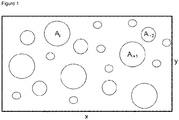
- Figure 1 Illustration of the evaluation method of the micrographs obtained in the Examples.
- a o is the product of x and y, whereas A i is the total area sum of all bubbles present in the micrograph.
- the first object of the present invention is an aqueous cosmetic cleansing and/or conditioning composition having a pH in the range of 1 to 7 characterized in that it comprises:
- the second object of the invention is a method for cleansing and/or conditioning of keratin fibers, preferably human keratin fibers, more preferably human hair, characterized in that a composition as defined above is applied onto keratin fibers, massaged for 10 s to 300 s, and rinsed-off with water.
- the third object of the invention is a use of a composition as defined above as deposition aid of hair direct dyes onto keratin fibers, preferably human keratin fibers, more preferably human hair.
- a further object of the present invention is a kit-of-parts comprising the composition as defined above.
- the composition has a pH in the range of 2 to 6, preferably in the range of 3 to 5, more preferably in the range of 3.5 to 4.5.
- Suitable fatty alcohols having a linear or branched, saturated or unsaturated carbon chain length of C 12 -C 22 are, for example, lauryl alcohol, tridecyl alcohol, myristyl alcohol, pentadecyl alcohol, cetyl alcohol, palmitoleyl alcohol, heptadecyl alcohol, stearyl alcohol, oleyl alcohol, nonadecyl alcohol, arachidyl alcohol, behenyl alcohol, and/or their mixtures, in particular cetearyl alcohol.
- the composition comprises fatty alcohols at a total concentration in the range of usually 0.5% to 10% by weight, preferably 1% to 8% by weight, more preferably 2% to 6% by weight, calculated to the total of the composition.
- Fatty alcohols within the meaning of the present invention are not considered as surfactants.
- Suitable surfactants having one or more positively charged group(s) at a pH below 7 are selected from cationic and/or cationizable and/or zwitterionic/amphoteric surfactants, and/or their salt(s).
- Suitable cationic surfactants are of quaternary ammonium structure according to the following general structure
- R 3 and R 4 have an alkyl chain with C 1 to C 4 , and X - is typically chloride, bromide, or methosulfate.
- Typical examples of those ingredients are cetyl trimethyl ammonium chloride, stearyl trimonium chloride, dipalmitoyl dimonium chloride, distearyl dimethyl ammonium chloride, stearamidopropyl trimethyl ammonium chloride, dioleoylethyl dimethyl ammonium methosulfate, dioleoylethyl hydroxyethylmonium methosulfate, behenyl trimethyl ammonium chloride, and/or their mixtures.
- Suitable cationizable surfactants are surfactants which carry one or more chemical group(s) that is/are at least at some point non-ionic at pH above 7, but which is/are positively charged at a pH under 7.
- groups are, for example, primary, secondary, and tertiary amino groups. It is well known to the skilled reader that the aforementioned groups are becoming ammonium groups at a pH below 7.
- Suitable cationizable surfactants are, for example, according to the following general structure where R 8 is a saturated or unsaturated, straight or branched alkyl chain, optionally modified with ethoxylate and/or propxylate groups, with C 12 to C 22 , R 9 is selected from H or straight or branched alkyl with C 1 to C 4 , and R 10 is selected from H or straight or branched alkyl with C 1 to C 4 .
- Suitable compounds according to this structure are, for example, dodecylamine, tridecylamine, tetradecylamine, pentadecylamine, stearylamine, octylamine, oleylamine, behenylamine, stearyl methylamine, stearyl dimethylamine, octyl methylamine, octyl dimethylamine, behenyl methylamine, behenyl dimethylamine, stearyl ethylamine, stearyl ethylamine, octyl ethylamine, octyl ethylamine, behenyl ethylamine, behenyl ethylamine, behenyl ethylamine, stearyl propylamine, stearyl dipropylamine, octyl propylamine, octyl dipropylamine, behenyl propylamine,
- alkyl amido alkyl amine surfactants are known as alkyl amido alkyl amine surfactants and/or their salt(s) and are according to the following general structure where R 11 is a saturated or unsaturated, straight or branched alkyl chain with C 11 to C 21 , R 12 is a straight or branched alkyl chain with C 1 to C 6 , R 13 and R 14 may be the same of different selected from H and straight or branched alkyl chain with C 1 to C 4 .
- Suitable compounds according to this definition are, for example, cocamidopropyl dimethylamine, stearamidopropyl dimethylamine, behenamidopropyl dimethylamine, and/or their salt(s).
- amphoteric/zwitterionic surfactants may be selected from compounds according to the general structure(s) wherein R 15 is a straight or branched, saturated or unsaturated, substituted or unsubstituted alkyl chain with a carbon number of C 10 to C 22 , preferably R 15 is a straight alkyl chain with a carbon number of C 10 to C 16 , A is a straight alkyl chain with a carbon number of C 1 to C 6 or a branched alkyl chain with a carbon number of C 3 to C 6 , preferably A is a linear alkyl chain with a carbon number of C 3 , and B is an amide or an ester group.
- Suitable compounds are known as hydroxysultaine surfactants, such as cocoamidopropyl hydroxysultaine, laurylamidopropyl hydroxysultaine, erucamidopropyl hydroxysultaine, lauryl hydroxysultaine, and cocoyl hydroxysultaine, and/or their salt(s).
- amphoteric/zwitterionic surfactants are of betaine type.
- Suitable compounds may be selected from alkyl betaines and/or alkylamido betaines.
- a preferred compound selected from alkyl betaines is lauryl betaine.
- a preferred compound selected from alkylamido betaines is cocamidopropyl betaine.
- the disclosure also relates to the salts of the compounds.
- the preferred surfactant(s) having one or more positively charged group(s) at a pH below 7 of the composition according to the present invention is/are selected from quaternary ammonium surfactant(s) and its/their salt(s), alkyl amido alkyl amine surfactant(s) and its/their salt(s), amphoteric/zwitterionic surfactants and/or its/their salt(s), and/or their mixtures.
- the total concentration of surfactants having one or more positively charged group(s) at a pH below 7 is usually in the range of 0.5% to 3% by weight, preferably 0.75% to 2% by weight, and more preferably 1% to 1.5% by weight, calculated to the total of the composition.
- composition of the present invention further comprises a first non-ionic surfactant selected from N-alkylpolyhydroxyalkylamide type surfactants according to the following general formula: wherein R 16 is a linear or branched, saturated or unsaturated alkyl chain with C 11 to C 21 , R 17 is linear or branched alkyl, or linear or branched hydroxyalkyl with C 1 to C 4 , and R 18 is a linear or branched polyhydroxyalkyl chain with C 3 to C 12 and 3 to 10 hydroxyl groups.
- a first non-ionic surfactant selected from N-alkylpolyhydroxyalkylamide type surfactants according to the following general formula: wherein R 16 is a linear or branched, saturated or unsaturated alkyl chain with C 11 to C 21 , R 17 is linear or branched alkyl, or linear or branched hydroxyalkyl with C 1 to C 4 , and R 18 is a linear or branched polyhydroxyalkyl chain with C 3 to
- Such compounds are disclosed in cosmetic compositions in WO96/27366 and their synthesis is disclosed in US1985424 , US2016962 , US2703798 , and WO92/06984 .
- the preferred N-alkylpolyhydroxyalkylamide type surfactants have the following structure: where R 16 has the same denotation as above for the general structure of N-alkylpolyhydroxyalkylamide type surfactants.
- the preferred surfactants as displayed above are known as N-methyl-N-acylglucamides.
- N-alkylpolyhydroxyalkylamide type surfactants are selected from lauroyl/myristoyl methyl glucamide and coco methyl glucamide.
- non-ionic surfactants different form the first non-ionic surfactant and the C 12 -C 22 fatty alcohols as specified above are suitable for the purpose of the present invention.
- Suitable nonionic surfactants are alkyl polyglycosides according to the general structure: R 23 O(R 24 O) t Z x
- Z denotes a carbohydrate with C 5 to C 6
- R 23 is an alkyl group with C 8 to C 18
- R 24 is methyl, ethyl or propyl
- t ranges from 0 to 10
- x ranges from 1 to 5.
- Suitable compounds according to this structure are C 9 -C 11 alkylpolyglycoside, the structures disclosed in EP-A 70 074 , and JP 2015-123019A .
- decyl glucoside lauryl glucoside, and coco glucoside
- decyl glucoside the most preferred one is decyl glucoside.
- non-ionic surfactants are fatty alcohol ethoxylates of the following general structure R 25 (OCH 2 CH 2 ) n4 OH wherein R 25 is straight or branched, saturated or unsaturated alkyl chain which may be synthetic or natural with a C chain length in the range of 8 to 40, preferably 9 to 30 and more preferably 9 to 24 and n4 is a number in the range of 5 to 40, preferably 9 to 30.
- Non-limiting suitable examples of the fatty alcohol ethoxylates are C9-11 Pareth-6, C9-11 Pareth-8, C9-15 Pareth-8, C11-13 Pareth-9, C11-13 Pareth-10, C11-15 Pareth-5, C11-15 Pareth-7, C11-15 Pareth-9, C11-15 Pareth-12, C11-15 Pareth-15, C11-15 Pareth-20, C11-15 Pareth-30, C11-15 Pareth-40, C11-21 Pareth-10, C12-13 Pareth-5, C12-13 Pareth-6, C12-13 Pareth-7, C12-13 Pareth-9, C12-13 Pareth-10, C12-13 Pareth-15, C12-13 Pareth-23, C12-14 Pareth-5, C12-14 Pareth-7, C12-14 Pareth-9, C12-14 Pareth-11, C12-14 Pareth-12, C12-15 Pareth-5, C12-15 Pareth-7, C12-15 Pareth-9, C12-15 Par
- nonionic surfactants are polypropylene glycol ethers of fatty alcohol according to general structure R 25 (OCH 2 -CH 2 -CH 2 ) n5 OH wherein R 25 is straight or branched, saturated or unsaturated fatty alcohol which may be synthetic or natural with a C chain length in the range of 8 to 40, preferably 9 to 30 and more preferably 9 to 24 and n5 is a number in the range of 1 to 40, preferably 3 to 30.
- Suitable non-limiting examples are PPG-3 Caprylyl ether, PPG-5 Caprylyl ether, PPG-10 Caprylyl ether, PPG-10 Cetyl ether, PPG-20 Cetyl ether, PPG-28 Cetyl ether, PPG-30 Cetyl ether, PPG-7 Lauryl ether, PPG-10 Lauryl ether, PPG-10 Oleyl ether, PPG-20 Oleyl ether, PPG-23 Oleyl ether, PPG-30 Oleyl ether, PPG-11 Stearyl ether and PPG-15 Stearyl ether.
- nonionic surfactants are polyethylene glycol fatty acid esters of the following general structure R 26 C(O) (OCH 2 CH 2 ) n6 OH wherein R 26 is straight or branched, saturated or unsaturated alkyl group which may be synthetic or natural with a C chain length in the range of 7 to 39, preferably 9 to 29 and more preferably 9 to 23 and n6 is a number in the range of 5 to 40, preferably 9 to 30.
- Suitable non-limiting examples are PEG-8 Behenate, PEG-8 Caprate, PEG-8 Caprylate, PEG-5 Cocoate, PEG-8 Cocoate, PEG-9 Cocoate, PEG-10 Cocoate, PEG-15 Cocoate, PEG-6 Isopalmitate, PEG-6 Isostearate, PEG-8 Isostearate,
- nonionic surfactants are polypropylene glycol fatty acid esters of the following general structure R 27 C(O) (OCH 2 -CH 2 -CH 2 ) n8 OH wherein R 27 is straight or branched, saturated or unsaturated alkyl group which may be synthetic or natural with a C chain length in the range of 7 to 39, preferably 9 to 29 and more preferably 9 to 23 and n8 is a number in the range of 1 to 40, preferably 9 to 30.
- Suitable non-limiting examples are PPG-15 Isostearate, PPG-9 Laurate, PPG-26 Oleate and PPG-36 Oleate.
- nonionic surfactants are polyethylene glycol and polypropylene glycol ether of fatty alcohols of the following general structure R 28 (OCH 2 -CH 2 -CH 2 ) n9 (OCH 2 CH 2 ) n10 OH wherein R 28 is straight or branched, saturated or unsaturated alkyl group which may be synthetic or natural with a C chain length in the range of 7 to 39, preferably 9 to 29 and more preferably 9 to 23 and n9 and n10 may be the same or different and are a number in the range of 1 to 40.
- nonionic surfactants are ethoxylated vegetable oils.
- ethoxylated vegetable oils such as PEG-40 hydrogenated castor oil or and PEG-60 hydrogenated castor oil.
- composition of the present invention preferably comprises a second non-ionic surfactant selected from alkyl polyglycoside(s), ethoxylated and/or propoxylated fatty alcohols, ethoxylated and/or propoxylated vegetable oils, preferably they are selected from C 8 -C 22 alkyl polyglycoside(s), more preferably they are selected from decyl glucoside, lauryl glucoside, and coco glucoside, and further more preferably it is decyl glucoside.
- a second non-ionic surfactant selected from alkyl polyglycoside(s), ethoxylated and/or propoxylated fatty alcohols, ethoxylated and/or propoxylated vegetable oils, preferably they are selected from C 8 -C 22 alkyl polyglycoside(s), more preferably they are selected from decyl glucoside, lauryl glucoside, and coco glucoside, and further more preferably it
- the total concentration of non-ionic surfactants is in the range of 0.1% to 7.5% by weight, preferably 0.5% to 5% by weight, more preferably 0.75% to 3% by weight, calculated to the total of the composition.
- composition of the present invention comprises the first non-ionic surfactant to second non-ionic surfactant at a weight ratio in the range of usually 10 to 0.1, preferably 8 to 0.2, and more preferably 6 to 0.25.
- composition may further comprise linear and/or cyclic non-aminated silicones and/or non-aminated siliconols.
- Suitable non-aminated silicones and/or non-aminated siliconols are dimethicone, dimethiconol, polydimethylsiloxane (DC fluid ranges from Dow Corning), arylated silicones such as phenyl methicone, phenyl trimethicone, diphenyl dimethicone, diphenylsiloxy phenyl trimethicone, tetramethyl tetraphenyl trisiloxane, triphenyl trimethicone, and trimethyl pentaphenyl trisiloxane, aqueous emulsions of divinyldimethicone/dimethicone copolymer, preferably with a viscosity of higher than 1 x 10 8 mm 2 /s, more preferably higher than 1.1 x 10 8 mm 2 /s measured at 0.01 Hz and at 20°C with a Brookfield viscometer and an appropriate spindle.
- composition may further comprise aminosilicone(s), preferably selected from a compound according to the general structure
- R 31 is selected from OH, OCH 3 , and/or O-Si-(CH 3 ) 3
- R 32 is selected from CH 3 , OCH 3 , O-(Si-(CH 3 ) 2 )x-R 33 , and/or O-Si-(CH 3 ) 3 , with the provision that if R 31 or R 32 are selected from O-Si-(CH 3 ) 3 , then all other R 32 or R 33 are selected from O-Si-(CH 3 ) 3 and/or OCH 3
- x is an integer from 1 to 200.
- m and n15 are integer numbers independently of each other and in the range of 1 to 200.
- composition of the present invention comprises one or more silicone compound(s) at a total concentration in the range of usually 0.01% to 1% by weight, preferably it is 0.1% to 0.5% by weight, calculated to the total of the composition.
- composition of the present invention may comprise a cationic conditioning polymer.
- Suitable cationic polymers are those of best known with their INCI category name Polyquaternium.
- cationic cellulose type polymers known as Polymer JR type from Amerchol such as Polyquaternium 10 or cationic galactomannans such as cationic guar gum known with trade name Jaguar from Rhone-Poulenc which are chemically for example guar hydroxypropyl trimonium chloride and cationic tara gum and its derivatives known with INCI name Caesalpinia spinosa hydroxypropyltrimonium chloride, are preferred ones.
- chitosan and chitin can also be included in the compositions as cationic natural polymers.
- the most preferred cationic polymers are those of cationic cellulose derivatives, cationic guar gum derivatives, cationic Caesalpinia spinosa gum derivatives, polyquaternium 6, polyquaternium 7, polyquaternium 10, polyquaternium 37, polyquaternium 67 and polyquaternium 70.
- the cationic polymers also include the quaternized products of graft polymers from organopolysiloxanes and polyethyl oxazolines described in EP-A 524 612 and EP-A 640 643 .
- Compositions may comprise cationic polymer at a concentration of usually 0.01 to 5%, preferably 0.02 to 4%, more preferably 0.05 to 3% and most preferably 0.1 to 2.5% by weight, calculated to the total of the composition.
- composition of the present invention may further comprise anionic cleansing surfactants.
- the total concentration of anionic cleansing surfactants in the composition of the present invention is in the range of usually 0.01% by weight to 2% by weight, preferably in the range of 0.1% to 1% by weight, more preferably in the range of 0.15% to 0.75% by weight.
- Suitable anionic cleansing surfactants are alkyl sulfate or preferably ethoxylated alkyl ether sulfate surfactant or mixtures thereof with an alkyl chain length of C 10 to C 22 .
- Suitable surfactants are laureth sulfates, coceth sulfate, pareth sulfate, capryleth sulphate, myreth sulfate, oleth sulfate, deceth sulfate, trideceth sulfate, coco sulphate, C 10 -C 16 alkyl sulphate, C 11 -C 15 alkyl sulphate, C 12 -C 18 alkyl sulphate, C 12 -C 15 alkyl sulphate, C 12 -C 16 alkyl sulphate, C 12 -C 13 alkyl sulfate, lauryl sulphate, myrystyl sulphate, palm kernel sulphate, cetearyl sulfate, cetyl sulphate, decyl sulphate, oleyl sulphate, behenyl sulphate and/or their salts. All of the aforementioned ani
- Cations for the surfactants may be selected from sodium, potassium, magnesium and/or ammonium.
- the most suitable anionic cleansing surfactant is sodium laureth sulfate with 1-5 ethylene oxide units.
- the composition is free of anionic cleansing surfactants.
- composition of the present invention further may comprise one or more thickening agent(s), preferably selected from thickening polymers, more preferably from associative and/or non-associative thickening polymers.
- thickening agent(s) preferably selected from thickening polymers, more preferably from associative and/or non-associative thickening polymers.
- the composition comprises one or more thickening polymers selected from anionic, nonionic, cationic and amphoteric polymers, preferably selected from polymers resulting in a solution and/or dispersion with a viscosity of at least 500 mPa•s measured at a polymer concentration of 1% by weight in water and at 20°C with a Brookfield viscometer and spindle 4, such as at 10 rpm for 1 min.
- thickening polymers selected from anionic, nonionic, cationic and amphoteric polymers, preferably selected from polymers resulting in a solution and/or dispersion with a viscosity of at least 500 mPa•s measured at a polymer concentration of 1% by weight in water and at 20°C with a Brookfield viscometer and spindle 4, such as at 10 rpm for 1 min.
- Suitable polymers are cellulose polymers, alginates, polysaccharides and acrylic acid polymers, preferably methyl cellulose, ethyl cellulose, hydroxyethylcellulose, methylhydroxyethylcellulose, methylhydroxypropylcellulose, carboxymethyl cellulose, alginic acids, sodium alginates, ammonium alginates, calcium alginates, gum arabic, guar gum or xanthan gum, dehydroxanthan gum or acrylic acid polymers known with the CTFA adopted name Carbomer and its derivatives.
- the preferred polymers are dehydroxanthan gum, xanthan gum, and polymeric anionic thickeners, namely Carbomer and its derivatives.
- thickeners which are commonly known as associative thickeners.
- copolymers and/or crosspolymers which comprise an acrylate and/or methacrylate monomer unit and at least one more hydrophobic unit such as alkyl chains.
- examples are acrylates/c10-30 alkyl acrylate crosspolymer, acrylates/steareth-20 methacrylate copolymer, acrylates/stearyl acrylate/dimethicone methacrylate copolymer, acrylates/beheneth-25 methacrylate copolymer, acrylates/lauryl acrylate/stearyl acrylate/ ethylamine oxide methacrylate copolymer.
- the composition preferably comprises thickening agents at a total concentration in the range of usually 0.1% to 5%, preferably, 0.2% to 3%, more preferably 0.25% to 2.5% and most preferably 0.3% to 2% by weight calculated to the total of the composition.
- the viscosity of the composition of the present invention may be adjusted to a viscosity usually in the range of 10,000 mPas to 50,000 mPas, preferably in the range of 12,000 mPas to 40,000 mPas, more preferably in the range of 15,000 mPas to 30,000 mPas, measured with a Brookfield viscometer at 10 rpm with spindle number 4 at 20°C.
- composition may further comprise hair direct dyes selected from cationic and/or non-ionic hair direct dyes.
- Suitable cationic dyes are in principle those available on the market for cosmetic hair colouring applications.
- PCT application WO 95/15144 of Ciba-Geigy AG Some examples to those are Basic Blue 6, Basic Blue 7, Basic Blue 9, Basic Blue 26, Basic Blue 41, Basic Blue 99, Basic Brown 4, Basic Brown 16, Basic Brown 17, Natural Brown 7, Basic Green 1, Basic Red 2, Basic Red 12 Basic Red 22, Basic Red 76, Basic Violet 1, Basic Violet 2, Basic Violet 3, Basic Violet 10, Basic Violet 14, Basic Yellow 57, Basic red 51, Basic Yellow 87, HC Blue 17 and Basic Orange 31.
- the most preferred ones are Basic red 51, Basic Yellow 87 and Basic Orange 31 sold by BASF, HC Blue 17, Basic Blue 124.
- Suitable neutral dyes including nitro dyes are HC Blue No.2, HC Blue No.4, HC Blue No.5, HC Blue No.6, HC Blue No.7, HC Blue No.8, HC Blue No.9, HC Blue No.10, HC Blue No.11, HC Blue No.12, HC Blue No.13, HC Brown No.1, HC Brown No.2, HC Green No.1, HC Orange No.1, HC Orange No.2, HC Orange No.3, HC Orange No.5, HC Red BN, HC Red No.1, HC Red No.3, HC Red No.7, HC Red No.8, HC Red No.9, HC Red No.10, HC Red No.11, HC Red No.13, HC Red No.54, HC Red No.14, HC Violet BS, HC Violet No.1, HC Violet No.2, HC Yellow No.2, HC Yellow No.4, HC Yellow No.5, HC Yellow No.6, HC Yellow No.7, HC Yellow No.8,
- the composition may comprise one or more hair direct dye(s) at a total concentration of usually 0.001% to 10% by weight, preferably 0.005% to 7.5% by weight, and more preferably 0.01% to 5% by weight, calculated to the total of the composition.
- the composition can also comprise a mixture of several direct dyes, i.e. a cationic and/or nonionic hair direct dyes. In such a case the dyes may be mixed at any ratio with each other.
- compositions were prepared by conventional formulation techniques: Ingredient Inventive comp. 1 [% by weight] Inventive comp. 2 [% by weight] Comparative comp. 1 [% by weight] Comparative comp. 2 [% by weight] Cetearyl alcohol 6.0 6.0 6.0 Cetrimonium chloride 1.5 1.5 1.5 1.5 Decyl glucoside 1.5 - 3.0 - Lauryl glucoside - 2.0 - - Lauroyl/myristoyl methyl glucamide 1.5 - - 3.0 Coco methyl glucamide - 1.0 - - Water Ad 100.0
- the pH of the compositions was adjusted to 4.5 with lactic acid.
- Viscosities of the compositions were measured with a Brookfield viscometer with spindle 4 at 20°C.
- Inventive compositions 1 and 2 had viscosities in the range of 10,000 mPas to 20,000 mPas, whereas the comparative compositions had viscosities in the range of 5,000 mPas to less than 10,000 mPas.
- compositions from above were then diluted with water in a ratio of 1:10 for foam analysis.
- 100 mL of the diluted compositions were foamed for 30 s with a paddle stirrer (500 rpm) in a 800 mL glass beaker.
- the resulting foam was collected on a microscope glass slide and allowed to settle for 5 min.
- the foam was then observed under a microscope at 10 x magnification and micrographs were recorded.
- the resulting micrographs are planar projections of a 3D foam.
- the micrographs were then further analyzed with Imagej software wherein the diameter d of the foam bubbles in the micrograph was determined.
- each foam bubble receives an area and a serial index i.
- the rectangular area of the micrograph was measured and assigned a value A o , wherein A o is the product of x and y as displayed in Fig. 1 and refers to the total area of the micrograph.
- a o is the product of x and y as displayed in Fig. 1 and refers to the total area of the micrograph.
- the evaluated micrograph area A o was 8 mm 2 and kept exactly the same between the treatment groups.
- the LTF was found to be above 5 for the inventive compositions and below 2 for the comparative compositions.
- a high LTF corresponds to a large laminar area between small foam bubbles.
- the inventive compositions had such large areas which are associated with high foam stability and high creaminess.
- composition according to the invention was prepared: % by weight Behenyl alcohol 10.0 Behentrimonium chloride 1.5 Coco glucoside 2.25 Lauroyl/myristoyl methyl glucamide 0.75 Stearylamidopropyl-dimethylamine 0.5 Hydroxyethylcellulose 0.25 Basic Red 51 0.15 Polyquaternium 10 0.50 Sodium chloride 1.0 Water ad 100.0
- the pH of the composition is adjusted to 3.5 with malic acid.
- the pH of the composition is adjusted to 5.5 with glyoxylic acid.
- the pH of the composition is adjusted to 3.5 with lactic acid.
- Behenyl alcohol 8.0 Behentrimonium chloride 1.5 Coco glucoside 0.75 Lauroyl/myristoyl methyl glucamide 2.25 Stearylamidopropyl-dimethylamine 0.5 Hydroxyethylcellulose 0.25 Basic Yellow 87 0.15 Polyquaternium 10 0.50 Sodium chloride 1.0 Water ad 100.0
- the pH of the composition is adjusted to 3.5 with lactic acid.
- the pH of the composition is adjusted to 3.5 with citric acid.
- the pH of the composition is adjusted to 4.5 with lactic acid.
Landscapes
- Health & Medical Sciences (AREA)
- Life Sciences & Earth Sciences (AREA)
- Animal Behavior & Ethology (AREA)
- General Health & Medical Sciences (AREA)
- Public Health (AREA)
- Veterinary Medicine (AREA)
- Birds (AREA)
- Epidemiology (AREA)
- Dermatology (AREA)
- Emergency Medicine (AREA)
- Cosmetics (AREA)
Abstract
Description
- The present invention is directed to the field of cleansing and conditioning of keratin fibers. A composition, method for cleansing and conditioning, use of a composition, and kit-of-parts is disclosed.
- Early cosmetic products used to be very simple, often comprising only few, mostly natural ingredients. They showed more or less elevated performances and were developed to fulfil one particular need. Multifunctional products were rare or resulted in compromises regarding their main purposes. Consistency or use experience did not play a role, but performance was the main target of such products.
- Nowadays, consumers demand products with features beyond pure functionality. Therefore, product performance is expected to reach beyond the pure technical need such as cleansing. Consumers desire to experience a special effect during application. Relaxation, spoiling and spa feelings at home play a more and more important role when consumers choose products according to their personal taste.
- There always has been a disparity between cleansing products which foam during cleansing and conditioning products which improve the cosmetic properties of keratin fibers, but often lack surprising foam. 2 in 1 cleansing conditioning products are well established on the market, but they are often impaired in their conditioning properties while providing a less creamy feel and less conditioning performance than pure conditioning products.
- In
WO2013/178701 conditioning compositions for hair are disclosed which comprise fatty alcohol, cationic surfactant, and N-alkylpolyhydroxyalkylamide type surfactants as non-ionic surfactant. However, the document is silent on cleansing conditioning compositions comprising a second non-ionic surfactant which results in improved cleansing properties without diminishing the conditioning properties. - Pure conditioning products (Mintel #4886209) comprising cationic surfactant, alkyl polyglycoside, and fatty alcohol are known, but they lack N-alkylpolyhydroxyalkylamide type surfactants and are not used for cleansing hair. Cleansing conditioners with similar ingredients are known (Mintel #4113911), but they still lack N-alkylpolyhydroxyalkylamide type surfactants and have less conditioning properties.
- The inventors of the present invention have unexpectedly found that the combination of fatty alcohols, at least two different non-ionic surfactants, and surfactants having at least one positively charged group below pH 7 yield a composition which provides cleansing and conditioning benefits to keratin fibers while delivering excellent foam in terms of creaminess and stability. Despite consumer's experience, the resulting foams are characterized by a large laminal area and a high laminar thickness factor (ratio of area of foam bubbles to total micrograph area) which is visible under the microscope wherein the inventive compositions deliver a laminar thickness factor of at least 5. In contrast to pure cleansing compositions, the compositions according to the present invention act as deposition aid for hair direct dyes onto keratin fibers. Thus, the inventive composition possesses self-evident multifunctional properties such as cleansing and conditioning but also fulfils the desire of consumers to feel, see and experience the next level of foam creaminess. This experience is directly connected to positive emotions and thus highly appreciated in new personal care and especially hair care formulations.
-
Figure 1 : Illustration of the evaluation method of the micrographs obtained in the Examples. Ao is the product of x and y, whereas Ai is the total area sum of all bubbles present in the micrograph. - The first object of the present invention is an aqueous cosmetic cleansing and/or conditioning composition having a pH in the range of 1 to 7 characterized in that it comprises:
- one or more fatty alcohol(s) having a linear or branched, saturated or unsaturated carbon chain length of C12-C22,
- one or more surfactant(s) having one or more positively charged group(s) at a pH below 7,
- a first non-ionic surfactant selected from N-alkylpolyhydroxyalkylamide type surfactants,
- a second non-ionic surfactant being different from the first non-ionic surfactant and being different from fatty alcohols,
- The second object of the invention is a method for cleansing and/or conditioning of keratin fibers, preferably human keratin fibers, more preferably human hair, characterized in that a composition as defined above is applied onto keratin fibers, massaged for 10 s to 300 s, and rinsed-off with water.
- The third object of the invention is a use of a composition as defined above as deposition aid of hair direct dyes onto keratin fibers, preferably human keratin fibers, more preferably human hair.
- A further object of the present invention is a kit-of-parts comprising the composition as defined above.
- It is a preferred embodiment of the present invention that the composition has a pH in the range of 2 to 6, preferably in the range of 3 to 5, more preferably in the range of 3.5 to 4.5.
- Suitable fatty alcohols having a linear or branched, saturated or unsaturated carbon chain length of C12-C22 according to the present invention are, for example, lauryl alcohol, tridecyl alcohol, myristyl alcohol, pentadecyl alcohol, cetyl alcohol, palmitoleyl alcohol, heptadecyl alcohol, stearyl alcohol, oleyl alcohol, nonadecyl alcohol, arachidyl alcohol, behenyl alcohol, and/or their mixtures, in particular cetearyl alcohol.
- The composition comprises fatty alcohols at a total concentration in the range of usually 0.5% to 10% by weight, preferably 1% to 8% by weight, more preferably 2% to 6% by weight, calculated to the total of the composition.
- Fatty alcohols within the meaning of the present invention are not considered as surfactants.
- Suitable surfactants having one or more positively charged group(s) at a pH below 7 are selected from cationic and/or cationizable and/or zwitterionic/amphoteric surfactants, and/or their salt(s).
- Suitable cationic surfactants are of quaternary ammonium structure according to the following general structure

- where R1 is a saturated or unsaturated, branched or linear alkyl chain with C8-C22 or
R5 CO NH (CH2)n
- where R5 is saturated or unsaturated, branched or linear alkyl chain with C7-C21 atoms and n has typical value of 1-4 or
R6 CO O (CH2)n
- where R6 is saturated or unsaturated, branched or linear alkyl chain with C7-C21 atoms and n has typical value of 1-4, and
- R2 is unsaturated or saturated, branched or linear alkyl chain with C1-C22 atoms or
R5 CO NH (CH2)n
or
R6 CO O (CH2)n
- where R5, R6 and n are same as above.
- R3 and R4 have an alkyl chain with C1 to C4, and X- is typically chloride, bromide, or methosulfate.
- Typical examples of those ingredients are cetyl trimethyl ammonium chloride, stearyl trimonium chloride, dipalmitoyl dimonium chloride, distearyl dimethyl ammonium chloride, stearamidopropyl trimethyl ammonium chloride, dioleoylethyl dimethyl ammonium methosulfate, dioleoylethyl hydroxyethylmonium methosulfate, behenyl trimethyl ammonium chloride, and/or their mixtures.
- Suitable cationizable surfactants are surfactants which carry one or more chemical group(s) that is/are at least at some point non-ionic at pH above 7, but which is/are positively charged at a pH under 7. Such groups are, for example, primary, secondary, and tertiary amino groups. It is well known to the skilled reader that the aforementioned groups are becoming ammonium groups at a pH below 7.
- Suitable cationizable surfactants are, for example, according to the following general structure

- Suitable compounds according to this structure are, for example, dodecylamine, tridecylamine, tetradecylamine, pentadecylamine, stearylamine, octylamine, oleylamine, behenylamine, stearyl methylamine, stearyl dimethylamine, octyl methylamine, octyl dimethylamine, behenyl methylamine, behenyl dimethylamine, stearyl ethylamine, stearyl ethylamine, octyl ethylamine, octyl ethylamine, behenyl ethylamine, behenyl ethylamine, stearyl propylamine, stearyl dipropylamine, octyl propylamine, octyl dipropylamine, behenyl propylamine, behenyl dipropylamine and/or their salts and/or their mixtures. The aforementioned compounds may be modified with ethoxylate and/or propoxylate groups.
- Further suitable cationizable surfactants are known as alkyl amido alkyl amine surfactants and/or their salt(s) and are according to the following general structure

- Suitable compounds according to this definition are, for example, cocamidopropyl dimethylamine, stearamidopropyl dimethylamine, behenamidopropyl dimethylamine, and/or their salt(s).
- Further suitable surfactants having one or more positively charged group(s) at a pH below 7 are amphoteric/zwitterionic surfactants. Amphoteric/zwitterionic surfactants may be selected from compounds according to the general structure(s)

- Suitable compounds are known as hydroxysultaine surfactants, such as cocoamidopropyl hydroxysultaine, laurylamidopropyl hydroxysultaine, erucamidopropyl hydroxysultaine, lauryl hydroxysultaine, and cocoyl hydroxysultaine, and/or their salt(s).
- Further suitable amphoteric/zwitterionic surfactants are of betaine type. Suitable compounds may be selected from alkyl betaines and/or alkylamido betaines. A preferred compound selected from alkyl betaines is lauryl betaine. A preferred compound selected from alkylamido betaines is cocamidopropyl betaine. The disclosure also relates to the salts of the compounds.
- It is to be noted that the skilled person can combine the surfactants from the classes of above to create suitable surfactant mixtures.
- The preferred surfactant(s) having one or more positively charged group(s) at a pH below 7 of the composition according to the present invention is/are selected from quaternary ammonium surfactant(s) and its/their salt(s), alkyl amido alkyl amine surfactant(s) and its/their salt(s), amphoteric/zwitterionic surfactants and/or its/their salt(s), and/or their mixtures.
- The total concentration of surfactants having one or more positively charged group(s) at a pH below 7 is usually in the range of 0.5% to 3% by weight, preferably 0.75% to 2% by weight, and more preferably 1% to 1.5% by weight, calculated to the total of the composition.
- The composition of the present invention further comprises a first non-ionic surfactant selected from N-alkylpolyhydroxyalkylamide type surfactants according to the following general formula:

-
- The preferred N-alkylpolyhydroxyalkylamide type surfactants have the following structure:

- The most preferred N-alkylpolyhydroxyalkylamide type surfactants are selected from lauroyl/myristoyl methyl glucamide and coco methyl glucamide.
- In principle, all non-ionic surfactants different form the first non-ionic surfactant and the C12-C22 fatty alcohols as specified above are suitable for the purpose of the present invention.
- Suitable nonionic surfactants are alkyl polyglycosides according to the general structure:
R23O(R24O)tZx
- Wherein Z denotes a carbohydrate with C5 to C6, R23 is an alkyl group with C8 to C18, R24 is methyl, ethyl or propyl, t ranges from 0 to 10, and x ranges from 1 to 5. Suitable compounds according to this structure are C9-C11 alkylpolyglycoside, the structures disclosed in
EP-A 70 074 JP 2015-123019A - The preferred compounds according to the structure of above are decyl glucoside, lauryl glucoside, and coco glucoside, and the most preferred one is decyl glucoside.
- Suitable examples for non-ionic surfactants are fatty alcohol ethoxylates of the following general structure
R25(OCH2CH2)n4OH
wherein R25 is straight or branched, saturated or unsaturated alkyl chain which may be synthetic or natural with a C chain length in the range of 8 to 40, preferably 9 to 30 and more preferably 9 to 24 and n4 is a number in the range of 5 to 40, preferably 9 to 30. - Non-limiting suitable examples of the fatty alcohol ethoxylates are C9-11 Pareth-6, C9-11 Pareth-8, C9-15 Pareth-8, C11-13 Pareth-9, C11-13 Pareth-10, C11-15 Pareth-5, C11-15 Pareth-7, C11-15 Pareth-9, C11-15 Pareth-12, C11-15 Pareth-15, C11-15 Pareth-20, C11-15 Pareth-30, C11-15 Pareth-40, C11-21 Pareth-10, C12-13 Pareth-5, C12-13 Pareth-6, C12-13 Pareth-7, C12-13 Pareth-9, C12-13 Pareth-10, C12-13 Pareth-15, C12-13 Pareth-23, C12-14 Pareth-5, C12-14 Pareth-7, C12-14 Pareth-9, C12-14 Pareth-11, C12-14 Pareth-12, C12-15 Pareth-5, C12-15 Pareth-7, C12-15 Pareth-9, C12-15 Pareth-10, C12-15 Pareth-11, C12-15 Pareth-12, C12-16 Pareth-5, C12-16 Pareth-7, C12-16 Pareth-9, C13-15 Pareth-21, C14-15 Pareth-7, C14-15 Pareth-8, C14-15 Pareth-11, C14-15 Pareth-12, C14-15 Pareth-13, C20-22 Pareth-30, C20-40 Pareth-10, C20-40 Pareth-24, C20-40 Pareth-40, C20-40 Pareth-95, C22-24 Pareth-33, Beheneth-5, Beheneth-10, Beheneth-15, Beheneth-20, Beheneth-25, Beheneth-30, Ceteareth-5, Ceteareth-6, Ceteareth-7, Ceteareth-10, Ceteareth-11, Ceteareth-12, Ceteareth-15, Ceteareth-20, Ceteareth-25, Ceteareth-30, Ceteareth-35, Ceteareth-40, Laureth-5, Laureth-10, Laureth-15, Laureth-20, Laureth-25, Laureth-30, Laureth-40, Myreth-5, Myreth-10, Ceteth-5, Ceteth-10, Ceteth-15, Ceteth-20, Ceteth-25, Ceteth-30, Ceteth-40, Oleth-5, Oleth-10, Oleth-15, Oleth-20, Oleth-25, Oleth-30, Oleth-40, Steareth-5, Steareth-10, Steareth-15, Steareth-20, Steareth-25, Steareth-30, Steareth-35, and Steareth-40. They may also be comprised in the compositions as a mixture of more than one surfactant.
- Further suitable nonionic surfactants are polypropylene glycol ethers of fatty alcohol according to general structure
R25(OCH2-CH2-CH2)n5OH
wherein R25 is straight or branched, saturated or unsaturated fatty alcohol which may be synthetic or natural with a C chain length in the range of 8 to 40, preferably 9 to 30 and more preferably 9 to 24 and n5 is a number in the range of 1 to 40, preferably 3 to 30. - Suitable non-limiting examples are PPG-3 Caprylyl ether, PPG-5 Caprylyl ether, PPG-10 Caprylyl ether, PPG-10 Cetyl ether, PPG-20 Cetyl ether, PPG-28 Cetyl ether, PPG-30 Cetyl ether, PPG-7 Lauryl ether, PPG-10 Lauryl ether, PPG-10 Oleyl ether, PPG-20 Oleyl ether, PPG-23 Oleyl ether, PPG-30 Oleyl ether, PPG-11 Stearyl ether and PPG-15 Stearyl ether.
- Further suitable nonionic surfactants are polyethylene glycol fatty acid esters of the following general structure
R26 C(O) (OCH2CH2)n6 OH
wherein R26 is straight or branched, saturated or unsaturated alkyl group which may be synthetic or natural with a C chain length in the range of 7 to 39, preferably 9 to 29 and more preferably 9 to 23 and n6 is a number in the range of 5 to 40, preferably 9 to 30. - Suitable non-limiting examples are PEG-8 Behenate, PEG-8 Caprate, PEG-8 Caprylate, PEG-5 Cocoate, PEG-8 Cocoate, PEG-9 Cocoate, PEG-10 Cocoate, PEG-15 Cocoate, PEG-6 Isopalmitate, PEG-6 Isostearate, PEG-8 Isostearate,
- PEG-9 Isostearate, PEG-10 Isostearate, PEG-12 Isostearate, PEG-20 Isostearate, PEG-30 Isostearate, PEG-40 Isostearate, PEG-6 Laurate, PEG-8 Laurate, PEG-9 Laurate, PEG-10 Laurate, PEG-12 Laurate, PEG-14 Laurate, PEG-20 Laurate, PEG-30 Laurate, PEG-8 Myristate, PEG-20 Myristate, PEG-5 Oleate, PEG-6 Oleate, PEG-7 Oleate, PEG-8 Oleate, PEG-9 Oleate, PEG-10 Oleate, PEG-11 Oleate, PEG-12 Oleate, PEG-15 Oleate, PEG-20 Oleate, PEG-30 Oleate, PEG-32 Oleate, PEG-6 Palmitate, PEG-18 Palmitate, PEG-20 Palmitate, PEG-5 Stearate, PEG-6 Stearate, PEG-7 Stearate, PEG-8 Stearate, PEG-9 Stearate, PEG-10 Stearate, PEG-12 Stearate, PEG-14 Stearate, PEG-15 Stearate, PEG-20 Stearate, PEG-25 Stearate, PEG-30 Stearate, PEG-35 Stearate and PEG-40 Stearate.
- Further suitable nonionic surfactants are polypropylene glycol fatty acid esters of the following general structure
R27 C(O) (OCH2-CH2-CH2)n8 OH
wherein R27 is straight or branched, saturated or unsaturated alkyl group which may be synthetic or natural with a C chain length in the range of 7 to 39, preferably 9 to 29 and more preferably 9 to 23 and n8 is a number in the range of 1 to 40, preferably 9 to 30. - Suitable non-limiting examples are PPG-15 Isostearate, PPG-9 Laurate, PPG-26 Oleate and PPG-36 Oleate.
- Further suitable nonionic surfactants are polyethylene glycol and polypropylene glycol ether of fatty alcohols of the following general structure
R28 (OCH2-CH2-CH2)n9 (OCH2CH2)n10 OH
wherein R28 is straight or branched, saturated or unsaturated alkyl group which may be synthetic or natural with a C chain length in the range of 7 to 39, preferably 9 to 29 and more preferably 9 to 23 and n9 and n10 may be the same or different and are a number in the range of 1 to 40. - Further suitable nonionic surfactants are ethoxylated vegetable oils. Well-known and commonly used examples are ethoxylated castor oil such as PEG-40 hydrogenated castor oil or and PEG-60 hydrogenated castor oil.
- The composition of the present invention preferably comprises a second non-ionic surfactant selected from alkyl polyglycoside(s), ethoxylated and/or propoxylated fatty alcohols, ethoxylated and/or propoxylated vegetable oils, preferably they are selected from C8-C22 alkyl polyglycoside(s), more preferably they are selected from decyl glucoside, lauryl glucoside, and coco glucoside, and further more preferably it is decyl glucoside.
- The total concentration of non-ionic surfactants is in the range of 0.1% to 7.5% by weight, preferably 0.5% to 5% by weight, more preferably 0.75% to 3% by weight, calculated to the total of the composition.
- The composition of the present invention comprises the first non-ionic surfactant to second non-ionic surfactant at a weight ratio in the range of usually 10 to 0.1, preferably 8 to 0.2, and more preferably 6 to 0.25.
- The composition may further comprise linear and/or cyclic non-aminated silicones and/or non-aminated siliconols.
- Suitable non-aminated silicones and/or non-aminated siliconols are dimethicone, dimethiconol, polydimethylsiloxane (DC fluid ranges from Dow Corning), arylated silicones such as phenyl methicone, phenyl trimethicone, diphenyl dimethicone, diphenylsiloxy phenyl trimethicone, tetramethyl tetraphenyl trisiloxane, triphenyl trimethicone, and trimethyl pentaphenyl trisiloxane, aqueous emulsions of divinyldimethicone/dimethicone copolymer, preferably with a viscosity of higher than 1 x 108 mm2/s, more preferably higher than 1.1 x 108 mm2/s measured at 0.01 Hz and at 20°C with a Brookfield viscometer and an appropriate spindle.
- The composition may further comprise aminosilicone(s), preferably selected from a compound according to the general structure

- Wherein R31 is selected from OH, OCH3, and/or O-Si-(CH3)3, R32 is selected from CH3, OCH3, O-(Si-(CH3)2)x-R33, and/or O-Si-(CH3)3, with the provision that if R31 or R32 are selected from O-Si-(CH3)3, then all other R32 or R33 are selected from O-Si-(CH3)3 and/or OCH3, and x is an integer from 1 to 200. m and n15 are integer numbers independently of each other and in the range of 1 to 200. Special reference is made to the aminosilicones sold by Wacker Corporation under the trade name Belsil ADM 6102E and Belsil ADM 8020VP, the ones sold by by Shin-Etsu Corp. under the trade name X-52-2265, and the ones sold by Dow Corning Corp. under the trade name DC 969.
- The composition of the present invention comprises one or more silicone compound(s) at a total concentration in the range of usually 0.01% to 1% by weight, preferably it is 0.1% to 0.5% by weight, calculated to the total of the composition.
- The composition of the present invention may comprise a cationic conditioning polymer.
- Suitable cationic polymers are those of best known with their INCI category name Polyquaternium.
- Typical examples of those are
Polyquaternium 1,Polyquaternium 2, Polyquaternium 4, Polyquaternium 5, Polyquaternium 6, Polyquaternium 7, Polyquaternium 8, Polyquaternium 9, Polyquaternium 10, Polyquaternium 11, Polyquaternium 12, Polyquaternium 13, Polyquaternium 14, Polyquaternium 15, Polyquaternium 16, Polyquaternium 17, Polyquaternium 18, Polyquaternium 19, Polyquaternium 20, Polyquaternium 22, Polyquaternium 24, Polyquaternium 27, Polyquaternium 28, Polyquaternium 29, Polyquaternium 30, Polyquaternium 31, Polyquaternium 32, Polyquaternium 33, Polyquaternium 34, Polyquaternium 35 and Polyquaternium 36, Polyquaternium-37, Polyquaternium 39, Polyquaternium 42, Polyquaternium 43, Polyquaternium 44, Polyquaternium 45, Polyquaternium 46, Polyquaternium 47, Polyquaternium 48, Polyquaternium 49, Polyquaternium 50, Polyquaternium 51, Polyquaternium 52, Polyquaternium 53, Polyquaternium 54, Polyquaternium 55, Polyquaternium 56, Polyquaternium 57, Polyquaternium 58, Polyquaternium 59, Polyquaternium 60, Polyquaternium 61, Polyquaternium 62, Polyquaternium 63, Polyquaternium 64, Polyquaternium 65, Polyquaternium 66, Polyquaternium 67, Polyquaternium 68, Polyquaternium 69, Polyquaternium-70, Polyquaternium 71, Polyquaternium 72, Polyquaternium 73, Polyquaternium 74, Polyquaternium 75, Polyquaternium 76, Polyquaternium 77, Polyquaternium 78, Polyquaternium-79, Polyquaternium 80, Polyquaternium 81, Polyquaternium 82, Polyquaternium 83, Polyquaternium 84, Polyquaternium 85, Polyquaternium 86, and Polyquaternium 87. - It has further been found out that especially those of cationic cellulose type polymers known as Polymer JR type from Amerchol such as Polyquaternium 10 or cationic galactomannans such as cationic guar gum known with trade name Jaguar from Rhone-Poulenc which are chemically for example guar hydroxypropyl trimonium chloride and cationic tara gum and its derivatives known with INCI name Caesalpinia spinosa hydroxypropyltrimonium chloride, are preferred ones. Furthermore, chitosan and chitin can also be included in the compositions as cationic natural polymers. In this context reference is also made to the cationic polymers disclosed in
DE 25 21 960 ,DE 28 11 010, 30 44 738 DE 32 17 059 , as well as to the products described inEP-A 337 354 - The most preferred cationic polymers are those of cationic cellulose derivatives, cationic guar gum derivatives, cationic Caesalpinia spinosa gum derivatives, polyquaternium 6, polyquaternium 7, polyquaternium 10, polyquaternium 37, polyquaternium 67 and polyquaternium 70.
- The cationic polymers also include the quaternized products of graft polymers from organopolysiloxanes and polyethyl oxazolines described in
EP-A 524 612 EP-A 640 643 - Compositions may comprise cationic polymer at a concentration of usually 0.01 to 5%, preferably 0.02 to 4%, more preferably 0.05 to 3% and most preferably 0.1 to 2.5% by weight, calculated to the total of the composition.
- In cases where a cationic silicone compound is added to the composition, the narrower concentration limitation for silicone compounds applies to the cationic silicone compounds as well.
- The composition of the present invention may further comprise anionic cleansing surfactants. The total concentration of anionic cleansing surfactants in the composition of the present invention is in the range of usually 0.01% by weight to 2% by weight, preferably in the range of 0.1% to 1% by weight, more preferably in the range of 0.15% to 0.75% by weight.
- Suitable anionic cleansing surfactants are alkyl sulfate or preferably ethoxylated alkyl ether sulfate surfactant or mixtures thereof with an alkyl chain length of C10 to C22.
- Suitable surfactants are laureth sulfates, coceth sulfate, pareth sulfate, capryleth sulphate, myreth sulfate, oleth sulfate, deceth sulfate, trideceth sulfate, coco sulphate, C10-C16 alkyl sulphate, C11-C15 alkyl sulphate, C12-C18 alkyl sulphate, C12-C15 alkyl sulphate, C12-C16 alkyl sulphate, C12-C13 alkyl sulfate, lauryl sulphate, myrystyl sulphate, palm kernel sulphate, cetearyl sulfate, cetyl sulphate, decyl sulphate, oleyl sulphate, behenyl sulphate and/or their salts. All of the aforementioned anionic surfactants may or may not be ethoxylated at various degrees.
- Cations for the surfactants may be selected from sodium, potassium, magnesium and/or ammonium.
- The most suitable anionic cleansing surfactant is sodium laureth sulfate with 1-5 ethylene oxide units.
- In a preferred embodiment of the composition of the present invention, the composition is free of anionic cleansing surfactants.
- The composition of the present invention further may comprise one or more thickening agent(s), preferably selected from thickening polymers, more preferably from associative and/or non-associative thickening polymers.
- In a preferred embodiment of the present invention, the composition comprises one or more thickening polymers selected from anionic, nonionic, cationic and amphoteric polymers, preferably selected from polymers resulting in a solution and/or dispersion with a viscosity of at least 500 mPa•s measured at a polymer concentration of 1% by weight in water and at 20°C with a Brookfield viscometer and spindle 4, such as at 10 rpm for 1 min.
- Suitable polymers are cellulose polymers, alginates, polysaccharides and acrylic acid polymers, preferably methyl cellulose, ethyl cellulose, hydroxyethylcellulose, methylhydroxyethylcellulose, methylhydroxypropylcellulose, carboxymethyl cellulose, alginic acids, sodium alginates, ammonium alginates, calcium alginates, gum arabic, guar gum or xanthan gum, dehydroxanthan gum or acrylic acid polymers known with the CTFA adopted name Carbomer and its derivatives.
- The preferred polymers are dehydroxanthan gum, xanthan gum, and polymeric anionic thickeners, namely Carbomer and its derivatives.
- Of particular advantageous use are thickeners which are commonly known as associative thickeners. Preferred are copolymers and/or crosspolymers which comprise an acrylate and/or methacrylate monomer unit and at least one more hydrophobic unit such as alkyl chains. Examples are acrylates/c10-30 alkyl acrylate crosspolymer, acrylates/steareth-20 methacrylate copolymer, acrylates/stearyl acrylate/dimethicone methacrylate copolymer, acrylates/beheneth-25 methacrylate copolymer, acrylates/lauryl acrylate/stearyl acrylate/ ethylamine oxide methacrylate copolymer.
- The composition preferably comprises thickening agents at a total concentration in the range of usually 0.1% to 5%, preferably, 0.2% to 3%, more preferably 0.25% to 2.5% and most preferably 0.3% to 2% by weight calculated to the total of the composition.
- The viscosity of the composition of the present invention may be adjusted to a viscosity usually in the range of 10,000 mPas to 50,000 mPas, preferably in the range of 12,000 mPas to 40,000 mPas, more preferably in the range of 15,000 mPas to 30,000 mPas, measured with a Brookfield viscometer at 10 rpm with spindle number 4 at 20°C.
- The composition may further comprise hair direct dyes selected from cationic and/or non-ionic hair direct dyes.
- Suitable cationic dyes are in principle those available on the market for cosmetic hair colouring applications. For this purpose, special reference is made to the
PCT application WO 95/15144 Basic Green 1,Basic Red 2, Basic Red 12 Basic Red 22, Basic Red 76,Basic Violet 1,Basic Violet 2, Basic Violet 3, Basic Violet 10, Basic Violet 14, Basic Yellow 57, Basic red 51, Basic Yellow 87, HC Blue 17 and Basic Orange 31. The most preferred ones are Basic red 51, Basic Yellow 87 and Basic Orange 31 sold by BASF, HC Blue 17, Basic Blue 124. - Suitable neutral dyes including nitro dyes are HC Blue No.2, HC Blue No.4, HC Blue No.5, HC Blue No.6, HC Blue No.7, HC Blue No.8, HC Blue No.9, HC Blue No.10, HC Blue No.11, HC Blue No.12, HC Blue No.13, HC Brown No.1, HC Brown No.2, HC Green No.1, HC Orange No.1, HC Orange No.2, HC Orange No.3, HC Orange No.5, HC Red BN, HC Red No.1, HC Red No.3, HC Red No.7, HC Red No.8, HC Red No.9, HC Red No.10, HC Red No.11, HC Red No.13, HC Red No.54, HC Red No.14, HC Violet BS, HC Violet No.1, HC Violet No.2, HC Yellow No.2, HC Yellow No.4, HC Yellow No.5, HC Yellow No.6, HC Yellow No.7, HC Yellow No.8, HC Yellow No.9, HC Yellow No.10, HC Yellow No.11, HC Yellow No.12, HC Yellow No.13, HC Yellow No.14, HC Yellow No.15, 2- Amino-6-chloro-4-nitrophenol, picramic acid, 1,2-Diamino-4-nitrobenzol, 1,4-Diamino-2-nitrobenzol, 3-Nitro-4-aminophenol, 1-Hydroxy-2-amino-3-nitrobenzol and 2-hydroxyethylpicramic acid.
- The composition may comprise one or more hair direct dye(s) at a total concentration of usually 0.001% to 10% by weight, preferably 0.005% to 7.5% by weight, and more preferably 0.01% to 5% by weight, calculated to the total of the composition. The composition can also comprise a mixture of several direct dyes, i.e. a cationic and/or nonionic hair direct dyes. In such a case the dyes may be mixed at any ratio with each other.
- The following examples are to illustrate the invention, but not to limit it.
- The following compositions were prepared by conventional formulation techniques:
Ingredient Inventive comp. 1 [% by weight] Inventive comp. 2 [% by weight] Comparative comp. 1 [% by weight] Comparative comp. 2 [% by weight] Cetearyl alcohol 6.0 6.0 6.0 6.0 Cetrimonium chloride 1.5 1.5 1.5 1.5 Decyl glucoside 1.5 - 3.0 - Lauryl glucoside - 2.0 - - Lauroyl/myristoyl methyl glucamide 1.5 - - 3.0 Coco methyl glucamide - 1.0 - - Water Ad 100.0 - The pH of the compositions was adjusted to 4.5 with lactic acid.
- Viscosities of the compositions were measured with a Brookfield viscometer with spindle 4 at 20°C.
Inventive compositions - The compositions from above were then diluted with water in a ratio of 1:10 for foam analysis. 100 mL of the diluted compositions were foamed for 30 s with a paddle stirrer (500 rpm) in a 800 mL glass beaker. The resulting foam was collected on a microscope glass slide and allowed to settle for 5 min. The foam was then observed under a microscope at 10 x magnification and micrographs were recorded. Thus, the resulting micrographs are planar projections of a 3D foam. The micrographs were then further analyzed with Imagej software wherein the diameter d of the foam bubbles in the micrograph was determined. Each foam bubble was then assigned a circular area Ai by using the equation

Fig. 1 where each foam bubble receives an area and a serial index i. Furthermore, the rectangular area of the micrograph was measured and assigned a value Ao, wherein Ao is the product of x and y as displayed inFig. 1 and refers to the total area of the micrograph. For the present experiments, the evaluated micrograph area Ao was 8 mm2 and kept exactly the same between the treatment groups. Then a Lamellar Thickness Factor (LTF) was calculated by the following equation:
- It is to be noted that a high LTF denoted stable, rich, and creamy foam whereas a low LTF denoted a less stable, rich, and creamy foam. The following results by using this method were obtained:
Paramter Inventive comp. 1 Inventive comp. 2 Comparative comp. 1 Comparative comp. 2 LTF 8.3 5.4 1.3 1.8 - As a result, the LTF was found to be above 5 for the inventive compositions and below 2 for the comparative compositions. A high LTF corresponds to a large laminar area between small foam bubbles. Thus, the inventive compositions had such large areas which are associated with high foam stability and high creaminess.
- The following composition according to the invention was prepared:
% by weight Behenyl alcohol 10.0 Behentrimonium chloride 1.5 Coco glucoside 2.25 Lauroyl/myristoyl methyl glucamide 0.75 Stearylamidopropyl-dimethylamine 0.5 Hydroxyethylcellulose 0.25 Basic Red 51 0.15 Polyquaternium 10 0.50 Sodium chloride 1.0 Water ad 100.0 - The pH of the composition is adjusted to 3.5 with malic acid.
- 2 g of the composition was applied onto bleached human keratin fibers, massaged for 60 s and then rinsed-off with water. The hair streak was then blow dried. As a result, the hair streak treated with the inventive composition was dyed intensively red, as judged by the naked human eye.
- The following examples are within the scope of the present invention.
-
% by weight Cetearyl alcohol 2.0 Behenamidopropyl-dimethylamine 1.0 Lauryl glucoside 1.0 Stearyl methyl glucamide 1.0 Acrylates/C10-C30 alkyl acrylate crosspolymer 0.10 Basic Yellow 87 0.25 Polyquaternium 37 0.50 EDTA tetrasodium salt 0.25 Phenoxyethanol 0.20 4-aminobenzoic acid 0.15 α-tocopherol 0.05 Sodium chloride 1.0 Water ad 100.0 - The pH of the composition is adjusted to 5.5 with glyoxylic acid.
-
% by weight Behenyl alcohol 5.0 Coco glucoside 2.25 Lauroyl/myristoyl methyl glucamide 0.75 Stearylamidopropyl-dimethylamine 0.5 Hydroxyethylcellulose 0.25 Basic Red 51 0.15 Polyquaternium 10 0.50 Sodium chloride 1.0 Water ad 100.0 - The pH of the composition is adjusted to 3.5 with lactic acid.
-
% by weight Behenyl alcohol 8.0 Behentrimonium chloride 1.5 Coco glucoside 0.75 Lauroyl/myristoyl methyl glucamide 2.25 Stearylamidopropyl-dimethylamine 0.5 Hydroxyethylcellulose 0.25 Basic Yellow 87 0.15 Polyquaternium 10 0.50 Sodium chloride 1.0 Water ad 100.0 - The pH of the composition is adjusted to 3.5 with lactic acid.
-
% by weight Cetearyl alcohol 5.0 Cocoamidopropyl betaine 2.5 Coco glucoside 0.75 Lauroyl/myristoyl methyl glucamide 2.0 Hydroxyethylcellulose 0.25 Basic Yellow 87 0.15 Polyquaternium 16 0.10 Sodium chloride 1.0 Water ad 100.0 - The pH of the composition is adjusted to 3.5 with citric acid.
-
% by weight Stearyl alcohol 10.0 Lauryl hydroxysultaine 2.0 Coco glucoside 1.0 Lauroyl/myristoyl methyl glucamide 1.5 Hydroxyethylcellulose 0.25 Basic Yellow 87 0.15 Polyquaternium 6 0.10 Sodium chloride 1.0 Water ad 100.0 - The pH of the composition is adjusted to 4.5 with lactic acid.
Claims (15)
- An aqueous cosmetic cleansing and/or conditioning composition having a pH in the range of 1 to 7 characterized in that it comprises:- one or more fatty alcohol(s) having a linear or branched, saturated or unsaturated carbon chain length of C12-C22,- one or more surfactant(s) having one or more positively charged group(s) at a pH below 7,- a first non-ionic surfactant selected from N-alkylpolyhydroxyalkylamide type surfactants,- a second non-ionic surfactant being different from the first non-ionic surfactant and being different from fatty alcohols,wherein the total concentration of first and second non-ionic surfactants is in the range of 0.1% to 7.5% by weight, preferably 0.5% to 5% by weight, more preferably 0.75% to 3% by weight, calculated to the total of the composition.
- The composition according to claim 1 characterized in that the total concentration of fatty alcohols is in the range of 0.5% to 10% by weight, preferably 1% to 8% by weight, more preferably 2% to 6% by weight, calculated to the total of the composition.
- The composition according to claims 1 and/or 2 characterized in that one or more surfactant(s) having one or more positively charged group(s) at a pH below 7 is/are selected from quaternary ammonium surfactant(s) and its/their salt(s), alkyl amido alkyl amine surfactant(s) and its/their salt(s), amphoteric/zwitterionic surfactant(s) and/or its/their salt(s), and/or their mixtures.
- The composition according to any of the preceding claims characterized in that the total concentration of surfactants having a net positive charge at a pH below 7 is in the range of 0.5% to 3% by weight, preferably 0.75% to 2% by weight, and more preferably 1% to 1.5% by weight, calculated to the total of the composition.
- The composition according to any of the preceding claims characterized in that the weight ratio of first non-ionic surfactant to second non-ionic surfactant is in the range of 10 to 0.1, preferably 8 to 0.2, and more preferably 6 to 0.25.
- The composition according to any of the preceding claims characterized in that the first non-ionic surfactant is selected from lauroyl/myristoyl methyl glucamide and/or coco methyl glucamide.
- The composition according to any of the preceding claims characterized in that second non-ionic surfactant is selected from alkyl polyglycoside(s), ethoxylated and/or propoxylated fatty alcohols, ethoxylated and/or propoxylated vegetable oils, preferably they are selected from C8-C22 alkyl polyglycoside(s), more preferably they are selected from decyl glucoside, lauryl glucoside, and coco glucoside, and further more preferably it is decyl glucoside.
- The composition according to any of the preceding claims characterized in that it comprises a cationic conditioning polymer and/or a silicone compound, and preferably the total concentration of silicone compounds is in the range of 0.01% to 1% by weight, preferably it is 0.1% to 0.5% by weight, calculated to the total of the composition.
- The composition according to any of the preceding claims characterized in that it comprises anionic cleansing surfactants at a concentration in the range of 0.01% by weight to 2% by weight, preferably in the range of 0.1% to 1% by weight, more preferably in the range of 0.15% to 0.75% by weight.
- The composition according to any of the preceding claims characterized in that it has a pH in the range of 2 to 6, preferably in the range of 3 to 5, more preferably in the range of 3.5 to 4.5.
- The composition according to any of the preceding claims characterized in that it comprises a thickening agent, preferably selected from thickening polymers, more preferably from associative and/or non-associative thickening polymers.
- The composition according to any of the preceding claims characterized in that it has a viscosity in the range of 10,000 mPas to 50,000 mPas, preferably in the range of 12,000 mPas to 40,000 mPas, more preferably in the range of 15,000 mPas to 30,000 mPas, measured with a Brookfield viscometer at 10 rpm with spindle number 4 at 20°C.
- The composition according to any of the preceding claims characterized in that it comprises hair direct dyes selected from cationic and/or non-ionic hair direct dyes.
- Method for cleansing and/or conditioning of keratin fibers, preferably human keratin fibers, more preferably human hair, characterized in that a composition as defined in the claims 1 to 13 is applied onto keratin fibers, massaged for 10 s to 300 s, and rinsed-off with water.
- Use of a composition as defined in the claims 1 to 13 as deposition aid for hair direct dyes on keratin fibers, preferably human keratin fibers, more preferably human hair.
Priority Applications (1)
| Application Number | Priority Date | Filing Date | Title |
|---|---|---|---|
| US16/288,488 US20190262245A1 (en) | 2018-02-28 | 2019-02-28 | Cleansing and conditioning composition for keratin fibers, method, use, and kit-of-parts thereof |
Applications Claiming Priority (1)
| Application Number | Priority Date | Filing Date | Title |
|---|---|---|---|
| EP18159189 | 2018-02-28 |
Publications (2)
| Publication Number | Publication Date |
|---|---|
| EP3533435A1 true EP3533435A1 (en) | 2019-09-04 |
| EP3533435B1 EP3533435B1 (en) | 2022-07-13 |
Family
ID=61563140
Family Applications (1)
| Application Number | Title | Priority Date | Filing Date |
|---|---|---|---|
| EP19156857.5A Active EP3533435B1 (en) | 2018-02-28 | 2019-02-13 | Cleansing and conditioning composition for keratin fibers, method, use, and kit-of-parts thereof |
Country Status (2)
| Country | Link |
|---|---|
| US (1) | US20190262245A1 (en) |
| EP (1) | EP3533435B1 (en) |
Citations (22)
| Publication number | Priority date | Publication date | Assignee | Title |
|---|---|---|---|---|
| US1985424A (en) | 1933-03-23 | 1934-12-25 | Ici Ltd | Alkylene-oxide derivatives of polyhydroxyalkyl-alkylamides |
| US2016962A (en) | 1932-09-27 | 1935-10-08 | Du Pont | Process for producing glucamines and related products |
| US2703798A (en) | 1950-05-25 | 1955-03-08 | Commercial Solvents Corp | Detergents from nu-monoalkyl-glucamines |
| DE2521960A1 (en) | 1974-05-16 | 1976-04-08 | Oreal | NEW COSMETIC AGENTS BASED ON QUATERNIZED POLYMERS |
| DE2811010A1 (en) | 1977-03-15 | 1978-09-28 | Oreal | MEANS AND METHODS FOR TREATMENT OF KERATIN MATERIALS WITH CATIONIC AND ANIONIC POLYMERS |
| DE3044738A1 (en) | 1979-11-28 | 1981-06-19 | L'Oreal, 75008 Paris | Hair treatment compsn. - contg. amphoteric polymer contg. basic nitrogen and acid gps., and cationic polymer contg. poly:amine or quat. ammonium gps. |
| DE3217059A1 (en) | 1981-05-08 | 1982-11-25 | Oreal | PRESSURIZED AGENT BASED ON CATIONIC AND ANIONIC POLYMERS, METHODS FOR FOAMING AND METHODS FOR TREATING THE HAIR |
| EP0070074A2 (en) | 1981-07-13 | 1983-01-19 | THE PROCTER & GAMBLE COMPANY | Foaming surfactant compositions |
| EP0337354A1 (en) | 1988-04-12 | 1989-10-18 | Kao Corporation | Low-irritation detergent composition |
| WO1992006984A1 (en) | 1990-10-12 | 1992-04-30 | The Procter & Gamble Company | Process for preparing n-alkyl polyhydroxy amines and fatty acid amides therefrom in hydroxy solvents |
| EP0524612A2 (en) | 1991-07-22 | 1993-01-27 | Kao Corporation | Modified silicone containing hair cosmetic |
| DE4309568A1 (en) * | 1993-03-24 | 1994-09-29 | Henkel Kgaa | Detergent mixtures with improved softening properties |
| EP0640643A2 (en) | 1993-08-10 | 1995-03-01 | Kao Corporation | Organopolysiloxanes and a method of setting hair using the same |
| WO1995015144A1 (en) | 1993-11-30 | 1995-06-08 | Ciba-Geigy Ag | Cationic dyes for keratin-containing fibres |
| WO1996027366A1 (en) | 1995-03-03 | 1996-09-12 | Henkel Kommanditgesellschaft Auf Aktien | Cosmetic and/or pharmaceutical preparations |
| WO1997012020A1 (en) * | 1995-09-29 | 1997-04-03 | The Procter & Gamble Company | Liquid laundry detergents containing selected alkyl amidoalkoyl quaternary ammonium compounds |
| EP0550656B1 (en) * | 1990-09-28 | 1997-04-16 | The Procter & Gamble Company | Improved shampoo compositions |
| EP0784465B1 (en) * | 1994-10-04 | 1999-06-16 | Henkel Kommanditgesellschaft auf Aktien | Cosmetic agents containing fatty acid-n-alkyl glucamide and silicon compounds |
| WO2013178701A2 (en) | 2012-05-30 | 2013-12-05 | Clariant International Ltd. | Compositions containing fatty alcohols, cationic surfactants and n-acyl-n-methylglucamines |
| US20140017185A1 (en) * | 2011-04-01 | 2014-01-16 | Cognis Ip Management Gmbh | Hair Care Agent |
| DE202013011413U1 (en) * | 2013-12-20 | 2014-01-27 | Clariant International Ltd. | Conditioning shampoos containing anionic surfactants, glucamides and fatty alcohols |
| JP2015123019A (en) | 2013-12-26 | 2015-07-06 | 花王株式会社 | Method for producing alkyl poly glycoside |
Family Cites Families (3)
| Publication number | Priority date | Publication date | Assignee | Title |
|---|---|---|---|---|
| BRPI0516519B1 (en) * | 2004-10-15 | 2015-08-04 | Ciba Sc Holding Ag | Hair conditioner formulation comprising aminofunctional polyorganosiloxane, shampoo, conditioner and method for treating keratin-containing fibers |
| US20160206533A1 (en) * | 2015-01-15 | 2016-07-21 | The Procter & Gamble Company | Translucent hair conditioning composition |
| ITUA20164246A1 (en) * | 2016-06-09 | 2017-12-09 | Beauty & Business S P A | COMPOSITION FOR HAIR COLORING |
-
2019
- 2019-02-13 EP EP19156857.5A patent/EP3533435B1/en active Active
- 2019-02-28 US US16/288,488 patent/US20190262245A1/en not_active Abandoned
Patent Citations (22)
| Publication number | Priority date | Publication date | Assignee | Title |
|---|---|---|---|---|
| US2016962A (en) | 1932-09-27 | 1935-10-08 | Du Pont | Process for producing glucamines and related products |
| US1985424A (en) | 1933-03-23 | 1934-12-25 | Ici Ltd | Alkylene-oxide derivatives of polyhydroxyalkyl-alkylamides |
| US2703798A (en) | 1950-05-25 | 1955-03-08 | Commercial Solvents Corp | Detergents from nu-monoalkyl-glucamines |
| DE2521960A1 (en) | 1974-05-16 | 1976-04-08 | Oreal | NEW COSMETIC AGENTS BASED ON QUATERNIZED POLYMERS |
| DE2811010A1 (en) | 1977-03-15 | 1978-09-28 | Oreal | MEANS AND METHODS FOR TREATMENT OF KERATIN MATERIALS WITH CATIONIC AND ANIONIC POLYMERS |
| DE3044738A1 (en) | 1979-11-28 | 1981-06-19 | L'Oreal, 75008 Paris | Hair treatment compsn. - contg. amphoteric polymer contg. basic nitrogen and acid gps., and cationic polymer contg. poly:amine or quat. ammonium gps. |
| DE3217059A1 (en) | 1981-05-08 | 1982-11-25 | Oreal | PRESSURIZED AGENT BASED ON CATIONIC AND ANIONIC POLYMERS, METHODS FOR FOAMING AND METHODS FOR TREATING THE HAIR |
| EP0070074A2 (en) | 1981-07-13 | 1983-01-19 | THE PROCTER & GAMBLE COMPANY | Foaming surfactant compositions |
| EP0337354A1 (en) | 1988-04-12 | 1989-10-18 | Kao Corporation | Low-irritation detergent composition |
| EP0550656B1 (en) * | 1990-09-28 | 1997-04-16 | The Procter & Gamble Company | Improved shampoo compositions |
| WO1992006984A1 (en) | 1990-10-12 | 1992-04-30 | The Procter & Gamble Company | Process for preparing n-alkyl polyhydroxy amines and fatty acid amides therefrom in hydroxy solvents |
| EP0524612A2 (en) | 1991-07-22 | 1993-01-27 | Kao Corporation | Modified silicone containing hair cosmetic |
| DE4309568A1 (en) * | 1993-03-24 | 1994-09-29 | Henkel Kgaa | Detergent mixtures with improved softening properties |
| EP0640643A2 (en) | 1993-08-10 | 1995-03-01 | Kao Corporation | Organopolysiloxanes and a method of setting hair using the same |
| WO1995015144A1 (en) | 1993-11-30 | 1995-06-08 | Ciba-Geigy Ag | Cationic dyes for keratin-containing fibres |
| EP0784465B1 (en) * | 1994-10-04 | 1999-06-16 | Henkel Kommanditgesellschaft auf Aktien | Cosmetic agents containing fatty acid-n-alkyl glucamide and silicon compounds |
| WO1996027366A1 (en) | 1995-03-03 | 1996-09-12 | Henkel Kommanditgesellschaft Auf Aktien | Cosmetic and/or pharmaceutical preparations |
| WO1997012020A1 (en) * | 1995-09-29 | 1997-04-03 | The Procter & Gamble Company | Liquid laundry detergents containing selected alkyl amidoalkoyl quaternary ammonium compounds |
| US20140017185A1 (en) * | 2011-04-01 | 2014-01-16 | Cognis Ip Management Gmbh | Hair Care Agent |
| WO2013178701A2 (en) | 2012-05-30 | 2013-12-05 | Clariant International Ltd. | Compositions containing fatty alcohols, cationic surfactants and n-acyl-n-methylglucamines |
| DE202013011413U1 (en) * | 2013-12-20 | 2014-01-27 | Clariant International Ltd. | Conditioning shampoos containing anionic surfactants, glucamides and fatty alcohols |
| JP2015123019A (en) | 2013-12-26 | 2015-07-06 | 花王株式会社 | Method for producing alkyl poly glycoside |
Also Published As
| Publication number | Publication date |
|---|---|
| EP3533435B1 (en) | 2022-07-13 |
| US20190262245A1 (en) | 2019-08-29 |
Similar Documents
| Publication | Publication Date | Title |
|---|---|---|
| US7947259B2 (en) | Hair care compositions | |
| RU2380086C2 (en) | Soft, moistening sulfosuccinate cleaning compositions | |
| US10517807B2 (en) | Hair cleansing composition with improved color retention on pre-colored keratin fibers and improved foam properties | |
| CN102209576A (en) | Conditioning shampoo composition comprising an aqueous conditioning- gel | |
| EP3547996B1 (en) | Cosmetic composition for enhancing properties of pre-colored keratin fibers | |
| EP3659577A1 (en) | Keratin fiber straightening composition, process, and kit-of-parts | |
| US20170252287A1 (en) | Hair care regimen using conditioner comprising silicone resin and aminosilicone | |
| CA2633816A1 (en) | Hair treatment compositions | |
| EP2160181B1 (en) | Hair care compositions | |
| EP2018843B1 (en) | Conditioning and colouring composition for hair | |
| EP3533435B1 (en) | Cleansing and conditioning composition for keratin fibers, method, use, and kit-of-parts thereof | |
| EP1428499A2 (en) | Aqueous hair cleansing composition | |
| EP1656969A1 (en) | Conditioning and coloring composition for Hair | |
| US8197798B2 (en) | Hair treatment compositions | |
| US20130022567A1 (en) | Hair care composition comprising alkyl-modified siloxane | |
| EP3890696B1 (en) | Process for reshaping keratin fibers | |
| EP3768388B1 (en) | Process for conditioning of keratin fibers | |
| JP2021091665A (en) | Hair cosmetic composition | |
| WO2006010441A1 (en) | Hair care compositions | |
| JP5550876B2 (en) | Hair cleaning composition | |
| EP3662885A1 (en) | Process for reshaping keratin fibers | |
| MX2008007764A (en) | Hair treatment compositions | |
| AU2004243010A1 (en) | Transparent conditioning shampoo |
Legal Events
| Date | Code | Title | Description |
|---|---|---|---|
| PUAI | Public reference made under article 153(3) epc to a published international application that has entered the european phase |
Free format text: ORIGINAL CODE: 0009012 |
|
| STAA | Information on the status of an ep patent application or granted ep patent |
Free format text: STATUS: THE APPLICATION HAS BEEN PUBLISHED |
|
| AK | Designated contracting states |
Kind code of ref document: A1 Designated state(s): AL AT BE BG CH CY CZ DE DK EE ES FI FR GB GR HR HU IE IS IT LI LT LU LV MC MK MT NL NO PL PT RO RS SE SI SK SM TR |
|
| AX | Request for extension of the european patent |
Extension state: BA ME |
|
| STAA | Information on the status of an ep patent application or granted ep patent |
Free format text: STATUS: REQUEST FOR EXAMINATION WAS MADE |
|
| 17P | Request for examination filed |
Effective date: 20200211 |
|
| RBV | Designated contracting states (corrected) |
Designated state(s): AL AT BE BG CH CY CZ DE DK EE ES FI FR GB GR HR HU IE IS IT LI LT LU LV MC MK MT NL NO PL PT RO RS SE SI SK SM TR |
|
| STAA | Information on the status of an ep patent application or granted ep patent |
Free format text: STATUS: EXAMINATION IS IN PROGRESS |
|
| 17Q | First examination report despatched |
Effective date: 20200408 |
|
| GRAP | Despatch of communication of intention to grant a patent |
Free format text: ORIGINAL CODE: EPIDOSNIGR1 |
|
| STAA | Information on the status of an ep patent application or granted ep patent |
Free format text: STATUS: GRANT OF PATENT IS INTENDED |
|
| INTG | Intention to grant announced |
Effective date: 20220307 |
|
| GRAS | Grant fee paid |
Free format text: ORIGINAL CODE: EPIDOSNIGR3 |
|
| GRAA | (expected) grant |
Free format text: ORIGINAL CODE: 0009210 |
|
| STAA | Information on the status of an ep patent application or granted ep patent |
Free format text: STATUS: THE PATENT HAS BEEN GRANTED |
|
| AK | Designated contracting states |
Kind code of ref document: B1 Designated state(s): AL AT BE BG CH CY CZ DE DK EE ES FI FR GB GR HR HU IE IS IT LI LT LU LV MC MK MT NL NO PL PT RO RS SE SI SK SM TR |
|
| REG | Reference to a national code |
Ref country code: CH Ref legal event code: EP |
|
| REG | Reference to a national code |
Ref country code: DE Ref legal event code: R096 Ref document number: 602019016868 Country of ref document: DE |
|
| REG | Reference to a national code |
Ref country code: AT Ref legal event code: REF Ref document number: 1503898 Country of ref document: AT Kind code of ref document: T Effective date: 20220815 |
|
| REG | Reference to a national code |
Ref country code: IE Ref legal event code: FG4D |
|
| REG | Reference to a national code |
Ref country code: LT Ref legal event code: MG9D |
|
| REG | Reference to a national code |
Ref country code: NL Ref legal event code: MP Effective date: 20220713 |
|
| PG25 | Lapsed in a contracting state [announced via postgrant information from national office to epo] |
Ref country code: SE Free format text: LAPSE BECAUSE OF FAILURE TO SUBMIT A TRANSLATION OF THE DESCRIPTION OR TO PAY THE FEE WITHIN THE PRESCRIBED TIME-LIMIT Effective date: 20220713 Ref country code: RS Free format text: LAPSE BECAUSE OF FAILURE TO SUBMIT A TRANSLATION OF THE DESCRIPTION OR TO PAY THE FEE WITHIN THE PRESCRIBED TIME-LIMIT Effective date: 20220713 Ref country code: PT Free format text: LAPSE BECAUSE OF FAILURE TO SUBMIT A TRANSLATION OF THE DESCRIPTION OR TO PAY THE FEE WITHIN THE PRESCRIBED TIME-LIMIT Effective date: 20221114 Ref country code: NO Free format text: LAPSE BECAUSE OF FAILURE TO SUBMIT A TRANSLATION OF THE DESCRIPTION OR TO PAY THE FEE WITHIN THE PRESCRIBED TIME-LIMIT Effective date: 20221013 Ref country code: NL Free format text: LAPSE BECAUSE OF FAILURE TO SUBMIT A TRANSLATION OF THE DESCRIPTION OR TO PAY THE FEE WITHIN THE PRESCRIBED TIME-LIMIT Effective date: 20220713 Ref country code: LV Free format text: LAPSE BECAUSE OF FAILURE TO SUBMIT A TRANSLATION OF THE DESCRIPTION OR TO PAY THE FEE WITHIN THE PRESCRIBED TIME-LIMIT Effective date: 20220713 Ref country code: LT Free format text: LAPSE BECAUSE OF FAILURE TO SUBMIT A TRANSLATION OF THE DESCRIPTION OR TO PAY THE FEE WITHIN THE PRESCRIBED TIME-LIMIT Effective date: 20220713 Ref country code: FI Free format text: LAPSE BECAUSE OF FAILURE TO SUBMIT A TRANSLATION OF THE DESCRIPTION OR TO PAY THE FEE WITHIN THE PRESCRIBED TIME-LIMIT Effective date: 20220713 Ref country code: ES Free format text: LAPSE BECAUSE OF FAILURE TO SUBMIT A TRANSLATION OF THE DESCRIPTION OR TO PAY THE FEE WITHIN THE PRESCRIBED TIME-LIMIT Effective date: 20220713 |
|
| REG | Reference to a national code |
Ref country code: AT Ref legal event code: MK05 Ref document number: 1503898 Country of ref document: AT Kind code of ref document: T Effective date: 20220713 |
|
| PG25 | Lapsed in a contracting state [announced via postgrant information from national office to epo] |
Ref country code: PL Free format text: LAPSE BECAUSE OF FAILURE TO SUBMIT A TRANSLATION OF THE DESCRIPTION OR TO PAY THE FEE WITHIN THE PRESCRIBED TIME-LIMIT Effective date: 20220713 Ref country code: IS Free format text: LAPSE BECAUSE OF FAILURE TO SUBMIT A TRANSLATION OF THE DESCRIPTION OR TO PAY THE FEE WITHIN THE PRESCRIBED TIME-LIMIT Effective date: 20221113 Ref country code: HR Free format text: LAPSE BECAUSE OF FAILURE TO SUBMIT A TRANSLATION OF THE DESCRIPTION OR TO PAY THE FEE WITHIN THE PRESCRIBED TIME-LIMIT Effective date: 20220713 Ref country code: GR Free format text: LAPSE BECAUSE OF FAILURE TO SUBMIT A TRANSLATION OF THE DESCRIPTION OR TO PAY THE FEE WITHIN THE PRESCRIBED TIME-LIMIT Effective date: 20221014 |
|
| REG | Reference to a national code |
Ref country code: DE Ref legal event code: R097 Ref document number: 602019016868 Country of ref document: DE |
|
| PG25 | Lapsed in a contracting state [announced via postgrant information from national office to epo] |
Ref country code: SM Free format text: LAPSE BECAUSE OF FAILURE TO SUBMIT A TRANSLATION OF THE DESCRIPTION OR TO PAY THE FEE WITHIN THE PRESCRIBED TIME-LIMIT Effective date: 20220713 Ref country code: RO Free format text: LAPSE BECAUSE OF FAILURE TO SUBMIT A TRANSLATION OF THE DESCRIPTION OR TO PAY THE FEE WITHIN THE PRESCRIBED TIME-LIMIT Effective date: 20220713 Ref country code: DK Free format text: LAPSE BECAUSE OF FAILURE TO SUBMIT A TRANSLATION OF THE DESCRIPTION OR TO PAY THE FEE WITHIN THE PRESCRIBED TIME-LIMIT Effective date: 20220713 Ref country code: CZ Free format text: LAPSE BECAUSE OF FAILURE TO SUBMIT A TRANSLATION OF THE DESCRIPTION OR TO PAY THE FEE WITHIN THE PRESCRIBED TIME-LIMIT Effective date: 20220713 Ref country code: AT Free format text: LAPSE BECAUSE OF FAILURE TO SUBMIT A TRANSLATION OF THE DESCRIPTION OR TO PAY THE FEE WITHIN THE PRESCRIBED TIME-LIMIT Effective date: 20220713 |
|
| PLBE | No opposition filed within time limit |
Free format text: ORIGINAL CODE: 0009261 |
|
| STAA | Information on the status of an ep patent application or granted ep patent |
Free format text: STATUS: NO OPPOSITION FILED WITHIN TIME LIMIT |
|
| PG25 | Lapsed in a contracting state [announced via postgrant information from national office to epo] |
Ref country code: SK Free format text: LAPSE BECAUSE OF FAILURE TO SUBMIT A TRANSLATION OF THE DESCRIPTION OR TO PAY THE FEE WITHIN THE PRESCRIBED TIME-LIMIT Effective date: 20220713 Ref country code: EE Free format text: LAPSE BECAUSE OF FAILURE TO SUBMIT A TRANSLATION OF THE DESCRIPTION OR TO PAY THE FEE WITHIN THE PRESCRIBED TIME-LIMIT Effective date: 20220713 |
|
| 26N | No opposition filed |
Effective date: 20230414 |
|
| P01 | Opt-out of the competence of the unified patent court (upc) registered |
Effective date: 20230522 |
|
| PG25 | Lapsed in a contracting state [announced via postgrant information from national office to epo] |
Ref country code: AL Free format text: LAPSE BECAUSE OF FAILURE TO SUBMIT A TRANSLATION OF THE DESCRIPTION OR TO PAY THE FEE WITHIN THE PRESCRIBED TIME-LIMIT Effective date: 20220713 |
|
| PG25 | Lapsed in a contracting state [announced via postgrant information from national office to epo] |
Ref country code: SI Free format text: LAPSE BECAUSE OF FAILURE TO SUBMIT A TRANSLATION OF THE DESCRIPTION OR TO PAY THE FEE WITHIN THE PRESCRIBED TIME-LIMIT Effective date: 20220713 |
|
| PG25 | Lapsed in a contracting state [announced via postgrant information from national office to epo] |
Ref country code: MC Free format text: LAPSE BECAUSE OF FAILURE TO SUBMIT A TRANSLATION OF THE DESCRIPTION OR TO PAY THE FEE WITHIN THE PRESCRIBED TIME-LIMIT Effective date: 20220713 |
|
| REG | Reference to a national code |
Ref country code: CH Ref legal event code: PL |
|
| REG | Reference to a national code |
Ref country code: BE Ref legal event code: MM Effective date: 20230228 |
|
| PG25 | Lapsed in a contracting state [announced via postgrant information from national office to epo] |
Ref country code: LU Free format text: LAPSE BECAUSE OF NON-PAYMENT OF DUE FEES Effective date: 20230213 Ref country code: LI Free format text: LAPSE BECAUSE OF NON-PAYMENT OF DUE FEES Effective date: 20230228 Ref country code: CH Free format text: LAPSE BECAUSE OF NON-PAYMENT OF DUE FEES Effective date: 20230228 |
|
| REG | Reference to a national code |
Ref country code: IE Ref legal event code: MM4A |
|
| PG25 | Lapsed in a contracting state [announced via postgrant information from national office to epo] |
Ref country code: IT Free format text: LAPSE BECAUSE OF FAILURE TO SUBMIT A TRANSLATION OF THE DESCRIPTION OR TO PAY THE FEE WITHIN THE PRESCRIBED TIME-LIMIT Effective date: 20220713 Ref country code: IE Free format text: LAPSE BECAUSE OF NON-PAYMENT OF DUE FEES Effective date: 20230213 |
|
| PG25 | Lapsed in a contracting state [announced via postgrant information from national office to epo] |
Ref country code: BE Free format text: LAPSE BECAUSE OF NON-PAYMENT OF DUE FEES Effective date: 20230228 |
|
| PG25 | Lapsed in a contracting state [announced via postgrant information from national office to epo] |
Ref country code: BG Free format text: LAPSE BECAUSE OF FAILURE TO SUBMIT A TRANSLATION OF THE DESCRIPTION OR TO PAY THE FEE WITHIN THE PRESCRIBED TIME-LIMIT Effective date: 20220713 |
|
| PG25 | Lapsed in a contracting state [announced via postgrant information from national office to epo] |
Ref country code: BG Free format text: LAPSE BECAUSE OF FAILURE TO SUBMIT A TRANSLATION OF THE DESCRIPTION OR TO PAY THE FEE WITHIN THE PRESCRIBED TIME-LIMIT Effective date: 20220713 |
|
| PG25 | Lapsed in a contracting state [announced via postgrant information from national office to epo] |
Ref country code: CY Free format text: LAPSE BECAUSE OF FAILURE TO SUBMIT A TRANSLATION OF THE DESCRIPTION OR TO PAY THE FEE WITHIN THE PRESCRIBED TIME-LIMIT; INVALID AB INITIO Effective date: 20190213 |
|
| PG25 | Lapsed in a contracting state [announced via postgrant information from national office to epo] |
Ref country code: HU Free format text: LAPSE BECAUSE OF FAILURE TO SUBMIT A TRANSLATION OF THE DESCRIPTION OR TO PAY THE FEE WITHIN THE PRESCRIBED TIME-LIMIT; INVALID AB INITIO Effective date: 20190213 |
|
| PG25 | Lapsed in a contracting state [announced via postgrant information from national office to epo] |
Ref country code: TR Free format text: LAPSE BECAUSE OF FAILURE TO SUBMIT A TRANSLATION OF THE DESCRIPTION OR TO PAY THE FEE WITHIN THE PRESCRIBED TIME-LIMIT Effective date: 20220713 |
|
| PGFP | Annual fee paid to national office [announced via postgrant information from national office to epo] |
Ref country code: FR Payment date: 20251231 Year of fee payment: 8 |
|
| PGFP | Annual fee paid to national office [announced via postgrant information from national office to epo] |
Ref country code: GB Payment date: 20260106 Year of fee payment: 8 |
|
| PGFP | Annual fee paid to national office [announced via postgrant information from national office to epo] |
Ref country code: DE Payment date: 20251230 Year of fee payment: 8 |