EP3533209B1 - Joint iot broker and network slice management component - Google Patents
Joint iot broker and network slice management component Download PDFInfo
- Publication number
- EP3533209B1 EP3533209B1 EP17783727.5A EP17783727A EP3533209B1 EP 3533209 B1 EP3533209 B1 EP 3533209B1 EP 17783727 A EP17783727 A EP 17783727A EP 3533209 B1 EP3533209 B1 EP 3533209B1
- Authority
- EP
- European Patent Office
- Prior art keywords
- iot
- network
- broker
- network slice
- management component
- Prior art date
- Legal status (The legal status is an assumption and is not a legal conclusion. Google has not performed a legal analysis and makes no representation as to the accuracy of the status listed.)
- Active
Links
Images




Classifications
-
- H—ELECTRICITY
- H04—ELECTRIC COMMUNICATION TECHNIQUE
- H04L—TRANSMISSION OF DIGITAL INFORMATION, e.g. TELEGRAPHIC COMMUNICATION
- H04L67/00—Network arrangements or protocols for supporting network services or applications
- H04L67/01—Protocols
- H04L67/12—Protocols specially adapted for proprietary or special-purpose networking environments, e.g. medical networks, sensor networks, networks in vehicles or remote metering networks
-
- H—ELECTRICITY
- H04—ELECTRIC COMMUNICATION TECHNIQUE
- H04L—TRANSMISSION OF DIGITAL INFORMATION, e.g. TELEGRAPHIC COMMUNICATION
- H04L47/00—Traffic control in data switching networks
- H04L47/70—Admission control; Resource allocation
-
- H—ELECTRICITY
- H04—ELECTRIC COMMUNICATION TECHNIQUE
- H04L—TRANSMISSION OF DIGITAL INFORMATION, e.g. TELEGRAPHIC COMMUNICATION
- H04L67/00—Network arrangements or protocols for supporting network services or applications
- H04L67/01—Protocols
- H04L67/10—Protocols in which an application is distributed across nodes in the network
-
- H—ELECTRICITY
- H04—ELECTRIC COMMUNICATION TECHNIQUE
- H04L—TRANSMISSION OF DIGITAL INFORMATION, e.g. TELEGRAPHIC COMMUNICATION
- H04L67/00—Network arrangements or protocols for supporting network services or applications
- H04L67/34—Network arrangements or protocols for supporting network services or applications involving the movement of software or configuration parameters
Definitions
- the present invention relates to a method and a system for loT traffic management in a communication network supporting a plurality of network slices, in particular a 5 th generation wireless communication network.
- VMNOs virtual mobile network operators
- OTT Over-The-Top
- a network resources allocation e.g., RAN resources, network functions, which must guarantee the resource isolation principle and, at the same time, it improves the multiplexing gain resulting in a more cost-effective allocation for the infrastructure provider. This problem is promptly faced when the network slicing concept is deployed on the network facilities.
- US 2016/0352645 A1 discloses systems and methods for managing network slice enabled traffic on a communications network.
- the network slice is instantiated on the communications network for providing connectivity resources to a network operator.
- a traffic level indicative of the traffic enabled by the network slice is measured, and the traffic enabled by the network slice is adjusted in accordance with the traffic level and a network operator enabled function associated with the network slice.
- WO 2016/192636 A1 discloses methods and apparatus for management of network slices in a communication network such as a 5th generation wireless communication network.
- a connection manager residing in a management plane receives an indication that a mobile device is to be associated with the communication network.
- a network slice is determined, and the connection manager transmits instructions, to one or more network nodes, to associate the mobile device with the network slice.
- the slice may be requested explicitly by the mobile device, or determined based on device and/or network requirements.
- a spectrum broker allocates resources to the network slices.
- the infrastructure provider applies and defines optimization algorithms for maximizing the allocation of virtual network slices aiming at the maximization of the revenues.
- the tenants i.e. the network slice customers
- the invention targets to solve the provider-customer problem in IoT scenarios for efficiently allocating/maintaining/configuring the 5G network slice for IoT devices, namely IoT network slice, while fulfilling the communication constraints between IoT entities.
- the aforementioned objective is accomplished by a method for IoT traffic management in a communication network supporting a plurality of network slices, the method comprising:
- an IoT broker for deployment in a system for IoT traffic management in a communication network supporting a plurality of network slices
- the system comprises a network slice management component configured to dynamically assign network resources to a number of network slices, wherein one or more of said network slices are dedicated IoT network slices that are adapted to enable IoT-related communications between an IoT platform and IoT devices or IoT gateways
- the IoT broker being configured to gather IoT data from IoT devices or IoT gateways based on IoT requests from IoT applications, and to negotiate via a bidirectional interface with the network slice management component network resource requirements of the loT broker and/or IoT data traffic configuration requests of the network slice management component.
- a network slice management component configured to dynamically assign network resources to a number of network slices, wherein one or more of said network slices are dedicated IoT network slices being adapted to enable IoT-related communications between an IoT platform and IoT devices or IoT gateways, to interact with an IoT broker that is associated with the IoT platform and that gathers data from IoT devices or IoT gateways based on IoT requests from IoT applications, and, based on said interaction, to perform actions with respect to an allocation of network resources to said number of network slices and/or triggering actions on the IoT broker with respect to a configuration of IoT data traffic.
- the above objective can be accomplished by enabling interaction between the network slice management component, e.g. 5G network slice Manager, and an IoT broker of the IoT platform such that, based on this interaction, the network slice management component is enabled to perform actions with respect to an allocation of network resources to the network slices and/or to trigger actions on the IoT broker with respect to a configuration of IoT data traffic.
- the interaction is performed via a bidirectional direct interface between the 5G Network slice manager and the IoT Broker.
- the present invention provides a system comprising a network slicing manager and an IoT Broker that engage a negotiation to efficiently allocate and manage cellular resources while, at the same time, guaranteeing the IoT communication SLAs.
- the present invention provides a technological solution for optimizing the IoT traffic of many IoT domains within a 5G Network Slicing concept.
- the invention provides the means for IoT Broker and 5G Network Slice management to communicate and efficiently orchestrate IoT traffic and/or network slicing operations.
- the present invention provides a detailed message flow between the IoT broker and the 5G network management responsible for properly configuring network slices to ( i ) limit (e.g., by changing granularity of requested information) the IoT message load when 5G network congestions occur, ( ii ) rescheduling IoT messages for underloaded periods of time, and/or ( iii ) prepare 5G network facilities (e.g., by rescaling other network slices, offloading, denying) when mission-critical messages must be exchanged between IoT entities in safety contexts.
- limit e.g., by changing granularity of requested information
- 5G network facilities e.g., by rescaling other network slices, offloading, denying
- the network slice brokering process acquires more knowledge about the real application needs thereby optimally instantiating/configuring/scaling network slicing resource requests. This case directly applies to an loT environment where an ad-hoc 5G network slice is required to provide connectivity with specific target performance.
- an interaction between the network slice management component and the IoT broker may include the negotiation of network resource requirements of the IoT broker.
- an interaction between the network slice management component and the IoT broker may include negotiation of IoT data traffic configuration requests of the network slice management component, in particular requests for shaping/reshaping IoT data traffic (e.g. reduce or enlarge the granularity of gathered information) according to given criteria and based on messages exchanged within the framework of the interaction between the network slice management component and the IoT broker.
- the network slice management component may be configured to provide updates to the IoT broker on the status of the one or more dedicated network slices.
- these updates may include information on the SLA status, resource utilization, capacity, and/or latency.
- the updates may be provided on a regular basis, or on demand.
- the negotiation between the network slice management component and the IoT broker is triggered by changes to any of the network slices.
- these changes may be caused by IoT applications joining/leaving a dedicated network slice, by modifications of IoT applications, and/or by dedicated network slice SLA relaxation/strengthening based on dynamic network changes/congestions. It may be provided that negotiations are initiated in case a change in one of the relevant parameters exceeds a predefined configuration threshold. The negotiations may directly apply on the changes.
- the network slice management component may be configured to indicate an underutilization of resources of any of the one or more dedicated network slices to the IoT broker.
- the IoT broker may react by advance scheduling of respective IoT traffic (including IoT reports and transmissions).
- the IoT broker may react to messages from the network slice management component by properly managing IoT traffic demands, in particular by taking into consideration the IoT traffic demands' heterogeneity and/or different granularity.
- IoT traffic demands are highly heterogeneous (e.g., different magnitudes of response time requirements, different magnitude of bandwidth usage) and fine-grained (e.g., different aggregation levels of IoT data). Consequently, the IoT broker actually manages elastic SLAs, i.e. the IoT broker may react to messages from the network slice management component by adapting (e.g. aggregating/mapping/filtering) diverse IoT applications requirements onto multiple IoT network slice classes and SLA requirements.
- the one or more dedicated network slices may be instantiated by the network slice management component by providing a set of network slice templates selectable by the IoT broker depending on the IoT traffic requirements.
- the network slice manager may provide a set of slice templates to be selected by the IoT broker for addressing the IoT traffic requirements.
- the IoT broker may be configured to exposes a northbound interface for IoT data requests from IoT applications and to expose a southbound interface to IoT gateways or IoT devices through the respective dedicated network slice.
- a 5G slice can span all domains of the network: software modules running on cloud nodes, specific configurations of the transport network supporting flexible location of functions, a dedicated radio configuration or even a specific RAT, as well as configuration of the 5G device. Not all slices contain the same functions, and some functions that today seem essential for a mobile network might even be missing in some of the slices.
- the intention of a 5G slice is to provide only the traffic treatment that is necessary for the use case, and avoid all other unnecessary functionality.
- the flexibility behind the slice concept is a key enabler to both expand existing businesses and create new businesses. Third-party entities can be given permission to control certain aspects of slicing via a suitable API, in order to provide tailored services.”
- Fig. 3 is a schematic view illustrating the basic architecture of a system for IoT traffic management in accordance with an embodiment of the present invention.
- IoT communications are realized by means of 5G network premises.
- the network operator instantiates an IoT-dedicated network slice 2, namely 5G Massive IoT Slice, which can be accessed by all IoT devices 4 based on prior agreements.
- the dedicated network slice 2 consists of radio access network, fronthaul/backhaul transport nodes as well as core network facilities.
- IoT-related messages can reach the IoT platform 3 or the IoT Gateways (hereinafter briefly denoted IoT GWs) 5.
- the 5G Massive IoT slice 2 accounts for both IoT control-plane (indicated by dashed lines in Fig. 3 ) and IoT data-plane (indicated by solid lines) messages. Control-plane messages are issued by the IoT Broker 6 to dynamically adjust the amount of data exchanged (via the data-plane) between the IoT platform 3 and the IoT GWs 5.
- 5G resources assigned to the 5G Massive IoT slice 2 are dynamically managed by a network slice management component 1, hereinafter sometimes the denoted 5G Network Slice Manager, through a dedicated control-plane channel. This communication might trigger resizing of slice resources to cope with unexpected and rapid network changes (such as network congestion, additional network slice instantiations, IoT SLAs renegotiation).
- a direct interface is established between the 5G Network Slice Manager 1 and the IoT platform 3 (e.g., IoT broker 6) that leverages, e.g., novel resource negotiations and traffic reshaping operations.
- the IoT platform 3 might decide (after receiving specific advertisements from the 5G network slice manager 1) to adopt a fine-grained data traffic, or, conversely, e.g. when network condition degradation or network resources preemption occur, the IoT platform 3 might ask to reduce data coming from the IoT GWs 5 (or to delay data after collecting a larger set of them).
- the 5G Network Slice Manager 1 which is configured to constantly monitor the traffic for each of the currently accommodated 5G slices 2.
- the 5G Network Slice Manager 1 checks whether the traffic does not exceed the respective network resource boundaries. In case an overflow is detected, the 5G Network Slice Manager 1 may request the IoT Broker 6 to re-shape the IoT Data traffic, as indicated at 301. On the other hand, in case of underutilization of the network resources, the 5G Network Slice Manager 1 may suggest to the IoT Broker 6 to increase the slice capabilities.
- the IoT platform component 3 this component is configured to handle all the IoT communications. In relation to the IoT GWs 5, this IoT communication is indicated en bloc at 303 in Fig. 3 . Furthermore, the IoT platform component 3 receives IoT requests from IoT applications 7, as shown in Fig. 4 . More specifically, IoT requests coming from IoT applications 7 are received at an IoT broker 6 of the IoT platform 3 through a northbound interface 7, as shown in Fig. 4 .
- the IoT broker 6 is configured to perform one or more of the following tasks: (i) mapping northbound requests into a set of southbound requests, (ii) sending IoT requests to IoT Components, e.g., IoT GWs 5, through the southbound interface, (iii) aggregating northbound requests QoS requirements into one or multiple QoS classes, (iv) measuring traffic generated for each of the IoT QoS classes, and/or (v) shaping the southbound IoT traffic by modifying the southbound requests parameters.
- the IoT broker 6 may request the 5G network slice manager 1 to scale-up the size of the network slice 2.
- the IoT broker 6 In case the 5G network slice manager 1 requests the IoT broker 6 to re-shape the southbound IoT traffic in order to use less network resources (as indicated at 302 in Fig. 3 ), the IoT broker 6 tries to calculate a solution to change southbound request parameters subject to all the IoT QoS requirements. If such a solution is found, the IoT broker 6 responds back to the 5G network slice manager 1 with an accepted request, otherwise with a reject response.
- Fig. 4 schematically shows an IoT broker 6 communication view in a system for loT management in accordance with an embodiment of the present invention.
- IoT Broker GE Open Specs: 'https://forge.fiware.org/plugins/mediawiki/wiki/fiware/index.php/FIWARE. OpenSpecification.IoT.Backend.IoTBroker', the IoT broker component is foreseen to run on a machine in a data center, where it serves as a middleware that enables fast and easy access to Internet-of-Things data.
- the IoT broker 6 exposes a northbound interface 8 for IoT data requests, which can be conveyed either through a conventional network means, which does not present any resources limitations issue (e.g., fixed-line technology means), or through the IoT network slice 2, and exposes a southbound interface 9 through the IoT network slice 2.
- NGSI context management interface as described, e.g., in FI-WARE NGSI Open RESTful API Specification: https://forge.fiware.org/plugins/mediawiki/wiki/fiware/index.php/FI-WARE_NGSI_ Open_RESTful_API_Specification), which describes different types of operations for exchanging context information.
- a first and most basic kind of operations is a simple query , as shown in communication blocks 401.
- an application 7 invokes the query, it expects to receive IoT data as a single aggregated response (which is also indicated in communication blocks 401).
- the IoT broker 6 maps the northbound request into a set of southbound query requests to IoT GWs 5, which will be asked for new data. These southbound query requests are indicated in communication blocks 402. How to choose IoT GWs 5 to be contacted relies on several aspects.
- the selection of IoT GWs 5 may be based on data queries parameters, since typically only a subset of IoT GWs 5 amongst the whole set of available IoT GWs 5 will contain the requested kind of data. Alternatively or additionally, the selection of IoT GWs 5 may be based on QoS requirements contained in the requests. In this context it is important to note, for example and not as way of limitation, that if a request is specifying to have a sparse density of observation per geographic region, chosen IoT GWs 5 are responsible for observations sensed far enough between each other. Still further, the selection of IoT GWs 5 may be based on load status of the IoT network slice 2: for example and not as way of limitation, there would be more IoT GWs 5 chosen in case of lightweight network load.
- the NGSI query format is quite flexible and can carry information about Quality of Service requirements.
- the query can carry the following information:
- a second kind of operations is a subscription.
- an application 7 subscribes to certain loT data, it receives a subscription ID as response.
- the loT broker 6 maps the northbound request (of a communication block 401) into a set of southbound subscriptions (communication blocks 402) and sends them to loT GWs 5, which will notify the loT broker 6 about new loT data. How to choose loT GWs 5 to be contacted could be done similarly and with similar criteria as the query operation case (see above). IoT data is then aggregated and sent asynchronously to the respective application 7 in the form of notifications.
- the NGSI subscription format is envisaged to contain specific fields for specifying QoS requirements but it is also extensible enough to express any other kind of QoS parameters.
- the subscription can carry the following kind of information:
- Quality of Service parameters might be implicitly understood by the IoT broker 6 based on, as examples and not by way of limitations:
- This approach might be applied to both Subscription and Query.
- the association of an entity identifier, entity type and/or attribute type to a QoS can be kept, as examples and not by way of limitations, in a knowledge base server or a look-up table (not shown).
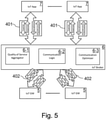
- Fig. 5 schematically shows an loT broker 6 functional view in a system for loT management in accordance with an embodiment of the present invention. Due to its centrality for loT data dispatcher, the loT broker 6 is suited for various functionalities including, but not limited to, one or more of the following, or combinations thereof:
- the IoT broker 6 might shape also the northbound traffic going through the IoT slice 2 by implementing a queue system for query response and/or notifications for each class of QoS and therefore changing the queue parameters in order to privilege higher QoS classes.
- a queue system for query response and/or notifications for each class of QoS for example and not by way of limitations, in case of two classes of QoS like "best effort" and "mission critical", messages of the first class will be sent only in case no "mission critical" messages are queued or when a maximum time period is reached. In case of high load of "mission critical" data, the maximum time period for "best effort" messages will be increased such that messages will be sent in bunch, but less frequently.
- the IoT broker 6 might use the same southbound subscription for more than one northbound subscription.
- a different approach can be applied to certain QoS classes (most likely low priority) northbound queries which can be collected for a certain period, aggregated, and then mapped to southbound requests: this approach could lead to a number of southbound queries (and therefore resulting data traffic) never greater than the ones which would be generated if each request would be satisfied independently.
- the IoT broker 6 could even adopt some cache system in order to re-use results from other queries if the QoS class of the request would accept a certain degree of data staleness.
- Some functionality exposed might be implemented also in the IoT GWs 5 in order to bring some QoS optimization also at GWs level.
- the IoT broker 6 is meant here to be a single logical component which can be indefinitely scalable.
- Fig. 6 is a schematic view illustrating the interaction between the IoT broker 6 and the 5G Network Slice Manager 1 in accordance with an embodiment of the present invention.
- a number of n (i.e. 1, ..., n) dedicated IoT network slices 2 and a number of m (i.e. 1, ..., m) non-IoT network slices are configured.
- Fig. 6 shows two diagrams that indicate the network resource allocated to the respective slice (in percent of the overall available network resources) and the current slice load (in percent of the overall available load for the respective slice).
- the IoT broker 6 controls the dedicated IoT network slices 2 only
- the 5G Network Slice Manager 1 has control over both the dedicated IoT network slices 2 and the non-IoT network slices (as indicated by the dashed line frames).
- the IoT Broker 6 reduces the size of one or more IoT slices 2 and informs the 5G Network Slice Manager 1 on the set of IoT slices 2 to shrink down.
- the 5G Network Slice Manager 1 confirms that one or more IoT slices 2 have been resized. Specifically, in the illustrated embodiment the allocated network resources of IoT slices #1, #2 and #n have been reduced in each case from 10% to 5% (as shown in the lower part of Fig. 6 ). As a result, the slice load is increased (e.g. for IoT slices #1 from 50% to 80%).
- the IoT Broker 6 acts on the IoT traffic of the respective IoT slices 2, thereby reducing the IoT Quality of Service (QoS) of those slices (as indicated by the bar charts in Fig. 6 ).
- QoS IoT Quality of Service
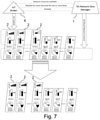
- Fig. 7 is a schematic view illustrating the interaction between the 5G Network Slice Manager 1 and the IoT broker 6 in accordance with an embodiment of the present invention.
- the configured network slices are the same as in Fig. 6 .
- the 5G Network Slice Manager 1 is the network component in charge of ( i ) interfacing with external network tenants in order to accept/reject requests for new slices 2, ( ii ) managing the instantiation/resize/maintenance/deletion of slices 2, and ( iii ) monitoring slice 2 traffic.
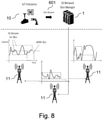
- Fig. 8 shows an example, where the 5G Network Slice Manager 1 receives a new slice request 601 from an IoT Enterprise 10 asking for a certain amount of capacity to be used by IoT devices.
- the slice request 601 may comprise a given number of Physical Resource Blocks (RBs), a given Network Capacity [expressed in Mb/s], a maximum latency allowed, high reliability, or even a combination of them.
- RBs Physical Resource Blocks
- Mb/s Network Capacity
- the 5G Network Slice Manager 1 instantiates a new slice 2 by instructing eNBs 11 to dedicate a given portion of resources. While this example mostly focuses on network slicing management on the Radio Access Network (RAN), it will be easily appreciated by those skilled in the art that it can be readily extended to the transport and core network elements.
- RAN Radio Access Network
- an application scenario of the embodiment of Fig. 6 could be a city council that owns a virtualized infrastructure (or network slice priority granted) and leases it (either completely or parts thereof) to different municipal domains, e.g., police, homeland security, public transportation companies, domestic energy providers, and markets association (shops/shopping mall).
- the IoT Broker 6 and the Network Slice Manager 1 could reside within the same administrative premises pursuing the same objective: maximization of network utilization.
- the IoT Broker 6 plays a role of a single infrastructure tenant and manages the dedicated IoT network slice 2.
- Other tenants can be envisaged as the other municipal domains.
- the 5G Network Slice Manager 1 is in charge to handle all tenants' requests.
Landscapes
- Engineering & Computer Science (AREA)
- Computer Networks & Wireless Communication (AREA)
- Signal Processing (AREA)
- Health & Medical Sciences (AREA)
- Computing Systems (AREA)
- General Health & Medical Sciences (AREA)
- Medical Informatics (AREA)
- Mobile Radio Communication Systems (AREA)
Description
- The present invention relates to a method and a system for loT traffic management in a communication network supporting a plurality of network slices, in particular a 5th generation wireless communication network.
- With the continuously increasing number of connected Internet-of-Things (loT) devices, foreseen as tens of Billion by 2020, as well as even more loT application scenarios identified, the loT market has got its momentum in the small and medium-sized enterprises (SMEs) market, whereas playing a key-role for non-Information Technology enterprises (e.g., retail providers, shopping malls, airports, train operators, municipalities), which aim to leverage their own produced data for optimizing industrial processes or for creating new businesses. To this aim, the evolution of new network technologies is enlarging its horizon to account for such a market exhibiting as one of their strengths a bigger flexibility on network definition and network virtualization. A clear example is represented by the novel Network Slicing (NS) concept applying to the 5th generation of mobile networks, namely 5G Networks.
- The Next Generation Mobile Network Alliance (NGMN) defines 5G network slice as a driver concept for running multiple logical networks as independent business operations on a common shared physical infrastructure (for reference, see NGMN Alliance, NGMN Network Slicing "Description of Network Slicing Concept" [online], https://www.ngmn.org/uploads/media/160113_Network_Slicing_v1_0.pdf). Therefore, each of those network slices represents a virtualized independent end-to-end network allowing infrastructure providers to deploy different architectures in parallel. A network slice is intended as a logical self-contained end-to-end construct provided with customized functions - including those at the user equipment (UE) side - and network function chains for delivering required services to customers.
- Interestingly, telecom operators may customize their own networks by opening their infrastructure to novel business players, such as virtual mobile network operators (VMNOs), third-parties as well as Over-The-Top (OTT) applications, as shown in
Fig. 1 . Such entities behave as tenants of the same infrastructure: This opens new challenges in designing a network resources allocation, e.g., RAN resources, network functions, which must guarantee the resource isolation principle and, at the same time, it improves the multiplexing gain resulting in a more cost-effective allocation for the infrastructure provider. This problem is promptly faced when the network slicing concept is deployed on the network facilities. -
US 2016/0352645 A1 discloses systems and methods for managing network slice enabled traffic on a communications network. The network slice is instantiated on the communications network for providing connectivity resources to a network operator. A traffic level indicative of the traffic enabled by the network slice is measured, and the traffic enabled by the network slice is adjusted in accordance with the traffic level and a network operator enabled function associated with the network slice. -
WO 2016/192636 A1 discloses methods and apparatus for management of network slices in a communication network such as a 5th generation wireless communication network. A connection manager residing in a management plane receives an indication that a mobile device is to be associated with the communication network. A network slice is determined, and the connection manager transmits instructions, to one or more network nodes, to associate the mobile device with the network slice. The slice may be requested explicitly by the mobile device, or determined based on device and/or network requirements. A spectrum broker allocates resources to the network slices. - While the flexibility introduced with network slicing dynamics fosters a network virtualization evolution, infrastructure providers do not quantify yet the real benefit brought to their current business cases. There is a real need of assessing and brokering the network slicing operations between infrastructure providers and different tenants. Recently, 3GPP has standardized a logically centralized entity, namely capacity broker (several aspects of which are described in
WO 2016/198104 A1 ), that resides inside the infrastructure provider's network in charge of admission control operations. This functional block has been extensively improved (for reference, see FI-WARE NGSI Open RESTful API Specification https://forge.fiware.org/plugins/mediawiki/wiki/fiware/index.php/FI-WARE_NGSI _Open_RESTful API_Specification) to provide a means for optimally allocating and configuring RAN network slices based on an on-demand network slice request service. Specifically, tenants may easily acquire their own network slice through a given interface by specifying the time duration and the application requirements for such a network slice. In addition, slice maintenance mechanisms are required to continuously satisfy tenants' SLAs while admitting new network slice requests. This may be obtained through monitoring and scaling operations towards the network slice broker. - Along the direct communication between infrastructure provider and tenant, several challenges can be identified. On the one side, the infrastructure provider applies and defines optimization algorithms for maximizing the allocation of virtual network slices aiming at the maximization of the revenues. On the other side, the tenants (i.e. the network slice customers) aim at minimizing the slice parameters with the dual target of minimizing the costs while keeping affordable the Quality of Service required. This usually results in a sub-optimal slicing configuration and limited and inefficient resource utilization and monetization.
- In view of the above it is an objective of the present invention to improve and further develop a method and a system for IoT traffic management in a communication network supporting a plurality of network slices in such a way that the above issues are overcome or at least partially alleviated. Specifically, in some embodiments the invention targets to solve the provider-customer problem in IoT scenarios for efficiently allocating/maintaining/configuring the 5G network slice for IoT devices, namely IoT network slice, while fulfilling the communication constraints between IoT entities.
- In accordance with the invention, the aforementioned objective is accomplished by a method for IoT traffic management in a communication network supporting a plurality of network slices, the method comprising:
- by a network slice management component, dynamically assigning network resources to a number of network slices, wherein one or more of said network slices are dedicated IoT network slices being adapted to enable IoT-related communications between an IoT platform and IoT devices or IoT gateways,
- by the network slice management component, interacting with an IoT broker that is associated with the IoT platform and that gathers data from IoT devices or IoT gateways based on IoT requests from IoT applications, and, based on said interaction, performing actions with respect to an allocation of network resources to said number of network slices and/or triggering actions on the IoT broker with respect to a configuration of IoT data traffic.
- Furthermore, the above objective is accomplished by an IoT broker for deployment in a system for IoT traffic management in a communication network supporting a plurality of network slices, wherein the system comprises a network slice management component configured to dynamically assign network resources to a number of network slices, wherein one or more of said network slices are dedicated IoT network slices that are adapted to enable IoT-related communications between an IoT platform and IoT devices or IoT gateways, the IoT broker being configured to gather IoT data from IoT devices or IoT gateways based on IoT requests from IoT applications, and to negotiate via a bidirectional interface with the network slice management component network resource requirements of the loT broker and/or IoT data traffic configuration requests of the network slice management component.
- Still further, the above objective is accomplished by a network slice management component configured to dynamically assign network resources to a number of network slices, wherein one or more of said network slices are dedicated IoT network slices being adapted to enable IoT-related communications between an IoT platform and IoT devices or IoT gateways, to interact with an IoT broker that is associated with the IoT platform and that gathers data from IoT devices or IoT gateways based on IoT requests from IoT applications, and, based on said interaction, to perform actions with respect to an allocation of network resources to said number of network slices and/or triggering actions on the IoT broker with respect to a configuration of IoT data traffic.
- According to the invention it has been recognized that the above objective can be accomplished by enabling interaction between the network slice management component, e.g. 5G network slice Manager, and an IoT broker of the IoT platform such that, based on this interaction, the network slice management component is enabled to perform actions with respect to an allocation of network resources to the network slices and/or to trigger actions on the IoT broker with respect to a configuration of IoT data traffic. The interaction is performed via a bidirectional direct interface between the 5G Network slice manager and the IoT Broker. Effectively, the present invention provides a system comprising a network slicing manager and an IoT Broker that engage a negotiation to efficiently allocate and manage cellular resources while, at the same time, guaranteeing the IoT communication SLAs. Consequently, the present invention provides a technological solution for optimizing the IoT traffic of many IoT domains within a 5G Network Slicing concept. In particular, according to an aspect, the invention provides the means for IoT Broker and 5G Network Slice management to communicate and efficiently orchestrate IoT traffic and/or network slicing operations.
- According to an aspect, the present invention provides a detailed message flow between the IoT broker and the 5G network management responsible for properly configuring network slices to (i) limit (e.g., by changing granularity of requested information) the IoT message load when 5G network congestions occur, (ii) rescheduling IoT messages for underloaded periods of time, and/or (iii) prepare 5G network facilities (e.g., by rescaling other network slices, offloading, denying) when mission-critical messages must be exchanged between IoT entities in safety contexts.
- According to another aspect of the present invention, when the customer-provider relationship is broken down, the network slice brokering process acquires more knowledge about the real application needs thereby optimally instantiating/configuring/scaling network slicing resource requests. This case directly applies to an loT environment where an ad-
hoc 5G network slice is required to provide connectivity with specific target performance. - According to an embodiment an interaction between the network slice management component and the IoT broker may include the negotiation of network resource requirements of the IoT broker. Likewise, according to an embodiment an interaction between the network slice management component and the IoT broker may include negotiation of IoT data traffic configuration requests of the network slice management component, in particular requests for shaping/reshaping IoT data traffic (e.g. reduce or enlarge the granularity of gathered information) according to given criteria and based on messages exchanged within the framework of the interaction between the network slice management component and the IoT broker.
- According to an embodiment the network slice management component may be configured to provide updates to the IoT broker on the status of the one or more dedicated network slices. In particular, these updates may include information on the SLA status, resource utilization, capacity, and/or latency. The updates may be provided on a regular basis, or on demand.
- According to an embodiment the negotiation between the network slice management component and the IoT broker is triggered by changes to any of the network slices. In particular, these changes may be caused by IoT applications joining/leaving a dedicated network slice, by modifications of IoT applications, and/or by dedicated network slice SLA relaxation/strengthening based on dynamic network changes/congestions. It may be provided that negotiations are initiated in case a change in one of the relevant parameters exceeds a predefined configuration threshold. The negotiations may directly apply on the changes.
- According to an embodiment the network slice management component may be configured to indicate an underutilization of resources of any of the one or more dedicated network slices to the IoT broker. In such case, the IoT broker may react by advance scheduling of respective IoT traffic (including IoT reports and transmissions).
- According to an embodiment the IoT broker may be configured to adapt elastic IoT application requirements to respective SLA requirements of the one or more dedicated network slices. Specifically, the IoT broker may aggregate IoT applications requirements or may map IoT applications requirements onto an IoT network slice SLA requirements (as input of the 5G network slice manager).
- According to an embodiment the IoT broker may react to messages from the network slice management component by properly managing IoT traffic demands, in particular by taking into consideration the IoT traffic demands' heterogeneity and/or different granularity. In this context it is important to note that IoT traffic demands are highly heterogeneous (e.g., different magnitudes of response time requirements, different magnitude of bandwidth usage) and fine-grained (e.g., different aggregation levels of IoT data). Consequently, the IoT broker actually manages elastic SLAs, i.e. the IoT broker may react to messages from the network slice management component by adapting (e.g. aggregating/mapping/filtering) diverse IoT applications requirements onto multiple IoT network slice classes and SLA requirements.
- According to an embodiment the one or more dedicated network slices may be instantiated by the network slice management component by providing a set of network slice templates selectable by the IoT broker depending on the IoT traffic requirements. In other words, the network slice manager may provide a set of slice templates to be selected by the IoT broker for addressing the IoT traffic requirements.
- According to an embodiment the IoT broker may be configured to exposes a northbound interface for IoT data requests from IoT applications and to expose a southbound interface to IoT gateways or IoT devices through the respective dedicated network slice.
- According to an embodiment the IoT broker and the IoT applications communicate with each other via the IoT broker's northbound interface by using NGSI, Next Generation Service Interface, query and subscription operations, in particular by using the NGSI context management interface (as described, e.g., in FI-WARE NGSI Open RESTful API Specification: https://forge.fiware.org/ plugins/mediawiki/wiki/fiware/index.php/FI-WARE_NGSI_Open_RESTful_API_ Specification). However, as will be easily appreciated by those skilled in the art, other communication protocols with similar characteristics may be employed likewise.
- There are several ways how to design and further develop the teaching of the present invention in an advantageous way. To this end it is to be referred to the dependent patent claims on the one hand and to the following explanation of preferred embodiments of the invention by way of example, illustrated by the drawing on the other hand. In connection with the explanation of the preferred embodiments of the invention by the aid of the drawing, generally preferred embodiments and further developments of the teaching will be explained. In the drawing
- Fig. 1
- is a schematic view illustrating several examples of 5G Network Slicing business cases,
- Fig. 2
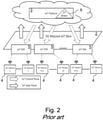
- is a schematic view illustrating an example of a typical Massive IoT deployment according to prior art,
- Fig. 3
- is a schematic view illustrating the basic architecture of a system for IoT management in accordance with an embodiment of the present invention,
- Fig. 4
- is a schematic view illustrating IoT broker communication in a system for IoT management in accordance with an embodiment of the present invention,
- Fig. 5
- is a schematic view illustrating IoT broker functionality in a system for IoT management in accordance with an embodiment of the present invention,
- Fig. 6
- is a schematic view illustrating the interaction between the IoT broker and the 5G Network Slice Manager in accordance with an embodiment of the present invention
- Fig. 7
- is a schematic view illustrating the interaction between the 5G Network Slice Manager and the IoT broker in accordance with an embodiment of the present invention, and
- Fig. 8
- is a schematic view illustrating 5G RAN slicing operational procedures in accordance with embodiments of the present invention.
- Throughout the figures like reference numerals denote like components.
-
Fig. 2 depicts a typical IoT deployment scenario where manyIoT devices 4 communicate wirelessly (e.g., by using ZigBee, WiFi Direct or Bluetooth) with geographically distributed IoT Gateways (GW) 5 in charge of gathering IoT traffic data (e.g. by means of explicit requests, through subscription-notifications, etc.). EachIoT GW 5 is connected to theIoT Platform 3 where anIoT Broker 6 is responsible for dimensioning, delaying and/or scaling IoT data flows. This connection leverages on 5G facilities and it may benefit from a dedicated 5G network slice, namely 5GMassive IoT Slice 2. - Generally, a network slice, like e.g. the 5G
Massive IoT Slice 2 as shown inFig. 2 , can be defined as follows (cf. NGMN Alliance: "NGMN 5G White Paper", Version 1.0, 17-February-2015):
"A network slice, namely "5G slice", supports the communication service of a particular connection type with a specific way of handling the C- and U-plane for this service. To this end, a 5G slice is composed of a collection of 5G network functions and specific RAT settings that are combined together for the specific use case or business model. Thus, a 5G slice can span all domains of the network: software modules running on cloud nodes, specific configurations of the transport network supporting flexible location of functions, a dedicated radio configuration or even a specific RAT, as well as configuration of the 5G device. Not all slices contain the same functions, and some functions that today seem essential for a mobile network might even be missing in some of the slices. The intention of a 5G slice is to provide only the traffic treatment that is necessary for the use case, and avoid all other unnecessary functionality. The flexibility behind the slice concept is a key enabler to both expand existing businesses and create new businesses. Third-party entities can be given permission to control certain aspects of slicing via a suitable API, in order to provide tailored services." -
Fig. 3 is a schematic view illustrating the basic architecture of a system for IoT traffic management in accordance with an embodiment of the present invention. Specifically, according to this embodiment IoT communications are realized by means of 5G network premises. Within a network slicing context, the network operator instantiates an IoT-dedicatednetwork slice 2, namely 5G Massive IoT Slice, which can be accessed by allIoT devices 4 based on prior agreements. Although not explicitly shown inFig. 3 , thededicated network slice 2 consists of radio access network, fronthaul/backhaul transport nodes as well as core network facilities. Through such adedicated network slice 2, IoT-related messages can reach theIoT platform 3 or the IoT Gateways (hereinafter briefly denoted IoT GWs) 5. - The 5G
Massive IoT slice 2 accounts for both IoT control-plane (indicated by dashed lines inFig. 3 ) and IoT data-plane (indicated by solid lines) messages. Control-plane messages are issued by theIoT Broker 6 to dynamically adjust the amount of data exchanged (via the data-plane) between theIoT platform 3 and theIoT GWs 5. 5G resources assigned to the 5GMassive IoT slice 2 are dynamically managed by a networkslice management component 1, hereinafter sometimes the denoted 5G Network Slice Manager, through a dedicated control-plane channel. This communication might trigger resizing of slice resources to cope with unexpected and rapid network changes (such as network congestion, additional network slice instantiations, IoT SLAs renegotiation). - According to the illustrated embodiment, in order to support a joint and even more efficient control mechanism (i.e., for IoT control plane and 5G control plane), a direct interface is established between the 5G
Network Slice Manager 1 and the IoT platform 3 (e.g., IoT broker 6) that leverages, e.g., novel resource negotiations and traffic reshaping operations. For instance, incase 5G network premises are under-utilized, theIoT platform 3 might decide (after receiving specific advertisements from the 5G network slice manager 1) to adopt a fine-grained data traffic, or, conversely, e.g. when network condition degradation or network resources preemption occur, theIoT platform 3 might ask to reduce data coming from the IoT GWs 5 (or to delay data after collecting a larger set of them). - Hereinafter, the functions and operations performed by each of the components of the system according to
Fig. 3 will be described in more detail, starting with the 5GNetwork Slice Manager 1, which is configured to constantly monitor the traffic for each of the currently accommodated 5G slices 2. In particular, the 5GNetwork Slice Manager 1 checks whether the traffic does not exceed the respective network resource boundaries. In case an overflow is detected, the 5GNetwork Slice Manager 1 may request theIoT Broker 6 to re-shape the IoT Data traffic, as indicated at 301. On the other hand, in case of underutilization of the network resources, the 5GNetwork Slice Manager 1 may suggest to theIoT Broker 6 to increase the slice capabilities. - As generally indicated at 302, in case the 5G
Network Slice Manager 1 receives a request from theIoT broker 6 to change the IoT network slice, the 5GNetwork Slice Manager 1 checks if it is possible to satisfy such a request without breaking requirements of other slice requests. If a solution is found, the 5GNetwork Slice Manager 1 may respond back to theIoT Broker 6 with an accepted request, otherwise with a reject response. -
Communications Network Slice Manager 1 and theIoT broker 6. - Turning now to the
IoT platform component 3, this component is configured to handle all the IoT communications. In relation to theIoT GWs 5, this IoT communication is indicated en bloc at 303 inFig. 3 . Furthermore, theIoT platform component 3 receives IoT requests fromIoT applications 7, as shown inFig. 4 . More specifically, IoT requests coming fromIoT applications 7 are received at anIoT broker 6 of theIoT platform 3 through anorthbound interface 7, as shown inFig. 4 . Generally, theIoT broker 6 is configured to perform one or more of the following tasks: (i) mapping northbound requests into a set of southbound requests, (ii) sending IoT requests to IoT Components, e.g.,IoT GWs 5, through the southbound interface, (iii) aggregating northbound requests QoS requirements into one or multiple QoS classes, (iv) measuring traffic generated for each of the IoT QoS classes, and/or (v) shaping the southbound IoT traffic by modifying the southbound requests parameters. - In particular, in case of necessity of larger sets of network slice resources, due to an increase of IoT data traffic (resulting from, e.g., an increase of IoT application requests, or from an increase of southbound IoT data) and inability to re-shape the actual traffic without infringing QoS requirements (e.g., mission critical data flows), the
IoT broker 6 may request the 5Gnetwork slice manager 1 to scale-up the size of thenetwork slice 2. On the other hand, in case of underutilization of thenetwork slice 2 due to a reduction of IoT data traffic (resulting from, e.g., a reduction of IoT application requests, or from a reduction of southbound IoT data, etc.) or a reduction of aggregated QoS requirements, theIoT broker 6 may suggest the 5Gnetwork slice manager 1 to decrease theIoT slice 2. - In case the 5G
network slice manager 1 requests theIoT broker 6 to re-shape the southbound IoT traffic in order to use less network resources (as indicated at 302 inFig. 3 ), theIoT broker 6 tries to calculate a solution to change southbound request parameters subject to all the IoT QoS requirements. If such a solution is found, theIoT broker 6 responds back to the 5Gnetwork slice manager 1 with an accepted request, otherwise with a reject response. -
Fig. 4 schematically shows anIoT broker 6 communication view in a system for loT management in accordance with an embodiment of the present invention. Generally, in accordance with the specifications provided in IoT Broker GE Open Specs: 'https://forge.fiware.org/plugins/mediawiki/wiki/fiware/index.php/FIWARE. OpenSpecification.IoT.Backend.IoTBroker', the IoT broker component is foreseen to run on a machine in a data center, where it serves as a middleware that enables fast and easy access to Internet-of-Things data. TheIoT broker 6 exposes anorthbound interface 8 for IoT data requests, which can be conveyed either through a conventional network means, which does not present any resources limitations issue (e.g., fixed-line technology means), or through theIoT network slice 2, and exposes asouthbound interface 9 through theIoT network slice 2. - Instead of having to deal directly with the technical details of existing deployments, application developers only need to set up their
IoT application 7 to communicate with theIoT broker 6 in order to retrieve the data they need. TheIoT broker 6 takes care of communication with differentIoT Gateways 5 to retrieve all needed information on the behalf of anysingle application 7. -
Applications 7 can access this information using the NGSI context management interface (as described, e.g., in FI-WARE NGSI Open RESTful API Specification: https://forge.fiware.org/plugins/mediawiki/wiki/fiware/index.php/FI-WARE_NGSI_ Open_RESTful_API_Specification), which describes different types of operations for exchanging context information. - A first and most basic kind of operations is a simple query, as shown in communication blocks 401. When an
application 7 invokes the query, it expects to receive IoT data as a single aggregated response (which is also indicated in communication blocks 401). Once received the query request, theIoT broker 6 maps the northbound request into a set of southbound query requests toIoT GWs 5, which will be asked for new data. These southbound query requests are indicated in communication blocks 402. How to chooseIoT GWs 5 to be contacted relies on several aspects. As examples and not by way of limitations, the selection ofIoT GWs 5 may be based on data queries parameters, since typically only a subset ofIoT GWs 5 amongst the whole set ofavailable IoT GWs 5 will contain the requested kind of data. Alternatively or additionally, the selection ofIoT GWs 5 may be based on QoS requirements contained in the requests. In this context it is important to note, for example and not as way of limitation, that if a request is specifying to have a sparse density of observation per geographic region, chosenIoT GWs 5 are responsible for observations sensed far enough between each other. Still further, the selection ofIoT GWs 5 may be based on load status of the IoT network slice 2: for example and not as way of limitation, there would bemore IoT GWs 5 chosen in case of lightweight network load. - The NGSI query format is quite flexible and can carry information about Quality of Service requirements. As examples and not by way of limitations, the query can carry the following information:
  • NGSI Operation Scopes:
         ∘It might contain granularity of the data.
               ▪ E.g.:
                   <operationScope>
                     <scopeType>GeographicAbstractionLevel</scopeType>
                     <scopeValue>Sensor</scopeValue>
                   </operationScope>
               ▪ E.g.:
                   <operationScope>
                     <scopeType>GeographicAbstractionLevel</scopeType>
                     <scopeValue>Street</scopeValue>
                   </operationScope>
               ▪ E.g.:
                   <operationScope>
                     <scopeType>GeographicDensity</scopeType>
                     <scopeValue>0.1 observation/m 2 </scopeValue>
                   </operationScope>
         ∘It might contain latency requirements
               ▪ E.g.:
                   <operationScope>
                     <scopeType>MaxResponseTime</scopeType>
                     <scopeValue>0.5s<scopeValue>
                   </operationScope>
         ∘It might declare a pre-defined QoS class (known by the loT Broker)
               ▪ E.g.:
                   <operationScope>
                     <scopeType>QualityOfServiceClass</scopeType>
                     <scopeValue>BestEffort<scopeValue>
                   </operationScope>
 NGSI Subscription
  • Throttling: minimum interval between notifications.
         ∘E.g.:
            <throttling>PT5m</throttling>
  • NGSI Operation Scopes besides the one specified before (see the query operation case
      above):
         ∘It can contain max data traffic received per second:
               ▪ E.g.:
                   <operationScope>
                     <scopeType>MaxBandwidth</scope Type>
                     <scopeValue>1 Kb/s<scopeValue>
                   </operationScope>
  • Notify Conditions
         ∘ONTIMEINTERVAL, it might specify the expected sampling time:
               ▪ E.g.
                   <notifyCondition>
                     <type>ONTIMEINTERVAL</type>
                     <condValueList>
                       <condValue>PT3s</condValue>
                     </condValueList>
                   </notifyCondition>
         ∘ ONVALUE, it might specify the condition under which the notification should be
            sent to the application
               ▪ E.g. specific condition on the values:
                   <notifyCondition>
                     <type>ONVALUE</type>
                     <restriction>
                   <attributeExpression>//contextAttribute[name='temperature'][value>35 or
                   value<0]</attributeExpression>
                     </restriction>
                   </notifyCondition>
               ▪ E.g. specific condition on metadata of the values (only aggregated value):
                   <notifyCondition>
                     <type>ONVALUE</type>
                     <restriction>
                   <attributeExpression>//contextAttribute/metadata/contextMetadata[name='
                   aggregation'][value='mean']</attributeExpression>
                     </restriction>
                   </notifyCondition>
         ∘ONCHANGE
               ▪ E.g. only if the specified attribute changes
                   <notifyCondition>
                     <type>ONCHANGE</type>
                     <condValueList>
                       <condValue>temperature</condValue>
                       <condValue>co2</condValue>
                     </condValueList>
                   </notifyCondition>
               ▪ E.g. only if the specified attribute changes of the given percentage
                   <notifyCondition>
                     <type>ONCHANGE</type>
                     <condValueList>
                       <condValue>temperature</condValue>
                     </condValueList>
                     <restriction>
                       <operationScope>
                        <scopeType>tolerance</scope Type>
                        <scopeValue>10%<scopeValue>
                       </operationScope>
                     </restriction>
                   </notifyCondition>
               ▪ E.g. only if the specified attribute changes of the given absolute value
                   <notifyCondition>
                     <type>ONCHANGE</type>
                     <condValueList>
                       <condValue>temperature</condValue>
                     </condValueList>
                     <restriction>
                       <operationScope>
                        <scopeType>tolerance</scope Type>
                        <scopeValue>1<scopeValue>
                       </operationScope>
                     </restriction>
                   </notifyCondition>
  • Specific entity identifiers:
         ∘E.g.
            <entityldList>
              <entityld>
                <id> EmergencyExit-1</id>
              </entityld>
            </entityldList>
  • Pattern of entity identifiers:
         ∘ E.g.
            <entityldList>
              <entityld isPattern="true">
                <id>EmergencyExit-.*</id>
              </entityld>
            </entityldList>
  • Type of entities:
         ∘E.g.
            <entityldList>
              <entityld isPattern="true" type="emergencyexit">
                <id>.*</id>
               </entityld>
            </entityldList>
  • Specific Attribute:
         ∘ E.g.
            <entityldList>
              <entityld isPattern="true">
                <id>.*</id>
               </entityld>
            </entityldList>
            <attributeList>
              <attribute>firedetected</attribute>
            </ attributeList >
  • A combination of the above
- 1) The
IoT broker 6 may comprise a Quality of Service Aggregator component 6-1 for aggregating all data requirements from the applications 7.Specifically, this component 6-1 of theIoT broker 6 might map all the requirements into a single or multiple classes of Quality of Service, which would differ in terms of bandwidth consumptions, real-timeness, etc. - 2) The
loT broker 6 may also comprise a communication logic component 6-2, in particular for monitoring the data traffic: The component 6-2 continuously measures the data traffic passing through theIoT broker 6 for each of the different QoS classes (if more than one). The traffic size might fluctuate, for instance, due to changes of amount ofapplications 7 requesting data via query, changes of frequency of notifications coming from theIoT GWs 5, changes of data parameters into query/subscriptions, or changes of QoS parameters into query/subscriptions. - 3) Still further, the
IoT broker 6 may comprise a communication optimizer component 6-3 for optimizing the traffic for a better usage of the resources: This component 6-3 of theIoT broker 6 might implement optimization algorithms for maximizing the usage of the5G network slice 2 resources and, at the same time, satisfying all the QoS requirements. The component 6-3 might shape the southbound traffic, for examples and not by way of limitations, by changing the set of IoT GWs 5chosen for satisfying data queries and/or subscription requests, by changing data and/or QoS (e.g., data granularity, data frequency) parameters of the active and/or future southbound subscriptions toIoT GWs 5, thus acting on the mapping between northbound and southbound subscriptions, by changing data and/or QoS parameters to the queries sent through the southbound interface, thus acting on the mapping between northbound and southbound queries.
Claims (15)
- A method for IoT traffic management in a communication network supporting a plurality of network slices, the method comprising:by a network slice management component (1), dynamically assigning network resources to a number of network slices, wherein one or more of said network slices are dedicated IoT network slices (2) being adapted to enable IoT-related communications between an IoT platform (3) and IoT devices (4) or IoT gateways (5),by the network slice management component (1), interacting with an IoT broker (6) that is associated with the IoT platform (3) and that gathers data from IoT devices (4) or IoT gateways (5) based on IoT requests from IoT applications, and, based on said interaction, performing actions with respect to an allocation of network resources to said number of network slices and/or triggering actions on the IoT broker (6) with respect to a configuration of IoT data traffic.
- The method according to claim 1, wherein an interaction between the network slice management component (1) and the IoT broker (6) includes negotiation of network resource requirements of the IoT broker (6).
- The method according to claim 1 or 2, wherein an interaction between the network slice management component (1) and the IoT broker (6) includes negotiation of IoT data traffic configuration requests of the network slice management component (1).
- The method according to any of claims 1 to 3, wherein the network slice management component (1) provides updates to the IoT broker (6) on the status of the one or more dedicated IoT network slices (2), including information on the SLA status, resource utilization, capacity, and/or latency.
- The method according to any of claims 2 to 4, wherein the negotiation between the network slice management component (1) and the IoT broker (6) is triggered by changes to the one or more dedicated IoT network slices (2) caused by joining/leaving IoT applications, by modifications of IoT applications, and/or by dedicated network slice (2) SLA relaxation/strengthening based on dynamic network changes/congestions.
- The method according to any of claims 1 to 5, wherein the network slice management component (1) indicates an underutilization of resources of any of the one or more dedicated IoT network slices (2) to the IoT broker (6), and wherein the IoT broker (6) reacts by advance scheduling of respective IoT traffic.
- The method according to any of claims 1 to 6, wherein the IoT broker (6) adapts elastic IoT application requirements to respective SLA requirements of the one or more dedicated IoT network slices (2).
- The method according to any of claims 1 to 7, wherein the IoT broker (6) reacts to messages from the network slice management component (1) by properly managing IoT traffic demands taking into consideration the IoT traffic demands' heterogeneity and/or different granularity.
- The method according to any of claims 1 to 8, wherein the IoT broker (6) manages IoT traffic demands by taking into consideration the IoT traffic demands' heterogeneity and/or different granularity.
- The method according to any of claims 1 to 9, wherein the one or more dedicated IoT network slices (2) are instantiated by the network slice management component (1) by providing a set of network slice templates selectable by the IoT broker (6) depending on the IoT traffic requirements.
- The method according to any of claims 1 to 10, wherein the loT broker (6) exposes a northbound interface for IoT data requests from IoT applications and a southbound interface through the respective dedicated IoT network slice (2).
- The method according to claim 11, wherein the IoT broker (6) and the IoT applications communicate with each other via the IoT broker's (6) northbound interface by using NGSI, Next Generation Service Interface, query and subscription operations.
- An IoT broker for deployment in a system for IoT traffic management in a communication network supporting a plurality of network slices, wherein the system comprises a network slice management component (1) configured to dynamically assign network resources to a number of network slices, wherein one or more of said network slices are dedicated IoT network slices (2) that are adapted to enable IoT-related communications between an IoT platform (3) and IoT devices (4) or IoT gateways (5), the IoT broker being configuredto gather IoT data from IoT devices (4) or IoT gateways (5) based on IoT requests from IoT applications, andto negotiate via a bidirectional interface with the network slice management component (1) network resource requirements of the IoT broker (6) and/or IoT data traffic configuration requests of the network slice management component (1).
- A network slice management component configuredto dynamically assign network resources to a number of network slices, wherein one or more of said network slices are dedicated IoT network slices (2) being adapted to enable IoT-related communications between an IoT platform (3) and IoT devices (4) or IoT gateways (5),to interact with an IoT broker (6) that is associated with the IoT platform (3) and that gathers data from IoT devices (4) or IoT gateways (5) based on IoT requests from IoT applications, andbased on said interaction, to perform actions with respect to an allocation of network resources to said number of network slices and/or triggering actions on the IoT broker (6) with respect to a configuration of IoT data traffic.
- The network slice management component according to claim 14, further configured to perform the steps according to any of claims 2 to 6.
Applications Claiming Priority (2)
| Application Number | Priority Date | Filing Date | Title |
|---|---|---|---|
| EP17166651 | 2017-04-13 | ||
| PCT/EP2017/073479 WO2018188767A1 (en) | 2017-04-13 | 2017-09-18 | Joint iot broker and network slice management component |
Publications (2)
| Publication Number | Publication Date |
|---|---|
| EP3533209A1 EP3533209A1 (en) | 2019-09-04 |
| EP3533209B1 true EP3533209B1 (en) | 2022-03-09 |
Family
ID=60083247
Family Applications (1)
| Application Number | Title | Priority Date | Filing Date |
|---|---|---|---|
| EP17783727.5A Active EP3533209B1 (en) | 2017-04-13 | 2017-09-18 | Joint iot broker and network slice management component |
Country Status (3)
| Country | Link |
|---|---|
| US (1) | US10798176B2 (en) |
| EP (1) | EP3533209B1 (en) |
| WO (1) | WO2018188767A1 (en) |
Families Citing this family (17)
| Publication number | Priority date | Publication date | Assignee | Title |
|---|---|---|---|---|
| GB2567490B (en) * | 2017-10-16 | 2021-08-11 | Samsung Electronics Co Ltd | Improvements in and relating to fronthaul interfaces in telecommunication networks |
| US20190158370A1 (en) * | 2017-11-17 | 2019-05-23 | Electronics And Telecommunications Research Institute | Computing system and method for intelligent ioe information framework |
| CN114697210B (en) | 2017-11-22 | 2023-11-03 | 华为技术有限公司 | Network performance guarantee method and device |
| CN110621045B (en) * | 2018-06-20 | 2022-05-13 | 华为云计算技术有限公司 | Method for service routing of Internet of things |
| US11283788B2 (en) * | 2018-10-31 | 2022-03-22 | Nec Corporation | Method and system for an internet of things platform |
| CN109783595B (en) * | 2019-01-10 | 2021-05-07 | 苏州工业园区测绘地理信息有限公司 | Routing and distribution method of loose sliced map service |
| WO2020239188A1 (en) * | 2019-05-24 | 2020-12-03 | Telefonaktiebolaget Lm Ericsson (Publ) | First entity, second entity, third entity, and methods performed thereby for providing a service in a communications network |
| US11240690B2 (en) * | 2019-05-24 | 2022-02-01 | Parallel Wireless, Inc. | Streaming media quality of experience prediction for network slice selection in 5G networks |
| CN111601350B (en) * | 2019-05-28 | 2022-06-17 | 维沃移动通信有限公司 | Registration switching method, request processing method, information sending method and related equipment |
| CN111628887B (en) * | 2020-04-29 | 2022-08-26 | 北京邮电大学 | Internet of things slice resource distribution system and method, electronic equipment and storage medium |
| CN116325890B (en) * | 2020-10-09 | 2025-04-08 | 瑞典爱立信有限公司 | Network slice dynamic congestion control |
| US20220141221A1 (en) * | 2020-11-05 | 2022-05-05 | T-Mobile Innovations Llc | Smart Computing Device Implementing Network Security and Data Arbitration |
| CN112532445B (en) * | 2020-11-26 | 2022-12-30 | 国网江苏省电力有限公司信息通信分公司 | Network slicing method for network equipment without virtualization capability, system and storage medium thereof |
| CN115225505B (en) * | 2022-07-14 | 2024-01-30 | 南京邮电大学 | An Internet of Things application function configuration structure |
| CN115297480B (en) * | 2022-10-09 | 2022-12-20 | 中通服建设有限公司 | OMC intelligent southbound management system based on 5G wireless network |
| US20250016627A1 (en) * | 2023-07-03 | 2025-01-09 | Qualcomm Incorporated | Network slice feasibility assessment for slice orchestration in a wireless network |
| CN118200188B (en) * | 2024-04-08 | 2024-09-20 | 北京云讯科技有限公司 | Internet of things card allocation management method and device |
Citations (1)
| Publication number | Priority date | Publication date | Assignee | Title |
|---|---|---|---|---|
| WO2016192636A1 (en) * | 2015-06-01 | 2016-12-08 | Huawei Technologies Co., Ltd. | System and method for virtualized functions in control and data planes |
Family Cites Families (5)
| Publication number | Priority date | Publication date | Assignee | Title |
|---|---|---|---|---|
| US10374965B2 (en) | 2015-06-01 | 2019-08-06 | Huawei Technologies Co., Ltd. | Systems and methods for managing network traffic with a network operator |
| WO2016198104A1 (en) | 2015-06-11 | 2016-12-15 | Nec Europe Ltd. | Network management system and method for a shared radio access network, ran, infrastructure |
| US10348517B2 (en) * | 2015-10-09 | 2019-07-09 | Openet Telecom Ltd. | System and method for enabling service lifecycle based policy, licensing, and charging in a network function virtualization ecosystem |
| US20170187819A1 (en) * | 2015-12-29 | 2017-06-29 | Nexenta Systems, Inc. | Negotiating proxy server for distributed storage and compute clusters |
| US10334446B2 (en) * | 2016-08-05 | 2019-06-25 | Nxgen Partners Ip, Llc | Private multefire network with SDR-based massive MIMO, multefire and network slicing |
-
2017
- 2017-09-18 EP EP17783727.5A patent/EP3533209B1/en active Active
- 2017-09-18 WO PCT/EP2017/073479 patent/WO2018188767A1/en not_active Ceased
- 2017-09-18 US US16/492,633 patent/US10798176B2/en active Active
Patent Citations (1)
| Publication number | Priority date | Publication date | Assignee | Title |
|---|---|---|---|---|
| WO2016192636A1 (en) * | 2015-06-01 | 2016-12-08 | Huawei Technologies Co., Ltd. | System and method for virtualized functions in control and data planes |
Also Published As
| Publication number | Publication date |
|---|---|
| US10798176B2 (en) | 2020-10-06 |
| WO2018188767A1 (en) | 2018-10-18 |
| US20200059521A1 (en) | 2020-02-20 |
| EP3533209A1 (en) | 2019-09-04 |
Similar Documents
| Publication | Publication Date | Title |
|---|---|---|
| US10798176B2 (en) | Joint IoT broker and network slice management component | |
| CN107637111B (en) | System and method for providing and allocating spectral resources | |
| CN107637034B (en) | System and method for virtual infrastructure management between carrier networks | |
| EP2997698B1 (en) | System and method for mapping a service-level topology to a service-specific data plane logical topology | |
| CN102883457B (en) | Ensure the method for upstream service quality, base station and subscriber equipment | |
| US10942786B2 (en) | Network management | |
| Sciancalepore et al. | Slice as a service (SlaaS) optimal IoT slice resources orchestration | |
| EP2802170A1 (en) | Method, system and device for service rate control | |
| JPWO2018016043A1 (en) | Resource management device, resource management method and program | |
| US20180242161A1 (en) | Distributed management of network slices using a gossip protocol | |
| CN107113243A (en) | System and method for managing network traffic with a network operator | |
| WO2019190527A1 (en) | Configuring network slices | |
| JP2020503778A (en) | Information transmission method and wireless access network device | |
| CN111434186A (en) | Wireless network control method and device based on forwarding network | |
| CN109792407B (en) | Quality of Service Level Indication Structure and Corresponding Controller and Control Method | |
| CN110495200B (en) | Resource control in a shared RAN | |
| CN102594578A (en) | Processing method, device and system for information transmission service | |
| EP2919509B1 (en) | Method and device for hosting application by access node | |
| JP2016046669A (en) | Packet processing apparatus, program and method | |
| CN104780542A (en) | Communication network system, multi-service dynamic resource allocation device and method | |
| EP3177067B1 (en) | Network controller, system, and method for resource allocation | |
| WO2010124527A1 (en) | Method, device and system for distributing idle load capacity of core network nodes | |
| CN111372281A (en) | Traffic management method in mobile network |
Legal Events
| Date | Code | Title | Description |
|---|---|---|---|
| STAA | Information on the status of an ep patent application or granted ep patent |
Free format text: STATUS: UNKNOWN |
|
| STAA | Information on the status of an ep patent application or granted ep patent |
Free format text: STATUS: THE INTERNATIONAL PUBLICATION HAS BEEN MADE |
|
| PUAI | Public reference made under article 153(3) epc to a published international application that has entered the european phase |
Free format text: ORIGINAL CODE: 0009012 |
|
| STAA | Information on the status of an ep patent application or granted ep patent |
Free format text: STATUS: REQUEST FOR EXAMINATION WAS MADE |
|
| 17P | Request for examination filed |
Effective date: 20190528 |
|
| AK | Designated contracting states |
Kind code of ref document: A1 Designated state(s): AL AT BE BG CH CY CZ DE DK EE ES FI FR GB GR HR HU IE IS IT LI LT LU LV MC MK MT NL NO PL PT RO RS SE SI SK SM TR |
|
| AX | Request for extension of the european patent |
Extension state: BA ME |
|
| STAA | Information on the status of an ep patent application or granted ep patent |
Free format text: STATUS: EXAMINATION IS IN PROGRESS |
|
| 17Q | First examination report despatched |
Effective date: 20200414 |
|
| DAV | Request for validation of the european patent (deleted) | ||
| DAX | Request for extension of the european patent (deleted) | ||
| GRAP | Despatch of communication of intention to grant a patent |
Free format text: ORIGINAL CODE: EPIDOSNIGR1 |
|
| STAA | Information on the status of an ep patent application or granted ep patent |
Free format text: STATUS: GRANT OF PATENT IS INTENDED |
|
| INTG | Intention to grant announced |
Effective date: 20211020 |
|
| GRAS | Grant fee paid |
Free format text: ORIGINAL CODE: EPIDOSNIGR3 |
|
| GRAA | (expected) grant |
Free format text: ORIGINAL CODE: 0009210 |
|
| STAA | Information on the status of an ep patent application or granted ep patent |
Free format text: STATUS: THE PATENT HAS BEEN GRANTED |
|
| AK | Designated contracting states |
Kind code of ref document: B1 Designated state(s): AL AT BE BG CH CY CZ DE DK EE ES FI FR GB GR HR HU IE IS IT LI LT LU LV MC MK MT NL NO PL PT RO RS SE SI SK SM TR |
|
| RAP1 | Party data changed (applicant data changed or rights of an application transferred) |
Owner name: NEC CORPORATION |
|
| REG | Reference to a national code |
Ref country code: CH Ref legal event code: EP Ref country code: AT Ref legal event code: REF Ref document number: 1475087 Country of ref document: AT Kind code of ref document: T Effective date: 20220315 |
|
| REG | Reference to a national code |
Ref country code: IE Ref legal event code: FG4D |
|
| REG | Reference to a national code |
Ref country code: DE Ref legal event code: R096 Ref document number: 602017054413 Country of ref document: DE |
|
| REG | Reference to a national code |
Ref country code: LT Ref legal event code: MG9D |
|
| REG | Reference to a national code |
Ref country code: NL Ref legal event code: MP Effective date: 20220309 |
|
| PG25 | Lapsed in a contracting state [announced via postgrant information from national office to epo] |
Ref country code: SE Free format text: LAPSE BECAUSE OF FAILURE TO SUBMIT A TRANSLATION OF THE DESCRIPTION OR TO PAY THE FEE WITHIN THE PRESCRIBED TIME-LIMIT Effective date: 20220309 Ref country code: RS Free format text: LAPSE BECAUSE OF FAILURE TO SUBMIT A TRANSLATION OF THE DESCRIPTION OR TO PAY THE FEE WITHIN THE PRESCRIBED TIME-LIMIT Effective date: 20220309 Ref country code: NO Free format text: LAPSE BECAUSE OF FAILURE TO SUBMIT A TRANSLATION OF THE DESCRIPTION OR TO PAY THE FEE WITHIN THE PRESCRIBED TIME-LIMIT Effective date: 20220609 Ref country code: LT Free format text: LAPSE BECAUSE OF FAILURE TO SUBMIT A TRANSLATION OF THE DESCRIPTION OR TO PAY THE FEE WITHIN THE PRESCRIBED TIME-LIMIT Effective date: 20220309 Ref country code: HR Free format text: LAPSE BECAUSE OF FAILURE TO SUBMIT A TRANSLATION OF THE DESCRIPTION OR TO PAY THE FEE WITHIN THE PRESCRIBED TIME-LIMIT Effective date: 20220309 Ref country code: BG Free format text: LAPSE BECAUSE OF FAILURE TO SUBMIT A TRANSLATION OF THE DESCRIPTION OR TO PAY THE FEE WITHIN THE PRESCRIBED TIME-LIMIT Effective date: 20220609 |
|
| REG | Reference to a national code |
Ref country code: AT Ref legal event code: MK05 Ref document number: 1475087 Country of ref document: AT Kind code of ref document: T Effective date: 20220309 |
|
| PG25 | Lapsed in a contracting state [announced via postgrant information from national office to epo] |
Ref country code: LV Free format text: LAPSE BECAUSE OF FAILURE TO SUBMIT A TRANSLATION OF THE DESCRIPTION OR TO PAY THE FEE WITHIN THE PRESCRIBED TIME-LIMIT Effective date: 20220309 Ref country code: GR Free format text: LAPSE BECAUSE OF FAILURE TO SUBMIT A TRANSLATION OF THE DESCRIPTION OR TO PAY THE FEE WITHIN THE PRESCRIBED TIME-LIMIT Effective date: 20220610 Ref country code: FI Free format text: LAPSE BECAUSE OF FAILURE TO SUBMIT A TRANSLATION OF THE DESCRIPTION OR TO PAY THE FEE WITHIN THE PRESCRIBED TIME-LIMIT Effective date: 20220309 |
|
| PG25 | Lapsed in a contracting state [announced via postgrant information from national office to epo] |
Ref country code: NL Free format text: LAPSE BECAUSE OF FAILURE TO SUBMIT A TRANSLATION OF THE DESCRIPTION OR TO PAY THE FEE WITHIN THE PRESCRIBED TIME-LIMIT Effective date: 20220309 |
|
| PG25 | Lapsed in a contracting state [announced via postgrant information from national office to epo] |
Ref country code: SM Free format text: LAPSE BECAUSE OF FAILURE TO SUBMIT A TRANSLATION OF THE DESCRIPTION OR TO PAY THE FEE WITHIN THE PRESCRIBED TIME-LIMIT Effective date: 20220309 Ref country code: SK Free format text: LAPSE BECAUSE OF FAILURE TO SUBMIT A TRANSLATION OF THE DESCRIPTION OR TO PAY THE FEE WITHIN THE PRESCRIBED TIME-LIMIT Effective date: 20220309 Ref country code: RO Free format text: LAPSE BECAUSE OF FAILURE TO SUBMIT A TRANSLATION OF THE DESCRIPTION OR TO PAY THE FEE WITHIN THE PRESCRIBED TIME-LIMIT Effective date: 20220309 Ref country code: PT Free format text: LAPSE BECAUSE OF FAILURE TO SUBMIT A TRANSLATION OF THE DESCRIPTION OR TO PAY THE FEE WITHIN THE PRESCRIBED TIME-LIMIT Effective date: 20220711 Ref country code: ES Free format text: LAPSE BECAUSE OF FAILURE TO SUBMIT A TRANSLATION OF THE DESCRIPTION OR TO PAY THE FEE WITHIN THE PRESCRIBED TIME-LIMIT Effective date: 20220309 Ref country code: EE Free format text: LAPSE BECAUSE OF FAILURE TO SUBMIT A TRANSLATION OF THE DESCRIPTION OR TO PAY THE FEE WITHIN THE PRESCRIBED TIME-LIMIT Effective date: 20220309 Ref country code: CZ Free format text: LAPSE BECAUSE OF FAILURE TO SUBMIT A TRANSLATION OF THE DESCRIPTION OR TO PAY THE FEE WITHIN THE PRESCRIBED TIME-LIMIT Effective date: 20220309 Ref country code: AT Free format text: LAPSE BECAUSE OF FAILURE TO SUBMIT A TRANSLATION OF THE DESCRIPTION OR TO PAY THE FEE WITHIN THE PRESCRIBED TIME-LIMIT Effective date: 20220309 |
|
| PG25 | Lapsed in a contracting state [announced via postgrant information from national office to epo] |
Ref country code: PL Free format text: LAPSE BECAUSE OF FAILURE TO SUBMIT A TRANSLATION OF THE DESCRIPTION OR TO PAY THE FEE WITHIN THE PRESCRIBED TIME-LIMIT Effective date: 20220309 Ref country code: IS Free format text: LAPSE BECAUSE OF FAILURE TO SUBMIT A TRANSLATION OF THE DESCRIPTION OR TO PAY THE FEE WITHIN THE PRESCRIBED TIME-LIMIT Effective date: 20220709 Ref country code: AL Free format text: LAPSE BECAUSE OF FAILURE TO SUBMIT A TRANSLATION OF THE DESCRIPTION OR TO PAY THE FEE WITHIN THE PRESCRIBED TIME-LIMIT Effective date: 20220309 |
|
| REG | Reference to a national code |
Ref country code: DE Ref legal event code: R097 Ref document number: 602017054413 Country of ref document: DE |
|
| PLBE | No opposition filed within time limit |
Free format text: ORIGINAL CODE: 0009261 |
|
| STAA | Information on the status of an ep patent application or granted ep patent |
Free format text: STATUS: NO OPPOSITION FILED WITHIN TIME LIMIT |
|
| PG25 | Lapsed in a contracting state [announced via postgrant information from national office to epo] |
Ref country code: DK Free format text: LAPSE BECAUSE OF FAILURE TO SUBMIT A TRANSLATION OF THE DESCRIPTION OR TO PAY THE FEE WITHIN THE PRESCRIBED TIME-LIMIT Effective date: 20220309 |
|
| 26N | No opposition filed |
Effective date: 20221212 |
|
| PG25 | Lapsed in a contracting state [announced via postgrant information from national office to epo] |
Ref country code: SI Free format text: LAPSE BECAUSE OF FAILURE TO SUBMIT A TRANSLATION OF THE DESCRIPTION OR TO PAY THE FEE WITHIN THE PRESCRIBED TIME-LIMIT Effective date: 20220309 |
|
| PG25 | Lapsed in a contracting state [announced via postgrant information from national office to epo] |
Ref country code: MC Free format text: LAPSE BECAUSE OF FAILURE TO SUBMIT A TRANSLATION OF THE DESCRIPTION OR TO PAY THE FEE WITHIN THE PRESCRIBED TIME-LIMIT Effective date: 20220309 |
|
| REG | Reference to a national code |
Ref country code: CH Ref legal event code: PL |
|
| REG | Reference to a national code |
Ref country code: BE Ref legal event code: MM Effective date: 20220930 |
|
| PG25 | Lapsed in a contracting state [announced via postgrant information from national office to epo] |
Ref country code: LU Free format text: LAPSE BECAUSE OF NON-PAYMENT OF DUE FEES Effective date: 20220918 |
|
| PG25 | Lapsed in a contracting state [announced via postgrant information from national office to epo] |
Ref country code: LI Free format text: LAPSE BECAUSE OF NON-PAYMENT OF DUE FEES Effective date: 20220930 Ref country code: IT Free format text: LAPSE BECAUSE OF FAILURE TO SUBMIT A TRANSLATION OF THE DESCRIPTION OR TO PAY THE FEE WITHIN THE PRESCRIBED TIME-LIMIT Effective date: 20220309 Ref country code: IE Free format text: LAPSE BECAUSE OF NON-PAYMENT OF DUE FEES Effective date: 20220918 Ref country code: CH Free format text: LAPSE BECAUSE OF NON-PAYMENT OF DUE FEES Effective date: 20220930 |
|
| PG25 | Lapsed in a contracting state [announced via postgrant information from national office to epo] |
Ref country code: BE Free format text: LAPSE BECAUSE OF NON-PAYMENT OF DUE FEES Effective date: 20220930 |
|
| PG25 | Lapsed in a contracting state [announced via postgrant information from national office to epo] |
Ref country code: HU Free format text: LAPSE BECAUSE OF FAILURE TO SUBMIT A TRANSLATION OF THE DESCRIPTION OR TO PAY THE FEE WITHIN THE PRESCRIBED TIME-LIMIT; INVALID AB INITIO Effective date: 20170918 |
|
| PG25 | Lapsed in a contracting state [announced via postgrant information from national office to epo] |
Ref country code: CY Free format text: LAPSE BECAUSE OF FAILURE TO SUBMIT A TRANSLATION OF THE DESCRIPTION OR TO PAY THE FEE WITHIN THE PRESCRIBED TIME-LIMIT Effective date: 20220309 |
|
| PG25 | Lapsed in a contracting state [announced via postgrant information from national office to epo] |
Ref country code: MK Free format text: LAPSE BECAUSE OF FAILURE TO SUBMIT A TRANSLATION OF THE DESCRIPTION OR TO PAY THE FEE WITHIN THE PRESCRIBED TIME-LIMIT Effective date: 20220309 |
|
| PG25 | Lapsed in a contracting state [announced via postgrant information from national office to epo] |
Ref country code: MT Free format text: LAPSE BECAUSE OF FAILURE TO SUBMIT A TRANSLATION OF THE DESCRIPTION OR TO PAY THE FEE WITHIN THE PRESCRIBED TIME-LIMIT Effective date: 20220309 |
|
| PGFP | Annual fee paid to national office [announced via postgrant information from national office to epo] |
Ref country code: DE Payment date: 20240918 Year of fee payment: 8 |
|
| PGFP | Annual fee paid to national office [announced via postgrant information from national office to epo] |
Ref country code: GB Payment date: 20240920 Year of fee payment: 8 |
|
| PGFP | Annual fee paid to national office [announced via postgrant information from national office to epo] |
Ref country code: FR Payment date: 20240925 Year of fee payment: 8 |
|
| PG25 | Lapsed in a contracting state [announced via postgrant information from national office to epo] |
Ref country code: TR Free format text: LAPSE BECAUSE OF FAILURE TO SUBMIT A TRANSLATION OF THE DESCRIPTION OR TO PAY THE FEE WITHIN THE PRESCRIBED TIME-LIMIT Effective date: 20220309 |