EP3532671B1 - Method of manufacturing hemp products and hemp products - Google Patents
Method of manufacturing hemp products and hemp products Download PDFInfo
- Publication number
- EP3532671B1 EP3532671B1 EP17866292.0A EP17866292A EP3532671B1 EP 3532671 B1 EP3532671 B1 EP 3532671B1 EP 17866292 A EP17866292 A EP 17866292A EP 3532671 B1 EP3532671 B1 EP 3532671B1
- Authority
- EP
- European Patent Office
- Prior art keywords
- hemp
- strands
- manufactured
- adhesive
- block
- Prior art date
- Legal status (The legal status is an assumption and is not a legal conclusion. Google has not performed a legal analysis and makes no representation as to the accuracy of the status listed.)
- Active
Links
Images






Classifications
-
- D—TEXTILES; PAPER
- D06—TREATMENT OF TEXTILES OR THE LIKE; LAUNDERING; FLEXIBLE MATERIALS NOT OTHERWISE PROVIDED FOR
- D06N—WALL, FLOOR, OR LIKE COVERING MATERIALS, e.g. LINOLEUM, OILCLOTH, ARTIFICIAL LEATHER, ROOFING FELT, CONSISTING OF A FIBROUS WEB COATED WITH A LAYER OF MACROMOLECULAR MATERIAL; FLEXIBLE SHEET MATERIAL NOT OTHERWISE PROVIDED FOR
- D06N7/00—Flexible sheet materials not otherwise provided for, e.g. textile threads, filaments, yarns or tow, glued on macromolecular material
- D06N7/0063—Floor covering on textile basis comprising a fibrous top layer being coated at the back with at least one polymer layer, e.g. carpets, rugs, synthetic turf
-
- B—PERFORMING OPERATIONS; TRANSPORTING
- B27—WORKING OR PRESERVING WOOD OR SIMILAR MATERIAL; NAILING OR STAPLING MACHINES IN GENERAL
- B27N—MANUFACTURE BY DRY PROCESSES OF ARTICLES, WITH OR WITHOUT ORGANIC BINDING AGENTS, MADE FROM PARTICLES OR FIBRES CONSISTING OF WOOD OR OTHER LIGNOCELLULOSIC OR LIKE ORGANIC MATERIAL
- B27N3/00—Manufacture of substantially flat articles, e.g. boards, from particles or fibres
- B27N3/08—Moulding or pressing
- B27N3/10—Moulding of mats
- B27N3/14—Distributing or orienting the particles or fibres
- B27N3/143—Orienting the particles or fibres
-
- B—PERFORMING OPERATIONS; TRANSPORTING
- B27—WORKING OR PRESERVING WOOD OR SIMILAR MATERIAL; NAILING OR STAPLING MACHINES IN GENERAL
- B27N—MANUFACTURE BY DRY PROCESSES OF ARTICLES, WITH OR WITHOUT ORGANIC BINDING AGENTS, MADE FROM PARTICLES OR FIBRES CONSISTING OF WOOD OR OTHER LIGNOCELLULOSIC OR LIKE ORGANIC MATERIAL
- B27N1/00—Pretreatment of moulding material
-
- B—PERFORMING OPERATIONS; TRANSPORTING
- B27—WORKING OR PRESERVING WOOD OR SIMILAR MATERIAL; NAILING OR STAPLING MACHINES IN GENERAL
- B27N—MANUFACTURE BY DRY PROCESSES OF ARTICLES, WITH OR WITHOUT ORGANIC BINDING AGENTS, MADE FROM PARTICLES OR FIBRES CONSISTING OF WOOD OR OTHER LIGNOCELLULOSIC OR LIKE ORGANIC MATERIAL
- B27N3/00—Manufacture of substantially flat articles, e.g. boards, from particles or fibres
- B27N3/02—Manufacture of substantially flat articles, e.g. boards, from particles or fibres from particles
-
- B—PERFORMING OPERATIONS; TRANSPORTING
- B27—WORKING OR PRESERVING WOOD OR SIMILAR MATERIAL; NAILING OR STAPLING MACHINES IN GENERAL
- B27N—MANUFACTURE BY DRY PROCESSES OF ARTICLES, WITH OR WITHOUT ORGANIC BINDING AGENTS, MADE FROM PARTICLES OR FIBRES CONSISTING OF WOOD OR OTHER LIGNOCELLULOSIC OR LIKE ORGANIC MATERIAL
- B27N3/00—Manufacture of substantially flat articles, e.g. boards, from particles or fibres
- B27N3/04—Manufacture of substantially flat articles, e.g. boards, from particles or fibres from fibres
-
- B—PERFORMING OPERATIONS; TRANSPORTING
- B27—WORKING OR PRESERVING WOOD OR SIMILAR MATERIAL; NAILING OR STAPLING MACHINES IN GENERAL
- B27N—MANUFACTURE BY DRY PROCESSES OF ARTICLES, WITH OR WITHOUT ORGANIC BINDING AGENTS, MADE FROM PARTICLES OR FIBRES CONSISTING OF WOOD OR OTHER LIGNOCELLULOSIC OR LIKE ORGANIC MATERIAL
- B27N3/00—Manufacture of substantially flat articles, e.g. boards, from particles or fibres
- B27N3/08—Moulding or pressing
- B27N3/18—Auxiliary operations, e.g. preheating, humidifying, cutting-off
-
- B—PERFORMING OPERATIONS; TRANSPORTING
- B27—WORKING OR PRESERVING WOOD OR SIMILAR MATERIAL; NAILING OR STAPLING MACHINES IN GENERAL
- B27N—MANUFACTURE BY DRY PROCESSES OF ARTICLES, WITH OR WITHOUT ORGANIC BINDING AGENTS, MADE FROM PARTICLES OR FIBRES CONSISTING OF WOOD OR OTHER LIGNOCELLULOSIC OR LIKE ORGANIC MATERIAL
- B27N5/00—Manufacture of non-flat articles
-
- D—TEXTILES; PAPER
- D04—BRAIDING; LACE-MAKING; KNITTING; TRIMMINGS; NON-WOVEN FABRICS
- D04H—MAKING TEXTILE FABRICS, e.g. FROM FIBRES OR FILAMENTARY MATERIAL; FABRICS MADE BY SUCH PROCESSES OR APPARATUS, e.g. FELTS, NON-WOVEN FABRICS; COTTON-WOOL; WADDING ; NON-WOVEN FABRICS FROM STAPLE FIBRES, FILAMENTS OR YARNS, BONDED WITH AT LEAST ONE WEB-LIKE MATERIAL DURING THEIR CONSOLIDATION
- D04H3/00—Non-woven fabrics formed wholly or mainly of yarns or like filamentary material of substantial length
- D04H3/015—Natural yarns or filaments
-
- D—TEXTILES; PAPER
- D04—BRAIDING; LACE-MAKING; KNITTING; TRIMMINGS; NON-WOVEN FABRICS
- D04H—MAKING TEXTILE FABRICS, e.g. FROM FIBRES OR FILAMENTARY MATERIAL; FABRICS MADE BY SUCH PROCESSES OR APPARATUS, e.g. FELTS, NON-WOVEN FABRICS; COTTON-WOOL; WADDING ; NON-WOVEN FABRICS FROM STAPLE FIBRES, FILAMENTS OR YARNS, BONDED WITH AT LEAST ONE WEB-LIKE MATERIAL DURING THEIR CONSOLIDATION
- D04H3/00—Non-woven fabrics formed wholly or mainly of yarns or like filamentary material of substantial length
- D04H3/02—Non-woven fabrics formed wholly or mainly of yarns or like filamentary material of substantial length characterised by the method of forming fleeces or layers, e.g. reorientation of yarns or filaments
- D04H3/04—Non-woven fabrics formed wholly or mainly of yarns or like filamentary material of substantial length characterised by the method of forming fleeces or layers, e.g. reorientation of yarns or filaments in rectilinear paths, e.g. crossing at right angles
-
- D—TEXTILES; PAPER
- D04—BRAIDING; LACE-MAKING; KNITTING; TRIMMINGS; NON-WOVEN FABRICS
- D04H—MAKING TEXTILE FABRICS, e.g. FROM FIBRES OR FILAMENTARY MATERIAL; FABRICS MADE BY SUCH PROCESSES OR APPARATUS, e.g. FELTS, NON-WOVEN FABRICS; COTTON-WOOL; WADDING ; NON-WOVEN FABRICS FROM STAPLE FIBRES, FILAMENTS OR YARNS, BONDED WITH AT LEAST ONE WEB-LIKE MATERIAL DURING THEIR CONSOLIDATION
- D04H3/00—Non-woven fabrics formed wholly or mainly of yarns or like filamentary material of substantial length
- D04H3/08—Non-woven fabrics formed wholly or mainly of yarns or like filamentary material of substantial length characterised by the method of strengthening or consolidating
- D04H3/12—Non-woven fabrics formed wholly or mainly of yarns or like filamentary material of substantial length characterised by the method of strengthening or consolidating with filaments or yarns secured together by chemical or thermo-activatable bonding agents, e.g. adhesives, applied or incorporated in liquid or solid form
-
- B—PERFORMING OPERATIONS; TRANSPORTING
- B27—WORKING OR PRESERVING WOOD OR SIMILAR MATERIAL; NAILING OR STAPLING MACHINES IN GENERAL
- B27N—MANUFACTURE BY DRY PROCESSES OF ARTICLES, WITH OR WITHOUT ORGANIC BINDING AGENTS, MADE FROM PARTICLES OR FIBRES CONSISTING OF WOOD OR OTHER LIGNOCELLULOSIC OR LIKE ORGANIC MATERIAL
- B27N3/00—Manufacture of substantially flat articles, e.g. boards, from particles or fibres
- B27N3/08—Moulding or pressing
- B27N3/20—Moulding or pressing characterised by using platen-presses
- B27N3/203—Moulding or pressing characterised by using platen-presses with heating or cooling means
-
- D—TEXTILES; PAPER
- D06—TREATMENT OF TEXTILES OR THE LIKE; LAUNDERING; FLEXIBLE MATERIALS NOT OTHERWISE PROVIDED FOR
- D06N—WALL, FLOOR, OR LIKE COVERING MATERIALS, e.g. LINOLEUM, OILCLOTH, ARTIFICIAL LEATHER, ROOFING FELT, CONSISTING OF A FIBROUS WEB COATED WITH A LAYER OF MACROMOLECULAR MATERIAL; FLEXIBLE SHEET MATERIAL NOT OTHERWISE PROVIDED FOR
- D06N2201/00—Chemical constitution of the fibres, threads or yarns
- D06N2201/04—Vegetal fibres
- D06N2201/042—Cellulose fibres, e.g. cotton
- D06N2201/045—Lignocellulosic fibres, e.g. jute, sisal, hemp, flax, bamboo
-
- Y—GENERAL TAGGING OF NEW TECHNOLOGICAL DEVELOPMENTS; GENERAL TAGGING OF CROSS-SECTIONAL TECHNOLOGIES SPANNING OVER SEVERAL SECTIONS OF THE IPC; TECHNICAL SUBJECTS COVERED BY FORMER USPC CROSS-REFERENCE ART COLLECTIONS [XRACs] AND DIGESTS
- Y10—TECHNICAL SUBJECTS COVERED BY FORMER USPC
- Y10T—TECHNICAL SUBJECTS COVERED BY FORMER US CLASSIFICATION
- Y10T428/00—Stock material or miscellaneous articles
- Y10T428/249921—Web or sheet containing structurally defined element or component
- Y10T428/249924—Noninterengaged fiber-containing paper-free web or sheet which is not of specified porosity
- Y10T428/249925—Fiber-containing wood product [e.g., hardboard, lumber, or wood board, etc.]
-
- Y—GENERAL TAGGING OF NEW TECHNOLOGICAL DEVELOPMENTS; GENERAL TAGGING OF CROSS-SECTIONAL TECHNOLOGIES SPANNING OVER SEVERAL SECTIONS OF THE IPC; TECHNICAL SUBJECTS COVERED BY FORMER USPC CROSS-REFERENCE ART COLLECTIONS [XRACs] AND DIGESTS
- Y10—TECHNICAL SUBJECTS COVERED BY FORMER USPC
- Y10T—TECHNICAL SUBJECTS COVERED BY FORMER US CLASSIFICATION
- Y10T428/00—Stock material or miscellaneous articles
- Y10T428/249921—Web or sheet containing structurally defined element or component
- Y10T428/249924—Noninterengaged fiber-containing paper-free web or sheet which is not of specified porosity
- Y10T428/24994—Fiber embedded in or on the surface of a polymeric matrix
- Y10T428/249942—Fibers are aligned substantially parallel
-
- Y—GENERAL TAGGING OF NEW TECHNOLOGICAL DEVELOPMENTS; GENERAL TAGGING OF CROSS-SECTIONAL TECHNOLOGIES SPANNING OVER SEVERAL SECTIONS OF THE IPC; TECHNICAL SUBJECTS COVERED BY FORMER USPC CROSS-REFERENCE ART COLLECTIONS [XRACs] AND DIGESTS
- Y10—TECHNICAL SUBJECTS COVERED BY FORMER USPC
- Y10T—TECHNICAL SUBJECTS COVERED BY FORMER US CLASSIFICATION
- Y10T428/00—Stock material or miscellaneous articles
- Y10T428/249921—Web or sheet containing structurally defined element or component
- Y10T428/249924—Noninterengaged fiber-containing paper-free web or sheet which is not of specified porosity
- Y10T428/24994—Fiber embedded in or on the surface of a polymeric matrix
- Y10T428/249942—Fibers are aligned substantially parallel
- Y10T428/249944—Fiber is precoated
Definitions
- the manufactured hemp products described herein may include hemp composite boards, blocks, beams, panels, flooring, furniture, building materials and other wood products wherein the grain of the product is displayed, as in some composite or wood products.
- Substitutes for natural wood can include, for example, plywood, particle board, and the like. However, many of these substitutes are derived from natural wood but do not have visual or technical attributes of natural wood. Furthermore, they may not address the issue of finding and maintaining a sustainable raw material supply for the future.
- the document GB1505833A discloses a wood substitute which may alternatively contain hemp fibers bonded together by a thermoset resin, wherein at least some of the fibres in a mass of loose separate fibres having been physically aligned before being bonded together and said fibres having a minimum length of one inch.
- a method and system have been developed that allows for the use of hemp stalks from Cannabis Sativa, Cannbis Indica or Cannabis Ruderalis plants (as well as plants with similar properties) which can be grown as replenishable plants indoors (or agricultural crops outdoors) to replace hardwood used in flooring, furniture and other wooden products.
- These products derived from hemp stalks provide the same or better hardness, stability, and density.
- One method of preparing hemp stalks for use in a manufactured hemp product may include beginning with a hemp stalk piece from a cannabis plant.
- the hemp stalk piece is generally rectangular or cylinder and it may have a thickness in the range of about 0.1 mm to about 75 mm.
- the hemp stalk piece typically includes an internal surface area which is accessible from the outside of the hemp stalk piece.
- the hemp stalk piece generally has a naturally-occurring, generally elongate internal structure extending along one axis of the hemp stalk piece.
- the hemp stalk is cut above the roots and the branches are (typically) removed.
- This provides an elongate hemp stalk piece from the cannabis plant.
- the internal volume of the hemp strand is capable of absorbing fluid accessible from the outside of the hemp stalk piece. Additionally, breaking at least a portion of the naturally-occurring generally elongate internal structure parallel to the axis increases the surface area of the hemp stalk piece such that the ability of the hemp piece to absorb an adhesive solution increases by at least 10% than the surface area of the hemp stalk piece prior to breaking at least a portion of the internal structure.
- the hemp stalk piece may be cut to size after which the hemp stalk piece may be deskinned, split and crushed to further open the internal lignocellulosic plant structure. This optional step is typically based on visual observation and the adhesive application. In addition, boiling the hemp stalk pieces in H2O or in a mild H2O2 solution or carbonizing with pressured steam may occur.
- the hemp strands are dried then submersed in a fossil fuel or agricultural based adhesive solution for about 0.5-20 minutes. Subsequent to this submersion, the hemp strands are air or heat dried to a second total water content of between about 5% to about 20% by weight for thermal set adhesives. If a cold set adhesive is going to be used, the hemp strands are not typically dried.
- the hemp strand includes adhesive in the range of between about 5% to about 49% by weight. Typically, the adhesive-applied strands for thermoset adhesives are dried, but adhesive-applied strands are not dried for cold set adhesives.
- Subsequent steps normally include placing the adhesive-applied strands into a mold with a lid; and applying pressure to the hemp strands.
- thermoset adhesives heat is typically applied to the mold while pressure is applied.
- a lid can be used to maintain pressure on the strands during adhesive curing.
- pressure is applied or, alternatively, a lid can be used to maintain pressure during adhesive curing.
- the pressure is released (or the mold lids are opened) and the manufactured hemp product is removed.
- the short ends of the manufactured product are trimmed/cut to form a uniform edge.
- the manufactured hemp product is then allowed to stabilize in ambient air conditions.
- the manufactured hemp product is then in the form of board, block beam or panel and is allowed to stabilize in ambient atmosphere conditions. Afterward, the manufactured hemp product is then dried with air or heat to obtain the required moisture content.
- the manufactured hemp product is comprised of a plurality of hemp stalk strands from a cannabis (or similar) plant less than one year old and typically has a density in the range of about 200 kg/cm 3 to about 900 kg/cm 3 with the desired amount of adhesive.
- the density and hardness of the final product is a result of: (1) the extent to which the lignocellulosic structure is opened, (2) the density of the adhesive solution, (3) the amount of time that the hemp stalk strands are submersed, and (4) the pressure applied to the mold.
- the manufactured hemp product comprises an amount of hemp strands greater than 50% and an amount of adhesive in the range of 5% to about 49%.
- the manufactured hemp product has a generally uniform density in the range of between about 600 kg/m3 to about 1200 kg/m3; and the manufactured hemp product has an aesthetically pleasing appearance.
- the manufactured hemp product has a dimensional stability coefficient of change that is at least 10% more stable than the original hemp stalk according to the dimensional stability coefficient of change. Test results have shown the manufactured hemp product to have an improved hardness over natural hemp stalks according to the Janka Hardness Test.
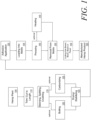
- FIG. 1 illustrates a process flow chart of one embodiment of the present invention.
- the flow chart begins with a hemp plant in Step 105.
- the hemp stalk is trimmed/cut to length.
- the cut lengths of the hemp stalk piece (stalks and petiole) are skinned, split and/or crushed; creating hemp strands.
- Each of these steps i.e., the skinned, split and/or crushed steps) is optional.
- the hemp strands may be boiled or carbonized.
- step 125 the boiled/carbonized/natural hemp strands are dried/stabilized (acclimatized).
- the first dried hemp strands have resin/glue/adhesive (generally referred to as adhesive) applied.
- Step 135 the hemp strands with the adhesive applied are loaded into molds.
- pressure is applied to the unpressed hemp strands. Pressure can be applied through direct pressure or through the use of a lid.
- Step 145 heat is optionally applied to the pressed hemp strands.
- the adhesive has cured and the heated hemp strands and adhesive have bonded together creating a monolithic molded hemp piece.
- the monolithic hemp piece is then removed from the mold in Step 150.
- Step 155 after the monolithic unmolded hemp piece is allowed to stabilize/rest, it is then cut into boards, blocks, beams or panels.
- the manufactured hemp product is ready for use for its intended purpose.
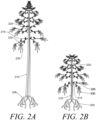
- Figure 2 is a drawing of hemp plants.
- the manufactured hemp product uses the hemp stalks from Cannabis Sativa, Cannbis Indica or Cannabis Ruderalis plants (as well as plants with similar properties), which can be grown as replenishable hemp plants indoors ( Figure 2B ) or agricultural hemp plants outdoors ( Figure 2A ).
- the agricultural hemp plants shown in Figure 2A can grow up to 2.5 meters in one growing season, which is generally less than one year.
- Agricultural hemp plants (grown outdoors) ( Figure 2A ) have been tested to have fiber content of 50-60% with generally elongated stalks.
- Indoor grown hemp plants ( Figure 2B ) are usually smaller in height and thinner in stem diameter with a fiber content lower than naturally grown outdoor hemp plants ( Figure 2A ).
- Each type of hemp plant includes Roots 205, Main Stalk 210, Nodes 215, Internodes 220, Petoile 225, and Fan Leaf 230.
- the manufactured hemp products use the Main Stalks 210, but may also incorporate the Nodes 215, Internodes 220 and Petoile 225.
- Hemp stalk are known to have higher fiber content than many trees species; with research showing standard tree species ⁇ 50% fiber content with hemp having up to 57% fiber content.
- Figure 3 is a drawing of the hemp stalk being cut/trimmed to length.
- Some embodiments disclosed herein are directed to a method of preparing hemp stalks for use in a manufactured hemp product.
- This embodiment includes providing a hemp stalk piece from a cannabis plant 305, wherein the hemp stalk piece is generally rectangular or cylinder and has a thickness ⁇ 75 mm.
- the internal surface area of the hemp stalk piece is accessible from the outside of the hemp stalk piece, with the hemp stalk piece having a naturally-occurring, generally elongate internal structure extending along one axis of the hemp stalk piece.
- Cutting the hemp stalk above the roots and removing the Petiole at the Nodes 310 provides an elongate hemp stalk 315 from a, for example, cannabis plant, where the hemp stalk has a length and a width, generally rectangular or cylinder in cross section 320, and has a thickness in the range of between about 0.1 mm to about 75 mm. Additionally, the internal volume of the hemp stalk is capable of absorbing fluid accessible from the outside of the hemp piece because the hemp stalk piece has a naturally-occurring, generally elongate internal structure extending generally along the length of the hemp stalk piece.
- Figure 4 is a drawing of a hemp stalk piece 320 being skinned 405, split 415, and crushed 420 to create a hemp stalk strand.
- a skinned hemp stalk piece is shown by reference number 410.
- One of ordinary skill in the art would appreciate that the degree of the hemp stalk piece being skinned, split, and/or crushed varies or these processes may be omitted entirely.
- Some embodiments disclosed herein are directed to a method of preparing hemp stalk for use in a manufactured hemp product that includes a hemp stalk piece from a cannabis plant 310.
- Splitting 415 at least a portion of the naturally-occurring generally elongate internal structure of the hemp stalk parallel to the axis of the hemp stalk 320 increases by at least 10% than the surface area of the hemp stalk piece prior to breaking at least a portion of the internal structure.
- the breaking step increases the surface area of the hemp stalk piece thereby increasing the ability of the hemp stalk piece to absorb an additional amount of the adhesive solution.
- the skin is removed 405 leaving a hemp stalk piece which is unskinned 410, it is split into strands 415, and/or crushed 425 to further open the internal lignocellulosic plant structure.
- the optional step of splitting the strand is similar to splitting a log.
- the optional step of crushing is generally performed through a rolling action.
- the crushing process results in crushed hemp stalk 420.
- the amount of splitting, skinning and crushing the hemp stalk piece to create a hemp strand varies in accordance with the required strength and visual appearance of the finished product. Reducing or eliminating the skinning, splitting and crushing allows less adhesive to penetrate the hemp strand and provides a "more busy" (or more complexed) visual appearance of the final product.
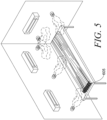
- Figure 5 is a drawing of a hemp strand being boiled or carbonized. These steps of boiling or carbonizing the hemp strands are optional. Some embodiments disclosed herein are directed to a method of preparing hemp stalk for use in a manufactured hemp product that can include providing a hemp strand. The optional steps of boiling the hemp strand in H2O or a mild H2O2 (2%) solution will remove natural sugars in the strand creating better adhesive penetration/bonding and a more uniform color to the end product. Boiling is generally conducted at above 100 C for a minimum of 2 hours. Carbonizing the hemp strand with pressured hot steam above 120 C will darken the color of the end manufactured hemp product by carbonizing the sugars for 2-4 hours to reach required color darkness.
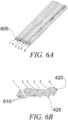
- Figure 6 is a drawing of a hemp strand (after the optional boiling or carbonizing) ( Figure 6A ) after the drying process which shows individual strands of similar size 605.
- a magnified drawing ( Figure 6B ) indicates stress fractures from the optional crushing process 420.
- the hemp stalk strand is dried to a first total water content preferably of less than 20% by weight. Drying the hemp stalk strand can be done by using forced air, heat, sunshine or ambient air conditions. Best practice is using natural elements such as sunshine, but wood drying room, kiln or microwave technology are also acceptable. Boiling the hemp strands is optional after de-skinning/splitting/crushing creates more uniform colors removing some of the green color of the live plant.
- Carbonizing the hemp strands is optional after cutting splitting/de-skinning. It is the process of pressure steaming the hemp strands to create a darker brown color by carbonizing the sugars in the stalk.
- Figure 7 is a drawing of the adhesive application to the first dried hemp strands.
- Some embodiments disclosed herein are directed to a method of preparing hemp stalk for use in a manufactured hemp product that can include providing a hemp strand 605.
- the hemp strands are submersed in a container 705 full of fossil fuel or agricultural based adhesive solution 710 for between about 0.5-20 minutes.
- Agricultural based adhesives may include but are not limited to; soy, hemp, wheat or flowers.
- Petro based adhesives may include but are not limited to; urea formaldehyde, phenol formaldehyde, melamine urea formaldehyde, polyvinyl acetate, polyurethane, emulsion polymeric isocyanates or melamin formaldehyde.
- the hemp strands with applied adhesive is air or heat dried to a second total water content of between about 5% to about 20% by weight for thermal set adhesives.
- the drying step is eliminated for cold set adhesives.
- the hemp strand includes adhesive in the range of between about 5% to about 49% by weight.
- Agri based adhesives are derived from natural occurring organic compounds, and are more eco-friendly and the preferred choice by end users for the manufactured hemp product. Cost, technical properties and ease of use sometimes limit the use of these eco-friendly adhesives.
- Fossil fuel based adhesives are derived from petroleum or other fossil fuels and include curing or linking agents such as isocyanates, phenol, urea, melamine or acetates. These products are not eco-friendly but typically create a stronger and more cost efficient product.
- Cold Set Adhesives- can cure at room temperature (5-40 C) and do not require an applied heat source, curing time is generally longer than thermoset adhesives. These adhesives generally have a higher viscosity and are applied more to the surface of the hemp strands, penetrating the hemp strand cell structure to a lesser degree than the diluted thermoset adhesives.
- Thermoset Adhesives- cure at higher temperatures (examples UF 70 C and PF 120 C) and require an applied heat source, curing time is generally shorter than cold set adhesives.
- Thermoset adhesives can be applied via a H2O dilution technique which includes using a 50% diluted adhesive to lower the viscosity in turn increasing the penetration of the plant structure. Following the flooding of the cell structure of the hemp strands the H2O is dried out of the hemp stalk but the adhesive remains clinging to the internal cell structure of the plant. These dried strands will require a heat curing system to trigger chemical bonding in some cases.
- Figure 8 is a drawing of the adhesive applied hemp strands 605 being loaded into molds 805.
- Some embodiments disclosed herein are directed to a method of making a manufactured hemp product that can include providing a plurality of hemp strands, and placing the adhesive-applied strands into a mold, where the mold has an interior width greater than the width of an individual adhesive applied hemp strand.
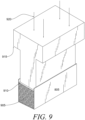
- Figure 9 is a drawing of the molded hemp strands being pressed.
- Some embodiments disclosed herein are directed to a method of making a manufactured hemp product that can include providing a plurality of adhesive applied hemp strands 905 placed into a mold 805 with a lid 910, using a press 915 and applying pressure 920 to the molded hemp strands in the mold to thereby form a manufactured hemp product.
- the amount of pressure 920 applied depends on the required density and hardness of the finished product. For thermoset adhesives heat is applied to the mold with pressure still applied or a lid attached to maintain pressure during adhesive curing. For cold set adhesives no heat is required, but pressure remains applied or a lid attached to maintain pressure during adhesive curing.
- Figure 10 is a drawing of the molds 805 being opened and the pressed hemp strands being trimmed.
- Some embodiments disclosed herein are directed to a method of making a manufactured hemp product including hemp strands and a desired amount of adhesive. Once the adhesives are cured, the pressure is released 1005 or the mold lids 910 are opened and the manufactured hemp product is removed 905. The short ends of the manufactured product are trimmed/cut to form a uniform edge. The manufactured hemp product is then allowed to stabilize in ambient air conditions.
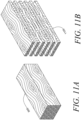
- Figure 11 is a drawing of the monolithic hemp piece 905 being cut into board, block, beam or panel 1105.
- the manufactured hemp product many then be cut, sanded or formed into board, block, beam or panel. Once in board, block, beam or panel shape the product is allowed to stabilize for preferably 2-10 days pending environmental conditions.
- Figure 12 is a drawing of a manufactured hemp product 1105.
- a manufactured hemp product that can include a plurality of adhesively bonded and pressed hemp strands; where: (1) each of the hemp strands is of generally the same length; (2) each hemp strand comprises a naturally-occurring, generally elongate internal structure extending generally along one axis of the strand that has been at least partially laterally broken and at least partially permeated by an adhesive; (3) the hemp strands are oriented roughly parallel to one another along their length; (4) the manufactured hemp product comprises an amount of adhesive in the range of between about 5% to about 49% by weight; and (5) the manufactured hemp product has a generally uniform density in the range of between about 600 kg/m3 to about 1200 kg/m3.
- the manufactured hemp product has a dimensional stability coefficient of change that is at least 10% more stable than the original hemp stalk according to the dimensional stability coefficient of change.
- the manufactured hemp product has a hardness pending adhesive used and density. Test results have shown the manufactured hemp product to have an improved hardness over natural hemp stalks according to the Janka Hardness Test.
- Some embodiments herein are directed to a manufactured hemp product that can include a plurality of adhesively bonded partially broken hemp strands; wherein each of the partially broken hemp strands maintains its original structure from an appearance point of view; the majority of the partially broken hemp strands from the stalk are the same length, but pieces from nodes, internodes and petiole may be of varying size; each partially broken hemp strand comprises a naturally-occurring, generally elongate internal structure extending along the length of the strand that has been at least partially broken and at least partially permeated by the adhesive; the partially broken hemp strands are oriented approximately parallel to one another along their length.
Landscapes
- Engineering & Computer Science (AREA)
- Life Sciences & Earth Sciences (AREA)
- Textile Engineering (AREA)
- Manufacturing & Machinery (AREA)
- Wood Science & Technology (AREA)
- Forests & Forestry (AREA)
- Chemical & Material Sciences (AREA)
- Chemical Kinetics & Catalysis (AREA)
- General Chemical & Material Sciences (AREA)
- Dry Formation Of Fiberboard And The Like (AREA)
Description
- Disclosed herein are manufactured hemp products and methods of making the same. More particularly, the manufactured hemp products described herein may include hemp composite boards, blocks, beams, panels, flooring, furniture, building materials and other wood products wherein the grain of the product is displayed, as in some composite or wood products.
- Today's increased demand for wood products, coupled with unbridled deforestation, has led to a scarce supply of timber sources. Many species of majestic rainforest trees are endangered or are approaching extinction. In addition to a reduced supply of trees, many trees traditionally coveted for their wood take many years to reach maturity. Thus, even if these trees are replanted, it will take many years to replenish the supply. This scarcity of natural wood may be particularly noticeable in those industries that rely on the particular aesthetic and structural qualities of the natural wood, such as the wood flooring, furniture, building materials or other wood industries.
- Substitutes for natural wood can include, for example, plywood, particle board, and the like. However, many of these substitutes are derived from natural wood but do not have visual or technical attributes of natural wood. Furthermore, they may not address the issue of finding and maintaining a sustainable raw material supply for the future.
- The document
GB1505833A - A method and system have been developed that allows for the use of hemp stalks from Cannabis Sativa, Cannbis Indica or Cannabis Ruderalis plants (as well as plants with similar properties) which can be grown as replenishable plants indoors (or agricultural crops outdoors) to replace hardwood used in flooring, furniture and other wooden products. These products derived from hemp stalks provide the same or better hardness, stability, and density.
- One method of preparing hemp stalks for use in a manufactured hemp product may include beginning with a hemp stalk piece from a cannabis plant. The hemp stalk piece is generally rectangular or cylinder and it may have a thickness in the range of about 0.1 mm to about 75 mm. The hemp stalk piece typically includes an internal surface area which is accessible from the outside of the hemp stalk piece. The hemp stalk piece generally has a naturally-occurring, generally elongate internal structure extending along one axis of the hemp stalk piece.
- In harvesting, the hemp stalk is cut above the roots and the branches are (typically) removed. This provides an elongate hemp stalk piece from the cannabis plant. The internal volume of the hemp strand is capable of absorbing fluid accessible from the outside of the hemp stalk piece. Additionally, breaking at least a portion of the naturally-occurring generally elongate internal structure parallel to the axis increases the surface area of the hemp stalk piece such that the ability of the hemp piece to absorb an adhesive solution increases by at least 10% than the surface area of the hemp stalk piece prior to breaking at least a portion of the internal structure.
- The hemp stalk piece may be cut to size after which the hemp stalk piece may be deskinned, split and crushed to further open the internal lignocellulosic plant structure. This optional step is typically based on visual observation and the adhesive application. In addition, boiling the hemp stalk pieces in H2O or in a mild H2O2 solution or carbonizing with pressured steam may occur. The hemp strands are dried then submersed in a fossil fuel or agricultural based adhesive solution for about 0.5-20 minutes. Subsequent to this submersion, the hemp strands are air or heat dried to a second total water content of between about 5% to about 20% by weight for thermal set adhesives. If a cold set adhesive is going to be used, the hemp strands are not typically dried. The hemp strand includes adhesive in the range of between about 5% to about 49% by weight. Typically, the adhesive-applied strands for thermoset adhesives are dried, but adhesive-applied strands are not dried for cold set adhesives.
- Subsequent steps normally include placing the adhesive-applied strands into a mold with a lid; and applying pressure to the hemp strands. When thermoset adhesives are used, heat is typically applied to the mold while pressure is applied. Alternately, a lid can be used to maintain pressure on the strands during adhesive curing. For cold set adhesives while no heat is required, pressure is applied or, alternatively, a lid can be used to maintain pressure during adhesive curing.
- Once the applied adhesives are cured, the pressure is released (or the mold lids are opened) and the manufactured hemp product is removed. The short ends of the manufactured product are trimmed/cut to form a uniform edge. The manufactured hemp product is then allowed to stabilize in ambient air conditions. The manufactured hemp product is then in the form of board, block beam or panel and is allowed to stabilize in ambient atmosphere conditions. Afterward, the manufactured hemp product is then dried with air or heat to obtain the required moisture content.
- The manufactured hemp product is comprised of a plurality of hemp stalk strands from a cannabis (or similar) plant less than one year old and typically has a density in the range of about 200 kg/cm3 to about 900 kg/cm3 with the desired amount of adhesive. The density and hardness of the final product is a result of: (1) the extent to which the lignocellulosic structure is opened, (2) the density of the adhesive solution, (3) the amount of time that the hemp stalk strands are submersed, and (4) the pressure applied to the mold.
- The manufactured hemp product comprises an amount of hemp strands greater than 50% and an amount of adhesive in the range of 5% to about 49%. The manufactured hemp product has a generally uniform density in the range of between about 600 kg/m3 to about 1200 kg/m3; and the manufactured hemp product has an aesthetically pleasing appearance. The manufactured hemp product has a dimensional stability coefficient of change that is at least 10% more stable than the original hemp stalk according to the dimensional stability coefficient of change. Test results have shown the manufactured hemp product to have an improved hardness over natural hemp stalks according to the Janka Hardness Test.
- The drawings are meant to illustrate the principles of the invention, wherein the invention per se is defined in the appended claims. The above-mentioned features and objects of the present disclosure will become more apparent with reference to the following description taken in conjunction with the accompanying drawings wherein like reference numerals denote like elements in which:
-
Figure 1 is a process flow chart illustrating one embodiment of a system described herein. -
Figure 2A is a drawing of an outdoor hemp plant. -
Figure 2B is a drawing of an indoor hemp plant. -
Figure 3 is a drawing of a hemp stalk being cut/trimmed to length. -
Figure 4 is a drawing of a hemp stalk piece being skinned, split and crushed to create a hemp strand (degree of split, skin and crushed varies or may be omitted). -
Figure 5 is a drawing of a hemp strand being boiled or carbonized (optional). -
Figure 6A is a drawing of a first dried hemp strand. -
Figure 6B is a magnified view of the dried hemp strand ofFigure 6A . -
Figure 7 is a drawing of the adhesive application to hemp strands. -
Figure 8 is a drawing of the adhesive applied hemp strands being loaded into molds. -
Figure 9 is a drawing of the molds with adhesive applied hemp strands being pressed. -
Figure 10 is a drawing of the molds being opened and monolithic hemp piece trimmed. -
Figure 11A is a drawing of the molded hemp strand. -
Figure 11B is a drawing of the molded hemp strand ofFigure 11A being cut into board, block, beam or panel. -
Figure 12 is a drawing of a manufactured hemp product. -
Figure 1 illustrates a process flow chart of one embodiment of the present invention. The flow chart begins with a hemp plant inStep 105. InStep 110 the hemp stalk is trimmed/cut to length. InStep 115, the cut lengths of the hemp stalk piece (stalks and petiole) are skinned, split and/or crushed; creating hemp strands. Each of these steps (i.e., the skinned, split and/or crushed steps) is optional. InStep 120 the hemp strands may be boiled or carbonized. Instep 125 the boiled/carbonized/natural hemp strands are dried/stabilized (acclimatized). InStep 130 the first dried hemp strands have resin/glue/adhesive (generally referred to as adhesive) applied. InStep 135 the hemp strands with the adhesive applied are loaded into molds. InStep 140 pressure is applied to the unpressed hemp strands. Pressure can be applied through direct pressure or through the use of a lid. InStep 145 heat is optionally applied to the pressed hemp strands. AfterStep 140 orStep 145, the adhesive has cured and the heated hemp strands and adhesive have bonded together creating a monolithic molded hemp piece. The monolithic hemp piece is then removed from the mold inStep 150. InStep 155, after the monolithic unmolded hemp piece is allowed to stabilize/rest, it is then cut into boards, blocks, beams or panels. Instep 160 the manufactured hemp product is ready for use for its intended purpose. -
Figure 2 is a drawing of hemp plants. The manufactured hemp product uses the hemp stalks from Cannabis Sativa, Cannbis Indica or Cannabis Ruderalis plants (as well as plants with similar properties), which can be grown as replenishable hemp plants indoors (Figure 2B ) or agricultural hemp plants outdoors (Figure 2A ). The agricultural hemp plants shown inFigure 2A can grow up to 2.5 meters in one growing season, which is generally less than one year. Agricultural hemp plants (grown outdoors) (Figure 2A ) have been tested to have fiber content of 50-60% with generally elongated stalks. Indoor grown hemp plants (Figure 2B ) are usually smaller in height and thinner in stem diameter with a fiber content lower than naturally grown outdoor hemp plants (Figure 2A ). Each type of hemp plant includesRoots 205,Main Stalk 210,Nodes 215,Internodes 220,Petoile 225, andFan Leaf 230. Preferably, the manufactured hemp products use theMain Stalks 210, but may also incorporate theNodes 215,Internodes 220 andPetoile 225. Hemp stalk are known to have higher fiber content than many trees species; with research showing standard tree species < 50% fiber content with hemp having up to 57% fiber content. -
Figure 3 is a drawing of the hemp stalk being cut/trimmed to length. Some embodiments disclosed herein are directed to a method of preparing hemp stalks for use in a manufactured hemp product. This embodiment includes providing a hemp stalk piece from a cannabis plant 305, wherein the hemp stalk piece is generally rectangular or cylinder and has a thickness < 75 mm. The internal surface area of the hemp stalk piece is accessible from the outside of the hemp stalk piece, with the hemp stalk piece having a naturally-occurring, generally elongate internal structure extending along one axis of the hemp stalk piece. Cutting the hemp stalk above the roots and removing the Petiole at the Nodes 310, provides anelongate hemp stalk 315 from a, for example, cannabis plant, where the hemp stalk has a length and a width, generally rectangular or cylinder incross section 320, and has a thickness in the range of between about 0.1 mm to about 75 mm. Additionally, the internal volume of the hemp stalk is capable of absorbing fluid accessible from the outside of the hemp piece because the hemp stalk piece has a naturally-occurring, generally elongate internal structure extending generally along the length of the hemp stalk piece. -
Figure 4 is a drawing of ahemp stalk piece 320 being skinned 405, split 415, and crushed 420 to create a hemp stalk strand. A skinned hemp stalk piece is shown by reference number 410. One of ordinary skill in the art would appreciate that the degree of the hemp stalk piece being skinned, split, and/or crushed varies or these processes may be omitted entirely. Some embodiments disclosed herein are directed to a method of preparing hemp stalk for use in a manufactured hemp product that includes a hemp stalk piece from a cannabis plant 310. Splitting 415 at least a portion of the naturally-occurring generally elongate internal structure of the hemp stalk parallel to the axis of thehemp stalk 320 increases by at least 10% than the surface area of the hemp stalk piece prior to breaking at least a portion of the internal structure. The breaking step increases the surface area of the hemp stalk piece thereby increasing the ability of the hemp stalk piece to absorb an additional amount of the adhesive solution. In some embodiments after the hemp stalk piece is cut to size, the skin is removed 405 leaving a hemp stalk piece which is unskinned 410, it is split into strands 415, and/or crushed 425 to further open the internal lignocellulosic plant structure. The optional step of splitting the strand is similar to splitting a log. The optional step of crushing is generally performed through a rolling action. The crushing process results in crushedhemp stalk 420. The amount of splitting, skinning and crushing the hemp stalk piece to create a hemp strand varies in accordance with the required strength and visual appearance of the finished product. Reducing or eliminating the skinning, splitting and crushing allows less adhesive to penetrate the hemp strand and provides a "more busy" (or more complexed) visual appearance of the final product. -
Figure 5 is a drawing of a hemp strand being boiled or carbonized. These steps of boiling or carbonizing the hemp strands are optional. Some embodiments disclosed herein are directed to a method of preparing hemp stalk for use in a manufactured hemp product that can include providing a hemp strand. The optional steps of boiling the hemp strand in H2O or a mild H2O2 (2%) solution will remove natural sugars in the strand creating better adhesive penetration/bonding and a more uniform color to the end product. Boiling is generally conducted at above 100 C for a minimum of 2 hours. Carbonizing the hemp strand with pressured hot steam above 120 C will darken the color of the end manufactured hemp product by carbonizing the sugars for 2-4 hours to reach required color darkness. -
Figure 6 is a drawing of a hemp strand (after the optional boiling or carbonizing) (Figure 6A ) after the drying process which shows individual strands ofsimilar size 605. A magnified drawing (Figure 6B ) indicates stress fractures from the optional crushingprocess 420. At this point, the hemp stalk strand is dried to a first total water content preferably of less than 20% by weight. Drying the hemp stalk strand can be done by using forced air, heat, sunshine or ambient air conditions. Best practice is using natural elements such as sunshine, but wood drying room, kiln or microwave technology are also acceptable. Boiling the hemp strands is optional after de-skinning/splitting/crushing creates more uniform colors removing some of the green color of the live plant. Adding H2O2 to the water solution for boiling improves the chemical bonding for phenol formaldehyde adhesives. Carbonizing the hemp strands is optional after cutting splitting/de-skinning. It is the process of pressure steaming the hemp strands to create a darker brown color by carbonizing the sugars in the stalk. -
Figure 7 is a drawing of the adhesive application to the first dried hemp strands. Some embodiments disclosed herein are directed to a method of preparing hemp stalk for use in a manufactured hemp product that can include providing ahemp strand 605. The hemp strands are submersed in acontainer 705 full of fossil fuel or agricultural basedadhesive solution 710 for between about 0.5-20 minutes. Agricultural based adhesives may include but are not limited to; soy, hemp, wheat or flowers. Petro based adhesives may include but are not limited to; urea formaldehyde, phenol formaldehyde, melamine urea formaldehyde, polyvinyl acetate, polyurethane, emulsion polymeric isocyanates or melamin formaldehyde. Afterward, the hemp strands with applied adhesive is air or heat dried to a second total water content of between about 5% to about 20% by weight for thermal set adhesives. Alternatively, the drying step is eliminated for cold set adhesives. The hemp strand includes adhesive in the range of between about 5% to about 49% by weight. - Agri based adhesives are derived from natural occurring organic compounds, and are more eco-friendly and the preferred choice by end users for the manufactured hemp product. Cost, technical properties and ease of use sometimes limit the use of these eco-friendly adhesives. Fossil fuel based adhesives are derived from petroleum or other fossil fuels and include curing or linking agents such as isocyanates, phenol, urea, melamine or acetates. These products are not eco-friendly but typically create a stronger and more cost efficient product.
- Cold Set Adhesives- can cure at room temperature (5-40 C) and do not require an applied heat source, curing time is generally longer than thermoset adhesives. These adhesives generally have a higher viscosity and are applied more to the surface of the hemp strands, penetrating the hemp strand cell structure to a lesser degree than the diluted thermoset adhesives. Thermoset Adhesives- cure at higher temperatures (examples UF 70 C and PF 120 C) and require an applied heat source, curing time is generally shorter than cold set adhesives. Thermoset adhesives can be applied via a H2O dilution technique which includes using a 50% diluted adhesive to lower the viscosity in turn increasing the penetration of the plant structure. Following the flooding of the cell structure of the hemp strands the H2O is dried out of the hemp stalk but the adhesive remains clinging to the internal cell structure of the plant. These dried strands will require a heat curing system to trigger chemical bonding in some cases.
-
Figure 8 is a drawing of the adhesive appliedhemp strands 605 being loaded intomolds 805. Some embodiments disclosed herein are directed to a method of making a manufactured hemp product that can include providing a plurality of hemp strands, and placing the adhesive-applied strands into a mold, where the mold has an interior width greater than the width of an individual adhesive applied hemp strand. -
Figure 9 is a drawing of the molded hemp strands being pressed. Some embodiments disclosed herein are directed to a method of making a manufactured hemp product that can include providing a plurality of adhesive appliedhemp strands 905 placed into amold 805 with alid 910, using apress 915 and applyingpressure 920 to the molded hemp strands in the mold to thereby form a manufactured hemp product. The amount ofpressure 920 applied depends on the required density and hardness of the finished product. For thermoset adhesives heat is applied to the mold with pressure still applied or a lid attached to maintain pressure during adhesive curing. For cold set adhesives no heat is required, but pressure remains applied or a lid attached to maintain pressure during adhesive curing. -
Figure 10 is a drawing of themolds 805 being opened and the pressed hemp strands being trimmed. Some embodiments disclosed herein are directed to a method of making a manufactured hemp product including hemp strands and a desired amount of adhesive. Once the adhesives are cured, the pressure is released 1005 or themold lids 910 are opened and the manufactured hemp product is removed 905. The short ends of the manufactured product are trimmed/cut to form a uniform edge. The manufactured hemp product is then allowed to stabilize in ambient air conditions. -
Figure 11 is a drawing of themonolithic hemp piece 905 being cut into board, block, beam orpanel 1105. The manufactured hemp product many then be cut, sanded or formed into board, block, beam or panel. Once in board, block, beam or panel shape the product is allowed to stabilize for preferably 2-10 days pending environmental conditions. -
Figure 12 is a drawing of a manufacturedhemp product 1105. Some embodiments disclosed herein are directed to a manufactured hemp product that can include a plurality of adhesively bonded and pressed hemp strands; where: (1) each of the hemp strands is of generally the same length; (2) each hemp strand comprises a naturally-occurring, generally elongate internal structure extending generally along one axis of the strand that has been at least partially laterally broken and at least partially permeated by an adhesive; (3) the hemp strands are oriented roughly parallel to one another along their length; (4) the manufactured hemp product comprises an amount of adhesive in the range of between about 5% to about 49% by weight; and (5) the manufactured hemp product has a generally uniform density in the range of between about 600 kg/m3 to about 1200 kg/m3. The manufactured hemp product has a dimensional stability coefficient of change that is at least 10% more stable than the original hemp stalk according to the dimensional stability coefficient of change. The manufactured hemp product has a hardness pending adhesive used and density. Test results have shown the manufactured hemp product to have an improved hardness over natural hemp stalks according to the Janka Hardness Test. -
Test Results Natural Hemp Stalk* Manufactured Hemp Product* Density (kg/m3) Internodes/Petiole 476 748 Main Stalk 616 813 Dimensional Change Coefficient Internodes/Petiole 0.00190 0.00140 Main Stalk 0.00179 0.00134 Janka Hardness Internodes/Petiole 3.9 PV A 6.4 Main Stalk 5.5 PF 9.3 *Source 24 week old hemp plant - Some embodiments herein are directed to a manufactured hemp product that can include a plurality of adhesively bonded partially broken hemp strands; wherein each of the partially broken hemp strands maintains its original structure from an appearance point of view; the majority of the partially broken hemp strands from the stalk are the same length, but pieces from nodes, internodes and petiole may be of varying size; each partially broken hemp strand comprises a naturally-occurring, generally elongate internal structure extending along the length of the strand that has been at least partially broken and at least partially permeated by the adhesive; the partially broken hemp strands are oriented approximately parallel to one another along their length.
Claims (8)
- A manufactured hemp block (905) comprising:
a plurality of adhesively bonded partially broken hemp strands (605), wherein:each of said partially broken hemp strands (605) maintains its original structure from an appearance point of view;each partially broken hemp strand (605) comprises a naturally-occurring, generally elongate internal structure extending along the length of the hemp strand, that has been at least partially broken parallel to axis of the elongate internal structure, and that is at least partially permeated by an adhesive;said partially broken hemp strands (605) are oriented approximately parallel to one another along their length;said manufactured hemp block (905) comprises an amount of adhesive in the range of 5% by weight to 49% by weight and an amount of hemp strands of greater than 50% by weight;said manufactured hemp block (905) has a generally uniform density in the range of 600 kg/m3 to 1200 kg/m3; andsaid manufactured hemp block (905) is suitable for being used as a wood substitute in appearance and technical properties. - The manufactured hemp block (905) of claim 1, wherein one or more of said partially broken hemp strands (605) is from hemp stalk that has a density in the range of 200 kg/m3 to 900 kg/m3.
- The manufactured hemp block (905) of claim 1, wherein said hemp strands (605) are from the stalk (210), petiole (225), nodes (215) and internodes (220) from at least one of Cannabis Sativa, Cannabis Indica and Cannabis Ruderalis.
- The manufactured hemp block (905) of claim 1, wherein said manufactured hemp block (905) can be used in a finished product such as flooring, furniture and other wood products.
- The manufactured hemp block (905) of claim 1 wherein said adhesive is an agricultural based adhesive suitable for the product of at least one of soy based adhesives, hemp based adhesive, a wheat based adhesive, and a flower based adhesive.
- The manufactured hemp block (905) of claim 1 wherein said adhesive is a fossil fuel based adhesive from at least one of urea formaldehyde, phenol formaldehyde, melamine urea formaldehyde, polyvinyl acetate, polyurethane, emulsion polymeric isocyanates, and melamine formaldehyde.
- The manufactured hemp block (905) of claim 1 wherein said adhesive includes both an agricultural based adhesive and a fossil fuel based adhesive.
- A process of manufacturing a manufactured hemp block (905) comprising:cutting a number of hemp strands (605), to generally the same length wherein each of said hemp strands (605) comprises a naturally-occurring, generally elongate internal structure extending generally along one axis of the strand;wherein said step of cutting includes at least partially laterally breaking said hemp strands parallel to axis of the elongate internal structure;orienting said number of hemp strands (605) to be roughly parallel to one another along their length;bonding said number of hemp strands (605) together by adding an amount of adhesive such that said manufactured hemp block (905) includes 5% by weight to 49% by weight of said adhesive and includes an amount of hemp strands (605) of greater than 50% by weight;permeating at least some of the broken hemp strands (605) with said adhesive;pressing said broken hemp strands (605) and adhesive together;creating said manufactured hemp block (905) which has a generally uniform density in the range of 600 kg/m3 to 1200 kg/m3; and where said manufactured hemp block (905) is suitable for being used as a wood substitute in appearance and technical properties.
Applications Claiming Priority (2)
| Application Number | Priority Date | Filing Date | Title |
|---|---|---|---|
| US15/338,298 US10240285B2 (en) | 2016-10-28 | 2016-10-28 | System for and method of manufacturing hemp products |
| PCT/US2017/058571 WO2018081450A1 (en) | 2016-10-28 | 2017-10-26 | System for and method of manufacturing hemp products |
Publications (4)
| Publication Number | Publication Date |
|---|---|
| EP3532671A1 EP3532671A1 (en) | 2019-09-04 |
| EP3532671A4 EP3532671A4 (en) | 2020-07-08 |
| EP3532671B1 true EP3532671B1 (en) | 2024-12-25 |
| EP3532671C0 EP3532671C0 (en) | 2024-12-25 |
Family
ID=62021132
Family Applications (1)
| Application Number | Title | Priority Date | Filing Date |
|---|---|---|---|
| EP17866292.0A Active EP3532671B1 (en) | 2016-10-28 | 2017-10-26 | Method of manufacturing hemp products and hemp products |
Country Status (7)
| Country | Link |
|---|---|
| US (1) | US10240285B2 (en) |
| EP (1) | EP3532671B1 (en) |
| AU (1) | AU2017348278B2 (en) |
| CA (1) | CA3041818C (en) |
| ES (1) | ES3015764T3 (en) |
| PL (1) | PL3532671T3 (en) |
| WO (1) | WO2018081450A1 (en) |
Families Citing this family (7)
| Publication number | Priority date | Publication date | Assignee | Title |
|---|---|---|---|---|
| US10843374B2 (en) | 2016-10-28 | 2020-11-24 | Gregory A. Wilson | System for and method of manufacturing hemp products |
| WO2020198393A1 (en) * | 2019-03-25 | 2020-10-01 | Wilson Gregory A | System for and method of manufacturing hemp products |
| DE102021106195A1 (en) * | 2021-03-15 | 2022-09-15 | Reimund Dann | Plastic railway sleeper |
| US12305393B1 (en) | 2021-03-23 | 2025-05-20 | Theodore James Fiala, Jr. | Hemp-based structural composites and methods of making hemp-based structural composites |
| US11661740B2 (en) | 2021-10-07 | 2023-05-30 | ORB Technologies, LLC | System, apparatus, and method for providing a plant-based structural assembly |
| US20240359428A1 (en) * | 2023-04-27 | 2024-10-31 | David Hubbard | System and method for manufacturing hemp-based building products and materials |
| BE1031803B1 (en) * | 2023-07-14 | 2025-02-12 | C Biotech Bv | HEMP-BASED WOOD AND METHOD FOR ITS PRODUCTION |
Citations (1)
| Publication number | Priority date | Publication date | Assignee | Title |
|---|---|---|---|---|
| US4232067A (en) * | 1976-04-15 | 1980-11-04 | Commonwealth Scientific And Industrial Research Organization | Reconsolidated wood product |
Family Cites Families (14)
| Publication number | Priority date | Publication date | Assignee | Title |
|---|---|---|---|---|
| GB1505833A (en) * | 1974-12-24 | 1978-03-30 | Plastic Res Lab | Wood substitute and preparation thereof |
| AU510845B2 (en) | 1976-04-15 | 1980-07-17 | Commonwealth Scientific And Industrial Research Organisation | Reconsolidated wood product Commonwealth Scientific and Industrial Research Organization |
| US6037049A (en) | 1996-05-09 | 2000-03-14 | Tingley; Daniel A. | Reinforcement panel sheet to be adhered to a wood structural member |
| US5939209A (en) | 1997-04-22 | 1999-08-17 | Tachi-S Co., Ltd. | Panel formed from sorghum millet fibers and method for forming the same |
| US6197414B1 (en) * | 1997-12-25 | 2001-03-06 | Matsushita Electric Works, Ltd. | Fiberboard and manufacturing method thereof |
| ATE245082T1 (en) | 1999-05-18 | 2003-08-15 | Alberta Res Council | COMPOSITE PANELS MADE OF HEMP FIBERS |
| JP3608457B2 (en) * | 1999-12-14 | 2005-01-12 | トヨタ自動車株式会社 | Wood-like molded body |
| US20060032167A1 (en) | 2004-07-30 | 2006-02-16 | Cecilio Federico R | Wood panel |
| US20080000548A1 (en) | 2005-12-23 | 2008-01-03 | Felpeng Liu | Methods for making improved strand wood products and products made thereby |
| WO2008055635A1 (en) | 2006-11-09 | 2008-05-15 | Dsm Ip Assets B.V. | Process for the preparation of a panel |
| WO2010091643A1 (en) | 2009-02-13 | 2010-08-19 | 中国林业科学研究院木材工业研究所 | Bamboo artificial board and producing method thereof |
| US8986437B2 (en) * | 2009-10-23 | 2015-03-24 | David H. Blount | Delignification of biomass containing lignin and production of adhesive and methods of making lignin cellulose compositions |
| WO2016077594A1 (en) | 2014-11-12 | 2016-05-19 | First Quality Tissue, Llc | Cannabis fiber, absorbent cellulosic structures containing cannabis fiber and methods of making the same |
| EP3265533A1 (en) * | 2015-03-04 | 2018-01-10 | Solenis Technologies, L.P. | Method of making lignocellulosic composites |
-
2016
- 2016-10-28 US US15/338,298 patent/US10240285B2/en active Active
-
2017
- 2017-10-26 AU AU2017348278A patent/AU2017348278B2/en active Active
- 2017-10-26 WO PCT/US2017/058571 patent/WO2018081450A1/en not_active Ceased
- 2017-10-26 ES ES17866292T patent/ES3015764T3/en active Active
- 2017-10-26 PL PL17866292.0T patent/PL3532671T3/en unknown
- 2017-10-26 CA CA3041818A patent/CA3041818C/en active Active
- 2017-10-26 EP EP17866292.0A patent/EP3532671B1/en active Active
Patent Citations (1)
| Publication number | Priority date | Publication date | Assignee | Title |
|---|---|---|---|---|
| US4232067A (en) * | 1976-04-15 | 1980-11-04 | Commonwealth Scientific And Industrial Research Organization | Reconsolidated wood product |
Also Published As
| Publication number | Publication date |
|---|---|
| WO2018081450A1 (en) | 2018-05-03 |
| EP3532671A4 (en) | 2020-07-08 |
| US10240285B2 (en) | 2019-03-26 |
| CA3041818C (en) | 2020-11-17 |
| PL3532671T3 (en) | 2025-06-02 |
| CA3041818A1 (en) | 2018-05-03 |
| AU2017348278A1 (en) | 2019-05-16 |
| EP3532671A1 (en) | 2019-09-04 |
| ES3015764T3 (en) | 2025-05-07 |
| AU2017348278B2 (en) | 2021-09-16 |
| EP3532671C0 (en) | 2024-12-25 |
| US20180119338A1 (en) | 2018-05-03 |
Similar Documents
| Publication | Publication Date | Title |
|---|---|---|
| EP3532671B1 (en) | Method of manufacturing hemp products and hemp products | |
| US10843374B2 (en) | System for and method of manufacturing hemp products | |
| Liese et al. | Utilization of bamboo | |
| WO2020198393A1 (en) | System for and method of manufacturing hemp products | |
| Anokye et al. | Bamboo properties and suitability as a replacement for wood | |
| EP2344309B1 (en) | Manufactured wood product and methods for producing the same | |
| Qisheng et al. | Industrial utilization on bamboo | |
| WO2010082140A1 (en) | Method for producing bamboo boards and products | |
| Lim et al. | The characteristics, properties and uses of plantation timbers-rubberwood and Acacia mangium | |
| EP4360836A1 (en) | Juncao fiberboard and preparation method therefor | |
| Hegazy et al. | Suitability of some fast-growing trees and date palm fronds for particleboard production | |
| CN102310442B (en) | Method for manufacturing recombined integrated section by using wood in fast-growing forest | |
| CN107379162A (en) | A kind of recombined bamboo plate production technology | |
| Chawla et al. | Use of lignocellulosic biomaterials for sustainable development of bamboo strand lumber for structural applications | |
| Kargarfard et al. | The effect of press temperature on properties of medium density fiberboard produced from Eucalyptus camaldulensis fibers | |
| US20190263017A1 (en) | Method for manufacturing reconstituted bamboo lumber for outdoor bamboo flooring | |
| KR20230023788A (en) | Cross-Hatched Bamboo Strand Timber | |
| CN112824072A (en) | Preparation method of salix mongolica board, container bottom board and preparation method of container bottom board | |
| Mishra et al. | Bamboo and Bamboo Composites: Sustainable Material for Green Construction | |
| Palokangas | Thermally modified mini-CLT panel: anti-swelling efficiency and strength properties | |
| AU2018100884A4 (en) | The manufacture of an Australian Bamboo panel board. | |
| WO2018018079A1 (en) | Panel and method of producing a panel | |
| Dost | Using eucalypts in manufacturing | |
| Johnny Ragland | Wood in Practice | |
| JPH04305402A (en) | Manufacture of fancy veneer |
Legal Events
| Date | Code | Title | Description |
|---|---|---|---|
| STAA | Information on the status of an ep patent application or granted ep patent |
Free format text: STATUS: THE INTERNATIONAL PUBLICATION HAS BEEN MADE |
|
| PUAI | Public reference made under article 153(3) epc to a published international application that has entered the european phase |
Free format text: ORIGINAL CODE: 0009012 |
|
| STAA | Information on the status of an ep patent application or granted ep patent |
Free format text: STATUS: REQUEST FOR EXAMINATION WAS MADE |
|
| 17P | Request for examination filed |
Effective date: 20190524 |
|
| AK | Designated contracting states |
Kind code of ref document: A1 Designated state(s): AL AT BE BG CH CY CZ DE DK EE ES FI FR GB GR HR HU IE IS IT LI LT LU LV MC MK MT NL NO PL PT RO RS SE SI SK SM TR |
|
| AX | Request for extension of the european patent |
Extension state: BA ME |
|
| DAV | Request for validation of the european patent (deleted) | ||
| DAX | Request for extension of the european patent (deleted) | ||
| A4 | Supplementary search report drawn up and despatched |
Effective date: 20200609 |
|
| RIC1 | Information provided on ipc code assigned before grant |
Ipc: D21D 1/26 20060101AFI20200604BHEP Ipc: D21H 11/16 20060101ALI20200604BHEP Ipc: D21D 1/06 20060101ALI20200604BHEP Ipc: D21C 9/00 20060101ALI20200604BHEP Ipc: B27N 3/04 20060101ALI20200604BHEP |
|
| STAA | Information on the status of an ep patent application or granted ep patent |
Free format text: STATUS: EXAMINATION IS IN PROGRESS |
|
| 17Q | First examination report despatched |
Effective date: 20230111 |
|
| TPAC | Observations filed by third parties |
Free format text: ORIGINAL CODE: EPIDOSNTIPA |
|
| REG | Reference to a national code |
Ref country code: DE Ref legal event code: R079 Free format text: PREVIOUS MAIN CLASS: D21D0001260000 Ipc: B27N0001000000 Ref country code: DE Ref legal event code: R079 Ref document number: 602017086999 Country of ref document: DE Free format text: PREVIOUS MAIN CLASS: D21D0001260000 Ipc: B27N0001000000 |
|
| GRAP | Despatch of communication of intention to grant a patent |
Free format text: ORIGINAL CODE: EPIDOSNIGR1 |
|
| STAA | Information on the status of an ep patent application or granted ep patent |
Free format text: STATUS: GRANT OF PATENT IS INTENDED |
|
| RIC1 | Information provided on ipc code assigned before grant |
Ipc: B27N 3/20 20060101ALN20240909BHEP Ipc: D04H 3/12 20060101ALI20240909BHEP Ipc: D04H 3/04 20120101ALI20240909BHEP Ipc: B27N 3/14 20060101ALI20240909BHEP Ipc: B27N 5/00 20060101ALI20240909BHEP Ipc: B27N 3/18 20060101ALI20240909BHEP Ipc: B27N 3/02 20060101ALI20240909BHEP Ipc: B27N 1/00 20060101AFI20240909BHEP |
|
| INTG | Intention to grant announced |
Effective date: 20240925 |
|
| GRAS | Grant fee paid |
Free format text: ORIGINAL CODE: EPIDOSNIGR3 |
|
| GRAA | (expected) grant |
Free format text: ORIGINAL CODE: 0009210 |
|
| STAA | Information on the status of an ep patent application or granted ep patent |
Free format text: STATUS: THE PATENT HAS BEEN GRANTED |
|
| AK | Designated contracting states |
Kind code of ref document: B1 Designated state(s): AL AT BE BG CH CY CZ DE DK EE ES FI FR GB GR HR HU IE IS IT LI LT LU LV MC MK MT NL NO PL PT RO RS SE SI SK SM TR |
|
| REG | Reference to a national code |
Ref country code: GB Ref legal event code: FG4D |
|
| REG | Reference to a national code |
Ref country code: CH Ref legal event code: EP |
|
| REG | Reference to a national code |
Ref country code: DE Ref legal event code: R096 Ref document number: 602017086999 Country of ref document: DE |
|
| REG | Reference to a national code |
Ref country code: IE Ref legal event code: FG4D |
|
| U01 | Request for unitary effect filed |
Effective date: 20250114 |
|
| U07 | Unitary effect registered |
Designated state(s): AT BE BG DE DK EE FI FR IT LT LU LV MT NL PT RO SE SI Effective date: 20250120 |
|
| PG25 | Lapsed in a contracting state [announced via postgrant information from national office to epo] |
Ref country code: HR Free format text: LAPSE BECAUSE OF FAILURE TO SUBMIT A TRANSLATION OF THE DESCRIPTION OR TO PAY THE FEE WITHIN THE PRESCRIBED TIME-LIMIT Effective date: 20241225 |
|
| PG25 | Lapsed in a contracting state [announced via postgrant information from national office to epo] |
Ref country code: NO Free format text: LAPSE BECAUSE OF FAILURE TO SUBMIT A TRANSLATION OF THE DESCRIPTION OR TO PAY THE FEE WITHIN THE PRESCRIBED TIME-LIMIT Effective date: 20250325 |
|
| PG25 | Lapsed in a contracting state [announced via postgrant information from national office to epo] |
Ref country code: GR Free format text: LAPSE BECAUSE OF FAILURE TO SUBMIT A TRANSLATION OF THE DESCRIPTION OR TO PAY THE FEE WITHIN THE PRESCRIBED TIME-LIMIT Effective date: 20250326 |
|
| PG25 | Lapsed in a contracting state [announced via postgrant information from national office to epo] |
Ref country code: RS Free format text: LAPSE BECAUSE OF FAILURE TO SUBMIT A TRANSLATION OF THE DESCRIPTION OR TO PAY THE FEE WITHIN THE PRESCRIBED TIME-LIMIT Effective date: 20250325 |
|
| PG25 | Lapsed in a contracting state [announced via postgrant information from national office to epo] |
Ref country code: SM Free format text: LAPSE BECAUSE OF FAILURE TO SUBMIT A TRANSLATION OF THE DESCRIPTION OR TO PAY THE FEE WITHIN THE PRESCRIBED TIME-LIMIT Effective date: 20241225 |
|
| PG25 | Lapsed in a contracting state [announced via postgrant information from national office to epo] |
Ref country code: IS Free format text: LAPSE BECAUSE OF FAILURE TO SUBMIT A TRANSLATION OF THE DESCRIPTION OR TO PAY THE FEE WITHIN THE PRESCRIBED TIME-LIMIT Effective date: 20250425 |
|
| PG25 | Lapsed in a contracting state [announced via postgrant information from national office to epo] |
Ref country code: SK Free format text: LAPSE BECAUSE OF FAILURE TO SUBMIT A TRANSLATION OF THE DESCRIPTION OR TO PAY THE FEE WITHIN THE PRESCRIBED TIME-LIMIT Effective date: 20241225 |
|
| PG25 | Lapsed in a contracting state [announced via postgrant information from national office to epo] |
Ref country code: CZ Free format text: LAPSE BECAUSE OF FAILURE TO SUBMIT A TRANSLATION OF THE DESCRIPTION OR TO PAY THE FEE WITHIN THE PRESCRIBED TIME-LIMIT Effective date: 20241225 |
|
| PLBE | No opposition filed within time limit |
Free format text: ORIGINAL CODE: 0009261 |
|
| STAA | Information on the status of an ep patent application or granted ep patent |
Free format text: STATUS: NO OPPOSITION FILED WITHIN TIME LIMIT |
|
| 26N | No opposition filed |
Effective date: 20250926 |
|
| U20 | Renewal fee for the european patent with unitary effect paid |
Year of fee payment: 9 Effective date: 20251025 |
|
| PGFP | Annual fee paid to national office [announced via postgrant information from national office to epo] |
Ref country code: GB Payment date: 20251023 Year of fee payment: 9 |
|
| PGFP | Annual fee paid to national office [announced via postgrant information from national office to epo] |
Ref country code: ES Payment date: 20251113 Year of fee payment: 9 |