EP3532457B1 - Crystalline forms of hydroxynorketamine - Google Patents
Crystalline forms of hydroxynorketamine Download PDFInfo
- Publication number
- EP3532457B1 EP3532457B1 EP18758671.4A EP18758671A EP3532457B1 EP 3532457 B1 EP3532457 B1 EP 3532457B1 EP 18758671 A EP18758671 A EP 18758671A EP 3532457 B1 EP3532457 B1 EP 3532457B1
- Authority
- EP
- European Patent Office
- Prior art keywords
- hydroxynorketamine
- acid
- addition salt
- theta
- degrees
- Prior art date
- Legal status (The legal status is an assumption and is not a legal conclusion. Google has not performed a legal analysis and makes no representation as to the accuracy of the status listed.)
- Active
Links
Images




Classifications
-
- C—CHEMISTRY; METALLURGY
- C07—ORGANIC CHEMISTRY
- C07C—ACYCLIC OR CARBOCYCLIC COMPOUNDS
- C07C225/00—Compounds containing amino groups and doubly—bound oxygen atoms bound to the same carbon skeleton, at least one of the doubly—bound oxygen atoms not being part of a —CHO group, e.g. amino ketones
- C07C225/20—Compounds containing amino groups and doubly—bound oxygen atoms bound to the same carbon skeleton, at least one of the doubly—bound oxygen atoms not being part of a —CHO group, e.g. amino ketones having amino groups bound to carbon atoms of rings other than six-membered aromatic rings of the carbon skeleton
-
- A—HUMAN NECESSITIES
- A61—MEDICAL OR VETERINARY SCIENCE; HYGIENE
- A61K—PREPARATIONS FOR MEDICAL, DENTAL OR TOILETRY PURPOSES
- A61K31/00—Medicinal preparations containing organic active ingredients
- A61K31/13—Amines
- A61K31/135—Amines having aromatic rings, e.g. ketamine, nortriptyline
-
- A—HUMAN NECESSITIES
- A61—MEDICAL OR VETERINARY SCIENCE; HYGIENE
- A61K—PREPARATIONS FOR MEDICAL, DENTAL OR TOILETRY PURPOSES
- A61K9/00—Medicinal preparations characterised by special physical form
- A61K9/20—Pills, tablets, discs, rods
- A61K9/2004—Excipients; Inactive ingredients
- A61K9/2022—Organic macromolecular compounds
- A61K9/205—Polysaccharides, e.g. alginate, gums; Cyclodextrin
- A61K9/2054—Cellulose; Cellulose derivatives, e.g. hydroxypropyl methylcellulose
-
- A—HUMAN NECESSITIES
- A61—MEDICAL OR VETERINARY SCIENCE; HYGIENE
- A61K—PREPARATIONS FOR MEDICAL, DENTAL OR TOILETRY PURPOSES
- A61K9/00—Medicinal preparations characterised by special physical form
- A61K9/48—Preparations in capsules, e.g. of gelatin, of chocolate
- A61K9/4816—Wall or shell material
- A61K9/4825—Proteins, e.g. gelatin
-
- C—CHEMISTRY; METALLURGY
- C07—ORGANIC CHEMISTRY
- C07C—ACYCLIC OR CARBOCYCLIC COMPOUNDS
- C07C215/00—Compounds containing amino and hydroxy groups bound to the same carbon skeleton
- C07C215/42—Compounds containing amino and hydroxy groups bound to the same carbon skeleton having amino groups or hydroxy groups bound to carbon atoms of rings other than six-membered aromatic rings of the same carbon skeleton
- C07C215/44—Compounds containing amino and hydroxy groups bound to the same carbon skeleton having amino groups or hydroxy groups bound to carbon atoms of rings other than six-membered aromatic rings of the same carbon skeleton bound to carbon atoms of the same ring or condensed ring system
-
- C—CHEMISTRY; METALLURGY
- C07—ORGANIC CHEMISTRY
- C07D—HETEROCYCLIC COMPOUNDS
- C07D201/00—Preparation, separation, purification or stabilisation of unsubstituted lactams
-
- C—CHEMISTRY; METALLURGY
- C07—ORGANIC CHEMISTRY
- C07D—HETEROCYCLIC COMPOUNDS
- C07D207/00—Heterocyclic compounds containing five-membered rings not condensed with other rings, with one nitrogen atom as the only ring hetero atom
- C07D207/02—Heterocyclic compounds containing five-membered rings not condensed with other rings, with one nitrogen atom as the only ring hetero atom with only hydrogen or carbon atoms directly attached to the ring nitrogen atom
- C07D207/18—Heterocyclic compounds containing five-membered rings not condensed with other rings, with one nitrogen atom as the only ring hetero atom with only hydrogen or carbon atoms directly attached to the ring nitrogen atom having one double bond between ring members or between a ring member and a non-ring member
- C07D207/22—Heterocyclic compounds containing five-membered rings not condensed with other rings, with one nitrogen atom as the only ring hetero atom with only hydrogen or carbon atoms directly attached to the ring nitrogen atom having one double bond between ring members or between a ring member and a non-ring member with hetero atoms or with carbon atoms having three bonds to hetero atoms with at the most one bond to halogen, e.g. ester or nitrile radicals, directly attached to ring carbon atoms
- C07D207/24—Oxygen or sulfur atoms
- C07D207/26—2-Pyrrolidones
- C07D207/273—2-Pyrrolidones with hetero atoms or with carbon atoms having three bonds to hetero atoms with at the most one bond to halogen, e.g. ester or nitrile radicals, directly attached to other ring carbon atoms
- C07D207/277—Carbon atoms having three bonds to hetero atoms with at the most one bond to halogen, e.g. ester or nitrile radicals
- C07D207/28—2-Pyrrolidone-5- carboxylic acids; Functional derivatives thereof, e.g. esters, nitriles
-
- C—CHEMISTRY; METALLURGY
- C07—ORGANIC CHEMISTRY
- C07B—GENERAL METHODS OF ORGANIC CHEMISTRY; APPARATUS THEREFOR
- C07B2200/00—Indexing scheme relating to specific properties of organic compounds
- C07B2200/13—Crystalline forms, e.g. polymorphs
-
- C—CHEMISTRY; METALLURGY
- C07—ORGANIC CHEMISTRY
- C07C—ACYCLIC OR CARBOCYCLIC COMPOUNDS
- C07C2601/00—Systems containing only non-condensed rings
- C07C2601/12—Systems containing only non-condensed rings with a six-membered ring
- C07C2601/14—The ring being saturated
Definitions
- the present invention provides novel, stable, processable and pharmaceutically acceptable salt forms of 2R,6R-hydroxynorketamine or 2S,6S-hydroxynorketamine with high aqueous solubility.
- Ketamine derivatives and in particular compounds derived from the ketamine metabolite 2R,6R-hydroxynorketamine and 2S,6S-hydroxynorketamine, show promise as antidepressant agents.
- Crystal forms of S-ketamine are known in, for example, WO2014/020155 (CLINPHARM REFORM GMBH) dated 6 February 2014, which discloses S-ketamine hydrochloride and other organic acid salts.
- a first aspect of the present invention provides an acid addition salt of 2R,6R-hydroxynorketamine or 2S,6S-hydroxynorketamine obtainable by reaction with an organic acid comprising either (i) two or more carboxylic acid groups, or (ii) one or more carboxylic acid groups and an amide group, with the proviso that the acid addition salt is not 2R,6R-hydroxynorketamine L-tartrate or 2S,6S-hydroxynorketamine D-tartrate.
- 2R,6R-hydroxynorketamine and 2S,6S-hydroxynorketamine form crystalline salts readily with organic acids as described herein.
- Organic acids as used in the present invention may be chiral, enabling the formation of a pharmaceutically acceptable salt to be performed simultaneously with chiral resolution of the active agent.
- crystalline salts of the present invention display unexpectedly high aqueous solubility. Advantages conferred by the high solubility of the acid addition salts of the present invention include high oral bioavailability, which enables optimised solid oral dosage forms to achieve concentrations of systemic circulation necessary to maximise the pharmacological response to 2R,6R-hydroxynorketamine and 2S,6S-hydroxynorketamine.
- the acid addition salt is obtainable with a chiral organic acid having Formula III, IV or V:
- the acid addition salt is selected from aspartic acid, citric acid, fumaric acid, glutaric acid, glutamic acid, hippuric acid, malic acid, maleic acid, mucic acid, oxalic acid, pyroglutamic acid, and succinic acid.
- the acid addition salt is selected from citric acid, L-malic acid, D-malic acid, fumaric acid, D-pyroglutamic acid, and L-pyroglutamic acid.
- the organic acid is homochiral.
- the acid addition salt is selected from 2R,6R-hydroxynorketamine difumarate, 2S,6S-hydroxynorketamine difumarate, 2S,6S-hydroxynorketamine D-pyroglutamate, 2R,6R-hydroxynorketamine L-pyroglutamate, 2R,6R-hydroxynorketamine L-malate, and 2S,6S-hydroxynorketamine D-malate.
- the acid addition salt is in substantially crystalline form.
- a second aspect of the present invention provides a crystalline acid addition salt of 2R,6R-hydroxynorketamine or 2S,6S-hydroxynorketamine having an X-ray powder diffraction pattern comprising characteristic peaks expressed in degrees 2-theta at positions 19.2, 26.4 and 31.5.
- the crystalline acid addition salt of 2R,6R-hydroxynorketamine or 2S,6S-hydroxynorketamine having an X-ray powder diffraction pattern further comprising characteristic peaks expressed in degrees 2-theta at positions 14.1, 16.9, 23.5, 24.0 and 29.9.
- the acid addition salt is obtainable according to the first aspect of the present invention.
- the acid addition salt is selected from 2R,6R-hydroxynorketamine difumarate and 2S,6S-hydroxynorketamine difumarate and displays an X-ray powder diffraction pattern comprising characteristic peaks expressed in degrees 2-theta at positions 11.7, 12.4, 22.5 and 22.8.
- the acid addition salt is selected from 2R,6R-hydroxynorketamine difumarate and 2S,6S-hydroxynorketamine difumarate and displays an X-ray powder diffraction pattern further comprising characteristic peaks expressed in degrees 2-theta at positions 14.7, 16.5, 18.8, 26.8 and 29.4.
- the acid addition salt is selected from 2R,6R-hydroxynorketamine difumarate and 2S,6S-hydroxynorketamine difumarate and displays an X-ray powder diffraction pattern further comprising characteristic peaks expressed in degrees 2-theta at positions 10.2, 21.4, 23.2, 25.7, and 29.7.
- the acid addition salt is selected from 2R,6R-hydroxynorketamine difumarate and 2S,6S-hydroxynorketamine difumarate and displays an X-ray powder diffraction pattern further comprising characteristic peaks expressed in degrees 2-theta at positions 18.3, 20.4, 31.0 and 33.0.
- the acid addition salt is selected from 2R,6R-hydroxynorketamine L-malate and 2S,6S-hydroxynorketamine D-malate and displays an X-ray powder diffraction pattern comprising a characteristic peak expressed in degrees 2-theta at position 23.1.
- the acid addition salt is selected from 2R,6R-hydroxynorketamine L-pyroglutamate and 2S,6S-hydroxynorketamine D-pyroglutamate having an X-ray powder diffraction pattern comprising characteristic peaks expressed in degrees 2-theta at position 14.3.
- the acid addition salt is selected from 2R,6R-hydroxynorketamine L-pyroglutamate and 2S,6S-hydroxynorketamine D-pyroglutamate having an X-ray powder diffraction pattern further comprising characteristic peaks expressed in degrees 2-theta at positions 19.9 and 23.8.
- the acid addition salt is selected from 2R,6R-hydroxynorketamine L-pyroglutamate and 2S,6S-hydroxynorketamine D-pyroglutamate having an X-ray powder diffraction pattern further comprising characteristic peaks expressed in degrees 2-theta at positions 12.0, 13.6, 15.2, 20.8, 26.2, and 28.9.
- the acid addition salt is selected from 2R,6R-hydroxynorketamine L-pyroglutamate and 2S,6S-hydroxynorketamine D-pyroglutamate having an X-ray powder diffraction pattern further comprising characteristic peaks expressed in degrees 2-theta at positions 12.8, 17.6, 18.1, and 25.5.
- the acid addition salt is selected from 2R,6R-hydroxynorketamine L-pyroglutamate and 2S,6S-hydroxynorketamine D-pyroglutamate having an X-ray powder diffraction pattern further comprising characteristic peaks expressed in degrees 2-theta at positions 13.8, 14.1, 17.8, 20.3, 21.0, 21.8, 22.7, 24.6, 25.0, 25.3, 27.3, 28.5, 28.7, 30.6, 32.3, 32.7, 33.3, 33.9, and 34.1.
- the acid addition salt is selected from 2R,6R-hydroxynorketamine L-pyroglutamate and 2S,6S-hydroxynorketamine D-pyroglutamate having an X-ray powder diffraction pattern further comprising characteristic peaks expressed in degrees 2-theta at positions 9.0, 16.6, 21.4, 22.4, 23.1, 25.7, 26.5, 27.8, 28.2, 29.3, 30.1, 31.1, 31.5, 33.1, 33.7, and 34.6.
- the acid addition salt is obtained by precipitation or crystallisation from an organic solvent, for example acetonitrile, isopropyl acetate, t-butyl methyl ether, ethyl acetate, or diisopropyl ether.
- an organic solvent for example acetonitrile, isopropyl acetate, t-butyl methyl ether, ethyl acetate, or diisopropyl ether.
- a third embodiment of the present invention provides a dosage form comprising an acid addition salt according to any embodiment of the first or second aspect of the present invention.
- the dosage form comprising between 5mg and 500mg of 2R,6R-hydroxynorketamine or 2S,6S-hydroxynorketamine, or the equivalent thereof.
- the dosage is a solid oral dosage form.
- the solid oral dosage form is selected from a capsule and a tablet.
- the dosage form is a solid oral dosage form comprising a blend of one or more diluent.
- the dosage form is a tablet and the blend of one or more diluent comprises microcrystalline cellulose.
- the dosage form is a capsule and the capsule shell comprises a constituent selected from gelatin and hydroxypropyl methylcellulose.
- the term '2R,6R-hydroxynorketamine' and '2S,6S-hydroxynorketamine' refer to 2R,6R-2-(2-Chlorophenyl)-2-(amino)-6-hydroxycyclohexanone and 2S,6S-2-(2-Chlorophenyl)-2-(amino)-6-hydroxycyclohexanone respectively.
- -H means a covalently bonded hydrogen
- -OH means a covalently bonded hydroxyl
- -COOH means a carboxylic acid group.
- 'chiral' means a structure which is not superimposable on its mirror image.
- 'homochiral means refers to a composition that comprises substantially one enantiomer of a chiral material.
- An aspect of the present invention provides an acid addition salt of 2R,6R-hydroxynorketamine or 2S,6S-hydroxynorketamine obtainable by reaction with an organic acid comprising either (i) two or more carboxylic acid groups, or (ii) one or more carboxylic acid groups and an amide group, with the proviso that the acid addition salt is not 2R,6R-hydroxynorketamine L-tartrate or 2S,6S-hydroxynorketamine D-tartrate.
- the acid addition salt of claim 1 the organic acid has Formula I or II
- organic acids as used in the present invention may be chiral, enabling the formation of pharmaceutically acceptable salt to take part in chiral resolution of the active agent.
- the acid addition salt is obtainable with an organic acid having Formula III, IV or V:
- the acid addition salt is selected from aspartic acid, citric acid, fumaric acid, glutaric acid, glutamic acid, hippuric acid, malic acid, maleic acid, mucic acid, oxalic acid, pyroglutamic acid, succinic acid, and tartaric acid.
- the acid addition salt is selected from citric acid, L-malic acid, D-malic acid, fumaric acid, D-pyroglutamic acid, and L-pyroglutamic acid.
- the organic acid is homochiral.
- the acid addition salt is selected from 2R,6R-hydroxynorketamine difumarate, 2S,6S-hydroxynorketamine difumarate, 2R,6R-hydroxynorketamine D-pyroglutamate, 2S,6S-hydroxynorketamine D-pyroglutamate, 2R,6R-hydroxynorketamine L-pyroglutamate, 2S,6S-hydroxynorketamine L-pyroglutamate, 2R,6R-hydroxynorketamine L-malate, and 2S,6S-hydroxynorketamine D-malate.
- the acid addition salt is in substantially crystalline form.
- An aspect of the present invention provides a crystalline acid addition salt of 2R,6R-hydroxynorketamine or 2S,6S-hydroxynorketamine having an X-ray powder diffraction pattern comprising characteristic peaks expressed in degrees 2-theta at positions 19.2, 26.4 and 31.5.
- the crystalline acid addition salt of 2R,6R-hydroxynorketamine or 2S,6S-hydroxynorketamine having an X-ray powder diffraction pattern further comprising characteristic peaks expressed in degrees 2-theta at positions 14.1, 16.9, 23.5, 24.0 and 29.9.
- the acid addition salt is obtainable according to the first aspect of the present invention.
- the acid addition salt is selected from 2R,6R-hydroxynorketamine difumarate and 2S,6S-hydroxynorketamine difumarate and displays an X-ray powder diffraction pattern comprising characteristic peaks expressed in degrees 2-theta at positions 11.7, 12.4, 22.5 and 22.8.
- the acid addition salt is selected from 2R,6R-hydroxynorketamine difumarate and 2S,6S-hydroxynorketamine difumarate and displays an X-ray powder diffraction pattern further comprising characteristic peaks expressed in degrees 2-theta at positions 14.7, 16.5, 18.8, 26.8 and 29.4.
- the acid addition salt is selected from 2R,6R-hydroxynorketamine difumarate and 2S,6S-hydroxynorketamine difumarate and displays an X-ray powder diffraction pattern further comprising characteristic peaks expressed in degrees 2-theta at positions 10.2, 21.4, 23.2, 25.7, and 29.7.
- the acid addition salt is selected from 2R,6R-hydroxynorketamine difumarate and 2S,6S-hydroxynorketamine difumarate and displays an X-ray powder diffraction pattern further comprising characteristic peaks expressed in degrees 2-theta at positions 18.3, 20.4, 31.0 and 33.0.
- the acid addition salt is selected from 2R,6R-hydroxynorketamine difumarate and 2S,6S-hydroxynorketamine difumarate and displays an X-ray powder diffraction pattern comprising characteristic peaks expressed in degrees 2-theta at the following positions: Difumarate Peak Degrees 2-theta Peak Degrees 2-theta Peak Degrees 2-theta Peak Degrees 2-theta Peak Degrees 2-theta Peak Degrees 2-theta Peak Degrees 2-theta 1 10.2 11 16.9 21 22.5 31 25.2 41 29.0 51 33.5 2 11.7 12 18.0 22 22.8 32 25.7 42 29.4 52 34.7 3 12.1 13 18.3 23 23.2 33 26.4 43 29.7 4 12.4 14 18.8 24 23.5 34 26.5 44 29.9 5 13.7 15 19.2 25 24.0 35 26.8 45 30.3 6 14.1 16 19.5 26 24.3 36 27.0 46 31.0 7 14.7 17 20.4 27 24.5 37 27.4 47 31.5 8 15.2 18 20.8 28 24.6 38 27
- the acid addition salt is selected from 2R,6R-hydroxynorketamine L-malate and 2S,6S-hydroxynorketamine D-malate and displays an X-ray powder diffraction pattern comprising a characteristic peak expressed in degrees 2-theta at position 23.1.
- the acid addition salt is selected from 2R,6R-hydroxynorketamine L-pyroglutamate and 2S,6S-hydroxynorketamine D-pyroglutamate and displays an X-ray powder diffraction pattern comprising characteristic peaks expressed in degrees 2-theta at the following positions: L-Pyroglutamate Peak Degrees 2-theta Peak Degrees 2-theta Peak Degrees 2-theta Peak Degrees 2-theta Peak Degrees 2-theta Peak Degrees 2-theta 1 9.0 11 17.8 21 23.1 31 27.8 41 32.3 2 12.0 12 18.1 22 23.8 32 28.2 42 32.7 3 12.8 13 19.9 23 24.6 33 28.5 43 33.1 4 13.6 14 20.3 24 25.0 34 28.7 44 33.3 5 13.8 15 20.8 25 25.3 35 28.9 45 33.7 6 14.1 16 21.0 26 25.5 36 29.3 46 33.9 7 14.3 17 21.4 27 25.7 37 30.1 47 34.1 8 15.2 18 21.8 28 26.2 38 30.6 48 34.6 9 16.6 19 22.4
- the acid addition salt is obtained by precipitation or crystallisation from an organic solvent selected from acetonitrile, isopropyl acetate, t-butyl methyl ether, ethyl acetate, and diisopropyl ether.
- an organic solvent selected from acetonitrile, isopropyl acetate, t-butyl methyl ether, ethyl acetate, and diisopropyl ether.
- solid oral dosage form' is defined as a solid pharmaceutical formulation which can be swallowed whole, chewed and swallowed, or dissolved, dispersed or absorbed via the oral cavity.
- Solid oral dosage forms include tablets, pills, capsules, caplets, orodispersible tablets, powders, granules and gums. Solid oral dosage forms are not taken to include liquid or aerosol formulations, powders for inhalation, or powders for injection.
- Solid oral dosage forms according to the present invention may be prepared by mixing the principle active agent(s) with a pharmaceutical carrier, e.g. corn starch, lactose, sucrose, sorbitol, talc, stearic acid, magnesium stearate, or dicalcium phosphate, and other pharmaceutical diluents, e.g. water, to form a solid preformulation composition containing a homogenous mixture of the active agent(s).
- a pharmaceutical carrier e.g. corn starch, lactose, sucrose, sorbitol, talc, stearic acid, magnesium stearate, or dicalcium phosphate
- other pharmaceutical diluents e.g. water
- the solid oral dosage form is provided in a unit dose containing between 5mg and 500mg of the acid addition salt of 2R,6R-hydroxynorketamine or 2S,6S-hydroxynorketamine as defined herein.
- Quantities of weight provided herein refer to the free-form equivalent of a compound of the present invention.
- a unit dose of 500mg 2R,6R-hydroxynorketamine hydrochloride contains the mass equivalent of 500mg freebase 2R,6R-hydroxynorketamine, and has an actual mass of 576 mg.
- the dosage form comprising between 5mg and 500mg of 2R,6R-hydroxynorketamine or 2S,6S-hydroxynorketamine, or the equivalent thereof.
- the dosage is a solid oral dosage form.
- the solid oral dosage form is selected from a capsule and a tablet.
- the dosage form is a solid oral dosage form comprising a blend of one or more diluent.
- the dosage form is a tablet and the blend of one or more diluent comprises microcrystalline cellulose.
- the dosage form is a capsule and the capsule shell comprises a constituent selected from gelatin and hydroxypropyl methylcellulose.
- mCPBA' refers to meta-chloroperoxybenzoic acid.
- 'enol' refers to a chemical moiety having an alkene with a hydroxyl group attached to one end of the alkene double bond.
- 'Enolate' refers to an enol with the hydroxyl proton removed.
- dihydroxylating agent' refers to one or more chemical substances that is capable of adding two hydroxyl groups across the double bond of an enol or enolate.
- 'alpha-hydroxylating agent' refers to one or more chemical substances that is capable of adding a hydroxyl group to an aliphatic carbon next to a carbonyl group.
- nitrogen protecting group' refers to a moiety which can be reversibly added to the nitrogen atom of an amine group to achieve chemical selectivity in one or more subsequent reaction.
- 'alkyl' means a hydrocarbon moiety having the general formula C n H 2n+1 .
- the term encompasses methyl (also referred to as Me), ethyl (Et), isopropyl (iPr, i Pr, or i-Pr), tert-butyl (tBu, t Bu, or t-Bu).
- 'silyl means a hydrosilicon moiety having the general formula Si n H 2n+1 .
- the term encompasses trimethylsilyl (TMS) and triethylsilyl (TES).
- 'Boc' means tert-butoxycarbonyl
- 'MoOPH' refers to oxodiperoxymolybdenum(pyridine)-(hexamethylphosphoric triamide).
- 'OsO 4 ' means osmium tetroxide and its chemical equivalents.
- 'I 2 ' refers to elemental iodine.
- 'oxone' refers to potassium peroxymonosulfate, also known as MPS.
- 'NaOCl' refers to sodium hypochlorite, also known as bleach.
- 'oxaziridine' refers to a compound which features a three-membered heterocycle containing oxygen, nitrogen, and carbon.
- 'AD-mix alpha' refers to a reagent system used in Sharpless asymmetric dihydroxylation consisting of hydroquinine 1,4-phthalazinediyl diether (0.16 mole%), potassium carbonate (49.88 mole%) potassium ferricyanide (49.88 mole%) potassium osmate dihydrate (0.07 mole%).
- 'AD-mix beta' refers to a reagent system used in Sharpless asymmetric dihydroxylation consisting of hydroquinidine 1,4-phthalazinediyl diether (0.16 mole%), potassium carbonate (49.88 mole%) potassium ferricyanide (49.88 mole%) potassium osmate dihydrate (0.07 mole%).
- Scheme 1 describes a general synthesis applicable to manufacturing 6-hydroxynorketamine and analogues thereof.
- Analogous acid addition salts to the salts of the present invention may be made by reacting a compound of Formula VI with an organic acid selected from the organic acids of Formula I, II, III, IV or V: wherein R 1 is H or C 1 -C 4 alkyl; R 3 is H or C 1 -C 4 alkyl; R 4 is H or C 1 -C 4 alkyl; R 5 is H or C 1 -C 4 alkyl; and R 6 represents 0, 1, 2, 3, 4 or 5 haloatoms each independently selected from F, Cl, Br, I, and wherein the -OH and the -NHR 1 are syn to one another; wherein the method comprises the step of reacting an enolate or an enol ether of Formula II wherein R 1 , R 3 , R 4 , R 5 , and R 6 are as in the compound of Formula I, with a dihydroxylating agent or an alpha-hydroxy
- the alpha-hydroxylating agent does not comprise mCPBA.
- R 7 is a nitrogen protecting group.
- R 7 is Boc.
- R 8 is a silyl enol ether, preferably selected from TMS and TES.
- the dihydroxylating agent comprises an oxidising agent selected from MoOPH, OsO 4 , RuO 4 , and I 2 .
- the alpha-hydroxylating agent comprises an oxidising agent selected from oxone, NaOCl, oxaziridine, lead (IV) acetate, and hypoflorous acid in acetonitrile.
- the dihydroxylating agent comprises AD-mix alpha. In preferred aspects of the first aspect of the present invention the dihydroxylating agent comprises AD-mix beta.
- the alpha-hydroxylating agent comprises an N-sulfonyloxaziridine.
- the dihydroxylating agent comprises OsO4, potassium ferricyanide and a chiral auxiliary selected from a dihydroquinidine and a dihydroquinine.
- the compound of Formula I is 2R,6R-hydroxynorketamine
- the compound of Formula II is Compound 37
- the dihydroxylating agent comprises OsO4, postassium ferricyanide and a chiral auxiliary selected from a dihydroquinidine and a dihydroquinine.
- Boc protecting group is removed by treating with HCl in cyclopentyl methyl ether (CPME).
- CPME cyclopentyl methyl ether
- the compound of Formula I is 2R,6R-hydroxynorketamine, wherein the compound of Formula II is Compound 38; and wherein the alpha-hydroxylating agent comprises the Davis's oxaziridine of Compound 39
- Scheme 2 describes a method of synthesising a compound of Formula VIII suitable for synthesizing the enolate or enol ether of Formula VII, wherein R 1 is H or C 1 -C 4 alkyl; R 3 is H or C 1 -C 4 alkyl; R 4 is H or C 1 -C 4 alkyl; R 5 is H or C 1 -C 4 alkyl; and R 6 represents 0, 1, 2, 3, 4 or 5 haloatoms each independently selected from F, Cl, Br, I; wherein said method comprises the step of refluxing a compound of Formula IV in a solvent comprising a C 1 -C 6 alcohol, wherein R 1 , R 3 , R 4 , R 5 , and R 6 are as in the compound of Formula VIII.
- the C 1 -C 6 alcohol is isobutanol.
- the step of refluxing a compound of Formula IX in a solvent comprising a C 1 -C 6 alcohol is carried out in the presence of a Lewis acid.
- a Lewis acid is an azaphilic Lewis acid.
- the step of refluxing a compound of Formula IX in a solvent comprising a C 1 -C 6 alcohol is carried out in the presence of a chiral Lewis acid.
- Scheme 3 provides a method of synthesising a compound of Formula VIII suitable for synthesizing the enolate or enol ether of Formula VII, wherein R 1 is H or C 1 -C 4 alkyl; R 3 is H or C 1 -C 4 alkyl; R 4 is H or C 1 -C 4 alkyl; R 5 is H or C 1 -C 4 alkyl; and R 6 represents 0, 1, 2, 3, 4 or 5 haloatoms each independently selected from F, Cl, Br, I; wherein said method comprises the step of heating a compound of Formula IX in the presence of a Lewis acid, wherein R 1 , R 3 , R 4 , R 5 , and R 6 are as in the compound of Formula VIII.
- the Lewis acid is an azaphilic Lewis acid.
- the Lewis acid is a chiral Lewis acid.
- the compound of Formula IX and the Lewis acid are dissolved in an aprotic solvent.
- Suitable aprotic solvents include diethyl ether, THF, DMF and DMSO.
- the Lewis acid comprises boron or a metal atom selected from copper, aluminium, zinc, scandium, indium, and titanium.
- the Lewis acid comprises boron, copper or zinc, for example Cu(OTf) 2 or Zn(OTf) 2 .
- the Lewis acid comprises one or more chiral ligand.
- Preferred chiral ligands include bis(oxazoline) ligands (eg. BOX and PyBOX), 1,1'-Bi-2-naphthol ligands, 2,2'-bis(diphenylphosphino)-1,1'-binaphthyl ligands, ⁇ , ⁇ , ⁇ ', ⁇ '-tetraaryl-2,2-disubstituted 1,3-dioxolane-4,5-dimethanol ligands, phospholane ligands, and salen ligands.
- bis(oxazoline) ligands eg. BOX and PyBOX
- 1,1'-Bi-2-naphthol ligands 1,1'-Bi-2-naphthol ligands
- Examples of chiral Lewis acid catalysts for use in the third or fourth aspect of the present invention include copper (II) (-)2,2'-isopropylidenebis[(4S)-4-tert-butyl-2-oxazoline] di(triflouromethanesulfonate), copper (II) (+)2,2'-Isopropylidenebis[(4R)-4-tert-butyl-2-oxazoline] di(triflouromethanesulfonate), copper (I) (-)-2,2'-isopropylidenebis[(4S)-4-phenyl-2-oxazoline] trifluoromethanesulfonate, copper (I) (+)-2,2'-isopropylidenebis[(4S)-4-phenyl-2-oxazoline] trifluoromethanesulfonate, (R)-(+)-2-Methyl-CBS-oxazaborolidine, and
- the compound of Formula IX is synthesised by treating a compound of Formula X with NHR 1 wherein R 3 , R 4 , R 5 , and R 6 are as in Formula IX.
- Compound 40 is synthesised by treating Compound 41 with an excess of liquid ammonia and allowing residual ammonia to evaporate at ambient temperature and pressure. This method provides for efficient, synthesis of 40 in near quantitative yield, which can be for use in synthesis of norketamine, 2R,6R-hydroxynorketamine, or 2S,6S-hydroxynorketamine.
- the trimethylsilyl enol ether of Boc protected R-norketamine was achieved with 99% yield by treating with strong base (lithium diisopropylamide (LDA)) in THF at -78°C, taking care to remove trace moisture from the reagents to avoid stalling the reaction.
- strong base lithium diisopropylamide (LDA)
- Compound 49 was also obtained directly from Boc protected R-norketamine in a one pot, two step reaction by treating with LDA in THF at -78°C for 1.5 hours, followed by addition of Davies oxaziridine and allowing the temperature to rise from -78°C to room temperature over 16 hours.
- TMS group undergoes in situ transfer to the 6-OH as the hemi-silyl-acetal, and then breaks down to form the ketone.
- XRPD analysis was carried out on a Philips X'pert Pro Multipurpose Diffractometer using a spinning stage with autosampler, scanning the samples between 3 and 35° 2 ⁇ .
- the material was loaded onto a circular sample holder and flattened using a glass slide.
- crystallinity Birefringence was determined using an Olympus BX50 polarising microscope, equipped with a Motic camera and image capture software (Motic Images Plus 2.0). All images were recorded using the 20x objective, unless otherwise stated.
- TG/DTA thermogravimetric/differential thermal analyser
- Infrared spectroscopy was carried out on a Bruker ALPHA P spectrometer. Sufficient material was placed onto the centre of the plate of the spectrometer and the spectra were obtained using the following parameters: Resolution: 4 cm -1 ; Background Scan Time: 16 scans; Sample Scan Time: 16 scans; Data Collection: 4000 to 400 cm -1 ; Result Spectrum: Transmittance; Software: OPUS version 6
- NMR experiments were performed on a Bruker AVIIIHD spectrometer equipped with a DCH cryoprobe operating at 500.12MHz for protons. Experiments were performed in deuterated DMSO-d6 and each sample was prepared to ca. 10 mM concentration.
- sample was placed into a mesh vapour sorption balance pan and loaded into a DVS-1 dynamic vapour sorption balance by Surface Measurement Systems.
- the sample was subjected to a ramping profile from 40 - 90% relative humidity (RH) at 10% increments, maintaining the sample at each step until a stable weight had been achieved (dm/dt 0.004%, minimum step length 30 minutes, maximum step length 500 minutes) at 25°C.
- RH relative humidity
- the sample was dried using the same procedure to 0% RH and then a second sorption cycle back to 40% RH. Two cycles were performed. The weight change during the sorption/desorption cycles were plotted, allowing for the hygroscopic nature of the sample to be determined. XRPD analysis was then carried out on any solid retained.
- sample was placed into a mesh vapour sorption balance pan and loaded into a DVS Intrinsic dynamic vapour sorption balance by Surface Measurement Systems.
- the sample was subjected to a ramping profile from 40 - 90% relative humidity (RH) at 10% increments, maintaining the sample at each step until a stable weight had been achieved (dm/dt 0.004%, minimum step length 30 minutes, maximum step length 500 minutes) at 25°C.
- RH relative humidity
- the sample was dried using the same procedure to 0% RH and then a second sorption cycle back to 40% RH. Two cycles were performed. The weight change during the sorption/desorption cycles were plotted, allowing for the hygroscopic nature of the sample to be determined. XRPD analysis was then carried out on any solid retained.
- sample was placed into a mesh vapour sorption balance pan and loaded into an IGASorp Moisture Sorption Analyser balance by Hiden Analytical.
- the sample was subjected to a ramping profile from 40 - 90% relative humidity (RH) at 10% increments, maintaining the sample at each step until a stable weight had been achieved (98% step completion, minimum step length 30 minutes, maximum step length 60 minutes) at 25°C.
- RH relative humidity
- the sample was dried using the same procedure to 0 % RH, and finally taken back to the starting point of 40% RH. Two cycles were performed. The weight change during the sorption/desorption cycles were plotted, allowing for the hygroscopic nature of the sample to be determined.
- VH-XRPD Variable Humidity X-ray powder diffraction
- Instrument LCQ Advantage Ion Trap MS; Sample concentration: 1 mg/ml, +ve ion mode by infusion; Source voltage (kV): 4.50; Source current ( ⁇ A): 80.00; Sheath gas flow rate: 20; Aux/Sweep gas flow rate: 0; Capillary voltage (V): 8.0; Capillary temp (oC): 200; Tube lens (V, Sp): 40; HPLC conditions as above.
- a known volume aliquot (typically 5 volumes) of solvent was added to approximately 5 mg 2R,6R-hydroxynorketamine. Between each addition, the mixture was checked for dissolution and where no dissolution was apparent, the mixture was heated to ca. 40°C and checked again. This procedure was continued until dissolution was observed or until 1 mL of solvent had been added. Any remaining solids were analysed by XRPD. Where the material had fully dissolved, the solution was left to evaporate and any resulting solids were analysed by XRPD.
- the sample pKa was determined using the potentiometric (pH-metric) technique following attempts to determine pK a via UV spectroscopic techniques.
- UV-metric The sample was initially titrated in a fast-UV triple titration between pH 2.0 - 12.0 at concentrations of 31 - 19 ⁇ M, under aqueous conditions. No evidence of any sample ionisation within the investigated pH range was inferred from the spectroscopic data obtained, meaning that any ionisable groups were remote from chromophores. Therefore, the sample was analysed using the pH-metric method.
- pH-metric The sample was subsequently titrated using the potentiometric technique to determine the non-UV active pK a s. A triple titration was carried out under methanol-water co-solvent conditions from pH 2.0 - 12.0 at concentrations of 0.9 - 0.6 mM (the methanol mixing ratio varied from 53.0 to 33.3 % w/w). No precipitation of the sample from solution was observed so the pK a was determined from the potentiometric data collected, by Yasuda-Shedlovsky extrapolation of the individual results obtained. pK a of 2R,6R-hydroxynorketamine was calculated as 6.51+/- 0.02.
- Candidate counterions were selected based on pK a compatibility.
- Solids were recovered from all solvent systems investigated. Post-thermal cycling, white solids were identified in acetone, acetonitrile and THF. Clear Solids were recovered from ethanol post-evaporation.
- White solids were recovered from all solvent systems investigated. Post-thermal cycling, white solids were identified in acetone, acetonitrile, ethanol and THF.
- Crystalline material was recovered from acetone and acetonitrile post thermal cycling. The same XRPD pattern was found from THF post re-dissolving and maturation. Further analysis confirmed complete chiral resolution had occurred by recrystallization, and that the crystalline material obtained is 2R,6R-hydroxynorketamine L-pyroglutamate. Repetition of the above method with 2S,6S-hydroxynorketamine yields 2S,6S-hydroxynorketamine D-pyroglutamate.
- Crystalline solids were recovered from acetone and THF post thermal-cycling. Acetonitrile and ethanol solutions were uncapped and allowed to evaporate at ambient temperature and pressure. Crystalline solids were recovered from acetonitrile post-evaporation.
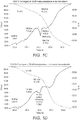
- TG/DTA Thermogram of the solids recovered from acetone is presented in Figure 1A .
- TG/DTA shows that there is a sharp mass loss of 17.3 wt.% with an associated thermal event at 159° C.
- the sharp mass loss is attributed to loss of bound HCl which would be lost as a gas at that temperature, hence the sharp loss.
- the 17.3 wt.% loss calculates to 1 equivalent of HCl.
- Figure 1B presents the TG/DTA thermogram of the solid recovered from acetonitrile. The material degrades above 159° C. There were no thermal events in the DTA.
- Figure 1C presents the TG/DTA thermogram of the solid recovered from acetonitrile.
- a 5.8 wt.% loss is observed from the onset of heating with a related endotherm from the onset of heating with a peak at 74° C. The material degrades above 157° C.
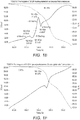
- TG/DTA analysis was carried out on the solid recovered from ethanol.
- the thermogram is presented in Figure 1D .
- TG/DTA analysis was carried out on solids from acetonitrile, shown in Figure IE. There is a loss of 18 wt.% from the onset of heating with a related endotherm. The material degrades above 150°C.
- TG/DTA analysis was carried out on solids from acetonitrile, shown in Figure IF. Complex thermal events are observable.
- TG/DTA analysis was carried out on solids from acetonitrile, shown in Figure IF. There is a 1% mass loss from onset of heating. The material degrades above 159° C. There were no thermal events in the DVA.
- solubility assessment of 2R,6R-hydroxynorketamine L-pyroglutamate in water for injection was conducted.
- a single replicant of the sample was prepared for the solubility assessment.
- Approximately 150mg of 2R,6R-hydroxynorketamine L-pyroglutamate was weighed into a 2mL HPLC vial prior to the addition of 1.0mL of water for injection, forming a saturated solution.
- the sample was shaken at approximately 400 rpm for 24 hours at 25°C. After this the sample was hot filtered using pre-heated (at 25°C) 0.22 ⁇ m PTFE syringe filters into a pre-heated HPLC vial.
Landscapes
- Chemical & Material Sciences (AREA)
- Organic Chemistry (AREA)
- Health & Medical Sciences (AREA)
- Medicinal Chemistry (AREA)
- Pharmacology & Pharmacy (AREA)
- Epidemiology (AREA)
- Life Sciences & Earth Sciences (AREA)
- Animal Behavior & Ethology (AREA)
- General Health & Medical Sciences (AREA)
- Public Health (AREA)
- Veterinary Medicine (AREA)
- Organic Low-Molecular-Weight Compounds And Preparation Thereof (AREA)
- Pharmaceuticals Containing Other Organic And Inorganic Compounds (AREA)
- Medicinal Preparation (AREA)
- Acyclic And Carbocyclic Compounds In Medicinal Compositions (AREA)
Description
- The present invention provides novel, stable, processable and pharmaceutically acceptable salt forms of 2R,6R-hydroxynorketamine or 2S,6S-hydroxynorketamine with high aqueous solubility.
- Ketamine derivatives, and in particular compounds derived from the
ketamine metabolite - Parenteral formulations of 2R,6R-hydroxynorketamine and 2S,6S-hydroxynorketamine are known from Zanos et al, Nature, (2016), 533, 481-486. However, parenteral formulations suffer drawbacks in the treatment of most depression sufferers, for whom treatment in an outpatient setting without the need of a medical professional would be preferable. The provision of solid oral dosage forms of 2R,6R-hydroxynorketamine and 2S,6S-hydroxynorketamine is therefore advantageous to parenteral dosage forms. There are, however, challenges in the development of solid oral dosage forms of 2R,6R-hydroxynorketamine and 2S,6S-hydroxynorketamine. For example, both compounds in the free base form readily form a viscous oil or gum under ambient conditions, are chemically unstable with a tendency to dimerise, and are particularly difficult to process into a pharmaceutical formulation unless in the liquid state.
- Crystal forms of S-ketamine are known in, for example,
WO2014/020155 (CLINPHARM REFORM GMBH) dated 6 February 2014, which discloses S-ketamine hydrochloride and other organic acid salts. - A first aspect of the present invention provides an acid addition salt of 2R,6R-hydroxynorketamine or 2S,6S-hydroxynorketamine obtainable by reaction with an organic acid comprising either (i) two or more carboxylic acid groups, or (ii) one or more carboxylic acid groups and an amide group, with the proviso that the acid addition salt is not 2R,6R-hydroxynorketamine L-tartrate or 2S,6S-hydroxynorketamine D-tartrate.
- In preferred embodiments of the first aspect the organic acid has Formula I or II
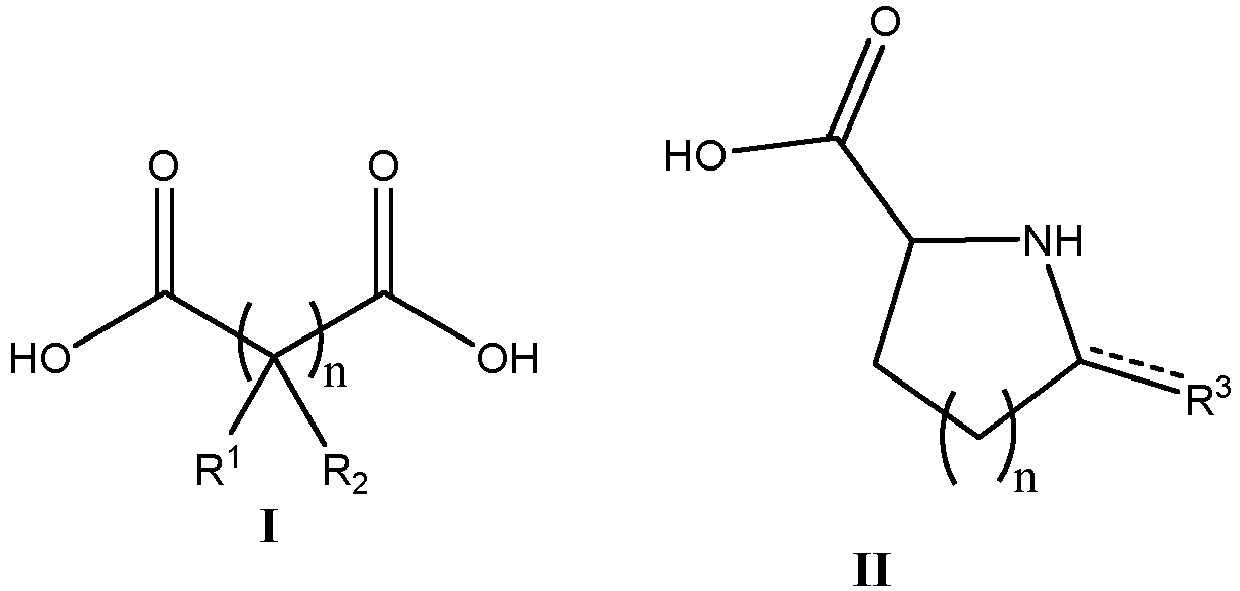
- wherein n = 0-3,
- R1 and R2 are each independently selected from -H, -OH, and -COOH, and wherein when n = 2 or 3, two adjacent R2 groups may together represent a C=C bond, and wherein
- R3 is =O, or -COOH.
- It has been discovered that 2R,6R-hydroxynorketamine and 2S,6S-hydroxynorketamine form crystalline salts readily with organic acids as described herein. Organic acids as used in the present invention may be chiral, enabling the formation of a pharmaceutically acceptable salt to be performed simultaneously with chiral resolution of the active agent. Moreover, crystalline salts of the present invention display unexpectedly high aqueous solubility. Advantages conferred by the high solubility of the acid addition salts of the present invention include high oral bioavailability, which enables optimised solid oral dosage forms to achieve concentrations of systemic circulation necessary to maximise the pharmacological response to 2R,6R-hydroxynorketamine and 2S,6S-hydroxynorketamine.
- In embodiments of the present invention, the acid addition salt is obtainable with a chiral organic acid having Formula III, IV or V:

- wherein n = 0-3,
- R1 and R2 are each independently selected from -H, -OH, and -COOH, wherein at least one pair of R1 and R2 are different, and wherein when n = 2 or 3, two adjacent R2 groups may together represent a C=C bond, and wherein
- R3 is =O, or -COOH.
- In embodiments of the invention the acid addition salt is obtainable with an organic acid of Formula I, wherein n=1 or 2, and wherein each R1 is H, one or both R2 is -OH and any remaining R2 is -H.
- In embodiments of the invention the acid addition salt is obtainable with an organic acid of Formula I, wherein n=2 or 3, and wherein each R1 is H, two adjacent R2 groups are taken together to represent a C=C bond, and any remaining R2 is -H.
- In embodiments of the invention the acid addition salt is obtainable with an organic acid of Formula I, wherein n=2, and wherein each R1 is -H and both R2 groups are taken together to represent a C=C bond.
- In embodiments of the invention the acid addition salt is obtainable by reaction with an organic acid of Formula II, wherein n=1 or 2, and wherein R3 is =O.
- In preferred embodiments of the first aspect of the present invention, the acid addition salt is selected from aspartic acid, citric acid, fumaric acid, glutaric acid, glutamic acid, hippuric acid, malic acid, maleic acid, mucic acid, oxalic acid, pyroglutamic acid, and succinic acid.
- In preferred embodiments of the first aspect of the present invention, the acid addition salt is selected from citric acid, L-malic acid, D-malic acid, fumaric acid, D-pyroglutamic acid, and L-pyroglutamic acid.
- In preferred embodiments of the first aspect the organic acid is homochiral.
- In preferred embodiments of the first aspect of the present invention, the acid addition salt is selected from 2R,6R-hydroxynorketamine difumarate, 2S,6S-hydroxynorketamine difumarate, 2S,6S-hydroxynorketamine D-pyroglutamate, 2R,6R-hydroxynorketamine L-pyroglutamate, 2R,6R-hydroxynorketamine L-malate, and 2S,6S-hydroxynorketamine D-malate.
- In preferred embodiments of the first aspect of the present invention, the acid addition salt is in substantially crystalline form.
- A second aspect of the present invention provides a crystalline acid addition salt of 2R,6R-hydroxynorketamine or 2S,6S-hydroxynorketamine having an X-ray powder diffraction pattern comprising characteristic peaks expressed in degrees 2-theta at positions 19.2, 26.4 and 31.5.
- In preferred embodiments of the second aspect the crystalline acid addition salt of 2R,6R-hydroxynorketamine or 2S,6S-hydroxynorketamine having an X-ray powder diffraction pattern further comprising characteristic peaks expressed in degrees 2-theta at positions 14.1, 16.9, 23.5, 24.0 and 29.9.
- In preferred embodiments of the second aspect the acid addition salt is obtainable according to the first aspect of the present invention.
- In embodiments the acid addition salt is selected from 2R,6R-hydroxynorketamine difumarate and 2S,6S-hydroxynorketamine difumarate and displays an X-ray powder diffraction pattern comprising characteristic peaks expressed in degrees 2-theta at positions 11.7, 12.4, 22.5 and 22.8.
- In embodiments the acid addition salt is selected from 2R,6R-hydroxynorketamine difumarate and 2S,6S-hydroxynorketamine difumarate and displays an X-ray powder diffraction pattern further comprising characteristic peaks expressed in degrees 2-theta at positions 14.7, 16.5, 18.8, 26.8 and 29.4.
- In embodiments the acid addition salt is selected from 2R,6R-hydroxynorketamine difumarate and 2S,6S-hydroxynorketamine difumarate and displays an X-ray powder diffraction pattern further comprising characteristic peaks expressed in degrees 2-theta at positions 10.2, 21.4, 23.2, 25.7, and 29.7.
- In embodiments the acid addition salt is selected from 2R,6R-hydroxynorketamine difumarate and 2S,6S-hydroxynorketamine difumarate and displays an X-ray powder diffraction pattern further comprising characteristic peaks expressed in degrees 2-theta at positions 18.3, 20.4, 31.0 and 33.0.
- In embodiments the acid addition salt is selected from 2R,6R-hydroxynorketamine L-malate and 2S,6S-hydroxynorketamine D-malate and displays an X-ray powder diffraction pattern comprising a characteristic peak expressed in degrees 2-theta at position 23.1.
- In embodiments the acid addition salt is selected from 2R,6R-hydroxynorketamine L-pyroglutamate and 2S,6S-hydroxynorketamine D-pyroglutamate having an X-ray powder diffraction pattern comprising characteristic peaks expressed in degrees 2-theta at position 14.3.
- In embodiments the acid addition salt is selected from 2R,6R-hydroxynorketamine L-pyroglutamate and 2S,6S-hydroxynorketamine D-pyroglutamate having an X-ray powder diffraction pattern further comprising characteristic peaks expressed in degrees 2-theta at positions 19.9 and 23.8.
- In embodiments the acid addition salt is selected from 2R,6R-hydroxynorketamine L-pyroglutamate and 2S,6S-hydroxynorketamine D-pyroglutamate having an X-ray powder diffraction pattern further comprising characteristic peaks expressed in degrees 2-theta at positions 12.0, 13.6, 15.2, 20.8, 26.2, and 28.9.
- In embodiments the acid addition salt is selected from 2R,6R-hydroxynorketamine L-pyroglutamate and 2S,6S-hydroxynorketamine D-pyroglutamate having an X-ray powder diffraction pattern further comprising characteristic peaks expressed in degrees 2-theta at positions 12.8, 17.6, 18.1, and 25.5.
- In embodiments the acid addition salt is selected from 2R,6R-hydroxynorketamine L-pyroglutamate and 2S,6S-hydroxynorketamine D-pyroglutamate having an X-ray powder diffraction pattern further comprising characteristic peaks expressed in degrees 2-theta at positions 13.8, 14.1, 17.8, 20.3, 21.0, 21.8, 22.7, 24.6, 25.0, 25.3, 27.3, 28.5, 28.7, 30.6, 32.3, 32.7, 33.3, 33.9, and 34.1.
- In embodiments the acid addition salt is selected from 2R,6R-hydroxynorketamine L-pyroglutamate and 2S,6S-hydroxynorketamine D-pyroglutamate having an X-ray powder diffraction pattern further comprising characteristic peaks expressed in degrees 2-theta at positions 9.0, 16.6, 21.4, 22.4, 23.1, 25.7, 26.5, 27.8, 28.2, 29.3, 30.1, 31.1, 31.5, 33.1, 33.7, and 34.6.
- In embodiments the acid addition salt is obtained by precipitation or crystallisation from an organic solvent, for example acetonitrile, isopropyl acetate, t-butyl methyl ether, ethyl acetate, or diisopropyl ether. A third embodiment of the present invention provides a dosage form comprising an acid addition salt according to any embodiment of the first or second aspect of the present invention.
- In preferred embodiments the dosage form comprising between 5mg and 500mg of 2R,6R-hydroxynorketamine or 2S,6S-hydroxynorketamine, or the equivalent thereof.
- In particularly preferred embodiments the dosage is a solid oral dosage form. Preferably the solid oral dosage form is selected from a capsule and a tablet.
- In embodiments of the invention the dosage form is a solid oral dosage form comprising a blend of one or more diluent. In preferred embodiments the dosage form is a tablet and the blend of one or more diluent comprises microcrystalline cellulose. In preferred embodiments the dosage form is a capsule and the capsule shell comprises a constituent selected from gelatin and hydroxypropyl methylcellulose.
-
-
Figures 1A to 1F : shows TG/DTA thermogram of 2R,6R-hydroxynorketamine crystalline salt forms according to the present invention -
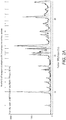
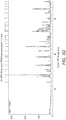
Figure 2A to 2E : shows VH-XRPD diffractogram of 2R,6R-hydroxynorketamine crystalline salt forms -
Figure 3 : 1H-NMR spectrum of 2R,6R-hydroxynorketamine difumarate compared with spectrum for 2R,6R-hydroxynorketamine free base - Throughout this specification, one or more aspect of the invention may be combined with one or more features described in the specification to define distinct embodiments of the invention.
- References herein to a singular of a noun encompass the plural of the noun, and vice-versa, unless the context implies otherwise.
- As used herein, the term '2R,6R-hydroxynorketamine' and '2S,6S-hydroxynorketamine' refer to 2R,6R-2-(2-Chlorophenyl)-2-(amino)-6-hydroxycyclohexanone and 2S,6S-2-(2-Chlorophenyl)-2-(amino)-6-hydroxycyclohexanone respectively.
- As used herein -H means a covalently bonded hydrogen.
- As used herein -OH means a covalently bonded hydroxyl.
- As used herein =O taken with the carbon to which it is bonded means a carbonyl group.
- As used herein -COOH means a carboxylic acid group.
- As used herein C=C means an olefin, in other words a carbon-carbon double bond.
- As used herein the term 'chiral' means a structure which is not superimposable on its mirror image.
- As used herein the term 'homochiral' means refers to a composition that comprises substantially one enantiomer of a chiral material.
- An aspect of the present invention provides an acid addition salt of 2R,6R-hydroxynorketamine or 2S,6S-hydroxynorketamine obtainable by reaction with an organic acid comprising either (i) two or more carboxylic acid groups, or (ii) one or more carboxylic acid groups and an amide group, with the proviso that the acid addition salt is not 2R,6R-hydroxynorketamine L-tartrate or 2S,6S-hydroxynorketamine D-tartrate.
- In preferred embodiments of the first aspect, the acid addition salt of claim 1 the organic acid has Formula I or II

- wherein n = 0-3,
- R1 and R2 are each independently selected from -H, -OH, and -COOH, and wherein when n = 2 or 3, two adjacent R2 groups may together represent a C=C bond, and wherein
- R3 is =O, or -COOH.
- It has been discovered that 2R,6R-hydroxynorketamine and 2S,6S-hydroxynorketamine form crystalline salts readily with organic acids as described herein. Moreover, organic acids as used in the present invention may be chiral, enabling the formation of pharmaceutically acceptable salt to take part in chiral resolution of the active agent.
- In embodiments of the present invention, the acid addition salt is obtainable with an organic acid having Formula III, IV or V:

- wherein n = 0-3,
- R1 and R2 are each independently selected from -H, -OH, and -COOH, wherein at least one pair of R1 and R2 are different, and wherein when n = 2 or 3, two adjacent R2 groups may together represent a C=C bond, and wherein
- R3 is =O, or -COOH.
- In embodiments of the invention the acid addition salt is obtainable with an organic acid of Formula I, wherein n=1 or 2, and wherein each R1 is H, one or both R2 is -OH and any remaining R2 is -H.
- In embodiments of the invention the acid addition salt is obtainable with an organic acid of Formula I, wherein n=2 or 3, and wherein each R1 is H, two adjacent R2 groups are taken together to represent a C=C bond, and any remaining R2 is -H.
- In embodiments of the invention the acid addition salt is obtainable with an organic acid of Formula I, wherein n=2, and wherein each R1 is -H and both R2 groups are taken together to represent a C=C bond.
- In embodiments of the invention the acid addition salt is obtainable by reaction with an organic acid of Formula II, wherein n=1 or 2, and wherein R3 is =O.
- In preferred embodiments of the first aspect of the present invention, the acid addition salt is selected from aspartic acid, citric acid, fumaric acid, glutaric acid, glutamic acid, hippuric acid, malic acid, maleic acid, mucic acid, oxalic acid, pyroglutamic acid, succinic acid, and tartaric acid.
- In preferred embodiments of the first aspect of the present invention, the acid addition salt is selected from citric acid, L-malic acid, D-malic acid, fumaric acid, D-pyroglutamic acid, and L-pyroglutamic acid.
- In preferred embodiments of the first aspect the organic acid is homochiral.
- In preferred embodiments of the first aspect of the present invention, the acid addition salt is selected from 2R,6R-hydroxynorketamine difumarate, 2S,6S-hydroxynorketamine difumarate, 2R,6R-hydroxynorketamine D-pyroglutamate, 2S,6S-hydroxynorketamine D-pyroglutamate, 2R,6R-hydroxynorketamine L-pyroglutamate, 2S,6S-hydroxynorketamine L-pyroglutamate, 2R,6R-hydroxynorketamine L-malate, and 2S,6S-hydroxynorketamine D-malate.
- In preferred embodiments of the first aspect of the present invention, the acid addition salt is in substantially crystalline form.
- An aspect of the present invention provides a crystalline acid addition salt of 2R,6R-hydroxynorketamine or 2S,6S-hydroxynorketamine having an X-ray powder diffraction pattern comprising characteristic peaks expressed in degrees 2-theta at positions 19.2, 26.4 and 31.5.
- In preferred embodiments of the second aspect the crystalline acid addition salt of 2R,6R-hydroxynorketamine or 2S,6S-hydroxynorketamine having an X-ray powder diffraction pattern further comprising characteristic peaks expressed in degrees 2-theta at positions 14.1, 16.9, 23.5, 24.0 and 29.9.
- In preferred embodiments of the second aspect the acid addition salt is obtainable according to the first aspect of the present invention.
- In embodiments the acid addition salt is selected from 2R,6R-hydroxynorketamine difumarate and 2S,6S-hydroxynorketamine difumarate and displays an X-ray powder diffraction pattern comprising characteristic peaks expressed in degrees 2-theta at positions 11.7, 12.4, 22.5 and 22.8.
- In embodiments the acid addition salt is selected from 2R,6R-hydroxynorketamine difumarate and 2S,6S-hydroxynorketamine difumarate and displays an X-ray powder diffraction pattern further comprising characteristic peaks expressed in degrees 2-theta at positions 14.7, 16.5, 18.8, 26.8 and 29.4.
- In embodiments the acid addition salt is selected from 2R,6R-hydroxynorketamine difumarate and 2S,6S-hydroxynorketamine difumarate and displays an X-ray powder diffraction pattern further comprising characteristic peaks expressed in degrees 2-theta at positions 10.2, 21.4, 23.2, 25.7, and 29.7. In embodiments the acid addition salt is selected from 2R,6R-hydroxynorketamine difumarate and 2S,6S-hydroxynorketamine difumarate and displays an X-ray powder diffraction pattern further comprising characteristic peaks expressed in degrees 2-theta at positions 18.3, 20.4, 31.0 and 33.0. In embodiments the acid addition salt is selected from 2R,6R-hydroxynorketamine difumarate and 2S,6S-hydroxynorketamine difumarate and displays an X-ray powder diffraction pattern comprising characteristic peaks expressed in degrees 2-theta at the following positions:
Difumarate Peak Degrees 2-theta Peak Degrees 2-theta Peak Degrees 2-theta Peak Degrees 2-theta Peak Degrees 2-theta Peak Degrees 2-theta 1 10.2 11 16.9 21 22.5 31 25.2 41 29.0 51 33.5 2 11.7 12 18.0 22 22.8 32 25.7 42 29.4 52 34.7 3 12.1 13 18.3 23 23.2 33 26.4 43 29.7 4 12.4 14 18.8 24 23.5 34 26.5 44 29.9 5 13.7 15 19.2 25 24.0 35 26.8 45 30.3 6 14.1 16 19.5 26 24.3 36 27.0 46 31.0 7 14.7 17 20.4 27 24.5 37 27.4 47 31.5 8 15.2 18 20.8 28 24.6 38 27.7 48 31.9 9 15.6 19 21.4 29 24.7 39 28.1 49 32.5 10 16.5 20 22.0 30 24.9 40 28.8 50 33.0 - In embodiments the acid addition salt is selected from 2R,6R-hydroxynorketamine L-malate and 2S,6S-hydroxynorketamine D-malate and displays an X-ray powder diffraction pattern comprising a characteristic peak expressed in degrees 2-theta at position 23.1.
- In embodiments the acid addition salt is selected from 2R,6R-hydroxynorketamine L-pyroglutamate and 2S,6S-hydroxynorketamine D-pyroglutamate and displays an X-ray powder diffraction pattern comprising characteristic peaks expressed in degrees 2-theta at the following positions:
L-Pyroglutamate Peak Degrees 2-theta Peak Degrees 2-theta Peak Degrees 2-theta Peak Degrees 2-theta Peak Degrees 2-theta 1 9.0 11 17.8 21 23.1 31 27.8 41 32.3 2 12.0 12 18.1 22 23.8 32 28.2 42 32.7 3 12.8 13 19.9 23 24.6 33 28.5 43 33.1 4 13.6 14 20.3 24 25.0 34 28.7 44 33.3 5 13.8 15 20.8 25 25.3 35 28.9 45 33.7 6 14.1 16 21.0 26 25.5 36 29.3 46 33.9 7 14.3 17 21.4 27 25.7 37 30.1 47 34.1 8 15.2 18 21.8 28 26.2 38 30.6 48 34.6 9 16.6 19 22.4 29 26.5 39 31.1 10 17.6 20 22.7 30 27.3 40 31.5 - In preferred embodiments the acid addition salt is obtained by precipitation or crystallisation from an organic solvent selected from acetonitrile, isopropyl acetate, t-butyl methyl ether, ethyl acetate, and diisopropyl ether. A further aspect of the present invention provides a dosage form comprising an acid addition salt according to any embodiment of the first or second aspect of the present invention.
- As used herein, the term 'solid oral dosage form' is defined as a solid pharmaceutical formulation which can be swallowed whole, chewed and swallowed, or dissolved, dispersed or absorbed via the oral cavity. Solid oral dosage forms include tablets, pills, capsules, caplets, orodispersible tablets, powders, granules and gums. Solid oral dosage forms are not taken to include liquid or aerosol formulations, powders for inhalation, or powders for injection.
- Solid oral dosage forms according to the present invention may be prepared by mixing the principle active agent(s) with a pharmaceutical carrier, e.g. corn starch, lactose, sucrose, sorbitol, talc, stearic acid, magnesium stearate, or dicalcium phosphate, and other pharmaceutical diluents, e.g. water, to form a solid preformulation composition containing a homogenous mixture of the active agent(s). When referring to these preformulation compositions as homogenous, it is meant that the active agent is dispersed evenly throughout the composition so that the composition may be readily subdivided into equally effective dosage forms such as tablets, pills and capsules. The solid preformulation composition is then subdivided into unit dosage forms of the type described above.
- In preferred embodiments of the present invention, the solid oral dosage form is provided in a unit dose containing between 5mg and 500mg of the acid addition salt of 2R,6R-hydroxynorketamine or 2S,6S-hydroxynorketamine as defined herein.
- Quantities of weight provided herein refer to the free-form equivalent of a compound of the present invention. For example a unit dose of
500mg - In preferred embodiments the dosage form comprising between 5mg and 500mg of 2R,6R-hydroxynorketamine or 2S,6S-hydroxynorketamine, or the equivalent thereof.
- In particularly preferred embodiments the dosage is a solid oral dosage form. Preferably the solid oral dosage form is selected from a capsule and a tablet.
- In embodiments of the invention the dosage form is a solid oral dosage form comprising a blend of one or more diluent. In preferred embodiments the dosage form is a tablet and the blend of one or more diluent comprises microcrystalline cellulose. In preferred embodiments the dosage form is a capsule and the capsule shell comprises a constituent selected from gelatin and hydroxypropyl methylcellulose.
- As used herein 'mCPBA' refers to meta-chloroperoxybenzoic acid.
- As used herein 'syn' refers to the configuration of compounds of Formula I having substituents on the same face of the cyclohexanone ring resulting from addition of the alpha-hydroxyl onto the same face as the amine group. Thus the absolute stereochemistry of compounds of Formula VI is R,R or S,S.
- As used herein 'enol' refers to a chemical moiety having an alkene with a hydroxyl group attached to one end of the alkene double bond. 'Enolate' refers to an enol with the hydroxyl proton removed.
- As used herein 'dihydroxylating agent' refers to one or more chemical substances that is capable of adding two hydroxyl groups across the double bond of an enol or enolate.
- As used herein the term 'alpha-hydroxylating agent' refers to one or more chemical substances that is capable of adding a hydroxyl group to an aliphatic carbon next to a carbonyl group.
- As used herein the term 'nitrogen protecting group' refers to a moiety which can be reversibly added to the nitrogen atom of an amine group to achieve chemical selectivity in one or more subsequent reaction.
- As used herein the term 'alkyl' means a hydrocarbon moiety having the general formula CnH2n+1. The term encompasses methyl (also referred to as Me), ethyl (Et), isopropyl (iPr, iPr, or i-Pr), tert-butyl (tBu, tBu, or t-Bu).
- As used herein the term 'silyl' means a hydrosilicon moiety having the general formula SinH2n+1. The term encompasses trimethylsilyl (TMS) and triethylsilyl (TES).
- As used herein the term 'Boc' means tert-butoxycarbonyl.
- As used herein the term 'MoOPH' refers to oxodiperoxymolybdenum(pyridine)-(hexamethylphosphoric triamide).
- As used herein the term 'OsO4' means osmium tetroxide and its chemical equivalents.
- As used herein the term 'RuO4' means ruthenium tetroxide and its chemical equivalents.
- As used herein the term 'I2' refers to elemental iodine.
- As used herein the term 'oxone' refers to potassium peroxymonosulfate, also known as MPS.
- As used herein the term 'NaOCl' refers to sodium hypochlorite, also known as bleach.
- As used herein the term 'oxaziridine' refers to a compound which features a three-membered heterocycle containing oxygen, nitrogen, and carbon.
- As used herein the term 'AD-mix alpha' refers to a reagent system used in Sharpless asymmetric dihydroxylation consisting of hydroquinine 1,4-phthalazinediyl diether (0.16 mole%), potassium carbonate (49.88 mole%) potassium ferricyanide (49.88 mole%) potassium osmate dihydrate (0.07 mole%).
- As used herein the term 'AD-mix beta' refers to a reagent system used in Sharpless asymmetric dihydroxylation consisting of hydroquinidine 1,4-phthalazinediyl diether (0.16 mole%), potassium carbonate (49.88 mole%) potassium ferricyanide (49.88 mole%) potassium osmate dihydrate (0.07 mole%).
- Scheme 1 describes a general synthesis applicable to manufacturing 6-hydroxynorketamine and analogues thereof. Analogous acid addition salts to the salts of the present invention may be made by reacting a compound of Formula VI with an organic acid selected from the organic acids of Formula I, II, III, IV or V:

- In a preferred embodiments of Scheme 1, the alpha-hydroxylating agent does not comprise mCPBA.
- In preferred embodiments of Scheme 1, R7 is a nitrogen protecting group. In preferred embodiments of the synthetic scheme, R7 is Boc.
- In preferred embodiments of the synthetic scheme R8 is a silyl enol ether, preferably selected from TMS and TES.
- In preferred embodiments of the synthetic scheme the dihydroxylating agent comprises an oxidising agent selected from MoOPH, OsO4, RuO4, and I2.
- In preferred embodiments of the synthetic scheme the alpha-hydroxylating agent comprises an oxidising agent selected from oxone, NaOCl, oxaziridine, lead (IV) acetate, and hypoflorous acid in acetonitrile.
- In preferred embodiments of Scheme 1 the dihydroxylating agent comprises AD-mix alpha. In preferred aspects of the first aspect of the present invention the dihydroxylating agent comprises AD-mix beta.
- In preferred embodiments of Scheme 1 the alpha-hydroxylating agent comprises an N-sulfonyloxaziridine.
- In preferred embodiments of Scheme 1 the dihydroxylating agent comprises OsO4, potassium ferricyanide and a chiral auxiliary selected from a dihydroquinidine and a dihydroquinine.
- In a particularly preferred embodiment of Scheme 1 the compound of Formula I is 2R,6R-hydroxynorketamine, the compound of Formula II is Compound 37; and the dihydroxylating agent comprises OsO4, postassium ferricyanide and a chiral auxiliary selected from a dihydroquinidine and a dihydroquinine.

- It has been found that Scheme 1 is effective in preparing a compound of Formula I in high yield wherein the -OH and the -NHR1 are syn to one another irrespective of which chiral auxiliary of dihydroquinidine and dihydroquinine is present in the reaction.
- In preferred embodiments the Boc protecting group is removed by treating with HCl in cyclopentyl methyl ether (CPME).
- In a preferred embodiment of Scheme 1, the compound of Formula I is 2R,6R-hydroxynorketamine, wherein the compound of Formula II is Compound 38; and wherein the alpha-hydroxylating agent comprises the Davis's oxaziridine of Compound 39

- Scheme 2 describes a method of synthesising a compound of Formula VIII suitable for synthesizing the enolate or enol ether of Formula VII,
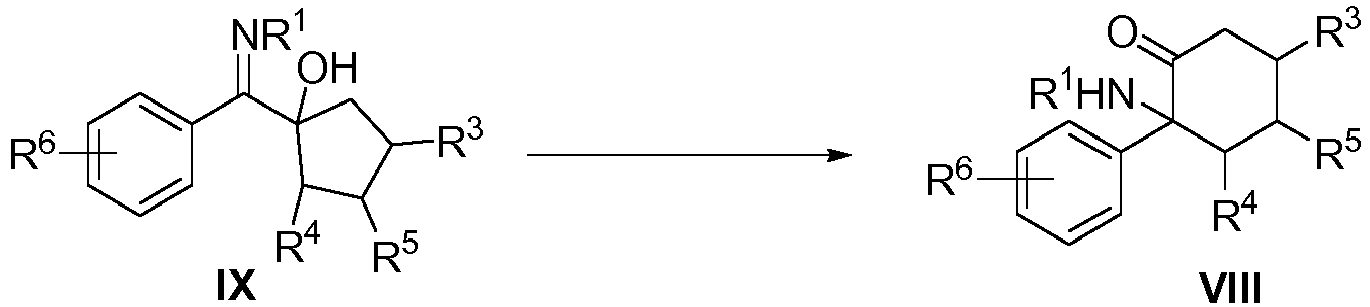

- In preferred embodiments of Scheme 2 the C1-C6 alcohol is isobutanol.
- In preferred embodiments of Scheme 2 the step of refluxing a compound of Formula IX in a solvent comprising a C1-C6 alcohol is carried out in the presence of a Lewis acid. Preferably the Lewis acid is an azaphilic Lewis acid.
- In preferred embodiments of Scheme 2 the step of refluxing a compound of Formula IX in a solvent comprising a C1-C6 alcohol is carried out in the presence of a chiral Lewis acid.
- Scheme 3 provides a method of synthesising a compound of Formula VIII suitable for synthesizing the enolate or enol ether of Formula VII,
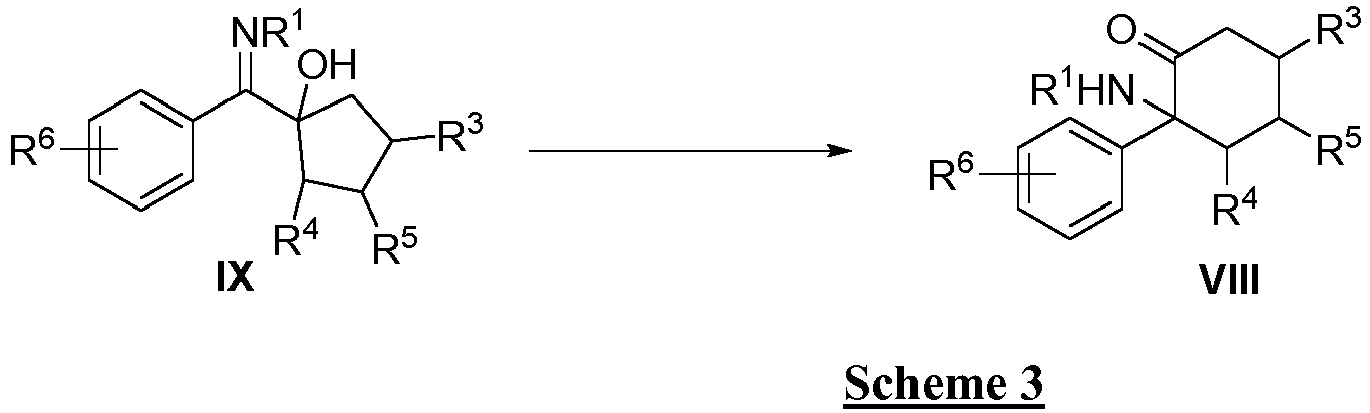
- In preferred embodiments of Schemes 2 or 3, the compound of Formula IX and the Lewis acid are dissolved in an aprotic solvent. Suitable aprotic solvents include diethyl ether, THF, DMF and DMSO.
- In preferred embodiments of Schemes 2 or 3, the Lewis acid comprises boron or a metal atom selected from copper, aluminium, zinc, scandium, indium, and titanium. Preferably the Lewis acid comprises boron, copper or zinc, for example Cu(OTf)2 or Zn(OTf)2.
- In preferred embodiments of Schemes 2 or 3, the Lewis acid comprises one or more chiral ligand. Preferred chiral ligands include bis(oxazoline) ligands (eg. BOX and PyBOX), 1,1'-Bi-2-naphthol ligands, 2,2'-bis(diphenylphosphino)-1,1'-binaphthyl ligands, α,α,α',α'-tetraaryl-2,2-disubstituted 1,3-dioxolane-4,5-dimethanol ligands, phospholane ligands, and salen ligands. Examples of chiral Lewis acid catalysts for use in the third or fourth aspect of the present invention include copper (II) (-)2,2'-isopropylidenebis[(4S)-4-tert-butyl-2-oxazoline] di(triflouromethanesulfonate), copper (II) (+)2,2'-Isopropylidenebis[(4R)-4-tert-butyl-2-oxazoline] di(triflouromethanesulfonate), copper (I) (-)-2,2'-isopropylidenebis[(4S)-4-phenyl-2-oxazoline] trifluoromethanesulfonate, copper (I) (+)-2,2'-isopropylidenebis[(4S)-4-phenyl-2-oxazoline] trifluoromethanesulfonate, (R)-(+)-2-Methyl-CBS-oxazaborolidine, and (S)-(-)-2-Methyl-CBS-oxazaborolidine.
- In an aspect of Schemes 2 or 3, the compound of Formula IX is synthesised by treating a compound of Formula X with NHR1

- In a preferred embodiment, Compound 40 is synthesised by treating Compound 41 with an excess of liquid ammonia and allowing residual ammonia to evaporate at ambient temperature and pressure. This method provides for efficient, synthesis of 40 in near quantitative yield, which can be for use in synthesis of norketamine, 2R,6R-hydroxynorketamine, or 2S,6S-hydroxynorketamine.

- The general synthesis of compounds of Formula IV from readily available starting materials is provided in Scheme 4 below:

- A scalable, efficient and high yielding synthesis which applies to the manufacture of 2R,6R-hydroxynorketamine or 2S,6S-hydroxynorketamine is provided in Scheme 5.

- Boc protection of norketamine was achieved with 95% yield by treating with Boc2O and triethylamine in THF at 70°C for 16-18 hours.
1H-NMR (301 MHz, CHLOROFORM-D) δ 7.81 (d, J = 6.9 Hz, 1H), 7.26 (d, J = 48.2 Hz, 3H), 6.57 (s, 1H), 3.78-3.83 (m, 1H), 2.22-2.41 (m, 2H), 2.02-2.05 (m, 1H), 1.58-1.81 (m, 4H), 1.27 (s, 9H)
LCMS 20-70% MeCN: 0.1% formic acid/water; short acid methods , C18-CSA, 1.03 min m/z (+ve) 268.1/270.1 (loss of boc + H) - The trimethylsilyl enol ether of Boc protected R-norketamine was achieved with 99% yield by treating with strong base (lithium diisopropylamide (LDA)) in THF at -78°C, taking care to remove trace moisture from the reagents to avoid stalling the reaction.
- Alpha hydroxylation of the trimethyl silyl enol ether of R-norketamine was achieved with 92% yield using AD-mix alpha under Sharpless dihydroxylation conditions for 16 hours, with hydroxylation occurring exclusively syn to the Boc protected amine group. The same product was obtained using AD-mix beta under Sharpless conditions, with 93% yield.
- Compound 49 was also obtained directly from Boc protected R-norketamine in a one pot, two step reaction by treating with LDA in THF at -78°C for 1.5 hours, followed by addition of Davies oxaziridine and allowing the temperature to rise from -78°C to room temperature over 16 hours.
1H-NMR (301 MHz, CHLOROFORM-D) δ 7.81 (d, J = 6.2 Hz, 1H), 7.28-7.39 (m, 3H), 6.60 (s, 1H), 4.14 (dd, J = 11.4, 6.9 Hz, 1H), 3.89 (d, J = 11.4 Hz, 1H), 3.33 (s, 1H), 2.34-2.42 (m, 1H), 1.44-1.77 (m, 7H), 1.31 (s, 9H)
LCMS (dihydroxylation route) Short acid 2-95% MeCN: 0.1% formic acid/H2O; 0.79 min Rt = product [M-Boc+H]+; 0.87 = Product + TMS (so 6-TMSO-HNK) minus tert-butyl - Data is indicative that the TMS group undergoes in situ transfer to the 6-OH as the hemi-silyl-acetal, and then breaks down to form the ketone.
- Compound 49 was Boc-deprotected with 88% yield by treating with HCl in cyclopentyl methyl ether.
1H-NMR (301 MHz, METHANOL-D3) δ 7.86-7.88 (m, 1H), 7.53-7.61 (m, 3H), 4.29 (dd, J = 11.5, 6.7 Hz, 1H), 3.18-3.25 (m, 1H), 2.28-2.33 (m, 1H), 1.55-1.96 (m, 4H)
LCMS 2-50% MeCN: 10 mM ammonium carbonate @ PH10, C18-XB; Rt 0.72min m/z (+ve) 240.1/240.2 (M+H-freebase) - XRPD analysis was carried out on a PANalytical X'pert pro, scanning the samples between 3 and 35° 2θ. The material was gently ground to release any agglomerates and loaded onto a multi-well plate with Kapton or Mylar polymer film to support the sample. The multi-well plate was then placed into the diffractometer and analysed using Cu K radiation (α1 λ = 1.54060 Å; α2 = 1.54443 Å; β = 1.39225 Å; α1 : α2 ratio = 0.5) running in transmission mode (step size 0.0130° 2θ) using 40 kV / 40 mA generator settings.
- XRPD analysis was carried out on a Philips X'pert Pro Multipurpose Diffractometer using a spinning stage with autosampler, scanning the samples between 3 and 35° 2θ. The material was loaded onto a circular sample holder and flattened using a glass slide. The sample holder was then loaded into position on the autosampler cassette and analysed using Cu K radiation (α1 λ = 1.54060 Å; α2 = 1.54443 Å; β = 1.39225 Å; α1 : α2 ratio = 0.5) running in reflectance mode (step size 0.013° 2θ, time per step 59.67 s) using 40 kV / 40 mA generator settings and fitted with a Ni Cu Kβ filter).
- The presence of crystallinity (birefringence) was determined using an Olympus BX50 polarising microscope, equipped with a Motic camera and image capture software (Motic Images Plus 2.0). All images were recorded using the 20x objective, unless otherwise stated.
- Approximately 5 mg of material was weighed into an open aluminium pan and loaded into a simultaneous thermogravimetric/differential thermal analyser (TG/DTA) and held at room temperature. The sample was then heated at a rate of 10°C/min from 20°C to 300°C during which time the change in sample weight was recorded along with any differential thermal events (DTA). Nitrogen was used as the purge gas, at a flow rate of 300 cm3/min.
- Approximately, 5 mg of material was weighed into an aluminium DSC pan and sealed non-hermetically with a pierced aluminium lid. The sample pan was then loaded into a Seiko DSC6200 (equipped with a cooler) cooled and held at 20°C. Once a stable heat-flow response was obtained, the sample and reference were heated to 180°C at scan rate of 10°C/min and the resulting heat flow response monitored. Nitrogen was used as the purge gas, at a flow rate of 50 cm3/min.
- Infrared spectroscopy was carried out on a Bruker ALPHA P spectrometer. Sufficient material was placed onto the centre of the plate of the spectrometer and the spectra were obtained using the following parameters:
Resolution: 4 cm-1; Background Scan Time: 16 scans; Sample Scan Time: 16 scans; Data Collection: 4000 to 400 cm-1; Result Spectrum: Transmittance; Software: OPUS version 6 - NMR experiments were performed on a Bruker AVIIIHD spectrometer equipped with a DCH cryoprobe operating at 500.12MHz for protons. Experiments were performed in deuterated DMSO-d6 and each sample was prepared to ca. 10 mM concentration.
- Approximately, 10 mg of sample was placed into a mesh vapour sorption balance pan and loaded into a DVS-1 dynamic vapour sorption balance by Surface Measurement Systems. The sample was subjected to a ramping profile from 40 - 90% relative humidity (RH) at 10% increments, maintaining the sample at each step until a stable weight had been achieved (dm/dt 0.004%,
minimum step length 30 minutes, maximum step length 500 minutes) at 25°C. After completion of the sorption cycle, the sample was dried using the same procedure to 0% RH and then a second sorption cycle back to 40% RH. Two cycles were performed. The weight change during the sorption/desorption cycles were plotted, allowing for the hygroscopic nature of the sample to be determined. XRPD analysis was then carried out on any solid retained. - Approximately, 10-20 mg of sample was placed into a mesh vapour sorption balance pan and loaded into a DVS Intrinsic dynamic vapour sorption balance by Surface Measurement Systems. The sample was subjected to a ramping profile from 40 - 90% relative humidity (RH) at 10% increments, maintaining the sample at each step until a stable weight had been achieved (dm/dt 0.004%,
minimum step length 30 minutes, maximum step length 500 minutes) at 25°C. After completion of the sorption cycle, the sample was dried using the same procedure to 0% RH and then a second sorption cycle back to 40% RH. Two cycles were performed. The weight change during the sorption/desorption cycles were plotted, allowing for the hygroscopic nature of the sample to be determined. XRPD analysis was then carried out on any solid retained. - Approximately 10-20 mg of sample was placed into a mesh vapour sorption balance pan and loaded into an IGASorp Moisture Sorption Analyser balance by Hiden Analytical. The sample was subjected to a ramping profile from 40 - 90% relative humidity (RH) at 10% increments, maintaining the sample at each step until a stable weight had been achieved (98% step completion,
minimum step length 30 minutes, maximum step length 60 minutes) at 25°C. After completion of the sorption cycle, the sample was dried using the same procedure to 0 % RH, and finally taken back to the starting point of 40% RH. Two cycles were performed. The weight change during the sorption/desorption cycles were plotted, allowing for the hygroscopic nature of the sample to be determined. - VH-XRPD analysis was carried out on a Philips X'Pert Pro Multipurpose diffractometer equipped with a humidity chamber. The samples were scanned between 4 and 35.99 °2θ using Cu K radiation (α1 λ = 1.54060 Å; α2 = 1.54443 Å; β = 1.39225 Å; α1 : α2 ratio = 0.5) running in Bragg-Brentano geometry (step size 0.008 °2θ) using 40 kV / 40 mA generator settings. Measurements were performed at 40 %RH, 80 %RH, 10 %RH, 0 %RH. The temperature was raised to 60° C, 100° C and 120° C all at 40 %RH.
- Instrument: Agilent 1100/
Dionex Ultimate 3000; Column: Ace Excel-3 C18-AR, 75 mm x 4.6 mm 3 µm; Column Temperature: 40° C; Autosampler Temperature: Ambient; UV wavelength: 210 nm; Injection Volume: 10; Flow Rate: 1 mL/min; Mobile Phase A: 10mM Ammonium Formate pH8; Mobile Phase B: 10mM Ammonium Formate pH8:Acetonitrile 20:80Gradient program: Time (minutes) Solvent B [%] 0 12 1 12 11 100 11.1 12 15 12 - Instrument: LCQ Advantage Ion Trap MS; Sample concentration: 1 mg/ml, +ve ion mode by infusion; Source voltage (kV): 4.50; Source current (µA): 80.00; Sheath gas flow rate: 20; Aux/Sweep gas flow rate: 0; Capillary voltage (V): 8.0; Capillary temp (oC): 200; Tube lens (V, Sp): 40; HPLC conditions as above.
- 90 mg of 2R,6R-hydroxynorketamine free base was dissolved in 18 mL of dichloromethane. 1 mL aliquots of the solution were allowed to evaporate in a fume hood. PLM images of the white solid that remained in the vial in which the material had been dissolved were recorded.
- A known volume aliquot (typically 5 volumes) of solvent was added to approximately 5
mg - The sample pKa was determined using the potentiometric (pH-metric) technique following attempts to determine pKa via UV spectroscopic techniques.
- UV-metric: The sample was initially titrated in a fast-UV triple titration between pH 2.0 - 12.0 at concentrations of 31 - 19 µM, under aqueous conditions. No evidence of any sample ionisation within the investigated pH range was inferred from the spectroscopic data obtained, meaning that any ionisable groups were remote from chromophores. Therefore, the sample was analysed using the pH-metric method.
- pH-metric: The sample was subsequently titrated using the potentiometric technique to determine the non-UV active pKas. A triple titration was carried out under methanol-water co-solvent conditions from pH 2.0 - 12.0 at concentrations of 0.9 - 0.6 mM (the methanol mixing ratio varied from 53.0 to 33.3 % w/w). No precipitation of the sample from solution was observed so the pKa was determined from the potentiometric data collected, by Yasuda-Shedlovsky extrapolation of the individual results obtained. pKa of 2R,6R-hydroxynorketamine was calculated as 6.51+/- 0.02.
- Candidate counterions were selected based on pKa compatibility.
- On addition of the 0.5 mL of acetonitrile to the
10mg Figure 2D . - 20 mg of 2R,6R-hydroxynorketamine was suspended in 100 µL each of acetone, acetonitrile, ethanol and tetrahydrofuran (THF). 87.6 µL of 1M hydrochloric acid stock solution prepared in water (1.05 equivalents) was added and the mixtures were then thermally cycled whilst being stirred for 48 hours according to the following program:
25° C to 5 ° C at 0.1° C/min; Hold at 5° C for 1 hour; 5° C to 25 ° C at 0.1° C/min; Hold at 5° C for 1 hour. - No solids were recovered post-thermal cycling so the solutions were uncapped and allowed to evaporate at ambient temperature and pressure.
- No solids were recovered post-evaporation anti-solvent addition was carried out using t-butyl methyl ether (tBME) and the mixtures were matured for 16 hours. Further anti-solvent addition was then carried out and the mixtures were matured for 72 hours.
- Clear solids of 2R,6R-hydroxynorketamine hydrochloride were recovered from acetone after treatment with anti-solvent. XRPD analysis was carried out on the solids. Significant preferred orientation was found, likely due to formation of needle-like crystals. The material was removed from the XRPD plate, ground and then re-analysed. Preferred orientation was again observed although in different peak positions.
- 20 mg of 2R,6R-hydroxynorketamine free base was suspended in 100 µL of organic solvent. 87.6 µL of 1M L-Tartaric acid stock solution prepared in water (1.05 equivalents) was added and the mixtures were then thermally cycled whilst being stirred for 48 hours according to the following program: 25° C to 5 ° C at 0.1° C/min; hold at 5° C for 1 hour; 5° C to 25 ° C at 0.1° C/min; hold at 5° C for 1 hour.
- Solids were recovered from all solvent systems investigated. Post-thermal cycling, white solids were identified in acetone, acetonitrile and THF. Clear Solids were recovered from ethanol post-evaporation.
- Subsequently, 2.5 mL of acetonitrile was added to 500 mg of 2R,6R-hydroxynorketamine free base. 2190 µL of 1M L-tartaric acid stock solution (1.05 equivalents) prepared in water was added and the mixture was thermally cycled for 72 hours according to the following program whilst being stirred: 25° C to 5 ° C at 0.1° C/min; hold at 5° C for 1 hour; 5° C to 25 ° C at 0.1° C/min; hold at 5° C for 1 hour. A small portion of solid was removed post thermal cycling for wet XRPD analysis to ensure that the correct material had been prepared. The remaining solids were isolated by Buchner filtration and dried under vacuum at ambient temperature for 3 hours.
- 20 mg of 2R,6R-hydroxynorketamine was suspended in 187.6 µL of organic solvent. 0.2 mg of fumaric acid (1.05 equivalents) was added neat and the mixtures were then thermally cycled whilst being stirred for 72 hours according to the following program: 25° C to 5 ° C at 0.1° C/min; hold at 5° C for 1 hour; 5° C to 25 ° C at 0.1° C/min; hold at 5° C for 1 hour.
- White solids were recovered from all solvent systems investigated. Post-thermal cycling, white solids were identified in acetone, acetonitrile, ethanol and THF.
- The 1H-NMR spectrum of the fumaric acid solid recovered from acetonitrile is presented in Figure 41. The singlet at 6.6 ppm with an integral of 4.2 protons gives 2 equivalents of fumaric acid per API. The presence of 2 equivalents of fumaric acid suggests the presence of a salt co-crystal.
- Subsequently, 2.5 mL of acetonitrile was added to 500 mg of 2R,6R-hydroxynorketamine. 496.3 mg of fumaric acid (2.05 equivalents) was added and the mixture was thermally cycled for 72 hours according to the following program whilst being stirred: 25° C to 5 ° C at 0.1° C/min; hold at 5° C for 1 hour; 5° C to 25 ° C at 0.1° C/min; hold at 5° C for 1 hour.
- A small portion of solid was removed post thermal cycling for wet XRPD analysis to ensure that the correct material had been prepared. The remaining solids were isolated by Buchner filtration and dried under vacuum at ambient temperature for 3 hours.
- 20 mg of 2R,6R-hydroxynorketamine was suspended in 100 µL of organic solvent. 87.6 µL of 1M L-Malic acid stock solution prepared in water (1.05 equivalents) was added and the mixtures were then thermally cycled whilst being stirred for 72 hours according to the following program: 25° C to 5 ° C at 0.1° C/min; hold at 5° C for 1 hour; 5° C to 25 ° C at 0.1° C/min; hold at 5° C for 1 hour. No solids were recovered post-thermal cycling so the solutions were uncapped and allowed to evaporate at ambient temperature and pressure.
- No solids were recovered post-evaporation so anti-solvent addition was carried out using tBME and the mixtures were matured for 16 hours. Further anti-solvent addition was carried out and the mixtures were matured for 72 hours. Clear solids were recovered from acetonitrile and ethanol following anti-solvent addition.
- 20 mg of 2R,6R-hydroxynorketamine was suspended in 100 µL of organic solvent. 87.6 µL of 1M D-Malic acid stock solution prepared in water (1.05 equivalents) was added and the mixtures were then thermally cycled whilst being stirred for 72 hours according to the following program: 25° C to 5 ° C at 0.1° C/min; hold at 5° C for 1 hour; 5° C to 25 ° C at 0.1° C/min; hold at 5° C for 1 hour. No solids were recovered post-thermal cycling so the solutions were uncapped and allowed to evaporate at ambient temperature and pressure.
- No solids were recovered post-evaporation so anti-solvent addition was carried out using tBME and the mixtures were matured for 16 hours. Further anti-solvent addition was carried out and the mixtures were matured for 72 hours. Clear solids were recovered from acetone, acetonitrile, ethanol and THF following anti-solvent addition.
- 20 mg of 2R,6R-hydroxynorketamine was suspended in 100 µL of organic solvent. 87.6 µL of 1M citric acid stock solution prepared in water (1.05 equivalents) was added and the mixtures were then thermally cycled whilst being stirred for 72 hours according to the following program: 25° C to 5° C at 0.1° C/min; hold at 5° C for 1 hour; 5° C to 25 ° C at 0.1° C/min; hold at 5° C for 1 hour. Solids were recovered from ethanol and THF post anti-solvent addition.
- 20 mg of 2R,6R-hydroxynorketamine was suspended in 100 µL of organic solvent. 87.6 µL of 1M D,L-pyroglutamic acid stock solution prepared in water (1.05 equivalents) was added and the mixtures were then thermally cycled whilst being stirred for 72 hours according to the following program: 25° C to 5° C at 0.1° C/min; hold at 5° C for 1 hour; 5° C to 25 ° C at 0.1° C/min; hold at 5° C for 1 hour.
- Crystalline material was recovered from acetone and acetonitrile post thermal cycling. The same XRPD pattern was found from THF post re-dissolving and maturation. Further analysis confirmed complete chiral resolution had occurred by recrystallization, and that the crystalline material obtained is 2R,6R-hydroxynorketamine L-pyroglutamate. Repetition of the above method with 2S,6S-hydroxynorketamine yields 2S,6S-hydroxynorketamine D-pyroglutamate.
- 20 mg of 2R,6R-hydroxynorketamine was suspended in 100 µL of organic solvent. 87.6 µL of 1M acetic acid stock solution prepared in water (1.05 equivalents) was added and the mixtures were then thermally cycled whilst being stirred for 72 hours according to the following program: 25° C to 5 ° C at 0.1° C/min; hold at 5° C for 1 hour; 5° C to 25 ° C at 0.1° C/min; hold at 5° C for 1 hour.
- No solids were recovered post-thermal cycling so the solutions were uncapped and allowed to evaporate at ambient temperature and pressure. No solids were recovered post-evaporation anti-solvent addition was carried out using tBME and the mixtures were matured for 16 hours. Further anti-solvent addition was carried out and the mixtures were matured for 72 hours. Clear solids were recovered from the acetic acid salt screen in ethanol post anti-solvent addition.
- 20 mg of 2R,6R-hydroxynorketamine was suspended in 100 µL of organic solvent. 87.6 µL of 1M acetic acid stock solution prepared in water (1.05 equivalents) was added and the mixtures were then thermally cycled whilst being stirred for 72 hours according to the following program: 25° C to 5 ° C at 0.1° C/min; hold at 5° C for 1 hour; 5° C to 25 ° C at 0.1° C/min; hold at 5° C for 1 hour.
- Crystalline solids were recovered from acetone and THF post thermal-cycling. Acetonitrile and ethanol solutions were uncapped and allowed to evaporate at ambient temperature and pressure. Crystalline solids were recovered from acetonitrile post-evaporation.
- 20 mg of 2R,6R-hydroxynorketamine was suspended in 100 µL of organic solvent (each of acetone, acetonitrile, ethanol and THF). Crystallization was attempted in each solvent system with each of phosphoric acid, sulfuric acid, methane sulfuric acid, benzene sulfonic acid, benzoic acid, D,L-lactic acid, and D,L-mandelic acid. 87.6 µL of 1M acid stock solution prepared in water (1.05 equivalents) was added and the mixtures were then thermally cycled whilst being stirred for 48 hours according to the following program: 25° C to 5 ° C at 0.1° C/min; hold at 5° C for 1 hour; 5° C to 25 ° C at 0.1° C/min; hold at 5° C for 1 hour. For each acid no solids were recovered post-thermal cycling so the solutions were uncapped and allowed to evaporate at ambient temperature and pressure. For each acid, no solids were recovered post-evaporation so anti-solvent addition was carried out using tBME and the mixtures were matured for 16 hours. Further anti-solvent addition was carried out and the mixtures were matured for 72 hours. For each acid, no solids were recovered following anti-solvent addition.
- The TG/DTA Thermogram of the solids recovered from acetone is presented in
Figure 1A . TG/DTA shows that there is a sharp mass loss of 17.3 wt.% with an associated thermal event at 159° C. The sharp mass loss is attributed to loss of bound HCl which would be lost as a gas at that temperature, hence the sharp loss. The 17.3 wt.% loss calculates to 1 equivalent of HCl. -
Figure 1B presents the TG/DTA thermogram of the solid recovered from acetonitrile. The material degrades above 159° C. There were no thermal events in the DTA. - The 1H-NMR spectrum of the fumaric acid solid recovered from acetonitrile shows a singlet at 6.6 ppm with an integral of 4.2 protons gives 2 equivalents of fumaric acid per API. The presence of 2 equivalents of fumaric acid suggests the presence of a salt co-crystal.
-
Figure 1C presents the TG/DTA thermogram of the solid recovered from acetonitrile. A 5.8 wt.% loss is observed from the onset of heating with a related endotherm from the onset of heating with a peak at 74° C. The material degrades above 157° C. - 1H-NMR analysis was carried out on the solids recovered from acetonitrile (Figure 32). The singlet at 4.15 with an integral of 2.2 protons equals one equivalent of L-tartaric acid. This confirms that a L-tartrate salt has been made.
- TG/DTA analysis was carried out on the solid recovered from ethanol. The thermogram is presented in
Figure 1D . There is a loss of 16.5 wt.% from the onset of heating with an associated endothermic event. There is an endotherm with onset 151° C with a peak at 159° C related to degradation of the material. The material degrades above 157° C. - TG/DTA analysis was carried out on solids from acetonitrile, shown in Figure IE. There is a loss of 18 wt.% from the onset of heating with a related endotherm. The material degrades above 150°C.
- TG/DTA analysis was carried out on solids from acetonitrile, shown in Figure IF. Complex thermal events are observable.
- TG/DTA analysis was carried out on solids from acetonitrile, shown in Figure IF. There is a 1% mass loss from onset of heating. The material degrades above 159° C. There were no thermal events in the DVA.
- A solubility assessment was carried out of 2R,6R-hydroxynorketamine L-pyroglutamate in various vehicles.
- A solution of the received material in water for injection was submitted for analysis after being shaken at 400 rpm for 24 hours at 25°C. The solution was filtered through a pre-heated (at 25°C) 0.22µm PTFE filter into a HPLC vial. Samples were analysed after being diluted in deionised water to achieve a concentration of approximately 1000µg/mL. HPLC method parameters used are provided in Table 1.
Table 1 HPLC-UV Parameters System Thermo Ultimate 3000 uHPLC with DAD Analytical column Ace Excel 3 C18 Ar 10mm x 3mm, particle size: 1.7µm Column temperature 40°C Flow rate 0.75 ml/min Injection volume 2.8 µl Autosamper temperature Ambient - The method used is provided in Table 2. Analysis using this column showed that all peaks were sharp and no tailing was observed. Duplicate injections of standards gave consistent peak areas and no retention time drift or interfering peaks were observed.

- Following the successful uHPLC solubility method assessment, solubility assessment of 2R,6R-hydroxynorketamine L-pyroglutamate in water for injection was conducted. A single replicant of the sample was prepared for the solubility assessment. Approximately 150mg of 2R,6R-hydroxynorketamine L-pyroglutamate was weighed into a 2mL HPLC vial prior to the addition of 1.0mL of water for injection, forming a saturated solution. The sample was shaken at approximately 400 rpm for 24 hours at 25°C. After this the sample was hot filtered using pre-heated (at 25°C) 0.22µm PTFE syringe filters into a pre-heated HPLC vial. The samples were immediately analysed using the uHPLC method outlined above with analysis being performed on the samples diluted and undiluted for each of the major peaks observed. Analysis confirmed that 2R,6R-hydroxynorketamine L-pyroglutamate has a saturated solubility of 64 mg/mL in water for injection at 25°C, demonstrating significantly superior aqueous solubility over known crystal forms of 2R,6R-hdyroxynorketamine hydrochloride (25 mg/mL).
- This method was repeated to determine solubility of 2R,6R-hydroxynorketamine L-pyroglutamate in 0.9% saline. HPLC-UV parameters and methods were the same as described above. Analysis confirmed that 2R,6R-hydroxynorketamine L-pyroglutamate has a saturated solubility of 87 mg/mL in 0.9% saline at 25°C.
Claims (14)
- An acid addition salt of 2R,6R-hydroxynorketamine or 2S,6S-hydroxynorketamine obtainable by reaction with an organic acid comprising either (i) one or more carboxylic acid groups and an amide group or (ii) two or more carboxylic acid groups, with the proviso that the acid addition salt is not 2R,6R-hydroxynorketamine L-tartrate or 2S,6S-hydroxynorketamine D-tartrate.
- The acid addition salt of claim 1 wherein the organic acid has Formula I or II
 wherein n = 0-3,R1 and R2 are each independently selected from -H, -OH, and -COOH, and wherein when n = 2, both R2 may together represent a C=C bond, and whereinR3 is =O or -COOH.
 - An acid addition salt of claim 1 or claim 2 which is obtainable with a chiral organic acid having Formula III, IV or V:
 wherein n = 0-3,R1 and R2 are each independently selected from -H, -OH, and -COOH,wherein when n = 2 or 3, two adjacent R2 groups may together represent a C=C bond, and whereinR3 is =O, or -COOH.
 - The acid addition salt of claim 2 or 3 wherein the organic acid has Formula I, wherein n=1 or 2, and wherein each R1 is -H and one or both R2 is -OH and any other R2 is-H.
- The acid addition salt of claim 2 wherein the organic acid has Formula I, wherein n=2, and wherein each R1 is H and both R2 are taken together to represent a C=C bond.
- The acid addition salt of claim 2 or 3 wherein the organic acid has Formula II, wherein n=1 or 2, and wherein R3 is =O.
- The acid addition salt of claim 1 wherein the organic acid is selected from aspartic acid, citric acid, fumaric acid, glutaric acid, glutamic acid, hippuric acid, malic acid, maleic acid, mucic acid, oxalic acid, pyroglutamic acid, and succinic acid.
- The acid addition salt of claim 1 selected from 2R,6R-hydroxynorketamine difumarate, 2S,6S-hydroxynorketamine difumarate, 2R,6R-hydroxynorketamine D-pyroglutamate, 2S,6S-hydroxynorketamine D-pyroglutamate, 2R,6R-hydroxynorketamine L-pyroglutamate, 2S,6S-hydroxynorketamine L-pyroglutamate, 2R,6R-hydroxynorketamine L-malate, and 2S,6S-hydroxynorketamine D-malate.
- The acid addition salt of any one of claims 1 to 8 in crystalline form.
- The acid addition salt of claim 8 selected from 2R,6R-hydroxynorketamine L-pyroglutamate and 2S,6S-hydroxynorketamine D-pyroglutamate having an X-ray powder diffraction pattern comprising a characteristic peak expressed in degrees 2-theta at position 14.3,
preferably further comprising characteristic peaks expressed in degrees 2-theta at positions 19.9 and 23.8, and/or
further comprising characteristic peaks expressed in degrees 2-theta at positions 12.0, 13.6, 15.2, 20.8, 26.2, and 28.9, and/or
further comprising characteristic peaks expressed in degrees 2-theta at positions 12.8, 17.6, 18.1, and 25.5, and/or
further comprising characteristic peaks expressed in degrees 2-theta at positions 13.8, 14.1, 17.8, 20.3, 21.0, 21.8, 22.7, 24.6, 25.0, 25.3, 27.3, 28.5, 28.7, 30.6, 32.3, 32.7, 33.3, 33.9, and 34.1, and/or
further comprising characteristic peaks expressed in degrees 2-theta at positions 9.0, 16.6, 21.4, 22.4, 23.1, 25.7, 26.5, 27.8, 28.2, 29.3, 30.1, 31.1, 31.5, 33.1, 33.7, and 34.6. - The acid addition salt of claim 1 having an X-ray powder diffraction pattern comprising characteristic peaks expressed in degrees 2-theta at positions 19.2, 26.4 and 31.5, preferably further comprising characteristic peaks expressed in degrees 2-theta at positions 14.1, 16.9, 23.5, 24.0 and 29.9.
- The acid addition salt of claims 8 or 11 selected from 2R,6R-hydroxynorketamine difumarate and 2S,6S-hydroxynorketamine difumarate, having an X-ray powder diffraction pattern comprising characteristic peaks expressed in degrees 2-theta at positions 11.7, 12.4, 22.5 and 22.8, preferably further comprising characteristic peaks expressed in degrees 2-theta at positions 14.7, 16.5, 18.8, 26.8 and 29.4, and/or further comprising characteristic peaks expressed in degrees 2-theta at positions 10.2, 21.4, 23.2, 25.7, and 29.7, and/or further comprising characteristic peaks expressed in degrees 2-theta at positions 18.3, 20.4, 31.0 and 33.0.
- A solid oral dosage form comprising an acid addition salt according to any one of claims 1 to 12.
- The solid oral dosage form of claim 13 comprising a blend of one or more diluent,
wherein when the dosage form is a tablet the blend of one or more diluent comprises microcrystalline cellulose, or wherein when the dosage form is a capsule the capsule shell comprises a constituent selected from gelatin and hydroxypropyl methylcellulose.
Priority Applications (1)
| Application Number | Priority Date | Filing Date | Title |
|---|---|---|---|
| PL18758671T PL3532457T3 (en) | 2017-07-31 | 2018-07-31 | Crystalline forms of hydroxynorketamine |
Applications Claiming Priority (4)
| Application Number | Priority Date | Filing Date | Title |
|---|---|---|---|
| GBGB1712304.3A GB201712304D0 (en) | 2017-07-31 | 2017-07-31 | Synthetic methods |
| GBGB1715010.3A GB201715010D0 (en) | 2017-09-18 | 2017-09-18 | Crystalline forms |
| GBGB1715500.3A GB201715500D0 (en) | 2017-09-25 | 2017-09-25 | Crystal forms of therapeutic compounds and dosage forms thereof |
| PCT/GB2018/052193 WO2019025792A1 (en) | 2017-07-31 | 2018-07-31 | Crystalline forms of hydroxynorketamine |
Publications (2)
| Publication Number | Publication Date |
|---|---|
| EP3532457A1 EP3532457A1 (en) | 2019-09-04 |
| EP3532457B1 true EP3532457B1 (en) | 2020-03-18 |
Family
ID=63294366
Family Applications (1)
| Application Number | Title | Priority Date | Filing Date |
|---|---|---|---|
| EP18758671.4A Active EP3532457B1 (en) | 2017-07-31 | 2018-07-31 | Crystalline forms of hydroxynorketamine |
Country Status (9)
| Country | Link |
|---|---|
| US (2) | US11377416B2 (en) |
| EP (1) | EP3532457B1 (en) |
| JP (1) | JP2020529445A (en) |
| CN (1) | CN111201217A (en) |
| AU (1) | AU2018311307B9 (en) |
| CA (1) | CA3071491A1 (en) |
| ES (1) | ES2797381T3 (en) |
| PL (1) | PL3532457T3 (en) |
| WO (1) | WO2019025792A1 (en) |
Families Citing this family (5)
| Publication number | Priority date | Publication date | Assignee | Title |
|---|---|---|---|---|
| CN110343050B (en) | 2018-04-04 | 2021-09-24 | 上海键合医药科技有限公司 | Aromatic compounds and preparation methods and uses thereof |
| WO2021101867A1 (en) * | 2019-11-18 | 2021-05-27 | The United States Of America, As Represented By The Secretary, Dept. Of Health And Human Services | Salts of (2r, 6r)-hydroxynorketamine, their crystal forms, and methods of making the same |
| WO2022047256A1 (en) * | 2020-08-27 | 2022-03-03 | University Of Maryland, Baltimore | Hydroxynorketamine compounds and methods of use thereof |
| CN112521357B (en) * | 2020-08-31 | 2021-10-08 | 深圳瑞健生物科技有限公司 | A kind of long-acting and low-addiction HNK derivative and preparation method thereof |
| US12396981B2 (en) | 2023-03-09 | 2025-08-26 | William Shulman | Methods of using DMT |
Family Cites Families (17)
| Publication number | Priority date | Publication date | Assignee | Title |
|---|---|---|---|---|
| US5817699A (en) | 1997-05-30 | 1998-10-06 | Flores; John A. | Process for the preparation of ketamine ointment |
| KR100467669B1 (en) * | 2002-08-21 | 2005-01-24 | 씨제이 주식회사 | An organic acid salt of amlodipine |
| CN104395283A (en) | 2011-10-14 | 2015-03-04 | 美国政府健康及人类服务部 | (2R,6R)-Hydroxynorketamine, (S)-dehydronorketamine, and other stereoisomeric dehydrogenated and hydroxylated metabolites of (R,S)-ketamine in the treatment of depression and neuropathic pain application |
| WO2014020155A1 (en) | 2012-08-02 | 2014-02-06 | Clinpharm Reform Gmbh | Oral transmucosal adminstration forms of s-ketamine |
| EP2948135B1 (en) | 2013-01-25 | 2019-01-02 | Case Western Reserve University | Compositions and methods for the treatment of pervasive development disorders |
| CA2936809A1 (en) | 2014-01-14 | 2015-07-23 | Children's Hospital Medical Center | Compositions comprising ketamine for treating an autism spectrum disorder |
| RU2771275C2 (en) | 2014-11-04 | 2022-04-29 | Аморса Терапьютикс, Инк. | Neuro-attenuating ketamine and norketamine compounds, their derivatives and their production methods |
| JO3456B1 (en) * | 2015-05-13 | 2020-07-05 | H Lundbeck As | ferrotioxetine pyroglutamate |
| WO2016186968A1 (en) | 2015-05-15 | 2016-11-24 | The Arizona Board Of Regents On Behalf Of The University Of Arizona | Compositions and methods for treating motor disorders |
| WO2017087691A1 (en) | 2015-11-17 | 2017-05-26 | The Trustees Of Columbia University In The City Of New York | Pharmacological prophylactics against stress-induced affective disorders and their associated symptoms |
| US11111210B2 (en) | 2015-11-18 | 2021-09-07 | Spirify Pharma Inc. | Phenyl cyclohexanone derivatives and methods of making and using them |
| WO2017180589A1 (en) | 2016-04-11 | 2017-10-19 | Auspex Pharmaceuticals, Inc. | Deuterated ketamine derivatives |
| US20190380978A1 (en) | 2016-06-03 | 2019-12-19 | Small Pharma Ltd | Solid oral dosage forms of 2r,6r-hydroxynorketamine or derivatives thereof |
| CN110035997A (en) | 2016-09-16 | 2019-07-19 | 生物制药沃克斯有限公司 | Hydroxyl Norketamine prodrug |
| US20190240184A1 (en) | 2016-10-27 | 2019-08-08 | National University Corporation Chiba University | Pharmaceutical applications for (s)-norketamine and salts thereof |
| CA3045148A1 (en) | 2016-11-30 | 2018-06-07 | Philip E. Wolfson | Ketamine for the treatment of menstrually related symptoms |
| US20210315840A1 (en) | 2017-09-25 | 2021-10-14 | Small Pharma Ltd | Solid oral dosage forms of ketamine derivatives |
-
2018
- 2018-07-31 EP EP18758671.4A patent/EP3532457B1/en active Active
- 2018-07-31 JP JP2020506258A patent/JP2020529445A/en active Pending
- 2018-07-31 US US16/635,406 patent/US11377416B2/en active Active
- 2018-07-31 CA CA3071491A patent/CA3071491A1/en active Pending
- 2018-07-31 WO PCT/GB2018/052193 patent/WO2019025792A1/en not_active Ceased
- 2018-07-31 ES ES18758671T patent/ES2797381T3/en active Active
- 2018-07-31 CN CN201880063777.9A patent/CN111201217A/en active Pending
- 2018-07-31 AU AU2018311307A patent/AU2018311307B9/en active Active
- 2018-07-31 PL PL18758671T patent/PL3532457T3/en unknown
-
2022
- 2022-05-27 US US17/804,338 patent/US20220306569A1/en not_active Abandoned
Non-Patent Citations (1)
| Title |
|---|
| None * |
Also Published As
| Publication number | Publication date |
|---|---|
| AU2018311307B9 (en) | 2021-09-09 |
| CA3071491A1 (en) | 2019-02-07 |
| US20200157040A1 (en) | 2020-05-21 |
| JP2020529445A (en) | 2020-10-08 |
| AU2018311307A1 (en) | 2020-02-13 |
| US11377416B2 (en) | 2022-07-05 |
| WO2019025792A1 (en) | 2019-02-07 |
| US20220306569A1 (en) | 2022-09-29 |
| AU2018311307B2 (en) | 2021-08-12 |
| PL3532457T3 (en) | 2020-10-19 |
| EP3532457A1 (en) | 2019-09-04 |
| ES2797381T3 (en) | 2020-12-02 |
| CN111201217A (en) | 2020-05-26 |
Similar Documents
| Publication | Publication Date | Title |
|---|---|---|
| US20220306569A1 (en) | Crystalline forms of hydroxynorketamine | |
| ES2569483T3 (en) | Methods to synthesize cinacalcet and salts thereof | |
| US12528768B2 (en) | Crystalline form of a 7H-benzo[7]annulene-2-carboxylic acid derivative | |
| ES3028540T3 (en) | Process for the preparation of sphingosine-1-phosphate receptor agonist | |
| JP5336509B2 (en) | (R) Stable crystalline salt of 3-fluorophenyl-3,4,5-trifluorobenzylcarbamic acid 1-azabicyclo [2.2.2] oct-3-yl ester | |
| US9624242B2 (en) | 11-2(2-pyrrolidin-1-yl-ethoxy)-14,19-dioxa-5,7,26-triaza-tetracyclo[19.3.1.1(2,6).1(8,12)]heptacosa-1(25),2(26),3,5,8,10,12(27),16,21,23-decaene citrate salt | |
| CN111032668B (en) | Optically active 2,3-bisphosphinylpyrazine derivative, process for producing the same, transition metal complex, and process for producing organoboron compound | |
| US8987243B2 (en) | 11-(2-pyrrolidin-1-yl-ethoxy)-14,19-dioxa-5,7,26-triaza-tetracyclo[19.3.1.1(2,6).1(8,12)]heptacosa-maleate salt | |
| HK40010285B (en) | Crystalline forms of hydroxynorketamine | |
| HK40010285A (en) | Crystalline forms of hydroxynorketamine | |
| US11214547B2 (en) | Crystalline Eltrombopag monoethanolamine salt form D | |
| JP6404309B2 (en) | Crystal form of substituted thiazolylacetic acid triethylamine salts. | |
| KR20260044269A (en) | Crystalline form of 6-(6-(((1R,2R,3S,5S)-2-fluoro-9-azabicyclo[3.3.1]nonane-3-yl)(methyl)amino)pyridazine-3-yl)-2-methylbenzo[D]oxazole-5-ol, a splicing modifier for the treatment of Huntington's disease | |
| JP2025537478A (en) | Novel salt of dimethyl-2,3-dihydro-1H-indene derivative and method for producing same | |
| US12448347B2 (en) | Polymorphic forms of (R)-oxybutynin hydrochloride | |
| JP2026512638A (en) | Method for producing Arogabat |
Legal Events
| Date | Code | Title | Description |
|---|---|---|---|
| STAA | Information on the status of an ep patent application or granted ep patent |
Free format text: STATUS: UNKNOWN |
|
| STAA | Information on the status of an ep patent application or granted ep patent |
Free format text: STATUS: THE INTERNATIONAL PUBLICATION HAS BEEN MADE |
|
| PUAI | Public reference made under article 153(3) epc to a published international application that has entered the european phase |
Free format text: ORIGINAL CODE: 0009012 |
|
| STAA | Information on the status of an ep patent application or granted ep patent |
Free format text: STATUS: REQUEST FOR EXAMINATION WAS MADE |
|
| 17P | Request for examination filed |
Effective date: 20190528 |
|
| AK | Designated contracting states |
Kind code of ref document: A1 Designated state(s): AL AT BE BG CH CY CZ DE DK EE ES FI FR GB GR HR HU IE IS IT LI LT LU LV MC MK MT NL NO PL PT RO RS SE SI SK SM TR |
|
| AX | Request for extension of the european patent |
Extension state: BA ME |
|
| GRAP | Despatch of communication of intention to grant a patent |
Free format text: ORIGINAL CODE: EPIDOSNIGR1 |
|
| STAA | Information on the status of an ep patent application or granted ep patent |
Free format text: STATUS: GRANT OF PATENT IS INTENDED |
|
| INTG | Intention to grant announced |
Effective date: 20190926 |
|
| GRAS | Grant fee paid |
Free format text: ORIGINAL CODE: EPIDOSNIGR3 |
|
| GRAA | (expected) grant |
Free format text: ORIGINAL CODE: 0009210 |
|
| STAA | Information on the status of an ep patent application or granted ep patent |
Free format text: STATUS: THE PATENT HAS BEEN GRANTED |
|
| AK | Designated contracting states |
Kind code of ref document: B1 Designated state(s): AL AT BE BG CH CY CZ DE DK EE ES FI FR GB GR HR HU IE IS IT LI LT LU LV MC MK MT NL NO PL PT RO RS SE SI SK SM TR |
|
| DAV | Request for validation of the european patent (deleted) | ||
| DAX | Request for extension of the european patent (deleted) | ||
| REG | Reference to a national code |
Ref country code: GB Ref legal event code: FG4D |
|
| REG | Reference to a national code |
Ref country code: DE Ref legal event code: R096 Ref document number: 602018003162 Country of ref document: DE |
|
| REG | Reference to a national code |
Ref country code: AT Ref legal event code: REF Ref document number: 1245762 Country of ref document: AT Kind code of ref document: T Effective date: 20200415 Ref country code: IE Ref legal event code: FG4D |
|
| REG | Reference to a national code |
Ref country code: NL Ref legal event code: FP |
|
| REG | Reference to a national code |
Ref country code: HK Ref legal event code: DE Ref document number: 40010285 Country of ref document: HK |
|
| REG | Reference to a national code |
Ref country code: CH Ref legal event code: NV Representative=s name: TR-IP CONSULTING LLC, CH |
|
| PG25 | Lapsed in a contracting state [announced via postgrant information from national office to epo] |
Ref country code: RS Free format text: LAPSE BECAUSE OF FAILURE TO SUBMIT A TRANSLATION OF THE DESCRIPTION OR TO PAY THE FEE WITHIN THE PRESCRIBED TIME-LIMIT Effective date: 20200318 Ref country code: NO Free format text: LAPSE BECAUSE OF FAILURE TO SUBMIT A TRANSLATION OF THE DESCRIPTION OR TO PAY THE FEE WITHIN THE PRESCRIBED TIME-LIMIT Effective date: 20200618 Ref country code: FI Free format text: LAPSE BECAUSE OF FAILURE TO SUBMIT A TRANSLATION OF THE DESCRIPTION OR TO PAY THE FEE WITHIN THE PRESCRIBED TIME-LIMIT Effective date: 20200318 |
|
| PG25 | Lapsed in a contracting state [announced via postgrant information from national office to epo] |
Ref country code: GR Free format text: LAPSE BECAUSE OF FAILURE TO SUBMIT A TRANSLATION OF THE DESCRIPTION OR TO PAY THE FEE WITHIN THE PRESCRIBED TIME-LIMIT Effective date: 20200619 Ref country code: BG Free format text: LAPSE BECAUSE OF FAILURE TO SUBMIT A TRANSLATION OF THE DESCRIPTION OR TO PAY THE FEE WITHIN THE PRESCRIBED TIME-LIMIT Effective date: 20200618 Ref country code: LV Free format text: LAPSE BECAUSE OF FAILURE TO SUBMIT A TRANSLATION OF THE DESCRIPTION OR TO PAY THE FEE WITHIN THE PRESCRIBED TIME-LIMIT Effective date: 20200318 Ref country code: SE Free format text: LAPSE BECAUSE OF FAILURE TO SUBMIT A TRANSLATION OF THE DESCRIPTION OR TO PAY THE FEE WITHIN THE PRESCRIBED TIME-LIMIT Effective date: 20200318 Ref country code: HR Free format text: LAPSE BECAUSE OF FAILURE TO SUBMIT A TRANSLATION OF THE DESCRIPTION OR TO PAY THE FEE WITHIN THE PRESCRIBED TIME-LIMIT Effective date: 20200318 |
|
| REG | Reference to a national code |
Ref country code: LT Ref legal event code: MG4D |
|
| PG25 | Lapsed in a contracting state [announced via postgrant information from national office to epo] |
Ref country code: CZ Free format text: LAPSE BECAUSE OF FAILURE TO SUBMIT A TRANSLATION OF THE DESCRIPTION OR TO PAY THE FEE WITHIN THE PRESCRIBED TIME-LIMIT Effective date: 20200318 Ref country code: RO Free format text: LAPSE BECAUSE OF FAILURE TO SUBMIT A TRANSLATION OF THE DESCRIPTION OR TO PAY THE FEE WITHIN THE PRESCRIBED TIME-LIMIT Effective date: 20200318 Ref country code: IS Free format text: LAPSE BECAUSE OF FAILURE TO SUBMIT A TRANSLATION OF THE DESCRIPTION OR TO PAY THE FEE WITHIN THE PRESCRIBED TIME-LIMIT Effective date: 20200718 Ref country code: SK Free format text: LAPSE BECAUSE OF FAILURE TO SUBMIT A TRANSLATION OF THE DESCRIPTION OR TO PAY THE FEE WITHIN THE PRESCRIBED TIME-LIMIT Effective date: 20200318 Ref country code: LT Free format text: LAPSE BECAUSE OF FAILURE TO SUBMIT A TRANSLATION OF THE DESCRIPTION OR TO PAY THE FEE WITHIN THE PRESCRIBED TIME-LIMIT Effective date: 20200318 Ref country code: SM Free format text: LAPSE BECAUSE OF FAILURE TO SUBMIT A TRANSLATION OF THE DESCRIPTION OR TO PAY THE FEE WITHIN THE PRESCRIBED TIME-LIMIT Effective date: 20200318 Ref country code: EE Free format text: LAPSE BECAUSE OF FAILURE TO SUBMIT A TRANSLATION OF THE DESCRIPTION OR TO PAY THE FEE WITHIN THE PRESCRIBED TIME-LIMIT Effective date: 20200318 Ref country code: PT Free format text: LAPSE BECAUSE OF FAILURE TO SUBMIT A TRANSLATION OF THE DESCRIPTION OR TO PAY THE FEE WITHIN THE PRESCRIBED TIME-LIMIT Effective date: 20200812 |
|
| REG | Reference to a national code |
Ref country code: AT Ref legal event code: MK05 Ref document number: 1245762 Country of ref document: AT Kind code of ref document: T Effective date: 20200318 |
|
| REG | Reference to a national code |
Ref country code: ES Ref legal event code: FG2A Ref document number: 2797381 Country of ref document: ES Kind code of ref document: T3 Effective date: 20201202 |
|
| REG | Reference to a national code |
Ref country code: DE Ref legal event code: R097 Ref document number: 602018003162 Country of ref document: DE |
|
| PLBE | No opposition filed within time limit |
Free format text: ORIGINAL CODE: 0009261 |
|
| STAA | Information on the status of an ep patent application or granted ep patent |
Free format text: STATUS: NO OPPOSITION FILED WITHIN TIME LIMIT |
|
| PG25 | Lapsed in a contracting state [announced via postgrant information from national office to epo] |
Ref country code: DK Free format text: LAPSE BECAUSE OF FAILURE TO SUBMIT A TRANSLATION OF THE DESCRIPTION OR TO PAY THE FEE WITHIN THE PRESCRIBED TIME-LIMIT Effective date: 20200318 Ref country code: AT Free format text: LAPSE BECAUSE OF FAILURE TO SUBMIT A TRANSLATION OF THE DESCRIPTION OR TO PAY THE FEE WITHIN THE PRESCRIBED TIME-LIMIT Effective date: 20200318 |
|
| 26N | No opposition filed |
Effective date: 20201221 |
|
| PG25 | Lapsed in a contracting state [announced via postgrant information from national office to epo] |
Ref country code: MC Free format text: LAPSE BECAUSE OF FAILURE TO SUBMIT A TRANSLATION OF THE DESCRIPTION OR TO PAY THE FEE WITHIN THE PRESCRIBED TIME-LIMIT Effective date: 20200318 |
|
| PG25 | Lapsed in a contracting state [announced via postgrant information from national office to epo] |
Ref country code: LU Free format text: LAPSE BECAUSE OF NON-PAYMENT OF DUE FEES Effective date: 20200731 |
|
| PG25 | Lapsed in a contracting state [announced via postgrant information from national office to epo] |
Ref country code: IE Free format text: LAPSE BECAUSE OF NON-PAYMENT OF DUE FEES Effective date: 20200731 |
|
| PG25 | Lapsed in a contracting state [announced via postgrant information from national office to epo] |
Ref country code: MT Free format text: LAPSE BECAUSE OF FAILURE TO SUBMIT A TRANSLATION OF THE DESCRIPTION OR TO PAY THE FEE WITHIN THE PRESCRIBED TIME-LIMIT Effective date: 20200318 Ref country code: CY Free format text: LAPSE BECAUSE OF FAILURE TO SUBMIT A TRANSLATION OF THE DESCRIPTION OR TO PAY THE FEE WITHIN THE PRESCRIBED TIME-LIMIT Effective date: 20200318 |
|
| PG25 | Lapsed in a contracting state [announced via postgrant information from national office to epo] |
Ref country code: MK Free format text: LAPSE BECAUSE OF FAILURE TO SUBMIT A TRANSLATION OF THE DESCRIPTION OR TO PAY THE FEE WITHIN THE PRESCRIBED TIME-LIMIT Effective date: 20200318 Ref country code: AL Free format text: LAPSE BECAUSE OF FAILURE TO SUBMIT A TRANSLATION OF THE DESCRIPTION OR TO PAY THE FEE WITHIN THE PRESCRIBED TIME-LIMIT Effective date: 20200318 |
|
| PG25 | Lapsed in a contracting state [announced via postgrant information from national office to epo] |
Ref country code: SI Free format text: LAPSE BECAUSE OF FAILURE TO SUBMIT A TRANSLATION OF THE DESCRIPTION OR TO PAY THE FEE WITHIN THE PRESCRIBED TIME-LIMIT Effective date: 20200318 |
|
| REG | Reference to a national code |
Ref country code: DE Ref legal event code: R081 Ref document number: 602018003162 Country of ref document: DE Owner name: CYBIN UK LTD., GB Free format text: FORMER OWNER: SMALL PHARMA LTD, LONDON, GB Ref country code: DE Ref legal event code: R081 Ref document number: 602018003162 Country of ref document: DE Owner name: CYBIN UK LTD., GB Free format text: FORMER OWNER: SMALL PHARMA LTD, LONDON, GREATER LONDON, GB |
|
| REG | Reference to a national code |
Ref country code: NL Ref legal event code: HC Owner name: CYBIN UK LTD; GB Free format text: DETAILS ASSIGNMENT: CHANGE OF OWNER(S), CHANGE OF OWNER(S) NAME; FORMER OWNER NAME: SMALL PHARMA LTD Effective date: 20240306 |
|
| REG | Reference to a national code |
Ref country code: BE Ref legal event code: HC Owner name: CYBIN UK LTD; GB Free format text: DETAILS ASSIGNMENT: CHANGE OF OWNER(S), CHANGE OF OWNER(S) NAME; FORMER OWNER NAME: SMALL PHARMA LTD Effective date: 20240424 |
|
| REG | Reference to a national code |
Ref country code: ES Ref legal event code: PC2A Owner name: CYBIN UK LTD Effective date: 20241017 |
|
| PGFP | Annual fee paid to national office [announced via postgrant information from national office to epo] |
Ref country code: NL Payment date: 20250725 Year of fee payment: 8 |
|
| PGFP | Annual fee paid to national office [announced via postgrant information from national office to epo] |
Ref country code: ES Payment date: 20250804 Year of fee payment: 8 |
|
| PGFP | Annual fee paid to national office [announced via postgrant information from national office to epo] |
Ref country code: DE Payment date: 20250730 Year of fee payment: 8 |
|
| PGFP | Annual fee paid to national office [announced via postgrant information from national office to epo] |
Ref country code: PL Payment date: 20250723 Year of fee payment: 8 Ref country code: TR Payment date: 20250723 Year of fee payment: 8 Ref country code: IT Payment date: 20250723 Year of fee payment: 8 |
|
| PGFP | Annual fee paid to national office [announced via postgrant information from national office to epo] |
Ref country code: BE Payment date: 20250725 Year of fee payment: 8 Ref country code: GB Payment date: 20250722 Year of fee payment: 8 |
|
| PGFP | Annual fee paid to national office [announced via postgrant information from national office to epo] |
Ref country code: FR Payment date: 20250725 Year of fee payment: 8 |
|
| PGFP | Annual fee paid to national office [announced via postgrant information from national office to epo] |
Ref country code: CH Payment date: 20250801 Year of fee payment: 8 |
|
| REG | Reference to a national code |
Ref country code: CH Ref legal event code: R18 Free format text: ST27 STATUS EVENT CODE: U-0-0-R10-R18 (AS PROVIDED BY THE NATIONAL OFFICE) Effective date: 20260127 |