EP3531741A1 - Method and apparatus for providing control actions from a controller to a radio access network - Google Patents
Method and apparatus for providing control actions from a controller to a radio access network Download PDFInfo
- Publication number
- EP3531741A1 EP3531741A1 EP18305202.6A EP18305202A EP3531741A1 EP 3531741 A1 EP3531741 A1 EP 3531741A1 EP 18305202 A EP18305202 A EP 18305202A EP 3531741 A1 EP3531741 A1 EP 3531741A1
- Authority
- EP
- European Patent Office
- Prior art keywords
- user equipment
- class
- bearer
- controller
- radio access
- Prior art date
- Legal status (The legal status is an assumption and is not a legal conclusion. Google has not performed a legal analysis and makes no representation as to the accuracy of the status listed.)
- Granted
Links
Images

Classifications
-
- H—ELECTRICITY
- H04—ELECTRIC COMMUNICATION TECHNIQUE
- H04W—WIRELESS COMMUNICATION NETWORKS
- H04W28/00—Network traffic management; Network resource management
- H04W28/02—Traffic management, e.g. flow control or congestion control
- H04W28/0252—Traffic management, e.g. flow control or congestion control per individual bearer or channel
-
- H—ELECTRICITY
- H04—ELECTRIC COMMUNICATION TECHNIQUE
- H04W—WIRELESS COMMUNICATION NETWORKS
- H04W28/00—Network traffic management; Network resource management
- H04W28/02—Traffic management, e.g. flow control or congestion control
- H04W28/0215—Traffic management, e.g. flow control or congestion control based on user or device properties, e.g. MTC-capable devices
-
- H—ELECTRICITY
- H04—ELECTRIC COMMUNICATION TECHNIQUE
- H04W—WIRELESS COMMUNICATION NETWORKS
- H04W28/00—Network traffic management; Network resource management
- H04W28/02—Traffic management, e.g. flow control or congestion control
- H04W28/0252—Traffic management, e.g. flow control or congestion control per individual bearer or channel
- H04W28/0263—Traffic management, e.g. flow control or congestion control per individual bearer or channel involving mapping traffic to individual bearers or channels, e.g. traffic flow template [TFT]
-
- H—ELECTRICITY
- H04—ELECTRIC COMMUNICATION TECHNIQUE
- H04W—WIRELESS COMMUNICATION NETWORKS
- H04W48/00—Access restriction; Network selection; Access point selection
- H04W48/02—Access restriction performed under specific conditions
- H04W48/04—Access restriction performed under specific conditions based on user or terminal location or mobility data, e.g. moving direction, speed
-
- H—ELECTRICITY
- H04—ELECTRIC COMMUNICATION TECHNIQUE
- H04W—WIRELESS COMMUNICATION NETWORKS
- H04W48/00—Access restriction; Network selection; Access point selection
- H04W48/02—Access restriction performed under specific conditions
- H04W48/06—Access restriction performed under specific conditions based on traffic conditions
-
- H—ELECTRICITY
- H04—ELECTRIC COMMUNICATION TECHNIQUE
- H04W—WIRELESS COMMUNICATION NETWORKS
- H04W48/00—Access restriction; Network selection; Access point selection
- H04W48/08—Access restriction or access information delivery, e.g. discovery data delivery
- H04W48/12—Access restriction or access information delivery, e.g. discovery data delivery using downlink control channel
Definitions
- the present application relates to a method, apparatus, system and computer program and in particular but not exclusively to a controller providing control actions to a radio access network.
- a communication system can be seen as a facility that enables communication sessions between two or more entities such as user terminals, base stations and/or other nodes by providing carriers between the various entities involved in the communications path.
- a communication system can be provided for example by means of a communication network and one or more compatible communication devices.
- the communication sessions may comprise, for example, communication of data for carrying communications such as voice, video, electronic mail (email), text message, multimedia and/or content data and so on.
- Non-limiting examples of services provided comprise two-way or multi-way calls, data communication or multimedia services and access to a data network system, such as the Internet.
- a user can access the communication system by means of an appropriate communication device or terminal.
- a communication device of a user may be referred to as user equipment (UE) or user device.
- UE user equipment
- a communication device is provided with an appropriate signal receiving and transmitting apparatus for enabling communications, for example enabling access to a communication network or communications directly with other users.
- the communication device may access a carrier provided by a station, for example a base station of a cell, and transmit and/or receive communications on the carrier.
- the communication system and associated devices typically operate in accordance with a given standard or specification which sets out what the various entities associated with the system are permitted to do and how that should be achieved. Communication protocols and/or parameters which shall be used for the connection are also typically defined.
- UTRAN 3G radio
- Other examples of communication systems are the long-term evolution (LTE) of the Universal Mobile Telecommunications System (UMTS) radio-access technology and so-called 5G or New Radio (NR) networks.
- LTE long-term evolution
- UMTS Universal Mobile Telecommunications System
- NR New Radio
- a method comprising providing, from a controller to a radio access network node, a control action, the control action comprising an indication that it is applicable to at least one user equipment or bearer class.
- the method may comprise determining, at the controller, whether a user equipment belongs to the at least one user equipment or bearer class and providing, from the controller to the radio access network node, an indication of whether the user equipment or bearer belongs to the at least one user equipment or bearer class.
- Whether a user equipment or bearer belongs to a user equipment or bearer class may be determined based on class identifying criterion.
- Class identifying criterion may comprise at least one of channel quality information, mobility information, traffic identifier information, slice identifier information, location information, subscriber identifier information and data usage information.
- the method may comprise providing, from the controller to the radio access network node, information indicating at least one class identifying criterion for use at the radio access network node in determining whether a user equipment or bearer belongs to the at least one user equipment or bearer class.
- the method may comprise providing class identifier information from the controller to the radio access network node.
- the at least one user equipment or bearer class may be one of a plurality of user equipment or bearer classes.
- Each of the plurality of user equipment or bearer classes may be in a first mode or a second mode, wherein in the first mode the controller determines whether a user equipment or bearer belongs to a class and in the second mode the radio access network node determines whether a user equipment or bearer belongs to a class.
- the method may comprise providing, from the controller to the radio access network node, information comprising an indication of whether a user equipment or bearer class belongs to a first mode or a second mode.
- the method may comprise receiving, from the radio access network node at the controller, radio access network node capability information and determining whether a user equipment or bearer class belongs to the first mode or the second mode based on the radio access network capability information.
- a method comprising receiving, from a controller at a radio access network node, a control action, the control action comprising an indication that it is applicable to at least one user equipment or bearer class.
- the method may comprise receiving, from the controller at the radio access network node, an indication of whether the user equipment or bearer belongs to the at least one user equipment or bearer class.
- Whether a user equipment or bearer belongs to a user equipment or bearer class may be determined based on class identifying criterion.
- the class identifying criterion may comprise at least one of channel quality information, mobility information, traffic identifier information, slice identifier information, location information, subscriber identifier information and data usage information.
- the method may comprise receiving, from the controller at the radio access network node, information indicating at least one class identifying criterion and determining at the radio access network node whether a user equipment or bearer belongs to the at least one user equipment or bearer class based on the information.
- the method may comprise receiving class identifier information from the controller at the radio access network node.
- the at least one user equipment or bearer class may be one of a plurality of user equipment or bearer classes.
- Each of the plurality of user equipment or bearer classes may be in a first mode or a second mode, wherein in the first mode the controller determines whether a user equipment or bearer belongs to a class and in the second mode the radio access network node determines whether a user equipment or bearer belongs to a class.
- the method may comprise receiving, from the controller at the radio access network node, information comprising an indication of whether a user equipment or bearer class belongs to a first mode or a second mode.
- the method may comprise providing from the radio access network node to the controller, radio access network node capability information for use in determining whether a user equipment or bearer class belongs to the first mode or the second mode based on the radio access network capability information.
- an apparatus comprising means for providing, from a controller to a radio access network node, a control action, the control action comprising an indication that it is applicable to at least one user equipment or bearer class.
- the apparatus may comprise means for determining, at the controller, whether a user equipment belongs to the at least one user equipment or bearer class and means for providing, from the controller to the radio access network node, an indication of whether the user equipment or bearer belongs to the at least one user equipment or bearer class.
- Whether a user equipment or bearer belongs to a user equipment or bearer class may be determined based on class identifying criterion.
- Class identifying criterion may comprise at least one of channel quality information, mobility information, traffic identifier information, slice identifier information, location information, subscriber identifier information and data usage information.
- the apparatus may comprise means for providing, from the controller to the radio access network node, information indicating at least one class identifying criterion for use at the radio access network node in determining whether a user equipment or bearer belongs to the at least one user equipment or bearer class.
- the apparatus may comprise means for providing class identifier information from the controller to the radio access network node.
- the apparatus may comprise means for providing, from the controller to the radio access network node, information comprising an indication of whether a user equipment or bearer class belongs to a first mode or a second mode.
- the apparatus may comprise means for receiving, from the radio access network node at the controller, radio access network node capability information and means for determining whether a user equipment or bearer class belongs to the first mode or the second mode based on the radio access network capability information.
- an apparatus comprising means for receiving, from a controller at a radio access network node, a control action, the control action comprising an indication that it is applicable to at least one user equipment or bearer class.
- the apparatus may comprise means for receiving, from the controller at the radio access network node, an indication of whether the user equipment or bearer belongs to the at least one user equipment or bearer class.
- Whether a user equipment or bearer belongs to a user equipment or bearer class may be determined based on class identifying criterion.
- the class identifying criterion may comprise at least one of channel quality information, mobility information, traffic identifier information, slice identifier information, location information, subscriber identifier information and data usage information.
- the apparatus may comprise means for receiving, from the controller at the radio access network node, information indicating at least one class identifying criterion and means for determining at the radio access network node whether a user equipment or bearer belongs to the at least one user equipment or bearer class based on the information.
- the apparatus may comprise means for receiving class identifier information from the controller at the radio access network node.
- the at least one user equipment or bearer class may be one of a plurality of user equipment or bearer classes.
- Each of the plurality of user equipment or bearer classes may be in a first mode or a second mode, wherein in the first mode the controller determines whether a user equipment or bearer belongs to a class and in the second mode the radio access network node determines whether a user equipment or bearer belongs to a class.
- the apparatus may comprise means for receiving, from the controller at the radio access network node, information comprising an indication of whether a user equipment or bearer class belongs to a first mode or a second mode.
- an apparatus comprising at least one processor and at least one memory including a computer program code, the at least one memory and the computer program code configured to, with the at least one processor, cause the apparatus at least to: provide, from a controller to a radio access network node, a control action, the control action comprising an indication that it is applicable to at least one user equipment or bearer class.
- the apparatus may be configured to determine, at the controller, whether a user equipment belongs to the at least one user equipment or bearer class and provide, from the controller to the radio access network node, an indication of whether the user equipment or bearer belongs to the at least one user equipment or bearer class.
- Whether a user equipment or bearer belongs to a user equipment or bearer class may be determined based on class identifying criterion.
- Class identifying criterion may comprise at least one of channel quality information, mobility information, traffic identifier information, slice identifier information, location information, subscriber identifier information and data usage information.
- the apparatus may be configured to provide, from the controller to the radio access network node, information indicating at least one class identifying criterion for use at the radio access network node in determining whether a user equipment or bearer belongs to the at least one user equipment or bearer class.
- the apparatus may be configured to provide class identifier information from the controller to the radio access network node.
- the at least one user equipment or bearer class may be one of a plurality of user equipment or bearer classes.
- Each of the plurality of user equipment or bearer classes may be in a first mode or a second mode, wherein in the first mode the controller determines whether a user equipment or bearer belongs to a class and in the second mode the radio access network node determines whether a user equipment or bearer belongs to a class.
- the apparatus may be configured to provide, from the controller to the radio access network node, information comprising an indication of whether a user equipment or bearer class belongs to a first mode or a second mode.
- the apparatus may be configured to receive, from the radio access network node at the controller, radio access network node capability information and determine whether a user equipment or bearer class belongs to the first mode or the second mode based on the radio access network capability information.
- an apparatus comprising at least one processor and at least one memory including a computer program code, the at least one memory and the computer program code configured to, with the at least one processor, cause the apparatus at least to: receive, from a controller at a radio access network node, a control action, the control action comprising an indication that it is applicable to at least one user equipment or bearer class.
- the apparatus may be configured to receive, from the controller at the radio access network node, an indication of whether the user equipment or bearer belongs to the at least one user equipment or bearer class.
- Whether a user equipment or bearer belongs to a user equipment or bearer class may be determined based on class identifying criterion.
- the class identifying criterion may comprise at least one of channel quality information, mobility information, traffic identifier information, slice identifier information, location information, subscriber identifier information and data usage information.
- the apparatus may be configured to receive, from the controller at the radio access network node, information indicating at least one class identifying criterion and determine at the radio access network node whether a user equipment or bearer belongs to the at least one user equipment or bearer class based on the information.
- the apparatus may be configured to receive class identifier information from the controller at the radio access network node.
- the at least one user equipment or bearer class may be one of a plurality of user equipment or bearer classes.
- Each of the plurality of user equipment or bearer classes may be in a first mode or a second mode, wherein in the first mode the controller determines whether a user equipment or bearer belongs to a class and in the second mode the radio access network node determines whether a user equipment or bearer belongs to a class.
- the apparatus may be configured to receive, from the controller at the radio access network node, information comprising an indication of whether a user equipment or bearer class belongs to a first mode or a second mode.
- the apparatus may be configured to provide from the radio access network node to the controller, radio access network node capability information for use in determining whether a user equipment or bearer class belongs to the first mode or the second mode based on the radio access network capability information.
- a computer program embodied on a non-transitory computer-readable storage medium, the computer program comprising program code for controlling a process to execute a process, the process comprising providing, from a controller to a radio access network node, a control action, the control action comprising an indication that it is applicable to at least one user equipment or bearer class.
- the process may comprise determining, at the controller, whether a user equipment belongs to the at least one user equipment or bearer class and providing, from the controller to the radio access network node, an indication of whether the user equipment or bearer belongs to the at least one user equipment or bearer class.
- Whether a user equipment or bearer belongs to a user equipment or bearer class may be determined based on class identifying criterion.
- Class identifying criterion may comprise at least one of channel quality information, mobility information, traffic identifier information, slice identifier information, location information, subscriber identifier information and data usage information.
- the process may comprise providing, from the controller to the radio access network node, information indicating at least one class identifying criterion for use at the radio access network node in determining whether a user equipment or bearer belongs to the at least one user equipment or bearer class.
- the process may comprise providing class identifier information from the controller to the radio access network node.
- the at least one user equipment or bearer class may be one of a plurality of user equipment or bearer classes.
- Each of the plurality of user equipment or bearer classes may be in a first mode or a second mode, wherein in the first mode the controller determines whether a user equipment or bearer belongs to a class and in the second mode the radio access network node determines whether a user equipment or bearer belongs to a class.
- the process may comprise providing, from the controller to the radio access network node, information comprising an indication of whether a user equipment or bearer class belongs to a first mode or a second mode.
- the process may comprise receiving, from the radio access network node at the controller, radio access network node capability information and determining whether a user equipment or bearer class belongs to the first mode or the second mode based on the radio access network capability information.
- a computer program embodied on a non-transitory computer-readable storage medium, the computer program comprising program code for controlling a process to execute a process, the process receiving, from a controller at a radio access network node, a control action, the control action comprising an indication that it is applicable to at least one user equipment or bearer class.
- the process may comprise receiving, from the controller at the radio access network node, an indication of whether the user equipment or bearer belongs to the at least one user equipment or bearer class.
- Whether a user equipment or bearer belongs to a user equipment or bearer class may be determined based on class identifying criterion.
- the class identifying criterion may comprise at least one of channel quality information, mobility information, traffic identifier information, slice identifier information, location information, subscriber identifier information and data usage information.
- the process may comprise receiving class identifier information from the controller at the radio access network node.
- the at least one user equipment or bearer class may be one of a plurality of user equipment or bearer classes.
- Each of the plurality of user equipment or bearer classes may be in a first mode or a second mode, wherein in the first mode the controller determines whether a user equipment or bearer belongs to a class and in the second mode the radio access network node determines whether a user equipment or bearer belongs to a class.
- the process may comprise receiving, from the controller at the radio access network node, information comprising an indication of whether a user equipment or bearer class belongs to a first mode or a second mode.
- the process may comprise providing from the radio access network node to the controller, radio access network node capability information for use in determining whether a user equipment or bearer class belongs to the first mode or the second mode based on the radio access network capability information.
- a computer program product for a computer comprising software code portions for performing the steps the method of the first aspect when said product is run on the computer.
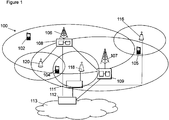
- a wireless communication system 100 such as that shown in figure 1
- mobile communication devices or user equipment (UE) 102, 104, 105 are provided wireless access via at least one base station or similar wireless transmitting and/or receiving node or point.
- Base stations are typically controlled by at least one appropriate controller apparatus, so as to enable operation thereof and management of mobile communication devices in communication with the base stations.
- the controller apparatus may be located in a radio access network (e.g. wireless communication system 100) or in a core network (CN) (not shown) and may be implemented as one central apparatus or its functionality may be distributed over several apparatus.
- the controller apparatus may be part of the base station and/or provided by a separate entity such as a Radio Network Controller.
- control apparatus 108 and 109 are shown to control the respective macro level base stations 106 and 107.
- the control apparatus of a base station can be interconnected with other control entities.
- the control apparatus is typically provided with memory capacity and at least one data processor.
- the control apparatus and functions may be distributed between a plurality of control units. In some systems, the control apparatus may additionally or alternatively be provided in a radio network controller.
- base stations 106 and 107 are shown as connected to a wider communications network 113 via gateway 112.
- a further gateway function may be provided to connect to another network.
- the smaller base stations 116, 118 and 120 may also be connected to the network 113, for example by a separate gateway function and/or via the controllers of the macro level stations.
- the base stations 116, 118 and 120 may be pico or femto level base stations or the like. In the example, stations 116 and 118 are connected via a gateway 111 whilst station 120 connects via the controller apparatus 108. In some embodiments, the smaller stations may not be provided. Smaller base stations 116, 118 and 120 may be part of a second network, for example WLAN and may be WLAN APs.
- the communication devices 102, 104, 105 may access the communication system based on various access techniques, such as code division multiple access (CDMA), or wideband CDMA (WCDMA).
- CDMA code division multiple access
- WCDMA wideband CDMA
- Other non-limiting examples comprise time division multiple access (TDMA), frequency division multiple access (FDMA) and various schemes thereof such as the interleaved frequency division multiple access (IFDMA), single carrier frequency division multiple access (SC-FDMA) and orthogonal frequency division multiple access (OFDMA), space division multiple access (SDMA) and so on.
- TDMA time division multiple access
- FDMA frequency division multiple access
- IFDMA interleaved frequency division multiple access
- SC-FDMA single carrier frequency division multiple access
- OFDMA orthogonal frequency division multiple access
- SDMA space division multiple access
- LTE Long Term Evolution
- UMTS Universal Mobile Telecommunications System
- LTE-A LTE Advanced
- E-UTRAN Evolved Universal Terrestrial Radio Access Network
- Base stations of such systems are known as evolved or enhanced Node Bs (eNBs) and provide E-UTRAN features such as user plane Packet Data Convergence/Radio Link Control/Medium Access Control/Physical layer protocol (PDCP/RLC/MAC/PHY) and control plane Radio Resource Control (RRC) protocol terminations towards the communication devices.
- E-UTRAN features such as user plane Packet Data Convergence/Radio Link Control/Medium Access Control/Physical layer protocol (PDCP/RLC/MAC/PHY) and control plane Radio Resource Control (RRC) protocol terminations towards the communication devices.
- RRC Radio Resource Control
- Other examples of radio access system comprise those provided by base stations of systems that are based on technologies such as wireless local area network (WLAN) and/or WiMax (Worldwide Interoperability for Microwave Access).
- WLAN wireless local area network
- WiMax Worldwide Interoperability for Microwave Access
- Network architecture in NR may be similar to that of LTE-advanced.
- Base stations of NR systems may be known as next generation Node Bs (gNBs).
- Changes to the network architecture may depend on the need to support various radio technologies and finer QoS support, and some on-demand requirements for e.g. QoS levels to support QoE of user point of view.
- network aware services and applications, and service and application aware networks may bring changes to the architecture. Those are related to Information Centric Network (ICN) and User-Centric Content Delivery Network (UC-CDN) approaches.
- ICN Information Centric Network
- UC-CDN User-Centric Content Delivery Network
- Future networks may utilise network functions virtualization (NFV) which is a network architecture concept that proposes virtualizing network node functions into "building blocks" or entities that may be operationally connected or linked together to provide services.
- a virtualized network function (VNF) may comprise one or more virtual machines running computer program codes using standard or general type servers instead of customized hardware. Cloud computing or data storage may also be utilized.
- radio communications this may mean node operations to be carried out, at least partly, in a server, host or node operationally coupled to a remote radio head. It is also possible that node operations will be distributed among a plurality of servers, nodes or hosts. It should also be understood that the distribution of labour between core network operations and base station operations may differ from that of the LTE or even be non-existent.
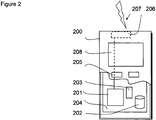
- a possible mobile communication device will now be described in more detail with reference to Figure 2 showing a schematic, partially sectioned view of a communication device 200.
- a communication device is often referred to as user equipment (UE) or terminal.
- An appropriate mobile communication device may be provided by any device capable of sending and receiving radio signals.
- Non-limiting examples comprise a mobile station (MS) or mobile device such as a mobile phone or what is known as a 'smart phone', a computer provided with a wireless interface card or other wireless interface facility (e.g., USB dongle), personal data assistant (PDA) or a tablet provided with wireless communication capabilities, or any combinations of these or the like.
- MS mobile station
- PDA personal data assistant
- a mobile communication device may provide, for example, communication of data for carrying communications such as voice, electronic mail (email), text message, multimedia and so on. Users may thus be offered and provided numerous services via their communication devices. Non-limiting examples of these services comprise two-way or multi-way calls, data communication or multimedia services or simply an access to a data communications network system, such as the Internet. Users may also be provided broadcast or multicast data. Non-limiting examples of the content comprise downloads, television and radio programs, videos, advertisements, various alerts and other information.
- a mobile device is typically provided with at least one data processing entity 201, at least one memory 202 and other possible components 203 for use in software and hardware aided execution of tasks it is designed to perform, including control of access to and communications with access systems and other communication devices.
- the data processing, storage and other relevant control apparatus can be provided on an appropriate circuit board and/or in chipsets. This feature is denoted by reference 204.
- the user may control the operation of the mobile device by means of a suitable user interface such as key pad 205, voice commands, touch sensitive screen or pad, combinations thereof or the like.
- a display 208, a speaker and a microphone can be also provided.
- a mobile communication device may comprise appropriate connectors (either wired or wireless) to other devices and/or for connecting external accessories, for example hands-free equipment, thereto.
- the mobile device 200 may receive signals over an air or radio interface 207 via appropriate apparatus for receiving and may transmit signals via appropriate apparatus for transmitting radio signals.
- transceiver apparatus is designated schematically by block 206.
- the transceiver apparatus 206 may be provided for example by means of a radio part and associated antenna arrangement.
- the antenna arrangement may be arranged internally or externally to the mobile device.
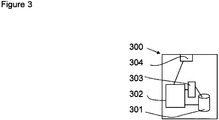
- Figure 3 shows an example of a control apparatus for a communication system, for example to be coupled to and/or for controlling a station of an access system, such as a RAN node, e.g. a base station, eNB or gNB or a node of a core network such as an MME or S-GW, or a server or host.
- a station of an access system such as a RAN node, e.g. a base station, eNB or gNB or a node of a core network such as an MME or S-GW, or a server or host.
- the method may be implanted in a single control apparatus or across more than one control apparatus.
- the control apparatus may be integrated with or external to a node or module of a core network or RAN.
- base stations comprise a separate control apparatus unit or module.
- the control apparatus can be another network element such as a radio network controller or a spectrum controller.
- each base station may have such a control apparatus as well as a control apparatus being provided in a radio network controller.
- the control apparatus 300 can be arranged to provide control on communications in the service area of the system.
- the control apparatus 300 comprises at least one memory 301, at least one data processing unit 302, 303 and an input/output interface 304. Via the interface the control apparatus can be coupled to a receiver and a transmitter of the base station.
- the receiver and/or the transmitter may be implemented as a radio front end or a remote radio head.
- the RAN may interact with a controller that will provide various control (and/or optimization) actions for RAN functions to the RAN over "B1 reference point".
- xRAN defines an architecture where the RAN will interface to a controller over a B1 interface.
- Figure 4 shows an example xRAN architecture.
- the system comprises a RAN Node 402 which may be a gNB or another RAN node such as eNB etc.
- the RAN node 402 may comprise various interfaces or functional units: RU (radio unit) 404 which may be hosted at a cell site 406; DU (distributed unit) 408 which may be hosted at a CRAN (cloud RAN) hub or cell site 410; CU-CP (central unit - control plane) 412; and CU-UP (central unit - user plane) 414.
- RU radio unit
- DU distributed unit
- CRAN cloud RAN
- CU-CP central unit - control plane
- CU-UP central unit - user plane
- the CU-CO and CU-UP may be hosted at a Central Office (CO) or edge data centre 428.
- CO Central Office
- the RAN node 402 is in communication with, and may be controlled by, Controller 418.
- the RAN node 402 may comprise an interface or Application Programming Interface B1 411 towards the Controller 418. Communication between RAN node 402 and controller 418 may be via a reference point 416 which may be labelled B1.
- the Controller 418 may comprise the following functional units shown schematically: control API 420, which may send control information to RAN node 402 (e.g. to CU-CP 412); data gathering/processing unit 422, which may gather data from the RAN node 402 (e.g. may receive information from CU-CP 412) and provide stream processing or in-memory database facilities; analytics or Machine Learning (ML) toolkits 424; services performing RAN operations or optimization algorithms 426.
- the xRAN controller may be realised using a real-time database for data gathering, analytics and RAN optimisation as micro-services.
- the controller 418 may be hosted at a Central Office (CO) or edge data centre 428.
- a policy node is schematically shown at 430.
- This may be an Orchestration/Policy Engine, such as an Open Network Automation Platform (ONAP).
- the policy node 430 may comprise a policy database or processing engine 432 and an analytics system which may be referred to as DCAE, which may provide the policy node capabilities of storing and processing historical data and applying centralized policy.
- DCAE an analytics system which may be referred to as DCAE, which may provide the policy node capabilities of storing and processing historical data and applying centralized policy.
- the policy node 430 is in communication with xRAN controller 418 via a reference point 434 which may be known as A1.
- the policy node 430 is hosted at a central cloud, shown schematically at central cloud 436.
- Control (and/or optimization) actions may include load-balancing (intra- and inter-frequency).
- a controller 418 may provide the RAN node 402 with target load values, or with handover offsets (Cell Individual Offset (CIO)) values for certain neighbor cells etc. that are used to control the RAN's load-balancing actions Admission Control.
- CIO Cell Individual Offset
- Physical channel e.g. PUCCH, SRS
- PUCCH Physical channel
- SRS Physical channel
- a controller 418 may provide RAN node 402 with an allowed number of PUCCH PRBs or a bitmap of allowed PRBs, along with indicators to whether existing UEs' PUCCH assignments should be reconfigured to adapt to the updated configuration.
- the actions provided by the controller 418 may apply to all users in a cell or RAN node (eNB or gNB). In some cases the controller 418 may provide control actions for individual UEs.
- eNB or gNB RAN node
- a control action may comprise various specific parameters such as threshold values or metric values or other parameters that influence the actions invoked by the RAN or messages communicated by the RAN towards UEs.
- controller 418 may be desirable to enable the controller 418 to provide different control actions or different parameters for certain control actions that the RAN should apply not to all UEs in a cell/RAN node or to individual UEs, but rather to certain groups or subsets of UEs.
- the controller 418 may wish to provide different target values, load thresholds or handover offsets etc. to different groups of UEs. This may allow the Controller 418 to effect different behaviors or performance characteristics for different groups or subsets or classes of UEs, and achieve a better overall system performance or other target.
- the following provides solutions to enable such differentiated behaviour or performance for different classes of UEs.
- Groups (or classes) of UEs may be identified based on various criteria, as discussed below.
- a group or class may be a subset of all the UEs in a cell/RAN node, i.e. the group or class may comprise less than the total number of UEs in a cell/RAN node.
- groups may be based on RF/channel quality characteristics.
- Cell-edge UEs e.g. UEs with a measured CQI or RSRP/RSRQ less than a threshold
- Cell-center UEs e.g., UEs with a CQI or RSRP/RSRQ greater than a threshold
- Groups may be based on mobility characteristics.
- Low-mobility UEs e.g. UEs with a "variability of CQI” less than a threshold, “timescale of variability of CQI” less than a threshold, or “number of handovers within current RRC Connection” less than a threshold
- a corresponding classification may be made for high mobility UEs.
- Groups may be based on traffic type.
- a group may comprise UEs with a particular type of traffic/bearer/QoS category (e.g. VoLTE UEs with a QCI1 bearer or other QCI type or VoLTE traffic or UEss with OTT high-bitrate videos) These UEs may be identified by probes or DPI if the RAN does not have visibility of traffic type.
- a particular type of traffic/bearer/QoS category e.g. VoLTE UEs with a QCI1 bearer or other QCI type or VoLTE traffic or UEss with OTT high-bitrate videos
- NSSAI may be based on Slice identifier or slice type.
- a standardized identifier of slices called NSSAI is being defined.
- NSSAI may consist of a Slice/Service Type (SST) (which may indicate, for example, MBB or IOT or URLLC, or other operator-specifiable values) and a Slice Differentiator (SD) which may indicate, for example, a tenant ID.
- SST Slice/Service Type
- SD Slice Differentiator
- the classification criteria for determining whether a UE belongs to a particular slice type or slice identifier may be based on the SST or SD or NSSAI.
- Groups may be based on location. For example, UEs near a particular shopping area or train station etc. (such UEs may be identified either by location info or RF fingerprinting). Groups may be based on subscription / tenant / slice identifier. Groups may be based on accounting information or user data consumption information (e.g. high-data-usage UEs vs low-data-usage UEs). Groups may be based on CEM (customer-experience management) or customer-acquisition information (high-churn-risk UEs).
- Groups or classes may be defined as collections of bearers rather than collections of UEs, or variously as mixtures of UEs and bearers.
- a UE or bearer may belong to one class or more than one class.
- the following may provide a method to enable flexible ways of identifying the class or classes to which a UE and/or bearer belongs.
- the following may enable the classification decision for a given class or UE or bearer to be flexibly performed at the RAN or the Controller 418.
- the Controller 418 may have certain capabilities for making such classification decisions, such as a database or policy configuration, whereas the RAN may have its own capabilities for executing such classification decisions.
- the RAN may have its own internal way of classifying UEs and the controller 418 may classify the UEs in a different way.
- the RAN may have certain information natively, based on which, the RAN can perform the classification. In other cases the RAN may not have sufficient information.
- Some RANs may not have enough processing power to be able to execute classification. However, depending on the latency between the RAN and controller 418, having the Controller 418 perform classification of UEs may not be desirable.
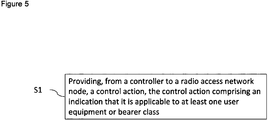
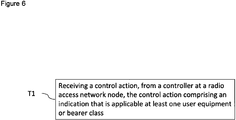
- Figures 5 and 6 show a flowchart of a method which may enable a controller 418 and RAN node 402 to support applying control actions to different classes/groups/subsets of UEs. Further, optional, steps of a method as described with reference to figures 5 and 6 may support the ability for either the RAN node 402 or the controller 418 to do the classification.
- the method comprises providing, from a controller to a radio access network node, a control action, the control action comprising an indication that the control action is applicable to at least one user equipment or bearer class.
- the method may comprise determining, at the controller, whether a user equipment belongs to the at least one user equipment or bearer class and providing, from the controller to the radio access node, an indication of whether the user equipment or bearer belongs to the at least one user equipment or bearer class.
- Whether a user equipment or bearer belongs to a user equipment or bearer class may be determined based on class identifying criterion.
- the class identifying criterion may comprise at least one of channel quality information, mobility information, traffic identifier information, slice identifier information, location information, subscriber identifier information and data usage information.
- the method may comprise providing, from the controller to the radio access network node, information indicating at least one class identifying criterion for use at the radio access network node in determining whether a user equipment or bearer belongs to the at least one user equipment or bearer class.
- the first step, T1 of a method as shown in Figure 6 comprises receiving, from a controller at a radio access network node, a control action, the control action comprising an indication that it is applicable to at least one user equipment or bearer class.
- the method as described with reference to Figure 6 may comprise receiving, from the controller at the radio access network node, information indicating at least one class identifying criterion and determining at the radio access network node whether a user equipment or bearer belongs to the at least one user equipment or bearer class based on the information.
- the RAN node may provide an indication to the controller of whether the user equipment or bearer belongs to the at least one user equipment or bearer class
- a method as shown in Figure 5 may be performed at a controller, e.g. xRAN controller 418.
- a method as shown in Figure 6 may be performed at a RAN node, e.g. a node 402 (eNB, gNB) of a RAN or cloud RAN.
- a RAN node e.g. a node 402 (eNB, gNB) of a RAN or cloud RAN.
- a method as described with reference to Figures 5 or 6 may include a signalling exchange between a controller and RAN node.
- the signalling exchange may be used to determine the groups (or classes) of UEs or bearers for which the controller will do the classification, and the groups (or classes) of UEs or bearers for which RAN will do the classification.
- At least two modes may be supported, a first mode and a second mode as described above.
- a "mixed mode" may be used, i.e. a first mode (Mode 1) for some classes and a second mode (Mode 2) for some classes.
- the at least one user equipment or bearer class may be one of a plurality of user equipment or bearer classes.
- Each of the plurality of user equipment or bearer classes may be in a first mode or a second mode.
- the controller determines whether a user equipment or bearer belongs to a class.
- the radio access network node determines whether a user equipment or bearer belongs to a class.
- a group may be determined for a UE, i.e. the UE is classified into appropriate classes.
- the method may comprise determining the class for a user equipment or bearer at the controller.
- the controller may be determine more than one class (or a set of classes) for a UE.
- An indication of the determined class may be provided by the controller to the radio access network.
- the controller notifies the RAN node of the classes that each UE belongs to. RAN may then follow the UE classification as made by the controller.
- the class for a user equipment may be determined based on measurements or indications received from the radio access network node.
- the measurements may be based on sources other than the RAN node, e.g. network probes or deep packet inspection (DPI).
- sources other than the RAN node e.g. network probes or deep packet inspection (DPI).
- DPI deep packet inspection
- the controller may decide, based on measurement reports forwarded by the RAN node to the controller, that a certain UE is to be classified as a "cell-edge UE" rather than a "cell center” UE.
- the controller may decide, based on indications of bearer setups or QoS attributes received from RAN (or data received from other sources such as probes or DPI) that a given UE or bearer should be treated as belonging to a certain high-priority class based on the UE's traffic.
- the controller In the first mode, the controller has granular control. This may incur latency since the classification can only be decided by the controller after it has received all relevant measurements/indications from the RAN or other sources.
- RAN node determines the classification of individual UEs. That is, the class for a user equipment or bearer may be determined at the RAN node.
- the RAN node may determine more than one class (or a set of classes) for a UE.
- a controller may provide an indication of modifications of the criteria used by the RAN node to decide the classification of UEs.
- RAN may decide that a certain UE should be classified as a "cell edge UE" based on thresholds of the CQI or RSRP/RSRQ etc.
- the controller may indicate to the RAN the type of measurement that should be used (CQI or RSRP etc.), and the value of the threshold that should be used, etc.
- the indication of the class to which a control action is applicable may comprise a qualifier or class identifier indicating which class(es) of UEs that action should be applied to.
- Each class may be identified by an integer from ⁇ 1...N ⁇ or other symbolic indicators e.g. ⁇ a, b, c ⁇ .
- the qualifier may contain either a list of integers, or set expressions (union/intersection/set difference etc) of class indicators, or "ANY"/"ALL” indicators (similar to union/intersection). Set expressions may be useful if a UE belongs to different classes, and it is desired to allow actions that should apply only to e.g. UEs that belong to all of the indicated classes (intersection) or any of the indicated classes, etc.
- Some class identifiers may be standardized. Some class identifiers may be determined dynamically.
- the controller and RAN may have a signaling exchange to establish the class identifiers.
- the method may comprise exchanging class identifier information between the controller and the RAN node.
- a controller may provide a message to RAN node to add/modify/delete a class identifier for each class.
- RAN maintains a list of currently operational class identifiers, and modifies the list per messages from controller.
- the RAN node may or may not actually know the "meaning" of each class identifier.
- the RAN may provide radio access network capability information to the controller.
- a standardized set of RAN UE-classification capabilities may be defined, and a RAN node (eNB/gNB) may provide to a controller its supported classification capabilities. Determining whether a user equipment or bearer class belongs to the first mode or the second mode may be based in the radio access network capability information.
- a common understanding between the RAN and Controller on the types of classifications that the RAN is capable of may then be established.
- the controller may indicate to the RAN control actions at the granularity of bearers or flows rather than for UEs.
- the controller may indicate that certain thresholds (e.g. packet discard or delay thresholds) should be applied to certain groups/classes of bearers.
- certain thresholds e.g. packet discard or delay thresholds
- the previously described procedures can be equally applied at the granularity of groups/classes of flows/bearers rather than (or in addition to) at the granularity of groups/classes of UEs.
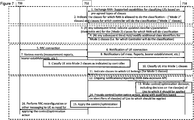
- Figure 7 shows an example signalling flow between a controller 718, a RAN 702 and a UE 700 which may be used in accordance with an example.
- the controller 718 and RAN 702 exchange RAN supported capabilities for classifying UEs 700 based on pre-agreed types of classes.
- the controller 718 then indicates the classes which are Mode 1 and Mode 2 classes.
- the controller 718 may indicate updated classifiers or parameters (e.g., thresholds etc.) for the Mode 2 classes.
- the controller 718 may add/modify additional class identifiers for Mode 1 classes.
- the UEs 700 are classified as agreed.
- the controller 718 indicates the classes to which the UE 700 belongs to the RAN 702.
- the controller 718 When communicating control actions, the controller 718 provides the control action, along with qualifiers based identifiers of class(es) of UEs to which the control action should be applied.
- a method as described herein may enable operators to apply differentiated behaviors to different types of UEs or bearers.
- nodes which are more intelligent have more capabilities for classification, as well as those nodes which are less intelligent and provide fewer capabilities for classification).
- the ability of the controller to optimize the behaviour of the RAN may be improved.
- Control functions may comprise providing, from a controller to a radio access network node, a control action, the control action comprising an indication that it is applicable to at least one user equipment or bearer class.
- control functions may comprise receiving, from a controller at a radio access network node, a control action, the control action comprising an indication that it is applicable to at least one user equipment or bearer class
- the apparatuses may comprise or be coupled to other units or modules etc., such as radio parts or radio heads, used in or for transmission and/or reception.
- the apparatuses have been described as one entity, different modules and memory may be implemented in one or more physical or logical entities.
- the various embodiments may be implemented in hardware or special purpose circuits, software, logic or any combination thereof. Some aspects of the invention may be implemented in hardware, while other aspects may be implemented in firmware or software which may be executed by a controller, microprocessor or other computing device, although the invention is not limited thereto. While various aspects of the invention may be illustrated and described as block diagrams, flow charts, or using some other pictorial representation, it is well understood that these blocks, apparatus, systems, techniques or methods described herein may be implemented in, as non-limiting examples, hardware, software, firmware, special purpose circuits or logic, general purpose hardware or controller or other computing devices, or some combination thereof.
- the embodiments of this invention may be implemented by computer software executable by a data processor of the mobile device, such as in the processor entity, or by hardware, or by a combination of software and hardware.
- Computer software or program also called program product, including software routines, applets and/or macros, may be stored in any apparatus-readable data storage medium and they comprise program instructions to perform particular tasks.
- a computer program product may comprise one or more computer-executable components which, when the program is run, are configured to carry out embodiments.
- the one or more computer-executable components may be at least one software code or portions of it.
- any blocks of the logic flow as in the Figures may represent program steps, or interconnected logic circuits, blocks and functions, or a combination of program steps and logic circuits, blocks and functions.
- the software may be stored on such physical media as memory chips, or memory blocks implemented within the processor, magnetic media such as hard disk or floppy disks, and optical media such as for example DVD and the data variants thereof, CD.
- the physical media is a non-transitory media.
- the memory may be of any type suitable to the local technical environment and may be implemented using any suitable data storage technology, such as semiconductor based memory devices, magnetic memory devices and systems, optical memory devices and systems, fixed memory and removable memory.
- the data processors may be of any type suitable to the local technical environment, and may comprise one or more of general purpose computers, special purpose computers, microprocessors, digital signal processors (DSPs), application specific integrated circuits (ASIC), FPGA, gate level circuits and processors based on multi core processor architecture, as non-limiting examples.
- Embodiments of the inventions may be practiced in various components such as integrated circuit modules.
- the design of integrated circuits is by and large a highly automated process.
- Complex and powerful software tools are available for converting a logic level design into a semiconductor circuit design ready to be etched and formed on a semiconductor substrate.
Landscapes
- Engineering & Computer Science (AREA)
- Computer Networks & Wireless Communication (AREA)
- Signal Processing (AREA)
- Mobile Radio Communication Systems (AREA)
Abstract
Description
- The present application relates to a method, apparatus, system and computer program and in particular but not exclusively to a controller providing control actions to a radio access network.
- A communication system can be seen as a facility that enables communication sessions between two or more entities such as user terminals, base stations and/or other nodes by providing carriers between the various entities involved in the communications path. A communication system can be provided for example by means of a communication network and one or more compatible communication devices. The communication sessions may comprise, for example, communication of data for carrying communications such as voice, video, electronic mail (email), text message, multimedia and/or content data and so on. Non-limiting examples of services provided comprise two-way or multi-way calls, data communication or multimedia services and access to a data network system, such as the Internet.
- In a wireless communication system at least a part of a communication session between at least two stations occurs over a wireless link. Examples of wireless systems comprise public land mobile networks (PLMN), satellite based communication systems and different wireless local networks, for example wireless local area networks (WLAN). The wireless systems can typically be divided into cells, and are therefore often referred to as cellular systems.
- A user can access the communication system by means of an appropriate communication device or terminal. A communication device of a user may be referred to as user equipment (UE) or user device. A communication device is provided with an appropriate signal receiving and transmitting apparatus for enabling communications, for example enabling access to a communication network or communications directly with other users. The communication device may access a carrier provided by a station, for example a base station of a cell, and transmit and/or receive communications on the carrier.
- The communication system and associated devices typically operate in accordance with a given standard or specification which sets out what the various entities associated with the system are permitted to do and how that should be achieved. Communication protocols and/or parameters which shall be used for the connection are also typically defined. One example of a communications system is UTRAN (3G radio). Other examples of communication systems are the long-term evolution (LTE) of the Universal Mobile Telecommunications System (UMTS) radio-access technology and so-called 5G or New Radio (NR) networks. NR is being standardized by the 3rd Generation Partnership Project (3GPP).
- In a first aspect there is provided a method comprising providing, from a controller to a radio access network node, a control action, the control action comprising an indication that it is applicable to at least one user equipment or bearer class.
- The method may comprise determining, at the controller, whether a user equipment belongs to the at least one user equipment or bearer class and providing, from the controller to the radio access network node, an indication of whether the user equipment or bearer belongs to the at least one user equipment or bearer class.
- Whether a user equipment or bearer belongs to a user equipment or bearer class may be determined based on class identifying criterion.
- Class identifying criterion may comprise at least one of channel quality information, mobility information, traffic identifier information, slice identifier information, location information, subscriber identifier information and data usage information.
- The method may comprise providing, from the controller to the radio access network node, information indicating at least one class identifying criterion for use at the radio access network node in determining whether a user equipment or bearer belongs to the at least one user equipment or bearer class.
- The method may comprise providing class identifier information from the controller to the radio access network node.
- The at least one user equipment or bearer class may be one of a plurality of user equipment or bearer classes. Each of the plurality of user equipment or bearer classes may be in a first mode or a second mode, wherein in the first mode the controller determines whether a user equipment or bearer belongs to a class and in the second mode the radio access network node determines whether a user equipment or bearer belongs to a class.
- The method may comprise providing, from the controller to the radio access network node, information comprising an indication of whether a user equipment or bearer class belongs to a first mode or a second mode.
- The method may comprise receiving, from the radio access network node at the controller, radio access network node capability information and determining whether a user equipment or bearer class belongs to the first mode or the second mode based on the radio access network capability information.
- In a second aspect there is provided a method, said method comprising receiving, from a controller at a radio access network node, a control action, the control action comprising an indication that it is applicable to at least one user equipment or bearer class.
- The method may comprise receiving, from the controller at the radio access network node, an indication of whether the user equipment or bearer belongs to the at least one user equipment or bearer class.
- Whether a user equipment or bearer belongs to a user equipment or bearer class may be determined based on class identifying criterion.
- The class identifying criterion may comprise at least one of channel quality information, mobility information, traffic identifier information, slice identifier information, location information, subscriber identifier information and data usage information.
- The method may comprise receiving, from the controller at the radio access network node, information indicating at least one class identifying criterion and determining at the radio access network node whether a user equipment or bearer belongs to the at least one user equipment or bearer class based on the information.
- The method may comprise receiving class identifier information from the controller at the radio access network node.
- The at least one user equipment or bearer class may be one of a plurality of user equipment or bearer classes. Each of the plurality of user equipment or bearer classes may be in a first mode or a second mode, wherein in the first mode the controller determines whether a user equipment or bearer belongs to a class and in the second mode the radio access network node determines whether a user equipment or bearer belongs to a class.
- The method may comprise receiving, from the controller at the radio access network node, information comprising an indication of whether a user equipment or bearer class belongs to a first mode or a second mode.
- The method may comprise providing from the radio access network node to the controller, radio access network node capability information for use in determining whether a user equipment or bearer class belongs to the first mode or the second mode based on the radio access network capability information.
- In a third aspect there is provided an apparatus, said apparatus comprising means for providing, from a controller to a radio access network node, a control action, the control action comprising an indication that it is applicable to at least one user equipment or bearer class.
- The apparatus may comprise means for determining, at the controller, whether a user equipment belongs to the at least one user equipment or bearer class and means for providing, from the controller to the radio access network node, an indication of whether the user equipment or bearer belongs to the at least one user equipment or bearer class.
- Whether a user equipment or bearer belongs to a user equipment or bearer class may be determined based on class identifying criterion.
- Class identifying criterion may comprise at least one of channel quality information, mobility information, traffic identifier information, slice identifier information, location information, subscriber identifier information and data usage information.
- The apparatus may comprise means for providing, from the controller to the radio access network node, information indicating at least one class identifying criterion for use at the radio access network node in determining whether a user equipment or bearer belongs to the at least one user equipment or bearer class.
- The apparatus may comprise means for providing class identifier information from the controller to the radio access network node.
- The at least one user equipment or bearer class may be one of a plurality of user equipment or bearer classes. Each of the plurality of user equipment or bearer classes may be in a first mode or a second mode, wherein in the first mode the controller determines whether a user equipment or bearer belongs to a class and in the second mode the radio access network node determines whether a user equipment or bearer belongs to a class.
- The apparatus may comprise means for providing, from the controller to the radio access network node, information comprising an indication of whether a user equipment or bearer class belongs to a first mode or a second mode.
- The apparatus may comprise means for receiving, from the radio access network node at the controller, radio access network node capability information and means for determining whether a user equipment or bearer class belongs to the first mode or the second mode based on the radio access network capability information.
- In a fourth aspect there is provided an apparatus, said apparatus comprising means for receiving, from a controller at a radio access network node, a control action, the control action comprising an indication that it is applicable to at least one user equipment or bearer class.
- The apparatus may comprise means for receiving, from the controller at the radio access network node, an indication of whether the user equipment or bearer belongs to the at least one user equipment or bearer class.
- Whether a user equipment or bearer belongs to a user equipment or bearer class may be determined based on class identifying criterion.
- The class identifying criterion may comprise at least one of channel quality information, mobility information, traffic identifier information, slice identifier information, location information, subscriber identifier information and data usage information.
- The apparatus may comprise means for receiving, from the controller at the radio access network node, information indicating at least one class identifying criterion and means for determining at the radio access network node whether a user equipment or bearer belongs to the at least one user equipment or bearer class based on the information.
- The apparatus may comprise means for receiving class identifier information from the controller at the radio access network node.
- The at least one user equipment or bearer class may be one of a plurality of user equipment or bearer classes. Each of the plurality of user equipment or bearer classes may be in a first mode or a second mode, wherein in the first mode the controller determines whether a user equipment or bearer belongs to a class and in the second mode the radio access network node determines whether a user equipment or bearer belongs to a class.
- The apparatus may comprise means for receiving, from the controller at the radio access network node, information comprising an indication of whether a user equipment or bearer class belongs to a first mode or a second mode.
- The apparatus may comprise means for providing from the radio access network node to the controller, radio access network node capability information for use in determining whether a user equipment or bearer class belongs to the first mode or the second mode based on the radio access network capability information.
- In a fifth aspect there is provided an apparatus comprising at least one processor and at least one memory including a computer program code, the at least one memory and the computer program code configured to, with the at least one processor, cause the apparatus at least to: provide, from a controller to a radio access network node, a control action, the control action comprising an indication that it is applicable to at least one user equipment or bearer class.
- The apparatus may be configured to determine, at the controller, whether a user equipment belongs to the at least one user equipment or bearer class and provide, from the controller to the radio access network node, an indication of whether the user equipment or bearer belongs to the at least one user equipment or bearer class.
- Whether a user equipment or bearer belongs to a user equipment or bearer class may be determined based on class identifying criterion.
- Class identifying criterion may comprise at least one of channel quality information, mobility information, traffic identifier information, slice identifier information, location information, subscriber identifier information and data usage information.
- The apparatus may be configured to provide, from the controller to the radio access network node, information indicating at least one class identifying criterion for use at the radio access network node in determining whether a user equipment or bearer belongs to the at least one user equipment or bearer class.
- The apparatus may be configured to provide class identifier information from the controller to the radio access network node.
- The at least one user equipment or bearer class may be one of a plurality of user equipment or bearer classes. Each of the plurality of user equipment or bearer classes may be in a first mode or a second mode, wherein in the first mode the controller determines whether a user equipment or bearer belongs to a class and in the second mode the radio access network node determines whether a user equipment or bearer belongs to a class.
- The apparatus may be configured to provide, from the controller to the radio access network node, information comprising an indication of whether a user equipment or bearer class belongs to a first mode or a second mode.
- The apparatus may be configured to receive, from the radio access network node at the controller, radio access network node capability information and determine whether a user equipment or bearer class belongs to the first mode or the second mode based on the radio access network capability information.
- In a sixth aspect there is provided an apparatus comprising at least one processor and at least one memory including a computer program code, the at least one memory and the computer program code configured to, with the at least one processor, cause the apparatus at least to: receive, from a controller at a radio access network node, a control action, the control action comprising an indication that it is applicable to at least one user equipment or bearer class.
- The apparatus may be configured to receive, from the controller at the radio access network node, an indication of whether the user equipment or bearer belongs to the at least one user equipment or bearer class.
- Whether a user equipment or bearer belongs to a user equipment or bearer class may be determined based on class identifying criterion.
- The class identifying criterion may comprise at least one of channel quality information, mobility information, traffic identifier information, slice identifier information, location information, subscriber identifier information and data usage information.
- The apparatus may be configured to receive, from the controller at the radio access network node, information indicating at least one class identifying criterion and determine at the radio access network node whether a user equipment or bearer belongs to the at least one user equipment or bearer class based on the information.
- The apparatus may be configured to receive class identifier information from the controller at the radio access network node.
- The at least one user equipment or bearer class may be one of a plurality of user equipment or bearer classes. Each of the plurality of user equipment or bearer classes may be in a first mode or a second mode, wherein in the first mode the controller determines whether a user equipment or bearer belongs to a class and in the second mode the radio access network node determines whether a user equipment or bearer belongs to a class.
- The apparatus may be configured to receive, from the controller at the radio access network node, information comprising an indication of whether a user equipment or bearer class belongs to a first mode or a second mode.
- The apparatus may be configured to provide from the radio access network node to the controller, radio access network node capability information for use in determining whether a user equipment or bearer class belongs to the first mode or the second mode based on the radio access network capability information.
- In a seventh aspect there is provided a computer program embodied on a non-transitory computer-readable storage medium, the computer program comprising program code for controlling a process to execute a process, the process comprising providing, from a controller to a radio access network node, a control action, the control action comprising an indication that it is applicable to at least one user equipment or bearer class.
- The process may comprise determining, at the controller, whether a user equipment belongs to the at least one user equipment or bearer class and providing, from the controller to the radio access network node, an indication of whether the user equipment or bearer belongs to the at least one user equipment or bearer class.
- Whether a user equipment or bearer belongs to a user equipment or bearer class may be determined based on class identifying criterion.
- Class identifying criterion may comprise at least one of channel quality information, mobility information, traffic identifier information, slice identifier information, location information, subscriber identifier information and data usage information.
- The process may comprise providing, from the controller to the radio access network node, information indicating at least one class identifying criterion for use at the radio access network node in determining whether a user equipment or bearer belongs to the at least one user equipment or bearer class.
- The process may comprise providing class identifier information from the controller to the radio access network node.
- The at least one user equipment or bearer class may be one of a plurality of user equipment or bearer classes. Each of the plurality of user equipment or bearer classes may be in a first mode or a second mode, wherein in the first mode the controller determines whether a user equipment or bearer belongs to a class and in the second mode the radio access network node determines whether a user equipment or bearer belongs to a class.
- The process may comprise providing, from the controller to the radio access network node, information comprising an indication of whether a user equipment or bearer class belongs to a first mode or a second mode.
- The process may comprise receiving, from the radio access network node at the controller, radio access network node capability information and determining whether a user equipment or bearer class belongs to the first mode or the second mode based on the radio access network capability information.
- In an eighth aspect there is provided a computer program embodied on a non-transitory computer-readable storage medium, the computer program comprising program code for controlling a process to execute a process, the process receiving, from a controller at a radio access network node, a control action, the control action comprising an indication that it is applicable to at least one user equipment or bearer class.
- The process may comprise receiving, from the controller at the radio access network node, an indication of whether the user equipment or bearer belongs to the at least one user equipment or bearer class.
- Whether a user equipment or bearer belongs to a user equipment or bearer class may be determined based on class identifying criterion.
- The class identifying criterion may comprise at least one of channel quality information, mobility information, traffic identifier information, slice identifier information, location information, subscriber identifier information and data usage information.
- The process may comprise receiving, from the controller at the radio access network node, information indicating at least one class identifying criterion and determining at the radio access network node whether a user equipment or bearer belongs to the at least one user equipment or bearer class based on the information.
- The process may comprise receiving class identifier information from the controller at the radio access network node.
- The at least one user equipment or bearer class may be one of a plurality of user equipment or bearer classes. Each of the plurality of user equipment or bearer classes may be in a first mode or a second mode, wherein in the first mode the controller determines whether a user equipment or bearer belongs to a class and in the second mode the radio access network node determines whether a user equipment or bearer belongs to a class.
- The process may comprise receiving, from the controller at the radio access network node, information comprising an indication of whether a user equipment or bearer class belongs to a first mode or a second mode.
- The process may comprise providing from the radio access network node to the controller, radio access network node capability information for use in determining whether a user equipment or bearer class belongs to the first mode or the second mode based on the radio access network capability information.
- In a ninth aspect there is provided a computer program product for a computer, comprising software code portions for performing the steps the method of the first aspect when said product is run on the computer.
- In the above, many different embodiments have been described. It should be appreciated that further embodiments may be provided by the combination of any two or more of the embodiments described above.
- Embodiments will now be described, by way of example only, with reference to the accompanying Figures in which:
-
Figure 1 shows a schematic diagram of an example communication system comprising a base station and a plurality of communication devices; -
Figure 2 shows a schematic diagram of an example mobile communication device; -
Figure 3 shows a schematic diagram of an example control apparatus; -
Figure 4 shows a schematic diagram of an example xRAN architecture; -
Figure 5 shows a flow chart of a method according to an example; -
Figure 6 shows a flowchart of a method according to an example; -
Figure 7 shows a signalling flow of a method according to an example. - Before explaining in detail the examples, certain general principles of a wireless communication system and mobile communication devices are briefly explained with reference to
Figures 1 to 3 to assist in understanding the technology underlying the described examples. - In a
wireless communication system 100, such as that shown infigure 1 , mobile communication devices or user equipment (UE) 102, 104, 105 are provided wireless access via at least one base station or similar wireless transmitting and/or receiving node or point. Base stations are typically controlled by at least one appropriate controller apparatus, so as to enable operation thereof and management of mobile communication devices in communication with the base stations. The controller apparatus may be located in a radio access network (e.g. wireless communication system 100) or in a core network (CN) (not shown) and may be implemented as one central apparatus or its functionality may be distributed over several apparatus. The controller apparatus may be part of the base station and/or provided by a separate entity such as a Radio Network Controller. InFigure 1 control apparatus level base stations - In
Figure 1 base stations wider communications network 113 viagateway 112. A further gateway function may be provided to connect to another network. - The
smaller base stations network 113, for example by a separate gateway function and/or via the controllers of the macro level stations. Thebase stations stations gateway 111 whilststation 120 connects via thecontroller apparatus 108. In some embodiments, the smaller stations may not be provided.Smaller base stations - The
communication devices - An example of wireless communication systems are architectures standardized by the 3rd Generation Partnership Project (3GPP). A latest 3GPP based development is often referred to as the long term evolution (LTE) of the Universal Mobile Telecommunications System (UMTS) radio-access technology. The various development stages of the 3GPP specifications are referred to as releases. More recent developments of the LTE are often referred to as LTE Advanced (LTE-A). The LTE employs a mobile architecture known as the Evolved Universal Terrestrial Radio Access Network (E-UTRAN). Base stations of such systems are known as evolved or enhanced Node Bs (eNBs) and provide E-UTRAN features such as user plane Packet Data Convergence/Radio Link Control/Medium Access Control/Physical layer protocol (PDCP/RLC/MAC/PHY) and control plane Radio Resource Control (RRC) protocol terminations towards the communication devices. Other examples of radio access system comprise those provided by base stations of systems that are based on technologies such as wireless local area network (WLAN) and/or WiMax (Worldwide Interoperability for Microwave Access). A base station can provide coverage for an entire cell or similar radio service area.
- An example of a suitable communications system is the 5G or NR concept. Network architecture in NR may be similar to that of LTE-advanced. Base stations of NR systems may be known as next generation Node Bs (gNBs). Changes to the network architecture may depend on the need to support various radio technologies and finer QoS support, and some on-demand requirements for e.g. QoS levels to support QoE of user point of view. Also network aware services and applications, and service and application aware networks may bring changes to the architecture. Those are related to Information Centric Network (ICN) and User-Centric Content Delivery Network (UC-CDN) approaches. NR may use multiple input - multiple output (MIMO) antennas, many more base stations or nodes than the LTE (a so-called small cell concept), including macro sites operating in co-operation with smaller stations and perhaps also employing a variety of radio technologies for better coverage and enhanced data rates.
- Future networks may utilise network functions virtualization (NFV) which is a network architecture concept that proposes virtualizing network node functions into "building blocks" or entities that may be operationally connected or linked together to provide services. A virtualized network function (VNF) may comprise one or more virtual machines running computer program codes using standard or general type servers instead of customized hardware. Cloud computing or data storage may also be utilized. In radio communications this may mean node operations to be carried out, at least partly, in a server, host or node operationally coupled to a remote radio head. It is also possible that node operations will be distributed among a plurality of servers, nodes or hosts. It should also be understood that the distribution of labour between core network operations and base station operations may differ from that of the LTE or even be non-existent.
- A possible mobile communication device will now be described in more detail with reference to
Figure 2 showing a schematic, partially sectioned view of acommunication device 200. Such a communication device is often referred to as user equipment (UE) or terminal. An appropriate mobile communication device may be provided by any device capable of sending and receiving radio signals. Non-limiting examples comprise a mobile station (MS) or mobile device such as a mobile phone or what is known as a 'smart phone', a computer provided with a wireless interface card or other wireless interface facility (e.g., USB dongle), personal data assistant (PDA) or a tablet provided with wireless communication capabilities, or any combinations of these or the like. A mobile communication device may provide, for example, communication of data for carrying communications such as voice, electronic mail (email), text message, multimedia and so on. Users may thus be offered and provided numerous services via their communication devices. Non-limiting examples of these services comprise two-way or multi-way calls, data communication or multimedia services or simply an access to a data communications network system, such as the Internet. Users may also be provided broadcast or multicast data. Non-limiting examples of the content comprise downloads, television and radio programs, videos, advertisements, various alerts and other information. - A mobile device is typically provided with at least one
data processing entity 201, at least onememory 202 and otherpossible components 203 for use in software and hardware aided execution of tasks it is designed to perform, including control of access to and communications with access systems and other communication devices. The data processing, storage and other relevant control apparatus can be provided on an appropriate circuit board and/or in chipsets. This feature is denoted byreference 204. The user may control the operation of the mobile device by means of a suitable user interface such askey pad 205, voice commands, touch sensitive screen or pad, combinations thereof or the like. Adisplay 208, a speaker and a microphone can be also provided. Furthermore, a mobile communication device may comprise appropriate connectors (either wired or wireless) to other devices and/or for connecting external accessories, for example hands-free equipment, thereto. - The
mobile device 200 may receive signals over an air orradio interface 207 via appropriate apparatus for receiving and may transmit signals via appropriate apparatus for transmitting radio signals. InFigure 2 transceiver apparatus is designated schematically byblock 206. Thetransceiver apparatus 206 may be provided for example by means of a radio part and associated antenna arrangement. The antenna arrangement may be arranged internally or externally to the mobile device. -
Figure 3 shows an example of a control apparatus for a communication system, for example to be coupled to and/or for controlling a station of an access system, such as a RAN node, e.g. a base station, eNB or gNB or a node of a core network such as an MME or S-GW, or a server or host. The method may be implanted in a single control apparatus or across more than one control apparatus. The control apparatus may be integrated with or external to a node or module of a core network or RAN. In some embodiments, base stations comprise a separate control apparatus unit or module. In other embodiments, the control apparatus can be another network element such as a radio network controller or a spectrum controller. In some embodiments, each base station may have such a control apparatus as well as a control apparatus being provided in a radio network controller. Thecontrol apparatus 300 can be arranged to provide control on communications in the service area of the system. Thecontrol apparatus 300 comprises at least onememory 301, at least onedata processing unit output interface 304. Via the interface the control apparatus can be coupled to a receiver and a transmitter of the base station. The receiver and/or the transmitter may be implemented as a radio front end or a remote radio head. - The RAN may interact with a controller that will provide various control (and/or optimization) actions for RAN functions to the RAN over "B1 reference point". xRAN defines an architecture where the RAN will interface to a controller over a B1 interface.
Figure 4 shows an example xRAN architecture. The system comprises aRAN Node 402 which may be a gNB or another RAN node such as eNB etc. TheRAN node 402 may comprise various interfaces or functional units: RU (radio unit) 404 which may be hosted at acell site 406; DU (distributed unit) 408 which may be hosted at a CRAN (cloud RAN) hub orcell site 410; CU-CP (central unit - control plane) 412; and CU-UP (central unit - user plane) 414. The CU-CO and CU-UP may be hosted at a Central Office (CO) or edge data centre 428.The units are in communication with each other as schematically shown by the arrows inFigure 4 . - The
RAN node 402 is in communication with, and may be controlled by,Controller 418. TheRAN node 402 may comprise an interface or ApplicationProgramming Interface B1 411 towards theController 418. Communication betweenRAN node 402 andcontroller 418 may be via areference point 416 which may be labelled B1. TheController 418 may comprise the following functional units shown schematically: controlAPI 420, which may send control information to RAN node 402 (e.g. to CU-CP 412); data gathering/processing unit 422, which may gather data from the RAN node 402 (e.g. may receive information from CU-CP 412) and provide stream processing or in-memory database facilities; analytics or Machine Learning (ML)toolkits 424; services performing RAN operations oroptimization algorithms 426. The xRAN controller may be realised using a real-time database for data gathering, analytics and RAN optimisation as micro-services. In this example thecontroller 418 may be hosted at a Central Office (CO) oredge data centre 428. - A policy node is schematically shown at 430. This may be an Orchestration/Policy Engine, such as an Open Network Automation Platform (ONAP). The
policy node 430 may comprise a policy database orprocessing engine 432 and an analytics system which may be referred to as DCAE, which may provide the policy node capabilities of storing and processing historical data and applying centralized policy. In this example thepolicy node 430 is in communication withxRAN controller 418 via areference point 434 which may be known as A1. In this example thepolicy node 430 is hosted at a central cloud, shown schematically atcentral cloud 436. - Control (and/or optimization) actions may include load-balancing (intra- and inter-frequency). For example, a
controller 418 may provide theRAN node 402 with target load values, or with handover offsets (Cell Individual Offset (CIO)) values for certain neighbor cells etc. that are used to control the RAN's load-balancing actions Admission Control. - Admission control is another example of a control action. The
controller 418 may provide theRAN node 402 with modifiers that change various thresholds or resource projections etc. that, for example, make the RAN's admission control more permissive or less permissive - Physical channel (e.g. PUCCH, SRS) sizing/assignment may be a control action provided to the
RAN node 402 by thecontroller 418. For example, for PUCCH, acontroller 418 may provideRAN node 402 with an allowed number of PUCCH PRBs or a bitmap of allowed PRBs, along with indicators to whether existing UEs' PUCCH assignments should be reconfigured to adapt to the updated configuration. - The actions provided by the
controller 418 may apply to all users in a cell or RAN node (eNB or gNB). In some cases thecontroller 418 may provide control actions for individual UEs. - A control action may comprise various specific parameters such as threshold values or metric values or other parameters that influence the actions invoked by the RAN or messages communicated by the RAN towards UEs.
- It may be desirable to enable the
controller 418 to provide different control actions or different parameters for certain control actions that the RAN should apply not to all UEs in a cell/RAN node or to individual UEs, but rather to certain groups or subsets of UEs. For example, thecontroller 418 may wish to provide different target values, load thresholds or handover offsets etc. to different groups of UEs. This may allow theController 418 to effect different behaviors or performance characteristics for different groups or subsets or classes of UEs, and achieve a better overall system performance or other target. The following provides solutions to enable such differentiated behaviour or performance for different classes of UEs. - Groups (or classes) of UEs may be identified based on various criteria, as discussed below. A group or class may be a subset of all the UEs in a cell/RAN node, i.e. the group or class may comprise less than the total number of UEs in a cell/RAN node.
- As an example, groups may be based on RF/channel quality characteristics. Cell-edge UEs (e.g. UEs with a measured CQI or RSRP/RSRQ less than a threshold) may be grouped together and Cell-center UEs (e.g., UEs with a CQI or RSRP/RSRQ greater than a threshold) grouped together.
- Groups may be based on mobility characteristics. Low-mobility UEs (e.g. UEs with a "variability of CQI" less than a threshold, "timescale of variability of CQI" less than a threshold, or "number of handovers within current RRC Connection" less than a threshold) may be classified. A corresponding classification may be made for high mobility UEs.
- Groups may be based on traffic type. For example, a group may comprise UEs with a particular type of traffic/bearer/QoS category (e.g. VoLTE UEs with a QCI1 bearer or other QCI type or VoLTE traffic or UEss with OTT high-bitrate videos) These UEs may be identified by probes or DPI if the RAN does not have visibility of traffic type.
- Groups may be based on Slice identifier or slice type. For example, in 5G, a standardized identifier of slices called NSSAI is being defined. NSSAI may consist of a Slice/Service Type (SST) (which may indicate, for example, MBB or IOT or URLLC, or other operator-specifiable values) and a Slice Differentiator (SD) which may indicate, for example, a tenant ID. The classification criteria for determining whether a UE belongs to a particular slice type or slice identifier may be based on the SST or SD or NSSAI.
- Groups may be based on location. For example, UEs near a particular shopping area or train station etc. (such UEs may be identified either by location info or RF fingerprinting). Groups may be based on subscription / tenant / slice identifier. Groups may be based on accounting information or user data consumption information (e.g. high-data-usage UEs vs low-data-usage UEs). Groups may be based on CEM (customer-experience management) or customer-acquisition information (high-churn-risk UEs).
- Groups or classes may be defined as collections of bearers rather than collections of UEs, or variously as mixtures of UEs and bearers. A UE or bearer may belong to one class or more than one class.
- The following may provide a method to enable flexible ways of identifying the class or classes to which a UE and/or bearer belongs. The following may enable the classification decision for a given class or UE or bearer to be flexibly performed at the RAN or the
Controller 418. TheController 418 may have certain capabilities for making such classification decisions, such as a database or policy configuration, whereas the RAN may have its own capabilities for executing such classification decisions. - The RAN may have its own internal way of classifying UEs and the
controller 418 may classify the UEs in a different way. In some cases, the RAN may have certain information natively, based on which, the RAN can perform the classification. In other cases the RAN may not have sufficient information. - Some RANs (eNB/gNB) may not have enough processing power to be able to execute classification. However, depending on the latency between the RAN and
controller 418, having theController 418 perform classification of UEs may not be desirable. -
Figures 5 and6 show a flowchart of a method which may enable acontroller 418 andRAN node 402 to support applying control actions to different classes/groups/subsets of UEs. Further, optional, steps of a method as described with reference tofigures 5 and6 may support the ability for either theRAN node 402 or thecontroller 418 to do the classification. - In a first step, S1, the method comprises providing, from a controller to a radio access network node, a control action, the control action comprising an indication that the control action is applicable to at least one user equipment or bearer class.
- The method may comprise determining, at the controller, whether a user equipment belongs to the at least one user equipment or bearer class and providing, from the controller to the radio access node, an indication of whether the user equipment or bearer belongs to the at least one user equipment or bearer class.
- Whether a user equipment or bearer belongs to a user equipment or bearer class may be determined based on class identifying criterion. The class identifying criterion may comprise at least one of channel quality information, mobility information, traffic identifier information, slice identifier information, location information, subscriber identifier information and data usage information.
- The method may comprise providing, from the controller to the radio access network node, information indicating at least one class identifying criterion for use at the radio access network node in determining whether a user equipment or bearer belongs to the at least one user equipment or bearer class.
- The first step, T1, of a method as shown in
Figure 6 comprises receiving, from a controller at a radio access network node, a control action, the control action comprising an indication that it is applicable to at least one user equipment or bearer class. - The method as described with reference to
Figure 6 may comprise receiving, from the controller at the radio access network node, information indicating at least one class identifying criterion and determining at the radio access network node whether a user equipment or bearer belongs to the at least one user equipment or bearer class based on the information. - The RAN node may provide an indication to the controller of whether the user equipment or bearer belongs to the at least one user equipment or bearer class
- A method as shown in
Figure 5 may be performed at a controller,e.g. xRAN controller 418. A method as shown inFigure 6 may be performed at a RAN node, e.g. a node 402 (eNB, gNB) of a RAN or cloud RAN. - A method as described with reference to
Figures 5 or6 may include a signalling exchange between a controller and RAN node. The signalling exchange may be used to determine the groups (or classes) of UEs or bearers for which the controller will do the classification, and the groups (or classes) of UEs or bearers for which RAN will do the classification. At least two modes may be supported, a first mode and a second mode as described above. A "mixed mode" may be used, i.e. a first mode (Mode 1) for some classes and a second mode (Mode 2) for some classes. - That is, the at least one user equipment or bearer class may be one of a plurality of user equipment or bearer classes. Each of the plurality of user equipment or bearer classes may be in a first mode or a second mode. In the first mode the controller determines whether a user equipment or bearer belongs to a class. In the second mode the radio access network node determines whether a user equipment or bearer belongs to a class.
- A method may comprise providing, from a controller to a radio access network node, information comprising an indication of whether a user equipment or bearer class belongs to a first mode or a second mode.
- At suitable events (e.g. new UE connection, or UE incoming handover, or new measurement report received, etc), a group may be determined for a UE, i.e. the UE is classified into appropriate classes.
- If the user equipment or bearer class belongs to the first mode, the method may comprise determining the class for a user equipment or bearer at the controller. The controller may be determine more than one class (or a set of classes) for a UE. An indication of the determined class may be provided by the controller to the radio access network. In an example, the controller notifies the RAN node of the classes that each UE belongs to. RAN may then follow the UE classification as made by the controller.
- The class for a user equipment may be determined based on measurements or indications received from the radio access network node. The measurements may be based on sources other than the RAN node, e.g. network probes or deep packet inspection (DPI).
- For example, the controller may decide, based on measurement reports forwarded by the RAN node to the controller, that a certain UE is to be classified as a "cell-edge UE" rather than a "cell center" UE.
- Alternatively or in addition, the controller may decide, based on indications of bearer setups or QoS attributes received from RAN (or data received from other sources such as probes or DPI) that a given UE or bearer should be treated as belonging to a certain high-priority class based on the UE's traffic.
- In the first mode, the controller has granular control. This may incur latency since the classification can only be decided by the controller after it has received all relevant measurements/indications from the RAN or other sources.
- In the second mode, RAN node determines the classification of individual UEs. That is, the class for a user equipment or bearer may be determined at the RAN node. The RAN node may determine more than one class (or a set of classes) for a UE.
- In the second mode, a controller may provide an indication of modifications of the criteria used by the RAN node to decide the classification of UEs.
- For example, RAN may decide that a certain UE should be classified as a "cell edge UE" based on thresholds of the CQI or RSRP/RSRQ etc. The controller may indicate to the RAN the type of measurement that should be used (CQI or RSRP etc.), and the value of the threshold that should be used, etc.
- The indication of the class to which a control action is applicable may comprise a qualifier or class identifier indicating which class(es) of UEs that action should be applied to.
- Each class may be identified by an integer from {1...N} or other symbolic indicators e.g. {a, b, c}. The qualifier may contain either a list of integers, or set expressions (union/intersection/set difference etc) of class indicators, or "ANY"/"ALL" indicators (similar to union/intersection). Set expressions may be useful if a UE belongs to different classes, and it is desired to allow actions that should apply only to e.g. UEs that belong to all of the indicated classes (intersection) or any of the indicated classes, etc.
- Some class identifiers may be standardized. Some class identifiers may be determined dynamically. The controller and RAN may have a signaling exchange to establish the class identifiers. The method may comprise exchanging class identifier information between the controller and the RAN node.
- A controller may provide a message to RAN node to add/modify/delete a class identifier for each class. RAN maintains a list of currently operational class identifiers, and modifies the list per messages from controller. The RAN node may or may not actually know the "meaning" of each class identifier.
- The RAN may provide radio access network capability information to the controller. A standardized set of RAN UE-classification capabilities may be defined, and a RAN node (eNB/gNB) may provide to a controller its supported classification capabilities. Determining whether a user equipment or bearer class belongs to the first mode or the second mode may be based in the radio access network capability information. A common understanding between the RAN and Controller on the types of classifications that the RAN is capable of may then be established.
- Although the above has been described primarily with relation to UEs, it may be desirable to also enable the controller to indicate to the RAN control actions at the granularity of bearers or flows rather than for UEs. For example, the controller may indicate that certain thresholds (e.g. packet discard or delay thresholds) should be applied to certain groups/classes of bearers. The previously described procedures can be equally applied at the granularity of groups/classes of flows/bearers rather than (or in addition to) at the granularity of groups/classes of UEs.
-
Figure 7 shows an example signalling flow between acontroller 718, aRAN 702 and a UE 700 which may be used in accordance with an example. In a first signalling exchange, thecontroller 718 andRAN 702 exchange RAN supported capabilities for classifying UEs 700 based on pre-agreed types of classes. Thecontroller 718 then indicates the classes which areMode 1 andMode 2 classes. - In a signalling exchange at any subsequent time, the
controller 718 may indicate updated classifiers or parameters (e.g., thresholds etc.) for theMode 2 classes. Thecontroller 718 may add/modify additional class identifiers forMode 1 classes. - At a new connection establishment (or any other suitable event), the UEs 700 are classified as agreed. For
Mode 1 classes, thecontroller 718 indicates the classes to which the UE 700 belongs to theRAN 702. - When communicating control actions, the
controller 718 provides the control action, along with qualifiers based identifiers of class(es) of UEs to which the control action should be applied. - A method as described herein may enable operators to apply differentiated behaviors to different types of UEs or bearers.
- Support of different types of RAN nodes may be provided. (For example, nodes which are more intelligent have more capabilities for classification, as well as those nodes which are less intelligent and provide fewer capabilities for classification). The ability of the controller to optimize the behaviour of the RAN may be improved.
- The method may be implemented in a control apparatus as described with reference to
Figure 3 . Control functions may comprise providing, from a controller to a radio access network node, a control action, the control action comprising an indication that it is applicable to at least one user equipment or bearer class. - Alternatively, or in addition, control functions may comprise receiving, from a controller at a radio access network node, a control action, the control action comprising an indication that it is applicable to at least one user equipment or bearer class It should be understood that the apparatuses may comprise or be coupled to other units or modules etc., such as radio parts or radio heads, used in or for transmission and/or reception. Although the apparatuses have been described as one entity, different modules and memory may be implemented in one or more physical or logical entities.
- It is noted that whilst embodiments have been described in relation to xRAN architecture, similar principles can be applied in relation to other networks and communication systems where the RAN is controlled by a controller. Therefore, although certain embodiments were described above by way of example with reference to certain example architectures for wireless networks, technologies and standards, embodiments may be applied to any other suitable forms of communication systems than those illustrated and described herein.
- It is also noted herein that while the above describes example embodiments, there are several variations and modifications which may be made to the disclosed solution without departing from the scope of the present invention.
- In general, the various embodiments may be implemented in hardware or special purpose circuits, software, logic or any combination thereof. Some aspects of the invention may be implemented in hardware, while other aspects may be implemented in firmware or software which may be executed by a controller, microprocessor or other computing device, although the invention is not limited thereto. While various aspects of the invention may be illustrated and described as block diagrams, flow charts, or using some other pictorial representation, it is well understood that these blocks, apparatus, systems, techniques or methods described herein may be implemented in, as non-limiting examples, hardware, software, firmware, special purpose circuits or logic, general purpose hardware or controller or other computing devices, or some combination thereof.
- The embodiments of this invention may be implemented by computer software executable by a data processor of the mobile device, such as in the processor entity, or by hardware, or by a combination of software and hardware. Computer software or program, also called program product, including software routines, applets and/or macros, may be stored in any apparatus-readable data storage medium and they comprise program instructions to perform particular tasks. A computer program product may comprise one or more computer-executable components which, when the program is run, are configured to carry out embodiments. The one or more computer-executable components may be at least one software code or portions of it.
- Further in this regard it should be noted that any blocks of the logic flow as in the Figures may represent program steps, or interconnected logic circuits, blocks and functions, or a combination of program steps and logic circuits, blocks and functions. The software may be stored on such physical media as memory chips, or memory blocks implemented within the processor, magnetic media such as hard disk or floppy disks, and optical media such as for example DVD and the data variants thereof, CD. The physical media is a non-transitory media.
- The memory may be of any type suitable to the local technical environment and may be implemented using any suitable data storage technology, such as semiconductor based memory devices, magnetic memory devices and systems, optical memory devices and systems, fixed memory and removable memory. The data processors may be of any type suitable to the local technical environment, and may comprise one or more of general purpose computers, special purpose computers, microprocessors, digital signal processors (DSPs), application specific integrated circuits (ASIC), FPGA, gate level circuits and processors based on multi core processor architecture, as non-limiting examples.
- Embodiments of the inventions may be practiced in various components such as integrated circuit modules. The design of integrated circuits is by and large a highly automated process. Complex and powerful software tools are available for converting a logic level design into a semiconductor circuit design ready to be etched and formed on a semiconductor substrate.
- The foregoing description has provided by way of non-limiting examples a full and informative description of the exemplary embodiment of this invention. However, various modifications and adaptations may become apparent to those skilled in the relevant arts in view of the foregoing description, when read in conjunction with the accompanying drawings and the appended claims. However, all such and similar modifications of the teachings of this invention will still fall within the scope of this invention as defined in the appended claims. Indeed there is a further embodiment comprising a combination of one or more embodiments with any of the other embodiments previously discussed.
Claims (15)
- A method comprising:
providing, from a controller to a radio access network node, a control action, the control action comprising an indication that it is applicable to at least one user equipment or bearer class. - A method according to claim 1, comprising:determining, at the controller, whether a user equipment belongs to the at least one user equipment or bearer class; andproviding, from the controller to the radio access network node, an indication of whether the user equipment or bearer belongs to the at least one user equipment or bearer class.
- A method according to claim 1 or claim 2, wherein whether a user equipment or bearer belongs to a user equipment or bearer class is determined based on class identifying criterion and the class identifying criterion comprises at least one of channel quality information, mobility information, traffic identifier information, slice identifier information, location information, subscriber identifier information and data usage information.
- A method according to claim 3, comprising:
providing, from the controller to the radio access network node, information indicating at least one class identifying criterion for use at the radio access network node in determining whether a user equipment or bearer belongs to the at least one user equipment or bearer class. - A method according to claims 1 to 4 comprising providing class identifier information from the controller to the radio access network node.
- A method according to claims 1 to 5, wherein the at least one user equipment or bearer class is one of a plurality of user equipment or bearer classes, and each of the plurality of user equipment or bearer classes is in a first mode or a second mode, wherein in the first mode the controller determines whether a user equipment or bearer belongs to a class and in the second mode the radio access network node determines whether a user equipment or bearer belongs to a class.
- A method according to claim 6, further comprising
providing, from the controller to the radio access network node, information comprising an indication of whether a user equipment or bearer class belongs to a first mode or a second mode. - A method according to any of claims 6 or claim 7, comprising:receiving, from the radio access network node at the controller, radio access network node capability information; anddetermining whether a user equipment or bearer class belongs to the first mode or the second mode based on the radio access network capability information.
- A method comprising:
receiving, from a controller at a radio access network node, a control action, the control action comprising an indication that it is applicable to at least one user equipment or bearer class. - A method according to claim 9, wherein whether a user equipment or bearer belongs to a user equipment or bearer class is determined based on class identifying criterion and the class identifying criterion comprises at least one of channel quality information, mobility information, traffic identifier information, slice identifier information, location information, subscriber identifier information and data usage information.
- A method according to claim 10, comprising:receiving, from the controller at the radio access network node, information indicating at least one class identifying criterion; anddetermining at the radio access network node whether a user equipment or bearer belongs to the at least one user equipment or bearer class based on the information.
- An apparatus comprising means for performing a method according to any one of claims 1 to 8 or 9 to 11.
- A computer program product for a computer, comprising software code portions for performing the steps of any of claims 1 to 8 or 9 to 11 when said product is run on the computer.
- An apparatus comprising:
at least one processor and at least one memory including a computer program code, the at least one memory and the computer program code configured to, with the at least one processor, cause the apparatus at least to: provide, from a controller to a radio access network node, a control action, the control action comprising an indication that it is applicable to at least one user equipment or bearer class. - An apparatus comprising:
at least one processor and at least one memory including a computer program code, the at least one memory and the computer program code configured to, with the at least one processor, cause the apparatus at least to: receive, from a controller at a radio access network node, a control action, the control action comprising an indication that it is applicable to at least one user equipment or bearer class.
Priority Applications (1)
| Application Number | Priority Date | Filing Date | Title |
|---|---|---|---|
| EP18305202.6A EP3531741B1 (en) | 2018-02-26 | 2018-02-26 | Method and apparatus for providing control actions from a controller to a radio access network |
Applications Claiming Priority (1)
| Application Number | Priority Date | Filing Date | Title |
|---|---|---|---|
| EP18305202.6A EP3531741B1 (en) | 2018-02-26 | 2018-02-26 | Method and apparatus for providing control actions from a controller to a radio access network |
Publications (2)
| Publication Number | Publication Date |
|---|---|
| EP3531741A1 true EP3531741A1 (en) | 2019-08-28 |
| EP3531741B1 EP3531741B1 (en) | 2021-06-02 |
Family
ID=61569196
Family Applications (1)
| Application Number | Title | Priority Date | Filing Date |
|---|---|---|---|
| EP18305202.6A Active EP3531741B1 (en) | 2018-02-26 | 2018-02-26 | Method and apparatus for providing control actions from a controller to a radio access network |
Country Status (1)
| Country | Link |
|---|---|
| EP (1) | EP3531741B1 (en) |
Cited By (2)
| Publication number | Priority date | Publication date | Assignee | Title |
|---|---|---|---|---|
| EP4068850A1 (en) * | 2021-03-31 | 2022-10-05 | Sterlite Technologies Limited | Method for identifying user equipment for real-time handover trigger in open-radio access network environment |
| US12323823B2 (en) | 2018-08-20 | 2025-06-03 | Nokia Solutions And Networks Oy | Method, apparatus and medium for adjusting transmission property |
Citations (3)
| Publication number | Priority date | Publication date | Assignee | Title |
|---|---|---|---|---|
| CN101977416A (en) * | 2010-05-19 | 2011-02-16 | 中兴通讯股份有限公司 | Overload control method and system of MTC (Machine Type Communication) equipment |
| US20110058480A1 (en) * | 2008-01-30 | 2011-03-10 | Telefonaktiebolaget L M Ericsson (Publ) | Core Network Processing Load Reduction |
| US20130215742A1 (en) * | 2012-01-23 | 2013-08-22 | Intel Corporation | Extended access barring (eab) signaling for a core network (cn) and node |
-
2018
- 2018-02-26 EP EP18305202.6A patent/EP3531741B1/en active Active
Patent Citations (3)
| Publication number | Priority date | Publication date | Assignee | Title |
|---|---|---|---|---|
| US20110058480A1 (en) * | 2008-01-30 | 2011-03-10 | Telefonaktiebolaget L M Ericsson (Publ) | Core Network Processing Load Reduction |
| CN101977416A (en) * | 2010-05-19 | 2011-02-16 | 中兴通讯股份有限公司 | Overload control method and system of MTC (Machine Type Communication) equipment |
| US20130215742A1 (en) * | 2012-01-23 | 2013-08-22 | Intel Corporation | Extended access barring (eab) signaling for a core network (cn) and node |
Cited By (2)
| Publication number | Priority date | Publication date | Assignee | Title |
|---|---|---|---|---|
| US12323823B2 (en) | 2018-08-20 | 2025-06-03 | Nokia Solutions And Networks Oy | Method, apparatus and medium for adjusting transmission property |
| EP4068850A1 (en) * | 2021-03-31 | 2022-10-05 | Sterlite Technologies Limited | Method for identifying user equipment for real-time handover trigger in open-radio access network environment |
Also Published As
| Publication number | Publication date |
|---|---|
| EP3531741B1 (en) | 2021-06-02 |
Similar Documents
| Publication | Publication Date | Title |
|---|---|---|
| US10701751B2 (en) | Signaling for multiple radio access technology dual connectivity in wireless network | |
| EP3925130B1 (en) | Apparatus, method and computer program | |
| WO2022084955A1 (en) | L1/l2-centric mobility - neighbour cell measurements | |
| US20210076240A1 (en) | Method, apparatus and computer program for performing measurements in new radio (nr) | |
| CN119678539A (en) | AI/ML model monitoring method and device | |
| EP3777329B1 (en) | Improving cell access procedure | |
| US12302142B2 (en) | Apparatus, method and computer program | |
| US20190260834A1 (en) | Method, Apparatus and Computer Program | |
| EP3531741B1 (en) | Method and apparatus for providing control actions from a controller to a radio access network | |
| US11399335B2 (en) | Network operator assisted connectivity over a second network | |
| WO2019138150A1 (en) | Method, apparatus and computer program | |
| US10470193B2 (en) | Method, apparatus and system | |
| CN111183666B (en) | Method, computer program and apparatus | |
| US20260040116A1 (en) | Predicted radio resource management (rrm) measurement configuration and reporting | |
| US20180288791A1 (en) | User equipment assisted coordination for scheduled wireless transmissions | |
| WO2021260413A1 (en) | Method, apparatus and computer program | |
| JP7801460B2 (en) | Communication control method and user device | |
| WO2019157738A1 (en) | Method, apparatus and computer program | |
| WO2017121470A1 (en) | Method, apparatus and computer program for controlling load | |
| US20170093537A1 (en) | A method, apparatus and system | |
| WO2025233025A1 (en) | Apparatus, method and computer program | |
| WO2020030289A1 (en) | Apparatus, method and computer program | |
| HK40036566A (en) | Improving cell access procedure | |
| HK40036566B (en) | Improving cell access procedure |
Legal Events
| Date | Code | Title | Description |
|---|---|---|---|
| PUAI | Public reference made under article 153(3) epc to a published international application that has entered the european phase |
Free format text: ORIGINAL CODE: 0009012 |
|
| STAA | Information on the status of an ep patent application or granted ep patent |
Free format text: STATUS: THE APPLICATION HAS BEEN PUBLISHED |
|
| AK | Designated contracting states |
Kind code of ref document: A1 Designated state(s): AL AT BE BG CH CY CZ DE DK EE ES FI FR GB GR HR HU IE IS IT LI LT LU LV MC MK MT NL NO PL PT RO RS SE SI SK SM TR |
|
| AX | Request for extension of the european patent |
Extension state: BA ME |
|
| RAP1 | Party data changed (applicant data changed or rights of an application transferred) |
Owner name: NOKIA TECHNOLOGIES OY |
|
| STAA | Information on the status of an ep patent application or granted ep patent |
Free format text: STATUS: REQUEST FOR EXAMINATION WAS MADE |
|
| 17P | Request for examination filed |
Effective date: 20200228 |
|
| RBV | Designated contracting states (corrected) |
Designated state(s): AL AT BE BG CH CY CZ DE DK EE ES FI FR GB GR HR HU IE IS IT LI LT LU LV MC MK MT NL NO PL PT RO RS SE SI SK SM TR |
|
| GRAP | Despatch of communication of intention to grant a patent |
Free format text: ORIGINAL CODE: EPIDOSNIGR1 |
|
| STAA | Information on the status of an ep patent application or granted ep patent |
Free format text: STATUS: GRANT OF PATENT IS INTENDED |
|
| RIC1 | Information provided on ipc code assigned before grant |
Ipc: H04W 48/04 20090101ALN20201221BHEP Ipc: H04W 28/02 20090101AFI20201221BHEP Ipc: H04W 48/12 20090101ALN20201221BHEP Ipc: H04W 48/06 20090101ALN20201221BHEP |
|
| INTG | Intention to grant announced |
Effective date: 20210125 |
|
| GRAS | Grant fee paid |
Free format text: ORIGINAL CODE: EPIDOSNIGR3 |
|
| GRAA | (expected) grant |
Free format text: ORIGINAL CODE: 0009210 |
|
| STAA | Information on the status of an ep patent application or granted ep patent |
Free format text: STATUS: THE PATENT HAS BEEN GRANTED |
|
| REG | Reference to a national code |
Ref country code: CH Ref legal event code: EP |
|
| AK | Designated contracting states |
Kind code of ref document: B1 Designated state(s): AL AT BE BG CH CY CZ DE DK EE ES FI FR GB GR HR HU IE IS IT LI LT LU LV MC MK MT NL NO PL PT RO RS SE SI SK SM TR |
|
| REG | Reference to a national code |
Ref country code: GB Ref legal event code: FG4D |
|
| REG | Reference to a national code |
Ref country code: AT Ref legal event code: REF Ref document number: 1399614 Country of ref document: AT Kind code of ref document: T Effective date: 20210615 |
|
| REG | Reference to a national code |
Ref country code: IE Ref legal event code: FG4D |
|
| REG | Reference to a national code |
Ref country code: DE Ref legal event code: R096 Ref document number: 602018017977 Country of ref document: DE |
|
| REG | Reference to a national code |
Ref country code: LT Ref legal event code: MG9D |
|
| PG25 | Lapsed in a contracting state [announced via postgrant information from national office to epo] |
Ref country code: LT Free format text: LAPSE BECAUSE OF FAILURE TO SUBMIT A TRANSLATION OF THE DESCRIPTION OR TO PAY THE FEE WITHIN THE PRESCRIBED TIME-LIMIT Effective date: 20210602 Ref country code: HR Free format text: LAPSE BECAUSE OF FAILURE TO SUBMIT A TRANSLATION OF THE DESCRIPTION OR TO PAY THE FEE WITHIN THE PRESCRIBED TIME-LIMIT Effective date: 20210602 Ref country code: FI Free format text: LAPSE BECAUSE OF FAILURE TO SUBMIT A TRANSLATION OF THE DESCRIPTION OR TO PAY THE FEE WITHIN THE PRESCRIBED TIME-LIMIT Effective date: 20210602 Ref country code: BG Free format text: LAPSE BECAUSE OF FAILURE TO SUBMIT A TRANSLATION OF THE DESCRIPTION OR TO PAY THE FEE WITHIN THE PRESCRIBED TIME-LIMIT Effective date: 20210902 |
|
| REG | Reference to a national code |
Ref country code: NL Ref legal event code: MP Effective date: 20210602 |
|
| REG | Reference to a national code |
Ref country code: AT Ref legal event code: MK05 Ref document number: 1399614 Country of ref document: AT Kind code of ref document: T Effective date: 20210602 |
|
| PG25 | Lapsed in a contracting state [announced via postgrant information from national office to epo] |
Ref country code: SE Free format text: LAPSE BECAUSE OF FAILURE TO SUBMIT A TRANSLATION OF THE DESCRIPTION OR TO PAY THE FEE WITHIN THE PRESCRIBED TIME-LIMIT Effective date: 20210602 Ref country code: RS Free format text: LAPSE BECAUSE OF FAILURE TO SUBMIT A TRANSLATION OF THE DESCRIPTION OR TO PAY THE FEE WITHIN THE PRESCRIBED TIME-LIMIT Effective date: 20210602 Ref country code: NO Free format text: LAPSE BECAUSE OF FAILURE TO SUBMIT A TRANSLATION OF THE DESCRIPTION OR TO PAY THE FEE WITHIN THE PRESCRIBED TIME-LIMIT Effective date: 20210902 Ref country code: PL Free format text: LAPSE BECAUSE OF FAILURE TO SUBMIT A TRANSLATION OF THE DESCRIPTION OR TO PAY THE FEE WITHIN THE PRESCRIBED TIME-LIMIT Effective date: 20210602 Ref country code: LV Free format text: LAPSE BECAUSE OF FAILURE TO SUBMIT A TRANSLATION OF THE DESCRIPTION OR TO PAY THE FEE WITHIN THE PRESCRIBED TIME-LIMIT Effective date: 20210602 Ref country code: GR Free format text: LAPSE BECAUSE OF FAILURE TO SUBMIT A TRANSLATION OF THE DESCRIPTION OR TO PAY THE FEE WITHIN THE PRESCRIBED TIME-LIMIT Effective date: 20210903 |
|
| PG25 | Lapsed in a contracting state [announced via postgrant information from national office to epo] |
Ref country code: ES Free format text: LAPSE BECAUSE OF FAILURE TO SUBMIT A TRANSLATION OF THE DESCRIPTION OR TO PAY THE FEE WITHIN THE PRESCRIBED TIME-LIMIT Effective date: 20210602 Ref country code: EE Free format text: LAPSE BECAUSE OF FAILURE TO SUBMIT A TRANSLATION OF THE DESCRIPTION OR TO PAY THE FEE WITHIN THE PRESCRIBED TIME-LIMIT Effective date: 20210602 Ref country code: SM Free format text: LAPSE BECAUSE OF FAILURE TO SUBMIT A TRANSLATION OF THE DESCRIPTION OR TO PAY THE FEE WITHIN THE PRESCRIBED TIME-LIMIT Effective date: 20210602 Ref country code: SK Free format text: LAPSE BECAUSE OF FAILURE TO SUBMIT A TRANSLATION OF THE DESCRIPTION OR TO PAY THE FEE WITHIN THE PRESCRIBED TIME-LIMIT Effective date: 20210602 Ref country code: RO Free format text: LAPSE BECAUSE OF FAILURE TO SUBMIT A TRANSLATION OF THE DESCRIPTION OR TO PAY THE FEE WITHIN THE PRESCRIBED TIME-LIMIT Effective date: 20210602 Ref country code: NL Free format text: LAPSE BECAUSE OF FAILURE TO SUBMIT A TRANSLATION OF THE DESCRIPTION OR TO PAY THE FEE WITHIN THE PRESCRIBED TIME-LIMIT Effective date: 20210602 Ref country code: PT Free format text: LAPSE BECAUSE OF FAILURE TO SUBMIT A TRANSLATION OF THE DESCRIPTION OR TO PAY THE FEE WITHIN THE PRESCRIBED TIME-LIMIT Effective date: 20211004 Ref country code: CZ Free format text: LAPSE BECAUSE OF FAILURE TO SUBMIT A TRANSLATION OF THE DESCRIPTION OR TO PAY THE FEE WITHIN THE PRESCRIBED TIME-LIMIT Effective date: 20210602 Ref country code: AT Free format text: LAPSE BECAUSE OF FAILURE TO SUBMIT A TRANSLATION OF THE DESCRIPTION OR TO PAY THE FEE WITHIN THE PRESCRIBED TIME-LIMIT Effective date: 20210602 |
|
| REG | Reference to a national code |
Ref country code: DE Ref legal event code: R097 Ref document number: 602018017977 Country of ref document: DE |
|
| PLBE | No opposition filed within time limit |
Free format text: ORIGINAL CODE: 0009261 |
|
| STAA | Information on the status of an ep patent application or granted ep patent |
Free format text: STATUS: NO OPPOSITION FILED WITHIN TIME LIMIT |
|
| PG25 | Lapsed in a contracting state [announced via postgrant information from national office to epo] |
Ref country code: DK Free format text: LAPSE BECAUSE OF FAILURE TO SUBMIT A TRANSLATION OF THE DESCRIPTION OR TO PAY THE FEE WITHIN THE PRESCRIBED TIME-LIMIT Effective date: 20210602 |
|
| 26N | No opposition filed |
Effective date: 20220303 |
|
| PG25 | Lapsed in a contracting state [announced via postgrant information from national office to epo] |
Ref country code: AL Free format text: LAPSE BECAUSE OF FAILURE TO SUBMIT A TRANSLATION OF THE DESCRIPTION OR TO PAY THE FEE WITHIN THE PRESCRIBED TIME-LIMIT Effective date: 20210602 |
|
| PGFP | Annual fee paid to national office [announced via postgrant information from national office to epo] |
Ref country code: FR Payment date: 20220118 Year of fee payment: 5 |
|
| PG25 | Lapsed in a contracting state [announced via postgrant information from national office to epo] |
Ref country code: IT Free format text: LAPSE BECAUSE OF FAILURE TO SUBMIT A TRANSLATION OF THE DESCRIPTION OR TO PAY THE FEE WITHIN THE PRESCRIBED TIME-LIMIT Effective date: 20210602 |
|
| PG25 | Lapsed in a contracting state [announced via postgrant information from national office to epo] |
Ref country code: MC Free format text: LAPSE BECAUSE OF FAILURE TO SUBMIT A TRANSLATION OF THE DESCRIPTION OR TO PAY THE FEE WITHIN THE PRESCRIBED TIME-LIMIT Effective date: 20210602 |
|
| REG | Reference to a national code |
Ref country code: CH Ref legal event code: PL |
|
| REG | Reference to a national code |
Ref country code: BE Ref legal event code: MM Effective date: 20220228 |
|
| PG25 | Lapsed in a contracting state [announced via postgrant information from national office to epo] |
Ref country code: LU Free format text: LAPSE BECAUSE OF NON-PAYMENT OF DUE FEES Effective date: 20220226 |
|
| PG25 | Lapsed in a contracting state [announced via postgrant information from national office to epo] |
Ref country code: LI Free format text: LAPSE BECAUSE OF NON-PAYMENT OF DUE FEES Effective date: 20220228 Ref country code: IE Free format text: LAPSE BECAUSE OF NON-PAYMENT OF DUE FEES Effective date: 20220226 Ref country code: CH Free format text: LAPSE BECAUSE OF NON-PAYMENT OF DUE FEES Effective date: 20220228 |
|
| PG25 | Lapsed in a contracting state [announced via postgrant information from national office to epo] |
Ref country code: BE Free format text: LAPSE BECAUSE OF NON-PAYMENT OF DUE FEES Effective date: 20220228 |
|
| P01 | Opt-out of the competence of the unified patent court (upc) registered |
Effective date: 20230527 |
|
| PG25 | Lapsed in a contracting state [announced via postgrant information from national office to epo] |
Ref country code: FR Free format text: LAPSE BECAUSE OF NON-PAYMENT OF DUE FEES Effective date: 20230228 |
|
| PG25 | Lapsed in a contracting state [announced via postgrant information from national office to epo] |
Ref country code: MK Free format text: LAPSE BECAUSE OF FAILURE TO SUBMIT A TRANSLATION OF THE DESCRIPTION OR TO PAY THE FEE WITHIN THE PRESCRIBED TIME-LIMIT Effective date: 20210602 Ref country code: CY Free format text: LAPSE BECAUSE OF FAILURE TO SUBMIT A TRANSLATION OF THE DESCRIPTION OR TO PAY THE FEE WITHIN THE PRESCRIBED TIME-LIMIT Effective date: 20210602 |
|
| PG25 | Lapsed in a contracting state [announced via postgrant information from national office to epo] |
Ref country code: HU Free format text: LAPSE BECAUSE OF FAILURE TO SUBMIT A TRANSLATION OF THE DESCRIPTION OR TO PAY THE FEE WITHIN THE PRESCRIBED TIME-LIMIT; INVALID AB INITIO Effective date: 20180226 |
|
| PG25 | Lapsed in a contracting state [announced via postgrant information from national office to epo] |
Ref country code: TR Free format text: LAPSE BECAUSE OF FAILURE TO SUBMIT A TRANSLATION OF THE DESCRIPTION OR TO PAY THE FEE WITHIN THE PRESCRIBED TIME-LIMIT Effective date: 20210602 |
|
| PG25 | Lapsed in a contracting state [announced via postgrant information from national office to epo] |
Ref country code: MT Free format text: LAPSE BECAUSE OF FAILURE TO SUBMIT A TRANSLATION OF THE DESCRIPTION OR TO PAY THE FEE WITHIN THE PRESCRIBED TIME-LIMIT Effective date: 20210602 |
|
| PGFP | Annual fee paid to national office [announced via postgrant information from national office to epo] |
Ref country code: GB Payment date: 20260106 Year of fee payment: 9 |
|
| PGFP | Annual fee paid to national office [announced via postgrant information from national office to epo] |
Ref country code: DE Payment date: 20260102 Year of fee payment: 9 |