EP3531652A1 - Utility meter, server, and external display system having encryption and decryption communication function, and method of communicating meter data - Google Patents
Utility meter, server, and external display system having encryption and decryption communication function, and method of communicating meter data Download PDFInfo
- Publication number
- EP3531652A1 EP3531652A1 EP18200079.4A EP18200079A EP3531652A1 EP 3531652 A1 EP3531652 A1 EP 3531652A1 EP 18200079 A EP18200079 A EP 18200079A EP 3531652 A1 EP3531652 A1 EP 3531652A1
- Authority
- EP
- European Patent Office
- Prior art keywords
- message
- encrypted
- meter
- request message
- server
- Prior art date
- Legal status (The legal status is an assumption and is not a legal conclusion. Google has not performed a legal analysis and makes no representation as to the accuracy of the status listed.)
- Granted
Links
Images






Classifications
-
- H—ELECTRICITY
- H04—ELECTRIC COMMUNICATION TECHNIQUE
- H04L—TRANSMISSION OF DIGITAL INFORMATION, e.g. TELEGRAPHIC COMMUNICATION
- H04L63/00—Network architectures or network communication protocols for network security
- H04L63/04—Network architectures or network communication protocols for network security for providing a confidential data exchange among entities communicating through data packet networks
- H04L63/0428—Network architectures or network communication protocols for network security for providing a confidential data exchange among entities communicating through data packet networks wherein the data content is protected, e.g. by encrypting or encapsulating the payload
- H04L63/0435—Network architectures or network communication protocols for network security for providing a confidential data exchange among entities communicating through data packet networks wherein the data content is protected, e.g. by encrypting or encapsulating the payload wherein the sending and receiving network entities apply symmetric encryption, i.e. same key used for encryption and decryption
-
- H—ELECTRICITY
- H04—ELECTRIC COMMUNICATION TECHNIQUE
- H04L—TRANSMISSION OF DIGITAL INFORMATION, e.g. TELEGRAPHIC COMMUNICATION
- H04L9/00—Cryptographic mechanisms or cryptographic arrangements for secret or secure communications; Network security protocols
- H04L9/06—Cryptographic mechanisms or cryptographic arrangements for secret or secure communications; Network security protocols the encryption apparatus using shift registers or memories for block-wise or stream coding, e.g. DES systems or RC4; Hash functions; Pseudorandom sequence generators
- H04L9/0618—Block ciphers, i.e. encrypting groups of characters of a plain text message using fixed encryption transformation
-
- G—PHYSICS
- G08—SIGNALLING
- G08B—SIGNALLING SYSTEMS, e.g. PERSONAL CALLING SYSTEMS; ORDER TELEGRAPHS; ALARM SYSTEMS
- G08B21/00—Alarms responsive to a single specified undesired or abnormal condition and not otherwise provided for
- G08B21/18—Status alarms
- G08B21/182—Level alarms, e.g. alarms responsive to variables exceeding a threshold
-
- G—PHYSICS
- G08—SIGNALLING
- G08C—TRANSMISSION SYSTEMS FOR MEASURED VALUES, CONTROL OR SIMILAR SIGNALS
- G08C17/00—Arrangements for transmitting signals characterised by the use of a wireless electrical link
- G08C17/02—Arrangements for transmitting signals characterised by the use of a wireless electrical link using a radio link
-
- H—ELECTRICITY
- H04—ELECTRIC COMMUNICATION TECHNIQUE
- H04L—TRANSMISSION OF DIGITAL INFORMATION, e.g. TELEGRAPHIC COMMUNICATION
- H04L1/00—Arrangements for detecting or preventing errors in the information received
- H04L1/004—Arrangements for detecting or preventing errors in the information received by using forward error control
- H04L1/0056—Systems characterized by the type of code used
- H04L1/0061—Error detection codes
-
- H—ELECTRICITY
- H04—ELECTRIC COMMUNICATION TECHNIQUE
- H04L—TRANSMISSION OF DIGITAL INFORMATION, e.g. TELEGRAPHIC COMMUNICATION
- H04L63/00—Network architectures or network communication protocols for network security
- H04L63/12—Applying verification of the received information
- H04L63/123—Applying verification of the received information received data contents, e.g. message integrity
-
- H—ELECTRICITY
- H04—ELECTRIC COMMUNICATION TECHNIQUE
- H04L—TRANSMISSION OF DIGITAL INFORMATION, e.g. TELEGRAPHIC COMMUNICATION
- H04L9/00—Cryptographic mechanisms or cryptographic arrangements for secret or secure communications; Network security protocols
- H04L9/06—Cryptographic mechanisms or cryptographic arrangements for secret or secure communications; Network security protocols the encryption apparatus using shift registers or memories for block-wise or stream coding, e.g. DES systems or RC4; Hash functions; Pseudorandom sequence generators
- H04L9/0643—Hash functions, e.g. MD5, SHA, HMAC or f9 MAC
Definitions
- the present disclosure relates to technology for encrypting a communication message of a utility meter.
- Utility meters includes a water meter, a gas meter, a heat meter, and a hot water meter which measure an amount of the use of water, gas, heat, and hot water and are generally installed in each household of an apartment building or in individual houses.
- Such utility meters may periodically or aperiodically transmit meter data to the server by a remote meter reading service.
- a communication protocol generally used at present to transmit/receive meter data does not use an encryption technique, so that problems may occur such as falsification of bills or illegal collection of personal information by a third party, for example, whether there is a damage.
- the utility meter is designed to operate for several years with only a battery through high-level technology, and thus uses low specification hardware consuming a very small amount of power, for example, a computing processor or a memory and it is difficult to apply a generally known encryption technology to the current communication protocol.
- an aspect of the present disclosure is to provide technology for encrypting a communication message of a utility meter.
- Another aspect of the present disclosure is to provide technology for performing high-level encryption on necessary data with a small amount of calculations to be suitable for hardware specifications of the utility meter.
- a utility meter includes: a communication unit configured to receive an encrypted request message from a server configured to generate a first request message, generate a first encrypted character string by encrypting a part corresponding to a first interval in the first request message through a unidirectional encryption algorithm, generate a second request message by inserting all or some of the first encrypted character string into a second interval in the first request message, and generate the encrypted request message by performing a bitwise operation on a part of the second request message M1 (M1 being a natural number) times according to a first sequence; a meter reading unit configured to generate meter data; and a controller configured to generate a reconstructed message by inversely performing the bitwise operation on the part of the encrypted request message M1 times according to a first inverse sequence opposing the first sequence, generate a second encrypted character string by encrypting a part corresponding to a first interval in the reconstructed message through the unidirectional encryption algorithm, compare a character
- the first request message may include a first message block indicating a type of requested information and a second message block indicating a location of a household in which the utility meter is installed, and the first message block and the second message block may be included in the first interval.
- the first request message may include a third message block indicating a type of the utility meter and a fourth message block including time information, and the third message block and the fourth message block may be included in the first interval.
- the first request message may further include a checksum value for a third interval including the first interval, and the controller may determine whether the encrypted request message has errors through the checksum value included in the third interval of the reconstructed message.
- the controller may increase a pre-initialized count and, when the count exceeds a predetermined value, provide an alarm to the server or outside
- the unidirectional encryption algorithm may be an algorithm using a hash function.
- the unidirectional encryption algorithm may be one of Message-Digest algorithm 5 (MD5), Secure Hash Algorithm (SHA), bcrypt, Password-Based Key Derivation Function2 (PBKDF2), and scrypt.
- MD5 Message-Digest algorithm 5
- SHA Secure Hash Algorithm
- PBKDF2 Password-Based Key Derivation Function2
- the server may generate the encrypted request message by performing an XOR operation on the second request message and N1 (N1 being a natural number) symmetric keys.
- the server may generate the encrypted request message by performing two or more different bitwise operations.
- the two or more different bitwise operations may include bit movement of shifting each of a predetermined number of bits in one direction and bit transposition of relocating a location of each bit in a predefined order.
- the two or more different bit operations may include at least two bit operations among an XOR operation, bit movement of shifting each of a predetermined number of bits in one direction, and bit transposition of relocating each bit in a predefined order.
- the server may insert only L (L being a natural number) characters in the first encrypted character string into the second interval.
- the second request message may include a start character and an end character
- the server may generate the encrypted request message by performing a bitwise operation on remaining parts other than the start character and the end character.
- a server includes: a communication unit configured to receive an encrypted meter reading message from a utility meter configured to generate a first meter reading message including meter data, generate a first encrypted character string by encrypting a part corresponding to a first interval in the first meter reading message through a unidirectional encryption algorithm, generate a second meter reading message by inserting all or some of the first encrypted character string into a second interval in the first meter reading message, and generate the encrypted metering reading message by performing a bitwise operation on a part of the second meter reading message M2 (M2 being a natural number) times according to a second sequence; a controller configured to generate a reconstructed message by inversely performing the bitwise operation on the part of the encrypted metering reading message M2 times according to a second inverse sequence opposing the second sequence, generate a second encrypted character string by encrypting the part corresponding to the first interval in the reconstructed message through the unidirectional encryption algorithm,
- the second meter reading message may include a start character and an end character
- the utility meter may generate the encrypted meter reading message by performing a bitwise operation on remaining parts other than the start character and the end character
- the controller may identify a length of the encrypted meter reading message by recognizing the start character and the end character of the encrypted meter reading message.
- the reconstructed message may include a message length block, and the controller may determine whether the encrypted meter reading message has errors by comparing a length of the encrypted meter reading message identified through the start character and the end character with a message length included in the message length block.
- the controller may increase a pre-initialized count and, when the count exceeds a predetermined value, provide an alarm to a user terminal corresponding to the utility meter.
- a method of communicating meter data includes: writing a first request message including utility meter-specific information specifying a utility meter by a server; generating a first encrypted character string by encrypting a part corresponding to an interval 1-1 in the first request message through a unidirectional encryption algorithm by the server; generating a second request message by inserting all or some of the encrypted first character string into an interval 2-1 in the first request message by the server; generating an encrypted request message by performing a bitwise operation on a part of the second request message M1 (M1 being a natural number) times according to a first sequence by the server; receiving the encrypted request message by the utility meter; generating a first reconstructed message by inversely performing the bitwise operation on the encrypted request message M1 times according to a first inverse sequence opposing the first sequence by the utility meter; generating a second character string by encrypting the part corresponding to the interval 1-1 in the first reconstructed message through the un
- the method may further include: generating a first meter reading message by inserting a result of a function requested by the first reconstructed message into the meter data by the utility meter; generating a third encrypted character string by encrypting a part corresponding to an interval 1-2 in the first meter reading message through the unidirectional encryption algorithm by the utility meter; generating a second meter reading message by inserting all or some of the third encrypted character string into an interval 2-2 in the first meter reading message by the utility meter; generating an encrypted meter reading message by performing the bitwise operation on a part of the second meter reading message M2 (M2 being a natural number) times according to a second sequence by the utility meter; and transmitting the encrypted meter reading message to the server by the utility meter.
- M2 being a natural number
- the method may further include: generating a second reconstructed message by inversely performing the bitwise operation on the encrypted meter reading message M2 times according to a second inverse sequence opposing the second sequence by the server; generating a fourth encrypted character string by encrypting the part corresponding to the interval 1-2 in the second reconstructed message through the unidirectional encryption algorithm by the server; determining whether the encrypted meter reading message is normal by comparing a second character string to be compared corresponding to the interval 2-2 in the second reconstructed message with all or some of the fourth encrypted character string by the server; and processing the meter data included in the second reconstructed message by the server when the encrypted meter reading message is normal.
- an external display system includes: a communication unit configured to receive a first encrypted message from a utility meter; and a controller configured to generate a first reconstructed message by performing a bitwise operation on a part of the first encrypted message M1 (M1 being a natural number) times according to a first inverse sequence opposing to a first sequence, generate a first encrypted character string by encrypting a part corresponding to an interval 1-1 in the first reconstructed message through a unidirectional encryption algorithm, compare a character string to be compared corresponding to an interval 2-1 in the first reconstructed message with all or some of the first encrypted character string, generate a second reconstructed message by inserting a household location character string indicating a household location into a particular interval of the first reconstructed message when it is determined that the first encrypted message is normal, and control the communication unit to transmit a second encrypted message generated by encrypting the second reconstructed message to a server.
- M1 being a natural number
- the external display system may further include a display unit configured to display meter reading information of the utility meter.
- the display unit may display alarm information when it is determined that the first encrypted message is abnormal.
- the controller may generate a second encrypted character string by encrypting a part corresponding to an interval 1-2 in the second reconstructed message through the unidirectional encryption algorithm, generate a third reconstructed message by inserting all or some of the second encrypted character string into an interval 2-2 in the second reconstructed message, and generate the second encrypted message by performing a bitwise operation on a part of the third reconstructed message M2 (M2 being a natural number larger than or equal to N2) according to a second sequence.
- M2 being a natural number larger than or equal to N2
- the communication unit may communicate with a plurality of utility meters, and the plurality of utility meters is distinguished by separate IDs.
- the controller may insert a random number character string block configured by random numbers into a part of the interval 1-2 in the second reconstructed message.
- a communication message of the utility meter can be encrypted. Further, according to the present embodiment, it is possible to perform high-level encryption on necessary data with a small amount of calculations to be suitable for hardware specifications of the utility meter.
- first, second, A, B, (a), (b) or the like may be used herein when describing components of the present disclosure. These terms are merely used to distinguish one structural element from other structural elements, and a property, an order, a sequence and the like of a corresponding structural element are not limited by the term. It should be noted that if it is described in the specification that one component is “connected,” “coupled” or “joined” to another component, a third component may be “connected,” “coupled,” and “joined” between the first and second components, although the first component may be directly connected, coupled or joined to the second component.
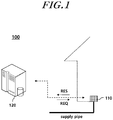
- FIG. 1 is a diagram illustrating a meter reading system according to an embodiment.
- a meter reading system 100 may include a utility meter 110 and a server 120.
- the utility meter 110 may read an amount of the use of utilities in the household and transmit meter data to the server 120.
- the utilities may be water, gas, heating, and hot water supplied through supply pipes in the form of a fluid.
- a water meter for reading an amount of used water, a gas meter for reading an amount of used gas, a heat meter for reading an amount of used heat, and a hot water meter for reading an amount of used hot water may be referred to as the utility meter.
- the server 120 may receive meter data from the utility meter 110 and issue a bill for the amount of used utilities in each household based on the received meter-read data or notify an amount of meter reading to the user in each household.
- the server 120 and the utility meter 110 may be connected through communication based on remote meter reading service technology and transmit and receive meter data.
- Communication may be wired communication or wireless communication.
- a relay may intervene between the server 120 and the utility meter 110 or the following external display system may intervene. At this time, some intervals of the communication may be wired communication and other intervals may be wireless communication.
- the server 120 may make a request for reading meters by transmitting a request message (REQ) to the utility meter 110, and the utility meter 110 may generate a meter reading message (RES) corresponding to the request message (REQ) and transmit the generated meter reading message (RES) to the server 120.
- the utility meter 110 may periodically or aperiodically generate and transmit the meter reading message (RES) without transmitting the request message (REQ).
- the utility meter 110 may detect the content in the request message (REQ) from the server 120 by reading the request message (REQ) in plain text.
- the plain text is a protocol pre-regulated without encryption and consists of, for example, characteristic prescribed in ASCII table.
- the ASCII table defines a total of 255 characters through 8-bit characters, wherein a 0 th character means NUL and Arabic numerals 0 to 9 are defined by a 48 th character to a 57 th character.
- STX that means a start character may be defined by a 2 nd character and ETX that means an end character may be defined by a 3 rd character
- alphabet characters may be defined by 65 to 90 th characters and 97 to 122 nd characters.
- the server 120 may also identify meter data by reading the meter reading message (RES) in the plain text.
- RES meter reading message
- the meter reading message may have the form such as "1203WAT1111" in the plain text. If a user other than the manager knows that "1203" means a particular household, “WAT” means water, and "1111” means an amount of meter reading through a periodic observation, it may introduce risks in that personal information is leaked and also a charge is manipulated.
- the meter reading system 100 may solve the above-described problems by encrypting the request message (REQ) which the server 120 transmits to the utility meter 110 and/or the meter reading message (RES) which the utility meter 110 transmits to the server 120. Further, the meter reading system 100 according to an embodiment applies an encryption method having a small amount of calculations in consideration of a hardware limit of the utility meter 110.
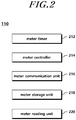
- FIG. 2 is a block diagram illustrating the utility meter according to an embodiment.
- the utility meter 110 may include a meter timer 212, a meter controller 214, a meter communication unit 216, a meter storage unit 218, and a meter reading unit 220.
- the meter timer 212 may be called a timer
- the meter controller 214 may be called a controller
- the meter communication unit 216 may be called a communication unit
- the meter storage unit 218 may be called a storage unit
- the meter reading unit 220 may be called a reading unit but, hereinafter, the modifier "meter" is added before a name of each element in order to prevent confusion with elements of the server.
- the meter timer 212 is an element for generating time and may synchronize a timer of the server 120 and time.
- the meter controller 214 may perform all controls of the utility meter 110. In the following description, it is understood that unless an element performing an operation is specified, the operation is performed by the meter controller 214.
- the meter controller 214 may decrypt a received encrypted request message, identify request information included in the decrypted request message, and perform a function corresponding to the request information.
- the meter controller 214 may insert a result of the function corresponding to the request information into a meter reading message, and encrypt the meter reading message.
- the meter communication unit 216 is an element for performing communication and may receive the encrypted request message from the server and transmit the encrypted meter reading message to the server.
- the meter storage unit 218 may store meter data and store a key (KEY) required for encryption or setting matters.
- key required for encryption or setting matters.
- presetting a particular element may be understood that such settings are stored in the meter storage unit 218.
- the meter reading unit 220 is an element for reading an amount of the use of utilities, and an amount of meter reading may have an instantaneous value or an accumulated value.
- the meter reading unit 220 may measure not only the amount of the use of utilities but also states of the utilities. For example, the meter reading unit 220 may measure temperature and a flow rate. The meter reading unit 220 may calculate a quantity of heat based on a value generated by measuring temperature or the flow rate. When the quantity of heat is a target to be read, the meter reading unit 220 may read the quantity of heat through such a process.
- FIG. 3 is a block diagram illustrating the server according to an embodiment.
- the server 120 may include a server timer 312, a server controller 314, a server communication unit 316, and a server storage unit 318.
- the server timer 312 may be called a timer
- the server controller 314 may be called a controller
- the server communication unit 316 may be called a communication unit
- the server storage unit 318 may be called a storage unit but, hereinafter, the modifier "server" may be added before a name of each element in order to prevent confusion with the elements of the utility meter.
- the server timer 312 is an element for generating time and may synchronize the timer of the utility meter 110 and time.
- the server controller 314 may perform all controls of the server 120. In the following description, it may be understood that unless an element performing an operation is specified, the operation is performed by the server controller 314.
- the server controller 314 may decrypt a received encrypted meter reading message and identify meter data included in the decrypted meter reading message.
- the server controller 314 may generate request information for making a request to the utility meter, insert the request information into a request message, and encrypt the request message.
- the server communication unit 316 is an element for performing communication, and may receive the encrypted meter reading message from the utility meter and transmit the encrypted request message to the utility meter.
- the server storage unit 318 may store meter data and also store a key (KEY) required for encryption or setting matters.
- key required for encryption or setting matters.
- presetting a particular element may be understood that such settings are stored in the server storage unit 318.
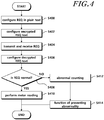
- FIG. 4 is a flowchart illustrating a process of transmitting and receiving a request message according to an embodiment.
- the server may configure a request message in plain text in S400.
- the server may generate a first request message.
- the first request message may include utility meter-specific information that specifying a utility meter.
- the utility meter-specific information may include, for example, household location information indicating a household location and ID information indicating an ID of a utility meter within each household.
- the first request message may further include request information.
- the request information may include, for example, information type indication information indicating a type of requested information such as a flow rate, temperature, and a quantity of heat and utility type indication information indicating a type of the requested utility such as a water meter, a gas meter, a heat meter, and a hot water meter.
- the first request message may further include a data block.
- time information on a time point at which the first request message is generated may be recorded or time information on a time point at which meter data is generated, that is, a time point at which meter data to be transmitted by the utility meter may be recorded.
- Information inserted into the first request message may be inserted into a block in a particular location (interval).
- the information type indication information may be inserted into a first message block of the first request message
- the household location information may be inserted into a second message block
- the utility type indication information may be inserted into a third message block
- the time information may be inserted into a fourth message block (data block).
- a random character string consisting of random numbers generated by arbitrary numbers may be further inserted into the first request message.
- the random character string may be inserted into a random character string block following the fourth message block.
- the first request message may further include a checksum value.
- the first request message may further include an encrypted character string by which falsification by hacking can be identified.
- the server may generate a first encrypted character string by encrypting the part corresponding to a particular interval A1 in the first request message through a unidirectional encryption algorithm and generate a second request message by inserting all or some of the first encrypted character string into a particular interval B1 in the first request message.
- the second request message may be designated as a request message to be transmitted.
- the unidirectional encryption algorithm may be an algorithm using a hash function.
- the unidirectional encryption algorithm may be one of Message-Digest algorithm 5 (MD5), Secure Hash Algorithm (SHA), bcrypt, Password-Based Key Derivation Function2 (PBKDF2), and scrypt.
- MD5 Message-Digest algorithm 5
- SHA Secure Hash Algorithm
- PBKDF2 Password-Based Key Derivation Function2
- the server may insert only L (L being a natural number) characters in the first encrypted character string may be inserted into the interval B1.
- the server may generate an encrypted request message by encrypting the request message in S402.
- the server may generate the encrypted request message by performing a bitwise operation on the part of the request message M1 times (M1 being a natural number larger than or equal to N1) according to a first sequence.
- the server may generate an encrypted request message by performing a bitwise operation on the request message with the symmetric keys M1 times. For example, the server may generate the encrypted request message by performing an XOR operation on the request message and the symmetric keys. Alternatively, the server may generate the encrypted request message by performing two or more different bitwise operations, for example, bit movement and bit transposition on the request message.
- the bit movement corresponds to shift of each bit of the predefined number of bits in one direction, and the predefined number may be a kind of symmetric key.
- the bit transposition corresponds to relocation of each bit in a predefined depth or a predefined order, and the predefined order may be a kind of symmetric key.
- the expression that the bitwise operation is performed on the request message through the symmetric keys may be understood as the expression applied to the bit movement and the bit transposition.
- the request message includes a start character (STX) in the very front and an end character (ETX) in the very back, and the server may generate the encrypted request message by performing the bitwise operation on the remaining parts other than the start character (STX) and the end character (ETX).
- the server may transmit the encrypted request message to the utility meter and the utility meter, for example, the meter communication unit may receive the encrypted request message from the server in S404.
- the utility meter for example, the meter controller, may generate a first reconstructed message by decrypting the encrypted request message in S406.
- the meter controller may identify a length of the encrypted request message by recognizing the start character (STX) and the end character (ETX) of the encrypted request message. Further, the server may generate the encrypted request message by inserting a message length into a message length block of the request message, and the meter controller may identify the message length in the message length block of the first reconstructed message generated by decrypting the encrypted request message and compare the length of the encrypted request message identified through the start character (STX) and the end character (ETX) with the message length included in the message length block of the first reconstructed message, so as to determine whether there is an error in the encrypted request message.
- the meter controller may generate the first reconstructed message by inversely performing the bitwise operation on the part of the encrypted request message M1 times according to a first inverse sequence opposing the first sequence.
- the meter controller may generate a second encrypted character string by encrypting the part corresponding to an interval A1 in the first reconstructed message through a unidirectional encryption algorithm.
- the meter controller may determine whether the encrypted request message is normal in S408.
- the meter controller may determine whether the encrypted request message is normal by comparing a character string to be compared corresponding to an interval B1 in the first reconstructed message with the entirety or part of the second encrypted character string.
- the meter controller may generate a meter reading message by responding to a request from the server included in the first reconstructed message and generate an encrypted meter reading message by encrypting the meter reading message in S410.
- the meter controller may generate a meter reading message on the basis of the meter data generated by the meter reading unit and generate an encrypted meter reading message by encrypting the meter reading message.
- the meter controller may control the meter communication unit to transmit the encrypted meter reading message to the server.
- the meter controller may increase a pre-initialized count, for example, an abnormal count or a hacking count in S412.
- the meter controller may perform a function of preventing abnormality, for example, providing an alarm to the server or outside in S414.
- FIG. 5 is a flowchart illustrating a process of transmitting and receiving a meter reading message according to an embodiment.
- the utility meter may configure the meter reading message in plain text in S500.
- the utility meter may generate a first meter reading message.
- the first meter reading message may include utility meter-specific information that specifies the utility meter.
- the utility meter-specific information may include, for example, household location information indicating a household location and ID information indicating an ID of a utility meter within each household.
- the first meter reading message may further include response information corresponding to request information.
- the response information may include, for example, information type indication information indicating a type of responded information such as a flow rate, temperature, and a quantity of heat and utility type indication information indicating a type of the responded utility such as a water meter, a gas meter, a heat meter, and a hot water meter.
- the first meter reading message may further include a data block.
- meter data may be included or time information indicating a time point at which the first metering reading message is generated or the meter data is generated may be recorded.
- the meter data may include a flow rate value and a temperature value.
- Information inserted into the first meter reading message may be inserted into a block in a particular location (interval).
- the information type indication information may be inserted into a first message block of the first request message
- the household location information may be inserted into a second message block
- the utility type indication information may be inserted into a third message block
- the meter data may be inserted into a fourth message block (data block).
- a random character string consisting of random numbers generated by arbitrary numbers may be further inserted into the first meter reading message.
- the random character string may be inserted into a random character string block following the fourth message block.
- the first meter reading message may further include a checksum value.
- the first meter reading message may further include an encrypted character string by which falsification by hacking can be identified.
- the utility meter may generate a first encrypted character string by encrypting the part corresponding to a particular interval A2 in the first meter reading message through a unidirectional encryption algorithm and generate a second meter reading message by inserting all or some of the first encrypted character string into a particular interval B2 in the first meter reading message.
- the second meter reading message may be designated as a meter reading message to be transmitted.
- the unidirectional encryption algorithm may be an algorithm using a hash function.
- the unidirectional encryption algorithm may be one of Message-Digest algorithm 5 (MD5), Secure Hash Algorithm (SHA), bcrypt, Password-Based Key Derivation Function2 (PBKDF2), and scrypt.
- MD5 Message-Digest algorithm 5
- SHA Secure Hash Algorithm
- PBKDF2 Password-Based Key Derivation Function2
- the utility meter may insert only L (L being a natural number) characters in the first encrypted character string into the interval B2.
- the utility meter may generate an encrypted meter reading message by encrypting the metering reading message in S502.
- the utility meter may generate the encrypted meter reading message by performing a bitwise operation on the part of the meter reading message M2 times according to a second sequence.
- the utility meter may generate the encrypted meter reading message by performing a bitwise operation on the meter reading message with the symmetric keys M2 times. For example, the utility meter may generate the encrypted meter reading message by performing an XOR operation on the meter reading message and the symmetric keys. Alternatively, the utility meter may generate the encrypted meter reading message by performing two or more different bitwise operations, for example, bit movement and bit transposition on the meter reading message.
- the meter reading message includes a start character (STX) in the very front and an end character (ETX) in the very back, and the utility meter may generate the encrypted request message by performing the bitwise operation on the remaining parts other than the start character (STX) and the end character (ETX).
- the utility meter may transmit the encrypted metering reading message to the server and the server, for example, the server communication unit may receive the encrypted metering reading message from the utility meter in S504.
- the server for example, the server controller may generate a second reconstructed message by decrypting the encrypted metering reading message in S506.
- the server controller may identify a length of the encrypted meter reading message by recognizing the start character (STX) and the end character (ETX) of the encrypted meter reading message. Further, the utility meter may generate the encrypted meter reading message by inserting a message length into a message length block of the meter reading message, and the server controller may identify the message length in the message length block of the second reconstructed message generated by decrypting the encrypted meter reading message and compare the length of the encrypted meter reading message identified through the start character (STX) and the end character (ETX) with the message length included in the message length block of the second reconstructed message, so as to determine whether there is an error in the encrypted meter reading message.
- the server controller may generate the second reconstructed message by inversely performing the bitwise operation on the part of the encrypted meter reading message M2 times according to a second inverse sequence opposing the second sequence.
- the server controller may generate a second encrypted character string by encrypting the part corresponding to an interval A2 in the second reconstructed message through a unidirectional encryption algorithm.
- the server controller may determine whether the encrypted meter reading message is normal in S508.
- the server controller may determine whether the encrypted meter reading message is normal by comparing the character string to be compared corresponding to an interval B2 of the second reconstructed message with the entirety or part of the second encrypted character string.
- the server controller may extract meter data from the second reconstructed message and control the server storage unit to store meter reading information included in the meter data in S510.
- the server controller may increase a pre-initialized count, for example, an abnormal count or a hacking count in S512.
- the server controller may perform a function of preventing abnormality, for example, providing an alarm to a user terminal corresponding to the utility meter in S514.
- FIG. 6 illustrates a plain text protocol of the request message and the meter reading message according to an embodiment.
- the request message and the meter reading message may have the same plain text protocol.
- the request message and the meter reading message may include a start character (STX), a message length block (LEN), a first message block (MSG1), a second message block (MSG2), a third message block (MSG3), a fourth message block (MSG4), a random character string block (RND), a checksum (CKS), an encrypted character string block (COD), and an end character (ETX).
- STX start character
- LEN message length block
- MSG1 first message block
- MSG2 second message block
- MSG3 third message block
- MSG4 fourth message block
- RTD random character string block
- CKS checksum
- COD encrypted character string block
- ETX end character
- the message length block may include a message length.
- the message length may be a length from the first message block (MSG1) to the fourth message block (MSG4), a value generated by adding a length of the random character string block (RND) to the length, or a length of the blocks further including another block.
- Information type indication information may be inserted into the first message block (MSG1), household location information may be inserted into the second message block (MSG2), and utility type indication information may be inserted into the third message block (MSG3).
- the fourth message block (MSG4) is a data block and may include time information and meter data, and the length of the fourth message block (MSG4) may be fixed or variable in some embodiments.
- Random character string block An arbitrarily generated random number may be inserted into the random character string block (RND).
- An encrypted character string generated by encrypting the part of the request message (REQ)/meter reading message (RES) corresponding to the interval A through a unidirectional encryption algorithm may be inserted into the encrypted character string block (COD) inserted into the interval B.
- the interval A may include the random number character string block (RND) together with the first message block (MSG1) to the fourth message block (MSG4).
- the encrypted character string included in the encrypted character string block (COD) may be changed ever time by the random number character string block (RND).
- the checksum (CKS) may include a checksum value for an interval C, and the interval C may include the interval A in some embodiments.
- the server or the utility meter may determine whether message transmitted and received through communication have errors on the basis of the checksum (CKS).
- FIG. 7 is a flowchart illustrating an encryption process according to an embodiment.
- the server and the utility meter may write information in plain text in the request message or the meter reading message in S700.
- the server and the utility meter may write information on a household location, time information, and an amount of metering reading in plain text according to the ASCII table.
- the server and the utility meter may add a random number character string written in plain text to the plain text in order to increase complexity of the request message and the meter reading message in S702.
- server and the utility meter may generate an encrypted character string by executing a unidirectional encryption algorithm on the part including the random number character string and insert the encrypted character string into the request message and the meter reading message in S704.
- the server and the utility meter may perform symmetric encryption on the request message and the meter reading message into which the encrypted character string is inserted through a bitwise operation using symmetric keys in S706.
- FIG. 8 is a flowchart illustrating a decryption process according to an embodiment.
- the server and the utility meter may generate a reconstructed message by inversely performing a bitwise operation using symmetric keys on the received encrypted message in S800.
- the server and the utility meter may generate the reconstructed message using symmetric keys while storing symmetric keys which are the same as the symmetric keys used for encryption.
- the server and the utility meter may generate an encrypted character string by performing a unidirectional encryption algorithm on a particular interval of the reconstructed message in S802.
- the server and the utility meter may compare the character string to be compared, which is included in the reconstructed message, for example, a character string corresponding to the encrypted character string which the server and the utility meter insert into the request message and the meter reading message with a newly generated encrypted character string and identify whether the encrypted charter strings are the same as each other in S808.
- the server and the utility meter may perform a normal function corresponding to the received message in S810.
- the server and the utility meter may increase a count indicating abnormality in S812 and, when the count exceeds a predetermined value, generate an alarm in S814.
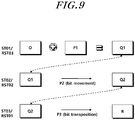
- FIG. 9 illustrates symmetric encryption and decryption according to an embodiment.
- the server and the utility meter may generate an encrypted message by performing a bitwise operation on N symmetric keys M times.
- the server and the utility meter may generate a first encrypted message (Q1) by performing a first bitwise operation, for example, an XOR operation on a plain text message (O) and a first symmetric key (P1) in a first step (ST01).
- the first symmetric key is reconfiguration of ASCII plain text in Hexa, and, for example, A!b1C2d3E4#$% may correspond to 41 21 62 31 43 32 64 33 45 34 23 24 25.
- the server and the utility meter may perform the XOR operation on the first symmetric key and the plain text message (O) in the unit of bytes in one-to-one correspondence.
- the server and the utility meter may generate a second encrypted message (Q2) by performing a second bitwise operation, for example, bit movement on the first encrypted message (Q1) and a second symmetric key (P2) in a second step (ST02).
- the second symmetric key correspond a direction of bit movement and the number of moving bits. For example, when the second symmetric key indicates movement of 10 bits in a right direction, 61 36 63 01 53 30 54 23 54 26 30 30 30 30 may become 6B 40 6D 0B 5D 3A 5E 2D 5E 30 3A 3A by applying the second symmetric key.
- the server and the utility meter may generate an encrypted message (R) by performing a third bitwise operation, for example, bit transposition on the second encrypted message (Q2) and a third symmetric key (P3) in a third step (ST03).
- the third symmetric key designates a location of each relocated bit. For example, when the third symmetric key for a message consisting 5 bits of ABCDE corresponds to 14352, the message becomes ADCEB after the bitwise operation is applied thereto.
- Decryption may be performed on the same symmetric keys in an inverse sequence.
- the server and the utility meter may generate the second encrypted message (Q2) by inversely performing a third bitwise operation on the encrypted message (R) with the third symmetric key (P3) in a first inverse step (RST01).
- the server and the utility meter may generate the first encrypted message (Q1) by inversely performing the second bitwise operation on the second encrypted message (Q2) with the second symmetric key (P2) in a second inverse step (RST02).
- the server and the utility meter may reconstruct a plain text message (O) by inversely performing the first bitwise operation on the first encrypted message (Q1) with the first symmetric key (P1) in a third inverse step (RST03).
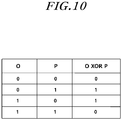
- FIG. 10 illustrates a logical table of an XOR operation.
- the server and the utility meter may generate the encrypted message according to the logical table while storing in advance the logical table for each bitwise operation.
- FIG. 11 illustrates a process of comparing encrypted character strings according to an embodiment.
- the side transmitting a communication message for example, the request message or the meter reading message may generate, insert, and transmit a first encrypted character string 1116 through a unidirectional algorithm based on the part corresponding to the interval A of the communication message (original text) to be transmitted.
- the side receiving the communication message may generate a reconstructed message (reconstructed text) by reconstructing the received communication message and generate a second encrypted character string 1126 through a unidirectional encryption algorithm, which is the same as that used by the transmitting side, based on the part corresponding to the interval A of the reconstructed message (reconstructed text).
- the server and the utility meter may determine whether the received communication message is normal, for example, whether the received communication message is hacked or has errors on the basis of the principle that the first encrypted character string 1116 and the second encrypted character string 1126 are the same as each other if the interval A of the communication message (original text) and the interval A of the reconstructed message (reconstructed text) are the same as each other and the algorithms used for generating the encrypted character strings are the same as each other.
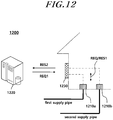
- FIG. 12 is a diagram illustrating a meter reading system according to another embodiment.
- a meter reading system 1200 may include one or more utility meters 1210a and 1210b, a server 1220, and an external display system 1230.
- the meter reading system 1200 may include a plurality of utility meters 1210a and 1210b and, at this time, the utility meter 1210a and 1210b may be connected to different supply pipes and measure amounts of the use of the utilities supplied through the respective pipes.
- the plurality of utility meters 1210a and 1210b may be connected to the external display system 1230 through communication. Further, the external display system 1230 may display meter reading information read by each utility meter 1210a and 1210b.
- the external display system 1230 may be connected to the server 1220 through communication may transmit the meter reading information received from the plurality of utility meters 1210a and 1210b to the server 1220.
- the external display system 1230 may receive an encrypted request message (REQ) from the server 1220 and retransmit the encrypted request message to the plurality of utility meters 1210a and 1210b. Alternatively, the external display system 1230 may receive the encrypted request message (REQ) from the server 1220 and determine whether the message (REQ) is normal. When it is determined that the message (REQ) is normal, the external display system 1230 may transmit the message (REQ) to the utility meters 1210a and 1210b.
- REQ encrypted request message
- the external display system 1230 may receive an encrypted meter reading message (RES1) from the utility meters 1210a and 1210b and retransmit the encrypted meter reading message to the server 1220.
- the external display system 1230 may receive the encrypted meter reading message (RES1) from the utility meters 1210a and 1210b and determine whether the message (RES1) is normal. When it is determined that the message (RES1) is normal, the external display system 1230 may retransmit the message (RES1) to the server 1220 or transmit an encrypted meter reading message (RES2), to which some information is added, to the server 1220.
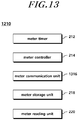
- FIG. 13 is a block diagram illustrating the utility meter according to another embodiment.
- the utility terminal 1210 may include the meter timer 212, the meter controller 214, a meter communication unit 1316, the meter storage unit 218, and the meter reading unit 220.
- the meter communication unit 1316 may be connected to the external display system without being connected to the server.
- FIG. 14 is a block diagram illustrating the server according to another embodiment.
- the server 1220 may include the server timer 312, the server controller 314, a server communication unit 1416, and the server storage unit 318.
- the server communication unit 1416 may be connected to the external display system without being connected to the utility meter.
- FIG. 15 is a block diagram illustrating the external display system according to another embodiment.
- the external display system 1230 may include a display system timer 1512, a display system controller 1514, a display system communication unit 1516, and a display system storage unit 1518.
- the display system timer 1512 may be called a timer
- the display system controller 1514 may be called a controller
- the display system communication unit 1516 may be called a communication unit
- the display system storage unit 1518 may be called a storage unit but, the modifier "display system" is added before a name of each element in order to prevent confusion with another device.
- the display system timer 1512 is an element for generating time and may synchronize the timers of the server and the utility meter with time.
- the display system controller 1514 may perform all controls of the external display system 1230. In the following description, it is understood that unless an element performing an operation is specified, the operation is performed by the display system controller 1514.
- the display system communication unit 1516 may receive the encrypted message from the server and the utility meter and transmit the encrypted message to the server and the utility meter.
- the display system storage unit 1518 may store a key (KEY) required for encryption and setting matters.
- KY key
- presetting a particular element may be understood that such settings are stored in the display system storage unit 1518.
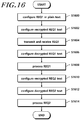
- FIG. 16 is a flowchart illustrating a process of transmitting the request message according to another embodiment.
- the server may configure the request message in plain text.
- the request message configured in plain text may be the same as the request message described through an embodiment in S1600.
- the server may insert an encrypted character string generated through the unidirectional encryption algorithm into the request message, and the request message may include a random number character string block.
- the server may generate a first encrypted request message after encrypting the request message through a bitwise operation using symmetric keys in S1602.
- the first encrypted request message may be the same as the encrypted request message described through an embodiment.
- the server may transmit a first encrypted request message to the external display system and the external display system may receive the first encrypted request message in S1604.
- the external display system may generate a first reconstructed message by decrypting the first encrypted request message in S1606.
- a process of generating the first reconstructed message from the first encrypted request message may be the same as the process in which the utility meter generates the reconstructed message from the encrypted request message according to an embodiment.
- the external display system may identify whether the first encrypted request message is normal by analyzing the encrypted character string in the first reconstructed message. When the first encrypted request message is abnormal, the external display system may ignore the first encrypted request message and increase an abnormal count. When the abnormal count exceeds a predetermined value, the external display system may display alarm information.
- the external display system may generate a second encrypted request message by encrypting the first reconstructed message or by copying the first encrypted request message without any change in S1610.
- the external display system may insert a new random number into the random number character string block to make the first encrypted request message and the second encrypted request message different from each other.
- the utility meter may receive the second encrypted request message and configure a second reconstructed message by decrypting the second encrypted request message in S1612.
- a process of decrypting the second encrypted request message may be the same as the process in which the utility meter decrypts the encrypted request message according to an embodiment.
- the utility meter may perform a meter reading function required from the server in S1614.
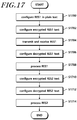
- FIG. 17 is a flowchart illustrating the process of transmitting the meter reading message according to another embodiment.
- the utility meter may configure a first meter reading message in plain text in S1700.
- the first meter reading message configured in plain text may be the same as the meter reading message described through an embodiment.
- the utility meter may generate a first encrypted meter reading message after encrypting the first meter reading message through a bitwise operation using symmetric keys in S1702.
- the first encrypted meter reading message may the same as the encrypted meter reading message described through an embodiment.
- the external display system may receive the first encrypted meter reading message from the utility meter in S1704.
- the display system controller may generate a first reconstructed message by decrypting the first encrypted meter reading message in S1706.
- the display system controller may generate the first reconstructed message by performing a bitwise operation on the part of the first encrypted meter reading message M1 (M1 being a natural number) according to a first inverse sequence opposing the first sequence.
- the display system controller may generate a first encrypted charter string by encrypting the part corresponding to an interval 1-1 in the first reconstructed message through the unidirectional encryption algorithm and determine whether the first encrypted meter reading message is normal by comparing a character string to be compared corresponding to an interval 2-1 in the first reconstructed message with all or some of the first encrypted character string.
- the display system controller may generate a second reconstructed message by inserting a household location character string indicating a household location into a particular interval in the first reconstructed message in S1708.
- the display system controller may generate a second encrypted meter reading message by encrypting the second reconstructed message through a mechanism which is the same as that used by the utility meter in S1710. Specifically, the display system controller may generate a second encrypted character string by encrypting the part corresponding to an interval 1-2 in the second reconstructed message, generate a third reconstructed message by inserting all or some of the second encrypted character string into an interval 2-2 in the second reconstructed message, and generate a second encrypted meter reading message by performing a bitwise operation on the part of the third reconstructed message M2 (M2 being a natural number) according to a second sequence.
- M2 being a natural number
- the display system controller may transmit the second encrypted meter reading message to the server.
- the server may decrypt the second encrypted meter reading message in S1712 and store meter data included in the decrypted message in S1714.
- the external display system may further include a display unit for displaying meter reading information, and the display unit may display alarm information when it is determined that the received encrypted message, for example, the encrypted request message or the encrypted meter reading message is abnormal.
- the communication unit of the external display system may communicate with a plurality of utility meters and, at this time, the plurality of utility meters may be distinguished by separate IDs, for example, different IDs.
Landscapes
- Engineering & Computer Science (AREA)
- Computer Security & Cryptography (AREA)
- Computer Networks & Wireless Communication (AREA)
- Signal Processing (AREA)
- Physics & Mathematics (AREA)
- General Physics & Mathematics (AREA)
- Computer Hardware Design (AREA)
- Computing Systems (AREA)
- General Engineering & Computer Science (AREA)
- Emergency Management (AREA)
- Business, Economics & Management (AREA)
- Power Engineering (AREA)
- Arrangements For Transmission Of Measured Signals (AREA)
- Selective Calling Equipment (AREA)
Abstract
Description
- This application claims priority from Korean Patent Application No.
10-2018-0021743, filed on February 23, 2018 - The present disclosure relates to technology for encrypting a communication message of a utility meter.
- Utility meters includes a water meter, a gas meter, a heat meter, and a hot water meter which measure an amount of the use of water, gas, heat, and hot water and are generally installed in each household of an apartment building or in individual houses.
- Such utility meters may periodically or aperiodically transmit meter data to the server by a remote meter reading service. However, a communication protocol generally used at present to transmit/receive meter data does not use an encryption technique, so that problems may occur such as falsification of bills or illegal collection of personal information by a third party, for example, whether there is a damage.
- Meanwhile, the utility meter is designed to operate for several years with only a battery through high-level technology, and thus uses low specification hardware consuming a very small amount of power, for example, a computing processor or a memory and it is difficult to apply a generally known encryption technology to the current communication protocol.
- In this background, an aspect of the present disclosure is to provide technology for encrypting a communication message of a utility meter. Another aspect of the present disclosure is to provide technology for performing high-level encryption on necessary data with a small amount of calculations to be suitable for hardware specifications of the utility meter.
- In accordance with an aspect of the present disclosure, a utility meter is provided. The utility meter includes: a communication unit configured to receive an encrypted request message from a server configured to generate a first request message, generate a first encrypted character string by encrypting a part corresponding to a first interval in the first request message through a unidirectional encryption algorithm, generate a second request message by inserting all or some of the first encrypted character string into a second interval in the first request message, and generate the encrypted request message by performing a bitwise operation on a part of the second request message M1 (M1 being a natural number) times according to a first sequence; a meter reading unit configured to generate meter data; and a controller configured to generate a reconstructed message by inversely performing the bitwise operation on the part of the encrypted request message M1 times according to a first inverse sequence opposing the first sequence, generate a second encrypted character string by encrypting a part corresponding to a first interval in the reconstructed message through the unidirectional encryption algorithm, compare a character string to be compared corresponding to a second interval in the reconstructed message with all or some of the second encrypted character string, generate an encrypted meter reading message by encrypting meter data when it is determined that the encrypted request message is normal, and control the communication unit to transmit the encrypted meter reading message to the server.
- The first request message may include a first message block indicating a type of requested information and a second message block indicating a location of a household in which the utility meter is installed, and the first message block and the second message block may be included in the first interval.
- The first request message may include a third message block indicating a type of the utility meter and a fourth message block including time information, and the third message block and the fourth message block may be included in the first interval.
- The first request message may further include a checksum value for a third interval including the first interval, and the controller may determine whether the encrypted request message has errors through the checksum value included in the third interval of the reconstructed message.
- When it is determined that the encrypted request message is abnormal, the controller may increase a pre-initialized count and, when the count exceeds a predetermined value, provide an alarm to the server or outside
- The unidirectional encryption algorithm may be an algorithm using a hash function.
- The unidirectional encryption algorithm may be one of Message-Digest algorithm 5 (MD5), Secure Hash Algorithm (SHA), bcrypt, Password-Based Key Derivation Function2 (PBKDF2), and scrypt.
- The server may generate the encrypted request message by performing an XOR operation on the second request message and N1 (N1 being a natural number) symmetric keys.
- The server may generate the encrypted request message by performing two or more different bitwise operations.
- The two or more different bitwise operations may include bit movement of shifting each of a predetermined number of bits in one direction and bit transposition of relocating a location of each bit in a predefined order.
- The two or more different bit operations may include at least two bit operations among an XOR operation, bit movement of shifting each of a predetermined number of bits in one direction, and bit transposition of relocating each bit in a predefined order.
- The server may insert only L (L being a natural number) characters in the first encrypted character string into the second interval.
- The second request message may include a start character and an end character, and the server may generate the encrypted request message by performing a bitwise operation on remaining parts other than the start character and the end character.
- In accordance with another aspect of the present disclosure, a server is provided. The server includes: a communication unit configured to receive an encrypted meter reading message from a utility meter configured to generate a first meter reading message including meter data, generate a first encrypted character string by encrypting a part corresponding to a first interval in the first meter reading message through a unidirectional encryption algorithm, generate a second meter reading message by inserting all or some of the first encrypted character string into a second interval in the first meter reading message, and generate the encrypted metering reading message by performing a bitwise operation on a part of the second meter reading message M2 (M2 being a natural number) times according to a second sequence; a controller configured to generate a reconstructed message by inversely performing the bitwise operation on the part of the encrypted metering reading message M2 times according to a second inverse sequence opposing the second sequence, generate a second encrypted character string by encrypting the part corresponding to the first interval in the reconstructed message through the unidirectional encryption algorithm, compare a character sting to be compared corresponding to a second interval in the reconstructed message with all or some of the second encrypted character string, and extract the meter reading message from the reconstructed message when it is determined that the encrypted meter reading message is normal; and a storage unit configured to store meter reading information included in the meter data.
- The second meter reading message may include a start character and an end character, and the utility meter may generate the encrypted meter reading message by performing a bitwise operation on remaining parts other than the start character and the end character, and the controller may identify a length of the encrypted meter reading message by recognizing the start character and the end character of the encrypted meter reading message.
- The reconstructed message may include a message length block, and the controller may determine whether the encrypted meter reading message has errors by comparing a length of the encrypted meter reading message identified through the start character and the end character with a message length included in the message length block.
- When it is determined that the encrypted meter reading message is abnormal, the controller may increase a pre-initialized count and, when the count exceeds a predetermined value, provide an alarm to a user terminal corresponding to the utility meter.
- In accordance with another aspect of the present disclosure, a method of communicating meter data is provided. The method includes: writing a first request message including utility meter-specific information specifying a utility meter by a server; generating a first encrypted character string by encrypting a part corresponding to an interval 1-1 in the first request message through a unidirectional encryption algorithm by the server; generating a second request message by inserting all or some of the encrypted first character string into an interval 2-1 in the first request message by the server; generating an encrypted request message by performing a bitwise operation on a part of the second request message M1 (M1 being a natural number) times according to a first sequence by the server; receiving the encrypted request message by the utility meter; generating a first reconstructed message by inversely performing the bitwise operation on the encrypted request message M1 times according to a first inverse sequence opposing the first sequence by the utility meter; generating a second character string by encrypting the part corresponding to the interval 1-1 in the first reconstructed message through the unidirectional encryption algorithm by the utility meter; determining whether the encrypted request message is normal by comparing a first character string to be compared corresponding to the interval 2-1 in the first reconstructed message with all or some of the second encrypted character string by the utility meter; and performing a function requested by the first reconstructed message by the utility meter when the encrypted request message is normal.
- The method may further include: generating a first meter reading message by inserting a result of a function requested by the first reconstructed message into the meter data by the utility meter; generating a third encrypted character string by encrypting a part corresponding to an interval 1-2 in the first meter reading message through the unidirectional encryption algorithm by the utility meter; generating a second meter reading message by inserting all or some of the third encrypted character string into an interval 2-2 in the first meter reading message by the utility meter; generating an encrypted meter reading message by performing the bitwise operation on a part of the second meter reading message M2 (M2 being a natural number) times according to a second sequence by the utility meter; and transmitting the encrypted meter reading message to the server by the utility meter.
- The method may further include: generating a second reconstructed message by inversely performing the bitwise operation on the encrypted meter reading message M2 times according to a second inverse sequence opposing the second sequence by the server; generating a fourth encrypted character string by encrypting the part corresponding to the interval 1-2 in the second reconstructed message through the unidirectional encryption algorithm by the server; determining whether the encrypted meter reading message is normal by comparing a second character string to be compared corresponding to the interval 2-2 in the second reconstructed message with all or some of the fourth encrypted character string by the server; and processing the meter data included in the second reconstructed message by the server when the encrypted meter reading message is normal.
- In accordance with another aspect of the present disclosure, an external display system is provided. The external display system includes: a communication unit configured to receive a first encrypted message from a utility meter; and a controller configured to generate a first reconstructed message by performing a bitwise operation on a part of the first encrypted message M1 (M1 being a natural number) times according to a first inverse sequence opposing to a first sequence, generate a first encrypted character string by encrypting a part corresponding to an interval 1-1 in the first reconstructed message through a unidirectional encryption algorithm, compare a character string to be compared corresponding to an interval 2-1 in the first reconstructed message with all or some of the first encrypted character string, generate a second reconstructed message by inserting a household location character string indicating a household location into a particular interval of the first reconstructed message when it is determined that the first encrypted message is normal, and control the communication unit to transmit a second encrypted message generated by encrypting the second reconstructed message to a server.
- The external display system may further include a display unit configured to display meter reading information of the utility meter.
- The display unit may display alarm information when it is determined that the first encrypted message is abnormal.
- The controller may generate a second encrypted character string by encrypting a part corresponding to an interval 1-2 in the second reconstructed message through the unidirectional encryption algorithm, generate a third reconstructed message by inserting all or some of the second encrypted character string into an interval 2-2 in the second reconstructed message, and generate the second encrypted message by performing a bitwise operation on a part of the third reconstructed message M2 (M2 being a natural number larger than or equal to N2) according to a second sequence.
- The communication unit may communicate with a plurality of utility meters, and the plurality of utility meters is distinguished by separate IDs.
- The controller may insert a random number character string block configured by random numbers into a part of the interval 1-2 in the second reconstructed message.
- As described above, according to the present embodiment, a communication message of the utility meter can be encrypted. Further, according to the present embodiment, it is possible to perform high-level encryption on necessary data with a small amount of calculations to be suitable for hardware specifications of the utility meter.
- The above and other aspects, features and advantages of the present disclosure will be more apparent from the following detailed description taken in conjunction with the accompanying drawings, in which:
-
FIG. 1 is a diagram illustrating a meter reading system according to an embodiment; -
FIG. 2 is a block diagram illustrating a utility meter according to an embodiment; -
FIG. 3 is a block diagram illustrating a server according to an embodiment; -
FIG. 4 is a flowchart illustrating a process of transmitting and receiving a request message according to an embodiment; -
FIG. 5 is a flowchart illustrating a process of transmitting and receiving a meter reading message according to an embodiment; -
FIG. 6 illustrates a plain text protocol of the request message and the meter reading message according to an embodiment; -
FIG. 7 is a flowchart illustrating an encryption process according to an embodiment; -
FIG. 8 is a flowchart illustrating a decryption process according to an embodiment; -
FIG. 9 illustrates symmetric encryption and decryption according to an embodiment; -
FIG. 10 illustrates a logical table of an XOR operation; -
FIG. 11 illustrates a process of comparing encrypted character strings according to an embodiment; -
FIG. 12 is a diagram illustrating the meter reading system according to another embodiment; -
FIG. 13 is a block diagram illustrating the utility meter according to another embodiment; -
FIG. 14 is a block diagram illustrating the server according to another embodiment; -
FIG. 15 is a block diagram illustrating the external display system according to another embodiment; -
FIG. 16 is a flowchart illustrating the process of transmitting the request message according to another embodiment; and -
FIG. 17 is a flowchart illustrating the process of transmitting the meter reading message according to another embodiment. - Hereinafter, embodiments of the present disclosure will be described in detail with reference to the accompanying drawings. In adding reference numerals to elements in each drawing, the same elements will be designated by the same reference numerals, if possible, although they are shown in different drawings. Further, in the following description of the present disclosure, a detailed description of known functions and configurations incorporated herein will be omitted when it is determined that the description may make the subject matter of the present disclosure rather unclear.
- In addition, terms, such as first, second, A, B, (a), (b) or the like may be used herein when describing components of the present disclosure. These terms are merely used to distinguish one structural element from other structural elements, and a property, an order, a sequence and the like of a corresponding structural element are not limited by the term. It should be noted that if it is described in the specification that one component is "connected," "coupled" or "joined" to another component, a third component may be "connected," "coupled," and "joined" between the first and second components, although the first component may be directly connected, coupled or joined to the second component.
-
FIG. 1 is a diagram illustrating a meter reading system according to an embodiment. - Referring to
FIG. 1 , ameter reading system 100 may include autility meter 110 and aserver 120. - The
utility meter 110 may read an amount of the use of utilities in the household and transmit meter data to theserver 120. The utilities may be water, gas, heating, and hot water supplied through supply pipes in the form of a fluid. A water meter for reading an amount of used water, a gas meter for reading an amount of used gas, a heat meter for reading an amount of used heat, and a hot water meter for reading an amount of used hot water may be referred to as the utility meter. - The
server 120 may receive meter data from theutility meter 110 and issue a bill for the amount of used utilities in each household based on the received meter-read data or notify an amount of meter reading to the user in each household. - The
server 120 and theutility meter 110 may be connected through communication based on remote meter reading service technology and transmit and receive meter data. Communication may be wired communication or wireless communication. For communication, a relay may intervene between theserver 120 and theutility meter 110 or the following external display system may intervene. At this time, some intervals of the communication may be wired communication and other intervals may be wireless communication. - The
server 120 may make a request for reading meters by transmitting a request message (REQ) to theutility meter 110, and theutility meter 110 may generate a meter reading message (RES) corresponding to the request message (REQ) and transmit the generated meter reading message (RES) to theserver 120. In some embodiments, theutility meter 110 may periodically or aperiodically generate and transmit the meter reading message (RES) without transmitting the request message (REQ). - The
utility meter 110 may detect the content in the request message (REQ) from theserver 120 by reading the request message (REQ) in plain text. The plain text is a protocol pre-regulated without encryption and consists of, for example, characteristic prescribed in ASCII table. The ASCII table defines a total of 255 characters through 8-bit characters, wherein a 0th character means NUL andArabic numerals 0 to 9 are defined by a 48th character to a 57th character. In the ASCII table, STX that means a start character may be defined by a 2nd character and ETX that means an end character may be defined by a 3rd character, and alphabet characters may be defined by 65 to 90th characters and 97 to 122nd characters. - The
server 120 may also identify meter data by reading the meter reading message (RES) in the plain text. - Meanwhile, since the plain text is not encrypted, users other than a manager who manages meter reading can easily obtain the content. For example, the meter reading message (RES) may have the form such as "1203WAT1111" in the plain text. If a user other than the manager knows that "1203" means a particular household, "WAT" means water, and "1111" means an amount of meter reading through a periodic observation, it may introduce risks in that personal information is leaked and also a charge is manipulated.
- The
meter reading system 100 according to an embodiment may solve the above-described problems by encrypting the request message (REQ) which theserver 120 transmits to theutility meter 110 and/or the meter reading message (RES) which theutility meter 110 transmits to theserver 120. Further, themeter reading system 100 according to an embodiment applies an encryption method having a small amount of calculations in consideration of a hardware limit of theutility meter 110. -
FIG. 2 is a block diagram illustrating the utility meter according to an embodiment. - Referring to
FIG. 2 , theutility meter 110 may include ameter timer 212, ameter controller 214, ameter communication unit 216, ameter storage unit 218, and ameter reading unit 220. - The
meter timer 212 may be called a timer, themeter controller 214 may be called a controller, themeter communication unit 216 may be called a communication unit, themeter storage unit 218 may be called a storage unit, themeter reading unit 220 may be called a reading unit but, hereinafter, the modifier "meter" is added before a name of each element in order to prevent confusion with elements of the server. - The
meter timer 212 is an element for generating time and may synchronize a timer of theserver 120 and time. - The
meter controller 214 may perform all controls of theutility meter 110. In the following description, it is understood that unless an element performing an operation is specified, the operation is performed by themeter controller 214. - The
meter controller 214 may decrypt a received encrypted request message, identify request information included in the decrypted request message, and perform a function corresponding to the request information. Themeter controller 214 may insert a result of the function corresponding to the request information into a meter reading message, and encrypt the meter reading message. - The
meter communication unit 216 is an element for performing communication and may receive the encrypted request message from the server and transmit the encrypted meter reading message to the server. - The
meter storage unit 218 may store meter data and store a key (KEY) required for encryption or setting matters. In the following description, the expression of presetting a particular element may be understood that such settings are stored in themeter storage unit 218. - The
meter reading unit 220 is an element for reading an amount of the use of utilities, and an amount of meter reading may have an instantaneous value or an accumulated value. - The
meter reading unit 220 may measure not only the amount of the use of utilities but also states of the utilities. For example, themeter reading unit 220 may measure temperature and a flow rate. Themeter reading unit 220 may calculate a quantity of heat based on a value generated by measuring temperature or the flow rate. When the quantity of heat is a target to be read, themeter reading unit 220 may read the quantity of heat through such a process. -
FIG. 3 is a block diagram illustrating the server according to an embodiment. - Referring to
FIG. 3 , theserver 120 may include aserver timer 312, aserver controller 314, aserver communication unit 316, and aserver storage unit 318. - The
server timer 312 may be called a timer, theserver controller 314 may be called a controller, theserver communication unit 316 may be called a communication unit, and theserver storage unit 318 may be called a storage unit but, hereinafter, the modifier "server" may be added before a name of each element in order to prevent confusion with the elements of the utility meter. - The
server timer 312 is an element for generating time and may synchronize the timer of theutility meter 110 and time. - The
server controller 314 may perform all controls of theserver 120. In the following description, it may be understood that unless an element performing an operation is specified, the operation is performed by theserver controller 314. - The
server controller 314 may decrypt a received encrypted meter reading message and identify meter data included in the decrypted meter reading message. Theserver controller 314 may generate request information for making a request to the utility meter, insert the request information into a request message, and encrypt the request message. - The
server communication unit 316 is an element for performing communication, and may receive the encrypted meter reading message from the utility meter and transmit the encrypted request message to the utility meter. - The
server storage unit 318 may store meter data and also store a key (KEY) required for encryption or setting matters. In the following description, the expression of presetting a particular element may be understood that such settings are stored in theserver storage unit 318. -
FIG. 4 is a flowchart illustrating a process of transmitting and receiving a request message according to an embodiment. - Referring to
FIG. 4 , the server may configure a request message in plain text in S400. - The server may generate a first request message. The first request message may include utility meter-specific information that specifying a utility meter. The utility meter-specific information may include, for example, household location information indicating a household location and ID information indicating an ID of a utility meter within each household.
- The first request message may further include request information. The request information may include, for example, information type indication information indicating a type of requested information such as a flow rate, temperature, and a quantity of heat and utility type indication information indicating a type of the requested utility such as a water meter, a gas meter, a heat meter, and a hot water meter.
- The first request message may further include a data block. In the data block, time information on a time point at which the first request message is generated may be recorded or time information on a time point at which meter data is generated, that is, a time point at which meter data to be transmitted by the utility meter may be recorded.
- Information inserted into the first request message may be inserted into a block in a particular location (interval). For example, the information type indication information may be inserted into a first message block of the first request message, the household location information may be inserted into a second message block, the utility type indication information may be inserted into a third message block, and the time information may be inserted into a fourth message block (data block).
- A random character string consisting of random numbers generated by arbitrary numbers may be further inserted into the first request message. For example, the random character string may be inserted into a random character string block following the fourth message block.
- The first request message may further include a checksum value.
- The first request message may further include an encrypted character string by which falsification by hacking can be identified.
- The server may generate a first encrypted character string by encrypting the part corresponding to a particular interval A1 in the first request message through a unidirectional encryption algorithm and generate a second request message by inserting all or some of the first encrypted character string into a particular interval B1 in the first request message.
- The second request message may be designated as a request message to be transmitted.
- The unidirectional encryption algorithm may be an algorithm using a hash function. The unidirectional encryption algorithm may be one of Message-Digest algorithm 5 (MD5), Secure Hash Algorithm (SHA), bcrypt, Password-Based Key Derivation Function2 (PBKDF2), and scrypt.
- The server may insert only L (L being a natural number) characters in the first encrypted character string may be inserted into the interval B1.
- The server may generate an encrypted request message by encrypting the request message in S402.
- The server may generate the encrypted request message by performing a bitwise operation on the part of the request message M1 times (M1 being a natural number larger than or equal to N1) according to a first sequence.
- When the server uses N1 (N1 being a natural number) symmetric keys, the server may generate an encrypted request message by performing a bitwise operation on the request message with the symmetric keys M1 times. For example, the server may generate the encrypted request message by performing an XOR operation on the request message and the symmetric keys. Alternatively, the server may generate the encrypted request message by performing two or more different bitwise operations, for example, bit movement and bit transposition on the request message.
- The bit movement corresponds to shift of each bit of the predefined number of bits in one direction, and the predefined number may be a kind of symmetric key. Further, the bit transposition corresponds to relocation of each bit in a predefined depth or a predefined order, and the predefined order may be a kind of symmetric key. Hereinafter, the expression that the bitwise operation is performed on the request message through the symmetric keys may be understood as the expression applied to the bit movement and the bit transposition.
- The request message includes a start character (STX) in the very front and an end character (ETX) in the very back, and the server may generate the encrypted request message by performing the bitwise operation on the remaining parts other than the start character (STX) and the end character (ETX).
- The server may transmit the encrypted request message to the utility meter and the utility meter, for example, the meter communication unit may receive the encrypted request message from the server in S404.
- The utility meter, for example, the meter controller, may generate a first reconstructed message by decrypting the encrypted request message in S406.
- The meter controller may identify a length of the encrypted request message by recognizing the start character (STX) and the end character (ETX) of the encrypted request message. Further, the server may generate the encrypted request message by inserting a message length into a message length block of the request message, and the meter controller may identify the message length in the message length block of the first reconstructed message generated by decrypting the encrypted request message and compare the length of the encrypted request message identified through the start character (STX) and the end character (ETX) with the message length included in the message length block of the first reconstructed message, so as to determine whether there is an error in the encrypted request message.
- Meanwhile, the meter controller may generate the first reconstructed message by inversely performing the bitwise operation on the part of the encrypted request message M1 times according to a first inverse sequence opposing the first sequence.
- The meter controller may generate a second encrypted character string by encrypting the part corresponding to an interval A1 in the first reconstructed message through a unidirectional encryption algorithm.
- The meter controller may determine whether the encrypted request message is normal in S408.
- The meter controller may determine whether the encrypted request message is normal by comparing a character string to be compared corresponding to an interval B1 in the first reconstructed message with the entirety or part of the second encrypted character string.
- When it is determined that the encrypted request message is normal (Yes of S408), the meter controller may generate a meter reading message by responding to a request from the server included in the first reconstructed message and generate an encrypted meter reading message by encrypting the meter reading message in S410. For example, the meter controller may generate a meter reading message on the basis of the meter data generated by the meter reading unit and generate an encrypted meter reading message by encrypting the meter reading message. Further, the meter controller may control the meter communication unit to transmit the encrypted meter reading message to the server.
- When it is determined that the encrypted meter reading message is abnormal (No of S408), the meter controller may increase a pre-initialized count, for example, an abnormal count or a hacking count in S412.
- When the count exceeds a predetermined value, the meter controller may perform a function of preventing abnormality, for example, providing an alarm to the server or outside in S414.
-
FIG. 5 is a flowchart illustrating a process of transmitting and receiving a meter reading message according to an embodiment. - Referring to
FIG. 5 , the utility meter may configure the meter reading message in plain text in S500. - The utility meter may generate a first meter reading message. The first meter reading message may include utility meter-specific information that specifies the utility meter. The utility meter-specific information may include, for example, household location information indicating a household location and ID information indicating an ID of a utility meter within each household.
- The first meter reading message may further include response information corresponding to request information. The response information may include, for example, information type indication information indicating a type of responded information such as a flow rate, temperature, and a quantity of heat and utility type indication information indicating a type of the responded utility such as a water meter, a gas meter, a heat meter, and a hot water meter.
- The first meter reading message may further include a data block. In the data block, meter data may be included or time information indicating a time point at which the first metering reading message is generated or the meter data is generated may be recorded. The meter data may include a flow rate value and a temperature value.
- Information inserted into the first meter reading message may be inserted into a block in a particular location (interval). For example, the information type indication information may be inserted into a first message block of the first request message, the household location information may be inserted into a second message block, the utility type indication information may be inserted into a third message block, and the meter data may be inserted into a fourth message block (data block).
- A random character string consisting of random numbers generated by arbitrary numbers may be further inserted into the first meter reading message. For example, the random character string may be inserted into a random character string block following the fourth message block.
- The first meter reading message may further include a checksum value.
- The first meter reading message may further include an encrypted character string by which falsification by hacking can be identified.
- The utility meter may generate a first encrypted character string by encrypting the part corresponding to a particular interval A2 in the first meter reading message through a unidirectional encryption algorithm and generate a second meter reading message by inserting all or some of the first encrypted character string into a particular interval B2 in the first meter reading message. The second meter reading message may be designated as a meter reading message to be transmitted.
- The unidirectional encryption algorithm may be an algorithm using a hash function. The unidirectional encryption algorithm may be one of Message-Digest algorithm 5 (MD5), Secure Hash Algorithm (SHA), bcrypt, Password-Based Key Derivation Function2 (PBKDF2), and scrypt.
- The utility meter may insert only L (L being a natural number) characters in the first encrypted character string into the interval B2.
- The utility meter may generate an encrypted meter reading message by encrypting the metering reading message in S502.
- The utility meter may generate the encrypted meter reading message by performing a bitwise operation on the part of the meter reading message M2 times according to a second sequence.
- When the utility meter uses N2 (N2 being a natural number) symmetric keys, the utility meter may generate the encrypted meter reading message by performing a bitwise operation on the meter reading message with the symmetric keys M2 times. For example, the utility meter may generate the encrypted meter reading message by performing an XOR operation on the meter reading message and the symmetric keys. Alternatively, the utility meter may generate the encrypted meter reading message by performing two or more different bitwise operations, for example, bit movement and bit transposition on the meter reading message.
- The meter reading message includes a start character (STX) in the very front and an end character (ETX) in the very back, and the utility meter may generate the encrypted request message by performing the bitwise operation on the remaining parts other than the start character (STX) and the end character (ETX).
- The utility meter may transmit the encrypted metering reading message to the server and the server, for example, the server communication unit may receive the encrypted metering reading message from the utility meter in S504.
- The server, for example, the server controller may generate a second reconstructed message by decrypting the encrypted metering reading message in S506.
- The server controller may identify a length of the encrypted meter reading message by recognizing the start character (STX) and the end character (ETX) of the encrypted meter reading message. Further, the utility meter may generate the encrypted meter reading message by inserting a message length into a message length block of the meter reading message, and the server controller may identify the message length in the message length block of the second reconstructed message generated by decrypting the encrypted meter reading message and compare the length of the encrypted meter reading message identified through the start character (STX) and the end character (ETX) with the message length included in the message length block of the second reconstructed message, so as to determine whether there is an error in the encrypted meter reading message.
- Meanwhile, the server controller may generate the second reconstructed message by inversely performing the bitwise operation on the part of the encrypted meter reading message M2 times according to a second inverse sequence opposing the second sequence.
- The server controller may generate a second encrypted character string by encrypting the part corresponding to an interval A2 in the second reconstructed message through a unidirectional encryption algorithm.
- The server controller may determine whether the encrypted meter reading message is normal in S508.
- The server controller may determine whether the encrypted meter reading message is normal by comparing the character string to be compared corresponding to an interval B2 of the second reconstructed message with the entirety or part of the second encrypted character string.
- When it is determined that the encrypted meter reading message is normal (Yes of S508), the server controller may extract meter data from the second reconstructed message and control the server storage unit to store meter reading information included in the meter data in S510.
- When it is determined that the encrypted meter reading message is abnormal (No of S508), the server controller may increase a pre-initialized count, for example, an abnormal count or a hacking count in S512.
- When the count value exceeds a predetermined value, the server controller may perform a function of preventing abnormality, for example, providing an alarm to a user terminal corresponding to the utility meter in S514.
-
FIG. 6 illustrates a plain text protocol of the request message and the meter reading message according to an embodiment. - The request message and the meter reading message may have the same plain text protocol.
- Referring to
FIG. 6 , the request message and the meter reading message may include a start character (STX), a message length block (LEN), a first message block (MSG1), a second message block (MSG2), a third message block (MSG3), a fourth message block (MSG4), a random character string block (RND), a checksum (CKS), an encrypted character string block (COD), and an end character (ETX). - The message length block (LEN) may include a message length. The message length may be a length from the first message block (MSG1) to the fourth message block (MSG4), a value generated by adding a length of the random character string block (RND) to the length, or a length of the blocks further including another block.
- Information type indication information may be inserted into the first message block (MSG1), household location information may be inserted into the second message block (MSG2), and utility type indication information may be inserted into the third message block (MSG3).
- The fourth message block (MSG4) is a data block and may include time information and meter data, and the length of the fourth message block (MSG4) may be fixed or variable in some embodiments.
- An arbitrarily generated random number may be inserted into the random character string block (RND).
- An encrypted character string generated by encrypting the part of the request message (REQ)/meter reading message (RES) corresponding to the interval A through a unidirectional encryption algorithm may be inserted into the encrypted character string block (COD) inserted into the interval B.
- The interval A may include the random number character string block (RND) together with the first message block (MSG1) to the fourth message block (MSG4). The encrypted character string included in the encrypted character string block (COD) may be changed ever time by the random number character string block (RND).
- The checksum (CKS) may include a checksum value for an interval C, and the interval C may include the interval A in some embodiments. The server or the utility meter may determine whether message transmitted and received through communication have errors on the basis of the checksum (CKS).
-
FIG. 7 is a flowchart illustrating an encryption process according to an embodiment. - Referring to
FIG. 7 , the server and the utility meter may write information in plain text in the request message or the meter reading message in S700. The server and the utility meter may write information on a household location, time information, and an amount of metering reading in plain text according to the ASCII table. - The server and the utility meter may add a random number character string written in plain text to the plain text in order to increase complexity of the request message and the meter reading message in S702.
- Further, the server and the utility meter may generate an encrypted character string by executing a unidirectional encryption algorithm on the part including the random number character string and insert the encrypted character string into the request message and the meter reading message in S704.
- The server and the utility meter may perform symmetric encryption on the request message and the meter reading message into which the encrypted character string is inserted through a bitwise operation using symmetric keys in S706.
-
FIG. 8 is a flowchart illustrating a decryption process according to an embodiment. - Referring to
FIG. 8 , the server and the utility meter may generate a reconstructed message by inversely performing a bitwise operation using symmetric keys on the received encrypted message in S800. At this time, the server and the utility meter may generate the reconstructed message using symmetric keys while storing symmetric keys which are the same as the symmetric keys used for encryption. - The server and the utility meter may generate an encrypted character string by performing a unidirectional encryption algorithm on a particular interval of the reconstructed message in S802.
- Further, the server and the utility meter may compare the character string to be compared, which is included in the reconstructed message, for example, a character string corresponding to the encrypted character string which the server and the utility meter insert into the request message and the meter reading message with a newly generated encrypted character string and identify whether the encrypted charter strings are the same as each other in S808.
- When the character string to be compared and the encrypted character string are the same as each other (Yes of S808), the server and the utility meter may perform a normal function corresponding to the received message in S810.
- When the character string to be compared and the encrypted character string are not the same as each other (No of S808), the server and the utility meter may increase a count indicating abnormality in S812 and, when the count exceeds a predetermined value, generate an alarm in S814.
-
FIG. 9 illustrates symmetric encryption and decryption according to an embodiment. - The server and the utility meter may generate an encrypted message by performing a bitwise operation on N symmetric keys M times.
- For example, the server and the utility meter may generate a first encrypted message (Q1) by performing a first bitwise operation, for example, an XOR operation on a plain text message (O) and a first symmetric key (P1) in a first step (ST01). The first symmetric key is reconfiguration of ASCII plain text in Hexa, and, for example, A!b1C2d3E4#$% may correspond to 41 21 62 31 43 32 64 33 45 34 23 24 25. The server and the utility meter may perform the XOR operation on the first symmetric key and the plain text message (O) in the unit of bytes in one-to-one correspondence.
- Further, the server and the utility meter may generate a second encrypted message (Q2) by performing a second bitwise operation, for example, bit movement on the first encrypted message (Q1) and a second symmetric key (P2) in a second step (ST02). The second symmetric key correspond a direction of bit movement and the number of moving bits. For example, when the second symmetric key indicates movement of 10 bits in a right direction, 61 36 63 01 53 30 54 23 54 26 30 30 30 may become 6B 40 6D 0B 5D 3A 5E 2D 5E 30 3A 3A 3A by applying the second symmetric key.
- Further, the server and the utility meter may generate an encrypted message (R) by performing a third bitwise operation, for example, bit transposition on the second encrypted message (Q2) and a third symmetric key (P3) in a third step (ST03). The third symmetric key designates a location of each relocated bit. For example, when the third symmetric key for a message consisting 5 bits of ABCDE corresponds to 14352, the message becomes ADCEB after the bitwise operation is applied thereto.
- Decryption may be performed on the same symmetric keys in an inverse sequence.
- For example, the server and the utility meter may generate the second encrypted message (Q2) by inversely performing a third bitwise operation on the encrypted message (R) with the third symmetric key (P3) in a first inverse step (RST01).
- Further, the server and the utility meter may generate the first encrypted message (Q1) by inversely performing the second bitwise operation on the second encrypted message (Q2) with the second symmetric key (P2) in a second inverse step (RST02).
- In addition, the server and the utility meter may reconstruct a plain text message (O) by inversely performing the first bitwise operation on the first encrypted message (Q1) with the first symmetric key (P1) in a third inverse step (RST03).
-
FIG. 10 illustrates a logical table of an XOR operation. - Referring to
FIG. 10 , when the plain text message (O) is 1 and the symmetric key (P) is 0, a bitwise operation value by XOR becomes 1 and an encrypted message may be generated by the bitwise operation value. Further, inversely, when the encrypted message is 1 and the symmetric key (P) is 0, it may be identified that the plain text message (O) corresponding to the original text is 1. - The server and the utility meter may generate the encrypted message according to the logical table while storing in advance the logical table for each bitwise operation.
-
FIG. 11 illustrates a process of comparing encrypted character strings according to an embodiment. - Referring to
FIG. 11 , the side transmitting a communication message, for example, the request message or the meter reading message may generate, insert, and transmit a firstencrypted character string 1116 through a unidirectional algorithm based on the part corresponding to the interval A of the communication message (original text) to be transmitted. - Further, the side receiving the communication message may generate a reconstructed message (reconstructed text) by reconstructing the received communication message and generate a second
encrypted character string 1126 through a unidirectional encryption algorithm, which is the same as that used by the transmitting side, based on the part corresponding to the interval A of the reconstructed message (reconstructed text). - The server and the utility meter may determine whether the received communication message is normal, for example, whether the received communication message is hacked or has errors on the basis of the principle that the first
encrypted character string 1116 and the secondencrypted character string 1126 are the same as each other if the interval A of the communication message (original text) and the interval A of the reconstructed message (reconstructed text) are the same as each other and the algorithms used for generating the encrypted character strings are the same as each other. -
FIG. 12 is a diagram illustrating a meter reading system according to another embodiment. - Referring to
FIG. 12 , ameter reading system 1200 may include one ormore utility meters server 1220, and anexternal display system 1230. - The
meter reading system 1200 may include a plurality ofutility meters utility meter - The plurality of
utility meters external display system 1230 through communication. Further, theexternal display system 1230 may display meter reading information read by eachutility meter - The
external display system 1230 may be connected to theserver 1220 through communication may transmit the meter reading information received from the plurality ofutility meters server 1220. - The
external display system 1230 may receive an encrypted request message (REQ) from theserver 1220 and retransmit the encrypted request message to the plurality ofutility meters external display system 1230 may receive the encrypted request message (REQ) from theserver 1220 and determine whether the message (REQ) is normal. When it is determined that the message (REQ) is normal, theexternal display system 1230 may transmit the message (REQ) to theutility meters - The
external display system 1230 may receive an encrypted meter reading message (RES1) from theutility meters server 1220. Alternatively, theexternal display system 1230 may receive the encrypted meter reading message (RES1) from theutility meters external display system 1230 may retransmit the message (RES1) to theserver 1220 or transmit an encrypted meter reading message (RES2), to which some information is added, to theserver 1220. -
FIG. 13 is a block diagram illustrating the utility meter according to another embodiment. - Referring to
FIG. 13 , theutility terminal 1210 may include themeter timer 212, themeter controller 214, ameter communication unit 1316, themeter storage unit 218, and themeter reading unit 220. - Unlike the
meter communication unit 216 illustrated inFIG. 2 , themeter communication unit 1316 may be connected to the external display system without being connected to the server. -
FIG. 14 is a block diagram illustrating the server according to another embodiment. - Referring to
FIG. 14 , theserver 1220 may include theserver timer 312, theserver controller 314, aserver communication unit 1416, and theserver storage unit 318. - Unlike the
server communication unit 316 illustrated inFIG. 3 , theserver communication unit 1416 may be connected to the external display system without being connected to the utility meter. -
FIG. 15 is a block diagram illustrating the external display system according to another embodiment. - Referring to
FIG. 15 , theexternal display system 1230 may include adisplay system timer 1512, adisplay system controller 1514, a displaysystem communication unit 1516, and a displaysystem storage unit 1518. - The
display system timer 1512 may be called a timer, thedisplay system controller 1514 may be called a controller, the displaysystem communication unit 1516 may be called a communication unit, and the displaysystem storage unit 1518 may be called a storage unit but, the modifier "display system" is added before a name of each element in order to prevent confusion with another device. - The
display system timer 1512 is an element for generating time and may synchronize the timers of the server and the utility meter with time. - The
display system controller 1514 may perform all controls of theexternal display system 1230. In the following description, it is understood that unless an element performing an operation is specified, the operation is performed by thedisplay system controller 1514. - The display
system communication unit 1516 may receive the encrypted message from the server and the utility meter and transmit the encrypted message to the server and the utility meter. - The display
system storage unit 1518 may store a key (KEY) required for encryption and setting matters. In the following description, the expression of presetting a particular element may be understood that such settings are stored in the displaysystem storage unit 1518. -
FIG. 16 is a flowchart illustrating a process of transmitting the request message according to another embodiment. - Referring to
FIG. 16 , the server may configure the request message in plain text. The request message configured in plain text may be the same as the request message described through an embodiment in S1600. For example, the server may insert an encrypted character string generated through the unidirectional encryption algorithm into the request message, and the request message may include a random number character string block. - The server may generate a first encrypted request message after encrypting the request message through a bitwise operation using symmetric keys in S1602. The first encrypted request message may be the same as the encrypted request message described through an embodiment.
- The server may transmit a first encrypted request message to the external display system and the external display system may receive the first encrypted request message in S1604.
- The external display system may generate a first reconstructed message by decrypting the first encrypted request message in S1606. A process of generating the first reconstructed message from the first encrypted request message may be the same as the process in which the utility meter generates the reconstructed message from the encrypted request message according to an embodiment.
- The external display system may identify whether the first encrypted request message is normal by analyzing the encrypted character string in the first reconstructed message. When the first encrypted request message is abnormal, the external display system may ignore the first encrypted request message and increase an abnormal count. When the abnormal count exceeds a predetermined value, the external display system may display alarm information.
- When the first encrypted request message is normal, the external display system may generate a second encrypted request message by encrypting the first reconstructed message or by copying the first encrypted request message without any change in S1610. When the second encrypted request message is generated by encrypting the first reconstructed message, the external display system may insert a new random number into the random number character string block to make the first encrypted request message and the second encrypted request message different from each other.
- The utility meter may receive the second encrypted request message and configure a second reconstructed message by decrypting the second encrypted request message in S1612. At this time, a process of decrypting the second encrypted request message may be the same as the process in which the utility meter decrypts the encrypted request message according to an embodiment.
- When it is determined that the second encrypted request message is normal through verification of the second encrypted request message, the utility meter may perform a meter reading function required from the server in S1614.
-
FIG. 17 is a flowchart illustrating the process of transmitting the meter reading message according to another embodiment. - Referring to
FIG. 17 , the utility meter may configure a first meter reading message in plain text in S1700. The first meter reading message configured in plain text may be the same as the meter reading message described through an embodiment. - The utility meter may generate a first encrypted meter reading message after encrypting the first meter reading message through a bitwise operation using symmetric keys in S1702. The first encrypted meter reading message may the same as the encrypted meter reading message described through an embodiment.
- The external display system, for example, the display system communication unit, may receive the first encrypted meter reading message from the utility meter in S1704.
- Further, the display system controller may generate a first reconstructed message by decrypting the first encrypted meter reading message in S1706.
- The display system controller may generate the first reconstructed message by performing a bitwise operation on the part of the first encrypted meter reading message M1 (M1 being a natural number) according to a first inverse sequence opposing the first sequence.
- The display system controller may generate a first encrypted charter string by encrypting the part corresponding to an interval 1-1 in the first reconstructed message through the unidirectional encryption algorithm and determine whether the first encrypted meter reading message is normal by comparing a character string to be compared corresponding to an interval 2-1 in the first reconstructed message with all or some of the first encrypted character string.
- When the first encrypted meter reading message is normal, the display system controller may generate a second reconstructed message by inserting a household location character string indicating a household location into a particular interval in the first reconstructed message in S1708.
- The display system controller may generate a second encrypted meter reading message by encrypting the second reconstructed message through a mechanism which is the same as that used by the utility meter in S1710. Specifically, the display system controller may generate a second encrypted character string by encrypting the part corresponding to an interval 1-2 in the second reconstructed message, generate a third reconstructed message by inserting all or some of the second encrypted character string into an interval 2-2 in the second reconstructed message, and generate a second encrypted meter reading message by performing a bitwise operation on the part of the third reconstructed message M2 (M2 being a natural number) according to a second sequence.
- The display system controller may transmit the second encrypted meter reading message to the server.
- The server may decrypt the second encrypted meter reading message in S1712 and store meter data included in the decrypted message in S1714.
- Meanwhile, the external display system may further include a display unit for displaying meter reading information, and the display unit may display alarm information when it is determined that the received encrypted message, for example, the encrypted request message or the encrypted meter reading message is abnormal.
- The communication unit of the external display system may communicate with a plurality of utility meters and, at this time, the plurality of utility meters may be distinguished by separate IDs, for example, different IDs.
- In addition, since terms, such as "including," "comprising," and "having" mean that one or more corresponding components may exist unless they are specifically described to the contrary, it shall be construed that one or more other components can be included. All the terms that are technical, scientific or otherwise agree with the meanings as understood by a person skilled in the art unless defined to the contrary. Common terms as found in dictionaries should be interpreted in the context of the related technical writings not too ideally or impractically unless the present disclosure expressly defines them so.
- Although a preferred embodiment of the present disclosure has been described for illustrative purposes, those skilled in the art will appreciate that various modifications, additions and substitutions are possible, without departing from the scope and spirit of the disclosure as disclosed in the accompanying claims. Therefore, the embodiments disclosed in the present disclosure are intended to illustrate the scope of the technical idea of the present disclosure, and the scope of the present disclosure is not limited by the embodiment. The scope of the present disclosure shall be construed on the basis of the accompanying claims in such a manner that all of the technical ideas included within the scope equivalent to the claims belong to the present disclosure.
Claims (15)
- A utility meter comprising:a communication unit configured to receive an encrypted request message from a server configured to generate a first request message, generate a first encrypted character string by encrypting a part corresponding to a first interval in the first request message through a unidirectional encryption algorithm, generate a second request message by inserting all or some of the first encrypted character string into a second interval in the first request message, and generate the encrypted request message by performing a bitwise operation on a part of the second request message M1 (M1 being a natural number) times according to a first sequence;a meter reading unit configured to generate meter data; anda controller configured to generate a reconstructed message by inversely performing the bitwise operation on the part of the encrypted request message M1 times according to a first inverse sequence opposing the first sequence, generate a second encrypted character string by encrypting a part corresponding to the first interval in the reconstructed message through the unidirectional encryption algorithm, compare a character string to be compared corresponding to the second interval in the reconstructed message with all or some of the second encrypted character string, generate an encrypted meter reading message by encrypting meter data when it is determined that the encrypted request message is normal, and control the communication unit to transmit the encrypted meter reading message to the server.
- The utility meter of claim 1, wherein the first request message includes a first message block indicating a type of requested information and a second message block indicating a location of a household in which the utility meter is installed, and the first message block and the second message block are included in the first interval.
- The utility meter of claim 1 or 2, wherein the first request message includes a third message block indicating a type of the utility meter and a fourth message block including time information, and the third message block and the fourth message block are included in the first interval.
- The utility meter of any of claims 1 to 3, wherein the first request message further includes a checksum value for a third interval including the first interval, and the controller determines whether the encrypted request message has errors through the checksum value included in the third interval of the reconstructed message.
- The utility meter of any of claims 1 to 4, wherein, when it is determined that the encrypted request message is abnormal, the controller increases a pre-initialized count and, when the count exceeds a predetermined value, provides an alarm to the server or outside.
- The utility meter of any of claims 1 to 5, wherein the unidirectional encryption algorithm is an algorithm using a hash function.
- The utility meter of any of claims 1 to 6, wherein the unidirectional encryption algorithm is one of Message-Digest algorithm 5 (MD5), Search Hash Algorithm (SHA), bcrypt, Password-Based Key Derivation Function2 (PBKDF2), and scrypt.
- The utility meter of any of claims 1 to 7, wherein the server generates the encrypted request message by performing an XOR operation on the second request message and N1 (N1 being a natural number) symmetric keys.
- The utility meter of any of claims 1 to 8, wherein the server generates the encrypted request message by performing two or more different bitwise operations.
- The utility meter of claim 9, wherein the two or more different bitwise operations include bit movement of shifting each of a predetermined number of bits in one direction and bit transposition of relocating a location of each bit in a predefined order.
- The utility meter of claim 9 or 10, wherein the two or more different bit operations include at least two bit operations among an XOR operation, bit movement of shifting each of a predetermined number of bits in one direction and bit transposition of relocating a location of each bit in a predefined order.
- The utility meter of any of claims 1 to 11, wherein the server inserts only L (L being a natural number) characters in the first encrypted character string into the second interval.
- The utility meter of any of claims 1 to 12, wherein the second request message includes a start character and an end character, and the server generates the encrypted request message by performing a bitwise operation on remaining parts other than the start character and the end character.
- A method of communicating meter data, the method comprising:writing a first request message including utility meter-specific information specifying a utility meter by a server;generating a first encrypted character string by encrypting a part corresponding to an interval 1-1 in the first request message through a unidirectional encryption algorithm by the server;generating a second request message by inserting all or some of the encrypted first character string into an interval 2-1 in the first request message by the server;generating an encrypted request message by performing a bitwise operation on a part of the second request message M1 (M1 being a natural number) times according to a first sequence by the server;receiving the encrypted request message by the utility meter;generating a first reconstructed message by inversely performing the bitwise operation on the encrypted request message M1 times according to a first inverse sequence opposing the first sequence by the utility meter;generating a second character string by encrypting the part corresponding to the interval 1-1 in the first reconstructed message through the unidirectional encryption algorithm by the utility meter;determining whether the encrypted request message is normal by comparing a first character string to be compared corresponding to the interval 2-1 in the first reconstructed message with all or some of the second encrypted character string by the utility meter; andperforming a function requested by the first reconstructed message by the utility meter when the encrypted request message is normal.
- The method of claim 14, further comprising:generating a first meter reading message by inserting a result of a function requested by the first reconstructed message into the meter data by the utility meter;generating a third encrypted character string by encrypting a part corresponding to an interval 1-2 in the first meter reading message through the unidirectional encryption algorithm by the utility meter;generating a second meter reading message by inserting all or some of the third encrypted character string into an interval 2-2 in the first meter reading message by the utility meter;generating an encrypted meter reading message by performing the bitwise operation on a part of the second meter reading message M2 (M2 being a natural number) times according to a second sequence by the utility meter; andtransmitting the encrypted meter reading message to the server by the utility meter.
Applications Claiming Priority (1)
| Application Number | Priority Date | Filing Date | Title |
|---|---|---|---|
| KR1020180021743A KR102011871B1 (en) | 2018-02-23 | 2018-02-23 | Facilities meter, server and external display with built-in encryption and decryption communication function, and communication method for meter reading data |
Publications (2)
| Publication Number | Publication Date |
|---|---|
| EP3531652A1 true EP3531652A1 (en) | 2019-08-28 |
| EP3531652B1 EP3531652B1 (en) | 2025-02-19 |
Family
ID=63862010
Family Applications (1)
| Application Number | Title | Priority Date | Filing Date |
|---|---|---|---|
| EP18200079.4A Active EP3531652B1 (en) | 2018-02-23 | 2018-10-12 | Utility meter, server, and external display system having encryption and decryption communication function, and method of communicating meter data |
Country Status (3)
| Country | Link |
|---|---|
| EP (1) | EP3531652B1 (en) |
| KR (1) | KR102011871B1 (en) |
| DK (1) | DK3531652T3 (en) |
Family Cites Families (3)
| Publication number | Priority date | Publication date | Assignee | Title |
|---|---|---|---|---|
| JP4641327B1 (en) * | 2010-03-25 | 2011-03-02 | 慧通信技術工業 株式会社 | Measurement data management method, measurement data management system, measurement data management device, and terminal device |
| KR101344074B1 (en) * | 2012-11-19 | 2013-12-24 | 순천향대학교 산학협력단 | Smart Grid Information Transmission Scheme for Privacy Protection |
| KR101825838B1 (en) * | 2016-10-14 | 2018-02-06 | 영남대학교 산학협력단 | Method of partially encrypting data, method of decrypting a partially-encrpted data, storage medium for a program decrypting a partially-encrpted data |
-
2018
- 2018-02-23 KR KR1020180021743A patent/KR102011871B1/en active Active
- 2018-10-12 DK DK18200079.4T patent/DK3531652T3/en active
- 2018-10-12 EP EP18200079.4A patent/EP3531652B1/en active Active
Non-Patent Citations (4)
| Title |
|---|
| ANONYMOUS: "Advanced Encryption Standard - Wikipedia", 14 February 2018 (2018-02-14), XP055568852, Retrieved from the Internet <URL:https://en.wikipedia.org/w/index.php?title=Advanced_Encryption_Standard&oldid=825572045> [retrieved on 20190313] * |
| CHAITANYA DANDUGULA: "Networking for Smart Meters", 19 June 2012 (2012-06-19), Stockholm, Sweden, XP055568791, Retrieved from the Internet <URL:https://people.kth.se/~maguire/DEGREE-PROJECT-REPORTS/120619-Chaitanya_Dandugula-with-cover.pdf> [retrieved on 20190313] * |
| RESCORLA RTFM E ET AL: "Datagram Transport Layer Security Version 1.2; rfc6347.txt", DATAGRAM TRANSPORT LAYER SECURITY VERSION 1.2; RFC6347.TXT, INTERNET ENGINEERING TASK FORCE, IETF; STANDARD, INTERNET SOCIETY (ISOC) 4, RUE DES FALAISES CH- 1205 GENEVA, SWITZERLAND, 21 January 2012 (2012-01-21), pages 1 - 32, XP015081400 * |
| THOMAS KOTHMAYR ET AL: "A DTLS based end-to-end security architecture for the Internet of Things with two-way authentication", 37TH ANNUAL IEEE CONFERENCE ON LOCAL COMPUTER NETWORKS -- WORKSHOPS, 1 October 2012 (2012-10-01), pages 956 - 963, XP055568944, ISBN: 978-1-4673-2128-0, DOI: 10.1109/LCNW.2012.6424088 * |
Also Published As
| Publication number | Publication date |
|---|---|
| DK3531652T3 (en) | 2025-05-19 |
| KR102011871B1 (en) | 2019-08-20 |
| EP3531652B1 (en) | 2025-02-19 |
Similar Documents
| Publication | Publication Date | Title |
|---|---|---|
| EP3190543A1 (en) | Method of dynamically encrypting fingerprint data and related fingerprint sensor | |
| EP3289723B1 (en) | Encryption system, encryption key wallet and method | |
| EP2543974B1 (en) | Metering system having improved security | |
| CN108476136A (en) | Encryption device, ciphertext conversion device, encryption program, ciphertext conversion program, encryption method, and ciphertext conversion method | |
| CN103905204A (en) | Data transmission method and transmission system | |
| CN108780548A (en) | Using Elliptic Curve Cryptography for Personal Device Security to Share Secrets | |
| JPWO2011064883A1 (en) | Memory chip | |
| JPWO2012120671A1 (en) | Authentication system using common key cryptography | |
| KR102017727B1 (en) | Apparatus and method for managing metering infomation | |
| WO2012120671A1 (en) | Authentication system using symmetric-key cryptography | |
| CN107135070A (en) | Method for implanting, framework and the system of RSA key pair and certificate | |
| CN103914662A (en) | Access control method and device of file encrypting system on the basis of partitions | |
| CN113014380A (en) | File data password management method and device, computer equipment and storage medium | |
| KR101344074B1 (en) | Smart Grid Information Transmission Scheme for Privacy Protection | |
| US10944579B2 (en) | Device pairing and authentication | |
| CN116418480A (en) | A chaotic encrypted smart meter based on hash function and its encryption method | |
| CN102882687B (en) | Intelligent household safe access method and system based on searchable cipher text | |
| CA2891610A1 (en) | Agent for providing security cloud service and security token device for security cloud service | |
| US9450925B2 (en) | Methods and systems for auto-commissioning of devices in a communication network | |
| EP3531652B1 (en) | Utility meter, server, and external display system having encryption and decryption communication function, and method of communicating meter data | |
| KR20100078559A (en) | Encryption system for remote inspecting and method for changing key thereof | |
| WO2020142051A1 (en) | Blockchain-based smart measurement and data recording system with privacy protection | |
| CN103870724A (en) | Main management device, agent management device, electronic device and authorization management method | |
| US10262098B1 (en) | Field programmable gate array bitstream verification | |
| CN113536334A (en) | Authorization verification method, module and system |
Legal Events
| Date | Code | Title | Description |
|---|---|---|---|
| PUAI | Public reference made under article 153(3) epc to a published international application that has entered the european phase |
Free format text: ORIGINAL CODE: 0009012 |
|
| STAA | Information on the status of an ep patent application or granted ep patent |
Free format text: STATUS: REQUEST FOR EXAMINATION WAS MADE |
|
| 17P | Request for examination filed |
Effective date: 20181012 |
|
| AK | Designated contracting states |
Kind code of ref document: A1 Designated state(s): AL AT BE BG CH CY CZ DE DK EE ES FI FR GB GR HR HU IE IS IT LI LT LU LV MC MK MT NL NO PL PT RO RS SE SI SK SM TR |
|
| AX | Request for extension of the european patent |
Extension state: BA ME |
|
| RBV | Designated contracting states (corrected) |
Designated state(s): AL AT BE BG CH CY CZ DE DK EE ES FI FR GB GR HR HU IE IS IT LI LT LU LV MC MK MT NL NO PL PT RO RS SE SI SK SM TR |
|
| STAA | Information on the status of an ep patent application or granted ep patent |
Free format text: STATUS: EXAMINATION IS IN PROGRESS |
|
| 17Q | First examination report despatched |
Effective date: 20211001 |
|
| REG | Reference to a national code |
Ref country code: DE Ref legal event code: R079 Ipc: H04L0009400000 Ref country code: DE Ref legal event code: R079 Ref document number: 602018079274 Country of ref document: DE Free format text: PREVIOUS MAIN CLASS: H04L0029060000 Ipc: H04L0009400000 |
|
| GRAP | Despatch of communication of intention to grant a patent |
Free format text: ORIGINAL CODE: EPIDOSNIGR1 |
|
| STAA | Information on the status of an ep patent application or granted ep patent |
Free format text: STATUS: GRANT OF PATENT IS INTENDED |
|
| RIC1 | Information provided on ipc code assigned before grant |
Ipc: H04L 9/40 20220101AFI20240626BHEP |
|
| INTG | Intention to grant announced |
Effective date: 20240730 |
|
| GRAJ | Information related to disapproval of communication of intention to grant by the applicant or resumption of examination proceedings by the epo deleted |
Free format text: ORIGINAL CODE: EPIDOSDIGR1 |
|
| STAA | Information on the status of an ep patent application or granted ep patent |
Free format text: STATUS: EXAMINATION IS IN PROGRESS |
|
| GRAP | Despatch of communication of intention to grant a patent |
Free format text: ORIGINAL CODE: EPIDOSNIGR1 |
|
| STAA | Information on the status of an ep patent application or granted ep patent |
Free format text: STATUS: GRANT OF PATENT IS INTENDED |
|
| INTC | Intention to grant announced (deleted) | ||
| INTG | Intention to grant announced |
Effective date: 20241009 |
|
| GRAS | Grant fee paid |
Free format text: ORIGINAL CODE: EPIDOSNIGR3 |
|
| GRAA | (expected) grant |
Free format text: ORIGINAL CODE: 0009210 |
|
| STAA | Information on the status of an ep patent application or granted ep patent |
Free format text: STATUS: THE PATENT HAS BEEN GRANTED |
|
| AK | Designated contracting states |
Kind code of ref document: B1 Designated state(s): AL AT BE BG CH CY CZ DE DK EE ES FI FR GB GR HR HU IE IS IT LI LT LU LV MC MK MT NL NO PL PT RO RS SE SI SK SM TR |
|
| REG | Reference to a national code |
Ref country code: GB Ref legal event code: FG4D |
|
| REG | Reference to a national code |
Ref country code: CH Ref legal event code: EP |
|
| REG | Reference to a national code |
Ref country code: IE Ref legal event code: FG4D |
|
| REG | Reference to a national code |
Ref country code: DE Ref legal event code: R096 Ref document number: 602018079274 Country of ref document: DE |
|
| REG | Reference to a national code |
Ref country code: DK Ref legal event code: T3 Effective date: 20250516 |
|
| REG | Reference to a national code |
Ref country code: NL Ref legal event code: MP Effective date: 20250219 |
|
| PG25 | Lapsed in a contracting state [announced via postgrant information from national office to epo] |
Ref country code: RS Free format text: LAPSE BECAUSE OF FAILURE TO SUBMIT A TRANSLATION OF THE DESCRIPTION OR TO PAY THE FEE WITHIN THE PRESCRIBED TIME-LIMIT Effective date: 20250519 |
|
| PG25 | Lapsed in a contracting state [announced via postgrant information from national office to epo] |
Ref country code: FI Free format text: LAPSE BECAUSE OF FAILURE TO SUBMIT A TRANSLATION OF THE DESCRIPTION OR TO PAY THE FEE WITHIN THE PRESCRIBED TIME-LIMIT Effective date: 20250219 |
|
| PG25 | Lapsed in a contracting state [announced via postgrant information from national office to epo] |
Ref country code: PL Free format text: LAPSE BECAUSE OF FAILURE TO SUBMIT A TRANSLATION OF THE DESCRIPTION OR TO PAY THE FEE WITHIN THE PRESCRIBED TIME-LIMIT Effective date: 20250219 |
|
| PG25 | Lapsed in a contracting state [announced via postgrant information from national office to epo] |
Ref country code: ES Free format text: LAPSE BECAUSE OF FAILURE TO SUBMIT A TRANSLATION OF THE DESCRIPTION OR TO PAY THE FEE WITHIN THE PRESCRIBED TIME-LIMIT Effective date: 20250219 |
|
| REG | Reference to a national code |
Ref country code: LT Ref legal event code: MG9D |
|
| PG25 | Lapsed in a contracting state [announced via postgrant information from national office to epo] |
Ref country code: IS Free format text: LAPSE BECAUSE OF FAILURE TO SUBMIT A TRANSLATION OF THE DESCRIPTION OR TO PAY THE FEE WITHIN THE PRESCRIBED TIME-LIMIT Effective date: 20250619 Ref country code: NO Free format text: LAPSE BECAUSE OF FAILURE TO SUBMIT A TRANSLATION OF THE DESCRIPTION OR TO PAY THE FEE WITHIN THE PRESCRIBED TIME-LIMIT Effective date: 20250519 |
|
| PG25 | Lapsed in a contracting state [announced via postgrant information from national office to epo] |
Ref country code: NL Free format text: LAPSE BECAUSE OF FAILURE TO SUBMIT A TRANSLATION OF THE DESCRIPTION OR TO PAY THE FEE WITHIN THE PRESCRIBED TIME-LIMIT Effective date: 20250219 |
|
| PG25 | Lapsed in a contracting state [announced via postgrant information from national office to epo] |
Ref country code: HR Free format text: LAPSE BECAUSE OF FAILURE TO SUBMIT A TRANSLATION OF THE DESCRIPTION OR TO PAY THE FEE WITHIN THE PRESCRIBED TIME-LIMIT Effective date: 20250219 |
|
| PG25 | Lapsed in a contracting state [announced via postgrant information from national office to epo] |
Ref country code: LV Free format text: LAPSE BECAUSE OF FAILURE TO SUBMIT A TRANSLATION OF THE DESCRIPTION OR TO PAY THE FEE WITHIN THE PRESCRIBED TIME-LIMIT Effective date: 20250219 Ref country code: PT Free format text: LAPSE BECAUSE OF FAILURE TO SUBMIT A TRANSLATION OF THE DESCRIPTION OR TO PAY THE FEE WITHIN THE PRESCRIBED TIME-LIMIT Effective date: 20250620 |
|
| PG25 | Lapsed in a contracting state [announced via postgrant information from national office to epo] |
Ref country code: GR Free format text: LAPSE BECAUSE OF FAILURE TO SUBMIT A TRANSLATION OF THE DESCRIPTION OR TO PAY THE FEE WITHIN THE PRESCRIBED TIME-LIMIT Effective date: 20250520 Ref country code: BG Free format text: LAPSE BECAUSE OF FAILURE TO SUBMIT A TRANSLATION OF THE DESCRIPTION OR TO PAY THE FEE WITHIN THE PRESCRIBED TIME-LIMIT Effective date: 20250219 |
|
| REG | Reference to a national code |
Ref country code: AT Ref legal event code: MK05 Ref document number: 1769387 Country of ref document: AT Kind code of ref document: T Effective date: 20250219 |
|
| PG25 | Lapsed in a contracting state [announced via postgrant information from national office to epo] |
Ref country code: SE Free format text: LAPSE BECAUSE OF FAILURE TO SUBMIT A TRANSLATION OF THE DESCRIPTION OR TO PAY THE FEE WITHIN THE PRESCRIBED TIME-LIMIT Effective date: 20250219 |
|
| PG25 | Lapsed in a contracting state [announced via postgrant information from national office to epo] |
Ref country code: SM Free format text: LAPSE BECAUSE OF FAILURE TO SUBMIT A TRANSLATION OF THE DESCRIPTION OR TO PAY THE FEE WITHIN THE PRESCRIBED TIME-LIMIT Effective date: 20250219 |
|
| PG25 | Lapsed in a contracting state [announced via postgrant information from national office to epo] |
Ref country code: IT Free format text: LAPSE BECAUSE OF FAILURE TO SUBMIT A TRANSLATION OF THE DESCRIPTION OR TO PAY THE FEE WITHIN THE PRESCRIBED TIME-LIMIT Effective date: 20250219 |
|
| PG25 | Lapsed in a contracting state [announced via postgrant information from national office to epo] |
Ref country code: AT Free format text: LAPSE BECAUSE OF FAILURE TO SUBMIT A TRANSLATION OF THE DESCRIPTION OR TO PAY THE FEE WITHIN THE PRESCRIBED TIME-LIMIT Effective date: 20250219 |
|
| PG25 | Lapsed in a contracting state [announced via postgrant information from national office to epo] |
Ref country code: CZ Free format text: LAPSE BECAUSE OF FAILURE TO SUBMIT A TRANSLATION OF THE DESCRIPTION OR TO PAY THE FEE WITHIN THE PRESCRIBED TIME-LIMIT Effective date: 20250219 Ref country code: EE Free format text: LAPSE BECAUSE OF FAILURE TO SUBMIT A TRANSLATION OF THE DESCRIPTION OR TO PAY THE FEE WITHIN THE PRESCRIBED TIME-LIMIT Effective date: 20250219 |
|
| PG25 | Lapsed in a contracting state [announced via postgrant information from national office to epo] |
Ref country code: RO Free format text: LAPSE BECAUSE OF FAILURE TO SUBMIT A TRANSLATION OF THE DESCRIPTION OR TO PAY THE FEE WITHIN THE PRESCRIBED TIME-LIMIT Effective date: 20250219 |
|
| PG25 | Lapsed in a contracting state [announced via postgrant information from national office to epo] |
Ref country code: SK Free format text: LAPSE BECAUSE OF FAILURE TO SUBMIT A TRANSLATION OF THE DESCRIPTION OR TO PAY THE FEE WITHIN THE PRESCRIBED TIME-LIMIT Effective date: 20250219 |
|
| REG | Reference to a national code |
Ref country code: DE Ref legal event code: R097 Ref document number: 602018079274 Country of ref document: DE |
|
| PLBE | No opposition filed within time limit |
Free format text: ORIGINAL CODE: 0009261 |
|
| STAA | Information on the status of an ep patent application or granted ep patent |
Free format text: STATUS: NO OPPOSITION FILED WITHIN TIME LIMIT |
|
| PGFP | Annual fee paid to national office [announced via postgrant information from national office to epo] |
Ref country code: DE Payment date: 20250902 Year of fee payment: 8 |
|
| PGFP | Annual fee paid to national office [announced via postgrant information from national office to epo] |
Ref country code: DK Payment date: 20251014 Year of fee payment: 8 |
|
| 26N | No opposition filed |
Effective date: 20251120 |