EP3531639A1 - Method and system for controlling access to a communications medium - Google Patents
Method and system for controlling access to a communications medium Download PDFInfo
- Publication number
- EP3531639A1 EP3531639A1 EP19153354.6A EP19153354A EP3531639A1 EP 3531639 A1 EP3531639 A1 EP 3531639A1 EP 19153354 A EP19153354 A EP 19153354A EP 3531639 A1 EP3531639 A1 EP 3531639A1
- Authority
- EP
- European Patent Office
- Prior art keywords
- communications
- round
- credit
- value
- node
- Prior art date
- Legal status (The legal status is an assumption and is not a legal conclusion. Google has not performed a legal analysis and makes no representation as to the accuracy of the status listed.)
- Granted
Links
Images





Classifications
-
- H—ELECTRICITY
- H04—ELECTRIC COMMUNICATION TECHNIQUE
- H04L—TRANSMISSION OF DIGITAL INFORMATION, e.g. TELEGRAPHIC COMMUNICATION
- H04L47/00—Traffic control in data switching networks
- H04L47/10—Flow control; Congestion control
- H04L47/215—Flow control; Congestion control using token-bucket
-
- H—ELECTRICITY
- H04—ELECTRIC COMMUNICATION TECHNIQUE
- H04W—WIRELESS COMMUNICATION NETWORKS
- H04W74/00—Wireless channel access
- H04W74/08—Non-scheduled access, e.g. ALOHA
- H04W74/0808—Non-scheduled access, e.g. ALOHA using carrier sensing, e.g. carrier sense multiple access [CSMA]
- H04W74/0816—Non-scheduled access, e.g. ALOHA using carrier sensing, e.g. carrier sense multiple access [CSMA] with collision avoidance
-
- H—ELECTRICITY
- H04—ELECTRIC COMMUNICATION TECHNIQUE
- H04W—WIRELESS COMMUNICATION NETWORKS
- H04W72/00—Local resource management
- H04W72/50—Allocation or scheduling criteria for wireless resources
- H04W72/52—Allocation or scheduling criteria for wireless resources based on load
Definitions
- a medium access control (MAC) mechanism is required to control access to a shared communications medium, such as a bus or an electromagnetic spectrum.
- a shared communications medium such as a bus or an electromagnetic spectrum.
- an arbitration mechanism can be used to orchestrate the access to the shared communications medium and eventually allow any communications node to transmit data through the shared communications medium.
- Ethernet as defined in IEEE 802.3 uses a CSMA/CD (Carrier Sense Multiple Access, Collision Detection) scheme
- Wi-Fi transmission uses a CSMA/CA (Carrier Sense Multiple Access, Collision Avoidance) scheme
- DCF distributed coordination function
- Embodiments of a method, a device and a computer-readable storage medium are disclosed.
- a method for controlling access to a communications medium involves replenishing a credit value assigned to a communications node in a communications round, granting or denying access to the communications medium to the communications node during the communications round based on the credit value, and controlling the credit value in response to granting or denying access to the communications medium to the communications node during the communications round.
- Other embodiments are also described.
- replenishing the credit value assigned to the communications node in the communications round with the fixed replenishment value at the start of the communications round involves replenishing the credit value assigned to the communications node in the communications round with the fixed replenishment value before granting or denying access to the communications medium to the communications node during the communications round based on the credit value.
- the method further involves determining a replenishment value as a function of the credit value, and replenishing the credit value assigned to the communications node in the communications round involves replenishing the credit value assigned to the communications node in the communications round with the replenishment value.
- determining the replenishment value as the function of the credit value involves determining the replenishment value as the function of the credit value and a second credit value that is assigned to a second communications node having access to the communications medium in the communications round.
- the method further involves receiving, at the communications node, a message from the second communications node containing the second credit value.
- the method further involves comprising estimating the second credit value based on a data frame transmitted by the second communications node in a predetermined time slot during the communications round.
- determining the replenishment value as the function of the credit value and the second credit value involves determining the replenishment value based on a maximum value or a minimum value of the credit value and the second credit value.
- granting or denying access to the communications medium to the communications node during the communications round based on the credit value involves allowing or prohibiting the communications node to transmit a data frame through the communications medium in a predetermined time slot during the communications round based on the credit value.
- granting or denying access to the communications medium to the communications node during the communications round based on the credit value involves comparing the credit value with a credit threshold and allowing or prohibiting the communications node to transmit a data frame through the communications medium in a predetermined time slot during the communications round based on a comparison result between credit value and the credit threshold.
- granting or denying access to the communications medium to the communications node during the communications round based on the credit value involves comparing the credit value with a credit threshold, if the credit value is greater than the credit threshold, allowing the communications node to transmit a data frame through the communications medium in a predetermined time slot during the communications round, and if the credit value is less than the credit threshold, allowing the communications node to transmit a stall message that indicates the communications node is not allowed to transmit the data frame through the communications medium in the predetermined time slot during the communications round.
- controlling the credit value in response to granting or denying access to the communications medium to the communications node during the communications round involves deducting a credit consumption value from the credit value in response to granting access to the communications medium to the communications node during the communications round and maintaining the credit value for a subsequent communications round in response to denying access to the communications medium to the communications node during the communications round.
- the method further involves determining the credit consumption value based on a characteristic of a data frame that is transmitted by the communications node through the communications medium in a predetermined time slot during the communications round.
- determining the credit consumption value based on the characteristic of the data frame that is transmitted by the communications node through the communications medium in the predetermined time slot during the communications round involves calculating the credit consumption value as a function of a size of the data frame that is transmitted by the communications node through the communications medium in the predetermined time slot during the communications round.
- a device for controlling access to a communications medium includes a credit protocol manager configured to replenish a credit value assigned to a communications device in a communications round, a distributed round-robin scheduler configured to grant or deny access to the communications medium for the communications device during the communications round based on the credit value, and a credit counter configured to control the credit value in response to granting or denying access to the communications medium for the communications device during the communications round.
- the credit protocol manager is further configured to replenish the credit value assigned to the communications node in the communications round with a fixed replenishment value before granting or denying access to the communications medium to the communications node during the communications round based on the credit value.
- the credit protocol manager is further configured to determine a replenishment value as the function of the credit value and a second credit value that is assigned to a second communications node having access to the communications medium in the communications round and replenish the credit value assigned to the communications node in the communications round with the replenishment value.
- the distributed round-robin scheduler is further configured to if the credit value is greater than a credit threshold, allow the communications node to transmit a data frame through the communications medium in a predetermined time slot during the communications round and if the credit value is less than the credit threshold, allow the communications node to transmit a stall message that indicates the communications node is not allowed to transmit the data frame through the communications medium in the predetermined time slot during the communications round.
- the credit counter is further configured to deduct a credit consumption value from the credit value as a function of a size of a data frame that is transmitted by the communications node through the communications medium in a predetermined time slot during the communications round and maintain the credit value for a subsequent communications round in response to denying access to the communications medium to the communications node during the communications round.
- a computer-readable medium containing program instructions for controlling access to a communications medium is described. Execution of the program instructions by one or more processors causes the one or more processors to perform the above described method in accordance with an embodiment of the present application.
- Fig. 1 depicts a communications network 100 that includes multiple communications nodes 104-1, 104-2, ..., 104-N (where N is an integer greater than one) that communicate through a shared communications medium 102.
- the communications medium may be a wired communications medium, a wireless communications medium, or a combination thereof.
- each communications node includes a corresponding transceiver 106-1, 106-2, ..., or 106-N and a corresponding medium access controller (MAC) units 108-1, 108-2, ..., or 108-N configured to perform medium access arbitration to orchestrate the access to the communications medium.
- MAC medium access controller
- the communications network is an in-vehicle network (IVN) used in a bus system within a vehicle, such as a Controller Area Network (CAN), a Local Interconnect Network (LIN), a Media Oriented Systems Transport (MOST) network, a FlexRay compatible network, or other types of IVNs.
- IVN in-vehicle network
- CAN Controller Area Network
- LIN Local Interconnect Network
- MOST Media Oriented Systems Transport
- FlexRay compatible network or other types of IVNs.
- the transceivers 106-1, 106-2, ..., 106-N which may be wired transceivers or wireless transceivers, are configured to decode messages received through the shared communications medium 102 and to generate appropriate outgoing messages to be transmitted through the shared communications medium.
- Each of the transceivers may include at least one antenna (not shown) for transmitting signal through an electromagnetic spectrum.
- the transceivers are connected to at least one device (not shown) such as a sensor, an actuator, or some other control device.
- at least one of the transceivers is an IEEE 802.3cg compatible transceiver.
- the transceivers implement physical layer operations.
- a transceiver converts analog signals from a bus or from an antenna to digital signals that the corresponding communications node can interpret.
- the transceiver may also protect a corresponding MAC unit from extreme electrical conditions on a bus, e.g., electrical surges.
- a transceiver converts digital bits received into analog differential signals that are sent on a bus or through an antenna.
- a bus carries analog signals and includes high and low bus lines.
- the MAC units 108-1, 108-2, ..., 108-N are configured to perform medium access control for the corresponding communications nodes 104-1, 104-2, ..., 104-N.
- the MAC units may be implemented as processors, such as microcontrollers also referred to as host processors, hosts, or digital signal processors (DSPs), or central processing units (CPUs).
- DSPs digital signal processors
- CPUs central processing units
- at least one of the MAC units is included within the PHY layer module of an IEEE 802.3cg compatible Ethernet communications device.
- the illustrated MAC units are shown in Fig. 1 as included in the corresponding communications nodes, in some embodiments, the MAC units may be separated from the corresponding communications nodes.
- the MAC units may be implemented within a bus to which the corresponding communications nodes are connected.
- Fig. 2 depicts an example of two communications rounds in the communications network 100 depicted in Fig. 1 .
- Two communications nodes 104-1, 104-2 participate in the communications rounds depicted in Fig. 2 .
- a beacon 250-1 is transmitted through the communications medium 102, subsequently a first data frame 260-1 is transmitted through the communications medium by the communications node 104-1 during a time slot A-1, and subsequently a second data frame 260-2 is transmitted through the communications medium by the communications node 104-2 during a time slot B-1.
- the beacon 250-1 may be transmitted by the communications node 104-1.
- the duration of the time slots A-1, B-1 are determined by the length of the data frames 260-1, 206-2, respectively.
- a beacon 250-2 is transmitted through the communications medium, subsequently a data frame 260-3 is transmitted through the communications medium by the communications node 104-1 during a time slot A-2, and subsequently a data frame 260-4 is transmitted through the communications medium by the communications node 104-2 during a time slot B-2.
- the beacon 250-2 may be transmitted by the communications node 104-1.
- the duration of the time slots A-2, B-2 are determined by the length of the data frames 260-3, 206-4, respectively.
- Time space may exist between adjacent time slots. For example, a fixed time space or a flexible time space may exist between the time slot A-1 and the time slot B-1 and/or between the time slot A-2 and the time slot B-2.
- Fig. 3 depicts another example of two communications rounds in the communications network 100 depicted in Fig. 1 .
- Two communications nodes 104-1, 104-2 participate in the communications rounds depicted in Fig. 3 .
- a beacon 350-1 is transmitted through the communications medium 102, subsequently a yield message 360-1 is transmitted through the communications medium by the communications node 104-1 during a time slot A-1 to yield the communications medium to the communications node 104-2, and subsequently a data frame 360-2 is transmitted through the communications medium by the communications node 104-2 during a time slot B-1.
- the beacon 350-1 may be transmitted by the communications node 104-1.
- the duration of the time slots A-1, B-1 are determined by the length of the yield message 360-1 and the data frame 360-2, respectively.
- a beacon 350-2 is transmitted through the communications medium, subsequently a data frame 360-3 is transmitted through the communications medium by the communications node 104-1 during a time slot A-2, and subsequently a yield message 360-4 is transmitted through the communications medium by the communications node 104-2 during a time slot B-2 to yield the communications medium.
- the beacon may be transmitted by the communications node 104-1.
- the duration of the time slots A-2, B-2 are determined by the length of the data frame 360-3 and the yield message 360-4, respectively. Time space may exist between adjacent time slots.
- each of the MAC units 108-1, 108-2, ..., 108-N implements a fairness control mechanism for a corresponding communications node 104-1, 104-2, ..., or 104-N.
- each MAC unit controls medium admission for a corresponding communications node by keeping track of recent data transmissions.
- a credit value or level may be maintained by each communications node individually.
- the credit value is replenished in each communications round and is consumed if a data frame is transmitted and admission to the communications medium is only granted when credit is available.
- a credit value assigned to the communications node is replenished in a communications round, access to the communications medium to the communications node during the communications round is granted or denied based on the credit value, and the credit value is controlled in response to granting or denying access to the communications medium to the communications node during the communications round.
- the credit value assigned to the communications node in the communications round is replenished with a fixed replenishment value at a start of the communications round (e.g., before granting or denying access to the communications medium to the communications node during the communications round based on the credit value).
- the replenishment value is determined as a function of the credit value and the credit value assigned to the communications node in the communications round is replenished with the replenishment value.
- the replenishment value is determined as the function of the credit value and a second credit value that is assigned to a second communications node having access to the communications medium in the communications round.
- a message from the second communications node containing the second credit value may be received at the communications node.
- the second credit value may be estimated based on a data frame transmitted by the second communications node in a predetermined time slot during the communications round.
- the communications network depicted 100 in Fig. 1 allows the communications nodes to share the communications medium based on credit values in respective communications rounds to increase or maximize medium usage while increasing or maximizing fairness regarding the sharing of the communications medium.
- the MAC units 108-1, 108-2, ..., 108-N implements a fairness control mechanism based on credit values in respective communications rounds for the corresponding communications nodes that allows the communications nodes to share the communications medium with increased fairness.
- a communications node A may transmit a large data frame (e.g., 1526 bytes) in each communications round while a communications node B transmits a small data frame (e.g., 64 bytes) in each communications round, resulting in unfairness in medium sharing (e.g., node A having around 96% of access and node B having around 4% of access).
- a large data frame e.g. 1526 bytes
- a communications node B transmits a small data frame (e.g., 64 bytes) in each communications round, resulting in unfairness in medium sharing (e.g., node A having around 96% of access and node B having around 4% of access).
- Fig. 4 depicts an embodiment of one of the MAC units 108-1, 108-2, ..., 108-N of the communications nodes 104-1, 104-2, ..., 104-N in the communications network 100 depicted in Fig. 1 .
- a MAC unit 408 includes a distributed round-robin scheduler 414, a credit protocol manager 416, and a credit counter 418.
- One or more of the distributed round-robin scheduler, the credit protocol manager, and the credit counter may be implemented in software, hardware, firmware, or a combination of software, hardware, and firmware.
- the distributed round-robin scheduler, the credit protocol manager, and the credit counter may be implemented in one or more processors, such as microcontrollers or CPUs.
- the MAC unit 408 depicted in Fig. 4 is a possible implementation of the MAC units 108-1, 108-2, ..., 108-N depicted in Fig. 1 .
- the MAC units depicted in Fig. 1 can be implemented differently from the MAC unit depicted in Fig. 4 .
- the communications nodes 104-1, 104-2 may collectively decide how many replenishment rounds can be skipped. Alternatively, each communications node may independently decide how many replenishment rounds can be skipped.
- the replenishment value for the next communications round (round 4 in the embodiment depicted in Fig. 8 ) is determined based on the credit values of the communications nodes 104-1, 104-2 in the current communications round (round 4 in the embodiment depicted in Fig. 8 ).
- the replenishment value for the next communications round (round 4 in the embodiment depicted in Fig. 8 ) may be determined as a function of the credit values of the communications nodes 104-1, 104-2 in the current communications round (round 4 in the embodiment depicted in Fig. 8 ).
- the replenishment value for the next communications round (round 4 in the embodiment depicted in Fig. 8 ) is determined based on the maximum value or the minimum value of the credit values of the communications nodes 104-1, 104-2 in the current communications round (round 4 in the embodiment depicted in Fig. 8 ).
- each communications node replenishes a replenishment value of A in the next round (i.e., round 4) to its credit value.
- the communications nodes 104-1, 104-2 may collectively decide how many replenishment rounds can be skipped. Alternatively, each communications node may independently decide how many replenishment rounds can be skipped.
- the replenishment value for the next communications round (round 4 in the embodiment depicted in Fig. 8 ) is determined based on the credit values of the communications nodes 104-1, 104-2 in the current communications round (round 4 in the embodiment depicted in Fig. 8 ). For example, each communications node may replenish a replenishment value of A in the next round (i.e., round 6) to its credit value.
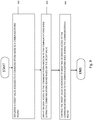
- Fig. 9 is a process flow diagram of a method for controlling access to a communications medium in accordance with an embodiment of the invention.
- a credit value assigned to a communications node is replenished in a communications round.
- access to the communications medium to the communications node during the communications round is granted or denied based on the credit value.
- the credit value is controlled in response to granting or denying access to the communications medium to the communications node during the communications round.
- the communications node may be the same as or similar to the communications nodes 104-1, 104-2, ..., 104-N depicted in Fig. 1 .
- an embodiment of a computer program product includes a computer useable storage medium to store a computer readable program.
Landscapes
- Engineering & Computer Science (AREA)
- Computer Networks & Wireless Communication (AREA)
- Signal Processing (AREA)
- Mobile Radio Communication Systems (AREA)
Abstract
Description
- In a shared-medium communications network, such as a wireless network or a wired network, a medium access control (MAC) mechanism is required to control access to a shared communications medium, such as a bus or an electromagnetic spectrum. For example, an arbitration mechanism can be used to orchestrate the access to the shared communications medium and eventually allow any communications node to transmit data through the shared communications medium. For instance, Ethernet as defined in IEEE 802.3 uses a CSMA/CD (Carrier Sense Multiple Access, Collision Detection) scheme, Wi-Fi transmission uses a CSMA/CA (Carrier Sense Multiple Access, Collision Avoidance) scheme, and distributed coordination function (DCF) in a Controller Area Network uses a CSMA/CA scheme.
- Embodiments of a method, a device and a computer-readable storage medium are disclosed. In an embodiment, a method for controlling access to a communications medium involves replenishing a credit value assigned to a communications node in a communications round, granting or denying access to the communications medium to the communications node during the communications round based on the credit value, and controlling the credit value in response to granting or denying access to the communications medium to the communications node during the communications round. Other embodiments are also described.
- In an embodiment, replenishing the credit value assigned to the communications node in the communications round involves replenishing the credit value assigned to the communications node in the communications round with a fixed replenishment value at a start of the communications round.
- In an embodiment, replenishing the credit value assigned to the communications node in the communications round with the fixed replenishment value at the start of the communications round involves replenishing the credit value assigned to the communications node in the communications round with the fixed replenishment value before granting or denying access to the communications medium to the communications node during the communications round based on the credit value.
- In an embodiment, the method further involves determining a replenishment value as a function of the credit value, and replenishing the credit value assigned to the communications node in the communications round involves replenishing the credit value assigned to the communications node in the communications round with the replenishment value.
- In an embodiment, determining the replenishment value as the function of the credit value involves determining the replenishment value as the function of the credit value and a second credit value that is assigned to a second communications node having access to the communications medium in the communications round.
- In an embodiment, the method further involves receiving, at the communications node, a message from the second communications node containing the second credit value.
- In an embodiment, the method further involves comprising estimating the second credit value based on a data frame transmitted by the second communications node in a predetermined time slot during the communications round.
- In an embodiment, determining the replenishment value as the function of the credit value and the second credit value involves determining the replenishment value based on a maximum value or a minimum value of the credit value and the second credit value.
- In an embodiment, granting or denying access to the communications medium to the communications node during the communications round based on the credit value involves allowing or prohibiting the communications node to transmit a data frame through the communications medium in a predetermined time slot during the communications round based on the credit value.
- In an embodiment, granting or denying access to the communications medium to the communications node during the communications round based on the credit value involves comparing the credit value with a credit threshold and allowing or prohibiting the communications node to transmit a data frame through the communications medium in a predetermined time slot during the communications round based on a comparison result between credit value and the credit threshold.
- In an embodiment, granting or denying access to the communications medium to the communications node during the communications round based on the credit value involves comparing the credit value with a credit threshold, if the credit value is greater than the credit threshold, allowing the communications node to transmit a data frame through the communications medium in a predetermined time slot during the communications round, and if the credit value is less than the credit threshold, allowing the communications node to transmit a stall message that indicates the communications node is not allowed to transmit the data frame through the communications medium in the predetermined time slot during the communications round.
- In an embodiment, controlling the credit value in response to granting or denying access to the communications medium to the communications node during the communications round involves deducting a credit consumption value from the credit value in response to granting access to the communications medium to the communications node during the communications round and maintaining the credit value for a subsequent communications round in response to denying access to the communications medium to the communications node during the communications round.
- In an embodiment, the method further involves determining the credit consumption value based on a characteristic of a data frame that is transmitted by the communications node through the communications medium in a predetermined time slot during the communications round.
- In an embodiment, determining the credit consumption value based on the characteristic of the data frame that is transmitted by the communications node through the communications medium in the predetermined time slot during the communications round involves calculating the credit consumption value as a function of a size of the data frame that is transmitted by the communications node through the communications medium in the predetermined time slot during the communications round.
- In an embodiment, a device for controlling access to a communications medium includes a credit protocol manager configured to replenish a credit value assigned to a communications device in a communications round, a distributed round-robin scheduler configured to grant or deny access to the communications medium for the communications device during the communications round based on the credit value, and a credit counter configured to control the credit value in response to granting or denying access to the communications medium for the communications device during the communications round.
- In an embodiment, the credit protocol manager is further configured to replenish the credit value assigned to the communications node in the communications round with a fixed replenishment value before granting or denying access to the communications medium to the communications node during the communications round based on the credit value.
- In an embodiment, the credit protocol manager is further configured to determine a replenishment value as the function of the credit value and a second credit value that is assigned to a second communications node having access to the communications medium in the communications round and replenish the credit value assigned to the communications node in the communications round with the replenishment value.
- In an embodiment, the distributed round-robin scheduler is further configured to if the credit value is greater than a credit threshold, allow the communications node to transmit a data frame through the communications medium in a predetermined time slot during the communications round and if the credit value is less than the credit threshold, allow the communications node to transmit a stall message that indicates the communications node is not allowed to transmit the data frame through the communications medium in the predetermined time slot during the communications round.
- In an embodiment, the credit counter is further configured to deduct a credit consumption value from the credit value as a function of a size of a data frame that is transmitted by the communications node through the communications medium in a predetermined time slot during the communications round and maintain the credit value for a subsequent communications round in response to denying access to the communications medium to the communications node during the communications round.
- In an embodiment, a computer-readable medium containing program instructions for controlling access to a communications medium is described. Execution of the program instructions by one or more processors causes the one or more processors to perform the above described method in accordance with an embodiment of the present application.
- Other aspects in accordance with the invention will become apparent from the following detailed description, taken in conjunction with the accompanying drawings, illustrated by way of example of the principles of the invention.
-
-
Fig. 1 depicts a communications network that includes multiple communications nodes that communicate through a shared communications medium. -
Fig. 2 depicts an example of two communications rounds in the communications network depicted inFig. 1 . -
Fig. 3 depicts another example of two communications rounds in the communications network depicted inFig. 1 . -
Fig. 4 depicts an embodiment of a MAC unit of a communications node in the communications network depicted inFig. 1 . -
Fig. 5 depicts an example of communications rounds in which the communications nodes depicted inFig. 1 participate. -
Fig. 6 depicts an example of communications rounds in which link capacity is lost. -
Fig. 7 depicts an example of communications rounds in which the communications nodes depicted inFig. 1 participate. -
Fig. 8 depicts another example of communications rounds in which the communications nodes depicted inFig. 1 participate. -
Fig. 9 is a process flow diagram of a method for controlling access to a communications medium in accordance with an embodiment of the invention. - Throughout the description, similar reference numbers may be used to identify similar elements.
- It will be readily understood that the components of the embodiments as generally described herein and illustrated in the appended figures could be arranged and designed in a wide variety of different configurations. Thus, the following more detailed description of various embodiments, as represented in the figures, is not intended to limit the scope of the present disclosure, but is merely representative of various embodiments. While the various aspects of the embodiments are presented in drawings, the drawings are not necessarily drawn to scale unless specifically indicated.
- The present invention may be embodied in other specific forms without departing from its spirit or essential characteristics. The described embodiments are to be considered in all respects only as illustrative and not restrictive. The scope of the invention is, therefore, indicated by the appended claims rather than by this detailed description. All changes which come within the meaning and range of equivalency of the claims are to be embraced within their scope.
- Reference throughout this specification to features, advantages, or similar language does not imply that all of the features and advantages that may be realized with the present invention should be or are in any single embodiment of the invention. Rather, language referring to the features and advantages is understood to mean that a specific feature, advantage, or characteristic described in connection with an embodiment is included in at least one embodiment of the present invention. Thus, discussions of the features and advantages, and similar language, throughout this specification may, but do not necessarily, refer to the same embodiment.
- Furthermore, the described features, advantages, and characteristics of the invention may be combined in any suitable manner in one or more embodiments. One skilled in the relevant art will recognize, in light of the description herein, that the invention can be practiced without one or more of the specific features or advantages of a particular embodiment. In other instances, additional features and advantages may be recognized in certain embodiments that may not be present in all embodiments of the invention.
- Reference throughout this specification to "one embodiment", "an embodiment", or similar language means that a particular feature, structure, or characteristic described in connection with the indicated embodiment is included in at least one embodiment of the present invention. Thus, the phrases "in one embodiment", "in an embodiment", and similar language throughout this specification may, but do not necessarily, all refer to the same embodiment.
- Techniques described herein can be applied to any type of shared medium communications networks, included wired communications networks and wireless communications networks. Although in some embodiments a specific type of communications networks is described, it should be noted that the invention is not restricted to a specific type of communications network.
-
Fig. 1 depicts acommunications network 100 that includes multiple communications nodes 104-1, 104-2, ..., 104-N (where N is an integer greater than one) that communicate through a sharedcommunications medium 102. The communications medium may be a wired communications medium, a wireless communications medium, or a combination thereof. In the embodiment ofFig. 1 , each communications node includes a corresponding transceiver 106-1, 106-2, ..., or 106-N and a corresponding medium access controller (MAC) units 108-1, 108-2, ..., or 108-N configured to perform medium access arbitration to orchestrate the access to the communications medium. Although the illustrated communications nodes are shown with certain components and described with certain functionality herein, other embodiments of the communications nodes may include fewer or more components to implement the same, less, or more functionality. - The
communications network 100 depicted inFig. 1 may be a wired communications network or a wireless communications network. In some embodiments, the communications network is used in an Ethernet based network, such as an Institute of Electrical and Electronics Engineers (IEEE) P802.3cg compatible single twisted pair Ethernet network. In these embodiments, the MAC units 108-1, 108-2, ..., 108-N may be implemented within the physical (PHY) layer module of the Open Systems Interconnection (OSI) model of an IEEE 802.3cg compatible Ethernet communications device. The communications network can be used for various applications. In some embodiments, the communications network is used for automotive application. For example, the communications network is an in-vehicle network (IVN) used in a bus system within a vehicle, such as a Controller Area Network (CAN), a Local Interconnect Network (LIN), a Media Oriented Systems Transport (MOST) network, a FlexRay compatible network, or other types of IVNs. - The transceivers 106-1, 106-2, ..., 106-N, which may be wired transceivers or wireless transceivers, are configured to decode messages received through the shared
communications medium 102 and to generate appropriate outgoing messages to be transmitted through the shared communications medium. Each of the transceivers may include at least one antenna (not shown) for transmitting signal through an electromagnetic spectrum. In some embodiments, the transceivers are connected to at least one device (not shown) such as a sensor, an actuator, or some other control device. In some embodiments, at least one of the transceivers is an IEEE 802.3cg compatible transceiver. In some embodiments, the transceivers implement physical layer operations. For example, in receive operations, a transceiver converts analog signals from a bus or from an antenna to digital signals that the corresponding communications node can interpret. The transceiver may also protect a corresponding MAC unit from extreme electrical conditions on a bus, e.g., electrical surges. In transmit operations, a transceiver converts digital bits received into analog differential signals that are sent on a bus or through an antenna. In some embodiments, a bus carries analog signals and includes high and low bus lines. - The MAC units 108-1, 108-2, ..., 108-N are configured to perform medium access control for the corresponding communications nodes 104-1, 104-2, ..., 104-N. The MAC units may be implemented as processors, such as microcontrollers also referred to as host processors, hosts, or digital signal processors (DSPs), or central processing units (CPUs). In some embodiments, at least one of the MAC units is included within the PHY layer module of an IEEE 802.3cg compatible Ethernet communications device. Although the illustrated MAC units are shown in
Fig. 1 as included in the corresponding communications nodes, in some embodiments, the MAC units may be separated from the corresponding communications nodes. For example, the MAC units may be implemented within a bus to which the corresponding communications nodes are connected. - In some embodiments, the communications nodes 104-1, 104-2, ..., 104-N in the
communications network 100 communicate in a round-robin fashion. In an embodiment, a round of communications, which is also referred to as a communications round, is a fixed sequence (e.g., a fixed order of transmission) of transmit opportunities or time slots. In each communications round, the sequence of transmission or the order of transmission (e.g., Node A then Node B) may be fixed for the communications nodes. For example, when the communications nodes 104-1, 104-2 transmit in communications rounds, the communications node 104-1 transmits during a first time slot in each communications round while the communications node 104-2 transmits during a second time slot in each communications round in the fixed order of transmission. When the communications nodes 104-1, 104-2, 104-3 transmit in communications rounds, the communications node 104-1 transmits during a first time slot in each communications round, the communications node 104-2 transmits during a second time slot in each communications round, and the communications node 104-3 transmits during a third time slot in each communications round in the fixed order of transmission. Each communications round may be preceded by a special beacon to indicate the start of the communications round. The duration of the time slots is determined by the length of data frames during the time slots. In some embodiments, a communications node transmits a yield message or command in a time slot assigned to the communications node to yield the communications medium to other communications node(s) (i.e., give access to the communications medium to other communications node(s)). -
Fig. 2 depicts an example of two communications rounds in thecommunications network 100 depicted inFig. 1 . Two communications nodes 104-1, 104-2 participate in the communications rounds depicted inFig. 2 . Inround 1, a beacon 250-1 is transmitted through thecommunications medium 102, subsequently a first data frame 260-1 is transmitted through the communications medium by the communications node 104-1 during a time slot A-1, and subsequently a second data frame 260-2 is transmitted through the communications medium by the communications node 104-2 during a time slot B-1. The beacon 250-1 may be transmitted by the communications node 104-1. The duration of the time slots A-1, B-1 are determined by the length of the data frames 260-1, 206-2, respectively. Inround 2, a beacon 250-2 is transmitted through the communications medium, subsequently a data frame 260-3 is transmitted through the communications medium by the communications node 104-1 during a time slot A-2, and subsequently a data frame 260-4 is transmitted through the communications medium by the communications node 104-2 during a time slot B-2. The beacon 250-2 may be transmitted by the communications node 104-1. The duration of the time slots A-2, B-2 are determined by the length of the data frames 260-3, 206-4, respectively. Time space may exist between adjacent time slots. For example, a fixed time space or a flexible time space may exist between the time slot A-1 and the time slot B-1 and/or between the time slot A-2 and the time slot B-2. -
Fig. 3 depicts another example of two communications rounds in thecommunications network 100 depicted inFig. 1 . Two communications nodes 104-1, 104-2 participate in the communications rounds depicted inFig. 3 . Inround 1, a beacon 350-1 is transmitted through thecommunications medium 102, subsequently a yield message 360-1 is transmitted through the communications medium by the communications node 104-1 during a time slot A-1 to yield the communications medium to the communications node 104-2, and subsequently a data frame 360-2 is transmitted through the communications medium by the communications node 104-2 during a time slot B-1. The beacon 350-1 may be transmitted by the communications node 104-1. The duration of the time slots A-1, B-1 are determined by the length of the yield message 360-1 and the data frame 360-2, respectively. Inround 2, a beacon 350-2 is transmitted through the communications medium, subsequently a data frame 360-3 is transmitted through the communications medium by the communications node 104-1 during a time slot A-2, and subsequently a yield message 360-4 is transmitted through the communications medium by the communications node 104-2 during a time slot B-2 to yield the communications medium. The beacon may be transmitted by the communications node 104-1. The duration of the time slots A-2, B-2 are determined by the length of the data frame 360-3 and the yield message 360-4, respectively. Time space may exist between adjacent time slots. - In some embodiments, each of the MAC units 108-1, 108-2, ..., 108-N implements a fairness control mechanism for a corresponding communications node 104-1, 104-2, ..., or 104-N. In these embodiments, each MAC unit controls medium admission for a corresponding communications node by keeping track of recent data transmissions. A credit value or level may be maintained by each communications node individually. In an embodiment, the credit value is replenished in each communications round and is consumed if a data frame is transmitted and admission to the communications medium is only granted when credit is available. In an example operation of the communications node 104-1, 104-2, ..., or 104-N, a credit value assigned to the communications node is replenished in a communications round, access to the communications medium to the communications node during the communications round is granted or denied based on the credit value, and the credit value is controlled in response to granting or denying access to the communications medium to the communications node during the communications round. In an embodiment, the credit value assigned to the communications node in the communications round is replenished with a fixed replenishment value at a start of the communications round (e.g., before granting or denying access to the communications medium to the communications node during the communications round based on the credit value). In an embodiment, the replenishment value is determined as a function of the credit value and the credit value assigned to the communications node in the communications round is replenished with the replenishment value. For example, the replenishment value is determined as the function of the credit value and a second credit value that is assigned to a second communications node having access to the communications medium in the communications round. A message from the second communications node containing the second credit value may be received at the communications node. Alternatively, the second credit value may be estimated based on a data frame transmitted by the second communications node in a predetermined time slot during the communications round.
- Compared to a typical communications network, the communications network depicted 100 in
Fig. 1 allows the communications nodes to share the communications medium based on credit values in respective communications rounds to increase or maximize medium usage while increasing or maximizing fairness regarding the sharing of the communications medium. For example, compared to a round-robin access scheme that permits each communications node in the communication network to transmit one data frame in each communications round, the MAC units 108-1, 108-2, ..., 108-N implements a fairness control mechanism based on credit values in respective communications rounds for the corresponding communications nodes that allows the communications nodes to share the communications medium with increased fairness. For example, in a round-robin access scheme that permits each communications node in the communication network to transmit one data frame in each communications round, a communications node A may transmit a large data frame (e.g., 1526 bytes) in each communications round while a communications node B transmits a small data frame (e.g., 64 bytes) in each communications round, resulting in unfairness in medium sharing (e.g., node A having around 96% of access and node B having around 4% of access). -
Fig. 4 depicts an embodiment of one of the MAC units 108-1, 108-2, ..., 108-N of the communications nodes 104-1, 104-2, ..., 104-N in thecommunications network 100 depicted inFig. 1 . In the embodiment ofFig. 4 , aMAC unit 408 includes a distributed round-robin scheduler 414, acredit protocol manager 416, and acredit counter 418. One or more of the distributed round-robin scheduler, the credit protocol manager, and the credit counter may be implemented in software, hardware, firmware, or a combination of software, hardware, and firmware. In some embodiments, the distributed round-robin scheduler, the credit protocol manager, and the credit counter may be implemented in one or more processors, such as microcontrollers or CPUs. TheMAC unit 408 depicted inFig. 4 is a possible implementation of the MAC units 108-1, 108-2, ..., 108-N depicted inFig. 1 . However, the MAC units depicted inFig. 1 can be implemented differently from the MAC unit depicted inFig. 4 . - Compared to a credit-based approach that replenishes a communications credit value or level assigned to a communications node based on passed time or bit time, the
MAC unit 408 depicted inFig. 4 can replenish a communications credit value or level assigned to a corresponding communications node 104-1, 104-2, ..., or 104-N in each communications round. The MAC unit can control medium admission for a corresponding communications node by keeping track of recent data transmissions. Compared to a credit-based approach that replenishes a communications credit value or level assigned to a communications node based on passed time or bit time, theMAC unit 408 depicted inFig. 4 , when implemented in multiple communications nodes, allow these communications nodes to share the communications medium to increasing or maximizing data rate through the communications medium while increase or maximize fairness regarding the sharing of the communications medium. - In the embodiment of
Fig. 4 , the distributed round-robin scheduler 414 is configured to perform round-robin scheduling for a corresponding communications node 104-1, 104-2, ..., or 104-N. In some embodiments, the distributed round-robin scheduler 414 is configured to detect the start of a communications round. For example, the distributed round-robin scheduler detects the start of a communications round by detecting a beacon that is transmitted onto thecommunications medium 102 that precedes the transmission of data frames. In some embodiments, the distributed round-robin scheduler, which can be embedded within the correspondingMAC unit 408 or external to the corresponding MAC unit 408 (e.g., a separate IC device), implements one or more data link layer operations. For example, the distributed round-robin scheduler may determine the size of a data frame to be transmitted onto the communications medium from acorresponding transceiver 106 and/or a received data frame from other communications node(s). The distributed round-robin scheduler may also decode a received message according to a predefined frame format. - In some embodiments, the distributed round-
robin scheduler 414 is configured to grant or deny access to thecommunications medium 102 to a corresponding communications node 104-1, 104-2, ..., or 104-N during a communications round based on a credit value assigned to the communications node in the communications round. The distributed round-robin scheduler may allow or prohibit the communications node to transmit a data frame through the communications medium in a predetermined time slot during the communications round based on the credit value. In some embodiments, the distributed round-robin scheduler allows or prohibits the communications node to transmit a data frame through the communications medium in a predetermined time slot during the communications round based on a comparison result between a credit value assigned to the communications node in a communications round and a credit threshold. The distributed round-robin scheduler, thecredit protocol manager 416, and/or thecredit counter 418 may compare a credit value assigned to the communications node in a communications round with a credit threshold. If the credit value is greater than the credit threshold, the distributed round-robin scheduler allows the communications node to transmit a data frame through the communications medium in a predetermined time slot during the communications round. If the credit value is less than the credit threshold, the distributed round-robin scheduler allows the communications node to transmit a stall message that indicates the communications node is not allowed to transmit the data frame through the communications medium in the predetermined time slot during the communications round. - In the embodiment of
Fig. 4 , thecredit protocol manager 416 is configured to perform transmission credit management for a corresponding communications node 104-1, 104-2, ..., or 104-N. The credit protocol manager may be configured to assign a credit value to the corresponding communications node, to determine an adjustment to the credit value or reset the credit value during a communications round, and/or to issue a predefined message or demand to other communications node(s). - In some embodiments, the
credit protocol manager 416 determines an adjustment (e.g., a replenishment) to the credit value assigned to corresponding communications node 104-1, 104-2, ..., or 104-N, e.g., at the start of a communications round. In some embodiments, the credit protocol manager determines a fixed replenishment per communications round (e.g., 1 credit per round, 2 credit per round or any other suitable value) to the credit value at the start of a communications round. The credit protocol manager may replenish a credit value assigned to a communications node in a communications round with a fixed replenishment value before granting or denying access to thecommunications medium 102 to the communications node during the communications round based on the credit value. In some embodiments, the credit protocol manager determines a replenishment value as a function of a credit value assigned to a communications node in a communications round. The credit protocol manager may determine a replenishment value as a function of a credit value assigned to a communications node in a communications round and a second credit value that is assigned to a second communications node having access to the communications medium in the communications round. The second credit value may be derived from a message node containing the second credit value that is received at the communication node from the second communications node. Alternatively, the credit protocol manager may estimate the second credit value based on a data frame transmitted by the second communications node in a predetermined time slot during the communications round. In some embodiments, the credit protocol manager determines the replenishment value based on a maximum value or a minimum value of a credit value assigned to a communications node in a communications round and a second credit value that is assigned to a second communications node having access to the communications medium in the communications round. - In some embodiments, the
credit protocol manager 416 determines an adjustment (e.g., a reduction or a consumption value) to the credit value at an end of a communications round based on access to the communications medium by a corresponding communications node 104-1, 104-2, ..., or 104-N during the communications round. For example, the credit protocol manager determines an adjustment (e.g., a reduction or a consumption value) to the credit value, e.g., at an end of a communications round based on the size of the data frame transmitted by a correspondingcommunications node 104 during an assigned time slot in the communications round. In some embodiments, the credit protocol manager determines a reduction or a consumption value that is applied to the credit value based on a predefined credit-to-byte ratio (e.g., 1 credit per 32 byte transmitted, 1 credit per 64 byte transmitted, 1 credit per 128 byte transmitted, or any other suitable value). - In some embodiments, the
credit protocol manager 416 resets the credit value assigned to a corresponding communications node 104-1, 104-2, ..., or 104-N, e.g., at the start of a communications round to a predefined value based on access to thecommunications medium 102 by a correspondingcommunications node 104 during the communications round. For example, the credit protocol manager resets the credit value assigned to the communications node 104-1, e.g., at the start of a communications round, to a predefined value if the communications node has an empty queue and no pending transmissions and if the credit value assigned to the communications node 104-1 is greater than or equal to a predefined threshold (e.g., greater than or equal to zero). - In some embodiments, the
credit protocol manager 416 is configured to issue a yield message to yield the communications medium to other communications node(s) during a communications round if a corresponding communications node 104-1, 104-2, ..., or 104-N has no data to be transmitted in the communications round. In some embodiments, the credit protocol manager is configured to issue a stall message to notify other communications node(s) during a communications round if the credit value assigned to the communications node 104-1 during the communications round is below (e.g., less than) a predefined threshold to allow access to thecommunications medium 102. - In the embodiment of
Fig. 4 , thecredit counter 418 is configured to perform transmission credit value adjustment and comparison for a corresponding communications node 104-1, 104-2, ..., or 104-N. The credit counter may perform transmission credit value adjustment and comparison for the communications node based on access to thecommunications medium 102 by the communications node during a communications round or at a particular point in time during a communications round. In some embodiments, the credit counter transmits an adjusted or reset credit value to the credit protocol manager. - In some embodiments, the
credit counter 418 is configured to compare the credit value assigned to a corresponding communications node 104-1, 104-2, ..., or 104-N during a communications round with a predefined threshold to allow or deny access to thecommunications medium 102 during the communications round. For example, if the credit value is below (e.g., less than) the predefined threshold during a communications round, access to thecommunications medium 102 during the communications round by the communications node is denied. If the credit value is above (e.g., greater than) the predefined threshold during a communications round, access to thecommunications medium 102 during the communications round by the communications node is granted. The credit counter may transmit a grant demand or message to the credit protocol manager if access to thecommunications medium 102 during the communications round by the communications node is granted. - In some embodiments, the
credit counter 418 performs an adjustment (e.g., applies a replenishment value) to the credit value assigned to a corresponding communications node 104-1, 104-2, ..., or 104-N at the start of a communications round. For example, the credit counter adds a fixed replenishment per communications round (e.g., 1 credit added per round, 2 credit added per round or any other suitable value) to the credit value, e.g., at the start of a communications round. - In some embodiments, the
credit counter 418 performs an adjustment (e.g., applies a reduction or a consumption value) to the credit value at an end of a communications round based on access to the communications medium by a corresponding communications node 104-1, 104-2, ..., or 104-N during the communications round. For example, the credit counter deducts a reduction value or a consumption value from the credit value at an end of a communications round based on the size of the data frame transmitted by the corresponding communications node during an assignment time slot in the communications round. In some embodiments, the credit counter deducts a reduction value or a consumption value from the credit value based on a predefined credit-to-byte ratio (e.g., 1 credit deduction per 32 byte transmitted, 1 credit deduction per 64 byte transmitted, 1 credit deduction per 128 byte transmitted, or any other suitable value). - In some embodiments, the
credit counter 418 resets the credit value assigned to a corresponding communications node 104-1, 104-2, ..., or 104-N, e.g., at the start of a communications round to a predefined value based on access to thecommunications medium 102 by the corresponding communications node during the communications round. For example, the credit counter resets the credit value assigned to the corresponding communications node, e.g., at the start of a communications round to a predefined value if the communications node has an empty queue and no pending transmissions. - In some embodiments, the
credit protocol manager 416 is configured to replenish a credit value assigned to a communications node 104-1, 104-2, ..., or 104-N in a communications round, the distributed round-robin scheduler 414 is configured to grant or deny access to the communications medium for the communications device during the communications round based on the credit value, and thecredit counter 418 is configured to control the credit value in response to granting or denying access to the communications medium for the communications device during the communications round. For example, the credit protocol manager may be further configured to replenish the credit value assigned to the communications node in the communications round with a fixed replenishment value before granting or denying access to the communications medium to the communications node during the communications round based on the credit value. In another example, the credit protocol manager is further configured to determine a replenishment value as a function of the credit value and a second credit value that is assigned to a second communications node having access to the communications medium in the communications round and to replenish the credit value assigned to the communications node in the communications round with the replenishment value. The distributed round-robin scheduler may be further configured to compare the credit value with a credit threshold, if the credit value is greater than the credit threshold, allow the communications node to transmit a data frame through the communications medium in a predetermined time slot during the communications round, and if the credit value is less than the credit threshold, allow the communications node to transmit a stall message that indicates the communications node is not allowed to transmit the data frame through the communications medium in the predetermined time slot during the communications round. The credit counter may be further configured to deduct a credit consumption value from the credit value as a function of a size of a data frame that is transmitted by the communications node through the communications medium in a predetermined time slot during the communications round and to maintain the credit value for a subsequent communications round in response to denying access to the communications medium to the communications node during the communications round. -
Fig. 5 depicts an example of communications rounds in which communications nodes 104-1, 104-2 depicted inFig. 1 participate. In the example depicted inFig. 5 , only credit values at the start of each communications round (i.e., before data transmission by the communications nodes) are shown. The credit replenishment value for each communications round is 1 credit added per round. Beacons (not shown) may be transmitted prior to data transmissions in a communications round to indicate the start of the communications round. Inround 1, a first data frame 560-1 of 1526 bytes (e.g., the maximum frame size that can be transmitted through Ethernet) is transmitted through thecommunications medium 102 by the communications node 104-1 during a time slot TSA-1, and subsequently a second data frame 560-2 of 64 bytes is transmitted through the communications medium by the communications node 104-2 during a time slot TSB-1. At the beginning ofround 1, the credit value, "CreditA1", assigned to the communications node 104-1 and the credit value, "CreditB1", assigned to the communications node 104-2 are both zero. After the communications node 104-1 transmits the data frame 560-1 during the time slot TSA-1, the credit value, Credits for round 2 (i.e., the credit value at the end of round 1) of the communications node 104-1 can be computed as:
round 1. The credit consumption value, ConsumptionA1, of the communications node 104-1 inround 1 can be computed as:
round 2 is -24 (i.e., 0 - 24 =-24). For the communications node 104-2, the credit consumption value, "ConsumptionB1", of the communications node 104-2 inround 1 is 1 credit deducted per round and the credit value, CreditB2 forround 2 is -1 (i.e., 0 - 1= -1). - At the beginning of
round 2, the credit value, CreditA2, assigned to the communications node 104-1 and the credit value, CreditB2, assigned to the communications node 104-2 are replenished with a fixed replenishment. In the embodiment depicted inFig. 5 , the fixed replenishment is set to 1 credit per round. However, it should be noted that the fixed replenishment can be set to other values. For the communications node 104-1, the replenished credit value, CreditA2, is set to -23 (i.e., -24 + 1= -23). For the communications node 104-2, the replenished credit value, CreditB2, is set to 0 (i.e. -1 + 1 = 0). Inround 2, a stall message 560-3 is transmitted through thecommunications medium 102 by the communications node 104-1 during a time slot TSA-2, and subsequently a data frame 560-4 of 64 bytes is transmitted through the communications medium by the communications node 104-2 during a time slot TSB-2. After the communications node 104-1 transmits the stall message 560-3 during the time slot TSA-2, the credit value, CreditA3 for round 3 (i.e., the credit value at the end of round 2) of the communications node 104-1 is kept or maintained at -23 because the communications node 104-1 does not transmit any data frame during the time slot TSA-2. For the communications node 104-2, the credit value, CreditA3 forround 3 is 0 - 1 = -1 (i.e., the credit consumption value for the communications node 104-2 atround 2 is 1 credit deducted per round) because the communications node 104-2 transmits the data frame 560-4 during the time slot TSB-2. - At the beginning of
round 3, the credit value, CreditA3, assigned to the communications node 104-1 and the credit value, CreditB3, assigned to the communications node 104-2 are replenished and the replenished credit value, CreditA3, is set to -22 (i.e., -23 + 1 = -22), while the replenished credit value, CreditB3, is set to 0 (i.e. -1 + 1 = 0). Inround 3, a stall message 560-5 is transmitted through thecommunications medium 102 by the communications node 104-1 during a time slot TSA-3, and subsequently a data frame 560-6 of 64 bytes is transmitted through the communications medium by the communications node 104-2 during a time slot TSB-3. After the communications node 104-1 transmits the stall message 560-5 during the time slot TSA-3, the credit value, CreditA4 for round 4 (i.e., the credit value at the end of round 3) of the communications node 104-1 is kept or maintained at -22 because the communications node 104-1 does not transmit any data frame during the time slot TSA-3. For the communications node 104-2, the credit value, CreditA3 forround 4 is 0-1 = -1 (i.e., the credit consumption value for the communications node 104-2 atround 3 is 1 credit deducted per round) because the communications node 104-2 transmits the data frame 560-6 during the time slot TSB-3. - At the beginning of
round 4, the credit value, CreditA4, assigned to the communications node 104-1 and the credit value, CreditB4, assigned to the communications node 104-2 are replenished and the replenished credit value, CreditA4, is set to -21 (i.e., -22 + 1 = -21), while the replenished credit value, CreditB4, is set to 0 (i.e. -1 + 1 = 0). Inround 4, a stall message 560-7 is transmitted through thecommunications medium 102 by the communications node 104-1 during a time slot TSA-4, and subsequently a data frame 560-8 of 64 bytes is transmitted through the communications medium by the communications node 104-2 during a time slot TSB-4. After the communications node 104-1 transmits the stall message 560-7 during the time slot TSA-4, the credit value, CreditA5 for round 5 (i.e., the credit value at the end of round 4) of the communications node 104-1 is kept or maintained at -21 because the communications node 104-1 does not transmit any data frame during the time slot TSA-4. For the communications node 104-2, the credit value, CreditA4 forround 4 is 0-1 = -1 (i.e., the credit consumption value for the communications node 104-2 atround 4 is 1 credit deducted per round) because the communications node 104-2 transmits the data frame 560-8 during the time slot TSB-4. After 24 rounds of communications, the credit value, "CreditAM", assigned to the communications node 104-1 and the credit value, "CreditBM", assigned to the communications node 104-2 are both zero in round M (where M is an integer that is greater than 24) and the communications node 104-1 is allowed to access thecommunications medium 102 in predetermined time slots 560-2M-1, 560-2M. - In some scenarios, if a communications node sends a large data frame (e.g. the communications node 104-1 sends a 1526 byte data frame) while other communications node(s) has no data to send, medium bandwidth can be wasted and link capacity can be lost (e.g., not all of the transmission capacity of the
communications medium 102 are used).Fig. 6 depicts an example of communications rounds in which link capacity of the communications medium is lost or not fully used. Specifically, the communications node 104-1 is stalled for multiple round after transmitting a large data frame and the communications 104-2 stays idle for all of the communications rounds. Consequently, the communications medium is not fully utilized in multiple communications rounds and medium bandwidth or link capacity is wasted. In the example depicted inFig. 6 , only credit values at the start of each communications round (i.e., before data transmission by the communications nodes) are shown. The credit replenishment value for each communications round is 1 credit added per round. Beacons (not shown) may be transmitted prior to data transmissions in a communications round to indicate the start of the communications round. At the beginning ofround 1, the credit value, "CreditA1," assigned to the communications node 104-1 is zero. Inround 1, a first data frame 660-1 of 1526 bytes (e.g., the maximum frame size that can be transmitted through Ethernet) is transmitted through thecommunications medium 102 by the communications node 104-1 during a time slot TSA-1, and subsequently an idle message 660-2 is transmitted through the communications medium by the communications node 104-2 during a time slot TSB-1. In the embodiment depicted inFig. 6 , for the communications node 104-1, the credit value, Credits forround 2 is -24 (i.e., 0 - 24 = -24) (i.e., the credit consumption value for the communications node 104-1 atround 1 is 24 credits deducted per round). - At the beginning of
round 2, the credit replenishment value forround 2 is 1 credit added per round and the credit value, CreditA2, assigned to the communications node 104-1 is replenished to -23. Inround 2, a stall message 660-3 is transmitted through thecommunications medium 102 by the communications node 104-1 during a time slot TSA-2, and subsequently an idle message 660-4 is transmitted through the communications medium by the communications node 104-2 during a time slot TSB-2. After the communications node 104-1 transmits the stall message 660-3 during the time slot TSA-2, the credit value, CreditA3 for round 3 (i.e., the credit value at the end of round 2) of the communications node 104-1 is kept or maintained at -23 because the communications node 104-1 does not transmit any data frame during the time slot TSA-2. - At the beginning of
round 3, the credit replenishment value forround 3 is 1 credit added per round and the credit value, CreditA3, assigned to the communications node 104-1 is replenished and the replenished credit value, CreditA3, is set to -22. Inround 3, a stall message 660-5 is transmitted through thecommunications medium 102 by the communications node 104-1 during a time slot TSA-3, and subsequently an idle message 660-6 is transmitted through the communications medium by the communications node 104-2 during a time slot TSB-3. After the communications node 104-1 transmits the stall message 560-5 during the time slot TSA-3, the credit value, CreditA4 for round 4 (i.e., the credit value at the end of round 3) of the communications node 104-1 is kept or maintained at -22 because the communications node 104-1 does not transmit any data frame during the time slot TSA-3. - At the beginning of
round 4, the credit replenishment value forround 4 is 1 credit added per round and the credit value, CreditA4, assigned to the communications node 104-1 is replenished and the replenished credit value, CreditA4, is set to -21. Inround 4, a stall message 660-7 is transmitted through thecommunications medium 102 by the communications node 104-1 during a time slot TSA-4, and subsequently an idle message 660-8 is transmitted through the communications medium by the communications node 104-2 during a time slot TSB-4. After the communications node 104-1 transmits the stall message 560-7 during the time slot TSA-4, the credit value, CreditA5 for round 5 (i.e., the credit value at the end of round 4) of the communications node 104-1 is kept or maintained at -21 because the communications node 104-1 does not transmit any data frame during the time slot TSA-4. After 24 rounds of communications, the credit value, "CreditA25", assigned to the communications node 104-1 is zero in round 25 (and the communications node 104-1 is allowed to access thecommunications medium 102. - In some embodiments, to address the loss of link capacity (e.g., inefficient use of available transmission capacity of the communications medium 102) when a communications node is stalled while other communications node(s) has no data to send, the communications node transmits its assigned credit value to other communications node(s) during stall time slots (i.e., time slots in which the communications node is stalled. In these embodiments, other communications node(s) may also broadcast its assigned credit value. The communications nodes may collectively determine an increased replenishment value (i.e., decide how many replenishment rounds can be skipped). Alternatively, each communications node may independently determine an increased replenishment value (i.e., decide how many replenishment rounds can be skipped).
Figs. 7 and8 depict two examples of communications rounds in which increased replenishment values are used to improve transmission capacity usage of the communications medium. -
Fig. 7 depicts an example of communications rounds in which the communications nodes 104-1, 104-2 depicted inFig. 1 participate. In the example depicted inFig. 7 , only credit values at the start of each communications round (i.e., before data transmission by the communications nodes) are shown. Beacons (not shown) may be transmitted prior to data transmissions in a communications round to indicate the start of the communications round. At the beginning ofround 1, the credit value, "CreditA1", assigned to the communications node 104-1 and the credit value, "CreditB1", assigned to the communications node 104-2 are both zero. Inround 1, a first data frame 760-1 of 1526 bytes (e.g., the maximum frame size that can be transmitted through Ethernet) is transmitted through thecommunications medium 102 by the communications node 104-1 during a time slot TSA-1, and subsequently an idle message 760-2 is transmitted through the communications medium by the communications node 104-2 during a time slot TSB-1. In the embodiment depicted inFig. 7 , for the communications node 104-1, the credit value, CreditA2 forround 2 is -24 (i.e., 0 - 24 = -24) because the communications node 104-1 transmits the data frame 760-1 during the time slot TSA-1, while for the communications node 104-2, the credit value, CreditB2 forround 2 is kept or maintained at 0 because the communications node 104-2 does not transmit any data frame during the time slot TSB-1. - At the beginning of
round 2, the credit replenishment value forround 2 is 1 credit added per round and the credit value, CreditA2, assigned to the communications node 104-1 is replenished to -23 (i.e., -24 + 1 = -23) while the credit value, CreditB2, assigned to the communications node 104-2 is zero (i.e., -1 + 1 = 0). Inround 2, a message 760-3 containing the credit value of the communications node 104-1 is transmitted through thecommunications medium 102 by the communications node 104-1 during a time slot TSA-2, and subsequently an idle message 760-4 is transmitted through the communications medium by the communications node 104-2 during a time slot TSB-2. After the communications node 104-1 transmits the message 760-3 containing the credit value of the communications node 104-1 during the time slot TSA-2, the credit value, CreditA3 for round 3 (i.e., the credit value at the end of round 2) of the communications node 104-1 is set to zero (i.e., 23 replenishment rounds are skipped) while for the communications node 104-2, the credit value, CreditB3 forround 3 is kept or maintained at zero because the communications node 104-2 does not transmit any data frame during the time slot TSB-2. - At the beginning of
round 3, the credit value, CreditA3, assigned to the communications node 104-1 and the credit value, CreditB3 forround 3 are maintained at zero (i.e., saturated at maximum credit value, which is zero in the example ofFig. 7 ). Inround 3, a data frame 760-5 of 1526 bytes (e.g., the maximum frame size that can be transmitted through Ethernet) is transmitted through thecommunications medium 102 by the communications node 104-1 during a time slot TSA-3, and subsequently an idle message 760-6 is transmitted through the communications medium by the communications node 104-2 during a time slot TSB-3. In the embodiment depicted inFig. 7 , for the communications node 104-1, the credit value, CreditA2 forround 4 is -24 (i.e., 0 - 24 = -24) because the communications node 104-1 transmits the data frame 760-5 during the time slot TSA-3, while for the communications node 104-2, the credit value, CreditB2 forround 4 is kept or maintained at 0 because the communications node 104-2 does not transmit any data frame during the time slot TSB-3. -
Fig. 8 depicts another example of communications rounds in which the communications node 104-1 depicted inFig. 4 participates. In the example depicted inFig. 8 , credit values at the start of each communications round (i.e., before data transmission by the communications nodes) and credit values at the end of round 2 (i.e., after data transmission by the communications nodes are shown. Beacons (not shown) may be transmitted prior to data transmissions in a communications round to indicate the start of the communications round. At the beginning ofround 1, the credit value, "CreditA1", assigned to the communications node 104-1 and the credit value, "CreditB1", assigned to the communications node 104-2 are both zero. Inround 1, a first data frame 860-1 of 1526 bytes (e.g., the maximum frame size that can be transmitted through Ethernet) is transmitted through thecommunications medium 102 by the communications node 104-1 during a time slot TSA-1, and subsequently a second data frame 860-2 of 64 bytes is transmitted through the communications medium by the communications node 104-2 during a time slot TSB-1. In the embodiment depicted inFig. 8 , for the communications node 104-1, the credit value, CreditA2 forround 2 is -24 (i.e., 0 - 24 = -24) because the communications node 104-1 transmits the data frame 860-1 during the time slot TSA-1, while for the communications node 104-2, the credit value, CreditB2 forround 2 is -1 (i.e., 0 - 1 = -1) because the communications node 104-2 transmits the data frame 860-2 during the time slot TSB-1. - At the beginning of
round 2, the credit replenishment value forround 2 is 1 credit added per round and the credit value, CreditA2, assigned to the communications node 104-1 is replenished to -23 (i.e., -24 + 1 = -23) while the credit value, CreditB2, assigned to the communications node 104-2 is replenished to 0 (i.e., -1 + 1 = 0). Inround 2, a message 860-3 containing the credit value (-23) of the communications node 104-1 is transmitted through thecommunications medium 102 by the communications node 104-1 during a time slot TSA-2, and subsequently a data frame 860-2 of 192 bytes is transmitted through the communications medium by the communications node 104-2 during a time slot TSB-2. After the communications node 104-1 transmits the message 860-3 containing the credit value of the communications node 104-1 during the time slot TSA-2, the credit value, CreditA3 for round 3 (i.e., the credit value at the end of round 2) of the communications node 104-1 is kept or maintained at -23 because the communications node 104-1 does not transmit any data frame during the time slot TSA-2 while for the communications node 104-2, the credit value, CreditB3 forround 3 is deducted to -3 (i.e., 0 - 3 = -3) because the communications node 104-2 transmits the data frame 860-4 during the time slot TSB-2. - At the beginning of
round 3, the credit replenishment value forround 3 is 1 credit added per round and the credit value, CreditA3, assigned to the communications node 104-1 and the credit value, CreditB3, assigned to the communications node 104-2 forround 3 are replenished to -22 (i.e., -23 + 1 = -22) and -2 (i.e., -3 + 1 = -2), respectively. Inround 3, a message 860-5 containing the credit value (-22) of the communications node 104-1 is transmitted through thecommunications medium 102 by the communications node 104-1 during a time slot TSA-3, and subsequently a message 860-6 containing the credit value (-2) of the communications node 104-2 is transmitted through the communications medium by the communications node 104-2 during a time slot TSB-3. In the embodiment depicted inFig. 8 , for the communications node 104-1, the credit value, CreditA2 forround 4 is -22, while for the communications node 104-2, the credit value, CreditB2 forround 4 is -2 because no transmission is conducted through the communications medium duringround 3. The communications nodes 104-1, 104-2 may collectively decide how many replenishment rounds can be skipped. Alternatively, each communications node may independently decide how many replenishment rounds can be skipped. In some embodiments, the replenishment value for the next communications round (round 4 in the embodiment depicted inFig. 8 ) is determined based on the credit values of the communications nodes 104-1, 104-2 in the current communications round (round 4 in the embodiment depicted inFig. 8 ). For example, the replenishment value for the next communications round (round 4 in the embodiment depicted inFig. 8 ) may be determined as a function of the credit values of the communications nodes 104-1, 104-2 in the current communications round (round 4 in the embodiment depicted inFig. 8 ). In an embodiment, the replenishment value for the next communications round (round 4 in the embodiment depicted inFig. 8 ) is determined based on the maximum value or the minimum value of the credit values of the communications nodes 104-1, 104-2 in the current communications round (round 4 in the embodiment depicted inFig. 8 ). In the embodiment depicted inFig. 8 , each communications node replenishes a replenishment value of A in the next round (i.e., round 4) to its credit value. The replenishment value of A can be expressed as:
round 4 is 2 credit added per round). - At the beginning of
round 4, the credit replenishment value forround 4 is 2 credit added per round and the credit value, CreditA4, assigned to the communications node 104-1 and the credit value, CreditB4, assigned to the communications node 104-2 forround 4 are replenished to -20 (i.e., -22 + 2 = 20) and 0 (i.e., -2 + 2 = 0), respectively. Inround 4, a message 860-7 containing the credit value (-20) of the communications node 104-1 is transmitted through thecommunications medium 102 by the communications node 104-1 during a time slot TSA-4, and subsequently a data frame 860-8 of 192 bytes is transmitted through the communications medium by the communications node 104-2 during a time slot TSB-4. In the embodiment depicted inFig. 8 , for the communications node 104-1, the credit value, CreditA2 forround 5 is -20 because no transmission is conducted through the communications medium duringround 4 while for the communications node 104-2, the credit value, CreditB2 forround 5 is -3 because the data frame 860-8 of 192 bytes is transmitted through the communications medium by the communications node 104-2 during the time slot TSB-4. - At the beginning of
round 5, the credit replenishment value forround 5 is 1 credit added per round, and the credit value, CreditA5, assigned to the communications node 104-1 and the credit value, CreditB5, assigned to the communications node 104-2 forround 5 are replenished to -19 (i.e., -20 + 1 = -19) and -2 (i.e., -3 + 1 = -2), respectively. Inround 5, a message 860-9 containing the credit value (-19) of the communications node 104-1 is transmitted through thecommunications medium 102 by the communications node 104-1 during a time slot TSA-5, and subsequently a message 860-10 containing the credit value (-2) of the communications node 104-2 is transmitted through the communications medium by the communications node 104-2 during a time slot TSB-5. In the embodiment depicted inFig. 8 , for the communications node 104-1, the credit value, CreditA2 forround 5 is -19, while for the communications node 104-2, the credit value, CreditB2 forround 5 is -2 because no transmission is conducted through the communications medium duringround 5. The communications nodes 104-1, 104-2 may collectively decide how many replenishment rounds can be skipped. Alternatively, each communications node may independently decide how many replenishment rounds can be skipped. In some embodiments, the replenishment value for the next communications round (round 4 in the embodiment depicted inFig. 8 ) is determined based on the credit values of the communications nodes 104-1, 104-2 in the current communications round (round 4 in the embodiment depicted inFig. 8 ). For example, each communications node may replenish a replenishment value of A in the next round (i.e., round 6) to its credit value. The replenishment value of A can be expressed as:
round 6 is 2 credit added per round). -
Fig. 9 is a process flow diagram of a method for controlling access to a communications medium in accordance with an embodiment of the invention. Atblock 902, a credit value assigned to a communications node is replenished in a communications round. Atblock 904, access to the communications medium to the communications node during the communications round is granted or denied based on the credit value. Atblock 906, the credit value is controlled in response to granting or denying access to the communications medium to the communications node during the communications round. The communications node may be the same as or similar to the communications nodes 104-1, 104-2, ..., 104-N depicted inFig. 1 . - In the above description, specific details of various embodiments are provided. However, some embodiments may be practiced with less than all of these specific details. In other instances, certain methods, procedures, components, structures, and/or functions are described in no more detail than to enable the various embodiments of the invention, for the sake of brevity and clarity.
- Although the operations of the method(s) herein are shown and described in a particular order, the order of the operations of each method may be altered so that certain operations may be performed in an inverse order or so that certain operations may be performed, at least in part, concurrently with other operations. In another embodiment, instructions or sub-operations of distinct operations may be implemented in an intermittent and/or alternating manner.
- It should also be noted that at least some of the operations for the methods described herein may be implemented using software instructions stored on a computer useable storage medium for execution by a computer. As an example, an embodiment of a computer program product includes a computer useable storage medium to store a computer readable program.
- The computer-useable or computer-readable storage medium can be an electronic, magnetic, optical, electromagnetic, infrared, or semiconductor system (or apparatus or device). Examples of non-transitory computer-useable and computer-readable storage media include a semiconductor or solid-state memory, magnetic tape, a removable computer diskette, a random access memory (RAM), a read-only memory (ROM), a rigid magnetic disk, and an optical disk. Current examples of optical disks include a compact disk with read only memory (CD-ROM), a compact disk with read/write (CD-R/W), and a digital video disk (DVD).
- Alternatively, embodiments of the invention may be implemented entirely in hardware or in an implementation containing both hardware and software elements. In embodiments which use software, the software may include but is not limited to firmware, resident software, microcode, etc.
- Although specific embodiments of the invention have been described and illustrated, the invention is not to be limited to the specific forms or arrangements of parts so described and illustrated. The scope of the invention is to be defined by the claims appended hereto and their equivalents.
Claims (15)
- A method for controlling access to a communications medium, the method comprising:replenishing (902) a credit value assigned to a communications node in a communications round;granting or denying (904) access to the communications medium to the communications node during the communications round based on the credit value; andcontrolling (906) the credit value in response to granting or denying access to the communications medium to the communications node during the communications round.
- The method of claim 1, wherein replenishing the credit value assigned to the communications node in the communications round comprises replenishing the credit value assigned to the communications node in the communications round with a fixed replenishment value at a start of the communications round.
- The method of claim 2, wherein replenishing the credit value assigned to the communications node in the communications round with the fixed replenishment value at the start of the communications round comprises replenishing the credit value assigned to the communications node in the communications round with the fixed replenishment value before granting or denying access to the communications medium to the communications node during the communications round based on the credit value.
- The method of any preceding claim, further comprising determining a replenishment value as a function of the credit value, and wherein replenishing the credit value assigned to the communications node in the communications round comprises replenishing the credit value assigned to the communications node in the communications round with the replenishment value.
- The method of claim 4, wherein determining the replenishment value as the function of the credit value comprises determining the replenishment value as the function of the credit value and a second credit value that is assigned to a second communications node having access to the communications medium in the communications round.
- The method of claim 5, further comprising:receiving, at the communications node, a message from the second communications node containing the second credit value;estimating the second credit value based on a data frame transmitted by the second communications node in a predetermined time slot during the communications round; and/ordetermining the replenishment value as the function of the credit value and the second credit value comprises determining the replenishment value based on a maximum value or a minimum value of the credit value and the second credit value.
- The method of any preceding claim, wherein granting or denying access to the communications medium to the communications node during the communications round based on the credit value comprises allowing or prohibiting the communications node to transmit a data frame through the communications medium in a predetermined time slot during the communications round based on the credit value.
- The method of any preceding claim, wherein granting or denying access to the communications medium to the communications node during the communications round based on the credit value comprises:comparing the credit value with a credit threshold; andallowing or prohibiting the communications node to transmit a data frame through the communications medium in a predetermined time slot during the communications round based on a comparison result between credit value and the credit threshold.
- The method of any preceding claim, wherein granting or denying access to the communications medium to the communications node during the communications round based on the credit value comprises:comparing the credit value with a credit threshold;if the credit value is greater than the credit threshold, allowing the communications node to transmit a data frame through the communications medium in a predetermined time slot during the communications round; andif the credit value is less than the credit threshold, allowing the communications node to transmit a stall message that indicates the communications node is not allowed to transmit the data frame through the communications medium in the predetermined time slot during the communications round.
- The method of any preceding claim, wherein controlling the credit value in response to granting or denying access to the communications medium to the communications node during the communications round comprises:deducting a credit consumption value from the credit value in response to granting access to the communications medium to the communications node during the communications round; andmaintaining the credit value for a subsequent communications round in response to denying access to the communications medium to the communications node during the communications round.
- The method of claim 10, further comprising determining the credit consumption value based on a characteristic of a data frame that is transmitted by the communications node through the communications medium in a predetermined time slot during the communications round.
- A device for controlling access to a communications medium (102), the device comprising:a credit protocol manager (416) configured to replenish a credit value assigned to a communications device in a communications round;a distributed round-robin scheduler (414) configured to grant or deny access to the communications medium for the communications device during the communications round based on the credit value; anda credit counter (418) configured to control the credit value in response to granting or denying access to the communications medium for the communications device during the communications round.
- The device of claim 12, wherein the credit protocol manager is further configured to replenish the credit value assigned to the communications node in the communications round with a fixed replenishment value before granting or denying access to the communications medium to the communications node during the communications round based on the credit value.
- The device of claim 12 or claim 13, wherein the credit protocol manager is further configured to:determine a replenishment value as the function of the credit value and a second credit value that is assigned to a second communications node having access to the communications medium in the communications round; andreplenish the credit value assigned to the communications node in the communications round with the replenishment value.
- The device of any one of the claims 12 to 14, wherein the distributed round-robin scheduler is further configured to:if the credit value is greater than a credit threshold, allow the communications node to transmit a data frame through the communications medium in a predetermined time slot during the communications round; andif the credit value is less than the credit threshold, allow the communications node to transmit a stall message that indicates the communications node is not allowed to transmit the data frame through the communications medium in the predetermined time slot during the communications round.
Applications Claiming Priority (1)
| Application Number | Priority Date | Filing Date | Title |
|---|---|---|---|
| US15/904,382 US20190268941A1 (en) | 2018-02-25 | 2018-02-25 | Method and system for controlling access to a communications medium |
Publications (2)
| Publication Number | Publication Date |
|---|---|
| EP3531639A1 true EP3531639A1 (en) | 2019-08-28 |
| EP3531639B1 EP3531639B1 (en) | 2020-09-23 |
Family
ID=65365777
Family Applications (1)
| Application Number | Title | Priority Date | Filing Date |
|---|---|---|---|
| EP19153354.6A Active EP3531639B1 (en) | 2018-02-25 | 2019-01-23 | Method and system for controlling access to a communications medium |
Country Status (2)
| Country | Link |
|---|---|
| US (1) | US20190268941A1 (en) |
| EP (1) | EP3531639B1 (en) |
Families Citing this family (10)
| Publication number | Priority date | Publication date | Assignee | Title |
|---|---|---|---|---|
| US11272543B2 (en) | 2018-02-21 | 2022-03-08 | Nxp B.V. | Physical layer device that connects to a shared media and method for operating a physical layer device that connects to a shared media |
| JP7248702B2 (en) * | 2018-06-26 | 2023-03-29 | インテル コーポレイション | Deterministic backoff with collision avoidance |
| KR102709492B1 (en) | 2019-05-03 | 2024-09-26 | 마이크로칩 테크날러지 인코포레이티드 | Collision emulation in wired local area networks and related systems, methods, and devices |
| CN112422295B (en) | 2019-08-23 | 2023-06-13 | 微芯片技术股份有限公司 | Ethernet interface and related systems, methods and devices |
| CN112423403A (en) | 2019-08-23 | 2021-02-26 | 微芯片技术股份有限公司 | Detecting conflicts on a network |
| CN112422153B (en) | 2019-08-23 | 2023-04-07 | 微芯片技术股份有限公司 | Method and system for processing data reception after detecting collisions at a shared transmission medium |
| CN112422219B (en) | 2019-08-23 | 2024-05-24 | 微芯片技术股份有限公司 | Ethernet interface and related systems, methods and devices |
| CN112415323B (en) | 2019-08-23 | 2024-07-09 | 微芯片技术股份有限公司 | Diagnosing cable faults within a network |
| CN112422385B (en) | 2019-08-23 | 2022-11-29 | 微芯片技术股份有限公司 | Interface for improved media access and related systems, methods and devices |
| DE112021001780T5 (en) * | 2020-03-24 | 2023-01-05 | Microchip Technology Incorporated | LOW LINK COUNT INTERFACE WAKE SOURCE COMMUNICATIONS ACCORDING TO LOCAL AND REMOTE 10SPE WAKE AND RELATED SYSTEMS, PROCEDURES AND DEVICES |
Citations (3)
| Publication number | Priority date | Publication date | Assignee | Title |
|---|---|---|---|---|
| WO2007051153A1 (en) * | 2005-10-26 | 2007-05-03 | Qualcomm Incorporated | Minimum rate guarantees on wireless channel using resource utilization messages |
| US20100208665A1 (en) * | 2009-02-18 | 2010-08-19 | Clear Wireless LLC. | Setting token bucket parameters for scheduling of air-interface resources |
| US20180041956A1 (en) * | 2016-08-02 | 2018-02-08 | Qualcomm Incorporated | Operation of user equipment in c-drx mode with token bucket based access |
Family Cites Families (5)
| Publication number | Priority date | Publication date | Assignee | Title |
|---|---|---|---|---|
| US7652988B2 (en) * | 2002-06-04 | 2010-01-26 | Alcatel-Lucent Usa Inc. | Hardware-based rate control for bursty traffic |
| US8478811B2 (en) * | 2002-10-08 | 2013-07-02 | Netlogic Microsystems, Inc. | Advanced processor with credit based scheme for optimal packet flow in a multi-processor system on a chip |
| US7408946B2 (en) * | 2004-05-03 | 2008-08-05 | Lucent Technologies Inc. | Systems and methods for smooth and efficient round-robin scheduling |
| US8505028B2 (en) * | 2007-05-30 | 2013-08-06 | Red Hat, Inc. | Flow control protocol |
| US8045563B2 (en) * | 2007-12-27 | 2011-10-25 | Cellco Partnership | Dynamically adjusted credit based round robin scheduler |
-
2018
- 2018-02-25 US US15/904,382 patent/US20190268941A1/en not_active Abandoned
-
2019
- 2019-01-23 EP EP19153354.6A patent/EP3531639B1/en active Active
Patent Citations (3)
| Publication number | Priority date | Publication date | Assignee | Title |
|---|---|---|---|---|
| WO2007051153A1 (en) * | 2005-10-26 | 2007-05-03 | Qualcomm Incorporated | Minimum rate guarantees on wireless channel using resource utilization messages |
| US20100208665A1 (en) * | 2009-02-18 | 2010-08-19 | Clear Wireless LLC. | Setting token bucket parameters for scheduling of air-interface resources |
| US20180041956A1 (en) * | 2016-08-02 | 2018-02-08 | Qualcomm Incorporated | Operation of user equipment in c-drx mode with token bucket based access |
Also Published As
| Publication number | Publication date |
|---|---|
| US20190268941A1 (en) | 2019-08-29 |
| EP3531639B1 (en) | 2020-09-23 |
Similar Documents
| Publication | Publication Date | Title |
|---|---|---|
| EP3531639B1 (en) | Method and system for controlling access to a communications medium | |
| US11362858B2 (en) | Method for transmitting data via a communication channel, correspondingly designed device and communication interface, as well as correspondingly designed computer program | |
| EP3618364B1 (en) | Physical layer device and method for operating a physical layer device | |
| EP1603283B1 (en) | Access to a shared communication medium | |
| US8218493B2 (en) | System and method for interference mitigation in wireless networks | |
| Almohammedi et al. | An adaptive multi-channel assignment and coordination scheme for IEEE 802.11 P/1609.4 in vehicular ad-hoc networks | |
| KR20110015759A (en) | WiFi cooperative communication method | |
| JP2005065275A (en) | Frame burst management | |
| US10200290B2 (en) | Station and method for serial data transmission using dynamic reprioritizing of data frames | |
| CN105101453A (en) | Carrier sensing method based on dynamic idle channel assessment threshold | |
| EP2625918B1 (en) | Facilitating distributed channel access for a plurality of access terminals transmitting in a wireless communication environment | |
| Amuru et al. | To send or not to send-learning MAC contention | |
| WO2011084228A2 (en) | Method and apparatus for downlink multiple-user multiple input multiple output scheduling | |
| EP1525717A2 (en) | Method for assigning a back-off interval | |
| WO2008041271A1 (en) | Transmitting/receiving system, node and communication method | |
| CN109996210B (en) | Congestion window control method, device and device for Internet of Vehicles | |
| EP4297348A1 (en) | Phy level collision avoidance with lower latency qos | |
| Amadou et al. | Revisiting Backoff algorithms in CSMA/CA based MAC for channel Reservation in RFID reader Networks through broadcasting | |
| EP3293916B1 (en) | Communication method, server, and wireless distribution system | |
| US9820303B2 (en) | Multi-destination burst protocol | |
| JP2002218000A (en) | Data communication device and data communication method | |
| CN115694708B (en) | Multipoint Network System | |
| TW202306424A (en) | Multidrop network system | |
| Cheng et al. | A novel MAC mechanism to resolve 802.11 performance anomaly | |
| Lin et al. | A multi-period resource auction scheme for machine-to-machine communications. |
Legal Events
| Date | Code | Title | Description |
|---|---|---|---|
| PUAI | Public reference made under article 153(3) epc to a published international application that has entered the european phase |
Free format text: ORIGINAL CODE: 0009012 |
|
| STAA | Information on the status of an ep patent application or granted ep patent |
Free format text: STATUS: THE APPLICATION HAS BEEN PUBLISHED |
|
| AK | Designated contracting states |
Kind code of ref document: A1 Designated state(s): AL AT BE BG CH CY CZ DE DK EE ES FI FR GB GR HR HU IE IS IT LI LT LU LV MC MK MT NL NO PL PT RO RS SE SI SK SM TR |
|
| AX | Request for extension of the european patent |
Extension state: BA ME |
|
| STAA | Information on the status of an ep patent application or granted ep patent |
Free format text: STATUS: REQUEST FOR EXAMINATION WAS MADE |
|
| 17P | Request for examination filed |
Effective date: 20200228 |
|
| RBV | Designated contracting states (corrected) |
Designated state(s): AL AT BE BG CH CY CZ DE DK EE ES FI FR GB GR HR HU IE IS IT LI LT LU LV MC MK MT NL NO PL PT RO RS SE SI SK SM TR |
|
| GRAP | Despatch of communication of intention to grant a patent |
Free format text: ORIGINAL CODE: EPIDOSNIGR1 |
|
| STAA | Information on the status of an ep patent application or granted ep patent |
Free format text: STATUS: GRANT OF PATENT IS INTENDED |
|
| INTG | Intention to grant announced |
Effective date: 20200519 |
|
| GRAJ | Information related to disapproval of communication of intention to grant by the applicant or resumption of examination proceedings by the epo deleted |
Free format text: ORIGINAL CODE: EPIDOSDIGR1 |
|
| STAA | Information on the status of an ep patent application or granted ep patent |
Free format text: STATUS: REQUEST FOR EXAMINATION WAS MADE |
|
| GRAP | Despatch of communication of intention to grant a patent |
Free format text: ORIGINAL CODE: EPIDOSNIGR1 |
|
| STAA | Information on the status of an ep patent application or granted ep patent |
Free format text: STATUS: GRANT OF PATENT IS INTENDED |
|
| GRAS | Grant fee paid |
Free format text: ORIGINAL CODE: EPIDOSNIGR3 |
|
| INTC | Intention to grant announced (deleted) | ||
| GRAA | (expected) grant |
Free format text: ORIGINAL CODE: 0009210 |
|
| STAA | Information on the status of an ep patent application or granted ep patent |
Free format text: STATUS: THE PATENT HAS BEEN GRANTED |
|
| INTG | Intention to grant announced |
Effective date: 20200807 |
|
| AK | Designated contracting states |
Kind code of ref document: B1 Designated state(s): AL AT BE BG CH CY CZ DE DK EE ES FI FR GB GR HR HU IE IS IT LI LT LU LV MC MK MT NL NO PL PT RO RS SE SI SK SM TR |
|
| REG | Reference to a national code |
Ref country code: GB Ref legal event code: FG4D |
|
| REG | Reference to a national code |
Ref country code: CH Ref legal event code: EP |
|
| REG | Reference to a national code |
Ref country code: IE Ref legal event code: FG4D |
|
| REG | Reference to a national code |
Ref country code: DE Ref legal event code: R096 Ref document number: 602019000716 Country of ref document: DE Ref country code: AT Ref legal event code: REF Ref document number: 1317529 Country of ref document: AT Kind code of ref document: T Effective date: 20201015 |
|
| PG25 | Lapsed in a contracting state [announced via postgrant information from national office to epo] |
Ref country code: FI Free format text: LAPSE BECAUSE OF FAILURE TO SUBMIT A TRANSLATION OF THE DESCRIPTION OR TO PAY THE FEE WITHIN THE PRESCRIBED TIME-LIMIT Effective date: 20200923 Ref country code: HR Free format text: LAPSE BECAUSE OF FAILURE TO SUBMIT A TRANSLATION OF THE DESCRIPTION OR TO PAY THE FEE WITHIN THE PRESCRIBED TIME-LIMIT Effective date: 20200923 Ref country code: SE Free format text: LAPSE BECAUSE OF FAILURE TO SUBMIT A TRANSLATION OF THE DESCRIPTION OR TO PAY THE FEE WITHIN THE PRESCRIBED TIME-LIMIT Effective date: 20200923 Ref country code: GR Free format text: LAPSE BECAUSE OF FAILURE TO SUBMIT A TRANSLATION OF THE DESCRIPTION OR TO PAY THE FEE WITHIN THE PRESCRIBED TIME-LIMIT Effective date: 20201224 Ref country code: BG Free format text: LAPSE BECAUSE OF FAILURE TO SUBMIT A TRANSLATION OF THE DESCRIPTION OR TO PAY THE FEE WITHIN THE PRESCRIBED TIME-LIMIT Effective date: 20201223 Ref country code: NO Free format text: LAPSE BECAUSE OF FAILURE TO SUBMIT A TRANSLATION OF THE DESCRIPTION OR TO PAY THE FEE WITHIN THE PRESCRIBED TIME-LIMIT Effective date: 20201223 |
|
| REG | Reference to a national code |
Ref country code: AT Ref legal event code: MK05 Ref document number: 1317529 Country of ref document: AT Kind code of ref document: T Effective date: 20200923 |
|
| PG25 | Lapsed in a contracting state [announced via postgrant information from national office to epo] |
Ref country code: LV Free format text: LAPSE BECAUSE OF FAILURE TO SUBMIT A TRANSLATION OF THE DESCRIPTION OR TO PAY THE FEE WITHIN THE PRESCRIBED TIME-LIMIT Effective date: 20200923 Ref country code: RS Free format text: LAPSE BECAUSE OF FAILURE TO SUBMIT A TRANSLATION OF THE DESCRIPTION OR TO PAY THE FEE WITHIN THE PRESCRIBED TIME-LIMIT Effective date: 20200923 |
|
| REG | Reference to a national code |
Ref country code: NL Ref legal event code: MP Effective date: 20200923 |
|
| REG | Reference to a national code |
Ref country code: LT Ref legal event code: MG4D |
|
| PG25 | Lapsed in a contracting state [announced via postgrant information from national office to epo] |
Ref country code: SM Free format text: LAPSE BECAUSE OF FAILURE TO SUBMIT A TRANSLATION OF THE DESCRIPTION OR TO PAY THE FEE WITHIN THE PRESCRIBED TIME-LIMIT Effective date: 20200923 Ref country code: LT Free format text: LAPSE BECAUSE OF FAILURE TO SUBMIT A TRANSLATION OF THE DESCRIPTION OR TO PAY THE FEE WITHIN THE PRESCRIBED TIME-LIMIT Effective date: 20200923 Ref country code: EE Free format text: LAPSE BECAUSE OF FAILURE TO SUBMIT A TRANSLATION OF THE DESCRIPTION OR TO PAY THE FEE WITHIN THE PRESCRIBED TIME-LIMIT Effective date: 20200923 Ref country code: RO Free format text: LAPSE BECAUSE OF FAILURE TO SUBMIT A TRANSLATION OF THE DESCRIPTION OR TO PAY THE FEE WITHIN THE PRESCRIBED TIME-LIMIT Effective date: 20200923 Ref country code: PT Free format text: LAPSE BECAUSE OF FAILURE TO SUBMIT A TRANSLATION OF THE DESCRIPTION OR TO PAY THE FEE WITHIN THE PRESCRIBED TIME-LIMIT Effective date: 20210125 Ref country code: CZ Free format text: LAPSE BECAUSE OF FAILURE TO SUBMIT A TRANSLATION OF THE DESCRIPTION OR TO PAY THE FEE WITHIN THE PRESCRIBED TIME-LIMIT Effective date: 20200923 |
|
| PG25 | Lapsed in a contracting state [announced via postgrant information from national office to epo] |
Ref country code: ES Free format text: LAPSE BECAUSE OF FAILURE TO SUBMIT A TRANSLATION OF THE DESCRIPTION OR TO PAY THE FEE WITHIN THE PRESCRIBED TIME-LIMIT Effective date: 20200923 Ref country code: AL Free format text: LAPSE BECAUSE OF FAILURE TO SUBMIT A TRANSLATION OF THE DESCRIPTION OR TO PAY THE FEE WITHIN THE PRESCRIBED TIME-LIMIT Effective date: 20200923 Ref country code: AT Free format text: LAPSE BECAUSE OF FAILURE TO SUBMIT A TRANSLATION OF THE DESCRIPTION OR TO PAY THE FEE WITHIN THE PRESCRIBED TIME-LIMIT Effective date: 20200923 Ref country code: PL Free format text: LAPSE BECAUSE OF FAILURE TO SUBMIT A TRANSLATION OF THE DESCRIPTION OR TO PAY THE FEE WITHIN THE PRESCRIBED TIME-LIMIT Effective date: 20200923 Ref country code: IS Free format text: LAPSE BECAUSE OF FAILURE TO SUBMIT A TRANSLATION OF THE DESCRIPTION OR TO PAY THE FEE WITHIN THE PRESCRIBED TIME-LIMIT Effective date: 20210123 |
|
| REG | Reference to a national code |
Ref country code: DE Ref legal event code: R097 Ref document number: 602019000716 Country of ref document: DE |
|
| PG25 | Lapsed in a contracting state [announced via postgrant information from national office to epo] |
Ref country code: SK Free format text: LAPSE BECAUSE OF FAILURE TO SUBMIT A TRANSLATION OF THE DESCRIPTION OR TO PAY THE FEE WITHIN THE PRESCRIBED TIME-LIMIT Effective date: 20200923 |
|
| PLBE | No opposition filed within time limit |
Free format text: ORIGINAL CODE: 0009261 |
|
| STAA | Information on the status of an ep patent application or granted ep patent |
Free format text: STATUS: NO OPPOSITION FILED WITHIN TIME LIMIT |
|
| PG25 | Lapsed in a contracting state [announced via postgrant information from national office to epo] |
Ref country code: MC Free format text: LAPSE BECAUSE OF FAILURE TO SUBMIT A TRANSLATION OF THE DESCRIPTION OR TO PAY THE FEE WITHIN THE PRESCRIBED TIME-LIMIT Effective date: 20200923 Ref country code: DK Free format text: LAPSE BECAUSE OF FAILURE TO SUBMIT A TRANSLATION OF THE DESCRIPTION OR TO PAY THE FEE WITHIN THE PRESCRIBED TIME-LIMIT Effective date: 20200923 Ref country code: SI Free format text: LAPSE BECAUSE OF FAILURE TO SUBMIT A TRANSLATION OF THE DESCRIPTION OR TO PAY THE FEE WITHIN THE PRESCRIBED TIME-LIMIT Effective date: 20200923 |
|
| 26N | No opposition filed |
Effective date: 20210624 |
|
| PG25 | Lapsed in a contracting state [announced via postgrant information from national office to epo] |
Ref country code: LU Free format text: LAPSE BECAUSE OF NON-PAYMENT OF DUE FEES Effective date: 20210123 |
|
| REG | Reference to a national code |
Ref country code: BE Ref legal event code: MM Effective date: 20210131 |
|
| PG25 | Lapsed in a contracting state [announced via postgrant information from national office to epo] |
Ref country code: FR Free format text: LAPSE BECAUSE OF NON-PAYMENT OF DUE FEES Effective date: 20210131 Ref country code: IT Free format text: LAPSE BECAUSE OF FAILURE TO SUBMIT A TRANSLATION OF THE DESCRIPTION OR TO PAY THE FEE WITHIN THE PRESCRIBED TIME-LIMIT Effective date: 20200923 |
|
| REG | Reference to a national code |
Ref country code: DE Ref legal event code: R079 Ref document number: 602019000716 Country of ref document: DE Free format text: PREVIOUS MAIN CLASS: H04L0012819000 Ipc: H04L0047210000 |
|
| PG25 | Lapsed in a contracting state [announced via postgrant information from national office to epo] |
Ref country code: IE Free format text: LAPSE BECAUSE OF NON-PAYMENT OF DUE FEES Effective date: 20210123 |
|
| PG25 | Lapsed in a contracting state [announced via postgrant information from national office to epo] |
Ref country code: BE Free format text: LAPSE BECAUSE OF NON-PAYMENT OF DUE FEES Effective date: 20210131 |
|
| REG | Reference to a national code |
Ref country code: CH Ref legal event code: PL |
|
| PG25 | Lapsed in a contracting state [announced via postgrant information from national office to epo] |
Ref country code: LI Free format text: LAPSE BECAUSE OF NON-PAYMENT OF DUE FEES Effective date: 20220131 Ref country code: CH Free format text: LAPSE BECAUSE OF NON-PAYMENT OF DUE FEES Effective date: 20220131 |
|
| PG25 | Lapsed in a contracting state [announced via postgrant information from national office to epo] |
Ref country code: NL Free format text: LAPSE BECAUSE OF NON-PAYMENT OF DUE FEES Effective date: 20200923 Ref country code: CY Free format text: LAPSE BECAUSE OF FAILURE TO SUBMIT A TRANSLATION OF THE DESCRIPTION OR TO PAY THE FEE WITHIN THE PRESCRIBED TIME-LIMIT Effective date: 20200923 |
|
| PG25 | Lapsed in a contracting state [announced via postgrant information from national office to epo] |
Ref country code: HU Free format text: LAPSE BECAUSE OF FAILURE TO SUBMIT A TRANSLATION OF THE DESCRIPTION OR TO PAY THE FEE WITHIN THE PRESCRIBED TIME-LIMIT; INVALID AB INITIO Effective date: 20190123 |
|
| P01 | Opt-out of the competence of the unified patent court (upc) registered |
Effective date: 20230725 |
|
| GBPC | Gb: european patent ceased through non-payment of renewal fee |
Effective date: 20230123 |
|
| PG25 | Lapsed in a contracting state [announced via postgrant information from national office to epo] |
Ref country code: GB Free format text: LAPSE BECAUSE OF NON-PAYMENT OF DUE FEES Effective date: 20230123 |
|
| PG25 | Lapsed in a contracting state [announced via postgrant information from national office to epo] |
Ref country code: MK Free format text: LAPSE BECAUSE OF FAILURE TO SUBMIT A TRANSLATION OF THE DESCRIPTION OR TO PAY THE FEE WITHIN THE PRESCRIBED TIME-LIMIT Effective date: 20200923 |
|
| PG25 | Lapsed in a contracting state [announced via postgrant information from national office to epo] |
Ref country code: TR Free format text: LAPSE BECAUSE OF FAILURE TO SUBMIT A TRANSLATION OF THE DESCRIPTION OR TO PAY THE FEE WITHIN THE PRESCRIBED TIME-LIMIT Effective date: 20200923 |
|
| PG25 | Lapsed in a contracting state [announced via postgrant information from national office to epo] |
Ref country code: MT Free format text: LAPSE BECAUSE OF FAILURE TO SUBMIT A TRANSLATION OF THE DESCRIPTION OR TO PAY THE FEE WITHIN THE PRESCRIBED TIME-LIMIT Effective date: 20200923 |
|
| PGFP | Annual fee paid to national office [announced via postgrant information from national office to epo] |
Ref country code: DE Payment date: 20251217 Year of fee payment: 8 |