EP3531279A1 - Method and apparatus for detecting page redirection circulation - Google Patents
Method and apparatus for detecting page redirection circulation Download PDFInfo
- Publication number
- EP3531279A1 EP3531279A1 EP17864138.7A EP17864138A EP3531279A1 EP 3531279 A1 EP3531279 A1 EP 3531279A1 EP 17864138 A EP17864138 A EP 17864138A EP 3531279 A1 EP3531279 A1 EP 3531279A1
- Authority
- EP
- European Patent Office
- Prior art keywords
- page
- sequence
- redirect
- access times
- target page
- Prior art date
- Legal status (The legal status is an assumption and is not a legal conclusion. Google has not performed a legal analysis and makes no representation as to the accuracy of the status listed.)
- Granted
Links
Images


Classifications
-
- G—PHYSICS
- G06—COMPUTING OR CALCULATING; COUNTING
- G06F—ELECTRIC DIGITAL DATA PROCESSING
- G06F16/00—Information retrieval; Database structures therefor; File system structures therefor
- G06F16/90—Details of database functions independent of the retrieved data types
- G06F16/95—Retrieval from the web
- G06F16/957—Browsing optimisation, e.g. caching or content distillation
-
- G—PHYSICS
- G06—COMPUTING OR CALCULATING; COUNTING
- G06F—ELECTRIC DIGITAL DATA PROCESSING
- G06F16/00—Information retrieval; Database structures therefor; File system structures therefor
- G06F16/90—Details of database functions independent of the retrieved data types
- G06F16/95—Retrieval from the web
- G06F16/954—Navigation, e.g. using categorised browsing
-
- G—PHYSICS
- G06—COMPUTING OR CALCULATING; COUNTING
- G06F—ELECTRIC DIGITAL DATA PROCESSING
- G06F11/00—Error detection; Error correction; Monitoring
- G06F11/07—Responding to the occurrence of a fault, e.g. fault tolerance
- G06F11/0703—Error or fault processing not based on redundancy, i.e. by taking additional measures to deal with the error or fault not making use of redundancy in operation, in hardware, or in data representation
- G06F11/0751—Error or fault detection not based on redundancy
- G06F11/0754—Error or fault detection not based on redundancy by exceeding limits
- G06F11/076—Error or fault detection not based on redundancy by exceeding limits by exceeding a count or rate limit, e.g. word- or bit count limit
-
- G—PHYSICS
- G06—COMPUTING OR CALCULATING; COUNTING
- G06F—ELECTRIC DIGITAL DATA PROCESSING
- G06F16/00—Information retrieval; Database structures therefor; File system structures therefor
- G06F16/90—Details of database functions independent of the retrieved data types
- G06F16/95—Retrieval from the web
- G06F16/955—Retrieval from the web using information identifiers, e.g. uniform resource locators [URL]
-
- G—PHYSICS
- G06—COMPUTING OR CALCULATING; COUNTING
- G06F—ELECTRIC DIGITAL DATA PROCESSING
- G06F9/00—Arrangements for program control, e.g. control units
- G06F9/06—Arrangements for program control, e.g. control units using stored programs, i.e. using an internal store of processing equipment to receive or retain programs
- G06F9/44—Arrangements for executing specific programs
- G06F9/451—Execution arrangements for user interfaces
-
- G—PHYSICS
- G06—COMPUTING OR CALCULATING; COUNTING
- G06F—ELECTRIC DIGITAL DATA PROCESSING
- G06F11/00—Error detection; Error correction; Monitoring
- G06F11/07—Responding to the occurrence of a fault, e.g. fault tolerance
- G06F11/0703—Error or fault processing not based on redundancy, i.e. by taking additional measures to deal with the error or fault not making use of redundancy in operation, in hardware, or in data representation
- G06F11/0766—Error or fault reporting or storing
- G06F11/0772—Means for error signaling, e.g. using interrupts, exception flags, dedicated error registers
Definitions
- the present invention relates to computer technologies, and in particular, to a method and an apparatus for detecting a page redirect loop.
- page redirection sometimes is performed due to various reasons. For example, when a transaction page is being rendered, if it is detected that a user has not logged in or the user's login has expired, the access to the transaction page can be redirected to a login page. After the user's login succeeds, the access is redirected to the transaction page.
- the page redirection process at least one page is often involved, and a redirect chain may be formed including multiple pages transitioning from one to another, such as A ⁇ B ⁇ C, which indicates that the access to page A is redirected to page B, and then redirected to page C.
- An existing method for detecting a page redirect loop can be detecting whether a cycle exists in a redirect chain, and determining that a page redirect loop occurs if a cycle exists.
- this method requires acquisition of complete information of the redirect chain.
- the chain is relatively long, a large amount of processing resources will be consumed to acquire the information.
- a redirect chain may include sites belonging to different owners, making it difficult to acquire information of the chain, thereby restricting applications of the existing method.
- the present invention provides a method and an apparatus for detecting a page redirect loop, enabling the method for detecting a page redirect loop to be simpler and more widely applied.
- the present invention is achieved through the following technical solutions.
- a method for detecting a page redirect loop comprises:
- an apparatus for detecting a page redirect loop comprises:
- the occurrence of a redirect loop can be determined by monitoring a single node page in a redirect chain and analyzing the sequence of access times at which the single page is accessed. Since this method does not need to acquire the entire redirect chain, it is relatively simple to implement the method and the consumption of system resources is reduced. Moreover, even in a cross-site page redirect scenario, since a loop can be determined by monitoring a single page without acquiring information about other sites, the method can be more widely applied.
- a page redirect loop means that, during a process of displaying page-type resources, a cycle appears in a redirect chain due to various reasons. For example, in an exemplary redirect chain, such as A ⁇ B ⁇ C--... A ⁇ B ⁇ C, transition is repeated among the page A, page B, and page C, which undoubtedly will result in a great pressure on the backend of each page.
- the embodiments of the present application expect to use features of page redirect loops as the basis for detecting and identifying the occurrence of a page redirect loop. Still taking the above-described chain "A ⁇ B ⁇ C--... A ⁇ B ⁇ C" that has a page redirect loop as an example, in the circular redirect among the pages, a node page in the pages will be accessed repeatedly. For example, taking the page B as an example, after the page B is first accessed, it will be accessed again after a short time, and again after another short time. The times when the page B is accessed are recorded, and a sequence of access times will thus be formed, such as "t1, t2, t3, ."
- transition chain in a page redirect loop is fixed.
- the circular redirect always happens among the page A, page B, and page C. Therefore, in the time sequence of accesses to the page B, the page B will be accessed repeatedly always at a relatively fixed interval. For example, the access to the page B is periodic in terms of time.
- the embodiments of the present application provide a method for detecting a page redirect loop.
- the method can determine the occurrence of the page redirect loop by monitoring a node page of the transition chain of the page redirect loop. Taking the above-described circular redirect from the page A to the page C "A ⁇ B ⁇ C--... A ⁇ B ⁇ C" as an example, any one of the page A, page B, and page C can be monitored, which is not limited in the present example.
- FIG. 1 is a flow chart of a method for detecting a page redirect loop.
- the method can include: Step 101, for a monitored target page, acquiring a sequence of access times at which the target page is accessed, the target page being a node page in a page redirect chain.
- the monitoring method in the present example can be implemented by a monitoring system.
- the to-be-monitored page can be added as a monitored object of the monitoring system.
- some of the pages of the chain may experience exception, leading to the occurrence of a redirect loop.
- This can be determined through a pre-analysis. Namely, in a potential redirect loop, what pages will be accessed in a circular manner can be pre-analyzed. For example, still taking the above-described redirect chain "A ⁇ B ⁇ C--... A ⁇ B ⁇ C" as an example, if a page redirect loop occurs, it is very likely that the page B will be accessed in a circular manner in the redirect loop.
- the monitoring system can be set to initiate monitoring on the page B, and the page B can be referred to as a monitored target page.
- the target page selected in the present example is a node page of the page redirect chain.
- the page B will be accessed repeatedly at an time interval.
- the monitoring system can obtain a sequence of times of accesses to the page B.
- the sequence can be t1, t2, t3, ..., tn, indicating that the page B is accessed at the moment of t1, again at the moment of t2, once more at the moment of t3, and so on.
- the sequence of the times of accesses to the page B can be, for example, obtained by the monitoring system from a page access log recorded at the backend of the page B.
- Step 102 when it is analyzed that the sequence of access times is periodic, determining that a page redirect loop occurs in the page redirect chain where the target page is included.
- the monitoring system can analyze the sequence of access times "t1, t2, t3, ..., tn" obtained in the step 101 to determine whether the access times in the sequence are periodic. For example, assuming that the interval between t1 and t2 is 2 seconds, one ideal situation is that the interval between t2 and t3 is also 2 seconds, so is the interval between t3 and t4, and so on. In other words, the page B is accessed at a fixed interval of 2 seconds, and then it can be determined that the sequence of access times is periodic.
- the above-described intervals between the access times in the sequence may typically be different.
- the interval between t1 and t2 is 2 seconds
- the interval between t2 and t3 is 1.8 seconds
- the interval between t3 and t4 is 2.1 seconds
- the sequence of access times is "2, 1.8, 2.1, 2.2, 1.9, ...,” i.e., the intervals among the access times fluctuate within a range.
- the intervals are stable around a fixed value. Therefore, the sequence of access times can also be regarded to be periodic.
- a number of methods for monitoring periodicity of time sequences can be used, e.g., a spectrum analysis-based Fourier analysis, a periodogram based detection method, a maximum entropy based detection method, etc., to identify whether the above-described time sequence is periodic and to determine the occurrence of a loop with a level of confidence and an accuracy.
- a period length of the time sequence can be determined. For example, some possible period lengths can be preset and referred to as candidate period values; a level of confidence and a period threshold value can be set for period lengths, and the level of confidence for the candidate period values can be greater than or equal to a given period threshold value.
- the period's confidence for a time sequence indicates the number of times in a row that a pattern appears before the time sequence can be regarded as periodic.
- a periodic time sequence may allow some noises to exist therein, but the noises cannot appear more than a number of times. If the noises occur in the time sequence more than a number of times, the periodicity may no longer exist in the time sequence.
- the page B is a node page in the page redirect chain.
- the sequence of access times of the page B is determined to be periodic, it can be determined that a page redirect loop occurs in the redirect chain where the page B is included.
- the monitoring system can take measures to warn against the occurrence of the redirect loop and can send redirect loop alarm information.
- the redirect loop alarm information can include a text message or email notice sent to relevant technical personnel, so that the technical personnel decides on corresponding subsequent processing measures.
- the monitoring system can determine that, when the occurrence of the redirect loop is detected, new access requests are automatically rejected.
- an agent module can be provided in a transaction system to which the page belongs, and the agent module can receive requests to access the page and perform corresponding processing.
- alarm information can be sent to the agent module to notify the agent module, and the agent module rejects an access to the page when the agent module receives a request to access the page afterward.
- the occurrence of a redirect loop can be determined by monitoring a single node page in a redirect chain and analyzing the sequence of access times of the single page. Since this method does not need to acquire the entire redirect chain, it is relatively simple to implement the method and the consumption of system resources is reduced. Moreover, even in a cross-site page redirect scenario, since a loop can be determined by monitoring a single page without acquiring information about other sites, the method can be more widely applied.
- the sequence of access times of a target page obtained by the monitoring system can be a sequence of access times recorded in a user dimension or in a device dimension.
- the sequence of access times can be a sequence of the access times at which the same user accesses the page B; alternatively, the sequence of access times can be a sequence of access times at which the same device accesses the page B.
- the access time sequence can be access times recorded in other dimensions.
- a page redirect loop occurs during the access process.
- the redirect loop can be "g1-g2-g3-g1-g2-g3"
- a backend access log corresponding to one page records access information of the page.
- the access information of the page can include a variety of information, such as an account number of a user accessing the page (e.g., when a user logs in an account registered with a website and then accesses a page of the website, account information of the user accessing the page can be recorded in the log), an identifier of a device accessing the page (e.g., a unique hardware identifier of a computer used by the user), an access time when the page is accessed, and the like.
- an account number of a user accessing the page e.g., when a user logs in an account registered with a website and then accesses a page of the website, account information of the user accessing the page can be recorded in the log
- an identifier of a device accessing the page e.g., a unique hardware identifier of a computer used by the user
- an access time when the page is accessed e.g., a unique hardware identifier of a computer used by the user
- what information to be recorded can be flexibly set. For example, in the recording manner based on a user dimension, identifiers of devices accessing the page are not recorded; instead, the times are recorded when a user accesses the page. This way, when the sequence of the access times of the page is to be obtained subsequently, the access times corresponding to the same user's identifier can be found based on the user's identifier, and therefore the sequence of the access times can be obtained.
- records can be made based on an device dimension, in which manner identifiers of users accessing the page are not recorded; instead, the times are recorded when a device accesses the page.
- the sequence of access times of the page when the sequence of access times of the page is to be obtained subsequently, the access times corresponding to the same device's identifier can be found based on the device's identifier, and therefore the sequence of the access times can be obtained.
- users and devices accessing the page can be both recorded in the access information, while a sequence of access times can be obtained from a log by selecting a search based on a user dimension or a search based on a device dimension.
- a variety of pages may experience a page redirect loop in the embodiments of the present application, such as Personal Computer (PC) pages identified by a Uniform Resource Locator (URL) (i.e., pages having URL addresses), HTML5 (h5) pages, or native pages; alternatively, the pages can be page resources having non-URL identifiers.
- PC Personal Computer
- URL Uniform Resource Locator
- HTML5 h5
- native pages or native pages; alternatively, the pages can be page resources having non-URL identifiers.
- the embodiments of the present application further provide an apparatus for detecting a page redirect loop.
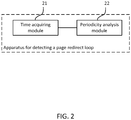
- the apparatus can include: a time acquiring module 21 and a periodicity analysis module 22.
- the time acquiring module 21 may be configured to, for a monitored target page, acquire a sequence of access times at which the target page is accessed, the target page being a node page in a page redirect chain; and the periodicity analysis module 22 is configured to, when it is analyzed that the access time sequence is periodic, determine that a page redirect loop occurs in the page redirect chain where the target page is included.
- the sequence of access times includes the access times at which the same user accesses the target page; alternatively, the sequence of access times includes the access times at which the same device accesses the target page.
- the periodicity analysis module 22 is configured to use a detection method, such as a spectrum analysis-based Fourier analysis, a periodogram based detection method, or a maximum entropy based detection method, to analyze whether the sequence of access times is periodic and to determine that the sequence of access times is periodic.
- a detection method such as a spectrum analysis-based Fourier analysis, a periodogram based detection method, or a maximum entropy based detection method
- the target page includes a PC page, an h5 page, or a native page.
- the apparatus can further include: a warning module 23 configured to send loop alarm information after the periodicity analysis module 22 determines that a page redirect loop occurs in the page redirect chain where the target page is included.
Landscapes
- Engineering & Computer Science (AREA)
- Theoretical Computer Science (AREA)
- Software Systems (AREA)
- General Engineering & Computer Science (AREA)
- General Physics & Mathematics (AREA)
- Physics & Mathematics (AREA)
- Databases & Information Systems (AREA)
- Human Computer Interaction (AREA)
- Data Mining & Analysis (AREA)
- Radar, Positioning & Navigation (AREA)
- Remote Sensing (AREA)
- Quality & Reliability (AREA)
- Information Transfer Between Computers (AREA)
- Debugging And Monitoring (AREA)
- Information Retrieval, Db Structures And Fs Structures Therefor (AREA)
Abstract
Description
- The present invention relates to computer technologies, and in particular, to a method and an apparatus for detecting a page redirect loop.
- In a page display process, page redirection sometimes is performed due to various reasons. For example, when a transaction page is being rendered, if it is detected that a user has not logged in or the user's login has expired, the access to the transaction page can be redirected to a login page. After the user's login succeeds, the access is redirected to the transaction page. In the page redirection process, at least one page is often involved, and a redirect chain may be formed including multiple pages transitioning from one to another, such as A→B→C, which indicates that the access to page A is redirected to page B, and then redirected to page C. However, it is possible that a page redirect loop, such as A→B→C→A→B→C..., occurs due to a processing error on a node page of the redirect chain. This will result in a great pressure on the backend of each page and a waste of processing resources. Therefore, it is very important to quickly and effectively detect a page redirect loop, so as to take measures to fix it timely.
- An existing method for detecting a page redirect loop can be detecting whether a cycle exists in a redirect chain, and determining that a page redirect loop occurs if a cycle exists. However, this method requires acquisition of complete information of the redirect chain. When the chain is relatively long, a large amount of processing resources will be consumed to acquire the information. Moreover, it is sometimes impossible to acquire complete information of a redirect chain. For example, in a scenario of cross-site trusted login, a redirect chain may include sites belonging to different owners, making it difficult to acquire information of the chain, thereby restricting applications of the existing method.
- In view of this, the present invention provides a method and an apparatus for detecting a page redirect loop, enabling the method for detecting a page redirect loop to be simpler and more widely applied.
- For example, the present invention is achieved through the following technical solutions.
- According to a first aspect, a method for detecting a page redirect loop is provided, and the method comprises:
- for a monitored target page, acquiring a sequence of access times at which the target page is accessed, the target page being a node page in a page redirect chain; and
- when the sequence of access times is periodic, determining that a page redirect loop occurs in the page redirect chain where the target page is included.
- According to a second aspect, an apparatus for detecting a page redirect loop is provided, and the apparatus comprises:
- a time acquiring module configured to, for a monitored target page, acquire a sequence of access times at which the target page is accessed, the target page being a node page in a page redirect chain; and
- a period analysis module configured to, when the sequence of access times is periodic, determine that a page redirect loop occurs in the page redirect chain where the target page is included.
- With the method and the apparatus for detecting a page redirect loop according to the present invention, the occurrence of a redirect loop can be determined by monitoring a single node page in a redirect chain and analyzing the sequence of access times at which the single page is accessed. Since this method does not need to acquire the entire redirect chain, it is relatively simple to implement the method and the consumption of system resources is reduced. Moreover, even in a cross-site page redirect scenario, since a loop can be determined by monitoring a single page without acquiring information about other sites, the method can be more widely applied.
-
-
FIG. 1 is a flow chart of a method for detecting a page redirect loop according to some embodiments of the present application; -
FIG. 2 is a schematic structural diagram of an apparatus for detecting a page redirect loop according to some embodiments of the present application; -
FIG. 3 is a schematic structural diagram of another apparatus for detecting a page redirect loop according to some embodiments of the present application. - A page redirect loop means that, during a process of displaying page-type resources, a cycle appears in a redirect chain due to various reasons. For example, in an exemplary redirect chain, such as A→B→C--... A→B→C, transition is repeated among the page A, page B, and page C, which undoubtedly will result in a great pressure on the backend of each page.
- The embodiments of the present application expect to use features of page redirect loops as the basis for detecting and identifying the occurrence of a page redirect loop. Still taking the above-described chain "A→B→C--... A→B→C" that has a page redirect loop as an example, in the circular redirect among the pages, a node page in the pages will be accessed repeatedly. For example, taking the page B as an example, after the page B is first accessed, it will be accessed again after a short time, and again after another short time. The times when the page B is accessed are recorded, and a sequence of access times will thus be formed, such as "t1, t2, t3, ..."
- Moreover, another feature is that the transition chain in a page redirect loop is fixed. In the above example, the circular redirect always happens among the page A, page B, and page C. Therefore, in the time sequence of accesses to the page B, the page B will be accessed repeatedly always at a relatively fixed interval. For example, the access to the page B is periodic in terms of time.
- Based on the above features of a page redirect loop, the embodiments of the present application provide a method for detecting a page redirect loop. The method can determine the occurrence of the page redirect loop by monitoring a node page of the transition chain of the page redirect loop. Taking the above-described circular redirect from the page A to the page C "A→B→C--... A→B→C" as an example, any one of the page A, page B, and page C can be monitored, which is not limited in the present example.
-
FIG. 1 is a flow chart of a method for detecting a page redirect loop. The method can include:
Step 101, for a monitored target page, acquiring a sequence of access times at which the target page is accessed, the target page being a node page in a page redirect chain. - The monitoring method in the present example can be implemented by a monitoring system. When a page is to be monitored, the to-be-monitored page can be added as a monitored object of the monitoring system. For example, in a redirect chain, some of the pages of the chain may experience exception, leading to the occurrence of a redirect loop. This can be determined through a pre-analysis. Namely, in a potential redirect loop, what pages will be accessed in a circular manner can be pre-analyzed. For example, still taking the above-described redirect chain "A→B→C--... A→B→C" as an example, if a page redirect loop occurs, it is very likely that the page B will be accessed in a circular manner in the redirect loop. The monitoring system can be set to initiate monitoring on the page B, and the page B can be referred to as a monitored target page. The target page selected in the present example is a node page of the page redirect chain.
- In this step, in the page transition of a redirect loop, the page B will be accessed repeatedly at an time interval. The monitoring system can obtain a sequence of times of accesses to the page B. For example, the sequence can be t1, t2, t3, ..., tn, indicating that the page B is accessed at the moment of t1, again at the moment of t2, once more at the moment of t3, and so on. The sequence of the times of accesses to the page B can be, for example, obtained by the monitoring system from a page access log recorded at the backend of the page B.
-
Step 102, when it is analyzed that the sequence of access times is periodic, determining that a page redirect loop occurs in the page redirect chain where the target page is included. - In the present example, the monitoring system can analyze the sequence of access times "t1, t2, t3, ..., tn" obtained in the
step 101 to determine whether the access times in the sequence are periodic. For example, assuming that the interval between t1 and t2 is 2 seconds, one ideal situation is that the interval between t2 and t3 is also 2 seconds, so is the interval between t3 and t4, and so on. In other words, the page B is accessed at a fixed interval of 2 seconds, and then it can be determined that the sequence of access times is periodic. - However, the above-described intervals between the access times in the sequence may typically be different. For example, the interval between t1 and t2 is 2 seconds, the interval between t2 and t3 is 1.8 seconds, the interval between t3 and t4 is 2.1 seconds, etc. The sequence of access times is "2, 1.8, 2.1, 2.2, 1.9, ...," i.e., the intervals among the access times fluctuate within a range. Overall, the intervals are stable around a fixed value. Therefore, the sequence of access times can also be regarded to be periodic.
- In the present example, a number of methods for monitoring periodicity of time sequences can be used, e.g., a spectrum analysis-based Fourier analysis, a periodogram based detection method, a maximum entropy based detection method, etc., to identify whether the above-described time sequence is periodic and to determine the occurrence of a loop with a level of confidence and an accuracy.
- In one example, in the process of detecting the periodicity of a time sequence, a period length of the time sequence can be determined. For example, some possible period lengths can be preset and referred to as candidate period values; a level of confidence and a period threshold value can be set for period lengths, and the level of confidence for the candidate period values can be greater than or equal to a given period threshold value. The period's confidence for a time sequence indicates the number of times in a row that a pattern appears before the time sequence can be regarded as periodic. A periodic time sequence may allow some noises to exist therein, but the noises cannot appear more than a number of times. If the noises occur in the time sequence more than a number of times, the periodicity may no longer exist in the time sequence.
- In addition, in the present example, the page B is a node page in the page redirect chain. When the sequence of access times of the page B is determined to be periodic, it can be determined that a page redirect loop occurs in the redirect chain where the page B is included.
- After the monitoring system determines the occurrence of a page redirect loop, the monitoring system can take measures to warn against the occurrence of the redirect loop and can send redirect loop alarm information. For example, the redirect loop alarm information can include a text message or email notice sent to relevant technical personnel, so that the technical personnel decides on corresponding subsequent processing measures. Alternatively, the monitoring system can determine that, when the occurrence of the redirect loop is detected, new access requests are automatically rejected. In one example, an agent module can be provided in a transaction system to which the page belongs, and the agent module can receive requests to access the page and perform corresponding processing. When the monitoring system determines, by using the detection method according to the present application, that a page redirect loop occurs in the redirect chain where the page is included, alarm information can be sent to the agent module to notify the agent module, and the agent module rejects an access to the page when the agent module receives a request to access the page afterward.
- In the detection method according to the embodiments of the present application, the occurrence of a redirect loop can be determined by monitoring a single node page in a redirect chain and analyzing the sequence of access times of the single page. Since this method does not need to acquire the entire redirect chain, it is relatively simple to implement the method and the consumption of system resources is reduced. Moreover, even in a cross-site page redirect scenario, since a loop can be determined by monitoring a single page without acquiring information about other sites, the method can be more widely applied.
- In one example, the sequence of access times of a target page obtained by the monitoring system can be a sequence of access times recorded in a user dimension or in a device dimension. For example, the sequence of access times can be a sequence of the access times at which the same user accesses the page B; alternatively, the sequence of access times can be a sequence of access times at which the same device accesses the page B. In some other examples, the access time sequence can be access times recorded in other dimensions.
- For example, a user goes online on his/her personal computer and accesses some sites. A page redirect loop occurs during the access process. The redirect loop can be "g1-g2-g3-g1-g2-g3..." A backend access log corresponding to one page records access information of the page. The access information of the page can include a variety of information, such as an account number of a user accessing the page (e.g., when a user logs in an account registered with a website and then accesses a page of the website, account information of the user accessing the page can be recorded in the log), an identifier of a device accessing the page (e.g., a unique hardware identifier of a computer used by the user), an access time when the page is accessed, and the like. When the redirect loop occurs, a node page can be repeatedly accessed, and the above-described access information can be recorded at each access.
- In an exemplary implementation, what information to be recorded can be flexibly set. For example, in the recording manner based on a user dimension, identifiers of devices accessing the page are not recorded; instead, the times are recorded when a user accesses the page. This way, when the sequence of the access times of the page is to be obtained subsequently, the access times corresponding to the same user's identifier can be found based on the user's identifier, and therefore the sequence of the access times can be obtained. In another example, records can be made based on an device dimension, in which manner identifiers of users accessing the page are not recorded; instead, the times are recorded when a device accesses the page. This way, when the sequence of access times of the page is to be obtained subsequently, the access times corresponding to the same device's identifier can be found based on the device's identifier, and therefore the sequence of the access times can be obtained. In still another example, users and devices accessing the page can be both recorded in the access information, while a sequence of access times can be obtained from a log by selecting a search based on a user dimension or a search based on a device dimension.
- In addition, a variety of pages may experience a page redirect loop in the embodiments of the present application, such as Personal Computer (PC) pages identified by a Uniform Resource Locator (URL) (i.e., pages having URL addresses), HTML5 (h5) pages, or native pages; alternatively, the pages can be page resources having non-URL identifiers.
- To implement the above-described detection method, the embodiments of the present application further provide an apparatus for detecting a page redirect loop. As shown in
FIG. 2 , the apparatus can include: atime acquiring module 21 and aperiodicity analysis module 22. Thetime acquiring module 21 may be configured to, for a monitored target page, acquire a sequence of access times at which the target page is accessed, the target page being a node page in a page redirect chain; and
theperiodicity analysis module 22 is configured to, when it is analyzed that the access time sequence is periodic, determine that a page redirect loop occurs in the page redirect chain where the target page is included. - In some examples, the sequence of access times includes the access times at which the same user accesses the target page; alternatively, the sequence of access times includes the access times at which the same device accesses the target page.
- In some examples, the
periodicity analysis module 22 is configured to use a detection method, such as a spectrum analysis-based Fourier analysis, a periodogram based detection method, or a maximum entropy based detection method, to analyze whether the sequence of access times is periodic and to determine that the sequence of access times is periodic. - In some examples, the target page includes a PC page, an h5 page, or a native page.
- In some examples, as shown in
FIG. 3 , the apparatus can further include: a warningmodule 23 configured to send loop alarm information after theperiodicity analysis module 22 determines that a page redirect loop occurs in the page redirect chain where the target page is included. - The above-described is only embodiments of the present invention, which are not used to limit the present invention. Any modification, equivalent substitution or improvement made within the spirit and principle of the present invention shall be encompassed by the protection scope of the present invention.
Claims (12)
- A method for detecting a page redirect loop, comprising:for a monitored target page, acquiring a sequence of access times at which the target page is accessed, the target page being a node page in a page redirect chain; andwhen the sequence of access times is periodic, determining that a page redirect loop occurs in the page redirect chain where the target page is included.
- The method according to claim 1, wherein the sequence of access times comprises:a sequence of access times at which a same access user accesses the target page;or a sequence of access times at which a same access device accesses the target page.
- The method according to claim 1, further comprising analyzing whether the sequence of access times is periodic, which comprises:
using a spectrum analysis based Fourier analysis, a periodogram detection method, or a maximum entropy detection method to analyze whether the sequence of access times is periodic and to determine that the sequence of access times is periodic. - The method according to claim 1, wherein the target page includes a Personal Computer (PC) page.
- The method according to claim 1, wherein the target page includes an HTML5 (h5) page or a native page.
- The method according to claim 1, wherein, after determining that a page redirect loop occurs in the page redirect chain where the target page is included, the method further comprises: sending loop alarm information.
- An apparatus for detecting a page redirect loop, comprising:a time acquiring module configured to, for a monitored target page, acquire a sequence of access times at which the target page is accessed, the target page being a node page in a page redirect chain; anda period analysis module configured to, when the sequence of access times is periodic, determine that a page redirect loop occurs in the page redirect chain where the target page is included.
- The apparatus according to claim 7, wherein the sequence of access times comprises:a sequence of access times at which a same access user accesses the target page;or a sequence of access times at which a same access device accesses the target page.
- The apparatus according to claim 7, wherein
the period analysis module is configured to use a spectrum analysis based Fourier analysis, a periodogram detection method, or a maximum entropy detection method to analyze whether the sequence of access times is periodic and to determine that the sequence of access times is periodic. - The apparatus according to claim 7, wherein the target page includes a Personal Computer (PC) page.
- The apparatus according to claim 7, wherein the target page includes an HTML (h5) page or a native page.
- The apparatus according to claim 7, wherein the apparatus further comprises:
an alarm processing module configured to send loop alarm information after the period analysis module determines that a page redirect loop occurs in the page redirect chain where the target page is included.
Applications Claiming Priority (2)
| Application Number | Priority Date | Filing Date | Title |
|---|---|---|---|
| CN201610949251.3A CN107025107A (en) | 2016-10-24 | 2016-10-24 | The detection method and device of a kind of page reorientation circulation |
| PCT/CN2017/106539 WO2018077072A1 (en) | 2016-10-24 | 2017-10-17 | Method and apparatus for detecting page redirection circulation |
Publications (3)
| Publication Number | Publication Date |
|---|---|
| EP3531279A1 true EP3531279A1 (en) | 2019-08-28 |
| EP3531279A4 EP3531279A4 (en) | 2020-06-24 |
| EP3531279B1 EP3531279B1 (en) | 2025-10-22 |
Family
ID=59525173
Family Applications (1)
| Application Number | Title | Priority Date | Filing Date |
|---|---|---|---|
| EP17864138.7A Active EP3531279B1 (en) | 2016-10-24 | 2017-10-17 | Method and apparatus for detecting page redirect loop |
Country Status (9)
| Country | Link |
|---|---|
| US (1) | US20190251130A1 (en) |
| EP (1) | EP3531279B1 (en) |
| JP (1) | JP6871372B2 (en) |
| KR (1) | KR102233525B1 (en) |
| CN (1) | CN107025107A (en) |
| MY (1) | MY189859A (en) |
| PH (1) | PH12019500900A1 (en) |
| TW (1) | TWI671646B (en) |
| WO (1) | WO2018077072A1 (en) |
Families Citing this family (2)
| Publication number | Priority date | Publication date | Assignee | Title |
|---|---|---|---|---|
| CN107025107A (en) * | 2016-10-24 | 2017-08-08 | 阿里巴巴集团控股有限公司 | The detection method and device of a kind of page reorientation circulation |
| CN111368169B (en) * | 2018-12-25 | 2023-08-01 | 卓望数码技术(深圳)有限公司 | Method, device, equipment and storage medium for detecting brushing amount behavior |
Family Cites Families (18)
| Publication number | Priority date | Publication date | Assignee | Title |
|---|---|---|---|---|
| JP2002108382A (en) * | 2000-09-27 | 2002-04-10 | Sony Corp | Animation method and apparatus for performing lip sync |
| US7441026B2 (en) | 2003-07-10 | 2008-10-21 | Sun Microsystems, Inc. | System and method for guarding against infinite loops from multi-point redirects in a multi-threaded environment |
| US20070280238A1 (en) * | 2006-05-30 | 2007-12-06 | Martin Lund | Method and system for passive loop detection and prevention in a packet network switch |
| US8291411B2 (en) * | 2007-05-21 | 2012-10-16 | International Business Machines Corporation | Dynamic placement of virtual machines for managing violations of service level agreements (SLAs) |
| US20090064001A1 (en) * | 2007-08-30 | 2009-03-05 | Nicole Summers Robbins | Personalizing Default Settings on a GUI |
| US8706811B2 (en) * | 2008-09-30 | 2014-04-22 | Lenovo (Singapore) Pte. Ltd. | Preventing redirection loops during collaborative web browsing |
| US9015226B2 (en) | 2011-01-06 | 2015-04-21 | Oracle International Corporation | Techniques for detecting new browser windows |
| CN103678364B (en) * | 2012-09-13 | 2020-01-21 | 创新先进技术有限公司 | A method and device for dynamically detecting an infinite loop of URL redirection |
| CN103051722B (en) * | 2012-12-26 | 2015-10-14 | 新浪网技术(中国)有限公司 | A kind ofly determine the method whether page is held as a hostage and relevant device |
| CN104111944B (en) * | 2013-04-19 | 2018-09-18 | 阿里巴巴集团控股有限公司 | Page processing method and device and page generation method and device |
| US20150066615A1 (en) * | 2013-08-28 | 2015-03-05 | Devkumar Gandhi | Method for syndicating posts on a social network site |
| CN104468852A (en) * | 2013-09-18 | 2015-03-25 | 腾讯科技(北京)有限公司 | Method, device and system for client to select IP link address |
| KR101518474B1 (en) | 2013-12-30 | 2015-05-07 | 주식회사 플랜티넷 | Method for selectively permitting/blocking a plurality of internet request traffics sharing the public IP address on the basis of current time and system for detecting and blocking internet request traffics sharing the public IP address on the current time |
| CN104881603B (en) * | 2014-02-27 | 2018-07-03 | 腾讯科技(深圳)有限公司 | Webpage redirects leak detection method and device |
| CN103888465B (en) * | 2014-03-28 | 2017-07-18 | 新浪网技术(中国)有限公司 | A kind of webpage kidnaps detection method and device |
| JP2015232780A (en) * | 2014-06-09 | 2015-12-24 | キヤノン株式会社 | Information processing apparatus and system, management apparatus, and power state control method |
| US10044576B2 (en) * | 2015-11-25 | 2018-08-07 | Qualcomm Incorporated | Estimation of power consumption of individual websites |
| CN107025107A (en) * | 2016-10-24 | 2017-08-08 | 阿里巴巴集团控股有限公司 | The detection method and device of a kind of page reorientation circulation |
-
2016
- 2016-10-24 CN CN201610949251.3A patent/CN107025107A/en active Pending
-
2017
- 2017-09-13 TW TW106131353A patent/TWI671646B/en active
- 2017-10-17 JP JP2019522259A patent/JP6871372B2/en active Active
- 2017-10-17 EP EP17864138.7A patent/EP3531279B1/en active Active
- 2017-10-17 WO PCT/CN2017/106539 patent/WO2018077072A1/en not_active Ceased
- 2017-10-17 KR KR1020197014022A patent/KR102233525B1/en active Active
- 2017-10-17 MY MYPI2019002254A patent/MY189859A/en unknown
-
2019
- 2019-04-23 US US16/391,779 patent/US20190251130A1/en not_active Abandoned
- 2019-04-24 PH PH12019500900A patent/PH12019500900A1/en unknown
Also Published As
| Publication number | Publication date |
|---|---|
| PH12019500900A1 (en) | 2020-01-20 |
| US20190251130A1 (en) | 2019-08-15 |
| JP6871372B2 (en) | 2021-05-12 |
| TWI671646B (en) | 2019-09-11 |
| WO2018077072A1 (en) | 2018-05-03 |
| TW201816628A (en) | 2018-05-01 |
| JP2019533255A (en) | 2019-11-14 |
| KR102233525B1 (en) | 2021-03-30 |
| MY189859A (en) | 2022-03-14 |
| KR20190069501A (en) | 2019-06-19 |
| EP3531279B1 (en) | 2025-10-22 |
| EP3531279A4 (en) | 2020-06-24 |
| CN107025107A (en) | 2017-08-08 |
Similar Documents
| Publication | Publication Date | Title |
|---|---|---|
| US11233819B2 (en) | Method and apparatus for analyzing cyberattack | |
| EP3026864B1 (en) | Method and device for identifying bot access | |
| CN110888783A (en) | Monitoring method and device of micro-service system and electronic equipment | |
| CN105488398B (en) | Web application behavior extracting method and malicious act detection method | |
| US8275581B2 (en) | Managing statistical profile data | |
| CN107085549B (en) | Method and device for generating fault information | |
| CN112003838A (en) | Network threat detection method, device, electronic device and storage medium | |
| CN109344046B (en) | Data processing method, device, medium and electronic equipment | |
| SA521430199B1 (en) | Rule Based System and Method for Detecting and Identifying Tampering in Security Analysis | |
| US10305760B2 (en) | Identifying an analysis reporting message in network traffic | |
| US9935812B1 (en) | Performance evaluation of applications that access external resources | |
| EP3531279B1 (en) | Method and apparatus for detecting page redirect loop | |
| CN115190108B (en) | Method, device, medium and electronic equipment for detecting monitored equipment | |
| US20160050101A1 (en) | Real-Time Network Monitoring and Alerting | |
| KR101725404B1 (en) | Method and apparatus for testing web site | |
| EP4338373A1 (en) | Anomalous and suspicious role assignment determinations | |
| CN106911635A (en) | A kind of method and device of detection website with the presence or absence of backdoor programs | |
| CN107870848B (en) | Method, device and system for detecting CPU performance conflict | |
| CN113609411A (en) | Method for crawling page information through web crawler | |
| CN114090310B (en) | Abnormality detection method and device | |
| CN114417314B (en) | Alarm information analysis methods, devices, electronic equipment and storage media | |
| GB2505529A (en) | Protecting a user from compromised web resources | |
| CN115277224A (en) | Method and device for determining application protection rule, storage medium and electronic equipment | |
| CN111131370B (en) | Method, device and system for detecting whether service call is correct | |
| CN112541183A (en) | Data processing method and device, edge computing equipment and storage medium |
Legal Events
| Date | Code | Title | Description |
|---|---|---|---|
| STAA | Information on the status of an ep patent application or granted ep patent |
Free format text: STATUS: THE INTERNATIONAL PUBLICATION HAS BEEN MADE |
|
| PUAI | Public reference made under article 153(3) epc to a published international application that has entered the european phase |
Free format text: ORIGINAL CODE: 0009012 |
|
| STAA | Information on the status of an ep patent application or granted ep patent |
Free format text: STATUS: REQUEST FOR EXAMINATION WAS MADE |
|
| 17P | Request for examination filed |
Effective date: 20190429 |
|
| AK | Designated contracting states |
Kind code of ref document: A1 Designated state(s): AL AT BE BG CH CY CZ DE DK EE ES FI FR GB GR HR HU IE IS IT LI LT LU LV MC MK MT NL NO PL PT RO RS SE SI SK SM TR |
|
| AX | Request for extension of the european patent |
Extension state: BA ME |
|
| DAV | Request for validation of the european patent (deleted) | ||
| DAX | Request for extension of the european patent (deleted) | ||
| A4 | Supplementary search report drawn up and despatched |
Effective date: 20200525 |
|
| RIC1 | Information provided on ipc code assigned before grant |
Ipc: G06F 9/451 20180101ALI20200516BHEP Ipc: G06F 9/44 20180101AFI20200516BHEP Ipc: G06F 16/95 20190101ALI20200516BHEP Ipc: G06F 11/07 20060101ALI20200516BHEP Ipc: G06F 16/957 20190101ALI20200516BHEP |
|
| RAP1 | Party data changed (applicant data changed or rights of an application transferred) |
Owner name: ADVANCED NEW TECHNOLOGIES CO., LTD. |
|
| STAA | Information on the status of an ep patent application or granted ep patent |
Free format text: STATUS: EXAMINATION IS IN PROGRESS |
|
| 17Q | First examination report despatched |
Effective date: 20210929 |
|
| P01 | Opt-out of the competence of the unified patent court (upc) registered |
Effective date: 20230512 |
|
| RAP1 | Party data changed (applicant data changed or rights of an application transferred) |
Owner name: ADVANCED NOVA TECHNOLOGIES (SINGAPORE) HOLDING PTE. LTD. |
|
| GRAP | Despatch of communication of intention to grant a patent |
Free format text: ORIGINAL CODE: EPIDOSNIGR1 |
|
| STAA | Information on the status of an ep patent application or granted ep patent |
Free format text: STATUS: GRANT OF PATENT IS INTENDED |
|
| INTG | Intention to grant announced |
Effective date: 20250507 |
|
| GRAS | Grant fee paid |
Free format text: ORIGINAL CODE: EPIDOSNIGR3 |
|
| GRAA | (expected) grant |
Free format text: ORIGINAL CODE: 0009210 |
|
| STAA | Information on the status of an ep patent application or granted ep patent |
Free format text: STATUS: THE PATENT HAS BEEN GRANTED |
|
| AK | Designated contracting states |
Kind code of ref document: B1 Designated state(s): AL AT BE BG CH CY CZ DE DK EE ES FI FR GB GR HR HU IE IS IT LI LT LU LV MC MK MT NL NO PL PT RO RS SE SI SK SM TR |
|
| REG | Reference to a national code |
Ref country code: CH Ref legal event code: F10 Free format text: ST27 STATUS EVENT CODE: U-0-0-F10-F00 (AS PROVIDED BY THE NATIONAL OFFICE) Effective date: 20251022 Ref country code: GB Ref legal event code: FG4D |
|
| REG | Reference to a national code |
Ref country code: DE Ref legal event code: R096 Ref document number: 602017092341 Country of ref document: DE |
|
| REG | Reference to a national code |
Ref country code: IE Ref legal event code: FG4D |
|
| REG | Reference to a national code |
Ref country code: NL Ref legal event code: MP Effective date: 20251022 |
|
| PG25 | Lapsed in a contracting state [announced via postgrant information from national office to epo] |
Ref country code: NL Free format text: LAPSE BECAUSE OF FAILURE TO SUBMIT A TRANSLATION OF THE DESCRIPTION OR TO PAY THE FEE WITHIN THE PRESCRIBED TIME-LIMIT Effective date: 20251022 |
|
| PG25 | Lapsed in a contracting state [announced via postgrant information from national office to epo] |
Ref country code: ES Free format text: LAPSE BECAUSE OF FAILURE TO SUBMIT A TRANSLATION OF THE DESCRIPTION OR TO PAY THE FEE WITHIN THE PRESCRIBED TIME-LIMIT Effective date: 20251022 |
|
| REG | Reference to a national code |
Ref country code: LT Ref legal event code: MG9D |
|
| PG25 | Lapsed in a contracting state [announced via postgrant information from national office to epo] |
Ref country code: NO Free format text: LAPSE BECAUSE OF FAILURE TO SUBMIT A TRANSLATION OF THE DESCRIPTION OR TO PAY THE FEE WITHIN THE PRESCRIBED TIME-LIMIT Effective date: 20260122 |
|
| PG25 | Lapsed in a contracting state [announced via postgrant information from national office to epo] |
Ref country code: AT Free format text: LAPSE BECAUSE OF FAILURE TO SUBMIT A TRANSLATION OF THE DESCRIPTION OR TO PAY THE FEE WITHIN THE PRESCRIBED TIME-LIMIT Effective date: 20251022 Ref country code: FI Free format text: LAPSE BECAUSE OF FAILURE TO SUBMIT A TRANSLATION OF THE DESCRIPTION OR TO PAY THE FEE WITHIN THE PRESCRIBED TIME-LIMIT Effective date: 20251022 Ref country code: HR Free format text: LAPSE BECAUSE OF FAILURE TO SUBMIT A TRANSLATION OF THE DESCRIPTION OR TO PAY THE FEE WITHIN THE PRESCRIBED TIME-LIMIT Effective date: 20251022 |
|
| REG | Reference to a national code |
Ref country code: AT Ref legal event code: MK05 Ref document number: 1849731 Country of ref document: AT Kind code of ref document: T Effective date: 20251022 |
|
| PG25 | Lapsed in a contracting state [announced via postgrant information from national office to epo] |
Ref country code: RS Free format text: LAPSE BECAUSE OF FAILURE TO SUBMIT A TRANSLATION OF THE DESCRIPTION OR TO PAY THE FEE WITHIN THE PRESCRIBED TIME-LIMIT Effective date: 20260122 |
|
| PG25 | Lapsed in a contracting state [announced via postgrant information from national office to epo] |
Ref country code: IS Free format text: LAPSE BECAUSE OF FAILURE TO SUBMIT A TRANSLATION OF THE DESCRIPTION OR TO PAY THE FEE WITHIN THE PRESCRIBED TIME-LIMIT Effective date: 20260222 |
|
| PG25 | Lapsed in a contracting state [announced via postgrant information from national office to epo] |
Ref country code: PT Free format text: LAPSE BECAUSE OF FAILURE TO SUBMIT A TRANSLATION OF THE DESCRIPTION OR TO PAY THE FEE WITHIN THE PRESCRIBED TIME-LIMIT Effective date: 20260223 |
|
| PG25 | Lapsed in a contracting state [announced via postgrant information from national office to epo] |
Ref country code: PL Free format text: LAPSE BECAUSE OF FAILURE TO SUBMIT A TRANSLATION OF THE DESCRIPTION OR TO PAY THE FEE WITHIN THE PRESCRIBED TIME-LIMIT Effective date: 20251022 |
|
| PG25 | Lapsed in a contracting state [announced via postgrant information from national office to epo] |
Ref country code: LV Free format text: LAPSE BECAUSE OF FAILURE TO SUBMIT A TRANSLATION OF THE DESCRIPTION OR TO PAY THE FEE WITHIN THE PRESCRIBED TIME-LIMIT Effective date: 20251022 |
|
| PG25 | Lapsed in a contracting state [announced via postgrant information from national office to epo] |
Ref country code: BG Free format text: LAPSE BECAUSE OF FAILURE TO SUBMIT A TRANSLATION OF THE DESCRIPTION OR TO PAY THE FEE WITHIN THE PRESCRIBED TIME-LIMIT Effective date: 20251022 |