EP3530775A1 - Metal corrosion suppressing method - Google Patents
Metal corrosion suppressing method Download PDFInfo
- Publication number
- EP3530775A1 EP3530775A1 EP17856203.9A EP17856203A EP3530775A1 EP 3530775 A1 EP3530775 A1 EP 3530775A1 EP 17856203 A EP17856203 A EP 17856203A EP 3530775 A1 EP3530775 A1 EP 3530775A1
- Authority
- EP
- European Patent Office
- Prior art keywords
- oil
- gas
- hydrocarbon
- aldehyde
- group
- Prior art date
- Legal status (The legal status is an assumption and is not a legal conclusion. Google has not performed a legal analysis and makes no representation as to the accuracy of the status listed.)
- Withdrawn
Links
Images

Classifications
-
- C—CHEMISTRY; METALLURGY
- C10—PETROLEUM, GAS OR COKE INDUSTRIES; TECHNICAL GASES CONTAINING CARBON MONOXIDE; FUELS; LUBRICANTS; PEAT
- C10G—CRACKING HYDROCARBON OILS; PRODUCTION OF LIQUID HYDROCARBON MIXTURES, e.g. BY DESTRUCTIVE HYDROGENATION, OLIGOMERISATION, POLYMERISATION; RECOVERY OF HYDROCARBON OILS FROM OIL-SHALE, OIL-SAND, OR GASES; REFINING MIXTURES MAINLY CONSISTING OF HYDROCARBONS; REFORMING OF NAPHTHA; MINERAL WAXES
- C10G75/00—Inhibiting corrosion or fouling in apparatus for treatment or conversion of hydrocarbon oils, in general
- C10G75/02—Inhibiting corrosion or fouling in apparatus for treatment or conversion of hydrocarbon oils, in general by addition of corrosion inhibitors
-
- C—CHEMISTRY; METALLURGY
- C23—COATING METALLIC MATERIAL; COATING MATERIAL WITH METALLIC MATERIAL; CHEMICAL SURFACE TREATMENT; DIFFUSION TREATMENT OF METALLIC MATERIAL; COATING BY VACUUM EVAPORATION, BY SPUTTERING, BY ION IMPLANTATION OR BY CHEMICAL VAPOUR DEPOSITION, IN GENERAL; INHIBITING CORROSION OF METALLIC MATERIAL OR INCRUSTATION IN GENERAL
- C23F—NON-MECHANICAL REMOVAL OF METALLIC MATERIAL FROM SURFACE; INHIBITING CORROSION OF METALLIC MATERIAL OR INCRUSTATION IN GENERAL; MULTI-STEP PROCESSES FOR SURFACE TREATMENT OF METALLIC MATERIAL INVOLVING AT LEAST ONE PROCESS PROVIDED FOR IN CLASS C23 AND AT LEAST ONE PROCESS COVERED BY SUBCLASS C21D OR C22F OR CLASS C25
- C23F11/00—Inhibiting corrosion of metallic material by applying inhibitors to the surface in danger of corrosion or adding them to the corrosive agent
- C23F11/08—Inhibiting corrosion of metallic material by applying inhibitors to the surface in danger of corrosion or adding them to the corrosive agent in other liquids
- C23F11/10—Inhibiting corrosion of metallic material by applying inhibitors to the surface in danger of corrosion or adding them to the corrosive agent in other liquids using organic inhibitors
- C23F11/12—Oxygen-containing compounds
- C23F11/122—Alcohols; Aldehydes; Ketones
-
- C—CHEMISTRY; METALLURGY
- C09—DYES; PAINTS; POLISHES; NATURAL RESINS; ADHESIVES; COMPOSITIONS NOT OTHERWISE PROVIDED FOR; APPLICATIONS OF MATERIALS NOT OTHERWISE PROVIDED FOR
- C09K—MATERIALS FOR MISCELLANEOUS APPLICATIONS, NOT PROVIDED FOR ELSEWHERE
- C09K15/00—Anti-oxidant compositions; Compositions inhibiting chemical change
- C09K15/04—Anti-oxidant compositions; Compositions inhibiting chemical change containing organic compounds
- C09K15/06—Anti-oxidant compositions; Compositions inhibiting chemical change containing organic compounds containing oxygen
-
- C—CHEMISTRY; METALLURGY
- C10—PETROLEUM, GAS OR COKE INDUSTRIES; TECHNICAL GASES CONTAINING CARBON MONOXIDE; FUELS; LUBRICANTS; PEAT
- C10G—CRACKING HYDROCARBON OILS; PRODUCTION OF LIQUID HYDROCARBON MIXTURES, e.g. BY DESTRUCTIVE HYDROGENATION, OLIGOMERISATION, POLYMERISATION; RECOVERY OF HYDROCARBON OILS FROM OIL-SHALE, OIL-SAND, OR GASES; REFINING MIXTURES MAINLY CONSISTING OF HYDROCARBONS; REFORMING OF NAPHTHA; MINERAL WAXES
- C10G7/00—Distillation of hydrocarbon oils
- C10G7/10—Inhibiting corrosion during distillation
-
- C—CHEMISTRY; METALLURGY
- C10—PETROLEUM, GAS OR COKE INDUSTRIES; TECHNICAL GASES CONTAINING CARBON MONOXIDE; FUELS; LUBRICANTS; PEAT
- C10G—CRACKING HYDROCARBON OILS; PRODUCTION OF LIQUID HYDROCARBON MIXTURES, e.g. BY DESTRUCTIVE HYDROGENATION, OLIGOMERISATION, POLYMERISATION; RECOVERY OF HYDROCARBON OILS FROM OIL-SHALE, OIL-SAND, OR GASES; REFINING MIXTURES MAINLY CONSISTING OF HYDROCARBONS; REFORMING OF NAPHTHA; MINERAL WAXES
- C10G9/00—Thermal non-catalytic cracking, in the absence of hydrogen, of hydrocarbon oils
- C10G9/14—Thermal non-catalytic cracking, in the absence of hydrogen, of hydrocarbon oils in pipes or coils with or without auxiliary means, e.g. digesters, soaking drums, expansion means
- C10G9/16—Preventing or removing incrustation
-
- C—CHEMISTRY; METALLURGY
- C10—PETROLEUM, GAS OR COKE INDUSTRIES; TECHNICAL GASES CONTAINING CARBON MONOXIDE; FUELS; LUBRICANTS; PEAT
- C10L—FUELS NOT OTHERWISE PROVIDED FOR; NATURAL GAS; SYNTHETIC NATURAL GAS OBTAINED BY PROCESSES NOT COVERED BY SUBCLASSES C10G OR C10K; LIQUIFIED PETROLEUM GAS; USE OF ADDITIVES TO FUELS OR FIRES; FIRE-LIGHTERS
- C10L10/00—Use of additives to fuels or fires for particular purposes
- C10L10/04—Use of additives to fuels or fires for particular purposes for minimising corrosion or incrustation
-
- C—CHEMISTRY; METALLURGY
- C23—COATING METALLIC MATERIAL; COATING MATERIAL WITH METALLIC MATERIAL; CHEMICAL SURFACE TREATMENT; DIFFUSION TREATMENT OF METALLIC MATERIAL; COATING BY VACUUM EVAPORATION, BY SPUTTERING, BY ION IMPLANTATION OR BY CHEMICAL VAPOUR DEPOSITION, IN GENERAL; INHIBITING CORROSION OF METALLIC MATERIAL OR INCRUSTATION IN GENERAL
- C23F—NON-MECHANICAL REMOVAL OF METALLIC MATERIAL FROM SURFACE; INHIBITING CORROSION OF METALLIC MATERIAL OR INCRUSTATION IN GENERAL; MULTI-STEP PROCESSES FOR SURFACE TREATMENT OF METALLIC MATERIAL INVOLVING AT LEAST ONE PROCESS PROVIDED FOR IN CLASS C23 AND AT LEAST ONE PROCESS COVERED BY SUBCLASS C21D OR C22F OR CLASS C25
- C23F11/00—Inhibiting corrosion of metallic material by applying inhibitors to the surface in danger of corrosion or adding them to the corrosive agent
- C23F11/04—Inhibiting corrosion of metallic material by applying inhibitors to the surface in danger of corrosion or adding them to the corrosive agent in markedly acid liquids
-
- C—CHEMISTRY; METALLURGY
- C23—COATING METALLIC MATERIAL; COATING MATERIAL WITH METALLIC MATERIAL; CHEMICAL SURFACE TREATMENT; DIFFUSION TREATMENT OF METALLIC MATERIAL; COATING BY VACUUM EVAPORATION, BY SPUTTERING, BY ION IMPLANTATION OR BY CHEMICAL VAPOUR DEPOSITION, IN GENERAL; INHIBITING CORROSION OF METALLIC MATERIAL OR INCRUSTATION IN GENERAL
- C23F—NON-MECHANICAL REMOVAL OF METALLIC MATERIAL FROM SURFACE; INHIBITING CORROSION OF METALLIC MATERIAL OR INCRUSTATION IN GENERAL; MULTI-STEP PROCESSES FOR SURFACE TREATMENT OF METALLIC MATERIAL INVOLVING AT LEAST ONE PROCESS PROVIDED FOR IN CLASS C23 AND AT LEAST ONE PROCESS COVERED BY SUBCLASS C21D OR C22F OR CLASS C25
- C23F11/00—Inhibiting corrosion of metallic material by applying inhibitors to the surface in danger of corrosion or adding them to the corrosive agent
- C23F11/08—Inhibiting corrosion of metallic material by applying inhibitors to the surface in danger of corrosion or adding them to the corrosive agent in other liquids
- C23F11/10—Inhibiting corrosion of metallic material by applying inhibitors to the surface in danger of corrosion or adding them to the corrosive agent in other liquids using organic inhibitors
- C23F11/12—Oxygen-containing compounds
-
- C—CHEMISTRY; METALLURGY
- C09—DYES; PAINTS; POLISHES; NATURAL RESINS; ADHESIVES; COMPOSITIONS NOT OTHERWISE PROVIDED FOR; APPLICATIONS OF MATERIALS NOT OTHERWISE PROVIDED FOR
- C09K—MATERIALS FOR MISCELLANEOUS APPLICATIONS, NOT PROVIDED FOR ELSEWHERE
- C09K2208/00—Aspects relating to compositions of drilling or well treatment fluids
- C09K2208/20—Hydrogen sulfide elimination
-
- C—CHEMISTRY; METALLURGY
- C09—DYES; PAINTS; POLISHES; NATURAL RESINS; ADHESIVES; COMPOSITIONS NOT OTHERWISE PROVIDED FOR; APPLICATIONS OF MATERIALS NOT OTHERWISE PROVIDED FOR
- C09K—MATERIALS FOR MISCELLANEOUS APPLICATIONS, NOT PROVIDED FOR ELSEWHERE
- C09K2208/00—Aspects relating to compositions of drilling or well treatment fluids
- C09K2208/32—Anticorrosion additives
-
- C—CHEMISTRY; METALLURGY
- C10—PETROLEUM, GAS OR COKE INDUSTRIES; TECHNICAL GASES CONTAINING CARBON MONOXIDE; FUELS; LUBRICANTS; PEAT
- C10G—CRACKING HYDROCARBON OILS; PRODUCTION OF LIQUID HYDROCARBON MIXTURES, e.g. BY DESTRUCTIVE HYDROGENATION, OLIGOMERISATION, POLYMERISATION; RECOVERY OF HYDROCARBON OILS FROM OIL-SHALE, OIL-SAND, OR GASES; REFINING MIXTURES MAINLY CONSISTING OF HYDROCARBONS; REFORMING OF NAPHTHA; MINERAL WAXES
- C10G2300/00—Aspects relating to hydrocarbon processing covered by groups C10G1/00 - C10G99/00
- C10G2300/20—Characteristics of the feedstock or the products
- C10G2300/201—Impurities
- C10G2300/207—Acid gases, e.g. H2S, COS, SO2, HCN
-
- C—CHEMISTRY; METALLURGY
- C10—PETROLEUM, GAS OR COKE INDUSTRIES; TECHNICAL GASES CONTAINING CARBON MONOXIDE; FUELS; LUBRICANTS; PEAT
- C10G—CRACKING HYDROCARBON OILS; PRODUCTION OF LIQUID HYDROCARBON MIXTURES, e.g. BY DESTRUCTIVE HYDROGENATION, OLIGOMERISATION, POLYMERISATION; RECOVERY OF HYDROCARBON OILS FROM OIL-SHALE, OIL-SAND, OR GASES; REFINING MIXTURES MAINLY CONSISTING OF HYDROCARBONS; REFORMING OF NAPHTHA; MINERAL WAXES
- C10G2300/00—Aspects relating to hydrocarbon processing covered by groups C10G1/00 - C10G99/00
- C10G2300/80—Additives
-
- C—CHEMISTRY; METALLURGY
- C10—PETROLEUM, GAS OR COKE INDUSTRIES; TECHNICAL GASES CONTAINING CARBON MONOXIDE; FUELS; LUBRICANTS; PEAT
- C10G—CRACKING HYDROCARBON OILS; PRODUCTION OF LIQUID HYDROCARBON MIXTURES, e.g. BY DESTRUCTIVE HYDROGENATION, OLIGOMERISATION, POLYMERISATION; RECOVERY OF HYDROCARBON OILS FROM OIL-SHALE, OIL-SAND, OR GASES; REFINING MIXTURES MAINLY CONSISTING OF HYDROCARBONS; REFORMING OF NAPHTHA; MINERAL WAXES
- C10G2400/00—Products obtained by processes covered by groups C10G9/00 - C10G69/14
- C10G2400/02—Gasoline
-
- C—CHEMISTRY; METALLURGY
- C10—PETROLEUM, GAS OR COKE INDUSTRIES; TECHNICAL GASES CONTAINING CARBON MONOXIDE; FUELS; LUBRICANTS; PEAT
- C10L—FUELS NOT OTHERWISE PROVIDED FOR; NATURAL GAS; SYNTHETIC NATURAL GAS OBTAINED BY PROCESSES NOT COVERED BY SUBCLASSES C10G OR C10K; LIQUIFIED PETROLEUM GAS; USE OF ADDITIVES TO FUELS OR FIRES; FIRE-LIGHTERS
- C10L2200/00—Components of fuel compositions
- C10L2200/02—Inorganic or organic compounds containing atoms other than C, H or O, e.g. organic compounds containing heteroatoms or metal organic complexes
- C10L2200/0254—Oxygen containing compounds
-
- C—CHEMISTRY; METALLURGY
- C10—PETROLEUM, GAS OR COKE INDUSTRIES; TECHNICAL GASES CONTAINING CARBON MONOXIDE; FUELS; LUBRICANTS; PEAT
- C10L—FUELS NOT OTHERWISE PROVIDED FOR; NATURAL GAS; SYNTHETIC NATURAL GAS OBTAINED BY PROCESSES NOT COVERED BY SUBCLASSES C10G OR C10K; LIQUIFIED PETROLEUM GAS; USE OF ADDITIVES TO FUELS OR FIRES; FIRE-LIGHTERS
- C10L2200/00—Components of fuel compositions
- C10L2200/02—Inorganic or organic compounds containing atoms other than C, H or O, e.g. organic compounds containing heteroatoms or metal organic complexes
- C10L2200/0263—Sulphur containing compounds
-
- C—CHEMISTRY; METALLURGY
- C10—PETROLEUM, GAS OR COKE INDUSTRIES; TECHNICAL GASES CONTAINING CARBON MONOXIDE; FUELS; LUBRICANTS; PEAT
- C10L—FUELS NOT OTHERWISE PROVIDED FOR; NATURAL GAS; SYNTHETIC NATURAL GAS OBTAINED BY PROCESSES NOT COVERED BY SUBCLASSES C10G OR C10K; LIQUIFIED PETROLEUM GAS; USE OF ADDITIVES TO FUELS OR FIRES; FIRE-LIGHTERS
- C10L2200/00—Components of fuel compositions
- C10L2200/04—Organic compounds
- C10L2200/0407—Specifically defined hydrocarbon fractions as obtained from, e.g. a distillation column
- C10L2200/0415—Light distillates, e.g. LPG, naphtha
- C10L2200/0423—Gasoline
Definitions
- the present invention relates to a method for suppressing metal corrosion.
- Hydrogen sulfide that is frequently contained in hydrocarbons for example, fossil fuels, refined petroleum products, and bio-fuels, such as natural gas, liquefied natural gas (LNG), liquefied petroleum gas (LPG), sour gas, dry gas, wet gas, oilfield gas, associated gas, tail gas, dimethyl ether, crude oil, naphtha, heavy aromatic naphtha, gasoline, kerosene, diesel oil, gas oil, lubricant oil, heavy oil, A-type fuel oil, B-type fuel oil, C-type fuel oil, jet fuel oil, FCC slurry, asphalt, oil field condensate, bitumen, extra heavy oil, tar, gas to liquid (GTL), coal to liquid (CTL), asphaltene, aromatic hydrocarbon, alkylate, base oil, kerogen, coke, black oil, synthetic crude oil, reformulated gasoline, isomerized gasoline, recovered heavy oil, bottom oil, white oil, raffinate, wax, biomass fuel, biomass to liquid (BTL), biogaso
- the known methods for removing hydrogen sulfide contained in a hydrocarbon include a method of adding a hexahydrotriazine compound, such as 1,3,5-tris(2-hydroxyethyl)-hexahydro-1,3,5-triazine, or an aldehyde, such as formaldehyde, glyoxal, glutaraldehyde, 3-methylglutaraldehyde, 1,9-nonanedial, and 2-methyl-1,8-octanedial, to the hydrocarbon (see PTLs 1 to 9).
- a hexahydrotriazine compound such as 1,3,5-tris(2-hydroxyethyl)-hexahydro-1,3,5-triazine
- an aldehyde such as formaldehyde, glyoxal, glutaraldehyde, 3-methylglutaraldehyde, 1,9-nonanedial, and 2-methyl-1,8-octan
- An object of the present invention is to provide a method for suppressing metal corrosion by suppressing further generation of a compound having an SH structure after the removal or reduction of hydrogen sulfide contained in a hydrocarbon.
- the present invention includes the following.
- the use of at least one aldehyde selected from the group consisting of a monoaldehyde having 4 or more carbon atoms and a dialdehyde having 3 or more carbon atoms can suppress further generation of a compound having an SH structure after the removal or reduction of hydrogen sulfide contained in a hydrocarbon, thereby suppressing metal corrosion.
- Fig. 1 is a photograph showing the copper sheets after the copper sheet corrosion test in the cases using a mixture of 1,9-nonanedial and 2-methyl-1,8-octanedial (shown as NL/MOL), glyoxal, and 1,3,5-tris(2-hydroxyethyl)-hexahydro-1,3,5-triazine (shown as MEA triazine).
- NL/MOL 1,9-nonanedial and 2-methyl-1,8-octanedial
- MEA triazine 1,3,5-tris(2-hydroxyethyl)-hexahydro-1,3,5-triazine
- hydrocarbon may be in a gaseous state, a liquid state, a solid state, or a mixed state thereof, typical examples of which include a hydrocarbon, for example, a fossil fuel, a refined petroleum product, and a bio-fuel, such as natural gas, liquefied natural gas (LNG), liquefied petroleum gas (LPG), sour gas, dry gas, wet gas, oilfield gas, associated gas, tail gas, dimethyl ether, crude oil, naphtha, heavy aromatic naphtha, gasoline, kerosene, diesel oil, gas oil, lubricant oil, heavy oil, A-type fuel oil, B-type fuel oil, C-type fuel oil, jet fuel oil, FCC slurry, asphalt, oil field condensate, bitumen, extra heavy oil, tar, gas to liquid (GTL), coal to liquid (CTL), asphaltene, aromatic hydrocarbon, alkylate, base oil, kerogen, coke, black oil, synthetic crude oil, reformulated
- a hydrocarbon for example,
- the "compound having an SH structure” referred in the description herein means a compound having an -SH moiety in the structure thereof, and may include hydrogen sulfide and an organic compound having a thiol group.
- the "organic compound having a thiol group" referred in the description herein means a compound having a C-SH moiety in the structure thereof.
- the organic compound having a thiol group include a mercaptan compound, such as methylmercaptan, ethylmercaptan, propylmercaptan, isopropylmercaptan, n-butylmercaptan, isobutylmercaptan, sec-butylmercaptan, tert-butylmercaptan, n-amylmercaptan, phenylmercaptan, and benzylmercaptan.
- a mercaptan compound such as methylmercaptan, ethylmercaptan, propylmercaptan, isopropylmercaptan, n-butylmercaptan, isobutylmercaptan, sec-butylmercaptan, tert-but
- the organic compound having a thiol group may further include an organic compound having a thiol group that is newly formed from a reaction product of a hexahydrotriazine compound or a certain type of an aldehyde and hydrogen sulfide.
- R represents a hydrogen atom or an organic group
- Nu represents a nucleophilic agent, such as OH.
- R represents -CH 2 CH 2 OH or the like.
- the reaction product of the hexahydrotriazine compound and hydrogen sulfide has such a structure that typically one or two of the three >N-R groups of the hexahydrotriazine compound is replaced by >S, and the structure having all the three >N-R groups replaced by >S rarely occurs.
- the hexahydrotriazine compound is frequently used in the form of an aqueous solution, and the hydrocarbon frequently contains water mixed therein. Therefore, the hydrocarbon having the hexahydrotriazine compound added thereto for reducing or removing hydrogen sulfide generally contains water present therein.
- an organic compound having a thiol group is also generated from a reaction product of a certain type of an aldehyde, such as glyoxal, and hydrogen sulfide.
- an aldehyde such as glyoxal
- hydrogen sulfide The mechanism thereof is not necessarily clear, but the mechanism shown by the following chemical reaction formula (2) can be estimated for glyoxal.
- Nu represents a nucleophilic agent, such as OH.
- reaction product of glyoxal and hydrogen sulfide has the structure shown as the starting substance in the chemical reaction formula (2).
- glyoxal is frequently used in the form of an aqueous solution, and the hydrocarbon frequently contains water mixed therein. Therefore, the hydrocarbon having glyoxal added thereto for reducing or removing hydrogen sulfide generally contains water present therein.
- the at least one aldehyde selected from the group consisting of a monoaldehyde having 4 or more carbon atoms and a dialdehyde having 3 or more carbon atoms used in the present invention forms the compounds represented by the following general formulae (A) to (C) through reaction with hydrogen sulfide.
- R represents an organic group.
- Three groups represented by R may be the same as or different from each other, and two or more groups represented by R may be bonded to each other.
- the compound represented by the general formulae (A) to (C) is relatively stable against a nucleophilic agent due to the structure thereof, and is considered to have a possibility that the compound does not readily undergo ring-opening reaction even though water is present in the hydrocarbon.
- the monoaldehyde having 4 or more carbon atoms used in the present invention is not particularly limited, and examples thereof include butanal, pentanal, hexanal, heptanal, octanal, nonanal, decanal, benzaldehyde, and senecioaldehyde.
- the number of carbon atoms of the monoaldehyde is preferably 16 or less.
- the dialdehyde having 3 or more carbon atoms used in the present invention is not particularly limited, and examples thereof include malondialdehyde, succinaldehyde, glutaraldehyde, methylglutaraldehyde, 1,6-hexanedial, ethylpentanedial, 1,7-heptanedial, methylhexanedial, 1,8-octanedial, methylheptanedial, dimethylhexanedial, ethylhexanedial, 1,9-nonanedial, methyloctanedial, ethylheptanedial, 1,10-decanedial, dimethyloctanedial, ethyloctanedial, dodecanedial, hexadecanedial, 1,2-cyclohexanedicarboaldehyde, 1,3-cyclohexanedicarboaldehyde, 1,4-cyclohexanedicar
- the aldehyde used in the present invention is preferably a dialdehyde having 3 or more carbon atoms.
- a dialdehyde having from 6 to 16 carbon atoms is more preferred, and at least one compound selected from the group consisting of 3-methylglutaraldehyde, 1,9-nonanedial and 2-methyl-1,8-octanedial is further preferred.
- At least one compound selected from the group consisting of 1,9-nonanedial and 2-methyl-1,8-octanedial is most preferred.
- the aldehydes may be used alone or as a combination of two or more kinds thereof.
- 1,9-nonanedial and 2-methyl-1,8-octanedial are used as the aldehyde, 1,9-nonanedial or 2-methyl-1,8-octanedial may be used alone, and from the standpoint of the industrial availability, a mixture of 1,9-nonanedial and 2-methyl-1,8-octanedial is preferably used.
- the mixing ratio of the mixture of 1,9-nonanedial and 2-methyl-1,8-octanedial is not particularly limited, and the mass ratio of 1,9-nonanedial/2-methyl-1,8-octanedial is generally preferably from 99/1 to 1/99, more preferably from 95/5 to 5/95, further preferably from 90/10 to 45/55, and particularly preferably from 90/10 to 55/45.
- the inhibitor of the present invention may contain, in addition to the aldehyde, a solvent and the like, such as toluene, xylene, heavy aromatic naphtha, petroleum distillate, methanol, ethanol, isopropyl alcohol, ethylene glycol, polyethylene glycol, and ethyl acetate.
- a solvent and the like such as toluene, xylene, heavy aromatic naphtha, petroleum distillate, methanol, ethanol, isopropyl alcohol, ethylene glycol, polyethylene glycol, and ethyl acetate.
- the solvents may be used alone or as a combination of two or more kinds thereof.
- the aldehyde is added to a hydrocarbon.
- the method of adding is not particularly limited, and the aldehyde may be added according to a known method, such as injection to a storage tank of the hydrocarbon, a pipeline for transportation thereof, a distillation column for refining thereof, and the like.
- the amount of the aldehyde added is not particularly limited, and is preferably such an amount that can sufficiently remove hydrogen sulfide.
- the temperature, at which the aldehyde is added to the hydrocarbon is preferably from 0 to 200°C, and more preferably from 20 to 120°C.
- NL 1,9-nonanedial
- MOL 2-methyl-1,8-octanedial
- a polished copper sheet (length: 75 mm, width: 12.5 mm, thickness: 1.5 to 3.0 mm, produced by Nippon Testpanel Co., Ltd.) was partially immersed in the gasoline and allowed to stand at 50°C.
- the gasoline after the copper sheet corrosion test was again measured for the concentration of hydrogen sulfide by the gas chromatography, and the concentration was confirmed to be 0 ppm.
- the copper sheet corrosion test was performed under the same condition as in Example 1 except that the mixture of NL and MOL was not added, and the concentration of hydrogen sulfide was not measured. The result is shown in Table 1.
- the copper sheet corrosion test was performed under the same condition as in Example 1 except that a 39% by mass glyoxal aqueous solution (produced by Tokyo Kasei Kogyo Co., Ltd.) was added in an amount of 1% by mass in terms of glyoxal based on the total amount instead of the mixture of NL and MOL added.
- a 39% by mass glyoxal aqueous solution produced by Tokyo Kasei Kogyo Co., Ltd.
- the results are shown in Table 1 and Fig. 1 .
- the gasoline after the copper sheet corrosion test was again measured for the concentration of hydrogen sulfide by the gas chromatography, and the concentration was confirmed to be 0 ppm.
- the copper sheet corrosion test was performed under the same condition as in Example 1 except that a 50% by mass 1,3,5-tris(2-hydroxyethyl)-hexahydro-1,3,5-triazine (MEA triazine) aqueous solution was added in an amount of 1% by mass in terms of MEA triazine based on the total amount instead of the mixture of NL and MOL added.
- MEA triazine 1,3,5-tris(2-hydroxyethyl)-hexahydro-1,3,5-triazine
- the corrosion rating according to ASTM-D130 includes 1a, 1b, 2a, 2b, 2c, 2d, 2e, 3a, 3b, 4a, 4b, and 4c, and a larger number means severer corrosion.
- Example and Comparative Examples 2 and 3 even though the copper sheet corrosion test was performed after confirming the removal of hydrogen sulfide, the copper sheet was severely corroded in Comparative Examples 2 and 3. This suggests that an organic compound having an SH structure is newly formed in Comparative Examples 2 and 3.
- Example 2 For investigating the influence of the nucleophilic agent on the corrosion of the copper sheet, the following three tests were performed in Example and Comparative Examples 2 and 3. The results are shown in Table 2.
- the copper sheet corrosion test was performed in the same manner as in Example and Comparative Examples 2 and 3 except that 4 g of water was added immediately before immersing the copper sheet.
- the presence of the compound capable of acting as a nucleophilic agent strongly influences the corrosion of the copper sheet. It is considered that the reaction product of glyoxal or MEA triazine and hydrogen sulfide readily reacts with water and undergoes ring-opening reaction to form an organic compound having a thiol group. It is also considered that the reaction product of the aldehyde used in the present invention and hydrogen sulfide does not undergo ring-opening reaction even under the presence of water, but undergoes ring-opening reaction to form an organic compound having a thiol group in the presence of an amine, which is considered to act as a stronger nucleophilic agent.
Landscapes
- Chemical & Material Sciences (AREA)
- Engineering & Computer Science (AREA)
- Organic Chemistry (AREA)
- Oil, Petroleum & Natural Gas (AREA)
- Materials Engineering (AREA)
- Chemical Kinetics & Catalysis (AREA)
- General Chemical & Material Sciences (AREA)
- Metallurgy (AREA)
- Mechanical Engineering (AREA)
- Combustion & Propulsion (AREA)
- Thermal Sciences (AREA)
- Physics & Mathematics (AREA)
- Production Of Liquid Hydrocarbon Mixture For Refining Petroleum (AREA)
- Liquid Carbonaceous Fuels (AREA)
- Solid Fuels And Fuel-Associated Substances (AREA)
- Preventing Corrosion Or Incrustation Of Metals (AREA)
Abstract
Description
- The present invention relates to a method for suppressing metal corrosion.
- Hydrogen sulfide that is frequently contained in hydrocarbons, for example, fossil fuels, refined petroleum products, and bio-fuels, such as natural gas, liquefied natural gas (LNG), liquefied petroleum gas (LPG), sour gas, dry gas, wet gas, oilfield gas, associated gas, tail gas, dimethyl ether, crude oil, naphtha, heavy aromatic naphtha, gasoline, kerosene, diesel oil, gas oil, lubricant oil, heavy oil, A-type fuel oil, B-type fuel oil, C-type fuel oil, jet fuel oil, FCC slurry, asphalt, oil field condensate, bitumen, extra heavy oil, tar, gas to liquid (GTL), coal to liquid (CTL), asphaltene, aromatic hydrocarbon, alkylate, base oil, kerogen, coke, black oil, synthetic crude oil, reformulated gasoline, isomerized gasoline, recovered heavy oil, bottom oil, white oil, raffinate, wax, biomass fuel, biomass to liquid (BTL), biogasoline, bioethanol, bio-ETBE, and bio-diesel oil, is problematized as a factor causing corrosion of a metal in contact with the hydrocarbon.
- The known methods for removing hydrogen sulfide contained in a hydrocarbon include a method of adding a hexahydrotriazine compound, such as 1,3,5-tris(2-hydroxyethyl)-hexahydro-1,3,5-triazine, or an aldehyde, such as formaldehyde, glyoxal, glutaraldehyde, 3-methylglutaraldehyde, 1,9-nonanedial, and 2-methyl-1,8-octanedial, to the hydrocarbon (see PTLs 1 to 9).
-
- PTL 1:
U.S. Patent No. 1,991,765 - PTL 2:
U.S. Patent No. 4,680,127 - PTL 3:
U.S. Patent No. 5,284,635 - PTL 4:
WO 2011/087540 - PTL 5:
JP 2012-525964 A - PTL 6:
JP 2013-544305 A - PTL 7:
US 2013/090271 A - PTL 8:
US 2013/089460 A - PTL 9:
WO 2015/141535 - The addition of a hexahydrotriazine compound or an aldehyde to a hydrocarbon achieves removal or reduction of hydrogen sulfide contained in the hydrocarbon through reaction of the compound and hydrogen sulfide. As a result of the investigations made by the present inventors, however, it has been found that even the hydrocarbon, from which hydrogen sulfide has been removed with the compound, may still cause metal corrosion in some cases, and an organic compound having a thiol group newly formed from the reaction product of a hexahydrotriazine compound or a certain type of an aldehyde and hydrogen sulfide is highly possibly a part of the factors causing the metal corrosion.
- An object of the present invention is to provide a method for suppressing metal corrosion by suppressing further generation of a compound having an SH structure after the removal or reduction of hydrogen sulfide contained in a hydrocarbon.
- The present invention includes the following.
- [1] A method for suppressing metal corrosion attributable to a compound having an SH structure contained in a hydrocarbon, including adding at least one aldehyde selected from the group consisting of a monoaldehyde having 4 or more carbon atoms and a dialdehyde having 3 or more carbon atoms, to the hydrocarbon.
- [2] The method according to the item [1], wherein the aldehyde is a dialdehyde having 3 or more carbon atoms.
- [3] The method according to the item [1], wherein the aldehyde is at least one selected from the group consisting of 3-methylglutaraldehyde, 1,9-nonanedial, and 2-methyl-1,8-octanedial.
- [4] The method according to any one of the items [1] to [3], wherein the hydrocarbon is at least one selected from the group consisting of natural gas, liquefied natural gas (LNG), liquefied petroleum gas (LPG), sour gas, dry gas, wet gas, oilfield gas, associated gas, tail gas, dimethyl ether, crude oil, naphtha, heavy aromatic naphtha, gasoline, kerosene, diesel oil, gas oil, lubricant oil, heavy oil, A-type fuel oil, B-type fuel oil, C-type fuel oil, jet fuel oil, FCC slurry, asphalt, oil field condensate, bitumen, extra heavy oil, tar, gas to liquid (GTL), coal to liquid (CTL), asphaltene, aromatic hydrocarbon, alkylate, base oil, kerogen, coke, black oil, synthetic crude oil, reformulated gasoline, isomerized gasoline, recovered heavy oil, bottom oil, white oil, raffinate, wax, biomass fuel, biomass to liquid (BTL), biogasoline, bioethanol, bio-ETBE, and bio-diesel oil.
- [5] The method according to any one of the items [1] to [4], wherein the compound having an SH structure is an organic compound having a thiol group.
- [6] Use of at least one aldehyde selected from the group consisting of a monoaldehyde having 4 or more carbon atoms and a dialdehyde having 3 or more carbon atoms, for suppressing metal corrosion attributable to a compound having an SH structure contained in a hydrocarbon.
- [7] The use according to the item [6], wherein the aldehyde is a dialdehyde having 3 or more carbon atoms.
- [8] The use according to the item [6], wherein the aldehyde is at least one selected from the group consisting of 3-methylglutaraldehyde, 1,9-nonanedial, and 2-methyl-1,8-octanedial.
- [9] The use according to any one of the items [6] to [8], wherein the hydrocarbon is at least one selected from the group consisting of natural gas, liquefied natural gas (LNG), liquefied petroleum gas (LPG), sour gas, dry gas, wet gas, oilfield gas, associated gas, tail gas, dimethyl ether, crude oil, naphtha, heavy aromatic naphtha, gasoline, kerosene, diesel oil, gas oil, lubricant oil, heavy oil, A-type fuel oil, B-type fuel oil, C-type fuel oil, jet fuel oil, FCC slurry, asphalt, oil field condensate, bitumen, extra heavy oil, tar, gas to liquid (GTL), coal to liquid (CTL), asphaltene, aromatic hydrocarbon, alkylate, base oil, kerogen, coke, black oil, synthetic crude oil, reformulated gasoline, isomerized gasoline, recovered heavy oil, bottom oil, white oil, raffinate, wax, biomass fuel, biomass to liquid (BTL), biogasoline, bioethanol, bio-ETBE, and bio-diesel oil.
- [10] The use according to any one of the items [6] to [9], wherein the compound having an SH structure is an organic compound having a thiol group.
- [11] An inhibitor for metal corrosion attributable to a compound having an SH structure contained in a hydrocarbon, containing at least one aldehyde selected from the group consisting of a monoaldehyde having 4 or more carbon atoms and a dialdehyde having 3 or more carbon atoms.
- [12] The inhibitor according to the item [11], wherein the aldehyde is a dialdehyde having 3 or more carbon atoms.
- [13] The inhibitor according to the item [11], wherein the aldehyde is at least one selected from the group consisting of 3-methylglutaraldehyde, 1,9-nonanedial, and 2-methyl-1,8-octanedial.
- [14] The inhibitor according to any one of the items [11] to [13], wherein the hydrocarbon is at least one selected from the group consisting of natural gas, liquefied natural gas (LNG), liquefied petroleum gas (LPG), sour gas, dry gas, wet gas, oilfield gas, associated gas, tail gas, dimethyl ether, crude oil, naphtha, heavy aromatic naphtha, gasoline, kerosene, diesel oil, gas oil, lubricant oil, heavy oil, A-type fuel oil, B-type fuel oil, C-type fuel oil, jet fuel oil, FCC slurry, asphalt, oil field condensate, bitumen, extra heavy oil, tar, gas to liquid (GTL), coal to liquid (CTL), asphaltene, aromatic hydrocarbon, alkylate, base oil, kerogen, coke, black oil, synthetic crude oil, reformulated gasoline, isomerized gasoline, recovered heavy oil, bottom oil, white oil, raffinate, wax, biomass fuel, biomass to liquid (BTL), biogasoline, bioethanol, bio-ETBE, and bio-diesel oil.
- [15] The inhibitor according to any one of the items [11] to [14], wherein the compound having an SH structure is an organic compound having a thiol group.
- In the method, the use, and the inhibitor according to the present invention, the use of at least one aldehyde selected from the group consisting of a monoaldehyde having 4 or more carbon atoms and a dialdehyde having 3 or more carbon atoms can suppress further generation of a compound having an SH structure after the removal or reduction of hydrogen sulfide contained in a hydrocarbon, thereby suppressing metal corrosion.
-
Fig. 1 is a photograph showing the copper sheets after the copper sheet corrosion test in the cases using a mixture of 1,9-nonanedial and 2-methyl-1,8-octanedial (shown as NL/MOL), glyoxal, and 1,3,5-tris(2-hydroxyethyl)-hexahydro-1,3,5-triazine (shown as MEA triazine). - The "hydrocarbon" referred in the description herein may be in a gaseous state, a liquid state, a solid state, or a mixed state thereof, typical examples of which include a hydrocarbon, for example, a fossil fuel, a refined petroleum product, and a bio-fuel, such as natural gas, liquefied natural gas (LNG), liquefied petroleum gas (LPG), sour gas, dry gas, wet gas, oilfield gas, associated gas, tail gas, dimethyl ether, crude oil, naphtha, heavy aromatic naphtha, gasoline, kerosene, diesel oil, gas oil, lubricant oil, heavy oil, A-type fuel oil, B-type fuel oil, C-type fuel oil, jet fuel oil, FCC slurry, asphalt, oil field condensate, bitumen, extra heavy oil, tar, gas to liquid (GTL), coal to liquid (CTL), asphaltene, aromatic hydrocarbon, alkylate, base oil, kerogen, coke, black oil, synthetic crude oil, reformulated gasoline, isomerized gasoline, recovered heavy oil, bottom oil, white oil, raffinate, wax, biomass fuel, biomass to liquid (BTL), biogasoline, bioethanol, bio-ETBE, and bio-diesel oil, but the hydrocarbon herein is not limited to these examples.
- The "compound having an SH structure" referred in the description herein means a compound having an -SH moiety in the structure thereof, and may include hydrogen sulfide and an organic compound having a thiol group.
- The "organic compound having a thiol group" referred in the description herein means a compound having a C-SH moiety in the structure thereof. Examples of the organic compound having a thiol group include a mercaptan compound, such as methylmercaptan, ethylmercaptan, propylmercaptan, isopropylmercaptan, n-butylmercaptan, isobutylmercaptan, sec-butylmercaptan, tert-butylmercaptan, n-amylmercaptan, phenylmercaptan, and benzylmercaptan.
- The organic compound having a thiol group may further include an organic compound having a thiol group that is newly formed from a reaction product of a hexahydrotriazine compound or a certain type of an aldehyde and hydrogen sulfide.
- The mechanism of the generation of the organic compound having a thiol group from a reaction product of a hexahydrotriazine compound and hydrogen sulfide is not necessarily clear, but the mechanism shown by the following chemical reaction formula (1) can be estimated.

- In the chemical reaction formula (1), R represents a hydrogen atom or an organic group, and Nu represents a nucleophilic agent, such as OH. In the case where the hexahydrotriazine compound is 1,3,5-tris(2-hydroxyethyl)-hexahydro-1,3,5-triazine, R represents -CH2CH2OH or the like.
- The reaction product of the hexahydrotriazine compound and hydrogen sulfide has such a structure that typically one or two of the three >N-R groups of the hexahydrotriazine compound is replaced by >S, and the structure having all the three >N-R groups replaced by >S rarely occurs.
- The hexahydrotriazine compound is frequently used in the form of an aqueous solution, and the hydrocarbon frequently contains water mixed therein. Therefore, the hydrocarbon having the hexahydrotriazine compound added thereto for reducing or removing hydrogen sulfide generally contains water present therein.
- In the case where water or another compound functioning as a nucleophilic agent is present, it is considered that the ring-opening reaction of the reaction product of the hexahydrotriazine compound and hydrogen sulfide is accelerated as shown in the chemical reaction formula (1), and the organic compound having a thiol group is generated.
- It is considered that an organic compound having a thiol group is also generated from a reaction product of a certain type of an aldehyde, such as glyoxal, and hydrogen sulfide. The mechanism thereof is not necessarily clear, but the mechanism shown by the following chemical reaction formula (2) can be estimated for glyoxal.
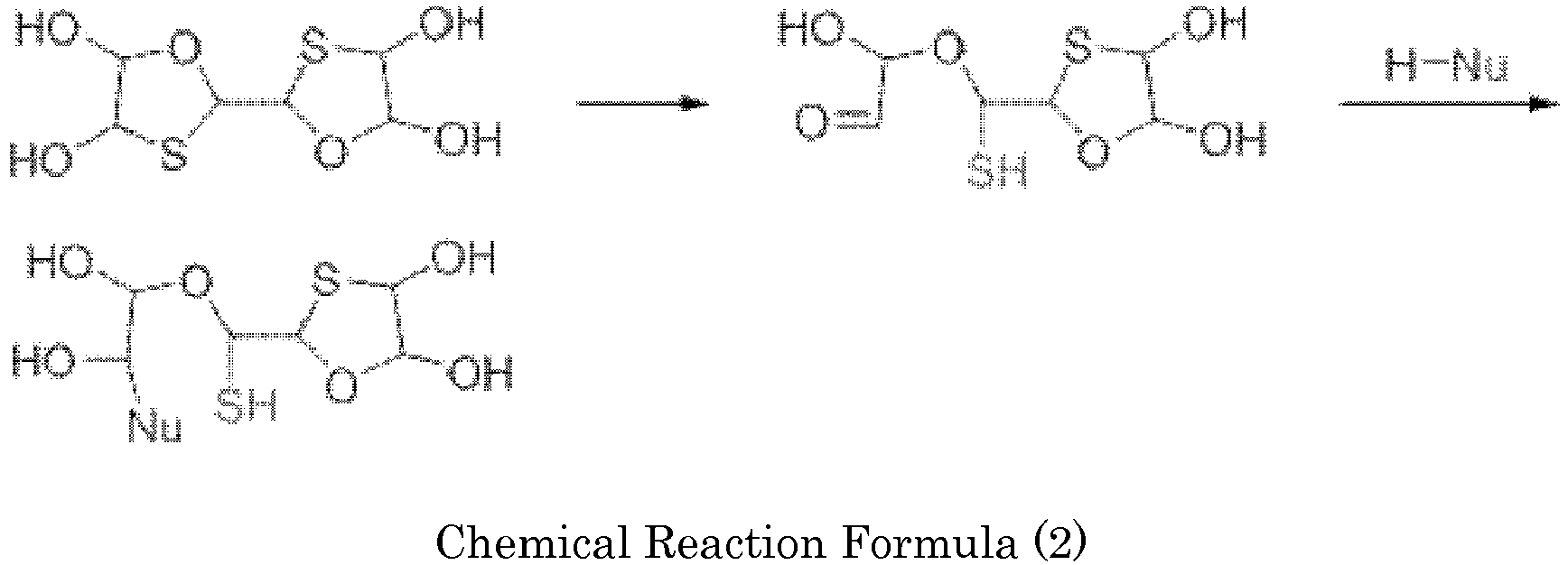
- In the chemical reaction formula (2), Nu represents a nucleophilic agent, such as OH.
- It has been known that the reaction product of glyoxal and hydrogen sulfide has the structure shown as the starting substance in the chemical reaction formula (2).
- As similar to the hexahydrotriazine compound, glyoxal is frequently used in the form of an aqueous solution, and the hydrocarbon frequently contains water mixed therein. Therefore, the hydrocarbon having glyoxal added thereto for reducing or removing hydrogen sulfide generally contains water present therein.
- In the case where water or another compound functioning as a nucleophilic agent is present, it is considered that the ring-opening reaction of the reaction product of glyoxal and hydrogen sulfide is accelerated as shown in the chemical reaction formula (2), and the organic compound having a thiol group is generated.
- On the other hand, it is considered that the at least one aldehyde selected from the group consisting of a monoaldehyde having 4 or more carbon atoms and a dialdehyde having 3 or more carbon atoms used in the present invention forms the compounds represented by the following general formulae (A) to (C) through reaction with hydrogen sulfide.

- In the general formulae (A) to (C), R represents an organic group. Three groups represented by R may be the same as or different from each other, and two or more groups represented by R may be bonded to each other.
- The compound represented by the general formulae (A) to (C) is relatively stable against a nucleophilic agent due to the structure thereof, and is considered to have a possibility that the compound does not readily undergo ring-opening reaction even though water is present in the hydrocarbon.
- It is considered accordingly that in the case where hydrogen sulfide is reduced or removed by the method, the use, and the inhibitor of the present invention, further generation of a compound having an SH structure can be suppressed.
- The monoaldehyde having 4 or more carbon atoms used in the present invention is not particularly limited, and examples thereof include butanal, pentanal, hexanal, heptanal, octanal, nonanal, decanal, benzaldehyde, and senecioaldehyde. The number of carbon atoms of the monoaldehyde is preferably 16 or less.
- The dialdehyde having 3 or more carbon atoms used in the present invention is not particularly limited, and examples thereof include malondialdehyde, succinaldehyde, glutaraldehyde, methylglutaraldehyde, 1,6-hexanedial, ethylpentanedial, 1,7-heptanedial, methylhexanedial, 1,8-octanedial, methylheptanedial, dimethylhexanedial, ethylhexanedial, 1,9-nonanedial, methyloctanedial, ethylheptanedial, 1,10-decanedial, dimethyloctanedial, ethyloctanedial, dodecanedial, hexadecanedial, 1,2-cyclohexanedicarboaldehyde, 1,3-cyclohexanedicarboaldehyde, 1,4-cyclohexanedicarboaldehyde, 1,2-cyclooctanedicarboaldehyde, 1,3-cyclooctanedicarboaldehyde, 1,4-cyclooctanedicarboaldehyde, and 1,5-cyclooctanedicarboaldehyde.
- The aldehyde used in the present invention is preferably a dialdehyde having 3 or more carbon atoms.
- From the standpoint of the low toxicity, the biodegradability, the handling safety, the heat resistance, the low metal corrosiveness of the aldehyde, and the like, a dialdehyde having from 6 to 16 carbon atoms is more preferred, and at least one compound selected from the group consisting of 3-methylglutaraldehyde, 1,9-nonanedial and 2-methyl-1,8-octanedial is further preferred.
- From the standpoint of the high hydrophobicity avoiding the use of water as a solvent, at least one compound selected from the group consisting of 1,9-nonanedial and 2-methyl-1,8-octanedial is most preferred.
- The aldehydes may be used alone or as a combination of two or more kinds thereof.
- In the case where at least one of 1,9-nonanedial and 2-methyl-1,8-octanedial is used as the aldehyde, 1,9-nonanedial or 2-methyl-1,8-octanedial may be used alone, and from the standpoint of the industrial availability, a mixture of 1,9-nonanedial and 2-methyl-1,8-octanedial is preferably used. The mixing ratio of the mixture of 1,9-nonanedial and 2-methyl-1,8-octanedial is not particularly limited, and the mass ratio of 1,9-nonanedial/2-methyl-1,8-octanedial is generally preferably from 99/1 to 1/99, more preferably from 95/5 to 5/95, further preferably from 90/10 to 45/55, and particularly preferably from 90/10 to 55/45.
- The inhibitor of the present invention may contain, in addition to the aldehyde, a solvent and the like, such as toluene, xylene, heavy aromatic naphtha, petroleum distillate, methanol, ethanol, isopropyl alcohol, ethylene glycol, polyethylene glycol, and ethyl acetate.
- The solvents may be used alone or as a combination of two or more kinds thereof.
- In the method and the use of the present invention, the aldehyde is added to a hydrocarbon. The method of adding is not particularly limited, and the aldehyde may be added according to a known method, such as injection to a storage tank of the hydrocarbon, a pipeline for transportation thereof, a distillation column for refining thereof, and the like. The amount of the aldehyde added is not particularly limited, and is preferably such an amount that can sufficiently remove hydrogen sulfide. The temperature, at which the aldehyde is added to the hydrocarbon, is preferably from 0 to 200°C, and more preferably from 20 to 120°C.
- The present invention will be described in more detail with reference to examples and the like below, but the present invention is not limited to the examples.
- A mixture of 1,9-nonanedial (hereinafter referred to as NL) and 2-methyl-1,8-octanedial (hereinafter referred to as MOL) was produced according to the method described in Japanese Patent No.
2,857,055 - In a 50 mL sample bottle, 40 mL of regular gasoline (produced by JX Nippon Oil & Energy Corporation, hereinafter referred simply to "gasoline") having 10 ppm of hydrogen sulfide added thereto was charged, to which the mixture of NL and MOL obtained in Production Example was added in an amount of 1% by mass based on the total amount, and then the opening of the sample bottle was closed with a septum, followed by allowing to stand at 25°C without agitation. The gasoline was appropriately sampled and measured for the concentration of hydrogen sulfide by gas chromatography equipped with a flame photometric detector capable of selectively detecting a sulfur compound.
- After confirming that the concentration of hydrogen sulfide was stabilized at 0 ppm, a polished copper sheet (length: 75 mm, width: 12.5 mm, thickness: 1.5 to 3.0 mm, produced by Nippon Testpanel Co., Ltd.) was partially immersed in the gasoline and allowed to stand at 50°C.
- After three hours, the copper sheet was taken out, and subjected to a copper sheet corrosion test according to ASTM-D130. The results are shown in Table 1 and
Fig. 1 . - The gasoline after the copper sheet corrosion test was again measured for the concentration of hydrogen sulfide by the gas chromatography, and the concentration was confirmed to be 0 ppm.
- The copper sheet corrosion test was performed under the same condition as in Example 1 except that the mixture of NL and MOL was not added, and the concentration of hydrogen sulfide was not measured. The result is shown in Table 1.
- The copper sheet corrosion test was performed under the same condition as in Example 1 except that a 39% by mass glyoxal aqueous solution (produced by Tokyo Kasei Kogyo Co., Ltd.) was added in an amount of 1% by mass in terms of glyoxal based on the total amount instead of the mixture of NL and MOL added. The results are shown in Table 1 and
Fig. 1 . - The gasoline after the copper sheet corrosion test was again measured for the concentration of hydrogen sulfide by the gas chromatography, and the concentration was confirmed to be 0 ppm.
- The copper sheet corrosion test was performed under the same condition as in Example 1 except that a 50% by mass 1,3,5-tris(2-hydroxyethyl)-hexahydro-1,3,5-triazine (MEA triazine) aqueous solution was added in an amount of 1% by mass in terms of MEA triazine based on the total amount instead of the mixture of NL and MOL added. The results are shown in Table 1 and
Fig. 1 . - The gasoline after the copper sheet corrosion test was again measured for the concentration of hydrogen sulfide by the gas chromatography, and the concentration was confirmed to be 0 ppm.
Table 1 Example Comparative Example 1 Comparative Example 2 Comparative Example 3 Corrosion rating according to ASTM-D130 1a 4a 3a 4a - The corrosion rating according to ASTM-D130 includes 1a, 1b, 2a, 2b, 2c, 2d, 2e, 3a, 3b, 4a, 4b, and 4c, and a larger number means severer corrosion.
- In Example and Comparative Examples 2 and 3, even though the copper sheet corrosion test was performed after confirming the removal of hydrogen sulfide, the copper sheet was severely corroded in Comparative Examples 2 and 3. This suggests that an organic compound having an SH structure is newly formed in Comparative Examples 2 and 3.
- For investigating the influence of the nucleophilic agent on the corrosion of the copper sheet, the following three tests were performed in Example and Comparative Examples 2 and 3. The results are shown in Table 2.
- The copper sheet corrosion test was performed in the same manner as in Example and Comparative Examples 2 and 3 except that 4 g of water was added immediately before immersing the copper sheet.
- After adding the mixture of NL and MOL, the glyoxal aqueous solution, or the MEA triazine aqueous solution to the gasoline, a molecular sieve (produced by Wako Pure Chemical Industries, Ltd.) was added and allowed to stand for 18 hours, so as to dehydrate to a water content of 100 ppm or less, and then the copper sheet corrosion test was performed in the same manner as in Example and Comparative Examples 2 and 3.
- The copper sheet corrosion test was performed in the same manner as in Example and Comparative Examples 2 and 3 except that 50 mg of MEA was added immediately before immersing the copper sheet.
Table 2 (No treatment) Water addition Water removal MEA addition Aqueous phase Oil phase Mixture of NL and MOL 1a 1a 1a 1a 2d Glyoxal 3a 4a 3a 1a 4a MEA triazine 4a 4a 3a 1a 4a - In the case where the mixture of NL and MOL was used, the corrosion of the copper sheet was suppressed in the water addition test, whereas the progress of corrosion of the copper sheet was confirmed in the MEA addition test. In the water removal test, the corrosion of all the copper sheets was suppressed.
- It is understood from the results that the presence of the compound capable of acting as a nucleophilic agent strongly influences the corrosion of the copper sheet. It is considered that the reaction product of glyoxal or MEA triazine and hydrogen sulfide readily reacts with water and undergoes ring-opening reaction to form an organic compound having a thiol group. It is also considered that the reaction product of the aldehyde used in the present invention and hydrogen sulfide does not undergo ring-opening reaction even under the presence of water, but undergoes ring-opening reaction to form an organic compound having a thiol group in the presence of an amine, which is considered to act as a stronger nucleophilic agent.
- According to the aforementioned results, by employing the method of the present invention instead of the method using a hexahydrotriazine compound or a certain type of an aldehyde, the further generation of a compound having an SH structure after the removal or reduction of hydrogen sulfide contained in a hydrocarbon, and metal corrosion can be more effectively suppressed.
Claims (15)
- A method for suppressing metal corrosion attributable to a compound having an SH structure contained in a hydrocarbon, comprising adding at least one aldehyde selected from the group consisting of a monoaldehyde having 4 or more carbon atoms and a dialdehyde having 3 or more carbon atoms, to the hydrocarbon.
- The method according to claim 1, wherein the aldehyde is a dialdehyde having 3 or more carbon atoms.
- The method according to claim 1, wherein the aldehyde is at least one selected from the group consisting of 3-methylglutaraldehyde, 1,9-nonanedial, and 2-methyl-1,8-octanedial.
- The method according to any one of claims 1 to 3, wherein the hydrocarbon is at least one selected from the group consisting of natural gas, liquefied natural gas (LNG), liquefied petroleum gas (LPG), sour gas, dry gas, wet gas, oilfield gas, associated gas, tail gas, dimethyl ether, crude oil, naphtha, heavy aromatic naphtha, gasoline, kerosene, diesel oil, gas oil, lubricant oil, heavy oil, A-type fuel oil, B-type fuel oil, C-type fuel oil, jet fuel oil, FCC slurry, asphalt, oil field condensate, bitumen, extra heavy oil, tar, gas to liquid (GTL), coal to liquid (CTL), asphaltene, aromatic hydrocarbon, alkylate, base oil, kerogen, coke, black oil, synthetic crude oil, reformulated gasoline, isomerized gasoline, recovered heavy oil, bottom oil, white oil, raffinate, wax, biomass fuel, biomass to liquid (BTL), biogasoline, bioethanol, bio-ETBE, and bio-diesel oil.
- The method according to any one of claims 1 to 4, wherein the compound having an SH structure is an organic compound having a thiol group.
- Use of at least one aldehyde selected from the group consisting of a monoaldehyde having 4 or more carbon atoms and a dialdehyde having 3 or more carbon atoms, for suppressing metal corrosion attributable to a compound having an SH structure contained in a hydrocarbon.
- The use according to claim 6, wherein the aldehyde is a dialdehyde having 3 or more carbon atoms.
- The use according to claim 6, wherein the aldehyde is at least one selected from the group consisting of 3-methylglutaraldehyde, 1,9-nonanedial, and 2-methyl-1,8-octanedial.
- The use according to any one of claims 6 to 8, wherein the hydrocarbon is at least one selected from the group consisting of natural gas, liquefied natural gas (LNG), liquefied petroleum gas (LPG), sour gas, dry gas, wet gas, oilfield gas, associated gas, tail gas, dimethyl ether, crude oil, naphtha, heavy aromatic naphtha, gasoline, kerosene, diesel oil, gas oil, lubricant oil, heavy oil, A-type fuel oil, B-type fuel oil, C-type fuel oil, jet fuel oil, FCC slurry, asphalt, oil field condensate, bitumen, extra heavy oil, tar, gas to liquid (GTL), coal to liquid (CTL), asphaltene, aromatic hydrocarbon, alkylate, base oil, kerogen, coke, black oil, synthetic crude oil, reformulated gasoline, isomerized gasoline, recovered heavy oil, bottom oil, white oil, raffinate, wax, biomass fuel, biomass to liquid (BTL), biogasoline, bioethanol, bio-ETBE, and bio-diesel oil.
- The use according to any one of claims 6 to 9, wherein the compound having an SH structure is an organic compound having a thiol group.
- An inhibitor for metal corrosion attributable to a compound having an SH structure contained in a hydrocarbon, comprising at least one aldehyde selected from the group consisting of a monoaldehyde having 4 or more carbon atoms and a dialdehyde having 3 or more carbon atoms.
- The inhibitor according to claim 11, wherein the aldehyde is a dialdehyde having 3 or more carbon atoms.
- The inhibitor according to claim 11, wherein the aldehyde is at least one selected from the group consisting of 3-methylglutaraldehyde, 1,9-nonanedial, and 2-methyl-1,8-octanedial.
- The inhibitor according to any one of claims 11 to 13, wherein the hydrocarbon is at least one selected from the group consisting of natural gas, liquefied natural gas (LNG), liquefied petroleum gas (LPG), sour gas, dry gas, wet gas, oilfield gas, associated gas, tail gas, dimethyl ether, crude oil, naphtha, heavy aromatic naphtha, gasoline, kerosene, diesel oil, gas oil, lubricant oil, heavy oil, A-type fuel oil, B-type fuel oil, C-type fuel oil, jet fuel oil, FCC slurry, asphalt, oil field condensate, bitumen, extra heavy oil, tar, gas to liquid (GTL), coal to liquid (CTL), asphaltene, aromatic hydrocarbon, alkylate, base oil, kerogen, coke, black oil, synthetic crude oil, reformulated gasoline, isomerized gasoline, recovered heavy oil, bottom oil, white oil, raffinate, wax, biomass fuel, biomass to liquid (BTL), biogasoline, bioethanol, bio-ETBE, and bio-diesel oil.
- The inhibitor according to any one of claims 11 to 14, wherein the compound having an SH structure is an organic compound having a thiol group.
Applications Claiming Priority (2)
| Application Number | Priority Date | Filing Date | Title |
|---|---|---|---|
| JP2016187826 | 2016-09-27 | ||
| PCT/JP2017/034912 WO2018062254A1 (en) | 2016-09-27 | 2017-09-27 | Metal corrosion suppressing method |
Publications (2)
| Publication Number | Publication Date |
|---|---|
| EP3530775A1 true EP3530775A1 (en) | 2019-08-28 |
| EP3530775A4 EP3530775A4 (en) | 2020-05-27 |
Family
ID=61760534
Family Applications (1)
| Application Number | Title | Priority Date | Filing Date |
|---|---|---|---|
| EP17856203.9A Withdrawn EP3530775A4 (en) | 2016-09-27 | 2017-09-27 | METHOD FOR REMOVING METAL CORROSION |
Country Status (6)
| Country | Link |
|---|---|
| US (1) | US20200017781A1 (en) |
| EP (1) | EP3530775A4 (en) |
| JP (1) | JPWO2018062254A1 (en) |
| CN (1) | CN109715856A (en) |
| CA (1) | CA3038037A1 (en) |
| WO (1) | WO2018062254A1 (en) |
Families Citing this family (1)
| Publication number | Priority date | Publication date | Assignee | Title |
|---|---|---|---|---|
| CA3028229A1 (en) * | 2018-12-20 | 2020-06-20 | Fluid Energy Group Ltd. | Novel corrosion inhibition package |
Family Cites Families (15)
| Publication number | Priority date | Publication date | Assignee | Title |
|---|---|---|---|---|
| US1991765A (en) | 1932-01-23 | 1935-02-19 | Dupont Viscoloid Company | Aldehyde-hydrogen sulphide reaction product |
| US2571739A (en) * | 1949-10-28 | 1951-10-16 | Pure Oil Co | Prevention of corrosion of structural metals by hydrogen sulfide, air, and water |
| US3589860A (en) * | 1967-10-09 | 1971-06-29 | Exxon Research Engineering Co | Cinnamic aldehyde inhibitors |
| US3537974A (en) * | 1968-07-02 | 1970-11-03 | Exxon Research Engineering Co | Alkoxy-substituted aromatic aldehydes as corrosion inhibitors |
| US4680127A (en) | 1985-12-13 | 1987-07-14 | Betz Laboratories, Inc. | Method of scavenging hydrogen sulfide |
| US5284635A (en) | 1989-09-05 | 1994-02-08 | Societe Francaise Hoechst | Process for the elimination of hydrogen sulfide by using water-in-oil emulsions |
| JP2857055B2 (en) | 1994-03-30 | 1999-02-10 | 株式会社クラレ | Method for producing 1,9-nonandial |
| KR101629753B1 (en) * | 2009-03-13 | 2016-06-13 | 그린 소스 에너지 엘엘씨 | Extraction of hydrocarbons from hydrocarbon-containing materials and/or processing of hydrocarbon-containing materials |
| ES2406762T3 (en) | 2009-05-05 | 2013-06-10 | Dorf Ketal Chemicals (I) Private Limited | Method of removing hydrogen sulfide from a hydrocarbon stream |
| US20110147272A1 (en) | 2009-12-23 | 2011-06-23 | General Electric Company | Emulsification of hydrocarbon gas oils to increase efficacy of water based hydrogen sulfide scavengers |
| WO2012070065A1 (en) | 2010-11-22 | 2012-05-31 | Dorf Ketal Chemicals (India) Private Limited | Additive composition and method for scavenging hydrogen sulfide in hydrocarbon streams |
| US20130089460A1 (en) | 2011-10-05 | 2013-04-11 | Baker Hughes Incorporated | Inhibiting corrosion caused by aqueous aldehyde solutions |
| JP6446029B2 (en) * | 2014-03-17 | 2018-12-26 | 株式会社クラレ | Composition for removing sulfur-containing compounds |
| US10087404B2 (en) * | 2014-09-19 | 2018-10-02 | Kuraray Co., Ltd. | Biological corrosion inhibitor for metals |
| JP6621030B2 (en) * | 2015-01-29 | 2019-12-18 | 株式会社クラレ | Composition for removing sulfur-containing compounds |
-
2017
- 2017-09-27 CN CN201780058294.5A patent/CN109715856A/en active Pending
- 2017-09-27 JP JP2018542632A patent/JPWO2018062254A1/en active Pending
- 2017-09-27 US US16/335,422 patent/US20200017781A1/en not_active Abandoned
- 2017-09-27 CA CA3038037A patent/CA3038037A1/en not_active Abandoned
- 2017-09-27 EP EP17856203.9A patent/EP3530775A4/en not_active Withdrawn
- 2017-09-27 WO PCT/JP2017/034912 patent/WO2018062254A1/en not_active Ceased
Also Published As
| Publication number | Publication date |
|---|---|
| CN109715856A (en) | 2019-05-03 |
| WO2018062254A1 (en) | 2018-04-05 |
| JPWO2018062254A1 (en) | 2019-08-15 |
| EP3530775A4 (en) | 2020-05-27 |
| CA3038037A1 (en) | 2018-04-05 |
| US20200017781A1 (en) | 2020-01-16 |
Similar Documents
| Publication | Publication Date | Title |
|---|---|---|
| CA2805404C (en) | Use of alpha-amino ethers for the removal of hydrogen sulfide from hydrocarbons | |
| US8357306B2 (en) | Non-nitrogen sulfide sweeteners | |
| RU2693494C2 (en) | Composition for removing sulphur-containing compounds | |
| US10093868B1 (en) | Ionic liquid-based hydrogen sulfide and mercaptan scavengers | |
| CA2805402C (en) | Improved method of removing hydrogen sulfide | |
| US8048175B2 (en) | Quick removal of mercaptans from hydrocarbons | |
| US10457817B2 (en) | 2-mercaptobenzimidazole derivatives as corrosion inhibitors | |
| US20200017781A1 (en) | Metal corrosion suppressing method | |
| EP2593533B1 (en) | Use of alpha-amino ethers for the removal of mercaptans from hydrocarbons | |
| US10633601B2 (en) | Nitrogen-free hydrogen sulfide scavengers | |
| US9273254B2 (en) | Amino acetals and ketals as hydrogen sulfide and mercaptan scavengers | |
| EP3562915B1 (en) | Amine based hydrogen sulfide scavenging additive compositions of copper salts, and medium comprising the same | |
| HK40000789A (en) | Metal corrosion suppressing method | |
| JP5191146B2 (en) | Fuel oil composition | |
| EP4214296A1 (en) | Nitrogen-free hydrogen sulphide and mercaptans scavengers | |
| US20140084206A1 (en) | Treating Additives for the Deactivation of Sulfur Species Within a Stream | |
| JP2021120136A (en) | Composition for removing sulfur-containing compound |
Legal Events
| Date | Code | Title | Description |
|---|---|---|---|
| STAA | Information on the status of an ep patent application or granted ep patent |
Free format text: STATUS: THE INTERNATIONAL PUBLICATION HAS BEEN MADE |
|
| PUAI | Public reference made under article 153(3) epc to a published international application that has entered the european phase |
Free format text: ORIGINAL CODE: 0009012 |
|
| STAA | Information on the status of an ep patent application or granted ep patent |
Free format text: STATUS: REQUEST FOR EXAMINATION WAS MADE |
|
| 17P | Request for examination filed |
Effective date: 20190327 |
|
| AK | Designated contracting states |
Kind code of ref document: A1 Designated state(s): AL AT BE BG CH CY CZ DE DK EE ES FI FR GB GR HR HU IE IS IT LI LT LU LV MC MK MT NL NO PL PT RO RS SE SI SK SM TR |
|
| AX | Request for extension of the european patent |
Extension state: BA ME |
|
| DAV | Request for validation of the european patent (deleted) | ||
| DAX | Request for extension of the european patent (deleted) | ||
| A4 | Supplementary search report drawn up and despatched |
Effective date: 20200430 |
|
| RIC1 | Information provided on ipc code assigned before grant |
Ipc: E21B 41/02 20060101ALI20200423BHEP Ipc: C10G 9/16 20060101ALI20200423BHEP Ipc: C10L 10/04 20060101ALI20200423BHEP Ipc: C23F 11/04 20060101ALI20200423BHEP Ipc: C10G 75/02 20060101ALI20200423BHEP Ipc: C09K 8/54 20060101ALI20200423BHEP Ipc: C23F 11/12 20060101AFI20200423BHEP Ipc: C10G 7/10 20060101ALI20200423BHEP |
|
| STAA | Information on the status of an ep patent application or granted ep patent |
Free format text: STATUS: THE APPLICATION HAS BEEN WITHDRAWN |
|
| 18W | Application withdrawn |
Effective date: 20200911 |