EP3530652A1 - Modified phenylphthalimide and pharmaceutical composition having same as active ingredient - Google Patents
Modified phenylphthalimide and pharmaceutical composition having same as active ingredient Download PDFInfo
- Publication number
- EP3530652A1 EP3530652A1 EP17862847.5A EP17862847A EP3530652A1 EP 3530652 A1 EP3530652 A1 EP 3530652A1 EP 17862847 A EP17862847 A EP 17862847A EP 3530652 A1 EP3530652 A1 EP 3530652A1
- Authority
- EP
- European Patent Office
- Prior art keywords
- peg11
- group
- cells
- chloroform
- mmol
- Prior art date
- Legal status (The legal status is an assumption and is not a legal conclusion. Google has not performed a legal analysis and makes no representation as to the accuracy of the status listed.)
- Withdrawn
Links
- YTMSIVKCVBMPFF-UHFFFAOYSA-N 4-phenylisoindole-1,3-dione Chemical class O=C1NC(=O)C2=C1C=CC=C2C1=CC=CC=C1 YTMSIVKCVBMPFF-UHFFFAOYSA-N 0.000 title claims abstract description 22
- 239000008194 pharmaceutical composition Substances 0.000 title claims description 13
- 239000004480 active ingredient Substances 0.000 title description 4
- 206010035226 Plasma cell myeloma Diseases 0.000 claims abstract description 16
- 125000000217 alkyl group Chemical group 0.000 claims abstract description 16
- 125000003118 aryl group Chemical group 0.000 claims abstract description 12
- 125000003277 amino group Chemical group 0.000 claims abstract description 11
- 125000003545 alkoxy group Chemical group 0.000 claims abstract description 10
- 125000003710 aryl alkyl group Chemical group 0.000 claims abstract description 10
- 125000004104 aryloxy group Chemical group 0.000 claims abstract description 7
- 125000004435 hydrogen atom Chemical group [H]* 0.000 claims abstract description 7
- 208000034578 Multiple myelomas Diseases 0.000 claims abstract description 6
- 125000005543 phthalimide group Chemical group 0.000 claims description 15
- 239000002246 antineoplastic agent Substances 0.000 claims description 12
- 125000001449 isopropyl group Chemical group [H]C([H])([H])C([H])(*)C([H])([H])[H] 0.000 claims description 4
- 125000004356 hydroxy functional group Chemical group O* 0.000 claims 2
- 206010028980 Neoplasm Diseases 0.000 abstract description 33
- 125000002887 hydroxy group Chemical group [H]O* 0.000 abstract description 8
- 101001094545 Homo sapiens Retrotransposon-like protein 1 Proteins 0.000 description 149
- 102100035123 Retrotransposon-like protein 1 Human genes 0.000 description 149
- DTPCFIHYWYONMD-UHFFFAOYSA-N decaethylene glycol Chemical compound OCCOCCOCCOCCOCCOCCOCCOCCOCCOCCO DTPCFIHYWYONMD-UHFFFAOYSA-N 0.000 description 149
- XEKOWRVHYACXOJ-UHFFFAOYSA-N Ethyl acetate Chemical compound CCOC(C)=O XEKOWRVHYACXOJ-UHFFFAOYSA-N 0.000 description 141
- NRPIRIUWEKTNGQ-UHFFFAOYSA-N 5-amino-2-[2,6-di(propan-2-yl)phenyl]isoindole-1,3-dione Chemical compound CC(C)C1=CC=CC(C(C)C)=C1N1C(=O)C2=CC(N)=CC=C2C1=O NRPIRIUWEKTNGQ-UHFFFAOYSA-N 0.000 description 124
- 210000004027 cell Anatomy 0.000 description 113
- HEDRZPFGACZZDS-UHFFFAOYSA-N Chloroform Chemical compound ClC(Cl)Cl HEDRZPFGACZZDS-UHFFFAOYSA-N 0.000 description 108
- OKKJLVBELUTLKV-UHFFFAOYSA-N Methanol Chemical compound OC OKKJLVBELUTLKV-UHFFFAOYSA-N 0.000 description 67
- VLKZOEOYAKHREP-UHFFFAOYSA-N n-Hexane Chemical compound CCCCCC VLKZOEOYAKHREP-UHFFFAOYSA-N 0.000 description 52
- HEDRZPFGACZZDS-MICDWDOJSA-N Trichloro(2H)methane Chemical compound [2H]C(Cl)(Cl)Cl HEDRZPFGACZZDS-MICDWDOJSA-N 0.000 description 50
- 238000006243 chemical reaction Methods 0.000 description 39
- VYPSYNLAJGMNEJ-UHFFFAOYSA-N Silicium dioxide Chemical compound O=[Si]=O VYPSYNLAJGMNEJ-UHFFFAOYSA-N 0.000 description 38
- 239000000741 silica gel Substances 0.000 description 38
- 229910002027 silica gel Inorganic materials 0.000 description 38
- 102100032783 Protein cereblon Human genes 0.000 description 35
- 239000000243 solution Substances 0.000 description 35
- 238000005160 1H NMR spectroscopy Methods 0.000 description 32
- 101000941994 Homo sapiens Protein cereblon Proteins 0.000 description 32
- 239000003814 drug Substances 0.000 description 32
- 229940079593 drug Drugs 0.000 description 31
- 229960004942 lenalidomide Drugs 0.000 description 29
- GOTYRUGSSMKFNF-UHFFFAOYSA-N lenalidomide Chemical compound C1C=2C(N)=CC=CC=2C(=O)N1C1CCC(=O)NC1=O GOTYRUGSSMKFNF-UHFFFAOYSA-N 0.000 description 29
- XLYOFNOQVPJJNP-UHFFFAOYSA-N water Substances O XLYOFNOQVPJJNP-UHFFFAOYSA-N 0.000 description 29
- LFQSCWFLJHTTHZ-UHFFFAOYSA-N Ethanol Chemical compound CCO LFQSCWFLJHTTHZ-UHFFFAOYSA-N 0.000 description 28
- 239000002202 Polyethylene glycol Substances 0.000 description 28
- 229920001223 polyethylene glycol Polymers 0.000 description 28
- 230000002401 inhibitory effect Effects 0.000 description 27
- UEJJHQNACJXSKW-UHFFFAOYSA-N 2-(2,6-dioxopiperidin-3-yl)-1H-isoindole-1,3(2H)-dione Chemical compound O=C1C2=CC=CC=C2C(=O)N1C1CCC(=O)NC1=O UEJJHQNACJXSKW-UHFFFAOYSA-N 0.000 description 26
- 229960003433 thalidomide Drugs 0.000 description 26
- 230000004663 cell proliferation Effects 0.000 description 25
- 239000000203 mixture Substances 0.000 description 25
- 239000002904 solvent Substances 0.000 description 22
- QTBSBXVTEAMEQO-UHFFFAOYSA-N Acetic acid Chemical compound CC(O)=O QTBSBXVTEAMEQO-UHFFFAOYSA-N 0.000 description 21
- 210000004369 blood Anatomy 0.000 description 21
- 239000008280 blood Substances 0.000 description 21
- 239000000047 product Substances 0.000 description 20
- 238000004128 high performance liquid chromatography Methods 0.000 description 19
- 238000000034 method Methods 0.000 description 19
- 239000007795 chemical reaction product Substances 0.000 description 18
- 230000015572 biosynthetic process Effects 0.000 description 17
- 238000000338 in vitro Methods 0.000 description 17
- KDLHZDBZIXYQEI-UHFFFAOYSA-N Palladium Chemical compound [Pd] KDLHZDBZIXYQEI-UHFFFAOYSA-N 0.000 description 16
- 238000002835 absorbance Methods 0.000 description 16
- IAZDPXIOMUYVGZ-UHFFFAOYSA-N Dimethylsulphoxide Chemical compound CS(C)=O IAZDPXIOMUYVGZ-UHFFFAOYSA-N 0.000 description 15
- 101000604197 Homo sapiens Neuronatin Proteins 0.000 description 15
- 102100038816 Neuronatin Human genes 0.000 description 15
- 235000002597 Solanum melongena Nutrition 0.000 description 15
- 201000011510 cancer Diseases 0.000 description 15
- 238000003786 synthesis reaction Methods 0.000 description 15
- 101001109719 Homo sapiens Nucleophosmin Proteins 0.000 description 14
- 102100022678 Nucleophosmin Human genes 0.000 description 14
- -1 diisopropylphenyl group Chemical group 0.000 description 14
- 230000000857 drug effect Effects 0.000 description 14
- 239000002994 raw material Substances 0.000 description 14
- 230000006907 apoptotic process Effects 0.000 description 13
- 239000000843 powder Substances 0.000 description 13
- WYURNTSHIVDZCO-UHFFFAOYSA-N Tetrahydrofuran Chemical compound C1CCOC1 WYURNTSHIVDZCO-UHFFFAOYSA-N 0.000 description 12
- 150000001875 compounds Chemical class 0.000 description 12
- 239000010410 layer Substances 0.000 description 12
- 241000699666 Mus <mouse, genus> Species 0.000 description 11
- 241000699670 Mus sp. Species 0.000 description 11
- FAPWRFPIFSIZLT-UHFFFAOYSA-M Sodium chloride Chemical class [Na+].[Cl-] FAPWRFPIFSIZLT-UHFFFAOYSA-M 0.000 description 11
- 239000000126 substance Substances 0.000 description 11
- WEVYAHXRMPXWCK-UHFFFAOYSA-N Acetonitrile Chemical compound CC#N WEVYAHXRMPXWCK-UHFFFAOYSA-N 0.000 description 10
- XKRFYHLGVUSROY-UHFFFAOYSA-N Argon Chemical compound [Ar] XKRFYHLGVUSROY-UHFFFAOYSA-N 0.000 description 10
- 238000004458 analytical method Methods 0.000 description 10
- 230000000694 effects Effects 0.000 description 10
- 238000000605 extraction Methods 0.000 description 10
- 238000003756 stirring Methods 0.000 description 10
- 230000008961 swelling Effects 0.000 description 10
- ZMANZCXQSJIPKH-UHFFFAOYSA-N Triethylamine Chemical compound CCN(CC)CC ZMANZCXQSJIPKH-UHFFFAOYSA-N 0.000 description 9
- 230000003993 interaction Effects 0.000 description 9
- 238000007912 intraperitoneal administration Methods 0.000 description 9
- 201000000050 myeloid neoplasm Diseases 0.000 description 9
- 238000002360 preparation method Methods 0.000 description 9
- XMVJITFPVVRMHC-UHFFFAOYSA-N roxarsone Chemical group OC1=CC=C([As](O)(O)=O)C=C1[N+]([O-])=O XMVJITFPVVRMHC-UHFFFAOYSA-N 0.000 description 9
- UFHFLCQGNIYNRP-UHFFFAOYSA-N Hydrogen Chemical compound [H][H] UFHFLCQGNIYNRP-UHFFFAOYSA-N 0.000 description 8
- PMZURENOXWZQFD-UHFFFAOYSA-L Sodium Sulfate Chemical compound [Na+].[Na+].[O-]S([O-])(=O)=O PMZURENOXWZQFD-UHFFFAOYSA-L 0.000 description 8
- RTZKZFJDLAIYFH-UHFFFAOYSA-N ether Substances CCOCC RTZKZFJDLAIYFH-UHFFFAOYSA-N 0.000 description 8
- 238000010898 silica gel chromatography Methods 0.000 description 8
- 238000002198 surface plasmon resonance spectroscopy Methods 0.000 description 8
- YYROPELSRYBVMQ-UHFFFAOYSA-N 4-toluenesulfonyl chloride Chemical compound CC1=CC=C(S(Cl)(=O)=O)C=C1 YYROPELSRYBVMQ-UHFFFAOYSA-N 0.000 description 7
- 108090000371 Esterases Proteins 0.000 description 7
- 239000000872 buffer Substances 0.000 description 7
- 238000010828 elution Methods 0.000 description 7
- 239000000706 filtrate Substances 0.000 description 7
- 238000001727 in vivo Methods 0.000 description 7
- 230000035755 proliferation Effects 0.000 description 7
- WKBALTUBRZPIPZ-UHFFFAOYSA-N 2,6-di(propan-2-yl)aniline Chemical compound CC(C)C1=CC=CC(C(C)C)=C1N WKBALTUBRZPIPZ-UHFFFAOYSA-N 0.000 description 6
- VHYFNPMBLIVWCW-UHFFFAOYSA-N 4-Dimethylaminopyridine Chemical compound CN(C)C1=CC=NC=C1 VHYFNPMBLIVWCW-UHFFFAOYSA-N 0.000 description 6
- MWRVRCAFWBBXTL-UHFFFAOYSA-N 4-hydroxyphthalic acid Chemical compound OC(=O)C1=CC=C(O)C=C1C(O)=O MWRVRCAFWBBXTL-UHFFFAOYSA-N 0.000 description 6
- PAYRUJLWNCNPSJ-UHFFFAOYSA-N Aniline Chemical compound NC1=CC=CC=C1 PAYRUJLWNCNPSJ-UHFFFAOYSA-N 0.000 description 6
- OKTJSMMVPCPJKN-UHFFFAOYSA-N Carbon Chemical compound [C] OKTJSMMVPCPJKN-UHFFFAOYSA-N 0.000 description 6
- JGFZNNIVVJXRND-UHFFFAOYSA-N N,N-Diisopropylethylamine (DIPEA) Chemical compound CCN(C(C)C)C(C)C JGFZNNIVVJXRND-UHFFFAOYSA-N 0.000 description 6
- IMNFDUFMRHMDMM-UHFFFAOYSA-N N-Heptane Chemical compound CCCCCCC IMNFDUFMRHMDMM-UHFFFAOYSA-N 0.000 description 6
- YXFVVABEGXRONW-UHFFFAOYSA-N Toluene Chemical compound CC1=CC=CC=C1 YXFVVABEGXRONW-UHFFFAOYSA-N 0.000 description 6
- 230000001093 anti-cancer Effects 0.000 description 6
- 230000000259 anti-tumor effect Effects 0.000 description 6
- 229910052799 carbon Inorganic materials 0.000 description 6
- 230000006698 induction Effects 0.000 description 6
- 238000002347 injection Methods 0.000 description 6
- 239000007924 injection Substances 0.000 description 6
- 230000004048 modification Effects 0.000 description 6
- 238000012986 modification Methods 0.000 description 6
- ZRSNZINYAWTAHE-UHFFFAOYSA-N p-methoxybenzaldehyde Chemical compound COC1=CC=C(C=O)C=C1 ZRSNZINYAWTAHE-UHFFFAOYSA-N 0.000 description 6
- 239000002245 particle Substances 0.000 description 6
- 125000001997 phenyl group Chemical group [H]C1=C([H])C([H])=C(*)C([H])=C1[H] 0.000 description 6
- 239000002953 phosphate buffered saline Substances 0.000 description 6
- XJMOSONTPMZWPB-UHFFFAOYSA-M propidium iodide Chemical compound [I-].[I-].C12=CC(N)=CC=C2C2=CC=C(N)C=C2[N+](CCC[N+](C)(CC)CC)=C1C1=CC=CC=C1 XJMOSONTPMZWPB-UHFFFAOYSA-M 0.000 description 6
- 108090000623 proteins and genes Proteins 0.000 description 6
- JUJBNYBVVQSIOU-UHFFFAOYSA-M sodium;4-[2-(4-iodophenyl)-3-(4-nitrophenyl)tetrazol-2-ium-5-yl]benzene-1,3-disulfonate Chemical compound [Na+].C1=CC([N+](=O)[O-])=CC=C1N1[N+](C=2C=CC(I)=CC=2)=NC(C=2C(=CC(=CC=2)S([O-])(=O)=O)S([O-])(=O)=O)=N1 JUJBNYBVVQSIOU-UHFFFAOYSA-M 0.000 description 6
- 0 CC(C)c1cccc(C(C)C(C)=C)c1N(C(c(c1c2)cc(N)c2OCCO)=*)C1=* Chemical compound CC(C)c1cccc(C(C)C(C)=C)c1N(C(c(c1c2)cc(N)c2OCCO)=*)C1=* 0.000 description 5
- 102000009728 CDC2 Protein Kinase Human genes 0.000 description 5
- 108010034798 CDC2 Protein Kinase Proteins 0.000 description 5
- 208000031404 Chromosome Aberrations Diseases 0.000 description 5
- QAOWNCQODCNURD-UHFFFAOYSA-N Sulfuric acid Chemical compound OS(O)(=O)=O QAOWNCQODCNURD-UHFFFAOYSA-N 0.000 description 5
- 102000004243 Tubulin Human genes 0.000 description 5
- 108090000704 Tubulin Proteins 0.000 description 5
- 229910052786 argon Inorganic materials 0.000 description 5
- 239000012300 argon atmosphere Substances 0.000 description 5
- 239000011324 bead Substances 0.000 description 5
- 230000003833 cell viability Effects 0.000 description 5
- 238000001816 cooling Methods 0.000 description 5
- 238000012217 deletion Methods 0.000 description 5
- 230000037430 deletion Effects 0.000 description 5
- 238000002474 experimental method Methods 0.000 description 5
- 239000007789 gas Substances 0.000 description 5
- 238000005984 hydrogenation reaction Methods 0.000 description 5
- 125000005113 hydroxyalkoxy group Chemical group 0.000 description 5
- 230000005764 inhibitory process Effects 0.000 description 5
- 239000007788 liquid Substances 0.000 description 5
- 239000002504 physiological saline solution Substances 0.000 description 5
- 239000002244 precipitate Substances 0.000 description 5
- 102000004169 proteins and genes Human genes 0.000 description 5
- 238000010992 reflux Methods 0.000 description 5
- 238000006467 substitution reaction Methods 0.000 description 5
- 235000000346 sugar Nutrition 0.000 description 5
- 238000005406 washing Methods 0.000 description 5
- JMAKFNFKUHXFBH-UHFFFAOYSA-N 3-[2-[2-[2-[2-[2-[2-[2-[2-[2-[2-(2-methoxyethoxy)ethoxy]ethoxy]ethoxy]ethoxy]ethoxy]ethoxy]ethoxy]ethoxy]ethoxy]ethoxy]propanoic acid Chemical compound COCCOCCOCCOCCOCCOCCOCCOCCOCCOCCOCCOCCC(O)=O JMAKFNFKUHXFBH-UHFFFAOYSA-N 0.000 description 4
- MYTDZUKWTMLBSV-UHFFFAOYSA-N 5-hydroxy-4-nitro-2-benzofuran-1,3-dione Chemical class OC1=CC=C2C(=O)OC(=O)C2=C1[N+]([O-])=O MYTDZUKWTMLBSV-UHFFFAOYSA-N 0.000 description 4
- 108090000672 Annexin A5 Proteins 0.000 description 4
- IJGRMHOSHXDMSA-UHFFFAOYSA-N Atomic nitrogen Chemical compound N#N IJGRMHOSHXDMSA-UHFFFAOYSA-N 0.000 description 4
- OKKJLVBELUTLKV-MZCSYVLQSA-N Deuterated methanol Chemical compound [2H]OC([2H])([2H])[2H] OKKJLVBELUTLKV-MZCSYVLQSA-N 0.000 description 4
- 206010043275 Teratogenicity Diseases 0.000 description 4
- 210000004271 bone marrow stromal cell Anatomy 0.000 description 4
- 239000003153 chemical reaction reagent Substances 0.000 description 4
- 208000029742 colonic neoplasm Diseases 0.000 description 4
- 229910001873 dinitrogen Inorganic materials 0.000 description 4
- 201000005787 hematologic cancer Diseases 0.000 description 4
- 208000032839 leukemia Diseases 0.000 description 4
- 230000000394 mitotic effect Effects 0.000 description 4
- 239000002808 molecular sieve Substances 0.000 description 4
- 239000012044 organic layer Substances 0.000 description 4
- 125000004430 oxygen atom Chemical group O* 0.000 description 4
- 230000026731 phosphorylation Effects 0.000 description 4
- 238000006366 phosphorylation reaction Methods 0.000 description 4
- 210000002381 plasma Anatomy 0.000 description 4
- 238000010079 rubber tapping Methods 0.000 description 4
- 210000002966 serum Anatomy 0.000 description 4
- URGAHOPLAPQHLN-UHFFFAOYSA-N sodium aluminosilicate Chemical compound [Na+].[Al+3].[O-][Si]([O-])=O.[O-][Si]([O-])=O URGAHOPLAPQHLN-UHFFFAOYSA-N 0.000 description 4
- 229910052938 sodium sulfate Inorganic materials 0.000 description 4
- 235000011152 sodium sulphate Nutrition 0.000 description 4
- 239000007858 starting material Substances 0.000 description 4
- 239000006228 supernatant Substances 0.000 description 4
- 231100000211 teratogenicity Toxicity 0.000 description 4
- YLQBMQCUIZJEEH-UHFFFAOYSA-N tetrahydrofuran Natural products C=1C=COC=1 YLQBMQCUIZJEEH-UHFFFAOYSA-N 0.000 description 4
- DLYUQMMRRRQYAE-UHFFFAOYSA-N tetraphosphorus decaoxide Chemical compound O1P(O2)(=O)OP3(=O)OP1(=O)OP2(=O)O3 DLYUQMMRRRQYAE-UHFFFAOYSA-N 0.000 description 4
- LDLCZOVUSADOIV-UHFFFAOYSA-N 2-bromoethanol Chemical compound OCCBr LDLCZOVUSADOIV-UHFFFAOYSA-N 0.000 description 3
- ULUQYHQBGULMJT-UHFFFAOYSA-N 4-hydroxy-3-nitrophthalic acid Chemical compound OC(=O)C1=CC=C(O)C([N+]([O-])=O)=C1C(O)=O ULUQYHQBGULMJT-UHFFFAOYSA-N 0.000 description 3
- DEAYCUDQAGOPDO-UHFFFAOYSA-N 4-hydroxy-5-nitrophthalic acid Chemical compound OC(=O)C1=CC(O)=C([N+]([O-])=O)C=C1C(O)=O DEAYCUDQAGOPDO-UHFFFAOYSA-N 0.000 description 3
- WFDIJRYMOXRFFG-UHFFFAOYSA-N Acetic anhydride Chemical compound CC(=O)OC(C)=O WFDIJRYMOXRFFG-UHFFFAOYSA-N 0.000 description 3
- 102000004121 Annexin A5 Human genes 0.000 description 3
- 206010008342 Cervix carcinoma Diseases 0.000 description 3
- 206010009944 Colon cancer Diseases 0.000 description 3
- 108010040476 FITC-annexin A5 Proteins 0.000 description 3
- WQZGKKKJIJFFOK-GASJEMHNSA-N Glucose Natural products OC[C@H]1OC(O)[C@H](O)[C@@H](O)[C@@H]1O WQZGKKKJIJFFOK-GASJEMHNSA-N 0.000 description 3
- 208000002250 Hematologic Neoplasms Diseases 0.000 description 3
- VEXZGXHMUGYJMC-UHFFFAOYSA-N Hydrochloric acid Chemical compound Cl VEXZGXHMUGYJMC-UHFFFAOYSA-N 0.000 description 3
- 201000003793 Myelodysplastic syndrome Diseases 0.000 description 3
- 101710086076 Protein cereblon Proteins 0.000 description 3
- KEAYESYHFKHZAL-UHFFFAOYSA-N Sodium Chemical compound [Na] KEAYESYHFKHZAL-UHFFFAOYSA-N 0.000 description 3
- 208000005718 Stomach Neoplasms Diseases 0.000 description 3
- 208000006105 Uterine Cervical Neoplasms Diseases 0.000 description 3
- 230000036765 blood level Effects 0.000 description 3
- 230000037396 body weight Effects 0.000 description 3
- 230000022131 cell cycle Effects 0.000 description 3
- 238000005119 centrifugation Methods 0.000 description 3
- 210000003793 centrosome Anatomy 0.000 description 3
- 201000010881 cervical cancer Diseases 0.000 description 3
- 210000000349 chromosome Anatomy 0.000 description 3
- 238000012790 confirmation Methods 0.000 description 3
- 230000007423 decrease Effects 0.000 description 3
- 238000010494 dissociation reaction Methods 0.000 description 3
- 230000005593 dissociations Effects 0.000 description 3
- 125000004185 ester group Chemical group 0.000 description 3
- 238000001704 evaporation Methods 0.000 description 3
- 230000008020 evaporation Effects 0.000 description 3
- 230000005284 excitation Effects 0.000 description 3
- 230000006870 function Effects 0.000 description 3
- 206010017758 gastric cancer Diseases 0.000 description 3
- 239000011521 glass Substances 0.000 description 3
- 239000008103 glucose Substances 0.000 description 3
- NDEMNVPZDAFUKN-UHFFFAOYSA-N guanidine;nitric acid Chemical compound NC(N)=N.O[N+]([O-])=O.O[N+]([O-])=O NDEMNVPZDAFUKN-UHFFFAOYSA-N 0.000 description 3
- 238000010438 heat treatment Methods 0.000 description 3
- 208000024200 hematopoietic and lymphoid system neoplasm Diseases 0.000 description 3
- RAXXELZNTBOGNW-UHFFFAOYSA-N imidazole Natural products C1=CNC=N1 RAXXELZNTBOGNW-UHFFFAOYSA-N 0.000 description 3
- 230000009390 immune abnormality Effects 0.000 description 3
- 230000005917 in vivo anti-tumor Effects 0.000 description 3
- 231100000053 low toxicity Toxicity 0.000 description 3
- 238000004519 manufacturing process Methods 0.000 description 3
- GRVDJDISBSALJP-UHFFFAOYSA-N methyloxidanyl Chemical compound [O]C GRVDJDISBSALJP-UHFFFAOYSA-N 0.000 description 3
- 238000010172 mouse model Methods 0.000 description 3
- 238000006384 oligomerization reaction Methods 0.000 description 3
- 125000000962 organic group Chemical group 0.000 description 3
- 108700025694 p53 Genes Proteins 0.000 description 3
- 230000006320 pegylation Effects 0.000 description 3
- 239000012071 phase Substances 0.000 description 3
- KNCYXPMJDCCGSJ-UHFFFAOYSA-N piperidine-2,6-dione Chemical group O=C1CCCC(=O)N1 KNCYXPMJDCCGSJ-UHFFFAOYSA-N 0.000 description 3
- 238000010379 pull-down assay Methods 0.000 description 3
- 239000012312 sodium hydride Substances 0.000 description 3
- 229910000104 sodium hydride Inorganic materials 0.000 description 3
- 239000007787 solid Substances 0.000 description 3
- 201000011549 stomach cancer Diseases 0.000 description 3
- 150000003613 toluenes Chemical class 0.000 description 3
- 230000004614 tumor growth Effects 0.000 description 3
- QKNYBSVHEMOAJP-UHFFFAOYSA-N 2-amino-2-(hydroxymethyl)propane-1,3-diol;hydron;chloride Chemical compound Cl.OCC(N)(CO)CO QKNYBSVHEMOAJP-UHFFFAOYSA-N 0.000 description 2
- YEKPNMQQSPHKBP-UHFFFAOYSA-N 2-methyl-6-nitrobenzoic anhydride Chemical compound CC1=CC=CC([N+]([O-])=O)=C1C(=O)OC(=O)C1=C(C)C=CC=C1[N+]([O-])=O YEKPNMQQSPHKBP-UHFFFAOYSA-N 0.000 description 2
- UTBSBSOBZHXMHI-LSDHHAIUSA-N 2-n-[(1r,2s)-2-aminocyclohexyl]-6-n-(3-chlorophenyl)-9-ethylpurine-2,6-diamine Chemical compound N1=C(N[C@H]2[C@H](CCCC2)N)N=C2N(CC)C=NC2=C1NC1=CC=CC(Cl)=C1 UTBSBSOBZHXMHI-LSDHHAIUSA-N 0.000 description 2
- YMWMTQPDLHRNCZ-UHFFFAOYSA-N 3-[2-[2-[2-[2-(2-methoxyethoxy)ethoxy]ethoxy]ethoxy]ethoxy]propanoic acid Chemical compound COCCOCCOCCOCCOCCOCCC(O)=O YMWMTQPDLHRNCZ-UHFFFAOYSA-N 0.000 description 2
- CFZXVBYDDONTAA-UHFFFAOYSA-N 5-hydroxy-6-nitro-2-benzofuran-1,3-dione Chemical compound Oc1cc2C(=O)OC(=O)c2cc1[N+]([O-])=O CFZXVBYDDONTAA-UHFFFAOYSA-N 0.000 description 2
- 108700028369 Alleles Proteins 0.000 description 2
- 108091003079 Bovine Serum Albumin Proteins 0.000 description 2
- 206010006187 Breast cancer Diseases 0.000 description 2
- 208000026310 Breast neoplasm Diseases 0.000 description 2
- 102100025064 Cellular tumor antigen p53 Human genes 0.000 description 2
- 241000725101 Clea Species 0.000 description 2
- 206010025323 Lymphomas Diseases 0.000 description 2
- 238000000134 MTT assay Methods 0.000 description 2
- 231100000002 MTT assay Toxicity 0.000 description 2
- 238000011579 SCID mouse model Methods 0.000 description 2
- 108020004459 Small interfering RNA Proteins 0.000 description 2
- 210000000683 abdominal cavity Anatomy 0.000 description 2
- 230000001133 acceleration Effects 0.000 description 2
- 150000007960 acetonitrile Chemical class 0.000 description 2
- 125000002777 acetyl group Chemical group [H]C([H])([H])C(*)=O 0.000 description 2
- 229940041181 antineoplastic drug Drugs 0.000 description 2
- 239000012298 atmosphere Substances 0.000 description 2
- 238000011088 calibration curve Methods 0.000 description 2
- 150000001720 carbohydrates Chemical class 0.000 description 2
- 235000014633 carbohydrates Nutrition 0.000 description 2
- 239000003054 catalyst Substances 0.000 description 2
- 238000010531 catalytic reduction reaction Methods 0.000 description 2
- 230000030833 cell death Effects 0.000 description 2
- 238000001516 cell proliferation assay Methods 0.000 description 2
- 230000010129 centrosome duplication Effects 0.000 description 2
- 231100000005 chromosome aberration Toxicity 0.000 description 2
- 229960002204 daratumumab Drugs 0.000 description 2
- 238000003381 deacetylation reaction Methods 0.000 description 2
- 239000003937 drug carrier Substances 0.000 description 2
- 238000001035 drying Methods 0.000 description 2
- 230000032050 esterification Effects 0.000 description 2
- 238000005886 esterification reaction Methods 0.000 description 2
- 238000011156 evaluation Methods 0.000 description 2
- 239000012894 fetal calf serum Substances 0.000 description 2
- 238000001914 filtration Methods 0.000 description 2
- 238000005534 hematocrit Methods 0.000 description 2
- 239000001257 hydrogen Substances 0.000 description 2
- 229910052739 hydrogen Inorganic materials 0.000 description 2
- 230000007062 hydrolysis Effects 0.000 description 2
- 238000006460 hydrolysis reaction Methods 0.000 description 2
- 239000005457 ice water Substances 0.000 description 2
- 238000011534 incubation Methods 0.000 description 2
- 230000001939 inductive effect Effects 0.000 description 2
- 230000009878 intermolecular interaction Effects 0.000 description 2
- 230000003834 intracellular effect Effects 0.000 description 2
- 238000010253 intravenous injection Methods 0.000 description 2
- 238000005259 measurement Methods 0.000 description 2
- 230000007246 mechanism Effects 0.000 description 2
- 125000002496 methyl group Chemical group [H]C([H])([H])* 0.000 description 2
- 150000002772 monosaccharides Chemical class 0.000 description 2
- 125000000449 nitro group Chemical group [O-][N+](*)=O 0.000 description 2
- 231100000957 no side effect Toxicity 0.000 description 2
- 239000003921 oil Substances 0.000 description 2
- 238000007911 parenteral administration Methods 0.000 description 2
- 239000000825 pharmaceutical preparation Substances 0.000 description 2
- 229940127557 pharmaceutical product Drugs 0.000 description 2
- 239000008363 phosphate buffer Substances 0.000 description 2
- 239000013612 plasmid Substances 0.000 description 2
- 235000010482 polyoxyethylene sorbitan monooleate Nutrition 0.000 description 2
- 229920000053 polysorbate 80 Polymers 0.000 description 2
- 238000010837 poor prognosis Methods 0.000 description 2
- 102000004196 processed proteins & peptides Human genes 0.000 description 2
- 108090000765 processed proteins & peptides Proteins 0.000 description 2
- 238000004393 prognosis Methods 0.000 description 2
- 150000003839 salts Chemical class 0.000 description 2
- 239000011734 sodium Substances 0.000 description 2
- 125000001424 substituent group Chemical group 0.000 description 2
- 150000008163 sugars Chemical class 0.000 description 2
- 239000000725 suspension Substances 0.000 description 2
- 208000024891 symptom Diseases 0.000 description 2
- 231100000462 teratogen Toxicity 0.000 description 2
- 239000003439 teratogenic agent Substances 0.000 description 2
- 238000002560 therapeutic procedure Methods 0.000 description 2
- GETQZCLCWQTVFV-UHFFFAOYSA-N trimethylamine Chemical compound CN(C)C GETQZCLCWQTVFV-UHFFFAOYSA-N 0.000 description 2
- 210000004881 tumor cell Anatomy 0.000 description 2
- 238000002525 ultrasonication Methods 0.000 description 2
- 238000011144 upstream manufacturing Methods 0.000 description 2
- 210000003462 vein Anatomy 0.000 description 2
- HBENZIXOGRCSQN-VQWWACLZSA-N (1S,2S,6R,14R,15R,16R)-5-(cyclopropylmethyl)-16-[(2S)-2-hydroxy-3,3-dimethylpentan-2-yl]-15-methoxy-13-oxa-5-azahexacyclo[13.2.2.12,8.01,6.02,14.012,20]icosa-8(20),9,11-trien-11-ol Chemical compound N1([C@@H]2CC=3C4=C(C(=CC=3)O)O[C@H]3[C@@]5(OC)CC[C@@]2([C@@]43CC1)C[C@@H]5[C@](C)(O)C(C)(C)CC)CC1CC1 HBENZIXOGRCSQN-VQWWACLZSA-N 0.000 description 1
- GHCZTIFQWKKGSB-UHFFFAOYSA-N 2-hydroxypropane-1,2,3-tricarboxylic acid;phosphoric acid Chemical compound OP(O)(O)=O.OC(=O)CC(O)(C(O)=O)CC(O)=O GHCZTIFQWKKGSB-UHFFFAOYSA-N 0.000 description 1
- 125000000094 2-phenylethyl group Chemical group [H]C1=C([H])C([H])=C(C([H])=C1[H])C([H])([H])C([H])([H])* 0.000 description 1
- 229960000549 4-dimethylaminophenol Drugs 0.000 description 1
- CCTOEAMRIIXGDJ-UHFFFAOYSA-N 4-hydroxy-2-benzofuran-1,3-dione Chemical compound OC1=CC=CC2=C1C(=O)OC2=O CCTOEAMRIIXGDJ-UHFFFAOYSA-N 0.000 description 1
- ZQDZMNJDJVBNTI-UHFFFAOYSA-N 4-phenyl-5,6-di(propan-2-yl)isoindole-1,3-dione Chemical class C(C)(C)C1=C(C(=C2C(C(=O)NC2=O)=C1)C1=CC=CC=C1)C(C)C ZQDZMNJDJVBNTI-UHFFFAOYSA-N 0.000 description 1
- NLXLAEXVIDQMFP-UHFFFAOYSA-N Ammonia chloride Chemical class [NH4+].[Cl-] NLXLAEXVIDQMFP-UHFFFAOYSA-N 0.000 description 1
- 208000019838 Blood disease Diseases 0.000 description 1
- 208000003174 Brain Neoplasms Diseases 0.000 description 1
- 101150013999 CRBN gene Proteins 0.000 description 1
- 101100170173 Caenorhabditis elegans del-1 gene Proteins 0.000 description 1
- 108010051152 Carboxylesterase Proteins 0.000 description 1
- 102000013392 Carboxylesterase Human genes 0.000 description 1
- IAZDPXIOMUYVGZ-WFGJKAKNSA-N Dimethyl sulfoxide Chemical compound [2H]C([2H])([2H])S(=O)C([2H])([2H])[2H] IAZDPXIOMUYVGZ-WFGJKAKNSA-N 0.000 description 1
- 230000005526 G1 to G0 transition Effects 0.000 description 1
- 230000037059 G2/M phase arrest Effects 0.000 description 1
- 208000032843 Hemorrhage Diseases 0.000 description 1
- 101000629400 Homo sapiens Mesoderm-specific transcript homolog protein Proteins 0.000 description 1
- 208000037147 Hypercalcaemia Diseases 0.000 description 1
- 206010061598 Immunodeficiency Diseases 0.000 description 1
- 208000029462 Immunodeficiency disease Diseases 0.000 description 1
- 206010058467 Lung neoplasm malignant Diseases 0.000 description 1
- 102100026821 Mesoderm-specific transcript homolog protein Human genes 0.000 description 1
- 235000007265 Myrrhis odorata Nutrition 0.000 description 1
- 240000009023 Myrrhis odorata Species 0.000 description 1
- 208000003076 Osteolysis Diseases 0.000 description 1
- 206010033128 Ovarian cancer Diseases 0.000 description 1
- 108020002230 Pancreatic Ribonuclease Proteins 0.000 description 1
- 206010061902 Pancreatic neoplasm Diseases 0.000 description 1
- 102000005891 Pancreatic ribonuclease Human genes 0.000 description 1
- 108091000080 Phosphotransferase Proteins 0.000 description 1
- 235000012550 Pimpinella anisum Nutrition 0.000 description 1
- 208000007452 Plasmacytoma Diseases 0.000 description 1
- 229920003171 Poly (ethylene oxide) Polymers 0.000 description 1
- OFOBLEOULBTSOW-UHFFFAOYSA-N Propanedioic acid Natural products OC(=O)CC(O)=O OFOBLEOULBTSOW-UHFFFAOYSA-N 0.000 description 1
- 206010060862 Prostate cancer Diseases 0.000 description 1
- 208000000236 Prostatic Neoplasms Diseases 0.000 description 1
- 229940079156 Proteasome inhibitor Drugs 0.000 description 1
- 239000012083 RIPA buffer Substances 0.000 description 1
- 208000006265 Renal cell carcinoma Diseases 0.000 description 1
- 229920002684 Sepharose Polymers 0.000 description 1
- UIIMBOGNXHQVGW-UHFFFAOYSA-M Sodium bicarbonate Chemical class [Na+].OC([O-])=O UIIMBOGNXHQVGW-UHFFFAOYSA-M 0.000 description 1
- 108010090804 Streptavidin Proteins 0.000 description 1
- 238000000692 Student's t-test Methods 0.000 description 1
- 101150080074 TP53 gene Proteins 0.000 description 1
- 208000035199 Tetraploidy Diseases 0.000 description 1
- 208000027418 Wounds and injury Diseases 0.000 description 1
- CYAYKKUWALRRPA-RGDJUOJXSA-N [(2r,3r,4s,5r,6r)-3,4,5-triacetyloxy-6-bromooxan-2-yl]methyl acetate Chemical compound CC(=O)OC[C@H]1O[C@H](Br)[C@H](OC(C)=O)[C@@H](OC(C)=O)[C@@H]1OC(C)=O CYAYKKUWALRRPA-RGDJUOJXSA-N 0.000 description 1
- 230000002159 abnormal effect Effects 0.000 description 1
- 230000005856 abnormality Effects 0.000 description 1
- 238000010521 absorption reaction Methods 0.000 description 1
- 230000004913 activation Effects 0.000 description 1
- 239000000654 additive Substances 0.000 description 1
- 230000000996 additive effect Effects 0.000 description 1
- 125000003342 alkenyl group Chemical group 0.000 description 1
- 125000003282 alkyl amino group Chemical group 0.000 description 1
- 125000004414 alkyl thio group Chemical group 0.000 description 1
- 125000002947 alkylene group Chemical group 0.000 description 1
- 125000000304 alkynyl group Chemical group 0.000 description 1
- 208000007502 anemia Diseases 0.000 description 1
- 229940127079 antineoplastic immunimodulatory agent Drugs 0.000 description 1
- 238000003556 assay Methods 0.000 description 1
- 229960003852 atezolizumab Drugs 0.000 description 1
- 210000003719 b-lymphocyte Anatomy 0.000 description 1
- 125000001797 benzyl group Chemical group [H]C1=C([H])C([H])=C(C([H])=C1[H])C([H])([H])* 0.000 description 1
- WQZGKKKJIJFFOK-VFUOTHLCSA-N beta-D-glucose Chemical compound OC[C@H]1O[C@@H](O)[C@H](O)[C@@H](O)[C@@H]1O WQZGKKKJIJFFOK-VFUOTHLCSA-N 0.000 description 1
- 239000012148 binding buffer Substances 0.000 description 1
- 230000008827 biological function Effects 0.000 description 1
- 230000000740 bleeding effect Effects 0.000 description 1
- 238000000055 blue native polyacrylamide gel electrophoresis Methods 0.000 description 1
- 229960001467 bortezomib Drugs 0.000 description 1
- GXJABQQUPOEUTA-RDJZCZTQSA-N bortezomib Chemical compound C([C@@H](C(=O)N[C@@H](CC(C)C)B(O)O)NC(=O)C=1N=CC=NC=1)C1=CC=CC=C1 GXJABQQUPOEUTA-RDJZCZTQSA-N 0.000 description 1
- 244000309464 bull Species 0.000 description 1
- 125000000484 butyl group Chemical group [H]C([*])([H])C([H])([H])C([H])([H])C([H])([H])[H] 0.000 description 1
- 239000002775 capsule Substances 0.000 description 1
- 125000003178 carboxy group Chemical group [H]OC(*)=O 0.000 description 1
- 229960002438 carfilzomib Drugs 0.000 description 1
- 108010021331 carfilzomib Proteins 0.000 description 1
- BLMPQMFVWMYDKT-NZTKNTHTSA-N carfilzomib Chemical compound C([C@@H](C(=O)N[C@@H](CC(C)C)C(=O)N[C@@H](CC=1C=CC=CC=1)C(=O)N[C@@H](CC(C)C)C(=O)[C@]1(C)OC1)NC(=O)CN1CCOCC1)CC1=CC=CC=C1 BLMPQMFVWMYDKT-NZTKNTHTSA-N 0.000 description 1
- 230000015556 catabolic process Effects 0.000 description 1
- 230000011712 cell development Effects 0.000 description 1
- 238000002737 cell proliferation kit Methods 0.000 description 1
- 238000004587 chromatography analysis Methods 0.000 description 1
- 201000010897 colon adenocarcinoma Diseases 0.000 description 1
- 239000012230 colorless oil Substances 0.000 description 1
- 239000013078 crystal Substances 0.000 description 1
- 230000006378 damage Effects 0.000 description 1
- 230000006196 deacetylation Effects 0.000 description 1
- 230000034994 death Effects 0.000 description 1
- 230000002950 deficient Effects 0.000 description 1
- 238000006731 degradation reaction Methods 0.000 description 1
- 230000018044 dehydration Effects 0.000 description 1
- 238000006297 dehydration reaction Methods 0.000 description 1
- 238000001514 detection method Methods 0.000 description 1
- 238000011161 development Methods 0.000 description 1
- 230000018109 developmental process Effects 0.000 description 1
- LOKCTEFSRHRXRJ-UHFFFAOYSA-I dipotassium trisodium dihydrogen phosphate hydrogen phosphate dichloride Chemical compound P(=O)(O)(O)[O-].[K+].P(=O)(O)([O-])[O-].[Na+].[Na+].[Cl-].[K+].[Cl-].[Na+] LOKCTEFSRHRXRJ-UHFFFAOYSA-I 0.000 description 1
- 150000002016 disaccharides Chemical class 0.000 description 1
- 230000008034 disappearance Effects 0.000 description 1
- 201000010099 disease Diseases 0.000 description 1
- 208000037265 diseases, disorders, signs and symptoms Diseases 0.000 description 1
- 238000004090 dissolution Methods 0.000 description 1
- 239000012153 distilled water Substances 0.000 description 1
- 239000002552 dosage form Substances 0.000 description 1
- 238000001647 drug administration Methods 0.000 description 1
- 239000003596 drug target Substances 0.000 description 1
- 125000001033 ether group Chemical group 0.000 description 1
- 238000006266 etherification reaction Methods 0.000 description 1
- 125000001495 ethyl group Chemical group [H]C([H])([H])C([H])([H])* 0.000 description 1
- 230000001747 exhibiting effect Effects 0.000 description 1
- 239000013604 expression vector Substances 0.000 description 1
- 201000006569 extramedullary plasmacytoma Diseases 0.000 description 1
- 238000000684 flow cytometry Methods 0.000 description 1
- 238000001943 fluorescence-activated cell sorting Methods 0.000 description 1
- 238000009472 formulation Methods 0.000 description 1
- 230000002068 genetic effect Effects 0.000 description 1
- 150000004676 glycans Chemical class 0.000 description 1
- 238000006206 glycosylation reaction Methods 0.000 description 1
- 239000008187 granular material Substances 0.000 description 1
- 230000012010 growth Effects 0.000 description 1
- 230000003394 haemopoietic effect Effects 0.000 description 1
- 125000001188 haloalkyl group Chemical group 0.000 description 1
- 208000014951 hematologic disease Diseases 0.000 description 1
- 208000018706 hematopoietic system disease Diseases 0.000 description 1
- HNDVDQJCIGZPNO-UHFFFAOYSA-N histidine Natural products OC(=O)C(N)CC1=CN=CN1 HNDVDQJCIGZPNO-UHFFFAOYSA-N 0.000 description 1
- 230000002209 hydrophobic effect Effects 0.000 description 1
- 230000000148 hypercalcaemia Effects 0.000 description 1
- 208000030915 hypercalcemia disease Diseases 0.000 description 1
- 230000001900 immune effect Effects 0.000 description 1
- 229940124622 immune-modulator drug Drugs 0.000 description 1
- 230000007813 immunodeficiency Effects 0.000 description 1
- 238000010348 incorporation Methods 0.000 description 1
- 239000003112 inhibitor Substances 0.000 description 1
- 230000000977 initiatory effect Effects 0.000 description 1
- 208000014674 injury Diseases 0.000 description 1
- 238000010255 intramuscular injection Methods 0.000 description 1
- 239000007927 intramuscular injection Substances 0.000 description 1
- 239000007928 intraperitoneal injection Substances 0.000 description 1
- 238000001990 intravenous administration Methods 0.000 description 1
- 238000012933 kinetic analysis Methods 0.000 description 1
- 238000002372 labelling Methods 0.000 description 1
- 230000003902 lesion Effects 0.000 description 1
- 239000003446 ligand Substances 0.000 description 1
- 201000007270 liver cancer Diseases 0.000 description 1
- 208000014018 liver neoplasm Diseases 0.000 description 1
- 201000005202 lung cancer Diseases 0.000 description 1
- 208000020816 lung neoplasm Diseases 0.000 description 1
- 208000029791 lytic metastatic bone lesion Diseases 0.000 description 1
- 229920001427 mPEG Polymers 0.000 description 1
- 230000014759 maintenance of location Effects 0.000 description 1
- VZCYOOQTPOCHFL-UPHRSURJSA-N maleic acid Chemical compound OC(=O)\C=C/C(O)=O VZCYOOQTPOCHFL-UPHRSURJSA-N 0.000 description 1
- 239000011976 maleic acid Substances 0.000 description 1
- 208000015486 malignant pancreatic neoplasm Diseases 0.000 description 1
- 201000001441 melanoma Diseases 0.000 description 1
- 239000002480 mineral oil Substances 0.000 description 1
- 235000010446 mineral oil Nutrition 0.000 description 1
- 230000006618 mitotic catastrophe Effects 0.000 description 1
- 238000002156 mixing Methods 0.000 description 1
- 238000002703 mutagenesis Methods 0.000 description 1
- GVOISEJVFFIGQE-YCZSINBZSA-N n-[(1r,2s,5r)-5-[methyl(propan-2-yl)amino]-2-[(3s)-2-oxo-3-[[6-(trifluoromethyl)quinazolin-4-yl]amino]pyrrolidin-1-yl]cyclohexyl]acetamide Chemical compound CC(=O)N[C@@H]1C[C@H](N(C)C(C)C)CC[C@@H]1N1C(=O)[C@@H](NC=2C3=CC(=CC=C3N=CN=2)C(F)(F)F)CC1 GVOISEJVFFIGQE-YCZSINBZSA-N 0.000 description 1
- 238000006396 nitration reaction Methods 0.000 description 1
- 231100000252 nontoxic Toxicity 0.000 description 1
- 230000003000 nontoxic effect Effects 0.000 description 1
- 238000002414 normal-phase solid-phase extraction Methods 0.000 description 1
- 229940126701 oral medication Drugs 0.000 description 1
- 238000004806 packaging method and process Methods 0.000 description 1
- 201000002528 pancreatic cancer Diseases 0.000 description 1
- 208000008443 pancreatic carcinoma Diseases 0.000 description 1
- 239000000546 pharmaceutical excipient Substances 0.000 description 1
- 102000020233 phosphotransferase Human genes 0.000 description 1
- XKJCHHZQLQNZHY-UHFFFAOYSA-N phthalimide Chemical class C1=CC=C2C(=O)NC(=O)C2=C1 XKJCHHZQLQNZHY-UHFFFAOYSA-N 0.000 description 1
- 210000004180 plasmocyte Anatomy 0.000 description 1
- 229920000642 polymer Polymers 0.000 description 1
- 238000006116 polymerization reaction Methods 0.000 description 1
- 229920001282 polysaccharide Polymers 0.000 description 1
- 239000005017 polysaccharide Substances 0.000 description 1
- 229960000688 pomalidomide Drugs 0.000 description 1
- UVSMNLNDYGZFPF-UHFFFAOYSA-N pomalidomide Chemical compound O=C1C=2C(N)=CC=CC=2C(=O)N1C1CCC(=O)NC1=O UVSMNLNDYGZFPF-UHFFFAOYSA-N 0.000 description 1
- 239000011148 porous material Substances 0.000 description 1
- 238000001556 precipitation Methods 0.000 description 1
- 230000008569 process Effects 0.000 description 1
- 230000002035 prolonged effect Effects 0.000 description 1
- 125000001436 propyl group Chemical group [H]C([*])([H])C([H])([H])C([H])([H])[H] 0.000 description 1
- 239000003207 proteasome inhibitor Substances 0.000 description 1
- 238000010298 pulverizing process Methods 0.000 description 1
- 239000012264 purified product Substances 0.000 description 1
- 238000003908 quality control method Methods 0.000 description 1
- 230000009257 reactivity Effects 0.000 description 1
- 208000037922 refractory disease Diseases 0.000 description 1
- 208000015347 renal cell adenocarcinoma Diseases 0.000 description 1
- 230000008085 renal dysfunction Effects 0.000 description 1
- 230000004044 response Effects 0.000 description 1
- 239000011780 sodium chloride Substances 0.000 description 1
- 238000002415 sodium dodecyl sulfate polyacrylamide gel electrophoresis Methods 0.000 description 1
- 238000010186 staining Methods 0.000 description 1
- 239000011550 stock solution Substances 0.000 description 1
- 238000007920 subcutaneous administration Methods 0.000 description 1
- 238000010254 subcutaneous injection Methods 0.000 description 1
- 239000007929 subcutaneous injection Substances 0.000 description 1
- 150000005846 sugar alcohols Chemical class 0.000 description 1
- 230000001629 suppression Effects 0.000 description 1
- 239000006188 syrup Substances 0.000 description 1
- 235000020357 syrup Nutrition 0.000 description 1
- 238000012353 t test Methods 0.000 description 1
- 239000003826 tablet Substances 0.000 description 1
- 230000008685 targeting Effects 0.000 description 1
- 231100000378 teratogenic Toxicity 0.000 description 1
- 230000003390 teratogenic effect Effects 0.000 description 1
- 125000000999 tert-butyl group Chemical group [H]C([H])([H])C(*)(C([H])([H])[H])C([H])([H])[H] 0.000 description 1
- 229940124597 therapeutic agent Drugs 0.000 description 1
- 238000001269 time-of-flight mass spectrometry Methods 0.000 description 1
- 238000007070 tosylation reaction Methods 0.000 description 1
- VZCYOOQTPOCHFL-UHFFFAOYSA-N trans-butenedioic acid Natural products OC(=O)C=CC(O)=O VZCYOOQTPOCHFL-UHFFFAOYSA-N 0.000 description 1
- 230000005945 translocation Effects 0.000 description 1
- 238000002054 transplantation Methods 0.000 description 1
- 238000000825 ultraviolet detection Methods 0.000 description 1
- 210000002700 urine Anatomy 0.000 description 1
- 238000012795 verification Methods 0.000 description 1
- 239000003643 water by type Substances 0.000 description 1
- 238000001262 western blot Methods 0.000 description 1
Images




Classifications
-
- C—CHEMISTRY; METALLURGY
- C07—ORGANIC CHEMISTRY
- C07F—ACYCLIC, CARBOCYCLIC OR HETEROCYCLIC COMPOUNDS CONTAINING ELEMENTS OTHER THAN CARBON, HYDROGEN, HALOGEN, OXYGEN, NITROGEN, SULFUR, SELENIUM OR TELLURIUM
- C07F5/00—Compounds containing elements of Groups 3 or 13 of the Periodic Table
-
- A—HUMAN NECESSITIES
- A61—MEDICAL OR VETERINARY SCIENCE; HYGIENE
- A61K—PREPARATIONS FOR MEDICAL, DENTAL OR TOILETRY PURPOSES
- A61K47/00—Medicinal preparations characterised by the non-active ingredients used, e.g. carriers or inert additives; Targeting or modifying agents chemically bound to the active ingredient
- A61K47/50—Medicinal preparations characterised by the non-active ingredients used, e.g. carriers or inert additives; Targeting or modifying agents chemically bound to the active ingredient the non-active ingredient being chemically bound to the active ingredient, e.g. polymer-drug conjugates
- A61K47/51—Medicinal preparations characterised by the non-active ingredients used, e.g. carriers or inert additives; Targeting or modifying agents chemically bound to the active ingredient the non-active ingredient being chemically bound to the active ingredient, e.g. polymer-drug conjugates the non-active ingredient being a modifying agent
- A61K47/56—Medicinal preparations characterised by the non-active ingredients used, e.g. carriers or inert additives; Targeting or modifying agents chemically bound to the active ingredient the non-active ingredient being chemically bound to the active ingredient, e.g. polymer-drug conjugates the non-active ingredient being a modifying agent the modifying agent being an organic macromolecular compound, e.g. an oligomeric, polymeric or dendrimeric molecule
- A61K47/59—Medicinal preparations characterised by the non-active ingredients used, e.g. carriers or inert additives; Targeting or modifying agents chemically bound to the active ingredient the non-active ingredient being chemically bound to the active ingredient, e.g. polymer-drug conjugates the non-active ingredient being a modifying agent the modifying agent being an organic macromolecular compound, e.g. an oligomeric, polymeric or dendrimeric molecule obtained otherwise than by reactions only involving carbon-to-carbon unsaturated bonds, e.g. polyureas or polyurethanes
- A61K47/60—Medicinal preparations characterised by the non-active ingredients used, e.g. carriers or inert additives; Targeting or modifying agents chemically bound to the active ingredient the non-active ingredient being chemically bound to the active ingredient, e.g. polymer-drug conjugates the non-active ingredient being a modifying agent the modifying agent being an organic macromolecular compound, e.g. an oligomeric, polymeric or dendrimeric molecule obtained otherwise than by reactions only involving carbon-to-carbon unsaturated bonds, e.g. polyureas or polyurethanes the organic macromolecular compound being a polyoxyalkylene oligomer, polymer or dendrimer, e.g. PEG, PPG, PEO or polyglycerol
-
- A—HUMAN NECESSITIES
- A61—MEDICAL OR VETERINARY SCIENCE; HYGIENE
- A61P—SPECIFIC THERAPEUTIC ACTIVITY OF CHEMICAL COMPOUNDS OR MEDICINAL PREPARATIONS
- A61P35/00—Antineoplastic agents
-
- C—CHEMISTRY; METALLURGY
- C07—ORGANIC CHEMISTRY
- C07D—HETEROCYCLIC COMPOUNDS
- C07D209/00—Heterocyclic compounds containing five-membered rings, condensed with other rings, with one nitrogen atom as the only ring hetero atom
- C07D209/02—Heterocyclic compounds containing five-membered rings, condensed with other rings, with one nitrogen atom as the only ring hetero atom condensed with one carbocyclic ring
- C07D209/44—Iso-indoles; Hydrogenated iso-indoles
- C07D209/48—Iso-indoles; Hydrogenated iso-indoles with oxygen atoms in positions 1 and 3, e.g. phthalimide
-
- C—CHEMISTRY; METALLURGY
- C07—ORGANIC CHEMISTRY
- C07H—SUGARS; DERIVATIVES THEREOF; NUCLEOSIDES; NUCLEOTIDES; NUCLEIC ACIDS
- C07H15/00—Compounds containing hydrocarbon or substituted hydrocarbon radicals directly attached to hetero atoms of saccharide radicals
- C07H15/26—Acyclic or carbocyclic radicals, substituted by hetero rings
Definitions
- the present invention relates to a novel phenylphthalimide derivative and a pharmaceutical composition containing the same as an active ingredient.
- the present invention more specifically relates to a phenylphthalimide derivative prepared by modification of phenylphthalimide with polyethylene glycol (PEG) or a hydroxy-alkoxy group, a method for producing the same, and a pharmaceutical composition such as an anticancer agent comprising the phenylphthalimide derivative.
- MM Multiple myeloma
- B-cells plasma cells
- MM causes the presentation of various characteristic symptoms including osteolytic lesion, hematopoietic injury (particularly, anemia), hypercalcemia, renal dysfunction, immunodeficiency, and extramedullary plasmacytoma, etc.
- the number of national patients with MM is estimated to be 14,000, approximately 4,000 new MM patients are diagnosed annually, and annual death number is 4,066.
- MM is common in elderly people. Our country will be a super-aging society and thus the number of MM patients will steadily increase. Worldwide, the number of MM patients reaches as high as 750,000.
- Non-patent document 1 Non-patent document 2
- Non-patent document 3 Protein cereblon (cereblon; CRBN) that binds as teratogen to thalidomide has been recently identified. Furthermore, compounds analogous to thalidomide (lenalidomide, pomalidomide) referred to as immunomodulatory drugs (IMiDs) have emerged and been used for countermeasures against MM, a refractory disease, (Non-patent document 4; Non-patent document 5; Non-patent document 6). However, all of these cases will be resistant to these novel drugs within several years, and most cases will be fatal.
- IiDs immunomodulatory drugs
- drugs with other mechanisms include drugs, the efficacy of which is confirmed by the use thereof as a single drug (Non-patent document 12) or the same in combination with lenalidomide.
- an anti-CD38 antibody (daratumumab) and an anti-PD-Ll antibody (atezolizumab) have been administered in combination.
- antibody medicines are expensive and some of these medicines are injections and are unable to be applied via oral medication, and thus cannot always be optimum in view of patients' convenience.
- a novel compound effective for even a case with high-risk chromosomal abnormality should be searched for, and the prognosis should be improved.
- the present inventors have synthesized to date many phthalimide derivatives, and discovered a compound TC11 (2-(2,6-diisopropylphenyl)-5-amino-1H-isoindole-1,3-dione; Fig. 1 ) having a high drug effect using as an index the inhibition of the proliferation of many myeloma cell line panels including high-risk myeloma cell lines that the present inventors had established themselves (Non-patent document 13; Patent document 1).
- TC11 comprises a phthalimide ring and a diisopropylphenyl group as the backbone, having an amino group at position 5 of the phthalimide ring (Non-patent document 14; Non-patent document 15; Patent document 2).
- TC11 lacks a glutarimide ring that is a CRBN binding site of thalidomide, lenalidomide or the like (Non-patent document 6).
- Nucleophosmin 1 (NPM1/B23.1) and ⁇ -tubulin being located as a target protein of TC11 in centrosomes during mitotic phase and having a function of controlling centrosome duplication have been identified (Non-patent document 11).
- Non-patent document 11 Similar phenomena of apoptosis induction have also been observed in experiments of the knockdown of NPM1 by siRNA using HeLa cells. Furthermore, the present inventors have also revealed that TC11 is effective against MM resistant to lenalidomide, and thalidomide in a human MM xenograft model established using immunodeficient mice (Non-patent document 16).
- PEG is a nontoxic and nonimmunogenic polymer, and has a feature such that the size or the side-chain structure can be varied depending on its application.
- PEGylation of target proteins or peptides has been focused and used as a method for improving the pharmacokinetic properties and the immunologic properties of proteins and peptides having poor stability in vivo or for targeting etc., with the use of the above features (Non-patent document 17).
- An object of the present invention is to provide a novel phenylphthalimide derivative. Another object of the present invention is to provide a pharmaceutical composition comprising the novel derivative. Another object of the present invention is to provide a therapeutic agent for various cancers including MM and immune abnormality, comprising the novel derivative.
- TC11 has been problematic in its low water solubility in view of development thereof as a drug. It has been observed that in a tumor-transplanted mouse model, most TC11 administered via intraperitoneal injection remains unabsorbed within the abdominal cavity. Hence, TC11 should have improved water solubility upon its formulation.
- salt formation of amino groups bound to a phthalimide ring with hydrochloric acid and maleic acid was attempted, but almost no salt formation of TC11 was confirmed. Therefore, through modification with PEG, hydroxyalkoxy, sugars, and carbohydrate, etc., the present inventors aimed at improving the water solubility, blood kinetics and drug effect of TC 11.
- the present inventors discovered a phenylphthalimide derivative, which can be easily synthesized, and has significantly improved water solubility and blood kinetics, low toxicity, no side effect such as teratogenicity, and a high drug effect against various cancers including MM with high-risk chromosomal abnormality, and immune abnormality, and thus completed the present invention.
- R 1 is a group containing PEG or a hydroxy C 1-5 alkoxy group binding to position 4 or 5
- R 2 is an amino group at position 6
- R 3 and R 4 are each independently a hydrogen atom, an alkyl group, an aryl group, an aralkyl group, or an aryloxy group.
- R 1 is preferably a group containing PEG, and is further preferably a group in which PEG binds to a phthalimide ring via an ester bond.
- R 1 may also be a hydroxy C 1-5 alkoxy group.
- R 1 preferably binds to position 5.
- R 3 and R 4 are both isopropyl groups preferably located at position 2' and position 6'.
- the present invention provides a pharmaceutical composition comprising the above derivative.
- the pharmaceutical composition is preferably an anticancer agent.
- the anticancer agent is preferably used for multiple myeloma.
- the derivative of the present invention can be easily synthesized, and has significantly improved water solubility and blood kinetics, low toxicity, no side effect such as teratogenicity, and a high drug effect on various cancers including MM with high-risk chromosomal abnormality and immune abnormality, and thus is advantageous as a pharmaceutical product.
- TC11 is known to have an anticancer effect and a high drug effect particularly on myeloma (Non-patent document 13).
- Nucleophosmin 1 (NPM1/B23.1) and ⁇ -tubulin being located in centrosomes during mitotic phase as a target protein of TC11 and having a function of controlling centrosome duplication have been identified (Non-patent document 13). It has been revealed that when tumor cells are treated with TC11, TC11 inhibits centrosomal clustering, as a result, induces multi-polarization and further multinucleation of mitotic cells, thereby inducing apoptosis (Non-patent document 13).
- TC11 inhibits oligomerization of NPM1.
- NPM1 is considered to exhibit cell biological functions via oligomerization, while TC11 is considered to suppress the functions.
- TC11 inhibits ⁇ -tubulin polymerization. It is thus inferred that mitotic catastrophe is induced by such inhibition.
- TC11 induces apoptosis of myeloma cells with various mechanisms including (1) inhibition of NPM1 oligomerization, (2) inhibition of ⁇ -tubulin polymerization, followed by the suppression of TC11-induced apoptosis by CGP74514A, and (3) induction of cell death by excessive activation of CDK1, etc.
- the present inventors synthesized various derivatives resulting from modification of TC11 with polyethylene glycol (PEG), hydroxyalkoxy, sugars such as glucose, carbohydrate, and the like, and intensively searched for activity of suppressing the growth of various cancers including MM. Specifically, the present inventors examined a phenylphthalimide derivative represented by the following general formula.
- R 1 contains a PEG group binding to any one of position 4, 5, 6, and 7 of a phthalimide ring via an ester group or an ether group
- R 1 contains a hydroxy C 1-5 alkoxy group binding to any one of position 4, 5, 6, and 7 of the phthalimide ring
- R 1 contains a monosaccharide, a derivative of a monosaccharide, a disaccharide, a polysaccharide, or a sugar alcohol binding to any one of position 4, 5, 6, and 7 of the phthalimide ring.
- R 2 represents an amino group, a hydroxy group, a nitro group, an O-alkyl group, or an S-alkyl group located at position 6 or 5 of the phthalimide ring.
- R 3 and R 4 may be the same or different, and each represents a hydrogen atom, an alkyl group, a haloalkyl group, an alkenyl group, an alkynyl group, an alkoxy group, an alkylamino group, an alkylthio group, an aralkyl group, or an aryloxy group.
- R 3 and R 4 are each independently a hydrogen atom, an alkyl group or an aryl group
- R 1 is a group containing PEG or a hydroxy C 1-5 alkoxy group binding to position 4 or 5
- R 2 is an amino group at position 6
- R 3 and R 4 are each independently a hydrogen atom, an alkyl group, an aryl group, an aralkyl group, or an aryloxy group.
- R 1 may be a group containing PEG.
- PEG generally refers to PEG represented by a structural formula CH 3 O(CH 2 CH 2 O) n H wherein n is between 5 and 15 (preferably 6 and 15, further preferably 8 and 13).
- PEG may directly bind to a phthalimide ring via terminal oxygen atom (binding via an ether bond), or to a phthalimide ring via a divalent organic group.
- any organic group can be used as long as it does not inhibit the anticancer activity of the derivative, and in general, polyoxyalkylene in which a non-terminal oxygen atom is substituted with an ester group (binding via an ester bond) can be used.
- Alkylene has a carbon number of generally 2 to 4, and a polymerization degree of generally 2 to 3.
- polyoxyethylene an example thereof is a -CH 2 -CH 2 -C(O)-O-CH 2 -CH 2 -O- structure.
- An end of PEG, which is on the side not binding to a phthalimide ring may be OH or an alkyl group having a carbon number of 1-3, and is generally a methyl group.
- R 1 is preferably a group in which PEG binds to a phthalimide ring via polyoxyalkylene wherein a non-terminal oxygen atom is substituted with an ester group, specifically, an ester bond.
- Hydroxyalkoxy-TC11 is a compound generated by hydrolysis of PEG 11 (E)-TC11 by in vivo esterase. Accordingly, in the case of binding via an ester bond, more desirable pharmacokinetics can be exhibited as a result of in vivo hydrolysis.
- a hydroxyalkoxy derivative also exhibits an anticancer effect, and thus R 1 may also be a hydroxy C 1-5 alkoxy group.
- a hydroxy-alkoxy group has a carbon number of preferably 1 to 3, and further preferably 2.
- R 1 examples include CH 3 O(CH 2 CH 2 O) n CH 2 CH 2 O-, and CH 3 O(CH 2 CH 2 O) n CH 2 CH 2 C(O)OCH 2 CH 2 O- wherein "n" is as described above.
- R 1 preferably binds to position 5.
- R 2 is an amino group binding to position 6. It is considered that an amino group should be present at position 6 of a phthalimide ring for the derivative to exhibit anticancer activity.
- R 1 group is bound to position 5 or position 4 in order to avoid the inhibition of the effect of the amino group.
- phthalimide rings are symmetric, and thus the relationship between position 6 and position 5 or position 4 is equivalent to that between position 5 and position 6 or position 7.
- R 3 and R 4 are each independently a hydrogen atom, an alkyl group, an aryl group, an aralkyl group, or an aryloxy group.
- An alkyl group is generally an alkyl group having a carbon number of 1 to 6 (preferably 1 to 3). Examples thereof include a methyl group, an ethyl group, a propyl group, an isopropyl group, a butyl group, and a t-butyl group.
- An aryl group is generally an aryl group having a carbon number of 6 to 10. An example thereof is a phenyl group.
- Aryl may be substituted with an alkyl group.
- the alkyl group may be similar to the above alkyl.
- An aralkyl group is an aralkyl group wherein an alkyl portion has a carbon number of 1 to 6 (preferably 1 to 3).
- the aryl portion may be similar to the above aryl group. Examples thereof include a benzyl group, and a phenethyl group.
- Alkyl portions in an alkyl group and an aralkyl group may be linear or branched.
- An aryloxy group may be a group in which oxygen atoms bind to the above aryl group and aralkyl group.
- R 3 and R 4 are not particularly limited.
- R 3 is substituted with a phenyl group at position 2' or position 6', or R 3 is substituted with an oxyphenyl group at position 4'.
- R 3 and R 4 are both isopropyl groups, and preferably present at position 2' and position 6'.
- the structure on the phenyl ring side should be hydrophobic for the derivative to exhibit anticancer activity. Accordingly, it is inferred that anticancer activity is exhibited based on the range of the above R 3 and R 4 . Hence, it is also inferred that the structure on the phenyl ring side should not be PEGylated. As described later in Example 14, the structure on the phenyl ring side is also a structure that does not bind to the cereblon protein.
- the derivative of the present invention can be produced through combination of known synthesis techniques. This will be described with specific examples as follows.
- PEG11(E)-TC11 ( Fig. 1 ) of the present invention can be produced by a method for producing the TC11 derivative (PEG11(E)-TC11) through PEGylation of TC11 via an ester bond, such as the following method when a reactive group for modification is mPEG 1-COOH.
- the compound of the present invention PEG11(E)-TC11 prepared via modification with PEG, can be obtained as follows.
- 4-hydroxyphthalic acid is nitrated with guanidine nitrate to give a mixture of a 5-nitro compound and a 3-nitro compound of 4-hydroxyphthalic acid, and then the mixture is dehydrated with phosphorus pentoxide so as to be able to give a hydroxyphthalic anhydride mixture of a 5-nitro anhydride and a 3-nitro anhydride.
- the mixture is reacted with 2,6-diisopropylaniline, so as to be able to give a diisopropylphenyl phthalimide derivative (1a and 1b).
- the mixture is purified by silica gel chromatography, so that 1a and 1b can be separated from each other.
- 1a is reacted with ethylene bromohydrin, so as to be able to give hydroxyethoxy-la.
- the hydroxyethoxy-la is esterified with mPEG11-COOH to give PEG11(E)-1a, and then PEG11(E)-1a is subjected to catalytic reduction with a hydrogen gas in the presence of a Pd/C catalyst, so that PEG11(E)-TC11 can be finally obtained.
- PEG11(0)-TC11 of the present invention can be produced by a method for producing the TC11 derivative (PEG11(O)-TC11) through PEGylation ofTC11 via an ether bond such as the following method when a reactive group for modification is mPEG11.
- Hydroxyethoxy-1a synthesized in advance is tosylated with para-toluenesulfonyl chloride (TsCl) to synthesize tosylethoxy-1a, mPEG11 is reacted with the resultant to obtain PEG(O)-1a, and then catalytic reduction is finally performed with a hydrogen gas in the presence of a Pd/C catalyst, so that PEG11(O)-TC11 can be obtained.
- TsCl para-toluenesulfonyl chloride
- a derivative having another substituent, such as PEG5(E)-TC11 can be similarly produced by adequately substituting a starting material or the like.
- the present invention provides a pharmaceutical composition comprising the above derivative.
- the pharmaceutical composition is preferably an anticancer agent.
- the anticancer agent is preferably used for multiple myeloma.
- a phenylphthalimide derivative as an active ingredient can be formulated into a preparation (pharmaceutical composition) using a pharmaceutically acceptable carrier.
- a pharmaceutically acceptable carrier include an excipient and a base.
- the preparation may contain a generally employed additive.
- the dosage form thereof is selected as appropriate depending on the route of administration.
- the phenylphthalimide derivative may be formulated into preparations such as tablets, capsules, granules, powders, or syrups for peroral administration, or can be formulated into preparations such as injection preparations, or suppositorries for parenteral administration via intraperitoneal, intravenous, or subcutaneous injection.
- the preparation also include a preparation prepared by packaging the phenylphthalimide derivative as an active ingredient and another anticancer agent separately and then integrating the packages into a single preparation.
- the anticancer agent of the present invention can be administered to a patient who is receiving or will receive anticancer drug treatment.
- a phenylphthalimide derivative may be used independently or in combination with another drug (for example, another anticancer agent).
- the dosage of the phenylphthalimide derivative is selected as appropriate depending on target anticancer drug treatment, patient's conditions, and the like.
- the phenylphthalimide derivative when the phenylphthalimide derivative is administered to a human, the phenylphthalimide derivative can be administered at a dosage of about 0.1 to 20 mg/kg (body weight) per day, preferably about 0.1 to 0.5 mg/kg (body weight) per day in a single dose or several doses via peroral administration or parenteral administration including intravenous administration and subcutaneous administration.
- the dosage and the frequency of administration can be varied adequately depending on the symptom, age, and the method of administration, for example.
- the phenylphthalimide derivative can be used for treatment of cancers including, particularly, hematologic malignancies such as myeloma, malignant lymphoma, leukemia, and myelodysplastic syndrome and solid cancers such as colon cancer, lung cancer, renal cell cancer, mammary cancer, brain tumor, ovarian carcinoma, melanoma, stomach cancer, and prostate cancer.
- hematologic malignancies such as myeloma, malignant lymphoma, leukemia, and myelodysplastic syndrome
- solid cancers such as colon cancer, lung cancer, renal cell cancer, mammary cancer, brain tumor, ovarian carcinoma, melanoma, stomach cancer, and prostate cancer.
- the phenylphthalimide derivative can be advantageously used for multiple myeloma.
- the reaction solution was poured into ice-cold H 2 O (400 ml), and then the flask was washed with 80 ml of ice-cold H 2 O. The total amount was about 550 ml.
- the solution was poured into a 1-L separatory funnel, and then extracted twice with ethyl acetate (170 ml ⁇ 2).
- the resulting ethyl acetate layer was washed twice with a saturated saline solution (70 ml ⁇ 2), dehydrated with anhydrous sodium sulfate, and then filtered. The filtrate was evaporated to dryness.
- the nitrated product 3.66 g (13.15 mmol, yield 95.8%) was obtained as a pale yellow powder by the above step.
- the reaction product was found to be an about 1:1 mixture of 5-nitro-4-hydroxyphthalic acid and 3-nitro-4-hydroxyphthalic acid.
- the product ratio of the 5-nitro compound and the 3-nitro compound was 1:1 as a result of 1 H NMR spectroscopy.
- a mixture (1.22 g, 5.37 mmol) of 5-nitro-4-hydroxyphthalic acid and 3-nitro-4-hydroxyphthalic acid were added to a 500-ml three-necked flask, and then the mass was pulverized using a glass rod. After 1 hour of drying under vacuum, dehydrated toluene (150 ml) was added. However, the resultant was practically insoluble and thus was subjected to ultrasonication to give a suspension that was homogenous as possible.
- SICAPENT (14.4 g, as P 2 O 5 : 10.8 g, 76.08 mmol) was weighed in a beaker, and then immediately added into the flask under a nitrogen gas using a funnel and a spatula.
- SICAPENT is highly hygroscopic, it should be added quickly.
- the funnel was washed with the remaining dehydrated toluene (33 ml), and then under an argon gas, heated under reflux at 100°C for a whole day and night. After cooling to room temperature, the reaction solution was filtered off, the resultant was washed with toluene, and then the filtrate (with slight clouding) was evaporated to dryness.
- the reaction product 571.6 mg (2.73 mmol, yield 50.8%) was obtained as a pale yellow powder by the above step.
- the product ratio of the 5-nitro compound and the 3-nitro compound was 1:0.6 as a result of 1 H NMR spectroscopy.
- 2,6-Diisopropylaniline (587mg, 3.31mmol) was weighed in a 50-ml two-necked eggplant flask, acetic acid (2 ml) was added, and then the mixture was stirred. A mixture (571.6 mg, 2.73 mmol) of 5-nitro and 3-nitro-4-hydroxyphthalic anhydrides was added to and dissolved in the remaining acetic acid (11.5 ml), followed by heating for a whole day and night under reflux at 140°C. After cooling to room temperature, the reaction solution was poured into 75 ml of H 2 O (in an amount about 5 times that of acetic acid), to immediately give a beige fine precipitate. The solution was gently stirred for 30 minutes, and then the resulting precipitate was filtered off (see note). After washing with 100 ml of 5% acetic acid, the filter paper including the precipitate was dried.
- a light brown powder (687 mg) was obtained by the above step.
- the powder adhered to the filter paper was dissolved with ethyl acetate and then evaporated to dryness, so that 273 mg of a similar light brown powder was obtained.
- the resultant was a mixture (compound 1a and compound 1b) in which 2,6-diisopropylaniline was added to the 5-nitro compound and to the 3-nitro compound, respectively.
- the purified product was identified as 1a by 1 H-NMR spectroscopy in deuterated chloroform. Moreover, under the above TLC conditions, only a single spot of 1a was confirmed. The yield was 628.8 mg (31.8%).
- the reaction product was identified as hydroxyethoxy-la as a result of 1 H-NMR spectroscopy in deuterated chloroform.
- the yield of hydroxyethoxy-1a was 567.2 mg (1.38 mmol, 80.7%).
- Hydroxyethoxy-la (228.4 mg, 0.554 mmol) was weighed in a 20-ml pear-shaped flask and mPEG11-COOH (401.5 mg, 0.682 mmol) was weighed in a 10 ml pear-shaped flask, followed by about 1 hour of drying under vacuum.
- Dehydrated DMF (1.6 ml) and triethylamine (257 ⁇ l, 1.85 mmol) were added to a 50-ml two-necked eggplant flask, and then 4-dimethylaminopyridine (6.96 mg, 0.057 mmol) and 2-methyl-6-nitrobenzoic anhydride (235.1 mg, 0.683 mmol) were further added under a nitrogen gas flow.
- PEG11(E)-1a (365 mg, 0.371 mmol) was added to a 200-ml two-necked eggplant flask, and then dissolved in 43 ml of tetrahydrofuran:ethanol (1:1). After addition of 5% Pd/C (172.5 mg) under an argon gas flow, substitution with a hydrogen gas was performed, and then to stirring at room temperature for a whole day and night. The reaction solution was filtered using sellite, and then the filtrate was evaporated to dryness, so that 402.1 mg of a residue (yellow green viscous liquid) was obtained.
- PEG5(E)-TC11 was synthesized from the hydroxyethoxy-la by the following method.
- Hydroxyethoxy-1a (666.6 mg, 1.62 mmol) was weighed in a 100-ml eggplant flask, dried under vacuum for about 1 hour, and then dissolved by the addition of dehydrated toluene (43 ml). While stirring on ice, para-toluene sulfonyl chloride (623.3 mg, 3.27 mmol) was added under a nitrogen gas flow. 4-dimethylaminopyridine (400.2 mg, 3.28 mmol) was subsequently added to cause precipitation, but left to stand until the temperature returned to room temperature, followed by stirring for a whole day and night.
- the product was identified as tosylethoxy-1a by 1 H-NMR spectroscopy in deuterated chloroform.
- the yield was 503.7 mg (0.888 mmol, 55%) and the same of the unreacted hydroxyethoxy-la was 144.4 mg (0.35 mmol, 22%).
- Molecular sieve 3A (1.0 g) was weighed in a small beaker. Twenty five seconds of microwave heating and 20 minutes of cooling under vacuum were repeated 3 times to activate molecular sieve 3A, and then the resultant was added to a 20-ml two-necked eggplant flask under a nitrogen gas flow. mPEG11 (307.6 mg, 0.595 mmol) was weighed in a 20 ml pear-shaped flask, decompressed for 1 hour, dissolved in dehydrated DMF (2 ml), added to the flask of molecular sieve 3A, and then stirred at room temperature for 30 minutes to 1 hour.
- Sodium hydride (46.4 mg, 27.8 mg as sodium hydride, 1.16 mmol) was weighed in a 10-ml two-necked eggplant flask. Mineral oil adhered thereto was washed 3 times with dehydrated hexane, dried under vacuum, and then suspended in dehydrated DMF (2.9 ml). The previous DMF solution of mPEG11 was stirred on ice for cooling. The suspension of sodium hydride was slowly added dropwise to the solution and then the solution was stirred at room temperature for 1.5 hours.
- tosylethoxy-1a (157.9 mg, 0.278 mmol) weighed in advance in a 20 ml pear-shaped flask with stirring on ice, dried under vacuum for 2 to 3 hours and then dissolved in dehydrated DMF (1.4 ml) was added dropwise. The resultant was stirred on ice for 7 to 10 minutes. Next, a supernatant of the reaction solution was transferred into a separatory funnel, to which 0.1 M phosphate buffer pH7.0 (5 ml) had been added. The reaction flask and the molecular sieve were washed with ether (12 ml), and then the first extraction was performed.
- PEG11(O)-1a (165.5 mg, 0.182 mmol) was added to a 200-ml two-necked eggplant flask, and then dissolved in 40 ml of tetrahydrofuran:ethanol (1:1). After addition of 5% Pd/C (135.6 mg) under an argon gas flow, substitution with a hydrogen gas was performed, and then the resultant was stirred at room temperature for a whole day and night. The reaction solution was filtered using sellite, and then the filtrate was evaporated to dryness.
- Hydroxyethoxy-la (309.1 mg, 0.749 mmol) was weighed in a 50-ml two-necked eggplant flask, dried under vacuum for about 1 hour, and then dissolved in dehydrated acetonitrile (4.5 ml).
- Diisopropylethylamine 256.6 ⁇ l, 1.50 mmol
- acetobromo- ⁇ -D-glucose (616.9 mg, 1.50 mmol) weighed in a 20 ml pear-shaped flask and dissolved in dehydrated acetonitrile (5.5 ml) were added, followed by heating under reflux at 80°C for a whole day and night.
- the reaction solution was transferred into a 50-ml eggplant flask and then evaporated to dryness, thereby obtaining 1.15 g of a residue.
- the residue was dissolved in 2.5 ml of chloroform, and then injected into the upper part of a silica gel column ( ⁇ 3.5 ⁇ 10.5 cm; 100.8 ml) subjected to swelling in chloroform. After washing with chloroform:ethyl acetate (90:1), a target reaction product was separated with chloroform:ethyl acetate (80:1).
- Glu(OAc)-1a (739.5 mg, 0.939 mmol) was added to a 300-ml two-necked eggplant flask, and then dissolved in 100 ml of tetrahydrofuran:ethanol (1:1). After addition of 5% Pd/C (460.9 mg) under an argon gas flow, substitution with a hydrogen gas was performed, and then stirring was performed for a whole day and night at room temperature. The reaction solution was filtered using sellite, and then the filtrate was evaporated to dryness.
- Glu(OAc)-TC11 (679.5 mg, 0.897 mmol) was added to a 100-ml two-necked eggplant flask, and then dissolved in dehydrated methanol (25 ml). Trimethylamine (5.6 ml, 40.2 mmol) was added and then the mixture was stirred for a whole day and night at room temperature. The reaction solution was dissolved in methanol, transferred into a 100-ml eggplant flask, and then evaporated to dryness. Subsequently, toluene was added (not dissolved) and then the resultant was evaporated twice to dryness, thereby removing triethylamine. Furthermore, evaporation to dryness was repeated 3 times with ethyl acetate.
- the powder was dissolved in 30 ml of chloroform, and then injected into the upper part of a silica gel column ( ⁇ 3.5 cm ⁇ 6 cm; 57.6 ml) subjected to swelling in chloroform. After washing sequentially with chloroform: ethyl acetate (100), (50:1), and then (20:1), and then a target reaction product was eluted with chloroform:ethyl acetate (5:1).
- PEG11(E)-TC11(A) and PEG11(O)-TC11(B) were examined for stability in mouse blood.
- PEG11(E)-TC11 and PEG11(0)-TC11 were administered intraperitoneally at 59.1 mg/kg BW and 54.6 mg/kg BW, respectively, in such a manner that each molar concentration was equivalent to that of 20 mg/kg BW of TC11.
- a tail vein was punctured with a 26G needle for bleeding, and then about 100 ⁇ L of blood was collected using a heparinized hematocrit capillary tube (Terumo, Tokyo, Japan). After blood collection, blood was transferred into a 0.5-mL tube, and then subjected to centrifugation at 4°C and 3,400 G for 15 minutes. Subsequently, the supernatant was collected, and then cryopreserved at -80°C. A quality control serum, Consera (registered trademark) (Nissui pharmaceutical, Tokyo, Japan) was dissolved in 3 mL of distilled water (dH 2 O) per bottle.
- dH 2 O distilled water
- Consera 190 ⁇ L was mixed with the collected blood plasma and 10 ⁇ L of urine, thereby preparing samples.
- PEG11(E)-TC11 and HOEtO-TC11 were each diluted with dH 2 O in such a manner that the concentrations were 0, 2, 4, 6, 8, and 10 ⁇ M, and then 10 ⁇ L of the solution at each concentration and 190 ⁇ L of Consera were mixed, thereby preparing a calibration curve sample.
- Sep-Pak (registered trademark) C18 solid phase extraction cartridge (Waters Associates, Massachusetts, USA) was washed with 2 mL of 100% CH 3 CN, and then equilibrated with 4 mL of dH 2 O. Each sample and a sample for preparing a calibration curve were added to the cartridge, and then rinsed with 200 ⁇ L of dH 2 O. Subsequently, the resultant was washed with 2 mL of dH 2 O, 2 mL of 40%CH 3 CN, and 250 ⁇ L of 100% CH 3 CN, and then eluted with 1 mL of 100% CH 3 CN.
- the eluate was evaporated under vacuum using a centrifugal evaporator CVE-2000 (TOKYO RIKAKIKAI CO, LTD, Tokyo, Japan), redissolution was performed with 100 ⁇ L of 100% EtOH, and then filtration was performed using a chromatodisc having a pore size of 0.45 ⁇ m (GL sciences, Tokyo, Japan).
- HPLC High Performance Liquid Chromatography
- the high performance liquid chromatography (High Performance Liquid Chromatography; HPLC) apparatuses used herein are the following apparatuses manufactured by JASCO (Tokyo, Japan). Intelligent HPLC pump PU-2089 Autosampler AS-2057 Column oven Co-2060 UV detector UV-2075 Fluorescence detector FP-2020 Chromatography data station LC-NetII/ADC
- Inertsil registered trademark
- PEG11(E)-TC11 was examined for stability in mouse blood plasma (A) and in medium (B). As shown in Fig. 3A , it was revealed that PEG11(E)-TC11 is very quickly hydrolyzed by esterase in mouse blood plasma, and converted to HOEtO-TC11. Moreover, as shown in Fig. 3B , PEG11(E)-TC11 was slowly degraded even in medium and then converted to HOEtO-TC11. Such degradation is considered to result from a small amount of esterase in FBS (fetal calf serum) contained in the medium.
- FBS fetal calf serum
- MM cell lines For examination of cell proliferation inhibitory activity, high-risk MM cell lines (KMM1, KMS11, KMS21, KMS26, KMS28, KMS34) established by Takemi Otsuki et al., of Kawasaki Medical School were used ( Otsuki, T. et al., Int. J. Oncol., 15: 1205-1212, 1999 ). MM cell line MUM24 was established by one of the present inventors, Yutaka Hattori by himself from patients resistant to thalidomide therapy ( Hattori, Y. et al., Blood Cancer J., 3: e115, 2013 ). The genetic abnormality of these cell types, and in particular deletion of p53 gene were examined by FISH method ( Chang, H.
- KMM1, KMS11, KMS26, KMS28, KMS34, and MUM24 were found to have one p53 gene-deficient allele, and KMS21 was found to have alleles with no p53 deletion.
- These high-risk MM cell lines were treated with drugs such as TC11, HOEtO-TC11, PEG11(E)-TC11, and PEG11(O)-TC11 at arbitrary concentrations. Cell viability after 48 hours was determined using an MTT assay method ( Mosman, T. J. Immunol. Methods, 65, 55-63, 1983 ), thereby calculating IC 50 values.
- each high-risk MM cell line was prepared at a concentration of 2 ⁇ 10 5 cells/ml, and then seeded in an amount of 50 ⁇ l (1 ⁇ 10 4 cells) per well.
- drugs such as TC11, HOEtO-TC11, PEG11(E)-TC11, and PEG11(O)-TC11 having arbitrary concentrations were added.
- 10 ⁇ L each of an MTT labeling reagent in Cell Proliferation Kit I [MTT] (Roche Diagnostics, Basel, Switzerland) was added. After 4 hours of treatment at 37°C, 100 ⁇ L each of solution buffer was added and then left to stand overnight at 37°C.
- drugs such as TC11, HOEtO-TC11, PEG11(E)-TC11, and PEG11(O)-TC11 exhibited significant cell proliferation inhibitory activity against many high-risk MM cell lines.
- PEG11(E)-TC11 had a high drug effect, and its IC 50 value ranged from 1 to 7 ⁇ M, the level of which was almost the same as TC11's IC 50 value of 2-8 ⁇ M.
- PEG11(O)-TC11 also exhibited significant cell proliferation inhibitory activity, but the drug effect (IC 50 value of 5-60 ⁇ M) varied for different cell lines.
- PEG11(0)-TC11 had an IC 50 value 5 to 10 times higher and a drug effect lower than those of PEG11(E)-TC11.
- HOEtO-TC11 had also a high drug effect (IC 50 value of 1-8 ⁇ M), the level of which was almost the same as that of TC11 or PEG11(E)-TC11. It was inferred from these results as follows.
- PEG11(E)-TC11 is hydrolyzed by esterase in medium and within cells for conversion thereof to PEG11(E)-TC11 having a small molecular size, and then finally starts to act.
- PEG11(E)-TC11 has high reactivity with a target molecule in view of molecular mobility and thus has a high drug effect.
- high-risk MM cell lines were treated with drugs, TC11 and PEG5(E)-TC11 at arbitrary concentrations.
- Cell viability after 48 hours was determined using a WST-1 assay method ( Cook, JA. & Mitchell, JB., Anal. Biochem., 179, 1-7, 1984 ), and thus IC 50 values were calculated.
- each high-risk MM cell line was prepared at 5 ⁇ 10 5 cells/ml, and then seeded at 50 ⁇ l per well (2.5 ⁇ 10 4 cells).
- Drugs such as TC11, and PEG5(E)-TC11 were added to wells at arbitrary concentrations.
- WST-1 reagent was added at 48 hours after addition of drugs.
- drugs such as TC11 and PEG5(E)-TC11 exhibited significant cell proliferation inhibitory activity against various high-risk MM cell lines, and the drug effect (IC 50 value of 1.3-4.6 ⁇ M) of PEGS(E)-TC11 was almost the same as the IC 50 value of TC11.
- MM cell lines (KMM1, KMS11, KMS21, KMS26, KMS27, KMS28, KMS34) used herein were those established by Takemi Otsuki et al., of Kawasaki Medical School ( Otsuki, T. et al., Int. J. Oncol., 15: 1205-1212, 1999 ). MUM24 used herein was established by one of the present inventors, Yutaka Hattori by himself from patients resistant to thalidomide therapy ( Hattori, Y. et al., Blood Cancer J., 3: e115, 2013 ).
- PEG11(E)-TC11 exhibited significant in vitro cell proliferation inhibitory activity against various high-risk MM cells, however, lenalidomide did not exhibit in vitro cell proliferation inhibitory activity, against myeloma cells other than KMS21 and MUM24, including high-risk MM cells, KMS11, KMS28, and KMS34, as shown in Fig. 5B .
- Cancer cells used herein were KMS34 (human myeloma cells), HeLa (human cervical cancer cells), HCT116 (human colon cancer cells; p53+/+), KATOIII (human stomach cancer cells), MDA-MB-231 (human breast cancer cells), HT-29 (human colon adenocarcinoma cells), PANC-1 (human pancreatic cancer cells), and Li-7 (human liver cancer cells).
- Proliferation assay of various cancer cells was performed by the WST-1 method ( Cook, JA. & Mitchell, JB., Anal. Biochem., 179, 1-7, 1984 ) as follows.
- PEG11(E)-TC11 and PEG11(O)-TC11 exhibit in vitro cell proliferation inhibitory activity against various cancer cells. It could be confirmed that PEG11(E)-TC11 exhibits a significant drug effect (IC 50 value of 0.67 ⁇ M) on cancer cells and particularly KMS34 (myeloma cells), and also exhibits strong cell proliferation inhibitory activity against HeLa (human cervical cancer cells), KATOIII (human stomach cancer cells), and HCT116 (human colon cancer cells).
- Proliferation assay of cancer cells and normal cells was performed using WST-1 as follows. One ⁇ l each of PEG11(E)-TC11 and TC11 prepared at target concentrations was added to each well of a 96-well microplate. Medium was added to the wells at 50 ⁇ l per well, and then mixed by tapping lightly the plate. Next, high-risk MM cells (KMS34) prepared at 5 ⁇ 10 5 cells/ml and bone marrow stromal cell-derived normal cells (WT) prepared at 2 ⁇ 10 5 cells/ml were seeded at 50 ⁇ l (2.5 ⁇ 10 4 cells and 1 ⁇ 10 4 cells, respectively) per well, and then incubated in a CO 2 incubator (37°C, 5% CO 2 ) for 48 hours.
- KMS34 high-risk MM cells
- WT bone marrow stromal cell-derived normal cells
- PEG11(E)-TC11 and TC11 each exhibited significant proliferation inhibitory activity against high-risk MM cells (KMS34), but exhibited no proliferation inhibitory activity against bone marrow stromal cell-derived normal cells (WT). These results successfully confirmed that PEG11(E)-TC11 is a drug exhibiting cell proliferation inhibitory activity in a cancer-specific manner against various cancer cells including MM cells.
- MUM24 cells were treated with TC11 and PEG11(E)-TC11, Annexin V/PI staining was performed, and then analysis was conducted using a flow cytometer. More specifically, MUM24 was adjusted at 2.0 ⁇ 10 5 cells/mL, and then 1.95 mL each thereof was seeded to a 6-well plate. From the next day, TC11 and PEG 11 (E)-TC11 were added in such a manner that the final concentrations were 0, and 10 ⁇ M, and then cells were cultured at 37°C for 24, 48, and 72 hours.
- each cell (1.5 ml each) was collected, and then washed twice with Phosphate Buffered Saline (PBS, Sigma-Aldrich). Subsequently, each resultant was suspended again in a solution prepared by adding 5 ⁇ L of Annexin V-FITC and 5 ⁇ L of Propidium Iodide (PI) to 500 ⁇ L of 1 ⁇ Binding Buffer in Annexin V-FITC Apoptosis Detection Kit (Bio Vision, California, USA), and then left to stand in the dark for 5 minutes. Fluorescence intensity was measured using BDTM LSR II Flow Cytometer (Becton, Dickinson and company, New Jersey, USA). Wavelengths to be measured were excitation wavelength of 488 nm, and fluorescence wavelengths of 530 ⁇ 15 nm for Annexin V-FITC and 610 ⁇ 10 nm for PI.
- both TC11 and PEG11(E)-TC11 were confirmed to cause an increase in, an early apoptosis fraction, Annexin V + /PI - cells, and an increase in, a late apoptosis fraction, Annexin V + /PI + cells.
- TC11 and PEG11(E)-TC11 clearly induce apoptosis in MM cells.
- the present inventors have reported that when HeLa cells of a human cervical cancer-derived cell line are treated with TC11, multipolarization and then multinucleation take place ( Shiheido, H. et al., PLoS One, 7: e38878, 2012 ). The present inventors have also reported in the same paper ⁇ -tubulin and NPM1 as binding molecules for TC11. Next, intracellular DNA content was measured using flow cytometry in order to examine the effects of TC11 and its derivative, PEG11(E)-TC11 on cell cycle. More specifically, MUM24 was adjusted at 4.0 ⁇ 10 5 cells/mL, 1.95 mL each of MUM24 was seeded to a 6-well plate.
- TC11 and PEG11(E)-TC11 were added in such a manner that the final concentrations were 0 and 3 ⁇ M, respectively, and then cells were cultured at 37°C for 12, 24, and 36 hours. Each cell was collected, and then washed with PBS. 70% EtOH (460 ml) was added and then the resultant was left to stand overnight at - 30°C. After washing with PBS, 100 ml of citrate-phosphate buffer was added, and then the resultant was left to stand at room temperature for 30 minutes, thereby eluting fragmented DNA.
- MUM24 cells treated with TC11 and the same treated with PEG11(E)-TC11 were each found to be composed of a higher proportion of tetraploid cells than that of the control. Therefore, it was successfully confirmed that TC11 and PEG 11 (E)-TC11 induce cell death by causing G2/M phase arrest in high-risk MM cells (MUM24).
- Protein cereblon (cereblon; CRBN) binding as a teratogen to thalidomide has been recently identified ( Ito, T. et al., Science, 327: 1345-1350, 2010 ).
- thalidomide was confirmed to bind to CRBN, with its glutarimide ring part ( Chamberlain, PP, et al., Nature Struct. Mol. Biol., 21: 803-810, 2014 ).
- TC11 lacks a glutarimide ring serving as a CRBN binding site of thalidomide, lenalidomide or the like, but instead has a benzene ring having a bulky diisopropylphenyl group as a result of substitution, and thus is inferred to bind to CRBN with difficulty.
- TC11 lacks a glutarimide ring serving as a CRBN binding site of thalidomide, lenalidomide or the like, but instead has a benzene ring having a bulky diisopropylphenyl group as a result of substitution, and thus is inferred to bind to CRBN with difficulty.
- TC11 lacks a glutarimide ring serving as a CRBN binding site of thalidomide, lenalidomide or the like, but instead has a benzene ring having a bulky diisopropylphenyl group as a result of substitution, and thus is infer
- CRBN was prepared as follows. A T7 tag was added 5'-upstream of, and a FLAG tag and a histidine tag were added 3'-downstream of a full-length CRBN gene. The gene was introduced into a pcDNA3.3 expression vector (Invitrogen), thereby constructing a plasmid DNA. Next, a Kozak sequence was added 5'-upstream of the T7 tag using a KOD-Plus-Mutagenesis Kit (TOYOBO). The plasmid DNA was transfected into 293T cells.
- Protein bands corresponding to CRBN were separated by SDS-PAGE, and then detected by Western blot. As shown in Fig. 9A , it was revealed that CRBN bound to thalidomide immobilized on beads, but did not bind to TC11 immobilized on beads. Note that "I” indicates "Input fraction”.
- CRBN having the histidine-tagged C terminus prepared by the above method was used as a ligand (substance to be adhered to a sensor chip) of a BIACORE biosensor.
- CRBN was immobilized on a Sensor Chip NTA.
- TBS Nacalai Tesque
- CRBN (10 ⁇ l) was injected after buffer exchange for immobilization of CRBN to flow cell 2 and flow cell 4, and thus 7800 RU (response unit) of CRBN bound to each of them.
- TC11 and its derivatives, PEG11(E)-TC11, PEG11(O)-TC11, and HOEtO-TC11 and thalidomide or lenalidomide were dissolved as analytes (substances to be applied to a flow system) in TBS (Nacalai Tesque) buffers, and the concentrations were adjusted at 1 ⁇ M, 2 ⁇ M, and 10 ⁇ M.
- Analysis of intermolecular interaction using BIACORE 3000 was conducted using TBS buffer at a flow rate of 20 ⁇ l/min. These analytes were injected, 60 ⁇ l each, using FLOWPATH 1,2 or FLOWPATH 3,4 and KINJECT, and then dissociation was measured for 300 seconds.
- TC11 and its derivatives PEG11(E)-TC11, PEG11(O)-TC11, and HOEtO-TC11, and thalidomide or lenalidomide were measured using TBS buffers at concentrations of 1 ⁇ M, 2 ⁇ M, and 10 ⁇ M. Analysis was conducted as follows. A value obtained by subtracting the sensorgram of flow cell 1 from the sensorgram of flow cell 2, or, a value obtained by subtracting the sensorgram of flow cell 3 from the sensorgram of flow cell 4 was analyzed by reaction kinetic analysis using analysis software BIA evaluation ver. 4.1 and 1:1 binding model, thereby determining the dissociation constant (K D ).
- Fig. 9B shows the surface plasmon resonance biosensorgram of the interaction of CRBN with thalidomide and lenalidomide. Gray denotes actual measured data, and black denotes fitting curves. Good fitting curves were obtained for both in this measurement.
- Thalidomide exhibited a K D value of 5.66x 10 -7 M for CRBN.
- lenalidomide exhibited a K D value of 3.65 ⁇ 10 -6 M for CRBN.
- Fig. 9C shows the surface plasmon resonance biosensorgram of the interaction of CRBN with TC11 and its derivatives, HOEtO-TC11, PEG11(E)-TC11, and PEG11(O)-TC11.
- TC11 and PEG11(E)-TC11 Mouse blood kinetics upon single intraperitoneal administration of TC11 and PEG11(E)-TC11 was examined.
- TC11 (60 mg/kg BW) and PEG11(E)-TC11 (177.3 mg/kg BW) in an equimolar amount thereof were administered to six 5-week-old male ICR mice (CLEA Japan, Tokyo, Japan) via single intraperitoneal administration.
- TC11 (60 mg/kg BW) and PEG11(E)-TC11 (177.3 mg/kg BW) in an equimolar amount thereof were administered to six 5-week-old male ICR mice (CLEA Japan, Tokyo, Japan) via single intraperitoneal administration.
- a heparinized hematocrit capillary tube Terumo, Tokyo, Japan.
- Example 7 After blood collection, centrifugation was performed at 4°C and 3,400 G for 15 minutes, 10 ⁇ l of a supernatant was collected, and then cryopreserved at -80°C.
- the subsequent serum treatment and HPLC analyses of TC11 and PEG11(E)-TC11 and HOEtO-TC11 were performed by the same method as in Example 7. Note that as described in Example 7, since PEG11(E)-TC11 is quickly hydrolyzed by esterase in blood and then converted to HOEtO-TC11, the blood HOEtO-TC11 level was measured.
- tmax the time at which the blood level reached the highest level (tmax), the highest blood level (Cmax), and the serum half-life (t1/2) upon single intraperitoneal administration of TC11 (60 mg/kg BW) were 1.5 hours, 2.6 ⁇ M, and 1.4 hours, respectively.
- tmax, Cmax, and t1/2 upon single intraperitoneal administration of PEG11(E)-TC11 (177.3 mg/kg BW) were 1.0 hour, 24.4 ⁇ M, and 2.2 hours, respectively, confirming the highest blood level 9 times higher than that of TC11 and the prolonged serum half-life 1.6 times longer than that of TC11.
- TC11 and its derivatives were examined for in vivo antitumor effects using 6 KMS11 xenograft model mice.
- KMS11 was administered to 6-week-old ICR/SCID mice at 3 ⁇ 10 7 cells/mouse via hypodermic injection. Tumor volume was measured over time. The day on which each tumor volume exceeded 50 mm 3 was designated as Day 1 and observation was performed for 14 days.
- the single dosage of TC11 was 60 mg/kgBW, the intraperitoneal dosages of PEG11(E)-TC11 and PEG11(O)-TC11 were 177.3 mg/kgBW and 163.8 mg/kgBW, respectively, which were equimolar amounts of that of TC11.
- TC11 is hardly dissolved in physiological saline (NaCl 0.9 w/v%) alone, TC11 was dissolved in DMSO, and then diluted with 1.1% Tween 80/physiological saline, so that it had a predetermined concentration. The final composition of the solvent was 10% DMSO + 1% Tween 80/physiological saline. TC11 was almost completely dissolved under the solvent conditions. PEG11(E)-TC11 and PEG11(O)-TC11 were each completely dissolved in physiological saline. Drug administration was performed for two out of every 3 days (Day 1, 2, 4, 5, 7, 8, 10, 11, 12, 13). Mice were sacrificed on Day 14, and then tumor weights were measured and in vivo findings were confirmed.
- HOEtO-TC11 had a drug effect higher than that of TC11 in vivo, and whether or not lenalidomide exhibited an antitumor effect in vivo on high-risk MM cells KMS11 were examined.
- TC11, HOEtO-TC11, and lenalidomide were examined for the antitumor effect in vivo using 5 KMS11 xenograft model mice.
- KMS11 was administered to 5-week-old ICR/SCID mice at 2 ⁇ 10 7 cells/mouse via hypodermic injection. Tumor volumes were measured over time, and the day on which the tumor volume exceeded 50 mm 3 was designated as Day 1 and observation was performed for 9 days.
- Single dosage of TC11 was 60 mg/kgBW, the intraperitoneal dosages of HOEtO-TC11 and lenalidomide were 71.1 mg/kg BW and 49.9 mg/kgBW, respectively, which were equimolar amounts of TC11.
- KMS-11 tumor growth was suppressed by administration of TC11 and HOEtO-TC11 to a degree higher than that in control individual mice to which no drug had been administered, resulting in a clear significant difference.
- administration of HOEtO-TC11 significantly inhibited KMS-11 tumor growth to a level about 1/3 of that of the control, and about a half of that of TC11.
- the symbol "*" in the figure indicates that the t-test result (significance level 5%) was more significant than that of one control group.
- lenalidomide had an in vivo anti-tumor effect clearly weaker than that of HOEtO-TC11.
- Pd/C (K-type) (2.3 g) was added to a solution (mixture of 200 mL of EtOH and 200 mL of THF) of 7.0 g of hydroxyethoxy-la (16.97 mmol), and then the mixture was stirred under a hydrogen atmosphere at room temperature for 3 hours.
Landscapes
- Chemical & Material Sciences (AREA)
- Organic Chemistry (AREA)
- Health & Medical Sciences (AREA)
- General Health & Medical Sciences (AREA)
- Life Sciences & Earth Sciences (AREA)
- Medicinal Chemistry (AREA)
- Pharmacology & Pharmacy (AREA)
- Animal Behavior & Ethology (AREA)
- Public Health (AREA)
- Veterinary Medicine (AREA)
- Nuclear Medicine, Radiotherapy & Molecular Imaging (AREA)
- General Chemical & Material Sciences (AREA)
- Chemical Kinetics & Catalysis (AREA)
- Engineering & Computer Science (AREA)
- Bioinformatics & Cheminformatics (AREA)
- Epidemiology (AREA)
- Biochemistry (AREA)
- Biotechnology (AREA)
- Genetics & Genomics (AREA)
- Molecular Biology (AREA)
- Pharmaceuticals Containing Other Organic And Inorganic Compounds (AREA)
- Medicinal Preparation (AREA)
- Indole Compounds (AREA)
Abstract
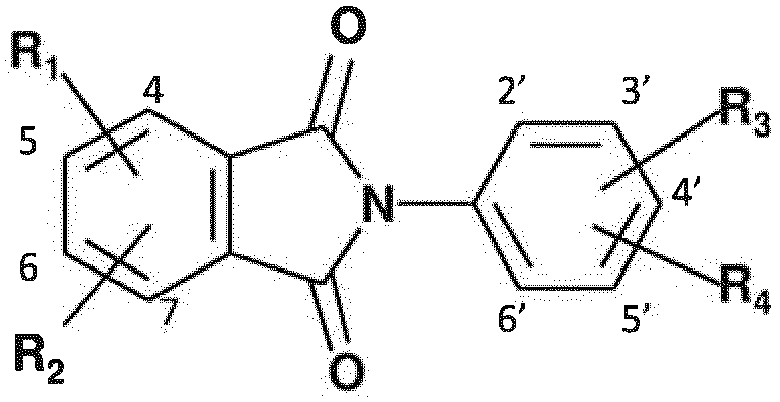
Description
- The present invention relates to a novel phenylphthalimide derivative and a pharmaceutical composition containing the same as an active ingredient. The present invention more specifically relates to a phenylphthalimide derivative prepared by modification of phenylphthalimide with polyethylene glycol (PEG) or a hydroxy-alkoxy group, a method for producing the same, and a pharmaceutical composition such as an anticancer agent comprising the phenylphthalimide derivative.
- Multiple myeloma (hereafter referred to as "MM") accounting for about 10% of hematologic cancers is one of blood disorders with poor prognosis, hematologic malignancy, which is characterized by monoclonal abnormal proliferation of B-cells (plasma cells) having undergone terminal differentiation. MM causes the presentation of various characteristic symptoms including osteolytic lesion, hematopoietic injury (particularly, anemia), hypercalcemia, renal dysfunction, immunodeficiency, and extramedullary plasmacytoma, etc. The number of national patients with MM is estimated to be 14,000, approximately 4,000 new MM patients are diagnosed annually, and annual death number is 4,066. MM is common in elderly people. Our country will be a super-aging society and thus the number of MM patients will steadily increase. Worldwide, the number of MM patients reaches as high as 750,000.
- Whereas in recent years many malignant lymphoma and leukemia cases among hematologic malignancies are cured, many MM and myelodysplastic syndrome (MDS) cases are often determined to be ineligible for transplantation since MM is common in the elderly and remains as a difficult to cure disease. After specified as a teratogenic substance, thalidomide was forced to withdraw from the market as a drug. However, after the report of data demonstrating that thalidomide is effective against MM and the following clinical trials under strict limitations for use, the efficacy of thalidomide has been recognized (Non-patent
document 1; Non-patent document 2). Protein cereblon (cereblon; CRBN) that binds as teratogen to thalidomide has been recently identified (Non-patent document 3). Furthermore, compounds analogous to thalidomide (lenalidomide, pomalidomide) referred to as immunomodulatory drugs (IMiDs) have emerged and been used for countermeasures against MM, a refractory disease, (Non-patent document 4; Non-patentdocument 5; Non-patent document 6). However, all of these cases will be resistant to these novel drugs within several years, and most cases will be fatal. In particular, the prognosis of high-risk myeloma with chromosome 13 deletion (del13), t(4;14) translocation or chromosome 17 deletion (del17) is poor, and particularly cases with deletion of chromosome 17 (del17) on which TP53 gene is present always results in poor prognosis even when novel drugs are used (Non-patent document 7; Non-patentdocument 8; Non-patent document 9). Subsequently, a proteasome inhibitor, bortezomib (Non-patent document 10), or carfilzomib (Non-patent document 11) has also been developed. Furthermore, drugs with other mechanisms (anti-CD38; daratumumab) include drugs, the efficacy of which is confirmed by the use thereof as a single drug (Non-patent document 12) or the same in combination with lenalidomide. Moreover, an anti-CD38 antibody (daratumumab) and an anti-PD-Ll antibody (atezolizumab) have been administered in combination. However, such antibody medicines are expensive and some of these medicines are injections and are unable to be applied via oral medication, and thus cannot always be optimum in view of patients' convenience. - To move beyond the present circumstances, a novel compound effective for even a case with high-risk chromosomal abnormality should be searched for, and the prognosis should be improved. The present inventors have synthesized to date many phthalimide derivatives, and discovered a compound TC11 (2-(2,6-diisopropylphenyl)-5-amino-1H-isoindole-1,3-dione;
Fig. 1 ) having a high drug effect using as an index the inhibition of the proliferation of many myeloma cell line panels including high-risk myeloma cell lines that the present inventors had established themselves (Non-patent document 13; Patent document 1). TC11 comprises a phthalimide ring and a diisopropylphenyl group as the backbone, having an amino group atposition 5 of the phthalimide ring (Non-patent document 14; Non-patentdocument 15; Patent document 2). On the other hand, TC11 lacks a glutarimide ring that is a CRBN binding site of thalidomide, lenalidomide or the like (Non-patent document 6). Nucleophosmin 1 (NPM1/B23.1) and α-tubulin being located as a target protein of TC11 in centrosomes during mitotic phase and having a function of controlling centrosome duplication have been identified (Non-patent document 11). It has been revealed that when tumor cells are treated with TC11, TC11 inhibits centrosome clustering, and as a result, induces multi-polarization and multinucleation of mitotic cells, thereby inducing apoptosis (Non-patent document 11). Similar phenomena of apoptosis induction have also been observed in experiments of the knockdown of NPM1 by siRNA using HeLa cells. Furthermore, the present inventors have also revealed that TC11 is effective against MM resistant to lenalidomide, and thalidomide in a human MM xenograft model established using immunodeficient mice (Non-patent document 16). - PEG is a nontoxic and nonimmunogenic polymer, and has a feature such that the size or the side-chain structure can be varied depending on its application. In recent years, PEGylation of target proteins or peptides has been focused and used as a method for improving the pharmacokinetic properties and the immunologic properties of proteins and peptides having poor stability in vivo or for targeting etc., with the use of the above features (Non-patent document 17).
-
- [Patent document 1]
WO2010/061862A1 - [Patent document 2]
JP 10-109975A -
- [Non-patent document 1] Singhal, S. et al., N. Engl. J. Med., 341: 1565-1571, 1999
- [Non-patent document 2] Hattori, Y. et al., Cancer Sci., 99, 1243-1250, 2008
- [Non-patent document 3] Ito, T. et al., Science, 327: 1345-1350, 2010
- [Non-patent document 4] Dimopoulos, M. et al., N. Engl. J. Med., 357: 2123-2132, 2007
- [Non-patent document 5] Weber, DM. et al., N. Engl. J. Med., 357: 2133-2142, 2007
- [Non-patent document 6] Chamberlain, PP. et al., Nature Struct. Mol. Biol., 21: 803-809,2014
- [Non-patent document 7] Avet-Loiseau, H. et al., Blood, 109, 3489-3496, 2007
- [Non-patent document 8] Avet-Loiseau, H. et al., Leukemia, 24, 623-628, 2010
- [Non-patent document 9] Klein, U. et al., Cancer, 117, 2136-2144, 2011
- [Non-patent document 10] Jagannath, S. et al., Leukemia: 21, 151-157, 2007
- [Non-patent document 11] Siegel, DS. et al., Blood, 120: 2817-2825, 2012
- [Non-patent document 12] Lokhorst, HM. et al., New Engl. J. Med., 373: 1207-1219, 2015
- [Non-patent document 13] Shiheido, H. et al., PLoS One, 7: e38878, 2012
- [Non-patent document 14] Shibata, Y. et al., Chem. Pharm. Bull., 44: 156-162, 1996
- [Non-patent document 15] Noguchi, T. et al., Bioorg. Med. Chem. Lett., 15: 5509-5513,2005
- [Non-patent document 16] Matsushita, M. et al., PLoS One, 10: e0116135, 2015
- [Non-patent document 17] Pasut, G., Veronese, FM., Adv. Drug Del. Rev., 61, 1177-1188, 2009
- An object of the present invention is to provide a novel phenylphthalimide derivative. Another object of the present invention is to provide a pharmaceutical composition comprising the novel derivative. Another object of the present invention is to provide a therapeutic agent for various cancers including MM and immune abnormality, comprising the novel derivative.
- TC11 has been problematic in its low water solubility in view of development thereof as a drug. It has been observed that in a tumor-transplanted mouse model, most TC11 administered via intraperitoneal injection remains unabsorbed within the abdominal cavity. Hence, TC11 should have improved water solubility upon its formulation. First, in an experiment for improving water solubility of TC11, salt formation of amino groups bound to a phthalimide ring with hydrochloric acid and maleic acid was attempted, but almost no salt formation of TC11 was confirmed. Therefore, through modification with PEG, hydroxyalkoxy, sugars, and carbohydrate, etc., the present inventors aimed at improving the water solubility, blood kinetics and drug effect of
TC 11. - As a result of such trial and error, the present inventors discovered a phenylphthalimide derivative, which can be easily synthesized, and has significantly improved water solubility and blood kinetics, low toxicity, no side effect such as teratogenicity, and a high drug effect against various cancers including MM with high-risk chromosomal abnormality, and immune abnormality, and thus completed the present invention.
- The present invention provides a phenylphthalimide derivative represented by the following general formula.

position 4 or 5, R2 is an amino group atposition 6, and R3 and R4 are each independently a hydrogen atom, an alkyl group, an aryl group, an aralkyl group, or an aryloxy group. - R1 is preferably a group containing PEG, and is further preferably a group in which PEG binds to a phthalimide ring via an ester bond. R1 may also be a hydroxy C1-5 alkoxy group. Furthermore, R1 preferably binds to
position 5. R3 and R4 are both isopropyl groups preferably located at position 2' and position 6'. - Furthermore, the present invention provides a pharmaceutical composition comprising the above derivative. The pharmaceutical composition is preferably an anticancer agent. The anticancer agent is preferably used for multiple myeloma.
- The derivative of the present invention can be easily synthesized, and has significantly improved water solubility and blood kinetics, low toxicity, no side effect such as teratogenicity, and a high drug effect on various cancers including MM with high-risk chromosomal abnormality and immune abnormality, and thus is advantageous as a pharmaceutical product.
-
-
Fig. 1 shows the chemical structures of TC11, HOEtO-TC11 and PEG11(E)-TC11. -
Fig. 2 shows the stability of PEG11(E)-TC11 (A) and PEG11(0)-TC11 (B) in mouse blood. -
Fig. 3 shows the stability of PEG11(E)-TC11 in mouse plasma (A) and medium (B). -
Fig. 4 shows the concentration dependency of in vitro cell proliferation inhibitory activity of TC11 and its derivatives, PEG11(E)-TC11 and HOEtO-TC11 against a high-risk MM cell line (KMS21). -
Fig. 5 shows the in vitro cell proliferation inhibitory activity of PEG 11(E)-TC11 (A) and lenalidomide (B) against various MM cells. -
Fig. 6 shows the in vitro cell proliferation inhibitory activity of PEG11(E)-TC11 and TC11 against high-risk MM cells (KMS34) and normal cells (WT) derived from bone marrow stromal cells. -
Fig. 7 shows apoptosis induction in high-risk MM cells (MUM24) by TC11 and PEG11(E)-TC11. -
Fig. 8 shows the effect of TC11 and PEG11(E)-TC11 on cell cycle. -
Fig. 9A shows a pull-down experiment (A) concerning interaction of protein cereblon (CRBN) with thalidomide and TC11 (electrophoretic image). -
Fig. 9B shows surface plasmon resonance biosensorgrams (B) showing the interaction of CRBN with thalidomide and lenalidomide. -
Fig. 9C shows surface plasmon resonance biosensorgrams (C) showing the interaction of CRBN with TC11 and its derivatives, PEG11(E)-TC11, PEG11(O)-TC11, and HOEtO-TC11. -
Fig. 10 shows mouse blood kinetics upon single intraperitoneal administration of TC11(A) and PEG11(E)-TC11(B) to mice. -
Fig. 11 shows the antitumor effect of TC11, PEG11(E)-TC11, and PEG11(0)-TC11 on KMS11 cancer-bearing mice. -
Fig. 12 shows a comparison of TC11, HOEtO-TC11, and lenalidomide for the antitumor effect on KMS11 cancer-bearing mice. - TC11 is known to have an anticancer effect and a high drug effect particularly on myeloma (Non-patent document 13). Nucleophosmin 1 (NPM1/B23.1) and α-tubulin being located in centrosomes during mitotic phase as a target protein of TC11 and having a function of controlling centrosome duplication have been identified (Non-patent document 13). It has been revealed that when tumor cells are treated with TC11, TC11 inhibits centrosomal clustering, as a result, induces multi-polarization and further multinucleation of mitotic cells, thereby inducing apoptosis (Non-patent document 13). Similar phenomena of apoptosis induction have also been observed in experiments of the knockdown of NPM1 by siRNA using HeLa cells. Furthermore, the relationship between TC11 and phosphorylation of NPM1 has been studied, revealing that the phosphorylation of Ser4, Thr95, and Thr199 of NPM1 is accelerated over time by TC11. One of phosphotransferases ofNPM1 is Cyclin-dependent kinase 1 (CDK1). Acceleration of NPM1 phosphorylation by TC11 is suppressed through treatment with an inhibitor of CDK1, CGP74514A, revealing the involvement of CDK1 in acceleration of NPM1 phosphorylation.
- Meanwhile, it has been revealed by a Blue native PAGE method that TC11 inhibits oligomerization of NPM1. NPM1 is considered to exhibit cell biological functions via oligomerization, while TC11 is considered to suppress the functions. Moreover, TC11 inhibits α-tubulin polymerization. It is thus inferred that mitotic catastrophe is induced by such inhibition. As described above, it is considered that TC11 induces apoptosis of myeloma cells with various mechanisms including (1) inhibition of NPM1 oligomerization, (2) inhibition of α-tubulin polymerization, followed by the suppression of TC11-induced apoptosis by CGP74514A, and (3) induction of cell death by excessive activation of CDK1, etc.
- The present inventors synthesized various derivatives resulting from modification of TC11 with polyethylene glycol (PEG), hydroxyalkoxy, sugars such as glucose, carbohydrate, and the like, and intensively searched for activity of suppressing the growth of various cancers including MM. Specifically, the present inventors examined a phenylphthalimide derivative represented by the following general formula.


position position position position - The present inventors discovered that a phenylphthalimide derivative in which, in the above general formula, R2 is an amino group at
position 6, R1 is a group containing PEG or a hydroxy C1-5 alkoxy group binding toposition 4 or 5, and R3 and R4 are each independently a hydrogen atom, an alkyl group or an aryl group, has an in vitro cancer growth-suppressing effect and in vivo antitumor activity as determined by the use of a xenograft model. The present inventors also discovered that special blood kinetics are observed based on the binding modes of PEG. These compounds have never been synthesized and are completely novel TC11 derivatives. - In the above general formula, R1 is a group containing PEG or a hydroxy C1-5 alkoxy group binding to
position 4 or 5, R2 is an amino group atposition 6, R3 and R4 are each independently a hydrogen atom, an alkyl group, an aryl group, an aralkyl group, or an aryloxy group. - R1 may be a group containing PEG. The term "PEG" generally refers to PEG represented by a structural formula CH3O(CH2CH2O)nH wherein n is between 5 and 15 (preferably 6 and 15, further preferably 8 and 13). PEG may directly bind to a phthalimide ring via terminal oxygen atom (binding via an ether bond), or to a phthalimide ring via a divalent organic group. As such an organic group, any organic group can be used as long as it does not inhibit the anticancer activity of the derivative, and in general, polyoxyalkylene in which a non-terminal oxygen atom is substituted with an ester group (binding via an ester bond) can be used. Alkylene has a carbon number of generally 2 to 4, and a polymerization degree of generally 2 to 3. For example, in the case of polyoxyethylene, an example thereof is a -CH2-CH2-C(O)-O-CH2-CH2-O- structure.
- An end of PEG, which is on the side not binding to a phthalimide ring may be OH or an alkyl group having a carbon number of 1-3, and is generally a methyl group.
- R1 is preferably a group in which PEG binds to a phthalimide ring via polyoxyalkylene wherein a non-terminal oxygen atom is substituted with an ester group, specifically, an ester bond. Hydroxyalkoxy-TC11 is a compound generated by hydrolysis of PEG 11 (E)-TC11 by in vivo esterase. Accordingly, in the case of binding via an ester bond, more desirable pharmacokinetics can be exhibited as a result of in vivo hydrolysis. A hydroxyalkoxy derivative also exhibits an anticancer effect, and thus R1 may also be a hydroxy C1-5 alkoxy group. A hydroxy-alkoxy group has a carbon number of preferably 1 to 3, and further preferably 2.
- Specific examples of R1 include CH3O(CH2CH2O)nCH2CH2O-, and CH3O(CH2CH2O)nCH2CH2C(O)OCH2CH2O- wherein "n" is as described above.
- R1 preferably binds to
position 5. - R2 is an amino group binding to
position 6. It is considered that an amino group should be present atposition 6 of a phthalimide ring for the derivative to exhibit anticancer activity. R1 group is bound toposition 5 or position 4 in order to avoid the inhibition of the effect of the amino group. In addition, phthalimide rings are symmetric, and thus the relationship betweenposition 6 andposition 5 or position 4 is equivalent to that betweenposition 5 andposition 6 or position 7. - R3 and R4 are each independently a hydrogen atom, an alkyl group, an aryl group, an aralkyl group, or an aryloxy group.
- An alkyl group is generally an alkyl group having a carbon number of 1 to 6 (preferably 1 to 3). Examples thereof include a methyl group, an ethyl group, a propyl group, an isopropyl group, a butyl group, and a t-butyl group.
- An aryl group is generally an aryl group having a carbon number of 6 to 10. An example thereof is a phenyl group. Aryl may be substituted with an alkyl group. The alkyl group may be similar to the above alkyl.
- An aralkyl group is an aralkyl group wherein an alkyl portion has a carbon number of 1 to 6 (preferably 1 to 3). The aryl portion may be similar to the above aryl group. Examples thereof include a benzyl group, and a phenethyl group.
- Alkyl portions in an alkyl group and an aralkyl group may be linear or branched.
- An aryloxy group may be a group in which oxygen atoms bind to the above aryl group and aralkyl group.
- The positions of R3 and R4 are not particularly limited. For example, R3 is substituted with a phenyl group at position 2' or position 6', or R3 is substituted with an oxyphenyl group at position 4'. R3 and R4 are both isopropyl groups, and preferably present at position 2' and position 6'.
- The structure on the phenyl ring side should be hydrophobic for the derivative to exhibit anticancer activity. Accordingly, it is inferred that anticancer activity is exhibited based on the range of the above R3 and R4. Hence, it is also inferred that the structure on the phenyl ring side should not be PEGylated. As described later in Example 14, the structure on the phenyl ring side is also a structure that does not bind to the cereblon protein.
- The derivative of the present invention can be produced through combination of known synthesis techniques. This will be described with specific examples as follows.
- PEG11(E)-TC11 (
Fig. 1 ) of the present invention can be produced by a method for producing the TC11 derivative (PEG11(E)-TC11) through PEGylation of TC11 via an ester bond, such as the following method when a reactive group for modification is mPEG 1-COOH.


- The compound of the present invention, PEG11(E)-TC11 prepared via modification with PEG, can be obtained as follows. For example, 4-hydroxyphthalic acid is nitrated with guanidine nitrate to give a mixture of a 5-nitro compound and a 3-nitro compound of 4-hydroxyphthalic acid, and then the mixture is dehydrated with phosphorus pentoxide so as to be able to give a hydroxyphthalic anhydride mixture of a 5-nitro anhydride and a 3-nitro anhydride. The mixture is reacted with 2,6-diisopropylaniline, so as to be able to give a diisopropylphenyl phthalimide derivative (1a and 1b). The mixture is purified by silica gel chromatography, so that 1a and 1b can be separated from each other. 1a is reacted with ethylene bromohydrin, so as to be able to give hydroxyethoxy-la. The hydroxyethoxy-la is esterified with mPEG11-COOH to give PEG11(E)-1a, and then PEG11(E)-1a is subjected to catalytic reduction with a hydrogen gas in the presence of a Pd/C catalyst, so that PEG11(E)-TC11 can be finally obtained.
- PEG11(0)-TC11 of the present invention can be produced by a method for producing the TC11 derivative (PEG11(O)-TC11) through PEGylation ofTC11 via an ether bond such as the following method when a reactive group for modification is mPEG11.

- Hydroxyethoxy-1a synthesized in advance is tosylated with para-toluenesulfonyl chloride (TsCl) to synthesize tosylethoxy-1a, mPEG11 is reacted with the resultant to obtain PEG(O)-1a, and then catalytic reduction is finally performed with a hydrogen gas in the presence of a Pd/C catalyst, so that PEG11(O)-TC11 can be obtained.
- A derivative having another substituent, such as PEG5(E)-TC11 can be similarly produced by adequately substituting a starting material or the like.
- The present invention provides a pharmaceutical composition comprising the above derivative. The pharmaceutical composition is preferably an anticancer agent. The anticancer agent is preferably used for multiple myeloma.
- A phenylphthalimide derivative as an active ingredient can be formulated into a preparation (pharmaceutical composition) using a pharmaceutically acceptable carrier. Examples of such a pharmaceutically acceptable carrier include an excipient and a base. Moreover, the preparation may contain a generally employed additive. The dosage form thereof is selected as appropriate depending on the route of administration. For example, the phenylphthalimide derivative may be formulated into preparations such as tablets, capsules, granules, powders, or syrups for peroral administration, or can be formulated into preparations such as injection preparations, or suppositorries for parenteral administration via intraperitoneal, intravenous, or subcutaneous injection. Examples of the preparation also include a preparation prepared by packaging the phenylphthalimide derivative as an active ingredient and another anticancer agent separately and then integrating the packages into a single preparation. The anticancer agent of the present invention can be administered to a patient who is receiving or will receive anticancer drug treatment. Such a phenylphthalimide derivative may be used independently or in combination with another drug (for example, another anticancer agent).
- The dosage of the phenylphthalimide derivative is selected as appropriate depending on target anticancer drug treatment, patient's conditions, and the like. For example, when the phenylphthalimide derivative is administered to a human, the phenylphthalimide derivative can be administered at a dosage of about 0.1 to 20 mg/kg (body weight) per day, preferably about 0.1 to 0.5 mg/kg (body weight) per day in a single dose or several doses via peroral administration or parenteral administration including intravenous administration and subcutaneous administration. The dosage and the frequency of administration can be varied adequately depending on the symptom, age, and the method of administration, for example.
- The phenylphthalimide derivative can be used for treatment of cancers including, particularly, hematologic malignancies such as myeloma, malignant lymphoma, leukemia, and myelodysplastic syndrome and solid cancers such as colon cancer, lung cancer, renal cell cancer, mammary cancer, brain tumor, ovarian carcinoma, melanoma, stomach cancer, and prostate cancer. In particular, the phenylphthalimide derivative can be advantageously used for multiple myeloma.
- The present invention will be described in detail as follows with reference to the following examples. These examples are preferred embodiments of the present invention, and the present invention is not limited to these examples.
- 4-Hydroxyphthalic acid (2.5 g, 13.73 mmol) was added to a 300-ml three-necked flask, and then the mass was pulverized using a glass rod into powders as fine as possible. 88 ml of 85% sulfuric acid (96% sulfuric acid was added to 10 ml of H2O to give 88 ml of the resultant.) was added and then the resulting mass was subjected to ultrasonication, stirring, or pulverization with a glass rod, followed by complete dissolution at room temperature. Guanidine nitrate (1.68 g, 13.76 mmol) was gradually added while stirring on ice, and then the resultant was further stirred for 3 hours while cooling with ice. The reaction solution was poured into ice-cold H2O (400 ml), and then the flask was washed with 80 ml of ice-cold H2O. The total amount was about 550 ml. The solution was poured into a 1-L separatory funnel, and then extracted twice with ethyl acetate (170 ml × 2). The resulting ethyl acetate layer was washed twice with a saturated saline solution (70 ml × 2), dehydrated with anhydrous sodium sulfate, and then filtered. The filtrate was evaporated to dryness.

- The nitrated product 3.66 g (13.15 mmol, yield 95.8%) was obtained as a pale yellow powder by the above step. As a result of 1H-NMR spectroscopy in deuterated methanol, the reaction product was found to be an about 1:1 mixture of 5-nitro-4-hydroxyphthalic acid and 3-nitro-4-hydroxyphthalic acid.
- The Rf values of silica gel TLC (developing solvent: chloroform/methanol = 1:1): The Rf value of the raw material (4-hydroxyphthalic acid) was 0.77, the same of the product, 5-nitro compound, was 0.3, and the same of 3-nitro compound was 0.07.
1H NMR (400 MHz, CDCl3): 5-nitro compound: δ8.56 (s, 1H), 7.27 (s, 1H); 3-nitro compound: δ8.00 (d, J =8.8 Hz, 1H), 7.14 (d, J =8.8 Hz, 1H). - The product ratio of the 5-nitro compound and the 3-nitro compound was 1:1 as a result of 1H NMR spectroscopy.
- A mixture (1.22 g, 5.37 mmol) of 5-nitro-4-hydroxyphthalic acid and 3-nitro-4-hydroxyphthalic acid were added to a 500-ml three-necked flask, and then the mass was pulverized using a glass rod. After 1 hour of drying under vacuum, dehydrated toluene (150 ml) was added. However, the resultant was practically insoluble and thus was subjected to ultrasonication to give a suspension that was homogenous as possible. SICAPENT (14.4 g, as P2O5: 10.8 g, 76.08 mmol) was weighed in a beaker, and then immediately added into the flask under a nitrogen gas using a funnel and a spatula. Since SICAPENT is highly hygroscopic, it should be added quickly. The funnel was washed with the remaining dehydrated toluene (33 ml), and then under an argon gas, heated under reflux at 100°C for a whole day and night. After cooling to room temperature, the reaction solution was filtered off, the resultant was washed with toluene, and then the filtrate (with slight clouding) was evaporated to dryness.


- The reaction product 571.6 mg (2.73 mmol, yield 50.8%) was obtained as a pale yellow powder by the above step. The Rf values of silica gel TLC (developing solvent: chloroform/methanol = 1:1): The Rf value of the raw material (5-nitro-4-hydroxyphthalic acid) was 0.27, the same of (3-nitro-4-hydroxyphthalic acid) was 0.1, the same of 5-nitro-4-hydroxyphthalic anhydride was 0.9, and the same of 3-nitro-4-hydroxyphthalic anhydride was 0.77.
1H NMR (400 MHz, CDCl3): 5-nitro compound: δ8.82 (s, 1H), 7.81 (s, 1H); 3-nitro compound: δ8.14 (d, J =8.8 Hz, 1H), 7.70 (d, J =8.8 Hz, 1H). - The product ratio of the 5-nitro compound and the 3-nitro compound was 1:0.6 as a result of 1H NMR spectroscopy.
- 2,6-Diisopropylaniline (587mg, 3.31mmol) was weighed in a 50-ml two-necked eggplant flask, acetic acid (2 ml) was added, and then the mixture was stirred. A mixture (571.6 mg, 2.73 mmol) of 5-nitro and 3-nitro-4-hydroxyphthalic anhydrides was added to and dissolved in the remaining acetic acid (11.5 ml), followed by heating for a whole day and night under reflux at 140°C. After cooling to room temperature, the reaction solution was poured into 75 ml of H2O (in an amount about 5 times that of acetic acid), to immediately give a beige fine precipitate. The solution was gently stirred for 30 minutes, and then the resulting precipitate was filtered off (see note). After washing with 100 ml of 5% acetic acid, the filter paper including the precipitate was dried.

- A light brown powder (687 mg) was obtained by the above step. The powder adhered to the filter paper was dissolved with ethyl acetate and then evaporated to dryness, so that 273 mg of a similar light brown powder was obtained. A total of 0.96 g of the product (2.61 mmol, yield 95.6%) was obtained. As a result of 1H-NMR spectroscopy in deuterated chloroform, the resultant was a mixture (compound 1a and compound 1b) in which 2,6-diisopropylaniline was added to the 5-nitro compound and to the 3-nitro compound, respectively.
- The Rf values of silica gel TLC (developing solvent: chloroform/methanol=10:1): The Rf value of the raw material (5-nitro-4-hydroxyphthalic anhydride) was 0.14, the same of (3-nitro-4-hydroxyphthalic anhydride) was 0.07, the same of the product, 1a, was 0.34, and the same of 1b was 0.17.
- (Note) The precipitate that appears herein is so fine to easily cause severe clogging upon filtration. In such a case, extraction with ethyl acetate was performed. The ethyl acetate layer contained 1a and 1b, unreacted aniline, and acetic acid. Hence, the layer was evaporated to dryness so as to remove acetic acid as much as possible. Aniline could be removed in the next process, silica gel chromatography.
- The mixture of 1a and 1b (0.96 g) was dissolved in 1.8 ml of chloroform, sprinkled with silica gel, and then injected into the upper part of a silica gel column (ϕ3.5 cm × 10.5 cm; 100.8 ml) subjected to swelling in hexane:ethyl acetate (40:1). Aniline mixed therein was eluted with hexane:ethyl acetate (10:1), and then the resultant was eluted with hexane:ethyl acetate (4:1).


- A yellow substance with Rf=0.34 was obtained by silica gel TLC (chloroform/methanol=10:1) in the above step. The purified product was identified as 1a by 1H-NMR spectroscopy in deuterated chloroform. Moreover, under the above TLC conditions, only a single spot of 1a was confirmed. The yield was 628.8 mg (31.8%).
- 1H NMR (400 MHz, CDCl3): 5-nitro compound :δ8.76 (s, 1H), 7.71 (s, 1H), 7.48 (t, 7.6 Hz, 1H), 7.29 (d, J =7.6 Hz, 2H), 2.61 (sep, J =7.2 Hz, 2H), 1.16 (d, J =7.2 Hz, 12H); 3-nitro compound :δ8.11 (d, J =8.8 Hz, 1H), 7.59 (d, J =8.8 Hz,1H), 7.48 (t, J =7.6 Hz, 1H), 7.30 (d, J =7.6 Hz, 2H), 2.63 (sep, J =7.2 Hz, 2H), 1.16 (d, J =7.2 Hz, 12H) The product ratio of the 5-nitro compound and the 3-nitro compound was 1:0.7 as a result of 1H NMR spectroscopy.
MS(EI):[M]+ m/z 368 - 1a of the 5-nitro compound (628.8 mg, 1.71 mmol) was weighed in a 100-ml two-necked eggplant flask, dried under vacuum for 1 to 2 hours, and then dissolved in dehydrated DMF (24 ml). Diisopropylethylamine (583.4 µl, 3.40 mmol) and ethylene bromohydrin (240.5 µl, 3.41 mmol) were added, and then the mixture was heated at 110°C for a whole day and night under reflux. After the temperature returned to room temperature, the resultant was transferred to a 300-ml separatory funnel. 2 M HCl (60 ml) was added and then extraction was performed with hexane:ethyl acetate (1:1) (60 ml×3). The results of silica gel TLC confirmed the reaction product in the hexane:ethyl acetate layer. The hexane:ethyl acetate layer was washed with a saturated saline solution. After dehydration with anhydrous sodium sulfate, the resultant was filtered and then subjected to vacuum concentration, so that 701 mg of a residue (dark brown viscous liquid) was obtained. The thus obtained residue contained a reaction product and unreacted raw materials.
- The thus obtained residue was dissolved in 0.9 ml of chloroform, sprinkled with silica gel, and then injected into the upper part of a silica gel column (ϕ3.5 cm×7.2 cm; 69.1 ml) subjected to swelling in hexane:ethyl acetate (40:1). The column was washed sequentially with hexane:ethyl acetate (40:1) and then hexane:ethyl acetate (10:1), and then unreacted 1a was eluted with hexane:ethyl acetate (4:1). Subsequently, the target reaction product was eluted with hexane:ethyl acetate (3:1).


- The reaction product was identified as hydroxyethoxy-la as a result of 1H-NMR spectroscopy in deuterated chloroform. The yield of hydroxyethoxy-1a was 567.2 mg (1.38 mmol, 80.7%).
- The Rf values of silica gel TLC (developing solvent: chloroform/ethyl acetate = 1:1): The Rf value of hydroxyethoxy-1a was 0.67, and the same of raw material 1a was 0.1.
1H NMR (400 MHz, CDCl3): δ8.37 (s, 1H), 7.71 (s, 1H), 7.48 (t, J =7.8 Hz, 1H), 7.30 (d, J =7.8 Hz, 2H), 4.43 (t, J =4.3 Hz, 2H), 4.07 (m, 2H), 2.65 (sep, J =6.8 Hz, 2H), 1.17 (d, J =6.8 Hz, 12H).
MS(EI):[M]+ m/z 412 - Hydroxyethoxy-la (228.4 mg, 0.554 mmol) was weighed in a 20-ml pear-shaped flask and mPEG11-COOH (401.5 mg, 0.682 mmol) was weighed in a 10 ml pear-shaped flask, followed by about 1 hour of drying under vacuum. Dehydrated DMF (1.6 ml) and triethylamine (257 µl, 1.85 mmol) were added to a 50-ml two-necked eggplant flask, and then 4-dimethylaminopyridine (6.96 mg, 0.057 mmol) and 2-methyl-6-nitrobenzoic anhydride (235.1 mg, 0.683 mmol) were further added under a nitrogen gas flow. Previously dried mPEG11-COOH was added and dissolved in 2.8 ml of dehydrated DMF, followed by 15 minutes of stirring at room temperature. Subsequently, previously dried hydroxyethoxy-la was added to and dissolved in 5.5 ml of dehydrated DMF, and then the resultant was heated at 55°C for a whole day and night under reflux. After reaction, the resultant was transferred to a 50-ml eggplant flask, and then DMF was evaporated to dryness at 55°C and 10 mmHg. The residue (brown viscous liquid) was dissolved in ethyl acetate (40 ml), the solution was transferred to a 200-ml separatory funnel, and then saturated ammonium chloride (pH 4) (40 ml) was added for extraction. Extraction was further performed twice with ethyl acetate (40 ml), the ethyl acetate layer was neutralized with 50 ml of saturated sodium hydrogen carbonate (pH 8), washed with a saturated saline solution, dehydrated with anhydrous sodium sulfate, filtered, and then evaporated to dryness.

- Finally, 546.8 mg of a residue was obtained. The thus obtained residue was dissolved in 0.5 ml of chloroform, and then injected into the upper part of a silica gel column (ϕ2.5 cm × 10 cm; 49 ml) subjected to swelling in chloroform. Unreacted hydroxyethoxy-la was eluted with chloroform (100%), and then a target reaction product was eluted with chloroform:methanol (98:2). The results of 1H-NMR spectroscopy in deuterated chloroform confirmed that the product was PEG11(E)-1a. The result of silica gel TLC (chloroform/methanol=10:1) confirmed the spot of only PEG11(E)-1a. The yield was 365 mg (0.371 mmol, 67%).
- The Rf values of silica gel TLC (developing solvent: chloroform/methanol=10:1): The Rf value of the raw material, hydroxyethoxy-la, was 0.53, and the same of the product, PEG1 1(E)-1a, was 0.47.
1H NMR (400 MHz, CDCl3): δ8.37 (s, 1H), 7.71 (s, 1H), 7.48 (t, J =7.6 Hz, 1H), 7.30 (d, J =7.6 Hz, 2H), 4.53 (m, 4H), 4.07 (m, 2H), 3.77 (t, J =6.4 Hz, 2H), 3.65 (br.s, 44H), 3.55 (dd, J =2.8, 4.0 Hz, 2H), 3.38 (s, 3H), 2.65 (sep, J =6.4 Hz, 2H), 1.16 (d, J =6.4 Hz,12H). - PEG11(E)-1a (365 mg, 0.371 mmol) was added to a 200-ml two-necked eggplant flask, and then dissolved in 43 ml of tetrahydrofuran:ethanol (1:1). After addition of 5% Pd/C (172.5 mg) under an argon gas flow, substitution with a hydrogen gas was performed, and then to stirring at room temperature for a whole day and night. The reaction solution was filtered using sellite, and then the filtrate was evaporated to dryness, so that 402.1 mg of a residue (yellow green viscous liquid) was obtained. The residue was dissolved in chloroform (0.6 ml), and then the resultant was injected into the upper part of a silica gel column (ϕ2.5 cm×9.5 cm; 46.6 ml) subjected to swelling in chloroform. After the column was washed with 100% chloroform, and then with chloroform:methanol (99:1), a target reaction product was eluted with chloroform:methanol (98:2), and thus a fluorescent pale yellow oily substance was obtained.

- The thus obtained substance was identified as PEG11(E)-TC11 as a result of 1H-NMR spectroscopy in deuterated chloroform. The results of silica gel TLC confirmed a single spot of only PEG11(E)-TC11. The yield was 386.8 mg (0.406 mmol), and the yield (%) was 73.3% relative to the starting material, hydroxyethoxy-1a.
- The Rf values of silica gel TLC (developing solvent: chloroform/methanol=10:1) (Note): The Rf value of the raw material, PEG(E)-1a, was 0.47, and the same of the product, PEG11(E)-TC11, was 0.47.
- (Note) The two exhibited almost the same Rf value as a result of silica gel TLC under the conditions. PEG11(E)-TC11 emitted yellow fluorescence by irradiation at 365 nm, but PEG11(E)-1a emitted no fluorescence. Moreover, 1H-NMR results revealed that the raw materials were all hydrogenated to give PEG11(E)-TC11.
- 1H NMR (400 MHz, CDCl3): δ7.25 (s, 1H), 7.16 (s, 1H), 7.42 (t, J =7.8 Hz, 1H), 7.26 (d, J =7.8 Hz, 2H), 4.56 (t, J =3.6 Hz, 2H), 4.33 (t, J =3.6 Hz, 2H), 3.78 (t, J =6.4 Hz, 2H), 3.64 (br.s, 44H), 3.55 (dd, J = 2.8, 6.0 Hz, 2H), 3.38 (s, 3H), 2.66 (sep, J =6.8 Hz, 2H), 1.14 (d, J =6.8 Hz,12H).
HRMS(ESI): The calculated value of m/z [M+Na]+ was 975.50417, and the measured value was 975.50454.
HPLC: Analysis with a YMC-Pack C18 column (250 mm × 4.6 mm, particle diameter of 5 µm, flow rate of 0.7 ml/min, solvent; CH3CN: H2O=1:1) revealed elution at 11.8 min.
UVmax = 270(s), 317(w), 404(w) nm (50% EtOH) - PEG5(E)-TC11 was synthesized from the hydroxyethoxy-la by the following method.
-

- DMAP 50.0 mg (0.436 mmol) and 2.0 mL (14.53 mmol) of triethylamine were dissolved in 20 mL of DMF, and then 1.8 g (4.36 mmol) of hydroxyethoxy-la and 1.5 g (5.37 mmol) of mPEG5-COOH were added. Subsequently, 1.85 g (5.37 mmol) of MNBA was added, the reaction solution was heated to 55°C under an argon atmosphere, and then stirred for 16 hours. Completion of the reaction was confirmed by HPLC, water was added, extraction with ethyl acetate was performed, and then an aqueous layer was further extracted with ethyl acetate. An organic layer was washed with a saturated saline solution, dried using sodium sulfate, and then subjected to vacuum concentration.
- The resultant was purified by silica gel chromatography (HiFlash 2L heptane/ethyl acetate = 5/1→0/1), and then the main distillate was subjected to vacuum concentration, so that 2.86 g of PEG5(E)-1a was obtained as a colorless oil (yield: 97.3%).
-

- After addition of 450 mg of Pd/C (K-type) to a solution (mixture of 56 mL of EtOH and 56 mL of THF) of 2.86 g (4.23 mmol) of PEG5(E)-1a, the resultant was stirred for 2 hours under a hydrogen atmosphere at room temperature.
- After the completion of the reaction was confirmed by HPLC, the reaction solution was filtered and then concentrated under vacuum. The resultant was purified by silica gel chromatography (HiFlash 3 L methanol/chloroform = 0/1→1/20) and then the main distillate was concentrated under vacuum, thereby obtaining 2.54 g of PEG5(E)-TC11 as a yellow oil (yield: 93.0%).
- HPLC: Analysis with an YMC-Pack Pro C18 column (250 mm × 4.6 mm, particle diameter of 5 µm, flow rate of 1.0 ml/min, solvent; A: H2O containing 0.1% TFA, B: AcCN containing 0.1% TFA, Gradient: A/B= 100/30→50/50 (10 min)→15/75 (15 min)→0/100 (20 min)→100/30 (25 min), revealed elution at 20.5 min.
MS (TOFMS): [M]+m/z 644.6
1H-NMR(400 MHz, d6-DMSO): δ7.44(t, J=7.6 Hz, 1H),7.35(s, 1H), 7.30(d, J=7.6 Hz, 2H), 7.09(s, 1H), 6.11(br.s, 2H), 4.44(br.t, 2H), 4.39(br.t, 2H), 3.65(t,J=6.4Hz), 3.48(m, 16H),3.23(s,3H),2.64(sep, J=7.2 Hz,2H),1.06(d, J=8.4 Hz,12H) . - Hydroxyethoxy-1a (666.6 mg, 1.62 mmol) was weighed in a 100-ml eggplant flask, dried under vacuum for about 1 hour, and then dissolved by the addition of dehydrated toluene (43 ml). While stirring on ice, para-toluene sulfonyl chloride (623.3 mg, 3.27 mmol) was added under a nitrogen gas flow. 4-dimethylaminopyridine (400.2 mg, 3.28 mmol) was subsequently added to cause precipitation, but left to stand until the temperature returned to room temperature, followed by stirring for a whole day and night. After reaction, the precipitate was filtered off using sellite, and then the filtrate was evaporated to dryness, thereby obtaining 818.6 mg of a residue. The results of silica gel TLC (hexane:ethyl acetate =1:1) confirmed the spot of tosylethoxy-1a (Rf=0.75), few spots of para-toluenesulfonyl chloride (Rf=0.82) and the spot of a small amount of hydroxyethoxy-1a(Rf=0.49).

- The thus obtained residue was dissolved in 1.5 ml of chloroform, sprinkled with silica gel, and then injected into the upper part of a silica gel column (φ)3.5 cm × 6.7 cm; 64.3 ml) subjected to swelling in hexane. After elution of para-toluenesulfonyl chloride with hexane:ethyl acetate (5:1), a target reaction product was eluted with hexane:ethyl acetate (4:1). Unreacted hydroxyethoxy-la was collected with hexane:ethyl acetate (2:1). The product was identified as tosylethoxy-1a by 1H-NMR spectroscopy in deuterated chloroform. The yield was 503.7 mg (0.888 mmol, 55%) and the same of the unreacted hydroxyethoxy-la was 144.4 mg (0.35 mmol, 22%).
- The Rf values of silica gel TLC (developing solvent: hexane/ethyl acetate =1:1): The Rf value of the raw material, hydroxyethoxy-la, was 0.49, the same of the product, tosylethoxy-1a, was 0.75, and the same of para-toluenesulfonyl chloride was 0.82.
1H NMR (400 MHz, CDCl3): δ8.30 (s, 1H), 7.82 (d, J =6.5 Hz, 2H), 7.60 (s, 1H), 7.48 (t, J =6.4 Hz, 1H), 7.39 (d, J =6.5 Hz, 2H), 7.30 (d, J =6.4 Hz, 2H), 4.50 (m, 2H), 4.45 (m, 2H), 2.63 (sep, J =5.2 Hz, 2H), 1.16 (d, J =5.2 Hz, 12H). - Molecular sieve 3A (1.0 g) was weighed in a small beaker. Twenty five seconds of microwave heating and 20 minutes of cooling under vacuum were repeated 3 times to activate molecular sieve 3A, and then the resultant was added to a 20-ml two-necked eggplant flask under a nitrogen gas flow. mPEG11 (307.6 mg, 0.595 mmol) was weighed in a 20 ml pear-shaped flask, decompressed for 1 hour, dissolved in dehydrated DMF (2 ml), added to the flask of molecular sieve 3A, and then stirred at room temperature for 30 minutes to 1 hour. Sodium hydride (46.4 mg, 27.8 mg as sodium hydride, 1.16 mmol) was weighed in a 10-ml two-necked eggplant flask. Mineral oil adhered thereto was washed 3 times with dehydrated hexane, dried under vacuum, and then suspended in dehydrated DMF (2.9 ml). The previous DMF solution of mPEG11 was stirred on ice for cooling. The suspension of sodium hydride was slowly added dropwise to the solution and then the solution was stirred at room temperature for 1.5 hours. Subsequently, tosylethoxy-1a (157.9 mg, 0.278 mmol) weighed in advance in a 20 ml pear-shaped flask with stirring on ice, dried under vacuum for 2 to 3 hours and then dissolved in dehydrated DMF (1.4 ml) was added dropwise. The resultant was stirred on ice for 7 to 10 minutes. Next, a supernatant of the reaction solution was transferred into a separatory funnel, to which 0.1 M phosphate buffer pH7.0 (5 ml) had been added. The reaction flask and the molecular sieve were washed with ether (12 ml), and then the first extraction was performed. Furthermore, a small amount of a saturated saline solution was added to the aqueous layer, and then extraction was performed twice with ether (12 ml). The ether layer was washed 3 times with a saturated saline solution, dehydrated with anhydrous sodium sulfate, and then filtered, followed by evaporation to dryness.


- A residue (193.9 mg) (orange viscous liquid) was obtained by the above step. The results of silica gel TLC (chloroform:methanol=10:1) confirmed the spot of the target PEG11(O)-1a having UV at Rf=0.42, and the spot having weak UV at Rf=0.94.
- The residue was dissolved in chloroform (0.8 ml), and then injected into the upper part of a silica gel column (ϕ1.3 cm × 11 cm; 14.6 ml) subjected to swelling in chloroform. The column was sufficiently washed with chloroform, and then a target product was eluted with chloroform:methanol (98:2). As a result of 1H-NMR spectroscopy in deuterated chloroform, the product was identified as PEG11(O)-1a. The results of silica gel TLC confirmed the spot of only PEG11(O)-1a (UV absorption and at the lower side thereof, extremely weak pale fluorescence was present). The yield was 165.5 mg (0.182 mmol, 65.5%).
- The Rf values of silica gel TLC (developing solvent: chloroform/methanol = 10:1): The Rf value of the raw material, tosylethoxy-1a, was 0.94, and the same of the product, PEG11(O)-1a, was 0.42.
1H NMR (400 MHz, CDCl3): δ8.30 (s, 1H), 7.73 (s, 1H), 7.47 (t, J =6.2 Hz, 1H), 7.30 (d, J =6.2 Hz, 2H), 4.45 (t, J =3.7 Hz, 2H), 3.96 (t, J =3.7 Hz,2H), 3.64 (br.s, 44H), 3.34 (s, 3H), 2.65 (sep, J =5.6 Hz, 2H), 1.16 (d, J =5.6 Hz,12H). - PEG11(O)-1a (165.5 mg, 0.182 mmol) was added to a 200-ml two-necked eggplant flask, and then dissolved in 40 ml of tetrahydrofuran:ethanol (1:1). After addition of 5% Pd/C (135.6 mg) under an argon gas flow, substitution with a hydrogen gas was performed, and then the resultant was stirred at room temperature for a whole day and night. The reaction solution was filtered using sellite, and then the filtrate was evaporated to dryness.

- A residue (154.6 mg) (yellow green viscous liquid) was obtained by the above step. The results of silica gel TLC (chloroform:methanol = 10:1) confirmed the spot (yellow fluorescence) of the target product, PEG11(O)-TC11, at Rf=0.39. Weak pale fluorescence was observed on the upper and the lower sides of the spot.
- The residue was dissolved in chloroform (0.7 ml), and then injected into the upper part of a silica gel column (ϕ1.3 cm × 10 cm; 13.3 ml) subjected to swelling in chloroform. The column was washed with 100% chloroform and then with chloroform:methanol (99:1) (green and pale fluorescent substances were removed), and then a target reaction product was eluted with chloroform:methanol (98:2), thereby obtaining a fluorescent yellow oily substance.
- The results of silica gel TLC confirmed only a single spot (Rf=0.39) of PEG11(0)-TC11 turned yellow having orange UV and yellow fluorescence. As a result of 1H-NMR spectroscopy in deuterated chloroform, the substance was identified as PEG11(O)-TC11. The yield was 145.9 mg (0.166 mmol), and the yield (%) was 32.9% relative to the starting material, hydroxyethoxy-la.
- The Rf values of silica gel TLC (developing solvent: chloroform/methanol=10:1): The Rf value of the raw material, PEG11(O)-1a, was 0.42, and the same of the product, PEG11(0)-TC11 was 0.39.
1H NMR (400 MHz, CDCl3): δ8.11 (s, 1H), 7.53 (s, 1H), 7.44 (t, J =6.2 Hz, 1H), 7.27 (d, J =6.2 Hz, 2H), 4.30 (t, J =4.6 Hz, 2H), 3.96 (t, J =4.6 Hz,2H), 3.64 (br.s, 44H), 3.35 (s, 3H), 2.66 (sep, J =5.6 Hz, 2H), 1.14 (d, J =5.6 Hz,12H).
HRMS (ESI): The calculated value of m/z [M+Na]+ was 903.48304, and the measured value was 903.48968.
HPLC: Analysis with an YMC-Pack C18 column (250 mm × 4.6 mm, particle diameter of 5 µm, flow rate of 0.7 ml/min, solvent; CH3CN:H2O=1:1) revealed elution at 27.2 min.
UVmax = 270(s), 318(w), 407(w) nm (50% EtOH) - Hydroxyethoxy-la (309.1 mg, 0.749 mmol) was weighed in a 50-ml two-necked eggplant flask, dried under vacuum for about 1 hour, and then dissolved in dehydrated acetonitrile (4.5 ml). Diisopropylethylamine (256.6 µl, 1.50 mmol) and acetobromo-α-D-glucose (616.9 mg, 1.50 mmol) weighed in a 20 ml pear-shaped flask and dissolved in dehydrated acetonitrile (5.5 ml) were added, followed by heating under reflux at 80°C for a whole day and night. The reaction solution was transferred into a 50-ml eggplant flask and then evaporated to dryness, thereby obtaining 1.15 g of a residue. The residue was dissolved in 2.5 ml of chloroform, and then injected into the upper part of a silica gel column (φ3.5 × 10.5 cm; 100.8 ml) subjected to swelling in chloroform. After washing with chloroform:ethyl acetate (90:1), a target reaction product was separated with chloroform:ethyl acetate (80:1).

- The results of 1H-NMR (deuterated chloroform) confirmed signals derived from glucose and from an acetyl group and that the collected reaction product was Glu(OAc)-1a. However, TLC results revealed the presence of substances suspected of coming from glucose. The yield was 739.5 mg (0.939 mmol, about 100%).
- The Rf values of silica gel TLC (developing solvent: chloroform/ethyl acetate = 5:1): The Rf value of the raw material, hydroxyethoxy-la, was 0.33, the same of α-acetobromo glucose was 0.63, and the same of the product, Glu(OAc)-1a, was 0.50 (positive for p-anisaldehyde reaction for confirmation of sugar chain).
1H NMR (400 MHz, CDCl3): δ8.29 (s, 1H), 7.65 (s, 1H), 7.48 (t, J =7.8 Hz, 1H), 7.30 (d, J =7.8Hz, 2H), 5.77 (d, J =5.2 Hz, 1H), 5.22 (t, J =7.4 Hz,1H), 4.93 (dd, J =2.4, 8.4 Hz, 1H), 4.40 (m, 1H), 4.39 (m, 2H), 4.21 (d, J =4.2 Hz, 2H), 3.95 (t, J =4.4 Hz, 2H), 3.93 (m, 1H), 2.65 (sep, J =6.8 Hz, 1H), 2.64 (sep, J =6.8 Hz, 1H), 2.22 (s, 3H), 2.11 (s, 3H), 2.10 (s, 3H), 1.77 (s, 3H), 1.15 (d, J =7.2 Hz, 12H). - Glu(OAc)-1a (739.5 mg, 0.939 mmol) was added to a 300-ml two-necked eggplant flask, and then dissolved in 100 ml of tetrahydrofuran:ethanol (1:1). After addition of 5% Pd/C (460.9 mg) under an argon gas flow, substitution with a hydrogen gas was performed, and then stirring was performed for a whole day and night at room temperature. The reaction solution was filtered using sellite, and then the filtrate was evaporated to dryness.


- A residue (679.5 mg) (0.897 mmol, 95.5%) was obtained by the above step. The results of 1H-NMR (deuterated chloroform) confirmed that the reaction product was Glu(OAc)-TC11. TLC results confirmed a spot at Rf=0.40, which was considered to be of Glu(OAc)-TC11. Furthermore, few spots having pale UV and fluorescence at Rf=0.52 and not reacting with anise were observed. The residue was directly used for deacetylation reaction.
- The Rf values of silica gel TLC (developing solvent: chloroform/ethyl acetate = 5:1): The Rf value of Glu(OAc)-1a was 0.50, and the same of the product, Glu(OAc)-TC11, was 0.40. In addition, both spots were found to be positive for p-anisaldehyde reaction for confirmation of sugar chain.
1H NMR (400 MHz, CDCl3): δ7.29 (s, 1H), 7.15 (s, 1H), 7.42 (t, J =7.8 Hz, 1H), 7.26 (d, J =7.8Hz, 2H), 5.73 (d, J =5.2 Hz, 1H), 5.20 (t, J =2.8 Hz,1H), 4.91 (dd, J =2.4, 10.0 Hz, 1H), 4.35 (dd, J =2.8, 5.6Hz, 1H), 4.29 (m, 2H), 4.21 (d, J =4.0 Hz, 2H), 3.97 (m, 1H), 3.93 (t, J =4.6Hz, 2H), 2.75 (sep, J =6.8 Hz, 1H), 2.74 (sep, J =6.8 Hz, 1H), 2.10 (s, 9H), 1.79 (s, 3H), 1.15 (d, J =7.2 Hz, 12H). - Glu(OAc)-TC11 (679.5 mg, 0.897 mmol) was added to a 100-ml two-necked eggplant flask, and then dissolved in dehydrated methanol (25 ml). Trimethylamine (5.6 ml, 40.2 mmol) was added and then the mixture was stirred for a whole day and night at room temperature. The reaction solution was dissolved in methanol, transferred into a 100-ml eggplant flask, and then evaporated to dryness. Subsequently, toluene was added (not dissolved) and then the resultant was evaporated twice to dryness, thereby removing triethylamine. Furthermore, evaporation to dryness was repeated 3 times with ethyl acetate.

- A residue (566.4 mg) was obtained by the above step. 1H-NMR (deuterated chloroform) results revealed disappearance of the signal of the acetyl group, so that the reaction product was inferred to be Glu-TC11. Next, the reaction product was purified with a silica gel column.
- The residue was dissolved in 1.5 ml of chloroform, and then injected into the upper part of a silica gel column (φ2.7 × 11 cm; 62.7 ml) subjected to swelling in chloroform. After washing of the column with chloroform, a compound corresponding to Rf=0.65 was eluted with chloroform:methanol (98:2). Furthermore, after application of chloroform:methanol (97:3), a reaction product corresponding to Rf=0.48 was eluted with chloroform:methanol (96:4), thereby removing the solvent by evaporation.
- A yellow solid was obtained by the above step. As a result of 1H-NMR spectroscopy in deuterated chloroform, the compound with Rf=0.48 was identified as Glu-TC11. The compound corresponding to Rf=0.65 was identified as hydroxyethoxy-TC11. The yield was 384.4 mg (0.652 mmol), and the yield (%) was 87% relative to the starting material, hydroxyethoxy-la.
- The Rf values of silica gel TLC (developing solvent: chloroform/ethyl acetate =5:1): The Rf value of Glu(OAc)-TC11 was 0.77, and the same of the product, Glu-TC11, was 0.48. In addition, both spots were positive for p-anisaldehyde reaction for confirmation of sugar chain.
1H NMR (400 MHz, CD3OD): δ7.35 (s, 1H), 7.45 (t, J =7.8 Hz, 1H), 7.29 (d, J =7.8Hz, 2H), 7.15 (s, 1H), 5.76 (d, J =5.2 Hz, 1H), 4.32 (t, J =4.4 Hz, 2H), 4.29 (t, J =4.8 Hz, 1H), 3.96 (dd, J =4.4, 7.6 Hz, 2H), 3.84 (t, J =4.6 Hz,1H), 3.80 (dd, J =2.4, 12.0 Hz, 1H), 3.68 (dd, J =5.6, 12.0 Hz,1H), 3.60 (ddd, J =2.4, 5.6, 8.8 Hz, 1H), 3.49 (dd, J =4.8, 9.6Hz, 1H), 2.72 (sep, J =6.9 Hz, 2H), 1.14 (d, J =6.9 Hz, 12H).
HPLC: Analysis with an YMC-Pack C18 column (250 mm × 4.6 mm, particle diameter of 5 µm, flow rate of 0.7 ml/min, solvent; CH3CN:H2O=1:1) revealed elution at 12.8 min.
UVmax = 268(s), 316(w), 400(w) nm (50% EtOH) - Hydroxyethoxy-la (220.9 mg, 0.536 mmol) was added to a 200-ml two-necked eggplant flask, and then dissolved in 30 ml of tetrahydrofuran:ethanol (1:1). After addition of 5% Pd/C (294.2 mg) under an argon gas, substitution with a hydrogen gas was performed, and then stirring was performed for a whole day and night at room temperature. The reaction solution was filtered using sellite, and then the filtrate was evaporated to dryness, thereby obtaining 243.5 mg of a dark green powder. The powder was dissolved in 30 ml of chloroform, and then injected into the upper part of a silica gel column (φ3.5 cm × 6 cm; 57.6 ml) subjected to swelling in chloroform. After washing sequentially with chloroform: ethyl acetate (100), (50:1), and then (20:1), and then a target reaction product was eluted with chloroform:ethyl acetate (5:1).

- As a result of 1H-NMR spectroscopy in deuterated chloroform, the reaction product was identified as hydroxyethoxy-TC11. Silica gel TLC results confirmed the spot of only hydroxyethoxy-TC11. The yield was 199.2 mg (0.521 mmol, 97.2%).
- The Rf values of silica gel TLC (developing solvent: chloroform/ethyl acetate = 1:1): The Rf value of the raw material, hydroxyethoxy-la, was 0.63, and the same of hydroxyethoxy-TC11 was 0.2.
1H NMR (400 MHz, CDCl3): δ7.43 (t, J =7.8 Hz, 1H), 7.34 (s, 1H), 7.27 (d, J =7.8 Hz, 2H),7.18 (s, 1H), 4.29 (t, J =4.3 Hz, 2H), 4.07 (m, 2H), 2.73 (sep, J =6.8 Hz, 2H), 1.16 (d, J =6.8 Hz, 12H).
HPLC: Analysis with an YMC-Pack C18 column (250 mm × 4.6 mm, particle diameter of 5 µm, flow rate of 0.7 ml/min, solvent; CH3CN: H2O=1:1) revealed elution at 8.1 min. - Excess amounts of TC11, PEG5(E)-TC11, HOEtO-TC11, Glu-TC11, PEG11(E)-TC11, and PEG11(0)-TC11 were each added to 100 mM Tris-HCl (pH 7.5), the solutions were stirred at 25°C, the supernatant of each solution was collected every 5 hours, and then the concentration was measured using high performance liquid chromatography (YMC-Pack C18 column (250 mm × 4.6 mm, particle diameter of 5 µm, flow rate of 0.7 ml/min, solvent; CH3CN: H2O=1:1). A point, at which the concentration was constant, was designated as a saturation concentration. Table 1 shows the results.
-
Table 1 Water solubility of various drugs Drug g/ 100ml 100 mM Tris-HCl (pH 7.5)TC11 0.002 (×1) PEG5(E)-TC11 0.002 (×1) HOEtO-TC11 0.027 (×13.5) Glu-TC11 0.082 (×41) PEG11(O)-TC11 1.470 (×735) PEG11(E)-TC11 8.894 (×4,447) Numerals in parentheses indicate relative ratios - The results in Table 1 revealed that HOEtO-TC11 had solubility 13.5 times, Glu-TC11 had solubility 41 times, PEG11(E)-TC11 had solubility 4,447 times, and PEG11(O)-TC11 had solubility 735 times improved than that of TC11. As a result, PEG11(E)-TC11 having solubility 4000 times improved than that of TC11 enables more various methods of administration than that in the case of TC11, including peroral administration, intravenous injection, hypodermic injection, intramuscular injection, and the like.
- First, PEG11(E)-TC11(A) and PEG11(O)-TC11(B) were examined for stability in mouse blood. To 5-week-old male ICR mice (CLEA Japan, Tokyo, Japan), PEG11(E)-TC11 and PEG11(0)-TC11 were administered intraperitoneally at 59.1 mg/kg BW and 54.6 mg/kg BW, respectively, in such a manner that each molar concentration was equivalent to that of 20 mg/kg BW of TC11. At 0, 0.5, 1, 1.5, 4, 8, 12, and 24 hours later, a tail vein was punctured with a 26G needle for bleeding, and then about 100 µL of blood was collected using a heparinized hematocrit capillary tube (Terumo, Tokyo, Japan). After blood collection, blood was transferred into a 0.5-mL tube, and then subjected to centrifugation at 4°C and 3,400 G for 15 minutes. Subsequently, the supernatant was collected, and then cryopreserved at -80°C. A quality control serum, Consera (registered trademark) (Nissui pharmaceutical, Tokyo, Japan) was dissolved in 3 mL of distilled water (dH2O) per bottle. After left to stand for 30 minutes, bottles were turned upside-down (mixing by inversion) and then used. Consera (190 µL) was mixed with the collected blood plasma and 10 µL of urine, thereby preparing samples. Moreover, PEG11(E)-TC11 and HOEtO-TC11 were each diluted with dH2O in such a manner that the concentrations were 0, 2, 4, 6, 8, and 10 µM, and then 10 µL of the solution at each concentration and 190 µL of Consera were mixed, thereby preparing a calibration curve sample. Sep-Pak (registered trademark) C18 solid phase extraction cartridge (Waters Associates, Massachusetts, USA) was washed with 2 mL of 100% CH3CN, and then equilibrated with 4 mL of dH2O. Each sample and a sample for preparing a calibration curve were added to the cartridge, and then rinsed with 200 µL of dH2O. Subsequently, the resultant was washed with 2 mL of dH2O, 2 mL of 40%CH3CN, and 250 µL of 100% CH3CN, and then eluted with 1 mL of 100% CH3CN. The eluate was evaporated under vacuum using a centrifugal evaporator CVE-2000 (TOKYO RIKAKIKAI CO, LTD, Tokyo, Japan), redissolution was performed with 100 µL of 100% EtOH, and then filtration was performed using a chromatodisc having a pore size of 0.45 µm (GL sciences, Tokyo, Japan). The high performance liquid chromatography (High Performance Liquid Chromatography; HPLC) apparatuses used herein are the following apparatuses manufactured by JASCO (Tokyo, Japan).
Intelligent HPLC pump PU-2089 Autosampler AS-2057 Column oven Co-2060 UV detector UV-2075 Fluorescence detector FP-2020 Chromatography data station LC-NetII/ADC - HPLC analysis was conducted using Inertsil (registered trademark) ODS-3 250 nm×Φ4.6 mm as a stationary phase, CH3CN:dH2O=50:50 as a mobile phase, a flow rate of 0.70 mL/min, a UV detection wavelength of 267 nm, and an excitation wavelength of 380 nm, a fluorescence wavelength of 530 nm, and an injection amount of 10 µL at a column temperature of 25°C.
- Unlike TC11, no residual drug was observed within the abdominal cavity when PEG11(E)-TC11 and PEG11(O)-TC11 were administered. As shown in
Fig. 2A , in the case of subjects to which PEG11(E)-TC11 had been administered, no peak was detected at 0.5 hour after administration during the retention time (tR) of PEG11(E)-TC11 itself, but peaks were detected during only the same tR as that of HOEtO-TC11 having a structure from which water soluble substituent, PEG, had left. The results suggest that PEG11(E)-TC11 is quickly hydrolyzed with esterase in blood, and converted to HOEtO-TC11. On the other hand, in the case of subjects, to which PEG11(0)-TC11 had been administered, a clear peak corresponding to PEG11(0)-TC11 was observed at 0.5 hour after administration, and even 1.5 hours later, a peak was observed at the same position (Fig. 2B ). The results suggest that PEG11(O)-TC11 was not degraded with esterase in blood and was not converted to another compound. - Subsequently, PEG11(E)-TC11 was examined for stability in mouse blood plasma (A) and in medium (B). As shown in
Fig. 3A , it was revealed that PEG11(E)-TC11 is very quickly hydrolyzed by esterase in mouse blood plasma, and converted to HOEtO-TC11. Moreover, as shown inFig. 3B , PEG11(E)-TC11 was slowly degraded even in medium and then converted to HOEtO-TC11. Such degradation is considered to result from a small amount of esterase in FBS (fetal calf serum) contained in the medium. - For examination of cell proliferation inhibitory activity, high-risk MM cell lines (KMM1, KMS11, KMS21, KMS26, KMS28, KMS34) established by Takemi Otsuki et al., of Kawasaki Medical School were used (Otsuki, T. et al., Int. J. Oncol., 15: 1205-1212, 1999). MM cell line MUM24 was established by one of the present inventors, Yutaka Hattori by himself from patients resistant to thalidomide therapy (Hattori, Y. et al., Blood Cancer J., 3: e115, 2013). The genetic abnormality of these cell types, and in particular deletion of p53 gene were examined by FISH method (Chang, H. Blood, 105: 358-360, 2005) (
WO2010/ 061862A1 ). As a result, KMM1, KMS11, KMS26, KMS28, KMS34, and MUM24 were found to have one p53 gene-deficient allele, and KMS21 was found to have alleles with no p53 deletion. These high-risk MM cell lines were treated with drugs such as TC11, HOEtO-TC11, PEG11(E)-TC11, and PEG11(O)-TC11 at arbitrary concentrations. Cell viability after 48 hours was determined using an MTT assay method (Mosman, T. J. Immunol. Methods, 65, 55-63, 1983), thereby calculating IC50 values. Specifically, each high-risk MM cell line was prepared at a concentration of 2×10⁵ cells/ml, and then seeded in an amount of 50 µl (1×10⁴ cells) per well. After 24 hours, drugs such as TC11, HOEtO-TC11, PEG11(E)-TC11, and PEG11(O)-TC11 having arbitrary concentrations were added. At 48 hours after addition of each drug, 10 µL each of an MTT labeling reagent in Cell Proliferation Kit I [MTT] (Roche Diagnostics, Basel, Switzerland) was added. After 4 hours of treatment at 37°C, 100 µL each of solution buffer was added and then left to stand overnight at 37°C. Absorbance was measured using a microplate reader Infinit™ M1000 (Tecan, Maennedorf, Switzerland) at a wavelength of 570 nm. Cell viability was found from an absorbance ratio using absorbance at 0 µM designated as 100%. IC50 was calculated from a semi-logarithmic chart using Microsoft (registered trademark) Excel. - As shown in Table 2, drugs such as TC11, HOEtO-TC11, PEG11(E)-TC11, and PEG11(O)-TC11 exhibited significant cell proliferation inhibitory activity against many high-risk MM cell lines. Particularly, PEG11(E)-TC11 had a high drug effect, and its IC50 value ranged from 1 to 7 µM, the level of which was almost the same as TC11's IC50 value of 2-8 µM. PEG11(O)-TC11 also exhibited significant cell proliferation inhibitory activity, but the drug effect (IC50 value of 5-60 µM) varied for different cell lines. PEG11(0)-TC11 had an IC50 value 5 to 10 times higher and a drug effect lower than those of PEG11(E)-TC11. HOEtO-TC11 had also a high drug effect (IC50 value of 1-8 µM), the level of which was almost the same as that of TC11 or PEG11(E)-TC11. It was inferred from these results as follows. PEG11(E)-TC11 is hydrolyzed by esterase in medium and within cells for conversion thereof to PEG11(E)-TC11 having a small molecular size, and then finally starts to act. Hence, unlike PEG11(0)-TC11 that has a large molecular size and thus is not degraded within cells, PEG11(E)-TC11 has high reactivity with a target molecule in view of molecular mobility and thus has a high drug effect.
- Moreover, the concentration dependency of the in vitro cell proliferation inhibitory activity of TC11, and its derivatives, PEG11(E)-TC11 and HOEtO-TC11 against high-risk MM cell line (KMS21) was examined in detail (
Fig. 4 ). The 3 µM (near the IC50 values of TC11, HOEtO-TC11, and PEG11(E)-TC11) of PEG11(E)-TC11 and the same of HOEtO-TC11 exhibited proliferation inhibitory activity against KMS21 cells, nearly 3 to 4 times higher than that of TC11 as shown in Table 2. Such a phenomenon was similarly observed for other high-risk MM cell lines, KMS11, KMS34, and MUM24. The possible reasons why the 3 µM (near the IC50 value) of PEG11(E)-TC11 and HOEtO-TC11 exhibited proliferation inhibitory activity extremely higher than that of TC11 are that: (1) the activity of incorporation of the drugs into cells was improved because of improved water solubility of the drugs; and (2) PEG11(E)-TC11 was hydrolyzed by intracellular carboxyesterase and then finally converted to HOEtO-TC11, and affinity between HOEtO-TC11 and a drug target was higher than that between TC11 and the same, and thus the drug effect was improved. -
Table 2 In vitro cell proliferation inhibitory activity of TC11 and TC11 derivatives against high-risk MM cell lines Chromosome aberration TC11 HOEtO-TC11. PEG11(E)-TC11 PEG11(O)-TC11 KMM1 t(6;14), t(8;14), del17 5.1 7.7 6.3 59.3 KMS11 t(4;14), del17 2.0 3.9 1.4 4.8 KMS21 t(11;14) 2.8 2.4 1.6 22.7 KMS26 t(4;14), t(4;16), del1 7 3.0 1.9 2.7 16.4 KMS28 t(4;14), del17 7.1 6.8 25.8 KMS34 t(4;14), del17 4.0 4.1 2.6 10.5 MUM24 t(4;14), del13, del17 3.0 4.0 1.8 9.2 Numerical values indicate IC50 (µM) - Similar to Example 7, high-risk MM cell lines were treated with drugs, TC11 and PEG5(E)-TC11 at arbitrary concentrations. Cell viability after 48 hours was determined using a WST-1 assay method (Cook, JA. & Mitchell, JB., Anal. Biochem., 179, 1-7, 1984), and thus IC50 values were calculated. Specifically, each high-risk MM cell line was prepared at 5×10⁵ cells/ml, and then seeded at 50 µl per well (2.5×10⁴ cells). Drugs such as TC11, and PEG5(E)-TC11 were added to wells at arbitrary concentrations. WST-1 reagent was added at 48 hours after addition of drugs. After 1 hour of reaction at 37°C in a CO2 incubator, absorbance was measured at a wavelength of 450 nm using a microplate reader. Cell viability was found from an absorbance ratio using absorbance at 0 µM designated as 100%. IC50 was calculated from a semi-logarithmic chart using Microsoft (registered trademark) Excel.
- As shown in Table 3, drugs such as TC11 and PEG5(E)-TC11 exhibited significant cell proliferation inhibitory activity against various high-risk MM cell lines, and the drug effect (IC50 value of 1.3-4.6 µM) of PEGS(E)-TC11 was almost the same as the IC50 value of TC11.
-
Table 3 In vitro cell proliferation inhibitory activity of TC11 and PEG5(E)-TC11 against high-risk MM cell lines MM cell type Chromosome aberration TC11 PEG5(E)-TC11 KMM1 t(6;14). t(8;14), del17 5.7 3.6 KMS11 t(4;14), del17 3.2 1.4 KMS21 t(11;14) 1.6 1.2 KMS34 t(4;14), del17 6.5 6.5 Numerical values indicate IC50 (µM) - MM cell lines (KMM1, KMS11, KMS21, KMS26, KMS27, KMS28, KMS34) used herein were those established by Takemi Otsuki et al., of Kawasaki Medical School (Otsuki, T. et al., Int. J. Oncol., 15: 1205-1212, 1999). MUM24 used herein was established by one of the present inventors, Yutaka Hattori by himself from patients resistant to thalidomide therapy (Hattori, Y. et al., Blood Cancer J., 3: e115, 2013). These cell lines were each treated with 0-30µM PEG11(E)-TC11 and 0-100 µM lenalidomide, respectively, and then 48 hours later, cell viability was calculated in a manner similar to that in Example 7 using the MTT assay method (Mosman, T. J. Immunol. Methods, 65, 55-63, 1983).
- As shown in
Fig. 5A , PEG11(E)-TC11 exhibited significant in vitro cell proliferation inhibitory activity against various high-risk MM cells, however, lenalidomide did not exhibit in vitro cell proliferation inhibitory activity, against myeloma cells other than KMS21 and MUM24, including high-risk MM cells, KMS11, KMS28, and KMS34, as shown inFig. 5B . These results successfully confirmed that PEG11(E)-TC11 is very effective, but lenalidomide is not significantly effective to inhibit high-risk MM cell proliferation. - Cancer cells used herein were KMS34 (human myeloma cells), HeLa (human cervical cancer cells), HCT116 (human colon cancer cells; p53+/+), KATOIII (human stomach cancer cells), MDA-MB-231 (human breast cancer cells), HT-29 (human colon adenocarcinoma cells), PANC-1 (human pancreatic cancer cells), and Li-7 (human liver cancer cells). Proliferation assay of various cancer cells was performed by the WST-1 method (Cook, JA. & Mitchell, JB., Anal. Biochem., 179, 1-7, 1984) as follows. One µl each of PEG11(E)-TC11 and PEG11(O)-TC11 prepared in advance at target concentrations was added into each well of a 96-well microplate. Medium was added to the wells at 50 µl per well, and then mixed by tapping lightly the plate. Subsequently, KMS34 was prepared at a concentration of 5×10⁵ cells/ml, and cells other than KMS34 were prepared at a concentration of 2×10⁵ cells/ml. Cells were seeded at 50 µl per well (2.5×10⁴ cells, 1×10⁴ cells), and then incubated in a CO2 incubator (37°C, 5% CO2) for 48 hours. Ten µl each of cell proliferation reagent WST-1 (Roche) was added to each well after incubation, and then the resultants were mixed by lightly tapping the plate, followed by 1 hour of reaction in the CO2 incubator. Subsequently, the plate was shaken with a plate reader for 1 minute, and then absorbance was measured at 450 nm. At this time, absorbance was also measured at 595 nm as a reference wavelength. The net absorbance was obtained by subtracting the absorbance at the reference wavelength from the absorbance at 450 nm.
-
Table 4 In vitro cell proliferation inhibitory activity of PEG11 (E)-TC11 and PEG11 (O)-TC11 against various cancer cells Drug KMS34 HeLa HCT116 KATOIII MDA-MB-231 HT-29 PANC-1 Li-7 PEG11 (E))-TC11 0.67 5.4 9.0 7.9 11.0 20.5 14.0 9.4 PEG11 (O)-TC11 16.0 18.1 34.5 21.0 80.0 11.4 75.0 87.0 TC11 2.6 - - - - - - - Numerical values indicate IC50 (µM) - The results in Table 4 revealed that PEG11(E)-TC11 and PEG11(O)-TC11 exhibit in vitro cell proliferation inhibitory activity against various cancer cells. It could be confirmed that PEG11(E)-TC11 exhibits a significant drug effect (IC50 value of 0.67 µM) on cancer cells and particularly KMS34 (myeloma cells), and also exhibits strong cell proliferation inhibitory activity against HeLa (human cervical cancer cells), KATOIII (human stomach cancer cells), and HCT116 (human colon cancer cells).
- In vitro cell proliferation inhibitory activity of PEG11(E)-TC11 and TC11 against high-risk MM cells (KMS34) and bone marrow stromal cell-derived normal cells
- Proliferation assay of cancer cells and normal cells was performed using WST-1 as follows. One µl each of PEG11(E)-TC11 and TC11 prepared at target concentrations was added to each well of a 96-well microplate. Medium was added to the wells at 50 µl per well, and then mixed by tapping lightly the plate. Next, high-risk MM cells (KMS34) prepared at 5×10⁵ cells/ml and bone marrow stromal cell-derived normal cells (WT) prepared at 2×10⁵ cells/ml were seeded at 50 µl (2.5×10⁴ cells and 1×10⁴ cells, respectively) per well, and then incubated in a CO2 incubator (37°C, 5% CO2) for 48 hours. Ten (10) µl each of cell proliferation reagent WST-1 (Roche) was added to each well after incubation, and then the resultants were mixed by lightly tapping the plate, followed by 1 hour of reaction in the CO2 incubator. Subsequently, the plate was shaken with a plate reader for 1 minute, and then absorbance was measured at 450 nm. At this time, absorbance was also measured at 595 nm as a reference wavelength. The net absorbance was obtained by subtracting the absorbance at the reference wavelength from the absorbance at 450 nm.
- As shown in
Fig. 6 , PEG11(E)-TC11 and TC11 each exhibited significant proliferation inhibitory activity against high-risk MM cells (KMS34), but exhibited no proliferation inhibitory activity against bone marrow stromal cell-derived normal cells (WT). These results successfully confirmed that PEG11(E)-TC11 is a drug exhibiting cell proliferation inhibitory activity in a cancer-specific manner against various cancer cells including MM cells. - For observation of apoptosis induction caused by drugs, TC11 and PEG11(E)-TC11, one type of MM cells, MUM24 cells were treated with TC11 and PEG11(E)-TC11, Annexin V/PI staining was performed, and then analysis was conducted using a flow cytometer. More specifically, MUM24 was adjusted at 2.0×10⁵ cells/mL, and then 1.95 mL each thereof was seeded to a 6-well plate. From the next day, TC11 and PEG 11 (E)-TC11 were added in such a manner that the final concentrations were 0, and 10 µM, and then cells were cultured at 37°C for 24, 48, and 72 hours. Each cell (1.5 ml each) was collected, and then washed twice with Phosphate Buffered Saline (PBS, Sigma-Aldrich). Subsequently, each resultant was suspended again in a solution prepared by adding 5 µL of Annexin V-FITC and 5 µL of Propidium Iodide (PI) to 500 µL of 1 × Binding Buffer in Annexin V-FITC Apoptosis Detection Kit (Bio Vision, California, USA), and then left to stand in the dark for 5 minutes. Fluorescence intensity was measured using BDTM LSR II Flow Cytometer (Becton, Dickinson and company, New Jersey, USA). Wavelengths to be measured were excitation wavelength of 488 nm, and fluorescence wavelengths of 530±15 nm for Annexin V-FITC and 610±10 nm for PI.
- As shown in
Fig. 7 , both TC11 and PEG11(E)-TC11 were confirmed to cause an increase in, an early apoptosis fraction, Annexin V+/PI- cells, and an increase in, a late apoptosis fraction, Annexin V+/PI+ cells. As a result, it was confirmed that TC11 and PEG11(E)-TC11 clearly induce apoptosis in MM cells. - The present inventors have reported that when HeLa cells of a human cervical cancer-derived cell line are treated with TC11, multipolarization and then multinucleation take place (Shiheido, H. et al., PLoS One, 7: e38878, 2012). The present inventors have also reported in the same paper α-tubulin and NPM1 as binding molecules for TC11. Next, intracellular DNA content was measured using flow cytometry in order to examine the effects of TC11 and its derivative, PEG11(E)-TC11 on cell cycle. More specifically, MUM24 was adjusted at 4.0×10⁵ cells/mL, 1.95 mL each of MUM24 was seeded to a 6-well plate. From the next day, TC11 and PEG11(E)-TC11 were added in such a manner that the final concentrations were 0 and 3 µM, respectively, and then cells were cultured at 37°C for 12, 24, and 36 hours. Each cell was collected, and then washed with PBS. 70% EtOH (460 ml) was added and then the resultant was left to stand overnight at - 30°C. After washing with PBS, 100 ml of citrate-phosphate buffer was added, and then the resultant was left to stand at room temperature for 30 minutes, thereby eluting fragmented DNA. After elution of the fragmented DNA, 100 ml of PBS, and 10 ml of 1 mg/ml RNase A (heated) (Roche) were added for 30 minutes of reaction at room temperature. Thereafter, 200 ml of PBS, and 10 ml of 1 mg/ml PI were added, and then the mixture was allowed to react in the dark at room temperature for 30 minutes. Fluorescence intensity was measured using BD FACS Calibur (Trademark) (Becton, Dickinson and company, New Jersey, USA). Wavelengths for measurement were an excitation wavelength of 488 nm, and a fluorescence wavelength of 610±10 nm.
- As shown in
Fig. 8 , MUM24 cells treated with TC11 and the same treated with PEG11(E)-TC11 were each found to be composed of a higher proportion of tetraploid cells than that of the control. Therefore, it was successfully confirmed that TC11 and PEG 11 (E)-TC11 induce cell death by causing G2/M phase arrest in high-risk MM cells (MUM24). - Protein cereblon (cereblon; CRBN) binding as a teratogen to thalidomide has been recently identified (Ito, T. et al., Science, 327: 1345-1350, 2010). As a result of X-ray crystal structure analysis, thalidomide was confirmed to bind to CRBN, with its glutarimide ring part (Chamberlain, PP, et al., Nature Struct. Mol. Biol., 21: 803-810, 2014). TC11 lacks a glutarimide ring serving as a CRBN binding site of thalidomide, lenalidomide or the like, but instead has a benzene ring having a bulky diisopropylphenyl group as a result of substitution, and thus is inferred to bind to CRBN with difficulty. Here we attempted to verify interaction between CRBN and TC11, its derivative, and thalidomide or lenalidomide using a pull-down assay and a surface plasmon resonance biosensor.
- First, the interaction of CRBN with thalidomide and the same with TC11 were verified using a pull-down assay. CRBN was prepared as follows. A T7 tag was added 5'-upstream of, and a FLAG tag and a histidine tag were added 3'-downstream of a full-length CRBN gene. The gene was introduced into a pcDNA3.3 expression vector (Invitrogen), thereby constructing a plasmid DNA. Next, a Kozak sequence was added 5'-upstream of the T7 tag using a KOD-Plus-Mutagenesis Kit (TOYOBO). The plasmid DNA was transfected into 293T cells. After 4 days of culture at 37°C with 5% CO2, cells were extracted with a RIPA buffer (Thermo), and then the extracted fraction was purified using Ni Sepharose excel (GE Healthcare). Since the purified fraction contained imidazole, TBS (Nacalai Tesque) was subjected to buffer exchange. A biotinylated existing pharmaceutical product, thalidomide, and TC11 were each bound to streptavidin beads, and then recombinant full-length CRBN prepared by the above method was reacted with the beads at 30°C for 30 minutes. Centrifugation was performed to separate the resultants into a flow-through (F) fraction and a bead (B) fraction. Protein bands corresponding to CRBN were separated by SDS-PAGE, and then detected by Western blot. As shown in
Fig. 9A , it was revealed that CRBN bound to thalidomide immobilized on beads, but did not bind to TC11 immobilized on beads. Note that "I" indicates "Input fraction". - Subsequently, the interaction of CRBN with TC11 and the same with its derivatives, PEG11(E)-TC11, PEG11(O)-TC11, and HOEtO-TC11, and thalidomide or lenalidomide were verified using a surface plasmon resonance biosensor. Dissociation constants KD of TC11 and its derivatives, PEG11(E)-TC11, PEG11(O)-TC11, and HOEtO-TC11, and thalidomide or lenalidomide for CRBN were estimated by analyzing intermolecular interaction using BIACORE™ 3000 (biosensor based on the principle of surface plasmon resonance, GE Healthcare BioScience Corporation). As a ligand (substance to be adhered to a sensor chip) of a BIACORE biosensor, CRBN having the histidine-tagged C terminus prepared by the above method was used. First, CRBN was immobilized on a Sensor Chip NTA. TBS (Nacalai Tesque) was used as a buffer and applied at a flow rate of 5 µl/min. CRBN (10 µl) was injected after buffer exchange for immobilization of CRBN to flow
cell 2 and flow cell 4, and thus 7800 RU (response unit) of CRBN bound to each of them. Meanwhile, TC11 and its derivatives, PEG11(E)-TC11, PEG11(O)-TC11, and HOEtO-TC11 and thalidomide or lenalidomide were dissolved as analytes (substances to be applied to a flow system) in TBS (Nacalai Tesque) buffers, and the concentrations were adjusted at 1 µM, 2 µM, and 10 µM. Analysis of intermolecular interaction using BIACORE 3000 was conducted using TBS buffer at a flow rate of 20 µl/min. These analytes were injected, 60 µl each, usingFLOWPATH FLOWPATH 3,4 and KINJECT, and then dissociation was measured for 300 seconds. TC11 and its derivatives, PEG11(E)-TC11, PEG11(O)-TC11, and HOEtO-TC11, and thalidomide or lenalidomide were measured using TBS buffers at concentrations of 1 µM, 2 µM, and 10 µM. Analysis was conducted as follows. A value obtained by subtracting the sensorgram offlow cell 1 from the sensorgram offlow cell 2, or, a value obtained by subtracting the sensorgram offlow cell 3 from the sensorgram of flow cell 4 was analyzed by reaction kinetic analysis using analysis software BIA evaluation ver. 4.1 and 1:1 binding model, thereby determining the dissociation constant (KD). -
Fig. 9B shows the surface plasmon resonance biosensorgram of the interaction of CRBN with thalidomide and lenalidomide. Gray denotes actual measured data, and black denotes fitting curves. Good fitting curves were obtained for both in this measurement. Thalidomide exhibited a KD value of 5.66x 10⁻⁷ M for CRBN. Further, lenalidomide exhibited a KD value of 3.65×10⁻⁶ M for CRBN.Fig. 9C shows the surface plasmon resonance biosensorgram of the interaction of CRBN with TC11 and its derivatives, HOEtO-TC11, PEG11(E)-TC11, and PEG11(O)-TC11. All compounds were measured at concentrations of 1 µM, 2 µM, and 10 µM. It was revealed inFig 9C that TC11 and its derivatives, HOEtO-TC11, PEG11(E)-TC11, and PEG11(O)-TC11 never bind to CRBN. Taken together, TC11 and its derivatives, HOEtO-TC11, PEG11(E)-TC11, and PEG11(O)-TC11 do not bind to CRBN directly involved in teratogenicity, unlike drugs such as thalidomide and lenalidomide, and thus is considered to be drugs having almost no teratogenicity. - Mouse blood kinetics upon single intraperitoneal administration of TC11 and PEG11(E)-TC11 was examined. TC11 (60 mg/kg BW) and PEG11(E)-TC11 (177.3 mg/kg BW) in an equimolar amount thereof were administered to six 5-week-old male ICR mice (CLEA Japan, Tokyo, Japan) via single intraperitoneal administration. At 0, 0.25, 0.5, 1, 1.5, 4, 8, 12, and 24 hours later, about 100 µL of blood was collected via a tail vein using a heparinized hematocrit capillary tube (Terumo, Tokyo, Japan). After blood collection, centrifugation was performed at 4°C and 3,400 G for 15 minutes, 10 µl of a supernatant was collected, and then cryopreserved at -80°C. The subsequent serum treatment and HPLC analyses of TC11 and PEG11(E)-TC11 and HOEtO-TC11 were performed by the same method as in Example 7. Note that as described in Example 7, since PEG11(E)-TC11 is quickly hydrolyzed by esterase in blood and then converted to HOEtO-TC11, the blood HOEtO-TC11 level was measured.
- As a result, as shown in
Fig. 10A , the time at which the blood level reached the highest level (tmax), the highest blood level (Cmax), and the serum half-life (t1/2) upon single intraperitoneal administration of TC11 (60 mg/kg BW) were 1.5 hours, 2.6 µM, and 1.4 hours, respectively. On the other hand, as shown inFig. 10B , tmax, Cmax, and t1/2 upon single intraperitoneal administration of PEG11(E)-TC11 (177.3 mg/kg BW) were 1.0 hour, 24.4 µM, and 2.2 hours, respectively, confirming thehighest blood level 9 times higher than that of TC11 and the prolonged serum half-life 1.6 times longer than that of TC11. - TC11 and its derivatives were examined for in vivo antitumor effects using 6 KMS11 xenograft model mice. KMS11 was administered to 6-week-old ICR/SCID mice at 3×10⁷ cells/mouse via hypodermic injection. Tumor volume was measured over time. The day on which each tumor volume exceeded 50 mm3 was designated as
Day 1 and observation was performed for 14 days. The single dosage of TC11 was 60 mg/kgBW, the intraperitoneal dosages of PEG11(E)-TC11 and PEG11(O)-TC11 were 177.3 mg/kgBW and 163.8 mg/kgBW, respectively, which were equimolar amounts of that of TC11. Since TC11 is hardly dissolved in physiological saline (NaCl 0.9 w/v%) alone, TC11 was dissolved in DMSO, and then diluted with 1.1% Tween 80/physiological saline, so that it had a predetermined concentration. The final composition of the solvent was 10% DMSO + 1% Tween 80/physiological saline. TC11 was almost completely dissolved under the solvent conditions. PEG11(E)-TC11 and PEG11(O)-TC11 were each completely dissolved in physiological saline. Drug administration was performed for two out of every 3 days (Day Day 14, and then tumor weights were measured and in vivo findings were confirmed. - As shown in
Fig. 11 , in groups to which TC11, PEG11(E)-TC11, and PEG11(O)-TC11 had been administered, respectively, a tendency of significant decreases in tumor volume was confirmed compared to the control. In particular, administration of PEG11(E)-TC11 resulted in a significant decrease in tumor volume compared to TC11, such that 3 mice having tumor sizes almost the same as those at the time of initiation of administration and 1 mouse from which the primary lesion had completely disappeared were observed. Furthermore, no decrease in body weight was observed in the case of the group to which each compound had been administered, compared to the control group, suggesting the low toxicity at a concentration for suppressing tumor growth. - Comparison of antitumor effects of TC11, HOEtO-TC11, and lenalidomide on KMS11 cancer-bearing mice
- As shown in
Fig. 4 in Example 7, the concentration dependency of in vitro cell proliferation inhibitory activity of TC11 and HOEtO-TC11 against the high-risk MM cell line (KMS21) was examined specifically. The 3 µM (near the IC50 values of TC11 and HOEtO-TC11) of HOEtO-TC11 exhibited proliferation inhibitory activity against KMS21 cells, which was nearly 3 to 4 times higher than that of TC11. Furthermore, in Example 9, lenalidomide exhibited no in vitro cell proliferation inhibitory activity against myeloma cells other than KMS21 and MUM24 including high-risk MM cells KMS11, KMS28, and KMS34 (Fig. 5B ). Moreover, it has been reported that about 20% of patients exhibit resistance to lenalidomide. Accordingly, whether or not HOEtO-TC11 had a drug effect higher than that of TC11 in vivo, and whether or not lenalidomide exhibited an antitumor effect in vivo on high-risk MM cells KMS11 were examined. - In this experiment, TC11, HOEtO-TC11, and lenalidomide were examined for the antitumor effect in vivo using 5 KMS11 xenograft model mice. KMS11 was administered to 5-week-old ICR/SCID mice at 2×10⁷ cells/mouse via hypodermic injection. Tumor volumes were measured over time, and the day on which the tumor volume exceeded 50 mm3 was designated as
Day 1 and observation was performed for 9 days. Single dosage of TC11 was 60 mg/kgBW, the intraperitoneal dosages of HOEtO-TC11 and lenalidomide were 71.1 mg/kg BW and 49.9 mg/kgBW, respectively, which were equimolar amounts of TC11. Stock solutions of TC11, HOEtO-TC11, and lenalidomide were prepared in advance at 60 mg/mL (33% DMSO, 66% Cremorphor), 71.1 mg/mL (33% DMSO, 66% Cremorphor), and 49.9 mg/mL (33% DMSO, 66% Cremorphor), respectively, and then stored at 4°C. On the day of administration, these solutions were diluted 10-fold with physiological saline while stirring with Vortex, and then intraperitoneally administered. Tumor volume was calculated by the following formula.
- As shown in
Fig. 12 , onDay 9, KMS-11 tumor growth was suppressed by administration of TC11 and HOEtO-TC11 to a degree higher than that in control individual mice to which no drug had been administered, resulting in a clear significant difference. OnDay 9, administration of HOEtO-TC11 significantly inhibited KMS-11 tumor growth to a level about 1/3 of that of the control, and about a half of that of TC11. The symbol "*" in the figure indicates that the t-test result (significance level 5%) was more significant than that of one control group. Moreover, lenalidomide had an in vivo anti-tumor effect clearly weaker than that of HOEtO-TC11. -

- 4-hydroxyphthalic acid (21.7 g, 119.0 mmol) was dissolved in 682 mL of 95% concentrated sulfuric acid. The reaction solution was cooled to 5°C, 14.6 g (119.0 mmol) of guanidine nitrate was slowly added for 30 minutes under an argon atmosphere, and then the solution was stirred for 1 hour. The completion of the reaction was confirmed by HPLC, and then the reaction solution was slowly added to cool ice water. After extraction using ethyl acetate, an aqueous layer was further extracted with ethyl acetate. An organic layer was washed with a saturated saline solution, dried using sodium sulfate, and then concentrated under vacuum, thereby obtaining 16.8 g of B + B' as a brown powder (yield 62.1%).
- The thus obtained B was a mixture of positional isomers of the nitro group, and the ratio was B : B' = 1 : 1.27.
-

- The mixture of B and B' (22.4 g, 99.0 mmol) was dissolved in 186 mL of acetic anhydride. Under an argon atmosphere, the reaction solution was heated to 110°C and then stirred for 3 hours. The completion of the reaction was confirmed by HPLC, and then the reaction solution was concentrated under vacuum, thereby obtaining 24.8 g of D and D' as a black oil (yield 100%).
- The thus obtained D was a mixture of the raw material-derived positional isomers, and the ratio was D : D' = 1 : 1.27.
-


- The mixture of D and D' (24.8 g, 99.0 mmol) was dissolved in 282 mL of acetic acid, and then 24.0 mL (126.7 mmol) of 2,6-diisopropylaniline was added. The reaction solution was heated to 120°C under an argon atmosphere, and then stirred for 4 hours. Subsequently, 7.8 mL (41.58 mmol) of 2,6-diisopropylaniline was added, and then the mixture was further stirred for 1 hour. The completion of the reaction was confirmed by HPLC, and then the reaction solution was added to ice water. After extraction with ethyl acetate, an aqueous layer was further extracted with ethyl acetate. An organic layer was washed with a saturated saline solution, dried using sodium sulfate, and then concentrated under vacuum. The resultant was purified by silica gel chromatography (heptane/ethyl acetate = 20/1→4/1), and then the main distillate was concentrated under vacuum, thereby obtaining 15.0 g of 1a as a thin yellow powder (two more steps were performed after the preparation of the B+B' mixture, 41.2%).
-

- 1a (13.5 g, 36.6 mmol) was dissolved in 142 mL of DMF, 5.22 mL of 2-bromoethanol (73.3 mmol) and 12.8 mL of DIPEA (73.3 mmol) were added. The reaction solution was heated to 110°C under an argon atmosphere, and then stirred for 18 hours. The completion of the reaction was confirmed by HPLC, and then water was added. After extraction with ethyl acetate, an aqueous layer was further extracted with ethyl acetate. An organic layer was washed with a saturated saline solution, dried using sodium sulfate, and then concentrated under vacuum. The resultant was purified by silica gel chromatography (heptane/ethyl acetate = 50/1→0/1), the main distillate was concentrated under vacuum, and then subjected again to silica gel chromatography (chloroform/ethyl acetate = 1/0→3/1), thereby obtaining 13.2 g of hydroxyethoxy-la as a thin yellow powder (yield 87.3%).
-
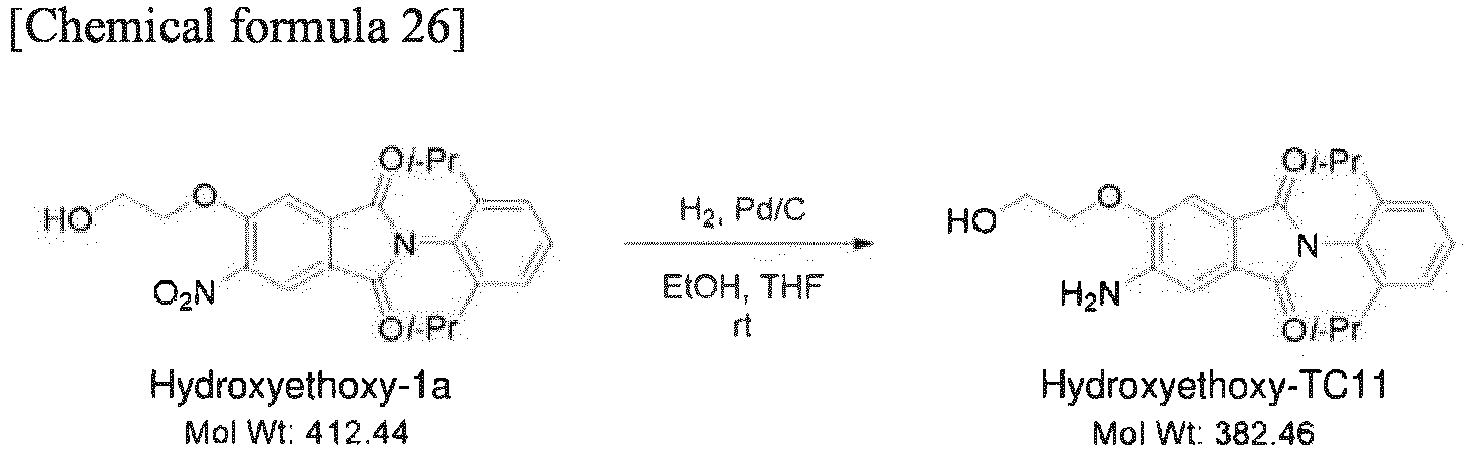
- Pd/C (K-type) (2.3 g) was added to a solution (mixture of 200 mL of EtOH and 200 mL of THF) of 7.0 g of hydroxyethoxy-la (16.97 mmol), and then the mixture was stirred under a hydrogen atmosphere at room temperature for 3 hours.
- The completion of the reaction was confirmed by HPLC, the reaction solution was filtered, and then concentrated under vacuum. The resultant was purified by silica gel chromatography (chloroform/ethyl acetate = 1/0→1/1) and then the main distillate was concentrated under vacuum, thereby obtaining 5.5 g of hydroxyethoxy(HOEtO)-TC11 as a yellow powder (yield: 84.7%).
Claims (9)
- A phenylphthalimide derivative represented by the following general formula:
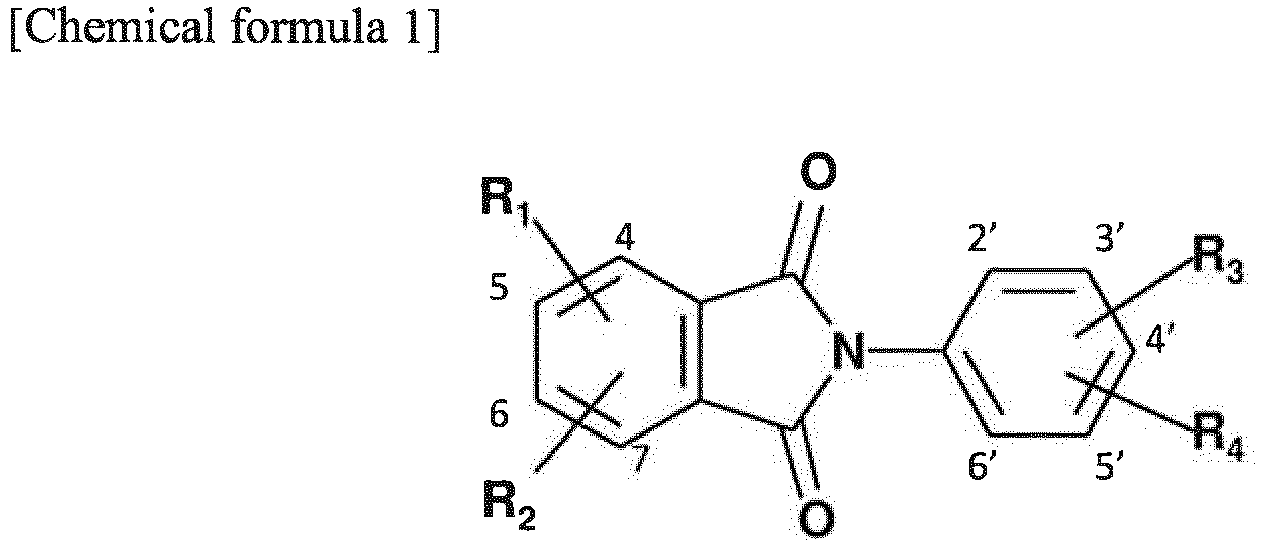
- The derivative according to claim 1, wherein R1 is a group containing PEG.
- The derivative according to claim 2, wherein R1 is a group in which PEG binds to a phthalimide ring via an ester bond.
- The derivative according to claim 1, wherein R1 is a hydroxy C1-5 alkoxy group.
- The derivative according to any one of claims 1 to 4, wherein R1 binds to position 5.
- The derivative according to any one of claims 1 to 5, wherein R3 and R4 are both isopropyl groups at position 2' and position 6', respectively.
- A pharmaceutical composition, comprising the derivative according to any one of claims 1 to 6.
- The pharmaceutical composition according to claim 7, which is an anticancer agent.
- The pharmaceutical composition according to claim 8, wherein the anticancer agent is used for multiple myeloma.
Applications Claiming Priority (2)
| Application Number | Priority Date | Filing Date | Title |
|---|---|---|---|
| JP2016207402 | 2016-10-21 | ||
| PCT/JP2017/037906 WO2018074563A1 (en) | 2016-10-21 | 2017-10-19 | Modified phenylphthalimide and pharmaceutical composition having same as active ingredient |
Publications (2)
| Publication Number | Publication Date |
|---|---|
| EP3530652A1 true EP3530652A1 (en) | 2019-08-28 |
| EP3530652A4 EP3530652A4 (en) | 2020-03-25 |
Family
ID=62018740
Family Applications (1)
| Application Number | Title | Priority Date | Filing Date |
|---|---|---|---|
| EP17862847.5A Withdrawn EP3530652A4 (en) | 2016-10-21 | 2017-10-19 | MODIFIED PHENYLPHTHALIMIDE AND PHARMACEUTICAL COMPOSITION THEREFORE AS AN ACTIVE SUBSTANCE |
Country Status (4)
| Country | Link |
|---|---|
| US (1) | US20190315775A1 (en) |
| EP (1) | EP3530652A4 (en) |
| JP (1) | JPWO2018074563A1 (en) |
| WO (1) | WO2018074563A1 (en) |
Family Cites Families (6)
| Publication number | Priority date | Publication date | Assignee | Title |
|---|---|---|---|---|
| JPH10109975A (en) | 1996-08-16 | 1998-04-28 | Ishihara Sangyo Kaisha Ltd | Pharmaceutical composition |
| JPWO2008047831A1 (en) * | 2006-10-17 | 2010-02-25 | 協和発酵キリン株式会社 | JAK inhibitor |
| KR20090082440A (en) * | 2006-10-31 | 2009-07-30 | 쉐링 코포레이션 | 2-amin0thiaz0le-4-carb0xylic amides as protein kinase inhibitors |
| WO2010061862A1 (en) | 2008-11-25 | 2010-06-03 | 学校法人 慶應義塾 | Antitumor agent containing thalidomide derivative as active ingredient |
| FR2956816B1 (en) * | 2010-03-01 | 2012-05-18 | Univ Joseph Fourier | USE OF QUINOLONES FOR THE PREPARATION OF MEDICAMENTS, NEW QUINOLONES AND THEIR METHOD OF SYNTHESIS |
| EP4649963A3 (en) * | 2014-04-14 | 2026-05-13 | Arvinas Operations, Inc. | Imide-based modulators of proteolysis and associated methods of use |
-
2017
- 2017-10-19 EP EP17862847.5A patent/EP3530652A4/en not_active Withdrawn
- 2017-10-19 JP JP2018545750A patent/JPWO2018074563A1/en not_active Withdrawn
- 2017-10-19 US US16/343,130 patent/US20190315775A1/en not_active Abandoned
- 2017-10-19 WO PCT/JP2017/037906 patent/WO2018074563A1/en not_active Ceased
Also Published As
| Publication number | Publication date |
|---|---|
| EP3530652A4 (en) | 2020-03-25 |
| JPWO2018074563A1 (en) | 2019-08-08 |
| US20190315775A1 (en) | 2019-10-17 |
| WO2018074563A1 (en) | 2018-04-26 |
Similar Documents
| Publication | Publication Date | Title |
|---|---|---|
| Gao et al. | Design, synthesis and biological evaluation of novel histone deacetylase (HDAC) inhibitors derived from β-elemene scaffold | |
| Nasibullin et al. | Synthetic prodrug design enables biocatalytic activation in mice to elicit tumor growth suppression | |
| Kumar et al. | Potent anticancer activity with high selectivity of a chiral palladium N-heterocyclic carbene complex | |
| CN111375056B (en) | Immunoreceptor Modulator Conjugate, Its Preparation Method and Application, Its Conjugated Precursor and Synthetic Conjugated Precursor Compound | |
| Daum et al. | Identification of boronic acid derivatives as an active form of N-alkylaminoferrocene-based anticancer prodrugs and their radiolabeling with 18F | |
| Hao et al. | Design, synthesis and biological evaluation of novel carbohydrate-based sulfonamide derivatives as antitumor agents | |
| Compain et al. | A β-glucuronidase-responsive albumin-binding prodrug for potential selective kinase inhibitor-based cancer chemotherapy | |
| EP4053135A1 (en) | Anti-cancer compounds acting as non-pgp substrate | |
| Wang et al. | Tumor-targeted oxaliplatin (IV) prodrug delivery based on ROS-regulated cancer-selective glycan labeling | |
| Zi et al. | Design, synthesis, and biological evaluation of novel biotinylated podophyllotoxin derivatives as potential antitumor agents | |
| Miao et al. | Novel hybrid CHC from β-carboline and N-Hydroxyacrylamide overcomes drug-resistant hepatocellular carcinoma by promoting apoptosis, DNA damage, and cell cycle arrest | |
| Ateşoğlu et al. | Synthesis, characterization and in vitro and in silico biological evaluation of new Mannich-based rhodanine and Thiazolidine-2, 4-dione derivatives as potential anti-lung-cancer agents | |
| Yang et al. | A new oxaliplatin (IV) prodrug inducing ferroptosis through a triple-pathway mechanism and activating anti-cancer immunity | |
| Chouhan et al. | Glucosyltriazole amphiphile treatment attenuates breast cancer by modulating the AMPK signaling | |
| Yang et al. | Discovery of highly potent and selective 7-ethyl-10-hydroxycamptothecin-glucose conjugates as potential anti-colorectal cancer agents | |
| Li et al. | A soluble triantennary N-Acetylgalactosamine camptothecin prodrug for hepatocellular carcinoma-targeted therapy | |
| CN105418490B (en) | Purposes of the mustargen base piperlongumine class compound in medicine | |
| Antoszczak et al. | Rapid access to ironomycin derivatives by click chemistry | |
| US20190315775A1 (en) | Modified phenylphthalimide and pharmaceutical composition having same as active ingredient | |
| Vaidya et al. | [Retracted] Design and In Vitro Evaluation of Novel Cationic Lipids for siRNA Delivery in Breast Cancer Cell Lines | |
| Kovář et al. | Chemosensitization of tumors via simultaneous delivery of STAT3 inhibitor and doxorubicin through HPMA copolymer-based nanotherapeutics with pH-sensitive activation | |
| Xiao et al. | Ferrocene-modified cyclic asymmetric curcumin analogs: Synthesis and enhanced antitumor activity | |
| US20240042040A1 (en) | Cisplatin analogue with potent anti-cancer effects and synthesis thereof | |
| Tang et al. | Discovery of Novel 3, 11‐Bispeptide Ester Arenobufagin Derivatives with Potential in Vivo Antitumor Activity and Reduced Cardiotoxicity | |
| EP3763391A1 (en) | Ketone carbonyl-containing hydrophobic antitumor drug and conjugate thereof as well as nano preparation containing conjugate, preparation method therefor, and application thereof |
Legal Events
| Date | Code | Title | Description |
|---|---|---|---|
| PUAI | Public reference made under article 153(3) epc to a published international application that has entered the european phase |
Free format text: ORIGINAL CODE: 0009012 |
|
| STAA | Information on the status of an ep patent application or granted ep patent |
Free format text: STATUS: REQUEST FOR EXAMINATION WAS MADE |
|
| 17P | Request for examination filed |
Effective date: 20190507 |
|
| AK | Designated contracting states |
Kind code of ref document: A1 Designated state(s): AL AT BE BG CH CY CZ DE DK EE ES FI FR GB GR HR HU IE IS IT LI LT LU LV MC MK MT NL NO PL PT RO RS SE SI SK SM TR |
|
| AX | Request for extension of the european patent |
Extension state: BA ME |
|
| DAV | Request for validation of the european patent (deleted) | ||
| DAX | Request for extension of the european patent (deleted) | ||
| A4 | Supplementary search report drawn up and despatched |
Effective date: 20200226 |
|
| RIC1 | Information provided on ipc code assigned before grant |
Ipc: A61K 31/4035 20060101ALI20200215BHEP Ipc: C07D 209/48 20060101AFI20200215BHEP Ipc: A61P 35/00 20060101ALI20200215BHEP |
|
| STAA | Information on the status of an ep patent application or granted ep patent |
Free format text: STATUS: THE APPLICATION IS DEEMED TO BE WITHDRAWN |
|
| 18D | Application deemed to be withdrawn |
Effective date: 20200929 |