EP3530270A1 - Mucosal immunomodulator - Google Patents
Mucosal immunomodulator Download PDFInfo
- Publication number
- EP3530270A1 EP3530270A1 EP17861843.5A EP17861843A EP3530270A1 EP 3530270 A1 EP3530270 A1 EP 3530270A1 EP 17861843 A EP17861843 A EP 17861843A EP 3530270 A1 EP3530270 A1 EP 3530270A1
- Authority
- EP
- European Patent Office
- Prior art keywords
- formula
- mucosal
- group
- present
- compounds represented
- Prior art date
- Legal status (The legal status is an assumption and is not a legal conclusion. Google has not performed a legal analysis and makes no representation as to the accuracy of the status listed.)
- Granted
Links
- 0 CCC1C(C2)C2*C1 Chemical compound CCC1C(C2)C2*C1 0.000 description 4
Images

Classifications
-
- A—HUMAN NECESSITIES
- A23—FOODS OR FOODSTUFFS; TREATMENT THEREOF, NOT COVERED BY OTHER CLASSES
- A23L—FOODS, FOODSTUFFS OR NON-ALCOHOLIC BEVERAGES, NOT OTHERWISE PROVIDED FOR; PREPARATION OR TREATMENT THEREOF
- A23L33/00—Modifying nutritive qualities of foods; Dietetic products; Preparation or treatment thereof
- A23L33/10—Modifying nutritive qualities of foods; Dietetic products; Preparation or treatment thereof using additives
- A23L33/115—Fatty acids or derivatives thereof; Fats or oils
- A23L33/12—Fatty acids or derivatives thereof
-
- A—HUMAN NECESSITIES
- A61—MEDICAL OR VETERINARY SCIENCE; HYGIENE
- A61K—PREPARATIONS FOR MEDICAL, DENTAL OR TOILETRY PURPOSES
- A61K31/00—Medicinal preparations containing organic active ingredients
- A61K31/185—Acids; Anhydrides, halides or salts thereof, e.g. sulfur acids, imidic, hydrazonic or hydroximic acids
- A61K31/19—Carboxylic acids, e.g. valproic acid
- A61K31/191—Carboxylic acids, e.g. valproic acid having two or more hydroxy groups, e.g. gluconic acid
-
- A—HUMAN NECESSITIES
- A61—MEDICAL OR VETERINARY SCIENCE; HYGIENE
- A61K—PREPARATIONS FOR MEDICAL, DENTAL OR TOILETRY PURPOSES
- A61K31/00—Medicinal preparations containing organic active ingredients
- A61K31/185—Acids; Anhydrides, halides or salts thereof, e.g. sulfur acids, imidic, hydrazonic or hydroximic acids
- A61K31/19—Carboxylic acids, e.g. valproic acid
- A61K31/194—Carboxylic acids, e.g. valproic acid having two or more carboxyl groups, e.g. succinic, maleic or phthalic acid
-
- A—HUMAN NECESSITIES
- A61—MEDICAL OR VETERINARY SCIENCE; HYGIENE
- A61K—PREPARATIONS FOR MEDICAL, DENTAL OR TOILETRY PURPOSES
- A61K31/00—Medicinal preparations containing organic active ingredients
- A61K31/21—Esters, e.g. nitroglycerine, selenocyanates
- A61K31/215—Esters, e.g. nitroglycerine, selenocyanates of carboxylic acids
- A61K31/22—Esters, e.g. nitroglycerine, selenocyanates of carboxylic acids of acyclic acids, e.g. pravastatin
- A61K31/23—Esters, e.g. nitroglycerine, selenocyanates of carboxylic acids of acyclic acids, e.g. pravastatin of acids having a carboxyl group bound to a chain of seven or more carbon atoms
- A61K31/231—Esters, e.g. nitroglycerine, selenocyanates of carboxylic acids of acyclic acids, e.g. pravastatin of acids having a carboxyl group bound to a chain of seven or more carbon atoms having one or two double bonds
-
- A—HUMAN NECESSITIES
- A61—MEDICAL OR VETERINARY SCIENCE; HYGIENE
- A61K—PREPARATIONS FOR MEDICAL, DENTAL OR TOILETRY PURPOSES
- A61K39/00—Medicinal preparations containing antigens or antibodies
- A61K39/12—Viral antigens
-
- A—HUMAN NECESSITIES
- A61—MEDICAL OR VETERINARY SCIENCE; HYGIENE
- A61K—PREPARATIONS FOR MEDICAL, DENTAL OR TOILETRY PURPOSES
- A61K39/00—Medicinal preparations containing antigens or antibodies
- A61K39/39—Medicinal preparations containing antigens or antibodies characterised by the immunostimulating additives, e.g. chemical adjuvants
-
- A—HUMAN NECESSITIES
- A61—MEDICAL OR VETERINARY SCIENCE; HYGIENE
- A61P—SPECIFIC THERAPEUTIC ACTIVITY OF CHEMICAL COMPOUNDS OR MEDICINAL PREPARATIONS
- A61P31/00—Antiinfectives, i.e. antibiotics, antiseptics, chemotherapeutics
- A61P31/12—Antivirals
- A61P31/14—Antivirals for RNA viruses
-
- A—HUMAN NECESSITIES
- A61—MEDICAL OR VETERINARY SCIENCE; HYGIENE
- A61P—SPECIFIC THERAPEUTIC ACTIVITY OF CHEMICAL COMPOUNDS OR MEDICINAL PREPARATIONS
- A61P37/00—Drugs for immunological or allergic disorders
- A61P37/02—Immunomodulators
-
- A—HUMAN NECESSITIES
- A61—MEDICAL OR VETERINARY SCIENCE; HYGIENE
- A61P—SPECIFIC THERAPEUTIC ACTIVITY OF CHEMICAL COMPOUNDS OR MEDICINAL PREPARATIONS
- A61P37/00—Drugs for immunological or allergic disorders
- A61P37/02—Immunomodulators
- A61P37/04—Immunostimulants
-
- A—HUMAN NECESSITIES
- A61—MEDICAL OR VETERINARY SCIENCE; HYGIENE
- A61P—SPECIFIC THERAPEUTIC ACTIVITY OF CHEMICAL COMPOUNDS OR MEDICINAL PREPARATIONS
- A61P37/00—Drugs for immunological or allergic disorders
- A61P37/02—Immunomodulators
- A61P37/06—Immunosuppressants, e.g. drugs for graft rejection
-
- A—HUMAN NECESSITIES
- A61—MEDICAL OR VETERINARY SCIENCE; HYGIENE
- A61K—PREPARATIONS FOR MEDICAL, DENTAL OR TOILETRY PURPOSES
- A61K39/00—Medicinal preparations containing antigens or antibodies
- A61K2039/54—Medicinal preparations containing antigens or antibodies characterised by the route of administration
- A61K2039/541—Mucosal route
-
- A—HUMAN NECESSITIES
- A61—MEDICAL OR VETERINARY SCIENCE; HYGIENE
- A61K—PREPARATIONS FOR MEDICAL, DENTAL OR TOILETRY PURPOSES
- A61K39/00—Medicinal preparations containing antigens or antibodies
- A61K2039/555—Medicinal preparations containing antigens or antibodies characterised by a specific combination antigen/adjuvant
- A61K2039/55511—Organic adjuvants
-
- C—CHEMISTRY; METALLURGY
- C12—BIOCHEMISTRY; BEER; SPIRITS; WINE; VINEGAR; MICROBIOLOGY; ENZYMOLOGY; MUTATION OR GENETIC ENGINEERING
- C12N—MICROORGANISMS OR ENZYMES; COMPOSITIONS THEREOF; PROPAGATING, PRESERVING, OR MAINTAINING MICROORGANISMS; MUTATION OR GENETIC ENGINEERING; CULTURE MEDIA
- C12N2760/00—MICROORGANISMS OR ENZYMES; COMPOSITIONS THEREOF; PROPAGATING, PRESERVING, OR MAINTAINING MICROORGANISMS; MUTATION OR GENETIC ENGINEERING; CULTURE MEDIA ssRNA viruses negative-sense
- C12N2760/00011—Details
- C12N2760/16011—Orthomyxoviridae
- C12N2760/16111—Influenzavirus A, i.e. influenza A virus
- C12N2760/16134—Use of virus or viral component as vaccine, e.g. live-attenuated or inactivated virus, VLP, viral protein
-
- C—CHEMISTRY; METALLURGY
- C12—BIOCHEMISTRY; BEER; SPIRITS; WINE; VINEGAR; MICROBIOLOGY; ENZYMOLOGY; MUTATION OR GENETIC ENGINEERING
- C12N—MICROORGANISMS OR ENZYMES; COMPOSITIONS THEREOF; PROPAGATING, PRESERVING, OR MAINTAINING MICROORGANISMS; MUTATION OR GENETIC ENGINEERING; CULTURE MEDIA
- C12N2770/00—MICROORGANISMS OR ENZYMES; COMPOSITIONS THEREOF; PROPAGATING, PRESERVING, OR MAINTAINING MICROORGANISMS; MUTATION OR GENETIC ENGINEERING; CULTURE MEDIA ssRNA viruses positive-sense
- C12N2770/00011—Details
- C12N2770/32011—Picornaviridae
- C12N2770/32611—Poliovirus
- C12N2770/32634—Use of virus or viral component as vaccine, e.g. live-attenuated or inactivated virus, VLP, viral protein
-
- Y—GENERAL TAGGING OF NEW TECHNOLOGICAL DEVELOPMENTS; GENERAL TAGGING OF CROSS-SECTIONAL TECHNOLOGIES SPANNING OVER SEVERAL SECTIONS OF THE IPC; TECHNICAL SUBJECTS COVERED BY FORMER USPC CROSS-REFERENCE ART COLLECTIONS [XRACs] AND DIGESTS
- Y02—TECHNOLOGIES OR APPLICATIONS FOR MITIGATION OR ADAPTATION AGAINST CLIMATE CHANGE
- Y02A—TECHNOLOGIES FOR ADAPTATION TO CLIMATE CHANGE
- Y02A50/00—TECHNOLOGIES FOR ADAPTATION TO CLIMATE CHANGE in human health protection, e.g. against extreme weather
- Y02A50/30—Against vector-borne diseases, e.g. mosquito-borne, fly-borne, tick-borne or waterborne diseases whose impact is exacerbated by climate change
Definitions
- the present invention relates to a mucosal immunomodulator.
- Mucous tissues such as the intestinal tract or respiratory organs, which is in contact with the external environment, become initial infection sites in many cases. Therefore, it is important, from the viewpoint of preventive medicine, to strengthen the mucosal immune function.
- Peyer patches and nasal-associated lymphoid tissue play central roles in the induction and control of mucosal immune responses.
- Microfold cells are found in gut-associated lymphoid tissue, such as Peyer patches, and the follicle-associated epithelium (FAE) covering lymphoid follicles, such as NALT.
- M cells are involved in the initiation of mucosal immune responses through the uptake and transcytosis of intestinal antigens (Non Patent Literature 1).
- Glycoprotein 2 (GP2) is known as an M cell-specific marker (Non Patent Literature 2).
- Patent Literature 1 discloses a mucosal immunostimulator comprising, as an active ingredient, at least one honeybee product selected from royal jelly, propolis, and bee pollen.
- Patent Literature 1 JP 2011-84525 A
- an object of the present invention is to provide a novel mucosal immunomodulator.
- the present invention relates to a mucosal immunomodulator comprising, as an active ingredient, at least one selected from the group consisting of compounds represented by the following formula (1): wherein, in the formula (1), R 1 represents a hydrogen atom or an alkyl group having 1 to 3 carbon atoms, R 2 and R 3 each independently represent a hydrogen atom, a hydroxyl group or an alkylcarbonyloxy group having 2 to 4 carbon atoms, and n represents a natural number of 1 to 6; compounds represented by the following formula (2): wherein, in the formula (2), R 1 represents a hydrogen atom or an alkyl group having 1 to 3 carbon atoms, R 4 represents a hydrogen atom or a hydroxyl group, R 5 represents a hydroxyl group, a carboxyl group or an alkyloxycarbonyl group having 2 to 4 carbon atoms, and n represents a natural number of 1 to 9, provided that when R 4 is a hydrogen atom, R 5 is not a hydroxyl group; compounds represented by the following
- the mucosal immunomodulator of the present invention comprises, as an active ingredient, at least one selected from the group consisting of the compounds represented by the formula (1), formula (2) or formula (3), and salts thereof, it can modulate (stimulate or suppress) mucosal immunity.
- the mucosal immunomodulator comprise, as an active ingredient, at least one selected from the group consisting of compounds represented by the following formulas (4), (5), (6), (7), (8), (9), (10), (11), (12), (13) or (14), and salts thereof. Mucosal immunity can thereby be further effectively modulated (stimulated or suppressed).
- the mucosal immunomodulator of the present invention may be a mucosal immunostimulator comprising, as an active ingredient, at least one selected from the group consisting of the compounds represented by the above formula (4), formula (5), formula (6), formula (7) or formula (8), and salts thereof. Because these compounds stimulate mucosal immunity, they can be suitably used for mucosal immunostimulation.
- the mucosal immunomodulator of the present invention may be a mucosal immunosuppressant comprising, as an active ingredient, at least one selected from the group consisting of the compounds represented by the above formula (9), formula (10), formula (11), formula (12), formula (13) or formula (14), and salts thereof. Because these compounds suppress mucosal immunity, they can be suitably used for mucosal immunosuppression.
- the present invention also relates to a food composition for mucosal immunomodulation, comprising the above mucosal immunomodulator of the present invention.
- the food composition includes foods, health foods, foods with function claims, nutritional supplementary foods, supplements, and foods for specified health uses.
- the food composition comprises the mucosal immunomodulator of the present invention, it has the function of modulating (stimulating or suppressing) mucosal immunity and can be suitably used for mucosal immunomodulation.
- the present invention further relates to an adjuvant comprising the above mucosal immunostimulator. Because the above mucosal immunostimulator can induce the differentiation of M cells involved in the initiation of mucosal immune responses, it can be suitably used as an adjuvant.
- the present invention further relates to a vaccine formulation comprising the above adjuvant.
- the present invention can also be regarded as compounds represented by the formula (1), formula (2) or formula (3), or salts thereof for use in mucosal immunomodulation.
- the present invention can also be regarded as an agent comprising, as an active ingredient, at least one selected from the group consisting of the compounds represented by the formula (1), formula (2) or formula (3), and salts thereof for use in mucosal immunomodulation.
- the present invention can also be regarded as application of the compounds represented by the formula (1), formula (2) or formula (3), or salts thereof in the production of a mucosal immunomodulator.
- the present invention can also be regarded as a method for modulating mucosal immunity, the method comprising a step of administering an effective amount of a mucosal immunomodulator comprising, as an active ingredient, at least one selected from the group consisting of the compounds represented by the formula (1), formula (2) or formula (3), and salts thereof to a subject in need thereof.
- a novel mucosal immunomodulator is provided by the present invention.
- the mucosal immunomodulator of the present invention includes a mucosal immunostimulator stimulating mucosal immunity, and a mucosal immunosuppressant suppressing mucosal immunity.
- the mucosal immunostimulator of the present invention can induce the differentiation of M cells, and is thus useful as an adjuvant.
- the immunosuppressant of the present invention is useful for promoting immune tolerance.
- the mucosal immunomodulator of the present invention comprises, as an active ingredient, at least one selected from the group consisting of the compounds represented by the formula (1), the compounds represented by the formula (2) and the compounds represented by the formula (3), and salts thereof.
- the compounds represented by the formula (1), the compounds represented by the formula (2) and the compounds represented by the formula (3) may also be collectively referred to as "the present compounds.”
- R 1 represents a hydrogen atom or an alkyl group having 1 to 3 carbon atoms
- R 2 and R 3 each independently represent a hydrogen atom, a hydroxyl group or an alkylcarbonyloxy group having 2 to 4 carbon atoms
- n represents a natural number of 1 to 6
- Examples of the alkyl group having 1 to 3 carbon atoms in R 1 include a methyl group, an ethyl group, a 1-propyl group, and a 1-methylethyl group.
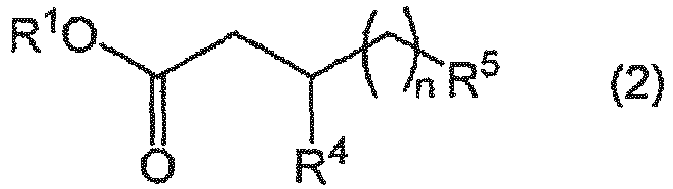
- R 1 has the same meaning as R 1 in the formula (1), R 4 represents a hydrogen atom or a hydroxyl group, R 5 represents a hydroxyl group, a carboxyl group or an alkyloxycarbonyl group having 2 to 4 carbon atoms, and n represents a natural number of 1 to 9, provided that when R 4 is a hydrogen atom, R 5 is not a hydroxyl group.
- a 1-methylethyloxycarbonyl group CH 3 -CH(-CH 3 )-
- n in the formula (2) be a natural number of 3 to 9 and it is more preferable that it be a natural number of 4 to 8.
- R 1 has the same meaning as R 1 in the formula (1) and R 6 and R 7 each independently represent a linear alkylene group having 1 to 10 carbon atoms which may be substituted with hydroxyl group(s).
- Examples of the linear alkylene group having 1 to 10 carbon atoms in R 6 and R 7 include a methylene group, an ethylene group, an n-propylene group, an n-butylene group, an n-pentylene group, an n-hexylene group, an n-heptylene group, an n-octylene group, an n-nonylene group and an n-decylene group.
- the linear alkylene group having 1 to 10 carbon atoms in R 6 and R 7 may be substituted with hydroxyl group (s).
- the linear alkylene group having 1 to 10 carbon atoms which may be substituted with hydroxyl group(s) in R 6 and R 7 be a linear alkylene group having 1 to 10 carbon atoms substituted with hydroxyl group(s), it is more preferable that it be a linear alkylene group having 3 to 9 carbon atoms substituted with hydroxyl group(s), it is even more preferable that it be a linear alkylene group having 5 to 8 carbon atoms substituted with hydroxyl group(s), it is even more preferable that it be a linear alkylene group having 6 to 8 carbon atoms substituted with hydroxyl group(s), and it is more preferable that it be a linear alkylene group having 6 to 8 carbon atoms substituted with 1 to 3 hydroxyl group(s).
- the present compounds When an optical isomer is present, the present compounds may be either of R-form or S-form. When a geometric isomer is present, the present compounds may be either of cis-form and trans-form.
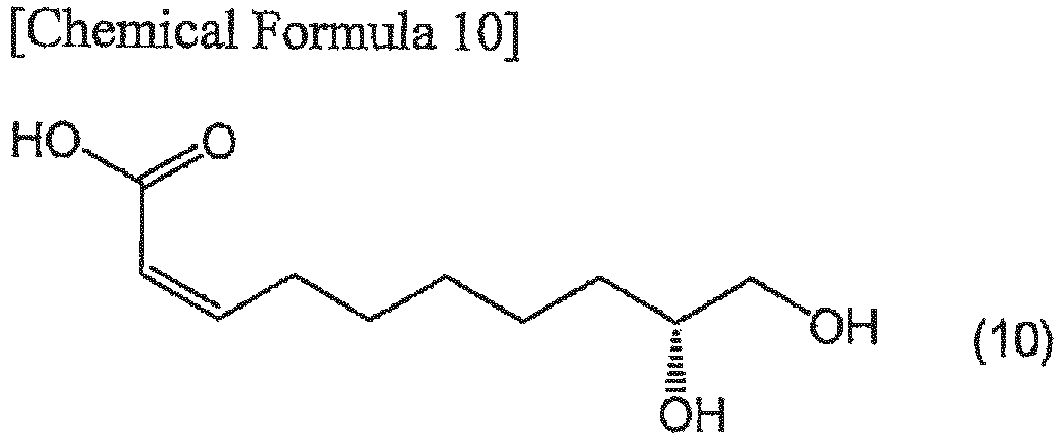
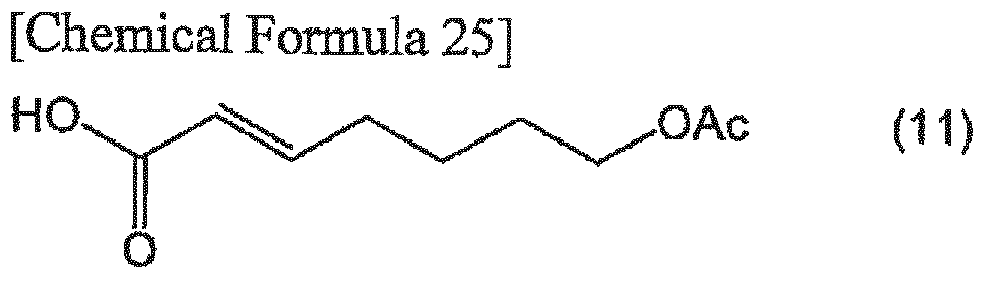
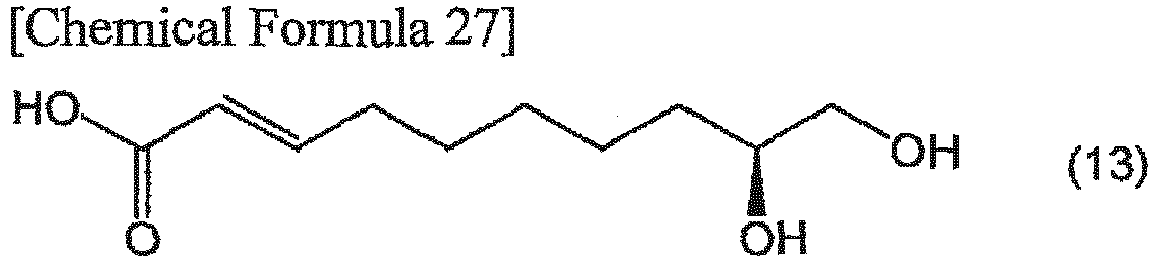
- More specific examples of the present compounds include the compounds represented by the following formula (4), (5), (6), (7), (8), (9), (10), (11), (12), (13) or (14).
- the present compounds may be salts that are acceptable for food applications or pharmaceutical applications.
- Examples of salts of the present compounds include salts with alkali metals, alkaline earth metals, other metals, and ammonium. More specific examples of salts of the present compounds include potassium salts, sodium salts, calcium salts, and magnesium salts.
- the present compounds and salts thereof can be produced, for example, according to the synthesis method of the compounds represented by the formula (4), (5), (6), (7), (8), (9), (10), (11), (12), (13) or (14) in the Examples described later. Moreover, the present compounds and salts thereof may be obtained, for example, by purification from natural products such as royal jelly. Furthermore, as the present compounds and salts thereof, commercially available products may be purchased and used.
- the mucosal immunomodulator of the present invention may comprise one of the above present compounds and salts thereof singly or two or more in combination.
- a mucosal immunostimulator comprising, as an active ingredient, at least one selected from the group consisting of the compounds represented by the formula (4), the formula (5), the formula (6), the formula (7) or the formula (8), and salts thereof, is provided.
- a mucosal immunosuppressant comprising, as an active ingredient, at least one selected from the group consisting of the compounds represented by the formula (9), the formula (10), the formula (11), the formula (12), the formula (13) or the formula (14), and salts thereof, is provided.
- the mucosal immunomodulator of the present invention may comprise only the above active ingredient, or may further comprise other ingredients as long as the effects of the present invention are not impaired.
- other ingredients include pharmaceutically acceptable ingredients (e.g., diluents, binders, lubricants, disintegrators, emulsifiers, surfactants, bases, solubilizing agents, and suspending agents) and ingredients acceptable as food (e.g., minerals, vitamins, flavonoids, quinones, polyphenols, amino acids, nucleic acids, essential fatty acids, fresheners, binders, sweeteners, disintegrators, lubricants, coloring agents, flavoring agents, stabilizers, preservatives, sustained release controlling agents, surfactants, solubilizing agents, and wetting agents).
- pharmaceutically acceptable ingredients e.g., diluents, binders, lubricants, disintegrators, emulsifiers, surfactants, bases, solubilizing agents, and suspending agents
- the mucosal immunomodulator of the present invention can be used, in terms of the amount of active ingredient, at a dose of 1 mg or more and 10 g or less per day for an adult with a body weight of 60 kg, preferably a dose of 5 mg or more and 8 g or less, more preferably a dose of 10 mg or more and 3 g or less, even more preferably a dose of 15 mg or more and 1.5 g or less, further more preferably a dose of 20 mg or more and 1 g or less, further even more preferably a dose of 22 mg or more and 500 mg or less, and particularly preferably a dose of 24 mg or more and 250 mg or less.
- the dose of the mucosal immunomodulator of the present invention when used in an infant may be, for example, 3/5 of the adult dose for infants at an age of 6 to less than 13 years old, 2/5 of the adult dose for infants at an age of 1 to less than 6 years old, and 1/5 of the adult dose for infants at an age of less than 1 year old.
- This dose can be suitably determined within the above-mentioned range, depending on the factors such as health conditions of a person to take, administration route, combination with other agents, and the like.
- the mucosal immunomodulator of the present invention may be orally administered (taken), or parenterally administered (e.g., intranasally administered).
- the mucosal immunomodulator of the present invention may be administered once a day, or administered in several times a day, such as twice a day or three times a day, as long as the amount of active ingredient per day is within the above range. It is preferable that the mucosal immunomodulator of the present invention be continuously administered. Mucosal immunomodulator effects (e.g., mucosal immunostimulating effects) are more significantly exhibited by continuous administration.
- the mucosal immunomodulator of the present invention may be in any form, such as a solid, liquid, paste, or the like.
- Examples of the form of the mucosal immunomodulator of the present invention include uncoated pills, sugar-coated pills, granules, powders, tablets, and capsules (hard capsules, soft capsules, and seamless capsules).
- the mucosal immunomodulator of the present invention can be prepared by, for example, mixing an active ingredient, which is the compound according to the present invention or a salt thereof, with other ingredients, if necessary, and forming the mixture into a dosage form mentioned above.
- the mucosal immunomodulator of the present invention can be used as it is as a drug, a quasi-drug, or a food composition, and also can be used as an additive for drugs, quasi-drugs, and food compositions. It is preferable that the food composition be food in which the third function (physical condition-controlling function) of food is strengthened. Examples of the food in which the third function of food is strengthened include health foods, foods with function claims, nutritional supplementary foods, supplements, and foods for specified health uses.
- a drug, a quasi-drug, or a food composition, each of which consists of the mucosal immunomodulator of the present invention, or a drug, a quasi-drug, or a food composition, each of which comprises the mucosal immunomodulator of the present invention may be used for mucosal immunomodulation, may also be used for mucosal immunostimulation and may be labelled with the following indications: "increasing immune activity,” “making the body resistant to viruses,” “supporting immune function,” “being useful to increase M cells,” “keeping immune activity,” “maintaining immune activity,” “being suitable for people who easily catch cold,” “making immune function excellent,”, “being useful to prevent weakened immune systems from being further weakened,” “making the body resistant to food-poisoning bacteria,” “supporting the health of the mucosa,” “supporting mucosal immunity,” “supporting the health of the nose and throat,” “being useful for maintenance of health during winter,” “being useful for maintenance of health in cold seasons,” “making the body
- the content of the mucosal immunomodulator of the present invention in drugs, quasi-drugs, and food compositions may be suitably determined depending on the type of drug, quasi-drug, and food composition, etc., so that the amount of active ingredient taken per day is within the above range.
- the form of the food composition is not particularly limited, and examples thereof include beverages (soft drinks such as coffee, juice, and tea, milk drinks, lactic acid bacteria drinks, yogurt drinks, carbonated drinks, etc.); spreads (custard cream, etc.); pastes (fruit paste, etc.); Western confectionary (chocolates, doughnuts, pies, cream puffs, gums, jellies, candies, cookies, cakes, puddings, etc.); Japanese confectionary (daifuku, mochi, manju, castella, anmitsu, yokan, etc.); frozen desserts (ice cream, popsicle, sherbet, etc.); food products (curry, beef bowl, porridge, miso soup, soup, meat sauce, pasta, pickles, jams, etc.); and seasonings (dressing, furikake, tasty seasoning, soup stock, etc.).
- beverages soft drinks such as coffee, juice, and tea, milk drinks, lactic acid bacteria drinks, yogurt drinks, carbonated drinks, etc.
- spreads custard cream, etc
- the mucosal immunomodulator of the present invention is used as it is as food in which the third function of food is strengthened (e.g., health foods, foods with function claims, nutritional supplementary foods, supplements, or foods for specified health uses), or used as an additive for food in which the third function of food is strengthened
- examples of the form of the food in which the third function of food is strengthened include, in addition to the above forms of food, uncoated pills, sugar-coated pills, granules, powders, tablets, and capsules (hard capsules, soft capsules, and seamless capsules).
- the mucosal immunomodulator of the present invention is used as it is as a drug or a quasi-drug, or when the mucosal immunomodulator of the present invention is used as an additive for a drug or a quasi-drug
- the form of the drug or quasi-drug is not particularly limited, and examples thereof include uncoated pills, sugar-coated pills, granules, powders, tablets, and capsules (hard capsules, soft capsules, and seamless capsules).
- the method for producing drugs, quasi-drugs, or food compositions, to each of which the mucosal immunomodulator of the present invention is added is not particularly limited, and can be suitably performed according to a known method.
- drugs, quasi-drugs, or food compositions used for the above applications can be obtained by, for example, mixing the mucosal immunomodulator of the present invention with intermediate products or final products in the production process of the drugs, quasi-drugs, or food compositions.
- the present invention can also be regarded as compounds represented by the above formula (1), formula (2) or formula (3), or salts thereof for use in mucosal immunomodulation.
- the present invention can also be regarded as an agent comprising, as an active ingredient, at least one selected from the group consisting of the compounds represented by the above formula (1), formula (2) or formula (3), and salts thereof for use in mucosal immunomodulation.
- the present invention can also be regarded as application of at least one selected from the group consisting of the compounds represented by the above formula (1), formula (2) or formula (3), and salts thereof in the production of a mucosal immunomodulator.
- the present invention can also be regarded as a method for modulating (stimulating or suppressing) mucosal immunity, the method comprising a step of administering an effective amount of a mucosal immunomodulator comprising, as an active ingredient, at least one selected from the group consisting of the compounds represented by the above formula (1), formula (2) or formula (3), and salts thereof to a subject in need thereof.
- a mucosal immunomodulator comprising, as an active ingredient, at least one selected from the group consisting of the compounds represented by the above formula (1), formula (2) or formula (3), and salts thereof to a subject in need thereof.
- the subject include rodents, ungulates, carnivores, marsupials, and primates.
- the subject is preferably a mammal, such as a cynomolgus monkey or a human, and more preferably a human.
- mucosal immunomodulators of the present invention those having a mucosal immunostimulating action (mucosal immunostimulator) can also be used as an adjuvant. At least part of the action mechanism by the adjuvant of the present invention is based on the induction of differentiation of M cells, which is involved in the initiation of mucosal immune responses.
- the adjuvant according to the present embodiment may be one comprising the above mucosal immunostimulator or one consisting of the above mucosal immunostimulator.
- the vaccine formulation of the present invention comprises the above adjuvant.
- the adjuvant of the present invention can be combined with various immunogens to form vaccine formulations.
- the vaccine formulation of the present invention may be a mixture of the adjuvant and an immunogen, or the adjuvant and an immunogen may be separated so that they are mixed at the time of administration or separately administered.
- the vaccine formulation of the present invention may be used for treatment or for prevention.
- the immunogen to be used in combination with the adjuvant of the present invention is not particularly limited, as long as it is an antigen that induces an immune response against mammals, such as humans.
- Specific examples of immunogens include one or more pathogenic microorganisms selected from the group consisting of influenza virus, rotavirus, adenovirus, norovirus, measles virus, rubella virus, mumps virus, AIDS virus, hepatitis virus, poliovirus, rabies virus, Bordetella pertussis, Corynebacterium diphtheriae, Helicobacter pylori, enterohaemorrhagic Escherichia coli (EHEC), Chlamydia protozoa, Mycoplasma protozoa, Malaria parasite, coccidium protozoa, and schistosome; antigens derived from these pathogenic microorganisms, prion proteins, and the like. These immunogens may be inactivated or not inactivated.
- the quantitative ratio of immunogen and adjuvant in the vaccine formulation of the present invention can be suitably determined depending on the type of immunogen used, the purpose of vaccine formulation, etc.
- the quantitative ratio may be 1:0.0001 to 1:10000 (weight ratio), and is preferably 1:0.1 to 1:10 (weight ratio).
- the form of the vaccine formulation of the present invention may be liquid or powder.
- the form of the vaccine formulation of the present invention is not particularly limited, and examples thereof include uncoated pills, sugar-coated pills, granules, powders, tablets, and capsules (hard capsules, soft capsules, and seamless capsules).
- Known stabilizers, preservatives, etc. may be contained in the vaccine formulation of the present invention.
- the vaccine formulation of the present invention can be produced by a known method.
- the vaccine formulation of the present invention may be administered orally or intranasally.
- the vaccine formulation of the present invention can be administered by a method comprising a step of administering the adjuvant to a subject, and a step of administering an immunogen to the subject.
- Administration of the adjuvant and administration of an immunogen may be performed simultaneously or separately.
- administration of the adjuvant can be previously performed, and administration of an immunogen can be then performed.
- administration of an immunogen can be performed in a timely manner while the adjuvant is continuously administered.
- the vaccine formulation of the present invention be used such that, for example, an immunogen is administered after the adjuvant is continuously administered. Induction of immune responses can thereby be further facilitated.
- administering is continued for 3 days or more, preferably 7 days or more, more preferably 14 days or more, and even more preferably 21 days or more.
- Administration may be conducted in several times a day, such as twice a day or three times a day, within the effective amount range per day.
- the effective amount of the adjuvant is, in terms of the amount of active ingredient, a dose of 1 mg or more and 10 g or less per day for an adult with a body weight of 60 kg, preferably a dose of 5 mg or more and 8 g or less, more preferably a dose of 10 mg or more and 3 g or less, even more preferably a dose of 15 mg or more and 1.5 g or less, further more preferably a dose of 20 mg or more and 1 g or less, further even more preferably a dose of 22 mg or more and 500 mg or less, and particularly preferably a dose of 24 mg or more and 250 mg or less.
- the effective amount for an infant may be, for example, 3/5 of the adult dose for infants at an age of 6 to less than 13 years old, 2/5 of the adult dose for infants at an age of 1 to less than 6 years old, and 1/5 of the adult dose for infants at an age of less than 1 year old.
- This dose can be suitably determined within the above-mentioned range, depending on the factors such as health conditions of a person to take, administration route, combination with other agents, and the like.
- the compound represented by the formula (4) ((2E,9R)-9-hydroxy-2-decenoic acid) was synthesized according to the method described in Preparation Example 14 of JP 2010-168290 A .
- the compound represented by the formula (6) ((2E,11R)-11,12-dihydroxy-2-dodecenoic acid) was synthesized according to the method described in Preparation Example 6 of JP 2010-168290 A .
- the compound represented by the formula (7) ((2E)-3,10-dihydroxy-decanoic acid) was isolated from royal jelly according to the following method.
- the obtained residue (108.9 g) was purified by ODS column chromatography (column: Cosmosil 75C18-PREP, column size: ⁇ 80 ⁇ 205 mm, eluent: 10%, 50% aqueous methanol solution, 2500 mL each (1250 mL ⁇ 2 fractions), and was divided into a fraction 1 (first half of 10% methanol elution), 2 (second half of 10% methanol elution), 3 (first half of 50% methanol elution), and 4 (second half of 50% methanol elution).
- the fraction 4 was purified by silica gel column chromatography (column: Daiso gel IR-60, column size: ⁇ 26 ⁇ 150 mm, eluent: chloroform containing 5%, 10% methanol, 500 mL (50 mL ⁇ 10 fractions), and the fourth eluted fraction of 10% was concentrated. This was purified again by silica gel column chromatography (column: Daiso gel IR-60, column size: ⁇ 26 ⁇ 100 mm, eluent: chloroform containing 10, 15% methanol, 300 mL (20 mL ⁇ 15 fractions), and the 13th to 19th eluted fractions were collected to obtain 23.7 mg of the compound represented by the formula (7).
- the compound represented by the formula (8) (sebacic acid) was purchased from Sigma-aldrich.
- the compound represented by the formula (9) ((2E,7R)-7,8-dihydroxy-2-octenoic acid) was synthesized according to the method described in Preparation Example 5 of JP 2010-168290 A .
- the compound represented by the formula (10) ((2Z,9R)-9,10-dihydroxy-2-decenoic acid) was synthesized according to the method described in Preparation Example 8 of JP 2010-168290 A .
- the compound represented by the formula (11) ((2E)-7-acetoxy-2-heptenoic acid) was synthesized according to the method described in Preparation Example 15 of JP 2010-168290 A .
- the compound represented by the formula (12) ((2E,9R)-9,10-diacetoxy-2-decenoic acid) was synthesized according to the method described in Preparation Example 12 of JP 2010-168290 A .
- the compound represented by the formula (13) ((2E,9S)-9,10-dihydroxy-2-decenoic acid) was synthesized according to the method described in Preparation Example 2 of JP 2010-168290 A .
- the compound represented by the formula (14) (9(S),12(S),13(S)-trihydroxy-10(E)-octadecenoic acid) was purchased from Larodan.
- Caco-2 cells derived from human intestinal epithelium cells were used.
- the Caco-2 cells were cultured in an MEM medium (produced by Nissui Pharmaceutical Co., Ltd.) supplemented with 20% fetal calf serum (FCS, produced by CANSERA INTERNATIONAL), 2 mM glutamine (produced by Wako Pure Chemical Industries, Ltd.), and 0.1 mM nonessential amino acid (produced by Gibco) at 37°C in the presence of 5% CO 2 .
- FCS fetal calf serum
- 2 mM glutamine produced by Wako Pure Chemical Industries, Ltd.
- 0.1 mM nonessential amino acid produced by Gibco
- each test compound was prepared as a DMSO solution (10 mM). After the Caco-2 cells were seeded in a 6-well plate and allowed to form a single-layer film, each of the above test compounds was added so that the final concentration was 100 ⁇ M. The same amount of DMSO was added as a control. The medium was as described above. After addition, the cells were cultured at 37°C in the presence of 5% CO 2 for 3 days.
- the cells were collected with 1 mM EDTA ⁇ 2Na/PBS(-) (pH 7.2), and stained with rabbit anti-GP2 antibody (produced by IMGENEX) and Alexa 488-labeled anti-rabbit antibody (produced by Molecular probes). The stained cells were analyzed by FACS (produced by BECKMAN COULTER), and GP2 expression levels were quantified.
- the compounds represented by the formula (4), (5), (6), (7) or (8) induced the expression of GP2.
- the compounds represented by the formula (5) or (6) intensely induced the expression of GP2.
- the compounds represented by the formula (9), (10), (11), (12), (13) or (14) suppressed the expression of GP2.
- the compounds represented by the formula (11), (12) or (13) intensely suppressed the expression of GP2.
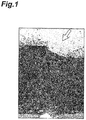
- M cells generally have the morphological characteristics that microvilli on the apical side are shorter than those of epithelial cells in the vicinity thereof. As indicated by an arrow in Fig. 1 , cells with short microvilli were observed due to the application of 10-hydroxydecanoic acid. From the results, it is considered to suggest that the Caco-2 cells were morphologically changed to M cell-like cells by the action of 10-hydroxydecanoic acid.
- a DMSO solution (10 mM) of 10-hydroxydecanoic acid was diluted 100 times with PBS(-) to prepare a test solution.
- Three male cynomolgus monkeys (Macaca fascicularis) (age at the start of test: 3 to 4 years old, body weight at the start of test: 3.53 to 4.36 kg) were used as test animals.
- About 0.1 mL of the above test solution was sprayed to each of the left and right nasal cavities of each cynomolgus monkey using a fine atomizer (Neizaru) (product number: FAN020, produced and sold by Yoshikawa Kasei Co., Ltd.). The same operation was performed using PBS(-) as a control.
- Neizaru fine atomizer
- nasopharyngeal mucosa in the pharyngeal tonsil site was collected.
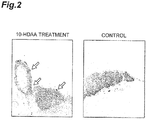
- the collected nasopharyngeal mucosa was subjected to fluorescent immunohistostaining with Alexa 555-labeled anti-GP2 antibody (produced by IMGENEX) or Alexa 555-labeled anti-GP2 antibody (produced by Abcam), and fluorescence images were observed with an all-in-one fluorescence microscope BZ-9000 (produced by Keyence Corporation). DAPI staining was used in combination for the observation of the fluorescence images.
- FIG. 2 Fluorescent immunohistostaining photographs are shown in Fig. 2 .
- Fig. 2 Fluorescent immunohistostaining photographs are shown in Fig. 2 .
- GP2-positive cells black portions shown by arrows in Fig. 2
- GP2-positive cells were observed on the nasopharyngeal mucosa.
- such an increase in GP2-positive cells was not observed in the control.
- Fetuin (3 mg), an inactivated poliovirus antigen (10 6 TCID 50 ), and an inactivated influenza virus antigen (220_HA Units) were placed as antigens in an enteric capsule to prepare a capsule containing the above 3 antigens (capsule C).
- the cynomolgus monkeys were dissected on day 22, and the intestinal mucosa was collected.
- the collected intestinal mucosa was subjected to fluorescent immunohistostaining with Alexa 555-labeled anti-GP2 antibody (produced by IMGENEX) or Alexa 555-labeled anti-GP2 antibody (produced by Abcam), and fluorescence images were observed with an all-in-one fluorescence microscope BZ-9000 (produced by Keyence Corporation).
- DAPI staining was used in combination for the observation of the fluorescence images.
- FIG. 3 Examples of fluorescent immunohistostaining photographs are shown in Fig. 3 .
- Fig. 3 In order to enhance the visibility of Fig. 3 , light and darkness are reversed.
- GP2-positive cells black portions shown by an arrow in Fig. 3
- GP2-positive cells were observed on the intestinal mucosa in the test group, which was sensitized with the antigens about every 3 days while 10-hydroxydecanoic acid was continuously administered once a day.
- such an increase in GP2-positive cells was not observed in the control group, which was sensitized only with the antigens about every 3 days.
- Fetuin antigen (produced by Sigma) was dissolved at 100 ⁇ g/mL in an antigen buffer (50 mmol/L Tris-HCl (pH 8.0), 10 mmol/L MgCl 2 , and 0.1% Tween 80). This antigen was added to a Nunc MaxiSorp (registered trademark) flat-bottom 96-well plate to prepare an antigen plate. Influenza virus H1N1 antigen (11,000 HA Unit) and poliovirus antigen type III (0.67 x 10 8 TCID 50 ) were diluted with 25 mL of antigen buffer, and an antigen plate was prepared in the same manner as above. For masking, a reaction was performed at 200 ⁇ l/well at 4°C overnight.
- an antigen buffer 50 mmol/L Tris-HCl (pH 8.0), 10 mmol/L MgCl 2 , and 0.1% Tween 80.
- This antigen was added to a Nunc MaxiSorp (registered trademark) flat
- a sample buffer (0.1% sodium azide, 1 mmol/L EDTA ⁇ 2Na, 0.05% Tween 20, 5% nonfat skim milk, and a PBS(-) (pH 7.2) solution of 1 mmol/L phenylmethylsulfonyl fluoride (PMSF)
- PMSF phenylmethylsulfonyl fluoride
- the prepared sample was added in an amount of 50 ⁇ l to each well of the antigen plate, and shaken for 1.5 hours in a low-temperature room. Thereafter, washing was performed 4 times using a washing buffer (0.1% Tween 80 in MilliQ: 200 ⁇ l/well).
- BSA was dissolved in a second antibody buffer (0.5 M Tris-HCl, 1.75% NaCl) to 1%, and the following antibodies (a) and (b) were diluted 5000 times with this buffer.
- the second antibody solution was added in an amount of 50 ⁇ l to each well, and reacted for 0.75 hours. After the reaction, washing was performed 4 times using a washing buffer (0.1% Tween 80 in MilliQ: 200 ⁇ l/well).
- a substrate solution (2.68 mg of TMBZ, 1.05 ⁇ l of 35% hydrogen peroxide solution, and 7 mL of EDTA ⁇ 2Na (2 mM)) was added in an amount of 50 ⁇ l to each well. Finally, 50 ⁇ l of 0.3N H 2 SO 4 was added to each well to terminate the reaction. Thereafter, the absorbance (450 nm/630 nm) was measured.
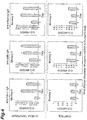
- the anti-Fetuin IgA antibody titer, anti-poliovirus IgA antibody titer, and anti-influenza virus IgA antibody titer in the feces are shown in Fig. 4 .
- increases in the anti-Fetuin IgA antibody titer, the anti-poliovirus IgA antibody titer, and the anti-influenza virus IgA antibody titer were observed in the test group, which was sensitized with the antigens about every 3 days while 10-hydroxydecanoic acid was continuously administered once a day.
- increases in the antibody titers were not observed in the control group, which was sensitized only with the antigens about every 3 days.
Landscapes
- Health & Medical Sciences (AREA)
- Life Sciences & Earth Sciences (AREA)
- Chemical & Material Sciences (AREA)
- Immunology (AREA)
- Pharmacology & Pharmacy (AREA)
- Veterinary Medicine (AREA)
- Public Health (AREA)
- Medicinal Chemistry (AREA)
- General Health & Medical Sciences (AREA)
- Animal Behavior & Ethology (AREA)
- Engineering & Computer Science (AREA)
- Epidemiology (AREA)
- General Chemical & Material Sciences (AREA)
- Chemical Kinetics & Catalysis (AREA)
- Bioinformatics & Cheminformatics (AREA)
- Nuclear Medicine, Radiotherapy & Molecular Imaging (AREA)
- Organic Chemistry (AREA)
- Mycology (AREA)
- Microbiology (AREA)
- Virology (AREA)
- Oil, Petroleum & Natural Gas (AREA)
- Nutrition Science (AREA)
- Food Science & Technology (AREA)
- Polymers & Plastics (AREA)
- Transplantation (AREA)
- Emergency Medicine (AREA)
- Molecular Biology (AREA)
- Communicable Diseases (AREA)
- Oncology (AREA)
- Acyclic And Carbocyclic Compounds In Medicinal Compositions (AREA)
- Pharmaceuticals Containing Other Organic And Inorganic Compounds (AREA)
- Medicines Containing Antibodies Or Antigens For Use As Internal Diagnostic Agents (AREA)
- Coloring Foods And Improving Nutritive Qualities (AREA)
Abstract


Description
- The present invention relates to a mucosal immunomodulator.
- Mucous tissues such as the intestinal tract or respiratory organs, which is in contact with the external environment, become initial infection sites in many cases. Therefore, it is important, from the viewpoint of preventive medicine, to strengthen the mucosal immune function. As the front barrier of infection defense mechanism, Peyer patches and nasal-associated lymphoid tissue (NALT) play central roles in the induction and control of mucosal immune responses. Microfold cells (M cells) are found in gut-associated lymphoid tissue, such as Peyer patches, and the follicle-associated epithelium (FAE) covering lymphoid follicles, such as NALT. M cells are involved in the initiation of mucosal immune responses through the uptake and transcytosis of intestinal antigens (Non Patent Literature 1). Glycoprotein 2 (GP2) is known as an M cell-specific marker (Non Patent Literature 2).
- As a mucosal immunostimulator,
Patent Literature 1 discloses a mucosal immunostimulator comprising, as an active ingredient, at least one honeybee product selected from royal jelly, propolis, and bee pollen. - Patent Literature 1:
JP 2011-84525 A -
- Non Patent Literature 1: Bioscience of Microbiota, Food and Health, 2014, Vol. 33 (No. 3), pp. 91-97
- Non Patent Literature 2: Mucosal Immunology, 2013, Vol. 6 (No. 4), pp. 666-677
- Some mucosal immunomodulators such as mucosal immunostimulators are known, as disclosed in
Patent Literature 1; however, in order to satisfy various consumers' needs, it cannot be said that there have been sufficient options. Accordingly, an object of the present invention is to provide a novel mucosal immunomodulator. - The present invention relates to a mucosal immunomodulator comprising, as an active ingredient, at least one selected from the group consisting of compounds represented by the following formula (1):

compounds represented by the following formula (2):
compounds represented by the following formula (3):
and salts thereof. - Because the mucosal immunomodulator of the present invention comprises, as an active ingredient, at least one selected from the group consisting of the compounds represented by the formula (1), formula (2) or formula (3), and salts thereof, it can modulate (stimulate or suppress) mucosal immunity.
- It is preferable that the mucosal immunomodulator comprise, as an active ingredient, at least one selected from the group consisting of compounds represented by the following formulas (4), (5), (6), (7), (8), (9), (10), (11), (12), (13) or (14), and salts thereof. Mucosal immunity can thereby be further effectively modulated (stimulated or suppressed).




- The mucosal immunomodulator of the present invention may be a mucosal immunostimulator comprising, as an active ingredient, at least one selected from the group consisting of the compounds represented by the above formula (4), formula (5), formula (6), formula (7) or formula (8), and salts thereof. Because these compounds stimulate mucosal immunity, they can be suitably used for mucosal immunostimulation.
- The mucosal immunomodulator of the present invention may be a mucosal immunosuppressant comprising, as an active ingredient, at least one selected from the group consisting of the compounds represented by the above formula (9), formula (10), formula (11), formula (12), formula (13) or formula (14), and salts thereof. Because these compounds suppress mucosal immunity, they can be suitably used for mucosal immunosuppression.
- The present invention also relates to a food composition for mucosal immunomodulation, comprising the above mucosal immunomodulator of the present invention. The food composition includes foods, health foods, foods with function claims, nutritional supplementary foods, supplements, and foods for specified health uses.
- Because the food composition comprises the mucosal immunomodulator of the present invention, it has the function of modulating (stimulating or suppressing) mucosal immunity and can be suitably used for mucosal immunomodulation.
- The present invention further relates to an adjuvant comprising the above mucosal immunostimulator. Because the above mucosal immunostimulator can induce the differentiation of M cells involved in the initiation of mucosal immune responses, it can be suitably used as an adjuvant.
- The present invention further relates to a vaccine formulation comprising the above adjuvant.
- The present invention can also be regarded as compounds represented by the formula (1), formula (2) or formula (3), or salts thereof for use in mucosal immunomodulation. The present invention can also be regarded as an agent comprising, as an active ingredient, at least one selected from the group consisting of the compounds represented by the formula (1), formula (2) or formula (3), and salts thereof for use in mucosal immunomodulation.
- The present invention can also be regarded as application of the compounds represented by the formula (1), formula (2) or formula (3), or salts thereof in the production of a mucosal immunomodulator.
- The present invention can also be regarded as a method for modulating mucosal immunity, the method comprising a step of administering an effective amount of a mucosal immunomodulator comprising, as an active ingredient, at least one selected from the group consisting of the compounds represented by the formula (1), formula (2) or formula (3), and salts thereof to a subject in need thereof.
- A novel mucosal immunomodulator is provided by the present invention. The mucosal immunomodulator of the present invention includes a mucosal immunostimulator stimulating mucosal immunity, and a mucosal immunosuppressant suppressing mucosal immunity. The mucosal immunostimulator of the present invention can induce the differentiation of M cells, and is thus useful as an adjuvant. The immunosuppressant of the present invention is useful for promoting immune tolerance.
-
-
Fig. 1 is an electron micrograph showing the results of an M-cell differentiation induction test. -
Fig. 2 is fluorescent immunohistostaining photographs showing the results of an M-cell differentiation induction test. -
Fig. 3 is fluorescent immunohistostaining photographs showing the results of an immunostimulation test. -
Fig. 4 is graphs showing the measured values of antibody titers. - Hereinafter, embodiments for carrying out the present invention are described in detail. However, the present invention is not limited to the following embodiments.
- The mucosal immunomodulator of the present invention comprises, as an active ingredient, at least one selected from the group consisting of the compounds represented by the formula (1), the compounds represented by the formula (2) and the compounds represented by the formula (3), and salts thereof. Hereinafter, the compounds represented by the formula (1), the compounds represented by the formula (2) and the compounds represented by the formula (3) may also be collectively referred to as "the present compounds."

- In the formula (1), R1 represents a hydrogen atom or an alkyl group having 1 to 3 carbon atoms, R2 and R3 each independently represent a hydrogen atom, a hydroxyl group or an alkylcarbonyloxy group having 2 to 4 carbon atoms, and n represents a natural number of 1 to 6
- Examples of the alkyl group having 1 to 3 carbon atoms in R1 include a methyl group, an ethyl group, a 1-propyl group, and a 1-methylethyl group.
- Examples of the alkylcarbonyloxy group having 2 to 4 carbon atoms in R2 include a methylcarbonyloxy group (CH3-C(=O)-O-), an ethylcarbonyloxy group (CH3-CH2-C(=O)-O-), a 1-propylcarbonyloxy group (CH3-CH2-CH2-C(=O)-O-), and a 1-methylethylcarbonyloxy group (CH3-CH(-CH3)-C(=O)-O-).

- In the formula (2), R1 has the same meaning as R1 in the formula (1), R4 represents a hydrogen atom or a hydroxyl group, R5 represents a hydroxyl group, a carboxyl group or an alkyloxycarbonyl group having 2 to 4 carbon atoms, and n represents a natural number of 1 to 9, provided that when R4 is a hydrogen atom, R5 is not a hydroxyl group.
- Examples of the alkyloxycarbonyl group having 2 to 4 carbon atoms in R5 include a methyloxycarbonyl group (CH3-O-C(=O)-), an ethyloxycarbonyl group (CH3-CH2-O-C(=O)-), a 1-propyloxycarbonyl group (CH3-CH2-CH2-O-C(=O)-) and a 1-methylethyloxycarbonyl group (CH3-CH(-CH3)-O-C(=O)-).
- It is preferable that n in the formula (2) be a natural number of 3 to 9 and it is more preferable that it be a natural number of 4 to 8.

- In the formula (3), R1 has the same meaning as R1 in the formula (1) and R6 and R7 each independently represent a linear alkylene group having 1 to 10 carbon atoms which may be substituted with hydroxyl group(s).
- Examples of the linear alkylene group having 1 to 10 carbon atoms in R6 and R7 include a methylene group, an ethylene group, an n-propylene group, an n-butylene group, an n-pentylene group, an n-hexylene group, an n-heptylene group, an n-octylene group, an n-nonylene group and an n-decylene group. The linear alkylene group having 1 to 10 carbon atoms in R6 and R7 may be substituted with hydroxyl group (s).
- It is preferable that the linear alkylene group having 1 to 10 carbon atoms which may be substituted with hydroxyl group(s) in R6 and R7 be a linear alkylene group having 1 to 10 carbon atoms substituted with hydroxyl group(s), it is more preferable that it be a linear alkylene group having 3 to 9 carbon atoms substituted with hydroxyl group(s), it is even more preferable that it be a linear alkylene group having 5 to 8 carbon atoms substituted with hydroxyl group(s), it is even more preferable that it be a linear alkylene group having 6 to 8 carbon atoms substituted with hydroxyl group(s), and it is more preferable that it be a linear alkylene group having 6 to 8 carbon atoms substituted with 1 to 3 hydroxyl group(s).
- When an optical isomer is present, the present compounds may be either of R-form or S-form. When a geometric isomer is present, the present compounds may be either of cis-form and trans-form.
- More specific examples of the present compounds include the compounds represented by the following formula (4), (5), (6), (7), (8), (9), (10), (11), (12), (13) or (14).




- The present compounds may be salts that are acceptable for food applications or pharmaceutical applications. Examples of salts of the present compounds include salts with alkali metals, alkaline earth metals, other metals, and ammonium. More specific examples of salts of the present compounds include potassium salts, sodium salts, calcium salts, and magnesium salts.
- The present compounds and salts thereof can be produced, for example, according to the synthesis method of the compounds represented by the formula (4), (5), (6), (7), (8), (9), (10), (11), (12), (13) or (14) in the Examples described later. Moreover, the present compounds and salts thereof may be obtained, for example, by purification from natural products such as royal jelly. Furthermore, as the present compounds and salts thereof, commercially available products may be purchased and used.
- The mucosal immunomodulator of the present invention may comprise one of the above present compounds and salts thereof singly or two or more in combination.
- The compounds represented by the above formula (4), the formula (5), the formula (6), the formula (7) or the formula (8) stimulate mucosal immunity. Therefore, as one embodiment of the mucosal immunomodulator of the present invention, a mucosal immunostimulator comprising, as an active ingredient, at least one selected from the group consisting of the compounds represented by the formula (4), the formula (5), the formula (6), the formula (7) or the formula (8), and salts thereof, is provided.
- The compounds represented by the above formula (9), the formula (10), the formula (11), the formula (12), the formula (13) or the formula (14) suppress mucosal immunity. Therefore, as one embodiment of the mucosal immunomodulator of the present invention, a mucosal immunosuppressant comprising, as an active ingredient, at least one selected from the group consisting of the compounds represented by the formula (9), the formula (10), the formula (11), the formula (12), the formula (13) or the formula (14), and salts thereof, is provided.
- The mucosal immunomodulator of the present invention may comprise only the above active ingredient, or may further comprise other ingredients as long as the effects of the present invention are not impaired. Examples of other ingredients include pharmaceutically acceptable ingredients (e.g., diluents, binders, lubricants, disintegrators, emulsifiers, surfactants, bases, solubilizing agents, and suspending agents) and ingredients acceptable as food (e.g., minerals, vitamins, flavonoids, quinones, polyphenols, amino acids, nucleic acids, essential fatty acids, fresheners, binders, sweeteners, disintegrators, lubricants, coloring agents, flavoring agents, stabilizers, preservatives, sustained release controlling agents, surfactants, solubilizing agents, and wetting agents).
- The mucosal immunomodulator of the present invention can be used, in terms of the amount of active ingredient, at a dose of 1 mg or more and 10 g or less per day for an adult with a body weight of 60 kg, preferably a dose of 5 mg or more and 8 g or less, more preferably a dose of 10 mg or more and 3 g or less, even more preferably a dose of 15 mg or more and 1.5 g or less, further more preferably a dose of 20 mg or more and 1 g or less, further even more preferably a dose of 22 mg or more and 500 mg or less, and particularly preferably a dose of 24 mg or more and 250 mg or less. The dose of the mucosal immunomodulator of the present invention when used in an infant may be, for example, 3/5 of the adult dose for infants at an age of 6 to less than 13 years old, 2/5 of the adult dose for infants at an age of 1 to less than 6 years old, and 1/5 of the adult dose for infants at an age of less than 1 year old. This dose can be suitably determined within the above-mentioned range, depending on the factors such as health conditions of a person to take, administration route, combination with other agents, and the like.
- The mucosal immunomodulator of the present invention may be orally administered (taken), or parenterally administered (e.g., intranasally administered). The mucosal immunomodulator of the present invention may be administered once a day, or administered in several times a day, such as twice a day or three times a day, as long as the amount of active ingredient per day is within the above range. It is preferable that the mucosal immunomodulator of the present invention be continuously administered. Mucosal immunomodulator effects (e.g., mucosal immunostimulating effects) are more significantly exhibited by continuous administration.
- The mucosal immunomodulator of the present invention may be in any form, such as a solid, liquid, paste, or the like. Examples of the form of the mucosal immunomodulator of the present invention include uncoated pills, sugar-coated pills, granules, powders, tablets, and capsules (hard capsules, soft capsules, and seamless capsules). The mucosal immunomodulator of the present invention can be prepared by, for example, mixing an active ingredient, which is the compound according to the present invention or a salt thereof, with other ingredients, if necessary, and forming the mixture into a dosage form mentioned above.
- The mucosal immunomodulator of the present invention can be used as it is as a drug, a quasi-drug, or a food composition, and also can be used as an additive for drugs, quasi-drugs, and food compositions. It is preferable that the food composition be food in which the third function (physical condition-controlling function) of food is strengthened. Examples of the food in which the third function of food is strengthened include health foods, foods with function claims, nutritional supplementary foods, supplements, and foods for specified health uses.
- A drug, a quasi-drug, or a food composition, each of which consists of the mucosal immunomodulator of the present invention, or a drug, a quasi-drug, or a food composition, each of which comprises the mucosal immunomodulator of the present invention, may be used for mucosal immunomodulation, may also be used for mucosal immunostimulation and may be labelled with the following indications: "increasing immune activity," "making the body resistant to viruses," "supporting immune function," "being useful to increase M cells," "keeping immune activity," "maintaining immune activity," "being suitable for people who easily catch cold," "making immune function excellent,", "being useful to prevent weakened immune systems from being further weakened," "making the body resistant to food-poisoning bacteria," "supporting the health of the mucosa," "supporting mucosal immunity," "supporting the health of the nose and throat," "being useful for maintenance of health during winter," "being useful for maintenance of health in cold seasons," "making the body withstanding cold seasons," "modulating immune function," "inhibiting excess M cells," "suppressing excessive immune response," "preventing or improving bronchial asthma," "preventing or improving allergic rhinitis," "preventing or improving hay fever," "preventing or improving Crohn's disease," and the like.
- The content of the mucosal immunomodulator of the present invention in drugs, quasi-drugs, and food compositions may be suitably determined depending on the type of drug, quasi-drug, and food composition, etc., so that the amount of active ingredient taken per day is within the above range.
- When the mucosal immunomodulator of the present invention is used as it is as a food composition, or used as an additive for a food composition, the form of the food composition is not particularly limited, and examples thereof include beverages (soft drinks such as coffee, juice, and tea, milk drinks, lactic acid bacteria drinks, yogurt drinks, carbonated drinks, etc.); spreads (custard cream, etc.); pastes (fruit paste, etc.); Western confectionary (chocolates, doughnuts, pies, cream puffs, gums, jellies, candies, cookies, cakes, puddings, etc.); Japanese confectionary (daifuku, mochi, manju, castella, anmitsu, yokan, etc.); frozen desserts (ice cream, popsicle, sherbet, etc.); food products (curry, beef bowl, porridge, miso soup, soup, meat sauce, pasta, pickles, jams, etc.); and seasonings (dressing, furikake, tasty seasoning, soup stock, etc.).
- When the mucosal immunomodulator of the present invention is used as it is as food in which the third function of food is strengthened (e.g., health foods, foods with function claims, nutritional supplementary foods, supplements, or foods for specified health uses), or used as an additive for food in which the third function of food is strengthened, examples of the form of the food in which the third function of food is strengthened include, in addition to the above forms of food, uncoated pills, sugar-coated pills, granules, powders, tablets, and capsules (hard capsules, soft capsules, and seamless capsules).
- When the mucosal immunomodulator of the present invention is used as it is as a drug or a quasi-drug, or when the mucosal immunomodulator of the present invention is used as an additive for a drug or a quasi-drug, the form of the drug or quasi-drug is not particularly limited, and examples thereof include uncoated pills, sugar-coated pills, granules, powders, tablets, and capsules (hard capsules, soft capsules, and seamless capsules).
- The method for producing drugs, quasi-drugs, or food compositions, to each of which the mucosal immunomodulator of the present invention is added, is not particularly limited, and can be suitably performed according to a known method. For example, drugs, quasi-drugs, or food compositions used for the above applications can be obtained by, for example, mixing the mucosal immunomodulator of the present invention with intermediate products or final products in the production process of the drugs, quasi-drugs, or food compositions.
- The present invention can also be regarded as compounds represented by the above formula (1), formula (2) or formula (3), or salts thereof for use in mucosal immunomodulation. The present invention can also be regarded as an agent comprising, as an active ingredient, at least one selected from the group consisting of the compounds represented by the above formula (1), formula (2) or formula (3), and salts thereof for use in mucosal immunomodulation. The present invention can also be regarded as application of at least one selected from the group consisting of the compounds represented by the above formula (1), formula (2) or formula (3), and salts thereof in the production of a mucosal immunomodulator.
- The present invention can also be regarded as a method for modulating (stimulating or suppressing) mucosal immunity, the method comprising a step of administering an effective amount of a mucosal immunomodulator comprising, as an active ingredient, at least one selected from the group consisting of the compounds represented by the above formula (1), formula (2) or formula (3), and salts thereof to a subject in need thereof. Examples of the subject include rodents, ungulates, carnivores, marsupials, and primates. The subject is preferably a mammal, such as a cynomolgus monkey or a human, and more preferably a human.
- Among the mucosal immunomodulators of the present invention, those having a mucosal immunostimulating action (mucosal immunostimulator) can also be used as an adjuvant. At least part of the action mechanism by the adjuvant of the present invention is based on the induction of differentiation of M cells, which is involved in the initiation of mucosal immune responses. The adjuvant according to the present embodiment may be one comprising the above mucosal immunostimulator or one consisting of the above mucosal immunostimulator.
- The vaccine formulation of the present invention comprises the above adjuvant. The adjuvant of the present invention can be combined with various immunogens to form vaccine formulations. The vaccine formulation of the present invention may be a mixture of the adjuvant and an immunogen, or the adjuvant and an immunogen may be separated so that they are mixed at the time of administration or separately administered. The vaccine formulation of the present invention may be used for treatment or for prevention.
- The immunogen to be used in combination with the adjuvant of the present invention is not particularly limited, as long as it is an antigen that induces an immune response against mammals, such as humans. Specific examples of immunogens include one or more pathogenic microorganisms selected from the group consisting of influenza virus, rotavirus, adenovirus, norovirus, measles virus, rubella virus, mumps virus, AIDS virus, hepatitis virus, poliovirus, rabies virus, Bordetella pertussis, Corynebacterium diphtheriae, Helicobacter pylori, enterohaemorrhagic Escherichia coli (EHEC), Chlamydia protozoa, Mycoplasma protozoa, Malaria parasite, coccidium protozoa, and schistosome; antigens derived from these pathogenic microorganisms, prion proteins, and the like. These immunogens may be inactivated or not inactivated.
- The quantitative ratio of immunogen and adjuvant in the vaccine formulation of the present invention can be suitably determined depending on the type of immunogen used, the purpose of vaccine formulation, etc. For example, the quantitative ratio may be 1:0.0001 to 1:10000 (weight ratio), and is preferably 1:0.1 to 1:10 (weight ratio).
- The form of the vaccine formulation of the present invention may be liquid or powder. The form of the vaccine formulation of the present invention is not particularly limited, and examples thereof include uncoated pills, sugar-coated pills, granules, powders, tablets, and capsules (hard capsules, soft capsules, and seamless capsules).
- Known stabilizers, preservatives, etc., may be contained in the vaccine formulation of the present invention. The vaccine formulation of the present invention can be produced by a known method. The vaccine formulation of the present invention may be administered orally or intranasally.
- The vaccine formulation of the present invention can be administered by a method comprising a step of administering the adjuvant to a subject, and a step of administering an immunogen to the subject. Administration of the adjuvant and administration of an immunogen may be performed simultaneously or separately. For example, administration of the adjuvant can be previously performed, and administration of an immunogen can be then performed. Furthermore, administration of an immunogen can be performed in a timely manner while the adjuvant is continuously administered. It is preferable that the vaccine formulation of the present invention be used such that, for example, an immunogen is administered after the adjuvant is continuously administered. Induction of immune responses can thereby be further facilitated. As a specific example of an embodiment in which the adjuvant is continuously administered, administration of an effective amount per day is continued for 3 days or more, preferably 7 days or more, more preferably 14 days or more, and even more preferably 21 days or more. Administration may be conducted in several times a day, such as twice a day or three times a day, within the effective amount range per day.
- The effective amount of the adjuvant is, in terms of the amount of active ingredient, a dose of 1 mg or more and 10 g or less per day for an adult with a body weight of 60 kg, preferably a dose of 5 mg or more and 8 g or less, more preferably a dose of 10 mg or more and 3 g or less, even more preferably a dose of 15 mg or more and 1.5 g or less, further more preferably a dose of 20 mg or more and 1 g or less, further even more preferably a dose of 22 mg or more and 500 mg or less, and particularly preferably a dose of 24 mg or more and 250 mg or less. The effective amount for an infant may be, for example, 3/5 of the adult dose for infants at an age of 6 to less than 13 years old, 2/5 of the adult dose for infants at an age of 1 to less than 6 years old, and 1/5 of the adult dose for infants at an age of less than 1 year old. This dose can be suitably determined within the above-mentioned range, depending on the factors such as health conditions of a person to take, administration route, combination with other agents, and the like.
- Hereinafter, the present invention is described in more detail based on Examples. However, the present invention is not limited to the following Examples.
- The compounds represented by the formula (4), (5), (6), (7), (8), (9), (10), (11), (12), (13) or (14) were prepared as the test compounds.
- The compound represented by the formula (4) ((2E,9R)-9-hydroxy-2-decenoic acid) was synthesized according to the method described in Preparation Example 14 of
JP 2010-168290 A - The compound represented by the formula (5) ((2E,9R)-methyl-9,10-dihydroxy-2-decenoate) was synthesized according to the method described in Preparation Example 11 of
JP 2010-168290 A - The compound represented by the formula (6) ((2E,11R)-11,12-dihydroxy-2-dodecenoic acid) was synthesized according to the method described in Preparation Example 6 of
JP 2010-168290 A - The compound represented by the formula (7) ((2E)-3,10-dihydroxy-decanoic acid) was isolated from royal jelly according to the following method.
- 1500 mL of methanol was added to 200 g of dried royal jelly powder (from Pinghu in Zhejiang Province) and extracted for 12 hour while stirring at room temperature. The eluate was filtered under reduced pressure, and the solvent of the filtrate was distilled off under reduced pressure. The obtained residue (108.9 g) was purified by ODS column chromatography (column: Cosmosil 75C18-PREP, column size: ϕ 80 × 205 mm, eluent: 10%, 50% aqueous methanol solution, 2500 mL each (1250 mL × 2 fractions), and was divided into a fraction 1 (first half of 10% methanol elution), 2 (second half of 10% methanol elution), 3 (first half of 50% methanol elution), and 4 (second half of 50% methanol elution). The fraction 4 was purified by silica gel column chromatography (column: Daiso gel IR-60, column size: ϕ 26 × 150 mm, eluent: chloroform containing 5%, 10% methanol, 500 mL (50 mL × 10 fractions), and the fourth eluted fraction of 10% was concentrated. This was purified again by silica gel column chromatography (column: Daiso gel IR-60, column size: ϕ 26 × 100 mm, eluent: chloroform containing 10, 15% methanol, 300 mL (20 mL × 15 fractions), and the 13th to 19th eluted fractions were collected to obtain 23.7 mg of the compound represented by the formula (7).
- The compound represented by the formula (8) (sebacic acid) was purchased from Sigma-aldrich.
- The compound represented by the formula (9) ((2E,7R)-7,8-dihydroxy-2-octenoic acid) was synthesized according to the method described in Preparation Example 5 of
JP 2010-168290 A - The compound represented by the formula (10) ((2Z,9R)-9,10-dihydroxy-2-decenoic acid) was synthesized according to the method described in Preparation Example 8 of
JP 2010-168290 A - The compound represented by the formula (11) ((2E)-7-acetoxy-2-heptenoic acid) was synthesized according to the method described in Preparation Example 15 of
JP 2010-168290 A - The compound represented by the formula (12) ((2E,9R)-9,10-diacetoxy-2-decenoic acid) was synthesized according to the method described in Preparation Example 12 of
JP 2010-168290 A - The compound represented by the formula (13) ((2E,9S)-9,10-dihydroxy-2-decenoic acid) was synthesized according to the method described in Preparation Example 2 of
JP 2010-168290 A - The compound represented by the formula (14) (9(S),12(S),13(S)-trihydroxy-10(E)-octadecenoic acid) was purchased from Larodan.
- As an in vitro M-cell model, Caco-2 cells derived from human intestinal epithelium cells were used. The Caco-2 cells were cultured in an MEM medium (produced by Nissui Pharmaceutical Co., Ltd.) supplemented with 20% fetal calf serum (FCS, produced by CANSERA INTERNATIONAL), 2 mM glutamine (produced by Wako Pure Chemical Industries, Ltd.), and 0.1 mM nonessential amino acid (produced by Gibco) at 37°C in the presence of 5% CO2. The cells were subcultured within a range of logarithmic growth (2.0 x 10⁵ to 1.0 x 10⁶ cells/mL). The cell concentration was determined by counting the number of living cells and the number of dead cells by the trypan blue staining method.
- The induction of the differentiation of M cells by each test compound was analyzed by FACS using GP2 as an indicator. Each test compound was prepared as a DMSO solution (10 mM). After the Caco-2 cells were seeded in a 6-well plate and allowed to form a single-layer film, each of the above test compounds was added so that the final concentration was 100 µM. The same amount of DMSO was added as a control. The medium was as described above. After addition, the cells were cultured at 37°C in the presence of 5% CO2 for 3 days. After culture, the cells were collected with 1 mM EDTA·2Na/PBS(-) (pH 7.2), and stained with rabbit anti-GP2 antibody (produced by IMGENEX) and Alexa 488-labeled anti-rabbit antibody (produced by Molecular probes). The stained cells were analyzed by FACS (produced by BECKMAN COULTER), and GP2 expression levels were quantified.
- The quantitative values of GP2 expression level were calculated by the analysis software Flowjo from the histograms of FACS, and the relative values when the quantitative value of the control (DMSO only) is set to 1 were calculated. The results are shown in the following Table 1.
[Table 1] Test Compound GP2 Expression Level (relative value when DMSO = 1) Formula (4) 1.72 Formula (5) 2.46 Formula (6) 4.03 Formula (7) 1.48 Formula (8) 1.45 Formula (9) 0.75 Formula (10) 0.83 Formula (11) 0.16 Formula (12) 0.48 Formula (13) 0.39 Formula (14) 0.74 DMSO 1.00 - The compounds represented by the formula (4), (5), (6), (7) or (8) induced the expression of GP2. In particular, the compounds represented by the formula (5) or (6) intensely induced the expression of GP2. On the other hand, the compounds represented by the formula (9), (10), (11), (12), (13) or (14) suppressed the expression of GP2. In particular, the compounds represented by the formula (11), (12) or (13) intensely suppressed the expression of GP2. Based on the results of the References Examples, it is considered that GP2 is an M-cell specific marker, and that the expression induction of GP2 reflects the differentiation induction of M cells.
- The same method as in Test Example 1 was performed.
- FACS analysis was performed in the same manner as in Test Example 1, except that 10-hydroxydecanoic acid (manufactured by SIGMA-ALDRICH) was used as the test compound. The quantitative values of GP2 expression level were calculated by the analysis software Flowjo from the histograms of FACS, and the relative values when the quantitative value of the control (DMSO only) is set to 1 were calculated. The results are shown in the following Table 2. 10-Hydroxydecanoic acid induced the expression of GP2.
[Table 2] Test Compound GP2 Expression Level (relative value when DMSO = 1) 10-Hydroxydecanoic Acid 2.63 DMSO 1.00 - After the Caco-2 cells were seeded at 2 x 10⁵ cells in a Transwell insert (6.5 mm Transwell, produced by Corning) and allowed to form a single-layer film, 10-hydroxydecanoic acid (final concentration: 100 µm) was applied from the apical side of the single-layer film, and the cells were cultured at 37°C in the presence of 5% CO2 for 3 days. After culture, the single-layer film together with the membrane of the Transwell insert was cut, and the cell morphology was observed with an electron microscope (produced by JEOL).
- An electron micrograph is shown in
Fig. 1 . M cells generally have the morphological characteristics that microvilli on the apical side are shorter than those of epithelial cells in the vicinity thereof. As indicated by an arrow inFig. 1 , cells with short microvilli were observed due to the application of 10-hydroxydecanoic acid. From the results, it is considered to suggest that the Caco-2 cells were morphologically changed to M cell-like cells by the action of 10-hydroxydecanoic acid. - A DMSO solution (10 mM) of 10-hydroxydecanoic acid was diluted 100 times with PBS(-) to prepare a test solution. Three male cynomolgus monkeys (Macaca fascicularis) (age at the start of test: 3 to 4 years old, body weight at the start of test: 3.53 to 4.36 kg) were used as test animals. About 0.1 mL of the above test solution was sprayed to each of the left and right nasal cavities of each cynomolgus monkey using a fine atomizer (Neizaru) (product number: FAN020, produced and sold by Yoshikawa Kasei Co., Ltd.). The same operation was performed using PBS(-) as a control. After this operation was repeated once a day for 3 days, the cynomolgus monkeys were dissected on day 4, and the nasopharyngeal mucosa in the pharyngeal tonsil site was collected. The collected nasopharyngeal mucosa was subjected to fluorescent immunohistostaining with Alexa 555-labeled anti-GP2 antibody (produced by IMGENEX) or Alexa 555-labeled anti-GP2 antibody (produced by Abcam), and fluorescence images were observed with an all-in-one fluorescence microscope BZ-9000 (produced by Keyence Corporation). DAPI staining was used in combination for the observation of the fluorescence images.
- Fluorescent immunohistostaining photographs are shown in
Fig. 2 . In order to enhance the visibility ofFig. 2 , light and darkness are reversed. As shown inFig. 2 , because the inside of the nasal cavities was exposed to 10-hydroxydecanoic acid for 3 days, GP2-positive cells (black portions shown by arrows inFig. 2 ) were observed on the nasopharyngeal mucosa. In contrast, such an increase in GP2-positive cells was not observed in the control. - Only 2.4 mg of 10-hydroxydecanoic acid was placed in an enteric capsule to prepare a capsule containing 10-hydroxydecanoic acid (capsule A). In addition to 2.4 mg of 10-hydroxydecanoic acid, Fetuin (3 mg), an inactivated poliovirus antigen (106 TCID50), and an inactivated influenza virus antigen (220_HA Units) were placed as antigens in an enteric capsule to prepare a capsule containing 10-hydroxydecanoic acid and the above 3 antigens (capsule B). Further, Fetuin (3 mg), an inactivated poliovirus antigen (106 TCID50), and an inactivated influenza virus antigen (220_HA Units) were placed as antigens in an enteric capsule to prepare a capsule containing the above 3 antigens (capsule C).
- Three male cynomolgus monkeys (Macaca fascicularis) (age at the start of test: 3 to 6 years old, body weight at the start of test: 3.0 to 6.0 kg) were used as test animals, and the above capsule A and capsule B were orally administered according to the schedule shown in the following Table 3 (1 capsule once a day) (hereinafter, "the test group"). As a control, only the capsule C was orally administered to three male cynomolgus monkeys (age at the start of test: 3 to 6 years old, body weight at the start of test: 3.0 to 6.0 kg) according to the schedule shown in the following Table 3 (the capsule A and capsule B were not administered) (hereinafter, "the control group"). The cynomolgus monkeys were dissected on day 22, and the intestinal mucosa was collected. The collected intestinal mucosa was subjected to fluorescent immunohistostaining with Alexa 555-labeled anti-GP2 antibody (produced by IMGENEX) or Alexa 555-labeled anti-GP2 antibody (produced by Abcam), and fluorescence images were observed with an all-in-one fluorescence microscope BZ-9000 (produced by Keyence Corporation). DAPI staining was used in combination for the observation of the fluorescence images.

- Examples of fluorescent immunohistostaining photographs are shown in
Fig. 3 . In order to enhance the visibility ofFig. 3 , light and darkness are reversed. As shown inFig. 3 , GP2-positive cells (black portions shown by an arrow inFig. 3 ) were observed on the intestinal mucosa in the test group, which was sensitized with the antigens about every 3 days while 10-hydroxydecanoic acid was continuously administered once a day. In contrast, such an increase in GP2-positive cells was not observed in the control group, which was sensitized only with the antigens about every 3 days. - [Test Method] Feces of the cynomolgus monkeys raised in Reference Example 3 were collected, and the anti-Fetuin IgA antibody titer, anti-poliovirus IgA antibody titer, and anti-influenza virus IgA antibody titer in the feces were measured by ELISA.
- Fetuin antigen (produced by Sigma) was dissolved at 100 µg/mL in an antigen buffer (50 mmol/L Tris-HCl (pH 8.0), 10 mmol/L MgCl2, and 0.1% Tween 80). This antigen was added to a Nunc MaxiSorp (registered trademark) flat-bottom 96-well plate to prepare an antigen plate. Influenza virus H1N1 antigen (11,000 HA Unit) and poliovirus antigen type III (0.67 x 10⁸ TCID50) were diluted with 25 mL of antigen buffer, and an antigen plate was prepared in the same manner as above. For masking, a reaction was performed at 200 µl/well at 4°C overnight.
- A sample buffer (0.1% sodium azide, 1 mmol/L EDTA·2Na, 0.05% Tween 20, 5% nonfat skim milk, and a PBS(-) (pH 7.2) solution of 1 mmol/L phenylmethylsulfonyl fluoride (PMSF)) was added to feces samples so that the weight ratio was 1:4. After the resultant was centrifuged at 13000 x g for 5 minutes at 4°C, the supernatant was collected to prepare a sample for ELISA. The sample for ELISA was stored in a chilling freezer. At the time of measurement, the sample for ELISA was diluted 10 times and 100 times with PBS(-).
- The prepared sample was added in an amount of 50 µl to each well of the antigen plate, and shaken for 1.5 hours in a low-temperature room. Thereafter, washing was performed 4 times using a washing buffer (0.1% Tween 80 in MilliQ: 200 µl/well).
- As a second antibody, BSA was dissolved in a second antibody buffer (0.5 M Tris-HCl, 1.75% NaCl) to 1%, and the following antibodies (a) and (b) were diluted 5000 times with this buffer.
- (a) Peroxidase-Labeled Affinity Purified antibody to Monkey IgA (alpha) (Cat. No. 074-11-011, KPL)
- (b) Goat Anti-monkey IgA (alpha-chain specific)-peroxidase (Affinity purified) (Cat. No. 70041, Alpha diagnostic international)
- The second antibody solution was added in an amount of 50 µl to each well, and reacted for 0.75 hours. After the reaction, washing was performed 4 times using a washing buffer (0.1% Tween 80 in MilliQ: 200 µl/well).
- A substrate solution (2.68 mg of TMBZ, 1.05 µl of 35% hydrogen peroxide solution, and 7 mL of EDTA·2Na (2 mM)) was added in an amount of 50 µl to each well. Finally, 50 µl of 0.3N H2SO4 was added to each well to terminate the reaction. Thereafter, the absorbance (450 nm/630 nm) was measured.
- The anti-Fetuin IgA antibody titer, anti-poliovirus IgA antibody titer, and anti-influenza virus IgA antibody titer in the feces are shown in
Fig. 4 . As shown inFig. 4 , increases in the anti-Fetuin IgA antibody titer, the anti-poliovirus IgA antibody titer, and the anti-influenza virus IgA antibody titer were observed in the test group, which was sensitized with the antigens about every 3 days while 10-hydroxydecanoic acid was continuously administered once a day. In contrast, such increases in the antibody titers were not observed in the control group, which was sensitized only with the antigens about every 3 days. - These results indicate that GP2 expression induction in in vitro tests correlates with the mucosal immunostimulation effect in vivo.
Claims (7)
- A mucosal immunomodulator comprising, as an active ingredient, at least one selected from the group consisting of compounds represented by the following formula (1):

compounds represented by the following formula (2):
compounds represented by the following formula (3):
and salts thereof. - The mucosal immunomodulator according to claim 1, comprising, as an active ingredient, at least one selected from the group consisting of compounds represented by the following formulas (4), (5), (6), (7), (8), (9), (10), (11), (12), (13) or (14), and salts thereof.


- The mucosal immunomodulator according to claim 2, comprising, as an active ingredient, at least one selected from the group consisting of the compounds represented by the formulas (4), (5), (6), (7) or (8), and salts thereof, and wherein the mucosal immunomodulator is a mucosal immunostimulator.
- The mucosal immunomodulator according to claim 2, comprising, as an active ingredient, at least one selected from the group consisting of the compounds represented by the formulas (9), (10), (11), (12), (13) or (14), and salts thereof, and wherein the mucosal immunomodulator is a mucosal immunosuppressant.
- A food composition for mucosal immunomodulation, comprising the mucosal immunomodulator according to any one of claims 1 to 4.
- An adjuvant comprising the mucosal immunomodulator according to claim 3.
- A vaccine formulation comprising the adjuvant according to claim 6.
Applications Claiming Priority (2)
| Application Number | Priority Date | Filing Date | Title |
|---|---|---|---|
| JP2016206134 | 2016-10-20 | ||
| PCT/JP2017/037056 WO2018074327A1 (en) | 2016-10-20 | 2017-10-12 | Mucosal immunomodulator |
Publications (3)
| Publication Number | Publication Date |
|---|---|
| EP3530270A1 true EP3530270A1 (en) | 2019-08-28 |
| EP3530270A4 EP3530270A4 (en) | 2020-06-24 |
| EP3530270B1 EP3530270B1 (en) | 2024-08-07 |
Family
ID=62019335
Family Applications (1)
| Application Number | Title | Priority Date | Filing Date |
|---|---|---|---|
| EP17861843.5A Active EP3530270B1 (en) | 2016-10-20 | 2017-10-12 | Mucosal immunomodulator |
Country Status (6)
| Country | Link |
|---|---|
| US (1) | US11089805B2 (en) |
| EP (1) | EP3530270B1 (en) |
| JP (1) | JP6845548B2 (en) |
| CN (1) | CN109843281B (en) |
| TW (1) | TW201818931A (en) |
| WO (1) | WO2018074327A1 (en) |
Family Cites Families (7)
| Publication number | Priority date | Publication date | Assignee | Title |
|---|---|---|---|---|
| AU2001280208A1 (en) | 2000-08-31 | 2002-03-13 | The Kitasato Institute | Vaccine preparation containing fatty acid as component |
| US8119839B2 (en) * | 2007-07-20 | 2012-02-21 | Yamada Apiculture Center, Inc. | Carboxylic acid and antidepressant composition containing the same as active ingredient |
| JP5478082B2 (en) | 2009-01-20 | 2014-04-23 | 株式会社山田養蜂場本社 | Interleukin-2 production inhibitor |
| JP2011084525A (en) | 2009-10-16 | 2011-04-28 | Kumamoto Univ | Mucosal immunity stimulation agent |
| CN102206151B (en) | 2010-03-30 | 2013-04-17 | 上海灏翔生物科技有限公司 | Synthetic method of royaljelly acid |
| CN103787879B (en) | 2014-01-21 | 2016-05-11 | 石家庄维奥化工有限公司 | A kind of royal jelly acid derivative and its preparation method and application |
| JP6202587B2 (en) | 2015-04-22 | 2017-09-27 | 株式会社山田養蜂場本社 | Mucosal immunostimulant |
-
2017
- 2017-10-12 US US16/343,393 patent/US11089805B2/en active Active
- 2017-10-12 CN CN201780063873.9A patent/CN109843281B/en active Active
- 2017-10-12 EP EP17861843.5A patent/EP3530270B1/en active Active
- 2017-10-12 JP JP2018546284A patent/JP6845548B2/en active Active
- 2017-10-12 WO PCT/JP2017/037056 patent/WO2018074327A1/en not_active Ceased
- 2017-10-18 TW TW106135634A patent/TW201818931A/en unknown
Also Published As
| Publication number | Publication date |
|---|---|
| US20190230967A1 (en) | 2019-08-01 |
| US11089805B2 (en) | 2021-08-17 |
| EP3530270A4 (en) | 2020-06-24 |
| JP6845548B2 (en) | 2021-03-17 |
| JPWO2018074327A1 (en) | 2019-07-25 |
| WO2018074327A1 (en) | 2018-04-26 |
| CN109843281A (en) | 2019-06-04 |
| CN109843281B (en) | 2022-02-25 |
| TW201818931A (en) | 2018-06-01 |
| EP3530270B1 (en) | 2024-08-07 |
Similar Documents
| Publication | Publication Date | Title |
|---|---|---|
| CN103648502B (en) | Pharmaceutical composition for preventing or treating TLR and IL-6-mediated diseases comprising oleanolic acid acetate as an active ingredient | |
| EP4438610A1 (en) | Compound, racemate of said compound, salt of said compound or said racemate, composition, anti-inflammatory agent, therapeutic agent for dementia, and therapeutic agent for rett syndrome | |
| JP2021522296A (en) | Urolithin A as an immunopotentiator | |
| TW201630612A (en) | Agent for treating inflammatory diseases, which contains adenosine N1-oxide | |
| US20200093776A1 (en) | Mucosal immunostimulator | |
| US11089805B2 (en) | Mucosal immunomodulator | |
| HK40005693A (en) | Mucosal immunomodulator | |
| JP6664956B2 (en) | Muscle differentiation promoting composition | |
| JP6018800B2 (en) | Orally administered composition | |
| JP5927038B2 (en) | Bone formation promoter | |
| CN105101974B (en) | Internal composition | |
| JP2006151926A (en) | Preventive or therapeutic agent for Th1 cell-dependent diseases | |
| JPWO2019146801A1 (en) | New compound | |
| KR20260070416A (en) | Use of anti-aging agents, oral compositions for anti-aging, and compounds | |
| JP5704749B2 (en) | Immunostimulator | |
| JP2020117464A (en) | γ HYDROXYBUTYRIC ACID RECEPTOR BINDER | |
| KR20210035388A (en) | Composition For Immunosuppression Comprising Chitosan And Use Thereof | |
| IT201900014550A1 (en) | USE OF CHOLECALCIFEROL AS AN ACTIVE AGENT IN THE TREATMENT OF CELIACIA | |
| WO2003105869A1 (en) | Inhibitor of anticancer drug side effect | |
| JPS58208230A (en) | Antitumor agent | |
| JP2006241021A (en) | Antiallergic agent | |
| KR20150139508A (en) | Yeast culture, and composition for internal application | |
| JP2009001548A (en) | Airway goblet cell hyperplasia inhibitor composed of trehalose | |
| JP2010254718A (en) | Bone formation promoter |
Legal Events
| Date | Code | Title | Description |
|---|---|---|---|
| STAA | Information on the status of an ep patent application or granted ep patent |
Free format text: STATUS: THE INTERNATIONAL PUBLICATION HAS BEEN MADE |
|
| PUAI | Public reference made under article 153(3) epc to a published international application that has entered the european phase |
Free format text: ORIGINAL CODE: 0009012 |
|
| STAA | Information on the status of an ep patent application or granted ep patent |
Free format text: STATUS: REQUEST FOR EXAMINATION WAS MADE |
|
| 17P | Request for examination filed |
Effective date: 20190515 |
|
| AK | Designated contracting states |
Kind code of ref document: A1 Designated state(s): AL AT BE BG CH CY CZ DE DK EE ES FI FR GB GR HR HU IE IS IT LI LT LU LV MC MK MT NL NO PL PT RO RS SE SI SK SM TR |
|
| AX | Request for extension of the european patent |
Extension state: BA ME |
|
| DAV | Request for validation of the european patent (deleted) | ||
| DAX | Request for extension of the european patent (deleted) | ||
| A4 | Supplementary search report drawn up and despatched |
Effective date: 20200528 |
|
| RIC1 | Information provided on ipc code assigned before grant |
Ipc: A61P 37/06 20060101ALI20200520BHEP Ipc: A61P 37/02 20060101ALI20200520BHEP Ipc: A61K 31/191 20060101AFI20200520BHEP Ipc: A61P 37/04 20060101ALI20200520BHEP Ipc: A61K 31/231 20060101ALI20200520BHEP Ipc: A61K 31/194 20060101ALI20200520BHEP Ipc: A61K 39/39 20060101ALI20200520BHEP Ipc: A23L 33/12 20160101ALI20200520BHEP |
|
| STAA | Information on the status of an ep patent application or granted ep patent |
Free format text: STATUS: EXAMINATION IS IN PROGRESS |
|
| 17Q | First examination report despatched |
Effective date: 20231127 |
|
| GRAP | Despatch of communication of intention to grant a patent |
Free format text: ORIGINAL CODE: EPIDOSNIGR1 |
|
| STAA | Information on the status of an ep patent application or granted ep patent |
Free format text: STATUS: GRANT OF PATENT IS INTENDED |
|
| RIC1 | Information provided on ipc code assigned before grant |
Ipc: A61K 39/00 20060101ALI20240430BHEP Ipc: A61K 39/12 20060101ALI20240430BHEP Ipc: A61K 31/194 20060101ALI20240430BHEP Ipc: A61K 31/231 20060101ALI20240430BHEP Ipc: A61K 39/39 20060101ALI20240430BHEP Ipc: A61P 31/14 20060101ALI20240430BHEP Ipc: A61P 37/02 20060101ALI20240430BHEP Ipc: A61P 37/04 20060101ALI20240430BHEP Ipc: A61P 37/06 20060101ALI20240430BHEP Ipc: A23L 33/12 20160101ALI20240430BHEP Ipc: A61K 31/191 20060101AFI20240430BHEP |
|
| INTG | Intention to grant announced |
Effective date: 20240517 |
|
| GRAS | Grant fee paid |
Free format text: ORIGINAL CODE: EPIDOSNIGR3 |
|
| GRAA | (expected) grant |
Free format text: ORIGINAL CODE: 0009210 |
|
| STAA | Information on the status of an ep patent application or granted ep patent |
Free format text: STATUS: THE PATENT HAS BEEN GRANTED |
|
| AK | Designated contracting states |
Kind code of ref document: B1 Designated state(s): AL AT BE BG CH CY CZ DE DK EE ES FI FR GB GR HR HU IE IS IT LI LT LU LV MC MK MT NL NO PL PT RO RS SE SI SK SM TR |
|
| REG | Reference to a national code |
Ref country code: GB Ref legal event code: FG4D |
|
| REG | Reference to a national code |
Ref country code: CH Ref legal event code: EP |
|
| REG | Reference to a national code |
Ref country code: DE Ref legal event code: R096 Ref document number: 602017083953 Country of ref document: DE |
|
| REG | Reference to a national code |
Ref country code: IE Ref legal event code: FG4D |
|
| REG | Reference to a national code |
Ref country code: LT Ref legal event code: MG9D |
|
| REG | Reference to a national code |
Ref country code: NL Ref legal event code: MP Effective date: 20240807 |
|
| PG25 | Lapsed in a contracting state [announced via postgrant information from national office to epo] |
Ref country code: NO Free format text: LAPSE BECAUSE OF FAILURE TO SUBMIT A TRANSLATION OF THE DESCRIPTION OR TO PAY THE FEE WITHIN THE PRESCRIBED TIME-LIMIT Effective date: 20241107 |
|
| REG | Reference to a national code |
Ref country code: AT Ref legal event code: MK05 Ref document number: 1710156 Country of ref document: AT Kind code of ref document: T Effective date: 20240807 |
|
| PG25 | Lapsed in a contracting state [announced via postgrant information from national office to epo] |
Ref country code: FI Free format text: LAPSE BECAUSE OF FAILURE TO SUBMIT A TRANSLATION OF THE DESCRIPTION OR TO PAY THE FEE WITHIN THE PRESCRIBED TIME-LIMIT Effective date: 20240807 Ref country code: NL Free format text: LAPSE BECAUSE OF FAILURE TO SUBMIT A TRANSLATION OF THE DESCRIPTION OR TO PAY THE FEE WITHIN THE PRESCRIBED TIME-LIMIT Effective date: 20240807 Ref country code: PT Free format text: LAPSE BECAUSE OF FAILURE TO SUBMIT A TRANSLATION OF THE DESCRIPTION OR TO PAY THE FEE WITHIN THE PRESCRIBED TIME-LIMIT Effective date: 20241209 Ref country code: GR Free format text: LAPSE BECAUSE OF FAILURE TO SUBMIT A TRANSLATION OF THE DESCRIPTION OR TO PAY THE FEE WITHIN THE PRESCRIBED TIME-LIMIT Effective date: 20241108 Ref country code: PL Free format text: LAPSE BECAUSE OF FAILURE TO SUBMIT A TRANSLATION OF THE DESCRIPTION OR TO PAY THE FEE WITHIN THE PRESCRIBED TIME-LIMIT Effective date: 20240807 |
|
| PG25 | Lapsed in a contracting state [announced via postgrant information from national office to epo] |
Ref country code: BG Free format text: LAPSE BECAUSE OF FAILURE TO SUBMIT A TRANSLATION OF THE DESCRIPTION OR TO PAY THE FEE WITHIN THE PRESCRIBED TIME-LIMIT Effective date: 20240807 |
|
| PG25 | Lapsed in a contracting state [announced via postgrant information from national office to epo] |
Ref country code: LV Free format text: LAPSE BECAUSE OF FAILURE TO SUBMIT A TRANSLATION OF THE DESCRIPTION OR TO PAY THE FEE WITHIN THE PRESCRIBED TIME-LIMIT Effective date: 20240807 |
|
| PG25 | Lapsed in a contracting state [announced via postgrant information from national office to epo] |
Ref country code: AT Free format text: LAPSE BECAUSE OF FAILURE TO SUBMIT A TRANSLATION OF THE DESCRIPTION OR TO PAY THE FEE WITHIN THE PRESCRIBED TIME-LIMIT Effective date: 20240807 Ref country code: IS Free format text: LAPSE BECAUSE OF FAILURE TO SUBMIT A TRANSLATION OF THE DESCRIPTION OR TO PAY THE FEE WITHIN THE PRESCRIBED TIME-LIMIT Effective date: 20241207 |
|
| PG25 | Lapsed in a contracting state [announced via postgrant information from national office to epo] |
Ref country code: HR Free format text: LAPSE BECAUSE OF FAILURE TO SUBMIT A TRANSLATION OF THE DESCRIPTION OR TO PAY THE FEE WITHIN THE PRESCRIBED TIME-LIMIT Effective date: 20240807 |
|
| PG25 | Lapsed in a contracting state [announced via postgrant information from national office to epo] |
Ref country code: ES Free format text: LAPSE BECAUSE OF FAILURE TO SUBMIT A TRANSLATION OF THE DESCRIPTION OR TO PAY THE FEE WITHIN THE PRESCRIBED TIME-LIMIT Effective date: 20240807 Ref country code: RS Free format text: LAPSE BECAUSE OF FAILURE TO SUBMIT A TRANSLATION OF THE DESCRIPTION OR TO PAY THE FEE WITHIN THE PRESCRIBED TIME-LIMIT Effective date: 20241107 |
|
| PG25 | Lapsed in a contracting state [announced via postgrant information from national office to epo] |
Ref country code: RS Free format text: LAPSE BECAUSE OF FAILURE TO SUBMIT A TRANSLATION OF THE DESCRIPTION OR TO PAY THE FEE WITHIN THE PRESCRIBED TIME-LIMIT Effective date: 20241107 Ref country code: PT Free format text: LAPSE BECAUSE OF FAILURE TO SUBMIT A TRANSLATION OF THE DESCRIPTION OR TO PAY THE FEE WITHIN THE PRESCRIBED TIME-LIMIT Effective date: 20241209 Ref country code: PL Free format text: LAPSE BECAUSE OF FAILURE TO SUBMIT A TRANSLATION OF THE DESCRIPTION OR TO PAY THE FEE WITHIN THE PRESCRIBED TIME-LIMIT Effective date: 20240807 Ref country code: NO Free format text: LAPSE BECAUSE OF FAILURE TO SUBMIT A TRANSLATION OF THE DESCRIPTION OR TO PAY THE FEE WITHIN THE PRESCRIBED TIME-LIMIT Effective date: 20241107 Ref country code: NL Free format text: LAPSE BECAUSE OF FAILURE TO SUBMIT A TRANSLATION OF THE DESCRIPTION OR TO PAY THE FEE WITHIN THE PRESCRIBED TIME-LIMIT Effective date: 20240807 Ref country code: LV Free format text: LAPSE BECAUSE OF FAILURE TO SUBMIT A TRANSLATION OF THE DESCRIPTION OR TO PAY THE FEE WITHIN THE PRESCRIBED TIME-LIMIT Effective date: 20240807 Ref country code: IS Free format text: LAPSE BECAUSE OF FAILURE TO SUBMIT A TRANSLATION OF THE DESCRIPTION OR TO PAY THE FEE WITHIN THE PRESCRIBED TIME-LIMIT Effective date: 20241207 Ref country code: HR Free format text: LAPSE BECAUSE OF FAILURE TO SUBMIT A TRANSLATION OF THE DESCRIPTION OR TO PAY THE FEE WITHIN THE PRESCRIBED TIME-LIMIT Effective date: 20240807 Ref country code: GR Free format text: LAPSE BECAUSE OF FAILURE TO SUBMIT A TRANSLATION OF THE DESCRIPTION OR TO PAY THE FEE WITHIN THE PRESCRIBED TIME-LIMIT Effective date: 20241108 Ref country code: FI Free format text: LAPSE BECAUSE OF FAILURE TO SUBMIT A TRANSLATION OF THE DESCRIPTION OR TO PAY THE FEE WITHIN THE PRESCRIBED TIME-LIMIT Effective date: 20240807 Ref country code: ES Free format text: LAPSE BECAUSE OF FAILURE TO SUBMIT A TRANSLATION OF THE DESCRIPTION OR TO PAY THE FEE WITHIN THE PRESCRIBED TIME-LIMIT Effective date: 20240807 Ref country code: BG Free format text: LAPSE BECAUSE OF FAILURE TO SUBMIT A TRANSLATION OF THE DESCRIPTION OR TO PAY THE FEE WITHIN THE PRESCRIBED TIME-LIMIT Effective date: 20240807 Ref country code: AT Free format text: LAPSE BECAUSE OF FAILURE TO SUBMIT A TRANSLATION OF THE DESCRIPTION OR TO PAY THE FEE WITHIN THE PRESCRIBED TIME-LIMIT Effective date: 20240807 |
|
| PG25 | Lapsed in a contracting state [announced via postgrant information from national office to epo] |
Ref country code: DK Free format text: LAPSE BECAUSE OF FAILURE TO SUBMIT A TRANSLATION OF THE DESCRIPTION OR TO PAY THE FEE WITHIN THE PRESCRIBED TIME-LIMIT Effective date: 20240807 Ref country code: RO Free format text: LAPSE BECAUSE OF FAILURE TO SUBMIT A TRANSLATION OF THE DESCRIPTION OR TO PAY THE FEE WITHIN THE PRESCRIBED TIME-LIMIT Effective date: 20240807 Ref country code: SM Free format text: LAPSE BECAUSE OF FAILURE TO SUBMIT A TRANSLATION OF THE DESCRIPTION OR TO PAY THE FEE WITHIN THE PRESCRIBED TIME-LIMIT Effective date: 20240807 |
|
| PG25 | Lapsed in a contracting state [announced via postgrant information from national office to epo] |
Ref country code: EE Free format text: LAPSE BECAUSE OF FAILURE TO SUBMIT A TRANSLATION OF THE DESCRIPTION OR TO PAY THE FEE WITHIN THE PRESCRIBED TIME-LIMIT Effective date: 20240807 |
|
| PG25 | Lapsed in a contracting state [announced via postgrant information from national office to epo] |
Ref country code: CZ Free format text: LAPSE BECAUSE OF FAILURE TO SUBMIT A TRANSLATION OF THE DESCRIPTION OR TO PAY THE FEE WITHIN THE PRESCRIBED TIME-LIMIT Effective date: 20240807 |
|
| PG25 | Lapsed in a contracting state [announced via postgrant information from national office to epo] |
Ref country code: SK Free format text: LAPSE BECAUSE OF FAILURE TO SUBMIT A TRANSLATION OF THE DESCRIPTION OR TO PAY THE FEE WITHIN THE PRESCRIBED TIME-LIMIT Effective date: 20240807 |
|
| REG | Reference to a national code |
Ref country code: DE Ref legal event code: R097 Ref document number: 602017083953 Country of ref document: DE |
|
| REG | Reference to a national code |
Ref country code: CH Ref legal event code: PL |
|
| PLBE | No opposition filed within time limit |
Free format text: ORIGINAL CODE: 0009261 |
|
| STAA | Information on the status of an ep patent application or granted ep patent |
Free format text: STATUS: NO OPPOSITION FILED WITHIN TIME LIMIT |
|
| PG25 | Lapsed in a contracting state [announced via postgrant information from national office to epo] |
Ref country code: MC Free format text: LAPSE BECAUSE OF FAILURE TO SUBMIT A TRANSLATION OF THE DESCRIPTION OR TO PAY THE FEE WITHIN THE PRESCRIBED TIME-LIMIT Effective date: 20240807 |
|
| PG25 | Lapsed in a contracting state [announced via postgrant information from national office to epo] |
Ref country code: LU Free format text: LAPSE BECAUSE OF NON-PAYMENT OF DUE FEES Effective date: 20241012 Ref country code: BE Free format text: LAPSE BECAUSE OF NON-PAYMENT OF DUE FEES Effective date: 20241031 |
|
| 26N | No opposition filed |
Effective date: 20250508 |
|
| PGFP | Annual fee paid to national office [announced via postgrant information from national office to epo] |
Ref country code: FR Payment date: 20250625 Year of fee payment: 9 |
|
| PG25 | Lapsed in a contracting state [announced via postgrant information from national office to epo] |
Ref country code: CH Free format text: LAPSE BECAUSE OF NON-PAYMENT OF DUE FEES Effective date: 20241031 |
|
| REG | Reference to a national code |
Ref country code: BE Ref legal event code: MM Effective date: 20241031 |
|
| PG25 | Lapsed in a contracting state [announced via postgrant information from national office to epo] |
Ref country code: SE Free format text: LAPSE BECAUSE OF FAILURE TO SUBMIT A TRANSLATION OF THE DESCRIPTION OR TO PAY THE FEE WITHIN THE PRESCRIBED TIME-LIMIT Effective date: 20240807 |
|
| PGFP | Annual fee paid to national office [announced via postgrant information from national office to epo] |
Ref country code: GB Payment date: 20250808 Year of fee payment: 9 |
|
| PG25 | Lapsed in a contracting state [announced via postgrant information from national office to epo] |
Ref country code: IE Free format text: LAPSE BECAUSE OF NON-PAYMENT OF DUE FEES Effective date: 20241012 |
|
| PGFP | Annual fee paid to national office [announced via postgrant information from national office to epo] |
Ref country code: DE Payment date: 20250625 Year of fee payment: 9 |
|
| PG25 | Lapsed in a contracting state [announced via postgrant information from national office to epo] |
Ref country code: IT Free format text: LAPSE BECAUSE OF FAILURE TO SUBMIT A TRANSLATION OF THE DESCRIPTION OR TO PAY THE FEE WITHIN THE PRESCRIBED TIME-LIMIT Effective date: 20240807 Ref country code: CY Free format text: LAPSE BECAUSE OF FAILURE TO SUBMIT A TRANSLATION OF THE DESCRIPTION OR TO PAY THE FEE WITHIN THE PRESCRIBED TIME-LIMIT; INVALID AB INITIO Effective date: 20171012 |
|
| PG25 | Lapsed in a contracting state [announced via postgrant information from national office to epo] |
Ref country code: HU Free format text: LAPSE BECAUSE OF FAILURE TO SUBMIT A TRANSLATION OF THE DESCRIPTION OR TO PAY THE FEE WITHIN THE PRESCRIBED TIME-LIMIT; INVALID AB INITIO Effective date: 20171012 |