EP3528942B1 - Synthesis and characterization of ru alkylidene complexes - Google Patents
Synthesis and characterization of ru alkylidene complexes Download PDFInfo
- Publication number
- EP3528942B1 EP3528942B1 EP17862438.3A EP17862438A EP3528942B1 EP 3528942 B1 EP3528942 B1 EP 3528942B1 EP 17862438 A EP17862438 A EP 17862438A EP 3528942 B1 EP3528942 B1 EP 3528942B1
- Authority
- EP
- European Patent Office
- Prior art keywords
- aryl
- alkyl
- substituted
- unsubstituted
- heterocycle
- Prior art date
- Legal status (The legal status is an assumption and is not a legal conclusion. Google has not performed a legal analysis and makes no representation as to the accuracy of the status listed.)
- Active
Links
- 0 C*(CC1)CC*1N Chemical compound C*(CC1)CC*1N 0.000 description 15
- YNAVUWVOSKDBBP-UHFFFAOYSA-N C1NCCOC1 Chemical compound C1NCCOC1 YNAVUWVOSKDBBP-UHFFFAOYSA-N 0.000 description 3
- WYUJVHWSOJQSQU-UHFFFAOYSA-N C[N](C)(C)N1CCOCC1 Chemical compound C[N](C)(C)N1CCOCC1 WYUJVHWSOJQSQU-UHFFFAOYSA-N 0.000 description 2
- LQFNADMUTCJBTG-UHFFFAOYSA-N C(COCC1)N1P(c1ccccc1)N1CCOCC1 Chemical compound C(COCC1)N1P(c1ccccc1)N1CCOCC1 LQFNADMUTCJBTG-UHFFFAOYSA-N 0.000 description 1
- WAKNQQVWPGKEKU-UHFFFAOYSA-N CC(C)(C)N1CCN(C)CC1 Chemical compound CC(C)(C)N1CCN(C)CC1 WAKNQQVWPGKEKU-UHFFFAOYSA-N 0.000 description 1
- RXYPXQSKLGGKOL-UHFFFAOYSA-N CN1CCN(C)CC1 Chemical compound CN1CCN(C)CC1 RXYPXQSKLGGKOL-UHFFFAOYSA-N 0.000 description 1
- PVOAHINGSUIXLS-UHFFFAOYSA-N CN1CCNCC1 Chemical compound CN1CCNCC1 PVOAHINGSUIXLS-UHFFFAOYSA-N 0.000 description 1
- BQQYRCIILLVFEA-UHFFFAOYSA-N CP(C1CCCCC1)(C1CCCCC1)N1CCOCC1 Chemical compound CP(C1CCCCC1)(C1CCCCC1)N1CCOCC1 BQQYRCIILLVFEA-UHFFFAOYSA-N 0.000 description 1
- BQPZMDZPDASSPW-UHFFFAOYSA-N Cc(cc1C)cc(C)c1N(CC1)C(C(Cl)(Cl)Cl)N1c1c(C)cc(C)cc1C Chemical compound Cc(cc1C)cc(C)c1N(CC1)C(C(Cl)(Cl)Cl)N1c1c(C)cc(C)cc1C BQPZMDZPDASSPW-UHFFFAOYSA-N 0.000 description 1
- LWMPFIOTEAXAGV-UHFFFAOYSA-N NN1CCCCC1 Chemical compound NN1CCCCC1 LWMPFIOTEAXAGV-UHFFFAOYSA-N 0.000 description 1
- OHVWVLZTMSRHBE-UHFFFAOYSA-N SN1CCCCC1 Chemical compound SN1CCCCC1 OHVWVLZTMSRHBE-UHFFFAOYSA-N 0.000 description 1
Images






Classifications
-
- C—CHEMISTRY; METALLURGY
- C07—ORGANIC CHEMISTRY
- C07F—ACYCLIC, CARBOCYCLIC OR HETEROCYCLIC COMPOUNDS CONTAINING ELEMENTS OTHER THAN CARBON, HYDROGEN, HALOGEN, OXYGEN, NITROGEN, SULFUR, SELENIUM OR TELLURIUM
- C07F15/00—Compounds containing elements of Groups 8, 9, 10 or 18 of the Periodic Table
- C07F15/0006—Compounds containing elements of Groups 8, 9, 10 or 18 of the Periodic Table compounds of the platinum group
- C07F15/0046—Ruthenium compounds
-
- B—PERFORMING OPERATIONS; TRANSPORTING
- B01—PHYSICAL OR CHEMICAL PROCESSES OR APPARATUS IN GENERAL
- B01J—CHEMICAL OR PHYSICAL PROCESSES, e.g. CATALYSIS OR COLLOID CHEMISTRY; THEIR RELEVANT APPARATUS
- B01J31/00—Catalysts comprising hydrides, coordination complexes or organic compounds
- B01J31/16—Catalysts comprising hydrides, coordination complexes or organic compounds containing coordination complexes
- B01J31/24—Phosphines, i.e. phosphorus bonded to only carbon atoms, or to both carbon and hydrogen atoms, including e.g. sp2-hybridised phosphorus compounds such as phosphabenzene, phosphole or anionic phospholide ligands
- B01J31/2404—Cyclic ligands, including e.g. non-condensed polycyclic ligands, the phosphine-P atom being a ring member or a substituent on the ring
- B01J31/2409—Cyclic ligands, including e.g. non-condensed polycyclic ligands, the phosphine-P atom being a ring member or a substituent on the ring with more than one complexing phosphine-P atom
- B01J31/2414—Cyclic ligands, including e.g. non-condensed polycyclic ligands, the phosphine-P atom being a ring member or a substituent on the ring with more than one complexing phosphine-P atom comprising aliphatic or saturated rings
-
- B—PERFORMING OPERATIONS; TRANSPORTING
- B01—PHYSICAL OR CHEMICAL PROCESSES OR APPARATUS IN GENERAL
- B01J—CHEMICAL OR PHYSICAL PROCESSES, e.g. CATALYSIS OR COLLOID CHEMISTRY; THEIR RELEVANT APPARATUS
- B01J31/00—Catalysts comprising hydrides, coordination complexes or organic compounds
- B01J31/16—Catalysts comprising hydrides, coordination complexes or organic compounds containing coordination complexes
- B01J31/18—Catalysts comprising hydrides, coordination complexes or organic compounds containing coordination complexes containing nitrogen, phosphorus, arsenic or antimony as complexing atoms, e.g. in pyridine ligands, or in resonance therewith, e.g. in isocyanide ligands C=N-R or as complexed central atoms
- B01J31/1805—Catalysts comprising hydrides, coordination complexes or organic compounds containing coordination complexes containing nitrogen, phosphorus, arsenic or antimony as complexing atoms, e.g. in pyridine ligands, or in resonance therewith, e.g. in isocyanide ligands C=N-R or as complexed central atoms the ligands containing nitrogen
- B01J31/181—Cyclic ligands, including e.g. non-condensed polycyclic ligands, comprising at least one complexing nitrogen atom as ring member, e.g. pyridine
-
- B—PERFORMING OPERATIONS; TRANSPORTING
- B01—PHYSICAL OR CHEMICAL PROCESSES OR APPARATUS IN GENERAL
- B01J—CHEMICAL OR PHYSICAL PROCESSES, e.g. CATALYSIS OR COLLOID CHEMISTRY; THEIR RELEVANT APPARATUS
- B01J31/00—Catalysts comprising hydrides, coordination complexes or organic compounds
- B01J31/16—Catalysts comprising hydrides, coordination complexes or organic compounds containing coordination complexes
- B01J31/18—Catalysts comprising hydrides, coordination complexes or organic compounds containing coordination complexes containing nitrogen, phosphorus, arsenic or antimony as complexing atoms, e.g. in pyridine ligands, or in resonance therewith, e.g. in isocyanide ligands C=N-R or as complexed central atoms
- B01J31/1845—Catalysts comprising hydrides, coordination complexes or organic compounds containing coordination complexes containing nitrogen, phosphorus, arsenic or antimony as complexing atoms, e.g. in pyridine ligands, or in resonance therewith, e.g. in isocyanide ligands C=N-R or as complexed central atoms the ligands containing phosphorus
- B01J31/185—Phosphites ((RO)3P), their isomeric phosphonates (R(RO)2P=O) and RO-substitution derivatives thereof
- B01J31/1855—Triamide derivatives thereof
-
- B—PERFORMING OPERATIONS; TRANSPORTING
- B01—PHYSICAL OR CHEMICAL PROCESSES OR APPARATUS IN GENERAL
- B01J—CHEMICAL OR PHYSICAL PROCESSES, e.g. CATALYSIS OR COLLOID CHEMISTRY; THEIR RELEVANT APPARATUS
- B01J31/00—Catalysts comprising hydrides, coordination complexes or organic compounds
- B01J31/16—Catalysts comprising hydrides, coordination complexes or organic compounds containing coordination complexes
- B01J31/18—Catalysts comprising hydrides, coordination complexes or organic compounds containing coordination complexes containing nitrogen, phosphorus, arsenic or antimony as complexing atoms, e.g. in pyridine ligands, or in resonance therewith, e.g. in isocyanide ligands C=N-R or as complexed central atoms
- B01J31/1845—Catalysts comprising hydrides, coordination complexes or organic compounds containing coordination complexes containing nitrogen, phosphorus, arsenic or antimony as complexing atoms, e.g. in pyridine ligands, or in resonance therewith, e.g. in isocyanide ligands C=N-R or as complexed central atoms the ligands containing phosphorus
- B01J31/1865—Phosphonites (RP(OR)2), their isomeric phosphinates (R2(RO)P=O) and RO-substitution derivatives thereof
- B01J31/187—Amide derivatives thereof
-
- B—PERFORMING OPERATIONS; TRANSPORTING
- B01—PHYSICAL OR CHEMICAL PROCESSES OR APPARATUS IN GENERAL
- B01J—CHEMICAL OR PHYSICAL PROCESSES, e.g. CATALYSIS OR COLLOID CHEMISTRY; THEIR RELEVANT APPARATUS
- B01J31/00—Catalysts comprising hydrides, coordination complexes or organic compounds
- B01J31/16—Catalysts comprising hydrides, coordination complexes or organic compounds containing coordination complexes
- B01J31/18—Catalysts comprising hydrides, coordination complexes or organic compounds containing coordination complexes containing nitrogen, phosphorus, arsenic or antimony as complexing atoms, e.g. in pyridine ligands, or in resonance therewith, e.g. in isocyanide ligands C=N-R or as complexed central atoms
- B01J31/1845—Catalysts comprising hydrides, coordination complexes or organic compounds containing coordination complexes containing nitrogen, phosphorus, arsenic or antimony as complexing atoms, e.g. in pyridine ligands, or in resonance therewith, e.g. in isocyanide ligands C=N-R or as complexed central atoms the ligands containing phosphorus
- B01J31/1875—Phosphinites (R2P(OR), their isomeric phosphine oxides (R3P=O) and RO-substitution derivatives thereof)
-
- B—PERFORMING OPERATIONS; TRANSPORTING
- B01—PHYSICAL OR CHEMICAL PROCESSES OR APPARATUS IN GENERAL
- B01J—CHEMICAL OR PHYSICAL PROCESSES, e.g. CATALYSIS OR COLLOID CHEMISTRY; THEIR RELEVANT APPARATUS
- B01J31/00—Catalysts comprising hydrides, coordination complexes or organic compounds
- B01J31/16—Catalysts comprising hydrides, coordination complexes or organic compounds containing coordination complexes
- B01J31/18—Catalysts comprising hydrides, coordination complexes or organic compounds containing coordination complexes containing nitrogen, phosphorus, arsenic or antimony as complexing atoms, e.g. in pyridine ligands, or in resonance therewith, e.g. in isocyanide ligands C=N-R or as complexed central atoms
- B01J31/1845—Catalysts comprising hydrides, coordination complexes or organic compounds containing coordination complexes containing nitrogen, phosphorus, arsenic or antimony as complexing atoms, e.g. in pyridine ligands, or in resonance therewith, e.g. in isocyanide ligands C=N-R or as complexed central atoms the ligands containing phosphorus
- B01J31/1875—Phosphinites (R2P(OR), their isomeric phosphine oxides (R3P=O) and RO-substitution derivatives thereof)
- B01J31/188—Amide derivatives thereof
-
- B—PERFORMING OPERATIONS; TRANSPORTING
- B01—PHYSICAL OR CHEMICAL PROCESSES OR APPARATUS IN GENERAL
- B01J—CHEMICAL OR PHYSICAL PROCESSES, e.g. CATALYSIS OR COLLOID CHEMISTRY; THEIR RELEVANT APPARATUS
- B01J31/00—Catalysts comprising hydrides, coordination complexes or organic compounds
- B01J31/16—Catalysts comprising hydrides, coordination complexes or organic compounds containing coordination complexes
- B01J31/22—Organic complexes
- B01J31/2204—Organic complexes the ligands containing oxygen or sulfur as complexing atoms
- B01J31/2208—Oxygen, e.g. acetylacetonates
-
- B—PERFORMING OPERATIONS; TRANSPORTING
- B01—PHYSICAL OR CHEMICAL PROCESSES OR APPARATUS IN GENERAL
- B01J—CHEMICAL OR PHYSICAL PROCESSES, e.g. CATALYSIS OR COLLOID CHEMISTRY; THEIR RELEVANT APPARATUS
- B01J31/00—Catalysts comprising hydrides, coordination complexes or organic compounds
- B01J31/16—Catalysts comprising hydrides, coordination complexes or organic compounds containing coordination complexes
- B01J31/22—Organic complexes
- B01J31/2265—Carbenes or carbynes, i.e.(image)
-
- B—PERFORMING OPERATIONS; TRANSPORTING
- B01—PHYSICAL OR CHEMICAL PROCESSES OR APPARATUS IN GENERAL
- B01J—CHEMICAL OR PHYSICAL PROCESSES, e.g. CATALYSIS OR COLLOID CHEMISTRY; THEIR RELEVANT APPARATUS
- B01J31/00—Catalysts comprising hydrides, coordination complexes or organic compounds
- B01J31/16—Catalysts comprising hydrides, coordination complexes or organic compounds containing coordination complexes
- B01J31/22—Organic complexes
- B01J31/2265—Carbenes or carbynes, i.e.(image)
- B01J31/2269—Heterocyclic carbenes
- B01J31/2273—Heterocyclic carbenes with only nitrogen as heteroatomic ring members, e.g. 1,3-diarylimidazoline-2-ylidenes
-
- B—PERFORMING OPERATIONS; TRANSPORTING
- B01—PHYSICAL OR CHEMICAL PROCESSES OR APPARATUS IN GENERAL
- B01J—CHEMICAL OR PHYSICAL PROCESSES, e.g. CATALYSIS OR COLLOID CHEMISTRY; THEIR RELEVANT APPARATUS
- B01J31/00—Catalysts comprising hydrides, coordination complexes or organic compounds
- B01J31/16—Catalysts comprising hydrides, coordination complexes or organic compounds containing coordination complexes
- B01J31/22—Organic complexes
- B01J31/2265—Carbenes or carbynes, i.e.(image)
- B01J31/2278—Complexes comprising two carbene ligands differing from each other, e.g. Grubbs second generation catalysts
-
- B—PERFORMING OPERATIONS; TRANSPORTING
- B01—PHYSICAL OR CHEMICAL PROCESSES OR APPARATUS IN GENERAL
- B01J—CHEMICAL OR PHYSICAL PROCESSES, e.g. CATALYSIS OR COLLOID CHEMISTRY; THEIR RELEVANT APPARATUS
- B01J31/00—Catalysts comprising hydrides, coordination complexes or organic compounds
- B01J31/16—Catalysts comprising hydrides, coordination complexes or organic compounds containing coordination complexes
- B01J31/22—Organic complexes
- B01J31/2282—Unsaturated compounds used as ligands
- B01J31/2295—Cyclic compounds, e.g. cyclopentadienyls
-
- B—PERFORMING OPERATIONS; TRANSPORTING
- B01—PHYSICAL OR CHEMICAL PROCESSES OR APPARATUS IN GENERAL
- B01J—CHEMICAL OR PHYSICAL PROCESSES, e.g. CATALYSIS OR COLLOID CHEMISTRY; THEIR RELEVANT APPARATUS
- B01J31/00—Catalysts comprising hydrides, coordination complexes or organic compounds
- B01J31/16—Catalysts comprising hydrides, coordination complexes or organic compounds containing coordination complexes
- B01J31/24—Phosphines, i.e. phosphorus bonded to only carbon atoms, or to both carbon and hydrogen atoms, including e.g. sp2-hybridised phosphorus compounds such as phosphabenzene, phosphole or anionic phospholide ligands
- B01J31/2404—Cyclic ligands, including e.g. non-condensed polycyclic ligands, the phosphine-P atom being a ring member or a substituent on the ring
-
- B—PERFORMING OPERATIONS; TRANSPORTING
- B01—PHYSICAL OR CHEMICAL PROCESSES OR APPARATUS IN GENERAL
- B01J—CHEMICAL OR PHYSICAL PROCESSES, e.g. CATALYSIS OR COLLOID CHEMISTRY; THEIR RELEVANT APPARATUS
- B01J31/00—Catalysts comprising hydrides, coordination complexes or organic compounds
- B01J31/16—Catalysts comprising hydrides, coordination complexes or organic compounds containing coordination complexes
- B01J31/24—Phosphines, i.e. phosphorus bonded to only carbon atoms, or to both carbon and hydrogen atoms, including e.g. sp2-hybridised phosphorus compounds such as phosphabenzene, phosphole or anionic phospholide ligands
- B01J31/2404—Cyclic ligands, including e.g. non-condensed polycyclic ligands, the phosphine-P atom being a ring member or a substituent on the ring
- B01J31/2409—Cyclic ligands, including e.g. non-condensed polycyclic ligands, the phosphine-P atom being a ring member or a substituent on the ring with more than one complexing phosphine-P atom
-
- C—CHEMISTRY; METALLURGY
- C07—ORGANIC CHEMISTRY
- C07C—ACYCLIC OR CARBOCYCLIC COMPOUNDS
- C07C67/00—Preparation of carboxylic acid esters
- C07C67/30—Preparation of carboxylic acid esters by modifying the acid moiety of the ester, such modification not being an introduction of an ester group
- C07C67/333—Preparation of carboxylic acid esters by modifying the acid moiety of the ester, such modification not being an introduction of an ester group by isomerisation; by change of size of the carbon skeleton
-
- C—CHEMISTRY; METALLURGY
- C07—ORGANIC CHEMISTRY
- C07F—ACYCLIC, CARBOCYCLIC OR HETEROCYCLIC COMPOUNDS CONTAINING ELEMENTS OTHER THAN CARBON, HYDROGEN, HALOGEN, OXYGEN, NITROGEN, SULFUR, SELENIUM OR TELLURIUM
- C07F9/00—Compounds containing elements of Groups 5 or 15 of the Periodic Table
- C07F9/02—Phosphorus compounds
- C07F9/547—Heterocyclic compounds, e.g. containing phosphorus as a ring hetero atom
- C07F9/553—Heterocyclic compounds, e.g. containing phosphorus as a ring hetero atom having one nitrogen atom as the only ring hetero atom
- C07F9/576—Six-membered rings
- C07F9/59—Hydrogenated pyridine rings
-
- C—CHEMISTRY; METALLURGY
- C07—ORGANIC CHEMISTRY
- C07F—ACYCLIC, CARBOCYCLIC OR HETEROCYCLIC COMPOUNDS CONTAINING ELEMENTS OTHER THAN CARBON, HYDROGEN, HALOGEN, OXYGEN, NITROGEN, SULFUR, SELENIUM OR TELLURIUM
- C07F9/00—Compounds containing elements of Groups 5 or 15 of the Periodic Table
- C07F9/02—Phosphorus compounds
- C07F9/547—Heterocyclic compounds, e.g. containing phosphorus as a ring hetero atom
- C07F9/6527—Heterocyclic compounds, e.g. containing phosphorus as a ring hetero atom having nitrogen and oxygen atoms as the only ring hetero atoms
- C07F9/6533—Six-membered rings
-
- C—CHEMISTRY; METALLURGY
- C08—ORGANIC MACROMOLECULAR COMPOUNDS; THEIR PREPARATION OR CHEMICAL WORKING-UP; COMPOSITIONS BASED THEREON
- C08G—MACROMOLECULAR COMPOUNDS OBTAINED OTHERWISE THAN BY REACTIONS ONLY INVOLVING UNSATURATED CARBON-TO-CARBON BONDS
- C08G61/00—Macromolecular compounds obtained by reactions forming a carbon-to-carbon link in the main chain of the macromolecule
- C08G61/02—Macromolecular compounds containing only carbon atoms in the main chain of the macromolecule, e.g. polyxylylenes
- C08G61/04—Macromolecular compounds containing only carbon atoms in the main chain of the macromolecule, e.g. polyxylylenes only aliphatic carbon atoms
- C08G61/06—Macromolecular compounds containing only carbon atoms in the main chain of the macromolecule, e.g. polyxylylenes only aliphatic carbon atoms prepared by ring-opening of carbocyclic compounds
- C08G61/08—Macromolecular compounds containing only carbon atoms in the main chain of the macromolecule, e.g. polyxylylenes only aliphatic carbon atoms prepared by ring-opening of carbocyclic compounds of carbocyclic compounds containing one or more carbon-to-carbon double bonds in the ring
-
- B—PERFORMING OPERATIONS; TRANSPORTING
- B01—PHYSICAL OR CHEMICAL PROCESSES OR APPARATUS IN GENERAL
- B01J—CHEMICAL OR PHYSICAL PROCESSES, e.g. CATALYSIS OR COLLOID CHEMISTRY; THEIR RELEVANT APPARATUS
- B01J2231/00—Catalytic reactions performed with catalysts classified in B01J31/00
- B01J2231/50—Redistribution or isomerisation reactions of C-C, C=C or C-C triple bonds
- B01J2231/54—Metathesis reactions, e.g. olefin metathesis
- B01J2231/543—Metathesis reactions, e.g. olefin metathesis alkene metathesis
-
- B—PERFORMING OPERATIONS; TRANSPORTING
- B01—PHYSICAL OR CHEMICAL PROCESSES OR APPARATUS IN GENERAL
- B01J—CHEMICAL OR PHYSICAL PROCESSES, e.g. CATALYSIS OR COLLOID CHEMISTRY; THEIR RELEVANT APPARATUS
- B01J2531/00—Additional information regarding catalytic systems classified in B01J31/00
- B01J2531/80—Complexes comprising metals of Group VIII as the central metal
- B01J2531/82—Metals of the platinum group
- B01J2531/821—Ruthenium
-
- C—CHEMISTRY; METALLURGY
- C07—ORGANIC CHEMISTRY
- C07C—ACYCLIC OR CARBOCYCLIC COMPOUNDS
- C07C2601/00—Systems containing only non-condensed rings
- C07C2601/06—Systems containing only non-condensed rings with a five-membered ring
- C07C2601/10—Systems containing only non-condensed rings with a five-membered ring the ring being unsaturated
-
- C—CHEMISTRY; METALLURGY
- C08—ORGANIC MACROMOLECULAR COMPOUNDS; THEIR PREPARATION OR CHEMICAL WORKING-UP; COMPOSITIONS BASED THEREON
- C08G—MACROMOLECULAR COMPOUNDS OBTAINED OTHERWISE THAN BY REACTIONS ONLY INVOLVING UNSATURATED CARBON-TO-CARBON BONDS
- C08G2261/00—Macromolecular compounds obtained by reactions forming a carbon-to-carbon link in the main chain of the macromolecule
- C08G2261/40—Polymerisation processes
- C08G2261/41—Organometallic coupling reactions
- C08G2261/418—Ring opening metathesis polymerisation [ROMP]
-
- Y—GENERAL TAGGING OF NEW TECHNOLOGICAL DEVELOPMENTS; GENERAL TAGGING OF CROSS-SECTIONAL TECHNOLOGIES SPANNING OVER SEVERAL SECTIONS OF THE IPC; TECHNICAL SUBJECTS COVERED BY FORMER USPC CROSS-REFERENCE ART COLLECTIONS [XRACs] AND DIGESTS
- Y02—TECHNOLOGIES OR APPLICATIONS FOR MITIGATION OR ADAPTATION AGAINST CLIMATE CHANGE
- Y02P—CLIMATE CHANGE MITIGATION TECHNOLOGIES IN THE PRODUCTION OR PROCESSING OF GOODS
- Y02P20/00—Technologies relating to chemical industry
- Y02P20/50—Improvements relating to the production of bulk chemicals
- Y02P20/52—Improvements relating to the production of bulk chemicals using catalysts, e.g. selective catalysts
Definitions
- This invention relates generally to olefin metathesis catalysts, to the preparation of such compounds, compositions comprising such compounds, methods of using such compounds, and the use of such compounds in the metathesis of olefins and in the synthesis of related olefin metathesis catalysts.
- the invention has utility in the fields of catalysis, organic synthesis, polymer chemistry, and in industrial applications such as oil and gas, fine chemicals and pharmaceuticals.
- ruthenium metathesis catalysts have enabled the development of several research platforms including: ring opening metathesis polymerization (ROMP), ring opening cross metathesis (ROCM), cross metathesis (CM), ring closing metathesis (RCM).
- ROMP ring opening metathesis polymerization
- CCM cross metathesis
- RCM ring closing metathesis
- N-Heterocyclic Carbene (NHC) ligands has played an essential role in the development of ruthenium metathesis catalysts.
- Metathesis catalysts, based on ruthenium, are known and have been studied WO92076920 describes similar compounds which differ in that the phosphorous has three alkoxy substituents.
- Organometallics vol. 31, 21, 2012 pages 7415-7426 similar compounds are disclosed with different phosphorous ligands.
- the invention provides an olefin metathesis catalyst, represented by the structure of Formula (I): wherein:
- the invention provides an olefin metathesis catalyst, represented by the structure of Formula (IV): wherein:
- the invention provides an olefin metathesis catalyst, represented by the structure of Formula (V): wherein:
- the invention provides a method of synthesizing the olefin metathesis catalysts of the invention.
- the invention provides a method of using the olefin metathesis catalysts of the invention in metathesis reactions.
- the olefin metathesis catalysts of the invention are of particular benefit for use in metathesis reactions, such as ring opening metathesis polymerization reactions, ring-opening cross metathesis reactions, cross metathesis reactions, ring-closing metathesis reactions, self-metathesis reactions, as well as combinations of such metathesis reactions.
- the olefin metathesis catalysts of the invention are also key intermediates in the synthesis of a variety of ruthenium olefin metathesis catalysts.
- an olefin includes a single olefin as well as a combination or mixture of two or more olefins
- reference to "a substituent” encompasses a single substituent as well as two or more substituents, and the like.
- alkyl refers to a linear, branched, or cyclic saturated hydrocarbon group typically although not necessarily containing generally 1 to 30 carbon atoms, typically 1 to 12 carbon atoms, such as methyl, ethyl, n -propyl, iso -propyl, n -butyl, iso -butyl, t -butyl, octyl, decyl, and the like, as well as cycloalkyl groups such as cyclopentyl, cyclohexyl and the like.
- lower alkyl intends an alkyl group of 1 to 6 carbon atoms
- cycloalkyl intends a cyclic alkyl group, typically having 4 to 8, preferably 5 to 7, carbon atoms.
- substituted alkyl refers to alkyl substituted with one or more substituent groups
- heteroatom-containing alkyl and “heteroalkyl” refer to alkyl in which at least one carbon atom is replaced with a heteroatom. If not otherwise indicated, the terms “alkyl” and “lower alkyl” include linear, branched, cyclic, unsubstituted, substituted, and/or heteroatom-containing alkyl and lower alkyl, respectively.
- alkylene refers to a divalent linear, branched, or cyclic alkyl group, where "alkyl” is as defined above.
- alkenyl refers to a linear, branched, or cyclic hydrocarbon group of 2 to 30 carbon atoms containing at least one double bond, such as ethenyl, n -propenyl, iso -propenyl, n -butenyl, iso -butenyl, octenyl, decenyl, tetradecenyl, hexadecenyl, eicosenyl, tetracosenyl, and the like.
- alkenyl groups herein contain 2 to 12 carbon atoms.
- lower alkenyl intends an alkenyl group of 2 to 6 carbon atoms
- specific term “cycloalkenyl” intends a cyclic alkenyl group, typically having 5 to 8 carbon atoms.
- substituted alkenyl refers to alkenyl substituted with one or more substituent groups
- heteroatom-containing alkenyl and “heteroalkenyl” refer to alkenyl in which at least one carbon atom is replaced with a heteroatom.
- alkenyl and lower alkenyl include linear, branched, cyclic, unsubstituted, substituted, and/or heteroatom-containing alkenyl and lower alkenyl, respectively.
- alkenyl is used interchangeably with the term “olefin” herein.
- alkenylene refers to a divalent linear, branched, or cyclic alkenyl group, where "alkenyl” is as defined above.
- alkynyl refers to a linear or branched hydrocarbon group of 2 to 30 carbon atoms containing at least one triple bond, such as ethynyl, n -propynyl, and the like. Typical alkynyl groups described herein contain 2 to 12 carbon atoms. The term “lower alkynyl” intends an alkynyl group of 2 to 6 carbon atoms.
- substituted alkynyl refers to alkynyl substituted with one or more substituent groups
- heteroatom-containing alkynyl and “heteroalkynyl” refer to alkynyl in which at least one carbon atom is replaced with a heteroatom.
- alkynyl and “lower alkynyl” include linear, branched, unsubstituted, substituted, and/or heteroatom-containing alkynyl and lower alkynyl, respectively.
- alkoxy intends an alkyl group bound through a single, terminal ether linkage; that is, an "alkoxy” group can be represented as -O-alkyl where alkyl is as defined above.
- a "lower alkoxy” group intends an alkoxy group containing 1 to 6 carbon atoms.
- alkenyloxy and lower alkenyloxy respectively refer to an alkenyl and lower alkenyl group bound through a single, terminal ether linkage
- alkynyloxy and “lower alkynyloxy” respectively refer to an alkynyl and lower alkynyl group bound through a single, terminal ether linkage.
- aryl refers to an aromatic substituent containing a single aromatic ring or multiple aromatic rings that are fused together, directly linked, or indirectly linked (such that the different aromatic rings are bound to a common group such as a methylene or ethylene moiety).
- aryl groups contain 5 to 30 carbon atoms, and typically aryl groups contain 5 to 14 carbon atoms.
- Exemplary aryl groups contain one aromatic ring or two fused or linked aromatic rings, e.g., phenyl, naphthyl, biphenyl, diphenylether, diphenylamine, benzophenone, and the like.
- Substituted aryl refers to an aryl moiety substituted with one or more substituent groups.
- heteroatom-containing aryl and “heteroaryl” refer to aryl substituents in which at least one carbon atom is replaced with a heteroatom, as will be described in further detail infra.
- aryloxy refers to an aryl group bound through a single, terminal ether linkage, wherein "aryl” is as defined above.
- An "aryloxy” group can be represented as -O-aryl where aryl is as defined above.
- Preferred aryloxy groups contain 5 to 24 carbon atoms, and particularly preferred aryloxy groups contain 5 to 14 carbon atoms.
- aryloxy groups include, without limitation, phenoxy, o-halo-phenoxy, m -halo-phenoxy, p -halo-phenoxy, o -methoxy-phenoxy, m -methoxy-phenoxy, p -methoxy-phenoxy, 2,4-dimethoxy-phenoxy, 3,4,5-trimethoxy-phenoxy, and the like.
- alkaryl refers to an aryl group with an alkyl substituent
- aralkyl refers to an alkyl group with an aryl substituent, wherein “aryl” and “alkyl” are as defined above.
- alkaryl and aralkyl groups contain 6 to 30 carbon atoms, and typically alkaryl and aralkyl groups contain 6 to 16 carbon atoms.
- Alkaryl groups include, for example, p -methylphenyl, 2,4-dimethylphenyl, p -cyclohexylphenyl, 2,7-dimethylnaphthyl, 7-cyclooctylnaphthyl, 3-ethyl-cyclopenta-1,4-diene, and the like.
- aralkyl groups include, without limitation, benzyl, 2-phenyl-ethyl, 3-phenyl-propyl, 4-phenyl-butyl, 5-phenylpentyl, 4-phenylcyclohexyl, 4-benzylcyclohexyl, 4-phenylcyclohexylmethyl, 4-benzylcyclohexylmethyl, and the like.
- alkaryloxy and aralkyloxy refer to substituents of the formula -OR wherein R is alkaryl or aralkyl, respectively, as defined herein.
- acyl refers to substituents having the formula -(CO)-alkyl, -(CO)-aryl, or -(CO)-aralkyl
- acyloxy refers to substituents having the formula -O(CO)-alkyl, -O(CO)-aryl, or -O(CO)-aralkyl, wherein "alkyl,” “aryl,” and “aralkyl” are as defined above.
- cyclic and ring refer to moieties which are saturated or have unsaturations and are non-aromatic or are aromatic and that are optionally substituted and/or heteroatom containing, and that can be monocyclic, bicyclic, or polycyclic.
- saturated N-heterocycle refers to a heteroatom-containing cyclic group, which is saturated and is attached to the rest of the molecule by a nitrogen (N) atom.
- the saturated N-heterocycle moiety contains rings wherein one or more carbon(s) has been replaced by a heteroatom, such as: N, S or O.
- Unsubstituted "saturated N-heterocycle” groups include pyrrolidino, morpholino, piperazino, piperidino, thiomorpholino, etc.
- Substituted "saturated N-heterocycle” groups include 1-methyl-piperazino, N-acetyl-piperazino, N-ethylcarboxylate-piperazino, etc.
- halo halogen
- halide halogen
- hydrocarbyl refers to univalent hydrocarbyl radicals containing 1 to 30 carbon atoms, typically containing 1 to 24 carbon atoms, specifically containing 1 to 12 carbon atoms, including linear, branched, cyclic, saturated, and unsaturated species, such as alkyl groups, alkenyl groups, aryl groups, and the like.
- lower hydrocarbyl intends a hydrocarbyl group of 1 to 6 carbon atoms, typically 1 to 4 carbon atoms
- hydrocarbylene intends a divalent hydrocarbyl moiety containing 1 to 30 carbon atoms, typically 1 to 24 carbon atoms, specifically 1 to 12 carbon atoms, including linear, branched, cyclic, saturated and unsaturated species.
- lower hydrocarbylene intends a hydrocarbylene group of 1 to 6 carbon atoms.
- Substituted hydrocarbyl refers to hydrocarbyl substituted with one or more substituent groups
- heteroatom-containing hydrocarbyl and heterohydrocarbyl refer to hydrocarbyl in which at least one carbon atom is replaced with a heteroatom
- substituted hydrocarbylene refers to hydrocarbylene substituted with one or more substituent groups
- heteroatom-containing hydrocarbylene and “heterohydrocarbylene” refer to hydrocarbylene in which at least one carbon atom is replaced with a heteroatom.
- hydrocarbyl and hydrocarbylene are to be interpreted as including substituted and/or heteroatom-containing hydrocarbyl and hydrocarbylene moieties, respectively.
- heteroatom-containing refers to a hydrocarbon molecule or a hydrocarbyl molecular fragment in which one or more carbon atoms is replaced with an atom other than carbon, e.g., nitrogen, oxygen, sulfur, phosphorus or silicon, typically nitrogen, oxygen or sulfur.
- heteroalkyl refers to an alkyl substituent that is heteroatom-containing
- heterocyclic refers to a cyclic substituent that is heteroatom-containing
- heteroaryl and “heteroaromatic” respectively refer to "aryl” and "aromatic” substituents that are heteroatom-containing, and the like.
- heterocyclic group or compound is optionally aromatic, and further that “heterocycles” can be monocyclic, bicyclic, or polycyclic as described above with respect to the term "aryl.”
- heteroalkyl groups include alkoxyaryl, alkylsulfanyl-substituted alkyl, N-alkylated amino alkyl, and the like.
- heteroaryl substituents include pyrrolyl, pyrrolidinyl, pyridinyl, quinolinyl, indolyl, pyrimidinyl, imidazolyl, 1,2,4-triazolyl, tetrazolyl, etc.
- Grubbs-Hoveyda ligands benzylidene ligands having a chelating alkyloxy group attached to the benzene ring at the ortho position.
- Examples of -NH(C 1 -C 24 alkyl) groups include -NHMe (e.g., methylamino), - NHEt (e.g., ethylamine), -NH( i -Pr) (e.g., iso -propylamino), etc.
- -NHMe e.g., methylamino
- NHEt e.g., ethylamine
- -NH( i -Pr) e.g., iso -propylamino
- Examples of -N(C 1 -C 24 alkyl) 2 groups include -N(Me) 2 (e.g., dimethylamino), - N(Et) 2 (e.g., diethylamino), -N(i-Pr) 2 (e.g., di- iso -propylamino), etc.
- Examples of -NH(C 5 -C 24 aryl) groups include -NH(C 6 H 5 ) (e.g., phenylamino), etc.
- Examples of -N(C 5 -C 24 aryl) 2 groups include -N(C 6 H 5 ) 2 (e.g., diphenylamino), etc.
- Examples of -N(C 1 -C 24 alkyl)(C 5 -C 24 aryl) groups include -NMe(C 6 H 5 ) (e.g., phenylmethylamino), etc.
- Examples of -N[(C 1 -C 6 alkylene)(C 5 -C 24 aryl)] 2 groups include -N[(CH 2 )(C 6 H 5 )] 2 (e.g., di-benzyl-amino), etc.
- substituted as in “substituted hydrocarbyl,” “substituted alkyl,” “substituted aryl,” and the like, as alluded to in some of the aforementioned definitions, is meant that in the hydrocarbyl, alkyl, aryl, or other moiety, at least one hydrogen atom bound to a carbon (or other) atom is replaced with one or more non-hydrogen substituents.
- substituents include, without limitation: functional groups referred to herein as "Fn,” such as halo, hydroxyl, sulfhydryl, C 1 -C 24 alkoxy, C 2 -C 24 alkenyloxy, C 2 -C 24 alkynyloxy, C 5 -C 24 aryloxy, C 6 -C 24 aralkyloxy, C 6 -C 24 alkaryloxy, acyl (including C 2 -C 24 alkylcarbonyl (-CO-alkyl) and C 6 -C 24 arylcarbonyl (-CO-aryl)), acyloxy (-O-acyl, including C 2 -C 24 alkylcarbonyloxy (-O-CO-alkyl) and C 6 -C 24 arylcarbonyloxy (-O-CO-aryl)), C 2 -C 24 alkoxycarbonyl (-(CO)-O-alkyl), C 6 -C 24 aryloxycarbonyl (--C
- “functionalized” as in “functionalized hydrocarbyl,” “functionalized alkyl,” “functionalized olefin,” “functionalized cyclic olefin,” and the like, is meant that in the hydrocarbyl, alkyl, olefin, cyclic olefin, or other moiety, at least one hydrogen atom bound to a carbon (or other) atom is replaced with one or more functional groups such as those described hereinabove.
- the term “functional group” is meant to include any functional species that is suitable for the uses described herein. In particular, as used herein, a functional group would necessarily possess the ability to react with or bond to corresponding functional groups on a substrate surface.
- the aforementioned functional groups can, if a particular group permits, be further substituted with one or more additional functional groups or with one or more hydrocarbyl moieties such as those specifically enumerated above.
- the above-mentioned hydrocarbyl moieties can be further substituted with one or more functional groups or additional hydrocarbyl moieties such as those specifically enumerated.
- Optional or “optionally” means that the subsequently described circumstance can or cannot occur, so that the description includes instances where the circumstance occurs and instances where it does not.
- the phrase “optionally substituted” means that a non-hydrogen substituent can or cannot be present on a given atom, and, thus, the description includes structures wherein a non-hydrogen substituent is present and structures wherein a non-hydrogen substituent is not present.
- the invention provides an olefin metathesis catalyst, represented by the structure of Formula (VI): wherein:
- the invention provides an olefin metathesis catalyst, represented by the structure of Formula (VI), wherein X 1 is Cl; X 2 is Cl; R 1 is morpholino, thiomorpholino, 1-methyl-piperazino, piperidino, N-acetyl-piperazino, di-benzyl-amino, N-ethylcarboxylate-piperazino, diethylamino, methyl-phenylamino, or di- iso -propylamino; R 2 is phenyl, morpholino, thiomorpholino, 1-methyl-piperazino, piperidino, N-acetyl-piperazino, di-benzyl-amino, N-ethylcarboxylate-piperazino, diethylamino, methyl-phenylamino, or di- iso -propylamino; and R 3 is phenyl or morpholino.
- VI olefin meta
- the invention provides an olefin metathesis catalyst, represented by the structure of Formula (VII): wherein:
- the invention provides an olefin metathesis catalyst, represented by the structure of Formula (VIII): wherein:
- the invention provides an olefin metathesis catalyst, represented by the structure of Formula (VIII), wherein X 1 is Cl; X 2 is Cl; R 1 is morpholino, thiomorpholino, 1-methyl-piperazino, piperidino, N-acetyl-piperazino, di-benzyl-amino, N-ethylcarboxylate-piperazino, diethylamino, methyl-phenylamino, or di- iso -propylamino; R 2 is phenyl, morpholino, thiomorpholino, 1-methyl-piperazino, piperidino, N-acetyl-piperazino, di-benzyl-amino, N-ethylcarboxylate-piperazino, diethylamino, methyl-phenylamino, or di -iso- propylamino; R 3 is phenyl or morpholino; and R 5 and R 6
- the invention provides an olefin metathesis catalyst, represented by the structure of Formula (IVa): wherein:
- the invention provides an olefin metathesis catalyst, represented by the structure of Formula (IVa), wherein X 1 is Cl; X 2 is Cl; R 1 is morpholino, thiomorpholino, 1-methyl-piperazino, piperidino, N-acetyl-piperazino, di-benzyl-amino, N-ethylcarboxylate-piperazino, diethylamino, methyl-phenylamino, or di- iso -propylamino; R 2 is phenyl, morpholino, thiomorpholino, 1-methyl-piperazino, piperidino, N-acetyl-piperazino, di-benzyl-amino, N-ethylcarboxylate-piperazino, diethylamino, methyl-phenylamino, or di- iso -propylamino; and R 3 is phenyl or morpholino.
- X 1 is Cl
- the invention provides an olefin metathesis catalyst, represented by the structure of Formula (IX): wherein:
- the invention provides an olefin metathesis catalyst, represented by the structure of Formula (IX), wherein X 1 is Cl; X 2 is Cl; X 3 is phenyl; R 1 is morpholino, iso -propoxyl, pyrrolo; R 2 is cyclohexyl, phenyl or morpholino; and R 3 is cyclohexyl, phenyl or morpholino.
- Formula (IX) wherein X 1 is Cl; X 2 is Cl; X 3 is phenyl; R 1 is morpholino, iso -propoxyl, pyrrolo; R 2 is cyclohexyl, phenyl or morpholino; and R 3 is cyclohexyl, phenyl or morpholino.
- the invention provides an olefin metathesis catalyst, represented by the structure of Formula (IX), wherein X 1 is Cl; X 2 is Cl; X 3 is 2-methyl-1-propenyl; R 1 is morpholino, iso -propoxyl, pyrrolo; R 2 is cyclohexyl, phenyl or morpholino; and R 3 is cyclohexyl, phenyl or morpholino.
- Formula (IX) wherein X 1 is Cl; X 2 is Cl; X 3 is 2-methyl-1-propenyl; R 1 is morpholino, iso -propoxyl, pyrrolo; R 2 is cyclohexyl, phenyl or morpholino; and R 3 is cyclohexyl, phenyl or morpholino.
- the invention provides an olefin metathesis catalyst, represented by the structure of Formula (X): wherein:
- the invention provides olefin metathesis catalysts, represented by the structure of Formula (XI), wherein:
- the invention provides an olefin metathesis catalyst, represented by the structure of Formula (XI), wherein X 1 is Cl; X 2 is Cl; X 3 is phenyl; R 1 is morpholino, isopropoxy, pyrrolo or piperidino; R 2 is cyclohexyl, morpholino, piperidino or phenyl; R 3 is phenyl, morpholino, piperidino or cyclohexyl; and R 5 and R 6 are independently 2,4,6-trimethyl-phenyl, 2,6-di- iso -propylphenyl, 2- iso -propylphenyl, or 2-methyl-6- iso -propylphenyl.
- Formula (XI) Formula (XI), wherein X 1 is Cl; X 2 is Cl; X 3 is phenyl; R 1 is morpholino, isopropoxy, pyrrolo or piperidino; R 2 is cyclohexyl,
- the invention provides an olefin metathesis catalyst, represented by the structure of Formula (XI), wherein X 1 is Cl; X 2 is Cl; X 3 is 2-methyl-1-propenyl; R 1 is morpholino, isopropoxy, pyrrolo or piperidino; R 2 is cyclohexyl, morpholino, piperidino or phenyl; R 3 is phenyl, morpholino, piperidino or cyclohexyl; and R 5 and R 6 are independently 2,4,6-trimethyl-phenyl, 2,6-di- iso -propylphenyl, 2- iso -propylphenyl, or 2-methyl-6- iso -propylphenyl.
- Formula (XI) Formula (XI), wherein X 1 is Cl; X 2 is Cl; X 3 is 2-methyl-1-propenyl; R 1 is morpholino, isopropoxy, pyrrolo or piperidino; R 2 is
- Non-limiting examples of olefin metathesis catalysts represented by the structure of Formula (VI) are found in Table (1): Table (1)
- Non-limiting examples of olefin metathesis catalysts represented by Formula (VI) Catalyst R 1 R 2 R 3 X 1 X 2 1 Cl Cl 2 Cl Cl 3 Cl Cl 4 Cl Cl 5 Cl Cl 6 Cl Cl 7 Cl Cl 8 Cl Cl 9 Cl Cl 10 Cl Cl 11 Cl Cl 12 Cl Cl 13 Cl Cl 14 Cl Cl 15 Cl Cl 16 Cl Cl 17 Cl Cl 18 Cl Cl 19 Cl Cl 20 Cl Cl 21 Cl Cl Cl
- Non-limiting examples of olefin metathesis catalysts represented by the structure of Formula (VIII) are found in Table (2): Table (2)
- Non-limiting examples of olefin metathesis catalysts represented by the structure of Formula (IVa) are found in Table (3) : Table (3)
- Non-limiting examples of olefin metathesis catalysts represented by the structure of Formula (IVa) Catalyst R 1 R 2 R 3 X 1 X 2 85 Cl Cl Cl 86 Cl Cl 87 Cl Cl Cl 88 Cl Cl 89 Cl Cl 90 Cl Cl 91 Cl Cl 92 Cl Cl Cl 93 Cl Cl Cl 94 Cl Cl 95 Cl Cl Cl 96 Cl Cl Cl 97 Cl Cl Cl 98 Cl Cl 99 Cl Cl 100 Cl Cl 101 Cl Cl 102 Cl Cl Cl 103 Cl Cl 104 Cl Cl 105 Cl Cl
- Non-limiting examples of olefin metathesis catalysts represented by the structure of Formula (IX) are found in Table (4) : Table (4 . Examples 111,118 are reference compounds.
- Non-limiting examples of olefin metathesis catalysts represented by the structure of Formula (IX) Catalyst R 1 R 2 R 3 X 1 X 2 X 3 106 Cl Cl 107 Cl Cl 108 Cl Cl 109 Cl Cl 110 Cl Cl 111 Cl Cl 112 Cl Cl Cl 113 Cl Cl Cl 114 Cl Cl Cl 115 Cl Cl Cl 116 Cl Cl 117 Cl Cl 118 Cl Cl 119 Cl Cl Cl
- Non-limiting examples of olefin metathesis catalysts represented by the structure of Formula (XI) are found in Table (5) : Table (5 . Examples 125,135,145,155,164,174 are reference compounds.
- Non-limiting examples of olefin metathesis catalysts represented by the structure of Formula (XI) Catalyst R 1 R 2 R 3 X 1 X 2 X 3 R 5 R 6 120 Cl Cl Mes Mes 121 Cl Cl Mes Mes Mes 122 Cl Cl Mes Mes Mes 123 Cl Cl Mes Mes 124 Cl Cl Mes Mes Mes 125 Cl Cl Mes Mes 126 Cl Cl Mes Mes Mes 127 Cl Cl Mes Mes 128 Cl Cl Mes Mes 129 Cl Cl Mes Mes 130 Cl Cl Mes Mes Mes 131 Cl Cl Mes Mes Mes 132 Cl Cl Mes Mes Mes 133 Cl Cl Mes Mes 134 Cl Cl Mes Mes 135 Cl Cl Mes Mes Mes 136 Cl Cl Mes Mes Mes 137 Cl Mes Mes Mes 138 Cl Cl Mes Mes 139 Cl Cl Mes Mes 140 Cl Cl DIPP DIPP 141 Cl Cl DIPP DIPP 142 Cl Cl DIPP DIPP
- the present invention concerns also processes for preparing the olefin metathesis catalysts described above.
- the olefin metathesis catalysts according to the invention can be prepared analogously to conventional methods as understood by the person skilled in the art of synthetic organic chemistry.
- Synthetic Scheme 1 illustrates how the olefin metathesis catalysts of Formula (VI), Formula (VII), and Formula (VIII) can be synthesized.
- Synthetic Scheme 2 illustrates how olefin metathesis catalysts of Formula (IVa) can be synthesized.
- Synthetic Scheme 3 illustrates how the olefin metathesis catalysts of Formula (IX), Formula (X), and Formula (XI) can be synthesized.
- the reactions take place under degassed N 2 at room temperature or at high temperature in an inert solvent (toluene, THF, MeTHF, dioxane and the like).
- an inert solvent toluene, THF, MeTHF, dioxane and the like.
- the invention concerns methods of using the olefin metathesis catalysts of the invention, in the synthesis of related olefin metathesis catalysts.
- the ruthenium olefin metathesis catalysts of the invention are excellent precursors for various Second Generation Grubbs ruthenium olefin metathesis catalysts.
- the Second Generation Grubbs ruthenium olefin metathesis catalysts synthesized during these procedures are obtained in higher yield and with higher purity, which presents an advantage compared to the existing synthetic procedures.
- the invention concerns also processes for synthesizing olefin metathesis catalysts of Formula (A) starting with an olefin metathesis catalyst of Formula (VIII) .
- the PR 1 R 2 R 3 ligand of the olefin metathesis catalyst represented by Formula (VIII) can be exchanged with a PR d R e OR f ligand at room temperature in an inert solvent, such as dichloromethane or toluene, wherein:
- the invention concerns also processes for synthesizing olefin metathesis catalysts of Formula (B) starting with an olefin metathesis catalyst of Formula (VIII) .
- the PR 1 R 2 R 3 ligand of the olefin metathesis catalyst represented by Formula (VIII) can be exchanged with a PR g OR h OR i ligand or a PR g R h OR i ligand at room temperature in an inert solvent, such as dichloromethane or toluene, wherein:
- the invention concerns also processes for synthesizing olefin metathesis catalysts of Formula (C) starting with an olefin metathesis catalyst of Formula (IVa) .
- the invention concerns also processes for synthesizing olefin metathesis catalysts of Formula (C) starting with an olefin metathesis catalyst of Formula (VIII) .
- the olefin metathesis catalysts are typically added to a resin composition as a solid, a solution, or as a suspension.
- a dispersing carrier such as mineral oil, paraffin oil, soybean oil, tri- iso -propylbenzene, or any hydrophobic liquid which has a sufficiently high viscosity so as to permit effective dispersion of the catalyst(s), and which is sufficiently inert and which has a sufficiently high boiling point so that is does not act as a low-boiling impurity in the olefin metathesis reaction.
- Resin compositions that may be used with the present invention disclosed herein comprise one or more cyclic olefins.
- Such cyclic olefins may be optionally substituted, optionally heteroatom-containing, mono-unsaturated, di-unsaturated, or poly-unsaturated C 5 to C 24 hydrocarbons that may be mono-, di-, or poly-cyclic.
- the cyclic olefin may generally be any strained or unstrained cyclic olefin, provided the cyclic olefin is able to participate in a ROMP reaction either individually or as part of a ROMP cyclic olefin composition.
- bicyclic and polycyclic olefins thus include, without limitation, dicyclopentadiene (DCPD); trimer and other higher order oligomers of cyclopentadiene including without limitation tricyclopentadiene (cyclopentadiene trimer), cyclopentadiene tetramer, and cyclopentadiene pentamer; ethylidenenorbornene; dicyclohexadiene; norbornene; C 2 -C 12 hydrocarbyl substituted norbornenes; 5-butyl-2-norbornene; 5-hexyl-2-norbornene; 5-octyl-2-norbornene; 5-decyl-2-norbornene; 5-dodecyl-2-norbornene; 5-vinyl-2-norbornene; 5-ethylidene-2-norbornene; 5- iso propenyl-2-norbornene; 5-propenyl-2-n
- SIMes ⁇ HBr, SIMes ⁇ HCl, SIPrHCl , P426 , P510 , 1,3-Bis(2,4,6-trimethylphenyl)-4,5-dihydroimidazol-2-ylidene and Catalysts C959, C931, C848, C831, C949, C601, C727, C787, and C765 were prepared using known methods.
- DCPD Ultrene® 99 dicyclopentadiene
- DCPD-HT modified DCPD base resin containing 20-25% tricyclopentadiene (and small amounts of higher cyclopentadiene homologs)
- n -pentane solution was concentrated to ⁇ 20 mL, and allowed to stand at -30 °C for 12 h, affording purple crystals of C807 (74 mg, 28%) which were isolated by filteration, washed with cold n -pentane, and dried under vacuum.
- the catalysts of the invention show fast initiation, as indicated by the vinyl ether quenching experiments.
- the initiation rate of the C832 complex is about two orders of magnitude faster than the C849 analogue.
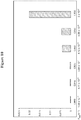
- Figure 10 shows the vinyl ether quenching experiments for catalysts: C849, C865, C825, C850, C852, and C832.
- Figure 11 shows the vinyl ether quenching experiments for catalysts: C831, C840, C849, and C858.
- Figure 12 shows the vinyl ether quenching experiments for catalysts: C848, C852, C855, and C858.
- the catalytic activity of the complexes according to the invention was evaluated in ROMP reactions as follows.
- a 250 mL beaker was filled with 100 g of DCPD-HT monomer and 50 ppm of CHP (cumene hydroperoxide).
- the monomer was equilibrated to the desired temperature in an oil bath (30 °C +/- 0.5 °C).
- a J-Type thermocouple was suspended directly into the center of the monomer.
- the catalyst under study was dissolved in solvent (either toluene or CH 2 Cl 2 ) to form a catalyst solution and the catalyst solution was then added to the monomer at a molar ratio of 45,000:1 (monomer: catalyst) to form a ROMP composition.
- ROMP composition Addition of the catalyst to the monomer to form the ROMP composition denoted the start of the ROMP reaction and hence, this was time point zero. Temperature readings were recorded using the thermocouple. The exotherm time was determined by measuring the amount of time that passed (i.e., the time difference) between time point zero and the time point that a propagating interface of the ROMP composition was first visually observed as the ROMP composition transitioned from a liquid state or gel state to a cured polymer state. ROMP reactions were stopped 2 hours after addition of the catalyst solution to the monomer.
- Time to exotherm is expressed by: slow > 120 minutes; moderate 30 - 120 minutes; medium 1 - ⁇ 30 minutes; fast ⁇ 1 minute and peak exotherm temperature are shown in Table 7
- Compounds C931 and C949 are reference compounds.
Landscapes
- Chemical & Material Sciences (AREA)
- Organic Chemistry (AREA)
- Chemical Kinetics & Catalysis (AREA)
- Inorganic Chemistry (AREA)
- Engineering & Computer Science (AREA)
- Materials Engineering (AREA)
- Health & Medical Sciences (AREA)
- Life Sciences & Earth Sciences (AREA)
- Biochemistry (AREA)
- General Health & Medical Sciences (AREA)
- Molecular Biology (AREA)
- Medicinal Chemistry (AREA)
- Polymers & Plastics (AREA)
- Catalysts (AREA)
- Organic Low-Molecular-Weight Compounds And Preparation Thereof (AREA)
Description
- This invention relates generally to olefin metathesis catalysts, to the preparation of such compounds, compositions comprising such compounds, methods of using such compounds, and the use of such compounds in the metathesis of olefins and in the synthesis of related olefin metathesis catalysts. The invention has utility in the fields of catalysis, organic synthesis, polymer chemistry, and in industrial applications such as oil and gas, fine chemicals and pharmaceuticals.
- Since its discovery in the 1950s, olefin metathesis has emerged as a valuable synthetic method for the formation of carbon-carbon double bonds. Recent advances in applications to organic syntheses and polymer syntheses mostly rely on developments of well-defined olefin metathesis catalysts.
- The technology of ruthenium metathesis catalysts has enabled the development of several research platforms including: ring opening metathesis polymerization (ROMP), ring opening cross metathesis (ROCM), cross metathesis (CM), ring closing metathesis (RCM).
- The incorporation of N-Heterocyclic Carbene (NHC) ligands has played an essential role in the development of ruthenium metathesis catalysts. Metathesis catalysts, based on ruthenium, are known and have been studied
WO92076920 - However, there is an ongoing need for olefin metathesis catalysts, particularly ruthenium metathesis catalysts with improved characteristics which will further enable their use in a wider array of applications and olefin metathesis reactions, and for methods to prepare them.
- To meet this need the inventors have discovered various olefin metathesis catalysts as described herein.
- In one embodiment, the invention provides an olefin metathesis catalyst, represented by the structure of Formula (I):

- M is a
Group 8 transition metal; generally M is ruthenium or osmium; typically M is ruthenium; - X1 and X2 are independently anionic ligands; generally X1 and X2 are independently halogen, trifluoroacetate, per-fluorophenols or nitrate; typically X1 and X2 are independently Cl, Br, I or F;
- L1 is a ligand represented by the structure of Formula (II), or is an NHC ligand represented by the structure of Formula (III):

- R1 is unsubstituted saturated N-heterocycle, substituted saturated N-heterocycle, -NH(C1-C24 alkyl), -N(C1-C24 alkyl)2, -NH(C5-C24 aryl), -N(C5-C24 aryl)2, -N(C1-C24 alkyl)(C5-C24 aryl) or -N[(C1-C6 alkylene)(C5-C24 aryl)]2;
- R2 is unsubstituted (C5-C24 aryl), substituted (C5-C24 aryl), unsubstituted saturated N-heterocycle, substituted saturated N-heterocycle, -NH(C1-C24 alkyl), -N(C1-C24 alkyl)2, -NH(Cs-C24 aryl), -N(C5-C24 aryl)2, -N(C1-C24 alkyl)(C5-C24 aryl) or -N[(C1-C6 alkylene)(C5-C24 aryl)]2;
- R3 is unsubstituted (C5-C24 aryl), substituted (C5-C24 aryl), unsubstituted saturated N-heterocycle, or substituted saturated N-heterocycle;
- Y is CR4 or N;
- R4 is hydrogen, unsubstituted (C1-C12 alkyl), or substituted (C1-C12 alkyl);
- R5 and R6 are independently hydrogen, unsubstituted (C5-C24 aryl), or substituted (C5-C24 aryl);
- Q is a two-atom linkage represented by structures -[CR7R8]s-[CR9R10]t- or -[CR11=CR12]-;
- R7, R8, R9 and R10 are independently hydrogen, unsubstituted (C1-C24 alkyl), substituted (C1-C24 alkyl), unsubstituted (C5-C24 aryl), or substituted (C5-C24 aryl); or any two of R7, R8, R9 and R10 are optionally linked together to form a substituted or unsubstituted, saturated or unsaturated ring structure;
- R11 and R12 are independently hydrogen, unsubstituted (C1-C24 alkyl), substituted (C1-C24 alkyl), unsubstituted (C5-C24 aryl), or substituted (C5-C24 aryl); or R11 and R12 are optionally linked together to form a substituted or unsubstituted, saturated or unsaturated ring structure; and
- "s" and "t" are independently 1 or 2; typically "s" and "t" are independently 1.
- In another embodiment, the invention provides an olefin metathesis catalyst, represented by the structure of Formula (IV):

- M is a
Group 8 transition metal; generally M is ruthenium or osmium; typically M is ruthenium; - X1 and X2 are independently anionic ligands; generally X1 and X2 are independently halogen, trifluoroacetate, per-fluorophenols or nitrate; typically X1 and X2 are independently Cl, Br, I or F;
- R1 is unsubstituted saturated N-heterocycle, substituted saturated N-heterocycle, -NH(C1-C24 alkyl), -N(C1-C24 alkyl)2, -NH(C5-C24 aryl), -N(C5-C24 aryl)2, -N(C1-C24 alkyl)(C5-C24 aryl) or -N[(C1-C6 alkylene)(C5-C24 aryl)]2;
- R2 is unsubstituted (C5-C24 aryl), substituted (C5-C24 aryl), unsubstituted saturated N-heterocycle, substituted saturated N-heterocycle, -NH(C1-C24alkyl), -N(C1-C24alkyl)2, -NH(C5-C24 aryl), -N(C5-C24 aryl)2, -N(C1-C24 alkyl)(C5-C24 aryl) or -N[(C1-C6 alkylene)(C5-C24 aryl)]2; and
- R3 is unsubstituted (C5-C24 aryl), substituted (C5-C24 aryl), unsubstituted saturated N-heterocycle, substituted saturated N-heterocycle, -NH(C1-C24alkyl), -N(C1-C24alkyl)2, -NH(C5-C24 aryl), -N(C5-C24 aryl)2, -N(C1-C24 alkyl)(C5-C24 aryl) or -N[(C1-C6 alkylene)(C5-C24 aryl)]2.
- In another embodiment, the invention provides an olefin metathesis catalyst, represented by the structure of Formula (V):

- M is a
Group 8 transition metal; generally M is ruthenium or osmium; typically M is ruthenium; - X1 and X2 are independently anionic ligands; generally X1 and X2 are independently halogen, trifluoroacetate, per-fluorophenols or nitrate; typically X1 and X2 are independently Cl, Br, I or F;
- X3 is phenyl (


- L1 is a ligand represented by the structure of Formula (II), or is an NHC ligand represented by the structure of Formula (III):

- R1 is unsubstituted saturated N-heterocycle, substituted saturated N-heterocycle, unsubstituted unsaturated N-heterocycle, substituted unsaturated N-heterocycle, -NH(C1-C24 alkyl), -N(C1-C24 alkyl)2, -NH(C5-C24 aryl), -N(C5-C24 aryl)2, -N(C1-C24 alkyl)(C5-C24 aryl), - N[(C1-C6 alkylene)(C5-C24 aryl)]2, or -O-(C1-C12 alkyl);
- R2 is unsubstituted (C5-C24 cycloalkyl), substituted (C5-C24 cycloalkyl), unsubstituted saturated N-heterocycle, substituted saturated N-heterocycle, unsubstituted (C5-C24 aryl), substituted (C5-C24 aryl), -NH(C1-C24 alkyl), -N(C1-C24 alkyl)2, -NH(C5-C24 aryl), -N(C5-C24 aryl)2, -N(C1-C24 alkyl)(C5-C24 aryl) or -N[(C1-C6 alkylene)(C5-C24 aryl)]2;
- R3 is unsubstituted (C5-C24 cycloalkyl), substituted (C5-C24 cycloalkyl), unsubstituted saturated N-heterocycle, substituted saturated N-heterocycle, unsubstituted (C5-C24 aryl), or substituted (C5-C24 aryl);
- Y is CR4 or N;
- R4 is hydrogen, unsubstituted (C1-C12 alkyl), or substituted (C1-C12 alkyl);
- R5 and R6 are independently hydrogen, unsubstituted (C5-C24 aryl), or substituted (C5-C24 aryl);
- Q is a two-atom linkage represented by structures -[CR7R8]s-[CR9R10]t- or -[CR11=CR12]-;
- R7, R8, R9 and R10 are independently hydrogen, unsubstituted (C1-C24 alkyl), substituted (C1-C24 alkyl), unsubstituted (C5-C24 aryl), or substituted (C5-C24 aryl); or any two of R7, R8, R9 and R10 are optionally linked together to form a substituted or unsubstituted, saturated or unsaturated ring structure;
- R11 and R12 are independently hydrogen, unsubstituted (C1-C24 alkyl), substituted (C1-C24 alkyl), unsubstituted (C5-C24 aryl), or substituted (C5-C24 aryl); or R11 and R12 are optionally linked together to form a substituted or unsubstituted, saturated or unsaturated ring structure; and
- "s" and "t" are independently 1 or 2; typically "s" and "t" are independently 1.
- In one embodiment, the invention provides a method of synthesizing the olefin metathesis catalysts of the invention.
- In one embodiment, the invention provides a method of using the olefin metathesis catalysts of the invention in metathesis reactions. The olefin metathesis catalysts of the invention are of particular benefit for use in metathesis reactions, such as ring opening metathesis polymerization reactions, ring-opening cross metathesis reactions, cross metathesis reactions, ring-closing metathesis reactions, self-metathesis reactions, as well as combinations of such metathesis reactions.
- The olefin metathesis catalysts of the invention are also key intermediates in the synthesis of a variety of ruthenium olefin metathesis catalysts.
- These and other aspects of the present invention will be apparent to the skilled artisan in light of the following detailed description and examples. Furthermore, it is to be understood that none of the embodiments or examples of the invention described herein are to be interpreted as being limiting.
-
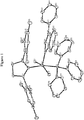
- Figure 1.
- Oak Ridge Thermal Ellipsoid Plot (ORTEP) diagram of C940.
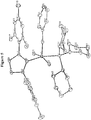
- Figure 2.
- Oak Ridge Thermal Ellipsoid Plot (ORTEP) diagram of C958.
- Figure 3.
- Oak Ridge Thermal Ellipsoid Plot (ORTEP) diagram of C852.
- Figure 4.
- Oak Ridge Thermal Ellipsoid Plot (ORTEP) diagram of C803.
- Figure 5.
- Oak Ridge Thermal Ellipsoid Plot (ORTEP) diagram of C850.
- Figure 6.
- Oak Ridge Thermal Ellipsoid Plot (ORTEP) diagram of C825.
- Figure 7.
- Oak Ridge Thermal Ellipsoid Plot (ORTEP) diagram of C832.
- Figure 8.
- Oak Ridge Thermal Ellipsoid Plot (ORTEP) diagram of C865.
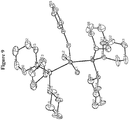
- Figure 9.
- Oak Ridge Thermal Ellipsoid Plot (ORTEP) diagram of C829.
- Figure 10.
- Vinyl ether quenching experiments for catalysts: C849, C865, C825, C850, C852, and C832.
- Figure 11.
- Vinyl ether quenching experiments for catalysts: C831, C840, C849, and C858.
- Figure 12.
- Vinyl ether quenching experiments for catalysts: C848, C852, C855, C858.
- Unless otherwise indicated, the invention is not limited to specific reactants, substituents, catalysts, reaction conditions, or the like, as such can vary. It is also to be understood that the terminology used herein is for the purpose of describing particular embodiments only and is not to be interpreted as being limiting.
- As used in the specification and the appended claims, the singular forms "a," "an," and "the" include plural referents unless the context clearly dictates otherwise. Thus, for example, reference to "an olefin" includes a single olefin as well as a combination or mixture of two or more olefins, reference to "a substituent" encompasses a single substituent as well as two or more substituents, and the like.
- As used in the specification and the appended claims, the terms "for example," "for instance," "such as," or "including" are meant to introduce examples that further clarify more general subject matter. Unless otherwise specified, these examples are provided only as an aid for understanding the invention, and are not meant to be limiting in any fashion.
- In this specification and in the claims that follow, reference will be made to a number of terms, which shall be defined to have the following meanings:
- The term "alkyl" as used herein refers to a linear, branched, or cyclic saturated hydrocarbon group typically although not necessarily containing generally 1 to 30 carbon atoms, typically 1 to 12 carbon atoms, such as methyl, ethyl, n-propyl, iso-propyl, n-butyl, iso-butyl, t-butyl, octyl, decyl, and the like, as well as cycloalkyl groups such as cyclopentyl, cyclohexyl and the like. The term "lower alkyl" intends an alkyl group of 1 to 6 carbon atoms, and the specific term "cycloalkyl" intends a cyclic alkyl group, typically having 4 to 8, preferably 5 to 7, carbon atoms. The term "substituted alkyl" refers to alkyl substituted with one or more substituent groups, and the terms "heteroatom-containing alkyl" and "heteroalkyl" refer to alkyl in which at least one carbon atom is replaced with a heteroatom. If not otherwise indicated, the terms "alkyl" and "lower alkyl" include linear, branched, cyclic, unsubstituted, substituted, and/or heteroatom-containing alkyl and lower alkyl, respectively.
- The term "alkylene" as used herein refers to a divalent linear, branched, or cyclic alkyl group, where "alkyl" is as defined above.
- The term "alkenyl" as used herein refers to a linear, branched, or cyclic hydrocarbon group of 2 to 30 carbon atoms containing at least one double bond, such as ethenyl, n-propenyl, iso-propenyl, n-butenyl, iso-butenyl, octenyl, decenyl, tetradecenyl, hexadecenyl, eicosenyl, tetracosenyl, and the like. Typically alkenyl groups herein contain 2 to 12 carbon atoms. The term "lower alkenyl" intends an alkenyl group of 2 to 6 carbon atoms, and the specific term "cycloalkenyl" intends a cyclic alkenyl group, typically having 5 to 8 carbon atoms. The term "substituted alkenyl" refers to alkenyl substituted with one or more substituent groups, and the terms "heteroatom-containing alkenyl" and "heteroalkenyl" refer to alkenyl in which at least one carbon atom is replaced with a heteroatom. If not otherwise indicated, the terms "alkenyl" and "lower alkenyl" include linear, branched, cyclic, unsubstituted, substituted, and/or heteroatom-containing alkenyl and lower alkenyl, respectively. The term "alkenyl" is used interchangeably with the term "olefin" herein.
- The term "alkenylene" as used herein refers to a divalent linear, branched, or cyclic alkenyl group, where "alkenyl" is as defined above.
- The term "alkynyl" as used herein refers to a linear or branched hydrocarbon group of 2 to 30 carbon atoms containing at least one triple bond, such as ethynyl, n-propynyl, and the like. Typical alkynyl groups described herein contain 2 to 12 carbon atoms. The term "lower alkynyl" intends an alkynyl group of 2 to 6 carbon atoms. The term "substituted alkynyl" refers to alkynyl substituted with one or more substituent groups, and the terms "heteroatom-containing alkynyl" and "heteroalkynyl" refer to alkynyl in which at least one carbon atom is replaced with a heteroatom. If not otherwise indicated, the terms "alkynyl" and "lower alkynyl" include linear, branched, unsubstituted, substituted, and/or heteroatom-containing alkynyl and lower alkynyl, respectively.
- The term "alkoxy" as used herein intends an alkyl group bound through a single, terminal ether linkage; that is, an "alkoxy" group can be represented as -O-alkyl where alkyl is as defined above. A "lower alkoxy" group intends an alkoxy group containing 1 to 6 carbon atoms. Analogously, "alkenyloxy" and "lower alkenyloxy" respectively refer to an alkenyl and lower alkenyl group bound through a single, terminal ether linkage, and "alkynyloxy" and "lower alkynyloxy" respectively refer to an alkynyl and lower alkynyl group bound through a single, terminal ether linkage.
- The term "aryl" as used herein, and unless otherwise specified, refers to an aromatic substituent containing a single aromatic ring or multiple aromatic rings that are fused together, directly linked, or indirectly linked (such that the different aromatic rings are bound to a common group such as a methylene or ethylene moiety). Generally aryl groups contain 5 to 30 carbon atoms, and typically aryl groups contain 5 to 14 carbon atoms. Exemplary aryl groups contain one aromatic ring or two fused or linked aromatic rings, e.g., phenyl, naphthyl, biphenyl, diphenylether, diphenylamine, benzophenone, and the like. "Substituted aryl" refers to an aryl moiety substituted with one or more substituent groups. The terms "heteroatom-containing aryl" and "heteroaryl" refer to aryl substituents in which at least one carbon atom is replaced with a heteroatom, as will be described in further detail infra.
- The term "aryloxy" as used herein refers to an aryl group bound through a single, terminal ether linkage, wherein "aryl" is as defined above. An "aryloxy" group can be represented as -O-aryl where aryl is as defined above. Preferred aryloxy groups contain 5 to 24 carbon atoms, and particularly preferred aryloxy groups contain 5 to 14 carbon atoms. Examples of aryloxy groups include, without limitation, phenoxy, o-halo-phenoxy, m-halo-phenoxy, p-halo-phenoxy, o-methoxy-phenoxy, m-methoxy-phenoxy, p-methoxy-phenoxy, 2,4-dimethoxy-phenoxy, 3,4,5-trimethoxy-phenoxy, and the like.
- The term "alkaryl" refers to an aryl group with an alkyl substituent, and the term "aralkyl" refers to an alkyl group with an aryl substituent, wherein "aryl" and "alkyl" are as defined above. Generally alkaryl and aralkyl groups contain 6 to 30 carbon atoms, and typically alkaryl and aralkyl groups contain 6 to 16 carbon atoms. Alkaryl groups include, for example, p-methylphenyl, 2,4-dimethylphenyl, p-cyclohexylphenyl, 2,7-dimethylnaphthyl, 7-cyclooctylnaphthyl, 3-ethyl-cyclopenta-1,4-diene, and the like. Examples of aralkyl groups include, without limitation, benzyl, 2-phenyl-ethyl, 3-phenyl-propyl, 4-phenyl-butyl, 5-phenylpentyl, 4-phenylcyclohexyl, 4-benzylcyclohexyl, 4-phenylcyclohexylmethyl, 4-benzylcyclohexylmethyl, and the like. The terms "alkaryloxy" and "aralkyloxy" refer to substituents of the formula -OR wherein R is alkaryl or aralkyl, respectively, as defined herein.
- The term "acyl" refers to substituents having the formula -(CO)-alkyl, -(CO)-aryl, or -(CO)-aralkyl, and the term "acyloxy" refers to substituents having the formula -O(CO)-alkyl, -O(CO)-aryl, or -O(CO)-aralkyl, wherein "alkyl," "aryl," and "aralkyl" are as defined above.
- The terms "cyclic" and "ring" refer to moieties which are saturated or have unsaturations and are non-aromatic or are aromatic and that are optionally substituted and/or heteroatom containing, and that can be monocyclic, bicyclic, or polycyclic.
- The term "saturated N-heterocycle" as used herein refers to a heteroatom-containing cyclic group, which is saturated and is attached to the rest of the molecule by a nitrogen (N) atom. The saturated N-heterocycle moiety contains rings wherein one or more carbon(s) has been replaced by a heteroatom, such as: N, S or O. Unsubstituted "saturated N-heterocycle" groups include pyrrolidino, morpholino, piperazino, piperidino, thiomorpholino, etc. Substituted "saturated N-heterocycle" groups include 1-methyl-piperazino, N-acetyl-piperazino, N-ethylcarboxylate-piperazino, etc.
- The terms "halo," "halogen," and "halide" are used in the conventional sense to refer to a chloro, bromo, fluoro, or iodo substituent.
- The term "hydrocarbyl" refers to univalent hydrocarbyl radicals containing 1 to 30 carbon atoms, typically containing 1 to 24 carbon atoms, specifically containing 1 to 12 carbon atoms, including linear, branched, cyclic, saturated, and unsaturated species, such as alkyl groups, alkenyl groups, aryl groups, and the like. The term "lower hydrocarbyl" intends a hydrocarbyl group of 1 to 6 carbon atoms, typically 1 to 4 carbon atoms, and the term "hydrocarbylene" intends a divalent hydrocarbyl moiety containing 1 to 30 carbon atoms, typically 1 to 24 carbon atoms, specifically 1 to 12 carbon atoms, including linear, branched, cyclic, saturated and unsaturated species. The term "lower hydrocarbylene" intends a hydrocarbylene group of 1 to 6 carbon atoms. "Substituted hydrocarbyl" refers to hydrocarbyl substituted with one or more substituent groups, and the terms "heteroatom-containing hydrocarbyl" and "heterohydrocarbyl" refer to hydrocarbyl in which at least one carbon atom is replaced with a heteroatom. Similarly, "substituted hydrocarbylene" refers to hydrocarbylene substituted with one or more substituent groups, and the terms "heteroatom-containing hydrocarbylene" and "heterohydrocarbylene" refer to hydrocarbylene in which at least one carbon atom is replaced with a heteroatom. Unless otherwise indicated, the term "hydrocarbyl" and "hydrocarbylene" are to be interpreted as including substituted and/or heteroatom-containing hydrocarbyl and hydrocarbylene moieties, respectively.
- The term "heteroatom-containing" as in a "heteroatom-containing hydrocarbyl group" refers to a hydrocarbon molecule or a hydrocarbyl molecular fragment in which one or more carbon atoms is replaced with an atom other than carbon, e.g., nitrogen, oxygen, sulfur, phosphorus or silicon, typically nitrogen, oxygen or sulfur. Similarly, the term "heteroalkyl" refers to an alkyl substituent that is heteroatom-containing, the term "heterocyclic" refers to a cyclic substituent that is heteroatom-containing, the terms "heteroaryl" and "heteroaromatic" respectively refer to "aryl" and "aromatic" substituents that are heteroatom-containing, and the like. It should be noted that a "heterocyclic" group or compound is optionally aromatic, and further that "heterocycles" can be monocyclic, bicyclic, or polycyclic as described above with respect to the term "aryl." Examples of heteroalkyl groups include alkoxyaryl, alkylsulfanyl-substituted alkyl, N-alkylated amino alkyl, and the like. Examples of heteroaryl substituents include pyrrolyl, pyrrolidinyl, pyridinyl, quinolinyl, indolyl, pyrimidinyl, imidazolyl, 1,2,4-triazolyl, tetrazolyl, etc.
- By "Grubbs-Hoveyda ligands," is meant benzylidene ligands having a chelating alkyloxy group attached to the benzene ring at the ortho position.
- Examples of -NH(C1-C24 alkyl) groups include -NHMe (e.g., methylamino), - NHEt (e.g., ethylamine), -NH(i-Pr) (e.g., iso-propylamino), etc.
- Examples of -N(C1-C24 alkyl)2 groups include -N(Me)2 (e.g., dimethylamino), - N(Et)2 (e.g., diethylamino), -N(i-Pr)2 (e.g., di-iso-propylamino), etc.
- Examples of -NH(C5-C24 aryl) groups include -NH(C6H5) (e.g., phenylamino), etc.
- Examples of -N(C5-C24 aryl)2 groups include -N(C6H5)2 (e.g., diphenylamino), etc.
- Examples of -N(C1-C24 alkyl)(C5-C24 aryl) groups include -NMe(C6H5) (e.g., phenylmethylamino), etc.
- Examples of -N[(C1-C6 alkylene)(C5-C24 aryl)]2 groups include -N[(CH2)(C6H5)]2 (e.g., di-benzyl-amino), etc.
- By "substituted" as in "substituted hydrocarbyl," "substituted alkyl," "substituted aryl," and the like, as alluded to in some of the aforementioned definitions, is meant that in the hydrocarbyl, alkyl, aryl, or other moiety, at least one hydrogen atom bound to a carbon (or other) atom is replaced with one or more non-hydrogen substituents. Examples of such substituents include, without limitation: functional groups referred to herein as "Fn," such as halo, hydroxyl, sulfhydryl, C1-C24 alkoxy, C2-C24 alkenyloxy, C2-C24 alkynyloxy, C5-C24 aryloxy, C6-C24 aralkyloxy, C6-C24 alkaryloxy, acyl (including C2-C24 alkylcarbonyl (-CO-alkyl) and C6-C24 arylcarbonyl (-CO-aryl)), acyloxy (-O-acyl, including C2-C24 alkylcarbonyloxy (-O-CO-alkyl) and C6-C24 arylcarbonyloxy (-O-CO-aryl)), C2-C24 alkoxycarbonyl (-(CO)-O-alkyl), C6-C24 aryloxycarbonyl (-(CO)-O-aryl), halocarbonyl (-CO)-X where X is halo), C2-C24 alkylcarbonato (-O-(CO)-O-alkyl), C6-C24 arylcarbonato (-O-(CO)-O-aryl), carboxy (-COOH), carboxylato (-COO-), carbamoyl (-(CO)-NH2), mono-(C1-C24 alkyl)-substituted carbamoyl (-(CO)-NH(C1-C24 alkyl)), di-(C1-C24 alkyl)-substituted carbamoyl (-(CO)-N(C1-C24 alkyl)2), mono-(C1-C24 haloalkyl)-substituted carbamoyl (-(CO)-NH(C1-C24 alkyl)), di-(C1-C24 haloalkyl)-substituted carbamoyl (-(CO)-N(C1-C24 alkyl)2), mono-(C5-C24 aryl)-substituted carbamoyl (-(CO)-NH-aryl), di-(C5-C24 aryl)-substituted carbamoyl (-(CO)-N(C5-C24 aryl)2), di-N-(C1-C24 alkyl),N-(C5-C24 aryl)-substituted carbamoyl, thiocarbamoyl (-(CS)-NH2), mono-(C1-C24 alkyl)-substituted thiocarbamoyl (-(CS)-NH(C1-C24 alkyl)), di-(C1-C24 alkyl)-substituted thiocarbamoyl (-(CS)-N(C1-C24 alkyl)2), mono-(C5-C24 aryl)-substituted thiocarbamoyl (-(CS)-NH-aryl), di-(C5-C24 aryl)-substituted thiocarbamoyl (-(CS)-N(C5-C24 aryl)2), di-N-(C1-C24 alkyl), N-(C5-C24 aryl)-substituted thiocarbamoyl, carbamido (-NH-(CO)-NH2), cyano(-C=N), cyanato (-O-C≡N), thiocyanato (-S-C=N), formyl (-(CO)-H), thioformyl (-(CS)-H), amino (-NH2), mono-(C1-C24 alkyl)-substituted amino, di-(C1-C24 alkyl)-substituted amino, mono-(C5-C24 aryl)-substituted amino, di-(C5-C24 aryl)-substituted amino, (C1-C24 alkyl)(C5-C24 aryl)-substituted amino, C2-C24 alkylamido (-NH-(CO)-alkyl), C6-C24 arylamido (-NH-(CO)-aryl), imino (-CR=NH where R = hydrogen, C1-C24 alkyl, C5-C24 aryl, C6-C24 alkaryl, C6-C24 aralkyl, etc.), C2-C20 alkylimino (-CR=N(alkyl), where R = hydrogen, C1-C24 alkyl, C5-C24 aryl, C6-C24 alkaryl, C6-C24 aralkyl, etc.), arylimino (-CR=N(aryl), where R = hydrogen, C1-C20 alkyl, C5-C24 aryl, C6-C24 alkaryl, C6-C24 aralkyl, etc.), nitro (-NO2), nitroso (-NO), sulfo (-SO2-OH), sulfonato (-SO2-O-), C1-C24 alkylsulfanyl (-S-alkyl; also termed "alkylthio"), C5-C24 arylsulfanyl (-S-aryl; also termed "arylthio"), C1-C24 alkylsulfinyl (-(SO)-alkyl), C5-C24 arylsulfinyl (-(SO)-aryl), C1-C24 alkylsulfonyl (-SO2-alkyl), C1-C24 monoalkylaminosulfonyl -SO2-N(H) alkyl), C1-C24 dialkylaminosulfonyl -SO2-N(alkyl)2, C5-C24 arylsulfonyl (-SO2-aryl), boryl (-BH2), borono (-B(OH)2), boronato (-B(OR)2 where R is alkyl or other hydrocarbyl), phosphono (-P(O)(OH)2), phosphonato (-P(O)(O-)2), phosphinato (-P(O)(O-)), phospho (-PO2), and phosphino (-PH2); and the hydrocarbyl moieties C1-C24 alkyl (preferably C1-C12 alkyl, more preferably C1-C6 alkyl), C2-C24 alkenyl (preferably C2-C12 alkenyl, more preferably C2-C6 alkenyl), C2-C24 alkynyl (preferably C2-C12 alkynyl, more preferably C2-C6 alkynyl), C5-C24 aryl (preferably C5-C14 aryl), C6-C24 alkaryl (preferably C6-C16 alkaryl), and C6-C24 aralkyl (preferably C6-C16 aralkyl).
- By "functionalized" as in "functionalized hydrocarbyl," "functionalized alkyl," "functionalized olefin," "functionalized cyclic olefin," and the like, is meant that in the hydrocarbyl, alkyl, olefin, cyclic olefin, or other moiety, at least one hydrogen atom bound to a carbon (or other) atom is replaced with one or more functional groups such as those described hereinabove. The term "functional group" is meant to include any functional species that is suitable for the uses described herein. In particular, as used herein, a functional group would necessarily possess the ability to react with or bond to corresponding functional groups on a substrate surface.
- In addition, the aforementioned functional groups can, if a particular group permits, be further substituted with one or more additional functional groups or with one or more hydrocarbyl moieties such as those specifically enumerated above. Analogously, the above-mentioned hydrocarbyl moieties can be further substituted with one or more functional groups or additional hydrocarbyl moieties such as those specifically enumerated.
- "Optional" or "optionally" means that the subsequently described circumstance can or cannot occur, so that the description includes instances where the circumstance occurs and instances where it does not. For example, the phrase "optionally substituted" means that a non-hydrogen substituent can or cannot be present on a given atom, and, thus, the description includes structures wherein a non-hydrogen substituent is present and structures wherein a non-hydrogen substituent is not present.
- In one embodiment, the invention provides an olefin metathesis catalyst, represented by the structure of Formula (VI):

- X1 and X2 are independently anionic ligands; generally X1 and X2 are independently halogen, trifluoroacetate, per-fluorophenols or nitrate; typically X1 and X2 are independently Cl, Br, I or F;
- R1 is unsubstituted saturated N-heterocycle, substituted saturated N-heterocycle, -NH(C1-C24 alkyl), -N(C1-C24 alkyl)2, -NH(C5-C24 aryl), -N(C5-C24 aryl)2, -N(C1-C24 alkyl)(C5-C24 aryl) or -N[(C1-C6 alkylene) (C5-C24 aryl)]2; generally R1 is unsubstituted saturated N-heterocycle, substituted saturated N-heterocycle, -N(C1-C6 alkyl)2, -N(C1-C6 alkyl)(C6 aryl) or -N[(C1-C3 alkylene)(C6 aryl)]2;
- R2 is unsubstituted (C5-C24 aryl), substituted (C5-C24 aryl), unsubstituted saturated N-heterocycle, substituted saturated N-heterocycle, -NH(C1-C24 alkyl), -N(C1-C24 alkyl)2, -NH(C5-C24 aryl), -N(C5-C24 aryl)2, -N(C1-C24 alkyl)(C5-C24 aryl) or -N[(C1-C6 alkylene)(C5-C24 aryl)]2; generally R2 is unsubstituted (C6 aryl), unsubstituted saturated N-heterocycle, substituted saturated N-heterocycle, -N(C1-C6 alkyl)2, -N(C1-C6 alkyl)(C6 aryl) or -N[(C1-C3 alkylene)(C6 aryl)]2; and
- R3 is unsubstituted (C5-C24 aryl), substituted (C5-C24 aryl), unsubstituted saturated N-heterocycle, or substituted saturated N-heterocycle; generally R3 is unsubstituted (C6 aryl) or unsubstituted saturated N-heterocycle.
- In another embodiment, the invention provides an olefin metathesis catalyst, represented by the structure of Formula (VI), wherein X1 is Cl; X2 is Cl; R1 is morpholino, thiomorpholino, 1-methyl-piperazino, piperidino, N-acetyl-piperazino, di-benzyl-amino, N-ethylcarboxylate-piperazino, diethylamino, methyl-phenylamino, or di-iso-propylamino; R2 is phenyl, morpholino, thiomorpholino, 1-methyl-piperazino, piperidino, N-acetyl-piperazino, di-benzyl-amino, N-ethylcarboxylate-piperazino, diethylamino, methyl-phenylamino, or di-iso-propylamino; and R3 is phenyl or morpholino.
- In another embodiment, the invention provides an olefin metathesis catalyst, represented by the structure of Formula (VII):

- X1 and X2 are independently anionic ligands; generally X1 and X2 are independently halogen, trifluoroacetate, per-fluorophenols or nitrate; typically X1 and X2 are independently Cl, Br, I or F;
- R1 is unsubstituted saturated N-heterocycle, substituted saturated N-heterocycle, -NH(C1-C24 alkyl), -N(C1-C24 alkyl)2, -NH(C5-C24 aryl), -N(C5-C24 aryl)2, -N(C1-C24 alkyl)(C5-C24 aryl) or -N[(C1-C6 alkylene)(C5-C24 aryl)]2; generally R1 is unsubstituted saturated N-heterocycle, substituted saturated N-heterocycle, -N(C1-C6 alkyl)2, -N(C1-C6 alkyl)(C6 aryl) or -N[(C1-C3 alkylene)(C6 aryl)]2;
- R2 is unsubstituted (C5-C24 aryl), substituted (C5-C24 aryl), unsubstituted saturated N-heterocycle, substituted saturated N-heterocycle, -NH(C1-C24 alkyl), -N(C1-C24alkyl)2, -NH(Cs-C24 aryl), -N(C5-C24 aryl)2, -N(C1-C24 alkyl)(C5-C24 aryl) or -N[(C1-C6 alkylene)(C5-C24 aryl)]2; generally R2 is unsubstituted (C6 aryl), unsubstituted saturated N-heterocycle, substituted saturated N-heterocycle, -N(C1-C6 alkyl)2, -N(C1-C6 alkyl)(C6 aryl) or -N[(C1-C3 alkylene)(C6 aryl)]2;
- R3 is unsubstituted (C5-C24 aryl), substituted (C5-C24 aryl), unsubstituted saturated N-heterocycle or substituted saturated N-heterocycle; generally R3 is unsubstituted (C6 aryl) or substituted saturated N-heterocycle;
- Y is CR4 or N; generally Y is N;
- R4 is hydrogen, unsubstituted (C1-C12 alkyl), or substituted (C1-C12 alkyl);
- R5 and R6 are independently hydrogen, unsubstituted (C5-C24 aryl), or substituted (C5-C24 aryl); generally R5 and R6 are independently substituted (C5-C24 aryl);
- Q is a two-atom linkage represented by structures -[CR7R8]s-[CR9R10]t- or -[CR11=CR12]-;
- R7, R8, R9 and R10 are independently hydrogen, unsubstituted (C1-C24 alkyl), substituted (C1-C24 alkyl), unsubstituted (C5-C24 aryl), or substituted (C1-C24 aryl); or any two of R7, R8, R9 and R10 are optionally linked together to form a substituted or unsubstituted, saturated or unsaturated ring structure; generally R7, R8, R9 and R10 are independently hydrogen, unsubstituted (C1-C12 alkyl), substituted (C1-C12 alkyl), unsubstituted (C5-C14 aryl) or substituted (C5-C14 aryl);
- R11 and R12 are independently hydrogen, unsubstituted (C1-C24 alkyl), substituted (C1-C24 alkyl), unsubstituted (C5-C24 aryl), or substituted (C5-C24 aryl); or R11 and R12 are optionally linked together to form a substituted or unsubstituted, saturated or unsaturated ring structure; and
- "s" and "t" are independently 1 or 2; generally "s" and "t" are independently 1.
- In another embodiment, the invention provides an olefin metathesis catalyst, represented by the structure of Formula (VIII):

- X1 and X2 are independently anionic ligands; generally X1 and X2 are independently halogen, trifluoroacetate, per-fluorophenols or nitrate; typically X1 and X2 are independently Cl, Br, I or F;
- R1 is unsubstituted saturated N-heterocycle, substituted saturated N-heterocycle, -NH(C1-C24 alkyl). -NC1-C24 alkl2 -NH(C5-C24 aryl), -N(C5-C24 aryl)2, -NC1-C24 alkyl)(C5-C24 aryl) or -N[(C1-C6 alkylene)(C5-C24 aryl)]2; generally R1 is unsubstituted saturated N-heterocycle, substituted saturated N-heterocycle, -N(C1-C6 alkyl)2, -N(C1-C6 alkyl)(C6 aryl) or -N[(C1-C3 alkylene)(C6 aryl)]2;
- R2 is unsubstituted (C5-C24 aryl), substituted (C5-C24 aryl), unsubstituted saturated N-heterocycle, substituted saturated N-heterocycle, -NH(C1-C24 alkyl), -N(C1-C24 alkyl)2, -NH(C5-C24 aryl), -N(C5-C24 aryl)2, -N(C1-C24 alkyl)(C5-C24 aryl) or -N[(C1-C6 alkylene)(C5-C24 aryl)]2; generally R2 is unsubstituted (C6 aryl), unsubstituted saturated N-heterocycle, substituted saturated N-heterocycle, -N(C1-C6 alkyl)2, -N(C1-C6 alkyl)(C6 aryl) or -N[(C1-C3 alkylene)(C6 aryl)]2;
- R3 is unsubstituted (C5-C24 aryl), substituted (C5-C24 aryl), unsubstituted saturated N-heterocycle or substituted saturated N-heterocycle; generally R3 is unsubstituted (C6 aryl) or unsubstituted saturated N-heterocycle; and
- R5 and R6 are independently hydrogen, unsubstituted C5-C24 aryl, or substituted C5-C24 aryl; generally R5 and R6 are independently substituted C5-C24 aryl with one to three unsubstituted (C1-C6 alkyl) groups or substituted (C1-C6 alkyl) groups.
- In another embodiment, the invention provides an olefin metathesis catalyst, represented by the structure of Formula (VIII), wherein X1 is Cl; X2 is Cl; R1 is morpholino, thiomorpholino, 1-methyl-piperazino, piperidino, N-acetyl-piperazino, di-benzyl-amino, N-ethylcarboxylate-piperazino, diethylamino, methyl-phenylamino, or di-iso-propylamino; R2 is phenyl, morpholino, thiomorpholino, 1-methyl-piperazino, piperidino, N-acetyl-piperazino, di-benzyl-amino, N-ethylcarboxylate-piperazino, diethylamino, methyl-phenylamino, or di-iso-propylamino; R3 is phenyl or morpholino; and R5 and R6 are independently 2,4,6-trimethyl-phenyl (e.g., mesityl or Mes), 2,6-di-iso-propylphenyl (e.g., DIPP or DiPP), 2-iso-propylphenyl (e.g., IPP or Ipp), or 2-methyl-6-iso-propylphenyl (e.g., MIPP or Mipp or MiPP).
- Some of the olefin metathesis catalysts represented by the structure of Formula (VIII) were obtained as solvates.
- In one embodiment, the invention provides an olefin metathesis catalyst, represented by the structure of Formula (IVa):

- X1 and X2 are independently anionic ligands; generally X1 and X2 are independently halogen, trifluoroacetate, per-fluorophenols or nitrate; typically X1 and X2 are independently Cl, Br, I or F;
- R1 is unsubstituted saturated N-heterocycle, substituted saturated N-heterocycle, -NH(C1-C24 alkyl), -N(C1-C24 alkyl)2, -NH(C5-C24 aryl), -N(C5-C24 aryl)2, -N(C1-C24 alkyl)(C5-C24 aryl) or -N[(C1-C6 alkylene)(C5-C24 aryl)]2; generally R1 is unsubstituted saturated N-heterocycle, substituted saturated N-heterocycle, -N(C1-C6 alkyl)2, -N(C1-C6 alkyl)(C6 aryl) or -N[(C1-C3 alkylene)(C6 aryl)]2;
- R2 is unsubstituted (C5-C24 aryl), substituted (C5-C24 aryl), unsubstituted saturated N-heterocycle, substituted saturated N-heterocycle, -NH(C1-C24 alkyl), -N(C1-C24 alkyl)2, -NH(Cs-C24 aryl), -N(C5-C24 aryl)2, -N(C1-C24 alkyl)(C5-C24 aryl) or -N[(C1-C6 alkylene)(C5-C24 aryl)]2; generally R2 is unsubstituted (C6 aryl), unsubstituted saturated N-heterocycle, substituted saturated N-heterocycle, -N(C1-C6 alkyl)2, -N(C1-C6 alkyl)(C6 aryl) or -N[(C1-C3 alkylene)(C6 aryl)]2; and
- R3 is unsubstituted (C5-C24 aryl), substituted (C5-C24 aryl), unsubstituted saturated N-heterocycle, substituted saturated N-heterocycle, -NH(C1-C24 alkyl), -N(C1-C24 alkyl)2, -NH(Cs-C24 aryl), -N(C5-C24 aryl)2, -N(C1-C24 alkyl)(C5-C24 aryl) or -N[(C1-C6 alkylene)(C5-C24 aryl)]2; generally R3 is unsubstituted (C6 aryl) or unsubstituted saturated N-heterocycle.
- In another embodiment, the invention provides an olefin metathesis catalyst, represented by the structure of Formula (IVa), wherein X1 is Cl; X2 is Cl; R1 is morpholino, thiomorpholino, 1-methyl-piperazino, piperidino, N-acetyl-piperazino, di-benzyl-amino, N-ethylcarboxylate-piperazino, diethylamino, methyl-phenylamino, or di-iso-propylamino; R2 is phenyl, morpholino, thiomorpholino, 1-methyl-piperazino, piperidino, N-acetyl-piperazino, di-benzyl-amino, N-ethylcarboxylate-piperazino, diethylamino, methyl-phenylamino, or di-iso-propylamino; and R3 is phenyl or morpholino.
- In another embodiment, the invention provides an olefin metathesis catalyst, represented by the structure of Formula (IX):

- X1 and X2 are independently anionic ligands; generally X1 and X2 are independently halogen, trifluoroacetate, per-fluorophenols or nitrate; typically X1 and X2 are independently Cl, Br, I or F;
- X3 is phenyl or 2-methyl-1-propenyl;
- R1 is unsubstituted saturated N-heterocycle, substituted saturated N-heterocycle, unsubstituted unsaturated N-heterocycle, substituted unsaturated N-heterocycle, -NH(C1-C24 alkyl), -N(C1-C24 alkyl)2, -NH(C5-C24 aryl), -N(C5-C24 aryl)2, -N(C1-C24 alkyl)(C5-C24 aryl), - N[(C1-C6 alkylene)(C5-C24 aryl)]2, or -O-(C1-C12 alkyl); generally R1 is unsubstituted saturated N-heterocycle, substituted saturated N-heterocycle, -O-(C1-C12 alkyl), or unsubstituted unsaturated N-heterocycle;
- R2 is unsubstituted (C5-C24 cycloalkyl), substituted (C5-C24 cycloalkyl), unsubstituted (C5-C24 aryl), substituted (C5-C24 aryl), unsubstituted saturated N-heterocycle, substituted saturated N-heterocycle, -NH(C1-C24 alkyl), -N(C1-C24 alkyl)2, -NH(C5-C24 aryl), -N(C5-C24 aryl)2, -N(C1-C24 alkyl)(C5-C24 aryl) or -N[(C1-C6 alkylene)(C5-C24 aryl)]2; generally R2 is unsubstituted (C5-C24 cycloalkyl), unsubstituted (C6 aryl), unsubstituted saturated N-heterocycle; and
- R3 is unsubstituted (C5-C24 cycloalkyl), substituted (C5-C24 cycloalkyl), unsubstituted (C5-C24 aryl), substituted (C5-C24 aryl), unsubstituted saturated N-heterocycle or substituted saturated N-heterocycle; generally R3 is unsubstituted (C5-C24 cycloalkyl), unsubstituted (C6 aryl) or unsubstituted saturated N-heterocycle.
- In another embodiment, the invention provides an olefin metathesis catalyst, represented by the structure of Formula (IX), wherein X1 is Cl; X2 is Cl; X3 is phenyl; R1 is morpholino, iso-propoxyl, pyrrolo; R2 is cyclohexyl, phenyl or morpholino; and R3 is cyclohexyl, phenyl or morpholino.
- In another embodiment, the invention provides an olefin metathesis catalyst, represented by the structure of Formula (IX), wherein X1 is Cl; X2 is Cl; X3 is 2-methyl-1-propenyl; R1 is morpholino, iso-propoxyl, pyrrolo; R2 is cyclohexyl, phenyl or morpholino; and R3 is cyclohexyl, phenyl or morpholino.
- In another embodiment, the invention provides an olefin metathesis catalyst, represented by the structure of Formula (X):

- X1 and X2 are independently anionic ligands; generally X1 and X2 are independently halogen, trifluoroacetate, per-fluorophenols or nitrate; typically X1 and X2 are independently Cl, Br, I or F;
- X3 is phenyl or 2-methyl-1-propenyl;
- R1 is unsubstituted saturated N-heterocycle, substituted saturated N-heterocycle, unsubstituted unsaturated N-heterocycle, substituted unsaturated N-heterocycle, -NH(C1-C24 alkyl), -N(C1-C24 alkyl)2, -NH(C5-C24 aryl), -N(C5-C24 aryl)2, -N(C1-C24 alkyl)(C5-C24 aryl), - N[(C1-C6 alkylene)(C5-C24 aryl)]2, or -O-(C1-C12 alkyl); generally R1 is unsubstituted saturated N-heterocycle, substituted saturated N-heterocycle, -O-(C1-C12 alkyl), -N(C1-C6 alkyl)2, -N(C1-C6 alkyl)(C6 aryl) or -N[(C1-C3 alkylene)(C6 aryl)]2;
- R2 is unsubstituted (C5-C24 cycloalkyl), substituted (C5-C24 cycloalkyl), unsubstituted (C5-C24 aryl), substituted (C5-C24 aryl), unsubstituted saturated N-heterocycle, substituted saturated N-heterocycle, -NH(C1-C24 alkyl), -N(C1-C24 alkyl)2, -NH(C5-C24 aryl), -N(C5-C24 aryl)2, -N(C1-C24 alkyl)(C5-C24 aryl) or -N[(C1-C6 alkylene)(C5-C24 aryl)]2; generally R2 is unsubstituted (C5-C24 cycloalkyl), unsubstituted (C6 aryl), unsubstituted saturated N-heterocycle, substituted saturated N-heterocycle, -N(C1-C6 alkyl)2, -N(C1-C6 alkyl)(C6 aryl) or -N[(C1-C3 alkylene)(C6 aryl)]2;
- R3 is unsubstituted (C5-C24 cycloalkyl), substituted (C5-C24 cycloalkyl), unsubstituted (C5-C24 aryl), substituted (C5-C24 aryl), unsubstituted saturated N-heterocycle or substituted saturated N-heterocycle; generally R3 is unsubstituted (C5-C24 cycloalkyl), unsubstituted (C6 aryl) or unsubstituted saturated N-heterocycle;
- Y is CR4 or N; generally Y is N;
- R4 is hydrogen, unsubstituted (C1-C12 alkyl), or substituted (C1-C12 alkyl);
- R5 and R6 are independently hydrogen, unsubstituted (C5-C24 aryl), or substituted (C5-C24 aryl); generally R5 and R6 are independently substituted (C5-C24 aryl);
- Q is a two-atom linkage represented by structures -[CR7R8]s-[CR9R10]t- or -[CR11=CR12]-;
- R7, R8, R9 and R10 are independently hydrogen, unsubstituted (C1-C24 alkyl), substituted (C1-C24 alkyl), unsubstituted (C5-C24 aryl), or substituted (C1-C24 aryl); or any two of R7, R8, R9 and R10 are optionally linked together to form a substituted or unsubstituted, saturated or unsaturated ring structure; generally R7, R8, R9 and R10 are independently hydrogen, unsubstituted (C1-C12 alkyl), substituted (C1-C12 alkyl), unsubstituted (C5-C14 aryl) or substituted (C5-C14 aryl);
- R11 and R12 are independently hydrogen, unsubstituted (C1-C24 alkyl), substituted (C1-C24 alkyl), unsubstituted (C5-C24 aryl), or substituted (C5-C24 aryl); or R11 and R12 are optionally linked together to form a substituted or unsubstituted, saturated or unsaturated ring structure; and
- "s" and "t" are independently 1 or 2; generally "s" and "t" are independently 1.
- In one embodiment, the invention provides olefin metathesis catalysts, represented by the structure of Formula (XI),

- X1 and X2 are independently anionic ligands; generally X1 and X2 are independently halogen, trifluoroacetate, per-fluorophenols or nitrate; typically X1 and X2 are independently Cl, Br, I or F;
- X3 is phenyl or 2-methyl-1-propenyl;
- R1 is unsubstituted saturated N-heterocycle, substituted saturated N-heterocycle, unsubstituted unsaturated N-heterocycle, substituted unsaturated N-heterocycle, -NH(C1-C24 alkyl), -N(C1-C24 alkyl)2, -NH(C5-C24 aryl), -N(C5-C24 aryl)2, -N(C1-C24 alkyl)(C5-C24 aryl), - N[(C1-C6 alkylene)(C5-C24 aryl)]2, or -O-(C1-C12 alkyl); generally R1 is unsubstituted saturated N-heterocycle, unsubstituted unsaturated N-heterocycle, -O-(C1-C12 alkyl);
- R2 is unsubstituted (C5-C24 cycloalkyl), substituted (C5-C24 cycloalkyl), unsubstituted (C5-C24 aryl), substituted (C5-C24 aryl), unsubstituted saturated N-heterocycle, substituted saturated N-heterocycle, -NH(C1-C24 alkyl), -N(C1-C24 alkyl)2, -NH(C5-C24 aryl), -N(C5-C24 aryl)2, -N(C1-C24 alkyl)(C5-C24 aryl) or -N[(C1-C6 alkylene)(C5-C24 aryl)]2; generally R2 is unsubstituted (C5-C24 cycloalkyl), unsubstituted (C6 aryl), unsubstituted saturated N-heterocycle;
- R3 is unsubstituted (C5-C24 cycloalkyl), substituted (C5-C24 cycloalkyl), unsubstituted (C5-C24 aryl), substituted (C5-C24 aryl), unsubstituted saturated N-heterocycle or substituted saturated N-heterocycle; generally R3 is unsubstituted (C5-C24 cycloalkyl), unsubstituted (C6 aryl) or unsubstituted saturated N-heterocycle; and
- R5 and R6 are independently unsubstituted (C5-C24 aryl), or substituted (C5-C24 aryl); generally R5 and R6 are independently substituted (C5-C24 aryl) with one to three unsubstituted (C1-C6 alkyl) groups or substituted (C1-C6 alkyl) groups.
- In another embodiment, the invention provides an olefin metathesis catalyst, represented by the structure of Formula (XI), wherein X1 is Cl; X2 is Cl; X3 is phenyl; R1 is morpholino, isopropoxy, pyrrolo or piperidino; R2 is cyclohexyl, morpholino, piperidino or phenyl; R3 is phenyl, morpholino, piperidino or cyclohexyl; and R5 and R6 are independently 2,4,6-trimethyl-phenyl, 2,6-di-iso-propylphenyl, 2-iso-propylphenyl, or 2-methyl-6-iso-propylphenyl.
- In another embodiment, the invention provides an olefin metathesis catalyst, represented by the structure of Formula (XI), wherein X1 is Cl; X2 is Cl; X3 is 2-methyl-1-propenyl; R1 is morpholino, isopropoxy, pyrrolo or piperidino; R2 is cyclohexyl, morpholino, piperidino or phenyl; R3 is phenyl, morpholino, piperidino or cyclohexyl; and R5 and R6 are independently 2,4,6-trimethyl-phenyl, 2,6-di-iso-propylphenyl, 2-iso-propylphenyl, or 2-methyl-6-iso-propylphenyl.
- Non-limiting examples of olefin metathesis catalysts represented by the structure of Formula (VI) are found in Table (1):

Table (1) Non-limiting examples of olefin metathesis catalysts represented by Formula (VI) Catalyst R1 R2 R3 X1 X2 1 


Cl Cl 2 
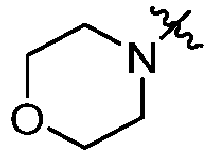

Cl Cl 3 


Cl Cl 4 


Cl Cl 5 


Cl Cl 6 


Cl Cl 7 

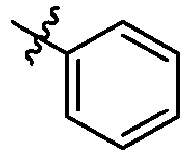
Cl Cl 8 


Cl Cl 9 


Cl Cl 10 


Cl Cl 11 


Cl Cl 12 


Cl Cl 13 


Cl Cl 14 


Cl Cl 15 


Cl Cl 16 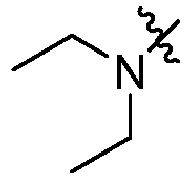


Cl Cl 17 


Cl Cl 18 


Cl Cl 19 


Cl Cl 20 


Cl Cl 21 


Cl Cl - Non-limiting examples of olefin metathesis catalysts represented by the structure of Formula (VIII) are found in Table (2):

Table (2) Non-limiting examples of olefin metathesis catalysts represented by Formula (VIII) Catalyst R1 R2 R3 X1 X2 R5 R6 22 


Cl Cl Mes Mes 23 


Cl Cl Mes Mes 24 


Cl Cl Mes Mes 25 

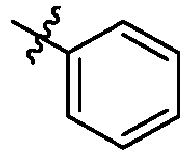
Cl Cl Mes Mes 26 


Cl Cl Mes Mes 27 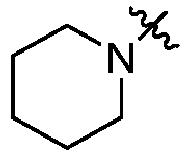


Cl Cl Mes Mes 28 


Cl Cl Mes Mes 29 


Cl Cl Mes Mes 30 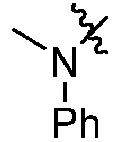


Cl Cl Mes Mes 31 


Cl Cl Mes Mes 32 


Cl Cl Mes Mes 33 


Cl Cl Mes Mes 34 


Cl Cl Mes Mes 35 


Cl Cl Mes Mes 36 
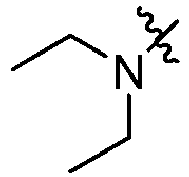

Cl Cl Mes Mes 37 


Cl Cl Mes Mes 38 


Cl Cl Mes Mes 39 


Cl Cl Mes Mes 40 


Cl Cl Mes Mes 41 


Cl Cl Mes Mes 42 


Cl Cl Mes Mes 43 


Cl Cl DIPP DIPP 44 


Cl Cl DIPP DIPP 45 


Cl Cl DIPP DIPP 46 


Cl Cl DIPP DIPP 47 


Cl Cl DIPP DIPP 48 


Cl Cl DIPP DIPP 49 


Cl Cl DIPP DIPP 50 


Cl Cl DIPP DIPP 51 


Cl Cl DIPP DIPP 52 


Cl Cl DIPP DIPP 53 


Cl Cl DIPP DIPP 54 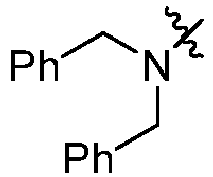


Cl Cl DIPP DIPP 55 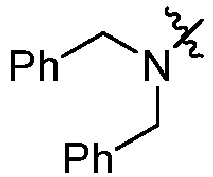
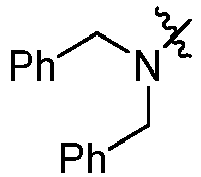

Cl Cl DIPP DIPP 56 


Cl Cl DIPP DIPP 57 


Cl Cl DIPP DIPP 58 


Cl Cl DIPP DIPP 59 


Cl Cl DIPP DIPP 60 


Cl Cl DIPP DIPP 61 


Cl Cl DIPP DIPP 62 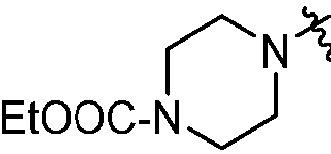


Cl Cl DIPP DIPP 63 


Cl Cl DIPP DIPP 64 


Cl Cl MIPP MIPP 65 


Cl Cl MIPP MIPP 66 


Cl Cl MIPP MIPP 67 


Cl Cl MIPP MIPP 68 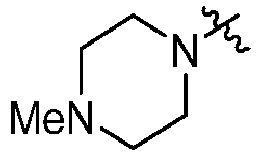


Cl Cl MIPP MIPP 69 


Cl Cl MIPP MIPP 70 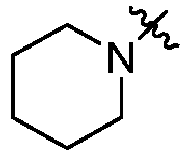


Cl Cl MIPP MIPP 71 


Cl Cl MIPP MIPP 72 

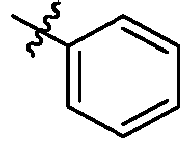
Cl Cl MIPP MIPP 73 


Cl Cl MIPP MIPP 74 


Cl Cl MIPP MIPP 75 


Cl Cl MIPP MIPP 76 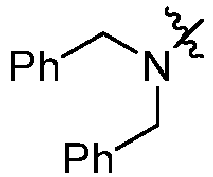


Cl Cl MIPP MIPP 77 


Cl Cl MIPP MIPP 78 

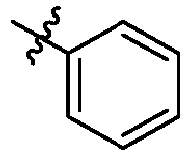
Cl Cl MIPP MIPP 79 


Cl Cl MIPP MIPP 80 

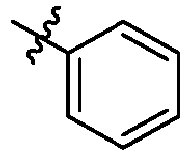
Cl Cl MIPP MIPP 81 


Cl Cl MIPP MIPP 82 


Cl Cl MIPP MIPP 83 


Cl Cl MIPP MIPP 84 
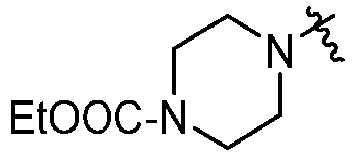

Cl Cl MIPP MIPP 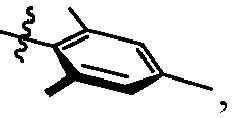


- Non-limiting examples of olefin metathesis catalysts represented by the structure of Formula (IVa) are found in Table (3):
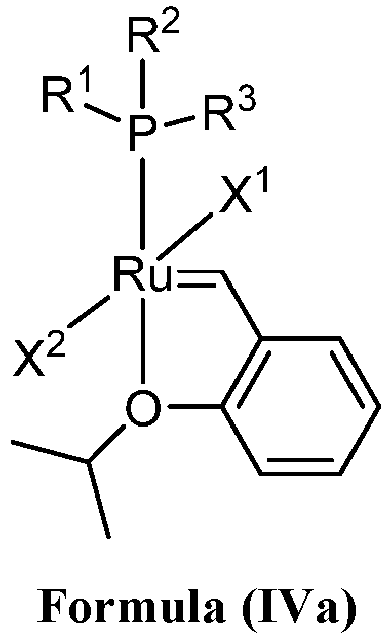
Table (3) Non-limiting examples of olefin metathesis catalysts represented by the structure of Formula (IVa) Catalyst R1 R2 R3 X1 X2 85 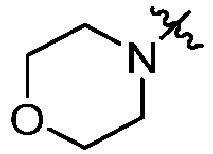


Cl Cl 86 


Cl Cl 87 


Cl Cl 88 


Cl Cl 89 


Cl Cl 90 


Cl Cl 91 


Cl Cl 92 


Cl Cl 93 


Cl Cl 94 

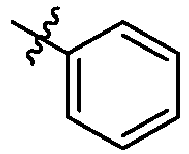
Cl Cl 95 


Cl Cl 96 


Cl Cl 97 


Cl Cl 98 


Cl Cl 99 


Cl Cl 100 


Cl Cl 101 


Cl Cl 102 


Cl Cl 103 


Cl Cl 104 


Cl Cl 105 


Cl Cl - Non-limiting examples of olefin metathesis catalysts represented by the structure of Formula (IX) are found in Table (4):

Table (4. Examples 111,118 are reference compounds. Non-limiting examples of olefin metathesis catalysts represented by the structure of Formula (IX) Catalyst R1 R2 R3 X1 X2 X3 106 


Cl Cl 
107 


Cl Cl 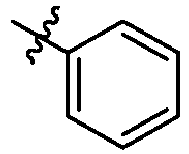
108 


Cl Cl 
109 


Cl Cl 
110 


Cl Cl 
111 


Cl Cl 
112 


Cl Cl 
113 


Cl Cl 
114 


Cl Cl 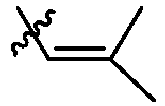
115 


Cl Cl 
116 


Cl Cl 
117 


Cl Cl 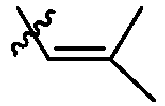
118 


Cl Cl 
119 


Cl Cl 
- Non-limiting examples of olefin metathesis catalysts represented by the structure of Formula (XI) are found in Table (5):

Table (5. Examples 125,135,145,155,164,174 are reference compounds. Non-limiting examples of olefin metathesis catalysts represented by the structure of Formula (XI) Catalyst R1 R2 R3 X1 X2 X3 R5 R6 120 


Cl Cl 
Mes Mes 121 
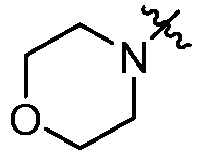

Cl Cl 
Mes Mes 122 


Cl Cl 
Mes Mes 123 


Cl Cl 
Mes Mes 124 


Cl Cl 
Mes Mes 125 

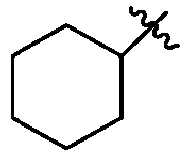
Cl Cl 
Mes Mes 126 


Cl Cl 
Mes Mes 127 


Cl Cl 
Mes Mes 128 


Cl Cl 
Mes Mes 129 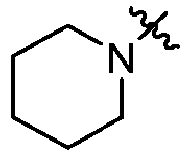


Cl Cl 
Mes Mes 130 


Cl Cl 
Mes Mes 131 


Cl Cl 
Mes Mes 132 


Cl Cl 
Mes Mes 133 


Cl Cl 
Mes Mes 134 


Cl Cl 
Mes Mes 135 


Cl Cl 
Mes Mes 136 


Cl Cl 
Mes Mes 137 


Cl Cl 
Mes Mes 138 


Cl Cl 
Mes Mes 139 


Cl Cl 
Mes Mes 140 


Cl Cl 
DIPP DIPP 141 


Cl Cl 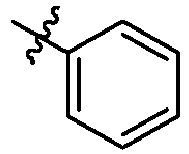
DIPP DIPP 142 


Cl Cl 
DIPP DIPP 143 


Cl Cl 
DIPP DIPP 144 


Cl Cl 
DIPP DIPP 145 


Cl Cl 
DIPP DIPP 146 


Cl Cl 
DIPP DIPP 147 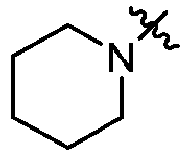

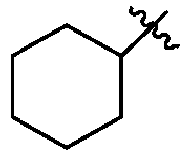
Cl Cl 
DIPP DIPP 148 


Cl Cl 
DIPP DIPP 149 


Cl Cl 
DIPP DIPP 150 


Cl Cl 
DIPP DIPP 151 


Cl Cl 
DIPP DIPP 152 


Cl Cl 
DIPP DIPP 153 


Cl Cl 
DIPP DIPP 154 


Cl Cl 
DIPP DIPP 155 


Cl Cl 
DIPP DIPP 156 


Cl Cl 
DIPP DIPP 157 


Cl Cl 
DIPP DIPP 158 
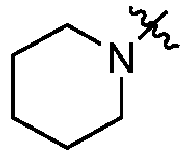

Cl Cl 
DIPP DIPP 158 


Cl Cl 
DIPP DIPP 159 


Cl Cl 
MIPP MIPP 160 


Cl Cl 
MIPP MIPP 161 


Cl Cl 
MIPP MIPP 162 


Cl Cl 
MIPP MIPP 163 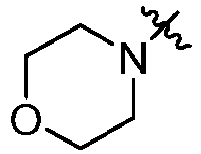


Cl Cl 
MIPP MIPP 164 


Cl Cl 
MIPP MIPP 165 


Cl Cl 
MIPP MIPP 166 


Cl Cl 
MIPP MIPP 167 


Cl Cl 
MIPP MIPP 168 


Cl Cl 
MIPP MIPP 169 


Cl Cl 
MIPP MIPP 170 


Cl Cl 
MIPP MIPP 171 


Cl Cl 
MIPP MIPP 172 


Cl Cl 
MIPP MIPP 173 


Cl Cl 
MIPP MIPP 174 


Cl Cl 
MIPP MIPP 175 
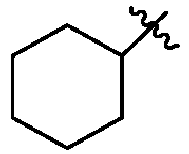
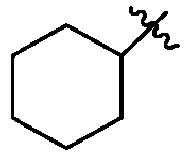
Cl Cl 
MIPP MIPP 176 


Cl Cl 
MIPP MIPP 177 


Cl Cl 
MIPP MIPP 178 


Cl Cl 
MIPP MIPP 


- The present invention concerns also processes for preparing the olefin metathesis catalysts described above. The olefin metathesis catalysts according to the invention can be prepared analogously to conventional methods as understood by the person skilled in the art of synthetic organic chemistry.
-
Synthetic Scheme 1 illustrates how the olefin metathesis catalysts of Formula (VI), Formula (VII), and Formula (VIII) can be synthesized.
-
Synthetic Scheme 2 illustrates how olefin metathesis catalysts of Formula (IVa) can be synthesized.
-
Synthetic Scheme 3 illustrates how the olefin metathesis catalysts of Formula (IX), Formula (X), and Formula (XI) can be synthesized.
- In
synthetic Schemes - Generally, the reactions take place under degassed N2 at room temperature or at high temperature in an inert solvent (toluene, THF, MeTHF, dioxane and the like). Once the reaction is completed, the mixture is cooled to room temperature, the solvent is removed under high vacuum, and the residue is purified on a silica gel column and then recrystallized to afford the new olefin metathesis catalysts.
- In another embodiment, the invention concerns methods of using the olefin metathesis catalysts of the invention, in the synthesis of related olefin metathesis catalysts. The ruthenium olefin metathesis catalysts of the invention are excellent precursors for various Second Generation Grubbs ruthenium olefin metathesis catalysts. The Second Generation Grubbs ruthenium olefin metathesis catalysts synthesized during these procedures are obtained in higher yield and with higher purity, which presents an advantage compared to the existing synthetic procedures.
- The invention concerns also processes for synthesizing olefin metathesis catalysts of Formula (A) starting with an olefin metathesis catalyst of Formula (VIII).
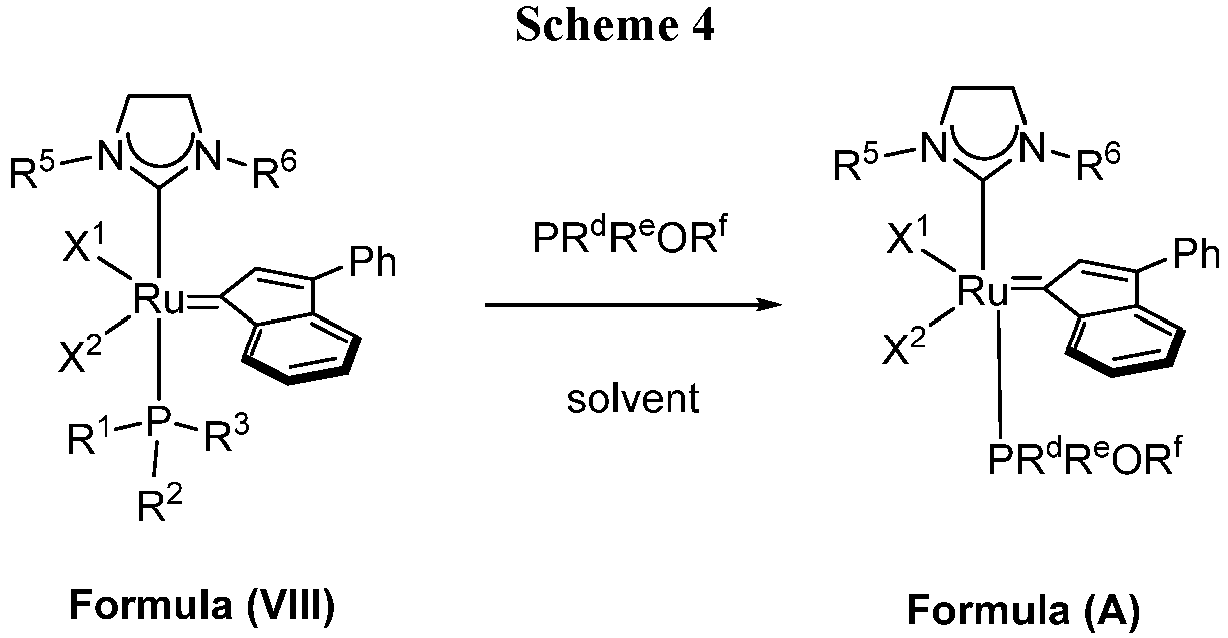
- In a typical procedure, as shown in
Scheme 4, the PR1R2R3 ligand of the olefin metathesis catalyst represented by Formula (VIII) can be exchanged with a PRdReORf ligand at room temperature in an inert solvent, such as dichloromethane or toluene, wherein: - R1 is unsubstituted saturated N-heterocycle, substituted saturated N-heterocycle, -NH(C1-C24 alkyl), -N(C1-C24 alkyl)2, -NH(C5-C24 aryl), -N(C5-C24 aryl)2, -N(C1-C24 alkyl)(C5-C24 aryl) or -N[(C1-C6 alkylene)(C5-C24 aryl)]2; generally R1 is unsubstituted saturated N-heterocycle, substituted saturated N-heterocycle, -N(C1-C6 alkyl)2, -N(C1-C6 alkyl)(C6 aryl) or -N[(C1-C3 alkylene)(C6 aryl)]2;
- R2 is unsubstituted (C5-C24 aryl), substituted (C5-C24 aryl), unsubstituted saturated N-heterocycle, substituted saturated N-heterocycle, -NH(C1-C24 alkyl), -N(C1-C24 alkyl)2, -NH(C5-C24 aryl), -N(C5-C24 aryl)2, -N(C1-C24 alkyl)(C5-C24 aryl) or -N[(C1-C6 alkylene)(C5-C24 aryl)]2; generally R2 is unsubstituted (C6 aryl), unsubstituted saturated N-heterocycle, substituted saturated N-heterocycle, -N(C1-C6 alkyl)2, -N(C1-C6 alkyl)(C6 aryl) or -N[(C1-C3 alkylene)(C6 aryl)]2;
- R3 is unsubstituted (C5-C24 aryl), substituted (C5-C24 aryl), unsubstituted saturated N-heterocycle or substituted saturated N-heterocycle; generally R3 is unsubstituted (C6 aryl) or unsubstituted saturated N-heterocycle;
- R5 and R6 are independently hydrogen, unsubstituted C5-C24 aryl, or substituted C5-C24 aryl; generally R5 and R6 are independently substituted C5-C24 aryl with one to three unsubstituted (C1-C6 alkyl) groups or substituted (C1-C6 alkyl) groups; typically, R5 and R6 are independently 2,4,6-trimethylphenyl, 2,6-di-iso-propylphenyl, 2-iso-propyl-6-methylphenyl, 2-iso-propylphenyl or 2-methyl-phenyl;
- X1 and X2 are independently halogen, trifluoroacetate, per-fluorophenols or nitrate; generally X1 and X2 are independently Cl, Br, I or F; typically X1 and X2 are independently Cl;
- Rd is unsubstituted C1-C10 alkyl, substituted C1-C10 alkyl, substituted C6-C10 aryl, unsubstituted C6-C10 aryl, substituted C3-C8 cycloalkyl or unsubstituted C3-C8 cycloalkyl; generally Rd is unsubstituted C1-C10 alkyl or unsubstituted C6-C10 aryl; typically Rd is phenyl;
- Re is unsubstituted C1-C10 alkyl, substituted C1-C10 alkyl, substituted C6-C10 aryl, unsubstituted C6-C10 aryl, substituted C3-C8 cycloalkyl or unsubstituted C3-C8 cycloalkyl; generally Re is unsubstituted C1-C10 alkyl or unsubstituted C6-C10 aryl; typically Re is phenyl; and
- Rf is unsubstituted C1-C10 alkyl, substituted C1-C10 alkyl, substituted C6-C10 aryl, unsubstituted C6-C10 aryl, substituted C3-C8 cycloalkyl or unsubstituted C3-C8 cycloalkyl; generally Rf is unsubstituted C1-C10 alkyl, unsubstituted C6-C10 aryl or unsubstituted C6-C10 aryl; typically, Rf is phenyl, methyl, p-(OMe)phenyl, iso-propyl or ethyl.
- The invention concerns also processes for synthesizing olefin metathesis catalysts of Formula (B) starting with an olefin metathesis catalyst of Formula (VIII).

- In a typical procedure, as shown in Scheme 5, the PR1R2R3 ligand of the olefin metathesis catalyst represented by Formula (VIII) can be exchanged with a PRgORhORi ligand or a PRgRhORi ligand at room temperature in an inert solvent, such as dichloromethane or toluene, wherein:
- R1 is unsubstituted saturated N-heterocycle, substituted saturated N-heterocycle, -NH(C1-C24 alkyl), -N(C1-C24 alkyl)2, -NH(C5-C24 aryl), -N(C5-C24 aryl)2, -N(C1-C24 alkyl)(C5-C24 aryl) or -N[(C1-C6 alkylene)(C5-C24 aryl)]2; generally R1 is unsubstituted saturated N-heterocycle, substituted saturated N-heterocycle, -N(C1-C6 alkyl)2, -N(C1-C6 alkyl)(C6 aryl) or -N[(C1-C3 alkylene)(C6 aryl)]2;
- R2 is unsubstituted (C5-C24 aryl), substituted (C5-C24 aryl), unsubstituted saturated N-heterocycle, substituted saturated N-heterocycle, -NH(C1-C24 alkyl), -N(C1-C24 alkyl)2, -NH(C5-C24 aryl), -N(C5-C24 aryl)2, -N(C1-C24 alkyl)(C5-C24 aryl) or -N[(C1-C6 alkylene)(C5-C24 aryl)]2; generally R 2 is unsubstituted (C6 aryl), unsubstituted saturated N-heterocycle, substituted saturated N-heterocycle, -N(C1-C6 alkyl)2, -N(C1-C6 alkyl)(C6 aryl) or -N[(C1-C3 alkylene)(C6 aryl)]2;
- R3 is unsubstituted (C5-C24 aryl), substituted (C5-C24 aryl), unsubstituted saturated N-heterocycle or substituted saturated N-heterocycle; generally R3 is unsubstituted (C6 aryl) or unsubstituted saturated N-heterocycle;
- R5 and R6 are independently hydrogen, unsubstituted C5-C24 aryl, or substituted C5-C24 aryl; generally R5 and R6 are independently substituted C5-C24 aryl with one to three unsubstituted (C1-C6 alkyl) groups or substituted (C1-C6 alkyl) groups; typically, R5 and R6 are independently 2,4,6-trimethylphenyl, 2,6-di-iso-propylphenyl, 2-iso-propyl-6-methylphenyl, 2-iso-propylphenyl or 2-methyl-phenyl;
- X1 and X2 are independently halogen, trifluoroacetate, per-fluorophenols or nitrate; generally X1 and X2 are independently Cl, Br, I or F; typically X1 and X2 are independently Cl;
- Rg is unsubstituted C1-C10 alkyl, substituted C1-C10 alkyl, substituted C6-C10 aryl, unsubstituted C6-C10 aryl, substituted C3-C8 cycloalkyl or unsubstituted C3-C8 cycloalkyl; generally Rg is unsubstituted C1-C10 alkyl or unsubstituted C6-C10 aryl; typically Rg is phenyl;
- Rh is unsubstituted C1-C10 alkyl, substituted C1-C10 alkyl, substituted C6-C10 aryl, unsubstituted C6-C10 aryl, substituted C3-C8 cycloalkyl or unsubstituted C3-C8 cycloalkyl; generally Rh is unsubstituted C1-C10 alkyl or unsubstituted C6-C10 aryl; typically Rh is phenyl or methyl; and
- Ri is unsubstituted C1-C10 alkyl, substituted C1-C10 alkyl, substituted C6-C10 aryl, unsubstituted C6-C10 aryl, substituted C3-C8 cycloalkyl or unsubstituted C3-C8 cycloalkyl; generally Ri is unsubstituted C1-C10 alkyl or unsubstituted C6-C10 aryl; typically Ri is phenyl or methyl.
- In another embodiment, the invention concerns also processes for synthesizing olefin metathesis catalysts of Formula (C) starting with an olefin metathesis catalyst of Formula (IVa).

- In a typical procedure, as shown in Scheme 6, the PR1R2R3 ligand of the olefin metathesis catalyst represented by Formula (IVa) can be exchanged with a NHC ligand,

- R1 is unsubstituted saturated N-heterocycle, substituted saturated N-heterocycle, -NH(C1-C24 alkyl), -N(C1-C24 alkyl)2, -NH(C5-C24 aryl), -N(C5-C24 aryl)2, -N(C1-C24 alkyl)(C5-C24 aryl) or -N[(C1-C6 alkylene)(C5-C24 aryl)]2; generally R1 is unsubstituted saturated N-heterocycle, substituted saturated N-heterocycle, -N(C1-C6 alkyl)2, -N(C1-C6 alkyl)(C6 aryl) or -N[(C1-C3 alkylene)(C6 aryl)]2;
- R2 is unsubstituted (C5-C24 aryl), substituted (C5-C24 aryl), unsubstituted saturated N-heterocycle, substituted saturated N-heterocycle, -NH(C1-C24 alkyl), -N(C1-C24 alkyl)2, -NH(C5-C24 aryl), -N(C5-C24 aryl)2, -N(C1-C24 alkyl)(C5-C24 aryl) or -N[(C1-C6 alkylene)(C5-C24 aryl)]2; generally R2 is unsubstituted (C6 aryl), unsubstituted saturated N-heterocycle, substituted saturated N-heterocycle, -N(C1-C6 alkyl)2, -N(C1-C6 alkyl)(C6 aryl) or -N[(C1-C3 alkylene)(C6 aryl)]2;
- R3 is unsubstituted (C5-C24 aryl), substituted (C5-C24 aryl), unsubstituted saturated N-heterocycle or substituted saturated N-heterocycle; generally R3 is unsubstituted (C6 aryl) or unsubstituted saturated N-heterocycle;
- R5 and R6 are independently hydrogen, unsubstituted C5-C24 aryl, or substituted C5-C24 aryl; generally R5 and R6 are independently substituted C5-C24 aryl with one to three unsubstituted (C1-C6 alkyl) groups or substituted (C1-C6 alkyl) groups; typically, R5 and R6 are independently 2,4,6-trimethylphenyl, 2,6-di-iso-propylphenyl, 2-iso-propyl-6-methylphenyl, 2-iso-propylphenyl or 2-methyl-phenyl; and
- X1 and X2 are independently halogen, trifluoroacetate, per-fluorophenols or nitrate; generally X1 and X2 are independently Cl, Br, I or F; typically X1 and X2 are independently Cl.
- In another embodiment, the invention concerns also processes for synthesizing olefin metathesis catalysts of Formula (C) starting with an olefin metathesis catalyst of Formula (VIII).

- In a typical procedure, as shown in
Scheme 7, the -PR1R2R3 ligand of the olefin metathesis catalyst represented by Formula (VIII) can be exchanged with a Grubbs-Hoveyda ligand, wherein: - R1 is unsubstituted saturated N-heterocycle, substituted saturated N-heterocycle, -NH(C1-C24 alkyl), -N(C1-C24 alkyl)2, -NH(C5-C24 aryl), -N(C5-C24 aryl)2, -N(C1-C24 alkyl)(C5-C24 aryl) or -N[(C1-C6 alkylene)(C5-C24 aryl)]2; generally R1 is unsubstituted saturated N-heterocycle, substituted saturated N-heterocycle, -N(C1-C6 alkyl)2, -N(C1-C6 alkyl)(C6 aryl) or -N[(C1-C3 alkylene)(C6 aryl)]2;
- R2 is unsubstituted (C5-C24 aryl), substituted (C5-C24 aryl), unsubstituted saturated N-heterocycle, substituted saturated N-heterocycle, -NH(C1-C24 alkyl), -N(C1-C24 alkyl)2, -NH(Cs-C24 aryl), -N(C5-C24 aryl)2, -N(C1-C24 alkyl)(C5-C24 aryl) or -N[(C1-C6 alkylene)(C5-C24 aryl)]2; generally R2 is unsubstituted (C6 aryl), unsubstituted saturated N-heterocycle, substituted saturated N-heterocycle, -N(C1-C6 alkyl)2, -N(C1-C6 alkyl)(C6 aryl) or -N[(C1-C3 alkylene)(C6 aryl)]2;
- R3 is unsubstituted (C5-C24 aryl), substituted (C5-C24 aryl), unsubstituted saturated N-heterocycle or substituted saturated N-heterocycle; generally R3 is unsubstituted (C6 aryl) or unsubstituted saturated N-heterocycle;
- R5 and R6 are independently hydrogen, unsubstituted C5-C24 aryl, or substituted C5-C24 aryl; generally R5 and R6 are independently substituted C5-C24 aryl with one to three unsubstituted (C1-C6 alkyl) groups or substituted (C1-C6 alkyl) groups; typically, R5 and R6 are independently 2,4,6-trimethylphenyl, 2,6-di-iso-propylphenyl, 2-iso-propyl-6-methylphenyl, 2-iso-propylphenyl or 2-methyl-phenyl;
- X1 and X2 are independently halogen, trifluoroacetate, per-fluorophenols or nitrate; generally X1 and X2 are independently Cl, Br, I or F; typically X1 and X2 are independently Cl.
- Rk is hydrogen, halogen, -NO2, -CN, -CF3, -SO2NRs 2, -NHC(O)CF3, -NHC(O)C6F5, - NHC(O)OtBu, unsubstituted hydrocarbyl, substituted hydrocarbyl, unsubstituted heteroatom-containing hydrocarbyl, or substituted heteroatom-containing hydrocarbyl; typically, Rk is hydrogen;
- R1 is hydrogen, halogen, -NO2, -CN, -CF3, -SO2NRs 2, -NHC(O)CF3, -NHC(O)C6F5, - NHC(O)OtBu, unsubstituted hydrocarbyl, substituted hydrocarbyl, unsubstituted heteroatom-containing hydrocarbyl, or substituted heteroatom-containing hydrocarbyl; typically, R1 is hydrogen;
- Rm is hydrogen, halogen, -NO2, -CN, -CF3, -SO2NRs 2, -NHC(O)CF3, -NHC(O)C6F5, - NHC(O)OtBu, unsubstituted hydrocarbyl, substituted hydrocarbyl, unsubstituted heteroatom-containing hydrocarbyl, or substituted heteroatom-containing hydrocarbyl; typically, Rm is hydrogen, -NO2, -CN, -CF3, -SO2NRs 2, -NHC(O)CF3, -NHC(O)C6F5, or -NHC(O)OtBu; specifically Rm is hydrogen;
- Rn is hydrogen, halogen, -NO2, -CN, -CF3, -SO2NRs 2, -NHC(O)CF3, -NHC(O)C6F5, - NHC(O)OtBu, unsubstituted hydrocarbyl, substituted hydrocarbyl, unsubstituted heteroatom-containing hydrocarbyl, or substituted heteroatom-containing hydrocarbyl; typically, Rn is hydrogen; and
- Rs is hydrogen or C1-C6 alkyl; typically Rs is hydrogen, methyl, ethyl or n-propyl; and
- Rq is unsubstituted hydrocarbyl, substituted hydrocarbyl; generally, Rq is C1-C10 alkyl; typically, Rq is iso-propyl.
- At this stage, those skilled in the art will appreciate that many additional compounds that fall under the scope of the invention can be prepared by performing various common chemical reactions. Details of certain specific chemical transformations are provided in the examples.
- For example, the olefin metathesis catalysts are typically added to a resin composition as a solid, a solution, or as a suspension. When the olefin metathesis catalysts are added to a resin composition as a suspension, the olefin metathesis catalysts are suspended in a dispersing carrier such as mineral oil, paraffin oil, soybean oil, tri-iso-propylbenzene, or any hydrophobic liquid which has a sufficiently high viscosity so as to permit effective dispersion of the catalyst(s), and which is sufficiently inert and which has a sufficiently high boiling point so that is does not act as a low-boiling impurity in the olefin metathesis reaction.
- Resin compositions that may be used with the present invention disclosed herein comprise one or more cyclic olefins. Such cyclic olefins may be optionally substituted, optionally heteroatom-containing, mono-unsaturated, di-unsaturated, or poly-unsaturated C5 to C24 hydrocarbons that may be mono-, di-, or poly-cyclic. The cyclic olefin may generally be any strained or unstrained cyclic olefin, provided the cyclic olefin is able to participate in a ROMP reaction either individually or as part of a ROMP cyclic olefin composition.
- Examples of bicyclic and polycyclic olefins thus include, without limitation, dicyclopentadiene (DCPD); trimer and other higher order oligomers of cyclopentadiene including without limitation tricyclopentadiene (cyclopentadiene trimer), cyclopentadiene tetramer, and cyclopentadiene pentamer; ethylidenenorbornene; dicyclohexadiene; norbornene; C2-C12 hydrocarbyl substituted norbornenes; 5-butyl-2-norbornene; 5-hexyl-2-norbornene; 5-octyl-2-norbornene; 5-decyl-2-norbornene; 5-dodecyl-2-norbornene; 5-vinyl-2-norbornene; 5-ethylidene-2-norbornene; 5-isopropenyl-2-norbornene; 5-propenyl-2-norbornene; 5-butenyl-2-norbornene; 5-tolyl-norbornene; 5-methyl-2-norbornene; 5-ethyl-2-norbornene; 5-isobutyl-2-norbornene; 5,6-dimethyl-2-norbornene; 5-phenylnorbornene; 5-benzylnorbornene; 5-acetylnorbornene; 5-methoxycarbonylnorbornene; 5-ethyoxycarbonyl-1-norbornene; 5-methyl-5-methoxycarbonylnorbornene; bicyclo[2.2.1]hept-2-ene-2-carboxylic acid, 2-ethylhexyl ester; 5-cyanonorbornene; 5,5,6-trimethyl-2-norbornene; cyclo-hexenylnorbornene; endo, exo-5,6-dimethoxynorbornene; endo, endo-5,6-dimethoxynorbornene; endo, exo-5,6-dimethoxy carbonylnorbornene; endo,endo-5,6-dimethoxycarbonylnorbornene; 2,3-dimethoxynorbornene; norbornadiene; tricycloundecene; tetracyclododecene; 8-methyl tetracyclododecene; 8-ethyltetracyclododecene; 8-methoxy carbonyltetracyclo dodecene; 8-methyl-8-tetra cyclododecene; 8-cyanotetracyclo dodecene; pentacyclopentadecene; pentacyclo hexadecene; bicyclo[2.2.1]hept-2-ene-5-phenoxymethyl; 2-ethylhexyl ester-bicyclo[2.2.1]hept-5-ene-2-carboxylic acid; 2-hydroxyethyl ester-bicyclo[2.2.1]hept-5-ene-2-carboxylic acid; bicyclo[2.2.1] hept-5-ene-2-methanol; bicyclo[2.2.1]hept-5-ene-2-heptanoic acid-methyl ester; bicyclo[2.2.1] hept-5-ene-2-hexanoic acid-methyl ester; 1,4:5,8-dimethanonaphthalene, 2-hexyl-1,2,3,4,4a,5,8, 8a-octahydro; bicyclo[2.2.1]hept-5-ene-2-octanoic acid-methyl ester; 1,4:5,8-dimethano naphthalene; 2-butyl-1,2,3,4,4a,5,8,8a-octahydro; ethylidenetetracyclododecene; 2-vinyl-1,2,3,4,4a,5,8,8a-octahydro-1,4:5,8-dimethano naphthalene; and the like, and their structural isomers, stereoisomers, and mixtures thereof.
- In the following examples, efforts have been made to ensure accuracy with respect to numbers used (e.g., amounts, temperature, etc.) but some experimental error and deviation should be accounted for. The examples are to be considered as not being limiting of the invention described herein.
- All reactions involving metal complexes were conducted in oven-dried glassware under an argon or nitrogen atmosphere using standard Schlenk techniques. Chemicals and solvents were obtained from Sigma-Aldrich, Strem, Alfa Aesar, Nexeo, Brenntag, AG Layne and TCI. Commercially available reagents were used as received unless otherwise noted. Silica gel was purchased from Fisher (0.040-0.063 µm, EMD Millipore). Solvents were dried by passing through an activated alumina column (n-pentane, benzene, toluene, Et2O, and THF).
- SIMes·HBr, SIMes·HCl, SIPrHCl , P426, P510, 1,3-Bis(2,4,6-trimethylphenyl)-4,5-dihydroimidazol-2-ylidene and Catalysts C959, C931, C848, C831, C949, C601, C727, C787, and C765 were prepared using known methods.
- The crystallographic measurements were performed at 100(2) K using a Bruker APEX-II CCD area detector diffractometer (Mo-K α radiation, λ = 0.71073 Å). In each case, a specimen of suitable size and quality was selected and mounted onto a nylon loop. The structures were solved by direct methods, which successfully located most of the nonhydrogen atoms. Semi-empirical absorption corrections were applied. Subsequent refinement on F 2 using the SHELXTL/PC package (version 6.1) allowed location of the remaining non-hydrogen atoms. Depending on the experimental conditions, some of the olefin metathesis catalysts of the invention were obtained as solvates.
- Ultrene® 99 dicyclopentadiene (DCPD) was obtained from Cymetech Corporation. A modified DCPD base resin containing 20-25% tricyclopentadiene (and small amounts of higher cyclopentadiene homologs) (DCPD-HT) was prepared by heat treatment of Ultrene® 99 DCPD generally as described in
U.S. Pat. No. 4,899,005 . - 1H and 13C NMR spectra were recorded on a Varian 400 MHz spectrometer. Chemical shifts are reported in ppm downfield from Me4Si by using the residual solvent peak as an internal standard (CDCl3 - δ 7.24 ppm; CD2Cl2 - δ 5.32 ppm). 31P NMR used an external standard of 85% H3PO4, referenced to 0 ppm. Spectra were analyzed and processed using MestReNova software. Deuterated solvents were purchased from Cambridge Isotopes Laboratories, Inc. and were degassed and stored over activated 3 Å molecular sieves prior to use.
- The following abbreviations are used in the examples:
mL milliliter L liter °C degrees Celsius CD2Cl2 deuterated dichloromethane CDCl3 deuterated chloroform C6D6 deuterated benzene SIMes·HBr N,N'-bis-(2,4,6-trimethylphenylamino)ethane dihydrobromide SIMes·HCl N,N'-bis-(2,4,6-trimethylphenylamino)ethane dihydrochloride SIPr· HCl 1,3 -bis(2, 6-di-iso-propylphenyl)-4,5-dihydroimidazolium chloride Ar argon HCl hydrochloric acid KHMDS potassium bis(trimethylsilyl)amide r.t. room temperature C765 
Dichloro(3-methyl-2-butenylidene)bis(triphenylphosphine) ruthenium [CAS 191609-95-7] C727 
[1,3-bis(2,4,6-trimethylphenyl)-2-imidazolidinylidene] dichloro(phenylmethylene)bis(pyridine)-Ruthenium [CAS 357186-58-4] 1,3-Bis(2,4,6-trimethylphenyl)-4,5-dihydroimidazol-2-ylidene 
C959 (PPh3)3Ru(Cl)2 tris(triphenylphosphine)ruthenium(II) dichloride [CAS 15529-49-4] (2-Me)THF 2-methyltetrahydrofuran THF tetrahydrofuran C787 
Benzylidenedichlorobis(triphenylphosphine)ruthenium [CAS 172222-26-3] C848 
Dichloro[1,3-bis-(2,4,6-trimethylphenyl)-2-imidazolidinylidene](benzylidene)(tricyclohexylphosphine) ruthenium (II) [CAS 246047-72-3] C831 
Dichloro[1,3-bis-(2,4,6-trimethylphenyl)-2-imidazolidinylidene](benzylidene)(triphenylphosphine) ruthenium (II) [CAS 357261-84-8] PTSA p-Toluenesulfonic acid C931 
[1,3-bis-(2,4,6-trimethylphenyl)-2-imidazolidinylidene]dichloro (phenylindenylidene)(triphenylphosphine)ruthenium(II) [CAS 340810-50-6] C949 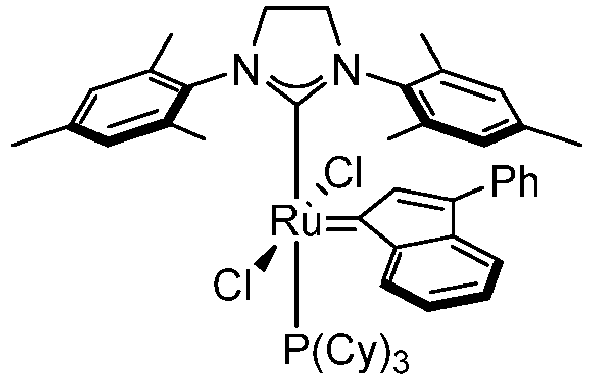
[1,3-bis-(2,4,6-trimethylphenyl)-2-imidazolidinylidene]dichloro (phenylindenylidene) (tricyclohexylphosphine) ruthenium(II) [CAS 536724-67-1] C601 
Dichloro(2-isopropoxyphenylmethylene) (tricyclohexylphosphine)ruthenium (II) [CAS 203714-71-0] P426 
1,3-Bis(2,4,6-trimethylphenyl)-2-(trichloromethyl)imidazolidine [CAS 260054-47-5] P510 
1,3-bis[2,6-bis(1-methylethyl)phenyl]-2-(trichloromethyl) imidazolidine [CAS 465543-05-9] -

- In a 3 L, 3-neck round bottom flask were added C959 (100.0 g, 104.2 mmol), 1,1-diphenyl-2-propyn-1-ol (24.9 g, 119.8 mmol), and triphenylphosphine (27.3 g, 104.2 mmol) under air. The flask was equipped with a thermocouple and rubber suba-seal septum and then it was placed under Ar using Schlenk technique. The reagents and products of this reaction are highly air sensitive in solution. A 1 L addition funnel was attached to the flask under a flow of Ar. To the addition funnel were added (2-Me)THF (1 L) and 4 M HCl (25.6 mL, 104.2 mmol) in dioxane using Schlenk technique. The solution was added over 10 minutes at room temperature with stirring. Another 0.75 L (2-Me)THF were added directly to the flask. The addition funnel was replaced with a glass stopper under a flow of Ar and the flask was lowered into a pre-heated oil bath at 65 °C. The reaction was monitored by 31P NMR. When conversion was deemed to be complete, the reaction flask was removed from the oil bath and hot filtered via cannula transfer through a celite pad (in an evacuated Schlenk filter) into a Schlenk flask. Approximately 85% (2-Me)THF was removed at room temperature (water bath) under vacuum. The resulting slurry was cooled to 0 °C then filtered on a coarse glass frit under air. The solid was washed quickly with 3x50 mL portions of 0 °C (2-Me)THF followed by hexanes (200 mL) (r.t.) and 2-propanol (100 mL). The solid from the frit was re-slurred with hexanes (200 mL) and filtered again. The solid was air-dried until no condensation was seen on the outside of the glass frit, then transferred to a 200 mL round bottom flask and dried under high vacuum overnight. The final 1H NMR and 31P NMR in CDCl3 indicate that the complex is a 1:1 adduct of (PPh3)2Ru(PhInd)Cl2, and (2-Me)THF, C973, for a final molecular weight of 973 g/mol. Yield = 74.1 g (73%).
- 1H NMR (400 MHz in CDCl3 at r.t.): δ = 7.2-7.6 (overlapping CDCl3 and aromatics), 7.07 (d, Ind, 1H), 6.62 (t, Ind, 1H), 6.43 (s, Ind, 1H), 3.92 (m, (2-Me)THF, 2H), 3.70 (m, (2-Me)THF, 1H), 1.88-1.98 (overlapping m, (2-Me)THF, 3H), 1.41 (m, (2-Me)THF, 1H), 1.23 (d, (2-Me)THF, 3H).
-

- To a 40 mL scintillation vial equipped with a magnetic stir bar were added C973 (0.750 mg, 0.771 mmol), Ph2P[N(C2H4)2O] ([CAS 13743-27-6] 0.837 g, 3.08 mmol), and diethyl ether (20 mL). The suspension was allowed to stir for 14 hours at ambient temperature. The resulting precipitate was isolated by filtration, washed with diethyl ether (5 mL) followed by diethyl ether/hexanes (1:1, 10 mL), then dried in vacuum to afford C905 as a red/brown powder (0.507 g, 72.7% yield).
- 1H NMR (400 MHz, CD2Cl2) δ 7.71 (m, 6H), 7.61-7.50 (m, 4H), 7.48-7.40 (m, 5H), 7.40-7.31 (m, 11H), 7.24 (d, J = 7.4 Hz, 2H), 6.79 (t, J = 7.4 Hz, 1H), 6.38 (s, 1H), 3.42 (br s, 8H), 2.81 (br s, 8H). 31P NMR (162 MHz, CD2Cl2) δ 79.3 (s).
-

- To a 40 mL scintillation vial equipped with a magnetic stir bar were added C905 (0.200 mg, 0.221 mmol), 1,3-bis(2,4,6-trimethylphenyl)-4,5-dihydroimidazol-2-ylidene (0.071 g, 0.23 mmol), and toluene (10 mL). The resulting solution was stirred for 2 hours, devolatilized, and the resulting residue recrystallized from toluene/pentane at -35 °C. The resulting brown crystals were separated by filtration and dried in vacuum affording C940 (0.146 g, 70.1% yield).
Figure 1 shows the ORTEP diagram of C940. - 1H NMR (400 MHz, CD2Cl2) δ 7.78 (d, J= 7.6 Hz, 1H), 7.56-7.33 (m, 7H), 7.27 (t, J= 7.3 Hz, 1H), 7.24-7.11 (m, 6H), 7.08-7.01 (m,2H), 6.98 (d, J= 6.5 Hz, 3H), 6.93 (t, J= 7.6 Hz, 1H), 6.54 (s, 1H), 6.39 (s, 1H), 6.00 (s, 1H), 4.07-3.97 (m, 2H), 3.90-3.71 (m, 2H), 3.37-3.22 (m, 4H), 2.65 (s, 6H), 2.62-2.48 (m, 4H), 2.38 (s, 3H), 2.12 (s, 3H), 1.97 (s, 3H), 1.81 (s, 3H). 31P NMR (162 MHz, CD2Cl2) δ 76.3 (s).
-

- To a 20 mL scintillation vial equipped with a magnetic stir bar were added C973 (0.500 mg, 0.514 mmol), 4,4'-(phenylphosphinidene)bismorpholine ([CAS 13337-35-4] 0.576 g, 2.06 mmol), and diethyl ether (10 mL). The suspension was allowed to stir for 14 hours at ambient temperature. The resulting precipitate was isolated by filtration, washed with diethyl ether (5 mL) followed by diethyl ether/hexanes (1:1, 10 mL) and hexanes (10 mL), then dried in vacuum to afford C923 as a red/brown powder (0.313 g, 66.0% yield).
- 1H NMR (400 MHz, CD2Cl2) δ 7.95-7.15 (m, 18H), 7.15-6.30 (m, 2H), 3.49 (br s, 16H), 3.02 (br s, 16H). 31P NMR (162 MHz, CD2Cl2) δ 97.3 (br s).
-

- To a 20 mL scintillation vial equipped with a magnetic stir bar were added SIMes.HBr (0.110 mg, 0.285 mmol), KHMDS (0.057 g, 0.285 mmol), and toluene (2 mL). The resulting reaction was allowed to stir for 30 minutes at ambient temperature, then it was filtered through a pad of celite, and combined with C923 and hexanes (8 mL) in a 20 mL scintillation vial equipped with a magnetic stir bar. The resulting suspension was subsequently stirred for 6 hours at ambient temperature. The resulting precipitate was isolated by filtration, washed with toluene/hexanes (3:7, 2 x 10 mL) followed by hexanes (10 mL) then dried in vacuum, to afford C949 as a red/brown powder (0.239 g, 93.0% yield).
- 1H NMR (400 MHz, CD2Cl2) δ 7.91 (d, J = 7.3 Hz, 1H), 7.66 (d, J = 7.6 Hz, 2H), 7.56 (t, J= 6.9 Hz, 1H), 7.42 (t, J= 7.6 Hz, 2H), 7.25 (t, J= 7.3 Hz, 1H), 7.21-7.07 (m, 3H), 7.09-6.93 (m, 6H), 6.54 (s, 1H), 6.38 (s, 1H), 5.96 (s, 1H), 4.10-3.97 (m, 2H), 3.90-3.70 (m, 2H), 3.29 (br s, 4H), 3.26-3.03 (m, 4H), 2.96-2.80 (m, 4H), 2.78-2.69 (m, 4H), 2.67 (s, 3H), 2.66 (s, 3H), 2.38 (s, 3H), 2.13 (s, 3H), 1.97 (s, 3H), 1.76 (s, 3H). 31P NMR (162 MHz, CD2Cl2) δ 97.4 (s).
-

- To a 40 mL scintillation vial equipped with a magnetic stir bar were added C973 (1.00 g, 1.03 mmol), 4,4",4"'-phosphinidyltrismorpholine ([CAS 5815-61-2] 1.19 g, 4.11 mmol), and diethyl ether (30 mL). The suspension was allowed to stir for 14 hours at ambient temperature. The resulting precipitate was isolated by filtration, washed with diethyl ether (4 x 15 mL) followed by hexanes (2 x 10 mL), then dried in vacuum to afford C941 as a red powder (0.740 g, 76.5% yield).
- 1H NMR (400 MHz, CD2Cl2) δ 8.61-8.44 (m, 1H), 7.87-7.72 (m, 2H), 7.60 (t, J = 7.0 Hz, 1H), 7.45 (t, J= 7.4 Hz, 3H), 7.40-7.20 (m, 3H), 3.52 (s, 24H), 3.15 (s, 24H). 31P NMR (162 MHz, CD2Cl2) δ 100.1 (br s).
-

- To a 20 mL scintillation vial equipped with a magnetic stir bar was added C941 (0.500 g, 0.531 mmol), 1,3-bis(2,4,6-trimethylphenyl)-4,5-dihydroimidazol-2-ylidene (0.171 g, 0.558 mmol), and diethyl ether (10 mL). The resulting suspension was allowed to stir for 8 hours at ambient temperature. The resulting precipitate was isolated by filtration, washed with diethyl ether (2 x 10 mL) followed by hexanes (10 mL) then dried in vacuum to afford C958 as a red/brown powder (0.434 g, 85.3% yield).
Figure 2 shows the ORTEP diagram of C958. - 1H NMR (400 MHz, CD2Cl2) δ 8.41 (d, J = 7.4 Hz, 1H), 7.70 (d, J = 7.8 Hz, 2H), 7.54 (t, J = 7.4 Hz, 1H), 7.43 (t, J = 7.5 Hz, 2H), 7.30-7.20 (m, 2H), 7.14 (t, J = 7.5 Hz, 2H), 7.09-6.98 (m, 3H), 6.42 (s, 1H), 5.99 (s, 1H), 4.07-3.97 (m, 2H), 3.91-3.72 (m, 2H), 3.23 (s, 12H), 2.79 (s, 12H), 2.71 (s, 3H), 2.67 (s, 3H), 2.36 (s, 3H), 2.17 (s, 3H), 2.10 (s, 3H), 1.81 (s, 3H). 31P NMR (162 MHz, CD2Cl2) δ 108.8 (s).
-

- To a 20 mL scintillation vial equipped with a magnetic stir bar was added 1,3-bis(2,6-diisopropylphenyl)-4,5-dihydroimidazolium chloride (0.238 g, 0.558 mmol), potassium bis(trimethylsilyl)amide (0.111 g, 0.558 mmol), and toluene (5 mL). The resulting reaction was allowed to stir for 30 minutes at ambient temperature, filtered through a pad of celite, and combined with C941 (0.500 g, 0.531 mmol) and heptanes (15 mL) in a 40 mL scintillation vial equipped with a magnetic stir bar. The resulting suspension was subsequently stirred for 3 hours at ambient temperature. The resulting precipitate was isolated by filtration, washed with toluene/heptanes (1:4, 2 x 10 mL) followed by heptanes (10 mL) then dried in vacuum to afford C1042 (0.436 g, 78.7% yield) as a red/brown powder.
- 1H NMR (400 MHz, CDCl3) δ 8.66 (d, J = 7.4 Hz, 1H), 7.64 (d, J = 8.3 Hz, 2H), 7.53-7.42 (m, 2H), 7.37 (t, J = 6.5 Hz, 4H), 7.23 (t, J = 7.5 Hz, 1H), 7.12 (t, J = 7.5 Hz, 1H), 7.04 (d, J= 7.2 Hz, 1H), 6.94 (s, 1H), 6.73-6.67 (m, 2H), 6.61-6.56 (m, 1H), 4.27-4.18 (m, 1H), 4.17-3.91 (m, 4H), 3.91-3.81 (m, 1H), 3.59-3.49 (m, 1H), 3.31-3.18 (m, 12H), 3.19-3.10 (m, 1H), 2.93-2.77 (m, 6H), 2.75-2.63 (m, 6H), 1.58 (d, J= 6.4 Hz, 3H), 1.53 (d, J= 6.4 Hz, 3H), 1.37 (d, J = 6.6 Hz, 3H), 1.26 (d, J= 6.8 Hz, 3H), 1.22 (d, J= 6.8 Hz, 3H), 1.09 (d, J= 6.8 Hz, 3H), 0.94 (d, J = 6.8 Hz, 3H), 0.82 (d, J= 6.6 Hz, 3H). 31P NMR (162 MHz, CDCl3) δ 102.8 (s).
-

- To a 20 mL scintillation vial equipped with a magnetic stir bar were added SIMes.HBr (0.173 mg, 0.446 mmol), KHMDS (0.089 g, 0.446 mmol), and toluene (4 mL). The resulting reaction was allowed to stir for 30 minutes at ambient temperature, then filtered through a pad of celite, and combined with C941 (0.400 g, 0.425 mmol) and hexanes (16 mL) in a 40 mL scintillation vial equipped with a magnetic stir bar. The resulting suspension was subsequently stirred for 4 hours at ambient temperature. The resulting precipitate was isolated by filtration, washed with toluene/hexanes (1:5, 2 x 10 mL) followed by hexanes (10 mL) then dried in vacuum to afford C1050 as a red/brown powder (0.406 g, 91.0% yield).
- 1H NMR (400 MHz, CD2Cl2) δ 8.41 (d, J= 7.5 Hz, 1H), 7.70 (d, J= 7.8 Hz, 2H), 7.54 (t, J= 7.2 Hz, 1H), 7.43 (t, J= 7.6 Hz, 2H), 7.30-7.20 (m, 4H), 7.20-7.10 (m, 4H), 7.09-6.98 (m, 3H), 6.42 (s, 1H), 5.99 (s, 1H), 4.07-3.97 (m, 2H), 3.91-3.72 (m, 2H), 3.24 (s, 12H), 2.79 (s, 12H), 2.71 (s, 3H), 2.67 (s, 3H), 2.36 (s, 3H), 2.34 (s, 3H), 2.17 (s, 3H), 2.10 (s, 3H), 1.81 (s, 3H). 31P NMR (162 MHz, CD2Cl2) δ 108.9 (s).
-

- To a 20 mL scintillation vial equipped with a magnetic stir bar were added C1050 (0.300 g, 0.286 mmol), phenoxydiphenylphosphine ([CAS 13360-92-4] 0.057 g, 0.300 mmol), PTSA (0.169 g, 0.886 mmol) and toluene (5 mL). The resulting reaction was allowed to stir for 60 minutes at ambient temperature, then it was filtered through a plug of silica gel, devolatilized and the resulting residue was recrystallized from toluene/heptanes at -35 °C. The red/brown crystals were isolated by filtration, washed with toluene/heptanes (1:5, 2 x 10 mL) followed by heptanes (5 mL) then dried in vacuum to afford C947 (0.228 g, 84.2% yield).
- 1H NMR (400 MHz, CD2Cl2) δ 8.18 (d, J= 7.5 Hz, 1H), 7.58 (d, J = 7.7 Hz, 2H), 7.54 (t, J= 7.4 Hz, 1H), 7.40 (t, J= 7.6 Hz, 2H), 7.27-7.11 (m, 7H), 7.08-7.00 (m, 7H), 6.97 (d, J = 7.3 Hz, 1H), 6.82 (t, J = 7.8 Hz, 2H), 6.71 (t, J = 7.3 Hz, 1H), 6.63 (s, 1H), 6.54 (d, J = 8.3 Hz, 2H), 6.45 (s, 1H), 6.07 (s, 1H), 4.19-4.04 (m, 2H), 4.00-3.78 (m, 2H), 2.71 (s, 3H), 2.67 (s, 3H), 2.43 (s, 3H), 2.26 (s, 3H), 1.99 (s, 3H), 1.79 (s, 3H). 31P NMR (162 MHz, CD2Cl2) δ 127.9 (s).
-

- To a 40 mL scintillation vial equipped with a magnetic stir bar was added C601 (0.500 g, 0.833 mmol), 4,4",4"'-phosphinidyntrismorpholine ([CAS 5815-61-2] 0.361 g, 1.25 mmol), and diethyl ether (20 mL). The resulting reaction was allowed to stir for 4 hours at 35 °C then cooled to ambient temperature. The resulting precipitate was isolated by filtration, washed with diethyl ether (2 x 10 mL), and dried in vacuum to afford C609 (0.420 g, 82.8% yield) as a pale red/brown powder.
- 1H NMR (400 MHz, C6D6) δ 16.69 (d, J = 5.0 Hz, 1H), 7.36 (d, J = 7.4 Hz, 1H), 7.20 (t, J= 7.4 Hz, 1H), 6.82 (t, J= 7.4 Hz, 1H), 6.59 (d, J= 8.2 Hz, 1H), 4.81-4.70 (m, 1H), 3.52 (br s, 12H), 3.10 (br s, 12H), 1.72 (d, J = 6.1 Hz, 6H). 31P NMR (162 MHz, C6D6) δ 120.3 (s). 31P NMR (162 MHz, CD2Cl2) δ 119.7 (s).
-

- To a 40 mL scintillation vial equipped with a magnetic stir bar was added C601 (0.500 g, 0.833 mmol), 4-(diphenylphosphino)morpholine (0.294 g, 1.08 mmol), and diethyl ether (20 mL). The resulting reaction was allowed to stir for 4 hours at 30 °C. The resulting precipitate was isolated by filtration, washed with diethyl ether (2 x 10 mL), and dried in vacuum to afford C591 (0.302 g, 61.4% yield) as a pale red/brown powder.
- 1H NMR (400 MHz, CDCl3) δ 16.62 (d, J = 5.8 Hz, 1H), 7.82-7.70 (m, 4H), 7.61 (t, J= 7.8 Hz, 1H), 7.56 (d, J= 7.6 Hz, 1H), 7.52-7.39 (m, 6H), 7.16 (d, J= 8.5 Hz, 1H), 7.08 (t, J = 7.5 Hz, 1H), 5.43-5.33 (m, 1H), 3.75-3.62 (m, 4H), 3.18 (m, 4H), 1.85 (d, J = 6.1 Hz, 6H). 31P NMR (162 MHz, CDCl3) δ 109.5 (s).
-

- To a 40 mL scintillation vial equipped with a magnetic stir bar was added C601 (0.500 g, 0.833 mmol), 4,4'-(phenylphosphinidene)bismorpholine (0.303 g, 1.08 mmol), and diethyl ether (20 mL). The resulting reaction was allowed to stir for 4 hours at 30 °C. The resulting precipitate was isolated by filtration, washed with diethyl ether (2 x 10 mL), and dried in vacuum to afford C600 (0.422 g, 84.4% yield) as a pale red/brown powder.
- 1H NMR (400 MHz, CDCl3) δ 16.59 (d, J= 5.2 Hz, 1H), 7.86-7.76 (m, 2H), 7.61 (t, J= 8.0 Hz, 1H), 7.55 (d, J= 7.6 Hz, 1H), 7.50-7.40 (m, 3H), 7.15 (d, J= 8.4 Hz, 1H), 7.08 (t, J= 7.6 Hz, 1H), 5.41-5.30 (m, 1H), 3.80-3.60 (m, 8H), 3.41-3.29 (m, 4H), 3.26-3.15 (m, 4H), 1.84 (d, J = 6.2 Hz, 6H). 31P NMR (162 MHz, CDCl3) δ 125.9 (br s).
-

- To a 40 mL scintillation vial equipped with a magnetic stir bar was added C601 (0.500 g, 0.833 mmol), 1-(diphenylphosphino)piperidine ([CAS 22859-54-7] 0.292 g, 1.08 mmol), and diethyl ether (20 mL). The resulting reaction was allowed to stir for 14 hours at 30 °C. The resulting precipitate was isolated by filtration, washed with diethyl ether (2 x 10 mL), and then dissolved in a minimal amount of dichloromethane (4 mL). The solution was filtered through a pad of celite then hexanes (30 mL) was slowly added to afford a red precipitate. The solid was isolated by filtration, washed with hexanes (2 x 10 mL), and dried in vacuum to afford C590 (0.191 g, 38.9% yield) as a red solid.
- 1H NMR (400 MHz, CDCl3) δ 16.70 (d, J= 5.7 Hz, 1H), 7.80-7.70 (m, 4H), 7.59 (t, J= 7.8 Hz, 1H), 7.55 (d, J= 7.7 Hz, 1H), 7.50-7.37 (m, 6H), 7.15 (d, J= 8.4 Hz, 1H), 7.07 (t, J = 7.5 Hz, 1H), 5.42-5.31 (m, 1H), 3.20-3.08 (m, 4H), 1.86 (d, J = 6.1 Hz, 6H), 1.66-1.50 (m, 6H). 31P NMR (162 MHz, CDCl3) δ 107.9 (s).
-

- To a 40 mL scintillation vial equipped with a magnetic stir bar was added C591 (0.250 g, 0.423 mmol), P426 (0.216 g, 0.507 mmol), and 10% toluene/heptanes (v/v) (10 mL). The resulting reaction was heated to 90 °C for 5 hr. The resulting precipitate was isolated by filtration, washed with hexanes (2 x 10 mL) followed by methanol (2 x 10 mL), then dried in vacuum to afford C627 (0.146 g, 55.0% yield) as a green solid. The NMR data correspond to the data reported in the literature.
-

- To a 40 mL scintillation vial equipped with a magnetic stir bar was added C1050 (0.5 g, 0.5 mmol), 2-isopropoxy-β-methylstyrene (0.18 g, 1.02 mmol), DCM (5 mL), and tosyl chloride (0.11 g, 0.57 mmol). The resulting reaction was heated to 60 °C for 30 min and then concentrated to dryness. The material was triturated with methanol (10 mL) and the resulting green solid was collected on a fritted funnel and washed with methanol (10 mL) followed by hexanes (10 mL) then dried in vacuum to afford C627 (0.268 g, 90 % yield) as a green solid. The NMR data correspond to the data reported in the literature.
-

- To a 40 mL scintillation vial equipped with a magnetic stirbar was added C940 (0.5 g, 0.53 mmol), 2-iso-propoxy-β-methylstyrene (0.18 g, 1.02 mmol), EtOAc (20 mL), and tosyl chloride (0.11 g, 0.58 mmol). The resulting reaction was heated to 60 °C for 30 min and then concentrated to dryness. The material was triturated with methanol (10 mL) and the resulting green solid was collected on a fritted funnel and washed with methanol (10 mL) followed by hexanes (10 mL) then dried in vacuum to afford C627 (0.177 g, 53 % yield) as a green solid. The NMR data corresponded to the data reported in the literature.
-

- To a 40 mL scintillation vial equipped with a magnetic stir bar was added C609 (1.0 g, 1.64 mmol), P426 (0.805 g, 1.89 mmol), and 10% toluene/heptanes (v/v) (10 mL). The resulting reaction was heated to 90 °C for 3 hr. The resulting precipitate was isolated by filtration and dissolved in DCM (10 mL). PTSA (0.343 g) was added to the solution and allowed to stir at room temperature for 30 min. The reaction mixture was concentrated and the C627 was triturated with MeOH (10 mL). The resulting precipitate was collected on a fritted funnel and washed with methanol (10 mL), then dried in vacuum to afford C627 (0.74 g, 72 % yield) as a green solid. The NMR data corresponded to the data reported in the literature.
-

- To a 40 mL scintillation vial equipped with a magnetic stir bar was added C591 (0.250 g, 0.423 mmol), P510 (0.259 g, 0.507 mmol), and 10% toluene/heptanes (v/v) (10 mL). The resulting reaction was heated to 90 °C for 5 hr. The resulting precipitate was isolated by filtration, washed with hexanes (2 x 10 mL) followed by methanol (2 x 10 mL), then dried in vacuum to afford C711 (0.224 g, 74.5% yield) as a green solid. The NMR data corresponded to the data reported in the literature.
-

- To a 40 mL scintillation vial equipped with a magnetic stir bar was added C609 (1.0 g, 1.64 mmol), P510 (1.0 g, 1.96 mmol), and 10% toluene/heptanes (v/v) (10 mL). The resulting reaction was heated to 90 °C for 5 hr. The resulting precipitate was isolated by filtration, washed with hexanes (2 x 10 mL) followed by methanol (2 x 10 mL), then dried in vacuum to afford C711 (0.64 g, 54.8% yield) as a green solid. The NMR data corresponded to the data reported in the literature.
-

- To a THF solution (5 mL) of C787 (215 mg, 0.273 mmol) was added a THF solution (3 mL) of Cy2P(morph) (309.8 mg, 1.093 mmol) at r.t. The mixture was allowed to stir at ambient temperature for 15 min, leading to the quantitative formation of C829 as monitored in situ by 31P NMR spectroscopy. The solvent was then removed under reduced pressure to afford a sticky solid. To this solid was added n-pentane (3 × 10 mL), and the resulting solid was removed by filtration. The combined n-pentane solutions were slowly concentrated by vapor diffusion into hexamethyldisiloxane at r.t. over 12 h, affording purple crystals of C829 (80 mg, 35%) which were isolated by filteration, washed with cold n-pentane, and dried under vacuum.
Figure 9 shows the ORTEP diagram of C829. - 1H NMR (300 MHz; C6D6): δ 20.52 (s, 1H), 8.47 (d, 2H, J H-H = 10.6 Hz), 7.16 (t, 1H, J H-H = 7.2 Hz), 7.00 (t, 2H, J H-H = 7.5 Hz), 3.53 (t, 8H, J H-H = 3.8 Hz), 2.82-2.76 (m, 8H), 1.98-1.12 (m, 44H). 31P NMR (121 MHz; C6D6): δ 95.7 (s).
-

- To a toluene solution (2 mL) of SIMes-HCl (34.7 mg, 0.101 mmol) was added solid KHMDS (20.2 mg, 0.101 mmol). The resulting mixture was allowed to stir at r.t. for 15 min, and then transferred into a toluene solution (5 mL) of C829 (79.8 mg, 0.096 mmol). The reaction was warmed up to 65 °C for 12 h. The resulting suspension was then passed through a short plug of Celite to remove the unwanted solid. All volatiles were removed under reduced pressure, affording a brown solid which was washed with cold n-pentane (10 mL). Further recrystallization from THF/pentane yielded brown/pink crystals of C852 (50 mg, 61%).
Figure 3 shows the ORTEP diagram of C852. - 1H NMR (300 MHz; C6D6): δ 19.56 (s, 1H), 9.13 (bs, 2H), 7.11-6.90 (m, 5H), 6.10 (bs, 2H), 3.45 (t, 4H, J H-H = 4.3 Hz), 3.31-0.75 (m, 48H). 31P NMR (121 MHz; C6D6): δ 92.2 (s).
-

- To a THF solution (6 mL) of C765 (250 mg, 0.327 mmol) was added a THF solution (6 mL) of Cy2P(morph) (370.6 mg, 1.308 mmol) at ambient temperature. The mixture was allowed to stir at ambient temperature for 15 min, leading to the quantitative formation of C807 as monitored in situ by 31P NMR spectroscopy. The solvent was then removed under reduced pressures to afford a brown oil. To this oil was added n-pentane (45 mL). The mixture was stirred at r.t. for 30 min, and the resulting solid was removed by filtration. The n-pentane solution was concentrated to ∼20 mL, and allowed to stand at -30 °C for 12 h, affording purple crystals of C807 (74 mg, 28%) which were isolated by filteration, washed with cold n-pentane, and dried under vacuum.
- 1H NMR (300 MHz; C6D6): δ 19.81 (d, 1H, J H-H = 11.2 Hz), 8.08 (d, 1H, J H-H = 11.2 Hz), 3.60 (t, 8H, J H-H = 3.7 Hz), 2.94 (t, 8H, J H-H = 3.7 Hz), 2.07-0.91 (m, 54H). 31P NMR (121 MHz; C6D6): δ 95.3 (s).
-

- To a THF solution (2 mL) of C807 (50 mg, 0.062 mmol) was added a THF solution (2 mL) of SIMes-CHCl3 (26.4 mg, 0.062 mmol). The reaction was warmed up to 65 °C for 2 h. During the course of the reaction, the color changed from purple to brown. All volatiles were removed under reduced pressures, affording a brown solid. To this solid was added n-pentane (3 × 10 mL), and the resulting solid was removed by filtration. The combined n-pentane solution was slowly concentrated by vapor diffusion into hexamethyldisiloxane at r.t. over 12 h, affording brown crystals of C830 (18 mg, 35%) which were isolated by filteration, washed with Et2O, and dried under vacuum.
- 1H NMR (300 MHz; C6D6): δ 19.03 (d, 1H, J H-H = 11.3 Hz), 7.68 (d, 1H, J H-H = 11.3 Hz), 6.85 (s, 2H), 6.57 (s, 2H), 3.53 (t, 4H, J H-H = 2.9 Hz), 2.74 (s, 6H), 2.50 (s, 6H), 2.15 (s, 3H), 1.97 (s, 3H), 1.07-0.92 (m, 36H). 31P NMR (121 MHz; C6D6): δ 90.3 (s).
-

- To a THF solution (3 mL) of C765 (100 mg, 0.131 mmol) was added a THF solution (3 mL) of Cy2P(O i Pr) ([CAS 65796-69-2]134.1 mg, 0.523 mmol) at ambient temperature. The mixture was allowed to stir at ambient temperature for 15 min, leading to the quantitative formation of the bis-phosphinite complex as monitored in situ by 31P NMR spectroscopy (143.6 ppm). To this solution was added a THF solution (2 mL) of SIMes-CHCl3 (55.7 mg, 0.131 mmol). The resulting mixture was allowed to reflux at 65 °C for 2 h. The solvent was then removed under reduced pressures to afford a brown solid. To this solid was added n-pentane (10 mL). The mixture was stirred at r.t. for 5 min, and the resulting solid was removed by filtration. Slow evaporation of the n-pentane filtrate afforded brown crystals of C803 (71 mg, 68%) which were isolated by filteration, washed with cold n-pentane, and dried under vacuum.
Figure 4 shows the ORTEP diagram of C803. - 1H NMR (300 MHz; C6D6): δ 18.94 (d, 1H, J H-H = 11.2 Hz), 7.57 (d, 1H, J H-H = 11.2 Hz), 6.84 (s, 2H), 6.58 (s, 2H), 3.24-3.15 (m, 3H), 2.77 (s, 6H), 2.50 (s, 6H), 2.12 (s, 3H), 1.98 (s, 3H), 1.66-0.90 (m, 18H). 31P NMR (121 MHz; C6D6): δ 151.0 (s).
-

- To a THF solution (2 mL) of the bispyridine complex C727 (100 mg, 0.138 mmol) was added 1.2 equivalent (0.165 mmol) of the corresponding PR1R2R3 ligand of Formula (II) in THF (1 mL). The resulting mixture was stirred at r.t. for 20 min. All volatiles were then removed under reduced pressures. Addition of pentane or diethyl ether led to a pink precipitate of the desired complex which was isolated by filtration and dried under vacuum.
- The olefin metathesis catalysts synthesized according to the procedure described in Example 26 are disclosed in Table 6.
Figures 5 ,6 ,7 , and8 show the ORTEP diagrams of C850, C825, C832, and C865, respectively Compounds C825 and C865 are reference compounds.Table 6 Olefin metathesis catalyst 
Quantity (mg) Yield (%) δ 1H NMR (300 MHz; C6D6) δ 31P NMR (121 MHz; C6D6) C852 
110 94 19.56 (s, 1H), 9.13 (bs, 2H), 7.11-6.90 (m, 5H), 6.10 (bs, 2H), 3.45 (t, 4H, J H-H = 4.3 Hz), 3.31-0.75 (m, 48H) 92.2 (s) C855 
79 67 19.30 (s, 1H), 8.03 (bs, 2H), 7.10-6.88 (m, 5H), 6.17 (bs, 2H), 3.27 (t, 16H, J H-H = 3.8 Hz), 2.75 (s, 6H), 2.69-2.67 (m, 12H), 2.35 (s, 6H), 1.77 (s, 3H). 131.9 (s) C858 
103 87 19.44 (s, 1H), 7.96 (bs, 2H), 7.00-6.92 (m, 5H), 6.15 (bs, 2H), 3.27-0.72 (m, 46H). 116.9 (s) C840 
110 95 19.32 (s, 1H), 7.71 (d, 2H, J H-H = 8.5 Hz), 7.37 (t, 4H, J H-H = 7.5 Hz), 7.05-6.95 (m, 7H), 6.77 (t, 2H, J H-H = 7.5 Hz), 6.72 (s, 2H), 6.19 (s, 2H), 3.44-3.26 (m, 6H), 2.68 (s, 6H), 2.58-2.55 (m, 4H). 2.28 (s, 6H), 2.17 (s, 3H), 1.85 (s, 3H). 86.7 (s) C849 
95 81 19.11 (s, 1H), 7.64 (d, 2H, J H-H = 5.9 Hz), 7.17 (t, 1H, J H-H = 6.8 Hz), 7.11-6.97 (m, 7H), 6.84 (t, 2H, J H-H = 8.8 Hz), 6.80 (s, 2H), 6.16 (s, 2H), 3.43-3.23 (m, 12H), 2.73-2.65 (m, 11H). 2.26 (s, 6H), 2.22 (s, 3H), 2.08 (s, 3H), 1.82 (s, 3H) 107.9 (s) C850 
93 80 19.65 (s, 1H), 9.30 (bs, 2H), 7.08-6.89 (m, 5H), 6.53 (bs, 2H), 3.30-0.77 (m, 54H). 92.1 (s) C825 
101 89 19.55 (d, 1H, J H-H = 11.2 Hz), 8.19 (bs, 2H), 7.16-6.94 (m, 3H), 6.85 (s, 2H), 6.16 (bs, 2H), 4.18-4.11 (m, 1H), 3.42-3.25 (m, 4H), 2.76 (s, 6H), 2.36 (s, 6H), 2.17 (s, 3H), 1.80 (s, 3H), 1.69-1.03 (m, 18H), 0.94 (d, 6H, J H-H = 5.9 Hz) 145.9 (s) C832 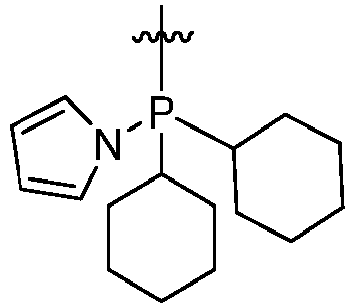
96 84 19.74 (d, 1H, J H-H = 11.2 Hz), 8.17 (bs, 2H), 7.10-6.88 (m, 5H), 6.65-6.63 (m, 2H), 6.16 (bs, 2H), 6.11 (s, 2H), 3.44-3.26 (m, 4H), 2.75 (s, 6H), 2.36 (s, 6H), 2.19 (s, 3H), 1.80 (s, 3H), 1.58-0.93 (m, 22H). 92.0 (s) C865 
89 75 19.53 (s, 1H), 8.24 (bs, 2H), 7.18-6.89 (m, 5H), 6.17 (bs, 2H), 4.06-4.01 (m, 1H), 3.43-3.26 (m, 4H), 2.77 (s, 6H), 2.37 (s, 6H), 2.21 (s, 3H), 1.82 (s, 3H), 1.78-1.01 (m, 32H). 150.3 (s) C850n 
82 54 (400 MHz; C6D6): δ 19.47 (s, 1H), 8.46 (bs, 1H), 7.14 (m, 1H), 7.01 (t, J = 7.7 Hz, 2H), 6.94 (s, 3H), 6.20 (m, 2H), 3.44 - 3.17 (m, 4H), 3.04 - 2.75 (m, 11H), 2.75 - 2.56 (s, 6H), 2.22 (s, 3H), 1.82 (s, 3H), 1.69-1.50 (m, 5H), 1.41 (s, 11H), 1.28 (s, 7H), 1.08 - 0.75 (m, 3H). (161.8 MHz; C6D6): δ 133.0 (s) C851 
92 78 (400 MHz; C6D6): δ 19.70 (s, 1H), 8.30 (bs, 2H), 7.19 (m, 1H), 7.04 - 6.98 (m, 2H), 6.93 (s, 2H), 6.25 (s, 2H), 3.43 - 3.16 (m, 4H), 2.86 (s, 6H), 2.85 - 2.77 (m, 12H), 2.48 (s, 6H), 2.22 (s, 3H), 1.82 (s, 3H), 1.48 - 1.34 (m, 6H), 1.29 (m, 12H) (161.8 MHz; C6D6): δ 118.7 (s) - Ring closing metathesis reactions of diethyl diallylmalonate were run in the presence of different catalysts of the invention. In an argon filled glovebox, diethyl diallylmalonate (0.200 mL, 0.827 mmol), catalyst (0.021 mmol) and toluene (4 mL) were combined in a 40 mL scintillation vial equipped with a magnetic stir bar. The resulting reaction was stirred at 80 °C and analyzed by gas chromatography.

entry catalyst time % yield 1 C609 1 15 2 3 30 3 5 36 4 20 50 5 C600 1 1 6 3 1 7 5 1 8 20 1 9 C591 1 3 10 3 5 11 5 6 12 20 9 - The catalysts of the invention show fast initiation, as indicated by the vinyl ether quenching experiments. For example, the initiation rate of the C832 complex is about two orders of magnitude faster than the C849 analogue.
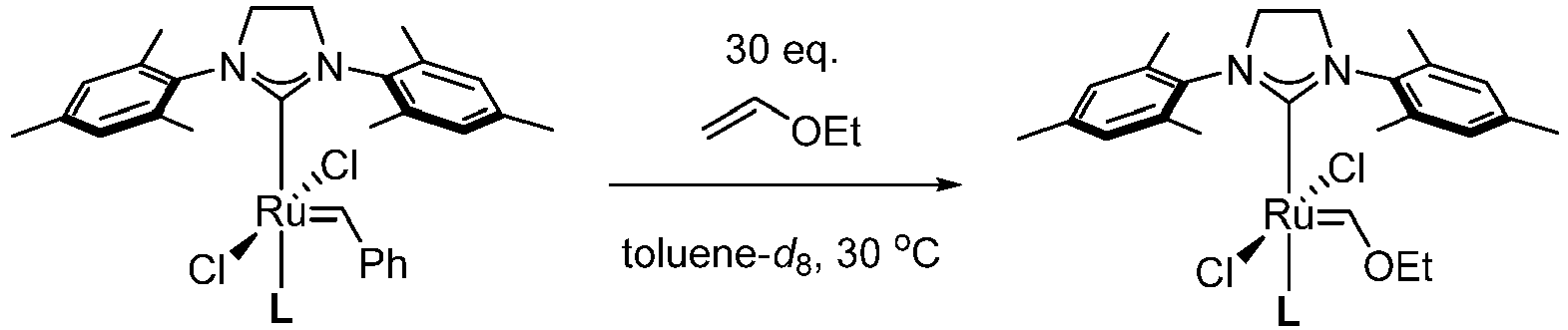
Figure 10 shows the vinyl ether quenching experiments for catalysts: C849, C865, C825, C850, C852, and C832.Figure 11 shows the vinyl ether quenching experiments for catalysts: C831, C840, C849, and C858.Figure 12 shows the vinyl ether quenching experiments for catalysts: C848, C852, C855, and C858. - The catalytic activity of the complexes according to the invention, was evaluated in ROMP reactions as follows. A 250 mL beaker was filled with 100 g of DCPD-HT monomer and 50 ppm of CHP (cumene hydroperoxide). The monomer was equilibrated to the desired temperature in an oil bath (30 °C +/- 0.5 °C). A J-Type thermocouple was suspended directly into the center of the monomer. The catalyst under study was dissolved in solvent (either toluene or CH2Cl2) to form a catalyst solution and the catalyst solution was then added to the monomer at a molar ratio of 45,000:1 (monomer: catalyst) to form a ROMP composition. Addition of the catalyst to the monomer to form the ROMP composition denoted the start of the ROMP reaction and hence, this was time point zero. Temperature readings were recorded using the thermocouple. The exotherm time was determined by measuring the amount of time that passed (i.e., the time difference) between time point zero and the time point that a propagating interface of the ROMP composition was first visually observed as the ROMP composition transitioned from a liquid state or gel state to a cured polymer state. ROMP reactions were stopped 2 hours after addition of the catalyst solution to the monomer. Time to exotherm is expressed by: slow > 120 minutes; moderate 30 - 120 minutes; medium 1 - < 30 minutes; fast < 1 minute and peak exotherm temperature are shown in Table 7 Compounds C931 and C949 are reference compounds.
Table 7 Catalyst DCPD-HT Monomer Temperature (°C) Time to Exotherm (min.) Peak Exotherm Temperature (°C) C931 30 medium 192 
C940 30 moderate 192 
C949morph 30 moderate 192 
C958 30 moderate 188 
C949 30 slow 186 
Claims (13)
- An olefin metathesis catalyst represented by Formula (I):
 M is ruthenium or osmium;X1 and X2 are independently halogen, trifluoroacetate, per-fluorophenols or nitrate;L1 is a ligand represented by the structure of Formula (II), or is a N-Heterocyclic Carbene ligand represented by the structure of Formula (III):
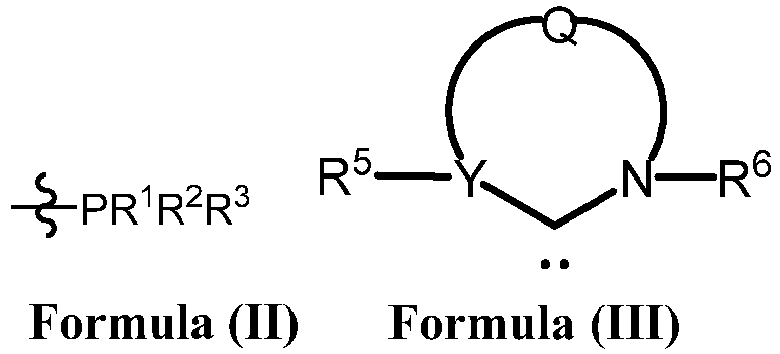 R1 is unsubstituted saturated N-heterocycle, substituted saturated N-heterocycle, -NH(C1-C24 alkyl), -N(C1-C24 alkyl)2, -NH(C5-C24 aryl), -N(C5-C24 aryl)2, -N(C1-C24 alkyl)(C5-C24 aryl) or -N[(C1-C6 alkylene) (C5-C24 aryl)]2;R2 is unsubstituted (C5-C24 aryl), substituted (C5-C24 aryl), unsubstituted saturated N-heterocycle, substituted saturated N-heterocycle, -NH(C1-C24 alkyl), -N(C1-C24 alkyl)2, -NH(C5-C24 aryl), -N(C5-C24 aryl)2, -N(C1-C24 alkyl)(C5-C24 aryl) or -N[(C1-C6 alkylene)(C5-C24 aryl)]2;R3 is unsubstituted (C5-C24 aryl), substituted (C5-C24 aryl), unsubstituted saturated N-heterocycle, or substituted saturated N-heterocycle;Y is CR4 or N;R4 is hydrogen, unsubstituted (C1-C12 alkyl), or substituted (C1-C12 alkyl);R5 and R6 are independently hydrogen, unsubstituted (C5-C24 aryl), or substituted (C5-C24 aryl);Q is a two-atom linkage represented by structures -[CR7R8]s-[CR9R10]t- or -[CR11=CR12]-;R7, R8, R9 and R10 are independently hydrogen, unsubstituted (C1-C24 alkyl), substituted (C1-C24 alkyl), unsubstituted (C5-C24 aryl), or substituted (C5-C24 aryl);R11 and R12 are independently hydrogen, unsubstituted (C1-C24 alkyl), substituted (C1-C24 alkyl), unsubstituted (C5-C24 aryl), or substituted (C5-C24 aryl); and"s" and "t" are independently 1 or 2.
 - The olefin metathesis catalyst according to claim 1, represented by the structure of Formula (VI):
 X1 is Cl;X2 is Cl;R1 is morpholino, thiomorpholino, 1-methyl-piperazino, piperidino, N-acetyl-piperazino, di-benzyl-amino, N-ethylcarboxylate-piperazino, diethylamino, methyl-phenylamino, or di-iso-propylamino;R2 is phenyl, morpholino, thiomorpholino, 1-methyl-piperazino, piperidino, N-acetyl-piperazino, di-benzyl-amino, N-ethylcarboxylate-piperazino, diethylamino, methyl-phenylamino, or di-iso-propylamino; andR3 is phenyl or morpholino.
 - The olefin metathesis catalyst according to claim 2, selected from:

- The olefin metathesis catalyst according to claim 1, represented by the structure of Formula (VII):
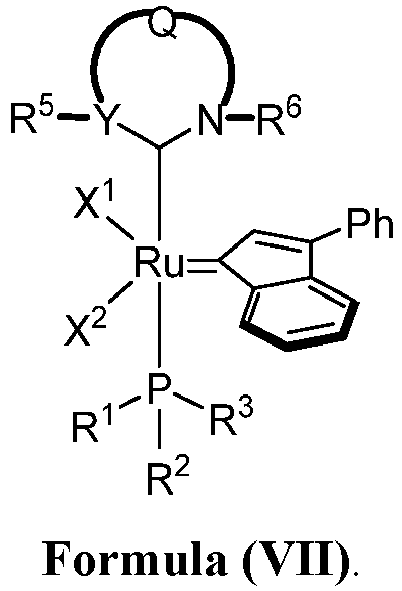
- The olefin metathesis catalyst according to claim 4, represented by the structure of Formula (VIII):
 X1 is Cl;X2 is Cl;R1 is morpholino, thiomorpholino, 1-methyl-piperazino, piperidino, N-acetyl-piperazino, di-benzyl-amino, N-ethylcarboxylate-piperazino, diethylamino, methyl-phenylamino, or di-iso-propylamino;R2 is phenyl, morpholino, thiomorpholino, 1-methyl-piperazino, piperidino, N-acetyl-piperazino, di-benzyl-amino, N-ethylcarboxylate-piperazino, diethylamino, methyl-phenylamino, or di-iso-propylamino;R3 is phenyl or morpholino;R5 and R6 are independently 2,4,6-trimethyl-phenyl, 2,6-di-iso-propylphenyl, 2-iso-propylphenyl or 2-methyl-6-iso-propylphenyl;Q is a two-atom linkage represented by structure -[CR7R8]s-[CR9R10]t-;R7, R8, R9 and R10 are independently hydrogen; and"s" and "t" are independently 1.
 - The olefin metathesis catalyst according to claim 5, selected from:


- An olefin metathesis catalyst represented by the structure of Formula (IVa):
 X1 and X2 are independently halogen, trifluoroacetate, per-fluorophenols or nitrate;R1 is unsubstituted saturated N-heterocycle, substituted saturated N-heterocycle, -NH(C1-C24 alkyl), -N(C1-C24 alkyl)2, -NH(C5-C24 aryl), -N(C5-C24 aryl)2, -N(C1-C24 alkyl)(C5-C24 aryl) or -N[(C1-C6 alkylene)(C5-C24 aryl)]2;R2 is unsubstituted (C5-C24 aryl), substituted (C5-C24 aryl), unsubstituted saturated N-heterocycle, substituted saturated N-heterocycle, -NH(C1-C24alkyl), -N(C1-C24alkyl)2, -NH(C5-C24aryl), -N(C5-C24aryl)2, -N(C1-C24alkyl)(C5-C24aryl) or -N[(C1-C6alkylene)(C5-C24aryl)]2; andR3 is unsubstituted (C5-C24 aryl), substituted (C5-C24 aryl), unsubstituted saturated N-heterocycle or substituted saturated N-heterocycle.
 - The olefin metathesis catalyst according to claim 7, wherein
X1 is Cl;
X2 is Cl;
R1 is morpholino, thiomorpholino, 1-methyl-piperazino, piperidino, N-acetyl-piperazino, di-benzyl-amino, N-ethylcarboxylate-piperazino, diethylamino, methyl-phenylamino, or di-iso-propylamino;
R2 is phenyl, morpholino, thiomorpholino, 1-methyl-piperazino, piperidino, N-acetyl-piperazino, di-benzyl-amino, N-ethylcarboxylate-piperazino, diethylamino, methyl-phenylamino, or di-iso-propylamino; and
R3 is phenyl or morpholino. - The olefin metathesis catalyst according to claim 8, selected from:

- A method of synthesizing an olefin metathesis catalyst represented by the structure of Formula (A):

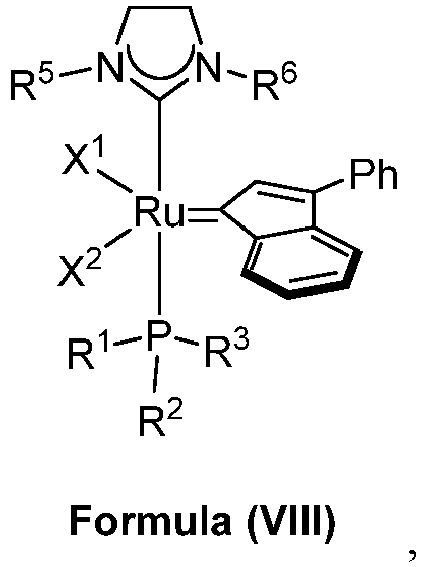 X1 and X2 are independently halogen, trifluoroacetate, per-fluorophenols or nitrate;R1 is unsubstituted saturated N-heterocycle, substituted saturated N-heterocycle, -NH(C1-C24 alkyl), -N(C1-C24 alkyl)2, -NH(C5-C24 aryl), -N(C5-C24 aryl)2, -N(C1-C24 alkyl)(C5-C24 aryl) or -N[(C1-C6 alkylene)(C5-C24 aryl)]2;R2 is unsubstituted (C5-C24 aryl), substituted (C5-C24 aryl), unsubstituted saturated N-heterocycle, substituted saturated N-heterocycle, -NH(C1-C24 alkyl), -N(C1-C24 alkyl)2, -NH(C5-C24 aryl), -N(C5-C24 aryl)2, -N(C1-C24 alkyl)(C5-C24 aryl) or -N[(C1-C6 alkylene)(C5-C24 aryl)]2;R3 is unsubstituted (C5-C24 aryl), substituted (C5-C24 aryl), unsubstituted saturated N-heterocycle or substituted saturated N-heterocycle;R5 and R6 are independently hydrogen, unsubstituted C5-C24 aryl, or substituted C5-C24 aryl; generally R5 and R6 are independently substituted C5-C24 aryl with one to three unsubstituted (C1-C6 alkyl) groups or substituted (C1-C6 alkyl) groups;Rd is unsubstituted C1-C10 alkyl, substituted C1-C10 alkyl, substituted C6-C10 aryl, unsubstituted C6-C10 aryl, substituted C3-C8 cycloalkyl or unsubstituted C3-C8 cycloalkyl;Re is unsubstituted C1-C10 alkyl, substituted C1-C10 alkyl, substituted C6-C10 aryl, unsubstituted C6-C10 aryl, substituted C3-C8 cycloalkyl or unsubstituted C3-C8 cycloalkyl; andRf is unsubstituted C1-C10 alkyl, substituted C1-C10 alkyl, substituted C6-C10 aryl, unsubstituted C6-C10 aryl, substituted C3-C8 cycloalkyl or unsubstituted C3-C8 cycloalkyl.
 - The method according to claim 10, wherein:X1 is Cl;X2 is Cl;R1 is morpholino, thiomorpholino, 1-methyl-piperazino, piperidino, N-acetyl-piperazino, di-benzyl-amino, N-ethylcarboxylate-piperazino, diethylamino, methyl-phenylamino, or di-iso-propylamino;R2 is phenyl, morpholino, thiomorpholino, 1-methyl-piperazino, piperidino, N-acetyl-piperazino, di-benzyl-amino, N-ethylcarboxylate-piperazino, diethylamino, methyl-phenylamino, or di-iso-propylamino; andR3 is phenyl or morpholinoR5 is 2,4,6-trimethylphenyl;R6 is 2,4,6-trimethylphenyl;Rd is phenyl;Re is phenyl; andRf is phenyl, methyl, p-(OMe)phenyl, or iso-propyl.
- A method of synthesizing an olefin metathesis catalyst represented by the structure of Formula (C):


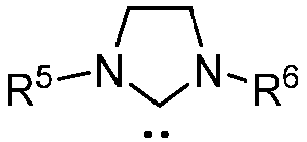 X1 and X2 are independently halogen, trifluoroacetate, per-fluorophenols or nitrate;R1 is unsubstituted saturated N-heterocycle, substituted saturated N-heterocycle, -NH(C1-C24 alkyl), -N(C1-C24 alkyl)2, -NH(C5-C24 aryl), -N(C5-C24 aryl)2, -N(C1-C24 alkyl)(C5-C24 aryl) or -N[(C1-C6 alkylene)(C5-C24 aryl)]2;R2 is unsubstituted (C5-C24 aryl), substituted (C5-C24 aryl), unsubstituted saturated N-heterocycle, substituted saturated N-heterocycle, -NH(C1-C24 alkyl), -N(C1-C24 alkyl)2, -NH(C5-C24 aryl), -N(C5-C24 aryl)2, -N(C1-C24 alkyl)(C5-C24 aryl) or -N[(C1-C6 alkylene)(C5-C24 aryl)]2;R3 is unsubstituted (C5-C24 aryl), substituted (C5-C24 aryl), unsubstituted saturated N-heterocycle or substituted saturated N-heterocycle; andR5 and R6 are independently hydrogen, unsubstituted C5-C24 aryl, or substituted C5-C24 aryl; generally R5 and R6 are independently substituted C5-C24 aryl with one to three unsubstituted (C1-C6 alkyl) groups or substituted (C1-C6 alkyl) groups.
 - The method according to claim 12, wherein:R1 is morpholino, thiomorpholino, 1-methyl-piperazino, piperidino, N-acetyl-piperazino, di-benzyl-amino, N-ethylcarboxylate-piperazino, diethylamino, methyl-phenylamino, or di-iso-propylamino;R2 is phenyl, morpholino, thiomorpholino, 1-methyl-piperazino, piperidino, N-acetyl-piperazino, di-benzyl-amino, N-ethylcarboxylate-piperazino, diethylamino, methyl-phenylamino, or di-iso-propylamino;R3 is phenyl or morpholino;X1 is Cl;X2 is Cl; andR5 and R6 are independently 2,4,6-trimethyl-phenyl, or 2,6-di-iso-propylphenyl.
Priority Applications (1)
| Application Number | Priority Date | Filing Date | Title |
|---|---|---|---|
| PL17862438T PL3528942T3 (en) | 2016-10-19 | 2017-10-17 | Synthesis and characterization of ru alkylidene complexes |
Applications Claiming Priority (3)
| Application Number | Priority Date | Filing Date | Title |
|---|---|---|---|
| US201662410003P | 2016-10-19 | 2016-10-19 | |
| US201762509269P | 2017-05-22 | 2017-05-22 | |
| PCT/US2017/056919 WO2018075479A1 (en) | 2016-10-19 | 2017-10-17 | Synthesis and characterization of ru alkylidene complexes |
Publications (3)
| Publication Number | Publication Date |
|---|---|
| EP3528942A1 EP3528942A1 (en) | 2019-08-28 |
| EP3528942A4 EP3528942A4 (en) | 2020-06-03 |
| EP3528942B1 true EP3528942B1 (en) | 2021-04-28 |
Family
ID=62018985
Family Applications (1)
| Application Number | Title | Priority Date | Filing Date |
|---|---|---|---|
| EP17862438.3A Active EP3528942B1 (en) | 2016-10-19 | 2017-10-17 | Synthesis and characterization of ru alkylidene complexes |
Country Status (5)
| Country | Link |
|---|---|
| US (3) | US10792651B2 (en) |
| EP (1) | EP3528942B1 (en) |
| CN (2) | CN109862963B (en) |
| PL (1) | PL3528942T3 (en) |
| WO (1) | WO2018075479A1 (en) |
Families Citing this family (1)
| Publication number | Priority date | Publication date | Assignee | Title |
|---|---|---|---|---|
| CN111974457B (en) * | 2020-08-31 | 2021-05-28 | 江南大学 | A kind of catalyst and preparation method for synthesizing substituted ketone compounds |
Family Cites Families (13)
| Publication number | Priority date | Publication date | Assignee | Title |
|---|---|---|---|---|
| US4899005A (en) | 1987-11-19 | 1990-02-06 | The B. F. Goodrich Company | Method for preparing cycloolefin copolymers with improved heat stability |
| US5917071A (en) * | 1996-11-15 | 1999-06-29 | California Institute Of Technology | Synthesis of ruthenium or osmium metathesis catalysts |
| ES2209185T3 (en) * | 1997-06-27 | 2004-06-16 | Ciba Specialty Chemicals Holding Inc. | RUTENIUM AND OSMIO CATALYSTS. |
| US6759537B2 (en) * | 2001-03-23 | 2004-07-06 | California Institute Of Technology | Hexacoordinated ruthenium or osmium metal carbene metathesis catalysts |
| KR100898876B1 (en) | 2001-03-26 | 2009-05-25 | 다우 글로벌 테크놀로지스 인크. | Heterogeneous catalyst composition |
| AU2005228434A1 (en) * | 2004-03-29 | 2005-10-13 | California Institute Of Technology | Latent, high-activity olefin metathesis catalysts containing an N-heterocyclic carbene ligand |
| CA2569525C (en) * | 2004-06-09 | 2015-03-31 | University Technologies International Inc. | Transition metal carbene complexes containing a cationic substituent as catalysts of olefin metathesis reactions |
| CA2591126A1 (en) * | 2007-06-08 | 2008-12-08 | Kanata Chemical Technologies Inc. | Process for the preparation of aminiphosphine ligands and their use in metal catalysts |
| CN101205242A (en) * | 2007-09-30 | 2008-06-25 | 埃沃尼克德古萨有限责任公司 | Ruthenium alkylidene complex containing N-heterocyclic carbenes and use thereof as high-activity high-selectivity catalyst in olefin duplex decomposition |
| EP2255877B1 (en) * | 2009-05-07 | 2014-09-24 | Umicore AG & Co. KG | Method for preparation of ruthenium-based metathesis catalysts with chelating alkylidene ligands |
| US9597674B2 (en) * | 2011-01-14 | 2017-03-21 | California Institute Of Technology | Z-selective olefin metathesis catalysts and their synthetic procedure |
| CN105229040B (en) * | 2013-02-27 | 2017-05-31 | 马特里亚公司 | Metal carbene olefin metathesis dual catalyst composition |
| US9068045B2 (en) | 2013-04-05 | 2015-06-30 | Reichhold, Inc. | Curing of liquid thermosetting resins |
-
2017
- 2017-10-17 WO PCT/US2017/056919 patent/WO2018075479A1/en not_active Ceased
- 2017-10-17 CN CN201780064313.5A patent/CN109862963B/en active Active
- 2017-10-17 US US16/341,635 patent/US10792651B2/en active Active
- 2017-10-17 PL PL17862438T patent/PL3528942T3/en unknown
- 2017-10-17 CN CN202111502938.XA patent/CN114106057B/en active Active
- 2017-10-17 EP EP17862438.3A patent/EP3528942B1/en active Active
-
2020
- 2020-07-02 US US16/919,704 patent/US11123722B2/en active Active
-
2021
- 2021-08-27 US US17/459,089 patent/US11779912B2/en active Active
Also Published As
| Publication number | Publication date |
|---|---|
| US10792651B2 (en) | 2020-10-06 |
| EP3528942A4 (en) | 2020-06-03 |
| US11123722B2 (en) | 2021-09-21 |
| CN109862963A (en) | 2019-06-07 |
| US20200038851A1 (en) | 2020-02-06 |
| US20200330970A1 (en) | 2020-10-22 |
| CN109862963B (en) | 2022-05-24 |
| PL3528942T3 (en) | 2021-11-08 |
| CN114106057B (en) | 2023-06-23 |
| WO2018075479A1 (en) | 2018-04-26 |
| US11779912B2 (en) | 2023-10-10 |
| US20210394167A1 (en) | 2021-12-23 |
| CN114106057A (en) | 2022-03-01 |
| EP3528942A1 (en) | 2019-08-28 |
Similar Documents
| Publication | Publication Date | Title |
|---|---|---|
| EP3386936B1 (en) | Olefin metathesis catalysts | |
| EP1735352B1 (en) | Latent, high-activity olefin metathesis catalysts containing an n-heterocyclic carbene ligand | |
| US6987154B2 (en) | Synthesis of A,B-alternating copolymers by olefin metathesis reactions of cyclic olefins or olefinic polymers with an acyclic diene | |
| EP2663398B1 (en) | Z-selective olefin metathesis catalysts and their synthetic procedure | |
| EP3496855B1 (en) | Metathesis catalysts | |
| US11794179B2 (en) | Synthesis and characterization of metathesis catalysts | |
| AU2012206966A1 (en) | Z-selective olefin metathesis catalysts and their synthetic procedure | |
| WO2011119778A2 (en) | Method for in-situ formation of metathesis catalysts | |
| WO2020109217A2 (en) | Metal organic compounds | |
| US11779912B2 (en) | Synthesis and characterization of Ru alkylidene complexes | |
| WO2018191373A1 (en) | Synthesis and characterization of metathesis catalysts | |
| US11066434B2 (en) | Metal complexes comprising aniline type ligands | |
| AU2011205218B2 (en) | Latent, high-activity olefin metathesis catalysts containing an N-heterocyclic carbene ligand | |
| CN101090915A (en) | Latent, high-activity olefin metathesis catalysts containing an n-heterocyclic carbene ligand |
Legal Events
| Date | Code | Title | Description |
|---|---|---|---|
| STAA | Information on the status of an ep patent application or granted ep patent |
Free format text: STATUS: THE INTERNATIONAL PUBLICATION HAS BEEN MADE |
|
| PUAI | Public reference made under article 153(3) epc to a published international application that has entered the european phase |
Free format text: ORIGINAL CODE: 0009012 |
|
| STAA | Information on the status of an ep patent application or granted ep patent |
Free format text: STATUS: REQUEST FOR EXAMINATION WAS MADE |
|
| 17P | Request for examination filed |
Effective date: 20190520 |
|
| AK | Designated contracting states |
Kind code of ref document: A1 Designated state(s): AL AT BE BG CH CY CZ DE DK EE ES FI FR GB GR HR HU IE IS IT LI LT LU LV MC MK MT NL NO PL PT RO RS SE SI SK SM TR |
|
| AX | Request for extension of the european patent |
Extension state: BA ME |
|
| DAV | Request for validation of the european patent (deleted) | ||
| DAX | Request for extension of the european patent (deleted) | ||
| REG | Reference to a national code |
Ref country code: DE Ref legal event code: R079 Ref document number: 602017037819 Country of ref document: DE Free format text: PREVIOUS MAIN CLASS: B01J0031220000 Ipc: C07F0015000000 |
|
| A4 | Supplementary search report drawn up and despatched |
Effective date: 20200506 |
|
| RIC1 | Information provided on ipc code assigned before grant |
Ipc: C07F 9/02 20060101ALI20200428BHEP Ipc: B01J 31/22 20060101ALI20200428BHEP Ipc: C07F 15/00 20060101AFI20200428BHEP |
|
| GRAP | Despatch of communication of intention to grant a patent |
Free format text: ORIGINAL CODE: EPIDOSNIGR1 |
|
| STAA | Information on the status of an ep patent application or granted ep patent |
Free format text: STATUS: GRANT OF PATENT IS INTENDED |
|
| INTG | Intention to grant announced |
Effective date: 20210114 |
|
| GRAS | Grant fee paid |
Free format text: ORIGINAL CODE: EPIDOSNIGR3 |
|
| GRAA | (expected) grant |
Free format text: ORIGINAL CODE: 0009210 |
|
| STAA | Information on the status of an ep patent application or granted ep patent |
Free format text: STATUS: THE PATENT HAS BEEN GRANTED |
|
| AK | Designated contracting states |
Kind code of ref document: B1 Designated state(s): AL AT BE BG CH CY CZ DE DK EE ES FI FR GB GR HR HU IE IS IT LI LT LU LV MC MK MT NL NO PL PT RO RS SE SI SK SM TR |
|
| REG | Reference to a national code |
Ref country code: GB Ref legal event code: FG4D |
|
| REG | Reference to a national code |
Ref country code: CH Ref legal event code: EP |
|
| REG | Reference to a national code |
Ref country code: AT Ref legal event code: REF Ref document number: 1386951 Country of ref document: AT Kind code of ref document: T Effective date: 20210515 |
|
| REG | Reference to a national code |
Ref country code: DE Ref legal event code: R096 Ref document number: 602017037819 Country of ref document: DE |
|
| REG | Reference to a national code |
Ref country code: IE Ref legal event code: FG4D |
|
| REG | Reference to a national code |
Ref country code: LT Ref legal event code: MG9D |
|
| REG | Reference to a national code |
Ref country code: AT Ref legal event code: MK05 Ref document number: 1386951 Country of ref document: AT Kind code of ref document: T Effective date: 20210428 |
|
| PG25 | Lapsed in a contracting state [announced via postgrant information from national office to epo] |
Ref country code: HR Free format text: LAPSE BECAUSE OF FAILURE TO SUBMIT A TRANSLATION OF THE DESCRIPTION OR TO PAY THE FEE WITHIN THE PRESCRIBED TIME-LIMIT Effective date: 20210428 Ref country code: AT Free format text: LAPSE BECAUSE OF FAILURE TO SUBMIT A TRANSLATION OF THE DESCRIPTION OR TO PAY THE FEE WITHIN THE PRESCRIBED TIME-LIMIT Effective date: 20210428 Ref country code: BG Free format text: LAPSE BECAUSE OF FAILURE TO SUBMIT A TRANSLATION OF THE DESCRIPTION OR TO PAY THE FEE WITHIN THE PRESCRIBED TIME-LIMIT Effective date: 20210728 Ref country code: NL Free format text: LAPSE BECAUSE OF FAILURE TO SUBMIT A TRANSLATION OF THE DESCRIPTION OR TO PAY THE FEE WITHIN THE PRESCRIBED TIME-LIMIT Effective date: 20210428 Ref country code: FI Free format text: LAPSE BECAUSE OF FAILURE TO SUBMIT A TRANSLATION OF THE DESCRIPTION OR TO PAY THE FEE WITHIN THE PRESCRIBED TIME-LIMIT Effective date: 20210428 Ref country code: LT Free format text: LAPSE BECAUSE OF FAILURE TO SUBMIT A TRANSLATION OF THE DESCRIPTION OR TO PAY THE FEE WITHIN THE PRESCRIBED TIME-LIMIT Effective date: 20210428 |
|
| PG25 | Lapsed in a contracting state [announced via postgrant information from national office to epo] |
Ref country code: IS Free format text: LAPSE BECAUSE OF FAILURE TO SUBMIT A TRANSLATION OF THE DESCRIPTION OR TO PAY THE FEE WITHIN THE PRESCRIBED TIME-LIMIT Effective date: 20210828 Ref country code: GR Free format text: LAPSE BECAUSE OF FAILURE TO SUBMIT A TRANSLATION OF THE DESCRIPTION OR TO PAY THE FEE WITHIN THE PRESCRIBED TIME-LIMIT Effective date: 20210729 Ref country code: SE Free format text: LAPSE BECAUSE OF FAILURE TO SUBMIT A TRANSLATION OF THE DESCRIPTION OR TO PAY THE FEE WITHIN THE PRESCRIBED TIME-LIMIT Effective date: 20210428 Ref country code: RS Free format text: LAPSE BECAUSE OF FAILURE TO SUBMIT A TRANSLATION OF THE DESCRIPTION OR TO PAY THE FEE WITHIN THE PRESCRIBED TIME-LIMIT Effective date: 20210428 Ref country code: PT Free format text: LAPSE BECAUSE OF FAILURE TO SUBMIT A TRANSLATION OF THE DESCRIPTION OR TO PAY THE FEE WITHIN THE PRESCRIBED TIME-LIMIT Effective date: 20210830 Ref country code: NO Free format text: LAPSE BECAUSE OF FAILURE TO SUBMIT A TRANSLATION OF THE DESCRIPTION OR TO PAY THE FEE WITHIN THE PRESCRIBED TIME-LIMIT Effective date: 20210728 Ref country code: LV Free format text: LAPSE BECAUSE OF FAILURE TO SUBMIT A TRANSLATION OF THE DESCRIPTION OR TO PAY THE FEE WITHIN THE PRESCRIBED TIME-LIMIT Effective date: 20210428 |
|
| REG | Reference to a national code |
Ref country code: NL Ref legal event code: MP Effective date: 20210428 |
|
| PG25 | Lapsed in a contracting state [announced via postgrant information from national office to epo] |
Ref country code: SK Free format text: LAPSE BECAUSE OF FAILURE TO SUBMIT A TRANSLATION OF THE DESCRIPTION OR TO PAY THE FEE WITHIN THE PRESCRIBED TIME-LIMIT Effective date: 20210428 Ref country code: SM Free format text: LAPSE BECAUSE OF FAILURE TO SUBMIT A TRANSLATION OF THE DESCRIPTION OR TO PAY THE FEE WITHIN THE PRESCRIBED TIME-LIMIT Effective date: 20210428 Ref country code: ES Free format text: LAPSE BECAUSE OF FAILURE TO SUBMIT A TRANSLATION OF THE DESCRIPTION OR TO PAY THE FEE WITHIN THE PRESCRIBED TIME-LIMIT Effective date: 20210428 Ref country code: EE Free format text: LAPSE BECAUSE OF FAILURE TO SUBMIT A TRANSLATION OF THE DESCRIPTION OR TO PAY THE FEE WITHIN THE PRESCRIBED TIME-LIMIT Effective date: 20210428 Ref country code: CZ Free format text: LAPSE BECAUSE OF FAILURE TO SUBMIT A TRANSLATION OF THE DESCRIPTION OR TO PAY THE FEE WITHIN THE PRESCRIBED TIME-LIMIT Effective date: 20210428 Ref country code: DK Free format text: LAPSE BECAUSE OF FAILURE TO SUBMIT A TRANSLATION OF THE DESCRIPTION OR TO PAY THE FEE WITHIN THE PRESCRIBED TIME-LIMIT Effective date: 20210428 Ref country code: RO Free format text: LAPSE BECAUSE OF FAILURE TO SUBMIT A TRANSLATION OF THE DESCRIPTION OR TO PAY THE FEE WITHIN THE PRESCRIBED TIME-LIMIT Effective date: 20210428 |
|
| REG | Reference to a national code |
Ref country code: DE Ref legal event code: R097 Ref document number: 602017037819 Country of ref document: DE |
|
| PLBE | No opposition filed within time limit |
Free format text: ORIGINAL CODE: 0009261 |
|
| STAA | Information on the status of an ep patent application or granted ep patent |
Free format text: STATUS: NO OPPOSITION FILED WITHIN TIME LIMIT |
|
| 26N | No opposition filed |
Effective date: 20220131 |
|
| REG | Reference to a national code |
Ref country code: CH Ref legal event code: PL |
|
| PG25 | Lapsed in a contracting state [announced via postgrant information from national office to epo] |
Ref country code: IS Free format text: LAPSE BECAUSE OF FAILURE TO SUBMIT A TRANSLATION OF THE DESCRIPTION OR TO PAY THE FEE WITHIN THE PRESCRIBED TIME-LIMIT Effective date: 20210828 Ref country code: AL Free format text: LAPSE BECAUSE OF FAILURE TO SUBMIT A TRANSLATION OF THE DESCRIPTION OR TO PAY THE FEE WITHIN THE PRESCRIBED TIME-LIMIT Effective date: 20210428 |
|
| REG | Reference to a national code |
Ref country code: BE Ref legal event code: MM Effective date: 20211031 |
|
| PG25 | Lapsed in a contracting state [announced via postgrant information from national office to epo] |
Ref country code: MC Free format text: LAPSE BECAUSE OF FAILURE TO SUBMIT A TRANSLATION OF THE DESCRIPTION OR TO PAY THE FEE WITHIN THE PRESCRIBED TIME-LIMIT Effective date: 20210428 |
|
| PG25 | Lapsed in a contracting state [announced via postgrant information from national office to epo] |
Ref country code: LU Free format text: LAPSE BECAUSE OF NON-PAYMENT OF DUE FEES Effective date: 20211017 Ref country code: IT Free format text: LAPSE BECAUSE OF FAILURE TO SUBMIT A TRANSLATION OF THE DESCRIPTION OR TO PAY THE FEE WITHIN THE PRESCRIBED TIME-LIMIT Effective date: 20210428 Ref country code: BE Free format text: LAPSE BECAUSE OF NON-PAYMENT OF DUE FEES Effective date: 20211031 |
|
| PG25 | Lapsed in a contracting state [announced via postgrant information from national office to epo] |
Ref country code: LI Free format text: LAPSE BECAUSE OF NON-PAYMENT OF DUE FEES Effective date: 20211031 Ref country code: CH Free format text: LAPSE BECAUSE OF NON-PAYMENT OF DUE FEES Effective date: 20211031 |
|
| PG25 | Lapsed in a contracting state [announced via postgrant information from national office to epo] |
Ref country code: FR Free format text: LAPSE BECAUSE OF NON-PAYMENT OF DUE FEES Effective date: 20211031 |
|
| PG25 | Lapsed in a contracting state [announced via postgrant information from national office to epo] |
Ref country code: IE Free format text: LAPSE BECAUSE OF NON-PAYMENT OF DUE FEES Effective date: 20211017 |
|
| PG25 | Lapsed in a contracting state [announced via postgrant information from national office to epo] |
Ref country code: CY Free format text: LAPSE BECAUSE OF FAILURE TO SUBMIT A TRANSLATION OF THE DESCRIPTION OR TO PAY THE FEE WITHIN THE PRESCRIBED TIME-LIMIT Effective date: 20210428 |
|
| PG25 | Lapsed in a contracting state [announced via postgrant information from national office to epo] |
Ref country code: HU Free format text: LAPSE BECAUSE OF FAILURE TO SUBMIT A TRANSLATION OF THE DESCRIPTION OR TO PAY THE FEE WITHIN THE PRESCRIBED TIME-LIMIT; INVALID AB INITIO Effective date: 20171017 |
|
| PG25 | Lapsed in a contracting state [announced via postgrant information from national office to epo] |
Ref country code: MK Free format text: LAPSE BECAUSE OF FAILURE TO SUBMIT A TRANSLATION OF THE DESCRIPTION OR TO PAY THE FEE WITHIN THE PRESCRIBED TIME-LIMIT Effective date: 20210428 |
|
| PG25 | Lapsed in a contracting state [announced via postgrant information from national office to epo] |
Ref country code: TR Free format text: LAPSE BECAUSE OF FAILURE TO SUBMIT A TRANSLATION OF THE DESCRIPTION OR TO PAY THE FEE WITHIN THE PRESCRIBED TIME-LIMIT Effective date: 20210428 |
|
| PG25 | Lapsed in a contracting state [announced via postgrant information from national office to epo] |
Ref country code: MT Free format text: LAPSE BECAUSE OF FAILURE TO SUBMIT A TRANSLATION OF THE DESCRIPTION OR TO PAY THE FEE WITHIN THE PRESCRIBED TIME-LIMIT Effective date: 20210428 |
|
| PGFP | Annual fee paid to national office [announced via postgrant information from national office to epo] |
Ref country code: GB Payment date: 20250904 Year of fee payment: 9 |
|
| PGFP | Annual fee paid to national office [announced via postgrant information from national office to epo] |
Ref country code: DE Payment date: 20250902 Year of fee payment: 9 |
|
| PGFP | Annual fee paid to national office [announced via postgrant information from national office to epo] |
Ref country code: PL Payment date: 20250912 Year of fee payment: 9 |