EP3528037A1 - Ophthalmic tinted glass - Google Patents
Ophthalmic tinted glass Download PDFInfo
- Publication number
- EP3528037A1 EP3528037A1 EP18305153.1A EP18305153A EP3528037A1 EP 3528037 A1 EP3528037 A1 EP 3528037A1 EP 18305153 A EP18305153 A EP 18305153A EP 3528037 A1 EP3528037 A1 EP 3528037A1
- Authority
- EP
- European Patent Office
- Prior art keywords
- layered structure
- tinted glass
- value
- base eyeglass
- ophthalmic
- Prior art date
- Legal status (The legal status is an assumption and is not a legal conclusion. Google has not performed a legal analysis and makes no representation as to the accuracy of the status listed.)
- Granted
Links
Images

Classifications
-
- G—PHYSICS
- G02—OPTICS
- G02C—SPECTACLES; SUNGLASSES OR GOGGLES INSOFAR AS THEY HAVE THE SAME FEATURES AS SPECTACLES; CONTACT LENSES
- G02C7/00—Optical parts
- G02C7/10—Filters, e.g. for facilitating adaptation of the eyes to the dark; Sunglasses
- G02C7/104—Filters, e.g. for facilitating adaptation of the eyes to the dark; Sunglasses having spectral characteristics for purposes other than sun-protection
-
- G—PHYSICS
- G02—OPTICS
- G02C—SPECTACLES; SUNGLASSES OR GOGGLES INSOFAR AS THEY HAVE THE SAME FEATURES AS SPECTACLES; CONTACT LENSES
- G02C7/00—Optical parts
- G02C7/02—Lenses; Lens systems ; Methods of designing lenses
-
- G—PHYSICS
- G02—OPTICS
- G02C—SPECTACLES; SUNGLASSES OR GOGGLES INSOFAR AS THEY HAVE THE SAME FEATURES AS SPECTACLES; CONTACT LENSES
- G02C7/00—Optical parts
- G02C7/10—Filters, e.g. for facilitating adaptation of the eyes to the dark; Sunglasses
-
- G—PHYSICS
- G02—OPTICS
- G02C—SPECTACLES; SUNGLASSES OR GOGGLES INSOFAR AS THEY HAVE THE SAME FEATURES AS SPECTACLES; CONTACT LENSES
- G02C7/00—Optical parts
- G02C7/10—Filters, e.g. for facilitating adaptation of the eyes to the dark; Sunglasses
- G02C7/107—Interference colour filters
-
- G—PHYSICS
- G02—OPTICS
- G02C—SPECTACLES; SUNGLASSES OR GOGGLES INSOFAR AS THEY HAVE THE SAME FEATURES AS SPECTACLES; CONTACT LENSES
- G02C7/00—Optical parts
- G02C7/10—Filters, e.g. for facilitating adaptation of the eyes to the dark; Sunglasses
- G02C7/108—Colouring materials
-
- G—PHYSICS
- G02—OPTICS
- G02C—SPECTACLES; SUNGLASSES OR GOGGLES INSOFAR AS THEY HAVE THE SAME FEATURES AS SPECTACLES; CONTACT LENSES
- G02C2202/00—Generic optical aspects applicable to one or more of the subgroups of G02C7/00
- G02C2202/16—Laminated or compound lenses
Definitions
- the invention relates to an ophthalmic tinted glass and a solar-protection eyewear.
- Ophthalmic tinted glasses are known for long time for protecting the eyes against excessive solar light intensity.
- a tinted glass is designed for absorbing and/or reflecting solar light so as to reduce light intensity to an amount which provides safety and comfortable vision to the wearer.
- Light which is involved in vision for a human being, called visible light corresponds to the wavelength range from 380 nm (nanometer) to 780 nm, called visible wavelength range.
- tinted glasses may progressively have detrimental effects on the biological, hormonal and behavioural functions of the wearer. Such detrimental effects may appear after daily repeated and abusively prolonged wearing of the tinted glasses, and sleep troubles, seasonal affective disorders and mood disorders may result in long term. These effects are commonly described as chronobiological because of their consequences on the circadian rhythms of the wearer.
- the tinted glasses cause the pupil diameter to increase, which affects visual acuity.
- the depth of field is decreased and the optical aberrations are more important.
- the increase in the pupil diameter leads to higher energetic exposure of the retina to non-filtered light wavelengths, in particular in case of non-filtered blue-violet wavelengths which are deemed to be noxious. Blue-violet wavelengths correspond to values between 380 nm and 450 nm.
- one object of the invention is to provide ophthalmic tinted glasses which produce protection against excessive light intensity but in which transmittance within the wavelength range from 460 nm to 510 nm is enriched.
- Another object of the invention is to allow production of such tinted glasses with enriched transmittance within the wavelength range 460 nm - 510 nm, from base tinted glasses.
- An additional object of the invention is to provide such tinted glasses which produce good protection against blue-violet light.
- a first aspect of the invention proposes an ophthalmic tinted glass which comprises:
- the base eyeglass and the first layered structure are such that a difference equal to a mean transmittance value of the tinted glass over a wavelength range from 460 nm to 510 nm minus a visual transmission value of the tinted glass is higher than 14%, preferably higher than or equal to 20%.
- T mB - T v > 14%, where T mB is the mean transmittance value of the tinted glass over the wavelength range from 460 nm to 510 nm, and T v is the visual transmission value of the tinted glass as defined in standard ISO 8980-3:2013, for taking into account the spectral sensibility to light of the retina cells, and using the illuminant D65 as defined by CIE standard ISO 10526:1999/CIE S005/E-1998.
- the mean transmittance value over the wavelength range from 460 nm to 510 nm denotes the calculation result of ⁇ 460nm 510nm T( ⁇ ) ⁇ d ⁇ /50, denoted T mB , where 50 is the length in nanometers of the wavelength range 460 nm - 510 nm, corresponding to medium-blue light, ⁇ denotes the wavelength in nanometers and T( ⁇ ) denotes the spectral transmittance value at wavelength ⁇ .
- the wavelength range 460 nm - 510 nm may be replaced with range 465 nm - 495 nm while maintaining any threshold value unchanged.
- the mean transmittance value T mB to be considered is ⁇ 465nm 495nm T( ⁇ ) ⁇ d ⁇ /30, where 30 is the length in nanometers of the wavelength range 465 nm - 495 nm.
- the proportion of the medium-blue light relative to the total amount of light which is effective for vision is increased by the first layered structure.
- the first layered structure also produces a solar protection effect, with respect to the base eyeglass devoid of the first layered structure, since it reduces the total amount of visible light which enters into the wearer's eye.
- the base eyeglass may be a clear eyeglass, for example with visual transmission value higher than 90%, or higher than 95%, when measured in daylight conditions or using illuminant D65.
- the material of base eyeglass may be light-absorbing, so that the base eyeglass produces a first solar protection effect.
- the first layered structure provides an additional solar protection so that the invention ophthalmic tinted glass has an overall solar protection efficiency which is improved with respect to that of the bare base eyeglass.
- the first layered structure increases the relative proportion of medium-blue light with respect to the total light which is allowed by the base eyeglass to enter into the wearer's eye.
- the base eyeglass may have a visual transmission value which is higher than 18% when devoid of the first layered structure, and the first layered structure may be such that the visual transmission value of the tinted glass is less than or equal to 18%.
- the invention allows transforming an initial ophthalmic tinted glass which is formed by the bare base eyeglass, and which pertains to class 2 as defined by the standard ISO 12312-1, into a final ophthalmic tinted glass which pertains to class 3.
- the base eyeglass and the first layered structure may be such that the mean transmittance value of the tinted glass over the wavelength range from 460 nm to 510 nm, or from 465 nm to 495 nm, is higher than 30%, preferably higher than 40%, more preferably higher than or equal to 48%. Then, enough medium-blue light intensity enters into the wearer's eye to ensure that biological, hormonal and behavioural functions are not altered, and related circadian rhythms are maintained.
- the base eyeglass may advantageously be such that its spectral transmittance when devoid of the first layered structure is less than 30%, preferably less than 20%, across the wavelength range from 380 nm to 450 nm.
- the base eyeglass may be light-absorbing at least for visible light wavelengths below 450 nm.
- the base eyeglass provides protection against blue-violet light, and also the invention tinted glass.
- the base eyeglass may also be such that its spectral transmittance when devoid of the first layered structure is less than 25% across a wavelength range from 540 nm to 630 nm. This ensures that the invention tinted glass produces an efficient protection against dazzling for the wearer, because the maximum of the spectral sensibility of the human eye to light is close to 570 nm.
- the base eyeglass may be such that its visual transmission value is less than 25%, again when devoid of the first layered structure.
- the base eyeglass material may be comprised of a transparent matrix with dyes and absorbers which are distributed therein. At least one of the dyes may have a light-absorption peak in the wavelength range from 380 nm to 450 nm, and at least two of the absorbers may have respective light-absorption peaks in another wavelength range from 520 nm to 660 nm.
- the spectral reflectance of the ophthalmic tinted glass for light impinging on the convex optical face with incidence value of 15° may have a value of more than 30% for at least one first wavelength comprised between 520 nm and 660 nm, and another value of less than 20% for at least one second wavelength comprised between 460 nm and 510 nm.
- the first layered structure is less light-reflecting at the second wavelength in the medium-blue range with chronobiological effect, than for longer wavelengths corresponding to green, yellow or red colors.
- the ophthalmic tinted glass may further comprise:
- the second layered structure may be such that the visual reflection value effective for light impinging from outside of the tinted glass onto the concave face of the ophthalmic tinted glass covered by the second layered structure is less than 3%, preferably less than or equal to 2.5%, for incidence value of 35° (degree).
- the first layered structure may be a stack of eleven layers alternatively of zirconia and silica, starting and ending with two of the zirconia layers.
- the zirconia layers may have respective thicknesses between 50 nm and 73 nm
- the silica layers may have respective thicknesses between 80 nm and 125 nm.
- the first layered structure may be an ordered stack which comprises, from the convex face of the base eyeglass:
- these other invention embodiments may comprise a second layered structure, which is another ordered stack comprising, from the concave face of the base eyeglass:
- a second aspect of the invention proposes a solar-protection eyewear, which comprises a frame and two ophthalmic tinted glasses mounted into the frame, each ophthalmic tinted glass being in accordance with the first invention aspect.
- Figure 1a shows a first possible configuration for an ophthalmic tinted glass 10 in accordance with the invention. It comprises a base eyeglass 1 which is self-supporting and has opposite optical faces Cx and Cc.
- the optical face Cx is convex and intended to be oriented towards a scene to be viewed when the tinted glass 10 is fitted within a spectacle frame and worn by a wearer.
- the optical face Cc is concave and intended to face an eye of the wearer.
- Both optical faces Cx and Cc may be such that the base eyeglass 1 does not produce any ametropia correction, namely it is of plano type, or may be such that the base eyeglass 1 produces an ametropia correction. In such latter case, the base eyeglass 1 may be of single vision type or a progressive addition lens.
- the base eyeglass 1 is covered on its optical convex face Cx by a layered structure 2.
- the layered structure 2 is based on thin-film technology so that the base eyeglass 1 forms a substrate for the layered structure 2.
- the layered structure 2 is multi-layered, and any coating deposition process or combination of several coating deposition processes may be used for producing the layered structure 2, including physical vapour deposition (PVD), e.g. beam evaporation, thermal evaporation, sputtering, and also including chemical vapour deposition (CVD), atomic layer deposition (ALD), sol-gel, varnish deposition, etc.
- PVD physical vapour deposition
- CVD chemical vapour deposition
- ALD atomic layer deposition
- sol-gel varnish deposition
- the base eyeglass 1 may also be covered on its optical concave face Cc with a layered structure 3, as shown in Figure 1b .
- the layered structure 3 is based on thin-film technology too, and may be multi-layered and deposited using the same deposition processes as recited above.
- the structure 3 has been called second layered structure in the general part of this description.
- the base eyeglass 1 may be a clear eyeglass, corresponding to class 1 for tinted glasses as defined in standard ISO 12312-1.
- it may be an OrmaTM eyeglass as supplied by Essilor, or a polycarbonate eyeglass.
- the solar protection function of the ophthalmic tinted glass 10 is provided by the layered structure 2.
- the base eyeglass 1 may be of a light-absorbing material, still light-transmitting but with reduced transmission value, so that it produces per se a first contribution to the solar protection function of the ophthalmic tinted glass 10.
- the layered structure 2 produces an additional solar protection contribution, so that the solar protection efficiency of the ophthalmic tinted glass 10 results from both contributions of the base eyeglass 1 and the layered structure 2.
- the base eyeglass 1 may be based on TrivexTM matrix as supplied by PPG industries, which is well known and based on polyurethane polymer. The TrivexTM matrix is clear material per se, but dyes and absorbers can be incorporated therein for forming a tinted base eyeglass 1.
- Table 1 below indicates possible dye- and absorber concentrations which correspond to the spectral transmittance curve represented in Figure 2 , for a 2 mm (millimeter) thick piano base eyeglass 1.
- the dye- and absorber concentrations are expressed in mg (milligram) of each dye or absorber for 100 g of the resulting blend of TrivexTM with the dyes and absorbers.
- Commercial suppliers are also indicated between parentheses.
- the dyes indicated are mainly responsible for the shape of the eyeglass transmittance profile for wavelength values between 380 nm and 450 nm, whereas the absorbers are mainly responsible for the shape of the eyeglass transmittance profile for wavelength values between 520 nm and 680 nm.
- the horizontal axis indicates the wavelength ⁇ in the visible range, i.e. from 380 nm (nanometer) to 780 nm, and the vertical axis indicates the spectral transmittance values T( ⁇ ) for light impinging perpendicular to the convex face Cx.
- such base eyeglass 1 produces light absorption for wavelength values between 380 nm and 450 nm, and also between 520 nm and 680 nm.
- the absorption between 380 nm and 450 nm is beneficial for protecting the wearer's eye against harmful blue-violet radiation, and that between 520 nm and 680 nm is efficient for producing the solar protection function.
- the spectral transmittance T( ⁇ ) is much less than 20% in the range 380 nm - 450 nm, and less than 25% in the range 540 nm - 630 nm.
- the transmission window between 460 nm and 510 nm allows enriching the total light which is transmitted for vision to the wearer's eye with medium-blue light beneficial for the chronobiological effects.
- the visual transmission value T v as defined by the standard ISO 8980-3:2013 with illuminant D65, is then 23.1%, corresponding to class 2 for tinted glasses as defined in standard ISO 12312-1.
- the rear side visual reflection value R v which is considered here takes into account the absorption of the substrate.
- Table 2 below displays the configurations of five ophthalmic tinted glasses 10, labelled D1 to D5, with their respective values for the visual transmission T v , the visual reflection R v of the concave face Cc for incidence value of 35° (degree), and the medium-blue mean transmittance value T mB as defined by the integral equation above.
- the base eyeglass 1 is that of Figure 2 and Table 1, denoted tinted as indicated in the column labelled 1.
- Z1, Q1, Z2, Q2 and Z3 denote the successive layers of the layered structures 2 (resp. 3) borne by the optical faces Cx (resp. Cc) of the base eyeglasses 1, when recited from the base eyeglass 1 to the air interface in front of (resp. behind) the tinted glass 10.
- Z1, Z2 and Z3 are zirconia (ZrO 2 ) layers with refractive index value of about 2.00 for the wavelength value of 633 nm
- Q1 and Q2 are silica (SiO 2 ) layers with refractive index value of about 1.47 for the same wavelength value of 633 nm.
- the values displayed in the layer columns are the physical thicknesses of the individual layers, expressed in nanometers, and provided that the actual thickness values are within +/-5% of the values displayed.
- the layered structures 2 displayed in the Cx-lines are of selective mirror type, because of being reflection-enhancing for some wavelength values above 520 nm when comparing the base eyeglass 1 with and without the layered structure 2.
- the mention "air" in two of the Cc-lines indicates that the concave optical faces Cc of the tinted glasses D1 and D3 do not have any layered structure 3, and the layered structures 3 displayed in the Cc-lines for the tinted glasses D2 and D4 are of antireflection type. That for the tinted glass D5 is reflection-increasing.
- T v -value being less than or equal to 18% means that the tinted glass 10 is of class 3.
- an appropriate layered structure 2 and a layered structure 3 when implemented can transform a base eyeglass 1 which pertains to class 2 of tinted glasses into a tinted glass 10 of class 3.
- R v -value being less than or equal to 2.5% means that the tinted glass 10 is antireflective on its rear side.
- Table 3 below displays the values for another tinted glass 10 according to the invention, which is labelled D6 and implements a base eyeglass 1 corresponding to Figure 2 and Table 1, with thickness of 2 mm for this base eyeglass 1.
- the layered structure 2 on the convex face Cx is of selective mirror type again, and the layered structure 3 on the concave face Cc is antireflective.
- the layer thicknesses are expressed in nanometers again, and can vary within +/-5% with respect to the values indicated.
- UL denotes underlayers with refractive index value of about 1.50 at wavelength of 633 nm
- ITO denotes layers of indium-tin (In-Sn) oxide which are intermediate between layers Z2 and Q2.
- the underlayers UL may be varnish layers which provide protection against impacts and scratches.
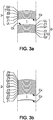
- Figure 3a shows the layers of such tinted glass D6.
- Table 4 below displays the values for another tinted glass 10 according to the invention, which is labelled D7 and implements an OrmaTM base eyeglass 1 with thickness of 2 mm.
- the layered structure 2 on the convex face Cx is comprised of eleven layers alternatively of zirconia (Z1-Z6) and silica (Q1-Q5), but no layered structure 3 is on the concave face Cc.
- the layer thicknesses are expressed in nanometers again, and can vary within +/-5% with respect to the values indicated.
- the visual transmission T v equals 18.0%
- the visual reflection R v for light impinging onto the concave side Cc with 35° incidence value equals 69.4%
- the medium-blue mean transmittance value T mB equals 50.1%.
- Figure 3b shows the layers of such tinted glass D7.
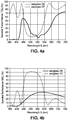
- Figure 4a exhibits the spectral transmittance curves for both tinted glasses. Spectral transmittance values are noted T( ⁇ ) again.
- T( ⁇ ) the transmittance-lowering effect of the layered structure 2 when compared to the curve of Figure 2 .
- Figure 4b shows the spectral reflectance values R( ⁇ ) for light impinging on the convex optical faces Cx with incidence value of 15°.
- the spectral reflectance is 37.4% at 610 nm and 13.5% at 480 nm for the tinted glass D6.
- the spectral reflectance is 92.5% at 540 nm and 8.8% at 465 nm, again for light impinging on the convex optical faces Cx with incidence value of 15°.
- the base eyeglass 1 is that of Figure 2 and Table 1.
- Table 5 displays the layer thicknesses in nanometers for both layered structures 2 and 3 of this another tinted glass 10, called Prototype. The actual thickness values may vary again within +/-5% with respect to the values indicated.
- the layered structure 2 on the convex face Cx has four layers, and is again of selective mirror type.
- the layered structure 3 on the concave face Cc has six layers, including one of tin oxide (SnO 2 ) which is intermediate between the layers Z3 and Q3, and is antireflective.
- Table 5 ophthalmic tinted glass Prototype 1 face Z1 Q1 Z2 Q2 Z3 SnO 2 Q3 T v (%) T mB (%) tinted Cx 65.5 117.4 52.4 41.4 none none none 17.9 47.8 Cc none 150.0 18.43 23.0 100.6 6.5 75.6
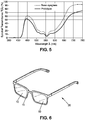
- the diagram of Figure 5 compares the spectral transmittance curve of the base eyeglass 1 as used for the tinted glass Prototype, but devoid of the layered structures 2 and 3, and that of the completed tinted glass Prototype. Actually, the spectral transmittance values are modified in a limited extent when the layered structure 3 is suppressed from the tinted glass Prototype. Put another way, a tinted glass which would be comprised only of the tinted base eyeglass 1 according to Table 1 and Figure 2 and the layered structure 2 according to the Cx-line of Table 5, almost meets the invention.
- the antireflective layered structure 3 as implemented in the tinted glass Prototype mainly has the function of reducing the reflection for light rays which impinge laterally from behind the wearer's head onto the concave face Cc of the tinted glass.
- the layered structure 2 as displayed in the Cx-line of Table 5 may be combined with many base eyeglasses of different types.
- the solar-protection eyewear 20 comprises two tinted glasses 10 each according to the invention, which are mounted in a frame 11 so as to fit on the wearer's face. Thanks to the invention, the eyewear 20 provides efficient solar protection to the wearer, while avoiding biological, hormonal and behavioural disorders for him.
- substrate-forming base eyeglasses of any type may be used, including those known under the acronyms or common designations MR7, MR8, 1.67, PhysiotintTM 1.67, TrivexTM, etc.
- Photochromic base eyeglasses, polarizing eyeglasses and any tinted lens may also be used.
Landscapes
- Physics & Mathematics (AREA)
- Health & Medical Sciences (AREA)
- Ophthalmology & Optometry (AREA)
- General Health & Medical Sciences (AREA)
- General Physics & Mathematics (AREA)
- Optics & Photonics (AREA)
- Spectroscopy & Molecular Physics (AREA)
- Eyeglasses (AREA)
- Joining Of Glass To Other Materials (AREA)
- Glass Compositions (AREA)
Abstract
Description
- The invention relates to an ophthalmic tinted glass and a solar-protection eyewear.
- Ophthalmic tinted glasses are known for long time for protecting the eyes against excessive solar light intensity. To this purpose, a tinted glass is designed for absorbing and/or reflecting solar light so as to reduce light intensity to an amount which provides safety and comfortable vision to the wearer. Light which is involved in vision for a human being, called visible light, corresponds to the wavelength range from 380 nm (nanometer) to 780 nm, called visible wavelength range.
- But it has been discovered more recently that light within the wavelength range from 460 nm to 510 nm is involved in maintaining circadian rhythms for the wearer. This range corresponds to medium-blue light. By significantly reducing retinal exposure to light which pertains to this wavelength range, tinted glasses may progressively have detrimental effects on the biological, hormonal and behavioural functions of the wearer. Such detrimental effects may appear after daily repeated and abusively prolonged wearing of the tinted glasses, and sleep troubles, seasonal affective disorders and mood disorders may result in long term. These effects are commonly described as chronobiological because of their consequences on the circadian rhythms of the wearer.
- In addition, by significantly reducing the intensity of visible light which enters into the eyes, the tinted glasses cause the pupil diameter to increase, which affects visual acuity. In particular, the depth of field is decreased and the optical aberrations are more important. Also the increase in the pupil diameter leads to higher energetic exposure of the retina to non-filtered light wavelengths, in particular in case of non-filtered blue-violet wavelengths which are deemed to be noxious. Blue-violet wavelengths correspond to values between 380 nm and 450 nm.
- From this situation, one object of the invention is to provide ophthalmic tinted glasses which produce protection against excessive light intensity but in which transmittance within the wavelength range from 460 nm to 510 nm is enriched.
- Another object of the invention is to allow production of such tinted glasses with enriched transmittance within the wavelength range 460 nm - 510 nm, from base tinted glasses.
- An additional object of the invention is to provide such tinted glasses which produce good protection against blue-violet light.
- For meeting at one of these objects or others, a first aspect of the invention proposes an ophthalmic tinted glass which comprises:
- a substrate-forming base eyeglass, comprised of a self-supporting portion of a light-transmitting material intermediate between a convex face and a concave face, and
- a first layered structure which covers the convex face of the base eyeglass, and which is adapted for increasing a reflection effective for light impinging from outside of the tinted glass onto the convex face covered by the first layered structure, when compared to a reference reflection effective for light impinging also from outside onto the convex face but without the first layered structure, the reflection increase being effective for at least one light wavelength higher than 520 nm, and preferably less than 780 nm.
- According to the invention, the base eyeglass and the first layered structure are such that a difference equal to a mean transmittance value of the tinted glass over a wavelength range from 460 nm to 510 nm minus a visual transmission value of the tinted glass is higher than 14%, preferably higher than or equal to 20%. Put another way, TmB - Tv > 14%, where TmB is the mean transmittance value of the tinted glass over the wavelength range from 460 nm to 510 nm, and Tv is the visual transmission value of the tinted glass as defined in standard ISO 8980-3:2013, for taking into account the spectral sensibility to light of the retina cells, and using the illuminant D65 as defined by CIE standard ISO 10526:1999/CIE S005/E-1998. In the frame of the present invention, the mean transmittance value over the wavelength range from 460 nm to 510 nm denotes the calculation result of ∫460nm 510nm T(λ)·dλ/50, denoted TmB, where 50 is the length in nanometers of the wavelength range 460 nm - 510 nm, corresponding to medium-blue light, λ denotes the wavelength in nanometers and T(λ) denotes the spectral transmittance value at wavelength λ.
- Possibly, in the whole description and appended claims, the wavelength range 460 nm - 510 nm may be replaced with range 465 nm - 495 nm while maintaining any threshold value unchanged. In such conditions, the mean transmittance value TmB to be considered is ∫465nm 495nm T(λ)·dλ/30, where 30 is the length in nanometers of the wavelength range 465 nm - 495 nm.
- In this way, the proportion of the medium-blue light relative to the total amount of light which is effective for vision is increased by the first layered structure. But simultaneously, by selectively increasing light reflection, the first layered structure also produces a solar protection effect, with respect to the base eyeglass devoid of the first layered structure, since it reduces the total amount of visible light which enters into the wearer's eye.
- The base eyeglass may be a clear eyeglass, for example with visual transmission value higher than 90%, or higher than 95%, when measured in daylight conditions or using illuminant D65.
- Alternatively, the material of base eyeglass may be light-absorbing, so that the base eyeglass produces a first solar protection effect. Then the first layered structure provides an additional solar protection so that the invention ophthalmic tinted glass has an overall solar protection efficiency which is improved with respect to that of the bare base eyeglass. And also in such case of light-absorbing base eyeglass, the first layered structure increases the relative proportion of medium-blue light with respect to the total light which is allowed by the base eyeglass to enter into the wearer's eye.
- In particular, the base eyeglass may have a visual transmission value which is higher than 18% when devoid of the first layered structure, and the first layered structure may be such that the visual transmission value of the tinted glass is less than or equal to 18%. In this way, the invention allows transforming an initial ophthalmic tinted glass which is formed by the bare base eyeglass, and which pertains to
class 2 as defined by the standard ISO 12312-1, into a final ophthalmic tinted glass which pertains toclass 3. - Advantageously, the base eyeglass and the first layered structure may be such that the mean transmittance value of the tinted glass over the wavelength range from 460 nm to 510 nm, or from 465 nm to 495 nm, is higher than 30%, preferably higher than 40%, more preferably higher than or equal to 48%. Then, enough medium-blue light intensity enters into the wearer's eye to ensure that biological, hormonal and behavioural functions are not altered, and related circadian rhythms are maintained.
- Generally for the invention, the base eyeglass may advantageously be such that its spectral transmittance when devoid of the first layered structure is less than 30%, preferably less than 20%, across the wavelength range from 380 nm to 450 nm. This means that the base eyeglass may be light-absorbing at least for visible light wavelengths below 450 nm. Thus, the base eyeglass provides protection against blue-violet light, and also the invention tinted glass.
- The base eyeglass may also be such that its spectral transmittance when devoid of the first layered structure is less than 25% across a wavelength range from 540 nm to 630 nm. This ensures that the invention tinted glass produces an efficient protection against dazzling for the wearer, because the maximum of the spectral sensibility of the human eye to light is close to 570 nm.
- Alternatively or in combination, the base eyeglass may be such that its visual transmission value is less than 25%, again when devoid of the first layered structure.
- The base eyeglass material may be comprised of a transparent matrix with dyes and absorbers which are distributed therein. At least one of the dyes may have a light-absorption peak in the wavelength range from 380 nm to 450 nm, and at least two of the absorbers may have respective light-absorption peaks in another wavelength range from 520 nm to 660 nm.
- Generally for the invention, the spectral reflectance of the ophthalmic tinted glass for light impinging on the convex optical face with incidence value of 15°, may have a value of more than 30% for at least one first wavelength comprised between 520 nm and 660 nm, and another value of less than 20% for at least one second wavelength comprised between 460 nm and 510 nm. Thus, the first layered structure is less light-reflecting at the second wavelength in the medium-blue range with chronobiological effect, than for longer wavelengths corresponding to green, yellow or red colors.
- Again generally for the invention, the ophthalmic tinted glass may further comprise:
- a second layered structure which covers the concave face of the base eyeglass, and which is adapted for decreasing a visual reflection value effective for light impinging from outside of the tinted glass onto the concave face covered by the second layered structure, when compared to a visual reference reflection effective for light impinging also from outside onto the concave face of the base eyeglass but when devoid of the second layered structure.
- Such antireflection coating on the concave face of the tinted glass, as formed by the second layered structure, avoids that reflected light from behind the wearer's head, obliquely on each side, interferes with vision through the tinted glass. Preferably, the second layered structure may be such that the visual reflection value effective for light impinging from outside of the tinted glass onto the concave face of the ophthalmic tinted glass covered by the second layered structure is less than 3%, preferably less than or equal to 2.5%, for incidence value of 35° (degree). The visual reflection values considered meet again the ISO standard indicated above for taking into account the spectral sensibility to light of the retina cells, using the illuminant D65.
- In possible embodiments of the invention, the first layered structure may be a stack of eleven layers alternatively of zirconia and silica, starting and ending with two of the zirconia layers. The zirconia layers may have respective thicknesses between 50 nm and 73 nm, and the silica layers may have respective thicknesses between 80 nm and 125 nm.
- In other possible embodiments of the invention, the first layered structure may be an ordered stack which comprises, from the convex face of the base eyeglass:
- an underlayer with a refractive index of about 1.5 for wavelength value of 633 nm, and with a thickness of between 65 nm and 80 nm,
- three layers alternatively of zirconia and silica, starting with a first zirconia layer having a thickness of between 90 nm and 100 nm, then a first silica layer having a thickness of between 59 nm and 65 nm, and then a second zirconia layer having a thickness of between 74 nm and 82 nm,
- one indium-tin oxide layer having a thickness of between 5 nm and 8 nm, and
- a second silica layer having a thickness of between 28 nm and 32 nm.
- Simultaneously, these other invention embodiments may comprise a second layered structure, which is another ordered stack comprising, from the concave face of the base eyeglass:
- another underlayer with a refractive index of about 1.5 for wavelength value of 633 nm, and with a thickness of between 143 nm and 158 nm,
- another three layers alternatively of zirconia and silica, starting with another first zirconia layer having a thickness of between 18 nm and 20 nm, then another first silica layer having a thickness of between 32 nm and 36 nm, and then another second zirconia layer having a thickness of between 70 nm and 78 nm,
- another indium-tin oxide layer having a thickness of between 5 nm and 8 nm, and
- another second silica layer having a thickness of between 95 nm and 104 nm.
- Finally, a second aspect of the invention proposes a solar-protection eyewear, which comprises a frame and two ophthalmic tinted glasses mounted into the frame, each ophthalmic tinted glass being in accordance with the first invention aspect.
- These and other features of the invention will be now described with reference to the appended figures, which relate to preferred but not-limiting embodiments of the invention.
-
-
Figures 1 a and 1 b are side views of two ophthalmic tinted glasses according to the invention. -
Figure 2 is a diagram displaying a spectral transmittance curve for a base eyeglass which may be used for an ophthalmic tinted glass according to the invention. -
Figures 3a and 3b are parts of cross-sectional views for two ophthalmic tinted glasses according to the invention. -
Figures 4a and 4b are diagrams displaying spectral transmittance and spectral reflectance curves for both ophthalmic tinted glasses ofFigures 3a and 3b . -
Figure 5 is diagram displaying a spectral transmittance curve for another ophthalmic tinted glass according to the invention. -
Figure 6 shows a solar-protection eyewear according to the invention. - For clarity sake, element sizes which appear in these figures do not correspond to actual dimensions or dimension ratios. Also, same reference labels which are indicated in some of these figures and in tables provided below denote identical elements of elements with identical function.
-
Figure 1a shows a first possible configuration for an ophthalmictinted glass 10 in accordance with the invention. It comprises abase eyeglass 1 which is self-supporting and has opposite optical faces Cx and Cc. The optical face Cx is convex and intended to be oriented towards a scene to be viewed when thetinted glass 10 is fitted within a spectacle frame and worn by a wearer. The optical face Cc is concave and intended to face an eye of the wearer. Both optical faces Cx and Cc may be such that thebase eyeglass 1 does not produce any ametropia correction, namely it is of plano type, or may be such that thebase eyeglass 1 produces an ametropia correction. In such latter case, thebase eyeglass 1 may be of single vision type or a progressive addition lens. - The
base eyeglass 1 is covered on its optical convex face Cx by alayered structure 2. Thelayered structure 2 is based on thin-film technology so that thebase eyeglass 1 forms a substrate for thelayered structure 2. Preferably, thelayered structure 2 is multi-layered, and any coating deposition process or combination of several coating deposition processes may be used for producing thelayered structure 2, including physical vapour deposition (PVD), e.g. beam evaporation, thermal evaporation, sputtering, and also including chemical vapour deposition (CVD), atomic layer deposition (ALD), sol-gel, varnish deposition, etc. Thestructure 2 has been called first layered structure in the general part of this description. - Optionally, according to a second possible configuration for an ophthalmic
tinted glass 10 in accordance with the invention, thebase eyeglass 1 may also be covered on its optical concave face Cc with alayered structure 3, as shown inFigure 1b . In such case, thelayered structure 3 is based on thin-film technology too, and may be multi-layered and deposited using the same deposition processes as recited above. Thestructure 3 has been called second layered structure in the general part of this description. - The
base eyeglass 1 may be a clear eyeglass, corresponding toclass 1 for tinted glasses as defined in standard ISO 12312-1. For example it may be an Orma™ eyeglass as supplied by Essilor, or a polycarbonate eyeglass. In such cases, the solar protection function of the ophthalmictinted glass 10 is provided by thelayered structure 2. - Alternatively, the
base eyeglass 1 may be of a light-absorbing material, still light-transmitting but with reduced transmission value, so that it produces per se a first contribution to the solar protection function of the ophthalmictinted glass 10. In such case, thelayered structure 2 produces an additional solar protection contribution, so that the solar protection efficiency of the ophthalmictinted glass 10 results from both contributions of thebase eyeglass 1 and thelayered structure 2. For such alternative embodiments, thebase eyeglass 1 may be based on Trivex™ matrix as supplied by PPG industries, which is well known and based on polyurethane polymer. The Trivex™ matrix is clear material per se, but dyes and absorbers can be incorporated therein for forming atinted base eyeglass 1. For example, Table 1 below indicates possible dye- and absorber concentrations which correspond to the spectral transmittance curve represented inFigure 2 , for a 2 mm (millimeter) thickpiano base eyeglass 1. The dye- and absorber concentrations are expressed in mg (milligram) of each dye or absorber for 100 g of the resulting blend of Trivex™ with the dyes and absorbers. Commercial suppliers are also indicated between parentheses.Table 1 dyes absorbers concentrations Macrolex Green 5B (Lanxess AG)) 4 Estofil Blue RR (Sandoz Ltd) 5 Macrolex Yellow G (Lanxess AG) 1.8 Exciton ABS584L (Exciton) 1 Macrolex Violet 3R (Lanxess AG) 1 Exciton ABS 526 (Exciton) 1.5 Yamada FDB002 (Yamada Chemical Co., Ltd.) 6 GentexA102 (Gentex) 0.5 - The dyes indicated are mainly responsible for the shape of the eyeglass transmittance profile for wavelength values between 380 nm and 450 nm, whereas the absorbers are mainly responsible for the shape of the eyeglass transmittance profile for wavelength values between 520 nm and 680 nm. In the diagram of
Figure 2 , the horizontal axis indicates the wavelength λ in the visible range, i.e. from 380 nm (nanometer) to 780 nm, and the vertical axis indicates the spectral transmittance values T(λ) for light impinging perpendicular to the convex face Cx. As this appears from the transmittance curve,such base eyeglass 1 produces light absorption for wavelength values between 380 nm and 450 nm, and also between 520 nm and 680 nm. The absorption between 380 nm and 450 nm is beneficial for protecting the wearer's eye against harmful blue-violet radiation, and that between 520 nm and 680 nm is efficient for producing the solar protection function. Actually, as shown in the diagram ofFigure 2 , the spectral transmittance T(λ) is much less than 20% in therange 380 nm - 450 nm, and less than 25% in the range 540 nm - 630 nm. However, the transmission window between 460 nm and 510 nm allows enriching the total light which is transmitted for vision to the wearer's eye with medium-blue light beneficial for the chronobiological effects. The visual transmission value Tv, as defined by the standard ISO 8980-3:2013 with illuminant D65, is then 23.1%, corresponding toclass 2 for tinted glasses as defined in standard ISO 12312-1. The rear side visual reflection value Rv, for light impinging on the concave face Cc, is about 5% at incidence value of 35°, and the mean transmittance value over the medium-blue range from 460 nm to 510 nm, TmB = ∫460nm 510nm T(λ)·dλ/50, is 53.1%. The rear side visual reflection value Rv which is considered here takes into account the absorption of the substrate. - Table 2 below displays the configurations of five ophthalmic
tinted glasses 10, labelled D1 to D5, with their respective values for the visual transmission Tv, the visual reflection Rv of the concave face Cc for incidence value of 35° (degree), and the medium-blue mean transmittance value TmB as defined by the integral equation above. For these tinted glasses D1 to D5, thebase eyeglass 1 is that ofFigure 2 and Table 1, denoted tinted as indicated in the column labelled 1.Table 2 10 1 face Z1 Q1 Z2 Q2 Z3 Tv(%) Rv(%) TmB(%) D1 tinted Cx 89.0 108.3 56.8 34.8 none 18.1 6.3 49.4 Cc air D2 tinted Cx 91.3 113.6 60.1 12.7 none 18.1 3.0 49.2 Cc 23.0 26.6 77.2 94.4 none D3 tinted Cx 87.8 115.0 58.1 99.7 103.2 18.0 6.4 56.0 Cc air D4 tinted Cx 83.3 57.6 78.8 71.5 124.5 18.6 2.5 49.7 Cc 19.6 38.1 86.4 100.6 none D5 tinted Cx 222.4 91.3 220.4 21.6 none 17.9 17.5 51.7 Cc 83.0 66.5 46.0 99.7 none - In this table, Z1, Q1, Z2, Q2 and Z3 denote the successive layers of the layered structures 2 (resp. 3) borne by the optical faces Cx (resp. Cc) of the
base eyeglasses 1, when recited from thebase eyeglass 1 to the air interface in front of (resp. behind) the tintedglass 10. Z1, Z2 and Z3 are zirconia (ZrO2) layers with refractive index value of about 2.00 for the wavelength value of 633 nm, and Q1 and Q2 are silica (SiO2) layers with refractive index value of about 1.47 for the same wavelength value of 633 nm. The values displayed in the layer columns are the physical thicknesses of the individual layers, expressed in nanometers, and provided that the actual thickness values are within +/-5% of the values displayed. Thelayered structures 2 displayed in the Cx-lines are of selective mirror type, because of being reflection-enhancing for some wavelength values above 520 nm when comparing thebase eyeglass 1 with and without thelayered structure 2. The mention "air" in two of the Cc-lines indicates that the concave optical faces Cc of the tinted glasses D1 and D3 do not have any layeredstructure 3, and thelayered structures 3 displayed in the Cc-lines for the tinted glasses D2 and D4 are of antireflection type. That for the tinted glass D5 is reflection-increasing. Tv-value being less than or equal to 18% means that thetinted glass 10 is ofclass 3. Thus, an appropriatelayered structure 2 and alayered structure 3 when implemented can transform abase eyeglass 1 which pertains toclass 2 of tinted glasses into atinted glass 10 ofclass 3. Rv-value being less than or equal to 2.5% means that thetinted glass 10 is antireflective on its rear side. - Table 3 below displays the values for another
tinted glass 10 according to the invention, which is labelled D6 and implements abase eyeglass 1 corresponding toFigure 2 and Table 1, with thickness of 2 mm for thisbase eyeglass 1. Thelayered structure 2 on the convex face Cx is of selective mirror type again, and thelayered structure 3 on the concave face Cc is antireflective. The layer thicknesses are expressed in nanometers again, and can vary within +/-5% with respect to the values indicated.Table 3: ophthalmic tinted glass D6 face UL Z1 Q1 Z2 ITO Q2 Tv(%) Rv(%) TmB(%) Cx 71.8 95.2 62.1 77.8 6.5 30.1 18.6 2.5 49.7 Cc 150.0 18.9 34.1 74.1 6.5 99.5 - In Table 3, UL denotes underlayers with refractive index value of about 1.50 at wavelength of 633 nm, and ITO denotes layers of indium-tin (In-Sn) oxide which are intermediate between layers Z2 and Q2. For example, the underlayers UL may be varnish layers which provide protection against impacts and scratches.
Figure 3a shows the layers of such tinted glass D6. - Table 4 below displays the values for another
tinted glass 10 according to the invention, which is labelled D7 and implements an Orma™ base eyeglass 1 with thickness of 2 mm. Thelayered structure 2 on the convex face Cx is comprised of eleven layers alternatively of zirconia (Z1-Z6) and silica (Q1-Q5), but nolayered structure 3 is on the concave face Cc. The layer thicknesses are expressed in nanometers again, and can vary within +/-5% with respect to the values indicated.Table 4: ophthalmic tinted glass D7 Z1 Q1 Z2 Q2 Z3 Q3 Z4 Q4 Z5 Q5 Z6 68.8 89.4 63.0 93.0 65.6 115.9 60.1 98.9 52.7 104.8 67.7 - For the tinted glass D7, the visual transmission Tv equals 18.0%, the visual reflection Rv for light impinging onto the concave side Cc with 35° incidence value equals 69.4%, and the medium-blue mean transmittance value TmB equals 50.1%.
Figure 3b shows the layers of such tinted glass D7. - The diagrams of
Figures 4a and 4b relate to these latter tinted glasses D6 and D7.Figure 4a exhibits the spectral transmittance curves for both tinted glasses. Spectral transmittance values are noted T(λ) again. For tinted glass D6, one can see the transmittance-lowering effect of thelayered structure 2 when compared to the curve ofFigure 2 . For tinted glass D7, the large deepening effect between 490 nm and 630 nm is provided by thelayered structure 2 of Table 4.Figure 4b shows the spectral reflectance values R(λ) for light impinging on the convex optical faces Cx with incidence value of 15°. In particular, the spectral reflectance is 37.4% at 610 nm and 13.5% at 480 nm for the tinted glass D6. For the tinted glass D7, the spectral reflectance is 92.5% at 540 nm and 8.8% at 465 nm, again for light impinging on the convex optical faces Cx with incidence value of 15°. - Finally, a last invention embodiment is provided in Table 5 below and
Figure 5 . Thebase eyeglass 1 is that ofFigure 2 and Table 1. Table 5 displays the layer thicknesses in nanometers for bothlayered structures tinted glass 10, called Prototype. The actual thickness values may vary again within +/-5% with respect to the values indicated. Thelayered structure 2 on the convex face Cx has four layers, and is again of selective mirror type. Thelayered structure 3 on the concave face Cc has six layers, including one of tin oxide (SnO2) which is intermediate between the layers Z3 and Q3, and is antireflective.Table 5: ophthalmic tinted glass Prototype 1 face Z1 Q1 Z2 Q2 Z3 SnO2 Q3 Tv(%) TmB(%) tinted Cx 65.5 117.4 52.4 41.4 none none none 17.9 47.8 Cc none 150.0 18.43 23.0 100.6 6.5 75.6 - The diagram of
Figure 5 compares the spectral transmittance curve of thebase eyeglass 1 as used for the tinted glass Prototype, but devoid of thelayered structures layered structure 3 is suppressed from the tinted glass Prototype. Put another way, a tinted glass which would be comprised only of thetinted base eyeglass 1 according to Table 1 andFigure 2 and thelayered structure 2 according to the Cx-line of Table 5, almost meets the invention. In particular, such tinted glass Prototype devoid of thelayered structure 3 on its concave face Cc has the following values: Tv=17.4% and TmB=46.3%. The antireflectivelayered structure 3 as implemented in the tinted glass Prototype mainly has the function of reducing the reflection for light rays which impinge laterally from behind the wearer's head onto the concave face Cc of the tinted glass. - Alternatively, the
layered structure 2 as displayed in the Cx-line of Table 5 may be combined with many base eyeglasses of different types. In particular, it may be applied on the convex face of a Trivex™-basedclear base eyeglass 1. Then, the following values are obtained without implementing anylayered structure 3 on the concave face Cc: Tv=63.6% and TmB = 77.7%. - In
Figure 6 , the solar-protection eyewear 20 comprises twotinted glasses 10 each according to the invention, which are mounted in aframe 11 so as to fit on the wearer's face. Thanks to the invention, theeyewear 20 provides efficient solar protection to the wearer, while avoiding biological, hormonal and behavioural disorders for him. - Generally for the invention, substrate-forming base eyeglasses of any type may be used, including those known under the acronyms or common designations MR7, MR8, 1.67, Physiotint™ 1.67, Trivex™, etc. Photochromic base eyeglasses, polarizing eyeglasses and any tinted lens may also be used.
Claims (14)
- An ophthalmic tinted glass (10) comprising:- a substrate-forming base eyeglass (1), comprised of a self-supporting portion of a light-transmitting material intermediate between a convex face (Cx) and a concave face (Cc), and- a first layered structure (2) covering the convex face (Cx) of the base eyeglass (1), and adapted for increasing a reflection effective for light impinging from outside of the tinted glass (10) onto the convex face covered by the first layered structure, when compared to a reference reflection effective for light impinging also from outside onto the convex face but without the first layered structure, the reflection increase being effective for at least one light wavelength higher than 520 nm,the base eyeglass (1) and the first layered structure (2) being such that a difference equal to a mean transmittance value of the tinted glass (10) over a wavelength range from 460 nm to 510 nm, or from 465 nm to 495 nm, minus a visual transmission value of the tinted glass is higher than 14%.
- The ophthalmic tinted glass (10) of claim 1, wherein the base eyeglass (1) and the first layered structure (2) are such that the difference equal to the mean transmittance value over the wavelength range from 460 nm to 510 nm, or from 465 nm to 495 nm, minus the visual transmission value is higher than or equal to 20%.
- The ophthalmic tinted glass (10) of claim 1 or 2, wherein the base eyeglass (1) has a visual transmission value higher than 18% when devoid of the first layered structure (2), and the first layered structure is such that the visual transmission value of the tinted glass (10) is less than or equal to 18%.
- The ophthalmic tinted glass (10) of any one of claims 1 to 3, wherein the base eyeglass (1) and the first layered structure (2) are such that the mean transmittance value of the tinted glass (10) over the wavelength range from 460 nm to 510 nm, or from 465 nm to 495 nm, is higher than 30%, preferably higher than 40%, more preferably higher than or equal to 48%.
- The ophthalmic tinted glass (10) of any one of claims 1 to 4, wherein the base eyeglass (1) is such that a spectral transmittance of said base eyeglass when devoid of the first layered structure (2), is less than 30%, preferably less than 20%, across a wavelength range from 380 nm to 450 nm.
- The ophthalmic tinted glass (10) of any one of claims 1 to 5, wherein the base eyeglass (1) is such that a spectral transmittance of said base eyeglass when devoid of the first layered structure (2) is less than 25% across a wavelength range from 540 nm to 630 nm.
- The ophthalmic tinted glass (10) of any one of claims 1 to 6, wherein the base eyeglass (1) is such that the visual transmission value of said base eyeglass when devoid of the first layered structure (2) is less than 25%.
- The ophthalmic tinted glass (10) of any one of claims 1 to 7, wherein the material of the base eyeglass (1) is comprised of a transparent matrix with dyes and absorbers distributed within the matrix, at least one of said dyes having a light-absorption peak in a wavelength range from 380 nm to 450 nm, and at least two of said absorbers having respective light-absorption peaks in another wavelength range from 520 nm to 660 nm.
- The ophthalmic tinted glass (10) of any one of claims 1 to 8, wherein a spectral reflectance of said ophthalmic tinted glass for light impinging on the convex optical face (Cx) with incidence value of 15°, has a value of more than 30% for at least one first wavelength comprised between 520 nm and 660 nm, and another value of less than 20% for at least one second wavelength comprised between 460 nm and 510 nm.
- The ophthalmic tinted glass (10) of any one of claims 1 to 9, further comprising:- a second layered structure (3) covering the concave face (Cc) of the base eyeglass (1), and adapted for decreasing a visual reflection value effective for light impinging from outside of the tinted glass (10) onto the concave face covered by the second layered structure, when compared to a visual reference reflection effective for light impinging also from outside onto the concave face of the base eyeglass but when devoid of the second layered structure.
- The ophthalmic tinted glass (10) of claim 10, wherein the second layered structure (3) is such that the visual reflection value effective for light impinging from outside of the tinted glass onto the concave face (Cc) covered by said second layered structure is less than 3%, preferably less than or equal to 2.5%, for incidence value of 35°.
- The ophthalmic tinted glass (10) of any one of claims 1 to 11, wherein the first layered structure (2) is a stack of eleven layers alternatively of zirconia and silica, starting and ending with two of said zirconia layers, with the zirconia layers (Z1-Z6) having respective thicknesses between 50 nm and 73 nm, and the silica layers (Q1-Q5) having respective thicknesses between 80 nm and 125 nm.
- The ophthalmic tinted glass of claim 10 or 11, wherein the first layered structure (2) is an ordered stack comprising, from the convex face (Cx) of the base eyeglass (1):- an underlayer (UL) with a refractive index of about 1.5 for wavelength value of 633 nm, and with a thickness of between 65 nm and 80 nm,- three layers alternatively of zirconia and silica, starting with a first zirconia layer (Z1) having a thickness of between 90 nm and 100 nm, then a first silica layer (Q1) having a thickness of between 59 nm and 65 nm, and then a second zirconia layer (Z2) having a thickness of between 74 nm and 82 nm,- one indium-tin oxide layer (ITO) having a thickness of between 5 nm and 8 nm, and- a second silica layer (Q2) having a thickness of between 28 nm and 32 nm;and wherein the second layered structure (3) is an ordered stack comprising, from the concave face (Cc) of the base eyeglass (1):- another underlayer (UL) with a refractive index of about 1.5 for wavelength value of 633 nm, and with a thickness of between 143 nm and 158 nm,- another three layers alternatively of zirconia and silica, starting with another first zirconia layer (Z1) having a thickness of between 18 nm and 20 nm, then another first silica layer (Q1) having a thickness of between 32 nm and 36 nm, and then another second zirconia layer (Z2) having a thickness of between 70 nm and 78 nm,- another indium-tin oxide layer (ITO) having a thickness of between 5 nm and 8 nm, and- another second silica layer (Q2) having a thickness of between 95 nm and 104 nm.
- Solar-protection eyewear (20), comprising a frame (11) and two ophthalmic tinted glasses (10) mounted into the frame, each ophthalmic tinted glass being in accordance with any one of claims 1 to 13.
Priority Applications (4)
| Application Number | Priority Date | Filing Date | Title |
|---|---|---|---|
| EP18305153.1A EP3528037B1 (en) | 2018-02-15 | 2018-02-15 | Ophthalmic tinted glass |
| US16/969,484 US11561416B2 (en) | 2018-02-15 | 2019-02-15 | Ophthalmic tinted glass |
| CN201980012950.7A CN111727401B (en) | 2018-02-15 | 2019-02-15 | Ophthalmic colored lens |
| PCT/EP2019/053866 WO2019158717A1 (en) | 2018-02-15 | 2019-02-15 | Ophthalmic tinted glass |
Applications Claiming Priority (1)
| Application Number | Priority Date | Filing Date | Title |
|---|---|---|---|
| EP18305153.1A EP3528037B1 (en) | 2018-02-15 | 2018-02-15 | Ophthalmic tinted glass |
Publications (2)
| Publication Number | Publication Date |
|---|---|
| EP3528037A1 true EP3528037A1 (en) | 2019-08-21 |
| EP3528037B1 EP3528037B1 (en) | 2025-04-09 |
Family
ID=61283128
Family Applications (1)
| Application Number | Title | Priority Date | Filing Date |
|---|---|---|---|
| EP18305153.1A Active EP3528037B1 (en) | 2018-02-15 | 2018-02-15 | Ophthalmic tinted glass |
Country Status (4)
| Country | Link |
|---|---|
| US (1) | US11561416B2 (en) |
| EP (1) | EP3528037B1 (en) |
| CN (1) | CN111727401B (en) |
| WO (1) | WO2019158717A1 (en) |
Cited By (5)
| Publication number | Priority date | Publication date | Assignee | Title |
|---|---|---|---|---|
| WO2021122530A1 (en) | 2019-12-16 | 2021-06-24 | Essilor International | Methods for designing an ophthalmic tinted lens and ophthalmic tinted lenses, and corresponding ophthalmic tinted lens |
| US11561416B2 (en) * | 2018-02-15 | 2023-01-24 | Essilor International | Ophthalmic tinted glass |
| CN116435377A (en) * | 2023-04-17 | 2023-07-14 | 苏州弘德光电材料科技有限公司 | A kind of optical film, photovoltaic module |
| US12337191B2 (en) | 2023-09-07 | 2025-06-24 | NeuroRays, LLC | Color balanced sunglass lens for ocular photo-bio-stimulation |
| US12582837B2 (en) | 2023-09-07 | 2026-03-24 | NeuroRays, LLC | Color balanced sunglass lens for ocular photo-bio-stimulation |
Families Citing this family (5)
| Publication number | Priority date | Publication date | Assignee | Title |
|---|---|---|---|---|
| WO2021220513A1 (en) * | 2020-05-01 | 2021-11-04 | 株式会社ニコン・エシロール | Optical member |
| EP3907553B1 (en) | 2020-05-07 | 2024-11-20 | Essilor International | Ophthalmic lens configured to exhibit a clear state and optionally a dark state |
| CN112526645B (en) * | 2020-12-03 | 2023-07-25 | 艾普偏光科技(厦门)有限公司 | F-P Fabry-Perot technology visible light color-changing lens and spectacle lens |
| WO2022204593A1 (en) * | 2021-03-26 | 2022-09-29 | Perkinson Alvin P | Eyewear lenses |
| WO2023249067A1 (en) * | 2022-06-24 | 2023-12-28 | 三井化学株式会社 | Information processing device, information processing server, information processing method, and computer program |
Citations (8)
| Publication number | Priority date | Publication date | Assignee | Title |
|---|---|---|---|---|
| US3826751A (en) * | 1970-12-07 | 1974-07-30 | American Optical Corp | Selective optical filter and method of manufacture |
| US5083858A (en) * | 1989-04-17 | 1992-01-28 | Girerd Rene J | Photobiologic sunglasses and transmitters |
| US5592245A (en) * | 1994-08-10 | 1997-01-07 | Moore; J. Paul | Apparatus for enhancing visual perception of selected objects in recreational and sporting activities |
| DE102007007777A1 (en) * | 2006-11-29 | 2008-06-05 | Eckhart Watzke | Low-risk ocular regulation of photoneural process, useful e.g. for suppressing melatonin secretion, comprises positioning an economical, solarization stable optical filter in the optical path between radiation sources and the eyes |
| WO2013177676A1 (en) * | 2012-05-29 | 2013-12-05 | Switch Materials Inc. | Optical filter comprising a variable transmittance layer |
| US20150309335A1 (en) * | 2014-04-25 | 2015-10-29 | Megalowmart Holdings Llc. | Blue-Light-Inhibiting Resin Lens and Manufacturing Method Therefor |
| EP3088921A1 (en) * | 2014-02-04 | 2016-11-02 | Tokai Optical Co., Ltd. | Optical product, glasses lens and glasses |
| US20170242273A1 (en) * | 2014-10-17 | 2017-08-24 | Hoya Lens Thailand Ltd. | Spectacle lens and spectacles |
Family Cites Families (5)
| Publication number | Priority date | Publication date | Assignee | Title |
|---|---|---|---|---|
| US6631987B2 (en) * | 2001-01-23 | 2003-10-14 | Nike, Inc. | Activity-specific optical filters and eyewear using such filters |
| US8941488B2 (en) | 2013-05-17 | 2015-01-27 | Johnson & Johnson Vision Care, Inc. | System and method for a processor controlled ophthalmic lens |
| EP3112910A1 (en) | 2015-06-29 | 2017-01-04 | ESSILOR INTERNATIONAL (Compagnie Générale d'Optique) | Optical filter |
| EP3112926A1 (en) * | 2015-06-29 | 2017-01-04 | ESSILOR INTERNATIONAL (Compagnie Générale d'Optique) | Ophthalmic lens with improved colour perception |
| EP3528037B1 (en) * | 2018-02-15 | 2025-04-09 | Essilor International | Ophthalmic tinted glass |
-
2018
- 2018-02-15 EP EP18305153.1A patent/EP3528037B1/en active Active
-
2019
- 2019-02-15 WO PCT/EP2019/053866 patent/WO2019158717A1/en not_active Ceased
- 2019-02-15 CN CN201980012950.7A patent/CN111727401B/en active Active
- 2019-02-15 US US16/969,484 patent/US11561416B2/en active Active
Patent Citations (8)
| Publication number | Priority date | Publication date | Assignee | Title |
|---|---|---|---|---|
| US3826751A (en) * | 1970-12-07 | 1974-07-30 | American Optical Corp | Selective optical filter and method of manufacture |
| US5083858A (en) * | 1989-04-17 | 1992-01-28 | Girerd Rene J | Photobiologic sunglasses and transmitters |
| US5592245A (en) * | 1994-08-10 | 1997-01-07 | Moore; J. Paul | Apparatus for enhancing visual perception of selected objects in recreational and sporting activities |
| DE102007007777A1 (en) * | 2006-11-29 | 2008-06-05 | Eckhart Watzke | Low-risk ocular regulation of photoneural process, useful e.g. for suppressing melatonin secretion, comprises positioning an economical, solarization stable optical filter in the optical path between radiation sources and the eyes |
| WO2013177676A1 (en) * | 2012-05-29 | 2013-12-05 | Switch Materials Inc. | Optical filter comprising a variable transmittance layer |
| EP3088921A1 (en) * | 2014-02-04 | 2016-11-02 | Tokai Optical Co., Ltd. | Optical product, glasses lens and glasses |
| US20150309335A1 (en) * | 2014-04-25 | 2015-10-29 | Megalowmart Holdings Llc. | Blue-Light-Inhibiting Resin Lens and Manufacturing Method Therefor |
| US20170242273A1 (en) * | 2014-10-17 | 2017-08-24 | Hoya Lens Thailand Ltd. | Spectacle lens and spectacles |
Cited By (13)
| Publication number | Priority date | Publication date | Assignee | Title |
|---|---|---|---|---|
| US11561416B2 (en) * | 2018-02-15 | 2023-01-24 | Essilor International | Ophthalmic tinted glass |
| WO2021122530A1 (en) | 2019-12-16 | 2021-06-24 | Essilor International | Methods for designing an ophthalmic tinted lens and ophthalmic tinted lenses, and corresponding ophthalmic tinted lens |
| AU2020405962B2 (en) * | 2019-12-16 | 2024-02-01 | Essilor International | Methods for designing an ophthalmic tinted lens and ophthalmic tinted lenses, and corresponding ophthalmic tinted lens |
| US12474599B2 (en) | 2019-12-16 | 2025-11-18 | Essilor International | Methods for designing an ophthalmic tinted lens and ophthalmic tinted lenses, and corresponding ophthalmic tinted lens |
| CN116435377A (en) * | 2023-04-17 | 2023-07-14 | 苏州弘德光电材料科技有限公司 | A kind of optical film, photovoltaic module |
| US12409337B2 (en) | 2023-09-07 | 2025-09-09 | NeuroRays, LLC | Blue light ocular photo-bio-stimulation and moving fixation target |
| US12409338B1 (en) | 2023-09-07 | 2025-09-09 | NeuroRays, LLC | Red light ocular photo-bio-stimulation and moving fixation target |
| US12337191B2 (en) | 2023-09-07 | 2025-06-24 | NeuroRays, LLC | Color balanced sunglass lens for ocular photo-bio-stimulation |
| US12472377B2 (en) | 2023-09-07 | 2025-11-18 | NeuroRays, LLC | Filtering eyewear and optics for ocular photo-bio-stimulation |
| US12515071B1 (en) | 2023-09-07 | 2026-01-06 | NeuroRays, LLC | System for providing ocular photo-bio-stimulation light |
| US12582837B2 (en) | 2023-09-07 | 2026-03-24 | NeuroRays, LLC | Color balanced sunglass lens for ocular photo-bio-stimulation |
| US12616849B2 (en) | 2023-09-07 | 2026-05-05 | NeuroRays, LLC | Sunglass lens and sunglass optics for ocular photo-bio-stimulation |
| US12702862B2 (en) | 2023-09-07 | 2026-08-11 | NeuroRays, LLC | Filtering eyewear and optics for ocular photo-bio-stimulation |
Also Published As
| Publication number | Publication date |
|---|---|
| US11561416B2 (en) | 2023-01-24 |
| WO2019158717A1 (en) | 2019-08-22 |
| US20200400974A1 (en) | 2020-12-24 |
| EP3528037B1 (en) | 2025-04-09 |
| CN111727401A (en) | 2020-09-29 |
| CN111727401B (en) | 2022-11-01 |
Similar Documents
| Publication | Publication Date | Title |
|---|---|---|
| EP3528037B1 (en) | Ophthalmic tinted glass | |
| US8210678B1 (en) | Multiband contrast-enhancing light filter and polarized sunglass lens comprising same | |
| US5135298A (en) | Sunglass lens | |
| US10330953B2 (en) | Ophthalmic lens | |
| US5574517A (en) | Aid for color vision deficiencies | |
| US6145984A (en) | Color-enhancing polarized lens | |
| CN101529311B (en) | System and method for selective light inhibition | |
| US11016313B2 (en) | Ophthalmic lens | |
| US20170336545A1 (en) | Methods, systems, and apparatus for reducing the frequency and/or severity of photophobic responses or for modulating circadian cycles | |
| US20100149483A1 (en) | Optical Filter for Selectively Blocking Light | |
| US20130282115A1 (en) | Dual-filter ophthalmic lens to reduce risk of macular degeneration | |
| CN102124394A (en) | Low-power eyewear for reducing symptoms of computer vision syndrome | |
| US11474381B2 (en) | Ophthalmic article | |
| US10088693B2 (en) | Ophthalmic lens, in particular for sunglasses | |
| CN103842892A (en) | Synthetic resin lens | |
| US12474600B2 (en) | Sleep-aiding eyewear with improved visibility | |
| CA3072541A1 (en) | Methods, systems, and apparatus for reducing the frequency and/or severity of photophobic responses or for modulating circadian cycles | |
| US20240230956A1 (en) | Optical lens having an antireflection coating reflecting blue light | |
| EP4102264A1 (en) | Optical lens having an antireflection coating reflecting harmful blue light and nir radiation | |
| US12399388B2 (en) | Optical lens having an antireflection coating reflecting harmful blue light | |
| CN111712754B (en) | Ophthalmic colored lens | |
| GB2277602A (en) | Opthalmic graduated photochromic lens | |
| EP4535045A1 (en) | Optical lens having a narrow band antireflective coating reflecting blue light | |
| HK1255884B (en) | Ophthalmic lens | |
| HK1255884A1 (en) | Ophthalmic lens |
Legal Events
| Date | Code | Title | Description |
|---|---|---|---|
| PUAI | Public reference made under article 153(3) epc to a published international application that has entered the european phase |
Free format text: ORIGINAL CODE: 0009012 |
|
| STAA | Information on the status of an ep patent application or granted ep patent |
Free format text: STATUS: THE APPLICATION HAS BEEN PUBLISHED |
|
| AK | Designated contracting states |
Kind code of ref document: A1 Designated state(s): AL AT BE BG CH CY CZ DE DK EE ES FI FR GB GR HR HU IE IS IT LI LT LU LV MC MK MT NL NO PL PT RO RS SE SI SK SM TR |
|
| AX | Request for extension of the european patent |
Extension state: BA ME |
|
| STAA | Information on the status of an ep patent application or granted ep patent |
Free format text: STATUS: REQUEST FOR EXAMINATION WAS MADE |
|
| 17P | Request for examination filed |
Effective date: 20200214 |
|
| RBV | Designated contracting states (corrected) |
Designated state(s): AL AT BE BG CH CY CZ DE DK EE ES FI FR GB GR HR HU IE IS IT LI LT LU LV MC MK MT NL NO PL PT RO RS SE SI SK SM TR |
|
| STAA | Information on the status of an ep patent application or granted ep patent |
Free format text: STATUS: EXAMINATION IS IN PROGRESS |
|
| 17Q | First examination report despatched |
Effective date: 20201209 |
|
| P01 | Opt-out of the competence of the unified patent court (upc) registered |
Effective date: 20230525 |
|
| GRAP | Despatch of communication of intention to grant a patent |
Free format text: ORIGINAL CODE: EPIDOSNIGR1 |
|
| STAA | Information on the status of an ep patent application or granted ep patent |
Free format text: STATUS: GRANT OF PATENT IS INTENDED |
|
| INTG | Intention to grant announced |
Effective date: 20241001 |
|
| GRAS | Grant fee paid |
Free format text: ORIGINAL CODE: EPIDOSNIGR3 |
|
| GRAA | (expected) grant |
Free format text: ORIGINAL CODE: 0009210 |
|
| STAA | Information on the status of an ep patent application or granted ep patent |
Free format text: STATUS: THE PATENT HAS BEEN GRANTED |
|
| AK | Designated contracting states |
Kind code of ref document: B1 Designated state(s): AL AT BE BG CH CY CZ DE DK EE ES FI FR GB GR HR HU IE IS IT LI LT LU LV MC MK MT NL NO PL PT RO RS SE SI SK SM TR |
|
| REG | Reference to a national code |
Ref country code: GB Ref legal event code: FG4D |
|
| REG | Reference to a national code |
Ref country code: CH Ref legal event code: EP |
|
| REG | Reference to a national code |
Ref country code: DE Ref legal event code: R096 Ref document number: 602018080916 Country of ref document: DE |
|
| REG | Reference to a national code |
Ref country code: IE Ref legal event code: FG4D |
|
| REG | Reference to a national code |
Ref country code: NL Ref legal event code: MP Effective date: 20250409 |
|
| PG25 | Lapsed in a contracting state [announced via postgrant information from national office to epo] |
Ref country code: NL Free format text: LAPSE BECAUSE OF FAILURE TO SUBMIT A TRANSLATION OF THE DESCRIPTION OR TO PAY THE FEE WITHIN THE PRESCRIBED TIME-LIMIT Effective date: 20250409 |
|
| REG | Reference to a national code |
Ref country code: AT Ref legal event code: MK05 Ref document number: 1784044 Country of ref document: AT Kind code of ref document: T Effective date: 20250409 |
|
| PG25 | Lapsed in a contracting state [announced via postgrant information from national office to epo] |
Ref country code: ES Free format text: LAPSE BECAUSE OF FAILURE TO SUBMIT A TRANSLATION OF THE DESCRIPTION OR TO PAY THE FEE WITHIN THE PRESCRIBED TIME-LIMIT Effective date: 20250409 Ref country code: PT Free format text: LAPSE BECAUSE OF FAILURE TO SUBMIT A TRANSLATION OF THE DESCRIPTION OR TO PAY THE FEE WITHIN THE PRESCRIBED TIME-LIMIT Effective date: 20250811 Ref country code: FI Free format text: LAPSE BECAUSE OF FAILURE TO SUBMIT A TRANSLATION OF THE DESCRIPTION OR TO PAY THE FEE WITHIN THE PRESCRIBED TIME-LIMIT Effective date: 20250409 |
|
| REG | Reference to a national code |
Ref country code: LT Ref legal event code: MG9D |
|
| PG25 | Lapsed in a contracting state [announced via postgrant information from national office to epo] |
Ref country code: GR Free format text: LAPSE BECAUSE OF FAILURE TO SUBMIT A TRANSLATION OF THE DESCRIPTION OR TO PAY THE FEE WITHIN THE PRESCRIBED TIME-LIMIT Effective date: 20250710 Ref country code: NO Free format text: LAPSE BECAUSE OF FAILURE TO SUBMIT A TRANSLATION OF THE DESCRIPTION OR TO PAY THE FEE WITHIN THE PRESCRIBED TIME-LIMIT Effective date: 20250709 |
|
| PG25 | Lapsed in a contracting state [announced via postgrant information from national office to epo] |
Ref country code: PL Free format text: LAPSE BECAUSE OF FAILURE TO SUBMIT A TRANSLATION OF THE DESCRIPTION OR TO PAY THE FEE WITHIN THE PRESCRIBED TIME-LIMIT Effective date: 20250409 |
|
| PG25 | Lapsed in a contracting state [announced via postgrant information from national office to epo] |
Ref country code: BG Free format text: LAPSE BECAUSE OF FAILURE TO SUBMIT A TRANSLATION OF THE DESCRIPTION OR TO PAY THE FEE WITHIN THE PRESCRIBED TIME-LIMIT Effective date: 20250409 |
|
| PG25 | Lapsed in a contracting state [announced via postgrant information from national office to epo] |
Ref country code: HR Free format text: LAPSE BECAUSE OF FAILURE TO SUBMIT A TRANSLATION OF THE DESCRIPTION OR TO PAY THE FEE WITHIN THE PRESCRIBED TIME-LIMIT Effective date: 20250409 |
|
| PG25 | Lapsed in a contracting state [announced via postgrant information from national office to epo] |
Ref country code: AT Free format text: LAPSE BECAUSE OF FAILURE TO SUBMIT A TRANSLATION OF THE DESCRIPTION OR TO PAY THE FEE WITHIN THE PRESCRIBED TIME-LIMIT Effective date: 20250409 |
|
| PG25 | Lapsed in a contracting state [announced via postgrant information from national office to epo] |
Ref country code: RS Free format text: LAPSE BECAUSE OF FAILURE TO SUBMIT A TRANSLATION OF THE DESCRIPTION OR TO PAY THE FEE WITHIN THE PRESCRIBED TIME-LIMIT Effective date: 20250709 |
|
| PG25 | Lapsed in a contracting state [announced via postgrant information from national office to epo] |
Ref country code: IS Free format text: LAPSE BECAUSE OF FAILURE TO SUBMIT A TRANSLATION OF THE DESCRIPTION OR TO PAY THE FEE WITHIN THE PRESCRIBED TIME-LIMIT Effective date: 20250809 |
|
| PG25 | Lapsed in a contracting state [announced via postgrant information from national office to epo] |
Ref country code: LV Free format text: LAPSE BECAUSE OF FAILURE TO SUBMIT A TRANSLATION OF THE DESCRIPTION OR TO PAY THE FEE WITHIN THE PRESCRIBED TIME-LIMIT Effective date: 20250409 |
|
| REG | Reference to a national code |
Ref country code: DE Ref legal event code: R097 Ref document number: 602018080916 Country of ref document: DE |
|
| PG25 | Lapsed in a contracting state [announced via postgrant information from national office to epo] |
Ref country code: SM Free format text: LAPSE BECAUSE OF FAILURE TO SUBMIT A TRANSLATION OF THE DESCRIPTION OR TO PAY THE FEE WITHIN THE PRESCRIBED TIME-LIMIT Effective date: 20250409 Ref country code: DK Free format text: LAPSE BECAUSE OF FAILURE TO SUBMIT A TRANSLATION OF THE DESCRIPTION OR TO PAY THE FEE WITHIN THE PRESCRIBED TIME-LIMIT Effective date: 20250409 |
|
| PG25 | Lapsed in a contracting state [announced via postgrant information from national office to epo] |
Ref country code: CZ Free format text: LAPSE BECAUSE OF FAILURE TO SUBMIT A TRANSLATION OF THE DESCRIPTION OR TO PAY THE FEE WITHIN THE PRESCRIBED TIME-LIMIT Effective date: 20250409 |
|
| PG25 | Lapsed in a contracting state [announced via postgrant information from national office to epo] |
Ref country code: EE Free format text: LAPSE BECAUSE OF FAILURE TO SUBMIT A TRANSLATION OF THE DESCRIPTION OR TO PAY THE FEE WITHIN THE PRESCRIBED TIME-LIMIT Effective date: 20250409 |
|
| PG25 | Lapsed in a contracting state [announced via postgrant information from national office to epo] |
Ref country code: SK Free format text: LAPSE BECAUSE OF FAILURE TO SUBMIT A TRANSLATION OF THE DESCRIPTION OR TO PAY THE FEE WITHIN THE PRESCRIBED TIME-LIMIT Effective date: 20250409 Ref country code: RO Free format text: LAPSE BECAUSE OF FAILURE TO SUBMIT A TRANSLATION OF THE DESCRIPTION OR TO PAY THE FEE WITHIN THE PRESCRIBED TIME-LIMIT Effective date: 20250409 |
|
| PG25 | Lapsed in a contracting state [announced via postgrant information from national office to epo] |
Ref country code: IT Free format text: LAPSE BECAUSE OF FAILURE TO SUBMIT A TRANSLATION OF THE DESCRIPTION OR TO PAY THE FEE WITHIN THE PRESCRIBED TIME-LIMIT Effective date: 20250409 |
|
| PLBE | No opposition filed within time limit |
Free format text: ORIGINAL CODE: 0009261 |
|
| STAA | Information on the status of an ep patent application or granted ep patent |
Free format text: STATUS: NO OPPOSITION FILED WITHIN TIME LIMIT |
|
| REG | Reference to a national code |
Ref country code: CH Ref legal event code: L10 Free format text: ST27 STATUS EVENT CODE: U-0-0-L10-L00 (AS PROVIDED BY THE NATIONAL OFFICE) Effective date: 20260218 |
|
| 26N | No opposition filed |
Effective date: 20260112 |
|
| PGFP | Annual fee paid to national office [announced via postgrant information from national office to epo] |
Ref country code: GB Payment date: 20260227 Year of fee payment: 9 |
|
| PGFP | Annual fee paid to national office [announced via postgrant information from national office to epo] |
Ref country code: DE Payment date: 20260227 Year of fee payment: 9 |
|
| PGFP | Annual fee paid to national office [announced via postgrant information from national office to epo] |
Ref country code: FR Payment date: 20260225 Year of fee payment: 9 |
|
| PG25 | Lapsed in a contracting state [announced via postgrant information from national office to epo] |
Ref country code: LT Free format text: LAPSE BECAUSE OF FAILURE TO SUBMIT A TRANSLATION OF THE DESCRIPTION OR TO PAY THE FEE WITHIN THE PRESCRIBED TIME-LIMIT Effective date: 20250409 |
|
| PG25 | Lapsed in a contracting state [announced via postgrant information from national office to epo] |
Ref country code: SE Free format text: LAPSE BECAUSE OF FAILURE TO SUBMIT A TRANSLATION OF THE DESCRIPTION OR TO PAY THE FEE WITHIN THE PRESCRIBED TIME-LIMIT Effective date: 20250409 |