EP3527598A1 - Radically curable organosiloxane graft polyvinyl alcohol polymer and process for producing same - Google Patents
Radically curable organosiloxane graft polyvinyl alcohol polymer and process for producing same Download PDFInfo
- Publication number
- EP3527598A1 EP3527598A1 EP19155410.4A EP19155410A EP3527598A1 EP 3527598 A1 EP3527598 A1 EP 3527598A1 EP 19155410 A EP19155410 A EP 19155410A EP 3527598 A1 EP3527598 A1 EP 3527598A1
- Authority
- EP
- European Patent Office
- Prior art keywords
- general formula
- polyvinyl alcohol
- group
- radically curable
- curable organosiloxane
- Prior art date
- Legal status (The legal status is an assumption and is not a legal conclusion. Google has not performed a legal analysis and makes no representation as to the accuracy of the status listed.)
- Granted
Links
- 0 CC(N*C(C(*)=C)=O)=O Chemical compound CC(N*C(C(*)=C)=O)=O 0.000 description 5
- MGOLNIXAPIAKFM-UHFFFAOYSA-N CC(C)(C)N=C=O Chemical compound CC(C)(C)N=C=O MGOLNIXAPIAKFM-UHFFFAOYSA-N 0.000 description 1
- ACYFWRHALJTSCF-UHFFFAOYSA-N CC(C)(C)NC(C)=O Chemical compound CC(C)(C)NC(C)=O ACYFWRHALJTSCF-UHFFFAOYSA-N 0.000 description 1
- OPJRLGZYRNLXKO-UHFFFAOYSA-N CC(C)(C)[N](C)([N](C)(C(C)(C)C)[I]=C)[N](C)(N(N=C)O)(O)=C Chemical compound CC(C)(C)[N](C)([N](C)(C(C)(C)C)[I]=C)[N](C)(N(N=C)O)(O)=C OPJRLGZYRNLXKO-UHFFFAOYSA-N 0.000 description 1
Images
Classifications
-
- C—CHEMISTRY; METALLURGY
- C08—ORGANIC MACROMOLECULAR COMPOUNDS; THEIR PREPARATION OR CHEMICAL WORKING-UP; COMPOSITIONS BASED THEREON
- C08G—MACROMOLECULAR COMPOUNDS OBTAINED OTHERWISE THAN BY REACTIONS ONLY INVOLVING UNSATURATED CARBON-TO-CARBON BONDS
- C08G18/00—Polymeric products of isocyanates or isothiocyanates
- C08G18/06—Polymeric products of isocyanates or isothiocyanates with compounds having active hydrogen
- C08G18/28—Polymeric products of isocyanates or isothiocyanates with compounds having active hydrogen characterised by the compounds used containing active hydrogen
- C08G18/40—High-molecular-weight compounds
- C08G18/62—Polymers of compounds having carbon-to-carbon double bonds
- C08G18/6212—Polymers of alkenylalcohols; Acetals thereof; Oxyalkylation products thereof
-
- C—CHEMISTRY; METALLURGY
- C08—ORGANIC MACROMOLECULAR COMPOUNDS; THEIR PREPARATION OR CHEMICAL WORKING-UP; COMPOSITIONS BASED THEREON
- C08F—MACROMOLECULAR COMPOUNDS OBTAINED BY REACTIONS ONLY INVOLVING CARBON-TO-CARBON UNSATURATED BONDS
- C08F210/00—Copolymers of unsaturated aliphatic hydrocarbons having only one carbon-to-carbon double bond
- C08F210/14—Monomers containing five or more carbon atoms
-
- C—CHEMISTRY; METALLURGY
- C08—ORGANIC MACROMOLECULAR COMPOUNDS; THEIR PREPARATION OR CHEMICAL WORKING-UP; COMPOSITIONS BASED THEREON
- C08F—MACROMOLECULAR COMPOUNDS OBTAINED BY REACTIONS ONLY INVOLVING CARBON-TO-CARBON UNSATURATED BONDS
- C08F216/00—Copolymers of compounds having one or more unsaturated aliphatic radicals, each having only one carbon-to-carbon double bond, and at least one being terminated by an alcohol, ether, aldehydo, ketonic, acetal or ketal radical
- C08F216/02—Copolymers of compounds having one or more unsaturated aliphatic radicals, each having only one carbon-to-carbon double bond, and at least one being terminated by an alcohol, ether, aldehydo, ketonic, acetal or ketal radical by an alcohol radical
- C08F216/04—Acyclic compounds
- C08F216/06—Polyvinyl alcohol ; Vinyl alcohol
-
- C—CHEMISTRY; METALLURGY
- C08—ORGANIC MACROMOLECULAR COMPOUNDS; THEIR PREPARATION OR CHEMICAL WORKING-UP; COMPOSITIONS BASED THEREON
- C08F—MACROMOLECULAR COMPOUNDS OBTAINED BY REACTIONS ONLY INVOLVING CARBON-TO-CARBON UNSATURATED BONDS
- C08F8/00—Chemical modification by after-treatment
- C08F8/42—Introducing metal atoms or metal-containing groups
-
- C—CHEMISTRY; METALLURGY
- C08—ORGANIC MACROMOLECULAR COMPOUNDS; THEIR PREPARATION OR CHEMICAL WORKING-UP; COMPOSITIONS BASED THEREON
- C08G—MACROMOLECULAR COMPOUNDS OBTAINED OTHERWISE THAN BY REACTIONS ONLY INVOLVING UNSATURATED CARBON-TO-CARBON BONDS
- C08G18/00—Polymeric products of isocyanates or isothiocyanates
- C08G18/06—Polymeric products of isocyanates or isothiocyanates with compounds having active hydrogen
- C08G18/70—Polymeric products of isocyanates or isothiocyanates with compounds having active hydrogen characterised by the isocyanates or isothiocyanates used
- C08G18/71—Monoisocyanates or monoisothiocyanates
- C08G18/718—Monoisocyanates or monoisothiocyanates containing silicon
-
- C—CHEMISTRY; METALLURGY
- C08—ORGANIC MACROMOLECULAR COMPOUNDS; THEIR PREPARATION OR CHEMICAL WORKING-UP; COMPOSITIONS BASED THEREON
- C08G—MACROMOLECULAR COMPOUNDS OBTAINED OTHERWISE THAN BY REACTIONS ONLY INVOLVING UNSATURATED CARBON-TO-CARBON BONDS
- C08G18/00—Polymeric products of isocyanates or isothiocyanates
- C08G18/06—Polymeric products of isocyanates or isothiocyanates with compounds having active hydrogen
- C08G18/70—Polymeric products of isocyanates or isothiocyanates with compounds having active hydrogen characterised by the isocyanates or isothiocyanates used
- C08G18/81—Unsaturated isocyanates or isothiocyanates
- C08G18/8108—Unsaturated isocyanates or isothiocyanates having only one isocyanate or isothiocyanate group
- C08G18/8116—Unsaturated isocyanates or isothiocyanates having only one isocyanate or isothiocyanate group esters of acrylic or alkylacrylic acid having only one isocyanate or isothiocyanate group
-
- C—CHEMISTRY; METALLURGY
- C08—ORGANIC MACROMOLECULAR COMPOUNDS; THEIR PREPARATION OR CHEMICAL WORKING-UP; COMPOSITIONS BASED THEREON
- C08G—MACROMOLECULAR COMPOUNDS OBTAINED OTHERWISE THAN BY REACTIONS ONLY INVOLVING UNSATURATED CARBON-TO-CARBON BONDS
- C08G77/00—Macromolecular compounds obtained by reactions forming a linkage containing silicon with or without sulfur, nitrogen, oxygen or carbon in the main chain of the macromolecule
- C08G77/42—Block-or graft-polymers containing polysiloxane sequences
- C08G77/442—Block-or graft-polymers containing polysiloxane sequences containing vinyl polymer sequences
-
- C—CHEMISTRY; METALLURGY
- C08—ORGANIC MACROMOLECULAR COMPOUNDS; THEIR PREPARATION OR CHEMICAL WORKING-UP; COMPOSITIONS BASED THEREON
- C08G—MACROMOLECULAR COMPOUNDS OBTAINED OTHERWISE THAN BY REACTIONS ONLY INVOLVING UNSATURATED CARBON-TO-CARBON BONDS
- C08G81/00—Macromolecular compounds obtained by interreacting polymers in the absence of monomers, e.g. block polymers
- C08G81/02—Macromolecular compounds obtained by interreacting polymers in the absence of monomers, e.g. block polymers at least one of the polymers being obtained by reactions involving only carbon-to-carbon unsaturated bonds
- C08G81/024—Block or graft polymers containing sequences of polymers of C08C or C08F and of polymers of C08G
Definitions
- the present invention relates to a radically curable organosiloxane graft polyvinyl alcohol polymer, and particularly to a novel radically curable organosiloxane graft polyvinyl alcohol polymer and a process for producing the same.
- Polyvinyl alcohol is a thermoplastic polymer material having excellent gas barrier properties and transparency. Its glass transition temperature is relatively low as about 80°C and excellent in heat moldability, so that it is widely used as a raw material for films, sheets, containers and the like. It is also used for improving oil resistance and gas barrier properties by being coated on other resin films or sheets.
- polyvinyl alcohol has poor solubility in common organic solvents, and handleability as a liquid material is extremely poor.
- it reacts poorly with a modifying agent for imparting a new function, and modification of the material is difficult and its application is limited. Accordingly, it has been desired to develop polyvinyl alcohol improved in solvent solubility and having extremely good handleability as a liquid material while maintaining properties peculiar to polyvinyl alcohol.
- Patent Document 1 and Patent Document 2 disclose a substituted silylalkyl carbamate polyvinyl alcohol as a material having both properties of general properties of polyvinyl alcohol such as film-forming property, toughness, excellent gas barrier properties, transparency and the like, and properties of silicone having a branched structure such as high solubility in an organic solvent and excellent handleability as a liquid material.
- Patent Document 3 a material to which the above characteristics are imparted by introducing a radically curable group into general polyvinyl alcohol has been proposed, but there is no example in which silicone is introduced into the molecular structure and it cannot be applied to applications requiring oxygen permeability, water repellency, and leveling property in coating.
- the present invention has been made to solve the above-mentioned problems, and an object thereof is to provide a radically curable organosiloxane graft polyvinyl alcohol polymer having general properties such as film-forming property, transparency, solubility in an organic solvent and the like. Another object is to provide a process for producing the radically curable organosiloxane graft polyvinyl alcohol polymer for producing it efficiently with an industrially low cost.
- the present invention provides a radically curable organosiloxane graft polyvinyl alcohol polymer which comprises structural units represented by both of the following general formula (1) and general formula (2), wherein, M 1 represents a siloxane group represented by the following general formula (3) and/or general formula (4); and M 2 represents an organic group having an unsaturated group represented by the following general formula (5), wherein, R 1 , R 2 , R 3 , and R 4 each represent a monovalent organic group having 1 to 6 carbon atoms; "n” represents an integer of 1 to 10; and “a” represents an integer of 0 to 2, wherein, R 5 , R 6 , R 7 , R 8 , and R 9 each represent a monovalent organic group having 1 to 6 carbon atoms; "n” represents an integer of 1 to 10; and “m” represents an integer of 1 to 20, wherein, R 10 represents hydrogen or a methyl group; and "k” represents 1 or 2.
- M 1 represents a siloxane group represented by the following general formula
- a radically curable organosiloxane graft polyvinyl alcohol polymer When such a radically curable organosiloxane graft polyvinyl alcohol polymer is employed, it becomes a material having general properties of polyvinyl alcohol such as film-forming property, transparency and the like, and properties of a silicone such as high solubility in an organic solvent and excellent handleability as a liquid material. Further the material has properties of the obtainable coating film such as solvent resistance and moldability together. Therefore, it can be suitably used as cosmetic, adhesive, paint and the like.
- M 3 and M 4 each represent a hydrogen atom, an acetyl group or a siloxane group represented by the above general formula (3) and/or general formula (4), at least one of which is a siloxane group represented by the above general formula (3) or general formula (4), and "A" represents a single bond or a linking group.
- the radically curable organosiloxane graft polyvinyl alcohol polymer has a number average molecular weight (Mn) of 5,000 to 500,000 as measured by GPC in terms of polystyrene.
- a process for producing a radically curable organosiloxane graft polyvinyl alcohol polymer which comprises reacting at least a polyvinyl alcohol resin compound containing a structural unit represented by the following general formula (7), an organopolysiloxane containing an isocyanate group represented by the following general formula (8) and/or general formula (9), and an unsaturated compound containing an isocyanate group represented by the following general formula (10) with each other, wherein, R 1 , R 2 , R 3 , R 4 , R 5 , R 6 , R 7 , R 8 , and R 9 each represent a monovalent organic group having 1 to 6 carbon atoms; R 10 represents hydrogen or a methyl group; "k” represents 1 or 2; "n” represents an integer of 1 to 10; “m” represents an integer of 1 to 20; and "a” represents an integer of 0 to 2.
- the radically curable organosiloxane graft polyvinyl alcohol polymer of the present invention can be produced with good efficiency and industrially with a low cost.
- the organopolysiloxane containing an isocyanate group represented by the general formula (8) is tris(trimethylsiloxy)silylpropyl isocyanate
- R 10 of the unsaturated compound containing an isocyanate group represented by the general formula (10) is a methyl group
- k 1
- a radically curable organosiloxane graft polyvinyl alcohol polymer having a higher modification rate can be obtained efficiently from the viewpoints of productivity and reactivity.
- the radically curable organosiloxane graft polyvinyl alcohol polymer of the present invention becomes a material having general properties of the polyvinyl alcohol such as film-forming property, transparency and the like, and properties of the silicone such as high solubility in an organic solvent and excellent handleability as a liquid material, and further properties of the obtainable coating film such as solvent resistance and moldability together. Therefore, it can be suitably used as cosmetics, adhesives, paints and the like.
- an isocyanate group having high reactivity and a hydroxyl group of the polyvinyl alcohol resin compound can be more effectively reacted. Accordingly, the organosiloxane graft polyvinyl alcohol polymer of the present invention can be produced easily and good efficiency, and further can be obtained industrially with a low cost, i.e., inexpensively.
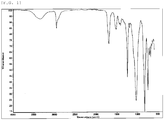
- FIG. 1 is a view showing the result of the IR analysis of the polymer obtained in Example 1.
- the present inventors have intensively studied to develop a radically curable siloxane-containing polyvinyl alcohol having both properties of a polyvinyl alcohol-based polymer and a silicone, and as a result, they have found that by reacting a hydroxyl group of a polyvinyl alcohol resin compound containing a structural unit represented by the general formula (7) mentioned below, an organopolysiloxane containing an isocyanate group represented by the general formula (8) and/or general formula (9) mentioned below, and an unsaturated compound containing an isocyanate group represented by the general formula (10) mentioned below together, the hydroxyl groups of the polyvinyl alcohol resin compound are effectively reacted with the organopolysiloxane containing an isocyanate group and the unsaturated compound containing an isocyanate group so that a radically curable organosiloxane graft polyvinyl alcohol polymer having both the structural units represented by the general formula (1) and general formula (2) mentioned below can be easily and effectively obtained.
- the organosiloxane graft polyvinyl alcohol polymer thus obtained is a novel material, and becomes a material which has general properties of the polyvinyl alcohol such as film-forming property, transparency and the like, and properties of the silicone such as high solubility in an organic solvent and excellent handleability as a liquid material, and further properties of the obtained coating film such as solvent resistance and moldability, whereby completed the present invention.
- the present invention is a radically curable organosiloxane graft polyvinyl alcohol polymer having both structural units represented by both of the following general formula (1) and general formula (2), wherein, M 1 represents a siloxane group represented by the following general formula (3) and/or general formula (4); and M 2 represents an organic group having an unsaturated group represented by the following general formula (5), wherein, R 1 , R 2 , R 3 , and R 4 each represent a monovalent organic group having 1 to 6 carbon atoms; "n” represents an integer of 1 to 10; and “a” represents an integer of 0 to 2, wherein, R 5 , R 6 , R 7 , R 8 , and R 9 each represent a monovalent organic group having 1 to 6 carbon atoms; "n” represents an integer of 1 to 10; and “m” represents an integer of 1 to 20, wherein, R 10 represents hydrogen or a methyl group; and "k” represents 1 or 2.
- M 1 represents a siloxane group represented by the following general formula
- tetrahydrofuran THF
- the radically curable organosiloxane graft polyvinyl alcohol polymer of the present invention has both structural units represented by both of the following general formula (1) and general formula (2), wherein, M represents a siloxane group represented by the following general formula (3) and/or general formula (4); and M 2 represents an organic group having an unsaturated group represented by the following general formula (5), wherein, R 1 , R 2 , R 3 , and R 4 each represent a monovalent organic group having 1 to 6 carbon atoms; "n” represents an integer of 1 to 10; and “a” represents an integer of 0 to 2, wherein, R 5 , R 6 , R 7 , R 8 , and R 9 each represent a monovalent organic group having 1 to 6 carbon atoms; "n” represents an integer of 1 to 10; and “m” represents an integer of 1 to 20, wherein, R 10 represents hydrogen or a methyl group; and "k” represents 1 or 2.
- the radically curable organosiloxane graft polyvinyl alcohol polymer of the present invention has a structural unit represented by the following general formula (6), wherein, M 3 and M 4 each represent a hydrogen atom, an acetyl group or a siloxane group represented by the above general formula (3) and/or the general formula (4), at least one of which is a siloxane group represented by the above general formula (3) or general formula (4), and "A" represents a single bond or a linking group.
- R 1 , R 2 , R 3 , R 4 , R 5 , R 6 , R 7 , R 8 , and R 9 each independently represent a monovalent organic group having 1 to 6 carbon atoms, and specific examples thereof include an alkyl group such as a methyl group, an ethyl group, a propyl group, a butyl group and the like, a cycloalkyl group such as a cyclopentyl group, a cyclohexyl group and the like, an aryl group such as a phenyl group and the like, an alkenyl group such as a vinyl group, an allyl group and the like, and a substituted hydrocarbon group such as a chloromethyl group, a 3,3,3-trifluoropropyl group and the like, and R 1 , R 2 , R 3 , R 4 , R 5 , R 6 , R 7 , R 8 , and R 9 may be the same or different from each other.
- R 2 , R 3 , and R 4 each may be a siloxy group represented by -OSiR 7 R 8 R 9 , and examples of the siloxy group include a trimethylsiloxy group, an ethyldimethylsiloxy group, a phenyldimethylsiloxy group, a vinyldimethylsiloxy group, a chloromethyldimethylsiloxy group, a 3,3,3-trifluoropropyldimethylsiloxy group, and the like.
- Such a radically curable organosiloxane graft polyvinyl alcohol polymer is employed, by lowering high crystallinity of the polyvinyl alcohol, solubility in an organic solvent increases and reactivity with a modifying agent becomes higher, so that it becomes a material which is inexpensive and excellent.
- the polyvinyl alcohol resin compound By including the structural unit represented by the general formula (4) in the polyvinyl alcohol resin compound as the raw material of the radically curable organosiloxane graft polyvinyl alcohol polymer of the present invention, the polyvinyl alcohol resin becomes easily soluble in an organic solvent, and the reaction ratio with the compound represented by the general formula (6) is remarkably improved.
- R 5 , R 6 , R 7 , and R 8 are methyl groups
- R 9 is a butyl group
- such a radically curable organosiloxane graft polyvinyl alcohol polymer becomes a material more excellent in productivity, reactivity and the like.
- a molecular weight of the radically curable organosiloxane graft polyvinyl alcohol polymer of the present invention may be in the range of 5,000 to 5,000,000 in terms of polystyrene-equivalent number average molecular weight (Mn) measured by GPC using tetrahydrofuran (THF) as a solvent, preferably 5,000 to 500,000, and more preferably 10,000 to 100,000. If the number average molecular weight is 5,000 or more, there is no fear that it is inferior in the point of film strength, while if number average molecular weight is 500,000 or less, there is no fear that it is inferior in the point of handleability or solubility.
- the radically curable organosiloxane graft polyvinyl alcohol polymer of the present invention when it becomes a material having general properties such as film-forming property, transparency and the like of the polyvinyl alcohol, and properties such as high solubility in an organic solvent and excellent handleability as a liquid material of the silicone, and further properties such as solvent resistance and moldability of the obtained coating film. Therefore, it can be suitably used as cosmetics, adhesives, paints and the like.
- a process for producing the radically curable organosiloxane graft polyvinyl alcohol polymer of the present invention which comprises reacting at least a polyvinyl alcohol resin compound containing a structural unit represented by the following general formula (7), an organopolysiloxane containing an isocyanate group represented by the following general formula (8) and/or general formula (9), and an unsaturated compound containing an isocyanate group represented by the following general formula (10) with each other, wherein, R 1 , R 2 , R 3 , R 4 , R 5 , R 6 , R 7 , R 8 , and R 9 each represent a monovalent organic group having 1 to 6 carbon atoms; R 10 represents hydrogen or a methyl group; and "k” represents 1 or 2; "n” represents an integer of 1 to 10; “m” represents an integer of 1 to 20; and "a” represents an integer of 0 to 2.
- organopolysiloxane containing an isocyanate group represented by the general formula (8) is tris(trimethylsiloxy)silylpropyl isocyanate
- a radically curable organosiloxane graft polyvinyl alcohol polymer having a high modification ratio can be obtained efficiently from the viewpoints of productivity, and reactivity.
- the polyvinyl alcohol resin compound containing a structural unit represented by the general formula (7) and a structural unit represented by the general formula (11) can be obtained, for example, by saponifying a polyvinyl acetate-based resin compound containing a structural unit represented by the following general formula (12) and a structural unit represented by the following general formula (13), wherein, "A" represents the same meaning as before.
- the polyvinyl alcohol resin compound used as a raw material in the process for producing the radically curable organosiloxane graft polyvinyl alcohol polymer can be obtained by saponifying the polyvinyl acetate-based compound, and as the polyvinyl alcohol resin compound, a partially saponified material may be also used.
- the radically curable organosiloxane graft polyvinyl alcohol polymer is synthesized by using a partially saponified polyvinyl alcohol resin compound, as a representative compound, it can be made a radically curable organosiloxane graft polyvinyl alcohol polymer containing a structural unit represented by the general formula (12) and a structural unit represented by the general formula (13).
- the polyvinyl acetate-based resin compound containing the structural unit represented by the general formula (12) and the structural unit represented by the general formula (13) can be obtained by, for example, polymerizing a compound represented by the following general formula (14) and a compound represented by the following general formula (15), wherein, "A" represents the same meaning as before.
- a molecular weight of the polyvinyl alcohol resin compound is suitably selected such that the molecular weight of the radically curable organosiloxane graft polyvinyl alcohol polymer of the present invention (that is, the number average molecular weight (Mn) in terms of polystyrene measured by GPC) is in the range of 5,000 to 5,000,000.
- the polyvinyl alcohol resin compound is manufactured and sold as G-PolymerTM of The Nippon Synthetic Chemical Industry Co., Ltd., and it can be obtained. Specifically, it can be selected from AZF8035W, OKS-6026, OKS-1011, OKS-8041, OKS-8049, OKS-1028, OKS-1027, OKS-1109, and OKS-1083.
- the process for producing the radically curable organosiloxane graft polyvinyl alcohol polymer of the present invention is carried out by reacting the hydroxyl group of the polyvinyl alcohol resin compound, the organopolysiloxane containing an isocyanate group and the unsaturated compound containing an isocyanate group together as mentioned above, and as the organopolysiloxane containing an isocyanate group, it is particularly preferable to use tris(trimethylsiloxy)silylpropyl isocyanate (that is, in the general formula (8), a material in which "n" represents 3, R 2 , R 3 , and R 4 are methyl groups, and "a" represents 0).
- the radically curable organosiloxane graft polyvinyl alcohol polymer having structural units represented by the following general formula (16) and general formula (17) can be produced, wherein, L 1 represents a siloxane group represented by the following general formula (18); and L 2 represents an organic group having an unsaturated group represented by the following general formula (19):
- the radically curable organosiloxane graft polyvinyl alcohol polymer of the present invention is carried out by the reaction of the hydroxyl group of the polyvinyl alcohol resin compound with the organopolysiloxane containing an isocyanate group and the organic group having the unsaturated group as mentioned above, and it is preferable that the polyvinyl alcohol resin compound contains a polybutenediol structure (that is, a material in which "A" is a single bond in the general formula (6)). As long as it contains a polybutenediol structure, an organosiloxane graft polyvinyl alcohol polymer having high solubility in an organic solvent and a high modification ratio can be obtained with good efficiency.
- a polybutenediol structure that is, a material in which "A" is a single bond in the general formula (6)
- the process for producing the radically curable organosiloxane graft polyvinyl alcohol polymer of the present invention is a producing process by the reaction of forming a urethane bond by reacting the hydroxyl group of the polyvinyl alcohol resin compound with the organopolysiloxane containing an isocyanate group and an organic group having an unsaturated group, so that it is not necessary to use specific reaction conditions or reaction apparatus, but it is preferable to use a solvent for mixing the polyvinyl alcohol resin compound and the compound containing an isocyanate group, reaction efficiency, and control of the reaction.
- the solvent examples include esters such as methyl acetate, ethyl acetate, butyl acetate, and the like, ketones such as acetone, methyl ethyl ketone, cyclohexanone and the like, aromatic hydrocarbons such as toluene, xylene and the like, ethers such as diethyl ether, tetrahydrofuran and the like, amides such as N,N-dimethylformamide, N-methylpyrrolidone and the like, and sulfoxides such as dimethylsulfoxide and the like, and these may be used singly or in admixture of two or more.
- esters such as methyl acetate, ethyl acetate, butyl acetate, and the like
- ketones such as acetone, methyl ethyl ketone, cyclohexanone and the like
- aromatic hydrocarbons such as toluene, xylene and the like
- this reaction may be usually carried out at 20 to 150°C for 1 to 24 hours, and in this case, a conventionally known catalyst used for forming urethane bonds may be added, including amines such as triethylamine, triethylenediamine, N-methylmorpholine and the like, an organometallic compounds such as di-n-butyltin dilaurate, stannous oleate, and the like as a catalyst.
- the objective radically curable organosiloxane graft polyvinyl alcohol polymer can be obtained by washing and drying.
- the organosiloxane graft polyvinyl alcohol polymer of the present invention can be easily produced with good efficiency, and further it can be industrially obtained at low cost, that is, inexpensively.
- the product was precipitated in a mixed solution of water and methanol, further washed repeatedly with water and methanol mixed solution, and then dried under reduced pressure at 70°C for 24 hours to obtain 15.0 g of a polymer.
- FIG. 1 the results of IR analysis of this polymer are shown. From the results of the IR analysis, it was confirmed that the absorption of 2,270cm -1 of the isocyanate group almost disappeared and that the obtained polymer was a copolymer of polyvinyl alcohol tris(trimethylsiloxy)silylpropyl carbamate and polyvinyl alcohol ethyl methacrylate carbamate.
- the number average molecular weight (Mn) measured by GPC using THF as a solvent was 26,000 in terms of polystyrene, and the molecular weight distribution was 1.60.
- the obtained polymer was dissolved in dimethylacrylamide at 20% by mass, and a radically cured film was prepared by radical crosslinking by blending 0.5% by mass of benzoyl peroxide.
- the results of film-forming property, transparency, and oxygen permeability of the polymer of Example 1 and the radically cured film are shown in Table 1.
- the results of solubility (solvent resistance) in toluene and isopropyl alcohol are shown in Table 2.
- the obtained polymer was dissolved in dimethylacrylamide at 20% by mass, and a radically cured film was prepared by radical crosslinking by blending 0.5% by mass of benzoyl peroxide.
- the results of film-forming property, transparency, and oxygen permeability of the polymer of Example 2 and the radically cured film are shown in Table 1.
- the results of solubility (solvent resistance) in toluene and isopropyl alcohol are shown in Table 2.
- Example 2 By using the same apparatus as in Example 1, when the reaction was carried out in the same manner as in Example 1 except for not using Karenz MOI (available from Showa Denko K.K.), then 14.8 g of a polymer was obtained.
- the number average molecular weight (Mn) measured by GPC using THF as a solvent was 24,000 in terms of polystyrene and the molecular weight distribution was 1.60.
- the obtained polymer was dissolved in dimethylacrylamide at 20% by mass, and a radically cured film was prepared by radical crosslinking by blending 0.5% by mass of benzoyl peroxide.
- Table 1 The results of film-forming property, transparency, and oxygen permeability of the polymer of Comparative example 1 and the radically cured film are shown in Table 1.
- the results of solubility (solvent resistance) in toluene and isopropyl alcohol are shown in Table 2.
- Example 1 to 3 the reaction was carried out efficiently with a silicone modifying agent so that radically curable organosiloxane graft polyvinyl alcohol polymers having structural units represented by the general formula (1) and general formula (2) of the present invention could be obtained, and in any case, film property and transparency were high, and further, high oxygen permeability was shown by grafting silicone.
- Comparative example 1 having no structural unit represented by the general formula (2), it was understood that even when it was radically crosslinked with dimethylacrylamide, the obtained cured film had solubility in toluene and isopropyl alcohol.
- the radically curable organosiloxane graft polyvinyl alcohol polymer of the present invention had general properties such as film-forming property, transparency and the like of the polyvinyl alcohol, had excellent handleability as a liquid material since solubility in an organic solvent was high, and further, had both of solvent resistance and moldability of the obtained coating film, and could be produced with a low cost.
Landscapes
- Chemical & Material Sciences (AREA)
- Health & Medical Sciences (AREA)
- Chemical Kinetics & Catalysis (AREA)
- Medicinal Chemistry (AREA)
- Polymers & Plastics (AREA)
- Organic Chemistry (AREA)
- General Chemical & Material Sciences (AREA)
- Addition Polymer Or Copolymer, Post-Treatments, Or Chemical Modifications (AREA)
- Macromonomer-Based Addition Polymer (AREA)
- Graft Or Block Polymers (AREA)
Abstract
Description
- The present invention relates to a radically curable organosiloxane graft polyvinyl alcohol polymer, and particularly to a novel radically curable organosiloxane graft polyvinyl alcohol polymer and a process for producing the same.
- Polyvinyl alcohol is a thermoplastic polymer material having excellent gas barrier properties and transparency. Its glass transition temperature is relatively low as about 80°C and excellent in heat moldability, so that it is widely used as a raw material for films, sheets, containers and the like. It is also used for improving oil resistance and gas barrier properties by being coated on other resin films or sheets. However, there are problems that polyvinyl alcohol has poor solubility in common organic solvents, and handleability as a liquid material is extremely poor. In addition, it reacts poorly with a modifying agent for imparting a new function, and modification of the material is difficult and its application is limited. Accordingly, it has been desired to develop polyvinyl alcohol improved in solvent solubility and having extremely good handleability as a liquid material while maintaining properties peculiar to polyvinyl alcohol.
- For the purpose of solving this problem,
Patent Document 1 and Patent Document 2 disclose a substituted silylalkyl carbamate polyvinyl alcohol as a material having both properties of general properties of polyvinyl alcohol such as film-forming property, toughness, excellent gas barrier properties, transparency and the like, and properties of silicone having a branched structure such as high solubility in an organic solvent and excellent handleability as a liquid material. - However, none of these materials have a radically curable site in the molecule, so that solvent resistance and moldability of the obtained coating film cannot be obtained, and these materials are insufficient as a coating agent or a curable resin.
- In
Patent Document 3, a material to which the above characteristics are imparted by introducing a radically curable group into general polyvinyl alcohol has been proposed, but there is no example in which silicone is introduced into the molecular structure and it cannot be applied to applications requiring oxygen permeability, water repellency, and leveling property in coating. -
- Patent document 1:
JP 2011-246642A - Patent document 2:
JP 2017-203127A - Patent document 3:
JP 2914872B2 - The present invention has been made to solve the above-mentioned problems, and an object thereof is to provide a radically curable organosiloxane graft polyvinyl alcohol polymer having general properties such as film-forming property, transparency, solubility in an organic solvent and the like. Another object is to provide a process for producing the radically curable organosiloxane graft polyvinyl alcohol polymer for producing it efficiently with an industrially low cost.
- In order to solve the above problems, the present invention provides a radically curable organosiloxane graft polyvinyl alcohol polymer which comprises structural units represented by both of the following general formula (1) and general formula (2),


- When such a radically curable organosiloxane graft polyvinyl alcohol polymer is employed, it becomes a material having general properties of polyvinyl alcohol such as film-forming property, transparency and the like, and properties of a silicone such as high solubility in an organic solvent and excellent handleability as a liquid material. Further the material has properties of the obtainable coating film such as solvent resistance and moldability together. Therefore, it can be suitably used as cosmetic, adhesive, paint and the like.
- It is also preferable to further have a structural unit represented by the following general formula (6),

- When such a radically curable organosiloxane graft polyvinyl alcohol polymer is employed, by lowering high crystallinity of polyvinyl alcohol, solubility in an organic solvent increases and reactivity with a modifying agent becomes higher, so that it becomes a material which is inexpensive and excellent.
- It is also preferable that the radically curable organosiloxane graft polyvinyl alcohol polymer has a number average molecular weight (Mn) of 5,000 to 500,000 as measured by GPC in terms of polystyrene.
- When such a number average molecular weight is employed, film strength, handleability and solubility become more excellent.
- In the general formula (3), it is preferably a material in which R2, R3, and R4 are methyl groups, n=3 and a=0.
- In the general formula (4), it is preferably a material in which R5, R6, R7, and R8 are methyl groups, R9 is a butyl group, n=3 and m=4.
- In the general formula (5), it is preferably a material in which R10 is a methyl group, and k=1.
- When such a radically curable organosiloxane graft polyvinyl alcohol polymer is employed, productivity, reactivity and the like become more excellent.
- In the present invention, it is further provided a process for producing a radically curable organosiloxane graft polyvinyl alcohol polymer which comprises reacting at least a polyvinyl alcohol resin compound containing a structural unit represented by the following general formula (7), an organopolysiloxane containing an isocyanate group represented by the following general formula (8) and/or general formula (9), and an unsaturated compound containing an isocyanate group represented by the following general formula (10) with each other,


- When the process for producing a radically curable organosiloxane graft polyvinyl alcohol polymer of the present invention is employed, the radically curable organosiloxane graft polyvinyl alcohol polymer of the present invention can be produced with good efficiency and industrially with a low cost.
- It is preferable to further react with a polyvinyl alcohol resin compound containing a structural unit represented by the following general formula (11),

- When the polyvinyl alcohol resin compound containing such a structural unit is employed, a radically curable organosiloxane graft polyvinyl alcohol polymer in which solubility in an organic solvent is increased, reactivity with a modifying agent is higher, and it becomes inexpensive and an excellent material can be produced more easily.
- In addition, it is preferable that the organopolysiloxane containing an isocyanate group represented by the general formula (8) is tris(trimethylsiloxy)silylpropyl isocyanate, R10 of the unsaturated compound containing an isocyanate group represented by the general formula (10) is a methyl group, and k=1.
- When such a process for producing a radically curable organosiloxane graft polyvinyl alcohol polymer is employed, a radically curable organosiloxane graft polyvinyl alcohol polymer having a higher modification rate can be obtained efficiently from the viewpoints of productivity and reactivity.
- According to the radically curable organosiloxane graft polyvinyl alcohol polymer of the present invention, it becomes a material having general properties of the polyvinyl alcohol such as film-forming property, transparency and the like, and properties of the silicone such as high solubility in an organic solvent and excellent handleability as a liquid material, and further properties of the obtainable coating film such as solvent resistance and moldability together. Therefore, it can be suitably used as cosmetics, adhesives, paints and the like.
- In addition, according to the process for producing a radically curable organosiloxane graft polyvinyl alcohol polymer of the present invention, an isocyanate group having high reactivity and a hydroxyl group of the polyvinyl alcohol resin compound can be more effectively reacted. Accordingly, the organosiloxane graft polyvinyl alcohol polymer of the present invention can be produced easily and good efficiency, and further can be obtained industrially with a low cost, i.e., inexpensively.
-
FIG. 1 is a view showing the result of the IR analysis of the polymer obtained in Example 1. - As mentioned above, it has been desired to develop a radically curable organosiloxane grafted polyvinyl alcohol having improved solubility in a solvent and extremely good handleability as a liquid material while maintaining properties peculiar to the polyvinyl alcohol and a process for producing the same.
- The present inventors have intensively studied to develop a radically curable siloxane-containing polyvinyl alcohol having both properties of a polyvinyl alcohol-based polymer and a silicone, and as a result, they have found that by reacting a hydroxyl group of a polyvinyl alcohol resin compound containing a structural unit represented by the general formula (7) mentioned below, an organopolysiloxane containing an isocyanate group represented by the general formula (8) and/or general formula (9) mentioned below, and an unsaturated compound containing an isocyanate group represented by the general formula (10) mentioned below together, the hydroxyl groups of the polyvinyl alcohol resin compound are effectively reacted with the organopolysiloxane containing an isocyanate group and the unsaturated compound containing an isocyanate group so that a radically curable organosiloxane graft polyvinyl alcohol polymer having both the structural units represented by the general formula (1) and general formula (2) mentioned below can be easily and effectively obtained. In addition, the present inventors have found that the organosiloxane graft polyvinyl alcohol polymer thus obtained is a novel material, and becomes a material which has general properties of the polyvinyl alcohol such as film-forming property, transparency and the like, and properties of the silicone such as high solubility in an organic solvent and excellent handleability as a liquid material, and further properties of the obtained coating film such as solvent resistance and moldability, whereby completed the present invention.
- That is, the present invention is a radically curable organosiloxane graft polyvinyl alcohol polymer having both structural units represented by both of the following general formula (1) and general formula (2),


- Hereinafter, the present invention will be explained in detail, but the present invention is not limited thereto. In the present invention, as a solvent to be used for measurement of gel permeation chromatography (GPC), tetrahydrofuran (THF) is to be used.
- The radically curable organosiloxane graft polyvinyl alcohol polymer of the present invention has both structural units represented by both of the following general formula (1) and general formula (2),


- Further, it is preferable that the radically curable organosiloxane graft polyvinyl alcohol polymer of the present invention has a structural unit represented by the following general formula (6),

- Here, R1, R2, R3, R4, R5, R6, R7, R8, and R9 each independently represent a monovalent organic group having 1 to 6 carbon atoms, and specific examples thereof include an alkyl group such as a methyl group, an ethyl group, a propyl group, a butyl group and the like, a cycloalkyl group such as a cyclopentyl group, a cyclohexyl group and the like, an aryl group such as a phenyl group and the like, an alkenyl group such as a vinyl group, an allyl group and the like, and a substituted hydrocarbon group such as a chloromethyl group, a 3,3,3-trifluoropropyl group and the like, and R1, R2, R3, R4, R5, R6, R7, R8, and R9 may be the same or different from each other. Also, R2, R3, and R4 each may be a siloxy group represented by -OSiR7R8R9, and examples of the siloxy group include a trimethylsiloxy group, an ethyldimethylsiloxy group, a phenyldimethylsiloxy group, a vinyldimethylsiloxy group, a chloromethyldimethylsiloxy group, a 3,3,3-trifluoropropyldimethylsiloxy group, and the like.
- Such a radically curable organosiloxane graft polyvinyl alcohol polymer is employed, by lowering high crystallinity of the polyvinyl alcohol, solubility in an organic solvent increases and reactivity with a modifying agent becomes higher, so that it becomes a material which is inexpensive and excellent.
- By including the structural unit represented by the general formula (4) in the polyvinyl alcohol resin compound as the raw material of the radically curable organosiloxane graft polyvinyl alcohol polymer of the present invention, the polyvinyl alcohol resin becomes easily soluble in an organic solvent, and the reaction ratio with the compound represented by the general formula (6) is remarkably improved.
- It is also preferable that "A" is a single bond in the general formula (6). The radically curable organosiloxane graft polyvinyl alcohol polymer in which "A" is a single bond is industrially more excellent in productivity.
- In the general formula (3), it is preferable that R2, R3, and R4 are methyl groups, n=3, and a=0, and such a radically curable organosiloxane graft polyvinyl alcohol polymer becomes a material more excellent in productivity, reactivity and the like.
- In the general formula (4), it is preferable that R5, R6, R7, and R8 are methyl groups, R9 is a butyl group, n=3, and m=4, and such a radically curable organosiloxane graft polyvinyl alcohol polymer becomes a material more excellent in productivity, reactivity and the like.
- In the general formula (5), it is preferable that R10 is a methyl group, and k=1, and such a radically curable organosiloxane graft polyvinyl alcohol polymer becomes a material more excellent in productivity, reactivity and the like.
- A molecular weight of the radically curable organosiloxane graft polyvinyl alcohol polymer of the present invention may be in the range of 5,000 to 5,000,000 in terms of polystyrene-equivalent number average molecular weight (Mn) measured by GPC using tetrahydrofuran (THF) as a solvent, preferably 5,000 to 500,000, and more preferably 10,000 to 100,000. If the number average molecular weight is 5,000 or more, there is no fear that it is inferior in the point of film strength, while if number average molecular weight is 500,000 or less, there is no fear that it is inferior in the point of handleability or solubility.
- As mentioned above, when the radically curable organosiloxane graft polyvinyl alcohol polymer of the present invention, it becomes a material having general properties such as film-forming property, transparency and the like of the polyvinyl alcohol, and properties such as high solubility in an organic solvent and excellent handleability as a liquid material of the silicone, and further properties such as solvent resistance and moldability of the obtained coating film. Therefore, it can be suitably used as cosmetics, adhesives, paints and the like.
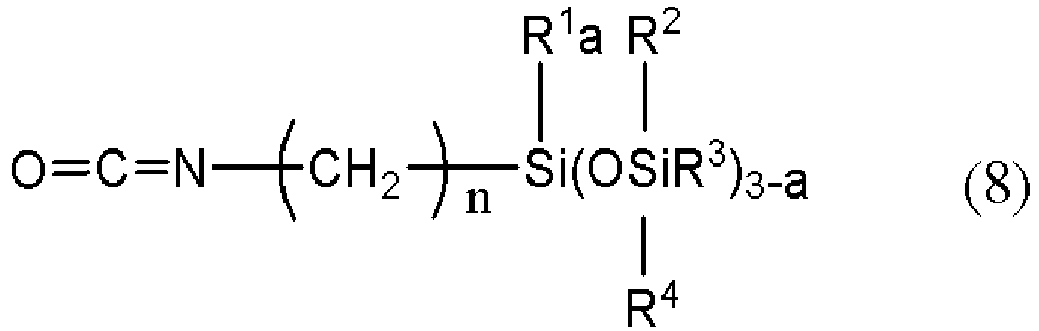
- In the present invention, there is provided a process for producing the radically curable organosiloxane graft polyvinyl alcohol polymer of the present invention which comprises reacting at least a polyvinyl alcohol resin compound containing a structural unit represented by the following general formula (7), an organopolysiloxane containing an isocyanate group represented by the following general formula (8) and/or general formula (9), and an unsaturated compound containing an isocyanate group represented by the following general formula (10) with each other,



- In addition, by reacting a polyvinyl alcohol resin compound containing a structural unit represented by the following general formula (11) as a polyvinyl alcohol resin compound, it is preferable since the polyvinyl alcohol resin is easily dissolved in an organic solvent, and the reaction ratio with the compounds represented by the general formulae (8), (9), and (10) is remarkably improved,

- In addition, when the organopolysiloxane containing an isocyanate group represented by the general formula (8) is tris(trimethylsiloxy)silylpropyl isocyanate, R10 of the unsaturated compound containing an isocyanate group is a methyl group in the general formula (10), and k=1, it is preferable since a radically curable organosiloxane graft polyvinyl alcohol polymer having a high modification ratio can be obtained efficiently from the viewpoints of productivity, and reactivity.
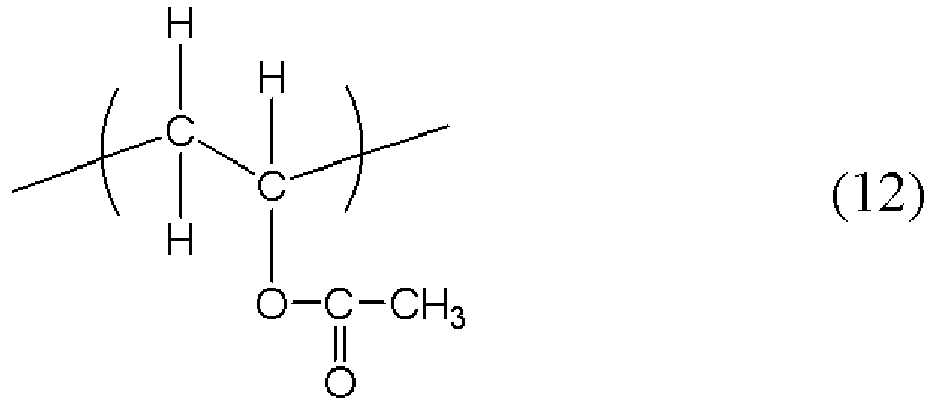
- The polyvinyl alcohol resin compound containing a structural unit represented by the general formula (7) and a structural unit represented by the general formula (11) can be obtained, for example, by saponifying a polyvinyl acetate-based resin compound containing a structural unit represented by the following general formula (12) and a structural unit represented by the following general formula (13),

- The polyvinyl alcohol resin compound used as a raw material in the process for producing the radically curable organosiloxane graft polyvinyl alcohol polymer can be obtained by saponifying the polyvinyl acetate-based compound, and as the polyvinyl alcohol resin compound, a partially saponified material may be also used.
- When the radically curable organosiloxane graft polyvinyl alcohol polymer is synthesized by using a partially saponified polyvinyl alcohol resin compound, as a representative compound, it can be made a radically curable organosiloxane graft polyvinyl alcohol polymer containing a structural unit represented by the general formula (12) and a structural unit represented by the general formula (13).
- The polyvinyl acetate-based resin compound containing the structural unit represented by the general formula (12) and the structural unit represented by the general formula (13) can be obtained by, for example, polymerizing a compound represented by the following general formula (14) and a compound represented by the following general formula (15),


- It is preferable that a molecular weight of the polyvinyl alcohol resin compound is suitably selected such that the molecular weight of the radically curable organosiloxane graft polyvinyl alcohol polymer of the present invention (that is, the number average molecular weight (Mn) in terms of polystyrene measured by GPC) is in the range of 5,000 to 5,000,000.
- The polyvinyl alcohol resin compound is manufactured and sold as G-Polymer™ of The Nippon Synthetic Chemical Industry Co., Ltd., and it can be obtained. Specifically, it can be selected from AZF8035W, OKS-6026, OKS-1011, OKS-8041, OKS-8049, OKS-1028, OKS-1027, OKS-1109, and OKS-1083.
- The process for producing the radically curable organosiloxane graft polyvinyl alcohol polymer of the present invention is carried out by reacting the hydroxyl group of the polyvinyl alcohol resin compound, the organopolysiloxane containing an isocyanate group and the unsaturated compound containing an isocyanate group together as mentioned above, and as the organopolysiloxane containing an isocyanate group, it is particularly preferable to use tris(trimethylsiloxy)silylpropyl isocyanate (that is, in the general formula (8), a material in which "n" represents 3, R2, R3, and R4 are methyl groups, and "a" represents 0). As the unsaturated compound containing an isocyanate group, it is preferable to use Karenz MOI commercially available from Showa Denko K.K. (that is, a material in which R10 of the unsaturated compound containing an isocyanate group represented by the general formula (10) is a methyl group, and k=1). By the reaction using these, the radically curable organosiloxane graft polyvinyl alcohol polymer having structural units represented by the following general formula (16) and general formula (17) can be produced,


- The radically curable organosiloxane graft polyvinyl alcohol polymer of the present invention is carried out by the reaction of the hydroxyl group of the polyvinyl alcohol resin compound with the organopolysiloxane containing an isocyanate group and the organic group having the unsaturated group as mentioned above, and it is preferable that the polyvinyl alcohol resin compound contains a polybutenediol structure (that is, a material in which "A" is a single bond in the general formula (6)). As long as it contains a polybutenediol structure, an organosiloxane graft polyvinyl alcohol polymer having high solubility in an organic solvent and a high modification ratio can be obtained with good efficiency. This is a material having a structural unit represented by the following general formula (20),

- The process for producing the radically curable organosiloxane graft polyvinyl alcohol polymer of the present invention is a producing process by the reaction of forming a urethane bond by reacting the hydroxyl group of the polyvinyl alcohol resin compound with the organopolysiloxane containing an isocyanate group and an organic group having an unsaturated group, so that it is not necessary to use specific reaction conditions or reaction apparatus, but it is preferable to use a solvent for mixing the polyvinyl alcohol resin compound and the compound containing an isocyanate group, reaction efficiency, and control of the reaction. Examples of the solvent include esters such as methyl acetate, ethyl acetate, butyl acetate, and the like, ketones such as acetone, methyl ethyl ketone, cyclohexanone and the like, aromatic hydrocarbons such as toluene, xylene and the like, ethers such as diethyl ether, tetrahydrofuran and the like, amides such as N,N-dimethylformamide, N-methylpyrrolidone and the like, and sulfoxides such as dimethylsulfoxide and the like, and these may be used singly or in admixture of two or more.
- Although it varies depending on the kind of the solvent used here, this reaction may be usually carried out at 20 to 150°C for 1 to 24 hours, and in this case, a conventionally known catalyst used for forming urethane bonds may be added, including amines such as triethylamine, triethylenediamine, N-methylmorpholine and the like, an organometallic compounds such as di-n-butyltin dilaurate, stannous oleate, and the like as a catalyst. After completion of the reaction, the objective radically curable organosiloxane graft polyvinyl alcohol polymer can be obtained by washing and drying.
- Thus, according to the process for producing the radically curable organosiloxane graft polyvinyl alcohol polymer of the present invention, it is possible to more effectively react an isocyanate group having high reactivity and a hydroxyl group(s) of the polyvinyl alcohol resin compound. According to this procedure, the organosiloxane graft polyvinyl alcohol polymer of the present invention can be easily produced with good efficiency, and further it can be industrially obtained at low cost, that is, inexpensively.
- Hereinafter, the present invention will be explained in more detail with reference to Examples and Comparative example, but the present invention is not limited by these.
- In a flask equipped with a dropping funnel, a condenser tube, a thermometer, and a stirring device, as the polyvinyl alcohol resin compound containing structural units represented by the general formula (7) and general formula (11), 4.6 g of G-Polymer (OKS-1011; polymerization degree: 300, saponification degree %: 98.5%) obtained from The Nippon Synthetic Chemical Industry Co., Ltd. was dissolved in 41 g of N-methylpyrrolidone, then, 12 g of tris(trimethylsiloxy)silylpropyl isocyanate, and 0.55 g of Karenz MOI (available from Showa Denko K.K.) were charged therein, and the reaction was carried out at 70°C for 2 hours. After completion of the reaction, the product was precipitated in a mixed solution of water and methanol, further washed repeatedly with water and methanol mixed solution, and then dried under reduced pressure at 70°C for 24 hours to obtain 15.0 g of a polymer. In
FIG. 1 , the results of IR analysis of this polymer are shown. From the results of the IR analysis, it was confirmed that the absorption of 2,270cm-1 of the isocyanate group almost disappeared and that the obtained polymer was a copolymer of polyvinyl alcohol tris(trimethylsiloxy)silylpropyl carbamate and polyvinyl alcohol ethyl methacrylate carbamate. The number average molecular weight (Mn) measured by GPC using THF as a solvent was 26,000 in terms of polystyrene, and the molecular weight distribution was 1.60. The obtained polymer was dissolved in dimethylacrylamide at 20% by mass, and a radically cured film was prepared by radical crosslinking by blending 0.5% by mass of benzoyl peroxide. The results of film-forming property, transparency, and oxygen permeability of the polymer of Example 1 and the radically cured film are shown in Table 1. The results of solubility (solvent resistance) in toluene and isopropyl alcohol are shown in Table 2. - By using the same apparatus as in Example 1, when the reaction was carried out in the same manner as in Example 1 except for using G-Polymer (OKS-1083; polymerization degree: 1,900, saponification degree %: 99.8%) obtained from The Nippon Synthetic Chemical Industry Co., Ltd. as the polyvinyl alcohol resin compound containing structural units represented by the general formula (7) and general formula (11), then 15.1 g of a polymer was obtained. The number average molecular weight (Mn) measured by GPC using THF as a solvent was 85,000 in terms of polystyrene and the molecular weight distribution was 1.60. The obtained polymer was dissolved in dimethylacrylamide at 20% by mass, and a radically cured film was prepared by radical crosslinking by blending 0.5% by mass of benzoyl peroxide. The results of film-forming property, transparency, and oxygen permeability of the polymer of Example 2 and the radically cured film are shown in Table 1. The results of solubility (solvent resistance) in toluene and isopropyl alcohol are shown in Table 2.
- By using the same apparatus as in Example 1, when the reaction was carried out in the same manner as in Example 2 except for using 24 g of tris(trimethylsiloxy)silylpropyl isocyanate, then 27.1 g of a polymer was obtained. The number average molecular weight (Mn) measured by GPC using THF as a solvent was 135,000 in terms of polystyrene and the molecular weight distribution was 1.70. The results of solubility of the obtained polymer in various kinds of solvents are shown in Table 1. The obtained polymer was dissolved in dimethylacrylamide at 20% by mass, and a radically cured film was prepared by radical crosslinking by blending 0.5% by mass of benzoyl peroxide. The results of film-forming property, transparency, and oxygen permeability of the polymer of Example 3 and the radically cured film are shown in Table 1. The results of solubility (solvent resistance) in toluene and isopropyl alcohol are shown in Table 2.
- By using the same apparatus as in Example 1, when the reaction was carried out in the same manner as in Example 1 except for not using Karenz MOI (available from Showa Denko K.K.), then 14.8 g of a polymer was obtained. The number average molecular weight (Mn) measured by GPC using THF as a solvent was 24,000 in terms of polystyrene and the molecular weight distribution was 1.60. The obtained polymer was dissolved in dimethylacrylamide at 20% by mass, and a radically cured film was prepared by radical crosslinking by blending 0.5% by mass of benzoyl peroxide. The results of film-forming property, transparency, and oxygen permeability of the polymer of Comparative example 1 and the radically cured film are shown in Table 1. The results of solubility (solvent resistance) in toluene and isopropyl alcohol are shown in Table 2.
- The results of film-forming property, transparency, and oxygen permeability of G-Polymer (OKS-1011, OKS-1083) alone are shown in Table 1. The results of solubility (solvent resistance) in toluene and isopropyl alcohol are shown in Table 2.
[Table 1] Film formability Transparency Oxygen permeability (Barrer) G-Polymer; OKS-1011 good good <0.1 G-Polymer; OKS-1083 good good <0.1 Example 1 (Polymer) good good 110 Example 1 (Radically cured film) good good - Example 2 (Polymer) good good 108 Example 2 (Radically cured film) good good - Example 3 (Polymer) good good 144 Example 3 (Radically cured film) good good - Comparative example 1 (Polymer) good good 120 Comparative example 1 (Radically cured film) good good - [Table 2] Solubility in toluene Solubility in isopropyl alcohol G-Polymer; OKS-1011 insoluble insoluble G-Polymer; OKS-1083 insoluble insoluble Example 1 (Polymer) dissolved dissolved Example 1 (Radically cured film) insoluble (swelling) insoluble (swelling) Example 2 (Polymer) dissolved dissolved Example 2 (Radically cured film) insoluble (swelling) insoluble (swelling) Example 3 (Polymer) dissolved dissolved Example 3 (Radically cured film) insoluble (swelling) insoluble (swelling) Comparative example 1 (Polymer) dissolved dissolved Comparative example 1 (Radically cured film) dissolved dissolved - As shown in Table 1, in Example 1 to 3, the reaction was carried out efficiently with a silicone modifying agent so that radically curable organosiloxane graft polyvinyl alcohol polymers having structural units represented by the general formula (1) and general formula (2) of the present invention could be obtained, and in any case, film property and transparency were high, and further, high oxygen permeability was shown by grafting silicone.
- In Table 2, all of the products obtained in Examples 1 to 3 have excellent solubility in toluene and isopropyl alcohol, it was understood that they have excellent handleability as a liquid material.
- Further, it was understood that the cured films in which the radically curable organosiloxane graft polyvinyl alcohol polymers obtained from Examples 1 to 3 were radically crosslinked with dimethylacrylamide had undergone intermolecular crosslinking, became insoluble in toluene and isopropyl alcohol, and had solvent resistance.
- On the other hand, in Comparative example 1 having no structural unit represented by the general formula (2), it was understood that even when it was radically crosslinked with dimethylacrylamide, the obtained cured film had solubility in toluene and isopropyl alcohol.
- From the above results, it was shown that the radically curable organosiloxane graft polyvinyl alcohol polymer of the present invention had general properties such as film-forming property, transparency and the like of the polyvinyl alcohol, had excellent handleability as a liquid material since solubility in an organic solvent was high, and further, had both of solvent resistance and moldability of the obtained coating film, and could be produced with a low cost.
- It must be stated here that the present invention is not restricted to the embodiments shown by Examples. The embodiments shown by Examples are merely examples so that any embodiments composed of substantially the same technical concept as disclosed in the claims of the present invention and expressing a similar effect are included in the technical scope of the present invention.
Claims (9)
- A radically curable organosiloxane graft polyvinyl alcohol polymer which comprises structural units represented by both of the following general formula (1) and general formula (2),


- The radically curable organosiloxane graft polyvinyl alcohol polymer according to claim 1, wherein the polymer further has a structural unit represented by the following general formula (6),

- The radically curable organosiloxane graft polyvinyl alcohol polymer according to claim 1 or 2, wherein the radically curable organosiloxane graft polyvinyl alcohol polymer has a number average molecular weight (Mn) of 5,000 to 500,000 as measured by GPC in terms of polystyrene.
- The radically curable organosiloxane graft polyvinyl alcohol polymer according to any one of claims 1 to 3, wherein R2, R3, and R4 are methyl groups, n=3, and a=0 in the general formula (3).
- The radically curable organosiloxane graft polyvinyl alcohol polymer according to any one of claims 1 to 4, wherein R5, R6, R7, and R8 are methyl groups, R9 is a butyl group, n=3, and m=4 in the general formula (4).
- The radically curable organosiloxane graft polyvinyl alcohol polymer according to any one of claims 1 to 5, wherein R10 is a methyl group, and k=1 in the general formula (5).
- A process for producing a radically curable organosiloxane graft polyvinyl alcohol polymer which comprises reacting at least a polyvinyl alcohol resin compound containing a structural unit represented by the following general formula (7), an organopolysiloxane containing an isocyanate group represented by the following general formula (8) and/or general formula (9), and an unsaturated compound containing an isocyanate group represented by the following general formula (10) with each other,


- The process for producing a radically curable organosiloxane graft polyvinyl alcohol polymer according to claim 7, wherein a polyvinyl alcohol resin compound having a structural unit represented by the following general formula (11) is further reacted,

- The process for producing a radically curable organosiloxane graft polyvinyl alcohol polymer according to claim 7 or 8, wherein the organopolysiloxane containing an isocyanate group represented by the general formula (8) is tris(trimethylsiloxy)silylpropyl isocyanate, and in the unsaturated compound containing an isocyanate group represented by the general formula (10), R10 is a methyl group, and k=1.
Applications Claiming Priority (1)
| Application Number | Priority Date | Filing Date | Title |
|---|---|---|---|
| JP2018027320A JP6842435B2 (en) | 2018-02-19 | 2018-02-19 | Radical curable organosiloxane graft polyvinyl alcohol polymer and its production method |
Publications (2)
| Publication Number | Publication Date |
|---|---|
| EP3527598A1 true EP3527598A1 (en) | 2019-08-21 |
| EP3527598B1 EP3527598B1 (en) | 2020-09-16 |
Family
ID=65529226
Family Applications (1)
| Application Number | Title | Priority Date | Filing Date |
|---|---|---|---|
| EP19155410.4A Active EP3527598B1 (en) | 2018-02-19 | 2019-02-05 | Radically curable organosiloxane graft polyvinyl alcohol polymer and process for producing same |
Country Status (6)
| Country | Link |
|---|---|
| US (1) | US10793679B2 (en) |
| EP (1) | EP3527598B1 (en) |
| JP (1) | JP6842435B2 (en) |
| KR (1) | KR102731685B1 (en) |
| CN (1) | CN110172110B (en) |
| TW (1) | TWI782186B (en) |
Families Citing this family (2)
| Publication number | Priority date | Publication date | Assignee | Title |
|---|---|---|---|---|
| JP7270566B2 (en) * | 2020-02-27 | 2023-05-10 | 信越化学工業株式会社 | Organosilicon compound containing isocyanate group and method for producing organosilicon compound containing isocyanate group |
| WO2022004636A1 (en) * | 2020-06-30 | 2022-01-06 | 株式会社クラレ | Modified vinyl alcohol polymer, aqueous solution, and method for producing modified vinyl alcohol polymer |
Citations (9)
| Publication number | Priority date | Publication date | Assignee | Title |
|---|---|---|---|---|
| EP0216074A2 (en) * | 1985-07-31 | 1987-04-01 | Ciba-Geigy Ag | Polyvinyl alcohol derivatives and crosslinked hydrogel contact lenses made therefrom |
| US4670506A (en) * | 1985-12-23 | 1987-06-02 | Ciba-Geigy Corporation | Polyvinyl alcohol derivatives containing pendant (meth)acryloyl units bound through urethane groups and crosslinked hydrogel contact lenses made therefrom |
| EP0321403A2 (en) * | 1987-12-16 | 1989-06-21 | Ciba-Geigy Ag | Polyvinyl alcohol derivatives containing pendant vinylic monomer reaction product units bond through ether groups and hydrogel contact lenses made therefrom |
| EP0362137A2 (en) * | 1988-09-28 | 1990-04-04 | Ciba-Geigy Ag | Molded polymers with hydrophilic surfaces, and process for making them |
| WO1996024073A1 (en) * | 1995-02-03 | 1996-08-08 | Novartis Ag | Crosslinked polymers containing urethane groups |
| JP2914872B2 (en) | 1993-08-06 | 1999-07-05 | ノバルティス アクチエンゲゼルシャフト | Photocrosslinked polymer |
| JP2011246642A (en) | 2010-05-28 | 2011-12-08 | Shin-Etsu Chemical Co Ltd | Substituted silyl alkyl carbamate polyvinyl alcohol and method for producing the same |
| WO2016204181A1 (en) * | 2015-06-18 | 2016-12-22 | 富士フイルム株式会社 | Laminate film |
| JP2017203127A (en) | 2016-05-12 | 2017-11-16 | 信越化学工業株式会社 | Organosiloxane graft polyvinyl alcohol polymer and method for producing the same |
Family Cites Families (3)
| Publication number | Priority date | Publication date | Assignee | Title |
|---|---|---|---|---|
| US4665123A (en) | 1985-12-13 | 1987-05-12 | Ciba-Geigy Corporation | Polyvinyl alcohol derivatives containing pendant (meth)acryloylvinylic monomer reaction product units bound through urethane groups and hydrogel contact lenses made therefrom |
| US5010155A (en) | 1988-09-28 | 1991-04-23 | Ciba-Geigy Corporation | Vinyl-urethane substituted hydroxyethyl cellulose |
| JP6511414B2 (en) * | 2016-07-04 | 2019-05-15 | 信越化学工業株式会社 | Cosmetics |
-
2018
- 2018-02-19 JP JP2018027320A patent/JP6842435B2/en active Active
-
2019
- 2019-02-04 US US16/266,417 patent/US10793679B2/en active Active
- 2019-02-05 EP EP19155410.4A patent/EP3527598B1/en active Active
- 2019-02-13 KR KR1020190016646A patent/KR102731685B1/en active Active
- 2019-02-19 TW TW108105375A patent/TWI782186B/en active
- 2019-02-19 CN CN201910120927.1A patent/CN110172110B/en active Active
Patent Citations (11)
| Publication number | Priority date | Publication date | Assignee | Title |
|---|---|---|---|---|
| EP0216074A2 (en) * | 1985-07-31 | 1987-04-01 | Ciba-Geigy Ag | Polyvinyl alcohol derivatives and crosslinked hydrogel contact lenses made therefrom |
| US4670506A (en) * | 1985-12-23 | 1987-06-02 | Ciba-Geigy Corporation | Polyvinyl alcohol derivatives containing pendant (meth)acryloyl units bound through urethane groups and crosslinked hydrogel contact lenses made therefrom |
| EP0321403A2 (en) * | 1987-12-16 | 1989-06-21 | Ciba-Geigy Ag | Polyvinyl alcohol derivatives containing pendant vinylic monomer reaction product units bond through ether groups and hydrogel contact lenses made therefrom |
| EP0362137A2 (en) * | 1988-09-28 | 1990-04-04 | Ciba-Geigy Ag | Molded polymers with hydrophilic surfaces, and process for making them |
| JP2914872B2 (en) | 1993-08-06 | 1999-07-05 | ノバルティス アクチエンゲゼルシャフト | Photocrosslinked polymer |
| WO1996024073A1 (en) * | 1995-02-03 | 1996-08-08 | Novartis Ag | Crosslinked polymers containing urethane groups |
| JP2011246642A (en) | 2010-05-28 | 2011-12-08 | Shin-Etsu Chemical Co Ltd | Substituted silyl alkyl carbamate polyvinyl alcohol and method for producing the same |
| WO2016204181A1 (en) * | 2015-06-18 | 2016-12-22 | 富士フイルム株式会社 | Laminate film |
| US20180099480A1 (en) * | 2015-06-18 | 2018-04-12 | Fujifilm Corporation | Laminated film |
| JP2017203127A (en) | 2016-05-12 | 2017-11-16 | 信越化学工業株式会社 | Organosiloxane graft polyvinyl alcohol polymer and method for producing the same |
| EP3246342A1 (en) * | 2016-05-12 | 2017-11-22 | Shin-Etsu Chemical Co., Ltd. | Organosiloxane graft polyvinyl alcohol polymer and method of producing the same |
Also Published As
| Publication number | Publication date |
|---|---|
| KR102731685B1 (en) | 2024-11-18 |
| JP6842435B2 (en) | 2021-03-17 |
| JP2019143019A (en) | 2019-08-29 |
| EP3527598B1 (en) | 2020-09-16 |
| US20190256663A1 (en) | 2019-08-22 |
| CN110172110A (en) | 2019-08-27 |
| CN110172110B (en) | 2023-07-04 |
| US10793679B2 (en) | 2020-10-06 |
| TWI782186B (en) | 2022-11-01 |
| KR20190100038A (en) | 2019-08-28 |
| TW201936725A (en) | 2019-09-16 |
Similar Documents
| Publication | Publication Date | Title |
|---|---|---|
| Zhang et al. | UV-curable coating crosslinked by a novel hyperbranched polyurethane acrylate with excellent mechanical properties and hardness | |
| JP2003531925A (en) | Use of boron derivatives as heat-activated catalysts for the polymerization and / or crosslinking of silicones by dehydrocondensation | |
| KR960703146A (en) | Siloxane Modified Polyolefin Copolymer (SILOXANE MODIFIED POLYOLEFIN COPOLYMERS) | |
| EP3527598B1 (en) | Radically curable organosiloxane graft polyvinyl alcohol polymer and process for producing same | |
| CN107365395B (en) | Organosiloxane-grafted polyvinyl alcohol polymer and method for producing same | |
| CN109369881B (en) | Synthesis of high-molecular acrylate resin with photosensitive autocatalysis activity | |
| Byczyński | Effect of different polyethers on surface and thermal properties of poly (urethane-siloxane) copolymers modified with side-chain siloxane | |
| Mehravar et al. | Role of grafting on particle and film morphology and film properties of zero VOC polyurethane/poly (meth) acrylate hybrid dispersions | |
| CN113260640B (en) | Interpenetrating network polymer comprising organopolysiloxane crosslinked product and (meth)acrylic polymer and method for producing same | |
| KR102363498B1 (en) | Modified polyolefin resin composition and manufacturing method thereof | |
| MXPA05005550A (en) | Microgel composition and process for preparation thereof. | |
| JP2011246642A (en) | Substituted silyl alkyl carbamate polyvinyl alcohol and method for producing the same | |
| EP3674374B1 (en) | Coating resin composition and coating film comprising cured article thereof as coating layer | |
| CA3161291C (en) | Rapid hydrosilylation cure composition | |
| US20060057190A1 (en) | Silicone topcoat with improved dirt repellency and improved bondability | |
| WO2020256046A1 (en) | Polyrotaxane comprising long-chain alkyl group in cyclic molecule, composition comprising said polyrotaxane, and method for producing said polyrotaxane | |
| JP2004143411A (en) | Method for producing graft copolymer having special structure | |
| CN115551899B (en) | A polyrotaxane having a group in a cyclic molecule containing a chain formed by repeating units of propylene oxide | |
| Yang et al. | The preparation and surface properties of silicone-grafted acrylic copolymer coatings | |
| EP0729988A2 (en) | Silicone-grafted alicyclic epoxy-functional vinyl polymers and method for preparation | |
| CN110776585B (en) | Preparation method of vinyl-terminated rubber with oxygen inhibition effect | |
| Wu et al. | Influence of an oligomer polyol and monomers on the structure and properties of core–shell polyurethane–poly (n‐butyl acrylate‐co‐styrene) hybrid emulsions | |
| Ouyang et al. | A kinetics study of diacrylic-styrene crosslinking copolymerization | |
| JP7345819B2 (en) | A polyrotaxane having an oxazoline-derived group in a part of the cyclic molecule, a composition containing the polyrotaxane, and a method for producing the polyrotaxane | |
| JPH0718140A (en) | Vinyl chloride resin composition |
Legal Events
| Date | Code | Title | Description |
|---|---|---|---|
| PUAI | Public reference made under article 153(3) epc to a published international application that has entered the european phase |
Free format text: ORIGINAL CODE: 0009012 |
|
| STAA | Information on the status of an ep patent application or granted ep patent |
Free format text: STATUS: THE APPLICATION HAS BEEN PUBLISHED |
|
| AK | Designated contracting states |
Kind code of ref document: A1 Designated state(s): AL AT BE BG CH CY CZ DE DK EE ES FI FR GB GR HR HU IE IS IT LI LT LU LV MC MK MT NL NO PL PT RO RS SE SI SK SM TR |
|
| AX | Request for extension of the european patent |
Extension state: BA ME |
|
| STAA | Information on the status of an ep patent application or granted ep patent |
Free format text: STATUS: REQUEST FOR EXAMINATION WAS MADE |
|
| 17P | Request for examination filed |
Effective date: 20200221 |
|
| RBV | Designated contracting states (corrected) |
Designated state(s): AL AT BE BG CH CY CZ DE DK EE ES FI FR GB GR HR HU IE IS IT LI LT LU LV MC MK MT NL NO PL PT RO RS SE SI SK SM TR |
|
| GRAP | Despatch of communication of intention to grant a patent |
Free format text: ORIGINAL CODE: EPIDOSNIGR1 |
|
| RIC1 | Information provided on ipc code assigned before grant |
Ipc: C08G 18/81 20060101ALI20200327BHEP Ipc: C08G 18/62 20060101AFI20200327BHEP Ipc: C08G 18/71 20060101ALI20200327BHEP |
|
| STAA | Information on the status of an ep patent application or granted ep patent |
Free format text: STATUS: GRANT OF PATENT IS INTENDED |
|
| INTG | Intention to grant announced |
Effective date: 20200507 |
|
| RIN1 | Information on inventor provided before grant (corrected) |
Inventor name: HAGIWARA, MAMORU |
|
| GRAS | Grant fee paid |
Free format text: ORIGINAL CODE: EPIDOSNIGR3 |
|
| GRAA | (expected) grant |
Free format text: ORIGINAL CODE: 0009210 |
|
| STAA | Information on the status of an ep patent application or granted ep patent |
Free format text: STATUS: THE PATENT HAS BEEN GRANTED |
|
| AK | Designated contracting states |
Kind code of ref document: B1 Designated state(s): AL AT BE BG CH CY CZ DE DK EE ES FI FR GB GR HR HU IE IS IT LI LT LU LV MC MK MT NL NO PL PT RO RS SE SI SK SM TR |
|
| REG | Reference to a national code |
Ref country code: GB Ref legal event code: FG4D |
|
| REG | Reference to a national code |
Ref country code: CH Ref legal event code: EP |
|
| REG | Reference to a national code |
Ref country code: DE Ref legal event code: R096 Ref document number: 602019000665 Country of ref document: DE |
|
| REG | Reference to a national code |
Ref country code: IE Ref legal event code: FG4D |
|
| REG | Reference to a national code |
Ref country code: AT Ref legal event code: REF Ref document number: 1314125 Country of ref document: AT Kind code of ref document: T Effective date: 20201015 |
|
| PG25 | Lapsed in a contracting state [announced via postgrant information from national office to epo] |
Ref country code: HR Free format text: LAPSE BECAUSE OF FAILURE TO SUBMIT A TRANSLATION OF THE DESCRIPTION OR TO PAY THE FEE WITHIN THE PRESCRIBED TIME-LIMIT Effective date: 20200916 Ref country code: NO Free format text: LAPSE BECAUSE OF FAILURE TO SUBMIT A TRANSLATION OF THE DESCRIPTION OR TO PAY THE FEE WITHIN THE PRESCRIBED TIME-LIMIT Effective date: 20201216 Ref country code: SE Free format text: LAPSE BECAUSE OF FAILURE TO SUBMIT A TRANSLATION OF THE DESCRIPTION OR TO PAY THE FEE WITHIN THE PRESCRIBED TIME-LIMIT Effective date: 20200916 Ref country code: FI Free format text: LAPSE BECAUSE OF FAILURE TO SUBMIT A TRANSLATION OF THE DESCRIPTION OR TO PAY THE FEE WITHIN THE PRESCRIBED TIME-LIMIT Effective date: 20200916 Ref country code: GR Free format text: LAPSE BECAUSE OF FAILURE TO SUBMIT A TRANSLATION OF THE DESCRIPTION OR TO PAY THE FEE WITHIN THE PRESCRIBED TIME-LIMIT Effective date: 20201217 Ref country code: BG Free format text: LAPSE BECAUSE OF FAILURE TO SUBMIT A TRANSLATION OF THE DESCRIPTION OR TO PAY THE FEE WITHIN THE PRESCRIBED TIME-LIMIT Effective date: 20201216 |
|
| REG | Reference to a national code |
Ref country code: AT Ref legal event code: MK05 Ref document number: 1314125 Country of ref document: AT Kind code of ref document: T Effective date: 20200916 |
|
| REG | Reference to a national code |
Ref country code: NL Ref legal event code: MP Effective date: 20200916 |
|
| PG25 | Lapsed in a contracting state [announced via postgrant information from national office to epo] |
Ref country code: RS Free format text: LAPSE BECAUSE OF FAILURE TO SUBMIT A TRANSLATION OF THE DESCRIPTION OR TO PAY THE FEE WITHIN THE PRESCRIBED TIME-LIMIT Effective date: 20200916 Ref country code: LV Free format text: LAPSE BECAUSE OF FAILURE TO SUBMIT A TRANSLATION OF THE DESCRIPTION OR TO PAY THE FEE WITHIN THE PRESCRIBED TIME-LIMIT Effective date: 20200916 |
|
| REG | Reference to a national code |
Ref country code: LT Ref legal event code: MG4D |
|
| PG25 | Lapsed in a contracting state [announced via postgrant information from national office to epo] |
Ref country code: EE Free format text: LAPSE BECAUSE OF FAILURE TO SUBMIT A TRANSLATION OF THE DESCRIPTION OR TO PAY THE FEE WITHIN THE PRESCRIBED TIME-LIMIT Effective date: 20200916 Ref country code: CZ Free format text: LAPSE BECAUSE OF FAILURE TO SUBMIT A TRANSLATION OF THE DESCRIPTION OR TO PAY THE FEE WITHIN THE PRESCRIBED TIME-LIMIT Effective date: 20200916 Ref country code: PT Free format text: LAPSE BECAUSE OF FAILURE TO SUBMIT A TRANSLATION OF THE DESCRIPTION OR TO PAY THE FEE WITHIN THE PRESCRIBED TIME-LIMIT Effective date: 20210118 Ref country code: RO Free format text: LAPSE BECAUSE OF FAILURE TO SUBMIT A TRANSLATION OF THE DESCRIPTION OR TO PAY THE FEE WITHIN THE PRESCRIBED TIME-LIMIT Effective date: 20200916 Ref country code: SM Free format text: LAPSE BECAUSE OF FAILURE TO SUBMIT A TRANSLATION OF THE DESCRIPTION OR TO PAY THE FEE WITHIN THE PRESCRIBED TIME-LIMIT Effective date: 20200916 Ref country code: LT Free format text: LAPSE BECAUSE OF FAILURE TO SUBMIT A TRANSLATION OF THE DESCRIPTION OR TO PAY THE FEE WITHIN THE PRESCRIBED TIME-LIMIT Effective date: 20200916 |
|
| PG25 | Lapsed in a contracting state [announced via postgrant information from national office to epo] |
Ref country code: AL Free format text: LAPSE BECAUSE OF FAILURE TO SUBMIT A TRANSLATION OF THE DESCRIPTION OR TO PAY THE FEE WITHIN THE PRESCRIBED TIME-LIMIT Effective date: 20200916 Ref country code: AT Free format text: LAPSE BECAUSE OF FAILURE TO SUBMIT A TRANSLATION OF THE DESCRIPTION OR TO PAY THE FEE WITHIN THE PRESCRIBED TIME-LIMIT Effective date: 20200916 Ref country code: ES Free format text: LAPSE BECAUSE OF FAILURE TO SUBMIT A TRANSLATION OF THE DESCRIPTION OR TO PAY THE FEE WITHIN THE PRESCRIBED TIME-LIMIT Effective date: 20200916 Ref country code: PL Free format text: LAPSE BECAUSE OF FAILURE TO SUBMIT A TRANSLATION OF THE DESCRIPTION OR TO PAY THE FEE WITHIN THE PRESCRIBED TIME-LIMIT Effective date: 20200916 Ref country code: IS Free format text: LAPSE BECAUSE OF FAILURE TO SUBMIT A TRANSLATION OF THE DESCRIPTION OR TO PAY THE FEE WITHIN THE PRESCRIBED TIME-LIMIT Effective date: 20210116 |
|
| REG | Reference to a national code |
Ref country code: DE Ref legal event code: R097 Ref document number: 602019000665 Country of ref document: DE |
|
| PG25 | Lapsed in a contracting state [announced via postgrant information from national office to epo] |
Ref country code: SK Free format text: LAPSE BECAUSE OF FAILURE TO SUBMIT A TRANSLATION OF THE DESCRIPTION OR TO PAY THE FEE WITHIN THE PRESCRIBED TIME-LIMIT Effective date: 20200916 |
|
| PLBE | No opposition filed within time limit |
Free format text: ORIGINAL CODE: 0009261 |
|
| STAA | Information on the status of an ep patent application or granted ep patent |
Free format text: STATUS: NO OPPOSITION FILED WITHIN TIME LIMIT |
|
| 26N | No opposition filed |
Effective date: 20210617 |
|
| PG25 | Lapsed in a contracting state [announced via postgrant information from national office to epo] |
Ref country code: DK Free format text: LAPSE BECAUSE OF FAILURE TO SUBMIT A TRANSLATION OF THE DESCRIPTION OR TO PAY THE FEE WITHIN THE PRESCRIBED TIME-LIMIT Effective date: 20200916 Ref country code: SI Free format text: LAPSE BECAUSE OF FAILURE TO SUBMIT A TRANSLATION OF THE DESCRIPTION OR TO PAY THE FEE WITHIN THE PRESCRIBED TIME-LIMIT Effective date: 20200916 |
|
| PG25 | Lapsed in a contracting state [announced via postgrant information from national office to epo] |
Ref country code: MC Free format text: LAPSE BECAUSE OF FAILURE TO SUBMIT A TRANSLATION OF THE DESCRIPTION OR TO PAY THE FEE WITHIN THE PRESCRIBED TIME-LIMIT Effective date: 20200916 |
|
| REG | Reference to a national code |
Ref country code: BE Ref legal event code: MM Effective date: 20210228 |
|
| PG25 | Lapsed in a contracting state [announced via postgrant information from national office to epo] |
Ref country code: IT Free format text: LAPSE BECAUSE OF FAILURE TO SUBMIT A TRANSLATION OF THE DESCRIPTION OR TO PAY THE FEE WITHIN THE PRESCRIBED TIME-LIMIT Effective date: 20200916 Ref country code: LU Free format text: LAPSE BECAUSE OF NON-PAYMENT OF DUE FEES Effective date: 20210205 |
|
| PG25 | Lapsed in a contracting state [announced via postgrant information from national office to epo] |
Ref country code: IE Free format text: LAPSE BECAUSE OF NON-PAYMENT OF DUE FEES Effective date: 20210205 |
|
| PG25 | Lapsed in a contracting state [announced via postgrant information from national office to epo] |
Ref country code: BE Free format text: LAPSE BECAUSE OF NON-PAYMENT OF DUE FEES Effective date: 20210228 |
|
| REG | Reference to a national code |
Ref country code: CH Ref legal event code: PL |
|
| PG25 | Lapsed in a contracting state [announced via postgrant information from national office to epo] |
Ref country code: LI Free format text: LAPSE BECAUSE OF NON-PAYMENT OF DUE FEES Effective date: 20220228 Ref country code: CH Free format text: LAPSE BECAUSE OF NON-PAYMENT OF DUE FEES Effective date: 20220228 |
|
| PG25 | Lapsed in a contracting state [announced via postgrant information from national office to epo] |
Ref country code: NL Free format text: LAPSE BECAUSE OF NON-PAYMENT OF DUE FEES Effective date: 20200923 Ref country code: CY Free format text: LAPSE BECAUSE OF FAILURE TO SUBMIT A TRANSLATION OF THE DESCRIPTION OR TO PAY THE FEE WITHIN THE PRESCRIBED TIME-LIMIT Effective date: 20200916 |
|
| PG25 | Lapsed in a contracting state [announced via postgrant information from national office to epo] |
Ref country code: HU Free format text: LAPSE BECAUSE OF FAILURE TO SUBMIT A TRANSLATION OF THE DESCRIPTION OR TO PAY THE FEE WITHIN THE PRESCRIBED TIME-LIMIT; INVALID AB INITIO Effective date: 20190205 |
|
| PG25 | Lapsed in a contracting state [announced via postgrant information from national office to epo] |
Ref country code: MK Free format text: LAPSE BECAUSE OF FAILURE TO SUBMIT A TRANSLATION OF THE DESCRIPTION OR TO PAY THE FEE WITHIN THE PRESCRIBED TIME-LIMIT Effective date: 20200916 |
|
| PG25 | Lapsed in a contracting state [announced via postgrant information from national office to epo] |
Ref country code: MT Free format text: LAPSE BECAUSE OF FAILURE TO SUBMIT A TRANSLATION OF THE DESCRIPTION OR TO PAY THE FEE WITHIN THE PRESCRIBED TIME-LIMIT Effective date: 20200916 |
|
| PG25 | Lapsed in a contracting state [announced via postgrant information from national office to epo] |
Ref country code: TR Free format text: LAPSE BECAUSE OF FAILURE TO SUBMIT A TRANSLATION OF THE DESCRIPTION OR TO PAY THE FEE WITHIN THE PRESCRIBED TIME-LIMIT Effective date: 20200916 |
|
| PGFP | Annual fee paid to national office [announced via postgrant information from national office to epo] |
Ref country code: GB Payment date: 20260219 Year of fee payment: 8 |
|
| PGFP | Annual fee paid to national office [announced via postgrant information from national office to epo] |
Ref country code: DE Payment date: 20260218 Year of fee payment: 8 |
|
| PGFP | Annual fee paid to national office [announced via postgrant information from national office to epo] |
Ref country code: FR Payment date: 20260218 Year of fee payment: 8 |