EP3525157A1 - Method and system for cooperative operation - Google Patents
Method and system for cooperative operation Download PDFInfo
- Publication number
- EP3525157A1 EP3525157A1 EP18156096.2A EP18156096A EP3525157A1 EP 3525157 A1 EP3525157 A1 EP 3525157A1 EP 18156096 A EP18156096 A EP 18156096A EP 3525157 A1 EP3525157 A1 EP 3525157A1
- Authority
- EP
- European Patent Office
- Prior art keywords
- vehicle
- negotiation
- action
- offer
- vehicles
- Prior art date
- Legal status (The legal status is an assumption and is not a legal conclusion. Google has not performed a legal analysis and makes no representation as to the accuracy of the status listed.)
- Pending
Links
Images


Classifications
-
- G—PHYSICS
- G06—COMPUTING OR CALCULATING; COUNTING
- G06Q—INFORMATION AND COMMUNICATION TECHNOLOGY [ICT] SPECIALLY ADAPTED FOR ADMINISTRATIVE, COMMERCIAL, FINANCIAL, MANAGERIAL OR SUPERVISORY PURPOSES; SYSTEMS OR METHODS SPECIALLY ADAPTED FOR ADMINISTRATIVE, COMMERCIAL, FINANCIAL, MANAGERIAL OR SUPERVISORY PURPOSES, NOT OTHERWISE PROVIDED FOR
- G06Q20/00—Payment architectures, schemes or protocols
- G06Q20/04—Payment circuits
- G06Q20/06—Private payment circuits, e.g. involving electronic currency used among participants of a common payment scheme
- G06Q20/065—Private payment circuits, e.g. involving electronic currency used among participants of a common payment scheme using e-cash
- G06Q20/0658—Private payment circuits, e.g. involving electronic currency used among participants of a common payment scheme using e-cash e-cash managed locally
-
- G—PHYSICS
- G06—COMPUTING OR CALCULATING; COUNTING
- G06Q—INFORMATION AND COMMUNICATION TECHNOLOGY [ICT] SPECIALLY ADAPTED FOR ADMINISTRATIVE, COMMERCIAL, FINANCIAL, MANAGERIAL OR SUPERVISORY PURPOSES; SYSTEMS OR METHODS SPECIALLY ADAPTED FOR ADMINISTRATIVE, COMMERCIAL, FINANCIAL, MANAGERIAL OR SUPERVISORY PURPOSES, NOT OTHERWISE PROVIDED FOR
- G06Q30/00—Commerce
- G06Q30/06—Buying, selling or leasing transactions
- G06Q30/08—Auctions
-
- G—PHYSICS
- G06—COMPUTING OR CALCULATING; COUNTING
- G06Q—INFORMATION AND COMMUNICATION TECHNOLOGY [ICT] SPECIALLY ADAPTED FOR ADMINISTRATIVE, COMMERCIAL, FINANCIAL, MANAGERIAL OR SUPERVISORY PURPOSES; SYSTEMS OR METHODS SPECIALLY ADAPTED FOR ADMINISTRATIVE, COMMERCIAL, FINANCIAL, MANAGERIAL OR SUPERVISORY PURPOSES, NOT OTHERWISE PROVIDED FOR
- G06Q20/00—Payment architectures, schemes or protocols
- G06Q20/04—Payment circuits
- G06Q20/06—Private payment circuits, e.g. involving electronic currency used among participants of a common payment scheme
- G06Q20/065—Private payment circuits, e.g. involving electronic currency used among participants of a common payment scheme using e-cash
-
- G—PHYSICS
- G06—COMPUTING OR CALCULATING; COUNTING
- G06Q—INFORMATION AND COMMUNICATION TECHNOLOGY [ICT] SPECIALLY ADAPTED FOR ADMINISTRATIVE, COMMERCIAL, FINANCIAL, MANAGERIAL OR SUPERVISORY PURPOSES; SYSTEMS OR METHODS SPECIALLY ADAPTED FOR ADMINISTRATIVE, COMMERCIAL, FINANCIAL, MANAGERIAL OR SUPERVISORY PURPOSES, NOT OTHERWISE PROVIDED FOR
- G06Q50/00—Information and communication technology [ICT] specially adapted for implementation of business processes of specific business sectors, e.g. utilities or tourism
- G06Q50/10—Services
- G06Q50/18—Legal services
- G06Q50/188—Electronic negotiation
-
- H—ELECTRICITY
- H04—ELECTRIC COMMUNICATION TECHNIQUE
- H04W—WIRELESS COMMUNICATION NETWORKS
- H04W4/00—Services specially adapted for wireless communication networks; Facilities therefor
- H04W4/30—Services specially adapted for particular environments, situations or purposes
- H04W4/40—Services specially adapted for particular environments, situations or purposes for vehicles, e.g. vehicle-to-pedestrians [V2P]
- H04W4/46—Services specially adapted for particular environments, situations or purposes for vehicles, e.g. vehicle-to-pedestrians [V2P] for vehicle-to-vehicle communication [V2V]
-
- G—PHYSICS
- G06—COMPUTING OR CALCULATING; COUNTING
- G06Q—INFORMATION AND COMMUNICATION TECHNOLOGY [ICT] SPECIALLY ADAPTED FOR ADMINISTRATIVE, COMMERCIAL, FINANCIAL, MANAGERIAL OR SUPERVISORY PURPOSES; SYSTEMS OR METHODS SPECIALLY ADAPTED FOR ADMINISTRATIVE, COMMERCIAL, FINANCIAL, MANAGERIAL OR SUPERVISORY PURPOSES, NOT OTHERWISE PROVIDED FOR
- G06Q2220/00—Business processing using cryptography
-
- H—ELECTRICITY
- H04—ELECTRIC COMMUNICATION TECHNIQUE
- H04L—TRANSMISSION OF DIGITAL INFORMATION, e.g. TELEGRAPHIC COMMUNICATION
- H04L9/00—Cryptographic mechanisms or cryptographic arrangements for secret or secure communications; Network security protocols
- H04L9/50—Cryptographic mechanisms or cryptographic arrangements for secret or secure communications; Network security protocols using hash chains, e.g. blockchains or hash trees
Definitions
- the present invention relates to a cooperative vehicular system. More particularly, the present invention relates to a method and system for performing negotiation and providing monetary incentives for cooperative operations of vehicles.
- a cooperative vehicular system is a group of two or more vehicles performing together whilst working on selfish yet common goals.
- the selfish yet common goal is the essence of the distinction with collaborative systems, where vehicles have a single shared goal (e.g. platooning).
- a single vehicle might suffer from a lower performance than when it drives by itself without cooperation.
- An example for the former case is the cost of a communications system (e.g. a provider charge for data over managed frequencies) sending sensor data to fill the occlusion of the field of view of another vehicle. It can also be the reduction of its own speed to avoid a full brake for another vehicle, although it has no legal obligation to do so, in order to reduce their global energy consumption.
- An example for the latter case is the higher consumption of the leading vehicle of a high-density platoon (HDPL). If an HDPL permits to reduce the drag force and thus the global consumption of the platoon, the leading vehicle still suffers from high drag force whilst performing platoon-related maneuver, thus not improving its individual performance when participating in a platoon.
- HDPL high-density platoon
- platoon leader might not be a problem in collaborative cases, where vehicles are operated by the same company or part of the same organization, sharing costs and benefits. When cooperation is addressed, working for the greater good is generally assumed, thus avoiding the defined problem.
- US 2014/0316865 discloses a platoon travel system for organizing a platoon of vehicles along a preset travel route.
- the vehicles are divided into a top group and a tail end group based on projection area information of the vehicles.
- US 2014/0316865 describes only a specific platooning system and algorithms for joining and leaving maneuvers.
- US 2016/010416 discloses a method of vehicle chain resource allocation. The method includes establishing a vehicle chain network between vehicles, transmitting energy parameters between vehicles via the vehicle chain network, and generating energy credits based on the energy parameters. US 2016/010416 is specifically limited to platooning systems and discloses algorithms to translate the energy savings in credits.
- US 9,355,423 discloses a method for determining a vehicle droning rewards.
- US 9,355,423 discloses that vehicle driving data and other information may be used to calculate an autonomous droning reward amount.
- this reward system in US 9,355,423 is specifically limited to the leader-follower relationships.
- US 9,355,423 also discloses the autonomous relationship such as vehicle B drives according to vehicle A driving characteristics.
- An example relates to a method and system for performing negotiation and providing monetary incentives for cooperative vehicular operations.
- a first vehicle may send an offer for an action to a second vehicle wirelessly.
- the offer includes a price for performing the action by the second vehicle.
- the first vehicle negotiates with the second vehicle for a monetary incentive for performing the action while operating the first vehicle.
- the first vehicle provides the monetary incentive to the second vehicle and the second vehicle performs the action if the first vehicle and the second vehicle reach an agreement.
- the first vehicle and the second vehicle may execute a smart contract and the monetary incentive may be provided by a blockchain-based cryptocurrency transaction.
- the action requested from the second vehicle may be providing data from the second vehicle to the first vehicle.
- the data provided by the second vehicle may be raw data from a sensor or processed data by the second vehicle.
- the action requested from the second vehicle may be maneuvering the second vehicle in a negotiated way.
- the action may be recommended by a smart road system.
- the first vehicle may perform the negotiation with the second vehicle based on a maximum number of steps for negotiation and a minimum increment or decrement amount for each step of negotiation, such that the offer may be incremented or decremented by the minimum increment or decrement each negotiation step if an agreement is not reached.
- the negotiation between the first vehicle and the second vehicle may be mediated by a central controller.
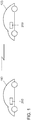
- Fig. 1 is a diagram of example vehicles configured to implement cooperative operations of a vehicle.
- Fig. 1 shows two vehicles 110, 120 interacting each other as an example, but the vehicles 110, 120 may interact with more than one vehicle and may interact with a group of vehicles (e.g. a platoon).
- the vehicles 110, 120 may be running in the same direction (e.g. vehicles running on a highway) or in different directions (e.g. vehicles approaching an intersection).
- the vehicle 110, 120 may be a car, a bus, a truck, a sports utility vehicle (SUV), a trailer, a recreational vehicle, a motorcycle, or any other type of motorized vehicles.
- SUV sports utility vehicle
- Each vehicle 110, 120 may include an internal system 200.
- Fig. 2 is a diagram of an example internal system 200.
- the internal system 200 may include a processor 210, a memory 220, and a wireless communication interface 230, and one or more sensors 240.
- Each component shown in Fig. 2 may be implemented in hardware, software, or a combination thereof.
- the sensor 240 may include, but is not limited to, a proximity sensor(s), a camera(s), or the like.
- the sensor 240 may detect and record various conditions and scenes in and around the vehicle, one or more operational parameters of the vehicle, or the like.
- a camera(s) may capture and record inside and/or outside of the vehicle (e.g. a front and/or rear view, a surround view, etc.).
- the sensor 240 may detect and store data corresponding to the vehicle's location (e.g., GPS coordinates), speed, direction, acceleration/deceleration, jerk, and heading of the vehicle, locations and images of objects around the vehicle such as other vehicles, road signs, road conditions, animals, pedestrians, or the like, external temperature, rain, snow, or other weather conditions, or the like.
- the vehicle's location e.g., GPS coordinates
- speed, direction, acceleration/deceleration, jerk e.g., speed, direction, acceleration/deceleration, jerk, and heading of the vehicle
- locations and images of objects around the vehicle such as other vehicles, road signs, road conditions, animals, pedestrians, or the like, external temperature, rain, snow, or other weather conditions, or the like.
- the data captured by the sensor 240 may be stored in the internal system 200 of the vehicle.
- the data captured by the sensor 240 may be provided to other vehicles via the wireless communication interface 230.
- the wireless communication interface 230 includes a wireless transceiver and an antenna.
- the wireless communication interface 230 is used for communication with other vehicles.
- the communication may be a point-to-point communication directly between vehicles 110, 120 or may go through a network (e.g. a Third Generation (3G), Fourth Generation (4G), or Fifth Generation (5G) network and beyond).
- a network e.g. a Third Generation (3G), Fourth Generation (4G), or Fifth Generation (5G) network and beyond.
- Each vehicle 110, 120 interacts with other vehicle by transmitting and receiving wireless signals.
- the wireless communication interface 230 may use any wireless communication protocols, such as IEEE 802.11 wireless local area network (WLAN) protocols, Bluetooth, 3G, Long Term Evolution (LTE), satellite communication, GSM, WiMAX, or any other wireless communication protocols.
- WLAN wireless local area network
- LTE Long Term Evolution
- satellite communication GSM, WiMAX, or any other wireless communication protocols.
- the internal system 200 includes application software stored in the memory 220 and running on the processor 210 for implementing methods for cooperative maneuvering of a vehicle, which will be explained in detail below, including negotiating and executing a transaction for implementing a certain action with another vehicle, implementing and monitoring the action agreed with another vehicle, providing or receiving a monetary incentive to or from another vehicle (user) as agreed, and the like.
- vehicles 110, 120 may negotiate for performing a certain action, such as providing information or maneuvering a vehicle in a specific way (e.g. reducing or increasing speed, providing captured data, leading a platoon, etc.) and provide a monetary incentive for performing the action.
- the requested action is typically time critical so that the negotiation and performance of the requested action should be performed in a short time period (e.g. immediately).
- a non-reversible contract may be executed between the users on the fly (e.g. as the vehicles approach an interaction, or the vehicles are running on a highway, etc.).
- Individual users may be compensated for their effort in the performance (e.g. cooperative maneuvers in a group) when their individual performance is affected.
- the monetary incentive may be provided immediately.
- the monetary compensation may be fixed for a defined time period and may be re-negotiated for the subsequent time period.
- the invention provides a mechanism (common platform) for negotiations for cooperative vehicle maneuvers. This abstraction enables the negotiation with a single objective, such as virtual money, instead of multiple ones.
- each vehicle 110, 120 may be responsible for evaluating its effort in terms of the monetary incentive. This means that it may be completely up to each vehicle's preferences to assign a specific universal "cost" or "offer price” value for any required or desired action. If the "cost" value is above the "offer price” value by other participants in the negotiation, the required action might not be executed by the vehicles.
- the negotiation and performance of the actions should be performed in a very short period of time since the required actions are typically time critical. For example, if an action requires reducing speed at an intersection, the negotiation between two or more vehicles approaching the intersection and performance of the requested action should be performed immediately. For another example, if a vehicle requests road condition data, the data should be provided immediately otherwise the data might be obsolete.
- the invention provides a mechanism for rapid completion of the negotiation (convergence or failure).
- Table 1 shows example parameters for the negotiation. It should be noted that the parameters in Table 1 are merely an example, and additional parameters may be added or some of the parameters in Table 1 might not be used.
- the negotiation may also be performed among three or more vehicles. Table 1 Parameters Vehicle A Vehicle B Initial offer o a o b Maximum negotiation steps ns a ns b Offer increment/decrement oi a oi b Best alternative to a negotiated agreement batna a batna b
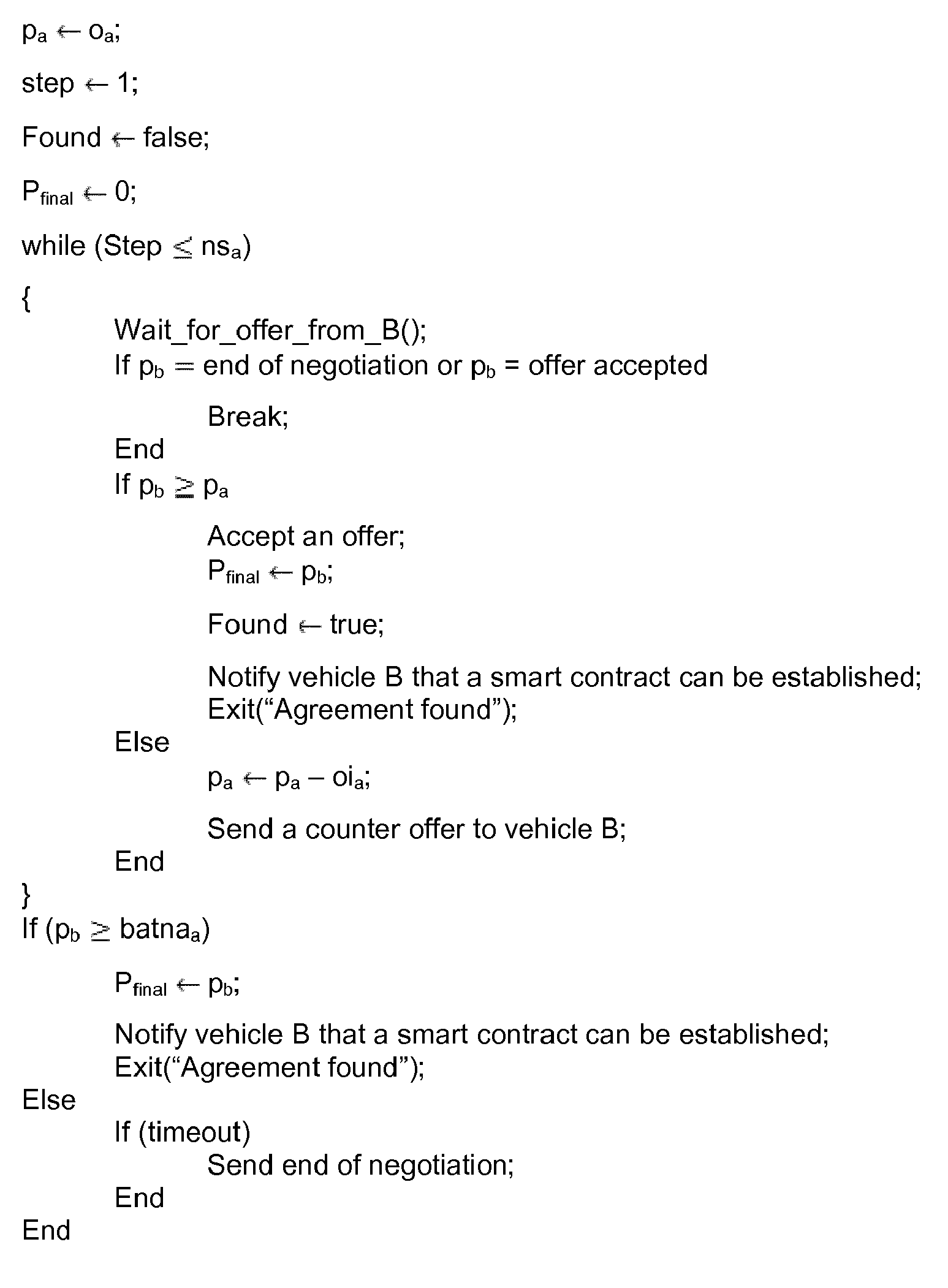
- each participant i.e. each vehicle involved in the negotiation may configure its maximum number of possible offers (e.g. maximum negotiation steps) it can participate in and a minimum increment or decrement for counter offer in each negotiation step, as shown in the example negotiation algorithm below.
- Each vehicle provides an offer and if an agreement is not found, each vehicle may provide a counter offer with an amount increased or decreased by at least the minimum increment or decrement until the maximum number of negotiation steps is reached. If an agreement is not found until the maximum negotiation steps are reached, the negotiation may fail.
- the vehicle may then decide whether any new offer is needed or may take the best offer as far as the best alternative to a negotiated agreement is not crossed. If the negotiation is mediated through a central controller or any third party, the parameters (e.g. the initial offer, the maximum negotiation steps, the increment/decrement, and/or the BATNA) may be provided to the central controller/third party.
- the parameters e.g. the initial offer, the maximum negotiation steps, the increment/decrement, and/or the BATNA
- the negotiation between two vehicles may be performed via a central controller/entity (centralized case) or may be performed directly between the vehicles (decentralized case).
- vehicle A is offering an action (e.g. sending data or maneuvering a vehicle in a specific way) and vehicle B is offering a reward for the action.
- a central controller/entity receives an offer (e.g. including some or all of the parameters in Table 1) from each vehicle and may mediate the negotiation between the vehicles.
- the central controller receives the offers from the vehicles and determines whether an agreement can be reached by iterating the negotiation steps based on the received parameters, and sends the result of negotiation to the vehicles.
- the negotiated price (Pfinal) in the example below may be determined as a mean of the two offers. If an agreement is not found until the maximum number of negotiation steps is reached, the agreement may be made for the middle value of the offers if the offers do not cross the best alternative to the negotiated agreement value.
- the negotiation may be performed as follows.
- the negotiation is performed directly between the vehicles and each vehicle sends an offer and a counter offer to the other vehicle at each step.
- the vehicles send a counter offer with an increased or decreased amount if an agreement is not found in each negotiation step until the maximum number of negotiation steps is reached. If an agreement is found, a contract may be executed between the vehicles. If an agreement is not found until the maximum number of negotiation steps is reached, the vehicle may accept the last offer if the last offer does not cross the best alternative to the negotiated agreement value.
- the negotiation may be performed as follows.
- the negotiation fails when both vehicles send an end of negotiation.
- the vehicles may execute a transaction.
- the vehicles may execute a smart contract using blockchain-based cryptocurrencies or any distributed digital ledger technology.
- the blockchain-based cryptocurrencies may provide a platform for this negotiation.
- Blockchain technology is based on a distributed digital ledger, which keeps records of all transactions. Transactions are validated by the distributed nodes (i.e. the internal computing system in each vehicle), which makes the system independent of a central identity and enables two parties operate an immediate transaction with a simple network connection.
- the fast and distributed characteristics of the blockchain-based cryptocurrency technology may enable such an immediate incentivization systems.
- a smart contract is "A computerized transaction protocol that executes the terms of a contract".
- the contract is the result of the negotiation, i.e. a promise for a defined reward in exchange for e.g. a defined action or defined set of data.
- This transaction can be for instance operated on a blockchain-based platform which has the advantage to rely on a public ledger meaning that, among others, both parties can monitor the transaction and decide whether or not they continue their business relationship in an automated and rather immediate way.
- a blockchain-based smart contract has the advantage, over the traditional contract, to be enforced by cryptographic protocols.
- the parties i.e. the vehicles involved in the cooperative maneuvering may execute a smart contract once a negotiation reaches an agreement.
- a smart contract is a computer protocol intended to digitally facilitate, verify, or enforce the negotiation and performance of a contract. Smart contracts allow the performance of credible transactions without third parties. The transactions are trackable and irreversible.
- the cryptocurrency transaction (e.g. transferring a cryptocurrency in an agreed amount from one account to another) may be operated when the contract is executed.
- the internal system 200 of each vehicle 110, 120 autonomously negotiates with other vehicle(s), and executes and monitors performance of the smart contract including the cryptocurrency transaction and performance of the requested action (such as transfer of data).
- Fig. 3 is a flow diagram of an example negotiation process for cooperative perception (e.g. sharing of sensor data).
- vehicle A detects an occlusion of its field of view (302).
- Vehicle A broadcasts (i.e. sends a wireless signal) a request for external sensor data to nearby vehicles (304).
- Vehicle B receives the request via the wireless transmission and evaluates cost for sending the requested data (306).
- Vehicle B then sends an offer to vehicle A including a price for sending the requested data (308).
- Vehicle A receives the offer from vehicle B and evaluates the offer (310).
- Vehicles A and B may perform negotiation in one or more steps to reach an agreement.
- vehicles A and B execute a transaction (e.g. a blockchain-based cryptocurrency transfer) and vehicle B sends the data to vehicle A (312).
- a transaction e.g. a blockchain-based cryptocurrency transfer
- the data provided by the vehicle may be raw data from a sensor (e.g. cloud from laser scanner/lidar, radar, video stream from a camera(s) (three-dimensional (3D) cameras, 360° cameras, etc.), Global Positioning System (GPS), odometer, inertial measurement unit (IMU)) to let the receiving vehicle A perform filtering, fusion and/or analysis of the data.
- a sensor e.g. cloud from laser scanner/lidar, radar, video stream from a camera(s) (three-dimensional (3D) cameras, 360° cameras, etc.), Global Positioning System (GPS), odometer, inertial measurement unit (IMU)
- GPS Global Positioning System
- IMU inertial measurement unit
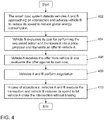
- Fig. 4 is a flow diagram of an example negotiation process for cooperative intersection crossing.
- Vehicles A and B arrive at an intersection where a smart road system is deployed.
- the smart road system is an intelligent system deployed for relieving traffic congestion and improving road system capacity.
- the smart road system provides driving advices (no commands) to the nearby vehicles, such as specific rights of way.
- driving advices no commands
- vehicle A should yield to vehicle B, but the smart road system advices vehicle B that if vehicle B reduces its speed, vehicle A can cross the intersection without stopping.
- This maneuver reduces the global energy consumption especially because it avoids a full brake of vehicle A.
- vehicle B does not benefit from this maneuver since it must reduce its speed and therefore use more energy to come back to its original state.
- the smart road system detects vehicles A and B approaching an intersection and advices vehicle B to reduce its speed to reduce global energy consumption (302).
- Vehicle B evaluates its cost for performing the requested action and translates it into a price proposal and transmits an offer to vehicle A (304).
- Vehicle A receives the offer from vehicle B and evaluates the offer against its own cost (306).
- Vehicles A and B perform negotiation (308). Each vehicle evaluates the cost of giving the priority and if the total cost does not meet the proposal, the priority may be refused.
- vehicles A and B execute the transaction (e.g. blockchain-based cryptocurrency transfer) and vehicle B reduces its speed to let vehicle A cross the intersection without braking (310). If an agreement is not reached by vehicles A and B, a negotiation fails and a priority may not be given to vehicle A.
- a central system e.g. the smart road system
- the central system may directly negotiate with a vehicle and pay the reward to the vehicle.
- the smart road system may negotiate with vehicle B and provide a reward to vehicle B if vehicle B agrees to reduce its speed to let vehicle A to pass without stopping.
- the central system may negotiate with one or more vehicles to obtain data (e.g. for traffic signal management, or the like) and pay a compensation to the vehicle(s) that provide the data.
- the transaction may be monitored by using the connectivity of the vehicles.
- the system may enforce the payments by monitoring the transactions using a blockchain's feature.
- the blockchain-based cryptocurrency transactions are immediate and public. Therefore, the parties may check the payment immediately and if the payment is not made as agreed, the vehicle may cancel the transaction, (e.g. vehicle B may change its trajectory and drive according to the traffic law).
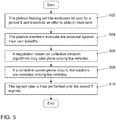
- Fig. 5 is a flow diagram of an example negotiation process for operating a platoon of a plurality of vehicles. Grouping vehicles into platoons is one possible way of increasing the capacity of roads. An automated highway system may be implemented with this technology. Platoons may decrease the distances between vehicles using electronic or mechanical coupling. This capability would allow many vehicles to accelerate or brake simultaneously. Smart cars could automatically join and leave a platoon.
- the platoon leading vehicle evaluates its cost (energy, delay penalty, etc.) for a period T and transmits an offer to platoon members (502).
- the platoon members evaluate the proposal against their own benefits (504).
- a negotiation based on collective decision algorithms i.e. marker-based algorithm
- Collective decision algorithms are a family of algorithm involving multiple agents having different interests, resources and objectives, which are sometimes remote in the case of distributed collective decision algorithms.
- the agents must reach an agreement based on defined rules (rule-based algorithms), on bidding processes (market-based algorithms) for instance.
- the collective algorithms for more than two agents can start with the evaluation of the cost and benefit of participating in a collective behavior (such has estimating the drag force cost for the first member of a platoon, the cost of time for driving under the maximal speed, the benefit of reduced a drag force for followers in a platoon, decreased fuel consumption, etc. Then the agents can get involved in a bidding mechanism where they would try to reach a consensus for engaging the collective behavior, such has negotiating prices, time of involvement, etc. They can also, for instance, apply predefined optimization rules. If a collective convergence occurs, transactions are executed among the vehicles (e.g. cryptocurrency-based transactions) (508). The agreed plan is then performed until the period T expires (510). The negotiation process may then restart for the subsequent period.
- the vehicles e.g. cryptocurrency-based transactions
- Another example is a computer program having a program code for performing at least one of the methods described herein, when the computer program is executed on a computer, a processor, or a programmable hardware component.
- Another example is a machine-readable storage including machine readable instructions, when executed, to implement a method or realize an apparatus as described herein.
- a further example is a machine-readable medium including code, when executed, to cause a machine to perform any of the methods described herein.
- Examples may further be or relate to a computer program having a program code for performing one or more of the above methods, when the computer program is executed on a computer or processor. Steps, operations or processes of various above-described methods may be performed by programmed computers or processors. Examples may also cover program storage devices such as digital data storage media, which are machine, processor or computer readable and encode machine-executable, processor-executable or computer-executable programs of instructions. The instructions perform or cause performing some or all of the acts of the above-described methods.
- the program storage devices may comprise or be, for instance, digital memories, magnetic storage media such as magnetic disks and magnetic tapes, hard drives, or optically readable digital data storage media.
- FIG. 1 may also cover computers, processors or control units programmed to perform the acts of the above-described methods or (field) programmable logic arrays ((F)PLAs) or (field) programmable gate arrays ((F)PGAs), programmed to perform the acts of the above-described methods.
- a functional block denoted as "means for " performing a certain function may refer to a circuit that is configured to perform a certain function.
- a "means for s.th.” may be implemented as a "means configured to or suited for s.th.”, such as a device or a circuit configured to or suited for the respective task.
- Functions of various elements shown in the figures may be implemented in the form of dedicated hardware, such as “a signal provider”, “a signal processing unit”, “a processor”, “a controller”, etc. as well as hardware capable of executing software in association with appropriate software.
- a processor the functions may be provided by a single dedicated processor, by a single shared processor, or by a plurality of individual processors, some of which or all of which may be shared.
- processor or “controller” is by far not limited to hardware exclusively capable of executing software, but may include digital signal processor (DSP) hardware, network processor, application specific integrated circuit (ASIC), field programmable gate array (FPGA), read only memory (ROM) for storing software, random access memory (RAM), and non-volatile storage.
- DSP digital signal processor
- ASIC application specific integrated circuit
- FPGA field programmable gate array
- ROM read only memory
- RAM random access memory
- non-volatile storage Other hardware, conventional and/or custom, may also be included.
- a block diagram may, for instance, illustrate a high-level circuit diagram implementing the principles of the disclosure.
- a flow chart, a flow diagram, a state transition diagram, a pseudo code, and the like may represent various processes, operations or steps, which may, for instance, be substantially represented in computer readable medium and so executed by a computer or processor, whether or not such computer or processor is explicitly shown.
- Methods disclosed in the specification or in the claims may be implemented by a device having means for performing each of the respective acts of these methods.
- each claim may stand on its own as a separate example. While each claim may stand on its own as a separate example, it is to be noted that - although a dependent claim may refer in the claims to a specific combination with one or more other claims - other examples may also include a combination of the dependent claim with the subject matter of each other dependent or independent claim. Such combinations are explicitly proposed herein unless it is stated that a specific combination is not intended. Furthermore, it is intended to include also features of a claim to any other independent claim even if this claim is not directly made dependent to the independent claim.
Landscapes
- Business, Economics & Management (AREA)
- Engineering & Computer Science (AREA)
- Accounting & Taxation (AREA)
- General Physics & Mathematics (AREA)
- Theoretical Computer Science (AREA)
- Strategic Management (AREA)
- Physics & Mathematics (AREA)
- General Business, Economics & Management (AREA)
- Tourism & Hospitality (AREA)
- Finance (AREA)
- Economics (AREA)
- Marketing (AREA)
- Technology Law (AREA)
- Health & Medical Sciences (AREA)
- General Health & Medical Sciences (AREA)
- Human Resources & Organizations (AREA)
- Primary Health Care (AREA)
- Computer Networks & Wireless Communication (AREA)
- Signal Processing (AREA)
- Development Economics (AREA)
- Entrepreneurship & Innovation (AREA)
- Traffic Control Systems (AREA)
Abstract

Description
- The present invention relates to a cooperative vehicular system. More particularly, the present invention relates to a method and system for performing negotiation and providing monetary incentives for cooperative operations of vehicles.
- Decisions made while operating a vehicle are often the result of a multi-objective optimization problem, which accounts for factors such as fuel consumption, travel time, or the like. The importance of one factor over another for each vehicle may vary over time. For example, at a specific time, a vehicle might value more its travel time than its fuel consumption, while later, when its fuel tank is almost empty and there is no gas station in the vicinity, the fuel consumption may be more important than the travel time.
- A cooperative vehicular system is a group of two or more vehicles performing together whilst working on selfish yet common goals. The selfish yet common goal is the essence of the distinction with collaborative systems, where vehicles have a single shared goal (e.g. platooning).
- Research has been done on interaction between vehicles, autonomous or not, with beginnings of autonomous truck platooning. A recurring question in such systems is the conflict between individual performances and the global performance. Collaborative vehicles are assumed to have the shared goal as prime priority.
- To cooperate with other vehicles, for example, in terms of safety and comfort or to participate in a group formation aiming for a lower fuel consumption and higher road efficiency, a single vehicle might suffer from a lower performance than when it drives by itself without cooperation. An example for the former case is the cost of a communications system (e.g. a provider charge for data over managed frequencies) sending sensor data to fill the occlusion of the field of view of another vehicle. It can also be the reduction of its own speed to avoid a full brake for another vehicle, although it has no legal obligation to do so, in order to reduce their global energy consumption. An example for the latter case is the higher consumption of the leading vehicle of a high-density platoon (HDPL). If an HDPL permits to reduce the drag force and thus the global consumption of the platoon, the leading vehicle still suffers from high drag force whilst performing platoon-related maneuver, thus not improving its individual performance when participating in a platoon.
- The case of the platoon leader might not be a problem in collaborative cases, where vehicles are operated by the same company or part of the same organization, sharing costs and benefits. When cooperation is addressed, working for the greater good is generally assumed, thus avoiding the defined problem.
-
US 2014/0316865 discloses a platoon travel system for organizing a platoon of vehicles along a preset travel route. The vehicles are divided into a top group and a tail end group based on projection area information of the vehicles. However,US 2014/0316865 describes only a specific platooning system and algorithms for joining and leaving maneuvers. -
US 2016/010416 discloses a method of vehicle chain resource allocation. The method includes establishing a vehicle chain network between vehicles, transmitting energy parameters between vehicles via the vehicle chain network, and generating energy credits based on the energy parameters.US 2016/010416 is specifically limited to platooning systems and discloses algorithms to translate the energy savings in credits. -
US 9,355,423 US 9,355,423 US 9,355,423 US 9,355,423 - There is a demand for providing an improved concept for negotiating for rewards or monetary incentive for cooperative maneuvering of vehicles and providing the monetary incentive or rewards for the requested action in a very short period of time while operating the vehicles. The demand is satisfied according to the appended independent claims.
- An example relates to a method and system for performing negotiation and providing monetary incentives for cooperative vehicular operations. A first vehicle may send an offer for an action to a second vehicle wirelessly. The offer includes a price for performing the action by the second vehicle. The first vehicle negotiates with the second vehicle for a monetary incentive for performing the action while operating the first vehicle. The first vehicle provides the monetary incentive to the second vehicle and the second vehicle performs the action if the first vehicle and the second vehicle reach an agreement. The first vehicle and the second vehicle may execute a smart contract and the monetary incentive may be provided by a blockchain-based cryptocurrency transaction.
- The action requested from the second vehicle may be providing data from the second vehicle to the first vehicle. The data provided by the second vehicle may be raw data from a sensor or processed data by the second vehicle. The action requested from the second vehicle may be maneuvering the second vehicle in a negotiated way. The action may be recommended by a smart road system.
- The first vehicle may perform the negotiation with the second vehicle based on a maximum number of steps for negotiation and a minimum increment or decrement amount for each step of negotiation, such that the offer may be incremented or decremented by the minimum increment or decrement each negotiation step if an agreement is not reached. The negotiation between the first vehicle and the second vehicle may be mediated by a central controller.
- Some examples of apparatuses and/or methods will be described in the following by way of example only, and with reference to the accompanying figures, in which:
-
Fig. 1 is a diagram of example vehicles configured to implement cooperative operations of a vehicle; -
Fig. 2 is a diagram of an example internal system; -
Fig. 3 is a flow diagram of an example negotiation process for cooperative perception; -
Fig. 4 is a flow diagram of an example negotiation process for cooperative intersection crossing; and -
Fig. 5 is a flow diagram of an example negotiation process for operating a platoon of a plurality of vehicles. - Various examples will now be described more fully with reference to the accompanying drawings in which some examples are illustrated. In the figures, the thicknesses of lines, layers and/or regions may be exaggerated for clarity.
- Accordingly, while further examples are capable of various modifications and alternative forms, some particular examples thereof are shown in the figures and will subsequently be described in detail. However, this detailed description does not limit further examples to the particular forms described. Further examples may cover all modifications, equivalents, and alternatives falling within the scope of the disclosure. Like numbers refer to like or similar elements throughout the description of the figures, which may be implemented identically or in modified form when compared to one another while providing for the same or a similar functionality.
- It will be understood that when an element is referred to as being "connected" or "coupled" to another element, the elements may be directly connected or coupled or via one or more intervening elements. If two elements A and B are combined using an "or", this is to be understood to disclose all possible combinations, i.e. only A, only B as well as A and B. An alternative wording for the same combinations is "at least one of A and B". The same applies for combinations of more than 2 elements.
- The terminology used herein for the purpose of describing particular examples is not intended to be limiting for further examples. Whenever a singular form such as "a," "an" and "the" is used and using only a single element is neither explicitly or implicitly defined as being mandatory, further examples may also use plural elements to implement the same functionality. Likewise, when a functionality is subsequently described as being implemented using multiple elements, further examples may implement the same functionality using a single element or processing entity. It will be further understood that the terms "comprises," "comprising," "includes" and/or "including," when used, specify the presence of the stated features, integers, steps, operations, processes, acts, elements and/or components, but do not preclude the presence or addition of one or more other features, integers, steps, operations, processes, acts, elements, components and/or any group thereof.
- Unless otherwise defined, all terms (including technical and scientific terms) are used herein in their ordinary meaning of the art to which the examples belong.
-
Fig. 1 is a diagram of example vehicles configured to implement cooperative operations of a vehicle.Fig. 1 shows twovehicles vehicles vehicles vehicle - Each
vehicle internal system 200.Fig. 2 is a diagram of an exampleinternal system 200. Theinternal system 200 may include aprocessor 210, amemory 220, and awireless communication interface 230, and one ormore sensors 240. Each component shown inFig. 2 may be implemented in hardware, software, or a combination thereof. - The
sensor 240 may include, but is not limited to, a proximity sensor(s), a camera(s), or the like. Thesensor 240 may detect and record various conditions and scenes in and around the vehicle, one or more operational parameters of the vehicle, or the like. For example, a camera(s) may capture and record inside and/or outside of the vehicle (e.g. a front and/or rear view, a surround view, etc.). For another example, thesensor 240 may detect and store data corresponding to the vehicle's location (e.g., GPS coordinates), speed, direction, acceleration/deceleration, jerk, and heading of the vehicle, locations and images of objects around the vehicle such as other vehicles, road signs, road conditions, animals, pedestrians, or the like, external temperature, rain, snow, or other weather conditions, or the like. - The data captured by the
sensor 240 may be stored in theinternal system 200 of the vehicle. The data captured by thesensor 240 may be provided to other vehicles via thewireless communication interface 230. - The
wireless communication interface 230 includes a wireless transceiver and an antenna. Thewireless communication interface 230 is used for communication with other vehicles. The communication may be a point-to-point communication directly betweenvehicles vehicle wireless communication interface 230 may use any wireless communication protocols, such as IEEE 802.11 wireless local area network (WLAN) protocols, Bluetooth, 3G, Long Term Evolution (LTE), satellite communication, GSM, WiMAX, or any other wireless communication protocols. - The
internal system 200 includes application software stored in thememory 220 and running on theprocessor 210 for implementing methods for cooperative maneuvering of a vehicle, which will be explained in detail below, including negotiating and executing a transaction for implementing a certain action with another vehicle, implementing and monitoring the action agreed with another vehicle, providing or receiving a monetary incentive to or from another vehicle (user) as agreed, and the like. - This invention provides a way to incentivize cooperation among
vehicles vehicles - Individual users (the users of the vehicles) may be compensated for their effort in the performance (e.g. cooperative maneuvers in a group) when their individual performance is affected. The monetary incentive may be provided immediately. The monetary compensation may be fixed for a defined time period and may be re-negotiated for the subsequent time period.
- The invention provides a mechanism (common platform) for negotiations for cooperative vehicle maneuvers. This abstraction enables the negotiation with a single objective, such as virtual money, instead of multiple ones. In one example, each
vehicle - The negotiation and performance of the actions should be performed in a very short period of time since the required actions are typically time critical. For example, if an action requires reducing speed at an intersection, the negotiation between two or more vehicles approaching the intersection and performance of the requested action should be performed immediately. For another example, if a vehicle requests road condition data, the data should be provided immediately otherwise the data might be obsolete. The invention provides a mechanism for rapid completion of the negotiation (convergence or failure).
- Example negotiation algorithm between two vehicles is explained below. Table 1 shows example parameters for the negotiation. It should be noted that the parameters in Table 1 are merely an example, and additional parameters may be added or some of the parameters in Table 1 might not be used. The negotiation may also be performed among three or more vehicles.
Table 1 Parameters Vehicle A Vehicle B Initial offer oa ob Maximum negotiation steps nsa nsb Offer increment/decrement oia oib Best alternative to a negotiated agreement batnaa batnab - In order to enable sufficiently fast convergence of negotiation and performance of the requested or desired actions, each participant (i.e. each vehicle) involved in the negotiation may configure its maximum number of possible offers (e.g. maximum negotiation steps) it can participate in and a minimum increment or decrement for counter offer in each negotiation step, as shown in the example negotiation algorithm below. Each vehicle provides an offer and if an agreement is not found, each vehicle may provide a counter offer with an amount increased or decreased by at least the minimum increment or decrement until the maximum number of negotiation steps is reached. If an agreement is not found until the maximum negotiation steps are reached, the negotiation may fail. If the negotiation process reaches the maximum number of steps provided by the vehicle, the vehicle may then decide whether any new offer is needed or may take the best offer as far as the best alternative to a negotiated agreement is not crossed. If the negotiation is mediated through a central controller or any third party, the parameters (e.g. the initial offer, the maximum negotiation steps, the increment/decrement, and/or the BATNA) may be provided to the central controller/third party.
- The negotiation between two vehicles may be performed via a central controller/entity (centralized case) or may be performed directly between the vehicles (decentralized case). In the example negotiation algorithm below, vehicle A is offering an action (e.g. sending data or maneuvering a vehicle in a specific way) and vehicle B is offering a reward for the action.
- In the centralized case, a central controller/entity (e.g. a smart traffic light controller, a centralized intelligence entity, a smart road system, or the like) receives an offer (e.g. including some or all of the parameters in Table 1) from each vehicle and may mediate the negotiation between the vehicles. The central controller receives the offers from the vehicles and determines whether an agreement can be reached by iterating the negotiation steps based on the received parameters, and sends the result of negotiation to the vehicles. The negotiated price (Pfinal) in the example below may be determined as a mean of the two offers. If an agreement is not found until the maximum number of negotiation steps is reached, the agreement may be made for the middle value of the offers if the offers do not cross the best alternative to the negotiated agreement value. The negotiation may be performed as follows.

- In the decentralized case, the negotiation is performed directly between the vehicles and each vehicle sends an offer and a counter offer to the other vehicle at each step. The vehicles send a counter offer with an increased or decreased amount if an agreement is not found in each negotiation step until the maximum number of negotiation steps is reached. If an agreement is found, a contract may be executed between the vehicles. If an agreement is not found until the maximum number of negotiation steps is reached, the vehicle may accept the last offer if the last offer does not cross the best alternative to the negotiated agreement value. The negotiation may be performed as follows.
- In vehicle A:
- The negotiation fails when both vehicles send an end of negotiation. Once an agreement is reached, the vehicles may execute a transaction. In one example, the vehicles may execute a smart contract using blockchain-based cryptocurrencies or any distributed digital ledger technology. For example, the blockchain-based cryptocurrencies may provide a platform for this negotiation. Blockchain technology is based on a distributed digital ledger, which keeps records of all transactions. Transactions are validated by the distributed nodes (i.e. the internal computing system in each vehicle), which makes the system independent of a central identity and enables two parties operate an immediate transaction with a simple network connection. The fast and distributed characteristics of the blockchain-based cryptocurrency technology may enable such an immediate incentivization systems. A smart contract is "A computerized transaction protocol that executes the terms of a contract". Here the contract is the result of the negotiation, i.e. a promise for a defined reward in exchange for e.g. a defined action or defined set of data. This transaction can be for instance operated on a blockchain-based platform which has the advantage to rely on a public ledger meaning that, among others, both parties can monitor the transaction and decide whether or not they continue their business relationship in an automated and rather immediate way. In addition to the short term monitoring and public fold, a blockchain-based smart contract has the advantage, over the traditional contract, to be enforced by cryptographic protocols.
- The parties (i.e. the vehicles) involved in the cooperative maneuvering may execute a smart contract once a negotiation reaches an agreement. A smart contract is a computer protocol intended to digitally facilitate, verify, or enforce the negotiation and performance of a contract. Smart contracts allow the performance of credible transactions without third parties. The transactions are trackable and irreversible. The cryptocurrency transaction (e.g. transferring a cryptocurrency in an agreed amount from one account to another) may be operated when the contract is executed. The
internal system 200 of eachvehicle -
Fig. 3 is a flow diagram of an example negotiation process for cooperative perception (e.g. sharing of sensor data). For example, vehicle A detects an occlusion of its field of view (302). Vehicle A broadcasts (i.e. sends a wireless signal) a request for external sensor data to nearby vehicles (304). Vehicle B receives the request via the wireless transmission and evaluates cost for sending the requested data (306). Vehicle B then sends an offer to vehicle A including a price for sending the requested data (308). Vehicle A receives the offer from vehicle B and evaluates the offer (310). Vehicles A and B may perform negotiation in one or more steps to reach an agreement. In case of acceptance, vehicles A and B execute a transaction (e.g. a blockchain-based cryptocurrency transfer) and vehicle B sends the data to vehicle A (312). The above example is described just for the case of obstruction of the field of view, but the requested data may be any type of data that may be necessary for any situations. - The data provided by the vehicle may be raw data from a sensor (e.g. cloud from laser scanner/lidar, radar, video stream from a camera(s) (three-dimensional (3D) cameras, 360° cameras, etc.), Global Positioning System (GPS), odometer, inertial measurement unit (IMU)) to let the receiving vehicle A perform filtering, fusion and/or analysis of the data. Alternatively, the data provided by the vehicle may be processed data, such as arrays of objects, 3D scene of the surrounding of vehicle B, or the like.
-
Fig. 4 is a flow diagram of an example negotiation process for cooperative intersection crossing. Vehicles A and B arrive at an intersection where a smart road system is deployed. The smart road system is an intelligent system deployed for relieving traffic congestion and improving road system capacity. The smart road system provides driving advices (no commands) to the nearby vehicles, such as specific rights of way. In this example, it is assumed that according to the traffic laws, vehicle A should yield to vehicle B, but the smart road system advices vehicle B that if vehicle B reduces its speed, vehicle A can cross the intersection without stopping. This maneuver reduces the global energy consumption especially because it avoids a full brake of vehicle A. However, vehicle B does not benefit from this maneuver since it must reduce its speed and therefore use more energy to come back to its original state. - The smart road system detects vehicles A and B approaching an intersection and advices vehicle B to reduce its speed to reduce global energy consumption (302). Vehicle B evaluates its cost for performing the requested action and translates it into a price proposal and transmits an offer to vehicle A (304). Vehicle A receives the offer from vehicle B and evaluates the offer against its own cost (306). Vehicles A and B perform negotiation (308). Each vehicle evaluates the cost of giving the priority and if the total cost does not meet the proposal, the priority may be refused. In case of acceptance (i.e. an agreement is reached by vehicles A and B), vehicles A and B execute the transaction (e.g. blockchain-based cryptocurrency transfer) and vehicle B reduces its speed to let vehicle A cross the intersection without braking (310). If an agreement is not reached by vehicles A and B, a negotiation fails and a priority may not be given to vehicle A.
- In the above example, since the global reduction of traffic congestion is also an objective of a road system operator, the road system operator may also participate in the transaction to improve the traffic flow in the road system. For example, a central system (e.g. the smart road system) may accept proposals from vehicles A and B and may mediate the negotiation between the vehicles, and if an agreement cannot be reached, the central system may fill the gap (e.g. pay the difference between the offers). Alternatively, the central system may directly negotiate with a vehicle and pay the reward to the vehicle. In the above example, the smart road system may negotiate with vehicle B and provide a reward to vehicle B if vehicle B agrees to reduce its speed to let vehicle A to pass without stopping. Alternatively, the central system may negotiate with one or more vehicles to obtain data (e.g. for traffic signal management, or the like) and pay a compensation to the vehicle(s) that provide the data.
- In both examples above, the transaction may be monitored by using the connectivity of the vehicles. The system may enforce the payments by monitoring the transactions using a blockchain's feature. The blockchain-based cryptocurrency transactions are immediate and public. Therefore, the parties may check the payment immediately and if the payment is not made as agreed, the vehicle may cancel the transaction, (e.g. vehicle B may change its trajectory and drive according to the traffic law).
-
Fig. 5 is a flow diagram of an example negotiation process for operating a platoon of a plurality of vehicles. Grouping vehicles into platoons is one possible way of increasing the capacity of roads. An automated highway system may be implemented with this technology. Platoons may decrease the distances between vehicles using electronic or mechanical coupling. This capability would allow many vehicles to accelerate or brake simultaneously. Smart cars could automatically join and leave a platoon. - It is assumed that a platoon is already formed. The platoon leading vehicle evaluates its cost (energy, delay penalty, etc.) for a period T and transmits an offer to platoon members (502). The platoon members evaluate the proposal against their own benefits (504). A negotiation based on collective decision algorithms (i.e. marker-based algorithm) may take place among the vehicles (506). Collective decision algorithms are a family of algorithm involving multiple agents having different interests, resources and objectives, which are sometimes remote in the case of distributed collective decision algorithms. The agents must reach an agreement based on defined rules (rule-based algorithms), on bidding processes (market-based algorithms) for instance. Here the collective algorithms for more than two agents can start with the evaluation of the cost and benefit of participating in a collective behavior (such has estimating the drag force cost for the first member of a platoon, the cost of time for driving under the maximal speed, the benefit of reduced a drag force for followers in a platoon, decreased fuel consumption, etc. Then the agents can get involved in a bidding mechanism where they would try to reach a consensus for engaging the collective behavior, such has negotiating prices, time of involvement, etc. They can also, for instance, apply predefined optimization rules. If a collective convergence occurs, transactions are executed among the vehicles (e.g. cryptocurrency-based transactions) (508). The agreed plan is then performed until the period T expires (510). The negotiation process may then restart for the subsequent period.
- Another example is a computer program having a program code for performing at least one of the methods described herein, when the computer program is executed on a computer, a processor, or a programmable hardware component. Another example is a machine-readable storage including machine readable instructions, when executed, to implement a method or realize an apparatus as described herein. A further example is a machine-readable medium including code, when executed, to cause a machine to perform any of the methods described herein.
- The aspects and features mentioned and described together with one or more of the previously detailed examples and figures, may as well be combined with one or more of the other examples in order to replace a like feature of the other example or in order to additionally introduce the feature to the other example.
- Examples may further be or relate to a computer program having a program code for performing one or more of the above methods, when the computer program is executed on a computer or processor. Steps, operations or processes of various above-described methods may be performed by programmed computers or processors. Examples may also cover program storage devices such as digital data storage media, which are machine, processor or computer readable and encode machine-executable, processor-executable or computer-executable programs of instructions. The instructions perform or cause performing some or all of the acts of the above-described methods. The program storage devices may comprise or be, for instance, digital memories, magnetic storage media such as magnetic disks and magnetic tapes, hard drives, or optically readable digital data storage media. Further examples may also cover computers, processors or control units programmed to perform the acts of the above-described methods or (field) programmable logic arrays ((F)PLAs) or (field) programmable gate arrays ((F)PGAs), programmed to perform the acts of the above-described methods.
- The description and drawings merely illustrate the principles of the disclosure. Furthermore, all examples recited herein are principally intended expressly to be only for pedagogical purposes to aid the reader in understanding the principles of the disclosure and the concepts contributed by the inventor(s) to furthering the art. All statements herein reciting principles, aspects, and examples of the disclosure, as well as specific examples thereof, are intended to encompass equivalents thereof.
- A functional block denoted as "means for ..." performing a certain function may refer to a circuit that is configured to perform a certain function. Hence, a "means for s.th." may be implemented as a "means configured to or suited for s.th.", such as a device or a circuit configured to or suited for the respective task.
- Functions of various elements shown in the figures, including any functional blocks labeled as "means", "means for providing a sensor signal", "means for generating a transmit signal.", etc., may be implemented in the form of dedicated hardware, such as "a signal provider", "a signal processing unit", "a processor", "a controller", etc. as well as hardware capable of executing software in association with appropriate software. When provided by a processor, the functions may be provided by a single dedicated processor, by a single shared processor, or by a plurality of individual processors, some of which or all of which may be shared. However, the term "processor" or "controller" is by far not limited to hardware exclusively capable of executing software, but may include digital signal processor (DSP) hardware, network processor, application specific integrated circuit (ASIC), field programmable gate array (FPGA), read only memory (ROM) for storing software, random access memory (RAM), and non-volatile storage. Other hardware, conventional and/or custom, may also be included.
- A block diagram may, for instance, illustrate a high-level circuit diagram implementing the principles of the disclosure. Similarly, a flow chart, a flow diagram, a state transition diagram, a pseudo code, and the like may represent various processes, operations or steps, which may, for instance, be substantially represented in computer readable medium and so executed by a computer or processor, whether or not such computer or processor is explicitly shown. Methods disclosed in the specification or in the claims may be implemented by a device having means for performing each of the respective acts of these methods.
- It is to be understood that the disclosure of multiple acts, processes, operations, steps or functions disclosed in the specification or claims may not be construed as to be within the specific order, unless explicitly or implicitly stated otherwise, for instance for technical reasons. Therefore, the disclosure of multiple acts or functions will not limit these to a particular order unless such acts or functions are not interchangeable for technical reasons. Furthermore, in some examples a single act, function, process, operation or step may include or may be broken into multiple sub-acts, -functions, -processes, -operations or-steps, respectively. Such sub acts may be included and part of the disclosure of this single act unless explicitly excluded.
- Furthermore, the following claims are hereby incorporated into the detailed description, where each claim may stand on its own as a separate example. While each claim may stand on its own as a separate example, it is to be noted that - although a dependent claim may refer in the claims to a specific combination with one or more other claims - other examples may also include a combination of the dependent claim with the subject matter of each other dependent or independent claim. Such combinations are explicitly proposed herein unless it is stated that a specific combination is not intended. Furthermore, it is intended to include also features of a claim to any other independent claim even if this claim is not directly made dependent to the independent claim.
-
- 110, 120: vehicle,
- 200: internal system,
- 210: processor,
- 220: memory,
- 230: wireless communication system,
- 240: sensors.
Claims (15)
- A method for cooperative operation of a vehicle, the method comprising:a first vehicle (110) sending an offer for an action to a second vehicle (120) wirelessly, wherein the offer includes a price for performing the action by the second vehicle (120);the first vehicle (110) negotiating with the second vehicle (120) for a monetary incentive for performing the action while operating the first vehicle (110); andthe first vehicle (110) providing the monetary incentive to the second vehicle (120) if the first vehicle (110) and the second vehicle (120) reach an agreement.
- The method of claim 1, wherein the first vehicle (110) executes a smart contract with the second vehicle (120).
- The method as in any one of claims 1-2, wherein the monetary incentive is provided by a blockchain-based cryptocurrency transaction.
- The method as in any one of claims 1-3, wherein the action requested from the second vehicle (120) is either providing data from the second vehicle (120) to the first vehicle (110) or maneuvering the second vehicle (120) in a negotiated way.
- The method of claim 4, wherein the action is recommended by a smart road system.
- The method as in any one of claims 1-5, wherein the first vehicle (110) performs the negotiation with the second vehicle (120) based on a maximum number of steps for negotiation and a minimum increment or decrement amount for each step of negotiation, wherein the offer is incremented or decremented by the minimum increment or decrement each negotiation step if an agreement is not reached.
- The method as in any one of claim 1-6, wherein the negotiation between the first vehicle (110) and the second vehicle (120) is mediated by a central controller.
- A method for cooperative operation of a vehicle, the method comprising:a first vehicle (110) receiving an offer for an action from a second vehicle (120) wirelessly, wherein the offer includes a price for performing the action by the first vehicle (110);the first vehicle (110) negotiating with the second vehicle (120) for a monetary incentive for performing the action while operating the first vehicle (110); andthe first vehicle (110) performing the action in response to payment of the monetary incentive from the second vehicle (120) if the first vehicle (110) and the second vehicle (120) reach an agreement.
- The method of claim 8, wherein the monetary incentive is provided by a blockchain-based cryptocurrency transaction.
- The method as in any one of claims 8-9, wherein the action requested to be performed by the first vehicle (110) is either providing data to the second vehicle or maneuvering the first vehicle (110) in a negotiated way.
- The method as in any one of claims 8-10, wherein the first vehicle (110) performs the negotiation with the second vehicle (120) based on a maximum number of steps for negotiation and a minimum increment or decrement amount for each step of negotiation, wherein the offer is incremented or decremented by the minimum increment or decrement each negotiation step if an agreement is not reached.
- A system for cooperative operation of a first vehicle, the system comprising:a transceiver (230) configured to send an offer for an action to a second vehicle (120) wirelessly, wherein the offer includes a price for performing the action by the second vehicle (120); anda processor (210) configured to negotiate with the second vehicle (120) for a monetary incentive for performing the action while operating the first vehicle (110), and provide the monetary incentive to the second vehicle (120) if the first vehicle (110) reaches an agreement with the second vehicle (120).
- The system of claim 12, wherein the processor (210) is configured to negotiate with the second vehicle (120) based on a maximum number of steps for negotiation and a minimum increment or decrement amount for each step of negotiation, wherein the offer is incremented or decremented by the minimum increment or decrement each negotiation step if an agreement is not reached.
- A system for cooperative operation of a first vehicle, the system comprising:a transceiver (230) configured to receive an offer for an action from a second vehicle (120) wirelessly, wherein the offer includes a price for performing the action by the first vehicle (110); anda processor (210) configured to negotiate with the second vehicle (120) for a monetary incentive for performing the action while operating the first vehicle (110), and perform the action in response to payment of the monetary incentive from the second vehicle (120) if the first vehicle (110) reaches an agreement with the second vehicle (120).
- The system of claim 14, wherein the processor (210) is configured to negotiate with the second vehicle (120) based on a maximum number of steps for negotiation and a minimum increment or decrement amount for each step of negotiation, wherein the offer is incremented or decremented by the minimum increment or decrement each negotiation step if an agreement is not reached.
Priority Applications (6)
| Application Number | Priority Date | Filing Date | Title |
|---|---|---|---|
| EP18156096.2A EP3525157A1 (en) | 2018-02-09 | 2018-02-09 | Method and system for cooperative operation |
| EP18186671.6A EP3525158A1 (en) | 2018-02-09 | 2018-07-31 | Methods, apparatuses and computer programs for a first road resource user and for a road resource allocation entity |
| CN201980022966.6A CN112119420A (en) | 2018-02-09 | 2019-02-08 | Method, apparatus and computer program for a first road resource user and for a road resource allocation entity |
| PCT/EP2019/053095 WO2019154968A1 (en) | 2018-02-09 | 2019-02-08 | Methods, apparatuses and computer programs for a first road resource user and for a road resource allocation entity |
| US16/968,258 US20210035074A1 (en) | 2018-02-09 | 2019-02-08 | Methods, Apparatuses and Computer Programs for a First Road Resource User and for a Road Resource Allocation Entity |
| BR112020016239-6A BR112020016239A2 (en) | 2018-02-09 | 2019-02-08 | COMPUTER PROGRAM METHOD, DEVICE AND PRODUCT FOR A FIRST ROAD RESOURCE USER AND FOR A ROAD RESOURCE ALLOCATION ENTITY |
Applications Claiming Priority (1)
| Application Number | Priority Date | Filing Date | Title |
|---|---|---|---|
| EP18156096.2A EP3525157A1 (en) | 2018-02-09 | 2018-02-09 | Method and system for cooperative operation |
Publications (1)
| Publication Number | Publication Date |
|---|---|
| EP3525157A1 true EP3525157A1 (en) | 2019-08-14 |
Family
ID=61192729
Family Applications (2)
| Application Number | Title | Priority Date | Filing Date |
|---|---|---|---|
| EP18156096.2A Pending EP3525157A1 (en) | 2018-02-09 | 2018-02-09 | Method and system for cooperative operation |
| EP18186671.6A Ceased EP3525158A1 (en) | 2018-02-09 | 2018-07-31 | Methods, apparatuses and computer programs for a first road resource user and for a road resource allocation entity |
Family Applications After (1)
| Application Number | Title | Priority Date | Filing Date |
|---|---|---|---|
| EP18186671.6A Ceased EP3525158A1 (en) | 2018-02-09 | 2018-07-31 | Methods, apparatuses and computer programs for a first road resource user and for a road resource allocation entity |
Country Status (5)
| Country | Link |
|---|---|
| US (1) | US20210035074A1 (en) |
| EP (2) | EP3525157A1 (en) |
| CN (1) | CN112119420A (en) |
| BR (1) | BR112020016239A2 (en) |
| WO (1) | WO2019154968A1 (en) |
Cited By (10)
| Publication number | Priority date | Publication date | Assignee | Title |
|---|---|---|---|---|
| US20190378418A1 (en) * | 2018-06-06 | 2019-12-12 | International Business Machines Corporation | Performing vehicle logistics in a blockchain |
| CN113743479A (en) * | 2021-08-19 | 2021-12-03 | 东南大学 | End-edge-cloud vehicle-road cooperative fusion perception architecture and construction method thereof |
| US20220244743A1 (en) * | 2021-01-29 | 2022-08-04 | Toyota Motor Engineering & Manufacturing North America, Inc. | System and Methods for Platoon-Leader-as-a-Service |
| US11443518B2 (en) | 2020-11-30 | 2022-09-13 | At&T Intellectual Property I, L.P. | Uncrewed aerial vehicle shared environment privacy and security |
| WO2022202744A1 (en) * | 2021-03-22 | 2022-09-29 | いすゞ自動車株式会社 | Platooning assistance device, platooning assistance method, and program |
| CN115699819A (en) * | 2020-06-10 | 2023-02-03 | 奥迪股份公司 | Cooperative resource allocation method and associated control circuit for implementing sports maneuvers in a road area and motor vehicle with such a control circuit |
| US11588797B2 (en) * | 2020-09-15 | 2023-02-21 | Ford Global Technologies, Llc | Vehicle distributed computing for additional on-demand computational processing |
| US11726475B2 (en) | 2020-11-30 | 2023-08-15 | At&T Intellectual Property I, L.P. | Autonomous aerial vehicle airspace claiming and announcing |
| US11797896B2 (en) | 2020-11-30 | 2023-10-24 | At&T Intellectual Property I, L.P. | Autonomous aerial vehicle assisted viewing location selection for event venue |
| US12183110B2 (en) | 2020-11-30 | 2024-12-31 | At&T Intellectual Property I, L.P. | Autonomous aerial vehicle projection zone selection |
Families Citing this family (6)
| Publication number | Priority date | Publication date | Assignee | Title |
|---|---|---|---|---|
| US11499837B2 (en) | 2018-09-30 | 2022-11-15 | Strong Force Intellectual Capital, Llc | Intelligent transportation systems |
| WO2020069517A2 (en) * | 2018-09-30 | 2020-04-02 | Strong Force Intellectual Capital, Llc | Intelligent transportation systems |
| US11245514B1 (en) * | 2019-10-15 | 2022-02-08 | ArcBlock, Inc | Blockchain delegation |
| CN115408705A (en) * | 2021-02-20 | 2022-11-29 | 支付宝(杭州)信息技术有限公司 | Vehicle passing data processing method, device, equipment and system |
| US20220282980A1 (en) * | 2021-03-03 | 2022-09-08 | International Business Machines Corporation | Pedestrian route guidance that provides a space buffer |
| JP7359177B2 (en) * | 2021-03-05 | 2023-10-11 | 株式会社リコー | Resource management device, resource management system, program and resource management method |
Citations (5)
| Publication number | Priority date | Publication date | Assignee | Title |
|---|---|---|---|---|
| US20140316865A1 (en) | 2013-04-17 | 2014-10-23 | Denso Corporation | Platoon travel system |
| US20160010416A1 (en) | 2013-04-29 | 2016-01-14 | C6 Technologies As | A fibre composite rod fishing tool |
| US9355423B1 (en) | 2014-01-24 | 2016-05-31 | Allstate Insurance Company | Reward system related to a vehicle-to-vehicle communication system |
| WO2017190794A1 (en) * | 2016-05-06 | 2017-11-09 | Rwe International Se | Traffic system |
| WO2018026807A1 (en) * | 2016-08-02 | 2018-02-08 | Pcms Holdings, Inc. | Managing automotive vehicle premium lane access |
Family Cites Families (13)
| Publication number | Priority date | Publication date | Assignee | Title |
|---|---|---|---|---|
| DE10055874A1 (en) * | 2000-11-03 | 2002-05-08 | Daimler Chrysler Ag | Electronic system for management of road traffic provides drivers with paid options and operates with coordinator that communicates via driver-vehicle software modules |
| US10956999B2 (en) * | 2010-03-02 | 2021-03-23 | International Business Machines Corporation | Service class prioritization within a controllable transit system |
| US8744734B2 (en) * | 2011-03-04 | 2014-06-03 | Board of Regents, University of Arizona | Active traffic and demand management system |
| US9014210B2 (en) * | 2011-11-04 | 2015-04-21 | Qualcomm Incorporated | Method and apparatus for managing retransmission resources |
| WO2013166472A1 (en) * | 2012-05-04 | 2013-11-07 | Interdigital Patent Holdings, Inc. | Coexistence management service for spectrum sharing |
| US10706461B2 (en) * | 2014-11-26 | 2020-07-07 | Greenlightstrading Llc | System and method for traffic decongestion |
| GB2535718A (en) * | 2015-02-24 | 2016-08-31 | Addison Lee Ltd | Resource management |
| US10110511B2 (en) * | 2015-03-16 | 2018-10-23 | Liveperson, Inc. | Resource prioritization and communication-channel establishment |
| US10162351B2 (en) * | 2015-06-05 | 2018-12-25 | At&T Intellectual Property I, L.P. | Remote provisioning of a drone resource |
| US9811786B2 (en) * | 2015-10-15 | 2017-11-07 | At&T Intellectual Property I, L.P. | Reservations-based intelligent roadway traffic management |
| CN109076509B (en) * | 2016-05-13 | 2024-01-16 | 苹果公司 | Priority communication for vehicle proximity services |
| CN106652523B (en) * | 2017-01-13 | 2023-08-22 | 中原工学院 | Intelligent traffic system based on real-time reservation and processing of roads |
| US10699493B2 (en) * | 2017-12-09 | 2020-06-30 | Hausman Properties, Llc | System and method for toll transactions utilizing a distributed ledger |
-
2018
- 2018-02-09 EP EP18156096.2A patent/EP3525157A1/en active Pending
- 2018-07-31 EP EP18186671.6A patent/EP3525158A1/en not_active Ceased
-
2019
- 2019-02-08 BR BR112020016239-6A patent/BR112020016239A2/en not_active IP Right Cessation
- 2019-02-08 US US16/968,258 patent/US20210035074A1/en not_active Abandoned
- 2019-02-08 CN CN201980022966.6A patent/CN112119420A/en active Pending
- 2019-02-08 WO PCT/EP2019/053095 patent/WO2019154968A1/en not_active Ceased
Patent Citations (5)
| Publication number | Priority date | Publication date | Assignee | Title |
|---|---|---|---|---|
| US20140316865A1 (en) | 2013-04-17 | 2014-10-23 | Denso Corporation | Platoon travel system |
| US20160010416A1 (en) | 2013-04-29 | 2016-01-14 | C6 Technologies As | A fibre composite rod fishing tool |
| US9355423B1 (en) | 2014-01-24 | 2016-05-31 | Allstate Insurance Company | Reward system related to a vehicle-to-vehicle communication system |
| WO2017190794A1 (en) * | 2016-05-06 | 2017-11-09 | Rwe International Se | Traffic system |
| WO2018026807A1 (en) * | 2016-08-02 | 2018-02-08 | Pcms Holdings, Inc. | Managing automotive vehicle premium lane access |
Non-Patent Citations (3)
| Title |
|---|
| No relevant documents disclosed * |
| SUZUKI AKIRA JOHN ET AL: "Laser radar and visible light in a bidirectional V2V communication and ranging system", 2015 IEEE INTERNATIONAL CONFERENCE ON VEHICULAR ELECTRONICS AND SAFETY (ICVES), IEEE, 5 November 2015 (2015-11-05), pages 19 - 24, XP032866885, DOI: 10.1109/ICVES.2015.7396887 * |
| WANG XUYU ET AL: "An Overview of 3GPP Cellular Vehicle-to-Everything Standards", GETMOBILE: MOBILE COMPUTING AND COMMUNICATIONS, vol. 21, no. 3, 14 November 2017 (2017-11-14), 2 Penn Plaza, Suite 701 New York NY 10121-0701 USA, pages 19 - 25, XP093099731, ISSN: 2375-0529, DOI: 10.1145/3161587.3161593 * |
Cited By (13)
| Publication number | Priority date | Publication date | Assignee | Title |
|---|---|---|---|---|
| US11854405B2 (en) * | 2018-06-06 | 2023-12-26 | International Business Machines Corporation | Performing vehicle logistics in a blockchain |
| US20190378418A1 (en) * | 2018-06-06 | 2019-12-12 | International Business Machines Corporation | Performing vehicle logistics in a blockchain |
| CN115699819A (en) * | 2020-06-10 | 2023-02-03 | 奥迪股份公司 | Cooperative resource allocation method and associated control circuit for implementing sports maneuvers in a road area and motor vehicle with such a control circuit |
| US12374218B2 (en) | 2020-06-10 | 2025-07-29 | Audi Ag | Method for cooperative resource allocation for performing movement maneuvers in a road area, and related control circuit and motor vehicle having such a control circuit |
| US11588797B2 (en) * | 2020-09-15 | 2023-02-21 | Ford Global Technologies, Llc | Vehicle distributed computing for additional on-demand computational processing |
| US11443518B2 (en) | 2020-11-30 | 2022-09-13 | At&T Intellectual Property I, L.P. | Uncrewed aerial vehicle shared environment privacy and security |
| US11726475B2 (en) | 2020-11-30 | 2023-08-15 | At&T Intellectual Property I, L.P. | Autonomous aerial vehicle airspace claiming and announcing |
| US11797896B2 (en) | 2020-11-30 | 2023-10-24 | At&T Intellectual Property I, L.P. | Autonomous aerial vehicle assisted viewing location selection for event venue |
| US12183110B2 (en) | 2020-11-30 | 2024-12-31 | At&T Intellectual Property I, L.P. | Autonomous aerial vehicle projection zone selection |
| US20220244743A1 (en) * | 2021-01-29 | 2022-08-04 | Toyota Motor Engineering & Manufacturing North America, Inc. | System and Methods for Platoon-Leader-as-a-Service |
| US12321179B2 (en) * | 2021-01-29 | 2025-06-03 | Toyota Motor Engineering & Manufacturing North America, Inc. | System and methods for platoon-leader-as-a-service |
| WO2022202744A1 (en) * | 2021-03-22 | 2022-09-29 | いすゞ自動車株式会社 | Platooning assistance device, platooning assistance method, and program |
| CN113743479A (en) * | 2021-08-19 | 2021-12-03 | 东南大学 | End-edge-cloud vehicle-road cooperative fusion perception architecture and construction method thereof |
Also Published As
| Publication number | Publication date |
|---|---|
| US20210035074A1 (en) | 2021-02-04 |
| CN112119420A (en) | 2020-12-22 |
| WO2019154968A1 (en) | 2019-08-15 |
| BR112020016239A2 (en) | 2020-12-15 |
| EP3525158A1 (en) | 2019-08-14 |
Similar Documents
| Publication | Publication Date | Title |
|---|---|---|
| US12131639B2 (en) | Vehicle payment system for traffic prioritization | |
| Khan et al. | Level-5 autonomous driving—Are we there yet? A review of research literature | |
| US12249193B2 (en) | Partial sensor data sharing for connected vehicles | |
| US12020342B2 (en) | Mobile payment system for traffic prioritization in self-driving vehicles | |
| CN111833597B (en) | Autonomous decision making in traffic situations with planning control | |
| EP3591637A1 (en) | Method and system for distributing the cost among platooning vehicles based on collected sensor data | |
| US12321179B2 (en) | System and methods for platoon-leader-as-a-service | |
| US20220171385A1 (en) | Competitive and collaborative autonomous vehicle task performance | |
| DE102019101790A1 (en) | System and method for forming a fleet and positioning vehicles in the fleet | |
| EP4074562B1 (en) | Control system and control method for intelligent connected vehicle | |
| DE102020120088A1 (en) | SYSTEMS AND PROCEDURES FOR DYNAMIC LANE MANAGEMENT | |
| CN112119420A (en) | Method, apparatus and computer program for a first road resource user and for a road resource allocation entity | |
| US20220171386A1 (en) | Autonomous vehicle-to-autonomous vehicle coordination of collaborative tasks | |
| CN115997394A (en) | A method of coordinating actions between vehicles | |
| Burger et al. | Rating cooperative driving: A scheme for behavior assessment | |
| CN116161057A (en) | Automatic parking method, device, system, terminal, medium and program product | |
| CN113422797B (en) | Method and system for updating map for Internet of vehicles | |
| WO2023221516A1 (en) | Vehicle platoon control method and apparatus, medium, device and program product | |
| CN111341093A (en) | Control method, device, equipment and storage medium of motorcade | |
| KR20200038139A (en) | Apparatus and method for managing platoon for vehicle | |
| CN110654395A (en) | Vehicle-mounted control system, vehicle and method | |
| DE102023107910A1 (en) | WIND SHADE ARRANGEMENT SYSTEMS AND METHODS | |
| US20240025285A1 (en) | Mobile electric vehicle wireless charging | |
| CN113741470B (en) | Robot team forming control method and device, robot and scheduling equipment | |
| CN116358551A (en) | Path decision method, device, electronic device, system and readable storage medium |
Legal Events
| Date | Code | Title | Description |
|---|---|---|---|
| PUAI | Public reference made under article 153(3) epc to a published international application that has entered the european phase |
Free format text: ORIGINAL CODE: 0009012 |
|
| STAA | Information on the status of an ep patent application or granted ep patent |
Free format text: STATUS: THE APPLICATION HAS BEEN PUBLISHED |
|
| AK | Designated contracting states |
Kind code of ref document: A1 Designated state(s): AL AT BE BG CH CY CZ DE DK EE ES FI FR GB GR HR HU IE IS IT LI LT LU LV MC MK MT NL NO PL PT RO RS SE SI SK SM TR |
|
| AX | Request for extension of the european patent |
Extension state: BA ME |
|
| STAA | Information on the status of an ep patent application or granted ep patent |
Free format text: STATUS: REQUEST FOR EXAMINATION WAS MADE |
|
| 17P | Request for examination filed |
Effective date: 20200214 |
|
| RBV | Designated contracting states (corrected) |
Designated state(s): AL AT BE BG CH CY CZ DE DK EE ES FI FR GB GR HR HU IE IS IT LI LT LU LV MC MK MT NL NO PL PT RO RS SE SI SK SM TR |
|
| STAA | Information on the status of an ep patent application or granted ep patent |
Free format text: STATUS: EXAMINATION IS IN PROGRESS |
|
| 17Q | First examination report despatched |
Effective date: 20210416 |