EP3525098A1 - Method and system for voice based provisioning of optimized resources in a cloud environment - Google Patents
Method and system for voice based provisioning of optimized resources in a cloud environment Download PDFInfo
- Publication number
- EP3525098A1 EP3525098A1 EP18164163.0A EP18164163A EP3525098A1 EP 3525098 A1 EP3525098 A1 EP 3525098A1 EP 18164163 A EP18164163 A EP 18164163A EP 3525098 A1 EP3525098 A1 EP 3525098A1
- Authority
- EP
- European Patent Office
- Prior art keywords
- resources
- values
- resource
- parameters
- keywords
- Prior art date
- Legal status (The legal status is an assumption and is not a legal conclusion. Google has not performed a legal analysis and makes no representation as to the accuracy of the status listed.)
- Withdrawn
Links
Images


Classifications
-
- G—PHYSICS
- G06—COMPUTING OR CALCULATING; COUNTING
- G06F—ELECTRIC DIGITAL DATA PROCESSING
- G06F9/00—Arrangements for program control, e.g. control units
- G06F9/06—Arrangements for program control, e.g. control units using stored programs, i.e. using an internal store of processing equipment to receive or retain programs
- G06F9/46—Multiprogramming arrangements
- G06F9/50—Allocation of resources, e.g. of the central processing unit [CPU]
- G06F9/5061—Partitioning or combining of resources
-
- G—PHYSICS
- G10—MUSICAL INSTRUMENTS; ACOUSTICS
- G10L—SPEECH ANALYSIS TECHNIQUES OR SPEECH SYNTHESIS; SPEECH RECOGNITION; SPEECH OR VOICE PROCESSING TECHNIQUES; SPEECH OR AUDIO CODING OR DECODING
- G10L15/00—Speech recognition
- G10L15/22—Procedures used during a speech recognition process, e.g. man-machine dialogue
-
- G—PHYSICS
- G06—COMPUTING OR CALCULATING; COUNTING
- G06F—ELECTRIC DIGITAL DATA PROCESSING
- G06F9/00—Arrangements for program control, e.g. control units
- G06F9/06—Arrangements for program control, e.g. control units using stored programs, i.e. using an internal store of processing equipment to receive or retain programs
- G06F9/46—Multiprogramming arrangements
- G06F9/50—Allocation of resources, e.g. of the central processing unit [CPU]
- G06F9/5061—Partitioning or combining of resources
- G06F9/5072—Grid computing
-
- G—PHYSICS
- G10—MUSICAL INSTRUMENTS; ACOUSTICS
- G10L—SPEECH ANALYSIS TECHNIQUES OR SPEECH SYNTHESIS; SPEECH RECOGNITION; SPEECH OR VOICE PROCESSING TECHNIQUES; SPEECH OR AUDIO CODING OR DECODING
- G10L15/00—Speech recognition
- G10L15/08—Speech classification or search
- G10L15/14—Speech classification or search using statistical models, e.g. Hidden Markov Models [HMMs]
- G10L15/142—Hidden Markov Models [HMMs]
-
- G—PHYSICS
- G10—MUSICAL INSTRUMENTS; ACOUSTICS
- G10L—SPEECH ANALYSIS TECHNIQUES OR SPEECH SYNTHESIS; SPEECH RECOGNITION; SPEECH OR VOICE PROCESSING TECHNIQUES; SPEECH OR AUDIO CODING OR DECODING
- G10L15/00—Speech recognition
- G10L15/08—Speech classification or search
- G10L15/16—Speech classification or search using artificial neural networks
-
- G—PHYSICS
- G10—MUSICAL INSTRUMENTS; ACOUSTICS
- G10L—SPEECH ANALYSIS TECHNIQUES OR SPEECH SYNTHESIS; SPEECH RECOGNITION; SPEECH OR VOICE PROCESSING TECHNIQUES; SPEECH OR AUDIO CODING OR DECODING
- G10L15/00—Speech recognition
- G10L15/28—Constructional details of speech recognition systems
- G10L15/30—Distributed recognition, e.g. in client-server systems, for mobile phones or network applications
-
- G—PHYSICS
- G10—MUSICAL INSTRUMENTS; ACOUSTICS
- G10L—SPEECH ANALYSIS TECHNIQUES OR SPEECH SYNTHESIS; SPEECH RECOGNITION; SPEECH OR VOICE PROCESSING TECHNIQUES; SPEECH OR AUDIO CODING OR DECODING
- G10L15/00—Speech recognition
- G10L15/08—Speech classification or search
- G10L2015/088—Word spotting
Definitions
- the present disclosure relates in general to cloud provisioning. More particularly, but not exclusively, the present disclosure discloses a method and system for provisioning of resources in a cloud environment based on voice based input.
- manual selection of the catalogs and entering the various fields of a form presented for receiving parameters and configuration for provisioning may serve as an added overhead for the non-technical user. This is because, such a user may not be aware about each and every fields to be filled in the form to access the database server and consequently may select incorrect configuration for the cloud which may lead to several performance issues in a database server being used for said provisioning.
- the present disclosure relates to a method of provisioning optimized resources in a cloud environment.
- the method includes receiving a voice-based user input for accessing resources in the cloud environment.
- the method further includes identifying one or more keywords related to the resources from the voice-based user input.
- the method further includes determining automatically one or more parameters and corresponding one or more values of the one or more parameters required for accessing the resources based on the one or more keywords.
- the method further includes populating, one or more fields, corresponding to the one or more parameters, with the one or more values.
- the one or more values indicates an optimal machine configuration of the resources.
- the method further includes provisioning the optimized resources based on the populating of the one or more values in the one or more fields.
- the present disclosure relates to a resource provisioning system for provisioning optimized resources in a cloud environment.
- the system comprises a processor and a memory communicatively coupled to the processor.
- the memory stores processor-executable instructions, which, on execution, causes the processor to receive a voice-based user input for accessing resources in the cloud environment.
- the processor further identifies one or more keywords related to the resources from the voice-based user input.
- the processor determines automatically one or more parameters and corresponding one or more values of the one or more parameters required for accessing the resources based on the one or more keywords.
- the processor further populates one or more fields, corresponding to the one or more parameters, with the one or more values.
- the one or more values indicates an optimal machine configuration of the resources.
- the processor provisions the optimized resources based on the populating of the one or more values in the one or more fields.
- the present disclosure relates to a non-transitory computer readable medium including instructions stored thereon that when processed by at least one processor cause a resource provisioning system to perform the acts of receiving a voice-based user input for accessing resources in the cloud environment.
- the instructions further cause the at least one processor to identify one or more keywords related to the resources from the voice-based user input. Further, the instructions cause the at least one processor to determine automatically one or more parameters and corresponding one or more values of the one or more parameters required for accessing the resources based on the one or more keywords.
- the instructions further cause the at least one processor to populate one or more fields, corresponding to the one or more parameters, with the one or more values.
- the one or more values indicates an optimal machine configuration of the resources.
- the instructions further cause the at least one processor to provision the optimized resources based on the populating of the one or more values in the one or more fields.
- the present disclosure relates to a method and a system for provisioning optimized resources in a cloud environment.
- the method for provisioning the optimized resources in a cloud environment is described in conjunction with a server, the said method can also be implemented in various computing systems/devices, other than the server.
- Cloud provisioning facilitates provisioning of resources or virtual machines to users.
- the users For accessing the resources on the cloud, conventionally, the users have to make a request by manually selecting catalogs or by filling details in forms/fields. Selecting catalogs/filling details in the forms/fields requires technical knowledge of resource/machine to be accessed. As discussed earlier, if the catalogs are not appropriately selected, it may lead to higher cost or poor performance of the selected resource.
- the present disclosure overcome this issue by eliminating the dependency of selecting the catalogs from the users.
- the present disclosure aims to automate the process of selecting of catalogs/filling of forms based on voice input of users.
- the system converts the voice-based user input into textual data.
- keywords are identified which reflects the service requested for accessing the resources.
- the keywords may be "MS", “Microsoft”, “SQL” "structured query language", "standardized query language”.
- the system Based on keywords identified, the system, without taking any manual input, automatically determines one or more parameters and corresponding values of the one or more parameters.
- the one or more parameters may comprise at least one of Central Processing Unit (CPU]) count, Random Access Memory (RAM) size, hard disk size, security zone, active directory (AD) domain, server type, service level agreement (SLA), default username, and password.
- the values of the parameters indicates the optimal machine configuration of the resources to be accessed/provisioned.
- the system now populates different fields of an automatically generated form, corresponding to the parameters, with the values of the parameters. Once the values are populated in the fields, the system provisions the optimized resource. Now the user can access the resource on the cloud environment.
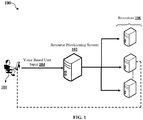
- FIG. 1 is an exemplary environment illustrating a resource provisioning system for provisioning optimized resources in a cloud environment in accordance with some embodiments of the present disclosure.
- the environment 100 includes a resource provisioning system 102, a voice-based user input 104, resources 106.
- a user 101 wishes to access resources provided on the cloud (public or private cloud) may send the request in a form of voice input (voice-based user input 104 ) rather than manually selecting each and every catalog or filling details in each and every form or field.
- voice-based user input 104 it becomes easier for non-technical users having less or no technical knowledge to access the resource on the cloud. Further, it may help in identifying the most optimized resource amongst the available resources 106, thereby improving the overall user experience.
- the voice-based user input 104 received from the user 101, is converted into textual format by using a speech convertor 206 of the resource provisioning system 102. From the textual format, the system 102 identifies one or more keywords for determining one or more parameters and corresponding values of the one or more parameters. These values may indicate the optimal machine configuration of the optimized resource. Once the values are determined, the fields corresponding to the parameters are populated by the corresponding values for provisioning the optimized resource to the user 101.
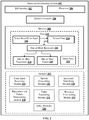
- FIG. 2 is a detailed block diagram illustrating the resource provisioning system in accordance with some embodiments of the present disclosure.
- the resource provisioning system 102 comprises an I/O interface 202, a processor 204, a speech convertor 206, and a memory 208.
- the memory 208 is communicatively coupled to the processor 204.
- the processor 204 is configured to perform one or more functions of the resource provisioning system 102 for provisioning optimized resources in a cloud environment.
- the resource provisioning system 102 may include data 210 and modules 212 for performing various operations in accordance with the embodiments of the present disclosure.
- the data 210 may be stored within the memory 208 and may include, without limitation, a voice-based user input 104, textual data 214, one or more keywords 216, one or more parameters 218, one or values 220 corresponding to the one or more parameters 218, and other data 222.
- the data 210 may be stored within the memory 208 in the form of various data structures. Additionally, the aforementioned data 210 can be organized using data models, such as relational or hierarchical data models.
- the other data 222 may store data, including temporary data and temporary files, generated by the modules 212 for performing the various functions of the resource provisioning system 102.
- the voice-based user input 104 is an input received from the user 101 requesting an access of a resource in the cloud environment. Rather than typing or filling details, the user 101 may simply input voice based instructions through an electronic device such as mobile phone, computer system and the like which is received by the resource provisioning system 102.
- the textual data 214 is the textual format of the voice-based user input 104.
- the resource provisioning system 102 may use the speech convertor 206 to convert the voice-based user input 104 into the textual format.
- the one or more keywords 216 are identified from the textual data 214 by applying identifier on the textual data 214.
- the identifier may comprise at least one of a Rapid Automatic Keyword Extraction (RAKE) method and a Key Phrase Extraction Algorithm (KEA).
- RAKE Rapid Automatic Keyword Extraction
- KPA Key Phrase Extraction Algorithm
- the one or more keywords 216 are associated with a service requested for accessing the resources 106.
- the one more parameters 218 and the one or more values 220 are automatically determined based on the one or more keywords 216.
- the one more parameters 218 may comprise, but not limited to, Central Processing Unit (CPU) count, Random Access Memory (RAM) size, hard disk size, security zone, active directory (AD) domain, server type, service level agreement (SLA), default username, and password.
- the one or more values 220 are the corresponding values of the one or more parameters 218.
- the data 210 may be processed by one or more modules 212 of the resource provisioning system 102.
- the one or more modules 212 may be stored as a part of the processor 204.
- the one or more modules 212 may be communicatively coupled to the processor 204 for performing one or more functions of the resource provisioning system 102.
- the modules 212 may include, without limiting to, a voice input receiving module 224, a speech converting module 226, an keywords identifying module 228, a parameters and values determining module 230, a fields populating module 232, a resource provisioning module 234, and other modules 236.
- module' refers to an application specific integrated circuit (ASIC), an electronic circuit, a processor (shared, dedicated, or group) and memory that execute one or more software or firmware programs, a combinational logic circuit, and/or other suitable components that provide the described functionality.
- ASIC application specific integrated circuit
- the other modules 236 may be used to perform various miscellaneous functionalities of the resource provisioning system 102. It will be appreciated that such modules 236 may be represented as a single module or a combination of different modules.
- the voice input receiving module 224 may receive the voice-based user input 104 from a user 101 through the I/O interface 202.
- the voice-based user input 104 indicates the user's 101 request for accessing the resources 106 on the cloud.
- the user 101 may be technical or non-technical user or any other user who may wish to access the resource/virtual machine on the cloud.
- the technical users may be comfortable doing this manual task as long as they have the technical knowledge about machine's configuration.
- the non-technical users becomes completely clueless when they have to provide each and every technical details for completing their request.
- the technical details may comprises details like machine configuration of the resources (e.g., server).
- the user 101 may select a low configuration resource (e.g., having less RAM size and lower computing power) for performing computation intensive task.
- a low configuration resource e.g., having less RAM size and lower computing power
- the voice-based user input 104 may be provided by the user 101 through a microphone of the user's 101 device.
- the user device is associated with the resource provisioning system 102 using a wired or a wireless connection.
- the voice input receiving module 224 of the resource provisioning system 102 receives the voice-based user input 104 from the user device.
- the speech converting module 226 which may be a speech convertor 206 which converts the voice-based user input 104 into the textual data 214.
- the conversion of the voice-based user input 104 into the textual data 214 is based on different models like an acoustic model, a language model, a pronunciation model. Examples of such models comprises a Hidden Markov method, a Dynamic Time Warping (DTW) method, an artificial neural network, an end-to-end Automatic Speech Recognition (ASR) method, a deep feedforward network, and a Recurrent Neural Network (RNN).
- these models can be specialized for a given language, dialect, application domain, type of speech, and communication channel in order to get the best transcription quality of the voice-based user input 104 received from the user 101.
- the keywords identifying module 228 of the resource provisioning system 102 applies an identifier on the textual data 214 to identify the one or more keywords 216. These keywords are associated with the resource requested by the user 101. Considering an example, in which, the user 101 has requested for accessing "Windows server 2012 R2", the one or more keywords 216 extracted may comprise machine name, a user name and a password. According to embodiments of the present disclosure, the identifier applied for identifying the one or more keywords 216 may comprise at least one of a Rapid Automatic Keyword Extraction (RAKE) method and a Key Phrase Extraction (KEA) method.
- RAKE Rapid Automatic Keyword Extraction
- KPA Key Phrase Extraction
- the resource provisioning system 102 gets an idea about the type of the resource the user 101 is looking for.
- the resource provisioning system 102 is able to understand that the user 101 is looking for MicrosoftTM server operating system of version 2012.
- the resource provisioning system 102 also interprets the code "R2" and understand that user 101 is looking for release 2 of the windows server 2012. This information helps in determining optimal configuration of the resource to be provisioned to the user 101, or in other words, identifying the appropriate resource which meets the requirement of the user 101.
- the parameters and values determining module 230 automatically determines the one or more parameters 218 and corresponding one or more values 220 of the one or more parameters 218 required for accessing the resources 106 based on the one or more keywords 216.
- the example of the determined one or more parameters 218 and the corresponding one or more values 220 for the Windows server 2012 R2 have been shown in below table 1.
- Table 1 The one or more parameters and corresponding one or more values. Parameters Values of the parameters Central Processing Unit (CPU) count 2 Random Access Memory (RAM) size, 2048 MB Hard disk size 40 GB
- the one or more parameters 218 determined for the resource "Windows server 2012 R2" are the CPU count, RAM size, and Hard disk size. It must be understood to a person skilled in art that other parameters may also be determined based on type of the resource to be provisioned to the user 101. The other parameters may include, but not limited to, security zone, active directory (AD) domain, server type, service level agreement (SLA), default username, password and the like which depends on the type of resource being requested. It can be also observed from the above table 1 that the one or more values 220 corresponding to the one or more parameters 218 are determined by the resource provisioning system 102. For example, the value for the parameter "CPU count” is "2", the value of the parameter "RAM size” is "2048 MB”, and the value of the parameter "Hard disk size” is "40 GB".
- These one or more values 220 are nothing but the optimal machine configuration of the resource to be provisioned to the user 101. According to an embodiment, these one or more values 220 are determined based on recommendation of a service provider associated with the optimized resource. In this case, the recommendation of the one or more values 220 may be provided by the service provider MicrosoftTM. This way, the burden of identifying the optimal resource amongst the available resources is removed at user's end. However, these values need to be filled in a form for completing the request and for making the resource provisioning system 102 to trigger the request. To achieve this, one or more fields may be generated in the form corresponding to the one or more parameters 218.
- the fields populating module 232 of the resource provisioning system 102 may populate the one or more values 220 in the one or more fields. Once the one or more values 220 are populated, the resource provisioning module 234 provisions the optimized resource, amongst the available resources 106, to the user 101.
- the resource provisioning system 102 may dynamically generate a workflow corresponding to the identified one or more keywords 216.
- the workflow is a set of automated steps performed by the resource provisioning system 102 for provisioning the optimized resource. In other words, once the workflow is generated, it triggers the provisioning of the optimized resource. Referring back to the above example of "Windows server 2012 R2", as soon as the one or more keywords 216 are identified, the resource provisioning system 102 automatically generates a workflow for provisioning the optimized resource.
- the workflow generated may comprises a series of tasks to be performed by the resource provisioning system 102. For example, the first task may trigger the resource provisioning system 102 to determine the one or more parameters 218 and corresponding one more values 220 from the identified one or more keywords 216.
- the one or more parameters 218 and the one more values 220 can be seen from the above table 1. As explained above, the workflow ensures that the one or values 220 generated should be an optimal configuration of the resource to be provisioned.
- the workflow may now trigger the resource provisioning system 102 to populates the one or more values 220 into one or fields of an automatically generated form. Once the fields are populated, the next task of the workflow enables the provisioning of the optimized resource to the user. This way, the entire process from determining the one or more parameters 218 and the corresponding one or more values 220 till the provisioning of the optimized resource is triggered by the workflow.
- workflow may be generated based on service requested by the user.
- the workflow generated is related to "Windows server 2012 R2".
- an another workflow is generated which comprises a series of task from determining of parameters and values till identifying and provisioning of an optimized Linux server amongst the available Linux servers on the cloud.
- FIG. 3 is a flowchart illustrating a method for provisioning optimized resources in a cloud environment in accordance with some embodiments of the present disclosure.
- the method 300 comprises one or more blocks for provisioning optimized resources in a cloud environment using a resource provisioning system 102.
- the method 300 may be described in the general context of computer executable instructions.
- computer executable instructions can include routines, programs, objects, components, data structures, procedures, modules, and functions, which perform particular functions or implement particular abstract data types.
- the order in which the method 300 is described is not intended to be construed as a limitation, and any number of the described method blocks can be combined in any order to implement the method. Additionally, individual blocks may be deleted from the methods without departing from the scope of the subject matter described herein. Furthermore, the method can be implemented in any suitable hardware, software, firmware, or combination thereof.
- the method 300 includes receiving, by the resource provisioning system 102, a voice-based user input 104 for accessing resources 106 in the cloud environment.
- the voice-based user input 104 may be provided by the user 101 through a microphone of the user's device.
- the user device is associated with the resource provisioning system 102 using a wired or a wireless connection.
- the voice input receiving module 224 of the resource provisioning system 102 receives the voice-based user input 104 from the user device.
- the method 300 includes identifying, by the resource provisioning system 102, one or more keywords 216 related to the resources 106 from the voice-based user input 104.
- the one or more keywords 216 are identified by applying an identifier on the textual data 214.
- the identifier applied for identifying the one or more keywords 216 comprises at least one of a Rapid Automatic Keyword Extraction (RAKE) method and a Key Phrase Extraction (KEA) method.
- the method 300 includes determining, by the resource provisioning system 102, automatically one or more parameters 218 and corresponding one or more values 220 of the one or more parameters 218 required for accessing the resources 106 based on the one or more keywords 216.
- the one or more parameters 218 comprises at least one of Central Processing Unit [CPU] count, Random Access Memory [RAM] size, hard disk size, security zone, active directory (AD) domain, server type, service level agreement (SLA), default username, and password.
- the method 300 includes populating, by the resource provisioning system 102, one or more fields, corresponding to the one or more parameters 218, with the one or more values 220.
- the one or more values 220 indicates an optimal machine configuration of the resources 106.
- the method 300 includes provisioning, by the resource provisioning system 102, the optimized resource based on the populating of the one or more values 220 in the one or more fields.
- Fig.4 illustrates a block diagram of an exemplary computer system 400 for implementing embodiments consistent with the present invention.
- the computer system 400 can be the system 102 which is used for provisioning optimized resources in a cloud environment.
- the computer system 400 may receive voice-based user input 104 from an user 101 requesting to access a resource in the cloud environment.
- the computer system 400 may comprise a central processing unit ("CPU” or "processor") 402.
- the processor 402 may comprise at least one data processor for executing program components for executing user- or system-generated business processes.
- the processor 402 may include specialized processing units such as integrated system (bus) controllers, memory management control units, floating point units, graphics processing units, digital signal processing units, etc.
- the processor 402 may be disposed in communication with one or more input/output (I/O) devices ( 411 and 412 ) via I/O interface 401.
- the I/O interface 401 may employ communication protocols/methods such as, without limitation, audio, analog, digital, stereo, IEEE-1394, serial bus, Universal Serial Bus (USB), infrared, PS/2, BNC, coaxial, component, composite, Digital Visual Interface (DVI), high-definition multimedia interface (HDMI), Radio Frequency (RF) antennas, S-Video, Video Graphics Array (VGA), IEEE 802.n /b/g/n/x, Bluetooth, cellular (e.g., Code-Division Multiple Access (CDMA), High-Speed Packet Access (HSPA+), Global System For Mobile Communications (GSM), Long-Term Evolution (LTE) or the like), etc.
- CDMA Code-Division Multiple Access
- HSPA+ High-Speed Packet Access
- GSM Global System For Mobile Communications
- LTE Long-Term Evolution
- the computer system 400 may communicate with one or more I/O devices ( 411 and 412 ).
- the processor 402 may be disposed in communication with a communication network 409 via a network interface 403.
- the network interface 403 may communicate with the communication network 409.
- the network interface 403 may employ connection protocols including, without limitation, direct connect, Ethernet (e.g., twisted pair 10/100/1000 Base T), Transmission Control Protocol/Internet Protocol (TCP/IP), token ring, IEEE 802.11a/b/g/n/x, etc.
- the communication network 409 can be implemented as one of the different types of networks, such as intranet or Local Area Network (LAN) and such within the organization.
- the communication network 409 may either be a dedicated network or a shared network, which represents an association of the different types of networks that use a variety of protocols, for example, Hypertext Transfer Protocol (HTTP), Transmission Control Protocol/Internet Protocol (TCP/IP), Wireless Application Protocol (WAP), etc., to communicate with each other. Further, the communication network 409 may include a variety of network devices, including routers, bridges, servers, computing devices, storage devices, etc.
- HTTP Hypertext Transfer Protocol
- TCP/IP Transmission Control Protocol/Internet Protocol
- WAP Wireless Application Protocol
- the communication network 409 may include a variety of network devices, including routers, bridges, servers, computing devices, storage devices, etc.
- the processor 402 may be disposed in communication with a memory 405 (e.g., RAM 413, ROM 414, etc. as shown in FIG. 4 ) via a storage interface 404.
- the storage interface 404 may connect to memory 405 including, without limitation, memory drives, removable disc drives, etc., employing connection protocols such as Serial Advanced Technology Attachment (SATA), Integrated Drive Electronics (IDE), IEEE-1394, Universal Serial Bus (USB), fiber channel, Small Computer Systems Interface (SCSI), etc.
- the memory drives may further include a drum, magnetic disc drive, magneto-optical drive, optical drive, Redundant Array of Independent Discs (RAID), solid-state memory devices, solid-state drives, etc.
- the memory 405 may store a collection of program or database components, including, without limitation, user/application data 406, an operating system 407, web browser 408 etc.
- computer system 400 may store user/application data 406, such as the data, variables, records, etc. as described in this invention.
- databases may be implemented as fault-tolerant, relational, scalable, secure databases such as Oracle or Sybase.
- the operating system 407 may facilitate resource management and operation of the computer system 400.
- Examples of operating systems include, without limitation, Apple Macintosh OS X, UNIX, Unix-like system distributions (e.g., Berkeley Software Distribution (BSD), FreeBSD, Net BSD, Open BSD, etc.), Linux distributions (e.g., Red Hat, Ubuntu, K-Ubuntu, etc.), International Business Machines (IBM) OS/2, Microsoft Windows (XP, Vista/7/8, etc.), Apple iOS, Google Android, Blackberry Operating System (OS), or the like.
- I/O interface 401 may facilitate display, execution, interaction, manipulation, or operation of program components through textual or graphical facilities.
- I/O interface may provide computer interaction interface elements on a display system operatively connected to the computer system 400, such as cursors, icons, check boxes, menus, windows, widgets, etc.
- Graphical User Interfaces may be employed, including, without limitation, Apple Macintosh operating systems' Aqua, IBM OS/2, Microsoft Windows (e.g., Aero, Metro, etc.), Unix X-Windows, web interface libraries (e.g., ActiveX, Java, JavaScript, AJAX, HTML, Adobe Flash, etc.), or the like.
- the computer system 400 may implement a web browser 408 stored program component.
- the web browser may be a hypertext viewing application, such as Microsoft Internet Explorer, Google Chrome, Mozilla Firefox, Apple Safari, etc. Secure web browsing may be provided using Secure Hypertext Transport Protocol (HTTPS) secure sockets layer (SSL), Transport Layer Security (TLS), etc. Web browsers may utilize facilities such as AJAX, DHTML, Adobe Flash, JavaScript, Java, Application Programming Interfaces (APIs), etc.
- the computer system 400 may implement a mail server stored program component.
- the mail server may be an Internet mail server such as Microsoft Exchange, or the like.
- the mail server may utilize facilities such as Active Server Pages (ASP), ActiveX, American National Standards Institute (ANSI) C++/C#, Microsoft .NET, Common Gateway Interface (CGI) scripts, Java, JavaScript, PERL, PHP, Python, WebObjects, etc.
- the mail server may utilize communication protocols such as Internet Message Access Protocol (IMAP), Messaging Application Programming Interface (MAPI), Microsoft Exchange, Post Office Protocol (POP), Simple Mail Transfer Protocol (SMTP), or the like.
- the computer system 400 may implement a mail client stored program component.
- the mail client may be a mail viewing application, such as Apple Mail, Microsoft Entourage, Microsoft Outlook, Mozilla Thunderbird, and the like.
- a computer-readable storage medium refers to any type of physical memory on which information or data readable by a processor may be stored.
- a computer-readable storage medium may store instructions for execution by one or more processors, including instructions for causing the processor(s) to perform steps or stages consistent with the embodiments described herein.
- the term "computer-readable medium” should be understood to include tangible items and exclude carrier waves and transient signals, i.e., non-transitory. Examples include Random Access Memory (RAM), Read-Only Memory (ROM), volatile memory, nonvolatile memory, hard drives, Compact Disc (CD) ROMs, Digital Video Disc (DVDs), flash drives, disks, and any other known physical storage media.
- the present disclosure provides a method of automatically provisioning an optimized resource to the user based on voice input.
- the method of present disclosure simplifies the process of requesting for cloud provisioning for user.
- the method of present disclosure identifies an optimized resource, amongst the available resources, which not only meet user's requirement but also helps in improving overall performance of resource allocated to the user.
- the methods of present disclosure helps in complying with service level agreement (SLA), thereby preventing breaching of the SLA.
- SLA service level agreement
Landscapes
- Engineering & Computer Science (AREA)
- Physics & Mathematics (AREA)
- Software Systems (AREA)
- Theoretical Computer Science (AREA)
- Computational Linguistics (AREA)
- Health & Medical Sciences (AREA)
- Audiology, Speech & Language Pathology (AREA)
- Human Computer Interaction (AREA)
- Acoustics & Sound (AREA)
- Multimedia (AREA)
- General Engineering & Computer Science (AREA)
- General Physics & Mathematics (AREA)
- Mathematical Physics (AREA)
- Evolutionary Computation (AREA)
- Artificial Intelligence (AREA)
- Probability & Statistics with Applications (AREA)
- Telephonic Communication Services (AREA)
Abstract
Description
- The present disclosure relates in general to cloud provisioning. More particularly, but not exclusively, the present disclosure discloses a method and system for provisioning of resources in a cloud environment based on voice based input.
- In recent past, cloud provisioning has become very much popular in computing environment. In the cloud provisioning, various resources are allocated to users/customers based on their request. However, for raising such request for accessing the resource on the cloud, the user has to manually select various catalogs which is not only tedious and time consuming process but it also requires technical skills from the user. Hence, it creates a challenge for non-technical users having no/limited knowledge of technical features/configurations of the resources while selecting the catalogs manually.
- Even for the technical users, sometimes it becomes a challenge to appropriately select the catalogs. The users may not know what would be an ideal configuration of resources/machines which they wish to access. This creates a technical problem in a field of cloud provisioning. That is, the users (both technical and non-technical) may select a higher configuration resource which involve extra cost, or may select a resource having lesser computing capacity which may not match with actual requirements of users, thereby leading to a poor performance of the resource.
- Additionally, manual selection of the catalogs and entering the various fields of a form presented for receiving parameters and configuration for provisioning may serve as an added overhead for the non-technical user. This is because, such a user may not be aware about each and every fields to be filled in the form to access the database server and consequently may select incorrect configuration for the cloud which may lead to several performance issues in a database server being used for said provisioning.
- Furthermore, many companies offer technical support for such provisioning, over the cloud, and some may even offer live operator assistance for user's queries. However, it is an extremely costly and inefficient method, because a real person must be employed to handle such queries. This presents a practical limit that results in long wait times for responses or high labor overheads. Therefore, there is a requirement for having a mechanism for performing provisioning in the cloud environment that is efficient and requires minimal manual effort from the user that performs such provisioning.
- The present disclosure relates to a method of provisioning optimized resources in a cloud environment. The method includes receiving a voice-based user input for accessing resources in the cloud environment. The method further includes identifying one or more keywords related to the resources from the voice-based user input. The method further includes determining automatically one or more parameters and corresponding one or more values of the one or more parameters required for accessing the resources based on the one or more keywords. The method further includes populating, one or more fields, corresponding to the one or more parameters, with the one or more values. The one or more values indicates an optimal machine configuration of the resources. The method further includes provisioning the optimized resources based on the populating of the one or more values in the one or more fields.
- Further, the present disclosure relates to a resource provisioning system for provisioning optimized resources in a cloud environment. The system comprises a processor and a memory communicatively coupled to the processor. The memory stores processor-executable instructions, which, on execution, causes the processor to receive a voice-based user input for accessing resources in the cloud environment. The processor further identifies one or more keywords related to the resources from the voice-based user input. Further, the processor determines automatically one or more parameters and corresponding one or more values of the one or more parameters required for accessing the resources based on the one or more keywords. The processor further populates one or more fields, corresponding to the one or more parameters, with the one or more values. The one or more values indicates an optimal machine configuration of the resources. Further, the processor provisions the optimized resources based on the populating of the one or more values in the one or more fields.
- Furthermore, the present disclosure relates to a non-transitory computer readable medium including instructions stored thereon that when processed by at least one processor cause a resource provisioning system to perform the acts of receiving a voice-based user input for accessing resources in the cloud environment. The instructions further cause the at least one processor to identify one or more keywords related to the resources from the voice-based user input. Further, the instructions cause the at least one processor to determine automatically one or more parameters and corresponding one or more values of the one or more parameters required for accessing the resources based on the one or more keywords. The instructions further cause the at least one processor to populate one or more fields, corresponding to the one or more parameters, with the one or more values. The one or more values indicates an optimal machine configuration of the resources. The instructions further cause the at least one processor to provision the optimized resources based on the populating of the one or more values in the one or more fields.
- The foregoing summary is illustrative only and is not intended to be in any way limiting. In addition to the illustrative aspects, embodiments, and features described above, further aspects, embodiments, and features will become apparent by reference to the drawings and the following detailed description.
- The accompanying drawings, which are incorporated in and constitute a part of this disclosure, illustrate exemplary embodiments and, together with the description, serve to explain the disclosed principles. In the figures, the left-most digit(s) of a reference number identifies the figure in which the reference number first appears. The same numbers are used throughout the figures to reference like features and components. Some embodiments of system and/or methods in accordance with embodiments of the present subject matter are now described, by way of example only, and with reference to the accompanying figures, in which:
-
FIG. 1 is an exemplary environment illustrating a resource provisioning system for provisioning optimized resources in a cloud environment, in accordance with some embodiments of the present disclosure; -
FIG. 2 is a detailed block diagram illustrating the resource provisioning system, in accordance with some embodiments of the present disclosure; -
FIG. 3 is a flowchart illustrating a method for provisioning optimized resources in a cloud environment, in accordance with some embodiments of the present disclosure; and -
FIG. 4 is a block diagram of an exemplary computer system for implementing embodiments consistent with the present disclosure. - It should be appreciated by those skilled in the art that any block diagrams herein represent conceptual views of illustrative systems embodying the principles of the present subject matter. Similarly, it will be appreciated that any flow charts, flow diagrams, state transition diagrams, pseudo code, and the like represent various processes which may be substantially represented in computer readable medium and executed by a computer or processor, whether or not such computer or processor is explicitly shown.
- In the present document, the word "exemplary" is used herein to mean "serving as an example, instance, or illustration."
- While the disclosure is susceptible to various modifications and alternative forms, specific embodiment thereof has been shown by way of example in the drawings and will be described in detail below. It should be understood, however that it is not intended to limit the disclosure to the particular forms disclosed, but on the contrary, the disclosure is to cover all modifications, equivalents, and alternative falling within the scope of the disclosure.
- The present disclosure relates to a method and a system for provisioning optimized resources in a cloud environment. Although, the method for provisioning the optimized resources in a cloud environment is described in conjunction with a server, the said method can also be implemented in various computing systems/devices, other than the server. Cloud provisioning facilitates provisioning of resources or virtual machines to users. For accessing the resources on the cloud, conventionally, the users have to make a request by manually selecting catalogs or by filling details in forms/fields. Selecting catalogs/filling details in the forms/fields requires technical knowledge of resource/machine to be accessed. As discussed earlier, if the catalogs are not appropriately selected, it may lead to higher cost or poor performance of the selected resource.
- The present disclosure overcome this issue by eliminating the dependency of selecting the catalogs from the users. In other words, the present disclosure aims to automate the process of selecting of catalogs/filling of forms based on voice input of users. By facilitating the voice based mechanism, the requirement of having the technical knowledge for appropriately selecting the catalogs is eliminated. Now, once the system receives the voice-based user input requesting to access a particular type of resource (e.g., MS SQL database), the system converts the voice-based user input into textual data. From the textual data, keywords are identified which reflects the service requested for accessing the resources. For example, in this case, the keywords may be "MS", "Microsoft", "SQL" "structured query language", "standardized query language".
- Based on keywords identified, the system, without taking any manual input, automatically determines one or more parameters and corresponding values of the one or more parameters. As an example, the one or more parameters may comprise at least one of Central Processing Unit (CPU]) count, Random Access Memory (RAM) size, hard disk size, security zone, active directory (AD) domain, server type, service level agreement (SLA), default username, and password. The values of the parameters indicates the optimal machine configuration of the resources to be accessed/provisioned. To complete the provisioning process, the system now populates different fields of an automatically generated form, corresponding to the parameters, with the values of the parameters. Once the values are populated in the fields, the system provisions the optimized resource. Now the user can access the resource on the cloud environment. The above discussed process from determining the one or more parameters and corresponding values till provisioning of the optimized resource may be triggered based on a dynamically generated workflow. This way, the entire process of provisioning of the resources may be automated without requiring the manual input, which is explained in detail in subsequent paragraphs of the specification.
- In the following detailed description of the embodiments of the disclosure, reference is made to the accompanying drawings that form a part hereof, and in which are shown by way of illustration specific embodiments in which the disclosure may be practiced. These embodiments are described in sufficient detail to enable those skilled in the art to practice the disclosure, and it is to be understood that other embodiments may be utilized and that changes may be made without departing from the scope of the present disclosure. The following description is, therefore, not to be taken in a limiting sense.
-
FIG. 1 is an exemplary environment illustrating a resource provisioning system for provisioning optimized resources in a cloud environment in accordance with some embodiments of the present disclosure. - The
environment 100 includes aresource provisioning system 102, a voice-baseduser input 104,resources 106. According to embodiments, when auser 101 wishes to access resources provided on the cloud (public or private cloud) may send the request in a form of voice input (voice-based user input 104) rather than manually selecting each and every catalog or filling details in each and every form or field. By implementing the voice-baseduser input 104, it becomes easier for non-technical users having less or no technical knowledge to access the resource on the cloud. Further, it may help in identifying the most optimized resource amongst theavailable resources 106, thereby improving the overall user experience. - The voice-based
user input 104, received from theuser 101, is converted into textual format by using aspeech convertor 206 of theresource provisioning system 102. From the textual format, thesystem 102 identifies one or more keywords for determining one or more parameters and corresponding values of the one or more parameters. These values may indicate the optimal machine configuration of the optimized resource. Once the values are determined, the fields corresponding to the parameters are populated by the corresponding values for provisioning the optimized resource to theuser 101. -
FIG. 2 is a detailed block diagram illustrating the resource provisioning system in accordance with some embodiments of the present disclosure. - The
resource provisioning system 102 comprises an I/O interface 202, aprocessor 204, aspeech convertor 206, and amemory 208. Thememory 208 is communicatively coupled to theprocessor 204. Theprocessor 204 is configured to perform one or more functions of theresource provisioning system 102 for provisioning optimized resources in a cloud environment. In one implementation, theresource provisioning system 102 may includedata 210 andmodules 212 for performing various operations in accordance with the embodiments of the present disclosure. In an embodiment, thedata 210 may be stored within thememory 208 and may include, without limitation, a voice-baseduser input 104,textual data 214, one ormore keywords 216, one ormore parameters 218, one or values 220 corresponding to the one ormore parameters 218, andother data 222. - In one embodiment, the
data 210 may be stored within thememory 208 in the form of various data structures. Additionally, theaforementioned data 210 can be organized using data models, such as relational or hierarchical data models. Theother data 222 may store data, including temporary data and temporary files, generated by themodules 212 for performing the various functions of theresource provisioning system 102. - In an embodiment, the voice-based
user input 104 is an input received from theuser 101 requesting an access of a resource in the cloud environment. Rather than typing or filling details, theuser 101 may simply input voice based instructions through an electronic device such as mobile phone, computer system and the like which is received by theresource provisioning system 102. - In an embodiment, the
textual data 214 is the textual format of the voice-baseduser input 104. Theresource provisioning system 102 may use thespeech convertor 206 to convert the voice-baseduser input 104 into the textual format. In an embodiment, the one ormore keywords 216 are identified from thetextual data 214 by applying identifier on thetextual data 214. The identifier may comprise at least one of a Rapid Automatic Keyword Extraction (RAKE) method and a Key Phrase Extraction Algorithm (KEA). Further, the one ormore keywords 216 are associated with a service requested for accessing theresources 106. - In an embodiment, the one
more parameters 218 and the one ormore values 220 are automatically determined based on the one ormore keywords 216. The onemore parameters 218 may comprise, but not limited to, Central Processing Unit (CPU) count, Random Access Memory (RAM) size, hard disk size, security zone, active directory (AD) domain, server type, service level agreement (SLA), default username, and password. Further, the one ormore values 220 are the corresponding values of the one ormore parameters 218. - In some embodiments, the
data 210 may be processed by one ormore modules 212 of theresource provisioning system 102. In one implementation, the one ormore modules 212 may be stored as a part of theprocessor 204. In another implementation, the one ormore modules 212 may be communicatively coupled to theprocessor 204 for performing one or more functions of theresource provisioning system 102. Themodules 212 may include, without limiting to, a voiceinput receiving module 224, aspeech converting module 226, ankeywords identifying module 228, a parameters and values determining module 230, afields populating module 232, a resource provisioning module 234, andother modules 236. - As used herein, the term 'module' refers to an application specific integrated circuit (ASIC), an electronic circuit, a processor (shared, dedicated, or group) and memory that execute one or more software or firmware programs, a combinational logic circuit, and/or other suitable components that provide the described functionality. In an embodiment, the
other modules 236 may be used to perform various miscellaneous functionalities of theresource provisioning system 102. It will be appreciated thatsuch modules 236 may be represented as a single module or a combination of different modules. - In an embodiment, the voice
input receiving module 224 may receive the voice-baseduser input 104 from auser 101 through the I/O interface 202. The voice-baseduser input 104 indicates the user's 101 request for accessing theresources 106 on the cloud. Theuser 101 may be technical or non-technical user or any other user who may wish to access the resource/virtual machine on the cloud. To some extent, the technical users may be comfortable doing this manual task as long as they have the technical knowledge about machine's configuration. However, the non-technical users becomes completely clueless when they have to provide each and every technical details for completing their request. According to embodiments of present disclosure, the technical details may comprises details like machine configuration of the resources (e.g., server). This not only results in wasting time and effort while filling the details, but it also leads to poor performance of the resource provisioned to theuser 101. For example, theuser 101 may select a low configuration resource (e.g., having less RAM size and lower computing power) for performing computation intensive task. - To overcome the above technical challenge, the present disclosure discloses a mechanism, in which, the users rather than typing or filling details in the form, simply provide their voice input for requesting the service. This eliminates the requirement of having the technical knowledge about the resources which the users wishes to access. The voice-based
user input 104 may be provided by theuser 101 through a microphone of the user's 101 device. The user device is associated with theresource provisioning system 102 using a wired or a wireless connection. The voiceinput receiving module 224 of theresource provisioning system 102 receives the voice-baseduser input 104 from the user device. - In an embodiment, the
speech converting module 226 which may be aspeech convertor 206 which converts the voice-baseduser input 104 into thetextual data 214. According to embodiments of present disclosure, the conversion of the voice-baseduser input 104 into thetextual data 214 is based on different models like an acoustic model, a language model, a pronunciation model. Examples of such models comprises a Hidden Markov method, a Dynamic Time Warping (DTW) method, an artificial neural network, an end-to-end Automatic Speech Recognition (ASR) method, a deep feedforward network, and a Recurrent Neural Network (RNN). According to embodiments, these models can be specialized for a given language, dialect, application domain, type of speech, and communication channel in order to get the best transcription quality of the voice-baseduser input 104 received from theuser 101. - Now the next task is to identify or extract relevant keywords from the
textual data 214. In an embodiment, thekeywords identifying module 228 of theresource provisioning system 102 applies an identifier on thetextual data 214 to identify the one ormore keywords 216. These keywords are associated with the resource requested by theuser 101. Considering an example, in which, theuser 101 has requested for accessing "Windows server 2012 R2", the one ormore keywords 216 extracted may comprise machine name, a user name and a password. According to embodiments of the present disclosure, the identifier applied for identifying the one ormore keywords 216 may comprise at least one of a Rapid Automatic Keyword Extraction (RAKE) method and a Key Phrase Extraction (KEA) method. - Once these
keywords 216 are identified, theresource provisioning system 102 gets an idea about the type of the resource theuser 101 is looking for. In the example considered in previous paragraph, theresource provisioning system 102 is able to understand that theuser 101 is looking for Microsoft™ server operating system of version 2012. Theresource provisioning system 102 also interprets the code "R2" and understand thatuser 101 is looking for release 2 of the windows server 2012. This information helps in determining optimal configuration of the resource to be provisioned to theuser 101, or in other words, identifying the appropriate resource which meets the requirement of theuser 101. - Now based on the aforementioned information, since the
resource provisioning system 102 understands the actual requirement of theuser 101, the parameters and values determining module 230 automatically determines the one ormore parameters 218 and corresponding one ormore values 220 of the one ormore parameters 218 required for accessing theresources 106 based on the one ormore keywords 216. The example of the determined one ormore parameters 218 and the corresponding one ormore values 220 for the Windows server 2012 R2 have been shown in below table 1.Table 1 - The one or more parameters and corresponding one or more values. Parameters Values of the parameters Central Processing Unit (CPU) count 2 Random Access Memory (RAM) size, 2048 MB Hard disk size 40 GB - From the above table 1, it can be observed that the one or
more parameters 218 determined for the resource "Windows server 2012 R2" are the CPU count, RAM size, and Hard disk size. It must be understood to a person skilled in art that other parameters may also be determined based on type of the resource to be provisioned to theuser 101. The other parameters may include, but not limited to, security zone, active directory (AD) domain, server type, service level agreement (SLA), default username, password and the like which depends on the type of resource being requested. It can be also observed from the above table 1 that the one ormore values 220 corresponding to the one ormore parameters 218 are determined by theresource provisioning system 102. For example, the value for the parameter "CPU count" is "2", the value of the parameter "RAM size" is "2048 MB", and the value of the parameter "Hard disk size" is "40 GB". - These one or
more values 220 are nothing but the optimal machine configuration of the resource to be provisioned to theuser 101. According to an embodiment, these one ormore values 220 are determined based on recommendation of a service provider associated with the optimized resource. In this case, the recommendation of the one ormore values 220 may be provided by the service provider Microsoft™. This way, the burden of identifying the optimal resource amongst the available resources is removed at user's end. However, these values need to be filled in a form for completing the request and for making theresource provisioning system 102 to trigger the request. To achieve this, one or more fields may be generated in the form corresponding to the one ormore parameters 218. - To complete the request, the
fields populating module 232 of theresource provisioning system 102 may populate the one ormore values 220 in the one or more fields. Once the one ormore values 220 are populated, the resource provisioning module 234 provisions the optimized resource, amongst theavailable resources 106, to theuser 101. - In an alternative embodiment of present disclosure, the
resource provisioning system 102 may dynamically generate a workflow corresponding to the identified one ormore keywords 216. The workflow is a set of automated steps performed by theresource provisioning system 102 for provisioning the optimized resource. In other words, once the workflow is generated, it triggers the provisioning of the optimized resource. Referring back to the above example of "Windows server 2012 R2", as soon as the one ormore keywords 216 are identified, theresource provisioning system 102 automatically generates a workflow for provisioning the optimized resource. The workflow generated may comprises a series of tasks to be performed by theresource provisioning system 102. For example, the first task may trigger theresource provisioning system 102 to determine the one ormore parameters 218 and corresponding onemore values 220 from the identified one ormore keywords 216. The one ormore parameters 218 and the onemore values 220 can be seen from the above table 1. As explained above, the workflow ensures that the one or values 220 generated should be an optimal configuration of the resource to be provisioned. - In next step, the workflow may now trigger the
resource provisioning system 102 to populates the one ormore values 220 into one or fields of an automatically generated form. Once the fields are populated, the next task of the workflow enables the provisioning of the optimized resource to the user. This way, the entire process from determining the one ormore parameters 218 and the corresponding one ormore values 220 till the provisioning of the optimized resource is triggered by the workflow. - It must be noted to person skilled in art that workflow may be generated based on service requested by the user. For example, in above case, the workflow generated is related to "Windows server 2012 R2". However, if the user changes his/her requirement, for example user now wants to access "Linux server", then an another workflow is generated which comprises a series of task from determining of parameters and values till identifying and provisioning of an optimized Linux server amongst the available Linux servers on the cloud.
-
FIG. 3 is a flowchart illustrating a method for provisioning optimized resources in a cloud environment in accordance with some embodiments of the present disclosure. - As illustrated in
FIG. 3 , themethod 300 comprises one or more blocks for provisioning optimized resources in a cloud environment using aresource provisioning system 102. Themethod 300 may be described in the general context of computer executable instructions. Generally, computer executable instructions can include routines, programs, objects, components, data structures, procedures, modules, and functions, which perform particular functions or implement particular abstract data types. - The order in which the
method 300 is described is not intended to be construed as a limitation, and any number of the described method blocks can be combined in any order to implement the method. Additionally, individual blocks may be deleted from the methods without departing from the scope of the subject matter described herein. Furthermore, the method can be implemented in any suitable hardware, software, firmware, or combination thereof. - At
block 302, themethod 300 includes receiving, by theresource provisioning system 102, a voice-baseduser input 104 for accessingresources 106 in the cloud environment. The voice-baseduser input 104 may be provided by theuser 101 through a microphone of the user's device. The user device is associated with theresource provisioning system 102 using a wired or a wireless connection. The voiceinput receiving module 224 of theresource provisioning system 102 receives the voice-baseduser input 104 from the user device. - At
block 304, themethod 300 includes identifying, by theresource provisioning system 102, one ormore keywords 216 related to theresources 106 from the voice-baseduser input 104. According to embodiments, the one ormore keywords 216 are identified by applying an identifier on thetextual data 214. The identifier applied for identifying the one ormore keywords 216 comprises at least one of a Rapid Automatic Keyword Extraction (RAKE) method and a Key Phrase Extraction (KEA) method. - At
block 306, themethod 300 includes determining, by theresource provisioning system 102, automatically one ormore parameters 218 and corresponding one ormore values 220 of the one ormore parameters 218 required for accessing theresources 106 based on the one ormore keywords 216. According to embodiments, the one ormore parameters 218 comprises at least one of Central Processing Unit [CPU] count, Random Access Memory [RAM] size, hard disk size, security zone, active directory (AD) domain, server type, service level agreement (SLA), default username, and password. - At
block 308, themethod 300 includes populating, by theresource provisioning system 102, one or more fields, corresponding to the one ormore parameters 218, with the one ormore values 220. The one ormore values 220 indicates an optimal machine configuration of theresources 106. - At
block 310, themethod 300 includes provisioning, by theresource provisioning system 102, the optimized resource based on the populating of the one ormore values 220 in the one or more fields. -
Fig.4 illustrates a block diagram of anexemplary computer system 400 for implementing embodiments consistent with the present invention. In an embodiment, thecomputer system 400 can be thesystem 102 which is used for provisioning optimized resources in a cloud environment. According to an embodiment, thecomputer system 400 may receive voice-baseduser input 104 from anuser 101 requesting to access a resource in the cloud environment. Thecomputer system 400 may comprise a central processing unit ("CPU" or "processor") 402. Theprocessor 402 may comprise at least one data processor for executing program components for executing user- or system-generated business processes. Theprocessor 402 may include specialized processing units such as integrated system (bus) controllers, memory management control units, floating point units, graphics processing units, digital signal processing units, etc. - The
processor 402 may be disposed in communication with one or more input/output (I/O) devices (411 and 412) via I/O interface 401. The I/O interface 401 may employ communication protocols/methods such as, without limitation, audio, analog, digital, stereo, IEEE-1394, serial bus, Universal Serial Bus (USB), infrared, PS/2, BNC, coaxial, component, composite, Digital Visual Interface (DVI), high-definition multimedia interface (HDMI), Radio Frequency (RF) antennas, S-Video, Video Graphics Array (VGA), IEEE 802.n /b/g/n/x, Bluetooth, cellular (e.g., Code-Division Multiple Access (CDMA), High-Speed Packet Access (HSPA+), Global System For Mobile Communications (GSM), Long-Term Evolution (LTE) or the like), etc. - Using the I/
O interface 401, thecomputer system 400 may communicate with one or more I/O devices (411 and 412). - In some embodiments, the
processor 402 may be disposed in communication with acommunication network 409 via anetwork interface 403. Thenetwork interface 403 may communicate with thecommunication network 409. Thenetwork interface 403 may employ connection protocols including, without limitation, direct connect, Ethernet (e.g., twisted pair 10/100/1000 Base T), Transmission Control Protocol/Internet Protocol (TCP/IP), token ring, IEEE 802.11a/b/g/n/x, etc. Thecommunication network 409 can be implemented as one of the different types of networks, such as intranet or Local Area Network (LAN) and such within the organization. Thecommunication network 409 may either be a dedicated network or a shared network, which represents an association of the different types of networks that use a variety of protocols, for example, Hypertext Transfer Protocol (HTTP), Transmission Control Protocol/Internet Protocol (TCP/IP), Wireless Application Protocol (WAP), etc., to communicate with each other. Further, thecommunication network 409 may include a variety of network devices, including routers, bridges, servers, computing devices, storage devices, etc. - In some embodiments, the
processor 402 may be disposed in communication with a memory 405 (e.g.,RAM 413,ROM 414, etc. as shown inFIG. 4 ) via astorage interface 404. Thestorage interface 404 may connect tomemory 405 including, without limitation, memory drives, removable disc drives, etc., employing connection protocols such as Serial Advanced Technology Attachment (SATA), Integrated Drive Electronics (IDE), IEEE-1394, Universal Serial Bus (USB), fiber channel, Small Computer Systems Interface (SCSI), etc. The memory drives may further include a drum, magnetic disc drive, magneto-optical drive, optical drive, Redundant Array of Independent Discs (RAID), solid-state memory devices, solid-state drives, etc. - The
memory 405 may store a collection of program or database components, including, without limitation, user/application data 406, anoperating system 407,web browser 408 etc. In some embodiments,computer system 400 may store user/application data 406, such as the data, variables, records, etc. as described in this invention. Such databases may be implemented as fault-tolerant, relational, scalable, secure databases such as Oracle or Sybase. - The
operating system 407 may facilitate resource management and operation of thecomputer system 400. Examples of operating systems include, without limitation, Apple Macintosh OS X, UNIX, Unix-like system distributions (e.g., Berkeley Software Distribution (BSD), FreeBSD, Net BSD, Open BSD, etc.), Linux distributions (e.g., Red Hat, Ubuntu, K-Ubuntu, etc.), International Business Machines (IBM) OS/2, Microsoft Windows (XP, Vista/7/8, etc.), Apple iOS, Google Android, Blackberry Operating System (OS), or the like. I/O interface 401 may facilitate display, execution, interaction, manipulation, or operation of program components through textual or graphical facilities. For example, I/O interface may provide computer interaction interface elements on a display system operatively connected to thecomputer system 400, such as cursors, icons, check boxes, menus, windows, widgets, etc. Graphical User Interfaces (GUIs) may be employed, including, without limitation, Apple Macintosh operating systems' Aqua, IBM OS/2, Microsoft Windows (e.g., Aero, Metro, etc.), Unix X-Windows, web interface libraries (e.g., ActiveX, Java, JavaScript, AJAX, HTML, Adobe Flash, etc.), or the like. - In some embodiments, the
computer system 400 may implement aweb browser 408 stored program component. The web browser may be a hypertext viewing application, such as Microsoft Internet Explorer, Google Chrome, Mozilla Firefox, Apple Safari, etc. Secure web browsing may be provided using Secure Hypertext Transport Protocol (HTTPS) secure sockets layer (SSL), Transport Layer Security (TLS), etc. Web browsers may utilize facilities such as AJAX, DHTML, Adobe Flash, JavaScript, Java, Application Programming Interfaces (APIs), etc. In some embodiments, thecomputer system 400 may implement a mail server stored program component. The mail server may be an Internet mail server such as Microsoft Exchange, or the like. The mail server may utilize facilities such as Active Server Pages (ASP), ActiveX, American National Standards Institute (ANSI) C++/C#, Microsoft .NET, Common Gateway Interface (CGI) scripts, Java, JavaScript, PERL, PHP, Python, WebObjects, etc. The mail server may utilize communication protocols such as Internet Message Access Protocol (IMAP), Messaging Application Programming Interface (MAPI), Microsoft Exchange, Post Office Protocol (POP), Simple Mail Transfer Protocol (SMTP), or the like. In some embodiments, thecomputer system 400 may implement a mail client stored program component. The mail client may be a mail viewing application, such as Apple Mail, Microsoft Entourage, Microsoft Outlook, Mozilla Thunderbird, and the like. - Furthermore, one or more computer-readable storage media may be utilized in implementing embodiments consistent with the present invention. A computer-readable storage medium refers to any type of physical memory on which information or data readable by a processor may be stored. Thus, a computer-readable storage medium may store instructions for execution by one or more processors, including instructions for causing the processor(s) to perform steps or stages consistent with the embodiments described herein. The term "computer-readable medium" should be understood to include tangible items and exclude carrier waves and transient signals, i.e., non-transitory. Examples include Random Access Memory (RAM), Read-Only Memory (ROM), volatile memory, nonvolatile memory, hard drives, Compact Disc (CD) ROMs, Digital Video Disc (DVDs), flash drives, disks, and any other known physical storage media.
- In an embodiment, the present disclosure provides a method of automatically provisioning an optimized resource to the user based on voice input.
- In an embodiment, the method of present disclosure simplifies the process of requesting for cloud provisioning for user.
- In an embodiment, the method of present disclosure identifies an optimized resource, amongst the available resources, which not only meet user's requirement but also helps in improving overall performance of resource allocated to the user.
- In an embodiment, the methods of present disclosure helps in complying with service level agreement (SLA), thereby preventing breaching of the SLA.
- A description of an embodiment with several components in communication with each other does not imply that all such components are required. On the contrary a variety of optional components are described to illustrate the wide variety of possible embodiments of the invention.
- When a single device or article is described herein, it will be readily apparent that more than one device/article (whether or not they cooperate) may be used in place of a single device/article. Similarly, where more than one device or article is described herein (whether or not they cooperate), it will be readily apparent that a single device/article may be used in place of the more than one device or article or a different number of devices/articles may be used instead of the shown number of devices or programs. The functionality and/or the features of a device may be alternatively embodied by one or more other devices which are not explicitly described as having such functionality/features. Thus, other embodiments of the invention need not include the device itself.
- The embodiments of the present invention are intended to be illustrative, but not limiting, of the scope of the invention.
- While various aspects and embodiments have been disclosed herein, other aspects and embodiments will be apparent to those skilled in the art. The various aspects and embodiments disclosed herein are for purposes of illustration and are not intended to be limiting.
Claims (9)
- A method for provisioning optimized resources in a cloud environment, wherein the method comprises:receiving, by a resource provisioning system, a voice-based user input for accessing resources in the cloud environment;identifying, by the resource provisioning system, one or more keywords related to the resources from the voice-based user input;determining automatically, by the resource provisioning system, one or more parameters and corresponding one or more values of the one or more parameters required for accessing the resources based on the one or more keywords;populating, by the resource provisioning system, one or more fields, corresponding to the one or more parameters, with the one or more values, wherein the one or more values indicates an optimal machine configuration of the resources; andprovisioning, by the resource provisioning system, the optimized resources based on the populating of the one or more values in the one or more fields.
- The method as claimed in claim 1, wherein identifying the one or more keywords comprises:converting, by the resource provisioning system, the voice-based user input into textual data; andapplying, by the resource provisioning system, an identifier on the textual data to identify the one or more keywords associated with a service requested for accessing the resources.
- The method as claimed in claim 2, wherein converting the voice-based user input into the textual data is based on at least one of a Hidden Markov method, a Dynamic Time Warping (DTW) method, an artificial neural network, an end-to-end Automatic Speech Recognition (ASR) method, a deep feedforward network, and a Recurrent Neural Network (RNN).
- The method as claimed in claim 2 or 3, wherein the identifier applied for identifying the one or more keywords comprises at least one of a Rapid Automatic Keyword Extraction (RAKE) method and a Key Phrase Extraction Algorithm (KEA).
- The method as claimed in any preceding claim, wherein the one or more parameters comprises at least one of Central Processing Unit (CPU) count, Random Access Memory (RAM) size, hard disk size, security zone, active directory (AD) domain, server type, service level agreement (SLA), default username, and password.
- The method as claimed in any preceding claim, wherein the one or more values of the one or more parameters are determined based on recommendation of a service provider associated with the optimized resources.
- The method as claimed in any preceding claim, further comprising dynamically generating a workflow corresponding to the identified one or more keywords, wherein the workflow triggers the provisioning of the optimized resources.
- A resource provisioning system for provisioning optimized resources in a cloud environment, the system comprising:a processor; anda memory communicatively coupled to the processor, wherein the memory stores processor-executable instructions, which, on execution, causes the processor to perform the method as claimed in any preceding claim.
- A non-transitory computer-readable storage medium including instructions stored thereon that when processed by at least one processor cause a resource provisioning system to perform operations comprising the method as claimed in any of claims 1 - 7.
Applications Claiming Priority (1)
| Application Number | Priority Date | Filing Date | Title |
|---|---|---|---|
| IN201841005284 | 2018-02-12 |
Publications (1)
| Publication Number | Publication Date |
|---|---|
| EP3525098A1 true EP3525098A1 (en) | 2019-08-14 |
Family
ID=61972281
Family Applications (1)
| Application Number | Title | Priority Date | Filing Date |
|---|---|---|---|
| EP18164163.0A Withdrawn EP3525098A1 (en) | 2018-02-12 | 2018-03-27 | Method and system for voice based provisioning of optimized resources in a cloud environment |
Country Status (2)
| Country | Link |
|---|---|
| US (1) | US10403281B1 (en) |
| EP (1) | EP3525098A1 (en) |
Families Citing this family (2)
| Publication number | Priority date | Publication date | Assignee | Title |
|---|---|---|---|---|
| US10942787B2 (en) * | 2018-11-13 | 2021-03-09 | Servicenow, Inc. | Instance mapping engine and tools |
| CN114356553A (en) * | 2021-12-13 | 2022-04-15 | 深圳价值在线信息科技股份有限公司 | Resource allocation method and device, cloud server and computer readable storage medium |
Citations (1)
| Publication number | Priority date | Publication date | Assignee | Title |
|---|---|---|---|---|
| US20170006032A1 (en) * | 2015-06-30 | 2017-01-05 | Vmware, Inc. | Methods and apparatus to grant access to cloud computing resources |
Family Cites Families (3)
| Publication number | Priority date | Publication date | Assignee | Title |
|---|---|---|---|---|
| US10601810B2 (en) | 2011-09-09 | 2020-03-24 | Kingston Digital, Inc. | Private cloud routing server connection mechanism for use in a private communication architecture |
| CN106357609B (en) | 2016-08-22 | 2019-09-20 | 深圳市先河系统技术有限公司 | A kind of method and system, public network server and private clound equipment creating user |
| CN107040518B (en) | 2017-02-23 | 2020-06-19 | 深圳市先河系统技术有限公司 | Private cloud server login method and system |
-
2018
- 2018-03-27 EP EP18164163.0A patent/EP3525098A1/en not_active Withdrawn
- 2018-03-27 US US15/936,467 patent/US10403281B1/en active Active
Patent Citations (1)
| Publication number | Priority date | Publication date | Assignee | Title |
|---|---|---|---|---|
| US20170006032A1 (en) * | 2015-06-30 | 2017-01-05 | Vmware, Inc. | Methods and apparatus to grant access to cloud computing resources |
Non-Patent Citations (2)
| Title |
|---|
| CUTAJAR MICHELLE ET AL: "Comparative study of automatic speech recognition techniques", IET SIGNAL PROCES, THE INSTITUTION OF ENGINEERING AND TECHNOLOGY, MICHAEL FARADAY HOUSE, SIX HILLS WAY, STEVENAGE, HERTS. SG1 2AY, UK, vol. 7, no. 1, 1 February 2013 (2013-02-01), pages 25 - 46, XP006046508, ISSN: 1751-9675, DOI: 10.1049/IET-SPR.2012.0151 * |
| HASAN H M MAHEDI ET AL: "An empirical study of important keyword extraction techniques from documents", 2017 1ST INTERNATIONAL CONFERENCE ON INTELLIGENT SYSTEMS AND INFORMATION MANAGEMENT (ICISIM), IEEE, 5 October 2017 (2017-10-05), pages 91 - 94, XP033270711, DOI: 10.1109/ICISIM.2017.8122154 * |
Also Published As
| Publication number | Publication date |
|---|---|
| US20190251962A1 (en) | 2019-08-15 |
| US10403281B1 (en) | 2019-09-03 |
Similar Documents
| Publication | Publication Date | Title |
|---|---|---|
| US10817578B2 (en) | Method and system for providing context based adaptive response to user interactions | |
| US10037767B1 (en) | Integrated system and a method of identifying and learning emotions in conversation utterances | |
| US9448993B1 (en) | System and method of recording utterances using unmanaged crowds for natural language processing | |
| US10545854B2 (en) | Method and a system for automatically identifying violations in one or more test cases | |
| US20160188710A1 (en) | METHOD AND SYSTEM FOR MIGRATING DATA TO NOT ONLY STRUCTURED QUERY LANGUAGE (NoSOL) DATABASE | |
| WO2016107491A1 (en) | Method and query suggestion server for providing alternate query suggestions for time bound results | |
| US20170220654A1 (en) | Method for automatically generating extract transform load (etl) codes using a code generation device | |
| US11909698B2 (en) | Method and system for identifying ideal virtual assistant bots for providing response to user queries | |
| EP3355201B1 (en) | A method and system for establishing a relationship between a plurality of user interface elements | |
| JP2018509011A (en) | Interactive voice response system crawler | |
| EP3301579A1 (en) | A method and system for generating a valid set of test configurations for test scenarios | |
| EP3220272A1 (en) | A method and system for performing regression integration testing | |
| US20180204150A1 (en) | System and method for generation of integrated test scenarios | |
| US20190362014A1 (en) | Method and device for managing big-data in cloud environment | |
| US10403281B1 (en) | Method and system for voice based provisioning of optimized resources in a cloud environment | |
| WO2020026680A1 (en) | Method for identifying project component, and reusability detection system therefor | |
| US20170308575A1 (en) | Method and Plan Optimizing Apparatus for Optimizing Query Execution Plan | |
| US20170270137A1 (en) | Method and system for synchronization of relational database management system to non-structured query language database | |
| US10860530B2 (en) | Method and system for migrating automation assets in an enterprise system | |
| EP3327567A1 (en) | A method and a system for determining requirements for a project | |
| EP3528109A1 (en) | Method and system for integrating scene database with hmi application | |
| US10885045B2 (en) | Method and system for providing context-based response for a user query | |
| US10318636B2 (en) | Method and system for determining action items using neural networks from knowledge base for execution of operations | |
| CA2941948A1 (en) | Adjustable dual-tone multi-frequency phone system | |
| US20150365477A1 (en) | System and method for automating identification and download of web assets or web artifacts |
Legal Events
| Date | Code | Title | Description |
|---|---|---|---|
| PUAI | Public reference made under article 153(3) epc to a published international application that has entered the european phase |
Free format text: ORIGINAL CODE: 0009012 |
|
| STAA | Information on the status of an ep patent application or granted ep patent |
Free format text: STATUS: THE APPLICATION HAS BEEN PUBLISHED |
|
| AK | Designated contracting states |
Kind code of ref document: A1 Designated state(s): AL AT BE BG CH CY CZ DE DK EE ES FI FR GB GR HR HU IE IS IT LI LT LU LV MC MK MT NL NO PL PT RO RS SE SI SK SM TR |
|
| AX | Request for extension of the european patent |
Extension state: BA ME |
|
| STAA | Information on the status of an ep patent application or granted ep patent |
Free format text: STATUS: REQUEST FOR EXAMINATION WAS MADE |
|
| 17P | Request for examination filed |
Effective date: 20200213 |
|
| RBV | Designated contracting states (corrected) |
Designated state(s): AL AT BE BG CH CY CZ DE DK EE ES FI FR GB GR HR HU IE IS IT LI LT LU LV MC MK MT NL NO PL PT RO RS SE SI SK SM TR |
|
| STAA | Information on the status of an ep patent application or granted ep patent |
Free format text: STATUS: EXAMINATION IS IN PROGRESS |
|
| 17Q | First examination report despatched |
Effective date: 20211028 |
|
| STAA | Information on the status of an ep patent application or granted ep patent |
Free format text: STATUS: THE APPLICATION HAS BEEN WITHDRAWN |
|
| 18W | Application withdrawn |
Effective date: 20220208 |