EP3521815A1 - Ph measurement method - Google Patents
Ph measurement method Download PDFInfo
- Publication number
- EP3521815A1 EP3521815A1 EP17910501.0A EP17910501A EP3521815A1 EP 3521815 A1 EP3521815 A1 EP 3521815A1 EP 17910501 A EP17910501 A EP 17910501A EP 3521815 A1 EP3521815 A1 EP 3521815A1
- Authority
- EP
- European Patent Office
- Prior art keywords
- saturation
- ppm
- amide
- measuring
- chemical exchange
- Prior art date
- Legal status (The legal status is an assumption and is not a legal conclusion. Google has not performed a legal analysis and makes no representation as to the accuracy of the status listed.)
- Granted
Links
Images
Classifications
-
- G—PHYSICS
- G01—MEASURING; TESTING
- G01R—MEASURING ELECTRIC VARIABLES; MEASURING MAGNETIC VARIABLES
- G01R33/00—Arrangements or instruments for measuring magnetic variables
- G01R33/20—Arrangements or instruments for measuring magnetic variables involving magnetic resonance
- G01R33/44—Arrangements or instruments for measuring magnetic variables involving magnetic resonance using nuclear magnetic resonance [NMR]
- G01R33/48—NMR imaging systems
- G01R33/54—Signal processing systems, e.g. using pulse sequences ; Generation or control of pulse sequences; Operator console
- G01R33/56—Image enhancement or correction, e.g. subtraction or averaging techniques, e.g. improvement of signal-to-noise ratio and resolution
- G01R33/5601—Image enhancement or correction, e.g. subtraction or averaging techniques, e.g. improvement of signal-to-noise ratio and resolution involving use of a contrast agent for contrast manipulation, e.g. a paramagnetic, super-paramagnetic, ferromagnetic or hyperpolarised contrast agent
-
- G—PHYSICS
- G01—MEASURING; TESTING
- G01R—MEASURING ELECTRIC VARIABLES; MEASURING MAGNETIC VARIABLES
- G01R33/00—Arrangements or instruments for measuring magnetic variables
- G01R33/20—Arrangements or instruments for measuring magnetic variables involving magnetic resonance
- G01R33/44—Arrangements or instruments for measuring magnetic variables involving magnetic resonance using nuclear magnetic resonance [NMR]
- G01R33/48—NMR imaging systems
- G01R33/54—Signal processing systems, e.g. using pulse sequences ; Generation or control of pulse sequences; Operator console
- G01R33/56—Image enhancement or correction, e.g. subtraction or averaging techniques, e.g. improvement of signal-to-noise ratio and resolution
- G01R33/5605—Image enhancement or correction, e.g. subtraction or averaging techniques, e.g. improvement of signal-to-noise ratio and resolution by transferring coherence or polarization from a spin species to another, e.g. creating magnetization transfer contrast [MTC], polarization transfer using nuclear Overhauser enhancement [NOE]
-
- G—PHYSICS
- G01—MEASURING; TESTING
- G01N—INVESTIGATING OR ANALYSING MATERIALS BY DETERMINING THEIR CHEMICAL OR PHYSICAL PROPERTIES
- G01N24/00—Investigating or analyzing materials by the use of nuclear magnetic resonance, electron paramagnetic resonance or other spin effects
- G01N24/08—Investigating or analyzing materials by the use of nuclear magnetic resonance, electron paramagnetic resonance or other spin effects by using nuclear magnetic resonance
-
- G—PHYSICS
- G01—MEASURING; TESTING
- G01R—MEASURING ELECTRIC VARIABLES; MEASURING MAGNETIC VARIABLES
- G01R33/00—Arrangements or instruments for measuring magnetic variables
- G01R33/20—Arrangements or instruments for measuring magnetic variables involving magnetic resonance
- G01R33/44—Arrangements or instruments for measuring magnetic variables involving magnetic resonance using nuclear magnetic resonance [NMR]
- G01R33/48—NMR imaging systems
- G01R33/54—Signal processing systems, e.g. using pulse sequences ; Generation or control of pulse sequences; Operator console
- G01R33/56—Image enhancement or correction, e.g. subtraction or averaging techniques, e.g. improvement of signal-to-noise ratio and resolution
- G01R33/5608—Data processing and visualization specially adapted for MR, e.g. for feature analysis and pattern recognition on the basis of measured MR data, segmentation of measured MR data, edge contour detection on the basis of measured MR data, for enhancing measured MR data in terms of signal-to-noise ratio by means of noise filtering or apodization, for enhancing measured MR data in terms of resolution by means for deblurring, windowing, zero filling, or generation of gray-scaled images, colour-coded images or images displaying vectors instead of pixels
Definitions
- the present disclosure relates to the biomedical field, and particularly to a method for measuring pH.
- Intracellular pH is an important parameter of the acid-base environment of organism tissues, which is closely related to the metabolic state of the organism, and is helpful to the understanding of pathogenesis, development process and prognostic evaluation of diseases.
- Chemical exchange saturation transfer (CEST) imaging is a magnetic resonance molecular imaging technique, which is based on the chemical exchange effect between exchangeable protons in an endogenous or exogenous contrast agent and water molecules, and enables the measurement of the chemical exchange rate.
- Some contrast agents such as amide protons
- Some contrast agents are sensitive to pH environment, and their chemical exchange rate thereof is closely related to pH, thus providing a possible way for pH measurement.
- the main existing methods for measuring intracellular pH comprise the followings.
- a relation between APTR and pH can be established if the parameters such as pKw and f amide are estimated appropriately.
- AACID is only related to the exchange rate.
- this method assumes that amine groups and amide groups are from the same macromolecule which cannot be strictly proved.
- amine groups generally have a faster chemical exchange rate, and its CEST effect is relatively difficult to be captured under the clinical magnetic field strength, making clinical adoption difficult.
- An object of the present disclosure is to provide a method for measuring pH, which can completely eliminate the impact of concentration and does not require any estimation or measurement of the parameters such as the concentration of exchangeable protons, the longitudinal relaxation time of water, etc., and therefore can measure pH more accurately, conveniently and non-invasively.
- amide groups have a relatively low chemical exchange rate, and can be imaged stably under the clinical magnetic field strength, promising for clinical applications.
- the present disclosure provides a method for measuring pH, wherein with amide protons as an endogenous contrast agent, a chemical exchange saturation transfer effect ratio R of amide protons corresponding to a pH-known amide proton source solution under different saturation pulse intensities is measured, then a function relation between pH and R is established according to different pH-known amide proton source solutions and the corresponding measured R, and finally the desired pH is calculated according to experimentally measured R i and the function relation, wherein R i is a chemical exchange saturation transfer effect ratio of amide protons of a phantom to be tested or a tissue to be tested under different saturation pulse powers.
- the pH of the amide proton source solution is 5.5-8.0.
- amide proton source solutions having different pH are prepared and then made into phantoms, and then the phantoms are subjected to a chemical exchange saturation transfer imaging experiment under different saturation powers.
- a frequency offset range of the different saturation pulse intensities comprises ⁇ 3.5 ppm.
- the chemical exchange saturation transfer effect M S of the amide proton source solution at each pH under different saturation powers is calculated using an asymmetric model, to obtain R.
- M S1 ⁇ M S1 (-3.5 ppm)-M S1 (+3.5 ppm) ⁇ /M 0 ; wherein M 0 is a signal amplitude when no saturation pulse is applied, M S1 (-3.5 ppm) and M S1 (+3.5 ppm) are signal amplitudes at -3.5 ppm and +3.5 ppm when a saturation pulse is applied, respectively.
- M S2 ⁇ M S2 (-3.5 ppm)-M S2 (+3.5 ppm) ⁇ /M 0 ; wherein M 0 is a signal amplitude when no saturation pulse is applied, M S2 (-3.5 ppm) and M S2 (+3.5 ppm) are signal amplitudes at -3.5 ppm and +3.5 ppm when a saturation pulse is applied, respectively.
- the function relation between pH and R refers to the function relation in the monotonically varying interval of pH and R; preferably, the function relation between pH and R is obtained by third order polynomial fitting.
- the measurement of R of different pH-known amide proton source solutions and the measurement of R i are conducted at the same experimental temperature and under the same imaging conditions, and the in vivo experimental temperature is preferably 37°C.
- amide protons are used as an endogenous contrast agent, a function relation between pH and R is established by measuring a chemical exchange saturation transfer effect ratio R of amide protons corresponding to a pH-known solution under different saturation powers, and then the desired pH is obtained by calculation according to experimentally measured R i with the function relation.
- R chemical exchange saturation transfer effect ratio
- the saturation transfer effect ratio of amide protons under different saturation powers can completely get rid of the dependence on the concentration of amide groups and the longitudinal relaxation time of water, and is only related to the chemical exchange rate, thus enabling more accurate, convenient and non-invasive measurement of pH.
- amide groups have a relatively low chemical exchange rate, and can be imaged stably under the clinical magnetic field strength, promising for clinical practices.
- the method for measuring pH described above can be applied to the prediction of pathogenesis, prediction of development process or prognostic evaluation of diseases, by which the pH in organism tissue cells can be accurately measured, and which allows for more accurate and convenient prediction of pathogenesis, prediction of development process or prognostic evaluation of diseases.
- a method for measuring pH wherein with amide protons as an endogenous contrast agent, a chemical exchange saturation transfer effect ratio R of amide protons corresponding to a pH-known amide proton source solution under different saturation powers is measured, then a function relation between pH and R is established according to different pH-known amide proton source solutions and the corresponding measured R, and finally the desired pH is calculated according to experimentally measured R i and the function relation, wherein R i is a chemical exchange saturation transfer effect ratio of amide protons of a phantom to be tested or a tissue to be tested under different saturation powers.
- amide protons are used as an endogenous contrast agent, a function relation between pH and R is established by measuring a chemical exchange saturation transfer effect ratio R of amide protons corresponding to a pH-known solution under different saturation powers, and then the desired pH is calculated according to experimentally measured R i and the function relation.
- R i chemical exchange saturation transfer effect ratio
- the saturation transfer effect ratio of amide protons under different saturation pulses can completely get rid of the dependence on the concentration of amide groups and the longitudinal relaxation time of water, and is only related to the chemical exchange rate, thus enabling more accurate, convenient and non-invasive measurement of pH.
- amide groups have a relatively low chemical exchange rate, and can be imaged stably under the clinically common magnetic resonance field strength, promising for clinical practices.
- Endogenous contrast agents are one kind of chemical exchange saturation transfer contrast agents. With intracellular substance as an endogenous contrast agent, and metabolite information is indirectly detected through water signals, so as to perform tissue pH imaging and various tissue metabolite imaging.
- amide proton solution refers to a solution capable of providing amide protons
- amide proton solution comprises, but is not limited to, a polylysine solution.
- the polylysine solution is formed preferably by diluting polylysine to a suitable concentration, comprising, but not limited to, 10 mg/mL, with a phosphate buffer or agarose.
- Polylysine solutions having different pH are prepared preferably by titration method.
- the pH of the amide proton source solutions described above is 5.5-8.0, typically but not limited to 5.5, 5.6, 5.7, 5.8, 5.9, 6.0, 6.1, 6.2, 6.3, 6.4, 6.5, 6.6, 6.7, 6.8, 6.9, 7.0, 7.1, 7.2, 7.3, 7.4, 7.5, 7.6, 7.7, 7.8, 7.9 or 8.0.
- the pH of the amide proton source solutions having different pH comprises, but is not limited to, any combinations of several pH values described above.
- the pH of the amide proton source solutions having different pH is 5.5, 6.0, 6.5, 7.0, 7.5 and 8.0, respectively.
- the experimentally measured R i comprises, but is not limited to, the measured R i of other phantoms or tissues.
- the desired pH comprises, but is not limited to, the pH of other phantoms or tissues. It is to be understood that the above-described other phantoms refer to other phantoms than those that may be used in determining the function relation between pH and R; and the above-described tissues refer to organism tissues.
- amide proton solutions having different pH are prepared and then made into phantoms, and then the phantoms are subjected to a chemical exchange saturation transfer imaging experiment under different saturation powers.
- the chemical exchange saturation transfer imaging is an imaging method with a special contrast ratio based on endogenous or exogenous contrast agents. Chemical exchange saturation transfer imaging is performed by first saturating exchangeable protons with pulses and then imaging hydrogen protons in water by using conventional imaging sequences.
- preparing of an amide proton solution comprises, but is not limited to, preparing an amide proton solution with a test tube.
- a frequency offset range of the different saturation pulse intensities comprises ⁇ 3.5 ppm.
- An APT Amide Proton Transfer
- RF saturation pulses also excite protons at adjacent resonance frequencies, particularly in clinical magnetic fields wherein the resonance frequency of the endogenous contrast agent, amide protons, is very close to that of water molecules, and this may cause direct water saturation effect to overwhelm the APT signals.
- 3.5 ppm is the chemical shift between amide groups and water molecules, with frequency offset range being -3.5 ppm, and mainly serves to eliminate the impact of direct water saturation effect on amide protons by the method of asymmetric analysis in the subsequent calculation process.
- the chemical exchange saturation transfer effect Ms of the amide proton source solution at each pH under different saturation pulse intensities is calculated using an asymmetric model, respectively, to obtain R.
- the chemical exchange saturation transfer effect is expressed by the ratio of signals after saturation and before saturation.
- the graph illustrating the signal ratio varying with chemical shift is called Z spectrum or CEST spectrum.
- Z spectrum images within a certain range of chemical shift are collected to correct the offset of the main magnetic field.
- Such spectrum contains direct saturation effect close to the water frequency, which will interfere with the detection of CEST.
- M S ⁇ M S (-3.5 ppm)-M S (+3.5 ppm) ⁇ /M 0 ; wherein M 0 is a signal amplitude when no saturation pulse is applied, M S (-3.5 ppm) and M S (+3.5 ppm) are signal amplitudes at -3.5 ppm and +3.5 ppm when a saturation pulse is applied, respectively.
- M S1 ⁇ M S1 (-3.5 ppm)-M S1 (+3.5 ppm) ⁇ /M 0 ; wherein M 0 is a signal amplitude when no saturation pulse is applied, and M S1 (-3.5 ppm) and M S1 (+3.5 ppm) are signal amplitudes at -3.5 ppm and +3.5 ppm when a saturation pulse is applied, respectively.
- M S2 ⁇ M S2 (-3.5 ppm)-M S2 (+3.5 ppm) ⁇ /M 0 ; wherein M 0 is a signal amplitude when no saturation pulse is applied, M S2 (-3.5 ppm) and M S2 (+3.5 ppm) are signal amplitudes at -3.5 ppm and +3.5 ppm when a saturation pulse is applied, respectively.
- the function relation between pH and R refers to the function relation in the monotonically varying interval of pH and R.
- the function relation in the monotonically varying interval of pH and R is of more practical significance.
- the above-mentioned "monotonically varying interval" refers to an interval in which the R-dependent variation of pH exhibits a monotonous increase or a monotonous decrease.
- the function relation between pH and R is obtained by third order polynomial fitting.
- the third order polynomial means that the highest degree of the independent variable is 3, and the third order polynomial is also referred to as a cubic polynomial.
- the measurement of R of different pH-known amide proton source solutions and the measurement of R i are conducted at the same experimental temperature and under the same imaging conditions, and the in vivo experimental temperature is preferably 37°C.
- the actual pH can be measured more accurately only when the obtained function relation between pH and R is applied to the measurement of R i .
- the in vivo experimental temperature being preferably 37°C serves the purpose of getting adapted to the human body temperature.
- the method for measuring pH described above can be applied to the prediction of pathogenesis, prediction of development process or prognostic evaluation of diseases, can accurately measure the pH in organism tissue cells, and allow for more accurate and convenient prediction of pathogenesis, prediction of development process or prognostic evaluation of diseases.
- a method for measuring pH comprising the steps of: (a) loading a polylysine solution having different pH and then making the same into several phantoms, with the pH being 5.5, 6.0, 6.5, 7.0, 7.5 and 8.0; (b) subjecting the phantoms to a chemical exchange saturation transfer imaging experiment under different saturation powers; wherein it is assumed that the chemical exchange rates of the solutions having pH of 5.5, 6.0, 6.5, 7.0, 7.5 and 8.0 are 10, 30, 60, 90, 120 and 180 Hz, respectively, and the concentration of amide protons with respect to water is 1:200, the longitudinal and transverse relaxation time of water is set to 1.2 s and 80 ms respectively, the saturation time of continuous RF pulse is set to 2.4 s, the frequency offset range is set to -6 ⁇ 6 ppm with intervals of 0.1 ppm, and then when the saturation powers are 0.75 ⁇ T and 1.5 ⁇ T at the magnetic field strength of 3 T, the Z spectrum is as shown in FIG.
Landscapes
- Physics & Mathematics (AREA)
- High Energy & Nuclear Physics (AREA)
- Engineering & Computer Science (AREA)
- General Physics & Mathematics (AREA)
- Health & Medical Sciences (AREA)
- General Health & Medical Sciences (AREA)
- Condensed Matter Physics & Semiconductors (AREA)
- Signal Processing (AREA)
- Radiology & Medical Imaging (AREA)
- Nuclear Medicine, Radiotherapy & Molecular Imaging (AREA)
- Computer Vision & Pattern Recognition (AREA)
- Artificial Intelligence (AREA)
- Chemical & Material Sciences (AREA)
- Life Sciences & Earth Sciences (AREA)
- Analytical Chemistry (AREA)
- Biochemistry (AREA)
- Immunology (AREA)
- Pathology (AREA)
- Magnetic Resonance Imaging Apparatus (AREA)
- Medicines Containing Antibodies Or Antigens For Use As Internal Diagnostic Agents (AREA)
Abstract
Description
- The present disclosure claims the priority to the Chinese patent application with the application number
201711372590.0 - The present disclosure relates to the biomedical field, and particularly to a method for measuring pH.
- Intracellular pH is an important parameter of the acid-base environment of organism tissues, which is closely related to the metabolic state of the organism, and is helpful to the understanding of pathogenesis, development process and prognostic evaluation of diseases.
- Chemical exchange saturation transfer (CEST) imaging is a magnetic resonance molecular imaging technique, which is based on the chemical exchange effect between exchangeable protons in an endogenous or exogenous contrast agent and water molecules, and enables the measurement of the chemical exchange rate. Some contrast agents (such as amide protons) are sensitive to pH environment, and their chemical exchange rate thereof is closely related to pH, thus providing a possible way for pH measurement.
- The existing methods for measuring intracellular pH have to first measure the pH value of several representative regions in some typical physiological environments (such as eucapnia, hypercapnia and autopsy state) with magnetic resonance spectroscopy (MRS), such as 31P MRS. pH could be measured as, pH=6.75+log{(δ-3.26)/(5.70-δ)}, wherein δ is the chemical shift between inorganic phosphate and phosphocreatine. Then the pH value of each pixel in other physiological environments could be obtained from the relation between CEST effect and pH. The main existing methods for measuring intracellular pH comprise the followings. (1) It has proved that the amide protons are base-catalyzed with pH>5, so the chemical exchange rate thereof can be expressed as k=kbase[OH]=kbase×10pH-pKw; in addition, the CEST effect of amide protons is APTR=k×famide×(1-e-R1w×Tsat )/(2×R1w), wherein famide is the concentration of amide groups, R1w is the longitudinal relaxation rate of water and Tsat is the saturation time. A relation between APTR and pH can be established if the parameters such as pKw and famide are estimated appropriately. For example, at 4.7 T, the relation between APTR and pH of rat brain tissues is approximately as follows: APTR=5.73×10pH-9.4. The disadvantage of this method is that the estimation of the parameters such as pKw and famide has relatively large impact on the subsequent pH quantitation, especially in in vivo imaging, it is difficult to obtain pKw and famide, and thus this method has obvious limitations. (2) Endogenous amine groups (resonance frequency at + 2.75 ppm) and amide groups (resonance frequency + 3.5 ppm) are used for ratiometric imaging. The CEST effect ratio between the two groups of exchangeable protons is AACID=k1T1wf1/k2T1wf2, wherein k is the exchange rate of each group of exchangeable protons, f is the concentration thereof, and T1w is the longitudinal relaxation time of water. Assuming that amine groups and amide groups are from the same macromolecule, their concentrations thereof are the same, thus AACID is only related to the exchange rate. The relation between AACID and pH could be established as, pH=-4.0×AACID+12.8. However, this method assumes that amine groups and amide groups are from the same macromolecule which cannot be strictly proved. In addition, amine groups generally have a faster chemical exchange rate, and its CEST effect is relatively difficult to be captured under the clinical magnetic field strength, making clinical adoption difficult.
- In view of this, the present disclosure has been proposed.
- An object of the present disclosure is to provide a method for measuring pH, which can completely eliminate the impact of concentration and does not require any estimation or measurement of the parameters such as the concentration of exchangeable protons, the longitudinal relaxation time of water, etc., and therefore can measure pH more accurately, conveniently and non-invasively. In addition, amide groups have a relatively low chemical exchange rate, and can be imaged stably under the clinical magnetic field strength, promising for clinical applications.
- In order to achieve the above object of the present disclosure, the following technical solution is particularly adopted:
The present disclosure provides a method for measuring pH, wherein with amide protons as an endogenous contrast agent, a chemical exchange saturation transfer effect ratio R of amide protons corresponding to a pH-known amide proton source solution under different saturation pulse intensities is measured, then a function relation between pH and R is established according to different pH-known amide proton source solutions and the corresponding measured R, and finally the desired pH is calculated according to experimentally measured Ri and the function relation, wherein Ri is a chemical exchange saturation transfer effect ratio of amide protons of a phantom to be tested or a tissue to be tested under different saturation pulse powers. - As a further preferred technical solution, the pH of the amide proton source solution is 5.5-8.0.
- As a further preferred technical solution, amide proton source solutions having different pH are prepared and then made into phantoms, and then the phantoms are subjected to a chemical exchange saturation transfer imaging experiment under different saturation powers.
- As a further preferred technical solution, a frequency offset range of the different saturation pulse intensities comprises ±3.5 ppm.
- As a further preferred technical solution, the chemical exchange saturation transfer effect MS of the amide proton source solution at each pH under different saturation powers is calculated using an asymmetric model, to obtain R.
- As a further preferred technical solution, R=ST(ω1)/ST(ω2)={(M0-MS1)×MS2}/{(M0-MS2)×MS1}; wherein M0 is a signal amplitude when no saturation pulse is applied, MS1 and MS2 are chemical exchange saturation transfer effects when the saturation pulse amplitudes are ω1 and ω2, respectively, with ST(ω1)=(M0-MS1)/MS1, and ST(ω2)=M0-MS2)/MS2.
- As a further preferred technical solution, MS1={MS1(-3.5 ppm)-MS1(+3.5 ppm)}/M0; wherein M0 is a signal amplitude when no saturation pulse is applied, MS1(-3.5 ppm) and MS1(+3.5 ppm) are signal amplitudes at -3.5 ppm and +3.5 ppm when a saturation pulse is applied, respectively.
- MS2={MS2(-3.5 ppm)-MS2(+3.5 ppm)}/M0; wherein M0 is a signal amplitude when no saturation pulse is applied, MS2(-3.5 ppm) and MS2(+3.5 ppm) are signal amplitudes at -3.5 ppm and +3.5 ppm when a saturation pulse is applied, respectively.
- As a further preferred technical solution, the function relation between pH and R refers to the function relation in the monotonically varying interval of pH and R;
preferably, the function relation between pH and R is obtained by third order polynomial fitting. - As a further preferred technical solution, the measurement of R of different pH-known amide proton source solutions and the measurement of Ri are conducted at the same experimental temperature and under the same imaging conditions, and the in vivo experimental temperature is preferably 37°C.
- As a further preferred technical solution, the following steps are comprised:
- (a) preparing amide proton solution phantoms with different pH;
- (b) subjecting the phantoms to a chemical exchange saturation transfer imaging experiment under different saturation powers;
- (c) calculating chemical exchange saturation transfer effect MS of the amide proton solution at each pH under different saturation powers;
- (d) calculating a chemical exchange saturation transfer effect ratio R of the amide proton solution at each pH under different saturation powers;
- (e) establishing a function relation between pH and R; and
- (f) conducting a phantom experiment or in vivo experiment to measure Ri, and calculating the desired pH according to Ri with the function in Step (e).
- Compared with the prior methods, the advantageous effects of the present disclosure are as follows.
- In the method for measuring pH provided in the present disclosure, amide protons are used as an endogenous contrast agent, a function relation between pH and R is established by measuring a chemical exchange saturation transfer effect ratio R of amide protons corresponding to a pH-known solution under different saturation powers, and then the desired pH is obtained by calculation according to experimentally measured Ri with the function relation. In this method, since the amide protons involved in the imaging have the same source, the concentrations thereof are the same, then the impact of concentration can be completely eliminated and there is no need to make any estimation or measurement of the parameters such as the concentration of exchangeable protons, the longitudinal relaxation time of water, etc. Therefore, the saturation transfer effect ratio of amide protons under different saturation powers can completely get rid of the dependence on the concentration of amide groups and the longitudinal relaxation time of water, and is only related to the chemical exchange rate, thus enabling more accurate, convenient and non-invasive measurement of pH. In addition, amide groups have a relatively low chemical exchange rate, and can be imaged stably under the clinical magnetic field strength, promising for clinical practices.
- The method for measuring pH described above can be applied to the prediction of pathogenesis, prediction of development process or prognostic evaluation of diseases, by which the pH in organism tissue cells can be accurately measured, and which allows for more accurate and convenient prediction of pathogenesis, prediction of development process or prognostic evaluation of diseases.
-
-
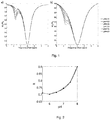
FIG. 1 illustrates Z spectrums generated by solutions having different pH at the saturation pulse intensities of 0.75 µT (a) and 1.5 µT (b) in embodiment 1; and -
FIG. 2 illustrates the pH-dependent variation of R (dotted line) and the fitted pH correction curve (solid line). - The technical solutions of the present disclosure will be described in detail below in connection with the embodiments, but it will be understood by those skilled in the art that the embodiments described below are only intended to illustrate the present disclosure, but should not be considered as limiting the scope of the present disclosure. The embodiments are carried out in accordance with conventional conditions or conditions recommended by the manufacturer if no specific conditions are specified in the embodiments.
- In at least one embodiment, there is provided a method for measuring pH, wherein with amide protons as an endogenous contrast agent, a chemical exchange saturation transfer effect ratio R of amide protons corresponding to a pH-known amide proton source solution under different saturation powers is measured, then a function relation between pH and R is established according to different pH-known amide proton source solutions and the corresponding measured R, and finally the desired pH is calculated according to experimentally measured Ri and the function relation, wherein Ri is a chemical exchange saturation transfer effect ratio of amide protons of a phantom to be tested or a tissue to be tested under different saturation powers.
- In the method for measuring pH described above, amide protons are used as an endogenous contrast agent, a function relation between pH and R is established by measuring a chemical exchange saturation transfer effect ratio R of amide protons corresponding to a pH-known solution under different saturation powers, and then the desired pH is calculated according to experimentally measured Ri and the function relation. In this method, since the amide protons involved in the imaging have the same source, the concentrations thereof are the same, then the impact of concentration can be completely eliminated and there is no need to make any estimation or measurement of the parameters such as the concentration of exchangeable protons, the longitudinal relaxation time of water, etc. Therefore, the saturation transfer effect ratio of amide protons under different saturation pulses can completely get rid of the dependence on the concentration of amide groups and the longitudinal relaxation time of water, and is only related to the chemical exchange rate, thus enabling more accurate, convenient and non-invasive measurement of pH. In addition, amide groups have a relatively low chemical exchange rate, and can be imaged stably under the clinically common magnetic resonance field strength, promising for clinical practices.
- Endogenous contrast agents are one kind of chemical exchange saturation transfer contrast agents. With intracellular substance as an endogenous contrast agent, and metabolite information is indirectly detected through water signals, so as to perform tissue pH imaging and various tissue metabolite imaging.
- The term "amide proton solution" refers to a solution capable of providing amide protons, and the abovementioned "amide proton solution" comprises, but is not limited to, a polylysine solution. The polylysine solution is formed preferably by diluting polylysine to a suitable concentration, comprising, but not limited to, 10 mg/mL, with a phosphate buffer or agarose. Polylysine solutions having different pH are prepared preferably by titration method.
- Preferably, the pH of the amide proton source solutions described above is 5.5-8.0, typically but not limited to 5.5, 5.6, 5.7, 5.8, 5.9, 6.0, 6.1, 6.2, 6.3, 6.4, 6.5, 6.6, 6.7, 6.8, 6.9, 7.0, 7.1, 7.2, 7.3, 7.4, 7.5, 7.6, 7.7, 7.8, 7.9 or 8.0. The pH of the amide proton source solutions having different pH comprises, but is not limited to, any combinations of several pH values described above. Preferably, the pH of the amide proton source solutions having different pH is 5.5, 6.0, 6.5, 7.0, 7.5 and 8.0, respectively.
- The word "there" in the phrasing "the corresponding measured R thereto" refers to a certain pH-known amide proton solution.
- The experimentally measured Ri comprises, but is not limited to, the measured Ri of other phantoms or tissues. The desired pH comprises, but is not limited to, the pH of other phantoms or tissues. It is to be understood that the above-described other phantoms refer to other phantoms than those that may be used in determining the function relation between pH and R; and the above-described tissues refer to organism tissues.
- It should be understood that the different saturation powers employed in the test of a pH-known amide proton solution are the same as the different saturation powers employed in the test of a phantom to be tested or a tissue to be tested.
- In a preferred embodiment, amide proton solutions having different pH are prepared and then made into phantoms, and then the phantoms are subjected to a chemical exchange saturation transfer imaging experiment under different saturation powers. The chemical exchange saturation transfer imaging is an imaging method with a special contrast ratio based on endogenous or exogenous contrast agents. Chemical exchange saturation transfer imaging is performed by first saturating exchangeable protons with pulses and then imaging hydrogen protons in water by using conventional imaging sequences.
- It should be noted that the "preparing of an amide proton solution" comprises, but is not limited to, preparing an amide proton solution with a test tube.
- In a preferred embodiment, a frequency offset range of the different saturation pulse intensities comprises ±3.5 ppm. An APT (Amide Proton Transfer) imaging signal is obtained by saturating signals at different chemical shifts and then acquiring water signals. In fact, RF saturation pulses also excite protons at adjacent resonance frequencies, particularly in clinical magnetic fields wherein the resonance frequency of the endogenous contrast agent, amide protons, is very close to that of water molecules, and this may cause direct water saturation effect to overwhelm the APT signals. 3.5 ppm is the chemical shift between amide groups and water molecules, with frequency offset range being -3.5 ppm, and mainly serves to eliminate the impact of direct water saturation effect on amide protons by the method of asymmetric analysis in the subsequent calculation process.
- In a preferred embodiment, the chemical exchange saturation transfer effect Ms of the amide proton source solution at each pH under different saturation pulse intensities is calculated using an asymmetric model, respectively, to obtain R. The chemical exchange saturation transfer effect is expressed by the ratio of signals after saturation and before saturation. The graph illustrating the signal ratio varying with chemical shift is called Z spectrum or CEST spectrum. In Z spectrum, images within a certain range of chemical shift are collected to correct the offset of the main magnetic field. Such spectrum, however, contains direct saturation effect close to the water frequency, which will interfere with the detection of CEST. In view of the characteristic that the conventional MT (Magnetization Transfer) effect and the direct water saturation effect on the Z spectrum exhibit a symmetry trend around water, it is feasible to remove the interference caused by the above factors by the method of asymmetric analysis, which is a simple and effective processing method. In this method, a subtraction operation is performed between the signal at the frequency of the exchangeable protons and the signal symmetrical to the resonance frequency of water molecules to eliminate the impact of the direct water saturation effect, to obtain MS and further obtain R. The calculation method is as follows: MS={MS(-3.5 ppm)-MS(+3.5 ppm)}/M0; wherein M0 is a signal amplitude when no saturation pulse is applied, MS(-3.5 ppm) and MS(+3.5 ppm) are signal amplitudes at -3.5 ppm and +3.5 ppm when a saturation pulse is applied, respectively.
- In a preferred embodiment, P=3T(ω1)/3T(ω2)={(M0-MS1)×MS2}/{(M0-MS2)×MS1}; wherein M0 is a signal amplitude when no saturation pulse is applied, MS1 and MS2 are chemical exchange saturation transfer effects when the saturation powers are ω1 and ω2, respectively, with ST(ω1)=(M0-MS1)/MS1, and ST(ω2)=(M0-MS2)/MS2. In this preferred embodiment, R is the ratio of ST(ω1) to ST(ω2), while ST(ω1)=(M0-MS1)/MS1, and ST(ω2)=(M0-MS2)/MS2, the abovementioned specific ST(ω1) and ST(ω2) can more sufficiently reflect the relation between R and the amide proton exchange rate.
- In a preferred embodiment, MS1={MS1(-3.5 ppm)-MS1(+3.5 ppm)}/M0; wherein M0 is a signal amplitude when no saturation pulse is applied, and MS1(-3.5 ppm) and MS1(+3.5 ppm) are signal amplitudes at -3.5 ppm and +3.5 ppm when a saturation pulse is applied, respectively.
- MS2={MS2(-3.5 ppm)-MS2(+3.5 ppm)}/M0; wherein M0 is a signal amplitude when no saturation pulse is applied, MS2(-3.5 ppm) and MS2(+3.5 ppm) are signal amplitudes at -3.5 ppm and +3.5 ppm when a saturation pulse is applied, respectively.
- In a preferred embodiment, the function relation between pH and R refers to the function relation in the monotonically varying interval of pH and R. The function relation in the monotonically varying interval of pH and R is of more practical significance. The above-mentioned "monotonically varying interval" refers to an interval in which the R-dependent variation of pH exhibits a monotonous increase or a monotonous decrease.
- Preferably, the function relation between pH and R is obtained by third order polynomial fitting. Based on practical application, the number of amide proton solutions with different pH will not be excessive, and the fitting accuracy can be ensured by using the third order polynomial fitting. It should be understood that the third order polynomial means that the highest degree of the independent variable is 3, and the third order polynomial is also referred to as a cubic polynomial.
- It should be understood that as the number of amide proton source solutions with different pH increases, higher order polynomials or more complex models can also be used for fitting, so that the precision of the resulting fitting curve is higher.
- In a preferred embodiment, the measurement of R of different pH-known amide proton source solutions and the measurement of Ri are conducted at the same experimental temperature and under the same imaging conditions, and the in vivo experimental temperature is preferably 37°C. In the case where the measurement of R of different pH-known amide proton source solutions and the measurement of Ri are conducted at the same experimental temperature and under the same imaging conditions, the actual pH can be measured more accurately only when the obtained function relation between pH and R is applied to the measurement of Ri. The in vivo experimental temperature being preferably 37°C serves the purpose of getting adapted to the human body temperature.
- In a preferred embodiment, the following steps are comprised:
- (a) preparing amide proton solutions with different pH and then making the same into several phantoms;
- (b) subjecting the phantoms to a chemical exchange saturation transfer imaging experiment under different saturation powers;
- (c) calculating chemical exchange saturation transfer effect MS of the amide proton source solution at each pH under different saturation powers;
- (d) calculating a chemical exchange saturation transfer effect ratio R of the amide proton source solution at each pH under different saturation powers;
- (e) establishing a function relation between pH and R; and
- (f) conducting a phantom experiment or in vivo experiment to measure Ri, and calculating the desired pH according to Ri with the function relation in Step (e).
- The method for measuring pH described above can be applied to the prediction of pathogenesis, prediction of development process or prognostic evaluation of diseases, can accurately measure the pH in organism tissue cells, and allow for more accurate and convenient prediction of pathogenesis, prediction of development process or prognostic evaluation of diseases.
- A method for measuring pH, comprising the steps of:
(a) loading a polylysine solution having different pH and then making the same into several phantoms, with the pH being 5.5, 6.0, 6.5, 7.0, 7.5 and 8.0;
(b) subjecting the phantoms to a chemical exchange saturation transfer imaging experiment under different saturation powers;
wherein it is assumed that the chemical exchange rates of the solutions having pH of 5.5, 6.0, 6.5, 7.0, 7.5 and 8.0 are 10, 30, 60, 90, 120 and 180 Hz, respectively, and the concentration of amide protons with respect to water is 1:200, the longitudinal and transverse relaxation time of water is set to 1.2 s and 80 ms respectively, the saturation time of continuous RF pulse is set to 2.4 s, the frequency offset range is set to -6∼6 ppm with intervals of 0.1 ppm, and then when the saturation powers are 0.75 µT and 1.5 µT at the magnetic field strength of 3 T, the Z spectrum is as shown inFIG. 1 ;
(c) calculating chemical exchange saturation transfer effect MS of the corresponding amide protons in the solution at each pH under different saturation pulse intensities, with MS={MS(-3.5 ppm)-MS(+3.5 ppm)}/M0, wherein M0 is a signal amplitude when no saturation pulse is applied, MS(-3.5 ppm) and MS(+3.5 ppm) are signal amplitudes when a saturation pulse is applied at -3.5 ppm and +3.5 ppm, respectively, and the results being as shown in Table 1;Table 1 Chemical exchange saturation transfer effect corresponding to amide protons in solutions having different pH pH 5.5 6.0 6.5 7.0 7.5 8.0 ω1=0.75 µT 0.04 0.12 0.20 0.26 0.29 0.32 ω2=1.5 µT 0.03 0.09 0.15 0.20 0.24 0.30
(d) calculating a chemical exchange saturation transfer effect ratio R of the solution at each pH under different saturation powers, with P=ST(ω1)/ST(ω2)={(M0-MS1)×MS2}/{(M0-MS2)×MS1}, wherein MS1 and MS2 are chemical exchange saturation transfer effects when the saturation powers are ω1 and ω2, respectively, with ST(ω1)=(M0-MS1)/MS1, and ST(ω2)=(M0-MS2)/MS2;
(e) studying the relation between the chemical exchange saturation transfer effect ratio R and pH at two saturation powers, and fitting the numerical values in the monotonically varying interval with appropriate functions to establish a function relation between pH and R,
wherein as can be seen, when pH is in the range of 6∼8, R and pH exhibit a monotonically varying trend, this range covers most of the pH values of organism tissues, a pH calibration curve (solid line) can be obtained by fitting the pH with R using a third order polynomial, as shown inFIG. 2 , and the function relation between pH and R after the fitting is R = 0.02*pH3-0.28*pH2+1.56*pH-2.22;
(f) conducting a phantom experiment or in vivo experiment under the same experimental temperature and imaging conditions as in Step (b) to measure Ri, and calculating the desired pH according to Ri with the function relation in Step (e), wherein for example, the chemical exchange saturation transfer effects of a phantom/in vivo tissue obtained under the saturation pulses of 0.75 µT and 1.5 µT are 0.24 and 0.19, respectively, then Ri = 0.73, and based on the pH calibration curve obtained above and the function relation after fitting, it can be obtained that the phantom/in vivo tissue has a pH of 6.9. - Although the present disclosure has been illustrated and described with specific embodiments, it should be appreciated that many other changes and modifications may be made without departing from the spirit and scope of the present disclosure. Therefore, the appended claims are meant to encompass all such variations and modifications falling within the scope of the present disclosure.
Claims (10)
- A method for measuring pH, characterized in that with amide protons as an endogenous contrast agent, a chemical exchange saturation transfer effect ratio R of amide protons corresponding to a pH-known amide proton solution under different saturation powers is measured, then a function relation between pH and R is established according to different pH-known amide proton solutions and the corresponding measured R thereto, and finally the desired pH is calculated according to experimentally measured Ri and the function relation, wherein Ri is a chemical exchange saturation transfer effect ratio of amide protons of a phantom to be tested or a tissue to be tested under different saturation pulse intensities.
- The method for measuring pH according to claim 1, characterized in that the pH of the amide proton solution is 5.5-8.0.
- The method for measuring pH according to claim 1, characterized in that amide proton solutions having different pH are prepared and then made into phantoms, and then the phantoms are subjected to a chemical exchange saturation transfer imaging experiment under different saturation powers.
- The method for measuring pH according to claim 1, characterized in that a frequency offset range of the different saturation powers is ±3.5 ppm.
- The method for measuring pH according to claim 1, characterized in that a chemical exchange saturation transfer effect MS of the amide proton solution at each pH under different saturation powers is calculated using an asymmetric model, to obtain R.
- The method for measuring pH according to claim 1, characterized in that R is determined by R=ST(ω1)/ST(ω2)=((M0-MS1)×MS2}/{(M0-MS2)×MS1}, wherein M0 is a signal amplitude when no saturation pulse is applied, MS1 and MS2 are chemical exchange saturation transfer effects when the saturation powers are ω1 and ω2, respectively, with ST(ω1)=(M0-MS1)/MS1, and ST(ω2)=(M0-MS2)/MS2.
- The method for measuring pH according to claim 6, characterized in that MS1 is determined by MS1={MS1(-3.5 ppm)-MS1(+3.5 ppm)}/M0, wherein M0 is a signal amplitude when no saturation pulse is applied, MS1(-3.5 ppm) and MS1(+3.5 ppm) are signal amplitudes at -3.5 ppm and +3.5 ppm when a saturation pulse is applied, respectively; and
MS2 is determined by MS2={MS2(-3.5 ppm)-MS2(+3.5 ppm)}/M0; wherein M0 is a signal amplitude when no saturation pulse is applied, and MS2(-3.5 ppm) and MS2(+3.5 ppm) are signal amplitudes at -3.5 ppm and +3.5 ppm when a saturation pulse is applied, respectively. - The method for measuring pH according to claim 1, characterized in that the function relation between pH and R refers to a function relation in the monotonically varying interval of pH and R,
preferably, the function relation between pH and R is obtained by third order polynomial fitting. - The method for measuring pH according to claim 1, characterized in that the measurement of R of different pH-known amide proton solutions and the measurement of Ri are performed at the same experimental temperature and under the same imaging conditions, and the in vivo experimental temperature is preferably 37°C.
- The method for measuring pH according to any one of claims 1-9, characterized by comprising steps of:(a) loading amide proton solutions having different pH and then making the same into several phantoms;(b) subjecting the phantoms to a chemical exchange saturation transfer imaging experiment under different saturation powers;(c) calculating chemical exchange saturation transfer effect Ms of the amide proton solution at each pH under different saturation powers;(d) calculating a chemical exchange saturation transfer effect ratio R of the amide proton solution at each pH under different saturation powers;(e) establishing a function relation between pH and R; and(f) performing a phantom experiment or in vivo experiment to measure Ri, and calculating the desired pH according to Ri and the function relation in Step (e).
Applications Claiming Priority (2)
| Application Number | Priority Date | Filing Date | Title |
|---|---|---|---|
| CN201711372590.0A CN108195867B (en) | 2017-12-18 | 2017-12-18 | pH measurement method |
| PCT/CN2017/120104 WO2019119517A1 (en) | 2017-12-18 | 2017-12-29 | Ph measurement method |
Publications (3)
| Publication Number | Publication Date |
|---|---|
| EP3521815A1 true EP3521815A1 (en) | 2019-08-07 |
| EP3521815A4 EP3521815A4 (en) | 2019-08-21 |
| EP3521815B1 EP3521815B1 (en) | 2024-07-03 |
Family
ID=62576898
Family Applications (1)
| Application Number | Title | Priority Date | Filing Date |
|---|---|---|---|
| EP17910501.0A Active EP3521815B1 (en) | 2017-12-18 | 2017-12-29 | Ph measurement method |
Country Status (4)
| Country | Link |
|---|---|
| US (1) | US11125843B2 (en) |
| EP (1) | EP3521815B1 (en) |
| CN (1) | CN108195867B (en) |
| WO (1) | WO2019119517A1 (en) |
Families Citing this family (4)
| Publication number | Priority date | Publication date | Assignee | Title |
|---|---|---|---|---|
| CN110824398B (en) * | 2019-10-15 | 2021-10-22 | 深圳先进技术研究院 | Chemical exchange characteristic quantitative method and equipment |
| WO2021072640A1 (en) * | 2019-10-15 | 2021-04-22 | 深圳先进技术研究院 | Chemical exchange feature quantification method and device |
| CN111521629B (en) * | 2020-04-30 | 2022-08-12 | 中国科学院精密测量科学与技术创新研究院 | A Magnetic Resonance Imaging Method for Non-uniform Saturation Energy Distribution for Quantitative Measurement of pH |
| US12529739B2 (en) * | 2022-07-26 | 2026-01-20 | Canon Medical Systems Corporation | pH calculating apparatus, magnetic resonance imaging apparatus, and pH calculating method |
Family Cites Families (6)
| Publication number | Priority date | Publication date | Assignee | Title |
|---|---|---|---|---|
| US6943033B2 (en) * | 2001-12-13 | 2005-09-13 | The Johns Hopkins University | Magnetic resonance method for assesing amide proton transfer effects between amide protons of endogenous mobile proteins and peptides and tissue water in situ and its use for imaging ph and mobile protein/peptide content |
| US8278925B2 (en) * | 2008-03-26 | 2012-10-02 | The General Hospital Corporation | Method for relaxation-compensated fast multi-slice chemical exchange saturation transfer MRI |
| WO2014154728A1 (en) * | 2013-03-29 | 2014-10-02 | Koninklijke Philips N.V. | Amide proton transfer (apt) and electric properties tomography (ept) imaging in a single mr acquisition |
| US10001536B2 (en) * | 2014-05-06 | 2018-06-19 | The General Hospital Corporation | System and method for measuring pH using magnetic resonance |
| EP3394627B1 (en) * | 2015-12-23 | 2020-06-03 | Bracco Imaging S.p.A | Ratiometric pulsed cest imaging |
| CN106772165B (en) * | 2016-12-30 | 2019-04-05 | 深圳先进技术研究院 | Method and device for determination of amino proton transfer effect |
-
2017
- 2017-12-18 CN CN201711372590.0A patent/CN108195867B/en active Active
- 2017-12-29 US US16/309,351 patent/US11125843B2/en active Active
- 2017-12-29 WO PCT/CN2017/120104 patent/WO2019119517A1/en not_active Ceased
- 2017-12-29 EP EP17910501.0A patent/EP3521815B1/en active Active
Also Published As
| Publication number | Publication date |
|---|---|
| WO2019119517A1 (en) | 2019-06-27 |
| US20200309885A1 (en) | 2020-10-01 |
| CN108195867B (en) | 2019-10-18 |
| EP3521815B1 (en) | 2024-07-03 |
| EP3521815A4 (en) | 2019-08-21 |
| US11125843B2 (en) | 2021-09-21 |
| CN108195867A (en) | 2018-06-22 |
Similar Documents
| Publication | Publication Date | Title |
|---|---|---|
| Desmond et al. | Understanding quantitative pulsed CEST in the presence of MT | |
| Xu et al. | Chemical exchange saturation transfer imaging of creatine, phosphocreatine, and protein arginine residue in tissues | |
| Near et al. | Unedited in vivo detection and quantification of γ‐aminobutyric acid in the occipital cortex using short‐TE MRS at 3 T | |
| Yarnykh | Fast macromolecular proton fraction mapping from a single off‐resonance magnetization transfer measurement | |
| US8032335B2 (en) | Evaluating magnetic resonance spectra | |
| Henry et al. | Brain GABA editing without macromolecule contamination | |
| Sanaei Nezhad et al. | Quantification of GABA, glutamate and glutamine in a single measurement at 3 T using GABA‐edited MEGA‐PRESS | |
| Goense et al. | Laminar specificity in monkey V1 using high-resolution SE-fMRI | |
| Saleh et al. | Multi-vendor standardized sequence for edited magnetic resonance spectroscopy | |
| Mangia et al. | Sensitivity of single-voxel 1H-MRS in investigating the metabolism of the activated human visual cortex at 7 T | |
| EP3521815B1 (en) | Ph measurement method | |
| EP2967419B1 (en) | A method and system for determiing a corrected value of magnetic resonance relaxometry data of a subject's visceral tissue for extracellular fluid based on a normal iron content for the visceral tissue | |
| Sandino et al. | Myocardial T2* mapping: influence of noise on accuracy and precision | |
| Marjańska et al. | Altered macromolecular pattern and content in the aging human brain | |
| US6819952B2 (en) | Magnetic resonance spectroscopic imaging method to monitor progression and treatment of neurodegenerative conditions | |
| US20190011516A1 (en) | System and method for direct saturation-corrected chemical exchange saturation transfer (disc-cest) | |
| Varghese et al. | CMR-based blood oximetry via multi-parametric estimation using multiple T2 measurements | |
| Randtke et al. | Multislice CEST MRI improves the spatial assessment of tumor pH | |
| US10365343B2 (en) | Multi-echo length and offset varied saturation (Me-LOVARS) method for chemical exchange saturation transfer (CEST) MR imaging | |
| Roussel et al. | Respiratory‐triggered quantitative MR spectroscopy of the human cervical spinal cord at 7 T | |
| US11337647B2 (en) | Quantification of in vivo metabolite | |
| Brandejsky et al. | Proton diffusion tensor spectroscopy of metabolites in human muscle in vivo | |
| CN110687489A (en) | Fitting method for magnetic resonance imaging multi-echo magnetic field distribution diagram | |
| Tiwari et al. | Distinction of the GABA 2.29 ppm resonance using triple refocusing at 3 T in vivo | |
| Umesh Rudrapatna et al. | Measurement of distinctive features of cortical spreading depolarizations with different MRI contrasts |
Legal Events
| Date | Code | Title | Description |
|---|---|---|---|
| STAA | Information on the status of an ep patent application or granted ep patent |
Free format text: STATUS: UNKNOWN |
|
| STAA | Information on the status of an ep patent application or granted ep patent |
Free format text: STATUS: THE INTERNATIONAL PUBLICATION HAS BEEN MADE |
|
| PUAI | Public reference made under article 153(3) epc to a published international application that has entered the european phase |
Free format text: ORIGINAL CODE: 0009012 |
|
| STAA | Information on the status of an ep patent application or granted ep patent |
Free format text: STATUS: REQUEST FOR EXAMINATION WAS MADE |
|
| REG | Reference to a national code |
Ref country code: DE Ref legal event code: R079 Free format text: PREVIOUS MAIN CLASS: G01N0024080000 Ipc: G01R0033560000 |
|
| 17P | Request for examination filed |
Effective date: 20181129 |
|
| AK | Designated contracting states |
Kind code of ref document: A1 Designated state(s): AL AT BE BG CH CY CZ DE DK EE ES FI FR GB GR HR HU IE IS IT LI LT LU LV MC MK MT NL NO PL PT RO RS SE SI SK SM TR |
|
| AX | Request for extension of the european patent |
Extension state: BA ME |
|
| A4 | Supplementary search report drawn up and despatched |
Effective date: 20190723 |
|
| RIC1 | Information provided on ipc code assigned before grant |
Ipc: G01N 24/08 20060101ALI20190717BHEP Ipc: G01R 33/56 20060101AFI20190717BHEP |
|
| RIN1 | Information on inventor provided before grant (corrected) |
Inventor name: WU, YIN Inventor name: ZHENG, HAIRONG Inventor name: LIU, XIN |
|
| DAV | Request for validation of the european patent (deleted) | ||
| DAX | Request for extension of the european patent (deleted) | ||
| STAA | Information on the status of an ep patent application or granted ep patent |
Free format text: STATUS: EXAMINATION IS IN PROGRESS |
|
| 17Q | First examination report despatched |
Effective date: 20220421 |
|
| GRAP | Despatch of communication of intention to grant a patent |
Free format text: ORIGINAL CODE: EPIDOSNIGR1 |
|
| STAA | Information on the status of an ep patent application or granted ep patent |
Free format text: STATUS: GRANT OF PATENT IS INTENDED |
|
| INTG | Intention to grant announced |
Effective date: 20240205 |
|
| GRAS | Grant fee paid |
Free format text: ORIGINAL CODE: EPIDOSNIGR3 |
|
| GRAA | (expected) grant |
Free format text: ORIGINAL CODE: 0009210 |
|
| STAA | Information on the status of an ep patent application or granted ep patent |
Free format text: STATUS: THE PATENT HAS BEEN GRANTED |
|
| AK | Designated contracting states |
Kind code of ref document: B1 Designated state(s): AL AT BE BG CH CY CZ DE DK EE ES FI FR GB GR HR HU IE IS IT LI LT LU LV MC MK MT NL NO PL PT RO RS SE SI SK SM TR |
|
| REG | Reference to a national code |
Ref country code: CH Ref legal event code: EP |
|
| REG | Reference to a national code |
Ref country code: DE Ref legal event code: R096 Ref document number: 602017083103 Country of ref document: DE |
|
| REG | Reference to a national code |
Ref country code: LT Ref legal event code: MG9D |
|
| REG | Reference to a national code |
Ref country code: NL Ref legal event code: MP Effective date: 20240703 |
|
| PG25 | Lapsed in a contracting state [announced via postgrant information from national office to epo] |
Ref country code: PT Free format text: LAPSE BECAUSE OF FAILURE TO SUBMIT A TRANSLATION OF THE DESCRIPTION OR TO PAY THE FEE WITHIN THE PRESCRIBED TIME-LIMIT Effective date: 20241104 |
|
| REG | Reference to a national code |
Ref country code: AT Ref legal event code: MK05 Ref document number: 1700368 Country of ref document: AT Kind code of ref document: T Effective date: 20240703 |
|
| PG25 | Lapsed in a contracting state [announced via postgrant information from national office to epo] |
Ref country code: NL Free format text: LAPSE BECAUSE OF FAILURE TO SUBMIT A TRANSLATION OF THE DESCRIPTION OR TO PAY THE FEE WITHIN THE PRESCRIBED TIME-LIMIT Effective date: 20240703 |
|
| PG25 | Lapsed in a contracting state [announced via postgrant information from national office to epo] |
Ref country code: PT Free format text: LAPSE BECAUSE OF FAILURE TO SUBMIT A TRANSLATION OF THE DESCRIPTION OR TO PAY THE FEE WITHIN THE PRESCRIBED TIME-LIMIT Effective date: 20241104 Ref country code: NL Free format text: LAPSE BECAUSE OF FAILURE TO SUBMIT A TRANSLATION OF THE DESCRIPTION OR TO PAY THE FEE WITHIN THE PRESCRIBED TIME-LIMIT Effective date: 20240703 |
|
| PG25 | Lapsed in a contracting state [announced via postgrant information from national office to epo] |
Ref country code: NO Free format text: LAPSE BECAUSE OF FAILURE TO SUBMIT A TRANSLATION OF THE DESCRIPTION OR TO PAY THE FEE WITHIN THE PRESCRIBED TIME-LIMIT Effective date: 20241003 |
|
| PG25 | Lapsed in a contracting state [announced via postgrant information from national office to epo] |
Ref country code: GR Free format text: LAPSE BECAUSE OF FAILURE TO SUBMIT A TRANSLATION OF THE DESCRIPTION OR TO PAY THE FEE WITHIN THE PRESCRIBED TIME-LIMIT Effective date: 20241004 Ref country code: FI Free format text: LAPSE BECAUSE OF FAILURE TO SUBMIT A TRANSLATION OF THE DESCRIPTION OR TO PAY THE FEE WITHIN THE PRESCRIBED TIME-LIMIT Effective date: 20240703 Ref country code: PL Free format text: LAPSE BECAUSE OF FAILURE TO SUBMIT A TRANSLATION OF THE DESCRIPTION OR TO PAY THE FEE WITHIN THE PRESCRIBED TIME-LIMIT Effective date: 20240703 |
|
| PG25 | Lapsed in a contracting state [announced via postgrant information from national office to epo] |
Ref country code: BG Free format text: LAPSE BECAUSE OF FAILURE TO SUBMIT A TRANSLATION OF THE DESCRIPTION OR TO PAY THE FEE WITHIN THE PRESCRIBED TIME-LIMIT Effective date: 20240703 |
|
| PG25 | Lapsed in a contracting state [announced via postgrant information from national office to epo] |
Ref country code: LV Free format text: LAPSE BECAUSE OF FAILURE TO SUBMIT A TRANSLATION OF THE DESCRIPTION OR TO PAY THE FEE WITHIN THE PRESCRIBED TIME-LIMIT Effective date: 20240703 |
|
| PG25 | Lapsed in a contracting state [announced via postgrant information from national office to epo] |
Ref country code: AT Free format text: LAPSE BECAUSE OF FAILURE TO SUBMIT A TRANSLATION OF THE DESCRIPTION OR TO PAY THE FEE WITHIN THE PRESCRIBED TIME-LIMIT Effective date: 20240703 Ref country code: IS Free format text: LAPSE BECAUSE OF FAILURE TO SUBMIT A TRANSLATION OF THE DESCRIPTION OR TO PAY THE FEE WITHIN THE PRESCRIBED TIME-LIMIT Effective date: 20241103 |
|
| PG25 | Lapsed in a contracting state [announced via postgrant information from national office to epo] |
Ref country code: CZ Free format text: LAPSE BECAUSE OF FAILURE TO SUBMIT A TRANSLATION OF THE DESCRIPTION OR TO PAY THE FEE WITHIN THE PRESCRIBED TIME-LIMIT Effective date: 20240703 Ref country code: HR Free format text: LAPSE BECAUSE OF FAILURE TO SUBMIT A TRANSLATION OF THE DESCRIPTION OR TO PAY THE FEE WITHIN THE PRESCRIBED TIME-LIMIT Effective date: 20240703 |
|
| PG25 | Lapsed in a contracting state [announced via postgrant information from national office to epo] |
Ref country code: RS Free format text: LAPSE BECAUSE OF FAILURE TO SUBMIT A TRANSLATION OF THE DESCRIPTION OR TO PAY THE FEE WITHIN THE PRESCRIBED TIME-LIMIT Effective date: 20241003 Ref country code: ES Free format text: LAPSE BECAUSE OF FAILURE TO SUBMIT A TRANSLATION OF THE DESCRIPTION OR TO PAY THE FEE WITHIN THE PRESCRIBED TIME-LIMIT Effective date: 20240703 |
|
| PG25 | Lapsed in a contracting state [announced via postgrant information from national office to epo] |
Ref country code: RS Free format text: LAPSE BECAUSE OF FAILURE TO SUBMIT A TRANSLATION OF THE DESCRIPTION OR TO PAY THE FEE WITHIN THE PRESCRIBED TIME-LIMIT Effective date: 20241003 Ref country code: PL Free format text: LAPSE BECAUSE OF FAILURE TO SUBMIT A TRANSLATION OF THE DESCRIPTION OR TO PAY THE FEE WITHIN THE PRESCRIBED TIME-LIMIT Effective date: 20240703 Ref country code: NO Free format text: LAPSE BECAUSE OF FAILURE TO SUBMIT A TRANSLATION OF THE DESCRIPTION OR TO PAY THE FEE WITHIN THE PRESCRIBED TIME-LIMIT Effective date: 20241003 Ref country code: LV Free format text: LAPSE BECAUSE OF FAILURE TO SUBMIT A TRANSLATION OF THE DESCRIPTION OR TO PAY THE FEE WITHIN THE PRESCRIBED TIME-LIMIT Effective date: 20240703 Ref country code: IS Free format text: LAPSE BECAUSE OF FAILURE TO SUBMIT A TRANSLATION OF THE DESCRIPTION OR TO PAY THE FEE WITHIN THE PRESCRIBED TIME-LIMIT Effective date: 20241103 Ref country code: HR Free format text: LAPSE BECAUSE OF FAILURE TO SUBMIT A TRANSLATION OF THE DESCRIPTION OR TO PAY THE FEE WITHIN THE PRESCRIBED TIME-LIMIT Effective date: 20240703 Ref country code: GR Free format text: LAPSE BECAUSE OF FAILURE TO SUBMIT A TRANSLATION OF THE DESCRIPTION OR TO PAY THE FEE WITHIN THE PRESCRIBED TIME-LIMIT Effective date: 20241004 Ref country code: FI Free format text: LAPSE BECAUSE OF FAILURE TO SUBMIT A TRANSLATION OF THE DESCRIPTION OR TO PAY THE FEE WITHIN THE PRESCRIBED TIME-LIMIT Effective date: 20240703 Ref country code: ES Free format text: LAPSE BECAUSE OF FAILURE TO SUBMIT A TRANSLATION OF THE DESCRIPTION OR TO PAY THE FEE WITHIN THE PRESCRIBED TIME-LIMIT Effective date: 20240703 Ref country code: CZ Free format text: LAPSE BECAUSE OF FAILURE TO SUBMIT A TRANSLATION OF THE DESCRIPTION OR TO PAY THE FEE WITHIN THE PRESCRIBED TIME-LIMIT Effective date: 20240703 Ref country code: BG Free format text: LAPSE BECAUSE OF FAILURE TO SUBMIT A TRANSLATION OF THE DESCRIPTION OR TO PAY THE FEE WITHIN THE PRESCRIBED TIME-LIMIT Effective date: 20240703 Ref country code: AT Free format text: LAPSE BECAUSE OF FAILURE TO SUBMIT A TRANSLATION OF THE DESCRIPTION OR TO PAY THE FEE WITHIN THE PRESCRIBED TIME-LIMIT Effective date: 20240703 |
|
| REG | Reference to a national code |
Ref country code: DE Ref legal event code: R097 Ref document number: 602017083103 Country of ref document: DE |
|
| PG25 | Lapsed in a contracting state [announced via postgrant information from national office to epo] |
Ref country code: RO Free format text: LAPSE BECAUSE OF FAILURE TO SUBMIT A TRANSLATION OF THE DESCRIPTION OR TO PAY THE FEE WITHIN THE PRESCRIBED TIME-LIMIT Effective date: 20240703 Ref country code: DK Free format text: LAPSE BECAUSE OF FAILURE TO SUBMIT A TRANSLATION OF THE DESCRIPTION OR TO PAY THE FEE WITHIN THE PRESCRIBED TIME-LIMIT Effective date: 20240703 Ref country code: SM Free format text: LAPSE BECAUSE OF FAILURE TO SUBMIT A TRANSLATION OF THE DESCRIPTION OR TO PAY THE FEE WITHIN THE PRESCRIBED TIME-LIMIT Effective date: 20240703 |
|
| PG25 | Lapsed in a contracting state [announced via postgrant information from national office to epo] |
Ref country code: EE Free format text: LAPSE BECAUSE OF FAILURE TO SUBMIT A TRANSLATION OF THE DESCRIPTION OR TO PAY THE FEE WITHIN THE PRESCRIBED TIME-LIMIT Effective date: 20240703 |
|
| PG25 | Lapsed in a contracting state [announced via postgrant information from national office to epo] |
Ref country code: IT Free format text: LAPSE BECAUSE OF FAILURE TO SUBMIT A TRANSLATION OF THE DESCRIPTION OR TO PAY THE FEE WITHIN THE PRESCRIBED TIME-LIMIT Effective date: 20240703 Ref country code: SK Free format text: LAPSE BECAUSE OF FAILURE TO SUBMIT A TRANSLATION OF THE DESCRIPTION OR TO PAY THE FEE WITHIN THE PRESCRIBED TIME-LIMIT Effective date: 20240703 |
|
| PLBE | No opposition filed within time limit |
Free format text: ORIGINAL CODE: 0009261 |
|
| STAA | Information on the status of an ep patent application or granted ep patent |
Free format text: STATUS: NO OPPOSITION FILED WITHIN TIME LIMIT |
|
| 26N | No opposition filed |
Effective date: 20250404 |
|
| PG25 | Lapsed in a contracting state [announced via postgrant information from national office to epo] |
Ref country code: MC Free format text: LAPSE BECAUSE OF FAILURE TO SUBMIT A TRANSLATION OF THE DESCRIPTION OR TO PAY THE FEE WITHIN THE PRESCRIBED TIME-LIMIT Effective date: 20240703 |
|
| REG | Reference to a national code |
Ref country code: CH Ref legal event code: PL |
|
| PG25 | Lapsed in a contracting state [announced via postgrant information from national office to epo] |
Ref country code: LU Free format text: LAPSE BECAUSE OF NON-PAYMENT OF DUE FEES Effective date: 20241229 |
|
| GBPC | Gb: european patent ceased through non-payment of renewal fee |
Effective date: 20241229 |
|
| PG25 | Lapsed in a contracting state [announced via postgrant information from national office to epo] |
Ref country code: SE Free format text: LAPSE BECAUSE OF FAILURE TO SUBMIT A TRANSLATION OF THE DESCRIPTION OR TO PAY THE FEE WITHIN THE PRESCRIBED TIME-LIMIT Effective date: 20240703 |
|
| REG | Reference to a national code |
Ref country code: BE Ref legal event code: MM Effective date: 20241231 |
|
| PG25 | Lapsed in a contracting state [announced via postgrant information from national office to epo] |
Ref country code: GB Free format text: LAPSE BECAUSE OF NON-PAYMENT OF DUE FEES Effective date: 20241229 Ref country code: BE Free format text: LAPSE BECAUSE OF NON-PAYMENT OF DUE FEES Effective date: 20241231 |
|
| PG25 | Lapsed in a contracting state [announced via postgrant information from national office to epo] |
Ref country code: FR Free format text: LAPSE BECAUSE OF NON-PAYMENT OF DUE FEES Effective date: 20241231 |
|
| PG25 | Lapsed in a contracting state [announced via postgrant information from national office to epo] |
Ref country code: CH Free format text: LAPSE BECAUSE OF NON-PAYMENT OF DUE FEES Effective date: 20241231 |
|
| PG25 | Lapsed in a contracting state [announced via postgrant information from national office to epo] |
Ref country code: IE Free format text: LAPSE BECAUSE OF NON-PAYMENT OF DUE FEES Effective date: 20241229 |
|
| PGFP | Annual fee paid to national office [announced via postgrant information from national office to epo] |
Ref country code: DE Payment date: 20251222 Year of fee payment: 9 |
|
| PG25 | Lapsed in a contracting state [announced via postgrant information from national office to epo] |
Ref country code: CY Free format text: LAPSE BECAUSE OF FAILURE TO SUBMIT A TRANSLATION OF THE DESCRIPTION OR TO PAY THE FEE WITHIN THE PRESCRIBED TIME-LIMIT Effective date: 20240703 |