EP3521446A1 - Method for designing primer for multiplex pcr - Google Patents
Method for designing primer for multiplex pcr Download PDFInfo
- Publication number
- EP3521446A1 EP3521446A1 EP17855651.0A EP17855651A EP3521446A1 EP 3521446 A1 EP3521446 A1 EP 3521446A1 EP 17855651 A EP17855651 A EP 17855651A EP 3521446 A1 EP3521446 A1 EP 3521446A1
- Authority
- EP
- European Patent Office
- Prior art keywords
- interest
- value
- base sequences
- primer
- primers
- Prior art date
- Legal status (The legal status is an assumption and is not a legal conclusion. Google has not performed a legal analysis and makes no representation as to the accuracy of the status listed.)
- Withdrawn
Links
Images



Classifications
-
- G—PHYSICS
- G16—INFORMATION AND COMMUNICATION TECHNOLOGY [ICT] SPECIALLY ADAPTED FOR SPECIFIC APPLICATION FIELDS
- G16C—COMPUTATIONAL CHEMISTRY; CHEMOINFORMATICS; COMPUTATIONAL MATERIALS SCIENCE
- G16C20/00—Chemoinformatics, i.e. ICT specially adapted for the handling of physicochemical or structural data of chemical particles, elements, compounds or mixtures
- G16C20/30—Prediction of properties of chemical compounds, compositions or mixtures
-
- C—CHEMISTRY; METALLURGY
- C12—BIOCHEMISTRY; BEER; SPIRITS; WINE; VINEGAR; MICROBIOLOGY; ENZYMOLOGY; MUTATION OR GENETIC ENGINEERING
- C12Q—MEASURING OR TESTING PROCESSES INVOLVING ENZYMES, NUCLEIC ACIDS OR MICROORGANISMS; COMPOSITIONS OR TEST PAPERS THEREFOR; PROCESSES OF PREPARING SUCH COMPOSITIONS; CONDITION-RESPONSIVE CONTROL IN MICROBIOLOGICAL OR ENZYMOLOGICAL PROCESSES
- C12Q1/00—Measuring or testing processes involving enzymes, nucleic acids or microorganisms; Compositions therefor; Processes of preparing such compositions
- C12Q1/68—Measuring or testing processes involving enzymes, nucleic acids or microorganisms; Compositions therefor; Processes of preparing such compositions involving nucleic acids
-
- C—CHEMISTRY; METALLURGY
- C12—BIOCHEMISTRY; BEER; SPIRITS; WINE; VINEGAR; MICROBIOLOGY; ENZYMOLOGY; MUTATION OR GENETIC ENGINEERING
- C12Q—MEASURING OR TESTING PROCESSES INVOLVING ENZYMES, NUCLEIC ACIDS OR MICROORGANISMS; COMPOSITIONS OR TEST PAPERS THEREFOR; PROCESSES OF PREPARING SUCH COMPOSITIONS; CONDITION-RESPONSIVE CONTROL IN MICROBIOLOGICAL OR ENZYMOLOGICAL PROCESSES
- C12Q1/00—Measuring or testing processes involving enzymes, nucleic acids or microorganisms; Compositions therefor; Processes of preparing such compositions
- C12Q1/68—Measuring or testing processes involving enzymes, nucleic acids or microorganisms; Compositions therefor; Processes of preparing such compositions involving nucleic acids
- C12Q1/6844—Nucleic acid amplification reactions
- C12Q1/6846—Common amplification features
-
- C—CHEMISTRY; METALLURGY
- C12—BIOCHEMISTRY; BEER; SPIRITS; WINE; VINEGAR; MICROBIOLOGY; ENZYMOLOGY; MUTATION OR GENETIC ENGINEERING
- C12Q—MEASURING OR TESTING PROCESSES INVOLVING ENZYMES, NUCLEIC ACIDS OR MICROORGANISMS; COMPOSITIONS OR TEST PAPERS THEREFOR; PROCESSES OF PREPARING SUCH COMPOSITIONS; CONDITION-RESPONSIVE CONTROL IN MICROBIOLOGICAL OR ENZYMOLOGICAL PROCESSES
- C12Q1/00—Measuring or testing processes involving enzymes, nucleic acids or microorganisms; Compositions therefor; Processes of preparing such compositions
- C12Q1/68—Measuring or testing processes involving enzymes, nucleic acids or microorganisms; Compositions therefor; Processes of preparing such compositions involving nucleic acids
- C12Q1/6844—Nucleic acid amplification reactions
- C12Q1/6853—Nucleic acid amplification reactions using modified primers or templates
-
- C—CHEMISTRY; METALLURGY
- C12—BIOCHEMISTRY; BEER; SPIRITS; WINE; VINEGAR; MICROBIOLOGY; ENZYMOLOGY; MUTATION OR GENETIC ENGINEERING
- C12Q—MEASURING OR TESTING PROCESSES INVOLVING ENZYMES, NUCLEIC ACIDS OR MICROORGANISMS; COMPOSITIONS OR TEST PAPERS THEREFOR; PROCESSES OF PREPARING SUCH COMPOSITIONS; CONDITION-RESPONSIVE CONTROL IN MICROBIOLOGICAL OR ENZYMOLOGICAL PROCESSES
- C12Q1/00—Measuring or testing processes involving enzymes, nucleic acids or microorganisms; Compositions therefor; Processes of preparing such compositions
- C12Q1/68—Measuring or testing processes involving enzymes, nucleic acids or microorganisms; Compositions therefor; Processes of preparing such compositions involving nucleic acids
- C12Q1/6844—Nucleic acid amplification reactions
- C12Q1/686—Polymerase chain reaction [PCR]
-
- C—CHEMISTRY; METALLURGY
- C12—BIOCHEMISTRY; BEER; SPIRITS; WINE; VINEGAR; MICROBIOLOGY; ENZYMOLOGY; MUTATION OR GENETIC ENGINEERING
- C12Q—MEASURING OR TESTING PROCESSES INVOLVING ENZYMES, NUCLEIC ACIDS OR MICROORGANISMS; COMPOSITIONS OR TEST PAPERS THEREFOR; PROCESSES OF PREPARING SUCH COMPOSITIONS; CONDITION-RESPONSIVE CONTROL IN MICROBIOLOGICAL OR ENZYMOLOGICAL PROCESSES
- C12Q1/00—Measuring or testing processes involving enzymes, nucleic acids or microorganisms; Compositions therefor; Processes of preparing such compositions
- C12Q1/68—Measuring or testing processes involving enzymes, nucleic acids or microorganisms; Compositions therefor; Processes of preparing such compositions involving nucleic acids
- C12Q1/6876—Nucleic acid products used in the analysis of nucleic acids, e.g. primers or probes
-
- G—PHYSICS
- G16—INFORMATION AND COMMUNICATION TECHNOLOGY [ICT] SPECIALLY ADAPTED FOR SPECIFIC APPLICATION FIELDS
- G16B—BIOINFORMATICS, i.e. INFORMATION AND COMMUNICATION TECHNOLOGY [ICT] SPECIALLY ADAPTED FOR GENETIC OR PROTEIN-RELATED DATA PROCESSING IN COMPUTATIONAL MOLECULAR BIOLOGY
- G16B25/00—ICT specially adapted for hybridisation; ICT specially adapted for gene or protein expression
- G16B25/20—Polymerase chain reaction [PCR]; Primer or probe design; Probe optimisation
-
- G—PHYSICS
- G16—INFORMATION AND COMMUNICATION TECHNOLOGY [ICT] SPECIALLY ADAPTED FOR SPECIFIC APPLICATION FIELDS
- G16C—COMPUTATIONAL CHEMISTRY; CHEMOINFORMATICS; COMPUTATIONAL MATERIALS SCIENCE
- G16C20/00—Chemoinformatics, i.e. ICT specially adapted for the handling of physicochemical or structural data of chemical particles, elements, compounds or mixtures
- G16C20/20—Identification of molecular entities, parts thereof or of chemical compositions
-
- G—PHYSICS
- G16—INFORMATION AND COMMUNICATION TECHNOLOGY [ICT] SPECIALLY ADAPTED FOR SPECIFIC APPLICATION FIELDS
- G16C—COMPUTATIONAL CHEMISTRY; CHEMOINFORMATICS; COMPUTATIONAL MATERIALS SCIENCE
- G16C20/00—Chemoinformatics, i.e. ICT specially adapted for the handling of physicochemical or structural data of chemical particles, elements, compounds or mixtures
- G16C20/50—Molecular design, e.g. of drugs
-
- G—PHYSICS
- G16—INFORMATION AND COMMUNICATION TECHNOLOGY [ICT] SPECIALLY ADAPTED FOR SPECIFIC APPLICATION FIELDS
- G16C—COMPUTATIONAL CHEMISTRY; CHEMOINFORMATICS; COMPUTATIONAL MATERIALS SCIENCE
- G16C20/00—Chemoinformatics, i.e. ICT specially adapted for the handling of physicochemical or structural data of chemical particles, elements, compounds or mixtures
- G16C20/60—In silico combinatorial chemistry
-
- C—CHEMISTRY; METALLURGY
- C12—BIOCHEMISTRY; BEER; SPIRITS; WINE; VINEGAR; MICROBIOLOGY; ENZYMOLOGY; MUTATION OR GENETIC ENGINEERING
- C12N—MICROORGANISMS OR ENZYMES; COMPOSITIONS THEREOF; PROPAGATING, PRESERVING, OR MAINTAINING MICROORGANISMS; MUTATION OR GENETIC ENGINEERING; CULTURE MEDIA
- C12N15/00—Mutation or genetic engineering; DNA or RNA concerning genetic engineering, vectors, e.g. plasmids, or their isolation, preparation or purification; Use of hosts therefor
- C12N15/09—Recombinant DNA-technology
-
- C—CHEMISTRY; METALLURGY
- C12—BIOCHEMISTRY; BEER; SPIRITS; WINE; VINEGAR; MICROBIOLOGY; ENZYMOLOGY; MUTATION OR GENETIC ENGINEERING
- C12Q—MEASURING OR TESTING PROCESSES INVOLVING ENZYMES, NUCLEIC ACIDS OR MICROORGANISMS; COMPOSITIONS OR TEST PAPERS THEREFOR; PROCESSES OF PREPARING SUCH COMPOSITIONS; CONDITION-RESPONSIVE CONTROL IN MICROBIOLOGICAL OR ENZYMOLOGICAL PROCESSES
- C12Q2600/00—Oligonucleotides characterized by their use
- C12Q2600/16—Primer sets for multiplex assays
Definitions
- a second aspect of the method for designing primers for PCR amplifying regions of interest includes the following: (a 1 ) a first step of target region selection, (b 1 ) a first step of candidate primer base sequence generation, (c 1 ) a first step of local alignment, (d 1 ) a first step of first-stage selection, (e 1 ) a first step of global alignment, (f 1 ) a first step of second-stage selection, (g 1 ) a first step of primer employment, (a 2 ) a second step of target region selection, (b 2 ) a second step of candidate primer base sequence generation, (c 2 ) a second step of local alignment, (d 2 ) a second step of first-stage selection, (e 2 ) a second step of global alignment, (f 2 ) a second step of second-stage selection, and (g 2 ) a second step of primer employment as below.
- a first step of global alignment for performing pairwise global alignment, for all combinations for selecting base sequences of two candidate primers from among base sequences of candidate primers generated in the first step of candidate primer base sequence generation, on base sequences having a preset sequence length and including 3'-ends of two base sequences included in each of the combinations, to determine global alignment scores.
- both the steps (c 2 ) and (d 2 ) and both the steps (e 2 ) and (f 2 ) may be performed in any order or performed simultaneously. That is, the steps (e 2 ) and (f 2 ) may be performed after the steps (c 2 ) and (d 2 ) are performed, or the steps (c 2 ) and (d 2 ) may be performed after the steps (e 2 ) and (f 2 ) are performed. Alternatively, the steps (c 2 ) and (d 2 ) and the steps (e 2 ) and (f 2 ) may be performed in parallel.
- a second step of global alignment for performing pairwise global alignment, for all combinations for selecting base sequences of two candidate primers and all combinations for selecting a base sequence of one candidate primer and a base sequence of one primer that has already been employed from among base sequences of candidate primers generated in the second step of candidate primer base sequence generation and from among base sequences of primers that have already been employed, on base sequences having a preset sequence length and including 3'-ends of two base sequences included in each of the combinations, to determine global alignment scores.
- both the steps (c-2) and (d-2) and both the steps (e-2) and (f-2) may be performed in any order or performed simultaneously. That is, the steps (e-2) and (f-2) may be performed after the steps (c-2) and (d-2) are performed, or the steps (c-2) and (d-2) may be performed after the steps (e-2) and (f-2) are performed. Alternatively, the steps (c-1) and (d-1) and the steps (e-1) and (f-1) may be performed in parallel.
- steps (c-2) and (d-2) are performed after the steps (e-2) and (f-2) are performed, the steps (e-2) and (c-2) are preferably replaced with steps (e'-2) and (c'-2) below, respectively.
- the target region selection step (a) is a step of selecting a target region from regions of interest.
- the method for selection is not specifically limited, and, for example, when the regions of interest are assigned priorities for primer design, target regions in which primers are designed are selected from among the regions of interest in order of priority.
- the first step of target region selection (a 1 ) is a step of selecting a first target region from regions of interest
- the second step of target region selection (a 2 ) is a step of selecting a second target region from regions of interest that are yet to be selected as target regions.
- the method for selection is not specifically limited, and, for example, when the regions of interest are assigned priorities for primer design, target regions in which primers are designed are selected from among the regions of interest in order of priority.
- this step is represented as "plurality-of-candidate-primer-base-sequence generation”.
- base sequences of candidate primers are generated for all the plurality of target regions, and selection and employment are repeated in the subsequent steps.
- the length of a neighboring region is not specifically limited, and is preferably less than or equal to a length that allows extension of a neighboring region by PCR, and more preferably less than or equal to the upper limit of the length of the DNA fragment to be amplified.
- the length of a neighboring region is preferably a length that facilitates application of concentration selection and/or sequence reading.
- the length of a neighboring region may be changed as appropriate in accordance with the type or the like of enzyme (DNA polymerase) to be used in PCR.
- the specific length of a neighboring region is preferably about 20 to 500 bases, more preferably about 20 to 300 bases, even more preferably about 20 to 200 bases, and still more preferably about 50 to 200 bases.
- the primer length (number of nucleotides) is not specifically limited, and is preferably 15-mer to 45-mer, more preferably 20-mer to 45-mer, and even more preferably 20-mer to 30-mer. A primer length in this range facilitates the designing of a primer excellent in specificity and amplification efficiency.
- the primer GC content is not specifically limited, and is preferably 40 mol% to 60 mol%, and more preferably 45 mol% to 55 mol%. A GC content in this range is less likely to cause a problem of a reduction in specificity and amplification efficiency due to a high-order structure.
- the primer Tm value is not specifically limited, and is preferably in a range of 50°C to 65°C, and more preferably in a range of 55°C to 65°C.
- the difference between the Tm values of primers is set to preferably 5°C or less, and more preferably 3°C or less.
- the Tm value can be calculated using software such as OLIGO Primer Analysis Software (manufactured by Molecular Biology Insights Inc.) or Primer3 (http://www-genome.wi.mit.edu/ftp/distribution/software/).
- the Tm value can be calculated in accordance with the formula below based on the numbers of A's, T's, G's, and C's (represented as nA, nT, nG, and nC, respectively) in a base sequence of a primer.
- Tm value ° C 2 nA + nT + 4 nC + nG
- the method for calculating the Tm value is not limited to those described above, and the Tm value can be calculated using any of various well-known methods.
- a base sequence of a candidate primer is preferably a sequence having entirely no deviation of bases. For example, it is desirable to avoid a partially GC-rich sequence and a partially AT-rich sequence.
- Threshold values for scores and local alignment scores are not specifically limited and may be set as appropriate in accordance with the length of a base sequence of a candidate primer and/or PCR conditions or the like. When a homology search tool is used, specified values for the homology search tool may be used.
- match (complementary base) +1
- mismatch (non-complementary base) -1
- local alignment step S103 ( Fig. 4 ), first step of local alignment S203 and second step of local alignment S213 ( Fig. 5 ), and first local alignment step S303 and second local alignment step S313 ( Fig. 6 ) are collectively referred to sometimes simply as "local alignment step”.
- the local alignment step (c) is a step of performing pairwise local alignment, for all combinations for selecting base sequences of two candidate primers from among base sequences of candidate primers generated in the candidate primer base sequence generation step, on two base sequences included in each of the combinations, under a condition in which partial sequences to be compared for the two base sequences include 3'-ends of the two base sequences, to determine local alignment scores.
- the gap refers to an insertion and/or deletion (indel) of a base.
- Alignment is performed such that a score is set for each of a match, a mismatch, and an indel and the total score is maximum.
- the scores may be set as appropriate. For example, scores may be set as in Table 1 below. In Table 1, "-" indicates a gap (insertion and/or deletion (indel)). Table 1 A T G C - A -1 +1 -1 -1 -1 T +1 -1 -1 -1 1 G -1 -1 -1 +1 -1 C -1 -1 +1 -1 - -1 -1 -1 -1 "-":gap(indel)
- a dot matrix given in Table 3 is generated from the base sequences with SEQ ID NOs: 1 and 2. Specifically, the base sequence with SEQ ID NO: 1 is arranged from left to right in a 5' to 3' direction, and the base sequence with SEQ ID NO: 2 is arranged from bottom to top in a 5' to 3' direction, with grids of complementary bases filled with " ⁇ " to obtain a dot matrix given in Table 3.
- the first step of first-stage selection (d 1 ) is a step of performing first-stage selection of base sequences of candidate primers for PCR amplifying the first target region on the basis of the local alignment scores
- the second step of first-stage selection (d 2 ) is a step of performing first-stage selection of base sequences of candidate primers for PCR amplifying the second target region on the basis of the local alignment scores.
- a threshold value for local alignment scores (referred to also as “first threshold value”) is set in advance.
- this step is represented as "global alignment”.
- the first global alignment step (e-1) is a step of performing pairwise global alignment, for all combinations for selecting base sequences of two candidate primers from among base sequences of candidate primers selected in the first first-stage selection step, on base sequences having a preset sequence length and including 3'-ends of two base sequences included in each of the combinations, to determine global alignment scores
- the second global alignment step (e-2) is a step of performing pairwise global alignment, for all combinations for selecting base sequences of two candidate primers and all combinations for selecting a base sequence of one candidate primer and a base sequence of one primer that has already been employed from among base sequences of candidate primers selected in the second first-stage selection step and from among base sequences of primers that have already been employed, on base sequences having a preset sequence length and including 3'-ends of two base sequences included in each of the combinations, to determine global alignment scores.
- a combination of base sequences to be subjected to global alignment may be a combination selected with allowed overlap or a combination selected without allowed overlap. However, if the probability of primer dimer formation between primers having the same base sequence has not yet been evaluated, it is preferable to use a combination selected with allowed overlap.
- Global alignment is alignment to be performed on "entire sequences" and allows examination of the complementarity of the entire sequences.
- base sequences of candidate primers having a local alignment score less than the first threshold value where the local alignment score is determined by performing pairwise local alignment on base sequences of candidate primers under the condition that the partial sequences to be compared include the 3'-ends of the base sequences, and having a global alignment score less than the second threshold value, where the global alignment score is determined by performing pairwise global alignment on base sequences having a preset number of bases including the 3'-ends of the base sequences of the candidate primers, are employed as base sequences of primers for amplifying a target region.
Landscapes
- Chemical & Material Sciences (AREA)
- Life Sciences & Earth Sciences (AREA)
- Organic Chemistry (AREA)
- Engineering & Computer Science (AREA)
- Health & Medical Sciences (AREA)
- Proteomics, Peptides & Aminoacids (AREA)
- Zoology (AREA)
- Wood Science & Technology (AREA)
- Bioinformatics & Cheminformatics (AREA)
- Physics & Mathematics (AREA)
- General Health & Medical Sciences (AREA)
- Analytical Chemistry (AREA)
- Genetics & Genomics (AREA)
- Molecular Biology (AREA)
- Biotechnology (AREA)
- Biophysics (AREA)
- Microbiology (AREA)
- Biochemistry (AREA)
- Immunology (AREA)
- General Engineering & Computer Science (AREA)
- Chemical Kinetics & Catalysis (AREA)
- Bioinformatics & Computational Biology (AREA)
- Theoretical Computer Science (AREA)
- Computing Systems (AREA)
- Crystallography & Structural Chemistry (AREA)
- Spectroscopy & Molecular Physics (AREA)
- Medicinal Chemistry (AREA)
- Evolutionary Biology (AREA)
- Medical Informatics (AREA)
- Pharmacology & Pharmacy (AREA)
- Measuring Or Testing Involving Enzymes Or Micro-Organisms (AREA)
Abstract
Description
- The present invention relates to a method for designing primers for multiplex PCR.
- DNA sequencers and the like, which have been developed in recent years, facilitate genetic analysis. However, the total base length of the genome is generally enormous, and, on the other hand, sequencers have limited reading capacity. Accordingly, a PCR method is spreading as a technique for efficient and accurate genetic analysis by amplifying only a necessary specific gene region and reading only its base sequence. In particular, a method for selectively amplifying a plurality of gene regions by simultaneously supplying a plurality of types of primers to a certain single PCR reaction system is referred to as multiplex PCR.
-
JP5079694B - First, candidate primers corresponding to a first region of interest X1 from a base sequence of DNA to be amplified are selected. At this time, candidate primers are assumed to be selected based on the primer melting temperature Tm, the GC content, the base sequence length, the base sequence specificity, and the score indicating the unlikelihood of formation of a hairpin structure and a primer dimer. Among n candidate primers corresponding to the region of interest X1 for which the melting temperature, the GC content, and the base sequence length fall within predetermined ranges, the candidate having the highest score, where the score indicates the superiority of the candidate primer and is calculated from the base sequence specificity and the unlikelihood of formation of a hairpin structure and a primer dimer, is referred to as P11, the candidate having the second highest score is referred to as P12, and the n-th candidate is referred to as P1n. Also, n' candidate primers P21, P22, ..., and P2n' corresponding to a second region of interest X2 are selected in a manner similar to that described above. Similar operations are repeated for all the regions of interest to select k candidate primers Pm1, Pm2, ..., and Pmk corresponding to the m-th region of interest Xm.
- Then, to select a combination of primers that are optimum for a reaction from the selected candidate primers, whether primers in different regions of interest have no complementary base sequences at unintended sites is examined. Primers that are less likely to form a primer dimer among primers in different regions of interest are primers available for multiplex PCR.
- However, if multiplex PCR is performed on, in particular, as minute an amount of genomic DNA as several pg to ten and several pg, which is extracted from a single cell to amplify several hundreds of regions or more, even for the same region, regions with large amplification variations in a plurality of single cells may be present.
- The presence of regions with large amplification variations in a plurality of single cells for each region implies unstable DNA amplification. It is thus desirable to reduce amplification variations in a plurality of single cells to enable more stable DNA amplification.
- Accordingly, it is an object of the present invention to provide a method for designing primers for multiplex PCR, in which amplification variations for each region of interest can be suppressed in a plurality of single cells.
- As a result of intensive studies to solve the problems described above, the present inventor has found that amplification variations for each region of interest can be suppressed in a plurality of single cells by: repeatedly attempting multiplex PCR for a small number of regions of interest; separating the regions of interest into a group of regions of interest for which the coefficient of variation for the number of sequence reads is greater than or equal to a threshold value and a group of regions of interest for which the coefficient of variation for the number of sequence reads is less than the threshold value; generating a histogram for each group, each histogram having a horizontal axis representing the average Tm value of a pair of primers used to PCR amplify each region of interest and a vertical axis representing the number of regions of interest; calculating the lower limit value and the upper limit value of a Tm value range for primer design; setting the obtained Tm value range; and designing primers. Finally, the present inventor has accomplished the present invention.
- [1] A method for designing primers for multiplex PCR from a single cell, including a Tm value range setting step of setting a Tm value range for primer design, wherein
- in a case where an attempt to PCR amplify m regions of interest out of n regions of interest and to count the number of sequence reads in each region of interest is made N times to calculate a coefficient of variation for the number of sequence reads in each region of interest, given that an actual value of a coefficient of variation for the number of sequence reads in an i-th region of interest is denoted by CVi and an average Tm value of a pair of primers used to PCR amplify the i-th region of interest is denoted by Tmi,
- in the Tm value range setting step, a Tm value range of a primer is determined by:
- a step of inputting a target value CV0 of coefficients of variation for the numbers of sequence reads from input means, and storing the target value CV0 in storage means;
- a step of inputting the number of regions of interest m in the attempt made N times, the actual value CVi of the coefficient of variation for the number of sequence reads in the i-th region of interest, and the average Tm value Tmi of the pair of primers used to PCR amplify the i-th region of interest, and storing the number of regions of interest m, the actual value CVi, and the average Tm value Tmi in the storage means;
- a step of, by arithmetic means, calculating a threshold value CVt for the coefficients of variation for the numbers of sequence reads as a function of the target value CV0 in accordance with CVt = H(CV0), and storing the threshold value CVt in the storage means;
- a step of, by the arithmetic means, separating the m regions of interest into an R1 group constituted by m1 regions of interest in which the coefficient of variation CVi for the number of sequence reads satisfies CVi ≥ CVt and an R2 group constituted by m2 regions of interest in which the coefficient of variation CVi for the number of sequence reads satisfies CVi < CVt, generating respective histograms for the R1 group and the R2 group, each histogram having a horizontal axis representing an average Tm value of a pair of primers used to PCR amplify each region of interest and a vertical axis representing the number of regions of interest, and storing the histograms in the storage means;
- a step of, by the arithmetic means, calculating a value designated in advance from a value at a left end of the histogram for the R1 group, a value at a right end of the histogram for the R1 group, a mode of the histogram for the R1 group, a value at a left end of the histogram for the R2 group, and a Tm value at an intersection of the histogram for the R1 group and the histogram for the R2 group, and storing the calculated value as a lower limit value of the Tm value range in the storage means;
- a step of, by the arithmetic means, calculating a value at a right end of the histogram for the R2 group, and storing the calculated value as an upper limit value of the Tm value range in the storage means; and
- a step of, by the arithmetic means, reading the lower limit value and the upper limit value stored in the storage means and displaying the lower limit value and the upper limit value on display means,
- where n is an integer satisfying 2 ≤ n, m is an integer satisfying 2 ≤ m ≤ n, N is an integer satisfying 3 ≤ n, i is an integer satisfying 1 ≤ i ≤ m, and m1 and m2 are integers satisfying 1 ≤ m1 < m, 1 ≤ m2 < m, and m1 + m2 = m.
- [2] The method for designing primers for multiplex PCR according to [1] above, wherein CVt = H(CV0) = √2 × CV0 is satisfied.
- [3] The method for designing primers for multiplex PCR according to [1] above, wherein CVt = H(CV0) = CV0 is satisfied.
- According to the present invention, it is possible to provide a method for designing primers for multiplex PCR, in which amplification variations for each region of interest can be suppressed in a plurality of single cells.
- The suppression of amplification variations for each region of interest in a plurality of single cells provides stable PCR amplification results across the plurality of single cells, resulting in high-accuracy determination of the number of chromosomes and high-accuracy SNP calling.
-
-
Fig. 1 is a conceptual diagram illustrating hardware used in the present invention; -
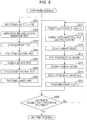
Fig. 2 is a flow diagram describing a Tm value range setting step of setting a Tm value range for primer design according to the present invention; -
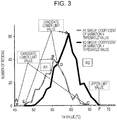
Fig. 3 illustrates histograms for an R1 group and an R2 group, which are obtained as a result of making an attempt N times to PCR amplify m regions of interest out of n regions of interest and to count the number of sequence reads in each region of interest, each histogram having a horizontal axis representing the average Tm value of a pair of primers used to PCR amplify each region of interest and a vertical axis representing the number of regions of interest, in which points "A" to "E" are options for the lower limit value of a Tm value range for primer design, and point "F" is the upper limit value of the Tm value range; -
Fig. 4 is a diagram illustrating a first aspect of a method for designing primers for PCR amplifying regions of interest; -
Fig. 5 is a diagram illustrating a second aspect of the method for designing primers for PCR amplifying regions of interest; and -
Fig. 6 is a diagram illustrating the first aspect of the method for designing primers for PCR amplifying regions of interest. - In the present invention, a range indicated using "... to ..." refers to a range including values given before and after "to". For example, "A to B" refers to a range including A and B.
- The present invention provides a method for designing primers for multiplex PCR from a single cell, including a Tm value range setting step of setting a Tm value range for primer design.
- A device (also referred to as "hardware" or "execution device") that executes a Tm value range setting step according to the present invention will be described with reference to
Fig. 1 . - In the present invention, the setting of priorities is performed by hardware (device) including arithmetic means (CPU; Central Processing Unit) 11, storage means (memory) 12, auxiliary storage means (storage) 13, input means (keyboard) 14, and display means (monitor) 16. This device may further include auxiliary input means (mouse) 15, output means (printer) 17, and so on.
- Each means will be described.
- The input means (keyboard) 14 is means for inputting instructions, data, and so on to the device. The auxiliary input means (mouse) 15 is used instead of or together with the input means (keyboard) 14.
- The arithmetic means (CPU) 11 is means for performing arithmetic processing.
- The storage means (memory) 12 is means for storing results of the arithmetic processing performed by the arithmetic means (CPU) 11 or for storing input from the input means (keyboard) 14.
- The auxiliary storage means (storage) 13 is a storage that stores an operating system, a program for determining the necessary number of loci, and so on. A portion of the auxiliary storage means (storage) 13 can also be used for extension of the storage means (memory) 12 (virtual memory).
- In the following, the Tm value range setting step and a method for designing primers for PCR amplifying regions of interest will be described.
- A description will be given with reference to
Fig. 2 andFig. 3 . - The Tm value range setting step is based on the assumption that an attempt to PCR amplify m regions of interest out of n regions of interest and to count the number of sequence reads in each region of interest is made N times to calculate a coefficient of variation for the number of sequence reads in each region of interest, given that an actual value of a coefficient of variation for the number of sequence reads in an i-th region of interest is denoted by CVi and an average Tm value of a pair of primers used to PCR amplify the i-th region of interest is denoted by Tmi.
- In the Tm value range setting step, a Tm value range of a primer is set in the following way.
- (1) A target value CV0 of coefficients of variation for the numbers of sequence reads is input from the input means 14 and is stored in the storage means 12 ("input target value (CV0) of coefficient of variation" S11 in
Fig. 2 ). - (2) The number of regions of interest m in the attempt made N times, the actual value CVi of the coefficient of variation for the number of sequence reads in the i-th region of interest, and the average Tm value Tmi of the pair of primers used to PCR amplify the i-th region of interest are input and are stored in the storage means 12 ("input primer Tm value (Tmi) and actual value (CVi) of coefficient of variation" S12 in
Fig. 2 ). - (3) The arithmetic means 11 calculates a threshold value CVt for the coefficients of variation for the numbers of sequence reads as a function of the target value CV0 in accordance with CVt = H(CV0), and stores the threshold value CVt in the storage means 12 ("calculate threshold value CVt) for coefficient of variation" S13 in
Fig. 2 ). The function H(CV0) of CV0 is not specifically limited, and is preferably given by H(CV0) = √2 × CV0 or H(CV0) = CV0, and more preferably given by H(CV0) = √2 × CV0. - (4) The arithmetic means 11 separates the m regions of interest into an R1 group constituted by m1 regions of interest in which the coefficient of variation CVi for the number of sequence reads satisfies CVi ≥ CVt and an R2 group constituted by m2 regions of interest in which the coefficient of variation CVi for the number of sequence reads satisfies CVi < CVt, generates respective histograms for the R1 group and the R2 group, each histogram having a horizontal axis representing an average Tm value of a pair of primers used to PCR amplify each region of interest and a vertical axis representing the number of regions of interest, and stores the histograms in the storage means 12 (
Fig. 3 ). - (5) The arithmetic means 11 calculates a value selected in advance from the value at the left end of the histogram for the R1 group ("A" in
Fig. 3 ), the value at the right end of the histogram for the R1 group ("C" inFig. 3 , and the mode of the histogram for the R1 group ("B" inFig. 3 ), the value at the left end of the histogram for the R2 group ("E" inFig. 3 ), and an intersection ("D" inFig. 3 ) of the histogram for the R1 group and the histogram for the R2 group, and stores the calculated value as a lower limit value of the Tm value range in the storage means 12 (""calculate lower limit value of Tm value" S15 inFig. 2 ). - (6) The arithmetic means 11 calculates the value at the right end of the R2 group ("F" in
Fig. 3 ), and stores the calculated value as an upper limit value of the Tm value range in the storage means 12 (""calculate upper limit value of Tm value" S16 inFig. 2 ). - (7) The arithmetic means 11 displays the Tm value range on the display means 16 or outputs the Tm value range to the output means 17 (""output Tm value range" S17 in
Fig. 2 ). - Note that n is an integer satisfying 2 ≤ n, m is an integer satisfying 2 ≤ m ≤ n, N is an integer satisfying 3 ≤ n, i is an integer satisfying 1 ≤ i ≤ m, and m1 and m2 are integers satisfying 1 < m1 < m, 1 < m2 < m, and m1 + m2 = m.
- In a method for designing primers for multiplex PCR according to the present invention, a method for designing primers for PCR amplifying regions of interest includes the following steps.
- A first aspect of a method for designing primers for PCR amplifying regions of interest includes (a) a target region selection step, (b) a candidate primer base sequence generation step, (c) a local alignment step, (d) a first-stage selection step, (e) a global alignment step, (f) a second-stage selection step, and (g) a primer employment step as below.
- (a) A target region selection step of selecting a target region from regions of interest.
- (b) A candidate primer base sequence generation step of generating at least one base sequence of a candidate primer for PCR amplifying the target region on the basis of each of base sequences of respective neighboring regions located at two ends of the target region on genomic DNA.
- (c) A local alignment step of performing pairwise local alignment, for all combinations for selecting base sequences of two candidate primers from among base sequences of candidate primers generated in the candidate primer base sequence generation step, on two base sequences included in each of the combinations, under a condition in which partial sequences to be compared for the two base sequences include 3'-ends of the two base sequences, to determine local alignment scores.
- (d) A first-stage selection step of performing first-stage selection of base sequences of candidate primers for PCR amplifying the target region on the basis of the local alignment scores.
- (e) A global alignment step of performing pairwise global alignment, for all combinations for selecting base sequences of two candidate primers from among base sequences of candidate primers selected in the first-stage selection step, on base sequences having a preset sequence length and including 3'-ends of two base sequences included in each of the combinations, to determine global alignment scores.
- (f) A second-stage selection step of performing second-stage selection of base sequences of candidate primers for PCR amplifying the target region on the basis of the global alignment scores.
- (g) A primer employment step of employing, as base sequences of primers for PCR amplifying the target region, base sequences of candidate primers selected in both the first-stage selection step and the second-stage selection step.
- Among the steps (a) to (g), both the steps (c) and (d) and both the steps (e) and (f) may be performed in any order or performed simultaneously. That is, the steps (e) and (f) may be performed after the steps (c) and (d) are performed, or the steps (c) and (d) may be performed after the steps (e) and (f) are performed. Alternatively, the steps (c) and (d) and the steps (e) and (f) may be performed in parallel.
- If the steps (c) and (d) are performed after the steps (e) and (f) are performed, the steps (e) and (c) are preferably replaced with steps (e') and (c') below, respectively.
- (e') A global alignment step of performing pairwise global alignment, for all combinations for selecting base sequences of two candidate primers from among base sequences of candidate primers generated in the candidate primer base sequence generation step, on base sequences having a preset sequence length and including 3'-ends of two base sequences included in each of the combinations, to determine global alignment scores.
- (c') A local alignment step of performing pairwise local alignment, for all combinations for selecting base sequences of two candidate primers from among base sequences of candidate primers selected in the second-stage selection step, on two base sequences included in each of the combinations, under a condition in which partial sequences to be compared for the two base sequences include 3'-ends of the two base sequences, to determine local alignment scores.
- Further, if the steps (c) and (d) and the steps (e) and (f) are performed in parallel, the step (e) is preferably replaced with step (e') below.
- (e') A global alignment step of performing pairwise global alignment, for all combinations for selecting base sequences of two candidate primers from among base sequences of candidate primers generated in the candidate primer base sequence generation step, on base sequences having a preset sequence length and including 3'-ends of two base sequences included in each of the combinations, to determine global alignment scores.
- A second aspect of the method for designing primers for PCR amplifying regions of interest includes the following: (a1) a first step of target region selection, (b1) a first step of candidate primer base sequence generation, (c1) a first step of local alignment, (d1) a first step of first-stage selection, (e1) a first step of global alignment, (f1) a first step of second-stage selection, (g1) a first step of primer employment, (a2) a second step of target region selection, (b2) a second step of candidate primer base sequence generation, (c2) a second step of local alignment, (d2) a second step of first-stage selection, (e2) a second step of global alignment, (f2) a second step of second-stage selection, and (g2) a second step of primer employment as below.
- (a1) A first step of target region selection for selecting a first target region from regions of interest.
- (b1) A first step of candidate primer base sequence generation for generating at least one base sequence of a candidate primer for PCR amplifying the first target region on the basis of each of base sequences of respective neighboring regions located at two ends of the first target region on genomic DNA.
- (c1) A first step of local alignment for performing pairwise local alignment, for all combinations for selecting base sequences of two candidate primers from among base sequences of candidate primers generated in the first step of candidate primer base sequence generation, on two base sequences included in each of the combinations, under a condition in which partial sequences to be compared for the two base sequences include 3'-ends of the two base sequences, to determine local alignment scores.
- (d1) A first step of first-stage selection for performing first-stage selection of base sequences of candidate primers for PCR amplifying the first target region on the basis of the local alignment scores.
- (e1) A first step of global alignment for performing pairwise global alignment, for all combinations for selecting base sequences of two candidate primers from among base sequences of candidate primers selected in the first step of first-stage selection, on base sequences having a preset sequence length and including 3'-ends of two base sequences included in each of the combinations, to determine global alignment scores.
- (f1) A first step of second-stage selection for performing second-stage selection of base sequences of candidate primers for PCR amplifying the first target region on the basis of the global alignment scores.
- (g1) A first step of primer employment for employing, as base sequences of primers for PCR amplifying the first target region, base sequences of candidate primers selected in both the first step of first-stage selection and the first step of second-stage selection.
- (a2) A second step of target region selection for selecting a second target region different from the first target region from regions of interest.
- (b2) A second step of candidate primer base sequence generation for generating at least one base sequence of a candidate primer for PCR amplifying the second target region on the basis of each of base sequences of respective neighboring regions located at two ends of the second target region on genomic DNA.
- (c2) A second step of local alignment for performing pairwise local alignment, for all combinations for selecting base sequences of two candidate primers and all combinations for selecting a base sequence of one candidate primer and a base sequence of one primer that has already been employed from among base sequences of candidate primers generated in the second step of candidate primer base sequence generation and from among base sequences of primers that have already been employed, on two base sequences included in each of the combinations, under a condition in which partial sequences to be compared for the two base sequences include 3'-ends of the two base sequences, to determine local alignment scores.
- (d2) A second step of first-stage selection for performing first-stage selection of base sequences of candidate primers for PCR amplifying the second target region on the basis of the local alignment scores.
- (e2) A second step of global alignment for performing pairwise global alignment, for all combinations for selecting base sequences of two candidate primers and all combinations for selecting a base sequence of one candidate primer and a base sequence of one primer that has already been employed from among base sequences of candidate primers selected in the second step of first-stage selection and from among base sequences of primers that have already been employed, on base sequences having a preset sequence length and including 3'-ends of two base sequences included in each of the combinations, to determine global alignment scores.
- (f2) A second step of second-stage selection for performing second-stage selection of base sequences of candidate primers for PCR amplifying the second target region on the basis of the global alignment scores.
- (g2) A second step of primer employment for employing, as base sequences of primers for PCR amplifying the second target region, base sequences of candidate primers selected in both the second step of first-stage selection and the second step of second-stage selection.
- Among the steps (a1) to (g1), both the steps (c1) and (d1) and both the steps (e1) and (f1) may be performed in any order or performed simultaneously. That is, the steps (e1) and (f1) may be performed after the steps (c1) and (d1) are performed, or the steps (c1) and (d1) may be performed after the steps (e1) and (f1) are performed. Alternatively, the steps (c1) and (d1) and the steps (e1) and (f1) may be performed in parallel.
- If the steps (c1) and (d1) are performed after the steps (e1) and (f1) are performed, the steps (e1) and (c1) are preferably replaced with steps (e1') and (c1') below, respectively.
- (e1') A first step of global alignment for performing pairwise global alignment, for all combinations for selecting base sequences of two candidate primers from among base sequences of candidate primers generated in the first step of candidate primer base sequence generation, on base sequences having a preset sequence length and including 3'-ends of two base sequences included in each of the combinations, to determine global alignment scores.
- (c1') A first step of local alignment for performing pairwise local alignment, for all combinations for selecting base sequences of two candidate primers from among base sequences of candidate primers selected in the first step of second-stage selection, on two base sequences included in each of the combinations, under a condition in which partial sequences to be compared for the two base sequences include 3'-ends of the two base sequences, to determine local alignment scores.
- Further, if the steps (c1) and (d1) and the steps (e1) and (f1) are performed in parallel, the step (e1) is preferably replaced with step (e1') below.
- (e1') A first step of global alignment for performing pairwise global alignment, for all combinations for selecting base sequences of two candidate primers from among base sequences of candidate primers generated in the first step of candidate primer base sequence generation, on base sequences having a preset sequence length and including 3'-ends of two base sequences included in each of the combinations, to determine global alignment scores.
- Among the steps (a2) to (g2), both the steps (c2) and (d2) and both the steps (e2) and (f2) may be performed in any order or performed simultaneously. That is, the steps (e2) and (f2) may be performed after the steps (c2) and (d2) are performed, or the steps (c2) and (d2) may be performed after the steps (e2) and (f2) are performed. Alternatively, the steps (c2) and (d2) and the steps (e2) and (f2) may be performed in parallel.
- If the steps (c2) and (d2) are performed after the steps (e2) and (f2) are performed, the steps (e2) and (c2) are preferably replaced with steps (e2') and (c2') below, respectively.
- (e2') A second step of global alignment for performing pairwise global alignment, for all combinations for selecting base sequences of two candidate primers and all combinations for selecting a base sequence of one candidate primer and a base sequence of one primer that has already been employed from among base sequences of candidate primers generated in the second step of candidate primer base sequence generation and from among base sequences of primers that have already been employed, on base sequences having a preset sequence length and including 3'-ends of two base sequences included in each of the combinations, to determine global alignment scores.
- (c2') A second step of local alignment for performing pairwise local alignment, for all combinations for selecting base sequences of two candidate primers and all combinations for selecting a base sequence of one candidate primer and a base sequence of one primer that has already been employed from among base sequences of candidate primers selected in the second step of second-stage selection and from among base sequences of primers that have already been employed, on two base sequences included in each of the combinations, under a condition in which partial sequences to be compared for the two base sequences include 3'-ends of the two base sequences, to determine local alignment scores.
- Further, if the steps (c2) and (d2) and the steps (e2) and (f2) are performed in parallel, the step (e2) is preferably replaced with step (e2') below.
- (e2') A second step of global alignment for performing pairwise global alignment, for all combinations for selecting base sequences of two candidate primers and all combinations for selecting a base sequence of one candidate primer and a base sequence of one primer that has already been employed from among base sequences of candidate primers generated in the second step of candidate primer base sequence generation and from among base sequences of primers that have already been employed, on base sequences having a preset sequence length and including 3'-ends of two base sequences included in each of the combinations, to determine global alignment scores.
- Further, when the at least one region of interest includes three or more regions of interest and when base sequences of primers for PCR amplifying third and subsequent target regions that have not yet been selected from the three or more regions of interest are employed, the steps (a2) to (g2) are repeated for each of the third and subsequent target regions.
- A third aspect of the method for designing primers for PCR amplifying regions of interest includes the following: (a-0) a plurality-of-target-region selection step, (b-0) a plurality-of-candidate-primer-base-sequence generation step, (c-1) a first local alignment step, (d-1) a first first-stage selection step, (e-1) a first global alignment step, (f-1) a first second-stage selection step, (g-1) a first primer employment step, (c-2) a second local alignment step, (d-2) a second first-stage selection step, (e-2) a second global alignment step, (f-2) a second second-stage selection step, and (g-2) a second primer employment step as below.
- (a-0) A plurality-of-target-region selection step of selecting a plurality of target regions from regions of interest.
- (b-0) A plurality-of-candidate-primer-base-sequence generation step of generating at least one base sequence of a candidate primer for PCR amplifying each of the plurality of target regions on the basis of each of base sequences of respective neighboring regions located at two ends of each of the plurality of target regions on genomic DNA.
- (c-1) A first local alignment step of setting, as a first target region, one of the plurality of target regions selected in the plurality-of-target-region selection step, and performing pairwise local alignment, for all combinations for selecting base sequences of two candidate primers from a base sequence of a candidate primer for PCR amplifying the first target region among base sequences of candidate primers generated in the plurality-of-candidate-primer-base-sequence generation step, on two base sequences included in each of the combinations, under a condition in which partial sequences to be compared for the two base sequences include 3'-ends of the two base sequences, to determine local alignment scores.
- (d-1) A first first-stage selection step of performing first-stage selection of base sequences of candidate primers for PCR amplifying the first target region on the basis of the local alignment scores.
- (e-1) A first global alignment step of performing pairwise global alignment, for all combinations for selecting base sequences of two candidate primers from among base sequences of candidate primers selected in the first first-stage selection step, on base sequences having a preset sequence length and including 3'-ends of two base sequences included in each of the combinations, to determine global alignment scores.
- (f-1) A first second-stage selection step of performing second-stage selection of base sequences of candidate primers for PCR amplifying the first target region on the basis of the global alignment scores.
- (g-1) A first primer employment step of employing, as base sequences of primers for PCR amplifying the first target region, base sequences of candidate primers selected in both the first first-stage selection step and the first second-stage selection step.
- (c-2) A second local alignment step of setting, as a second target region, one of the plurality of target regions selected in the plurality-of-target-region selection step, except for the first target region, and performing pairwise local alignment, for all combinations for selecting base sequences of two candidate primers and all combinations for selecting a base sequence of one candidate primer and a base sequence of one primer that has already been employed from among base sequences of candidate primers for PCR amplifying the second target region and from among base sequences of primers that have already been employed among base sequences of candidate primers generated in the plurality-of-candidate-primer-base-sequence generation step, on two base sequences included in each of the combinations, under a condition in which partial sequences to be compared for the two base sequences include 3'-ends of the two base sequences, to determine local alignment scores.
- (d-2) A second first-stage selection step of performing first-stage selection of base sequences of candidate primers for PCR amplifying the second target region on the basis of the local alignment scores.
- (e-2) A second global alignment step of performing pairwise global alignment, for all combinations for selecting base sequences of two candidate primers and all combinations for selecting a base sequence of one candidate primer and a base sequence of one primer that has already been employed from among base sequences of candidate primers selected in the second first-stage selection step and from among base sequences of primers that have already been employed, on base sequences having a preset sequence length and including 3'-ends of two base sequences included in each of the combinations, to determine global alignment scores.
- (f-2) A second second-stage selection step of performing second-stage selection of base sequences of candidate primers for PCR amplifying the second target region on the basis of the global alignment scores.
- (g-2) A second primer employment step of employing, as base sequences of primers for PCR amplifying the second target region, base sequences of candidate primers selected in both the second first-stage selection step and the second second-stage selection step.
- Among the steps (c-1) to (g-1), both the steps (c-1) and (d-1) and both the steps (e-1) and (f-1) may be performed in any order or performed simultaneously. That is, the steps (e-1) and (f-1) may be performed after the steps (c-1) and (d-1) are performed, or the steps (c-1) and (d-1) may be performed after the steps (e-1) and (f-1) are performed. Alternatively, the steps (c-1) and (d-1) and the steps (e-1) and (f-1) may be performed in parallel.
- If the steps (c-1) and (d-1) are performed after the steps (e-1) and (f-1) are performed, the steps (e-1) and (c-1) are preferably replaced with steps (e'-1) and (c'-1) below, respectively.
- (e'-1) A first global alignment step of setting, as a first target region, one of the plurality of target regions selected in the plurality-of-target-region selection step, and performing pairwise global alignment, for all combinations for selecting base sequences of two candidate primers from a base sequence of a candidate primer for PCR amplifying the first target region among base sequences of candidate primers generated in the plurality-of-candidate-primer-base-sequence generation step, on base sequences having a preset sequence length and including 3'-ends of two base sequences included in each of the combinations, to determine global alignment scores.
- (c'-1) A first local alignment step of performing pairwise local alignment, for all combinations for selecting base sequences of two candidate primers from among base sequences of candidate primers selected in the first second-stage selection step, on two base sequences included in each of the combinations, under a condition in which partial sequences to be compared for the two base sequences include 3'-ends of the two base sequences, to determine local alignment scores.
- Further, if the steps (c-1) and (d-1) and the steps (e-1) and (f-1) are performed in parallel, the step (e-1) is preferably replaced with step (e'-1) below.
- (e'-1) A first global alignment step of setting, as a first target region, one of the plurality of target regions selected in the plurality-of-target-region selection step, and performing pairwise global alignment, for all combinations for selecting base sequences of two candidate primers from a base sequence of a candidate primer for PCR amplifying the first target region among base sequences of candidate primers generated in the plurality-of-candidate-primer-base-sequence generation step, on base sequences having a preset sequence length and including 3'-ends of two base sequences included in each of the combinations, to determine global alignment scores.
- Among the steps (c-2) to (g-2), both the steps (c-2) and (d-2) and both the steps (e-2) and (f-2) may be performed in any order or performed simultaneously. That is, the steps (e-2) and (f-2) may be performed after the steps (c-2) and (d-2) are performed, or the steps (c-2) and (d-2) may be performed after the steps (e-2) and (f-2) are performed. Alternatively, the steps (c-1) and (d-1) and the steps (e-1) and (f-1) may be performed in parallel.
- If the steps (c-2) and (d-2) are performed after the steps (e-2) and (f-2) are performed, the steps (e-2) and (c-2) are preferably replaced with steps (e'-2) and (c'-2) below, respectively.
- (e'-2) A second global alignment step of setting, as a second target region, one of the plurality of target regions selected in the plurality-of-target-region selection step, except for the first target region, and performing pairwise global alignment, for all combinations for selecting base sequences of two candidate primers and all combinations for selecting a base sequence of one candidate primer and a base sequence of one primer that has already been employed from among base sequences of candidate primers for PCR amplifying the second target region and from among base sequences of primers that have already been employed among base sequences of candidate primers generated in the plurality-of-candidate-primer-base-sequence generation step, on base sequences having a preset sequence length and including 3'-ends of two base sequences included in each of the combinations, to determine global alignment scores.
- (c'-2) A second local alignment step of performing pairwise local alignment, for all combinations for selecting base sequences of two candidate primers and all combinations for selecting a base sequence of one candidate primer and a base sequence of one primer that has already been employed from among base sequences of candidate primers selected in the second second-stage selection step and from among base sequences of primers that have already been employed, on two base sequences included in each of the combinations, under a condition in which partial sequences to be compared for the two base sequences include 3'-ends of the two base sequences, to determine local alignment scores.
- Further, if the steps (c-2) and (d-2) and the steps (e-2) and (f-2) are performed in parallel, the step (e-2) is preferably replaced with step (e'-2) below.
- (e'-2) A second global alignment step of setting, as a second target region, one of the plurality of target regions selected in the plurality-of-target-region selection step, except for the first target region, and performing pairwise global alignment for all combinations for selecting base sequences of two candidate primers and all combinations for selecting a base sequence of one candidate primer and a base sequence of one primer that has already been employed from among base sequences of candidate primers for PCR amplifying the second target region and from among base sequences of primers that have already been employed among base sequences of candidate primers generated in the plurality-of-candidate-primer-base-sequence generation step, on base sequences having a preset sequence length and including 3'-ends of two base sequences included in each of the combinations, to determine global alignment scores.
- Further, when the at least one region of interest includes three or more regions of interest, when three or more target regions are selected in the plurality-of-target-region selection step, when base sequences of candidate primers for PCR amplifying each of the three or more target regions are generated in the plurality-of-candidate-primer-base-sequence generation step, and when one of the plurality of target regions selected in the plurality-of-target-region selection step, except for the first and second target regions, is set as a third target region and base sequences of primers for PCR amplifying the third and subsequent target regions are employed, the steps from the second local alignment step to the second primer employment step are repeated for the third and subsequent target regions.
- The steps in the first to third aspects of the method for designing primers for PCR amplifying regions of interest will be described with reference to
Fig. 4 to Fig. 6 , as appropriate. - As used herein, target region selection step S101 (
Fig. 4 ), first step of target region selection S201 and second step of target region selection S211 (Fig. 5 ), and plurality-of-target-region selection step S301 (Fig. 6 ) are collectively referred to sometimes simply as "target region selection step". - In
Fig. 4 , this step is represented as "target region selection". - In the first aspect, the target region selection step (a) is a step of selecting a target region from regions of interest. The method for selection is not specifically limited, and, for example, when the regions of interest are assigned priorities for primer design, target regions in which primers are designed are selected from among the regions of interest in order of priority.
- In
Fig. 5 , these steps are represented as "target region selection: first" and "target region selection: second". - In the second aspect, the first step of target region selection (a1) is a step of selecting a first target region from regions of interest, and the second step of target region selection (a2) is a step of selecting a second target region from regions of interest that are yet to be selected as target regions. The method for selection is not specifically limited, and, for example, when the regions of interest are assigned priorities for primer design, target regions in which primers are designed are selected from among the regions of interest in order of priority.
- In
Fig. 6 , this step is represented as "plurality-of-target-region selection". - In the third aspect, the plurality-of-target-region selection step (a-0) is a step of selecting a plurality of target regions from regions of interest. The method for selection is not specifically limited, and, for example, when the regions of interest are assigned priorities for primer design, a plurality of target regions in which primers are designed are selected from among the regions of interest in order of priority.
- As used herein, candidate primer base sequence generation step S102 (
Fig. 4 ), first step of candidate primer base sequence generation S202 and second step of candidate primer base sequence generation S212 (Fig. 5 ), and plurality-of-candidate-primer-base-sequence generation step S302 (Fig. 6 ) are collectively referred to sometimes simply as "candidate primer base sequence generation step". - In
Fig. 4 , this step is represented as "candidate primer base sequence generation". - In the first aspect, the candidate primer base sequence generation step (b) is a step of generating at least one base sequence of a candidate primer for PCR amplifying a target region on the basis of each of base sequences of respective neighboring regions located at two ends of the target region on genomic DNA.
- In
Fig. 5 , these steps are represented as "candidate primer base sequence generation: first" and "candidate primer base sequence generation: second". - In the second aspect, the first step of candidate primer base sequence generation (b1) is a step of generating at least one base sequence of a candidate primer for PCR amplifying a first target region on the basis of each of base sequences of respective neighboring regions located at two ends of the first target region on genomic DNA, and the second step of candidate primer base sequence generation (b2) is a step of generating at least one base sequence of a candidate primer for PCR amplifying a second target region on the basis of each of base sequences of respective neighboring regions located at two ends of the second target region on genomic DNA.
- In the second aspect, the generation of a base sequence of a candidate primer, the selection of a candidate primer, and the employment of a primer are performed for one target region, and similar steps are repeated for the next target region.
- In
Fig. 6 , this step is represented as "plurality-of-candidate-primer-base-sequence generation". - In the third aspect, the plurality-of-candidate-primer-base-sequence generation step (b-0) generates at least one base sequence of a candidate primer for PCR amplifying each of a plurality of target regions on the basis of each of base sequences of respective neighboring regions located at two ends of each of the plurality of target regions on genomic DNA.
- In the third aspect, base sequences of candidate primers are generated for all the plurality of target regions, and selection and employment are repeated in the subsequent steps.
- Respective neighboring regions located at two ends of a target region are collectively referred to as regions outside the 5'-end of the target region and regions outside the 3'-end of the target region. The area inside the target region is not included in the neighboring regions.
- The length of a neighboring region is not specifically limited, and is preferably less than or equal to a length that allows extension of a neighboring region by PCR, and more preferably less than or equal to the upper limit of the length of the DNA fragment to be amplified. In particular, the length of a neighboring region is preferably a length that facilitates application of concentration selection and/or sequence reading. The length of a neighboring region may be changed as appropriate in accordance with the type or the like of enzyme (DNA polymerase) to be used in PCR. The specific length of a neighboring region is preferably about 20 to 500 bases, more preferably about 20 to 300 bases, even more preferably about 20 to 200 bases, and still more preferably about 50 to 200 bases.
- In addition, to generate a base sequence of a candidate primer, careful attention is required to the same points as those in a common method for designing primers, such as primer length, GC content (corresponding to the total mole percentage of guanine (G) and cytosine (C) in all nucleic acid bases), melting temperature (temperature at which 50% of double-stranded DNA is dissociated into single-stranded DNA, referred to sometimes as "Tm value", from Melting Temperature, in "°C"), and sequence deviation.
- The primer length (number of nucleotides) is not specifically limited, and is preferably 15-mer to 45-mer, more preferably 20-mer to 45-mer, and even more preferably 20-mer to 30-mer. A primer length in this range facilitates the designing of a primer excellent in specificity and amplification efficiency.
- The primer GC content is not specifically limited, and is preferably 40 mol% to 60 mol%, and more preferably 45 mol% to 55 mol%. A GC content in this range is less likely to cause a problem of a reduction in specificity and amplification efficiency due to a high-order structure.
- The primer Tm value is not specifically limited, and is preferably in a range of 50°C to 65°C, and more preferably in a range of 55°C to 65°C.
- In a primer pair and a primer set, the difference between the Tm values of primers is set to preferably 5°C or less, and more preferably 3°C or less.
- The Tm value can be calculated using software such as OLIGO Primer Analysis Software (manufactured by Molecular Biology Insights Inc.) or Primer3 (http://www-genome.wi.mit.edu/ftp/distribution/software/).
- Alternatively, the Tm value can be calculated in accordance with the formula below based on the numbers of A's, T's, G's, and C's (represented as nA, nT, nG, and nC, respectively) in a base sequence of a primer.

- The method for calculating the Tm value is not limited to those described above, and the Tm value can be calculated using any of various well-known methods.
- Note that in the method for designing primers for multiplex PCR according to the present invention, after a range of Tm values is set in the "Tm value range setting step of setting a Tm value range for primer design" described above, the range of Tm values is used.
- A base sequence of a candidate primer is preferably a sequence having entirely no deviation of bases. For example, it is desirable to avoid a partially GC-rich sequence and a partially AT-rich sequence.
- It is also desirable to avoid consecutive T's and/or C's (polypyrimidine) and consecutive A's and/or G's (polypurine).
- For the 3'-end base sequence, furthermore, it is preferable to avoid a GC-rich sequence or an AT-rich sequence. The base at the 3'-end is preferably, but is not limited to, G or C.
- A specificity check step may be performed (not illustrated) to evaluate the specificity of a base sequence of a candidate primer on the basis of the sequence complementarity of a base sequence of each candidate primer, which is generated in the "candidate primer base sequence generation step", to chromosomal DNA.
- A specificity check may be performed in the following manner. Local alignment is performed between a base sequence of chromosomal DNA and a base sequence of a candidate primer, and it can be evaluated that the base sequence of the candidate primer has low complementarity to the genomic DNA and has high specificity when the local alignment score is less than a preset value. It is desirable to perform local alignment also on complementary strands of the chromosomal DNA. This is because whereas a primer is single-stranded DNA, chromosomal DNA is double-stranded. Alternatively, instead of a base sequence of a candidate primer, a base sequence complementary thereto may be used.
- In addition, homology search may be performed against a genomic DNA base sequence database by using a base sequence of a candidate primer as a query sequence. Examples of a homology search tool include BLAST (Basic Local Alignment Search Tool) (Altschul, S. A., four others, "Basic Local Alignment Search Tool", Journal of Molecular Biology, October 1990, Vol. 215, pp. 403-410) and FASTA (Pearson, W. R., one other, "Improved tools for biological sequence comparison", Proceedings of the National Academy of Sciences of the United States of America, the National Academy of Sciences of the United States of America, April 1988, Vol. 85, pp. 2444-2448). As a result of homology search, local alignment can be obtained.
- Threshold values for scores and local alignment scores are not specifically limited and may be set as appropriate in accordance with the length of a base sequence of a candidate primer and/or PCR conditions or the like. When a homology search tool is used, specified values for the homology search tool may be used.
- For example, as the score, match (complementary base) = +1, mismatch (non-complementary base) = -1, and indel (insertion and/or deletion) = -3 may be employed, and the threshold value may be set to +15.
- If a base sequence of a candidate primer has complementarity to a base sequence at an unexpected position on chromosomal DNA and has low specificity, an artifact, rather than a target region, may be amplified in PCR performed using a primer of the base sequence, and the artifact is thus removed.
- As used herein, local alignment step S103 (
Fig. 4 ), first step of local alignment S203 and second step of local alignment S213 (Fig. 5 ), and first local alignment step S303 and second local alignment step S313 (Fig. 6 ) are collectively referred to sometimes simply as "local alignment step". - In
Fig. 4 , this step is represented as "local alignment". - In the first aspect, the local alignment step (c) is a step of performing pairwise local alignment, for all combinations for selecting base sequences of two candidate primers from among base sequences of candidate primers generated in the candidate primer base sequence generation step, on two base sequences included in each of the combinations, under a condition in which partial sequences to be compared for the two base sequences include 3'-ends of the two base sequences, to determine local alignment scores.
- In
Fig. 5 , these steps are represented as "local alignment: first" and "local alignment: second". - In the second aspect, the first step of local alignment (c1) is a step of performing pairwise local alignment, for all combinations for selecting base sequences of two candidate primers from among base sequences of candidate primers generated in the first step of candidate primer base sequence generation, on two base sequences included in each of the combinations, under a condition in which partial sequences to be compared for the two base sequences include 3'-ends of the two base sequences, to determine local alignment scores, and the second step of local alignment (c2) is a step of performing pairwise local alignment, for all combinations for selecting base sequences of two candidate primers and all combinations for selecting a base sequence of one candidate primer and a base sequence of one primer that has already been employed from among base sequences of candidate primers generated in the second step of candidate primer base sequence generation and from among base sequences of primers that have already been employed, on two base sequences included in each of the combinations, under a condition in which partial sequences to be compared for the two base sequences include 3'-ends of the two base sequences, to determine local alignment scores.
- In
Fig. 6 , these steps are represented as "first local alignment" and "second local alignment". - In the third aspect, the first local alignment step (c-1) is a step of performing pairwise local alignment, for all combinations for selecting base sequences of two candidate primers from among base sequences of candidate primers for PCR amplifying the first target region among base sequences of candidate primers generated in the plurality-of-candidate-primer-base-sequence generation step, on two base sequences included in each of the combinations, under a condition in which partial sequences to be compared for the two base sequences include 3'-ends of the two base sequences, to determine local alignment scores, and the second local alignment step (c-2) is a step of performing pairwise local alignment, for all combinations for selecting base sequences of two candidate primers and all combinations for selecting a base sequence of one candidate primer and a base sequence of one primer that has already been employed from among base sequence of candidate primer for PCR amplifying the second target region among base sequences of candidate primers generated in the plurality-of-candidate-primer-base-sequence generation step and from among base sequences of primers that have already been employed, on two base sequences included in each of the combinations, under a condition in which partial sequences to be compared for the two base sequences include 3'-ends of the two base sequences, to determine local alignment scores.
- A combination of base sequences to be subjected to local alignment may be a combination selected with allowed overlap or a combination selected without allowed overlap. However, if the probability of primer dimer formation between primers having the same base sequence has not yet been evaluated, it is preferable to use a combination selected with allowed overlap.
- The total number of combinations is given by "pH2=p+1C2 = (p + 1)!/2(p - 1)!" when combinations are selected with allowed overlap, and is given by "pC2=p(p - 1)/2" when combinations are selected without allowed overlap, where p denotes the total number of base sequences to be subjected to local alignment.
- Local alignment is alignment to be performed on partial sequences and allows local examination of high complementarity fragments.
- In the present invention, however, unlike typical local alignment performed on base sequences, local alignment is performed under the condition that "partial sequences to be compared include the 3'-ends of the base sequences", so that partial sequences to be compared include the 3'-ends of both the base sequences.
- In the present invention, furthermore, in a preferred aspect, local alignment is performed under the condition that "partial sequences to be compared include the 3'-ends of the base sequences", that is, the condition that "partial sequences to be compared take into account only alignment that starts at the 3'-end of one of the sequences and ends at the 3'-end of the other sequence", so that partial sequences to be compared include the 3'-ends of both the base sequences.
- Note that in local alignment, a gap may be inserted. The gap refers to an insertion and/or deletion (indel) of a base.
- In local alignment, furthermore, a match is determined when bases in a base sequence pair are complementary to each other, and a mismatch is determined when bases in a base sequence pair are not complementary to each other.
- Alignment is performed such that a score is set for each of a match, a mismatch, and an indel and the total score is maximum. The scores may be set as appropriate. For example, scores may be set as in Table 1 below. In Table 1, "-" indicates a gap (insertion and/or deletion (indel)).
Table 1 A T G C - A -1 +1 -1 -1 -1 T +1 -1 -1 -1 1 G -1 -1 -1 +1 -1 C -1 -1 +1 -1 -1 - -1 -1 -1 -1 "-":gap(indel) - For example, consideration is given to local alignment of base sequences with SEQ ID NOs: 1 and 2 given in Table 2 below. Here, scores are assumed to be given in Table 1.
Table 2 Base sequence (5' → 3') SEQ ID NO: 1 CTTCGATGCGGACCTTCTGG SEQ ID NO: 2 TCTCCCACATCCGGCTATGG - A dot matrix given in Table 3 is generated from the base sequences with SEQ ID NOs: 1 and 2. Specifically, the base sequence with SEQ ID NO: 1 is arranged from left to right in a 5' to 3' direction, and the base sequence with SEQ ID NO: 2 is arranged from bottom to top in a 5' to 3' direction, with grids of complementary bases filled with "●" to obtain a dot matrix given in Table 3.
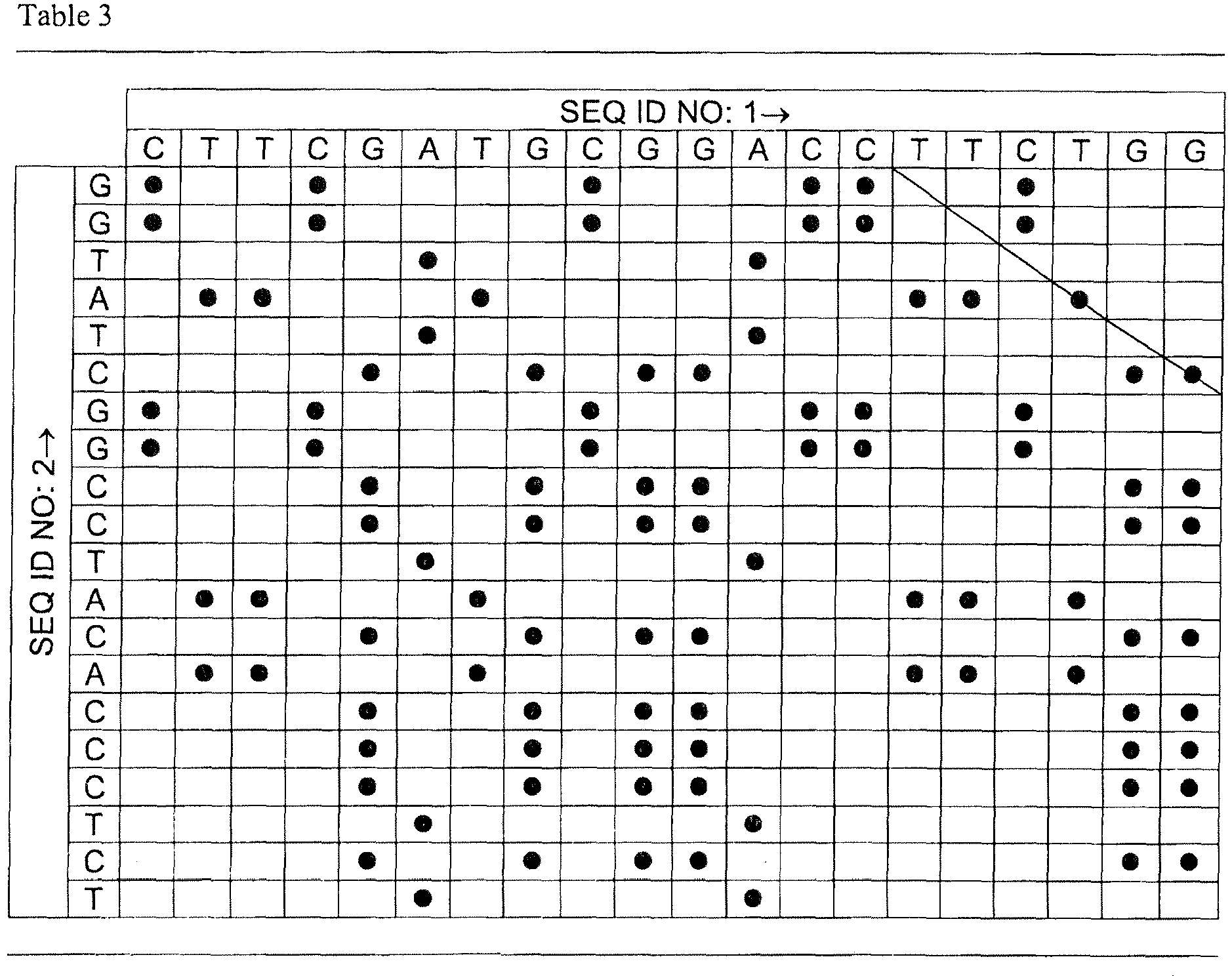
- The dot matrix given in Table 3 yields alignment of partial sequences (pairwise alignment) as given in Table 4 below (see a portion indicated by the diagonal line in Table 3). In Table 4, a match is denoted by "|" and a mismatch is denoted by ":".
Table 4 Partial sequence from SEQ ID NO: 1 5'- T T C T G G -3' : : : | : | Partial sequence from SEQ ID NO: 2 3'- G G T A T C -5' - This (pairwise) alignment includes two matches, four mismatches, and no indel (gap).
- Thus, the local alignment score based on this (pairwise) alignment is given by (+1) × 2 + (-1) × 4 + (-1) × 0 = -2.
- Note that the alignment (pairwise alignment) may be obtained using, instead of the dot matrix method exemplified herein, the dynamic programming method, the word method, or any of various other methods.
- As used herein, first-stage selection step S104 (
Fig. 4 ), first step of first-stage selection S204 and second step of first-stage selection S214 (Fig. 5 ), and first first-stage selection step S304 and second first-stage selection step S314 (Fig. 6 ) are collectively referred to sometimes simply as "first-stage selection step". - In
Fig. 4 , this step is represented as "first-stage selection". - In the first aspect, the first-stage selection step (d) is a step of performing first-stage selection of base sequences of candidate primers for PCR amplifying the target region on the basis of the local alignment scores.
- In
Fig. 5 , these steps are represented as "first-stage selection: first" and "first-stage selection: second". - In the second aspect, the first step of first-stage selection (d1) is a step of performing first-stage selection of base sequences of candidate primers for PCR amplifying the first target region on the basis of the local alignment scores, and the second step of first-stage selection (d2) is a step of performing first-stage selection of base sequences of candidate primers for PCR amplifying the second target region on the basis of the local alignment scores.
- In
Fig. 6 , these steps are represented as "first first-stage selection" and "second first-stage selection". - In the third aspect, the first first-stage selection step (d-1) is a step of performing first-stage selection of base sequences of candidate primers for PCR amplifying the first target region on the basis of the local alignment scores, and the second first-stage selection step (d-2) is a step of performing first-stage selection of base sequences of candidate primers for PCR amplifying the second target region on the basis of the local alignment scores.
- A threshold value for local alignment scores (referred to also as "first threshold value") is set in advance.
- If a local alignment score is less than the first threshold value, the combination of two base sequences is determined to have low probability of dimer formation, and then the subsequent step is performed.
- On the other hand, if a local alignment score is not less than the first threshold value, the combination of two base sequences is determined to have high probability of primer dimer formation, and no further steps are performed for the combination.
- The first threshold value is not specifically limited and can be set as appropriate. For example, the first threshold value may be set in accordance with PCR conditions such as the amount of genomic DNA that is a template for polymerase chain reaction.
- Here, consideration is given to a case where the first threshold value is set to "+3" in the example provided in the "local alignment" described above.
- In the above example, the local alignment score is "-2" and is less than the first threshold value, that is, "+3". Thus, the combination of the base sequences with SEQ ID NOs: 1 and 2 can be determined to have low probability of primer dimer formation.
- Note that this step is performed on all the combinations for which local alignment scores are calculated in the local alignment step S103, the first step of local alignment S203, the second step of local alignment S213, the first local alignment step S303, or the second local alignment step S313.
- As used herein, global alignment step S105 (
Fig. 4 ), first step of global alignment S205 and second step of global alignment S215 (Fig. 5 ), and first global alignment step S305 and second global alignment step S315 (Fig. 6 ) are collectively referred to sometimes simply as "global alignment step". - In
Fig. 4 , this step is represented as "global alignment". - In the first aspect, the global alignment step (e) is a step of performing pairwise global alignment, for all combinations for selecting base sequences of two candidate primers from among base sequences of candidate primers selected in the first-stage selection step, on base sequences having a preset sequence length and including 3'-ends of two base sequences included in each of the combinations, to determine global alignment scores.
- In
Fig. 5 , these steps are represented as "global alignment: first" and "global alignment: second". - In the second aspect, the first step of global alignment (e1) is a step of performing pairwise global alignment, for all combinations for selecting base sequences of two candidate primers from among base sequences of candidate primers selected in the first step of first-stage selection, on base sequences having a preset sequence length and including 3'-ends of two base sequences included in each of the combinations, to determine global alignment scores, and the second step of global alignment (e2) is a step of performing pairwise global alignment, for all combinations for selecting base sequences of two candidate primers and all combinations for selecting a base sequence of one candidate primer and a base sequence of one primer that has already been employed from among base sequences of candidate primers selected in the second step of first-stage selection and from among base sequences of primers that have already been employed, on base sequences having a preset sequence length and including 3'-ends of two base sequences included in each of the combinations, to determine global alignment scores.
- In
Fig. 6 , these steps are represented as "first global alignment" and "second global alignment". - In the third aspect, the first global alignment step (e-1) is a step of performing pairwise global alignment, for all combinations for selecting base sequences of two candidate primers from among base sequences of candidate primers selected in the first first-stage selection step, on base sequences having a preset sequence length and including 3'-ends of two base sequences included in each of the combinations, to determine global alignment scores, and the second global alignment step (e-2) is a step of performing pairwise global alignment, for all combinations for selecting base sequences of two candidate primers and all combinations for selecting a base sequence of one candidate primer and a base sequence of one primer that has already been employed from among base sequences of candidate primers selected in the second first-stage selection step and from among base sequences of primers that have already been employed, on base sequences having a preset sequence length and including 3'-ends of two base sequences included in each of the combinations, to determine global alignment scores.
- A global alignment score is determined by extracting two primers from the group consisting of all the candidate primers generated in the "candidate primer base sequence generation step" (when the "local alignment step" and the "first-stage selection step" are performed previously, if there is a combination of candidate primers having local alignment scores less than the first threshold value, all the candidate primers included in the combination) and all the primers that have already been employed (only when there is present a primer that has already been employed) and by performing pairwise global alignment on base sequences having a preset sequence length and including the 3'-ends of the extracted primers.
- A combination of base sequences to be subjected to global alignment may be a combination selected with allowed overlap or a combination selected without allowed overlap. However, if the probability of primer dimer formation between primers having the same base sequence has not yet been evaluated, it is preferable to use a combination selected with allowed overlap.
- The total number of combinations is given by "xH2=x+1C2 = (x + 1)!/2(x - 1)!" when combinations are selected with allowed overlap, and is given by "xC2=x(x - 1)/2" when combinations are selected without allowed overlap, where x denotes the total number of base sequences to be subjected to global alignment.
- Global alignment is alignment to be performed on "entire sequences" and allows examination of the complementarity of the entire sequences.
- As used here, the "entire sequence" refers to the entire base sequence having a preset sequence length and including the 3'-end of a base sequence of a candidate primer.
- Note that in global alignment, a gap may be inserted. The gap refers to an insertion and/or deletion (indel) of a base.
- In global alignment, furthermore, a match is determined when bases in a base sequence pair are complementary to each other, and a mismatch is determined when bases in a base sequence pair are not complementary to each other.
- Alignment is performed such that a score is set for each of a match, a mismatch, and an indel and the total score is maximum. The scores may be set as appropriate. For example, scores may be set as in Table 1 above. In Table 1, "-" indicates a gap (insertion and/or deletion (indel)).
- For example, consideration is given to global alignment of, for base sequences with SEQ ID NOs: 1 and 2 given in Table 5 below, three bases (indicated by capital letters) at the 3'-end of each base sequence. Here, scores are assumed to be given in Table 1.
Table 5 Base sequence (5' → 3') SEQ ID NO: 1 cttcgatgcggaccttcTGG SEQ ID NO: 2 tctcccacatccgpctaTGG - Global alignment is performed on three bases (indicated by capital letters) at the 3'-end of the base sequence with SEQ ID NO: 1 and the base sequence of three bases (indicated by capital letters) at the 3'-end of SEQ ID NO: 2 so as to obtain a maximum score, yielding alignment (pairwise alignment) given in Table 6 below. In Table 6, a mismatch is denoted by ":".
Table 6 Three bases at 3'-end of SEQ ID NO: 1 5'- T G G -3' : : : Three bases at 3'-end of SEQ ID NO: 2 3'- G G T -5' - This (pairwise) alignment includes 3 mismatches and no match and indel (gap).
- Thus, the global alignment score based on this (pairwise) alignment is given by (+1) × 0 + (-1) × 3 + (-1) × 0 = -3.
- Note that alignment (pairwise alignment) may be obtained using the dot matrix method, the dynamic programming method, the word method, or any of various other methods.
- As used herein, second-stage selection step S106 (
Fig. 4 ), first step of second-stage selection S206 and second step of second-stage selection S216 (Fig. 5 ), and first second-stage selection step S306 and second second-stage selection step S316 (Fig. 6 ) are collectively referred to sometimes simply as "second-stage selection step". - In
Fig. 4 , this step is represented as "second-stage selection". - In the first aspect, the second-stage selection step (f) is a step of performing second-stage selection of base sequences of candidate primers for PCR amplifying the target region on the basis of the global alignment scores.
- In
Fig. 5 , these steps are represented as "second-stage selection: first" and "second-stage selection: second". - In the second aspect, the first step of second-stage selection (f1) is a step of performing second-stage selection of base sequences of candidate primers for PCR amplifying the first target region on the basis of the global alignment scores, and the second step of second-stage selection (f2) is a step of performing second-stage selection of base sequences of candidate primers for PCR amplifying the second target region on the basis of the global alignment scores.
- In
Fig. 6 , these steps are represented as "first second-stage selection" and "second second-stage selection". - In the third aspect, the first second-stage selection step (f-1) is a step of performing second-stage selection of base sequences of candidate primers for PCR amplifying the first target region on the basis of the global alignment scores, and the second second-stage selection step (f-2) is a step of performing second-stage selection of base sequences of candidate primers for PCR amplifying the second target region on the basis of the global alignment scores.
- A threshold value for global alignment scores (referred to also as "second threshold value") is set in advance.
- If a global alignment score is less than the second threshold value, the combination of two base sequences is determined to have low probability of dimer formation, and then the subsequent step is performed.
- On the other hand, if a global alignment score is not less than the second threshold value, the combination of two base sequences is determined to have high probability of dimer formation, and no further steps are performed for the combination.
- The second threshold value is not specifically limited and can be set as appropriate. For example, the second threshold value may be set in accordance with PCR conditions such as the amount of genomic DNA that is a template for polymerase chain reaction.
- Note that base sequences including several bases from the 3'-ends of primers are set to be the same, whereby a global alignment score determined by performing pairwise global alignment on base sequences having a preset number of bases including the 3'-ends of the base sequences of the respective primers can be made less than the second threshold value.
- Here, consideration is given to a case where the second threshold value is set to "+3" in the example provided in the "global alignment step" described above.
- In the above example, the global alignment score is "-3" and is less than the second threshold value, that is, "+3". Thus, the combination of the base sequences with SEQ ID NOs: 1 and 2 can be determined to have low probability of primer dimer formation.
- Note that this step is performed on all the combinations for which global alignment scores are calculated in the global alignment step S105, the first step of global alignment S205, the second step of global alignment S215, the first global alignment step S305, or the second global alignment step S315.
- In addition, to reduce the amount of computation, preferably, both the "global alignment step" and the "second-stage selection step" are performed previously, and both the "local alignment step" and the "first-stage selection step" are performed on a combination of base sequences of primers that have been subjected to the "second-stage selection step". In particular, as the number of target regions and the number of base sequences of candidate primers increase, the effect of reducing the amount of computation increases, leading to an increase in the speed of the overall processing.
- This is because in the "global alignment step", global alignment is performed on base sequences having a short length, that is, the "preset sequence length", which requires less computation than the calculation of a local alignment score to find partial sequences having high complementarity from the entire base sequences under the condition that the 3'-ends are included, resulting in higher-speed processing. Note that it is known that a commonly known algorithm allows global alignment to be performed at a higher speed than local alignment when the alignments are performed on sequences having the same length.
- A combination of base sequences of candidate primers determined to have low probability of primer dimer formation in the "first-stage selection step" and the "second-stage selection step" may be subjected to an amplification sequence length check step (not illustrated) to compute the distance between the ends of the base sequences of the candidate primers on the chromosomal DNA to determine whether the distance falls within a preset range.
- If the distance between the ends of the base sequences falls within the preset range, the combination of the base sequences of the candidate primers can be determined to be likely to amplify the target region in a suitable manner. The distance between the ends of the base sequences of the candidate primers is not specifically limited and may be set as appropriate in accordance with PCR conditions such as the type of enzyme (DNA polymerase). For example, the range may be set to any of various ranges such as a range of 100 to 200 bases (pairs), a range of 120 to 180 bases (pairs), a range of 140 to 180 bases (pairs), a range of 140 to 160 bases (pairs), and a range of 160 to 180 bases (pairs).
- As used herein, primer employment step S107 (
Fig. 4 ), first step of primer employment S207 and second step of primer employment S217 (Fig. 5 ), and first primer employment step S307 and second primer employment step S317 (Fig. 6 ) are collectively referred to sometimes simply as "primer employment step". - In
Fig. 4 , this step is represented as "primer employment". - In the first aspect, the primer employment step (g) is a step of employing, as base sequences of primers for PCR amplifying the target region, base sequences of candidate primers selected in both the first-stage selection step and the second-stage selection step.
- In
Fig. 5 , these steps are represented as "primer employment: first" and "primer employment: second". - In the second aspect, the first step of primer employment (g1) is a step of employing, as base sequences of primers for PCR amplifying the first target region, base sequences of candidate primers selected in both the first step of first-stage selection and the first step of second-stage selection, and the second step of primer employment (g2) is a step of employing, as base sequences of primers for PCR amplifying the second target region, base sequences of candidate primers selected in both the second step of first-stage selection and the second step of second-stage selection.
- In
Fig. 6 , these steps are represented as "first primer employment" and "second primer employment". - In the third aspect, the first primer employment step (g-1) is a step of employing base sequences of candidate primers selected in both the first first-stage selection step and the first second-stage selection step as base sequences of primers for PCR amplifying the first target region, and the second primer employment step (g-2) is a step of employing base sequences of candidate primers selected in both the second first-stage selection step and the second second-stage selection step as base sequences of primers for PCR amplifying the second target region.
- In the primer employment step, base sequences of candidate primers having a local alignment score less than the first threshold value, where the local alignment score is determined by performing pairwise local alignment on base sequences of candidate primers under the condition that the partial sequences to be compared include the 3'-ends of the base sequences, and having a global alignment score less than the second threshold value, where the global alignment score is determined by performing pairwise global alignment on base sequences having a preset number of bases including the 3'-ends of the base sequences of the candidate primers, are employed as base sequences of primers for amplifying a target region.
- For example, consideration is given to the employment of base sequences with SEQ ID NOs: 1 and 2 given in Table 7 as base sequences of primers for amplifying a target region.
Table 7 Base sequence (5' → 3') SEQ ID NO: 1 CTTCGATGCGGACCTTCTGG SEQ ID NO: 2 TCTCCCACATCCGGCTATGG - As described previously, for the combination of SEQ ID NO: 1 and SEQ ID NO: 2, the local alignment score is "-2" and is thus less than the first threshold value, that is, "+3". Further, the global alignment score is "-3" and is thus less than the second threshold value, that is, "+3".
- Accordingly, the base sequence of the candidate primer indicated by SEQ ID NO: 1 and the base sequence of the candidate primer indicated by SEQ ID NO: 2 can be employed as base sequences of primers for amplifying a target region.
- After the employment of primers for one region of interest, primers may further be designed for any other region of interest.
- In the first aspect, if a base sequence of a candidate primer for any other region of interest has been generated in the candidate primer base sequence generation step S102, the local alignment step S103 and the following steps are performed. If a base sequence of a candidate primer for any other region of interest has not been generated, no region of interest has been selected in the target region selection step S101. Thus, in the target region selection step S101, any other region of interest is selected. Then, in the candidate primer base sequence generation step S102, a base sequence of a candidate primer for this region of interest is generated. After that, the local alignment step S103 and the subsequent steps are performed.
- In the second aspect, the second step of target region selection S211 is repeated from the selection of a region of interest other than the first region of interest.
- In the third aspect, base sequences of candidate primers for the regions of interest selected in the plurality-of-target-region selection step S301 have been generated in the plurality-of-candidate-primer-base-sequence generation step S302. Thus, the process repeats from the second local alignment step S313.
- In brief, a feature in a method for designing primers for PCR amplifying regions of interest in a method for designing primers for multiplex PCR according to the present invention is that a plurality of specific target regions are selected, nearby base sequences are searched for, the complementarity of the found nearby base sequences to each of extracted primer sets is examined, and base sequences with low complementarity are selected to obtain a primer group in which primers are not complementary to each other and for which a target region is included in an object to be amplified.
- A feature point in the examination of the complementarity of base sequences of primers is to generate a primer group so as to reduce the complementarity of the entire sequences by using local alignment and reduce the complementarity of ends of the base sequences of the primers by using global alignment.
- Furthermore, as a Tm value for generating a base sequence of a candidate primer, a Tm value range calculated based on a target value and an actual value is used, thereby enabling more stable PCR amplification of a region of interest.
- The present invention will be described more specifically hereinafter with reference to Examples. However, the present invention is not limited to these Examples.
- Tm values were set to a typical range of 60°C to 80°C (referred to as "first Tm value range") and primers for PCR amplifying regions of interest were designed. Among the designed primers, primers for PCR amplifying regions of interest V1 to V20 are provided in Table 8.
Table 8 Region of interest Primer Name Chromosome Start point coordinate (upper) Name Base sequence (5' → 3') SEQ ID NO: End point coordinate (lower) V1 13 20763333 V01-F CTTCGATGCGGACCTTCTGG 1 20763509 V01-R TCTCCCACATCCGGCTATGG 2 V2 13 20763795 V02-F GGAGACTTCTCTGAGTCTGG 3 20763948 V02-R ACACGTTCAAGAGGGTTTGG 4 V3 13 20764098 V03-F CCTCTGCAGAGCTTCCTTGG 5 20764260 V03-R CACGGTTCTCCTGTACTTGG 6 V4 13 20764701 V04-F AGTTCAGCGCTGAAGCTTGG 7 20764874 V04-R CTTGTTTAGGAGAGCGTTGG 8 V5 13 20765172 V05-F TTTAGCTTCACTGAGCTTGG 9 20765344 V05-R CTCGGTGGTTCTGCTGTTGG 10 V6 13 20777714 V06-F CACTGTTGAGTAGAGAGTGG 11 20777882 V06-R TTCGCTTAATCTTTGGCTGG 12 V7 13 20782007 V07-F TCGAAATGGCATGTGTCTGG 13 20782180 V07-R GCCTAAGAATTACCCGGTGG 14 V8 13 20822695 V08-F TGGATAGGCTGGATCAGTGG 15 20822854 V08-R GAACCACAGTCAGGAGATGG 16 V9 13 20831095 V09-F ATCAGCAGGACTGTGCATGG 17 20831251 V09-R TACAACCTGGCTTAGAATGG 18 V10 13 20831937 V10-F GTGCCTTCTCTTCGTTCTGG 19 20832088 V10-R TGACCCGCTTGTGTCAATGG 20 V11 13 20835554 V11-F TGGCCCCTACTTAAATCTGG 21 20835732 V11-R TGCTGGAGCGAGTAGACTGG 22 V12 13 20838576 V12-F CTGAGTAAGTTCAGGATTGG 23 20838740 V12-R TTCAGTTATCAGTGCAGTGG 24 V13 13 20840222 V13-F AGTCCCAGCACTCTCTGTGG 25 20840395 V13-R CCCACTGGGATGCTAACTGG 26 V14 13 20846339 V14-F GAAAGGAACGTGTTGAGTGG 27 20846499 V14-R CCCCTCATGATTTAAGATGG 28 V15 13 20872609 V15-F GGAAGCATCCAAGGAAGTGG 29 20872781 V15-R AGCACATGCAGTGCCTGTGG 30 V16 13 20873614 V16-F CCACTACCACTAGGGGATGG 31 20873782 V16-R TAGCTGCCAAAGACTGTTGG 32 V17 13 20876415 V17-F AACAGTGAATGGTGCATTGG 33 20876565 V17-R AGTCTTGAGCGTGTTAGTGG 34 V18 13 20894986 V18-F CTCACCAAAGCTGAGACTGG 35 20895160 V18-R TGCCTGTTGGGTTTTGCTGG 36 V19 13 20895632 V19-F GCAACACTAACATAGGATGG 37 20895780 V19-R TGACTTCTGCGCAAATTTGG 38 V20 13 20914055 V20-F TTGTAGGAGCCTGGGCTTGG 39 20914209 V20-R GGGGAAACACTATGAAGTGG 40 - Table 9 shows the number of sequence reads in regions of interest No. 1 to No. 12 in cells No. 1 to No. 5, and the coefficient of variation for each region of interest.
- In the case of primer design using the first Tm value range, regions of interest for which the coefficient of variation for each region of interest exceeds 1.0 were present, and PCR amplification variations were large.
Table 9 Number of sequence reads Cell Coefficient of variation for each region of interest No. 1 2 3 4 5 Region of interest 1 1501 1374 2218 8077 864 1.063687 2 63 60 228 635 61 1.187320 3 252 208 538 2976 428 1.339199 4 653 688 1530 4740 386 1.130052 5 95 113 188 1417 8 1.625496 6 38 47 50 615 40 1.617203 7 65 77 126 1250 0 1.748873 8 14 20 12 207 0 1.733822 9 2 1 0 42 2 1.940724 10 163 159 376 1675 11 1.431055 11 5 0 0 0 0 2.236068 12 17 7 2 0 0 1.382744 - A target value of the coefficient of variation for the number of sequence reads was set to 1.0, the threshold value was set to a value that is √2 times of the target value, and a new Tm value range (referred to as "second Tm value range") was calculated from the Tm value of a primer for which each region of interest was PCR amplified and from the coefficient of variation for each region of interest.
- Tm values were set to the second Tm value range and primers for PCR amplifying regions of interest were designed. Among the designed primers, primers for PCR amplifying the regions of interest V1 and V21 to V39 are provided in Table 10.
Table 10 Region of interest Primer Name Chromosome Start point coordinate (upper) Name Base sequence (5' → 3') SEQ ID NO: End point coordinate (lower) V1 13 20763333 V01-F CTTCGATGCGGACCTTCTGG 1 20763509 V01-R TCTCCCACATCCGGCTATGG 2 V21 13 21205086 V21-F TTTCCCCGACCATAAGCTTG 41 21205235 V21-R ATACAGGGCTGAGAGATTGG 42 V22 13 21619945 V22-F TGATAAGGTCCGAACTTTGG 43 21620115 V22-R GCGACTGCAAGAGATTCGTG 44 V23 13 23898446 V23-F ATTTGCTGCTGACCAGGGTG 45 23898625 V23-R AGGTACAGCTTCCCATCTGG 46 V24 13 24797765 V24-F CCGTGTGTGAGATTCTCGTG 47 24797943 V24-R ACTGCTCAGGGTCCTCTGTG 48 V25 13 25009017 V25-F GTAAAGCCTCCAGGATGTTG 49 25009170 V25-R CTGGCACTTGTGCTGACTGG 50 V26 13 25029140 V26-F CCAAAGCGCACTCACCTGTG 51 25029301 V26-R TAGCCAGTGAGAGCGAAGTG 52 V27 13 25264984 V27-F GGCCTAGAGGACGATGCTTG 53 25265146 V27-R TGTTGATAACCATGCCGGTG 54 V28 13 25266857 V28-F TGCTGGACAGTGACTCATGG 55 25267020 V28-R CATTTTCCTGTCCTGGCTTG 56 V29 13 25453371 V29-F ATCCAGTTCATATGCCGTTG 57 25453549 V29-R GCGTTGCTGTCATTCCTTTG 58 V30 13 26043061 V30-F CCTGGCGGTTGACTTCTTTG 59 26043241 V30-R AATTTGTTGAGATGCGGTTG 60 V31 13 28367853 V31-F AGAAGCAGGTGAAGATCTGG 51 28368020 V31-R CGTCATCCTCGGAGCACTTG 52 V32 13 28537192 V32-F AGAGTCCACGCTCCTCATGG 53 28537358 V32-R CAGAGCCCTTGAGTCCGGTG 54 V33 13 28893594 V33-F AGACCACACGTCGCTCTTGG 55 28893738 V33-R GGACACTCGGGTTGAATGTG 56 V34 13 29600265 V34-F GAGAGAACAAGACGGAGGTG 57 29600444 V34-R GGAGGGGTGCTGGAATATTG 58 V35 13 29855745 V35-F AGATGACGGCAGTAGGATTG 59 29855886 V35-R AGAGATGCCTTCAGAACTGG 60 V36 13 32784937 V36-F ACTGGCCTAGTGTTCCTGTG 61 32785116 V36-R GTCACAATGCTGGACGATGG 62 V37 13 33704042 V37-F ATTTGGCCCTAGCCCTCGTG 63 33704222 V37-R ATTCACAGCGAAAGCAGTGG 64 V38 13 36384994 V38-F GAGCCACGTATGTTGGGGTG 65 36385161 V38-R AAAGGGCTTTTGAGCTCTTG 66 V39 13 36686005 V39-F CCTGTTTCCCATCCAACGTG 67 36686167 V39-R GTCACCATCATCAGAAGTGG 68 - Table 11 shows the number of sequence reads in regions of interest No. 1 to No. 12 in cells No. 6 to No. 10, and the coefficient of variation for each region of interest.
- In the case of primer design using the second Tm value range, no targeted region for which the coefficient of variation for each region of interest exceeds 1.0 is present, and PCR amplification variations were small.
Table 11 Number of sequence reads Cell Coefficient of variation for each region of interest No. 6 7 8 9 10 13 177 88 125 98 94 0.315457 14 245 119 143 120 197 0.333031 15 56 52 53 5 93 0.603324 16 88 36 154 27 241 0.818340 17 45 17 46 43 66 0.401940 18 908 1050 879 878 991 0.081060 19 62 1 132 84 70 0.674449 20 1 2 93 62 76 0.914245 21 143 206 189 110 146 0.242562 Region of interest 22 117 81 90 98 135 0.208653 23 108 95 99 123 51 0.283068 24 168 182 132 205 57 0.388084 25 113 179 84 130 103 0.295988 26 75 164 148 142 74 0.355276 27 228 219 143 237 115 0.294517 28 216 135 131 154 118 0.256375 29 46 33 38 32 23 0.245463 30 255 181 147 162 48 0.469441 31 112 117 165 88 31 0.475719 32 66 67 111 139 61 0.389321 33 113 65 56 94 39 0.405825 -
- 11
- arithmetic means (CPU)
- 12
- storage means (memory)
- 13
- auxiliary storage means (storage)
- 14
- input means (keyboard)
- 15
- auxiliary input means (mouse)
- 16
- display means (monitor)
- 17
- output means (printer)


Claims (3)
- A method for designing primers for multiplex PCR from a single cell, comprising a Tm value range setting step of setting a Tm value range for primer design, wherein
in a case where an attempt to PCR amplify m regions of interest out of n regions of interest and to count the number of sequence reads in each region of interest is made N times to calculate a coefficient of variation for the number of sequence reads in each region of interest, given that an actual value of a coefficient of variation for the number of sequence reads in an i-th region of interest is denoted by CVi and an average Tm value of a pair of primers used to PCR amplify the i-th region of interest is denoted by Tmi,
in the Tm value range setting step, a Tm value range of a primer is determined by:a step of inputting a target value CV0 of coefficients of variation for the numbers of sequence reads from input means and storing the target value CV0 in storage means;a step of inputting the number of regions of interest m in the attempt made N times, the actual value CVi of the coefficient of variation for the number of sequence reads in the i-th region of interest, and the average Tm value Tmi of the pair of primers used to PCR amplify the i-th region of interest, and storing the number of regions of interest m, the actual value CVi, and the average Tm value Tmi in the storage means;a step of, by arithmetic means, calculating a threshold value CVt for the coefficients of variation for the numbers of sequence reads as a function of the target value CV0 in accordance with CVt = H(CV0), and storing the threshold value CVt in the storage means;a step of, by the arithmetic means, separating the m regions of interest into an R1 group constituted by m1 regions of interest in which the coefficient of variation CVi for the number of sequence reads satisfies CVi ≥ CVt and an R2 group constituted by m2 regions of interest in which the coefficient of variation CVi for the number of sequence reads satisfies CVi < CVt, generating respective histograms for the R1 group and the R2 group, each histogram having a horizontal axis representing an average Tm value of a pair of primers used to PCR amplify each region of interest and a vertical axis representing the number of regions of interest, and storing the histograms in the storage means;a step of, by the arithmetic means, calculating a value designated in advance from a value at a left end of the histogram for the R1 group, a value at a right end of the histogram for the R1 group, a mode of the histogram for the R1 group, a value at a left end of the histogram for the R2 group, and a Tm value at an intersection of the histogram for the R1 group and the histogram for the R2 group, and storing the calculated value as a lower limit value of the Tm value range in the storage means;a step of, by the arithmetic means, calculating a value at a right end of the histogram for the R2 group, and storing the calculated value as an upper limit value of the Tm value range in the storage means; anda step of, by the arithmetic means, reading the lower limit value and the upper limit value stored in the storage means and displaying the lower limit value and the upper limit value on display means,where n is an integer satisfying 2 ≤ n, m is an integer satisfying 2 ≤ m ≤ n, N is an integer satisfying 3 ≤ n, i is an integer satisfying 1 ≤ i ≤ m, and m1 and m2 are integers satisfying 1 ≤ m1 < m, 1 ≤ m2 < m, and m1 + m2 = m. - The method for designing primers for multiplex PCR according to claim 1, wherein CVt = H(CV0) = √2 × CV0 is satisfied.
- The method for designing primers for multiplex PCR according to claim 1, wherein CVt = H(CV0) = CV0 is satisfied.
Applications Claiming Priority (2)
| Application Number | Priority Date | Filing Date | Title |
|---|---|---|---|
| JP2016192242 | 2016-09-29 | ||
| PCT/JP2017/032252 WO2018061693A1 (en) | 2016-09-29 | 2017-09-07 | Method for designing primer for multiplex pcr |
Publications (2)
| Publication Number | Publication Date |
|---|---|
| EP3521446A1 true EP3521446A1 (en) | 2019-08-07 |
| EP3521446A4 EP3521446A4 (en) | 2019-10-30 |
Family
ID=61762839
Family Applications (1)
| Application Number | Title | Priority Date | Filing Date |
|---|---|---|---|
| EP17855651.0A Withdrawn EP3521446A4 (en) | 2016-09-29 | 2017-09-07 | METHOD FOR DESIGNING PRIMER FOR MULTIPLEX PCR |
Country Status (5)
| Country | Link |
|---|---|
| US (1) | US20190214112A1 (en) |
| EP (1) | EP3521446A4 (en) |
| JP (1) | JPWO2018061693A1 (en) |
| CN (1) | CN109790569A (en) |
| WO (1) | WO2018061693A1 (en) |
Cited By (1)
| Publication number | Priority date | Publication date | Assignee | Title |
|---|---|---|---|---|
| EP4253537A4 (en) * | 2020-11-26 | 2024-05-22 | FUJIFILM Corporation | METHOD FOR DESIGNING A PRIMERS FOR AMPLICON METHYLATION SEQUENCE ANALYSIS, METHOD OF PRODUCTION, DESIGN APPARATUS, DESIGN PROGRAM AND RECORDING MEDIUM |
Families Citing this family (5)
| Publication number | Priority date | Publication date | Assignee | Title |
|---|---|---|---|---|
| JPWO2017145738A1 (en) * | 2016-02-24 | 2018-08-30 | 富士フイルム株式会社 | Chromosome number quantification method |
| CN109804079A (en) * | 2016-09-29 | 2019-05-24 | 富士胶片株式会社 | For the design method of the primer of multiplex PCR |
| US20240392370A1 (en) * | 2021-10-29 | 2024-11-28 | Chengdu Boe Optoelectronics Technology Co., Ltd. | Method for designing multiplex pcr primers based on iteration and computer device |
| JPWO2024047992A1 (en) * | 2022-08-31 | 2024-03-07 | ||
| CN117271836B (en) * | 2023-07-14 | 2026-04-21 | 企知道科技有限公司 | A data storage method, apparatus and electronic device |
Family Cites Families (3)
| Publication number | Priority date | Publication date | Assignee | Title |
|---|---|---|---|---|
| JP4192740B2 (en) * | 2003-09-22 | 2008-12-10 | 株式会社島津製作所 | Primer panel for multiplex PCR, multiplex PCR method using the same, and gene analysis method |
| CN101484898A (en) * | 2006-07-04 | 2009-07-15 | 株式会社岛津制作所 | Primer design device for nucleic acid amplification, primer design program, and primer design server device |
| JP2008212083A (en) * | 2007-03-06 | 2008-09-18 | Kyoto Univ | Primer set for detecting or quantifying microorganisms in treatment of terephthalic acid-containing wastewater, method for monitoring the amount of microorganisms using the primer set, and method for evaluating methane fermentation efficiency |
-
2017
- 2017-09-07 CN CN201780060242.1A patent/CN109790569A/en active Pending
- 2017-09-07 JP JP2018542322A patent/JPWO2018061693A1/en active Pending
- 2017-09-07 EP EP17855651.0A patent/EP3521446A4/en not_active Withdrawn
- 2017-09-07 WO PCT/JP2017/032252 patent/WO2018061693A1/en not_active Ceased
-
2019
- 2019-03-28 US US16/368,145 patent/US20190214112A1/en not_active Abandoned
Cited By (1)
| Publication number | Priority date | Publication date | Assignee | Title |
|---|---|---|---|---|
| EP4253537A4 (en) * | 2020-11-26 | 2024-05-22 | FUJIFILM Corporation | METHOD FOR DESIGNING A PRIMERS FOR AMPLICON METHYLATION SEQUENCE ANALYSIS, METHOD OF PRODUCTION, DESIGN APPARATUS, DESIGN PROGRAM AND RECORDING MEDIUM |
Also Published As
| Publication number | Publication date |
|---|---|
| CN109790569A (en) | 2019-05-21 |
| US20190214112A1 (en) | 2019-07-11 |
| JPWO2018061693A1 (en) | 2019-07-04 |
| EP3521446A4 (en) | 2019-10-30 |
| WO2018061693A1 (en) | 2018-04-05 |
Similar Documents
| Publication | Publication Date | Title |
|---|---|---|
| EP3521424B1 (en) | Method for designing primers for multiplex pcr | |
| EP3521425A1 (en) | Method for designing primers for multiplex pcr | |
| EP3521446A1 (en) | Method for designing primer for multiplex pcr | |
| Gronau et al. | Inference of natural selection from interspersed genomic elements based on polymorphism and divergence | |
| Burgess et al. | Estimation of hominoid ancestral population sizes under Bayesian coalescent models incorporating mutation rate variation and sequencing errors | |
| Nielsen et al. | Maximum likelihood estimation of ancestral codon usage bias parameters in Drosophila | |
| ES2403312T3 (en) | New strategies for genome sequencing | |
| EP3279322B1 (en) | Method for designing primers to be subjected to polymerase chain reaction, and primer set | |
| Babenko et al. | Investigating extended regulatory regions of genomic DNA sequences. | |
| US20250218536A1 (en) | Identification, characterization, and quantitation of crispr-introduced double-stranded dna break repairs | |
| Paul et al. | Recombination hotspots: Models and tools for detection | |
| Patel et al. | Characterizing selection on complex traits through conditional frequency spectra | |
| Roberts et al. | K-mer-based approaches to bridging pangenomics and population genetics | |
| Chen et al. | Novel and efficient tag SNPs selection algorithms | |
| Miao et al. | Improved understanding of sequence polymorphisms at 42 Y chromosome short tandem repeats for the Chinese Han population | |
| Almirantis | A standard deviation based quantification differentiates coding from non-coding DNA sequences and gives insight to their evolutionary history | |
| Rybarczyk et al. | Tabu search for the RNA partial degradation problem | |
| Dash et al. | Sequence analysis and secondary structure prediction of autosomal STR alleles using next generation sequencing (NGS) data | |
| EP3524687A1 (en) | Method for determining number of loci required and method for determining number of snp loci required | |
| US7101665B2 (en) | Method for the identification of gene transcripts with improved efficiency in the treatment of errors | |
| Mansilla et al. | Long-range correlation in the whole human genome | |
| Borštnik et al. | The apparent enhancement of CpG transversions in primate lineage is a consequence of multiple replacements | |
| Mahadani et al. | Modified evolutionary model with insertion and deletion (Indel) for phylogenetic tree construction | |
| Durrett | Estimation and Hypothesis Testing | |
| Kangwanpong et al. | Selection of Y-Chromosomal microsatellites for phylogenetic study among Hilltribes in Northern Thailand using the decision tree induction algorithm |
Legal Events
| Date | Code | Title | Description |
|---|---|---|---|
| STAA | Information on the status of an ep patent application or granted ep patent |
Free format text: STATUS: THE INTERNATIONAL PUBLICATION HAS BEEN MADE |
|
| PUAI | Public reference made under article 153(3) epc to a published international application that has entered the european phase |
Free format text: ORIGINAL CODE: 0009012 |
|
| STAA | Information on the status of an ep patent application or granted ep patent |
Free format text: STATUS: REQUEST FOR EXAMINATION WAS MADE |
|
| 17P | Request for examination filed |
Effective date: 20190318 |
|
| AK | Designated contracting states |
Kind code of ref document: A1 Designated state(s): AL AT BE BG CH CY CZ DE DK EE ES FI FR GB GR HR HU IE IS IT LI LT LU LV MC MK MT NL NO PL PT RO RS SE SI SK SM TR |
|
| AX | Request for extension of the european patent |
Extension state: BA ME |
|
| A4 | Supplementary search report drawn up and despatched |
Effective date: 20190927 |
|
| RIC1 | Information provided on ipc code assigned before grant |
Ipc: C12Q 1/68 20180101AFI20190923BHEP Ipc: C12Q 1/6844 20180101ALI20190923BHEP Ipc: G16C 20/50 20190101ALI20190923BHEP Ipc: C12N 15/09 20060101ALI20190923BHEP Ipc: G16B 25/20 20190101ALI20190923BHEP |
|
| DAV | Request for validation of the european patent (deleted) | ||
| DAX | Request for extension of the european patent (deleted) | ||
| STAA | Information on the status of an ep patent application or granted ep patent |
Free format text: STATUS: THE APPLICATION HAS BEEN WITHDRAWN |
|
| 18W | Application withdrawn |
Effective date: 20200406 |