EP3521271A1 - Pseudo-ceramide compound and preparation method therefor - Google Patents
Pseudo-ceramide compound and preparation method therefor Download PDFInfo
- Publication number
- EP3521271A1 EP3521271A1 EP17856615.4A EP17856615A EP3521271A1 EP 3521271 A1 EP3521271 A1 EP 3521271A1 EP 17856615 A EP17856615 A EP 17856615A EP 3521271 A1 EP3521271 A1 EP 3521271A1
- Authority
- EP
- European Patent Office
- Prior art keywords
- compound
- chemical formula
- pseudo
- ceramide
- hydroxymethyl
- Prior art date
- Legal status (The legal status is an assumption and is not a legal conclusion. Google has not performed a legal analysis and makes no representation as to the accuracy of the status listed.)
- Granted
Links
Classifications
-
- C—CHEMISTRY; METALLURGY
- C07—ORGANIC CHEMISTRY
- C07C—ACYCLIC OR CARBOCYCLIC COMPOUNDS
- C07C233/00—Carboxylic acid amides
- C07C233/01—Carboxylic acid amides having carbon atoms of carboxamide groups bound to hydrogen atoms or to acyclic carbon atoms
- C07C233/16—Carboxylic acid amides having carbon atoms of carboxamide groups bound to hydrogen atoms or to acyclic carbon atoms having the nitrogen atom of at least one of the carboxamide groups bound to a carbon atom of a hydrocarbon radical substituted by singly-bound oxygen atoms
- C07C233/17—Carboxylic acid amides having carbon atoms of carboxamide groups bound to hydrogen atoms or to acyclic carbon atoms having the nitrogen atom of at least one of the carboxamide groups bound to a carbon atom of a hydrocarbon radical substituted by singly-bound oxygen atoms with the substituted hydrocarbon radical bound to the nitrogen atom of the carboxamide group by an acyclic carbon atom
- C07C233/18—Carboxylic acid amides having carbon atoms of carboxamide groups bound to hydrogen atoms or to acyclic carbon atoms having the nitrogen atom of at least one of the carboxamide groups bound to a carbon atom of a hydrocarbon radical substituted by singly-bound oxygen atoms with the substituted hydrocarbon radical bound to the nitrogen atom of the carboxamide group by an acyclic carbon atom having the carbon atom of the carboxamide group bound to a hydrogen atom or to a carbon atom of an acyclic saturated carbon skeleton
-
- C—CHEMISTRY; METALLURGY
- C07—ORGANIC CHEMISTRY
- C07C—ACYCLIC OR CARBOCYCLIC COMPOUNDS
- C07C235/00—Carboxylic acid amides, the carbon skeleton of the acid part being further substituted by oxygen atoms
- C07C235/02—Carboxylic acid amides, the carbon skeleton of the acid part being further substituted by oxygen atoms having carbon atoms of carboxamide groups bound to acyclic carbon atoms and singly-bound oxygen atoms bound to the same carbon skeleton
- C07C235/04—Carboxylic acid amides, the carbon skeleton of the acid part being further substituted by oxygen atoms having carbon atoms of carboxamide groups bound to acyclic carbon atoms and singly-bound oxygen atoms bound to the same carbon skeleton the carbon skeleton being acyclic and saturated
- C07C235/06—Carboxylic acid amides, the carbon skeleton of the acid part being further substituted by oxygen atoms having carbon atoms of carboxamide groups bound to acyclic carbon atoms and singly-bound oxygen atoms bound to the same carbon skeleton the carbon skeleton being acyclic and saturated having the nitrogen atoms of the carboxamide groups bound to hydrogen atoms or to acyclic carbon atoms
-
- A—HUMAN NECESSITIES
- A61—MEDICAL OR VETERINARY SCIENCE; HYGIENE
- A61K—PREPARATIONS FOR MEDICAL, DENTAL OR TOILETRY PURPOSES
- A61K8/00—Cosmetics or similar toiletry preparations
- A61K8/18—Cosmetics or similar toiletry preparations characterised by the composition
- A61K8/30—Cosmetics or similar toiletry preparations characterised by the composition containing organic compounds
- A61K8/68—Sphingolipids, e.g. ceramides, cerebrosides, gangliosides
-
- A—HUMAN NECESSITIES
- A61—MEDICAL OR VETERINARY SCIENCE; HYGIENE
- A61Q—SPECIFIC USE OF COSMETICS OR SIMILAR TOILETRY PREPARATIONS
- A61Q19/00—Preparations for care of the skin
- A61Q19/08—Anti-ageing preparations
-
- C—CHEMISTRY; METALLURGY
- C07—ORGANIC CHEMISTRY
- C07B—GENERAL METHODS OF ORGANIC CHEMISTRY; APPARATUS THEREFOR
- C07B51/00—Introduction of protecting groups or activating groups, not provided for in the preceding groups
-
- C—CHEMISTRY; METALLURGY
- C07—ORGANIC CHEMISTRY
- C07C—ACYCLIC OR CARBOCYCLIC COMPOUNDS
- C07C231/00—Preparation of carboxylic acid amides
- C07C231/02—Preparation of carboxylic acid amides from carboxylic acids or from esters, anhydrides, or halides thereof by reaction with ammonia or amines
-
- C—CHEMISTRY; METALLURGY
- C07—ORGANIC CHEMISTRY
- C07D—HETEROCYCLIC COMPOUNDS
- C07D319/00—Heterocyclic compounds containing six-membered rings having two oxygen atoms as the only ring hetero atoms
- C07D319/04—1,3-Dioxanes; Hydrogenated 1,3-dioxanes
- C07D319/06—1,3-Dioxanes; Hydrogenated 1,3-dioxanes not condensed with other rings
-
- Y—GENERAL TAGGING OF NEW TECHNOLOGICAL DEVELOPMENTS; GENERAL TAGGING OF CROSS-SECTIONAL TECHNOLOGIES SPANNING OVER SEVERAL SECTIONS OF THE IPC; TECHNICAL SUBJECTS COVERED BY FORMER USPC CROSS-REFERENCE ART COLLECTIONS [XRACs] AND DIGESTS
- Y02—TECHNOLOGIES OR APPLICATIONS FOR MITIGATION OR ADAPTATION AGAINST CLIMATE CHANGE
- Y02P—CLIMATE CHANGE MITIGATION TECHNOLOGIES IN THE PRODUCTION OR PROCESSING OF GOODS
- Y02P20/00—Technologies relating to chemical industry
- Y02P20/50—Improvements relating to the production of bulk chemicals
- Y02P20/55—Design of synthesis routes, e.g. reducing the use of auxiliary or protecting groups
Definitions
- the present invention relates to a novel pseudo-ceramide compound and a preparation method thereof.
- stratum corneum The surface of human skin is protected by stratum corneum.
- stratum corneum intercellular lipid forms a lamella structure and contributes to maintain skin's basic function.
- the stratum corneum intercellular lipid consists of ceramide, cholesterol, free fatty acid and the like.
- the ceramide is a main component and plays a central role in moisture retention and barrier function of the stratum corneum. It is known that if the content of ceramide in the stratum corneum is reduced, the protective barrier function of the stratum corneum is reduced and various skin diseases are exacerbated.
- the ceramide is extracted from various plants and animals containing the ceramide.
- the natural ceramide is not suitable for commercialization because it is difficult to mass-produce and the raw material is expensive due to difficulty of extraction and the like.
- the natural ceramide is low in solubility in various solvents used in cosmetics, and thus the natural ceramide is limited in the amount that can be used when preparing a product and there is a limit to obtaining efficacy.
- Patent Document 1 Korean Laid-open Patent Publication No. 2014-0070474 , NOVEL PSEUDO-CERAMIDE COMPOUND AND METHOD FOR PREPARING THE SAME.
- the present inventors have made efforts to synthesize a pseudo-ceramide compound having improved physical properties such as solubility while having a structure similar to the natural ceramide, and as a result, has completed the present invention.
- the present invention provides a pseudo-ceramide compound represented by the following Chemical Formula 1: wherein R 1 and R 2 are as described in the specification.
- the present invention provides a method for preparing a pseudo-ceramide compound, which is represented by the following Reaction Scheme 1 and comprises the steps of
- the pseudo-ceramide compound has a molecular structure and a function similar to those of the natural ceramide, can be readily synthesized, and has excellent solubility and stability in an organic solvent, and thus can be used as an alternative to the natural ceramide. Therefore, the pseudo-ceramide compound of the present invention can be widely applied to a skin preparation for external use, a cosmetic composition, and the like for reinforcing and maintaining a skin barrier function.
- the present invention provides a novel pseudo-ceramide compound represented by the following Chemical Formula 1: wherein R 1 and R 2 are the same as or different from each other and are each independently a C9 to C23 saturated or unsaturated aliphatic chain.
- the C9 to C23 saturated aliphatic chain referred to in the present specification is a chain in which the carbon-carbon bond is composed of only single bonds, and may be, for example, but is not limited to, nonanyl (C9:0), decanyl (C10:0), undecanyl (C11:0), dodecanyl (C12:0), tridecanyl (C13:0), tetradecanyl (C14:0), pentadecanyl (C15:0), hexadecanyl (C16:0), heptadecanyl (C17:0), octadecanyl (C18:0), nonadecanyl (C19:0), icosanyl (C20:0), henicosanyl (C21:0), docosanyl (C22:0), or tricosanyl (C23:0).
- the C9 to C23 unsaturated aliphatic chain referred to in the present specification is a chain including at least one carbon-carbon double or triple bond, and may be, for example, but is not limited to, nonenyl (C9:1), decenyl (C10:1), undecenyl (C11:1), dodecenyl(C12:1), tridecenyl (C13:1), tetradecenyl (C14:1), pentadecenyl (C15:1), hexadecenyl (C16:1), heptadecenyl (C17:1), octadecenyl (C18:1), nonadecenyl (C19:1), icosenyl (C20:1), henicosenyl (C21:1) docosenyl (C22:1), or tricosenyl (C23:1).
- nonenyl C9:1
- R 1 and R 2 are the same as or different from each other, and each independently can be a C13 to C18 saturated or unsaturated aliphatic chain.
- R 1 and R 2 are the same as or different from each other, and each independently may be tridecanyl, tetradecanyl, pentadecanyl, hexadecanyl, heptadecanyl, or octadecanyl.
- R 1 may be tridecanyl, pentadecanyl, or heptadecanyl
- R 2 may be tetradecanyl, hexadecanyl, or octadecanyl.
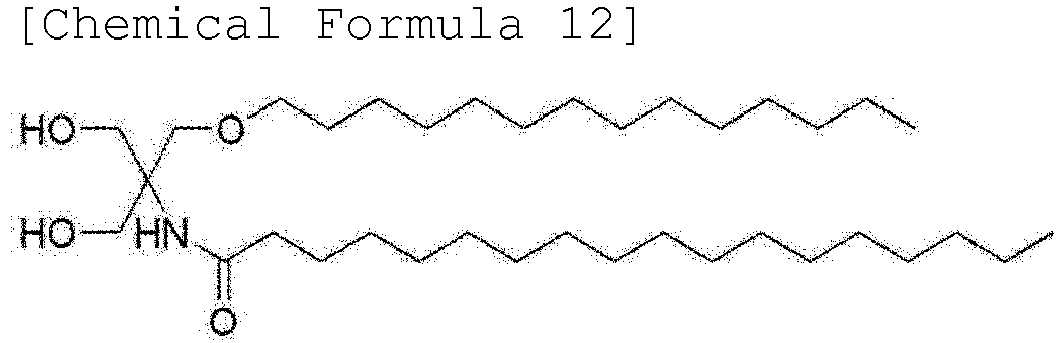
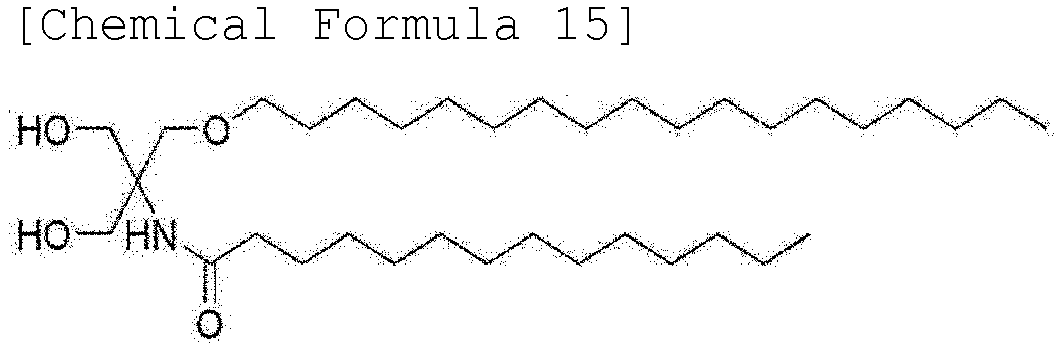
- Specific examples of the compound represented by Chemical Formula 1 may include hexadecanoic acid (2-hexadecyloxy-1,1-bis-hydroxymethyl-ethyl)-amide (Chemical Formula 8), hexadecanoic acid (1,1-bis-hydroxymethyl-2-tetradecyloxy-ethyl)-amide (Chemical Formula 9), hexadecanoic acid (1,1-bis-hydroxymethyl-2-octadecyloxy-ethyl)-amide (Chemical Formula 10), octadecanoic acid (2-hexadecyloxy-1,1-bis-hydroxymethyl-ethyl)-amide (Chemical Formula 11), octadecanoic acid (1,1-bis-hydroxymethyl-2-tetradecyloxy-ethyl)-amide (Chemical Formula 12), octadecanoic acid (1,1-bis-hydroxymethyl-2-octadecyloxy-e
- the pseudo-ceramide compound of Chemical Formula 1 as described above is structurally and functionally similar to the natural ceramide, and thus can be used as a raw material of the skin preparation for external use or cosmetic composition for skin barrier protection.
- the pseudo-ceramide compound according to the present invention can be synthesized using 2-amino-2-hydroxymethyl-propane-1,3-diol as a starting material.
- the present invention provides a method for preparing the pseudo-ceramide compound, which is represented by the following Reaction Scheme 1 and comprises the steps of
- the C1 to C4 acyloxy may be formate, acetate, propionate or butanoate, and the C1 to C4 alkoxy may be methoxy, ethoxy, propoxy, isopropoxy or butoxy.
- the L 1 is Cl.
- step S1 a protecting group is introduced into tris (hydroxymethyl) aminomethane (2-amino-2-hydroxymethyl-propane-1,3-diol, Chemical Formula 2) to prepare a compound of Chemical Formula 3 in which 1,3-diols are protected.
- the protecting group can be used without limitation as long as it is used as a protecting group of a hydroxy group. However, it is desirable to use a protecting group that is used as a diol protecting group so that two of the three hydroxy groups of tris(hydroxymethyl)aminomethane can be protected simultaneously. Specifically, methylidene acetal, ethylidene acetal, isopropylidene ketal, cyclohexylidene ketal, benzylidene ketal, or p-methoxybenzylidene acetal protecting group may be used.
- the solvent used in this step is preferably an organic solvent, and for example, may be one selected from the group consisting of chloroform, dimethylformamide (DMF), dichloromethane, diisopropyl ether, diethylether, tetrahydrofuran (THF), dimethylacetamide (DMA), dimethyl sulfoxide (DMSO), chlorobenzene, toluene, benzene, acetone, and mixed solvents thereof.
- organic solvent for example, may be one selected from the group consisting of chloroform, dimethylformamide (DMF), dichloromethane, diisopropyl ether, diethylether, tetrahydrofuran (THF), dimethylacetamide (DMA), dimethyl sulfoxide (DMSO), chlorobenzene, toluene, benzene, acetone, and mixed solvents thereof.
- reaction conditions temperature, pressure, time and the like are not particularly limited in the present invention, but are in accordance with known conditions.
- the protecting group is an isopropylidene ketal protecting group.
- the method of introducing the isopropylidene ketal protecting group is not particularly limited in the present invention, and a method known in the art can be used.
- the isopropylidene ketal protecting group can be introduced by reacting tris(hydroxymethyl)aminomethane with 2,2-dimethoxypropane under a slightly acidic condition, as shown in the following Reaction Scheme 2.
- the above-mentioned organic solvent may be used, and an acid catalyst may be used.
- an acid catalyst may be used.
- DMF as a solvent
- p-toluene sulfonic acid (TsOH) as an acid catalyst can be used.
- step S2 the compound of Chemical Formula 3 prepared by introducing the protecting group in Step S1 is reacted with a compound of Chemical Formula 4 to prepare a compound of Chemical Formula 5 having an amide group.
- the compound of Chemical Formula 4 is an acyl compound having a leaving group (L 1 ), and may be an acyl halide, an acid anhydride, or an ester.
- the compound of Chemical Formula 4 can be used without limitation as long as it satisfies the definition of Reaction Scheme 1 above, and for example, may be palmitoyl chloride (CH 3 (CH 2 ) 14 COCl), myristoyl chloride (CH 3 (CH 2 ) 12 COCl), stearoyl chloride (CH 3 (CH 2 ) 16 COCl) and the like.
- the solvent used in this step is preferably the organic solvent as described above in Step S1, and if necessary, a basic catalyst such as triethylamine, N,N'-diisopropylethylamine, pyridine or N-methylmorpholine can be used.
- a basic catalyst such as triethylamine, N,N'-diisopropylethylamine, pyridine or N-methylmorpholine.
- dichloromethane as a solvent and triethylamine as a base catalyst can be used.
- the compound of Chemical Formula 5 can be prepared by adding the base catalyst to the compound of Chemical Formula 3 at 0°C, adding the compound of Chemical Formula 4 slowly thereto, and stirring at room temperature for 2 to 4 hours.
- step S3 an aliphatic chain is introduced into the hydroxy group of the compound of Chemical Formula 5 to prepare a compound of Chemical Formula 7 having a ceramide-like structure.
- the compound of Chemical Formula 6, which is a reactant in this step, is a C9 to C23 alkyl halide, and can be used without limitation as long as it satisfies the definition of Reaction Scheme 1 above.
- the compound of Chemical Formula 6 may be bromotetradecane, bromohexadecane, bromooctadecane or the like.
- This step can be carried out using a solvent and a base catalyst used in the nucleophilic substitution reaction.
- a solvent and a base catalyst used in the nucleophilic substitution reaction.
- t-butanol, THF or 1,4-dioxane may be used as a solvent
- t-butoxide, potassium hydroxide, sodium hydroxide, lithium hydroxide or sodium hydride may be used as a base catalyst.
- reaction conditions are not particularly limited in the present invention and can be appropriately controlled depending on the reactants used.
- t-butanol was used as a solvent
- potassium t-butoxide was used as a base catalyst
- the compound of Chemical Formula 7 was prepared by reacting at room temperature for 10 to 14 hours.
- Step S4 is a step of removing the diol protecting group introduced in step S1, and the reaction conditions, temperature, pressure, time and the like are not particularly limited and may vary depending on the protecting group used. Specifically, the removal of the protecting group may be accomplished by treatment of the acidic aqueous solution, addition of hydrogen gas in the presence of a metal catalyst.
- an acidic aqueous solution is used to remove the acetonide protecting group.
- the acid used may be hydrochloric acid, nitric acid, sulfuric acid, or acetic acid, preferably hydrochloric acid.
- the conditions for the removal reaction of the protecting group are not particularly limited in the present invention, and the reaction is carried out at a temperature of -30 to 60°C, preferably -30 to 40°C for 0.5 to 72 hours, preferably 1 to 12 hours.
- the solvent may be a polar solvent capable of dissolving an acid, and may be one selected from the group consisting of water, C1-C4 lower alcohol, tetrahydrofuran and a mixed solvent thereof, preferably tetrahydrofuran.
- the compound of Chemical Formula 1 prepared by the above-mentioned method can be applied to various fields, and can be widely applied to cosmetics, medicines, preparations for external use, foods and the like to which existing natural ceramide, synthetic ceramide or pseudo ceramide is applied.
- Example 1 Preparation of hexadecanoic acid (2-hexadecyloxy-1,1-bis-hydroxymethyl-ethyl)-amide
- reaction mixture was dissolved in tetrahydrofuran (20 mL), a 1 M aqueous hydrochloric acid solution (4 mL) was added, and the mixture was stirred at room temperature for 12 hours.
- the reaction solution was diluted with dichloromethane and washed with a saturated sodium hydrogen carbonate solution.
- the organic solution layer was dried over anhydrous magnesium sulfate and concentrated under reduced pressure.
- the product was isolated using column chromatography to obtain 0.88 g of the desired compound as a white solid.
- 0.71 g of the desired compound was obtained using substantially the same method as in (2) of Example 1, except that bromooctadecane (1.67g) was used instead of bromohexadecane (1.53 g).
- 1.8 g of the desired compound was obtained using substantially the same method as in (2) of Example 1, except that octadecanoic acid (5-hydroxymethyl-2,2-dimethyl-[1,3]dioxan-5-yl)-amide (5.0g) prepared in the above (1) was used instead of hexadecanoic acid (5-hydroxymethyl-2,2-dimethyl-[1,3]dioxan-5-yl)-amide, tetrahydrofuran (100 mL) was used instead of t-butanol, and KOtBu (1.73g) and bromohexadecane (3.6g) were used.
- 1.1 g of the desired compound was obtained using substantially the same method as in (2) of Example 4, except that bromooctadecane (3.14g) was used instead of bromohexadecane (3.6g), and octadecanoic acid (5-hydroxymethyl-2,2-dimethyl-[1,3]dioxan-5-yl)-amide (4.0g) and KOtBu (1.38g) were used.
- 1 H NMR 500MHz, CDCl 3 ) ⁇ 6.50 (brs, 1H), 3.70 ⁇ 3.40 (m, 8H), 2.26 (m, 2H), 1.90 ⁇ 1.15 (m, 64H), 0.88 (m, 6H).
- 1.2 g of the desired compound was obtained using substantially the same method as in (2) of Example 1, except that tetradecanoic acid (5-hydroxymethyl-2,2-dimethyl-[1,3]dioxan-5-yl)-amide (3.71g) as prepared in (1) above was used instead of hexadecanoic acid (5-hydroxymethyl-2,2-dimethyl-[1,3]dioxan-5-yl)-amide, tetrahydrofuran (100mL) was used instead of t-butanol, and KOtBu (1.47g) and bromohexadecane (2.74g) were used.
Landscapes
- Chemical & Material Sciences (AREA)
- Organic Chemistry (AREA)
- Health & Medical Sciences (AREA)
- Life Sciences & Earth Sciences (AREA)
- Chemical Kinetics & Catalysis (AREA)
- Public Health (AREA)
- Veterinary Medicine (AREA)
- Animal Behavior & Ethology (AREA)
- General Health & Medical Sciences (AREA)
- Gerontology & Geriatric Medicine (AREA)
- Dermatology (AREA)
- Biophysics (AREA)
- Molecular Biology (AREA)
- Birds (AREA)
- Epidemiology (AREA)
- Organic Low-Molecular-Weight Compounds And Preparation Thereof (AREA)
- Cosmetics (AREA)
- Acyclic And Carbocyclic Compounds In Medicinal Compositions (AREA)
Abstract
Description
- The present application claims the benefit of priority based on Korean Patent Application No.
10-2016-0124064 filed on September 27, 2016 - The present invention relates to a novel pseudo-ceramide compound and a preparation method thereof.
- The surface of human skin is protected by stratum corneum. Among the constituents of stratum corneum, stratum corneum intercellular lipid forms a lamella structure and contributes to maintain skin's basic function.
- The stratum corneum intercellular lipid consists of ceramide, cholesterol, free fatty acid and the like. Among them, the ceramide is a main component and plays a central role in moisture retention and barrier function of the stratum corneum. It is known that if the content of ceramide in the stratum corneum is reduced, the protective barrier function of the stratum corneum is reduced and various skin diseases are exacerbated.
- Meanwhile, it has been reported that if the stratum corneum is damaged by skin aging or external stimuli and thus the content of ceramide in the stratum corneum is reduced, the skin's lamella structure can be restored by supplementing ceramide from the outside and thus the skin can be restored to its normal state. Accordingly, for the purpose of restoring and maintaining skin barrier function and enhancing moisturizing power, the development of cosmetic composition containing the ceramide is actively being done.
- The ceramide is extracted from various plants and animals containing the ceramide. However, the natural ceramide is not suitable for commercialization because it is difficult to mass-produce and the raw material is expensive due to difficulty of extraction and the like. In addition, the natural ceramide is low in solubility in various solvents used in cosmetics, and thus the natural ceramide is limited in the amount that can be used when preparing a product and there is a limit to obtaining efficacy.
- Therefore, in order to replace the natural ceramide, it is necessary to research and develop a pseudo-ceramide compound which has a structure similar to the natural ceramide, is easy to synthesize, and has improved physical properties.
- (Patent Document 1) Korean Laid-open Patent Publication No.
2014-0070474 - In order to solve the above problems, the present inventors have made efforts to synthesize a pseudo-ceramide compound having improved physical properties such as solubility while having a structure similar to the natural ceramide, and as a result, has completed the present invention.
- Therefore, it is an object of the present invention to provide a novel pseudo-ceramide compound and a preparation method thereof.
- In order to accomplish the above object, the present invention provides a pseudo-ceramide compound represented by the following Chemical Formula 1:

- In addition, the present invention provides a method for preparing a pseudo-ceramide compound, which is represented by the following Reaction Scheme 1 and comprises the steps of
- S1) introducing a protecting group into a compound of Chemical Formula 2 to prepare a compound of Chemical Formula 3;
- S2) reacting the compound of Chemical Formula 3 with a compound of Chemical Formula 4 to prepare a compound of Chemical Formula 5;
- S3) reacting the compound of Chemical Formula 5 with a compound of Chemical Formula 6 under a base catalyst to prepare a compound of Chemical Formula 7; and
- S4) removing the protecting group from the compound of Chemical Formula 7 to prepare a compound of Chemical Formula 1:


- According to the present invention, the pseudo-ceramide compound has a molecular structure and a function similar to those of the natural ceramide, can be readily synthesized, and has excellent solubility and stability in an organic solvent, and thus can be used as an alternative to the natural ceramide. Therefore, the pseudo-ceramide compound of the present invention can be widely applied to a skin preparation for external use, a cosmetic composition, and the like for reinforcing and maintaining a skin barrier function.
- Hereinafter, the present invention will be described in detail so as to be easily carried out by those having ordinary skill in the art to which the present invention pertains. However, the present invention may be embodied in many different forms and should not be construed as limited to the embodiments set forth herein.
- The present invention provides a novel pseudo-ceramide compound represented by the following Chemical Formula 1:

- The C9 to C23 saturated aliphatic chain referred to in the present specification is a chain in which the carbon-carbon bond is composed of only single bonds, and may be, for example, but is not limited to, nonanyl (C9:0), decanyl (C10:0), undecanyl (C11:0), dodecanyl (C12:0), tridecanyl (C13:0), tetradecanyl (C14:0), pentadecanyl (C15:0), hexadecanyl (C16:0), heptadecanyl (C17:0), octadecanyl (C18:0), nonadecanyl (C19:0), icosanyl (C20:0), henicosanyl (C21:0), docosanyl (C22:0), or tricosanyl (C23:0).
- In addition, the C9 to C23 unsaturated aliphatic chain referred to in the present specification is a chain including at least one carbon-carbon double or triple bond, and may be, for example, but is not limited to, nonenyl (C9:1), decenyl (C10:1), undecenyl (C11:1), dodecenyl(C12:1), tridecenyl (C13:1), tetradecenyl (C14:1), pentadecenyl (C15:1), hexadecenyl (C16:1), heptadecenyl (C17:1), octadecenyl (C18:1), nonadecenyl (C19:1), icosenyl (C20:1), henicosenyl (C21:1) docosenyl (C22:1), or tricosenyl (C23:1).
- Preferably, R1 and R2 are the same as or different from each other, and each independently can be a C13 to C18 saturated or unsaturated aliphatic chain.
- More preferably, R1 and R2 are the same as or different from each other, and each independently may be tridecanyl, tetradecanyl, pentadecanyl, hexadecanyl, heptadecanyl, or octadecanyl.
- Furthermore preferably, R1 may be tridecanyl, pentadecanyl, or heptadecanyl, and R2 may be tetradecanyl, hexadecanyl, or octadecanyl.
- Specific examples of the compound represented by Chemical Formula 1 may include hexadecanoic acid (2-hexadecyloxy-1,1-bis-hydroxymethyl-ethyl)-amide (Chemical Formula 8), hexadecanoic acid (1,1-bis-hydroxymethyl-2-tetradecyloxy-ethyl)-amide (Chemical Formula 9), hexadecanoic acid (1,1-bis-hydroxymethyl-2-octadecyloxy-ethyl)-amide (Chemical Formula 10), octadecanoic acid (2-hexadecyloxy-1,1-bis-hydroxymethyl-ethyl)-amide (Chemical Formula 11), octadecanoic acid (1,1-bis-hydroxymethyl-2-tetradecyloxy-ethyl)-amide (Chemical Formula 12), octadecanoic acid (1,1-bis-hydroxymethyl-2-octadecyloxy-ethyl)-amide (Chemical Formula 13), tetradecanoic acid (2-hexadecyloxy-1,1-bis-hydroxymethyl-ethyl)-amide (Chemical Formula 14), or tetradecanoic acid (1,1-bis-hydroxymethyl-2-octadecyloxy-ethyl)-amide (Chemical Formula 15).




- The pseudo-ceramide compound of Chemical Formula 1 as described above is structurally and functionally similar to the natural ceramide, and thus can be used as a raw material of the skin preparation for external use or cosmetic composition for skin barrier protection.
- The pseudo-ceramide compound according to the present invention can be synthesized using 2-amino-2-hydroxymethyl-propane-1,3-diol as a starting material.
- Specifically, the present invention provides a method for preparing the pseudo-ceramide compound, which is represented by the following Reaction Scheme 1 and comprises the steps of
- S1) introducing a protecting group into a compound of Chemical Formula 2 to prepare a compound of Chemical Formula 3;
- S2) reacting the compound of Chemical Formula 3 with a compound of Chemical Formula 4 to prepare a compound of Chemical Formula 5;
- S3) reacting the compound of Chemical Formula 5 with a compound of Chemical Formula 6 under a base catalyst to prepare a compound of Chemical Formula 7; and
- S4) removing the protecting group from the compound of Chemical Formula 7 to prepare a compound of Chemical Formula 1:

- wherein X is alkylidene, ethylidene, isopropylidene, cyclohexylidene, benzylidene or p-methoxybenzylidene,
- R1 and R2 are the same as or different from each other and are each independently a C9 to C23 saturated or unsaturated aliphatic chain,
- L1 is Cl, Br, I, C1 to C4 acyloxy, or C1 to C4 alkoxy, and
- L2 is Cl, Br, or I.
- At this time, the C1 to C4 acyloxy may be formate, acetate, propionate or butanoate, and the C1 to C4 alkoxy may be methoxy, ethoxy, propoxy, isopropoxy or butoxy. Preferably, the L1 is Cl.
- Hereinafter, each step will be described in detail.
- In step S1, a protecting group is introduced into tris (hydroxymethyl) aminomethane (2-amino-2-hydroxymethyl-propane-1,3-diol, Chemical Formula 2) to prepare a compound of Chemical Formula 3 in which 1,3-diols are protected.
- The protecting group can be used without limitation as long as it is used as a protecting group of a hydroxy group. However, it is desirable to use a protecting group that is used as a diol protecting group so that two of the three hydroxy groups of tris(hydroxymethyl)aminomethane can be protected simultaneously. Specifically, methylidene acetal, ethylidene acetal, isopropylidene ketal, cyclohexylidene ketal, benzylidene ketal, or p-methoxybenzylidene acetal protecting group may be used.
- The solvent used in this step is preferably an organic solvent, and for example, may be one selected from the group consisting of chloroform, dimethylformamide (DMF), dichloromethane, diisopropyl ether, diethylether, tetrahydrofuran (THF), dimethylacetamide (DMA), dimethyl sulfoxide (DMSO), chlorobenzene, toluene, benzene, acetone, and mixed solvents thereof.
- In this step, a known acid or base catalyst may be used if necessary. The reaction conditions, temperature, pressure, time and the like are not particularly limited in the present invention, but are in accordance with known conditions.
- According to one preferred embodiment of the present invention, the protecting group is an isopropylidene ketal protecting group. The method of introducing the isopropylidene ketal protecting group is not particularly limited in the present invention, and a method known in the art can be used. For example, the isopropylidene ketal protecting group can be introduced by reacting tris(hydroxymethyl)aminomethane with 2,2-dimethoxypropane under a slightly acidic condition, as shown in the following Reaction Scheme 2.

- In the reaction of the above Reaction Scheme 2, the above-mentioned organic solvent may be used, and an acid catalyst may be used. Preferably, DMF as a solvent and p-toluene sulfonic acid (TsOH) as an acid catalyst can be used.
- In step S2, the compound of Chemical Formula 3 prepared by introducing the protecting group in Step S1 is reacted with a compound of Chemical Formula 4 to prepare a compound of Chemical Formula 5 having an amide group.
- The compound of Chemical Formula 4 is an acyl compound having a leaving group (L1), and may be an acyl halide, an acid anhydride, or an ester. The compound of Chemical Formula 4 can be used without limitation as long as it satisfies the definition of Reaction Scheme 1 above, and for example, may be palmitoyl chloride (CH3(CH2)14COCl), myristoyl chloride (CH3(CH2)12COCl), stearoyl chloride (CH3(CH2)16COCl) and the like.
- The solvent used in this step is preferably the organic solvent as described above in Step S1, and if necessary, a basic catalyst such as triethylamine, N,N'-diisopropylethylamine, pyridine or N-methylmorpholine can be used. At this time, the reaction conditions, temperature, pressure, time and the like are not particularly limited, but are in accordance with known conditions.
- According to one preferred embodiment of the present invention, dichloromethane as a solvent and triethylamine as a base catalyst can be used. The compound of Chemical Formula 5 can be prepared by adding the base catalyst to the compound of Chemical Formula 3 at 0°C, adding the compound of Chemical Formula 4 slowly thereto, and stirring at room temperature for 2 to 4 hours.
- In step S3, an aliphatic chain is introduced into the hydroxy group of the compound of Chemical Formula 5 to prepare a compound of Chemical Formula 7 having a ceramide-like structure.
- The compound of Chemical Formula 6, which is a reactant in this step, is a C9 to C23 alkyl halide, and can be used without limitation as long as it satisfies the definition of Reaction Scheme 1 above. Specifically, the compound of Chemical Formula 6 may be bromotetradecane, bromohexadecane, bromooctadecane or the like.
- This step can be carried out using a solvent and a base catalyst used in the nucleophilic substitution reaction. Specifically, t-butanol, THF or 1,4-dioxane may be used as a solvent, and t-butoxide, potassium hydroxide, sodium hydroxide, lithium hydroxide or sodium hydride may be used as a base catalyst.
- At this time, the reaction conditions, temperature, pressure, time and the like are not particularly limited in the present invention and can be appropriately controlled depending on the reactants used.
- Specifically, in one embodiment of the present invention, t-butanol was used as a solvent, and potassium t-butoxide was used as a base catalyst, and the compound of Chemical Formula 7 was prepared by reacting at room temperature for 10 to 14 hours.
- Step S4 is a step of removing the diol protecting group introduced in step S1, and the reaction conditions, temperature, pressure, time and the like are not particularly limited and may vary depending on the protecting group used. Specifically, the removal of the protecting group may be accomplished by treatment of the acidic aqueous solution, addition of hydrogen gas in the presence of a metal catalyst.
- According to one preferred embodiment of the present invention, an acidic aqueous solution is used to remove the acetonide protecting group. At this time, the acid used may be hydrochloric acid, nitric acid, sulfuric acid, or acetic acid, preferably hydrochloric acid.
- The conditions for the removal reaction of the protecting group are not particularly limited in the present invention, and the reaction is carried out at a temperature of -30 to 60°C, preferably -30 to 40°C for 0.5 to 72 hours, preferably 1 to 12 hours.
- The solvent may be a polar solvent capable of dissolving an acid, and may be one selected from the group consisting of water, C1-C4 lower alcohol, tetrahydrofuran and a mixed solvent thereof, preferably tetrahydrofuran.
- The compound of Chemical Formula 1 prepared by the above-mentioned method can be applied to various fields, and can be widely applied to cosmetics, medicines, preparations for external use, foods and the like to which existing natural ceramide, synthetic ceramide or pseudo ceramide is applied.
- Hereinafter, the present invention will be described in more detail with reference to the following Examples. However, the following Examples are for illustrative purposes only and are not intended to limit the scope of the present invention.
-

- (5-amino-2,2-dimethyl-[1,3]dioxan-5-yl)-methanol (1.61g), which was synthesized according to a method known in the literature (Helv. Chim. Acta 2003, 86, 2458-2470) using 2-amino-2-hydroxymethyl-propane-1,3-diol hydrochloride as starting material, was dissolved in dichloromethane (50 mL), and after adding triethylamine (1.7 mL), palmitoyl chloride (2.75 g) dissolved in dichloromethane (10 mL) while stirring at 0 °C, was slowly added dropwise. The reaction solution was stirred at room temperature for 3 hours, and then washed with dilute hydrochloric acid solution and saturated sodium chloride solution. The organic solution layer was dried over anhydrous magnesium sulfate, filtered, concentrated under reduced pressure, and recrystallized from dichloromethane and hexane to obtain 2.5 g of a white solid.
1H NMR (300MHz, CDCl3) δ 6.28 (brs, 1H), 5.18 (m, 1H), 3.83 (s, 4H), 3.65 (d, 2H, J = 6.3Hz), 2.28 (t, 2H, J = 7.2Hz), 1.65 ∼ 1.25 (m, 32H), 0.88 (t, 3H, J = 6.9Hz). -

- The hexadecanoic acid (5-hydroxymethyl-2,2-dimethyl-[1,3]dioxan-5-yl)-amide (2.0 g) prepared in the above (1) was dissolved in t-butanol (50mL) and KOtBu (=potassium t-butoxide) (0.67 g) was slowly added thereto, followed by stirring at room temperature for 10 minutes. To this solution, bromohexadecane (1.53 g) was added, and further stirred for 12 hours. The reaction solution was neutralized with diluted hydrochloric acid to quench the reaction and extracted with dichloromethane. The organic layer was dried over anhydrous magnesium sulfate and then concentrated under reduced pressure. The reaction mixture was dissolved in tetrahydrofuran (20 mL), a 1 M aqueous hydrochloric acid solution (4 mL) was added, and the mixture was stirred at room temperature for 12 hours. The reaction solution was diluted with dichloromethane and washed with a saturated sodium hydrogen carbonate solution. The organic solution layer was dried over anhydrous magnesium sulfate and concentrated under reduced pressure. The product was isolated using column chromatography to obtain 0.88 g of the desired compound as a white solid.
1H NMR (300MHz, CDCl3) δ 6.50 (brs, 1H), 4.34 (m, 2H), 3.71 ∼ 3.45 (m, 8H), 2.55 (t, 2H, J = 7.5Hz), 1.80 ∼ 1.20 (m, 54H), 0.88 (m, 6H). -

- 0.82 g of the desired compound was obtained using substantially the same method as in (2) of Example 1, except that bromotetradecane (1.39 g) was used instead of bromohexadecane (1.53 g).
1H NMR (300MHz, CDCl3) δ 6.49 (brs, 1H), 4.32 (m, 2H), 3.71 ∼ 3.43 (m, 8H), 2.42 (m, 2H), 1.80 ∼ 1.05 (m, 50H), 0.87 (m, 6H). -

- 0.71 g of the desired compound was obtained using substantially the same method as in (2) of Example 1, except that bromooctadecane (1.67g) was used instead of bromohexadecane (1.53 g).
1H NMR (300MHz, CDCl3) δ 6.50 (brs, 1H), 4.33 (m, 2H), 3.71 ∼ 3.44 (m, 8H), 2.24 (t, 2H, J = 7.5Hz), 1.80 ∼ 1.20 (m, 58H), 0.88 (m, 6H). -

- 23 g of the desired compound as a white solid was obtained using substantially the same method as in (1) of Example 1, except that 12.8 g of (5-Amino-2,2-dimethyl-[1,3]dioxan-5-yl)-methanol was used as the starting material and stearoyl chloride (24.5 g) was used instead of palmitoyl chloride (2.75 g).
1H NMR (300MHz, CDCl3) δ 6.28 (brs, 1H), 5.17 (m, 1H), 3.83 (s, 4H), 3.64 (d, 2H, J = 6.0Hz), 2.28 (t, 2H, J = 7.5Hz), 1.65 ∼ 1.25 (m, 36H), 0.87 (t, 3H, J = 6.6Hz). -

- 1.8 g of the desired compound was obtained using substantially the same method as in (2) of Example 1, except that octadecanoic acid (5-hydroxymethyl-2,2-dimethyl-[1,3]dioxan-5-yl)-amide (5.0g) prepared in the above (1) was used instead of hexadecanoic acid (5-hydroxymethyl-2,2-dimethyl-[1,3]dioxan-5-yl)-amide, tetrahydrofuran (100 mL) was used instead of t-butanol, and KOtBu (1.73g) and bromohexadecane (3.6g) were used.
1H NMR (500MHz, CDCl3) δ 6.48 (brs, 1H), 3.68 ∼ 3.43 (m, 8H), 2.31 (m, 2H), 2.22 (m, 2H), 1.70 ∼ 1.20 (m, 58H), 0.85 (m, 6H). -

- 1.2 g of the desired compound was obtained using substantially the same method as (2) of Example 4, except that bromotetradecane (3.27 g) was used instead of bromohexadecane (3.6 g).
1H NMR (500MHz, CDCl3) δ 6.47 (brs, 1H), 4.32 (m, 2H), 3.68 ∼ 3.31 (m, 8H), 2.22 (m, 2H), 1.61 ∼ 1.10 (m, 54H), 0.84 (m, 6H). -


- 1.1 g of the desired compound was obtained using substantially the same method as in (2) of Example 4, except that bromooctadecane (3.14g) was used instead of bromohexadecane (3.6g), and octadecanoic acid (5-hydroxymethyl-2,2-dimethyl-[1,3]dioxan-5-yl)-amide (4.0g) and KOtBu (1.38g) were used.
1H NMR (500MHz, CDCl3) δ 6.50 (brs, 1H), 3.70 ∼ 3.40 (m, 8H), 2.26 (m, 2H), 1.90 ∼ 1.15 (m, 64H), 0.88 (m, 6H). -

- 15 g of the desired compound as a white solid was obtained using substantially the same method as in (1) of Example 1, except that 12.8 g of (5-amino-2,2-dimethyl-[1,3]dioxan-5-yl)-methanol was used as the starting material and myristoyl chloride (19.5 g) was used instead of palmitoyl chloride (2.75 g).
1H NMR (300MHz, CDCl3) δ 6.31 (brs, 1H), 5.20 (m, 1H), 3.85 (s, 4H), 3.67 (s, 2H), 2.31 (t, 2H, J = 7.2Hz), 1.68 ∼ 1.28 (m, 28H), 0.90 (t, 3H, J = 6.6Hz). -

- 1.2 g of the desired compound was obtained using substantially the same method as in (2) of Example 1, except that tetradecanoic acid (5-hydroxymethyl-2,2-dimethyl-[1,3]dioxan-5-yl)-amide (3.71g) as prepared in (1) above was used instead of hexadecanoic acid (5-hydroxymethyl-2,2-dimethyl-[1,3]dioxan-5-yl)-amide, tetrahydrofuran (100mL) was used instead of t-butanol, and KOtBu (1.47g) and bromohexadecane (2.74g) were used.
1H NMR (500MHz, CDCl3) δ 6.47(brs, 1H), 4.22 (m, 2H), 3.68 ∼ 3.32 (m, 8H), 2.24 (m, 2H), 1.80 ∼ 1.10 (m, 50H), 0.86 (m, 6H). -

- 1.05 g of the desired compound was obtained using substantially the same method as in (2) of Example 7, except that bromooctadecane (3.3 g) was used instead of bromohexadecane.
1H NMR (500MHz, CDCl3) δ 6.47(brs, 1H), 4.31 (m, 2H), 3.68 ∼ 3.43(m, 8H), 2.22 (t, 2H, J = 7.0Hz), 1.65 ∼ 1.10(m, 54H), 0.85(m, 6H).
Claims (7)
- A pseudo-ceramide compound represented by the following Chemical Formula 1:

- The pseudo-ceramide compound according to claim 1, wherein R1 and R2 are the same as or different from each other and are each independently a C13 to C18 saturated or unsaturated aliphatic chain.
- The pseudo-ceramide compound according to claim 1, wherein the pseudo-ceramide compound is hexadecanoic acid (2-hexadecyloxy-1,1-bis-hydroxymethyl-ethyl)-amide, hexadecanoic acid (1,1-bis-hydroxymethyl-2-tetradecyloxy-ethyl)-amide, hexadecanoic acid (1,1-bis-hydroxymethyl-2-octadecyloxy-ethyl)-amide, octadecanoic acid (2-hexadecyloxy-1,1-bis-hydroxymethyl-ethyl)-amide, octadecanoic acid (1,1-bis-hydroxymethyl-2-tetradecyloxy-ethyl)-amide, octadecanoic acid (1,1-bis-hydroxymethyl-2-octadecyloxy-ethyl)-amide, tetradecanoic acid (2-hexadecyloxy-1,1-bis-hydroxymethyl-ethyl)-amide, or tetradecanoic acid (1,1-bis-hydroxymethyl-2-octadecyloxy-ethyl)-amide.
- A method for preparing a pseudo-ceramide compound, which is represented by the following Reaction Scheme 1 and comprises the steps ofS1) introducing a protecting group into a compound of Chemical Formula 2 to prepare a compound of Chemical Formula 3;S2) reacting the compound of Chemical Formula 3 with a compound of Chemical Formula 4 to prepare a compound of Chemical Formula 5;S3) reacting the compound of Chemical Formula 5 with a compound of Chemical Formula 6 under a base catalyst to prepare a compound of Chemical Formula 7; andS4) removing the protecting group from the compound of Chemical Formula 7 to prepare a compound of Chemical Formula 1:
 wherein X is alkylidene, ethylidene, isopropylidene, cyclohexylidene, benzylidene or p-methoxybenzylidene,R1 and R2 are the same as or different from each other and are each independently a C9 to C23 saturated or unsaturated aliphatic chain,L1 is Cl, Br, I, C1 to C4 acyloxy, or C1 to C4 alkoxy, andL2 is Cl, Br, or I.
 - The method for preparing the pseudo-ceramide compound according to claim 4, wherein the R1 and R2 are the same as or different from each other and are each independently a C13 to C18 saturated or unsaturated aliphatic chain.
- The method for preparing the pseudo-ceramide compound according to claim 4, wherein the compound of Chemical Formula 4 is myristoyl chloride, palmitoyl chloride, or stearoyl chloride.
- The method for preparing the pseudo-ceramide compound according to claim 4, wherein the compound of Chemical Formula 6 is bromotetradecane, bromohexadecane, or bromooctadecane.
Applications Claiming Priority (2)
| Application Number | Priority Date | Filing Date | Title |
|---|---|---|---|
| KR1020160124064A KR102703167B1 (en) | 2016-09-27 | 2016-09-27 | Pseudoceramide compounds and preparation method thereof |
| PCT/KR2017/010087 WO2018062729A1 (en) | 2016-09-27 | 2017-09-14 | Pseudo-ceramide compound and preparation method therefor |
Publications (3)
| Publication Number | Publication Date |
|---|---|
| EP3521271A1 true EP3521271A1 (en) | 2019-08-07 |
| EP3521271A4 EP3521271A4 (en) | 2019-10-16 |
| EP3521271B1 EP3521271B1 (en) | 2020-11-04 |
Family
ID=61762856
Family Applications (1)
| Application Number | Title | Priority Date | Filing Date |
|---|---|---|---|
| EP17856615.4A Active EP3521271B1 (en) | 2016-09-27 | 2017-09-14 | Pseudo-ceramide compound and preparation method therefor |
Country Status (6)
| Country | Link |
|---|---|
| US (1) | US10570087B2 (en) |
| EP (1) | EP3521271B1 (en) |
| JP (1) | JP6872021B2 (en) |
| KR (1) | KR102703167B1 (en) |
| CN (1) | CN110023280A (en) |
| WO (1) | WO2018062729A1 (en) |
Family Cites Families (11)
| Publication number | Priority date | Publication date | Assignee | Title |
|---|---|---|---|---|
| JPH0418045A (en) * | 1990-03-05 | 1992-01-22 | Mect Corp | Ceramide-analogous compound and preparation thereof |
| FR2711138B1 (en) * | 1993-10-12 | 1995-11-24 | Oreal | Ceramides, their preparation process and their applications in cosmetics and dermopharmacy. |
| JP3544080B2 (en) * | 1996-11-14 | 2004-07-21 | 花王株式会社 | Water-in-oil emulsion cosmetics |
| CN1186656A (en) * | 1996-11-14 | 1998-07-08 | 花王株式会社 | Water-in-oil cosmetic emulsion |
| KR100570810B1 (en) * | 2003-09-23 | 2006-04-28 | 주식회사 바이오씨에스 | Novel ceramide derivatives, preparation method thereof and use thereof |
| KR100847781B1 (en) * | 2007-01-08 | 2008-07-23 | 재단법인서울대학교산학협력재단 | Ceramide derivatives, pharmaceutically acceptable salts thereof, preparation methods thereof, and pharmaceutical compositions for preventing and treating cancer containing the same as active ingredients |
| KR102088802B1 (en) | 2012-11-30 | 2020-03-16 | (주)아모레퍼시픽 | Novel pseudo-ceramide compound and method for preparing the same |
| KR101641702B1 (en) | 2014-11-14 | 2016-07-21 | 애경산업(주) | Novel Pseudoceramide Compound and composition comprising it |
| KR102644587B1 (en) * | 2015-12-24 | 2024-03-07 | (주)아모레퍼시픽 | Pseudoceramide compounds and preparation method thereof |
| WO2017111387A1 (en) * | 2015-12-24 | 2017-06-29 | (주)아모레퍼시픽 | Pseudo-ceramide compound and preparation method therefor |
| KR102087948B1 (en) | 2016-10-18 | 2020-03-11 | 엘지이노텍 주식회사 | Light emitting device package |
-
2016
- 2016-09-27 KR KR1020160124064A patent/KR102703167B1/en active Active
-
2017
- 2017-09-14 JP JP2019537726A patent/JP6872021B2/en active Active
- 2017-09-14 US US16/336,893 patent/US10570087B2/en active Active
- 2017-09-14 CN CN201780073268.XA patent/CN110023280A/en active Pending
- 2017-09-14 EP EP17856615.4A patent/EP3521271B1/en active Active
- 2017-09-14 WO PCT/KR2017/010087 patent/WO2018062729A1/en not_active Ceased
Also Published As
| Publication number | Publication date |
|---|---|
| JP2019530748A (en) | 2019-10-24 |
| EP3521271A4 (en) | 2019-10-16 |
| US10570087B2 (en) | 2020-02-25 |
| JP6872021B2 (en) | 2021-05-19 |
| KR20180034044A (en) | 2018-04-04 |
| EP3521271B1 (en) | 2020-11-04 |
| CN110023280A (en) | 2019-07-16 |
| WO2018062729A1 (en) | 2018-04-05 |
| KR102703167B1 (en) | 2024-09-06 |
| US20190248736A1 (en) | 2019-08-15 |
Similar Documents
| Publication | Publication Date | Title |
|---|---|---|
| DE69717974T2 (en) | METHOD FOR PRODUCING GANCICLOVIR DERIVATIVES | |
| EP3395808B1 (en) | Pseudo-ceramide compound and preparation method therefor | |
| BR112012018232B1 (en) | FURO [3,2-B] PYRAN DERIVATIVE COMPOUNDS USEFUL IN THE SYNTHESIS OF HALICONDRIN B ANALOGS AND ER-80402 AND ERIBULIN SYNTHESIS METHODS | |
| ES2431631T3 (en) | Process for the preparation of derivatives of D-erythro-2,2-difluoro-2-deoxy-1-oxoribose | |
| EP3521271B1 (en) | Pseudo-ceramide compound and preparation method therefor | |
| CN103664985B (en) | The stereoselectivity preparation method of β type hydroxyl sweet wormwood alkyl oxide | |
| EP4495129A1 (en) | Method for producing chimeric molecule | |
| KR20210026336A (en) | Method for preparing pseudoceramide compound | |
| US20050203287A1 (en) | Process for the preparation of sulfamate derivatives | |
| JP2010530358A (en) | Lipid-bound cyclic carbonate derivatives, their synthesis and uses | |
| RU2434014C2 (en) | Method of producing taxane derivatives | |
| ES2974301T3 (en) | Vinyl ether compounds, aldehyde compound, process for preparing the aldehyde compound and a carboxylate compound therefrom | |
| CN108929334B (en) | A kind of preparation method of morpholinedione natural alkaloid and derivative thereof | |
| JP6205530B2 (en) | Method for producing side chain precursor of paclitaxel and docetaxel | |
| HK1244814A1 (en) | Diosgenin-3-site derivative, and preparation method and application thereof | |
| WO2005090274A1 (en) | Process for regioselective preparation of glycerol, derivative and intermediate therefor | |
| JP2008189589A (en) | Phosphorylcholine group-containing cyclic ketal compound, method for producing the same, and method for producing phosphatidylcholine group-containing diol compound | |
| JPH06293722A (en) | Foam-increasing agent, its production and detergent composition containing the same | |
| TW202430648A (en) | Linker for nucleic acid synthesis, vector, and method for producing the same | |
| WO2026099776A1 (en) | A process for the preparation of paclitaxel | |
| WO2008123737A1 (en) | Docetaxel / mono propylene glycol clathrate and method for the preparation thereof | |
| JPS63307896A (en) | Novel compound produced by bonding lipid a monosaccharide analog with sulfur-containing peptide glycan analog | |
| Kovács et al. | The evaluation of b, b, b-trichloro-tert.-butyl (Tcb) group for the protection of carboxyl functionality | |
| Bielski et al. | and Decoupling (CAD) Chemistry | |
| JPH1036386A (en) | 4-n-acyl-2-thiocytosine arabinoside and anticancer agent containing the compound as active ingredient |
Legal Events
| Date | Code | Title | Description |
|---|---|---|---|
| STAA | Information on the status of an ep patent application or granted ep patent |
Free format text: STATUS: THE INTERNATIONAL PUBLICATION HAS BEEN MADE |
|
| PUAI | Public reference made under article 153(3) epc to a published international application that has entered the european phase |
Free format text: ORIGINAL CODE: 0009012 |
|
| STAA | Information on the status of an ep patent application or granted ep patent |
Free format text: STATUS: REQUEST FOR EXAMINATION WAS MADE |
|
| 17P | Request for examination filed |
Effective date: 20190418 |
|
| AK | Designated contracting states |
Kind code of ref document: A1 Designated state(s): AL AT BE BG CH CY CZ DE DK EE ES FI FR GB GR HR HU IE IS IT LI LT LU LV MC MK MT NL NO PL PT RO RS SE SI SK SM TR |
|
| AX | Request for extension of the european patent |
Extension state: BA ME |
|
| A4 | Supplementary search report drawn up and despatched |
Effective date: 20190916 |
|
| RIC1 | Information provided on ipc code assigned before grant |
Ipc: C07D 319/06 20060101ALI20190910BHEP Ipc: C07C 231/02 20060101ALI20190910BHEP Ipc: C07C 235/06 20060101AFI20190910BHEP |
|
| DAV | Request for validation of the european patent (deleted) | ||
| DAX | Request for extension of the european patent (deleted) | ||
| GRAP | Despatch of communication of intention to grant a patent |
Free format text: ORIGINAL CODE: EPIDOSNIGR1 |
|
| STAA | Information on the status of an ep patent application or granted ep patent |
Free format text: STATUS: GRANT OF PATENT IS INTENDED |
|
| INTG | Intention to grant announced |
Effective date: 20200619 |
|
| GRAS | Grant fee paid |
Free format text: ORIGINAL CODE: EPIDOSNIGR3 |
|
| GRAA | (expected) grant |
Free format text: ORIGINAL CODE: 0009210 |
|
| STAA | Information on the status of an ep patent application or granted ep patent |
Free format text: STATUS: THE PATENT HAS BEEN GRANTED |
|
| AK | Designated contracting states |
Kind code of ref document: B1 Designated state(s): AL AT BE BG CH CY CZ DE DK EE ES FI FR GB GR HR HU IE IS IT LI LT LU LV MC MK MT NL NO PL PT RO RS SE SI SK SM TR |
|
| REG | Reference to a national code |
Ref country code: GB Ref legal event code: FG4D |
|
| REG | Reference to a national code |
Ref country code: CH Ref legal event code: EP |
|
| REG | Reference to a national code |
Ref country code: AT Ref legal event code: REF Ref document number: 1330640 Country of ref document: AT Kind code of ref document: T Effective date: 20201115 |
|
| REG | Reference to a national code |
Ref country code: IE Ref legal event code: FG4D |
|
| REG | Reference to a national code |
Ref country code: DE Ref legal event code: R096 Ref document number: 602017027141 Country of ref document: DE |
|
| REG | Reference to a national code |
Ref country code: NL Ref legal event code: MP Effective date: 20201104 |
|
| REG | Reference to a national code |
Ref country code: AT Ref legal event code: MK05 Ref document number: 1330640 Country of ref document: AT Kind code of ref document: T Effective date: 20201104 |
|
| PG25 | Lapsed in a contracting state [announced via postgrant information from national office to epo] |
Ref country code: GR Free format text: LAPSE BECAUSE OF FAILURE TO SUBMIT A TRANSLATION OF THE DESCRIPTION OR TO PAY THE FEE WITHIN THE PRESCRIBED TIME-LIMIT Effective date: 20210205 Ref country code: NO Free format text: LAPSE BECAUSE OF FAILURE TO SUBMIT A TRANSLATION OF THE DESCRIPTION OR TO PAY THE FEE WITHIN THE PRESCRIBED TIME-LIMIT Effective date: 20210204 Ref country code: FI Free format text: LAPSE BECAUSE OF FAILURE TO SUBMIT A TRANSLATION OF THE DESCRIPTION OR TO PAY THE FEE WITHIN THE PRESCRIBED TIME-LIMIT Effective date: 20201104 Ref country code: RS Free format text: LAPSE BECAUSE OF FAILURE TO SUBMIT A TRANSLATION OF THE DESCRIPTION OR TO PAY THE FEE WITHIN THE PRESCRIBED TIME-LIMIT Effective date: 20201104 Ref country code: PT Free format text: LAPSE BECAUSE OF FAILURE TO SUBMIT A TRANSLATION OF THE DESCRIPTION OR TO PAY THE FEE WITHIN THE PRESCRIBED TIME-LIMIT Effective date: 20210304 |
|
| PG25 | Lapsed in a contracting state [announced via postgrant information from national office to epo] |
Ref country code: ES Free format text: LAPSE BECAUSE OF FAILURE TO SUBMIT A TRANSLATION OF THE DESCRIPTION OR TO PAY THE FEE WITHIN THE PRESCRIBED TIME-LIMIT Effective date: 20201104 Ref country code: AT Free format text: LAPSE BECAUSE OF FAILURE TO SUBMIT A TRANSLATION OF THE DESCRIPTION OR TO PAY THE FEE WITHIN THE PRESCRIBED TIME-LIMIT Effective date: 20201104 Ref country code: BG Free format text: LAPSE BECAUSE OF FAILURE TO SUBMIT A TRANSLATION OF THE DESCRIPTION OR TO PAY THE FEE WITHIN THE PRESCRIBED TIME-LIMIT Effective date: 20210204 Ref country code: IS Free format text: LAPSE BECAUSE OF FAILURE TO SUBMIT A TRANSLATION OF THE DESCRIPTION OR TO PAY THE FEE WITHIN THE PRESCRIBED TIME-LIMIT Effective date: 20210304 Ref country code: PL Free format text: LAPSE BECAUSE OF FAILURE TO SUBMIT A TRANSLATION OF THE DESCRIPTION OR TO PAY THE FEE WITHIN THE PRESCRIBED TIME-LIMIT Effective date: 20201104 Ref country code: LV Free format text: LAPSE BECAUSE OF FAILURE TO SUBMIT A TRANSLATION OF THE DESCRIPTION OR TO PAY THE FEE WITHIN THE PRESCRIBED TIME-LIMIT Effective date: 20201104 Ref country code: SE Free format text: LAPSE BECAUSE OF FAILURE TO SUBMIT A TRANSLATION OF THE DESCRIPTION OR TO PAY THE FEE WITHIN THE PRESCRIBED TIME-LIMIT Effective date: 20201104 |
|
| REG | Reference to a national code |
Ref country code: LT Ref legal event code: MG9D |
|
| PG25 | Lapsed in a contracting state [announced via postgrant information from national office to epo] |
Ref country code: HR Free format text: LAPSE BECAUSE OF FAILURE TO SUBMIT A TRANSLATION OF THE DESCRIPTION OR TO PAY THE FEE WITHIN THE PRESCRIBED TIME-LIMIT Effective date: 20201104 |
|
| PG25 | Lapsed in a contracting state [announced via postgrant information from national office to epo] |
Ref country code: SK Free format text: LAPSE BECAUSE OF FAILURE TO SUBMIT A TRANSLATION OF THE DESCRIPTION OR TO PAY THE FEE WITHIN THE PRESCRIBED TIME-LIMIT Effective date: 20201104 Ref country code: RO Free format text: LAPSE BECAUSE OF FAILURE TO SUBMIT A TRANSLATION OF THE DESCRIPTION OR TO PAY THE FEE WITHIN THE PRESCRIBED TIME-LIMIT Effective date: 20201104 Ref country code: SM Free format text: LAPSE BECAUSE OF FAILURE TO SUBMIT A TRANSLATION OF THE DESCRIPTION OR TO PAY THE FEE WITHIN THE PRESCRIBED TIME-LIMIT Effective date: 20201104 Ref country code: CZ Free format text: LAPSE BECAUSE OF FAILURE TO SUBMIT A TRANSLATION OF THE DESCRIPTION OR TO PAY THE FEE WITHIN THE PRESCRIBED TIME-LIMIT Effective date: 20201104 Ref country code: EE Free format text: LAPSE BECAUSE OF FAILURE TO SUBMIT A TRANSLATION OF THE DESCRIPTION OR TO PAY THE FEE WITHIN THE PRESCRIBED TIME-LIMIT Effective date: 20201104 Ref country code: LT Free format text: LAPSE BECAUSE OF FAILURE TO SUBMIT A TRANSLATION OF THE DESCRIPTION OR TO PAY THE FEE WITHIN THE PRESCRIBED TIME-LIMIT Effective date: 20201104 |
|
| REG | Reference to a national code |
Ref country code: DE Ref legal event code: R097 Ref document number: 602017027141 Country of ref document: DE |
|
| PG25 | Lapsed in a contracting state [announced via postgrant information from national office to epo] |
Ref country code: DK Free format text: LAPSE BECAUSE OF FAILURE TO SUBMIT A TRANSLATION OF THE DESCRIPTION OR TO PAY THE FEE WITHIN THE PRESCRIBED TIME-LIMIT Effective date: 20201104 |
|
| PLBE | No opposition filed within time limit |
Free format text: ORIGINAL CODE: 0009261 |
|
| STAA | Information on the status of an ep patent application or granted ep patent |
Free format text: STATUS: NO OPPOSITION FILED WITHIN TIME LIMIT |
|
| 26N | No opposition filed |
Effective date: 20210805 |
|
| PG25 | Lapsed in a contracting state [announced via postgrant information from national office to epo] |
Ref country code: AL Free format text: LAPSE BECAUSE OF FAILURE TO SUBMIT A TRANSLATION OF THE DESCRIPTION OR TO PAY THE FEE WITHIN THE PRESCRIBED TIME-LIMIT Effective date: 20201104 Ref country code: NL Free format text: LAPSE BECAUSE OF FAILURE TO SUBMIT A TRANSLATION OF THE DESCRIPTION OR TO PAY THE FEE WITHIN THE PRESCRIBED TIME-LIMIT Effective date: 20201104 Ref country code: IT Free format text: LAPSE BECAUSE OF FAILURE TO SUBMIT A TRANSLATION OF THE DESCRIPTION OR TO PAY THE FEE WITHIN THE PRESCRIBED TIME-LIMIT Effective date: 20201104 |
|
| PG25 | Lapsed in a contracting state [announced via postgrant information from national office to epo] |
Ref country code: SI Free format text: LAPSE BECAUSE OF FAILURE TO SUBMIT A TRANSLATION OF THE DESCRIPTION OR TO PAY THE FEE WITHIN THE PRESCRIBED TIME-LIMIT Effective date: 20201104 |
|
| REG | Reference to a national code |
Ref country code: CH Ref legal event code: PL |
|
| REG | Reference to a national code |
Ref country code: BE Ref legal event code: MM Effective date: 20210930 |
|
| PG25 | Lapsed in a contracting state [announced via postgrant information from national office to epo] |
Ref country code: IS Free format text: LAPSE BECAUSE OF FAILURE TO SUBMIT A TRANSLATION OF THE DESCRIPTION OR TO PAY THE FEE WITHIN THE PRESCRIBED TIME-LIMIT Effective date: 20210304 Ref country code: MC Free format text: LAPSE BECAUSE OF FAILURE TO SUBMIT A TRANSLATION OF THE DESCRIPTION OR TO PAY THE FEE WITHIN THE PRESCRIBED TIME-LIMIT Effective date: 20201104 |
|
| PG25 | Lapsed in a contracting state [announced via postgrant information from national office to epo] |
Ref country code: LU Free format text: LAPSE BECAUSE OF NON-PAYMENT OF DUE FEES Effective date: 20210914 Ref country code: IE Free format text: LAPSE BECAUSE OF NON-PAYMENT OF DUE FEES Effective date: 20210914 Ref country code: BE Free format text: LAPSE BECAUSE OF NON-PAYMENT OF DUE FEES Effective date: 20210930 |
|
| PG25 | Lapsed in a contracting state [announced via postgrant information from national office to epo] |
Ref country code: LI Free format text: LAPSE BECAUSE OF NON-PAYMENT OF DUE FEES Effective date: 20210930 Ref country code: CH Free format text: LAPSE BECAUSE OF NON-PAYMENT OF DUE FEES Effective date: 20210930 |
|
| PG25 | Lapsed in a contracting state [announced via postgrant information from national office to epo] |
Ref country code: CY Free format text: LAPSE BECAUSE OF FAILURE TO SUBMIT A TRANSLATION OF THE DESCRIPTION OR TO PAY THE FEE WITHIN THE PRESCRIBED TIME-LIMIT Effective date: 20201104 |
|
| PG25 | Lapsed in a contracting state [announced via postgrant information from national office to epo] |
Ref country code: HU Free format text: LAPSE BECAUSE OF FAILURE TO SUBMIT A TRANSLATION OF THE DESCRIPTION OR TO PAY THE FEE WITHIN THE PRESCRIBED TIME-LIMIT; INVALID AB INITIO Effective date: 20170914 |
|
| PG25 | Lapsed in a contracting state [announced via postgrant information from national office to epo] |
Ref country code: MK Free format text: LAPSE BECAUSE OF FAILURE TO SUBMIT A TRANSLATION OF THE DESCRIPTION OR TO PAY THE FEE WITHIN THE PRESCRIBED TIME-LIMIT Effective date: 20201104 |
|
| PG25 | Lapsed in a contracting state [announced via postgrant information from national office to epo] |
Ref country code: MT Free format text: LAPSE BECAUSE OF FAILURE TO SUBMIT A TRANSLATION OF THE DESCRIPTION OR TO PAY THE FEE WITHIN THE PRESCRIBED TIME-LIMIT Effective date: 20201104 |
|
| PGFP | Annual fee paid to national office [announced via postgrant information from national office to epo] |
Ref country code: DE Payment date: 20240822 Year of fee payment: 8 |
|
| PGFP | Annual fee paid to national office [announced via postgrant information from national office to epo] |
Ref country code: GB Payment date: 20240822 Year of fee payment: 8 |
|
| PGFP | Annual fee paid to national office [announced via postgrant information from national office to epo] |
Ref country code: FR Payment date: 20250715 Year of fee payment: 9 |
|
| PG25 | Lapsed in a contracting state [announced via postgrant information from national office to epo] |
Ref country code: TR Free format text: LAPSE BECAUSE OF FAILURE TO SUBMIT A TRANSLATION OF THE DESCRIPTION OR TO PAY THE FEE WITHIN THE PRESCRIBED TIME-LIMIT Effective date: 20201104 |