EP3516983A1 - Disposable applicator - Google Patents
Disposable applicator Download PDFInfo
- Publication number
- EP3516983A1 EP3516983A1 EP17853033.3A EP17853033A EP3516983A1 EP 3516983 A1 EP3516983 A1 EP 3516983A1 EP 17853033 A EP17853033 A EP 17853033A EP 3516983 A1 EP3516983 A1 EP 3516983A1
- Authority
- EP
- European Patent Office
- Prior art keywords
- applicator
- cotton body
- cosmetic
- viscous
- exceptional
- Prior art date
- Legal status (The legal status is an assumption and is not a legal conclusion. Google has not performed a legal analysis and makes no representation as to the accuracy of the status listed.)
- Withdrawn
Links
- 239000002537 cosmetic Substances 0.000 claims abstract description 81
- 229920000742 Cotton Polymers 0.000 claims abstract description 80
- 239000000825 pharmaceutical preparation Substances 0.000 claims abstract description 11
- 239000004372 Polyvinyl alcohol Substances 0.000 claims description 14
- 229920002451 polyvinyl alcohol Polymers 0.000 claims description 14
- 238000000034 method Methods 0.000 claims description 11
- 239000011347 resin Substances 0.000 claims description 6
- 229920005989 resin Polymers 0.000 claims description 6
- 239000002674 ointment Substances 0.000 abstract description 4
- 238000003892 spreading Methods 0.000 abstract description 4
- 238000012360 testing method Methods 0.000 description 17
- 239000000853 adhesive Substances 0.000 description 12
- 230000001070 adhesive effect Effects 0.000 description 12
- 230000000052 comparative effect Effects 0.000 description 11
- 239000003814 drug Substances 0.000 description 10
- 229940079593 drug Drugs 0.000 description 10
- 238000011156 evaluation Methods 0.000 description 10
- 239000000835 fiber Substances 0.000 description 5
- 239000000047 product Substances 0.000 description 5
- 230000000694 effects Effects 0.000 description 4
- 229920002134 Carboxymethyl cellulose Polymers 0.000 description 3
- 239000001768 carboxy methyl cellulose Substances 0.000 description 3
- 235000010948 carboxy methyl cellulose Nutrition 0.000 description 3
- 239000008112 carboxymethyl-cellulose Substances 0.000 description 3
- 230000002349 favourable effect Effects 0.000 description 3
- 239000002932 luster Substances 0.000 description 3
- 238000005507 spraying Methods 0.000 description 3
- 238000005259 measurement Methods 0.000 description 2
- 239000003086 colorant Substances 0.000 description 1
- 239000013065 commercial product Substances 0.000 description 1
- 238000010586 diagram Methods 0.000 description 1
- 238000001035 drying Methods 0.000 description 1
- 238000004519 manufacturing process Methods 0.000 description 1
- 238000000465 moulding Methods 0.000 description 1
- 239000003921 oil Substances 0.000 description 1
- 238000002360 preparation method Methods 0.000 description 1
- 238000007493 shaping process Methods 0.000 description 1
- 238000003756 stirring Methods 0.000 description 1
- 238000012795 verification Methods 0.000 description 1
- 239000011345 viscous material Substances 0.000 description 1
Images
Classifications
-
- A—HUMAN NECESSITIES
- A61—MEDICAL OR VETERINARY SCIENCE; HYGIENE
- A61F—FILTERS IMPLANTABLE INTO BLOOD VESSELS; PROSTHESES; DEVICES PROVIDING PATENCY TO, OR PREVENTING COLLAPSING OF, TUBULAR STRUCTURES OF THE BODY, e.g. STENTS; ORTHOPAEDIC, NURSING OR CONTRACEPTIVE DEVICES; FOMENTATION; TREATMENT OR PROTECTION OF EYES OR EARS; BANDAGES, DRESSINGS OR ABSORBENT PADS; FIRST-AID KITS
- A61F13/00—Bandages or dressings; Absorbent pads
- A61F13/15—Absorbent pads, e.g. sanitary towels, swabs or tampons for external or internal application to the body; Supporting or fastening means therefor; Tampon applicators
- A61F13/38—Swabs having a stick-type handle, e.g. cotton tips
-
- A—HUMAN NECESSITIES
- A45—HAND OR TRAVELLING ARTICLES
- A45D—HAIRDRESSING OR SHAVING EQUIPMENT; EQUIPMENT FOR COSMETICS OR COSMETIC TREATMENTS, e.g. FOR MANICURING OR PEDICURING
- A45D34/00—Containers or accessories specially adapted for handling liquid toiletry or cosmetic substances, e.g. perfumes
- A45D34/04—Appliances specially adapted for applying liquid, e.g. using roller or ball
-
- A—HUMAN NECESSITIES
- A45—HAND OR TRAVELLING ARTICLES
- A45D—HAIRDRESSING OR SHAVING EQUIPMENT; EQUIPMENT FOR COSMETICS OR COSMETIC TREATMENTS, e.g. FOR MANICURING OR PEDICURING
- A45D40/00—Casings or accessories specially adapted for storing or handling solid or pasty toiletry or cosmetic substances, e.g. shaving soaps or lipsticks
- A45D40/26—Appliances specially adapted for applying pasty paint, e.g. using roller, using a ball
-
- A—HUMAN NECESSITIES
- A61—MEDICAL OR VETERINARY SCIENCE; HYGIENE
- A61M—DEVICES FOR INTRODUCING MEDIA INTO, OR ONTO, THE BODY; DEVICES FOR TRANSDUCING BODY MEDIA OR FOR TAKING MEDIA FROM THE BODY; DEVICES FOR PRODUCING OR ENDING SLEEP OR STUPOR
- A61M35/00—Devices for applying media, e.g. remedies, on the human body
- A61M35/003—Portable hand-held applicators having means for dispensing or spreading integral media
- A61M35/006—Portable hand-held applicators having means for dispensing or spreading integral media using sponges, foams, absorbent pads or swabs as spreading means
-
- A—HUMAN NECESSITIES
- A45—HAND OR TRAVELLING ARTICLES
- A45D—HAIRDRESSING OR SHAVING EQUIPMENT; EQUIPMENT FOR COSMETICS OR COSMETIC TREATMENTS, e.g. FOR MANICURING OR PEDICURING
- A45D2200/00—Details not otherwise provided for in A45D
- A45D2200/10—Details of applicators
- A45D2200/1009—Applicators comprising a pad, tissue, sponge, or the like
Definitions
- the present invention relates to an applicator for applying viscous cosmetics such as lip gloss and viscous pharmaceutical preparations such as ointments.
- Viscous cosmetics such as lip gloss have been popular among consumers due to the cosmetic effects thereof that give lips a glossy luster to create three-dimensional lip looks, and viscous cosmetics of a wide variety of colors and textures are sold in the market.
- a consumer purchases a viscous cosmetic at a store
- the consumer may apply samples of the viscous cosmetic to his/her lips and select the product suiting him/her most.
- Applicators used for applying samples are preferably disposable for sanitary reasons so that the same applicators are not used by the next consumers.
- samples of viscous cosmetics distributed as free testers preferably accompany disposable applicators that can be used once or several times until using up the cosmetics.
- the applicator In order to evaluate a product using such a disposable applicator, the applicator needs to be designed to allow a consumer to scoop a sufficient amount of a viscous cosmetic and easily spread the cosmetic over the application area to adequately see the features of the product such as the color and texture thereof.
- a disposable viscous cosmetic applicator that is used by a consumer at a store or the like to purchase a viscous cosmetic such as lip gloss
- a disposable viscous cosmetic applicator that is not used by other consumers and is therefore sanitary and capable of reliably scooping the cosmetic, coming into firm contact with the application area and easily spreading the cosmetic needs to be developed.
- viscous pharmaceutical preparations such as ointments
- An object of the present invention is to provide an applicator used for applying viscous cosmetics such as lip gloss and viscous pharmaceutical preparations such as ointments, the applicator being sanitary and disposable but capable of reliably scooping the cosmetic or pharmaceutical preparation, coming into firm contact with the application area, and easily spreading the cosmetic or pharmaceutical preparation.
- the inventors of the present invention have discovered an applicator which, while sanitary and disposable, can reliably scoop a viscous cosmetic such as lip gloss, come into firm contact with the application area, and easily spread the viscous cosmetic, by shaping a cotton body extending from an end portion of a shaft into a predetermined flat curved shaped. As a result, the inventors have completed the present invention.
- the present invention is an applicator having a cotton body that extends from an end portion of a shaft and has a flat curved shape in which a maximum width is 4.5 to 6.5 mm and a thickness at a thickest portion is 2.0 to 3.6 mm, wherein an imaginary line connecting a tip portion of the cotton body and a rear end central portion thereof has an inclination angle of 25 to 35 degrees with respect to the shaft.
- the present invention is an applicator in which the cotton body is formed of an aggregate of cotton fibers bonded together with 0.5 mg of polyvinyl alcohol resin.
- the present invention is a viscous cosmetic applicator having a cotton body that extends from an end portion of a shaft and has a flat curved shape in which a maximum width is 4.5 to 6.5 mm and a thickness at a thickest portion is 2.0 to 3.6 mm, wherein an imaginary line connecting a tip portion of the cotton body and a rear end central portion thereof has an inclination angle of 25 to 35 degrees with respect to the shaft.
- the present invention is a viscous cosmetic applicator in which the cotton body is formed of an aggregate of cotton fibers bonded together with 0.5 mg of polyvinyl alcohol resin.
- the present invention is a viscous cosmetic applicator capable of applying a viscous cosmetic having a viscosity of 400 to 300000 mPa ⁇ s.
- the present invention is a method for using an applicator, the method including scooping and applying a viscous cosmetic or a viscous pharmaceutical preparation by using the foregoing applicator.
- the present invention a method for using a viscous cosmetic applicator, the method including scooping and applying a viscous cosmetic by using the foregoing viscous cosmetic applicator.
- an applicator used for applying various viscous substances such as viscous cosmetics and viscous pharmaceutical preparations can be made sanitary and disposable and configured to reliably scoop a viscous cosmetic such as lip gloss, come into firm contact with the application area, and easily spread the viscous cosmetic thereon.
- a viscous cosmetic such as lip gloss
- the applicator of the present invention although disposable, the same excellent sense of usability as that of a resin applicator that normally accompanies a cosmetic container and an applicator with a flocking-finished surface.
- the viscous cosmetic applicator of the present invention since the viscous cosmetic applicator of the present invention has necessary durability, the user can use a sample of a viscous cosmetic distributed as a free tester, once or several times repeatedly until using up the cosmetic.
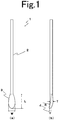
- an applicator has a cotton body (3) extending from an end portion of a shaft (2), the cotton body having a flat curved shape in which a maximum width W is 4.5 to 6.5 mm and a thickness T at a thickest portion is 2.0 to 3.6 mm, and an imaginary line (4) connecting a tip portion of the cotton body and a rear end central portion thereof has an inclination angle ⁇ of 25 to 35 degrees with respect to the shaft (2).
- a viscous cosmetic normally have a viscosity of 4000 mPa ⁇ s or more in order to obtain a thick applied layer and bring about excellent gloss and luster (the measured value is obtained using BL-type viscometer manufactured by Shibaura Semtek Co., Ltd. under the measurement condition of rotor No. 4 at 0.3 rpm). It is particularly preferred that the viscosity of the viscous cosmetic be 10000 to 100000 mPa ⁇ s in order to achieve a balance between the ease of application and excellent luster.
- the cotton body (3) has a flat curved shape so as to be able to reliably scoop the viscous cosmetic, come into firm contact with the application area, and easily spread the viscous cosmetic.
- the maximum width W of the cotton body (3) is 4.5 to 6.5 mm. While the maximum width W smaller than 4.5 mm results in a smaller amount of the cosmetic to be scooped and hence an insufficient amount of the cosmetic to be applied, the maximum width W greater than 6.5 mm makes it difficult to apply the cosmetic to small, fine areas, making the applicator less user-friendly.
- the thickness T of the thickest portion of the cotton body (3) is 2.0 to 3.6 mm.
- the thickness T of the thickest portion less than 2.0 mm makes the cotton body less rigid and consequently makes the cotton body become deformed easily, leading to difficulty in scooping and applying the viscos cosmetic. If the thickness T of the thickest portion is greater than 3.6 mm, however, the cotton body becomes excessively thick and scooping of the viscous cosmetic becomes difficult; the cosmetic cannot be applied to small, fine areas easily.
- the cotton body (3) has a shape that allows the imaginary line (4) to have the inclination angle ⁇ of 25 to 35 with respect to the shaft, the imaginary line (4) connecting the tip portion of the cotton body and the rear end central portion thereof.
- Providing the inclination angle ⁇ in the cotton body not only makes scooping of the cosmetic easy, but also allows the viscous cosmetic to be applied easily to the application area such as lips, enabling easy application of the viscous cosmetic and the like.
- a length L of the cotton body (3) be 10 to 17 mm and that a curvature radius R of the curved surface be 4.5 to 5.2 mm.
- a method for manufacturing the applicator is not particularly limited, and examples thereof include a method in which, first, a roll of paper is cut into a specific size and rolled using a roller to create a shaft. Secondly, cotton fibers that are detangled by a defibration machine are bonded to an end portion of the shaft having an adhesive applied thereto, by appropriately spraying an adhesive to the cotton fibers, thereby wrapping the cotton fibers around the end portion. Thereafter, the aggregate of the wrapped cotton fibers is compression-molded using a mold of a predetermined shape, thereby forming a flat, curved cotton body. After this molding process, the adhesive is dried in a drying step using hot air, a heater, or the like, thereby obtaining the applicator.
- the cotton body of the applicator needs to be durable to some extent so that the cotton fibers do not become loose and deformed during use.
- the durability of the cotton body changes significantly depending on the type or amount of the adhesive used for bonding the cotton fibers together.
- the type of the adhesive is preferably polyvinyl alcohol resin and the amount of the adhesive for bonding the cotton fibers is preferably 0.5 mg.
- Table 1 shows the results of evaluating "rigidity,” “amount of cosmetic scooped,” and “ease of application” corresponding to the cotton body of the applicator, with the shape of the cotton body being changed variously.
- the evaluation items such as “user-friendliness (easy of application to fine parts),” “degree of sticking of cosmetic to lips,” and “uniform application properties” in relation to the “ease of application” were evaluated by use tests by ten panelists.
- the evaluation criteria are categorized as follows: exceptional (pass), excellent (pass), marginal (fail), and poor (fail).
- Table 2 shows the results of evaluating "amount of cosmetic scooped,” “durability at one-time use,” and “ease of application” when the inclination angle ⁇ of the imaginary line with respect to the shaft was changed, the imaginary line connecting the tip portion of the cotton body and the rear end central portion thereof.
- Table 3 shows a relationship between each of the shapes of the cotton body and viscosities (degrees of hardness) of viscous cosmetics applied using the cotton body.
- the applicator of the present invention is capable of bringing about the excellent sense of usability especially when applying a viscous cosmetic. Moreover, although data are not provided, the use tests were able to confirm that the same sense of usability as those of applicators that normally accompany cosmetic containers were achieved.
- the effects of the type and amount (concentration of an adhesive solution) of the adhesive for bonding the cotton body of the applicator on the durability of the cotton body were evaluated next.
- There are two types of adhesives for bonding the cotton fibers of the cotton body a carboxymethyl cellulose solution, and a polyvinyl alcohol solution.
- the commercially available "UD Swab Shower” (manufactured by Heiwa Medic Inc.) was used as a carboxymethyl cellulose solution product of ordinary (conventional) concentration.
- the commercially available "UD Swab Universal Shaft” (manufactured by Heiwa Medic Inc.) was used as a polyvinyl alcohol solution product of ordinary (conventional) concentration.
- test cotton body For the polyvinyl alcohol solution, a solution having a higher concentration than the ordinary (conventional) concentration used in a commercial product was prepared to create a test cotton body.
- the test cotton body is usually obtained by spraying an adhesive solution in the step of wrapping the cotton fibers around the shaft and then dried and molded into a predetermined shape, but when a solution having a high concentration of polyvinyl alcohol is used, the cotton body is molded using 0.5-mg polyvinyl alcohol.
- a plurality of oils having different viscosities were used as test drugs. In the following table, the viscosities of the test drugs indicate the measurements obtained at 25°C.
- Table 4 shows the results of confirming a fray of fibers when the cotton body of the applicator was immersed in each test drug and then each test drug was applied to a lip after being left for ten minutes.
- the fibers did not fray when any of the test drugs was used, and favorable results were achieved in the viscosity range of 400 to 300000 mPa ⁇ s.
- Table 5 shows the results of observing how the fibers frayed after stirring 10 ml of each test drug ten times while having the cotton body of the applicator immersed therein.
- the polyvinyl alcohol solution (high concentration) of Example 1 With the polyvinyl alcohol solution (high concentration) of Example 1, none of the test drugs showed changes in appearance, and favorable results were achieved in the viscosity range of 400 to 300000 mPa ⁇ s.
- Table 6 shows the results of confirming a fray of fibers when 10 ml of each test drug was stirred ten times while having the cotton body of the applicator immersed therein and thereafter each test drug was applied to a lip.
- the fibers did not fray at any level of viscosity (400 to 300000 mPa ⁇ s), and each test drug was applied smoothly.
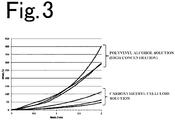
- Fig. 3 shows the results of measuring the hardness of the cotton body.
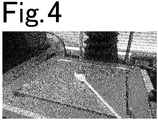
- the hardness of the cotton body was measured using the texture analyzer TA XT PLUS (manufactured by Stable Micro Systems) in which, as shown in Fig. 4 , a circular disc with a diameter of approximately 1 cm was pressed against the cotton body of the applicator placed on the table and lowered at a speed of 0.1 mm/sec, to measure the stress produced on the cotton body.
- the results were able to confirm that the cotton body adhered and molded using the polyvinyl alcohol solution (high concentration) had a higher hardness than the cotton body adhered and molded using the carboxymethyl cellulose solution and had strength which can withstand repeated use.
Landscapes
- Health & Medical Sciences (AREA)
- Life Sciences & Earth Sciences (AREA)
- Biomedical Technology (AREA)
- Heart & Thoracic Surgery (AREA)
- Engineering & Computer Science (AREA)
- Animal Behavior & Ethology (AREA)
- General Health & Medical Sciences (AREA)
- Public Health (AREA)
- Veterinary Medicine (AREA)
- Anesthesiology (AREA)
- Hematology (AREA)
- Epidemiology (AREA)
- Vascular Medicine (AREA)
- Coating Apparatus (AREA)
Abstract
Description
- The present invention relates to an applicator for applying viscous cosmetics such as lip gloss and viscous pharmaceutical preparations such as ointments.
- Viscous cosmetics such as lip gloss have been popular among consumers due to the cosmetic effects thereof that give lips a glossy luster to create three-dimensional lip looks, and viscous cosmetics of a wide variety of colors and textures are sold in the market.
- When a consumer purchases a viscous cosmetic at a store, the consumer may apply samples of the viscous cosmetic to his/her lips and select the product suiting him/her most. Applicators used for applying samples are preferably disposable for sanitary reasons so that the same applicators are not used by the next consumers. Furthermore, samples of viscous cosmetics distributed as free testers preferably accompany disposable applicators that can be used once or several times until using up the cosmetics.
- Although disposable, in order to evaluate a product using such a disposable applicator, the applicator needs to be designed to allow a consumer to scoop a sufficient amount of a viscous cosmetic and easily spread the cosmetic over the application area to adequately see the features of the product such as the color and texture thereof.
- For these reasons, as a disposable applicator that is used by a consumer at a store or the like to purchase a viscous cosmetic such as lip gloss, a disposable viscous cosmetic applicator that is not used by other consumers and is therefore sanitary and capable of reliably scooping the cosmetic, coming into firm contact with the application area and easily spreading the cosmetic needs to be developed. Even for viscous pharmaceutical preparations such as ointments, it is crucial to develop sanitary, disposable applicators that are used only once and capable of easily scooping and spreading the viscous preparations over the affected areas.
- [PTL 1] Japanese Patent Application Laid-open No.
2003-199616 - An object of the present invention is to provide an applicator used for applying viscous cosmetics such as lip gloss and viscous pharmaceutical preparations such as ointments, the applicator being sanitary and disposable but capable of reliably scooping the cosmetic or pharmaceutical preparation, coming into firm contact with the application area, and easily spreading the cosmetic or pharmaceutical preparation.
- As a result of studies in order to achieve the foregoing object, the inventors of the present invention have discovered an applicator which, while sanitary and disposable, can reliably scoop a viscous cosmetic such as lip gloss, come into firm contact with the application area, and easily spread the viscous cosmetic, by shaping a cotton body extending from an end portion of a shaft into a predetermined flat curved shaped. As a result, the inventors have completed the present invention.
- Specifically, the present invention is an applicator having a cotton body that extends from an end portion of a shaft and has a flat curved shape in which a maximum width is 4.5 to 6.5 mm and a thickness at a thickest portion is 2.0 to 3.6 mm, wherein an imaginary line connecting a tip portion of the cotton body and a rear end central portion thereof has an inclination angle of 25 to 35 degrees with respect to the shaft.
- Furthermore, the present invention is an applicator in which the cotton body is formed of an aggregate of cotton fibers bonded together with 0.5 mg of polyvinyl alcohol resin.
- Moreover, the present invention is a viscous cosmetic applicator having a cotton body that extends from an end portion of a shaft and has a flat curved shape in which a maximum width is 4.5 to 6.5 mm and a thickness at a thickest portion is 2.0 to 3.6 mm, wherein an imaginary line connecting a tip portion of the cotton body and a rear end central portion thereof has an inclination angle of 25 to 35 degrees with respect to the shaft.
- Further, the present invention is a viscous cosmetic applicator in which the cotton body is formed of an aggregate of cotton fibers bonded together with 0.5 mg of polyvinyl alcohol resin.
- In addition, the present invention is a viscous cosmetic applicator capable of applying a viscous cosmetic having a viscosity of 400 to 300000 mPa·s.
- Also, the present invention is a method for using an applicator, the method including scooping and applying a viscous cosmetic or a viscous pharmaceutical preparation by using the foregoing applicator.
- Furthermore, the present invention a method for using a viscous cosmetic applicator, the method including scooping and applying a viscous cosmetic by using the foregoing viscous cosmetic applicator.
- According to the applicator of the present invention, an applicator used for applying various viscous substances such as viscous cosmetics and viscous pharmaceutical preparations can be made sanitary and disposable and configured to reliably scoop a viscous cosmetic such as lip gloss, come into firm contact with the application area, and easily spread the viscous cosmetic thereon. Moreover, according to the applicator of the present invention, although disposable, the same excellent sense of usability as that of a resin applicator that normally accompanies a cosmetic container and an applicator with a flocking-finished surface.
- Additionally, since the viscous cosmetic applicator of the present invention has necessary durability, the user can use a sample of a viscous cosmetic distributed as a free tester, once or several times repeatedly until using up the cosmetic.
-
- [
Fig. 1 ]
Fig. 1 is an external view ((a) front view, (b) side view) of an applicator. - [
Fig. 2 ]
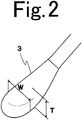
Fig. 2 is an enlarged perspective view of a cotton body. - [
Fig. 3 ]
Fig. 3 is a graph showing the hardness of the cotton body. - [
Fig. 4 ]
Fig. 4 is a diagram showing how the hardness of the cotton body is measured (a diagram-substituted photograph). - As shown in
Fig. 1 , an applicator according to the present invention has a cotton body (3) extending from an end portion of a shaft (2), the cotton body having a flat curved shape in which a maximum width W is 4.5 to 6.5 mm and a thickness T at a thickest portion is 2.0 to 3.6 mm, and an imaginary line (4) connecting a tip portion of the cotton body and a rear end central portion thereof has an inclination angle θ of 25 to 35 degrees with respect to the shaft (2). - It is preferred that a viscous cosmetic normally have a viscosity of 4000 mPa·s or more in order to obtain a thick applied layer and bring about excellent gloss and luster (the measured value is obtained using BL-type viscometer manufactured by Shibaura Semtek Co., Ltd. under the measurement condition of rotor No. 4 at 0.3 rpm). It is particularly preferred that the viscosity of the viscous cosmetic be 10000 to 100000 mPa·s in order to achieve a balance between the ease of application and excellent luster.
- The cotton body (3) has a flat curved shape so as to be able to reliably scoop the viscous cosmetic, come into firm contact with the application area, and easily spread the viscous cosmetic.
- The maximum width W of the cotton body (3) is 4.5 to 6.5 mm. While the maximum width W smaller than 4.5 mm results in a smaller amount of the cosmetic to be scooped and hence an insufficient amount of the cosmetic to be applied, the maximum width W greater than 6.5 mm makes it difficult to apply the cosmetic to small, fine areas, making the applicator less user-friendly.
- The thickness T of the thickest portion of the cotton body (3) is 2.0 to 3.6 mm. The thickness T of the thickest portion less than 2.0 mm makes the cotton body less rigid and consequently makes the cotton body become deformed easily, leading to difficulty in scooping and applying the viscos cosmetic. If the thickness T of the thickest portion is greater than 3.6 mm, however, the cotton body becomes excessively thick and scooping of the viscous cosmetic becomes difficult; the cosmetic cannot be applied to small, fine areas easily.
- Also, the cotton body (3) has a shape that allows the imaginary line (4) to have the inclination angle θ of 25 to 35 with respect to the shaft, the imaginary line (4) connecting the tip portion of the cotton body and the rear end central portion thereof. Providing the inclination angle θ in the cotton body not only makes scooping of the cosmetic easy, but also allows the viscous cosmetic to be applied easily to the application area such as lips, enabling easy application of the viscous cosmetic and the like.
- In addition, it is preferred that a length L of the cotton body (3) be 10 to 17 mm and that a curvature radius R of the curved surface be 4.5 to 5.2 mm. The reason is because, in a case where the viscos cosmetic is a lip gloss, the cotton body needs to have a shape allowing the cosmetic to easily stick to the application area, i.e., the lips.
- A method for manufacturing the applicator is not particularly limited, and examples thereof include a method in which, first, a roll of paper is cut into a specific size and rolled using a roller to create a shaft. Secondly, cotton fibers that are detangled by a defibration machine are bonded to an end portion of the shaft having an adhesive applied thereto, by appropriately spraying an adhesive to the cotton fibers, thereby wrapping the cotton fibers around the end portion. Thereafter, the aggregate of the wrapped cotton fibers is compression-molded using a mold of a predetermined shape, thereby forming a flat, curved cotton body. After this molding process, the adhesive is dried in a drying step using hot air, a heater, or the like, thereby obtaining the applicator.
- The cotton body of the applicator needs to be durable to some extent so that the cotton fibers do not become loose and deformed during use. However, the durability of the cotton body changes significantly depending on the type or amount of the adhesive used for bonding the cotton fibers together. For this reason, when creating the cotton body, it is desirable not only to select the most appropriate adhesive to be used in the step of wrapping the cotton fibers around the shaft, but also to thoroughly bond the cotton fibers together by spraying an appropriate amount of the adhesive thereto to create an aggregate of cotton fibers. For example, the type of the adhesive is preferably polyvinyl alcohol resin and the amount of the adhesive for bonding the cotton fibers is preferably 0.5 mg.
- The following examples describe in detail the results of verification tests of the effects of the present invention.
- Table 1 shows the results of evaluating "rigidity," "amount of cosmetic scooped," and "ease of application" corresponding to the cotton body of the applicator, with the shape of the cotton body being changed variously. The evaluation items such as "user-friendliness (easy of application to fine parts)," "degree of sticking of cosmetic to lips," and "uniform application properties" in relation to the "ease of application" were evaluated by use tests by ten panelists.
- The evaluation criteria are categorized as follows: exceptional (pass), excellent (pass), marginal (fail), and poor (fail).
-
[Table 1] Comparative Example 1 Comparative Example 2 Example 1 Example 2 Example 3 Comparative Example 3 Comparative Example 4 Shape of Cotton Body Maximum Width W (unit: mm) 3.0 4.0 4.5 5.5 6.5 7.0 8.0 Thickness T of Thickest Portion (unit: mm) 5.0 4.0 3.6 2.8 2.0 1.5 1.0 Inclination angle θ (unit: °) Approximately 30° Evaluation (*1) Rigidity Excellent Excellent Excellent Excellent Excellent Marginal Poor Amount of Cosmetic Scooped Poor Poor Exceptional Exceptional Exceptional Marginal Poor Ease of Application User-friendliness (ease of application to fine parts) Marginal Excellent Exceptional Exceptional Exceptional Marginal Poor Degree of sticking of cosmetic to application area (lips) Poor Marginal Exceptional Exceptional Exceptional Marginal Poor Free of unevenness/Uniform application properties Poor Marginal Exceptional Exceptional Exceptional Marginal Poor Overall evaluation Poor Marginal Exceptional Exceptional Exceptional Poor Poor *1 "Amount of cosmetic scooped" and "ease of application" were evaluated using lip gloss having viscosity of 56600 mPa·s. - As shown in Table 1, in Examples 1 to 3 in which the maximum width W of the cotton body was 4.5 to 6.5 mm and the thickness T of the thickest portion was 3.6 to 2.0 mm, the "rigidity" was excellent and "exceptional (pass)" results were obtained for the evaluation items, "amount of cosmetic scooped" and "ease of application."
- Table 2 shows the results of evaluating "amount of cosmetic scooped," "durability at one-time use," and "ease of application" when the inclination angle θ of the imaginary line with respect to the shaft was changed, the imaginary line connecting the tip portion of the cotton body and the rear end central portion thereof. The evaluation item, "durability at one-time use," was evaluated by making sure that the inclination angle θ did not change at one-time use.
[Table 2] Comparative Example 5 Example 4 Example 5 Example 6 Comparative Example 6 Comparative Example 7 Shape of Cotton Body Inclination angle θ (unit: °) Maximum Width W: 5.5 mm, Thickness T of Thickest portion: 2.8 mm 0° 25° 30° 35° 45° 90° Evaluation (*1) Amount of Cosmetic Scooped Poor Exceptional Exceptional Exceptional Marginal Poor Durability at One-time Use (*2) Exceptional Exceptional Exceptional Exceptional Poor Poor Ease of Application User-friendliness (ease of application to fine parts) Excellent Exceptional Exceptional Exceptional Poor Poor Degree of sticking of cosmetic to application area (lips) Marginal Exceptional Exceptional Exceptional Poor Poor Uniform application properties Marginal Exceptional Exceptional Exceptional Poor Poor *1 "Amount of cosmetic scooped," "durability at one-time use," and "ease of application" were evaluated using lip gloss having viscosity of 56600 mPa·s.
*2 The fact that the inclination angle did not change at one-time use was confirmed. - As shown in Table 2, in Examples 4 to 6 in which the inclination angle θ of the imaginary line with respect to the shaft was 25 to 35 degrees, the imaginary line connecting the tip portion of the cotton body and the rear end central portion thereof, "exceptional (pass)" results were obtained for the evaluation items, "amount of cosmetic scooped," "durability at one-time use," and "ease of application."
- Table 3 shows a relationship between each of the shapes of the cotton body and viscosities (degrees of hardness) of viscous cosmetics applied using the cotton body. Using the applicator having the variously shaped cotton body, the "amount of cosmetic scooped" and the "ease of application" were evaluated when the viscous cosmetics of various viscosities (degrees of hardness) were applied.
[Table 3] Comparative Example 8 Comparative Example 9 Example 7 Example 8 Example 9 Comparative Example 10 Comparative Example 11 Shape of Cotton Body Maximum Width W (unit: mm) 3.0 4.0 4.5 5.5 6.5 7.0 8.0 Thickness T of Thickest Portion (unit: mm) 5.0 4.0 3.6 2.8 2.0 1.5 1.0 Inclination angle θ (unit: °) Approximately 30° Viscosity of Viscous Cosmetic (mPa·s) 19300 Evaluation (Overall evaluation on amount of cosmetic scooped/easiness of application) Poor/Poor Marginal/Excellent Excellent/Exceptional Exceptional/Exceptional Excellent/Exceptional Poor/Marginal Poor/Marginal 39500 Poor/Poor Poor/Marginal Excellent/Exceptional Exceptional/Exceptional Excellent/Exceptional Marginal/Marginal Poor/Marginal 56600 Poor/Poor Poor/Marginal Exceptional/Exceptional Exceptional/Exceptional Exceptional/Exceptional Marginal/Marginal Poor/Poor Hardness of Viscous Cosmetic 30 Excellent/Poor Excellent/Poor Excellent/Exceptional Exceptional/Exceptional Excellent/Exceptional Marginal/Poor Marginal/Poor - As shown in Table 3, the use tests were able to confirm that in Examples 7 to 9 in which the maximum width W of the cotton body was 4.5 to 6.5 mm and the thickness T of the thickest portion was 3.6 to 2.0, favorable results were obtained for the "amount of cosmetic scooped" and "ease of application" when viscous cosmetics having a viscosity of 19300 to 56600 mPa·s and a hardness of 30 were applied.
- Although disposable, the applicator of the present invention is capable of bringing about the excellent sense of usability especially when applying a viscous cosmetic. Moreover, although data are not provided, the use tests were able to confirm that the same sense of usability as those of applicators that normally accompany cosmetic containers were achieved.
- The effects of the type and amount (concentration of an adhesive solution) of the adhesive for bonding the cotton body of the applicator on the durability of the cotton body were evaluated next. There are two types of adhesives for bonding the cotton fibers of the cotton body: a carboxymethyl cellulose solution, and a polyvinyl alcohol solution. The commercially available "UD Swab Shower" (manufactured by Heiwa Medic Inc.) was used as a carboxymethyl cellulose solution product of ordinary (conventional) concentration. The commercially available "UD Swab Universal Shaft" (manufactured by Heiwa Medic Inc.) was used as a polyvinyl alcohol solution product of ordinary (conventional) concentration. For the polyvinyl alcohol solution, a solution having a higher concentration than the ordinary (conventional) concentration used in a commercial product was prepared to create a test cotton body. The test cotton body is usually obtained by spraying an adhesive solution in the step of wrapping the cotton fibers around the shaft and then dried and molded into a predetermined shape, but when a solution having a high concentration of polyvinyl alcohol is used, the cotton body is molded using 0.5-mg polyvinyl alcohol. Note that in the durability test, a plurality of oils having different viscosities were used as test drugs. In the following table, the viscosities of the test drugs indicate the measurements obtained at 25°C.

- Table 4 shows the results of confirming a fray of fibers when the cotton body of the applicator was immersed in each test drug and then each test drug was applied to a lip after being left for ten minutes. With the polyvinyl alcohol solution (high concentration) of Example 1, the fibers did not fray when any of the test drugs was used, and favorable results were achieved in the viscosity range of 400 to 300000 mPa·s.

- Table 5 shows the results of observing how the fibers frayed after stirring 10 ml of each test drug ten times while having the cotton body of the applicator immersed therein. With the polyvinyl alcohol solution (high concentration) of Example 1, none of the test drugs showed changes in appearance, and favorable results were achieved in the viscosity range of 400 to 300000 mPa·s.

- Table 6 shows the results of confirming a fray of fibers when 10 ml of each test drug was stirred ten times while having the cotton body of the applicator immersed therein and thereafter each test drug was applied to a lip. With the polyvinyl alcohol solution (high concentration) of Example 1, the fibers did not fray at any level of viscosity (400 to 300000 mPa·s), and each test drug was applied smoothly.
-
Fig. 3 shows the results of measuring the hardness of the cotton body. The hardness of the cotton body was measured using the texture analyzer TA XT PLUS (manufactured by Stable Micro Systems) in which, as shown inFig. 4 , a circular disc with a diameter of approximately 1 cm was pressed against the cotton body of the applicator placed on the table and lowered at a speed of 0.1 mm/sec, to measure the stress produced on the cotton body. - As shown in
Fig. 3 , the results were able to confirm that the cotton body adhered and molded using the polyvinyl alcohol solution (high concentration) had a higher hardness than the cotton body adhered and molded using the carboxymethyl cellulose solution and had strength which can withstand repeated use. -
- 1
- Applicator
- 2
- Shaft
- 3
- Cotton body
- 4
- Imaginary line
Claims (7)
- An applicator, comprising a cotton body that extends from an end portion of a shaft and has a flat curved shape in which a maximum width is 4.5 to 6.5 mm and a thickness at a thickest portion is 2.0 to 3.6 mm, wherein an imaginary line connecting a tip portion of the cotton body and a rear end central portion thereof has an inclination angle of 25 to 35 degrees with respect to the shaft.
- The applicator according to claim 1, wherein the cotton body is formed of an aggregate of cotton fibers bonded together with 0.5 mg of polyvinyl alcohol resin.
- A viscous cosmetic applicator, comprising a cotton body that extends from an end portion of a shaft and has a flat curved shape in which a maximum width is 4.5 to 6.5 mm and a thickness at a thickest portion is 2.0 to 3.6 mm, wherein an imaginary line connecting a tip portion of the cotton body and a rear end central portion thereof has an inclination angle of 25 to 35 degrees with respect to the shaft.
- The viscous cosmetic applicator according to claim 3, wherein the cotton body is formed of an aggregate of cotton fibers bonded together with 0.5 mg of polyvinyl alcohol resin.
- The viscous cosmetic applicator according to claim 4, which is used for applying a viscous cosmetic having a viscosity of 400 to 300000 mPa·s.
- A method for using an applicator, the method comprising scooping and applying a viscous cosmetic or a viscous pharmaceutical preparation by using the applicator according to claim 1 or 2.
- A method for using a viscous cosmetic applicator, the method comprising scooping and applying a viscous cosmetic by using the viscous cosmetic applicator according to any one of claims 3 to 5.
Applications Claiming Priority (2)
| Application Number | Priority Date | Filing Date | Title |
|---|---|---|---|
| JP2016183227 | 2016-09-20 | ||
| PCT/JP2017/033727 WO2018056261A1 (en) | 2016-09-20 | 2017-09-19 | Disposable applicator |
Publications (2)
| Publication Number | Publication Date |
|---|---|
| EP3516983A1 true EP3516983A1 (en) | 2019-07-31 |
| EP3516983A4 EP3516983A4 (en) | 2020-06-03 |
Family
ID=61689845
Family Applications (1)
| Application Number | Title | Priority Date | Filing Date |
|---|---|---|---|
| EP17853033.3A Withdrawn EP3516983A4 (en) | 2016-09-20 | 2017-09-19 | Disposable applicator |
Country Status (7)
| Country | Link |
|---|---|
| US (1) | US20190380884A1 (en) |
| EP (1) | EP3516983A4 (en) |
| JP (1) | JP7110101B2 (en) |
| KR (1) | KR20190050789A (en) |
| CN (1) | CN109715005A (en) |
| TW (1) | TW201825026A (en) |
| WO (1) | WO2018056261A1 (en) |
Cited By (1)
| Publication number | Priority date | Publication date | Assignee | Title |
|---|---|---|---|---|
| FR3102651A1 (en) * | 2019-10-30 | 2021-05-07 | Parfums Christian Dior | manufacturing process of an applicator for cosmetic product |
Families Citing this family (1)
| Publication number | Priority date | Publication date | Assignee | Title |
|---|---|---|---|---|
| CN116448494A (en) * | 2022-01-10 | 2023-07-18 | 浙江东方基因生物制品股份有限公司 | Apparatus for producing collector for collecting sample |
Family Cites Families (20)
| Publication number | Priority date | Publication date | Assignee | Title |
|---|---|---|---|---|
| JPS55179604U (en) * | 1979-06-11 | 1980-12-24 | ||
| JPS58153844U (en) * | 1982-04-09 | 1983-10-14 | ピジヨン株式会社 | cotton swab |
| JPS6057317U (en) * | 1983-09-27 | 1985-04-22 | 中村 剛士 | cotton swab |
| US4767398A (en) * | 1986-04-25 | 1988-08-30 | Chesebrough-Pond's Inc. | Swab applicator comprising a flock swab tip |
| FR2786674B1 (en) * | 1998-12-03 | 2001-01-05 | Oreal | APPLICATION MEMBER FOR APPLYING A PRODUCT TO THE SKIN AND ASSEMBLY THEREOF |
| JP3069066U (en) * | 1999-11-18 | 2000-05-30 | 有限会社 エコ・テックス | Cotton swab |
| JP2003199616A (en) | 2001-11-21 | 2003-07-15 | Nippon Shikizai Inc | Viscous cosmetic applicator |
| CN2552517Y (en) * | 2002-05-27 | 2003-05-28 | 潮阳市泰恩康医用器材厂有限公司 | Cotton stick with liquid medicine |
| ES2293128T3 (en) * | 2004-07-09 | 2008-03-16 | JOHNSON & JOHNSON GMBH | COSMETIC COMPOSITION FOR DESMAQUILLAR AND APPLICATOR THAT INCLUDES SUCH COMPOSITION |
| JP2007000571A (en) * | 2005-06-21 | 2007-01-11 | Tomoko Nagao | Tool for assisting make-up |
| USD541979S1 (en) * | 2005-12-30 | 2007-05-01 | Crown Packaging Technology, Inc. | Spatula surface cosmetic applicator |
| JP2008132011A (en) * | 2006-11-27 | 2008-06-12 | Glory Sangyo Kk | Swab comprising hydrophilic continuous porous member |
| JP2011001303A (en) * | 2009-06-19 | 2011-01-06 | Mandom Corp | Lip gloss product |
| WO2011043470A1 (en) * | 2009-10-09 | 2011-04-14 | 花王株式会社 | Lip cosmetic application device |
| JP4840831B2 (en) * | 2010-04-27 | 2011-12-21 | 株式会社 資生堂 | Cosmetic application body |
| JP2011234666A (en) * | 2010-05-10 | 2011-11-24 | Sanyo:Kk | Swab |
| JP2013138760A (en) * | 2011-12-30 | 2013-07-18 | Kao Corp | Cosmetic material coating container |
| WO2015075626A1 (en) * | 2013-11-19 | 2015-05-28 | L'oreal | Applicator for cosmetic use |
| FR3026281B1 (en) * | 2014-09-25 | 2018-08-24 | L'oreal | APPLICATION MEMBER HAVING TWO ASSEMBLED PARTS. |
| JP6282972B2 (en) * | 2014-12-10 | 2018-02-21 | 有限会社佐藤化成工業所 | Cotton ball and cotton swab manufacturing method |
-
2017
- 2017-09-19 KR KR1020197007884A patent/KR20190050789A/en not_active Ceased
- 2017-09-19 US US16/334,231 patent/US20190380884A1/en not_active Abandoned
- 2017-09-19 CN CN201780058107.3A patent/CN109715005A/en active Pending
- 2017-09-19 WO PCT/JP2017/033727 patent/WO2018056261A1/en not_active Ceased
- 2017-09-19 EP EP17853033.3A patent/EP3516983A4/en not_active Withdrawn
- 2017-09-19 JP JP2018541067A patent/JP7110101B2/en active Active
- 2017-09-20 TW TW106132323A patent/TW201825026A/en unknown
Cited By (1)
| Publication number | Priority date | Publication date | Assignee | Title |
|---|---|---|---|---|
| FR3102651A1 (en) * | 2019-10-30 | 2021-05-07 | Parfums Christian Dior | manufacturing process of an applicator for cosmetic product |
Also Published As
| Publication number | Publication date |
|---|---|
| JP7110101B2 (en) | 2022-08-01 |
| JPWO2018056261A1 (en) | 2019-10-10 |
| KR20190050789A (en) | 2019-05-13 |
| US20190380884A1 (en) | 2019-12-19 |
| CN109715005A (en) | 2019-05-03 |
| TW201825026A (en) | 2018-07-16 |
| EP3516983A4 (en) | 2020-06-03 |
| WO2018056261A1 (en) | 2018-03-29 |
Similar Documents
| Publication | Publication Date | Title |
|---|---|---|
| AU2022246369B2 (en) | Applicators and cases for artificial lash extensions | |
| Ergücü et al. | Color stability of nanocomposites polished with one-step systems | |
| CN104349695B (en) | Cosmetics applicator | |
| Kursoglu et al. | Correlation of surface texture with the stainability of ceramics | |
| US20190380884A1 (en) | Disposable applicator | |
| JP2010527992A (en) | Kit and method for applying hair treatment | |
| Jalali et al. | In vitro color stability of provisional restorative materials | |
| JP2021535821A (en) | Mascara applicator | |
| CN106714602B (en) | False eyelashes sticking device and false eyelashes set | |
| TW201234990A (en) | Internally fed applicator | |
| Turkun et al. | Can wheel polishers improve surface properties and color stability of monochromatic resin composites? | |
| Johnson et al. | Retention of metal-ceramic crowns with contemporary dental cements | |
| US20220264980A1 (en) | Cosmetic article | |
| Barkmeier et al. | Wear simulation of resin composites and the relationship to clinical wear | |
| JP7550353B2 (en) | Cosmetic sheet and its manufacturing method, cosmetic set, and method for applying thin film sheet | |
| Çeliksöz et al. | Evaluation of color stability of bulk-fill restorative materials with different properties | |
| HK40000616A (en) | Disposable applicator | |
| Safa’a et al. | Chromatic stability of light-activated resin and heat-cure acrylic resin submitted to accelerated aging | |
| Rosentritt et al. | Laboratory tests for assessing adaptability and stickiness of dental composites | |
| Caldwell | A method of measuring the adhesion of foodstuffs to tooth surfaces | |
| JP6311227B2 (en) | Application brush | |
| Sreelal et al. | Evaluation of Influence of Die Spacer Thickness on the Shear Bond Strength of Porcelain Laminate Veneers: An In-vitro Study. | |
| KR20120050056A (en) | Quantitative estimating method to skin adhesion of cosmetics goods | |
| JOSE et al. | ASSESSMENT OF INFLUENCE OF POLISHING ON THE QUALITY OF CLASS 1 AMALGAM RESTORATION-A RETROSPECTIVE ANALYSIS | |
| Win et al. | Process‑oriented surface modification strategies to optimize interface-only bonding performance of 3D‑printed dental polymers |
Legal Events
| Date | Code | Title | Description |
|---|---|---|---|
| STAA | Information on the status of an ep patent application or granted ep patent |
Free format text: STATUS: THE INTERNATIONAL PUBLICATION HAS BEEN MADE |
|
| PUAI | Public reference made under article 153(3) epc to a published international application that has entered the european phase |
Free format text: ORIGINAL CODE: 0009012 |
|
| STAA | Information on the status of an ep patent application or granted ep patent |
Free format text: STATUS: REQUEST FOR EXAMINATION WAS MADE |
|
| 17P | Request for examination filed |
Effective date: 20190320 |
|
| AK | Designated contracting states |
Kind code of ref document: A1 Designated state(s): AL AT BE BG CH CY CZ DE DK EE ES FI FR GB GR HR HU IE IS IT LI LT LU LV MC MK MT NL NO PL PT RO RS SE SI SK SM TR |
|
| AX | Request for extension of the european patent |
Extension state: BA ME |
|
| DAV | Request for validation of the european patent (deleted) | ||
| DAX | Request for extension of the european patent (deleted) | ||
| A4 | Supplementary search report drawn up and despatched |
Effective date: 20200508 |
|
| RIC1 | Information provided on ipc code assigned before grant |
Ipc: A45D 34/04 20060101AFI20200501BHEP Ipc: A61M 35/00 20060101ALI20200501BHEP |
|
| STAA | Information on the status of an ep patent application or granted ep patent |
Free format text: STATUS: THE APPLICATION IS DEEMED TO BE WITHDRAWN |
|
| 18D | Application deemed to be withdrawn |
Effective date: 20201208 |