EP3516623B1 - Method and apparatus for image processing - Google Patents
Method and apparatus for image processing Download PDFInfo
- Publication number
- EP3516623B1 EP3516623B1 EP17771566.1A EP17771566A EP3516623B1 EP 3516623 B1 EP3516623 B1 EP 3516623B1 EP 17771566 A EP17771566 A EP 17771566A EP 3516623 B1 EP3516623 B1 EP 3516623B1
- Authority
- EP
- European Patent Office
- Prior art keywords
- movement
- subject
- video image
- cells
- video
- Prior art date
- Legal status (The legal status is an assumption and is not a legal conclusion. Google has not performed a legal analysis and makes no representation as to the accuracy of the status listed.)
- Active
Links
Images

Classifications
-
- G—PHYSICS
- G06—COMPUTING OR CALCULATING; COUNTING
- G06T—IMAGE DATA PROCESSING OR GENERATION, IN GENERAL
- G06T7/00—Image analysis
- G06T7/20—Analysis of motion
- G06T7/262—Analysis of motion using transform domain methods, e.g. Fourier domain methods
-
- G—PHYSICS
- G06—COMPUTING OR CALCULATING; COUNTING
- G06T—IMAGE DATA PROCESSING OR GENERATION, IN GENERAL
- G06T7/00—Image analysis
- G06T7/97—Determining parameters from multiple pictures
-
- G—PHYSICS
- G06—COMPUTING OR CALCULATING; COUNTING
- G06V—IMAGE OR VIDEO RECOGNITION OR UNDERSTANDING
- G06V20/00—Scenes; Scene-specific elements
- G06V20/40—Scenes; Scene-specific elements in video content
- G06V20/46—Extracting features or characteristics from the video content, e.g. video fingerprints, representative shots or key frames
-
- G—PHYSICS
- G08—SIGNALLING
- G08B—SIGNALLING SYSTEMS, e.g. PERSONAL CALLING SYSTEMS; ORDER TELEGRAPHS; ALARM SYSTEMS
- G08B21/00—Alarms responsive to a single specified undesired or abnormal condition and not otherwise provided for
- G08B21/02—Alarms for ensuring the safety of persons
- G08B21/04—Alarms for ensuring the safety of persons responsive to non-activity, e.g. of elderly persons
- G08B21/0438—Sensor means for detecting
- G08B21/0476—Cameras to detect unsafe condition, e.g. video cameras
-
- G—PHYSICS
- G06—COMPUTING OR CALCULATING; COUNTING
- G06T—IMAGE DATA PROCESSING OR GENERATION, IN GENERAL
- G06T2207/00—Indexing scheme for image analysis or image enhancement
- G06T2207/10—Image acquisition modality
- G06T2207/10016—Video; Image sequence
-
- G—PHYSICS
- G06—COMPUTING OR CALCULATING; COUNTING
- G06V—IMAGE OR VIDEO RECOGNITION OR UNDERSTANDING
- G06V20/00—Scenes; Scene-specific elements
- G06V20/40—Scenes; Scene-specific elements in video content
- G06V20/44—Event detection
Definitions
- the present invention relates to a method and apparatus for image processing, and in particular for processing video images.
- the automatic analysis and processing of video images is of interest in a wide variety of fields.
- proposals have been made for analysing the video images to detect the vital signs (such as heart rate, breathing rate, blood oxygen saturation) of the subject.
- Such analysis may be based on the PPGi signal in the image as in WO-A2-20131027027 or on detecting fine movement associated with breathing or heart beat or a combination of the two.
- illumination changes can often confound automated image analysis.
- an effect such as a cloud passing in front of the sun or trees, bushes or vehicles passing between a window illuminating the scene and the sky or sun, may cause fast movements to appear in the image as shadows, or changes in illumination, passing across the scene.
- One part of a scene may be in strong sunlight and one in shade creating an apparent edge, which may move. Distinguishing such changes from subject movement is a difficult problem.
- One aspect of the problem which makes it tough to solve is that one part of the scene may remain under steady illumination (sunlit or shaded) while another part of a scene has large illumination changes.
- a scene may also be illuminated by a combination of daylight and artificial light, either of which may be at times stable and at times change rapidly. So a global solution (i.e. across the whole image frame) may not work properly.
- US-A1-2003/0138149 and EP-A2-1571594 disclose methods of detecting scene changes and object changes respectively in video sequences and distinguishing them from illumination changes by calculating the magnitude of changes in selected DCT coefficients between frames of the sequence.
- This method is effective at distinguishing between gross subject movement and fine or no movement in a way which is unaffected by a changes in illumination caused, for example, by movement of sunlit areas, because image texture, such as is commonly associated with subjects of interest, show up well in a spatial frequency analysis of the image (i.e. have a lot of spatial frequency content), so if the subject (associated with image texture) has gross movement, this will be seen in a high number of large magnitude changes in the spatial frequency components between the two frames under consideration.
- sunlight changes tend to have lower amounts of spatial frequency information in them, thus producing a lower number of large magnitude differences in spatial frequency components between the two frames.
- gross movement of the subject is meant large movement of the subject, the subject as a whole moving (e.g. walking, running, jumping) or movements of whole body parts of the subject (e.g. movement of arms or legs), contrasted with “fine movement”, which is the type of small distance movement associated with breathing, heart beat, natural trembling or unconscious movement of the body.
- the first and second thresholds may be set by observing video sequences of a subject and scene being imaged and setting thresholds to distinguish gross movement from fine movement and illumination changes.
- the characterisation of gross movement in the video image sequence is conducted with reference to a threshold which is preferably set in a calibration process.
- the aim is to distinguish large movements, such as a subject deliberately walking around, moving their arms, or changing position when lying or seated, from the smaller, e.g. unconscious, movements related to, for example, breathing or the cardiac cycle, such as chest rise and fall, small head movement, etc..
- the distance that such a gross movement or fine movement corresponds to in the individual image frames of the video image sequence depends on the field of view of the video camera and the hardware used (optics and sensor).
- a threshold which distinguishes the two types of movement can be established for any given equipment in a calibration process by capturing a video image sequence of a volunteer who is asked, on the one hand, to perform gross movement, such as walking around, moving arms, or changing position when seated or lying, and on the other hand to remain as still as possible, while breathing normally.
- gross movement such as walking around, moving arms, or changing position when seated or lying
- the thresholds can be set which distinguishes between them and characterises the gross movement and the fine movement.
- the first and second thresholds are set in a parameter tuning process comprising the steps of: capturing a video image sequence of a subject who is performing gross movement; capturing a video image sequence containing an illumination change; and setting the first threshold to maximise the difference in the number of cells and spatial frequency components for which the magnitude differences are greater than the first threshold between the two video image sequences.
- the second threshold is also set by observing the number of cells and spatial frequency components for which the magnitude differences are greater than the first threshold between the two video image sequences.
- the magnitude of the spatial frequency components (also known as the 2D power spectrum) in each of the cells in each of the selected image frames may be calculated by a two-dimensional fast Fourier transform in each cell or by another known spectral analysis technique.
- the spatial frequency magnitudes may be respectively normalised by the largest value of the magnitude of each spatial frequency component before taking the differences which improves invariance to illumination changes.
- the mean or sum of the number of cells and spatial frequency components for which the magnitude differences are greater than the first threshold is preferably compared to the second threshold to perform said determination that the video sequence contains an illumination change rather than movement.
- the image frames may be subdivided into a rectangular, e.g. square, grid of the cells and the method may be repeated on the video image with a different number or size of cells. Larger cells are more robust to noise and complex changes in illumination whereas smaller cells are more sensitive to smaller movements.
- the invention also provides an apparatus for analysing video image in accordance with the method above, the apparatus comprising the features of claim 9.
- the apparatus may be part of a video monitoring system including a video camera to capture video images and a display to display the captured video together with the results of the image analysis. This may form part of a health or welfare monitoring system or a security monitoring system.
- the video camera is preferably a standard digital video camera so that the video image sequence is a conventional frame sequence with each frame comprising an array of pixel intensities.
- the camera may be monochrome or may be a colour camera providing pixel intensities in the red, green and blue channels.
- the invention may be embodied in a computer program for processing a captured video image sequence in accordance with the invention according to claim 10.
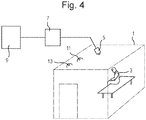
- FIG. 4 schematically illustrates an apparatus in accordance with an embodiment of the invention being used to monitor a subject 3 in a room 1.
- the room 1 can be a secure room such as a police or prison cell or some other detention facility, or could be a room in a hospital or other care facility such as a care home, sheltered accommodation or the subject's own home.
- the subject 3 is monitored by a video camera 5 whose output is processed by a video signal processor 7 and the results of the analysis are displayed on a display 9 which is visible to staff of the facility.
- the video signal processor 7 may be a dedicated signal processor or a programmed general purpose computer.
- the room may be naturally lit, e.g. via window 10 and may be artificially illuminated using a visible light source 11 or infrared light source 13.
- the video camera 5 is a standard digital video camera outputting video data in the form of a sequence of image frames, each frame being a pixel array of intensities in red, green, blue channels.
- the red, green and blue channels also give a response in the infrared range allowing the production of an infrared (IR) image useful when the room is dark.
- Video cameras of this type typically output the signal at twenty frames per second, though of course different frame rates are possible.
- the display 9 preferably displays the video image of the room and also displays information regarding the health or safety of the subject 3. This information is preferably:-
- Staff monitoring the subject by way of the display 9 can therefore tell at any given time whether the subject is considered safe, for example because they are moving or because the vital signs are being detected and are in a physiologically normal range, or whether the system is unable to detect vital signs and safe movement is detected (and for how long that situation has persisted), or that no vital signs and no movement is detected, in which case an alert is generated willing staff to check the subject. If the lack of vital signs detection persists for more than a configurable amount of time an alert may be generated to call on staff to check the subject. Alerts can include a range of electronic notification methods including automated telephone message, pager, SMS, as well as indication on the display 9 with the alert containing the condition and location of the subject and the condition being alerted.
- FIG. 1 schematically illustrates the overall processing by video signal processor 7.
- the video analysis system analyses the video image captured by camera 5 to detect the vital signs of the subject (such as heart rate and breathing rate), and in parallel analyses the video image to detect whether it contains gross movement of the subject, fine movement of the subject or no movement of the subject.
- gross movement is, for example, the subject walking or running or jumping, and in the case of gross movement it is normal to suspend analysis of the video to detect vital signs such as heart rate or breathing rate because it is difficult to perform such analysis in the presence of gross movement.
- step 100 the video is acquired and is subject both to movement detection in step 102 and vital signs detection or estimation in step 104.
- Step 104 may be suspended if gross movement is detected in the video sequence.
- the results of the movement detection and vital signs detection are interpreted and validated in step 106 and displayed in step 108 on display 9.
- FIG. 2 schematically illustrates the interpretation and validation step 106.
- step 200 the first determination is made as to whether gross subject movement is present in the video image. If gross movement is present then the movement is analysed to be classified as safe or unsafe and a corresponding display made in step 202. If no gross movement is present then, firstly, if valid vital signs have already been detected (in the previous pass through the process), then these are displayed in step 206. If not, then a determination is made as to whether fine movement is present in the image. If fine movement is present, but no vital signs have been detected, then a display "no vital signs" is made in step 210. On the other hand if no fine movement is detected, then a display "no vital signs and no movement" alert is made in step 212, which may indicate that the subject is in a serious condition.
- a critical point in the process is determining in step 200 whether or not gross movement is present. If gross movement is present in the image then it is difficult to detect vital signs reliably and so vital signs detection is suspended, but such gross movement is also regarded as indicating that the subject is, at least, alive. Consequently if some image artefact is mistaken for gross movement of the subject, serious consequences may result.
- the present invention is therefore designed to accurately detect gross movement of a subject despite the presence of image artefacts such as illumination changes, especially in natural light illuminated scenes.
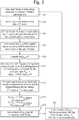
- step 300 in the sequence of image frames forming the video image, two frames separated by a predetermined number (d) of frames are selected.
- the separation may be, for example, 1 ⁇ 4 second or 5 frames.
- the size of the cells will determine how big a gross movement of the subject is before it is recognised and thus the size of the cells needs to be tuned to the particular image view being analysed.
- each of the cells is subjected to a two dimensional spectral analysis, for example by Fast Fourier transform, to determine the spatial frequencies (2D power spectrum) in each of the cells.
- the magnitude x m,i of each of the i different frequency components is then taken in each of the m cells. It is the difference between the magnitudes of corresponding frequency components in corresponding cells of the pair of selected frames which will be used to determine whether image changes are caused by illumination variations or gross movement.
- each of the magnitudes is processed in step 308 by adding one and taking the logarithm, and then in step 310 the resulting values are normalised within each cell by dividing them by the value of the largest magnitude for that cell.
- step 310 for each corresponding pair of cells in the two selected frames, the absolute differences between the normalised log magnitudes X' of corresponding frequency components is taken for all frequency components
- step 316 these values are thresholded to give a value D m,i of 1 if they are above the threshold or 0 if below.
- This first threshold is set by comparing a video sequence which contains subject movement and one which contains, for example, changes in illumination by sunlight.
- step 318 the number of cells and components giving a value of 1 is compared to a threshold, either by summing the D m,i values or taking the mean of the D m,i values, and if the number is greater than the second threshold then the video image is determined as containing gross movement, whereas if the number is lower than the second threshold the video image is determined as not containing gross movement, (it may include an illumination change or no/fine movement).
- This determination forms the output of step 200 of Figure 2 .
- Subsequent processing can determine if there is fine or no movement, and can also determine that, if no gross movement has been detected, then large-scale changes are illumination changes.
- the processing will be continuously repeated for further pairs of image frames selected from the video sequence, for example, a new pair each moved along by one frame so that a continual analysis is conducted on a video sequence as to whether it is containing gross subject movement or not.
- the number and size of cells m may be varied and the spacing d of the pair of frames under consideration may be varied.
- the method may be enhanced by varying the way in which the selected image frames are divided into cells. For example, in successive passes through the processing, the position and/or size of the cells may be varied so that there are successive sets of overlapping cells.
Landscapes
- Engineering & Computer Science (AREA)
- Physics & Mathematics (AREA)
- General Physics & Mathematics (AREA)
- Multimedia (AREA)
- Theoretical Computer Science (AREA)
- Computer Vision & Pattern Recognition (AREA)
- Mathematical Physics (AREA)
- General Health & Medical Sciences (AREA)
- Business, Economics & Management (AREA)
- Emergency Management (AREA)
- Gerontology & Geriatric Medicine (AREA)
- Health & Medical Sciences (AREA)
- Image Analysis (AREA)
- Measurement Of The Respiration, Hearing Ability, Form, And Blood Characteristics Of Living Organisms (AREA)
- Alarm Systems (AREA)
Description
- The present invention relates to a method and apparatus for image processing, and in particular for processing video images.
- The automatic analysis and processing of video images, in particular to extract useful information, is of interest in a wide variety of fields. For example, in the field of monitoring the health or welfare of subjects (human or animal for example) proposals have been made for analysing the video images to detect the vital signs (such as heart rate, breathing rate, blood oxygen saturation) of the subject. Such analysis may be based on the PPGi signal in the image as in
WO-A2-20131027027 - However a problem common to such fields is distinguishing between the signals of interest and artefacts caused by other effects. For example, illumination changes, whether the scene is illuminated by artificial light or by daylight, can often confound automated image analysis. For example, in the event of trying to detect gross movement of a subject or part of a subject in a video image where the scene is under daylight illumination, an effect such as a cloud passing in front of the sun or trees, bushes or vehicles passing between a window illuminating the scene and the sky or sun, may cause fast movements to appear in the image as shadows, or changes in illumination, passing across the scene. One part of a scene may be in strong sunlight and one in shade creating an apparent edge, which may move. Distinguishing such changes from subject movement is a difficult problem. In the security field the inability to distinguish these effects may result in many false alarms, and thus an alarm eventually being ignored, or in a threshold for triggering an alarm being set high, and then failing to detect intruders. In the health or welfare monitoring field, similar problems of excessive false alarms with low trigger thresholds or lack of alarm with high trigger thresholds also arise.
- One aspect of the problem which makes it tough to solve is that one part of the scene may remain under steady illumination (sunlit or shaded) while another part of a scene has large illumination changes. A scene may also be illuminated by a combination of daylight and artificial light, either of which may be at times stable and at times change rapidly. So a global solution (i.e. across the whole image frame) may not work properly.
-
US-A1-2003/0138149 andEP-A2-1571594 disclose methods of detecting scene changes and object changes respectively in video sequences and distinguishing them from illumination changes by calculating the magnitude of changes in selected DCT coefficients between frames of the sequence. - According to the present invention there is provided a computer- implemented method of analysing a video image as defined by
claim 1. - This method is effective at distinguishing between gross subject movement and fine or no movement in a way which is unaffected by a changes in illumination caused, for example, by movement of sunlit areas, because image texture, such as is commonly associated with subjects of interest, show up well in a spatial frequency analysis of the image (i.e. have a lot of spatial frequency content), so if the subject (associated with image texture) has gross movement, this will be seen in a high number of large magnitude changes in the spatial frequency components between the two frames under consideration. On the other hand sunlight changes tend to have lower amounts of spatial frequency information in them, thus producing a lower number of large magnitude differences in spatial frequency components between the two frames. This overcomes the problem of simpler video analytics methods that illumination changes can look like gross subject movement.
- Thus the method is particularly good at distinguishing between gross movement of the subject and illumination artefacts. By "gross movement" is meant large movement of the subject, the subject as a whole moving (e.g. walking, running, jumping) or movements of whole body parts of the subject (e.g. movement of arms or legs), contrasted with "fine movement", which is the type of small distance movement associated with breathing, heart beat, natural trembling or unconscious movement of the body.
- The first and second thresholds may be set by observing video sequences of a subject and scene being imaged and setting thresholds to distinguish gross movement from fine movement and illumination changes. The characterisation of gross movement in the video image sequence is conducted with reference to a threshold which is preferably set in a calibration process. The aim is to distinguish large movements, such as a subject deliberately walking around, moving their arms, or changing position when lying or seated, from the smaller, e.g. unconscious, movements related to, for example, breathing or the cardiac cycle, such as chest rise and fall, small head movement, etc.. The distance that such a gross movement or fine movement corresponds to in the individual image frames of the video image sequence depends on the field of view of the video camera and the hardware used (optics and sensor). In the image it will be characterized by different number of pixels affected and the magnitude of the change per pixel. However, a threshold which distinguishes the two types of movement can be established for any given equipment in a calibration process by capturing a video image sequence of a volunteer who is asked, on the one hand, to perform gross movement, such as walking around, moving arms, or changing position when seated or lying, and on the other hand to remain as still as possible, while breathing normally. By observing the spatial frequency changes between the selected frames of the video image sequence in these two different states, the thresholds can be set which distinguishes between them and characterises the gross movement and the fine movement. Thus the first and second thresholds are set in a parameter tuning process comprising the steps of: capturing a video image sequence of a subject who is performing gross movement; capturing a video image sequence containing an illumination change; and setting the first threshold to maximise the difference in the number of cells and spatial frequency components for which the magnitude differences are greater than the first threshold between the two video image sequences. The second threshold is also set by observing the number of cells and spatial frequency components for which the magnitude differences are greater than the first threshold between the two video image sequences.
- The magnitude of the spatial frequency components (also known as the 2D power spectrum) in each of the cells in each of the selected image frames may be calculated by a two-dimensional fast Fourier transform in each cell or by another known spectral analysis technique. The spatial frequency magnitudes may be respectively normalised by the largest value of the magnitude of each spatial frequency component before taking the differences which improves invariance to illumination changes.
- The mean or sum of the number of cells and spatial frequency components for which the magnitude differences are greater than the first threshold is preferably compared to the second threshold to perform said determination that the video sequence contains an illumination change rather than movement.
- The image frames may be subdivided into a rectangular, e.g. square, grid of the cells and the method may be repeated on the video image with a different number or size of cells. Larger cells are more robust to noise and complex changes in illumination whereas smaller cells are more sensitive to smaller movements.
- The invention also provides an apparatus for analysing video image in accordance with the method above, the apparatus comprising the features of
claim 9. The apparatus may be part of a video monitoring system including a video camera to capture video images and a display to display the captured video together with the results of the image analysis. This may form part of a health or welfare monitoring system or a security monitoring system. - The video camera is preferably a standard digital video camera so that the video image sequence is a conventional frame sequence with each frame comprising an array of pixel intensities. The camera may be monochrome or may be a colour camera providing pixel intensities in the red, green and blue channels.
- The invention may be embodied in a computer program for processing a captured video image sequence in accordance with the invention according to claim 10.
- The invention will be further described by way of non limited example with reference to the accompanying drawing in which: -
-
Figure 1 illustrates schematically a vital signs monitoring method; -
Figure 2 schematically illustrates a vital signs monitoring method on which the invention may be applied; -
Figure 3 is a flow diagram illustrating one embodiment of the invention; -
Figure 4 schematically illustrates a welfare monitoring system including an image analysis apparatus in accordance with an embodiment of the invention. - The invention will be described as applied to a vital signs/welfare monitoring system usable in a secure room environment, for monitoring the welfare of subjects such as patients or prisoners who are restrained in a secure room.
Figure 4 schematically illustrates an apparatus in accordance with an embodiment of the invention being used to monitor a subject 3 in aroom 1. Theroom 1 can be a secure room such as a police or prison cell or some other detention facility, or could be a room in a hospital or other care facility such as a care home, sheltered accommodation or the subject's own home. The subject 3 is monitored by avideo camera 5 whose output is processed by avideo signal processor 7 and the results of the analysis are displayed on adisplay 9 which is visible to staff of the facility. Thevideo signal processor 7 may be a dedicated signal processor or a programmed general purpose computer. The room may be naturally lit, e.g. via window 10 and may be artificially illuminated using avisible light source 11 orinfrared light source 13. - The
video camera 5 is a standard digital video camera outputting video data in the form of a sequence of image frames, each frame being a pixel array of intensities in red, green, blue channels. The red, green and blue channels also give a response in the infrared range allowing the production of an infrared (IR) image useful when the room is dark. Video cameras of this type typically output the signal at twenty frames per second, though of course different frame rates are possible. - The
display 9 preferably displays the video image of the room and also displays information regarding the health or safety of the subject 3. This information is preferably:- - Whether movement is detected.
- Whether vital signs are being acquired.
- Whether the subject is judged to be safe.
- Current values of estimated vital signs such as heart rate and breathing rate.
- Whether no vital signs have been detected and the time for which no vital signs have been detected.
- A no movement and no vital signs alert or alarm.
- Staff monitoring the subject by way of the
display 9 can therefore tell at any given time whether the subject is considered safe, for example because they are moving or because the vital signs are being detected and are in a physiologically normal range, or whether the system is unable to detect vital signs and safe movement is detected (and for how long that situation has persisted), or that no vital signs and no movement is detected, in which case an alert is generated willing staff to check the subject. If the lack of vital signs detection persists for more than a configurable amount of time an alert may be generated to call on staff to check the subject. Alerts can include a range of electronic notification methods including automated telephone message, pager, SMS, as well as indication on thedisplay 9 with the alert containing the condition and location of the subject and the condition being alerted. -
Figure 1 schematically illustrates the overall processing byvideo signal processor 7. In this embodiment the video analysis system analyses the video image captured bycamera 5 to detect the vital signs of the subject (such as heart rate and breathing rate), and in parallel analyses the video image to detect whether it contains gross movement of the subject, fine movement of the subject or no movement of the subject. As mentioned above gross movement is, for example, the subject walking or running or jumping, and in the case of gross movement it is normal to suspend analysis of the video to detect vital signs such as heart rate or breathing rate because it is difficult to perform such analysis in the presence of gross movement. As illustrated inFigure 1 , therefore, instep 100 the video is acquired and is subject both to movement detection instep 102 and vital signs detection or estimation instep 104. Step 104 may be suspended if gross movement is detected in the video sequence. The results of the movement detection and vital signs detection are interpreted and validated instep 106 and displayed instep 108 ondisplay 9. -
Figure 2 schematically illustrates the interpretation andvalidation step 106. Instep 200 the first determination is made as to whether gross subject movement is present in the video image. If gross movement is present then the movement is analysed to be classified as safe or unsafe and a corresponding display made instep 202. If no gross movement is present then, firstly, if valid vital signs have already been detected (in the previous pass through the process), then these are displayed instep 206. If not, then a determination is made as to whether fine movement is present in the image. If fine movement is present, but no vital signs have been detected, then a display "no vital signs" is made instep 210. On the other hand if no fine movement is detected, then a display "no vital signs and no movement" alert is made instep 212, which may indicate that the subject is in a serious condition. - It will be understood, therefore, that a critical point in the process is determining in
step 200 whether or not gross movement is present. If gross movement is present in the image then it is difficult to detect vital signs reliably and so vital signs detection is suspended, but such gross movement is also regarded as indicating that the subject is, at least, alive. Consequently if some image artefact is mistaken for gross movement of the subject, serious consequences may result. The present invention is therefore designed to accurately detect gross movement of a subject despite the presence of image artefacts such as illumination changes, especially in natural light illuminated scenes. - The image processing in accordance with one embodiment of the invention is illustrated in
Figure 3 . Firstly, instep 300, in the sequence of image frames forming the video image, two frames separated by a predetermined number (d) of frames are selected. The separation may be, for example, ¼ second or 5 frames. Then instep 302 the two selected frames are each divided into a square grid of m cells of 2" pixels, for example 16 or 32 cells, which may be each of 8x8=64 or 16x16=256 pixels. The size of the cells will determine how big a gross movement of the subject is before it is recognised and thus the size of the cells needs to be tuned to the particular image view being analysed. - Then in
step 304 each of the cells is subjected to a two dimensional spectral analysis, for example by Fast Fourier transform, to determine the spatial frequencies (2D power spectrum) in each of the cells. The spectral analysis will return values for i components from a minimum spatial frequency corresponding to one cycle per cell and a maximum of spatial frequency of one cycle per sample (pixel position). There will be i = n ∗ n different frequency components. Instep 306 the magnitude xm,i of each of the i different frequency components is then taken in each of the m cells. It is the difference between the magnitudes of corresponding frequency components in corresponding cells of the pair of selected frames which will be used to determine whether image changes are caused by illumination variations or gross movement. - In this embodiment each of the magnitudes is processed in
step 308 by adding one and taking the logarithm, and then instep 310 the resulting values are normalised within each cell by dividing them by the value of the largest magnitude for that cell. - Then, in
step 310, for each corresponding pair of cells in the two selected frames, the absolute differences between the normalised log magnitudes X' of corresponding frequency components is taken for all frequency components |X'm,i, frame a - X' m,i,,frame a+d |. Instep 316 these values are thresholded to give a value Dm,i of 1 if they are above the threshold or 0 if below. This first threshold is set by comparing a video sequence which contains subject movement and one which contains, for example, changes in illumination by sunlight. - In
step 318 the number of cells and components giving a value of 1 is compared to a threshold, either by summing the Dm,i values or taking the mean of the Dm,i values, and if the number is greater than the second threshold then the video image is determined as containing gross movement, whereas if the number is lower than the second threshold the video image is determined as not containing gross movement, (it may include an illumination change or no/fine movement). This determination forms the output ofstep 200 ofFigure 2 . Subsequent processing can determine if there is fine or no movement, and can also determine that, if no gross movement has been detected, then large-scale changes are illumination changes. - The processing will be continuously repeated for further pairs of image frames selected from the video sequence, for example, a new pair each moved along by one frame so that a continual analysis is conducted on a video sequence as to whether it is containing gross subject movement or not.
- It should be noted that the number and size of cells m may be varied and the spacing d of the pair of frames under consideration may be varied. Furthermore, the method may be enhanced by varying the way in which the selected image frames are divided into cells. For example, in successive passes through the processing, the position and/or size of the cells may be varied so that there are successive sets of overlapping cells.
Claims (10)
- A computer-implemented method of analysing a video image of a subject (3) in a room (1) to provide status or alerting of a subject's condition, the video image comprising a sequence of image frames, the method comprising the steps of:selecting from the video image two image frames spaced by a predetermined number of image frames (300);dividing each of the selected image frames into a plurality of cells (302);calculating the magnitude of the spatial frequency components in each of the cells in each of the selected image frames (304);determining differences between the magnitudes of corresponding spatial frequency components in corresponding cells of the selected frames (312);determining for all cells and spatial frequency components the number of magnitude differences which are greater than a first threshold (316);determining that the video sequence contains gross movement of a subject if the number exceeds a second threshold (200, 320), and in that event analysing the movement to classify it as safe or unsafe, and outputting a visible or audible indication of the classification of movement;if gross movement is determined as not being present, determining if valid vital signs have been detected in the video image (204) and if so displaying them (206);if gross movement is determined as not being present and valid vital signs have not been detected in the video image determining whether fine movement is present in the video image (208),and if it is, displaying that no vital signs have been detected (210); andif fine movement is determined as not being present in the video image (208) displaying an alert indicating no vital signs and no movement of the subject (3).
- A method according to claim 1 wherein the magnitude of the spatial frequency components in each of the cells in each of the selected image frames is calculated by a two-dimensional fast Fourier transform in each cell.
- A method according to claim 1 or 2 wherein the first threshold is set in a parameter tuning process comprising the steps of:capturing a video image sequence of a subject (3) who is performing gross movement;capturing a video image sequence containing an illumination change; andsetting the first threshold to maximise the difference in the number of magnitude differences which are greater than the first threshold between the two video image sequences.
- A method according to claim 1, 2 or 3 wherein the magnitudes of the spatial frequency components in each cell are respectively normalised by dividing them by the largest magnitude for that cell before taking the differences (310).
- A method according to any one of the preceding claims wherein the mean or sum of the number of spatial frequency components for which the magnitude differences are greater than the first threshold is compared to the second threshold to perform said determination that the video sequence contains gross movement.
- A method according to any one of the preceding claims wherein the frames are subdivided into a rectangular grid of the cells.
- A method according to any one of the preceding claims wherein the frames are subdivided into a square grid of the cells.
- A method according to any one of the preceding claims further comprising repeating the method with a different number or size of cells.
- Apparatus for monitoring a subject (3) in a room (1) to provide status or alerting of a subject's condition, the apparatus comprising:a video camera (5) configured to capture a video image sequence of the room (1);a data processor (7) configured to automatically process the video image sequence to distinguish between movement of a subject (3) in the image and illumination changes in accordance with the method of any one of the preceding claims; anda display (9) or other output device which under the control of the data processor outputs a visible or audible indication of the classification of movement and an indication of the detection of the vital signs.
- A computer program comprising instructions which, when the program is executed by a computer, cause the computer to carry out the method of any of claims 1 to 8.
Applications Claiming Priority (2)
| Application Number | Priority Date | Filing Date | Title |
|---|---|---|---|
| GBGB1615899.0A GB201615899D0 (en) | 2016-09-19 | 2016-09-19 | Method and apparatus for image processing |
| PCT/GB2017/052779 WO2018051142A1 (en) | 2016-09-19 | 2017-09-19 | Method and apparatus for image processing |
Publications (2)
| Publication Number | Publication Date |
|---|---|
| EP3516623A1 EP3516623A1 (en) | 2019-07-31 |
| EP3516623B1 true EP3516623B1 (en) | 2020-11-25 |
Family
ID=57288878
Family Applications (1)
| Application Number | Title | Priority Date | Filing Date |
|---|---|---|---|
| EP17771566.1A Active EP3516623B1 (en) | 2016-09-19 | 2017-09-19 | Method and apparatus for image processing |
Country Status (4)
| Country | Link |
|---|---|
| US (1) | US11182910B2 (en) |
| EP (1) | EP3516623B1 (en) |
| GB (1) | GB201615899D0 (en) |
| WO (1) | WO2018051142A1 (en) |
Family Cites Families (85)
| Publication number | Priority date | Publication date | Assignee | Title |
|---|---|---|---|---|
| JP2518503B2 (en) | 1993-03-08 | 1996-07-24 | 日本電気株式会社 | Screen switching detection method |
| US7630757B2 (en) | 1997-01-06 | 2009-12-08 | Flint Hills Scientific Llc | System for the prediction, rapid detection, warning, prevention, or control of changes in activity states in the brain of a subject |
| JP3263035B2 (en) | 1997-11-21 | 2002-03-04 | 東芝エンジニアリング株式会社 | Region of interest setting device for respiration monitoring and respiration monitoring system |
| CA2408338C (en) | 2000-08-18 | 2009-09-08 | Cygnus, Inc. | Methods and devices for prediction of hypoglycemic events |
| TW503650B (en) | 2001-04-13 | 2002-09-21 | Huper Lab Co Ltd | Method using image screen to detect movement of object |
| US7130472B2 (en) * | 2002-01-21 | 2006-10-31 | Canon Kabushiki Kaisha | Image distribution apparatus, communication terminal apparatus, and control method thereof |
| US6999599B2 (en) | 2002-06-07 | 2006-02-14 | Microsoft Corporation | System and method for mode-based multi-hypothesis tracking using parametric contours |
| US20050078747A1 (en) * | 2003-10-14 | 2005-04-14 | Honeywell International Inc. | Multi-stage moving object segmentation |
| US7499570B2 (en) * | 2004-03-02 | 2009-03-03 | Siemens Corporate Research, Inc. | Illumination invariant change detection |
| JP2006061581A (en) | 2004-08-30 | 2006-03-09 | Toshiba Corp | Medical motion analysis apparatus, medical motion analysis method, and medical motion analysis program |
| US8532737B2 (en) | 2005-12-29 | 2013-09-10 | Miguel Angel Cervantes | Real-time video based automated mobile sleep monitoring using state inference |
| DE102006022055A1 (en) | 2006-02-20 | 2007-08-30 | Fraunhofer-Gesellschaft zur Förderung der angewandten Forschung e.V. | Adaptive filtering for more reliable determination of vital parameters |
| JP5161427B2 (en) | 2006-02-20 | 2013-03-13 | 株式会社東芝 | Image photographing apparatus, image processing apparatus, and program |
| JP4764924B2 (en) * | 2006-05-18 | 2011-09-07 | パイオニア株式会社 | Data processing apparatus, method thereof, program thereof, and recording medium recording the program |
| JP5031758B2 (en) | 2006-10-04 | 2012-09-26 | 株式会社日立メディコ | Medical diagnostic imaging equipment |
| TWI361618B (en) * | 2006-12-26 | 2012-04-01 | Realtek Semiconductor Corp | Method and device for estimating noise |
| US20080181457A1 (en) * | 2007-01-31 | 2008-07-31 | Siemens Aktiengesellschaft | Video based monitoring system and method |
| US8585607B2 (en) | 2007-05-02 | 2013-11-19 | Earlysense Ltd. | Monitoring, predicting and treating clinical episodes |
| US8831299B2 (en) | 2007-05-22 | 2014-09-09 | Intellectual Ventures Fund 83 Llc | Capturing data for individual physiological monitoring |
| US8238612B2 (en) * | 2008-05-06 | 2012-08-07 | Honeywell International Inc. | Method and apparatus for vision based motion determination |
| US9186093B2 (en) | 2008-08-20 | 2015-11-17 | The Regents Of The University Of California | Compositions and methods for screening cardioactive drugs |
| JP5676492B2 (en) | 2009-03-06 | 2015-02-25 | コーニンクレッカ フィリップス エヌ ヴェ | Device for detecting presence of living body and method for controlling function of system |
| GB0906029D0 (en) | 2009-04-07 | 2009-05-20 | Nat Univ Ireland Cork | A method of analysing an electroencephalogram (EEG) signal |
| US8909330B2 (en) | 2009-05-20 | 2014-12-09 | Sotera Wireless, Inc. | Body-worn device and associated system for alarms/alerts based on vital signs and motion |
| JP5715132B2 (en) | 2009-08-20 | 2015-05-07 | コーニンクレッカ フィリップス エヌ ヴェ | Method and system for image analysis |
| US10213159B2 (en) * | 2010-03-10 | 2019-02-26 | Sotera Wireless, Inc. | Body-worn vital sign monitor |
| US8553940B2 (en) | 2009-10-06 | 2013-10-08 | Koninklijke Philips N.V. | Formation of a time-varying signal representative of at least variations in a value based on pixel values |
| US8483432B2 (en) | 2009-12-23 | 2013-07-09 | General Electric Company | Methods for automatic segmentation and temporal tracking |
| JP5195741B2 (en) | 2009-12-25 | 2013-05-15 | 株式会社デンソー | Life activity measurement device |
| US20110251493A1 (en) | 2010-03-22 | 2011-10-13 | Massachusetts Institute Of Technology | Method and system for measurement of physiological parameters |
| US9143843B2 (en) * | 2010-12-09 | 2015-09-22 | Sealed Air Corporation | Automated monitoring and control of safety in a production area |
| US10292625B2 (en) | 2010-12-07 | 2019-05-21 | Earlysense Ltd. | Monitoring a sleeping subject |
| JP5267596B2 (en) | 2011-02-23 | 2013-08-21 | 株式会社デンソー | Moving body detection device |
| US9041789B2 (en) | 2011-03-25 | 2015-05-26 | Tk Holdings Inc. | System and method for determining driver alertness |
| CN103503024B (en) | 2011-04-14 | 2016-10-05 | 皇家飞利浦有限公司 | Apparatus and method for extracting information from characteristic signals |
| US20130127620A1 (en) | 2011-06-20 | 2013-05-23 | Cerner Innovation, Inc. | Management of patient fall risk |
| GB201114406D0 (en) | 2011-08-22 | 2011-10-05 | Isis Innovation | Remote monitoring of vital signs |
| US8666484B2 (en) | 2011-11-25 | 2014-03-04 | Persyst Development Corporation | Method and system for displaying EEG data |
| US9301710B2 (en) | 2012-06-01 | 2016-04-05 | Xerox Corporation | Processing a video for respiration rate estimation |
| US8855384B2 (en) | 2012-06-20 | 2014-10-07 | Xerox Corporation | Continuous cardiac pulse rate estimation from multi-channel source video data |
| US9036877B2 (en) | 2012-06-20 | 2015-05-19 | Xerox Corporation | Continuous cardiac pulse rate estimation from multi-channel source video data with mid-point stitching |
| US9384555B2 (en) | 2012-07-02 | 2016-07-05 | Kabushiki Kaisha Toshiba | Motion correction apparatus and method |
| BR112015001897A2 (en) | 2012-08-02 | 2017-07-04 | Koninklijke Philips Nv | detected electromagnetic radiation physiological information extraction device emitted or reflected by a patient, electromagnetic radiation detected physiological information extraction method emitted or reflected by a patient and computer program |
| GB201302451D0 (en) | 2013-02-12 | 2013-03-27 | Isis Innovation | Method and system for signal analysis |
| EP2767233A1 (en) | 2013-02-15 | 2014-08-20 | Koninklijke Philips N.V. | Device for obtaining respiratory information of a subject |
| EP2772189A1 (en) | 2013-02-28 | 2014-09-03 | Koninklijke Philips N.V. | Apparatus and method for determining vital sign information from a subject |
| RU2695261C2 (en) | 2013-03-13 | 2019-07-22 | Конинклейке Филипс Н.В. | Device and method for determining patient's vital signs |
| US20140276104A1 (en) | 2013-03-14 | 2014-09-18 | Nongjian Tao | System and method for non-contact monitoring of physiological parameters |
| US10052038B2 (en) | 2013-03-14 | 2018-08-21 | Koninklijke Philips N.V. | Device and method for determining vital signs of a subject |
| US9339210B2 (en) | 2013-05-08 | 2016-05-17 | Koninklijke Philips N.V. | Device for obtaining a vital sign of a subject |
| US11229364B2 (en) | 2013-06-14 | 2022-01-25 | Medtronic, Inc. | Patient motion analysis for behavior identification based on video frames with user selecting the head and torso from a frame |
| US9521954B2 (en) | 2013-06-19 | 2016-12-20 | Xerox Corporation | Video acquisition system for monitoring a subject for a desired physiological function |
| US10638942B2 (en) | 2013-06-26 | 2020-05-05 | Massachusetts Institute Of Technology | Pulse detection from head motions in video |
| JP6201469B2 (en) | 2013-07-12 | 2017-09-27 | セイコーエプソン株式会社 | Biological information processing apparatus and biological information processing method |
| US9177383B2 (en) | 2013-08-29 | 2015-11-03 | Analog Devices Global | Facial detection |
| US9907474B2 (en) | 2013-10-01 | 2018-03-06 | Koninklijke Philips N.V. | Signal selection for obtaining a remote photoplethysmographic waveform |
| WO2015055709A1 (en) | 2013-10-17 | 2015-04-23 | Koninklijke Philips N.V. | Device and method for obtaining a vital sign of a subject |
| JP6349075B2 (en) | 2013-11-22 | 2018-06-27 | 三星電子株式会社Samsung Electronics Co.,Ltd. | Heart rate measuring device and heart rate measuring method |
| CA2931377A1 (en) | 2013-11-27 | 2015-06-04 | Koninklijke Philips N.V. | Device and method for obtaining pulse transit time and/or pulse wave velocity information of a subject |
| EP3082572A1 (en) | 2013-12-19 | 2016-10-26 | Koninklijke Philips N.V. | A baby monitoring device |
| US10438631B2 (en) | 2014-02-05 | 2019-10-08 | Snap Inc. | Method for real-time video processing involving retouching of an object in the video |
| US9336594B2 (en) | 2014-03-07 | 2016-05-10 | Xerox Corporation | Cardiac pulse rate estimation from source video data |
| US10746852B2 (en) | 2014-04-28 | 2020-08-18 | Massachusetts Institute Of Technology | Vital signs monitoring via radio reflections |
| CN105556539A (en) | 2014-05-16 | 2016-05-04 | 联发科技股份有限公司 | Detection device and method for detecting interest region |
| US20150363361A1 (en) | 2014-06-16 | 2015-12-17 | Mitsubishi Electric Research Laboratories, Inc. | Method for Kernel Correlation-Based Spectral Data Processing |
| US8965090B1 (en) | 2014-07-06 | 2015-02-24 | ARC Devices, Ltd | Non-touch optical detection of vital signs |
| FR3023699B1 (en) | 2014-07-21 | 2016-09-02 | Withings | METHOD AND DEVICE FOR MONITORING A BABY AND INTERACTING |
| US20160055635A1 (en) | 2014-08-21 | 2016-02-25 | Sony Corporation | Method and system for video data processing |
| US20170224256A1 (en) | 2014-10-13 | 2017-08-10 | Koninklijke Philips N.V. | Device and method for detecting vital sign information of a subject |
| US9693710B2 (en) | 2014-10-21 | 2017-07-04 | Xerox Corporation | System and method for determining respiration rate from a video |
| US9576218B2 (en) | 2014-11-04 | 2017-02-21 | Canon Kabushiki Kaisha | Selecting features from image data |
| US9852507B2 (en) | 2014-11-10 | 2017-12-26 | Utah State University | Remote heart rate estimation |
| GB201421785D0 (en) | 2014-12-08 | 2015-01-21 | Oxehealth Ltd | Method and apparatus for physiological monitoring |
| US10108325B2 (en) | 2014-12-11 | 2018-10-23 | Rdi Technologies, Inc. | Method of analyzing, displaying, organizing and responding to vital signals |
| CN107409193A (en) | 2014-12-15 | 2017-11-28 | 索尼公司 | Information processing method, image processing device and program |
| JP6308161B2 (en) | 2015-03-31 | 2018-04-11 | 株式会社エクォス・リサーチ | Pulse wave detection device and pulse wave detection program |
| TWI556793B (en) | 2015-07-09 | 2016-11-11 | 國立臺灣科技大學 | Non-contact method for detecting physiological signals and motion in real time |
| CN108135487A (en) | 2015-10-08 | 2018-06-08 | 皇家飞利浦有限公司 | For obtaining the equipment, system and method for the vital sign information of object |
| CN108471989B (en) | 2016-01-15 | 2022-04-26 | 皇家飞利浦有限公司 | Device, system and method for generating a photoplethysmographic image carrying vital sign information of a subject |
| GB201601140D0 (en) | 2016-01-21 | 2016-03-09 | Oxehealth Ltd | Method and apparatus for estimating heart rate |
| GB201601143D0 (en) | 2016-01-21 | 2016-03-09 | Oxehealth Ltd | Method and apparatus for health and safety monitoring of a subject in a room |
| GB201601142D0 (en) | 2016-01-21 | 2016-03-09 | Oxehealth Ltd | Method and apparatus for estimating breathing rate |
| CA2958003C (en) | 2016-02-19 | 2022-04-05 | Paul Stanley Addison | System and methods for video-based monitoring of vital signs |
| US10380756B2 (en) * | 2016-09-08 | 2019-08-13 | Sony Corporation | Video processing system and method for object detection in a sequence of image frames |
| US10203505B2 (en) * | 2016-11-16 | 2019-02-12 | Seiko Epson Corporation | Feature balancing |
-
2016
- 2016-09-19 GB GBGB1615899.0A patent/GB201615899D0/en not_active Ceased
-
2017
- 2017-09-19 EP EP17771566.1A patent/EP3516623B1/en active Active
- 2017-09-19 WO PCT/GB2017/052779 patent/WO2018051142A1/en not_active Ceased
- 2017-09-19 US US16/334,211 patent/US11182910B2/en active Active
Non-Patent Citations (1)
| Title |
|---|
| None * |
Also Published As
| Publication number | Publication date |
|---|---|
| GB201615899D0 (en) | 2016-11-02 |
| WO2018051142A1 (en) | 2018-03-22 |
| EP3516623A1 (en) | 2019-07-31 |
| US20190279376A1 (en) | 2019-09-12 |
| US11182910B2 (en) | 2021-11-23 |
Similar Documents
| Publication | Publication Date | Title |
|---|---|---|
| US10796140B2 (en) | Method and apparatus for health and safety monitoring of a subject in a room | |
| US12555225B2 (en) | Method and apparatus for monitoring of a human or animal subject | |
| EP3405105B1 (en) | Method and apparatus for estimating heart rate | |
| EP3678093B1 (en) | Monitoring movement and vital signs of a human or animal subject in a room using video imaging | |
| EP3678094B1 (en) | Method and apparatus for monitoring of a human or animal subject | |
| Zhang et al. | Evaluating depth-based computer vision methods for fall detection under occlusions | |
| US10885349B2 (en) | Method and apparatus for image processing | |
| JP2008046917A (en) | Smoke detector | |
| EP2000998A2 (en) | Flame detecting method and device | |
| KR101357721B1 (en) | Apparatus for detecting of single elderly persons’ abnormal situation using image and method thereof | |
| JP5261546B2 (en) | Smoke detector | |
| US11182910B2 (en) | Method and apparatus for image processing | |
| JP2017005485A (en) | Picture monitoring device and picture monitoring method | |
| JP2008046017A (en) | Smoke detector | |
| EP3536234B1 (en) | Improvements in or relating to video monitoring | |
| JP6124739B2 (en) | Image sensor | |
| CN117116004A (en) | A fall alarm method, system and medium for smart wearable devices | |
| JP4565738B2 (en) | Image sensor |
Legal Events
| Date | Code | Title | Description |
|---|---|---|---|
| STAA | Information on the status of an ep patent application or granted ep patent |
Free format text: STATUS: UNKNOWN |
|
| STAA | Information on the status of an ep patent application or granted ep patent |
Free format text: STATUS: THE INTERNATIONAL PUBLICATION HAS BEEN MADE |
|
| PUAI | Public reference made under article 153(3) epc to a published international application that has entered the european phase |
Free format text: ORIGINAL CODE: 0009012 |
|
| STAA | Information on the status of an ep patent application or granted ep patent |
Free format text: STATUS: REQUEST FOR EXAMINATION WAS MADE |
|
| 17P | Request for examination filed |
Effective date: 20190214 |
|
| AK | Designated contracting states |
Kind code of ref document: A1 Designated state(s): AL AT BE BG CH CY CZ DE DK EE ES FI FR GB GR HR HU IE IS IT LI LT LU LV MC MK MT NL NO PL PT RO RS SE SI SK SM TR |
|
| AX | Request for extension of the european patent |
Extension state: BA ME |
|
| DAV | Request for validation of the european patent (deleted) | ||
| DAX | Request for extension of the european patent (deleted) | ||
| GRAP | Despatch of communication of intention to grant a patent |
Free format text: ORIGINAL CODE: EPIDOSNIGR1 |
|
| STAA | Information on the status of an ep patent application or granted ep patent |
Free format text: STATUS: GRANT OF PATENT IS INTENDED |
|
| INTG | Intention to grant announced |
Effective date: 20200429 |
|
| GRAJ | Information related to disapproval of communication of intention to grant by the applicant or resumption of examination proceedings by the epo deleted |
Free format text: ORIGINAL CODE: EPIDOSDIGR1 |
|
| STAA | Information on the status of an ep patent application or granted ep patent |
Free format text: STATUS: REQUEST FOR EXAMINATION WAS MADE |
|
| GRAP | Despatch of communication of intention to grant a patent |
Free format text: ORIGINAL CODE: EPIDOSNIGR1 |
|
| STAA | Information on the status of an ep patent application or granted ep patent |
Free format text: STATUS: GRANT OF PATENT IS INTENDED |
|
| INTC | Intention to grant announced (deleted) | ||
| INTG | Intention to grant announced |
Effective date: 20200730 |
|
| GRAS | Grant fee paid |
Free format text: ORIGINAL CODE: EPIDOSNIGR3 |
|
| GRAA | (expected) grant |
Free format text: ORIGINAL CODE: 0009210 |
|
| STAA | Information on the status of an ep patent application or granted ep patent |
Free format text: STATUS: THE PATENT HAS BEEN GRANTED |
|
| AK | Designated contracting states |
Kind code of ref document: B1 Designated state(s): AL AT BE BG CH CY CZ DE DK EE ES FI FR GB GR HR HU IE IS IT LI LT LU LV MC MK MT NL NO PL PT RO RS SE SI SK SM TR |
|
| REG | Reference to a national code |
Ref country code: GB Ref legal event code: FG4D |
|
| REG | Reference to a national code |
Ref country code: CH Ref legal event code: EP |
|
| REG | Reference to a national code |
Ref country code: AT Ref legal event code: REF Ref document number: 1339164 Country of ref document: AT Kind code of ref document: T Effective date: 20201215 |
|
| REG | Reference to a national code |
Ref country code: DE Ref legal event code: R096 Ref document number: 602017028374 Country of ref document: DE |
|
| REG | Reference to a national code |
Ref country code: IE Ref legal event code: FG4D |
|
| REG | Reference to a national code |
Ref country code: SE Ref legal event code: TRGR |
|
| REG | Reference to a national code |
Ref country code: NL Ref legal event code: FP |
|
| REG | Reference to a national code |
Ref country code: AT Ref legal event code: MK05 Ref document number: 1339164 Country of ref document: AT Kind code of ref document: T Effective date: 20201125 |
|
| PG25 | Lapsed in a contracting state [announced via postgrant information from national office to epo] |
Ref country code: NO Free format text: LAPSE BECAUSE OF FAILURE TO SUBMIT A TRANSLATION OF THE DESCRIPTION OR TO PAY THE FEE WITHIN THE PRESCRIBED TIME-LIMIT Effective date: 20210225 Ref country code: GR Free format text: LAPSE BECAUSE OF FAILURE TO SUBMIT A TRANSLATION OF THE DESCRIPTION OR TO PAY THE FEE WITHIN THE PRESCRIBED TIME-LIMIT Effective date: 20210226 Ref country code: RS Free format text: LAPSE BECAUSE OF FAILURE TO SUBMIT A TRANSLATION OF THE DESCRIPTION OR TO PAY THE FEE WITHIN THE PRESCRIBED TIME-LIMIT Effective date: 20201125 Ref country code: PT Free format text: LAPSE BECAUSE OF FAILURE TO SUBMIT A TRANSLATION OF THE DESCRIPTION OR TO PAY THE FEE WITHIN THE PRESCRIBED TIME-LIMIT Effective date: 20210325 Ref country code: FI Free format text: LAPSE BECAUSE OF FAILURE TO SUBMIT A TRANSLATION OF THE DESCRIPTION OR TO PAY THE FEE WITHIN THE PRESCRIBED TIME-LIMIT Effective date: 20201125 |
|
| PG25 | Lapsed in a contracting state [announced via postgrant information from national office to epo] |
Ref country code: PL Free format text: LAPSE BECAUSE OF FAILURE TO SUBMIT A TRANSLATION OF THE DESCRIPTION OR TO PAY THE FEE WITHIN THE PRESCRIBED TIME-LIMIT Effective date: 20201125 Ref country code: LV Free format text: LAPSE BECAUSE OF FAILURE TO SUBMIT A TRANSLATION OF THE DESCRIPTION OR TO PAY THE FEE WITHIN THE PRESCRIBED TIME-LIMIT Effective date: 20201125 Ref country code: IS Free format text: LAPSE BECAUSE OF FAILURE TO SUBMIT A TRANSLATION OF THE DESCRIPTION OR TO PAY THE FEE WITHIN THE PRESCRIBED TIME-LIMIT Effective date: 20210325 Ref country code: BG Free format text: LAPSE BECAUSE OF FAILURE TO SUBMIT A TRANSLATION OF THE DESCRIPTION OR TO PAY THE FEE WITHIN THE PRESCRIBED TIME-LIMIT Effective date: 20210225 Ref country code: AT Free format text: LAPSE BECAUSE OF FAILURE TO SUBMIT A TRANSLATION OF THE DESCRIPTION OR TO PAY THE FEE WITHIN THE PRESCRIBED TIME-LIMIT Effective date: 20201125 |
|
| REG | Reference to a national code |
Ref country code: LT Ref legal event code: MG9D |
|
| PG25 | Lapsed in a contracting state [announced via postgrant information from national office to epo] |
Ref country code: HR Free format text: LAPSE BECAUSE OF FAILURE TO SUBMIT A TRANSLATION OF THE DESCRIPTION OR TO PAY THE FEE WITHIN THE PRESCRIBED TIME-LIMIT Effective date: 20201125 |
|
| PG25 | Lapsed in a contracting state [announced via postgrant information from national office to epo] |
Ref country code: SK Free format text: LAPSE BECAUSE OF FAILURE TO SUBMIT A TRANSLATION OF THE DESCRIPTION OR TO PAY THE FEE WITHIN THE PRESCRIBED TIME-LIMIT Effective date: 20201125 Ref country code: RO Free format text: LAPSE BECAUSE OF FAILURE TO SUBMIT A TRANSLATION OF THE DESCRIPTION OR TO PAY THE FEE WITHIN THE PRESCRIBED TIME-LIMIT Effective date: 20201125 Ref country code: SM Free format text: LAPSE BECAUSE OF FAILURE TO SUBMIT A TRANSLATION OF THE DESCRIPTION OR TO PAY THE FEE WITHIN THE PRESCRIBED TIME-LIMIT Effective date: 20201125 Ref country code: LT Free format text: LAPSE BECAUSE OF FAILURE TO SUBMIT A TRANSLATION OF THE DESCRIPTION OR TO PAY THE FEE WITHIN THE PRESCRIBED TIME-LIMIT Effective date: 20201125 Ref country code: EE Free format text: LAPSE BECAUSE OF FAILURE TO SUBMIT A TRANSLATION OF THE DESCRIPTION OR TO PAY THE FEE WITHIN THE PRESCRIBED TIME-LIMIT Effective date: 20201125 Ref country code: CZ Free format text: LAPSE BECAUSE OF FAILURE TO SUBMIT A TRANSLATION OF THE DESCRIPTION OR TO PAY THE FEE WITHIN THE PRESCRIBED TIME-LIMIT Effective date: 20201125 |
|
| REG | Reference to a national code |
Ref country code: DE Ref legal event code: R097 Ref document number: 602017028374 Country of ref document: DE |
|
| PG25 | Lapsed in a contracting state [announced via postgrant information from national office to epo] |
Ref country code: DK Free format text: LAPSE BECAUSE OF FAILURE TO SUBMIT A TRANSLATION OF THE DESCRIPTION OR TO PAY THE FEE WITHIN THE PRESCRIBED TIME-LIMIT Effective date: 20201125 |
|
| PLBE | No opposition filed within time limit |
Free format text: ORIGINAL CODE: 0009261 |
|
| STAA | Information on the status of an ep patent application or granted ep patent |
Free format text: STATUS: NO OPPOSITION FILED WITHIN TIME LIMIT |
|
| PG25 | Lapsed in a contracting state [announced via postgrant information from national office to epo] |
Ref country code: AL Free format text: LAPSE BECAUSE OF FAILURE TO SUBMIT A TRANSLATION OF THE DESCRIPTION OR TO PAY THE FEE WITHIN THE PRESCRIBED TIME-LIMIT Effective date: 20201125 Ref country code: IT Free format text: LAPSE BECAUSE OF FAILURE TO SUBMIT A TRANSLATION OF THE DESCRIPTION OR TO PAY THE FEE WITHIN THE PRESCRIBED TIME-LIMIT Effective date: 20201125 |
|
| 26N | No opposition filed |
Effective date: 20210826 |
|
| PG25 | Lapsed in a contracting state [announced via postgrant information from national office to epo] |
Ref country code: SI Free format text: LAPSE BECAUSE OF FAILURE TO SUBMIT A TRANSLATION OF THE DESCRIPTION OR TO PAY THE FEE WITHIN THE PRESCRIBED TIME-LIMIT Effective date: 20201125 |
|
| PG25 | Lapsed in a contracting state [announced via postgrant information from national office to epo] |
Ref country code: ES Free format text: LAPSE BECAUSE OF FAILURE TO SUBMIT A TRANSLATION OF THE DESCRIPTION OR TO PAY THE FEE WITHIN THE PRESCRIBED TIME-LIMIT Effective date: 20201125 |
|
| REG | Reference to a national code |
Ref country code: CH Ref legal event code: PL |
|
| REG | Reference to a national code |
Ref country code: BE Ref legal event code: MM Effective date: 20210930 |
|
| PG25 | Lapsed in a contracting state [announced via postgrant information from national office to epo] |
Ref country code: IS Free format text: LAPSE BECAUSE OF FAILURE TO SUBMIT A TRANSLATION OF THE DESCRIPTION OR TO PAY THE FEE WITHIN THE PRESCRIBED TIME-LIMIT Effective date: 20210325 Ref country code: MC Free format text: LAPSE BECAUSE OF FAILURE TO SUBMIT A TRANSLATION OF THE DESCRIPTION OR TO PAY THE FEE WITHIN THE PRESCRIBED TIME-LIMIT Effective date: 20201125 |
|
| PG25 | Lapsed in a contracting state [announced via postgrant information from national office to epo] |
Ref country code: LU Free format text: LAPSE BECAUSE OF NON-PAYMENT OF DUE FEES Effective date: 20210919 Ref country code: IE Free format text: LAPSE BECAUSE OF NON-PAYMENT OF DUE FEES Effective date: 20210919 Ref country code: BE Free format text: LAPSE BECAUSE OF NON-PAYMENT OF DUE FEES Effective date: 20210930 |
|
| PG25 | Lapsed in a contracting state [announced via postgrant information from national office to epo] |
Ref country code: LI Free format text: LAPSE BECAUSE OF NON-PAYMENT OF DUE FEES Effective date: 20210930 Ref country code: CH Free format text: LAPSE BECAUSE OF NON-PAYMENT OF DUE FEES Effective date: 20210930 |
|
| P01 | Opt-out of the competence of the unified patent court (upc) registered |
Effective date: 20230518 |
|
| PG25 | Lapsed in a contracting state [announced via postgrant information from national office to epo] |
Ref country code: CY Free format text: LAPSE BECAUSE OF FAILURE TO SUBMIT A TRANSLATION OF THE DESCRIPTION OR TO PAY THE FEE WITHIN THE PRESCRIBED TIME-LIMIT Effective date: 20201125 |
|
| PG25 | Lapsed in a contracting state [announced via postgrant information from national office to epo] |
Ref country code: HU Free format text: LAPSE BECAUSE OF FAILURE TO SUBMIT A TRANSLATION OF THE DESCRIPTION OR TO PAY THE FEE WITHIN THE PRESCRIBED TIME-LIMIT; INVALID AB INITIO Effective date: 20170919 |
|
| PGFP | Annual fee paid to national office [announced via postgrant information from national office to epo] |
Ref country code: NL Payment date: 20240214 Year of fee payment: 7 |
|
| PG25 | Lapsed in a contracting state [announced via postgrant information from national office to epo] |
Ref country code: MK Free format text: LAPSE BECAUSE OF FAILURE TO SUBMIT A TRANSLATION OF THE DESCRIPTION OR TO PAY THE FEE WITHIN THE PRESCRIBED TIME-LIMIT Effective date: 20201125 |
|
| PGFP | Annual fee paid to national office [announced via postgrant information from national office to epo] |
Ref country code: DE Payment date: 20240130 Year of fee payment: 7 |
|
| PGFP | Annual fee paid to national office [announced via postgrant information from national office to epo] |
Ref country code: SE Payment date: 20240212 Year of fee payment: 7 Ref country code: FR Payment date: 20240214 Year of fee payment: 7 |
|
| PG25 | Lapsed in a contracting state [announced via postgrant information from national office to epo] |
Ref country code: TR Free format text: LAPSE BECAUSE OF FAILURE TO SUBMIT A TRANSLATION OF THE DESCRIPTION OR TO PAY THE FEE WITHIN THE PRESCRIBED TIME-LIMIT Effective date: 20201125 |
|
| PG25 | Lapsed in a contracting state [announced via postgrant information from national office to epo] |
Ref country code: MT Free format text: LAPSE BECAUSE OF FAILURE TO SUBMIT A TRANSLATION OF THE DESCRIPTION OR TO PAY THE FEE WITHIN THE PRESCRIBED TIME-LIMIT Effective date: 20201125 |
|
| REG | Reference to a national code |
Ref country code: DE Ref legal event code: R119 Ref document number: 602017028374 Country of ref document: DE |
|
| REG | Reference to a national code |
Ref country code: SE Ref legal event code: EUG |
|
| REG | Reference to a national code |
Ref country code: NL Ref legal event code: MM Effective date: 20241001 |
|
| PG25 | Lapsed in a contracting state [announced via postgrant information from national office to epo] |
Ref country code: NL Free format text: LAPSE BECAUSE OF NON-PAYMENT OF DUE FEES Effective date: 20241001 |
|
| PG25 | Lapsed in a contracting state [announced via postgrant information from national office to epo] |
Ref country code: DE Free format text: LAPSE BECAUSE OF NON-PAYMENT OF DUE FEES Effective date: 20250401 |
|
| PG25 | Lapsed in a contracting state [announced via postgrant information from national office to epo] |
Ref country code: FR Free format text: LAPSE BECAUSE OF NON-PAYMENT OF DUE FEES Effective date: 20240930 |
|
| PG25 | Lapsed in a contracting state [announced via postgrant information from national office to epo] |
Ref country code: SE Free format text: LAPSE BECAUSE OF NON-PAYMENT OF DUE FEES Effective date: 20240920 |
|
| PGFP | Annual fee paid to national office [announced via postgrant information from national office to epo] |
Ref country code: GB Payment date: 20251016 Year of fee payment: 9 |