EP3514735A1 - A device and a method for image classification using a convolutional neural network - Google Patents
A device and a method for image classification using a convolutional neural network Download PDFInfo
- Publication number
- EP3514735A1 EP3514735A1 EP18213652.3A EP18213652A EP3514735A1 EP 3514735 A1 EP3514735 A1 EP 3514735A1 EP 18213652 A EP18213652 A EP 18213652A EP 3514735 A1 EP3514735 A1 EP 3514735A1
- Authority
- EP
- European Patent Office
- Prior art keywords
- kernel
- convolutional layer
- convolutional
- convolution
- image
- Prior art date
- Legal status (The legal status is an assumption and is not a legal conclusion. Google has not performed a legal analysis and makes no representation as to the accuracy of the status listed.)
- Granted
Links
Images

Classifications
-
- G—PHYSICS
- G06—COMPUTING OR CALCULATING; COUNTING
- G06N—COMPUTING ARRANGEMENTS BASED ON SPECIFIC COMPUTATIONAL MODELS
- G06N3/00—Computing arrangements based on biological models
- G06N3/02—Neural networks
- G06N3/04—Architecture, e.g. interconnection topology
- G06N3/0464—Convolutional networks [CNN, ConvNet]
-
- G—PHYSICS
- G06—COMPUTING OR CALCULATING; COUNTING
- G06N—COMPUTING ARRANGEMENTS BASED ON SPECIFIC COMPUTATIONAL MODELS
- G06N3/00—Computing arrangements based on biological models
- G06N3/02—Neural networks
- G06N3/04—Architecture, e.g. interconnection topology
- G06N3/045—Combinations of networks
-
- G—PHYSICS
- G06—COMPUTING OR CALCULATING; COUNTING
- G06F—ELECTRIC DIGITAL DATA PROCESSING
- G06F18/00—Pattern recognition
- G06F18/20—Analysing
- G06F18/21—Design or setup of recognition systems or techniques; Extraction of features in feature space; Blind source separation
-
- G—PHYSICS
- G06—COMPUTING OR CALCULATING; COUNTING
- G06F—ELECTRIC DIGITAL DATA PROCESSING
- G06F18/00—Pattern recognition
- G06F18/20—Analysing
- G06F18/24—Classification techniques
- G06F18/241—Classification techniques relating to the classification model, e.g. parametric or non-parametric approaches
- G06F18/2415—Classification techniques relating to the classification model, e.g. parametric or non-parametric approaches based on parametric or probabilistic models, e.g. based on likelihood ratio or false acceptance rate versus a false rejection rate
-
- G—PHYSICS
- G06—COMPUTING OR CALCULATING; COUNTING
- G06N—COMPUTING ARRANGEMENTS BASED ON SPECIFIC COMPUTATIONAL MODELS
- G06N3/00—Computing arrangements based on biological models
- G06N3/02—Neural networks
- G06N3/04—Architecture, e.g. interconnection topology
-
- G—PHYSICS
- G06—COMPUTING OR CALCULATING; COUNTING
- G06N—COMPUTING ARRANGEMENTS BASED ON SPECIFIC COMPUTATIONAL MODELS
- G06N3/00—Computing arrangements based on biological models
- G06N3/02—Neural networks
- G06N3/08—Learning methods
-
- G—PHYSICS
- G06—COMPUTING OR CALCULATING; COUNTING
- G06N—COMPUTING ARRANGEMENTS BASED ON SPECIFIC COMPUTATIONAL MODELS
- G06N3/00—Computing arrangements based on biological models
- G06N3/02—Neural networks
- G06N3/08—Learning methods
- G06N3/09—Supervised learning
Definitions
- the invention concerns a device and a method for image classification using a convolutional neural network.
- CNNs convolutional neural networks
- CNNs are a powerful class of algorithms which applies multiple layers of convolution-based blocks to an input.
- the convolutional kernels are learned from data such that they generate responses to elements of increasing complexity. For example, a network with 3 layers, trained to differentiate cats from humans in an image will commonly learn to detect low-level features like edges and colour gradients in the first layer. The second layer will combine these edges and gradients to look for pointy ears and a torso. The last layer will further combine the data and learn that a tall object with two legs and no fur is a human while an object with pointy ears, paws and a tail is a cat.
- CNNs have been dominating university research in the field for about a decade while industrial application has only recently started to emerge. This delayed transition from pure research to application oriented development has two main reasons. The first reason is the maturity of the field which plays a significant role in every Kir-industry transition of methods. Second and perhaps more important are the computational costs required for training and predicting with neural networks. Modern state-of-the-art artificial neural networks require billions of computations (floating point operations, FLOPS) and are thus normally executed on a series of high-end graphical processing units (GPUs) while exhibiting sub-interactive prediction cycles. While universities mostly aim for accuracy regardless of cost and efficiency, clients are not willing to settle for anything less than low-power, extremely cheap yet real-time algorithms and so a discrepancy emerges.
- FLOPS floating point operations
- a device for image classification comprising a convolutional neural network.
- the device is configured to receive an image that was captured by a camera.
- the image comprises a plurality of pixels.
- the convolutional neural network is configured to generate a plurality of probability values, in particular pseudo probability values, wherein each probability value is linked to a respective one of a plurality of predetermined classes and indicates the probability that the image or a pixel of the image is associated with the respective class.
- the classes divide the objects shown in the image in different categories that are predefined by the developee. For example, if road scenes are considered, there can be a class for vehicles, another class for pedestrians, another class for roads and another class for buildings. Since there are four predetermined classes in this example, for each image four probability values, in particular pseudo probability values, are generated.
- the probability value for one of the classes then indicates the probability that the image shows an object from this particular class. For example, the probability value for the class "vehicle" indicates the probability that the image shows a vehicle or a portion of a vehicle.
- the plurality of probability values is generated for each pixel of the input image.
- the probability value of a given pixel for one of the classes then indicates the probability that the respective pixel is associated with this particular class.
- the probability value of a given pixel for the class "vehicle” then indicates the probability that the pixel shows a portion of a vehicle.
- Convolutional neural networks are a sort of artificial neural networks designed to mimic the human visual processing system from the eye to the visual cortex. They are made of an arbitrary number of consecutive layers which are trained together to fulfil the visual task of object classification. Each layer of the convolutional neural network learns to recognise features which are relevant to the specific task in an increasing complexity. The final layer of the convolutional neural network outputs an array of pixels where an individual probability value for each class is assigned to each pixel.
- the convolutional neural network of the device comprises a plurality of convolutional blocks, for example, two or three or four convolutional blocks.
- the convolutional blocks may be arranged consecutively, which means that the image captured by the camera is input into a first convolutional block, an output of the first convolutional block is fed as an input to a second convolutional block, an output of the second convolutional block is fed as an input to a third convolutional block, etc.
- Each of the convolutional blocks comprises a first convolutional layer, a second convolutional layer, a third convolutional layer and a fourth convolutional layer.
- conventional convolutional blocks contain a single convolutional layer.
- Each of the convolutional blocks disclosed in this application approximates the functionality of a single conventional convolutional layer, saving computational effort and, in particular, storage space.
- Each of the four convolutional layers according to the first aspect of the application comprises a respective kernel (also called convolutional kernel or filter) which is swiped (or slides) over an input signal, wherein a convolution is performed between the kernel and the input signal.
- the kernel is an array or a matrix of numbers which are also called weights or parameters.
- the kernel has a number of rows, a number of columns, a number of input channels and a number of output channels.
- the kernel is thus a four-dimensional tensor given in the following format: [rows, columns, channels in, channels out].
- the size of a kernel can be given in the format axb, wherein a is the number of rows and b is the number of columns.
- a kernel with the size of 2x1 has two rows and one column.
- a convolution that does not combine the input channels but performs a convolution on each input channel separately is called a depthwise convolution.
- a depthwise convolution the number of input channels is equal to the number of output channels.
- the first convolutional layer receives an input and is configured to perform a pointwise convolution using a first kernel, i.e., the first kernel has the size of 1x1.
- the convolution performed by the first convolutional layer is a conventional (or regular) convolution, but not a depthwise convolution.
- the output of the first convolutional layer is fed as an input to the second convolutional layer.
- the second convolutional layer is configured to perform a depthwise convolution using a second kernel.
- the second kernel has either a single row or a single column. It can also be provided that two second convolutional layers are arranged in parallel, which both perform a depthwise convolution having the same kernel size, and both layers together have twice as many output channels than input channels.
- the output of the second convolutional layer is fed as an input to the third convolutional layer.
- the third convolutional layer is configured to perform a depthwise convolution using a third kernel.
- the third kernel has a single column if the second kernel has a single row. If the second kernel, however, has a single column, the third kernel has a single row. In particular, the numbers of rows and columns of the third kernel are interchanged compared to the numbers of rows and columns of the second kernel.
- the output of the third convolutional layer is fed as an input to the fourth convolutional layer.
- the fourth convolutional layer is configured to perform a convolution using a fourth kernel.
- the convolution performed by the fourth convolutional layer is a conventional (or regular) convolution, but not a depthwise convolution.
- the problem of decreased accuracies in recent models described in documents D1 to D4 is solved by a revisited structure of the convolution blocks.
- the proposed convolutional blocks are still significantly cheaper to compute than the common structure while sacrificing little to no accuracy.
- the number of columns of the second kernel is 3 and the number of rows of the third kernel is 3 if the second kernel has a single row.
- the second kernel has a size of 1x3
- the third kernel has a size of 3x1.
- the number of rows of the second kernel is 3 and the number of columns of the third kernel is 3 if the second kernel has a single column.
- the second kernel has a size of 3x1
- the third kernel has a size of 1x3.
- the second convolutional layer is configured to perform a pooling operation after the depthwise convolution.
- the pooling operation combines a number of outputs of the depthwise convolution into a single output.
- the pooling operation is a one-dimensional pooling operation, i.e., the pooling is performed along a row or a column, but not along a row and a column. In this case, pooling is performed, for example, from a 1x2 patch or a 2x1 patch.
- the pooling operation may be a max-pooling, where a patch of a predetermined size is taken from an input and a single number that is the maximal element of the patch is returned as the output.
- the fourth convolutional layer may be configured to apply the fourth kernel in strides to pixels of an input of the fourth convolutional layer, for example, in strides of two. Stride controls how the fourth kernel convolves around the input of the fourth convolutional layer. If the stride is set to two, the fourth kernel convolves around the input by shifting two units at a time. The amount by which the fourth kernel shifts is the stride.
- the stride of the fourth kernel may be one-dimensional.
- the fourth kernel then convolves around the input by shifting a number of units along a row or a column at a time, but not along a row and a column at the same time.
- the number of output channels of the fourth convolutional layer is twice the number of the output channels of the first convolutional layer.
- the second kernel has a single row and the second convolutional layer is configured to perform a pooling operation, in particular a one-dimensional pooling operation, after the depthwise convolution.
- the fourth kernel has two rows and one column, i.e., the fourth kernel has a size of 2x1.
- the fourth convolutional layer is configured to apply the fourth kernel in strides along an axis perpendicular to the pooling axis.
- the second kernel has a single column and the second convolutional layer is configured to perform a pooling operation, in particular a one-dimensional pooling operation, after the depthwise convolution.
- the fourth kernel has one row and two columns, i.e., the fourth kernel has a size of 1x2.
- the fourth convolutional layer is configured to apply the fourth kernel in strides along an axis perpendicular to the pooling axis.
- the second convolutional layer is configured not to perform a pooling operation after the depthwise convolution and the convolution performed by the fourth convolutional layer is a pointwise convolution, i.e., the fourth kernel has a size of 1x1.
- the first convolutional layer, the second convolutional layer, the third convolutional layer, and/or the fourth convolutional layer are configured to perform a rectification after the convolution.
- at least one or each layer in the block can be followed by a so called rectified linear unit (ReLU).
- the second convolutional layer can be configured to perform the depthwise convolution using at least two different second kernels, each of the at least two different second kernels having one of a single row and a single column.
- at least one further second kernel is used in this layer, wherein the second kernels differ from each other with respect to their weights.
- the second kernels have the same structure, namely that they have either a single row or a single column, but not both.
- the different kernels are preferably applied in parallel per input channel, i.e. each input channel is processed with each of the different kernels separately.
- the number of different second kernels can be defined as a hyper-parameter for the second convolutional layer and in the same fashion also for other depthwise layers.
- a hyper-parameter dm
- dm hyper-parameter
- a value of 2 is preferred if multiple different kernels are to be applied.
- the third convolutional layer can be configured to perform the depthwise convolution using at least two different third kernels, each of the at least two different third kernels having one of a single row and a single column.
- the second and third convolutional layer can employ multiple different kernels so as to strongly increase the accuracy at a low additional cost of processing.
- the number of output channels of the first convolutional layer is equal to the number of input channels of the first convolutional layer multiplied with a factor, the factor preferably being in the range of 1 to 6.
- a factor of 6, for example, means that the layer will output 6 times more channels than input channels.
- the factor can be employed as a free hyper-parameter.
- the factor is set to one of five values, namely [0.5, 1, 2, 4, 6].
- the factor is a way to modify the amount of information outputted by the first layer of a block before it is preferably downsampled (using, e.g., pooling).
- the structure of the first convolutional layer is for example 1x1xchx2.
- the second convolutional layer and/or the third convolutional layer can be configured to add a bias term after the depthwise convolution.
- a bias term is a variable, which is used as an offset for the output of a convolutional layer. It is preferably subject to training of the neural network. As such, the bias term is comparable to a weight of a kernel. It is, however, used after the convolution by adding the bias term to the result of the convolution. It has been found that the operations of adding of the bias terms do not require significant processing resources. Preferably, a direct addition of the bias term is employed. This allows for complete parallelisation of the addition operations. Initialisation time is thus reduced.
- a size of the second kernel of 3x1 has special advantages in view to computational efficiency. This holds even more if the size of the third kernel is reversed, i.e 1x3.
- the swap allows to overcome the padding limitation introduced by a 1x3 convolution. While the 3x1 convolution can be efficiently calculated over an arbitrary amount of elements, the 1x3 convolution usually requires the rows' length to be divisible by 4 in order to make full use of the processing units. This means that input data with a width not divisible by 4 would require initial padding, which is an expensive operation by itself. The following convolution would then also run on these redundant elements thus wasting computational resources.
- the padded elements generated by a 1x3 convolution would either be passed on to the next layer or be removed. Both options result in additional computations. However, they are saved when the size of the second kernel is 3x1 and the size of the third kernel is 1x3.
- a cache-line of 4 essentially means that four elements are read at the same time. This property can be used to parallelise the 3x1 convolution with four kernel displacements at the same time.
- a further aspect is that because the 3x1 convolution is significantly quicker to compute, moving it to the "top of the deptwise convolution pipeline" means that more expensive consecutive operations can run, e.g., on pooled activations (the 3x1 convolution can be followed by a 2x1 max-pooling layer, which in this configuration requires only half of the processing time compared to a 1x2 max-pooling layer). Therefore, the more expensive layer then runs on only half of the input columns and is thus quicker by a factor of two. In this way, the overall processing time can be reduced by 15 to 20%.
- the size of the fourth kernel is preferably 1x2. This allows to fully utilise the cache-lines offered by usual hardware, wherein the convolutions can be performed per cache-line. In this way, a perfect parallelisation of four kernel displacements can be achieved for the price of one. Combined with the additional use of strides eight displacements, i.e. convolutions can be obtained for the price of one.
- the expensive phase of memory access associated with the depthwise convolutional layers can be further optimised. Since the input size is usually predetermined one or more processing parameters can be set to fixed values before the compilation. In this way, both parallelisation and memory access are can be optimised.
- a system for image classification comprises a camera capturing an image and a device as described above.
- a method for classifying an image by means of a convolutional neural network comprises the following steps:
- the method according to the third aspect of the application may comprise the embodiments disclosed above in connection with the device according to the first aspect of the application.
- Fig. 1 schematically illustrates a system 10 for image classification.
- the system 10 includes a camera 11 and a device 12.
- the camera 11 is mounted on a vehicle and captures images 13 of the area in front of the vehicle. Alternatively, the camera 11 may be directed to an area in the rear and/or at a side of the vehicle.
- the images 13 captured by the camera 11 are fed to the device 12.
- the device 12 performs a method for classifying the images 13 and generates output images 14 which contain probability values for each of the images 13 and, in particular, for each pixel of the images 13. Each probability value indicates the probability that the respective image 13 or pixel is associated with one of a plurality of predetermined classes.
- the device 12 For classifying the images 13 the device 12 includes a convolutional neural network 19 that consists of several convolutional layers and performs multiple convolution and pooling operations as explained below.
- the different convolutional layers are trained to detect different patterns in the images 13.
- the final layer of the convolutional neural network 19 outputs individual probability values that are assigned to each image 13 and, in particular, to each pixel.
- Each probability value indicates the probability that the respective image 13 (or pixel) is associated with one of a plurality of predetermined classes (or object categories).
- the classes divide the objects shown in the images 13 in different categories that can be typically found in road scenes. For example, there can be a class for vehicles, another class for pedestrians, another class for roads, another class for buildings etc.
- the probability value of a given image 13 (or pixel) for one of the classes then indicates the probability that the respective image 13 (or pixel) shows an object from this particular class.
- the probability values output by the final layer of the convolutional neural network 19 for one of the images 13 are, for example, 0.1, 0.1, 0.6 and 0.2 indicating the probability that this particular image 13 shows a vehicle, a pedestrian, a road and a building, respectively.
- the device 11, the system 10 and the method performed by the device 11 are exemplary embodiments according to the first, second and third aspect of the application, respectively.
- the unified general convolution block structure as explained in the following can safely replace the more expensive convolution layers disclosed in documents D1 and D2 without the risk of losing accuracy.
- the convolutional neural network 19 of the device 11 illustrated in Fig. 1 includes a plurality of convolutional blocks 20 i .
- the convolutional neural network 19 includes there convolutional blocks denoted by the reference numerals 20 1 , 20 2 and 20 3 .
- the convolutional blocks 20 1 , 20 2 and 20 3 are arranged consecutively.
- the image 13 captured by the camera 11 includes a plurality of pixels arranged in an array.
- the image 13 may, for example, be an RGB image with channels for red, green and blue, a greyscale image, a grey and red image or any other suitable image.
- the image 13 is fed to the first convolutional layer 21 1 of the convolutional block 20 1 , which is the input layer of the convolutional neural network 19. All other convolutional layers of the convolutional blocks 20 1 , 20 2 and 20 3 are hidden layers.
- Each of the convolutional layers applies a convolutional operation to its input, thereby an input volume having three dimensions (width, height and depth) is transformed to a 3D output volume of neuron activations.
- the output is passed to the next convolutional layer.
- the fourth convolutional layer 24 3 of the last convolutional block which is the convolutional block 20 3 in the current example, passes its result to fully connected layers 25 arranged after the last convolutional block.
- Each of the four convolutional layers 21 i , 22 i , 23 i and 24 i includes a respective kernel which slides over the input signal of the respective convolutional layer, wherein a convolution is performed between the kernel and the input signal.
- the pooling operator in its common configuration, takes a patch of a predetermined size from the image, for example a 2x2 patch, and returns a single number which is the maximal element of the patch.
- This kind of operator is biologically motivated and holds many benefits. However, it also significantly reduces the amount of information within the network and forces a data compression.
- each displacement of the pooling kernel commonly takes four numbers and outputs just a single number, each pooling layer compresses the data by a factor of four, thus creating a bottleneck.
- the common method for coping with the pooling-induced bottlenecks is to double the number of channels (kernels) right before the pooling. By doing so the network only loses about a half of its data which is shown to be a healthy compression.
- the number of channels are only compressed to half of their incoming amount in the first part of the convolutional block. For example, if one of the convolutional blocks takes 16 input channels the first part of the convolutional block compresses them to 8 channels.
- each channel is only convolved with itself, first with a 3x1 kernel (or a 1x3 kernel) and then with a 1x3 kernel (or a 3x1 kernel), and a 1x1 kernel is used which convolves the input channels.
- the first convolutional layer 21 i performs a pointwise convolution (which is not a depthwise, but a regular convolution) using a first kernel with a size of 1x1, i.e., the first kernel has a single row and a single column.
- the number of output channels of the first convolutional layer 21 i is ch/2.
- the second convolutional layer 22 i performs a depthwise convolution ('dw') using a second kernel, wherein the second kernel has a size of 1x3, i.e., the second kernel has a single row and three columns.
- the depthwise convolution is followed by a max-pooling operation ('mp').
- the pooling operation can be a one-dimensional pooling operation along a row. For example, if the pooling operator (or pooling kernel) has the size of 1x2 and is configured to output the maximum value, the pooling operator compares two input values that are arranged next to each other in a row and outputs the larger value.
- the third convolutional layer 23 i performs a depthwise convolution ('dw') using a third kernel, wherein the third kernel has a size of 3x1, i.e., the third kernel has three rows and a single column.
- the fourth convolutional layer 24 i performs a convolution (which is not a depthwise, but a regular convolution) using a fourth kernel with a size of 2x1, i.e., the fourth kernel has two rows and a single column.
- the number of output channels of the fourth convolutional layer 24 i is ch, which means that the number of output channels of the fourth convolutional layer 24 i is twice the number of the output channels of first convolutional layer 21 i .
- the fourth convolutional layer 24 i applies the fourth kernel in strides to the pixels of the input of the fourth convolutional layer 24 i , for example, in strides of two.
- the stride of the fourth kernel can be one-dimensional.
- the fourth kernel then convolves around the input by shifting a number of units along a column at a time, but not along a row.
- the structure of the convolutional blocks 20 i in the second variant is similar to the structure of the convolutional blocks 20 i in the first variant.
- the second convolutional layer 22 i of the second variant performs a depthwise convolution using a second kernel having a size of 3x1, i.e., the second kernel has three rows and a single column.
- the pooling operation can be a one-dimensional pooling operation along a column. For example, if the pooling operator (or pooling kernel) has the size of 2x1 and is configured to output the maximum value, the pooling operator compares two input values that are arranged next to each other in a column and outputs the larger value.
- the third convolutional layer 23 i of the second variant performs a depthwise convolution using a third kernel, wherein the third kernel has a size of 1x3, i.e., the third kernel has a single row and three columns.
- the fourth convolutional layer 24 i of the second variant performs a convolution using a fourth kernel with a size of 1x2, i.e., the fourth kernel has a single row and two columns.
- the fourth convolutional layer 24 i applies the fourth kernel in strides to the pixels of the input of the fourth convolutional layer 24 i , for example, in strides of two.
- the stride of the fourth kernel can be one-dimensional.
- the fourth kernel then convolves around the input by shifting a number of units along a row at a time, but not along a column.
- the structure of the convolutional blocks 20 i in the third variant is similar to the structure of the convolutional blocks 20 i in the first variant. The difference is that in the third variant no max-pooling is performed in the second convolutional layer 22 i and the fourth convolutional layer 24 i performs a pointwise convolution using a fourth kernel with a size of 1x1.
- the fourth convolutional layer 24 i applies the fourth kernel in strides of one to the pixels of the input of the fourth convolutional layer 24 i .
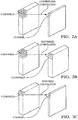
- a conventional (or regular) convolution layer applies a kernel to all of the channels of the input image. It slides this kernel across the image and at each step performs a weighted sum of the input pixels covered by the kernel across all input channels.
- the convolution operation thereby combines the values of all the input channels. If an image as shown in Fig. 2A has 3 input channels, then running a single convolution kernel across this image results in an output image with only 1 channel per pixel.
- a depthwise convolution works as shown in Fig. 2B . Unlike a conventional convolution it does not combine the input channels but it performs a convolution on each input channel separately. For an image with 3 input channels, a depthwise convolution creates an output image that also has 3 channels. Each channel gets its own set of weights. The purpose of the depthwise convolution is to filter the input channels.
- the depthwise convolution can be followed by a pointwise convolution as shown in Fig. 2C .
- the pointwise convolution is the same as a regular convolution but with a 1 ⁇ 1 kernel.
- the pointwise convolution adds up all the channels as a weighted sum.
- many of these pointwise kernels are usually stacked together to create an output image with many channels.
- the purpose of the pointwise convolution is to combine the output channels of the depthwise convolution to create new features.
- a depthwise convolution followed by a pointwise convolution is called a depthwise separable convolution.
- a conventional convolution does both filtering and combining in a single step, but with a depthwise separable convolution these two operations are done as separate steps.
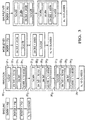
- Fig. 3 shows an exemplary embodiment of the first variant compared to three other network architectures.
- 'Baseline' is a conventional neural network, also called vanilla CNN.
- MobileNet is the model proposed by document D1.
- ShuffleNet is the model proposed by document D2.
- 'dw' and 'mp' stand for depthwise convolution and max-pooling, respectively.
- 'fc' layer means fully connected layer.
- 10 classes are used in all four network architectures shown in Fig. 3 .
- the shapes in Fig. 3 and the following tables are given in the following format: rows of the kernel x columns of the kernel x output channels.
- Table 1 shows the data compression in floating point numbers (short 'floats') throughout the baseline network without efficiency optimization.
- Convolutional neural networks are mostly well capable to handle a data compression of factor two.
- Table 2 shows the data compression in floats throughout the MobileNet model as proposed by document D1. 'Stride' is an operation similar to max-pooling. The critical compression points are highlighted in bold. Layers from the same block have the same background colour.
- Table 3 shows the data compression in floats throughout the ShuffleNet model as proposed by document D2. 'shuffle' and 'gc4' are as explained in document D2. 'Stride' is an operation similar to max-pooling. The critical compression points are highlighted in bold. Layers from the same block have the same background colour.
- Table 4 shows the data compression in floats throughout an exemplary model of the invention.
- '1d mp' means one-dimensional max-pooling.
- the invention successfully eliminates all bottlenecks in the network while keeping the number multiplications to a minimum (see tables 5 and 6).
- Table 5 Model Num. Multiplications Ratio to Baseline Accuracy (%) Baseline 39559168 1.00 79.50 MobileNet 4653056 0.12 77.70 ShuffleNet 2361344 0.06 75.60 Invention 5726208 0.14 81.20
- Table 5 shows a model comparison on the Cifar10 data set, which is a fundamental data set in computer vision.
- Table 5 shows a model comparison on the Cifar10 data set, which is a fundamental data set in computer vision.
- Table 5 the number of multiplications and the accuracy of each of the models are compared. Notice how the model according to an exemplary embodiment of the invention is significantly more accurate then both MobileNet and ShuffleNet while only being slightly more expensive than MobileNet.
- Table 6 Model Num. Multiplications Ratio to Baseline Accuracy (%) Baseline 1781760 1.00 91.08 MobileNet 532992 0.30 85.64 ShuffleNet 492288 0.28 82.73 Invention 390144 0.22 88.93
- Table 6 shows a model comparison on the SVHN (street view house number) data set. Notice that when the model according to an exemplary embodiment of the invention is extremely small, this model is both significantly cheaper and more accurate then both MobileNet and ShuffleNet.
Landscapes
- Engineering & Computer Science (AREA)
- Theoretical Computer Science (AREA)
- Physics & Mathematics (AREA)
- Data Mining & Analysis (AREA)
- Evolutionary Computation (AREA)
- Life Sciences & Earth Sciences (AREA)
- Artificial Intelligence (AREA)
- General Physics & Mathematics (AREA)
- General Engineering & Computer Science (AREA)
- Computing Systems (AREA)
- Software Systems (AREA)
- Molecular Biology (AREA)
- Computational Linguistics (AREA)
- Biophysics (AREA)
- Biomedical Technology (AREA)
- Mathematical Physics (AREA)
- General Health & Medical Sciences (AREA)
- Health & Medical Sciences (AREA)
- Bioinformatics & Cheminformatics (AREA)
- Bioinformatics & Computational Biology (AREA)
- Computer Vision & Pattern Recognition (AREA)
- Evolutionary Biology (AREA)
- Probability & Statistics with Applications (AREA)
- Image Analysis (AREA)
Abstract
Description
- The invention concerns a device and a method for image classification using a convolutional neural network.
- The entire field of computer vision and image understanding has been in recent years completely taken over by convolutional neural networks (CNNs). CNNs are a powerful class of algorithms which applies multiple layers of convolution-based blocks to an input. Unlike other convolution-based algorithms, the convolutional kernels are learned from data such that they generate responses to elements of increasing complexity. For example, a network with 3 layers, trained to differentiate cats from humans in an image will commonly learn to detect low-level features like edges and colour gradients in the first layer. The second layer will combine these edges and gradients to look for pointy ears and a torso. The last layer will further combine the data and learn that a tall object with two legs and no fur is a human while an object with pointy ears, paws and a tail is a cat.
- CNNs have been dominating university research in the field for about a decade while industrial application has only recently started to emerge. This delayed transition from pure research to application oriented development has two main reasons. The first reason is the maturity of the field which plays a significant role in every academia-industry transition of methods. Second and perhaps more important are the computational costs required for training and predicting with neural networks. Modern state-of-the-art artificial neural networks require billions of computations (floating point operations, FLOPS) and are thus normally executed on a series of high-end graphical processing units (GPUs) while exhibiting sub-interactive prediction cycles. While universities mostly aim for accuracy regardless of cost and efficiency, clients are not willing to settle for anything less than low-power, extremely cheap yet real-time algorithms and so a discrepancy emerges.
- Many companies overcome this challenge by outsourcing computational effort to the cloud thus requiring a constant internet connection and a tolerance to latencies. Others choose to comply with the current technological limitations and opt for an expensive hardware. Latest work in the field reviewed the nature of the building blocks used, the convolution operation, and tried to improve their efficiency.
- Recent work has been published in the following documents D1 to D4:
- D1 Howard, Andrew G., et al., "MobileNets: Efficient Convolutional Neural Networks for Mobile Vision Applications", arXiv preprint arXiv: 1704.04861, 2017, https://arxiv.org/pdf/1704.04861.pdf
- D2 Zhang, Xiangyu, et al., "ShuffleNet: An Extremely Efficient Convolutional Neural Network for Mobile Devices", arXiv preprint arXiv: 1707.01083, 2017, https://arxiv.org/pdf/1707.01083.pdf
- D3 Chollet, François, "Xception: Deep Learning with Depthwise Separable Convolutions", arXiv preprint arXiv: 1610.02357, 2016, https://arxiv.org/pdf/1610.02357.pdf
- D4 Kaiming, He, et al., "Deep Residual Learning for Image Recognition", Proceedings of the IEEE conference on computer vision and pattern recognition, 2016, pages 770-778, https://arxiv.org/pdf/1512.03385.pdf
- Despite the significant improvements both in terms of runtime and memory consumption demonstrated by existing technics, they present suboptimal accuracies when applied to slim models. Our experiments show that these technics rely heavily on taking extremely large networks, which have significantly more parameters than the minimum needed for the task, and making them slimmer and more efficient. Yet, applying these technics to small networks persistently results in a significant loss in prediction accuracy.
- It is an underlying object of the invention to provide a device for image classification comprising a convolutional neural network, wherein the device generates results with a high accuracy and with less computational effort compared to conventional devices. It is further an object of the invention to provide a system that comprises the device and a method for classifying images comprising a convolutional neural network.
- The object underlying the invention is satisfied by the features of the independent claims. Advantageous further developments and aspects of the invention are set forth in the dependent claims.
- In a first aspect of the instant application a device for image classification comprising a convolutional neural network is provided.
- The device is configured to receive an image that was captured by a camera. The image comprises a plurality of pixels. The convolutional neural network is configured to generate a plurality of probability values, in particular pseudo probability values, wherein each probability value is linked to a respective one of a plurality of predetermined classes and indicates the probability that the image or a pixel of the image is associated with the respective class. The classes divide the objects shown in the image in different categories that are predefined by the developee. For example, if road scenes are considered, there can be a class for vehicles, another class for pedestrians, another class for roads and another class for buildings. Since there are four predetermined classes in this example, for each image four probability values, in particular pseudo probability values, are generated. The probability value for one of the classes then indicates the probability that the image shows an object from this particular class. For example, the probability value for the class "vehicle" indicates the probability that the image shows a vehicle or a portion of a vehicle.
- Further, it may be provided that the plurality of probability values is generated for each pixel of the input image. The probability value of a given pixel for one of the classes then indicates the probability that the respective pixel is associated with this particular class. In the example given above, the probability value of a given pixel for the class "vehicle" then indicates the probability that the pixel shows a portion of a vehicle.
- Image classification by means of convolutional neural networks is known to a skilled person in general. Convolutional neural networks are a sort of artificial neural networks designed to mimic the human visual processing system from the eye to the visual cortex. They are made of an arbitrary number of consecutive layers which are trained together to fulfil the visual task of object classification. Each layer of the convolutional neural network learns to recognise features which are relevant to the specific task in an increasing complexity. The final layer of the convolutional neural network outputs an array of pixels where an individual probability value for each class is assigned to each pixel.
- The convolutional neural network of the device according to the first aspect of the application comprises a plurality of convolutional blocks, for example, two or three or four convolutional blocks. The convolutional blocks may be arranged consecutively, which means that the image captured by the camera is input into a first convolutional block, an output of the first convolutional block is fed as an input to a second convolutional block, an output of the second convolutional block is fed as an input to a third convolutional block, etc. Each of the convolutional blocks comprises a first convolutional layer, a second convolutional layer, a third convolutional layer and a fourth convolutional layer. It shall be noted that conventional convolutional blocks contain a single convolutional layer. Each of the convolutional blocks disclosed in this application approximates the functionality of a single conventional convolutional layer, saving computational effort and, in particular, storage space.
- Each of the four convolutional layers according to the first aspect of the application comprises a respective kernel (also called convolutional kernel or filter) which is swiped (or slides) over an input signal, wherein a convolution is performed between the kernel and the input signal. The kernel is an array or a matrix of numbers which are also called weights or parameters. The kernel has a number of rows, a number of columns, a number of input channels and a number of output channels. The kernel is thus a four-dimensional tensor given in the following format: [rows, columns, channels in, channels out]. In case only the rows and columns of a kernel are considered, the size of a kernel can be given in the format axb, wherein a is the number of rows and b is the number of columns. For example, a kernel with the size of 2x1 has two rows and one column. A kernel with the size of 1x1, i.e., a single row and a single column, performs a pointwise convolution.
- A convolution that does not combine the input channels but performs a convolution on each input channel separately is called a depthwise convolution. For a depthwise convolution the number of input channels is equal to the number of output channels.
- In the convolutional neural network according to the first aspect, the first convolutional layer receives an input and is configured to perform a pointwise convolution using a first kernel, i.e., the first kernel has the size of 1x1. The convolution performed by the first convolutional layer is a conventional (or regular) convolution, but not a depthwise convolution.
- The output of the first convolutional layer is fed as an input to the second convolutional layer. The second convolutional layer is configured to perform a depthwise convolution using a second kernel. The second kernel has either a single row or a single column. It can also be provided that two second convolutional layers are arranged in parallel, which both perform a depthwise convolution having the same kernel size, and both layers together have twice as many output channels than input channels.
- The output of the second convolutional layer is fed as an input to the third convolutional layer. The third convolutional layer is configured to perform a depthwise convolution using a third kernel. The third kernel has a single column if the second kernel has a single row. If the second kernel, however, has a single column, the third kernel has a single row. In particular, the numbers of rows and columns of the third kernel are interchanged compared to the numbers of rows and columns of the second kernel.
- The output of the third convolutional layer is fed as an input to the fourth convolutional layer. The fourth convolutional layer is configured to perform a convolution using a fourth kernel. The convolution performed by the fourth convolutional layer is a conventional (or regular) convolution, but not a depthwise convolution.
- According to the first aspect of the invention, the problem of decreased accuracies in recent models described in documents D1 to D4 is solved by a revisited structure of the convolution blocks. The proposed convolutional blocks are still significantly cheaper to compute than the common structure while sacrificing little to no accuracy.
- In one embodiment, the number of columns of the second kernel is 3 and the number of rows of the third kernel is 3 if the second kernel has a single row. In this case, the second kernel has a size of 1x3, and the third kernel has a size of 3x1.
- Alternatively, the number of rows of the second kernel is 3 and the number of columns of the third kernel is 3 if the second kernel has a single column. In this case, the second kernel has a size of 3x1, and the third kernel has a size of 1x3.
- In a further embodiment, the second convolutional layer is configured to perform a pooling operation after the depthwise convolution. The pooling operation combines a number of outputs of the depthwise convolution into a single output. In particular, the pooling operation is a one-dimensional pooling operation, i.e., the pooling is performed along a row or a column, but not along a row and a column. In this case, pooling is performed, for example, from a 1x2 patch or a 2x1 patch. The pooling operation may be a max-pooling, where a patch of a predetermined size is taken from an input and a single number that is the maximal element of the patch is returned as the output.
- Moreover, the fourth convolutional layer may be configured to apply the fourth kernel in strides to pixels of an input of the fourth convolutional layer, for example, in strides of two. Stride controls how the fourth kernel convolves around the input of the fourth convolutional layer. If the stride is set to two, the fourth kernel convolves around the input by shifting two units at a time. The amount by which the fourth kernel shifts is the stride.
- The stride of the fourth kernel may be one-dimensional. The fourth kernel then convolves around the input by shifting a number of units along a row or a column at a time, but not along a row and a column at the same time.
- Further, it may be provided that the number of output channels of the fourth convolutional layer is twice the number of the output channels of the first convolutional layer.
- In one embodiment, the second kernel has a single row and the second convolutional layer is configured to perform a pooling operation, in particular a one-dimensional pooling operation, after the depthwise convolution. In this case, the fourth kernel has two rows and one column, i.e., the fourth kernel has a size of 2x1. In particular, the fourth convolutional layer is configured to apply the fourth kernel in strides along an axis perpendicular to the pooling axis.
- In a further embodiment, the second kernel has a single column and the second convolutional layer is configured to perform a pooling operation, in particular a one-dimensional pooling operation, after the depthwise convolution. In this case, the fourth kernel has one row and two columns, i.e., the fourth kernel has a size of 1x2. In particular, the fourth convolutional layer is configured to apply the fourth kernel in strides along an axis perpendicular to the pooling axis.
- In yet a further embodiment, the second convolutional layer is configured not to perform a pooling operation after the depthwise convolution and the convolution performed by the fourth convolutional layer is a pointwise convolution, i.e., the fourth kernel has a size of 1x1.
- In yet a further embodiment, the first convolutional layer, the second convolutional layer, the third convolutional layer, and/or the fourth convolutional layer are configured to perform a rectification after the convolution. In particular, at least one or each layer in the block can be followed by a so called rectified linear unit (ReLU). The ReLU is usually defined elementwise as a non-linear activation function, e.g. ReLU(x) = max(0,x), i.e. negative inputs are set to zero while positive inputs remain unchanged. This allows running the calculations involved with the processing of the data in the more precise 32-bit domain while saving and reading the data in the compressed 8-bit format. In this way, the memory access rates can be increased by a factor of four if the output of each of the four convolution layers is rectified before further processing.
- The second convolutional layer can be configured to perform the depthwise convolution using at least two different second kernels, each of the at least two different second kernels having one of a single row and a single column. This is to say that in addition to the second kernel of the second convolutional layer at least one further second kernel is used in this layer, wherein the second kernels differ from each other with respect to their weights. However, the second kernels have the same structure, namely that they have either a single row or a single column, but not both. The different kernels are preferably applied in parallel per input channel, i.e. each input channel is processed with each of the different kernels separately. The number of different second kernels can be defined as a hyper-parameter for the second convolutional layer and in the same fashion also for other depthwise layers. Such a hyper-parameter (dm) can generally be used to increase the capacity of a depthwise convolutional layer by a factor of dm. It does so by using dm different kernels per input channel. The usual depthwise convolution with a single kernel can be seen as a special case where dm=1. A value of 2 is preferred if multiple different kernels are to be applied. As depthwise convolutions make for the least computationally intensive operator in the network, using multiple different kernels in a depthwise convolutional layer increases the accuracy of the prediction at a low additional computational cost.
- Likewise to using multiple different kernels in the second convolutional layer multiple different kernels can be used in the third convolutional layer. This is to say that the third convolutional layer can be configured to perform the depthwise convolution using at least two different third kernels, each of the at least two different third kernels having one of a single row and a single column. In particular, both, the second and third convolutional layer can employ multiple different kernels so as to strongly increase the accuracy at a low additional cost of processing.
- In a further embodiment, the number of output channels of the first convolutional layer is equal to the number of input channels of the first convolutional layer multiplied with a factor, the factor preferably being in the range of 1 to 6. A factor of 6, for example, means that the layer will output 6 times more channels than input channels. The factor can be employed as a free hyper-parameter. Preferably the factor is set to one of five values, namely [0.5, 1, 2, 4, 6]. The factor is a way to modify the amount of information outputted by the first layer of a block before it is preferably downsampled (using, e.g., pooling). A value of 0.5, i.e. a decrease of information by dropping half of the channels, would lead to a bottleneck structure while a value greater 1 would lead to a reversed bottleneck structure, i.e. by increasing the number of channels by the factor. A factor greater than 1 is preferred in order to reliably increase the accuracy. The structure of the first convolutional layer is for example 1x1xchx2.
- The second convolutional layer and/or the third convolutional layer can be configured to add a bias term after the depthwise convolution. A bias term is a variable, which is used as an offset for the output of a convolutional layer. It is preferably subject to training of the neural network. As such, the bias term is comparable to a weight of a kernel. It is, however, used after the convolution by adding the bias term to the result of the convolution. It has been found that the operations of adding of the bias terms do not require significant processing resources. Preferably, a direct addition of the bias term is employed. This allows for complete parallelisation of the addition operations. Initialisation time is thus reduced.
- Having regard to the second convolutional layer it has been found that in some applications a size of the second kernel of 3x1 has special advantages in view to computational efficiency. This holds even more if the size of the third kernel is reversed, i.e 1x3. The swap allows to overcome the padding limitation introduced by a 1x3 convolution. While the 3x1 convolution can be efficiently calculated over an arbitrary amount of elements, the 1x3 convolution usually requires the rows' length to be divisible by 4 in order to make full use of the processing units. This means that input data with a width not divisible by 4 would require initial padding, which is an expensive operation by itself. The following convolution would then also run on these redundant elements thus wasting computational resources. As a consequence, the padded elements generated by a 1x3 convolution would either be passed on to the next layer or be removed. Both options result in additional computations. However, they are saved when the size of the second kernel is 3x1 and the size of the third kernel is 1x3.
- Furthermore, many hardware architectures use cache-lines for reading data. A cache-line of 4 essentially means that four elements are read at the same time. This property can be used to parallelise the 3x1 convolution with four kernel displacements at the same time. A further aspect is that because the 3x1 convolution is significantly quicker to compute, moving it to the "top of the deptwise convolution pipeline" means that more expensive consecutive operations can run, e.g., on pooled activations (the 3x1 convolution can be followed by a 2x1 max-pooling layer, which in this configuration requires only half of the processing time compared to a 1x2 max-pooling layer). Therefore, the more expensive layer then runs on only half of the input columns and is thus quicker by a factor of two. In this way, the overall processing time can be reduced by 15 to 20%.
- Having regard to the fourth convolutional layer the size of the fourth kernel is preferably 1x2. This allows to fully utilise the cache-lines offered by usual hardware, wherein the convolutions can be performed per cache-line. In this way, a perfect parallelisation of four kernel displacements can be achieved for the price of one. Combined with the additional use of strides eight displacements, i.e. convolutions can be obtained for the price of one.
- The expensive phase of memory access associated with the depthwise convolutional layers can be further optimised. Since the input size is usually predetermined one or more processing parameters can be set to fixed values before the compilation. In this way, both parallelisation and memory access are can be optimised.
- According to a second aspect of the application, a system for image classification comprises a camera capturing an image and a device as described above.
- According to a third aspect of the application, a method for classifying an image by means of a convolutional neural network comprises the following steps:
- receiving an image captured by a camera, the image comprising a plurality of pixels, and
- using the convolutional neural network to generate a plurality of probability values, each probability value being linked to a respective one of a plurality of predetermined classes and indicating the probability that the image or a pixel of the image is associated with the respective class,
- wherein the convolutional neural network comprises a plurality of convolutional blocks and each of the convolutional blocks comprises:
- a first convolutional layer performing a pointwise convolution using a first kernel,
- a second convolutional layer performing a depthwise convolution using a second kernel, wherein the second kernel has one of a single row and a single column,
- a third convolutional layer performing a depthwise convolution using a third kernel, wherein the third kernel has a single column if the second kernel has a single row and the third kernel has a single row if the second kernel has a single column, and
- a fourth convolutional layer performing a convolution using a fourth kernel.
- The method according to the third aspect of the application may comprise the embodiments disclosed above in connection with the device according to the first aspect of the application.
- The invention will be described in more detail in the following in an exemplary manner with reference to an embodiment and to the drawings. There are shown in these:
- Fig. 1
- a schematic representation of an exemplary embodiment of a system for image classification;
- Fig. 2A
- a schematic representation of a conventional convolution;
- Fig. 2B
- a schematic representation of a depthwise convolution;
- Fig. 2C
- a schematic representation of a pointwise convolution; and
- Fig. 3
- a comparison of an exemplary embodiment of the invention with other network architectures.
-
Fig. 1 schematically illustrates asystem 10 for image classification. Thesystem 10 includes acamera 11 and adevice 12. - The
camera 11 is mounted on a vehicle and capturesimages 13 of the area in front of the vehicle. Alternatively, thecamera 11 may be directed to an area in the rear and/or at a side of the vehicle. - The
images 13 captured by thecamera 11 are fed to thedevice 12. Thedevice 12 performs a method for classifying theimages 13 and generatesoutput images 14 which contain probability values for each of theimages 13 and, in particular, for each pixel of theimages 13. Each probability value indicates the probability that therespective image 13 or pixel is associated with one of a plurality of predetermined classes. - For classifying the
images 13 thedevice 12 includes a convolutionalneural network 19 that consists of several convolutional layers and performs multiple convolution and pooling operations as explained below. The different convolutional layers are trained to detect different patterns in theimages 13. The final layer of the convolutionalneural network 19 outputs individual probability values that are assigned to eachimage 13 and, in particular, to each pixel. Each probability value indicates the probability that the respective image 13 (or pixel) is associated with one of a plurality of predetermined classes (or object categories). The classes divide the objects shown in theimages 13 in different categories that can be typically found in road scenes. For example, there can be a class for vehicles, another class for pedestrians, another class for roads, another class for buildings etc. The probability value of a given image 13 (or pixel) for one of the classes then indicates the probability that the respective image 13 (or pixel) shows an object from this particular class. - In one example, there are the following classes: vehicle, pedestrian, road and building. The probability values output by the final layer of the convolutional
neural network 19 for one of theimages 13 are, for example, 0.1, 0.1, 0.6 and 0.2 indicating the probability that thisparticular image 13 shows a vehicle, a pedestrian, a road and a building, respectively. - The
device 11, thesystem 10 and the method performed by thedevice 11 are exemplary embodiments according to the first, second and third aspect of the application, respectively. - When examining the applicability of documents D1 and D2, reduced accuracies were exhibited. Further examination of the relevant architectures revealed that this shortcoming results from bottlenecks in data flow through the convolutional neural network itself. Both algorithms disclosed in documents D1 and D2 force large compression factors inside the convolutional blocks. This kind of compression makes the network lose information too quickly thus harming performance when there is little to no redundancy in the information, i.e., in a small network. Furthermore, both documents D1 and D2 choose to not address the first layer of the network, leaving it rather computationally expensive.
- The unified general convolution block structure as explained in the following can safely replace the more expensive convolution layers disclosed in documents D1 and D2 without the risk of losing accuracy.
- The convolutional
neural network 19 of thedevice 11 illustrated inFig. 1 includes a plurality of convolutional blocks 20i. In the exemplary embodiment illustrated inFig. 1 , the convolutionalneural network 19 includes there convolutional blocks denoted by the reference numerals 201, 202 and 203. The convolutional blocks 201, 202 and 203 are arranged consecutively. - The convolutional blocks 201, 202 and 203 have the same structure and each of them includes four consecutively arranged convolutional layers: a first convolutional layer 21i, a second convolutional layer 22i, a third convolutional layer 23i and a fourth convolutional layer 24i (with i = 1, 2, 3).
- The
image 13 captured by thecamera 11 includes a plurality of pixels arranged in an array. Theimage 13 may, for example, be an RGB image with channels for red, green and blue, a greyscale image, a grey and red image or any other suitable image. - The
image 13 is fed to the first convolutional layer 211 of the convolutional block 201, which is the input layer of the convolutionalneural network 19. All other convolutional layers of the convolutional blocks 201, 202 and 203 are hidden layers. - Each of the convolutional layers applies a convolutional operation to its input, thereby an input volume having three dimensions (width, height and depth) is transformed to a 3D output volume of neuron activations. The output is passed to the next convolutional layer. The fourth convolutional layer 24i of the convolutional block 20i passes its output to the first convolutional layer 21i+1 of the next convolutional block 20i+1 (for i = 1, 2). The fourth convolutional layer 243 of the last convolutional block, which is the convolutional block 203 in the current example, passes its result to fully connected
layers 25 arranged after the last convolutional block. - Each of the four convolutional layers 21i, 22i, 23i and 24i includes a respective kernel which slides over the input signal of the respective convolutional layer, wherein a convolution is performed between the kernel and the input signal.
- Modern convolutional neural networks apply a pooling operator for subsampling. The pooling operator, in its common configuration, takes a patch of a predetermined size from the image, for example a 2x2 patch, and returns a single number which is the maximal element of the patch. This kind of operator is biologically motivated and holds many benefits. However, it also significantly reduces the amount of information within the network and forces a data compression. As each displacement of the pooling kernel commonly takes four numbers and outputs just a single number, each pooling layer compresses the data by a factor of four, thus creating a bottleneck. The common method for coping with the pooling-induced bottlenecks is to double the number of channels (kernels) right before the pooling. By doing so the network only loses about a half of its data which is shown to be a healthy compression.
- In the unified general convolution block structure proposed herein the number of channels are only compressed to half of their incoming amount in the first part of the convolutional block. For example, if one of the convolutional blocks takes 16 input channels the first part of the convolutional block compresses them to 8 channels.
- Further, to lessen the aggressiveness of the pooling operator while keeping a highly efficient architecture, a dimension wise separation of the pooling operator is proposed. Instead of pooling from a 2x2 patch, we pool from a 1x2 patch (or a 2x1 patch) and afterwards pool from a 2x1 patch (or a 1x2 patch).
- In addition, instead of convolving all input channels together with a 3x3 kernel, each channel is only convolved with itself, first with a 3x1 kernel (or a 1x3 kernel) and then with a 1x3 kernel (or a 3x1 kernel), and a 1x1 kernel is used which convolves the input channels.
- In a first variant, the convolutional blocks 20i (with i = 1, 2, 3) have the following structure:
first convolutional layer 21i: 1x1xch/2 second convolutional layer 22i: dw 1x3 + 1d mp third convolutional layer 23i: dw 3x1 fourth convolutional layer 24i: 2x1xch + 1d stride - The first convolutional layer 21i performs a pointwise convolution (which is not a depthwise, but a regular convolution) using a first kernel with a size of 1x1, i.e., the first kernel has a single row and a single column. The number of output channels of the first convolutional layer 21i is ch/2.
- The second convolutional layer 22i performs a depthwise convolution ('dw') using a second kernel, wherein the second kernel has a size of 1x3, i.e., the second kernel has a single row and three columns. The depthwise convolution is followed by a max-pooling operation ('mp'). The pooling operation can be a one-dimensional pooling operation along a row. For example, if the pooling operator (or pooling kernel) has the size of 1x2 and is configured to output the maximum value, the pooling operator compares two input values that are arranged next to each other in a row and outputs the larger value.
- The third convolutional layer 23i performs a depthwise convolution ('dw') using a third kernel, wherein the third kernel has a size of 3x1, i.e., the third kernel has three rows and a single column.
- The fourth convolutional layer 24i performs a convolution (which is not a depthwise, but a regular convolution) using a fourth kernel with a size of 2x1, i.e., the fourth kernel has two rows and a single column. The number of output channels of the fourth convolutional layer 24i is ch, which means that the number of output channels of the fourth convolutional layer 24i is twice the number of the output channels of first convolutional layer 21i.
- Further, the fourth convolutional layer 24i applies the fourth kernel in strides to the pixels of the input of the fourth convolutional layer 24i, for example, in strides of two. The stride of the fourth kernel can be one-dimensional. The fourth kernel then convolves around the input by shifting a number of units along a column at a time, but not along a row.
- In a second variant, the convolutional blocks 20i (with i = 1, 2, 3) have the following structure:
first convolutional layer 21i: 1x1xch/2 second convolutional layer 22i: dw 3x1 + 1d mp third convolutional layer 23i: dw 1x3 fourth convolutional layer 24i: 1x2xch + 1d stride - The structure of the convolutional blocks 20i in the second variant is similar to the structure of the convolutional blocks 20i in the first variant. The difference is that the second convolutional layer 22i of the second variant performs a depthwise convolution using a second kernel having a size of 3x1, i.e., the second kernel has three rows and a single column. Further, the pooling operation can be a one-dimensional pooling operation along a column. For example, if the pooling operator (or pooling kernel) has the size of 2x1 and is configured to output the maximum value, the pooling operator compares two input values that are arranged next to each other in a column and outputs the larger value.
- Further, the third convolutional layer 23i of the second variant performs a depthwise convolution using a third kernel, wherein the third kernel has a size of 1x3, i.e., the third kernel has a single row and three columns.
- The fourth convolutional layer 24i of the second variant performs a convolution using a fourth kernel with a size of 1x2, i.e., the fourth kernel has a single row and two columns.
- Further, the fourth convolutional layer 24i applies the fourth kernel in strides to the pixels of the input of the fourth convolutional layer 24i, for example, in strides of two. The stride of the fourth kernel can be one-dimensional. The fourth kernel then convolves around the input by shifting a number of units along a row at a time, but not along a column.
- In a third variant, the convolutional blocks 20i (with i = 1, 2, 3) have the following structure:
first convolutional layer 21i: 1x1xch/2 second convolutional layer 22i: dw 3x1 third convolutional layer 23i: dw 1x3 fourth convolutional layer 24i: 1x1xch - The structure of the convolutional blocks 20i in the third variant is similar to the structure of the convolutional blocks 20i in the first variant. The difference is that in the third variant no max-pooling is performed in the second convolutional layer 22i and the fourth convolutional layer 24i performs a pointwise convolution using a fourth kernel with a size of 1x1.
- In addition, the fourth convolutional layer 24i applies the fourth kernel in strides of one to the pixels of the input of the fourth convolutional layer 24i.
- In the following, the idea behind the depthwise convolution is explained as can also be found at the following internet address: http://machinethink.net/blog/googles-mobile-net-architecture-on-iphone/.
- A conventional (or regular) convolution layer applies a kernel to all of the channels of the input image. It slides this kernel across the image and at each step performs a weighted sum of the input pixels covered by the kernel across all input channels.
- The convolution operation thereby combines the values of all the input channels. If an image as shown in
Fig. 2A has 3 input channels, then running a single convolution kernel across this image results in an output image with only 1 channel per pixel. - This means that for each input pixel, no matter how many channels it has, the convolution writes a new output pixel with only a single channel. In practice many convolution kernels run across the input image. Each kernel gets its own channel in the output.
- A depthwise convolution works as shown in
Fig. 2B . Unlike a conventional convolution it does not combine the input channels but it performs a convolution on each input channel separately. For an image with 3 input channels, a depthwise convolution creates an output image that also has 3 channels. Each channel gets its own set of weights. The purpose of the depthwise convolution is to filter the input channels. - The depthwise convolution can be followed by a pointwise convolution as shown in
Fig. 2C . The pointwise convolution is the same as a regular convolution but with a 1×1 kernel. The pointwise convolution adds up all the channels as a weighted sum. As with a regular convolution, many of these pointwise kernels are usually stacked together to create an output image with many channels. The purpose of the pointwise convolution is to combine the output channels of the depthwise convolution to create new features. - A depthwise convolution followed by a pointwise convolution is called a depthwise separable convolution. A conventional convolution does both filtering and combining in a single step, but with a depthwise separable convolution these two operations are done as separate steps.
-
Fig. 3 shows an exemplary embodiment of the first variant compared to three other network architectures. 'Baseline' is a conventional neural network, also called vanilla CNN. MobileNet is the model proposed by document D1. ShuffleNet is the model proposed by document D2. 'dw' and 'mp' stand for depthwise convolution and max-pooling, respectively. 'fc' layer means fully connected layer. 10 classes are used in all four network architectures shown inFig. 3 . The shapes inFig. 3 and the following tables are given in the following format: rows of the kernel x columns of the kernel x output channels. - In the following the results of experiments are presented that were undertaken to evaluate the unified convolution block structure as proposed herein.
Table 1 Layer Shape out Floats out 3x3x64 + mp 16x16x64 16384 3x3x128 + mp 8x8x128 8192 3x3x256 + mp 4x4x256 4096 1x1x10 1x1x10 10 - Table 1 shows the data compression in floating point numbers (short 'floats') throughout the baseline network without efficiency optimization. Convolutional neural networks are mostly well capable to handle a data compression of factor two.


- Table 2 shows the data compression in floats throughout the MobileNet model as proposed by document D1. 'Stride' is an operation similar to max-pooling. The critical compression points are highlighted in bold. Layers from the same block have the same background colour.

- Table 3 shows the data compression in floats throughout the ShuffleNet model as proposed by document D2. 'shuffle' and 'gc4' are as explained in document D2. 'Stride' is an operation similar to max-pooling. The critical compression points are highlighted in bold. Layers from the same block have the same background colour.


- Table 4 shows the data compression in floats throughout an exemplary model of the invention. '1d mp' means one-dimensional max-pooling. The invention successfully eliminates all bottlenecks in the network while keeping the number multiplications to a minimum (see tables 5 and 6).
Table 5 Model Num. Multiplications Ratio to Baseline Accuracy (%) Baseline 39559168 1.00 79.50 MobileNet 4653056 0.12 77.70 ShuffleNet 2361344 0.06 75.60 Invention 5726208 0.14 81.20 - Table 5 shows a model comparison on the Cifar10 data set, which is a fundamental data set in computer vision. In table 5 the number of multiplications and the accuracy of each of the models are compared. Notice how the model according to an exemplary embodiment of the invention is significantly more accurate then both MobileNet and ShuffleNet while only being slightly more expensive than MobileNet.
Table 6 Model Num. Multiplications Ratio to Baseline Accuracy (%) Baseline 1781760 1.00 91.08 MobileNet 532992 0.30 85.64 ShuffleNet 492288 0.28 82.73 Invention 390144 0.22 88.93 - Table 6 shows a model comparison on the SVHN (street view house number) data set. Notice that when the model according to an exemplary embodiment of the invention is extremely small, this model is both significantly cheaper and more accurate then both MobileNet and ShuffleNet.
- Since the models are initialized with a random seed, all accuracies in tables 5 and 6 are the mean accuracy of multiple runs. This helps us even out cases of particularly good or particularly bad initialization.
-
- 10
- system
- 11
- camera
- 12
- device
- 13
- image
- 14
- output image
- 19
- convolutional neural network
- 201
- convolutional block
- 202
- convolutional block
- 203
- convolutional block
- 211
- first convolutional layer
- 212
- first convolutional layer
- 213
- first convolutional layer
- 221
- second convolutional layer
- 222
- second convolutional layer
- 223
- second convolutional layer
- 231
- third convolutional layer
- 232
- third convolutional layer
- 233
- third convolutional layer
- 241
- fourth convolutional layer
- 242
- fourth convolutional layer
- 243
- fourth convolutional layer
- 25
- fully connected layers
Claims (15)
- A device (12) for image classification comprising a convolutional neural network (19), wherein
the device (12) is configured to receive an image (13) captured by a camera (11), the image (13) comprising a plurality of pixels,
the convolutional neural network (19) is configured to generate a plurality of probability values, each probability value being linked to a respective one of a plurality of predetermined classes and indicating the probability that the image (13) or a pixel of the image (13) is associated with the respective class, and
the convolutional neural network (19) comprises a plurality of convolutional blocks (201, 202, 203) and each of the convolutional blocks (201, 202, 203) comprises:a first convolutional layer (211, 212, 213) configured to perform a pointwise convolution using a first kernel,a second convolutional layer (221, 222, 223) configured to perform a depthwise convolution using a second kernel, wherein the second kernel has one of a single row and a single column,a third convolutional layer (231, 232, 233) configured to perform a depthwise convolution using a third kernel, wherein the third kernel has a single column if the second kernel has a single row, and the third kernel has a single row if the second kernel has a single column, anda fourth convolutional layer (241, 242, 243) configured to perform a convolution using a fourth kernel. - The device (12) as claimed in claim 1, wherein the number of columns of the second kernel is 3 and the number of rows of the third kernel is 3 if the second kernel has a single row, and wherein the number of rows of the second kernel is 3 and the number of columns of the third kernel is 3 if the second kernel has a single column.
- The device (12) as claimed in claim 1 or 2, wherein the second convolutional layer (221, 222, 223) is configured to perform a pooling operation, in particular a one-dimensional pooling operation, after the depthwise convolution.
- The device (12) as claimed in one of the preceding claims, wherein the fourth convolutional layer (241, 242, 243) is configured to apply the fourth kernel in strides to pixels of an input of the fourth convolutional layer (241, 242, 243).
- The device (12) as claimed in one of the preceding claims, wherein the number of output channels of the fourth convolutional layer (241, 242, 243) is twice the number of the output channels of the first convolutional layer (211, 212, 213).
- The device (12) as claimed in one of the preceding claims, wherein the second kernel has a single row, the second convolutional layer (221, 222, 223) is configured to perform a pooling operation after the depthwise convolution, and the fourth kernel has two rows and a single column, or wherein the second kernel has a single column, the second convolutional layer (221, 222, 223) is configured to perform a pooling operation after the depthwise convolution, and the fourth kernel has a single row and two columns, or
wherein the second convolutional layer (221, 222, 223) is configured not to perform a pooling operation after the depthwise convolution and the convolution performed by the fourth convolutional layer (241, 242, 243) is a pointwise convolution. - The device (12) as claimed in one of the preceding claims, wherein the first convolutional layer (211, 212, 213), the second convolutional layer (221, 222, 223), the third convolutional layer (231, 232, 233), and/or the fourth convolutional layer (241, 242, 243) are configured to perform a rectification after the convolution.
- The device (12) as claimed in one of the preceding claims, wherein the second convolutional layer (221, 222, 223) is configured to perform the depthwise convolution using at least two different second kernels, each of the at least two different second kernels having one of a single row and a single column,
and/or
wherein the third convolutional layer (231, 232, 233) is configured to perform the depthwise convolution using at least two different third kernels, each of the at least two different third kernels having one of a single row and a single column. - The device (12) as claimed in one of the preceding claims, wherein the number of output channels of the first convolutional layer (211, 212, 213) is the number of input channels of the first convolutional layer (211, 212, 213) multiplied with a factor, the factor preferably being in the range of 1 to 6, and/or
wherein the second convolutional layer (221, 222, 223) and/or the third convolutional layer (231, 232, 233) are configured to add a bias term after the depthwise convolution. - A system (10) for image classification, the system (10) comprising a camera (11) capturing an image (13) and a device (12) as claimed in one of the preceding claims.
- A method for classifying an image by means of a convolutional neural network (19), the method comprising:receiving an image (13) captured by a camera (11), the image (13) comprising a plurality of pixels, andusing the convolutional neural network (19) to generate a plurality of probability values, each probability value being linked to a respective one of a plurality of predetermined classes and indicating the probability that the image (13) or a pixel of the image (13) is associated with the respective class,wherein the convolutional neural network (19) comprises a plurality of convolutional blocks (201, 202, 203) and each of the convolutional blocks (201, 202, 203) comprises:a first convolutional layer (211, 212, 213) performing a pointwise convolution using a first kernel,a second convolutional layer (221, 222, 223) performing a depthwise convolution using a second kernel, wherein the second kernel has one of a single row and a single column,a third convolutional layer (231, 232, 233) performing a depthwise convolution using a third kernel, wherein the third kernel has a single column if the second kernel has a single row, and the third kernel has a single row if the second kernel has a single column, anda fourth convolutional layer (241, 242, 243) performing a convolution using a fourth kernel.
- The method as claimed in claim 11, wherein the number of columns of the second kernel is 3 and the number of rows of the third kernel is 3 if the second kernel has a single row, and wherein the number of rows of the second kernel is 3 and the number of columns of the third kernel is 3 if the second kernel has a single column.
- The method as claimed in claim 11 or 12, wherein the second convolutional layer (221, 222, 223) performs a pooling operation, in particular a one-dimensional pooling operation, after the depthwise convolution.
- The method as claimed in one of the claims 11 to 13, wherein the fourth convolutional layer (241, 242, 243) applies the fourth kernel in strides to pixels of an input of the fourth convolutional layer (241, 242, 243), and/or wherein the number of output channels of the fourth convolutional layer (241, 242, 243) is twice the number of the output channels of the first convolutional layer (211, 212, 213).
- The method as claimed in one of the claims 11 to 14, wherein the second kernel has a single row, the second convolutional layer (221, 222, 223) performs a pooling operation after the depthwise convolution, and the fourth kernel has two rows and a single column, or
wherein the second kernel has a single column, the second convolutional layer (221, 222, 223) performs a pooling operation after the depthwise convolution, and the fourth kernel has a single row and two columns, or wherein the second convolutional layer (221, 222, 223) does not perform a pooling operation after the depthwise convolution and the convolution performed by the fourth convolutional layer (241, 242, 243) is a pointwise convolution.
Priority Applications (2)
| Application Number | Priority Date | Filing Date | Title |
|---|---|---|---|
| US16/241,091 US10832097B2 (en) | 2018-01-18 | 2019-01-07 | Device and a method for image classification using a convolutional neural network |
| CN201910042452.9A CN110059710B (en) | 2018-01-18 | 2019-01-17 | Apparatus and method for image classification using convolutional neural networks |
Applications Claiming Priority (1)
| Application Number | Priority Date | Filing Date | Title |
|---|---|---|---|
| EP18152378.8A EP3514733A1 (en) | 2018-01-18 | 2018-01-18 | A device and a method for image classification using a convolutional neural network |
Publications (2)
| Publication Number | Publication Date |
|---|---|
| EP3514735A1 true EP3514735A1 (en) | 2019-07-24 |
| EP3514735B1 EP3514735B1 (en) | 2024-01-31 |
Family
ID=61007539
Family Applications (2)
| Application Number | Title | Priority Date | Filing Date |
|---|---|---|---|
| EP18152378.8A Withdrawn EP3514733A1 (en) | 2018-01-18 | 2018-01-18 | A device and a method for image classification using a convolutional neural network |
| EP18213652.3A Active EP3514735B1 (en) | 2018-01-18 | 2018-12-18 | A device and a method for image classification using a convolutional neural network |
Family Applications Before (1)
| Application Number | Title | Priority Date | Filing Date |
|---|---|---|---|
| EP18152378.8A Withdrawn EP3514733A1 (en) | 2018-01-18 | 2018-01-18 | A device and a method for image classification using a convolutional neural network |
Country Status (3)
| Country | Link |
|---|---|
| US (1) | US10832097B2 (en) |
| EP (2) | EP3514733A1 (en) |
| CN (1) | CN110059710B (en) |
Families Citing this family (31)
| Publication number | Priority date | Publication date | Assignee | Title |
|---|---|---|---|---|
| CA3140924A1 (en) * | 2019-06-04 | 2020-12-10 | University Of Manitoba | Computer-implemented method of analyzing an image to segment article of interest therein |
| TWI719512B (en) * | 2019-06-24 | 2021-02-21 | 瑞昱半導體股份有限公司 | Method and system for algorithm using pixel-channel shuffle convolution neural network |
| KR102097294B1 (en) * | 2019-07-19 | 2020-04-06 | (주)지와이네트웍스 | Method and apparatus for training neural network model for detecting flame, and flame detecting method using the same model |
| CN110489584B (en) * | 2019-07-19 | 2021-10-01 | 长沙理工大学 | Image classification method and system based on densely connected MobileNets model |
| CN119027713A (en) * | 2019-07-30 | 2024-11-26 | 华为技术有限公司 | Image classification method and device |
| CN110569895B (en) * | 2019-08-30 | 2023-04-07 | 深圳大学 | Micro Doppler radar human body action classification method of convolutional neural network |
| CN110781912A (en) * | 2019-09-10 | 2020-02-11 | 东南大学 | An Image Classification Method Based on Channel Dilated Inverted Convolutional Neural Networks |
| CN110728352A (en) * | 2019-09-10 | 2020-01-24 | 东南大学 | Large-scale image classification method based on deep convolutional neural network |
| CN110782001B (en) * | 2019-09-11 | 2024-04-09 | 东南大学 | An improved method based on group convolutional neural network using shared convolution kernels |
| US11443163B2 (en) * | 2019-10-11 | 2022-09-13 | Alibaba Group Holding Limited | Method and system for executing neural network |
| US11449714B2 (en) * | 2019-10-30 | 2022-09-20 | Google Llc | Efficient convolutional neural networks and techniques to reduce associated computational costs |
| CN116416561A (en) * | 2019-11-22 | 2023-07-11 | 迪爱斯信息技术股份有限公司 | A video image processing method and device |
| CN113052291B (en) * | 2019-12-27 | 2024-04-16 | 上海商汤智能科技有限公司 | Data processing method and device |
| CN111178513B (en) * | 2019-12-31 | 2022-04-15 | 深圳云天励飞技术股份有限公司 | Convolution implementation method and device of neural network and terminal equipment |
| CN113298843B (en) | 2020-02-24 | 2024-05-14 | 中科寒武纪科技股份有限公司 | Data quantization processing method, device, electronic equipment and storage medium |
| US11443013B2 (en) * | 2020-03-23 | 2022-09-13 | Meta Platforms, Inc. | Pipelined pointwise convolution using per-channel convolution operations |
| CN111833360B (en) * | 2020-07-14 | 2024-03-26 | 腾讯科技(深圳)有限公司 | Image processing method, device, equipment and computer readable storage medium |
| CN112001258B (en) * | 2020-07-27 | 2023-07-11 | 上海东普信息科技有限公司 | Method, device, equipment and storage medium for identifying on-time arrival of logistics truck |
| CN112149742A (en) * | 2020-09-25 | 2020-12-29 | 济南浪潮高新科技投资发展有限公司 | Intelligent labeling method based on target detection network |
| KR102898595B1 (en) * | 2020-10-15 | 2025-12-18 | 삼성전자주식회사 | Electronic device and controlling method of electronic device |
| EP4191477A4 (en) * | 2020-10-15 | 2024-01-24 | Samsung Electronics Co., Ltd. | ELECTRONIC DEVICE AND CONTROL METHOD FOR ELECTRONIC DEVICE |
| TWI768517B (en) * | 2020-10-21 | 2022-06-21 | 國立政治大學 | Image quality improvement method and image processing apparatus using the same |
| US20220198250A1 (en) * | 2020-12-21 | 2022-06-23 | Hewlett Packard Enterprise Development Lp | Weighted matrix for input data stream |
| CN112801266B (en) * | 2020-12-24 | 2023-10-31 | 武汉旷视金智科技有限公司 | Neural network construction method, device, equipment and medium |
| US12131478B2 (en) * | 2021-02-04 | 2024-10-29 | Gynetworks Co., Ltd. | Method for object segmentation based on deep-learning using a trained neural network and system for performing the same |
| CN113239898A (en) * | 2021-06-17 | 2021-08-10 | 阿波罗智联(北京)科技有限公司 | Method for processing image, road side equipment and cloud control platform |
| CN113409281A (en) * | 2021-06-24 | 2021-09-17 | 上海云从企业发展有限公司 | Image definition evaluation method and device based on depth model |
| CN113988256B (en) * | 2021-10-14 | 2024-09-20 | 锐宸微(上海)科技有限公司 | Convolution operation method |
| CN116408814A (en) * | 2021-12-31 | 2023-07-11 | 同方威视技术股份有限公司 | mobile robot system |
| CN114266769B (en) * | 2022-03-01 | 2022-06-21 | 北京鹰瞳科技发展股份有限公司 | A system and method for eye disease recognition based on neural network model |
| CN119832292B (en) * | 2024-11-29 | 2025-10-14 | 北京计算机技术及应用研究所 | Light-weight communication equipment detection method based on asymmetric dense convolutional neural network |
Citations (1)
| Publication number | Priority date | Publication date | Assignee | Title |
|---|---|---|---|---|
| CN107392214A (en) * | 2017-07-26 | 2017-11-24 | 成都快眼科技有限公司 | A kind of object detection method based on full convolution splitting network |
Family Cites Families (7)
| Publication number | Priority date | Publication date | Assignee | Title |
|---|---|---|---|---|
| CN110826530B (en) * | 2014-11-15 | 2023-06-30 | 北京旷视科技有限公司 | Face detection using machine learning |
| JP6961011B2 (en) * | 2016-12-09 | 2021-11-05 | ベイジン ホライズン インフォメーション テクノロジー カンパニー リミテッド | Systems and methods for data management |
| US11562115B2 (en) * | 2017-01-04 | 2023-01-24 | Stmicroelectronics S.R.L. | Configurable accelerator framework including a stream switch having a plurality of unidirectional stream links |
| US10489887B2 (en) * | 2017-04-10 | 2019-11-26 | Samsung Electronics Co., Ltd. | System and method for deep learning image super resolution |
| US10997727B2 (en) * | 2017-11-07 | 2021-05-04 | Align Technology, Inc. | Deep learning for tooth detection and evaluation |
| CN108985317B (en) * | 2018-05-25 | 2022-03-01 | 西安电子科技大学 | Image classification method based on separable convolution and attention mechanism |
| CN108898112A (en) * | 2018-07-03 | 2018-11-27 | 东北大学 | A kind of near-infrared human face in-vivo detection method and system |
-
2018
- 2018-01-18 EP EP18152378.8A patent/EP3514733A1/en not_active Withdrawn
- 2018-12-18 EP EP18213652.3A patent/EP3514735B1/en active Active
-
2019
- 2019-01-07 US US16/241,091 patent/US10832097B2/en active Active
- 2019-01-17 CN CN201910042452.9A patent/CN110059710B/en active Active
Patent Citations (1)
| Publication number | Priority date | Publication date | Assignee | Title |
|---|---|---|---|---|
| CN107392214A (en) * | 2017-07-26 | 2017-11-24 | 成都快眼科技有限公司 | A kind of object detection method based on full convolution splitting network |
Non-Patent Citations (4)
| Title |
|---|
| CHOLLET, FRANGOIS: "Xception: Deep Learning with Depthwise Separable Convolutions", ARXIV PREPRINT ARXIV: 1610.02357, 2016, Retrieved from the Internet <URL:https://arxiv.org/pdf/1610.02357.pdf> |
| HOWARD, ANDREW G. ET AL.: "MobileNets: Efficient Convolutional Neural Networks for Mobile Vision Applications", ARXIV PREPRINT ARXIV: 1704.04861, 2017, Retrieved from the Internet <URL:https://arxiv.org/pdf/1704.04861.pdf> |
| KAIMING, HE ET AL.: "Deep Residual Learning for Image Recognition", PROCEEDINGS OF THE IEEE CONFERENCE ON COMPUTER VISION AND PATTERN RECOGNITION, 2016, pages 770 - 778, XP055536240, Retrieved from the Internet <URL:https://arxiv.org/pdf/1512.03385.pdf> DOI: doi:10.1109/CVPR.2016.90 |
| ZHANG, XIANGYU ET AL.: "ShuffleNet: An Extremely Efficient Convolutional Neural Network for Mobile Devices", ARXIV PREPRINT ARXIV: 1707.01083, 2017, Retrieved from the Internet <URL:https://arxiv.org/pdf/1707.01083.pdf> |
Also Published As
| Publication number | Publication date |
|---|---|
| CN110059710A (en) | 2019-07-26 |
| EP3514735B1 (en) | 2024-01-31 |
| EP3514733A1 (en) | 2019-07-24 |
| US20190220709A1 (en) | 2019-07-18 |
| CN110059710B (en) | 2023-07-14 |
| US10832097B2 (en) | 2020-11-10 |
Similar Documents
| Publication | Publication Date | Title |
|---|---|---|
| EP3514735B1 (en) | A device and a method for image classification using a convolutional neural network | |
| CN112561027B (en) | Neural network architecture search method, image processing method, device and storage medium | |
| US11989645B2 (en) | Event-based extraction of features in a convolutional spiking neural network | |
| CN112236779B (en) | Image processing method and image processing device based on convolutional neural network | |
| CN110033003B (en) | Image segmentation method and image processing device | |
| KR102224510B1 (en) | Systems and methods for data management | |
| EP3427195B1 (en) | Convolutional neural networks, particularly for image analysis | |
| CN112446380B (en) | Image processing methods and apparatus | |
| CN111914997B (en) | Method for training neural network, image processing method and device | |
| CN112215332B (en) | Searching method, image processing method and device for neural network structure | |
| US11157764B2 (en) | Semantic image segmentation using gated dense pyramid blocks | |
| EP3923233A1 (en) | Image denoising method and apparatus | |
| JP2020071862A (en) | Computer vision system and method | |
| US20180197067A1 (en) | Methods and apparatus for matrix processing in a convolutional neural network | |
| GB2580671A (en) | A computer vision system and method | |
| FR3050846A1 (en) | DEVICE AND METHOD FOR DISTRIBUTING CONVOLUTION DATA OF A CONVOLUTIONAL NEURON NETWORK | |
| CN113065637B (en) | A sensory network and data processing method | |
| CN115018039A (en) | Neural network distillation method, target detection method and device | |
| US20220044053A1 (en) | Semantic image segmentation using gated dense pyramid blocks | |
| Bhowmik et al. | Bio-inspired smart vision sensor: toward a reconfigurable hardware modeling of the hierarchical processing in the brain | |
| CN114693986B (en) | Training method of active learning model, image processing method and device | |
| EP3401840A1 (en) | Compressed data streams in object recognition | |
| WO2023122896A1 (en) | Data processing method and apparatus | |
| CN114418064B (en) | Target detection method, terminal equipment and storage medium | |
| US20220318961A1 (en) | Method and electronic device for removing artifact in high resolution image |
Legal Events
| Date | Code | Title | Description |
|---|---|---|---|
| PUAI | Public reference made under article 153(3) epc to a published international application that has entered the european phase |
Free format text: ORIGINAL CODE: 0009012 |
|
| STAA | Information on the status of an ep patent application or granted ep patent |
Free format text: STATUS: THE APPLICATION HAS BEEN PUBLISHED |
|
| AK | Designated contracting states |
Kind code of ref document: A1 Designated state(s): AL AT BE BG CH CY CZ DE DK EE ES FI FR GB GR HR HU IE IS IT LI LT LU LV MC MK MT NL NO PL PT RO RS SE SI SK SM TR |
|
| AX | Request for extension of the european patent |
Extension state: BA ME |
|
| STAA | Information on the status of an ep patent application or granted ep patent |
Free format text: STATUS: REQUEST FOR EXAMINATION WAS MADE |
|
| 17P | Request for examination filed |
Effective date: 20200122 |
|
| RBV | Designated contracting states (corrected) |
Designated state(s): AL AT BE BG CH CY CZ DE DK EE ES FI FR GB GR HR HU IE IS IT LI LT LU LV MC MK MT NL NO PL PT RO RS SE SI SK SM TR |
|
| STAA | Information on the status of an ep patent application or granted ep patent |
Free format text: STATUS: EXAMINATION IS IN PROGRESS |
|
| 17Q | First examination report despatched |
Effective date: 20210920 |
|
| RAP3 | Party data changed (applicant data changed or rights of an application transferred) |
Owner name: APTIV TECHNOLOGIES LIMITED |
|
| REG | Reference to a national code |
Ref legal event code: R079 Ipc: G06N0003046400 Ref country code: DE Ref legal event code: R079 Ref document number: 602018064737 Country of ref document: DE Free format text: PREVIOUS MAIN CLASS: G06N0003040000 Ipc: G06N0003046400 |
|
| GRAP | Despatch of communication of intention to grant a patent |
Free format text: ORIGINAL CODE: EPIDOSNIGR1 |
|
| STAA | Information on the status of an ep patent application or granted ep patent |
Free format text: STATUS: GRANT OF PATENT IS INTENDED |
|
| RIC1 | Information provided on ipc code assigned before grant |
Ipc: G06N 3/0464 20230101AFI20230829BHEP |
|
| INTG | Intention to grant announced |
Effective date: 20230926 |
|
| GRAS | Grant fee paid |
Free format text: ORIGINAL CODE: EPIDOSNIGR3 |
|
| P01 | Opt-out of the competence of the unified patent court (upc) registered |
Effective date: 20231102 |
|
| GRAA | (expected) grant |
Free format text: ORIGINAL CODE: 0009210 |
|
| STAA | Information on the status of an ep patent application or granted ep patent |
Free format text: STATUS: THE PATENT HAS BEEN GRANTED |
|
| AK | Designated contracting states |
Kind code of ref document: B1 Designated state(s): AL AT BE BG CH CY CZ DE DK EE ES FI FR GB GR HR HU IE IS IT LI LT LU LV MC MK MT NL NO PL PT RO RS SE SI SK SM TR |
|
| REG | Reference to a national code |
Ref country code: GB Ref legal event code: FG4D Ref country code: CH Ref legal event code: EP |
|
| REG | Reference to a national code |
Ref country code: DE Ref legal event code: R096 Ref document number: 602018064737 Country of ref document: DE |
|
| REG | Reference to a national code |
Ref country code: IE Ref legal event code: FG4D |
|
| REG | Reference to a national code |
Ref country code: LT Ref legal event code: MG9D |
|
| REG | Reference to a national code |
Ref country code: NL Ref legal event code: MP Effective date: 20240131 |
|
| PG25 | Lapsed in a contracting state [announced via postgrant information from national office to epo] |
Ref country code: IS Free format text: LAPSE BECAUSE OF FAILURE TO SUBMIT A TRANSLATION OF THE DESCRIPTION OR TO PAY THE FEE WITHIN THE PRESCRIBED TIME-LIMIT Effective date: 20240531 |
|
| PG25 | Lapsed in a contracting state [announced via postgrant information from national office to epo] |
Ref country code: LT Free format text: LAPSE BECAUSE OF FAILURE TO SUBMIT A TRANSLATION OF THE DESCRIPTION OR TO PAY THE FEE WITHIN THE PRESCRIBED TIME-LIMIT Effective date: 20240131 |
|
| PG25 | Lapsed in a contracting state [announced via postgrant information from national office to epo] |
Ref country code: GR Free format text: LAPSE BECAUSE OF FAILURE TO SUBMIT A TRANSLATION OF THE DESCRIPTION OR TO PAY THE FEE WITHIN THE PRESCRIBED TIME-LIMIT Effective date: 20240501 |
|
| REG | Reference to a national code |
Ref country code: AT Ref legal event code: MK05 Ref document number: 1654358 Country of ref document: AT Kind code of ref document: T Effective date: 20240131 |
|
| PG25 | Lapsed in a contracting state [announced via postgrant information from national office to epo] |
Ref country code: HR Free format text: LAPSE BECAUSE OF FAILURE TO SUBMIT A TRANSLATION OF THE DESCRIPTION OR TO PAY THE FEE WITHIN THE PRESCRIBED TIME-LIMIT Effective date: 20240131 Ref country code: NL Free format text: LAPSE BECAUSE OF FAILURE TO SUBMIT A TRANSLATION OF THE DESCRIPTION OR TO PAY THE FEE WITHIN THE PRESCRIBED TIME-LIMIT Effective date: 20240131 Ref country code: RS Free format text: LAPSE BECAUSE OF FAILURE TO SUBMIT A TRANSLATION OF THE DESCRIPTION OR TO PAY THE FEE WITHIN THE PRESCRIBED TIME-LIMIT Effective date: 20240430 |
|
| PG25 | Lapsed in a contracting state [announced via postgrant information from national office to epo] |
Ref country code: ES Free format text: LAPSE BECAUSE OF FAILURE TO SUBMIT A TRANSLATION OF THE DESCRIPTION OR TO PAY THE FEE WITHIN THE PRESCRIBED TIME-LIMIT Effective date: 20240131 |
|
| PG25 | Lapsed in a contracting state [announced via postgrant information from national office to epo] |
Ref country code: AT Free format text: LAPSE BECAUSE OF FAILURE TO SUBMIT A TRANSLATION OF THE DESCRIPTION OR TO PAY THE FEE WITHIN THE PRESCRIBED TIME-LIMIT Effective date: 20240131 |
|
| PG25 | Lapsed in a contracting state [announced via postgrant information from national office to epo] |
Ref country code: RS Free format text: LAPSE BECAUSE OF FAILURE TO SUBMIT A TRANSLATION OF THE DESCRIPTION OR TO PAY THE FEE WITHIN THE PRESCRIBED TIME-LIMIT Effective date: 20240430 Ref country code: NO Free format text: LAPSE BECAUSE OF FAILURE TO SUBMIT A TRANSLATION OF THE DESCRIPTION OR TO PAY THE FEE WITHIN THE PRESCRIBED TIME-LIMIT Effective date: 20240430 Ref country code: NL Free format text: LAPSE BECAUSE OF FAILURE TO SUBMIT A TRANSLATION OF THE DESCRIPTION OR TO PAY THE FEE WITHIN THE PRESCRIBED TIME-LIMIT Effective date: 20240131 Ref country code: LT Free format text: LAPSE BECAUSE OF FAILURE TO SUBMIT A TRANSLATION OF THE DESCRIPTION OR TO PAY THE FEE WITHIN THE PRESCRIBED TIME-LIMIT Effective date: 20240131 Ref country code: IS Free format text: LAPSE BECAUSE OF FAILURE TO SUBMIT A TRANSLATION OF THE DESCRIPTION OR TO PAY THE FEE WITHIN THE PRESCRIBED TIME-LIMIT Effective date: 20240531 Ref country code: HR Free format text: LAPSE BECAUSE OF FAILURE TO SUBMIT A TRANSLATION OF THE DESCRIPTION OR TO PAY THE FEE WITHIN THE PRESCRIBED TIME-LIMIT Effective date: 20240131 Ref country code: GR Free format text: LAPSE BECAUSE OF FAILURE TO SUBMIT A TRANSLATION OF THE DESCRIPTION OR TO PAY THE FEE WITHIN THE PRESCRIBED TIME-LIMIT Effective date: 20240501 Ref country code: FI Free format text: LAPSE BECAUSE OF FAILURE TO SUBMIT A TRANSLATION OF THE DESCRIPTION OR TO PAY THE FEE WITHIN THE PRESCRIBED TIME-LIMIT Effective date: 20240131 Ref country code: ES Free format text: LAPSE BECAUSE OF FAILURE TO SUBMIT A TRANSLATION OF THE DESCRIPTION OR TO PAY THE FEE WITHIN THE PRESCRIBED TIME-LIMIT Effective date: 20240131 Ref country code: BG Free format text: LAPSE BECAUSE OF FAILURE TO SUBMIT A TRANSLATION OF THE DESCRIPTION OR TO PAY THE FEE WITHIN THE PRESCRIBED TIME-LIMIT Effective date: 20240131 Ref country code: AT Free format text: LAPSE BECAUSE OF FAILURE TO SUBMIT A TRANSLATION OF THE DESCRIPTION OR TO PAY THE FEE WITHIN THE PRESCRIBED TIME-LIMIT Effective date: 20240131 |
|
| PG25 | Lapsed in a contracting state [announced via postgrant information from national office to epo] |
Ref country code: PL Free format text: LAPSE BECAUSE OF FAILURE TO SUBMIT A TRANSLATION OF THE DESCRIPTION OR TO PAY THE FEE WITHIN THE PRESCRIBED TIME-LIMIT Effective date: 20240131 Ref country code: PT Free format text: LAPSE BECAUSE OF FAILURE TO SUBMIT A TRANSLATION OF THE DESCRIPTION OR TO PAY THE FEE WITHIN THE PRESCRIBED TIME-LIMIT Effective date: 20240531 |
|
| PG25 | Lapsed in a contracting state [announced via postgrant information from national office to epo] |
Ref country code: SE Free format text: LAPSE BECAUSE OF FAILURE TO SUBMIT A TRANSLATION OF THE DESCRIPTION OR TO PAY THE FEE WITHIN THE PRESCRIBED TIME-LIMIT Effective date: 20240131 Ref country code: PT Free format text: LAPSE BECAUSE OF FAILURE TO SUBMIT A TRANSLATION OF THE DESCRIPTION OR TO PAY THE FEE WITHIN THE PRESCRIBED TIME-LIMIT Effective date: 20240531 Ref country code: PL Free format text: LAPSE BECAUSE OF FAILURE TO SUBMIT A TRANSLATION OF THE DESCRIPTION OR TO PAY THE FEE WITHIN THE PRESCRIBED TIME-LIMIT Effective date: 20240131 Ref country code: LV Free format text: LAPSE BECAUSE OF FAILURE TO SUBMIT A TRANSLATION OF THE DESCRIPTION OR TO PAY THE FEE WITHIN THE PRESCRIBED TIME-LIMIT Effective date: 20240131 |
|
| PG25 | Lapsed in a contracting state [announced via postgrant information from national office to epo] |
Ref country code: DK Free format text: LAPSE BECAUSE OF FAILURE TO SUBMIT A TRANSLATION OF THE DESCRIPTION OR TO PAY THE FEE WITHIN THE PRESCRIBED TIME-LIMIT Effective date: 20240131 |
|
| PG25 | Lapsed in a contracting state [announced via postgrant information from national office to epo] |
Ref country code: SM Free format text: LAPSE BECAUSE OF FAILURE TO SUBMIT A TRANSLATION OF THE DESCRIPTION OR TO PAY THE FEE WITHIN THE PRESCRIBED TIME-LIMIT Effective date: 20240131 |
|
| PG25 | Lapsed in a contracting state [announced via postgrant information from national office to epo] |
Ref country code: EE Free format text: LAPSE BECAUSE OF FAILURE TO SUBMIT A TRANSLATION OF THE DESCRIPTION OR TO PAY THE FEE WITHIN THE PRESCRIBED TIME-LIMIT Effective date: 20240131 Ref country code: CZ Free format text: LAPSE BECAUSE OF FAILURE TO SUBMIT A TRANSLATION OF THE DESCRIPTION OR TO PAY THE FEE WITHIN THE PRESCRIBED TIME-LIMIT Effective date: 20240131 |
|
| PG25 | Lapsed in a contracting state [announced via postgrant information from national office to epo] |
Ref country code: SK Free format text: LAPSE BECAUSE OF FAILURE TO SUBMIT A TRANSLATION OF THE DESCRIPTION OR TO PAY THE FEE WITHIN THE PRESCRIBED TIME-LIMIT Effective date: 20240131 |
|
| PG25 | Lapsed in a contracting state [announced via postgrant information from national office to epo] |
Ref country code: SM Free format text: LAPSE BECAUSE OF FAILURE TO SUBMIT A TRANSLATION OF THE DESCRIPTION OR TO PAY THE FEE WITHIN THE PRESCRIBED TIME-LIMIT Effective date: 20240131 Ref country code: SK Free format text: LAPSE BECAUSE OF FAILURE TO SUBMIT A TRANSLATION OF THE DESCRIPTION OR TO PAY THE FEE WITHIN THE PRESCRIBED TIME-LIMIT Effective date: 20240131 Ref country code: RO Free format text: LAPSE BECAUSE OF FAILURE TO SUBMIT A TRANSLATION OF THE DESCRIPTION OR TO PAY THE FEE WITHIN THE PRESCRIBED TIME-LIMIT Effective date: 20240131 Ref country code: EE Free format text: LAPSE BECAUSE OF FAILURE TO SUBMIT A TRANSLATION OF THE DESCRIPTION OR TO PAY THE FEE WITHIN THE PRESCRIBED TIME-LIMIT Effective date: 20240131 Ref country code: DK Free format text: LAPSE BECAUSE OF FAILURE TO SUBMIT A TRANSLATION OF THE DESCRIPTION OR TO PAY THE FEE WITHIN THE PRESCRIBED TIME-LIMIT Effective date: 20240131 Ref country code: CZ Free format text: LAPSE BECAUSE OF FAILURE TO SUBMIT A TRANSLATION OF THE DESCRIPTION OR TO PAY THE FEE WITHIN THE PRESCRIBED TIME-LIMIT Effective date: 20240131 |
|
| REG | Reference to a national code |
Ref country code: DE Ref legal event code: R097 Ref document number: 602018064737 Country of ref document: DE |
|
| PG25 | Lapsed in a contracting state [announced via postgrant information from national office to epo] |
Ref country code: IT Free format text: LAPSE BECAUSE OF FAILURE TO SUBMIT A TRANSLATION OF THE DESCRIPTION OR TO PAY THE FEE WITHIN THE PRESCRIBED TIME-LIMIT Effective date: 20240131 |
|
| PLBE | No opposition filed within time limit |
Free format text: ORIGINAL CODE: 0009261 |
|
| STAA | Information on the status of an ep patent application or granted ep patent |
Free format text: STATUS: NO OPPOSITION FILED WITHIN TIME LIMIT |
|
| PG25 | Lapsed in a contracting state [announced via postgrant information from national office to epo] |
Ref country code: IT Free format text: LAPSE BECAUSE OF FAILURE TO SUBMIT A TRANSLATION OF THE DESCRIPTION OR TO PAY THE FEE WITHIN THE PRESCRIBED TIME-LIMIT Effective date: 20240131 |
|
| 26N | No opposition filed |
Effective date: 20241101 |
|
| PG25 | Lapsed in a contracting state [announced via postgrant information from national office to epo] |
Ref country code: SI Free format text: LAPSE BECAUSE OF FAILURE TO SUBMIT A TRANSLATION OF THE DESCRIPTION OR TO PAY THE FEE WITHIN THE PRESCRIBED TIME-LIMIT Effective date: 20240131 |
|
| REG | Reference to a national code |
Ref country code: DE Ref legal event code: R081 Ref document number: 602018064737 Country of ref document: DE Owner name: APTIV TECHNOLOGIES AG, CH Free format text: FORMER OWNER: APTIV TECHNOLOGIES LIMITED, ST. MICHAEL, BB |
|
| PG25 | Lapsed in a contracting state [announced via postgrant information from national office to epo] |
Ref country code: MC Free format text: LAPSE BECAUSE OF FAILURE TO SUBMIT A TRANSLATION OF THE DESCRIPTION OR TO PAY THE FEE WITHIN THE PRESCRIBED TIME-LIMIT Effective date: 20240131 |
|
| REG | Reference to a national code |
Ref country code: CH Ref legal event code: PL |
|
| PG25 | Lapsed in a contracting state [announced via postgrant information from national office to epo] |
Ref country code: LU Free format text: LAPSE BECAUSE OF NON-PAYMENT OF DUE FEES Effective date: 20241218 |
|
| REG | Reference to a national code |
Ref country code: BE Ref legal event code: MM Effective date: 20241231 |
|
| PG25 | Lapsed in a contracting state [announced via postgrant information from national office to epo] |
Ref country code: BE Free format text: LAPSE BECAUSE OF NON-PAYMENT OF DUE FEES Effective date: 20241231 |
|
| PG25 | Lapsed in a contracting state [announced via postgrant information from national office to epo] |
Ref country code: CH Free format text: LAPSE BECAUSE OF NON-PAYMENT OF DUE FEES Effective date: 20241231 |
|
| PG25 | Lapsed in a contracting state [announced via postgrant information from national office to epo] |
Ref country code: IE Free format text: LAPSE BECAUSE OF NON-PAYMENT OF DUE FEES Effective date: 20241218 |
|
| PGFP | Annual fee paid to national office [announced via postgrant information from national office to epo] |
Ref country code: DE Payment date: 20251117 Year of fee payment: 8 |
|
| PGFP | Annual fee paid to national office [announced via postgrant information from national office to epo] |
Ref country code: GB Payment date: 20251210 Year of fee payment: 8 |
|
| PGFP | Annual fee paid to national office [announced via postgrant information from national office to epo] |
Ref country code: FR Payment date: 20251202 Year of fee payment: 8 |
|
| PG25 | Lapsed in a contracting state [announced via postgrant information from national office to epo] |
Ref country code: CY Free format text: LAPSE BECAUSE OF FAILURE TO SUBMIT A TRANSLATION OF THE DESCRIPTION OR TO PAY THE FEE WITHIN THE PRESCRIBED TIME-LIMIT Effective date: 20240131 |