EP3514725A1 - Display device for a vehicle - Google Patents
Display device for a vehicle Download PDFInfo
- Publication number
- EP3514725A1 EP3514725A1 EP18213098.9A EP18213098A EP3514725A1 EP 3514725 A1 EP3514725 A1 EP 3514725A1 EP 18213098 A EP18213098 A EP 18213098A EP 3514725 A1 EP3514725 A1 EP 3514725A1
- Authority
- EP
- European Patent Office
- Prior art keywords
- information
- vehicle
- driver
- display device
- environment
- Prior art date
- Legal status (The legal status is an assumption and is not a legal conclusion. Google has not performed a legal analysis and makes no representation as to the accuracy of the status listed.)
- Ceased
Links
Images




Classifications
-
- B—PERFORMING OPERATIONS; TRANSPORTING
- B60—VEHICLES IN GENERAL
- B60W—CONJOINT CONTROL OF VEHICLE SUB-UNITS OF DIFFERENT TYPE OR DIFFERENT FUNCTION; CONTROL SYSTEMS SPECIALLY ADAPTED FOR HYBRID VEHICLES; ROAD VEHICLE DRIVE CONTROL SYSTEMS FOR PURPOSES NOT RELATED TO THE CONTROL OF A PARTICULAR SUB-UNIT
- B60W50/00—Details of control systems for road vehicle drive control not related to the control of a particular sub-unit, e.g. process diagnostic or vehicle driver interfaces
- B60W50/08—Interaction between the driver and the control system
- B60W50/14—Means for informing the driver, warning the driver or prompting a driver intervention
-
- B—PERFORMING OPERATIONS; TRANSPORTING
- B60—VEHICLES IN GENERAL
- B60K—ARRANGEMENT OR MOUNTING OF PROPULSION UNITS OR OF TRANSMISSIONS IN VEHICLES; ARRANGEMENT OR MOUNTING OF PLURAL DIVERSE PRIME-MOVERS IN VEHICLES; AUXILIARY DRIVES FOR VEHICLES; INSTRUMENTATION OR DASHBOARDS FOR VEHICLES; ARRANGEMENTS IN CONNECTION WITH COOLING, AIR INTAKE, GAS EXHAUST OR FUEL SUPPLY OF PROPULSION UNITS IN VEHICLES
- B60K35/00—Instruments specially adapted for vehicles; Arrangement of instruments in or on vehicles
- B60K35/65—Instruments specially adapted for specific vehicle types or users, e.g. for left- or right-hand drive
- B60K35/654—Instruments specially adapted for specific vehicle types or users, e.g. for left- or right-hand drive the user being the driver
-
- B—PERFORMING OPERATIONS; TRANSPORTING
- B60—VEHICLES IN GENERAL
- B60K—ARRANGEMENT OR MOUNTING OF PROPULSION UNITS OR OF TRANSMISSIONS IN VEHICLES; ARRANGEMENT OR MOUNTING OF PLURAL DIVERSE PRIME-MOVERS IN VEHICLES; AUXILIARY DRIVES FOR VEHICLES; INSTRUMENTATION OR DASHBOARDS FOR VEHICLES; ARRANGEMENTS IN CONNECTION WITH COOLING, AIR INTAKE, GAS EXHAUST OR FUEL SUPPLY OF PROPULSION UNITS IN VEHICLES
- B60K35/00—Instruments specially adapted for vehicles; Arrangement of instruments in or on vehicles
- B60K35/20—Output arrangements, i.e. from vehicle to user, associated with vehicle functions or specially adapted therefor
- B60K35/21—Output arrangements, i.e. from vehicle to user, associated with vehicle functions or specially adapted therefor using visual output, e.g. blinking lights or matrix displays
- B60K35/22—Display screens
-
- B—PERFORMING OPERATIONS; TRANSPORTING
- B60—VEHICLES IN GENERAL
- B60K—ARRANGEMENT OR MOUNTING OF PROPULSION UNITS OR OF TRANSMISSIONS IN VEHICLES; ARRANGEMENT OR MOUNTING OF PLURAL DIVERSE PRIME-MOVERS IN VEHICLES; AUXILIARY DRIVES FOR VEHICLES; INSTRUMENTATION OR DASHBOARDS FOR VEHICLES; ARRANGEMENTS IN CONNECTION WITH COOLING, AIR INTAKE, GAS EXHAUST OR FUEL SUPPLY OF PROPULSION UNITS IN VEHICLES
- B60K35/00—Instruments specially adapted for vehicles; Arrangement of instruments in or on vehicles
- B60K35/20—Output arrangements, i.e. from vehicle to user, associated with vehicle functions or specially adapted therefor
- B60K35/21—Output arrangements, i.e. from vehicle to user, associated with vehicle functions or specially adapted therefor using visual output, e.g. blinking lights or matrix displays
- B60K35/23—Head-up displays [HUD]
- B60K35/235—Head-up displays [HUD] with means for detecting the driver's gaze direction or eye points
-
- B—PERFORMING OPERATIONS; TRANSPORTING
- B60—VEHICLES IN GENERAL
- B60K—ARRANGEMENT OR MOUNTING OF PROPULSION UNITS OR OF TRANSMISSIONS IN VEHICLES; ARRANGEMENT OR MOUNTING OF PLURAL DIVERSE PRIME-MOVERS IN VEHICLES; AUXILIARY DRIVES FOR VEHICLES; INSTRUMENTATION OR DASHBOARDS FOR VEHICLES; ARRANGEMENTS IN CONNECTION WITH COOLING, AIR INTAKE, GAS EXHAUST OR FUEL SUPPLY OF PROPULSION UNITS IN VEHICLES
- B60K35/00—Instruments specially adapted for vehicles; Arrangement of instruments in or on vehicles
- B60K35/20—Output arrangements, i.e. from vehicle to user, associated with vehicle functions or specially adapted therefor
- B60K35/28—Output arrangements, i.e. from vehicle to user, associated with vehicle functions or specially adapted therefor characterised by the type of the output information, e.g. video entertainment or vehicle dynamics information; characterised by the purpose of the output information, e.g. for attracting the attention of the driver
-
- G—PHYSICS
- G02—OPTICS
- G02B—OPTICAL ELEMENTS, SYSTEMS OR APPARATUS
- G02B27/00—Optical systems or apparatus not provided for by any of the groups G02B1/00 - G02B26/00, G02B30/00
- G02B27/01—Head-up displays
-
- G—PHYSICS
- G06—COMPUTING OR CALCULATING; COUNTING
- G06V—IMAGE OR VIDEO RECOGNITION OR UNDERSTANDING
- G06V20/00—Scenes; Scene-specific elements
- G06V20/50—Context or environment of the image
- G06V20/56—Context or environment of the image exterior to a vehicle by using sensors mounted on the vehicle
- G06V20/58—Recognition of moving objects or obstacles, e.g. vehicles or pedestrians; Recognition of traffic objects, e.g. traffic signs, traffic lights or roads
- G06V20/582—Recognition of moving objects or obstacles, e.g. vehicles or pedestrians; Recognition of traffic objects, e.g. traffic signs, traffic lights or roads of traffic signs
-
- G—PHYSICS
- G08—SIGNALLING
- G08G—TRAFFIC CONTROL SYSTEMS
- G08G1/00—Traffic control systems for road vehicles
- G08G1/09—Arrangements for giving variable traffic instructions
- G08G1/0962—Arrangements for giving variable traffic instructions having an indicator mounted inside the vehicle, e.g. giving voice messages
- G08G1/0967—Systems involving transmission of highway information, e.g. weather, speed limits
- G08G1/096766—Systems involving transmission of highway information, e.g. weather, speed limits where the system is characterised by the origin of the information transmission
- G08G1/096783—Systems involving transmission of highway information, e.g. weather, speed limits where the system is characterised by the origin of the information transmission where the origin of the information is a roadside individual element
-
- B—PERFORMING OPERATIONS; TRANSPORTING
- B60—VEHICLES IN GENERAL
- B60W—CONJOINT CONTROL OF VEHICLE SUB-UNITS OF DIFFERENT TYPE OR DIFFERENT FUNCTION; CONTROL SYSTEMS SPECIALLY ADAPTED FOR HYBRID VEHICLES; ROAD VEHICLE DRIVE CONTROL SYSTEMS FOR PURPOSES NOT RELATED TO THE CONTROL OF A PARTICULAR SUB-UNIT
- B60W50/00—Details of control systems for road vehicle drive control not related to the control of a particular sub-unit, e.g. process diagnostic or vehicle driver interfaces
- B60W50/08—Interaction between the driver and the control system
- B60W50/14—Means for informing the driver, warning the driver or prompting a driver intervention
- B60W2050/143—Alarm means
-
- B—PERFORMING OPERATIONS; TRANSPORTING
- B60—VEHICLES IN GENERAL
- B60W—CONJOINT CONTROL OF VEHICLE SUB-UNITS OF DIFFERENT TYPE OR DIFFERENT FUNCTION; CONTROL SYSTEMS SPECIALLY ADAPTED FOR HYBRID VEHICLES; ROAD VEHICLE DRIVE CONTROL SYSTEMS FOR PURPOSES NOT RELATED TO THE CONTROL OF A PARTICULAR SUB-UNIT
- B60W50/00—Details of control systems for road vehicle drive control not related to the control of a particular sub-unit, e.g. process diagnostic or vehicle driver interfaces
- B60W50/08—Interaction between the driver and the control system
- B60W50/14—Means for informing the driver, warning the driver or prompting a driver intervention
- B60W2050/146—Display means
-
- B—PERFORMING OPERATIONS; TRANSPORTING
- B60—VEHICLES IN GENERAL
- B60W—CONJOINT CONTROL OF VEHICLE SUB-UNITS OF DIFFERENT TYPE OR DIFFERENT FUNCTION; CONTROL SYSTEMS SPECIALLY ADAPTED FOR HYBRID VEHICLES; ROAD VEHICLE DRIVE CONTROL SYSTEMS FOR PURPOSES NOT RELATED TO THE CONTROL OF A PARTICULAR SUB-UNIT
- B60W2540/00—Input parameters relating to occupants
- B60W2540/043—Identity of occupants
-
- G—PHYSICS
- G02—OPTICS
- G02B—OPTICAL ELEMENTS, SYSTEMS OR APPARATUS
- G02B27/00—Optical systems or apparatus not provided for by any of the groups G02B1/00 - G02B26/00, G02B30/00
- G02B27/01—Head-up displays
- G02B27/0101—Head-up displays characterised by optical features
- G02B2027/0138—Head-up displays characterised by optical features comprising image capture systems, e.g. camera
-
- G—PHYSICS
- G02—OPTICS
- G02B—OPTICAL ELEMENTS, SYSTEMS OR APPARATUS
- G02B27/00—Optical systems or apparatus not provided for by any of the groups G02B1/00 - G02B26/00, G02B30/00
- G02B27/01—Head-up displays
- G02B27/0101—Head-up displays characterised by optical features
- G02B2027/014—Head-up displays characterised by optical features comprising information/image processing systems
Definitions
- the present disclosure relates to a display device for a vehicle.
- JP-A Japanese Patent Application Laid-Open ( JP-A) No. 2009-109404 recites a road sign display device installed in a vehicle.
- a road sign is imaged by a camera, the meaning of the road sign is interpreted, and a corresponding road sign from a driver's home country is displayed at a display device.
- the mother tongue of the driver is determined on the basis of data entered in advance by the driver. However, if the driver makes a mistake when entering their mother tongue, road signs may not be correctly interpreted and information that the driver cannot understand may be displayed at the display device.
- the present disclosure provides a display device for a vehicle that may display information that is comprehensible for a driver.
- a display device for a vehicle includes (i) a personal information acquisition section that acquires personal information of a driver of the vehicle from a first identification tag at which the personal information of the driver is recorded, (ii) an environment information acquisition section that acquires environment information about a vicinity of the vehicle, (iii) an information conversion section that converts the environment information in accordance with the personal information of the drive, and (iv) a display section that displays the converted environment information to the interior of a passenger compartment of the vehicle.
- environment information about the vicinity of the vehicle that is acquired by the environment information acquisition section is converted by the information conversion section.
- the information conversion section converts the environment information on the basis of the personal information of the driver acquired from a first identification tag at which the personal information of the driver is recorded. Therefore, erroneous personal information of the driver is less likely to be acquired than in a case in which, for example, a driver manually enters their personal information. Hence, information that is comprehensible for the driver may be displayed at the display section.
- environment information is intended to include information about the outside of the vehicle, including information relating to objects that can be seen by occupants in the vehicle, traffic information that cannot be seen by occupants in the vehicle, and so forth.
- personal information of the driver is intended to include information that includes at least the nationality of the driver.
- the environment information acquisition section includes an imaging device that acquires the environment information including a road sign, and the information conversion section converts the road sign to text information that is comprehensible for the driver.
- a road sign acquired by the imaging device is converted by the information conversion section to text information that can be understood by the driver.
- the driver may understand the meaning through text information. Therefore, the driver may understand road signs even when, for example, driving a vehicle in a country with different road signs from the driver's country of residence.
- the environment information acquisition section includes a communications device, the communications device acquires the environment information including traffic information, and the information conversion section converts the traffic information to text information.
- the traffic information acquired by the communications device is converted by the information conversion section to text information that can be understood by the driver.
- the driver may understand the details thereof through the text information. Therefore, the driver may understand traffic information even when, for example, driving a vehicle in a country with a different language from the driver's country of residence.
- the communications device can transmit the traffic information to another vehicle.
- the communications device can transmit traffic information to other vehicles, traffic information may be transferred between vehicles. Therefore, for example, when an accident occurs in a vicinity of a vehicle, accident information may be transmitted to a following vehicle. The following vehicle may then transmit the accident information to a vehicle further behind. Thus, the communications device may obtain emergency information more rapidly than in a situation in which, for example, accident information is acquired only from the internet.
- the information conversion section converts the environment information to image information.
- the environment information is converted to image information by the information conversion section.
- environment information that is a road sign is converted to image information that can be understood by the driver. Therefore, even when the driver cannot directly understand the meaning expressed by the design of a road sign, the driver may understand the meaning through image information.
- environment information that is a scene that is offensive to the driver can be converted by the information conversion section to image information that is not offensive to the driver. Therefore, stress may be moderated for a driver driving a vehicle in a country with different cultural norms.
- a display device for a vehicle in the display device for a vehicle of any one of the first to fifth aspects, (i) the personal information acquisition section acquires personal information of the vehicle occupant from a second identification tag at which the personal information of the vehicle occupant is recorded, (ii) the information conversion section converts the environment information in accordance with the personal information of the vehicle occupant, and (iii) the display section displays the information converted in accordance with the personal information of the vehicle occupant to the interior of the passenger compartment of the vehicle.
- the display device for a vehicle in addition to information converted on the basis of the personal information of the driver, information converted on the basis of the personal information of a vehicle occupant other than the driver is displayed at the display device. Therefore, environment information acquired by the environment information acquisition section may be understood by vehicle occupants other than the driver.
- the display device displays supplementary information relating to the environment information in accordance with the personal information of the driver.
- the seventh aspect of the display device for a vehicle in addition to information converted on the basis of the personal information of the driver, supplementary information relating to the environment information is displayed at the display device. Therefore, the driver may obtain additional knowledge about the environment information.
- the display device for a vehicle According to the display device for a vehicle according to the present disclosure, information that is comprehensible for a driver may be displayed.
- a vehicle display device 20 is a driver assistance system for assisting driving when a driver P (see Fig. 2 ) is driving a vehicle in a country other than the driver's country of residence.
- the vehicle display device 20 displays, for example, images for alleviating problems in driving that are caused by differences in traffic regulations and the like, to the interior of a passenger compartment.
- the vehicle display device 20 is installed in a vehicle 10.
- the vehicle display device 20 is provided with a personal information acquisition section 30, an environment information acquisition section 40, an information conversion section 50 and a display section 60.
- the information conversion section 50 includes a Central Processing Unit (CPU) 52, Read Only Memory (ROM) 54, Random Access Memory (RAM) 56, and storage 58. These configurations of the information conversion section 50 are connected to the personal information acquisition section 30, the environment information acquisition section 40, and the display section 60 so as to be capable of communicating each other through a bus 90.
- CPU Central Processing Unit
- ROM Read Only Memory
- RAM Random Access Memory
- the CPU 52 is a central computation processing unit that executes various programs and controls various sections. Namely, the CPU 52 reads programs from the ROM 54 or the storage 58, and executes the programs using the RAM 56 as a workspace. The CPU 52 controls the various configurations and performs various computation processing according to the programs recorded in the ROM 54 or the storage 58.
- the ROM 54 or the storage 58 stores (i) an information acquisition program to acquire an information by the personal information acquisition section 30 and the environment information acquisition section 40, (ii) an information conversion program to convert the information which is acquired by the personal information acquisition section 30 and the environment information acquisition section 40, and (iii) an information display program to display the converted information to the display section 60.
- the ROM 54 stores various programs and various data.
- the RAM 56 serves as a workspace that temporarily retains programs and data.
- the storage 58 is configured by a Hard Disk Drive (HDD) or a Solid State Drive (SSD), and stores various programs, including an operating system, and various data.
- HDD Hard Disk Drive
- SSD Solid State Drive
- the vehicle display device 20 performs various functions using the aforementioned hardware resources. Each function performed by the vehicle display device 20 is explained below.
- the personal information acquisition section 30 is an information acquisition device for acquiring personal information of vehicle occupants. Processing of the personal information acquisition section 30 is implemented by the CPU 52 that reads and executes the information acquisition program retained in the ROM 54 or the storage 58. The personal information acquisition section 30 transfers acquired personal information of a vehicle occupant to the information conversion section 50 or display section 60 by electronic signals.
- the personal information acquisition section 30 is provided with an identification tag reading portion 32 and a biometrics reading portion 34.
- identification tag is intended to include an identity document on which at least a nationality is recorded as personal information.
- a passport, international driving license or the like in which a chip that records the nationality is embedded corresponds to an identification tag.
- Preferable personal information recorded at the identification tag includes, in addition to the nationality, a country of residence, date of birth, sex, religion, usual language, occupation and the like.
- the identification tag reading portion 32 is a detection device disposed at an instrument panel 12 of the vehicle 10.
- the identification tag reading portion 32 reads personal information of the vehicle occupant from, for example, a chip embedded in the identification tag.
- the identification tag reading portion 32 acquires personal information of at least the driver P.
- the meaning of the term "driver” as used herein is intended to include a vehicle occupant sitting on a driver seat.
- the term “driver seat” is intended to include, in a vehicle equipped with autonomous driving functions, a seat on which a vehicle occupant who conducts driving during manual driving sits.
- the identification tag reading portion 32 transfers the acquired personal information to the information conversion section 50.
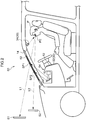
- the biometrics reading portion 34 is a detection device that detects a position of the eyes of a vehicle occupant. For example, as shown in Fig. 2 , the biometrics reading portion 34 detects a position PE of the eyes of the driver P. Hence, the biometrics reading portion 34 detects positions SP1 and SP2 at which straight lines L1 and L2 that link the position PE of the eyes with signs S1 and S2 outside the vehicle 10 intersect with a display portion 62 (which is described in detail below) at a front window 14.
- HUD head-up display
- the positions of the signs S1 and S2 relative to the vehicle 10 are detected by an imaging device 42, which is described below, and the information of the detected positions are transferred to the biometrics reading portion 34.
- the biometrics reading portion 34 is disposed at the vehicle 10, but the biometrics reading portion 34 may, for example, be formed as a wearable terminal and disposed at the head of the driver P.
- the environment information acquisition section 40 shown in Fig. 1 is an information acquisition device for obtaining environment information. Processing of environment information acquisition section 40 is implemented by the CPU 52 that reads and executes the information acquisition program retained in the ROM 54 or the storage 58. The environment information acquisition section 40 transfers acquired environment information to the information conversion section 50 or the above-described biometrics reading portion 34 by electronic signals.
- the environment information acquisition section 40 is provided with the imaging device 42 and a communications device 44.
- environment information encompasses: information relating to traffic regulations such as signs, road markings and so forth; information relating to established structures on the ground such as building names, bridge names, station names and so forth; information relating to mountains, rivers and the like; information relating to objects that can be seen by vehicle occupants of the vehicle 10; traffic accident information, congestion information and so forth; traffic information that cannot be seen by vehicle occupants of the vehicle 10; and the like.
- the imaging device 42 is a camera that images a space outside the vehicle 10. It is preferable if the imaging device 42 images a range that the driver P illustrated in Fig. 2 can see through the front window 14.
- the imaging device 42 may be equipped with a range detector and may detect distances between the vehicle 10 and signs in the vicinity of the vehicle 10, gradients, vehicle-to-vehicle distances from preceding vehicles, and the like.
- the communications device 44 may be equipped with a GPS receiver and detect location information of the vehicle 10.
- the communications device 44 may access a database on an internet and receive information on signs, road markings, building names, bridge names, station names and so forth in the vicinity of the vehicle 10, and map information and the like (collectively referred to below as "signs and the like").
- the communications device 44 may also receive traffic information such as traffic accident information, congestion information and the like from a database on the internet.
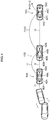
- the communications device 44 may communicate with vehicles in the vicinity of the vehicle 10. For example, as shown in Fig. 4 , when a collision accident occurs in the vicinity of a vehicle 10A, an imaging device 42A of an environment information acquisition section 40A installed in the vehicle 10A acquires accident information (information I1) to be used as traffic information. The information I1 is transmitted by a communications device 44A to a following vehicle 10B.
- the information I1 transmitted from the communications device 44A is received by a communications device 44B of an environment information acquisition section 40B.
- An imaging device 42B detects a vehicle-to-vehicle distance from the vehicle 10A (information 12).
- the information I1 and information 12 are transmitted to a following vehicle 10C by the communications device 44B.
- the information I1 and information 12 transmitted from the communications device 44B are received by a communications device 44C of an environment information acquisition section 40C.
- An imaging device 42C detects a vehicle-to-vehicle distance from the vehicle 10B (information 13).
- the information I1, information 12 and information I3 are transmitted to a following vehicle, which is not shown in Fig. 4 , by the communications device 44C.
- the communications device 44 may communicate with vehicles in the vicinity of the vehicle 10. Therefore, when an accident occurs near the vehicle 10, the driver P of the vehicle 10 may obtain accident information more quickly than in a situation in which the accident information is acquired after being uploaded to the internet.
- the communications device 44 sends vehicle-to-vehicle distances from preceding vehicles (information I2, I3, etc.) to following vehicles. Therefore, the driver P may identify from information converted by the information conversion section 50, which is described below, the presence of congestion caused by an accident, the possibility of congestion occurring, and the like.
- the information conversion section 50 is an information processing device that converts environment information acquired by the environment information acquisition section 40 to "information that is comprehensible" for at least the driver P among the vehicle occupants or "information that is not offensive". Processing of information conversion section 50 is implemented by the CPU 52 that reads and executes the information conversion program retained in the ROM 54 or the storage 58.
- FIG. 3A shows a procedure that converts environment information acquired by the imaging device 42 of the environment information acquisition section 40 to information that is comprehensible for the driver P.
- a video image imaged by the imaging device 42 is transferred from the imaging device 42 to the information conversion section 50 by the CPU 52 that reads and executes the information acquisition program (step 100). This video image is transferred sequentially and continuously.
- the CPU 52 extracts an image for each set of a predetermined number of frames from the video image (step 102).
- the information conversion section 50 inspects whether or not an identifiable sign is contained in this image (step 104). This inspection of the image is a determination as to whether or not sign information can be detected in a portion of the image. Sign information is memorized in advance in the ROM 54 or the storage 58 of the information conversion section 50.
- the CPU 52 reads and executes the information conversion program, and converts the sign to information that is comprehensible for the driver P (step 106).
- a sign S1 that expresses the meaning "overtaking forbidden” is converted, such that a British driver P can understand the sign S1, to a sign S1G that expresses the meaning "overtaking forbidden” in Germany and to (mother tongue) text information S1T that expresses the meaning "overtaking forbidden” in Germany.
- the converted information (the sign S1G and text information S1T) is displayed by the display section 60, which is described below (step 108).
- step 104 if no identifiable sign is contained in the image extracted from the video image imaged by the imaging device 42, the information conversion section 50 returns to step 102. Hence, images of subsequent frames are extracted and inspected for whether or not an identifiable sign is contained in the images.
- step 104 in the present exemplary embodiment whether or not sign information can be detected in an image extracted from the video image imaged by the imaging device 42 is inspected for on the basis of sign information memorized in the ROM 54 or the storage 58 of the information conversion section 50.
- sign information may be detected in an image on the basis of sign information for the vicinity of the vehicle 10 that is acquired from a database on the internet by the communications device 44 by the CPU 52 that reads and executes the information acquisition program. Accordingly, even when image resolution is low, sign information may be detected and converted information may be displayed promptly.
- the information conversion section 50 may convert information other than sign information that is acquired by the imaging device 42 of the environment information acquisition section 40 to information that is comprehensible for the driver P, by the CPU 52 that reads and executes the information conversion program.
- the CPU 52 when a historical building appears in the video image, a building name of the building is converted to the mother tongue of the driver P.
- a tourism site appears in the video image, a place name of the tourism site is converted to the mother tongue of the driver P.
- information other than sign information acquired by the imaging device 42 of the environment information acquisition section 40, may be converted to information that is not offensive to the driver P, by the CPU 52 that reads and executes the information conversion program.
- the driver P follows a religion that considers cows sacred, then when a restaurant, meat processing plant or the like that supplies beef appears in the video image, the restaurant, meat processing plant or the like may be converted to a mosaic image.
- traffic information acquired by the communications device 44 of the environment information acquisition section 40 may be converted to information that is comprehensible for the driver P, by the CPU 52 that reads and executes the information conversion program.
- the communications device 44 acquires accident information from between the current location of the vehicle 10 and a destination of the vehicle 10, this information is converted to (text information in) the mother tongue of the driver P.
- a determination of the presence or possibility of congestion can be made from accumulated vehicle distances (information 12,13, etc.) transmitted between vehicles in front, by the CPU 52 that reads and executes the information conversion program.
- the CPU 52 converts the result of this determination to text information.
- the CPU 52 may convert information estimated from obtained information to text information.
- environment information acquired by the environment information acquisition section 40 can be converted to one or both of image information and text information by the CPU 52.
- environment information that has been converted by the CPU 52 is referred to as "converted information”.
- the display section 60 is a display device for displaying converted information to the interior of the passenger compartment of the vehicle 10. Processing of display section 60 is implemented by the CPU 52 that reads and executes the information display program retained in the ROM 54 or the storage 58. As shown in Fig. 2 , the display section 60 is provided with the display portion 62 and the HUD unit 64.
- the display portion 62 is a head-up display formed at the front window 14 of the vehicle 10. The display portion 62 is formed over substantially the whole area of the front window 14.
- the HUD unit 64 is provided below the front window 14 in order to display one or both of image information and text information at the display portion 62.
- the HUD unit 64 projects converted information transferred from the information conversion section 50 onto the display portion 62.
- a sign S1 that is environment information as illustrated in Fig. 5A acquired by the imaging device 42 is converted to information that is comprehensible for the driver P (the sign S1G and text information S1T), by the CPU 52 that reads and executes the information conversion program, as illustrated in Fig. 3B .
- this converted information is displayed by the HUD unit 64 at the position SP1 of the display portion 62 that is detected by the biometrics reading portion 34.
- the driver P may see the converted information, which is displayed overlapping with a position at which the sign S1 is located as seen by the driver P.
- Traffic information such as accident information (the information I1) or the like acquired by the communications device 44 is displayed at a predetermined location of the display portion 62 regardless of the position of the eyes of the driver P.
- the traffic information is displayed at a location that is unlikely to impede driving such as an uppermost portion or the like of the display portion 62, such as position SP3 shown in Fig. 5A and Fig. 5B .
- a sign or the like and converted information in which the sign or the like has been converted to information that is comprehensible for the driver P may be displayed at position SP3.
- the sign S1, the sign S1G and the text information S1T may be depicted together at position SP3.
- the driver P may understand the meaning of the sign S1 that can be seen outside the front window 14.
- the signs may be displayed in a list with the closest sign at the top of the list.
- the driver P may easily understand the meanings of the signs.
- the sign S1G and text information S1T need not be displayed at position SP1.
- this fact may be displayed at the display portion 62 as supplementary information.
- the fact that the cow is considered sacred may be displayed at, for example, position SP3.
- this fact may be displayed at a location of the display portion 62 overlapping the cow. Hence, the driver may drive taking particular care not to collide with the cow.
- This "supplementary information" is not information in which a sign, animal or the like is converted directly to an image, text or the like that is comprehensible for the driver P.
- Supplementary information is information that is considered preferable for driving according to differences between the country of residence of the driver P and the country in which the vehicle 10 is running.
- the supplementary information is, for example, stored in advance in the information conversion section 50. Note that functions for displaying emergency information and supplementary information are not required functions in the present disclosure and may be omitted as appropriate.
- the vehicle display device 20 when a driver P is driving the vehicle 10 in a country (a foreign country) other than their home country (the country of their nationality), signs of the foreign country may be converted to signs of the driver P's home country and displayed. As a result, the safety risks of driving in a foreign country may be moderated.
- the vehicle display device 20 may also convert and display building names of historical buildings, place names of tourism sites and the like in the driver P's mother tongue. Therefore, if the driver P is a tourist, the driver P may easily obtain information about approaching locations. Accordingly, an embodiment in which the place names of tourism sites are displayed can be excellently employed when, for example, the vehicle 10 is under autonomous driving control. Because tourism information is displayed in this manner when the vehicle 10 is under autonomous driving control, a tourist may make efficient use of their travel time.
- the vehicle display device 20 may convert and display scenes that may be offensive to the driver P to images that are not offensive to the driver P (for example, mosaic images). Therefore, offence that is experienced due to cultural differences between the home country of the driver P and the country in which the vehicle 10 is driving may be moderated.
- the identification tag reading portion 32 acquires personal information of the driver P from an identification tag carried by the driver P. Therefore, more accurate personal information may be obtained than if, for example, the driver P manually enters their personal information themself. Furthermore, if the driver is replaced, the details of displays at the display portion 62 may be altered simply by an identification tag of the replacement driver being read by the identification tag reading portion 32.
- the sign S1 is converted to and displayed as the sign S1G and the text information S1T.
- embodiments of the present disclosure are not limited thus.
- the text information S1T need not necessarily be displayed and it is sufficient to display only the sign S1G.
- a sign corresponding to the sign S1 does not exist in the country of residence of the driver P, it is sufficient to display only the text information S1T.
- personal information of a vehicle occupant other than the driver P may be acquired by the identification tag reading portion 32, in which case converted information may be displayed at locations at which signs and the like are disposed as seen by the vehicle occupant.
- the display portion 62 may be divided in two in the vehicle width direction, converted information may be displayed at locations of the display portion 62 at the driver seat side at which signs and the like are disposed as seen by the driver P, and converted information may be displayed at locations of the display portion 62 at a front passenger seat side at which signs and the like are disposed as seen by a vehicle occupant sitting on the front passenger seat.
- the display portion 62 is formed only at the front window 14, but embodiments of the present disclosure are not limited thus.
- the display portion 62 may be formed at a side window. Accordingly, the amount of information that can be obtained may be increased.
- the environment information acquisition section 40 is equipped with the communications device 44 that is capable of communicating with the internet and with other vehicles, but embodiments of the present disclosure are not limited thus.
- functions enabling communication with other vehicles need not necessarily be provided. Even if there is no communication with other vehicles, traffic information may be obtained from a database on the internet.
- the communications device 44 may be omitted from the environment information acquisition section 40. Even if the communications device 44 is not provided, the environment information acquisition section 40 may acquire environment information about the vicinity of the vehicle 10 with the imaging device 42. In a configuration in which the communications device 44 is not provided, the structure of the vehicle display device 20 may be simplified.
- the information acquisition processing, the information conversion processing, and the information display processing are executed by the CPU 52 that reads software (i.e., programs) .
- the aforementioned processing may be executed by various processors other than the CPU 52.
- processors include a Programmable Logic Device (PLD) in which circuit configuration can be modified post-manufacture, such as a Field-Programmable Gate Array (FPGA), or a specialized electric circuit that is a processor with a specifically-designed circuit configuration for executing specific processing, such as an Application Specific Integrated Circuit (ASIC).
- PLD Programmable Logic Device
- FPGA Field-Programmable Gate Array
- ASIC Application Specific Integrated Circuit
- the information acquisition processing, the information conversion processing, and the information display processing may be executed by a single one of such processors, or may be executed by a combination of two or more processors of the same type or different types (for example, by plural FPGAs, or a combination of a CPU 52 and an FPGA).
- processors are electric circuits configured by combining circuit elements such as semiconductor devices.
- the programs may be provided in a format recorded on a recording medium such as Compact Disk Read Only Memory (CD-ROM), Digital Versatile Disk Read Only Memory (DVD-ROM), or Universal Serial Bus (USB) memory.
- CD-ROM Compact Disk Read Only Memory
- DVD-ROM Digital Versatile Disk Read Only Memory
- USB Universal Serial Bus
- these programs may be provided in a format downloaded from an external device through a network.
- the present disclosure may be embodied in a variety of embodiments.
Landscapes
- Engineering & Computer Science (AREA)
- Transportation (AREA)
- Mechanical Engineering (AREA)
- Combustion & Propulsion (AREA)
- Chemical & Material Sciences (AREA)
- Physics & Mathematics (AREA)
- General Physics & Mathematics (AREA)
- Automation & Control Theory (AREA)
- Multimedia (AREA)
- Theoretical Computer Science (AREA)
- Human Computer Interaction (AREA)
- Optics & Photonics (AREA)
- Atmospheric Sciences (AREA)
- Life Sciences & Earth Sciences (AREA)
- Traffic Control Systems (AREA)
- Instructional Devices (AREA)
- Fittings On The Vehicle Exterior For Carrying Loads, And Devices For Holding Or Mounting Articles (AREA)
- Instrument Panels (AREA)
- Processing Or Creating Images (AREA)
Abstract
Description
- The present disclosure relates to a display device for a vehicle.
- Japanese Patent Application Laid-Open (
JP-A) No. 2009-109404 - In the road sign display device according to
JP-A No. 2009-109404 - The present disclosure provides a display device for a vehicle that may display information that is comprehensible for a driver.
- A display device for a vehicle according to a first aspect of the present disclosure includes (i) a personal information acquisition section that acquires personal information of a driver of the vehicle from a first identification tag at which the personal information of the driver is recorded, (ii) an environment information acquisition section that acquires environment information about a vicinity of the vehicle, (iii) an information conversion section that converts the environment information in accordance with the personal information of the drive, and (iv) a display section that displays the converted environment information to the interior of a passenger compartment of the vehicle.
- According to the first aspect of the display device for a vehicle, environment information about the vicinity of the vehicle that is acquired by the environment information acquisition section is converted by the information conversion section. The information conversion section converts the environment information on the basis of the personal information of the driver acquired from a first identification tag at which the personal information of the driver is recorded. Therefore, erroneous personal information of the driver is less likely to be acquired than in a case in which, for example, a driver manually enters their personal information. Hence, information that is comprehensible for the driver may be displayed at the display section. The meaning of the term "environment information" as used herein is intended to include information about the outside of the vehicle, including information relating to objects that can be seen by occupants in the vehicle, traffic information that cannot be seen by occupants in the vehicle, and so forth. The meaning of the term "personal information of the driver" as used herein is intended to include information that includes at least the nationality of the driver.
- In a display device for a vehicle according to a second aspect, in the display device for a vehicle of the first aspect, the environment information acquisition section includes an imaging device that acquires the environment information including a road sign, and the information conversion section converts the road sign to text information that is comprehensible for the driver.
- According to the second aspect of the display device for a vehicle, a road sign acquired by the imaging device is converted by the information conversion section to text information that can be understood by the driver. As a result, even when the driver cannot directly understand the meaning expressed by the design of a road sign, the driver may understand the meaning through text information. Therefore, the driver may understand road signs even when, for example, driving a vehicle in a country with different road signs from the driver's country of residence.
- In a display device for a vehicle according to a third aspect, in the display device for a vehicle of the first aspect or the second aspect, the environment information acquisition section includes a communications device, the communications device acquires the environment information including traffic information, and the information conversion section converts the traffic information to text information.
- According to the third aspect of the display device for a vehicle, the traffic information acquired by the communications device is converted by the information conversion section to text information that can be understood by the driver. As a result, even when the driver cannot directly understand the traffic information acquired by the communications device, the driver may understand the details thereof through the text information. Therefore, the driver may understand traffic information even when, for example, driving a vehicle in a country with a different language from the driver's country of residence.
- In a display device for a vehicle according to a fourth aspect, in the display device for a vehicle of the third aspect, the communications device can transmit the traffic information to another vehicle.
- According to the fourth aspect of the display device for a vehicle, because the communications device can transmit traffic information to other vehicles, traffic information may be transferred between vehicles. Therefore, for example, when an accident occurs in a vicinity of a vehicle, accident information may be transmitted to a following vehicle. The following vehicle may then transmit the accident information to a vehicle further behind. Thus, the communications device may obtain emergency information more rapidly than in a situation in which, for example, accident information is acquired only from the internet.
- In a display device for a vehicle according to a fifth aspect, in the display device for a vehicle of the first aspect, the information conversion section converts the environment information to image information.
- According to the fifth aspect of the display device for a vehicle, the environment information is converted to image information by the information conversion section. For example, environment information that is a road sign is converted to image information that can be understood by the driver. Therefore, even when the driver cannot directly understand the meaning expressed by the design of a road sign, the driver may understand the meaning through image information.
- Alternatively, for example, environment information that is a scene that is offensive to the driver can be converted by the information conversion section to image information that is not offensive to the driver. Therefore, stress may be moderated for a driver driving a vehicle in a country with different cultural norms.
- In a display device for a vehicle according to a sixth aspect, in the display device for a vehicle of any one of the first to fifth aspects, when a vehicle occupant other than the driver is in the vehicle, (i) the personal information acquisition section acquires personal information of the vehicle occupant from a second identification tag at which the personal information of the vehicle occupant is recorded, (ii) the information conversion section converts the environment information in accordance with the personal information of the vehicle occupant, and (iii) the display section displays the information converted in accordance with the personal information of the vehicle occupant to the interior of the passenger compartment of the vehicle.
- According to the sixth aspect of the display device for a vehicle, in addition to information converted on the basis of the personal information of the driver, information converted on the basis of the personal information of a vehicle occupant other than the driver is displayed at the display device. Therefore, environment information acquired by the environment information acquisition section may be understood by vehicle occupants other than the driver.
- In a display device for a vehicle according to a seventh aspect, in the display device for a vehicle of any one of the first to sixth aspect, the display device displays supplementary information relating to the environment information in accordance with the personal information of the driver.
- According to the seventh aspect of the display device for a vehicle, in addition to information converted on the basis of the personal information of the driver, supplementary information relating to the environment information is displayed at the display device. Therefore, the driver may obtain additional knowledge about the environment information.
- According to the display device for a vehicle according to the present disclosure, information that is comprehensible for a driver may be displayed.
- Exemplary embodiments of the present disclosure will be described in detail based on the following figures, wherein:
-
Fig. 1 is a conceptual diagram showing schematics of a vehicle in which a display device for a vehicle according to an exemplary embodiment of the present disclosure is installed; -
Fig. 2 is a side view showing an example of positions at which information converted on the basis of personal information of a driver is displayed by the display device for a vehicle according to the exemplary embodiment of the present disclosure; -
Fig. 3A is a flowchart showing a procedure for an information conversion section of the display device for a vehicle according to the exemplary embodiment of the present disclosure to convert information transferred from an environment information acquisition section; -
Fig. 3B is a conceptual diagram showing an example of information acquired by the environment information acquisition section and converted information converted by the information conversion section of the display device for a vehicle according to the exemplary embodiment of the present disclosure; -
Fig. 4 is a conceptual diagram showing a state in which traffic information is transmitted between vehicles in which the display device for a vehicle according to the exemplary embodiment of the present disclosure is installed; -
Fig. 5A is a perspective view showing a sign that is environment information that can be seen by a driver in the vehicle in which the display device for a vehicle according to the exemplary embodiment of the present disclosure is installed; and -
Fig. 5B is a perspective view showing a state in which converted information is displayed at a location of a display portion that overlaps with the sign; -
Fig. 6 is a block diagram illustrating hardware configuration of the display device for a vehicle. - A
vehicle display device 20 according to an exemplary embodiment of the present disclosure is a driver assistance system for assisting driving when a driver P (seeFig. 2 ) is driving a vehicle in a country other than the driver's country of residence. Thevehicle display device 20 displays, for example, images for alleviating problems in driving that are caused by differences in traffic regulations and the like, to the interior of a passenger compartment. - As shown in
Fig. 1 , thevehicle display device 20 is installed in avehicle 10. Thevehicle display device 20 is provided with a personalinformation acquisition section 30, an environmentinformation acquisition section 40, aninformation conversion section 50 and adisplay section 60. - As shown in
Fig. 6 , theinformation conversion section 50 includes a Central Processing Unit (CPU) 52, Read Only Memory (ROM) 54, Random Access Memory (RAM) 56, andstorage 58. These configurations of theinformation conversion section 50 are connected to the personalinformation acquisition section 30, the environmentinformation acquisition section 40, and thedisplay section 60 so as to be capable of communicating each other through abus 90. - The
CPU 52 is a central computation processing unit that executes various programs and controls various sections. Namely, theCPU 52 reads programs from theROM 54 or thestorage 58, and executes the programs using theRAM 56 as a workspace. TheCPU 52 controls the various configurations and performs various computation processing according to the programs recorded in theROM 54 or thestorage 58. In the present exemplary embodiment, theROM 54 or thestorage 58 stores (i) an information acquisition program to acquire an information by the personalinformation acquisition section 30 and the environmentinformation acquisition section 40, (ii) an information conversion program to convert the information which is acquired by the personalinformation acquisition section 30 and the environmentinformation acquisition section 40, and (iii) an information display program to display the converted information to thedisplay section 60. - The
ROM 54 stores various programs and various data. TheRAM 56 serves as a workspace that temporarily retains programs and data. Thestorage 58 is configured by a Hard Disk Drive (HDD) or a Solid State Drive (SSD), and stores various programs, including an operating system, and various data. - At executing aformentined various programs, the
vehicle display device 20 performs various functions using the aforementioned hardware resources. Each function performed by thevehicle display device 20 is explained below. - The personal
information acquisition section 30 is an information acquisition device for acquiring personal information of vehicle occupants. Processing of the personalinformation acquisition section 30 is implemented by theCPU 52 that reads and executes the information acquisition program retained in theROM 54 or thestorage 58. The personalinformation acquisition section 30 transfers acquired personal information of a vehicle occupant to theinformation conversion section 50 ordisplay section 60 by electronic signals. The personalinformation acquisition section 30 is provided with an identificationtag reading portion 32 and abiometrics reading portion 34. - The meaning of the term "identification tag" as used herein is intended to include an identity document on which at least a nationality is recorded as personal information. To be specific, a passport, international driving license or the like in which a chip that records the nationality is embedded corresponds to an identification tag. Preferable personal information recorded at the identification tag includes, in addition to the nationality, a country of residence, date of birth, sex, religion, usual language, occupation and the like.
- As shown in
Fig. 2 , the identificationtag reading portion 32 is a detection device disposed at aninstrument panel 12 of thevehicle 10. When a vehicle occupant of thevehicle 10 brings an identification tag close to the identificationtag reading portion 32, the identificationtag reading portion 32 reads personal information of the vehicle occupant from, for example, a chip embedded in the identification tag. Among vehicle occupants, the identificationtag reading portion 32 acquires personal information of at least the driver P. The meaning of the term "driver" as used herein is intended to include a vehicle occupant sitting on a driver seat. The term "driver seat" is intended to include, in a vehicle equipped with autonomous driving functions, a seat on which a vehicle occupant who conducts driving during manual driving sits. The identificationtag reading portion 32 transfers the acquired personal information to theinformation conversion section 50. - The
biometrics reading portion 34 is a detection device that detects a position of the eyes of a vehicle occupant. For example, as shown inFig. 2 , thebiometrics reading portion 34 detects a position PE of the eyes of the driver P. Hence, thebiometrics reading portion 34 detects positions SP1 and SP2 at which straight lines L1 and L2 that link the position PE of the eyes with signs S1 and S2 outside thevehicle 10 intersect with a display portion 62 (which is described in detail below) at afront window 14. - Information of the detected positions SP1 and SP2 are transferred to a head-up display (HUD) unit 64 (described in detail below). The positions of the signs S1 and S2 relative to the
vehicle 10 are detected by animaging device 42, which is described below, and the information of the detected positions are transferred to thebiometrics reading portion 34. InFig. 2 , thebiometrics reading portion 34 is disposed at thevehicle 10, but thebiometrics reading portion 34 may, for example, be formed as a wearable terminal and disposed at the head of the driver P. - The environment
information acquisition section 40 shown inFig. 1 is an information acquisition device for obtaining environment information. Processing of environmentinformation acquisition section 40 is implemented by theCPU 52 that reads and executes the information acquisition program retained in theROM 54 or thestorage 58. The environmentinformation acquisition section 40 transfers acquired environment information to theinformation conversion section 50 or the above-describedbiometrics reading portion 34 by electronic signals. The environmentinformation acquisition section 40 is provided with theimaging device 42 and acommunications device 44. - The meaning of the term "environment information" as used herein is intended to include information about the outside of the
vehicle 10. To be specific, "environment information" encompasses: information relating to traffic regulations such as signs, road markings and so forth; information relating to established structures on the ground such as building names, bridge names, station names and so forth; information relating to mountains, rivers and the like; information relating to objects that can be seen by vehicle occupants of thevehicle 10; traffic accident information, congestion information and so forth; traffic information that cannot be seen by vehicle occupants of thevehicle 10; and the like. - The
imaging device 42 is a camera that images a space outside thevehicle 10. It is preferable if theimaging device 42 images a range that the driver P illustrated inFig. 2 can see through thefront window 14. Theimaging device 42 may be equipped with a range detector and may detect distances between thevehicle 10 and signs in the vicinity of thevehicle 10, gradients, vehicle-to-vehicle distances from preceding vehicles, and the like. - The
communications device 44 may be equipped with a GPS receiver and detect location information of thevehicle 10. Thecommunications device 44 may access a database on an internet and receive information on signs, road markings, building names, bridge names, station names and so forth in the vicinity of thevehicle 10, and map information and the like (collectively referred to below as "signs and the like"). Thecommunications device 44 may also receive traffic information such as traffic accident information, congestion information and the like from a database on the internet. - The
communications device 44 may communicate with vehicles in the vicinity of thevehicle 10. For example, as shown inFig. 4 , when a collision accident occurs in the vicinity of avehicle 10A, animaging device 42A of an environmentinformation acquisition section 40A installed in thevehicle 10A acquires accident information (information I1) to be used as traffic information. The information I1 is transmitted by acommunications device 44A to a followingvehicle 10B. - In the
vehicle 10B, the information I1 transmitted from thecommunications device 44A is received by acommunications device 44B of an environmentinformation acquisition section 40B. Animaging device 42B detects a vehicle-to-vehicle distance from thevehicle 10A (information 12). The information I1 andinformation 12 are transmitted to a followingvehicle 10C by thecommunications device 44B. - In the
vehicle 10C, the information I1 andinformation 12 transmitted from thecommunications device 44B are received by acommunications device 44C of an environmentinformation acquisition section 40C. Animaging device 42C detects a vehicle-to-vehicle distance from thevehicle 10B (information 13). The information I1,information 12 and information I3 are transmitted to a following vehicle, which is not shown inFig. 4 , by thecommunications device 44C. - Thus, the
communications device 44 may communicate with vehicles in the vicinity of thevehicle 10. Therefore, when an accident occurs near thevehicle 10, the driver P of thevehicle 10 may obtain accident information more quickly than in a situation in which the accident information is acquired after being uploaded to the internet. - In addition to accident information (the information I1), the
communications device 44 sends vehicle-to-vehicle distances from preceding vehicles (information I2, I3, etc.) to following vehicles. Therefore, the driver P may identify from information converted by theinformation conversion section 50, which is described below, the presence of congestion caused by an accident, the possibility of congestion occurring, and the like. - The
information conversion section 50 is an information processing device that converts environment information acquired by the environmentinformation acquisition section 40 to "information that is comprehensible" for at least the driver P among the vehicle occupants or "information that is not offensive". Processing ofinformation conversion section 50 is implemented by theCPU 52 that reads and executes the information conversion program retained in theROM 54 or thestorage 58. - An example of an information processing method of the
CPU 52 is described using the flowchart inFig. 3A. Fig. 3A shows a procedure that converts environment information acquired by theimaging device 42 of the environmentinformation acquisition section 40 to information that is comprehensible for the driver P. - First, a video image imaged by the
imaging device 42 is transferred from theimaging device 42 to theinformation conversion section 50 by theCPU 52 that reads and executes the information acquisition program (step 100). This video image is transferred sequentially and continuously. - The
CPU 52 extracts an image for each set of a predetermined number of frames from the video image (step 102). Theinformation conversion section 50 inspects whether or not an identifiable sign is contained in this image (step 104). This inspection of the image is a determination as to whether or not sign information can be detected in a portion of the image. Sign information is memorized in advance in theROM 54 or thestorage 58 of theinformation conversion section 50. - If an identifiable sign is contained in the image, then on the basis of the personal information of the driver P acquired by the personal
information acquisition section 30, theCPU 52 reads and executes the information conversion program, and converts the sign to information that is comprehensible for the driver P (step 106). As a specific example, as shown inFig. 3B , a sign S1 that expresses the meaning "overtaking forbidden" is converted, such that a British driver P can understand the sign S1, to a sign S1G that expresses the meaning "overtaking forbidden" in Britain and to (mother tongue) text information S1T that expresses the meaning "overtaking forbidden" in Britain. The converted information (the sign S1G and text information S1T) is displayed by thedisplay section 60, which is described below (step 108). - On the other hand, in
step 104, if no identifiable sign is contained in the image extracted from the video image imaged by theimaging device 42, theinformation conversion section 50 returns to step 102. Hence, images of subsequent frames are extracted and inspected for whether or not an identifiable sign is contained in the images. - In
step 104 in the present exemplary embodiment, whether or not sign information can be detected in an image extracted from the video image imaged by theimaging device 42 is inspected for on the basis of sign information memorized in theROM 54 or thestorage 58 of theinformation conversion section 50. However, embodiments of the present disclosure are not limited thus. For example, sign information may be detected in an image on the basis of sign information for the vicinity of thevehicle 10 that is acquired from a database on the internet by thecommunications device 44 by theCPU 52 that reads and executes the information acquisition program. Accordingly, even when image resolution is low, sign information may be detected and converted information may be displayed promptly. - A different example of an information processing method of the
CPU 52 is described. For example, theinformation conversion section 50 may convert information other than sign information that is acquired by theimaging device 42 of the environmentinformation acquisition section 40 to information that is comprehensible for the driver P, by theCPU 52 that reads and executes the information conversion program. As a specific example, when a historical building appears in the video image, a building name of the building is converted to the mother tongue of the driver P. Alternatively, when a tourism site appears in the video image, a place name of the tourism site is converted to the mother tongue of the driver P. - Further, information other than sign information, acquired by the
imaging device 42 of the environmentinformation acquisition section 40, may be converted to information that is not offensive to the driver P, by theCPU 52 that reads and executes the information conversion program. As a specific example, if the driver P follows a religion that considers cows sacred, then when a restaurant, meat processing plant or the like that supplies beef appears in the video image, the restaurant, meat processing plant or the like may be converted to a mosaic image. - Furthermore, traffic information acquired by the
communications device 44 of the environmentinformation acquisition section 40 may be converted to information that is comprehensible for the driver P, by theCPU 52 that reads and executes the information conversion program. As a specific example, when thecommunications device 44 acquires accident information from between the current location of thevehicle 10 and a destination of thevehicle 10, this information is converted to (text information in) the mother tongue of the driver P. - When traffic information is transmitted from a preceding vehicle, a determination of the presence or possibility of congestion can be made from accumulated vehicle distances (
information CPU 52 that reads and executes the information conversion program. TheCPU 52 converts the result of this determination to text information. Thus, theCPU 52 may convert information estimated from obtained information to text information. - As in the examples described above, environment information acquired by the environment
information acquisition section 40 can be converted to one or both of image information and text information by theCPU 52. In the following descriptions, environment information that has been converted by theCPU 52 is referred to as "converted information". - The
display section 60 is a display device for displaying converted information to the interior of the passenger compartment of thevehicle 10. Processing ofdisplay section 60 is implemented by theCPU 52 that reads and executes the information display program retained in theROM 54 or thestorage 58. As shown inFig. 2 , thedisplay section 60 is provided with thedisplay portion 62 and theHUD unit 64. Thedisplay portion 62 is a head-up display formed at thefront window 14 of thevehicle 10. Thedisplay portion 62 is formed over substantially the whole area of thefront window 14. - The
HUD unit 64 is provided below thefront window 14 in order to display one or both of image information and text information at thedisplay portion 62. TheHUD unit 64 projects converted information transferred from theinformation conversion section 50 onto thedisplay portion 62. - For example, a sign S1 that is environment information as illustrated in
Fig. 5A acquired by the imaging device 42 (seeFig. 1 ) is converted to information that is comprehensible for the driver P (the sign S1G and text information S1T), by theCPU 52 that reads and executes the information conversion program, as illustrated inFig. 3B . As shown inFig. 2 , this converted information is displayed by theHUD unit 64 at the position SP1 of thedisplay portion 62 that is detected by thebiometrics reading portion 34. Thus, as illustrated inFig. 5B , the driver P may see the converted information, which is displayed overlapping with a position at which the sign S1 is located as seen by the driver P. - Traffic information such as accident information (the information I1) or the like acquired by the
communications device 44 is displayed at a predetermined location of thedisplay portion 62 regardless of the position of the eyes of the driver P. For example, the traffic information is displayed at a location that is unlikely to impede driving such as an uppermost portion or the like of thedisplay portion 62, such as position SP3 shown inFig. 5A and Fig. 5B . - A sign or the like and converted information in which the sign or the like has been converted to information that is comprehensible for the driver P may be displayed at position SP3. For example, the sign S1, the sign S1G and the text information S1T may be depicted together at position SP3. Thus, the driver P may understand the meaning of the sign S1 that can be seen outside the
front window 14. If there are plural signs in the vicinity of thevehicle 10, the signs may be displayed in a list with the closest sign at the top of the list. Thus, the driver P may easily understand the meanings of the signs. In these cases, the sign S1G and text information S1T need not be displayed at position SP1. - When, the driver P must brake immediately or the like, for example, an accident occurs just in front of the
vehicle 10 or a person or animal runs out in front of thevehicle 10, information is displayed at a highly visible position in front of the driver P or the like, such as position SP4. Highly urgent emergency information may be displayed by thevehicle display device 20 in this manner. When emergency information is displayed, it is preferable if an alert noise is sounded to attract the attention of the driver P. - When an animal runs out into the road, if this animal is considered more important in the country in which the
vehicle 10 is running than in the country of residence of the driver, this fact may be displayed at thedisplay portion 62 as supplementary information. As a specific example, if thevehicle 10 is driving in a country in which many of the residents follow a religion that considers cows sacred, then when a cow runs out into the road, the fact that the cow is considered sacred may be displayed at, for example, position SP3. Alternatively, this fact may be displayed at a location of thedisplay portion 62 overlapping the cow. Hence, the driver may drive taking particular care not to collide with the cow. - This "supplementary information" is not information in which a sign, animal or the like is converted directly to an image, text or the like that is comprehensible for the driver P. Supplementary information is information that is considered preferable for driving according to differences between the country of residence of the driver P and the country in which the
vehicle 10 is running. The supplementary information is, for example, stored in advance in theinformation conversion section 50. Note that functions for displaying emergency information and supplementary information are not required functions in the present disclosure and may be omitted as appropriate. - As described above, according to the
vehicle display device 20 according to the present exemplary embodiment, when a driver P is driving thevehicle 10 in a country (a foreign country) other than their home country (the country of their nationality), signs of the foreign country may be converted to signs of the driver P's home country and displayed. As a result, the safety risks of driving in a foreign country may be moderated. - The
vehicle display device 20 may also convert and display building names of historical buildings, place names of tourism sites and the like in the driver P's mother tongue. Therefore, if the driver P is a tourist, the driver P may easily obtain information about approaching locations. Accordingly, an embodiment in which the place names of tourism sites are displayed can be excellently employed when, for example, thevehicle 10 is under autonomous driving control. Because tourism information is displayed in this manner when thevehicle 10 is under autonomous driving control, a tourist may make efficient use of their travel time. - Further, the
vehicle display device 20 may convert and display scenes that may be offensive to the driver P to images that are not offensive to the driver P (for example, mosaic images). Therefore, offence that is experienced due to cultural differences between the home country of the driver P and the country in which thevehicle 10 is driving may be moderated. - In the
vehicle display device 20 according to the present exemplary embodiment, the identificationtag reading portion 32 acquires personal information of the driver P from an identification tag carried by the driver P. Therefore, more accurate personal information may be obtained than if, for example, the driver P manually enters their personal information themself. Furthermore, if the driver is replaced, the details of displays at thedisplay portion 62 may be altered simply by an identification tag of the replacement driver being read by the identificationtag reading portion 32. - In the present exemplary embodiment, as shown in
Fig. 3B , the sign S1 is converted to and displayed as the sign S1G and the text information S1T. However, embodiments of the present disclosure are not limited thus. For example, if the meanings expressed by the sign S1 and the sign S1G completely match or the like, the text information S1T need not necessarily be displayed and it is sufficient to display only the sign S1G. Alternatively, if a sign corresponding to the sign S1 does not exist in the country of residence of the driver P, it is sufficient to display only the text information S1T. - in the present exemplary embodiment, an example is described in which the personal information of the driver P is acquired by the identification
tag reading portion 32 and converted information is displayed at locations of thedisplay portion 62 at which signs and the like are disposed as seen by the driver P. However, embodiments of the present disclosure are not limited thus. - For example, personal information of a vehicle occupant other than the driver P may be acquired by the identification
tag reading portion 32, in which case converted information may be displayed at locations at which signs and the like are disposed as seen by the vehicle occupant. Alternatively, thedisplay portion 62 may be divided in two in the vehicle width direction, converted information may be displayed at locations of thedisplay portion 62 at the driver seat side at which signs and the like are disposed as seen by the driver P, and converted information may be displayed at locations of thedisplay portion 62 at a front passenger seat side at which signs and the like are disposed as seen by a vehicle occupant sitting on the front passenger seat. - In the present exemplary embodiment, the
display portion 62 is formed only at thefront window 14, but embodiments of the present disclosure are not limited thus. For example, thedisplay portion 62 may be formed at a side window. Accordingly, the amount of information that can be obtained may be increased. - In the present exemplary embodiment, the environment
information acquisition section 40 is equipped with thecommunications device 44 that is capable of communicating with the internet and with other vehicles, but embodiments of the present disclosure are not limited thus. For example, functions enabling communication with other vehicles need not necessarily be provided. Even if there is no communication with other vehicles, traffic information may be obtained from a database on the internet. - Further, the
communications device 44 may be omitted from the environmentinformation acquisition section 40. Even if thecommunications device 44 is not provided, the environmentinformation acquisition section 40 may acquire environment information about the vicinity of thevehicle 10 with theimaging device 42. In a configuration in which thecommunications device 44 is not provided, the structure of thevehicle display device 20 may be simplified. - In the above exemplary embodiment, the information acquisition processing, the information conversion processing, and the information display processing are executed by the
CPU 52 that reads software (i.e., programs) . However, note that the aforementioned processing may be executed by various processors other than theCPU 52. Examples of such processors include a Programmable Logic Device (PLD) in which circuit configuration can be modified post-manufacture, such as a Field-Programmable Gate Array (FPGA), or a specialized electric circuit that is a processor with a specifically-designed circuit configuration for executing specific processing, such as an Application Specific Integrated Circuit (ASIC). The information acquisition processing, the information conversion processing, and the information display processing may be executed by a single one of such processors, or may be executed by a combination of two or more processors of the same type or different types (for example, by plural FPGAs, or a combination of aCPU 52 and an FPGA). Specifically, examples of hardware structures of such processors are electric circuits configured by combining circuit elements such as semiconductor devices. - In the above exemplary embodiment, explanation has been given regarding a mode in which the image transmission program, the image distribution program, and the image display program are installed in advance in the
ROM 54 or thestorage 58; however, there is no limitation thereto. The programs may be provided in a format recorded on a recording medium such as Compact Disk Read Only Memory (CD-ROM), Digital Versatile Disk Read Only Memory (DVD-ROM), or Universal Serial Bus (USB) memory. Alternatively, these programs may be provided in a format downloaded from an external device through a network. Thus, the present disclosure may be embodied in a variety of embodiments.
Claims (7)
- A display device for a vehicle, comprising:a personal information acquisition section that acquires personal information of a driver of the vehicle from a first identification tag at which the personal information of the driver is recorded;an environment information acquisition section that acquires environment information about a vicinity of the vehicle;an information conversion section that converts the environment information in accordance with the personal information of the driver; anda display section that displays the converted environment information to the interior of a passenger compartment of the vehicle.
- The display device for a vehicle according to claim 1, wherein:the environment information acquisition section includes an imaging device that acquires the environment information including a road sign, andthe information conversion section converts the road sign to text information that is comprehensible for the driver.
- The display device for a vehicle according to claim 1 or claim 2, wherein:the environment information acquisition section includes a communications device,the communications device acquires the environment information including traffic information, andthe information conversion section converts the traffic information to text information.
- The display device for a vehicle according to claim 3, wherein the communications device can transmit the traffic information to another vehicle.
- The display device for a vehicle according to claim 1, wherein the information conversion section converts the environment information to image information.
- The display device for a vehicle according to any one of claims 1 to 5, wherein when a vehicle occupant other than the driver is in the vehicle:the personal information acquisition section acquires personal information of the vehicle occupant from a second identification tag at which the personal information of the vehicle occupant is recorded;the information conversion section converts the environment information in accordance with the personal information of the vehicle occupant; andthe display section displays the information converted in accordance with the personal information of the vehicle occupant to the interior of the passenger compartment of the vehicle.
- The display device for a vehicle according to any one of claims 1 to 6, wherein the display device displays supplementary information relating to the environment information in accordance with the personal information of the driver.
Applications Claiming Priority (1)
| Application Number | Priority Date | Filing Date | Title |
|---|---|---|---|
| JP2018005819A JP7024427B2 (en) | 2018-01-17 | 2018-01-17 | Display device for vehicles |
Publications (1)
| Publication Number | Publication Date |
|---|---|
| EP3514725A1 true EP3514725A1 (en) | 2019-07-24 |
Family
ID=64744463
Family Applications (1)
| Application Number | Title | Priority Date | Filing Date |
|---|---|---|---|
| EP18213098.9A Ceased EP3514725A1 (en) | 2018-01-17 | 2018-12-17 | Display device for a vehicle |
Country Status (4)
| Country | Link |
|---|---|
| US (1) | US11117595B2 (en) |
| EP (1) | EP3514725A1 (en) |
| JP (1) | JP7024427B2 (en) |
| CN (1) | CN110039996B (en) |
Cited By (1)
| Publication number | Priority date | Publication date | Assignee | Title |
|---|---|---|---|---|
| FR3138103A1 (en) * | 2022-07-22 | 2024-01-26 | Psa Automobiles Sa | Method and device for presenting textual road signs for vehicles |
Families Citing this family (12)
| Publication number | Priority date | Publication date | Assignee | Title |
|---|---|---|---|---|
| RU2676359C1 (en) * | 2015-09-18 | 2018-12-28 | Ниссан Мотор Ко., Лтд. | Vehicle display device and display method for vehicle |
| JP6702390B2 (en) | 2018-10-09 | 2020-06-03 | トヨタ自動車株式会社 | Vehicle drive control device, vehicle-mounted electronic control unit, learned model, machine learning system, vehicle drive control method, electronic control unit manufacturing method, and output parameter calculation device |
| DE102019009079A1 (en) * | 2019-12-27 | 2021-07-01 | Joynext Gmbh | Method and navigation device for assisting a driver in driving a vehicle |
| US12043267B2 (en) * | 2020-08-21 | 2024-07-23 | Hyundai Motor Company | Method and apparatus for providing information |
| JP7354172B2 (en) * | 2021-03-18 | 2023-10-02 | ヤフー株式会社 | Information provision device, information provision method, and information provision program |
| JP7814870B2 (en) * | 2021-09-15 | 2026-02-17 | キヤノン株式会社 | Head-mounted display, control method, and program |
| JP7647502B2 (en) | 2021-11-11 | 2025-03-18 | トヨタ自動車株式会社 | Driving Support Devices |
| JP2024025997A (en) * | 2022-08-15 | 2024-02-28 | Lineヤフー株式会社 | Information processing device, information processing method, and information processing program |
| JP2024047322A (en) | 2022-09-26 | 2024-04-05 | トヨタ自動車株式会社 | Information notification system and information notification method |
| JP7711694B2 (en) | 2022-12-27 | 2025-07-23 | トヨタ自動車株式会社 | Notification device, notification method, and notification program |
| JP2025072971A (en) | 2023-10-25 | 2025-05-12 | トヨタ自動車株式会社 | Vehicle driving support device |
| JP2025084573A (en) | 2023-11-22 | 2025-06-03 | トヨタ自動車株式会社 | Driving Support Devices |
Citations (8)
| Publication number | Priority date | Publication date | Assignee | Title |
|---|---|---|---|---|
| JPS60204137A (en) * | 1984-03-28 | 1985-10-15 | Hochiki Corp | Broadcast equipment guiding hotel disaster preventing equipment |
| EP1273887A2 (en) * | 2001-07-05 | 2003-01-08 | Alpine Electronics, Inc. | Navigation system |
| EP1359557A1 (en) * | 2002-04-30 | 2003-11-05 | Matsushita Electric Industrial Co., Ltd. | Vehicle navigation system that automatically translates roadside signs and objects |
| US20080051946A1 (en) * | 1999-12-15 | 2008-02-28 | Automotive Technologies International, Inc. | Vehicular Heads-Up Display System |
| JP2009109404A (en) | 2007-10-31 | 2009-05-21 | Equos Research Co Ltd | Road sign display device |
| WO2016060907A1 (en) * | 2014-10-17 | 2016-04-21 | Niles James E | Vehicle language setting system |
| WO2016089500A1 (en) * | 2014-12-01 | 2016-06-09 | Niles James E | System for automatically changing language of a traveler's temporary habitation by referencing a personal electronic device of the traveler |
| GB2541519A (en) * | 2014-02-21 | 2017-02-22 | Jaguar Land Rover Ltd | A system for use in a vehicle |
Family Cites Families (14)
| Publication number | Priority date | Publication date | Assignee | Title |
|---|---|---|---|---|
| JPH11353587A (en) * | 1998-06-10 | 1999-12-24 | Sony Corp | Navigation system |
| US20010032070A1 (en) * | 2000-01-10 | 2001-10-18 | Mordechai Teicher | Apparatus and method for translating visual text |
| JP2004139510A (en) * | 2002-10-21 | 2004-05-13 | Alpine Electronics Inc | On-vehicle information device |
| JP2007315861A (en) * | 2006-05-24 | 2007-12-06 | Nissan Motor Co Ltd | Image processing apparatus for vehicle |
| JP2008280026A (en) * | 2007-04-11 | 2008-11-20 | Denso Corp | Driving assistance device |
| JP2010073006A (en) * | 2008-09-19 | 2010-04-02 | Oki Electric Ind Co Ltd | Display condition determining device and transaction confirming system |
| DE112009004886T5 (en) * | 2009-06-09 | 2012-06-14 | Toyota Jidosha Kabushiki Kaisha | Driving support device |
| JP2011207397A (en) * | 2010-03-30 | 2011-10-20 | Panasonic Corp | On-vehicle display device |
| US20120215403A1 (en) * | 2011-02-20 | 2012-08-23 | General Motors Llc | Method of monitoring a vehicle driver |
| KR101411951B1 (en) * | 2013-06-19 | 2014-07-03 | 한진정보통신(주) | System and apparatus for providing multilingual information |
| US9758116B2 (en) * | 2014-01-10 | 2017-09-12 | Sony Corporation | Apparatus and method for use in configuring an environment of an automobile |
| GB2523353B (en) * | 2014-02-21 | 2017-03-01 | Jaguar Land Rover Ltd | System for use in a vehicle |
| US9436682B2 (en) * | 2014-06-24 | 2016-09-06 | Google Inc. | Techniques for machine language translation of text from an image based on non-textual context information from the image |
| JP2016095688A (en) * | 2014-11-14 | 2016-05-26 | 株式会社デンソー | On-vehicle information display device |
-
2018
- 2018-01-17 JP JP2018005819A patent/JP7024427B2/en active Active
- 2018-12-12 CN CN201811514542.5A patent/CN110039996B/en active Active
- 2018-12-17 EP EP18213098.9A patent/EP3514725A1/en not_active Ceased
-
2019
- 2019-01-15 US US16/247,967 patent/US11117595B2/en active Active
Patent Citations (9)
| Publication number | Priority date | Publication date | Assignee | Title |
|---|---|---|---|---|
| JPS60204137A (en) * | 1984-03-28 | 1985-10-15 | Hochiki Corp | Broadcast equipment guiding hotel disaster preventing equipment |
| US20080051946A1 (en) * | 1999-12-15 | 2008-02-28 | Automotive Technologies International, Inc. | Vehicular Heads-Up Display System |
| EP1273887A2 (en) * | 2001-07-05 | 2003-01-08 | Alpine Electronics, Inc. | Navigation system |
| EP1273887B1 (en) * | 2001-07-05 | 2006-11-15 | Alpine Electronics, Inc. | Navigation system |
| EP1359557A1 (en) * | 2002-04-30 | 2003-11-05 | Matsushita Electric Industrial Co., Ltd. | Vehicle navigation system that automatically translates roadside signs and objects |
| JP2009109404A (en) | 2007-10-31 | 2009-05-21 | Equos Research Co Ltd | Road sign display device |
| GB2541519A (en) * | 2014-02-21 | 2017-02-22 | Jaguar Land Rover Ltd | A system for use in a vehicle |
| WO2016060907A1 (en) * | 2014-10-17 | 2016-04-21 | Niles James E | Vehicle language setting system |
| WO2016089500A1 (en) * | 2014-12-01 | 2016-06-09 | Niles James E | System for automatically changing language of a traveler's temporary habitation by referencing a personal electronic device of the traveler |
Cited By (1)
| Publication number | Priority date | Publication date | Assignee | Title |
|---|---|---|---|---|
| FR3138103A1 (en) * | 2022-07-22 | 2024-01-26 | Psa Automobiles Sa | Method and device for presenting textual road signs for vehicles |
Also Published As
| Publication number | Publication date |
|---|---|
| JP7024427B2 (en) | 2022-02-24 |
| CN110039996B (en) | 2022-09-16 |
| US20190217872A1 (en) | 2019-07-18 |
| JP2019125190A (en) | 2019-07-25 |
| US11117595B2 (en) | 2021-09-14 |
| CN110039996A (en) | 2019-07-23 |
Similar Documents
| Publication | Publication Date | Title |
|---|---|---|
| US11117595B2 (en) | Display device for a vehicle | |
| JP4752836B2 (en) | Road environment information notification device and road environment information notification program | |
| US20210309232A1 (en) | Driving assistance apparatus and data collection system | |
| EP3594922A1 (en) | Server device, terminal device, communication system, information receiving method, information sending method, program for receiving information, program for sending information, recording medium, and data structure | |
| CN107209987B (en) | Driver assistance system and method for traffic sign verification | |
| CN111386701A (en) | Image processing apparatus, image processing method, and program | |
| JP4093026B2 (en) | Road environment information notification device, in-vehicle notification device, information center device, and road environment information notification program | |
| US10132642B2 (en) | Unit setting apparatus and unit setting method | |
| TW201333896A (en) | Remote traffic management system using video radar | |
| CN114093023B (en) | Moving body obstruction detection device | |
| CN110378836B (en) | Method, system and device for obtaining 3D information of an object | |
| KR102781701B1 (en) | Anomaly detection device and anomaly detection method and program and information processing system | |
| CN112208522A (en) | Apparatus and method for controlling driving of vehicle | |
| US11594038B2 (en) | Information processing device, information processing system, and recording medium recording information processing program | |
| KR20160033214A (en) | Vehicular information provision system, vehicular information provision method, and program | |
| EP3896968B1 (en) | Image processing device and image processing method | |
| GB2580388A (en) | Control system for a vehicle | |
| JP2014074627A (en) | Navigation system for vehicle | |
| JP7347390B2 (en) | Driving evaluation device, driving evaluation system, and driving evaluation program | |
| JP2022056153A (en) | Temporary stop detection device, temporary stop detection system, and temporary stop detection program | |
| CN107170266B (en) | Information system for a motor vehicle, method and control device | |
| JP2007323281A (en) | Danger occurrence location information collection system, in-vehicle device and danger occurrence location information collection device | |
| JP2017040773A (en) | Head-mounted display device | |
| US11636692B2 (en) | Information processing device, information processing system, and recording medium storing information processing program | |
| KR102472347B1 (en) | Adr system for self-driving bus having improved network topology |
Legal Events
| Date | Code | Title | Description |
|---|---|---|---|
| PUAI | Public reference made under article 153(3) epc to a published international application that has entered the european phase |
Free format text: ORIGINAL CODE: 0009012 |
|
| STAA | Information on the status of an ep patent application or granted ep patent |
Free format text: STATUS: REQUEST FOR EXAMINATION WAS MADE |
|
| 17P | Request for examination filed |
Effective date: 20181217 |
|
| AK | Designated contracting states |
Kind code of ref document: A1 Designated state(s): AL AT BE BG CH CY CZ DE DK EE ES FI FR GB GR HR HU IE IS IT LI LT LU LV MC MK MT NL NO PL PT RO RS SE SI SK SM TR |
|
| AX | Request for extension of the european patent |
Extension state: BA ME |
|
| STAA | Information on the status of an ep patent application or granted ep patent |
Free format text: STATUS: EXAMINATION IS IN PROGRESS |
|
| 17Q | First examination report despatched |
Effective date: 20210312 |
|
| STAA | Information on the status of an ep patent application or granted ep patent |
Free format text: STATUS: THE APPLICATION HAS BEEN REFUSED |
|
| 18R | Application refused |
Effective date: 20230309 |