EP3514159A1 - Aluminium metal organic framework material - Google Patents
Aluminium metal organic framework material Download PDFInfo
- Publication number
- EP3514159A1 EP3514159A1 EP18205883.4A EP18205883A EP3514159A1 EP 3514159 A1 EP3514159 A1 EP 3514159A1 EP 18205883 A EP18205883 A EP 18205883A EP 3514159 A1 EP3514159 A1 EP 3514159A1
- Authority
- EP
- European Patent Office
- Prior art keywords
- metal
- organic framework
- acid
- organic
- framework according
- Prior art date
- Legal status (The legal status is an assumption and is not a legal conclusion. Google has not performed a legal analysis and makes no representation as to the accuracy of the status listed.)
- Granted
Links
- 0 COC(c1ccc(*)cc1)=O Chemical compound COC(c1ccc(*)cc1)=O 0.000 description 3
- NIELVEPUMVFRFN-UHFFFAOYSA-N OC(c(cc1)cnc1-c1nc(-c(cc2)ncc2C(O)=O)nc(-c(nc2)ccc2C(O)=O)n1)=O Chemical compound OC(c(cc1)cnc1-c1nc(-c(cc2)ncc2C(O)=O)nc(-c(nc2)ccc2C(O)=O)n1)=O NIELVEPUMVFRFN-UHFFFAOYSA-N 0.000 description 1
- MXBBZODCMBYDCL-ISLYRVAYSA-N OC(c1cc(C(O)=O)cc(/N=N/c2cc(C(O)=O)cc(C(O)=O)c2)c1)=O Chemical compound OC(c1cc(C(O)=O)cc(/N=N/c2cc(C(O)=O)cc(C(O)=O)c2)c1)=O MXBBZODCMBYDCL-ISLYRVAYSA-N 0.000 description 1
- SAFKXESNOCZQMT-UHFFFAOYSA-N OC(c1cnc(-c2nc(-c(nc3)ncc3C(O)=O)nc(-c(nc3)ncc3C(O)=O)n2)nc1)=O Chemical compound OC(c1cnc(-c2nc(-c(nc3)ncc3C(O)=O)nc(-c(nc3)ncc3C(O)=O)n2)nc1)=O SAFKXESNOCZQMT-UHFFFAOYSA-N 0.000 description 1
Images




Classifications
-
- B—PERFORMING OPERATIONS; TRANSPORTING
- B01—PHYSICAL OR CHEMICAL PROCESSES OR APPARATUS IN GENERAL
- B01J—CHEMICAL OR PHYSICAL PROCESSES, e.g. CATALYSIS OR COLLOID CHEMISTRY; THEIR RELEVANT APPARATUS
- B01J20/00—Solid sorbent compositions or filter aid compositions; Sorbents for chromatography; Processes for preparing, regenerating or reactivating thereof
- B01J20/22—Solid sorbent compositions or filter aid compositions; Sorbents for chromatography; Processes for preparing, regenerating or reactivating thereof comprising organic material
- B01J20/223—Solid sorbent compositions or filter aid compositions; Sorbents for chromatography; Processes for preparing, regenerating or reactivating thereof comprising organic material containing metals, e.g. organo-metallic compounds, coordination complexes
- B01J20/226—Coordination polymers, e.g. metal-organic frameworks [MOF], zeolitic imidazolate frameworks [ZIF]
-
- B—PERFORMING OPERATIONS; TRANSPORTING
- B01—PHYSICAL OR CHEMICAL PROCESSES OR APPARATUS IN GENERAL
- B01J—CHEMICAL OR PHYSICAL PROCESSES, e.g. CATALYSIS OR COLLOID CHEMISTRY; THEIR RELEVANT APPARATUS
- B01J20/00—Solid sorbent compositions or filter aid compositions; Sorbents for chromatography; Processes for preparing, regenerating or reactivating thereof
- B01J20/28—Solid sorbent compositions or filter aid compositions; Sorbents for chromatography; Processes for preparing, regenerating or reactivating thereof characterised by their form or physical properties
- B01J20/28054—Solid sorbent compositions or filter aid compositions; Sorbents for chromatography; Processes for preparing, regenerating or reactivating thereof characterised by their form or physical properties characterised by their surface properties or porosity
- B01J20/28057—Surface area, e.g. B.E.T specific surface area
-
- B—PERFORMING OPERATIONS; TRANSPORTING
- B01—PHYSICAL OR CHEMICAL PROCESSES OR APPARATUS IN GENERAL
- B01J—CHEMICAL OR PHYSICAL PROCESSES, e.g. CATALYSIS OR COLLOID CHEMISTRY; THEIR RELEVANT APPARATUS
- B01J20/00—Solid sorbent compositions or filter aid compositions; Sorbents for chromatography; Processes for preparing, regenerating or reactivating thereof
- B01J20/28—Solid sorbent compositions or filter aid compositions; Sorbents for chromatography; Processes for preparing, regenerating or reactivating thereof characterised by their form or physical properties
- B01J20/28054—Solid sorbent compositions or filter aid compositions; Sorbents for chromatography; Processes for preparing, regenerating or reactivating thereof characterised by their form or physical properties characterised by their surface properties or porosity
- B01J20/28057—Surface area, e.g. B.E.T specific surface area
- B01J20/28061—Surface area, e.g. B.E.T specific surface area being in the range 100-500 m2/g
-
- B—PERFORMING OPERATIONS; TRANSPORTING
- B01—PHYSICAL OR CHEMICAL PROCESSES OR APPARATUS IN GENERAL
- B01J—CHEMICAL OR PHYSICAL PROCESSES, e.g. CATALYSIS OR COLLOID CHEMISTRY; THEIR RELEVANT APPARATUS
- B01J20/00—Solid sorbent compositions or filter aid compositions; Sorbents for chromatography; Processes for preparing, regenerating or reactivating thereof
- B01J20/28—Solid sorbent compositions or filter aid compositions; Sorbents for chromatography; Processes for preparing, regenerating or reactivating thereof characterised by their form or physical properties
- B01J20/28054—Solid sorbent compositions or filter aid compositions; Sorbents for chromatography; Processes for preparing, regenerating or reactivating thereof characterised by their form or physical properties characterised by their surface properties or porosity
- B01J20/28057—Surface area, e.g. B.E.T specific surface area
- B01J20/28066—Surface area, e.g. B.E.T specific surface area being more than 1000 m2/g
-
- B—PERFORMING OPERATIONS; TRANSPORTING
- B01—PHYSICAL OR CHEMICAL PROCESSES OR APPARATUS IN GENERAL
- B01J—CHEMICAL OR PHYSICAL PROCESSES, e.g. CATALYSIS OR COLLOID CHEMISTRY; THEIR RELEVANT APPARATUS
- B01J20/00—Solid sorbent compositions or filter aid compositions; Sorbents for chromatography; Processes for preparing, regenerating or reactivating thereof
- B01J20/28—Solid sorbent compositions or filter aid compositions; Sorbents for chromatography; Processes for preparing, regenerating or reactivating thereof characterised by their form or physical properties
- B01J20/28054—Solid sorbent compositions or filter aid compositions; Sorbents for chromatography; Processes for preparing, regenerating or reactivating thereof characterised by their form or physical properties characterised by their surface properties or porosity
- B01J20/28069—Pore volume, e.g. total pore volume, mesopore volume, micropore volume
-
- B—PERFORMING OPERATIONS; TRANSPORTING
- B01—PHYSICAL OR CHEMICAL PROCESSES OR APPARATUS IN GENERAL
- B01J—CHEMICAL OR PHYSICAL PROCESSES, e.g. CATALYSIS OR COLLOID CHEMISTRY; THEIR RELEVANT APPARATUS
- B01J20/00—Solid sorbent compositions or filter aid compositions; Sorbents for chromatography; Processes for preparing, regenerating or reactivating thereof
- B01J20/28—Solid sorbent compositions or filter aid compositions; Sorbents for chromatography; Processes for preparing, regenerating or reactivating thereof characterised by their form or physical properties
- B01J20/28054—Solid sorbent compositions or filter aid compositions; Sorbents for chromatography; Processes for preparing, regenerating or reactivating thereof characterised by their form or physical properties characterised by their surface properties or porosity
- B01J20/28069—Pore volume, e.g. total pore volume, mesopore volume, micropore volume
- B01J20/28071—Pore volume, e.g. total pore volume, mesopore volume, micropore volume being less than 0.5 ml/g
-
- B—PERFORMING OPERATIONS; TRANSPORTING
- B01—PHYSICAL OR CHEMICAL PROCESSES OR APPARATUS IN GENERAL
- B01J—CHEMICAL OR PHYSICAL PROCESSES, e.g. CATALYSIS OR COLLOID CHEMISTRY; THEIR RELEVANT APPARATUS
- B01J20/00—Solid sorbent compositions or filter aid compositions; Sorbents for chromatography; Processes for preparing, regenerating or reactivating thereof
- B01J20/28—Solid sorbent compositions or filter aid compositions; Sorbents for chromatography; Processes for preparing, regenerating or reactivating thereof characterised by their form or physical properties
- B01J20/28054—Solid sorbent compositions or filter aid compositions; Sorbents for chromatography; Processes for preparing, regenerating or reactivating thereof characterised by their form or physical properties characterised by their surface properties or porosity
- B01J20/28069—Pore volume, e.g. total pore volume, mesopore volume, micropore volume
- B01J20/28073—Pore volume, e.g. total pore volume, mesopore volume, micropore volume being in the range 0.5-1.0 ml/g
-
- B—PERFORMING OPERATIONS; TRANSPORTING
- B01—PHYSICAL OR CHEMICAL PROCESSES OR APPARATUS IN GENERAL
- B01J—CHEMICAL OR PHYSICAL PROCESSES, e.g. CATALYSIS OR COLLOID CHEMISTRY; THEIR RELEVANT APPARATUS
- B01J20/00—Solid sorbent compositions or filter aid compositions; Sorbents for chromatography; Processes for preparing, regenerating or reactivating thereof
- B01J20/28—Solid sorbent compositions or filter aid compositions; Sorbents for chromatography; Processes for preparing, regenerating or reactivating thereof characterised by their form or physical properties
- B01J20/28054—Solid sorbent compositions or filter aid compositions; Sorbents for chromatography; Processes for preparing, regenerating or reactivating thereof characterised by their form or physical properties characterised by their surface properties or porosity
- B01J20/28069—Pore volume, e.g. total pore volume, mesopore volume, micropore volume
- B01J20/28076—Pore volume, e.g. total pore volume, mesopore volume, micropore volume being more than 1.0 ml/g
-
- C—CHEMISTRY; METALLURGY
- C01—INORGANIC CHEMISTRY
- C01B—NON-METALLIC ELEMENTS; COMPOUNDS THEREOF; METALLOIDS OR COMPOUNDS THEREOF NOT COVERED BY SUBCLASS C01C
- C01B21/00—Nitrogen; Compounds thereof
- C01B21/04—Purification or separation of nitrogen
- C01B21/0405—Purification or separation processes
- C01B21/0433—Physical processing only
- C01B21/045—Physical processing only by adsorption in solids
- C01B21/0455—Physical processing only by adsorption in solids characterised by the adsorbent
-
- C—CHEMISTRY; METALLURGY
- C01—INORGANIC CHEMISTRY
- C01B—NON-METALLIC ELEMENTS; COMPOUNDS THEREOF; METALLOIDS OR COMPOUNDS THEREOF NOT COVERED BY SUBCLASS C01C
- C01B3/00—Hydrogen; Gaseous mixtures containing hydrogen; Separation of hydrogen from mixtures containing it; Purification of hydrogen; Reversible storage of hydrogen
- C01B3/0005—Reversible storage of hydrogen, e.g. by hydrogen getters or electrodes
- C01B3/001—Reversible storage of hydrogen, e.g. by hydrogen getters or electrodes characterised by the uptaking media; Treatment thereof
- C01B3/0015—Organic compounds, e.g. liquid organic hydrogen carriers [LOHC] or metalorganic compounds; Solutions thereof
-
- C—CHEMISTRY; METALLURGY
- C01—INORGANIC CHEMISTRY
- C01B—NON-METALLIC ELEMENTS; COMPOUNDS THEREOF; METALLOIDS OR COMPOUNDS THEREOF NOT COVERED BY SUBCLASS C01C
- C01B3/00—Hydrogen; Gaseous mixtures containing hydrogen; Separation of hydrogen from mixtures containing it; Purification of hydrogen; Reversible storage of hydrogen
- C01B3/50—Separation of hydrogen or hydrogen-containing gases from gaseous mixtures, e.g. purification
- C01B3/508—Separation of hydrogen or hydrogen-containing gases from gaseous mixtures, e.g. purification by using hydrogen storage media
-
- C—CHEMISTRY; METALLURGY
- C01—INORGANIC CHEMISTRY
- C01B—NON-METALLIC ELEMENTS; COMPOUNDS THEREOF; METALLOIDS OR COMPOUNDS THEREOF NOT COVERED BY SUBCLASS C01C
- C01B32/00—Carbon; Compounds thereof
- C01B32/50—Carbon dioxide
-
- C—CHEMISTRY; METALLURGY
- C01—INORGANIC CHEMISTRY
- C01B—NON-METALLIC ELEMENTS; COMPOUNDS THEREOF; METALLOIDS OR COMPOUNDS THEREOF NOT COVERED BY SUBCLASS C01C
- C01B32/00—Carbon; Compounds thereof
- C01B32/90—Carbides
- C01B32/914—Carbides of single elements
-
- C—CHEMISTRY; METALLURGY
- C07—ORGANIC CHEMISTRY
- C07C—ACYCLIC OR CARBOCYCLIC COMPOUNDS
- C07C7/00—Purification; Separation; Use of additives
- C07C7/12—Purification; Separation; Use of additives by adsorption, i.e. purification or separation of hydrocarbons with the aid of solids, e.g. with ion-exchangers
- C07C7/13—Purification; Separation; Use of additives by adsorption, i.e. purification or separation of hydrocarbons with the aid of solids, e.g. with ion-exchangers by molecular-sieve technique
-
- C—CHEMISTRY; METALLURGY
- C07—ORGANIC CHEMISTRY
- C07F—ACYCLIC, CARBOCYCLIC OR HETEROCYCLIC COMPOUNDS CONTAINING ELEMENTS OTHER THAN CARBON, HYDROGEN, HALOGEN, OXYGEN, NITROGEN, SULFUR, SELENIUM OR TELLURIUM
- C07F15/00—Compounds containing elements of Groups 8, 9, 10 or 18 of the Periodic Table
- C07F15/02—Iron compounds
-
- C—CHEMISTRY; METALLURGY
- C07—ORGANIC CHEMISTRY
- C07F—ACYCLIC, CARBOCYCLIC OR HETEROCYCLIC COMPOUNDS CONTAINING ELEMENTS OTHER THAN CARBON, HYDROGEN, HALOGEN, OXYGEN, NITROGEN, SULFUR, SELENIUM OR TELLURIUM
- C07F15/00—Compounds containing elements of Groups 8, 9, 10 or 18 of the Periodic Table
- C07F15/02—Iron compounds
- C07F15/025—Iron compounds without a metal-carbon linkage
-
- C—CHEMISTRY; METALLURGY
- C07—ORGANIC CHEMISTRY
- C07F—ACYCLIC, CARBOCYCLIC OR HETEROCYCLIC COMPOUNDS CONTAINING ELEMENTS OTHER THAN CARBON, HYDROGEN, HALOGEN, OXYGEN, NITROGEN, SULFUR, SELENIUM OR TELLURIUM
- C07F15/00—Compounds containing elements of Groups 8, 9, 10 or 18 of the Periodic Table
- C07F15/04—Nickel compounds
-
- C—CHEMISTRY; METALLURGY
- C07—ORGANIC CHEMISTRY
- C07F—ACYCLIC, CARBOCYCLIC OR HETEROCYCLIC COMPOUNDS CONTAINING ELEMENTS OTHER THAN CARBON, HYDROGEN, HALOGEN, OXYGEN, NITROGEN, SULFUR, SELENIUM OR TELLURIUM
- C07F15/00—Compounds containing elements of Groups 8, 9, 10 or 18 of the Periodic Table
- C07F15/04—Nickel compounds
- C07F15/045—Nickel compounds without a metal-carbon linkage
-
- C—CHEMISTRY; METALLURGY
- C07—ORGANIC CHEMISTRY
- C07F—ACYCLIC, CARBOCYCLIC OR HETEROCYCLIC COMPOUNDS CONTAINING ELEMENTS OTHER THAN CARBON, HYDROGEN, HALOGEN, OXYGEN, NITROGEN, SULFUR, SELENIUM OR TELLURIUM
- C07F15/00—Compounds containing elements of Groups 8, 9, 10 or 18 of the Periodic Table
- C07F15/06—Cobalt compounds
-
- C—CHEMISTRY; METALLURGY
- C07—ORGANIC CHEMISTRY
- C07F—ACYCLIC, CARBOCYCLIC OR HETEROCYCLIC COMPOUNDS CONTAINING ELEMENTS OTHER THAN CARBON, HYDROGEN, HALOGEN, OXYGEN, NITROGEN, SULFUR, SELENIUM OR TELLURIUM
- C07F15/00—Compounds containing elements of Groups 8, 9, 10 or 18 of the Periodic Table
- C07F15/06—Cobalt compounds
- C07F15/065—Cobalt compounds without a metal-carbon linkage
-
- C—CHEMISTRY; METALLURGY
- C07—ORGANIC CHEMISTRY
- C07F—ACYCLIC, CARBOCYCLIC OR HETEROCYCLIC COMPOUNDS CONTAINING ELEMENTS OTHER THAN CARBON, HYDROGEN, HALOGEN, OXYGEN, NITROGEN, SULFUR, SELENIUM OR TELLURIUM
- C07F5/00—Compounds containing elements of Groups 3 or 13 of the Periodic Table
- C07F5/06—Aluminium compounds
-
- C—CHEMISTRY; METALLURGY
- C07—ORGANIC CHEMISTRY
- C07F—ACYCLIC, CARBOCYCLIC OR HETEROCYCLIC COMPOUNDS CONTAINING ELEMENTS OTHER THAN CARBON, HYDROGEN, HALOGEN, OXYGEN, NITROGEN, SULFUR, SELENIUM OR TELLURIUM
- C07F5/00—Compounds containing elements of Groups 3 or 13 of the Periodic Table
- C07F5/06—Aluminium compounds
- C07F5/069—Aluminium compounds without C-aluminium linkages
-
- C—CHEMISTRY; METALLURGY
- C07—ORGANIC CHEMISTRY
- C07F—ACYCLIC, CARBOCYCLIC OR HETEROCYCLIC COMPOUNDS CONTAINING ELEMENTS OTHER THAN CARBON, HYDROGEN, HALOGEN, OXYGEN, NITROGEN, SULFUR, SELENIUM OR TELLURIUM
- C07F7/00—Compounds containing elements of Groups 4 or 14 of the Periodic Table
- C07F7/003—Compounds containing elements of Groups 4 or 14 of the Periodic Table without C-Metal linkages
-
- C—CHEMISTRY; METALLURGY
- C07—ORGANIC CHEMISTRY
- C07F—ACYCLIC, CARBOCYCLIC OR HETEROCYCLIC COMPOUNDS CONTAINING ELEMENTS OTHER THAN CARBON, HYDROGEN, HALOGEN, OXYGEN, NITROGEN, SULFUR, SELENIUM OR TELLURIUM
- C07F7/00—Compounds containing elements of Groups 4 or 14 of the Periodic Table
- C07F7/28—Titanium compounds
-
- C—CHEMISTRY; METALLURGY
- C01—INORGANIC CHEMISTRY
- C01B—NON-METALLIC ELEMENTS; COMPOUNDS THEREOF; METALLOIDS OR COMPOUNDS THEREOF NOT COVERED BY SUBCLASS C01C
- C01B2210/00—Purification or separation of specific gases
- C01B2210/0001—Separation or purification processing
- C01B2210/0009—Physical processing
- C01B2210/0014—Physical processing by adsorption in solids
- C01B2210/0015—Physical processing by adsorption in solids characterised by the adsorbent
-
- Y—GENERAL TAGGING OF NEW TECHNOLOGICAL DEVELOPMENTS; GENERAL TAGGING OF CROSS-SECTIONAL TECHNOLOGIES SPANNING OVER SEVERAL SECTIONS OF THE IPC; TECHNICAL SUBJECTS COVERED BY FORMER USPC CROSS-REFERENCE ART COLLECTIONS [XRACs] AND DIGESTS
- Y02—TECHNOLOGIES OR APPLICATIONS FOR MITIGATION OR ADAPTATION AGAINST CLIMATE CHANGE
- Y02C—CAPTURE, STORAGE, SEQUESTRATION OR DISPOSAL OF GREENHOUSE GASES [GHG]
- Y02C20/00—Capture or disposal of greenhouse gases
- Y02C20/40—Capture or disposal of greenhouse gases of CO2
-
- Y—GENERAL TAGGING OF NEW TECHNOLOGICAL DEVELOPMENTS; GENERAL TAGGING OF CROSS-SECTIONAL TECHNOLOGIES SPANNING OVER SEVERAL SECTIONS OF THE IPC; TECHNICAL SUBJECTS COVERED BY FORMER USPC CROSS-REFERENCE ART COLLECTIONS [XRACs] AND DIGESTS
- Y02—TECHNOLOGIES OR APPLICATIONS FOR MITIGATION OR ADAPTATION AGAINST CLIMATE CHANGE
- Y02E—REDUCTION OF GREENHOUSE GAS [GHG] EMISSIONS, RELATED TO ENERGY GENERATION, TRANSMISSION OR DISTRIBUTION
- Y02E60/00—Enabling technologies; Technologies with a potential or indirect contribution to GHG emissions mitigation
- Y02E60/30—Hydrogen technology
- Y02E60/32—Hydrogen storage
Definitions
- the present invention relates to aluminium metal-organic frameworks, processes for preparing the same and the use thereof as well as aluminium metal-organic frameworks in crystalline form.
- the invention relates to monocrystalline aluminium metal organic frameworks and to a method for preparing the same. More specifically, it relates to massive single crystal aluminium metal organic frameworks and to their methods of preparation.
- Metal-Organic Frameworks have garnered significant interests in the last two decades due to their promising potential in many applications such as gas adsorption, separation, catalysis and sensing. For example, see Yaghi, O. M.; O'Keeffe, M.; Ockwig, N. W.; Chae, H. K.; Eddaoudi, M.; Kim, J. Nature 2003, 423, 705 .
- MOFs are based on crystalline porous structures tunable on the atomic scale, which can be designed and functionalized by judicious choice of metal nodes and modification of the organic linkers.
- one of the limitations of most MOFs is their low chemical stability, which undoubtedly hampers their application in industry.
- a rule of thumb for the construction of stable MOFs comes from the simple Hard and Soft Acid and Base Theory, which guides the selection of the metal-ligand combination for a MOF. For example, see Pearson, R.G. J. Am. Chem. Soc. 1963, 85, 3533 .
- Metal-organic frameworks have many applications including, for example, in the field of adsorption, storage, separation or controlled release of chemical substances, such as, for example gases, or in the field of catalysis. Metal-organic frameworks may also be useful in the field of pharmaceuticals (controlled release of medicaments) and in the field of cosmetics.
- metal organic (framework) powder material has been prepared by various methods but prior to the present invention large single crystals of metal organic frameworks containing a number of different metal ions have not been prepared.
- monocrystalline aluminium metal organic frameworks have not been prepared prior to the present invention.
- serious difficulties have been experienced preparing crystalline metal organic frameworks containing aluminium.
- US 8,648,002 describes the preparation of an aluminium MOF.
- this MOF (MOF-53) is in fact amorphous and as a result exhibits very small particle size in the region of 350 nanometres.
- US 8,648,002 therefore fails to prepare an aluminium MOF which is crystalline, let alone which is monocrystalline and having large crystal sizes.
- a monocrystalline MOF (or a single crystal MOF) consists of a MOF in which the crystal lattice of the entire solid is continuous, unbroken (with no grain boundaries) to its edges.
- Monocrystalline is opposed to amorphous material, in which the atomic order is limited to short range order only.
- Polycrystalline materials lie between these two extremes; they are made up of small crystals. They are different from monocrystalline materials. Large single crystals are very rare in nature and can be difficult to produce in the laboratory.
- Metal-organic frameworks are coordination polymers having an inorganic-organic hybrid framework that comprises metal ions and organic ligands coordinated to the metal ions. These materials are three-dimensional, e.g. they have three-dimensional lattices in which the metallic species are joined together periodically by spacer ligands.
- An object of the invention is to provide an aluminium based metal organic framework having a large crystal size. Another object is to provide a method of preparing monocrystalline or polycrystalline aluminium metal organic frameworks having a larger crystal size than previously achieved.
- a metal-organic framework comprising one or more metal-ligand clusters, each metal-ligand cluster comprising (i) a metal cluster having two or more metal ions, wherein at least one metal ion is aluminium, and (ii) one or more ligands having two or more carboxylate groups.
- the metal organic framework is a single crystal of an aluminium metal organic framework.
- the crystal may have a size greater than or equal to 2 ⁇ m, 5 ⁇ m, 10 ⁇ m, 20 ⁇ m, 30 ⁇ m, 40 ⁇ m, 50 ⁇ m, 100 ⁇ m, 150 ⁇ m, 200 ⁇ m, 300 ⁇ m, 500 ⁇ m, 750 ⁇ m, or 1000 ⁇ m.
- the invention therefore provides aluminium MOFs having crystal sizes that far exceed anything that has been achieved before.
- the crystal may have a crystal size ranging from about 25 ⁇ m to about 500 ⁇ m, preferably from about 50 ⁇ m to about 200 ⁇ m.
- the metal-organic framework is monocrystalline.
- the aluminium metal organic framework may be functionalised or not functionalised.
- the aluminium metal-organic framework does not comprise an amine functional group.
- the metal-organic framework comprises at least one metal-ligand cluster, each metal-ligand cluster comprising at least one aluminium metal ion.
- the at least one metal-ligand cluster comprises at least two aluminium metal ions, or the at least one metal-ligand cluster comprises three aluminium metal ions.
- the metal-ligand cluster comprises a second metal ion selected from Group 2 through Group 16.
- the second metal may be selected from Fe(II,III), Co(II), Ni(II), Mn(II), Zn(II), Mg(II), Cr(III), V(III), Sc(III), Ca(II), Ba(II) or In(III), preferably Fe(II,III), Co(II), Ni(II), Mn(II), Zn(II), or Mg(II).
- the metal-organic framework comprises metal-ligand clusters that comprise three metal ions, wherein at least one metal ion is aluminium, or at least two metal ions are aluminium.
- the metal-ligand cluster may have the formula Al 2 XO, where X is a metal ion selected from the group consisting of Group 2 through Group 16 metals.
- X may be a metal ion selected from Fe(III), Cr(III), V(III), Sc(III) or In(III).
- the metal cluster has a formula Al 3 O.
- the metal organic framework may have an Al 3 O cornerstone.
- the aluminium metal organic framework comprises metal clusters coordinated with 4, 5, or 6 ligands.
- the aluminium metal-organic framework comprises inorganic cornerstones having at least 8 coordination sites, at least 10 coordination sites, or having 12 coordination sites.
- the aluminium metal-organic framework has a molar ratio of metal ions to organic linker of from about 1:0.2 to about 1:0.7 of from about 1:0.45 to about 1:0.55, preferably about 1:0.5.
- the aluminium metal-organic framework has a surface area of at least 200 m 2 /g, at least 300 m 2 /g, at least 500 m 2 /g, at least 800 m 2 /g, or at least 1000 m 2 /g.
- the metal-organic framework may have a surface area of less than or equal to 8000 m 2 /g, less than or equal to 6000 m 2 /g, or less than or equal to 4000 m 2 /g.
- the aluminium metal-organic framework comprises cavities having a free diameter of about 4 ⁇ to about 50 ⁇ , about 4 ⁇ to about 40 ⁇ , about 5 ⁇ to about 25 ⁇ or from about 5 ⁇ to about 15 ⁇ .
- the aluminium metal-organic framework comprises pores having a pore volume from about 0.1 cm 3 /g to about 4 cm 3 /g, from about 0.2 cm 3 /g to about 3 cm 3 /g, or from about 0.4 cm 3 /g to about 0.6 cm 3 /g, or about 0.5 cm 3 /g.
- the invention provides a single crystal of a metal-organic framework comprising at least one aluminium metal ion having a largest dimension, for example as observed under a microscope, of greater than or equal to about 10 ⁇ m, 20 ⁇ m, 30 ⁇ m, 40 ⁇ m, or 50 ⁇ m.
- a metal-organic framework comprising at least one aluminium metal ion (e.g. comprising a metal cluster having formula Al 3 O) having a largest dimension of between about 50 ⁇ m and 200 ⁇ m have been achieved.
- the present invention provides a single crystal of a metal-organic framework comprising at least one metal-ligand cluster, each metal-ligand cluster comprising at least one aluminium metal ion, preferably at least two aluminium metal ions, more preferably three aluminium metal ions, wherein the single crystal has a size greater than or equal to about 10 ⁇ m, 20 ⁇ m, 30 ⁇ m, 40 ⁇ m, 50 ⁇ m, 100 ⁇ m, or 150 ⁇ m.
- single crystals of a metal-organic framework comprising at least one aluminium metal ion e.g. comprising a metal cluster having formula Al 3 O having a largest dimension of between about 50 ⁇ m and 200 ⁇ m have been achieved.
- the invention provides a single crystal of a metal-organic framework comprising at least one aluminium metal ion (e.g. comprising a metal cluster having formula Al 3 O) having a largest dimension, for example as observed under a microscope, of greater than or equal to about 10 ⁇ m, 20 ⁇ m, 30 ⁇ m, 40 ⁇ m, 50 ⁇ m, 100 ⁇ m, or 150 ⁇ m.
- a metal-organic framework comprising at least one aluminium metal ion (e.g. comprising a metal cluster having formula Al 3 O) having a largest dimension of between about 50 ⁇ m and 200 ⁇ m have been achieved.
- the size of the single crystal is greater than or equal to about 10 ⁇ m, greater than or equal to about 20 ⁇ m, greater than or equal to about 30 ⁇ m, greater than or equal to about 40 ⁇ m, greater than or equal to about 50 ⁇ m.
- Al-MOFs Aluminium metal-organic frameworks
- Al-MOFs have aroused great interest for a number of reasons such as aluminium is a very cheap and rich element in our planet; aluminium's atomic mass is very light (at least compared to other metal elements, especially the transition metals) which means for the MOFs with iso-sturcture, Al-MOFs have lower weight and therefore higher specific area, which provides improved gas adsorption; there is a very strong interaction between Al 3+ and carboxylate groups; and Al-MOFs can exhibit very high moisture, mechanical and chemical stability.
- the one or more ligands are derived from a dicarboxylic acid, a tricarboxylic acid, a tetracarboxylic acid, a hexacarboxylic acid, or a octacarboxylic acid.
- a monocrystalline or polycrystalline metal-organic framework comprising at least one aluminium metal ion.
- a monocrystalline or polycrystalline metal-organic framework comprising an Al 3 O cornerstone.
- additional substituents/ligands may be included.
- additional hydroxyl groups may be present in the metal-ligand cluster.
- the metal-organic frameworks of the invention exhibit high gravimetric and volumetric H2 and CH 4 uptake. Additionally, these metal-organic frameworks exhibit extraordinary stability in water and aqueous solutions at a range of pHs.
- the metal-organic framework according to the invention may be in crystalline form.
- the present invention may provide a single crystal of a metal-organic framework according to the invention having a largest dimension, for example as measured/observed under a microscope, of greater than or equal to about 10 ⁇ m, 20 ⁇ m, 30 ⁇ m, 40 ⁇ m, 50 ⁇ m, 100 ⁇ m, 200 ⁇ m, 500 ⁇ m, 1000 ⁇ m, or 1500 ⁇ m.
- single crystals of a metal-organic framework according to the invention possess a largest dimension of between about 50 ⁇ m and 2000 ⁇ m.
- the invention provides a single crystal of a metal-organic framework comprising at least one aluminium metal ion (e.g. comprising a metal cluster having formula Al 3 O) having a largest dimension, for example as observed under a microscope, of greater than or equal to about 10 ⁇ m, 20 ⁇ m, 30 ⁇ m, 40 ⁇ m, 50 ⁇ m, 100 ⁇ m, or 150 ⁇ m.
- a metal-organic framework comprising at least one aluminium metal ion (e.g. comprising a metal cluster having formula Al 3 O) having a largest dimension of between about 50 ⁇ m and 200 ⁇ m have been achieved.
- the present invention provides a single crystal of a metal-organic framework comprising at least one metal-ligand cluster, each metal-ligand cluster comprising at least one aluminium metal ion, preferably at least two aluminium metal ions, more preferably three aluminium metal ions, wherein the single crystal has a size greater than or equal to about 10 ⁇ m, 20 ⁇ m, 30 ⁇ m, 40 ⁇ m, 50 ⁇ m, 100 ⁇ m, or 150 ⁇ m.
- single crystals of a metal-organic framework comprising at least one aluminium metal ion e.g. comprising a metal cluster having formula Al 3 O having a largest dimension of between about 50 ⁇ m and 200 ⁇ m have been achieved.
- the size of the single crystal (containing an aluminium metal ion) is greater than or equal to about 10 ⁇ m, greater than or equal to about 20 ⁇ m, greater than or equal to about 30 ⁇ m, greater than or equal to about 40 ⁇ m, or greater than or equal to about 50 ⁇ m.
- the metal-organic framework further comprises one or more ligands having two or more carboxylate groups.
- the metal-organic framework may comprise 4, 5 or 6 of such ligands.
- These ligands may be derived from diacarboxylic acids, tricarboxylic acids, tetracarboxylic acids, hexacarboxylic acids, or octacarboxylic acids as defined above.
- Al-MOFs Aluminium metal-organic frameworks
- Al-MOFs have aroused great interest for a number of reasons such as aluminium is a very cheap and rich element in our planet; aluminium's atomic mass is very light (at least compared to other metal elements, especially the transition metals) which means for the MOFs with iso-sturcture, Al-MOFs have lower weight and therefore higher specific area, which provides improved gas adsorption; there is a very strong interaction between Al 3+ and carboxylate groups; and Al-MOFs can exhibit very high moisture, mechanical and chemical stability.
- the invention provides a process for preparing a metal-organic framework as described above, the process comprising reacting a starting compound having formula M a O y (OR 1 ) b (R 2 COO) c with a ligand precursor having at least two carboxylic acid groups in the presence of an acid having one carboxylic acid or carboxylate group to provide a metal-organic framework comprising a M a O cluster where at least one (R 2 COO) ligand is replaced by at least one ligand having at least two carboxylate groups; wherein each M is independently a metal ion selected from the group consisting of Group 2 through Group 16 metals; R 1 is H, alkyl or aryl; R 2 is alkyl or aryl; a is an integer from 1 to 8; b is an integer from 0 to 6; c is an integer from 6 to 20; and y is an integer from 1 to 10; wherein at least one M is Al.
- the acid having one carboxylic acid group or one carboxylate group is selected from trifluoroacetic acid, benzoic acid, formic acid, propionic acid, sodium acetate, and acetic acid. Most preferred is acetic acid.
- R 1 is H.
- R 2 is CH 3 .
- a 3.
- the starting compound may adopt a number of different combinations of M, a, b, c, and y.
- a process for preparing a metal-organic framework comprising a metal ion cluster of formula M 3 O comprising reacting a starting compound of formula M 3 O(CH 3 COO) 6 with a ligand precursor having at least two carboxylic acid groups in the presence of an acid having one carboxylic acid group or one carboxylate group to provide a metal-organic framework comprising a M 3 O cluster where at least one (CH 3 COO) ligand is replaced by at least one ligand having at least two carboxylate groups; wherein each M is independently a metal ion selected from the group consisting of Group 2 through Group 16 metals; wherein at least one M is Al.
- the acid having a carboxylic acid group is selected from trifluoroacetic acid, benzoic acid, formic acid, propionic acid, sodium acetate, and acetic acid. Most preferred is acetic acid.
- the starting compound has formula Al 2 XO(CH 3 COO) 6 , wherein X is a metal ion selected from the group consisting of Group 2 through Group 16 metals.
- X may be a metal ion selected from Al(III), Fe(II,III), Co(II), Ni(II), Mn(II), Zn(II), Mg(II), Cr(III), V(III), Sc(III), Ca(II), Ba(II) or In(III), preferably X is a metal ion selected from Fe(II,III), Co(II), Ni(II), Mn(II), Zn(II), and Mg(II).
- the starting compound may have a formula or Al 2 XO(CH 3 COO) 6 , wherein X is Fe(II,III), Al(III), Co(II), Ni(II), Mn(II), Zn(II), or Mg(II).
- the starting compound may have a formula Al 3 O(CH 3 COO) 6 .
- the starting compound has a formula Al 2 XO(CH 3 COO) 6 or Al 3 O(CH 3 COO) 6 , wherein X is as defined above.
- X may be Fe(III), Cr(III), V(III), Sc(III) or In(III).
- the process is a solvothermal process.
- the process involves heating the reaction at elevated pressure.
- the inventors have discovered that the use of starting compounds of formula M 3 O(CH 3 COO) 6 in the synthesis of metal-organic frameworks, in particular aluminium containing metal-organic frameworks enable the synthesis of large single crystals of these materials.
- the process of the invention may be carried out using any suitable solvent.
- solvents are appropriate: acetic acid, water, DMF, DEF, NMP, DMSO and DMA.
- Acetic acid is preferred.
- the amount of acid may vary depending on the ligands involved. However, an appropriate concentration of acid (such as pure glacier acetic acid) is from about 0.001 mmol/l to about 17.4 mol/l. Alternatively, an acid: solvent volume ratio of from about 0.05:2.0 to about 1.2:2.0 may be employed. Preferably, the acid:solvent ratio is from about 0.1:2.0 to about 1:2, from 0.1:2 to about 0.8:2, from about 0.1:2 to about 0.5:2, or an acid:solvent ratio of 0.1:2, 0.15:2, 0.2:2, 0.22:2, 0.25:2, 0.3:2, 0.35:2, 0.4:2, 0.45:2, 0.5:2, 0.6:2, 0.8:2, or 1:2. It is also clear from the examples which of these ratios are preferred for the synthesis of each metal-ligand cluster.
- An appropriate acid:solvent ratio is 0.9-1.1:2 (1:2).
- the acid is acetic acid.
- MOFs were synthesized through one pot reactions, in which their inorganic building blocks assemble in situ without adequate control. Therefore, the overall design of MOFs was challenging and significantly limited. As a result, the overall design of MOFs has been dominated by changes to the organic synthesis of these materials. In contrast, the structure of MOFs can be made more predictable using the process of the invention with control of the inorganic building blocks used. Constructed with desired inorganic building blocks, the structure of MOFs becomes more designable and predictable. Meanwhile, stability and functionality can be better controlled for targeted applications, such as gas storage, separations, and catalysis.
- the process of the present invention involves building MOFs with preformed inorganic building blocks (PIBBs) through simple substitution reactions. This is possible because: (1) the inorganic building block is isolatable and soluble; (2) the inorganic building block is robust enough that the constructing moieties can be perfectly maintained while it undergoes substitution under solvothermal conditions; and (3) it should have high symmetry to allow the facile formation of infinite frameworks with many ligand types.
- PIBBs inorganic building blocks
- the present invention employs a preassembled M 3 XO(CH 3 COO) 6 starting compound, such as a Al 2 XO(CH 3 COO) 6 starting compound to construct metal-organic frameworks such as Al-MOFs through a simple carboxylate substitution reaction.
- a preassembled M 3 XO(CH 3 COO) 6 starting compound such as a Al 2 XO(CH 3 COO) 6 starting compound to construct metal-organic frameworks such as Al-MOFs through a simple carboxylate substitution reaction.
- such basic carboxylate is inherently robust enough to protect the integrity of the inorganic organic building block under solvothermal conditions.
- the cluster itself exhibits pseudo-D 3h symmetry (Al and X are indistinguishable in crystallographic refinement, indicating a disordered X position), which makes it easier to form repeating units.
- metal-organic frameworks such as Al-MOFs, still gives rise to gel or amorphous products.
- the process of the present invention uses a ligand substitution process.
- the process of the present invention is useful in obtaining crystalline (monocrystalline) forms of aluminium-containing MOFs.
- the present invention provides a metal-organic framework obtainable by any process of the invention described herein.
- the invention provides a metal-organic framework of the present invention described herein obtainable by any process of the present invention described herein.
- the metal-organic frameworks according to the invention have a wide range of applications.
- the invention provides a method comprising uptaking at least one substance by a metal-organic framework of the present invention.
- the substance may be hydrogen, methane, carbon dioxide or nitrogen.
- the invention provides a method of storing a gas in a metal-organic framework according to the present invention.
- the invention provides the use of a metal-organic framework according to any embodiment of the present invention for storing a gas. This may be achieved by binding the gas in a plurality of linker channel sites present in the metal-organic framework, for example using van der Waals forces.
- the use/method of storing gases in this way may optimise gas storage density and volumetric gas storage.
- the gas may be hydrogen, methane, carbon dioxide or nitrogen.
- the metal-organic framework may be configured to store methane or hydrogen, for example for fuelling vehicles.
- the present invention provides the use of any metal-organic framework according to the invention for adsorbing a guest molecule, for example a gas molecule such as hydrogen, methane, carbon dioxide or nitrogen.
- a gas molecule such as hydrogen, methane, carbon dioxide or nitrogen.
- the invention also provides a method of adsorbing a guest molecule, for example a gas molecule such as hydrogen, methane, carbon dioxide or nitrogen, comprising contacting a metal-organic framework of the invention with a guest molecule source.
- the invention also provides a metal-organic framework according to any embodiment of the present invention, further comprising one or more than one type of guest molecule.
- the guest molecule may be a gas molecule such as hydrogen, methane, carbon dioxide or nitrogen.
- the substance, gas molecule, or gas may be selected from:
- a monocrystalline MOF (or a single crystal MOF) consists of a MOF in which the crystal lattice of the entire solid is continuous, unbroken (with no grain boundaries) to its edges.
- Monocrystalline is opposed to amorphous material, in which the atomic order is limited to short range order only.
- Polycrystalline materials lie between these two extremes; they are made up of small crystals.
- a polycrystalline solid or polycrystal is comprised of many individual grains or crystallites. There is no relationship between the grains. Therefore, on a large enough length scale, there is no periodicity across a polycrystalline sample. They are different from monocrystalline materials. Large single crystals are very rare in nature and can be difficult to produce in the laboratory.
- metal organic framework materials should be free from objectionable or incompatible impurities which detrimentally affect the crystal structure or the physical properties of the crystal.
- the material should be finely divided and uniform in size. Due to the absence of the defects associated with grain boundaries, monocrystalline metal organic frameworks have high surface areas and provide control over the crystallization process. The differences between amorphous, polycrystalline and (mono)crystalline are illustrated in Figure 1 .
- the MOF is a monocrystalline or polycrystalline product.
- a single crystal or monocrystalline solid is a material in which the crystal lattice of the entire sample is continuous and unbroken to the edges of the sample, with no grain boundaries.
- the symmetry exhibited by real single crystals is determined by the crystal structure of the material, normally by single-crystal X-Ray diffraction (SCRD) studies.
- SCRD single-crystal X-Ray diffraction
- SCRD single-crystal X-Ray diffraction
- a polycrystalline solid or polycrystal is comprised of many individual grains or crystallites. In most polycrystalline solids, there is no relationship between neighbouring grains. Therefore, there is no periodicity across a polycrystalline sample.
- the structure of polycrystals can be determined by high-resolution powder X-Ray diffraction (PXRD), such as synchrotron resources.
- PXRD powder X-Ray diffraction
- the metal organic frameworks comprise a low occurrence of twinning.
- the monocrystalline metal organic frameworks may comprise less than about 5% twinning crystals.
- the monocrystalline metal organic frameworks comprise no twinning crystals.
- the inorganic cornerstones of the metal organic frameworks of the invention have between 6 and 12 coordination sites.
- a MOF (preferably monocrystalline) comprising a Al 3 O cluster may have 12 coordination sites.
- Suitable cornerstones that can be employed in the MOFs of the invention Al 3 O.
- the metal-organic framework may comprise inorganic cornerstones having at least 10 coordination sites, preferably having 12 coordination sites.
- the metal-organic framework may have a molar ratio of metal ions to organic linker of from about 1:0.45 to about 1:0.55, preferably about 1:0.5.
- the metal-organic framework may have a surface area of at least 1000 m 2 /g, preferably at least 1100 m 2 /g, more preferably greater than or equal to 1200 m 2 /g.
- the metal-organic framework may have a surface area of less than or equal to 6000 m 2 /g, preferably less than or equal to 4000 m 2 /g, more preferably less than or equal to 3000 m 2 /g.
- the metal-organic framework may comprise cavities having a free diameter of about 8 ⁇ to about 12 ⁇ , preferably about 10 ⁇ .
- the metal-organic framework may comprise pores having a pore volume from about 0.3 cm 3 /g to about 0.7 cm 3 /g, preferably about 0.5 cm 3 /g.
- carboxylate ligands employ carboxylate ligands.
- these ligands may be derived from a dicarboxylic acid, a tricarboxylic acid, a tetracarboxylic acid, a hexcarboxylic acid or an octacarboxylic acid.
- the term "derived" means that the carboxylic acid compounds are present in partly deprotonated or fully deprotonated form.
- a ligand may be derived from a dicarboxylic acid, such as, for instance, oxalic acid, succinic acid, tartaric acid, 1,4-butanedicarboxylic acid, 1,4-butenedicarboxylic acid, 4-oxopyran-2,6-dicarboxylic acid, 1,6-hexanedicarboxylic acid, decanedicarboxylic acid, 1,8-heptadecanedicarboxylic acid, 1,9-heptadecanedicarboxylic acid, heptadecanedicarboxylic acid, acetylenedicarboxylic acid, 1,2-benzene-dicarboxylic acid, 1,3-benzenedicarboxylic acid, 2,3-pyridinedicarboxylic acid, pyridine-2,3-dicarboxylic acid, 1,3-butadiene-1,4-dicarboxylic acid, 1,4-benzene-dicarboxylic acid, p-
- a ligand may be derived from a tricarboxylic acid, such as for instance 2-hydroxy-1,2,3-propanetricarboxylic acid, 7-chloro-2,3,8-quinolinetricarboxylic acid, 1,2,3-, 1,2,4-benzenetricarboxylic acid, 1,2,4-butanetricarboxylic acid, 2-phosphono-1,2,4-butanetricarboxylic acid, 1,3,5-benzenetricarboxylic acid, 1-hydroxy-1,2,3-propanetricarboxylic acid, 4,5-dihydro-4,5-dioxo-1H-pyrrolo[2,3-F]quinoline-2,7,9-tricarboxylic acid, 5-acetyl-3-amino-6-methyl-benzene-1,2,4-tricarboxylic acid, 3-amino-5-benzoyl-6-methylbenzene-1,2,4-tricarboxylic acid, 1,2,3-propanetricarboxylic
- a ligand may be derived from a tricarboxylic acid, such as for instance 2-hydroxy-1,2,3-propanetricarboxylic acid, 7-chloro-2,3,8-quinolinetricarboxylic acid, 1,2,3-, 1,2,4-benzenetricarboxylic acid, 1,2,4-butanetricarboxylic acid, 2-phosphono-1,2,4-butanetricarboxylic acid, 1,3,5-benzenetricarboxylic acid, 1-hydroxy-1,2,3-propanetricarboxylic acid, 4,5-dihydro-4,5-dioxo-1H-pyrrolo[2,3-F]quinoline-2,7,9-tricarboxylic acid, 5-acetyl-3-amino-6-methyl-benzene-1,2,4-tricarboxylic acid, 3-amino-5-benzoyl-6-methylbenzene-1,2,4-tricarboxylic acid, 1,2,3-propanetricarboxylic
- a ligand may be derived from a tetracarboxylic acid, such as, for instance, 1,1-dioxidoperylo[1,12-BCD]thiophene-3,4,9,10-tetracarboxylic acid, perylene-tetracarboxylic acids such as perylene-3,4,9,10-tetracarboxylic acid or perylene-1,12-sulfone-3,4,9,10-tetracarboxylic acid, butanetetracarboxylic acids such as 1,2,3,4-butanetetracarboxylic acid or meso-1,2,3,4-butanetetracarboxylic acid, decane-2,4,6,8-tetracarboxylic acid, 1,4,7,10,13,16-hexaoxacyclooctadecane-2,3,11,12-tetracarboxylic acid, 1,2,4,5-benzenetetracarboxylic acid, 1,2,11,12,12
- the ligands may also be derived from a carboxylic acid selected from compounds of formula L1 to L30 and combinations thereof:
- ligands include ligands derived from L31 and L32:
- the ligand may be derived from a carboxylic acid selected from the following compounds or combinations thereof:
- the metal-organic framework comprises a metal cluster having formula Al 2 XO and one or more ligands derived from a carboxylic acid of formula L8:
- the metal-organic framework may have a metal cluster of formula Al 3 O and comprise six ligands derived from a carboxylic acid of formula L8.
- a metal-organic framework comprising a metal cluster having formula Al 3 O preferably further comprises a ligand derived from the carboxylic acids selected from:
- the crystal size may be measured as the largest dimension of the single crystal.
- the length of the largest dimension of a crystal can be determined from a two-dimensional optical microscope image of a crystal.
- the size may be measured as the circular equivalent (CE) diameter.
- CE circular equivalent
- the specific surface area measurements were carried out by nitrogen adsorption-desorption techniques using a machine sold under the name Micrometrics ASAP 2010, on around 50 mg of material previously activated under a primary vacuum (10 -3 Torr) for 15 hours at 200°C; the analysis being carried out by BET calculation methods.
- TGA-50 SHIMADZU thermogravimetric analyzer
- a heating rate of 5 °C min-1 under N2 flow For a single crystal analysis, a pink block crystal was taken directly from the mother liquor, transferred to oil and mounted into loop.
- the data frames were collected using the program APEX2 and processed using the program SAINT routine within APEX2.
- the data were corrected for absorption and beam corrections based on the multi-scan technique as implemented in SADABS ( G. M. Sheldrick, SHELXTL, Version 6.14, Structure Determination Software Suite, Bruker AXS , Madison, WI, 2003 ).
- the structure was solved by direct methods using the SHELXS program of the SHELXTL package and refined by full-matrix least-squares methods with SHELXL ( A. L. Spek, PLATON, A Multipurpose Crystallographic Tool, Utrecht University, Utrecht, The Netherlands, 1998 ).
- Metal atoms were located from the E-maps and other non-hydrogen atoms were refined with anisotropic displacement parameters during the final cycles. Hydrogen atoms were placed in calculated positions with isotropic displacement parameters set to 1.2 ⁇ Ueq of the attached atom.
- the solvent molecules are highly disordered, and attempts to locate and refine the solvent peaks were unsuccessful. Contributions to scattering due to these solvent molecules were removed using the SQUEEZE routine of PLATON ( A. L. Spek, PLATON, A Multipurpose Crystallographic Tool, Utrecht University, Utrecht, The Netherlands, 1998 ) structures were then refined again using the data generated. The contents of the solvent region are not represented in the unit cell contents in the crystal data.
- CCDC numbers (975771 -975791 and 975820-975828) contain the supplementary crystallographic data for this paper. These data can be obtained free of charge from The Cambridge Crystallographic Data Centre via www.ccdc.cam.ac.uk/data request/cif .
- the specific surface area measurements were carried out by nitrogen adsorption-desorption techniques using a machine sold under the name Micrometrics ASAP 2010, on around 50 mg of material previously activated under a primary vacuum (10 -3 Torr) for 15 hours at 200°C; the analysis being carried out by BET calculation methods.
- L16, L17 and L18 were synthesis as the same procedure for L15 except that the starting material of 1,3,5-Tribromobenzene were replaced by 2,4,6-Tribromoaniline (for L16), 2,4,6-Tribromotoluene (for L17) and 2,4,6-Tribromophenol (for L18 ) respectively.
- 1 H NMR (300 MHz, DMSO-d6) for L16. ⁇ 4.74 (s, 2H), 7.52 (s, 2H), 7.74 (d, 4H), 7.85 (d, 2H), 7.98 (d, 2H), 8.10 (d, 4H).
- L20 was synthesized as the same procedure for L19 except the starting material B ((S)-2-Methylbutyl p-Toluenesulfonate) was replace by Hexyl p-Toluenesulfonate.
- a (2 g, 11 mmol), B (2 g, 7.4 mmol), CsF (3 g, 15mmol) and Pd(PPh3)4 (0.2 g, 0.17mmol) was added to a 250 mL flask.
- the flask was connected to Schlenk line.
- 200 mL 1,2-Dimethoxyethane was degassed and added through a canula.
- the flask was equipped with a water condenser and refluxed under the nitrogen for 48 hours.
- the solution was dried on rotary evaporator. 100 mL H 2 O was added and then extract with CHCl 3 .
- a 300 mL glass autoclave was charged with B (2.00 g, 7.3 mmol), Pd(OAc) 2 (16.4 mg, 0.0732 mmol), and P(o-Tolyl) 3 (44.5 mg, 0.146 mmol).
- the autoclave was evacuated and filled with nitrogen alternately for several times.
- Anhydrous triethylamine (2.2 mL, 15.8 mmol) and anhydrous NMP (2.2 mL) were added under nitrogen.
- the autoclave was evacuated, filled with 1.5 bar of ethane. The pressure was released, and then built up again, and this release and repressurization was repeated three more times in order to saturate the solvent with ethene.
- a 250-mL Schlenk flask was charged with of A (1.2g, 3.05mmol), B (3.28 g 18.30mmol), CsF (4 g, 26.4 mmol), and 0.2 g of Pd(P(Ph) 3 ) 4 .
- 120 ml DME was degassed and transferred.
- a water condenser was then equipped and the flask was heated to reflux under the nitrogen for 72 hours.
- the solvent was dried on rotary evaporator. The residue was dissolved by CH 2 Cl 2 and purified by column chromatography to white crystal.
- B is prepared according to the procedure described in reference 1.
- a 250-mL Schlenk flask was charged with A (3g, 4.0 mmol), B (4.2 g, 24 mmol), CsF (9.5 g, 63.9 mmol), and Pd(P(Ph) 3 ) 4 0.3 g. 120 ml of DME was degassed and transferred.
- a water condenser was then equipped. The flask was heated to reflux under the nitrogen for 48 hours. The solvent was dried on rotary evaporator. The residue was dissolved by CH 2 Cl 2 , and purified by column chromatography to get C 2.9 g (Yield. 76%).
- the solvent was removed on a vacuum line and the sample was transported in a glove box to prevent the re-adsorption of H 2 O from the air.
- the sample was then activated again using the 'outgas' function of the adsorption instrument for 12 h at 190 °C. Gas adsorption was then measured.
- Figure 5 shows the H2 uptake (adsorption) measured for PCN-250(Al).
- Figure 6 shows the N2 uptake (adsorption) measured for PCN-250(Al).
- Figure 7 shows the CH 4 uptake (adsorption) measured for PCN-250(Al).
- Figure 8 shows the CO 2 uptake (adsorption) measured for PCN-250(Al).
- Figure 9 shows the thermogravimetric analysis trace for a fresh sample of PCN-250(Al).
Landscapes
- Chemical & Material Sciences (AREA)
- Organic Chemistry (AREA)
- Analytical Chemistry (AREA)
- Chemical Kinetics & Catalysis (AREA)
- Inorganic Chemistry (AREA)
- Engineering & Computer Science (AREA)
- Combustion & Propulsion (AREA)
- General Health & Medical Sciences (AREA)
- Health & Medical Sciences (AREA)
- Oil, Petroleum & Natural Gas (AREA)
- Water Supply & Treatment (AREA)
- Organic Low-Molecular-Weight Compounds And Preparation Thereof (AREA)
- Catalysts (AREA)
Abstract
Description
- The present invention relates to aluminium metal-organic frameworks, processes for preparing the same and the use thereof as well as aluminium metal-organic frameworks in crystalline form. In particular, the invention relates to monocrystalline aluminium metal organic frameworks and to a method for preparing the same. More specifically, it relates to massive single crystal aluminium metal organic frameworks and to their methods of preparation.
- Metal-Organic Frameworks (MOFs) have garnered significant interests in the last two decades due to their promising potential in many applications such as gas adsorption, separation, catalysis and sensing. For example, see Yaghi, O. M.; O'Keeffe, M.; Ockwig, N. W.; Chae, H. K.; Eddaoudi, M.; Kim, J. Nature 2003, 423, 705. (b) Ferey, G.; Mellot-Draznieks, C.; Serre, C.; Millange, F. Acc. Chem. Res. 2005, 38, 217. (c) Horike, S.; Shimomura, S.; Kitagawa, S. Nat. Chem. 2009, 1, 695. (d) Seo, J. S.; Whang, D.; Lee, H.; Jun, S. I.; Oh, J.; Jeon, Y. J.; Kim, K. Nature 2000, 404, 982. (e) Jiang, H.-L.; Liu, B.; Akita, T.; Haruta, M ; Sakurai, H.; Xu, Q. J. Am. Chem. Soc. 2009, 131, 11302. (f) Kreno, L. E.; Leong, K.; Farha, O. K.; Allendorf, M.; Van Duyne, R. P.; Hupp, J. T. Chem. Rev. 2012, 112, 1105. (g) Yang, S.; Liu, L.; Sun, J.; Thomas, K. M.; Davies, A. J.; George, M. W.; Blake, A. J.; Hill, A. H.; Fitch, A. N.; Tang, C. C.; Schröder, M. J. Am. Chem. Soc. 2013, 135, 4954. (h) Bloch, E. D.; Queen, W. L.; Krishna, R.; Zadrozny, J. M.; Brown, C. M.; Long, J. R. Science 2012, 335, 1606. (i) Wang, Z.; Cohen, S. M. Chem. Soc. Rev. 2009, 38, 1315.
- Compared with other porous materials such as zeolite and mesoporous silica, MOFs are based on crystalline porous structures tunable on the atomic scale, which can be designed and functionalized by judicious choice of metal nodes and modification of the organic linkers. However, one of the limitations of most MOFs is their low chemical stability, which undoubtedly hampers their application in industry. A rule of thumb for the construction of stable MOFs comes from the simple Hard and Soft Acid and Base Theory, which guides the selection of the metal-ligand combination for a MOF. For example, see Pearson, R.G. J. Am. Chem. Soc. 1963, 85, 3533. Because the carboxylate group is a hard Lewis base, hard Lewis acids such as Fe3+, Cr3+, Zr4+ and Ti4+ are usually considered good candidates for the construction of robust MOFs. This method has become the focus of some recent research efforts but very few stable MOFs have been obtained, especially in single crystal form. For example, see (a) Cavka, J. H.; Jakobsen, S.; Olsbye, U.; Guillou, N.; Lamberti, C.; Bordiga, S.; Lillerud, K. P. J. Am. Chem. Soc. 2008, 130, 13850. (b) Ferey, G.; Serre, C. Chem. Soc. Rev. 2009, 38, 1380. (c) Phan, A.; Doonan, C. J.; Uribe-Romo, F. J.; Knobler, C. B.; O ' Keeffe, M.; Yaghi, O. M. Acc. Chem. Res. 2010, 43, 58. (d). Murray, L. J.; Dincǎ, M.; Yano, J.; Chavan, S.; Bordiga, S.; Brown, C. M.; Long. J. R. J. Am. Chem. Soc. 2010, 132, 7856. (e) Feng, D.; Gu, Z.-Y.; Li, J.-R.; Jiang, H.-L.; Wei, Z.; Zhou, H.-C. Angew. Chem. Int. Ed. 2012, 51, 10307. (f) Jiang, H.-L.; Feng, D.; Liu, T.-F.; Li, J.-R.; Zhou, H.-C. J. Am. Chem. Soc. 2012, 134, 14690. The main reason is that MOFs based on these metal ions of high valence are difficult to crystallize. Occasionally, MOFs in the form of crystalline powder were obtained, but structure solution and refinement based on Powder X-Ray Diffraction (PXRD) data is not straightforward. Furthermore, the incorporation of rarely reported metal nodes into MOFs is less predictable and controllable.
- Metal-organic frameworks have many applications including, for example, in the field of adsorption, storage, separation or controlled release of chemical substances, such as, for example gases, or in the field of catalysis. Metal-organic frameworks may also be useful in the field of pharmaceuticals (controlled release of medicaments) and in the field of cosmetics.
- There are in fact a growing number of applications for metal-organic frameworks and as such there is an ever growing need for new such materials with a variety of properties and a need for new metal-organic frameworks having improved properties.
- In addition, there is a need to develop new processes for preparing metal-organic frameworks that allow for the preparation of a wide variety of metal-organic frameworks and/or improve the quality of the metal-organic frameworks obtained.
- However, metal organic (framework) powder material has been prepared by various methods but prior to the present invention large single crystals of metal organic frameworks containing a number of different metal ions have not been prepared. In particular, monocrystalline aluminium metal organic frameworks have not been prepared prior to the present invention. In fact, serious difficulties have been experienced preparing crystalline metal organic frameworks containing aluminium.
- For aluminium MOFs, reports of successful preparations of aluminium MOFs are rare. In the literature, Ferey et al (Chem. Mater. 2009, 21, 5695-5697 & Chem. Mater. 2009, 21, 5783-5791) describe the preparation of aluminium MOFs (labelled as MIL-100, MIL-120, and MIL-121) using hydrothermal synthesis, which were also the subject of US patent application
US2012/0055880 A1 . The sizes of the crystals obtained were however relatively small. For example,US2012/0055880 reports crystal sizes ranging from 1 micron up to only 30 microns (0.001 mm to 0.03 mm). Ferey et al therefore fail to provide aluminium MOFs having a large crystal size. - In addition,
US 8,648,002 describes the preparation of an aluminium MOF. However, this MOF (MOF-53) is in fact amorphous and as a result exhibits very small particle size in the region of 350 nanometres.US 8,648,002 therefore fails to prepare an aluminium MOF which is crystalline, let alone which is monocrystalline and having large crystal sizes. - All these references highlight that despite a significant effort to prepare aluminium MOFs exhibiting large crystal sizes and monocrystalline characteristics, all such attempts have failed. There are therefore clearly great difficulties associated with the preparation of aluminium metal organic framework materials having the desired properties.
- In the case of aluminium MOFs, there is therefore a need to provide crystalline MOFs that exhibit a greater crystal size and a minimum degree of crystalinity. As well as providing crystalline products, there is also a need to provide MOFs in monocrystalline or polycrystalline form. A monocrystalline MOF (or a single crystal MOF) consists of a MOF in which the crystal lattice of the entire solid is continuous, unbroken (with no grain boundaries) to its edges. Monocrystalline is opposed to amorphous material, in which the atomic order is limited to short range order only. Polycrystalline materials lie between these two extremes; they are made up of small crystals. They are different from monocrystalline materials. Large single crystals are very rare in nature and can be difficult to produce in the laboratory.
- Metal-organic frameworks are coordination polymers having an inorganic-organic hybrid framework that comprises metal ions and organic ligands coordinated to the metal ions. These materials are three-dimensional, e.g. they have three-dimensional lattices in which the metallic species are joined together periodically by spacer ligands.
- An object of the invention, therefore, is to provide an aluminium based metal organic framework having a large crystal size. Another object is to provide a method of preparing monocrystalline or polycrystalline aluminium metal organic frameworks having a larger crystal size than previously achieved.
- According to a first aspect of the invention is provided a metal-organic framework comprising one or more metal-ligand clusters, each metal-ligand cluster comprising (i) a metal cluster having two or more metal ions, wherein at least one metal ion is aluminium, and (ii) one or more ligands having two or more carboxylate groups.
- In one embodiment, the metal organic framework is a single crystal of an aluminium metal organic framework. For example, the crystal may have a size greater than or equal to 2 µm, 5 µm, 10 µm, 20 µm, 30 µm, 40 µm, 50 µm, 100 µm, 150 µm, 200 µm, 300 µm, 500 µm, 750 µm, or 1000 µm. The invention therefore provides aluminium MOFs having crystal sizes that far exceed anything that has been achieved before.
- The crystal may have a crystal size ranging from about 25 µm to about 500 µm, preferably from about 50 µm to about 200 µm.
- In one embodiment, the metal-organic framework is monocrystalline.
- The aluminium metal organic framework may be functionalised or not functionalised.
- In one embodiment, the aluminium metal-organic framework does not comprise an amine functional group.
- In one embodiment, the metal-organic framework comprises at least one metal-ligand cluster, each metal-ligand cluster comprising at least one aluminium metal ion. For example, the at least one metal-ligand cluster comprises at least two aluminium metal ions, or the at least one metal-ligand cluster comprises three aluminium metal ions.
- In one embodiment, the metal-ligand cluster comprises a second metal ion selected from Group 2 through Group 16. For example, the second metal may be selected from Fe(II,III), Co(II), Ni(II), Mn(II), Zn(II), Mg(II), Cr(III), V(III), Sc(III), Ca(II), Ba(II) or In(III), preferably Fe(II,III), Co(II), Ni(II), Mn(II), Zn(II), or Mg(II).
- In one embodiment, the metal-organic framework comprises metal-ligand clusters that comprise three metal ions, wherein at least one metal ion is aluminium, or at least two metal ions are aluminium. For example, the metal-ligand cluster may have the formula Al2XO, where X is a metal ion selected from the group consisting of Group 2 through Group 16 metals. For example, X may be a metal ion selected from Fe(III), Cr(III), V(III), Sc(III) or In(III). Alternatively, the metal cluster has a formula Al3O.
- In one embodiment, the metal organic framework may have an Al3O cornerstone.
- In one embodiment, the aluminium metal organic framework comprises metal clusters coordinated with 4, 5, or 6 ligands.
- In one embodiment, the aluminium metal-organic framework comprises inorganic cornerstones having at least 8 coordination sites, at least 10 coordination sites, or having 12 coordination sites.
- In one embodiment, the aluminium metal-organic framework has a molar ratio of metal ions to organic linker of from about 1:0.2 to about 1:0.7 of from about 1:0.45 to about 1:0.55, preferably about 1:0.5.
- In one embodiment, the aluminium metal-organic framework has a surface area of at least 200 m2/g, at least 300 m2/g, at least 500 m2/g, at least 800 m2/g, or at least 1000 m2/g. Likewise, the metal-organic framework may have a surface area of less than or equal to 8000 m2/g, less than or equal to 6000 m2/g, or less than or equal to 4000 m2/g.
- In one embodiment, the aluminium metal-organic framework comprises cavities having a free diameter of about 4Å to about 50Å, about 4Å to about 40Å, about 5Å to about 25Å or from about 5Å to about 15Å.
- In one embodiment, the aluminium metal-organic framework comprises pores having a pore volume from about 0.1 cm3/g to about 4 cm3/g, from about 0.2 cm3/g to about 3 cm3/g, or from about 0.4 cm3/g to about 0.6 cm3/g, or about 0.5 cm3/g.
- In one embodiment, the invention provides a single crystal of a metal-organic framework comprising at least one aluminium metal ion having a largest dimension, for example as observed under a microscope, of greater than or equal to about 10 µm, 20 µm, 30 µm, 40 µm, or 50 µm. Generally, single crystals of a metal-organic framework comprising at least one aluminium metal ion (e.g. comprising a metal cluster having formula Al3O) having a largest dimension of between about 50 µm and 200 µm have been achieved.
- In one embodiment, the present invention provides a single crystal of a metal-organic framework comprising at least one metal-ligand cluster, each metal-ligand cluster comprising at least one aluminium metal ion, preferably at least two aluminium metal ions, more preferably three aluminium metal ions, wherein the single crystal has a size greater than or equal to about 10 µm, 20 µm, 30 µm, 40 µm, 50 µm, 100 µm, or 150 µm. Generally, single crystals of a metal-organic framework comprising at least one aluminium metal ion (e.g. comprising a metal cluster having formula Al3O) having a largest dimension of between about 50 µm and 200 µm have been achieved.
- In one embodiment, the invention provides a single crystal of a metal-organic framework comprising at least one aluminium metal ion (e.g. comprising a metal cluster having formula Al3O) having a largest dimension, for example as observed under a microscope, of greater than or equal to about 10 µm, 20 µm, 30 µm, 40 µm, 50 µm, 100 µm, or 150 µm. Generally, single crystals of a metal-organic framework comprising at least one aluminium metal ion (e.g. comprising a metal cluster having formula Al3O) having a largest dimension of between about 50 µm and 200 µm have been achieved.
- In preferred embodiments, the size of the single crystal (containing an aluminium metal ion or an iron metal ion) is greater than or equal to about 10 µm, greater than or equal to about 20 µm, greater than or equal to about 30 µm, greater than or equal to about 40 µm, greater than or equal to about 50 µm.
- Aluminium metal-organic frameworks (Al-MOFs) have aroused great interest for a number of reasons such as aluminium is a very cheap and rich element in our planet; aluminium's atomic mass is very light (at least compared to other metal elements, especially the transition metals) which means for the MOFs with iso-sturcture, Al-MOFs have lower weight and therefore higher specific area, which provides improved gas adsorption; there is a very strong interaction between Al3+ and carboxylate groups; and Al-MOFs can exhibit very high moisture, mechanical and chemical stability.
- However, a great deal of effort has been put into preparing crystals of Al-MOFs without success. In fact, the inventors are not aware of any one preparing a single crystal of an Al-MOF with a single crystal size greater than about 1 µm.
- In one embodiment, the one or more ligands are derived from a dicarboxylic acid, a tricarboxylic acid, a tetracarboxylic acid, a hexacarboxylic acid, or a octacarboxylic acid.
- Suitable ligands are described in more detail in the section titled "General".
- According to one aspect of the invention is provided a monocrystalline or polycrystalline metal-organic framework comprising at least one aluminium metal ion.
- According to one aspect of the invention is provided a monocrystalline or polycrystalline metal-organic framework comprising an Al3O cornerstone.
- In embodiments in which it is necessary to balance the charge of the metal-ligand cluster, additional substituents/ligands may be included. For example, additional hydroxyl groups may be present in the metal-ligand cluster.
- The metal-organic frameworks of the invention exhibit high gravimetric and volumetric H2 and CH4 uptake. Additionally, these metal-organic frameworks exhibit extraordinary stability in water and aqueous solutions at a range of pHs.
- The metal-organic framework according to the invention may be in crystalline form. Specifically, the present invention may provide a single crystal of a metal-organic framework according to the invention having a largest dimension, for example as measured/observed under a microscope, of greater than or equal to about 10 µm, 20 µm, 30 µm, 40 µm, 50 µm, 100 µm, 200 µm, 500 µm, 1000 µm, or 1500 µm. Generally, single crystals of a metal-organic framework according to the invention possess a largest dimension of between about 50 µm and 2000 µm.
- In one embodiment, the invention provides a single crystal of a metal-organic framework comprising at least one aluminium metal ion (e.g. comprising a metal cluster having formula Al3O) having a largest dimension, for example as observed under a microscope, of greater than or equal to about 10 µm, 20 µm, 30 µm, 40 µm, 50 µm, 100 µm, or 150 µm. Generally, single crystals of a metal-organic framework comprising at least one aluminium metal ion (e.g. comprising a metal cluster having formula Al3O) having a largest dimension of between about 50 µm and 200 µm have been achieved.
- In one embodiment, the present invention provides a single crystal of a metal-organic framework comprising at least one metal-ligand cluster, each metal-ligand cluster comprising at least one aluminium metal ion, preferably at least two aluminium metal ions, more preferably three aluminium metal ions, wherein the single crystal has a size greater than or equal to about 10 µm, 20 µm, 30 µm, 40 µm, 50 µm, 100 µm, or 150 µm. Generally, single crystals of a metal-organic framework comprising at least one aluminium metal ion (e.g. comprising a metal cluster having formula Al3O) having a largest dimension of between about 50 µm and 200 µm have been achieved.
- In preferred embodiments, the size of the single crystal (containing an aluminium metal ion) is greater than or equal to about 10 µm, greater than or equal to about 20 µm, greater than or equal to about 30 µm, greater than or equal to about 40 µm, or greater than or equal to about 50 µm.
- In some embodiments, the metal-organic framework further comprises one or more ligands having two or more carboxylate groups. For example, the metal-organic framework may comprise 4, 5 or 6 of such ligands. These ligands may be derived from diacarboxylic acids, tricarboxylic acids, tetracarboxylic acids, hexacarboxylic acids, or octacarboxylic acids as defined above.
- Aluminium metal-organic frameworks (Al-MOFs) have aroused great interest for a number of reasons such as aluminium is a very cheap and rich element in our planet; aluminium's atomic mass is very light (at least compared to other metal elements, especially the transition metals) which means for the MOFs with iso-sturcture, Al-MOFs have lower weight and therefore higher specific area, which provides improved gas adsorption; there is a very strong interaction between Al3+ and carboxylate groups; and Al-MOFs can exhibit very high moisture, mechanical and chemical stability.
- However, a great deal of effort has been put into preparing crystals of Al-MOFs without success. In fact, the inventors are not aware of any one preparing a single crystal of an Al-MOF with a single crystal size greater than about 1 µm. The same is true for iron-MOFs.
- According to a further aspect, the invention provides a process for preparing a metal-organic framework as described above, the process comprising reacting a starting compound having formula MaOy(OR1)b(R2COO)c with a ligand precursor having at least two carboxylic acid groups in the presence of an acid having one carboxylic acid or carboxylate group to provide a metal-organic framework comprising a MaO cluster where at least one (R2COO) ligand is replaced by at least one ligand having at least two carboxylate groups; wherein each M is independently a metal ion selected from the group consisting of Group 2 through Group 16 metals; R1 is H, alkyl or aryl; R2 is alkyl or aryl; a is an integer from 1 to 8; b is an integer from 0 to 6; c is an integer from 6 to 20; and y is an integer from 1 to 10; wherein at least one M is Al.
- Preferably, the acid having one carboxylic acid group or one carboxylate group is selected from trifluoroacetic acid, benzoic acid, formic acid, propionic acid, sodium acetate, and acetic acid. Most preferred is acetic acid.
- Preferably, R1 is H.
- Preferably, R2 is CH3.
- Preferably, a = 3.
- The starting compound may adopt a number of different combinations of M, a, b, c, and y.
- For example, in one embodiment, one or more M=Al, a=3, b=0, c=6, and y=1.
- In a preferred embodiment is provided a process for preparing a metal-organic framework comprising a metal ion cluster of formula M3O, the process comprising reacting a starting compound of formula M3O(CH3COO)6 with a ligand precursor having at least two carboxylic acid groups in the presence of an acid having one carboxylic acid group or one carboxylate group to provide a metal-organic framework comprising a M3O cluster where at least one (CH3COO) ligand is replaced by at least one ligand having at least two carboxylate groups; wherein each M is independently a metal ion selected from the group consisting of Group 2 through Group 16 metals; wherein at least one M is Al.
- In some embodiments, the acid having a carboxylic acid group is selected from trifluoroacetic acid, benzoic acid, formic acid, propionic acid, sodium acetate, and acetic acid. Most preferred is acetic acid.
- In preferred embodiments, the starting compound has formula Al2XO(CH3COO)6, wherein X is a metal ion selected from the group consisting of Group 2 through Group 16 metals. For example, X may be a metal ion selected from Al(III), Fe(II,III), Co(II), Ni(II), Mn(II), Zn(II), Mg(II), Cr(III), V(III), Sc(III), Ca(II), Ba(II) or In(III), preferably X is a metal ion selected from Fe(II,III), Co(II), Ni(II), Mn(II), Zn(II), and Mg(II).
- For example, the starting compound may have a formula or Al2XO(CH3COO)6, wherein X is Fe(II,III), Al(III), Co(II), Ni(II), Mn(II), Zn(II), or Mg(II). For example, the starting compound may have a formula Al3O(CH3COO)6.
- In one embodiment, the starting compound has a formula Al2XO(CH3COO)6 or Al3O(CH3COO)6, wherein X is as defined above. For example, X may be Fe(III), Cr(III), V(III), Sc(III) or In(III).
- In one embodiment, the process is a solvothermal process.
- In one embodiment, the process involves heating the reaction at elevated pressure.
- The inventors have discovered that the use of starting compounds of formula M3O(CH3COO)6 in the synthesis of metal-organic frameworks, in particular aluminium containing metal-organic frameworks enable the synthesis of large single crystals of these materials.
- The process of the invention may be carried out using any suitable solvent. However, the following solvents are appropriate: acetic acid, water, DMF, DEF, NMP, DMSO and DMA. Acetic acid is preferred.
- The amount of acid may vary depending on the ligands involved. However, an appropriate concentration of acid (such as pure glacier acetic acid) is from about 0.001 mmol/l to about 17.4 mol/l. Alternatively, an acid: solvent volume ratio of from about 0.05:2.0 to about 1.2:2.0 may be employed. Preferably, the acid:solvent ratio is from about 0.1:2.0 to about 1:2, from 0.1:2 to about 0.8:2, from about 0.1:2 to about 0.5:2, or an acid:solvent ratio of 0.1:2, 0.15:2, 0.2:2, 0.22:2, 0.25:2, 0.3:2, 0.35:2, 0.4:2, 0.45:2, 0.5:2, 0.6:2, 0.8:2, or 1:2. It is also clear from the examples which of these ratios are preferred for the synthesis of each metal-ligand cluster.
- An appropriate acid:solvent ratio is 0.9-1.1:2 (1:2). Preferably, the acid is acetic acid.
- Previously, MOFs were synthesized through one pot reactions, in which their inorganic building blocks assemble in situ without adequate control. Therefore, the overall design of MOFs was challenging and significantly limited. As a result, the overall design of MOFs has been dominated by changes to the organic synthesis of these materials. In contrast, the structure of MOFs can be made more predictable using the process of the invention with control of the inorganic building blocks used. Constructed with desired inorganic building blocks, the structure of MOFs becomes more designable and predictable. Meanwhile, stability and functionality can be better controlled for targeted applications, such as gas storage, separations, and catalysis.
- In previous MOF one pot reactions, the inorganic building block forms in situ. Without accurate control of the inorganic building blocks, design of MOFs has mainly been dominated by organic synthesis techniques such as ligand extension and functionalization. As a result, several problems existed. For example: (i) the overall design of novel MOFs with expected structures or even simple functionalization of existing MOFs for targeted applications becomes very challenging because of the unpredictable configuration of in situ formed inorganic building blocks; (ii) mixed phases often come out together especially in metals with diverse inorganic building blocks such as Fe3+; and (iii) the abundant and interesting inorganic cluster chemistry is almost neglected and mainly acts in a supporting role, which severely limits the potential of inorganic chemistry for MOFs' development. The process of the present invention addresses these problems by employing pre-assembled inorganic building blocks, i.e. having formula M3O(CH3COO)6.
- All previous synthesis processes are essentially based on the labile coordination bond and have never been generalized. In contrast, the process of the present invention involves building MOFs with preformed inorganic building blocks (PIBBs) through simple substitution reactions. This is possible because: (1) the inorganic building block is isolatable and soluble; (2) the inorganic building block is robust enough that the constructing moieties can be perfectly maintained while it undergoes substitution under solvothermal conditions; and (3) it should have high symmetry to allow the facile formation of infinite frameworks with many ligand types. The present invention employs a preassembled M3XO(CH3COO)6 starting compound, such as a Al2XO(CH3COO)6 starting compound to construct metal-organic frameworks such as Al-MOFs through a simple carboxylate substitution reaction.
- In particular, Al2XO(CH3COO)6 (X=Fe(II,III), Co(II), Ni(II), Mn(II), Zn(II), Al(III) etc) exhibit excellent solubility and as a result have been found to be excellent starting materials for the purpose of the present invention. Meanwhile, due to the strong electrostatic interaction between Al3+ and µ3-O2- and the strong coordination bond between Fe3+ and carboxylate, such basic carboxylate is inherently robust enough to protect the integrity of the inorganic organic building block under solvothermal conditions. Moreover, the cluster itself exhibits pseudo-D3h symmetry (Al and X are indistinguishable in crystallographic refinement, indicating a disordered X position), which makes it easier to form repeating units.
- Metal ions with high valency, in particular metal ions such Al3+, as a hard Lewis acidic species, bond strongly to carboxylate, and therefore the ligand dissociation process is slow. This results in a rate of insufficient structural reorganization and defect repair that is insufficient to form a long range ordered crystalline structure. Even using M3O(CH3COO)6 type starting materials, direct synthesis of metal-organic frameworks, such as Al-MOFs, still gives rise to gel or amorphous products. In contrast, the process of the present invention uses a ligand substitution process.
- Unlike soft Lewis acidic species, Al3+ bonds strongly with carboxylate which results in a higher Ea for the ligand dissociation process and thus a much slower reaction rate. Since intermediate species keep constant concentration, and temperature variation simultaneously changes both the forward and the reverse reaction rate, the only way to produce a balanced substitution-dissociation process is to slow down the substitution reaction rate. Without wishing to be bound by theory, this is accomplished in the process of the present invention by maintaining an optimal concentration of ligand or cluster by replacing some portion of the solvent with acetic acid, which bonds competitively to the 5-coordinated intermediate. Because it is actually the carboxylate and not the acid doing the substitution, when the deprotonation process is taken into account, extra acetic acid could simultaneously inhibit the deprotonation of ligand, which further slows down the substitution reaction and aids the crystallization process.
- Consequently, with the assistance of acetic acid as a competing reagent, large crystals of metal-organic frameworks may be obtained using the process of the present invention. The process of the present invention is useful in obtaining crystalline (monocrystalline) forms of aluminium-containing MOFs.
- In a further aspect, the present invention provides a metal-organic framework obtainable by any process of the invention described herein. In particular, the invention provides a metal-organic framework of the present invention described herein obtainable by any process of the present invention described herein.
- The metal-organic frameworks according to the invention have a wide range of applications.
- According to one aspect, the invention provides a method comprising uptaking at least one substance by a metal-organic framework of the present invention.
- For example, the substance may be hydrogen, methane, carbon dioxide or nitrogen.
- According to one aspect, the invention provides a method of storing a gas in a metal-organic framework according to the present invention. Alternatively, the invention provides the use of a metal-organic framework according to any embodiment of the present invention for storing a gas. This may be achieved by binding the gas in a plurality of linker channel sites present in the metal-organic framework, for example using van der Waals forces.
- The use/method of storing gases in this way may optimise gas storage density and volumetric gas storage.
- For example, the gas may be hydrogen, methane, carbon dioxide or nitrogen.
- In the above embodiments of the invention, the metal-organic framework may be configured to store methane or hydrogen, for example for fuelling vehicles.
- In a further aspect, the present invention provides the use of any metal-organic framework according to the invention for adsorbing a guest molecule, for example a gas molecule such as hydrogen, methane, carbon dioxide or nitrogen. In this respect, the invention also provides a method of adsorbing a guest molecule, for example a gas molecule such as hydrogen, methane, carbon dioxide or nitrogen, comprising contacting a metal-organic framework of the invention with a guest molecule source.
- Accordingly, the invention also provides a metal-organic framework according to any embodiment of the present invention, further comprising one or more than one type of guest molecule.
- The guest molecule may be a gas molecule such as hydrogen, methane, carbon dioxide or nitrogen.
- In fact, in the context of any of the embodiments described herein, the substance, gas molecule, or gas may be selected from:
- (a) H2, N2, Ar, O2, CO2, NO, NO2 or CO; or
- (b) an alkane (C1-6), alkene (C2-4), alkyne (C2-6), alcohol (C1-6), arene (C6-8) or a substituted version of any of these;
wherein the alkane may be selected from CH4, C2H6, C3H8, C4H10, C5H12 or C6H14; or a cycloalkane (C3-6) selected from the group consisting of C3H6, C4H8, C5H10 and C6H14;
wherein the alkene may be C2H4, C3H6, C4H8, C5H10 or C6H12;
wherein the alkyne may be C2H2;
wherein the alcohol may be methanol, ethanol, n-propanol, isopropanol, n-butanol or isobutanol; or
wherein the arene may be a substituted arene (C6-8) such as is nitrobenzene, 1,2-dinitrobenzene, 1,3-dinitrobenzene, 1,4-dinitrobenzene, 1,2,4-trinitrobenzene or 1,3,5-trinitrobenzene. - The invention will now be described further with reference to the following nonlimiting examples and the accompanying Figures, in which:
-
Figure 1 illustrates the differences between amorphous, polycrystalline, and monocrystalline materials. -
Figures 2 to 4 show optical microscope images of PCN-250 (Al), (Example 1). -
Figure 5 shows the H2 uptake (adsorption) measured for PCN-250(Al). -
Figure 6 shows the N2 uptake (adsorption) measured for PCN-250(Al). -
Figure 7 shows the CH4 uptake (adsorption) measured for PCN-250(Al). -
Figure 8 shows the CO2 uptake (adsorption) measured for PCN-250(Al). -
Figure 9 shows a thermogravimetric analysis trace for a fresh sample of PCN-250(Al). -
Figures 10a, b, & c show the crystallographic structure of the material obtained (PCN-250) represented schematically. - A monocrystalline MOF (or a single crystal MOF) consists of a MOF in which the crystal lattice of the entire solid is continuous, unbroken (with no grain boundaries) to its edges. Monocrystalline is opposed to amorphous material, in which the atomic order is limited to short range order only. Polycrystalline materials lie between these two extremes; they are made up of small crystals. A polycrystalline solid or polycrystal is comprised of many individual grains or crystallites. There is no relationship between the grains. Therefore, on a large enough length scale, there is no periodicity across a polycrystalline sample. They are different from monocrystalline materials. Large single crystals are very rare in nature and can be difficult to produce in the laboratory. It is desired that metal organic framework materials should be free from objectionable or incompatible impurities which detrimentally affect the crystal structure or the physical properties of the crystal. The material should be finely divided and uniform in size. Due to the absence of the defects associated with grain boundaries, monocrystalline metal organic frameworks have high surface areas and provide control over the crystallization process. The differences between amorphous, polycrystalline and (mono)crystalline are illustrated in
Figure 1 . - The MOF, as achieved by the present invention, is a monocrystalline or polycrystalline product. A single crystal or monocrystalline solid is a material in which the crystal lattice of the entire sample is continuous and unbroken to the edges of the sample, with no grain boundaries. The symmetry exhibited by real single crystals is determined by the crystal structure of the material, normally by single-crystal X-Ray diffraction (SCRD) studies. SCRD is quite accessible in normal chemistry labs and become a routine way to obtain structures of single crystals. In contrast, a polycrystalline solid or polycrystal is comprised of many individual grains or crystallites. In most polycrystalline solids, there is no relationship between neighbouring grains. Therefore, there is no periodicity across a polycrystalline sample. In the absence of single crystals, the structure of polycrystals can be determined by high-resolution powder X-Ray diffraction (PXRD), such as synchrotron resources. However, synchrontron resources are very limited all over the world.
- In preferred embodiments of the invention, the metal organic frameworks comprise a low occurrence of twinning. For example, the monocrystalline metal organic frameworks may comprise less than about 5% twinning crystals. Most preferred, the monocrystalline metal organic frameworks comprise no twinning crystals.
- In a preferred embodiment, the inorganic cornerstones of the metal organic frameworks of the invention have between 6 and 12 coordination sites. For example, a MOF (preferably monocrystalline) comprising a Al3O cluster may have 12 coordination sites.
- Suitable cornerstones that can be employed in the MOFs of the invention Al3O.
- In the context of an aluminium MOF of the present invention, the metal-organic framework may comprise inorganic cornerstones having at least 10 coordination sites, preferably having 12 coordination sites.
- In the context of an aluminium MOF of the present invention, the metal-organic framework may have a molar ratio of metal ions to organic linker of from about 1:0.45 to about 1:0.55, preferably about 1:0.5.
- In the context of an aluminium MOF of the present invention, the metal-organic framework may have a surface area of at least 1000 m2/g, preferably at least 1100 m2/g, more preferably greater than or equal to 1200 m2/g.
- In the context of an aluminium MOF of the present invention, the metal-organic framework may have a surface area of less than or equal to 6000 m2/g, preferably less than or equal to 4000 m2/g, more preferably less than or equal to 3000 m2/g.
- In the context of an aluminium MOF of the present invention, the metal-organic framework may comprise cavities having a free diameter of about 8Å to about 12Å, preferably about 10Å.
- In the context of an aluminium MOF of the present invention, the metal-organic framework may comprise pores having a pore volume from about 0.3 cm3/g to about 0.7 cm3/g, preferably about 0.5 cm3/g.
- All aspects and embodiments of the invention employ carboxylate ligands. In all aspects and embodiments, these ligands may be derived from a dicarboxylic acid, a tricarboxylic acid, a tetracarboxylic acid, a hexcarboxylic acid or an octacarboxylic acid.
- For the purposes of the present invention, the term "derived" means that the carboxylic acid compounds are present in partly deprotonated or fully deprotonated form.
- For example, a ligand may be derived from a dicarboxylic acid, such as, for instance, oxalic acid, succinic acid, tartaric acid, 1,4-butanedicarboxylic acid, 1,4-butenedicarboxylic acid, 4-oxopyran-2,6-dicarboxylic acid, 1,6-hexanedicarboxylic acid, decanedicarboxylic acid, 1,8-heptadecanedicarboxylic acid, 1,9-heptadecanedicarboxylic acid, heptadecanedicarboxylic acid, acetylenedicarboxylic acid, 1,2-benzene-dicarboxylic acid, 1,3-benzenedicarboxylic acid, 2,3-pyridinedicarboxylic acid, pyridine-2,3-dicarboxylic acid, 1,3-butadiene-1,4-dicarboxylic acid, 1,4-benzene-dicarboxylic acid, p-benzenedicarboxylic acid, imidazole-2,4-dicarboxylic acid, 2-methylquinoline-3,4-dicarboxylic acid, quinoline-2,4-dicarboxylic acid, quinoxaline-2,3-dicarboxylic acid, 6-chloroquinoxaline-2,3-dicarboxylic acid, 4,4'-diaminophenylmethane-3,3'-dicarboxylic acid, quinoline-3,4-dicarboxylic acid, 7-chloro-4-hydroxyquinoline-2,8-dicarboxylic acid, diimidedicarboxylic acid, pyridine-2,6-dicarboxylic acid, 2-methylimidazole-4,5-dicarboxylic acid, thiophene-3,4-dicarboxylic acid, 2-isopropylimidazole-4,5-dicarboxylic acid, tetrahydropyran-4,4-dicarboxylic acid, perylene-3,9-dicarboxylic acid, perylenedicarboxylic acid, Pluriol E 200-dicarboxylic acid, 3,6-dioxaoctanedicarboxylic acid, 3,5-cyclo-hexadiene-1,2-dicarboxylic acid, octanedicarboxylic acid, pentane-3,3-dicarboxylic acid, 4,4'-diamino-1,1'-diphenyl-3,3'-dicarboxylic acid, 4,4'-diaminodiphenyl-3,3'-dicarboxylic acid, benzidine-3,3'-dicarboxylic acid, 1,4-bis(phenylamino)benzene-2,5-dicarboxylic acid, 1,1'-binaphthyidicarboxylic acid, 7-chloro-8-methylquinoline-2,3-dicarboxylic acid, 1-anilinoanthraquinone-2,4'-dicarboxylic acid, poly-tetrahydrofuran-250-dicarboxylic acid, 1,4-bis(carboxymethyl)piperazine-2,3-dicarboxylic acid, 7-chloroquinoline-3,8-dicarboxylic acid, 1-(4-carboxy)phenyl-3-(4-chloro)phenylpyrazoline-4,5-dicarboxylic acid, 1,4,5,6,7,7-hexachloro-5-norbornene-2,3-dicarboxylic acid, phenylindanedicarboxylic acid, 1,3-dibenzyl-2-oxoimidazolidine-4,5-dicarboxylic acid, 1,4-cyclohexanedicarboxylic acid, naphthalene-1,8-dicarboxylic acid, 2-benzoylbenzene-1,3-dicarboxylic acid, 1,3-dibenzyl-2-oxoimidazolidine-4,5-cis-dicarboxylic acid, 2,2'-biquinoline-4,4'-dicarboxylic acid, pyridine-3,4-dicarboxylic acid, 3,6,9-trioxaundecanedicarboxylic acid, hydroxybenzophenonedicarboxylic acid, Pluriol E 300-dicarboxylic acid, Pluriol E 400-dicarboxylic acid, Pluriol E 600-dicarboxylic acid, pyrazole-3,4-dicarboxylic acid, 2,3-pyrazinedicarboxylic acid, 5,6-dimethyl-2,3-pyrazine-dicarboxylic acid, 4,4'-diamino(diphenyl ether)diimidedicarboxylic acid, 4,4'-diaminodiphenylmethanediimidedicarboxylic acid, 4,4'-diamino(diphenyl sulfone)diimidedicarboxylic acid, 1,4-naphthalenedicarboxylic acid, 2,6-naphthalenedicarboxylic acid, 1,3-adamantanedicarboxylic acid, 1,8-naphthalenedicarboxylic acid, 2,3-naphthalenedicarboxylic acid, 8-methoxy-2,3-naphthalenedicarboxylic acid, 8-nitro-2,3-naphthalenedicarboxylic acid, 8-sulfo-2,3-naphthalenedicarboxylic acid, anthracene-2,3-dicarboxylic acid, 2',3'-diphenyl-p-terphenyl-4,4"-dicarboxylic acid, (diphenyl ether)-4,4'-dicarboxylic acid, imidazole-4,5-dicarboxylic acid, 4(1H)-oxothiochromene-2,8-dicarboxylic acid, 5-tert-butyl-1,3-benzenedicarboxylic acid, 7,8-quinolinedicarboxylic acid, 4,5-imidazoledicarboxylic acid, 4-cyclohexene-1,2-dicarboxylic acid, hexatriacontanedicarboxylic acid, tetradecanedicarboxylic acid, 1,7-heptane-dicarboxylic acid, 5-hydroxy-1,3-benzenedicarboxylic acid, 2,5-dihydroxy-1,4-dicarboxylic acid, pyrazine-2,3-dicarboxylic acid, furan-2,5-dicarboxylic acid, 1-nonene-6,9-dicarboxylic acid, eicosenedicarboxylic acid, 4,4'-dihydroxy-diphenylmethane-3,3'-dicarboxylic acid, 1-amino-4-methyl-9,10-dioxo-9,10-dihydroanthracene-2,3-dicarboxylic acid, 2,5-pyridinedicarboxylic acid, cyclohexene-2,3-dicarboxylic acid, 2,9-dichlorofluorubin-4,11-dicarboxylic acid, 7-chloro-3-methylquinoline-6,8-dicarboxylic acid, 2,4-dichlorobenzophenone-2',5'-dicarboxylic acid, 1,3-benzenedicarboxylic acid, 2,6-pyridinedicarboxylic acid, 1-methylpyrrole-3,4-dicarboxylic acid, 1-benzyl-1H-pyrrole-3,4-dicarboxylic acid, anthraquinone-1,5-dicarboxylic acid, 3,5-pyrazoledicarboxylic acid, 2-nitro-benzene-1,4-dicarboxylic acid, heptane-1,7-dicarboxylic acid, cyclobutane-1,1-dicarboxylic acid, 1,14-tetradecanedicarboxylic acid, 5,6-dehydronorbomane-2,3-dicarboxylic acid, 5-ethyl-2,3-pyridinedicarboxylic acid or camphordicarboxylic acid.
- For example, a ligand may be derived from a tricarboxylic acid, such as for instance 2-hydroxy-1,2,3-propanetricarboxylic acid, 7-chloro-2,3,8-quinolinetricarboxylic acid, 1,2,3-, 1,2,4-benzenetricarboxylic acid, 1,2,4-butanetricarboxylic acid, 2-phosphono-1,2,4-butanetricarboxylic acid, 1,3,5-benzenetricarboxylic acid, 1-hydroxy-1,2,3-propanetricarboxylic acid, 4,5-dihydro-4,5-dioxo-1H-pyrrolo[2,3-F]quinoline-2,7,9-tricarboxylic acid, 5-acetyl-3-amino-6-methyl-benzene-1,2,4-tricarboxylic acid, 3-amino-5-benzoyl-6-methylbenzene-1,2,4-tricarboxylic acid, 1,2,3-propanetricarboxylic acid or aurintricarboxylic acid.
- For example, a ligand may be derived from a tricarboxylic acid, such as for instance 2-hydroxy-1,2,3-propanetricarboxylic acid, 7-chloro-2,3,8-quinolinetricarboxylic acid, 1,2,3-, 1,2,4-benzenetricarboxylic acid, 1,2,4-butanetricarboxylic acid, 2-phosphono-1,2,4-butanetricarboxylic acid, 1,3,5-benzenetricarboxylic acid, 1-hydroxy-1,2,3-propanetricarboxylic acid, 4,5-dihydro-4,5-dioxo-1H-pyrrolo[2,3-F]quinoline-2,7,9-tricarboxylic acid, 5-acetyl-3-amino-6-methyl-benzene-1,2,4-tricarboxylic acid, 3-amino-5-benzoyl-6-methylbenzene-1,2,4-tricarboxylic acid, 1,2,3-propanetricarboxylic acid or aurintricarboxylic acid.
- For example, a ligand may be derived from a tetracarboxylic acid, such as, for instance, 1,1-dioxidoperylo[1,12-BCD]thiophene-3,4,9,10-tetracarboxylic acid, perylene-tetracarboxylic acids such as perylene-3,4,9,10-tetracarboxylic acid or perylene-1,12-sulfone-3,4,9,10-tetracarboxylic acid, butanetetracarboxylic acids such as 1,2,3,4-butanetetracarboxylic acid or meso-1,2,3,4-butanetetracarboxylic acid, decane-2,4,6,8-tetracarboxylic acid, 1,4,7,10,13,16-hexaoxacyclooctadecane-2,3,11,12-tetracarboxylic acid, 1,2,4,5-benzenetetracarboxylic acid, 1,2,11,12-dodecanetetracarboxylic acid, 1,2,5,6-hexanetetracarboxylic acid, 1,2,7,8-octane-tetracarboxylic acid, 1,4,5,8-naphthalenetetracarboxylic acid, 1,2,9,10-decanetetracarboxylic acid, benzophenonetetracarboxylic acid, 3,3',4,4'-benzophenonetetracarboxylic acid, tetrahydrofurantetracarboxylic acid or cyclopentanetetracarboxylic acids such as cyclopentane-1,2,3,4-tetracarboxylic acid.
- The ligands may also be derived from a carboxylic acid selected from compounds of formula L1 to L30 and combinations thereof:


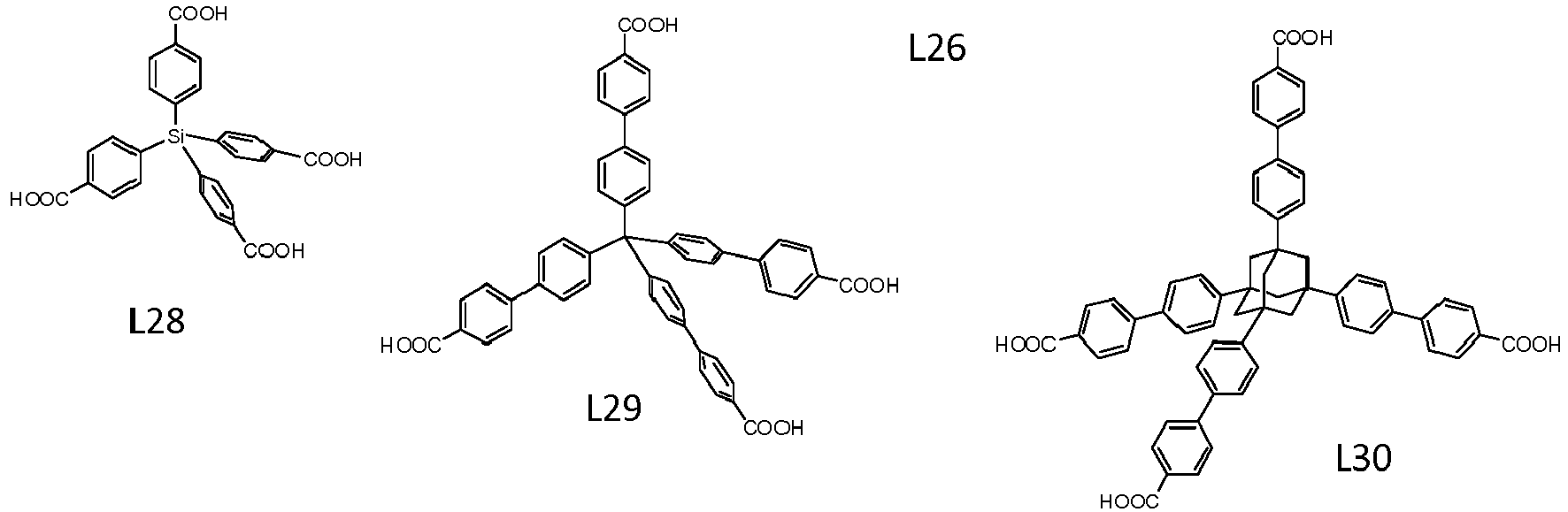
- Specific combinations of ligands include ligands derived from L31 and L32:


- Alternatively, the ligand may be derived from a carboxylic acid selected from the following compounds or combinations thereof:


- In a particular embodiment, the metal-organic framework comprises a metal cluster having formula Al2XO and one or more ligands derived from a carboxylic acid of formula L8:

- For example, the metal-organic framework may have a metal cluster of formula Al3O and comprise six ligands derived from a carboxylic acid of formula L8.
- Alternatively, a metal-organic framework comprising a metal cluster having formula Al3O preferably further comprises a ligand derived from the carboxylic acids selected from:


- Unless otherwise specified, the crystal size may be measured as the largest dimension of the single crystal. For example, the length of the largest dimension of a crystal can be determined from a two-dimensional optical microscope image of a crystal.
- Alternatively, the size may be measured as the circular equivalent (CE) diameter. For example, using a two-dimensional optical microscope image of a crystal (of any shape), the diameter of a circle with equivalent projected area can be calculated.
- The specific surface area measurements were carried out by nitrogen adsorption-desorption techniques using a machine sold under the name Micrometrics ASAP 2010, on around 50 mg of material previously activated under a primary vacuum (10-3 Torr) for 15 hours at 200°C; the analysis being carried out by BET calculation methods.
- Unless otherwise mentioned, all the reagents were purchased and used without further purification. NMR spectra were recorded on MERCURY 300 (1
H 300 MHz). The following abbreviations were used to explain the multiplicities: s = singlet, d = doublet, t = triplet, q = quartet, m = multiplet, b = broad. The abbreviation for some solvent and reagent were listed here: p-Toluenesulfonate (Tos). 1,2-Dimethoxyethane (DME). tris-o-tolylphosphine (P(o-Tolyl)3). N-Methyl-2-pyrrolidone (NMP). The ligands listed in Scheme Si were purchased from Sigma Aldrich or VWR and used without further purification.
- To obtain the TGA data, a TGA-50 (SHIMADZU) thermogravimetric analyzer was used with a heating rate of 5 °C min-1 under N2 flow. For a single crystal analysis, a pink block crystal was taken directly from the mother liquor, transferred to oil and mounted into loop. The diffraction data set was collected at 110 K on a Bruker APEX CCD diffractometer with MoKα radiation (λ = 0.71609 Å). The powder X-ray diffraction patterns (PXRD) were collected on a BRUKER D8-Focus Bragg-Brentano X-ray Powder diffractometer equipped with a Cu sealed tube (λ = 1.54178 Å) at a scan rate of 0.5 s deg-1. Low pressure gas adsorption measurements were performed by an ASAP 2020 with the extra-pure quality gases. High pressure excess adsorption of H2 and CH4 were measured using an automated controlled Sieverts' apparatus (PCT-Pro 2000 from Setaram) at 77 K (liquid nitrogen bath) or 298 K (room temperature).
- Regarding X-ray crystallography, the data frames were collected using the program APEX2 and processed using the program SAINT routine within APEX2. The data were corrected for absorption and beam corrections based on the multi-scan technique as implemented in SADABS (G. M. Sheldrick, SHELXTL, Version 6.14, Structure Determination Software Suite, Bruker AXS, Madison, WI, 2003). The structure was solved by direct methods using the SHELXS program of the SHELXTL package and refined by full-matrix least-squares methods with SHELXL (A. L. Spek, PLATON, A Multipurpose Crystallographic Tool, Utrecht University, Utrecht, The Netherlands, 1998). Metal atoms were located from the E-maps and other non-hydrogen atoms were refined with anisotropic displacement parameters during the final cycles. Hydrogen atoms were placed in calculated positions with isotropic displacement parameters set to 1.2 × Ueq of the attached atom. The solvent molecules are highly disordered, and attempts to locate and refine the solvent peaks were unsuccessful. Contributions to scattering due to these solvent molecules were removed using the SQUEEZE routine of PLATON (A. L. Spek, PLATON, A Multipurpose Crystallographic Tool, Utrecht University, Utrecht, The Netherlands, 1998) structures were then refined again using the data generated. The contents of the solvent region are not represented in the unit cell contents in the crystal data. CCDC numbers (975771 -975791 and 975820-975828) contain the supplementary crystallographic data for this paper. These data can be obtained free of charge from The Cambridge Crystallographic Data Centre via www.ccdc.cam.ac.uk/data request/cif.
- The specific surface area measurements were carried out by nitrogen adsorption-desorption techniques using a machine sold under the name Micrometrics ASAP 2010, on around 50 mg of material previously activated under a primary vacuum (10-3 Torr) for 15 hours at 200°C; the analysis being carried out by BET calculation methods.
- Synthesis of L6 was carried out in accordance with V. K, Ol'khovik, Yu. V. Matveenko, G. V. Kalechits, A. A. Pap, and A. A. Zenyuk. Synthesis and properties of 4,4'- bis [5-alkyl(aryl)benzoxazol-2-yl]-2-hydroxy (alkoxy) biphenyls. Russian Journal of Organic Chemistry, 2006, 42, 1164-1168.

- Synthesis of L8 was carried out in accordance with W. Zhou, X. Yang, E. Jia, X. Wang, J. Xua, G. Ye. Ultraviolet resistance of azo-containing poly(1,3,4-oxadiazole) fibres. Polymer Degradation and Stability, 2013, 98, 691-696.

- Synthesis of L9 was carried out in accordance with Jiang, H.-L.; Feng, D.; Liu, T.-F.; Li, J.-R.; Zhou, H.-C., Pore Surface Engineering with Controlled Loadings of Functional Groups via Click Chemistry in Highly Stable Metal-Organic Frameworks,J. Am. Chem. Soc. , 2012, 134, 14690-14693.

- Synthesis of L22 was carried out in accordance with Wang, X.-S.; Ma, S.; Rauch, K.; Simmons, J. M.; Yuan, D.; Wang, X.; Yildirim, T.; Cole, W. C.; Lopez, J. J.; de Meijere, A.; Zhou, H.-C.Metal-organic frameworks based on double-bond-coupled di-isophthalate linkers with high hydrogen and methane uptakes, Chemistry of .

- Synthesis of L28 was carried out in accordance with Fournier, J.-H.; Wang, X.; Wuest, J. D. Can. Derivatives of Tetraphenylmethane and Tetraphenylsilane. Synthesis of New Tetrahedral Building Blocks for Molecular Construction. J. Chem. 2003, 81, 376-380.

-

- A (2 g, 6.4 mmol), B (3.78 g, 21 mmol), CsF (3 g, 20 mmol) and Pd(PPh3)4 (0.2 g, 0.17mmol) was added to a 250 mL flask, and the flask was connected to Schlenk line. 200 mL DME was degassed and added through a canula. The mixture was refluxed under the nitrogen for 48 hours. The solution was dried on rotary evaporator. 100 mL H2O was added and then extract with CHCl3. The residue was subjected to column chromatography on silica gel (Ethyl acetate : Hexane = 20 : 80) to yield the title compound C as white solid 2.0 g. (Yield: 65%).
- Compound C (2.0 g, 4.2 mmol) was suspended in 60 mL THF / MeOH (v:v = 1 :1), and 30 mL 10% NaOH solution was added. The mixture was stirred overnight. The pH value was adjusted to approximately 2 using hydrochloric acid. The resulting white precipitate was collected by filtration, washed with water, and dried under vacuum to give L15 (1.7 g, 92%). 1H NMR (CDCl3): δ = 3.97 (s, 9H), 7.90 (d, 2H), 8.06 (d, 2H), 8.44 (d, 2H) 8.49 (t, 1H).
- L16, L17 and L18 were synthesis as the same procedure for L15 except that the starting material of 1,3,5-Tribromobenzene were replaced by 2,4,6-Tribromoaniline (for L16), 2,4,6-Tribromotoluene (for L17) and 2,4,6-Tribromophenol (for L18) respectively. 1H NMR (300 MHz, DMSO-d6) for L16. δ = 4.74 (s, 2H), 7.52 (s, 2H), 7.74 (d, 4H), 7.85 (d, 2H), 7.98 (d, 2H), 8.10 (d, 4H). 1H NMR (300 MHz, yDMSO-d6) for L17. δ = 2.13 (s, 3H), 7.64 (t, 6H), 7.92 (d, 2H), 8.01 (d, 2H), 8.06 (d, 4H). 1H NMR (300 MHz, DMSO-d6) for L18 : δ = 3.97 (s, 9H), 7.90 (d, 2H), 8.06 (d, 2H), 8.44 (d, 2H) 8.49 (t, 1H).

-

- To a round bottomed flask add A (2.0g, 4.0 mmol), B (1.2 g, 5 mmol), K2CO3 (0.7g), and DMF (30 mL). The resulting mixture was heated up to 60 °C for 12h. After cooling to RT, ice water was added. The precipitate was collected, washed thoroughly with water, and dried to produce (2.1g, 93%) of C. 1H NMR (CDCl3) for: δ = 0.49 (m, 6H), 0.78 (m, 1H), 1.01 (m, 1H), 1.24 (m, 1H), 3.05 (m, 2H), 3.95 (m, 9H), 7.61 (s, 2H), 7.72 (m, 6H), 8.11 (m, 2H).
- C (2.1g, 3.7 mmol) was dissolved in 100 mL mixture of THF and MeOH (v/v = 1/1), 50 mL 2N KOH aqueous solution was added. The mixture was stirred and refluxed overnight. The organic phase was removed. The aqueous phase was diluted to 100 mL and acidified with concentrated HCl. The precipitate was collected, washed thoroughly with water and dried to produce 1.6 g (Yield. 82.5%) of L19.
-

- L20 was synthesized as the same procedure for L19 except the starting material B ((S)-2-Methylbutyl p-Toluenesulfonate) was replace by Hexyl p-Toluenesulfonate.
-

- A (2 g, 11 mmol), B (2 g, 7.4 mmol), CsF (3 g, 15mmol) and Pd(PPh3)4 (0.2 g, 0.17mmol) was added to a 250 mL flask. The flask was connected to Schlenk line. 200 mL 1,2-Dimethoxyethane was degassed and added through a canula. The flask was equipped with a water condenser and refluxed under the nitrogen for 48 hours. The solution was dried on rotary evaporator. 100 mL H2O was added and then extract with CHCl3. The organic phase was evaporated to dryness and purified with chloroform through a short silica gel column to yield a light yellow powder 1.56 g. (Yield: 62%). 1H NMR (CDCl3): δ = 3.97 (s, 9H), 7.90 (d, 2H), 8.06 (d, 2H), 8.44 (d, 2H) 8.49 (t, 1H).
- Compound C (1.6 g, 4.6 mmol) was suspended in 50 mL THF / MeOH (v : v = 1 : 1), and 30 mL 10% NaOH solution was added. The mixture was stirred overnight. The pH value was adjusted to approximately 2 using hydrochloric acid. The resulting white precipitate was collected by filtration, washed with water, and dried under vacuum to give L21 (1.2 g, 91%).
-

- A mixture of A (12.2 g, 73.5 mmol), Ag2SO4 (13.3 g, 43 mmol) and Br2 (5ml, 97 mmol) in conc. sulphuric acid was stirred at 60°C for 32 h. The excess of Br2 was removed by addition of saturated Na2S2O3 solution very slowly. The residue was poured into ice-water. The solids were isolated by filtration and given into a NaHCO3 solution. The AgBr was then removed by filtration. The solution was acidified with concentrated hydrochloric acid to give white precipitates. The solid was filtered and washed with water several times to give the product as white solid 20.5g (Yield. 86.7%). 1H-NMR (DMSO-d6): δ = 8.23 (d, 2H), 8.40 (t, 1H).
- A solution of conc. sulphuric acid (8 ml) in methanol (30 ml) was added dropwise to a solution of B (13.2 g, 0.054 mol) in methanol (150 ml). The reaction mixture was refluxed for 20 h. After cooling to room temperature, the product was obtained as colourless crystals. After filtration, the product was washed with cold methanol to give C 11.3 g (Yield. 76.6%). 1H-NMR (CDCl3): δ = 3.96 (s, 6H), 8.35 (d, 2H), 8.6 (t, 1H).
- A 300 mL glass autoclave was charged with B (2.00 g, 7.3 mmol), Pd(OAc)2 (16.4 mg, 0.0732 mmol), and P(o-Tolyl)3 (44.5 mg, 0.146 mmol). The autoclave was evacuated and filled with nitrogen alternately for several times. Anhydrous triethylamine (2.2 mL, 15.8 mmol) and anhydrous NMP (2.2 mL) were added under nitrogen. The autoclave was evacuated, filled with 1.5 bar of ethane. The pressure was released, and then built up again, and this release and repressurization was repeated three more times in order to saturate the solvent with ethene. The contents of the autoclave were then kept under a pressure of 1.5 bar of ethene and stirred at 100 °C for 25.5 h. After having been cooled down to ambient temperature, the autoclave valve was opened to release excess ethene, and the mixture was taken up in methylene chloride (100 mL). The solution was washed with water (3 × 50 mL), dried MgSO4, and concentrated under reduced pressure. The residue was subjected to column chromatography on silica gel to yield 1.181 g (78%) of the title compound as a light yellow solid. 1H NMR (250 MHz, CDCl3): δ = 3.98 (s, 12 H), 7.31 (s, 2H), 8.38 (d, 4H), 8.59 (t, 2H).
- D (3 g, 7.3 mmol) was suspended in 100 mL THF / MeOH (v : v = 1 : 1), and 20 mL 10% NaOH solution was added. The mixture was stirred overnight. The pH value was adjusted to approximately 2 using hydrochloric acid. The resulting white precipitate was collected by filtration, washed with water, and dried under vacuum to give L23 2.46 g (Yield. 95%).
-

- A was synthesized as the same way for D in L23. A mixture of compound A (170 mg, 0.412 mmol), 10% Pd/C (54 mg) and toluene (30 mL) was hydrogenated at 50 °C (H2, 3 bar) for 4 h. The catalyst was filtered off through a pad of Celite and then washed with chloroform. The filtrate was evaporated to dryness on rotary evaporator. The residue was recrystallized from chloroform / toluene to give 152 mg of B as colorless solid (Yield. 89%). 1H-NMR (300 MHz, CDCl3): δ = 3.02 (s, 4H), 3.91 (s, 12H), 8.01-8.03 (m, 4H), 8.49-8.52 (m, 2H).
- Compound C (130 mg) was suspended in 50 mL THF/MeOH (v : v = 1 : 1), and 3 mL 10% NaOH solution was added. The mixture was stirred overnight. The pH value was adjusted to approximately 2 using hydrochloric acid. The resulting white precipitate was collected by centrifuge, washed with water, and dried under vacuum to give L24 (100 mg, 92%). 1H-NMR (DMSO-d6 ): δ = 13.10 (s, br, 4H), 8.29 (s, 2H), 8.04 (s, 4H), 3.02 (s, 2H).
-

- 12 mL SOCl2 (165 mmol) was slowly added to a stirred solution of A (10 g, 60 mmol) in 100 mL of absolute EtOH. After stirring under reflux for 5 hours, there are a lot of precipitates formed. The solvent was removed and the crude product was washed with a saturated aqueous solutionof Na2CO3. After filtered, the solid was dried at 60°C overnight to give B as white solid of 12.8g (Yield. 90%). 1H NMR (CDCl3): δ = 1.4 (t, 3H), 4.3 (q, 2H), 7.5 (s, 2H), 8.1 (s, 1H).
- A solution of NaNO2 (2.32 g) in 20 mL water was added to a cloudy mixture of B (6.6 g, 27.8 mmol) in 30 mL 2M hydrochloric acid at 0 °C. The mixture changed to clear solution slowly. After stirred at 0 °C for 45 minutes, an ice-cold KI aqueous solution was added. Then mixture changed to dark red and sticky. After 100 mL CH2Cl2 was added, the mixture was allowed to stir at RT for 4 hours. The aqueous phase was washed with CH2Cl2 three times. The combined organic phases were dried with MgSO4. After the solvent was removed, the crude product was purified by column chromatography with CH2Cl2 as the eluent. 1H NMR (Acetone): δ = 1.4 (t, 3H), 4.4 (q, 2H), 8.2 (s, 2H), 8.6 (s, 1H).
- C (7.3 g, 20.9 mmol), Pd(PPh3)2Cl2 (0.2 g). CuI (0.1 g) were dissolved in 200 mL Et2NH under nitrogen atmosphere. The mixture was bubbled with acetylene for 8 hours at RT, and then stirred overnight. The solvent was removed and the residual powder was dissolved in CH2Cl2 (300 mL) and 200 mL hydrochloric acid (2M). The aqueous phase was extracted with CH2Cl2 twice. The mixed organic phase was washed with water twice and dried with Na2SO4. After the solvent was removed, the crude product was purified by column chromatography with CH2Cl2 as eluent to give the product as pale-yellow powder. 1H NMR (CHCl3): δ = 1.5 (t, 3H), 4.4 (q, 2H), 8.4 (s, 2H), 8.7 (s, 1H).
- D was suspended in 100 mL THF, to which was added 20 mL 2 M KOH aqueous solution. The mixture was refluxed under N2 overnight. THF was removed on rotary evaporator and diluted hydrochloric acid was added into the aqueous solution until the solution became acidic. The solid was collected by filtration, washed with water several times and dried in the air.
-

- A solution of NaNO2 (2.32 g) in 20 mL water was added to a cloudy mixture of A (6.6 g, 27.8 mmol) in 30 mL 2M hydrochloric acid at 0 °C. After stirred at 0 °C for 45 minutes, an ice-cold KI aqueous solution was added. Then mixture changed to dark red and sticky. After 100 mL CH2Cl2 was added, the mixture was allowed to stir at RT for 4 hours. The aqueous phase was washed with CH2Cl2 three times. The combined organic phases were dried with MgSO4. After the solvent was removed, the crude product was purified by column chromatography with Ethyl acetate: Hexans = 4:1 as the elute.( 8.8g, Yield. 91%) 1H NMR (Acetone): δ = 1.4 (t, 3H), 4.4 (q, 2H), 8.2 (s, 2H), 8.6 (s, 1H).
- Degassed dry DMF (18mL) was added to a mixture of B (3.48 g, 10 mmol), C (3.1 g, 12 mmol), potassium acetate (2.2 g, 24 mmol), and Pd(OAc)2 (49 mg, 0.22 mmol). The mixture was heated to 90 °C (oil bath) for 24 h. After cooling to room temperature, the solution was added dropwise to water (90 mL) and stirred vigorously for 10 min. The solid was collected by filtration and purified through column chromatography on silica gel (hexane/ethyl acetate, 80:20, second point) to afford product as a white solid (2.01 g, 86%). 1H NMR (CDCl3): δ = 1.346 (s, 12H), 1.396 (t, 6H), 4.392 (q, 4H), 8.600 (d, 2H), 8.739 (t, 1H).
- A solution of NaNO2 (2.32 g) in 20 mL water was added to a cloudy mixture of E (6.6 g, 27.8 mmol) in 30 mL 2M hydrochloric acid at 0 °C. After stirred at 0 °C for 45 minutes, an ice-cold KI aqueous solution was added. Then mixture changed to dark red and sticky. After 100 mL CH2Cl2 was added, the mixture was allowed to stir at RT for 4 hours. The aqueous phase was washed with CH2Cl2 three times. The combined organic phases were dried with MgSO4. After the solvent was removed, the crude product was purified by column chromatography with Ethyl acetate: Hexane = 4:1 as the eluent. 1H NMR (CDCl3): δ = 2.538 (s, 12H), 7.261 (s, 4H).
- A 250-mL Schlenk flask was charged with of D (0.8 g, 3.05 mmol), F (3.7 g 8 mmol), CsF (4 g, 26.4 mmol), and 0.2 g of Pd(P(Ph)3)4. 120 ml of DME was degassed and transferred. A water condenser was then equipped and the flask was heated to reflux under the nitrogen for 72 hours. The solvent was dried on rotary evaporator. The residue was dissolved by CH2Cl2 and purified by column chromatography to white crystal. The white crystal was dissolved in a 500-mL Schlenk flask with 200 mL mixture of THF and MeOH (v/v = 1:1). 100 mL of 0.3M NaOH aqueous solution was added. The flask was heated to reflux overnight. The solution is then acidified by diluted hydrochloric acid to give white precipitate, which was filtered and washed with water several times to get L26 1.2g (Yield. 68%). 1H NMR (DMSO): δ = 2.051 (s, 12H), 7.516 (s, 4H), 7.925 (d, 4H), 8.490 (t, 2H).
-

- A 250-mL Schlenk flask was charged with of A (1.2g, 3.05mmol), B (3.28 g 18.30mmol), CsF (4 g, 26.4 mmol), and 0.2 g of Pd(P(Ph)3)4. 120 ml DME was degassed and transferred. A water condenser was then equipped and the flask was heated to reflux under the nitrogen for 72 hours. The solvent was dried on rotary evaporator. The residue was dissolved by CH2Cl2 and purified by column chromatography to white crystal.
- The white crystal was dissolved in a 500 mL Schlenk flask with 200 mL mixture of THF and MeOH (v/v = 1:1). 100 mL of 0.3M NaOH aqueous solution was added. The flask was heated to reflux overnight. The solution is then acidified by diluted hydrochloric acid to give white precipitate of C, which was filtered and washed with water several times to get L27 1.2g (Yield. 68%). 1H NMR (DMSO): δ=12.9 (s, 4H), 7.83 (t, 4H), 7.80 (s, 4H), 7.55 (s, 2H), 7.45 (d, 4H), 7.40 (d, 4H).
-

- B is prepared according to the procedure described in reference 5.
- A 250 mL Schlenk flask was charged with A (4g, 6.3 mmol), B (6.79 g, 37.7 mmol), CsF (9.5 g, 63.9 mmol), and Pd(P(Ph)3)4 0.3 g. 120 ml DME was degassed and transferred. A water condenser was then equipped. The flask was heated to reflux under the nitrogen for 48 hours. The solvent was dried on rotary evaporator. The residue was dissolved by CH2Cl2, and purified by column chromatography to get C 4.1g (Yield. 76%).
- C (4.1 g, 4.8 mmol) was dissolved in a 500 mL Schlenk flask with 200 mL mixture of THF and MeOH (v/v = 1:1). 100 mL of 1.25M NaOH aqueous solution was added. The flask was heated to reflux overnight. The solution is then acidified by diluted hydrochloric acid to give white precipitate, which was filtered and washed with water and acetone several times. 1HNMR (DMSO): δ =12.93 (s, 4H), 7.99 (d, 8H), 7.81 (d, 8H), 7.76 (d, 8H), 7.41 (d, 8H).
-

- B is prepared according to the procedure described in reference 1. A 250-mL Schlenk flask was charged with A (3g, 4.0 mmol), B (4.2 g, 24 mmol), CsF (9.5 g, 63.9 mmol), and Pd(P(Ph)3)4 0.3 g. 120 ml of DME was degassed and transferred. A water condenser was then equipped. The flask was heated to reflux under the nitrogen for 48 hours. The solvent was dried on rotary evaporator. The residue was dissolved by CH2Cl2, and purified by column chromatography to get C 2.9 g (Yield. 76%).
- C (2.9 g, 3.0 mmol) was dissolved in a 500 mL Schlenk flask with 200 mL mixture of THF and MeOH (v/v = 1:1). 100 mL of 1.25 M NaOH aqueous solution was added. The flask was heated to reflux overnight. The solution is then acidified by diluted hydrochloric acid to give white precipitate, which was filtered and washed with water and acetone several times. 1H NMR (CDCl3): δ = 2.29 (s, 8H), 3.92 (s, 12H) 7.64(m, 6H) 8.08 (d, 2H).
- The structures shown in the examples below represent the ligands employed which replace the (CH3COO) ligands seen in the starting material whilst retaining the same metal ion cluster.
-

- 10mg of [Al3O(OOCCH3)6·3CH3CN][AlCl4] and 10 mg of ABTC were dissolved in 2ml of DMF, then 0.5ml of acetic acid was added. The solution was sealed in a 4ml vial and put into oven at 150 °C for 5 days. After cooling down to room temperature, light yellow crystals were harvested.
- Optical microscope images of PCN-250 (Al) (Example 1) are shown in
Figures 2-4 . Crystal sizes of 42 µm, 10 µm, and 72 µm respectively were observed. - The crystal data and structure refinements for a single crystal of PCN-250 (Al) (Example 1) are shown in Table 1.
Table 1 PCN-250-Al Formula C9H6AlO5.33 Formula weight 226.45 Crystal Color/Shape Light Yellow Block Crystal System Cubic Space Group P43n a (Å) 21.6035(10) V (Å3) 10082.60(8) Z 24 d calcd. (g/cm3) 0.895 µ(mm-1) 0.121 F(000) 2776 θmax [deg] 26.37 Completeness 98.8% Collected reflections 3427 Unique reflections 3238 Parameters 145 Restraints 3 Rint 0.0308 R1 [I > 2σ(I)] 0.0386 ωR2 [I > 2σ(I)] 0.1241 R1 (all data) 0.0408 ωR2 (all data) 0.1254 GOF on F 2 1.136 Δρmax/Δρmin [e.Å-3] 0.371 / -0.250 - The adsorption characteristics of PCN-250(Al) were measured.
- Before measurements were carried out, as-synthesized PCN-250(Al) samples were washed with dry DMF several times, and immersed in DMF for 2 days to remove unreacted starting ligands, inorganic species and acetic acid. After that, DMF was decanted, washed with dry methanol several times, and immersed in methanol at 65°C. This was repeated for 2 days to completely substitute the coordinating molecule. After that, methanol was decanted, the sample was washed with dry CH2Cl2 several times, and CH2Cl2 solvent exchange was conducted under a well-sealed vial at 60°C for 3 days. After that, the solvent was removed on a vacuum line and the sample was transported in a glove box to prevent the re-adsorption of H2O from the air. The sample was then activated again using the 'outgas' function of the adsorption instrument for 12 h at 190 °C. Gas adsorption was then measured.
-
Figure 5 shows the H2 uptake (adsorption) measured for PCN-250(Al). -
Figure 6 shows the N2 uptake (adsorption) measured for PCN-250(Al). -
Figure 7 shows the CH4 uptake (adsorption) measured for PCN-250(Al). -
Figure 8 shows the CO2 uptake (adsorption) measured for PCN-250(Al). - The uptake properties exhibited by PCN-250 (al) are observed to be excellent.
- About 15 mg samples of PCN-250(Al) was heated on a TGA-50 (Shimadzu) thermogravimetric analyzer from room temperature to 650 °C at a rate of 5 °C min-1 under N2 flow of 15 mL min-1.
-
Figure 9 shows the thermogravimetric analysis trace for a fresh sample of PCN-250(Al). - The following are clauses describing embodiments of the invention. They are not claims.
- 1. A metal-organic framework comprising one or more metal-ligand clusters, each metal-ligand cluster comprising (i) a metal cluster having two or more metal ions, wherein at least one metal ion is aluminium, and (ii) one or more ligands having two or more carboxylate groups.
- 2. The metal-organic framework according to clause 1, having a size greater than or equal 10 µm, 20 µm, 30 µm, 40 µm, or 50 µm.
- 3. The metal-organic framework according to any one of the preceding clauses, wherein the metal organic framework is monocrystalline or polycrystalline.
- 4. The metal-organic framework according to any one of the preceding clauses, wherein the metal organic framework is a single crystal.
- 5. The metal-organic framework according to any one of the preceding clauses, wherein the metal-organic framework does not comprise any amine functional groups.
- 6. The metal-organic framework according to any one of the preceding clauses, wherein the at least one metal-ligand cluster comprises at least two aluminium metal ions.
- 7. The metal-organic framework according to clause 6, wherein the at least one metal-ligand cluster comprises three aluminium metal ions.
- 8. The metal-organic framework according to clause 6, wherein the metal-ligand cluster has the formula Al2XO, and X is a metal ion selected from the group consisting of Group 2 through Group 16 metals.
- 10. The metal-organic framework according to clause 8, wherein the metal-ligand cluster has formula Al2XO, wherein X is a metal ion selected from Fe(III), Cr(III), V(III), Sc(III) or In(III).
- 11. The metal-organic framework according to clause 7, wherein the metal cluster has a formula Al3O.
- 12. The metal-organic framework according to any one of the preceding clauses, wherein the one or more ligands are derived from a dicarboxylic acid, a tricarboxylic acid, a tetracarboxylic acid, a hexacarboxylic acid, or a octacarboxylic acid.
- 13. The metal-organic framework according to any of the preceding clauses, wherein each metal cluster is coordinated with 4, 5, or 6 ligands.
- 14. The metal-organic framework according to any of the preceding clauses, the metal-organic framework comprising inorganic cornerstones having at least 10 coordination sites, preferably having 12 coordination sites.
- 15. The metal-organic framework according to any of the preceding clauses, having a molar ratio of metal ions to organic linker of from about 1:0.45 to about 1:0.55, preferably about 1:0.5.
- 16. The metal-organic framework according to any of the preceding clauses, having a surface area of at least 1000 m2/g, preferably at least 1100 m2/g, more preferably greater than or equal to 1200 m2/g.
- 17. The metal-organic framework according to any of the preceding clauses, having a surface area of less than or equal to 6000 m2/g, preferably less than or equal to 4000 m2/g, more preferably less than or equal to 3000 m2/g.
- 18. The metal-organic framework according to any of the preceding clauses, the metal-organic framework comprising cavities having a free diameter of about 4Å to about 50Å, or about 8Å to about 12Å, or about 10Å.
- 19. The metal-organic framework according to any of the preceding clauses, the metal-organic framework comprising pores having a pore volume from about 0.1 cm3/g to about 4 cm3/g, or from about 0.3 cm3/g to about 0.7 cm3/g, or from about 0.4 cm3/g to about 0.6 cm3/g, or about 0.5 cm3/g.
- 20. The metal-organic framework according to any of the preceding clauses, having a crystal size from about 25 µm to about 500 µm, preferably from about 50 µm to about 200 µm.
- 21. A process for preparing a single crystal of a metal-organic framework as defined in any one of the preceding clauses, the process comprising reacting a starting compound of formula M3O(CH3COO)6 with a ligand precursor having at least two carboxylic acid groups in the presence of acetic acid to provide a metal-organic framework comprising a M3O cluster where at least one (CH3COO) ligand is replaced by at least one ligand having at least two carboxylate groups;
wherein each M is independently a metal ion selected from the group consisting of Group 2 through Group 16 metals, and wherein at least one M is Al(III). - 22. The process according to clause 21, wherein the starting compound has a formula Al2XO(CH3COO)6 or Al3O(CH3COO)6, wherein X is Fe(III), Cr(III), V(III), Sc(III) or In(III).
- 23. The process according to clause 21 or clause 22, wherein the process is a solvothermal process.
- 24. The process according to clause 23, wherein the process involves heating the reaction under pressure.
- 25. A single crystal of a metal-organic framework obtainable by the process of any one of clauses 21 to 24.
- 26. A method comprising uptaking at least one substance by a metal-organic framework according to any one of clauses 1 to 20 or 25.
- 27. The method according to clause 26, wherein the substance is hydrogen, methane, carbon dioxide or nitrogen.
- 28. A method of storing a gas in a metal-organic framework according to any one of clauses 1 to 20 or 25.
- 29. Use of a metal-organic framework according to any one of clauses 1 to 20 or 25 for storing a gas.
- 30. The use of clause 29, wherein the gas is hydrogen, methane, carbon dioxide or nitrogen.
- 31. Use of a metal-organic framework according to any one of clauses 1 to 20 or 25, for adsorbing a guest molecule.
- 32. The use according to clause 31, wherein the guest molecule is hydrogen, methane, carbon dioxide or nitrogen.
- 33. A method of adsorbing a guest molecule comprising contacting a metal-organic framework according to any one of clauses 1 to 20 or 25 with a guest molecule source.
- 34. The method of clause 33, wherein the guest molecule is hydrogen, methane, carbon dioxide or nitrogen,
- 35. A metal-organic framework according to any one of clauses 1 to 20 or 25, further comprising one or more than one type of guest molecule.
- 36. The metal-organic framework according to clause 35, wherein the guest molecule is a gas molecule.
- 37. The metal-organic framework according to clause 36, wherein the gas molecule is hydrogen, methane, carbon dioxide or nitrogen.
- 38. A monocrystalline or polycrystalline metal-organic framework comprising at least one aluminium metal ion.
- 39. A monocrystalline or polycrystalline metal-organic framework comprising an Al3O cornerstone.
- 40. The monocrystalline or polycrystalline metal-organic framework according to either clause 38 or clause 39, further comprising one or more ligands having two or more carboxylate groups.
Claims (15)
- A metal-organic framework comprising one or more metal-ligand clusters, each metal-ligand cluster comprising (i) a metal cluster having a formula Al3O, and (ii) one or more ligands derived from a carboxylic acid of formula L8:
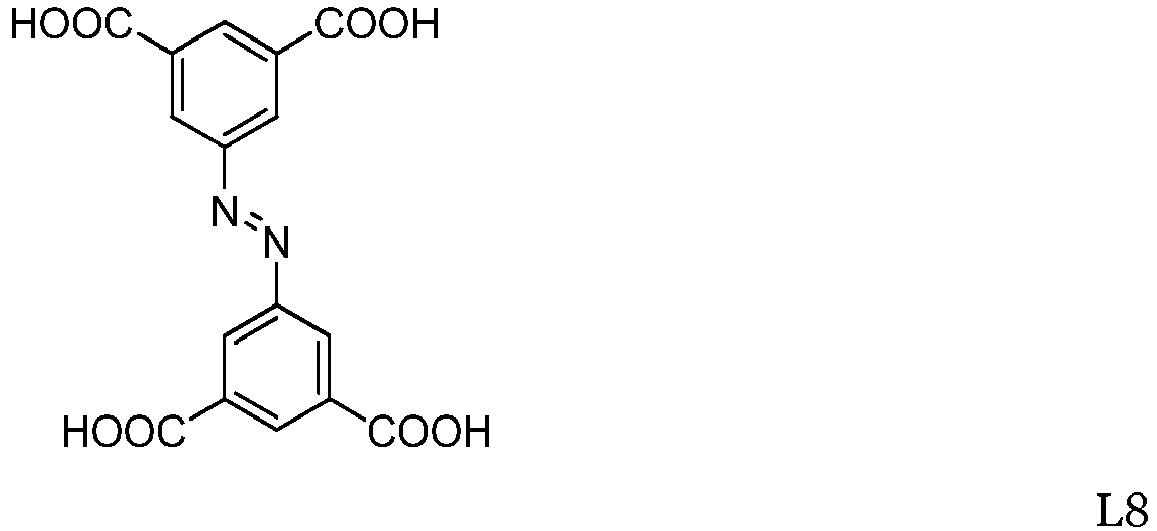
- The metal-organic framework according to claim 1, comprising six ligands derived from a carboxylic acid of formula L8.
- The metal organic framework according to claim 1 or claim 2, having a size greater than or equal 10 µm, 20 µm, 30 µm, 40 µm, or 50 µm.
- The metal-organic framework according to any one of the preceding claims, wherein(i) the metal organic framework is monocrystalline or polycrystalline; and/or(ii) the metal organic framework is a single crystal.
- The metal-organic framework according to any one of the preceding claims, wherein the metal-organic framework does not comprise any amine functional groups.
- The metal-organic framework according to any of the preceding claims, having a molar ratio of metal ions to organic linker of from about 1:0.45 to about 1:0.55, preferably about 1:0.5.
- The metal-organic framework according to any of the preceding claims, having a surface area of at least 1000 m2/g, preferably at least 1100 m2/g, more preferably greater than or equal to 1200 m2/g.
- The metal-organic framework according to any of the preceding claims, having a surface area of less than or equal to 6000 m2/g, preferably less than or equal to 4000 m2/g, more preferably less than or equal to 3000 m2/g.
- The metal-organic framework according to any of the preceding claims, the metal-organic framework comprising cavities having a free diameter of about 4Å to about 50Å, or about 8Å to about 12Å, or about 10Å.
- The metal-organic framework according to any of the preceding claims, the metal-organic framework comprising pores having a pore volume from about 0.1 cm3/g to about 4 cm3/g, or from about 0.3 cm3/g to about 0.7 cm3/g, or from about 0.4 cm3/g to about 0.6 cm3/g, or about 0.5 cm3/g.
- The metal-organic framework according to any of the preceding clauses, having a crystal size from about 25 µm to about 500 µm, preferably from about 50 µm to about 200 µm.
- A method comprising uptaking at least one substance by a metal-organic framework according to any one of claims 1 to 11.
- A method of storing a gas in a metal-organic framework according to any one of claims 1 to 11.
- Use of a metal-organic framework according to any one of claims 1 to 11 for storing a gas, or for adsorbing a guest molecule.
- A method of adsorbing a guest molecule comprising contacting a metal-organic framework according to any one of claims 1 to 11 with a guest molecule source.
Applications Claiming Priority (7)
| Application Number | Priority Date | Filing Date | Title |
|---|---|---|---|
| US201361909149P | 2013-11-26 | 2013-11-26 | |
| GB201414117A GB201414117D0 (en) | 2013-11-26 | 2014-08-08 | Titanium metal organic framework materials |
| GB201414114A GB201414114D0 (en) | 2013-11-26 | 2014-08-08 | Aluminium metal organic framework materials |
| GB201414115A GB201414115D0 (en) | 2013-11-26 | 2014-08-08 | Iron metal organic framework materials |
| GB201414113A GB201414113D0 (en) | 2013-11-26 | 2014-08-08 | Process for preparing metal organic framework materials |
| EP14806362.1A EP3071579B1 (en) | 2013-11-26 | 2014-11-26 | Aluminium metal organic framework materials |
| PCT/GB2014/053507 WO2015079230A1 (en) | 2013-11-26 | 2014-11-26 | Aluminium metal organic framework materials |
Related Parent Applications (1)
| Application Number | Title | Priority Date | Filing Date |
|---|---|---|---|
| EP14806362.1A Division EP3071579B1 (en) | 2013-11-26 | 2014-11-26 | Aluminium metal organic framework materials |
Publications (2)
| Publication Number | Publication Date |
|---|---|
| EP3514159A1 true EP3514159A1 (en) | 2019-07-24 |
| EP3514159B1 EP3514159B1 (en) | 2021-06-23 |
Family
ID=51629537
Family Applications (3)
| Application Number | Title | Priority Date | Filing Date |
|---|---|---|---|
| EP14195034.5A Active EP2876112B1 (en) | 2013-11-26 | 2014-11-26 | Monocrystalline iron metal organic frameworks |
| EP14806362.1A Active EP3071579B1 (en) | 2013-11-26 | 2014-11-26 | Aluminium metal organic framework materials |
| EP18205883.4A Active EP3514159B1 (en) | 2013-11-26 | 2014-11-26 | Aluminium metal organic framework material |
Family Applications Before (2)
| Application Number | Title | Priority Date | Filing Date |
|---|---|---|---|
| EP14195034.5A Active EP2876112B1 (en) | 2013-11-26 | 2014-11-26 | Monocrystalline iron metal organic frameworks |
| EP14806362.1A Active EP3071579B1 (en) | 2013-11-26 | 2014-11-26 | Aluminium metal organic framework materials |
Country Status (4)
| Country | Link |
|---|---|
| US (2) | US9102691B2 (en) |
| EP (3) | EP2876112B1 (en) |
| GB (4) | GB201414117D0 (en) |
| WO (2) | WO2015079229A1 (en) |
Families Citing this family (45)
| Publication number | Priority date | Publication date | Assignee | Title |
|---|---|---|---|---|
| FR2921660B1 (en) | 2007-10-01 | 2015-09-25 | Centre Nat Rech Scient | INORGANIC ORGANIC HYBRID NANOPARTICLES BASED ON IRON CARBOXYLATES. |
| KR101700206B1 (en) * | 2012-09-18 | 2017-01-26 | 쇼와 덴코 가부시키가이샤 | 1,3-butadiene-separating material, and separation method using said separating material |
| GB201414117D0 (en) | 2013-11-26 | 2014-09-24 | Texas A & M Univ Sys | Titanium metal organic framework materials |
| WO2016033086A1 (en) | 2014-08-25 | 2016-03-03 | King Abdullah University Of Science And Technology | Metal organic frameworks for removal of compounds from a fluid |
| US10751691B2 (en) | 2014-08-25 | 2020-08-25 | King Abdullah University Of Science And Technology | Metal organic frameworks for gas separation applications |
| US10322402B2 (en) | 2014-12-04 | 2019-06-18 | King Abdullah University Of Science And Technology | Metal organic frameworks for gas storage |
| CN105399602B (en) * | 2015-10-27 | 2018-02-09 | 辽宁大学 | A kind of V types rigidity bidentate Carboxylic acid ligand and its preparation method and application |
| CN105237337B (en) * | 2015-11-11 | 2017-07-25 | 遵义医学院 | The synthetic method of novel 5-[10-(9-carboxyanthracenyl)]-isophthalic acid |
| WO2017100279A1 (en) * | 2015-12-09 | 2017-06-15 | West Virginia University | Chemical compound for inhibition of shp2 function and for use as an anti-cancer agent |
| US9975114B2 (en) | 2016-05-13 | 2018-05-22 | King Fahd University Of Petroleum And Minerals | Metal organic frameworks as catalysts and hydrocarbon oxidation methods thereof |
| KR101902618B1 (en) * | 2016-05-31 | 2018-09-28 | 연세대학교 산학협력단 | Porous structure and method of fabricating the same |
| EP3254755B1 (en) * | 2016-06-10 | 2021-04-14 | Centre National de la Recherche Scientifique CNRS | High degree of condensation titanium-based inorganic-organic hybrid solid material, method for preparing same and uses thereof |
| BR112018077419B1 (en) | 2016-07-01 | 2023-10-03 | Ingevity South Carolina, Llc | METHOD FOR INCREASING VOLUMETRIC CAPACITY IN GAS STORAGE AND RELEASE SYSTEMS |
| KR102546232B1 (en) | 2016-08-10 | 2023-06-21 | 리써치 트라이앵글 인스티튜트 | Solid-state crystallization of metal organic frameworks within mesoporous materials methods and hybrid materials thereof |
| CN106496024A (en) * | 2016-08-31 | 2017-03-15 | 哈尔滨理工大学 | Supramolecular complexes with fluorescent functions based on aromatic carboxylic acid ligands for efficient detection of Hg2+ and preparation methods thereof |
| KR101937811B1 (en) * | 2017-04-27 | 2019-01-11 | 연세대학교 산학협력단 | Organic-inorganic Hybrid Porous Adsorbent And Method For Preparing The Same |
| CN111902195B (en) | 2018-02-05 | 2022-06-17 | 加利福尼亚大学董事会 | Atmospheric moisture collector |
| GB2573886A (en) * | 2018-04-25 | 2019-11-20 | Vapor Point Llc | Process of preparing metal-organic framework material |
| KR102565538B1 (en) * | 2018-06-11 | 2023-08-09 | 킹 압둘라 유니버시티 오브 사이언스 앤드 테크놀로지 | Complex mixed-linker structure |
| WO2020018767A1 (en) * | 2018-07-20 | 2020-01-23 | Northwestern University | An inorganic approach to rendering metal-organic frameworks electrically conductive |
| US11608351B2 (en) * | 2018-10-24 | 2023-03-21 | Sogang University Research & Business Development Foundation | Crystal structure-modulated zeolitic imidazolate framework nanoparticles and method of producing the same |
| US11045785B2 (en) | 2018-11-05 | 2021-06-29 | Industrial Technology Research Institute | Metal-organic framework, method for preparing the same, and adsorption device employing the same |
| US20220023829A1 (en) * | 2018-12-03 | 2022-01-27 | Framergy, Inc. | Amorphous metal organic frameworks and methods of preparing the same |
| CA3123380A1 (en) * | 2018-12-21 | 2020-06-25 | Massey University | Metal-organic frameworks for gas adsorption |
| US20220158173A1 (en) * | 2019-03-07 | 2022-05-19 | Cornell University | Mof-sulfur materials and composite materials, methods of making same, and uses thereof |
| CN109821579A (en) * | 2019-03-11 | 2019-05-31 | 金鹏霞 | Based on copper porphyrin MOFs and TiO2Nanocomposite preparation method and application |
| EP3946226A1 (en) * | 2019-03-29 | 2022-02-09 | Framergy Inc. | Mof comprising topical composition |
| WO2021006964A1 (en) * | 2019-07-09 | 2021-01-14 | Exxonmobil Research And Engineering Company | Metal-organic framework materials comprising a pyrazolylcarboxylate ligand and methods for production thereof |
| CN112295545A (en) * | 2019-08-02 | 2021-02-02 | 中国石油化工股份有限公司 | High-capacity methane storage material and preparation method and application thereof |
| US11387250B2 (en) | 2019-12-20 | 2022-07-12 | Sandisk Technologies Llc | Three-dimensional memory device containing metal-organic framework inter-word line insulating layers |
| US11296028B2 (en) | 2019-12-20 | 2022-04-05 | Sandisk Technologies Llc | Semiconductor device containing metal-organic framework inter-line insulator structures and methods of manufacturing the same |
| US20230096721A1 (en) | 2020-02-27 | 2023-03-30 | Rikkyo Educational Corporation | Metal-organic framework with carboxylic acid ion having terphenyl skeleton as ligand |
| US11430736B2 (en) | 2020-08-24 | 2022-08-30 | Sandisk Technologies Llc | Semiconductor device including having metal organic framework interlayer dielectric layer between metal lines and methods of forming the same |
| EP4326436A1 (en) * | 2021-04-23 | 2024-02-28 | Universiteit Antwerpen | Mof, mof linkers and manufacturing method thereof |
| CN113149014B (en) * | 2021-04-30 | 2022-12-23 | 景德镇陶瓷大学 | Method for preparing boron carbide powder using organic carbon source |
| CN113354828A (en) * | 2021-05-08 | 2021-09-07 | 沈阳大学 | Preparation and application of novel stable metal organic framework material |
| US20240399336A1 (en) * | 2021-09-16 | 2024-12-05 | University Of Virginia Patent Foundation | Polymer-mof-gels and methods of making same |
| CN116410475B (en) * | 2021-12-31 | 2025-06-13 | 中国石油天然气股份有限公司 | Zirconium-based metal-organic framework material and preparation method and application thereof, adsorption separation device and method |
| JP7874259B2 (en) * | 2022-07-14 | 2026-06-16 | 学校法人立教学院 | Metal-organic structures with a dibenzothiophene skeleton and hydroxamic acid ions as organic ligands |
| GB202218176D0 (en) * | 2022-12-02 | 2023-01-18 | Novnat Tech Ltd | Metal organic framework |
| EP4676642A1 (en) | 2023-03-03 | 2026-01-14 | Cambridge Enterprise Limited | Charged sorbent material |
| CN120826426A (en) * | 2023-03-09 | 2025-10-21 | 三菱瓦斯化学株式会社 | Sulfur-containing heterocyclic compounds and thermoplastic resins |
| CN116589486B (en) * | 2023-05-18 | 2025-12-23 | 南京工业大学 | Photo-responsive metal-organic polyhedron with alkenyloxy chain, preparation method and application thereof |
| CN116804088B (en) * | 2023-07-27 | 2025-08-19 | 浙江大学 | Preparation method of aluminum-based MOF material with high trace benzene adsorption |
| GR1010849B (en) * | 2023-08-08 | 2025-01-10 | Ειδικος Λογαριασμος Κονδυλιων Ερευνας / Πανεπιστημιο Κρητης, | NETWORK DESIGN AND DEVELOPMENT OF HIGH POROUS METAL-ORGANIC NETWORKS FOR GAS AND VAPOR ADSORPTION APPLICATIONS |
Family Cites Families (20)
| Publication number | Priority date | Publication date | Assignee | Title |
|---|---|---|---|---|
| US5648508A (en) | 1995-11-22 | 1997-07-15 | Nalco Chemical Company | Crystalline metal-organic microporous materials |
| ES2269761T3 (en) | 2001-04-30 | 2007-04-01 | The Regents Of The University Of Michigan | ISORRETICULAR ORGANOMETAL STRUCTURES, PROCEDURE FOR THEIR FORMATION, AND SYSTEMATIC DESIGN OF THE PITTER CALIBER AND FUNCTIONALITY OF THE SAME, WITH APPLICATION FOR THE STORAGE OF GASES. |
| DE102005023856A1 (en) | 2005-05-24 | 2006-11-30 | Basf Ag | Process for the preparation of porous metal-organic frameworks |
| EP2010547A1 (en) | 2006-04-18 | 2009-01-07 | Basf Se | Methods for producing metal-organic framework materials containing metals of subgroup iv |
| US20090092818A1 (en) * | 2006-04-18 | 2009-04-09 | Basf Se | Organometallic aluminum fumarate backbone material |
| DE502007001918D1 (en) | 2006-05-16 | 2009-12-17 | Basf Se | METHOD FOR PRODUCING POROUS METAL ORGANIC SCAFFOLD MATERIALS |
| EP2086678B1 (en) | 2006-11-27 | 2017-08-16 | Korea Research Institute Of Chemical Technology | A method for preparing porous organic-inorganic hybrid materials, porous organic-inorganic hybrid materials obtained by the method and catalytic uses of the materials |
| US7687432B2 (en) * | 2007-02-02 | 2010-03-30 | Miami University | Mesh-adjustable molecular sieve |
| EP2155390B1 (en) * | 2007-04-24 | 2012-10-17 | Basf Se | New organometallic framework materials based on aluminum, iron, and chromium |
| ES2402323T3 (en) * | 2007-05-21 | 2013-04-30 | Basf Se | Aluminum amino carboxylates as porous organometallic structural materials |
| US8222179B2 (en) | 2007-08-30 | 2012-07-17 | The Regents Of The University Of Michigan | Porous coordination copolymers and methods for their production |
| GB0807862D0 (en) | 2008-04-29 | 2008-06-04 | Uni I Oslo | Compounds |
| FR2938540B1 (en) * | 2008-11-18 | 2017-08-11 | Centre Nat Rech Scient | METHOD FOR THE HYDROTHERMAL PREPARATION OF CRYSTALLIZED POROUS ALUMINUM CARBOXYLATES OF THE "METAL-ORGANIC FRAMEWORK" TYPE |
| FR2938539B1 (en) * | 2008-11-18 | 2012-12-21 | Centre Nat Rech Scient | PROCESS FOR THE PREPARATION OF AROMATIC AROMATIC AZOCARBOXYLATES OF POROUS AND CRYSTALLIZED ALUMINUM OF THE "METAL-ORGANIC FRAMEWORK" TYPE |
| FR2942229B1 (en) * | 2009-02-18 | 2011-02-25 | Univ Paris Curie | TITANIUM-BASED POLYCARBOXYLATE INORGANIC-ORGANIC HYBRID SOLID MATERIAL, PROCESS FOR PREPARING THE SAME AND USES THEREOF |
| AU2010351979B2 (en) | 2010-04-30 | 2014-11-20 | Commonwealth Scientific And Industrial Research Organisation | Crystallisation facilitators for the synthesis of metal organic frameworks |
| JP5656186B2 (en) * | 2010-06-23 | 2015-01-21 | Jx日鉱日石エネルギー株式会社 | Porous metal complex and production method thereof, gas adsorption method and gas separation method |
| GB201205365D0 (en) * | 2012-03-27 | 2012-05-09 | Univ Nottingham | Frameworks |
| GB201414117D0 (en) | 2013-11-26 | 2014-09-24 | Texas A & M Univ Sys | Titanium metal organic framework materials |
| CN104667876B (en) * | 2013-11-29 | 2018-02-13 | 北京思达安新材料科技有限公司 | Serial MOF types multilevel hole material IPD mesoMOF 1~8 and preparation method thereof, and the adjusting method of mesoporous size |
-
2014
- 2014-08-08 GB GB201414117A patent/GB201414117D0/en not_active Ceased
- 2014-08-08 GB GB201414113A patent/GB201414113D0/en not_active Ceased
- 2014-08-08 GB GB201414115A patent/GB201414115D0/en not_active Ceased
- 2014-08-08 GB GB201414114A patent/GB201414114D0/en not_active Ceased
- 2014-11-26 EP EP14195034.5A patent/EP2876112B1/en active Active
- 2014-11-26 EP EP14806362.1A patent/EP3071579B1/en active Active
- 2014-11-26 WO PCT/GB2014/053506 patent/WO2015079229A1/en not_active Ceased
- 2014-11-26 WO PCT/GB2014/053507 patent/WO2015079230A1/en not_active Ceased
- 2014-11-26 EP EP18205883.4A patent/EP3514159B1/en active Active
- 2014-11-26 US US14/555,535 patent/US9102691B2/en active Active
-
2016
- 2016-05-26 US US15/165,247 patent/US9724668B2/en active Active
Non-Patent Citations (1)
| Title |
|---|
| MING XUE ET AL: "Structure, Hydrogen Storage, and Luminescence Properties of Three 3D Metal-Organic Frameworks with NbO and PtS Topologies", CRYSTAL GROWTH & DESIGN., vol. 8, no. 7, 1 July 2008 (2008-07-01), US, pages 2478 - 2483, XP055584050, ISSN: 1528-7483, DOI: 10.1021/cg8001114 * |
Also Published As
| Publication number | Publication date |
|---|---|
| US20150152123A1 (en) | 2015-06-04 |
| EP3514159B1 (en) | 2021-06-23 |
| WO2015079229A1 (en) | 2015-06-04 |
| EP3071579B1 (en) | 2018-11-14 |
| US9102691B2 (en) | 2015-08-11 |
| GB201414117D0 (en) | 2014-09-24 |
| US9724668B2 (en) | 2017-08-08 |
| GB201414114D0 (en) | 2014-09-24 |
| US20160346759A1 (en) | 2016-12-01 |
| GB201414113D0 (en) | 2014-09-24 |
| EP2876112A1 (en) | 2015-05-27 |
| EP2876112B1 (en) | 2016-07-13 |
| EP3071579A1 (en) | 2016-09-28 |
| WO2015079230A1 (en) | 2015-06-04 |
| GB201414115D0 (en) | 2014-09-24 |
Similar Documents
| Publication | Publication Date | Title |
|---|---|---|
| EP3071579B1 (en) | Aluminium metal organic framework materials | |
| US9951095B2 (en) | Chromium metal organic frameworks and synthesis of metal organic frameworks | |
| US10737239B2 (en) | Ultrafast high space-time-yield synthesis of metal-organic frameworks | |
| Waitschat et al. | Water-based synthesis and characterisation of a new Zr-MOF with a unique inorganic building unit | |
| US20090198079A1 (en) | Process for preparing metal organic frameworks comprising metals of transition group iv | |
| WO2015177511A1 (en) | Method of preparing a metal organic framework | |
| MX2008013256A (en) | Metal-organic zirconium-based framework materials. | |
| JP5239261B2 (en) | Porous organometallic complex, method for producing the same, method for occluding and separating unsaturated organic molecules using the same | |
| JP2009534280A (en) | Metal oxides composed of organometallic framework materials | |
| Fan et al. | Rational assembly of functional Co-MOFs via a mixed-ligand strategy: synthesis, structure, topological variation, photodegradation properties and dye adsorption | |
| JP2014001242A (en) | Porous metal-organic frameworks as desiccants | |
| Gu et al. | Structural isomerism of an anionic nanoporous In-MOF with interpenetrated diamond-like topology | |
| Al-Terkawi et al. | Mechanochemical synthesis, characterization, and structure determination of new alkaline earth metal-tetrafluoroterephthalate frameworks: Ca (p BDC-F4)· 4H2O, Sr (p BDC-F4)· 4H2O, and Ba (p BDC-F4) | |
| US20080300387A1 (en) | Organometallic Framework Materials of Transition Group III | |
| Duan et al. | A novel methoxy-decorated metal–organic framework exhibiting high acetylene and carbon dioxide storage capacities | |
| Mishra et al. | Solid-state structural transformations in metal organic-inorganic hybrids constructed from terbium (III) complexes and iodocuprate clusters | |
| Jia et al. | Trigonal prism or octahedron: the conformational change of a dendritic six-node ligand in MOFs | |
| Qian et al. | Crystal structure, morphology and sorption behaviour of porous indium-tetracarboxylate framework materials | |
| CN114621453A (en) | Preparation and application of zirconium metal organic framework material of bifunctional pyridine carboxylic acid porphyrin ligand | |
| Chen et al. | Structure, adsorption and magnetic properties of chiral metal–organic frameworks bearing linear trinuclear secondary building blocks | |
| Zhang et al. | A Cd-based MOF crystal vessel for the synthesis of interhalogens | |
| Frahm et al. | Linker extensions in metal–organic frameworks: a way to isoreticular networks or new topologies? | |
| CN110982084A (en) | A kind of metal-organic framework of zirconium based on the shortest porphyrin carboxylic acid ligand and its preparation and application | |
| Wu et al. | Synthesis and Structure of a Novel Mg6 Cluster Molecule Mg6 (μ3-OH) 2 (μ3-Br) 2 (μ-Br) 8 (THF) 8 | |
| CN106317127A (en) | Anthracene ring bis(triazole) isophthalic acid two-dimensional cobalt complex single crystal with hydrogen adsorption property and application |
Legal Events
| Date | Code | Title | Description |
|---|---|---|---|
| PUAI | Public reference made under article 153(3) epc to a published international application that has entered the european phase |
Free format text: ORIGINAL CODE: 0009012 |
|
| STAA | Information on the status of an ep patent application or granted ep patent |
Free format text: STATUS: THE APPLICATION HAS BEEN PUBLISHED |
|
| AC | Divisional application: reference to earlier application |
Ref document number: 3071579 Country of ref document: EP Kind code of ref document: P |
|
| AK | Designated contracting states |
Kind code of ref document: A1 Designated state(s): AL AT BE BG CH CY CZ DE DK EE ES FI FR GB GR HR HU IE IS IT LI LT LU LV MC MK MT NL NO PL PT RO RS SE SI SK SM TR |
|
| STAA | Information on the status of an ep patent application or granted ep patent |
Free format text: STATUS: REQUEST FOR EXAMINATION WAS MADE |
|
| 17P | Request for examination filed |
Effective date: 20200124 |
|
| RBV | Designated contracting states (corrected) |
Designated state(s): AL AT BE BG CH CY CZ DE DK EE ES FI FR GB GR HR HU IE IS IT LI LT LU LV MC MK MT NL NO PL PT RO RS SE SI SK SM TR |
|
| STAA | Information on the status of an ep patent application or granted ep patent |
Free format text: STATUS: EXAMINATION IS IN PROGRESS |
|
| 17Q | First examination report despatched |
Effective date: 20200401 |
|
| REG | Reference to a national code |
Ref country code: DE Ref legal event code: R079 Ref document number: 602014078388 Country of ref document: DE Free format text: PREVIOUS MAIN CLASS: C07F0005060000 Ipc: B01J0020220000 |
|
| RIC1 | Information provided on ipc code assigned before grant |
Ipc: C01B 21/04 20060101ALI20201012BHEP Ipc: B01J 20/22 20060101AFI20201012BHEP Ipc: C07F 15/02 20060101ALI20201012BHEP Ipc: B01J 20/28 20060101ALI20201012BHEP Ipc: C07F 7/00 20060101ALI20201012BHEP Ipc: C07F 15/04 20060101ALI20201012BHEP Ipc: C07F 15/06 20060101ALI20201012BHEP Ipc: C01B 32/50 20170101ALI20201012BHEP Ipc: C07F 5/06 20060101ALI20201012BHEP |
|
| GRAP | Despatch of communication of intention to grant a patent |
Free format text: ORIGINAL CODE: EPIDOSNIGR1 |
|
| STAA | Information on the status of an ep patent application or granted ep patent |
Free format text: STATUS: GRANT OF PATENT IS INTENDED |
|
| INTG | Intention to grant announced |
Effective date: 20210118 |
|
| RIN1 | Information on inventor provided before grant (corrected) |
Inventor name: WANG, KECHENG Inventor name: FENG, DAWEI Inventor name: ZHOU, HONG-CAI |
|
| GRAS | Grant fee paid |
Free format text: ORIGINAL CODE: EPIDOSNIGR3 |
|
| GRAA | (expected) grant |
Free format text: ORIGINAL CODE: 0009210 |
|
| STAA | Information on the status of an ep patent application or granted ep patent |
Free format text: STATUS: THE PATENT HAS BEEN GRANTED |
|
| AC | Divisional application: reference to earlier application |
Ref document number: 3071579 Country of ref document: EP Kind code of ref document: P |
|
| AK | Designated contracting states |
Kind code of ref document: B1 Designated state(s): AL AT BE BG CH CY CZ DE DK EE ES FI FR GB GR HR HU IE IS IT LI LT LU LV MC MK MT NL NO PL PT RO RS SE SI SK SM TR |
|
| REG | Reference to a national code |
Ref country code: GB Ref legal event code: FG4D |
|
| REG | Reference to a national code |
Ref country code: CH Ref legal event code: EP |
|
| REG | Reference to a national code |
Ref country code: DE Ref legal event code: R096 Ref document number: 602014078388 Country of ref document: DE Ref country code: AT Ref legal event code: REF Ref document number: 1403818 Country of ref document: AT Kind code of ref document: T Effective date: 20210715 |
|
| REG | Reference to a national code |
Ref country code: IE Ref legal event code: FG4D |
|
| REG | Reference to a national code |
Ref country code: LT Ref legal event code: MG9D |
|
| PG25 | Lapsed in a contracting state [announced via postgrant information from national office to epo] |
Ref country code: BG Free format text: LAPSE BECAUSE OF FAILURE TO SUBMIT A TRANSLATION OF THE DESCRIPTION OR TO PAY THE FEE WITHIN THE PRESCRIBED TIME-LIMIT Effective date: 20210923 Ref country code: FI Free format text: LAPSE BECAUSE OF FAILURE TO SUBMIT A TRANSLATION OF THE DESCRIPTION OR TO PAY THE FEE WITHIN THE PRESCRIBED TIME-LIMIT Effective date: 20210623 Ref country code: LT Free format text: LAPSE BECAUSE OF FAILURE TO SUBMIT A TRANSLATION OF THE DESCRIPTION OR TO PAY THE FEE WITHIN THE PRESCRIBED TIME-LIMIT Effective date: 20210623 Ref country code: HR Free format text: LAPSE BECAUSE OF FAILURE TO SUBMIT A TRANSLATION OF THE DESCRIPTION OR TO PAY THE FEE WITHIN THE PRESCRIBED TIME-LIMIT Effective date: 20210623 |
|
| REG | Reference to a national code |
Ref country code: AT Ref legal event code: MK05 Ref document number: 1403818 Country of ref document: AT Kind code of ref document: T Effective date: 20210623 |
|
| PG25 | Lapsed in a contracting state [announced via postgrant information from national office to epo] |
Ref country code: GR Free format text: LAPSE BECAUSE OF FAILURE TO SUBMIT A TRANSLATION OF THE DESCRIPTION OR TO PAY THE FEE WITHIN THE PRESCRIBED TIME-LIMIT Effective date: 20210924 Ref country code: LV Free format text: LAPSE BECAUSE OF FAILURE TO SUBMIT A TRANSLATION OF THE DESCRIPTION OR TO PAY THE FEE WITHIN THE PRESCRIBED TIME-LIMIT Effective date: 20210623 Ref country code: NO Free format text: LAPSE BECAUSE OF FAILURE TO SUBMIT A TRANSLATION OF THE DESCRIPTION OR TO PAY THE FEE WITHIN THE PRESCRIBED TIME-LIMIT Effective date: 20210923 Ref country code: RS Free format text: LAPSE BECAUSE OF FAILURE TO SUBMIT A TRANSLATION OF THE DESCRIPTION OR TO PAY THE FEE WITHIN THE PRESCRIBED TIME-LIMIT Effective date: 20210623 Ref country code: SE Free format text: LAPSE BECAUSE OF FAILURE TO SUBMIT A TRANSLATION OF THE DESCRIPTION OR TO PAY THE FEE WITHIN THE PRESCRIBED TIME-LIMIT Effective date: 20210623 |
|
| REG | Reference to a national code |
Ref country code: NL Ref legal event code: MP Effective date: 20210623 |
|
| PG25 | Lapsed in a contracting state [announced via postgrant information from national office to epo] |
Ref country code: AT Free format text: LAPSE BECAUSE OF FAILURE TO SUBMIT A TRANSLATION OF THE DESCRIPTION OR TO PAY THE FEE WITHIN THE PRESCRIBED TIME-LIMIT Effective date: 20210623 Ref country code: CZ Free format text: LAPSE BECAUSE OF FAILURE TO SUBMIT A TRANSLATION OF THE DESCRIPTION OR TO PAY THE FEE WITHIN THE PRESCRIBED TIME-LIMIT Effective date: 20210623 Ref country code: RO Free format text: LAPSE BECAUSE OF FAILURE TO SUBMIT A TRANSLATION OF THE DESCRIPTION OR TO PAY THE FEE WITHIN THE PRESCRIBED TIME-LIMIT Effective date: 20210623 Ref country code: NL Free format text: LAPSE BECAUSE OF FAILURE TO SUBMIT A TRANSLATION OF THE DESCRIPTION OR TO PAY THE FEE WITHIN THE PRESCRIBED TIME-LIMIT Effective date: 20210623 Ref country code: PT Free format text: LAPSE BECAUSE OF FAILURE TO SUBMIT A TRANSLATION OF THE DESCRIPTION OR TO PAY THE FEE WITHIN THE PRESCRIBED TIME-LIMIT Effective date: 20211025 Ref country code: SK Free format text: LAPSE BECAUSE OF FAILURE TO SUBMIT A TRANSLATION OF THE DESCRIPTION OR TO PAY THE FEE WITHIN THE PRESCRIBED TIME-LIMIT Effective date: 20210623 Ref country code: SM Free format text: LAPSE BECAUSE OF FAILURE TO SUBMIT A TRANSLATION OF THE DESCRIPTION OR TO PAY THE FEE WITHIN THE PRESCRIBED TIME-LIMIT Effective date: 20210623 Ref country code: EE Free format text: LAPSE BECAUSE OF FAILURE TO SUBMIT A TRANSLATION OF THE DESCRIPTION OR TO PAY THE FEE WITHIN THE PRESCRIBED TIME-LIMIT Effective date: 20210623 Ref country code: ES Free format text: LAPSE BECAUSE OF FAILURE TO SUBMIT A TRANSLATION OF THE DESCRIPTION OR TO PAY THE FEE WITHIN THE PRESCRIBED TIME-LIMIT Effective date: 20210623 |
|
| PG25 | Lapsed in a contracting state [announced via postgrant information from national office to epo] |
Ref country code: PL Free format text: LAPSE BECAUSE OF FAILURE TO SUBMIT A TRANSLATION OF THE DESCRIPTION OR TO PAY THE FEE WITHIN THE PRESCRIBED TIME-LIMIT Effective date: 20210623 |
|
| REG | Reference to a national code |
Ref country code: DE Ref legal event code: R097 Ref document number: 602014078388 Country of ref document: DE |
|
| PG25 | Lapsed in a contracting state [announced via postgrant information from national office to epo] |
Ref country code: DK Free format text: LAPSE BECAUSE OF FAILURE TO SUBMIT A TRANSLATION OF THE DESCRIPTION OR TO PAY THE FEE WITHIN THE PRESCRIBED TIME-LIMIT Effective date: 20210623 |
|
| PLBE | No opposition filed within time limit |
Free format text: ORIGINAL CODE: 0009261 |
|
| STAA | Information on the status of an ep patent application or granted ep patent |
Free format text: STATUS: NO OPPOSITION FILED WITHIN TIME LIMIT |
|
| 26N | No opposition filed |
Effective date: 20220324 |
|
| PG25 | Lapsed in a contracting state [announced via postgrant information from national office to epo] |
Ref country code: AL Free format text: LAPSE BECAUSE OF FAILURE TO SUBMIT A TRANSLATION OF THE DESCRIPTION OR TO PAY THE FEE WITHIN THE PRESCRIBED TIME-LIMIT Effective date: 20210623 |
|
| PG25 | Lapsed in a contracting state [announced via postgrant information from national office to epo] |
Ref country code: MC Free format text: LAPSE BECAUSE OF FAILURE TO SUBMIT A TRANSLATION OF THE DESCRIPTION OR TO PAY THE FEE WITHIN THE PRESCRIBED TIME-LIMIT Effective date: 20210623 |
|
| REG | Reference to a national code |
Ref country code: CH Ref legal event code: PL |
|
| PG25 | Lapsed in a contracting state [announced via postgrant information from national office to epo] |
Ref country code: LU Free format text: LAPSE BECAUSE OF NON-PAYMENT OF DUE FEES Effective date: 20211126 Ref country code: IT Free format text: LAPSE BECAUSE OF FAILURE TO SUBMIT A TRANSLATION OF THE DESCRIPTION OR TO PAY THE FEE WITHIN THE PRESCRIBED TIME-LIMIT Effective date: 20210623 Ref country code: BE Free format text: LAPSE BECAUSE OF NON-PAYMENT OF DUE FEES Effective date: 20211130 |
|
| REG | Reference to a national code |
Ref country code: BE Ref legal event code: MM Effective date: 20211130 |
|
| PG25 | Lapsed in a contracting state [announced via postgrant information from national office to epo] |
Ref country code: LI Free format text: LAPSE BECAUSE OF NON-PAYMENT OF DUE FEES Effective date: 20211130 Ref country code: CH Free format text: LAPSE BECAUSE OF NON-PAYMENT OF DUE FEES Effective date: 20211130 |
|
| PG25 | Lapsed in a contracting state [announced via postgrant information from national office to epo] |
Ref country code: IE Free format text: LAPSE BECAUSE OF NON-PAYMENT OF DUE FEES Effective date: 20211126 |
|
| P01 | Opt-out of the competence of the unified patent court (upc) registered |
Effective date: 20230519 |
|
| PG25 | Lapsed in a contracting state [announced via postgrant information from national office to epo] |
Ref country code: CY Free format text: LAPSE BECAUSE OF FAILURE TO SUBMIT A TRANSLATION OF THE DESCRIPTION OR TO PAY THE FEE WITHIN THE PRESCRIBED TIME-LIMIT Effective date: 20210623 |
|
| PG25 | Lapsed in a contracting state [announced via postgrant information from national office to epo] |
Ref country code: HU Free format text: LAPSE BECAUSE OF FAILURE TO SUBMIT A TRANSLATION OF THE DESCRIPTION OR TO PAY THE FEE WITHIN THE PRESCRIBED TIME-LIMIT; INVALID AB INITIO Effective date: 20141126 |
|
| PG25 | Lapsed in a contracting state [announced via postgrant information from national office to epo] |
Ref country code: MK Free format text: LAPSE BECAUSE OF FAILURE TO SUBMIT A TRANSLATION OF THE DESCRIPTION OR TO PAY THE FEE WITHIN THE PRESCRIBED TIME-LIMIT Effective date: 20210623 |
|
| PG25 | Lapsed in a contracting state [announced via postgrant information from national office to epo] |
Ref country code: TR Free format text: LAPSE BECAUSE OF FAILURE TO SUBMIT A TRANSLATION OF THE DESCRIPTION OR TO PAY THE FEE WITHIN THE PRESCRIBED TIME-LIMIT Effective date: 20210623 |
|
| PG25 | Lapsed in a contracting state [announced via postgrant information from national office to epo] |
Ref country code: MT Free format text: LAPSE BECAUSE OF FAILURE TO SUBMIT A TRANSLATION OF THE DESCRIPTION OR TO PAY THE FEE WITHIN THE PRESCRIBED TIME-LIMIT Effective date: 20210623 |
|
| PGFP | Annual fee paid to national office [announced via postgrant information from national office to epo] |
Ref country code: DE Payment date: 20251119 Year of fee payment: 12 |
|
| PGFP | Annual fee paid to national office [announced via postgrant information from national office to epo] |
Ref country code: GB Payment date: 20251117 Year of fee payment: 12 |
|
| PGFP | Annual fee paid to national office [announced via postgrant information from national office to epo] |
Ref country code: FR Payment date: 20251126 Year of fee payment: 12 |