EP3514157A1 - Method of preparing glucosylceramide synthase inhibitors - Google Patents
Method of preparing glucosylceramide synthase inhibitors Download PDFInfo
- Publication number
- EP3514157A1 EP3514157A1 EP19153389.2A EP19153389A EP3514157A1 EP 3514157 A1 EP3514157 A1 EP 3514157A1 EP 19153389 A EP19153389 A EP 19153389A EP 3514157 A1 EP3514157 A1 EP 3514157A1
- Authority
- EP
- European Patent Office
- Prior art keywords
- formula
- compound
- halo
- reacting
- alkyl
- Prior art date
- Legal status (The legal status is an assumption and is not a legal conclusion. Google has not performed a legal analysis and makes no representation as to the accuracy of the status listed.)
- Granted
Links
- 0 **[Al]*NC(*1C=NC=C1)=O Chemical compound **[Al]*NC(*1C=NC=C1)=O 0.000 description 3
- NFEBQGHKFSSNIY-WQLSENKSSA-N CC(C)(/C(/N)=C/SC(c(cc1)ccc1F)=C)C(O1)=NOC1=O Chemical compound CC(C)(/C(/N)=C/SC(c(cc1)ccc1F)=C)C(O1)=NOC1=O NFEBQGHKFSSNIY-WQLSENKSSA-N 0.000 description 1
- UWRCUZFXGDORPD-UHFFFAOYSA-N CC(C)(C(NO)=O)c1c[s]c(-c(cc2)ccc2F)n1 Chemical compound CC(C)(C(NO)=O)c1c[s]c(-c(cc2)ccc2F)n1 UWRCUZFXGDORPD-UHFFFAOYSA-N 0.000 description 1
- DZSFAUZMNRVOCF-UHFFFAOYSA-N CC(C)(c1c[s]c(-c(cc2)ccc2F)n1)C(O1)=NOC1=O Chemical compound CC(C)(c1c[s]c(-c(cc2)ccc2F)n1)C(O1)=NOC1=O DZSFAUZMNRVOCF-UHFFFAOYSA-N 0.000 description 1
- VLNIPBSBUZBICN-UHFFFAOYSA-N CC(C)(c1c[s]c(-c(cc2)ccc2F)n1)N=C=O Chemical compound CC(C)(c1c[s]c(-c(cc2)ccc2F)n1)N=C=O VLNIPBSBUZBICN-UHFFFAOYSA-N 0.000 description 1
- TXOSIGLBLSCJQE-UHFFFAOYSA-N CC(C)(c1c[s]c(-c(cc2)ccc2F)n1)NC([n]1cncc1)=O Chemical compound CC(C)(c1c[s]c(-c(cc2)ccc2F)n1)NC([n]1cncc1)=O TXOSIGLBLSCJQE-UHFFFAOYSA-N 0.000 description 1
- IEPJVHULVDHSMD-UHFFFAOYSA-N CCOC(Cc1c[s]c(-c(cc2)ccc2F)n1)=O Chemical compound CCOC(Cc1c[s]c(-c(cc2)ccc2F)n1)=O IEPJVHULVDHSMD-UHFFFAOYSA-N 0.000 description 1
Classifications
-
- C—CHEMISTRY; METALLURGY
- C07—ORGANIC CHEMISTRY
- C07D—HETEROCYCLIC COMPOUNDS
- C07D453/00—Heterocyclic compounds containing quinuclidine or iso-quinuclidine ring systems, e.g. quinine alkaloids
- C07D453/02—Heterocyclic compounds containing quinuclidine or iso-quinuclidine ring systems, e.g. quinine alkaloids containing not further condensed quinuclidine ring systems
-
- A—HUMAN NECESSITIES
- A61—MEDICAL OR VETERINARY SCIENCE; HYGIENE
- A61P—SPECIFIC THERAPEUTIC ACTIVITY OF CHEMICAL COMPOUNDS OR MEDICINAL PREPARATIONS
- A61P3/00—Drugs for disorders of the metabolism
-
- A—HUMAN NECESSITIES
- A61—MEDICAL OR VETERINARY SCIENCE; HYGIENE
- A61P—SPECIFIC THERAPEUTIC ACTIVITY OF CHEMICAL COMPOUNDS OR MEDICINAL PREPARATIONS
- A61P35/00—Antineoplastic agents
-
- A—HUMAN NECESSITIES
- A61—MEDICAL OR VETERINARY SCIENCE; HYGIENE
- A61P—SPECIFIC THERAPEUTIC ACTIVITY OF CHEMICAL COMPOUNDS OR MEDICINAL PREPARATIONS
- A61P43/00—Drugs for specific purposes, not provided for in groups A61P1/00-A61P41/00
-
- C—CHEMISTRY; METALLURGY
- C07—ORGANIC CHEMISTRY
- C07D—HETEROCYCLIC COMPOUNDS
- C07D277/00—Heterocyclic compounds containing 1,3-thiazole or hydrogenated 1,3-thiazole rings
- C07D277/02—Heterocyclic compounds containing 1,3-thiazole or hydrogenated 1,3-thiazole rings not condensed with other rings
- C07D277/20—Heterocyclic compounds containing 1,3-thiazole or hydrogenated 1,3-thiazole rings not condensed with other rings having two or three double bonds between ring members or between ring members and non-ring members
- C07D277/22—Heterocyclic compounds containing 1,3-thiazole or hydrogenated 1,3-thiazole rings not condensed with other rings having two or three double bonds between ring members or between ring members and non-ring members with only hydrogen atoms, hydrocarbon or substituted hydrocarbon radicals, directly attached to ring carbon atoms
- C07D277/30—Radicals substituted by carbon atoms having three bonds to hetero atoms with at the most one bond to halogen, e.g. ester or nitrile radicals
-
- C—CHEMISTRY; METALLURGY
- C07—ORGANIC CHEMISTRY
- C07D—HETEROCYCLIC COMPOUNDS
- C07D417/00—Heterocyclic compounds containing two or more hetero rings, at least one ring having nitrogen and sulfur atoms as the only ring hetero atoms, not provided for by group C07D415/00
- C07D417/02—Heterocyclic compounds containing two or more hetero rings, at least one ring having nitrogen and sulfur atoms as the only ring hetero atoms, not provided for by group C07D415/00 containing two hetero rings
- C07D417/06—Heterocyclic compounds containing two or more hetero rings, at least one ring having nitrogen and sulfur atoms as the only ring hetero atoms, not provided for by group C07D415/00 containing two hetero rings linked by a carbon chain containing only aliphatic carbon atoms
-
- C—CHEMISTRY; METALLURGY
- C07—ORGANIC CHEMISTRY
- C07D—HETEROCYCLIC COMPOUNDS
- C07D417/00—Heterocyclic compounds containing two or more hetero rings, at least one ring having nitrogen and sulfur atoms as the only ring hetero atoms, not provided for by group C07D415/00
- C07D417/02—Heterocyclic compounds containing two or more hetero rings, at least one ring having nitrogen and sulfur atoms as the only ring hetero atoms, not provided for by group C07D415/00 containing two hetero rings
- C07D417/12—Heterocyclic compounds containing two or more hetero rings, at least one ring having nitrogen and sulfur atoms as the only ring hetero atoms, not provided for by group C07D415/00 containing two hetero rings linked by a chain containing hetero atoms as chain links
Definitions
- the invention relates to a method of preparing inhibitors of glucosylceramide synthase (GCS) useful for the treatment metabolic diseases, such as lysosomal storage diseases, either alone or in combination with enzyme replacement therapy, and for the treatment of cancer.
- GCS glucosylceramide synthase
- Glucosylceramide synthase is a pivotal enzyme which catalyzes the initial glycosylation step in the biosynthesis of glucosylceramide-base glycosphingolipids (GSLs) namely via the pivotal transfer of glucose from UDP-glucose (UDP-Glc) to ceramide to form glucosylceramide.
- GCS is a transmembrane, type III integral protein localized in the cis/medial Golgi.
- Glycosphingolipids (GSLs) are believed to be integral for the dynamics of many cell membrane events, including cellular interactions, signaling and trafficking. Synthesis of GSL structures has been shown (see, Yamashita et al., Proc. Natl.
- Sphingolipids have a biomodulatory role in physiological as well as pathological cardiovascular conditions.
- sphingolipids and their regulating enzymes appear to play a role in adaptive responses to chronic hypoxia in the neonatal rat heart (see, El Alwanit et al., Prostaglandins & Other Lipid Mediators 2005, 78(1-4), 249-263 ).
- GCS inhibitors have been proposed for the treatment of a variety of diseases (see for example, WO2005068426 ). Such treatments include treatment of glycolipid storage diseases (e.g., Tay Sachs, Sandhoffs, GM2 Activator deficiency, GM1 gangliosidosis and Fabry diseases), diseases associated with glycolipid accumulation (e.g., Gaucher disease; Miglustat (Zavesca), a GCS inhibitor, has been approved for therapy in type 1 Gaucher disease patients, see, Treiber et al., Xenobiotica 2007, 37(3), 298-314 ), diseases that cause renal hypertrophy or hyperplasia such as diabetic nephropathy; diseases that cause hyperglycemia or hyperinsulemia; cancers in which glycolipid synthesis is abnormal, infectious diseases caused by organisms which use cell surface glycolipids as receptors, infectious diseases in which synthesis of glucosylceramide is essential or important, diseases in which synthesis of glucosylceramide is essential or important, diseases in which excessive glycolipid
- GCS inhibitors can be useful for treatment of proliferative disorders by inducing apoptosis in diseased cells.
- the present invention relates to a method of preparing a compound of the formula, wherein:
- the present invention relates to a method of preparing a compound of the formula, wherein:
- the present invention relates to a method of preparing a compound of the formula, wherein:
- the present invention further relates to a method wherein n is 1; t is 0; y is 1 and z is 1.
- the present invention further relates to a method wherein X 4 is CR 4 R 5 .
- the present invention further relates to a method wherein R 4 and R 5 are each methyl.
- the present invention further relates to a method wherein A 1 is (C 2 -C 9 )heteroaryl.
- the present invention further relates to a method wherein A 1 is thiophene, thiazole, isothiazole, furane, oxazole, isoxazole, pyrrole, imidazole, pyrazole, triazole, pyridine, pymiridine, pyridazine, indole, benzotiazole, benzoisoxazole, benzopyrazole, benzoimidazole, benzofuran, benzooxazole or benzoisoxazole.
- the present invention further relates to a method wherein A 1 is thiazole.
- the present invention further relates to a method wherein R 6 is H.
- the present invention further relates to a method wherein X 5 is a direct bond.
- the present invention further relates to a method wherein A 2 is (C 6 -C 12 )aryl.
- the present invention further relates to a method wherein A 2 is phenyl.
- the present invention further relates to a method wherein the phenyl group is substituted by halo.
- the present invention further relates to a method wherein the halo group is fluoro.
- the present invention further relates to a method wherein R 1 is hydrogen.
- the present invention further relates to a method including reacting the compound of Formula V with imidazole to form the compound of Formula II wherein X 4 , A 1 , X 5 and A 2 are as defined above.
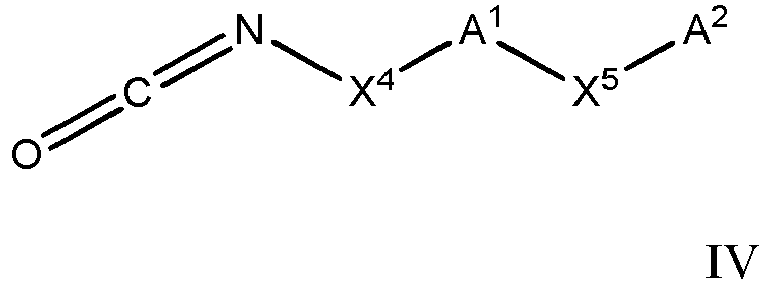
- the present invention further relates to a method including heating to reflux the compound of Formula V to form the compound of Formula IV wherein X 4 , A 1 , X 5 and A 2 are as defined above.
- the present invention further relates to a method including reacting, while heating to reflux, the compound of Formula V with imidazole to form the compounds of Formula II and Formula IV wherein X 4 , A 1 , X 5 and A 2 are as defined above.
- the present invention further relates to a method including reacting the compound of Formula VI with N, N'- carbonyldiimidazole to form the compound of Formula V wherein X 4 , A 1 , X 5 and A 2 are as defined above.
- the present invention further relates to a method including reacting the compound of Formula VII with N, N'- carbonyldiimidazole and hydroxylamine to form the compound of Formula VI wherein X 4 , A 1 , X 5 and A 2 are as defined above.
- the present invention relates to a method of preparing the compound of Formula VIII comprising reacting a compound of Formula IX with quinuclidinol.
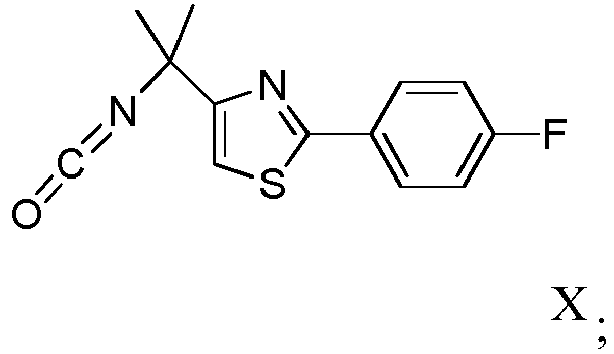
- the present invention relates to a method of preparing the compound of Formula VIII comprising reacting a compound of Formula X with quinuclidinol.
- the present invention relates to a method of preparing the compound of Formula VIII comprising reacting a compounds of Formula IX and Formula X with quinuclidinol.
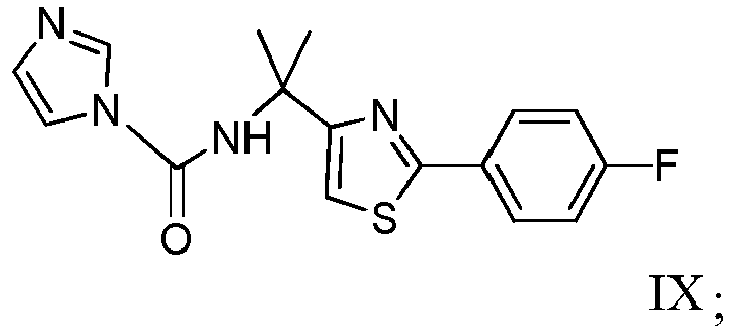
- the present invention further relates to a method including reacting the compound of Formula XI with imidazole to form the compound of Formula IX
- the present invention further relates to a method including heating to reflux the compound of Formula XI to form the compound of Formula X
- the present invention further relates to a method including reacting, while heating to reflux, the compound of Formula XI with imidazole to form the compounds of Formula IX and Formula X
- the present invention further relates to a method including reacting the compound of Formula XII with N, N'- carbonyldiimidazole to form the compound of Formula XI
- the present invention further relates to a method including reacting the compound of Formula XIII with N, N'- carbonyldiimidazole and hydroxylamine to form the compound of Formula XII
- the present invention further relates to a method including reacting the compound of Formula XIV with potassium tert-butoxide and methyl iodine followed by reacting the ethyl ester so formed with lithium hydroxide to form the compound of Formula XIII
- the present invention relates to a compound of Formula XII
- the present invention relates to a compound of Formula XI
- the present invention relates to a compound of Formula IX
- the carboxylic acid compound of Formula VII is converted to the corresponding hydroxamic acid compound of Formula VI by reacting VII with N, N'- carbonyldiimidazole (i.e. CDI) in a polar aprotic solvent, such as tetrahydrofuran (THF).
- a polar aprotic solvent such as tetrahydrofuran (THF).
- the solution is stirred at a temperature between about -5°C to about 25°C, preferable about 20°C, for a time period between about 5 minutes to about 30 minutes, preferably about 10 to 15 minutes.
- the resulting solution mixture is allowed to warm to room temperature and stirred for an additional time period between about 30 minutes to about 2 hours, preferably about 1 hour.
- Hydroxylamine is then added to the solution mixture at a temperature between about -5°C to about 10°C, preferable about 3°C.
- the resulting reaction mixture is stirred under inert atmosphere (i.e., nitrogen) for a time period between about 5 min to about 8 hours, preferably about 10 min.
- reaction 2 of Scheme 1 the hydroxamic acid compound of Formula VI is converted to the corresponding compound of Formula V by the addition of N, N'-carbonyldiimidazole to a solution of VI in toluene under inert atmosphere (i.e., nitrogen) and stirred for a time period between about 30 minutes to about 4 hours, preferably about 2.5 hours.
- inert atmosphere i.e., nitrogen
- reaction 3 of Scheme 1 the compound of Formula V is converted to the corresponding compounds of Formula II and Formula IV by reacting V with imidazole in the presence of a aprotic solvent, such as toluene.
- a aprotic solvent such as toluene.
- the reaction mixture is heated to reflux for a time period between about 4 hours to about 28 hours, preferable about 6 hours.
- reaction 4 of Scheme 1 a mixture of the compounds of Formula II and Formula IV (or each intermediate separately) is converted to the corresponding compound of Formula I by reacting II and IV with ( S )-(+)-quinuclidinol in the presence of a aprotic solvent, such as toluene.
- a aprotic solvent such as toluene.
- the reaction mixture is heated to reflux for a time period between about 12 hours to about 24 hours, preferable about 18 hours.
- Step 2 Hydrolysis of the ethyl ester with LiOH monohydrate
- reaction 1 (MW 280.32, 2.0 Kg) was transferred to a 100 L reactor. After stirring at room temperature for at least 15 min carbonyl diimidazole CDI (MW 162.15, 1.27 Kg, 1.1 equiv.) was added. The mixture was stirred at room temperature for 1-4 h until the reaction was judge complete by HPLC.
Landscapes
- Chemical & Material Sciences (AREA)
- Organic Chemistry (AREA)
- Health & Medical Sciences (AREA)
- General Health & Medical Sciences (AREA)
- Veterinary Medicine (AREA)
- Public Health (AREA)
- Medicinal Chemistry (AREA)
- Pharmacology & Pharmacy (AREA)
- Life Sciences & Earth Sciences (AREA)
- Animal Behavior & Ethology (AREA)
- Nuclear Medicine, Radiotherapy & Molecular Imaging (AREA)
- General Chemical & Material Sciences (AREA)
- Chemical Kinetics & Catalysis (AREA)
- Engineering & Computer Science (AREA)
- Bioinformatics & Cheminformatics (AREA)
- Obesity (AREA)
- Hematology (AREA)
- Diabetes (AREA)
- Pharmaceuticals Containing Other Organic And Inorganic Compounds (AREA)
- Plural Heterocyclic Compounds (AREA)
- Thiazole And Isothizaole Compounds (AREA)
- Nitrogen Condensed Heterocyclic Rings (AREA)
- Epidemiology (AREA)
- Heterocyclic Carbon Compounds Containing A Hetero Ring Having Nitrogen And Oxygen As The Only Ring Hetero Atoms (AREA)
Abstract
Description
- The invention relates to a method of preparing inhibitors of glucosylceramide synthase (GCS) useful for the treatment metabolic diseases, such as lysosomal storage diseases, either alone or in combination with enzyme replacement therapy, and for the treatment of cancer.
- Glucosylceramide synthase (GCS) is a pivotal enzyme which catalyzes the initial glycosylation step in the biosynthesis of glucosylceramide-base glycosphingolipids (GSLs) namely via the pivotal transfer of glucose from UDP-glucose (UDP-Glc) to ceramide to form glucosylceramide. GCS is a transmembrane, type III integral protein localized in the cis/medial Golgi. Glycosphingolipids (GSLs) are believed to be integral for the dynamics of many cell membrane events, including cellular interactions, signaling and trafficking. Synthesis of GSL structures has been shown (see, Yamashita et al., Proc. Natl. Acad. Sci. USA 1999, 96(16), 9142-9147) to be essential for embryonic development and for the differentiation of some tissues. Ceramide plays a central role in sphingolipid metabolism and downregulation of GCS activity has been shown to have marked effects on the sphingolipid pattern with diminished expression of glycosphingolipids. Sphingolipids (SLs) have a biomodulatory role in physiological as well as pathological cardiovascular conditions. In particular, sphingolipids and their regulating enzymes appear to play a role in adaptive responses to chronic hypoxia in the neonatal rat heart (see, El Alwanit et al., Prostaglandins & Other Lipid Mediators 2005, 78(1-4), 249-263).
- GCS inhibitors have been proposed for the treatment of a variety of diseases (see for example,
WO2005068426 ). Such treatments include treatment of glycolipid storage diseases (e.g., Tay Sachs, Sandhoffs, GM2 Activator deficiency, GM1 gangliosidosis and Fabry diseases), diseases associated with glycolipid accumulation (e.g., Gaucher disease; Miglustat (Zavesca), a GCS inhibitor, has been approved for therapy in type 1 Gaucher disease patients, see, Treiber et al., Xenobiotica 2007, 37(3), 298-314), diseases that cause renal hypertrophy or hyperplasia such as diabetic nephropathy; diseases that cause hyperglycemia or hyperinsulemia; cancers in which glycolipid synthesis is abnormal, infectious diseases caused by organisms which use cell surface glycolipids as receptors, infectious diseases in which synthesis of glucosylceramide is essential or important, diseases in which synthesis of glucosylceramide is essential or important, diseases in which excessive glycolipid synthesis occurs (e.g., atherosclerosis, polycystic kidney disease, and renal hypertrophy), neuronal disorders, neuronal injury, inflammatory diseases or disorders associated with macrophage recruitment and activation (e.g., rheumatoid arthritis, Crohn's disease, asthma and sepsis) and diabetes mellitus and obesity (see,WO 2006053043 ). - In particular, it has been shown that overexpression of GCS is implicated in multidrug resistance and disrupts ceramide-induced apoptosis. For example, Turzanski et al., (Experimental Hematology 2005, 33 (1), 62-72 have shown that ceramide induces apoptosis in acute myeloid leukemia (AML) cells and that P-glycoprotein (p-gp) confers resistance to ceramide-induced apoptosis, with modulation of the ceramide-glucosylceramide pathway making a marked contribution to this resistance in TF-1 cells. Thus, GCS inhibitors can be useful for treatment of proliferative disorders by inducing apoptosis in diseased cells.
- The present invention relates to a method of preparing a compound of the formula,

- n is 1, 2 or 3;
- m is 1;
- t is 0, 1 or 2;
- y is 1 or 2;
- z is 0, 1 or 2;
- E is O;
- X1is CR1;
- X2 is O ;
- X3 is -NH;
- X4 is CR4R5, CH2 CR4R5 or CH2-(C1-C6)alkyl-CR4R5;
- X5 is a direct bond, O, S, SO2, CR4R5; (C1-C6)alkyl, (C1-C6)alkyloxy, (C1-C6)alkenyl, (C1-C6)alkenyloxy;
- R is (C6-C12)aryl, (C2-C9)heteroaryl, (C1-C6)alkyl, (C2-C9)heteroaryl(C1-C6)alkyl;
- R1 is H, CN, (C1-C6)alkylcarbonyl, or (C1-C6)alkyl;
- R2 and R3 are each independently -H, (C1-C6)alkyl optionally substituted by one or more substituents selected from the group consisting of halogen, (C1-C6)alkyl, (C6-C12)aryl, (C2-C9)heteroaryl, (C1-C6)alkyl(C6-C12)aryl, halo(C6-C12)aryl, and halo(C2-C9)heteroaryl, or optionally when X2 is -NR2 and X3 is -NR3, R2 and R3 may be taken together with the nitrogen atoms to which they are attached form a non-aromatic heterocyclic ring optionally substituted by with one or more substituents selected from halogen, (C1-C6)alkyl, (C6-C12)aryl, (C2-C9)heteroaryl, (C1-C6)alkyl(C6-C12)aryl, halo(C6-C12)aryl, and halo(C2-C9)heteroaryl;
- R4 and R5 are independently selected from H, (C1-C6)alkyl, or taken together with the carbon to which they are attached to form a spiro (C3-C10)cycloalkyl ring or spiro (C3-C10)cycloalkoxy ring;
- R6 is -H, halogen, -CN, (C6-C12)aryl, (C6-C12)aryloxy, (C1-C6)alkyloxy; (C1-C6)alkyl optionally substituted by one to four halo or (C1-C6)alkyl;
- A1 is (C2-C6)alkynyl; (C3-C10)cycloalkyl, (C6-C12)aryl, (C2-C9)heteroaryl, (C2-C9)heterocycloalkyl or benzo(C2-C9)heterocycloalkyl optionally substituted with one or more substituents selected from the group consisting of halo, (C1-C6)alkyl optionally substituted by one to three halo; (C1-C6)alkenyl, amino, (C1-C6)alkylamino, (C1-C6)dialkylamino, (C1-C6)alkoxy, nitro, CN, -OH, (C1-C6)alkyloxy optionally substituted by one to three halo; (C1-C6)alkoxycarbonyl, and (C1-C6) alkylcarbonyl;
- A2 is H, (C3-C10)cycloalkyl, (C6-C12)aryl, (C2-C9)heteroaryl, (C2-C9)heterocycloalkyl or benzo(C2-C9)heterocycloalkyl optionally substituted with one or more substituents selected from the group consisting of halo, (C1-C6)alkyl optionally substituted by one to three halo; (C1-C6)alkylenyl, amino, (C1-C6) alkylamino, (C1-C6)dialkylamino, (C1-C6)alkoxy, O(C3-C6 cycloalkyl), (C3-C6) cycloalkoxy, nitro, CN, OH, (C1-C6)alkyloxy optionally substituted by one to three halo; (C3-C6) cycloalkyl, (C1-C6) alkoxycarbonyl, (C1-C6) alkylcarbonyl, (C1-C6) haloalkyl;
- with the proviso that the sum of n + t + y + z is not greater than 6; comprising reacting the compound of Formula II


- The present invention relates to a method of preparing a compound of the formula,

- n is 1, 2 or 3;
- m is 1;
- t is 0, 1 or 2;
- y is 1 or 2;
- z is 0, 1 or 2;
- E is O;
- X1is CR1;
- X2 is O ;
- X3 is -NH;
- X4 is CR4R5, CH2 CR4R5 or CH2-(C1-C6)alkyl-CR4R5;
- X5 is a direct bond, O, S, SO2, CR4R5; (C1-C6)alkyl, (C1-C6)alkyloxy, (C1-C6)alkenyl, (C1-C6)alkenyloxy;
- R is (C6-C12)aryl, (C2-C9)heteroaryl, (C1-C6)alkyl, (C2-C9)heteroaryl(C1-C6)alkyl;
- R1 is H, CN, (C1-C6)alkylcarbonyl, or (C1-C6)alkyl;
- R2 and R3 are each independently -H, (C1-C6)alkyl optionally substituted by one or more substituents selected from the group consisting of halogen, (C1-C6)alkyl, (C6-C12)aryl, (C2-C9)heteroaryl, (C1-C6)alkyl(C6-C12)aryl, halo(C6-C12)aryl, and halo(C2-C9)heteroaryl, or optionally when X2 is -NR2 and X3 is -NR3, R2 and R3 may be taken together with the nitrogen atoms to which they are attached form a non-aromatic heterocyclic ring optionally substituted by with one or more substituents selected from halogen, (C1-C6)alkyl, (C6-C12)aryl, (C2-C9)heteroaryl, (C1-C6)alkyl(C6-C12)aryl, halo(C6-C12)aryl, and halo(C2-C9)heteroaryl;
- R4 and R5 are independently selected from H, (C1-C6)alkyl, or taken together with the carbon to which they are attached to form a spiro (C3-C10)cycloalkyl ring or spiro (C3-C10)cycloalkoxy ring;
- R6 is -H, halogen, -CN, (C6-C12)aryl, (C6-C12)aryloxy, (C1-C6)alkyloxy; (C1-C6)alkyl optionally substituted by one to four halo or (C1-C6)alkyl;
- A1 is (C2-C6)alkynyl; (C3-C10)cycloalkyl, (C6-C12)aryl, (C2-C9)heteroaryl, (C2-C9)heterocycloalkyl or benzo(C2-C9)heterocycloalkyl optionally substituted with one or more substituents selected from the group consisting of halo, (C1-C6)alkyl optionally substituted by one to three halo; (C1-C6)alkenyl, amino, (C1-C6)alkylamino, (C1-C6)dialkylamino, (C1-C6)alkoxy, nitro, CN, -OH, (C1-C6)alkyloxy optionally substituted by one to three halo; (C1-C6)alkoxycarbonyl, and (C1-C6) alkylcarbonyl;
- A2 is H, (C3-C10)cycloalkyl, (C6-C12)aryl, (C2-C9)heteroaryl, (C2-C9)heterocycloalkyl or benzo(C2-C9)heterocycloalkyl optionally substituted with one or more substituents selected from the group consisting of halo, (C1-C6)alkyl optionally substituted by one to three halo; (C1-C6)alkylenyl, amino, (C1-C6) alkylamino, (C1-C6)dialkylamino, (C1-C6)alkoxy, O(C3-C6 cycloalkyl), (C3-C6) cycloalkoxy, nitro, CN, OH, (C1-C6)alkyloxy optionally substituted by one to three halo; (C3-C6) cycloalkyl, (C1-C6) alkoxycarbonyl, (C1-C6) alkylcarbonyl, (C1-C6) haloalkyl;
- with the proviso that the sum of n + t + y + z is not greater than 6; comprising reacting the compound of Formula IV


- The present invention relates to a method of preparing a compound of the formula,

- n is 1, 2 or 3;
- m is 1;
- t is 0, 1 or 2;
- y is 1 or 2;
- z is 0, 1 or 2;
- E is O;
- X1is CR1;
- X2 is O ;
- X3 is -NH;
- X4 is CR4R5, CH2 CR4R5 or CH2-(C1-C6)alkyl-CR4R5;
- X5 is a direct bond, O, S, SO2, CR4R5; (C1-C6)alkyl, (C1-C6)alkyloxy, (C1-C6)alkenyl, (C1-C6)alkenyloxy;
- R is (C6-C12)aryl, (C2-C9)heteroaryl, (C1-C6)alkyl, (C2-C9)heteroaryl(C1-C6)alkyl;
- R1 is H, CN, (C1-C6)alkylcarbonyl, or (C1-C6)alkyl;
- R2 and R3 are each independently -H, (C1-C6)alkyl optionally substituted by one or more substituents selected from the group consisting of halogen, (C1-C6)alkyl, (C6-C12)aryl, (C2-C9)heteroaryl, (C1-C6)alkyl(C6-C12)aryl, halo(C6-C12)aryl, and halo(C2-C9)heteroaryl, or optionally when X2 is -NR2 and X3 is -NR3, R2 and R3 may be taken together with the nitrogen atoms to which they are attached form a non-aromatic heterocyclic ring optionally substituted by with one or more substituents selected from halogen, (C1-C6)alkyl, (C6-C12)aryl, (C2-C9)heteroaryl, (C1-C6)alkyl(C6-C12)aryl, halo(C6-C12)aryl, and halo(C2-C9)heteroaryl;
- R4 and R5 are independently selected from H, (C1-C6)alkyl, or taken together with the carbon to which they are attached to form a spiro (C3-C10)cycloalkyl ring or spiro (C3-C10)cycloalkoxy ring;
- R6 is -H, halogen, -CN, (C6-C12)aryl, (C6-C12)aryloxy, (C1-C6)alkyloxy; (C1-C6)alkyl optionally substituted by one to four halo or (C1-C6)alkyl;
- A1 is (C2-C6)alkynyl; (C3-C10)cycloalkyl, (C6-C12)aryl, (C2-C9)heteroaryl, (C2-C9)heterocycloalkyl or benzo(C2-C9)heterocycloalkyl optionally substituted with one or more substituents selected from the group consisting of halo, (C1-C6)alkyl optionally substituted by one to three halo; (C1-C6)alkenyl, amino, (C1-C6)alkylamino, (C1-C6)dialkylamino, (C1-C6)alkoxy, nitro, CN, -OH, (C1-C6)alkyloxy optionally substituted by one to three halo; (C1-C6)alkoxycarbonyl, and (C1-C6) alkylcarbonyl;
- A2 is H, (C3-C10)cycloalkyl, (C6-C12)aryl, (C2-C9)heteroaryl, (C2-C9)heterocycloalkyl or benzo(C2-C9)heterocycloalkyl optionally substituted with one or more substituents selected from the group consisting of halo, (C1-C6)alkyl optionally substituted by one to three halo; (C1-C6)alkylenyl, amino, (C1-C6) alkylamino, (C1-C6)dialkylamino, (C1-C6)alkoxy, O(C3-C6 cycloalkyl), (C3-C6) cycloalkoxy, nitro, CN, OH, (C1-C6)alkyloxy optionally substituted by one to three halo; (C3-C6) cycloalkyl, (C1-C6) alkoxycarbonyl, (C1-C6) alkylcarbonyl, (C1-C6) haloalkyl;
- with the proviso that the sum of n + t + y + z is not greater than 6; comprising reacting the compounds of Formula II and Formula IV


- The present invention further relates to a method wherein n is 1; t is 0; y is 1 and z is 1.
- The present invention further relates to a method wherein X4 is CR4R5.
- The present invention further relates to a method wherein R4 and R5 are each methyl.
- The present invention further relates to a method wherein A1 is (C2-C9)heteroaryl.
- The present invention further relates to a method wherein A1 is thiophene, thiazole, isothiazole, furane, oxazole, isoxazole, pyrrole, imidazole, pyrazole, triazole, pyridine, pymiridine, pyridazine, indole, benzotiazole, benzoisoxazole, benzopyrazole, benzoimidazole, benzofuran, benzooxazole or benzoisoxazole.
- The present invention further relates to a method wherein A1 is thiazole.
- The present invention further relates to a method wherein R6 is H.
- The present invention further relates to a method wherein X5 is a direct bond.
- The present invention further relates to a method wherein A2 is (C6-C12)aryl.
- The present invention further relates to a method wherein A2 is phenyl.
- The present invention further relates to a method wherein the phenyl group is substituted by halo.
- The present invention further relates to a method wherein the halo group is fluoro.
- The present invention further relates to a method wherein R1 is hydrogen.
- The present invention further relates to a method including reacting the compound of Formula V


- The present invention further relates to a method including heating to reflux the compound of Formula V


- The present invention further relates to a method including reacting, while heating to reflux, the compound of Formula V


- The present invention further relates to a method including reacting the compound of Formula VI


- The present invention further relates to a method including reacting the compound of Formula VII


- The present invention relates to a method of preparing the compound of Formula VIII


- The present invention relates to a method of preparing the compound of Formula VIII

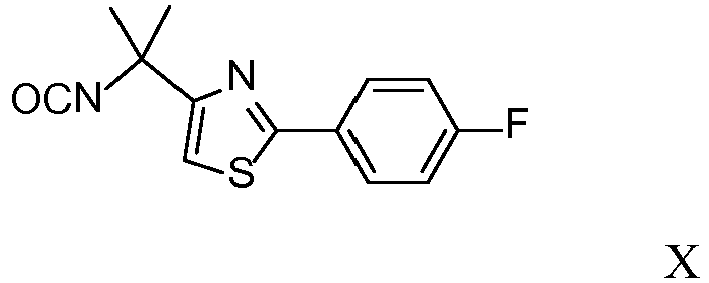
- The present invention relates to a method of preparing the compound of Formula VIII


- The present invention further relates to a method including reacting the compound of Formula XI


- The present invention further relates to a method including heating to reflux the compound of Formula XI


- The present invention further relates to a method including reacting, while heating to reflux, the compound of Formula XI

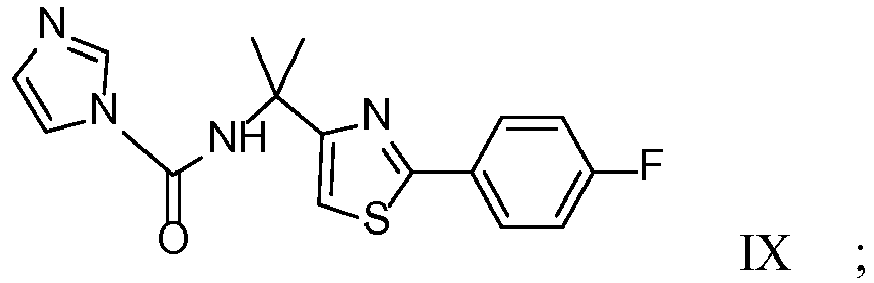

- The present invention further relates to a method including reacting the compound of Formula XII

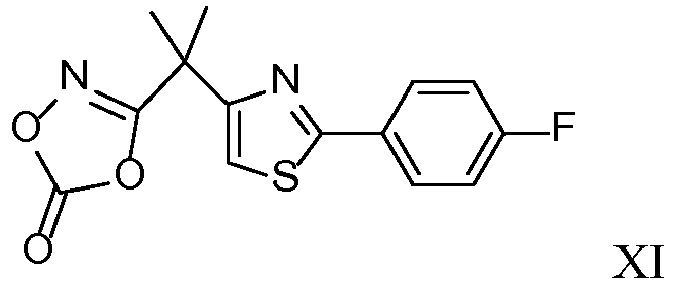
- The present invention further relates to a method including reacting the compound of Formula XIII


- The present invention further relates to a method including reacting the compound of Formula XIV


- The present invention relates to a compound of Formula XII

- The present invention relates to a compound of Formula XI

- The present invention relates to a compound of Formula IX

-


- In reaction 1 of Scheme 1, the carboxylic acid compound of Formula VII is converted to the corresponding hydroxamic acid compound of Formula VI by reacting VII with N, N'- carbonyldiimidazole (i.e. CDI) in a polar aprotic solvent, such as tetrahydrofuran (THF). The solution is stirred at a temperature between about -5°C to about 25°C, preferable about 20°C, for a time period between about 5 minutes to about 30 minutes, preferably about 10 to 15 minutes. The resulting solution mixture is allowed to warm to room temperature and stirred for an additional time period between about 30 minutes to about 2 hours, preferably about 1 hour. Hydroxylamine is then added to the solution mixture at a temperature between about -5°C to about 10°C, preferable about 3°C. The resulting reaction mixture is stirred under inert atmosphere (i.e., nitrogen) for a time period between about 5 min to about 8 hours, preferably about 10 min.
- In reaction 2 of Scheme 1, the hydroxamic acid compound of Formula VI is converted to the corresponding compound of Formula V by the addition of N, N'-carbonyldiimidazole to a solution of VI in toluene under inert atmosphere (i.e., nitrogen) and stirred for a time period between about 30 minutes to about 4 hours, preferably about 2.5 hours.
- In reaction 3 of Scheme 1, the compound of Formula V is converted to the corresponding compounds of Formula II and Formula IV by reacting V with imidazole in the presence of a aprotic solvent, such as toluene. The reaction mixture is heated to reflux for a time period between about 4 hours to about 28 hours, preferable about 6 hours.
- In reaction 4 of Scheme 1, a mixture of the compounds of Formula II and Formula IV (or each intermediate separately) is converted to the corresponding compound of Formula I by reacting II and IV with (S)-(+)-quinuclidinol in the presence of a aprotic solvent, such as toluene. The reaction mixture is heated to reflux for a time period between about 12 hours to about 24 hours, preferable about 18 hours.
- To 4-Fluorophenylthioamide (50.35g, 1 eq.) was added 8.6 weight volumes of 200 proof ethanol (based on thioamide) (430mL) and ethyl 4-chloroacetoacetate (68.2g, 1.1 eq.). The mixture was place under a nitrogen atmosphere. It was heated under reflux for 5h and allowed to cool to room temperature. The solution was concentrated to an oil and TBME (10 volumes, 500mL) and 6 volumes of saturated NaHCO3 (300mL) added. The aqueous layer was back extracted with 5 volumes (250mL) of TBME. The combined organic layer was washed with water and then concentrated to an oil and then dried to a solid. The product was crystallized from 3 weight volumes of hot hexanes.Yield 89 % Product 98.7% pure by HPLC (area %).
-

- Procedure: In a 100 L reactor was added tetrahydrofuran (THF, 28.4 Kg) and potassium tert-butoxide (MW 112.21, 2.28 Kg g, 4.0 equiv.,). This mixture was cooled to 0-2°C (internal temperature). The starting ester (MW 265.3, 2.0 Kg, 1.0 equiv.) was dissolved in THF (4 L) and transferred to the reactor over a period of 10-60 min, keeping the internal temperature below 10°C during the addition. The reaction mixture was stirred at 3-9 °C for 15- 60 min. A solution of methyl iodide (MW 141.94, 1.88 L, 4.0 equiv.) in THF (4.8 L) was added to the reactor over 30-120 min keeping the internal temperature below 10°C. A solution of NaCl (2.0 Kg) in water (14L) was added over 10 min and the mixture was stirred for at least 10 min more. The reaction was made acidic by the addition of 1 M HCl(∼ 1.44L). The layers were separated and the aqueous layer was back extracted with THF (6.2 kg). The combined organic layers were vacuum distilled to ∼ 16 1. This THF solution of the Step1 product was used in the next reaction.
-

- Procedure: To the ester in THF was added a solution of LiOH.H2O (MW 41.96, 0.695 Kg, 2.2 equiv.) in water (9.3 L) was added. The mixture was heated at reflux for 8-16 hours. After the reactions was judge complete by HPLC, water (12 L) was added and the mixture was vacuum distilled to ∼ 16L. TBME (5.9 kg) was added and after stirring the layers were separated. The aqueous layer containing the product was washed a second time with TBME (5.9 Kg). TBME was added to the aqueous layer and the mixture was made acidic (pH ≤ 3) by the addition of 5 M HCl (∼ 3.67 Kg). The layers were separated and the aqueous layer was extracted a second time with TBME (4.5 Kg). Heptane (15 Kg) was added to the combined organic layers and the mixture was vacuum distilled to ∼ 16L. After heating and cooling to 5-25 °C and stirring for at least 3 h, the product was filtered, washed with heptane, and vacuum dried. Yield 85.8 % (2.15 Kg) HPLC purity (area %) 99.72%
-

- Procedure: To a 100 L reactor was added THF (14.2 Kg) and N, N'-carbonyldiimidazole (CDI; MW 162.15, 1.34 Kg, 1.1 equiv.). The acid from reaction 2 ( 2.0 Kg, 1.0 equiv) dissolved in THF (4L) was added over 15- 20 min. The mixture was stirred at room temperature for 2.5-3 h. The reaction was cooled to 0-3 °C. Aqueous hydroxylamine (50% aqueous; 1.7 L, 4.0 equiv.) was added over 5-15 min keeping the internal temperature less than 18 °C. After the addition was complete, the layers were separated and the organic layer was washed with water (12 Kg) and a solution of sodium chloride (2.0 Kg) in water (12L). The separated organic layer was vacuum distill to ∼ 16 l. Toluene(13.8 Kg) was added and the mixture was again vacuum distilled to ∼ 16L. Heptane (11 kg) was added and the mixture was stirred at room temperature for at least 16 h. The resulting solid was filtered , washed with heptane (11 Kg) and vacuum dried at room temperature. The yield was 1.58 Kg (74.8%).
-

- Procedure: Toluene (17.3 Kg) and the hydroxamic acid from, reaction 1 (MW 280.32, 2.0 Kg) was transferred to a 100 L reactor. After stirring at room temperature for at least 15 min carbonyl diimidazole CDI (MW 162.15, 1.27 Kg, 1.1 equiv.) was added. The mixture was stirred at room temperature for 1-4 h until the reaction was judge complete by HPLC.
-

- Procedure : The solution of the dioxazolone (reaction 2) was heated at 60 °C for 6-16 hours to complete the conversion to a mixture of the isocyanate and imidazole urea as judge by HPLC analysis.
-

- Procedure: (S)-(+)-3- quinuclidinol (1.14 Kg , 1.18 equiv.) was added to the mixture of the isocyanate and imidazole urea toluene solution (reaction 3) and the solution was heated at 100-110 °C for 18-28 h. Toluene (8.6 Kg) was added to the reaction and the mixture was washed twice with water (20 Kg). The product was removed from the organic layer with two extractions of aqueous 1M HCl.(19.7 Kg). Isopropyl acetate (34.8 Kg) was added to the combined acidic aqueous layers. The mixture was cooled to 5-10 °C and 10M aqueous NaOH (5.3 Kg) was added. The layers were separated and the organic layer was vacuum distilled to ∼ 16 L. Heptane (21.4 Kg) was added to the remaining isopropyl acetate solution and again the solution was distilled to ∼ 16 L. the resulting suspension was stirred for at least 4 h. The product was filtered, washed with heptane (13.7 Kg) and vacuum dried at room temperature. The yield was 2.3 Kg (82.8 % yield). HPLC purity (Area %) 99.7 % .
1H NMR (400 MHz, CDCl3) δ 8.04 - 7.83 (m, 2H), 7.20 - 6.99 (m, 3H), 5.53 (s, 1H), 4.73 - 4.55 (m, 1H), 3.18 (dd, J = 14.5, 8.4 Hz, 1H), 3.05 - 2.19 (m, 5H), 2.0 - 1.76 (m, 11H). 13C NMR (100 MHz, CDCl3) δ 166.38, 165.02, 162.54, 162.8-155.0 (d, C-F), 130.06, 128.43, 128.34, 116.01, 115.79, 112.46, 71.18, 55.70, 54.13, 47.42, 46.52, 27.94, 25.41, 24.67, 19.58. -

- 2-(2-(4-fluorophenyl)thiazol-4-yl)-2-methylpropanoic acid (1g) and diisopropylethyl amine (0.57 ml) were dissolved in toluene and stirred at 110 °C under N2. DPPA (0.9 ml) was added dropwise. The mixture was stirred for 3 hours at 110 °C to complete the conversion of the acetyl azide and isocyanate. Quinuclidin-3-ol (0.72 g) was added and stirred for 18 hours. The result mixture was diluted with toluene (50 ml) and washed with saturated sodium bicarbonate solution. The organic layer was concentrated to oil. Product of quinuclidin-3-yl (2-(2-(4-fluorophenyl)thiazol-4-yl)propan-2-yl)carbamate was purified by crystallization from EtOAc (0.6 g).Claims
Claims (14)
- A method of preparing a compound of the formula,
 n is 1, 2 or 3;m is 1;t is 0, 1 or 2;y is 1 or 2;z is 0, 1 or 2;E is O;X1 is CR1;X2 is O;X3 is -NH;X4 is CR4R5, CH2 CR4R5 or CH2 -(C1-C6)alkyl-CR4R5;X5 is a direct bond, O, S, SO2, CR4R5, (C1-C6)alkyl, (C1-C6)alkyloxy, (C1-C6)alkenyl, (C1-C6)alkenyloxy;R1 is H, CN, (C1-C6)alkylcarbonyl, or (C1-C6)alkyl;R4 and R5 are independently selected from H, (C1-C6)alkyl, or taken together with the carbon to which they are attached to form a spiro (C3-C10)cycloalkyl ring or spiro (C3-C10)cycloalkoxy ring;R6 is -H, halogen, -CN, (C6-C12)aryl, (C6-C12)aryloxy, (C1-C6)alkyloxy; (C1-C6)alkyl optionally substituted by one to four halo or (C1-C6)alkyl;A1 is (C2-C6)alkynyl; (C3-C10)cycloalkyl, (C6-C12)aryl, (C2-C9)heteroaryl, (C2-C9)heterocycloalkyl or benzo(C2-C9)heterocycloalkyl optionally substituted with one or more substituents selected from the group consisting of halo, (C1-C6)alkyl optionally substituted by one to three halo; (C1-C6)alkenyl, amino, (C1-C6)alkylamino, (C1-C6)dialkylamino, (C1-C6)alkoxy, nitro, CN, -OH, (C1-C6)alkyloxy optionally substituted by one to three halo; (C1-C6)alkoxycarbonyl, and (C1-C6) alkylcarbonyl;A2 is H, (C3-C10)cycloalkyl, (C6-C12)aryl, (C2-C9)heteroaryl, (C2-C9)heterocycloalkyl or benzo(C2-C9)heterocycloalkyl optionally substituted with one or more substituents selected from the group consisting of halo, (C1-C6)alkyl optionally substituted by one to three halo; (C1-C6)alkylenyl, amino, (C1-C6) alkylamino, (C1-C6)dialkylamino, (C1-C6)alkoxy, O(C3-C6 cycloalkyl), (C3-C6) cycloalkoxy, nitro, CN, OH, (C1-C6)alkyloxy optionally substituted by one to three halo; (C3-C6) cycloalkyl, (C1-C6) alkoxycarbonyl, (C1-C6) alkylcarbonyl, (C1-C6) haloalkyl;with the proviso that the sum of n + t + y + z is not greater than 6;
comprising reacting the compound of Formula II and/or the compound of Formula IV


- A method according to claim 1, wherein n is 1; t is 0; y is 1 and z is 1.
- A method according to claim 1 or claim 2, wherein X4 is CR4R5, optionally wherein R4 and R5 are each methyl.
- A method according to any one of claims 1 to 3, wherein A1 is (C2-C9)heteroaryl, optionally wherein A1 is thiophene, thiazole, isothiazole, furane, oxazole, isoxazole, pyrrole, imidazole, pyrazole, triazole, pyridine, pymiridine, pyridazine, indole, benzotiazole, benzoisoxazole, benzopyrazole, benzoimidazole, benzofuran, benzooxazole or benzoisoxazole, especially wherein A1 is thiazole.
- A method according to any one of claims 1 to 4, wherein R6 is H.
- A method according to any one of claims 1 to 5, wherein X5 is a direct bond.
- A method according to any one of claims 1 to 6, wherein A2 is (C6-C12)aryl, optionally wherein A2 is phenyl, especially wherein the phenyl group is substituted by halo, e.g. wherein the halo group is fluoro.
- A method according to any one of claims 1 to 7, wherein R1 is hydrogen.
- A method according to any one of claims 1 to 8, further including:i) reacting the compound of Formula V

 ii) heating to reflux the compound of Formula V
 iii) reacting, while heating to reflux, the compound of Formula V
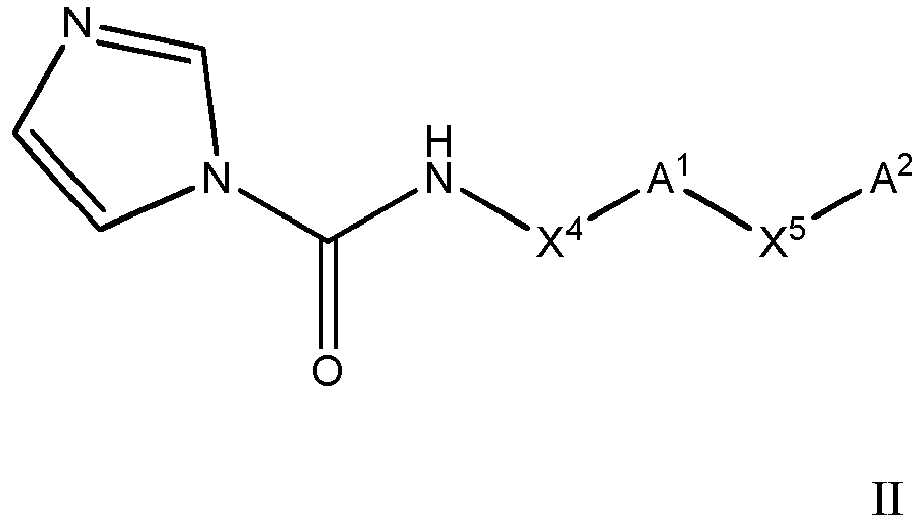
- A method according to claim 9, further including reacting the compound of Formula VI


- A method of preparing the compound of Formula VIII


- A method according to claim 11, further including:i) reacting the compound of Formula XI

 ii) heating to reflux the compound of Formula XI
 iii) reacting, while heating to reflux, the compound of Formula XI

- A method according to claim 12, further including reacting the compound of Formula XII


- A compound of Formula XII


Applications Claiming Priority (3)
| Application Number | Priority Date | Filing Date | Title |
|---|---|---|---|
| US201361791913P | 2013-03-15 | 2013-03-15 | |
| EP14718835.3A EP2970251B1 (en) | 2013-03-15 | 2014-03-13 | Method of preparing glucosylceramide synthase inhibitors |
| PCT/US2014/025384 WO2014151291A1 (en) | 2013-03-15 | 2014-03-13 | Method of preparing glucosylceramide synthase inhibitors |
Related Parent Applications (2)
| Application Number | Title | Priority Date | Filing Date |
|---|---|---|---|
| EP14718835.3A Division-Into EP2970251B1 (en) | 2013-03-15 | 2014-03-13 | Method of preparing glucosylceramide synthase inhibitors |
| EP14718835.3A Division EP2970251B1 (en) | 2013-03-15 | 2014-03-13 | Method of preparing glucosylceramide synthase inhibitors |
Publications (2)
| Publication Number | Publication Date |
|---|---|
| EP3514157A1 true EP3514157A1 (en) | 2019-07-24 |
| EP3514157B1 EP3514157B1 (en) | 2023-09-06 |
Family
ID=50543333
Family Applications (2)
| Application Number | Title | Priority Date | Filing Date |
|---|---|---|---|
| EP19153389.2A Active EP3514157B1 (en) | 2013-03-15 | 2014-03-13 | Method of preparing glucosylceramide synthase inhibitors |
| EP14718835.3A Active EP2970251B1 (en) | 2013-03-15 | 2014-03-13 | Method of preparing glucosylceramide synthase inhibitors |
Family Applications After (1)
| Application Number | Title | Priority Date | Filing Date |
|---|---|---|---|
| EP14718835.3A Active EP2970251B1 (en) | 2013-03-15 | 2014-03-13 | Method of preparing glucosylceramide synthase inhibitors |
Country Status (20)
| Country | Link |
|---|---|
| US (4) | US9682975B2 (en) |
| EP (2) | EP3514157B1 (en) |
| JP (2) | JP6543242B2 (en) |
| KR (1) | KR20150130386A (en) |
| CN (2) | CN105189491B (en) |
| AR (1) | AR095436A1 (en) |
| AU (2) | AU2014235132B2 (en) |
| BR (1) | BR112015020667A2 (en) |
| CA (2) | CA2906581C (en) |
| CY (1) | CY1121859T1 (en) |
| DK (1) | DK3514157T3 (en) |
| ES (2) | ES2968073T3 (en) |
| HU (2) | HUE064200T2 (en) |
| IL (2) | IL240617B (en) |
| MX (2) | MX389168B (en) |
| RU (1) | RU2015144035A (en) |
| SG (2) | SG10201706575UA (en) |
| TW (2) | TW201900625A (en) |
| UY (1) | UY35438A (en) |
| WO (1) | WO2014151291A1 (en) |
Families Citing this family (9)
| Publication number | Priority date | Publication date | Assignee | Title |
|---|---|---|---|---|
| MA37975B2 (en) | 2012-09-11 | 2021-03-31 | Genzyme Corp | Glucosylceramide synthase inhibitors |
| TW201900625A (en) | 2013-03-15 | 2019-01-01 | 美商健臻公司 | Method for preparing glucosylceramide synthesis enzyme inhibitor |
| ES2863322T3 (en) * | 2017-02-17 | 2021-10-11 | Univ Muenster Westfaelische Wilhelms | Electrolyte Additive for Lithium Ion Batteries |
| US20200339587A1 (en) | 2017-12-21 | 2020-10-29 | Lysosomal Therapeutics Inc. | Crystalline substituted cyclohexyl pyrazolo[1,5-a]pyrimidinyl carboxamide compound and therapeutic uses thereof |
| US10519157B2 (en) * | 2018-02-09 | 2019-12-31 | X-Cutag Therapeutics, Inc. | Deuterated compounds for treating Fabry, Gaucher, Parkinson's and related diseases and conditions, and compositions and methods thereof |
| US12527776B2 (en) | 2019-02-04 | 2026-01-20 | Genzyme Corporation | Treatment of ciliopathies using inhibitors of glucosylceramide synthase (GCS) |
| EP4100009A1 (en) | 2020-02-03 | 2022-12-14 | Genzyme Corporation | Methods for treating neurological symptoms associated with lysosomal storage diseases |
| EP4142878B1 (en) | 2020-04-28 | 2024-06-26 | The Regents of The University of Michigan | Pyridine inhibitors of glucosylceramide synthase and therapeutic methods using the same |
| KR20230043024A (en) | 2020-07-24 | 2023-03-30 | 젠자임 코포레이션 | Pharmaceutical composition comprising benglustat |
Citations (11)
| Publication number | Priority date | Publication date | Assignee | Title |
|---|---|---|---|---|
| GB725228A (en) * | 1952-06-19 | 1955-03-02 | Roche Products Ltd | Substituted carbamic acid esters and process for the manufacture thereof |
| DE1768808A1 (en) * | 1965-10-22 | 1972-01-13 | Sinclair Research Inc | Process for the preparation of aliphatic isocyanates |
| DE4326510A1 (en) * | 1993-08-06 | 1995-02-09 | Bayer Ag | Process for the preparation of cyclohexene derivatives |
| EP0747355A1 (en) * | 1994-02-10 | 1996-12-11 | Yamanouchi Pharmaceutical Co. Ltd. | Novel carbamate derivative and medicinal composition containing the same |
| WO1997030998A1 (en) * | 1996-02-23 | 1997-08-28 | Astra Aktiebolag | Azabicyclic esters of carbamic acids useful in therapy |
| WO2005068426A1 (en) | 2004-01-14 | 2005-07-28 | Actelion Pharmaceuticals Ltd | Piperidine derivatives as gcs inhibitors |
| WO2006053043A2 (en) | 2004-11-10 | 2006-05-18 | Genzyme Corporation | Methods of treating diabetes mellitus |
| WO2012063933A1 (en) * | 2010-11-12 | 2012-05-18 | 塩野義製薬株式会社 | Crystalline 6,7-unsaturated-7-carbamoyl morphinane derivative, and method for producing same |
| WO2012129084A2 (en) * | 2011-03-18 | 2012-09-27 | Genzyme Corporation | Glucosylceramide synthase inhibitors |
| WO2012175119A1 (en) * | 2011-06-22 | 2012-12-27 | Isochem | Process for the preparation of solifenacin and salts thereof |
| WO2014043068A1 (en) * | 2012-09-11 | 2014-03-20 | Genzyme Corporation | Glucosylceramide synthase inhibitors |
Family Cites Families (6)
| Publication number | Priority date | Publication date | Assignee | Title |
|---|---|---|---|---|
| GB725226A (en) * | 1952-06-03 | 1955-03-02 | Berger Brothers Co | Improvements in or relating to an inflatable surgical pad |
| NL130759C (en) * | 1965-10-07 | |||
| JPH08198751A (en) * | 1995-01-19 | 1996-08-06 | Yamanouchi Pharmaceut Co Ltd | Carbamate derivative |
| JP5285643B2 (en) * | 2010-03-15 | 2013-09-11 | シャープ株式会社 | Semiconductor integrated circuit and electronic information equipment |
| JP2013053228A (en) * | 2011-09-02 | 2013-03-21 | Asahi Kasei E-Materials Corp | Curing agent for epoxy resin, and microcapsule-type curing agent for epoxy resin |
| TW201900625A (en) * | 2013-03-15 | 2019-01-01 | 美商健臻公司 | Method for preparing glucosylceramide synthesis enzyme inhibitor |
-
2014
- 2014-03-13 TW TW107132577A patent/TW201900625A/en unknown
- 2014-03-13 CA CA2906581A patent/CA2906581C/en active Active
- 2014-03-13 MX MX2019000914A patent/MX389168B/en unknown
- 2014-03-13 ES ES19153389T patent/ES2968073T3/en active Active
- 2014-03-13 AU AU2014235132A patent/AU2014235132B2/en not_active Ceased
- 2014-03-13 HU HUE19153389A patent/HUE064200T2/en unknown
- 2014-03-13 RU RU2015144035A patent/RU2015144035A/en not_active Application Discontinuation
- 2014-03-13 KR KR1020157027836A patent/KR20150130386A/en not_active Ceased
- 2014-03-13 CN CN201480026302.4A patent/CN105189491B/en active Active
- 2014-03-13 DK DK19153389.2T patent/DK3514157T3/en active
- 2014-03-13 EP EP19153389.2A patent/EP3514157B1/en active Active
- 2014-03-13 US US14/776,443 patent/US9682975B2/en active Active
- 2014-03-13 BR BR112015020667A patent/BR112015020667A2/en not_active Application Discontinuation
- 2014-03-13 SG SG10201706575UA patent/SG10201706575UA/en unknown
- 2014-03-13 TW TW103108899A patent/TWI649317B/en not_active IP Right Cessation
- 2014-03-13 AR ARP140100982A patent/AR095436A1/en unknown
- 2014-03-13 WO PCT/US2014/025384 patent/WO2014151291A1/en not_active Ceased
- 2014-03-13 SG SG11201506415XA patent/SG11201506415XA/en unknown
- 2014-03-13 HU HUE14718835A patent/HUE043394T2/en unknown
- 2014-03-13 ES ES14718835T patent/ES2727869T3/en active Active
- 2014-03-13 JP JP2016501840A patent/JP6543242B2/en active Active
- 2014-03-13 CN CN201810630738.4A patent/CN108658970A/en active Pending
- 2014-03-13 EP EP14718835.3A patent/EP2970251B1/en active Active
- 2014-03-13 CA CA3092901A patent/CA3092901C/en active Active
- 2014-03-13 MX MX2015012842A patent/MX365464B/en active IP Right Grant
- 2014-03-14 UY UY0001035438A patent/UY35438A/en not_active Application Discontinuation
-
2015
- 2015-08-17 IL IL240617A patent/IL240617B/en active IP Right Grant
-
2017
- 2017-05-12 US US15/593,440 patent/US10065949B2/en active Active
-
2018
- 2018-06-03 IL IL259770A patent/IL259770B/en active IP Right Grant
- 2018-08-01 US US16/051,892 patent/US10604518B2/en active Active
-
2019
- 2019-01-18 AU AU2019200350A patent/AU2019200350A1/en not_active Abandoned
- 2019-05-27 CY CY20191100562T patent/CY1121859T1/en unknown
- 2019-06-13 JP JP2019109986A patent/JP6813626B2/en active Active
-
2020
- 2020-02-14 US US16/791,854 patent/US10954230B2/en active Active
Patent Citations (11)
| Publication number | Priority date | Publication date | Assignee | Title |
|---|---|---|---|---|
| GB725228A (en) * | 1952-06-19 | 1955-03-02 | Roche Products Ltd | Substituted carbamic acid esters and process for the manufacture thereof |
| DE1768808A1 (en) * | 1965-10-22 | 1972-01-13 | Sinclair Research Inc | Process for the preparation of aliphatic isocyanates |
| DE4326510A1 (en) * | 1993-08-06 | 1995-02-09 | Bayer Ag | Process for the preparation of cyclohexene derivatives |
| EP0747355A1 (en) * | 1994-02-10 | 1996-12-11 | Yamanouchi Pharmaceutical Co. Ltd. | Novel carbamate derivative and medicinal composition containing the same |
| WO1997030998A1 (en) * | 1996-02-23 | 1997-08-28 | Astra Aktiebolag | Azabicyclic esters of carbamic acids useful in therapy |
| WO2005068426A1 (en) | 2004-01-14 | 2005-07-28 | Actelion Pharmaceuticals Ltd | Piperidine derivatives as gcs inhibitors |
| WO2006053043A2 (en) | 2004-11-10 | 2006-05-18 | Genzyme Corporation | Methods of treating diabetes mellitus |
| WO2012063933A1 (en) * | 2010-11-12 | 2012-05-18 | 塩野義製薬株式会社 | Crystalline 6,7-unsaturated-7-carbamoyl morphinane derivative, and method for producing same |
| WO2012129084A2 (en) * | 2011-03-18 | 2012-09-27 | Genzyme Corporation | Glucosylceramide synthase inhibitors |
| WO2012175119A1 (en) * | 2011-06-22 | 2012-12-27 | Isochem | Process for the preparation of solifenacin and salts thereof |
| WO2014043068A1 (en) * | 2012-09-11 | 2014-03-20 | Genzyme Corporation | Glucosylceramide synthase inhibitors |
Non-Patent Citations (7)
| Title |
|---|
| D GEFFKEN: "3-(1-Hydroxyalkyl)-1,4,2-dioxazol-5-one und 3-Hydroxyoxazolidin-2,4-dione aus 2-Hydroxycarbohydroxamsauren und 1,1'-Carbonyldiimidazol", LIEBIGS ANN. CHEM., 1 January 1982 (1982-01-01), pages 211 - 218, XP055117457 * |
| EL ALWANIT ET AL., PROSTAGLANDINS & OTHER LIPID MEDIATORS, vol. 78, no. 1-4, 2005, pages 249 - 263 |
| MAZUROV A ET AL: "2-(Arylmethyl)-3-substituted quinuclidines as selective alpha7 nicotinic receptor ligands", BIOORGANIC & MEDICINAL CHEMISTRY LETTERS, PERGAMON, AMSTERDAM, NL, vol. 15, no. 8, 15 April 2005 (2005-04-15), pages 2073 - 2077, XP027801786, ISSN: 0960-894X, [retrieved on 20050415] * |
| TREIBER ET AL., XENOBIOTICA, vol. 37, no. 3, 2007, pages 298 - 314 |
| TURZANSKI ET AL., EXPERIMENTAL HEMATOLOGY, vol. 33, no. 1, 2005, pages 62 - 72 |
| WILLIAM J. MIDDLETON: "1,3,4-Dioxazol-2-ones: a potentially hazardous class of compounds", THE JOURNAL OF ORGANIC CHEMISTRY, vol. 48, no. 21, 1 October 1983 (1983-10-01), pages 3845 - 3847, XP055117449, ISSN: 0022-3263, DOI: 10.1021/jo00169a059 * |
| YAMASHITA ET AL., PROC. NATL. ACAD. SCI. USA, vol. 96, no. 16, 1999, pages 9142 - 9147 |
Also Published As
Similar Documents
| Publication | Publication Date | Title |
|---|---|---|
| EP2970251B1 (en) | Method of preparing glucosylceramide synthase inhibitors | |
| KR102029516B1 (en) | Derivatives of aza adamantane and uses thereof | |
| JP6820072B2 (en) | Oxindole compound and its pharmaceutical composition | |
| HK40012168A (en) | Method of preparing glucosylceramide synthase inhibitors | |
| CZ361292A3 (en) | Piperidylmethyl substituted derivatives of chroman | |
| HK40012168B (en) | Method of preparing glucosylceramide synthase inhibitors | |
| HK1220689B (en) | Method of preparing glucosylceramide synthase inhibitors | |
| AU2017258665A1 (en) | Process for the preparation of herbicidal compounds | |
| EP1043319B1 (en) | Novel alkylamino derivatives | |
| WO2008091860A1 (en) | Thiophene derivatives useful as ocular hypotensive agents | |
| KR100467309B1 (en) | Oxazolidinone derivatives, a method for producing the same and antibacterial pharmaceutical composition | |
| HK1181384A1 (en) | Method for producing substituted pyridin-2-one | |
| HK1181384B (en) | Method for producing substituted pyridin-2-one |
Legal Events
| Date | Code | Title | Description |
|---|---|---|---|
| PUAI | Public reference made under article 153(3) epc to a published international application that has entered the european phase |
Free format text: ORIGINAL CODE: 0009012 |
|
| STAA | Information on the status of an ep patent application or granted ep patent |
Free format text: STATUS: THE APPLICATION HAS BEEN PUBLISHED |
|
| AC | Divisional application: reference to earlier application |
Ref document number: 2970251 Country of ref document: EP Kind code of ref document: P |
|
| AK | Designated contracting states |
Kind code of ref document: A1 Designated state(s): AL AT BE BG CH CY CZ DE DK EE ES FI FR GB GR HR HU IE IS IT LI LT LU LV MC MK MT NL NO PL PT RO RS SE SI SK SM TR |
|
| AX | Request for extension of the european patent |
Extension state: BA ME |
|
| STAA | Information on the status of an ep patent application or granted ep patent |
Free format text: STATUS: REQUEST FOR EXAMINATION WAS MADE |
|
| 17P | Request for examination filed |
Effective date: 20200122 |
|
| RBV | Designated contracting states (corrected) |
Designated state(s): AL AT BE BG CH CY CZ DE DK EE ES FI FR GB GR HR HU IE IS IT LI LT LU LV MC MK MT NL NO PL PT RO RS SE SI SK SM TR |
|
| REG | Reference to a national code |
Ref country code: HK Ref legal event code: DE Ref document number: 40012168 Country of ref document: HK |
|
| STAA | Information on the status of an ep patent application or granted ep patent |
Free format text: STATUS: EXAMINATION IS IN PROGRESS |
|
| 17Q | First examination report despatched |
Effective date: 20201008 |
|
| RIC1 | Information provided on ipc code assigned before grant |
Ipc: A61P 43/00 20060101ALI20220628BHEP Ipc: A61P 35/00 20060101ALI20220628BHEP Ipc: A61P 3/00 20060101ALI20220628BHEP Ipc: C07D 417/12 20060101ALI20220628BHEP Ipc: C07D 277/30 20060101ALI20220628BHEP Ipc: C07D 417/06 20060101ALI20220628BHEP Ipc: C07D 453/02 20060101AFI20220628BHEP |
|
| GRAP | Despatch of communication of intention to grant a patent |
Free format text: ORIGINAL CODE: EPIDOSNIGR1 |
|
| STAA | Information on the status of an ep patent application or granted ep patent |
Free format text: STATUS: GRANT OF PATENT IS INTENDED |
|
| INTG | Intention to grant announced |
Effective date: 20221010 |
|
| GRAJ | Information related to disapproval of communication of intention to grant by the applicant or resumption of examination proceedings by the epo deleted |
Free format text: ORIGINAL CODE: EPIDOSDIGR1 |
|
| STAA | Information on the status of an ep patent application or granted ep patent |
Free format text: STATUS: EXAMINATION IS IN PROGRESS |
|
| INTC | Intention to grant announced (deleted) | ||
| RAP3 | Party data changed (applicant data changed or rights of an application transferred) |
Owner name: GENZYME CORPORATION |
|
| GRAP | Despatch of communication of intention to grant a patent |
Free format text: ORIGINAL CODE: EPIDOSNIGR1 |
|
| STAA | Information on the status of an ep patent application or granted ep patent |
Free format text: STATUS: GRANT OF PATENT IS INTENDED |
|
| INTG | Intention to grant announced |
Effective date: 20230403 |
|
| P01 | Opt-out of the competence of the unified patent court (upc) registered |
Effective date: 20230424 |
|
| GRAS | Grant fee paid |
Free format text: ORIGINAL CODE: EPIDOSNIGR3 |
|
| GRAA | (expected) grant |
Free format text: ORIGINAL CODE: 0009210 |
|
| STAA | Information on the status of an ep patent application or granted ep patent |
Free format text: STATUS: THE PATENT HAS BEEN GRANTED |
|
| AC | Divisional application: reference to earlier application |
Ref document number: 2970251 Country of ref document: EP Kind code of ref document: P |
|
| AK | Designated contracting states |
Kind code of ref document: B1 Designated state(s): AL AT BE BG CH CY CZ DE DK EE ES FI FR GB GR HR HU IE IS IT LI LT LU LV MC MK MT NL NO PL PT RO RS SE SI SK SM TR |
|
| REG | Reference to a national code |
Ref country code: GB Ref legal event code: FG4D |
|
| REG | Reference to a national code |
Ref country code: CH Ref legal event code: EP |
|
| REG | Reference to a national code |
Ref country code: IE Ref legal event code: FG4D |
|
| REG | Reference to a national code |
Ref country code: DE Ref legal event code: R096 Ref document number: 602014088254 Country of ref document: DE |
|
| REG | Reference to a national code |
Ref country code: DK Ref legal event code: T3 Effective date: 20231123 |
|
| REG | Reference to a national code |
Ref country code: NO Ref legal event code: T2 Effective date: 20230906 |
|
| REG | Reference to a national code |
Ref country code: SE Ref legal event code: TRGR |
|
| REG | Reference to a national code |
Ref country code: NL Ref legal event code: FP |
|
| REG | Reference to a national code |
Ref country code: LT Ref legal event code: MG9D |
|
| PG25 | Lapsed in a contracting state [announced via postgrant information from national office to epo] |
Ref country code: GR Free format text: LAPSE BECAUSE OF FAILURE TO SUBMIT A TRANSLATION OF THE DESCRIPTION OR TO PAY THE FEE WITHIN THE PRESCRIBED TIME-LIMIT Effective date: 20231207 |
|
| PG25 | Lapsed in a contracting state [announced via postgrant information from national office to epo] |
Ref country code: RS Free format text: LAPSE BECAUSE OF FAILURE TO SUBMIT A TRANSLATION OF THE DESCRIPTION OR TO PAY THE FEE WITHIN THE PRESCRIBED TIME-LIMIT Effective date: 20230906 Ref country code: LV Free format text: LAPSE BECAUSE OF FAILURE TO SUBMIT A TRANSLATION OF THE DESCRIPTION OR TO PAY THE FEE WITHIN THE PRESCRIBED TIME-LIMIT Effective date: 20230906 Ref country code: LT Free format text: LAPSE BECAUSE OF FAILURE TO SUBMIT A TRANSLATION OF THE DESCRIPTION OR TO PAY THE FEE WITHIN THE PRESCRIBED TIME-LIMIT Effective date: 20230906 Ref country code: HR Free format text: LAPSE BECAUSE OF FAILURE TO SUBMIT A TRANSLATION OF THE DESCRIPTION OR TO PAY THE FEE WITHIN THE PRESCRIBED TIME-LIMIT Effective date: 20230906 Ref country code: GR Free format text: LAPSE BECAUSE OF FAILURE TO SUBMIT A TRANSLATION OF THE DESCRIPTION OR TO PAY THE FEE WITHIN THE PRESCRIBED TIME-LIMIT Effective date: 20231207 Ref country code: FI Free format text: LAPSE BECAUSE OF FAILURE TO SUBMIT A TRANSLATION OF THE DESCRIPTION OR TO PAY THE FEE WITHIN THE PRESCRIBED TIME-LIMIT Effective date: 20230906 |
|
| REG | Reference to a national code |
Ref country code: HU Ref legal event code: AG4A Ref document number: E064200 Country of ref document: HU |
|
| PG25 | Lapsed in a contracting state [announced via postgrant information from national office to epo] |
Ref country code: IS Free format text: LAPSE BECAUSE OF FAILURE TO SUBMIT A TRANSLATION OF THE DESCRIPTION OR TO PAY THE FEE WITHIN THE PRESCRIBED TIME-LIMIT Effective date: 20240106 |
|
| PG25 | Lapsed in a contracting state [announced via postgrant information from national office to epo] |
Ref country code: SM Free format text: LAPSE BECAUSE OF FAILURE TO SUBMIT A TRANSLATION OF THE DESCRIPTION OR TO PAY THE FEE WITHIN THE PRESCRIBED TIME-LIMIT Effective date: 20230906 Ref country code: RO Free format text: LAPSE BECAUSE OF FAILURE TO SUBMIT A TRANSLATION OF THE DESCRIPTION OR TO PAY THE FEE WITHIN THE PRESCRIBED TIME-LIMIT Effective date: 20230906 Ref country code: IS Free format text: LAPSE BECAUSE OF FAILURE TO SUBMIT A TRANSLATION OF THE DESCRIPTION OR TO PAY THE FEE WITHIN THE PRESCRIBED TIME-LIMIT Effective date: 20240106 Ref country code: EE Free format text: LAPSE BECAUSE OF FAILURE TO SUBMIT A TRANSLATION OF THE DESCRIPTION OR TO PAY THE FEE WITHIN THE PRESCRIBED TIME-LIMIT Effective date: 20230906 Ref country code: PT Free format text: LAPSE BECAUSE OF FAILURE TO SUBMIT A TRANSLATION OF THE DESCRIPTION OR TO PAY THE FEE WITHIN THE PRESCRIBED TIME-LIMIT Effective date: 20240108 Ref country code: SK Free format text: LAPSE BECAUSE OF FAILURE TO SUBMIT A TRANSLATION OF THE DESCRIPTION OR TO PAY THE FEE WITHIN THE PRESCRIBED TIME-LIMIT Effective date: 20230906 |
|
| REG | Reference to a national code |
Ref country code: ES Ref legal event code: FG2A Ref document number: 2968073 Country of ref document: ES Kind code of ref document: T3 Effective date: 20240507 |
|
| PG25 | Lapsed in a contracting state [announced via postgrant information from national office to epo] |
Ref country code: PL Free format text: LAPSE BECAUSE OF FAILURE TO SUBMIT A TRANSLATION OF THE DESCRIPTION OR TO PAY THE FEE WITHIN THE PRESCRIBED TIME-LIMIT Effective date: 20230906 |
|
| REG | Reference to a national code |
Ref country code: DE Ref legal event code: R097 Ref document number: 602014088254 Country of ref document: DE |
|
| PLBE | No opposition filed within time limit |
Free format text: ORIGINAL CODE: 0009261 |
|
| STAA | Information on the status of an ep patent application or granted ep patent |
Free format text: STATUS: NO OPPOSITION FILED WITHIN TIME LIMIT |
|
| PG25 | Lapsed in a contracting state [announced via postgrant information from national office to epo] |
Ref country code: SI Free format text: LAPSE BECAUSE OF FAILURE TO SUBMIT A TRANSLATION OF THE DESCRIPTION OR TO PAY THE FEE WITHIN THE PRESCRIBED TIME-LIMIT Effective date: 20230906 |
|
| 26N | No opposition filed |
Effective date: 20240607 |
|
| PG25 | Lapsed in a contracting state [announced via postgrant information from national office to epo] |
Ref country code: BG Free format text: LAPSE BECAUSE OF FAILURE TO SUBMIT A TRANSLATION OF THE DESCRIPTION OR TO PAY THE FEE WITHIN THE PRESCRIBED TIME-LIMIT Effective date: 20230906 |
|
| PG25 | Lapsed in a contracting state [announced via postgrant information from national office to epo] |
Ref country code: LU Free format text: LAPSE BECAUSE OF NON-PAYMENT OF DUE FEES Effective date: 20240313 |
|
| PG25 | Lapsed in a contracting state [announced via postgrant information from national office to epo] |
Ref country code: LU Free format text: LAPSE BECAUSE OF NON-PAYMENT OF DUE FEES Effective date: 20240313 Ref country code: BG Free format text: LAPSE BECAUSE OF FAILURE TO SUBMIT A TRANSLATION OF THE DESCRIPTION OR TO PAY THE FEE WITHIN THE PRESCRIBED TIME-LIMIT Effective date: 20230906 |
|
| PGFP | Annual fee paid to national office [announced via postgrant information from national office to epo] |
Ref country code: ES Payment date: 20250410 Year of fee payment: 12 |
|
| PGFP | Annual fee paid to national office [announced via postgrant information from national office to epo] |
Ref country code: CH Payment date: 20250401 Year of fee payment: 12 |
|
| PG25 | Lapsed in a contracting state [announced via postgrant information from national office to epo] |
Ref country code: TR Free format text: LAPSE BECAUSE OF FAILURE TO SUBMIT A TRANSLATION OF THE DESCRIPTION OR TO PAY THE FEE WITHIN THE PRESCRIBED TIME-LIMIT Effective date: 20230906 |
|
| PGFP | Annual fee paid to national office [announced via postgrant information from national office to epo] |
Ref country code: FR Payment date: 20251231 Year of fee payment: 13 |
|
| PGFP | Annual fee paid to national office [announced via postgrant information from national office to epo] |
Ref country code: NL Payment date: 20260106 Year of fee payment: 13 |
|
| REG | Reference to a national code |
Ref country code: AT Ref legal event code: UEP Ref document number: 1608445 Country of ref document: AT Kind code of ref document: T Effective date: 20230906 |
|
| REG | Reference to a national code |
Ref country code: CH Ref legal event code: U11 Free format text: ST27 STATUS EVENT CODE: U-0-0-U10-U11 (AS PROVIDED BY THE NATIONAL OFFICE) Effective date: 20260401 |
|
| PGFP | Annual fee paid to national office [announced via postgrant information from national office to epo] |
Ref country code: SE Payment date: 20260105 Year of fee payment: 13 |
|
| PGFP | Annual fee paid to national office [announced via postgrant information from national office to epo] |
Ref country code: GB Payment date: 20260106 Year of fee payment: 13 |
|
| PGFP | Annual fee paid to national office [announced via postgrant information from national office to epo] |
Ref country code: MC Payment date: 20260226 Year of fee payment: 13 |
|
| PGFP | Annual fee paid to national office [announced via postgrant information from national office to epo] |
Ref country code: NO Payment date: 20260310 Year of fee payment: 13 Ref country code: DK Payment date: 20260313 Year of fee payment: 13 Ref country code: DE Payment date: 20260102 Year of fee payment: 13 Ref country code: IE Payment date: 20260102 Year of fee payment: 13 |
|
| PGFP | Annual fee paid to national office [announced via postgrant information from national office to epo] |
Ref country code: AT Payment date: 20260225 Year of fee payment: 13 |
|
| PGFP | Annual fee paid to national office [announced via postgrant information from national office to epo] |
Ref country code: BE Payment date: 20260105 Year of fee payment: 13 Ref country code: IT Payment date: 20260220 Year of fee payment: 13 |
|
| PGFP | Annual fee paid to national office [announced via postgrant information from national office to epo] |
Ref country code: HU Payment date: 20260213 Year of fee payment: 13 |
|
| PGFP | Annual fee paid to national office [announced via postgrant information from national office to epo] |
Ref country code: CZ Payment date: 20260223 Year of fee payment: 13 |
|
| PGFP | Annual fee paid to national office [announced via postgrant information from national office to epo] |
Ref country code: CY Payment date: 20260213 Year of fee payment: 13 Ref country code: MT Payment date: 20260325 Year of fee payment: 13 |