EP3514114A1 - Sheet containing two-dimensional borohydride and production method for sheet containing two-dimensional boron compound - Google Patents
Sheet containing two-dimensional borohydride and production method for sheet containing two-dimensional boron compound Download PDFInfo
- Publication number
- EP3514114A1 EP3514114A1 EP17862010.0A EP17862010A EP3514114A1 EP 3514114 A1 EP3514114 A1 EP 3514114A1 EP 17862010 A EP17862010 A EP 17862010A EP 3514114 A1 EP3514114 A1 EP 3514114A1
- Authority
- EP
- European Patent Office
- Prior art keywords
- dimensional
- containing sheet
- boron
- hydrogen
- experimental example
- Prior art date
- Legal status (The legal status is an assumption and is not a legal conclusion. Google has not performed a legal analysis and makes no representation as to the accuracy of the status listed.)
- Granted
Links
Images




Classifications
-
- C—CHEMISTRY; METALLURGY
- C01—INORGANIC CHEMISTRY
- C01B—NON-METALLIC ELEMENTS; COMPOUNDS THEREOF; METALLOIDS OR COMPOUNDS THEREOF NOT COVERED BY SUBCLASS C01C
- C01B35/00—Boron; Compounds thereof
- C01B35/02—Boron; Borides
- C01B35/04—Metal borides
-
- C—CHEMISTRY; METALLURGY
- C01—INORGANIC CHEMISTRY
- C01B—NON-METALLIC ELEMENTS; COMPOUNDS THEREOF; METALLOIDS OR COMPOUNDS THEREOF NOT COVERED BY SUBCLASS C01C
- C01B35/00—Boron; Compounds thereof
- C01B35/02—Boron; Borides
- C01B35/026—Higher boron hydrides, i.e. containing at least three boron atoms
-
- C—CHEMISTRY; METALLURGY
- C01—INORGANIC CHEMISTRY
- C01B—NON-METALLIC ELEMENTS; COMPOUNDS THEREOF; METALLOIDS OR COMPOUNDS THEREOF NOT COVERED BY SUBCLASS C01C
- C01B6/00—Hydrides of metals including fully or partially hydrided metals, alloys or intermetallic compounds ; Compounds containing at least one metal-hydrogen bond, e.g. (GeH3)2S, SiH GeH; Monoborane or diborane; Addition complexes thereof
-
- H—ELECTRICITY
- H01—ELECTRIC ELEMENTS
- H01M—PROCESSES OR MEANS, e.g. BATTERIES, FOR THE DIRECT CONVERSION OF CHEMICAL ENERGY INTO ELECTRICAL ENERGY
- H01M10/00—Secondary cells; Manufacture thereof
- H01M10/05—Accumulators with non-aqueous electrolyte
- H01M10/052—Li-accumulators
- H01M10/0525—Rocking-chair batteries, i.e. batteries with lithium insertion or intercalation in both electrodes; Lithium-ion batteries
-
- H—ELECTRICITY
- H01—ELECTRIC ELEMENTS
- H01M—PROCESSES OR MEANS, e.g. BATTERIES, FOR THE DIRECT CONVERSION OF CHEMICAL ENERGY INTO ELECTRICAL ENERGY
- H01M4/00—Electrodes
- H01M4/02—Electrodes composed of, or comprising, active material
- H01M4/36—Selection of substances as active materials, active masses, active liquids
- H01M4/58—Selection of substances as active materials, active masses, active liquids of inorganic compounds other than oxides or hydroxides, e.g. sulfides, selenides, tellurides, halogenides or LiCoFy; of polyanionic structures, e.g. phosphates, silicates or borates
-
- B—PERFORMING OPERATIONS; TRANSPORTING
- B01—PHYSICAL OR CHEMICAL PROCESSES OR APPARATUS IN GENERAL
- B01J—CHEMICAL OR PHYSICAL PROCESSES, e.g. CATALYSIS OR COLLOID CHEMISTRY; THEIR RELEVANT APPARATUS
- B01J31/00—Catalysts comprising hydrides, coordination complexes or organic compounds
- B01J31/02—Catalysts comprising hydrides, coordination complexes or organic compounds containing organic compounds or metal hydrides
- B01J31/12—Catalysts comprising hydrides, coordination complexes or organic compounds containing organic compounds or metal hydrides containing organo-metallic compounds or metal hydrides
- B01J31/14—Catalysts comprising hydrides, coordination complexes or organic compounds containing organic compounds or metal hydrides containing organo-metallic compounds or metal hydrides of aluminium or boron
- B01J31/146—Catalysts comprising hydrides, coordination complexes or organic compounds containing organic compounds or metal hydrides containing organo-metallic compounds or metal hydrides of aluminium or boron of boron
-
- C—CHEMISTRY; METALLURGY
- C01—INORGANIC CHEMISTRY
- C01P—INDEXING SCHEME RELATING TO STRUCTURAL AND PHYSICAL ASPECTS OF SOLID INORGANIC COMPOUNDS
- C01P2002/00—Crystal-structural characteristics
- C01P2002/70—Crystal-structural characteristics defined by measured X-ray, neutron or electron diffraction data
- C01P2002/74—Crystal-structural characteristics defined by measured X-ray, neutron or electron diffraction data by peak-intensities or a ratio thereof only
-
- C—CHEMISTRY; METALLURGY
- C01—INORGANIC CHEMISTRY
- C01P—INDEXING SCHEME RELATING TO STRUCTURAL AND PHYSICAL ASPECTS OF SOLID INORGANIC COMPOUNDS
- C01P2002/00—Crystal-structural characteristics
- C01P2002/70—Crystal-structural characteristics defined by measured X-ray, neutron or electron diffraction data
- C01P2002/76—Crystal-structural characteristics defined by measured X-ray, neutron or electron diffraction data by a space-group or by other symmetry indications
-
- C—CHEMISTRY; METALLURGY
- C01—INORGANIC CHEMISTRY
- C01P—INDEXING SCHEME RELATING TO STRUCTURAL AND PHYSICAL ASPECTS OF SOLID INORGANIC COMPOUNDS
- C01P2002/00—Crystal-structural characteristics
- C01P2002/80—Crystal-structural characteristics defined by measured data other than those specified in group C01P2002/70
- C01P2002/85—Crystal-structural characteristics defined by measured data other than those specified in group C01P2002/70 by XPS, EDX or EDAX data
-
- C—CHEMISTRY; METALLURGY
- C01—INORGANIC CHEMISTRY
- C01P—INDEXING SCHEME RELATING TO STRUCTURAL AND PHYSICAL ASPECTS OF SOLID INORGANIC COMPOUNDS
- C01P2004/00—Particle morphology
- C01P2004/01—Particle morphology depicted by an image
- C01P2004/03—Particle morphology depicted by an image obtained by SEM
-
- C—CHEMISTRY; METALLURGY
- C01—INORGANIC CHEMISTRY
- C01P—INDEXING SCHEME RELATING TO STRUCTURAL AND PHYSICAL ASPECTS OF SOLID INORGANIC COMPOUNDS
- C01P2004/00—Particle morphology
- C01P2004/20—Particle morphology extending in two dimensions, e.g. plate-like
- C01P2004/24—Nanoplates, i.e. plate-like particles with a thickness from 1-100 nanometer
-
- C—CHEMISTRY; METALLURGY
- C01—INORGANIC CHEMISTRY
- C01P—INDEXING SCHEME RELATING TO STRUCTURAL AND PHYSICAL ASPECTS OF SOLID INORGANIC COMPOUNDS
- C01P2006/00—Physical properties of inorganic compounds
- C01P2006/40—Electric properties
-
- H—ELECTRICITY
- H10—SEMICONDUCTOR DEVICES; ELECTRIC SOLID-STATE DEVICES NOT OTHERWISE PROVIDED FOR
- H10N—ELECTRIC SOLID-STATE DEVICES NOT OTHERWISE PROVIDED FOR
- H10N60/00—Superconducting devices
- H10N60/80—Constructional details
- H10N60/85—Superconducting active materials
-
- Y—GENERAL TAGGING OF NEW TECHNOLOGICAL DEVELOPMENTS; GENERAL TAGGING OF CROSS-SECTIONAL TECHNOLOGIES SPANNING OVER SEVERAL SECTIONS OF THE IPC; TECHNICAL SUBJECTS COVERED BY FORMER USPC CROSS-REFERENCE ART COLLECTIONS [XRACs] AND DIGESTS
- Y02—TECHNOLOGIES OR APPLICATIONS FOR MITIGATION OR ADAPTATION AGAINST CLIMATE CHANGE
- Y02E—REDUCTION OF GREENHOUSE GAS [GHG] EMISSIONS, RELATED TO ENERGY GENERATION, TRANSMISSION OR DISTRIBUTION
- Y02E60/00—Enabling technologies; Technologies with a potential or indirect contribution to GHG emissions mitigation
- Y02E60/10—Energy storage using batteries
Definitions
- the present invention relates to a two-dimensional hydrogen boride-containing sheet and a production method for a two-dimensional boron compound-containing sheet.
- atomic network substances substances in which atoms form a two-dimensional network
- the atomic network substances have attracted attention for their potential as functional materials.
- the potential of the atomic network substances may be considered superior to other materials.
- the potential of the atomic network substances which is superior to other materials for example, creation and control of functions by insertion of metal atoms into the atomic networks, selection thereof, or the like, flexibility of the atomic networks, a function as catalyst carriers or catalysts utilizing a wide specific surface area, high functionality inherent in the atomic networks, and the like are mentioned.
- the atomic network substances form a matrix of a metal, a semiconductor, or an insulator by a network structure. Insertion of metal atoms into the atomic networks causes charge transfer, which makes it possible to control electronic properties.
- Graphene in which only carbon atoms form a two-dimensional network has better electrical conductivity than silicon and better strength than iron.
- graphene is expected to be applied in various fields including semiconductor materials and electrode materials for secondary batteries.
- a two-dimensional boron sheet in which boron atoms form a two-dimensional network is also expected to have similar properties to graphene.
- Non Patent Literature 1 As a method of synthesizing a two-dimensional boron sheet, for example, a method of decomposing diborane at high temperature is known (see, for example, Non Patent Literature 1).
- Non Patent Literature 1 Ultrathin Nanosheets: Ultrathin Single-Crystalline Boron Nanosheets for Enhanced Electro-Optical Performances, Junqi Xu, Yangyang Chang, Lin Gan, Ying Ma and Tianyou Zhai Advanced Science, 2 (2015) 1500023 .
- the present invention has been made in view of the above circumstances, and an object thereof is to provide a two-dimensional hydrogen boride-containing sheet which has a two-dimensional network that consists of boron atoms and other atoms such as hydrogen, and a production method for a two-dimensional boron compound-containing sheet.
- a two-dimensional hydrogen boride-containing sheet which has a two-dimensional network that consists of boron atoms and other atoms such as hydrogen, and can be used as an electronic material, a catalyst carrier material, a catalyst material, a superconducting material, or the like, and a production method for a two-dimensional boron compound-containing sheet.
- Embodiments of the two-dimensional hydrogen boride-containing sheet and the production method for a two-dimensional boron compound-containing sheet of the present invention will be described.
- the two-dimensional hydrogen boride-containing sheet of the present embodiment is a sheet having a two-dimensional network that consists of (HB) n (n ⁇ 4, where n is an integer). That is, in the two-dimensional hydrogen boride-containing sheet of the present embodiment, boron atoms (B) and hydrogen atoms (H) are present at a molar ratio of 1:1. In addition, the two-dimensional hydrogen boride-containing sheet of the present embodiment is a sheet having a two-dimensional network formed of only boron atoms (B) and hydrogen atoms (H).
- boron atoms (B) are arranged in a hexagonal ring shape like a benzene ring, as shown in Fig. 1A .
- boron atoms (B) are present at the apexes of the hexagon.
- the hexagons formed of the boron atoms (B) are connected to one another without gaps to form a mesh-like surface structure (two-dimensional network).
- the two-dimensional hydrogen boride-containing sheet of the present embodiment has a site at which two adjacent boron atoms (B) amongst the boron atoms are bound to the same hydrogen atom (H).
- a hexagonal mesh-like shape formed of the boron atoms (B) refers, for example, to a honeycomb shape.
- Such a two-dimensional hydrogen boride-containing sheet of the present embodiment is a thin film-like substance having a two-dimensional network that consists of boron atoms (B) and hydrogen atoms (H).
- the two-dimensional hydrogen boride-containing sheet of the present embodiment contains almost no either metal atoms derived from metal diboride used in the production method for a two-dimensional boron compound-containing sheet of the present embodiment as will be described later, or other metal atoms.
- the total number of boron atoms (B) and hydrogen atoms (H) forming the above-mentioned mesh-like surface structure is 1,000 or more.
- a bonding distance d 1 between two adjacent boron atoms (B) as shown in Fig. 1A is 0.17 nm to 0.18 nm.
- a bonding distance d 2 between two adjacent boron atoms (B) via one hydrogen atom (H) as shown in Fig. 1B is 0.17 nm to 0.18 nm.
- a bonding distance d 3 between adjacent boron atom (B) and hydrogen atom (H) as shown in Fig. 1B is 0.125 nm to 0.135 nm.
- a thickness of the two-dimensional hydrogen boride-containing sheet of the present embodiment is 0.23 nm to 0.50 nm.
- a length in at least one direction is preferably 100 nm or longer.
- the two-dimensional hydrogen boride-containing sheet of the present embodiment in a case where the length in at least one direction is 100 nm or longer, can be effectively used as an electronic material, a catalyst carrier material, a catalyst material, a superconducting material, or the like.
- a size (area) of the two-dimensional hydrogen boride-containing sheet of the present embodiment is not particularly limited.
- the two-dimensional hydrogen boride-containing sheet of the present embodiment can be formed in any size by the production method for a two-dimensional boron compound-containing sheet of the present embodiment as described later.
- Such a two-dimensional hydrogen boride-containing sheet of the present embodiment is a substance having a crystal structure.
- a strong bonding strength is exhibited between the boron atoms (B) forming the hexagonal ring and between the boron atom (B) and the hydrogen atom (H). Therefore, even if a plurality of the sheets containing two-dimensional hydrogen boride of the present embodiment are stacked to form a crystal (aggregate) at the time of production, the crystal can be easily cleaved along a crystal plane similarly to graphite and separated (recovered) as single-layer two-dimensional sheets.
- the two-dimensional hydrogen boride-containing sheet of the present embodiment can be used as an electronic material, a catalyst carrier material, a superconducting material, or the like.
- the two-dimensional hydrogen boride-containing sheet of the present embodiment exhibits an electronic structure called Dirac Fermion that exhibits the same mobility as graphene (see Two-Dimensional Boron Hydride Sheets: High Stability, Massless Dirac Fermions, and Excellent Mechanical Properties, Angew. Chem. Int. Ed., 2016, 55, 1 .). Therefore, the two-dimensional hydrogen boride-containing sheet of the present embodiment is expected to be used as a new electronic device material.
- a two-dimensional sheet of boron is predicted to be a superconductor at 10 K to 20 K (see Can Two-Dimensional Boron Superconduct?, Evgeni S. Penev, Alex Kutana, and Boris I. Yakobson, Nano Lett., 2016, 16, 2522 ). Therefore, the two-dimensional hydrogen boride-containing sheet of the present embodiment is expected to be used as a new matrix material for superconductors which exceeds the two-dimensional sheet of boron.
- the two-dimensional sheet of boron is predicted to have four times mechanical strength of iron (see Mechanical properties and Stabilities of ⁇ -boron monolayers, Peng Q, Han L, Wen X, Liu S, Chen Z, Lian J, De S., Phys. Chem. Chem. Phys. 2015, 17, 2160 ). Therefore, the two-dimensional hydrogen boride-containing sheet of the present embodiment is expected to be used as a new matrix material for high-strength materials which exceeds the two-dimensional sheet of boron.
- the surface of the two-dimensional sheet of boron can be coated with lithium to provide hydrogen storage characteristics of 12.3 mass% ( Boron-duble-ring sheet, fullerene, and nanotubes: potential hydrogen storage materials.
- Boron-duble-ring sheet, fullerene, and nanotubes potential hydrogen storage materials.
- the lithium ion secondary battery provided with the electrode for which the two-dimensional sheet of boron is used, has four times the capacity of a lithium ion secondary battery provided with an electrode consisting of graphite ( Borophene: A promising anode material offering high specific capacity and high rate capability for lithium-ion batteries, H. R. Jiang, Ziheng Lu, M. C. Wu, Francesco Ciucci, T. S. Zhao, Nano Energy 23 (2016) 97 ). Therefore, the two-dimensional hydrogen boride-containing sheet of the present embodiment is expected to be used as a new electrode material for lithium ion secondary batteries which exceeds the two-dimensional sheet of boron.
- the two-dimensional hydrogen boride-containing sheet of the present embodiment is expected to be used as a solid fuel.
- the production method for a two-dimensional boron compound-containing sheet of the present embodiment is a method, including a step of mixing (hereinafter referred to as "first step"), in a polar organic solvent, metal diboride having an MB 2 -type structure (where M is at least one selected from the group consisting of Al, Mg, Ta, Zr, Re, Cr, Ti, and V) with an ion exchange resin in which ions exchangeable with metal ions constituting the metal diboride are coordinated.
- metal diboride having an MB 2 -type structure metal diboride having a hexagonal ring structure is used.
- AlB 2 aluminum diboride
- magnesium diboride (MgB 2 ) magnesium diboride
- tantalum diboride (TaB 2 ) tantalum diboride
- zirconium diboride (ZrB 2 ) zirconium diboride
- ReB 2 rhenium diboride
- CrB 2 chromium diboride
- TiB 2 titanium diboride
- vanadium diboride (VB 2 ) vanadium diboride
- magnesium diboride it is preferable to use magnesium diboride, from the viewpoint that ion exchange with an ion exchange resin can be easily performed in a polar organic solvent.
- ion exchange resin in which ions exchangeable with metal ions constituting the metal diboride are coordinated.
- an ion exchange resin for example, a polymer of styrene having a functional group in which ions exchangeable with metal ions constituting the metal diboride are coordinated (hereinafter referred to as "functional group ⁇ "), a polymer of divinylbenzene having the functional group ⁇ , a copolymer of styrene having the functional group ⁇ and divinylbenzene having the functional group ⁇ , and the like are mentioned.
- a sulfo group for example, a carboxyl group, and the like are mentioned.
- a sulfo group is preferable, from the viewpoint that ion exchange with metal ions constituting the metal diboride can be easily performed in a polar organic solvent.
- the polar organic solvent is not particularly limited.
- acetonitrile, N,N-dimethylformamide, methanol, and the like are mentioned. Among these, acetonitrile is preferable from the viewpoint that no oxygen is contained.
- the metal diboride and the ion exchange resin are introduced into the polar organic solvent, and a mixed solution containing the polar organic solvent, the metal diboride, and the ion exchange resin is stirred, so that sufficient contact is made between the metal diboride and the ion exchange resin.
- ion exchange occurs between metal ions constituting the metal diboride and ions of the functional group ⁇ of the ion exchange resin, so that a two-dimensional boron compound-containing sheet is produced which has a two-dimensional network formed of boron atoms and atoms derived from the functional group ⁇ of the ion exchange resin.
- magnesium diboride is used as the metal diboride and an ion exchange resin having a sulfo group is used as the ion exchange resin
- magnesium ion (Mg + ) of the magnesium diboride is replaced with hydrogen ion (H + ) of the sulfo group of the ion exchange resin, so that a two-dimensional hydrogen boride-containing sheet which has the two-dimensional network that consists of boron atoms (B) and hydrogen atoms (H) as described above is produced.
- an ion-exchange reaction between metal ions constituting the metal diboride and ions of the functional group ⁇ of the ion exchange resin be caused to proceed gently without applying ultrasonic waves or the like to the mixed solution.
- a temperature of the mixed solution is preferably 15 °C to 35 °C.
- a time for which the mixed solution is stirred is not particularly limited, and is, for example, 700 minutes to 7,000 minutes.
- the first step is performed under an inert atmosphere consisting of an inert gas such as nitrogen (N 2 ) and argon (Ar).
- an inert gas such as nitrogen (N 2 ) and argon (Ar).
- a filtration method of the mixed solution is not particularly limited, and, for example, methods such as natural filtration, vacuum filtration, pressure filtration, and centrifugal filtration are used.
- a filter medium for example, filter paper using cellulose as a base material, a membrane filter, a filter plate obtained by compression molding of cellulose, glass fiber, or the like, or the like is used.
- a solution containing a product recovered by being separated from a precipitate through filtration is either naturally dried or dried by heating, to finally obtain only the product.
- This product is a two-dimensional boron compound-containing sheet which has a two-dimensional network formed of boron atoms and atoms derived from the functional group ⁇ of the ion exchange resin.
- XPS X-ray photoelectron spectroscopy
- TEM transmission electron microscope
- EDS energy dispersive X-ray spectroscopy
- EELS electron energy loss spectroscopy
- XPS X-ray photoelectron spectroscopy
- the surface of a product is irradiated with X-rays using an X-ray photoelectron spectrometer (trade name: JPS9010TR) manufactured by JEOL Ltd., and energy of photoelectrons generated at the time of irradiation is measured, thereby analyzing constituent elements of the product and electronic states thereof.
- JPS9010TR X-ray photoelectron spectrometer
- TEM transmission electron microscope
- a shape (appearance) and the like of a product are analyzed by observing the product using a transmission electron microscope (trade name: JEM-2100F TEM/STEM) manufactured by JEOL Ltd.
- JEM-2100F TEM/STEM transmission electron microscope
- the product is a two-dimensional sheet-like substance.
- EDS energy dispersive X-ray spectroscopy
- a two-dimensional boron compound-containing sheet which has a two-dimensional network formed of boron atoms and atoms derived from the functional group ⁇ of the ion exchange resin can be easily produced.
- a two-dimensional boron compound-containing sheet having a larger area can be produced by using a large crystal of metal diboride having a MB 2 -type structure which is a raw material.
- a polar organic solvent is used instead of using an acidic solution. Therefore, it is not necessary to adjust a pH of the mixed solution containing the polar organic solvent, the metal diboride, and the ion exchange resin.
- magnesium ion (Mg + ) of the magnesium diboride is replaced with hydrogen ion (H + ) of the sulfo group of the ion exchange resin, so that a minimum unit (HB) 4 can be produced as the two-dimensional hydrogen boride-containing sheet.
- X-ray photoelectron spectroscopy of magnesium diboride (manufactured by Rare Metallic Co., Ltd.) was performed.
- an X-ray photoelectron spectrometer (trade name: JPS9010TR) manufactured by JEOL Ltd. was used. The results of the X-ray photoelectron spectroscopy are shown in Fig. 2 .
- ion exchange resin having a sulfo group (Amberlite (registered trademark) IR120B, manufactured by Organo Corporation) was added to acetonitrile while adding 60 mg of magnesium diboride (purity: 99%, manufactured by Rare Metallic Co., Ltd.). The resultant was stirred with a glass rod to prepare a mixed solution of the magnesium diboride and the ion exchange resin.
- the mixed solution was stirred at 25 °C for 72 hours, the mixed solution was filtered through a membrane filter with a pore size of 1.0 ⁇ m, and the filtrate was recovered. Thereafter, the filtrate was dried at 80 °C using a hot plate in a nitrogen atmosphere to obtain a product.
- the product was subjected to heating at 200°C for dehydration; and the product of Experimental Example 4 after being heated to 200°C and the product of Experimental Example 3 are equal in terms of molecular structure.
- the sheet-like substance is composed only of boron having the sp2 structure.
- no peak attributable to magnesium (Mg) was observed.
- Mg magnesium
- the sheet-like substance is composed only of boron.
- Fig. 15 peaks attributable to oxygen (O), sulfur (S), copper (Cu), and the like are observed. However, this represents noise due to high-sensitivity measurement.
- TDS thermal desorption spectroscopy
- Fig. 16 (a) represents a spectrum attributable to water, and (b) represents a spectrum attributable to hydrogen.
- a represents a spectrum attributable to water
- b represents a spectrum attributable to hydrogen.
- water is eliminated at around 180 °C due to the presence of boron which is a by-product.
- hydrogen is eliminated at 200°C or higher. An amount of water eliminated and an amount of hydrogen eliminated were measured, and a comparison was made for those amounts.
- UV-VIS visible ultraviolet spectroscopy
- a thickness of a portion indicated by L was measured by image analysis.
- the analysis results are shown in Fig. 19 . From the results in Fig. 19 , it was found that the product obtained in Experimental Example 2 is a sheet-like substance having a thickness of one to several atomic layers.
- FTIR Fourier transform infrared spectroscopy
- the two-dimensional hydrogen boride-containing sheet of the present invention can be used as an electronic material, a catalyst carrier material, a superconducting material, or the like.
Landscapes
- Chemical & Material Sciences (AREA)
- Organic Chemistry (AREA)
- Inorganic Chemistry (AREA)
- Engineering & Computer Science (AREA)
- Chemical Kinetics & Catalysis (AREA)
- Electrochemistry (AREA)
- General Chemical & Material Sciences (AREA)
- Materials Engineering (AREA)
- Manufacturing & Machinery (AREA)
- Catalysts (AREA)
Abstract
Description
- The present invention relates to a two-dimensional hydrogen boride-containing sheet and a production method for a two-dimensional boron compound-containing sheet.
- In recent years, a phenomenon with novel functionalities involved has been found for substances in which atoms form a two-dimensional network (hereinafter referred to as "atomic network substances"). In addition, the atomic network substances have attracted attention for their potential as functional materials. Although not sufficiently developed, the potential of the atomic network substances may be considered superior to other materials. As the potential of the atomic network substances which is superior to other materials, for example, creation and control of functions by insertion of metal atoms into the atomic networks, selection thereof, or the like, flexibility of the atomic networks, a function as catalyst carriers or catalysts utilizing a wide specific surface area, high functionality inherent in the atomic networks, and the like are mentioned.
- In addition, the atomic network substances form a matrix of a metal, a semiconductor, or an insulator by a network structure. Insertion of metal atoms into the atomic networks causes charge transfer, which makes it possible to control electronic properties. Graphene in which only carbon atoms form a two-dimensional network has better electrical conductivity than silicon and better strength than iron. In addition, graphene is expected to be applied in various fields including semiconductor materials and electrode materials for secondary batteries. In addition, a two-dimensional boron sheet in which boron atoms form a two-dimensional network is also expected to have similar properties to graphene.
- As a method of synthesizing a two-dimensional boron sheet, for example, a method of decomposing diborane at high temperature is known (see, for example, Non Patent Literature 1).
- [Non Patent Literature 1]
Ultrathin Nanosheets: Ultrathin Single-Crystalline Boron Nanosheets for Enhanced Electro-Optical Performances, Junqi Xu, Yangyang Chang, Lin Gan, Ying Ma and Tianyou Zhai Advanced Science, 2 (2015) 1500023. - However, in the related art, a production method for a two-dimensional boron compound-containing sheet, which consists of boron atoms and other atoms, and has high functionality, has not been established. Therefore, it was not possible to produce a two-dimensional boron compound-containing sheet.
- The present invention has been made in view of the above circumstances, and an object thereof is to provide a two-dimensional hydrogen boride-containing sheet which has a two-dimensional network that consists of boron atoms and other atoms such as hydrogen, and a production method for a two-dimensional boron compound-containing sheet.
-
- [1] A two-dimensional hydrogen boride-containing sheet, including:
a two-dimensional network that consists of (HB)n (n ≥ 4). - [2] The two-dimensional hydrogen boride-containing sheet according to [1],
in which in the two-dimensional network, boron atoms are arranged in a hexagonal ring shape, hexagons formed of the boron atoms are connected to one another to form a mesh-like shape, and the two-dimensional network has a site at which two adjacent boron atoms amongst the boron atoms are bound to the same hydrogen atom. - [3] The two-dimensional hydrogen boride-containing sheet according to [1] or [2],
in which a length in at least one direction is 100 nm or longer. - [4] A production method for a two-dimensional boron compound-containing sheet, including:
a step of mixing, in a polar organic solvent, metal diboride having an MB2-type (where M is at least one selected from the group consisting of Al, Mg, Ta, Zr, Re, Cr, Ti, and V) structure with an ion exchange resin in which ions exchangeable with metal ions constituting the metal diboride are coordinated. - [5] The production method for a two-dimensional boron compound-containing sheet according to [4],
in which the ion exchange resin has a sulfo group. - [6] The production method for a two-dimensional boron compound-containing sheet according to [4] or [5],
in which the polar organic solvent is acetonitrile or methanol. - According to the present invention, it is possible to provide a two-dimensional hydrogen boride-containing sheet which has a two-dimensional network that consists of boron atoms and other atoms such as hydrogen, and can be used as an electronic material, a catalyst carrier material, a catalyst material, a superconducting material, or the like, and a production method for a two-dimensional boron compound-containing sheet.
-
-
Fig. 1A is a schematic diagram representing an XY plane of a molecular structure of a two-dimensional hydrogen boride-containing sheet of the present invention. -
Fig. 1B is a schematic diagram representing a YZ plane of the molecular structure of the two-dimensional hydrogen boride-containing sheet of the present invention. -
Fig. 1C is a schematic diagram representing a ZX plane of the molecular structure of the two-dimensional hydrogen boride-containing sheet of the present invention. -
Fig. 2 is a graph representing the results of X-ray photoelectron spectroscopy in Experimental Example 1. -
Fig. 3 is a graph representing the results of X-ray photoelectron spectroscopy in Experimental Example 2. -
Fig. 4 is a scanning-type transmission electron microscopic image in Experimental Example 3. -
Fig. 5 is a scanning-type transmission electron microscopic image in Experimental Example 3. -
Fig. 6 is a scanning-type transmission electron microscopic image in Experimental Example 3. -
Fig. 7 is a scanning-type transmission electron microscopic image in Experimental Example 3. -
Fig. 8 is a scanning-type transmission electron microscopic image in Experimental Example 3. -
Fig. 9 is a scanning-type transmission electron microscopic image in Experimental Example 4; -
Fig. 10 is a scanning-type transmission electron microscopic image of Experimental Example 4. -
Fig. 11 is a scanning-type transmission electron microscopic image of Experimental Example 4. -
Fig. 12 is a scanning-type transmission electron microscopic image in Experimental Example 4. -
Fig. 13 is a scanning-type transmission electron microscopic image of Experimental Example 5. -
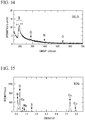
Fig. 14 is a graph representing the results of electron energy loss spectroscopy in Experimental Example 5. -
Fig. 15 is a graph representing the results of electron energy loss spectroscopy in Experimental Example 5. -
Fig. 16 is a graph representing the results of thermal desorption spectroscopy in Experimental Example 6. -
Fig. 17 is a graph representing the results of visible ultraviolet spectroscopy in Experimental Example 7. -
Fig. 18 is a scanning-type transmission electron microscopic image in Experimental Example 8. -
Fig. 19 is a graph representing the results obtained by measuring a thickness of a portion indicated by L in a scanning-type transmission electron microscopic image in Experimental Example 8. -
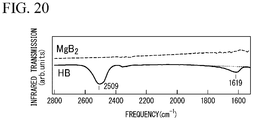
Fig. 20 is a graph representing the results of Fourier transform infrared spectroscopy in Experimental Example 9. - Embodiments of the two-dimensional hydrogen boride-containing sheet and the production method for a two-dimensional boron compound-containing sheet of the present invention will be described.
- The present embodiments are specifically described for better understanding of the spirit of the invention, and are not intended to limit the present invention unless otherwise specified.
- The two-dimensional hydrogen boride-containing sheet of the present embodiment is a sheet having a two-dimensional network that consists of (HB)n (n ≥ 4, where n is an integer). That is, in the two-dimensional hydrogen boride-containing sheet of the present embodiment, boron atoms (B) and hydrogen atoms (H) are present at a molar ratio of 1:1. In addition, the two-dimensional hydrogen boride-containing sheet of the present embodiment is a sheet having a two-dimensional network formed of only boron atoms (B) and hydrogen atoms (H).
- In addition, in (HB)n (n ≥ 4, where n is an integer), a case where n = 4 represents a unit cell of the two-dimensional hydrogen boride-containing sheet of the present embodiment.
- In the two-dimensional hydrogen boride-containing sheet of the present embodiment, boron atoms (B) are arranged in a hexagonal ring shape like a benzene ring, as shown in
Fig. 1A . In addition, boron atoms (B) are present at the apexes of the hexagon. Furthermore, the hexagons formed of the boron atoms (B) are connected to one another without gaps to form a mesh-like surface structure (two-dimensional network). As shown inFigs. 1B and 1C , the two-dimensional hydrogen boride-containing sheet of the present embodiment has a site at which two adjacent boron atoms (B) amongst the boron atoms are bound to the same hydrogen atom (H). - In the two-dimensional hydrogen boride-containing sheet of the present embodiment, a hexagonal mesh-like shape formed of the boron atoms (B) refers, for example, to a honeycomb shape.
- Such a two-dimensional hydrogen boride-containing sheet of the present embodiment is a thin film-like substance having a two-dimensional network that consists of boron atoms (B) and hydrogen atoms (H). In addition, the two-dimensional hydrogen boride-containing sheet of the present embodiment contains almost no either metal atoms derived from metal diboride used in the production method for a two-dimensional boron compound-containing sheet of the present embodiment as will be described later, or other metal atoms.
- In the two-dimensional hydrogen boride-containing sheet of the present embodiment, the total number of boron atoms (B) and hydrogen atoms (H) forming the above-mentioned mesh-like surface structure is 1,000 or more.
- A bonding distance d1 between two adjacent boron atoms (B) as shown in
Fig. 1A is 0.17 nm to 0.18 nm. In addition, a bonding distance d2 between two adjacent boron atoms (B) via one hydrogen atom (H) as shown inFig. 1B is 0.17 nm to 0.18 nm. In addition, a bonding distance d3 between adjacent boron atom (B) and hydrogen atom (H) as shown inFig. 1B is 0.125 nm to 0.135 nm. - A thickness of the two-dimensional hydrogen boride-containing sheet of the present embodiment is 0.23 nm to 0.50 nm.
- In the two-dimensional hydrogen boride-containing sheet of the present embodiment, a length in at least one direction (for example, a length in the X direction or Y direction in
Fig. 1A ) is preferably 100 nm or longer. In the two-dimensional hydrogen boride-containing sheet of the present embodiment, in a case where the length in at least one direction is 100 nm or longer, the two-dimensional hydrogen boride-containing sheet of the present embodiment can be effectively used as an electronic material, a catalyst carrier material, a catalyst material, a superconducting material, or the like. - A size (area) of the two-dimensional hydrogen boride-containing sheet of the present embodiment is not particularly limited. The two-dimensional hydrogen boride-containing sheet of the present embodiment can be formed in any size by the production method for a two-dimensional boron compound-containing sheet of the present embodiment as described later.
- Such a two-dimensional hydrogen boride-containing sheet of the present embodiment is a substance having a crystal structure. In addition, in the two-dimensional hydrogen boride-containing sheet of the present embodiment, a strong bonding strength is exhibited between the boron atoms (B) forming the hexagonal ring and between the boron atom (B) and the hydrogen atom (H). Therefore, even if a plurality of the sheets containing two-dimensional hydrogen boride of the present embodiment are stacked to form a crystal (aggregate) at the time of production, the crystal can be easily cleaved along a crystal plane similarly to graphite and separated (recovered) as single-layer two-dimensional sheets.
- The two-dimensional hydrogen boride-containing sheet of the present embodiment can be used as an electronic material, a catalyst carrier material, a superconducting material, or the like.
- It is predicted that the two-dimensional hydrogen boride-containing sheet of the present embodiment exhibits an electronic structure called Dirac Fermion that exhibits the same mobility as graphene (see Two-Dimensional Boron Hydride Sheets: High Stability, Massless Dirac Fermions, and Excellent Mechanical Properties, Angew. Chem. Int. Ed., 2016, 55, 1.). Therefore, the two-dimensional hydrogen boride-containing sheet of the present embodiment is expected to be used as a new electronic device material.
- In addition, a two-dimensional sheet of boron is predicted to be a superconductor at 10 K to 20 K (see Can Two-Dimensional Boron Superconduct?, Evgeni S. Penev, Alex Kutana, and Boris I. Yakobson, Nano Lett., 2016, 16, 2522). Therefore, the two-dimensional hydrogen boride-containing sheet of the present embodiment is expected to be used as a new matrix material for superconductors which exceeds the two-dimensional sheet of boron.
- In addition, the two-dimensional sheet of boron is predicted to have four times mechanical strength of iron (see Mechanical properties and Stabilities of α-boron monolayers, Peng Q, Han L, Wen X, Liu S, Chen Z, Lian J, De S., Phys. Chem. Chem. Phys. 2015, 17, 2160). Therefore, the two-dimensional hydrogen boride-containing sheet of the present embodiment is expected to be used as a new matrix material for high-strength materials which exceeds the two-dimensional sheet of boron.
- In addition, it is predicted that the surface of the two-dimensional sheet of boron can be coated with lithium to provide hydrogen storage characteristics of 12.3 mass% (Boron-duble-ring sheet, fullerene, and nanotubes: potential hydrogen storage materials., Wang J, Zhao HY, Liu Y., Chem. Phys. Chem. 2014, 15, 3453). Therefore, the two-dimensional hydrogen boride-containing sheet of the present embodiment is expected to be used as a new hydrogen storage material which exceeds the two-dimensional sheet of boron.
- In addition, in a case where the two-dimensional sheet of boron is used for an electrode of a lithium ion secondary battery, it is predicted that the lithium ion secondary battery, provided with the electrode for which the two-dimensional sheet of boron is used, has four times the capacity of a lithium ion secondary battery provided with an electrode consisting of graphite (Borophene: A promising anode material offering high specific capacity and high rate capability for lithium-ion batteries, H. R. Jiang, Ziheng Lu, M. C. Wu, Francesco Ciucci, T. S. Zhao, Nano Energy 23 (2016) 97). Therefore, the two-dimensional hydrogen boride-containing sheet of the present embodiment is expected to be used as a new electrode material for lithium ion secondary batteries which exceeds the two-dimensional sheet of boron.
- Furthermore, from the viewpoint that the two-dimensional sheet of boron releases hydrogen when heated (hydrogen comes out during burning thereof and explosion occurs due to hydrogen), the two-dimensional hydrogen boride-containing sheet of the present embodiment is expected to be used as a solid fuel.
- The production method for a two-dimensional boron compound-containing sheet of the present embodiment is a method, including a step of mixing (hereinafter referred to as "first step"), in a polar organic solvent, metal diboride having an MB2-type structure (where M is at least one selected from the group consisting of Al, Mg, Ta, Zr, Re, Cr, Ti, and V) with an ion exchange resin in which ions exchangeable with metal ions constituting the metal diboride are coordinated.
- As the metal diboride having an MB2-type structure, metal diboride having a hexagonal ring structure is used. For example, aluminum diboride (AlB2), magnesium diboride (MgB2), tantalum diboride (TaB2), zirconium diboride (ZrB2), rhenium diboride (ReB2), chromium diboride (CrB2), titanium diboride (TiB2), and vanadium diboride (VB2) are used.
- It is preferable to use magnesium diboride, from the viewpoint that ion exchange with an ion exchange resin can be easily performed in a polar organic solvent.
- There is no particular limitation on the ion exchange resin in which ions exchangeable with metal ions constituting the metal diboride are coordinated. As such an ion exchange resin, for example, a polymer of styrene having a functional group in which ions exchangeable with metal ions constituting the metal diboride are coordinated (hereinafter referred to as "functional group α"), a polymer of divinylbenzene having the functional group α, a copolymer of styrene having the functional group α and divinylbenzene having the functional group α, and the like are mentioned.
- As the functional group α, for example, a sulfo group, a carboxyl group, and the like are mentioned. Among these, a sulfo group is preferable, from the viewpoint that ion exchange with metal ions constituting the metal diboride can be easily performed in a polar organic solvent.
- The polar organic solvent is not particularly limited. For example, acetonitrile, N,N-dimethylformamide, methanol, and the like are mentioned. Among these, acetonitrile is preferable from the viewpoint that no oxygen is contained.
- In the first step, the metal diboride and the ion exchange resin are introduced into the polar organic solvent, and a mixed solution containing the polar organic solvent, the metal diboride, and the ion exchange resin is stirred, so that sufficient contact is made between the metal diboride and the ion exchange resin. As a result, ion exchange occurs between metal ions constituting the metal diboride and ions of the functional group α of the ion exchange resin, so that a two-dimensional boron compound-containing sheet is produced which has a two-dimensional network formed of boron atoms and atoms derived from the functional group α of the ion exchange resin.
- For example, in a case where magnesium diboride is used as the metal diboride and an ion exchange resin having a sulfo group is used as the ion exchange resin, magnesium ion (Mg+) of the magnesium diboride is replaced with hydrogen ion (H+) of the sulfo group of the ion exchange resin, so that a two-dimensional hydrogen boride-containing sheet which has the two-dimensional network that consists of boron atoms (B) and hydrogen atoms (H) as described above is produced.
- In the first step, it is preferable that an ion-exchange reaction between metal ions constituting the metal diboride and ions of the functional group α of the ion exchange resin be caused to proceed gently without applying ultrasonic waves or the like to the mixed solution.
- In a case where the mixed solution is stirred, a temperature of the mixed solution is preferably 15 °C to 35 °C.
- A time for which the mixed solution is stirred is not particularly limited, and is, for example, 700 minutes to 7,000 minutes.
- In addition, the first step is performed under an inert atmosphere consisting of an inert gas such as nitrogen (N2) and argon (Ar).
- Next, the mixed solution for which stirring has been completed is filtered (second step).
- A filtration method of the mixed solution is not particularly limited, and, for example, methods such as natural filtration, vacuum filtration, pressure filtration, and centrifugal filtration are used. In addition, as a filter medium, for example, filter paper using cellulose as a base material, a membrane filter, a filter plate obtained by compression molding of cellulose, glass fiber, or the like, or the like is used.
- A solution containing a product recovered by being separated from a precipitate through filtration is either naturally dried or dried by heating, to finally obtain only the product.
- This product is a two-dimensional boron compound-containing sheet which has a two-dimensional network formed of boron atoms and atoms derived from the functional group α of the ion exchange resin.
- As a method of analyzing the product obtained by the production method for a two-dimensional boron compound-containing sheet of the present embodiment, for example, observation by X-ray photoelectron spectroscopy (XPS), observation by a transmission electron microscope (TEM), observations by energy dispersive X-ray spectroscopy (EDS) and electron energy loss spectroscopy (EELS) performed in a transmission electron microscope, and the like are mentioned.
- In X-ray photoelectron spectroscopy (XPS), for example, the surface of a product is irradiated with X-rays using an X-ray photoelectron spectrometer (trade name: JPS9010TR) manufactured by JEOL Ltd., and energy of photoelectrons generated at the time of irradiation is measured, thereby analyzing constituent elements of the product and electronic states thereof. In this analysis, in a case where energy of photoelectrons attributable to a metal element constituting the metal diboride which is a raw material is hardly detected, and only energy of photoelectrons attributable to boron and an element derived from the functional group α of the ion exchange resin is detected, it can be said that the product is composed only of boron and the element derived from the functional group α of the ion exchange resin.
- In a case of the observation by a transmission electron microscope (TEM), for example, a shape (appearance) and the like of a product are analyzed by observing the product using a transmission electron microscope (trade name: JEM-2100F TEM/STEM) manufactured by JEOL Ltd. In this analysis, in a case where a film-like (sheet-like) substance is observed, it can be said that the product is a two-dimensional sheet-like substance. By performing energy dispersive X-ray spectroscopy (EDS) in a transmission electron microscope, it is possible to observe the presence or absence of a metal element at a TEM-observed site of the product. In this analysis, in a case where X-ray energy attributable to a metal element constituting the metal diboride which is a raw material is hardly detected, and a peak of the metal element (for example, Mg) does not appear, it can be said that the metal element does not exist. In addition, by performing electron energy loss spectroscopy (EELS) in a transmission electron microscope, constituent elements at a TEM-observed site of the product can be observed. In this analysis, in a case where only X-ray energy attributable to boron and an element derived from the functional group α of the ion exchange resin is detected, it can be said that the product is composed only of boron and the element derived from the functional group α of the above-mentioned ion exchange resin as described above.
- According to the production method for a two-dimensional boron compound-containing sheet of the present embodiment, a two-dimensional boron compound-containing sheet which has a two-dimensional network formed of boron atoms and atoms derived from the functional group α of the ion exchange resin can be easily produced.
- A two-dimensional boron compound-containing sheet having a larger area can be produced by using a large crystal of metal diboride having a MB2-type structure which is a raw material.
- In addition, according to the production method for a two-dimensional boron compound-containing sheet of the present embodiment, in order to perform ion-exchange between metal ions constituting the metal diboride and ions of the functional group α of the ion exchange resin, a polar organic solvent is used instead of using an acidic solution. Therefore, it is not necessary to adjust a pH of the mixed solution containing the polar organic solvent, the metal diboride, and the ion exchange resin.
- In addition, according to the production method for a two-dimensional boron compound-containing sheet of the present embodiment, in the first step, for example, in a case where magnesium diboride is used as the metal diboride, and an ion exchange resin having a sulfo group is used as the ion exchange resin, magnesium ion (Mg+) of the magnesium diboride is replaced with hydrogen ion (H+) of the sulfo group of the ion exchange resin, so that a minimum unit (HB)4 can be produced as the two-dimensional hydrogen boride-containing sheet.
- Hereinafter, the present invention will be described more specifically with reference to experimental examples. However, the present invention is not limited to the following experimental examples.
- X-ray photoelectron spectroscopy (XPS) of magnesium diboride (manufactured by Rare Metallic Co., Ltd.) was performed.
- As an analyzer for the X-ray photoelectron spectroscopy, an X-ray photoelectron spectrometer (trade name: JPS9010TR) manufactured by JEOL Ltd. was used. The results of the X-ray photoelectron spectroscopy are shown in
Fig. 2 . - 30 mL by volume of ion exchange resin having a sulfo group (Amberlite (registered trademark) IR120B, manufactured by Organo Corporation) was added to acetonitrile while adding 60 mg of magnesium diboride (purity: 99%, manufactured by Rare Metallic Co., Ltd.). The resultant was stirred with a glass rod to prepare a mixed solution of the magnesium diboride and the ion exchange resin.
- After the mixed solution was stirred at 25 °C for 72 hours, the mixed solution was filtered through a membrane filter with a pore size of 1.0 µm, and the filtrate was recovered. Thereafter, the filtrate was dried at 80 °C using a hot plate in a nitrogen atmosphere to obtain a product.
- For the obtained product, X-ray photoelectron spectroscopy was performed in the same manner as in Experimental Example 1. The results are shown in
Fig. 3 . - In the results in
Fig. 2 , a peak of Mg2p of magnesium appears at 51.3 eV, a peak of Bis of boron appears at 188.2 eV, and a peak of boron oxide (B2O3) covering the surface of magnesium diboride (MgB2) appears at 193.2 eV. This is consistent with the X-ray photoelectron spectroscopy results for typical commercial MgB2. - From the results in
Fig. 3 , the peak of Mg2p which appears inFig. 2 was not observed. As a result, it was found that the product in Experimental Example 2 contains no magnesium (Mg) and contains boron (B). InFig. 3 , the small peak appearing at 193.2 eV inFig. 3 is a peak of boric acid which is a by-product. This result suggests that ion exchange has occurred between Mg ion of magnesium diboride (MgB2) and hydrogen ion of the sulfo group of the ion exchange resin. - For the product obtained in Experimental Example 2, an observation was performed with a scanning-type transmission electron microscope (trade name: JEM-2100F TEM/STEM) manufactured by JEOL Ltd. The observation results are shown in
Figs. 4 to 8 . - From the results in
Figs. 4 to 8 , it is considered that the obtained product forms two-dimensional sheets, and respective sheets are in a state in which they are peelable one by one. - For the product obtained in Experimental Example 2 which had been subjected to heating at 200°C for 60 minutes, an observation was performed with a scanning-type transmission electron microscope (trade name: JEM-2100F TEM/STEM) manufactured by JEOL Ltd. The observation results are shown in
Figs. 9 to 12 . - From the results in
Figs. 9 to 12 , it is considered that the obtained product forms two-dimensional sheets, and respective sheets are present in a state of being peelable one by one. - The product was subjected to heating at 200°C for dehydration; and the product of Experimental Example 4 after being heated to 200°C and the product of Experimental Example 3 are equal in terms of molecular structure.
- For the product obtained in Experimental Example 2, an observation was performed with a scanning-type transmission electron microscope (STEM) (trade name: JEM-2100F TEM/STEM) manufactured by JEOL Ltd., and electron energy loss spectroscopy was performed. The observation results are shown in
Fig. 13 . In addition, the results of the electron energy loss spectroscopy regarding this product are shown inFigs. 14 and 15 . A sheet-like substance was observed from the results inFig. 13 . In addition, as shown inFig. 14 , a peak at 191 eV in the electron energy loss spectroscopy which represents the sp2 structure of boron (B) was observed, and peaks attributable to carbon (C), nitrogen (N), and oxygen (O) were not observed. From this viewpoint, it was found that the sheet-like substance is composed only of boron having the sp2 structure. In addition, from the results inFig. 15 , no peak attributable to magnesium (Mg) was observed. From this viewpoint, it was found that the sheet-like substance is composed only of boron. InFig. 15 , peaks attributable to oxygen (O), sulfur (S), copper (Cu), and the like are observed. However, this represents noise due to high-sensitivity measurement. - For the product obtained in Experimental Example 2, thermal desorption spectroscopy (TDS) was performed with TDS1400TV manufactured by ESCO. The analysis results are shown in
Fig. 16 . InFig. 16 , (a) represents a spectrum attributable to water, and (b) represents a spectrum attributable to hydrogen. In a case where the product obtained in Experimental Example 2 is heated, it was found that water is eliminated at around 180 °C due to the presence of boron which is a by-product. In addition, in a case where the product obtained in Experimental Example 2 is further heated, it was found that hydrogen is eliminated at 200°C or higher. An amount of water eliminated and an amount of hydrogen eliminated were measured, and a comparison was made for those amounts. As a result, a molar ratio of boron to hydrogen contained in the precipitate obtained in Experimental Example 2 was calculated to be 0.97:1. This result suggests that, in the precipitate obtained in Experimental Example 2, boron atom (B) and hydrogen atom (H) are present at a molar ratio of 1:1. - For the product obtained in Experimental Example 2, visible ultraviolet spectroscopy (UV-VIS) was performed with V-660 manufactured by JASCO Corporation. The analysis results are shown in
Fig. 17 . From the results inFig. 17 , it was found that the product obtained in Experimental Example 2 has light absorption at 2.90 eV which is not present in magnesium diboride or boric acid. - For the product obtained in Experimental Example 2, an observation was performed with a scanning-type transmission electron microscope (trade name: JEM-2100F TEM/STEM) manufactured by JEOL Ltd. The observation results are shown in
Fig. 18 . - In
Fig. 18 , a thickness of a portion indicated by L was measured by image analysis. The analysis results are shown inFig. 19 . From the results inFig. 19 , it was found that the product obtained in Experimental Example 2 is a sheet-like substance having a thickness of one to several atomic layers. - For the product obtained in Experimental Example 2, Fourier transform infrared spectroscopy (FTIR) was performed with FT/IR-300 manufactured by JASCO Analytical Instruments. The analysis results are shown in
Fig. 20 . From the results inFig. 20 , absorption at 1619 cm-1 was almost identical to absorption at 1613 cm-1 attributable to the theoretically calculated B-H-B bond. In addition, absorption at 2509 cm-1 represents a defect site or boundary site of the two-dimensional hydrogen boride-containing sheet, or a termination structure thereof which is not present in an infinitely large two-dimensional hydrogen boride-containing sheet. - The two-dimensional hydrogen boride-containing sheet of the present invention can be used as an electronic material, a catalyst carrier material, a superconducting material, or the like.
Claims (6)
- A two-dimensional hydrogen boride-containing sheet, comprising:
a two-dimensional network that consists of (HB)n (n ≥ 4). - The two-dimensional hydrogen boride-containing sheet according to claim 1,
wherein, in the two-dimensional network, boron atoms are arranged in a hexagonal ring shape, hexagons formed of the boron atoms are connected to one another to form a mesh-like shape, and the two-dimensional network has a site at which two adjacent boron atoms amongst the boron atoms are bound to the same hydrogen atom. - The two-dimensional hydrogen boride-containing sheet according to claim 1 or 2,
wherein a length in at least one direction is 100 nm or longer. - A production method for a two-dimensional boron compound-containing sheet, comprising:
a step of mixing, in a polar organic solvent, metal diboride having an MB2-type structure (where M is at least one selected from the group consisting of Al, Mg, Ta, Zr, Re, Cr, Ti, and V), with an ion exchange resin in which ions exchangeable with metal ions constituting the metal diboride are coordinated. - The production method for a two-dimensional boron compound-containing sheet according to claim 4,
wherein the ion exchange resin has a sulfo group. - The production method for a two-dimensional boron compound-containing sheet according to claim 4 or 5,
wherein the polar organic solvent is acetonitrile or methanol.
Applications Claiming Priority (2)
| Application Number | Priority Date | Filing Date | Title |
|---|---|---|---|
| JP2016204477 | 2016-10-18 | ||
| PCT/JP2017/037709 WO2018074518A1 (en) | 2016-10-18 | 2017-10-18 | Sheet containing two-dimensional borohydride and production method for sheet containing two-dimensional boron compound |
Publications (3)
| Publication Number | Publication Date |
|---|---|
| EP3514114A1 true EP3514114A1 (en) | 2019-07-24 |
| EP3514114A4 EP3514114A4 (en) | 2020-04-15 |
| EP3514114B1 EP3514114B1 (en) | 2024-12-04 |
Family
ID=62018707
Family Applications (1)
| Application Number | Title | Priority Date | Filing Date |
|---|---|---|---|
| EP17862010.0A Active EP3514114B1 (en) | 2016-10-18 | 2017-10-18 | Sheet containing two-dimensional borohydride and production method for sheet containing two-dimensional boron compound |
Country Status (4)
| Country | Link |
|---|---|
| US (1) | US10781108B2 (en) |
| EP (1) | EP3514114B1 (en) |
| JP (1) | JP7057569B2 (en) |
| WO (1) | WO2018074518A1 (en) |
Cited By (1)
| Publication number | Priority date | Publication date | Assignee | Title |
|---|---|---|---|---|
| EP4063321A4 (en) * | 2019-11-18 | 2023-12-27 | University of Tsukuba | HYDROGEN STORAGE AND RELEASE MATERIAL AND METHOD FOR PRODUCING THE SAME |
Families Citing this family (18)
| Publication number | Priority date | Publication date | Assignee | Title |
|---|---|---|---|---|
| JP7079932B2 (en) * | 2018-06-22 | 2022-06-03 | 国立大学法人東京工業大学 | Hydrogen generation method, hydrogen generation system and fuel cell system |
| JP7302840B2 (en) * | 2018-10-31 | 2023-07-04 | 国立大学法人 筑波大学 | Method for producing carbon dioxide storage-release material |
| WO2020179779A1 (en) * | 2019-03-07 | 2020-09-10 | 国立大学法人筑波大学 | Reduction material, composite body and reduction method |
| US11702543B2 (en) * | 2019-03-29 | 2023-07-18 | Arizona Board Of Regents On Behalf Of Arizona State University | 3D-printed nanocomposites with metal diboride nanosheets |
| JP2021028285A (en) * | 2019-08-09 | 2021-02-25 | 国立大学法人 筑波大学 | Layered hydrogen boride |
| JP7578961B2 (en) * | 2019-11-15 | 2024-11-07 | 国立大学法人東京科学大学 | Method for producing two-dimensional hydrogen borate-containing sheet, two-dimensional hydrogen borate-containing sheet composition and method for producing same |
| JP7354051B2 (en) | 2020-04-13 | 2023-10-02 | 三菱重工業株式会社 | Hydrogen release/storage systems, hydrogen release/storage methods, ammonia production equipment, gas turbines, fuel cells, and steel plants |
| JP7354050B2 (en) | 2020-04-13 | 2023-10-02 | 三菱重工業株式会社 | Hydrogen release/storage system, hydrogen release/storage method, hydrogen release/storage device, ammonia production device, gas turbine, fuel cell, and steelworks |
| JP7485287B2 (en) * | 2020-10-05 | 2024-05-16 | 株式会社デンソー | Hydrogen Generator |
| JP2022188581A (en) * | 2021-06-09 | 2022-12-21 | 国立大学法人東京工業大学 | Structures containing boron, hydrogen, and oxygen, and production method of the same |
| JP7873868B2 (en) * | 2021-07-16 | 2026-06-15 | 国立大学法人 筑波大学 | Boric acid-containing composition, hydrogen generation system, and fuel cell system |
| JP7745195B2 (en) * | 2021-07-30 | 2025-09-29 | 国立大学法人東京科学大学 | Antibacterial and/or antiviral borohydride-containing sheet and composition, and antibacterial and/or antiviral member |
| JP7386211B2 (en) * | 2021-08-24 | 2023-11-24 | 三菱重工業株式会社 | Hydrogen production system |
| JP7671208B2 (en) * | 2021-08-24 | 2025-05-01 | 三菱重工業株式会社 | Hydrocarbon Production Systems |
| CN117699745B (en) * | 2023-11-22 | 2025-11-07 | 东北大学 | Two-dimensional molybdenum nitride and crystalline Mo2Ammonia-free preparation method of N nano-sheet |
| WO2025154701A1 (en) * | 2024-01-19 | 2025-07-24 | 国立大学法人筑波大学 | Metal-supported two-dimensional borohydride sheet-containing substance, and method for producing metal-supported two-dimensional borohydride sheet-containing substance |
| CN118373399B (en) * | 2024-06-24 | 2024-09-06 | 湖南裕能新能源电池材料股份有限公司 | Preparation method of lithium iron phosphate positive electrode material and lithium battery |
| CN121732234B (en) * | 2026-02-26 | 2026-05-05 | 厦门工学院 | A boron hydride/magnesium composite sheet, its preparation method and application |
Family Cites Families (1)
| Publication number | Priority date | Publication date | Assignee | Title |
|---|---|---|---|---|
| JP5757587B2 (en) * | 2013-05-24 | 2015-07-29 | 国立大学法人東京工業大学 | Iron-based superconducting material, and iron-based superconducting layer comprising the same, iron-based superconducting tape wire, iron-based superconducting wire |
-
2017
- 2017-10-18 WO PCT/JP2017/037709 patent/WO2018074518A1/en not_active Ceased
- 2017-10-18 JP JP2018546383A patent/JP7057569B2/en active Active
- 2017-10-18 US US16/342,178 patent/US10781108B2/en active Active
- 2017-10-18 EP EP17862010.0A patent/EP3514114B1/en active Active
Cited By (2)
| Publication number | Priority date | Publication date | Assignee | Title |
|---|---|---|---|---|
| EP4063321A4 (en) * | 2019-11-18 | 2023-12-27 | University of Tsukuba | HYDROGEN STORAGE AND RELEASE MATERIAL AND METHOD FOR PRODUCING THE SAME |
| US12384675B2 (en) | 2019-11-18 | 2025-08-12 | University of Tsukba | Hydrogen storage and release material and method of producing same |
Also Published As
| Publication number | Publication date |
|---|---|
| WO2018074518A1 (en) | 2018-04-26 |
| US20190315628A1 (en) | 2019-10-17 |
| JPWO2018074518A1 (en) | 2019-08-29 |
| US10781108B2 (en) | 2020-09-22 |
| JP7057569B2 (en) | 2022-04-20 |
| EP3514114A4 (en) | 2020-04-15 |
| EP3514114B1 (en) | 2024-12-04 |
Similar Documents
| Publication | Publication Date | Title |
|---|---|---|
| US10781108B2 (en) | Sheet containing two-dimensional hydrogen boride and production method for sheet containing two-dimensional boron compound | |
| Wu et al. | Unusual formation of CoO@ C “dandelions” derived from 2D Kagóme MOLs for efficient lithium storage | |
| Zhang et al. | Organic small molecule activates transition metal foam for efficient oxygen evolution reaction | |
| Zhou et al. | Few‐layer bismuthene with anisotropic expansion for high‐areal‐capacity sodium‐ion batteries | |
| Joseph et al. | Borophene and boron fullerene materials in hydrogen storage: opportunities and challenges | |
| Alameda et al. | Topochemical deintercalation of Al from MoAlB: stepwise etching pathway, layered intergrowth structures, and two-dimensional MBene | |
| Chang et al. | Aluminum: An underappreciated anode material for lithium-ion batteries | |
| Yao et al. | Novel 2D Sb2S3 nanosheet/CNT coupling layer for exceptional polysulfide recycling performance | |
| Zhou et al. | 2D space-confined synthesis of few-layer MoS2 anchored on carbon nanosheet for lithium-ion battery anode | |
| Tian et al. | Few-layer antimonene: anisotropic expansion and reversible crystalline-phase evolution enable large-capacity and long-life Na-ion batteries | |
| Jiang et al. | Synthesis of 1T-MoSe2 ultrathin nanosheets with an expanded interlayer spacing of 1.17 nm for efficient hydrogen evolution reaction | |
| Jiang et al. | Facile synthesis of black phosphorus: an efficient electrocatalyst for the oxygen evolving reaction | |
| Gao et al. | Mixed-solution synthesis of sea urchin-like NiSe nanofiber assemblies as economical Pt-free catalysts for electrochemical H2 production | |
| Lei et al. | Transformation of bulk alloys to oxide nanowires | |
| Zhang et al. | A hydrogen-initiated chemical epitaxial growth strategy for in-plane heterostructured photocatalyst | |
| Wang et al. | Tungsten boride: a 2D multiple Dirac semimetal for the hydrogen evolution reaction | |
| Hu et al. | MXene: a new family of promising hydrogen storage medium | |
| Yang et al. | Vertically aligned WS2 nanosheets for water splitting | |
| Zhou et al. | Graphene/carbon-coated Si nanoparticle hybrids as high-performance anode materials for Li-ion batteries | |
| Park et al. | Synthesis process of CoSeO3 microspheres for unordinary Li‐ion storage performances and mechanism of their conversion reaction with Li ions | |
| Kim et al. | Scalable functionalized graphene nano-platelets as tunable cathodes for high-performance lithium rechargeable batteries | |
| Lee et al. | Soft X-ray absorption spectroscopy studies of the electronic structure recovery of graphene oxide upon chemical defunctionalization | |
| Zhao et al. | A newly-designed sandwich-structured graphene–Pt–graphene catalyst with improved electrocatalytic performance for fuel cells | |
| Bhattacharjya et al. | Graphene nanoplatelets with selectively functionalized edges as electrode material for electrochemical energy storage | |
| TW201223774A (en) | Graphene-silicon-carbide-graphene nanosheets |
Legal Events
| Date | Code | Title | Description |
|---|---|---|---|
| STAA | Information on the status of an ep patent application or granted ep patent |
Free format text: STATUS: THE INTERNATIONAL PUBLICATION HAS BEEN MADE |
|
| PUAI | Public reference made under article 153(3) epc to a published international application that has entered the european phase |
Free format text: ORIGINAL CODE: 0009012 |
|
| STAA | Information on the status of an ep patent application or granted ep patent |
Free format text: STATUS: REQUEST FOR EXAMINATION WAS MADE |
|
| 17P | Request for examination filed |
Effective date: 20190416 |
|
| AK | Designated contracting states |
Kind code of ref document: A1 Designated state(s): AL AT BE BG CH CY CZ DE DK EE ES FI FR GB GR HR HU IE IS IT LI LT LU LV MC MK MT NL NO PL PT RO RS SE SI SK SM TR |
|
| AX | Request for extension of the european patent |
Extension state: BA ME |
|
| DAV | Request for validation of the european patent (deleted) | ||
| DAX | Request for extension of the european patent (deleted) | ||
| REG | Reference to a national code |
Ref country code: DE Ref legal event code: R079 Free format text: PREVIOUS MAIN CLASS: C01B0035040000 Ipc: C01B0035020000 Ref document number: 602017086609 Country of ref document: DE |
|
| A4 | Supplementary search report drawn up and despatched |
Effective date: 20200317 |
|
| RIC1 | Information provided on ipc code assigned before grant |
Ipc: C01B 35/02 20060101AFI20200311BHEP |
|
| STAA | Information on the status of an ep patent application or granted ep patent |
Free format text: STATUS: EXAMINATION IS IN PROGRESS |
|
| 17Q | First examination report despatched |
Effective date: 20210401 |
|
| GRAP | Despatch of communication of intention to grant a patent |
Free format text: ORIGINAL CODE: EPIDOSNIGR1 |
|
| STAA | Information on the status of an ep patent application or granted ep patent |
Free format text: STATUS: GRANT OF PATENT IS INTENDED |
|
| INTG | Intention to grant announced |
Effective date: 20240627 |
|
| GRAS | Grant fee paid |
Free format text: ORIGINAL CODE: EPIDOSNIGR3 |
|
| GRAA | (expected) grant |
Free format text: ORIGINAL CODE: 0009210 |
|
| STAA | Information on the status of an ep patent application or granted ep patent |
Free format text: STATUS: THE PATENT HAS BEEN GRANTED |
|
| RAP3 | Party data changed (applicant data changed or rights of an application transferred) |
Owner name: TOKYO INSTITUTE OF TECHNOLOGY Owner name: UNIVERSITY OF TSUKUBA |
|
| AK | Designated contracting states |
Kind code of ref document: B1 Designated state(s): AL AT BE BG CH CY CZ DE DK EE ES FI FR GB GR HR HU IE IS IT LI LT LU LV MC MK MT NL NO PL PT RO RS SE SI SK SM TR |
|
| REG | Reference to a national code |
Ref country code: GB Ref legal event code: FG4D |
|
| REG | Reference to a national code |
Ref country code: CH Ref legal event code: EP |
|
| REG | Reference to a national code |
Ref country code: DE Ref legal event code: R096 Ref document number: 602017086609 Country of ref document: DE |
|
| REG | Reference to a national code |
Ref country code: IE Ref legal event code: FG4D |
|
| P01 | Opt-out of the competence of the unified patent court (upc) registered |
Free format text: CASE NUMBER: APP_2608/2025 Effective date: 20250115 |
|
| REG | Reference to a national code |
Ref country code: LT Ref legal event code: MG9D |
|
| REG | Reference to a national code |
Ref country code: NL Ref legal event code: MP Effective date: 20241204 |
|
| PG25 | Lapsed in a contracting state [announced via postgrant information from national office to epo] |
Ref country code: HR Free format text: LAPSE BECAUSE OF FAILURE TO SUBMIT A TRANSLATION OF THE DESCRIPTION OR TO PAY THE FEE WITHIN THE PRESCRIBED TIME-LIMIT Effective date: 20241204 |
|
| PG25 | Lapsed in a contracting state [announced via postgrant information from national office to epo] |
Ref country code: FI Free format text: LAPSE BECAUSE OF FAILURE TO SUBMIT A TRANSLATION OF THE DESCRIPTION OR TO PAY THE FEE WITHIN THE PRESCRIBED TIME-LIMIT Effective date: 20241204 |
|
| PG25 | Lapsed in a contracting state [announced via postgrant information from national office to epo] |
Ref country code: BG Free format text: LAPSE BECAUSE OF FAILURE TO SUBMIT A TRANSLATION OF THE DESCRIPTION OR TO PAY THE FEE WITHIN THE PRESCRIBED TIME-LIMIT Effective date: 20241204 |
|
| PG25 | Lapsed in a contracting state [announced via postgrant information from national office to epo] |
Ref country code: ES Free format text: LAPSE BECAUSE OF FAILURE TO SUBMIT A TRANSLATION OF THE DESCRIPTION OR TO PAY THE FEE WITHIN THE PRESCRIBED TIME-LIMIT Effective date: 20241204 |
|
| PG25 | Lapsed in a contracting state [announced via postgrant information from national office to epo] |
Ref country code: NO Free format text: LAPSE BECAUSE OF FAILURE TO SUBMIT A TRANSLATION OF THE DESCRIPTION OR TO PAY THE FEE WITHIN THE PRESCRIBED TIME-LIMIT Effective date: 20250304 |
|
| PG25 | Lapsed in a contracting state [announced via postgrant information from national office to epo] |
Ref country code: GR Free format text: LAPSE BECAUSE OF FAILURE TO SUBMIT A TRANSLATION OF THE DESCRIPTION OR TO PAY THE FEE WITHIN THE PRESCRIBED TIME-LIMIT Effective date: 20250305 Ref country code: LV Free format text: LAPSE BECAUSE OF FAILURE TO SUBMIT A TRANSLATION OF THE DESCRIPTION OR TO PAY THE FEE WITHIN THE PRESCRIBED TIME-LIMIT Effective date: 20241204 |
|
| PG25 | Lapsed in a contracting state [announced via postgrant information from national office to epo] |
Ref country code: RS Free format text: LAPSE BECAUSE OF FAILURE TO SUBMIT A TRANSLATION OF THE DESCRIPTION OR TO PAY THE FEE WITHIN THE PRESCRIBED TIME-LIMIT Effective date: 20250304 |
|
| PG25 | Lapsed in a contracting state [announced via postgrant information from national office to epo] |
Ref country code: NL Free format text: LAPSE BECAUSE OF FAILURE TO SUBMIT A TRANSLATION OF THE DESCRIPTION OR TO PAY THE FEE WITHIN THE PRESCRIBED TIME-LIMIT Effective date: 20241204 |
|
| REG | Reference to a national code |
Ref country code: AT Ref legal event code: MK05 Ref document number: 1748013 Country of ref document: AT Kind code of ref document: T Effective date: 20241204 |
|
| PG25 | Lapsed in a contracting state [announced via postgrant information from national office to epo] |
Ref country code: SM Free format text: LAPSE BECAUSE OF FAILURE TO SUBMIT A TRANSLATION OF THE DESCRIPTION OR TO PAY THE FEE WITHIN THE PRESCRIBED TIME-LIMIT Effective date: 20241204 |
|
| PG25 | Lapsed in a contracting state [announced via postgrant information from national office to epo] |
Ref country code: PL Free format text: LAPSE BECAUSE OF FAILURE TO SUBMIT A TRANSLATION OF THE DESCRIPTION OR TO PAY THE FEE WITHIN THE PRESCRIBED TIME-LIMIT Effective date: 20241204 |
|
| PG25 | Lapsed in a contracting state [announced via postgrant information from national office to epo] |
Ref country code: IS Free format text: LAPSE BECAUSE OF FAILURE TO SUBMIT A TRANSLATION OF THE DESCRIPTION OR TO PAY THE FEE WITHIN THE PRESCRIBED TIME-LIMIT Effective date: 20250404 |
|
| PG25 | Lapsed in a contracting state [announced via postgrant information from national office to epo] |
Ref country code: PT Free format text: LAPSE BECAUSE OF FAILURE TO SUBMIT A TRANSLATION OF THE DESCRIPTION OR TO PAY THE FEE WITHIN THE PRESCRIBED TIME-LIMIT Effective date: 20250404 |
|
| PG25 | Lapsed in a contracting state [announced via postgrant information from national office to epo] |
Ref country code: EE Free format text: LAPSE BECAUSE OF FAILURE TO SUBMIT A TRANSLATION OF THE DESCRIPTION OR TO PAY THE FEE WITHIN THE PRESCRIBED TIME-LIMIT Effective date: 20241204 |
|
| PG25 | Lapsed in a contracting state [announced via postgrant information from national office to epo] |
Ref country code: AT Free format text: LAPSE BECAUSE OF FAILURE TO SUBMIT A TRANSLATION OF THE DESCRIPTION OR TO PAY THE FEE WITHIN THE PRESCRIBED TIME-LIMIT Effective date: 20241204 Ref country code: RO Free format text: LAPSE BECAUSE OF FAILURE TO SUBMIT A TRANSLATION OF THE DESCRIPTION OR TO PAY THE FEE WITHIN THE PRESCRIBED TIME-LIMIT Effective date: 20241204 |
|
| PG25 | Lapsed in a contracting state [announced via postgrant information from national office to epo] |
Ref country code: SK Free format text: LAPSE BECAUSE OF FAILURE TO SUBMIT A TRANSLATION OF THE DESCRIPTION OR TO PAY THE FEE WITHIN THE PRESCRIBED TIME-LIMIT Effective date: 20241204 |
|
| PG25 | Lapsed in a contracting state [announced via postgrant information from national office to epo] |
Ref country code: CZ Free format text: LAPSE BECAUSE OF FAILURE TO SUBMIT A TRANSLATION OF THE DESCRIPTION OR TO PAY THE FEE WITHIN THE PRESCRIBED TIME-LIMIT Effective date: 20241204 |
|
| PG25 | Lapsed in a contracting state [announced via postgrant information from national office to epo] |
Ref country code: IT Free format text: LAPSE BECAUSE OF FAILURE TO SUBMIT A TRANSLATION OF THE DESCRIPTION OR TO PAY THE FEE WITHIN THE PRESCRIBED TIME-LIMIT Effective date: 20241204 |
|
| REG | Reference to a national code |
Ref country code: DE Ref legal event code: R097 Ref document number: 602017086609 Country of ref document: DE |
|
| PG25 | Lapsed in a contracting state [announced via postgrant information from national office to epo] |
Ref country code: SE Free format text: LAPSE BECAUSE OF FAILURE TO SUBMIT A TRANSLATION OF THE DESCRIPTION OR TO PAY THE FEE WITHIN THE PRESCRIBED TIME-LIMIT Effective date: 20241204 |
|
| PG25 | Lapsed in a contracting state [announced via postgrant information from national office to epo] |
Ref country code: DK Free format text: LAPSE BECAUSE OF FAILURE TO SUBMIT A TRANSLATION OF THE DESCRIPTION OR TO PAY THE FEE WITHIN THE PRESCRIBED TIME-LIMIT Effective date: 20241204 |
|
| PLBE | No opposition filed within time limit |
Free format text: ORIGINAL CODE: 0009261 |
|
| STAA | Information on the status of an ep patent application or granted ep patent |
Free format text: STATUS: NO OPPOSITION FILED WITHIN TIME LIMIT |
|
| REG | Reference to a national code |
Ref country code: CH Ref legal event code: L10 Free format text: ST27 STATUS EVENT CODE: U-0-0-L10-L00 (AS PROVIDED BY THE NATIONAL OFFICE) Effective date: 20251015 |
|
| 26N | No opposition filed |
Effective date: 20250905 |
|
| PGFP | Annual fee paid to national office [announced via postgrant information from national office to epo] |
Ref country code: DE Payment date: 20251015 Year of fee payment: 9 |
|
| PGFP | Annual fee paid to national office [announced via postgrant information from national office to epo] |
Ref country code: TR Payment date: 20251015 Year of fee payment: 9 |
|
| REG | Reference to a national code |
Ref country code: CH Ref legal event code: H13 Free format text: ST27 STATUS EVENT CODE: U-0-0-H10-H13 (AS PROVIDED BY THE NATIONAL OFFICE) Effective date: 20260527 |
|
| PG25 | Lapsed in a contracting state [announced via postgrant information from national office to epo] |
Ref country code: LU Free format text: LAPSE BECAUSE OF NON-PAYMENT OF DUE FEES Effective date: 20251018 |
|
| REG | Reference to a national code |
Ref country code: BE Ref legal event code: MM Effective date: 20251031 |
|
| GBPC | Gb: european patent ceased through non-payment of renewal fee |
Effective date: 20251018 |
|
| PG25 | Lapsed in a contracting state [announced via postgrant information from national office to epo] |
Ref country code: LT Free format text: LAPSE BECAUSE OF FAILURE TO SUBMIT A TRANSLATION OF THE DESCRIPTION OR TO PAY THE FEE WITHIN THE PRESCRIBED TIME-LIMIT Effective date: 20241204 |
|
| PG25 | Lapsed in a contracting state [announced via postgrant information from national office to epo] |
Ref country code: MC Free format text: LAPSE BECAUSE OF FAILURE TO SUBMIT A TRANSLATION OF THE DESCRIPTION OR TO PAY THE FEE WITHIN THE PRESCRIBED TIME-LIMIT Effective date: 20241204 |
|
| PG25 | Lapsed in a contracting state [announced via postgrant information from national office to epo] |
Ref country code: GB Free format text: LAPSE BECAUSE OF NON-PAYMENT OF DUE FEES Effective date: 20251018 |
|
| PG25 | Lapsed in a contracting state [announced via postgrant information from national office to epo] |
Ref country code: BE Free format text: LAPSE BECAUSE OF NON-PAYMENT OF DUE FEES Effective date: 20251031 Ref country code: CH Free format text: LAPSE BECAUSE OF NON-PAYMENT OF DUE FEES Effective date: 20251031 |
|
| PG25 | Lapsed in a contracting state [announced via postgrant information from national office to epo] |
Ref country code: FR Free format text: LAPSE BECAUSE OF NON-PAYMENT OF DUE FEES Effective date: 20251031 |