EP3514113A1 - Mica-made member, electrochemical reaction unit, and electrochemical reaction cell stack - Google Patents
Mica-made member, electrochemical reaction unit, and electrochemical reaction cell stack Download PDFInfo
- Publication number
- EP3514113A1 EP3514113A1 EP17850856.0A EP17850856A EP3514113A1 EP 3514113 A1 EP3514113 A1 EP 3514113A1 EP 17850856 A EP17850856 A EP 17850856A EP 3514113 A1 EP3514113 A1 EP 3514113A1
- Authority
- EP
- European Patent Office
- Prior art keywords
- mica
- peak
- intensity
- anode
- cell stack
- Prior art date
- Legal status (The legal status is an assumption and is not a legal conclusion. Google has not performed a legal analysis and makes no representation as to the accuracy of the status listed.)
- Pending
Links
- 238000003487 electrochemical reaction Methods 0.000 title claims description 27
- 238000002441 X-ray diffraction Methods 0.000 claims abstract description 45
- 239000013078 crystal Substances 0.000 claims abstract description 31
- 230000001747 exhibiting effect Effects 0.000 claims abstract description 14
- 229910052839 forsterite Inorganic materials 0.000 claims description 46
- 239000003792 electrolyte Substances 0.000 claims description 23
- 238000000034 method Methods 0.000 abstract description 21
- 229910052710 silicon Inorganic materials 0.000 abstract description 3
- 239000010703 silicon Substances 0.000 abstract description 3
- 239000000446 fuel Substances 0.000 description 76
- 230000005611 electricity Effects 0.000 description 75
- 239000007789 gas Substances 0.000 description 62
- 239000010445 mica Substances 0.000 description 60
- 229910052618 mica group Inorganic materials 0.000 description 60
- 239000002737 fuel gas Substances 0.000 description 39
- 239000007800 oxidant agent Substances 0.000 description 35
- 238000004891 communication Methods 0.000 description 32
- 238000005868 electrolysis reaction Methods 0.000 description 22
- HCWCAKKEBCNQJP-UHFFFAOYSA-N magnesium orthosilicate Chemical compound [Mg+2].[Mg+2].[O-][Si]([O-])([O-])[O-] HCWCAKKEBCNQJP-UHFFFAOYSA-N 0.000 description 21
- 230000009467 reduction Effects 0.000 description 16
- 125000006850 spacer group Chemical group 0.000 description 16
- 238000007669 thermal treatment Methods 0.000 description 15
- 238000011156 evaluation Methods 0.000 description 14
- UFHFLCQGNIYNRP-UHFFFAOYSA-N Hydrogen Chemical compound [H][H] UFHFLCQGNIYNRP-UHFFFAOYSA-N 0.000 description 11
- 238000010438 heat treatment Methods 0.000 description 11
- 239000001257 hydrogen Substances 0.000 description 10
- 229910052739 hydrogen Inorganic materials 0.000 description 10
- 238000004519 manufacturing process Methods 0.000 description 9
- 239000000463 material Substances 0.000 description 9
- 230000002093 peripheral effect Effects 0.000 description 8
- 230000008569 process Effects 0.000 description 8
- 230000006735 deficit Effects 0.000 description 7
- PXHVJJICTQNCMI-UHFFFAOYSA-N nickel Substances [Ni] PXHVJJICTQNCMI-UHFFFAOYSA-N 0.000 description 7
- 238000012360 testing method Methods 0.000 description 7
- 239000011230 binding agent Substances 0.000 description 6
- 238000006243 chemical reaction Methods 0.000 description 6
- 238000005259 measurement Methods 0.000 description 6
- 239000007787 solid Substances 0.000 description 6
- XLYOFNOQVPJJNP-UHFFFAOYSA-N water Substances O XLYOFNOQVPJJNP-UHFFFAOYSA-N 0.000 description 6
- 238000007789 sealing Methods 0.000 description 5
- QVGXLLKOCUKJST-UHFFFAOYSA-N atomic oxygen Chemical compound [O] QVGXLLKOCUKJST-UHFFFAOYSA-N 0.000 description 4
- 238000009413 insulation Methods 0.000 description 4
- 239000001301 oxygen Substances 0.000 description 4
- 229910052760 oxygen Inorganic materials 0.000 description 4
- 229910001220 stainless steel Inorganic materials 0.000 description 4
- OKKJLVBELUTLKV-UHFFFAOYSA-N Methanol Chemical compound OC OKKJLVBELUTLKV-UHFFFAOYSA-N 0.000 description 3
- 239000000919 ceramic Substances 0.000 description 3
- 230000006866 deterioration Effects 0.000 description 3
- 150000002500 ions Chemical class 0.000 description 3
- MCMNRKCIXSYSNV-UHFFFAOYSA-N Zirconium dioxide Chemical compound O=[Zr]=O MCMNRKCIXSYSNV-UHFFFAOYSA-N 0.000 description 2
- 238000005219 brazing Methods 0.000 description 2
- 229910002084 calcia-stabilized zirconia Inorganic materials 0.000 description 2
- 230000008859 change Effects 0.000 description 2
- 239000004020 conductor Substances 0.000 description 2
- 238000002474 experimental method Methods 0.000 description 2
- 230000006872 improvement Effects 0.000 description 2
- 239000012212 insulator Substances 0.000 description 2
- 238000012423 maintenance Methods 0.000 description 2
- 229910052751 metal Inorganic materials 0.000 description 2
- 239000002184 metal Substances 0.000 description 2
- 238000012986 modification Methods 0.000 description 2
- 230000004048 modification Effects 0.000 description 2
- 229910052759 nickel Inorganic materials 0.000 description 2
- 238000010248 power generation Methods 0.000 description 2
- 230000002265 prevention Effects 0.000 description 2
- 238000001004 secondary ion mass spectrometry Methods 0.000 description 2
- 239000010935 stainless steel Substances 0.000 description 2
- 229910001233 yttria-stabilized zirconia Inorganic materials 0.000 description 2
- 229910000859 α-Fe Inorganic materials 0.000 description 2
- 241001251094 Formica Species 0.000 description 1
- 229910000990 Ni alloy Inorganic materials 0.000 description 1
- QBYHSJRFOXINMH-UHFFFAOYSA-N [Co].[Sr].[La] Chemical compound [Co].[Sr].[La] QBYHSJRFOXINMH-UHFFFAOYSA-N 0.000 description 1
- YMVZSICZWDQCMV-UHFFFAOYSA-N [O-2].[Mn+2].[Sr+2].[La+3] Chemical compound [O-2].[Mn+2].[Sr+2].[La+3] YMVZSICZWDQCMV-UHFFFAOYSA-N 0.000 description 1
- 229910045601 alloy Inorganic materials 0.000 description 1
- 239000000956 alloy Substances 0.000 description 1
- 238000004458 analytical method Methods 0.000 description 1
- 230000015572 biosynthetic process Effects 0.000 description 1
- 239000011195 cermet Substances 0.000 description 1
- 239000002131 composite material Substances 0.000 description 1
- 230000000694 effects Effects 0.000 description 1
- 230000008030 elimination Effects 0.000 description 1
- 238000003379 elimination reaction Methods 0.000 description 1
- 239000000835 fiber Substances 0.000 description 1
- 238000010304 firing Methods 0.000 description 1
- 239000003502 gasoline Substances 0.000 description 1
- 239000011521 glass Substances 0.000 description 1
- 239000002241 glass-ceramic Substances 0.000 description 1
- 230000000977 initiatory effect Effects 0.000 description 1
- 239000003350 kerosene Substances 0.000 description 1
- DOARWPHSJVUWFT-UHFFFAOYSA-N lanthanum nickel Chemical compound [Ni].[La] DOARWPHSJVUWFT-UHFFFAOYSA-N 0.000 description 1
- 239000000203 mixture Substances 0.000 description 1
- 239000002245 particle Substances 0.000 description 1
- 239000000843 powder Substances 0.000 description 1
- 238000000634 powder X-ray diffraction Methods 0.000 description 1
- 238000004080 punching Methods 0.000 description 1
- 238000004451 qualitative analysis Methods 0.000 description 1
- 239000012495 reaction gas Substances 0.000 description 1
- 238000002407 reforming Methods 0.000 description 1
- 238000005507 spraying Methods 0.000 description 1
- 229910002076 stabilized zirconia Inorganic materials 0.000 description 1
- 239000000126 substance Substances 0.000 description 1
- 239000000758 substrate Substances 0.000 description 1
Images




Classifications
-
- C—CHEMISTRY; METALLURGY
- C01—INORGANIC CHEMISTRY
- C01B—NON-METALLIC ELEMENTS; COMPOUNDS THEREOF; METALLOIDS OR COMPOUNDS THEREOF NOT COVERED BY SUBCLASS C01C
- C01B33/00—Silicon; Compounds thereof
- C01B33/20—Silicates
- C01B33/36—Silicates having base-exchange properties but not having molecular sieve properties
- C01B33/38—Layered base-exchange silicates, e.g. clays, micas or alkali metal silicates of kenyaite or magadiite type
- C01B33/42—Micas ; Interstratified clay-mica products
-
- C—CHEMISTRY; METALLURGY
- C25—ELECTROLYTIC OR ELECTROPHORETIC PROCESSES; APPARATUS THEREFOR
- C25B—ELECTROLYTIC OR ELECTROPHORETIC PROCESSES FOR THE PRODUCTION OF COMPOUNDS OR NON-METALS; APPARATUS THEREFOR
- C25B9/00—Cells or assemblies of cells; Constructional parts of cells; Assemblies of constructional parts, e.g. electrode-diaphragm assemblies; Process-related cell features
-
- C—CHEMISTRY; METALLURGY
- C25—ELECTROLYTIC OR ELECTROPHORETIC PROCESSES; APPARATUS THEREFOR
- C25B—ELECTROLYTIC OR ELECTROPHORETIC PROCESSES FOR THE PRODUCTION OF COMPOUNDS OR NON-METALS; APPARATUS THEREFOR
- C25B9/00—Cells or assemblies of cells; Constructional parts of cells; Assemblies of constructional parts, e.g. electrode-diaphragm assemblies; Process-related cell features
- C25B9/70—Assemblies comprising two or more cells
-
- H—ELECTRICITY
- H01—ELECTRIC ELEMENTS
- H01M—PROCESSES OR MEANS, e.g. BATTERIES, FOR THE DIRECT CONVERSION OF CHEMICAL ENERGY INTO ELECTRICAL ENERGY
- H01M8/00—Fuel cells; Manufacture thereof
- H01M8/02—Details
-
- H—ELECTRICITY
- H01—ELECTRIC ELEMENTS
- H01M—PROCESSES OR MEANS, e.g. BATTERIES, FOR THE DIRECT CONVERSION OF CHEMICAL ENERGY INTO ELECTRICAL ENERGY
- H01M8/00—Fuel cells; Manufacture thereof
- H01M8/24—Grouping of fuel cells, e.g. stacking of fuel cells
- H01M8/241—Grouping of fuel cells, e.g. stacking of fuel cells with solid or matrix-supported electrolytes
- H01M8/242—Grouping of fuel cells, e.g. stacking of fuel cells with solid or matrix-supported electrolytes comprising framed electrodes or intermediary frame-like gaskets
-
- H—ELECTRICITY
- H01—ELECTRIC ELEMENTS
- H01M—PROCESSES OR MEANS, e.g. BATTERIES, FOR THE DIRECT CONVERSION OF CHEMICAL ENERGY INTO ELECTRICAL ENERGY
- H01M8/00—Fuel cells; Manufacture thereof
- H01M8/24—Grouping of fuel cells, e.g. stacking of fuel cells
- H01M8/2457—Grouping of fuel cells, e.g. stacking of fuel cells with both reactants being gaseous or vaporised
-
- H—ELECTRICITY
- H01—ELECTRIC ELEMENTS
- H01M—PROCESSES OR MEANS, e.g. BATTERIES, FOR THE DIRECT CONVERSION OF CHEMICAL ENERGY INTO ELECTRICAL ENERGY
- H01M8/00—Fuel cells; Manufacture thereof
- H01M8/24—Grouping of fuel cells, e.g. stacking of fuel cells
- H01M8/2465—Details of groupings of fuel cells
- H01M8/2483—Details of groupings of fuel cells characterised by internal manifolds
-
- C—CHEMISTRY; METALLURGY
- C01—INORGANIC CHEMISTRY
- C01P—INDEXING SCHEME RELATING TO STRUCTURAL AND PHYSICAL ASPECTS OF SOLID INORGANIC COMPOUNDS
- C01P2002/00—Crystal-structural characteristics
- C01P2002/70—Crystal-structural characteristics defined by measured X-ray, neutron or electron diffraction data
- C01P2002/72—Crystal-structural characteristics defined by measured X-ray, neutron or electron diffraction data by d-values or two theta-values, e.g. as X-ray diagram
-
- H—ELECTRICITY
- H01—ELECTRIC ELEMENTS
- H01M—PROCESSES OR MEANS, e.g. BATTERIES, FOR THE DIRECT CONVERSION OF CHEMICAL ENERGY INTO ELECTRICAL ENERGY
- H01M8/00—Fuel cells; Manufacture thereof
- H01M8/10—Fuel cells with solid electrolytes
- H01M8/12—Fuel cells with solid electrolytes operating at high temperature, e.g. with stabilised ZrO2 electrolyte
-
- Y—GENERAL TAGGING OF NEW TECHNOLOGICAL DEVELOPMENTS; GENERAL TAGGING OF CROSS-SECTIONAL TECHNOLOGIES SPANNING OVER SEVERAL SECTIONS OF THE IPC; TECHNICAL SUBJECTS COVERED BY FORMER USPC CROSS-REFERENCE ART COLLECTIONS [XRACs] AND DIGESTS
- Y02—TECHNOLOGIES OR APPLICATIONS FOR MITIGATION OR ADAPTATION AGAINST CLIMATE CHANGE
- Y02E—REDUCTION OF GREENHOUSE GAS [GHG] EMISSIONS, RELATED TO ENERGY GENERATION, TRANSMISSION OR DISTRIBUTION
- Y02E60/00—Enabling technologies; Technologies with a potential or indirect contribution to GHG emissions mitigation
- Y02E60/30—Hydrogen technology
- Y02E60/50—Fuel cells
Definitions
- a technique disclosed in the present specification relates to a mica-made member.
- a known type of a fuel cell for generating electricity by utilizing electrochemical reaction between hydrogen and oxygen is a solid oxide fuel cell (hereinafter may be referred to as "SOFC").
- a fuel cell electricity generation unit forming the SOFC includes a fuel cell unit cell including an electrolyte layer, a cathode, and an anode such that the cathode and the anode face each other in a first direction and the electrolyte layer intervenes between these electrodes.
- the fuel cell electricity generation unit also includes a cathode-side member and an anode-side member.
- the cathode-side member forms a cathode chamber facing the cathode
- the anode-side member forms an anode chamber facing the anode.
- the cathode-side member or the anode-side member is formed of mica (see Patent Documents 1 and 2).
- a certain type of mica sheet contains an Si (silicon)-containing binder.
- Si silicon
- an increase in temperature due to electricity generating operation may cause scattering of Si contained in the anode-side member.
- Scattered Si may deposit on, for example, the surface of an oxygen ion-conductive material forming the anode, leading to a decrease in the area of three-phase interface serving as a reaction field, resulting in a change (reduction) in the electricity generation performance of the fuel cell electricity generation unit.
- a disclosed technique for solving such a problem involves heating of a mica sheet containing a binder at a temperature of lower than 850(°C) to thereby cause scattering of Si contained in the binder, and use of the mica sheet as an anode-side member (see Patent Document 3).
- Si is contained not only in the binder contained in the mica sheet, but also in mica itself.
- the aforementioned technique involving heating of the mica sheet at a temperature of lower than 850(°C) may fail to reduce scattering of Si contained in mica itself, even if the technique can reduce scattering of Si contained in the binder.
- Such a problem is common with a mica-made member used in an electrolysis cell, which is a minimum constitutive unit of a solid oxide electrolysis cell (hereinafter may be referred to as "SOEC") for generating hydrogen by utilizing the electrolysis of water.
- SOEC solid oxide electrolysis cell
- a fuel cell unit and an electrolysis cell unit are collectively referred to as an "electrochemical reaction unit.”
- electrochemical reaction unit Such a problem is also common with a mica-made member used in products other than electrochemical reaction units.
- the present specification discloses a technique capable of solving the aforementioned problems.
- the technique disclosed in the present specification can be implemented in various modes; for example, a mica-made member, a structural member, an electrochemical reaction unit cell (fuel cell unit cell or electrolysis cell), an electrochemical reaction unit (fuel cell electricity generation unit), an electrochemical reaction cell stack (fuel cell stack or electrolysis cell stack) including a plurality of electrochemical reaction unit cells, and a production method therefor.
- a mica-made member for example, a mica-made member, a structural member, an electrochemical reaction unit cell (fuel cell unit cell or electrolysis cell), an electrochemical reaction unit (fuel cell electricity generation unit), an electrochemical reaction cell stack (fuel cell stack or electrolysis cell stack) including a plurality of electrochemical reaction unit cells, and a production method therefor.
- FIG. 1 is a perspective view showing the external appearance of a fuel cell stack 100 according to the present embodiment
- FIG. 2 is an explanatory view showing an XZ section of the fuel cell stack 100 taken along line II-II of FIG. 1
- FIG. 3 is an explanatory view showing a YZ section of the fuel cell stack 100 taken along line III-III of FIG. 1
- FIGS. 1 to 3 show mutually orthogonal X-axis, Y-axis, and Z-axis for specifying respective directions.
- the positive Z-axis direction is called the "upward direction” and the negative Z-axis direction is called the "downward direction”; however, in actuality, the fuel cell stack 100 may be disposed in a different orientation.
- the same also applies to FIG. 4 and subsequent drawings.
- the fuel cell stack corresponds to the electrochemical reaction cell stack appearing in CLAIMS.
- the fuel cell stack 100 includes a plurality of (seven in the present embodiment) of electricity generation units 102 and a pair of end plates 104 and 106.
- the seven electricity generation units 102 are disposed in a predetermined direction of array (in the vertical direction in the present embodiment).
- a pair of the end plates 104 and 106 is disposed in such a manner as to hold an assembly of the seven electricity generation units 102 from the upper and lower sides thereof.
- the direction of array (vertical direction) corresponds to the first direction appearing in CLAIMS.
- the fuel cell stack 100 has a plurality (eight in the present embodiment) of holes extending in the vertical direction through peripheral portions about the Z-axis direction of its component layers (the electricity generation units 102 and the end plates 104 and 106).
- the corresponding holes formed in the layers communicate with one another in the vertical direction, thereby forming communication holes 108 extending in the vertical direction from one end plate 104 to the other end plate 106.
- individual holes which constitute each communication hole 108 and are formed in the individual layers of the fuel cell stack 100 will be referred to as the "communication holes 108.”
- Bolts 22 extending in the vertical direction are inserted into the corresponding communication holes 108, and the fuel cell stack 100 is fastened by means of the bolts 22 and nuts 24 engaged with opposite ends of the bolts 22.
- corresponding insulation sheets 26 intervene between the nuts 24 engaged with one ends (upper ends) of the bolts 22 and the upper surface of the end plate 104 serving as the upper end of the fuel cell stack 100 and between the nuts 24 engaged with the other ends (lower ends) of the bolts 22 and the lower surface of the end plate 106 serving as the lower end of the fuel cell stack 100.
- the gas passage member 27 and the insulation sheets 26 disposed respectively on the upper end and on the lower end of the gas passage member 27 intervene between the nut 24 and the surface of the end plate 106.
- the insulation sheet 26 is formed of, for example, a mica sheet, a ceramic fiber sheet, a ceramic compact sheet, a glass sheet, or a glass ceramic composite material.
- the outside diameter of a shaft portion of each bolt 22 is smaller than the inside diameter of each communication hole 108. Accordingly, a space exists between the outer circumferential surface of the shaft portion of each bolt 22 and the inner circumferential surface of each communication hole 108. As shown in FIGS.
- a space defined by the bolt 22 (bolt 22A) located at around the midpoint of one side of the perimeter about the Z-axis direction of the fuel cell stack 100 (a side at the positive side in the X-axis direction of two sides in parallel with the Y-axis) and the communication hole 108 into which the bolt 22A is inserted functions as an oxidizer gas introduction manifold 161 into which oxidizer gas OG is introduced from outside the fuel cell stack 100 and which serves as a gas flow channel for supplying the oxidizer gas OG to the electricity generation units 102
- a space defined by the bolt 22 (bolt 22B) located at around the midpoint of the other side opposite the above side (a side at the negative side in the X-axis direction of two sides in parallel with the Y-axis) and the communication hole 108 into which the bolt 22B is inserted functions as an oxidizer gas discharge manifold 162 from which oxidizer offgas OOG discharged from the cathode chambers 166 of the electricity generation
- a space defined by the bolt 22 (bolt 22D) located at around the midpoint of one side of the perimeter about the Z-axis direction of the fuel cell stack 100 (a side at the positive side in the Y-axis direction of two sides in parallel with the X-axis) and the communication hole 108 into which the bolt 22D is inserted functions as a fuel gas introduction manifold 171 into which fuel gas FG is introduced from outside the fuel cell stack 100 and which supplies the fuel gas FG to the electricity generation units 102
- a space defined by the bolt 22 (bolt 22E) located at around the midpoint of the other side opposite the above side (a side at the negative side in the Y-axis direction of two sides in parallel with the X-axis) and the communication hole 108 into which the bolt 22E is inserted functions as a fuel gas discharge manifold 172 from which fuel offgas FOG discharged from the anode chambers 176 of the electricity generation units 102 is discharged to the outside of the fuel
- the fuel cell stack 100 has four gas passage members 27.
- Each gas passage member 27 has a tubular body portion 28 and a tubular branch portion 29 branching from the side surface of the body portion 28.
- the hole of the branch portion 29 communicates with the hole of the body portion 28.
- a gas pipe (not shown) is connected to the branch portion 29 of each gas passage member 27. As shown in FIG.
- the hole of the body portion 28 of the gas passage member 27 disposed at the position of the bolt 22A which partially defines the oxidizer gas introduction manifold 161 communicates with the oxidizer gas introduction manifold 161
- the hole of the body portion 28 of the gas passage member 27 disposed at the position of the bolt 22B which partially defines the oxidizer gas discharge manifold 162 communicates with the oxidizer gas discharge manifold 162. Also, as shown in FIG.
- the hole of the body portion 28 of the gas passage member 27 disposed at the position of the bolt 22D which partially defines the fuel gas introduction manifold 171 communicates with the fuel gas introduction manifold 171
- the hole of the body portion 28 of the gas passage member 27 disposed at the position of the bolt 22E which partially defines the fuel gas discharge manifold 172 communicates with the fuel gas discharge manifold 172.
- the two end plates 104 and 106 are electrically conductive members each having an approximately rectangular flat-plate shape and are formed of, for example, stainless steel.
- One end plate 104 is disposed on the uppermost electricity generation unit 102, and the other end plate 106 is disposed under the lowermost electricity generation unit 102.
- a plurality of the electricity generation units 102 are held under pressure between the two end plates 104 and 106.
- the upper end plate 104 functions as a positive output terminal of the fuel cell stack 100
- the lower end plate 106 functions as a negative output terminal of the fuel cell stack 100.
- FIG. 4 is an explanatory view of the same XZ section as that of FIG. 2 , showing two adjacent electricity generation units 102
- FIG. 5 is an explanatory view of the same YZ section as that of FIG. 3 , showing two adjacent electricity generation units 102.
- the electricity generation unit 102 which is a minimum unit for electricity generation, includes a unit cell 110, a separator 120, a cathode-side frame 130, a cathode-side current collector 134, an anode-side frame 140, an anode-side current collector 144, and a pair of interconnectors 150 serving as the uppermost layer and the lowermost layer of the electricity generation unit 102. Holes corresponding to the communication holes 108 into which the bolts 22 are inserted are formed in peripheral portions about the Z-axis direction of the separator 120, the cathode-side frame 130, the anode-side frame 140, and the interconnectors 150.
- the electricity generation unit 102 corresponds to the electrochemical reaction unit appearing in CLAIMS.
- the interconnector 150 is an electrically conductive member having an approximately rectangular flat plate shape and is formed of, for example, ferritic stainless steel.
- the interconnector 150 secures electrical conductivity between the electricity generation units 102 and prevents mixing of reaction gases between the electricity generation units 102.
- two electricity generation units 102 are disposed adjacent to each other, and the two adjacent electricity generation units 102 share one interconnector 150. That is, the upper interconnector 150 of a certain electricity generation unit 102 serves as a lower interconnector 150 of the upper adjacent electricity generation unit 102.
- the uppermost electricity generation unit 102 of the fuel cell stack 100 does not have the upper interconnector 150, and the lowermost electricity generation unit 102 does not have the lower interconnector 150 (see FIGS. 2 and 3 ).
- the unit cell 110 includes an electrolyte layer 112, a cathode 114 and an anode 116 which face each other in the vertical direction (in the direction of array of the electricity generation units 102) with the electrolyte layer 112 intervening therebetween.
- the unit cell 110 of the present embodiment is an anode-support-type unit cell in which the anode 116 supports the electrolyte layer 112 and the cathode 114.
- the electrolyte layer 112 is a member having an approximately rectangular flat-plate shape and containing at least Zr.
- the electrolyte layer 112 is formed of a solid oxide, such as YSZ (yttria-stabilized zirconia), ScSZ (scandia-stabilized zirconia), or CaSZ (calcia-stabilized zirconia).
- the cathode 114 is a member having an approximately rectangular flat-plate shape and is formed of, for example, a perovskite oxide (e.g., LSCF (lanthanum strontium cobalt ferrite), LSM (lanthanum strontium manganese oxide), or LNF (lanthanum nickel ferrite)).
- the anode 116 is a member having an approximately rectangular flat-plate shape and is formed of, for example, Ni (nickel), a cermet of Ni and ceramic particles, or an Ni-based alloy.
- the unit cell 110 (electricity generation unit 102) according to the present embodiment is a solid oxide fuel cell (SOFC) containing a solid oxide as an electrolyte.
- SOFC solid oxide fuel cell
- the separator 120 is a frame member which has an approximately rectangular hole 121 formed in a central region thereof and extending therethrough in the vertical direction, and is formed of, for example, a metal. A portion of the separator 120 around the hole 121 faces a peripheral portion of the surface of the electrolyte layer 112 on the cathode 114 side.
- the separator 120 is bonded to the electrolyte layer 112 (unit cell 110) by means of a bonding layer 124 formed of a brazing material (e.g., Ag brazing material) and disposed between the facing portion of the separator 120 and the electrolyte layer 112.
- a brazing material e.g., Ag brazing material
- the separator 120 separates the cathode chamber 166 which faces the cathode 114, and the anode chamber 176 which faces the anode 116, from each other, thereby preventing gas leakage from one electrode side to the other electrode side at a peripheral portion of the unit cell 110.
- the unit cell 110 to which the separator 120 is bonded is called a "separator-attached unit cell.”
- the cathode-side frame 130 is a frame member which has an approximately rectangular hole 131 formed in a central region thereof and extending therethrough in the vertical direction, and is formed of, for example, an insulator such as mica.
- the hole 131 of the cathode-side frame 130 partially constitutes the cathode chamber 166 which faces the cathode 114.
- the cathode-side frame 130 is in contact with a peripheral portion of the surface of the separator 120 on the side opposite the electrolyte layer 112 and with a peripheral portion of the surface of the interconnector 150 on the side toward the cathode 114.
- the cathode-side frame 130 electrically insulates the two interconnectors 150 included in the electricity generation unit 102 from each other.
- the cathode-side frame 130 has an oxidizer gas supply communication hole 132 formed therein and adapted to establish communication between the oxidizer gas introduction manifold 161 and the cathode chamber 166, and an oxidizer gas discharge communication hole 133 formed therein and adapted to establish communication between the cathode chamber 166 and the oxidizer gas discharge manifold 162.
- the anode-side frame 140 is a frame member which has an approximately rectangular hole 141 formed in a central region thereof and extending therethrough in the vertical direction, and is formed of, for example, a metal.
- the hole 141 of the anode-side frame 140 partially constitutes the anode chamber 176 which faces the anode 116.
- the anode-side frame 140 is in contact with a peripheral portion of the surface of the separator 120 on the side toward the electrolyte layer 112 and with a peripheral portion of the surface of the interconnector 150 on the side toward the anode 116.
- the anode-side frame 140 has a fuel gas supply communication hole 142 formed therein and adapted to establish communication between the fuel gas introduction manifold 171 and the anode chamber 176, and a fuel gas discharge communication hole 143 formed therein and adapted to establish communication between the anode chamber 176 and the fuel gas discharge manifold 172.
- the anode-side current collector 144 is disposed within the anode chamber 176.
- the anode-side current collector 144 includes an interconnector facing portion 146, an electrode facing portion 145, and a connection portion 147 which connects the electrode facing portion 145 and the interconnector facing portion 146 to each other, and is formed of, for example, nickel, a nickel alloy, or stainless steel.
- the electrode facing portion 145 is in contact with the surface of the anode 116 on the side opposite the electrolyte layer 112, and the interconnector facing portion 146 is in contact with the surface of the interconnector 150 on the side toward the anode 116.
- the interconnector facing portion 146 in the lowermost electricity generation unit 102 is in contact with the lower end plate 106. Since the anode-side current collector 144 is thus configured, the anode-side current collector 144 electrically connects the anode 116 and the interconnector 150 (or the end plate 106) to each other.
- a spacer 149 formed of, for example, mica is disposed between the electrode facing portion 145 and the interconnector facing portion 146.
- the anode-side current collector 144 follows the deformation of the electricity generation unit 102 stemming from a temperature cycle and a pressure variation of reaction gas, thereby maintaining good electrical connection between the anode 116 and the interconnector 150 (or the end plate 106) via the anode-side current collector 144.
- the spacer 149 corresponds to the mica-made member or the structural member appearing in CLAIMS.
- the cathode-side current collector 134 is disposed within the cathode chamber 166.
- the cathode-side current collector 134 is composed of a plurality of current collector elements 135 each having an approximately rectangular columnar shape and is formed of, for example, ferritic stainless steel.
- the cathode-side current collector 134 is in contact with the surface of the cathode 114 on the side opposite the electrolyte layer 112 and with the surface of the interconnector 150 on the side toward the cathode 114.
- the cathode-side current collector 134 in the uppermost electricity generation unit 102 is in contact with the upper end plate 104. Since the cathode-side current collector 134 is thus configured, the cathode-side current collector 134 electrically connects the cathode 114 and the interconnector 150 (or the end plate 104) to each other.
- the cathode-side current collector 134 and the interconnector 150 may be integrally formed as a unitary member.
- the oxidizer gas OG when the oxidizer gas OG is supplied through a gas pipe (not shown) connected to the branch portion 29 of the gas passage member 27 provided at the position of the oxidizer gas introduction manifold 161, the oxidizer gas OG is supplied to the oxidizer gas introduction manifold 161 through the holes of the branch portion 29 and the body portion 28 of the gas passage member 27 and is then supplied from the oxidizer gas introduction manifold 161 to the cathode chambers 166 through the oxidizer gas supply communication holes 132 of the electricity generation units 102. Also, as shown in FIGS.
- the unit cell 110 When the oxidizer gas OG is supplied to the cathode chamber 166 of each electricity generation unit 102, whereas the fuel gas FG is supplied to the anode chamber 176 of each electricity generation unit 102, the unit cell 110 generates electricity through the electrochemical reaction between the oxidizer gas OG and the fuel gas FG.
- the electricity generating reaction is an exothermic reaction.
- the cathode 114 of the unit cell 110 is electrically connected to one interconnector 150 through the cathode-side current collector 134, whereas the anode 116 is electrically connected to the other interconnector 150 through the anode-side current collector 144.
- a plurality of the electricity generation units 102 contained in the fuel cell stack 100 are connected electrically in series.
- electric energy generated in the electricity generation units 102 is output from the end plates 104 and 106 which function as output terminals of the fuel cell stack 100.
- the fuel cell stack 100 may be heated by a heater (not shown) from startup until the high temperature can be maintained by means of heat generated as a result of generation of electricity.
- the oxidizer offgas OOG discharged from the cathode chambers 166 of the electricity generation units 102 is discharged to the oxidizer gas discharge manifold 162 through the oxidizer gas discharge communication holes 133, passes through the holes of the body portion 28 and the branch portion 29 of the gas passage member 27 provided at the position of the oxidizer gas discharge manifold 162, and is then discharged to the outside of the fuel cell stack 100 through a gas pipe (not shown) connected to the branch portion 29. Also, as shown in FIGS.
- the fuel offgas FOG discharged from the anode chambers 176 of the electricity generation units 102 is discharged to the fuel gas discharge manifold 172 through the fuel gas discharge communication holes 143, passes through the holes of the body portion 28 and the branch portion 29 of the gas passage member 27 provided at the position of the fuel gas discharge manifold 172, and is then discharged to the outside of the fuel cell stack 100 through a gas pipe (not shown) connected to the branch portion 29.
- the spacer 149 has a crystal structure exhibiting an intensity peak (peak of diffraction intensity) of KMg 3 (Si 3 Al)O 10 (OH) 2 (hereinafter referred to as "soft mica") and an intensity peak of Mg 2 SiO 4 (hereinafter referred to as "forsterite”) in X-ray diffractometry (XRD).
- an X-ray diffraction pattern obtained through XRD analysis of the material forming the spacer 149 includes an intensity peak of soft mica and an intensity peak of forsterite.
- the ratio of the intensity of a peak of a Miller-index (120) plane of forsterite to the intensity of a peak of a Miller-index (003) plane of mica (hereinafter the ratio may be referred to as "peak intensity ratio”) is preferably 0.001 to 0.029.
- the fuel cell stack 100 having the aforementioned configuration is produced by, for example, a method described below.
- the unit cell 110 can be produced by any known method. For example, a green sheet for an anode substrate layer, a green sheet for an anode active layer, and a green sheet for an electrolyte layer are provided, and these green sheets are bonded together and then degreased at about 280°C. Subsequently, the resultant product was fired at about 1,350°C, to thereby prepare a laminate of the electrolyte layer 112 and the anode 116.
- a mixture containing a material for forming a cathode is applied by spraying to the surface of the electrolyte layer 112 of the laminate, followed by firing at 1,100°C, to thereby form the cathode 114.
- the unit cell 110 having the aforementioned structure is produced through the above-described process.
- the spacer 149 can be produced through, for example, the following process.
- a mica sheet formed of soft mica having a thickness of 0.2 (mm) to 0.6 (mm) (manufactured by Okabe Mica Co., Ltd., product number: D581AK) is subjected to punching, to thereby prepare a flat plate-like workpiece.
- the workpiece is placed in a heating furnace and heated in air at a temperature of 1,000(°C) or higher for four or more hours. This process can produce the spacer 149 having the aforementioned crystal structure.
- the spacer 149 is disposed between the electrode facing portion 145 and the interconnector facing portion 146 of the anode-side current collector 144.
- the anode-side current collector 144, the anode-side frame 140, the separator 120 brazed with the unit cell 110, and the cathode-side frame 130 are disposed between the paired interconnectors 150.
- the electricity generation unit 102 can be produced.
- the subsequent assembly process is performed, to thereby complete the production of the fuel cell stack 100 having the aforementioned configuration.
- FIG. 6 is an explanatory view showing the results of the performance evaluation of the samples.
- Samples 1 to 5 correspond to the spacer 149 having the aforementioned structure produced by the aforementioned process
- sample 6 corresponds to a spacer produced by a process in which the conditions for mica thermal treatment are different from those in the aforementioned process.
- Each of the thus-produced samples 1 to 5 was subjected to XRD (powder X-ray diffractometry), to thereby obtain an X-ray diffraction pattern.
- the X-ray diffraction pattern of each of samples 1 to 5 was obtained by means of an X-ray diffractometer through irradiation of a flat portion of the plate-like mica with X-rays.
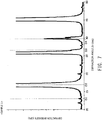
- FIGS. 7 to 11 are explanatory views showing X-ray diffraction patterns of samples 1 to 5.
- the vertical axis corresponds to diffraction intensity (CPS)
- the horizontal axis corresponds to diffraction angle 2 ⁇ (deg).
- the mica thermal treatment is performed through heating at a temperature of 1,000(°C) for 30 hours.
- the X-ray diffraction pattern of sample 1 is shown in FIG. 7 .
- the X-ray diffraction pattern of sample 1 was compared with a database of diffraction patterns of known substances (e.g., the Powder Diffraction File (PDF) card in the present embodiment).
- PDF Powder Diffraction File
- the X-ray diffraction pattern of sample 1 was determined to include an intensity peak of a Miller-index (003) plane of soft mica (see diffraction angle D2) and, for example, intensity peaks of Miller-index (120), (211), and (221) planes of forsterite (diffraction angles D1, D3, and D4).
- sample 1 is determined to contain soft mica and forsterite crystals.
- the aforementioned peak intensity ratio is 0.0012.
- the mica thermal treatment is performed through heating at a temperature of 1,100(°C) for five hours.
- the X-ray diffraction pattern of sample 2 is shown in FIG. 8 .
- the X-ray diffraction pattern of sample 2 was compared with the PDF card.
- the X-ray diffraction pattern of sample 2 was determined to include an intensity peak of a Miller-index (003) plane of soft mica (see diffraction angle D2) and, for example, intensity peaks of Miller-index (120), (211), and (221) planes of forsterite (diffraction angles D1, D3, and D4) as in the case of sample 1.
- sample 2 is determined to contain soft mica and forsterite crystals.
- the aforementioned peak intensity ratio is 0.0031.
- the mica thermal treatment is performed through heating at a temperature of 1,100(°C) for 30 hours.
- the X-ray diffraction pattern of sample 3 is shown in FIG. 9 .
- the X-ray diffraction pattern of sample 3 was compared with the PDF card.
- the X-ray diffraction pattern of sample 3 was determined to include an intensity peak of a Miller-index (003) plane of soft mica (see diffraction angle D2) and, for example, intensity peaks of Miller-index (120), (211), and (221) planes of forsterite (diffraction angles D1, D3, and D4) as in the cases of samples 1 and 2.
- sample 3 is determined to contain soft mica and forsterite crystals.
- the aforementioned peak intensity ratio is 0.0282.
- the mica thermal treatment is performed through heating at a temperature of 1,000(°C) for 120 hours.
- the X-ray diffraction pattern of sample 4 is shown in FIG. 10 .
- the X-ray diffraction pattern of sample 4 was compared with the PDF card.
- the X-ray diffraction pattern of sample 4 was determined to include an intensity peak of a Miller-index (003) plane of soft mica (see diffraction angle D2) and, for example, intensity peaks of Miller-index (120), (211), and (221) planes of forsterite (diffraction angles D1, D3, and D4) as in the cases of samples 1 and 2.
- sample 4 is determined to contain soft mica and forsterite crystals.
- the aforementioned peak intensity ratio is 0.1500.
- the mica thermal treatment is performed through heating at a temperature of 850(°C) for five hours.
- the X-ray diffraction pattern of sample 5 is shown in FIG. 11 .
- the X-ray diffraction pattern of sample 5 was compared with the PDF card.
- the X-ray diffraction pattern of sample 5 was determined to include an intensity peak of a Miller-index (003) plane of soft mica (see diffraction angle D2), but was barely determined to include intensity peaks of forsterite unlike the cases of samples 1 to 3.
- sample 5 is determined to contain a soft mica crystal but no forsterite crystal.
- the aforementioned peak intensity ratio is 0.0002.
- sample 6 In the production process for sample 6, the mica thermal treatment is performed through heating at a temperature of 1,300(°C) for 30 hours. Sample 6 was broken as a result of the mica thermal treatment under these conditions. Thus, sample 6 was subjected to neither qualitative analysis nor performance evaluation.
- Each of the fuel cell stacks 100 including samples 1 to 5 was subjected to an energization test for 400 hours while air (i.e., oxidizer gas OG) was supplied to the cathode 114 and 40% water vapor and hydrogen (i.e., fuel gas FG) were supplied to the anode 116 at 850(°C).
- air i.e., oxidizer gas OG
- water vapor and hydrogen i.e., fuel gas FG
- the output voltage of the fuel cell stack 100 was measured at a current density of 0.55 (A/cm 2 ), and the measured value was defined as initial voltage. Subsequently, rated electricity generation was initiated while air (i.e., oxidizer gas OG) was supplied to the cathode 114 and 4% water vapor and hydrogen (i.e., fuel gas FG) were supplied to the anode 116 at about 700(°C). Thereafter, the output voltage of the fuel cell stack 100 (post-test voltage) was measured at a current density of 0.55 (A/cm 2 ), and a difference between the initial voltage and the post-test voltage (i.e., voltage reduction (mV)) was calculated.
- air i.e., oxidizer gas OG
- water vapor and hydrogen i.e., fuel gas FG
- the post-test voltage corresponds to the output voltage of the fuel cell stack 100 at a temperature lower than that during the energization test. Thus, the voltage difference becomes noticeable, and voltage reduction can be more clearly evaluated. Rating "O" was assigned to a sample exhibiting a voltage reduction less than a reference voltage (e.g., 65 (mV)), whereas rating "X" was assigned to a sample exhibiting a voltage reduction equal to or higher than the reference voltage.
- the initial voltage of the fuel cell stack 100 corresponds to a voltage measured after the fuel cell stack 100 is shipped in an electricity-generable state and rated electricity generation is performed within 1,000 hours.
- Each of the fuel cell stacks 100 including samples 1 to 5 that had been evaluated for the aforementioned performance (voltage reduction) was used to measure the amount of Si deposited on the surface (exposed to the fuel gas FG) of the anode 116 of the unit cell 110 of the fuel cell stack 100.
- the amount of deposited Si can be regarded as the amount of scattered Si in each of samples 1 to 5.
- the amount of scattered Si is measured by a method described below.
- a measurement sample including the surface (exposed to the fuel gas FG) of the anode 116 of the unit cell 110.
- the measurement sample is subjected to secondary ion mass spectrometry (SIMS), to thereby determine the amount of Si deposited on the fuel gas FG-exposed surface of the measurement sample.
- SIMS secondary ion mass spectrometry
- the measurement sample is placed in an SIMS apparatus, and the fuel gas FG-exposed surface of the measurement sample is irradiated with primary ions. This irradiation causes emission of secondary ions from the surface of the measurement sample.
- the mass analysis of the secondary ions can determine the amount of deposited Si.
- the amount of deposited Si is regarded as the amount of scattered Si in each of samples 1 to 5.
- each of samples 1 to 4 contains soft mica and forsterite crystals, whereas sample 5 contains a soft mica crystal but no forsterite crystal.
- each of samples 1 to 4 which contains soft mica and forsterite crystals, has a more stable crystal structure (i.e., Si is less likely to scatter (stronger bonding to Si)) than sample 5, which contains a soft mica crystal but no forsterite crystal.
- Scattered Si may deposit on, for example, the surface of an oxygen ion-conductive material forming the anode 116, leading to a decrease in the area of three-phase interface serving as a reaction field, resulting in a change (reduction) in the electricity generation performance of the fuel cell stack 100.
- the amount of scattered Si in samples 1 to 4 is smaller than that in sample 5. This probably causes prevention of voltage reduction in the fuel cell stack 100.
- the peak intensity ratio is higher than that in sample 5.
- the peak intensity ratio is particularly preferably 0.001 to 0.15.
- a peak intensity ratio of 0.001 or more can contribute to more reliable reduction in Si scattering. However, a higher peak intensity ratio may cause impairment of intrinsic properties of mica (e.g., sealing property).
- a peak intensity ratio of 0.15 or less can lead to prevention of impairment of intrinsic properties of mica.
- the peak intensity ratio is more preferably 0.003 or more, still more preferably 0.025 or more.
- the peak intensity ratio is more preferably 0.029 or less.
- the results of evaluation of samples 1 to 4 will now be examined.
- an increase in the temperature of the mica thermal treatment leads to an increase in peak intensity ratio and a decrease in voltage reduction.
- an increase in the temperature of the mica thermal treatment results in a stable crystal structure of the workpiece with reduced Si scattering.
- the temperature of the mica thermal treatment is preferably lower than 1,300(°C).
- a longer heating time leads to an increase in peak intensity ratio and a decrease in voltage reduction.
- prolongation of the heating time in the mica thermal treatment results in a stable crystal structure of the workpiece with reduced Si scattering.
- a mica-made member having a crystal structure exhibiting an intensity peak of KMg 3 (Si 3 Al)O 10 (OH) 2 (soft mica) and an intensity peak of Mg 2 SiO 4 (forsterite) in XRD can reduce Si scattering to a greater extent than can pure soft mica exhibiting only an intensity peak of KMg 3 (Si 3 Al)O 10 (OH) 2 in XRD.
- the spacer 149 which has a crystal structure exhibiting an intensity peak of KMg 3 (Si 3 Al)O 10 (OH) 2 and an intensity peak of Mg 2 SiO 4 in XRD, can reduce Si scattering.
- the ratio of the intensity of the peak of the (120) plane of Mg 2 SiO 4 to the intensity of the peak of the (003) plane of KMg 3 (Si 3 Al)O 10 (OH) 2 is 0.001 or more, Si scattering can be more reliably reduced. Since the aforementioned peak intensity ratio is 0.029 or less, impairment of intrinsic properties of mica (e.g., sealing property) can be prevented.
- the spacer 149 is exemplified as the mica-made member or the structural member.
- the present invention is not limited thereto, and may be applied to the cathode-side frame 130 formed of mica. If the anode-side frame 140 is formed of mica, the present invention may be applied to the anode-side frame 140.
- the present invention may be applied to a mica-made member used in a product other than SOFC.
- the intensity peak ratio is preferably 0.001 to 0.029 in the X-ray diffraction pattern of the spacer 149.
- the intensity peak ratio is not limited thereto, and may be, for example, 0.03 or more.
- the mica-made member should have at least a crystal structure exhibiting an intensity peak of KMg 3 (Si 3 Al)O 10 (OH) 2 and an intensity peak of Mg 2 SiO 4 in XRD.
- the number of the electricity generation units 102 included in the fuel cell stack 100 is a mere example and is determined as appropriate in accordance with, for example, a required output voltage of the fuel cell stack 100.
- the nut 24 is engaged with each of opposite ends of the bolt 22.
- the bolt 22 may have a head, and the nut 24 may be engaged with only an end opposite the head of the bolt 22.
- the end plates 104 and 106 function as output terminals.
- other members connected respectively to the end plates 104 and 106 e.g., electrically conductive plates disposed respectively between the end plate 104 and the electricity generation unit 102 and between the end plate 106 and the electricity generation unit 102 may function as output terminals.
- spaces between the outer circumferential surfaces of shaft portions of the bolts 22 and the inner circumferential surfaces of the communication holes 108 are utilized as manifolds.
- axial holes may be provided in the shaft portions of the bolts 22 for use as the manifolds.
- the manifolds may be provided separately from the communication holes 108 into which the bolts 22 are inserted.
- the adjacent two electricity generation units 102 share a single interconnector 150.
- two electricity generation units 102 may have respective interconnectors 150.
- the uppermost electricity generation unit 102 in the fuel cell stack 100 does not have the upper interconnector 150
- the lowermost electricity generation unit 102 in the fuel cell stack 100 does not have the lower interconnector 150.
- these interconnectors 150 may be provided without elimination.
- the anode-side current collector 144 may have a structure similar to that of the cathode-side current collector 134; i.e., the anode-side current collector 144 and the adjacent interconnector 150 may be integrally formed as a unitary member.
- the anode-side frame 140 rather than the cathode-side frame 130 may be an insulator.
- the cathode-side frame 130 or the anode-side frame 140 may have a multilayer structure.
- materials used for formation of the members are provided merely by way of example. Other materials may be used to form the members.
- the hydrogen-rich fuel gas FG is obtained by reforming city gas.
- the fuel gas FG may be obtained from another material, such as LP gas, kerosene, methanol, or gasoline.
- pure hydrogen may be used as the fuel gas FG.
- each of the unit cells 110 included in the fuel cell stack 100 is configured to satisfy the requirements described above in the embodiment. If at least one electricity generation unit 102 included in the fuel cell stack 100 has such a configuration, the compatibility between an improvement in the electricity generation performance of the unit cell 110 and maintenance of the strength thereof can be achieved.
- the above embodiment corresponds to an SOFC for generating electricity by utilizing the electrochemical reaction between hydrogen contained in fuel gas and oxygen contained in oxidizer gas; however, the present invention is also applicable to an electrolysis cell unit which is the smallest unit of a solid oxide electrolysis cell (SOEC) for generating hydrogen by utilizing the electrolysis of water, and to an electrolysis cell stack having a plurality of electrolysis cell units. Since the structure of the electrolysis cell stack is publicly known as described in, for example, Japanese Patent Application Laid-Open (kokai) No. 2016-81813 , detailed description thereof is omitted, but schematically, the electrolysis cell stack has a structure similar to that of the fuel cell stack 100 in the above embodiment.
- SOEC solid oxide electrolysis cell
- the fuel cell stack 100 in the above embodiment may be read as “electrolysis cell stack,” and the electricity generation unit 102 may be read as “electrolysis cell unit.”
- voltage is applied between the cathode 114 and the anode 116 such that the cathode 114 is a positive electrode (anode), whereas the anode 116 is a negative electrode (cathode), and water vapor is supplied as material gas through the communication hole 108. Consequently, the electrolysis of water occurs in the electrolysis cell units, whereby hydrogen gas is generated in the anode chambers 176, and hydrogen is discharged to the outside of the electrolysis cell stack through the communication hole 108.
- the compatibility between an improvement in the electrochemical reaction property of the electrolysis cell and maintenance of the strength thereof can be achieved by configuring the anode 116 as in the above embodiment.
Landscapes
- Chemical & Material Sciences (AREA)
- Engineering & Computer Science (AREA)
- Electrochemistry (AREA)
- Chemical Kinetics & Catalysis (AREA)
- Organic Chemistry (AREA)
- General Chemical & Material Sciences (AREA)
- Sustainable Energy (AREA)
- Sustainable Development (AREA)
- Life Sciences & Earth Sciences (AREA)
- Manufacturing & Machinery (AREA)
- Materials Engineering (AREA)
- Metallurgy (AREA)
- Inorganic Chemistry (AREA)
- Fuel Cell (AREA)
- Silicates, Zeolites, And Molecular Sieves (AREA)
- Analysing Materials By The Use Of Radiation (AREA)
Abstract
Description
- A technique disclosed in the present specification relates to a mica-made member.
- A known type of a fuel cell for generating electricity by utilizing electrochemical reaction between hydrogen and oxygen is a solid oxide fuel cell (hereinafter may be referred to as "SOFC"). A fuel cell electricity generation unit forming the SOFC includes a fuel cell unit cell including an electrolyte layer, a cathode, and an anode such that the cathode and the anode face each other in a first direction and the electrolyte layer intervenes between these electrodes. The fuel cell electricity generation unit also includes a cathode-side member and an anode-side member. The cathode-side member forms a cathode chamber facing the cathode, and the anode-side member forms an anode chamber facing the anode. In a certain type of fuel cell electricity generation unit, the cathode-side member or the anode-side member is formed of mica (see
Patent Documents 1 and 2). - A certain type of mica sheet contains an Si (silicon)-containing binder. In the case where the anode-side member is formed of such a mica sheet containing an Si-containing binder, an increase in temperature due to electricity generating operation may cause scattering of Si contained in the anode-side member. Scattered Si may deposit on, for example, the surface of an oxygen ion-conductive material forming the anode, leading to a decrease in the area of three-phase interface serving as a reaction field, resulting in a change (reduction) in the electricity generation performance of the fuel cell electricity generation unit. A disclosed technique for solving such a problem involves heating of a mica sheet containing a binder at a temperature of lower than 850(°C) to thereby cause scattering of Si contained in the binder, and use of the mica sheet as an anode-side member (see Patent Document 3).
-
- Patent Document 1: Japanese Patent Application Laid-Open (kokai) No.
H04-162312 - Patent Document 2: Japanese Patent Application Laid-Open (kokai) No.
H07-282835 - Patent Document 3: Japanese Patent Application Laid-Open (kokai) No.
2015-125981 - Si is contained not only in the binder contained in the mica sheet, but also in mica itself. Thus, the aforementioned technique involving heating of the mica sheet at a temperature of lower than 850(°C) may fail to reduce scattering of Si contained in mica itself, even if the technique can reduce scattering of Si contained in the binder.
- Such a problem is common with a mica-made member used in an electrolysis cell, which is a minimum constitutive unit of a solid oxide electrolysis cell (hereinafter may be referred to as "SOEC") for generating hydrogen by utilizing the electrolysis of water. In the present specification, a fuel cell unit and an electrolysis cell unit are collectively referred to as an "electrochemical reaction unit." Such a problem is also common with a mica-made member used in products other than electrochemical reaction units.
- The present specification discloses a technique capable of solving the aforementioned problems.
- A technique disclosed in the present specification can be implemented in the following modes.
- (1) The mica-made member disclosed in the specification has a crystal structure exhibiting a diffraction intensity peak attributed to (hereinafter referred to simply as "an intensity peak of") KMg3 (Si3Al)O10(OH)2 and a diffraction intensity peak attributed to (hereinafter referred to simply as "an intensity peak of") Mg2SiO4 in X-ray diffractometry (XRD). The present inventors have found that, on the basis of the results of, for example, experiments, a mica-made member having a crystal structure exhibiting an intensity peak of KMg3(Si3Al)O10(OH)2 (soft mica) and an intensity peak of Mg2SiO4 (forsterite) in X-ray diffractometry (XRD) can reduce Si scattering to a greater extent than can pure soft mica exhibiting only an intensity peak of KMg3(Si3Al)O10(OH)2 in XRD. Thus, the mica-made member, which has a crystal structure exhibiting an intensity peak of KMg3(Si3Al)O10(OH)2 and an intensity peak of Mg2SiO4 in XRD, can reduce Si scattering. This reduction in Si scattering is probably attributed to the fact that an Mg2SiO4 crystal structure is more stable and less likely to be degraded than is a KMg3(Si3Al)O10(OH)2 crystal structure.
- (2) In the aforementioned mica-made member, the ratio of the intensity of a peak of the (120) plane of Mg2SiO4 to the intensity of a peak of the (003) plane of KMg3(Si3Al)O10(OH)2 may be adjusted to 0.001 or more. According to the mica-made member, the ratio of the intensity of the peak of the (120) plane of Mg2SiO4 to the intensity of the peak of the (003) plane of KMg3(Si3Al)O10(OH)2 is 0.001 or more, and thus Si is present in the form of Mg2SiO4. Therefore, Si scattering can be more reliably reduced.
- (3) In the aforementioned mica-made member, the ratio of the intensity of the peak of the (120) plane of Mg2SiO4 to the intensity of the peak of the (003) plane of KMg3(Si3Al)O10(OH)2 may be adjusted to 0.15 or less. Since the ratio of the intensity of the peak of the (120) plane of Mg2SiO4 to the intensity of the peak of the (003) plane of KMg3(Si3Al)O10(OH)2 is 0.15 or less, Si is also present in the form of KMg3(Si3Al)O10(OH)2 in a sufficient amount. Therefore, impairment of intrinsic properties of mica (e.g., sealing property) can be prevented.
- (4) In the aforementioned mica-made member, the ratio of the intensity of the peak of the (120) plane of Mg2SiO4 to the intensity of the peak of the (003) plane of KMg3(Si3Al)O10(OH)2 may be adjusted to 0.003 or more. Since the ratio of the intensity of the peak of the (120) plane of Mg2SiO4 to the intensity of the peak of the (003) plane of KMg3(Si3Al)O10(OH)2 is 0.003 or more, Si is present in the form of Mg2SiO4. Therefore, Si scattering can be more reliably reduced.
- (5) In the aforementioned the mica-made member, the ratio of the intensity of the peak of the (120) plane of Mg2SiO4 to the intensity of the peak of the (003) plane of KMg3(Si3Al)O10(OH)2 may be adjusted to 0.029 or less. Since the ratio of the intensity of the peak of the (120) plane of Mg2SiO4 to the intensity of the peak of the (003) plane of KMg3(Si3Al)O10(OH)2 is 0.029 or less, Si is also present in the form of KMg3(Si3Al)O10(OH)2 in a sufficient amount. Therefore, impairment of intrinsic properties of mica (e.g., sealing property) can be prevented.
- (6) In an electrochemical reaction unit comprising a unit cell including an electrolyte layer, and a cathode and an anode that face each other in a first direction with the electrolyte layer intervening therebetween; and a structural member that faces a cathode chamber facing the cathode or an anode chamber facing the anode, the structural member may be formed of a mica-made member as recited in any one of the above paragraphs (1) to (5). According to the electrochemical reaction unit, impairment of the performance of the reaction unit, which would otherwise occur due to Si scattering in the cathode chamber or the anode chamber, can be prevented.
- (7) In an electrochemical reaction cell stack comprising a plurality of electrochemical reaction units arrayed in a first direction, at least one of the electrochemical reaction units may be an electrochemical reaction unit as recited in the above paragraph (6).
- The technique disclosed in the present specification can be implemented in various modes; for example, a mica-made member, a structural member, an electrochemical reaction unit cell (fuel cell unit cell or electrolysis cell), an electrochemical reaction unit (fuel cell electricity generation unit), an electrochemical reaction cell stack (fuel cell stack or electrolysis cell stack) including a plurality of electrochemical reaction unit cells, and a production method therefor.
-
- [
FIG. 1 ] Perspective view showing the external appearance of afuel cell stack 100 according to an embodiment. - [
FIG. 2 ] Explanatory view showing an XZ section of thefuel cell stack 100 taken along line II-II ofFIG. 1 . - [
FIG. 3 ] Explanatory view showing a YZ section of thefuel cell stack 100 taken along line III-III ofFIG. 1 . - [
FIG. 4 ] Explanatory view of the same XZ section as that ofFIG. 2 , showing two adjacentelectricity generation units 102. - [
FIG. 5 ] Explanatory view of the same YZ section as that ofFIG. 3 , showing two adjacentelectricity generation units 102. - [
FIG. 6 ] Explanatory view showing the results of performance evaluation of samples. - [
FIG. 7 ] Explanatory view showing an X-ray diffraction pattern ofsample 1. - [
FIG. 8 ] Explanatory view showing an X-ray diffraction pattern ofsample 2. - [
FIG. 9 ] Explanatory view showing an X-ray diffraction pattern ofsample 3. - [
FIG. 10 ] Explanatory view showing an X-ray diffraction pattern ofsample 4. - [
FIG. 11 ] Explanatory view showing an X-ray diffraction pattern ofsample 5. -
FIG. 1 is a perspective view showing the external appearance of afuel cell stack 100 according to the present embodiment;FIG. 2 is an explanatory view showing an XZ section of thefuel cell stack 100 taken along line II-II ofFIG. 1 ; andFIG. 3 is an explanatory view showing a YZ section of thefuel cell stack 100 taken along line III-III ofFIG. 1 .FIGS. 1 to 3 show mutually orthogonal X-axis, Y-axis, and Z-axis for specifying respective directions. In the present specification, for the sake of convenience, the positive Z-axis direction is called the "upward direction" and the negative Z-axis direction is called the "downward direction"; however, in actuality, thefuel cell stack 100 may be disposed in a different orientation. The same also applies toFIG. 4 and subsequent drawings. The fuel cell stack corresponds to the electrochemical reaction cell stack appearing in CLAIMS. - The
fuel cell stack 100 includes a plurality of (seven in the present embodiment) ofelectricity generation units 102 and a pair ofend plates electricity generation units 102 are disposed in a predetermined direction of array (in the vertical direction in the present embodiment). A pair of theend plates electricity generation units 102 from the upper and lower sides thereof. The direction of array (vertical direction) corresponds to the first direction appearing in CLAIMS. - The
fuel cell stack 100 has a plurality (eight in the present embodiment) of holes extending in the vertical direction through peripheral portions about the Z-axis direction of its component layers (theelectricity generation units 102 and theend plates 104 and 106). The corresponding holes formed in the layers communicate with one another in the vertical direction, thereby formingcommunication holes 108 extending in the vertical direction from oneend plate 104 to theother end plate 106. In the following description, individual holes which constitute eachcommunication hole 108 and are formed in the individual layers of thefuel cell stack 100 will be referred to as the "communication holes 108." -
Bolts 22 extending in the vertical direction are inserted into the corresponding communication holes 108, and thefuel cell stack 100 is fastened by means of thebolts 22 andnuts 24 engaged with opposite ends of thebolts 22. As shown inFIGS. 2 and3 ,corresponding insulation sheets 26 intervene between the nuts 24 engaged with one ends (upper ends) of thebolts 22 and the upper surface of theend plate 104 serving as the upper end of thefuel cell stack 100 and between the nuts 24 engaged with the other ends (lower ends) of thebolts 22 and the lower surface of theend plate 106 serving as the lower end of thefuel cell stack 100.
However, in each region where agas passage member 27, which will be described later, is provided, thegas passage member 27 and theinsulation sheets 26 disposed respectively on the upper end and on the lower end of thegas passage member 27 intervene between thenut 24 and the surface of theend plate 106. Theinsulation sheet 26 is formed of, for example, a mica sheet, a ceramic fiber sheet, a ceramic compact sheet, a glass sheet, or a glass ceramic composite material. - The outside diameter of a shaft portion of each
bolt 22 is smaller than the inside diameter of eachcommunication hole 108. Accordingly, a space exists between the outer circumferential surface of the shaft portion of eachbolt 22 and the inner circumferential surface of eachcommunication hole 108. As shown inFIGS. 1 and2 , a space defined by the bolt 22 (bolt 22A) located at around the midpoint of one side of the perimeter about the Z-axis direction of the fuel cell stack 100 (a side at the positive side in the X-axis direction of two sides in parallel with the Y-axis) and thecommunication hole 108 into which thebolt 22A is inserted functions as an oxidizergas introduction manifold 161 into which oxidizer gas OG is introduced from outside thefuel cell stack 100 and which serves as a gas flow channel for supplying the oxidizer gas OG to theelectricity generation units 102, whereas a space defined by the bolt 22 (bolt 22B) located at around the midpoint of the other side opposite the above side (a side at the negative side in the X-axis direction of two sides in parallel with the Y-axis) and thecommunication hole 108 into which thebolt 22B is inserted functions as an oxidizergas discharge manifold 162 from which oxidizer offgas OOG discharged from thecathode chambers 166 of theelectricity generation units 102 is discharged to the outside of thefuel cell stack 100. In the present embodiment, for example, air is used as the oxidizer gas OG. - As shown in
FIGS. 1 and3 , a space defined by the bolt 22 (bolt 22D) located at around the midpoint of one side of the perimeter about the Z-axis direction of the fuel cell stack 100 (a side at the positive side in the Y-axis direction of two sides in parallel with the X-axis) and thecommunication hole 108 into which thebolt 22D is inserted functions as a fuelgas introduction manifold 171 into which fuel gas FG is introduced from outside thefuel cell stack 100 and which supplies the fuel gas FG to theelectricity generation units 102, whereas a space defined by the bolt 22 (bolt 22E) located at around the midpoint of the other side opposite the above side (a side at the negative side in the Y-axis direction of two sides in parallel with the X-axis) and thecommunication hole 108 into which thebolt 22E is inserted functions as a fuelgas discharge manifold 172 from which fuel offgas FOG discharged from theanode chambers 176 of theelectricity generation units 102 is discharged to the outside of thefuel cell stack 100. In the present embodiment, for example, hydrogen-rich gas reformed from city gas is used as the fuel gas FG. - The
fuel cell stack 100 has fourgas passage members 27. Eachgas passage member 27 has atubular body portion 28 and atubular branch portion 29 branching from the side surface of thebody portion 28. The hole of thebranch portion 29 communicates with the hole of thebody portion 28. A gas pipe (not shown) is connected to thebranch portion 29 of eachgas passage member 27. As shown inFIG. 2 , the hole of thebody portion 28 of thegas passage member 27 disposed at the position of thebolt 22A which partially defines the oxidizergas introduction manifold 161 communicates with the oxidizergas introduction manifold 161, whereas the hole of thebody portion 28 of thegas passage member 27 disposed at the position of thebolt 22B which partially defines the oxidizergas discharge manifold 162 communicates with the oxidizergas discharge manifold 162. Also, as shown inFIG. 3 , the hole of thebody portion 28 of thegas passage member 27 disposed at the position of thebolt 22D which partially defines the fuelgas introduction manifold 171 communicates with the fuelgas introduction manifold 171, whereas the hole of thebody portion 28 of thegas passage member 27 disposed at the position of thebolt 22E which partially defines the fuelgas discharge manifold 172 communicates with the fuelgas discharge manifold 172. - The two
end plates end plate 104 is disposed on the uppermostelectricity generation unit 102, and theother end plate 106 is disposed under the lowermostelectricity generation unit 102. A plurality of theelectricity generation units 102 are held under pressure between the twoend plates upper end plate 104 functions as a positive output terminal of thefuel cell stack 100, and thelower end plate 106 functions as a negative output terminal of thefuel cell stack 100. -
FIG. 4 is an explanatory view of the same XZ section as that ofFIG. 2 , showing two adjacentelectricity generation units 102, andFIG. 5 is an explanatory view of the same YZ section as that ofFIG. 3 , showing two adjacentelectricity generation units 102. - As shown in
FIGS. 4 and5 , theelectricity generation unit 102, which is a minimum unit for electricity generation, includes aunit cell 110, aseparator 120, a cathode-side frame 130, a cathode-sidecurrent collector 134, an anode-side frame 140, an anode-sidecurrent collector 144, and a pair ofinterconnectors 150 serving as the uppermost layer and the lowermost layer of theelectricity generation unit 102. Holes corresponding to the communication holes 108 into which thebolts 22 are inserted are formed in peripheral portions about the Z-axis direction of theseparator 120, the cathode-side frame 130, the anode-side frame 140, and theinterconnectors 150. Theelectricity generation unit 102 corresponds to the electrochemical reaction unit appearing in CLAIMS. - The
interconnector 150 is an electrically conductive member having an approximately rectangular flat plate shape and is formed of, for example, ferritic stainless steel. Theinterconnector 150 secures electrical conductivity between theelectricity generation units 102 and prevents mixing of reaction gases between theelectricity generation units 102. In the present embodiment, twoelectricity generation units 102 are disposed adjacent to each other, and the two adjacentelectricity generation units 102 share oneinterconnector 150. That is, theupper interconnector 150 of a certainelectricity generation unit 102 serves as alower interconnector 150 of the upper adjacentelectricity generation unit 102. Also, since thefuel cell stack 100 has the twoend plates electricity generation unit 102 of thefuel cell stack 100 does not have theupper interconnector 150, and the lowermostelectricity generation unit 102 does not have the lower interconnector 150 (seeFIGS. 2 and3 ). - The
unit cell 110 includes anelectrolyte layer 112, acathode 114 and ananode 116 which face each other in the vertical direction (in the direction of array of the electricity generation units 102) with theelectrolyte layer 112 intervening therebetween. Theunit cell 110 of the present embodiment is an anode-support-type unit cell in which theanode 116 supports theelectrolyte layer 112 and thecathode 114. - The
electrolyte layer 112 is a member having an approximately rectangular flat-plate shape and containing at least Zr. Theelectrolyte layer 112 is formed of a solid oxide, such as YSZ (yttria-stabilized zirconia), ScSZ (scandia-stabilized zirconia), or CaSZ (calcia-stabilized zirconia). Thecathode 114 is a member having an approximately rectangular flat-plate shape and is formed of, for example, a perovskite oxide (e.g., LSCF (lanthanum strontium cobalt ferrite), LSM (lanthanum strontium manganese oxide), or LNF (lanthanum nickel ferrite)). Theanode 116 is a member having an approximately rectangular flat-plate shape and is formed of, for example, Ni (nickel), a cermet of Ni and ceramic particles, or an Ni-based alloy. Thus, the unit cell 110 (electricity generation unit 102) according to the present embodiment is a solid oxide fuel cell (SOFC) containing a solid oxide as an electrolyte. - The
separator 120 is a frame member which has an approximatelyrectangular hole 121 formed in a central region thereof and extending therethrough in the vertical direction, and is formed of, for example, a metal. A portion of theseparator 120 around thehole 121 faces a peripheral portion of the surface of theelectrolyte layer 112 on thecathode 114 side. Theseparator 120 is bonded to the electrolyte layer 112 (unit cell 110) by means of abonding layer 124 formed of a brazing material (e.g., Ag brazing material) and disposed between the facing portion of theseparator 120 and theelectrolyte layer 112. Theseparator 120 separates thecathode chamber 166 which faces thecathode 114, and theanode chamber 176 which faces theanode 116, from each other, thereby preventing gas leakage from one electrode side to the other electrode side at a peripheral portion of theunit cell 110. Theunit cell 110 to which theseparator 120 is bonded is called a "separator-attached unit cell." - The cathode-
side frame 130 is a frame member which has an approximatelyrectangular hole 131 formed in a central region thereof and extending therethrough in the vertical direction, and is formed of, for example, an insulator such as mica. Thehole 131 of the cathode-side frame 130 partially constitutes thecathode chamber 166 which faces thecathode 114. The cathode-side frame 130 is in contact with a peripheral portion of the surface of theseparator 120 on the side opposite theelectrolyte layer 112 and with a peripheral portion of the surface of theinterconnector 150 on the side toward thecathode 114. The cathode-side frame 130 electrically insulates the twointerconnectors 150 included in theelectricity generation unit 102 from each other.
Also, the cathode-side frame 130 has an oxidizer gassupply communication hole 132 formed therein and adapted to establish communication between the oxidizergas introduction manifold 161 and thecathode chamber 166, and an oxidizer gasdischarge communication hole 133 formed therein and adapted to establish communication between thecathode chamber 166 and the oxidizergas discharge manifold 162. - The anode-
side frame 140 is a frame member which has an approximatelyrectangular hole 141 formed in a central region thereof and extending therethrough in the vertical direction, and is formed of, for example, a metal. Thehole 141 of the anode-side frame 140 partially constitutes theanode chamber 176 which faces theanode 116. The anode-side frame 140 is in contact with a peripheral portion of the surface of theseparator 120 on the side toward theelectrolyte layer 112 and with a peripheral portion of the surface of theinterconnector 150 on the side toward theanode 116. Also, the anode-side frame 140 has a fuel gassupply communication hole 142 formed therein and adapted to establish communication between the fuelgas introduction manifold 171 and theanode chamber 176, and a fuel gasdischarge communication hole 143 formed therein and adapted to establish communication between theanode chamber 176 and the fuelgas discharge manifold 172. - The anode-side
current collector 144 is disposed within theanode chamber 176. The anode-sidecurrent collector 144 includes aninterconnector facing portion 146, anelectrode facing portion 145, and aconnection portion 147 which connects theelectrode facing portion 145 and theinterconnector facing portion 146 to each other, and is formed of, for example, nickel, a nickel alloy, or stainless steel. Theelectrode facing portion 145 is in contact with the surface of theanode 116 on the side opposite theelectrolyte layer 112, and theinterconnector facing portion 146 is in contact with the surface of theinterconnector 150 on the side toward theanode 116. As described above, since theelectricity generation unit 102 disposed at the lowermost position in thefuel cell stack 100 does not have thelower interconnector 150, theinterconnector facing portion 146 in the lowermostelectricity generation unit 102 is in contact with thelower end plate 106. Since the anode-sidecurrent collector 144 is thus configured, the anode-sidecurrent collector 144 electrically connects theanode 116 and the interconnector 150 (or the end plate 106) to each other. Aspacer 149 formed of, for example, mica is disposed between theelectrode facing portion 145 and theinterconnector facing portion 146. Thus, the anode-sidecurrent collector 144 follows the deformation of theelectricity generation unit 102 stemming from a temperature cycle and a pressure variation of reaction gas, thereby maintaining good electrical connection between theanode 116 and the interconnector 150 (or the end plate 106) via the anode-sidecurrent collector 144. Thespacer 149 corresponds to the mica-made member or the structural member appearing in CLAIMS. - The cathode-side
current collector 134 is disposed within thecathode chamber 166. The cathode-sidecurrent collector 134 is composed of a plurality ofcurrent collector elements 135 each having an approximately rectangular columnar shape and is formed of, for example, ferritic stainless steel. The cathode-sidecurrent collector 134 is in contact with the surface of thecathode 114 on the side opposite theelectrolyte layer 112 and with the surface of theinterconnector 150 on the side toward thecathode 114. As described above, since theelectricity generation unit 102 disposed at the uppermost position in thefuel cell stack 100 does not have theupper interconnector 150, the cathode-sidecurrent collector 134 in the uppermostelectricity generation unit 102 is in contact with theupper end plate 104. Since the cathode-sidecurrent collector 134 is thus configured, the cathode-sidecurrent collector 134 electrically connects thecathode 114 and the interconnector 150 (or the end plate 104) to each other. The cathode-sidecurrent collector 134 and theinterconnector 150 may be integrally formed as a unitary member. - As shown in
FIGS. 2 and4 , when the oxidizer gas OG is supplied through a gas pipe (not shown) connected to thebranch portion 29 of thegas passage member 27 provided at the position of the oxidizergas introduction manifold 161, the oxidizer gas OG is supplied to the oxidizergas introduction manifold 161 through the holes of thebranch portion 29 and thebody portion 28 of thegas passage member 27 and is then supplied from the oxidizergas introduction manifold 161 to thecathode chambers 166 through the oxidizer gas supply communication holes 132 of theelectricity generation units 102. Also, as shown inFIGS. 3 and5 , when the fuel gas FG is supplied through a gas pipe (not shown) connected to thebranch portion 29 of thegas passage member 27 provided at the position of the fuelgas introduction manifold 171, the fuel gas FG is supplied to the fuelgas introduction manifold 171 through the holes of thebranch portion 29 and thebody portion 28 of thegas passage member 27 and is then supplied from the fuelgas introduction manifold 171 to theanode chambers 176 through the fuel gas supply communication holes 142 of theelectricity generation units 102. - When the oxidizer gas OG is supplied to the
cathode chamber 166 of eachelectricity generation unit 102, whereas the fuel gas FG is supplied to theanode chamber 176 of eachelectricity generation unit 102, theunit cell 110 generates electricity through the electrochemical reaction between the oxidizer gas OG and the fuel gas FG. The electricity generating reaction is an exothermic reaction. In eachelectricity generation unit 102, thecathode 114 of theunit cell 110 is electrically connected to oneinterconnector 150 through the cathode-sidecurrent collector 134, whereas theanode 116 is electrically connected to theother interconnector 150 through the anode-sidecurrent collector 144. Also, a plurality of theelectricity generation units 102 contained in thefuel cell stack 100 are connected electrically in series. Accordingly, electric energy generated in theelectricity generation units 102 is output from theend plates fuel cell stack 100. In the SOFC, since electricity is generated at a relatively high temperature (e.g., 700°C to 1,000°C), thefuel cell stack 100 may be heated by a heater (not shown) from startup until the high temperature can be maintained by means of heat generated as a result of generation of electricity. - As shown in
FIGS. 2 and4 , the oxidizer offgas OOG discharged from thecathode chambers 166 of theelectricity generation units 102 is discharged to the oxidizergas discharge manifold 162 through the oxidizer gas discharge communication holes 133, passes through the holes of thebody portion 28 and thebranch portion 29 of thegas passage member 27 provided at the position of the oxidizergas discharge manifold 162, and is then discharged to the outside of thefuel cell stack 100 through a gas pipe (not shown) connected to thebranch portion 29. Also, as shown inFIGS. 3 and5 , the fuel offgas FOG discharged from theanode chambers 176 of theelectricity generation units 102 is discharged to the fuelgas discharge manifold 172 through the fuel gas discharge communication holes 143, passes through the holes of thebody portion 28 and thebranch portion 29 of thegas passage member 27 provided at the position of the fuelgas discharge manifold 172, and is then discharged to the outside of thefuel cell stack 100 through a gas pipe (not shown) connected to thebranch portion 29. - The
spacer 149 has a crystal structure exhibiting an intensity peak (peak of diffraction intensity) of KMg3(Si3Al)O10(OH)2 (hereinafter referred to as "soft mica") and an intensity peak of Mg2SiO4 (hereinafter referred to as "forsterite") in X-ray diffractometry (XRD). In other words, an X-ray diffraction pattern obtained through XRD analysis of the material forming thespacer 149 includes an intensity peak of soft mica and an intensity peak of forsterite. In the X-ray diffraction pattern of the material forming thespacer 149, the ratio of the intensity of a peak of a Miller-index (120) plane of forsterite to the intensity of a peak of a Miller-index (003) plane of mica (hereinafter the ratio may be referred to as "peak intensity ratio") is preferably 0.001 to 0.029. - The
fuel cell stack 100 having the aforementioned configuration is produced by, for example, a method described below. Theunit cell 110 can be produced by any known method. For example, a green sheet for an anode substrate layer, a green sheet for an anode active layer, and a green sheet for an electrolyte layer are provided, and these green sheets are bonded together and then degreased at about 280°C. Subsequently, the resultant product was fired at about 1,350°C, to thereby prepare a laminate of theelectrolyte layer 112 and theanode 116. A mixture containing a material for forming a cathode is applied by spraying to the surface of theelectrolyte layer 112 of the laminate, followed by firing at 1,100°C, to thereby form thecathode 114. Theunit cell 110 having the aforementioned structure is produced through the above-described process. - The
spacer 149 can be produced through, for example, the following process. A mica sheet formed of soft mica having a thickness of 0.2 (mm) to 0.6 (mm) (manufactured by Okabe Mica Co., Ltd., product number: D581AK) is subjected to punching, to thereby prepare a flat plate-like workpiece. Subsequently, the workpiece is placed in a heating furnace and heated in air at a temperature of 1,000(°C) or higher for four or more hours. This process can produce thespacer 149 having the aforementioned crystal structure. - Thereafter, the
spacer 149 is disposed between theelectrode facing portion 145 and theinterconnector facing portion 146 of the anode-sidecurrent collector 144. The anode-sidecurrent collector 144, the anode-side frame 140, theseparator 120 brazed with theunit cell 110, and the cathode-side frame 130 are disposed between the pairedinterconnectors 150. Thus, theelectricity generation unit 102 can be produced. The subsequent assembly process is performed, to thereby complete the production of thefuel cell stack 100 having the aforementioned configuration. - Next will be described the performance evaluation of a plurality of
samples 1 to 6 (spacers) produced by different processes; i.e., under different conditions for thermal treatment of the aforementioned mica workpiece (hereinafter referred to as "mica thermal treatment"). For the performance evaluation of a plurality ofsamples 1 to 6, each sample was assembled into thefuel cell stack 100 having the aforementioned configuration, and thefuel cell stack 100 was subjected to determination of durability deterioration ratio (power generation deterioration ratio).FIG. 6 is an explanatory view showing the results of the performance evaluation of the samples. -
Samples 1 to 5 correspond to thespacer 149 having the aforementioned structure produced by the aforementioned process, andsample 6 corresponds to a spacer produced by a process in which the conditions for mica thermal treatment are different from those in the aforementioned process. Each of the thus-producedsamples 1 to 5 was subjected to XRD (powder X-ray diffractometry), to thereby obtain an X-ray diffraction pattern. Specifically, the X-ray diffraction pattern of each ofsamples 1 to 5 was obtained by means of an X-ray diffractometer through irradiation of a flat portion of the plate-like mica with X-rays.FIGS. 7 to 11 are explanatory views showing X-ray diffraction patterns ofsamples 1 to 5. The vertical axis corresponds to diffraction intensity (CPS), and the horizontal axis corresponds to diffraction angle 2θ (deg). - In the production process for
sample 1, the mica thermal treatment is performed through heating at a temperature of 1,000(°C) for 30 hours. The X-ray diffraction pattern ofsample 1 is shown inFIG. 7 . The X-ray diffraction pattern ofsample 1 was compared with a database of diffraction patterns of known substances (e.g., the Powder Diffraction File (PDF) card in the present embodiment). As a result, the X-ray diffraction pattern ofsample 1 was determined to include an intensity peak of a Miller-index (003) plane of soft mica (see diffraction angle D2) and, for example, intensity peaks of Miller-index (120), (211), and (221) planes of forsterite (diffraction angles D1, D3, and D4). Thus,sample 1 is determined to contain soft mica and forsterite crystals. Insample 1, the aforementioned peak intensity ratio is 0.0012. - In the production process for
sample 2, the mica thermal treatment is performed through heating at a temperature of 1,100(°C) for five hours. The X-ray diffraction pattern ofsample 2 is shown inFIG. 8 . The X-ray diffraction pattern ofsample 2 was compared with the PDF card. As a result, the X-ray diffraction pattern ofsample 2 was determined to include an intensity peak of a Miller-index (003) plane of soft mica (see diffraction angle D2) and, for example, intensity peaks of Miller-index (120), (211), and (221) planes of forsterite (diffraction angles D1, D3, and D4) as in the case ofsample 1. Thus,sample 2 is determined to contain soft mica and forsterite crystals. Insample 2, the aforementioned peak intensity ratio is 0.0031. - In the production process for
sample 3, the mica thermal treatment is performed through heating at a temperature of 1,100(°C) for 30 hours. The X-ray diffraction pattern ofsample 3 is shown inFIG. 9 . The X-ray diffraction pattern ofsample 3 was compared with the PDF card. As a result, the X-ray diffraction pattern ofsample 3 was determined to include an intensity peak of a Miller-index (003) plane of soft mica (see diffraction angle D2) and, for example, intensity peaks of Miller-index (120), (211), and (221) planes of forsterite (diffraction angles D1, D3, and D4) as in the cases ofsamples sample 3 is determined to contain soft mica and forsterite crystals. Insample 3, the aforementioned peak intensity ratio is 0.0282. - In the production process for
sample 4, the mica thermal treatment is performed through heating at a temperature of 1,000(°C) for 120 hours. The X-ray diffraction pattern ofsample 4 is shown inFIG. 10 . The X-ray diffraction pattern ofsample 4 was compared with the PDF card. As a result, the X-ray diffraction pattern ofsample 4 was determined to include an intensity peak of a Miller-index (003) plane of soft mica (see diffraction angle D2) and, for example, intensity peaks of Miller-index (120), (211), and (221) planes of forsterite (diffraction angles D1, D3, and D4) as in the cases ofsamples sample 4 is determined to contain soft mica and forsterite crystals. Insample 4, the aforementioned peak intensity ratio is 0.1500. - In the production process for
sample 5, the mica thermal treatment is performed through heating at a temperature of 850(°C) for five hours. The X-ray diffraction pattern ofsample 5 is shown inFIG. 11 . The X-ray diffraction pattern ofsample 5 was compared with the PDF card. As a result, the X-ray diffraction pattern ofsample 5 was determined to include an intensity peak of a Miller-index (003) plane of soft mica (see diffraction angle D2), but was barely determined to include intensity peaks of forsterite unlike the cases ofsamples 1 to 3. Thus,sample 5 is determined to contain a soft mica crystal but no forsterite crystal. Insample 5, the aforementioned peak intensity ratio is 0.0002. - In the production process for
sample 6, the mica thermal treatment is performed through heating at a temperature of 1,300(°C) for 30 hours.Sample 6 was broken as a result of the mica thermal treatment under these conditions. Thus,sample 6 was subjected to neither qualitative analysis nor performance evaluation. - Each of the fuel cell stacks 100 including
samples 1 to 5 (i.e., four fuel cell stacks 100) was subjected to an energization test for 400 hours while air (i.e., oxidizer gas OG) was supplied to thecathode anode 116 at 850(°C). In this energization test, the temperature of thefuel cell stack 100 is higher than that during rated electricity generation. Thus, Si (silicon) scattering is likely to occur in thefuel cell stack 100. At the initiation of the energization test, the output voltage of thefuel cell stack 100 was measured at a current density of 0.55 (A/cm2), and the measured value was defined as initial voltage. Subsequently, rated electricity generation was initiated while air (i.e., oxidizer gas OG) was supplied to thecathode anode 116 at about 700(°C). Thereafter, the output voltage of the fuel cell stack 100 (post-test voltage) was measured at a current density of 0.55 (A/cm2), and a difference between the initial voltage and the post-test voltage (i.e., voltage reduction (mV)) was calculated. A greater voltage reduction indicates a higher power generation deterioration ratio. The post-test voltage corresponds to the output voltage of thefuel cell stack 100 at a temperature lower than that during the energization test. Thus, the voltage difference becomes noticeable, and voltage reduction can be more clearly evaluated. Rating "O" was assigned to a sample exhibiting a voltage reduction less than a reference voltage (e.g., 65 (mV)), whereas rating "X" was assigned to a sample exhibiting a voltage reduction equal to or higher than the reference voltage. The initial voltage of thefuel cell stack 100 corresponds to a voltage measured after thefuel cell stack 100 is shipped in an electricity-generable state and rated electricity generation is performed within 1,000 hours. - Each of the fuel cell stacks 100 including
samples 1 to 5 that had been evaluated for the aforementioned performance (voltage reduction) was used to measure the amount of Si deposited on the surface (exposed to the fuel gas FG) of theanode 116 of theunit cell 110 of thefuel cell stack 100. The amount of deposited Si can be regarded as the amount of scattered Si in each ofsamples 1 to 5. The amount of scattered Si is measured by a method described below. There is provided a measurement sample including the surface (exposed to the fuel gas FG) of theanode 116 of theunit cell 110. The measurement sample is subjected to secondary ion mass spectrometry (SIMS), to thereby determine the amount of Si deposited on the fuel gas FG-exposed surface of the measurement sample. Specifically, the measurement sample is placed in an SIMS apparatus, and the fuel gas FG-exposed surface of the measurement sample is irradiated with primary ions. This irradiation causes emission of secondary ions from the surface of the measurement sample. The mass analysis of the secondary ions can determine the amount of deposited Si. The amount of deposited Si is regarded as the amount of scattered Si in each ofsamples 1 to 5. - The results of evaluation of
samples 1 to 5 will now be examined. As shown inFIG. 6 , rating "O" is assigned tosamples 1 to 4, whereas rating "X" is assigned to sample 5 for evaluation of voltage reduction. The amount of scattered Si is 600 to 690 (ppm) insamples 1 to 4, whereas the amount of scattered Si is 900 (ppm) insample 5; i.e., the amount of scattered Si insamples 1 to 4 is smaller than that insample 5. As described above, each ofsamples 1 to 4 contains soft mica and forsterite crystals, whereassample 5 contains a soft mica crystal but no forsterite crystal. - These results suggest that a reduction in the amount of scattered Si is attributed to a crystal structure containing soft mica and forsterite crystals. Thus, each of
samples 1 to 4, which contains soft mica and forsterite crystals, has a more stable crystal structure (i.e., Si is less likely to scatter (stronger bonding to Si)) thansample 5, which contains a soft mica crystal but no forsterite crystal. Scattered Si may deposit on, for example, the surface of an oxygen ion-conductive material forming theanode 116, leading to a decrease in the area of three-phase interface serving as a reaction field, resulting in a change (reduction) in the electricity generation performance of thefuel cell stack 100. As described above, the amount of scattered Si insamples 1 to 4 is smaller than that insample 5. This probably causes prevention of voltage reduction in thefuel cell stack 100. - In each of
samples 1 to 4, which contains soft mica and forsterite crystals, the peak intensity ratio is higher than that insample 5. The peak intensity ratio is particularly preferably 0.001 to 0.15. A peak intensity ratio of 0.001 or more can contribute to more reliable reduction in Si scattering. However, a higher peak intensity ratio may cause impairment of intrinsic properties of mica (e.g., sealing property). A peak intensity ratio of 0.15 or less can lead to prevention of impairment of intrinsic properties of mica. The peak intensity ratio is more preferably 0.003 or more, still more preferably 0.025 or more. The peak intensity ratio is more preferably 0.029 or less. - The results of evaluation of
samples 1 to 4 will now be examined. According to the results of evaluation ofsamples sample 6, the temperature of the mica thermal treatment is preferably lower than 1,300(°C). According to the results of evaluation ofsamples - As described above, the present inventors have found that, on the basis of the results of, for example, experiments, a mica-made member having a crystal structure exhibiting an intensity peak of KMg3(Si3Al)O10(OH)2 (soft mica) and an intensity peak of Mg2SiO4 (forsterite) in XRD can reduce Si scattering to a greater extent than can pure soft mica exhibiting only an intensity peak of KMg3(Si3Al)O10(OH)2 in XRD. According to the present embodiment, the
spacer 149, which has a crystal structure exhibiting an intensity peak of KMg3(Si3Al)O10(OH)2 and an intensity peak of Mg2SiO4 in XRD, can reduce Si scattering. - Since the ratio of the intensity of the peak of the (120) plane of Mg2SiO4 to the intensity of the peak of the (003) plane of KMg3(Si3Al)O10(OH)2 is 0.001 or more, Si scattering can be more reliably reduced. Since the aforementioned peak intensity ratio is 0.029 or less, impairment of intrinsic properties of mica (e.g., sealing property) can be prevented.
- When the ratio of the intensity of the peak of the (120) plane of Mg2SiO4 to the intensity of the peak of the (003) plane of KMg3(Si3Al)O10(OH)2 is 0.003 or more, Si scattering can be more reliably reduced. When the aforementioned peak intensity ratio is 0.15 or less, impairment of intrinsic properties of mica (e.g., sealing property) can be more effectively prevented.
- The technique disclosed in the present specification is not limited to the above embodiment, but may be modified into various other forms without departing from the gist thereof. For example, the technique may be modified as described below.
- In the above embodiment, the
spacer 149 is exemplified as the mica-made member or the structural member. However, the present invention is not limited thereto, and may be applied to the cathode-side frame 130 formed of mica. If the anode-side frame 140 is formed of mica, the present invention may be applied to the anode-side frame 140. The present invention may be applied to a mica-made member used in a product other than SOFC. - In the above embodiment, the intensity peak ratio is preferably 0.001 to 0.029 in the X-ray diffraction pattern of the
spacer 149. However, the intensity peak ratio is not limited thereto, and may be, for example, 0.03 or more. In short, the mica-made member should have at least a crystal structure exhibiting an intensity peak of KMg3(Si3Al)O10(OH)2 and an intensity peak of Mg2SiO4 in XRD. - In the above embodiment, the number of the
electricity generation units 102 included in thefuel cell stack 100 is a mere example and is determined as appropriate in accordance with, for example, a required output voltage of thefuel cell stack 100. - In the above embodiment, the
nut 24 is engaged with each of opposite ends of thebolt 22. However, thebolt 22 may have a head, and thenut 24 may be engaged with only an end opposite the head of thebolt 22. - In the above embodiment, the
end plates end plates 104 and 106 (e.g., electrically conductive plates disposed respectively between theend plate 104 and theelectricity generation unit 102 and between theend plate 106 and the electricity generation unit 102) may function as output terminals. - In the above embodiment, spaces between the outer circumferential surfaces of shaft portions of the
bolts 22 and the inner circumferential surfaces of the communication holes 108 are utilized as manifolds. However, axial holes may be provided in the shaft portions of thebolts 22 for use as the manifolds. Also, the manifolds may be provided separately from the communication holes 108 into which thebolts 22 are inserted. - In the above embodiment, in the case where two
electricity generation units 102 are disposed adjacent to each other, the adjacent twoelectricity generation units 102 share asingle interconnector 150. However, even in such a case, twoelectricity generation units 102 may haverespective interconnectors 150. Also, in the above embodiment, the uppermostelectricity generation unit 102 in thefuel cell stack 100 does not have theupper interconnector 150, and the lowermostelectricity generation unit 102 in thefuel cell stack 100 does not have thelower interconnector 150. However, theseinterconnectors 150 may be provided without elimination. - In the above embodiment, the anode-side
current collector 144 may have a structure similar to that of the cathode-sidecurrent collector 134; i.e., the anode-sidecurrent collector 144 and theadjacent interconnector 150 may be integrally formed as a unitary member. The anode-side frame 140 rather than the cathode-side frame 130 may be an insulator. Also, the cathode-side frame 130 or the anode-side frame 140 may have a multilayer structure. - In the above embodiment, materials used for formation of the members are provided merely by way of example. Other materials may be used to form the members.
- In the above embodiment, the hydrogen-rich fuel gas FG is obtained by reforming city gas. However, the fuel gas FG may be obtained from another material, such as LP gas, kerosene, methanol, or gasoline. Alternatively, pure hydrogen may be used as the fuel gas FG.
- In the above embodiment (or modifications; the same also applies in the following description), each of the
unit cells 110 included in thefuel cell stack 100 is configured to satisfy the requirements described above in the embodiment. If at least oneelectricity generation unit 102 included in thefuel cell stack 100 has such a configuration, the compatibility between an improvement in the electricity generation performance of theunit cell 110 and maintenance of the strength thereof can be achieved. - The above embodiment corresponds to an SOFC for generating electricity by utilizing the electrochemical reaction between hydrogen contained in fuel gas and oxygen contained in oxidizer gas; however, the present invention is also applicable to an electrolysis cell unit which is the smallest unit of a solid oxide electrolysis cell (SOEC) for generating hydrogen by utilizing the electrolysis of water, and to an electrolysis cell stack having a plurality of electrolysis cell units. Since the structure of the electrolysis cell stack is publicly known as described in, for example, Japanese Patent Application Laid-Open (kokai) No.
2016-81813 fuel cell stack 100 in the above embodiment. That is, thefuel cell stack 100 in the above embodiment may be read as "electrolysis cell stack," and theelectricity generation unit 102 may be read as "electrolysis cell unit." However, in operation of the electrolysis cell stack, voltage is applied between thecathode 114 and theanode 116 such that thecathode 114 is a positive electrode (anode), whereas theanode 116 is a negative electrode (cathode), and water vapor is supplied as material gas through thecommunication hole 108. Consequently, the electrolysis of water occurs in the electrolysis cell units, whereby hydrogen gas is generated in theanode chambers 176, and hydrogen is discharged to the outside of the electrolysis cell stack through thecommunication hole 108. Even in the electrolysis cell unit and the electrolysis cell stack having the aforementioned structures, the compatibility between an improvement in the electrochemical reaction property of the electrolysis cell and maintenance of the strength thereof can be achieved by configuring theanode 116 as in the above embodiment. - 22: bolt; 24: nut; 26: insulation sheet; 27: gas passage member; 28: body portion; 29: branch portion; 100: fuel cell stack; 102: electricity generation unit; 104, 106: end plate; 108: communication hole; 110: unit cell; 112: electrolyte layer; 114: cathode; 116: anode; 120: separator; 121: hole; 124: bonding portion; 130: cathode-side frame; 131: hole; 132: oxidizer gas supply communication hole; 133: oxidizer gas discharge communication hole; 134: cathode-side current collector; 135: current collector element; 140: anode-side frame; 141: hole; 142: fuel gas supply communication hole; 143: fuel gas discharge communication hole; 144: anode-side current collector; 145: electrode facing portion; 146: interconnector facing portion; 147: connection portion; 149: spacer; 150: interconnector; 161: oxidizer gas introduction manifold; 162: oxidizer gas discharge manifold; 166: cathode chamber; 171: fuel gas introduction manifold; 172: fuel gas discharge manifold; 176: anode chamber; FG: fuel gas; FOG: fuel offgas; OG: oxidizer gas; and OOG: oxidizer offgas
Claims (7)
- A mica-made member characterized by having a crystal structure exhibiting an intensity peak of KMg3(Si3Al)O10(OH)2 and an intensity peak of Mg2SiO4 in X-ray diffractometry (XRD) .
- A mica-made member according to claim 1, wherein the ratio of the intensity of a peak of the (120) plane of Mg2SiO4 to the intensity of a peak of the (003) plane of KMg3(Si3Al)O10(OH)2 is 0.001 or more.
- A mica-made member according to claim 1 or 2, wherein the ratio of the intensity of the peak of the (120) plane of Mg2SiO4 to the intensity of the peak of the (003) plane of KMg3(Si3Al)O10(OH)2 is 0.15 or less.
- A mica-made member according to any one of claims 1 to 3, wherein the ratio of the intensity of the peak of the (120) plane of Mg2SiO4 to the intensity of the peak of the (003) plane of KMg3(Si3Al)O10(OH)2 is 0.003 or more.
- A mica-made member according to any one of claims 1 to 4, wherein the ratio of the intensity of the peak of the (120) plane of Mg2SiO4 to the intensity of the peak of the (003) plane of KMg3(Si3Al)O10(OH)2 is 0.029 or less.
- An electrochemical reaction unit comprising:a unit cell including an electrolyte layer, and a cathode and an anode that face each other in a first direction with the electrolyte layer intervening therebetween; anda structural member that faces a cathode chamber facing the cathode or an anode chamber facing the anode, the electrochemical reaction unit being characterized in that:
the structural member is formed of a mica-made member as recited in any one of claims 1 to 5. - An electrochemical reaction cell stack comprising a plurality of electrochemical reaction units arrayed in a first direction, the electrochemical reaction cell stack being characterized in that:
at least one of the electrochemical reaction units is an electrochemical reaction unit as recited in claim 6.
Applications Claiming Priority (2)
| Application Number | Priority Date | Filing Date | Title |
|---|---|---|---|
| JP2016178409 | 2016-09-13 | ||
| PCT/JP2017/032715 WO2018051954A1 (en) | 2016-09-13 | 2017-09-11 | Mica-made member, electrochemical reaction unit, and electrochemical reaction cell stack |
Publications (2)
| Publication Number | Publication Date |
|---|---|
| EP3514113A1 true EP3514113A1 (en) | 2019-07-24 |
| EP3514113A4 EP3514113A4 (en) | 2020-05-27 |
Family
ID=61619977
Family Applications (1)
| Application Number | Title | Priority Date | Filing Date |
|---|---|---|---|
| EP17850856.0A Pending EP3514113A4 (en) | 2016-09-13 | 2017-09-11 | Mica-made member, electrochemical reaction unit, and electrochemical reaction cell stack |
Country Status (6)
| Country | Link |
|---|---|
| US (1) | US11027982B2 (en) |
| EP (1) | EP3514113A4 (en) |
| JP (1) | JP6609710B2 (en) |
| KR (1) | KR102218810B1 (en) |
| CN (1) | CN109689570B (en) |
| WO (1) | WO2018051954A1 (en) |
Family Cites Families (12)
| Publication number | Priority date | Publication date | Assignee | Title |
|---|---|---|---|---|
| US2863721A (en) * | 1957-09-16 | 1958-12-09 | Gen Electric | Method of treating mica |
| JPH04162312A (en) | 1990-10-25 | 1992-06-05 | Okabe Maika Kogyosho:Kk | Mica flat member for high temperature electric insulation |
| JPH07282835A (en) | 1994-04-13 | 1995-10-27 | Tonen Corp | Solid electrolyte fuel cell sealing material, solid electrolyte fuel cell sealing method using the same, and solid electrolyte fuel cell |
| JP2004244510A (en) * | 2003-02-13 | 2004-09-02 | Sekisui Chem Co Ltd | Resin composition, resin sheet, wiring board and coating agent |
| US7169497B2 (en) * | 2003-05-15 | 2007-01-30 | The Gillette Company | Electrochemical cells |
| JP5844167B2 (en) | 2012-01-31 | 2016-01-13 | 日本特殊陶業株式会社 | Solid oxide fuel cell |
| KR101278063B1 (en) * | 2012-02-06 | 2013-06-24 | 전남대학교산학협력단 | Separation method of semiconductor device using nanoporous gan |
| KR20140081147A (en) * | 2012-12-21 | 2014-07-01 | 삼성전기주식회사 | Solid oxide fuel cell assembly and method for forming seal |
| CA2899561C (en) * | 2013-01-31 | 2017-10-24 | Ngk Spark Plug Co., Ltd. | Fuel cell and fuel cell stack with maintained electrical connection |
| DK3046171T3 (en) * | 2013-09-10 | 2019-03-18 | Ngk Spark Plug Co | FUEL CELL AND FUEL CELL STACK. |
| JP6489023B2 (en) * | 2013-12-27 | 2019-03-27 | 株式会社村田製作所 | Battery, method of manufacturing battery, battery pack, electronic device, electric vehicle, storage device, and power system |
| JP6100683B2 (en) * | 2013-12-27 | 2017-03-22 | 日本特殊陶業株式会社 | Method for manufacturing structure for fuel cell and method for manufacturing fuel cell |
-
2017
- 2017-09-11 US US16/332,042 patent/US11027982B2/en not_active Expired - Fee Related
- 2017-09-11 CN CN201780056287.1A patent/CN109689570B/en active Active
- 2017-09-11 EP EP17850856.0A patent/EP3514113A4/en active Pending
- 2017-09-11 KR KR1020197007110A patent/KR102218810B1/en active Active
- 2017-09-11 JP JP2018539710A patent/JP6609710B2/en active Active
- 2017-09-11 WO PCT/JP2017/032715 patent/WO2018051954A1/en not_active Ceased
Also Published As
| Publication number | Publication date |
|---|---|
| KR102218810B1 (en) | 2021-02-22 |
| CN109689570A (en) | 2019-04-26 |
| US11027982B2 (en) | 2021-06-08 |
| CN109689570B (en) | 2022-08-23 |
| JPWO2018051954A1 (en) | 2018-12-06 |
| WO2018051954A1 (en) | 2018-03-22 |
| US20190218104A1 (en) | 2019-07-18 |
| KR20190039763A (en) | 2019-04-15 |
| JP6609710B2 (en) | 2019-11-20 |
| EP3514113A4 (en) | 2020-05-27 |
Similar Documents
| Publication | Publication Date | Title |
|---|---|---|
| US10497949B2 (en) | Electro-chemical reaction unit and fuel cell stack | |
| US9997797B2 (en) | Electrochemical reaction unit and fuel cell stack | |
| EP3588644B1 (en) | Electrochemical reaction unit and electrochemical reaction cell stack | |
| EP3547428A1 (en) | Electro-chemical reaction unit, electro-chemical reaction cell stack, and electro-chemical reaction unit production method | |
| US20190288322A1 (en) | Electrochemical cell stack | |
| EP3291344B1 (en) | Fuel-cell power generation unit and fuel-cell stack | |
| JP7522679B2 (en) | Electrochemical reaction single cells and electrochemical reaction cell stacks | |
| EP3787083A1 (en) | Composite, and electrochemical reaction cell stack | |
| US11027982B2 (en) | Mica-made member, electrochemical reaction unit, and electrochemical reaction cell stack | |
| JP6177836B2 (en) | Method for producing bonding material precursor and method for producing electrochemical reaction cell stack | |
| JP2017130304A (en) | Electrochemical reaction single cell and electrochemical reaction cell stack | |
| JP7840367B2 (en) | Electrochemical reaction cell stack | |
| JP6450885B2 (en) | Electrochemical reaction cell stack | |
| JP7606493B2 (en) | Electrochemical Reaction Module | |
| JP6780920B2 (en) | Fuel cell single cell and fuel cell stack | |
| JP7654021B2 (en) | Electrochemical reaction unit and method for manufacturing electrochemical reaction device | |
| US11289727B2 (en) | Electrochemical reaction unit, electrochemical reaction cell stack, and production method for electrochemical reaction unit | |
| JP2019200874A (en) | Electrochemical reaction unit, electrochemical reaction cell stack, and manufacturing method of electrochemical reaction unit | |
| JP2017154968A (en) | Bonding material precursor, electrochemical reaction cell stack and manufacturing method thereof | |
| JP2018174039A (en) | Electrochemical reaction unit and electrochemical reaction cell stack | |
| JP2018029023A (en) | Electrochemical reaction single cell and electrochemical cell stack | |
| JP2023081744A (en) | Electrochemical reaction module and method for manufacturing electrochemical reaction module | |
| JP2018174040A (en) | Electrochemical reaction unit and electrochemical reaction cell stack |
Legal Events
| Date | Code | Title | Description |
|---|---|---|---|
| STAA | Information on the status of an ep patent application or granted ep patent |
Free format text: STATUS: THE INTERNATIONAL PUBLICATION HAS BEEN MADE |
|
| PUAI | Public reference made under article 153(3) epc to a published international application that has entered the european phase |
Free format text: ORIGINAL CODE: 0009012 |
|
| STAA | Information on the status of an ep patent application or granted ep patent |
Free format text: STATUS: REQUEST FOR EXAMINATION WAS MADE |
|
| 17P | Request for examination filed |
Effective date: 20190312 |
|
| AK | Designated contracting states |
Kind code of ref document: A1 Designated state(s): AL AT BE BG CH CY CZ DE DK EE ES FI FR GB GR HR HU IE IS IT LI LT LU LV MC MK MT NL NO PL PT RO RS SE SI SK SM TR |
|
| AX | Request for extension of the european patent |
Extension state: BA ME |
|
| DAV | Request for validation of the european patent (deleted) | ||
| DAX | Request for extension of the european patent (deleted) | ||
| RAP1 | Party data changed (applicant data changed or rights of an application transferred) |
Owner name: MORIMURA SOFC TECHNOLOGY CO., LTD. |
|
| A4 | Supplementary search report drawn up and despatched |
Effective date: 20200428 |
|
| RIC1 | Information provided on ipc code assigned before grant |
Ipc: C25B 9/00 20060101ALI20200421BHEP Ipc: H01M 8/12 20160101ALI20200421BHEP Ipc: C01B 33/42 20060101AFI20200421BHEP Ipc: C25B 9/18 20060101ALI20200421BHEP Ipc: H01M 8/02 20160101ALI20200421BHEP |