EP3512863B1 - 2'-substituted-n6-substituted purine nucleotides for rna virus treatment - Google Patents
2'-substituted-n6-substituted purine nucleotides for rna virus treatment Download PDFInfo
- Publication number
- EP3512863B1 EP3512863B1 EP17849474.6A EP17849474A EP3512863B1 EP 3512863 B1 EP3512863 B1 EP 3512863B1 EP 17849474 A EP17849474 A EP 17849474A EP 3512863 B1 EP3512863 B1 EP 3512863B1
- Authority
- EP
- European Patent Office
- Prior art keywords
- formula
- compound
- hydrogen
- virus
- alkyl
- Prior art date
- Legal status (The legal status is an assumption and is not a legal conclusion. Google has not performed a legal analysis and makes no representation as to the accuracy of the status listed.)
- Active
Links
- 0 *CC(*C1[n]2c(nc(*)nc3N)c3nc2)C(*)C1F Chemical compound *CC(*C1[n]2c(nc(*)nc3N)c3nc2)C(*)C1F 0.000 description 48
- ZAOGIVYOCDXEAK-UHFFFAOYSA-N CNc1nc(N)nc2c1nc[nH]2 Chemical compound CNc1nc(N)nc2c1nc[nH]2 ZAOGIVYOCDXEAK-UHFFFAOYSA-N 0.000 description 5
- GHILAORILZRWPO-UHFFFAOYSA-N CN(C)c1nc(N)nc2c1nc[nH]2 Chemical compound CN(C)c1nc(N)nc2c1nc[nH]2 GHILAORILZRWPO-UHFFFAOYSA-N 0.000 description 4
- ISWSIDIOOBJBQZ-UHFFFAOYSA-N Oc1ccccc1 Chemical compound Oc1ccccc1 ISWSIDIOOBJBQZ-UHFFFAOYSA-N 0.000 description 3
- BMWLMKWXWGIGHC-WLRWDXFRSA-N CC(C)OC([C@H](C)N[P@](C)(Oc1ccccc1)=O)=O Chemical compound CC(C)OC([C@H](C)N[P@](C)(Oc1ccccc1)=O)=O BMWLMKWXWGIGHC-WLRWDXFRSA-N 0.000 description 2
- DHOGBOFNQITURP-UHFFFAOYSA-N CC1(COP(O)(OP(O)(O)=O)=O)OC2(CC2)CC1 Chemical compound CC1(COP(O)(OP(O)(O)=O)=O)OC2(CC2)CC1 DHOGBOFNQITURP-UHFFFAOYSA-N 0.000 description 2
- PGTLTQYPLLKPNS-UHFFFAOYSA-N CN(C)c1nc(N)nc(NC=C)c1N Chemical compound CN(C)c1nc(N)nc(NC=C)c1N PGTLTQYPLLKPNS-UHFFFAOYSA-N 0.000 description 2
- ABPGRTLYVBSAFW-UHFFFAOYSA-N CN(C1CC1)c1c2nc[n](C3OC(COP(Oc4cccc5ccccc45)=O)CC3C#C)c2nc(N)n1 Chemical compound CN(C1CC1)c1c2nc[n](C3OC(COP(Oc4cccc5ccccc45)=O)CC3C#C)c2nc(N)n1 ABPGRTLYVBSAFW-UHFFFAOYSA-N 0.000 description 2
- WYWRYMRZKVVPPV-CCUNJIBTSA-N CN(C1CC1)c1c2nc[n]([C@@H]3O[C@H](COP(O)(O)=O)C[C@@H]3C#C)c2nc(N)n1 Chemical compound CN(C1CC1)c1c2nc[n]([C@@H]3O[C@H](COP(O)(O)=O)C[C@@H]3C#C)c2nc(N)n1 WYWRYMRZKVVPPV-CCUNJIBTSA-N 0.000 description 2
- JPXJMZIHPIRYMS-CCUNJIBTSA-N CN(C1CC1)c1c2nc[n]([C@@H]3O[C@H](COP(O)(OP(O)(O)=O)=O)C[C@@H]3C#C)c2nc(N)n1 Chemical compound CN(C1CC1)c1c2nc[n]([C@@H]3O[C@H](COP(O)(OP(O)(O)=O)=O)C[C@@H]3C#C)c2nc(N)n1 JPXJMZIHPIRYMS-CCUNJIBTSA-N 0.000 description 2
- GZLHGVFMWRCADY-QYYRPYCUSA-N CNc1nc(N)nc2c1nc[n]2[C@@H]([C@@H]1F)O[C@H](CO)[C@H]1O Chemical compound CNc1nc(N)nc2c1nc[n]2[C@@H]([C@@H]1F)O[C@H](CO)[C@H]1O GZLHGVFMWRCADY-QYYRPYCUSA-N 0.000 description 2
- GWVJVVIXTKAWCP-ZLUOBGJFSA-N C[C@@H]1O[C@H](COP(O)(O)=O)C[C@@H]1F Chemical compound C[C@@H]1O[C@H](COP(O)(O)=O)C[C@@H]1F GWVJVVIXTKAWCP-ZLUOBGJFSA-N 0.000 description 2
- HZXFGCHNSUIYPU-ZLUOBGJFSA-N C[C@@H]1O[C@H](COP(O)(OP(O)(O)=O)=O)C[C@@H]1F Chemical compound C[C@@H]1O[C@H](COP(O)(OP(O)(O)=O)=O)C[C@@H]1F HZXFGCHNSUIYPU-ZLUOBGJFSA-N 0.000 description 2
- MCOQCWOVSCGMGA-JIBHNJPVSA-N C#C[C@@H](C1)C2(CC2)OC1(C1)[C@H]1OP(O)(OP(O)(O)=O)=O Chemical compound C#C[C@@H](C1)C2(CC2)OC1(C1)[C@H]1OP(O)(OP(O)(O)=O)=O MCOQCWOVSCGMGA-JIBHNJPVSA-N 0.000 description 1
- XMVUSWFXESFIHY-IUVAXFEKSA-N C#C[C@@]1(C(C2)(C2[n]2c(N=C(N)NC3=O)c3nc2)OC(C2)([C@@H]2OP(O)(OP(O)(OP(O)(O)=O)=O)=O)[C@H]1O)F Chemical compound C#C[C@@]1(C(C2)(C2[n]2c(N=C(N)NC3=O)c3nc2)OC(C2)([C@@H]2OP(O)(OP(O)(OP(O)(O)=O)=O)=O)[C@H]1O)F XMVUSWFXESFIHY-IUVAXFEKSA-N 0.000 description 1
- USQMDSBBUDJQFL-FFXSBCOPSA-N C#C[C@@]1([C@H]([n]2c(N=C(N)NC3=O)c3nc2)OC(C2)([C@H]2OP(O)(OP(O)(O)=O)=O)[C@H]1O)F Chemical compound C#C[C@@]1([C@H]([n]2c(N=C(N)NC3=O)c3nc2)OC(C2)([C@H]2OP(O)(OP(O)(O)=O)=O)[C@H]1O)F USQMDSBBUDJQFL-FFXSBCOPSA-N 0.000 description 1
- IBRJMHUSHDAPFE-HDXACZHMSA-N C#C[C@@]1([C@H]([n]2c(nc(N)nc3NC4CCCC4)c3nc2)O[C@H](CO)[C@H]1O)F Chemical compound C#C[C@@]1([C@H]([n]2c(nc(N)nc3NC4CCCC4)c3nc2)O[C@H](CO)[C@H]1O)F IBRJMHUSHDAPFE-HDXACZHMSA-N 0.000 description 1
- IHQWXZRGHQMKEP-DDRUUUMMSA-N C#C[C@]([C@@H](C[C@@H]1C2OP(O)(OP(O)(OP(O)(O)=O)=O)=O)[n]3c(nc(N)nc4N)c4nc3)([C@]12O)F Chemical compound C#C[C@]([C@@H](C[C@@H]1C2OP(O)(OP(O)(OP(O)(O)=O)=O)=O)[n]3c(nc(N)nc4N)c4nc3)([C@]12O)F IHQWXZRGHQMKEP-DDRUUUMMSA-N 0.000 description 1
- HYZLWROCGQBIQA-UHFFFAOYSA-N CC(C(OC)=O)NP(OCC(CC1C)OC1[n]1c2nc(N)nc(NC3CC3)c2nc1)=O Chemical compound CC(C(OC)=O)NP(OCC(CC1C)OC1[n]1c2nc(N)nc(NC3CC3)c2nc1)=O HYZLWROCGQBIQA-UHFFFAOYSA-N 0.000 description 1
- KDVOZGRYHZQNOF-QEPJRFBGSA-N CC(C)C(Nc(nc1Cl)nc2c1nc[n]2[C@@H]([C@@H]1O)O[C@H]2[C@H]1O[Si+](C(C)C)(C(C)C)OOC2)=O Chemical compound CC(C)C(Nc(nc1Cl)nc2c1nc[n]2[C@@H]([C@@H]1O)O[C@H]2[C@H]1O[Si+](C(C)C)(C(C)C)OOC2)=O KDVOZGRYHZQNOF-QEPJRFBGSA-N 0.000 description 1
- RKGRNFHJGJUZCE-UHFFFAOYSA-N CC(C)OC(C(C)N[O](c1ccccc1)P(OCC(C(C)C(C1(C#C)F)[n]2c3ncnc(N)c3nc2)C1O)=O)=O Chemical compound CC(C)OC(C(C)N[O](c1ccccc1)P(OCC(C(C)C(C1(C#C)F)[n]2c3ncnc(N)c3nc2)C1O)=O)=O RKGRNFHJGJUZCE-UHFFFAOYSA-N 0.000 description 1
- UYQBPMZFKGHFPN-UHFFFAOYSA-N CC(C)OC(C(C)N[O](c1ccccc1)P(OCC(C(C)C(C1F)[n]2c3nc(N)nc(N)c3nc2)C1O)=O)=O Chemical compound CC(C)OC(C(C)N[O](c1ccccc1)P(OCC(C(C)C(C1F)[n]2c3nc(N)nc(N)c3nc2)C1O)=O)=O UYQBPMZFKGHFPN-UHFFFAOYSA-N 0.000 description 1
- QDQVXVRZVCTVHE-YFKPBYRVSA-N CC(C)OC([C@H](C)N)=O Chemical compound CC(C)OC([C@H](C)N)=O QDQVXVRZVCTVHE-YFKPBYRVSA-N 0.000 description 1
- PTECCOLDIZSEDA-HNWBNLKNSA-N CC(C)OC([C@H](C)N[P@@](OC[C@H](C[C@@]1(C)F)O[C@H]1[n]1c2nc(N)nc(N(C)C)c2nc1)(Oc1ccccc1)=O)=O Chemical compound CC(C)OC([C@H](C)N[P@@](OC[C@H](C[C@@]1(C)F)O[C@H]1[n]1c2nc(N)nc(N(C)C)c2nc1)(Oc1ccccc1)=O)=O PTECCOLDIZSEDA-HNWBNLKNSA-N 0.000 description 1
- DCBYOSDMSKJGCV-UMQILLBMSA-N CC(C)OC([C@H](C)N[P@](OC[C@@](C)([C@H]([C@@]1(C#C)F)O)O[C@H]1[n]1c(nc(N)nc2NC)c2nc1)(Oc1ccccc1)=O)=O Chemical compound CC(C)OC([C@H](C)N[P@](OC[C@@](C)([C@H]([C@@]1(C#C)F)O)O[C@H]1[n]1c(nc(N)nc2NC)c2nc1)(Oc1ccccc1)=O)=O DCBYOSDMSKJGCV-UMQILLBMSA-N 0.000 description 1
- OISLSHLAXHALQZ-LZEIJKKFSA-N CC(C)OC([C@H](C)N[P@](OC[C@H]([C@H]([C@@]1(C)F)O)O[C@H]1[n]1c2nc(N)nc(NC)c2nc1)(Oc1ccccc1)=O)=O Chemical compound CC(C)OC([C@H](C)N[P@](OC[C@H]([C@H]([C@@]1(C)F)O)O[C@H]1[n]1c2nc(N)nc(NC)c2nc1)(Oc1ccccc1)=O)=O OISLSHLAXHALQZ-LZEIJKKFSA-N 0.000 description 1
- RXAOPCAGZLAGSF-LVILCHFXSA-N CC(C)OC([C@H](C)N[P@](OC[C@H]([C@H]([C@H]1F)O)O[C@H]1[n]1c2nc(N)nc(NC)c2nc1)(Oc1ccccc1)=O)=O Chemical compound CC(C)OC([C@H](C)N[P@](OC[C@H]([C@H]([C@H]1F)O)O[C@H]1[n]1c2nc(N)nc(NC)c2nc1)(Oc1ccccc1)=O)=O RXAOPCAGZLAGSF-LVILCHFXSA-N 0.000 description 1
- FRXZQCDIVGIMSK-CNPITBORSA-N CC(C)OC([C@H](C)N[P@](O[C@H](C1)C1(C1)O[C@@H](C[n]2c3nc(N)nc(N(C)C)c3nc2)[C@H]1C#C)(Oc1ccccc1)=S)=O Chemical compound CC(C)OC([C@H](C)N[P@](O[C@H](C1)C1(C1)O[C@@H](C[n]2c3nc(N)nc(N(C)C)c3nc2)[C@H]1C#C)(Oc1ccccc1)=S)=O FRXZQCDIVGIMSK-CNPITBORSA-N 0.000 description 1
- YLRZTDZLEQDGHZ-GHAQLXHISA-N CC(C)OC([C@H](C)N[P@](O[C@H](C1)C1(C[C@@H]1C#C)OC1[n]1c2nc(N)nc(NC3CC3)c2nc1)(Oc1ccccc1)=O)=O Chemical compound CC(C)OC([C@H](C)N[P@](O[C@H](C1)C1(C[C@@H]1C#C)OC1[n]1c2nc(N)nc(NC3CC3)c2nc1)(Oc1ccccc1)=O)=O YLRZTDZLEQDGHZ-GHAQLXHISA-N 0.000 description 1
- QKBCXNARRCDNAD-ZVXRFICKSA-N CC([C@@]1([C@H]([n]2c(N=C(N)NC3=O)c3nc2)OC(C2)([C@H]2OP(O)(O)=O)[C@H]1O)F)=N Chemical compound CC([C@@]1([C@H]([n]2c(N=C(N)NC3=O)c3nc2)OC(C2)([C@H]2OP(O)(O)=O)[C@H]1O)F)=N QKBCXNARRCDNAD-ZVXRFICKSA-N 0.000 description 1
- BPUQLLCPEDNHRX-GDVGLLTNSA-N CC1O[C@H](COP(O)(OP(O)(O)=O)=O)CC1 Chemical compound CC1O[C@H](COP(O)(OP(O)(O)=O)=O)CC1 BPUQLLCPEDNHRX-GDVGLLTNSA-N 0.000 description 1
- NWMFCKWMBQNLIV-XNIQEFJGSA-N CCOC([C@@H](C)N[IH][P@@](OC[C@H](C[C@@H]1C#C)O[C@H]1[n]1c2nc(N)nc(N(C)C)c2nc1)(Oc1ccccc1)=O)=O Chemical compound CCOC([C@@H](C)N[IH][P@@](OC[C@H](C[C@@H]1C#C)O[C@H]1[n]1c2nc(N)nc(N(C)C)c2nc1)(Oc1ccccc1)=O)=O NWMFCKWMBQNLIV-XNIQEFJGSA-N 0.000 description 1
- QVNQGGCHPDVKSJ-GUMMSWQESA-N CCOC([C@H](C)N[IH][P@@](OC[C@H](CC1=N)O[C@H]1[n]1c2nc(N)nc(N(C)C)c2nc1)(Oc1ccccc1)=O)=O Chemical compound CCOC([C@H](C)N[IH][P@@](OC[C@H](CC1=N)O[C@H]1[n]1c2nc(N)nc(N(C)C)c2nc1)(Oc1ccccc1)=O)=O QVNQGGCHPDVKSJ-GUMMSWQESA-N 0.000 description 1
- MCSAQVGDZLPTBS-UHFFFAOYSA-N CNCc1cnccc1 Chemical compound CNCc1cnccc1 MCSAQVGDZLPTBS-UHFFFAOYSA-N 0.000 description 1
- UARATIVEQURUGY-KQYNXXCUSA-N CNc(nc1Cl)nc2c1nc[n]2[C@@H]([C@@H]1O)O[C@H](CO)[C@H]1O Chemical compound CNc(nc1Cl)nc2c1nc[n]2[C@@H]([C@@H]1O)O[C@H](CO)[C@H]1O UARATIVEQURUGY-KQYNXXCUSA-N 0.000 description 1
- HJJVHNKOXFYNTJ-UHFFFAOYSA-N COCc1cnccc1 Chemical compound COCc1cnccc1 HJJVHNKOXFYNTJ-UHFFFAOYSA-N 0.000 description 1
- SNEZZDIOAQXFRI-LURJTMIESA-N C[C@@H](C(OCC(C)(C)C)=O)N Chemical compound C[C@@H](C(OCC(C)(C)C)=O)N SNEZZDIOAQXFRI-LURJTMIESA-N 0.000 description 1
- GUDVOEIAQUHONO-FQPCFFROSA-N C[C@@H](C(OCC(C)(C)C)=O)N[P@@](OC[C@H](C[C@@H]1C#C)O[C@H]1[n]1c2nc(N)nc(N(C)C3CC3)c2nc1)(Oc1cccc2ccccc12)=O Chemical compound C[C@@H](C(OCC(C)(C)C)=O)N[P@@](OC[C@H](C[C@@H]1C#C)O[C@H]1[n]1c2nc(N)nc(N(C)C3CC3)c2nc1)(Oc1cccc2ccccc12)=O GUDVOEIAQUHONO-FQPCFFROSA-N 0.000 description 1
- HAZORCRXJLZONJ-KCEGTZJFSA-N C[C@@H](C(OCC(C)(C)C)=O)N[P@@](OC[C@H](C[C@@H]1C#C)O[C@H]1[n]1c2nc(N)nc(NC)c2nc1)(Oc1c(cccc2)c2ccc1)=O Chemical compound C[C@@H](C(OCC(C)(C)C)=O)N[P@@](OC[C@H](C[C@@H]1C#C)O[C@H]1[n]1c2nc(N)nc(NC)c2nc1)(Oc1c(cccc2)c2ccc1)=O HAZORCRXJLZONJ-KCEGTZJFSA-N 0.000 description 1
- BPUQLLCPEDNHRX-WDSKDSINSA-N C[C@@H]1O[C@H](COP(O)(OP(O)(O)=O)=O)CC1 Chemical compound C[C@@H]1O[C@H](COP(O)(OP(O)(O)=O)=O)CC1 BPUQLLCPEDNHRX-WDSKDSINSA-N 0.000 description 1
- SNEZZDIOAQXFRI-ZCFIWIBFSA-N C[C@H](C(OCC(C)(C)C)=O)N Chemical compound C[C@H](C(OCC(C)(C)C)=O)N SNEZZDIOAQXFRI-ZCFIWIBFSA-N 0.000 description 1
- GUDVOEIAQUHONO-TUQPQVPVSA-N C[C@H](C(OCC(C)(C)C)=O)N[P@@](OC[C@H](C[C@@H]1C#C)O[C@H]1[n]1c2nc(N)nc(N(C)C3CC3)c2nc1)(Oc1c(cccc2)c2ccc1)=O Chemical compound C[C@H](C(OCC(C)(C)C)=O)N[P@@](OC[C@H](C[C@@H]1C#C)O[C@H]1[n]1c2nc(N)nc(N(C)C3CC3)c2nc1)(Oc1c(cccc2)c2ccc1)=O GUDVOEIAQUHONO-TUQPQVPVSA-N 0.000 description 1
- HAZORCRXJLZONJ-HZJWLPSPSA-N C[C@H](C(OCC(C)(C)C)=O)N[P@@](OC[C@H](C[C@@H]1C#C)O[C@H]1[n]1c2nc(N)nc(NC)c2nc1)(Oc1cccc2ccccc12)=O Chemical compound C[C@H](C(OCC(C)(C)C)=O)N[P@@](OC[C@H](C[C@@H]1C#C)O[C@H]1[n]1c2nc(N)nc(NC)c2nc1)(Oc1cccc2ccccc12)=O HAZORCRXJLZONJ-HZJWLPSPSA-N 0.000 description 1
- YGCKIKLWIYKESC-DXTOWSMRSA-N Nc(nc1Cl)nc2c1nc[n]2[C@@H]([C@@H]1F)O[C@H](CO)[C@H]1O Chemical compound Nc(nc1Cl)nc2c1nc[n]2[C@@H]([C@@H]1F)O[C@H](CO)[C@H]1O YGCKIKLWIYKESC-DXTOWSMRSA-N 0.000 description 1
Classifications
-
- A—HUMAN NECESSITIES
- A61—MEDICAL OR VETERINARY SCIENCE; HYGIENE
- A61K—PREPARATIONS FOR MEDICAL, DENTAL OR TOILETRY PURPOSES
- A61K31/00—Medicinal preparations containing organic active ingredients
- A61K31/70—Carbohydrates; Sugars; Derivatives thereof
- A61K31/7042—Compounds having saccharide radicals and heterocyclic rings
- A61K31/7052—Compounds having saccharide radicals and heterocyclic rings having nitrogen as a ring hetero atom, e.g. nucleosides, nucleotides
- A61K31/706—Compounds having saccharide radicals and heterocyclic rings having nitrogen as a ring hetero atom, e.g. nucleosides, nucleotides containing six-membered rings with nitrogen as a ring hetero atom
- A61K31/7064—Compounds having saccharide radicals and heterocyclic rings having nitrogen as a ring hetero atom, e.g. nucleosides, nucleotides containing six-membered rings with nitrogen as a ring hetero atom containing condensed or non-condensed pyrimidines
- A61K31/7076—Compounds having saccharide radicals and heterocyclic rings having nitrogen as a ring hetero atom, e.g. nucleosides, nucleotides containing six-membered rings with nitrogen as a ring hetero atom containing condensed or non-condensed pyrimidines containing purines, e.g. adenosine, adenylic acid
-
- A—HUMAN NECESSITIES
- A61—MEDICAL OR VETERINARY SCIENCE; HYGIENE
- A61K—PREPARATIONS FOR MEDICAL, DENTAL OR TOILETRY PURPOSES
- A61K31/00—Medicinal preparations containing organic active ingredients
- A61K31/66—Phosphorus compounds
- A61K31/675—Phosphorus compounds having nitrogen as a ring hetero atom, e.g. pyridoxal phosphate
-
- A—HUMAN NECESSITIES
- A61—MEDICAL OR VETERINARY SCIENCE; HYGIENE
- A61K—PREPARATIONS FOR MEDICAL, DENTAL OR TOILETRY PURPOSES
- A61K9/00—Medicinal preparations characterised by special physical form
- A61K9/0012—Galenical forms characterised by the site of application
- A61K9/0043—Nose
-
- A—HUMAN NECESSITIES
- A61—MEDICAL OR VETERINARY SCIENCE; HYGIENE
- A61P—SPECIFIC THERAPEUTIC ACTIVITY OF CHEMICAL COMPOUNDS OR MEDICINAL PREPARATIONS
- A61P1/00—Drugs for disorders of the alimentary tract or the digestive system
-
- A—HUMAN NECESSITIES
- A61—MEDICAL OR VETERINARY SCIENCE; HYGIENE
- A61P—SPECIFIC THERAPEUTIC ACTIVITY OF CHEMICAL COMPOUNDS OR MEDICINAL PREPARATIONS
- A61P31/00—Antiinfectives, i.e. antibiotics, antiseptics, chemotherapeutics
- A61P31/12—Antivirals
- A61P31/14—Antivirals for RNA viruses
-
- C—CHEMISTRY; METALLURGY
- C07—ORGANIC CHEMISTRY
- C07H—SUGARS; DERIVATIVES THEREOF; NUCLEOSIDES; NUCLEOTIDES; NUCLEIC ACIDS
- C07H19/00—Compounds containing a hetero ring sharing one ring hetero atom with a saccharide radical; Nucleosides; Mononucleotides; Anhydro-derivatives thereof
- C07H19/02—Compounds containing a hetero ring sharing one ring hetero atom with a saccharide radical; Nucleosides; Mononucleotides; Anhydro-derivatives thereof sharing nitrogen
- C07H19/04—Heterocyclic radicals containing only nitrogen atoms as ring hetero atom
- C07H19/16—Purine radicals
-
- C—CHEMISTRY; METALLURGY
- C07—ORGANIC CHEMISTRY
- C07H—SUGARS; DERIVATIVES THEREOF; NUCLEOSIDES; NUCLEOTIDES; NUCLEIC ACIDS
- C07H19/00—Compounds containing a hetero ring sharing one ring hetero atom with a saccharide radical; Nucleosides; Mononucleotides; Anhydro-derivatives thereof
- C07H19/02—Compounds containing a hetero ring sharing one ring hetero atom with a saccharide radical; Nucleosides; Mononucleotides; Anhydro-derivatives thereof sharing nitrogen
- C07H19/04—Heterocyclic radicals containing only nitrogen atoms as ring hetero atom
- C07H19/16—Purine radicals
- C07H19/20—Purine radicals with the saccharide radical esterified by phosphoric or polyphosphoric acids
-
- C—CHEMISTRY; METALLURGY
- C07—ORGANIC CHEMISTRY
- C07H—SUGARS; DERIVATIVES THEREOF; NUCLEOSIDES; NUCLEOTIDES; NUCLEIC ACIDS
- C07H19/00—Compounds containing a hetero ring sharing one ring hetero atom with a saccharide radical; Nucleosides; Mononucleotides; Anhydro-derivatives thereof
- C07H19/02—Compounds containing a hetero ring sharing one ring hetero atom with a saccharide radical; Nucleosides; Mononucleotides; Anhydro-derivatives thereof sharing nitrogen
- C07H19/04—Heterocyclic radicals containing only nitrogen atoms as ring hetero atom
- C07H19/16—Purine radicals
- C07H19/20—Purine radicals with the saccharide radical esterified by phosphoric or polyphosphoric acids
- C07H19/207—Purine radicals with the saccharide radical esterified by phosphoric or polyphosphoric acids the phosphoric or polyphosphoric acids being esterified by a further hydroxylic compound, e.g. flavine adenine dinucleotide or nicotinamide-adenine dinucleotide
-
- C—CHEMISTRY; METALLURGY
- C07—ORGANIC CHEMISTRY
- C07H—SUGARS; DERIVATIVES THEREOF; NUCLEOSIDES; NUCLEOTIDES; NUCLEIC ACIDS
- C07H23/00—Compounds containing boron, silicon or a metal, e.g. chelates or vitamin B12
-
- Y—GENERAL TAGGING OF NEW TECHNOLOGICAL DEVELOPMENTS; GENERAL TAGGING OF CROSS-SECTIONAL TECHNOLOGIES SPANNING OVER SEVERAL SECTIONS OF THE IPC; TECHNICAL SUBJECTS COVERED BY FORMER USPC CROSS-REFERENCE ART COLLECTIONS [XRACs] AND DIGESTS
- Y02—TECHNOLOGIES OR APPLICATIONS FOR MITIGATION OR ADAPTATION AGAINST CLIMATE CHANGE
- Y02A—TECHNOLOGIES FOR ADAPTATION TO CLIMATE CHANGE
- Y02A50/00—TECHNOLOGIES FOR ADAPTATION TO CLIMATE CHANGE in human health protection, e.g. against extreme weather
- Y02A50/30—Against vector-borne diseases, e.g. mosquito-borne, fly-borne, tick-borne or waterborne diseases whose impact is exacerbated by climate change
Definitions
- the present invention is directed to nucleotide compounds, compositions and uses thereof to treat RNA viruses other than HCV.
- the Baltimore classification system sorts viruses into Groups, labeled I-VII, according to their genome.
- DNA viruses belong to Groups I, II, and VII, while RNA viruses belong to Groups III-VI.
- RNA viruses use ribonucleic acid as their genetic material.
- An RNA virus can have double-stranded (ds) RNA or single stranded RNA and can also be positive-stranded or negative-stranded.
- Group III viruses are double-stranded RNA viruses.
- Groups IV and V are both single-stranded RNA viruses, but Groups IV viruses are positive-sense and Groups V are negative-sense.
- Group VI are positive-sense single-stranded RNA viruses that replicate through a DNA intermediate.
- the Group III dsRNA viruses include the following eleven families: Amalgaviridae, Birnaviridae, Chrysoviridae, Cystoviridae, Endornaviridae, Hypoviridae, Megabirnaviridae, Partitiviridae, Picobirnaviridae, Quadriviridae, Reoviridae and Totiviridae.
- the Group IV positive-sense ssRNA viruses include three orders and thirty-three families.
- the order Nidovirales includes the following families: Arteviridae, Coronaviridae, Mesoniviridae, and Roniviridae.
- the order Picornavirales includes the following families: Dicistroviridae, Ifaviridae, Marnaviridae, Picornaviridae and Secoviridae.
- the order Tymovirales includes the following families: Alphaflexiviridae, Betaflexiviridae, Gammaflexiviridae and Tymoviridae.
- the following positive-sense ssRNA viruses include viruses from the following unassigned families: Alphatetraviridae, Alvernaviridae, Astroviridae, Barnaviridae, Benyviridae, Bromoviridae, Caliciviridae, Carmotetraviridae, Closteroviridae, Flaviviridae, Fusariviridae, Hepeviridae, Leviviridae, Luteoviridae, Narnaviridae, Nodaviridae, Permutotetraviridae, Potyviridae, Togaviridae, Tombusviridae and Virgaviridae.
- Coronaviridae viral infections include infections with virus of the genuses Alphacoronavirus, Betacoronavirus (which includes severe acute respiratory syndrome coronavirus (SARS-CoV)), Gammacoronavirus, and Deltacoronavirus.
- Alphacoronavirus which includes severe acute respiratory syndrome coronavirus (SARS-CoV)
- Betacoronavirus which includes severe acute respiratory syndrome coronavirus (SARS-CoV)
- Gammacoronavirus gammacoronavirus
- Deltacoronavirus avirus
- Flaviviridae viral infections include infections with viruses of the genera Flavivirus and Pestivirus.
- Flavivirus infections include Dengue fever, Kyasanur Forest disease, Powassan disease, Wesselsbron disease, West Nile fever, yellow fever, Zika virus, Rio bravo, Rocio, Negishi, and the encephalitises including: California encephalitis, central European encephalitis, Ilheus virus, Murray Valley encephalitis, St. Louis encephalitis, Japanese B encephalitis, Louping ill, and Russian spring-rodents summer encephalitis.
- Pestivirus infections include primarily livestock diseases, including swine fever in pigs, BVDV (bovine viral diarrhea virus) in cattle, and Border Disease virus infections.
- Picornavirus infections include infections with viruses of the genuses Aphthovirus, Aquamavirus, Avihepatovirus, Cardiovirus, Cosavirus, Dicipivirus, Enterovirus, Erbovirus, Hepatovirus, Kobuvirus, Megrivirus, Parechovirus, Salivirus, Sapelovirus, Senecavirus, Teschovirus, and Tremovirus.
- the Togaviridae family comprises four genera: Alphavirus, Arterivirus, Rubivirus and Pestivirus.
- the alphavirus genus contains four viruses that produce encephalitis: Eastern equine encephalitis (EEE) virus, Venezuelan equine encephalitis (VEE) virus, Western equine encephalitis (WEE) virus and the Everglades virus.
- the Alphavirus genus includes the Chikungunya virus, Mayaro virus, Ockelbo virus, O'nyong-nyong virus, Ross River virus, Semliki Forest virus and Sindbis virus (SINV).
- the Arterivirus genus contains a single member: the equine arteritis virus.
- the pestivirus genus contains three viruses of veterinary importance, namely the bovine viral diarrhea virus (BVDV), hog cholera virus and border disease virus.
- the only member of the Rubivirus genus is the rubella virus.
- the Group V negative-sense ssRNA viruses include the order Mononegavirales.
- the Mononegavirales order includes, but is not limited to, the following families and viruses: Bornaviridae, Borna disease virus; Filoviridae, Ebola virus and Marburg virus; Paramyxoviridae, Measles virus, Mumps virus, Nipah virus, Hendra virus, respiratory syncytial virus (RSV) and Newcastle disease virus (NDV); Rhabdoviridae, Rabies virus and Nyamiviridae, Nyavirus.
- Unassigned families and viruses include, but are not limited to: Arenaviridae, Lassa virus; Bunyaviridae, Hantavirus, Crimean-Congo hemorrhagic fever; Ophioviridae and Orthomyxoviridae, influenza virus.
- the Bunyaviridae family comprises more than two hundred named viruses and the family is divided into five genera: Hantavirus, Nairovirus, Orthobunyavirus, Phlebovirus and Tospovirus.
- the Hantavirus genus includes the Hantaan virus.
- the Nairovirus genus includes the Crimean-Congo Hemorrhagic Fever virus and Dugbe viruses.
- the Orthobunyavirus genus is comprised of approximately one hundred seventy viruses that have been divided into multiple serogroups.
- the Serogroups include Anopheles A serogroup, Anopheles B serogroup, Bakau serogroup, Bunyamwera serogroup, Bwamba serogroup, California serogroup, Capim serogroup, Gamboa serogroup, Group C serogroup, Guama serogroup, Koongol serogroup, Mapputta serogroup, Minatitlan serogroup, Nyando serogroup, Olifanstlei serogroup, Patois serogroup, Simbu serogroup, Tete serogroup, Turlock serogroup, Wyeomyia serogroup and the Unclassified group.
- the Anopheles A serogroup includes the Anopheles A virus, Tacaiuma virus, Virgin River virus, Trombetas complex, Arumateua virus, Caraipe virus, Trombetas virus and the Tucurui virus.
- the Anopheles B serogroup includes the Anopheles B virus and the Boraceia virus.
- the Bakau serogroup includes the Bakau virus and the Nola virus.
- the Bunyamwera serogroup includes the Birao virus, Bozo virus, Bunyamwera virus, Cache Valley virus, Fort Sherman virus, Germiston virus, Guaroa virus, Ilesha virus, Kairi virus, Main Drain virus, Northway virus, Playas virus, Potosi virus, Shokwe virus, Stanfield virus, Tensaw virus, Xingu virus, Batai virus, Calovo virus, Chittoor virus, Garissa virus, KV-141 virus, and Ngari virus.
- the Bwamba serogroup includes the Bwamba and Pongola viruses.
- the California serogroup includes the California encephalitis virus, Chatanga virus, Inkoo virus, Jamestown Canyon virus, Jerry Slough virus, Keystone virus, Khatanga virus, La Crosse virus, Lumbo virus, Melao virus, Morro Bay virus, San Angelo virus, Serra do Navio virus, Snowshoe hare virus, South River virus, Tahyna virus, and the Trivittatus virus.
- the Capim serogroup includes the Acara virus, Benevides virus and the Capim virus.
- the Gamboa serogroup includes the Alajuela virus, Gamboa virus, Pueblo Viejo virus and San Juan virus.
- the Group C serogroup includes, but is not limited to, Bruconha virus, Ossa virus, Apeu virus, Brunconha virus, Caraparu virus, Vinces virus, Madrid virus, Gumbo limbo virus, Marituba virus, Murutucu virus, Nepuyo virus, Restan virus, Itaqui virus and Oriboca virus.
- the Guama serogroup includes, but is not limited to, the Bertioga virus, Bimiti virus, Cananeia virus, Guama virus, Guaratuba virus, Itimirim virus and Mirim virus.
- the Koongol serogroup includes, but is not limited to, the Koongol virus and Wongal virus.
- the Mapputta serogroup includes, but is not limited to, the Buffalo Creek virus, Mapputta virus, Maprik virus, Murrumbidgee virus and Salt Ash virus.
- the Minatitlan serogroup includes, but is not limited to, Minatitlan virus and Palestina virus.
- the Nyando serogroup includes, but is not limited to, Eretmapodites virus and Nyamdo virus.
- the Olifanstlei serogroup includes, but is not limited to, Botambi virus and Olifanstlei virus.
- the Patois serogroup includes, but is not limited to, Abras virus, Babahoyo virus, Pahayokee virus, Patois virus and Shark River virus.
- the Simbu serogroup includes, but is not limited to, Iquitos virus, Jatobal virus, Leanyer virus, Madre de Dios virus, Oropouche virus, Oya virus, Thimiri virus, Akabane virus, Tinaroo virus, Douglas virus, Sathuperi virus, Aino virus, Shuni virus, Peaton virus, Shamonda virus, Schmallenberg virus and Simbu virus.
- the Tete serogroup includes, but is not limited to, Batama virus and Tete virus.
- the Turlock serogroup includes, but is not limited to, M'Poko virus, Turlock virus and Umbre virus.
- the Wyeomyia serogroup includes, but is not limited to, Anhembi virus, Cachoeira Porteira virus, Iaco virus, Macaua virus, Sororoca virus, Taiassui virus, Tucunduba virus and Wyeomyia virus.
- the Unclassified serogroup includes, but is not limited to, Batama virus, Belmont virus, Enseada virus, Estero Real virus, Jurona virus, Kaeng Khei virus and Kowanyama virus.
- the Phlebovirus genus includes, but is not limited to, the Naples and Sicilian Sandfly Fever viruses and Rift Valley Fever virus.
- the Tospovirus genus includes, but is not limited to, the type species Tomato spotted wilt virus and the following species: Bean necrotic mosaic virus, Capsicum chlorosis virus, Groundnut bud necrosis virus, Groundnut ringspot virus, Groundnut yellow spot virus, Impatiens necrotic spot virus, Iris yellow spot virus, Melon yellow spot virus, Peanut bud necrosis virus, Peanut yellow spot virus, Soybean vein necrosis-associated virus, Tomato chlorotic spot virus, Tomato necrotic ringspot virus, Tomato yellow ring virus, Tomato zonate spot virus, Watermelon bud necrosis virus, Watermelon silver mottle virus and Zucchini lethal chlorosis virus.
- Picornavirus infections include infections with viruses of the genuses Aphthovirus, Aquamavirus, Avihepatovirus, Cardiovirus, Cosavirus, Dicipivirus, Enterovirus, Erbovirus, Hepatovirus, Kobuvirus, Megrivirus, Parechovirus, Salivirus, Sapelovirus, Senecavirus, Teschovirus, and Tremovirus.
- Coronavirus infections include infections with virus of the genuses Alphacoronavirus, Betacoronavirus (which includes severe acute respiratory syndrome coronavirus (SARS-CoV)), Gammacoronavirus, and Deltacoronavirus.
- nucleoside polymerase inhibitors for the treatment of viruses include those filed by Idenix Pharmaceuticals ( 6,812,219 ; 6,914,054 ; 7,105,493 ; 7,138,376 ; 7,148,206 ; 7,157,441 ; 7,163,929 ; 7,169,766 ; 7,192,936 ; 7,365,057 ; 7,384,924 ; 7,456,155 ; 7,547,704 ; 7,582,618 ; 7,608,597 ; 7,608,600 ; 7,625,875 ; 7,635,689 ; 7,662,798 ; 7,824,851 ; 7,902,202 ; 7,932,240 ; 7,951,789 ; 8,193,372 ; 8,299,038 ; 8,343,937 ; 8,362,068 ; 8,507,460 ; 8,637,475 ; 8,674,085 ; 8,680,071 ; 8,691,788
- nucleoside compounds as virus infection inhibitors
- US 2012/251487 discloses compounds and pharmaceutical compositions for the treatment of viral infections.
- US 2007/027065 discloses modified 2' and 3'-nucleoside prodrugs for treating Flaviviridae infections.
- AU 2012 241 173 discloses nucleoside phosphoramidate prodrugs.
- US 2008/286230 discloses compounds and pharmaceutical compositions for the treatment of viral infections.
- RNA virus in particular RNA viruses other than HCV.
- the present invention provides a compound for use in accordance with the appended claims. It has been discovered that the compounds of Formula I, Formula II, Formula III, Formula IV, Formula V, and Formula VI, including 2'-substituted-N 6 -substituted purine nucleotides, are advantageous for treatment of RNA viruses, in particular RNA viruses other than HCV, when administered in an effective amount to a host in need thereof.
- the host can be a human or any animal that carries the viral infection.
- Disclosed nucleotides include those with advantageous activity, for example, against bovine viral diarrhea virus (BVDV), Dengue virus 2, West Nile virus (WNV), Zika and Yellow fever virus (YFV) in vitro. Disclosed nucleotides also include those with advantageous activity against subtype 5 of the Coxsackie B virus.
- compounds for use in the treatment of a single-stranded RNA positive stranded virus other than a hepacivirus or other than HCV are presented.
- compounds for use in the treatment of Dengue virus 2 or Yellow fever virus are provided.
- compounds for use in the treatment of a single-stranded RNA negative-sense virus are provided.
- compounds for use in the treatment of a double-stranded RNA virus are provided.
- the compounds of the present invention are anabolized to a 5-monophosphate of the N 6 -substituted-purine without substantial N 6 -deamination and then subsequently anabolized at the 6-position to generate active guanine triphosphate compounds in a manner that provides good activity and therapeutic index.
- the metabolism of the ⁇ -D-2'-substituted-N 6 -methyl-2,6-diaminopurine nucleoside as a phosphoramidate involves the production of a 5'-monophosphate and the subsequent anabolism of the N 6 -methyl-2,6-diaminopurine base to generate the 2'-substituted guanine nucleoside as the 5'-monophosphate.
- the monophosphate is then further anabolized to the active species which is the 5'-triphosphate.
- a 5'-stabilized phosphate prodrug or derivative of a 2'-substituted-N 6 -methyl-2,6-diaminopurine nucleotide, as well as a 2'-substituted-2-N 6 -dimethyl-2,6-diaminopurine nucleotide, and other 2'-substituted-N 6 -substituted purine nucleotides as described below are active against a range of RNA viruses.
- a compound of Formula I for the treatment of an infection of an RNA virus in a host, for example, a human in need thereof.
- a method is presented to treat a host, including a human, infected with a single-stranded RNA positive stranded virus other than a hepacivirus or other than HCV with an effective amount of a compound of Formula I.
- a method is presented to treat a host, including a human, infected with a single-stranded RNA positive stranded virus of the Flaviviridae family, including but not limited to Dengue virus 2 and Yellow Fever, with an effective amount of a compound of Formula I.
- a method is presented to treat a host, including a human, infected with a single-stranded RNA negative-sense virus with an effective amount of a compound of Formula I.
- a method is presented to treat a host, including a human, infected with a double-stranded RNA virus with an effective amount of a compound of Formula I: wherein:
- a compound of Formula II below for the treatment of an infection of an RNA virus in a host, for example, a human in need thereof.
- a method is presented to treat a host, including a human, infected with a single-stranded RNA positive stranded virus other than a hepacivirus or other than HCV with an effective amount of a compound of Formula II.
- a method is presented to treat a host, including a human, infected with a single-stranded RNA positive stranded virus of the Flaviviridae family, including but not limited to Dengue virus 2 and Yellow Fever, with an effective amount of a compound of Formula II.
- a method is presented to treat a host, including a human, infected with a single-stranded RNA negative-sense virus with an effective amount of a compound of Formula II.
- a method is presented to treat a host, including a human, infected with a double-stranded RNA virus with an effective amount of a compound of Formula II: wherein:
- 2'-Substituted-N 6 -substituted-2,6-diaminopurine nucleotides can be further substituted at the N 2 -position by alkylation or acylated. This can modify the lipophilicity, pharmacokinetics, and/or targeting of the nucleotide to the liver.
- 2'-substituted-N 6 -substituted-2,6-diaminopurine nucleotides modified at the 2-position of the diaminopurine can be dealkylated or deacylated by hepatic enzymes to further increase the specificity of the nucleotide derivatives both in vitro and in vivo, unless the N 2 -amino group is completely replaced by a different moiety, as described herein, such as fluoro.
- N 2 modifications may increase cell permeability.
- N 2 modifications may increase hepatic targeting.
- the compounds described herein are provided in the ⁇ -D-configuration.
- the amino acid portion can be in the L- or D-configuration.
- the compounds can be provided in a ⁇ -L-configuration.
- any substituent group that exhibits chirality can be provided in racemic, enantiomeric, diastereomeric form or any mixture thereof.
- a phosphoramidate, thiophosphoramidate or other stabilized phosphorus prodrug in which the phosphorus exhibits chirality is used as the R 4 stabilized phosphate prodrug, it can be provided as an R or S chiral phosphorus derivative or a mixture thereof, including a racemic mixture. All of the combinations of these stereoconfigurations are included in the invention described herein.
- one aspect described herein but not claimed includes the use of a compound of Formula I, Formula II, Formula III, Formula IV, Formula V, or Formula VI or a pharmaceutically acceptable composition, salt, or prodrug thereof, as described herein in an effective amount to treat an RNA virus, for example, an RNA virus other than HCV.
- the parent nucleoside i.e., the nucleoside wherein R 4 is hydrogen and the 5'-position thus has a hydroxyl group
- the term "not substantially deaminated” means that the parent compound is not converted to the corresponding guanine derivative, or 6-oxo derivative, in an amount sufficient to provide a therapeutic effect in vivo.
- compositions for use in the treatment of a host infected with an RNA virus via administration of an effective amount of the compound or its pharmaceutically acceptable salt are provided.
- the compound or formulations that include the compounds can also be used in an effective amount prophylactically to prevent or restrict the progression of clinical illness in individuals who are RNA virus antibody- or antigen-positive.
- an effective amount of a compound of Formula Ia below for the treatment of an infection of an RNA virus in a host, for example, a human in need thereof.
- a method is provided to treat a host infected with a single-stranded RNA positive stranded virus other than a hepacivirus or other than HCV.
- a method is provided that includes the administration of an effective amount of a compound of Formula Ia for the treatment of a single-stranded RNA positive stranded virus of the Flaviviridae family, including but not limited to Dengue virus 2 and Yellow Fever, in a host, including a human in need thereof.
- a method includes the administration of an effective amount of a compound of Formula Ia for the treatment of a single-stranded RNA negative-sense virus in a host, including a human in need thereof.
- a method includes the administration of an effective amount of a compound of Formula Ia for the treatment of a double-stranded RNA virus in a host, including a human in need thereof.
- R 3 may be independently selected from hydrogen, diphosphate, triphosphate, an optionally substituted carbonyl linked amino acid, and -C(O)R 3C .
- R 3 may be independently selected from hydrogen, diphosphate, triphosphate, an optionally substituted carbonyl linked amino acid, and -C(O)R 3C .
- the present invention provides a compound of Formula IIIe, or a pharmaceutically acceptable salt thereof, for use in the treatment of a host in need thereof infected with an RNA virus other than HCV according to the appended claims.
- compounds of Formula V are disclosed.
- a method for the treatment of an infection of an RNA virus in a host comprising administering an effective amount of a compound of Formula V or a pharmaceutically acceptable salt thereof.
- the method may include administration of an effective amount of a compound of Formula V for the treatment of a single-stranded RNA positive stranded virus other than a hepacivirus or other than HCV in a host, including a human in need thereof.
- the method includes administration of an effective amount of a compound of Formula V for the treatment of a single-stranded RNA positive stranded virus of the Flaviviridae family, including but not limited to Dengue virus 2 and Yellow Fever, in a host, including a human in need thereof.
- the method includes administration of an effective amount of a compound of Formula V for the treatment of a single-stranded RNA negative-sense virus in a host, including a human in need thereof.
- the method includes administration of an effective amount of a compound of Formula V for the treatment of a double-stranded RNA virus in a host, including a human in need thereof.
- compounds of Formula Va are disclosed.
- compounds of Formula Vb are disclosed.
- compounds of Formula Vc are disclosed.
- compounds of Formula Vd are disclosed.
- compounds of Formula Ve are disclosed.
- compounds of Formula Vf are disclosed.
- compounds of Formula VI are disclosed.
- compounds of Formula VIa are disclosed.
- compounds of Formula VIb are disclosed.
- compounds of Formula VIc are disclosed.
- compounds of Formula VId are disclosed.
- compounds of Formula Vie are disclosed.
- compounds of Formula VIf are disclosed.
- RNA virus described herein for example, other than a hepacivirus or HCV
- the compounds for use of the invention can be administered in an effective amount alone or in combination with another anti-RNA viral agent to treat the infected host in need thereof. It may be useful to administer a combination of drugs that modulate the same or a different pathway or inhibit a different target in the virus.
- the disclosed 2'-substituted-N 6 -substituted purine nucleotides are polymerase inhibitors, it can be advantageous to administer the compound to a host in combination with a protease inhibitor or an NS5A inhibitor.
- the compounds for use of the invention can also be administered in combination with a structurally different polymerase inhibitor such as another compound described herein or otherwise known to those in the art.
- the compounds for use of the invention can also be administered in combination with ribavirin and/or interferon.
- the 2'-substituted-N 6 -substituted purine nucleotides of the invention are typically administered orally, for example in pill or tablet form, but may be administered via another route which the attending physician considers appropriate, including via intravenous, transdermal, subcutaneous, topical, parenteral, or other suitable route.
- RNA virus that includes the administration of an effective amount of a compound of Formula I, Formula II, Formula III, Formula IV, Formula V, or Formula VI as described herein or a pharmaceutically acceptable salt or prodrug thereof, optionally in a pharmaceutically acceptable carrier.
- the compounds described herein either possess anti-RNA activity, or are metabolized to a compound that exhibits such activity.
- the method includes the administration of a compound of Formula I, Formula II, Formula III, Formula IV, Formula V, or Formula VI or a pharmaceutically acceptable salt thereof for the treatment of an infection of a single-stranded RNA positive stranded virus other than a hepacivirus or other than HCV in a host in need thereof, including a human.
- a method in another aspect described herein but not claimed, includes the administration of a compound of Formula I, Formula II, Formula III, Formula IV, Formula V, or Formula VI or a pharmaceutically acceptable salt thereof for the treatment of an infection of a single-stranded RNA positive stranded virus of the Flaviviridae family, including but not limited to Dengue virus 2 and Yellow Fever, in a host in need thereof, including a human.
- a method in another aspect described herein but not claimed, includes the administration of a compound of Formula I, Formula II, Formula III, Formula IV, Formula V, or Formula VI or a pharmaceutically acceptable salt thereof for the treatment of an infection of a single-stranded RNA negative-sense virus in a host in need thereof, including a human.
- a method is presented that includes the administration of a compound of Formula I, Formula II, Formula III, Formula IV, Formula V, or Formula VI or a pharmaceutically acceptable salt thereof for the treatment of an infection of a double-stranded RNA virus in a host in need thereof, including a human.
- the compounds and compositions can also be used to treat conditions related to or occurring as a result of an RNA viral exposure.
- the compounds or formulations that include the compounds can also be used prophylactically to prevent or retard the progression of clinical illness in individuals who are RNA virus antibody- or RNA virus antigen-positive.
- RNA virus for example, other than hepacivirus or other than HCV.
- the compounds described herein are provided in the ⁇ -D-configuration.
- the compounds can be provided in a ⁇ -L-configuration.
- any substituent group that exhibits chirality can be provided in racemic, enantiomeric, diastereomeric form or any mixture thereof.
- a phosphoramidate, thiophosphoramidate or other stabilized phosphorus prodrug in which the phosphorus exhibits chirality is used as the R 4 stabilized phosphate prodrug, it can be provided as an R or S chiral phosphorus derivative or a mixture thereof, including a racemic mixture.
- the amino acid of the phosphoramidate or thiophosphoramidate can be in the D- or L-configuration, or a mixture thereof, including a racemic mixture. All of the combinations of these stereo configurations are included in the invention described herein.
- the present invention provides the compound of Formula IIIe or a pharmaceutically acceptable salt thereof, for use in the treatment of a host in need thereof according to the appended claims. wherein the variables Y, R 3 , R 7 , R 8 , R 9a , R 9b and R 10 are described herein.
- the compound is a ⁇ -D isomer with reference to the corresponding nucleoside (i.e., in the naturally occurring configuration).
- the compound is provided as a ⁇ -L isomer.
- the compound is typically at least 90% free of the opposite enantiomer, and can be at least 95%, 96%, 97%, 98%, 99% or even 100% free of the opposite enantiomer. Unless described otherwise, the compound is at least 90% free of the opposite enantiomer.
- the metabolism of the ⁇ -D-2'-deoxy-2'- ⁇ -fluoro-2'- ⁇ -ethynyl-N 6 -methyl-2,6-diaminopurine nucleoside phosphoramidate involves the production of a 5'-monophosphate and the subsequent anabolism of the N 6 -methyl-2,6-diaminopurine base to generate the ⁇ -D-2'-deoxy-2'- ⁇ -fluoro-2'- ⁇ -ethynylguanine nucleoside as the 5'-monophosphate.
- the monophosphate is then further anabolized to the active species; the 5'-triphosphate.
- the metabolism of the ⁇ -D-2'-deoxy-2'- ⁇ -fluoro-2'- ⁇ -ethynyl-N 6 -dimethyl-2,6-diaminopurine nucleotide involves both the formation of the ⁇ -D-2'-deoxy-2'- ⁇ -fluoro-2'- ⁇ -ethynyl-N 6 -dimethyl-2,6-diaminopurine nucleoside triphosphate as well as the generation of the corresponding guanine nucleoside triphosphate. These metabolic pathways are illustrated in Schemes 2 and 3 below (not in accordance with the present invention).
- Stabilized phosphate prodrugs are moieties that can deliver a mono, di, or triphosphate in vivo.
- McGuigan has disclosed phosphoramidates in US Patent Nos.: 8,933,053 ; 8,759,318 ; 8,658,616 ; 8,263,575 ; 8,119,779 ; 7,951,787 and 7,115,590 .
- Alios has disclosed thiophosphoramidates in US 8,895,723 and 8,871,737 .
- Alios has also disclosed cyclic nucleotides in US Patent No. 8,772,474 .
- Idenix has disclosed cyclic phosphoramidates and phosphoramidate/SATE derivatives in WO 2013/177219 .
- Idenix has also disclosed substituted carbonyloxymethylphosphoramidate compounds in WO 2013/039920 .
- Hostetler has disclosed lipid phosphate prodrugs, see, for example, US 7,517,858 .
- Hostetler has also disclosed lipid conjugates of phosphonate prodrugs, see, for example, US 8,889,658 ; 8,846,643 ; 8,710,030 ; 8,309,565 ; 8,008,308 ; and 7,790,703 .
- Emory University has disclosed nucleotide sphingoid and lipid derivatives in WO 2014/124430 .
- RFS Pharma has disclosed purine nucleoside monophosphate prodrugs in WO 2010/091386 .
- Cocrystal Pharma Inc. has also disclosed purine nucleoside monophosphate prodrugs in US Patent No.: 9,173,893 .
- HepDirect TM technology is disclosed in the article " Design, Synthesis, and Characterization of a Series of Cytochrome P(450) 3A-Activated Prodrugs (HepDirect Prodrugs) Useful for Targeting Phosph(on)ate-Based Drugs to the Liver," (J. Am. Chem. Soc. 126, 5154-5163 (2004 ).
- Additional phosphate prodrugs include, but are not limited to phosphate esters, 3',5'-cyclic phosphates including CycloSAL, SATE derivatives (S-acyl-2thioesters) and DTE (dithiodiethyl) prodrugs.
- phosphate esters 3',5'-cyclic phosphates including CycloSAL, SATE derivatives (S-acyl-2thioesters) and DTE (dithiodiethyl) prodrugs.
- CycloSAL SATE derivatives
- S-acyl-2thioesters S-acyl-2thioesters
- DTE dithiodiethyl prodrugs
- T stabilized phosphate prodrugs may include, but are not limited to those described in U.S. Patent No. 9,173,893 and U.S. Patent No. 8,609,627 , , including for processes of preparation.
- 5'-prodrugs of Formula I, Formula II, Formula III, Formula IV, Formula V, and Formula VI can be represented by the group:
- 3',5'-prodrugs of Formula I-VI can be represented by the group: wherein:
- the compounds can be prepared, for example, by preparing the 5'-OH analogs, then converting these to the monophosphate analogs.
- the compound has an R 22 substituent.
- the R 22 may be F, amide or carbamate.
- R 22 may be chloro, bromo, cyano, azido, ethyl, n-propyl, iso-propyl, n-butyl, isobutyl, sec-butyl, tert-butyl and n-pentyl, 1,1-dimethylpropyl, 2,2-dimtheylpropyl, 3-methylbutyl, 1-methylbutyl, 1-ethylpropyl, vinyl, allyl, 1-butynyl, 2-butynyl, acetylenyl, cyclopropyl, cyclobutyl, cyclopentyl, cyclohexyl, -(CH 2 )-cyclopropyl, -(CH 2 )-cyclobutyl, -(CH 2 )-cyclopentyl, -(CH 2 )-cyclohex
- an L-nucleoside may be used in Formula I-VI.
- R 12 variable may be CH 2 F.
- R 12 variable may be CHF 2 .
- R 12 variable may be CF 3 .
- thiophosphoramidates of Formula III include, but are not limited to (compounds for use according to the appended claims are claimed):
- thiophosphoramidates of Formula III include, but are not limited to (compounds for use according to the appended claims are claimed):
- RNA virus in a host including a human in need thereof.
- compounds of Formula II include:
- Non-limiting examples of compounds of Formula VI include: R 3 may be H and R 4 may be R 3 may be H and R 4 may be R 3 may be H and R 4 may be R 3 may be H and R 4 may be R 3 may be H and R 4 may be R 3 may be H and R 4 may be R 3 may be H and R 4 may be R 1 may be CH 3 , R 2 may be H, R 3 may be H and R 4 may be R 1 may be CH 3 , R 2 may be H, R 3 may be H and R 4 may be R 1 may be CH 3 , R 2 may be H, R 3 may be H and R 4 may be R 1 may be CH 3 , R 2 may be H, R 3 may be H and R 4 may be R 1 may be CH 3 , R 2 may be CH 3 , R 3 may be H and R 4 may be R 1 may be CH 3 , R 2 may be CH 3 , R 3 may be H and R 4 may be R 1 may be CH 3 , R 2 may be CH 3 , R 3 may be H and R 4 may
- alkyl shall mean within its context, a linear, or branch-chained fully saturated hydrocarbon radical or alkyl group which can be optionally substituted (for example, with halogen, including F).
- an alkyl group can have 1, 2, 3, 4, 5, 6, 7 or 8 carbon atoms (i.e., C 1 -C 8 alkyl), 1, 2, 3, 4, 5 or 6 carbon atoms (i.e., C 1 -C 6 alkyl) or 1 to 4 carbon atoms (i.e., C 1 -C 4 alkyl).
- alkyl groups include, but are not limited to, methyl, ethyl, n-propyl, iso-propyl, n-butyl, isobutyl, sec-butyl, tert-butyl, pentyl, isopentyl, tert-pentyl, neopentyl, hexyl, 2-methylpentyl, 3-methylpentyl, 2,2-dimethylbutyl and 2,3-dimethylbutyl.
- alkenyl refers to a non-aromatic hydrocarbon group which contains at least one double bond between adjacent carbon atoms and a similar structure to an alkyl group as otherwise described herein.
- an alkenyl group can have 2 to 8 carbon atoms (i.e., C 2 -C 8 alkenyl), or 2 to 4 carbon atoms (i.e., C 2 -C 4 alkenyl).
- the alkenyl group can be optionally substituted as described herein.
- alkynyl refers to a non-aromatic hydrocarbon group containing at least one triple bond between adjacent carbon atoms and a similar structure to an alkyl group as otherwise described herein.
- an alkynyl group can have 2 to 8 carbon atoms (i.e., C 2 -C 8 alkyne,), or 2 to 4 carbon atoms (i.e., C 2 -C 4 alkynyl).
- alkynyl groups include, but are not limited to, acetylenic or ethynyl and propargyl.
- the alkynyl group can be optionally substituted as described herein.
- acyl refers to the moiety -C(O)R in which the carbonyl moiety is bonded to R, for example, -C(O)alkyl.
- R can be selected from alkoxy, alkyl, cycloalkyl, lower alkyl (i.e., C 1 -C 4 ); alkoxyalkyl, including methoxymethyl; aralkyl- including benzyl, aryloxyalkyl- such as phenoxymethyl; aryl including phenyl optionally substituted with halogen, C 1 to C 4 alkyl or C 1 to C 4 alkoxy.
- the term "acyl” refers to a mono, di or triphosphate.
- lower acyl refers to an acyl group in which the carbonyl moiety is lower alkyl (i.e., C 1 -C 4 ).
- alkoxy refers to the group -OR' where -OR' is -O-alkyl, -O-alkenyl, -O-alkynyl, -O-(Co-C 2 )(cycloalkyl), -O-(C 0 -C 2 )(heterocyclo), -O-(C 0 -C 2 )(aryl), or -O-(C 0 -C 2 )(heteroaryl), each of which can be optionally substituted.
- amino refers to the group -NH 2 .
- amino acid refers to a D- or L- natural or non-naturally occurring amino acid.
- Representative amino acids include, but are not limited to, alanine, ⁇ -alanine, arginine, asparagine, aspartic acid, cysteine, cystine, glutamic acid, glutamine, glycine, phenylalanine, histidine, isoleucine, lysine, leucine, methionine, proline, serine, threonine, valine, tryptophan, or tyrosine, among others.
- azido refers to the group -N 3 .
- aryl or "aromatic”, in context, refers to a substituted (as otherwise described herein) or unsubstituted monovalent aromatic radical having a single ring ( e . g ., phenyl or benzyl) or condensed rings (e.g., naphthyl, anthracenyl, phenanthrenyl, etc.) and can be bound to the compound according to the present invention at any available stable position on the ring(s) or as otherwise indicated in the chemical structure presented.
- the aryl group can be optionally substituted as described herein.
- Cycloalkyl refers to a saturated (i.e., cycloalkyl) or partially unsaturated (e.g., cycloakenyl, cycloalkadienyl, etc.) ring having 3 to 7 carbon atoms as a monocycle.
- Monocyclic carbocycles have 3 to 7 ring atoms, still more typically 5 or 6 ring atoms.
- Non-limiting examples of cycloalkyl groups include cyclopropyl, cyclobutyl, cyclopentyl, 1-cyclopent-1-enyl, 1-cyclopent-2-enyl, 1-cyclopent-3-enyl, cyclohexyl, 1-cyclohex-1-enyl, 1-cyclohex-2-enyl, and 1-cyclo-hex-3-enyl.
- cyano refers to the group -CN.
- halogen refers to chloro, bromo, fluoro or iodo.
- a heteroaryl ring system is a saturated or unsaturated ring with one or more nitrogen, oxygen, or sulfur atoms in the ring (monocyclic) including but not limited to imidazole, furyl, pyrrole, furanyl, thiene, thiazole, pyridine, pyrimidine, purine, pyrazine, triazole, oxazole, or fused ring systems such as indole, quinoline, etc., among others, which may be optionally substituted as described above.
- Heteroaryl groups include nitrogen-containing heteroaryl groups such as pyrrole, pyridine, pyridone, pyridazine, pyrimidine, pyrazine, pyrazole, imidazole, triazole, triazine, tetrazole, indole, isoindole, indolizine, purine, indazole, quinoline, isoquinoline, quinolizine, phthalazine, naphthyridine, quinoxaline, quinazoline, cinnoline, pteridine, imidazopyridine, imidazotriazine, pyrazino-pyridazine, acridine, phenanthridine, carbazole, carbazoline, perimidine, phenanthroline, phenacene, oxadiazole, benzimidazole, pyrrolopyridine, pyrrolopyrimidine and pyridopyrimidine; sulfur
- heterocycle or “heterocyclo” refers to a cyclic group which contains at least one heteroatom, i.e., O, N, or S, and may be aromatic (heteroaryl) or non-aromatic.
- non-aromatic heterocyclic groups for use in the present invention include, for example, pyrrolidinyl, piperidinyl, piperazinyl, N-methylpiperazinyl, imidazolinyl, pyrazolidinyl, imidazolidinyl, morpholinyl, tetrahydropyranyl, azetidinyl, oxetanyl, oxathiolanyl, pyridone, 2-pyrrolidone, ethylene urea, 1,3-dioxolane, 1,3-dioxane, 1,4-dioxane, phthalimide, and succinimide, among others, all of which may be optionally substituted.
- hydroxyl refers to the group -OH.
- nitro refers to the group -NO 2 .
- pharmaceutically acceptable salt or prodrug
- any pharmaceutically acceptable form such as an ester, phosphoramidate, thiophosphoramidate, phosphate ester, salt of an ester, or a related group
- pharmaceutically acceptable form such as an ester, phosphoramidate, thiophosphoramidate, phosphate ester, salt of an ester, or a related group
- Examples of pharmaceutically acceptable salts are organic acid addition salts formed with acids, which form a physiological acceptable anion, for example, tosylate, methanesulfonate, acetate, citrate, malonate, tartrate, succinate, benzoate, ascorbate, ⁇ -ketoglutarate, and ⁇ -glycerophosphate.
- Suitable inorganic salts may also be formed, including sulfate, nitrate, bicarbonate, and carbonate salts.
- Pharmaceutically acceptable salts may be obtained using standard procedures well known in the art, for example by reacting a sufficiently basic compound such as an amine with a suitable acid affording a physiologically acceptable anion.
- Alkali metal for example, sodium, potassium, or lithium
- alkaline earth metal for example calcium
- “Pharmaceutically acceptable prodrug” refers to a compound that is metabolized, for example hydrolyzed or oxidized, in the host to form the compound of the present invention.
- Typical examples of prodrugs include compounds that have biologically labile protecting groups on a functional moiety of the active compound.
- Prodrugs include compounds that can be oxidized, reduced, aminated, deaminated, hydroxylated, dehydroxylated, hydrolyzed, dehydrolyzed, alkylated, dealkylated, acylated, deacylated, phosphorylated, dephosphorylated, thiophoshoramidated, dethiophoshoramidated, phoshoramidated or dephosphoramidated to produce the active compound.
- the compounds of this invention possess antiviral activity against an RNA virus, or are metabolized to a compound that exhibits such activity.
- the 2'-substituted-N 6 -substituted purine nucleoside can also be administered as a 5'-phosphoether lipid, a bisphosphoramidate, a 3',5'-cyclic phosphoramidate, a 3',5'-cyclic thiophosphoramidate, a DTE conjugate, a mixed phosphoramidate-SATE derivative or a "SATE" derivative.
- phosphonic acid refers to the group -P(O)(OH) 2 .
- the term purine or pyrimidine base includes, but is not limited to, adenine, N 6 -alkylpurines, N 6 -acylpurines (wherein acyl is -C(O)alkyl, -C(O)(aryl)C 0 -C 4 alkyl, or -C(O)(C 0 -C 4 alkyl)aryl), N 6 -benzylpurine, N 6 -halopurine, N 6 -vinylpurine, N 6 -acetylenic purine, N 6 -acyl purine, N 6 -hydroxyalkyl purine, N 6 -thioalkyl purine, N 2 -alkylpurines, N 2 -alkyl-6-thiopurines, thymine, cytosine, 5-fluorocytosine, 5-methylcytosine, 6-azapyrimidine, including 6-azacytosine, 2- and/or 4-mercaptopyrmidine, uracil
- Purine bases include, but are not limited to, guanine, adenine, hypoxanthine, 2,6-diaminopurine, and 6-chloropurine. Functional oxygen and nitrogen groups on the base can be protected as necessary or desired. Suitable protecting groups are well known to those skilled in the art, and include benzyl, trimethylsilyl, dimethylhexylsilyl, t-butyldimethylsilyl, t-butyldiphenylsilyl, trityl, alkyl groups, and acyl groups such as acetyl and propionyl; methanesulfonyl, and p-toluenesulfonyl. Alternatively, the purine or pyrimidine base can optionally be substituted such that it forms a viable prodrug, which can be cleaved in vivo. Examples of appropriate substituents include an acyl moiety.
- substituted or “optionally substituted” indicates that the moiety can have at least one additional substituent including, but not limited to, halogen (F, Cl, Br, I), OH, phenyl, benzyl, N 3 , CN, acyl, alkyl, including methyl; alkenyl, alkynyl, alkoxy, haloalkyl; including CHF 2 , CH 2 F and CF 3 ; etc.
- the term "substituted” or “optionally substituted” indicates that the moiety can have at least one additional substituent including, but not limited to, azido, cyano, halogen (fluoro, chloro, bromo, or iodo), alkyl, alkenyl, alkynyl, cycloalkyl, heterocycle, aryl, heteroaryl, haloalkyl, hydroxyl, alkoxy, amino, -NH(C 1 -C 6 unsubstituted alkyl), -NH(C 1 -C 6 substituted alkyl), -NH-(C 0 -C 2 alkyl)(C 3 -C 8 cycloalkyl), -NH-(C 0 -C 2 alkyl)(C 3 -C 8 heterocycle),-NH-(C 0 -C 2 alkyl)(aryl), -N(C 1 -C 6 unsubstituted alkyl) 2 ,
- sulfonate esters represented by the formula, R 14 S(O) 2 OR 15 , comprise R 14 wherein R 14 is alkyl, haloalkyl, aralkyl or aryl.
- R 15 is alkyl, aryl or aralkyl.
- sulfonic acid refers to the group -SO 2 OH.
- thiol refers to the group -SH.
- nitrogen-protecting group refers to a moiety that is covalently attached to nitrogen and which can be removed, and typically replaced with hydrogen, when appropriate.
- a nitrogen-protecting group may be a group that is removed in vivo after administration to a host, in vitro by a cell, or it may be removed during a manufacturing process.
- Suitable nitrogen-protecting groups useful in the present invention are described by Greene and Wuts in Protective Groups in Organic Synthesis (1991) New York, John Wiley and Sons, Inc.
- oxygen-protecting group refers to a moiety that is covalently attached to oxygen and which can be removed, and typically replaced with hydrogen, when appropriate.
- an oxygen-protecting group may be a group that is removed in vivo after administration to a host, in vitro by a cell, or it may be removed during a manufacturing process.
- Suitable oxygen-protecting groups useful in the present invention are described by Greene and Wuts in Protective Groups in Organic Synthesis (1991) New York, John Wiley and Sons, Inc.
- Phosphate refers to the group -OP(O)(OH) 2 .
- Phosphate ester refers to mono, di, and tri phosphates unless otherwise indicated.
- phosphoamidate is a moiety that has a phosphorus bound to three oxygen groups and an amine (which may optionally be substituted).
- Suitable phosphoramidates useful in the present invention are described by Madela, Karolina and McGuigan in 2012, "Progress in the development of anti-hepatitis C virus nucleoside and nucleotide prodrugs", Future Medicinal Chemistry 4(5), pages 625-650 10:1021/jm300074y and Anthony, McGuigan and Balzarini in 2004, "Aryloxy Phosphoramidate Triesters as Pro-Tides", Mini Reviews in Medicinal Chemistry 4(4), pages 371-381 .
- Phosphoramidate groups for use in the present invention include those of the structures:
- Typical R P1 groups include optionally substituted phenyl, naphthyl, and monocyclic heteroaryl groups, especially those groups (particularly lipophilic groups) which enhance bioavailability of the compounds in the cells of the patient and which exhibit reduced toxicity, enhanced therapeutic index and enhanced pharmacokinetics (the compounds are metabolized and excreted more slowly).
- phosphoramidate is used throughout the specification to describe a group that is found at the 5' or 3' position of the furanose ring of the nucleoside compound and forms a prodrug form of the nucleoside compound.
- phosphoramidates can be found at both the 5' and 3' position of the furanose ring of the nucleoside compound and form a prodrug form of the nucleoside compound.
- the phosphoramidate found at the 5' position of the furanose ring of the nucleoside can form a cyclic phosphoramidate compound by forming a bond with the 3'-hydroxyl substituent at the 3' position of the furanose ring of the nucleoside compound and form a prodrug form of the nucleoside compound.
- thiophosphoamidate is a moiety that has a phosphorus bound to sulfur, two oxygen groups and an amine (which may optionally be substituted).
- Thiophosphoramidates useful in the present invention are described in US Patent No. 8,772,474 and WO 2012/040124 .
- thiophosphoramidates include those of the structure: wherein:
- Typical R P1 groups include optionally substituted phenyl, naphthyl, and monocyclic heteroaryl groups, especially those groups (particularly lipophilic groups) which enhance bioavailability of the compounds into the cells of the patient and which exhibit reduced toxicity, enhanced therapeutic index and enhanced pharmacokinetics (the compounds are metabolized and excreted more slowly).
- the thiophosphoramidate can be at the 5' or 3' position of the furanose ring of the nucleoside compound to form a prodrug form of the nucleoside compound. In one embodiment, thiophosphoramidates can be found at both the 5' and 3' position of the furanose ring of the nucleoside compound and form a prodrug form of the nucleoside compound.
- the thiophosphoramidate found at the 5' position of the furanose ring of the nucleoside can form a cyclic thiophosphoramidate compound by forming a bond with the 3'-hydroxyl substituent at the 3' position of the furanose ring of the nucleoside compound and form a prodrug form of the nucleoside compound.
- D-configuration refers to the principle configuration which mimics the natural configuration of sugar moieties as opposed to the unnatural occurring nucleosides or "L” configuration.
- ⁇ or “ ⁇ anomer” is used with reference to nucleoside analogs in which the nucleoside base is configured (disposed) above the plane of the furanose moiety in the nucleoside analog.
- coadminister and “coadministration” or combination therapy are used to describe the administration of at least one of the 2'-substituted-N 6 -substituted purine nucleotide compounds according to the present invention in combination with at least one other active agent, for example where appropriate at least one additional anti-RNA virus agent, including other 2'-substituted-N 6 -substituted purine nucleotide agents which are disclosed herein.
- the timing of the coadministration is best determined by the medical specialist treating the patient. It is sometimes preferred that the agents be administered at the same time. Alternatively, the drugs selected for combination therapy may be administered at different times to the patient. Of course, when more than one viral or other infection or other condition is present, the present compounds may be combined with other agents to treat that other infection or condition as required.
- RNA virus refers to a unicellular or multicellular organism in which an RNA virus can replicate, including cell lines and animals, and typically a human.
- the term host specifically refers to infected cells, cells transfected with all or part of an RNA virus genome, and animals, in particular, primates (including chimpanzees) and humans. In most animal applications of the present invention, the host is a human patient.
- Veterinary applications in certain indications, however, are clearly anticipated by the present invention (such as chimpanzees).
- the host can be for example, bovine, equine, avian, canine, feline, etc.
- the present invention includes the use of compounds with desired isotopic substitutions of atoms, at amounts above the natural abundance of the isotope, i.e., enriched.
- Isotopes are atoms having the same atomic number but different mass numbers, i.e., the same number of protons but a different number of neutrons.
- isotopes of hydrogen for example, deuterium ( 2 H) and tritium ( 3 H) may be used anywhere in described structures.
- isotopes of carbon e.g., 13 C and 14 C, may be used.
- a typical isotopic substitution is deuterium for hydrogen at one or more locations on the molecule to improve the performance of the drug.
- the deuterium can be bound in a location of bond breakage during metabolism (an ⁇ -deuterium kinetic isotope effect) or next to or near the site of bond breakage (a ⁇ -deuterium kinetic isotope effect).
- Achillion Pharmaceuticals, Inc. ( WO/2014/169278 and WO/2014/169280 ) describes deuteration of nucleotides to improve their pharmacokinetics or pharmacodynamics, including at the 5-position of the molecule.
- substitution with isotopes such as deuterium can afford certain therapeutic advantages resulting from greater metabolic stability, such as, for example, increased in vivo half-life or reduced dosage requirements.
- Substitution of deuterium for hydrogen at a site of metabolic break down can reduce the rate of or eliminate the metabolism at that bond.
- the hydrogen atom can be any isotope of hydrogen, including protium ( 1 H), deuterium ( 2 H) and tritium ( 3 H).
- isotopically-labeled refers to an analog that is a "deuterated analog", a " 13 C-labeled analog,” or a “deuterated/ 13 C-labeled analog.”
- deuterated analog means a compound described herein, whereby an H-isotope, i.e., hydrogen/protium ( 1 H), is substituted by an H-isotope, i.e., deuterium ( 2 H).
- Deuterium substitution can be partial or complete. Partial deuterium substitution means that at least one hydrogen is substituted by at least one deuterium.
- the isotope is 90, 95, 96, 97, 98 or 99% or more enriched in an isotope at any location of interest.
- it is deuterium that is 90, 95, 96, 97, 98 or 99% enriched at a desired location. Unless indicated to the contrary, the deuteration is at least 80% at the selected location. Deuteration of the nucleoside can occur at any replaceable hydrogen that provides the desired results.
- Treatment refers to the administration of an active compound to a host who is infected with an RNA virus, for example, a human.
- prophylactic or preventative when used refers to the administration of an active compound to prevent or reduce the likelihood of an occurrence of the viral disorder. Described herein but not claimed are both treatment and prophylactic or preventative therapies.
- the active compound may be administered to a host who has been exposed to and thus at risk of infection by an RNA virus infection.
- RNA virus Described herein but not claimed is a method of treatment or prophylaxis of an RNA virus, including drug resistant and multidrug resistant forms of RNA virus and related disease states, conditions, or complications of an RNA virus infection, as well as other conditions that are secondary to an RNA virus infection, such as weakness, loss of appetite, weight loss, breast enlargement (especially in men), rash (especially on the palms), difficulty with clotting of blood, spider-like blood vessels on the skin, confusion, coma (encephalopathy), buildup of fluid in the abdominal cavity (ascites), esophageal varices, portal hypertension, kidney failure, enlarged spleen, decrease in blood cells, anemia, thrombocytopenia, jaundice, and hepatocellular cancer, among others.
- RNA virus infection such as weakness, loss of appetite, weight loss, breast enlargement (especially in men), rash (especially on the palms), difficulty with clotting of blood, spider-like blood vessels on the skin, confusion, coma (
- the method comprises administering to a host in need thereof an effective amount of at least one 2'-substituted-N 6 -substituted purine nucleotide as described herein, optionally in combination with at least one additional bioactive agent, for example, an additional anti-RNA virus agent, further in combination with a pharmaceutically acceptable carrier additive and/or excipient.
- additional bioactive agent for example, an additional anti-RNA virus agent
- Yet another aspect described herein but not claimed is a method for prevention or prophylaxis of an RNA virus infection or a disease state or related or follow-on disease state, condition or complication of an RNA virus infection, including hepatotoxicities, weakness, loss of appetite, weight loss, breast enlargement (especially in men), rash (especially on the palms), difficulty with clotting of blood, spider-like blood vessels on the skin, confusion, coma (encephalopathy), buildup of fluid in the abdominal cavity (ascites), esophageal varices, portal hypertension, kidney failure, enlarged spleen, decrease in blood cells, anemia, thrombocytopenia, jaundice, and hepatocellular (liver) cancer, among others, said method comprising administering to a patient at risk with an effective amount of at least one compound as described above in combination with a pharmaceutically acceptable carrier, additive, or excipient, optionally in combination with another anti-RNA virus agent.
- the 5'-stabilized 2'-substituted-N 6 -substituted purine nucleotide can be administered if desired as any salt or prodrug that upon administration to the recipient is capable of providing directly or indirectly the parent compound, or that exhibits activity itself.
- Nonlimiting examples are the pharmaceutically acceptable salts and a compound, which has been modified at a function group, such as a hydroxyl or amine function, to modify the biological activity, pharmacokinetics, half-life, controlled delivery, lipophilicity, absorption kinetics, ease of phosphorylation to the active 5'-triphosphate or efficiency of delivery using a desired route of administration of the compound.
- Methods to modify the properties of an active compound to achieve target properties are known to those of skill in the art or can easily be assessed by standard methods, for example, acylation, phosphorylation, thiophosphoramidation, phosphoramidation, phosphonation, alkylation, or pegylation.
- An active compound can be administered to a host that is infected with a double stranded RNA virus.
- An active compound can be administered to a host that is infected with a positive-stranded RNA virus.
- An active compound can be administered to a host that is infected with a negative-stranded RNA virus.
- An active compound can be administered to a host that is infected with a double stranded RNA virus from the family Amalgaviridae.
- An active compound can be administered to a host that is infected with a double stranded RNA virus from the family Birnaviridae .
- An active compound can be administered to a host that is infected with a double stranded RNA virus from the family Chrysoviridae .
- An active compound can be administered to a host that is infected with a double stranded RNA virus from the family Cystoviridae .
- An active compound can be administered to a host that is infected with a double stranded RNA virus from the family Endornaviridae .
- An active compound can be administered to a host that is infected with a double stranded RNA virus from the family Hypoviridae .
- An active compound can be administered to a host that is infected with a double stranded RNA virus from the family Megabirnaviridae.
- An active compound can be administered to a host that is infected with a double stranded RNA virus from the family Partitiviridae .
- An active compound can be administered to a host that is infected with a double stranded RNA virus from the family Picobirnaviridae.
- An active compound can be administered to a host that is infected with a double stranded RNA virus from the family Quadriviridae .
- An active compound can be administered to a host that is infected with a double stranded RNA virus from the family Reoviridae .
- An active compound can be administered to a host that is infected with a double stranded RNA virus from the family Totiviridae .
- An active compound can be administered to a host that is infected with a positive-sense RNA virus from the order Nidovirales.
- An active compound can be administered to a host that is infected with a positive-sense RNA virus from the order Picornavirales.
- An active compound can be administered to a host that is infected with a positive-sense RNA virus from the order Tymovirales.
- An active compound can be administered to a host that is infected with a positive-sense RNA virus from the family Arteviridae .
- An active compound can be administered to a host that is infected with a positive-sense RNA virus from the family Coronaviridae.
- An active compound can be administered to a host that is infected with a positive-sense RNA virus from the family Mesoniviridae .
- An active compound can be administered to a host that is infected with a positive-sense RNA virus from the family Roniviridae .
- An active compound can be administered to a host that is infected with a positive-sense RNA virus from the family Dicistroviridae .
- An active compound can be administered to a host that is infected with a positive-sense RNA virus from the family Ifaviridae.
- An active compound can be administered to a host that is infected with a positive-sense RNA virus from the family Marnaviridae .
- An active compound can be administered to a host that is infected with a positive-sense RNA virus from the family Picornaviridae.
- An active compound can be administered to a host that is infected with a positive-sense RNA virus from the family Secoviridae .
- An active compound can be administered to a host that is infected with a positive-sense RNA virus from the family Alphaflexiviridae.
- An active compound can be administered to a host that is infected with a positive-sense RNA virus from the family Betaflexiviridae.
- An active compound can be administered to a host that is infected with a positive-sense RNA virus from the family Gammaflexiviridae.
- An active compound can be administered to a host that is infected with a positive-sense RNA virus from the family Tymoviridae .
- An active compound can be administered to a host that is infected with a positive-sense RNA virus from the family Alphatetraviridae.
- An active compound can be administered to a host that is infected with a positive-sense RNA virus from the family Alvernaviridae.
- An active compound can be administered to a host that is infected with a positive-sense RNA virus from the family Astroviridae.
- An active compound can be administered to a host that is infected with a positive-sense RNA virus from the family Barnaviridae .
- An active compound can be administered to a host that is infected with a positive-sense RNA virus from the family Benyviridae .
- An active compound can be administered to a host that is infected with a positive-sense RNA virus from the family Bromoviridae .
- An active compound can be administered to a host that is infected with a positive-sense RNA virus from the family Caliciviridae.
- An active compound can be administered to a host that is infected with a positive-sense RNA virus from the family Carmotetraviridae.
- An active compound can be administered to a host that is infected with a positive-sense RNA virus from the family Closteroviridae.
- An active compound can be administered to a host that is infected with a positive-sense RNA virus from the family Fusariviridae .
- An active compound can be administered to a host that is infected with a positive-sense RNA virus from the family Hepeviridae .
- An active compound can be administered to a host that is infected with a positive-sense RNA virus from the family Leviviridae .
- An active compound can be administered to a host that is infected with a positive-sense RNA virus from the family Luteoviridae .
- An active compound can be administered to a host that is infected with a positive-sense RNA virus from the family Narnaviridae .
- An active compound can be administered to a host that is infected with a positive-sense RNA virus from the family Nodaviridae.
- An active compound can be administered to a host that is infected with a positive-sense RNA virus from the family Permutotetraviridae.
- An active compound can be administered to a host that is infected with a positive-sense RNA virus from the family Potyviridae .
- An active compound can be administered to a host that is infected with a positive-sense RNA virus from the family Togaviridae.
- An active compound can be administered to a host that is infected with a positive-sense RNA virus from the family Tombusviridae.
- An active compound can be administered to a host that is infected with a positive-sense RNA virus from the family Virgaviridae .
- An active compound can be administered to a host that is infected with a positive-sense RNA virus from the family Flaviviridae genuses Flavivirus and Pestivirus.
- the Flavivirus infection is Dengue fever. In a further embodiment, the Dengue fever is Dengue virus type 1, type 2, type 3, or type 4. In one embodiment, the Flavivirus infection is West Nile fever. In one embodiment, the Flavivirus infection is Yellow fever. In one embodiment, the Flavivirus infection is from the Zika virus. The Pestivirus infection may be BVDV.
- An active compound can be administered to a host that is infected with a negative-sense ssRNA virus from the order Mononegavirales.
- An active compound can be administered to a host that is infected with a negative-sense ssRNA virus from the family Bornaviridae .
- An active compound can be administered to a host that is infected with a negative-sense ssRNA virus from the family Filoviridae.
- An active compound can be administered to a host that is infected with a negative-sense ssRNA virus from the family Paramyxoviridae.
- An active compound can be administered to a host that is infected with a negative-sense ssRNA virus from the family Rhabdoviridae.
- An active compound can be administered to a host that is infected with a negative-sense ssRNA virus from the family Nyamiviridae .
- An active compound can be administered to a host that is infected with a negative-sense ssRNA virus from the family Arenaviridae .
- An active compound can be administered to a host that is infected with a negative-sense ssRNA virus from the family Bunyaviridae.
- An active compound can be administered to a host that is infected with a negative-sense ssRNA virus from the family Ophioviridae .
- An active compound can be administered to a host that is infected with a negative-sense ssRNA virus from the family Orthomyxoviridae.
- An active compound can be administered to a host that is infected with Borna disease virus.
- An active compound can be administered to a host that is infected with Ebola virus.
- An active compound can be administered to a host that is infected with Marburg virus.
- An active compound can be administered to a host that is infected with Measles virus.
- An active compound can be administered to a host that is infected with Mumps virus.
- An active compound can be administered to a host that is infected with Nipah virus.
- An active compound can be administered to a host that is infected with Hendra virus.
- An active compound can be administered to a host that is infected with Newcastle disease virus (NDV).
- NDV Newcastle disease virus
- An active compound can be administered to a host that is infected with Rhabdoviridae.
- An active compound can be administered to a host that is infected with Rabies virus.
- An active compound can be administered to a host that is infected with Nyamiviridae .
- An active compound can be administered to a host that is infected with Nyavirus.
- An active compound can be administered to a host that is infected with Arenaviridae .
- An active compound can be administered to a host that is infected with Lassa virus.
- An active compound can be administered to a host that is infected with Bunyaviridae.
- An active compound can be administered to a host that is infected with Hantavirus.
- An active compound can be administered to a host that is infected with Crimean-Congo hemorrhagic fever.
- An active compound can be administered to a host that is infected with Ophioviridae .
- An active compound can be administered to a host that is infected with Orthomyxoviridae.
- An active compound can be administered to a host that is infected with influenza virus.
- An active compound can be administered to a host that is infected with subtype 5 Coxsackie B virus.
- compositions comprise an anti-RNA virus effective amount of at least one of the 5'-stabilized 2'-substituted-N 6 -substituted purine nucleotide compounds described herein, optionally in combination with a pharmaceutically acceptable carrier, additive, or excipient, further optionally in combination or alternation with at least one other active compound.
- the treated virus may be other than a hepacivirus or other than HCV.
- compositions comprise an anti-RNA virus effective amount of at least one of the active 2'-substituted-N 6 -substituted purine nucleotide compounds described herein, optionally in combination with a pharmaceutically acceptable carrier, additive, or excipient, further optionally in combination with at least one other antiviral, such as an anti-RNA virus agent.
- compositions that include an effective amount to treat an RNA virus infection of one of the 2'-substituted-N 6 -substituted purine nucleotide compounds described herein or its salt or prodrug, in a pharmaceutically acceptable carrier or excipient.
- pharmaceutical compositions that include an effective amount to prevent an RNA virus infection of one of the 2'-substituted-N 6 -substituted purine nucleotide compounds described herein or its salt or prodrug, in a pharmaceutically acceptable carrier or excipient.
- a therapeutically effective amount will vary with the infection or condition to be treated, its severity, the treatment regimen to be employed, the pharmacokinetics of the agent used, as well as the patient or subject (animal or human) to be treated, and such therapeutic amount can be determined by the attending physician or specialist.
- the patient may be a human.
- the 5'-stabilized 2'-substituted-N 6 -substituted purine nucleotide compounds described herein can be formulated in an admixture with a pharmaceutically acceptable carrier.
- a pharmaceutically acceptable carrier In general, it is typical to administer the pharmaceutical composition in orally administrable form, but certain formulations may be administered via a parenteral, intravenous, intramuscular, topical, transdermal, buccal, subcutaneous, suppository, or other route, including intranasal spray. Intravenous and intramuscular formulations are often administered in sterile saline.
- the prodrug form of the compounds especially including acylated (acetylated or other), and ether (alkyl and related) derivatives, phosphate esters, thiophosphoramidates, phosphoramidates, and various salt forms of the present compounds, are typical.
- acylated (acetylated or other) and ether (alkyl and related) derivatives, phosphate esters, thiophosphoramidates, phosphoramidates, and various salt forms of the present compounds.
- ether alkyl and related derivatives
- phosphate esters thiophosphoramidates
- phosphoramidates phosphoramidates
- various salt forms of the present compounds are typical.
- One of ordinary skill in the art will recognize how to readily modify the present compounds to prodrug forms to facilitate delivery of active compounds to a targeted site within the host organism or patient.
- the routineer also will take advantage of favorable pharmacokinetic parameters of the prodrug forms, where applicable, in delivering the present compounds
- the amount of compound included within therapeutically active formulations described herein but not claimed is an effective amount for treating the RNA virus infection, reducing the likelihood of an RNA virus infection or the inhibition, reduction, and/or abolition of an RNA virus or its secondary effects, including disease states, conditions, and/or complications which occur secondary to an RNA virus infection.
- a therapeutically effective amount of the present compound in pharmaceutical dosage form usually ranges from about 0.001 mg/kg to about 100 mg/kg per day or more, more often, slightly less than about 0.1 mg/kg to more than about 25 mg/kg per day of the patient or considerably more, depending upon the compound used, the condition or infection treated and the route of administration.
- the active nucleoside compound is often administered in amounts ranging from about 0.1 mg/kg to about 15 mg/kg per day of the patient, depending upon the pharmacokinetics of the agent in the patient.
- This dosage range generally produces effective blood level concentrations of active compound which may range from about 0.001 to about 100, about 0.05 to about 100 micrograms/cc of blood in the patient.
- compositions will be administered in oral dosage form in amounts ranging from about 250 micrograms up to about 500 mg or more at least once a day, for example, at least 25, 50, 100, 150, 250 or 500 milligrams, up to four times a day.
- present compounds are often administered orally, but may be administered parenterally, topically, or in suppository form, as well as intranasally, as a nasal spray or as otherwise described herein.
- the amount of the compound to be administered ranges from about 0.01 mg/kg of the patient to about 500 mg/kg. or more of the patient or considerably more, depending upon the second agent to be co-administered and its potency against the virus, the condition of the patient and severity of the disease or infection to be treated and the route of administration.
- the other anti-RNA virus agent may for example be administered in amounts ranging from about 0.01 mg/kg to about 500 mg/kg.
- These compounds may be often administered in an amount ranging from about 0.5 mg/kg to about 50 mg/kg or more (usually up to about 100 mg/kg), generally depending upon the pharmacokinetics of the two agents in the patient. These dosage ranges generally produce effective blood level concentrations of active compound in the patient.
- a prophylactically or preventive effective amount of the compositions described herein falls within the same concentration range as set forth above for therapeutically effective amount and is usually the same as a therapeutically effective amount.
- Administration of the active compound may range from continuous intravenous drip to several oral or intranasal administrations per day (for example, Q.I.D.) or transdermal administration and may include oral, topical, parenteral, intramuscular, intravenous, sub-cutaneous, transdermal (which may include a penetration enhancement agent), buccal, and suppository administration, among other routes of administration.
- Enteric coated oral tablets may also be used to enhance bioavailability of the compounds for an oral route of administration.
- the most effective dosage form will depend upon the bioavailability/pharmacokinetics of the particular agent chosen as well as the severity of disease in the patient. Oral dosage forms are particularly typical, because of ease of administration and prospective favorable patient compliance.
- a therapeutically effective amount of one or more of the compounds is often intimately admixed with a pharmaceutically acceptable carrier according to conventional pharmaceutical compounding techniques to produce a dose.
- a carrier may take a wide variety of forms depending on the form of preparation desired for administration, e.g., oral or parenteral.
- any of the usual pharmaceutical media may be used.
- suitable carriers and additives including, but not limited to, water, glycols, oils, alcohols, flavoring agents, preservatives, coloring agents may be used.
- suitable carriers and additives including, but not limited to, starches, sugar carriers, such as dextrose, manifold, lactose, and related carriers, diluents, granulating agents, lubricants, binders, disintegrating agents may be used.
- the tablets or capsules may be enteric-coated or sustained release by standard techniques. The use of these dosage forms may significantly enhance the bioavailability of the compounds in the patient.
- the carrier will usually comprise sterile water or aqueous sodium chloride solution, though other ingredients, including those which aid dispersion, also may be included.
- sterile water is to be used and maintained as sterile, the compositions and carriers must also be sterilized.
- injectable suspensions may also be prepared, in which case appropriate liquid carriers, suspending agents, and the like may be employed.
- Liposomal suspensions may also be prepared by conventional methods to produce pharmaceutically acceptable carriers. This may be appropriate for the delivery of free nucleosides, acyl/alkyl nucleosides or phosphate ester prodrug forms of the nucleoside compounds.
- the compounds and compositions are used to treat, prevent or delay an RNA virus infection or a secondary disease state, condition or complication of an RNA virus infection.
- RNA virus infection can be prolonged, augmented, or restored by administering the compound in combination or alternation with another, and perhaps even two or three other, antiviral compounds that induce a different mutation or act through a different pathway, from that of the principle drug.
- the pharmacokinetics, bio distribution, half-life, or other parameter of the drug can be altered by such combination therapy (which may include alternation therapy if considered concerted). Since the disclosed 2'-substituted-N 6 -substituted purine nucleotides are polymerase inhibitors, it may be useful to administer the compound to a host in combination with, for example a:
- Drugs that are currently approved for influenza are Amantadine, Rimantadine, Oseltamivir and Rapivab ® . Any of these drugs can be used in combination or alternation with an active compound provided herein to treat a viral infection susceptible to such.
- Ribavirin is used to treat measles, Influenza A, influenza B, parainfluenza, severe RSV bronchiolitis and SARS as well as other viral infections, and therefore is particularly useful in combination with the present compound for treatment of the host infected with a single stranded RNA virus.
- the Yellow Fever Vaccine (YF-Vax) is manufactured by Sanofi Pasteur, Inc. and is recommended for those aged 9 and older who are traveling to areas of high risk, including South American and Africa.
- a compound of Formula I, Formula II, Formula III, Formula IV, Formula V, or Formula VI is administered to a host in combination with the YF-Vax. No treatment exists for Yellow Fever, but an emphasis is placed on easing fever, muscle pain, and dehydration. Due to the risk of internal bleeding, aspirin and nonsteroidal anti-inflammatory drugs are not recommended.
- any of the active compounds described herein have a chiral phosphorus moiety.
- Any of the active compounds described herein can be provided as an isolated phosphorus enantiomeric form, for example, at least 80%, 90%, 95%, 96%, 97% or 98% of the R or S enantiomer, using methods known to those of skill in the art.
- there are a number of publications that describe how to obtain such compounds including, but not limited to, column chromatography, for example, as described in U.S. Patent Nos. 8,859,756 ; 8,642,756 and 8,333,309 to Ross, et al.
- the base is potassium tert-butoxide.
- the mixture of organic solvents comprises tert-butanol and acetonitrile.
- the compound, (2 R ,3 R ,4 R ,5 R )-5-(2,6-dichloro-9 H -purin-9-yl)-2-(benzoyloxymethyl)-4-fluoro-4-methyltetrahydrofuran-3-yl benzoate is treated with an amine, a base and an organic solvent at ambient temperature to generate 2-chloro-N 6 -substituted purines.
- the amine is methylamine.
- the base is triethylamine.
- the organic solvent is ethanol.
- 2-Chloro-N 6 -substituted purines can then be treated with an amine, and an organic solvent in a sealed tube at an elevated temperature of about 100 °C to generate N 2 ,N 6 -disubstituted purine nucleosides of the present invention.
- the amine is methylamine.
- the organic solvent is ethanol.
- N 2 ,N 6 -Disubstituted purine nucleosides of the present invention can be treated with a base, isopropyl (( R,S )-(pentafluorophenoxy)-phenoxy-phosphoryl)- L -alaninate and an organic solvent at a reduced temperature to generate compounds of Formula I-VI (only compounds for use according to the appended claims are according to the present invention).
- the base is tert-butyl magnesium chloride.
- the organic solvent is tetrahydrofuran.
- PPAL-RS (280 g) was triturated in 300 mL of heptane/EtOAc (20:1) at room temperature for 5 min. The white suspension was filtered and the solid was rinsed with a mixture of heptane/EtOAc (20:1). The filtrate was cooled to 8 °C and the solid was collected by filtration. Crude PPAL-R (10 g) was obtained with 95% chiral purity. The crude product was purified following the above step. PPAL-R (5 g) was obtained in NLT 98% chiral purity.
- TIPDSiCl 2 (110 mL, 1.05 eq.) dropwise at -5 ⁇ 5 °C under a N 2 atmosphere. After stirring at -5 ⁇ 5 °C for 2 h, TLC showed that the starting material was consumed. DCM (600 mL) was added and TMSCl (85 mL, 2 eq.) was added dropwise at 0-5 °C. After stirring at 0-5 °C for 2 h, TLC showed that the intermediate was consumed. Isobutyryl chloride was added dropwise at 0-5 °C.
- reaction mixture was heated at 65 °C for 4 h, allowed to cool to room temperature, poured into saturated aqueous sodium (150 mL) and extracted with dichloromethane (3 X 100 mL). The combined organic fractions were dried over sodium sulfate and concentrated in vacuo. The residue was purified over silica gel using hexane/ethyl acetate (4:1) as the eluent to afford 151 (3.5 g, 73%) as a colorless foam.
- Step 3 Preparation of ( 2S )-Isopropyl 2-((((( 2R,3R,4R,5R )-5-(2-amino-6-(cyclopropyl(methyl)amino)-9H-purin-9-yl)-3,4-dihydroxy-4-methyltetrahydrofuran-2-yl)methoxy)(phenoxy)phosphoryl) amino) propanoate (103).
- Compound 250 can be prepared according to Tuttle, J.V. et al., "Purine 2'-Deoxy-2'-fluororibosides as Antiinfluenza Virus Agents", J. Med. Chem., 36:119-125 (1992 ).
- a solution of compound 250 (5.2 g, 17.3 mmol) in methylamine (33% in EtOH) (150 mL) was heated at 85 °C in a sealed container for 3 h, cooled to RT and concentrated. The residue was purified by column chromatography (silica gel, DCM/MeOH 0 to 15%). The product, 200, (4.9 g, 95%) was obtained as a white solid.
- Step 2 Preparation of ( S )-Isopropyl 2-(((S)-((( 2R,3R,4R,5R )-5-(2-amino-6-(methylamino)-9H - purin-9-yl)-4-fluoro-3-hydroxytetrahydrofuran-2-yl)methoxy)(phenoxy)phosphoryl)amino) propanoate (201).
- Step 2 Preparation of ( S )-Isopropyl 2-(((S)-((( 2R,3R,4R,5R )-5-(2-amino-6-(dimethylamino)-9H-purin-9-yl)-4-fluoro-3-hydroxytetrahydrofuran-2-yl)methoxy)(phenoxy)phosphoryl)amino) propanoate (203).
- Step 1 Preparation of ((3aR,4R,6R,6aS)-6-(6-Amino-9H-purin-9-yl)-2,2,5-trimethyltetrahydro-3aH-cyclopenta [d][1,3]dioxol-4-yl)methanol (212).
- Example 12 Preparation of isopropyl (((( R , S )-( 2R,3R,4R,5R )-5-(2-amino-6-(methylamino)-9 H -purin-9-yl)-4-fluoro-3-hydroxy-4-methyltetrahydrofuran-2-yl)methoxy)-phenoxy-phosphoryl)- L -alaninate (205).
- 2-Amino-6-chloropurine (2.63 g, 15.5 mmol) was suspended in t -BuOH (54 mL) under a nitrogen atmosphere. The reaction mixture was heated to 30 °C and potassium tert -butoxide (1.69 g, 15.1 mmol) was added. After 45 minutes, a solution of bromofuranoside 2 (2.24 g, 5.12 mmol) dissolved in anhydrous MeCN (6 mL) was added, the reaction mixture was heated to 65 °C for 16 h, and then cooled to room temperature. Saturated aq. NH 4 Cl solution (70 mL) was added and the resulting solution was extracted with EtOAc (3 x 60mL).
- Step 4 Preparation of isopropyl (((( R,S )-(2 R ,3 R ,4 R ,5 R )-5-(2-amino-6-(methylamino)-9 H- purin-9-yl)-4-fluoro-3-hydroxy-4-methyltetrahydrofuran-2-yl)methoxy)-phenoxy-phosphoryl)-L-alaninate (205).
- the reaction mixture was cooled to 0 °C before a solution of isopropyl (( R,S )-(pentafluorophenoxy)-phenoxy-phosphoryl)- L -alaninate, Ross, B.S., Reddy, P.G., Zhang, H.R., Rachakonda, S., and Sofia, M.J., J. Org, Chem., (2011 ), (253 mg, 558 ⁇ mol) dissolved in dry THF (1 mL) was added dropwise over 10 min. The reaction mixture was stirred at 0 °C for 30 min followed by 18 h at room temperature. The reaction was quenched with a saturated aq.
- Table 2 illustrates the structures of compounds 207, 208, 209, and 210 along with the corresponding mass spectra and 1 H NMR for the respective compounds.
- Compounds were synthesized via the general method shown in Example 4.
- Example 14 Compounds described herein are active against Dengue virus type 2 and Yellow Fever Virus
- CPE virus-induced cytopathic effects
- cell viability following YFV replication in BHK21 cells were measured by XTT tetrazolium dye staining.
- Cells (3 x 10³ cells per well) were seeded in 98-well flat-bottom tissue culture plates and allowed to adhere overnight. Following overnight incubation, diluted test compounds and virus diluted to a pre-determined titer to yield 85 to 95% cell killing at 6 days post-infection were added to the plate. Following incubation at 37°C, 5% CO 2 for six days, cell viability was measured by XTT staining.
- the optical density of the cell culture plate was determined spectrophotometrically at 450 and 650 nm using Softmax Pro 4.6 software. Percent CPE reduction of the virus-infected wells and the percent cell viability of uninfected drug control wells were calculated to determine the EC 50 values using four parameter curve fit analysis.
Landscapes
- Health & Medical Sciences (AREA)
- Chemical & Material Sciences (AREA)
- Life Sciences & Earth Sciences (AREA)
- Organic Chemistry (AREA)
- General Health & Medical Sciences (AREA)
- Molecular Biology (AREA)
- Veterinary Medicine (AREA)
- Pharmacology & Pharmacy (AREA)
- Public Health (AREA)
- Animal Behavior & Ethology (AREA)
- Medicinal Chemistry (AREA)
- Engineering & Computer Science (AREA)
- Genetics & Genomics (AREA)
- Biotechnology (AREA)
- Biochemistry (AREA)
- Virology (AREA)
- Epidemiology (AREA)
- Nuclear Medicine, Radiotherapy & Molecular Imaging (AREA)
- General Chemical & Material Sciences (AREA)
- Chemical Kinetics & Catalysis (AREA)
- Oncology (AREA)
- Communicable Diseases (AREA)
- Bioinformatics & Cheminformatics (AREA)
- Otolaryngology (AREA)
- Pharmaceuticals Containing Other Organic And Inorganic Compounds (AREA)
- Saccharide Compounds (AREA)
- Medicinal Preparation (AREA)
- Agricultural Chemicals And Associated Chemicals (AREA)
- Micro-Organisms Or Cultivation Processes Thereof (AREA)
Description
- The present invention is directed to nucleotide compounds, compositions and uses thereof to treat RNA viruses other than HCV.
- The Baltimore classification system sorts viruses into Groups, labeled I-VII, according to their genome. DNA viruses belong to Groups I, II, and VII, while RNA viruses belong to Groups III-VI. RNA viruses use ribonucleic acid as their genetic material. An RNA virus can have double-stranded (ds) RNA or single stranded RNA and can also be positive-stranded or negative-stranded. Group III viruses are double-stranded RNA viruses. Groups IV and V are both single-stranded RNA viruses, but Groups IV viruses are positive-sense and Groups V are negative-sense. Group VI are positive-sense single-stranded RNA viruses that replicate through a DNA intermediate.
- The Group III dsRNA viruses include the following eleven families: Amalgaviridae, Birnaviridae, Chrysoviridae, Cystoviridae, Endornaviridae, Hypoviridae, Megabirnaviridae, Partitiviridae, Picobirnaviridae, Quadriviridae, Reoviridae and Totiviridae.
- The Group IV positive-sense ssRNA viruses include three orders and thirty-three families. The order Nidovirales includes the following families: Arteviridae, Coronaviridae, Mesoniviridae, and Roniviridae. The order Picornavirales includes the following families: Dicistroviridae, Ifaviridae, Marnaviridae, Picornaviridae and Secoviridae. The order Tymovirales includes the following families: Alphaflexiviridae, Betaflexiviridae, Gammaflexiviridae and Tymoviridae. The following positive-sense ssRNA viruses include viruses from the following unassigned families: Alphatetraviridae, Alvernaviridae, Astroviridae, Barnaviridae, Benyviridae, Bromoviridae, Caliciviridae, Carmotetraviridae, Closteroviridae, Flaviviridae, Fusariviridae, Hepeviridae, Leviviridae, Luteoviridae, Narnaviridae, Nodaviridae, Permutotetraviridae, Potyviridae, Togaviridae, Tombusviridae and Virgaviridae.
- Coronaviridae viral infections include infections with virus of the genuses Alphacoronavirus, Betacoronavirus (which includes severe acute respiratory syndrome coronavirus (SARS-CoV)), Gammacoronavirus, and Deltacoronavirus.
- Flaviviridae viral infections include infections with viruses of the genera Flavivirus and Pestivirus. Flavivirus infections include Dengue fever, Kyasanur Forest disease, Powassan disease, Wesselsbron disease, West Nile fever, yellow fever, Zika virus, Rio bravo, Rocio, Negishi, and the encephalitises including: California encephalitis, central European encephalitis, Ilheus virus, Murray Valley encephalitis, St. Louis encephalitis, Japanese B encephalitis, Louping ill, and Russian spring-rodents summer encephalitis. Pestivirus infections include primarily livestock diseases, including swine fever in pigs, BVDV (bovine viral diarrhea virus) in cattle, and Border Disease virus infections.
- Picornavirus infections include infections with viruses of the genuses Aphthovirus, Aquamavirus, Avihepatovirus, Cardiovirus, Cosavirus, Dicipivirus, Enterovirus, Erbovirus, Hepatovirus, Kobuvirus, Megrivirus, Parechovirus, Salivirus, Sapelovirus, Senecavirus, Teschovirus, and Tremovirus.
- The Togaviridae family comprises four genera: Alphavirus, Arterivirus, Rubivirus and Pestivirus. The alphavirus genus contains four viruses that produce encephalitis: Eastern equine encephalitis (EEE) virus, Venezuelan equine encephalitis (VEE) virus, Western equine encephalitis (WEE) virus and the Everglades virus. In addition, the Alphavirus genus includes the Chikungunya virus, Mayaro virus, Ockelbo virus, O'nyong-nyong virus, Ross River virus, Semliki Forest virus and Sindbis virus (SINV). The Arterivirus genus contains a single member: the equine arteritis virus. The pestivirus genus contains three viruses of veterinary importance, namely the bovine viral diarrhea virus (BVDV), hog cholera virus and border disease virus. The only member of the Rubivirus genus is the rubella virus.
- The Group V negative-sense ssRNA viruses include the order Mononegavirales. The Mononegavirales order includes, but is not limited to, the following families and viruses: Bornaviridae, Borna disease virus; Filoviridae, Ebola virus and Marburg virus; Paramyxoviridae, Measles virus, Mumps virus, Nipah virus, Hendra virus, respiratory syncytial virus (RSV) and Newcastle disease virus (NDV); Rhabdoviridae, Rabies virus and Nyamiviridae, Nyavirus. Unassigned families and viruses include, but are not limited to: Arenaviridae, Lassa virus; Bunyaviridae, Hantavirus, Crimean-Congo hemorrhagic fever; Ophioviridae and Orthomyxoviridae, influenza virus.
- The Bunyaviridae family comprises more than two hundred named viruses and the family is divided into five genera: Hantavirus, Nairovirus, Orthobunyavirus, Phlebovirus and Tospovirus. The Hantavirus genus includes the Hantaan virus. The Nairovirus genus includes the Crimean-Congo Hemorrhagic Fever virus and Dugbe viruses. The Orthobunyavirus genus is comprised of approximately one hundred seventy viruses that have been divided into multiple serogroups. The Serogroups include Anopheles A serogroup, Anopheles B serogroup, Bakau serogroup, Bunyamwera serogroup, Bwamba serogroup, California serogroup, Capim serogroup, Gamboa serogroup, Group C serogroup, Guama serogroup, Koongol serogroup, Mapputta serogroup, Minatitlan serogroup, Nyando serogroup, Olifanstlei serogroup, Patois serogroup, Simbu serogroup, Tete serogroup, Turlock serogroup, Wyeomyia serogroup and the Unclassified group. The Anopheles A serogroup includes the Anopheles A virus, Tacaiuma virus, Virgin River virus, Trombetas complex, Arumateua virus, Caraipe virus, Trombetas virus and the Tucurui virus. The Anopheles B serogroup includes the Anopheles B virus and the Boraceia virus. The Bakau serogroup includes the Bakau virus and the Nola virus. The Bunyamwera serogroup includes the Birao virus, Bozo virus, Bunyamwera virus, Cache Valley virus, Fort Sherman virus, Germiston virus, Guaroa virus, Ilesha virus, Kairi virus, Main Drain virus, Northway virus, Playas virus, Potosi virus, Shokwe virus, Stanfield virus, Tensaw virus, Xingu virus, Batai virus, Calovo virus, Chittoor virus, Garissa virus, KV-141 virus, and Ngari virus. The Bwamba serogroup includes the Bwamba and Pongola viruses. The California serogroup includes the California encephalitis virus, Chatanga virus, Inkoo virus, Jamestown Canyon virus, Jerry Slough virus, Keystone virus, Khatanga virus, La Crosse virus, Lumbo virus, Melao virus, Morro Bay virus, San Angelo virus, Serra do Navio virus, Snowshoe hare virus, South River virus, Tahyna virus, and the Trivittatus virus. The Capim serogroup includes the Acara virus, Benevides virus and the Capim virus. The Gamboa serogroup includes the Alajuela virus, Gamboa virus, Pueblo Viejo virus and San Juan virus. The Group C serogroup includes, but is not limited to, Bruconha virus, Ossa virus, Apeu virus, Brunconha virus, Caraparu virus, Vinces virus, Madrid virus, Gumbo limbo virus, Marituba virus, Murutucu virus, Nepuyo virus, Restan virus, Itaqui virus and Oriboca virus. The Guama serogroup includes, but is not limited to, the Bertioga virus, Bimiti virus, Cananeia virus, Guama virus, Guaratuba virus, Itimirim virus and Mirim virus. The Koongol serogroup includes, but is not limited to, the Koongol virus and Wongal virus. The Mapputta serogroup includes, but is not limited to, the Buffalo Creek virus, Mapputta virus, Maprik virus, Murrumbidgee virus and Salt Ash virus. The Minatitlan serogroup includes, but is not limited to, Minatitlan virus and Palestina virus. The Nyando serogroup includes, but is not limited to, Eretmapodites virus and Nyamdo virus. The Olifanstlei serogroup includes, but is not limited to, Botambi virus and Olifanstlei virus. The Patois serogroup includes, but is not limited to, Abras virus, Babahoyo virus, Pahayokee virus, Patois virus and Shark River virus. The Simbu serogroup includes, but is not limited to, Iquitos virus, Jatobal virus, Leanyer virus, Madre de Dios virus, Oropouche virus, Oya virus, Thimiri virus, Akabane virus, Tinaroo virus, Douglas virus, Sathuperi virus, Aino virus, Shuni virus, Peaton virus, Shamonda virus, Schmallenberg virus and Simbu virus. The Tete serogroup includes, but is not limited to, Batama virus and Tete virus. The Turlock serogroup includes, but is not limited to, M'Poko virus, Turlock virus and Umbre virus. The Wyeomyia serogroup includes, but is not limited to, Anhembi virus, Cachoeira Porteira virus, Iaco virus, Macaua virus, Sororoca virus, Taiassui virus, Tucunduba virus and Wyeomyia virus. The Unclassified serogroup includes, but is not limited to, Batama virus, Belmont virus, Enseada virus, Estero Real virus, Jurona virus, Kaeng Khei virus and Kowanyama virus. The Phlebovirus genus includes, but is not limited to, the Naples and Sicilian Sandfly Fever viruses and Rift Valley Fever virus. The Tospovirus genus includes, but is not limited to, the type species Tomato spotted wilt virus and the following species: Bean necrotic mosaic virus, Capsicum chlorosis virus, Groundnut bud necrosis virus, Groundnut ringspot virus, Groundnut yellow spot virus, Impatiens necrotic spot virus, Iris yellow spot virus, Melon yellow spot virus, Peanut bud necrosis virus, Peanut yellow spot virus, Soybean vein necrosis-associated virus, Tomato chlorotic spot virus, Tomato necrotic ringspot virus, Tomato yellow ring virus, Tomato zonate spot virus, Watermelon bud necrosis virus, Watermelon silver mottle virus and Zucchini lethal chlorosis virus.
- Picornavirus infections include infections with viruses of the genuses Aphthovirus, Aquamavirus, Avihepatovirus, Cardiovirus, Cosavirus, Dicipivirus, Enterovirus, Erbovirus, Hepatovirus, Kobuvirus, Megrivirus, Parechovirus, Salivirus, Sapelovirus, Senecavirus, Teschovirus, and Tremovirus. Coronavirus infections include infections with virus of the genuses Alphacoronavirus, Betacoronavirus (which includes severe acute respiratory syndrome coronavirus (SARS-CoV)), Gammacoronavirus, and Deltacoronavirus.
- United States patents and WO applications which describe nucleoside polymerase inhibitors for the treatment of viruses include those filed by Idenix Pharmaceuticals (
6,812,219 6,914,054 7,105,493 7,138,376 7,148,206 7,157,441 7,163,929 7,169,766 7,192,936 7,365,057 7,384,924 7,456,155 7,547,704 7,582,618 7,608,597 7,608,600 7,625,875 7,635,689 7,662,798 7,824,851 7,902,202 7,932,240 7,951,789 8,193,372 8,299,038 8,343,937 8,362,068 8,507,460 8,637,475 8,674,085 8,680,071 8,691,788 8,742,101 8,951,985 9,109,001 9,243,025 US2016/0002281 ;US2013/0064794 ;WO/2015/095305 ;WO/2015/081133 ;WO/2015/061683 ;WO/2013/177219 ;WO/2013/039920 ;WO/2014/137930 ;WO/2014/052638 ;WO/2012/154321 ); Merck (6,777,395 7,105,499 7,125,855 7,202,224 7,323,449 7,339,054 7,534,767 7,632,821 7,879,815 8,071,568 8,148,349 8,470,834 8,481,712 8,541,434 8,697,694 8,715,638 9,061,041 9,156,872 WO/2013/009737 ); Emory University (6,348,587 6,911,424 7,307,065 7,495,006 7,662,938 7,772,208 8,114,994 8,168,583 8,609,627 US 2014/0212382 ; andWO2014/1244430 7,842,672 7,973,013 8,008,264 8,012,941 8,012,942 8,318,682 8,324,179 8,415,308 8,455,451 8,551,973 8,563,530 8,841,275 8,853,171 8,871,785 8,877,733 8,889,159 8,906,880 8,912,321 8,957,045 8,957,046 9,045,520 9,085,573 9,090,642 9,139,604 9,206,217 9,284,342 9,394,331 6,908,924 6,949,522 7,094,770 7,211,570 7,429,572 7,601,820 7,638,502 7,718,790 7,772,208 RE42,015; 7,919,247 7,964,580 8,093,380 8,114,997 8,173,621 8,334,270 8,415,322 8,481,713 8,492,539 8,551,973 8,580,765 8,618,076 8,629,263 8,633,309 8,642,756 8,716,262 8,716,263 8,735,345 8,735,372 8,735,569 8,759,510 8,765,710 6,660,721 6,784,166 7,608,599 7,608,601 8,071,567 8,895,723 8,877,731 8,871,737 8,846,896 8,772,474 8,980,865 9,012,427 US 2015/0105341 ;US 2015/0011497 ;US 2010/0249068 ;US2012/0070411 ;WO 2015/054465 ;WO 2014/209979 ;WO 2014/100505 ;WO 2014/100498 ;WO 2013/142159 ;WO 2013/142157 ;WO 2013/096680 ;WO 2013/088155 ;WO 2010/108135 ), Enanta Pharmaceuticals (US 8,575,119 ;8,846,638 ;9,085,599 WO 2013/044030 ;WO 2012/125900 ), Biota (7,268,119 7,285,658 7,713,941 8,119,607 8,415,309 8,501,699 8,802,840 7,388,002 7,429,571 7,514,410 7,560,434 7,994,139 8,133,870 8,163,703 8,242,085 8,440,813 8,889,701 WO 2015/053662 ), Inhibitex (8,759,318 WO/2012/092484 ), Janssen Products (8,399,429 8,431,588 8,481,510 8,552,021 8,933,052 9,006,29 9,012,428 6,348,587 7,307,065 7,662,938 8,168,583 8,673,926 8,816,074 8,921,384 8,946,244 8,895,531 8,859,595 8,815,829 8,609,627 7,560,550 US 2014/0066395 ;US 2014/0235566 ;US 2010/0279969 ;WO/2010/091386 andWO 2012/158811 ) University College Cardiff Consultants Limited (WO/2014/076490 ,WO 2010/081082 ;WO/2008/062206 ), Achillion Pharmaceuticals, Inc. (WO/2014/169278 andWO 2014/169280 ), Cocrystal Pharma, Inc. (US 9,173,893 WO 2015/158913 ), Catabasis (WO 2013/090420 ), the Regents of the University of Minnesota (WO 2006/004637 ), and Atea Pharmaceuticals, Inc (WO 2016/144918 ). - Additional United States patents, United States patent applications and PCT applications that describe nucleoside compounds as virus infection inhibitors include
U.S. Patent Nos.: 7,388,002 ;7,560,434 ;8,415,321 ;9,126,971 9,326,991 US 2004/0229839 . -
US 2012/251487 discloses compounds and pharmaceutical compositions for the treatment of viral infections. -
US 2007/027065 discloses modified 2' and 3'-nucleoside prodrugs for treating Flaviviridae infections. -
AU 2012 241 173 -
US 2008/286230 discloses compounds and pharmaceutical compositions for the treatment of viral infections. - There remains a strong medical need to develop anti-RNA virus therapies that are safe, effective and well-tolerated. The need is accentuated by the expectation that RNA viruses continue to spread into uninfected areas of the world and that RNA viruses mutate under drug pressure.
- It is therefore an object of the present invention to provide compounds, pharmaceutical compositions, and methods and uses to treat and/or prevent infections of an RNA virus, in particular RNA viruses other than HCV.
- The present invention provides a compound for use in accordance with the appended claims. It has been discovered that the compounds of Formula I, Formula II, Formula III, Formula IV, Formula V, and Formula VI, including 2'-substituted-N6-substituted purine nucleotides, are advantageous for treatment of RNA viruses, in particular RNA viruses other than HCV, when administered in an effective amount to a host in need thereof. The host can be a human or any animal that carries the viral infection.
- Disclosed nucleotides include those with advantageous activity, for example, against bovine viral diarrhea virus (BVDV), Dengue virus 2, West Nile virus (WNV), Zika and Yellow fever virus (YFV) in vitro. Disclosed nucleotides also include those with advantageous activity against subtype 5 of the Coxsackie B virus. In one embodiment, compounds for use in the treatment of a single-stranded RNA positive stranded virus other than a hepacivirus or other than HCV are presented. In a further embodiment, compounds for use in the treatment of Dengue virus 2 or Yellow fever virus are provided. In an alternative embodiment, compounds for use in the treatment of a single-stranded RNA negative-sense virus are provided. In an alternative embodiment, compounds for use in the treatment of a double-stranded RNA virus are provided.
- The compounds of the present invention are anabolized to a 5-monophosphate of the N6-substituted-purine without substantial N6-deamination and then subsequently anabolized at the 6-position to generate active guanine triphosphate compounds in a manner that provides good activity and therapeutic index.
- As an example, the metabolism of the β-D-2'-substituted-N6-methyl-2,6-diaminopurine nucleoside as a phosphoramidate involves the production of a 5'-monophosphate and the subsequent anabolism of the N6-methyl-2,6-diaminopurine base to generate the 2'-substituted guanine nucleoside as the 5'-monophosphate. The monophosphate is then further anabolized to the active species which is the 5'-triphosphate.
- In particular, it has been discovered that a 5'-stabilized phosphate prodrug or derivative of a 2'-substituted-N6-methyl-2,6-diaminopurine nucleotide, as well as a 2'-substituted-2-N6-dimethyl-2,6-diaminopurine nucleotide, and other 2'-substituted-N6-substituted purine nucleotides as described below are active against a range of RNA viruses. For example, a discussed in Example 14 and shown in Table 5, Compound 205 is potent against Dengue Fever (EC50 = 0.8 µM) and Yellow Fever (EC50 = 1.2 µM).
- Thus, in one aspect disclosed herein but not claimed, there is provided the use of a compound of Formula I below for the treatment of an infection of an RNA virus in a host, for example, a human in need thereof. A method is presented to treat a host, including a human, infected with a single-stranded RNA positive stranded virus other than a hepacivirus or other than HCV with an effective amount of a compound of Formula I. Alternatively, a method is presented to treat a host, including a human, infected with a single-stranded RNA positive stranded virus of the Flaviviridae family, including but not limited to Dengue virus 2 and Yellow Fever, with an effective amount of a compound of Formula I. Alternatively, a method is presented to treat a host, including a human, infected with a single-stranded RNA negative-sense virus with an effective amount of a compound of Formula I. Alternatively, a method is presented to treat a host, including a human, infected with a double-stranded RNA virus with an effective amount of a compound of Formula I:

- Y is NR1R2;
- R1 is C1-C5alkyl (including methyl, ethyl, n-propyl, iso-propyl, n-butyl, iso-butyl, sec-butyl, tert-butyl and pentyl), C1-C5haloalkyl (including CH2F, CHF2, CF3, CH2CF3, CF2CH3 and CF2CF3), C2-C6 alkenyl, C2-C6 alkynyl, -(C0-C2alkyl)(C3-C6cycloalkyl), -(Co-C2alkyl)(heterocycle), -(C0-C2alkyl)(aryl), -(C0-C2alkyl)(heteroaryl), -OR25, -C(O)R3C (including -C(O)CH3, -C(O)CH2CH3-C(O)CH(CH3)2, -C(O)OCH3, -C(O)OC2H5, -C(O)OC3H7, - C(O)OC4H9, and -C(O)OC5H11), -C(S)R3D, or -SO2R28 each of which can be optionally substituted;
- R2 is hydrogen, C1-C5alkyl (including methyl, ethyl, n-propyl, iso-propyl, n-butyl, iso-butyl, sec-butyl, tert-butyl and pentyl), C1-C5haloalkyl (including CHF2, CHF2, CF3, CH2CF3 and CF2CF3), -(C0-C2alkyl)(C3-C6cycloalkyl), -C(O)R3C (including -C(O)CH3, -C(O)CH2CH3-C(O)CH(CH3)2, -C(O)OCH3, -C(O)OC2H5, -C(O)OC3H7, -C(O)OC4H9, and -C(O)OC5H11), -(Co-C2alkyl)(aryl), -(C0-C2alkyl)(heterocycle), -(C0-C2alkyl)(heteroaryl); and
- wherein at least one of R1 and R2 is methyl, CH2F, CHF2 or CF3;
- R3 is hydrogen,

- R3A can be selected from O-, OH, an -O-optionally substituted aryl, an -O-optionally substituted heteroaryl, or an optionally substituted heterocyclyl;
- R3B can be selected from O-, OH, an optionally substituted N-linked amino acid or an optionally substituted N-linked amino acid ester;
- R3C is alkyl, alkenyl, alkynyl, -(C0-C2)(cycloalkyl), -(C0-C2)(heterocyclo), -(C0-C2)(aryl), -(C0-C2)(heteroaryl), -O-alkyl, -O-alkenyl, -O-alkynyl, -O-(C0-C2)(cycloalkyl), -O-(C0-C2)(heterocyclo), -O-(C0-C2)(aryl), or -O-(C0-C2)(heteroaryl), each of which can be optionally substituted;
- R4 is a monophosphate, diphosphate, triphosphate, or a stabilized phosphate prodrug, including but not limited to a phosphoramidate, a thiophosphoramidate, or any other moiety that is metabolized to a monophosphate, diphosphate or triphosphate in vivo in the host human or animal; or
- R3 and R4 together with the oxygens that they are bonded to can form a 3',5'-cyclic prodrug, including but not limited to, a 3',5'-cyclic phosphate prodrug;
- R12 is hydrogen, CH3, CH2F, CHF2, CF3, or ethynyl; and
- R13 is hydrogen, fluoro, chloro, bromo, N3, NH2, CN or OR3;
- wherein when R12 is methyl, R13 is bromo, chloro, N3, NH2, CN or OR3.
- Alternatively, at least one of R1 and R2 is cyclopropyl.
- Alternatively, at least one of R1 and R2 is cyclopentyl.
- In another aspect described herein but not claimed, there is provided the use of a compound of Formula II below for the treatment of an infection of an RNA virus in a host, for example, a human in need thereof. A method is presented to treat a host, including a human, infected with a single-stranded RNA positive stranded virus other than a hepacivirus or other than HCV with an effective amount of a compound of Formula II. Alternatively, a method is presented to treat a host, including a human, infected with a single-stranded RNA positive stranded virus of the Flaviviridae family, including but not limited to Dengue virus 2 and Yellow Fever, with an effective amount of a compound of Formula II. Alternatively, a method is presented to treat a host, including a human, infected with a single-stranded RNA negative-sense virus with an effective amount of a compound of Formula II. Alternatively, a method is presented to treat a host, including a human, infected with a double-stranded RNA virus with an effective amount of a compound of Formula II:

- Y is NR1R2;
- R1 is C1-C5alkyl (including methyl, ethyl, n-propyl, iso-propyl, n-butyl, iso-butyl, sec-butyl, tert-butyl and pentyl), C1-C5haloalkyl (including CH2F, CHF2, CF3, CH2CF3, CF2CH3 and CF2CF3), C2-C6 alkenyl, C2-C6 alkynyl, -(C0-C2alkyl)(C3-C6cycloalkyl), -(Co-C2alkyl)(heterocycle), -(C0-C2alkyl)(aryl), -(C0-C2alkyl)(heteroaryl), -OR25, -C(O)R3C (including -C(O)CH3, -C(O)CH2CH3-C(O)CH(CH3)2, -C(O)OCH3, -C(O)OC2H5, -C(O)OC3H7, - C(O)OC4H9, and -C(O)OC5H11), -C(S)R3D, or -SO2R28 each of which can be optionally substituted;
- R2 is hydrogen, optionally substituted C1-C5alkyl (including methyl, ethyl, n-propyl, iso-propyl, n-butyl, iso-butyl, sec-butyl, tert-butyl and pentyl), C1-C5haloalkyl (including CHF2, CHF2, CF3, CH2CF3 and CF2CF3), optionally substituted -(C0-C2alkyl)(C3-C6cycloalkyl), optionally substituted -(C0-C2alkyl)(heterocycle), optionally substituted -(C0-C2alkyl)(aryl), optionally substituted -(C0-C2alkyl)(heteroaryl), -C(O)R3C (including -C(O)CH3, - C(O)CH2CH3-C(O)CH(CH3)2, -C(O)OCH3, -C(O)OC2H5, -C(O)OC3H7, -C(O)OC4H9, and -C(O)OC5H11), -C(S)R3D, or -SO2R28; and
- wherein at least one of R1 and R2 is methyl, CH2F, CHF2 or CF3;
- R3 is hydrogen,

- R3A can be selected from O-, OH, an -O-optionally substituted aryl, an -O-optionally substituted heteroaryl, or an optionally substituted heterocyclyl;
- R3B can be selected from O-, OH, an optionally substituted N-linked amino acid or an optionally substituted N-linked amino acid ester;
- R3C is alkyl, alkenyl, alkynyl, -(C0-C2)(cycloalkyl), -(C0-C2)(heterocyclo), -(C0-C2)(aryl), -(C0-C2)(heteroaryl), -O-alkyl, -O-alkenyl, -O-alkynyl, -O-(C0-C2)(cycloalkyl), -O-(C0-C2)(heterocyclo), -O-(C0-C2)(aryl), -O-(C0-C2)(heteroaryl), -S-alkyl, -S-alkenyl, -S-alkynyl, -S-(C0-C2)(cycloalkyl), -S-(C0-C2)(heterocyclo), -S-(C0-C2)(aryl), or -S-(C0-C2)(heteroaryl) each of which can be optionally substituted;
- R3D is alkyl, alkenyl, alkynyl, -(C0-C2)(cycloalkyl), -(C0-C2)(heterocyclo), -(C0-C2)(aryl), -(C0-C2)(heteroaryl), -O-alkyl, -O-alkenyl, -O-alkynyl, -O-(C0-C2)(cycloalkyl), -O-(C0-C2)(heterocyclo), -O-(C0-C2)(aryl), or -O-(C0-C2)(heteroaryl), each of which can be optionally substituted;
- R4 is a monophosphate, diphosphate, triphosphate, or a stabilized phosphate prodrug, including but not limited to a phosphoramidate, a thiophosphoramidate, or any other moiety that is metabolized to a monophosphate, diphosphate or triphosphate in vivo in the host human or animal; or
- R3 and R4 together with the oxygens that they are bonded to can form a 3',5'-cyclic prodrug, including but not limited to, a 3',5'-cyclic phosphate prodrug;
- R5 is C1-C5alkyl (including methyl, ethyl, n-propyl, iso-propyl, n-butyl, iso-butyl, sec-butyl, tert-butyl and pentyl), C1-C5haloalkyl (including CHF2, CHF2, CF3, CH2CF3 and CF2CF3), C2-C6 alkenyl, C2-C6 alkynyl, -(C0-C2alkyl)(C3-C6cycloalkyl), -(C0-C2alkyl)(heterocycle), -(Co-C2alkyl)(aryl), -(C0-C2alkyl)(heteroaryl), -OR25, -C(O)R3C (including -C(O)CH3, - C(O)CH2CH3-C(O)CH(CH3)2, -C(O)OCH3, -C(O)OC2H5, -C(O)OC3H7, -C(O)OC4H9, and -C(O)OC5H11), -C(S)R3D, or -SO2R28 each of which can be optionally substituted;
- R6 is hydrogen, optionally substituted C1-C5alkyl (including methyl, ethyl, n-propyl, iso-propyl, n-butyl, iso-butyl, sec-butyl, tert-butyl and pentyl), C1-C5haloalkyl (including CHF2, CHF2, CF3, CH2CF3 and CF2CF3), optionally substituted -(C0-C2alkyl)(C3-C6cycloalkyl), optionally substituted -(C0-C2alkyl)(heterocycle), optionally substituted -(C0-C2alkyl)(aryl), optionally substituted -(C0-C2alkyl)(heteroaryl), -C(O)R3C (including -C(O)CH3, -C(O)CH2CH3-C(O)CH(CH3)2, -C(O)OCH3, -C(O)OC2H5, -C(O)OC3H7, -C(O)OC4H9, and - C(O)OC5H11), -C(S)R3D, or -SO2R28; or
- R5 and R6 together with the nitrogen that they are bonded to can form a heterocyclic ring;
- R12 is hydrogen, CH3, CH2F, CHF2, CF3, or ethynyl;
- R13 is hydrogen, fluoro, chloro, bromo, N3, NH2, CN or OR3;
- wherein when R12 is methyl, R13 is bromo, chloro, N3, NH2, CN or OR3.
- R22 is Cl, Br, F, CN, N3, C1-C6 alkyl, C2-C6 alkenyl, C2-C6 alkynyl, -(C1-C2alkyl)(C3-C6cycloalkyl), -(C0-C2alkyl)(C3-C6heterocycle), -(C0-C2alkyl)(aryl), -(C0-C2alkyl)(heteroaryl); -ONHC(=O)OR23, -NHOR24, -OR25, -SR25, -NH(CH2)1-4N(R26)2, -NHNHR26, -N=NR27, -NHC(O)NHNHR27, -NHC(S)NHNHR27, -C(O)NHNHR27, -NR27SO2R28, -SO2NR27R29, -C(O)NR27R29, -CO2R29, -SO2R29,


- R23 is C1-C5alkyl, -(C0-C2alkyl)(C3-C6cycloalkyl), -(C0-C2alkyl)(heterocycle), -(C0-2alkyl)(aryl) or -(C0-C2alkyl)(heteroaryl) each of which can be optionally substituted;
- R24 is hydrogen, C1-C6 alkyl, -(C1-C2alkyl)(C3-C6cycloalkyl), -(C1-C2alkyl)(C3-C6heterocycle) -(C0-C2alkyl)(aryl) or -(C0-C2alkyl)(heteroaryl) wherein except for the hydrogen each of which can be optionally substituted;
- R25 is hydrogen, C1-C6 alkyl, C2-C6 alkenyl, C2-C6 alkynyl, -(C0-C2alkyl)(C3-C6cycloalkyl), -(C0-C2alkyl)(C3-C6heterocycle), -(C0-C2alkyl)(aryl) or -(C0-C2alkyl)(heteroaryl) wherein except for the hydrogen each of which can be optionally substituted;
- R26 is independently selected from hydrogen, C1-C6alkyl, -(C0-C2alkyl)(C3-C6cycloalkyl), -(C0-C2alkyl)(heterocycle), -(C0-C2alkyl)(aryl), or -(C0-C2alkyl)(heteroaryl) wherein except for the hydrogen each of which can be optionally substituted;
- R27 hydrogen or optionally substituted C1-C6 alkyl;
- R28 is C1-C6 alkyl, C2-C6 alkenyl, C2-C6 alkynyl, -(C0-C2alkyl)(C3-C6cycloalkyl), -(C0-C2alkyl)(C3-C6heterocycle), -(C0-C2alkyl)(aryl) or -(C0-C2alkyl)(heteroaryl) each of which can be optionally substituted;
- R29 is hydrogen, C1-C6 alkyl, C2-C6 alkenyl, C2-C6 alkynyl, -(C0-C2alkyl)(C3-C6cycloalkyl), -(C0-C2alkyl)(C3-C6heterocycle), -(C0-C2alkyl)(aryl) or -(C0-C2alkyl)(heteroaryl) wherein except for the hydrogen each of which can be optionally substituted; or
- R27 and R29 together with the nitrogen that they are bonded to can form a heterocyclic ring;
- R30 is hydrogen, C1-C6 alkyl, C2-C6 alkenyl, C2-C6 alkynyl, -(C0-C2alkyl)(C3C6cycloalkyl), -(C0-C2alkyl)(C3-C6heterocycle), -(C0-C2alkyl)(aryl) or -(C0-C2alkyl)(heteroaryl) wherein except for the hydrogen each of which can be optionally substituted; or
- R29 and R30 can be bonded together to form a heterocyclic ring;
- x is 1, 2 or 3.
- Alternatively, at least one of R1 and R2 is cyclopropyl.
- Alternatively, at least one of R1 and R2 is cyclopentyl.
- Alternatively, R23 is -(C0-C2alkyl)(heterocycle) or -(C0-2alkyl)(aryl).
- β-D-2'-Deoxy-2'-α-fluoro-2'-β-ethynyl-N6-methyl-2,6-diaminopurine nucleoside phosphoramidate is first metabolized to the 5'-monophosphate and then the N6-methyl-2,6-diaminopurine base is anabolized to generate the β-D-2'-deoxy-2'-α-fluoro-2'-β-ethynylguanine nucleoside as the 5'-monophosphate. The monophosphate is then further anabolized to the active species, the 5'-triphosphate (Scheme 1).


- 2'-Substituted-N6-substituted-2,6-diaminopurine nucleotides can be further substituted at the N2-position by alkylation or acylated. This can modify the lipophilicity, pharmacokinetics, and/or targeting of the nucleotide to the liver. It has been discovered that 2'-substituted-N6-substituted-2,6-diaminopurine nucleotides modified at the 2-position of the diaminopurine can be dealkylated or deacylated by hepatic enzymes to further increase the specificity of the nucleotide derivatives both in vitro and in vivo, unless the N2-amino group is completely replaced by a different moiety, as described herein, such as fluoro. N2 modifications may increase cell permeability. N2 modifications may increase hepatic targeting.
- Unless otherwise specified, the compounds described herein are provided in the β-D-configuration. Likewise, when in phosphoramidate or thiophosphoramidate form, the amino acid portion can be in the L- or D-configuration. Alternatively, the compounds can be provided in a β-L-configuration. Likewise, any substituent group that exhibits chirality can be provided in racemic, enantiomeric, diastereomeric form or any mixture thereof. Where a phosphoramidate, thiophosphoramidate or other stabilized phosphorus prodrug in which the phosphorus exhibits chirality is used as the R4 stabilized phosphate prodrug, it can be provided as an R or S chiral phosphorus derivative or a mixture thereof, including a racemic mixture. All of the combinations of these stereoconfigurations are included in the invention described herein.
- Accordingly, one aspect described herein but not claimed includes the use of a compound of Formula I, Formula II, Formula III, Formula IV, Formula V, or Formula VI or a pharmaceutically acceptable composition, salt, or prodrug thereof, as described herein in an effective amount to treat an RNA virus, for example, an RNA virus other than HCV.
- The parent nucleoside, i.e., the nucleoside wherein R4 is hydrogen and the 5'-position thus has a hydroxyl group, may not be substantially deaminated by adenosine deaminase under conditions that mimic the in vivo environment (e.g., ambient temperature and aqueous physiological pH), for a period of 7 minutes, 10 minutes, 30 minutes, 60 minutes or 120 minutes. Unless otherwise stated, the time period is 30 minutes. The term "not substantially deaminated" means that the parent compound is not converted to the corresponding guanine derivative, or 6-oxo derivative, in an amount sufficient to provide a therapeutic effect in vivo.
- Compounds and compositions for use in the treatment of a host infected with an RNA virus via administration of an effective amount of the compound or its pharmaceutically acceptable salt are provided.
- The compound or formulations that include the compounds can also be used in an effective amount prophylactically to prevent or restrict the progression of clinical illness in individuals who are RNA virus antibody- or antigen-positive.
- In another aspect described herein but not claimed, there is provided the use of an effective amount of a compound of Formula Ia below for the treatment of an infection of an RNA virus in a host, for example, a human in need thereof. A method is provided to treat a host infected with a single-stranded RNA positive stranded virus other than a hepacivirus or other than HCV. Alternatively, a method is provided that includes the administration of an effective amount of a compound of Formula Ia for the treatment of a single-stranded RNA positive stranded virus of the Flaviviridae family, including but not limited to Dengue virus 2 and Yellow Fever, in a host, including a human in need thereof. Alternatively, a method is provided that includes the administration of an effective amount of a compound of Formula Ia for the treatment of a single-stranded RNA negative-sense virus in a host, including a human in need thereof. Alternatively, a method is provided that includes the administration of an effective amount of a compound of Formula Ia for the treatment of a double-stranded RNA virus in a host, including a human in need thereof.

- Y, R3, R3A, R3B, R3C, R3D, and R4 are as defined above.
- In Formula la, R3 may be hydrogen.
- In Formula la, when Y is NR1R2, R1 may be methyl and R2 may be hydrogen.
- In Formula la, when Y is NR1R2, both R1 and R2 may be methyl.
- In Formula la, when Y is NR1R2, R1 may be methyl and R2 may be cyclopropyl.
- In Formula la, when Y is NR1R2, R1 may be cyclopropyl and R2 may be hydrogen.
- In Formula la, when Y is NR1R2, R1 may be cyclopropyl and R2 may be cyclopropyl.
- In Formula la, when Y is NR1R2, R1 may be cyclopentyl and R2 may be hydrogen.
- In Formula la, R4 may be a stabilized phosphoramidate.
- In Formula la, R3 may be independently selected from hydrogen,

- In another aspect described herein but not claimed, there is provided the use of an effective amount of a compound of Formula Ib, or a pharmaceutically acceptable salt thereof, for the treatment of an infection of an RNA virus in a host, including a human in need thereof.

- Y, R3 and R4 are as defined above.
- In Formula Ib, R3 may be hydrogen.
- In Formula Ib, when Y is NR1R2, R1 may be methyl and R2 may be hydrogen.
- In Formula Ib, when Y is NR1R2, both R1 and R2 may be methyl.
- In Formula Ib, when Y is NR1R2, R1 may be methyl and R2 may be cyclopropyl.
- In Formula Ib, when Y is NR1R2, R1 may be cyclopropyl and R2 may be hydrogen.
- In Formula Ib, when Y is NR1R2, R1 may be cyclopropyl and R2 may be cyclopropyl.
- In Formula Ib, when Y is NR1R2, R1 may be cyclopentyl and R2 may be hydrogen.
- In Formula Ib, R4 may be a stabilized phosphoramidate.
- In an alternative aspect described herein but not claimed, there is provided the use of an effective amount of a compound of Formula Ib', or a pharmaceutically acceptable salt thereof, for the treatment of an infection of an RNA virus in a host, including a human in need thereof.

- m is 1, 2, or 3;
- p is 0, 1, or 2;
- R60 is independently selected from C1-C5alkyl (including methyl, ethyl, n-propyl, iso-propyl, n-butyl, iso-butyl, sec-butyl, tert-butyl and pentyl), C1-C5haloalkyl (including CHF2, CHF2, CF3, CH2CF3 and CF2CF3), C2-C6 alkenyl, C2-C6 alkynyl, -(C0-C2alkyl)(C3-C6cycloalkyl), -(C0-C2alkyl)(heterocycle), -(C0-C2alkyl)(aryl), -(C0-C2alkyl)(heteroaryl), - OR25, -C(O)R3C (including -C(O)CH3, -C(O)CH2CH3-C(O)CH(CH3)2, -C(O)OCH3, - C(O)OC2H5, -C(O)OC3H7, -C(O)OC4H9, and -C(O)OC5H11), -C(S)R3D, and -SO2R28 each of which can be optionally substituted; and
- R3, R4, R3C, R3D, R25, and R28 are as defined above.
- In Formula Ib', m may be 1 and p may be 0.
- In Formula Ib', m may be 2 and p may be 0.
- In Formula Ib', m may be 3 and p may be 0.
- In Formula Ib', m may be 2, p may be 0, and R3 may be hydrogen.
- In Formula Ib', m may be 2, p may be 0, R3 may be hydrogen, and R4 may be a stabilized phosphoramidate.
- In Formula Ib', m may be 3, p may be 0, R3 may be hydrogen, and R4 may be a stabilized phosphoramidate.
- In Formula Ib', R4 may be a stabilized phosphoramidate.
- In another aspect described herein but not claimed, there is provided the use of an effective amount of a compound of Formula Ic, or a pharmaceutically acceptable salt thereof, for the treatment of an infection of an RNA virus in a host, including a human in need thereof.

- Y, R3 and R4 are as defined above.
- In Formula Ic, R3 may be hydrogen.
- In Formula Ic, when Y is NR1R2, R1 may be methyl and R2 may be hydrogen.
- In Formula Ic, when Y is NR1R2, both R1 and R2 may be methyl.
- In Formula Ic, when Y is NR1R2, R1 may be methyl and R2 may be cyclopropyl.
- In Formula Ic, when Y is NR1R2, R1 may be cyclopropyl and R2 may be hydrogen.
- In Formula Ic, when Y is NR1R2, R1 may be cyclopropyl and R2 may be cyclopropyl.
- In Formula Ic, when Y is NR1R2, R1 may be cyclopentyl and R2 may be hydrogen.
- In Formula Ic, R4 may be a stabilized phosphoramidate.
- In another aspect described herein but not claimed, there is provided the use of an effective amount of a compound of Formula Id, or a pharmaceutically acceptable salt thereof, for the treatment of an infection of an RNA virus in a host, including a human in need thereof.

- Y, R3 and R4 are as defined above.
- In Formula Id, R3 may be hydrogen.
- In Formula Id, when Y is NR1R2, R1 may be methyl and R2 may be hydrogen.
- In Formula Id, when Y is NR1R2, both R1 and R2 may be methyl.
- In Formula Id, when Y is NR1R2, R1 may be methyl and R2 may be cyclopropyl.
- In Formula Id, when Y is NR1R2, R1 may be cyclopropyl and R2 may be hydrogen.
- In Formula Id, when Y is NR1R2, R1 may be cyclopropyl and R2 may be cyclopropyl.
- In Formula Id, when Y is NR1R2, R1 may be cyclopentyl and R2 may be hydrogen.
- In Formula Id, R4 may be a stabilized phosphoramidate.
- In another aspect described herein but not claimed, there is provided the use of an effective amount of a compound of Formula Ie, or a pharmaceutically acceptable salt thereof, for the treatment of an infection of an RNA virus in a host, including a human in need thereof.

- Y, R3 and R4 are as defined above.
- In Formula Ie, R3 may be hydrogen.
- In Formula Ie, when Y is NR1R2, R1 may be methyl and R2 may be hydrogen.
- In Formula Ie, when Y is NR1R2, R1 may be methyl and R2 may be cyclopropyl.
- In Formula Ie, when Y is NR1R2, R1 may be cyclopropyl and R2 may be cyclopropyl.
- In Formula Ie, when Y is NR1R2, R1 may be cyclopentyl and R2 may be hydrogen.
- In Formula Ie, R4 may be a stabilized phosphoramidate.
- In another aspect described herein but not claimed, there is provided the use of an effective amount of a compound of Formula II, or a pharmaceutically acceptable salt thereof, for the treatment of an infection of an RNA virus in a host, including a human in need thereof.

Y, R3, R4, R12, R13 and R22 are as defined above. - In another aspect described herein but not claimed, there is provided the use of an effective amount of a compound of Formula IIa, or a pharmaceutically acceptable salt thereof, for the treatment of an infection of an RNA virus in a host, including a human in need thereof.

- Y, R3, R3A, R3B, R3C, R3D, R4 and R22 are as defined above.
- In Formula IIa, R3 may be hydrogen.
- In Formula IIa, when Y is NR1R2, R1 may be methyl and R2 may be hydrogen.
- In Formula IIa, when Y is NR1R2, both R1 and R2 may be methyl.
- In Formula IIa, when Y is NR1R2, R1 may be methyl and R2 may be cyclopropyl.
- In Formula IIa, when Y is NR1R2, R1 may be cyclopropyl and R2 may be hydrogen.
- In Formula IIa, when Y is NR1R2, R1 may be cyclopropyl and R2 may be cyclopropyl.
- In Formula IIa, when Y is NR1R2, R1 may be cyclopentyl and R2 may be hydrogen.
- In Formula IIa, R4 may be a stabilized phosphoramidate.
- In Formula IIa, R3 may be independently selected from hydrogen,

- In another aspect described herein but not claimed, there is provided the use of an effective amount of a compound of Formula IIb, or a pharmaceutically acceptable salt thereof, for the treatment of an infection of an RNA virus in a host, including a human in need thereof.

- Y, R3, R4, and R22 are as defined above.
- In Formula IIb, R3 may be hydrogen.
- In Formula IIb, when Y is NR1R2, R1 may be methyl and R2 may be hydrogen.
- In Formula IIb, when Y is NR1R2, both R1 and R2 may be methyl.
- In Formula IIb, when Y is NR1R2, R1 may be methyl and R2 may be cyclopropyl.
- In Formula IIb, when Y is NR1R2, R1 may be cyclopropyl and R2 may be hydrogen.
- In Formula IIb, when Y is NR1R2, R1 may be cyclopropyl and R2 may be cyclopropyl.
- In Formula IIb, when Y is NR1R2, R1 may be cyclopentyl and R2 may be hydrogen.
- In Formula IIb, R4 may be a stabilized phosphoramidate.
- In another aspect described herein but not claimed, there is provided the use of an effective amount of a compound of Formula IIb', or a pharmaceutically acceptable salt thereof, for the treatment of an infection of an RNA virus in a host, including a human in need thereof.

- R3, R4, R22, R60, m, and p are as defined above.
- In Formula IIb', m may be 1 and p may be 0.
- In Formula IIb', m may be 2 and p may be 0.
- In Formula IIb', m may be 3 and p may be 0.
- In Formula IIb', m may be 2, p may be 0, R22 may be NR5R6, and R3 may be hydrogen.
- In Formula IIb', R4 may be a stabilized phosphoramidate.
- In another aspect described herein but not claimed, there is provided the use of an effective amount of a compound of Formula IIc, or a pharmaceutically acceptable salt thereof, for the treatment of an infection of an RNA virus in a host, including a human in need thereof.
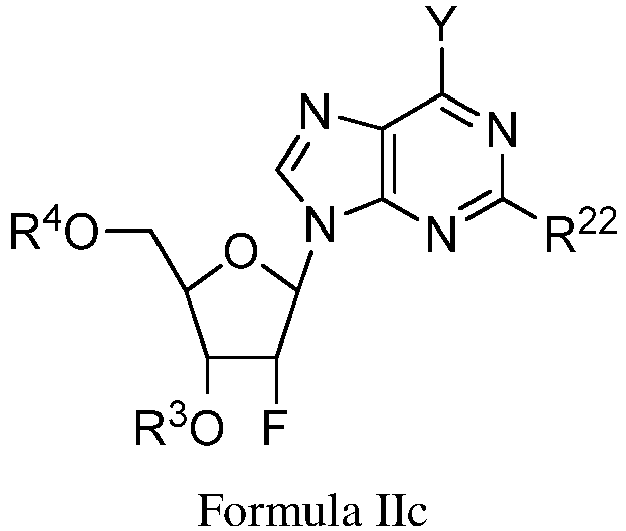
- Y, R3, R4, and R22 are as defined above.
- In Formula IIc, R3 may be hydrogen.
- In Formula IIc, when Y is NR1R2, R1 may be methyl and R2 may be hydrogen.
- In Formula IIc, when Y is NR1R2, both R1 and R2 may be methyl.
- In Formula IIc, when Y is NR1R2, R1 may be methyl and R2 may be cyclopropyl.
- In Formula IIc, when Y is NR1R2, R1 may be cyclopropyl and R2 may be hydrogen.
- In Formula IIc, when Y is NR1R2, R1 may be cyclopropyl and R2 may be cyclopropyl.
- In Formula IIc, when Y is NR1R2, R1 may be cyclopentyl and R2 may be hydrogen.
- In Formula IIc, R4 may be a stabilized phosphoramidate.
- In another aspect described herein but not claimed, there is provided the use of an effective amount of a compound of Formula IId, or a pharmaceutically acceptable salt thereof, for the treatment of an infection of an RNA virus in a host, including a human in need thereof.

- Y, R3, R4, and R22 are as defined above.
- In Formula IId, R3 may be hydrogen.
- In Formula IId, when Y is NR1R2, R1 may be methyl and R2 may be hydrogen.
- In Formula IId, when Y is NR1R2, both R1 and R2 may be methyl.
- In Formula IId, when Y is NR1R2, R1 may be methyl and R2 may be cyclopropyl.
- In Formula IId, when Y is NR1R2, R1 may be cyclopropyl and R2 may be hydrogen.
- In Formula IId, when Y is NR1R2, R1 may be cyclopropyl and R2 may be cyclopropyl.
- In Formula IId, when Y is NR1R2, R1 may be cyclopentyl and R2 may be hydrogen.
- In Formula IId, R4 may be a stabilized phosphoramidate.
- In another aspect described herein but not claimed, there is provided the use of an effective amount of a compound of Formula IIe, or a pharmaceutically acceptable salt thereof, for the treatment of an infection of an RNA virus in a host, including a human in need thereof.

- Y, R3, R4, and R22 are as defined above.
- In Formula IIe, R3 may be hydrogen.
- In Formula IIe, when Y is NR1R2, R1 may be methyl and R2 may be hydrogen.
- In Formula IIe, when Y is NR1R2, R1 may be methyl and R2 may be cyclopropyl.
- In Formula IIe, when Y is NR1R2, R1 may be cyclopropyl and R2 may be cyclopropyl.
- In Formula IIe, when Y is NR1R2, R1 may be cyclopentyl and R2 may be hydrogen.
- In Formula IIe, R4 may be a stabilized phosphoramidate.
- In another aspect described herein but not claimed, there is provided the use of an effective amount of a compound of Formula III, or a pharmaceutically acceptable salt thereof, for the treatment of an infection of an RNA virus in a host, including a human in need thereof.

- R7 is hydrogen, C1-6alkyl; C3-7cycloalkyl; heteroaryl, heterocyclic, or aryl, which includes, but is not limited to, phenyl or naphthyl, where phenyl or naphthyl are optionally substituted with C1-6alkyl, C2-6alkenyl, C2-6 alkynyl, C1-6alkoxy, F, Cl, Br, I, nitro, cyano, C1-6haloalkyl, -N(R7')2, C1-6acylamino, NHSO2C1-6alkyl, -SO2N(R7')2, COR7", and -SO2C1-6alkyl; (R7' is independently hydrogen or C1-6alkyl; R7" is -OR11 or-N(R7)2);
- R8 is hydrogen, C1-6alkyl, or R9a or R9b and R8 together are (CH2)n so as to form a cyclic ring that includes the adjoining N and C atoms; where n is 2 to 4;
- R9a and R9b are (i) independently selected from hydrogen, C1-6alkyl, cycloalkyl, -(CH2)c(NR9')2, C1-6hydroxyalkyl, -CH2SH, -(CH2)2S(O)(Me, -(CH2)3NHC(=NH)NH2, (1H-indol-3-yl)methyl, (1H-imidazol-4-yl)methyl, -(CH2)cCOR9" , aryl and aryl(C1-3alkyl)-, the aryl groups can be optionally substituted with a group selected from hydroxyl, C1-6alkyl, C1-6alkoxy, halogen, nitro and cyano; (ii) R9a and R9b both are C1-6alkyl; (iii) R9a and R9b together are (CH2)r so as to form a spiro ring; (iv) R9a is hydrogen and R9b and R8 together are (CH2)n so as to form a cyclic ring that includes the adjoining N and C atoms (v) R9b is hydrogen and R9a and R8 together are (CH2)n so as to form a cyclic ring that includes the adjoining N and C atoms, where c is 1 to 6, n is 2 to 4, r is 2 to 5 and where R9' is independently hydrogen or C1-6 alkyl and R9" is -OR11 or -N(R11')2 ); (vi) R9a is hydrogen and R9b is hydrogen, CH3, CH2CH3, CH(CH3)2, CH2CH(CH3)2, CH(CH3)CH2CH3, CH2Ph, CH2-indol-3-yl, -CH2CH2SCH3, CH2CO2H, CH2C(O)NH2, CH2CH2COOH, CH2CH2C(O)NH2, CH2CH2CH2CH2NH2, -CH2CH2CH2NHC(NH)NH2, CH2-imidazol-4-yl, CH2OH, CH(OH)CH3, CH2((4'-OH)-Ph), CH2SH, or lower cycloalkyl; or (vii) R9a is CH3, CH2CH3, CH(CH3)2, CH2CH(CH3)2, CH(CH3)CH2CH3, CH2Ph, CH2-indol-3-yl, -CH2CH2SCH3, CH2CO2H, CH2C(O)NH2, CH2CH2COOH, CH2CH2C(O)NH2, CH2CH2CH2CH2NH2, -CH2CH2CH2NHC(NH)NH2, CH2-imidazol-4-yl, CH2OH, CH(OH)CH3, CH2((4'-OH)-Ph), CH2SH, or lower cycloalkyl and R9b is hydrogen;
- R10 is hydrogen, C1-6alkyl optionally substituted with an alkoxy, di(lower alkyl)-amino, or halogen; C1-6haloalkyl, C3-7cycloalkyl, heterocycloalkyl, aminoacyl, aryl, such as phenyl; heteroaryl, such as, pyridinyl, substituted aryl, or substituted heteroaryl;
- R11 is an optionally substituted C1-6alkyl, an optionally substituted cycloalkyl; an optionally substituted C2-6alkynyl, an optionally substituted C2-6alkenyl, or optionally substituted acyl;
- R11' is hydrogen, an optionally substituted C1-6alkyl, an optionally substituted cycloalkyl; an optionally substituted C2-6alkynyl, an optionally substituted C2-6alkenyl, or optionally substituted acyl; and
- the variables Y, R3, R12 and R13 are described herein.
- In another aspect described herein but not claimed, there is provided the use of an effective amount of a compound of Formula IIIa, or a pharmaceutically acceptable salt thereof, for the treatment of an infection of an RNA virus in a host, including a human in need thereof.

- wherein the variables Y, R3, R7, R8, R9a, R9b and R10 are described herein.
- In Formula IIIa, the phosphoramidate may be in the L-configuration.
- In Formula IIIa, the phosphoramidate may be in the D-configuration.
- In Formula IIIa, R7 may be phenyl, R8 may be hydrogen, R9a may be methyl, R9b may be hydrogen, and R10 may be isopropyl and the phosphoramide may be in the L-configuration.
- In Formula IIIa, R7 may be phenyl, R8 may be hydrogen, R9a may be methyl, R9b may be hydrogen, and R10 may be isopropyl and the phosphoramide may be in the D-configuration.
- In Formula IIIa, R3 may be hydrogen,

- In another aspect described herein but not claimed, there is provided the use of an effective amount of a compound of Formula IIIb, or a pharmaceutically acceptable salt thereof, for the treatment of an infection of an RNA virus in a host, including a human in need thereof.

- wherein the variables Y, R3, R7, R8, R9a, R9b and R10 are described herein.
- In Formula IIIb, the phosphoramidate may be in the L-configuration.
- In Formula IIIb, the phosphoramidate may be in the D-configuration.
- In Formula IIIb, R7 may be phenyl, R8 may be hydrogen, R9a may be methyl, R9b may be hydrogen, and R10 may be isopropyl and the phosphoramide may be in the L-configuration.
- In Formula IIIb, R7 may be phenyl, R8 may be hydrogen, R9a may be methyl, R9b may be hydrogen, and R10 may be isopropyl and the phosphoramide may be in the D-configuration.
- In another aspect described herein but not claimed, there is provided the use of an effective amount of a compound of Formula IIIb', or a pharmaceutically acceptable salt thereof, for the treatment of an infection of an RNA virus in a host, including a human in need thereof.

- wherein the variables R3, R7, R8, R9a, R9b, R10, R60, m, and p are described herein.
- In Formula IIIb', m may be 1 and p may be 0.
- In Formula IIIb', m may be 2 and p may be 0.
- In Formula IIIb', m may be 3 and p may be 0.
- In Formula IIIb', m may be 2, p may be 0, and R3 may be hydrogen.
- In Formula IIIb', the phosphoramidate may be in the L-configuration.
- In Formula IIIb', the phosphoramidate may be in the D-configuration.
- In Formula IIIb', R7 may be phenyl, R8 may be hydrogen, R9a may be methyl, R9b may be hydrogen, and R10 may be isopropyl and the phosphoramide may be in the L-configuration.
- In Formula IIIb', R7 may be phenyl, R8 may be hydrogen, R9a may be methyl, R9b may be hydrogen, and R10 may be isopropyl and the phosphoramide may be in the D-configuration.
- In Formula IIIb', R3 may be hydrogen, m may be 2, p may be 0, R7 may be phenyl, R8 may be hydrogen, R9a may be methyl, R9b may be hydrogen, and R10 may be isopropyl.
- In Formula IIIb', R3 may be hydrogen, m may be 3, p may be 0, R7 may be phenyl, R8 may be hydrogen, R9a may be methyl, R9b may be hydrogen, and R10 may be isopropyl.
- In another aspect described herein but not claimed, there is provided the use of an effective amount of a compound of Formula IIIc, or a pharmaceutically acceptable salt thereof, for the treatment of an infection of an RNA virus in a host, including a human in need thereof.

- wherein the variables Y, R3, R7, R8, R9a, R9b and R10 are described herein.
- In Formula IIIc, the phosphoramidate may be in the L-configuration.
- In Formula IIIc, the phosphoramidate may be in the D-configuration.
- In Formula IIIc, R7 may be phenyl, R8 may be hydrogen, R9a may be methyl, R9b may be hydrogen, and R10 may be isopropyl and the phosphoramide may be in the L-configuration.
- In Formula IIIc, R7 may be phenyl, R8 may be hydrogen, R9a may be methyl, R9b may be hydrogen, and R10 may be isopropyl and the phosphoramide may be in the D-configuration.
- In another aspect described herein but not claimed, there is provided the use of an effective amount of a compound of Formula IIId or a pharmaceutically acceptable salt thereof, for the treatment of an infection of an RNA virus in a host, including a human in need thereof.

- wherein the variables Y, R3, R7, R8, R9a, R9b and R10 are described herein.
- In Formula IIId, the phosphoramidate may be in the L-configuration.
- In Formula IIId, the phosphoramidate may be in the D-configuration.
- In Formula IIId, R7 may be phenyl, R8 may be hydrogen, R9a may be methyl, R9b may be hydrogen, and R10 may be isopropyl and the phosphoramide may be in the L-configuration.
- In Formula IIId, R7 may be phenyl, R8 may be hydrogen, R9a may be methyl, R9b may be hydrogen, and R10 may be isopropyl and the phosphoramide may be in the D-configuration.
- The present invention provides a compound of Formula IIIe, or a pharmaceutically acceptable salt thereof, for use in the treatment of a host in need thereof infected with an RNA virus other than HCV according to the appended claims.

- wherein the variables Y, R3, R7, R8, R9a, R9b and R10 are as defined in the appended claims.
- In an alternative embodiment of Formula IIIe, the phosphoramidate is in the L-configuration.
- In an alternative embodiment of Formula IIIe, the phosphoramidate is in the D-configuration.
- In an alternative embodiment of Formula IIIe, R7 is phenyl, R8 is hydrogen, R9a is methyl, R9b is hydrogen, and R10 is isopropyl and the phosphoramide is in the L-configuration.
- In an alternative embodiment of Formula IIIe, R7 is phenyl, R8 is hydrogen, R9a is methyl, R9b is hydrogen, and R10 is isopropyl and the phosphoramide is in the D-configuration.
- In another aspect described herein but not claimed, there is provided the use of an effective amount of a compound of Formula IV or a pharmaceutically acceptable salt thereof, for the treatment of an infection of an RNA virus in a host, including a human in need thereof.

- wherein the variables Y, R3, R7, R8, R9a, R9b, R10, R12, R13 and R22 are described herein.
- In Formula IV, the phosphoramidate may be in the L-configuration.
- In Formula IV, the phosphoramidate may be in the D-configuration.
- In Formula IV, R7 may be phenyl, R8 may be hydrogen, R9a may be methyl, R9b may be hydrogen, and R10 may be isopropyl and the phosphoramide may be in the L-configuration.
- In Formula IV, R7 may be phenyl, R8 may be hydrogen, R9a may be methyl, R9b may be hydrogen, and R10 may be isopropyl and the phosphoramide may be in the D-configuration.
- In another aspect described herein but not claimed, there is provided the use of an effective amount of a compound of Formula IVa, or a pharmaceutically acceptable salt thereof, for the treatment of an infection of an RNA virus in a host, including a human in need thereof.

- wherein the variables Y, R3, R3A, R3B, R3C, R3D, R7, R8, R9a, R9b, R10 and R22 are described herein.
- In Formula IVa, the phosphoramidate may be in the L-configuration.
- In Formula IVa, the phosphoramidate may be in the D-configuration.
- In Formula IVa, R7 may be phenyl, R8 may be hydrogen, R9a may be methyl, R9b may be hydrogen, and R10 may be isopropyl and the phosphoramide may be in the L-configuration.
- In Formula IVa, R7 may be phenyl, R8 may be hydrogen, R9a may be methyl, R9b may be hydrogen, and R10 may be isopropyl and the phosphoramide may be in the D-configuration.
- In Formula IVa, R3 may be independently selected from hydrogen,

- In another aspect described herein but not claimed, there is provided the use of an effective amount of a compound of Formula IVb, or a pharmaceutically acceptable salt thereof, for the treatment of an infection of an RNA virus in a host, including a human in need thereof.

- wherein the variables Y, R3, R7, R8, R9a, R9b, R10 and R22 are described herein.
- In Formula IVb, the phosphoramidate may be in the L-configuration.
- In Formula IVb, the phosphoramidate may be in the D-configuration.
- In Formula IVb, R7 may be phenyl, R8 may be hydrogen, R9a may be methyl, R9b may be hydrogen, and R10 may be isopropyl and the phosphoramide may be in the L-configuration.
- In Formula IVb, R7 may be phenyl, R8 may be hydrogen, R9a may be methyl, R9b may be hydrogen, and R10 may be isopropyl and the phosphoramide may be in the D-configuration.
- In another aspect described herein but not claimed, there is provided the use of an effective amount of a compound of Formula IVb', or a pharmaceutically acceptable salt thereof, for the treatment of an infection of an RNA virus in a host, including a human in need thereof.

- wherein the variables R3, R7, R8, R9a, R9b, R10, R22, R60, m, and p are described herein.
- In Formula IVb', m may be 1 and p may be 0.
- In Formula IVb', m may be 2 and p may be 0.
- In Formula IVb', m may be 3 and p may be 0.
- In Formula IVb', m may be 2, p may be 0, and R3 may be hydrogen.
- In Formula IVb', m may be 2, p may be 0, R22 may be NR5R6, and R3 may be hydrogen. In Formula IVb', the phosphoramidate may be in the L-configuration.
- In Formula IVb', the phosphoramidate may be in the D-configuration.
- In Formula IVb', R7 may be phenyl, R8 may be hydrogen, R9a may be methyl, R9b may be hydrogen, and R10 may be isopropyl and the phosphoramide may be in the L-configuration.
- In Formula IVb', R7 may be phenyl, R8 may be hydrogen, R9a may be methyl, R9b may be hydrogen, and R10 may be isopropyl and the phosphoramide may be in the D-configuration.
- In another aspect described herein but not claimed, there is provided the use of an effective amount of a compound of Formula IVc, or a pharmaceutically acceptable salt thereof, for the treatment of an infection of an RNA virus in a host, including a human in need thereof.

- wherein the variables Y, R3, R7, R8, R9a, R9b, R10 and R22 are described herein.
- In Formula IVc, the phosphoramidate may be in the L-configuration.
- In Formula IVc, the phosphoramidate may be in the D-configuration.
- In Formula IVc, R7 may be phenyl, R8 may be hydrogen, R9a may be methyl, R9b may be hydrogen, and R10 may be isopropyl and the phosphoramide may be in the L-configuration.
- In Formula IVc, R7 may be phenyl, R8 may be hydrogen, R9a may be methyl, R9b may be hydrogen, and R10 may be isopropyl and the phosphoramide may be in the D-configuration.
- In another aspect described herein but not claimed, there is provided the use of an effective amount of a compound of Formula IVd, or a pharmaceutically acceptable salt thereof, for the treatment of an infection of an RNA virus in a host, including a human in need thereof.

- wherein the variables Y, R3, R7, R8, R9a, R9b, R10 and R22 are described herein.
- In Formula IVd, the phosphoramidate may be in the L-configuration.
- In Formula IVd, the phosphoramidate may be in the D-configuration.
- In Formula IVd, R7 may be phenyl, R8 may be hydrogen, R9a may be methyl, R9b may be hydrogen, and R10 may be isopropyl and the phosphoramide may be in the L-configuration.
- In Formula IVd, R7 may be phenyl, R8 may be hydrogen, R9a may be methyl, R9b may be hydrogen, and R10 may be isopropyl and the phosphoramide may be in the D-configuration.
- In another aspect described herein but not claimed, there is provided the use of an effective amount of a compound of Formula IVe, or a pharmaceutically acceptable salt thereof, for the treatment of an infection of an RNA virus in a host, including a human in need thereof.

- wherein the variables Y, R3, R7, R8, R9a, R9b and R10 are described herein.
- In Formula IVe, the phosphoramidate may be in the L-configuration.
- In Formula IVe, the phosphoramidate may be in the D-configuration.
- In Formula IVe, R7 may be phenyl, R8 may be hydrogen, R9a may be methyl, R9b may be hydrogen, and R10 may be isopropyl and the phosphoramide may be in the L-configuration.
- In Formula IVe, R7 may be phenyl, R8 may be hydrogen, R9a may be methyl, R9b may be hydrogen, and R10 may be isopropyl and the phosphoramide may be in the D-configuration.
- In another aspect described herein but not claimed, compounds of Formula V are disclosed. In another aspect described herein but not claimed, there is provided a method for the treatment of an infection of an RNA virus in a host, including a human in need thereof, comprising administering an effective amount of a compound of Formula V or a pharmaceutically acceptable salt thereof. The method may include administration of an effective amount of a compound of Formula V for the treatment of a single-stranded RNA positive stranded virus other than a hepacivirus or other than HCV in a host, including a human in need thereof. Alternatively, the method includes administration of an effective amount of a compound of Formula V for the treatment of a single-stranded RNA positive stranded virus of the Flaviviridae family, including but not limited to Dengue virus 2 and Yellow Fever, in a host, including a human in need thereof. Alternatively, the method includes administration of an effective amount of a compound of Formula V for the treatment of a single-stranded RNA negative-sense virus in a host, including a human in need thereof. Alternatively, the method includes administration of an effective amount of a compound of Formula V for the treatment of a double-stranded RNA virus in a host, including a human in need thereof.

- Q is CHR65;
- R50 is selected from hydrogen, NH2, and R22;
- R62 is hydrogen, CH3, CH2F, CHF2, CF3, or ethynyl;
- R63 is hydrogen, fluoro, chloro, bromo, N3, NH2, CN or OR3;
- R65 is C1-C3alkyl (including, methyl, ethyl, isopropyl, and cyclopropyl) or C1-3haloalkyl (including CH2F, CHF2, and CF3); and
- R3, R4, R5, and R22 are as defined above.
- In Formula V, R3 may be hydrogen.
- In Formula V, R65 may be methyl.
- In Formula V, R50 may be hydrogen.
- In Formula V, R50 may be -NH2.
- In Formula V, Q may be CHR65, R3 may be hydrogen R65 may be methyl, and R50 may be hydrogen.
- Alternatively, compounds of Formula Va are disclosed. In another aspect described herein but not claimed, there is provided the use of an effective amount of a compound of Formula Va, or a pharmaceutically acceptable salt thereof, for the treatment of an infection of an RNA virus in a host, including a human in need thereof.

- Q, R3, R4, and R50 are defined as above.
- In Formula Va, R3 may be hydrogen.
- In Formula Va, R65 may be methyl.
- In Formula Va, R50 may be hydrogen.
- In Formula Va, R50 may be -NH2.
- In Formula Va, Q may be CHR65, R3 may be hydrogen R65 may be methyl, and R50 may be hydrogen.
- In Formula Va, Q may be CHR65, R3 may be hydrogen R65 may be cyclopropyl, and R50 may be hydrogen.
- Alternatively, compounds of Formula Vb are disclosed. In another aspect described herein but not claimed, there is provided the use of an effective amount of a compound of Formula Vb, or a pharmaceutically acceptable salt thereof, for the treatment of an infection of an RNA virus in a host, including a human in need thereof.

- Q, R3, R4, and R50 are defined as above.
- In Formula Vb, R3 may be hydrogen.
- In Formula Vb, R65 may be methyl.
- In Formula Vb, R50 may be hydrogen.
- In Formula Vb, R50 may be -NH2.
- In Formula Vb, Q may be CHR65, R3 may be hydrogen R65 may be methyl, and R50 may be hydrogen.
- In Formula Vb, Q may be CHR65, R3 may be hydrogen R65 may be cyclopropyl, and R50 may be hydrogen.
- Alternatively, compounds of Formula Vc are disclosed. In another aspect described herein but not claimed, there is provided the use of an effective amount of a compound of Formula Vc, or a pharmaceutically acceptable salt thereof, for the treatment of an infection of an RNA virus in a host, including a human in need thereof.

- Q, R3, R4, and R50 are defined as above.
- In Formula Vc, R3 may be hydrogen.
- In Formula Vc, R65 may be methyl.
- In Formula Vc, R50 may be hydrogen.
- In Formula Vc, R50 may be -NH2.
- In Formula Vc, Q may be CHR65, R3 may be hydrogen R65 may be methyl, and R50 may be hydrogen.
- In Formula Vc, Q may be CHR65, R3 may be hydrogen R65 may be cyclopropyl, and R50 may be hydrogen.
- Alternatively, compounds of Formula Vd are disclosed. In another aspect described herein but not claimed, there is provided the use of an effective amount of a compound of Formula Vd, or a pharmaceutically acceptable salt thereof, for the treatment of an infection of an RNA virus in a host, including a human in need thereof.

- Q, R3, R4, and R50 are defined as above.
- In Formula Vd, R3 may be hydrogen.
- In Formula Vd, R65 may be methyl.
- In Formula Vd, R50 may be hydrogen.
- In Formula Vd, R50 may be -NH2.
- In Formula Vd, Q may be CHR65, R3 may be hydrogen R65 may be methyl, and R50 may be hydrogen.
- In Formula Vd, Q may be CHR65, R3 may be hydrogen R65 may be cyclopropyl, and R50 may be hydrogen.
- Alternatively, compounds of Formula Ve are disclosed. In another aspect described herein but not claimed, there is provided the use of an effective amount of a compound of Formula Ve, or a pharmaceutically acceptable salt thereof, for the treatment of an infection of an RNA virus in a host, including a human in need thereof.

- Q, R3, R4, and R50 are defined as above.
- In Formula Ve, R3 may be hydrogen.
- In Formula Ve, R65 may be methyl.
- In Formula Ve, R50 may be hydrogen.
- In Formula Ve, R50 may be -NH2.
- In Formula Ve, Q may be CHR65, R3 may be hydrogen R65 may be methyl, and R50 may be hydrogen.
- In Formula Ve, Q may be CHR65, R3 may be hydrogen R65 may be cyclopropyl, and R50 may be hydrogen.
- Alternatively, compounds of Formula Vf are disclosed. In another aspect described herein but not claimed, there is provided the use of an effective amount of a compound of Formula Vf, or a pharmaceutically acceptable salt thereof, for the treatment of an infection of an RNA virus in a host, including a human in need thereof.

- Q, R3, R4, and R50 are defined as above.
- In Formula Vf, R3 may be hydrogen.
- In Formula Vf, R65 may be methyl.
- In Formula Vf, R50 may be hydrogen.
- In Formula Vf, R50 may be -NH2.
- In Formula Vf, Q may be CHR65, R3 may be hydrogen R65 may be methyl, and R50 may be hydrogen.
- In Formula Ve, Q may be CHR65, R3 may be hydrogen R65 may be cyclopropyl, and R50 may be hydrogen.
- Alternatively, compounds of Formula VI are disclosed. In another aspect described herein but not claimed, there is provided the use of an effective amount of a compound of Formula VI, or a pharmaceutically acceptable salt thereof, for the treatment of an infection of an RNA virus in a host, including a human in need thereof.

- Q, R3, R7, R8, R9a, R9b, R10, R50, R62, and R63 are defined as above.
- In Formula VI, R3 may be hydrogen.
- In Formula VI, R65 may be methyl.
- In Formula VI, R50 may be hydrogen.
- In Formula VI, R50 may be -NH2.
- In Formula VI, Q may be CHR65, R3 may be hydrogen R65 may be methyl, and R50 may be hydrogen.
- In Formula VI, the phosphoramidate may be in the L-configuration.
- The phosphoramidate may be in the D-configuration.
- In Formula VI, R7 may be phenyl, R8 may be hydrogen, R9a may be methyl, R9b may be hydrogen, and R10 may be isopropyl and the phosphoramide may be in the L-configuration.
- In Formula VI, R7 may be phenyl, R8 may be hydrogen, R9a may be methyl, R9b may be hydrogen, and R10 may be isopropyl and the phosphoramide may be in the D-configuration.
- Alternatively, compounds of Formula VIa are disclosed. In another aspect described herein but not claimed, there is provided the use of an effective amount of a compound of Formula Via, or a pharmaceutically acceptable salt thereof, for the treatment of an infection of an RNA virus in a host, including a human in need thereof.

- Q, R3, R3A, R3B, R3C, R3D, R7, R8, R9a, R9b, R10, and R50 are defined as above. In Formula VIa, R3 may be hydrogen.
- In Formula VIa, R65 may be methyl.
- In Formula VIa, R50 may be hydrogen.
- In Formula VIa, R50 may be -NH2.
- In Formula VIa, Q may be CHR65, R3 may be hydrogen R65 may be methyl, and R50 may be hydrogen.
- In Formula VIa, the phosphoramidate may be in the L-configuration.
- In Formula VIa, the phosphoramidate may be in the D-configuration.
- In Formula VIa, R7 may be phenyl, R8 may be hydrogen, R9a may be methyl, R9b may be hydrogen, and R10 may be isopropyl and the phosphoramide may be in the L-configuration.
- In Formula VIa, R7 may be phenyl, R8 may be hydrogen, R9a may be methyl, R9b may be hydrogen, and R10 may be isopropyl and the phosphoramide may be in the D-configuration.
- In Formula VIa, Q may be CHR65, R3 may be hydrogen, R7 may be phenyl, R8 may be hydrogen, R9a may be methyl, R9b may be hydrogen, and R10 may be isopropyl.
- In Formula VIa, Q may be CHR65, R3 may be hydrogen, R65 may be methyl, R50 may be hydrogen, R7 may be phenyl, R8 may be hydrogen, R9a may be methyl, R9b may be hydrogen, and R10 may be isopropyl.
- In Formula VIa, R3 may be independently selected from hydrogen,

- Alternatively, compounds of Formula VIb are disclosed. In another aspect described herein but not claimed, there is provided the use of an effective amount of a compound of Formula VIb, or a pharmaceutically acceptable salt thereof, for the treatment of an infection of an RNA virus in a host, including a human in need thereof.

- Q, R3, R7, R8, R9a, R9b, R10, and R50 are defined as above.
- In Formula VIb, R3 may be hydrogen.
- In Formula VIb, R65 may be methyl.
- In Formula VIb, R50 may be hydrogen.
- In Formula VIb, R50 may be -NH2.
- In Formula VIb, Q may be CHR65, R3 may be hydrogen R65 may be methyl, and R50 may be hydrogen.
- In Formula VIb, the phosphoramidate may be in the L-configuration.
- In Formula VIb, the phosphoramidate may be in the D-configuration.
- In Formula VIb, R7 may be phenyl, R8 may be hydrogen, R9a may be methyl, R9b may be hydrogen, and R10 may be isopropyl and the phosphoramide may be in the L-configuration.
- In Formula VIb, R7 may be phenyl, R8 may be hydrogen, R9a may be methyl, R9b may be hydrogen, and R10 may be isopropyl and the phosphoramide may be in the D-configuration.
- In Formula VIb, Q may be CHR65, R3 may be hydrogen R7 may be phenyl, R8 may be hydrogen, R9a may be methyl, R9b may be hydrogen, and R10 may be isopropyl.
- In Formula VIb, Q may be CHR65, R3 may be hydrogen, R65 may be methyl, R50 may be hydrogen, R7 may be phenyl, R8 may be hydrogen, R9a may be methyl, R9b may be hydrogen, and R10 may be isopropyl.
- Alternatively, compounds of Formula VIc are disclosed. In another aspect described herein but not claimed, there is provided the use of an effective amount of a compound of Formula Vic, or a pharmaceutically acceptable salt thereof, for the treatment of an infection of an RNA virus in a host, including a human in need thereof.

- Q, R3, R7, R8, R9a, R9b, R10, and R50 are defined as above.
- In Formula VIc, R3 may be hydrogen.
- In Formula VIc, R65 may be methyl.
- In Formula VIc, R50 may be hydrogen.
- In Formula VIc, R50 may be -NH2.
- In Formula VIc, Q may be CHR65, R3 may be hydrogen R65 may be methyl, and R50 may be hydrogen.
- In Formula VIc, the phosphoramidate may be in the L-configuration.
- In Formula VIc, the phosphoramidate may be in the D-configuration.
- In Formula VIc, R7 may be phenyl, R8 may be hydrogen, R9a may be methyl, R9b may be hydrogen, and R10 may be isopropyl and the phosphoramide may be in the L-configuration.
- In Formula VIc, R7 may be phenyl, R8 may be hydrogen, R9a may be methyl, R9b may be hydrogen, and R10 may be isopropyl and the phosphoramide may be in the D-configuration.
- In Formula VIc, Q may be CHR65, R3 may be hydrogen, R7 may be phenyl, R8 may be hydrogen, R9a may be methyl, R9b may be hydrogen, and R10 may be isopropyl.
- In Formula VIc, Q may be CHR65, R3 may be hydrogen, R65 may be methyl, R50 may be hydrogen, R7 may be phenyl, R8 may be hydrogen, R9a may be methyl, R9b may be hydrogen, and R10 may be isopropyl.
- Alternatively, compounds of Formula VId are disclosed. In another aspect described herein but not claimed, there is provided the use of an effective amount of a compound of Formula Vid, or a pharmaceutically acceptable salt thereof, for the treatment of an infection of an RNA virus in a host, including a human in need thereof.

- Q, R3, R7, R8, R9a, R9b, R10, and R50 are defined as above.
- In Formula VId, R3 may be hydrogen.
- In Formula VId, R65 may be methyl.
- In Formula VId, R50 may be hydrogen.
- In Formula VId, R50 may be -NH2.
- In Formula VId, the phosphoramidate may be in the L-configuration.
- In Formula VId, the phosphoramidate may be in the D-configuration.
- In Formula VId, Q may be CHR65, R3 may be hydrogen R65 may be methyl, and R50 may be hydrogen.
- In Formula VId, R7 may be phenyl, R8 may be hydrogen, R9a may be methyl, R9b may be hydrogen, and R10 may be isopropyl and the phosphoramide may be in the L-configuration.
- In Formula VId, R7 may be phenyl, R8 may be hydrogen, R9a may be methyl, R9b may be hydrogen, and R10 may be isopropyl and the phosphoramide may be in the D-configuration.
- In Formula VId, Q may be CHR65, R3 may be hydrogen, R7 may be phenyl, R8 may be hydrogen, R9a may be methyl, R9b may be hydrogen, and R10 may be isopropyl.
- In Formula VId, Q may be CHR65, R3 may be hydrogen, R65 may be methyl, R50 may be hydrogen, R7 may be phenyl, R8 may be hydrogen, R9a may be methyl, R9b may be hydrogen, and R10 may be isopropyl.
- Alternatively, compounds of Formula Vie are disclosed. In another aspect described herein but not claimed, there is provided the use of an effective amount of a compound of Formula Vie, or a pharmaceutically acceptable salt thereof, for the treatment of an infection of an RNA virus in a host, including a human in need thereof.

- Q, R3, R7, R8, R9a, R9b, R10, and R50 are defined as above.
- In Formula VIe, R3 may be hydrogen.
- In Formula VIe, R65 may be methyl.
- In Formula VIe, R50 may be hydrogen.
- In Formula VIe, R50 may be -NH2.
- In Formula VIe, Q may be CHR65, R3 may be hydrogen R65 may be methyl, and R50 may be hydrogen.
- In Formula VIe, the phosphoramidate may be in the L-configuration.
- In Formula VIe, the phosphoramidate may be in the D-configuration.
- In Formula VIe, R7 may be phenyl, R8 may be hydrogen, R9a may be methyl, R9b may be hydrogen, and R10 may be isopropyl and the phosphoramide may be in the L-configuration.
- In Formula VIe, R7 may be phenyl, R8 may be hydrogen, R9a may be methyl, R9b may be hydrogen, and R10 may be isopropyl and the phosphoramide may be in the D-configuration.
- In Formula VIe, Q may be CHR65, R3 may be hydrogen, R7 may be phenyl, R8 may be hydrogen, R9a may be methyl, R9b may be hydrogen, and R10 may be isopropyl.
- In Formula VIe, Q may be CHR65, R3 may be hydrogen, R65 may be methyl, R50 may be hydrogen, R7 may be phenyl, R8 may be hydrogen, R9a may be methyl, R9b may be hydrogen, and R10 may be isopropyl.
- Alternatively, compounds of Formula VIf are disclosed. In another aspect described herein but not claimed, there is provided the use of an effective amount of a compound of Formula VIf, or a pharmaceutically acceptable salt thereof, for the treatment of an infection of an RNA virus in a host, including a human in need thereof.

- Q, R3, R7, R8, R9a, R9b, R10, and R50 are defined as above.
- In Formula VIf, R3 may be hydrogen.
- In Formula VIf, R65 may be methyl.
- In Formula VIf, R50 may be hydrogen.
- In Formula VIf, R50 may be -NH2.
- In Formula VIf, Q may be CHR65, R3 may be hydrogen R65 may be methyl, and R50 may be hydrogen.
- In Formula VIf, the phosphoramidate may be in the L-configuration.
- In Formula VIf, the phosphoramidate may be in the D-configuration.
- In Formula VIf, R7 may be phenyl, R8 may be hydrogen, R9a may be methyl, R9b may be hydrogen, and R10 may be isopropyl and the phosphoramide may be in the L-configuration.
- In Formula VIf, R7 may be phenyl, R8 may be hydrogen, R9a may be methyl, R9b may be hydrogen, and R10 may be isopropyl and the phosphoramide may be in the D-configuration.
- In Formula VIf, Q may be CHR65, R3 may be hydrogen, R7 may be phenyl, R8 may be hydrogen, R9a may be methyl, R9b may be hydrogen, and R10 may be isopropyl.
- In Formula VIf, Q may be CHR65, R3 may be hydrogen, R65 may be methyl, R50 may be hydrogen, R7 may be phenyl, R8 may be hydrogen, R9a may be methyl, R9b may be hydrogen, and R10 may be isopropyl.
- The phosphorus in any of the Formulas above may be chiral and thus can be provided as an R or S enantiomer or mixture thereof, including a racemic mixture.
- Non-limiting reference examples not according to the present invention include:


- Compounds and compositions for use in the treatment of a host infected with an RNA virus described herein, for example, other than a hepacivirus or HCV are provided. For example, the compounds for use of the invention can be administered in an effective amount alone or in combination with another anti-RNA viral agent to treat the infected host in need thereof. It may be useful to administer a combination of drugs that modulate the same or a different pathway or inhibit a different target in the virus. As the disclosed 2'-substituted-N6-substituted purine nucleotides are polymerase inhibitors, it can be advantageous to administer the compound to a host in combination with a protease inhibitor or an NS5A inhibitor. The compounds for use of the invention can also be administered in combination with a structurally different polymerase inhibitor such as another compound described herein or otherwise known to those in the art. The compounds for use of the invention can also be administered in combination with ribavirin and/or interferon.
- The 2'-substituted-N6-substituted purine nucleotides of the invention are typically administered orally, for example in pill or tablet form, but may be administered via another route which the attending physician considers appropriate, including via intravenous, transdermal, subcutaneous, topical, parenteral, or other suitable route.
- The invention is according to the appended claims. Also disclosed herein but not claimed are compounds and their uses, methods, and compositions as described herein for the treatment of infections in or exposure to humans or another host animal to an RNA virus that includes the administration of an effective amount of a compound of Formula I, Formula II, Formula III, Formula IV, Formula V, or Formula VI as described herein or a pharmaceutically acceptable salt or prodrug thereof, optionally in a pharmaceutically acceptable carrier. The compounds described herein either possess anti-RNA activity, or are metabolized to a compound that exhibits such activity. In another aspect described herein but not claimed, the method includes the administration of a compound of Formula I, Formula II, Formula III, Formula IV, Formula V, or Formula VI or a pharmaceutically acceptable salt thereof for the treatment of an infection of a single-stranded RNA positive stranded virus other than a hepacivirus or other than HCV in a host in need thereof, including a human. In another aspect described herein but not claimed, a method is presented that includes the administration of a compound of Formula I, Formula II, Formula III, Formula IV, Formula V, or Formula VI or a pharmaceutically acceptable salt thereof for the treatment of an infection of a single-stranded RNA positive stranded virus of the Flaviviridae family, including but not limited to Dengue virus 2 and Yellow Fever, in a host in need thereof, including a human. In another aspect described herein but not claimed, a method is presented that includes the administration of a compound of Formula I, Formula II, Formula III, Formula IV, Formula V, or Formula VI or a pharmaceutically acceptable salt thereof for the treatment of an infection of a single-stranded RNA negative-sense virus in a host in need thereof, including a human. In another aspect described herein but not claimed, a method is presented that includes the administration of a compound of Formula I, Formula II, Formula III, Formula IV, Formula V, or Formula VI or a pharmaceutically acceptable salt thereof for the treatment of an infection of a double-stranded RNA virus in a host in need thereof, including a human.
- The compounds and compositions can also be used to treat conditions related to or occurring as a result of an RNA viral exposure. The compounds or formulations that include the compounds can also be used prophylactically to prevent or retard the progression of clinical illness in individuals who are RNA virus antibody- or RNA virus antigen-positive.
- In particular, it has been discovered that a 5'-stabilized phosphate prodrug or derivative of a 2'-substituted-N6-methyl-2,6-diaminopurine nucleotide, as well as a 2'-substituted-N6-dimethyl-2,6-diaminopurine nucleotide, and other 2'-substituted-N6-substituted purine nucleotides as described below, are highly active against an RNA virus, for example, other than hepacivirus or other than HCV.
- Unless otherwise specified, the compounds described herein are provided in the β-D-configuration. Alternatively, the compounds can be provided in a β-L-configuration. Likewise, any substituent group that exhibits chirality can be provided in racemic, enantiomeric, diastereomeric form or any mixture thereof. Where a phosphoramidate, thiophosphoramidate or other stabilized phosphorus prodrug in which the phosphorus exhibits chirality is used as the R4 stabilized phosphate prodrug, it can be provided as an R or S chiral phosphorus derivative or a mixture thereof, including a racemic mixture. The amino acid of the phosphoramidate or thiophosphoramidate can be in the D- or L-configuration, or a mixture thereof, including a racemic mixture. All of the combinations of these stereo configurations are included in the invention described herein.
- Described herein but not claimed are the following features:
- (a) Formulas I-VI as described herein, and pharmaceutically acceptable salts and prodrugs thereof for use in the treatment or prophylaxis of an RNA virus infection and for example, a virus other than a hepacivirus or other than HCV;
- (b) Use of Formulas I-VI, and pharmaceutically acceptable salts and prodrugs thereof in the manufacture of a medicament for treatment of an RNA virus infection a virus other than a hepacivirus or other than HCV;
- (c) A method for manufacturing a medicament intended for the therapeutic use for treating an RNA virus infection, for example, a virus other than a hepacivirus or other than HCV, characterized in that a Formulas I-VI as described herein is used in the manufacture; and
- (d) A pharmaceutical formulation comprising an effective host-treating amount of the Formulas I-VI or a pharmaceutically acceptable salt or prodrug thereof together with a pharmaceutically acceptable carrier or diluent to treat an RNA virus other than a hepacivirus or other than HCV.
- Active compounds described herein but not claimed unless within the scope of the appended claims are those depicted, for example, in Formula I which can be provided in a pharmaceutically acceptable composition, salt or prodrug thereof:

- Y is NR1R2;
- R1 is C1-C5alkyl (including methyl, ethyl, n-propyl, iso-propyl, n-butyl, iso-butyl, sec-butyl, tert-butyl and pentyl), C1-C5haloalkyl (including CH2F, CH2F, CF3, CH2CF3, CF2CH3 and CF2CF3), C2-C6 alkenyl, C2-C6 alkynyl, -(C0-C2alkyl)(C3-C6cycloalkyl), -(Co-C2alkyl)(heterocycle), -(C0-C2alkyl)(aryl), -(C0-C2alkyl)(heteroaryl), -OR25, -C(O)R3C (including -C(O)CH3, -C(O)CH2CH3-C(O)CH(CH3)2, -C(O)OCH3, -C(O)OC2H5, -C(O)OC3H7, - C(O)OC4H9, and -C(O)OC5H11), -C(S)R3D, or -SO2R28 each of which can be optionally substituted;
- R2 is hydrogen, optionally substituted C1-C5alkyl (including methyl, ethyl, n-propyl, iso-propyl, n-butyl, iso-butyl, sec-butyl, tert-butyl and pentyl), C1-C5haloalkyl (including CHF2, CH2F, CF3, CH2CF3 and CF2CF3), optionally substituted -(C0-C2alkyl)(C3-C6cycloalkyl), optionally substituted -(C0-C2alkyl)(heterocycle), optionally substituted -(C0-C2alkyl)(aryl), optionally substituted -(C0-C2alkyl)(heteroaryl), -C(O)R3C (including -C(O)CH3, - C(O)CH2CH3-C(O)CH(CH3)2, -C(O)OCH3, -C(O)OC2H5, -C(O)OC3H7, -C(O)OC4H9, and -C(O)OC5H11), -C(S)R3D, or -SO2R28; and
- wherein at least one of R1 and R2 is methyl, CH2F, CHF2 or CF3;
- R3 is hydrogen,

- R3A can be selected from O-, OH, an -O-optionally substituted aryl, an -O-optionally substituted heteroaryl, or an optionally substituted heterocyclyl;
- R3B can be selected from O-, OH, an optionally substituted N-linked amino acid or an optionally substituted N-linked amino acid ester;
- R3C is alkyl, alkenyl, alkynyl, -(C0-C2)(cycloalkyl), -(C0-C2)(heterocyclo), -(C0-C2)(aryl), -(C0-C2)(heteroaryl), -O-alkyl, -O-alkenyl, -O-alkynyl, -O-(C0-C2)(cycloalkyl), -O-(C0-C2)(heterocyclo), -O-(C0-C2)(aryl), or -O-(C0-C2)(heteroaryl), each of which can be optionally substituted;
- R4 is a monophosphate, diphosphate, triphosphate, or a stabilized phosphate prodrug, including but not limited to a phosphoramidate, a thiophosphoramidate, or any other moiety that is metabolized to a monophosphate, diphosphate or triphosphate in vivo in the host human or animal; or
- R3 and R4 together with the oxygens that they are bonded to can form a 3',5'-cyclic prodrug, including but not limited to, a 3',5'-cyclic phosphate prodrug;
- R12 is hydrogen, CH3, CH2F, CHF2, CF3, or ethynyl; and
- R13 is hydrogen, fluoro, chloro, bromo, N3, NH2, CN or OR3;
- wherein when R12 is methyl, R13 is bromo, chloro, N3, NH2, CN or OR3.
- A stabilized phosphate prodrug is any moiety that can deliver a mono, di, or triphosphate.
- At least one of R1 and R2 may be cyclopropyl.
- At least one of R1 and R2 may be cyclopently.
- In another aspect described herein but not claimed, there is provided the use of an effective amount of a compound of Formula Ia or a pharmaceutically acceptable salt thereof, for the treatment of an infection of an RNA virus in a host, including a human in need thereof.
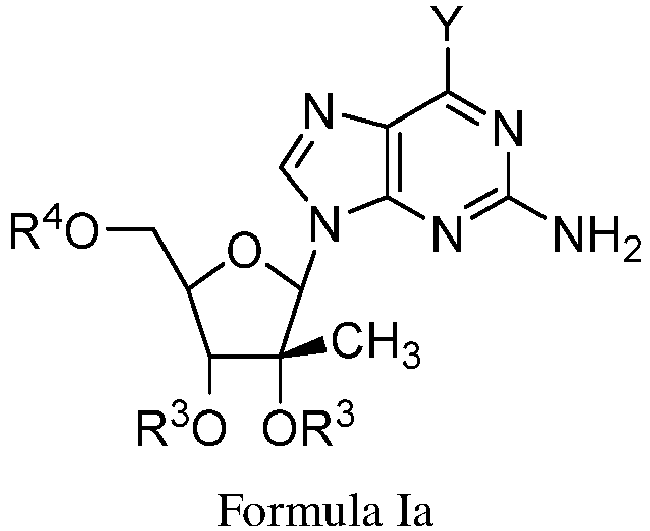
Y, R3 and R4 are as defined above. - In another aspect described herein but not claimed, there is provided the use of an effective amount of a compound of Formula Ib or a pharmaceutically acceptable salt thereof, for the treatment of an infection of an RNA virus in a host, including a human in need thereof.

Y, R3 and R4 are as defined above. - In another aspect described herein but not claimed, there is provided the use of an effective amount of a compound of Formula Ib' or a pharmaceutically acceptable salt thereof, for the treatment of an infection of an RNA virus in a host, including a human in need thereof.

R3, R4, R60, m, and p are defined above. - In another aspect described herein but not claimed, there is provided the use of an effective amount of a compound of Formula Ic or a pharmaceutically acceptable salt thereof, for the treatment of an infection of an RNA virus in a host, including a human in need thereof.

Y, R3 and R4 are as defined above. - In another aspect described herein but not claimed, there is provided the use of an effective amount of a compound of Formula Id or a pharmaceutically acceptable salt thereof, for the treatment of an infection of an RNA virus in a host, including a human in need thereof.

Y, R3 and R4 are as defined above. - In another aspect described herein but not claimed, there is provided the use of an effective amount of a compound of Formula Ie or a pharmaceutically acceptable salt thereof, for the treatment of an infection of an RNA virus in a host, including a human in need thereof.

Y, R3 and R4 are as defined above. - In another aspect described herein but not claimed, there is provided the use of an effective amount of a compound of Formula II or a pharmaceutically acceptable salt thereof, for the treatment of an infection of an RNA virus in a host, including a human in need thereof.

Y, R3, R4, R12, R13 and R22 are as defined above. - In another aspect described herein but not claimed, there is provided the use of an effective amount of a compound of Formula IIa or a pharmaceutically acceptable salt thereof, for the treatment of an infection of an RNA virus in a host, including a human in need thereof.

Y, R3, R4 and R22 are as defined above. - In another aspect described herein but not claimed, there is provided the use of an effective amount of a compound of Formula IIb or a pharmaceutically acceptable salt thereof, for the treatment of an infection of an RNA virus in a host, including a human in need thereof.

Y, R3, R4 and R22 are as defined above. - In another aspect described herein but not claimed, there is provided the use of an effective amount of a compound of Formula IIb' or a pharmaceutically acceptable salt thereof, for the treatment of an infection of an RNA virus in a host, including a human in need thereof.

R3, R4, R22, R60, m, and p are as defined above. - In another aspect described herein but not claimed, there is provided the use of an effective amount of a compound of Formula IIc or a pharmaceutically acceptable salt thereof, for the treatment of an infection of an RNA virus in a host, including a human in need thereof.

Y, R3, R4, and R22 are as defined above. - In another aspect described herein but not claimed, there is provided the use of an effective amount of a compound of Formula IId or a pharmaceutically acceptable salt thereof, for the treatment of an infection of an RNA virus in a host, including a human in need thereof.

Y, R3, R4, and R22 are as defined above. - In another aspect described herein but not claimed, there is provided the use of an effective amount of a compound of Formula IIe or a pharmaceutically acceptable salt thereof, for the treatment of an infection of an RNA virus in a host, including a human in need thereof.

Y, R3, R4, and R22 are as defined above. - In another aspect described herein but not claimed, there is provided the use of an effective amount of a compound of Formula III or a pharmaceutically acceptable salt thereof, for the treatment of an infection of an RNA virus in a host, including a human in need thereof.

- In another aspect described herein but not claimed, there is provided the use of an effective amount of a compound of Formula IIIa or a pharmaceutically acceptable salt thereof, for the treatment of an infection of an RNA virus in a host, including a human in need thereof.

- In another aspect described herein but not claimed, there is provided the use of an effective amount of a compound of Formula IIIb or a pharmaceutically acceptable salt thereof, for the treatment of an infection of an RNA virus in a host, including a human in need thereof.

- In another aspect described herein but not claimed, there is provided the use of an effective amount of a compound of Formula IIIb' or a pharmaceutically acceptable salt thereof, for the treatment of an infection of an RNA virus in a host, including a human in need thereof.

- In another aspect described herein but not claimed, there is provided the use of an effective amount of a compound of Formula IIIc or a pharmaceutically acceptable salt thereof, for the treatment of an infection of an RNA virus in a host, including a human in need thereof.

- In another aspect described herein but not claimed, there is provided the use of an effective amount of a compound of Formula IIId or a pharmaceutically acceptable salt thereof, for the treatment of an infection of an RNA virus in a host, including a human in need thereof.

- The present invention provides the compound of Formula IIIe or a pharmaceutically acceptable salt thereof, for use in the treatment of a host in need thereof according to the appended claims.
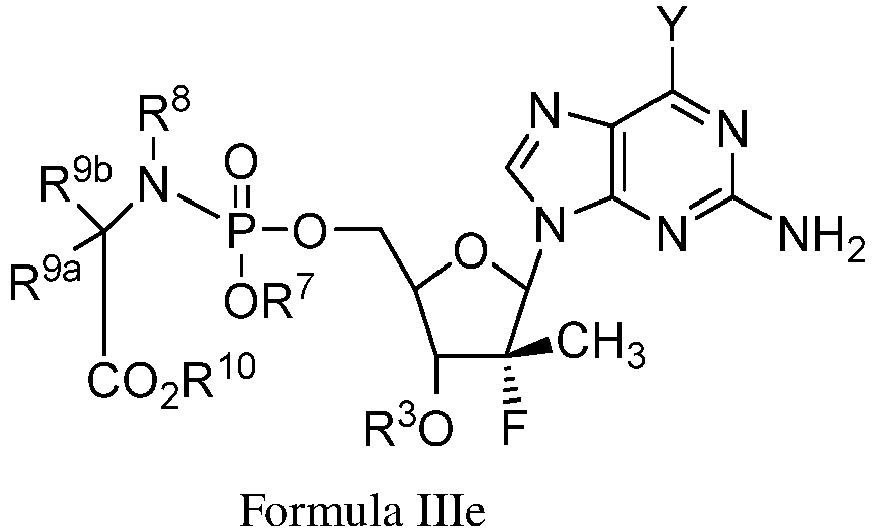
- In another aspect described herein but not claimed, there is provided the use of an effective amount of a compound of Formula IV or a pharmaceutically acceptable salt thereof, for the treatment of an infection of an RNA virus in a host, including a human in need thereof.

- In another aspect described herein but not claimed, there is provided the use of an effective amount of a compound of Formula IVa or a pharmaceutically acceptable salt thereof, for the treatment of an infection of an RNA virus in a host, including a human in need thereof.

- In another aspect described herein but not claimed, there is provided the use of an effective amount of a compound of Formula IVb or a pharmaceutically acceptable salt thereof, for the treatment of an infection of an RNA virus in a host, including a human in need thereof.

- In another aspect described herein but not claimed, there is provided the use of an effective amount of a compound of Formula IVb' or a pharmaceutically acceptable salt thereof, for the treatment of an infection of an RNA virus in a host, including a human in need thereof.

- In another aspect described herein but not claimed, there is provided the use of an effective amount of a compound of Formula IVc or a pharmaceutically acceptable salt thereof, for the treatment of an infection of an RNA virus in a host, including a human in need thereof.

- In another aspect described herein but not claimed, there is provided the use of an effective amount of a compound of Formula IVd or a pharmaceutically acceptable salt thereof, for the treatment of an infection of an RNA virus in a host, including a human in need thereof.

- In another aspect described herein but not claimed, there is provided the use of an effective amount of a compound of Formula IVe or a pharmaceutically acceptable salt thereof, for the treatment of an infection of an RNA virus in a host, including a human in need thereof.

- In another aspect described herein but not claimed, there is provided the use of an effective amount of a compound of Formula V or a pharmaceutically acceptable salt thereof, for the treatment of an infection of an RNA virus in a host, including a human in need thereof.

R3, R4, R50, R62, R63, and Q are defined above. - In another aspect described herein but not claimed, there is provided the use of an effective amount of a compound of Formula V or a pharmaceutically acceptable salt thereof, for the treatment of an infection of an RNA virus in a host, including a human in need thereof.
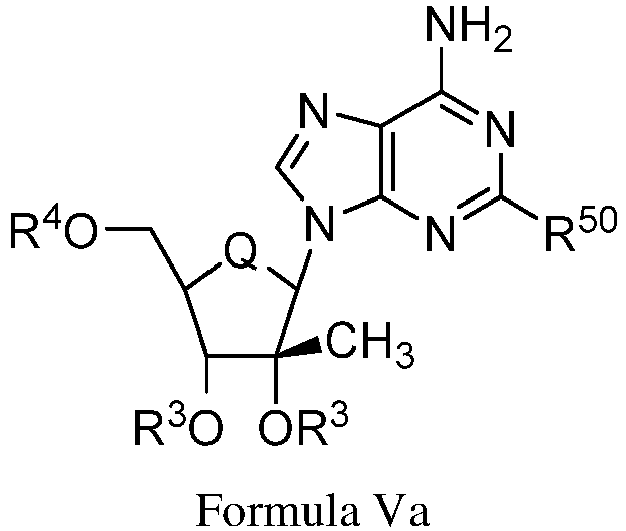
R3, R4, R50, and Q are defined above. - In another aspect described herein but not claimed, there is provided the use of an effective amount of a compound of Formula Vb or a pharmaceutically acceptable salt thereof, for the treatment of an infection of an RNA virus in a host, including a human in need thereof.

R3, R4, R50, and Q are defined above. - In another aspect described herein but not claimed, there is provided the use of an effective amount of a compound of Formula Vc or a pharmaceutically acceptable salt thereof, for the treatment of an infection of an RNA virus in a host, including a human in need thereof.

R3, R4, R50, and Q are defined above. - In another aspect described herein but not claimed, there is provided the use of an effective amount of a compound of Formula Vd or a pharmaceutically acceptable salt thereof, for the treatment of an infection of an RNA virus in a host, including a human in need thereof.

R3, R4, R50, and Q are defined above. - In another aspect described herein but not claimed, there is provided the use of an effective amount of a compound of Formula Ve or a pharmaceutically acceptable salt thereof, for the treatment of an infection of an RNA virus in a host, including a human in need thereof.

R3, R4, R50, and Q are defined above. - In another aspect described herein but not claimed, there is provided the use of an effective amount of a compound of Formula Vf or a pharmaceutically acceptable salt thereof, for the treatment of an infection of an RNA virus in a host, including a human in need thereof.

R3, R4, R50, and Q are defined above. - In another aspect described herein but not claimed, there is provided the use of an effective amount of a compound of Formula VI or a pharmaceutically acceptable salt thereof, for the treatment of an infection of an RNA virus in a host, including a human in need thereof.

R3, R7, R8, R9a, R9b, R10, R50, R62, and R63 and Q are defined above. - In another aspect described herein but not claimed, there is provided the use of an effective amount of a compound of Formula VIa or a pharmaceutically acceptable salt thereof, for the treatment of an infection of an RNA virus in a host, including a human in need thereof.

R3, R7, R8, R9a, R9b, R10, R50, and Q are defined above. - In another aspect described herein but not claimed, there is provided the use of an effective amount of a compound of Formula VIb or a pharmaceutically acceptable salt thereof, for the treatment of an infection of an RNA virus in a host, including a human in need thereof.

R3, R7, R8, R9a, R9b, R10, R50, and Q are defined above. - In another aspect described herein but not claimed, there is provided the use of an effective amount of a compound of Formula VIc or a pharmaceutically acceptable salt thereof, for the treatment of an infection of an RNA virus in a host, including a human in need thereof.

R3, R7, R8, R9a, R9b, R10, R50, and Q are defined above. - In another aspect described herein but not claimed, there is provided the use of an effective amount of a compound of Formula VId or a pharmaceutically acceptable salt thereof, for the treatment of an infection of an RNA virus in a host, including a human in need thereof.

R3, R7, R8, R9a, R9b, R10, R50, and Q are defined above. - In another aspect described herein but not claimed, there is provided the use of an effective amount of a compound of Formula VIe or a pharmaceutically acceptable salt thereof, for the treatment of an infection of an RNA virus in a host, including a human in need thereof.

R3, R7, R8, R9a, R9b, R10, R50, and Q are defined above. - In another aspect described herein but not claimed, there is provided the use of an effective amount of a compound of Formula VIf or a pharmaceutically acceptable salt thereof, for the treatment of an infection of an RNA virus in a host, including a human in need thereof.

R3, R7, R8, R9a, R9b, R10, R50, and Q are defined above. - Typically, the compound is a β-D isomer with reference to the corresponding nucleoside (i.e., in the naturally occurring configuration). In an alternative configuration, the compound is provided as a β-L isomer. The compound is typically at least 90% free of the opposite enantiomer, and can be at least 95%, 96%, 97%, 98%, 99% or even 100% free of the opposite enantiomer. Unless described otherwise, the compound is at least 90% free of the opposite enantiomer.
- The metabolism of the β-D-2'-deoxy-2'-α-fluoro-2'-β-ethynyl-N6-methyl-2,6-diaminopurine nucleoside phosphoramidate involves the production of a 5'-monophosphate and the subsequent anabolism of the N6-methyl-2,6-diaminopurine base to generate the β-D-2'-deoxy-2'-α-fluoro-2'-β-ethynylguanine nucleoside as the 5'-monophosphate. The monophosphate is then further anabolized to the active species; the 5'-triphosphate. The metabolic pathway for the β-D-2'-deoxy-2'-α-fluoro-2'-β-ethynyl-N6-methyl-2,6-diaminopurine nucleoside phosphoramidate is illustrated in Scheme 1 (not in accordance with the present invention).
- The metabolism of the β-D-2'-deoxy-2'-α-fluoro-2'-β-ethynyl-N6-dimethyl-2,6-diaminopurine nucleotide involves both the formation of the β-D-2'-deoxy-2'-α-fluoro-2'-β-ethynyl-N6-dimethyl-2,6-diaminopurine nucleoside triphosphate as well as the generation of the corresponding guanine nucleoside triphosphate. These metabolic pathways are illustrated in Schemes 2 and 3 below (not in accordance with the present invention).


- Stabilized phosphate prodrugs are moieties that can deliver a mono, di, or triphosphate in vivo. For example, McGuigan has disclosed phosphoramidates in
US Patent Nos.: 8,933,053 ;8,759,318 ;8,658,616 ;8,263,575 ;8,119,779 ;7,951,787 and7,115,590 . Alios has disclosed thiophosphoramidates inUS 8,895,723 and8,871,737 . Alios has also disclosed cyclic nucleotides inUS Patent No. 8,772,474 . Idenix has disclosed cyclic phosphoramidates and phosphoramidate/SATE derivatives inWO 2013/177219 . Idenix has also disclosed substituted carbonyloxymethylphosphoramidate compounds inWO 2013/039920 . Hostetler has disclosed lipid phosphate prodrugs, see, for example,US 7,517,858 . Hostetler has also disclosed lipid conjugates of phosphonate prodrugs, see, for example,US 8,889,658 ;8,846,643 ;8,710,030 ;8,309,565 ;8,008,308 ; and7,790,703 . Emory University has disclosed nucleotide sphingoid and lipid derivatives inWO 2014/124430 . RFS Pharma has disclosed purine nucleoside monophosphate prodrugs inWO 2010/091386 . Cocrystal Pharma Inc. has also disclosed purine nucleoside monophosphate prodrugs inUS Patent No.: 9,173,893 - T stabilized phosphate prodrugs may include, but are not limited to those described in
U.S. Patent No. 9,173,893 U.S. Patent No. 8,609,627 , , including for processes of preparation. For example, 5'-prodrugs of Formula I, Formula II, Formula III, Formula IV, Formula V, and Formula VI can be represented by the group: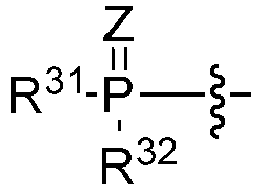
- In aspect described herein but not claimed, 3',5'-prodrugs of Formula I-VI can be represented by the group:

- when chirality exists at the phosphorous center it may be wholly or partially Rp or Sp or any mixture thereof.
- Z is O or S;
- R33 is selected from OR34,


- wherein R34, R35, and R36 are as defined below;
R31 and R32, when administered in vivo, are capable of providing the nucleoside monophosphate or thiomonophosphate, which may or may not be partially or fully resistant to 6-NH2 deamination in a biological system. Representative R31 and R32 are independently selected from:- (a) OR34 where R34 is selected from H, Li, Na, K, phenyl and pyridinyl; phenyl and pyridinyl are substituted with one to three substituents independently selected from the group consisting of (CH2)0-6CO2R37 and (CH2)0-6CON(R37)2;
- R37 is independently H, C1-20 alkyl, the carbon chain derived from a fatty alcohol (such as oleyl alcohol, octacosanol, triacontanol, linoleyl alcohol, and etc) or C1-20 alkyl substituted with a lower alkyl, alkoxy, di(lower alkyl)-amino, fluoro, C3-10 cycloalkyl, cycloalkyl alkyl, cycloheteroalkyl, aryl, such as phenyl, heteroaryl, such as, pyridinyl, substituted aryl, or substituted heteroaryl; wherein the substituents are C1-5 alkyl, or C1-5 alkyl substituted with a lower alkyl, alkoxy, di(lower alkyl)-amino, fluoro, C3-10 cycloalkyl, or cycloalkyl;

- (c) the ester of a D-amino acid or L-amino acid

- where R36 is restricted to those sidechains occurring in natural L-amino acids, and
- R35 is H, C1-20 alkyl, the carbon chain derived from a fatty alcohol (such as oleyl alcohol, octacosanol, triacontanol, linoleyl alcohol, and etc) or C1-20 alkyl substituted with a lower alkyl, alkoxy, di(lower alkyl)-amino, fluoro, C3-10 cycloalkyl, cycloalkyl alkyl, cycloheteroalkyl, aryl, such as phenyl, heteroaryl, such as, pyridinyl, substituted aryl, or substituted heteroaryl; wherein the substituents are C1-5 alkyl, or C1-5 alkyl substituted with a lower alkyl, alkoxy, di(lower alkyl)-amino, fluoro, C3-10 cycloalkyl, or cycloalkyl;
- (d) R31 and R32 can come together to form a ring

- where R38 is H, C1-20 alkyl, C1-20 alkenyl, the carbon chain derived from a fatty alcohol (such as oleyl alcohol, octacosanol, triacontanol, linoleyl alcohol, etc) or C1-20 alkyl substituted with a lower alkyl, alkoxy, di(lower alkyl)-amino, fluoro, C3-10 cycloalkyl, cycloalkyl alkyl, cycloheteroalkyl, aryl, such as phenyl, heteroaryl, such as, pyridinyl, substituted aryl, or substituted heteroaryl; wherein the substituents are C1-5 alkyl, or C1-5 alkyl substituted with a lower alkyl, alkoxy, di(lower alkyl)-amino, fluoro, C3-10 cycloalkyl, or cycloalkyl;
- (e) R31 and R32 can come together to form a ring selected from


- where R39 is O or NH and
- R40 is selected from H, C1-20 alkyl, C1-20 alkenyl, the carbon chain derived from a fatty acid (such as oleic acid, linoleic acid, and the like), and C1-20 alkyl substituted with a lower alkyl, alkoxy, di(lower alkyl)-amino, fluoro, C3-10 cycloalkyl, cycloalkyl alkyl, cycloheteroalkyl, aryl, such as phenyl, heteroaryl, such as pyridinyl, substituted aryl, or substituted heteroaryl; wherein the substituents are C1-5 alkyl, or C1-5 alkyl substituted with a lower alkyl, alkoxy, di(lower alkyl)-amino, fluoro, C3-10 cycloalkyl, or cycloalkyl.
- The compounds can be prepared, for example, by preparing the 5'-OH analogs, then converting these to the monophosphate analogs.
- In particular aspects described herein but not claimed:
- (i) in Formula la, Y may be NR1R2, R1 may be methyl, R2 may be hydrogen, R3 may be hydrogen, R4 may be a stabilized phosphate prodrug;
- (ii) in Formula la, Y may be NR1R2, R1 may be methyl, R2 may be hydrogen, R3 may be hydrogen, and R4 may be a stabilized thiophosphate prodrug;
- (iii) in Formula la, Y may be NR1R2, R1 may be methyl, R2 may be hydrogen, R3 may be hydrogen, and R4 may be a phosphoramidate;
- (iv) in Formula la, Y may be NR1R2, R1 may be methyl, R2 may be hydrogen, R3 may be hydrogen, and R4 may be a thiophosphoramidate:
- (v) in Formula la, Y may be NR1R2, R1 may be methyl, R2 may be hydrogen, R3 may be hydrogen, and R4 may be a monophosphate;
- (vi) in Formula la, Y may be NR1R2, R1 may be methyl, R2 may be hydrogen, R3 may be hydrogen, and R4 may be a diphosphate;
- (vii) in Formula la, Y may be NR1R2, R1 may be methyl, R2 may be hydrogen, R3 may be hydrogen, and R4 may be a triphosphate;
- (viii) in Formula la, Y may be NR1R2, R1 may be methyl, R2 may be methyl, R3 may be hydrogen, R4 may be a stabilized phosphate prodrug;
- (ix) in Formula la, Y may be NR1R2, R1 may be methyl, R2 may be methyl, R3 may be hydrogen, and R4 may be a stabilized thiophosphate prodrug;
- (x) in Formula la, Y may be NR1R2, R1 may be methyl, R2 may be methyl, R3 may be hydrogen, and R4 may be a phosphoramidate;
- (xi) in Formula la, Y may be NR1R2, R1 may be methyl, R2 may be methyl, R3 may be hydrogen, and R4 may be a thiophosphoramidate:
- (xii) in Formula la, Y may be NR1R2, R1 may be methyl, R2 may be methyl, R3 may be hydrogen, and R4 may be a monophosphate;
- (xiii) in Formula la, Y may be NR1R2, R1 may be methyl, R2 may be methyl, R3 may be hydrogen, and R4 may be a diphosphate;
- (xiv) in Formula la, Y may be NR1R2, R1 may be methyl, R2 may be methyl, R3 may be hydrogen, and R4 may be a triphosphate;
- (xv) in Formula la, Y may be NR1R2, R1 may be methyl, R2 may be cyclopropyl, R3 may be hydrogen, R4 may be a stabilized phosphate prodrug;
- (xvi) in Formula la, Y may be NR1R2, R1 may be methyl, R2 may be cyclopropyl, R3 may be hydrogen, and R4 may be a stabilized thiophosphate prodrug;
- (xvii) in Formula la, Y may be NR1R2, R1 may be methyl, R2 may be cyclopropyl, R3 may be hydrogen, and R4 may be a phosphoramidate;
- (xviii) in Formula la, Y may be NR1R2, R1 may be methyl, R2 may be cyclopropyl, R3 may be hydrogen, and R4 may be a thiophosphoramidate:
- (xix) in Formula la, Y may be NR1R2, R1 may be methyl, R2 may be cyclopropyl, R3 may be hydrogen, and R4 may be a monophosphate;
- (xx) in Formula la, Y may be NR1R2, R1 may be methyl, R2 may be cyclopropyl, R3 may be methyl, and R4 may be a diphosphate;
- (xxi) in Formula la, Y may be NR1R2, R1 may be methyl, R2 may be cyclopropyl, R3 may be hydrogen, and R4 may be a triphosphate;
- (xxii) in Formula la, Y may be NR1R2, R1 may be methyl, R2 may be propyl, R3 may be hydrogen, R4 may be a stabilized phosphate prodrug;
- (xxiii) in Formula la, Y may be NR1R2, R1 may be methyl, R2 may be propyl, R3 may be hydrogen, and R4 may be a stabilized thiophosphate prodrug;
- (xxiv) in Formula la, Y may be NR1R2, R1 may be methyl, R2 may be propyl, R3 may be hydrogen, and R4 may be a phosphoramidate;
- (xxv) in Formula la, Y may be NR1R2, R1 may be methyl, R2 may be propyl, R3 may be hydrogen, and R4 may be a thiophosphoramidate:
- (xxvi) in Formula la, Y may be NR1R2, R1 may be methyl, R2 may be propyl, R3 may be hydrogen, and R4 may be a monophosphate;
- (xxvii) in Formula la, Y may be NR1R2, R1 may be methyl, R2 may be propyl, R3 may be hydrogen, and R4 may be a diphosphate;
- (xxviii)in Formula la, Y may be NR1R2, Y may be NR1R2, R1 may be methyl, R2 may be propyl, R3 may be hydrogen, and R4 may be a triphosphate;
- (xxix) in Formula la, Y may be NR1R2, R1 may be methyl, R2 may be ethyl, R3 may be hydrogen, R4 may be a stabilized phosphate prodrug;
- (xxx) in Formula la, Y may be NR1R2, R1 may be methyl, R2 may be ethyl, R3 may be hydrogen, and R4 may be a stabilized thiophosphate prodrug;
- (xxxi) in Formula la, Y may be NR1R2, R1 may be methyl, R2 may be ethyl, R3 may be hydrogen, and R4 may be a phosphoramidate;
- (xxxii) in Formula la, Y may be NR1R2, R1 may be methyl, R2 may be ethyl, R3 may be hydrogen, and R4 may be a thiophosphoramidate:
- (xxxiii)in Formula la, Y may be NR1R2, R1 may be methyl, R2 may be ethyl, R3 may be hydrogen, and R4 may be a monophosphate;
- (xxxiv)in Formula la, Y may be NR1R2, R1 may be methyl, R2 may be ethyl, R3 may be hydrogen, and R4 may be a diphosphate;
- (xxxv) in Formula la, Y may be NR1R2, R1 may be methyl, R2 may be ethyl, R3 may be hydrogen, and R4 may be a triphosphate;
- (xxxvi)in Formula Ib, Y may be NR1R2, R1 may be methyl, R2 may be methyl, R3 may be hydrogen, R4 may be a stabilized phosphate prodrug;
- (xxxvii) in Formula Ib, Y may be NR1R2, R1 may be methyl, R2 may be methyl, R3 may be hydrogen, and R4 may be a stabilized thiophosphate prodrug;
- (xxxviii) in Formula Ib, Y may be NR1R2, R1 may be methyl, R2 may be methyl, R3 may be hydrogen, and R4 may be a phosphoramidate;
- (xxxix)in Formula Ib, Y may be NR1R2, R1 may be methyl, R2 may be methyl, R3 may be hydrogen, and R4 may be a thiophosphoramidate:
- (xl) in Formula Ib, Y may be NR1R2, R1 may be methyl, R2 may be methyl, R3 may be hydrogen, and R4 may be a monophosphate;
- (xli) in Formula Ib, Y may be NR1R2, R1 may be methyl, R2 may be methyl, R3 may be hydrogen, and R4 may be a diphosphate;
- (xlii) in Formula Ib, Y may be NR1R2, R1 may be methyl, R2 may be methyl, R3 may be hydrogen, and R4 may be a triphosphate;
- (xliii) in Formula Ib, Y may be NR1R2, R1 may be methyl, R2 may be hydrogen, R3 may be hydrogen, R4 may be a stabilized phosphate prodrug;
- (xliv) in Formula Ib, Y may be NR1R2, R1 may be methyl, R2 may be hydrogen, R3 may be hydrogen, and R4 may be a stabilized thiophosphate prodrug;
- (xlv) in Formula Ib, Y may be NR1R2, R1 may be methyl, R2 may be hydrogen, R3 may be hydrogen, and R4 may be a phosphoramidate;
- (xlvi) in Formula Ib, Y may be NR1R2, R1 may be methyl, R2 may be hydrogen, R3 may be hydrogen, and R4 may be a thiophosphoramidate:
- (xlvii) in Formula Ib, Y may be NR1R2, R1 may be methyl, R2 may be hydrogen, R3 may be hydrogen, and R4 may be a monophosphate;
- (xlviii) in Formula Ib, Y may be NR1R2, R1 may be methyl, R2 may be hydrogen, R3 may be hydrogen, and R4 may be a diphosphate;
- (xlix) in Formula Ib, Y may be NR1R2, R1 may be methyl, R2 may be hydrogen, R3 may be hydrogen, and R4 may be a triphosphate;
- (1) in Formula Ib, Y may be NR1R2, R1 may be methyl, R2 may be cyclopropyl, R3 may be hydrogen, R4 may be a stabilized phosphate prodrug;
- (li) in Formula Ib, Y may be NR1R2, R1 may be methyl, R2 may be cyclopropyl, R3 may be hydrogen, and R4 may be a stabilized thiophosphate prodrug;
- (lii) in Formula Ib, Y may be NR1R2, R1 may be methyl, R2 may be cyclopropyl, R3 may be hydrogen, and R4 may be a phosphoramidate;
- (liii) in Formula Ib, Y may be NR1R2, R1 may be methyl, R2 may be cyclopropyl, R3 may be hydrogen, and R4 may be a thiophosphoramidate:
- (liv) in Formula Ib, Y may be NR1R2, R1 may be methyl, R2 may be cyclopropyl, R3 may be hydrogen, and R4 may be a monophosphate;
- (lv) in Formula Ib, Y may be NR1R2, R1 may be methyl, R2 may be cyclopropyl, R3 may be methyl, and R4 may be a diphosphate;
- (lvi) in Formula la, Y may be NR1R2, R1 may be methyl, R2 may be cyclopropyl, R3 may be hydrogen, and R4 may be a triphosphate.
- Alternatively, the compound has an R22 substituent. The R22 may be F, amide or carbamate. R22 may be chloro, bromo, cyano, azido, ethyl, n-propyl, iso-propyl, n-butyl, isobutyl, sec-butyl, tert-butyl and n-pentyl, 1,1-dimethylpropyl, 2,2-dimtheylpropyl, 3-methylbutyl, 1-methylbutyl, 1-ethylpropyl, vinyl, allyl, 1-butynyl, 2-butynyl, acetylenyl, cyclopropyl, cyclobutyl, cyclopentyl, cyclohexyl, -(CH2)-cyclopropyl, -(CH2)-cyclobutyl, -(CH2)-cyclopentyl, -(CH2)-cyclohexyl, aziridine, oxirane, thiirane, azetidine, oxetane, thietane, pyrrolidine, tetrahydrofuran, thiolane, pyrazolidine, piperidine, oxane, thiane, -(CH2)-aziridine, -(CH2)-oxirane, -(CH2)-thiirane, -(CH2)-azetidine, -(CH2)-oxetane, -(CH2)-thietane, -(CH2)-pyrrolidine, -(CH2)-tetrahydrofuran, -(CH2)-thiolane, -(CH2)-pyrazolidine, -(CH2)-piperidine, -(CH2)-oxane, -(CH2)-thiane, phenyl, pyridyl, -ONHC(=O)OCH3, -ONHC(=O)OCH2CH3, -NHOH, NHOCH3, -OCH3, OC2H5, -OPh, OCH2Ph, -SCH3, -SC2H5, -SPh, SCH2Ph, -NH(CH2)2NH2, -NH(CH2)2N(CH3)2, -NHNH2, -NHNHCH3, -N=NH, -N=NCH3, -N=NCH2CH3, -NHC(O)NHNH2, -NHC(S)NHNH2, -C(O)NHNH2, -NHSO2CH3, -NHSO2CH2CH3, -SO2NHCH3, -SO2N(CH3)2, -C(O)NH2, -C(O)NHCH3, -C(O)N(CH3)2, -CO2CH3, -CO2CH2CH3, -CO2Ph, CO2CH2Ph, -SO2CH3, -SO2CH2CH3, -SO2Ph, -SO2CH2Ph,


- Alternatively, for compounds (i) through (lvi), an L-nucleoside may be used in Formula I-VI.
- In the Formula I R12 variable may be CH2F.
- In Formula I R12 variable may be CHF2.
- In Formula I R12 variable may be CF3.
- In one aspect described herein but not claimed, the use of an effective amount of a compound of Formula I or a pharmaceutically acceptable salt thereof, for the treatment of an infection of an RNA virus in a host, including a human in need thereof is provided. Non-limiting examples of compounds of Formula I include (compounds for use according to the appended claims are claimed):

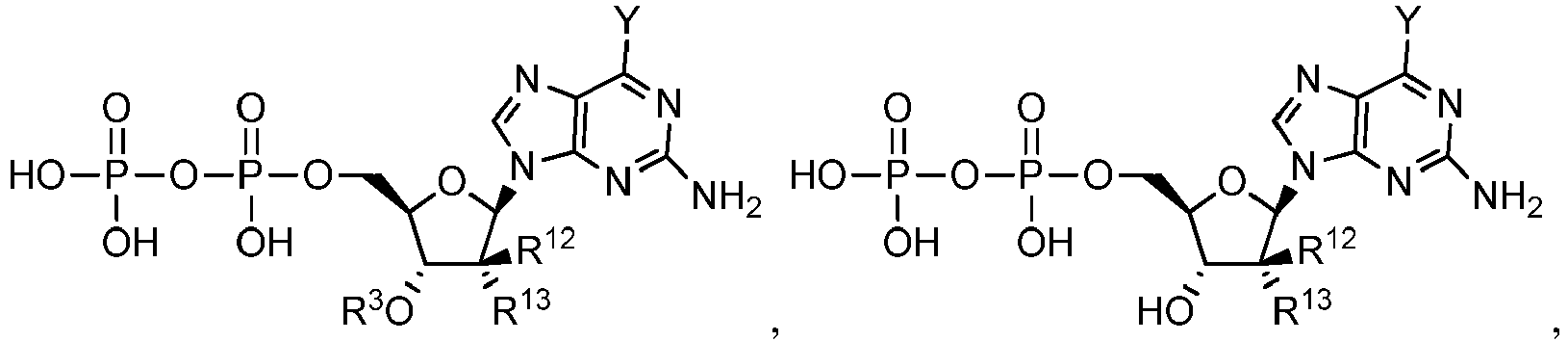


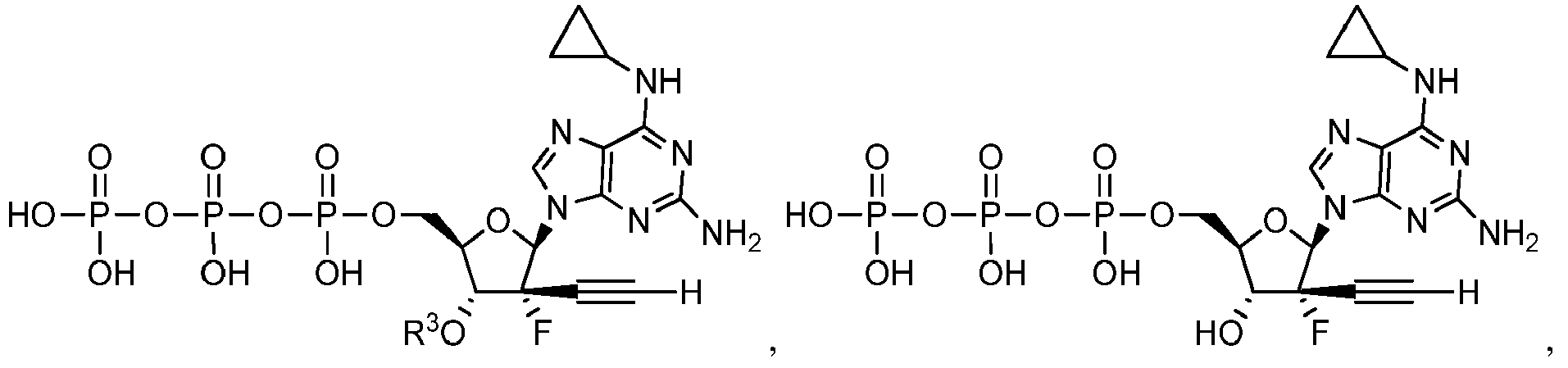


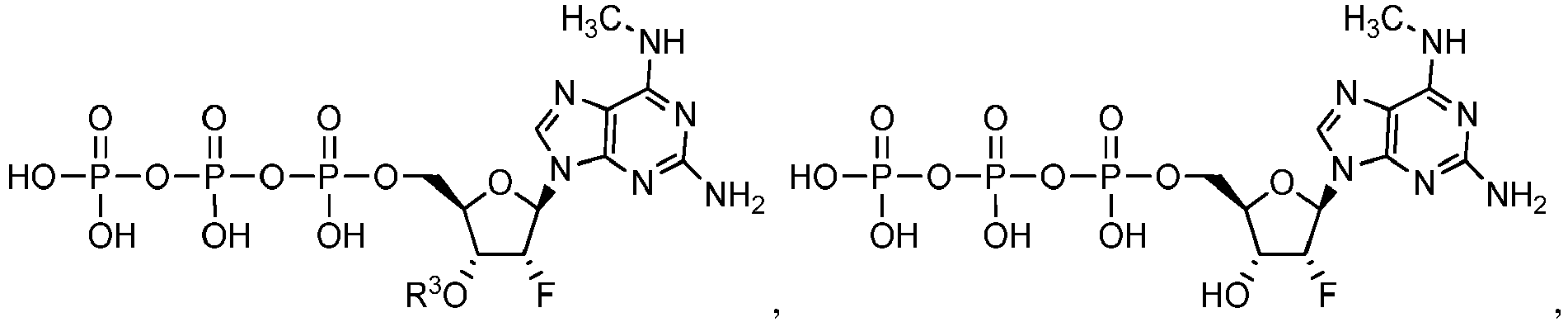
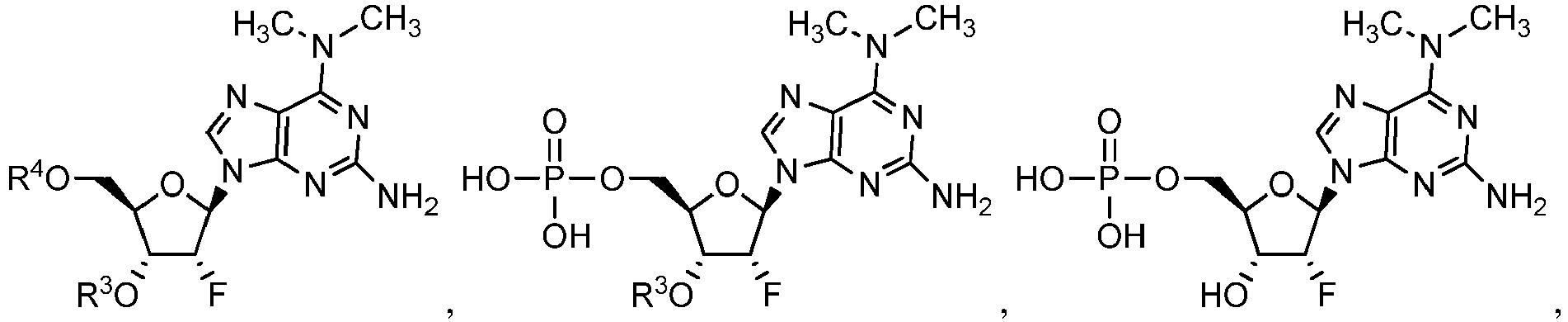
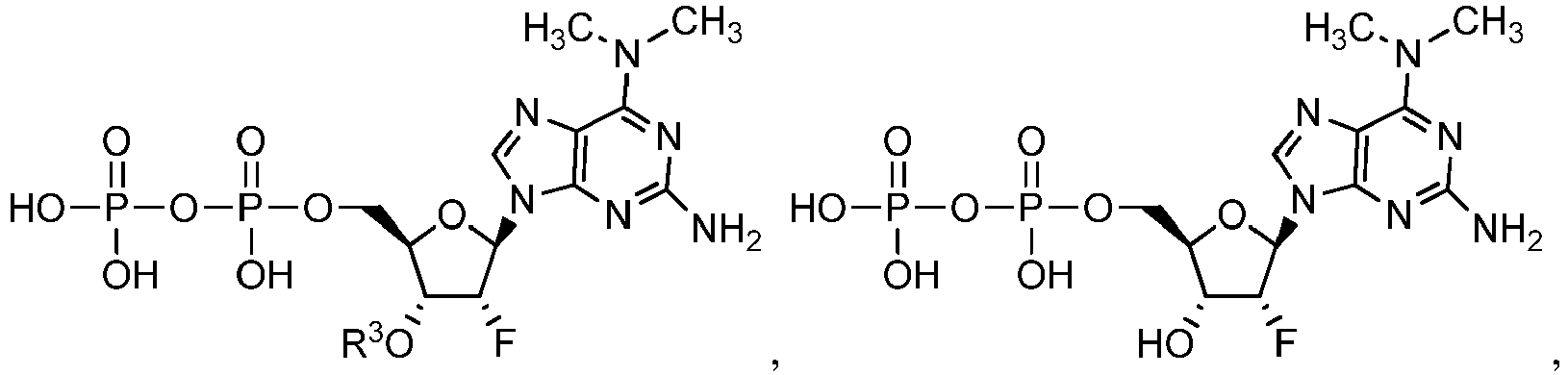


- In another aspect described herein but not claimed, the use of an effective amount of a compound of Formula I or a pharmaceutically acceptable salt thereof, for the treatment of an infection of an RNA virus in a host, including a human in need thereof is provided. Additional non-limiting examples of compounds of Formula I include (compounds for use according to the appended claims are claimed):


- In another aspect described herein but not claimed, the use of an effective amount of a compound of Formula III or a pharmaceutically acceptable salt thereof, for the treatment of an infection of an RNA virus in a host, including a human in need thereof is provided. Non-limiting examples of Formula III include but are not limited to (compounds for use according to the appended claims are claimed):


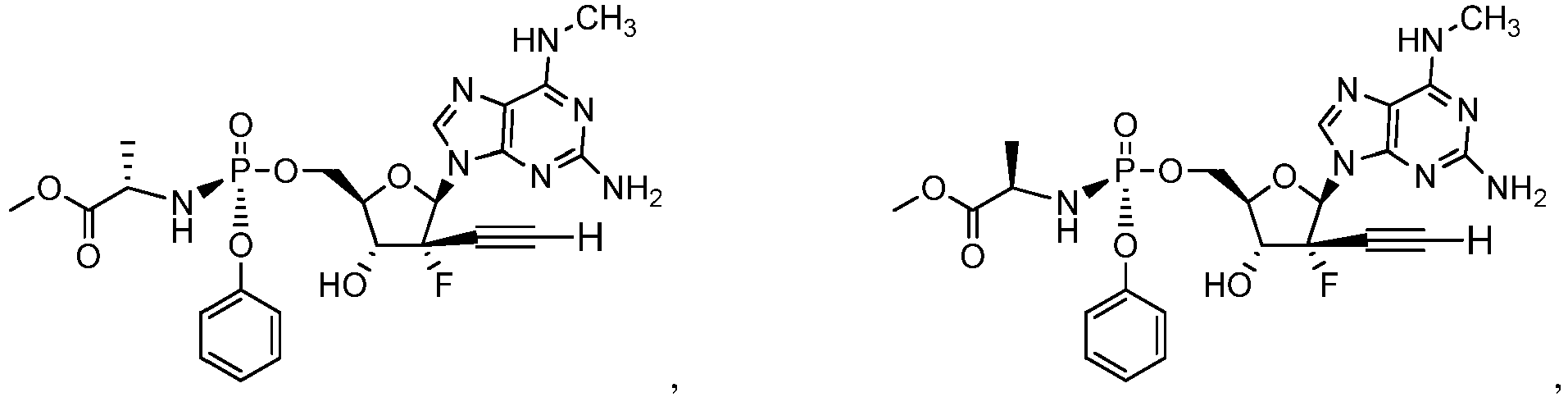


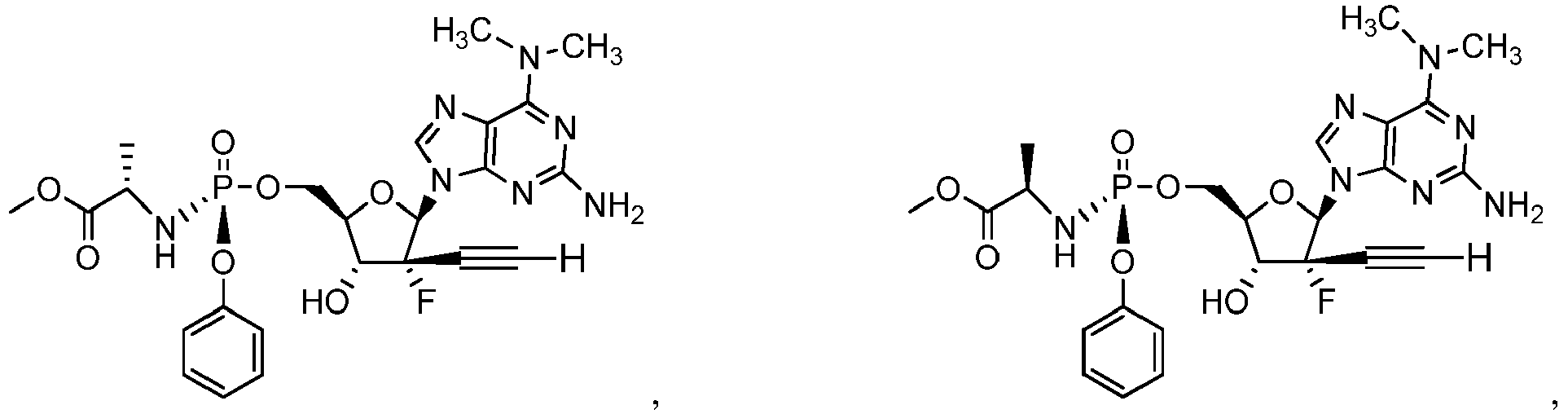


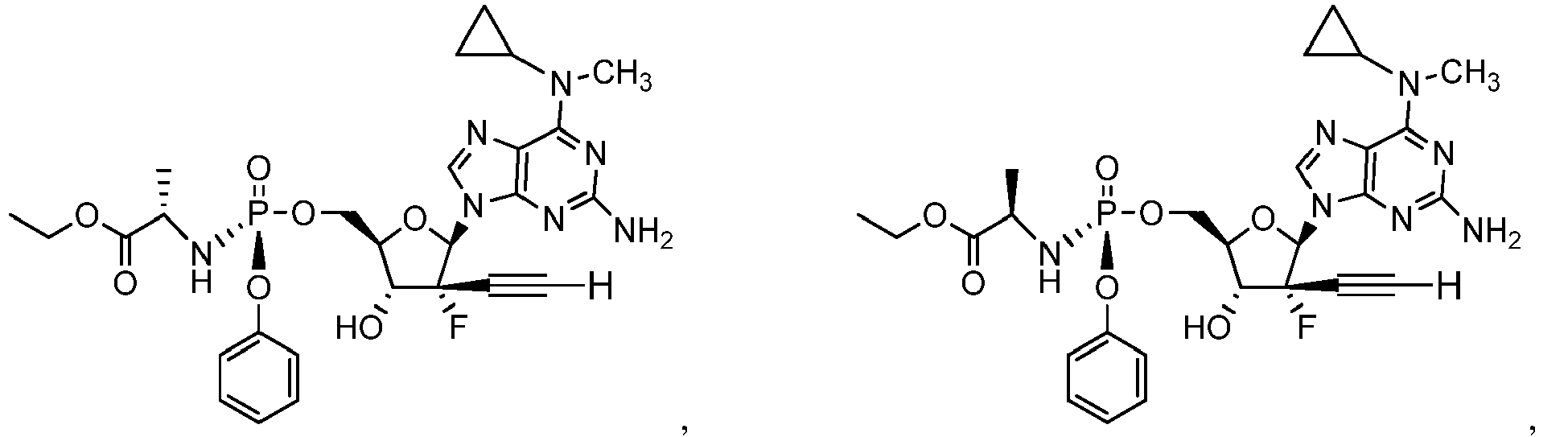


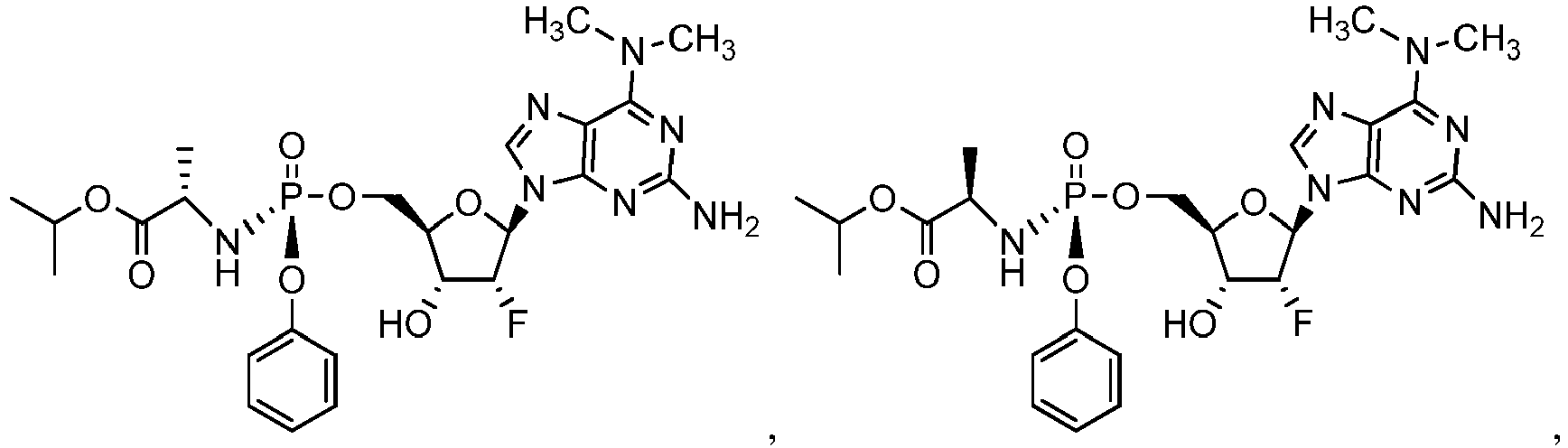

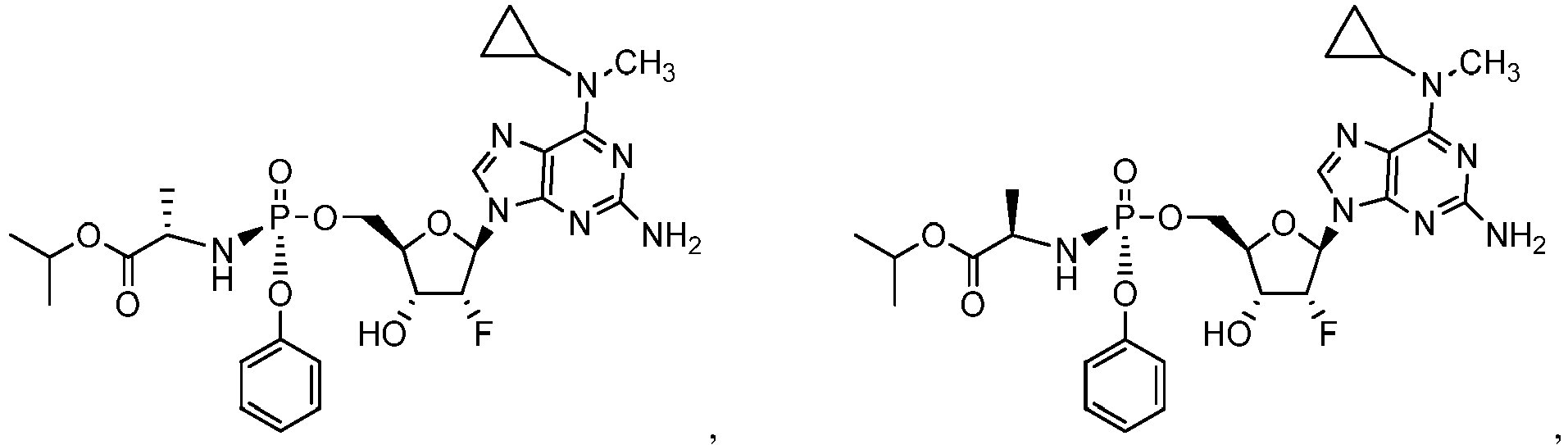
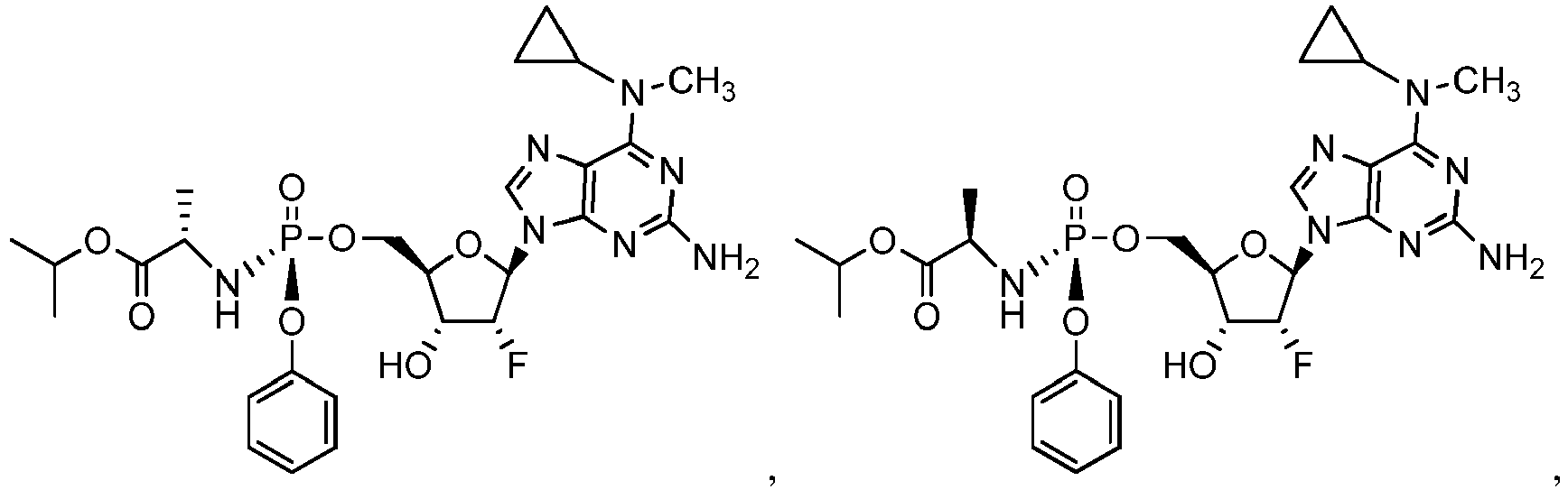


- In another aspect described herein but not claimed, the use of an effective amount of a compound of Formula III or a pharmaceutically acceptable salt thereof, for the treatment of an infection of an RNA virus in a host, including a human in need thereof is provided. Additional non-limiting examples of Formula III include but are not limited to (compounds for use according to the appended claims are claimed):


- In another aspect described herein but not claimed, the use of an effective amount of a compound of Formula III or a pharmaceutically acceptable salt thereof, for the treatment of an infection of an RNA virus in a host, including a human in need thereof is provided. Non-limiting examples of thiophosphoramidates of Formula III include, but are not limited to (compounds for use according to the appended claims are claimed):


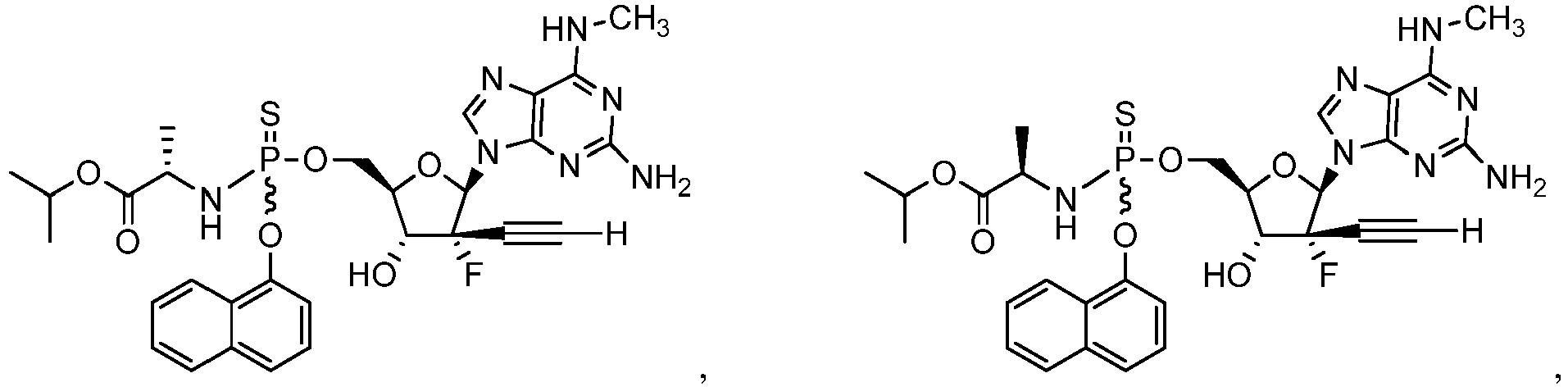


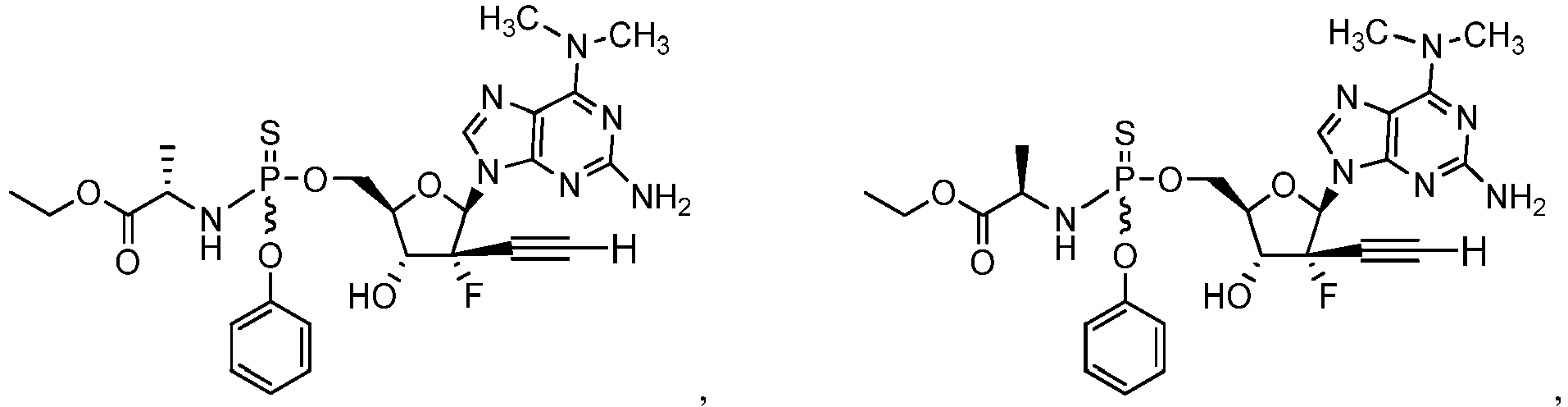


- In another aspect described herein but not claimed, the use of an effective amount of a compound of Formula III or a pharmaceutically acceptable salt thereof, for the treatment of an infection of an RNA virus in a host, including a human in need thereof is provided. Additional non-limiting examples of thiophosphoramidates of Formula III include, but are not limited to (compounds for use according to the appended claims are claimed):

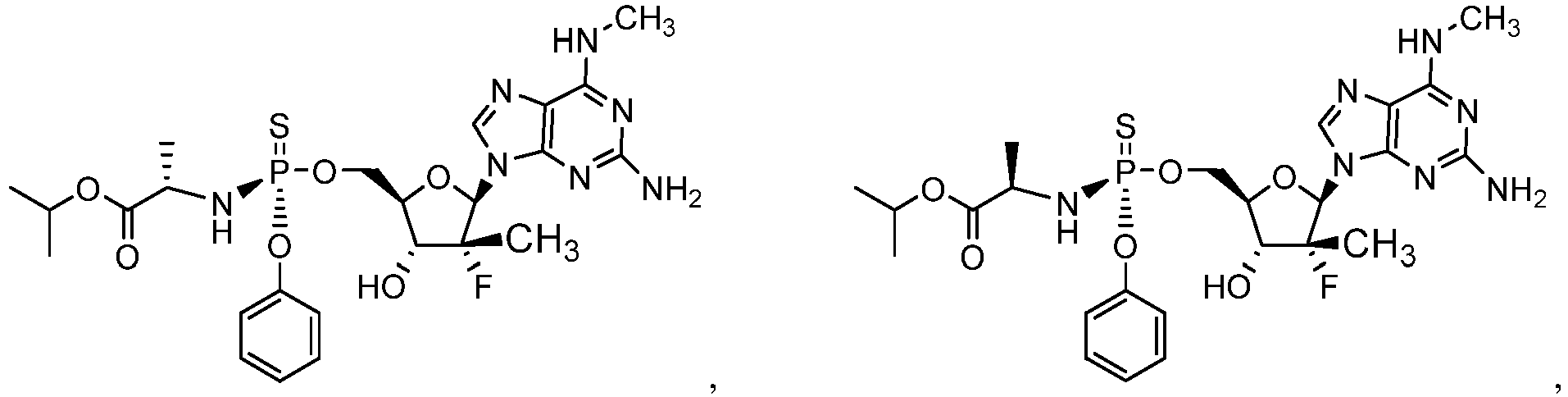
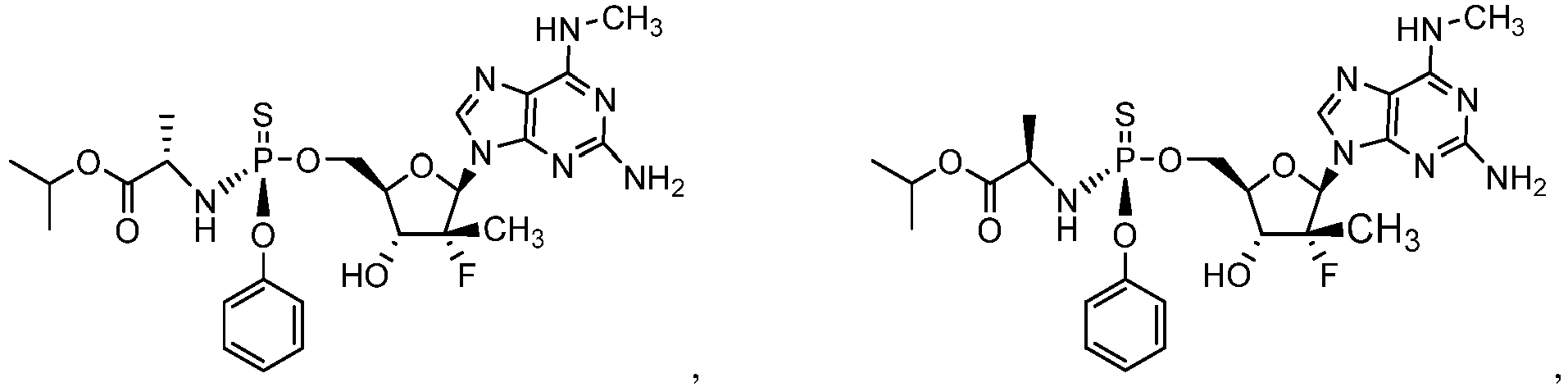


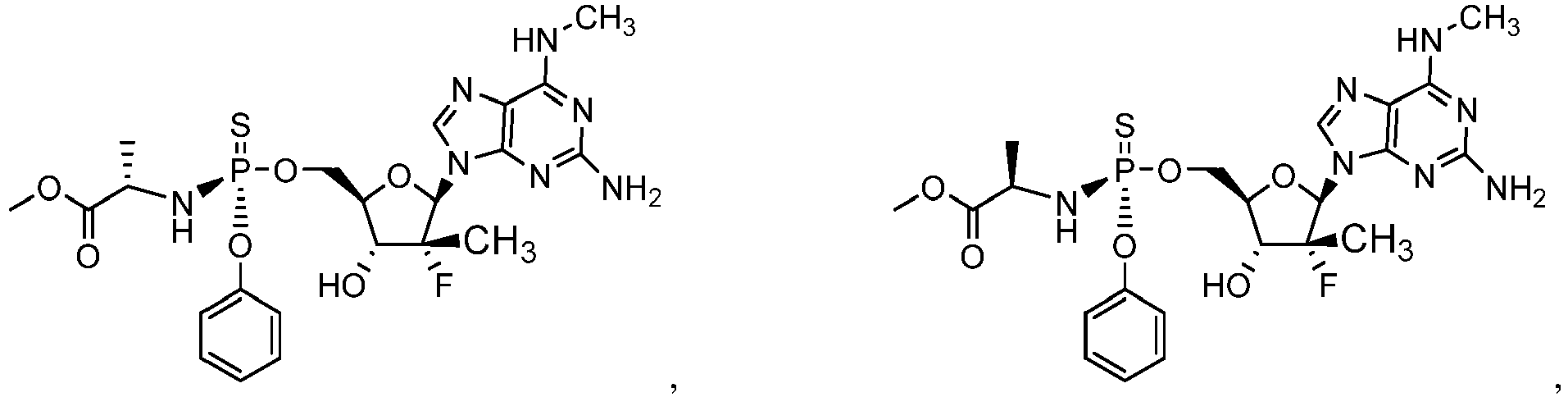


- In another aspect described herein but not claimed, the use of an effective amount of a compound of Formula I or a pharmaceutically acceptable salt thereof, for the treatment of an infection of an RNA virus in a host, including a human in need thereof is provided. Non-limiting examples of stabilized phosphate prodrugs of Formula I are illustrated below (compounds for use according to the appended claims are claimed):


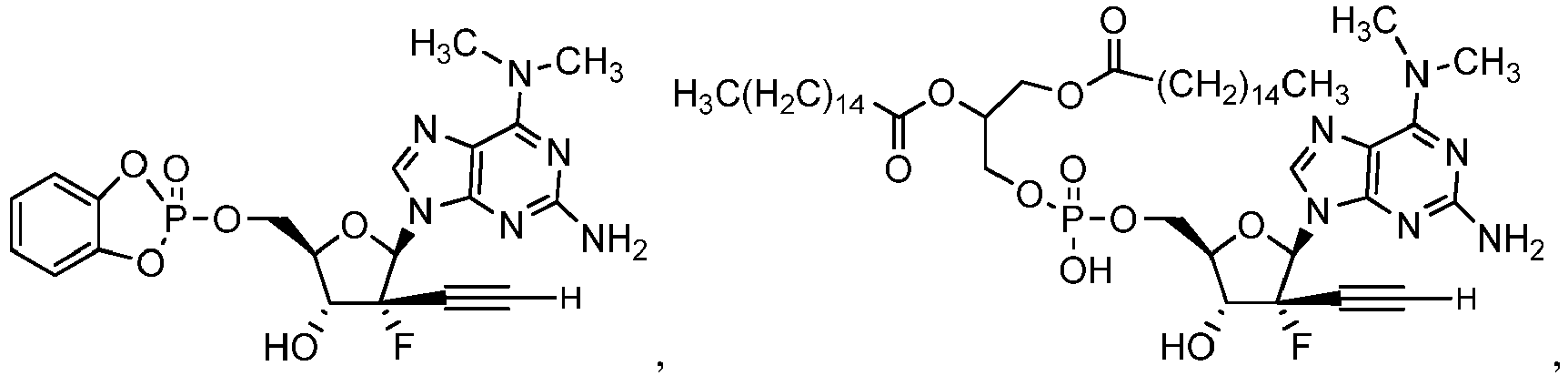


- In another aspect described herein but not claimed, the use of an effective amount of a compound of Formula II or a pharmaceutically acceptable salt thereof, for the treatment of an infection of an RNA virus in a host, including a human in need thereof is provided. Non-limiting examples of compounds of Formula II include:


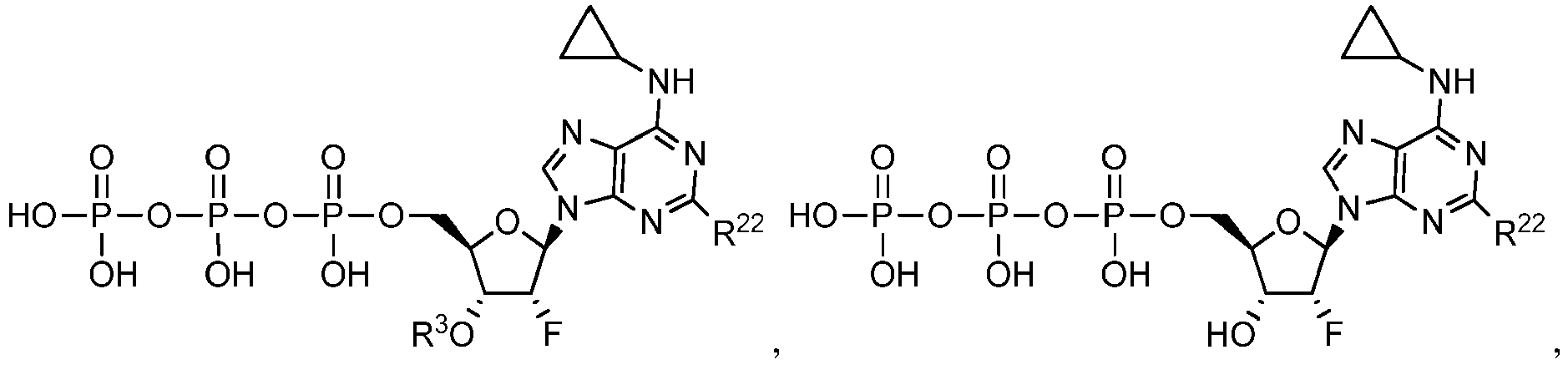


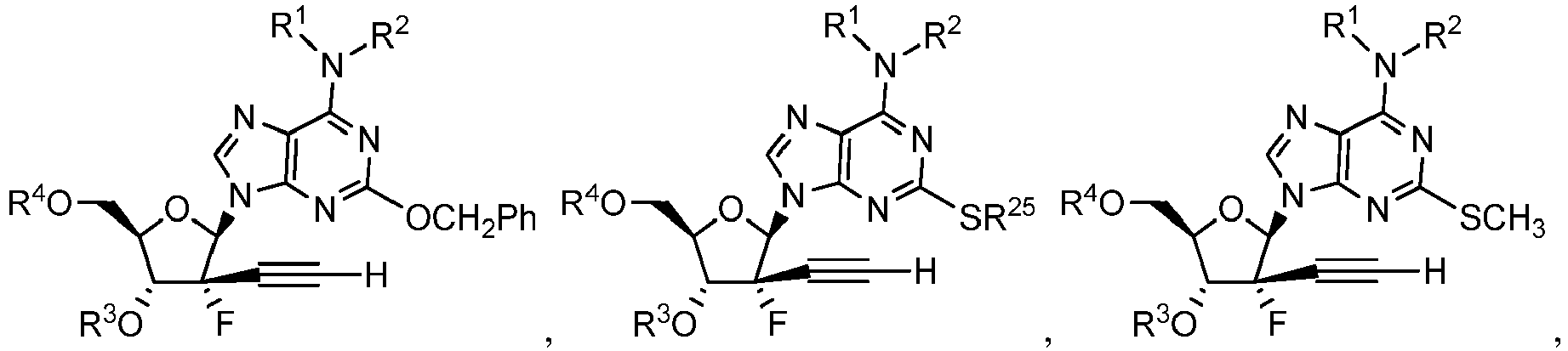


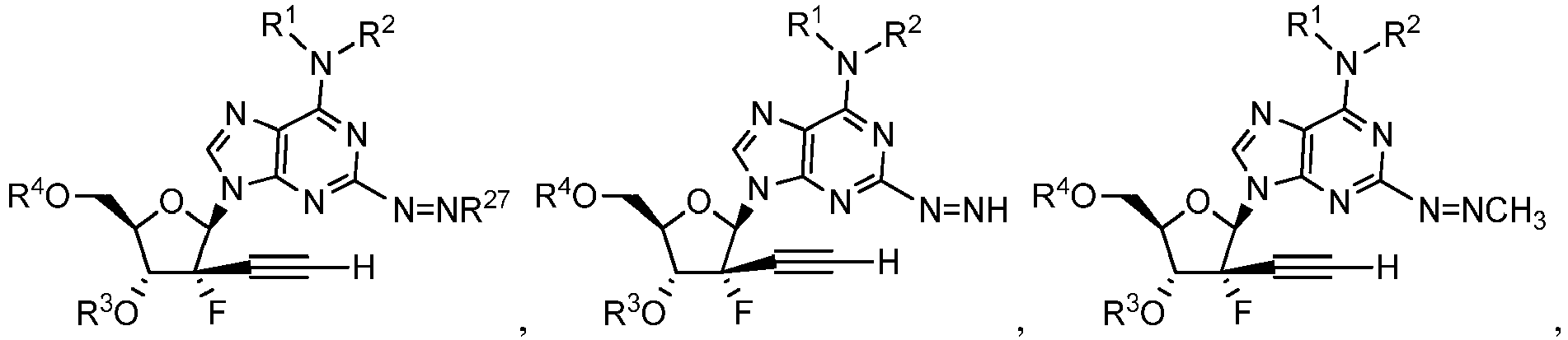
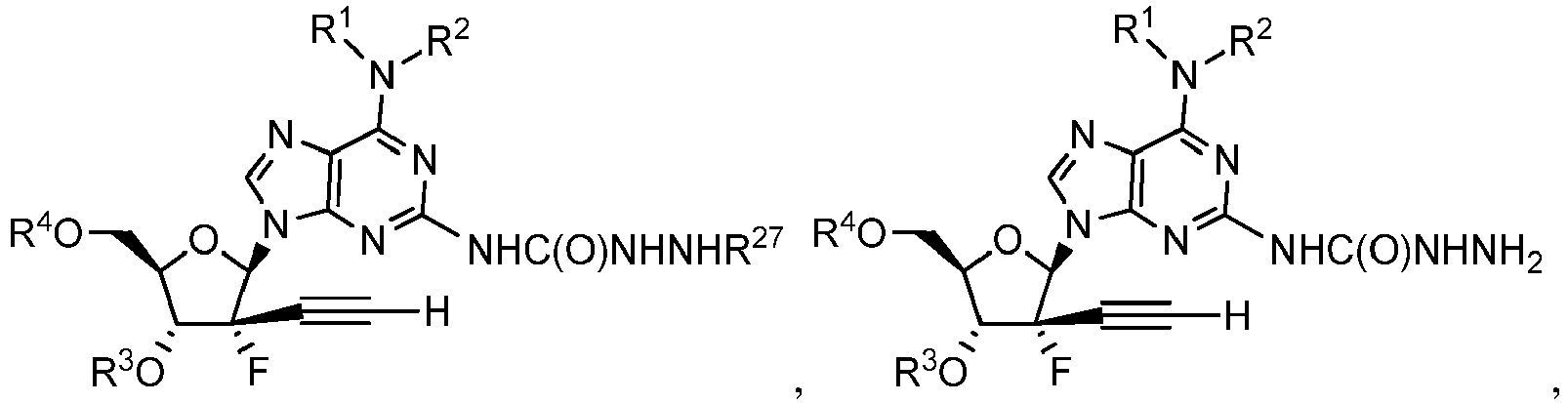


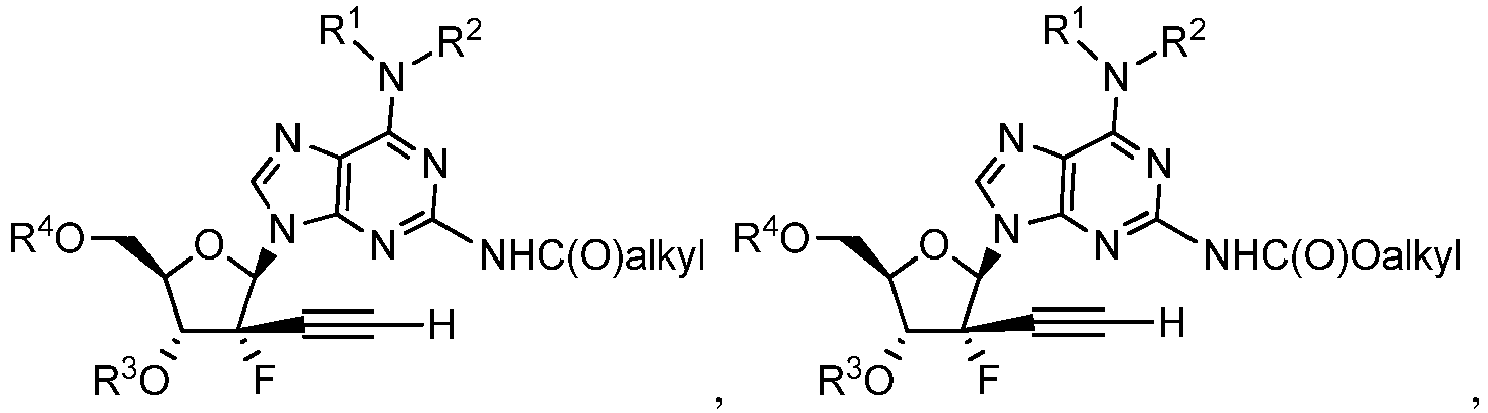


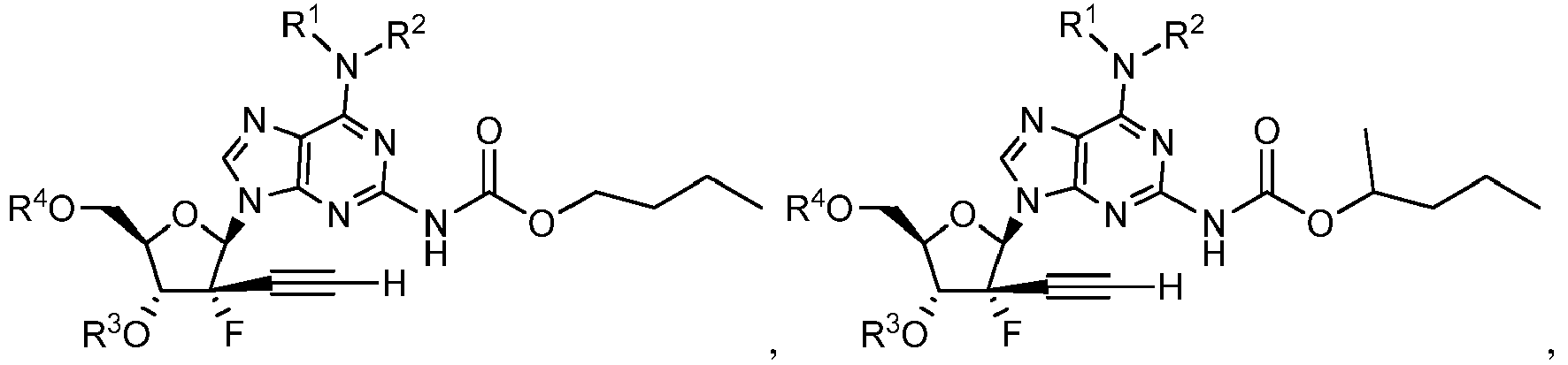


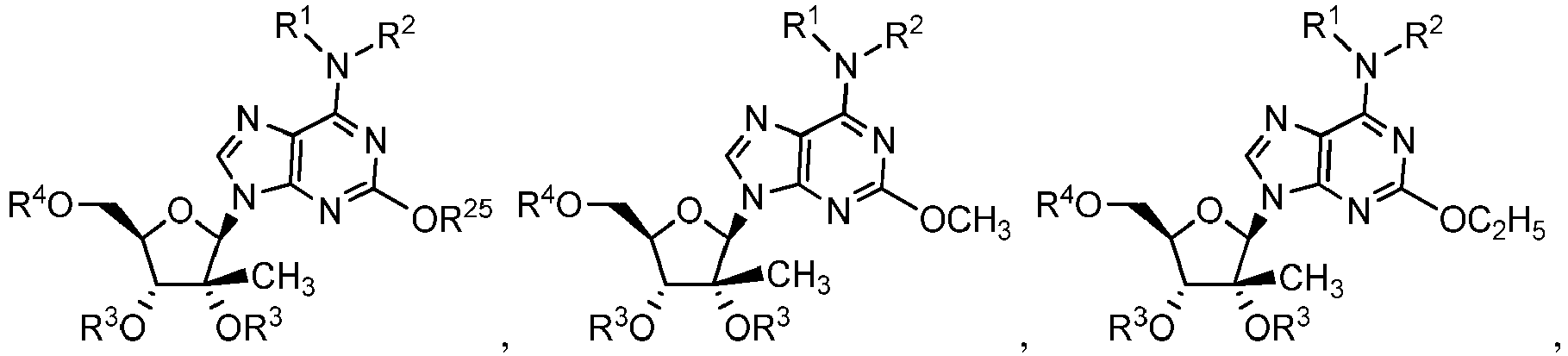


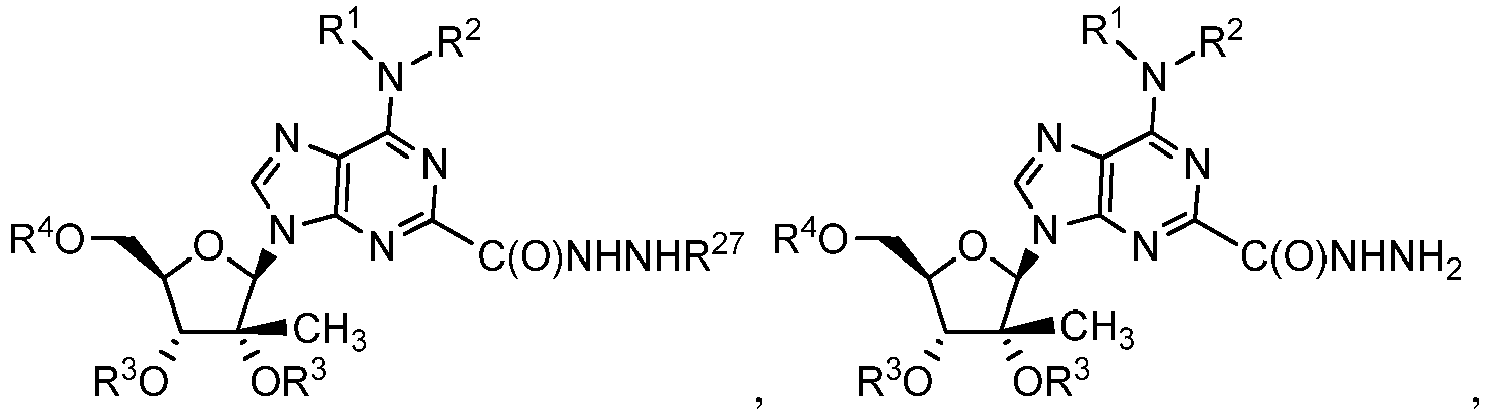


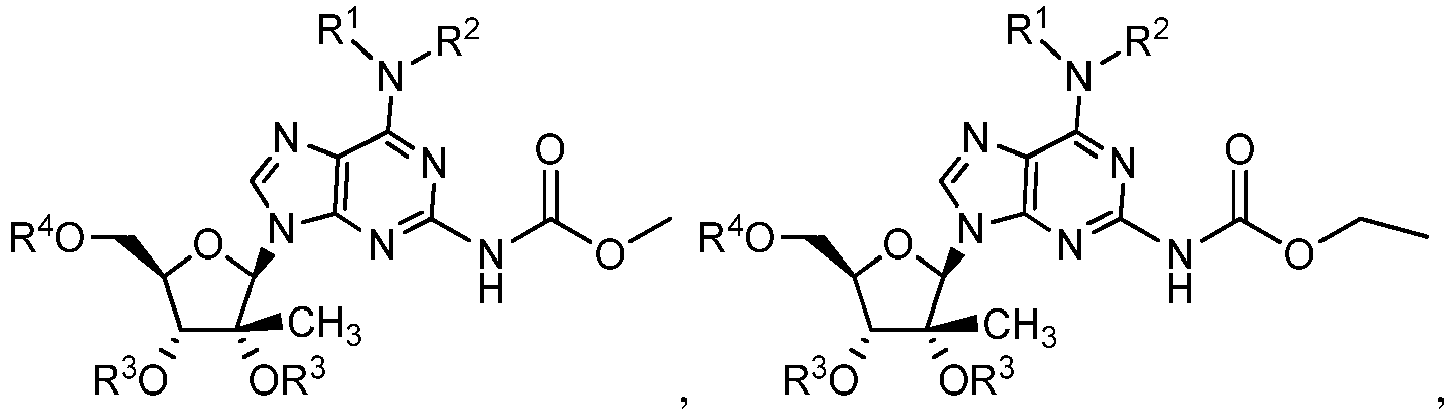


- In another aspect described herein but not claimed, the use of an effective amount of a compound of Formula V or a pharmaceutically acceptable salt thereof, for the treatment of an infection of an RNA virus in a host, including a human in need thereof is provided. Non-limiting examples of compounds of Formula V include:
















- In another aspect described herein but not claimed, the use of an effective amount of a compound of Formula VI or a pharmaceutically acceptable salt thereof, for the treatment of an infection of an RNA virus in a host, including a human in need thereof is provided. Non-limiting examples of compounds of Formula VI include:


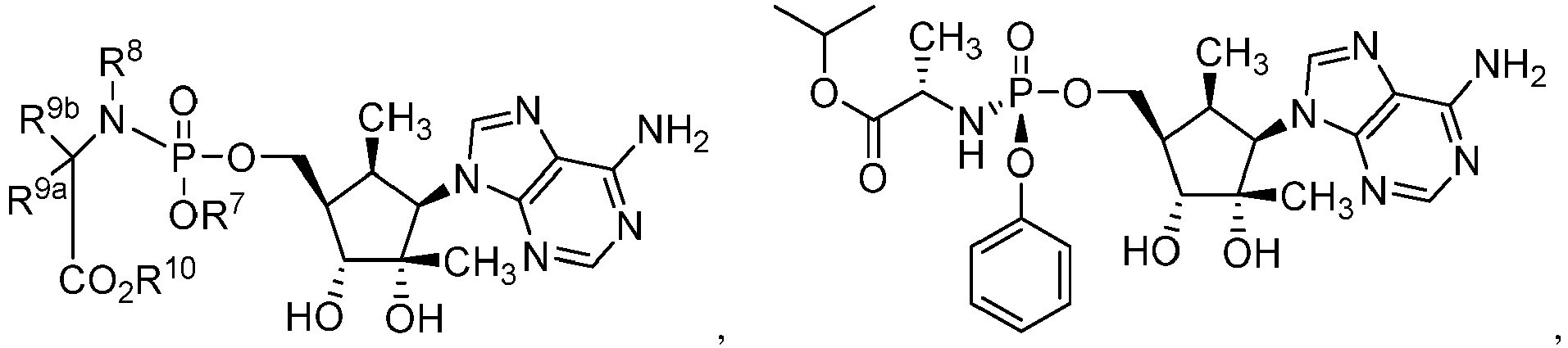


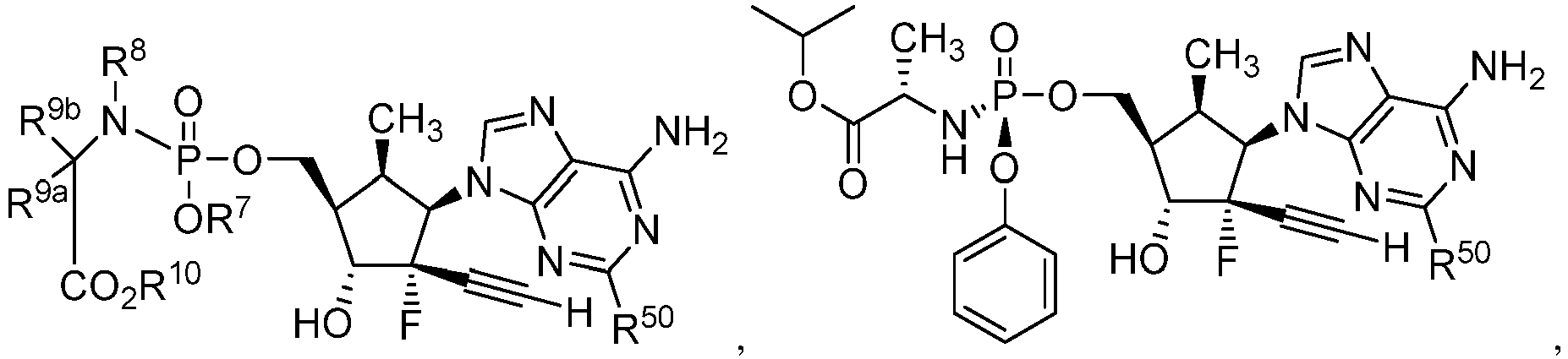


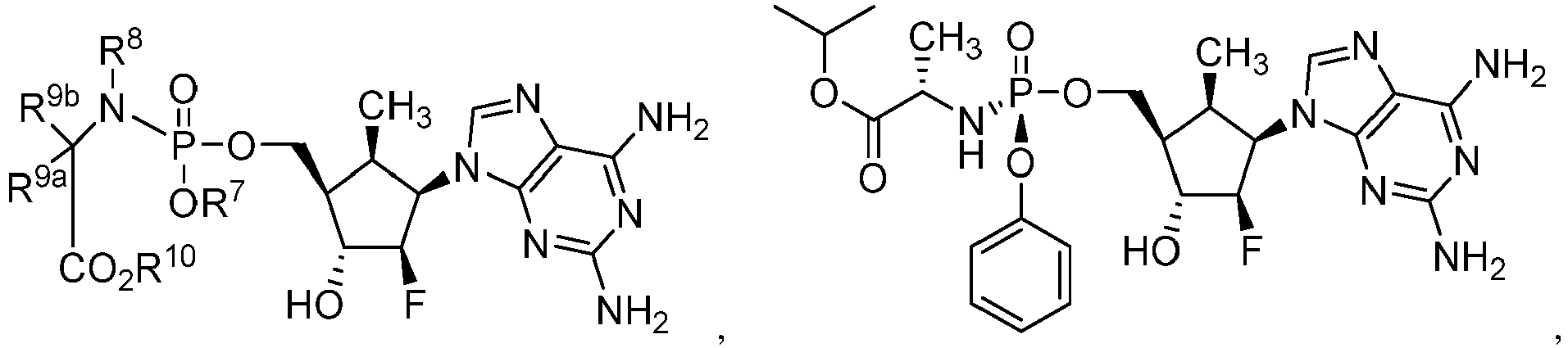


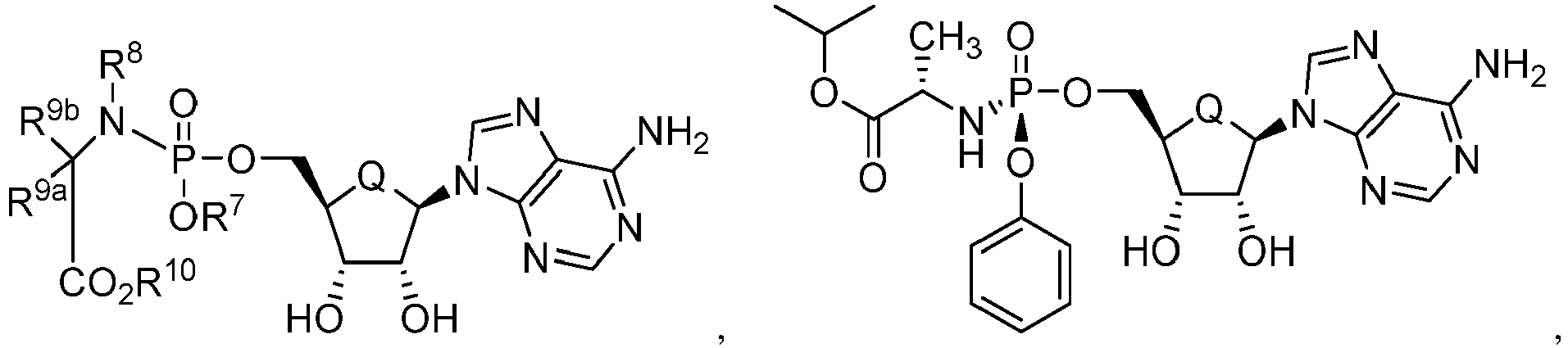


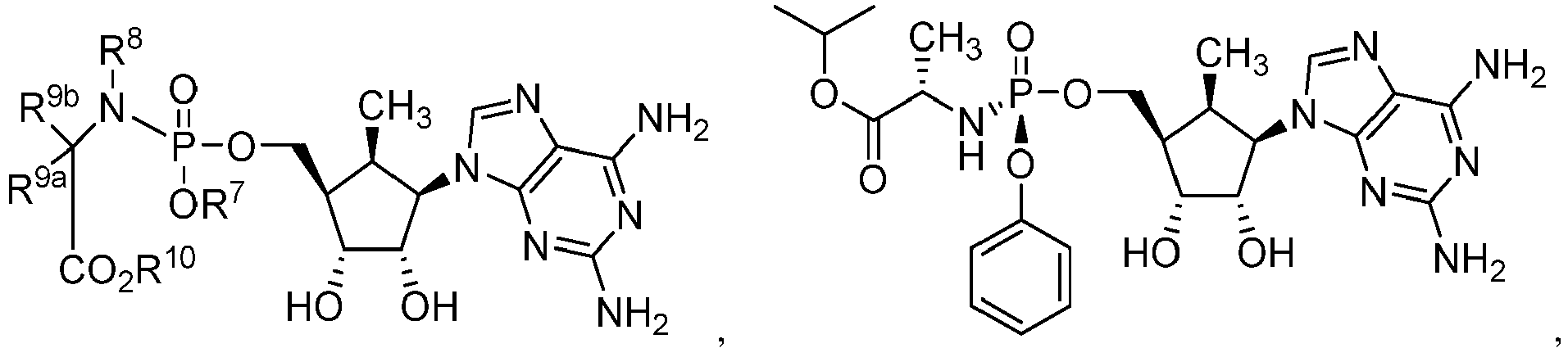


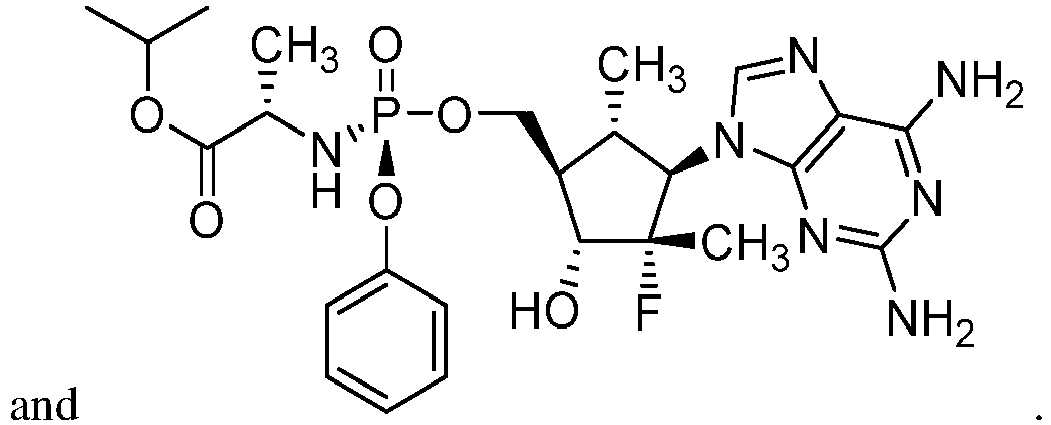


- In another aspect described herein but not claimed, the use of an effective amount of a compound of Formula III or a pharmaceutically acceptable salt thereof, for the treatment of an infection of an RNA virus in a host, including a human in need thereof is provided. Non-limiting examples of Formula III include but are not limited to (compounds for use according to the appended claims are claimed):


- The following terms are used to describe the present invention. In instances where a term is not specifically defined herein, that term is given an art-recognized meaning by those of ordinary skill applying that term in context to its use in describing the present invention.
- The term "alkyl" shall mean within its context, a linear, or branch-chained fully saturated hydrocarbon radical or alkyl group which can be optionally substituted (for example, with halogen, including F). For example, an alkyl group can have 1, 2, 3, 4, 5, 6, 7 or 8 carbon atoms (i.e., C1 -C8 alkyl), 1, 2, 3, 4, 5 or 6 carbon atoms (i.e., C1-C6 alkyl) or 1 to 4 carbon atoms (i.e., C1-C4 alkyl). Examples of suitable alkyl groups include, but are not limited to, methyl, ethyl, n-propyl, iso-propyl, n-butyl, isobutyl, sec-butyl, tert-butyl, pentyl, isopentyl, tert-pentyl, neopentyl, hexyl, 2-methylpentyl, 3-methylpentyl, 2,2-dimethylbutyl and 2,3-dimethylbutyl.
- The term "alkenyl" refers to a non-aromatic hydrocarbon group which contains at least one double bond between adjacent carbon atoms and a similar structure to an alkyl group as otherwise described herein. For example, an alkenyl group can have 2 to 8 carbon atoms (i.e., C2-C8 alkenyl), or 2 to 4 carbon atoms (i.e., C2-C4 alkenyl). Examples of suitable alkenyl groups include, but are not limited to, ethenyl or vinyl (-CH=CH2), allyl (-CH2CH=CH2), 1-butenyl (-C=CH-CH2CH3) and 2-butenyl (-CH2CH=CHCH2). The alkenyl group can be optionally substituted as described herein.
- The term "alkynyl" refers to a non-aromatic hydrocarbon group containing at least one triple bond between adjacent carbon atoms and a similar structure to an alkyl group as otherwise described herein. For example, an alkynyl group can have 2 to 8 carbon atoms (i.e., C2-C8 alkyne,), or 2 to 4 carbon atoms (i.e., C2-C4 alkynyl). Examples of alkynyl groups include, but are not limited to, acetylenic or ethynyl and propargyl. The alkynyl group can be optionally substituted as described herein.
- The term "acyl" refers to the moiety -C(O)R in which the carbonyl moiety is bonded to R, for example, -C(O)alkyl. R can be selected from alkoxy, alkyl, cycloalkyl, lower alkyl (i.e., C1-C4); alkoxyalkyl, including methoxymethyl; aralkyl- including benzyl, aryloxyalkyl- such as phenoxymethyl; aryl including phenyl optionally substituted with halogen, C1 to C4 alkyl or C1 to C4 alkoxy. In one embodiment, the term "acyl" refers to a mono, di or triphosphate.
- The term "lower acyl" refers to an acyl group in which the carbonyl moiety is lower alkyl (i.e., C1-C4).
- The term "alkoxy" refers to the group -OR' where -OR' is -O-alkyl, -O-alkenyl, -O-alkynyl, -O-(Co-C2)(cycloalkyl), -O-(C0-C2)(heterocyclo), -O-(C0-C2)(aryl), or -O-(C0-C2)(heteroaryl), each of which can be optionally substituted.
- The term "amino" refers to the group -NH2.
- The term "amino acid" or "amino acid residue" refers to a D- or L- natural or non-naturally occurring amino acid. Representative amino acids include, but are not limited to, alanine, β-alanine, arginine, asparagine, aspartic acid, cysteine, cystine, glutamic acid, glutamine, glycine, phenylalanine, histidine, isoleucine, lysine, leucine, methionine, proline, serine, threonine, valine, tryptophan, or tyrosine, among others.
- The term "azido" refers to the group -N3.
- The term "aryl" or "aromatic", in context, refers to a substituted (as otherwise described herein) or unsubstituted monovalent aromatic radical having a single ring (e.g., phenyl or benzyl) or condensed rings (e.g., naphthyl, anthracenyl, phenanthrenyl, etc.) and can be bound to the compound according to the present invention at any available stable position on the ring(s) or as otherwise indicated in the chemical structure presented. The aryl group can be optionally substituted as described herein.
- "Cycloalkyl", "carbocycle", or "carbocyclyl" refers to a saturated (i.e., cycloalkyl) or partially unsaturated (e.g., cycloakenyl, cycloalkadienyl, etc.) ring having 3 to 7 carbon atoms as a monocycle. Monocyclic carbocycles have 3 to 7 ring atoms, still more typically 5 or 6 ring atoms. Non-limiting examples of cycloalkyl groups include cyclopropyl, cyclobutyl, cyclopentyl, 1-cyclopent-1-enyl, 1-cyclopent-2-enyl, 1-cyclopent-3-enyl, cyclohexyl, 1-cyclohex-1-enyl, 1-cyclohex-2-enyl, and 1-cyclo-hex-3-enyl.
- The term "cyano" refers to the group -CN.
- The term "halogen" or "halo" refers to chloro, bromo, fluoro or iodo.
- A heteroaryl ring system is a saturated or unsaturated ring with one or more nitrogen, oxygen, or sulfur atoms in the ring (monocyclic) including but not limited to imidazole, furyl, pyrrole, furanyl, thiene, thiazole, pyridine, pyrimidine, purine, pyrazine, triazole, oxazole, or fused ring systems such as indole, quinoline, etc., among others, which may be optionally substituted as described above. Heteroaryl groups include nitrogen-containing heteroaryl groups such as pyrrole, pyridine, pyridone, pyridazine, pyrimidine, pyrazine, pyrazole, imidazole, triazole, triazine, tetrazole, indole, isoindole, indolizine, purine, indazole, quinoline, isoquinoline, quinolizine, phthalazine, naphthyridine, quinoxaline, quinazoline, cinnoline, pteridine, imidazopyridine, imidazotriazine, pyrazino-pyridazine, acridine, phenanthridine, carbazole, carbazoline, perimidine, phenanthroline, phenacene, oxadiazole, benzimidazole, pyrrolopyridine, pyrrolopyrimidine and pyridopyrimidine; sulfur-containing aromatic heterocycles such as thiophene and benzothiophene; oxygen-containing aromatic heterocycles such as furan, pyran, cyclopentapyran, benzofuran and isobenzofuran; and aromatic heterocycles comprising two or more hetero atoms selected from among nitrogen, sulfur and oxygen, such as thiazole, thiadiazole, isothiazole, benzoxazole, benzothiazole, benzothiadiazole, phenothiazine, isoxazole, furazan, phenoxazine, pyrazoloxazole, imidazothiazole, thienofuran, furopyrrole, pyridoxazine, furopyridine, furopyrimidine, thienopyrimidine and oxazole, among others, all of which may be optionally substituted.
- The term "heterocycle" or "heterocyclo" refers to a cyclic group which contains at least one heteroatom, i.e., O, N, or S, and may be aromatic (heteroaryl) or non-aromatic. Exemplary non-aromatic heterocyclic groups for use in the present invention include, for example, pyrrolidinyl, piperidinyl, piperazinyl, N-methylpiperazinyl, imidazolinyl, pyrazolidinyl, imidazolidinyl, morpholinyl, tetrahydropyranyl, azetidinyl, oxetanyl, oxathiolanyl, pyridone, 2-pyrrolidone, ethylene urea, 1,3-dioxolane, 1,3-dioxane, 1,4-dioxane, phthalimide, and succinimide, among others, all of which may be optionally substituted.
- The term "hydroxyl" refers to the group -OH.
- The term "nitro" refers to the group -NO2.
- The term "pharmaceutically acceptable salt" or prodrug" is used throughout the specification to describe any pharmaceutically acceptable form (such as an ester, phosphoramidate, thiophosphoramidate, phosphate ester, salt of an ester, or a related group) of a 2'-substituted-N6-substituted purine nucleotide which, upon administration to a patient, provides the desired active compound. Examples of pharmaceutically acceptable salts are organic acid addition salts formed with acids, which form a physiological acceptable anion, for example, tosylate, methanesulfonate, acetate, citrate, malonate, tartrate, succinate, benzoate, ascorbate, α-ketoglutarate, and α-glycerophosphate. Suitable inorganic salts may also be formed, including sulfate, nitrate, bicarbonate, and carbonate salts. Pharmaceutically acceptable salts may be obtained using standard procedures well known in the art, for example by reacting a sufficiently basic compound such as an amine with a suitable acid affording a physiologically acceptable anion. Alkali metal (for example, sodium, potassium, or lithium) or alkaline earth metal (for example calcium) salts of carboxylic acids can also be made.
- "Pharmaceutically acceptable prodrug" refers to a compound that is metabolized, for example hydrolyzed or oxidized, in the host to form the compound of the present invention. Typical examples of prodrugs include compounds that have biologically labile protecting groups on a functional moiety of the active compound. Prodrugs include compounds that can be oxidized, reduced, aminated, deaminated, hydroxylated, dehydroxylated, hydrolyzed, dehydrolyzed, alkylated, dealkylated, acylated, deacylated, phosphorylated, dephosphorylated, thiophoshoramidated, dethiophoshoramidated, phoshoramidated or dephosphoramidated to produce the active compound. The compounds of this invention possess antiviral activity against an RNA virus, or are metabolized to a compound that exhibits such activity. The 2'-substituted-N6-substituted purine nucleoside can also be administered as a 5'-phosphoether lipid, a bisphosphoramidate, a 3',5'-cyclic phosphoramidate, a 3',5'-cyclic thiophosphoramidate, a DTE conjugate, a mixed phosphoramidate-SATE derivative or a "SATE" derivative.
- The term "phosphonic acid" refers to the group -P(O)(OH)2.
- In one embodiment, the term purine or pyrimidine base includes, but is not limited to, adenine, N6-alkylpurines, N6-acylpurines (wherein acyl is -C(O)alkyl, -C(O)(aryl)C0-C4alkyl, or -C(O)(C0-C4alkyl)aryl), N6-benzylpurine, N6-halopurine, N6-vinylpurine, N6-acetylenic purine, N6-acyl purine, N6-hydroxyalkyl purine, N6-thioalkyl purine, N2-alkylpurines, N2-alkyl-6-thiopurines, thymine, cytosine, 5-fluorocytosine, 5-methylcytosine, 6-azapyrimidine, including 6-azacytosine, 2- and/or 4-mercaptopyrmidine, uracil, 5-halouracil, including 5-fluorouracil, C5-alkylpyrimidines, C5-benzylpyrimidines, C5-halopyrimidines, C5-vinylpyrimidine, C5-acetylenic pyrimidine, C5-acyl pyrimidine, C5-hydroxyalkyl purine, C5-amidopyrimidine, C5-cyanopyrimidine, C5-nitropyrimidine, C5-aminopyrimidine, N2-alkylpurines, N2-alkyl-6-thiopurines, 5-azacytidinyl, 5-azauracilyl, triazolopyridinyl, imidazolopyridinyl, pyrrolopyrimidinyl, and pyrazolo-pyrimidinyl. Purine bases include, but are not limited to, guanine, adenine, hypoxanthine, 2,6-diaminopurine, and 6-chloropurine. Functional oxygen and nitrogen groups on the base can be protected as necessary or desired. Suitable protecting groups are well known to those skilled in the art, and include benzyl, trimethylsilyl, dimethylhexylsilyl, t-butyldimethylsilyl, t-butyldiphenylsilyl, trityl, alkyl groups, and acyl groups such as acetyl and propionyl; methanesulfonyl, and p-toluenesulfonyl. Alternatively, the purine or pyrimidine base can optionally be substituted such that it forms a viable prodrug, which can be cleaved in vivo. Examples of appropriate substituents include an acyl moiety.
- The term "substituted" or "optionally substituted" indicates that the moiety can have at least one additional substituent including, but not limited to, halogen (F, Cl, Br, I), OH, phenyl, benzyl, N3, CN, acyl, alkyl, including methyl; alkenyl, alkynyl, alkoxy, haloalkyl; including CHF2, CH2F and CF3; etc. In one embodiment, the term "substituted" or "optionally substituted" indicates that the moiety can have at least one additional substituent including, but not limited to, azido, cyano, halogen (fluoro, chloro, bromo, or iodo), alkyl, alkenyl, alkynyl, cycloalkyl, heterocycle, aryl, heteroaryl, haloalkyl, hydroxyl, alkoxy, amino, -NH(C1-C6 unsubstituted alkyl), -NH(C1-C6 substituted alkyl), -NH-(C0-C2alkyl)(C3-C8cycloalkyl), -NH-(C0-C2alkyl)(C3-C8heterocycle),-NH-(C0-C2alkyl)(aryl), -N(C1-C6 unsubstituted alkyl)2, -N(C1-C6 unsubstituted alkyl)(C1-C6 substituted alkyl), -N(C1-C6 substituted alkyl)2,-NH-(C0-C2alkyl)(C3-C8cycloalkyl), -NH-(C0-C2alkyl)(C3-C8heterocycle),-NH-(C0-C2alkyl)(aryl), acyl, nitro, sulfonic acid, sulfate, phosphonic acid, phosphate, phosphonate, or thiol.
- The term "sulfonate esters", represented by the formula, R14S(O)2OR15, comprise R14 wherein R14 is alkyl, haloalkyl, aralkyl or aryl. R15 is alkyl, aryl or aralkyl.
- The term "sulfonic acid" refers to the group -SO2OH.
- The term "thiol" refers to the group -SH.
- The term "nitrogen-protecting group" as used herein refers to a moiety that is covalently attached to nitrogen and which can be removed, and typically replaced with hydrogen, when appropriate. For example, a nitrogen-protecting group may be a group that is removed in vivo after administration to a host, in vitro by a cell, or it may be removed during a manufacturing process. Suitable nitrogen-protecting groups useful in the present invention are described by Greene and Wuts in Protective Groups in Organic Synthesis (1991) New York, John Wiley and Sons, Inc.
- The term "oxygen-protecting group" as used herein refers to a moiety that is covalently attached to oxygen and which can be removed, and typically replaced with hydrogen, when appropriate. For example, an oxygen-protecting group may be a group that is removed in vivo after administration to a host, in vitro by a cell, or it may be removed during a manufacturing process. Suitable oxygen-protecting groups useful in the present invention are described by Greene and Wuts in Protective Groups in Organic Synthesis (1991) New York, John Wiley and Sons, Inc.
- "Phosphate" refers to the group -OP(O)(OH)2.
- "Phosphate ester" refers to mono, di, and tri phosphates unless otherwise indicated.
- The term "phosphoamidate", "phosphoramidate", or "phosphoroamidate" is a moiety that has a phosphorus bound to three oxygen groups and an amine (which may optionally be substituted). Suitable phosphoramidates useful in the present invention are described by Madela, Karolina and McGuigan in 2012, "Progress in the development of anti-hepatitis C virus nucleoside and nucleotide prodrugs", Future Medicinal Chemistry 4(5), pages 625-650 10:1021/jm300074y and Dominique, McGuigan and Balzarini in 2004, "Aryloxy Phosphoramidate Triesters as Pro-Tides", Mini Reviews in Medicinal Chemistry 4(4), pages 371-381. Additional phosphoramidates useful in the present invention are described in
U.S. Patent Nos. 5,233,031 ,7,115,590 ,7,547,704 ,7,879,815 ,7,888,330 ,7,902,202 ,7,951,789 ,7,964,580 ,8,071,568 ;8,148,349 ,8,263,575 ,8,324,179 ,8,334,270 ,8,552,021 ,8,563,530 ,8,580,765 ,8,735,372 8,759,318 ;EP 2120565 ;EP 1143995 ;6,455,513 ; and8,334,270 . Other phosphoramidates are described in the nucleoside patents described in the Background of the Invention. - Phosphoramidate groups for use in the present invention include those of the structures:


- Other phosphoramidates described herein but not claimed include those of the structure:

- RP1 is an optionally substituted linear, branched, or cyclic alkyl group, or an optionally substituted aryl, heteroaryl or heterocyclic group or a linked combination thereof; and
- RP2 is a -NRN1RN2 group or a B' group;
- wherein:
- RN1 and RN2 are each independently H, C1-8alkyl, (C3-C7cycloalkyl)C0-C4alkyl-, (aryl)Co-C4alkyl-, (C3-C6heterocyclo)C0-C4alkyl-, or (heteroaryl)C0-C4alky-; which may be optionally substituted; or
- RN1 and RN2 along with the nitrogen atom to which that are attached, join to form a 3 to 7 membered heterocyclic ring;

- R16 is hydrogen, (C1-C8)alkyl, (C2-C8)alkenyl, (C2-C8)alkynyl, (C3-C8cycloalkyl)C0-C4alkyl-, (aryl)C0-C4alkyl-, (C3-C6heterocyclo)C0-C4alkyl-, (heteroaryl)C0-C4alky-, or the sidechain of an amino acid, for example a sidechain of an amino acid (as otherwise described herein) often selected from the group consisting of alanine, β-alanine, arginine, asparagine, aspartic acid, cysteine, cystine, glutamic acid, glutamine, glycine, phenylalanine, histidine, isoleucine, lysine, leucine, methionine, proline, serine, threonine, valine, tryptophan, or tyrosine (often R16 is hydrogen, methyl, isopropyl, or isobutyl);
- R17 is hydrogen, (C1-C8)alkyl, (C2-C8)alkenyl, (C2-C8)alkynyl, (C3-C8cycloalkyl)C0-C4alkyl-, (aryl)C0-C4alkyl-, (C3-C6heterocyclo)C0-C4alkyl-, (heteroaryl)C0-C4alky-, or the sidechain of an amino acid, for example a sidechain of an amino acid (as otherwise described herein) often selected from the group consisting of alanine, β-alanine, arginine, asparagine, aspartic acid, cysteine, cystine, glutamic acid, glutamine, glycine, phenylalanine, histidine, isoleucine, lysine, leucine, methionine, proline, serine, threonine, valine, tryptophan, or tyrosine (often R17 is hydrogen, methyl, isopropyl, or isobutyl);
- R18 is hydrogen or C1-C3alkyl; or
- R16 and R17 can form a (C3-C7)cycloalkyl or (C3-C7)heterocyclic group; or
- R18 and R16 or R17 can form (C3-C6)heterocyclic group; and
- R19 is hydrogen, (C1-C6)alkyl, (C3-C6)alkenyl, (C3-C6)alkynyl, (C3-C8cycloalkyl)C0-C4alkyl-, (aryl)C0-C4alkyl-, (C3-C6heterocyclo)C0-C4alkyl-, (heteroaryl)C0-C4alky-; or B' is a

- R20 is hydrogen, (C1-C3)alkyl, (C3-C8cycloalkyl)C0-C4alkyl-, (aryl)C0-C4alkyl-, (C3-C6heterocyclo)C0-C4alkyl-, or (heteroaryl)C0-C4alky-;
- R21 is hydrogen, (C1-C3)alkyl, (C3-C8cycloalkyl)C0-C4alkyl-, (aryl)C0-C4alkyl-, (C3-C6heterocyclo)C0-C4alkyl-, or (heteroaryl)C0-C4alky-; and
- R18 and R19 are as defined above.
- Typical RP1 groups include optionally substituted phenyl, naphthyl, and monocyclic heteroaryl groups, especially those groups (particularly lipophilic groups) which enhance bioavailability of the compounds in the cells of the patient and which exhibit reduced toxicity, enhanced therapeutic index and enhanced pharmacokinetics (the compounds are metabolized and excreted more slowly).
- The term phosphoramidate is used throughout the specification to describe a group that is found at the 5' or 3' position of the furanose ring of the nucleoside compound and forms a prodrug form of the nucleoside compound. In one embodiment, phosphoramidates can be found at both the 5' and 3' position of the furanose ring of the nucleoside compound and form a prodrug form of the nucleoside compound. In another embodiment, the phosphoramidate found at the 5' position of the furanose ring of the nucleoside can form a cyclic phosphoramidate compound by forming a bond with the 3'-hydroxyl substituent at the 3' position of the furanose ring of the nucleoside compound and form a prodrug form of the nucleoside compound.
- The term "thiophosphoamidate", "thiophosphoramidate", or "thiophosphoroamidate" is a moiety that has a phosphorus bound to sulfur, two oxygen groups and an amine (which may optionally be substituted). Thiophosphoramidates useful in the present invention are described in
US Patent No. 8,772,474 andWO 2012/040124 . - Thiophosphoramidate groups described herein but not claimed include those of the structures:


- Other thiophosphoramidates include those of the structure:

- RP1 is an optionally substituted linear, branched, or cyclic alkyl group, or an optionally substituted aryl, heteroaryl or heterocyclic group or a linked combination thereof; and
- RP2 is a -NRN1RN2 group or a B' group;
- wherein:
- RN1 and RN2 are each independently H, C1-C8 alkyl, (C3-C7cycloalkyl)C0-C4alkyl-, (aryl)C0-C4alkyl-, (C3-C6heterocyclo)C0-C4alkyl-, or (heteroaryl)C0-C4alky-; or
- RN1 and RN2 along with the nitrogen atom to which that are attached, join to form a 3 to 7 membered heterocyclic ring;
- B' is a

- R16 is hydrogen, (C1-C8)alkyl, (C2-C8)alkenyl, (C2-C8)alkynyl, (C3-C8cycloalkyl)Co-C4alkyl-, (aryl)C0-C4alkyl-, (C3-C6heterocyclo)C0-C4alkyl-, (heteroaryl)C0-C4alky-, or the sidechain of an amino acid, for example a sidechain of an amino acid (as otherwise described herein) often selected from the group consisting of alanine, β-alanine, arginine, asparagine, aspartic acid, cysteine, cystine, glutamic acid, glutamine, glycine, phenylalanine, histidine, isoleucine, lysine, leucine, methionine, proline, serine, threonine, valine, tryptophan, or tyrosine (often R16 is hydrogen, methyl, isopropyl, or isobutyl);
- R17 is hydrogen, (C1-C8)alkyl, (C2-C8)alkenyl, (C2-C8)alkynyl, (C3-C8cycloalkyl)C0-C4alkyl-, (aryl)C0-C4alkyl-, (C3-C6heterocyclo)C0-C4alkyl-, (heteroaryl)C0-C4alky-, or the sidechain of an amino acid, for example a sidechain of an amino acid (as otherwise described herein) often selected from the group consisting of alanine, β-alanine, arginine, asparagine, aspartic acid, cysteine, cystine, glutamic acid, glutamine, glycine, phenylalanine, histidine, isoleucine, lysine, leucine, methionine, proline, serine, threonine, valine, tryptophan, or tyrosine (often R17 is hydrogen, methyl, isopropyl, or isobutyl);
- R18 is hydrogen or C1-C3alkyl; or
- R16 and R17 can form a (C3-C7)cycloalkyl or (C3-C7)heterocyclic group; or
- R18 and R16 or R17 can form (C3-C6) heterocyclic group; and R19 is hydrogen, (C1-C6)alkyl, (C3-C6)alkenyl, (C3-C6)alkynyl, (C3-C8cycloalkyl)C0-C4alkyl-, (aryl)C0-C4alkyl-, (C3-C6heterocyclo)C0-C4alkyl-, (heteroaryl)C0-C4alky-; or
- B' is a

- R18, R19, R20 and R21 are as defined above.
- Typical RP1 groups include optionally substituted phenyl, naphthyl, and monocyclic heteroaryl groups, especially those groups (particularly lipophilic groups) which enhance bioavailability of the compounds into the cells of the patient and which exhibit reduced toxicity, enhanced therapeutic index and enhanced pharmacokinetics (the compounds are metabolized and excreted more slowly).
- The thiophosphoramidate can be at the 5' or 3' position of the furanose ring of the nucleoside compound to form a prodrug form of the nucleoside compound. In one embodiment, thiophosphoramidates can be found at both the 5' and 3' position of the furanose ring of the nucleoside compound and form a prodrug form of the nucleoside compound. In another embodiment, the thiophosphoramidate found at the 5' position of the furanose ring of the nucleoside can form a cyclic thiophosphoramidate compound by forming a bond with the 3'-hydroxyl substituent at the 3' position of the furanose ring of the nucleoside compound and form a prodrug form of the nucleoside compound.
- The term "D-configuration" as used in the context of the present invention refers to the principle configuration which mimics the natural configuration of sugar moieties as opposed to the unnatural occurring nucleosides or "L" configuration. The term "β" or "β anomer" is used with reference to nucleoside analogs in which the nucleoside base is configured (disposed) above the plane of the furanose moiety in the nucleoside analog.
- The terms "coadminister" and "coadministration" or combination therapy are used to describe the administration of at least one of the 2'-substituted-N6-substituted purine nucleotide compounds according to the present invention in combination with at least one other active agent, for example where appropriate at least one additional anti-RNA virus agent, including other 2'-substituted-N6-substituted purine nucleotide agents which are disclosed herein. The timing of the coadministration is best determined by the medical specialist treating the patient. It is sometimes preferred that the agents be administered at the same time. Alternatively, the drugs selected for combination therapy may be administered at different times to the patient. Of course, when more than one viral or other infection or other condition is present, the present compounds may be combined with other agents to treat that other infection or condition as required.
- The term "host", as used herein, refers to a unicellular or multicellular organism in which an RNA virus can replicate, including cell lines and animals, and typically a human. The term host specifically refers to infected cells, cells transfected with all or part of an RNA virus genome, and animals, in particular, primates (including chimpanzees) and humans. In most animal applications of the present invention, the host is a human patient. Veterinary applications, in certain indications, however, are clearly anticipated by the present invention (such as chimpanzees). The host can be for example, bovine, equine, avian, canine, feline, etc.
- The present invention includes the use of compounds with desired isotopic substitutions of atoms, at amounts above the natural abundance of the isotope, i.e., enriched. Isotopes are atoms having the same atomic number but different mass numbers, i.e., the same number of protons but a different number of neutrons. By way of general example and without limitation, isotopes of hydrogen, for example, deuterium (2H) and tritium (3H) may be used anywhere in described structures. Alternatively, or in addition, isotopes of carbon, e.g., 13C and 14C, may be used. A typical isotopic substitution is deuterium for hydrogen at one or more locations on the molecule to improve the performance of the drug. The deuterium can be bound in a location of bond breakage during metabolism (an α-deuterium kinetic isotope effect) or next to or near the site of bond breakage (a β-deuterium kinetic isotope effect). Achillion Pharmaceuticals, Inc. (
WO/2014/169278 andWO/2014/169280 ) describes deuteration of nucleotides to improve their pharmacokinetics or pharmacodynamics, including at the 5-position of the molecule. - Substitution with isotopes such as deuterium can afford certain therapeutic advantages resulting from greater metabolic stability, such as, for example, increased in vivo half-life or reduced dosage requirements. Substitution of deuterium for hydrogen at a site of metabolic break down can reduce the rate of or eliminate the metabolism at that bond. At any position of the compound that a hydrogen atom may be present, the hydrogen atom can be any isotope of hydrogen, including protium (1H), deuterium (2H) and tritium (3H). Thus, reference herein to a compound encompasses all potential isotopic forms unless the context clearly dictates otherwise.
- The term "isotopically-labeled" analog refers to an analog that is a "deuterated analog", a "13C-labeled analog," or a "deuterated/13C-labeled analog." The term "deuterated analog" means a compound described herein, whereby an H-isotope, i.e., hydrogen/protium (1H), is substituted by an H-isotope, i.e., deuterium (2H). Deuterium substitution can be partial or complete. Partial deuterium substitution means that at least one hydrogen is substituted by at least one deuterium. In certain embodiments, the isotope is 90, 95, 96, 97, 98 or 99% or more enriched in an isotope at any location of interest. In some embodiments, it is deuterium that is 90, 95, 96, 97, 98 or 99% enriched at a desired location. Unless indicated to the contrary, the deuteration is at least 80% at the selected location. Deuteration of the nucleoside can occur at any replaceable hydrogen that provides the desired results.
- Treatment, as used herein, refers to the administration of an active compound to a host who is infected with an RNA virus, for example, a human.
- The term "prophylactic" or preventative when used refers to the administration of an active compound to prevent or reduce the likelihood of an occurrence of the viral disorder. Described herein but not claimed are both treatment and prophylactic or preventative therapies. The active compound may be administered to a host who has been exposed to and thus at risk of infection by an RNA virus infection.
- Described herein but not claimed is a method of treatment or prophylaxis of an RNA virus, including drug resistant and multidrug resistant forms of RNA virus and related disease states, conditions, or complications of an RNA virus infection, as well as other conditions that are secondary to an RNA virus infection, such as weakness, loss of appetite, weight loss, breast enlargement (especially in men), rash (especially on the palms), difficulty with clotting of blood, spider-like blood vessels on the skin, confusion, coma (encephalopathy), buildup of fluid in the abdominal cavity (ascites), esophageal varices, portal hypertension, kidney failure, enlarged spleen, decrease in blood cells, anemia, thrombocytopenia, jaundice, and hepatocellular cancer, among others. The method comprises administering to a host in need thereof an effective amount of at least one 2'-substituted-N6-substituted purine nucleotide as described herein, optionally in combination with at least one additional bioactive agent, for example, an additional anti-RNA virus agent, further in combination with a pharmaceutically acceptable carrier additive and/or excipient.
- Yet another aspect described herein but not claimed is a method for prevention or prophylaxis of an RNA virus infection or a disease state or related or follow-on disease state, condition or complication of an RNA virus infection, including hepatotoxicities, weakness, loss of appetite, weight loss, breast enlargement (especially in men), rash (especially on the palms), difficulty with clotting of blood, spider-like blood vessels on the skin, confusion, coma (encephalopathy), buildup of fluid in the abdominal cavity (ascites), esophageal varices, portal hypertension, kidney failure, enlarged spleen, decrease in blood cells, anemia, thrombocytopenia, jaundice, and hepatocellular (liver) cancer, among others, said method comprising administering to a patient at risk with an effective amount of at least one compound as described above in combination with a pharmaceutically acceptable carrier, additive, or excipient, optionally in combination with another anti-RNA virus agent.
- The 5'-stabilized 2'-substituted-N6-substituted purine nucleotide can be administered if desired as any salt or prodrug that upon administration to the recipient is capable of providing directly or indirectly the parent compound, or that exhibits activity itself. Nonlimiting examples are the pharmaceutically acceptable salts and a compound, which has been modified at a function group, such as a hydroxyl or amine function, to modify the biological activity, pharmacokinetics, half-life, controlled delivery, lipophilicity, absorption kinetics, ease of phosphorylation to the active 5'-triphosphate or efficiency of delivery using a desired route of administration of the compound. Methods to modify the properties of an active compound to achieve target properties are known to those of skill in the art or can easily be assessed by standard methods, for example, acylation, phosphorylation, thiophosphoramidation, phosphoramidation, phosphonation, alkylation, or pegylation.
- An active compound can be administered to a host that is infected with a double stranded RNA virus.
- An active compound can be administered to a host that is infected with a positive-stranded RNA virus.
- An active compound can be administered to a host that is infected with a negative-stranded RNA virus.
- An active compound can be administered to a host that is infected with a double stranded RNA virus from the family Amalgaviridae. An active compound can be administered to a host that is infected with a double stranded RNA virus from the family Birnaviridae. An active compound can be administered to a host that is infected with a double stranded RNA virus from the family Chrysoviridae. An active compound can be administered to a host that is infected with a double stranded RNA virus from the family Cystoviridae. An active compound can be administered to a host that is infected with a double stranded RNA virus from the family Endornaviridae. An active compound can be administered to a host that is infected with a double stranded RNA virus from the family Hypoviridae. An active compound can be administered to a host that is infected with a double stranded RNA virus from the family Megabirnaviridae. An active compound can be administered to a host that is infected with a double stranded RNA virus from the family Partitiviridae. An active compound can be administered to a host that is infected with a double stranded RNA virus from the family Picobirnaviridae. An active compound can be administered to a host that is infected with a double stranded RNA virus from the family Quadriviridae. An active compound can be administered to a host that is infected with a double stranded RNA virus from the family Reoviridae. An active compound can be administered to a host that is infected with a double stranded RNA virus from the family Totiviridae.
- An active compound can be administered to a host that is infected with a positive-sense RNA virus from the order Nidovirales. An active compound can be administered to a host that is infected with a positive-sense RNA virus from the order Picornavirales. An active compound can be administered to a host that is infected with a positive-sense RNA virus from the order Tymovirales. An active compound can be administered to a host that is infected with a positive-sense RNA virus from the family Arteviridae. An active compound can be administered to a host that is infected with a positive-sense RNA virus from the family Coronaviridae. An active compound can be administered to a host that is infected with a positive-sense RNA virus from the family Mesoniviridae. An active compound can be administered to a host that is infected with a positive-sense RNA virus from the family Roniviridae. An active compound can be administered to a host that is infected with a positive-sense RNA virus from the family Dicistroviridae. An active compound can be administered to a host that is infected with a positive-sense RNA virus from the family Ifaviridae. An active compound can be administered to a host that is infected with a positive-sense RNA virus from the family Marnaviridae. An active compound can be administered to a host that is infected with a positive-sense RNA virus from the family Picornaviridae. An active compound can be administered to a host that is infected with a positive-sense RNA virus from the family Secoviridae. An active compound can be administered to a host that is infected with a positive-sense RNA virus from the family Alphaflexiviridae. An active compound can be administered to a host that is infected with a positive-sense RNA virus from the family Betaflexiviridae. An active compound can be administered to a host that is infected with a positive-sense RNA virus from the family Gammaflexiviridae. An active compound can be administered to a host that is infected with a positive-sense RNA virus from the family Tymoviridae. An active compound can be administered to a host that is infected with a positive-sense RNA virus from the family Alphatetraviridae. An active compound can be administered to a host that is infected with a positive-sense RNA virus from the family Alvernaviridae. An active compound can be administered to a host that is infected with a positive-sense RNA virus from the family Astroviridae. An active compound can be administered to a host that is infected with a positive-sense RNA virus from the family Barnaviridae. An active compound can be administered to a host that is infected with a positive-sense RNA virus from the family Benyviridae. An active compound can be administered to a host that is infected with a positive-sense RNA virus from the family Bromoviridae. An active compound can be administered to a host that is infected with a positive-sense RNA virus from the family Caliciviridae. An active compound can be administered to a host that is infected with a positive-sense RNA virus from the family Carmotetraviridae. An active compound can be administered to a host that is infected with a positive-sense RNA virus from the family Closteroviridae. An active compound can be administered to a host that is infected with a positive-sense RNA virus from the family Fusariviridae. An active compound can be administered to a host that is infected with a positive-sense RNA virus from the family Hepeviridae. An active compound can be administered to a host that is infected with a positive-sense RNA virus from the family Leviviridae. An active compound can be administered to a host that is infected with a positive-sense RNA virus from the family Luteoviridae. An active compound can be administered to a host that is infected with a positive-sense RNA virus from the family Narnaviridae. An active compound can be administered to a host that is infected with a positive-sense RNA virus from the family Nodaviridae. An active compound can be administered to a host that is infected with a positive-sense RNA virus from the family Permutotetraviridae. An active compound can be administered to a host that is infected with a positive-sense RNA virus from the family Potyviridae. An active compound can be administered to a host that is infected with a positive-sense RNA virus from the family Togaviridae. An active compound can be administered to a host that is infected with a positive-sense RNA virus from the family Tombusviridae. An active compound can be administered to a host that is infected with a positive-sense RNA virus from the family Virgaviridae. An active compound can be administered to a host that is infected with a positive-sense RNA virus from the family Flaviviridae genuses Flavivirus and Pestivirus.
- In one embodiment, the Flavivirus infection is Dengue fever. In a further embodiment, the Dengue fever is Dengue virus type 1, type 2, type 3, or type 4. In one embodiment, the Flavivirus infection is West Nile fever. In one embodiment, the Flavivirus infection is Yellow fever. In one embodiment, the Flavivirus infection is from the Zika virus. The Pestivirus infection may be BVDV.
- An active compound can be administered to a host that is infected with a negative-sense ssRNA virus from the order Mononegavirales. An active compound can be administered to a host that is infected with a negative-sense ssRNA virus from the family Bornaviridae. An active compound can be administered to a host that is infected with a negative-sense ssRNA virus from the family Filoviridae. An active compound can be administered to a host that is infected with a negative-sense ssRNA virus from the family Paramyxoviridae. An active compound can be administered to a host that is infected with a negative-sense ssRNA virus from the family Rhabdoviridae. An active compound can be administered to a host that is infected with a negative-sense ssRNA virus from the family Nyamiviridae. An active compound can be administered to a host that is infected with a negative-sense ssRNA virus from the family Arenaviridae. An active compound can be administered to a host that is infected with a negative-sense ssRNA virus from the family Bunyaviridae. An active compound can be administered to a host that is infected with a negative-sense ssRNA virus from the family Ophioviridae. An active compound can be administered to a host that is infected with a negative-sense ssRNA virus from the family Orthomyxoviridae.
- An active compound can be administered to a host that is infected with Borna disease virus. An active compound can be administered to a host that is infected with Ebola virus. An active compound can be administered to a host that is infected with Marburg virus. An active compound can be administered to a host that is infected with Measles virus. An active compound can be administered to a host that is infected with Mumps virus. An active compound can be administered to a host that is infected with Nipah virus. An active compound can be administered to a host that is infected with Hendra virus. An active compound can be administered to a host that is infected with Newcastle disease virus (NDV). An active compound can be administered to a host that is infected with Rhabdoviridae. An active compound can be administered to a host that is infected with Rabies virus. An active compound can be administered to a host that is infected with Nyamiviridae. An active compound can be administered to a host that is infected with Nyavirus. An active compound can be administered to a host that is infected with Arenaviridae. An active compound can be administered to a host that is infected with Lassa virus.
- An active compound can be administered to a host that is infected with Bunyaviridae. An active compound can be administered to a host that is infected with Hantavirus. An active compound can be administered to a host that is infected with Crimean-Congo hemorrhagic fever. An active compound can be administered to a host that is infected with Ophioviridae. An active compound can be administered to a host that is infected with Orthomyxoviridae. An active compound can be administered to a host that is infected with influenza virus. An active compound can be administered to a host that is infected with subtype 5 Coxsackie B virus.
- In another aspect described herein but not claimed, pharmaceutical compositions comprise an anti-RNA virus effective amount of at least one of the 5'-stabilized 2'-substituted-N6-substituted purine nucleotide compounds described herein, optionally in combination with a pharmaceutically acceptable carrier, additive, or excipient, further optionally in combination or alternation with at least one other active compound. The treated virus may be other than a hepacivirus or other than HCV.
- In another aspect described herein but not claimed, pharmaceutical compositions comprise an anti-RNA virus effective amount of at least one of the active 2'-substituted-N6-substituted purine nucleotide compounds described herein, optionally in combination with a pharmaceutically acceptable carrier, additive, or excipient, further optionally in combination with at least one other antiviral, such as an anti-RNA virus agent.
- In another aspect described herein but not claimed, there are provided pharmaceutical compositions that include an effective amount to treat an RNA virus infection of one of the 2'-substituted-N6-substituted purine nucleotide compounds described herein or its salt or prodrug, in a pharmaceutically acceptable carrier or excipient. In another aspect described herein but not claimed, there are provided pharmaceutical compositions that include an effective amount to prevent an RNA virus infection of one of the 2'-substituted-N6-substituted purine nucleotide compounds described herein or its salt or prodrug, in a pharmaceutically acceptable carrier or excipient.
- One of ordinary skill in the art will recognize that a therapeutically effective amount will vary with the infection or condition to be treated, its severity, the treatment regimen to be employed, the pharmacokinetics of the agent used, as well as the patient or subject (animal or human) to be treated, and such therapeutic amount can be determined by the attending physician or specialist. The patient may be a human.
- The 5'-stabilized 2'-substituted-N6-substituted purine nucleotide compounds described herein can be formulated in an admixture with a pharmaceutically acceptable carrier. In general, it is typical to administer the pharmaceutical composition in orally administrable form, but certain formulations may be administered via a parenteral, intravenous, intramuscular, topical, transdermal, buccal, subcutaneous, suppository, or other route, including intranasal spray. Intravenous and intramuscular formulations are often administered in sterile saline. One of ordinary skill in the art may modify the formulations to render them more soluble in water or other vehicle, for example, this can be easily accomplished by minor modifications (salt formulation, esterification, etc.) which are well within the ordinary skill in the art. It is also well within the routineers' skill to modify the route of administration and dosage regimen of a particular compound in order to manage the pharmacokinetics of the present compounds for maximum beneficial effect in patients.
- In certain pharmaceutical dosage forms, the prodrug form of the compounds, especially including acylated (acetylated or other), and ether (alkyl and related) derivatives, phosphate esters, thiophosphoramidates, phosphoramidates, and various salt forms of the present compounds, are typical. One of ordinary skill in the art will recognize how to readily modify the present compounds to prodrug forms to facilitate delivery of active compounds to a targeted site within the host organism or patient. The routineer also will take advantage of favorable pharmacokinetic parameters of the prodrug forms, where applicable, in delivering the present compounds to a targeted site within the host organism or patient to maximize the intended effect of the compound.
- The amount of compound included within therapeutically active formulations described herein but not claimed is an effective amount for treating the RNA virus infection, reducing the likelihood of an RNA virus infection or the inhibition, reduction, and/or abolition of an RNA virus or its secondary effects, including disease states, conditions, and/or complications which occur secondary to an RNA virus infection. In general, a therapeutically effective amount of the present compound in pharmaceutical dosage form usually ranges from about 0.001 mg/kg to about 100 mg/kg per day or more, more often, slightly less than about 0.1 mg/kg to more than about 25 mg/kg per day of the patient or considerably more, depending upon the compound used, the condition or infection treated and the route of administration. The active nucleoside compound is often administered in amounts ranging from about 0.1 mg/kg to about 15 mg/kg per day of the patient, depending upon the pharmacokinetics of the agent in the patient. This dosage range generally produces effective blood level concentrations of active compound which may range from about 0.001 to about 100, about 0.05 to about 100 micrograms/cc of blood in the patient.
- Often, to treat, prevent or delay the onset of these infections and/or to reduce the likelihood of an RNA virus infection, or a secondary disease state, condition or complication of an RNA virus infection, the compositions will be administered in oral dosage form in amounts ranging from about 250 micrograms up to about 500 mg or more at least once a day, for example, at least 25, 50, 100, 150, 250 or 500 milligrams, up to four times a day. The present compounds are often administered orally, but may be administered parenterally, topically, or in suppository form, as well as intranasally, as a nasal spray or as otherwise described herein.
- In the case of the co-administration of the present compounds in combination with another anti-RNA virus compound as otherwise described herein, the amount of the compound to be administered ranges from about 0.01 mg/kg of the patient to about 500 mg/kg. or more of the patient or considerably more, depending upon the second agent to be co-administered and its potency against the virus, the condition of the patient and severity of the disease or infection to be treated and the route of administration. The other anti-RNA virus agent may for example be administered in amounts ranging from about 0.01 mg/kg to about 500 mg/kg. These compounds may be often administered in an amount ranging from about 0.5 mg/kg to about 50 mg/kg or more (usually up to about 100 mg/kg), generally depending upon the pharmacokinetics of the two agents in the patient. These dosage ranges generally produce effective blood level concentrations of active compound in the patient.
- For purposes described herein, a prophylactically or preventive effective amount of the compositions described herein falls within the same concentration range as set forth above for therapeutically effective amount and is usually the same as a therapeutically effective amount.
- Administration of the active compound may range from continuous intravenous drip to several oral or intranasal administrations per day (for example, Q.I.D.) or transdermal administration and may include oral, topical, parenteral, intramuscular, intravenous, sub-cutaneous, transdermal (which may include a penetration enhancement agent), buccal, and suppository administration, among other routes of administration. Enteric coated oral tablets may also be used to enhance bioavailability of the compounds for an oral route of administration. The most effective dosage form will depend upon the bioavailability/pharmacokinetics of the particular agent chosen as well as the severity of disease in the patient. Oral dosage forms are particularly typical, because of ease of administration and prospective favorable patient compliance.
- To prepare the pharmaceutical compositions described herein but not claimed, a therapeutically effective amount of one or more of the compounds is often intimately admixed with a pharmaceutically acceptable carrier according to conventional pharmaceutical compounding techniques to produce a dose. A carrier may take a wide variety of forms depending on the form of preparation desired for administration, e.g., oral or parenteral. In preparing pharmaceutical compositions in oral dosage form, any of the usual pharmaceutical media may be used. Thus, for liquid oral preparations such as suspensions, elixirs, and solutions, suitable carriers and additives including, but not limited to, water, glycols, oils, alcohols, flavoring agents, preservatives, coloring agents may be used. For solid oral preparations such as powders, tablets, capsules, and for solid preparations such as suppositories, suitable carriers and additives including, but not limited to, starches, sugar carriers, such as dextrose, manifold, lactose, and related carriers, diluents, granulating agents, lubricants, binders, disintegrating agents may be used. If desired, the tablets or capsules may be enteric-coated or sustained release by standard techniques. The use of these dosage forms may significantly enhance the bioavailability of the compounds in the patient.
- For parenteral formulations, the carrier will usually comprise sterile water or aqueous sodium chloride solution, though other ingredients, including those which aid dispersion, also may be included. Of course, where sterile water is to be used and maintained as sterile, the compositions and carriers must also be sterilized. Injectable suspensions may also be prepared, in which case appropriate liquid carriers, suspending agents, and the like may be employed.
- Liposomal suspensions (including liposomes targeted to viral antigens) may also be prepared by conventional methods to produce pharmaceutically acceptable carriers. This may be appropriate for the delivery of free nucleosides, acyl/alkyl nucleosides or phosphate ester prodrug forms of the nucleoside compounds.
- Typically, the compounds and compositions are used to treat, prevent or delay an RNA virus infection or a secondary disease state, condition or complication of an RNA virus infection.
- It is well recognized that drug-resistant variants of viruses can emerge after prolonged treatment with an antiviral agent. Drug resistance most typically occurs by mutation of a gene that encodes for an enzyme used in viral replication. The efficacy of a drug against an RNA virus infection can be prolonged, augmented, or restored by administering the compound in combination or alternation with another, and perhaps even two or three other, antiviral compounds that induce a different mutation or act through a different pathway, from that of the principle drug. Alternatively, the pharmacokinetics, bio distribution, half-life, or other parameter of the drug can be altered by such combination therapy (which may include alternation therapy if considered concerted). Since the disclosed 2'-substituted-N6-substituted purine nucleotides are polymerase inhibitors, it may be useful to administer the compound to a host in combination with, for example a:
- (1) Protease inhibitor, such as an NS3/4A protease inhibitor;
- (2) NS5A inhibitor;
- (3) Another polymerase inhibitor;
- (4) NS5B non-substrate inhibitor;
- (5) Interferon alfa-2a, which may be pegylated or otherwise modified, and/or ribavirin;
- (6) Non-substrate-based inhibitor;
- (7) Helicase inhibitor;
- (8) Antisense oligodeoxynucleotide (S-ODN);
- (9) Aptamer;
- (10) Nuclease-resistant ribozyme;
- (11) iRNA, including microRNA and SiRNA;
- (12) Antibody, partial antibody or domain antibody to the virus; or
- (13) Viral antigen or partial antigen that induces a host antibody response.
- Drugs that are currently approved for influenza are Amantadine, Rimantadine, Oseltamivir and Rapivab®. Any of these drugs can be used in combination or alternation with an active compound provided herein to treat a viral infection susceptible to such. Ribavirin is used to treat measles, Influenza A, influenza B, parainfluenza, severe RSV bronchiolitis and SARS as well as other viral infections, and therefore is particularly useful in combination with the present compound for treatment of the host infected with a single stranded RNA virus.
- Currently, there are no approved drugs for West Nile virus. Physicians are recommended to provide intensive support therapy, which may involve hospitalization, intravenous fluids, use of a ventilator to assist breathing, medications to control seizures, brain swelling, nausea and vomiting, and the use of antibiotics to prevent bacterial infections for making the disease even worse. This highlights the importance of the present compounds for viral medical therapy.
- In addition, there is no vaccine or specific treatment for the Zika virus. Instead the focus is on relieving symptoms which includes rest, rehydration and acetaminophen for fever and pain.
- There is also no vaccine or specific treatment for Dengue fever. Supportive case for those infected include fluid replacement and analgesics, along with acetaminophen, aspirin, and nonsteroidal anti-inflammatory drugs to treat fever and other symptoms.
- The Yellow Fever Vaccine (YF-Vax) is manufactured by Sanofi Pasteur, Inc. and is recommended for those aged 9 and older who are traveling to areas of high risk, including South American and Africa. In one aspect described herein but not claimed, a compound of Formula I, Formula II, Formula III, Formula IV, Formula V, or Formula VI is administered to a host in combination with the YF-Vax. No treatment exists for Yellow Fever, but an emphasis is placed on easing fever, muscle pain, and dehydration. Due to the risk of internal bleeding, aspirin and nonsteroidal anti-inflammatory drugs are not recommended.
- General methods for providing the compounds of the present invention are known in the art or described herein. The synthesis of 2'-chloro nucleotides is described in
US 20150366888 ,WO 2014058801 ;WO 2015/066370 andWO 2015200219 . - The following abbreviations are used in the synthetic schemes.
- n-BuLi: n-Butyllithium
- BSA: N,O-bis(trimethylsilyl)acetamide
- CBr4: Carbon tetrabromide
- DBU: 1,8-Diazabicyclo[5.4.0]undec-7-ene
- DAST: Diethylaminosulfur trifluoride
- DCM: Dichloromethane
- DIEA: N,N-Diisopropylethylamine
- DMF: N,N-dimethylformamide
- EA: Ethyl acetate
- EtOAc: Ethyl acetate
- EtOH: Ethanol
- Et3N: Triethylamine
- Na2SO4: Sodium sulphate (anhydrous)
- MeCN: Acetonitrile
- MeNH2: Methylamine
- MeOH: Methanol
- NaOH: Sodium hydroxide
- Na2SO4: Sodium sulfate
- Na2S2O3: Sodium thiosulfate
- NaHCO3: Sodium bicarbonate
- NH4Cl: Ammonium chloride
- NH4OH: Ammonium hydroxide
- NLT: Not less than
- PE: Petroleum ether
- Ph3P: Triphenylphosphine
- pTSA H2O: p-Toluenesulfonic acid monohydrate
- RT: Room Temperature
- Silica gel (230 to 400 mesh, Sorbent)
- TBAF: Tetrabutylammonium fluoride
- THF: Tetrahydrofuran (THF), anhydrous
- TMSCl: Chlorotrimethylsilane
- TMSOTf: Trimethylsilyl trifluoromethanesulfonate
- TIPDSiCl2: 1,3-Dichloro-1,1,3,3-tetraisopropyldisiloxane
- t-BuMgCl: t-Butyl magnesium chloride
- t-BuOK: Sodium tert-butoxide
- t-BuOH: Tert-butanol
- 1H, 19F and 31P NMR spectra were recorded on a 300 MHz Fourier transform Brücker spectrometer. Spectra were obtained from samples prepared in 5 mm diameter tubes in CDCl3, CD3OD or DMSO-d6. The spin multiplicities are indicated by the symbols s (singlet), d (doublet), t (triplet), m (multiplet) and br (broad). Coupling constants (J) are reported in Hz. MS spectra were obtained using electrospray ionization (ESI) on an Agilent Technologies 6120 quadrupole MS apparatus. The reactions were generally carried out under a dry nitrogen atmosphere using Sigma-Aldrich anhydrous solvents. All common chemicals were purchased from commercial sources.
- Certain of the active compounds described herein have a chiral phosphorus moiety. Any of the active compounds described herein can be provided as an isolated phosphorus enantiomeric form, for example, at least 80%, 90%, 95%, 96%, 97% or 98% of the R or S enantiomer, using methods known to those of skill in the art. For example, there are a number of publications that describe how to obtain such compounds including, but not limited to, column chromatography, for example, as described in
U.S. Patent Nos. 8,859,756 ;8,642,756 and8,333,309 to Ross, et al. - One of ordinary skill in the art can add a substituent to the 2-amino purine moiety by methods well known to those skilled in the art. One non-limiting process is provided here, and others can be easily adapted. ((2R,3R,4R,5R)-3-(benzoyloxy)-5-bromo-4-fluoro-4-methyltetrahydrofuran-2-yl)methyl benzoate, is treated with commercially available 2,6-dichloropurine, a base and a mixture of organic solvents at an elevated temperature to generate (2R,3R,4R,5R)-5-(2,6-dichloro-9H-purin-9-yl)-2-(benzoyloxymethyl)-4-fluoro-4-methyltetrahydrofuran-3-yl benzoate. In one embodiment, the base is potassium tert-butoxide. In one embodiment, the mixture of organic solvents comprises tert-butanol and acetonitrile. The compound, (2R,3R,4R,5R)-5-(2,6-dichloro-9H-purin-9-yl)-2-(benzoyloxymethyl)-4-fluoro-4-methyltetrahydrofuran-3-yl benzoate is treated with an amine, a base and an organic solvent at ambient temperature to generate 2-chloro-N6-substituted purines. In one embodiment, the amine is methylamine. In one embodiment, the base is triethylamine. In one embodiment, the organic solvent is ethanol. One skilled in the art will also recognize that upon treatment with an amine and base, the benzoate groups on the nucleoside will simultaneously be removed to generate the deprotected furanose moiety. 2-Chloro-N6-substituted purines can then be treated with an amine, and an organic solvent in a sealed tube at an elevated temperature of about 100 °C to generate N2,N6-disubstituted purine nucleosides of the present invention. In one embodiment, the amine is methylamine. In one embodiment, the organic solvent is ethanol. N2,N6-Disubstituted purine nucleosides of the present invention can be treated with a base, isopropyl ((R,S)-(pentafluorophenoxy)-phenoxy-phosphoryl)-L-alaninate and an organic solvent at a reduced temperature to generate compounds of Formula I-VI (only compounds for use according to the appended claims are according to the present invention). In one embodiment, the base is tert-butyl magnesium chloride. In one embodiment, the organic solvent is tetrahydrofuran.
-

- To a stirred solution of phenyl dichlorophosphate (250 g) in EtOAc (800 mL) was added isopropyl L-alaninate (200 g) in triethylamine (120 g) at -10 °C. The reaction was stirred at -10 °C for 1 h. 2,3,4,5,6-Pentafluorophenol (220 g) in triethylamine (120 g) and EtOAc (400 mL) was added at -5 °C and stirred at -5 °C for 0.5 h. The reaction mixture was allowed to warm to 25 °C and stirred at 25 °C for 2 h. The solution was filtrated, washed with EtOAc (2 × 200 mL), and the combined organic phases were evaporated under vacuum to afford solid PPAL-RS (racemate).
- To a stirred solution of PPAL-RS in EtOAc (200 mL) and n-heptane (1.4 L), was added 2,3,4,5,6-pentafluorophenol (10.1 g) in triethylamine (6 g), and the reaction was stirred for about 4-8 h. After the R-isomer of the solid was less than 0.5% of the reaction mixture, the solid was filtered. The solid was dissolved in EtOAc (4 L), washed with water (2 × 100 mL), brine (1 L), dried over anhydrous Na2SO4, and filtered. The solvent was removed under vacuum to afford PPAL-S (350 g).
- 1H NMR (400 MHz, DMSO-d6) δ = 7.42 - 7.40 (m, 2H), 7.24 - 7.22 (m, 3H), 6.87 (dd, J = 14.1, 9.9 Hz, 1H), 4.90 - 4.84 (m, 1H), 3.94 - 3.88 (m, 1H), 1.27 (dd, J = 7.1, 1.1 Hz, 3H), 1.15 (dd, J = 6.2, 1.2 Hz, 6H) ppm.. 13P NMR (160 MHz, DMSO- d6) δ = 0.37 ppm.
-

- To a three-necked round bottom flask fitted with a mechanic stirrer were added phenyl dichlorophosphate (189.6 g, 0.90 mol) and anhydrous EtOAc (750 mL). The solution was cooled to -10 °C under a nitrogen atmosphere. Iso-propyl L-alaninate (118 g, 0.90 mmol) and triethylamine (100 g, 1.1eq) were added to the above solution. A pre-cooled (below 10 °C) mixture of 2,3,4,5,6-pentafluorophenol (165 g, 1 eq) and triethylamine (90.5 g, 1 eq) in EtOAc (300 mL) was added to the mixture via an addition funnel at -5 °C and the resulting mixture was stirred between 20-25 °C for 1 hour. The white precipitate (TEA·HCl) was filtered off and rinsed with EtOAc. The filtrate was concentrated under reduced pressure to yield PPAL-RS (approximately 280 g (S/R=1/1)) as a white solid. PPAL-RS (280 g) was triturated in 300 mL of heptane/EtOAc (20:1) at room temperature for 5 min. The white suspension was filtered and the solid was rinsed with a mixture of heptane/EtOAc (20:1). The filtrate was cooled to 8 °C and the solid was collected by filtration. Crude PPAL-R (10 g) was obtained with 95% chiral purity. The crude product was purified following the above step. PPAL-R (5 g) was obtained in NLT 98% chiral purity.
- 1H NMR (400 MHz, DMSO-d6) δ = 7.43 - 7.39 (m, 2H), 7.27 - 7.22 (m, 3H), 6.87 (dd, J = 14.1, 9.9 Hz, 1H), 4.89 - 4.85 (m, 1H), 3.95 - 3.90 (m, 1H), 1.27 (dd, J = 7.1, 1.1 Hz, 3H), 1.14 (dd, J = 6.2, 1.2 Hz, 6H). 13P NMR (160 MHz, DMSO- d6) δ = 0.35.
-

-

- To a solution of 6-chloroguanosine (100 g, 332 mmol) in pyridine (400 mL) was added TIPDSiCl2 (110 mL, 1.05 eq.) dropwise at -5~5 °C under a N2 atmosphere. After stirring at -5~5 °C for 2 h, TLC showed that the starting material was consumed. DCM (600 mL) was added and TMSCl (85 mL, 2 eq.) was added dropwise at 0-5 °C. After stirring at 0-5 °C for 2 h, TLC showed that the intermediate was consumed. Isobutyryl chloride was added dropwise at 0-5 °C. After stirring at 0-5 °C for 2 h, TLC showed the intermediate was consumed. Water was added and the content was extracted with DCM. The organic phase was washed with 0.5N HCl to remove pyridine. The pH of the content was washed to 5~6, and pTSA. H2O (9.2 g, 484.5 mmol) was added at 0-5 °C. After stirring at 0-5 °C for 1 h, TLC showed the intermediate was consumed. Water was added and the organic phase was washed with water, saturated aqueous NaHCO3 and brine. The organic layer was dried over Na2SO4 and the solvent was removed in vacuo. The residue was purified with column chromatography (PE/EA = 100-> 10/1) to afford a light yellow solid (82 g, 40%).
- 1H NMR (400 MHz, DMSO-d 6) δ 10.88 (s, 1H), 8.55 (s, 1H), 5.91 (d, J = 1.6 Hz, 1H), 5.53 (d, J = 4.6 Hz, 1H), 4.72 - 4.58 (m, 2H), 4.16 (dd, J = 12.4, 4.8 Hz, 1H), 4.00 (ddd, J = 7.7, 4.8, 2.6 Hz, 1H), 3.93 (dd, J = 12.4, 2.7 Hz, 1H), 2.78 (h, J = 6.9 Hz, 1H), 1.26 - 1.12 (m, 3H), 1.10 (d, J = 6.7 Hz, 6H), 1.09 - 0.88 (m, 24H).

- To a solution of 8 (10.0 g, 16.3 mmol) in DCM (100 mL) was added Dess-Martin periodinane at RT and the reaction was stirred for 12 h. TLC showed the starting material was consumed. The reaction mixture was then diluted with DCM (200 mL) and washed with saturated aqueous Na2S2O3 and brine. The organic phase was then dried over Na2SO4 and concentrated to afford crude 9 as a light yellow solid (12 g). The crude product can be used directly in the next step without purification.

- To a solution of ethynyltrimethylsilane (18.6 mL, 142.7 mmol) in THF (240 mL) was added n-BuLi (46 mL, 2.5 M, 115.0 mmol) dropwise at -15-20 °C under a N2 atmosphere. After stirring for 30 min, the reaction was cooled to -70 °C and 9 (crude, 16.3 mmol) in THF (60 mL) was added at 15-20 °C. The content was then warmed to 0 °C. TLC showed the starting material was consumed. Saturated aqueous NH4Cl was added and the reaction was extracted with EA (100 mL) three times. The organic phase was combined, washed with brine, and further dried over Na2SO4. After concentration in vacuo, the residue was purified by column chromatography (PE/EA = 100-> 10/1) to afford a light yellow solid (6.0 g, 52%).
- 1H NMR (300 MHz, CDCl3) δ 8.39 (s, 1H), 8.07 (s, 1H), 6.18 (s, 1H), 4.42 (d, J = 7.2 Hz, 1H), 4.21 - 4.02 (m, 3H), 2.94 (d, J = 8.5 Hz, 1H), 1.25 (t, J = 8.8 Hz, 3H), 1.12 - 1.01 (m, 30H), 0.17 (d, J = 1.4 Hz, 9H).

- To a solution of 10 (6.0 g, 8.4 mmol) in DCM (240 mL) was added pyridine (4.2 mL, 52.9 mmol) under a N2 atmosphere. The reaction was cooled to -70 °C and DAST (12 mL, 90.4 mmol) was added. The content was then warmed to -30 °C. TLC showed that the starting material was consumed. The reaction was poured into saturated aqueous NaHCO3 and then extracted with DCM (200 mL). The organic phase was washed with brine and dried over Na2SO4. After being concentrated in vacuo, the residue was purified with column chromatography (PE/EA = 100-> 10/1) to afford a light yellow solid (3.8 g, 63%).
- 1H NMR (400 MHz, CDCl3) δ 8.57 (s, 1H), 8.37 (s, 1H), 6.24 (s, 1H), 5.98 (s, 2H), 5.32 (s, 1H), 4.44 (d, J = 8.0 Hz, 1H), 4.23 - 4.07 (m, 4H), 2.91 (m, 1H)1.32 - 1.27 (m, 10 H), 1.13 - 1.06 (m, 24H), 0.23 (s, 9H).

- To a solution of 11 (3.8 g, 5.3 mmol) in THF (120 mL) was added AcOH (1.3 g, 22 mmol) and TBAF (4.2 g, 15.9 mmol) at RT. The reaction was stirred at RT for 30 min. TLC showed the starting material was consumed. After being concentrated in vacuo, the residue was purified with column chromatography (EA) to afford the product as a white solid (2.0 g, 95%).
- 1H NMR (300 MHz, Methanol-d 4) δ 8.75 (s, 1H), 6.57 (d, J = 16.4 Hz, 1H), 4.99 (dd, J = 21.7, 9.3 Hz, 1H), 4.14 - 3.95 (m, 2H), 3.91 (dd, J = 12.8, 3.8 Hz, 1H), 3.14 (d, J = 5.3 Hz, 1H), 2.81 (dt, J = 13.7, 6.8 Hz, 1H), 1.22 (dd, J = 6.9, 3.1 Hz, 6H).

- To a solution of 12 (350 mg, 0.88 mmol) in dioxane (20 mL) was added a methanol or water solution of the corresponding amine (free base or salt as hydrochloride plus DIEA) at RT. The content was stirred at RT for 1-12 h. TLC showed the starting material was consumed. After concentration in vacuo, the residue was used directly in the next step without purification. The residue was dissolved in methanol (10 mL) and aqueous NaOH (2.5 N, 10 mL) was added. After stirring overnight at RT, TLC showed that starting material was consumed. The pH of the content was adjusted to 7-8 with 1 N HCl. The solution was concentrated and purified with column chromatography (DCM/MeOH = 100->20/1) to afford the product as an off-white solid (yield: 40-80% over two steps). Table 1 illustrates the structures of compounds 1, 3, and 5 and the corresponding mass spectra and 1H NMR for the respective compounds.
Table 1. Characterization of Compounds 1, 3, and 5 (not in accordance with the present invention) Compound No. Structure 1H NMR/MS 1 
1H NMR (400 MHz, Methanol-d 4) δ 8.05 (s, 1H), 6.27 (d, J = 16.9 Hz, 1H), 4.75 (dd, J = 21.7, 9.1 Hz, 1H), 4.06 (dd, J = 11.0, 2.4 Hz, 2H), 3.87 (dd, J = 13.1, 3.2 Hz, 1H), 3.42 (s, 6H), 3.37 (s, 2H), 3.18 (d, J = 5.4 Hz, 1H). [M+H]+ = 336.9 3 
1H NMR (400 MHz, DMSO-d 6) δ 7.94 (s, 1H), 7.30 (s, 1H), 6.20 - 6.09 (m, 2H), 5.98 (s, 2H), 5.33 (t, J = 5.3 Hz, 1H), 4.57 (dt, J = 22.1, 8.0 Hz, 1H), 4.12 (q, J = 5.3 Hz, 1H), 3.91 (d, J = 9.3 Hz, 1H), 3.70 (t, J = 8.6 Hz, 1H), 3.36 (s, 1H), 3.18 (d, J = 5.2 Hz, 2H), 2.89 (d, J = 7.0 Hz, 3H). [M+H]+ = 323.0 5 
1H NMR (400 MHz, Methanol-d 4) δ 8.07 (s, 1H), 6.26 (d, J = 16.9 Hz, 1H), 4.76 (dd, J = 21.8, 9.3 Hz, 1H), 4.11 - 4.01 (m, 2H), 3.89 (d, J = 3.0 Hz, 1H), 3.89 - 3.75 (m, 1H), 3.37 (s, 2H), 3.21 (d, J = 5.4 Hz, 1H), 2.97 - 2.86 (m, 1H), 1.00 - 0.77 (m, 2H), 0.67 - 0.46 (m, 2H). [M+H]+ = 348.8 -

- To a solution of compound 1 (30 mg, 0.09 mmol) in dry THF (2.0 mL) was added tert-butylmagnesium chloride (1 N in THF) (125 µL, 0.13 mmol) dropwise at 0 °C. The solution was stirred for 15 mins at 0 °C and for 45 mins at room temperature (RT). The reaction mixture was cooled down to 0 °C and a solution of isopropyl ((R,S)-(pentafluorophenoxy)-phenoxy-phosphoryl)-L-alaninate (49 mg, 0.11 mmol) in dry THF (1.0 mL) was added dropwise. The resulting solution was slowly warmed to RT and stirred for 15 h. The reaction mixture was then diluted with EtOAc (10 mL) and saturated NH4Cl aq. solution (8 mL). The phases were separated and the aqueous layer was back-extracted with EtOAc (2 x 5 mL). The combined organics were washed with saturated NH4Cl aq. solution (10 mL) and brine (10 mL), dried over Na2SO4 and concentrated. The residue was purified by column chromatography (silica gel, DCM/MeOH 0 to 10%) and by reverse phase column chromatography (C-18 silica, H2O/MeOH 0 to 100%). Product 2 (not in accordance with the present invention) (12 mg, 22%) was obtained as a white solid.
- 1H NMR (300 MHz, CD3OD) δ 7.79 (s, 0.5H), 7.77 (s, 0.5H), 7.36-7.14 (m, 5H), 6.28 (d, J = 17.4 Hz) and 6.26 (d, J = 17.5 Hz, 1H), 5.00-4.44 (m, 5H), 4.23-4.16 (m, 1H), 3.69-3.81 (m, 1H), 3.42 (bs, 3H), 3.40 (bs, 3H), 1.32-1.26 (m, 3H), 1.20-1.15 (m, 6H). 31P NMR (121 MHz, CD3OD) δ 4.04 (s), 3.98 (s). MS (ESI) m/z calcd. for C26H34FN7O7P [M+H]+ 606.2; found 606.2.
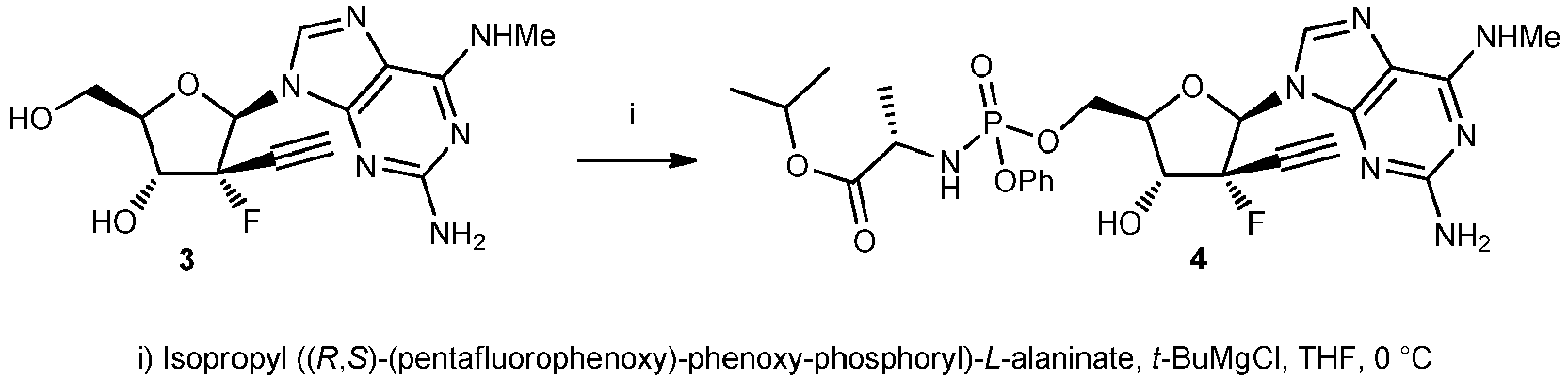
- To a solution of compound 3 (30 mg, 0.09 mmol) in dry THF (2.0 mL) was added tert-butylmagnesium chloride (1 N in THF) (112 µL, 0.11 mmol) dropwise at 0 °C. The solution was stirred for 15 mins at 0 °C and for 45 mins at RT. The reaction mixture was cooled down to 0 °C and a solution of isopropyl ((R,S)-(pentafluorophenoxy)-phenoxy-phosphoryl)-L-alaninate (51 mg, 0.11 mmol) in dry THF (1.0 mL) was added dropwise. The resulting solution was slowly warmed to RT and stirred for 15 h. The reaction mixture was then diluted with EtOAc (10 mL) and saturated NH4Cl aq. solution (8 mL). The phases were separated and the aqueous layer was back-extracted with EtOAc (2 x 5 mL). The combined organics were washed with saturated NH4Cl aq. solution (10 mL) and brine (10 mL), dried over Na2SO4 and concentrated. The residue was purified by column chromatography (silica gel, DCM/MeOH 0 to 10%) and by reverse phase column chromatography (C-18 silica, H2O/MeOH 0 to 100%). Product 4 (not in accordance with the present invention) (9 mg, 16%) was obtained as a white solid.
- 1H NMR (300 MHz, CD3OD) δ 7.81, 7.79 (s+s, 1H), 7.36-7.14 (m, 5H), 6.26 (d, J = 17.4 Hz, 0.1H), 6.24 (d, J = 17.4 Hz, 0.9H), 4.93-4.89 (overlapped with H2O, m, 1H), 4.80-4.78 (m, 1H), 4.53-4.49 (m, 2H), 4.21-4.18 (m, 1H), 3.95-3.84 (m, 1H), 3.23-3.20 (m, 1H), 3.04 (bs, 1H), 1.31-1.14 (m, 9H). 31P NMR (121 MHz, CD3OD) δ 4.06 (s), 3.97 (s). MS (ESI) m/z calcd. for C25H32FN7O7P [M+H]+ 592.2; found 592.2.

- To a solution of compound 5 (30 mg, 0.09 mmol) in dry THF (3.0 mL) was added tert-butylmagnesium chloride (1 N in THF) (120 µL, 0.12 mmol) dropwise at 0 °C. The solution was stirred for 15 mins at 0 °C and for 45 mins at RT. The reaction mixture was cooled to 0 °C and a solution of isopropyl ((R,S)-(pentafluorophenoxy)-phenoxy-phosphoryl)-L-alaninate (47 mg, 0.10 mmol) in dry THF (1.0 mL) was added dropwise. The resulting solution was slowly warmed to RT and stirred for 15 h. The reaction mixture was then diluted with EtOAc (10 mL) and saturated NH4Cl aq. solution (8 mL). The phases were separated and the aqueous layer was back-extracted with EtOAc (2 x 5 mL). The combined organics were washed with saturated NH4Cl aq. solution (10 mL) and brine (10 mL), dried over Na2SO4 and concentrated. The residue was purified by column chromatography (silica gel, DCM/MeOH 0 to 10%) and by reverse phase column chromatography (C-18 silica, H2O/MeOH 0 to 100%). Product 6 (not in accordance with the present invention) (19 mg, 35%) was obtained as a white solid.
- 1H NMR (300 MHz, CD3OD) δ 7.82, 7.79 (s+s, 1H), 7.44-7.17 (m, 5H), 6.26 (d, J = 17.1 Hz), 6.24 (d, J = 17.1 Hz, 1H), 4.93-4.89 (overlapped with H2O, m, 1H), 4.79-4.46 (m, 3H), 4.24-4.07 (m, 1H), 3.92-3.83 (m, 1H), 3.25-3.22 (m, 1H), 2.92-2.89 (m, 1H), 1.31-1.14 (m, 9H), 0.85-0.82 (m, 2H), 0.63-0.57 (m, 2H). 31P NMR (121 MHz, CD3OD) δ 4.03 (s), 3.94 (s). MS (ESI) m/z calcd. for C27H34FN7O7P [M+H]+ 618.2; found 618.2.
-

- To a pre-cooled (0 °C) solution containing 1,2,3,5-tetra-O-benzoyl-2-C-methyl-D-ribofuranose, 150, (2.50 g, 4.3 mmol), 2-amino-6-chloropurine (0.8 g, 4.68 mmol), 1,8-diazabicycl[5.4.0]undec-7-ene (DBU) (1.94 g,12.75 mmol) and anhydrous acetonitrile (50 mL), trimethylsilyl triflate (3.8 g, 17.2 mmol) was added dropwise. The reaction mixture was heated at 65 °C for 4 h, allowed to cool to room temperature, poured into saturated aqueous sodium (150 mL) and extracted with dichloromethane (3 X 100 mL). The combined organic fractions were dried over sodium sulfate and concentrated in vacuo. The residue was purified over silica gel using hexane/ethyl acetate (4:1) as the eluent to afford 151 (3.5 g, 73%) as a colorless foam.
- 1H NMR (400 MHz, DMSO-d 6) δ 8.41 (s, 1H), 8.04 (ddt, J = 22.8, 6.9, 1.4 Hz, 4H), 7.98 - 7.83 (m, 3H), 7.74 - 7.59 (m, 3H), 7.63 - 7.46 (m, 4H), 7.40 (t, J = 7.8 Hz, 2H), 7.22 (s, 2H), 6.64 (s, 1H), 5.97 (d, J = 4.5 Hz, 1H), 4.92 - 4.75 (m, 3H), 2.90 (s, 3H), 2.74 (s, 3H), 1.61 (s, 3H).
- A solution containing 151 (0.65 g, 1.03 mmol) and saturated methanolic ammonia (15 mL) was stirred in a sealed container for 7 h. The solvent was removed and the residue was purified on silica gel using methanol/DCM (1:40) as the eluent. Fractions containing the product were pooled and concentrated in vacuo to afford 152 (0.30 g, 92%) as a colorless powder.
- To a solution containing 152 (0.3 g, 1.0 mmol) and 1,4-dioxane (2 mL) was added methylamine solution (1 mL). The reaction was stirred for 2 h and concentrated in vacuo. The residue was purified on silica gel using methanol/ DCM (1:40) as the eluent. Fractions containing the product were pooled and concentrated in vacuo to afford 106 (0.150 g, 50%) as a colorless powder.
- 1H NMR (400 MHz, DMSO-d 6) δ 8.01 (s, 1H), 7.24 (s, 1H), 5.89 (s, 2H), 5.79 (s, 1H), 5.20 (dd, J = 6.2, 3.2 Hz, 2H), 5.05 (s, 1H), 4.11 (q, J = 5.2 Hz, 1H), 4.08 - 3.97 (m, 1H), 3.89 - 3.77 (m, 2H), 3.66 (ddd, J = 12.2, 5.4, 3.3 Hz, 1H), 3.17 (d, J = 5.3 Hz, 3H), 0.79 (s, 3H).
-

- To a solution of compound 106 (55 mg, 0.18 mmol) in dry DMF (4.0 mL) was added tert-butylmagnesium chloride (1 N in THF) (265 µL, 0.27 mmol) dropwise at 0 °C. The solution was stirred for 15 mins at 0 °C and for 45 mins at RT. The reaction mixture was cooled down to 0 °C and a solution of isopropyl ((R,S)-(pentafluorophenoxy)-phenoxy-phosphoryl)-L-alaninate (105 mg, 0.23 mmol) in dry THF (2.0 mL) was added dropwise. The resulting solution was slowly warmed up to RT and stirred for 15 h. The reaction mixture was then diluted with EtOAc (15 mL) and saturated NH4Cl aq. solution (10 mL). The phases were separated and the aqueous layer was back-extracted with EtOAc (2 x 10 mL). The combined organics were washed with saturated NH4Cl aq. solution (15 mL) and brine (15 mL), dried over Na2SO4 and concentrated. The residue was purified by column chromatography (silica gel, DCM/MeOH 0 to 10%) and by reverse phase column chromatography (C-18 silica, H2O/MeOH 0 to 100%). Product 107 (not in accordance with the present invention) (23 mg, 22%) was obtained as a white solid.
- 1H NMR (300 MHz, CD3OD) δ 7.84 (s, 1H), 7.38-7.16 (m, 5H), 5.96-5.93 (s+s, 1H), 4.97-4.90 (m, 1H), 4.63-4.42 (m, 2H), 4.26-4.15 (m, 2H), 3.98-3.87 (m, 1H), 3.06 (s, 3H), 1.33-1.29 (m, 3H), 1.22-1.15 (m, 6H), 0.98-0.95 (s+s, 3H). 31P NMR (121 MHz, CD3OD) δ 4.18 (s), 4.05 (s). MS (ESI) m/z calcd. for C24H35N7O8P [M+H]+ 580.2; found 580.2.
- To a solution containing 152 (0.3 g, 1.0 mmol) and 1,4-dioxane (2 mL) was added dimethylamine solution (1 mL). The reaction was stirred for 2 h and concentrated in vacuo. The residue was purified on silica gel using methanol/DCM (1:40) as the eluent. Fractions containing the product were pooled and concentrated in vacuo to afford 100 (not in accordance with the present invention) (0.200 g, 70%) as a colorless powder.
- 1H NMR (400 MHz, Methanol-d 4) δ 8.10 (s, 1H), 5.95 (s, 1H), 4.24 (d, J = 8.7 Hz, 1H), 4.08 - 3.99 (m, 2H), 3.91 - 3.82 (m, 1H), 3.42 (s, 6H), 3.37 (s, 2H), 0.95 (s, 3H).
-

- To a solution of compound 100 (30 mg, 0.09 mmol) in dry THF (2.0 mL) was added tert-butylmagnesium chloride (1 N in THF) (130 µL, 0.13 mmol) dropwise at 0 °C. The solution was stirred for 15 mins at 0 °C and for 45 mins at RT. The reaction mixture was cooled down to 0 °C and a solution of isopropyl ((R,S)-(pentafluorophenoxy)-phenoxy-phosphoryl)-L-alaninate (46 mg, 0.11 mmol) in dry THF (1.0 mL) was added dropwise. The resulting solution was slowly warmed up to RT and stirred for 15 h. The reaction mixture was then diluted with EtOAc (10 mL) and saturated NH4Cl aq. solution (8 mL). The phases were separated and the aqueous layer was back-extracted with EtOAc (2 x 5 mL). The combined organics were washed with saturated NH4Cl aq. solution (10 mL) and brine (10 mL), dried over Na2SO4 and concentrated. The residue was purified by column chromatography (silica gel, DCM/MeOH 0 to 10%) and by reverse phase column chromatography (C-18 silica, H2O/MeOH 0 to 100%). Product 101 (not in accordance with the present invention) (30 mg, 55%) was obtained as a white solid.
- 1H NMR (300 MHz, CD3OD) δ 7,81, 7.80 (s+s, 1H), 7.37-7.15 (m, 5H), 5.97, 5.95 (s+s, 1H), 4.96-4.88 (overlapped with H2O, m, 1H), 4.60-4.42 (m, 2H), 4.19-3.90 (m, 3H), 3.41 (Is, 6H), 1.33-1.15 (m, 10H), 0.96, 0.93 (s+s, 3H). 31P NMR (121 MHz, CD3OD) δ 4.16 (s), 4.07 (s). MS (ESI) m/z calcd. for C25H37N7O8P [M+H]+ 594.2; found 594.2.
-

- To a suspension of 2-amino-6-chloropurine (1.17 g, 6.90 mmol) in dry acetonitrile (100 mL) was added N,O-bis(trimethylsilyl)acetamide (2.50 mL, 10.20 mmol). The mixture was heated at reflux for 2 h. The resulting solution was cooled down to RT and 150 (2.00 g, 3.45 mmol) was added. The solution was cooled down to 0 °C and TMSOTf (1.87 mL, 10.20 mmol) was added dropwise over 2 mins. The reaction mixture was heated at reflux for 2 h, cooled to RT and concentrated. The residue was partitioned between EtOAc (100 mL) and saturated NaHCO3 aq. solution (80 mL). The phases were separated and the aqueous layer was back-extracted with EtOAc (2 x 40 mL). The combined organics were washed with saturated NaHCO3 aq. solution (100 mL), brine (100 mL), dried over Na2SO4 and concentrated. The residue was purified by column chromatography (silica gel, PE/EtOAc 10 to 80%). Product 151 (1.75 g, 81%) was obtained as a white foam.
- To a suspension of compound 151 (610 mg, 0.97 mmol) in MeOH (30 mL) was added N-methylcyclopropylamine hydrochloride (313 mg, 2.91 mmol) and triethylamine (410 µL, 2.91 mmol). The reaction mixture was heated at 100 °C in a sealed container for 15 h and cooled to RT. Then, 30% NH4OH (5 mL) was added and the mixture was heated at 100 °C in a sealed container for 2 h. The solution was cooled to RT and concentrated. The residue was purified by column chromatography (silica gel, DCM/MeOH 0 to 15%). Product 102 (245 mg, 72%) was obtained as a white solid.
- 1H NMR (300 MHz, CD3OD) δ 8.14 (s, 1H), 5.94 (s, 1H), 4.21 (d, J = 8.7 Hz, 1H), 4.02-3.98 (m, 2H), 3.83 (dd, J = 3.0, 12.9 Hz , 1H), 3.31 (overlapped with MeOH, s, 3H), 3.16-3.09 (m, 1H), 0.93-0.90 (m, 5H), 0.72-0.69 (m, 2H). MS (ESI) m/z calcd. for C15H23N6O4 [M+H]+ 351.2; found 351.2.
- To a solution of compound 102 (60 mg, 0.17 mmol) in dry THF (4.0 mL) was added tert-butylmagnesium chloride (1 N in THF) (240 µL, 0.24 mmol) dropwise at 0 °C. The solution was stirred for 15 mins at 0 °C and for 45 mins at RT. The reaction mixture was cooled to 0 °C and a solution of isopropyl ((R,S)-(pentafluorophenoxy)-phenoxy-phosphoryl)-L-alaninate (85 mg, 0.19 mmol) in dry THF (1.5 mL) was added dropwise. The resulting solution was slowly warmed up to RT and stirred for 15 h. The reaction mixture was then diluted with EtOAc (10 mL) and saturated NH4Cl aq. solution (8 mL). The phases were separated and the aqueous layer was back-extracted with EtOAc (2 x 5 mL). The combined organics were washed with saturated NH4Cl aq. solution (10 mL), brine (10 mL), dried over Na2SO4 and concentrated. The residue was purified by column chromatography (silica gel, DCM/MeOH 0 to 10%) and by reverse phase column chromatography (C-18 silica, H2O/MeOH 0 to 100%). Product 103 (not in accordance with the present invention) (51 mg, 48%) was obtained as a white solid.
- 1H NMR (300 MHz, CD3OD) δ 7,84 (s+s, 1H), 7.35-7.15 (m, 5H), 5.98, 5.96 (s+s, 1H), 4.95-4.86 (overlapped with H2O, m, 1H), 4.60-4.43 (m, 2H), 4.24-4.14 (m, 2H), 3.96-3.87 (m, 1H), 3.35,3.34 (s+s, 3H), 3.17-3.11 (m, 1H), 1.32-1.27 (m, 3H), 1.20-1.15 (m, 6H), 0.97-0.90 (m, 5H), 0.73-0.69 (m, 2H). 31P NMR (121 MHz, CD3OD) δ 4.06 (s), 3.97 (s). MS (ESI) m/z calcd. for C27H39N7O8P [M+H]+ 620.3; found 620.2.
-

- To a suspension of compound 151 (1.00 g, 1.59 mmol) in MeOH (40 mL) was added cyclopropylamine (1.45 mL, 20.67 mmol). The reaction mixture was heated at 100 °C in a sealed container for 15 h and cooled to RT. Then, 30% NH4OH (5 mL) was added and the mixture was heated at 100° C in a sealed container for 3 h. The solution was cooled to RT and concentrated. The residue was purified by column chromatography (silica gel, DCM/MeOH 0 to 20%). Product 104 (438 mg, 82%) was obtained as a white solid.
- 1H NMR (300 MHz, CD3OD) δ 8.09 (s, 1H), 5.91 (s, 1H), 4.23 (d, J = 8.7 Hz, 1H), 4.04-3.99 (, m, 1H), 3.87 (dd, J = 3.3, 12.6 Hz, 1H), 2.92-2.90 (m, 1H), 0.94 (s, 3H), 0.85-0.82 (m, 2H), 0.62-0.60 (m, 2H). MS (ESI) m/z calcd. for C14H21N6O4 [M+H]+ 337.2; found 337.2.
- To a solution of compound 104 (104 mg, 0.31 mmol) in dry THF (6.0 mL) was added tert-butylmagnesium chloride (1 N in THF) (430 µL, 0.43 mmol) dropwise at 0 °C. The solution was stirred for 15 mins at 0 °C and for 45 mins at RT. Then, the reaction mixture was cooled to 0 °C and a solution of isopropyl ((R,S)-(pentafluorophenoxy)-phenoxy-phosphoryl)-L-alaninate (154 mg, 0.34 mmol) in dry THF (2.5 mL) was added dropwise. The resulting solution was slowly warmed to RT and stirred for 15 h. The reaction mixture was diluted with EtOAc (20 mL) and saturated NH4Cl aq. solution (15 mL). The phases were separated and the aqueous layer was back-extracted with EtOAc (2 x 10 mL). The combined organics were washed with saturated NH4Cl aq. solution (20 mL), brine (20 mL), dried over Na2SO4 and concentrated. The residue was purified by column chromatography (silica gel, DCM/MeOH 0 to 10%) and by reverse phase column chromatography (C-18 silica, H2O/MeOH 0 to 100%). Product 105 (not in accordance with the present invention) (75 mg, 40%) was obtained as a white solid.
- 1H NMR (300 MHz, CD3OD) δ 7.83 (s, 1H), 7.36-7.17 (m, 5H), 5.95-5.92 (s+s, 1H), 4.97-4.84 (overlapped with H2O, m, 1H), 4.60-4.44 (m, 2H), 4.25-4.16 (m, 2H), 3.95-3.86 (m, 1H), 2.94-2.87 (m, 1H), 1.31-1.28 (m, 3H), 1.20-1.14 (m, 6H), 0.97-0.94 (s+s, 3H), 0.86-0.83 (m, 2H), 0.63-0.56 (m, 2H). 31P NMR (121 MHz, CD3OD) δ 4.00 (s), 3.92 (s). MS (ESI) mlz calcd. for C26H37N7O8P [M+H]+ 606.2; found 606.2.
-

- Compound 250 can be prepared according to Tuttle, J.V. et al., "Purine 2'-Deoxy-2'-fluororibosides as Antiinfluenza Virus Agents", J. Med. Chem., 36:119-125 (1992). A solution of compound 250 (5.2 g, 17.3 mmol) in methylamine (33% in EtOH) (150 mL) was heated at 85 °C in a sealed container for 3 h, cooled to RT and concentrated. The residue was purified by column chromatography (silica gel, DCM/MeOH 0 to 15%). The product, 200, (4.9 g, 95%) was obtained as a white solid.
- 1H NMR (300 MHz, DMSO-D6) δ 7.94 (s, 1H), 7.30 (bs, NH), 6.06 (dd, J = 3.3, 16.5 Hz, 1H), 5.93 (bs, NH2), 5.68 (bs, OH), 5.32 (dt, J = 53.1, 3.6 Hz, 1H), 5.30 (bs, OH), 4.40 (dt, J = 16.8, 4.5 Hz, 1H), 3.96-3.94 (m, 1H), 3.76-3.56 (m, 2H), 2.89 (bs, 3H). MS (ESI) m/z calcd. for C11H16FN6O3 [M+H]+ 299.1; found 299.2.
- To a solution of compound 200 (70 mg, 0.23 mmol) in dry DMF (3 mL) was added tert-butylmagnesium chloride (1 N in THF) (310 µL, 0.31 mmol) dropwise at 0 °C. The solution was stirred for 20 mins at 0 °C and for 40 mins at RT. The reaction mixture was cooled to -10 °C and a solution of isopropyl ((S)-(pentafluorophenoxy)-phenoxy-phosphoryl)-L-alaninate (118 mg, 0.27 mmol) in dry DMF (3 mL) was added dropwise. The resulting solution was slowly warmed to 10 °C and stirred for 15 h at this temperature. The reaction mixture was diluted with EtOAc (20 mL) and saturated NH4Cl aq. solution (15 mL). The phases were separated and the aqueous layer was back-extracted with EtOAc (2 x 10 mL). The combined organics were washed with saturated NH4Cl aq. solution (20 mL), brine (20 mL), dried over Na2SO4 and concentrated. The residue was purified by column chromatography (silica gel, DCM/MeOH 0 to 10%) and by reverse phase column chromatography (C-18 silica, H2O/MeOH 0 to 100%). Product 201 (not in accordance with the present invention) (22 mg, 17%) was obtained as a white solid.
- 1H NMR (300 MHz, CD3OD) δ 7.82 (s, 1H), 7.33-7.13 (m, 5H), 6.13 (dd, J = 18.6, 1.9 Hz, 1H), 5.39 (ddd, J = 52.9, 4.5, 2.0 Hz, 1H), 4.94-4.88 (m, 1H), 4.81-4.68 (m, 1H), 4.46 (ddd, J = 11.5, 6.3, 2.6 Hz, 1H), 4.32 (m, 1H), 4.20 (m, 1H), 3.87 (dq, J = 9.6, 7.2 Hz, 1H), 3.03 (s, 3H), 1.28 (d, J = 7.1 Hz, 3H), 1.18 (d, J = 6.2 Hz), 1.16 (d, J = 6.2 Hz). 31P NMR (121 MHz, CD3OD) δ 2.40 (s). MS (ESI) m/z calcd. for C23H32FN7O7P [M+H]+ 568.2; found 568.2.
-

- To a solution of compound 250 (10.5 g, 35 mmol) in EtOH (220 mL) was added dimethylamine hydrochloride (14.0 g, 173 mmol) and triethylamine (24.0 mL, 173 mmol). The reaction mixture was heated at 85 °C in a sealed container for 3 h, cooled to room temperature (RT) and concentrated. The residue was purified by column chromatography (silica gel, DCM/MeOH 0 to 10%). The product, 202, (10.8 g, 99%) was obtained as a white solid.
- 1H NMR (300 MHz, DMSO-D6) δ 7.97 (s, 1H), 6.07 (dd, J = 3.0, 16.5 Hz, 1H), 5.91 (bs, NH2), 5.66 (bs, OH), 5.27 (dt, J = 53.1, 3.3 Hz, 1H), 5.25 (t, J = 5.4 Hz, OH), 4.44-4.33 (m, 1H), 3.94-3.92 (m, 1H), 3.76-3.54 (m, 2H), 3.34 (s, overlapped with H2O, 6H). MS (ESI) m/z calcd. for C12H18FN6O3 [M+H]+ 313.1; found 313.2.
- To a solution of compound 202 (70 mg, 0.22 mmol) in dry DMF (3 mL) was added tert-butylmagnesium chloride (1 N in THF) (305 µL, 0.31 mmol) dropwise at 0 °C. The solution was stirred for 20 mins at 0 °C and for 40 mins at RT. The reaction mixture was cooled to -10 °C and a solution of isopropyl ((S)-(pentafluorophenoxy)-phenoxy-phosphoryl)-L-alaninate (116 mg, 0.27 mmol) in dry DMF (3 mL) was added dropwise. The resulting solution was slowly warmed up to 10 °C and stirred for 15 h at this temperature. The reaction mixture was then diluted with EtOAc (20 mL) and saturated NH4Cl aq. solution (15 mL). The phases were separated and the aqueous layer was back-extracted with EtOAc (2 x 10 mL). The combined organics were washed with saturated NH4Cl aq. solution (20 mL), brine (20 mL), dried over Na2SO4 and concentrated. The residue was purified by column chromatography (silica gel, DCM/MeOH 0 to 10%) and by reverse phase column chromatography (C-18 silica, H2O/MeOH 0 to 100%). Product 203 (not in accordance with the present invention) (27 mg, 21%) was obtained as a white solid.
- 1H NMR (300 MHz, CD3OD) δ 7.80 (s, 1H), 7.33-7.13 (m, 5H), 6.14 (dd, J = 18.7, 2.0 Hz, 1H), 5.38 (ddd, J = 53.0, 4.6, 2.1 Hz, 1H), 4.95-4.89 (m, 1H), 4.72 (ddd, J = 19.7, 7.6, 4.7 Hz, 1H), 4.46 (ddd, J = 11.5, 6.2, 2.6 Hz, 1H), 4.32 (ddd, J = 10.8, 5.9, 4.6 Hz, 1H), 4.20 (m, 1H), 3.88 (dq, J = 9.7, 7.0 Hz, 1H), 3.39 (s, 6H), 1.28 (dd, J = 7.1, 0.6 Hz, 3H), 1.18 (d, J = 6.2 Hz), 1.17 (d, J = 6.3 Hz). 31P NMR (121 MHz, CD3OD) δ 2.41 (s). MS (ESI) m/z calcd. for C24H34FN7O7P [M+H]+ 582.2; found 582.2.
-
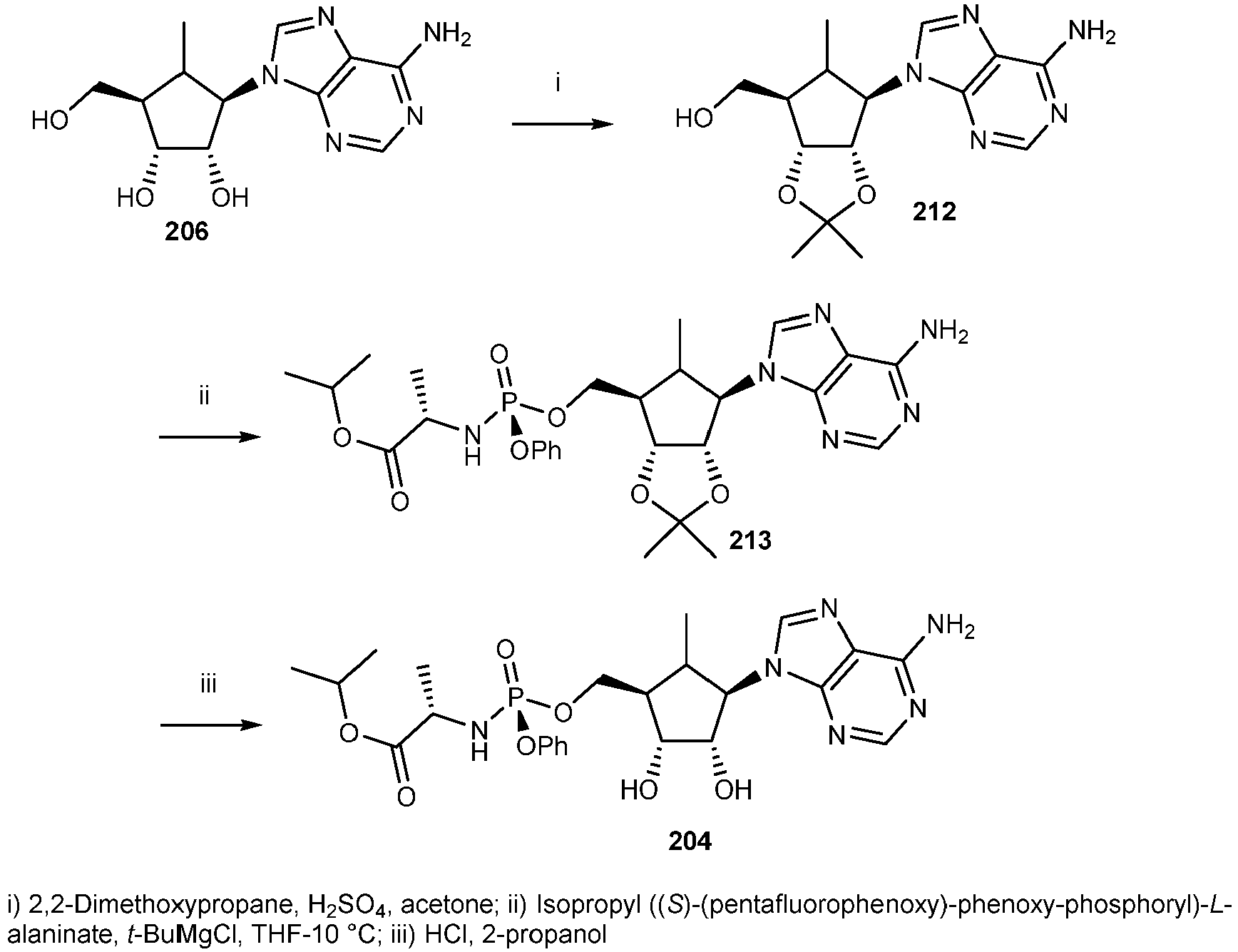
- To a solution of Compound 206 (32 mg, 0.115 mmol) in acetone (5.0 mL) was added 2,2-dimethoxypropane (300 µL, 2.30 mmol) and concentrated H2SO4 (1 drop). The reaction mixture was stirred at RT. Then, triethylamine (100 µL) was added and the solvent were removed. The residue was purified by column chromatography (silica gel, DCM/MeOH 100:0 to 90:10) to afford Compound 212 (33 mg, 0.102 mmol, 89%) as a white solid.
- To a solution of Compound 212 (32 mg, 0.10 mmol) in dry THF (2 mL) at 0° C was added tert-butyl magnesium chloride (1.0 M in THF, 150 µL, 0.15 mmol) dropwise over 10 min. The reaction mixture was stirred for 15 min at 0° C and then for an additional 15 min at room temperature. The reaction mixture was cooled to 0° C before a solution of isopropyl ((S)-(pentafluorophenoxy)-phenoxy-phosphoryl)-L-alaninate (61 mg, 0.14 mmol) dissolved in dry THF (1 mL) was added dropwise over 10 min. The reaction mixture was stirred at 0° C for 30 min and 18 h at room temperature. The reaction was quenched with a saturated aqueous NH4Cl solution (4 mL) and extracted with EtOAc (3 x 5 mL). The combined organic layers were dried over Na2SO4 and concentrated. The residue was purified by column chromatography (silica gel, DCM/MeOH 100:0 to 90:10) to afford Compound 213 (26 mg, 0.04 mmol, 44%) as a white solid.
- Compound 213 (26 mg, 0.04 mmol) was treated with a solution of HCl (2 N in 2-propanol) (3 mL) for 30 mins at 0° C and for 2 h at RT. The reaction mixture was concentrated. The residue was purified by column chromatography (silica gel, DCM/MeOH 100:0 to 90:10) and by reverse phase column chromatography (C-18 silica, H2O/MeOH 100:0 to 0:100). Compound 204 (not in accordance with the present invention) (mixture of 2 diastereoisomers, 6 mg, 0.01 mmol, 25% yield) was obtained as a white solid.
- 1H NMR (300 MHz, CD3OD) δ 8.25-8.09 (m, 2H), 7.42-7.14 (m, 5H), 5.05-4.90 (m, 1H, overlapped with H2O), 4.63-4.20 (m, 4H), 4.11-3.84 (m, 2H), 2.91-1.87 (m, 2H), 1.40-1.18 (m, 9H), 1.00 (d, J = 6.7 Hz) and 0.57 (d, J = 7.6 Hz, 3H). 31P NMR (121 MHz, CD3OD) δ 2.14 (s), 2.09 (s). MS (ESI) m/z calcd. for C24H34N6O7P [M+H]+ 549.2; found 549.2.
-
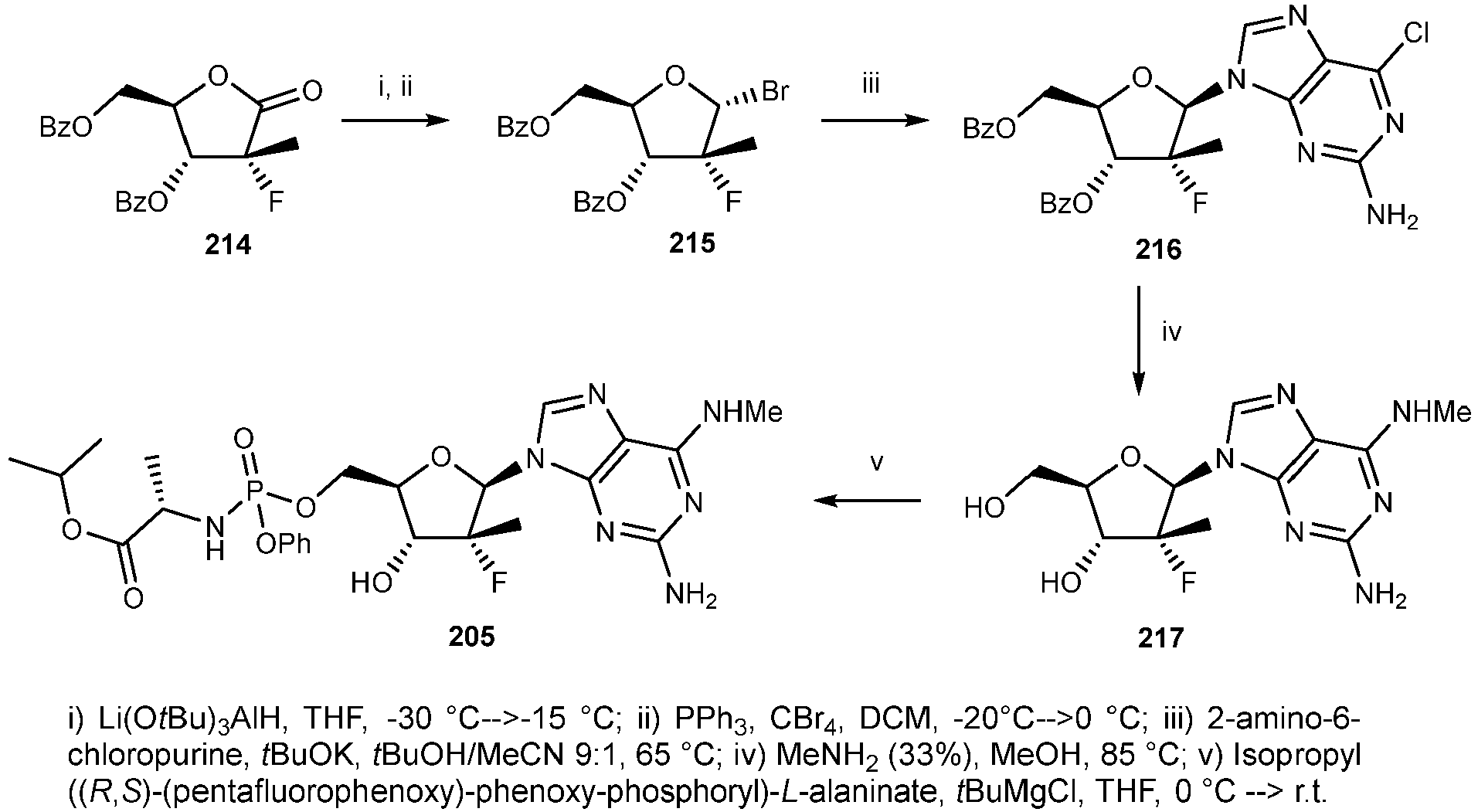
- To a solution of (2R)-3,5-di-O-benzoyl-2-fluoro-2-C-methyl-D-ribono-γ-lactone (214, 24.8 g, 66.6 mmol) in dry THF (333 mL) under a nitrogen atmosphere and cooled to -30 °C, was added lithium tri-tert-butoxyaluminum hydride (1.0 M in THF, 22.6 mL, 22.6 mmol) dropwise. After completion of the addition the reaction mixture was slowly warmed up to -15 °C over 90 minutes. EtOAc was added (300 mL) and the mixture was quenched with a saturated aq. NH4Cl solution (200 mL). The resulting solution was filtered on Celite® and the filtrate was extracted twice with EtOAc. The combined organics were dried (Na2SO4), filtered, and concentrated. The residue was taken up in dry DCM (225 mL) under a nitrogen atmosphere, cooled to -20 °C, and PPh3 (19.1 g, 72.8 mmol) was added. After 10 min of stirring at -20 °C, CBr4 (26.0 g, 78.4 mmol) was added and the reaction mixture was allowed to slowly warm to 0 °C over 2 h. The resulting mixture was poured onto a silica gel column and eluted with PE/EtOAc (gradient 100:0 to 80:20). The fractions containing the α-bromofuranoside were collected and concentrated to afford the product 215 (18.1 g, 41.3 mmol, 62% over two steps) as a thick colorless oil.
- 1H NMR (300 MHz, CDCl3) δ 8.15-8.11 (m, 2H), 8.04-8.01 (m, 2H), 7.64-7.55 (m, 2H), 7.51-7.41 (m, 4H), 6.34 (d, J = 1.6 Hz, 1H), 5.29 (dd, J = 5.5, 3.1 Hz, 1H), 4.89-4.85 (m, 1H), 4.78 (dd, J = 12.5, 3.2 Hz, 1H), 4.63 (dd, J = 12.5, 4.5 Hz, 1H), 1.72 (d, J = 21.6 Hz, 3H). 19F NMR (282 MHz, CDCl3) δ -150.0.
- 2-Amino-6-chloropurine (2.63 g, 15.5 mmol) was suspended in t-BuOH (54 mL) under a nitrogen atmosphere. The reaction mixture was heated to 30 °C and potassium tert-butoxide (1.69 g, 15.1 mmol) was added. After 45 minutes, a solution of bromofuranoside 2 (2.24 g, 5.12 mmol) dissolved in anhydrous MeCN (6 mL) was added, the reaction mixture was heated to 65 °C for 16 h, and then cooled to room temperature. Saturated aq. NH4Cl solution (70 mL) was added and the resulting solution was extracted with EtOAc (3 x 60mL). The combined organics were dried (Na2SO4), filtered, and concentrated. The residue was purified twice by column chromatography (gradient PE/EtOAc 80:20 to 0:100 then 60:40 to 20:80) to afford the product 216 (1.56 g, 2.96 mmol, 57%) as a white solid.
- 1H NMR (300 MHz, CDCl3) δ 8.05-8.02 (m, 2H), 7.95-7.92 (m, 2H), 7.88 (s, 1H), 7.63-7.57 (m, 1H), 7.53-7.41 (m, 3H), 7.35-7.30 (m, 2H), 6.43 (dd, J = 22.6, 9.1 Hz, 1H), 6.12 (d, J = 18.3 Hz, 1H), 5.34 (br s, 2H), 5.00 (dd, J = 11.9, 4.5 Hz, 1H), 4.79-4.73 (m, 1H), 4.60 (dd, J = 11.9, 5.3 Hz, 1H), 1.34 (d, J = 22.6 Hz, 3H). 19F NMR (282 MHz, CDCl3) δ -157.0. MS (ESI) m/z calcd. for C25H22FN5O5 [M+H]+ 526.9; found 527.0.
- To a solution of compound 216 (575 mg, 1.09 mmol) in MeOH (9 mL) was added methylamine (33% in absolute EtOH, 1.7 mL, 1.81 mmol). The reaction mixture was heated to 85 °C in a sealed tube for 16 h, cooled to room temperature and concentrated. The residue was purified by column chromatography (gradient DCM/MeOH 100:0 to 85:15) and reverse phase column chromatography (gradient H2O/MeOH 100:0 to 0:100) to afford the product 217 (286 mg, 0.91 mmol, 84%) as a white solid.
- 1H NMR (300 MHz, CD3OD) δ 8.06 (s, 1H), 6.11 (d, J = 18.1 Hz, 1H), 4.41 (dd, J = 24.4, 9.1 Hz, 1H), 4.07-4.01 (m, 2H), 3.86 (dd, J = 12.9, 3.3 Hz, 1H), 3.04 (br s, 3H), 1.16 (d, J = 22.3 Hz, 3H). 19F NMR (282 MHz, CD3OD) δ -163.7. MS (ESI) m/z calcd. for C12H19FN6O3 [M+H]+ 313.1; found 313.2.
- To a solution of compound 217 (114 mg, 365 µmol) in dry THF (4 mL) under a nitrogen atmosphere and cooled to 0 °C was added t-butyl magnesium chloride (1.0 M in THF, 0.66 mL, 660 µmol) dropwise over 10 min. The reaction mixture was stirred for 15 min at 0 °C and then another 15 min at room temperature. The reaction mixture was cooled to 0 °C before a solution of isopropyl ((R,S)-(pentafluorophenoxy)-phenoxy-phosphoryl)-L-alaninate, Ross, B.S., Reddy, P.G., Zhang, H.R., Rachakonda, S., and Sofia, M.J., J. Org, Chem., (2011), (253 mg, 558 µmol) dissolved in dry THF (1 mL) was added dropwise over 10 min. The reaction mixture was stirred at 0 °C for 30 min followed by 18 h at room temperature. The reaction was quenched with a saturated aq. NH4Cl solution (4 mL) and extracted with EtOAc (3 x 5 mL). The combined organics were dried, filtered (Na2SO4), and concentrated. The residue was purified by column chromatography (gradient DCM/MeOH 100:0 to 90:10) and reverse phase column chromatography (gradient H2O/MeOH 100:0 to 0:100) to afford product 205 (a mixture of diastereomers, 101 mg, 174 µmol, 48%) as a white solid.
- 1H NMR (300 MHz, CD3OD) δ 7.83 (s, 0.55H), 7.82 (s, 0.45H), 7.38-7.16 (m, 5H), 6.15 (d, J = 18.5 Hz, 0.45 H), (d, J = 18.8 Hz, 0.55 H), 4.99-4.88 (overlapped with H2O, m, 1H), 4.65-4.36 (m, 3H), 4.25-4.17 (m, 1H), 3.97-3.85 (m, 1H), 3.05 (br s, 3H), 1.32-1.28 (m, 3H), 1.25-1.15 (m, 9H). 19F NMR (282 MHz, CD3OD) δ -162.8 (s), -163.3 (s). 31P NMR (121 MHz, CD3OD) δ 4.10 (s), 3.99 (s). MS (ESI) m/z calcd. for C24H34FN7O7P [M+H]+ 582.2; found 582.2.
- Table 2 illustrates the structures of compounds 207, 208, 209, and 210 along with the corresponding mass spectra and 1H NMR for the respective compounds. Compounds were synthesized via the general method shown in Example 4.
Table 2. Mass Spectra and 1H NMR of Compounds 207, 208, 209, and 210 (not in accordance with the present invention) Compd No. Structure 1HNMR and Mass Spectra 207 
1H NMR (400 MHz, Methanol-d4) δ 8.11 (s, 1H), 6.29 (d, J = 16.9 Hz, 1H), 4.76 (dd, J = 21.7, 9.0 Hz, 1H), 4.10 - 4.01 (m, 2H), 3.87 (dd, J = 13.1, 3.1 Hz, 1H), 3.37 (s, 1H), 3.24 - 3.11 (m, 2H), 1.00 - 0.87 (m, 2H), 0.74 (td, J = 4.6, 2.8 Hz, 2H). [M+H]+ = 363.0 208 
1H NMR (400 MHz, Methanol-d4) δ 8.16 (s, 1H), 6.30 (d, J = 16.8 Hz, 1H), 4.76 (dd, J = 21.6, 9.1 Hz, 1H), 4.10 - 4.01 (m, 2H), 3.87 (dd, J = 12.9, 2.9 Hz, 1H), 3.23 (s, 2H), 3.22 (s, 1H), 3.00 (tt, J = 7.0, 3.7 Hz, 2H), 1.21 (s, 4H), 1.03 - 0.86 (m, 4H), 0.77 (dt, J = 5.5, 3.4 Hz, 4H). [M+H]+ = 389.0 209 
1H NMR (400 MHz, Methanol-d4) δ 8.05 (s, 1H), 6.25 (d, J = 16.9 Hz, 1H), 4.77 (dd, J = 21.8, 9.2 Hz, 1H), 4.50 (s, 1H), 4.11 - 4.01 (m, 2H), 3.87 (dd, J = 13.0, 3.0 Hz, 1H), 3.37 (s, 2H), 3.21 (d, J = 5.4 Hz, 1H), 2.14 - 2.01 (m, 2H), 1.89 - 1.70 (m, 2H), 1.75 - 1.64 (m, 1H), 1.60 (s, 1H), 1.68 - 1.50 (m, 1H). [M+H]+ = 377.0 210 
1H NMR (400 MHz, Methanol-d4) δ 8.08 (s, 1H), 6.28 (d, J = 16.7 Hz, 1H), 4.76 (dd, J = 21.7, 9.0 Hz, 1H), 4.10 - 4.01 (m, 2H), 3.99 (s, 2H), 3.87 (dd, J = 13.1, 3.2 Hz, 1H), 3.37 (s, 1H), 3.19 (d, J = 5.4 Hz, 1H), 2.03 (s, 4H). [M+H]+ = 363.1 - Compounds of the present invention include those in Table 3 and Table 4. Compound number, structure and molecular weight of illustrative compounds of the invention are also shown.
Table 3: Compounds of the Present Invention (* = not in accordance with the present invention) Cmpd No. Structure MW 1* 
336.3 2* 
605.6 3* 
322.3 4* 
591.5 5* 
348.3 6* 
617.6 100* 
324.3 101* 
593.6 102* 
350.4 103* 
619.6 104* 
336.4 105* 
605.6 106* 
310.3 107* 
579.5 200* 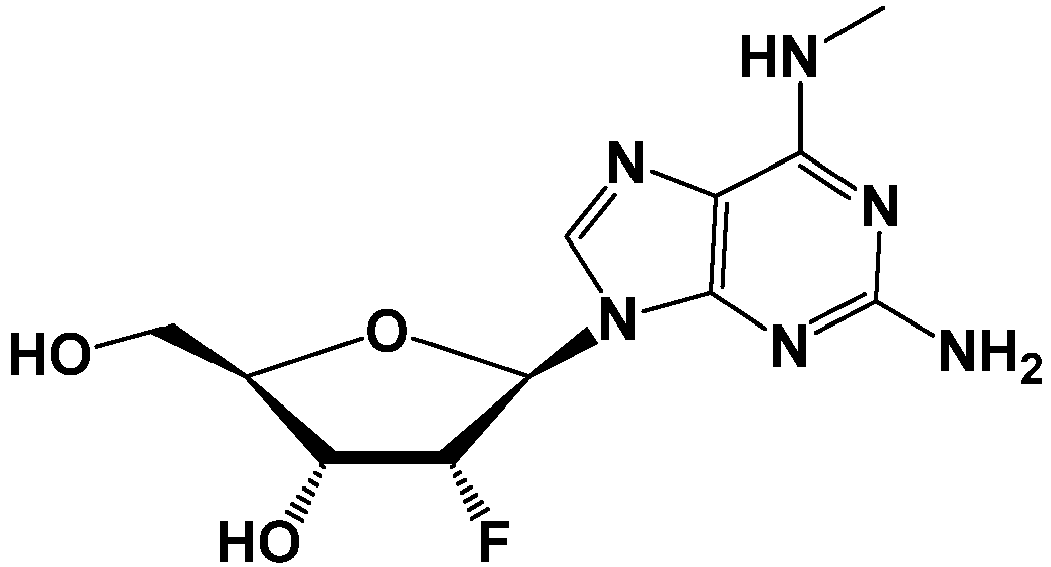
298.3 201* 
567.5 202* 
312.3 203* 
581.5 Table 4. Additional Compounds of the Present Invention (* = not in accordance with the present invention) 204* 
205 
206* 
207* 
208* 
209* 
210* 
- Compounds described herein were measured for activity against Dengue virus type 2 (DENV-2) and Yellow Fever (YFV). Inhibition of virus-induced cytopathic effects (CPE) and cell viability following YFV replication in BHK21 cells were measured by XTT tetrazolium dye staining. Cells (3 x 10³ cells per well) were seeded in 98-well flat-bottom tissue culture plates and allowed to adhere overnight. Following overnight incubation, diluted test compounds and virus diluted to a pre-determined titer to yield 85 to 95% cell killing at 6 days post-infection were added to the plate. Following incubation at 37°C, 5% CO2 for six days, cell viability was measured by XTT staining. The optical density of the cell culture plate was determined spectrophotometrically at 450 and 650 nm using Softmax Pro 4.6 software. Percent CPE reduction of the virus-infected wells and the percent cell viability of uninfected drug control wells were calculated to determine the EC50 values using four parameter curve fit analysis.
- Results are presented in Table 5. Compound 205 is the most potent compound with an EC50 of 0.8 µM in the DENV-2 assay and an EC50 value of 1.2 µM in the YFV assay.
Table 5. Activity of Selected Compounds against DENV-2 and YFV (* = not in accordance with the present invention) Compd No. Structure DENV-2 EC50 (µm) YFV EC50 (µM) 2* 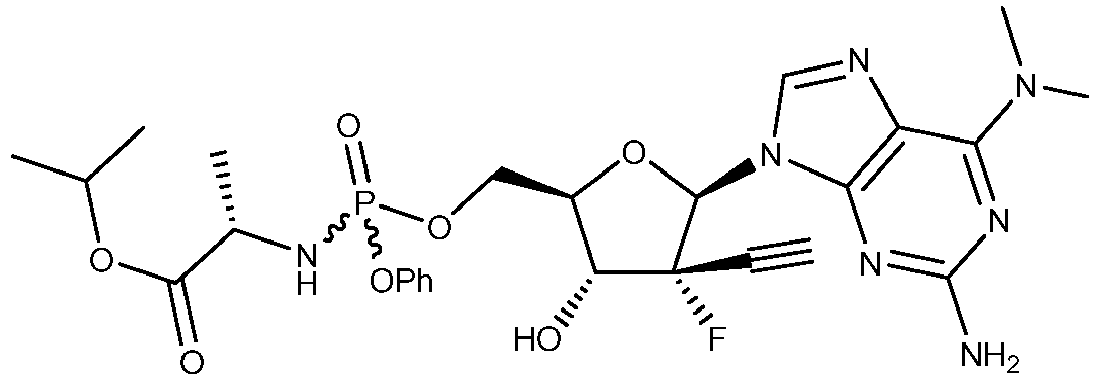
72.5 12.6 4* 
612.0 7.0 6* 
42.0 4.4/6 204* 
>2.1 >2.1 205 
0.8 1.2 206* 
1.83 2.3 - This specification has been described with reference to embodiments of the invention.
Claims (24)
- The compound of Formula IIIe for use in the treatment of a host in need thereof infected with an RNA virus other than HCV:
 Y is NR1R2;R1 is methyl;R2 is hydrogen;R3 is hydrogen,
 R3A is selected from O-, OH, an -O- aryl, an -O- heteroaryl, and an heterocyclyl;R3B is selected from O-, OH, an N-linked amino acid, and an N-linked amino acid ester;R3C is alkyl, alkenyl, alkynyl, -(C0-C2)(cycloalkyl), -(C0-C2)(heterocyclo), -(C0-C2)(aryl), -(C0-C2)(heteroaryl), -O-alkyl, -O-alkenyl, -O-alkynyl, -O-(C0-C2)(cycloalkyl), -O-(C0-C2)(heterocyclo), -O-(C0-C2)(aryl), -O-(C0-C2)(heteroaryl), -S-alkyl, -S-alkenyl, -S-alkynyl, -S-(C0-C2)(cycloalkyl), -S-(C0-C2)(heterocyclo), -S-(C0-C2)(aryl), or -S-(C0-C2)(heteroaryl);R7 is hydrogen, C1-6alkyl, C3-7cycloalkyl, heteroaryl, heterocyclyl, or aryl;R8 is hydrogen or C1-6alkyl;R9a and R9b are independently selected from hydrogen, C1-6alkyl, cycloalkyl, -(CH2)c(NR9')2, C1-6hydroxyalkyl, -CH2SH, -(CH2)2S(O)Me, -(CH2)3NHC(=NH)NH2, (1H-indol-3-yl)methyl, (1H-imidazol-4-yl)methyl, -(CH2)CCOR9", aryl and aryl(C1-3alkyl)-;R9' is independently hydrogen or C1-6 alkyl;R9" is -OR11 or -N(R11')2;R10 is hydrogen, C1-6alkyl, C1-6haloalkyl, C3-7cycloalkyl, heterocycloalkyl, aminoacyl, aryl, heteroaryl, aryl, or heteroaryl;R11 is C1-6alkyl, cycloalkyl, C2-6alkynyl, C2-6alkenyl, or acyl;R11' is hydrogen, C1-6alkyl, cycloalkyl, C2-6alkynyl, C2-6alkenyl, or acyl; andc is 1 to 6;wherein the virus is from the Flaviviridae family.
 - The compound for use of claim 1,whereinR7 is aryl;R8 is hydrogen;R9a and R9b are independently selected from methyl and hydrogen; andR10 is alkyl.
- The compound for use of claim 2,whereinR7 is phenyl;R8 is hydrogen;R9a and R9b are independently selected from methyl and hydrogen; andR10 is isopropyl.
- The compound for use of claim 3, wherein R3 is hydrogen.
- The compound for use of claim 1, wherein the compound is selected from:

- The compound for use of claim 1,
wherein
the amino acid of the phosphoramidate is in the L-configuration. - The compound for use of claim 5, wherein the compound is selected from

- The compound for use of claim 5, wherein the compound is selected from

- The compound for use of claim 1, wherein the compound is selected from:

- The compound for use of claim 9, wherein the compound is selected from

- The compound for use of claim 9, wherein the compound is selected from

- The compound for use of any of the preceding claims, wherein the virus is from the Flavivirus genus.
- The compound for use of claim 12, wherein the virus is selected from Dengue fever, West Nile fever, yellow fever, and Zika virus.
- The compound for use of claim 13, wherein the virus is Dengue fever.
- The compound for use of claim 13, wherein the virus is yellow fever.
- The compound for use of claim 13, wherein the virus is West Nile fever.
- The compound for use of claim 13, wherein the virus is Zika virus.
- The compound for use of claim 12, wherein the virus is Japanese B encephalitis.
- The compound for use of any of the preceding claims wherein the host is a human.
- The compound for use of any one of claims 1-19, wherein the compound is administered in a dosage form suitable for oral administration.
- The compound for use of claim 20, wherein the compound is administered in a solid dosage form.
- The compound for use of claim 21, wherein the solid dosage form is a tablet or capsule.
- The compound for use of any one of claims 1-19, wherein the compound is administered in a dosage form suitable for intravenous administration.
- The compound for use of any one of claims 1-19, wherein the compound is administered in a dosage form suitable for parenteral administration.
Priority Applications (7)
| Application Number | Priority Date | Filing Date | Title |
|---|---|---|---|
| EP22165102.9A EP4088725A1 (en) | 2016-09-07 | 2017-09-06 | 2'-substituted-n6-substituted purine nucleotides for the treatment of a virus from the picornaviridae family |
| SI201731075T SI3512863T1 (en) | 2016-09-07 | 2017-09-06 | 2'-substituted-n6-substituted purine nucleotides for rna virus treatment |
| SM20220072T SMT202200072T1 (en) | 2016-09-07 | 2017-09-06 | 2'-substituted-n6-substituted purine nucleotides for rna virus treatment |
| EP21167491.6A EP3865136A1 (en) | 2016-09-07 | 2017-09-06 | 2'-substituted-n6-substituted purine nucleotides for corona virus treatment |
| PL17849474T PL3512863T3 (en) | 2016-09-07 | 2017-09-06 | 2'-substituted-n6-substituted purine nucleotides for rna virus treatment |
| RS20220185A RS62943B1 (en) | 2016-09-07 | 2017-09-06 | 2'-substituted-n6-substituted purine nucleotides for rna virus treatment |
| HRP20220278TT HRP20220278T1 (en) | 2016-09-07 | 2017-09-06 | 2'-substituted-n6-substituted purine nucleotides for rna virus treatment |
Applications Claiming Priority (2)
| Application Number | Priority Date | Filing Date | Title |
|---|---|---|---|
| US201662384664P | 2016-09-07 | 2016-09-07 | |
| PCT/US2017/050323 WO2018048937A1 (en) | 2016-09-07 | 2017-09-06 | 2'-substituted-n6-substituted purine nucleotides for rna virus treatment |
Related Child Applications (4)
| Application Number | Title | Priority Date | Filing Date |
|---|---|---|---|
| EP21167491.6A Division EP3865136A1 (en) | 2016-09-07 | 2017-09-06 | 2'-substituted-n6-substituted purine nucleotides for corona virus treatment |
| EP21167491.6A Division-Into EP3865136A1 (en) | 2016-09-07 | 2017-09-06 | 2'-substituted-n6-substituted purine nucleotides for corona virus treatment |
| EP22165102.9A Division EP4088725A1 (en) | 2016-09-07 | 2017-09-06 | 2'-substituted-n6-substituted purine nucleotides for the treatment of a virus from the picornaviridae family |
| EP21200663.9 Division-Into | 2016-09-07 | 2021-10-04 |
Publications (3)
| Publication Number | Publication Date |
|---|---|
| EP3512863A1 EP3512863A1 (en) | 2019-07-24 |
| EP3512863A4 EP3512863A4 (en) | 2020-06-03 |
| EP3512863B1 true EP3512863B1 (en) | 2021-12-08 |
Family
ID=61562513
Family Applications (3)
| Application Number | Title | Priority Date | Filing Date |
|---|---|---|---|
| EP17849474.6A Active EP3512863B1 (en) | 2016-09-07 | 2017-09-06 | 2'-substituted-n6-substituted purine nucleotides for rna virus treatment |
| EP22165102.9A Withdrawn EP4088725A1 (en) | 2016-09-07 | 2017-09-06 | 2'-substituted-n6-substituted purine nucleotides for the treatment of a virus from the picornaviridae family |
| EP21167491.6A Withdrawn EP3865136A1 (en) | 2016-09-07 | 2017-09-06 | 2'-substituted-n6-substituted purine nucleotides for corona virus treatment |
Family Applications After (2)
| Application Number | Title | Priority Date | Filing Date |
|---|---|---|---|
| EP22165102.9A Withdrawn EP4088725A1 (en) | 2016-09-07 | 2017-09-06 | 2'-substituted-n6-substituted purine nucleotides for the treatment of a virus from the picornaviridae family |
| EP21167491.6A Withdrawn EP3865136A1 (en) | 2016-09-07 | 2017-09-06 | 2'-substituted-n6-substituted purine nucleotides for corona virus treatment |
Country Status (24)
| Country | Link |
|---|---|
| US (3) | US10946033B2 (en) |
| EP (3) | EP3512863B1 (en) |
| JP (4) | JP2019526596A (en) |
| KR (3) | KR20190043602A (en) |
| CN (2) | CN109689672B (en) |
| AU (3) | AU2017324939B2 (en) |
| BR (1) | BR112019004297A2 (en) |
| CA (2) | CA3034648C (en) |
| CY (1) | CY1125163T1 (en) |
| DK (1) | DK3512863T3 (en) |
| EA (2) | EA037868B1 (en) |
| ES (1) | ES2907874T3 (en) |
| HR (1) | HRP20220278T1 (en) |
| HU (1) | HUE057743T2 (en) |
| LT (1) | LT3512863T (en) |
| MY (1) | MY197236A (en) |
| PL (1) | PL3512863T3 (en) |
| PT (1) | PT3512863T (en) |
| RS (1) | RS62943B1 (en) |
| SG (1) | SG11201901457TA (en) |
| SI (1) | SI3512863T1 (en) |
| SM (1) | SMT202200072T1 (en) |
| WO (1) | WO2018048937A1 (en) |
| ZA (2) | ZA201901061B (en) |
Families Citing this family (18)
| Publication number | Priority date | Publication date | Assignee | Title |
|---|---|---|---|---|
| GEP20217282B (en) * | 2015-03-06 | 2021-08-10 | Atea Pharmaceuticals Inc | β-D-2'-DEOXY-2'α-FLUORO-2'-β-C-SUBSTITUTED-2-MODIFIED-N6-SUBSTITUTED PURINE NUCLEOTIDES FOR HCV TREATMENT |
| PT3512863T (en) | 2016-09-07 | 2022-03-09 | Atea Pharmaceuticals Inc | 2'-substituted-n6-substituted purine nucleotides for rna virus treatment |
| CN110248951B (en) | 2017-02-01 | 2022-10-28 | 阿堤亚制药公司 | Nucleotide hemisulfate salt for treating hepatitis C virus |
| WO2019200005A1 (en) | 2018-04-10 | 2019-10-17 | Atea Pharmaceuticals, Inc. | Treatment of hcv infected patients with cirrhosis |
| CN111087421B (en) * | 2019-12-24 | 2022-10-18 | 南京正大天晴制药有限公司 | Preparation method of phosphamide compound for chiral drug synthesis |
| US10874687B1 (en) * | 2020-02-27 | 2020-12-29 | Atea Pharmaceuticals, Inc. | Highly active compounds against COVID-19 |
| WO2021173713A1 (en) | 2020-02-27 | 2021-09-02 | Atea Pharmaceuticals, Inc. | Highly active compounds against covid-19 |
| WO2021253376A1 (en) * | 2020-06-19 | 2021-12-23 | 南京正大天晴制药有限公司 | Preparation method for phosphamide compound used for synthesizing chiral drug |
| MX2023002064A (en) * | 2020-08-19 | 2023-03-16 | Atea Pharmaceuticals Inc | STEREOSELECTIVE PRODUCTION OF SELECTED PURINE PHOSPHORAMIDATES. |
| JP2023546030A (en) * | 2020-10-09 | 2023-11-01 | アテア ファーマシューティカルズ, インコーポレイテッド | NIRAN interfering drugs for the therapy of SARS-COV-2 mutants |
| US12274700B1 (en) | 2020-10-30 | 2025-04-15 | Accencio LLC | Methods of treating symptoms of coronavirus infection with RNA polymerase inhibitors |
| AU2022213335A1 (en) | 2021-01-26 | 2023-07-27 | Atea Pharmaceuticals, Inc. | Advantageous morphic form of at-527 hemi-sulfate salt |
| BR112023026356A2 (en) | 2021-06-17 | 2024-03-05 | Atea Pharmaceuticals Inc | METHOD FOR TREATING HEPATITIS C VIRUS OR A CONDITION RESULTING FROM A HEPATITIS C INFECTION, COMBINATION, USE OF THE COMBINATION, PHARMACEUTICAL COMPOSITION, AND, KIT FOR TREATMENT OF HEPATITIS C VIRUS |
| WO2023034617A1 (en) * | 2021-09-03 | 2023-03-09 | Atea Pharmaceuticals, Inc. | 2'-chloro-2'-fluoro-n2-amino-n6-methylamino purine nucleotides for flavivirus treatment |
| AU2022339679A1 (en) * | 2021-09-03 | 2024-03-07 | Atea Pharmaceuticals, Inc. | 2'-chloro-2'-fluoro-n2-amino-n6-methylamino purine nucleotides for flavivirus treatment |
| CN119255797A (en) * | 2022-05-26 | 2025-01-03 | 阿堤亚制药公司 | Dosage regimen for treating dengue infection |
| CN115232165A (en) * | 2022-08-09 | 2022-10-25 | 安徽一灵药业有限公司 | The synthetic method of sofosbuvir intermediate |
| WO2025014360A1 (en) | 2023-07-07 | 2025-01-16 | Erasmus University Medical Center Rotterdam | Guanosine nucleotide analogs for use in preventing and/or treating hepatitis e virus infection |
Citations (1)
| Publication number | Priority date | Publication date | Assignee | Title |
|---|---|---|---|---|
| US20070027065A1 (en) * | 2002-06-28 | 2007-02-01 | Lacolla Paola | Modified 2' and 3'-nucleoside prodrugs for treating Flaviviridae infections |
Family Cites Families (240)
| Publication number | Priority date | Publication date | Assignee | Title |
|---|---|---|---|---|
| US900629A (en) | 1906-02-15 | 1908-10-06 | Robert Wettel | Combination latch and key lock. |
| CA2479846C (en) | 1989-05-15 | 2007-07-24 | Institute Of Organic Chemistry And Biochemistry Of The Academy Of Scienc Es Of The Czech Republic | Phosphonomethoxymethylpurine/pyrimidine derivatives |
| US5233031A (en) | 1991-09-23 | 1993-08-03 | University Of Rochester | Phosphoramidate analogs of 2'-deoxyuridine |
| IT1249732B (en) | 1991-11-26 | 1995-03-09 | Angeletti P Ist Richerche Bio | ANTISENSE OLIGONUCLEOTIDES. |
| DE9314572U1 (en) | 1993-09-27 | 1995-02-02 | Dr. Hahn GmbH & Co. KG., 41189 Mönchengladbach | Tape for doors, windows and the like |
| GB9505025D0 (en) | 1995-03-13 | 1995-05-03 | Medical Res Council | Chemical compounds |
| US5977061A (en) | 1995-04-21 | 1999-11-02 | Institute Of Organic Chemistry And Biochemistry Of The Academy Of Sciences Of The Czech Republic | N6 - substituted nucleotide analagues and their use |
| US7517858B1 (en) | 1995-06-07 | 2009-04-14 | The Regents Of The University Of California | Prodrugs of pharmaceuticals with improved bioavailability |
| DE59710502D1 (en) | 1996-10-07 | 2003-09-04 | Blum Gmbh Julius | Pull-out guide set for drawers |
| DE69729887T2 (en) | 1996-10-16 | 2005-07-28 | ICN Pharmaceuticals, Inc., Costa Mesa | Purine L nucleosides, analogs and their use |
| ZA986614B (en) | 1997-07-25 | 1999-01-27 | Gilead Sciences | Nucleotide analog composition |
| EP1058686B1 (en) | 1998-02-25 | 2006-11-02 | Emory University | 2'-fluoronucleosides |
| JP2002531413A (en) | 1998-11-30 | 2002-09-24 | ノボザイムス アクティーゼルスカブ | Anti-dandruff compositions containing antifungal polypeptides |
| US7115590B1 (en) | 1999-02-12 | 2006-10-03 | University College Cardiff Consultants Limited | Phosphoramidate, and mono-, di-, and tri-phosphate esters of (1R, cis)-4-(6-amino-9H-purin-9-yl)-2-cyclopentene-1-methanol as antiviral agents |
| IN191496B (en) | 1999-07-30 | 2003-12-06 | Ranbaxy Lab Ltd | |
| AU785355B2 (en) | 1999-12-03 | 2007-02-01 | Regents Of The University Of California At San Diego, The | Phosphonate compounds |
| EP1964569A3 (en) | 2000-04-13 | 2009-07-22 | Pharmasset, Inc. | 3'-or 2'-hydroxymethyl substituted nucleoside derivatives for treatment of viral infections |
| PY0111577A (en) | 2000-05-23 | 2017-01-02 | Idenix Cayman Ltd | METHODS AND COMPOSITIONS FOR THE TREATMENT OF HEPATITIS C VIRUS |
| AP2006003708A0 (en) | 2000-05-26 | 2006-08-31 | Idenix Cayman Ltd | Methods and compositions for treating flavivirusesand pestiviruses |
| JP2004533406A (en) | 2000-10-18 | 2004-11-04 | フアーマセツト・リミテツド | Modified nucleosides for treating viral infections and abnormal cell proliferation |
| WO2002033128A2 (en) | 2000-10-18 | 2002-04-25 | Pharmasset Limited | Multiplex quantification of nucleic acids in diseased cells |
| US8481712B2 (en) | 2001-01-22 | 2013-07-09 | Merck Sharp & Dohme Corp. | Nucleoside derivatives as inhibitors of RNA-dependent RNA viral polymerase |
| SI1355916T1 (en) | 2001-01-22 | 2007-04-30 | Merck & Co Inc | Nucleoside derivatives as inhibitors of rna-dependent rna viral polymerase |
| US7105499B2 (en) | 2001-01-22 | 2006-09-12 | Merck & Co., Inc. | Nucleoside derivatives as inhibitors of RNA-dependent RNA viral polymerase |
| GB0112617D0 (en) | 2001-05-23 | 2001-07-18 | Hoffmann La Roche | Antiviral nucleoside derivatives |
| GB0114286D0 (en) | 2001-06-12 | 2001-08-01 | Hoffmann La Roche | Nucleoside Derivatives |
| US6949522B2 (en) | 2001-06-22 | 2005-09-27 | Pharmasset, Inc. | β-2′- or 3′-halonucleosides |
| AU2002330154A1 (en) | 2001-09-28 | 2003-04-07 | Centre National De La Recherche Scientifique | Methods and compositions for treating hepatitis c virus using 4'-modified nucleosides |
| GB2383042A (en) | 2001-10-18 | 2003-06-18 | Cipla Ltd | Amorphous alendronate sodium |
| AU2002351077A1 (en) | 2001-11-05 | 2003-05-19 | Exiqon A/S | Oligonucleotides modified with novel alpha-l-rna analogues |
| US7388002B2 (en) | 2001-11-14 | 2008-06-17 | Biocryst Pharmaceuticals, Inc. | Nucleosides, preparation thereof and use as inhibitors of RNA viral polymerases |
| EP1569652A4 (en) | 2001-12-14 | 2008-07-02 | Pharmasset Inc | N sp 4 /sp-acylcytosine nucleosides for treatment of viral iinfections |
| US7211570B2 (en) | 2001-12-20 | 2007-05-01 | Pharmasset, Inc. | Treatment of EBV and KHSV infection |
| WO2003062256A1 (en) | 2002-01-17 | 2003-07-31 | Ribapharm Inc. | 2'-beta-modified-6-substituted adenosine analogs and their use as antiviral agents |
| WO2003068244A1 (en) | 2002-02-13 | 2003-08-21 | Merck & Co., Inc. | Methods of inhibiting orthopoxvirus replication with nucleoside compounds |
| US7285658B2 (en) | 2002-02-28 | 2007-10-23 | Biota, Inc. | Nucleotide mimics and their prodrugs |
| KR20050006221A (en) | 2002-05-06 | 2005-01-15 | 제네랩스 테크놀로지스, 인코포레이티드 | Nucleoside derivatives for treating hepatitis c virus infection |
| AU2003269892A1 (en) | 2002-06-27 | 2004-01-19 | Isis Pharmaceuticals, Inc. | Nucleoside derivatives as inhibitors of rna-dependent rna viral polymerase |
| CN101172993A (en) | 2002-06-28 | 2008-05-07 | 埃迪尼克斯(开曼)有限公司 | 2'-c-methyl-3'-o-l-valine ester ribofuranosyl cytidine for treatment of flaviviridae infections |
| EP1525209B1 (en) | 2002-06-28 | 2017-11-15 | Idenix Pharmaceuticals LLC | 1'-, 2'- and 3' -modified nucleoside derivatives for treating flaviviridae infections |
| CN1678326A (en) | 2002-06-28 | 2005-10-05 | 埃迪尼克斯(开曼)有限公司 | 2'-C-methyl-3'-O-L-valine ester ribofuranocytidine for the treatment of flavivirus infection |
| PT1523489E (en) * | 2002-06-28 | 2014-06-24 | Centre Nat Rech Scient | MODIFIED 2 'AND 3' NUCLEOUS PROPERTIES FOR THE TREATMENT OF FLAVIRIDAE INFECTIONS |
| US7323449B2 (en) | 2002-07-24 | 2008-01-29 | Merck & Co., Inc. | Thionucleoside derivatives as inhibitors of RNA-dependent RNA viral polymerase |
| US20040067877A1 (en) | 2002-08-01 | 2004-04-08 | Schinazi Raymond F. | 2', 3'-Dideoxynucleoside analogues for the treatment or prevention of Flaviviridae infections |
| JP2006507235A (en) | 2002-08-01 | 2006-03-02 | フアーマセツト・インコーポレイテツド | Compounds having bicyclo [4.2.1] nonane system for the treatment of Flaviviridae virus infection |
| WO2004014312A2 (en) | 2002-08-08 | 2004-02-19 | Sirna Therapeutics, Inc. | Small-mer compositions and methods of use |
| RU2005118421A (en) | 2002-11-15 | 2006-01-20 | Айденикс (Кайман) Лимитед (Ky) | 2'-BRANCHED NUCLEOSIDES AND MUTATION FLAVIVIRIDAE |
| TWI294882B (en) | 2002-12-09 | 2008-03-21 | Hoffmann La Roche | Anhydrous crystalline azido cytosine hemisulfate derivative |
| RU2005123395A (en) | 2002-12-23 | 2006-01-27 | Айденикс (Кайман) Лимитед (Ky) | METHOD FOR PRODUCING 3-NUCLEOSIDE PROCEDURES |
| AR043006A1 (en) | 2003-02-12 | 2005-07-13 | Merck & Co Inc | PROCESS TO PREPARE RAMIFIED RIBONUCLEOSIDS |
| BRPI0407374A (en) | 2003-02-19 | 2006-01-10 | Univ Yale | Antiviral nucleoside analogues and methods for treating viral infections, especially HIV infections |
| AU2003209667A1 (en) | 2003-02-21 | 2004-09-09 | Hetero Drugs Limited | Bicalutamide polymorphs |
| EP1613261A4 (en) | 2003-04-09 | 2011-01-26 | Novo Nordisk As | INTRACELLULAR FORMATION OF PEPTIDE CONJUGATES |
| PL1628685T3 (en) | 2003-04-25 | 2011-05-31 | Gilead Sciences Inc | Antiviral phosphonate analogs |
| US20040259934A1 (en) * | 2003-05-01 | 2004-12-23 | Olsen David B. | Inhibiting Coronaviridae viral replication and treating Coronaviridae viral infection with nucleoside compounds |
| EP1656093A2 (en) * | 2003-05-14 | 2006-05-17 | Idenix (Cayman) Limited | Nucleosides for treatment of infection by corona viruses, toga viruses and picorna viruses |
| US20040229839A1 (en) | 2003-05-14 | 2004-11-18 | Biocryst Pharmaceuticals, Inc. | Substituted nucleosides, preparation thereof and use as inhibitors of RNA viral polymerases |
| WO2004106356A1 (en) | 2003-05-27 | 2004-12-09 | Syddansk Universitet | Functionalized nucleotide derivatives |
| BRPI0419345B8 (en) | 2003-05-30 | 2021-05-25 | Gilead Pharmasset Llc | use of (2'r)-2'-deoxy-2'-fluor-2'-c-methyl nucleoside and a pharmaceutical composition comprising it |
| KR20060026426A (en) | 2003-06-19 | 2006-03-23 | 에프. 호프만-라 로슈 아게 | Process for preparing 4'-azido nucleoside derivative |
| GB0317009D0 (en) | 2003-07-21 | 2003-08-27 | Univ Cardiff | Chemical compounds |
| DK1658302T3 (en) | 2003-07-25 | 2010-11-22 | Idenix Pharmaceuticals Inc | Purine nucleoside analogues for the treatment of diseases caused by Flavirividae, including hepatitis C |
| DE10335061B4 (en) | 2003-07-31 | 2005-11-17 | Wacker-Chemie Gmbh | Process for the preparation of OH-protected [4- (2,6-damino-9H-purin-9-yl) -1,3-dioxolan-2-yl] methanol derivatives |
| KR20060123707A (en) | 2003-08-27 | 2006-12-04 | 바이오타, 인코포레이티드 | New Tricyclic Nucleosides or Nucleotides as Therapeutic Agents |
| GB0401088D0 (en) | 2004-01-19 | 2004-02-18 | Univ Cardiff | Phosphoramidate derivatives |
| WO2005090370A1 (en) | 2004-02-05 | 2005-09-29 | The Regents Of The University Of California | Pharmacologically active agents containing esterified phosphonates and methods for use thereof |
| US20050182252A1 (en) | 2004-02-13 | 2005-08-18 | Reddy K. R. | Novel 2'-C-methyl nucleoside derivatives |
| US7534767B2 (en) | 2004-06-15 | 2009-05-19 | Merck & Co., Inc. | C-purine nucleoside analogs as inhibitors of RNA-dependent RNA viral polymerase |
| WO2006002231A1 (en) | 2004-06-22 | 2006-01-05 | Biocryst Pharmaceuticals, Inc. | Aza nucleosides, preparation thereof and use as inhibitors of rna viral polymerases |
| CA2571079A1 (en) * | 2004-06-24 | 2006-02-02 | Merck & Co., Inc. | Nucleoside aryl phosphoramidates for the treatment of rna-dependent rna viral infection |
| ZA200610651B (en) | 2004-06-29 | 2008-06-25 | Avery Dennison Corp | Nonwoven-elastomeric laminate with improved bonding between elastomer and nonwoven web |
| CN101023094B (en) | 2004-07-21 | 2011-05-18 | 法莫赛特股份有限公司 | Preparation of alkyl-substituted 2-deoxy-2-fluoro-d-ribofuranosyl pyrimidines and purines and their derivatives |
| MX2007003085A (en) | 2004-09-14 | 2007-08-02 | Pharmasset Inc | Preparation of 2' ifluoro-2'- alkyl- substituted or other optionally substituted ribofuranosyl pyrimidines and purines and their derivatives. |
| US8133870B2 (en) | 2004-10-29 | 2012-03-13 | Biocryst Pharmaceuticals, Inc. | Therapeutic furopyrimidines and thienopyrimidines |
| CA2589935A1 (en) | 2004-12-09 | 2006-06-15 | Regents Of The University Of Minnesota | Nucleosides with antiviral and anticancer activity |
| WO2006063281A2 (en) | 2004-12-10 | 2006-06-15 | Emory University | 2' and 3' - substituted cyclobutyl nucleoside analogs for the treatment of viral infections and abnormal cellular proliferation |
| EP1828217A2 (en) | 2004-12-16 | 2007-09-05 | Febit Biotech GmbH | Polymerase-independent analysis of the sequence of polynucleotides |
| EP1858889A1 (en) | 2005-03-08 | 2007-11-28 | Biota Scientific Management Pty. Ltd. | Bicyclic nucleosides and nucleotides as therapeutic agents |
| GB0505781D0 (en) | 2005-03-21 | 2005-04-27 | Univ Cardiff | Chemical compounds |
| WO2006102533A2 (en) | 2005-03-23 | 2006-09-28 | Neopharm, Inc. | Pharmaceutically active lipid-based formulation of nucleoside-lipid conjugates |
| EP2537520A1 (en) | 2005-03-29 | 2012-12-26 | Biocryst Pharmaceuticals, Inc. | Hepatics C therapies |
| US20090156545A1 (en) | 2005-04-01 | 2009-06-18 | Hostetler Karl Y | Substituted Phosphate Esters of Nucleoside Phosphonates |
| WO2006121820A1 (en) | 2005-05-05 | 2006-11-16 | Valeant Research & Development | Phosphoramidate prodrugs for treatment of viral infection |
| US7632821B2 (en) | 2005-08-09 | 2009-12-15 | Merck & Co., Inc. | Ribonucleoside cyclic acetal derivatives for the treatment of RNA-dependent RNA viral infection |
| CA2618713A1 (en) | 2005-08-12 | 2007-02-22 | Merck & Co., Inc. | Novel 2'-c-methyl and 4'-c-methyl nucleoside derivatives |
| JP2009504704A (en) | 2005-08-15 | 2009-02-05 | エフ.ホフマン−ラ ロシュ アーゲー | Antiviral 4'-substituted pronucleotide phosphoramidate |
| WO2007056596A2 (en) | 2005-11-09 | 2007-05-18 | Wayne State University | Phosphoramidate derivatives of fau |
| US7879815B2 (en) | 2006-02-14 | 2011-02-01 | Merck Sharp & Dohme Corp. | Nucleoside aryl phosphoramidates for the treatment of RNA-dependent RNA viral infection |
| US8895531B2 (en) | 2006-03-23 | 2014-11-25 | Rfs Pharma Llc | 2′-fluoronucleoside phosphonates as antiviral agents |
| US7749983B2 (en) | 2006-05-03 | 2010-07-06 | Chimerix, Inc. | Metabolically stable alkoxyalkyl esters of antiviral or antiproliferative phosphonates, nucleoside phosphonates and nucleoside phosphates |
| WO2008005542A2 (en) | 2006-07-07 | 2008-01-10 | Gilead Sciences, Inc., | Antiviral phosphinate compounds |
| GB0614947D0 (en) | 2006-07-27 | 2006-09-06 | Isis Innovation | Epitope reduction therapy |
| PL2084174T3 (en) | 2006-10-10 | 2013-12-31 | Gilead Pharmasset Llc | Preparation of nucleosides ribofuranosyl pyrimidines |
| PL216525B1 (en) | 2006-10-17 | 2014-04-30 | Ct Badań Molekularnych I Makromolekularnych Polskiej Akademii Nauk | 5'-0-[(N-acyl) amidophosphate] - and 5'-0- [(N-acyl) amidothiophosphate]- and 5'-0- [N-acyl) amidodithiophosphate] and 5'-0- [N-acyl) amidoselenophosphate] - nucleosides and method for their manufacture |
| GB0623493D0 (en) | 2006-11-24 | 2007-01-03 | Univ Cardiff | Chemical compounds |
| US8148349B2 (en) | 2006-12-20 | 2012-04-03 | Istituto Di Ricerche Di Biologia Molecolare P. Angeletti S.P.A. | Nucleoside cyclic phosphoramidates for the treatment of RNA-dependent RNA viral infection |
| US7951789B2 (en) * | 2006-12-28 | 2011-05-31 | Idenix Pharmaceuticals, Inc. | Compounds and pharmaceutical compositions for the treatment of viral infections |
| US8071568B2 (en) | 2007-01-05 | 2011-12-06 | Merck Sharp & Dohme Corp. | Nucleoside aryl phosphoramidates for the treatment of RNA-dependent RNA viral infection |
| SI2114980T1 (en) | 2007-01-12 | 2012-11-30 | Biocryst Pharm Inc | Antiviral nucleoside analogs |
| KR20100014878A (en) | 2007-01-31 | 2010-02-11 | 앨리오스 바이오파마 인크. | 2-5a analogs and their methods of use |
| WO2008100447A2 (en) | 2007-02-09 | 2008-08-21 | Gilead Sciences, Inc. | Nucleoside analogs for antiviral treatment |
| AU2012241173B2 (en) | 2007-03-30 | 2014-09-25 | Gilead Sciences, Inc. | Nucleoside Phosphoramidate Prodrugs |
| US7964580B2 (en) | 2007-03-30 | 2011-06-21 | Pharmasset, Inc. | Nucleoside phosphoramidate prodrugs |
| EP1980568A1 (en) | 2007-04-13 | 2008-10-15 | Eberhard Karls Universität Tübingen | Ethinylated hetero dinucleotide phosphate analoga, method for their manufacture and application thereof |
| AU2008251555B2 (en) | 2007-05-10 | 2012-08-30 | Biocryst Pharmaceuticals, Inc. | Tetrahydrofuro [3 4-D] dioxolane compounds for use in the treatment of viral infections and cancer |
| MX2009012433A (en) | 2007-05-14 | 2010-04-30 | Rfs Pharma Llc | Azido purine nucleosides for treatment of viral infections. |
| PL2014771T3 (en) | 2007-06-25 | 2015-05-29 | Anadys Pharmaceuticals Inc | Continuous enzymatic hydrolysis process |
| GB0712494D0 (en) | 2007-06-27 | 2007-08-08 | Isis Innovation | Substrate reduction therapy |
| US20090060866A1 (en) | 2007-08-31 | 2009-03-05 | Idenix Pharmaceuticals, Inc. | Phosphadiazine hcv polymerase inhibitors i and ii |
| US20090318380A1 (en) | 2007-11-20 | 2009-12-24 | Pharmasset, Inc. | 2',4'-substituted nucleosides as antiviral agents |
| US20090181921A1 (en) | 2007-12-21 | 2009-07-16 | Alios Biopharma Inc. | 2-5a analogs and their methods of use |
| US20090176732A1 (en) | 2007-12-21 | 2009-07-09 | Alios Biopharma Inc. | Protected nucleotide analogs |
| TW200942243A (en) | 2008-03-05 | 2009-10-16 | Biocryst Pharm Inc | Antiviral therapeutic agents |
| WO2009129120A2 (en) | 2008-04-15 | 2009-10-22 | Rfs Pharma, Llc | Nucleoside derivatives for treatment of caliciviridae infections, including norovirus infections |
| HRP20130048T1 (en) | 2008-04-23 | 2013-02-28 | Gilead Sciences, Inc. | CARBA-NUCLEOSIDE ANALYSIS FOR ANTI-VIRUS THERAPY |
| US8173621B2 (en) | 2008-06-11 | 2012-05-08 | Gilead Pharmasset Llc | Nucleoside cyclicphosphates |
| TW201012814A (en) | 2008-07-01 | 2010-04-01 | Centocor Ortho Biotech Products L P | Cyclopropyl polymerase inhibitors |
| EP2313102A2 (en) | 2008-07-03 | 2011-04-27 | Biota Scientific Management | Bycyclic nucleosides and nucleotides as therapeutic agents |
| US8736709B2 (en) | 2008-07-11 | 2014-05-27 | The Invention Science Fund I, Llc | Spectral improvement of digital camera color images |
| CA2734486A1 (en) | 2008-08-20 | 2010-02-25 | Southern Research Institute | Substituted pyridine and pyrimidine derivatives and their use in treating viral infections |
| ES2439009T3 (en) | 2008-08-20 | 2014-01-21 | Merck Sharp & Dohme Corp. | Pyridine and pyrimidine derivatives substituted with ethenyl and their use in the treatment of viral infections |
| TW201020245A (en) | 2008-08-20 | 2010-06-01 | Schering Corp | Ethynyl-substituted pyridine and pyrimidine derivatives and their use in treating viral infections |
| WO2010022126A1 (en) | 2008-08-20 | 2010-02-25 | Schering Corporation | Azo-substituted pyridine and pyrimidine derivatives and their use in treating viral infections |
| PA8852101A1 (en) | 2008-12-08 | 2010-07-27 | Medivir Ab | URACIL CYCLOPROPYLL NUCLEOTIDES |
| US8815829B2 (en) | 2008-12-09 | 2014-08-26 | Rfs Pharma, Llc | 3′-azido purine nucleotide prodrugs for treatment of viral infections |
| TW201026715A (en) | 2008-12-23 | 2010-07-16 | Pharmasset Inc | Nucleoside phosphoramidates |
| JP6104504B2 (en) | 2008-12-23 | 2017-03-29 | ギリアド ファーマセット エルエルシー | Nucleoside analogues |
| CL2009002206A1 (en) | 2008-12-23 | 2011-08-26 | Gilead Pharmasset Llc | Compounds derived from pyrrolo - (2-3-d] -pyrimidin-7 (6h) -tetrahydrofuran-2-yl phosphonamidate, pharmaceutical composition; and its use in the treatment of viral diseases. |
| CN102348712A (en) | 2009-01-09 | 2012-02-08 | 卡迪夫大学学院顾问有限公司 | Phosphoramidate derivatives of guanosine nucleoside compounds for treatment of viral infections |
| EP2393815A4 (en) | 2009-02-06 | 2012-11-21 | Rfs Pharma Llc | NUCLEOSIDE MONOPHOSPHATE PURINE PRODRUGS FOR THE TREATMENT OF CANCER AND VIRAL INFECTIONS |
| CA2751277C (en) | 2009-02-10 | 2018-10-30 | Gilead Sciences, Inc. | Carba-nucleoside analogs for antiviral treatment |
| AR075584A1 (en) | 2009-02-27 | 2011-04-20 | Intermune Inc | THERAPEUTIC COMPOSITIONS THAT INCLUDE beta-D-2'-DESOXI-2'-FLUORO-2'-C-METHYLYCTIDINE AND A CARDIEX ISOINDOL ACID DERIVATIVE AND ITS USES. COMPOUND. |
| JP5690286B2 (en) | 2009-03-04 | 2015-03-25 | イデニク プハルマセウティカルス,インコーポレイテッド | Phosphothiophene and phosphothiazole HCV polymerase inhibitors |
| AU2010226466A1 (en) | 2009-03-20 | 2011-10-20 | Alios Biopharma, Inc. | Substituted nucleoside and nucleotide analogs |
| US20100240604A1 (en) | 2009-03-20 | 2010-09-23 | Alios Biopharma, Inc. | Protected nucleotide analogs |
| JO3027B1 (en) | 2009-05-14 | 2016-09-05 | Janssen Products Lp | Uracyl Spirooxetane Nucleosides |
| US8618076B2 (en) | 2009-05-20 | 2013-12-31 | Gilead Pharmasset Llc | Nucleoside phosphoramidates |
| TWI583692B (en) | 2009-05-20 | 2017-05-21 | 基利法瑪席特有限責任公司 | Nucleoside phosphoramidates |
| EP2264169A1 (en) | 2009-06-15 | 2010-12-22 | Qiagen GmbH | Modified siNA |
| WO2011005860A2 (en) | 2009-07-07 | 2011-01-13 | Alnylam Pharmaceuticals, Inc. | 5' phosphate mimics |
| US7973013B2 (en) | 2009-09-21 | 2011-07-05 | Gilead Sciences, Inc. | 2'-fluoro substituted carba-nucleoside analogs for antiviral treatment |
| US8455451B2 (en) | 2009-09-21 | 2013-06-04 | Gilead Sciences, Inc. | 2'-fluoro substituted carba-nucleoside analogs for antiviral treatment |
| WO2011039221A2 (en) | 2009-09-29 | 2011-04-07 | Centocor Ortho Biotech Products L.P. | Phosphoramidate derivatives of nucleosides |
| US8816074B2 (en) | 2009-11-16 | 2014-08-26 | University of Georgia Foundation, Inc. | 2′-fluoro-6′-methylene carbocyclic nucleosides and methods of treating viral infections |
| WO2011060408A2 (en) | 2009-11-16 | 2011-05-19 | University Of Georgia Research Foundation, Inc. | 2'-fluoro-6'-methylene carbocyclic nucleosides and methods of treating viral infections |
| SG181797A1 (en) | 2009-12-18 | 2012-07-30 | Idenix Pharmaceuticals Inc | 5,5-fused arylene or heteroarylene hepatitis c virus inhibitors |
| US8333309B2 (en) | 2010-03-02 | 2012-12-18 | Kenneth Riddleberger | Hunter's adjustable encapsulating scent adsorption system with combination pack and detachably securable flexible funnel for human odor adsorption |
| CL2011000716A1 (en) * | 2010-03-31 | 2012-04-20 | Gilead Pharmasset Llc | Crystalline forms 1 6 of (s) -isopropyl-2 - (((s) - (((2r.3r.4r.5r) -5- (2,4-dioxo-3,4-dihydropyrimidin-1 (2h) -yl) -4-fluoro-3-hydroxy-4-methyl tetrahydrofuran-2-yl) methoxy) (phenoxy) phosphoryl) amino) propanoate; pharmaceutical composition and combination; and its use to treat a hepatitis c virus infection. |
| PL3290428T3 (en) | 2010-03-31 | 2022-02-07 | Gilead Pharmasset Llc | Tablet comprising crystalline (s)-isopropyl 2-(((s)-(((2r,3r,4r,5r)-5-(2,4-dioxo-3,4-dihydropyrimidin-1 (2h)-yl)-4-fluoro-3-hydroxy-4-methyltetrahydrofuran-2-yl)methoxy)(phenoxy)phosphoryl)amino)propanoate |
| TWI515000B (en) | 2010-04-01 | 2016-01-01 | 伊迪尼克製藥公司 | Compounds and pharmaceutical compositions for the treatment of viral infections |
| CN102939291B (en) | 2010-04-14 | 2016-09-07 | 加利福尼亚大学董事会 | Phosphonate ester for the toxicity with reduction for the treatment of of viral infections |
| TW201201815A (en) | 2010-05-28 | 2012-01-16 | Gilead Sciences Inc | 1'-substituted-carba-nucleoside prodrugs for antiviral treatment |
| EA025311B1 (en) | 2010-07-19 | 2016-12-30 | Гайлид Сайэнсиз, Инк. | Methods for the preparation of diasteromerically pure phosphoramidate prodrugs |
| EP2616461A4 (en) | 2010-08-26 | 2014-03-26 | Rfs Pharma Llc | POWERFUL AND SELECTIVE INHIBITORS OF HEPATITIS C VIRUS |
| EP2619215B1 (en) | 2010-09-22 | 2018-09-05 | Alios Biopharma, Inc. | Azido nucleosides and nucleotide analogs |
| GEP20156313B (en) * | 2010-09-22 | 2015-07-10 | Alios Biopharma Inc | Substituted nucleotide analogs |
| WO2012040126A1 (en) | 2010-09-22 | 2012-03-29 | Alios Biopharma, Inc. | Substituted nucleotide analogs |
| WO2012041965A1 (en) | 2010-09-29 | 2012-04-05 | Universidad Nacional De Quilmes | Process for producing dialkylphosphotriesters of nucleosides by enzymatic transesterification and deprotection thereof for producing nucleoside monophosphates |
| WO2012048013A2 (en) | 2010-10-06 | 2012-04-12 | Inhibitex, Inc. | Phosphorodiamidate derivatives of guanosine nucleoside compounds for treatment of viral injections |
| PL2638054T3 (en) | 2010-11-10 | 2015-05-29 | Janssen Products Lp | Uracyl spirooxetane nucleoside phosphoramidates |
| WO2012075140A1 (en) | 2010-11-30 | 2012-06-07 | Pharmasset, Inc. | Compounds |
| EP2655392B1 (en) | 2010-12-22 | 2018-04-18 | Alios Biopharma, Inc. | Cyclic nucleotide analogs |
| EP2658857B1 (en) | 2010-12-29 | 2016-11-02 | Inhibitex, Inc. | Substituted purine nucleosides, phosphoroamidate and phosphorodiamidate derivatives for treatment of viral infections |
| CN103403014B (en) | 2011-01-03 | 2016-07-06 | 河南美泰宝生物制药有限公司 | O-(benzyl being substituted) phosphoramidate compounds and therapeutic use thereof |
| DK3447061T3 (en) | 2011-03-01 | 2022-01-03 | NuCana plc | PHARMACEUTICAL FORMULATION INCLUDING A PHOSPHORAMIDATE DERIVATIVE OF 5-FLUORO-2'-DEOXYURIDINE FOR USE IN CANCER TREATMENT |
| WO2012125900A1 (en) | 2011-03-16 | 2012-09-20 | Enanta Pharmaceuticals, Inc. | 2'-allene-substituted nucleoside derivatives |
| CN103842369A (en) * | 2011-03-31 | 2014-06-04 | 埃迪尼克斯医药公司 | Compounds and pharmaceutical compositions for the treatment of viral infections |
| ES2744587T3 (en) | 2011-04-13 | 2020-02-25 | Gilead Sciences Inc | 1-Substituted pyrimidine N-nucleoside analogs for antiviral treatment |
| US9156872B2 (en) * | 2011-04-13 | 2015-10-13 | Merck Sharp & Dohme Corp. | 2′-azido substituted nucleoside derivatives and methods of use thereof for the treatment of viral diseases |
| EP2696681B1 (en) | 2011-04-13 | 2018-10-03 | Merck Sharp & Dohme Corp. | 2'-substituted nucleoside derivatives and methods of use thereof for the treatment of viral diseases |
| BR112013029761A2 (en) | 2011-05-19 | 2017-03-21 | Univ Emory | purine monophosphate prodrugs for treatment of viral infections |
| JP6280033B2 (en) * | 2011-07-12 | 2018-02-14 | ヴァンダービルト ユニバーシティーVanderbilt University | Method of treating inflammation and hypertension with a gamma-ketoaldehyde scavenger |
| WO2013009737A1 (en) | 2011-07-13 | 2013-01-17 | Merck Sharp & Dohme Corp. | 5'-substituted nucleoside analogs and methods of use thereof for the treatment of viral diseases |
| CA2843885C (en) | 2011-08-01 | 2020-03-10 | Mbc Pharma, Inc. | Vitamin b6 derivatives of nucleotides, acyclonucleotides and acyclonucleoside phosphonates |
| AR088441A1 (en) | 2011-09-12 | 2014-06-11 | Idenix Pharmaceuticals Inc | SUBSTITUTED CARBONYLOXYMETHYLPHOSPHORAMIDATE COMPOUNDS AND PHARMACEUTICAL COMPOSITIONS FOR THE TREATMENT OF VIRAL INFECTIONS |
| WO2013039855A1 (en) | 2011-09-12 | 2013-03-21 | Idenix Pharmaceuticals, Inc. | Compounds and pharmaceutical compositions for the treatment of viral infections |
| US8575119B2 (en) | 2011-09-23 | 2013-11-05 | Enanta Pharmaceuticals, Inc. | 2′-chloroacetylenyl substituted nucleoside derivatives |
| TW201331221A (en) | 2011-10-14 | 2013-08-01 | Idenix Pharmaceuticals Inc | Substituted 3',5'-cyclic phosphates of purine nucleotide compounds and pharmaceutical compositions for the treatment of viral infections |
| EP2768514B8 (en) | 2011-10-19 | 2019-06-19 | Mercator Medsystems, Inc. | Localized modulation of tissues and cells to enhance therapeutic effects including renal denervation |
| US8889159B2 (en) | 2011-11-29 | 2014-11-18 | Gilead Pharmasset Llc | Compositions and methods for treating hepatitis C virus |
| WO2013090420A2 (en) | 2011-12-12 | 2013-06-20 | Catabasis Pharmaceuticals, Inc. | Fatty acid antiviral conjugates and their uses |
| GB2497580A (en) | 2011-12-16 | 2013-06-19 | Intercede Ltd | Data transmission using a plurality of barcodes displayed in a loop |
| US8980865B2 (en) | 2011-12-22 | 2015-03-17 | Alios Biopharma, Inc. | Substituted nucleotide analogs |
| AU2013221571A1 (en) | 2012-02-14 | 2014-08-28 | University Of Georgia Research Foundation, Inc. | Spiro [2.4] heptanes for treatment of Flaviviridae infections |
| HRP20171620T1 (en) | 2012-02-27 | 2017-12-01 | Bristol-Myers Squibb Company | N- (5S, 6S, 9R) - 5 AMINO- 6- OKSO-2, 3 - DIHYDRO-1H - IMIDASO [4, 5 -B] Pyridine - 1 - IL) PIPERIDINE - 1 - CARBOXYLATE, HEMISULPHATE SALT |
| HK1203513A1 (en) | 2012-03-21 | 2015-10-30 | 艾丽奥斯生物制药有限公司 | Methods of preparing substituted nucleotide analogs |
| WO2013142159A1 (en) | 2012-03-21 | 2013-09-26 | Alios Biopharma, Inc. | Pharmaceutical combinations comprising a thionucleotide analog |
| EP2827876A4 (en) | 2012-03-22 | 2015-10-28 | Alios Biopharma Inc | Pharmaceutical combinations comprising a thionucleotide analog |
| US20150057243A1 (en) | 2012-04-02 | 2015-02-26 | Northern University | Compositions and Methods for the Inhibition of Methyltransferases |
| CN103421068A (en) * | 2012-05-17 | 2013-12-04 | 世方药业(杭州)有限公司 | Heteroaryl phosphamide compounds with antiviral activity |
| WO2013173759A2 (en) | 2012-05-17 | 2013-11-21 | Enanta Pharmaceuticals, Inc. | Macrocyclic nucleoside phosphoramidate derivatives |
| EP2852604B1 (en) | 2012-05-22 | 2017-04-12 | Idenix Pharmaceuticals LLC | 3',5'-cyclic phosphoramidate prodrugs for hcv infection |
| AP3913A (en) | 2012-05-22 | 2016-11-26 | Idenix Pharamaceuticals Inc | D-amino acid compounds for liver disease |
| WO2013187978A1 (en) | 2012-06-16 | 2013-12-19 | Nanjing Molecular Research, Inc. | Double-liver-targeting phosphoramidate and phosphonoamidate prodrugs |
| EP2870169A1 (en) | 2012-07-03 | 2015-05-13 | Bristol-Myers Squibb Company | Process for preparing diastereomerically enriched phosphoramidate derivatives of nucleoside compounds for treatment of viral infections |
| WO2014043380A1 (en) | 2012-09-14 | 2014-03-20 | Ligand Pharmaceuticals Incorporated | Novel nucleotide prodrug compounds and use |
| WO2014047117A1 (en) | 2012-09-18 | 2014-03-27 | Bristol-Myers Squibb Company | Process for preparing phosphoramidate derivatives of nucleoside compounds for treatment of viral infections |
| WO2014052638A1 (en) | 2012-09-27 | 2014-04-03 | Idenix Pharmaceuticals, Inc. | Esters and malonates of sate prodrugs |
| SG11201502750UA (en) | 2012-10-08 | 2015-06-29 | Idenix Pharmaceuticals Inc | 2'-chloro nucleoside analogs for hcv infection |
| US20140112886A1 (en) | 2012-10-19 | 2014-04-24 | Idenix Pharmaceuticals, Inc. | Dinucleotide compounds for hcv infection |
| MX2015005500A (en) | 2012-10-29 | 2016-02-09 | Cocrystal Pharma Inc | Pyrimidine nucleotides and their monophosphate prodrugs for treatment of viral infections and cancer. |
| HUE044605T2 (en) | 2012-11-16 | 2019-11-28 | Univ College Cardiff Consultants Ltd | Mixture of rp/sp gemcitabine-[phenyl-(benzyloxy-l-alaninyl)]-phosphate |
| GB201220843D0 (en) | 2012-11-20 | 2013-01-02 | Univ College Cork Nat Univ Ie | Compound |
| US20140205566A1 (en) | 2012-11-30 | 2014-07-24 | Novartis Ag | Cyclic nucleuoside derivatives and uses thereof |
| EP2935304A1 (en) * | 2012-12-19 | 2015-10-28 | IDENIX Pharmaceuticals, Inc. | 4'-fluoro nucleosides for the treatment of hcv |
| GEP201706757B (en) | 2012-12-21 | 2017-10-25 | Alios Biopharma Inc | Substituted nucleosides, nucleotides and analogs thereof |
| US9598457B2 (en) | 2012-12-21 | 2017-03-21 | Alios Biopharma, Inc. | Substituted nucleosides, nucleotides and analogs thereof |
| NZ729172A (en) | 2013-01-31 | 2018-06-29 | Gilead Pharmasset Llc | Combination formulation of two antiviral compounds |
| WO2014124430A1 (en) | 2013-02-11 | 2014-08-14 | Emory University | Nucleotide and nucleoside therapeutic compositions and uses related thereto |
| WO2014137930A1 (en) | 2013-03-04 | 2014-09-12 | Idenix Pharmaceuticals, Inc. | Thiophosphate nucleosides for the treatment of hcv |
| EP2940031B1 (en) * | 2013-03-08 | 2017-09-27 | Nanjing Sanhome Pharmaceutical Co., Ltd. | Nucleoside phosphoramidate compounds for use in the treatment of hcv |
| EP2981542B1 (en) | 2013-04-01 | 2021-09-15 | Idenix Pharmaceuticals LLC | 2',4'-fluoro nucleosides for the treatment of hcv |
| BR112015025766A2 (en) | 2013-04-12 | 2017-10-17 | Achillion Pharmaceuticals Inc | highly active nucleoside derivative for the treatment of hcv |
| CN103435672A (en) | 2013-04-25 | 2013-12-11 | 刘沛 | Structure and synthesis of novel nucleoside phosphate prodrug containing substituted benzyl |
| HK1224229A1 (en) | 2013-06-26 | 2017-08-18 | Alios Biopharma, Inc. | Substituted nucleosides, nucleotides and analogs thereof |
| WO2015002952A1 (en) | 2013-07-02 | 2015-01-08 | Abbvie Inc. | Methods for treating hcv |
| DK3043803T3 (en) | 2013-09-11 | 2022-08-01 | Univ Emory | Nucleotide and nucleoside compounds and their applications |
| US8889701B1 (en) | 2013-10-11 | 2014-11-18 | Alla Chem, Llc | Substituted (S)-(2R,3R,5R)-3-hydroxy-(5-pyrimidin-1-yl)tetrahydrofuran-2-ylmethyl aryl phosphoramidate |
| JP6562908B2 (en) | 2013-10-11 | 2019-08-21 | ヤンセン バイオファーマ インク. | Substituted nucleosides, substituted nucleotides and analogs thereof |
| WO2015061683A1 (en) | 2013-10-25 | 2015-04-30 | Idenix Pharmaceuticals, Inc. | D-amino acid phosphoramidate and d-alanine thiophosphoramidate pronucleotides of nucleoside compounds useful for the treatment of hcv |
| WO2015066370A1 (en) | 2013-11-01 | 2015-05-07 | Idenix Pharmaceuticals, Inc. | D-alanine phosphoramidate pronucleotides of 2'-methyl 2'-fluoro guanosine nucleoside compounds for the treatment of hcv |
| BR112016011949A8 (pt) | 2013-11-27 | 2020-04-28 | Idenix Pharmaceuticals Llc | composto, composição farmacêutica, e, uso dos mesmos |
| WO2015084741A2 (en) | 2013-12-02 | 2015-06-11 | Gilead Pharmasset Llc | Methods of treating hepatitis c virus infection in subjects with cirrhosis |
| WO2015095305A1 (en) | 2013-12-17 | 2015-06-25 | Idenix Pharmaceuticals, Inc. | Production of cyclic phosphate, phosphoramidate, thiophosphate, and phosphonate nucleoside compounds |
| US20170022242A1 (en) | 2014-04-17 | 2017-01-26 | Katholieke Universiteit Leuven, KU LEUVEN R&D | Novel antiviral and antitumoral compounds |
| HUE051986T2 (en) | 2014-06-24 | 2021-04-28 | Janssen Biopharma Inc | Substituted nucleosides, nucleotides and analogs thereof for use in the treatment of viral infection |
| TN2016000566A1 (en) | 2014-06-24 | 2018-04-04 | Alios Biopharma Inc | Substituted nucleosides, nucleotides and analogs thereof |
| CN107108676A (en) | 2014-09-15 | 2017-08-29 | 美迪维尔公司 | Process for the preparation of diastereomerically pure phosphoramidate prodrugs |
| WO2016066582A1 (en) | 2014-10-28 | 2016-05-06 | Bci Pharma | Nucleoside kinase inhibitors |
| CN105646629A (en) | 2014-11-25 | 2016-06-08 | 广州市恒诺康医药科技有限公司 | L-nucleoside compounds and application thereof |
| MA41441A (en) | 2014-12-19 | 2017-12-12 | Alios Biopharma Inc | SUBSTITUTED NUCLEOSIDES, NUCLEOTIDES AND ANALOGUES OF THEM |
| MA41213A (en) | 2014-12-19 | 2017-10-24 | Alios Biopharma Inc | SUBSTITUTED NUCLEOSIDES, NUCLEOTIDES AND ANALOGUES OF THEM |
| GEP20217282B (en) | 2015-03-06 | 2021-08-10 | Atea Pharmaceuticals Inc | β-D-2'-DEOXY-2'α-FLUORO-2'-β-C-SUBSTITUTED-2-MODIFIED-N6-SUBSTITUTED PURINE NUCLEOTIDES FOR HCV TREATMENT |
| WO2016145142A1 (en) | 2015-03-10 | 2016-09-15 | Emory University | Nucleotide and nucleoside therapeutics compositions and uses related thereto |
| CN106188192B (en) | 2015-04-29 | 2019-09-10 | 刘沛 | Nucleosides phosphoramidic acid/the phosphate derivatives and its medical usage of the amino-acid ester containing D- |
| CN106366146A (en) | 2015-07-13 | 2017-02-01 | 中科云和(北京)生物医药科技有限公司 | 2-dialkyl substituted nucleoside analogue and uses thereof |
| KR102000100B1 (en) * | 2016-03-23 | 2019-07-16 | 주식회사 엘지화학 | Additive for non-aqueous electrolyte, non aqueous electrolyte for lithium secondary battery comprising the same, and lithium secondary battery |
| WO2018013937A1 (en) | 2016-07-14 | 2018-01-18 | Atea Pharmaceuticals, Inc. | Beta-d-2'-deoxy-2'-alpha-fluoro-2'-beta-c-substituted-4'-fluoro-n6-substituted-6-amino-2-substituted purine nucleotides for the treatment of hepatitis c virus infection |
| PT3512863T (en) | 2016-09-07 | 2022-03-09 | Atea Pharmaceuticals Inc | 2'-substituted-n6-substituted purine nucleotides for rna virus treatment |
| WO2019200005A1 (en) | 2018-04-10 | 2019-10-17 | Atea Pharmaceuticals, Inc. | Treatment of hcv infected patients with cirrhosis |
-
2017
- 2017-09-06 PT PT178494746T patent/PT3512863T/en unknown
- 2017-09-06 SG SG11201901457TA patent/SG11201901457TA/en unknown
- 2017-09-06 HR HRP20220278TT patent/HRP20220278T1/en unknown
- 2017-09-06 MY MYPI2019001191A patent/MY197236A/en unknown
- 2017-09-06 WO PCT/US2017/050323 patent/WO2018048937A1/en not_active Ceased
- 2017-09-06 PL PL17849474T patent/PL3512863T3/en unknown
- 2017-09-06 BR BR112019004297A patent/BR112019004297A2/en not_active Application Discontinuation
- 2017-09-06 AU AU2017324939A patent/AU2017324939B2/en active Active
- 2017-09-06 ES ES17849474T patent/ES2907874T3/en active Active
- 2017-09-06 SI SI201731075T patent/SI3512863T1/en unknown
- 2017-09-06 EP EP17849474.6A patent/EP3512863B1/en active Active
- 2017-09-06 KR KR1020197009555A patent/KR20190043602A/en not_active Ceased
- 2017-09-06 KR KR1020207025602A patent/KR102456417B1/en active Active
- 2017-09-06 EA EA201990628A patent/EA037868B1/en unknown
- 2017-09-06 CN CN201780054843.1A patent/CN109689672B/en active Active
- 2017-09-06 EP EP22165102.9A patent/EP4088725A1/en not_active Withdrawn
- 2017-09-06 SM SM20220072T patent/SMT202200072T1/en unknown
- 2017-09-06 CA CA3034648A patent/CA3034648C/en active Active
- 2017-09-06 KR KR1020227035793A patent/KR20220146668A/en not_active Ceased
- 2017-09-06 EA EA202190602A patent/EA202190602A3/en unknown
- 2017-09-06 HU HUE17849474A patent/HUE057743T2/en unknown
- 2017-09-06 LT LTEPPCT/US2017/050323T patent/LT3512863T/en unknown
- 2017-09-06 RS RS20220185A patent/RS62943B1/en unknown
- 2017-09-06 CA CA3187650A patent/CA3187650A1/en active Pending
- 2017-09-06 JP JP2019512772A patent/JP2019526596A/en active Pending
- 2017-09-06 CN CN202310189960.6A patent/CN116036114A/en active Pending
- 2017-09-06 DK DK17849474.6T patent/DK3512863T3/en active
- 2017-09-06 EP EP21167491.6A patent/EP3865136A1/en not_active Withdrawn
-
2019
- 2019-02-19 ZA ZA2019/01061A patent/ZA201901061B/en unknown
- 2019-03-05 US US16/293,423 patent/US10946033B2/en active Active
-
2020
- 2020-03-17 US US16/821,850 patent/US20200222442A1/en not_active Abandoned
- 2020-08-21 AU AU2020220216A patent/AU2020220216B2/en active Active
- 2020-09-18 JP JP2020156903A patent/JP7124024B2/en active Active
-
2021
- 2021-09-17 ZA ZA2021/06848A patent/ZA202106848B/en unknown
- 2021-09-22 US US17/482,224 patent/US11975016B2/en active Active
-
2022
- 2022-02-22 CY CY20221100145T patent/CY1125163T1/en unknown
- 2022-02-24 JP JP2022026428A patent/JP2022068329A/en active Pending
- 2022-08-09 AU AU2022215185A patent/AU2022215185A1/en not_active Abandoned
-
2023
- 2023-09-05 JP JP2023143352A patent/JP2023171730A/en active Pending
Patent Citations (1)
| Publication number | Priority date | Publication date | Assignee | Title |
|---|---|---|---|---|
| US20070027065A1 (en) * | 2002-06-28 | 2007-02-01 | Lacolla Paola | Modified 2' and 3'-nucleoside prodrugs for treating Flaviviridae infections |
Also Published As
Similar Documents
| Publication | Publication Date | Title |
|---|---|---|
| US11975016B2 (en) | 2′-substituted-N6-substituted purine nucleotides for RNA virus treatment | |
| JP7053754B2 (en) | Β-D-2'-deoxy-2'-α-fluoro-2'-β-C-substitution-2-modified-N6-substituted purine nucleotides for HCV treatment | |
| RU2776918C2 (en) | 2'-substituted-n6-substituted purine nucleotides for treatment of diseases caused by rna virus | |
| CA3174107A1 (en) | 2'-chloro-2'-fluoro-n2-amino-n6-methylamino purine nucleotides for flavivirus treatment | |
| HK40008711B (en) | 2'-substituted-n6-substituted purine nucleotides for rna virus treatment | |
| HK1247829B (en) | Beta-d-2'-deoxy-2'alpha-fluoro-2'-beta-c-substituted-2-modified-n6-substituted purine nucleotides for hcv treatment |
Legal Events
| Date | Code | Title | Description |
|---|---|---|---|
| REG | Reference to a national code |
Ref country code: HR Ref legal event code: TUEP Ref document number: P20220278T Country of ref document: HR |
|
| STAA | Information on the status of an ep patent application or granted ep patent |
Free format text: STATUS: THE INTERNATIONAL PUBLICATION HAS BEEN MADE |
|
| PUAI | Public reference made under article 153(3) epc to a published international application that has entered the european phase |
Free format text: ORIGINAL CODE: 0009012 |
|
| STAA | Information on the status of an ep patent application or granted ep patent |
Free format text: STATUS: REQUEST FOR EXAMINATION WAS MADE |
|
| 17P | Request for examination filed |
Effective date: 20190405 |
|
| AK | Designated contracting states |
Kind code of ref document: A1 Designated state(s): AL AT BE BG CH CY CZ DE DK EE ES FI FR GB GR HR HU IE IS IT LI LT LU LV MC MK MT NL NO PL PT RO RS SE SI SK SM TR |
|
| AX | Request for extension of the european patent |
Extension state: BA ME |
|
| DAV | Request for validation of the european patent (deleted) | ||
| DAX | Request for extension of the european patent (deleted) | ||
| REG | Reference to a national code |
Ref country code: DE Ref legal event code: R079 Ref document number: 602017050725 Country of ref document: DE Free format text: PREVIOUS MAIN CLASS: C07H0023000000 Ipc: A61K0031675000 |
|
| A4 | Supplementary search report drawn up and despatched |
Effective date: 20200504 |
|
| RIC1 | Information provided on ipc code assigned before grant |
Ipc: C07H 19/20 20060101ALI20200424BHEP Ipc: A61P 1/00 20060101ALI20200424BHEP Ipc: C07H 19/16 20060101ALI20200424BHEP Ipc: C07H 23/00 20060101ALI20200424BHEP Ipc: C07H 19/207 20060101ALI20200424BHEP Ipc: A61K 31/7076 20060101ALI20200424BHEP Ipc: A61K 31/675 20060101AFI20200424BHEP Ipc: A61P 31/14 20060101ALI20200424BHEP |
|
| REG | Reference to a national code |
Ref country code: HK Ref legal event code: DE Ref document number: 40008711 Country of ref document: HK |
|
| STAA | Information on the status of an ep patent application or granted ep patent |
Free format text: STATUS: EXAMINATION IS IN PROGRESS |
|
| 17Q | First examination report despatched |
Effective date: 20210208 |
|
| GRAP | Despatch of communication of intention to grant a patent |
Free format text: ORIGINAL CODE: EPIDOSNIGR1 |
|
| STAA | Information on the status of an ep patent application or granted ep patent |
Free format text: STATUS: GRANT OF PATENT IS INTENDED |
|
| INTG | Intention to grant announced |
Effective date: 20210702 |
|
| RIN1 | Information on inventor provided before grant (corrected) |
Inventor name: SOMMADOSSI, JEAN-PIERRE Inventor name: MOUSSA, ADEL |
|
| GRAS | Grant fee paid |
Free format text: ORIGINAL CODE: EPIDOSNIGR3 |
|
| GRAA | (expected) grant |
Free format text: ORIGINAL CODE: 0009210 |
|
| STAA | Information on the status of an ep patent application or granted ep patent |
Free format text: STATUS: THE PATENT HAS BEEN GRANTED |
|
| AK | Designated contracting states |
Kind code of ref document: B1 Designated state(s): AL AT BE BG CH CY CZ DE DK EE ES FI FR GB GR HR HU IE IS IT LI LT LU LV MC MK MT NL NO PL PT RO RS SE SI SK SM TR |
|
| REG | Reference to a national code |
Ref country code: GB Ref legal event code: FG4D |
|
| REG | Reference to a national code |
Ref country code: AT Ref legal event code: REF Ref document number: 1453237 Country of ref document: AT Kind code of ref document: T Effective date: 20211215 Ref country code: CH Ref legal event code: EP |
|
| REG | Reference to a national code |
Ref country code: DE Ref legal event code: R096 Ref document number: 602017050725 Country of ref document: DE |
|
| REG | Reference to a national code |
Ref country code: IE Ref legal event code: FG4D |
|
| REG | Reference to a national code |
Ref country code: RO Ref legal event code: EPE |
|
| REG | Reference to a national code |
Ref country code: FI Ref legal event code: FGE |
|
| REG | Reference to a national code |
Ref country code: NL Ref legal event code: FP |
|
| REG | Reference to a national code |
Ref country code: DK Ref legal event code: T3 Effective date: 20220304 |
|
| REG | Reference to a national code |
Ref country code: SE Ref legal event code: TRGR |
|
| REG | Reference to a national code |
Ref country code: PT Ref legal event code: SC4A Ref document number: 3512863 Country of ref document: PT Date of ref document: 20220309 Kind code of ref document: T Free format text: AVAILABILITY OF NATIONAL TRANSLATION Effective date: 20220303 |
|
| REG | Reference to a national code |
Ref country code: GR Ref legal event code: EP Ref document number: 20220400346 Country of ref document: GR Effective date: 20220309 |
|
| REG | Reference to a national code |
Ref country code: NO Ref legal event code: T2 Effective date: 20211208 |
|
| REG | Reference to a national code |
Ref country code: EE Ref legal event code: FG4A Ref document number: E021991 Country of ref document: EE Effective date: 20220216 |
|
| REG | Reference to a national code |
Ref country code: ES Ref legal event code: FG2A Ref document number: 2907874 Country of ref document: ES Kind code of ref document: T3 Effective date: 20220426 |
|
| REG | Reference to a national code |
Ref country code: HR Ref legal event code: T1PR Ref document number: P20220278 Country of ref document: HR |
|
| REG | Reference to a national code |
Ref country code: HU Ref legal event code: AG4A Ref document number: E057743 Country of ref document: HU |
|
| REG | Reference to a national code |
Ref country code: DE Ref legal event code: R097 Ref document number: 602017050725 Country of ref document: DE |
|
| PLBE | No opposition filed within time limit |
Free format text: ORIGINAL CODE: 0009261 |
|
| STAA | Information on the status of an ep patent application or granted ep patent |
Free format text: STATUS: NO OPPOSITION FILED WITHIN TIME LIMIT |
|
| 26N | No opposition filed |
Effective date: 20220909 |
|
| REG | Reference to a national code |
Ref country code: HR Ref legal event code: ODRP Ref document number: P20220278 Country of ref document: HR Payment date: 20220906 Year of fee payment: 6 |
|
| REG | Reference to a national code |
Ref country code: AT Ref legal event code: UEP Ref document number: 1453237 Country of ref document: AT Kind code of ref document: T Effective date: 20211208 |
|
| P01 | Opt-out of the competence of the unified patent court (upc) registered |
Effective date: 20230516 |
|
| REG | Reference to a national code |
Ref country code: HR Ref legal event code: ODRP Ref document number: P20220278 Country of ref document: HR Payment date: 20230728 Year of fee payment: 7 |
|
| REG | Reference to a national code |
Ref country code: HR Ref legal event code: ODRP Ref document number: P20220278 Country of ref document: HR Payment date: 20240726 Year of fee payment: 8 |
|
| PGFP | Annual fee paid to national office [announced via postgrant information from national office to epo] |
Ref country code: NL Payment date: 20250716 Year of fee payment: 9 |
|
| REG | Reference to a national code |
Ref country code: HR Ref legal event code: ODRP Ref document number: P20220278 Country of ref document: HR Payment date: 20250804 Year of fee payment: 9 |
|
| PGFP | Annual fee paid to national office [announced via postgrant information from national office to epo] |
Ref country code: LU Payment date: 20250829 Year of fee payment: 9 |
|
| REG | Reference to a national code |
Ref country code: CH Ref legal event code: U11 Free format text: ST27 STATUS EVENT CODE: U-0-0-U10-U11 (AS PROVIDED BY THE NATIONAL OFFICE) Effective date: 20251001 |
|
| PGFP | Annual fee paid to national office [announced via postgrant information from national office to epo] |
Ref country code: SM Payment date: 20250827 Year of fee payment: 9 |
|
| PGFP | Annual fee paid to national office [announced via postgrant information from national office to epo] |
Ref country code: PT Payment date: 20250901 Year of fee payment: 9 Ref country code: FI Payment date: 20250912 Year of fee payment: 9 |
|
| PGFP | Annual fee paid to national office [announced via postgrant information from national office to epo] |
Ref country code: DK Payment date: 20250911 Year of fee payment: 9 Ref country code: LT Payment date: 20250724 Year of fee payment: 9 Ref country code: DE Payment date: 20250716 Year of fee payment: 9 |
|
| PGFP | Annual fee paid to national office [announced via postgrant information from national office to epo] |
Ref country code: GR Payment date: 20250818 Year of fee payment: 9 Ref country code: MC Payment date: 20250828 Year of fee payment: 9 Ref country code: NO Payment date: 20250909 Year of fee payment: 9 |
|
| PGFP | Annual fee paid to national office [announced via postgrant information from national office to epo] |
Ref country code: TR Payment date: 20250903 Year of fee payment: 9 Ref country code: PL Payment date: 20250714 Year of fee payment: 9 Ref country code: IT Payment date: 20250825 Year of fee payment: 9 |
|
| PGFP | Annual fee paid to national office [announced via postgrant information from national office to epo] |
Ref country code: BG Payment date: 20250715 Year of fee payment: 9 Ref country code: BE Payment date: 20250818 Year of fee payment: 9 Ref country code: HU Payment date: 20250813 Year of fee payment: 9 Ref country code: GB Payment date: 20250717 Year of fee payment: 9 |
|
| PGFP | Annual fee paid to national office [announced via postgrant information from national office to epo] |
Ref country code: HR Payment date: 20250804 Year of fee payment: 9 |
|
| PGFP | Annual fee paid to national office [announced via postgrant information from national office to epo] |
Ref country code: AL Payment date: 20250904 Year of fee payment: 9 Ref country code: AT Payment date: 20250827 Year of fee payment: 9 Ref country code: FR Payment date: 20250721 Year of fee payment: 9 |
|
| PGFP | Annual fee paid to national office [announced via postgrant information from national office to epo] |
Ref country code: MT Payment date: 20250918 Year of fee payment: 9 Ref country code: SE Payment date: 20250710 Year of fee payment: 9 |
|
| PGFP | Annual fee paid to national office [announced via postgrant information from national office to epo] |
Ref country code: IE Payment date: 20250709 Year of fee payment: 9 Ref country code: RS Payment date: 20250815 Year of fee payment: 9 Ref country code: EE Payment date: 20250730 Year of fee payment: 9 Ref country code: CZ Payment date: 20250821 Year of fee payment: 9 |
|
| PGFP | Annual fee paid to national office [announced via postgrant information from national office to epo] |
Ref country code: RO Payment date: 20250807 Year of fee payment: 9 |
|
| PGFP | Annual fee paid to national office [announced via postgrant information from national office to epo] |
Ref country code: SK Payment date: 20250723 Year of fee payment: 9 |
|
| PGFP | Annual fee paid to national office [announced via postgrant information from national office to epo] |
Ref country code: IS Payment date: 20250909 Year of fee payment: 9 |
|
| PGFP | Annual fee paid to national office [announced via postgrant information from national office to epo] |
Ref country code: LV Payment date: 20250721 Year of fee payment: 9 |
|
| PGFP | Annual fee paid to national office [announced via postgrant information from national office to epo] |
Ref country code: SI Payment date: 20250724 Year of fee payment: 9 |
|
| PGFP | Annual fee paid to national office [announced via postgrant information from national office to epo] |
Ref country code: MK Payment date: 20250722 Year of fee payment: 9 |
|
| PGFP | Annual fee paid to national office [announced via postgrant information from national office to epo] |
Ref country code: CH Payment date: 20251001 Year of fee payment: 9 |
|
| PGFP | Annual fee paid to national office [announced via postgrant information from national office to epo] |
Ref country code: CY Payment date: 20250820 Year of fee payment: 9 |
|
| PGFP | Annual fee paid to national office [announced via postgrant information from national office to epo] |
Ref country code: ES Payment date: 20251014 Year of fee payment: 9 |