EP3509317A1 - Loudspeaker grilles - Google Patents
Loudspeaker grilles Download PDFInfo
- Publication number
- EP3509317A1 EP3509317A1 EP18248036.8A EP18248036A EP3509317A1 EP 3509317 A1 EP3509317 A1 EP 3509317A1 EP 18248036 A EP18248036 A EP 18248036A EP 3509317 A1 EP3509317 A1 EP 3509317A1
- Authority
- EP
- European Patent Office
- Prior art keywords
- grille
- perforations
- loudspeaker
- grilles
- arrangement
- Prior art date
- Legal status (The legal status is an assumption and is not a legal conclusion. Google has not performed a legal analysis and makes no representation as to the accuracy of the status listed.)
- Granted
Links
Images



Classifications
-
- H—ELECTRICITY
- H04—ELECTRIC COMMUNICATION TECHNIQUE
- H04R—LOUDSPEAKERS, MICROPHONES, GRAMOPHONE PICK-UPS OR LIKE ACOUSTIC ELECTROMECHANICAL TRANSDUCERS; ELECTRIC HEARING AIDS; PUBLIC ADDRESS SYSTEMS
- H04R1/00—Details of transducers, loudspeakers or microphones
- H04R1/02—Casings; Cabinets ; Supports therefor; Mountings therein
- H04R1/023—Screens for loudspeakers
-
- H—ELECTRICITY
- H04—ELECTRIC COMMUNICATION TECHNIQUE
- H04R—LOUDSPEAKERS, MICROPHONES, GRAMOPHONE PICK-UPS OR LIKE ACOUSTIC ELECTROMECHANICAL TRANSDUCERS; ELECTRIC HEARING AIDS; PUBLIC ADDRESS SYSTEMS
- H04R1/00—Details of transducers, loudspeakers or microphones
- H04R1/20—Arrangements for obtaining desired frequency or directional characteristics
- H04R1/22—Arrangements for obtaining desired frequency or directional characteristics for obtaining desired frequency characteristic only
- H04R1/28—Transducer mountings or enclosures modified by provision of mechanical or acoustic impedances, e.g. resonator, damping means
- H04R1/2803—Transducer mountings or enclosures modified by provision of mechanical or acoustic impedances, e.g. resonator, damping means for loudspeaker transducers
-
- H—ELECTRICITY
- H04—ELECTRIC COMMUNICATION TECHNIQUE
- H04R—LOUDSPEAKERS, MICROPHONES, GRAMOPHONE PICK-UPS OR LIKE ACOUSTIC ELECTROMECHANICAL TRANSDUCERS; ELECTRIC HEARING AIDS; PUBLIC ADDRESS SYSTEMS
- H04R31/00—Apparatus or processes specially adapted for the manufacture of transducers or diaphragms therefor
- H04R31/006—Interconnection of transducer parts
-
- H—ELECTRICITY
- H04—ELECTRIC COMMUNICATION TECHNIQUE
- H04R—LOUDSPEAKERS, MICROPHONES, GRAMOPHONE PICK-UPS OR LIKE ACOUSTIC ELECTROMECHANICAL TRANSDUCERS; ELECTRIC HEARING AIDS; PUBLIC ADDRESS SYSTEMS
- H04R2201/00—Details of transducers, loudspeakers or microphones covered by H04R1/00 but not provided for in any of its subgroups
- H04R2201/02—Details casings, cabinets or mounting therein for transducers covered by H04R1/02 but not provided for in any of its subgroups
-
- H—ELECTRICITY
- H04—ELECTRIC COMMUNICATION TECHNIQUE
- H04R—LOUDSPEAKERS, MICROPHONES, GRAMOPHONE PICK-UPS OR LIKE ACOUSTIC ELECTROMECHANICAL TRANSDUCERS; ELECTRIC HEARING AIDS; PUBLIC ADDRESS SYSTEMS
- H04R2499/00—Aspects covered by H04R or H04S not otherwise provided for in their subgroups
- H04R2499/10—General applications
- H04R2499/13—Acoustic transducers and sound field adaptation in vehicles
Definitions
- the present invention generally relates to a dynamic arrangement of loudspeaker grilles.
- a common loudspeaker may include a voice coil attached to a diaphragm.
- the voice coil may be positioned in a voice coil gap of the common loudspeaker, and the voice coil gap may be defined by a magnet assembly and a frame of the common loudspeaker.
- the common loudspeaker may receive an electrical acoustic signal, which may cause the voice coil to move in the voice coil gap. This movement may result from the interaction of the electrical acoustic signal, the voice coil, and the magnet assembly.
- a conventional grille may be attached to the common loudspeaker.
- the conventional grille may include fixed openings for sound from the common loudspeaker to travel through.
- the fixed openings may be static; as such, the fixed openings may be permanently located at specific locations on the conventional grille.
- the fixed openings may be arranged in a permanent pattern.
- the conventional grille may be a static component.
- the conventional grille may be a single, integral component, which may be entirely formed from a single material, such as a hard plastic or metal.
- a dynamic component for a loudspeaker comprising at least two grilles.
- a component for a loudspeaker comprising a first grille comprising a first arrangement of perforations, and a second grille comprising a second arrangement of perforations, wherein the second grille is operable to move or rotate relative to the first grille from a first position to a second position, and wherein the first arrangement of perforations and the second arrangement of perforations are aligned differently in the first position and the second position.
- the first arrangement of perforations is the same as the second arrangement of perforations.
- the first grille is disposed on a first plane and the second grille is disposed on a second plane parallel to the first plane, and the first plane and the second plane are separated by a small gap close to zero in size, such as under 5 millimetres.
- first grille and the second grille are circular, and the second grille is operable to rotate about its centre.
- the first grille is fixed.
- the relative rotation between the second grille and the first grille creates a dynamic Moiré effect.
- a front-facing face of the second grille has a distinct appearance from the front-facing face of the first grille.
- the first grille is an outer grille of a loudspeaker and the second grille is an inner grille.
- a loudspeaker comprising the component as described, and a motor operable to move or rotate the second grille.
- the second grille rotates from the first position to the second position when the loudspeaker receives a first signal such as a turn-on signal, and the second grille rotates from the second position to the first position when the loudspeaker receives a second signal such as a turn-off signal.
- the loudspeaker is integrated into an automotive vehicle.
- a loudspeaker comprising a first perforated grille, a second perforated grille which is partially obscured by the first perforated grille, and means to cause one or both of the perforated grilles to move or rotate relative to the other, causing a dynamic superposition of perforations in the grilles to demonstrate a Moiré effect.
- a method of operating a loudspeaker comprising receiving a signal, and moving (such as rotating) a first perforated grille of the loudspeaker relative to a second perforated grille, from a first position where perforations in the first grille and perforations in the second grille have a first alignment, to a second position where the perforations in the first grille and the perforations in the second grille have a second alignment different from the first alignment.
- the perforations in the first grille and the perforations in the second grille align, and in the first alignment, the perforations in the first grille and the perforations in the second grille fall out of alignment.
- moving and “movement” encompass angular movement (such as rotation and tilting), and the term “position” encompasses angular position (such as orientation).
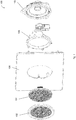
- Fig. 1 shows an exploded view of a number of components in an exemplary loudspeaker apparatus or system.
- the loudspeaker 100 comprises a first grille 102, a second grille 104, a door panel 106, a motor 108 and a transducer 110.
- the door panel 106 forms a front face of an outer casing or container (not shown), in which the motor 108 and the transducer 110 are housed.
- the first, or outer, grille 102 is disposed on the front face of the door panel, and the second, or inner, grille 104 is disposed behind the first grille 102.
- the door panel has an opening of a shape and size that correspond to the first and second grilles allowing them to be connected to the motor 108, which causes the relative movement of the two grilles.
- first grille 102 and the second grille 104 are both circular, and are of the same size or substantially the same size.
- the first grille may comprise an additional outer ring for protection.
- the two grilles are both planar or substantially planar, and they are disposed on adjacent parallel planes.
- the gap or separation between their respective planes is small; for example, the size of the gap may be under 5 millimetres, or may be on the order of lateral dimension of each individual perforation, or may be close to zero so that the inward-facing side of the first grille and the outward-facing side of the second grille effectively touch each other, but without affecting the smoothness of the relative motion between the two grilles.
- the second grille 104 is rotatable about an axis that is perpendicular to the parallel planes of the two grilles, and that passes through the respective centres of the two circular grilles. As the relative rotation between the two grilles occurs, a gradual change occurs to the appearance of the front face of the loudspeaker as viewed by a user. This is due to the gradual changes in alignment between the perforations in the first grille 102 and those in the second grille 104.
- the geometric arrangement of perforations (or the hole pattern) in the first grille 102 is the same as that in the second grille 104.
- the arrangement of perforations in each grille is a regular hexagonally packed arrangement of a large number of small circular holes.
- the consequence of the two hole arrangements being the same in the two rotatable grilles is that there exists a relative position or orientation where each of the perforations on the first grille aligns, perfectly or substantially, with a corresponding perforation on the second grille, corresponding to the illustration in Fig. 2f .
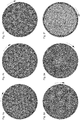
- Figs. 2a to 2f are a series of six drawings that illustrate the appearance of the grille portion of the front face of the door panel 106 of the loudspeaker 100, as viewed from outside, as the rotation of the second grille 104 proceeds behind the static first grille 102, according to one or more embodiments.
- Fig. 2a shows a "starting position", when the perforations in the two grilles are not perfectly aligned. In other words, in this position, the solid portions of the second grille 104 are partially obscured by the solid portions of the first grille 102. However, by virtue of the two grilles being aligned at their respective centres and having the same overall arrangement of perforations, a certain overall geometric pattern results from the "non-alignment" of the holes.
- the second grille 104 can be rotated until it reaches a "final position", in which it is totally aligned with the first grille 102, that is, each of the perforations on the first grille aligns, perfectly or substantially, with a corresponding perforation on the second grille, as in Fig. 2f .
- Figs. 3a to 3f are the same as Figs. 2a to 2f , respectively, but in the form of clear line drawings.
- the above-described arrangement of a set of grilles for loudspeaker equipment may be used, for example, in an automotive vehicle integrated with a hi-fi audio system.
- the door panel 106 may form a portion of an automotive interior surface or part.
- the presently disclosed arrangement creates an engaging, dynamic visual effect resulting in a whole new user experience for owners of a privately owned vehicle and customers of a luxury rental car, for example, whereas normal loudspeaker grilles feel static and uninteresting.
- the arrangement is not merely aesthetically pleasing to look at; new technical effects are also achieved that are advantageous over prior grille arrangements.
- the grilles are disposed in the starting position corresponding to Fig. 2a where the grilles are not aligned.
- the sound system is turned on (such as when the car engine is started)
- the second grille 104 gradually moves, and stops when the final position is reached, corresponding to Fig. 2f where it aligns with the first grille 102.
- acoustic transparency is optimal; on the other hand, acoustic transmission is sub-optimal at the starting position, and any sound waves coming from the transducer may be lower in volume or muffled in quality, or may differ from sound waves emitted when the grilles are aligned at the final position.
- any sound waves coming from the transducer may be lower in volume or muffled in quality, or may differ from sound waves emitted when the grilles are aligned at the final position.
- acoustic transparency or the sound quality in general may change in a gradual manner, for example, from a duller, deeper timbre to a higher-volume, brighter texture.
- This provides a simple, mechanical way to create an engaging, dynamic sound effect to the listener (for example, a gradual brightening of music as his or her journey in the vehicle begins, and a gradual blurring of music as the journey comes to an end), without the need for further digital programming or other filters, for example.
- the present arrangement is also technically advantageous in that any user of can be clearly and immediately informed whether the sound system is turned on or off, just by having a quick look at the front face of the loudspeaker, rather than, for example, looking at a small light indicating the on/off state, as is standard in many stereo systems in automobiles, homes or offices. This is achieved by the highly visible transformation in the perceived perforation pattern in the loudspeaker, caused by the motorised movement of at least one of the two grilles.
- Methods of operating a loudspeaker in particular of controlling one or more grilles in a loudspeaker system, are also herein disclosed.
- a method 400 is carried out at a loudspeaker that comprises at least first and second perforated grilles, with reference to flow diagram Fig. 4 . These grills may be disposed adjacent and parallel to each other.
- a first signal such as a turn-on signal, is received by the loudspeaker.
- the first grille is moved or rotated relative to the second grille to a different position or orientation, thereby causing perforations in the first grille to fall into a first alignment with perforations in the second grille; for example, the perforations in the first grille is made to completely align with those in the second grille.
- a method 500 is carried out at a loudspeaker that comprises at least first and second perforated grilles, with reference to flow diagram Fig. 5 .
- a second signal such as a turn-off signal, is received by the loudspeaker.
- the first grille is moved or rotated relative to the second grille to a different position or orientation, thereby causing perforations in the first grille to reach a second alignment with perforations in the second grille; for example, the perforations in the first grille is caused to fall out of alignment with those in the second grille.
- a loudspeaker comprising the presently disclosed arrangement of dynamic grilles is at least powered by an electrical signal for the movement of the grilles, and a separate electrical acoustic signal.
- the motion of the grilles and the acoustic functions of the loudspeaker are powered by the same signal(s).
- one or both of the first grille and the second grille are movable by means of one or more motors in the loudspeaker system, as long as a relative motion between the first and second grilles is created.
- the relative movement between the two grilles is created not by rotating one of the grilles but using alternative types of movement.
- the relative movement may involve a translational movement such as a lateral displacement, or a rotation or tilting relative to an axis that may or may not pass through a grille, or a combination thereof.
- one of the grilles is rotated and the other one is laterally displaced.
- both grilles are circular but are disposed non-concentrically or non-coaxially, and are rotated between respective first and second orientations.
- one of the grilles is fixed and the other one is laterally displaced and rotated at the same time to move, in a rolling motion, to a concentrically aligned position from a "misaligned" position.
- a grille may not be planar, but a curved section of a cylinder or sphere, for example.
- the grilles are each in the form of a curved section of a cylindrical surface, and one or both of the grilles are rotated relative to the other about the central axis of the cylinder.
- the grilles are not always disposed to be parallel to each other, or to follow substantially the same curved geometry.
- one of the grilles may be aligned to a predefined axis, and the other grille may be offset or angled (e.g. by up to 5 degrees) with respect to the axis, in at least one position such as a starting position.
- a grille may be tilted (e.g. rotated with respect to an axis that is coplanar with the grille) from a starting position to reach a final position in which the grilles are parallel.
- the perforations in the grilles may not be circular, or of uniform shape and size, to cater to different considerations, acoustic or otherwise.
- the arrangement of the perforations in the first grille is different from that in the second grille.
- the perforations in the innermost of the two grilles may form a specific pattern that is only clear visible when the second grille is in a certain position relative to the first grille, but totally or partially obscured when the second grille is in other positions.
- the outline of a logo may be formed from the collective shape of the perforations of the inner grille and be visible through the outer grille in a starting position, but may gradually appear to dissolve as the inner grille is moved and obscured by the outer grille, until it is rendered completely invisible as the sound system (or a vehicle containing the system) is fully started up, or vice versa.
- the geometric arrangement of the perforations in the first grille is the same as that in the second grille, but the second grille is made distinct from the first by including an additional visual aspect in its solid portions, to extend or heighten a visual impact.
- a logo of the vehicle hire company or a text may be formed on a face of the inner grille by coating, etching or engraving.
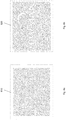
- a first grille 610 comprises a regular arrangement of perforations, in the form of holes that are slightly elongated at an angle.
- a second grille 620 located behind the first grille, comprises perforations in the form of long slits at the same angle, with modifications to some of the perforations to incorporate a specific pattern across a large area of the second grille.
- the grilles are operable to move relative to each other, from a starting position 702, through intermediate positions such as position 704, towards a final position 706.
- the perforations in the second grille are obscured by the first grille, as the two sets of perforations do not align; during movement 704 between the starting and final positions, the specific pattern or aspects thereof emerge gradually through the perforations of the first grille as the relative alignment of the grilles changes, until the final position 706 is reached, when the specific pattern or aspects thereof are clearly visible to the observer.
- the perforations in the two grilles are arranged such that there is at least one relative position, such as a starting or "closed” position, in which there are no or few gaps or openings in the front face between the interior and exterior of the loudspeaker (i.e. all or most of the perforations in one grille align with a solid portion of the other grille), effectively sealing off the interior where acoustic, electrical and other components are located; this helps to avoid dust from entering when the speaker is in this position, such as when it is turned off.
- a starting or "closed” position in which there are no or few gaps or openings in the front face between the interior and exterior of the loudspeaker (i.e. all or most of the perforations in one grille align with a solid portion of the other grille)
Landscapes
- Engineering & Computer Science (AREA)
- Physics & Mathematics (AREA)
- Acoustics & Sound (AREA)
- Signal Processing (AREA)
- Health & Medical Sciences (AREA)
- Otolaryngology (AREA)
- Manufacturing & Machinery (AREA)
- Fittings On The Vehicle Exterior For Carrying Loads, And Devices For Holding Or Mounting Articles (AREA)
- Audible-Bandwidth Dynamoelectric Transducers Other Than Pickups (AREA)
Abstract
Description
- The present invention generally relates to a dynamic arrangement of loudspeaker grilles.
- A common loudspeaker may include a voice coil attached to a diaphragm. The voice coil may be positioned in a voice coil gap of the common loudspeaker, and the voice coil gap may be defined by a magnet assembly and a frame of the common loudspeaker. The common loudspeaker may receive an electrical acoustic signal, which may cause the voice coil to move in the voice coil gap. This movement may result from the interaction of the electrical acoustic signal, the voice coil, and the magnet assembly.
- A conventional grille may be attached to the common loudspeaker. The conventional grille may include fixed openings for sound from the common loudspeaker to travel through. The fixed openings may be static; as such, the fixed openings may be permanently located at specific locations on the conventional grille. The fixed openings may be arranged in a permanent pattern. Moreover, once affixed to the common loudspeaker, the conventional grille may be a static component. The conventional grille may be a single, integral component, which may be entirely formed from a single material, such as a hard plastic or metal.
- It is herein disclosed a dynamic component for a loudspeaker, comprising at least two grilles.
- According to an embodiment, there is provided a component for a loudspeaker, comprising a first grille comprising a first arrangement of perforations, and a second grille comprising a second arrangement of perforations, wherein the second grille is operable to move or rotate relative to the first grille from a first position to a second position, and wherein the first arrangement of perforations and the second arrangement of perforations are aligned differently in the first position and the second position.
- In one aspect, the first arrangement of perforations is the same as the second arrangement of perforations.
- In another aspect, the first grille is disposed on a first plane and the second grille is disposed on a second plane parallel to the first plane, and the first plane and the second plane are separated by a small gap close to zero in size, such as under 5 millimetres.
- In one aspect, the first grille and the second grille are circular, and the second grille is operable to rotate about its centre.
- In another aspect, the first grille is fixed.
- In one aspect, the second grille is operable to move or rotate between the first position, at which perforations in the second grille and perforations in the first grille completely align, and the second position, at which perforations in the second grille and perforations in the first grille do not completely align.
- In another aspect, the relative rotation between the second grille and the first grille creates a dynamic Moiré effect.
- In one aspect, a front-facing face of the second grille has a distinct appearance from the front-facing face of the first grille.
- In another aspect, the first grille is an outer grille of a loudspeaker and the second grille is an inner grille.
- According to an embodiment, there is provided a loudspeaker comprising the component as described, and a motor operable to move or rotate the second grille.
- In one aspect, the second grille rotates from the first position to the second position when the loudspeaker receives a first signal such as a turn-on signal, and the second grille rotates from the second position to the first position when the loudspeaker receives a second signal such as a turn-off signal.
- In one aspect, the loudspeaker is integrated into an automotive vehicle.
- In accordance with an embodiment, there is provided a loudspeaker comprising a first perforated grille, a second perforated grille which is partially obscured by the first perforated grille, and means to cause one or both of the perforated grilles to move or rotate relative to the other, causing a dynamic superposition of perforations in the grilles to demonstrate a Moiré effect.
- In accordance with an embodiment, a method of operating a loudspeaker is provided, comprising receiving a signal, and moving (such as rotating) a first perforated grille of the loudspeaker relative to a second perforated grille, from a first position where perforations in the first grille and perforations in the second grille have a first alignment, to a second position where the perforations in the first grille and the perforations in the second grille have a second alignment different from the first alignment.
- In one aspect, in the second alignment, the perforations in the first grille and the perforations in the second grille align, and in the first alignment, the perforations in the first grille and the perforations in the second grille fall out of alignment.
- In order that the present invention be more readily understood, various aspects of specific non-limiting embodiments will now be described in conjunction with the attached drawings.
- It is noted that the terms "moving" and "movement" encompass angular movement (such as rotation and tilting), and the term "position" encompasses angular position (such as orientation).
-
-
Fig. 1 shows an exploded view of components in an exemplary loudspeaker system in accordance with one or more embodiments; -
Figs. 2a to 2f show, in sequence, an illustration of components of a loudspeaker system viewed from the front, in accordance with one or more embodiments; -
Figs. 3a to 3f are clear line drawing versions ofFigs. 2a to 2f , respectively; -
Fig. 4 is a flow chart illustrating an exemplary method of operating a loudspeaker according to one or more embodiments; -
Fig. 5 is a flow chart illustrating an exemplary method of operating a loudspeaker according to one or more embodiments; -
Figs. 6a and 6b illustrate components in a loudspeaker system according to one or more embodiments; -
Fig. 7 illustrates components in a loudspeaker system according to one or more embodiments. - It is herein disclosed a dynamic arrangement of loudspeaker grilles.
- The arrangement comprises a first grille and a second grille, at least one of which is adapted to move relative to the other, from a first position or orientation, to a second position or orientation in which the alignment of the perforations on the first grille and the perforations on the second grille is different compared to the first position or orientation. For example, in the second position, the perforations on the first grille and those on the second grille are aligned, whereas in the first position and other positions, the perforations are not fully aligned. The relative movement between the two grilles can be controlled to cause them to fall into varying levels of alignment, with advantageous effects on the acoustical transparency of the sound passing through the grilles and other aspects both technical and otherwise.
- An embodiment of the arrangement will now be described with reference to the drawings.
-
Fig. 1 shows an exploded view of a number of components in an exemplary loudspeaker apparatus or system. Theloudspeaker 100 comprises afirst grille 102, asecond grille 104, adoor panel 106, amotor 108 and atransducer 110. For example, thedoor panel 106 forms a front face of an outer casing or container (not shown), in which themotor 108 and thetransducer 110 are housed. The first, or outer,grille 102 is disposed on the front face of the door panel, and the second, or inner,grille 104 is disposed behind thefirst grille 102. The door panel has an opening of a shape and size that correspond to the first and second grilles allowing them to be connected to themotor 108, which causes the relative movement of the two grilles. - In an aspect, the
first grille 102 and thesecond grille 104 are both circular, and are of the same size or substantially the same size. The first grille may comprise an additional outer ring for protection. In another aspect, the two grilles are both planar or substantially planar, and they are disposed on adjacent parallel planes. In a further aspect, they are disposed very close to each other, that is, the gap or separation between their respective planes is small; for example, the size of the gap may be under 5 millimetres, or may be on the order of lateral dimension of each individual perforation, or may be close to zero so that the inward-facing side of the first grille and the outward-facing side of the second grille effectively touch each other, but without affecting the smoothness of the relative motion between the two grilles. - In one aspect, the
first grille 102 is static and not moveable or rotatable, and is fixed to thedoor panel 106. The second grille, on the other hand, can be rotated by themotor 108, which may be a small electrical motor. - In an aspect, the
second grille 104 is rotatable about an axis that is perpendicular to the parallel planes of the two grilles, and that passes through the respective centres of the two circular grilles. As the relative rotation between the two grilles occurs, a gradual change occurs to the appearance of the front face of the loudspeaker as viewed by a user. This is due to the gradual changes in alignment between the perforations in thefirst grille 102 and those in thesecond grille 104. - In one aspect, the geometric arrangement of perforations (or the hole pattern) in the
first grille 102 is the same as that in thesecond grille 104. For example, the arrangement of perforations in each grille is a regular hexagonally packed arrangement of a large number of small circular holes. In a particular hole pattern, there are approximately 960 identical circular holes arranged in an overall dodecagon shape covering most of the area of the circular grille (corresponding substantially to the view shown inFig. 2f ). The consequence of the two hole arrangements being the same in the two rotatable grilles is that there exists a relative position or orientation where each of the perforations on the first grille aligns, perfectly or substantially, with a corresponding perforation on the second grille, corresponding to the illustration inFig. 2f . -
Figs. 2a to 2f are a series of six drawings that illustrate the appearance of the grille portion of the front face of thedoor panel 106 of theloudspeaker 100, as viewed from outside, as the rotation of thesecond grille 104 proceeds behind the staticfirst grille 102, according to one or more embodiments. -
Fig. 2a shows a "starting position", when the perforations in the two grilles are not perfectly aligned. In other words, in this position, the solid portions of thesecond grille 104 are partially obscured by the solid portions of thefirst grille 102. However, by virtue of the two grilles being aligned at their respective centres and having the same overall arrangement of perforations, a certain overall geometric pattern results from the "non-alignment" of the holes. - As the
second grille 104 gradually rotates, for example in a clockwise direction, at a small distance behind thefirst grille 102, the solid portions of the second grille visible through each perforation of the first grille come and go. In one aspect, where the holes are circular and hexagonally packed, the combined geometric effect is the apparent emergence of more complex evolving patterns. - As seen in
Figs. 2b, 2c, 2d and 2e , as the clockwise rotation of thesecond grille 104 proceeds, the exact manner and extent of its obstruction by thefirst grille 102 continue to vary, the ever-changing superposition resulting in the perceived emergence of evolving hexagons, which appear to change in size and number across the entirety of the circular grille. This visual phenomenon is a type of Moiré effect. - The
second grille 104 can be rotated until it reaches a "final position", in which it is totally aligned with thefirst grille 102, that is, each of the perforations on the first grille aligns, perfectly or substantially, with a corresponding perforation on the second grille, as inFig. 2f . - The above sequence, with the relative rotational position of the two grilles progressing from the so-called non-alignment of
Fig. 2a, through Figs. 2b to 2e , up to the total alignment ofFig. 2f , can be described as an "opening operation" of the grilles. The reverse, a "closing operation", can be performed as thesecond grille 104 is made to rotate in the opposite direction, i.e. the anti-clockwise direction, progressing from the complete alignment of perforations shown inFig. 2f, through Figs. 2e to 2b , ending in the "starting position" ofFig. 2a . -
Figs. 3a to 3f are the same asFigs. 2a to 2f , respectively, but in the form of clear line drawings. - The above-described arrangement of a set of grilles for loudspeaker equipment may be used, for example, in an automotive vehicle integrated with a hi-fi audio system. For example, the
door panel 106 may form a portion of an automotive interior surface or part. - The presently disclosed arrangement creates an engaging, dynamic visual effect resulting in a whole new user experience for owners of a privately owned vehicle and customers of a luxury rental car, for example, whereas normal loudspeaker grilles feel static and uninteresting. However, the arrangement is not merely aesthetically pleasing to look at; new technical effects are also achieved that are advantageous over prior grille arrangements.
- As an example, when a car sound system is off, the grilles are disposed in the starting position corresponding to
Fig. 2a where the grilles are not aligned. When the sound system is turned on (such as when the car engine is started), thesecond grille 104 gradually moves, and stops when the final position is reached, corresponding toFig. 2f where it aligns with thefirst grille 102. At the final position, acoustic transparency is optimal; on the other hand, acoustic transmission is sub-optimal at the starting position, and any sound waves coming from the transducer may be lower in volume or muffled in quality, or may differ from sound waves emitted when the grilles are aligned at the final position. In the process of movement (Figs. 2b to 2e ), acoustic transparency or the sound quality in general may change in a gradual manner, for example, from a duller, deeper timbre to a higher-volume, brighter texture. This provides a simple, mechanical way to create an engaging, dynamic sound effect to the listener (for example, a gradual brightening of music as his or her journey in the vehicle begins, and a gradual blurring of music as the journey comes to an end), without the need for further digital programming or other filters, for example. - The present arrangement is also technically advantageous in that any user of can be clearly and immediately informed whether the sound system is turned on or off, just by having a quick look at the front face of the loudspeaker, rather than, for example, looking at a small light indicating the on/off state, as is standard in many stereo systems in automobiles, homes or offices. This is achieved by the highly visible transformation in the perceived perforation pattern in the loudspeaker, caused by the motorised movement of at least one of the two grilles.
- Methods of operating a loudspeaker, in particular of controlling one or more grilles in a loudspeaker system, are also herein disclosed.
- According to an exemplary embodiment, a
method 400 is carried out at a loudspeaker that comprises at least first and second perforated grilles, with reference to flow diagramFig. 4 . These grills may be disposed adjacent and parallel to each other. Instep 402, a first signal, such as a turn-on signal, is received by the loudspeaker. In step 404, the first grille is moved or rotated relative to the second grille to a different position or orientation, thereby causing perforations in the first grille to fall into a first alignment with perforations in the second grille; for example, the perforations in the first grille is made to completely align with those in the second grille. - According to an exemplary embodiment, a
method 500 is carried out at a loudspeaker that comprises at least first and second perforated grilles, with reference to flow diagramFig. 5 . Instep 502, a second signal, such as a turn-off signal, is received by the loudspeaker. Instep 504, the first grille is moved or rotated relative to the second grille to a different position or orientation, thereby causing perforations in the first grille to reach a second alignment with perforations in the second grille; for example, the perforations in the first grille is caused to fall out of alignment with those in the second grille. - In some embodiments and aspects, a loudspeaker comprising the presently disclosed arrangement of dynamic grilles is at least powered by an electrical signal for the movement of the grilles, and a separate electrical acoustic signal. In some other embodiments and aspects, the motion of the grilles and the acoustic functions of the loudspeaker are powered by the same signal(s).
- Modifications and variations to the embodiments described above are possible where appropriate. Several exemplary alternative embodiments and aspects are described below.
- In some embodiments and aspects, one or both of the first grille and the second grille are movable by means of one or more motors in the loudspeaker system, as long as a relative motion between the first and second grilles is created.
- In some embodiments and aspects, the relative movement between the two grilles is created not by rotating one of the grilles but using alternative types of movement. For example, the relative movement may involve a translational movement such as a lateral displacement, or a rotation or tilting relative to an axis that may or may not pass through a grille, or a combination thereof. For example, one of the grilles is rotated and the other one is laterally displaced. As another example, both grilles are circular but are disposed non-concentrically or non-coaxially, and are rotated between respective first and second orientations. As another example, one of the grilles is fixed and the other one is laterally displaced and rotated at the same time to move, in a rolling motion, to a concentrically aligned position from a "misaligned" position.
- In some other aspects, a grille may not be planar, but a curved section of a cylinder or sphere, for example. For example, the grilles are each in the form of a curved section of a cylindrical surface, and one or both of the grilles are rotated relative to the other about the central axis of the cylinder.
- In some aspects, the grilles are not always disposed to be parallel to each other, or to follow substantially the same curved geometry. For example, one of the grilles may be aligned to a predefined axis, and the other grille may be offset or angled (e.g. by up to 5 degrees) with respect to the axis, in at least one position such as a starting position. For example, a grille may be tilted (e.g. rotated with respect to an axis that is coplanar with the grille) from a starting position to reach a final position in which the grilles are parallel.
- In some aspects, the perforations in the grilles may not be circular, or of uniform shape and size, to cater to different considerations, acoustic or otherwise.
- In some embodiments and aspects, the arrangement of the perforations in the first grille is different from that in the second grille. For example, the perforations in the innermost of the two grilles may form a specific pattern that is only clear visible when the second grille is in a certain position relative to the first grille, but totally or partially obscured when the second grille is in other positions. For example, the outline of a logo may be formed from the collective shape of the perforations of the inner grille and be visible through the outer grille in a starting position, but may gradually appear to dissolve as the inner grille is moved and obscured by the outer grille, until it is rendered completely invisible as the sound system (or a vehicle containing the system) is fully started up, or vice versa.
- In some other embodiments and aspects, the geometric arrangement of the perforations in the first grille is the same as that in the second grille, but the second grille is made distinct from the first by including an additional visual aspect in its solid portions, to extend or heighten a visual impact. For example, a logo of the vehicle hire company or a text (such as a welcome greeting) may be formed on a face of the inner grille by coating, etching or engraving.
- An example incorporating some of the above aspects and variations is illustrated with reference to
Figs. 6a, 6b and7 . Afirst grille 610 comprises a regular arrangement of perforations, in the form of holes that are slightly elongated at an angle. Asecond grille 620, located behind the first grille, comprises perforations in the form of long slits at the same angle, with modifications to some of the perforations to incorporate a specific pattern across a large area of the second grille. The grilles are operable to move relative to each other, from a startingposition 702, through intermediate positions such asposition 704, towards afinal position 706. In this example, in the startingposition 702, the perforations in the second grille are obscured by the first grille, as the two sets of perforations do not align; duringmovement 704 between the starting and final positions, the specific pattern or aspects thereof emerge gradually through the perforations of the first grille as the relative alignment of the grilles changes, until thefinal position 706 is reached, when the specific pattern or aspects thereof are clearly visible to the observer. - In some aspects, the perforations in the two grilles are arranged such that there is at least one relative position, such as a starting or "closed" position, in which there are no or few gaps or openings in the front face between the interior and exterior of the loudspeaker (i.e. all or most of the perforations in one grille align with a solid portion of the other grille), effectively sealing off the interior where acoustic, electrical and other components are located; this helps to avoid dust from entering when the speaker is in this position, such as when it is turned off.
- The description of embodiments and aspects has been presented merely for purposes of illustration and description. Suitable modifications and variations to these embodiments and aspects may be performed in light of the above, and different embodiments and aspects may be combined where possible and appropriate, without departing from the scope of protection as determined by the claims.
Claims (15)
- A component for a loudspeaker, comprising:a first grille comprising a first arrangement of perforations; anda second grille comprising a second arrangement of perforations;wherein the second grille is operable to move relative to the first grille from a first position to a second position, andwherein the first arrangement of perforations and the second arrangement of perforations are aligned differently in the first position and the second position.
- The component according to claim 1, wherein the first arrangement of perforations is the same as the second arrangement of perforations.
- The component according to any of claims 1 and 2, wherein the first grille is disposed on a first plane and the second grille is disposed on a second plane parallel to the first plane, and the first plane and the second plane are separated by a small gap close to zero.
- The component according to any of claims 1 and 3, wherein the first grille and the second grille are substantially circular, and the second grille is operable to rotate about its centre.
- The component according to any of claims 1 to 4, wherein the first grille is fixed.
- The component according to any of claims 1 to 5, wherein:when the second grille is in the second position, perforations in the second grille and perforations in the first grille completely align, andwhen the second grille is in the first position, perforations in the second grille and perforations in the first grille do not completely align.
- The component according to any of claims 1 to 6, wherein a relative rotation between the second grille and the first grille creates a dynamic Moiré effect.
- The component according to any of claims 1 to 7, wherein a front-facing face of the second grille has a distinct appearance from the front-facing face of the first grille.
- The component according to any of claims 1 to 8, wherein the first grille is an outer grille of a loudspeaker and the second grille is an inner grille.
- A loudspeaker comprising:the component according to any of claims 1 to 9, anda motor operable to move or rotate the second grille.
- The loudspeaker according to claim 10, wherein the second grille rotates from the first position to the second position when the loudspeaker receives a first signal, and the second grille rotates from the second position to the first position when the loudspeaker receives a second signal.
- The loudspeaker according to any of claims 10 and 11, wherein the loudspeaker is integrated into an automotive vehicle.
- A loudspeaker comprising:a first perforated grille,a second perforated grille, wherein the second grille is partially obscured by the first perforated grille, andmeans to cause one or both of the first perforated grille and the second perforated grille to move or rotate relative to the other, causing a dynamic superposition of perforations in the grilles to demonstrate a Moiré effect.
- A method of operating a loudspeaker, comprising:receiving a signal;moving a first perforated grille of the loudspeaker relative to a second perforated grille, from a first position where perforations in the first grille and perforations in the second grille have a first alignment, to a second position where the perforations in the first grille and the perforations in the second grille have a second alignment that is different from the first alignment.
- The method according to claim 14, wherein:in the second alignment, the perforations in the first grille and the perforations in the second grille align, andin the first alignment, the perforations in the first grille and the perforations in the second grille fall out of alignment.
Applications Claiming Priority (1)
| Application Number | Priority Date | Filing Date | Title |
|---|---|---|---|
| EP18150349 | 2018-01-04 |
Publications (2)
| Publication Number | Publication Date |
|---|---|
| EP3509317A1 true EP3509317A1 (en) | 2019-07-10 |
| EP3509317B1 EP3509317B1 (en) | 2021-06-23 |
Family
ID=60937618
Family Applications (1)
| Application Number | Title | Priority Date | Filing Date |
|---|---|---|---|
| EP18248036.8A Active EP3509317B1 (en) | 2018-01-04 | 2018-12-27 | Loudspeaker grilles |
Country Status (2)
| Country | Link |
|---|---|
| US (1) | US10681438B2 (en) |
| EP (1) | EP3509317B1 (en) |
Cited By (1)
| Publication number | Priority date | Publication date | Assignee | Title |
|---|---|---|---|---|
| DE102023003046A1 (en) | 2023-07-24 | 2023-11-30 | Mercedes-Benz Group AG | Vehicle component, in particular an interior door panel and method for integrating a loudspeaker in the vehicle component |
Families Citing this family (9)
| Publication number | Priority date | Publication date | Assignee | Title |
|---|---|---|---|---|
| USD937802S1 (en) * | 2018-08-23 | 2021-12-07 | Sonos, Inc. | Speaker grill |
| USD929366S1 (en) * | 2018-12-21 | 2021-08-31 | JVC Kenwood Corporation | Speaker grill for cars |
| USD944776S1 (en) * | 2020-05-05 | 2022-03-01 | Shure Acquisition Holdings, Inc. | Audio device |
| USD943552S1 (en) * | 2020-05-05 | 2022-02-15 | Shure Acquisition Holdings, Inc. | Audio device |
| JP1771524S (en) * | 2023-08-25 | 2024-05-27 | Car speaker grill | |
| JP1766106S (en) * | 2023-08-25 | 2024-03-19 | car speakers | |
| JP1766105S (en) * | 2023-08-25 | 2024-03-19 | car speakers | |
| JP1771447S (en) * | 2023-08-25 | 2024-05-27 | Car speaker grill | |
| WO2025218876A1 (en) * | 2024-04-15 | 2025-10-23 | Harman Becker Automotive Systems Gmbh | Rotatable control element |
Citations (3)
| Publication number | Priority date | Publication date | Assignee | Title |
|---|---|---|---|---|
| US1884724A (en) * | 1923-06-19 | 1932-10-25 | Western Electric Co | Sound box for phonic diaphragms |
| US4817163A (en) * | 1986-02-17 | 1989-03-28 | Erich Stastny | Loud-speaker combined with a device for producing lighting effects |
| DE102016005453A1 (en) * | 2016-05-03 | 2017-02-16 | Daimler Ag | Method and device for lighting a loudspeaker, preferably in a vehicle |
Family Cites Families (1)
| Publication number | Priority date | Publication date | Assignee | Title |
|---|---|---|---|---|
| KR101736994B1 (en) * | 2015-11-26 | 2017-05-17 | 현대자동차주식회사 | Apparatus and method for controlling speaker grill in vehicle |
-
2018
- 2018-12-27 EP EP18248036.8A patent/EP3509317B1/en active Active
-
2019
- 2019-01-02 US US16/238,270 patent/US10681438B2/en active Active
Patent Citations (3)
| Publication number | Priority date | Publication date | Assignee | Title |
|---|---|---|---|---|
| US1884724A (en) * | 1923-06-19 | 1932-10-25 | Western Electric Co | Sound box for phonic diaphragms |
| US4817163A (en) * | 1986-02-17 | 1989-03-28 | Erich Stastny | Loud-speaker combined with a device for producing lighting effects |
| DE102016005453A1 (en) * | 2016-05-03 | 2017-02-16 | Daimler Ag | Method and device for lighting a loudspeaker, preferably in a vehicle |
Cited By (1)
| Publication number | Priority date | Publication date | Assignee | Title |
|---|---|---|---|---|
| DE102023003046A1 (en) | 2023-07-24 | 2023-11-30 | Mercedes-Benz Group AG | Vehicle component, in particular an interior door panel and method for integrating a loudspeaker in the vehicle component |
Also Published As
| Publication number | Publication date |
|---|---|
| US20190208297A1 (en) | 2019-07-04 |
| EP3509317B1 (en) | 2021-06-23 |
| US10681438B2 (en) | 2020-06-09 |
Similar Documents
| Publication | Publication Date | Title |
|---|---|---|
| US10681438B2 (en) | Loudspeaker grilles | |
| US8036412B2 (en) | Microphone system having pressure-gradient capsules | |
| EP3073758A1 (en) | Headphone and acoustic characteristic adjustment method | |
| US20100272303A1 (en) | Headset | |
| KR101736994B1 (en) | Apparatus and method for controlling speaker grill in vehicle | |
| EP2730097B1 (en) | A multiple receiver assembly and a method for assembly thereof | |
| EP3404932B1 (en) | Loudspeaker system and configurations for directionality and dispersion control | |
| JP2015537405A (en) | Porous cover structure for mobile device audio | |
| JP2009159120A (en) | Car speaker | |
| CA2116794A1 (en) | Audiovisual equipment casing with sound-transmitting openings | |
| CN112385244A (en) | Waveguide assembly | |
| EP3449642B1 (en) | Bass reflex tube for a loudspeaker | |
| KR100389734B1 (en) | Speaker Enclosure | |
| CN114979337B (en) | Earphone loudspeaker play sound subassembly and terminal equipment | |
| TW202044849A (en) | Headphone | |
| US10484790B1 (en) | Speaker device for vehicle | |
| JP2007168686A (en) | On-vehicle microphone device | |
| JP6124670B2 (en) | Interior equipment for automobiles | |
| US11470410B1 (en) | Speaker mounting system and method of mounting within a panel | |
| JP3511823B2 (en) | Speaker device | |
| KR100517694B1 (en) | Speaker device of car | |
| KR0138070Y1 (en) | Rotary door speaker | |
| JPH0678388A (en) | Speaker equipment | |
| CN109951770A (en) | Vehicle mounted loudspeaker system and audio system | |
| KR100402771B1 (en) | Variable Speaker Grill Structure for Vehicles |
Legal Events
| Date | Code | Title | Description |
|---|---|---|---|
| PUAI | Public reference made under article 153(3) epc to a published international application that has entered the european phase |
Free format text: ORIGINAL CODE: 0009012 |
|
| STAA | Information on the status of an ep patent application or granted ep patent |
Free format text: STATUS: THE APPLICATION HAS BEEN PUBLISHED |
|
| AK | Designated contracting states |
Kind code of ref document: A1 Designated state(s): AL AT BE BG CH CY CZ DE DK EE ES FI FR GB GR HR HU IE IS IT LI LT LU LV MC MK MT NL NO PL PT RO RS SE SI SK SM TR |
|
| AX | Request for extension of the european patent |
Extension state: BA ME |
|
| STAA | Information on the status of an ep patent application or granted ep patent |
Free format text: STATUS: REQUEST FOR EXAMINATION WAS MADE |
|
| 17P | Request for examination filed |
Effective date: 20200110 |
|
| RBV | Designated contracting states (corrected) |
Designated state(s): AL AT BE BG CH CY CZ DE DK EE ES FI FR GB GR HR HU IE IS IT LI LT LU LV MC MK MT NL NO PL PT RO RS SE SI SK SM TR |
|
| GRAP | Despatch of communication of intention to grant a patent |
Free format text: ORIGINAL CODE: EPIDOSNIGR1 |
|
| STAA | Information on the status of an ep patent application or granted ep patent |
Free format text: STATUS: GRANT OF PATENT IS INTENDED |
|
| INTG | Intention to grant announced |
Effective date: 20210204 |
|
| GRAS | Grant fee paid |
Free format text: ORIGINAL CODE: EPIDOSNIGR3 |
|
| GRAA | (expected) grant |
Free format text: ORIGINAL CODE: 0009210 |
|
| STAA | Information on the status of an ep patent application or granted ep patent |
Free format text: STATUS: THE PATENT HAS BEEN GRANTED |
|
| AK | Designated contracting states |
Kind code of ref document: B1 Designated state(s): AL AT BE BG CH CY CZ DE DK EE ES FI FR GB GR HR HU IE IS IT LI LT LU LV MC MK MT NL NO PL PT RO RS SE SI SK SM TR |
|
| REG | Reference to a national code |
Ref country code: GB Ref legal event code: FG4D |
|
| REG | Reference to a national code |
Ref country code: CH Ref legal event code: EP |
|
| REG | Reference to a national code |
Ref country code: DE Ref legal event code: R096 Ref document number: 602018018939 Country of ref document: DE Ref country code: AT Ref legal event code: REF Ref document number: 1405336 Country of ref document: AT Kind code of ref document: T Effective date: 20210715 |
|
| REG | Reference to a national code |
Ref country code: IE Ref legal event code: FG4D |
|
| REG | Reference to a national code |
Ref country code: LT Ref legal event code: MG9D |
|
| PG25 | Lapsed in a contracting state [announced via postgrant information from national office to epo] |
Ref country code: BG Free format text: LAPSE BECAUSE OF FAILURE TO SUBMIT A TRANSLATION OF THE DESCRIPTION OR TO PAY THE FEE WITHIN THE PRESCRIBED TIME-LIMIT Effective date: 20210923 Ref country code: LT Free format text: LAPSE BECAUSE OF FAILURE TO SUBMIT A TRANSLATION OF THE DESCRIPTION OR TO PAY THE FEE WITHIN THE PRESCRIBED TIME-LIMIT Effective date: 20210623 Ref country code: HR Free format text: LAPSE BECAUSE OF FAILURE TO SUBMIT A TRANSLATION OF THE DESCRIPTION OR TO PAY THE FEE WITHIN THE PRESCRIBED TIME-LIMIT Effective date: 20210623 Ref country code: FI Free format text: LAPSE BECAUSE OF FAILURE TO SUBMIT A TRANSLATION OF THE DESCRIPTION OR TO PAY THE FEE WITHIN THE PRESCRIBED TIME-LIMIT Effective date: 20210623 |
|
| REG | Reference to a national code |
Ref country code: AT Ref legal event code: MK05 Ref document number: 1405336 Country of ref document: AT Kind code of ref document: T Effective date: 20210623 |
|
| PG25 | Lapsed in a contracting state [announced via postgrant information from national office to epo] |
Ref country code: SE Free format text: LAPSE BECAUSE OF FAILURE TO SUBMIT A TRANSLATION OF THE DESCRIPTION OR TO PAY THE FEE WITHIN THE PRESCRIBED TIME-LIMIT Effective date: 20210623 Ref country code: RS Free format text: LAPSE BECAUSE OF FAILURE TO SUBMIT A TRANSLATION OF THE DESCRIPTION OR TO PAY THE FEE WITHIN THE PRESCRIBED TIME-LIMIT Effective date: 20210623 Ref country code: NO Free format text: LAPSE BECAUSE OF FAILURE TO SUBMIT A TRANSLATION OF THE DESCRIPTION OR TO PAY THE FEE WITHIN THE PRESCRIBED TIME-LIMIT Effective date: 20210923 Ref country code: LV Free format text: LAPSE BECAUSE OF FAILURE TO SUBMIT A TRANSLATION OF THE DESCRIPTION OR TO PAY THE FEE WITHIN THE PRESCRIBED TIME-LIMIT Effective date: 20210623 Ref country code: GR Free format text: LAPSE BECAUSE OF FAILURE TO SUBMIT A TRANSLATION OF THE DESCRIPTION OR TO PAY THE FEE WITHIN THE PRESCRIBED TIME-LIMIT Effective date: 20210924 |
|
| REG | Reference to a national code |
Ref country code: NL Ref legal event code: MP Effective date: 20210623 |
|
| PG25 | Lapsed in a contracting state [announced via postgrant information from national office to epo] |
Ref country code: EE Free format text: LAPSE BECAUSE OF FAILURE TO SUBMIT A TRANSLATION OF THE DESCRIPTION OR TO PAY THE FEE WITHIN THE PRESCRIBED TIME-LIMIT Effective date: 20210623 Ref country code: ES Free format text: LAPSE BECAUSE OF FAILURE TO SUBMIT A TRANSLATION OF THE DESCRIPTION OR TO PAY THE FEE WITHIN THE PRESCRIBED TIME-LIMIT Effective date: 20210623 Ref country code: SK Free format text: LAPSE BECAUSE OF FAILURE TO SUBMIT A TRANSLATION OF THE DESCRIPTION OR TO PAY THE FEE WITHIN THE PRESCRIBED TIME-LIMIT Effective date: 20210623 Ref country code: SM Free format text: LAPSE BECAUSE OF FAILURE TO SUBMIT A TRANSLATION OF THE DESCRIPTION OR TO PAY THE FEE WITHIN THE PRESCRIBED TIME-LIMIT Effective date: 20210623 Ref country code: PT Free format text: LAPSE BECAUSE OF FAILURE TO SUBMIT A TRANSLATION OF THE DESCRIPTION OR TO PAY THE FEE WITHIN THE PRESCRIBED TIME-LIMIT Effective date: 20211025 Ref country code: RO Free format text: LAPSE BECAUSE OF FAILURE TO SUBMIT A TRANSLATION OF THE DESCRIPTION OR TO PAY THE FEE WITHIN THE PRESCRIBED TIME-LIMIT Effective date: 20210623 Ref country code: NL Free format text: LAPSE BECAUSE OF FAILURE TO SUBMIT A TRANSLATION OF THE DESCRIPTION OR TO PAY THE FEE WITHIN THE PRESCRIBED TIME-LIMIT Effective date: 20210623 Ref country code: AT Free format text: LAPSE BECAUSE OF FAILURE TO SUBMIT A TRANSLATION OF THE DESCRIPTION OR TO PAY THE FEE WITHIN THE PRESCRIBED TIME-LIMIT Effective date: 20210623 Ref country code: CZ Free format text: LAPSE BECAUSE OF FAILURE TO SUBMIT A TRANSLATION OF THE DESCRIPTION OR TO PAY THE FEE WITHIN THE PRESCRIBED TIME-LIMIT Effective date: 20210623 |
|
| PG25 | Lapsed in a contracting state [announced via postgrant information from national office to epo] |
Ref country code: PL Free format text: LAPSE BECAUSE OF FAILURE TO SUBMIT A TRANSLATION OF THE DESCRIPTION OR TO PAY THE FEE WITHIN THE PRESCRIBED TIME-LIMIT Effective date: 20210623 |
|
| REG | Reference to a national code |
Ref country code: DE Ref legal event code: R097 Ref document number: 602018018939 Country of ref document: DE |
|
| PG25 | Lapsed in a contracting state [announced via postgrant information from national office to epo] |
Ref country code: DK Free format text: LAPSE BECAUSE OF FAILURE TO SUBMIT A TRANSLATION OF THE DESCRIPTION OR TO PAY THE FEE WITHIN THE PRESCRIBED TIME-LIMIT Effective date: 20210623 |
|
| PLBE | No opposition filed within time limit |
Free format text: ORIGINAL CODE: 0009261 |
|
| STAA | Information on the status of an ep patent application or granted ep patent |
Free format text: STATUS: NO OPPOSITION FILED WITHIN TIME LIMIT |
|
| 26N | No opposition filed |
Effective date: 20220324 |
|
| PG25 | Lapsed in a contracting state [announced via postgrant information from national office to epo] |
Ref country code: AL Free format text: LAPSE BECAUSE OF FAILURE TO SUBMIT A TRANSLATION OF THE DESCRIPTION OR TO PAY THE FEE WITHIN THE PRESCRIBED TIME-LIMIT Effective date: 20210623 |
|
| PG25 | Lapsed in a contracting state [announced via postgrant information from national office to epo] |
Ref country code: MC Free format text: LAPSE BECAUSE OF FAILURE TO SUBMIT A TRANSLATION OF THE DESCRIPTION OR TO PAY THE FEE WITHIN THE PRESCRIBED TIME-LIMIT Effective date: 20210623 Ref country code: IT Free format text: LAPSE BECAUSE OF FAILURE TO SUBMIT A TRANSLATION OF THE DESCRIPTION OR TO PAY THE FEE WITHIN THE PRESCRIBED TIME-LIMIT Effective date: 20210623 |
|
| REG | Reference to a national code |
Ref country code: CH Ref legal event code: PL |
|
| REG | Reference to a national code |
Ref country code: BE Ref legal event code: MM Effective date: 20211231 |
|
| PG25 | Lapsed in a contracting state [announced via postgrant information from national office to epo] |
Ref country code: LU Free format text: LAPSE BECAUSE OF NON-PAYMENT OF DUE FEES Effective date: 20211227 Ref country code: IE Free format text: LAPSE BECAUSE OF NON-PAYMENT OF DUE FEES Effective date: 20211227 |
|
| PG25 | Lapsed in a contracting state [announced via postgrant information from national office to epo] |
Ref country code: FR Free format text: LAPSE BECAUSE OF NON-PAYMENT OF DUE FEES Effective date: 20211231 Ref country code: BE Free format text: LAPSE BECAUSE OF NON-PAYMENT OF DUE FEES Effective date: 20211231 |
|
| PG25 | Lapsed in a contracting state [announced via postgrant information from national office to epo] |
Ref country code: LI Free format text: LAPSE BECAUSE OF NON-PAYMENT OF DUE FEES Effective date: 20211231 Ref country code: CH Free format text: LAPSE BECAUSE OF NON-PAYMENT OF DUE FEES Effective date: 20211231 |
|
| PG25 | Lapsed in a contracting state [announced via postgrant information from national office to epo] |
Ref country code: CY Free format text: LAPSE BECAUSE OF FAILURE TO SUBMIT A TRANSLATION OF THE DESCRIPTION OR TO PAY THE FEE WITHIN THE PRESCRIBED TIME-LIMIT Effective date: 20210623 |
|
| P01 | Opt-out of the competence of the unified patent court (upc) registered |
Effective date: 20230526 |
|
| PG25 | Lapsed in a contracting state [announced via postgrant information from national office to epo] |
Ref country code: HU Free format text: LAPSE BECAUSE OF FAILURE TO SUBMIT A TRANSLATION OF THE DESCRIPTION OR TO PAY THE FEE WITHIN THE PRESCRIBED TIME-LIMIT; INVALID AB INITIO Effective date: 20181227 |
|
| GBPC | Gb: european patent ceased through non-payment of renewal fee |
Effective date: 20221227 |
|
| PG25 | Lapsed in a contracting state [announced via postgrant information from national office to epo] |
Ref country code: GB Free format text: LAPSE BECAUSE OF NON-PAYMENT OF DUE FEES Effective date: 20221227 |
|
| PG25 | Lapsed in a contracting state [announced via postgrant information from national office to epo] |
Ref country code: MK Free format text: LAPSE BECAUSE OF FAILURE TO SUBMIT A TRANSLATION OF THE DESCRIPTION OR TO PAY THE FEE WITHIN THE PRESCRIBED TIME-LIMIT Effective date: 20210623 |
|
| PG25 | Lapsed in a contracting state [announced via postgrant information from national office to epo] |
Ref country code: TR Free format text: LAPSE BECAUSE OF FAILURE TO SUBMIT A TRANSLATION OF THE DESCRIPTION OR TO PAY THE FEE WITHIN THE PRESCRIBED TIME-LIMIT Effective date: 20210623 |
|
| PG25 | Lapsed in a contracting state [announced via postgrant information from national office to epo] |
Ref country code: MT Free format text: LAPSE BECAUSE OF FAILURE TO SUBMIT A TRANSLATION OF THE DESCRIPTION OR TO PAY THE FEE WITHIN THE PRESCRIBED TIME-LIMIT Effective date: 20210623 |
|
| PGFP | Annual fee paid to national office [announced via postgrant information from national office to epo] |
Ref country code: DE Payment date: 20251126 Year of fee payment: 8 |