EP3508629A1 - Method of manufacturing a sporting goods component and a sporting goods component - Google Patents
Method of manufacturing a sporting goods component and a sporting goods component Download PDFInfo
- Publication number
- EP3508629A1 EP3508629A1 EP18215284.3A EP18215284A EP3508629A1 EP 3508629 A1 EP3508629 A1 EP 3508629A1 EP 18215284 A EP18215284 A EP 18215284A EP 3508629 A1 EP3508629 A1 EP 3508629A1
- Authority
- EP
- European Patent Office
- Prior art keywords
- textile
- shrinking
- sporting goods
- shrinkage ratio
- component
- Prior art date
- Legal status (The legal status is an assumption and is not a legal conclusion. Google has not performed a legal analysis and makes no representation as to the accuracy of the status listed.)
- Granted
Links
Images





Classifications
-
- A—HUMAN NECESSITIES
- A43—FOOTWEAR
- A43D—MACHINES, TOOLS, EQUIPMENT OR METHODS FOR MANUFACTURING OR REPAIRING FOOTWEAR
- A43D15/00—Pulling-over or lasting machines for binding the toe end with cord, string, or wire; Machines for lasting with clamps; Lasting machines with sewing devices, also for platform shoes
-
- D—TEXTILES; PAPER
- D04—BRAIDING; LACE-MAKING; KNITTING; TRIMMINGS; NON-WOVEN FABRICS
- D04B—KNITTING
- D04B1/00—Weft knitting processes for the production of fabrics or articles not dependent on the use of particular machines; Fabrics or articles defined by such processes
- D04B1/10—Patterned fabrics or articles
- D04B1/12—Patterned fabrics or articles characterised by thread material
-
- A—HUMAN NECESSITIES
- A43—FOOTWEAR
- A43B—CHARACTERISTIC FEATURES OF FOOTWEAR; PARTS OF FOOTWEAR
- A43B23/00—Uppers; Boot legs; Stiffeners; Other single parts of footwear
- A43B23/02—Uppers; Boot legs
- A43B23/0245—Uppers; Boot legs characterised by the constructive form
- A43B23/025—Uppers; Boot legs characterised by the constructive form assembled by stitching
-
- A—HUMAN NECESSITIES
- A43—FOOTWEAR
- A43B—CHARACTERISTIC FEATURES OF FOOTWEAR; PARTS OF FOOTWEAR
- A43B23/00—Uppers; Boot legs; Stiffeners; Other single parts of footwear
- A43B23/02—Uppers; Boot legs
- A43B23/04—Uppers made of one piece; Uppers with inserted gussets
- A43B23/042—Uppers made of one piece
-
- A—HUMAN NECESSITIES
- A43—FOOTWEAR
- A43D—MACHINES, TOOLS, EQUIPMENT OR METHODS FOR MANUFACTURING OR REPAIRING FOOTWEAR
- A43D21/00—Lasting machines
-
- D—TEXTILES; PAPER
- D04—BRAIDING; LACE-MAKING; KNITTING; TRIMMINGS; NON-WOVEN FABRICS
- D04B—KNITTING
- D04B21/00—Warp knitting processes for the production of fabrics or articles not dependent on the use of particular machines; Fabrics or articles defined by such processes
- D04B21/20—Warp knitting processes for the production of fabrics or articles not dependent on the use of particular machines; Fabrics or articles defined by such processes specially adapted for knitting articles of particular configuration
- D04B21/207—Wearing apparel or garment blanks
-
- D—TEXTILES; PAPER
- D10—INDEXING SCHEME ASSOCIATED WITH SUBLASSES OF SECTION D, RELATING TO TEXTILES
- D10B—INDEXING SCHEME ASSOCIATED WITH SUBLASSES OF SECTION D, RELATING TO TEXTILES
- D10B2331/00—Fibres made from polymers obtained otherwise than by reactions only involving carbon-to-carbon unsaturated bonds, e.g. polycondensation products
- D10B2331/10—Fibres made from polymers obtained otherwise than by reactions only involving carbon-to-carbon unsaturated bonds, e.g. polycondensation products polyurethanes
-
- D—TEXTILES; PAPER
- D10—INDEXING SCHEME ASSOCIATED WITH SUBLASSES OF SECTION D, RELATING TO TEXTILES
- D10B—INDEXING SCHEME ASSOCIATED WITH SUBLASSES OF SECTION D, RELATING TO TEXTILES
- D10B2401/00—Physical properties
- D10B2401/04—Heat-responsive characteristics
- D10B2401/041—Heat-responsive characteristics thermoplastic; thermosetting
-
- D—TEXTILES; PAPER
- D10—INDEXING SCHEME ASSOCIATED WITH SUBLASSES OF SECTION D, RELATING TO TEXTILES
- D10B—INDEXING SCHEME ASSOCIATED WITH SUBLASSES OF SECTION D, RELATING TO TEXTILES
- D10B2403/00—Details of fabric structure established in the fabric forming process
- D10B2403/02—Cross-sectional features
- D10B2403/023—Fabric with at least two, predominantly unlinked, knitted or woven plies interlaced with each other at spaced locations or linked to a common internal co-extensive yarn system
- D10B2403/0231—Fabric with at least two, predominantly unlinked, knitted or woven plies interlaced with each other at spaced locations or linked to a common internal co-extensive yarn system including contracting yarn, e.g. blister fabrics
-
- D—TEXTILES; PAPER
- D10—INDEXING SCHEME ASSOCIATED WITH SUBLASSES OF SECTION D, RELATING TO TEXTILES
- D10B—INDEXING SCHEME ASSOCIATED WITH SUBLASSES OF SECTION D, RELATING TO TEXTILES
- D10B2501/00—Wearing apparel
- D10B2501/04—Outerwear; Protective garments
- D10B2501/043—Footwear
Definitions
- the present invention relates to a method of manufacturing a sporting goods component.
- Sporting good components often have a three-dimensional shape.
- a sports shoe comprises a shoe upper and a sole.
- the shoe upper generally comprises a three-dimensional shape for receiving and covering a human foot.
- Another example is the shape of sports apparel which follows the human anatomy.
- a three-dimensional shape of a sporting goods component is often obtained by joining together two-dimensional pieces.
- a shoe upper often comprises different components like vamp, toe cap, heel counter, etc. which are stitched or glued together in a three-dimensional shape. Additionally, the shoe upper is often pulled over a last having the shape of a human foot.
- a lasting piece of shrinkable, preferably oriented thermoplastic polymeric material is attached, preferably by stitching, to a shoe upper lasting margin and is shrunk by being heated, if it is thermoplastic, to between its glass transition temperature and melting point. Shrinkage of the lasting piece lasts the shoe upper to the last.
- the lasting piece can be a lasting string, endless band or strip, or a sheet, web, net or welt.
- US 4,027,406 does not address the general problem of how to obtain a three-dimensional sporting goods component from two-dimensional pieces. Furthermore, US 4,027,406 is directed to general footwear and does not address the specific needs of the sports industry.
- the technical problem underlying the present invention is to provide a method for the manufacture of a sporting goods component, which is time- and cost-efficient, and allows for the manufacture of optically appealing sporting goods.
- a method for the manufacture of a sporting goods component comprising the steps of: selecting a first textile, wherein the first textile comprises a first shrinkage ratio under a predetermined shrinking condition; forming a first portion of the component using the first textile; Selecting a second textile, wherein the second textile comprises a second shrinkage ratio under the predetermined shrinking condition, wherein the second shrinkage ratio is higher than the first shrinkage ratio; forming a second portion of the component using the second textile; and attaching the first textile and the second textile together.
- a sporting goods component is provided with a first textile and a second textile. Both textiles differ at least by their shrinkage ratio if a predetermined shrinking condition is applied. Examples of shrinking conditions will be given below. If the shrinking condition is applied, the second textile having a higher shrinking condition will shrink more than the first textile. As both textiles are attached to each other, the different shrinkage of both textiles will lead to a deformation of the sporting goods component. If the size, shape, arrangement and shrinkage ratio of both textiles are appropriately chosen, the deformation will result in a desired shape of the sporting goods component.
- the sporting goods component may be provided with a rather complex three-dimensional shape without the need to join different pieces together.
- the invention also allows to pull less appealing seams in a different location where they may be covered by another piece of the sporting goods component. Examples will be given below. In this way, more appealing sporting goods components can be manufactured.
- shrinkage ratio in the context of the present invention is understood as the ratio of the length of a certain portion of a respective textile before and after application of the shrinking condition. For example, if a certain portion of the first textile or the second textile comprises a length of 2 cm before shrinking and 1 cm after shrinking, the shrinkage ratio is 2. Alternatively, the shrinkage ratio may be expressed as a percent value denoting by how much the portion is shrunk. For example, if the length of the portion is 1 cm before shrinking and 0.7 cm after shrinking, the shrinkage ratio is said to be 30%. A shrinkage ratio of 1 (or 0%) is possible according to the invention, i.e. the textile may not shrink at all.
- the method may further comprise the step of applying the shrinking condition. This causes the second textile to shrink more than the first textile, because its shrinkage ratio is higher. As both textiles are attached to each other, a tension force is created within the sporting goods component resulting in a deformation.
- the application of the shrinking condition may provide the sporting goods component with a three-dimensional shape.
- a three-dimensional sporting goods component can be obtained from a flat two-dimensional shape simply by applying the shrinking condition.
- a three-dimensional sporting goods component may be modified from a three-dimensional shape to another different three-dimensional shape simply by applying the shrinking condition.
- the shrinking condition may comprise the application of heat and/or water.
- Water may include water in liquid form, as steam or as vapor. Heat and water are readily available and their application is rather simple.
- the first textile may be a knit and/or the second textile may be a knit. Knitted fabrics are well suitable for sporting goods components such as shoe uppers, but also for sports apparel. Moreover, yarns with different shrinkage ratios can be used by knitting machines to obtain the first and second textiles in a fully automated manner.
- the method may further comprise the step of forming the first portion and the second portion of the component during the same knitting process.
- a one-piece seamless knit fabric is obtained, thereby providing a simple cost-efficient manufacturing, and also a good looking finished product.
- such knit component may be obtained on a flat-knitting machine and may be provided with a three-dimensional shape when subjected to the application of the shrinking condition.
- the method may further comprise the step of attaching the first portion and the second portion to each other by loops of knitting during the knitting process.
- this technique avoids seams between the two portions. Nonetheless and according to the invention other methods of attaching the first and the second portion may be used such as stitching, gluing, melting, etc.
- the method may further comprise the steps of forming the first portion at least partially by a first knitting row and forming the second portion at least partially by a second knitting row.
- the two different textiles can be incorporated into the sporting goods component for example by changing the yarn on a knitting machine after the first row has been knitted.
- the first portion of the component may be obtained by using a first selection of yarn or yarns on a first needle and the second portion of the component may be obtained by using a second selection of yarn or yarns on a second needle, wherein the second needle forms loops side by side with loops formed by the first needle, and the second selection of yarn or yarns comprises a higher shrinkage ratio than the first selection of yarn or yarns.
- a setup decreases production time because both textiles can be incorporated into the sporting goods component at the same time.
- the method may further comprise the step of forming the first textile and the second textile by small circular knitting.
- Small circular knitting is a technique which allows to manufacture a single circular knit portion with a diameter adapted to the final shape of the component. Compared to conventional circular knitting or flat knitting, no additional cutting step is needed. Furthermore, as the result is a three-dimensional circular knit portion, no additional sewing step is needed to form a two-dimensional flat component into a three-dimensional component.
- the circular knit portion may further be formed into the desired shape.
- the first textile and the second textile may be knitted in a single small circular knitting process to obtain a tube comprising the first portion and the second portion.
- the shape of the tube may then be locally modified by the method according to the invention.
- the second shrinkage ratio may be higher than the first shrinkage ratio by at least 10%.
- the shrinkage ratio may be at least 20%.
- the sporting goods component manufactured according to the method described herein may in particular be a shoe upper for a sports shoe.
- shoe uppers are usually made from two-dimensional pieces sewn or glued together. These steps can be omitted when using the method according to the invention.
- a further aspect of the present invention relates to a sporting goods component comprising: a first portion with a first shrinkage ratio under a predetermined condition; and a second portion with a second shrinkage ratio under the predetermined condition.
- a sporting goods component may be have a rather complex three-dimensional shape without the need to join different pieces together.
- the invention also allows to pull less appealing seams in a different location where they may be covered by another piece of the sporting goods component. Examples will be given below.
- the sporting goods component may comprise a three-dimensional shape caused at least in part by a difference of the first shrinkage ratio and the second shrinkage ratio. In this way, a three-dimensional sporting goods component can be obtained from a flat two-dimensional shape. Also, a three-dimensional sporting goods component can be obtained from a three-dimensional shape, for example a complex three-dimensional sporting goods component may be obtained from a tubular component.
- the Sporting goods component may be a shoe upper.
- shoe uppers are usually made from two-dimensional pieces sewn or glued together. These steps can be omitted when manufacturing a shoe upper according to the invention which may therefore be manufactured with less time, effort and costs.
- the shrinking condition may comprise the application of heat and/or water. Heat and water are readily available and their application is rather simple.
- the first portion may comprise a knit textile and/or the second portion may comprise a knit textile.
- Knitted fabrics are well suitable for sporting goods components such as shoe uppers, but also for sports apparel.
- yarns with different shrinkage ratios can be used by knitting machines to obtain the first and second textiles in a fully automated manner.
- the first knit textile and the second knit textile may be portions of a one-piece knit.
- the sporting goods component comprises a one-piece seamless knit fabric which may even be originally flat, but which is provided with a three-dimensional shape subject to the application of the shrinking condition.
- the first portion and the second portion may have been attached to each other by loops of knitting during a knitting process. As mentioned above, this technique avoids seams between the two portions.
- the first portion may be formed at least partially by a first knitting row and the second portion may be formed at least partially by a second knitting row.
- the two different textiles can be incorporated into the sporting goods component for example by changing the yarn on a knitting machine after the first row has been knitted.
- the first textile and the second textile may have been formed by small circular knitting.
- small circular knitting is a technique which allows to manufacture a single circular knit portion at a time with the correct size and shape. Compared to conventional circular knitting or flat knitting, which produce several components (i.e. shoe uppers or parts of it) at once, no additional cutting step is needed. Furthermore, as the result is a three-dimensional circular knit portion, no additional sewing step is needed to form a two-dimensional flat component into a three-dimensional component.
- the circular knit portion may further be formed into the desired shape of the final sporting goods component.
- a shrinking yarn is incorporated in a sporting goods component, such that when the sporting good is worn, the shrinking yarn surrounds a portion of a human body.
- the shrinking yarn may be wrapped around a toe portion of a shoe upper, such that it surrounds a human foot when a shoe comprising the shoe upper is worn.
- the shrinking yarn may shrink and provide the sporting goods component with a desired shape.
- the shoe upper may be provided with a smaller diameter at the toe portion compared for example to the midfoot portion.
- the sporting goods component may comprise a base material and the shrinking yarn.
- the shrinking yarn may have a higher shrinkage ratio than the base material when applying the shrinking condition.
- the base material may be a textile, leather or artificial leather.
- the sporting goods component may be a shoe upper.
- the shoe upper may be provided with the desired shape simply by the application of the shrinking condition.
- the sporting goods component may be a sports apparel.
- the shrinking yarn may be arranged, such that it surrounds a waist of a human body when worn.
- the apparel may be provided with a good fit to the human body.
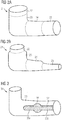
- Figures 1A and 1B show an exemplary sporting goods component, namely an upper 11 for a sports shoe.
- the present invention is applicable to all types of sporting goods, such as for example sports apparel.
- the shoe upper 11 is created by small circular knitting.
- Small circular knitting is a technique which allows to manufacture a single circular knit portion at a time with the correct size and shape. Compared to conventional circular knitting or flat knitting, in which several components (i.e. shoe uppers or parts of it) are produced at once, no additional cutting step is needed.
- the shoe upper 11 is initially a small circular knit sock.
- the upper 11 comprises a shrinking zone 12 that will shrink more than the rest 13 of the sock when heat is applied to the knit.
- the shrinking portion 12 is placed at the bottom portion of the forefoot portion of the sock. That way some portions such as the seam 14 at the front of the sock may be pulled toward below the sock, so that it is hidden when the shoe upper is then joined with a sole (not shown in figures 1A and 1B ).
- the shoe upper 11 After shrinking of the portion 12, the shoe upper 11 will be deformed in the forefoot portion such that the front seam 14 is arranged below the shoe upper 11.
- the joining line that separates the portion of the shoe upper 11 that will be visible on the final product and the portion of the upper 11 that will be joined to the sole unit is indicated by dashed lines 15. After shrinking, the seam 14 is below the joining line such that it cannot be seen on the final product.
- the method may be applied to any knit textile, in particular a flat knit textile, or to any other material.
- One or the other of the textiles may be a knit, mesh, woven, braid, or non-woven
- the area in which the higher shrinkage ratio is designed may be in a different place than in the above example of figures 1A and 1B .
- it may be in a plurality of portions with different sizes and shapes.
- more than two areas may each have a different shrinkage ratio.
- the shrinkage ratio may also change gradually, for example by changing gradually the proportions of shrinking yarn in a knit. This way a small circular knit tube may be pre-formed to a shoe shape as illustrated in figures 2A and 2B .
- a small circular knit tube 21 comprises four different zones 22, 23, 24 and 25, each having a different shrinkage ratio.
- the toe zone 25 has the highest shrinkage ratio
- ankle zone 23 has the lowest shrinkage ratio.
- the number of zones, the arrangement of the zones, as well as the shrinkage ratios may vary.
- shrinking yarns may be used in the context of the present invention.
- a shrinking yarn may for example be based on polyamides, polyesters, polyacrylonitriles or vinyl polymers, olefin polymers, TPU, wool-felted, Lycra®, yarns comprising rubber in their content, and biomimetic yarn such as spider-silk yarn obtained by bio-engineering (e.g. produced by genetically modified bacteria).
- a PES yarn may be used in a portion that is to shrink only slightly (for example between 1% and 5%), and a mix of PES and Lycra yarn may be used in shrinking portions with a higher shrinkage ratio (for example between 5% and 30%, in particular between 10% and 20%).
- One of the advantages of the invention is that a one size basic component may shrunk to different percentages so as to obtain different sizes of the final sporting good. This is particularly advantageous in small circular knitting where the number of needles is fixed, and therefore the diameter of the tube obtained is in principle also fixed. But varying the shrinkage ratio, and/or the size, and/or the shape, and/or the arrangement of the shrinking portion(s), and/or the shrinking conditions (in particular the duration of application), permits to obtain different sizes and shapes.
- a sock obtained by small circular knitting is to be used as a sports shoe upper.
- the size of the sock as it is taken out of the small circular knitting machine corresponds to European shoe size 40.
- the shrinking portion may have a varying width over a dimension of the shoe upper, such that one portion will become smaller than other portions as illustrated in Fig. 3 .
- a tube 31 to be used for a shoe upper comprises a shrinking portion 32 which as a higher shrinkage ratio than other portions 33 of the tube 31.
- the width of the shrinking portion 32 varies over its length.
- the middle section 34 of the shrinking portion 32 is rather large compared to its end portions 35a and 35b.
- the tube 31 will obtain a smaller diameter in the area of the middle section 34 of the shrinking portion 32 compared to the areas of the end portions 35a and 35b of the shrinking portion 32.
- Such middle section 34 may for example correspond to the foot arch portion of a sock or shoe upper.
- a shrinking area, zone or portion according to the invention is understood as an area that shrinks more than another area of the sporting goods component (for example a shoe upper).
- the shrinking area, zone or portion may be knit and comprises a higher proportion of a shrinking yarn. It may be that other areas have less percentage of shrinking yarn, or have no shrinking yarn at all.
- a sporting goods component may comprise two overlapping layers of textiles, wherein a first layer comprises a lower shrinkage ratio than a second layer.
- the two layers may be bonded to each other or only attached at some points (for example at their edges). The behavior of the portion will thus be different whether the two layers are bonded or not.
- the first (less shrinking) layer may be a stretch layer with a high degree of elasticity.
- FIG. 4A An example of overlapping layers with different shrinkage ratios is provided in figures 4A and 4B .
- the upper layer 41 comprises a lower shrinkage ratio than the lower layer 42.
- the lower layer 42 shrinks more than the upper layer 41 and "pulls" both layers into a bent shape.
- the upper layer 41 and the left portion 42a of the lower layer 42 are formed from a textile having a comparatively low shrinkage ratio. Both layers may for example for a spacer knit or the two layers may be attached by loose stitch for example.
- the right portion 42b of the lower layer 42 is formed from a textile having a comparatively high shrinkage ratio. As illustrated in Fig. 5B , after application of the shrinking condition, the portion 42b pulls a part of the upper layer 41 into a bent configuration.
- FIG. 6A A further example is illustrated in figures 6A and 6B .
- the upper layer 41, the left portion 42a and the right portion 42c of the lower layer 42 are formed from a textile having a comparatively low shrinkage ratio.
- the middle portion 42b of the lower layer 42 is formed from a textile having a comparatively high shrinkage ratio.
- the combination of the two layers 41 and 42 produces a texturing effect on the upper layer 41.
- the upper layer 41 may for example be an outer layer of a shoe upper.
- the activation of the shrinking may be provoked by different elements.
- the shrinking may be activated by heat, by water (liquid, vapor or steam), and/or any combination.
- the heat may be provided as electromagnetic waves in many different wavelengths: IR, microwave, radio-frequency, etc. so as to warm up the sporting goods component such as a shoe upper.
- the activation may be applied on the whole sporting goods component (such as a shoe upper) or locally.
- heat or steam may be applied very locally with a nozzle, either manually or automatically (e.g. with a robotic arm).
- the invention is particularly advantageous when the activation is applied to the entire sporting goods component (such as a shoe upper): the process is then more simple and cheaper as it may require less complex machines and less labor. Indeed, the entire shoe upper may be passed in an oven for example.
- the shrinking is beneficially made when the shoe upper is lasted. Nonetheless it may be made when the shoe upper is not lasted. If the shoe upper is lasted, heat may be transferred to the shoe upper via the last to activate the shrinking process.
- the last may comprise a heating, such as heating wires or may allow the passage of a hot medium such as water or oil, or may comprise steam nozzles.
- a portion may have a higher elasticity than another one.
- This may be obtained by using a higher proportion of an elastic yarn (in a knit or a woven for example).
- an elastic yarn may be integrated in the shrinking area, in combination with a shrinking yarn.
- the elastic yarn may be able to pull on the shrinking area when the shrinking yarn is "activated” so as to accelerate the shrinkage and/or obtain shrinkage with a lighter activation (e.g. at a lower temperature) and/or with a lower proportion of shrinking yarn than would be needed without the elastic yarn.
- the shrinking area may also be combined with a second different area made to be auxetic. Auxeticity may be obtained by the geometry and/or material of the second area.
- the shrinking area and the auxetic area may be placed on the shoe upper such that when the shrinking area shrinks it pulls the auxetic material in one direction. As a consequence of this pull along one direction the auxetic area also extends in a second direction.
- the method according to the invention may generally also be used for apparel.
- One other advantage of embedding shrinking areas is that these areas may become stiffer. Therefore, they can form a local reinforcement such as a heel counter or a toe cap. They may also improve abrasion resistance. It is particularly the case with knit textile whereby the shrunk knit portion has smaller and tighter loops. Besides, the shrunk portion may also be more water-repellant as the holes between the loops are smaller. Combined with a water-repellant yarn (e.g. water-repellant coated yarn), the holes may be small enough to stop water intake, even in a knit.
- a water-repellant yarn e.g. water-repellant coated yarn
- the shrinking portions or parts thereof such as for example a shrinking yarn may be removed in a further manufacturing step.
- it may be a shrinking patch or a shrinking yarn attached at intervals to a base layer so as to deform it when shrinking, and the base layer is then locked in place or set in its shape, and the shrinking portion is then removed.
- the shrinking portion may be cut-off for example a shoe upper in a subsequent manufacturing step. More particularly an outer-periphery of the shoe upper that would be made more shrinking than other portions of the shoe upper may be cut-off in a subsequent step.
- a specific shrinking yarn may comprise two different grades of material such that a portion of the yarn will shrink more than another portion of the yarn.
- the yarn 71 comprises a first portion 72 with a comparatively high shrinkage ratio and a second portion 73 with a comparatively low shrinkage ratio. As illustrated in Fig. 7B , after the application of the shrinking condition, the yarn 71 is in a curled configuration.
- the yarn 71 may be obtained by co-extrusion of two different materials - or two different grades of a same material - with different shrinkage ratio under the same predetermined conditions. Such yarn 71 would curl as illustrated in Fig. 7B and thereby exert a pulling force. If such yarn 71 is embedded in a textile such as a knit, it will exert its pulling force on the textile, thereby deforming the textile.
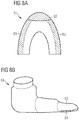
- Figures 8A and 8B illustrate a location where a shrinking portion 82 may be placed in a shoe upper 81, namely in the toe area.
- the toe area comprises a smaller diameter than the rest of the shoe upper which comprises a lower shrinking condition.
- Another possible location for a shrinking area is the outer periphery 83 of a shoe upper.
- a second step may be applied after having obtained the shoe support of Fig. 2B by a first shrinking step, to shrink an area 84 below the toe portion.
- the area 84 may comprise a yarn with a higher activation temperature compared to the area 82.
- the area 82 is activated by heat, whereas the area 84 is activated by water or vice versa.
- a mask may be applied to at least a portion of the sporting good component (such as a shoe upper), such that it does not receive the application of the shrinking condition. Such portion may thus remain un-shrunk or may be shrunk at a later stage.
- a mask may protect at least one portion from heat application.
- FIGs 9A, 9B and 9C show another exemplary embodiment of the present invention, namely a shoe upper 91 for a sports shoe.
- a TPU yarn has been used to create a shrinking zone 92.
- the shrinking zone 92 has been created in the bottom portion of the forefoot (or "toe") area of a knitted, sock-like shoe upper 91 (for example obtained by small circular knitting).
- Fig. 9A shows a bottom view of the knitted sock-like upper 91 before shrinkage.
- Figures 9B and 9C show the shrinking thus obtained.
- a portion 93 of the shoe upper 91 not comprising the shrinking TPU yarn is pulled under a portion of the toes.
- Fig. 9B shows the upper 91 after the application of steam, in a flat configuration.
- the zone 92 knitted with TPU yarn shrank from 12 cm to 10 cm, as indicated with the ruler. It can be seen that the seam lines 94 (between the zones 92 and 93) have been pulled toward the bottom surface of the shoe upper 91, such that if the shoe upper 91 is joined to a bottom unit, the seam lines will not be visible anymore.
- Fig. 9C shows the upper 91 after the application of steam, with the shoe upper 91 having been placed on a last. Here again the seam lines 94 have been pulled towards the bottom surface of the shoe upper 91.
- the yarn proportions in this specific example are as follow: 100% PES in the area 93 and 100% TPU in the area 92.
- material blends are advantageous to maintain a combination of properties in the shrinkage zones, for example to maintain bonding behavior or comfort.
- Fig. 10 shows another exemplary embodiment of the present invention, namely a shoe upper 101 with a shrinking portion 102 in the lower midfoot (or arch) region.
- the shrinking portion 102 helps to form the upper 101 around the concave shape of the midfoot, thus providing support to a foot of a wearer of the final sports shoe and generally improving the shape and fitting to the foot.
- a shrinking yarn is incorporated in a sporting goods component, such that when the sporting good is worn, the shrinking yarn surrounds a portion of a human body.
- This principle is generally illustrated in figures 11A and 11B which show a cylindrical shape 111.
- the cylindrical shape 111 is generally made from a first material 112.
- the middle of the cylinder comprises a shrinking portion or zone which additionally comprises a second material 113 in form of a yarn which shrinks by the application of a certain shrinking condition, e.g. the application of heat above a certain temperature or the application of water.
- the first material 112 does generally not shrink by the application of the shrinking condition or does not shrink as much as the shrinking yarn.
- the middle of the cylindrical shape is constricted due to the yarn 113 which has become shorter as illustrated in Fig. 11B .
- the material 112 used for the sporting goods component may be a textile (such as a knit), leather or artificial leather.
Landscapes
- Engineering & Computer Science (AREA)
- Textile Engineering (AREA)
- Knitting Of Fabric (AREA)
- Footwear And Its Accessory, Manufacturing Method And Apparatuses (AREA)
- Socks And Pantyhose (AREA)
- Professional, Industrial, Or Sporting Protective Garments (AREA)
Abstract
Description
- The present invention relates to a method of manufacturing a sporting goods component.
- Sporting good components often have a three-dimensional shape. For example, a sports shoe comprises a shoe upper and a sole. The shoe upper generally comprises a three-dimensional shape for receiving and covering a human foot. Another example is the shape of sports apparel which follows the human anatomy.
- A three-dimensional shape of a sporting goods component is often obtained by joining together two-dimensional pieces. For example, a shoe upper often comprises different components like vamp, toe cap, heel counter, etc. which are stitched or glued together in a three-dimensional shape. Additionally, the shoe upper is often pulled over a last having the shape of a human foot.
- This conventional method of forming a sporting goods component is time-consuming and costly due to the comparatively large number of manufacturing steps. Furthermore, sporting goods components manufactured in this way, comprise visible seams which are often detrimental to the optical appearance of the sporting good.
- According to
US 4,027,406 a lasting piece of shrinkable, preferably oriented thermoplastic polymeric material is attached, preferably by stitching, to a shoe upper lasting margin and is shrunk by being heated, if it is thermoplastic, to between its glass transition temperature and melting point. Shrinkage of the lasting piece lasts the shoe upper to the last. The lasting piece can be a lasting string, endless band or strip, or a sheet, web, net or welt. - However,
US 4,027,406 does not address the general problem of how to obtain a three-dimensional sporting goods component from two-dimensional pieces. Furthermore,US 4,027,406 is directed to general footwear and does not address the specific needs of the sports industry. - Further prior art is disclosed in
EP 3 330 420 A1WO 2017 / 142 857 A1 ,US 2016 / 0 076 176 A1 ,US 2015 / 0 107 307 A1 ,DE 10 2013 207 153 A1 ,US 2017 / 0 066 212 A1 andDE 10 2012 109 108 A1 . - Therefore, the technical problem underlying the present invention is to provide a method for the manufacture of a sporting goods component, which is time- and cost-efficient, and allows for the manufacture of optically appealing sporting goods.
- This problem is solved by a method for the manufacture of a sporting goods component comprising the steps of: selecting a first textile, wherein the first textile comprises a first shrinkage ratio under a predetermined shrinking condition; forming a first portion of the component using the first textile; Selecting a second textile, wherein the second textile comprises a second shrinkage ratio under the predetermined shrinking condition, wherein the second shrinkage ratio is higher than the first shrinkage ratio; forming a second portion of the component using the second textile; and attaching the first textile and the second textile together.
- According to the invention, a sporting goods component is provided with a first textile and a second textile. Both textiles differ at least by their shrinkage ratio if a predetermined shrinking condition is applied. Examples of shrinking conditions will be given below. If the shrinking condition is applied, the second textile having a higher shrinking condition will shrink more than the first textile. As both textiles are attached to each other, the different shrinkage of both textiles will lead to a deformation of the sporting goods component. If the size, shape, arrangement and shrinkage ratio of both textiles are appropriately chosen, the deformation will result in a desired shape of the sporting goods component.
- Thus, the sporting goods component may be provided with a rather complex three-dimensional shape without the need to join different pieces together.
- The invention also allows to pull less appealing seams in a different location where they may be covered by another piece of the sporting goods component. Examples will be given below. In this way, more appealing sporting goods components can be manufactured.
- "Shrinkage ratio" in the context of the present invention is understood as the ratio of the length of a certain portion of a respective textile before and after application of the shrinking condition. For example, if a certain portion of the first textile or the second textile comprises a length of 2 cm before shrinking and 1 cm after shrinking, the shrinkage ratio is 2. Alternatively, the shrinkage ratio may be expressed as a percent value denoting by how much the portion is shrunk. For example, if the length of the portion is 1 cm before shrinking and 0.7 cm after shrinking, the shrinkage ratio is said to be 30%. A shrinkage ratio of 1 (or 0%) is possible according to the invention, i.e. the textile may not shrink at all.
- The method may further comprise the step of applying the shrinking condition. This causes the second textile to shrink more than the first textile, because its shrinkage ratio is higher. As both textiles are attached to each other, a tension force is created within the sporting goods component resulting in a deformation.
- The application of the shrinking condition may provide the sporting goods component with a three-dimensional shape. In this way, a three-dimensional sporting goods component can be obtained from a flat two-dimensional shape simply by applying the shrinking condition. In other embodiments, a three-dimensional sporting goods component may be modified from a three-dimensional shape to another different three-dimensional shape simply by applying the shrinking condition.
- The shrinking condition may comprise the application of heat and/or water. Water may include water in liquid form, as steam or as vapor. Heat and water are readily available and their application is rather simple.
- The first textile may be a knit and/or the second textile may be a knit. Knitted fabrics are well suitable for sporting goods components such as shoe uppers, but also for sports apparel. Moreover, yarns with different shrinkage ratios can be used by knitting machines to obtain the first and second textiles in a fully automated manner.
- The method may further comprise the step of forming the first portion and the second portion of the component during the same knitting process. Thus, a one-piece seamless knit fabric is obtained, thereby providing a simple cost-efficient manufacturing, and also a good looking finished product. Besides, such knit component may be obtained on a flat-knitting machine and may be provided with a three-dimensional shape when subjected to the application of the shrinking condition.
- The method may further comprise the step of attaching the first portion and the second portion to each other by loops of knitting during the knitting process. As mentioned above, this technique avoids seams between the two portions. Nonetheless and according to the invention other methods of attaching the first and the second portion may be used such as stitching, gluing, melting, etc.
- The method may further comprise the steps of forming the first portion at least partially by a first knitting row and forming the second portion at least partially by a second knitting row. In this way, the two different textiles can be incorporated into the sporting goods component for example by changing the yarn on a knitting machine after the first row has been knitted.
- The first portion of the component may be obtained by using a first selection of yarn or yarns on a first needle and the second portion of the component may be obtained by using a second selection of yarn or yarns on a second needle, wherein the second needle forms loops side by side with loops formed by the first needle, and the second selection of yarn or yarns comprises a higher shrinkage ratio than the first selection of yarn or yarns. Such a setup decreases production time because both textiles can be incorporated into the sporting goods component at the same time.
- The method may further comprise the step of forming the first textile and the second textile by small circular knitting. Small circular knitting is a technique which allows to manufacture a single circular knit portion with a diameter adapted to the final shape of the component. Compared to conventional circular knitting or flat knitting, no additional cutting step is needed. Furthermore, as the result is a three-dimensional circular knit portion, no additional sewing step is needed to form a two-dimensional flat component into a three-dimensional component. In addition, by application of the shrinking condition, the circular knit portion may further be formed into the desired shape.
- The first textile and the second textile may be knitted in a single small circular knitting process to obtain a tube comprising the first portion and the second portion. The shape of the tube may then be locally modified by the method according to the invention.
- The second shrinkage ratio may be higher than the first shrinkage ratio by at least 10%. In particular, the shrinkage ratio may be at least 20%.
- The sporting goods component manufactured according to the method described herein may in particular be a shoe upper for a sports shoe. As mentioned above, shoe uppers are usually made from two-dimensional pieces sewn or glued together. These steps can be omitted when using the method according to the invention.
- A further aspect of the present invention relates to a sporting goods component comprising: a first portion with a first shrinkage ratio under a predetermined condition; and a second portion with a second shrinkage ratio under the predetermined condition. As described above, such a sporting goods component may be have a rather complex three-dimensional shape without the need to join different pieces together. The invention also allows to pull less appealing seams in a different location where they may be covered by another piece of the sporting goods component. Examples will be given below.
- The sporting goods component may comprise a three-dimensional shape caused at least in part by a difference of the first shrinkage ratio and the second shrinkage ratio. In this way, a three-dimensional sporting goods component can be obtained from a flat two-dimensional shape. Also, a three-dimensional sporting goods component can be obtained from a three-dimensional shape, for example a complex three-dimensional sporting goods component may be obtained from a tubular component.
- The Sporting goods component may be a shoe upper. As mentioned above, shoe uppers are usually made from two-dimensional pieces sewn or glued together. These steps can be omitted when manufacturing a shoe upper according to the invention which may therefore be manufactured with less time, effort and costs.
- The shrinking condition may comprise the application of heat and/or water. Heat and water are readily available and their application is rather simple.
- The first portion may comprise a knit textile and/or the second portion may comprise a knit textile. Knitted fabrics are well suitable for sporting goods components such as shoe uppers, but also for sports apparel. Moreover, yarns with different shrinkage ratios can be used by knitting machines to obtain the first and second textiles in a fully automated manner.
- The first knit textile and the second knit textile may be portions of a one-piece knit. Thus, the sporting goods component comprises a one-piece seamless knit fabric which may even be originally flat, but which is provided with a three-dimensional shape subject to the application of the shrinking condition.
- The first portion and the second portion may have been attached to each other by loops of knitting during a knitting process. As mentioned above, this technique avoids seams between the two portions.
- The first portion may be formed at least partially by a first knitting row and the second portion may be formed at least partially by a second knitting row. In this way, the two different textiles can be incorporated into the sporting goods component for example by changing the yarn on a knitting machine after the first row has been knitted.
- The first textile and the second textile may have been formed by small circular knitting. As mentioned above, small circular knitting is a technique which allows to manufacture a single circular knit portion at a time with the correct size and shape. Compared to conventional circular knitting or flat knitting, which produce several components (i.e. shoe uppers or parts of it) at once, no additional cutting step is needed. Furthermore, as the result is a three-dimensional circular knit portion, no additional sewing step is needed to form a two-dimensional flat component into a three-dimensional component. In addition, by using textiles with different shrinking conditions, the circular knit portion may further be formed into the desired shape of the final sporting goods component.
- According to an aspect of the inventive idea of the present invention, a shrinking yarn is incorporated in a sporting goods component, such that when the sporting good is worn, the shrinking yarn surrounds a portion of a human body. For example, the shrinking yarn may be wrapped around a toe portion of a shoe upper, such that it surrounds a human foot when a shoe comprising the shoe upper is worn.
- By the application of a shrinking condition, as described herein, the shrinking yarn may shrink and provide the sporting goods component with a desired shape. In the example above, the shoe upper may be provided with a smaller diameter at the toe portion compared for example to the midfoot portion.
- The sporting goods component may comprise a base material and the shrinking yarn. The shrinking yarn may have a higher shrinkage ratio than the base material when applying the shrinking condition. For example, the base material may be a textile, leather or artificial leather.
- The sporting goods component may be a shoe upper. As described above, the shoe upper may be provided with the desired shape simply by the application of the shrinking condition.
- The sporting goods component may be a sports apparel. For example, the shrinking yarn may be arranged, such that it surrounds a waist of a human body when worn. In this way, the apparel may be provided with a good fit to the human body.
- The presently preferred embodiments of the method according to the invention as well as of a sporting goods component according to the invention are described in the following detailed description, with reference to the following drawings:
- Figs. 1A and 1B
- illustrate an exemplary shoe upper according to the invention;
- Figs. 2A and 2B
- illustrate an exemplary embodiment according to the invention applicable to a shoe upper;
- Figure 3
- illustrate a further exemplary embodiment according to the invention applicable to a shoe upper;
- Figs. 4A and 4B
- illustrate an exemplary embodiment of the present invention using layers with different shrinkage ratios;
- Figs. 5A and 5B
- illustrate a further exemplary embodiment of the present invention using layers with different shrinkage ratios;
- Figs. 6A and 6B
- illustrate a still further exemplary embodiment of the present invention using layers with different shrinkage ratios;
- Figs. 7A and 7B
- illustrate an exemplary embodiment of a yarn according to the present invention;
- Figs. 8A and 8B
- illustrate an exemplary shoe upper according to the invention;
- Figs 9A, 9B and 9C
- show an exemplary shoe upper according to the invention;
- Fig. 10
- shows another exemplary shoe upper according to the invention; and
- Figs. 11A and 11B
- illustrate an exemplary embodiment according to the inventive idea of the present invention.
-
Figures 1A and 1B show an exemplary sporting goods component, namely an upper 11 for a sports shoe. In general, the present invention is applicable to all types of sporting goods, such as for example sports apparel. According to the exemplary embodiment offigures 1A and 1B , the shoe upper 11 is created by small circular knitting. Small circular knitting is a technique which allows to manufacture a single circular knit portion at a time with the correct size and shape. Compared to conventional circular knitting or flat knitting, in which several components (i.e. shoe uppers or parts of it) are produced at once, no additional cutting step is needed. - Thus, the shoe upper 11 is initially a small circular knit sock. The upper 11 comprises a shrinking
zone 12 that will shrink more than therest 13 of the sock when heat is applied to the knit. In particular, in the currently preferred embodiment of the invention, the shrinkingportion 12 is placed at the bottom portion of the forefoot portion of the sock. That way some portions such as theseam 14 at the front of the sock may be pulled toward below the sock, so that it is hidden when the shoe upper is then joined with a sole (not shown infigures 1A and 1B ). - After shrinking of the
portion 12, the shoe upper 11 will be deformed in the forefoot portion such that thefront seam 14 is arranged below the shoe upper 11. The joining line that separates the portion of the shoe upper 11 that will be visible on the final product and the portion of the upper 11 that will be joined to the sole unit is indicated by dashedlines 15. After shrinking, theseam 14 is below the joining line such that it cannot be seen on the final product. - The method may be applied to any knit textile, in particular a flat knit textile, or to any other material. One or the other of the textiles may be a knit, mesh, woven, braid, or non-woven
- The area in which the higher shrinkage ratio is designed may be in a different place than in the above example of
figures 1A and 1B . In particular, it may be in a plurality of portions with different sizes and shapes. Also, more than two areas may each have a different shrinkage ratio. The shrinkage ratio may also change gradually, for example by changing gradually the proportions of shrinking yarn in a knit. This way a small circular knit tube may be pre-formed to a shoe shape as illustrated infigures 2A and 2B . - In this example, a small
circular knit tube 21 comprises fourdifferent zones Fig. 2B , thetoe zone 25 has the highest shrinkage ratio, whereasankle zone 23 has the lowest shrinkage ratio. Of course, the number of zones, the arrangement of the zones, as well as the shrinkage ratios may vary. - Generally, shrinking yarns may be used in the context of the present invention. A shrinking yarn may for example be based on polyamides, polyesters, polyacrylonitriles or vinyl polymers, olefin polymers, TPU, wool-felted, Lycra®, yarns comprising rubber in their content, and biomimetic yarn such as spider-silk yarn obtained by bio-engineering (e.g. produced by genetically modified bacteria).
- In some embodiments, a PES yarn may be used in a portion that is to shrink only slightly (for example between 1% and 5%), and a mix of PES and Lycra yarn may be used in shrinking portions with a higher shrinkage ratio (for example between 5% and 30%, in particular between 10% and 20%).
- One of the advantages of the invention is that a one size basic component may shrunk to different percentages so as to obtain different sizes of the final sporting good. This is particularly advantageous in small circular knitting where the number of needles is fixed, and therefore the diameter of the tube obtained is in principle also fixed. But varying the shrinkage ratio, and/or the size, and/or the shape, and/or the arrangement of the shrinking portion(s), and/or the shrinking conditions (in particular the duration of application), permits to obtain different sizes and shapes.
- In an example, a sock obtained by small circular knitting is to be used as a sports shoe upper. The size of the sock as it is taken out of the small circular knitting machine corresponds to European shoe size 40. By selectively adding a shrinking yarn during the knitting process and applying a shrinking condition, it is possible to shrink the sock, such that it corresponds to smaller shoe sizes, such as 39, 38, 37, etc.
- Generally, the shrinking portion may have a varying width over a dimension of the shoe upper, such that one portion will become smaller than other portions as illustrated in
Fig. 3 . In this example, atube 31 to be used for a shoe upper comprises a shrinkingportion 32 which as a higher shrinkage ratio thanother portions 33 of thetube 31. The width of the shrinkingportion 32 varies over its length. Themiddle section 34 of the shrinkingportion 32 is rather large compared to itsend portions tube 31 will obtain a smaller diameter in the area of themiddle section 34 of the shrinkingportion 32 compared to the areas of theend portions portion 32. Suchmiddle section 34 may for example correspond to the foot arch portion of a sock or shoe upper. - A shrinking area, zone or portion according to the invention is understood as an area that shrinks more than another area of the sporting goods component (for example a shoe upper). For example, the shrinking area, zone or portion may be knit and comprises a higher proportion of a shrinking yarn. It may be that other areas have less percentage of shrinking yarn, or have no shrinking yarn at all.
- In some embodiments, a sporting goods component may comprise two overlapping layers of textiles, wherein a first layer comprises a lower shrinkage ratio than a second layer. The two layers may be bonded to each other or only attached at some points (for example at their edges). The behavior of the portion will thus be different whether the two layers are bonded or not. The first (less shrinking) layer may be a stretch layer with a high degree of elasticity.
- An example of overlapping layers with different shrinkage ratios is provided in
figures 4A and 4B . In this example, theupper layer 41 comprises a lower shrinkage ratio than thelower layer 42. Thus, when the shrinking condition is applied as illustrated inFig. 4B , thelower layer 42 shrinks more than theupper layer 41 and "pulls" both layers into a bent shape. - Another example is provided in
figures 5A and 5B . In this example, theupper layer 41 and theleft portion 42a of thelower layer 42 are formed from a textile having a comparatively low shrinkage ratio. Both layers may for example for a spacer knit or the two layers may be attached by loose stitch for example. Theright portion 42b of thelower layer 42 is formed from a textile having a comparatively high shrinkage ratio. As illustrated inFig. 5B , after application of the shrinking condition, theportion 42b pulls a part of theupper layer 41 into a bent configuration. - A further example is illustrated in
figures 6A and 6B . In this example, theupper layer 41, theleft portion 42a and theright portion 42c of thelower layer 42 are formed from a textile having a comparatively low shrinkage ratio. Themiddle portion 42b of thelower layer 42 is formed from a textile having a comparatively high shrinkage ratio. As illustrated inFig. 6B , after application of the shrinking condition, the combination of the twolayers upper layer 41. Theupper layer 41 may for example be an outer layer of a shoe upper. - Generally, according to the invention, the activation of the shrinking may be provoked by different elements. The shrinking may be activated by heat, by water (liquid, vapor or steam), and/or any combination. The heat may be provided as electromagnetic waves in many different wavelengths: IR, microwave, radio-frequency, etc. so as to warm up the sporting goods component such as a shoe upper.
- The activation may be applied on the whole sporting goods component (such as a shoe upper) or locally. For example, heat or steam may be applied very locally with a nozzle, either manually or automatically (e.g. with a robotic arm). Nonetheless the invention is particularly advantageous when the activation is applied to the entire sporting goods component (such as a shoe upper): the process is then more simple and cheaper as it may require less complex machines and less labor. Indeed, the entire shoe upper may be passed in an oven for example.
- In case of a shoe upper, the shrinking is beneficially made when the shoe upper is lasted. Nonetheless it may be made when the shoe upper is not lasted. If the shoe upper is lasted, heat may be transferred to the shoe upper via the last to activate the shrinking process. To this end, the last may comprise a heating, such as heating wires or may allow the passage of a hot medium such as water or oil, or may comprise steam nozzles.
- According to the invention, other portions with different characteristics may be integrated in a shoe upper for a sports shoe (or sports apparel). For example, a portion may have a higher elasticity than another one. This may be obtained by using a higher proportion of an elastic yarn (in a knit or a woven for example). More particularly, an elastic yarn may be integrated in the shrinking area, in combination with a shrinking yarn. By doing so, the elastic yarn may be able to pull on the shrinking area when the shrinking yarn is "activated" so as to accelerate the shrinkage and/or obtain shrinkage with a lighter activation (e.g. at a lower temperature) and/or with a lower proportion of shrinking yarn than would be needed without the elastic yarn.
- The shrinking area may also be combined with a second different area made to be auxetic. Auxeticity may be obtained by the geometry and/or material of the second area. The shrinking area and the auxetic area may be placed on the shoe upper such that when the shrinking area shrinks it pulls the auxetic material in one direction. As a consequence of this pull along one direction the auxetic area also extends in a second direction.
- The method according to the invention may generally also be used for apparel.
- One other advantage of embedding shrinking areas is that these areas may become stiffer. Therefore, they can form a local reinforcement such as a heel counter or a toe cap. They may also improve abrasion resistance. It is particularly the case with knit textile whereby the shrunk knit portion has smaller and tighter loops. Besides, the shrunk portion may also be more water-repellant as the holes between the loops are smaller. Combined with a water-repellant yarn (e.g. water-repellant coated yarn), the holes may be small enough to stop water intake, even in a knit.
- The shrinking portions or parts thereof, such as for example a shrinking yarn may be removed in a further manufacturing step. For example, it may be a shrinking patch or a shrinking yarn attached at intervals to a base layer so as to deform it when shrinking, and the base layer is then locked in place or set in its shape, and the shrinking portion is then removed. Also, the shrinking portion may be cut-off for example a shoe upper in a subsequent manufacturing step. More particularly an outer-periphery of the shoe upper that would be made more shrinking than other portions of the shoe upper may be cut-off in a subsequent step.
- A specific shrinking yarn may comprise two different grades of material such that a portion of the yarn will shrink more than another portion of the yarn. An illustrative example of such a
yarn 71 in provided infigures 7A and 7B . Theyarn 71 comprises afirst portion 72 with a comparatively high shrinkage ratio and asecond portion 73 with a comparatively low shrinkage ratio. As illustrated inFig. 7B , after the application of the shrinking condition, theyarn 71 is in a curled configuration. - The
yarn 71 may be obtained by co-extrusion of two different materials - or two different grades of a same material - with different shrinkage ratio under the same predetermined conditions.Such yarn 71 would curl as illustrated inFig. 7B and thereby exert a pulling force. Ifsuch yarn 71 is embedded in a textile such as a knit, it will exert its pulling force on the textile, thereby deforming the textile. -
Figures 8A and 8B illustrate a location where a shrinkingportion 82 may be placed in a shoe upper 81, namely in the toe area. As illustrated inFig. 8B , after application of the shrinking condition, the toe area comprises a smaller diameter than the rest of the shoe upper which comprises a lower shrinking condition. Another possible location for a shrinking area is theouter periphery 83 of a shoe upper. - It is also possible to apply a shrinking condition more than once. For example, as illustrated in
Fig. 8B , a second step may be applied after having obtained the shoe support ofFig. 2B by a first shrinking step, to shrink anarea 84 below the toe portion. In an example, thearea 84 may comprise a yarn with a higher activation temperature compared to thearea 82. In another example, thearea 82 is activated by heat, whereas thearea 84 is activated by water or vice versa. - In an optional step of the invention, a mask may be applied to at least a portion of the sporting good component (such as a shoe upper), such that it does not receive the application of the shrinking condition. Such portion may thus remain un-shrunk or may be shrunk at a later stage. For example, a mask may protect at least one portion from heat application.
-
Figures 9A, 9B and 9C show another exemplary embodiment of the present invention, namely a shoe upper 91 for a sports shoe. In this exemplary embodiment, a TPU yarn has been used to create a shrinkingzone 92. The shrinkingzone 92 has been created in the bottom portion of the forefoot (or "toe") area of a knitted, sock-like shoe upper 91 (for example obtained by small circular knitting).Fig. 9A shows a bottom view of the knitted sock-like upper 91 before shrinkage.Figures 9B and 9C show the shrinking thus obtained. As can be seen, aportion 93 of the shoe upper 91 not comprising the shrinking TPU yarn is pulled under a portion of the toes. - More particularly,
Fig. 9B shows the upper 91 after the application of steam, in a flat configuration. Thezone 92 knitted with TPU yarn shrank from 12 cm to 10 cm, as indicated with the ruler. It can be seen that the seam lines 94 (between thezones 92 and 93) have been pulled toward the bottom surface of the shoe upper 91, such that if the shoe upper 91 is joined to a bottom unit, the seam lines will not be visible anymore. -
Fig. 9C shows the upper 91 after the application of steam, with the shoe upper 91 having been placed on a last. Here again theseam lines 94 have been pulled towards the bottom surface of the shoe upper 91. - The yarn proportions in this specific example are as follow: 100% PES in the
area 93 and 100% TPU in thearea 92. However, similar behavior would be seen with material blends and especially using some materials which could be engineered with higher shrinkage levels. Additionally, material blends are advantageous to maintain a combination of properties in the shrinkage zones, for example to maintain bonding behavior or comfort. -
Fig. 10 shows another exemplary embodiment of the present invention, namely a shoe upper 101 with a shrinkingportion 102 in the lower midfoot (or arch) region. In this example, the shrinkingportion 102 helps to form the upper 101 around the concave shape of the midfoot, thus providing support to a foot of a wearer of the final sports shoe and generally improving the shape and fitting to the foot. - According to an aspect of the inventive idea of the present invention, a shrinking yarn is incorporated in a sporting goods component, such that when the sporting good is worn, the shrinking yarn surrounds a portion of a human body. This principle is generally illustrated in
figures 11A and 11B which show acylindrical shape 111. Thecylindrical shape 111 is generally made from afirst material 112. The middle of the cylinder comprises a shrinking portion or zone which additionally comprises asecond material 113 in form of a yarn which shrinks by the application of a certain shrinking condition, e.g. the application of heat above a certain temperature or the application of water. Thefirst material 112 does generally not shrink by the application of the shrinking condition or does not shrink as much as the shrinking yarn. After the application of the shrinking condition, the middle of the cylindrical shape is constricted due to theyarn 113 which has become shorter as illustrated inFig. 11B . - Generally, for this aspect of the idea of the present invention, one of the shrinking yarns described above may be used. The
material 112 used for the sporting goods component may be a textile (such as a knit), leather or artificial leather. - In the following, further embodiments are described to facilitate the understanding of the invention:
- 1. Method for the manufacture of a sporting goods component (11, 21, 31, 81, 91, 101, 111) comprising the steps of:
- Selecting a first textile, wherein the first textile comprises a first shrinkage ratio under a predetermined shrinking condition;
- Forming a first portion of the component (11, 21, 31, 81, 91, 101, 111) using the first textile;
- Selecting a second textile, wherein the second textile comprises a second shrinkage ratio under the predetermined shrinking condition, wherein the second shrinkage ratio is higher than the first shrinkage ratio;
- Forming a second portion of the component (11, 21, 31, 81, 91, 101, 111) using the second textile; and
- Attaching the first textile and the second textile together.
- 2. Method according to the preceding embodiment, further comprising the step of applying the shrinking condition.
- 3. Method according to the preceding embodiment, wherein the application of the shrinking condition provides the sporting goods component (11, 21, 31, 81, 91, 101, 111) with a three-dimensional shape.
- 4. Method according to one of the preceding embodiments, wherein the shrinking condition comprises the application of heat and/or water.
- 5. Method according to one of the preceding embodiments, wherein the first textile is a knit and/or wherein the second textile is a knit.
- 6. Method according to the preceding embodiment, further comprising the step of forming the first portion and the second portion of the component (11, 21, 31, 81, 91, 101, 111) during the same knitting process.
- 7. Method according to the preceding embodiment, further comprising the step of attaching the first portion and the second portion to each other by loops of knitting during the knitting process.
- 8. Method according to one of the preceding embodiments, further comprising the steps of forming the first portion at least partially by a first knitting row and forming the second portion at least partially by a second knitting row.
- 9. Method according to the preceding embodiment, wherein the first portion of the component (11, 21, 31, 81, 91, 101, 111) is obtained by using a first selection of yarn or yarns on a first needle and, wherein the second portion of the component (11, 21, 31, 81, 91, 101, 111) is obtained by using a second selection of yarn or yarns on a second needle, wherein the second needle forms loops side by side with loops formed by the first needle, and the second selection of yarn or yarns has a higher shrinkage ratio than the first selection of yarn or yarns.
- 10. Method according to one of the preceding embodiments, further comprising the step of forming the first textile and the second textile by small circular knitting.
- 11. Method according to the preceding embodiment, wherein the first textile and the second textile are knitted in a single small circular knitting process to obtain a tube comprising the first textile and the second textile.
- 12. Method according to one of the preceding embodiments, wherein the second shrinkage ratio is higher than the first shrinkage ratio by at least 10%.
- 13. Sporting goods component (11, 21, 31, 81, 91, 101, 111) comprising:
- a first portion with a first shrinkage ratio under a predetermined shrinking condition; and
- a second portion with a second shrinkage ratio under the predetermined shrinking condition.
- 14. Sporting goods component (11, 21, 31, 81, 91, 101, 111) according to the preceding embodiment, wherein the sporting goods component (11, 21, 31, 81, 91, 101, 111) comprises a three-dimensional shape caused at least in part by a difference of the first shrinkage ratio and the second shrinkage ratio.
- 15. Sporting goods component (11, 21, 31, 81, 91, 101, 111) according to the preceding embodiment, wherein the component (11, 21, 31, 81, 91, 101, 111) is a shoe upper.
- 16. Sporting goods component (11, 21, 31, 81, 91, 101, 111) according to one of
embodiments - 17. Sporting goods component (11, 21, 31, 81, 91, 101, 111) according to one of
embodiments 14 to 16, wherein the first portion comprises a knit textile and/or wherein the second portion comprises a knit textile. - 18. Sporting goods component (11, 21, 31, 81, 91, 101, 111) according to the preceding embodiment, wherein the first knit textile and the second knit textile are portions of a one-piece knit.
- 19. Sporting goods component (11, 21, 31, 81, 91, 101, 111) according to one of embodiments 17 or 18, wherein the first portion and the second portion are attached to each other by loops of knitting.
- 20. Sporting goods component (11, 21, 31, 81, 91, 101, 111) according to one of embodiments 17 to 19, wherein the first portion is formed at least partially by a first knitting row and the second portion is formed at least partially by a second knitting row.
- 21. Sporting goods component (11, 21, 31, 81, 91, 101, 111) according to one of
embodiments 14 to 20, wherein the first textile and the second textile have been formed by small circular knitting.
Claims (15)
- Method for the manufacture of a sporting goods component (11, 21, 31, 81, 91, 101, 111) comprising the steps of:- Selecting a first textile, wherein the first textile comprises a first shrinkage ratio under a predetermined shrinking condition;- Forming a first portion of the component (11, 21, 31, 81, 91, 101, 111) using the first textile;- Selecting a second textile, wherein the second textile comprises a second shrinkage ratio under the predetermined shrinking condition, wherein the second shrinkage ratio is higher than the first shrinkage ratio;- Forming a second portion of the component (11, 21, 31, 81, 91, 101, 111) using the second textile;- Attaching the first textile and the second textile together; and- Applying the shrinking condition, wherein the application of the shrinking condition provides the sporting goods component (11, 21, 31, 81, 91, 101, 111) with a three-dimensional shape either from a flat two-dimensional shape or from a three-dimensional shape to another three-dimensional shape.
- Method according to claim 1, wherein the shrinking condition comprises the application of heat and/or water.
- Method according to one of claims 1 or 2, wherein the first textile is a knit and/or wherein the second textile is a knit.
- Method according to one of claims 1-3, further comprising the steps of forming the first portion at least partially by a first knitting row and forming the second portion at least partially by a second knitting row.
- Method according to claim 4, wherein the first portion of the component (11, 21, 31, 81, 91, 101, 111) is obtained by using a first selection of yarn or yarns on a first needle and, wherein the second portion of the component (11, 21, 31, 81, 91, 101, 111) is obtained by using a second selection of yarn or yarns on a second needle, wherein the second needle forms loops side by side with loops formed by the first needle, and the second selection of yarn or yarns has a higher shrinkage ratio than the first selection of yarn or yarns.
- Method according to one of claims 1-5, further comprising the step of forming the first textile and the second textile by small circular knitting.
- Method according to claim 6, wherein the first textile and the second textile are knitted in a single small circular knitting process to obtain a tube comprising the first textile and the second textile.
- Method according to one of claims 1-7, wherein the second shrinkage ratio is higher than the first shrinkage ratio by at least 10%.
- Sporting goods component (11, 21, 31, 81, 91, 101, 111) comprising:- a first portion with a first shrinkage ratio under a predetermined shrinking condition; and- a second portion with a second shrinkage ratio under the predetermined shrinking condition,wherein the sporting goods component (11, 21, 31, 81, 91, 101, 111) comprises a three-dimensional shape caused at least in part by a difference of the first shrinkage ratio and the second shrinkage ratio.
- Sporting goods component (11, 21, 31, 81, 91, 101, 111) according to claim 9, wherein the shrinking condition comprises the application of heat and/or water.
- Sporting goods component (11, 21, 31, 81, 91, 101, 111) according to one of claims 9 to 10, wherein the first portion comprises a knit textile and/or wherein the second portion comprises a knit textile.
- Sporting goods component (11, 21, 31, 81, 91, 101, 111) according to claim 11, wherein the first knit textile and the second knit textile are portions of a one-piece knit.
- Sporting goods component (11, 21, 31, 81, 91, 101, 111) according to one of claims 11 or 12, wherein the first portion and the second portion are attached to each other by loops of knitting.
- Sporting goods component (11, 21, 31, 81, 91, 101, 111) according to one of claims 11 to 13, wherein the first portion is formed at least partially by a first knitting row and the second portion is formed at least partially by a second knitting row.
- Sporting goods component (11, 21, 31, 81, 91, 101, 111) according to one of claims 11 to 14, wherein the first portion and the second portion have been formed by small circular knitting.
Applications Claiming Priority (1)
| Application Number | Priority Date | Filing Date | Title |
|---|---|---|---|
| DE102017223743.0A DE102017223743B4 (en) | 2017-12-22 | 2017-12-22 | Method for producing a sporting goods component |
Publications (2)
| Publication Number | Publication Date |
|---|---|
| EP3508629A1 true EP3508629A1 (en) | 2019-07-10 |
| EP3508629B1 EP3508629B1 (en) | 2024-09-18 |
Family
ID=64949066
Family Applications (1)
| Application Number | Title | Priority Date | Filing Date |
|---|---|---|---|
| EP18215284.3A Active EP3508629B1 (en) | 2017-12-22 | 2018-12-21 | Method of manufacturing a shoe upper sporting goods component |
Country Status (4)
| Country | Link |
|---|---|
| US (2) | US11035060B2 (en) |
| EP (1) | EP3508629B1 (en) |
| CN (1) | CN109953426B (en) |
| DE (1) | DE102017223743B4 (en) |
Cited By (1)
| Publication number | Priority date | Publication date | Assignee | Title |
|---|---|---|---|---|
| US12161194B2 (en) | 2020-02-25 | 2024-12-10 | Decathlon | Textile footwear item and method of manufacture |
Families Citing this family (6)
| Publication number | Priority date | Publication date | Assignee | Title |
|---|---|---|---|---|
| DE102017223743B4 (en) | 2017-12-22 | 2025-07-10 | Adidas Ag | Method for producing a sporting goods component |
| FR3082103B1 (en) | 2018-06-08 | 2020-08-28 | Decathlon Sa | METHOD OF MANUFACTURING A SHOE, AND SHOE LIKELY TO BE OBTAINED BY LEDIT PROCEDE |
| EP4520858A3 (en) | 2018-07-23 | 2025-05-28 | NIKE Innovate C.V. | Knitted article with raised structure and methods of manufacture |
| DE102019208734B4 (en) | 2019-06-14 | 2026-05-07 | Adidas Ag | Method for producing an abrasion-resistant material |
| WO2020262608A1 (en) * | 2019-06-28 | 2020-12-30 | Spiber株式会社 | Fabric, 3d shaped fabric, and production method therefor |
| DE102020208218B4 (en) | 2020-07-01 | 2022-02-10 | Adidas Ag | Auxetic article |
Citations (7)
| Publication number | Priority date | Publication date | Assignee | Title |
|---|---|---|---|---|
| US2440393A (en) * | 1944-08-18 | 1948-04-27 | Frank W Clark | Process of making last-fitting fabric uppers |
| WO2011090845A1 (en) * | 2010-01-19 | 2011-07-28 | Mmi-Ipco, Llc | Composite textile fabrics |
| US20120263928A1 (en) | 2011-04-06 | 2012-10-18 | Groz-Beckert Kg | Three-Dimensional Shaped Textile Element and Method for the Manufacture of Said Element |
| EP2805638A1 (en) * | 2012-01-20 | 2014-11-26 | Shima Seiki Mfg., Ltd | Footwear, and knitting method for knit fabric |
| WO2015011148A1 (en) * | 2013-07-22 | 2015-01-29 | Visiotex GmbH | Elastic shoe |
| WO2017142857A1 (en) | 2016-02-16 | 2017-08-24 | Nike Innovate C.V. | Weatherized upper for an article of footwear |
| DE102017223743A1 (en) | 2017-12-22 | 2019-06-27 | Adidas Ag | Method for producing a sports article component |
Family Cites Families (12)
| Publication number | Priority date | Publication date | Assignee | Title |
|---|---|---|---|---|
| US2641004A (en) * | 1950-12-26 | 1953-06-09 | David V Whiting | Method for producing knitted shoe uppers of shrinkable yarn |
| US4027406A (en) * | 1976-05-13 | 1977-06-07 | Michael Salvatore | Method of lasting shoe uppers to a last and lasted shoe uppers and articles of footwear produced thereby |
| ITMI20052111A1 (en) * | 2005-11-07 | 2007-05-08 | Santoni & C Spa | PROCEDURE FOR THE MANUFACTURE OF KNITTED MANUFACTURERS WITH AT LEAST ONE OF THEIR SHAPED PORTIONS AT THE HEAD WITH CIRCULAR KNITTING MACHINES AND MESH MANUFACTURING OBTAINED BY PROCEDURE |
| TW200801271A (en) * | 2006-06-26 | 2008-01-01 | Taiwan Textile Federation | A thermal plastic fabric |
| TW201412258A (en) * | 2012-09-25 | 2014-04-01 | Long John Tsung Right Ind Co Ltd | Weaving method of three dimensional vamp |
| DE102012109108B4 (en) * | 2012-09-26 | 2017-10-26 | Long John Tsung Right Industrial Co., Ltd. | Method for working a three-dimensional shoe sheet |
| DE102013207153B4 (en) * | 2013-04-19 | 2019-11-07 | Adidas Ag | Shoe adapted to the foot shape |
| DE102013207156B4 (en) * | 2013-04-19 | 2025-12-24 | Adidas Ag | shoe, especially a sports shoe |
| CA2904754C (en) * | 2014-09-17 | 2023-01-24 | Myant Capitals Partners Inc. | Seamless silhouette with engineered insulation property |
| DE102014220087B4 (en) * | 2014-10-02 | 2016-05-12 | Adidas Ag | Flat knitted shoe top for sports shoes |
| JP6404477B2 (en) * | 2015-07-30 | 2018-10-10 | 株式会社島精機製作所 | Knitted fabric and joining method of knitted fabric |
| US20170066212A1 (en) * | 2015-09-08 | 2017-03-09 | Avery Dennison Retail Information Services, Llc | Shrink shoe or sock device |
-
2017
- 2017-12-22 DE DE102017223743.0A patent/DE102017223743B4/en active Active
-
2018
- 2018-12-21 EP EP18215284.3A patent/EP3508629B1/en active Active
- 2018-12-21 US US16/230,712 patent/US11035060B2/en active Active
- 2018-12-24 CN CN201811581399.1A patent/CN109953426B/en active Active
-
2021
- 2021-05-04 US US17/307,532 patent/US11866860B2/en active Active
Patent Citations (7)
| Publication number | Priority date | Publication date | Assignee | Title |
|---|---|---|---|---|
| US2440393A (en) * | 1944-08-18 | 1948-04-27 | Frank W Clark | Process of making last-fitting fabric uppers |
| WO2011090845A1 (en) * | 2010-01-19 | 2011-07-28 | Mmi-Ipco, Llc | Composite textile fabrics |
| US20120263928A1 (en) | 2011-04-06 | 2012-10-18 | Groz-Beckert Kg | Three-Dimensional Shaped Textile Element and Method for the Manufacture of Said Element |
| EP2805638A1 (en) * | 2012-01-20 | 2014-11-26 | Shima Seiki Mfg., Ltd | Footwear, and knitting method for knit fabric |
| WO2015011148A1 (en) * | 2013-07-22 | 2015-01-29 | Visiotex GmbH | Elastic shoe |
| WO2017142857A1 (en) | 2016-02-16 | 2017-08-24 | Nike Innovate C.V. | Weatherized upper for an article of footwear |
| DE102017223743A1 (en) | 2017-12-22 | 2019-06-27 | Adidas Ag | Method for producing a sports article component |
Cited By (1)
| Publication number | Priority date | Publication date | Assignee | Title |
|---|---|---|---|---|
| US12161194B2 (en) | 2020-02-25 | 2024-12-10 | Decathlon | Textile footwear item and method of manufacture |
Also Published As
| Publication number | Publication date |
|---|---|
| CN109953426B (en) | 2022-04-26 |
| DE102017223743B4 (en) | 2025-07-10 |
| DE102017223743A1 (en) | 2019-06-27 |
| US20210254246A1 (en) | 2021-08-19 |
| US20190191820A1 (en) | 2019-06-27 |
| US11035060B2 (en) | 2021-06-15 |
| EP3508629B1 (en) | 2024-09-18 |
| US11866860B2 (en) | 2024-01-09 |
| CN109953426A (en) | 2019-07-02 |
Similar Documents
| Publication | Publication Date | Title |
|---|---|---|
| US11866860B2 (en) | Method of manufacturing a sporting goods component | |
| JP7325486B2 (en) | Knitted components for products incorporating lenticular knit structures and methods of making same | |
| TWI594708B (en) | Method for weaving a knitted component for a footwear article and footwear article | |
| EP3148360B1 (en) | Method of making a knitted seamless bootie with tucked-in portion | |
| TWI606795B (en) | Method of making an article of footwear including knitting a knitted component of warp knit construction forming a seamless bootie with wrap-around portion | |
| TWI601487B (en) | An article of footwear including a monofilament knit element with peripheral knit portions and manufacturing thereof | |
| US9907349B2 (en) | Article of footwear including knitting a knitted component of warp knit construction forming a seamless bootie | |
| CN110771992A (en) | 3D shoes | |
| CN115211632A (en) | Method for manufacturing shoe upper | |
| TW201434407A (en) | Footwear upper incorporating a knitted component with collar and throat portions | |
| TW201633943A (en) | Method of forming a seamless braided abutment |
Legal Events
| Date | Code | Title | Description |
|---|---|---|---|
| PUAI | Public reference made under article 153(3) epc to a published international application that has entered the european phase |
Free format text: ORIGINAL CODE: 0009012 |
|
| STAA | Information on the status of an ep patent application or granted ep patent |
Free format text: STATUS: REQUEST FOR EXAMINATION WAS MADE |
|
| 17P | Request for examination filed |
Effective date: 20181221 |
|
| AK | Designated contracting states |
Kind code of ref document: A1 Designated state(s): AL AT BE BG CH CY CZ DE DK EE ES FI FR GB GR HR HU IE IS IT LI LT LU LV MC MK MT NL NO PL PT RO RS SE SI SK SM TR |
|
| AX | Request for extension of the european patent |
Extension state: BA ME |
|
| STAA | Information on the status of an ep patent application or granted ep patent |
Free format text: STATUS: EXAMINATION IS IN PROGRESS |
|
| 17Q | First examination report despatched |
Effective date: 20210813 |
|
| P01 | Opt-out of the competence of the unified patent court (upc) registered |
Effective date: 20230523 |
|
| GRAP | Despatch of communication of intention to grant a patent |
Free format text: ORIGINAL CODE: EPIDOSNIGR1 |
|
| STAA | Information on the status of an ep patent application or granted ep patent |
Free format text: STATUS: GRANT OF PATENT IS INTENDED |
|
| INTG | Intention to grant announced |
Effective date: 20240503 |
|
| TPAC | Observations filed by third parties |
Free format text: ORIGINAL CODE: EPIDOSNTIPA |
|
| GRAS | Grant fee paid |
Free format text: ORIGINAL CODE: EPIDOSNIGR3 |
|
| GRAA | (expected) grant |
Free format text: ORIGINAL CODE: 0009210 |
|
| STAA | Information on the status of an ep patent application or granted ep patent |
Free format text: STATUS: THE PATENT HAS BEEN GRANTED |
|
| AK | Designated contracting states |
Kind code of ref document: B1 Designated state(s): AL AT BE BG CH CY CZ DE DK EE ES FI FR GB GR HR HU IE IS IT LI LT LU LV MC MK MT NL NO PL PT RO RS SE SI SK SM TR |
|
| REG | Reference to a national code |
Ref country code: GB Ref legal event code: FG4D |
|
| REG | Reference to a national code |
Ref country code: CH Ref legal event code: EP |
|
| REG | Reference to a national code |
Ref country code: IE Ref legal event code: FG4D |
|
| REG | Reference to a national code |
Ref country code: DE Ref legal event code: R096 Ref document number: 602018074454 Country of ref document: DE |
|
| REG | Reference to a national code |
Ref country code: LT Ref legal event code: MG9D |
|
| PG25 | Lapsed in a contracting state [announced via postgrant information from national office to epo] |
Ref country code: NO Free format text: LAPSE BECAUSE OF FAILURE TO SUBMIT A TRANSLATION OF THE DESCRIPTION OR TO PAY THE FEE WITHIN THE PRESCRIBED TIME-LIMIT Effective date: 20241218 |
|
| PG25 | Lapsed in a contracting state [announced via postgrant information from national office to epo] |
Ref country code: GR Free format text: LAPSE BECAUSE OF FAILURE TO SUBMIT A TRANSLATION OF THE DESCRIPTION OR TO PAY THE FEE WITHIN THE PRESCRIBED TIME-LIMIT Effective date: 20241219 Ref country code: FI Free format text: LAPSE BECAUSE OF FAILURE TO SUBMIT A TRANSLATION OF THE DESCRIPTION OR TO PAY THE FEE WITHIN THE PRESCRIBED TIME-LIMIT Effective date: 20240918 |
|
| PG25 | Lapsed in a contracting state [announced via postgrant information from national office to epo] |
Ref country code: BG Free format text: LAPSE BECAUSE OF FAILURE TO SUBMIT A TRANSLATION OF THE DESCRIPTION OR TO PAY THE FEE WITHIN THE PRESCRIBED TIME-LIMIT Effective date: 20240918 |
|
| PG25 | Lapsed in a contracting state [announced via postgrant information from national office to epo] |
Ref country code: LV Free format text: LAPSE BECAUSE OF FAILURE TO SUBMIT A TRANSLATION OF THE DESCRIPTION OR TO PAY THE FEE WITHIN THE PRESCRIBED TIME-LIMIT Effective date: 20240918 |
|
| PG25 | Lapsed in a contracting state [announced via postgrant information from national office to epo] |
Ref country code: HR Free format text: LAPSE BECAUSE OF FAILURE TO SUBMIT A TRANSLATION OF THE DESCRIPTION OR TO PAY THE FEE WITHIN THE PRESCRIBED TIME-LIMIT Effective date: 20240918 |
|
| REG | Reference to a national code |
Ref country code: NL Ref legal event code: MP Effective date: 20240918 |
|
| PG25 | Lapsed in a contracting state [announced via postgrant information from national office to epo] |
Ref country code: RS Free format text: LAPSE BECAUSE OF FAILURE TO SUBMIT A TRANSLATION OF THE DESCRIPTION OR TO PAY THE FEE WITHIN THE PRESCRIBED TIME-LIMIT Effective date: 20241218 |
|
| PG25 | Lapsed in a contracting state [announced via postgrant information from national office to epo] |
Ref country code: RS Free format text: LAPSE BECAUSE OF FAILURE TO SUBMIT A TRANSLATION OF THE DESCRIPTION OR TO PAY THE FEE WITHIN THE PRESCRIBED TIME-LIMIT Effective date: 20241218 Ref country code: NO Free format text: LAPSE BECAUSE OF FAILURE TO SUBMIT A TRANSLATION OF THE DESCRIPTION OR TO PAY THE FEE WITHIN THE PRESCRIBED TIME-LIMIT Effective date: 20241218 Ref country code: LV Free format text: LAPSE BECAUSE OF FAILURE TO SUBMIT A TRANSLATION OF THE DESCRIPTION OR TO PAY THE FEE WITHIN THE PRESCRIBED TIME-LIMIT Effective date: 20240918 Ref country code: HR Free format text: LAPSE BECAUSE OF FAILURE TO SUBMIT A TRANSLATION OF THE DESCRIPTION OR TO PAY THE FEE WITHIN THE PRESCRIBED TIME-LIMIT Effective date: 20240918 Ref country code: GR Free format text: LAPSE BECAUSE OF FAILURE TO SUBMIT A TRANSLATION OF THE DESCRIPTION OR TO PAY THE FEE WITHIN THE PRESCRIBED TIME-LIMIT Effective date: 20241219 Ref country code: FI Free format text: LAPSE BECAUSE OF FAILURE TO SUBMIT A TRANSLATION OF THE DESCRIPTION OR TO PAY THE FEE WITHIN THE PRESCRIBED TIME-LIMIT Effective date: 20240918 Ref country code: BG Free format text: LAPSE BECAUSE OF FAILURE TO SUBMIT A TRANSLATION OF THE DESCRIPTION OR TO PAY THE FEE WITHIN THE PRESCRIBED TIME-LIMIT Effective date: 20240918 |
|
| REG | Reference to a national code |
Ref country code: AT Ref legal event code: MK05 Ref document number: 1724769 Country of ref document: AT Kind code of ref document: T Effective date: 20240918 |
|
| PG25 | Lapsed in a contracting state [announced via postgrant information from national office to epo] |
Ref country code: NL Free format text: LAPSE BECAUSE OF FAILURE TO SUBMIT A TRANSLATION OF THE DESCRIPTION OR TO PAY THE FEE WITHIN THE PRESCRIBED TIME-LIMIT Effective date: 20240918 |
|
| PG25 | Lapsed in a contracting state [announced via postgrant information from national office to epo] |
Ref country code: PT Free format text: LAPSE BECAUSE OF FAILURE TO SUBMIT A TRANSLATION OF THE DESCRIPTION OR TO PAY THE FEE WITHIN THE PRESCRIBED TIME-LIMIT Effective date: 20250120 Ref country code: IS Free format text: LAPSE BECAUSE OF FAILURE TO SUBMIT A TRANSLATION OF THE DESCRIPTION OR TO PAY THE FEE WITHIN THE PRESCRIBED TIME-LIMIT Effective date: 20250118 |
|
| PG25 | Lapsed in a contracting state [announced via postgrant information from national office to epo] |
Ref country code: SM Free format text: LAPSE BECAUSE OF FAILURE TO SUBMIT A TRANSLATION OF THE DESCRIPTION OR TO PAY THE FEE WITHIN THE PRESCRIBED TIME-LIMIT Effective date: 20240918 Ref country code: RO Free format text: LAPSE BECAUSE OF FAILURE TO SUBMIT A TRANSLATION OF THE DESCRIPTION OR TO PAY THE FEE WITHIN THE PRESCRIBED TIME-LIMIT Effective date: 20240918 |
|
| PG25 | Lapsed in a contracting state [announced via postgrant information from national office to epo] |
Ref country code: ES Free format text: LAPSE BECAUSE OF FAILURE TO SUBMIT A TRANSLATION OF THE DESCRIPTION OR TO PAY THE FEE WITHIN THE PRESCRIBED TIME-LIMIT Effective date: 20240918 |
|
| PG25 | Lapsed in a contracting state [announced via postgrant information from national office to epo] |
Ref country code: EE Free format text: LAPSE BECAUSE OF FAILURE TO SUBMIT A TRANSLATION OF THE DESCRIPTION OR TO PAY THE FEE WITHIN THE PRESCRIBED TIME-LIMIT Effective date: 20240918 Ref country code: AT Free format text: LAPSE BECAUSE OF FAILURE TO SUBMIT A TRANSLATION OF THE DESCRIPTION OR TO PAY THE FEE WITHIN THE PRESCRIBED TIME-LIMIT Effective date: 20240918 |
|
| PG25 | Lapsed in a contracting state [announced via postgrant information from national office to epo] |
Ref country code: PL Free format text: LAPSE BECAUSE OF FAILURE TO SUBMIT A TRANSLATION OF THE DESCRIPTION OR TO PAY THE FEE WITHIN THE PRESCRIBED TIME-LIMIT Effective date: 20240918 Ref country code: CZ Free format text: LAPSE BECAUSE OF FAILURE TO SUBMIT A TRANSLATION OF THE DESCRIPTION OR TO PAY THE FEE WITHIN THE PRESCRIBED TIME-LIMIT Effective date: 20240918 |
|
| PG25 | Lapsed in a contracting state [announced via postgrant information from national office to epo] |
Ref country code: IT Free format text: LAPSE BECAUSE OF FAILURE TO SUBMIT A TRANSLATION OF THE DESCRIPTION OR TO PAY THE FEE WITHIN THE PRESCRIBED TIME-LIMIT Effective date: 20240918 Ref country code: SK Free format text: LAPSE BECAUSE OF FAILURE TO SUBMIT A TRANSLATION OF THE DESCRIPTION OR TO PAY THE FEE WITHIN THE PRESCRIBED TIME-LIMIT Effective date: 20240918 |
|
| REG | Reference to a national code |
Ref country code: DE Ref legal event code: R097 Ref document number: 602018074454 Country of ref document: DE |
|
| PG25 | Lapsed in a contracting state [announced via postgrant information from national office to epo] |
Ref country code: MC Free format text: LAPSE BECAUSE OF FAILURE TO SUBMIT A TRANSLATION OF THE DESCRIPTION OR TO PAY THE FEE WITHIN THE PRESCRIBED TIME-LIMIT Effective date: 20240918 |
|
| PG25 | Lapsed in a contracting state [announced via postgrant information from national office to epo] |
Ref country code: DK Free format text: LAPSE BECAUSE OF FAILURE TO SUBMIT A TRANSLATION OF THE DESCRIPTION OR TO PAY THE FEE WITHIN THE PRESCRIBED TIME-LIMIT Effective date: 20240918 |
|
| PLBE | No opposition filed within time limit |
Free format text: ORIGINAL CODE: 0009261 |
|
| STAA | Information on the status of an ep patent application or granted ep patent |
Free format text: STATUS: NO OPPOSITION FILED WITHIN TIME LIMIT |
|
| REG | Reference to a national code |
Ref country code: CH Ref legal event code: PL |
|
| PG25 | Lapsed in a contracting state [announced via postgrant information from national office to epo] |
Ref country code: LU Free format text: LAPSE BECAUSE OF NON-PAYMENT OF DUE FEES Effective date: 20241221 |
|
| 26N | No opposition filed |
Effective date: 20250619 |
|
| PG25 | Lapsed in a contracting state [announced via postgrant information from national office to epo] |
Ref country code: SE Free format text: LAPSE BECAUSE OF FAILURE TO SUBMIT A TRANSLATION OF THE DESCRIPTION OR TO PAY THE FEE WITHIN THE PRESCRIBED TIME-LIMIT Effective date: 20240918 |
|
| REG | Reference to a national code |
Ref country code: BE Ref legal event code: MM Effective date: 20241231 |
|
| PG25 | Lapsed in a contracting state [announced via postgrant information from national office to epo] |
Ref country code: BE Free format text: LAPSE BECAUSE OF NON-PAYMENT OF DUE FEES Effective date: 20241231 |
|
| PG25 | Lapsed in a contracting state [announced via postgrant information from national office to epo] |
Ref country code: CH Free format text: LAPSE BECAUSE OF NON-PAYMENT OF DUE FEES Effective date: 20241231 |
|
| PG25 | Lapsed in a contracting state [announced via postgrant information from national office to epo] |
Ref country code: IE Free format text: LAPSE BECAUSE OF NON-PAYMENT OF DUE FEES Effective date: 20241221 |
|
| PGFP | Annual fee paid to national office [announced via postgrant information from national office to epo] |
Ref country code: DE Payment date: 20251126 Year of fee payment: 8 |
|
| PGFP | Annual fee paid to national office [announced via postgrant information from national office to epo] |
Ref country code: GB Payment date: 20251120 Year of fee payment: 8 |
|
| PGFP | Annual fee paid to national office [announced via postgrant information from national office to epo] |
Ref country code: FR Payment date: 20251119 Year of fee payment: 8 |