EP3508473A1 - Method for producing carbamic acid ester - Google Patents
Method for producing carbamic acid ester Download PDFInfo
- Publication number
- EP3508473A1 EP3508473A1 EP17846662.9A EP17846662A EP3508473A1 EP 3508473 A1 EP3508473 A1 EP 3508473A1 EP 17846662 A EP17846662 A EP 17846662A EP 3508473 A1 EP3508473 A1 EP 3508473A1
- Authority
- EP
- European Patent Office
- Prior art keywords
- carbamic acid
- acid ester
- production
- isomers
- compound
- Prior art date
- Legal status (The legal status is an assumption and is not a legal conclusion. Google has not performed a legal analysis and makes no representation as to the accuracy of the status listed.)
- Granted
Links
Classifications
-
- C—CHEMISTRY; METALLURGY
- C07—ORGANIC CHEMISTRY
- C07C—ACYCLIC OR CARBOCYCLIC COMPOUNDS
- C07C269/00—Preparation of derivatives of carbamic acid, i.e. compounds containing any of the groups, the nitrogen atom not being part of nitro or nitroso groups
- C07C269/04—Preparation of derivatives of carbamic acid, i.e. compounds containing any of the groups, the nitrogen atom not being part of nitro or nitroso groups from amines with formation of carbamate groups
-
- C—CHEMISTRY; METALLURGY
- C07—ORGANIC CHEMISTRY
- C07C—ACYCLIC OR CARBOCYCLIC COMPOUNDS
- C07C271/00—Derivatives of carbamic acids, i.e. compounds containing any of the groups, the nitrogen atom not being part of nitro or nitroso groups
- C07C271/06—Esters of carbamic acids
- C07C271/08—Esters of carbamic acids having oxygen atoms of carbamate groups bound to acyclic carbon atoms
- C07C271/26—Esters of carbamic acids having oxygen atoms of carbamate groups bound to acyclic carbon atoms with the nitrogen atom of at least one of the carbamate groups bound to a carbon atom of a six-membered aromatic ring
- C07C271/28—Esters of carbamic acids having oxygen atoms of carbamate groups bound to acyclic carbon atoms with the nitrogen atom of at least one of the carbamate groups bound to a carbon atom of a six-membered aromatic ring to a carbon atom of a non-condensed six-membered aromatic ring
-
- C—CHEMISTRY; METALLURGY
- C07—ORGANIC CHEMISTRY
- C07B—GENERAL METHODS OF ORGANIC CHEMISTRY; APPARATUS THEREFOR
- C07B61/00—Other general methods
Definitions
- the present invention relates to a method of production of a carbamic acid ester including reacting an amine, carbon dioxide, and an alkoxysilane compound.
- Polyurethanes are a representative general-purpose polymer used for housing and building materials, automobile parts, coating materials, and the like. Polyurethanes are produced by reacting a polyfunctional isocyanate with a polyfunctional alcohol. Isocyanates are obtained by thermally decomposing a carbamic acid ester. As a synthesis method of a carbamic acid ester, a method including reacting an amine, carbon dioxide, and a tin alkoxide compound is known (Patent Literature 1).
- a carbamic acid ester can be synthesized with a high yield and high selectivity. Further, the tin alkoxide compound having been used in the reaction can be reused. Therefore, the production method of a carbamic acid ester described in Patent Literature 1 is excellent. However, since a tin alkoxide compound is highly toxic and expensive, the advent of a synthesis method of a carbamic acid ester using a less expensive substance is desired.
- Patent Literature 1 International Publication No. WO 2015/133247
- the present invention has been made in view of such circumstances, and an object thereof is to provide a method capable of producing a carbamic acid ester with a high yield and high selectivity and is superior in economy.
- a production method of a carbamic acid ester according to a first aspect of the present invention includes reacting an amine, carbon dioxide, and an alkoxysilane compound in the presence of a catalyst containing a zinc compound.
- a production method of a carbamic acid ester according to a second aspect of the present invention includes reacting an amine, carbon dioxide, and an alkoxysilane compound in the presence of an ionic liquid.
- a production method of a carbamic acid ester according to a third aspect of the present invention includes reacting an amine, carbon dioxide, and an alkoxysilane compound in the presence of a catalyst containing an alkali metal compound.
- a carbamic acid ester is produced with a high yield and high selectivity and is superior in economy.
- a production method of a carbamic acid ester according to the present invention will be described based on each embodiment and Example.
- duplicated descriptions in the first embodiment are appropriately omitted.
- descriptions overlapping with the first embodiment or the second embodiment are appropriately omitted. Note that when "to" is between two numerical values to represent a numerical range, these two numerical values are also included in the numerical range.
- a production method of a carbamic acid ester according to a first embodiment of the present invention includes reacting an amine, carbon dioxide, and an alkoxysilane compound in the presence of a catalyst containing a zinc compound.
- a catalyst containing a zinc compound When the alkoxysilane compound is directly used instead of the tin alkoxide compound or the titanium alkoxide compound used in the production method of a carbamic acid ester described in Patent Literature 1, a carbamic acid ester is difficult to obtain. However, a carbamic acid ester is obtained with a high yield and high selectivity by using the catalyst containing a zinc compound in combination with the alkoxysilane compound.
- the zinc compound is preferably at least one of zinc oxide (ZnO 2 ), a zinc halide such as zinc chloride (ZnCl 2 ) and zinc bromide (ZnBr 2 ), zinc trifluoromethanesulfonate (Zn(OTf) 2 ), and zinc acetate (Zn(OAc) 2 ).
- Zinc acetate is preferable among them. This is because a carbamic acid ester is obtained with high a yield and high selectivity.
- the catalyst may include a ligand. There is no particular restriction on the ligand as long as the ligand is a compound which forms a coordinate bond with zinc to form a zinc complex.
- At least one of 1,10-phenanthroline (phen), 2,2'-bipyridine (bpy), N,N'-bis(2-pyridylmethyl)ethylenediamine (bispicen), 1,4,8,11-tetraazacyclotetradecane (cyclam), and ethylenediaminetetraacetic acid (EDTA) represented by the following chemical formulas may be used as the ligand.
- a catalyst including zinc acetate as the zinc compound and including at least one of 1,10-phenanthroline, 2,2'-bipyridine, N,N'-bis(2-pyridylmethyl)ethylenediamine, and 1,4,8,11-tetraazacyclotetradecane as the ligand is more preferable. This is because a carbamic acid ester is obtained with an especially high yield and high selectivity.
- a production method of a carbamic acid ester according to a second embodiment of the present invention includes reacting an amine, carbon dioxide, and an alkoxysilane compound in the presence of an ionic liquid.
- a carbamic acid ester is obtained with a high yield and high selectivity by using the ionic liquid in combination with the alkoxysilane compound. It is considered that the ionic liquid serves as a catalyst.
- An anion of the ionic liquid is preferably at least one of an acetate ion (CH 3 COO-([OAc])), a trifluoroacetate ion (CF 3 COO-), and a 2,2,2-trifluoroethanol ion (CF 3 CH 2 O-).
- a cation of the ionic liquid is preferably at least one of [DBUH] represented by the following formula (1), [DBNH] represented by the following formula (2), [TBDH] represented by the following formula (3), [TMGH] represented by the following formula (4), and [C 4 DABCO] represented by the following formula (5). This is because a carbamic acid ester is obtained with a high yield and high selectivity.
- an ionic liquid in which the cation is at least one of [DBUH] and [DBNH] and the anion is an acetate ion is more preferable. This is because a carbamic acid ester is obtained with an especially high yield and high selectivity.
- a production method of a carbamic acid ester according to a third embodiment of the present invention includes reacting an amine, carbon dioxide, and an alkoxysilane compound in the presence of a catalyst containing an alkali metal compound.
- a carbamic acid ester is obtained with a high yield and high selectivity by using the alkali metal compound in combination with the alkoxysilane compound. It is considered that the alkali metal compound serves as a catalyst.
- the alkali metal compound is preferably at least one of a potassium compound, a rubidium compound, and a cesium compound.
- Rubidium acetate, cesium acetate, rubidium carbonate, cesium carbonate, potassium acetate, potassium carbonate, potassium hydrogen carbonate, potassium hydroxide and potassium tert-butoxide are particularly preferable among them. This is because a carbamic acid ester is obtained with a high yield and high selectivity.
- a N-substituted carbamic acid ester is obtained in the production method of a carbamic acid ester according to each embodiment.
- the N-substituted carbamic acid ester include aliphatic carbamic acid esters, alicyclic carbamic acid esters, and aromatic carbamic acid esters, and aromatic carbamic acid esters are preferable among them.
- carbamic acid monoesters or carbamic acid diesters are obtained in the production method of a carbamic acid ester according to each embodiment. Production of carbamic acid diesters, especially aromatic carbamic acid diesters is useful for industry.
- Examples of a carbamic acid ester obtained by the production method according to each embodiment include methyl N-butylcarbamate, ethyl N-butylcarbamate, propyl N-butylcarbamate, butyl N-butylcarbamate, pentyl N-butylcarbamate, hexyl N-butylcarbamate, cyclohexyl N-butylcarbamate, methyl N-t-butylcarbamate, ethyl N-t-butylcarbamate, propyl N-t-butylcarbamate, butyl N-t-butylcarbamate, pentyl N-t-butylcarbamate, hexyl N-t-butylcarbamate, cyclohexyl N-t-butylcarbamate, methyl N-pentylcarbamate, ethyl N-pentylcarbamate, propyl N-pentyl
- the amine used for the production method of a carbamic acid ester according to each embodiment is preferably an aliphatic amine, an alicyclic amine, or an aromatic amine, and an aromatic amine is more preferable among them.
- the amine used for the production method of a carbamic acid ester according to each embodiment is preferably a primary amine or a secondary amine, and a primary amine is more preferable among them.
- the amine used for the production method of a carbamic acid ester according to each embodiment is preferably a monoamine or a diamine. Diamines, especially aromatic diamines, are useful for industry.
- Examples of the amine used for the production method of a carbamic acid ester according to each embodiment include methylamine, ethylamine, propylamine, isopropylamine, butylamine, t-butylamine, cyclohexylamine, dimethylamine, diethylamine, aniline, aminotoluene (all isomers), dimethylaniline (all isomers), diethylaniline (all isomers), dipropylaniline (all isomers), aminonaphthalene (all isomers), aminomethylnaphthalene (all isomers), dimethylnaphtylamine (all isomers), trimethylnaphtylamine (all isomers), diaminobenzene (all isomers), diaminotoluene (all isomers), methylenedianiline (all isomers), diaminomesitylene (all isomers), diaminobiphenyl (all isomers), diamino
- alkoxysilane compound examples include tetraalkoxysilanes, trialkoxysilanes, dialkoxysilanes, alkoxysilanes, and the like. Tetraalkoxysilanes are preferable among them.
- examples of the tetraalkoxysilanes include tetramethoxysilane, tetraethoxysilane, tetra-n-propoxysilane, tetra-iso-propoxysilane, tetraphenoxysilane, and the like. Tetramethoxysilane is preferable among them.
- trialkoxysilanes include methyltrimethoxysilane, methyltriethoxysilane, methyltri-n-propoxysilane, methyltriisopropoxysilane, methyltriphenoxysilane, ethyltrimethoxysilane, ethyltriethoxysilane, ethyltri-n-propoxysilane, ethyltriisopropoxysilane, ethyltriphenoxysilane, n-propyltrimethoxysilane, n-propyltriethoxysilane, n-propyltri-n-propoxysilane, n-propyltriisopropoxysilane, n-propyltriphenoxysilane, isopropyltrimethoxysilane, isopropyltriethoxysilane, isopropyltri-n-propoxysilane, isopropyltriisopropoxysilane,
- dialkoxysilanes include dimethyldimethoxysilane, dimethyldiethoxysilane, dimethyldi-n-propoxysilane, dimethyldiisopropoxysilane, dimethyldiphenoxysilane, diethyldimethoxysilane, diethyldiethoxysilane, diethyldi-n-propoxysilane, diethyldiisopropoxysilane, diethyldiphenoxysilane, di-n-propyldimethoxysilane, di-n-propyldiethoxysilane, di-n-propyldi-n-propoxysilane, di-n-propyldiisopropoxysilane, di-n-propyldi-phenoxysilane, diisopropyldimethoxysilane, diisopropyldiethoxysilane, diisopropyldi-n-propoxysilane, diisopropyl
- alkoxysilanes include trimethylmethoxysilane, trimethylethoxysilane, trimethyl-n-propoxysilane, trimethylisopropoxysilane, trimethylphenoxysilane, triethylmethoxysilane, triethylethoxysilane, triethyl-n-propoxysilane, triethylisopropoxysilane, triethylphenoxysilane, tri-n-propylmethoxysilane, tri-n-propylethoxysilane, tri-n-propyl-n-propoxysilane, tri-n-propylisopropoxysilane, tri-n-propyl-phenoxysilane, triisopropylmethoxysilane, triisopropylethoxysilane, triisopropyl-n-propoxysilane, triisopropyl-n-propoxysilane, triisopropylisopropoxys
- the method of production according to each embodiment may be performed, for example by filling a reaction container in which the catalyst or the ionic liquid, the amine, and the alkoxysilane compound are present with carbon dioxide, but there is no particular restriction thereon.
- the reaction temperature at the time of reacting the amine, carbon dioxide, and the alkoxysilane compound is preferably 100 to 200°C, more preferably 120 to 180°C, even more preferably 150 to 180°C from the viewpoint of sufficiently progressing the reaction and suppressing production of a by-products such as urea, but there is no particular restriction thereon.
- the pressure of carbon dioxide at the time of reacting the amine, carbon dioxide, and the alkoxysilane compound in the presence of the catalyst containing the zinc compound is preferably 0.5 to 100 MPa, more preferably 1 to 30 MPa, even more preferably 3 to 20 MPa, but there is no particular restriction thereon.
- carbon dioxide at a pressure of 3 to 10 MPa is reacted with the amine and the alkoxysilane compound, a carbamic acid ester is obtained with a high yield and high selectivity.
- the pressure of carbon dioxide at the time of reacting the amine, carbon dioxide, and the alkoxysilane compound in the presence of the ionic liquid is preferably 0.1 to 30 MPa, more preferably 1 to 10 MPa, even more preferably 3 to 5 MPa, but there is no particular restriction thereon.
- carbon dioxide at a pressure of 1 to 5 MPa is reacted with the amine and the alkoxysilane compound, a carbamic acid ester is obtained with a high yield and high selectivity.
- the pressure of carbon dioxide at the time of reacting the amine, carbon dioxide, and the alkoxysilane compound in the presence of the catalyst containing the alkali metal compound is preferably 0.5 to 100 MPa, more preferably 1 to 30 MPa, even more preferably 3 to 20 MPa, but there is no particular restriction thereon.
- carbon dioxide at a pressure of 3 to 10 MPa is reacted with the amine and the alkoxysilane compound, a carbamic acid ester is obtained with a high yield and high selectivity.
- the reaction time among the amine, carbon dioxide, and the alkoxysilane compound varies according to conditions such as kinds of the catalyst or the ionic liquid, the alkoxysilane compound, and the amine to be used, the reaction temperature, and the pressure of carbon dioxide, but a reaction time of 4 to 24 hours is sufficient.
- a reaction time of 4 to 24 hours is sufficient.
- a solvent for the reaction of the amine, carbon dioxide, and the alkoxysilane compound is not particularly limited as long as the solvent does not hinder production of a carbamic acid ester.
- the reaction may be solvent-free.
- solvents include hydrocarbons and ethers. Specifically, benzene, toluene, hexane, tetrahydrofuran, diethyl ether, dioxane, acetonitrile, dichloromethane, and the like are exemplified. It is preferable that a solvent other than alcohols be used from the viewpoint of progressing the production reaction of a carbamic acid ester.
- the inside of the autoclave was filled with carbon dioxide, the temperature was increased to 150°C, the inner pressure of the autoclave was adjusted so as to be 5 MPa, and the reaction was conducted for 24 hours to synthesize the carbamic acid ester (the following chemical equation). After completion of the reaction, the inside of the autoclave was cooled, and remaining carbon dioxide was released.
- Carbamic acid esters were synthesized in the same manner as in Example 1-6, except that reaction temperature and reaction time were changed, and respective yields of the main product A and the by-product B were calculated. Results thereof are shown in Table 2.
- the main product A which was the carbamic acid ester, was obtained with yields of 40% or higher over the reaction time of 4 hours or more when the reaction temperature was 150°C or over the reaction time of 2 hours or more when the reaction temperature was 180°C. [Table 2] No.
- Example 1-10 120 15 9 8
- Example 1-11 120 24 15 11
- Example 1-13 150 4
- Example 1-14 150 7 57 9
- Example 1-16 180 2 50 7
- Example 1-17 180 4 85
- Example 1-18 180 7 84 3
- Example 1-19 180 15 77 5
- Carbamic acid esters were synthesized in the same manner as in Example 2-1, except that reaction temperature and reaction time were changed, and respective yields of the main product A and the by-product B were calculated. Results thereof are shown in Table 6.
- the main product A which was the carbamic acid ester, was obtained with yields of 45% or higher over the reaction time of 4 hours or more when the reaction temperature was 150°C or over the reaction time of 1 hour or more when the reaction temperature was 180°C. [Table 6] No.
- Example 2-8 120 15 15 13
- Example 2-9 120 24 25 15
- Example 2-10 150 2 28 7
- Example 2-11 150 4 45 13
- Example 2-12 150 7 69
- Example 2-13 150 15 88 4
- Example 2-1 150 24 96 3
- Example 2-14 180 1 47 9
- Example 2-15 180 2 77 6
- Example 2-16 180 4 87 5
- Example 2-17 180 15 80 5
- Example 2-18 180 24 78 5
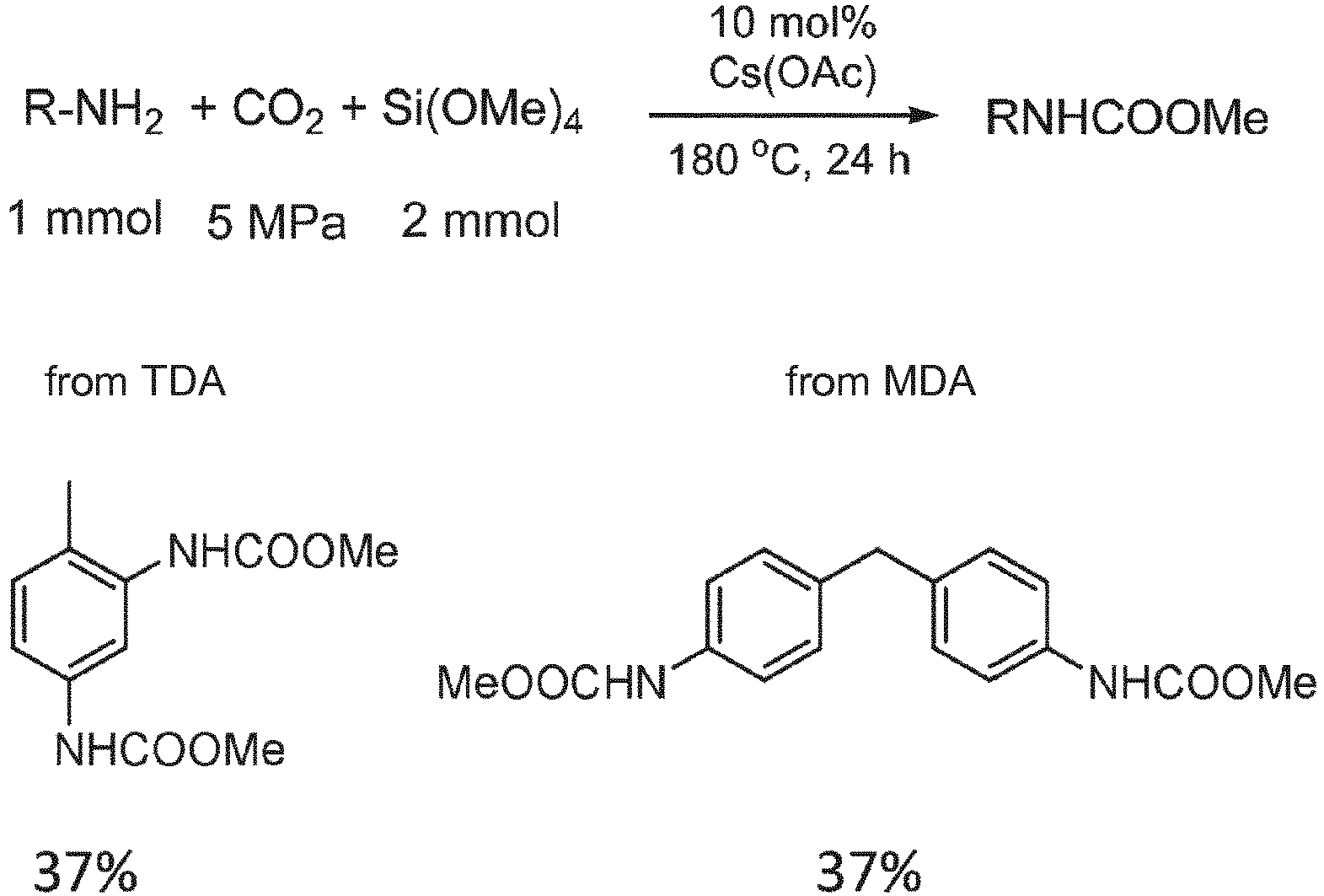
- urethane was synthesized from each of 2,4-toluenediamine (TDA) and 4,4'-diaminodiphenylmethane (MDA) in the same manner as in Example 3-3 (the following chemical equation). The types and yields of the main products obtained are shown together below.
Landscapes
- Chemical & Material Sciences (AREA)
- Organic Chemistry (AREA)
- Organic Low-Molecular-Weight Compounds And Preparation Thereof (AREA)
- Low-Molecular Organic Synthesis Reactions Using Catalysts (AREA)
Abstract
Description
- The present invention relates to a method of production of a carbamic acid ester including reacting an amine, carbon dioxide, and an alkoxysilane compound.
- Polyurethanes are a representative general-purpose polymer used for housing and building materials, automobile parts, coating materials, and the like. Polyurethanes are produced by reacting a polyfunctional isocyanate with a polyfunctional alcohol. Isocyanates are obtained by thermally decomposing a carbamic acid ester. As a synthesis method of a carbamic acid ester, a method including reacting an amine, carbon dioxide, and a tin alkoxide compound is known (Patent Literature 1).
- According to the method described in Patent Literature 1, a carbamic acid ester can be synthesized with a high yield and high selectivity. Further, the tin alkoxide compound having been used in the reaction can be reused. Therefore, the production method of a carbamic acid ester described in Patent Literature 1 is excellent. However, since a tin alkoxide compound is highly toxic and expensive, the advent of a synthesis method of a carbamic acid ester using a less expensive substance is desired.
- Patent Literature 1: International Publication No.
WO 2015/133247 - The present invention has been made in view of such circumstances, and an object thereof is to provide a method capable of producing a carbamic acid ester with a high yield and high selectivity and is superior in economy.
- A production method of a carbamic acid ester according to a first aspect of the present invention includes reacting an amine, carbon dioxide, and an alkoxysilane compound in the presence of a catalyst containing a zinc compound. A production method of a carbamic acid ester according to a second aspect of the present invention includes reacting an amine, carbon dioxide, and an alkoxysilane compound in the presence of an ionic liquid. A production method of a carbamic acid ester according to a third aspect of the present invention includes reacting an amine, carbon dioxide, and an alkoxysilane compound in the presence of a catalyst containing an alkali metal compound.
- According to the present invention, a carbamic acid ester is produced with a high yield and high selectivity and is superior in economy.
- A production method of a carbamic acid ester according to the present invention will be described based on each embodiment and Example. In the second embodiment, duplicated descriptions in the first embodiment are appropriately omitted. In the third embodiment, descriptions overlapping with the first embodiment or the second embodiment are appropriately omitted. Note that when "to" is between two numerical values to represent a numerical range, these two numerical values are also included in the numerical range.
- A production method of a carbamic acid ester according to a first embodiment of the present invention includes reacting an amine, carbon dioxide, and an alkoxysilane compound in the presence of a catalyst containing a zinc compound. When the alkoxysilane compound is directly used instead of the tin alkoxide compound or the titanium alkoxide compound used in the production method of a carbamic acid ester described in Patent Literature 1, a carbamic acid ester is difficult to obtain. However, a carbamic acid ester is obtained with a high yield and high selectivity by using the catalyst containing a zinc compound in combination with the alkoxysilane compound.
- The zinc compound is preferably at least one of zinc oxide (ZnO2), a zinc halide such as zinc chloride (ZnCl2) and zinc bromide (ZnBr2), zinc trifluoromethanesulfonate (Zn(OTf)2), and zinc acetate (Zn(OAc)2). Zinc acetate is preferable among them. This is because a carbamic acid ester is obtained with high a yield and high selectivity. The catalyst may include a ligand. There is no particular restriction on the ligand as long as the ligand is a compound which forms a coordinate bond with zinc to form a zinc complex. At least one of 1,10-phenanthroline (phen), 2,2'-bipyridine (bpy), N,N'-bis(2-pyridylmethyl)ethylenediamine (bispicen), 1,4,8,11-tetraazacyclotetradecane (cyclam), and ethylenediaminetetraacetic acid (EDTA) represented by the following chemical formulas may be used as the ligand.


- A catalyst including zinc acetate as the zinc compound and including at least one of 1,10-phenanthroline, 2,2'-bipyridine, N,N'-bis(2-pyridylmethyl)ethylenediamine, and 1,4,8,11-tetraazacyclotetradecane as the ligand is more preferable. This is because a carbamic acid ester is obtained with an especially high yield and high selectivity.
- A production method of a carbamic acid ester according to a second embodiment of the present invention includes reacting an amine, carbon dioxide, and an alkoxysilane compound in the presence of an ionic liquid. A carbamic acid ester is obtained with a high yield and high selectivity by using the ionic liquid in combination with the alkoxysilane compound. It is considered that the ionic liquid serves as a catalyst.
- An anion of the ionic liquid is preferably at least one of an acetate ion (CH3COO-([OAc])), a trifluoroacetate ion (CF3COO-), and a 2,2,2-trifluoroethanol ion (CF3CH2O-). A cation of the ionic liquid is preferably at least one of [DBUH] represented by the following formula (1), [DBNH] represented by the following formula (2), [TBDH] represented by the following formula (3), [TMGH] represented by the following formula (4), and [C4DABCO] represented by the following formula (5). This is because a carbamic acid ester is obtained with a high yield and high selectivity.

- Among them, an ionic liquid in which the cation is at least one of [DBUH] and [DBNH] and the anion is an acetate ion is more preferable. This is because a carbamic acid ester is obtained with an especially high yield and high selectivity.
- A production method of a carbamic acid ester according to a third embodiment of the present invention includes reacting an amine, carbon dioxide, and an alkoxysilane compound in the presence of a catalyst containing an alkali metal compound. A carbamic acid ester is obtained with a high yield and high selectivity by using the alkali metal compound in combination with the alkoxysilane compound. It is considered that the alkali metal compound serves as a catalyst.
- The alkali metal compound is preferably at least one of a potassium compound, a rubidium compound, and a cesium compound. Rubidium acetate, cesium acetate, rubidium carbonate, cesium carbonate, potassium acetate, potassium carbonate, potassium hydrogen carbonate, potassium hydroxide and potassium tert-butoxide are particularly preferable among them. This is because a carbamic acid ester is obtained with a high yield and high selectivity.
- For example, a N-substituted carbamic acid ester is obtained in the production method of a carbamic acid ester according to each embodiment. Examples of the N-substituted carbamic acid ester include aliphatic carbamic acid esters, alicyclic carbamic acid esters, and aromatic carbamic acid esters, and aromatic carbamic acid esters are preferable among them. For example, carbamic acid monoesters or carbamic acid diesters are obtained in the production method of a carbamic acid ester according to each embodiment. Production of carbamic acid diesters, especially aromatic carbamic acid diesters is useful for industry.
- Examples of a carbamic acid ester obtained by the production method according to each embodiment include methyl N-butylcarbamate, ethyl N-butylcarbamate, propyl N-butylcarbamate, butyl N-butylcarbamate, pentyl N-butylcarbamate, hexyl N-butylcarbamate, cyclohexyl N-butylcarbamate, methyl N-t-butylcarbamate, ethyl N-t-butylcarbamate, propyl N-t-butylcarbamate, butyl N-t-butylcarbamate, pentyl N-t-butylcarbamate, hexyl N-t-butylcarbamate, cyclohexyl N-t-butylcarbamate, methyl N-pentylcarbamate, ethyl N-pentylcarbamate, propyl N-pentylcarbamate, butyl N-pentylcarbamate, pentyl N-pentylcarbamate, hexyl N-pentylcarbamate, cyclohexyl N-pentylcarbamate, methyl N-hexylcarbamate, ethyl N-hexylcarbamate, propyl N-hexylcarbamate, butyl N-hexylcarbamate, pentyl N-hexylcarbamate, hexyl N-hexylcarbamate, cyclohexyl N-hexylcarbamate, methyl N-cyclohexylcarbamate, ethyl N-cyclohexylcarbamate, propyl N-cyclohexylcarbamate, butyl N-cyclohexylcarbamate, pentyl N-cyclohexylcarbamate, hexyl N-cyclohexylcarbamate, cyclohexyl N-cyclohexylcarbamate, methyl N-phenylcarbamate, ethyl N-phenylcarbamate, propyl N-phenylcarbamate, butyl N-phenylcarbamate, pentyl N-phenylcarbamate, hexyl N-phenylcarbamate, cyclohexyl N-phenylcarbamate, methyl N-tolylcarbamate (all isomers), ethyl N-tolylcarbamate (all isomers), propyl N-tolylcarbamate (all isomers), butyl N-tolylcarbamate (all isomers), pentyl N-tolylcarbamate (all isomers), hexyl N-tolylcarbamate (all isomers), cyclohexyl N-phenylcarbamate (all isomers), methyl N-(fluorophenyl)carbamate (all isomers), ethyl N-(fluorophenyl)carbamate (all isomers), propyl N-(fluorophenyl)carbamate (all isomers), butyl N-(fluorophenyl)carbamate (all isomers), pentyl N-(fluorophenyl)carbamate (all isomers), hexyl N-(fluorophenyl)carbamate (all isomers), cyclohexyl N-(fluorophenyl)carbamate (all isomers), methyl N-(chlorophenyl)carbamate (all isomers), ethyl N-(chlorophenyl)carbamate (all isomers), propyl N-(chlorophenyl)carbamate (all isomers), butyl N-(chlorophenyl)carbamate (all isomers), pentyl N-(chlorophenyl)carbamate (all isomers), hexyl N-(chlorophenyl)carbamate (all isomers), cyclohexyl N-(bromophenyl)carbamate (all isomers), methyl N-(bromophenyl)carbamate (all isomers), ethyl N-(bromophenyl)carbamate (all isomers), propyl N-(bromophenyl)carbamate (all isomers), butyl N-(bromophenyl)carbamate (all isomers), pentyl N-(bromophenyl)carbamate (all isomers), hexyl N-(bromophenyl)carbamate (all isomers), cyclohexyl N-(bromophenyl)carbamate (all isomers), methyl N-(iodophenyl)carbamate (all isomers), ethyl N-(iodophenyl)carbamate (all isomers), propyl N-(iodophenyl)carbamate (all isomers), butyl N-(iodophenyl)carbamate (all isomers), pentyl N-(iodophenyl)carbamate (all isomers), hexyl N-(iodophenyl)carbamate (all isomers), cyclohexyl N-(iodophenyl)carbamate (all isomers), methyl N-(nitrophenyl)carbamate (all isomers), ethyl N-(nitrophenyl)carbamate (all isomers), propyl N-(nitrophenyl)carbamate (all isomers), butyl N-(nitrophenyl)carbamate (all isomers), pentyl N-(nitrophenyl)carbamate (all isomers), hexyl N-(nitrophenyl)carbamate (all isomers), cyclohexyl N-(nitrophenyl)carbamate (all isomers), methyl N-(trifluoromethylphenyl)carbamate (all isomers), ethyl N-(trifluoromethylphenyl)carbamate (all isomers), propyl N-(trifluoromethylphenyl)carbamate (all isomers), butyl N-(trifluoromethylphenyl)carbamate (all isomers), pentyl N-(trifluoromethylphenyl)carbamate (all isomers), hexyl N-(trifluoromethylphenyl)carbamate (all isomers), cyclohexyl N-(trifluoromethylphenyl)carbamate (all isomers), methyl N-(methoxyphenyl)carbamate (all isomers), ethyl N-(methoxyphenyl)carbamate (all isomers), propyl N-(methoxyphenyl)carbamate (all isomers), butyl N-(methoxyphenyl)carbamate (all isomers), pentyl N-(methoxyphenyl)carbamate (all isomers), hexyl N-(methoxyphenyl)carbamate (all isomers), cyclohexyl N-(methoxyphenyl)carbamate (all isomers), N,N'-hexanediyl-dicarbamic acid-dimethyl ester, N,N'-hexanediyl-dicarbamic acid-diethyl ester, N,N'-hexanediyl-dicarbamic acid-dibutyl ester (all isomers), N,N'-hexanediyl-dicarbamic acid-dipentyl ester (all isomers), N,N'-hexanediyl-dicarbamic acid-dihexyl ester (all isomers), N,N'-hexanediyl-dicarbamic acid-dicyclohexyl ester, dimethyl-4,4'-methylene-dicyclohexyl carbamate, diethyl-4,4'-methylene-dicyclohexyl carbamate, dipropyl-4,4'-methylene-dicyclohexyl carbamate (all isomers), dibutyl-4,4'-methylene-dicyclohexyl carbamate (all isomers), dipentyl-4,4'-methylene-dicyclohexyl carbamate (all isomers), dihexyl-4,4'-methylene-dicyclohexyl carbamate (all isomers), dicyclohexyl-4,4'-methylene-dicyclohexyl carbamate (all isomers), 3-(methoxycarbonylamino-methyl)-3,5,5-trimethylcyclohexyl carbamic acid methyl ester, 3-(ethoxycarbonylamino-methyl)-3,5,5-trimethylcyclohexyl carbamic acid ethyl ester, 3-(propyloxycarbonylamino-methyl)-3,5,5-trimethylcyclohexyl carbamic acid propyl ester (all isomers), 3-(butyloxycarbonylamino-methyl)-3,5,5-trimethylcyclohexyl carbamic acid butyl ester (all isomers), 3-(pentyloxycarbonylamino-methyl)-3,5,5-trimethylcyclohexyl carbamic acid pentyl ester (all isomers), 3-(hexyloxycarbonylamino-methyl)-3,5,5-trimethylcyclohexyl carbamic acid hexyl ester (all isomers), 3-(octyloxycarbonylamino-methyl)-3,5,5-trimethylcyclohexyl carbamic acid cyclohexyl ester (all isomers), toluene-dicarbamic acid-dimethyl ester (all isomers), toluene-dicarbamic acid-diethyl ester (all isomers), toluene-dicarbamic acid-dipropyl ester (all isomers), toluene-dicarbamic acid-dibutyl ester (all isomers), toluene-dicarbamic acid-dipentyl ester (all isomers), toluene-dicarbamic acid-dihexyl ester (all isomers), toluene-dicarbamic acid-dicyclohexyl ester (all isomers), N,N'-(4,4'-methanediyl-diphenyl)-dicarbamic acid-dimethyl ester, N,N'-(4,4'-methanediyl-diphenyl)-dicarbamic acid-diethyl ester, N,N'-(4,4'-methanediyl-diphenyl)-dicarbamic acid-dipropyl ester, N,N'-(4,4'-methanediyl-diphenyl)-dicarbamic acid-dibutyl ester, N,N'-(4,4'-methanediyl-diphenyl)-dicarbamic acid-dipentyl ester, N,N'-(4,4'-methanediyl-diphenyl)-dicarbamic acid-dihexyl ester, N,N'-(4,4'-methanediyl-diphenyl)-dicarbamic acid-dicyclohexyl ester, and the like.
- The amine used for the production method of a carbamic acid ester according to each embodiment is preferably an aliphatic amine, an alicyclic amine, or an aromatic amine, and an aromatic amine is more preferable among them. Moreover, the amine used for the production method of a carbamic acid ester according to each embodiment is preferably a primary amine or a secondary amine, and a primary amine is more preferable among them. Moreover, the amine used for the production method of a carbamic acid ester according to each embodiment is preferably a monoamine or a diamine. Diamines, especially aromatic diamines, are useful for industry. Examples of the amine used for the production method of a carbamic acid ester according to each embodiment include methylamine, ethylamine, propylamine, isopropylamine, butylamine, t-butylamine, cyclohexylamine, dimethylamine, diethylamine, aniline, aminotoluene (all isomers), dimethylaniline (all isomers), diethylaniline (all isomers), dipropylaniline (all isomers), aminonaphthalene (all isomers), aminomethylnaphthalene (all isomers), dimethylnaphtylamine (all isomers), trimethylnaphtylamine (all isomers), diaminobenzene (all isomers), diaminotoluene (all isomers), methylenedianiline (all isomers), diaminomesitylene (all isomers), diaminobiphenyl (all isomers), diaminodibenzyl (all isomers), bis(aminophenyl)propane (all isomers), bis(aminophenyl)ether (all isomers), bis(aminophenoxyethane) (all isomers), diaminoxylene (all isomers), diaminoanisole (all isomers), diaminophenetole (all isomers), diaminonaphthalene (all isomers), diamino-methylbenzene (all isomers), diaminomethylpyridine (all isomers), diamino-methylnaphthalene (all isomers), ethylenediamine, diaminopropane (all isomers), diaminobutane (all isomers), diaminopentane (all isomers), diaminohexane (all isomers), diaminodecane (all isomers), triaminohexane (all isomers), triaminononane (all isomers), triaminodecane (all isomers), diaminocyclobutane (all isomers), diaminocyclohexane (all isomers), 3-aminomethyl-3,5,5-trimethylcyclohexylamine (cis isomer and/or trans isomer), methylenebis(cyclohexylamine) (all isomers), and the like.
- Examples of the alkoxysilane compound include tetraalkoxysilanes, trialkoxysilanes, dialkoxysilanes, alkoxysilanes, and the like. Tetraalkoxysilanes are preferable among them. Examples of the tetraalkoxysilanes include tetramethoxysilane, tetraethoxysilane, tetra-n-propoxysilane, tetra-iso-propoxysilane, tetraphenoxysilane, and the like. Tetramethoxysilane is preferable among them.
- Examples of the trialkoxysilanes include methyltrimethoxysilane, methyltriethoxysilane, methyltri-n-propoxysilane, methyltriisopropoxysilane, methyltriphenoxysilane, ethyltrimethoxysilane, ethyltriethoxysilane, ethyltri-n-propoxysilane, ethyltriisopropoxysilane, ethyltriphenoxysilane, n-propyltrimethoxysilane, n-propyltriethoxysilane, n-propyltri-n-propoxysilane, n-propyltriisopropoxysilane, n-propyltriphenoxysilane, isopropyltrimethoxysilane, isopropyltriethoxysilane, isopropyltri-n-propoxysilane, isopropyltriisopropoxysilane, isopropyltriphenoxysilane, phenyltrimethoxysilane, phenyltriethoxysilane, phenyltri-n-propoxysilane, phenyltriisopropoxysilane, phenyltriphenoxysilane, and the like.
- Examples of the dialkoxysilanes include dimethyldimethoxysilane, dimethyldiethoxysilane, dimethyldi-n-propoxysilane, dimethyldiisopropoxysilane, dimethyldiphenoxysilane, diethyldimethoxysilane, diethyldiethoxysilane, diethyldi-n-propoxysilane, diethyldiisopropoxysilane, diethyldiphenoxysilane, di-n-propyldimethoxysilane, di-n-propyldiethoxysilane, di-n-propyldi-n-propoxysilane, di-n-propyldiisopropoxysilane, di-n-propyldi-phenoxysilane, diisopropyldimethoxysilane, diisopropyldiethoxysilane, diisopropyldi-n-propoxysilane, diisopropyldiisopropoxysilane, diisopropyldiphenoxysilane, diphenyldimethoxysilane, diphenyldiethoxysilane, diphenyldi-n-propoxysilane, diphenyldiisopropoxysilane, diphenyldiphenoxysilane, and the like.
- Examples of the alkoxysilanes include trimethylmethoxysilane, trimethylethoxysilane, trimethyl-n-propoxysilane, trimethylisopropoxysilane, trimethylphenoxysilane, triethylmethoxysilane, triethylethoxysilane, triethyl-n-propoxysilane, triethylisopropoxysilane, triethylphenoxysilane, tri-n-propylmethoxysilane, tri-n-propylethoxysilane, tri-n-propyl-n-propoxysilane, tri-n-propylisopropoxysilane, tri-n-propyl-phenoxysilane, triisopropylmethoxysilane, triisopropylethoxysilane, triisopropyl-n-propoxysilane, triisopropylisopropoxysilane, triisopropylphenoxysilane, triphenylmethoxysilane, triphenylethoxysilane, triphenyl-n-propoxysilane, triphenylisopropoxysilane, triphenylphenoxysilane, dimethylmethoxysilane, dimethylethoxysilane, dimethyl-n-propoxysilane, dimethylisopropoxysilane, dimethylphenoxysilane, diethylmethoxysilane, diethylethoxysilane, diethyl-n-propoxysilane, diethylisopropoxysilane, diethylphenoxysilane, di-n-propylmethoxysilane, di-n-propylethoxysilane, di-n-propyl-n-propoxysilane, di-n-propylisopropoxysilane, di-n-propylphenoxysilane, diisopropylmethoxysilane, diisopropylethoxysilane, diisopropyl-n-propoxysilane, diisopropylisopropoxysilane, diisopropylphenoxysilane, diphenylmethoxysilane, diphenylethoxysilane, diphenyl-n-propoxysilane, diphenylisopropoxysilane, diphenylphenoxysilane, and the like.
- The method of production according to each embodiment may be performed, for example by filling a reaction container in which the catalyst or the ionic liquid, the amine, and the alkoxysilane compound are present with carbon dioxide, but there is no particular restriction thereon. The reaction temperature at the time of reacting the amine, carbon dioxide, and the alkoxysilane compound is preferably 100 to 200°C, more preferably 120 to 180°C, even more preferably 150 to 180°C from the viewpoint of sufficiently progressing the reaction and suppressing production of a by-products such as urea, but there is no particular restriction thereon. When the amine, carbon dioxide, and the alkoxysilane compound are reacted at 150 to 180°C, a carbamic acid ester is obtained with a high yield and high selectivity.
- The pressure of carbon dioxide at the time of reacting the amine, carbon dioxide, and the alkoxysilane compound in the presence of the catalyst containing the zinc compound is preferably 0.5 to 100 MPa, more preferably 1 to 30 MPa, even more preferably 3 to 20 MPa, but there is no particular restriction thereon. When carbon dioxide at a pressure of 3 to 10 MPa is reacted with the amine and the alkoxysilane compound, a carbamic acid ester is obtained with a high yield and high selectivity.
- The pressure of carbon dioxide at the time of reacting the amine, carbon dioxide, and the alkoxysilane compound in the presence of the ionic liquid is preferably 0.1 to 30 MPa, more preferably 1 to 10 MPa, even more preferably 3 to 5 MPa, but there is no particular restriction thereon. When carbon dioxide at a pressure of 1 to 5 MPa is reacted with the amine and the alkoxysilane compound, a carbamic acid ester is obtained with a high yield and high selectivity.
- The pressure of carbon dioxide at the time of reacting the amine, carbon dioxide, and the alkoxysilane compound in the presence of the catalyst containing the alkali metal compound is preferably 0.5 to 100 MPa, more preferably 1 to 30 MPa, even more preferably 3 to 20 MPa, but there is no particular restriction thereon. When carbon dioxide at a pressure of 3 to 10 MPa is reacted with the amine and the alkoxysilane compound, a carbamic acid ester is obtained with a high yield and high selectivity.
- The reaction time among the amine, carbon dioxide, and the alkoxysilane compound varies according to conditions such as kinds of the catalyst or the ionic liquid, the alkoxysilane compound, and the amine to be used, the reaction temperature, and the pressure of carbon dioxide, but a reaction time of 4 to 24 hours is sufficient. When carbon dioxide and the amine are reacted at 150 to 180°C for 4 to 24 hours, a carbamic acid ester is obtained with a high yield and high selectivity.
- A solvent for the reaction of the amine, carbon dioxide, and the alkoxysilane compound is not particularly limited as long as the solvent does not hinder production of a carbamic acid ester. The reaction may be solvent-free. Examples of such solvents include hydrocarbons and ethers. Specifically, benzene, toluene, hexane, tetrahydrofuran, diethyl ether, dioxane, acetonitrile, dichloromethane, and the like are exemplified. It is preferable that a solvent other than alcohols be used from the viewpoint of progressing the production reaction of a carbamic acid ester.
- Into an autoclave having an inner volume of 10 mL and equipped with a stirring device, 0.02 mmol of the zinc compound shown in Table 1, the ligand shown in Table 1, 1 mmol of aniline, 2 mmol of tetramethoxysilane, which is the alkoxysilane compound, and 3 mL of acetonitrile, which is the solvent, were charged; a carbon dioxide cylinder was connected to the autoclave; and the autoclave was sealed. While stirring the inside of the autoclave, the inside of the autoclave was filled with carbon dioxide, the temperature was increased to 150°C, the inner pressure of the autoclave was adjusted so as to be 5 MPa, and the reaction was conducted for 24 hours to synthesize the carbamic acid ester (the following chemical equation). After completion of the reaction, the inside of the autoclave was cooled, and remaining carbon dioxide was released.


- Next, the reaction product was analyzed by liquid chromatography using toluene. Then, respective yields of the main product A and the by-product B were calculated based on aniline. Results thereof are shown in Table 1. Note that Comparative Example 1 was a reaction not using the zinc compound and the ligand. In each Example, the main product A, which was the carbamic acid ester, was obtained with a high yield and high selectivity. On the other hand, very little of the carbamic acid ester was obtained in Comparative Example 1.
[Table 1] No. Zinc compound Ligand Yield of A (%) Yield of B (%) Type Amount used (mmol) Example 1-1 ZnO Not used 22 13 Example 1-2 ZnCl2 Not used 18 9 Example 1-3 ZnBr2 Not used 29 16 Example 1-4 Zn(OTf)2 Not used 35 6 Example 1-5 Zn(OAc)2 Not used 60 6 Example 1-6 Zn(OAc)2 phen 0.06 84 3 Example 1-7 Zn(OAc)2 bpy 0.06 83 5 Example 1-8 Zn(OAc)2 bispicen 0.03 84 5 Example 1-9 Zn(OAc)2 cyclam 0.03 60 12 Comparative Example 1 Not used Not used 1 2 - Carbamic acid esters were synthesized in the same manner as in Example 1-6, except that reaction temperature and reaction time were changed, and respective yields of the main product A and the by-product B were calculated. Results thereof are shown in Table 2. The main product A, which was the carbamic acid ester, was obtained with yields of 40% or higher over the reaction time of 4 hours or more when the reaction temperature was 150°C or over the reaction time of 2 hours or more when the reaction temperature was 180°C.
[Table 2] No. Reaction temperature (°C) Reaction time (h) Yield of A (%) Yield of B (%) Example 1-10 120 15 9 8 Example 1-11 120 24 15 11 Example 1-12 150 2 21 8 Example 1-13 150 4 40 9 Example 1-14 150 7 57 9 Example 1-15 150 15 84 4 Example 1-6 150 24 84 3 Example 1-16 180 2 50 7 Example 1-17 180 4 85 10 Example 1-18 180 7 84 3 Example 1-19 180 15 77 5 Example 1-20 180 24 70 5 - Carbamic acid esters were synthesized in the same manner as in Example 1-6, except that pressure of carbon dioxide was changed, and respective yields of the main product A and the by-product B were calculated. Results thereof are shown in Table 3. The main product A, which was the carbamic acid ester, was obtained with high yields and high selectivity regardless of the pressure of carbon dioxide. The main product A, which was the carbamic acid ester, was obtained with especially high yields and high selectivity, when the pressure of carbon dioxide was 3 to 10 MPa.
[Table 3] No. CO2 Pressure (MPa) Yield of A (%) Yield of B (%) Example 1-21 1 63 5 Example 1-22 3 84 4 Example 1-6 5 84 3 Example 1-23 10 79 2 Example 1-24 14 57 4 - Carbamic acid esters were synthesized in the same manner as in Example 1-6, except that the solvent was changed, and respective yields of the main product A and the by-product B were calculated. Results thereof are shown in Table 4. The main product A, which was the carbamic acid ester, was obtained with high yields and high selectivity regardless of the kinds of the solvent.
[Table 4] No. Solvent Yield of A (%) Yield of B (%) Example 1-6 Acetonitrile 84 3 Example 1-25 Dioxane 84 1 Example 1-26 Tetrahydrofuran 73 1 Example 1-27 Diethyl ether 55 3 Example 1-28 Hexane 74 9 - Into an autoclave having an inner volume of 10 mL and equipped with a stirring device, 0.1 mmol of the ionic liquid shown in Table 5, 1 mmol of aniline, 2 mmol of tetramethoxysilane, which is the alkoxysilane compound, and 3 mL of acetonitrile, which is the solvent, were charged; a carbon dioxide cylinder was connected to the autoclave; and the autoclave was sealed. While stirring the inside of the autoclave, the inside of the autoclave was filled with carbon dioxide, temperature was increased to 150°C, the inner pressure of the autoclave was adjusted so as to be 5 MPa, and the reaction was conducted for 24 hours to synthesize the carbamic acid ester (the following chemical equation). After completion of the reaction, the inside of the autoclave was cooled, and remaining carbon dioxide was released.

- Next, the reaction product was analyzed by liquid chromatography using toluene. Then, respective yields of the main product A and the by-product B were calculated based on aniline. Results thereof are shown in Table 1. Note that the reaction in Comparative Example 2 did not use the ionic acid. In each Example, the main product A, which was the carbamic acid ester, was obtained with a high yield and high selectivity. On the other hand, very little of the carbamic acid ester was obtained in Comparative Example 2.
[Table 5] No. Ionic liquid Yield of A (%) Yield of B (%) Example 2-1 [DBUH][OAc] 96 3 Example 2-2 [DBUH][CF3COO] 93 5 Example 2-3 [DBUH][CF3CH2O] 96 3 Example 2-4 [DBNH][OAc] 67 3 Example 2-5 [TBDH][OAc] 92 3 Example 2-6 [TMGH][OAc] 25 14 Example 2-7 [C4DABCO][OAc] 27 18 Comparative Example 2 Not used 1 2 - Carbamic acid esters were synthesized in the same manner as in Example 2-1, except that reaction temperature and reaction time were changed, and respective yields of the main product A and the by-product B were calculated. Results thereof are shown in Table 6. The main product A, which was the carbamic acid ester, was obtained with yields of 45% or higher over the reaction time of 4 hours or more when the reaction temperature was 150°C or over the reaction time of 1 hour or more when the reaction temperature was 180°C.
[Table 6] No. Reaction temperature (°C) Reaction time (h) Yield of A (%) Yield of B (%) Example 2-8 120 15 15 13 Example 2-9 120 24 25 15 Example 2-10 150 2 28 7 Example 2-11 150 4 45 13 Example 2-12 150 7 69 9 Example 2-13 150 15 88 4 Example 2-1 150 24 96 3 Example 2-14 180 1 47 9 Example 2-15 180 2 77 6 Example 2-16 180 4 87 5 Example 2-17 180 15 80 5 Example 2-18 180 24 78 5 - Carbamic acid esters were synthesized in the same manner as in Example 2-1, except that pressure of carbon dioxide was changed, and respective yields of the main product A and the by-product B were calculated. Results thereof are shown in Table 7. The main product A, which was the carbamic acid ester, was obtained with high yields and high selectivity regardless of the pressure of carbon dioxide. The main product A, which was the carbamic acid ester, was obtained with especially high yields and high selectivity, when the pressure of carbon dioxide was 3 to 5 MPa.
[Table 7] No. CO2 Pressure (MPa) Yield of A (%) Yield of B (%) Example 2-19 1 75 7 Example 2-20 3 94 4 Example 2-1 5 96 3 - Carbamic acid esters were synthesized in the same manner as in Example 2-1, except that the solvent was changed, and respective yields of the main product A and the by-product B were calculated. Results thereof are shown in Table 8. The main product A, which was the carbamic acid ester, was obtained with high yields and high selectivity regardless of the kinds of the solvent.
[Table 8] No. Solvent Yield of A (%) Yield of B (%) Example 2-1 Acetonitrile 96 3 Example 2-21 Dioxane 55 4 Example 2-22 Tetrahydrofuran 55 7 Example 2-23 Diethyl ether 43 1 Example 2-24 Hexane 69 1 - Into an autoclave having an inner volume of 10 mL and equipped with a stirring device, 0.02 mmol of the alkali metal compound shown in Table 9, 1 mmol of aniline, 2 mmol of tetramethoxysilane, which is the alkoxysilane compound, and 3 mL of acetonitrile, which is the solvent, were charged; a carbon dioxide cylinder was connected to the autoclave; and the autoclave was sealed. While stirring the inside of the autoclave, the inside of the autoclave was filled with carbon dioxide, the temperature was increased to 150°C, the inner pressure of the autoclave was adjusted so as to be 5 MPa, and the reaction was conducted for 24 hours to synthesize the carbamic acid ester (the following chemical equation). After completion of the reaction, the inside of the autoclave was cooled, and remaining carbon dioxide was released.

- Next, the reaction product was analyzed by liquid chromatography using toluene. Then, respective yields of the main product A and the by-product B were calculated based on aniline. Results thereof are shown in Table 9. Note that Comparative Example 3 was a reaction not using the alkali metal compound. In each Example, the main product A, which was the carbamic acid ester, was obtained with a high yield and high selectivity. On the other hand, very little of the carbamic acid ester was obtained in Comparative Example 3.
[Table 9] No. Alkali metal compound Yield of A (%) Yield of B (%) Example 3-1 K(OAc) 83 8 Example 3-2 Rb(OAc) 80 7 Example 3-3 Cs(OAc) 64 3 Example 3-4 K2CO3 89 7 Example 3-5 Rb2CO3 73 10 Example 3-6 Cs2CO3 81 13 Example 3-7 KHCO3 84 16 Example 3-8 KOH 76 11 Example 3-9 KOtBu 87 12 Comparative Example 3 Not used 1 2 - In addition, different carbamic acid esters were synthesized in the same manner as in Example 3-4 (the following chemical equation). The types and yields of the main products obtained are shown together below. It has been shown that extremely inexpensive potassium compounds are usable for the catalyst.


- Moreover, urethane was synthesized from each of 2,4-toluenediamine (TDA) and 4,4'-diaminodiphenylmethane (MDA) in the same manner as in Example 3-3 (the following chemical equation). The types and yields of the main products obtained are shown together below.

Claims (17)
- A method of production of a carbamic acid ester, comprising: reacting an amine, carbon dioxide, and an alkoxysilane compound in the presence of a catalyst containing a zinc compound.
- The method of production of a carbamic acid ester according to claim 1, wherein
the zinc compound is at least one of zinc oxide, a zinc halide, zinc trifluoromethanesulfonate, and zinc acetate. - The method of production of a carbamic acid ester according to claim 1 or 2, wherein
the catalyst further contains a ligand. - The method of production of a carbamic acid ester according to claim 3, wherein
the zinc compound is zinc acetate, and
the ligand is at least one of 1,10-phenanthroline, 2,2'-bipyridine, N,N'-bis(2-pyridylmethyl)ethylenediamine, and 1,4,8,11-tetraazacyclotetradecane. - The method of production of a carbamic acid ester according to any one of claims 1 to 4, wherein
the amine, the carbon dioxide, and the alkoxysilane compound are reacted at a pressure of the carbon dioxide of 3 to 10 MPa. - A method of production of a carbamic acid ester, comprising: reacting an amine, carbon dioxide, and an alkoxysilane compound in the presence of an ionic liquid.
- The method of production of a carbamic acid ester, according to claim 6, wherein
an anion of the ionic liquid is at least one of an acetate ion, a trifluoroacetate ion, and a 2,2,2-trifluoroethanol ion. - The method of production of a carbamic acid ester, according to claim 6 or 7, wherein
a cation of the ionic liquid is at least one of compounds represented by the following formulas (1) to (5):
- The method of production of a carbamic acid ester, according to claim 8, wherein
the cation of the ionic liquid is at least one of the compounds represented by the formulas (1) and (2), and
the anion of the ionic liquid is acetate ion. - The method of production of a carbamic acid ester, according to any one of claims 6 to 9, wherein
the amine, the carbon dioxide, and the alkoxysilane compound are reacted at a pressure of the carbon dioxide of 3 to 5 MPa. - A method of production of a carbamic acid ester, comprising: reacting an amine, carbon dioxide, and an alkoxysilane compound in the presence of a catalyst containing an alkali metal compound.
- The method of production of a carbamic acid ester according to claim 11, wherein
the alkali metal compound is at least one of a potassium compound, a rubidium compound, and a cesium compound. - The method of production of a carbamic acid ester, according to claim 11, wherein
the alkali metal compound is at least one of rubidium acetate, cesium acetate, rubidium carbonate, and cesium carbonate. - The method of production of a carbamic acid ester, according to claim 11, wherein
the alkali metal compound is at least one of potassium acetate, potassium carbonate, potassium hydrogen carbonate, potassium hydroxide, and potassium tert-butoxide. - The method of production of a carbamic acid ester according to any one of claims 1 to 14, wherein
the alkoxysilane compound is a tetraalkoxysilane. - The method of production of a carbamic acid ester, according to claim 15, wherein
the tetraalkoxysilane is tetramethoxysilane. - The method of production of a carbamic acid ester according to any one of claims 1 to 16, wherein the amine, the carbon dioxide, and the alkoxysilane compound are reacted at a temperature of 150 to 180°C.
Applications Claiming Priority (3)
| Application Number | Priority Date | Filing Date | Title |
|---|---|---|---|
| JP2016172076 | 2016-09-02 | ||
| JP2016172077 | 2016-09-02 | ||
| PCT/JP2017/031414 WO2018043658A1 (en) | 2016-09-02 | 2017-08-31 | Method for producing carbamic acid ester |
Publications (3)
| Publication Number | Publication Date |
|---|---|
| EP3508473A1 true EP3508473A1 (en) | 2019-07-10 |
| EP3508473A4 EP3508473A4 (en) | 2020-04-01 |
| EP3508473B1 EP3508473B1 (en) | 2021-05-26 |
Family
ID=61301089
Family Applications (1)
| Application Number | Title | Priority Date | Filing Date |
|---|---|---|---|
| EP17846662.9A Active EP3508473B1 (en) | 2016-09-02 | 2017-08-31 | Method for producing carbamic acid ester |
Country Status (5)
| Country | Link |
|---|---|
| US (1) | US10752579B2 (en) |
| EP (1) | EP3508473B1 (en) |
| JP (1) | JP6770272B2 (en) |
| CN (1) | CN109641835B (en) |
| WO (1) | WO2018043658A1 (en) |
Families Citing this family (6)
| Publication number | Priority date | Publication date | Assignee | Title |
|---|---|---|---|---|
| CN110878035B (en) * | 2018-09-06 | 2021-01-05 | 中国科学院化学研究所 | A kind of method for preparing symmetric urea compound |
| CN110878070B (en) * | 2018-09-06 | 2021-08-31 | 中国科学院化学研究所 | A kind of method for preparing asymmetric urea compound |
| CN112574070B (en) * | 2019-09-29 | 2022-11-08 | 西华大学 | Synthesis method of substituted urea compound |
| JP7458058B2 (en) * | 2020-01-24 | 2024-03-29 | 国立研究開発法人産業技術総合研究所 | Method for producing carbamate ester |
| JP7696562B2 (en) * | 2021-04-30 | 2025-06-23 | 国立研究開発法人産業技術総合研究所 | Method for producing carbamic acid ester using mono-substituted carbonate salt |
| JP7706707B2 (en) * | 2021-06-29 | 2025-07-14 | 国立研究開発法人産業技術総合研究所 | Method for producing carbamic acid ester |
Family Cites Families (7)
| Publication number | Priority date | Publication date | Assignee | Title |
|---|---|---|---|---|
| GB9827088D0 (en) * | 1998-12-09 | 1999-02-03 | Dow Corning | Silylating agent |
| AU2002232461A1 (en) * | 2000-10-25 | 2002-05-06 | Pharmacia And Upjohn Company Llc | Phosgene-free process for preparing carbamates |
| JP3543112B2 (en) * | 2001-01-18 | 2004-07-14 | 独立行政法人産業技術総合研究所 | Method for producing carbamate |
| JP4538603B2 (en) * | 2004-07-08 | 2010-09-08 | 独立行政法人産業技術総合研究所 | Method for producing carbamic acid ester |
| JP2012250930A (en) * | 2011-06-02 | 2012-12-20 | Showa Denko Kk | Process for producing carbamate |
| KR101583742B1 (en) * | 2013-11-14 | 2016-01-08 | 한국생산기술연구원 | Process for preparing disubstituted urea and carbamate compounds from amines, carbon dioxide, and epoxides |
| WO2015133247A1 (en) * | 2014-03-07 | 2015-09-11 | 独立行政法人産業技術総合研究所 | Carbamic acid ester production method |
-
2017
- 2017-08-31 EP EP17846662.9A patent/EP3508473B1/en active Active
- 2017-08-31 CN CN201780053418.0A patent/CN109641835B/en active Active
- 2017-08-31 JP JP2018537404A patent/JP6770272B2/en active Active
- 2017-08-31 WO PCT/JP2017/031414 patent/WO2018043658A1/en not_active Ceased
- 2017-08-31 US US16/328,530 patent/US10752579B2/en active Active
Also Published As
| Publication number | Publication date |
|---|---|
| JPWO2018043658A1 (en) | 2019-06-24 |
| CN109641835A (en) | 2019-04-16 |
| US10752579B2 (en) | 2020-08-25 |
| CN109641835B (en) | 2021-07-20 |
| EP3508473B1 (en) | 2021-05-26 |
| JP6770272B2 (en) | 2020-10-14 |
| WO2018043658A1 (en) | 2018-03-08 |
| US20190185420A1 (en) | 2019-06-20 |
| EP3508473A4 (en) | 2020-04-01 |
Similar Documents
| Publication | Publication Date | Title |
|---|---|---|
| EP3508473B1 (en) | Method for producing carbamic acid ester | |
| US9260383B2 (en) | Method for producing carbamate compound, carbamate compound, and method for producing isocyanate compound using same | |
| CN110114339B (en) | Process for preparing aliphatic isocyanates | |
| JP6270180B2 (en) | Method for producing carbamic acid ester | |
| TWI323729B (en) | Method for producing carbamates and method for produciing isocyanates | |
| US9278906B2 (en) | Process for hydrogenating aromatic di- and polyamines to cycloaliphatic di- and polyamines | |
| TW201741282A (en) | Method for producing urethanes | |
| US9988344B2 (en) | Zinc cluster compounds and their use as catalysts in the reaction of amines with dialkyl carbonates | |
| KR101610470B1 (en) | Method for Preparing Diureido Compounds | |
| CN101977893B (en) | Metal carbamates formed from diaminophenylmethane | |
| US12623999B2 (en) | Carbamate production method, carbamate ester production method, and urea derivative production method | |
| CN105263903B (en) | The manufacture method of the methylene diisocyanates of isophthalic two | |
| KR102026445B1 (en) | The method for preparing dicarbamate compounds from diamines and the catatlyst thereof | |
| JP7458058B2 (en) | Method for producing carbamate ester | |
| KR101609191B1 (en) | Method for Preparing Dicarbamate Compounds | |
| JP5753380B2 (en) | Method for producing compound having ureido group | |
| JP2722490B2 (en) | Production of urethane and carbonate | |
| JP2010215588A (en) | Method of producing carbamate | |
| JP2020132610A (en) | Method for Producing Amine Compound and Method for Producing Amine Composition | |
| JPH0830038B2 (en) | Manufacturing method of urethane and carbonate |
Legal Events
| Date | Code | Title | Description |
|---|---|---|---|
| STAA | Information on the status of an ep patent application or granted ep patent |
Free format text: STATUS: THE INTERNATIONAL PUBLICATION HAS BEEN MADE |
|
| PUAI | Public reference made under article 153(3) epc to a published international application that has entered the european phase |
Free format text: ORIGINAL CODE: 0009012 |
|
| STAA | Information on the status of an ep patent application or granted ep patent |
Free format text: STATUS: REQUEST FOR EXAMINATION WAS MADE |
|
| 17P | Request for examination filed |
Effective date: 20190226 |
|
| AK | Designated contracting states |
Kind code of ref document: A1 Designated state(s): AL AT BE BG CH CY CZ DE DK EE ES FI FR GB GR HR HU IE IS IT LI LT LU LV MC MK MT NL NO PL PT RO RS SE SI SK SM TR |
|
| AX | Request for extension of the european patent |
Extension state: BA ME |
|
| DAV | Request for validation of the european patent (deleted) | ||
| DAX | Request for extension of the european patent (deleted) | ||
| A4 | Supplementary search report drawn up and despatched |
Effective date: 20200304 |
|
| RIC1 | Information provided on ipc code assigned before grant |
Ipc: C07C 271/28 20060101ALI20200227BHEP Ipc: C07C 269/04 20060101AFI20200227BHEP |
|
| REG | Reference to a national code |
Ref country code: DE Ref legal event code: R079 Ref document number: 602017039437 Country of ref document: DE Free format text: PREVIOUS MAIN CLASS: C07C0269040000 Ipc: C07B0043000000 |
|
| GRAP | Despatch of communication of intention to grant a patent |
Free format text: ORIGINAL CODE: EPIDOSNIGR1 |
|
| STAA | Information on the status of an ep patent application or granted ep patent |
Free format text: STATUS: GRANT OF PATENT IS INTENDED |
|
| RIC1 | Information provided on ipc code assigned before grant |
Ipc: C07B 43/00 20060101AFI20200721BHEP Ipc: C07C 269/04 20060101ALI20200721BHEP Ipc: C07C 271/28 20060101ALI20200721BHEP |
|
| INTG | Intention to grant announced |
Effective date: 20200826 |
|
| GRAJ | Information related to disapproval of communication of intention to grant by the applicant or resumption of examination proceedings by the epo deleted |
Free format text: ORIGINAL CODE: EPIDOSDIGR1 |
|
| GRAP | Despatch of communication of intention to grant a patent |
Free format text: ORIGINAL CODE: EPIDOSNIGR1 |
|
| INTG | Intention to grant announced |
Effective date: 20210210 |
|
| GRAS | Grant fee paid |
Free format text: ORIGINAL CODE: EPIDOSNIGR3 |
|
| GRAA | (expected) grant |
Free format text: ORIGINAL CODE: 0009210 |
|
| STAA | Information on the status of an ep patent application or granted ep patent |
Free format text: STATUS: THE PATENT HAS BEEN GRANTED |
|
| AK | Designated contracting states |
Kind code of ref document: B1 Designated state(s): AL AT BE BG CH CY CZ DE DK EE ES FI FR GB GR HR HU IE IS IT LI LT LU LV MC MK MT NL NO PL PT RO RS SE SI SK SM TR |
|
| REG | Reference to a national code |
Ref country code: GB Ref legal event code: FG4D |
|
| REG | Reference to a national code |
Ref country code: CH Ref legal event code: EP |
|
| REG | Reference to a national code |
Ref country code: AT Ref legal event code: REF Ref document number: 1396099 Country of ref document: AT Kind code of ref document: T Effective date: 20210615 |
|
| REG | Reference to a national code |
Ref country code: DE Ref legal event code: R096 Ref document number: 602017039437 Country of ref document: DE |
|
| REG | Reference to a national code |
Ref country code: IE Ref legal event code: FG4D |
|
| REG | Reference to a national code |
Ref country code: NL Ref legal event code: FP |
|
| REG | Reference to a national code |
Ref country code: LT Ref legal event code: MG9D |
|
| REG | Reference to a national code |
Ref country code: AT Ref legal event code: MK05 Ref document number: 1396099 Country of ref document: AT Kind code of ref document: T Effective date: 20210526 |
|
| PG25 | Lapsed in a contracting state [announced via postgrant information from national office to epo] |
Ref country code: HR Free format text: LAPSE BECAUSE OF FAILURE TO SUBMIT A TRANSLATION OF THE DESCRIPTION OR TO PAY THE FEE WITHIN THE PRESCRIBED TIME-LIMIT Effective date: 20210526 Ref country code: BG Free format text: LAPSE BECAUSE OF FAILURE TO SUBMIT A TRANSLATION OF THE DESCRIPTION OR TO PAY THE FEE WITHIN THE PRESCRIBED TIME-LIMIT Effective date: 20210826 Ref country code: AT Free format text: LAPSE BECAUSE OF FAILURE TO SUBMIT A TRANSLATION OF THE DESCRIPTION OR TO PAY THE FEE WITHIN THE PRESCRIBED TIME-LIMIT Effective date: 20210526 Ref country code: FI Free format text: LAPSE BECAUSE OF FAILURE TO SUBMIT A TRANSLATION OF THE DESCRIPTION OR TO PAY THE FEE WITHIN THE PRESCRIBED TIME-LIMIT Effective date: 20210526 Ref country code: LT Free format text: LAPSE BECAUSE OF FAILURE TO SUBMIT A TRANSLATION OF THE DESCRIPTION OR TO PAY THE FEE WITHIN THE PRESCRIBED TIME-LIMIT Effective date: 20210526 |
|
| PG25 | Lapsed in a contracting state [announced via postgrant information from national office to epo] |
Ref country code: NO Free format text: LAPSE BECAUSE OF FAILURE TO SUBMIT A TRANSLATION OF THE DESCRIPTION OR TO PAY THE FEE WITHIN THE PRESCRIBED TIME-LIMIT Effective date: 20210826 Ref country code: PT Free format text: LAPSE BECAUSE OF FAILURE TO SUBMIT A TRANSLATION OF THE DESCRIPTION OR TO PAY THE FEE WITHIN THE PRESCRIBED TIME-LIMIT Effective date: 20210927 Ref country code: PL Free format text: LAPSE BECAUSE OF FAILURE TO SUBMIT A TRANSLATION OF THE DESCRIPTION OR TO PAY THE FEE WITHIN THE PRESCRIBED TIME-LIMIT Effective date: 20210526 Ref country code: LV Free format text: LAPSE BECAUSE OF FAILURE TO SUBMIT A TRANSLATION OF THE DESCRIPTION OR TO PAY THE FEE WITHIN THE PRESCRIBED TIME-LIMIT Effective date: 20210526 Ref country code: RS Free format text: LAPSE BECAUSE OF FAILURE TO SUBMIT A TRANSLATION OF THE DESCRIPTION OR TO PAY THE FEE WITHIN THE PRESCRIBED TIME-LIMIT Effective date: 20210526 Ref country code: SE Free format text: LAPSE BECAUSE OF FAILURE TO SUBMIT A TRANSLATION OF THE DESCRIPTION OR TO PAY THE FEE WITHIN THE PRESCRIBED TIME-LIMIT Effective date: 20210526 Ref country code: GR Free format text: LAPSE BECAUSE OF FAILURE TO SUBMIT A TRANSLATION OF THE DESCRIPTION OR TO PAY THE FEE WITHIN THE PRESCRIBED TIME-LIMIT Effective date: 20210827 Ref country code: IS Free format text: LAPSE BECAUSE OF FAILURE TO SUBMIT A TRANSLATION OF THE DESCRIPTION OR TO PAY THE FEE WITHIN THE PRESCRIBED TIME-LIMIT Effective date: 20210926 |
|
| PG25 | Lapsed in a contracting state [announced via postgrant information from national office to epo] |
Ref country code: EE Free format text: LAPSE BECAUSE OF FAILURE TO SUBMIT A TRANSLATION OF THE DESCRIPTION OR TO PAY THE FEE WITHIN THE PRESCRIBED TIME-LIMIT Effective date: 20210526 Ref country code: ES Free format text: LAPSE BECAUSE OF FAILURE TO SUBMIT A TRANSLATION OF THE DESCRIPTION OR TO PAY THE FEE WITHIN THE PRESCRIBED TIME-LIMIT Effective date: 20210526 Ref country code: SM Free format text: LAPSE BECAUSE OF FAILURE TO SUBMIT A TRANSLATION OF THE DESCRIPTION OR TO PAY THE FEE WITHIN THE PRESCRIBED TIME-LIMIT Effective date: 20210526 Ref country code: SK Free format text: LAPSE BECAUSE OF FAILURE TO SUBMIT A TRANSLATION OF THE DESCRIPTION OR TO PAY THE FEE WITHIN THE PRESCRIBED TIME-LIMIT Effective date: 20210526 Ref country code: CZ Free format text: LAPSE BECAUSE OF FAILURE TO SUBMIT A TRANSLATION OF THE DESCRIPTION OR TO PAY THE FEE WITHIN THE PRESCRIBED TIME-LIMIT Effective date: 20210526 Ref country code: DK Free format text: LAPSE BECAUSE OF FAILURE TO SUBMIT A TRANSLATION OF THE DESCRIPTION OR TO PAY THE FEE WITHIN THE PRESCRIBED TIME-LIMIT Effective date: 20210526 Ref country code: RO Free format text: LAPSE BECAUSE OF FAILURE TO SUBMIT A TRANSLATION OF THE DESCRIPTION OR TO PAY THE FEE WITHIN THE PRESCRIBED TIME-LIMIT Effective date: 20210526 |
|
| REG | Reference to a national code |
Ref country code: DE Ref legal event code: R097 Ref document number: 602017039437 Country of ref document: DE |
|
| REG | Reference to a national code |
Ref country code: CH Ref legal event code: PL |
|
| PLBE | No opposition filed within time limit |
Free format text: ORIGINAL CODE: 0009261 |
|
| STAA | Information on the status of an ep patent application or granted ep patent |
Free format text: STATUS: NO OPPOSITION FILED WITHIN TIME LIMIT |
|
| PG25 | Lapsed in a contracting state [announced via postgrant information from national office to epo] |
Ref country code: MC Free format text: LAPSE BECAUSE OF FAILURE TO SUBMIT A TRANSLATION OF THE DESCRIPTION OR TO PAY THE FEE WITHIN THE PRESCRIBED TIME-LIMIT Effective date: 20210526 |
|
| REG | Reference to a national code |
Ref country code: BE Ref legal event code: MM Effective date: 20210831 |
|
| GBPC | Gb: european patent ceased through non-payment of renewal fee |
Effective date: 20210831 |
|
| PG25 | Lapsed in a contracting state [announced via postgrant information from national office to epo] |
Ref country code: LI Free format text: LAPSE BECAUSE OF NON-PAYMENT OF DUE FEES Effective date: 20210831 Ref country code: CH Free format text: LAPSE BECAUSE OF NON-PAYMENT OF DUE FEES Effective date: 20210831 |
|
| 26N | No opposition filed |
Effective date: 20220301 |
|
| PG25 | Lapsed in a contracting state [announced via postgrant information from national office to epo] |
Ref country code: IS Free format text: LAPSE BECAUSE OF FAILURE TO SUBMIT A TRANSLATION OF THE DESCRIPTION OR TO PAY THE FEE WITHIN THE PRESCRIBED TIME-LIMIT Effective date: 20210926 Ref country code: LU Free format text: LAPSE BECAUSE OF NON-PAYMENT OF DUE FEES Effective date: 20210831 Ref country code: AL Free format text: LAPSE BECAUSE OF FAILURE TO SUBMIT A TRANSLATION OF THE DESCRIPTION OR TO PAY THE FEE WITHIN THE PRESCRIBED TIME-LIMIT Effective date: 20210526 |
|
| PG25 | Lapsed in a contracting state [announced via postgrant information from national office to epo] |
Ref country code: IT Free format text: LAPSE BECAUSE OF FAILURE TO SUBMIT A TRANSLATION OF THE DESCRIPTION OR TO PAY THE FEE WITHIN THE PRESCRIBED TIME-LIMIT Effective date: 20210526 Ref country code: IE Free format text: LAPSE BECAUSE OF NON-PAYMENT OF DUE FEES Effective date: 20210831 Ref country code: GB Free format text: LAPSE BECAUSE OF NON-PAYMENT OF DUE FEES Effective date: 20210831 Ref country code: FR Free format text: LAPSE BECAUSE OF NON-PAYMENT OF DUE FEES Effective date: 20210831 Ref country code: BE Free format text: LAPSE BECAUSE OF NON-PAYMENT OF DUE FEES Effective date: 20210831 |
|
| PG25 | Lapsed in a contracting state [announced via postgrant information from national office to epo] |
Ref country code: CY Free format text: LAPSE BECAUSE OF FAILURE TO SUBMIT A TRANSLATION OF THE DESCRIPTION OR TO PAY THE FEE WITHIN THE PRESCRIBED TIME-LIMIT Effective date: 20210526 |
|
| PG25 | Lapsed in a contracting state [announced via postgrant information from national office to epo] |
Ref country code: HU Free format text: LAPSE BECAUSE OF FAILURE TO SUBMIT A TRANSLATION OF THE DESCRIPTION OR TO PAY THE FEE WITHIN THE PRESCRIBED TIME-LIMIT; INVALID AB INITIO Effective date: 20170831 |
|
| PG25 | Lapsed in a contracting state [announced via postgrant information from national office to epo] |
Ref country code: MK Free format text: LAPSE BECAUSE OF FAILURE TO SUBMIT A TRANSLATION OF THE DESCRIPTION OR TO PAY THE FEE WITHIN THE PRESCRIBED TIME-LIMIT Effective date: 20210526 |
|
| PG25 | Lapsed in a contracting state [announced via postgrant information from national office to epo] |
Ref country code: MT Free format text: LAPSE BECAUSE OF FAILURE TO SUBMIT A TRANSLATION OF THE DESCRIPTION OR TO PAY THE FEE WITHIN THE PRESCRIBED TIME-LIMIT Effective date: 20210526 |
|
| PGFP | Annual fee paid to national office [announced via postgrant information from national office to epo] |
Ref country code: NL Payment date: 20250623 Year of fee payment: 9 |
|
| PGFP | Annual fee paid to national office [announced via postgrant information from national office to epo] |
Ref country code: DE Payment date: 20250624 Year of fee payment: 9 |
|
| PG25 | Lapsed in a contracting state [announced via postgrant information from national office to epo] |
Ref country code: TR Free format text: LAPSE BECAUSE OF FAILURE TO SUBMIT A TRANSLATION OF THE DESCRIPTION OR TO PAY THE FEE WITHIN THE PRESCRIBED TIME-LIMIT Effective date: 20210526 |