EP3508469B1 - Method for selecting alternative solvent - Google Patents
Method for selecting alternative solvent Download PDFInfo
- Publication number
- EP3508469B1 EP3508469B1 EP18850860.0A EP18850860A EP3508469B1 EP 3508469 B1 EP3508469 B1 EP 3508469B1 EP 18850860 A EP18850860 A EP 18850860A EP 3508469 B1 EP3508469 B1 EP 3508469B1
- Authority
- EP
- European Patent Office
- Prior art keywords
- solvent
- denotes
- methyl
- candidates
- solvents
- Prior art date
- Legal status (The legal status is an assumption and is not a legal conclusion. Google has not performed a legal analysis and makes no representation as to the accuracy of the status listed.)
- Active
Links
Images

Classifications
-
- G—PHYSICS
- G16—INFORMATION AND COMMUNICATION TECHNOLOGY [ICT] SPECIALLY ADAPTED FOR SPECIFIC APPLICATION FIELDS
- G16C—COMPUTATIONAL CHEMISTRY; CHEMOINFORMATICS; COMPUTATIONAL MATERIALS SCIENCE
- G16C20/00—Chemoinformatics, i.e. ICT specially adapted for the handling of physicochemical or structural data of chemical particles, elements, compounds or mixtures
- G16C20/30—Prediction of properties of chemical compounds, compositions or mixtures
-
- C—CHEMISTRY; METALLURGY
- C07—ORGANIC CHEMISTRY
- C07B—GENERAL METHODS OF ORGANIC CHEMISTRY; APPARATUS THEREFOR
- C07B61/00—Other general methods
-
- C—CHEMISTRY; METALLURGY
- C07—ORGANIC CHEMISTRY
- C07B—GENERAL METHODS OF ORGANIC CHEMISTRY; APPARATUS THEREFOR
- C07B63/00—Purification; Separation; Stabilisation; Use of additives
- C07B63/04—Use of additives
Definitions
- the present invention relates to a method for selecting alternative solvents having properties similar to those of a reference solvent, and provides a method for selecting alternative solvents based on the similarity with the reference solvent and the compatibility with a solute as factors.
- the method of manufacturing materials using a solution process is the most widely used method because the process is relatively simple, the physical properties are easy to control, and the manufacturing cost is very low.
- one of the important factors which influence performance of the solution process is the solvent used to prepare the solution used in the process.
- some of the conventionally used solvents may require replacement with other solvents because of environmental issues, process safety issues, and improvement of yield.
- the process of finding alternative solvents that are similar in properties to those conventionally used among many solvents requires complicated experiments that takes a lot of time, effort, and resources. Accordingly, among many solvents, there is a need for a method for easily and quickly finding alternative solvents having properties similar to those of conventional solvents.
- the properties required for such alternative solvents are compatibility with each of a plurality of solutes and similarity with the conventionally used solvents.
- the compatibility of the solvents with each solute plays an important role, and compatibility with such solute is a basis for estimating the dissolving ability of the solvents.
- the dissolving ability of the solvents may be inferred by calculating the mixing energy of the solvents with respect to the solute and the similarity with the conventionally used solvents may be estimated by quantifying the similarity of the respective sigma potentials of the solvents.
- the reference [ A. Filly et al, LWT-Food Science and Technology, April 2015, Volume 61, Issue 1, pp. 33-40 ] discloses methods for selecting alternative solvents for n-hexane for food flavor extraction by COSMO-RS (Conductor-like Screening Model for Real Solvents) by using a statistical thermodynamic approach based on quantum chemical calculation results.
- the inventors have been able to provide a method for selecting alternative solvents similar to the conventionally used solvents by using the physical quantity to be calculated and the specific model equation via the COSMO-RS theory.
- the present invention is as defined by Claim 1. Particular embodiments are given by the features of the dependent claims.
- the present invention provides a method for selecting solvents that may replace the conventionally used solvents.
- the present invention provides a method for simply and rapidly selecting alternative solvents for the conventionally used solvents for synthesis and purification of organic molecules.
- S ij may be a real number from 0.0 to 1.0 and ⁇ jk may be a real number from -20.0 to 20.0.
- the d ij may be a real number between 0.0 and 11.0, and the smaller the value, the more similar to the reference solvent.
- solvents in which the d ij is less than or equal to a certain value (d cut ), for example, solvents having a d cut of from 0.0 to 10.0 may be selected alternative solvents.
- the reference solvent is selected from the group consisting of xylene, acetone, chloroform, methyl ethyl ketone (MEK), methyl isobutyl ketone (MIBK), ethyl acetate (EA), butyl acetate, cyclohexanone, propylene glycol methyl ether acetate (PGMEA), dioxane, N-methylpyrrolidone (NMP), dimethylformamide (DMF), N,N-dimethylacetamide, dimethylsulfoxide, cyclopentanone, N,N-dimethylpropanamide, N,N-diethylformamide, 1-ethyl-2-pyrrolidinone, tetramethylurea, nitrobenzene, pyridine, ⁇ -butyrolactone, 2-methylpyridine, 1,2-dimethoxyethane, 3-methyl-2-oxazolidone, 4-methylpyridine, cyclohexanone, 2-methylpyrazine
- the alternative solvents is selected from the group consisting of oxetane, 1-methylimidazole, 1,3-dimethyl-2-imidazolidinone, 2-methylpyridine 1-oxide, tetramethylurea, xylene, acetone, chloroform, methyl ethyl ketone (MEK), methyl isobutyl ketone (MIBK), ethyl acetate (EA), butyl acetate, cyclohexanone, propylene glycol methyl ether acetate (PGMEA), dioxane, N-methylpyrrolidone (NMP), dimethylformamide (DMF), N,N-dimethylacetamide, dimethylsulfoxide, cyclopentanone, N,N-dimethylpropanamide, N,N-diethylformamide, 1-ethyl-2-pyrrolidinone, tetramethylurea, nitrobenzene, pyridine, ⁇ -butyrol
- the present invention may be subject to various modifications and may have various embodiments, and specific embodiments are to be exemplified. In the following description of the present invention, detailed description of known functions will be omitted if it is determined that it may obscure the gist of the present invention.
- i is the kind of the reference solvent
- j is the kinds of the solvent candidates
- k is the kind of the solute
- S ij denotes the similarity between the reference solvent i and the solvent candidates j
- ⁇ s jk denotes a standardized value of ⁇ jk
- ⁇ jk denotes the mixing energy of the solvent
- S ij may be a real number from 0.0 to 1.0 and ⁇ jk may be a real number from -20.0 to 20.0.
- the d ij may be a real number between 0.0 and 11.0, for example a real number between 0.0001 and 0.9, and the smaller the value, the more similar to the reference solvent.
- Solvent candidates were selected from a solvent library consisting of about 1800 kinds of solvents, including the solvents commonly used in the synthesis process, which exist in a liquid state at a room temperature, as follows. 1.
- the similarity values (Sij) of the solvents in the solvent library to Reference Solvent C were calculated according to Equation 2 above by using the sigma potentials of the reference solvent and the solvents of the solvent library. 2.
- the mixing energy values of the solvents in the solvent library for Solute A and Solute B were calculated according to Equation 3 above by applying the COSMO-RS theory. 3.
- the mixing energy values of the solvents calculated in item 2 above were standardized, respectively. 4.
- the distance values (d ij ) between Reference Solvent C and the respective solvents of the solvent library on the hyperspace consisting of the sigma potential similarity values (Sij) of the solvents and the standardized mixing energy values were calculated according to Equation 1 above.
- the solvents having the d ij values of 0.0 to 10.0 were selected as solvent candidates.
- the d ij values of the solvent candidates are shown in Table 2 below.
- N,N-dimethylacetamide, N-methyl-2-pyrrolidinone, oxetane, 4,6-dimethylpyrimidine, N,N-dimethylpropanamide, pyridine, 1-methylimidazole, 1,3-dimethyl-2-imidazolidinone, N,N-diethylformamide, 2-methylpyrazine, 2-methylpyridine 1-oxide and tetramethylurea in the solvent library are the solvents having distance values (d cut ) of 0.9 or less, which are alternative solvents to Reference Solvent C.
Landscapes
- Chemical & Material Sciences (AREA)
- Organic Chemistry (AREA)
- Crystallography & Structural Chemistry (AREA)
- Life Sciences & Earth Sciences (AREA)
- Engineering & Computer Science (AREA)
- Bioinformatics & Cheminformatics (AREA)
- Bioinformatics & Computational Biology (AREA)
- Computing Systems (AREA)
- Theoretical Computer Science (AREA)
- Organic Low-Molecular-Weight Compounds And Preparation Thereof (AREA)
Description
- This application claims the benefit of priority to
Korean Patent Application No. 10-2017-0111893, filed on September 1, 2017 - The present invention relates to a method for selecting alternative solvents having properties similar to those of a reference solvent, and provides a method for selecting alternative solvents based on the similarity with the reference solvent and the compatibility with a solute as factors.
- Compared with other methods such as deposition, the method of manufacturing materials using a solution process is the most widely used method because the process is relatively simple, the physical properties are easy to control, and the manufacturing cost is very low. In this case, one of the important factors which influence performance of the solution process is the solvent used to prepare the solution used in the process. However, some of the conventionally used solvents may require replacement with other solvents because of environmental issues, process safety issues, and improvement of yield. The process of finding alternative solvents that are similar in properties to those conventionally used among many solvents requires complicated experiments that takes a lot of time, effort, and resources. Accordingly, among many solvents, there is a need for a method for easily and quickly finding alternative solvents having properties similar to those of conventional solvents.
- The properties required for such alternative solvents are compatibility with each of a plurality of solutes and similarity with the conventionally used solvents. In order to facilitate the synthesis and purification of organic molecules, the compatibility of the solvents with each solute (reactant and product) plays an important role, and compatibility with such solute is a basis for estimating the dissolving ability of the solvents.
- The dissolving ability of the solvents may be inferred by calculating the mixing energy of the solvents with respect to the solute and the similarity with the conventionally used solvents may be estimated by quantifying the similarity of the respective sigma potentials of the solvents. For example, the reference [A. Filly et al, LWT-Food Science and Technology, April 2015, Volume 61, ] discloses methods for selecting alternative solvents for n-hexane for food flavor extraction by COSMO-RS (Conductor-like Screening Model for Real Solvents) by using a statistical thermodynamic approach based on quantum chemical calculation results.
- The inventors have been able to provide a method for selecting alternative solvents similar to the conventionally used solvents by using the physical quantity to be calculated and the specific model equation via the COSMO-RS theory.
- Loschen et al.: "COSMOquick: A Novel Interface for Fast σ-Profile Composition and Its Application to COSMO-RS Solvent Screening Using Multiple Reference Solvents" in Industrial & Engineering Chemistry Research, vol. 51, no. 43, pages 14303-14308, XP55627770, describes modifying the standard COSMO-RS solubility prediction scheme by additionally using experimental reference solubilities for the purpose of estimating solubilities of organic compounds in different solvents.
- The present invention is as defined by
Claim 1. Particular embodiments are given by the features of the dependent claims. The present invention provides a method for selecting solvents that may replace the conventionally used solvents. - In order to solve the above problems, the present invention provides a method for simply and rapidly selecting alternative solvents for the conventionally used solvents for synthesis and purification of organic molecules.
- Specifically, the present invention provides a method for selecting alternative solvents, comprising calculating and standardizing the mixing energy of a reference solvent and solvent candidates for a solute, and calculating the dij value of the solvent candidates by substituting the similarity of the solvent candidates to the reference solvent calculated by using the sigma potentials of the reference solvent and the solvent candidates into Equation 1:

- Sij in
Equation 1 is calculated according to Equation 2: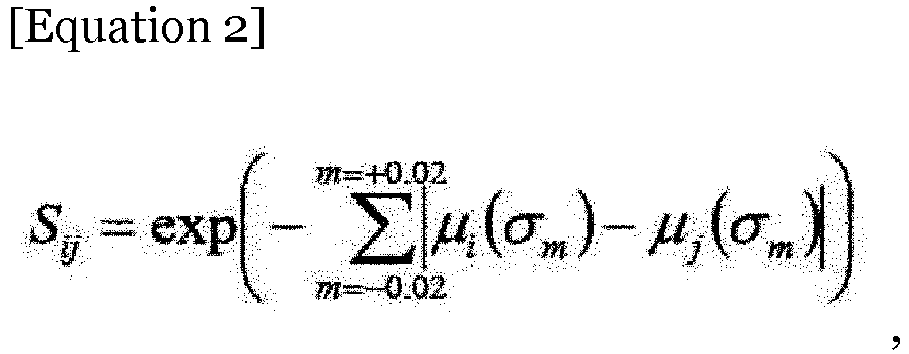
- Δµs jk in
Equation 1 is calculated according to Equation 3:
- According to one embodiment, Sij may be a real number from 0.0 to 1.0 and Δµjk may be a real number from -20.0 to 20.0.
- According to one embodiment, the dij may be a real number between 0.0 and 11.0, and the smaller the value, the more similar to the reference solvent.
- According to one embodiment, solvents in which the dij is less than or equal to a certain value (dcut), for example, solvents having a dcut of from 0.0 to 10.0 may be selected alternative solvents.
- The reference solvent is selected from the group consisting of xylene, acetone, chloroform, methyl ethyl ketone (MEK), methyl isobutyl ketone (MIBK), ethyl acetate (EA), butyl acetate, cyclohexanone, propylene glycol methyl ether acetate (PGMEA), dioxane, N-methylpyrrolidone (NMP), dimethylformamide (DMF), N,N-dimethylacetamide, dimethylsulfoxide, cyclopentanone, N,N-dimethylpropanamide, N,N-diethylformamide, 1-ethyl-2-pyrrolidinone, tetramethylurea, nitrobenzene, pyridine, γ-butyrolactone, 2-methylpyridine, 1,2-dimethoxyethane, 3-methyl-2-oxazolidone, 4-methylpyridine, cyclohexanone, 2-methylpyrazine, 1-vinyl-2-pyrrolidinone, 1,2-diaminoethane, 1-methylimidazole, thiazole, n-propyl acetate, 4,6-dimethylpyrimidine, isopropyl acetate, pyrimidine, aniline, 3-pyridinecarboxaldehyde, 2-(dimethylamino)-ethanol, isobutyl nitrate, 2,4-dimethylpyridine, acetic acid phenylmethyl ester, benzonitrile, 1,4-butanediamine, n-butyl acetate, benzyl alcohol, 1-methyl-1H-indole, N,N-diethyl-m-toluamide, 2-methyl-quinoline, 1H-indene, n-pentylacetate, 1-indanol, toluene, 1-methoxynaphthalene, propanol, ethoxybenzene, 1-methylnaphthalene, 2-butoxyethanol, 1,4-dimethylbenzene, 1,2-dimethylnaphthalene, 1-butanol, indane, 3-phenoxy toluene, 3-pentanol and the like.
- The alternative solvents is selected from the group consisting of oxetane, 1-methylimidazole, 1,3-dimethyl-2-imidazolidinone, 2-methylpyridine 1-oxide, tetramethylurea, xylene, acetone, chloroform, methyl ethyl ketone (MEK), methyl isobutyl ketone (MIBK), ethyl acetate (EA), butyl acetate, cyclohexanone, propylene glycol methyl ether acetate (PGMEA), dioxane, N-methylpyrrolidone (NMP), dimethylformamide (DMF), N,N-dimethylacetamide, dimethylsulfoxide, cyclopentanone, N,N-dimethylpropanamide, N,N-diethylformamide, 1-ethyl-2-pyrrolidinone, tetramethylurea, nitrobenzene, pyridine, γ-butyrolactone, 2-methylpyridine, 1,2-dimethoxyethane, 3-methyl-2-oxazolidone, 4-methylpyridine, cyclohexanone, 2-methylpyrazine, 1-vinyl-2-pyrrolidinone, 1,2-diaminoethane, 1-methylimidazole, thiazole, n-propyl acetate, 4,6-dimethylpyrimidine, isopropyl acetate, pyrimidine, aniline, 3- pyridinecarboxaldehyde, 2-(dimethylamino)-ethanol, isobutyl nitrate, 2,4-dimethylpyridine, acetic acid phenylmethyl ester, benzonitrile, 1,4-butanediamine, n-butyl acetate, benzyl alcohol, 1-methyl-1H-indole, N,N-diethyl-m-toluamide, 2-methyl-quinoline, 1H-indene, n-pentyl acetate, 1-indanol, toluene, 1-methoxynaphthalene, propanol, ethoxybenzene, 1-methylnaphthalene, 2-butoxyethanol, 1,4-dimethylbenzene, 1,2-dimethylnaphthalene, 1-butanol, indane, 3-phenoxy toluene, 3-pentanol, and the like.
- The details of other embodiments of the present invention are included in the following detailed description.
- According to the method of the present invention, it is possible to quickly select alternative solvents having properties similar to those of the conventionally used solvents among a number of candidate solvents through simple calculation methods, thereby saving time, effort, and resources consumed by complicated experiments.
-
-
Fig. 1 is a graph showing the values obtained by standardizing the mixing energy of a reference solvent C (Solvent C) and solvent candidates (Candidates) for Solute A and Solute B according to an embodiment of the present invention. -
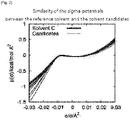
Fig. 2 is a graph showing the similarity of the sigma potential between the reference solvent C (Solvent C) and the solvent candidates (Candidates) according to an embodiment of the present invention. - The present invention will now be described in detail.
- The present invention may be subject to various modifications and may have various embodiments, and specific embodiments are to be exemplified. In the following description of the present invention, detailed description of known functions will be omitted if it is determined that it may obscure the gist of the present invention.
- When certain solvents used for synthesis or purification of organic molecules are to be replaced with another solvents due to environment, safety, etc., alternative solvents having properties similar to those of the conventionally used solvents may be selected.
- According to the present invention, it is possible to save efforts, time, resources, etc. required for finding alternative solvents having similar properties to those of the conventionally used solvents among many solvents.
- Specifically, the present invention provides a method for selecting alternative solvents, comprising calculating and standardizing the mixing energy of a reference solvent and solvent candidates for a solute, and calculating the dij value of the solvent candidates by substituting the similarity of the solvent candidates to the reference solvent calculated by using the sigma potentials of the reference solvent and the solvent candidates into Equation 1:

- Sij in
Equation 1 is calculated according to Equation 2:
- Δµs jk in
Equation 1 is calculated according to Equation 3:
- According to one embodiment, Sij may be a real number from 0.0 to 1.0 and Δµjk may be a real number from -20.0 to 20.0.
- According to one embodiment, the dij may be a real number between 0.0 and 11.0, for example a real number between 0.0001 and 0.9, and the smaller the value, the more similar to the reference solvent.
- According to one embodiment, solvents in which the dij is less than or equal to a certain value (dcut), for example, solvents having a dcut of from 0.0 to 10.0 maybe selected as alternative solvents.
- Hereinafter, embodiments of the present invention will be described in detail in order to facilitate those skilled in the art to which the present invention pertains. However, the present invention may be embodied with various modifications and variations and is not limited to the embodiments described herein.
- In the example, solvent candidates similar to the reference solvent C in terms of the properties for Solute A and Solute B, respectively, were selected. Solute A, Solute B, and Reference Solvent C used are shown in Table 1 below.
[Table 1] Solute A 4,4'-methylenediphenol Solute B 4,4'-((methylenebis(4,1-phenylene))bis (oxy))diphthalonitrile Reference Solvent C dimethylformamide - Solvent candidates were selected from a solvent library consisting of about 1800 kinds of solvents, including the solvents commonly used in the synthesis process, which exist in a liquid state at a room temperature, as follows.
1. The similarity values (Sij) of the solvents in the solvent library to Reference Solvent C were calculated according toEquation 2 above by using the sigma potentials of the reference solvent and the solvents of the solvent library.
2. The mixing energy values of the solvents in the solvent library for Solute A and Solute B were calculated according toEquation 3 above by applying the COSMO-RS theory.
3. The mixing energy values of the solvents calculated initem 2 above were standardized, respectively.
4. The distance values (dij) between Reference Solvent C and the respective solvents of the solvent library on the hyperspace consisting of the sigma potential similarity values (Sij) of the solvents and the standardized mixing energy values were calculated according toEquation 1 above. The solvents having the dij values of 0.0 to 10.0 were selected as solvent candidates. The dij values of the solvent candidates are shown in Table 2 below.[Table 2] Solvents dij value Reference Solvent dimethylformamide 0.0 Solvent Candidates N,N-dimethylacetamide 0.452 N-methyl-2-pyrrolidinone 0.604 oxetane 0.743 4,6-dimethyl pyrimidine 0.758 N,N-dimethylpropaneamide 0.791 pyridine 0.810 1-methylimidazole 0.819 1,3-dimethyl-2- imidazolidinone 0.820 N,N-diethylformamide 0.824 2-methyl pyrazine 0.841 2-methylpyridine1-oxide 0.845 tetramethylurea 0.887 - As shown in Table 2 above, it is confirmed that N,N-dimethylacetamide, N-methyl-2-pyrrolidinone, oxetane, 4,6-dimethylpyrimidine, N,N-dimethylpropanamide, pyridine, 1-methylimidazole, 1,3-dimethyl-2-imidazolidinone, N,N-diethylformamide, 2-methylpyrazine, 2-methylpyridine 1-oxide and tetramethylurea in the solvent library are the solvents having distance values (dcut) of 0.9 or less, which are alternative solvents to Reference Solvent C.
- The standardized values of the mixing energy of Reference Solvent C and the solvent candidates for the solutes A and B are shown in
Fig. 1 . InFigure 1 , "Solvent C" refers to Reference Solvent C and "Candidates" refers to the solvent candidates. - Also, a graph showing the sigma potential similarity between Reference Solvent C and the solvent candidates is shown in
Fig. 2 . InFigure 2 , "Solvent C" refers to Reference Solvent C and "Candidates" refers to the solvent candidates.
Claims (5)
- A method for selecting alternative solvents having properties similar to those of a conventionally used solvent according to the theory of Conductor-like Screening Model for Real Solvents, COSMO-RS, without complicated experiments, comprising:providing a mixing energy Δµik of a reference solvent i for a solute k;calculating a respective mixing energy Δµjk for solvent candidates j for the solute k;standardizing the mixing energy Δµik to obtain a standardized value Δµs ik;standardizing the mixing energy Δµjk to obtain a standardized value Δµs jk;calculating a dij value of the solvent candidates j by substituting a similarity Sij of the solvent candidates j to the reference solvent i calculated by using the sigma potentials µi(σm), µj(σm) of the reference solvent i and the solvent candidates j into Equation 1:
 wherein i is the reference solvent, j are the solvent candidates, and k is the solute,wherein Sij denotes the similarity between the reference solvent i and the solvent candidates j,wherein Δµjk denotes the mixing energy of the solvent candidates j for the solute k, and Δµs jk denotes the standardized value of Δµjk,wherein Δµik denotes the mixing energy of the reference solvent i for the solute k, and Δµs jk denotes the standardized value of Δµik,wherein Sij in Equation 1 is calculated according to Equation 2:
 wherein µi(σm) denotes a sigma potential of the reference solvent i,wherein µj(σm) denotes a sigma potential of the solvent candidates j,wherein Δµs jk in Equation 1 is calculated according to Equation 3:
 wherein Δµjk denotes a mixing energy of the solvent candidates j for the solute k,wherein Mk denotes an average of {Δµjk},wherein σk denotes a standard deviation,wherein Δµs jk denotes the standardized value of Δµjk,wherein the reference solvent is selected from the group consisting of xylene, acetone, chloroform, methyl ethyl ketone (MEK), methyl isobutyl ketone (MIBK), ethyl acetate (EA), butyl acetate, cyclohexanone, propylene glycol methyl ether acetate (PGMEA), dioxane, N-methylpyrrolidone (NMP), dimethylformamide (DMF), N,N-dimethylacetamide, dimethylsulfoxide, cyclopentanone, N,N-dimethylpropanamide, N,N-diethylformamide, 1-ethyl-2-pyrrolidinone, tetramethylurea, nitrobenzene, pyridine, γ-butyrolactone, 2-methylpyridine, 1,2-dimethoxyethane, 3-methyl-2-oxazolidone, 4-methylpyridine, cyclohexanone, 2-methylpyrazine, 1-vinyl-2-pyrrolidinone, 1,2-diaminoethane, 1-methylimidazole, thiazole, n-propyl acetate, 4,6-dimethylpyrimidine, isopropyl acetate, pyrimidine, aniline, 3-pyridinecarboxaldehyde, 2-(dimethylamino)-ethanol, isobutyl nitrate, 2,4-dimethylpyridine, acetic acid phenylmethyl ester, benzonitrile, 1,4-butanediamine, n-butyl acetate, benzyl alcohol, 1-methyl-1H-indole, N,N-diethyl-m-toluamide, 2-methyl-quinoline, 1H-indene, n-pentylacetate, 1-indanol, toluene, 1-methoxynaphthalene, propanol, ethoxybenzene, 1-methylnaphthalene, 2-butoxyethanol, 1,4-dimethylbenzene, 1,2-dimethylnaphthalene, 1-butanol, indane, 3-phenoxy toluene and 3-pentanol,wherein the alternative solvents are selected from the group consisting of oxetane, 1-methylimidazole, 1,3-dimethyl-2-imidazolidinone, 2-methylpyridine 1-oxide, tetramethylurea, xylene, acetone, chloroform, methyl ethyl ketone (MEK), methyl isobutyl ketone (MIBK), ethyl acetate (EA), butyl acetate, cyclohexanone, propylene glycol methyl ether acetate (PGMEA), dioxane, N-methylpyrrolidone (NMP), dimethylformamide (DMF), N,N-dimethylacetamide, dimethylsulfoxide, cyclopentanone, N,N-dimethylpropanamide, N,N-diethylformamide, 1-ethyl-2-pyrrolidinone, tetramethylurea, nitrobenzene, pyridine, γ-butyrolactone, 2-methylpyridine, 1,2-dimethoxyethane, 3-methyl-2-oxazolidone, 4-methylpyridine, cyclohexanone, 2-methylpyrazine, 1-vinyl-2-pyrrolidinone, 1,2-diaminoethane, 1-methylimidazole, thiazole, n-propyl acetate, 4,6-dimethylpyrimidine, isopropyl acetate, pyrimidine, aniline, 3- pyridinecarboxaldehyde, 2-(dimethylamino)-ethanol, isobutyl nitrate, 2,4-dimethylpyridine, acetic acid phenylmethyl ester, benzonitrile, 1,4-butanediamine, n-butyl acetate, benzyl alcohol, 1-methyl-1H-indole, N,N-diethyl-m-toluamide, 2-methyl-quinoline, 1H-indene, n-pentyl acetate, 1-indanol, toluene, 1-methoxynaphthalene, propanol, ethoxybenzene, 1-methylnaphthalene, 2-butoxyethanol, 1,4-dimethylbenzene, 1,2-dimethylnaphthalene, 1-butanol, indane, 3-phenoxy toluene and 3-pentanol.
 - The method for selecting alternative solvents according to claim 1, wherein Sij in Equation 1 is a real number from 0.0 to 1.0
- The method for selecting alternative solvents according to claim 1, wherein Δµjk in Equation 1 is a real number from -20.0 to 20.0.
- The method for selecting alternative solvents according to claim 1, wherein dij in Equation 1 is between 0.0 and 11.0
- The method for selecting alternative solvents according to claim 1, wherein the solvents having a dij of from 0.0 to 10.0 (dcut) are selected as the alternative solvents.
Applications Claiming Priority (2)
| Application Number | Priority Date | Filing Date | Title |
|---|---|---|---|
| KR1020170111893A KR102122111B1 (en) | 2017-09-01 | 2017-09-01 | Method for selecting alternative solvents |
| PCT/KR2018/008257 WO2019045274A1 (en) | 2017-09-01 | 2018-07-23 | ALTERNATIVE SOLVENT SELECTION METHOD |
Publications (3)
| Publication Number | Publication Date |
|---|---|
| EP3508469A1 EP3508469A1 (en) | 2019-07-10 |
| EP3508469A4 EP3508469A4 (en) | 2019-11-06 |
| EP3508469B1 true EP3508469B1 (en) | 2022-07-13 |
Family
ID=65527738
Family Applications (1)
| Application Number | Title | Priority Date | Filing Date |
|---|---|---|---|
| EP18850860.0A Active EP3508469B1 (en) | 2017-09-01 | 2018-07-23 | Method for selecting alternative solvent |
Country Status (6)
| Country | Link |
|---|---|
| US (1) | US11158401B2 (en) |
| EP (1) | EP3508469B1 (en) |
| JP (1) | JP6912046B2 (en) |
| KR (1) | KR102122111B1 (en) |
| CN (1) | CN109923094A (en) |
| WO (1) | WO2019045274A1 (en) |
Families Citing this family (4)
| Publication number | Priority date | Publication date | Assignee | Title |
|---|---|---|---|---|
| KR102523274B1 (en) * | 2019-03-27 | 2023-04-18 | 주식회사 엘지화학 | Method for predicting miscibility of solvent and water |
| JP7707787B2 (en) * | 2021-09-15 | 2025-07-15 | 住友金属鉱山株式会社 | Extractant selection support device, extractant selection support method, and program |
| JP7700599B2 (en) * | 2021-09-15 | 2025-07-01 | 住友金属鉱山株式会社 | Extractant selection support device, extractant selection support method, and program |
| JP7707788B2 (en) * | 2021-09-15 | 2025-07-15 | 住友金属鉱山株式会社 | Modifier selection support device, modifier selection support method, and program |
Family Cites Families (10)
| Publication number | Priority date | Publication date | Assignee | Title |
|---|---|---|---|---|
| US6231783B1 (en) * | 1995-11-14 | 2001-05-15 | Massachusetts Institute Of Technology | Replacement solvents for use in chemical synthesis |
| US6984768B2 (en) * | 2002-05-21 | 2006-01-10 | Battelle Energy Alliance, Llc | Method for destroying halocarbon compositions using a critical solvent |
| AR048239A1 (en) * | 2004-02-25 | 2006-04-12 | Wyeth Corp | PROCESSES FOR THE PREPARATION OF HALURES OF ARIL- AND HETEROARIL-ALQUILSULFONILO AND INTERMEDIARIES OF SYNTHESIS OF THEM |
| US20090112486A1 (en) * | 2007-10-26 | 2009-04-30 | E.I. Dupont De Nemours And Company | method for designing a substitute component for a modified system |
| KR101433851B1 (en) * | 2012-05-11 | 2014-08-26 | 김병훈 | Solvent for the Preparation of Aerogel and Method for Preparing Hydrophobic Aerogel by Using the Same |
| KR101647105B1 (en) | 2013-08-22 | 2016-08-09 | 주식회사 엘지화학 | Method of selecting solvents for solution-based process by group score of a solvent and system using the same |
| US10325677B2 (en) * | 2014-05-11 | 2019-06-18 | Texas Tech University System | Apparatus and computerized method for optimizing or generating a sigma profile for a molecule |
| CN105985213B (en) * | 2015-01-30 | 2018-10-16 | 中国石油天然气股份有限公司 | A screening method for separation solvent of alkane/cycloalkane system |
| KR101864474B1 (en) | 2015-09-25 | 2018-06-04 | 주식회사 엘지화학 | Method of quantitatively predicting reactivity of a sovlent in a solution |
| WO2018045158A1 (en) * | 2016-09-02 | 2018-03-08 | The Board Of Trustees Of The University Of Alabama | Reducing acid gases from streams |
-
2017
- 2017-09-01 KR KR1020170111893A patent/KR102122111B1/en active Active
-
2018
- 2018-07-23 EP EP18850860.0A patent/EP3508469B1/en active Active
- 2018-07-23 US US16/463,928 patent/US11158401B2/en active Active
- 2018-07-23 JP JP2019517422A patent/JP6912046B2/en active Active
- 2018-07-23 WO PCT/KR2018/008257 patent/WO2019045274A1/en not_active Ceased
- 2018-07-23 CN CN201880004239.2A patent/CN109923094A/en active Pending
Also Published As
| Publication number | Publication date |
|---|---|
| KR102122111B1 (en) | 2020-06-11 |
| US20200075133A1 (en) | 2020-03-05 |
| JP6912046B2 (en) | 2021-07-28 |
| KR20190025349A (en) | 2019-03-11 |
| EP3508469A1 (en) | 2019-07-10 |
| US11158401B2 (en) | 2021-10-26 |
| EP3508469A4 (en) | 2019-11-06 |
| JP2019531297A (en) | 2019-10-31 |
| WO2019045274A1 (en) | 2019-03-07 |
| CN109923094A (en) | 2019-06-21 |
Similar Documents
| Publication | Publication Date | Title |
|---|---|---|
| US11158401B2 (en) | Method for selecting alternative solvent | |
| Nielsen et al. | Deoxyfluorination with sulfonyl fluorides: navigating reaction space with machine learning | |
| DiRico et al. | Ultra-high-throughput acoustic droplet ejection-open port interface-mass spectrometry for parallel medicinal chemistry | |
| Armstrong et al. | Oxaziridine-mediated amination of primary amines: scope and application to a one-pot pyrazole synthesis | |
| Gedey et al. | Liquid-phase combinatorial synthesis of alicyclic β-lactams via Ugi four-component reaction | |
| Jirasek et al. | Hybridizing physical and data-driven prediction methods for physicochemical properties | |
| Liu et al. | High-throughput purification platform in support of drug discovery | |
| Qiu et al. | Solubility correlations of common organic solvents | |
| Davoodnia et al. | Fast and solvent-free synthesis of polyhydroquinolines catalyzed by a keplerate type giant nanoporous isopolyoxomolybdate as a reusable catalyst | |
| Khaligh et al. | Green one-pot multicomponent synthesis of pyrrolidinones using planetary ball milling process under solvent-free conditions | |
| Lee et al. | Design of New Amino Tf-Amide Organocatalysts: Environmentally Benign Approach to Asymmetric Aldol Synthesis | |
| Vörös et al. | Formation of aromatic amidoximes with hydroxylamine using microreactor technology | |
| Shirakawa et al. | Dehydrative amination of alcohols in water using a water-soluble calix [4] resorcinarene sulfonic acid | |
| Aalla et al. | Process improvements of prasugrel hydrochloride: an adenosine diphosphate receptor antagonist | |
| Zhu et al. | Kinetic study on the novel efficient clean decomposition of methyl n-phenyl carbamate to phenyl isocyanate | |
| Rial-Rodríguez et al. | Electrochemical self-optimization for the synthesis of densely functionalized molecules | |
| Ghorbani-Vaghei et al. | Efficient synthesis of novel quinazoline-4 (1 H)-one derivatives by N-halosulfonamides | |
| Kokitkar et al. | Modeling drug molecule solubility to identify optimal solvent systems for crystallization | |
| Usutani et al. | Development of an innovative three-component optical resolution and a flow chemistry process for (R)-troloxamide quinone (EPI-589) | |
| Tan et al. | Applications of in silico solvent screening and an interactive web-based portal for pharmaceutical crystallization process development | |
| Mallakpour et al. | Novel and Efficient Synthesis of 4‐Substituted‐1, 2, 4‐triazolidine‐3, 5‐diones from Anilines | |
| Rosso et al. | Rapid Optimization of the Hydrolysis of N ‘-Trifluoroacetyl-S-tert-leucine-N-methylamide Using High-Throughput Chemical Development Techniques | |
| Sathe et al. | Monitoring temperature effect on the polymorphic transformation of acitretin using FBRM− Lasentec | |
| Leyva et al. | One-pot methodology for conversion of o-halogen nitrobenzenes to benzofuroxans | |
| Foroughifar et al. | A novel efficient four-and five-component, one-pot synthesis of 4-semicarbazonoalkyl-2-naphthols |
Legal Events
| Date | Code | Title | Description |
|---|---|---|---|
| STAA | Information on the status of an ep patent application or granted ep patent |
Free format text: STATUS: THE INTERNATIONAL PUBLICATION HAS BEEN MADE |
|
| PUAI | Public reference made under article 153(3) epc to a published international application that has entered the european phase |
Free format text: ORIGINAL CODE: 0009012 |
|
| STAA | Information on the status of an ep patent application or granted ep patent |
Free format text: STATUS: REQUEST FOR EXAMINATION WAS MADE |
|
| 17P | Request for examination filed |
Effective date: 20190405 |
|
| AK | Designated contracting states |
Kind code of ref document: A1 Designated state(s): AL AT BE BG CH CY CZ DE DK EE ES FI FR GB GR HR HU IE IS IT LI LT LU LV MC MK MT NL NO PL PT RO RS SE SI SK SM TR |
|
| AX | Request for extension of the european patent |
Extension state: BA ME |
|
| A4 | Supplementary search report drawn up and despatched |
Effective date: 20191009 |
|
| RIC1 | Information provided on ipc code assigned before grant |
Ipc: C07B 61/00 20060101AFI20191002BHEP |
|
| STAA | Information on the status of an ep patent application or granted ep patent |
Free format text: STATUS: EXAMINATION IS IN PROGRESS |
|
| RIC1 | Information provided on ipc code assigned before grant |
Ipc: C07B 61/00 20060101AFI20200409BHEP |
|
| 17Q | First examination report despatched |
Effective date: 20200424 |
|
| DAV | Request for validation of the european patent (deleted) | ||
| DAX | Request for extension of the european patent (deleted) | ||
| GRAP | Despatch of communication of intention to grant a patent |
Free format text: ORIGINAL CODE: EPIDOSNIGR1 |
|
| STAA | Information on the status of an ep patent application or granted ep patent |
Free format text: STATUS: GRANT OF PATENT IS INTENDED |
|
| INTG | Intention to grant announced |
Effective date: 20220331 |
|
| GRAS | Grant fee paid |
Free format text: ORIGINAL CODE: EPIDOSNIGR3 |
|
| GRAA | (expected) grant |
Free format text: ORIGINAL CODE: 0009210 |
|
| STAA | Information on the status of an ep patent application or granted ep patent |
Free format text: STATUS: THE PATENT HAS BEEN GRANTED |
|
| AK | Designated contracting states |
Kind code of ref document: B1 Designated state(s): AL AT BE BG CH CY CZ DE DK EE ES FI FR GB GR HR HU IE IS IT LI LT LU LV MC MK MT NL NO PL PT RO RS SE SI SK SM TR |
|
| REG | Reference to a national code |
Ref country code: CH Ref legal event code: EP |
|
| REG | Reference to a national code |
Ref country code: DE Ref legal event code: R096 Ref document number: 602018037979 Country of ref document: DE |
|
| REG | Reference to a national code |
Ref country code: AT Ref legal event code: REF Ref document number: 1504211 Country of ref document: AT Kind code of ref document: T Effective date: 20220815 |
|
| REG | Reference to a national code |
Ref country code: IE Ref legal event code: FG4D |
|
| REG | Reference to a national code |
Ref country code: LT Ref legal event code: MG9D |
|
| REG | Reference to a national code |
Ref country code: NL Ref legal event code: MP Effective date: 20220713 |
|
| PG25 | Lapsed in a contracting state [announced via postgrant information from national office to epo] |
Ref country code: SE Free format text: LAPSE BECAUSE OF FAILURE TO SUBMIT A TRANSLATION OF THE DESCRIPTION OR TO PAY THE FEE WITHIN THE PRESCRIBED TIME-LIMIT Effective date: 20220713 Ref country code: RS Free format text: LAPSE BECAUSE OF FAILURE TO SUBMIT A TRANSLATION OF THE DESCRIPTION OR TO PAY THE FEE WITHIN THE PRESCRIBED TIME-LIMIT Effective date: 20220713 Ref country code: PT Free format text: LAPSE BECAUSE OF FAILURE TO SUBMIT A TRANSLATION OF THE DESCRIPTION OR TO PAY THE FEE WITHIN THE PRESCRIBED TIME-LIMIT Effective date: 20221114 Ref country code: NO Free format text: LAPSE BECAUSE OF FAILURE TO SUBMIT A TRANSLATION OF THE DESCRIPTION OR TO PAY THE FEE WITHIN THE PRESCRIBED TIME-LIMIT Effective date: 20221013 Ref country code: NL Free format text: LAPSE BECAUSE OF FAILURE TO SUBMIT A TRANSLATION OF THE DESCRIPTION OR TO PAY THE FEE WITHIN THE PRESCRIBED TIME-LIMIT Effective date: 20220713 Ref country code: LV Free format text: LAPSE BECAUSE OF FAILURE TO SUBMIT A TRANSLATION OF THE DESCRIPTION OR TO PAY THE FEE WITHIN THE PRESCRIBED TIME-LIMIT Effective date: 20220713 Ref country code: LT Free format text: LAPSE BECAUSE OF FAILURE TO SUBMIT A TRANSLATION OF THE DESCRIPTION OR TO PAY THE FEE WITHIN THE PRESCRIBED TIME-LIMIT Effective date: 20220713 Ref country code: FI Free format text: LAPSE BECAUSE OF FAILURE TO SUBMIT A TRANSLATION OF THE DESCRIPTION OR TO PAY THE FEE WITHIN THE PRESCRIBED TIME-LIMIT Effective date: 20220713 Ref country code: ES Free format text: LAPSE BECAUSE OF FAILURE TO SUBMIT A TRANSLATION OF THE DESCRIPTION OR TO PAY THE FEE WITHIN THE PRESCRIBED TIME-LIMIT Effective date: 20220713 |
|
| REG | Reference to a national code |
Ref country code: AT Ref legal event code: MK05 Ref document number: 1504211 Country of ref document: AT Kind code of ref document: T Effective date: 20220713 |
|
| PG25 | Lapsed in a contracting state [announced via postgrant information from national office to epo] |
Ref country code: PL Free format text: LAPSE BECAUSE OF FAILURE TO SUBMIT A TRANSLATION OF THE DESCRIPTION OR TO PAY THE FEE WITHIN THE PRESCRIBED TIME-LIMIT Effective date: 20220713 Ref country code: IS Free format text: LAPSE BECAUSE OF FAILURE TO SUBMIT A TRANSLATION OF THE DESCRIPTION OR TO PAY THE FEE WITHIN THE PRESCRIBED TIME-LIMIT Effective date: 20221113 Ref country code: HR Free format text: LAPSE BECAUSE OF FAILURE TO SUBMIT A TRANSLATION OF THE DESCRIPTION OR TO PAY THE FEE WITHIN THE PRESCRIBED TIME-LIMIT Effective date: 20220713 Ref country code: GR Free format text: LAPSE BECAUSE OF FAILURE TO SUBMIT A TRANSLATION OF THE DESCRIPTION OR TO PAY THE FEE WITHIN THE PRESCRIBED TIME-LIMIT Effective date: 20221014 |
|
| REG | Reference to a national code |
Ref country code: CH Ref legal event code: PL |
|
| REG | Reference to a national code |
Ref country code: BE Ref legal event code: MM Effective date: 20220731 |
|
| REG | Reference to a national code |
Ref country code: DE Ref legal event code: R097 Ref document number: 602018037979 Country of ref document: DE |
|
| PG25 | Lapsed in a contracting state [announced via postgrant information from national office to epo] |
Ref country code: SM Free format text: LAPSE BECAUSE OF FAILURE TO SUBMIT A TRANSLATION OF THE DESCRIPTION OR TO PAY THE FEE WITHIN THE PRESCRIBED TIME-LIMIT Effective date: 20220713 Ref country code: RO Free format text: LAPSE BECAUSE OF FAILURE TO SUBMIT A TRANSLATION OF THE DESCRIPTION OR TO PAY THE FEE WITHIN THE PRESCRIBED TIME-LIMIT Effective date: 20220713 Ref country code: MC Free format text: LAPSE BECAUSE OF FAILURE TO SUBMIT A TRANSLATION OF THE DESCRIPTION OR TO PAY THE FEE WITHIN THE PRESCRIBED TIME-LIMIT Effective date: 20220713 Ref country code: LU Free format text: LAPSE BECAUSE OF NON-PAYMENT OF DUE FEES Effective date: 20220723 Ref country code: LI Free format text: LAPSE BECAUSE OF NON-PAYMENT OF DUE FEES Effective date: 20220731 Ref country code: DK Free format text: LAPSE BECAUSE OF FAILURE TO SUBMIT A TRANSLATION OF THE DESCRIPTION OR TO PAY THE FEE WITHIN THE PRESCRIBED TIME-LIMIT Effective date: 20220713 Ref country code: CZ Free format text: LAPSE BECAUSE OF FAILURE TO SUBMIT A TRANSLATION OF THE DESCRIPTION OR TO PAY THE FEE WITHIN THE PRESCRIBED TIME-LIMIT Effective date: 20220713 Ref country code: CH Free format text: LAPSE BECAUSE OF NON-PAYMENT OF DUE FEES Effective date: 20220731 Ref country code: AT Free format text: LAPSE BECAUSE OF FAILURE TO SUBMIT A TRANSLATION OF THE DESCRIPTION OR TO PAY THE FEE WITHIN THE PRESCRIBED TIME-LIMIT Effective date: 20220713 |
|
| PLBE | No opposition filed within time limit |
Free format text: ORIGINAL CODE: 0009261 |
|
| STAA | Information on the status of an ep patent application or granted ep patent |
Free format text: STATUS: NO OPPOSITION FILED WITHIN TIME LIMIT |
|
| PG25 | Lapsed in a contracting state [announced via postgrant information from national office to epo] |
Ref country code: SK Free format text: LAPSE BECAUSE OF FAILURE TO SUBMIT A TRANSLATION OF THE DESCRIPTION OR TO PAY THE FEE WITHIN THE PRESCRIBED TIME-LIMIT Effective date: 20220713 Ref country code: EE Free format text: LAPSE BECAUSE OF FAILURE TO SUBMIT A TRANSLATION OF THE DESCRIPTION OR TO PAY THE FEE WITHIN THE PRESCRIBED TIME-LIMIT Effective date: 20220713 Ref country code: BE Free format text: LAPSE BECAUSE OF NON-PAYMENT OF DUE FEES Effective date: 20220731 |
|
| 26N | No opposition filed |
Effective date: 20230414 |
|
| PG25 | Lapsed in a contracting state [announced via postgrant information from national office to epo] |
Ref country code: AL Free format text: LAPSE BECAUSE OF FAILURE TO SUBMIT A TRANSLATION OF THE DESCRIPTION OR TO PAY THE FEE WITHIN THE PRESCRIBED TIME-LIMIT Effective date: 20220713 |
|
| PG25 | Lapsed in a contracting state [announced via postgrant information from national office to epo] |
Ref country code: IE Free format text: LAPSE BECAUSE OF NON-PAYMENT OF DUE FEES Effective date: 20220723 |
|
| PG25 | Lapsed in a contracting state [announced via postgrant information from national office to epo] |
Ref country code: SI Free format text: LAPSE BECAUSE OF FAILURE TO SUBMIT A TRANSLATION OF THE DESCRIPTION OR TO PAY THE FEE WITHIN THE PRESCRIBED TIME-LIMIT Effective date: 20220713 |
|
| PG25 | Lapsed in a contracting state [announced via postgrant information from national office to epo] |
Ref country code: IT Free format text: LAPSE BECAUSE OF FAILURE TO SUBMIT A TRANSLATION OF THE DESCRIPTION OR TO PAY THE FEE WITHIN THE PRESCRIBED TIME-LIMIT Effective date: 20220713 |
|
| PG25 | Lapsed in a contracting state [announced via postgrant information from national office to epo] |
Ref country code: HU Free format text: LAPSE BECAUSE OF FAILURE TO SUBMIT A TRANSLATION OF THE DESCRIPTION OR TO PAY THE FEE WITHIN THE PRESCRIBED TIME-LIMIT; INVALID AB INITIO Effective date: 20180723 |
|
| PG25 | Lapsed in a contracting state [announced via postgrant information from national office to epo] |
Ref country code: MK Free format text: LAPSE BECAUSE OF FAILURE TO SUBMIT A TRANSLATION OF THE DESCRIPTION OR TO PAY THE FEE WITHIN THE PRESCRIBED TIME-LIMIT Effective date: 20220713 Ref country code: CY Free format text: LAPSE BECAUSE OF FAILURE TO SUBMIT A TRANSLATION OF THE DESCRIPTION OR TO PAY THE FEE WITHIN THE PRESCRIBED TIME-LIMIT Effective date: 20220713 |
|
| PG25 | Lapsed in a contracting state [announced via postgrant information from national office to epo] |
Ref country code: TR Free format text: LAPSE BECAUSE OF FAILURE TO SUBMIT A TRANSLATION OF THE DESCRIPTION OR TO PAY THE FEE WITHIN THE PRESCRIBED TIME-LIMIT Effective date: 20220713 |
|
| PG25 | Lapsed in a contracting state [announced via postgrant information from national office to epo] |
Ref country code: BG Free format text: LAPSE BECAUSE OF FAILURE TO SUBMIT A TRANSLATION OF THE DESCRIPTION OR TO PAY THE FEE WITHIN THE PRESCRIBED TIME-LIMIT Effective date: 20220713 |
|
| PG25 | Lapsed in a contracting state [announced via postgrant information from national office to epo] |
Ref country code: MT Free format text: LAPSE BECAUSE OF FAILURE TO SUBMIT A TRANSLATION OF THE DESCRIPTION OR TO PAY THE FEE WITHIN THE PRESCRIBED TIME-LIMIT Effective date: 20220713 |
|
| PGFP | Annual fee paid to national office [announced via postgrant information from national office to epo] |
Ref country code: GB Payment date: 20250624 Year of fee payment: 8 |
|
| PGFP | Annual fee paid to national office [announced via postgrant information from national office to epo] |
Ref country code: FR Payment date: 20250624 Year of fee payment: 8 |
|
| PGFP | Annual fee paid to national office [announced via postgrant information from national office to epo] |
Ref country code: DE Payment date: 20250624 Year of fee payment: 8 |