EP3508423A1 - Aircraft passenger luggage bin load weight and balance system - Google Patents
Aircraft passenger luggage bin load weight and balance system Download PDFInfo
- Publication number
- EP3508423A1 EP3508423A1 EP19150626.0A EP19150626A EP3508423A1 EP 3508423 A1 EP3508423 A1 EP 3508423A1 EP 19150626 A EP19150626 A EP 19150626A EP 3508423 A1 EP3508423 A1 EP 3508423A1
- Authority
- EP
- European Patent Office
- Prior art keywords
- luggage storage
- passenger luggage
- passenger
- weight
- aircraft
- Prior art date
- Legal status (The legal status is an assumption and is not a legal conclusion. Google has not performed a legal analysis and makes no representation as to the accuracy of the status listed.)
- Granted
Links
Images



Classifications
-
- G—PHYSICS
- G01—MEASURING; TESTING
- G01G—WEIGHING
- G01G19/00—Weighing apparatus or methods adapted for special purposes not provided for in the preceding groups
- G01G19/08—Weighing apparatus or methods adapted for special purposes not provided for in the preceding groups for incorporation in vehicles
-
- B—PERFORMING OPERATIONS; TRANSPORTING
- B64—AIRCRAFT; AVIATION; COSMONAUTICS
- B64D—EQUIPMENT FOR FITTING IN OR TO AIRCRAFT; FLIGHT SUITS; PARACHUTES; ARRANGEMENT OR MOUNTING OF POWER PLANTS OR PROPULSION TRANSMISSIONS IN AIRCRAFT
- B64D11/00—Passenger or crew accommodation; Flight-deck installations not otherwise provided for
- B64D11/003—Stowage devices for passengers' personal luggage
-
- B—PERFORMING OPERATIONS; TRANSPORTING
- B64—AIRCRAFT; AVIATION; COSMONAUTICS
- B64C—AEROPLANES; HELICOPTERS
- B64C17/00—Aircraft stabilisation not otherwise provided for
- B64C17/02—Aircraft stabilisation not otherwise provided for by gravity or inertia-actuated apparatus
-
- B—PERFORMING OPERATIONS; TRANSPORTING
- B64—AIRCRAFT; AVIATION; COSMONAUTICS
- B64D—EQUIPMENT FOR FITTING IN OR TO AIRCRAFT; FLIGHT SUITS; PARACHUTES; ARRANGEMENT OR MOUNTING OF POWER PLANTS OR PROPULSION TRANSMISSIONS IN AIRCRAFT
- B64D43/00—Arrangements or adaptations of instruments
-
- G—PHYSICS
- G01—MEASURING; TESTING
- G01G—WEIGHING
- G01G19/00—Weighing apparatus or methods adapted for special purposes not provided for in the preceding groups
- G01G19/40—Weighing apparatus or methods adapted for special purposes not provided for in the preceding groups with provisions for indicating, recording, or computing price or other quantities dependent on the weight
- G01G19/413—Weighing apparatus or methods adapted for special purposes not provided for in the preceding groups with provisions for indicating, recording, or computing price or other quantities dependent on the weight using electromechanical or electronic computing means
- G01G19/414—Weighing apparatus or methods adapted for special purposes not provided for in the preceding groups with provisions for indicating, recording, or computing price or other quantities dependent on the weight using electromechanical or electronic computing means using electronic computing means only
-
- G—PHYSICS
- G01—MEASURING; TESTING
- G01G—WEIGHING
- G01G19/00—Weighing apparatus or methods adapted for special purposes not provided for in the preceding groups
- G01G19/40—Weighing apparatus or methods adapted for special purposes not provided for in the preceding groups with provisions for indicating, recording, or computing price or other quantities dependent on the weight
- G01G19/417—Weighing apparatus or methods adapted for special purposes not provided for in the preceding groups with provisions for indicating, recording, or computing price or other quantities dependent on the weight with provision for checking computing part of balance
-
- G—PHYSICS
- G01—MEASURING; TESTING
- G01G—WEIGHING
- G01G19/00—Weighing apparatus or methods adapted for special purposes not provided for in the preceding groups
- G01G19/52—Weighing apparatus combined with other objects, e.g. furniture
-
- G—PHYSICS
- G01—MEASURING; TESTING
- G01G—WEIGHING
- G01G19/00—Weighing apparatus or methods adapted for special purposes not provided for in the preceding groups
- G01G19/52—Weighing apparatus combined with other objects, e.g. furniture
- G01G19/58—Weighing apparatus combined with other objects, e.g. furniture combined with handles of suit-cases or trunks
-
- G—PHYSICS
- G01—MEASURING; TESTING
- G01G—WEIGHING
- G01G19/00—Weighing apparatus or methods adapted for special purposes not provided for in the preceding groups
- G01G19/62—Over or under weighing apparatus
Definitions
- This disclosure relates generally to an aircraft passenger luggage bin load weight and balance system for use in an aircraft.
- Airplane turn time the time required to unload an airplane after its arrival at the gate and to prepare it for departure again -- has increased since the mid-1970s. This contributes to both flight delays and increased passenger frustration.
- One of the key elements of turn time in a single-aisle aircraft is passenger boarding.
- One factor that contributes to an increase in passenger boarding time is an increase in the amount of passenger carry-on luggage.
- Passengers have increased their carry-on baggage for a number of reasons, including the implementation of checked baggage fees by the airlines. During the boarding process, finding available passenger bin storage space for carry-on baggage becomes increasingly time consuming and frustrating for passengers and flight attendants, and can cause delayed departure.
- the balance of an aircraft i.e., the weight distribution
- the distribution of carry-on baggage among the available passenger bin storage space in an aircraft can affect the balance thereof.
- a load weight and balance system for passenger luggage storage bins in an aircraft includes at least one first sensor coupled to each of the passenger luggage storage bins in the aircraft for providing a first output signal proportional to an available internal volume of an associated passenger luggage storage bin. At least one second sensor is coupled to each of the passenger luggage storage bins in the aircraft for providing a second output signal proportional a weight of any luggage in the associated passenger luggage storage bin.
- a display device for each of the passenger luggage storage bins provides a visual indication whether or not the associated passenger luggage storage bin is filled to capacity.
- a main display provides a visual indication of a storage status of all of the passenger luggage storage bins.
- a processor is coupled to receive the first output signals from each of the at least one first sensors.
- the processor calculates, based upon the first output signals from the at least one first sensors, whether or not each of the associated passenger luggage storage bins is filled to capacity.
- the processor provides an output signal to each of the display devices causing the display device to indicate whether or not the associated passenger luggage storage bin is filled to capacity.
- the processor is coupled to receive the second output signals from each of the at least one second sensors.
- the processor calculates, based upon the second output signals from the at least one second sensors, whether or not each of the associated passenger luggage storage bins is within a predetermined weight value.
- the processor provides a signal to the main display causing the main display to indicate whether or not each of the passenger luggage storage bins is within a predetermined weight value.
- each of the at least one second sensors may be a load sensor and the output signal from each of the at least one second sensors may be proportional to a weight of items within the associated passenger luggage storage bin.
- each of the at least one first sensors may be a range sensor and the output signal from each of the at least one first sensors may be proportional to an amount of empty space available within the associated passenger luggage storage bin.
- the processor may provide a signal to the main display causing the main display to indicate whether or not whether or not each of the passenger luggage storage bins is filled to capacity.
- the processor may calculate a weight distribution of all of the passenger luggage storage bins in the aircraft. The processor may determine whether or not the weight distribution of all of the passenger luggage storage bins in the aircraft is balanced.
- the processor may determine instructions on how to adjust a contents of at least some of the passenger luggage storage bins in the aircraft to achieve balance when the processor determines that the weight distribution of all of the passenger luggage storage bins in the aircraft is not balanced.
- the main display is a crew display.
- the processor may selectively provide signals to the crew display causing the crew display to display the instructions.
- the main display may be a passenger display.
- a load weight and balance system for passenger luggage storage bins in an aircraft has at least one sensor coupled to each of the passenger luggage storage bins in the aircraft for providing an output signal proportional a weight of any luggage in an associated passenger luggage storage bin.
- a main display provides a visual indication of a storage status of all of the passenger luggage storage bins.
- a processor is coupled to receive the output signals from each of the at least one sensors and calculates, based upon the output signals from the at least one sensors, whether or not each of the associated passenger luggage storage bins is within a predetermined weight value and provides a signal to the main display causing the main display to indicate whether or not each of the passenger luggage storage bins is within a predetermined weight value.
- a method for balancing a load weight of passenger luggage storage bins in an aircraft includes determining, for each passenger luggage storage bin, a weight of items within that passenger luggage storage bin. A distribution of passenger luggage storage bin weights across the aircraft is determined. Finally, it is determined whether or not the distribution of passenger luggage storage bin weights across the aircraft is balanced.
- instructions are provided on adjusting contents of the passenger luggage storage bins to correct any imbalance.
- the system disclosed herein helps to speed the passenger boarding process.
- a clear visual indication of whether there is available space may be provided in each passenger luggage storage bin.
- displays human machine interface
- the crew display also provides information about the relative weight of each passenger luggage storage bin (e.g., nominal weight or overweight, etc.) and also provides additional balancing instructions to the crew (e.g., instructions on moving some of the contents of one passenger luggage storage bin to another). This allows the crew to quickly identify and correct any weight imbalances in the passenger luggage storage bins during the boarding process and ensures that the aircraft will achieve the proper balance for optimal fuel efficiency during flight.
- Sensing system 100 includes a control and load balancing processor 105 having a first input coupled to a set of bin weight sensors 110, a second input coupled to a set of bin volume sensors 115, and a third input coupled to a set of bin door status sensors/actuators 120.
- the bin door status sensors/actuators 120 provide an indication of the state (e.g., open or closed) of the door on each passenger luggage storage bin and may also provide, via the actuator mechanism, the ability to remotely lock and unlock each bin door under the control of processor 105.
- processor 105 also has an output coupled to a set of bin door status displays 125.
- Each bin door status display 125 is preferably mounted on an external portion of a door of the respective passenger luggage storage bin. As one of ordinary skill in the art will readily recognize, each bin door status display 125 may be mounted in other positions adjacent to the associated passenger luggage storage bin and still provide adequate status notice to passengers.
- Processor 105, bin weight sensors 110, and bin volume sensors 115 are preferably selected to be low power, low voltage units to minimize the loading on the aircraft's internal power system.
- Each bin door status display 125 is preferably an LED device which provides a clear indication that the associated passenger luggage storage bin is either "filled” or “not filled.” For example, each bin door status display 125 may emit a first color (e.g., green) when the associated passenger luggage storage bin is not filled and a second color (e.g., red) when the associated passenger luggage storage bin is filled. In one alternative embodiment, each bin door status display 125 may only become active (lit) when the associated passenger luggage storage bin is filled (or when it is not filled) - e.g., an LED device positioned behind a translucent "FILLED" (or “NOT FILLED") panel. In another alternative embodiment, each bin door status display 125 may be an LED display which provides more detailed description of the storage status of the associated passenger luggage storage bin, e.g., a display which states one of "FILLED” or "NOT FILLED.”
- Processor 105 is also coupled to the aircraft's data network 130, a passenger human machine interface (display) 150, and a crew human machine interface (display) 140.
- the passenger display 150 and the crew display 140 are main displays which provide status information about all of passenger luggage storage bins.
- the passenger display 150 (which may consist of numerous display screens distributed across the aircraft and may be provided as part of a multi-use display, either at each seating location or within various portions of the aircraft) provides the storage status of each passenger luggage storage bin on the aircraft (e.g., empty or filled).
- the crew display 140 provides storage status information to allow the flight attendants to assist boarding passengers to identify unfilled passenger luggage storage bins and also provides information about the relative weight of each passenger luggage storage bin (e.g., nominal weight or overweight, etc.).
- Aircraft network 130 may be, for example, an aircraft data network compliant with industry standard ARINC-664 network protocol.
- each passenger luggage storage bin includes one or more bin weight sensors 110 and one or more bin volume sensors 115.
- Processor 105 receives signals from each of the bin weight sensors 110 and each of the bin volume sensors 115 and, based on such signals, determines, essentially in real-time, the storage status of each passenger luggage storage bin and whether the luggage stored in each passenger luggage storage bin is within a predetermined weight value or weight range.
- the processor may determine based on the signals from the bin weight sensors 110 if each passenger luggage storage bin is at or near a nominal value or is overweight (excessive).
- the predetermined weight value or weight range may be that of a nominal weight value that is between 200 and 250 pounds, for example.
- processor 105 Based on such determinations, processor 105 outputs signals to each of the bin door status displays 125 that indicates current storage status information, i.e., at least whether the particular passenger luggage storage bin is either "FILLED" or "NOT FILLED," as discussed above. Processor 105 also updates current storage status information on each of the passenger displays 150 and on each of the crew displays 140. In the event that any of the passenger luggage storage bins are found to be overweight, processor 105 also updates the weight balancing information shown on crew display 140 and determines load balancing information that is displayed on the crew display 140 upon a crew request (as discussed with respect to FIGS. 5A and 5B ).
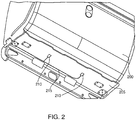
- each passenger luggage storage bin 200 may include one or more bin weight sensors 210 mounted on a bottom panel 205 of the passenger luggage storage bin 200.
- Each bin weight sensor 210 may be, for example, a load cell such as a piezoelectric pressure sensor.
- Each bin weight sensor 210 is coupled to processor 105 (not shown in FIG. 2 ) via wiring 215.
- bin weight sensors 210 may be mounted either on support rods or attachment fittings for passenger luggage storage bin 200 (instead of on bottom panel 205).
- Each of the bin weight sensors 210 provides an output signal which enable processor 105 to determine, in real time, the weight of any luggage currently placed in passenger luggage storage bin 200.
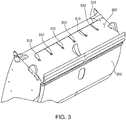
- one or more bin volume sensors 310 are mounted on a top panel 305 of passenger luggage storage bin 200 that are used in system 100 to determine the available internal volume (i.e., the available space) within each passenger luggage storage bin 200.
- Each of the bin volume sensors 310 provides a volume signal to processor 105 (not shown in FIG. 3 ) via wiring 315 to allow processor 105 to determine whether there is any space remaining within each respective passenger luggage storage bin 200.
- processor 105 not shown in FIG. 3
- FIG. 3 six bin volume sensors 310 are shown in FIG. 3 , the precise number of such bin volume sensors 310 required depends upon the size of passenger luggage storage bin 200 and the type of such bin volume sensor 310 selected for use in system 100.
- each passenger luggage storage bin 200 has a front panel 410 with a latch mechanism 420.
- a display device 430 may be provided surrounding latch mechanism 420 which is, in the preferred embodiment, capable of being activated in two different colors, e.g., red and green.
- processor 105 determines whether or not the each passenger luggage storage bin 200 has space available for additional luggage, and provides a storage status indication signal by, for example, causing display device 430 to be activated as a red light when passenger luggage storage bin 200 is filled and to be activated as a green light when passenger luggage storage bin 200 is not filled.
- Crew display 500 may be provided on a specialized tablet or other portable device (smart phone) for use by the crew or on a display mounted within an area of the aircraft reserved for the crew.
- Crew display 500 may be provided on a touchscreen device or may have another input device associated therewith (e.g., a keypad or mouse) for entering commands.
- the crew display 500 provides a visual indication of each passenger luggage storage bin on the aircraft and by shading (or alternatively color) identifies both storage status information (empty shading 510) and load balancing information.
- the load balancing information may be granular, only identifying whether each passenger luggage storage bin is within a nominal value (nominal shading 520) or is overweight (overweight shading 530) or may be more fine.
- the load balancing information is fine, also displaying information indicating whether each passenger luggage storage bin is below nominal weight (nominal - light shading 550) or above nominal weight (nominal - heavy shading 540).
- information may also be provided indicating whether a particular passenger luggage storage bin is out of service (out of service shading 560).
- Crew display 500 also includes a link 570 to a second page 580 (shown in FIG. 5B ) that provides load balancing information. Link 570 may be activate via the touch-screen or an alternative input device.
- the passenger display 150 ( FIG. 1 ) provides the same information as the crew display 500, but does not include link 570.
- the passenger display 150 may be provided via the aircraft's on-board entertainment system.
- the crew display 140 may also provide a selectable link used to remotely lock and unlock the door of all of the passenger luggage storage bins.
- instructions 590, 591 are provided via second page 580 on moving some of the luggage stored in one passenger luggage storage bin to another.
- instructions 590 state "Merge 34K with 33D and move part of 32K to 34K” (34K, 33D, and 32K are identifiers for particular passenger luggage storage bins) and instructions 591 state "Move part of 1K to 3D" (1 K and 3D are identifiers for particular passenger luggage storage bins).
- a flowchart 600 is shown of a method of balancing the passenger luggage storage bin load weight in an aircraft.
- the weight of items within each passenger luggage storage bin is determined.
- the distribution of passenger luggage storage bin weights across the aircraft is determined.
- a determination is made based upon the weight of items within all of the passenger luggage storage bins distribution of passenger luggage storage bin weights across the aircraft.
- the crew is provided with instructions on adjusting the contents of the passenger luggage storage bins to correct the imbalance.
Landscapes
- Physics & Mathematics (AREA)
- Engineering & Computer Science (AREA)
- General Physics & Mathematics (AREA)
- Mathematical Physics (AREA)
- Theoretical Computer Science (AREA)
- Aviation & Aerospace Engineering (AREA)
- Warehouses Or Storage Devices (AREA)
- Testing Of Balance (AREA)
- Devices For Checking Fares Or Tickets At Control Points (AREA)
- Vehicle Step Arrangements And Article Storage (AREA)
- Time Recorders, Dirve Recorders, Access Control (AREA)
Abstract
Description
- This disclosure relates generally to an aircraft passenger luggage bin load weight and balance system for use in an aircraft.
- Airplane turn time -- the time required to unload an airplane after its arrival at the gate and to prepare it for departure again -- has increased since the mid-1970s. This contributes to both flight delays and increased passenger frustration. One of the key elements of turn time in a single-aisle aircraft is passenger boarding. One factor that contributes to an increase in passenger boarding time is an increase in the amount of passenger carry-on luggage. Passengers have increased their carry-on baggage for a number of reasons, including the implementation of checked baggage fees by the airlines. During the boarding process, finding available passenger bin storage space for carry-on baggage becomes increasingly time consuming and frustrating for passengers and flight attendants, and can cause delayed departure.
- Furthermore, it is also important that the balance of an aircraft (i.e., the weight distribution) be within certain specifications to ensure safe operations. The distribution of carry-on baggage among the available passenger bin storage space in an aircraft can affect the balance thereof. There is typically a wide variation in the weight of each passenger's carry-on luggage. This variation can affect the aircraft's balance because, even when each passenger luggage storage bin is filled to capacity, the weight of each such bin can vary significantly given that the loading process for each passenger luggage storage bin is essentially random and controlled only by the order of boarding and the proximity of each passenger's seat location. Because an imbalanced aircraft may expend more fuel during flight, airlines have an incentive to ensure that each departing aircraft is as balanced as possible.
- Accordingly, there is a need for a system and method that ensures that the proper weight balance of the aircraft is maintained among the various passenger luggage storage bins during the boarding process.
- In a first aspect, a load weight and balance system for passenger luggage storage bins in an aircraft includes at least one first sensor coupled to each of the passenger luggage storage bins in the aircraft for providing a first output signal proportional to an available internal volume of an associated passenger luggage storage bin. At least one second sensor is coupled to each of the passenger luggage storage bins in the aircraft for providing a second output signal proportional a weight of any luggage in the associated passenger luggage storage bin. A display device for each of the passenger luggage storage bins provides a visual indication whether or not the associated passenger luggage storage bin is filled to capacity. A main display provides a visual indication of a storage status of all of the passenger luggage storage bins. A processor is coupled to receive the first output signals from each of the at least one first sensors. The processor calculates, based upon the first output signals from the at least one first sensors, whether or not each of the associated passenger luggage storage bins is filled to capacity. The processor provides an output signal to each of the display devices causing the display device to indicate whether or not the associated passenger luggage storage bin is filled to capacity. The processor is coupled to receive the second output signals from each of the at least one second sensors. The processor calculates, based upon the second output signals from the at least one second sensors, whether or not each of the associated passenger luggage storage bins is within a predetermined weight value. The processor provides a signal to the main display causing the main display to indicate whether or not each of the passenger luggage storage bins is within a predetermined weight value.
- In a further embodiment, each of the at least one second sensors may be a load sensor and the output signal from each of the at least one second sensors may be proportional to a weight of items within the associated passenger luggage storage bin. In addition, each of the at least one first sensors may be a range sensor and the output signal from each of the at least one first sensors may be proportional to an amount of empty space available within the associated passenger luggage storage bin. Further, the processor may provide a signal to the main display causing the main display to indicate whether or not whether or not each of the passenger luggage storage bins is filled to capacity. Still further, the processor may calculate a weight distribution of all of the passenger luggage storage bins in the aircraft. The processor may determine whether or not the weight distribution of all of the passenger luggage storage bins in the aircraft is balanced. The processor may determine instructions on how to adjust a contents of at least some of the passenger luggage storage bins in the aircraft to achieve balance when the processor determines that the weight distribution of all of the passenger luggage storage bins in the aircraft is not balanced. Also, the main display is a crew display. The processor may selectively provide signals to the crew display causing the crew display to display the instructions. Alternatively, the main display may be a passenger display.
- In a second aspect, a load weight and balance system for passenger luggage storage bins in an aircraft has at least one sensor coupled to each of the passenger luggage storage bins in the aircraft for providing an output signal proportional a weight of any luggage in an associated passenger luggage storage bin. A main display provides a visual indication of a storage status of all of the passenger luggage storage bins. A processor is coupled to receive the output signals from each of the at least one sensors and calculates, based upon the output signals from the at least one sensors, whether or not each of the associated passenger luggage storage bins is within a predetermined weight value and provides a signal to the main display causing the main display to indicate whether or not each of the passenger luggage storage bins is within a predetermined weight value.
- In a third aspect, a method for balancing a load weight of passenger luggage storage bins in an aircraft includes determining, for each passenger luggage storage bin, a weight of items within that passenger luggage storage bin. A distribution of passenger luggage storage bin weights across the aircraft is determined. Finally, it is determined whether or not the distribution of passenger luggage storage bin weights across the aircraft is balanced.
- In a further embodiment, instructions are provided on adjusting contents of the passenger luggage storage bins to correct any imbalance.
- The features, functions, and advantages that have been discussed can be achieved independently in various embodiments or may be combined in yet other embodiments, further details of which can be seen with reference to the following description and drawings.
- The following detailed description, given by way of example and not intended to limit the present disclosure solely thereto, will best be understood in conjunction with the accompanying drawings in which:
-
FIG. 1 is block circuit diagram of a passenger luggage storage bin load weight and balance system according to an embodiment of the present disclosure; -
FIG. 2 is a diagram showing bin weight sensors positioned on a bottom surface of a passenger luggage storage bin according to the present disclosure; -
FIG. 3 is a diagram showing bin volume sensors positioned on a top surface of a passenger luggage storage bin according to the present disclosure; -
FIG. 4A is a diagram showing visual indicators according to the present disclosure positioned on a front surface of passenger luggage storage bins, andFIG. 4B is a diagram showing a close-up of a single visual indicator fromFIG. 4A ; -
FIGS. 5A and 5b are diagrams of a crew human machine interface showing the operation of the load weight and balance system of the present disclosure; and -
FIG. 6 is a flowchart of a method of balancing the passenger luggage storage bin load weight according to the present disclosure. - In the present disclosure, like reference numbers refer to like elements throughout the drawings, which illustrate various exemplary embodiments of the present disclosure.
- The system disclosed herein helps to speed the passenger boarding process. A clear visual indication of whether there is available space may be provided in each passenger luggage storage bin. In addition, displays (human machine interface) are provided for the crew and for the passengers that indicates the storage status of each passenger luggage storage bin (e.g., empty or filled). The crew display also provides information about the relative weight of each passenger luggage storage bin (e.g., nominal weight or overweight, etc.) and also provides additional balancing instructions to the crew (e.g., instructions on moving some of the contents of one passenger luggage storage bin to another). This allows the crew to quickly identify and correct any weight imbalances in the passenger luggage storage bins during the boarding process and ensures that the aircraft will achieve the proper balance for optimal fuel efficiency during flight.
- Referring now to
FIG. 1 , a block diagram is shown for a passenger luggage storage binload sensing system 100.Sensing system 100 includes a control andload balancing processor 105 having a first input coupled to a set of bin weight sensors 110, a second input coupled to a set ofbin volume sensors 115, and a third input coupled to a set of bin door status sensors/actuators 120. The bin door status sensors/actuators 120 provide an indication of the state (e.g., open or closed) of the door on each passenger luggage storage bin and may also provide, via the actuator mechanism, the ability to remotely lock and unlock each bin door under the control ofprocessor 105. In addition,processor 105 also has an output coupled to a set of bin door status displays 125. Each bindoor status display 125 is preferably mounted on an external portion of a door of the respective passenger luggage storage bin. As one of ordinary skill in the art will readily recognize, each bindoor status display 125 may be mounted in other positions adjacent to the associated passenger luggage storage bin and still provide adequate status notice to passengers.Processor 105, bin weight sensors 110, andbin volume sensors 115 are preferably selected to be low power, low voltage units to minimize the loading on the aircraft's internal power system. Each bindoor status display 125 is preferably an LED device which provides a clear indication that the associated passenger luggage storage bin is either "filled" or "not filled." For example, each bindoor status display 125 may emit a first color (e.g., green) when the associated passenger luggage storage bin is not filled and a second color (e.g., red) when the associated passenger luggage storage bin is filled. In one alternative embodiment, each bindoor status display 125 may only become active (lit) when the associated passenger luggage storage bin is filled (or when it is not filled) - e.g., an LED device positioned behind a translucent "FILLED" (or "NOT FILLED") panel. In another alternative embodiment, each bindoor status display 125 may be an LED display which provides more detailed description of the storage status of the associated passenger luggage storage bin, e.g., a display which states one of "FILLED" or "NOT FILLED." -
Processor 105 is also coupled to the aircraft'sdata network 130, a passenger human machine interface (display) 150, and a crew human machine interface (display) 140. Thepassenger display 150 and thecrew display 140 are main displays which provide status information about all of passenger luggage storage bins. The passenger display 150 (which may consist of numerous display screens distributed across the aircraft and may be provided as part of a multi-use display, either at each seating location or within various portions of the aircraft) provides the storage status of each passenger luggage storage bin on the aircraft (e.g., empty or filled). Thecrew display 140 provides storage status information to allow the flight attendants to assist boarding passengers to identify unfilled passenger luggage storage bins and also provides information about the relative weight of each passenger luggage storage bin (e.g., nominal weight or overweight, etc.).Crew display 140 also selectively provides additional balancing instructions to the crew (e.g., instructions on moving some of the contents of one passenger luggage storage bin to another).Aircraft network 130 may be, for example, an aircraft data network compliant with industry standard ARINC-664 network protocol. - As described above, in the present system each passenger luggage storage bin includes one or more bin weight sensors 110 and one or more
bin volume sensors 115.Processor 105 receives signals from each of the bin weight sensors 110 and each of thebin volume sensors 115 and, based on such signals, determines, essentially in real-time, the storage status of each passenger luggage storage bin and whether the luggage stored in each passenger luggage storage bin is within a predetermined weight value or weight range. For example, the processor may determine based on the signals from the bin weight sensors 110 if each passenger luggage storage bin is at or near a nominal value or is overweight (excessive). In some exemplary embodiments, the predetermined weight value or weight range may be that of a nominal weight value that is between 200 and 250 pounds, for example. Based on such determinations,processor 105 outputs signals to each of the bin door status displays 125 that indicates current storage status information, i.e., at least whether the particular passenger luggage storage bin is either "FILLED" or "NOT FILLED," as discussed above.Processor 105 also updates current storage status information on each of the passenger displays 150 and on each of the crew displays 140. In the event that any of the passenger luggage storage bins are found to be overweight,processor 105 also updates the weight balancing information shown oncrew display 140 and determines load balancing information that is displayed on thecrew display 140 upon a crew request (as discussed with respect toFIGS. 5A and 5B ). - Referring now to
FIG. 2 , each passengerluggage storage bin 200 may include one or morebin weight sensors 210 mounted on abottom panel 205 of the passengerluggage storage bin 200. Eachbin weight sensor 210 may be, for example, a load cell such as a piezoelectric pressure sensor. Eachbin weight sensor 210 is coupled to processor 105 (not shown inFIG. 2 ) viawiring 215. In alternative embodiments,bin weight sensors 210 may be mounted either on support rods or attachment fittings for passenger luggage storage bin 200 (instead of on bottom panel 205). Each of thebin weight sensors 210 provides an output signal which enableprocessor 105 to determine, in real time, the weight of any luggage currently placed in passengerluggage storage bin 200. - Referring now to
FIG. 3 , one or more bin volume sensors 310 (e.g., infrared or ultrasonic rangefinder devices, a two-dimensional laser scanner or a three-dimensional vision system) are mounted on atop panel 305 of passengerluggage storage bin 200 that are used insystem 100 to determine the available internal volume (i.e., the available space) within each passengerluggage storage bin 200. Each of thebin volume sensors 310 provides a volume signal to processor 105 (not shown inFIG. 3 ) viawiring 315 to allowprocessor 105 to determine whether there is any space remaining within each respective passengerluggage storage bin 200. Although sixbin volume sensors 310 are shown inFIG. 3 , the precise number of suchbin volume sensors 310 required depends upon the size of passengerluggage storage bin 200 and the type of suchbin volume sensor 310 selected for use insystem 100. - Referring now to
FIGS. 4A and 4B , each passengerluggage storage bin 200 has afront panel 410 with alatch mechanism 420. Adisplay device 430 may be providedsurrounding latch mechanism 420 which is, in the preferred embodiment, capable of being activated in two different colors, e.g., red and green. In operation,processor 105 determines whether or not the each passengerluggage storage bin 200 has space available for additional luggage, and provides a storage status indication signal by, for example, causingdisplay device 430 to be activated as a red light when passengerluggage storage bin 200 is filled and to be activated as a green light when passengerluggage storage bin 200 is not filled. - Referring now to
FIG. 5A , a diagram of the crew human machine interface (display) 500 is shown.Crew display 500 may be provided on a specialized tablet or other portable device (smart phone) for use by the crew or on a display mounted within an area of the aircraft reserved for the crew.Crew display 500 may be provided on a touchscreen device or may have another input device associated therewith (e.g., a keypad or mouse) for entering commands. Thecrew display 500 provides a visual indication of each passenger luggage storage bin on the aircraft and by shading (or alternatively color) identifies both storage status information (empty shading 510) and load balancing information. The load balancing information may be granular, only identifying whether each passenger luggage storage bin is within a nominal value (nominal shading 520) or is overweight (overweight shading 530) or may be more fine. InFIG. 5A , the load balancing information is fine, also displaying information indicating whether each passenger luggage storage bin is below nominal weight (nominal - light shading 550) or above nominal weight (nominal - heavy shading 540). Finally, information may also be provided indicating whether a particular passenger luggage storage bin is out of service (out of service shading 560).Crew display 500 also includes alink 570 to a second page 580 (shown inFIG. 5B ) that provides load balancing information.Link 570 may be activate via the touch-screen or an alternative input device. The passenger display 150 (FIG. 1 ) provides the same information as thecrew display 500, but does not includelink 570. Thepassenger display 150 may be provided via the aircraft's on-board entertainment system. Thecrew display 140 may also provide a selectable link used to remotely lock and unlock the door of all of the passenger luggage storage bins. - Referring now to
FIG. 5B , whenprocessor 105 determines that the luggage weight distribution is imbalanced,instructions second page 580 on moving some of the luggage stored in one passenger luggage storage bin to another. For example,instructions 590 state "Merge 34K with 33D and move part of 32K to 34K" (34K, 33D, and 32K are identifiers for particular passenger luggage storage bins) andinstructions 591 state "Move part of 1K to 3D" (1 K and 3D are identifiers for particular passenger luggage storage bins). By providing thissecond page 580 ondisplay 500, a flight attendant can quickly fulfill these instructions once the passengers are seated to ensure that the weight distribution among the various passenger luggage storage bins is balanced. - Referring now to
FIG. 6 , a flowchart 600 is shown of a method of balancing the passenger luggage storage bin load weight in an aircraft. First, atstep 610, the weight of items within each passenger luggage storage bin is determined. Next, atstep 620, the distribution of passenger luggage storage bin weights across the aircraft is determined. Thereafter, atstep 630, a determination is made based upon the weight of items within all of the passenger luggage storage bins distribution of passenger luggage storage bin weights across the aircraft. Finally, atstep 640, if an imbalance is determined, the crew is provided with instructions on adjusting the contents of the passenger luggage storage bins to correct the imbalance. - Further, the disclosure comprises embodiments according to the following clauses:
- Clause 1. A load weight and balance system for passenger luggage storage bins in an aircraft, comprising:
- at least one first sensor coupled to each of the passenger luggage storage bins
- in the aircraft for providing a first output signal proportional to an available internal volume of an associated passenger luggage storage bin;
- at least one second sensor coupled to each of the passenger luggage storage bins in the aircraft for providing a second output signal proportional a weight of any luggage in the associated passenger luggage storage bin;
- a display device for each of the passenger luggage storage bins for providing a visual indication whether or not the associated passenger luggage storage bin is filled to capacity;
- a main display for providing a visual indication of a storage status of all of the passenger luggage storage bins; and
- a processor coupled to receive the first output signals from each of the at least one first sensors and which calculates, based upon the first output signals from the at least one first sensors, whether or not each of the associated passenger luggage storage bins is filled to capacity, and which provides an output signal to each of the display devices causing the display device to indicate whether or not the associated passenger luggage storage bin is filled to capacity, the processor coupled to receive the second output signals from each of the at least one second sensors and which calculates, based upon the second output signals from the at least one second sensors, whether or not each of the associated passenger luggage storage bins is within a predetermined weight value and which provides a signal to the main display causing the main display to indicate whether or not each of the passenger luggage storage bins is within a predetermined weight value.
- Clause 2. The load weight and balance system of Clause 1, wherein each of the at least one second sensors is a load sensor and wherein the output signal from each of the at least one second sensors is proportional to a weight of items within the associated passenger luggage storage bin.
- Clause 3. The load weight and balance system of Clause 1 or 2, wherein each of the at least one first sensors is a range sensor and wherein the output signal from each of the at least one first sensors is proportional to an amount of empty space available within the associated passenger luggage storage bin.
- Clause 4. The load weight and balance system of any preceding Clause, wherein the processor provides a signal to the main display causing the main display to indicate whether or not whether or not each of the passenger luggage storage bins is filled to capacity.
- Clause 5. The load weight and balance system of any preceding Clause, wherein the processor calculates a weight distribution of all of the passenger luggage storage bins in the aircraft.
- Clause 6. The load weight and balance system of any preceding Clause, wherein the processor determines whether or not the weight distribution of all of the passenger luggage storage bins in the aircraft is balanced.
- Clause 7. The load weight and balance system of any preceding Clause, wherein the processor determines instructions on how to adjust a contents of at least some of the passenger luggage storage bins in the aircraft to achieve balance when the processor determines that the weight distribution of all of the passenger luggage storage bins in the aircraft is not balanced.
- Clause 8. The load weight and balance system of any preceding Clause, wherein the main display is a crew display (140).
- Clause 9 The load weight and balance system of Clause 8, wherein the processor selectively provides signals to the crew display causing the crew display to display the instructions.
- Clause 10. The load weight and balance system of any preceding Clause, wherein the main display is a passenger display.
- Clause 11. A load weight and balance system for passenger luggage storage bins in an aircraft, comprising:
- at least one sensor coupled to each of the passenger luggage storage bins in the aircraft for providing an output signal proportional a weight of any luggage in an associated passenger luggage storage bin;
- a main display for providing a visual indication of a storage status of all of the passenger luggage storage bins; and
- a processor coupled to receive the output signals from each of the at least one sensors and which calculates, based upon the output signals from the at least one sensors, whether or not each of the associated passenger luggage storage bins is within a predetermined weight value and which provides a signal to the main display causing the main display to indicate whether or not each of the passenger luggage storage bins is within a predetermined weight value.
- Clause 12. The load weight and balance system of Clause 11, wherein each of the at least one sensors is a load cell.
- Clause 13. The load weight and balance system of Clause 11, wherein the processor calculates a weight distribution of all of the passenger luggage storage bins in the aircraft.
- Clause 14. The load weight and balance system of Clause 13, wherein the processor determines whether or not the weight distribution of all of the passenger luggage storage bins in the aircraft is balanced.
- Clause 15. The load weight and balance system of Clause 14, wherein the processor determines instructions on how to adjust a contents of at least some of the passenger luggage storage bins in the aircraft to achieve balance when the processor determines that the weight distribution of all of the passenger luggage storage bins in the aircraft is not balanced.
- Clause 16. The load weight and balance system of Clause 15, wherein the main display is a crew display.
- Clause 17 The load weight and balance system of Clause 16, wherein the processor selectively provides signals to the crew display causing the crew display to display the instructions.
- Clause 18. The load weight and balance system of any of Clauses 11 to 17, wherein the main display is a passenger display.
- Clause 19. A method for balancing a load weight of passenger luggage storage bins in an aircraft, comprising the steps of:
- determining, for each passenger luggage storage bin, a weight of items within that passenger luggage storage bin;
- determining a distribution of passenger luggage storage bin weights across the aircraft; and
- determining whether or not the distribution of passenger luggage storage bin weights across the aircraft is balanced.
- Clause 20. The method of Clause 19, further comprising the step of providing instructions on adjusting contents of the passenger luggage storage bins to correct any imbalance.
- Clause 21. The method of Clause 19 or 20, further comprising the step of determining instructions on how to adjust a contents of at least some of the passenger luggage storage bins in the aircraft to achieve balance when the processor determines that the weight distribution of all of the passenger luggage storage bins in the aircraft is not balanced.
- Clause 22. The method of any of Clauses 19 to 21, further comprising the steps of receiving a sensor output signal proportional a weight of any luggage in an associated passenger luggage storage bin, and displaying on a main display device a visual indication of a storage status of all of the passenger luggage storage bins.
- Clause 23. The method of any of Clauses 19 to 22, further comprising the steps of receiving another sensor output signal proportional to an available internal volume of an associated passenger luggage storage bin and displaying on a display device on each passenger storage bin an indication of whether or not the associated passenger luggage storage bin is filled to capacity.
- Although the present disclosure has been particularly shown and described with reference to the preferred embodiments and various aspects thereof, it will be appreciated by those of ordinary skill in the art that various changes and modifications may be made without departing from the spirit and scope of the disclosure. It is intended that the appended claims be interpreted as including the embodiments described herein, the alternatives mentioned above, and all equivalents thereto.
Claims (14)
- A load weight and balance system (100) for passenger luggage storage bins (200) in an aircraft, comprising:at least one sensor (110) coupled to each of the passenger luggage storage bins in the aircraft for providing an output signal proportional a weight of any luggage in an associated passenger luggage storage bin;a main display (140, 150) for providing a visual indication of a storage status of all of the passenger luggage storage bins; anda processor (105) coupled to receive the output signals from each of the at least one sensors and which calculates, based upon the output signals from the at least one sensors, whether or not each of the associated passenger luggage storage bins is within a predetermined weight value and which provides a signal to the main display causing the main display to indicate whether or not each of the passenger luggage storage bins is within a predetermined weight value.
- The load weight and balance system of claim 1, wherein each of the at least one sensors is a load cell that provides an output signal that is proportional to a weight of items within the associated passenger luggage storage bin.
- The load weight and balance system of claim 1 or 2, wherein the processor calculates a weight distribution of all of the passenger luggage storage bins in the aircraft.
- The load weight and balance system of claim 3, wherein the processor determines whether or not the weight distribution of all of the passenger luggage storage bins in the aircraft is balanced.
- The load weight and balance system of any preceding claim, wherein the processor determines instructions on how to adjust a contents of at least some of the passenger luggage storage bins in the aircraft to achieve balance when the processor determines that the weight distribution of all of the passenger luggage storage bins in the aircraft is not balanced.
- The load weight and balance system of any preceding claim, wherein the main display is a crew display (140).
- The load weight and balance system of claim 6, wherein the processor selectively provides signals to the crew display causing the crew display to display the instructions.
- The load weight and balance system of any preceding claim, wherein the main display is a passenger display (150).
- The load weight and balance system of any preceding claim, further comprising:at least one other sensor (115) coupled to each of the passenger luggage storage bins in the aircraft for providing a first output signal proportional to an available internal volume of an associated passenger luggage storage bin; anda display device (125) for each of the passenger luggage storage bins for providing a visual indication whether or not the associated passenger luggage storage bin is filled to capacity;wherein the processor (105) receives the output signals from each of the at least one sensor (110) and the at least one other sensor (115), and is configured to calculate, based upon the output signals from the at least one other sensor (115), whether or not each of the associated passenger luggage storage bins is filled to capacity, and which provides an output signal to each of the display devices causing the display device to indicate whether or not the associated passenger luggage storage bin is filled to capacity.
- A method for balancing a load weight of passenger luggage storage bins (200) in an aircraft, comprising the steps of:determining, for each passenger luggage storage bin, a weight of items within that passenger luggage storage bin;determining a distribution of passenger luggage storage bin weights across the aircraft; anddetermining whether or not the distribution of passenger luggage storage bin weights across the aircraft is balanced.
- The method of claim 10, further comprising the step of determining instructions on how to adjust a contents of at least some of the passenger luggage storage bins in the aircraft to achieve balance when the processor determines that the weight distribution of all of the passenger luggage storage bins in the aircraft is not balanced.
- The method of claim 10 or 11, further comprising the step of displaying on a display device information providing instructions on adjusting contents of the passenger luggage storage bins to correct any imbalance.
- The method of any of claims 10 to 12, further comprising the steps of receiving a sensor output signal proportional a weight of any luggage in an associated passenger luggage storage bin, and displaying on a main display device a visual indication of a storage status of all of the passenger luggage storage bins.
- The method of any of claims 10 to 13, further comprising the steps of receiving another sensor output signal proportional to an available internal volume of an associated passenger luggage storage bin and displaying on a display device on each passenger storage bin an indication of whether or not the associated passenger luggage storage bin is filled to capacity.
Applications Claiming Priority (1)
| Application Number | Priority Date | Filing Date | Title |
|---|---|---|---|
| US15/864,036 US11047728B2 (en) | 2018-01-08 | 2018-01-08 | Aircraft passenger luggage bin load weight and balance system |
Publications (2)
| Publication Number | Publication Date |
|---|---|
| EP3508423A1 true EP3508423A1 (en) | 2019-07-10 |
| EP3508423B1 EP3508423B1 (en) | 2021-09-08 |
Family
ID=65010547
Family Applications (1)
| Application Number | Title | Priority Date | Filing Date |
|---|---|---|---|
| EP19150626.0A Active EP3508423B1 (en) | 2018-01-08 | 2019-01-07 | Aircraft passenger luggage bin load weight and balance system |
Country Status (3)
| Country | Link |
|---|---|
| US (1) | US11047728B2 (en) |
| EP (1) | EP3508423B1 (en) |
| CN (1) | CN110015427B (en) |
Cited By (2)
| Publication number | Priority date | Publication date | Assignee | Title |
|---|---|---|---|---|
| WO2021097599A1 (en) | 2019-11-18 | 2021-05-27 | Airbus (China) Enterprise Management And Services Company Limited | Storage area loading status measurement systems and methods |
| EP4020308A1 (en) * | 2020-12-28 | 2022-06-29 | Koninklijke Fabriek Inventum B.V. | Integrated rfid tags in passenger aircraft |
Families Citing this family (10)
| Publication number | Priority date | Publication date | Assignee | Title |
|---|---|---|---|---|
| US10669028B1 (en) * | 2019-01-28 | 2020-06-02 | Rockwell Collins, Inc. | System and method for detecting items in aircraft stowage areas |
| CN110781006B (en) * | 2019-10-28 | 2022-06-03 | 重庆紫光华山智安科技有限公司 | Load balancing method, device, node and computer readable storage medium |
| US11649055B2 (en) * | 2019-12-16 | 2023-05-16 | Airbus Operations Gmbh | Process for determining that luggage has been left behind in an overhead bin |
| DE102020000373A1 (en) * | 2020-01-23 | 2021-07-29 | Diehl Aerospace Gmbh | Interior management system for an aircraft with the interior management system and a method for controlling the interior management system |
| EP3875370B1 (en) | 2020-03-05 | 2025-12-17 | B/E Aerospace, Inc. | Overhead stowage bin with electronic control system |
| US12077298B2 (en) * | 2020-03-05 | 2024-09-03 | B/E Aerospace, Inc. | Overhead stowage bin with electronic control system |
| JP7276290B2 (en) * | 2020-09-03 | 2023-05-18 | トヨタ自動車株式会社 | Vehicles and vehicle control systems |
| CN114812728A (en) * | 2021-01-19 | 2022-07-29 | 波音公司 | System and method for determining capacity of storage tank |
| CN115214892B (en) * | 2022-07-25 | 2025-08-01 | 中国商用飞机有限责任公司 | Luggage rack, and space occupation notification method and system for luggage rack |
| EP4685054A1 (en) * | 2024-07-22 | 2026-01-28 | Airbus Operations, S.L.U. | Computer implemented method to prevent a non-viable state of loading in an aircraft |
Citations (6)
| Publication number | Priority date | Publication date | Assignee | Title |
|---|---|---|---|---|
| US20080078870A1 (en) * | 2006-08-25 | 2008-04-03 | The Boeing Company | System and method for compartment control |
| US20140077952A1 (en) * | 2012-09-14 | 2014-03-20 | International Business Machines Corporation | Optimization of luggage placement in storage compartments |
| EP2910472A1 (en) * | 2014-02-25 | 2015-08-26 | Astronics Advanced Electronic Systems Corp. | Apparatus and method to monitor the occupied volume within a fixed or variable volume |
| US20160109280A1 (en) * | 2014-10-15 | 2016-04-21 | The Boeing Company | Smart aircraft overhead luggage bin system |
| EP3173329A1 (en) * | 2015-11-26 | 2017-05-31 | Goodrich Corporation | Aircraft overhead bin monitoring and alert system |
| US20170283086A1 (en) * | 2016-04-04 | 2017-10-05 | B/E Aerospace, Inc. | Aircraft Passenger Activity Monitoring |
Family Cites Families (18)
| Publication number | Priority date | Publication date | Assignee | Title |
|---|---|---|---|---|
| DE4209037C2 (en) | 1992-03-20 | 1994-06-23 | Deutsche Aerospace Airbus | Device for carrying luggage in airplanes |
| US6452487B1 (en) * | 2000-02-14 | 2002-09-17 | Stanley Krupinski | System and method for warning of a tip over condition in a tractor trailer or tanker |
| US6923375B2 (en) * | 2003-05-15 | 2005-08-02 | Arinc, Inc. | Aircraft weight and balance system |
| US20070050271A1 (en) * | 2003-07-11 | 2007-03-01 | Rf Code, Inc. | Presence, pattern and weight sensor surface |
| US20050060246A1 (en) * | 2003-07-11 | 2005-03-17 | Roc Lastinger | System, method, and computer program product for monitoring inventory |
| FR2871904B1 (en) | 2004-06-22 | 2006-09-22 | Airbus Groupement D Interet Ec | CLOSURE CONTROL DEVICE OF A BAGGAGE BOX |
| US20070265890A1 (en) | 2006-05-12 | 2007-11-15 | Curtis Vicki A | Interactive electronic boarding display |
| US20080055836A1 (en) * | 2006-08-25 | 2008-03-06 | The Boeing Company | System and method for compartment control |
| EP2132088B1 (en) | 2007-04-12 | 2016-09-14 | BE Aerospace, Inc. | Overhead luggage bin for aircraft interior |
| US8060283B2 (en) * | 2007-10-15 | 2011-11-15 | Deere & Company | Method and system for controlling the loading of a container associated with a vehicle |
| EP2065688B1 (en) * | 2007-11-27 | 2012-04-18 | Elektrobit Automotive GmbH | Technique for detecting shifted cargo |
| US20140000969A1 (en) * | 2009-05-29 | 2014-01-02 | David Carruthers | Vehicle load sensing system |
| US20130290221A1 (en) | 2012-04-25 | 2013-10-31 | Satish Jindel | Passenger aircraft overhead bin system and method |
| US9764842B2 (en) * | 2015-05-11 | 2017-09-19 | The Boeing Company | Storage capacity status indicator and associated systems and methods |
| DE102016218307B4 (en) * | 2016-09-23 | 2024-12-12 | Airbus Operations Gmbh | Electronic baggage stowage system and method |
| RU2020103735A (en) * | 2017-06-30 | 2021-07-30 | Си Энд Ди ЗОДИАК, ИНК. | LUGGAGE MANAGEMENT SYSTEM |
| US10759537B2 (en) * | 2017-11-03 | 2020-09-01 | Uber Technologies, Inc. | Safe vertical take-off and landing aircraft payload assignment |
| US10364052B2 (en) * | 2017-12-07 | 2019-07-30 | Polymer Logistics (Israel) Ltd. | Inventory management system |
-
2018
- 2018-01-08 US US15/864,036 patent/US11047728B2/en active Active
- 2018-12-24 CN CN201811582127.3A patent/CN110015427B/en active Active
-
2019
- 2019-01-07 EP EP19150626.0A patent/EP3508423B1/en active Active
Patent Citations (6)
| Publication number | Priority date | Publication date | Assignee | Title |
|---|---|---|---|---|
| US20080078870A1 (en) * | 2006-08-25 | 2008-04-03 | The Boeing Company | System and method for compartment control |
| US20140077952A1 (en) * | 2012-09-14 | 2014-03-20 | International Business Machines Corporation | Optimization of luggage placement in storage compartments |
| EP2910472A1 (en) * | 2014-02-25 | 2015-08-26 | Astronics Advanced Electronic Systems Corp. | Apparatus and method to monitor the occupied volume within a fixed or variable volume |
| US20160109280A1 (en) * | 2014-10-15 | 2016-04-21 | The Boeing Company | Smart aircraft overhead luggage bin system |
| EP3173329A1 (en) * | 2015-11-26 | 2017-05-31 | Goodrich Corporation | Aircraft overhead bin monitoring and alert system |
| US20170283086A1 (en) * | 2016-04-04 | 2017-10-05 | B/E Aerospace, Inc. | Aircraft Passenger Activity Monitoring |
Cited By (4)
| Publication number | Priority date | Publication date | Assignee | Title |
|---|---|---|---|---|
| WO2021097599A1 (en) | 2019-11-18 | 2021-05-27 | Airbus (China) Enterprise Management And Services Company Limited | Storage area loading status measurement systems and methods |
| EP4061712A4 (en) * | 2019-11-18 | 2023-07-19 | Airbus (China) Enterprise Management and Services Company Limited | Storage area loading status measurement systems and methods |
| EP4020308A1 (en) * | 2020-12-28 | 2022-06-29 | Koninklijke Fabriek Inventum B.V. | Integrated rfid tags in passenger aircraft |
| EP4286276A3 (en) * | 2020-12-28 | 2024-03-13 | Koninklijke Fabriek Inventum B.V. | Integrated rfid tags in passenger aircraft |
Also Published As
| Publication number | Publication date |
|---|---|
| CN110015427B (en) | 2024-11-12 |
| CN110015427A (en) | 2019-07-16 |
| BR102019000202A2 (en) | 2019-08-27 |
| US20190212183A1 (en) | 2019-07-11 |
| US11047728B2 (en) | 2021-06-29 |
| EP3508423B1 (en) | 2021-09-08 |
Similar Documents
| Publication | Publication Date | Title |
|---|---|---|
| EP3508423A1 (en) | Aircraft passenger luggage bin load weight and balance system | |
| US20160109280A1 (en) | Smart aircraft overhead luggage bin system | |
| CN104864931B (en) | Device and method for monitoring occupied volume in fixed or variable volume | |
| US4463428A (en) | Aircraft weight and center of gravity cockpit readout system | |
| CN107021228B (en) | Aircraft overhead storage bin monitoring and alarm system | |
| US12208919B2 (en) | System for monitoring a payload, aircraft and method | |
| EP4029788B1 (en) | Systems and methods of determining a capacity of storage bins | |
| US20100100225A1 (en) | Integrated aircraft cargo loading and monitoring system | |
| EP2349839B1 (en) | A method of operating an aircraft fuel management system | |
| WO2019006406A1 (en) | Baggage management system | |
| US6650974B2 (en) | Methods and apparatus for automated flight preparation | |
| CN110967145A (en) | Method and device for detecting gravity center state of airplane in real time | |
| EP0719226A1 (en) | Cockpit conversion from three to two members | |
| CN109308075A (en) | Flight management system with performance table data link capability | |
| JP2022109883A (en) | Systems and methods for monitoring storage of carry-ons in storage bins of aircraft | |
| CA3004507A1 (en) | Aircraft weight and balance tool system | |
| WO2020160471A1 (en) | Aircraft weight and balance measurement system and method | |
| US20100033350A1 (en) | Standby instrument for an aircraft instrument panel detecting overload, particularly during the landing phase | |
| US20170313425A1 (en) | Avionics system for assisting implementation of security measures onboard an aircraft, aircraft comprising such a system, and associated method | |
| BR102019000202B1 (en) | CARGO WEIGHING AND BALANCING SYSTEM, AND METHOD FOR BALANCING A CARGO WEIGHT IN PASSENGER BAGGAGE STORAGE COMPARTMENTS ON AN AIRCRAFT | |
| US6400282B1 (en) | System for monitoring the operation of an aircraft, especially a helicopter | |
| CN115214892B (en) | Luggage rack, and space occupation notification method and system for luggage rack | |
| CN120450731B (en) | Luggage abnormality early warning system based on block chain | |
| WO2020263529A1 (en) | Display system with projector | |
| JP2024158249A (en) | Information processing device, information processing method, and program |
Legal Events
| Date | Code | Title | Description |
|---|---|---|---|
| PUAI | Public reference made under article 153(3) epc to a published international application that has entered the european phase |
Free format text: ORIGINAL CODE: 0009012 |
|
| STAA | Information on the status of an ep patent application or granted ep patent |
Free format text: STATUS: REQUEST FOR EXAMINATION WAS MADE |
|
| 17P | Request for examination filed |
Effective date: 20190107 |
|
| AK | Designated contracting states |
Kind code of ref document: A1 Designated state(s): AL AT BE BG CH CY CZ DE DK EE ES FI FR GB GR HR HU IE IS IT LI LT LU LV MC MK MT NL NO PL PT RO RS SE SI SK SM TR |
|
| AX | Request for extension of the european patent |
Extension state: BA ME |
|
| RIC1 | Information provided on ipc code assigned before grant |
Ipc: B64D 11/00 20060101AFI20201027BHEP Ipc: G01G 19/52 20060101ALN20201027BHEP Ipc: G06F 17/40 20060101ALN20201027BHEP |
|
| GRAP | Despatch of communication of intention to grant a patent |
Free format text: ORIGINAL CODE: EPIDOSNIGR1 |
|
| STAA | Information on the status of an ep patent application or granted ep patent |
Free format text: STATUS: GRANT OF PATENT IS INTENDED |
|
| RIC1 | Information provided on ipc code assigned before grant |
Ipc: G06F 17/40 20060101ALN20201109BHEP Ipc: B64D 11/00 20060101AFI20201109BHEP Ipc: G01G 19/52 20060101ALN20201109BHEP |
|
| INTG | Intention to grant announced |
Effective date: 20201210 |
|
| GRAJ | Information related to disapproval of communication of intention to grant by the applicant or resumption of examination proceedings by the epo deleted |
Free format text: ORIGINAL CODE: EPIDOSDIGR1 |
|
| STAA | Information on the status of an ep patent application or granted ep patent |
Free format text: STATUS: REQUEST FOR EXAMINATION WAS MADE |
|
| GRAP | Despatch of communication of intention to grant a patent |
Free format text: ORIGINAL CODE: EPIDOSNIGR1 |
|
| STAA | Information on the status of an ep patent application or granted ep patent |
Free format text: STATUS: GRANT OF PATENT IS INTENDED |
|
| INTC | Intention to grant announced (deleted) | ||
| RIC1 | Information provided on ipc code assigned before grant |
Ipc: B64D 11/00 20060101AFI20210303BHEP Ipc: G06F 17/40 20060101ALN20210303BHEP Ipc: G01G 19/52 20060101ALN20210303BHEP |
|
| RIC1 | Information provided on ipc code assigned before grant |
Ipc: G06F 17/40 20060101ALN20210308BHEP Ipc: G01G 19/52 20060101ALN20210308BHEP Ipc: B64D 11/00 20060101AFI20210308BHEP |
|
| INTG | Intention to grant announced |
Effective date: 20210407 |
|
| GRAS | Grant fee paid |
Free format text: ORIGINAL CODE: EPIDOSNIGR3 |
|
| GRAA | (expected) grant |
Free format text: ORIGINAL CODE: 0009210 |
|
| STAA | Information on the status of an ep patent application or granted ep patent |
Free format text: STATUS: THE PATENT HAS BEEN GRANTED |
|
| AK | Designated contracting states |
Kind code of ref document: B1 Designated state(s): AL AT BE BG CH CY CZ DE DK EE ES FI FR GB GR HR HU IE IS IT LI LT LU LV MC MK MT NL NO PL PT RO RS SE SI SK SM TR |
|
| REG | Reference to a national code |
Ref country code: GB Ref legal event code: FG4D |
|
| REG | Reference to a national code |
Ref country code: CH Ref legal event code: EP Ref country code: AT Ref legal event code: REF Ref document number: 1428381 Country of ref document: AT Kind code of ref document: T Effective date: 20210915 |
|
| REG | Reference to a national code |
Ref country code: IE Ref legal event code: FG4D |
|
| REG | Reference to a national code |
Ref country code: DE Ref legal event code: R096 Ref document number: 602019007403 Country of ref document: DE |
|
| REG | Reference to a national code |
Ref country code: LT Ref legal event code: MG9D |
|
| REG | Reference to a national code |
Ref country code: NL Ref legal event code: MP Effective date: 20210908 |
|
| PG25 | Lapsed in a contracting state [announced via postgrant information from national office to epo] |
Ref country code: LT Free format text: LAPSE BECAUSE OF FAILURE TO SUBMIT A TRANSLATION OF THE DESCRIPTION OR TO PAY THE FEE WITHIN THE PRESCRIBED TIME-LIMIT Effective date: 20210908 Ref country code: BG Free format text: LAPSE BECAUSE OF FAILURE TO SUBMIT A TRANSLATION OF THE DESCRIPTION OR TO PAY THE FEE WITHIN THE PRESCRIBED TIME-LIMIT Effective date: 20211208 Ref country code: HR Free format text: LAPSE BECAUSE OF FAILURE TO SUBMIT A TRANSLATION OF THE DESCRIPTION OR TO PAY THE FEE WITHIN THE PRESCRIBED TIME-LIMIT Effective date: 20210908 Ref country code: NO Free format text: LAPSE BECAUSE OF FAILURE TO SUBMIT A TRANSLATION OF THE DESCRIPTION OR TO PAY THE FEE WITHIN THE PRESCRIBED TIME-LIMIT Effective date: 20211208 Ref country code: ES Free format text: LAPSE BECAUSE OF FAILURE TO SUBMIT A TRANSLATION OF THE DESCRIPTION OR TO PAY THE FEE WITHIN THE PRESCRIBED TIME-LIMIT Effective date: 20210908 Ref country code: FI Free format text: LAPSE BECAUSE OF FAILURE TO SUBMIT A TRANSLATION OF THE DESCRIPTION OR TO PAY THE FEE WITHIN THE PRESCRIBED TIME-LIMIT Effective date: 20210908 Ref country code: RS Free format text: LAPSE BECAUSE OF FAILURE TO SUBMIT A TRANSLATION OF THE DESCRIPTION OR TO PAY THE FEE WITHIN THE PRESCRIBED TIME-LIMIT Effective date: 20210908 Ref country code: SE Free format text: LAPSE BECAUSE OF FAILURE TO SUBMIT A TRANSLATION OF THE DESCRIPTION OR TO PAY THE FEE WITHIN THE PRESCRIBED TIME-LIMIT Effective date: 20210908 |
|
| REG | Reference to a national code |
Ref country code: AT Ref legal event code: MK05 Ref document number: 1428381 Country of ref document: AT Kind code of ref document: T Effective date: 20210908 |
|
| PG25 | Lapsed in a contracting state [announced via postgrant information from national office to epo] |
Ref country code: LV Free format text: LAPSE BECAUSE OF FAILURE TO SUBMIT A TRANSLATION OF THE DESCRIPTION OR TO PAY THE FEE WITHIN THE PRESCRIBED TIME-LIMIT Effective date: 20210908 Ref country code: GR Free format text: LAPSE BECAUSE OF FAILURE TO SUBMIT A TRANSLATION OF THE DESCRIPTION OR TO PAY THE FEE WITHIN THE PRESCRIBED TIME-LIMIT Effective date: 20211209 |
|
| PG25 | Lapsed in a contracting state [announced via postgrant information from national office to epo] |
Ref country code: AT Free format text: LAPSE BECAUSE OF FAILURE TO SUBMIT A TRANSLATION OF THE DESCRIPTION OR TO PAY THE FEE WITHIN THE PRESCRIBED TIME-LIMIT Effective date: 20210908 |
|
| PG25 | Lapsed in a contracting state [announced via postgrant information from national office to epo] |
Ref country code: IS Free format text: LAPSE BECAUSE OF FAILURE TO SUBMIT A TRANSLATION OF THE DESCRIPTION OR TO PAY THE FEE WITHIN THE PRESCRIBED TIME-LIMIT Effective date: 20220108 Ref country code: SM Free format text: LAPSE BECAUSE OF FAILURE TO SUBMIT A TRANSLATION OF THE DESCRIPTION OR TO PAY THE FEE WITHIN THE PRESCRIBED TIME-LIMIT Effective date: 20210908 Ref country code: SK Free format text: LAPSE BECAUSE OF FAILURE TO SUBMIT A TRANSLATION OF THE DESCRIPTION OR TO PAY THE FEE WITHIN THE PRESCRIBED TIME-LIMIT Effective date: 20210908 Ref country code: RO Free format text: LAPSE BECAUSE OF FAILURE TO SUBMIT A TRANSLATION OF THE DESCRIPTION OR TO PAY THE FEE WITHIN THE PRESCRIBED TIME-LIMIT Effective date: 20210908 Ref country code: PT Free format text: LAPSE BECAUSE OF FAILURE TO SUBMIT A TRANSLATION OF THE DESCRIPTION OR TO PAY THE FEE WITHIN THE PRESCRIBED TIME-LIMIT Effective date: 20220110 Ref country code: PL Free format text: LAPSE BECAUSE OF FAILURE TO SUBMIT A TRANSLATION OF THE DESCRIPTION OR TO PAY THE FEE WITHIN THE PRESCRIBED TIME-LIMIT Effective date: 20210908 Ref country code: NL Free format text: LAPSE BECAUSE OF FAILURE TO SUBMIT A TRANSLATION OF THE DESCRIPTION OR TO PAY THE FEE WITHIN THE PRESCRIBED TIME-LIMIT Effective date: 20210908 Ref country code: EE Free format text: LAPSE BECAUSE OF FAILURE TO SUBMIT A TRANSLATION OF THE DESCRIPTION OR TO PAY THE FEE WITHIN THE PRESCRIBED TIME-LIMIT Effective date: 20210908 Ref country code: CZ Free format text: LAPSE BECAUSE OF FAILURE TO SUBMIT A TRANSLATION OF THE DESCRIPTION OR TO PAY THE FEE WITHIN THE PRESCRIBED TIME-LIMIT Effective date: 20210908 Ref country code: AL Free format text: LAPSE BECAUSE OF FAILURE TO SUBMIT A TRANSLATION OF THE DESCRIPTION OR TO PAY THE FEE WITHIN THE PRESCRIBED TIME-LIMIT Effective date: 20210908 |
|
| REG | Reference to a national code |
Ref country code: DE Ref legal event code: R097 Ref document number: 602019007403 Country of ref document: DE |
|
| PLBE | No opposition filed within time limit |
Free format text: ORIGINAL CODE: 0009261 |
|
| STAA | Information on the status of an ep patent application or granted ep patent |
Free format text: STATUS: NO OPPOSITION FILED WITHIN TIME LIMIT |
|
| PG25 | Lapsed in a contracting state [announced via postgrant information from national office to epo] |
Ref country code: DK Free format text: LAPSE BECAUSE OF FAILURE TO SUBMIT A TRANSLATION OF THE DESCRIPTION OR TO PAY THE FEE WITHIN THE PRESCRIBED TIME-LIMIT Effective date: 20210908 |
|
| 26N | No opposition filed |
Effective date: 20220609 |
|
| PG25 | Lapsed in a contracting state [announced via postgrant information from national office to epo] |
Ref country code: SI Free format text: LAPSE BECAUSE OF FAILURE TO SUBMIT A TRANSLATION OF THE DESCRIPTION OR TO PAY THE FEE WITHIN THE PRESCRIBED TIME-LIMIT Effective date: 20210908 Ref country code: MC Free format text: LAPSE BECAUSE OF FAILURE TO SUBMIT A TRANSLATION OF THE DESCRIPTION OR TO PAY THE FEE WITHIN THE PRESCRIBED TIME-LIMIT Effective date: 20210908 |
|
| REG | Reference to a national code |
Ref country code: CH Ref legal event code: PL |
|
| REG | Reference to a national code |
Ref country code: BE Ref legal event code: MM Effective date: 20220131 |
|
| PG25 | Lapsed in a contracting state [announced via postgrant information from national office to epo] |
Ref country code: LU Free format text: LAPSE BECAUSE OF NON-PAYMENT OF DUE FEES Effective date: 20220107 |
|
| PG25 | Lapsed in a contracting state [announced via postgrant information from national office to epo] |
Ref country code: BE Free format text: LAPSE BECAUSE OF NON-PAYMENT OF DUE FEES Effective date: 20220131 |
|
| PG25 | Lapsed in a contracting state [announced via postgrant information from national office to epo] |
Ref country code: LI Free format text: LAPSE BECAUSE OF NON-PAYMENT OF DUE FEES Effective date: 20220131 Ref country code: CH Free format text: LAPSE BECAUSE OF NON-PAYMENT OF DUE FEES Effective date: 20220131 |
|
| PG25 | Lapsed in a contracting state [announced via postgrant information from national office to epo] |
Ref country code: IT Free format text: LAPSE BECAUSE OF FAILURE TO SUBMIT A TRANSLATION OF THE DESCRIPTION OR TO PAY THE FEE WITHIN THE PRESCRIBED TIME-LIMIT Effective date: 20210908 Ref country code: IE Free format text: LAPSE BECAUSE OF NON-PAYMENT OF DUE FEES Effective date: 20220107 |
|
| P01 | Opt-out of the competence of the unified patent court (upc) registered |
Effective date: 20230516 |
|
| PG25 | Lapsed in a contracting state [announced via postgrant information from national office to epo] |
Ref country code: HU Free format text: LAPSE BECAUSE OF FAILURE TO SUBMIT A TRANSLATION OF THE DESCRIPTION OR TO PAY THE FEE WITHIN THE PRESCRIBED TIME-LIMIT; INVALID AB INITIO Effective date: 20190107 |
|
| PG25 | Lapsed in a contracting state [announced via postgrant information from national office to epo] |
Ref country code: MK Free format text: LAPSE BECAUSE OF FAILURE TO SUBMIT A TRANSLATION OF THE DESCRIPTION OR TO PAY THE FEE WITHIN THE PRESCRIBED TIME-LIMIT Effective date: 20210908 Ref country code: CY Free format text: LAPSE BECAUSE OF FAILURE TO SUBMIT A TRANSLATION OF THE DESCRIPTION OR TO PAY THE FEE WITHIN THE PRESCRIBED TIME-LIMIT Effective date: 20210908 |
|
| PG25 | Lapsed in a contracting state [announced via postgrant information from national office to epo] |
Ref country code: TR Free format text: LAPSE BECAUSE OF FAILURE TO SUBMIT A TRANSLATION OF THE DESCRIPTION OR TO PAY THE FEE WITHIN THE PRESCRIBED TIME-LIMIT Effective date: 20210908 |
|
| PG25 | Lapsed in a contracting state [announced via postgrant information from national office to epo] |
Ref country code: MT Free format text: LAPSE BECAUSE OF FAILURE TO SUBMIT A TRANSLATION OF THE DESCRIPTION OR TO PAY THE FEE WITHIN THE PRESCRIBED TIME-LIMIT Effective date: 20210908 |
|
| PGFP | Annual fee paid to national office [announced via postgrant information from national office to epo] |
Ref country code: GB Payment date: 20260127 Year of fee payment: 8 |
|
| PGFP | Annual fee paid to national office [announced via postgrant information from national office to epo] |
Ref country code: DE Payment date: 20260128 Year of fee payment: 8 |
|
| PGFP | Annual fee paid to national office [announced via postgrant information from national office to epo] |
Ref country code: FR Payment date: 20260126 Year of fee payment: 8 |