EP3507072B1 - Polypropylene for additive manufacturing (3d printing) - Google Patents
Polypropylene for additive manufacturing (3d printing) Download PDFInfo
- Publication number
- EP3507072B1 EP3507072B1 EP17768681.3A EP17768681A EP3507072B1 EP 3507072 B1 EP3507072 B1 EP 3507072B1 EP 17768681 A EP17768681 A EP 17768681A EP 3507072 B1 EP3507072 B1 EP 3507072B1
- Authority
- EP
- European Patent Office
- Prior art keywords
- peroxydicarbonate
- polypropylene
- branched
- printing
- crosslinked
- Prior art date
- Legal status (The legal status is an assumption and is not a legal conclusion. Google has not performed a legal analysis and makes no representation as to the accuracy of the status listed.)
- Active
Links
Images



Classifications
-
- B—PERFORMING OPERATIONS; TRANSPORTING
- B29—WORKING OF PLASTICS; WORKING OF SUBSTANCES IN A PLASTIC STATE IN GENERAL
- B29C—SHAPING OR JOINING OF PLASTICS; SHAPING OF MATERIAL IN A PLASTIC STATE, NOT OTHERWISE PROVIDED FOR; AFTER-TREATMENT OF THE SHAPED PRODUCTS, e.g. REPAIRING
- B29C64/00—Additive manufacturing, i.e. manufacturing of three-dimensional [3D] objects by additive deposition, additive agglomeration or additive layering, e.g. by 3D printing, stereolithography or selective laser sintering
- B29C64/10—Processes of additive manufacturing
- B29C64/106—Processes of additive manufacturing using only liquids or viscous materials, e.g. depositing a continuous bead of viscous material
-
- B—PERFORMING OPERATIONS; TRANSPORTING
- B29—WORKING OF PLASTICS; WORKING OF SUBSTANCES IN A PLASTIC STATE IN GENERAL
- B29C—SHAPING OR JOINING OF PLASTICS; SHAPING OF MATERIAL IN A PLASTIC STATE, NOT OTHERWISE PROVIDED FOR; AFTER-TREATMENT OF THE SHAPED PRODUCTS, e.g. REPAIRING
- B29C64/00—Additive manufacturing, i.e. manufacturing of three-dimensional [3D] objects by additive deposition, additive agglomeration or additive layering, e.g. by 3D printing, stereolithography or selective laser sintering
- B29C64/10—Processes of additive manufacturing
- B29C64/106—Processes of additive manufacturing using only liquids or viscous materials, e.g. depositing a continuous bead of viscous material
- B29C64/118—Processes of additive manufacturing using only liquids or viscous materials, e.g. depositing a continuous bead of viscous material using filamentary material being melted, e.g. fused deposition modelling [FDM]
-
- B—PERFORMING OPERATIONS; TRANSPORTING
- B29—WORKING OF PLASTICS; WORKING OF SUBSTANCES IN A PLASTIC STATE IN GENERAL
- B29C—SHAPING OR JOINING OF PLASTICS; SHAPING OF MATERIAL IN A PLASTIC STATE, NOT OTHERWISE PROVIDED FOR; AFTER-TREATMENT OF THE SHAPED PRODUCTS, e.g. REPAIRING
- B29C64/00—Additive manufacturing, i.e. manufacturing of three-dimensional [3D] objects by additive deposition, additive agglomeration or additive layering, e.g. by 3D printing, stereolithography or selective laser sintering
- B29C64/30—Auxiliary operations or equipment
- B29C64/386—Data acquisition or data processing for additive manufacturing
- B29C64/393—Data acquisition or data processing for additive manufacturing for controlling or regulating additive manufacturing processes
-
- B—PERFORMING OPERATIONS; TRANSPORTING
- B33—ADDITIVE MANUFACTURING TECHNOLOGY
- B33Y—ADDITIVE MANUFACTURING, i.e. MANUFACTURING OF THREE-DIMENSIONAL [3D] OBJECTS BY ADDITIVE DEPOSITION, ADDITIVE AGGLOMERATION OR ADDITIVE LAYERING, e.g. BY 3D PRINTING, STEREOLITHOGRAPHY OR SELECTIVE LASER SINTERING
- B33Y10/00—Processes of additive manufacturing
-
- B—PERFORMING OPERATIONS; TRANSPORTING
- B33—ADDITIVE MANUFACTURING TECHNOLOGY
- B33Y—ADDITIVE MANUFACTURING, i.e. MANUFACTURING OF THREE-DIMENSIONAL [3D] OBJECTS BY ADDITIVE DEPOSITION, ADDITIVE AGGLOMERATION OR ADDITIVE LAYERING, e.g. BY 3D PRINTING, STEREOLITHOGRAPHY OR SELECTIVE LASER SINTERING
- B33Y30/00—Apparatus for additive manufacturing; Details thereof or accessories therefor
-
- B—PERFORMING OPERATIONS; TRANSPORTING
- B33—ADDITIVE MANUFACTURING TECHNOLOGY
- B33Y—ADDITIVE MANUFACTURING, i.e. MANUFACTURING OF THREE-DIMENSIONAL [3D] OBJECTS BY ADDITIVE DEPOSITION, ADDITIVE AGGLOMERATION OR ADDITIVE LAYERING, e.g. BY 3D PRINTING, STEREOLITHOGRAPHY OR SELECTIVE LASER SINTERING
- B33Y50/00—Data acquisition or data processing for additive manufacturing
- B33Y50/02—Data acquisition or data processing for additive manufacturing for controlling or regulating additive manufacturing processes
-
- B—PERFORMING OPERATIONS; TRANSPORTING
- B33—ADDITIVE MANUFACTURING TECHNOLOGY
- B33Y—ADDITIVE MANUFACTURING, i.e. MANUFACTURING OF THREE-DIMENSIONAL [3D] OBJECTS BY ADDITIVE DEPOSITION, ADDITIVE AGGLOMERATION OR ADDITIVE LAYERING, e.g. BY 3D PRINTING, STEREOLITHOGRAPHY OR SELECTIVE LASER SINTERING
- B33Y70/00—Materials specially adapted for additive manufacturing
-
- B—PERFORMING OPERATIONS; TRANSPORTING
- B33—ADDITIVE MANUFACTURING TECHNOLOGY
- B33Y—ADDITIVE MANUFACTURING, i.e. MANUFACTURING OF THREE-DIMENSIONAL [3D] OBJECTS BY ADDITIVE DEPOSITION, ADDITIVE AGGLOMERATION OR ADDITIVE LAYERING, e.g. BY 3D PRINTING, STEREOLITHOGRAPHY OR SELECTIVE LASER SINTERING
- B33Y80/00—Products made by additive manufacturing
-
- C—CHEMISTRY; METALLURGY
- C08—ORGANIC MACROMOLECULAR COMPOUNDS; THEIR PREPARATION OR CHEMICAL WORKING-UP; COMPOSITIONS BASED THEREON
- C08F—MACROMOLECULAR COMPOUNDS OBTAINED BY REACTIONS ONLY INVOLVING CARBON-TO-CARBON UNSATURATED BONDS
- C08F210/00—Copolymers of unsaturated aliphatic hydrocarbons having only one carbon-to-carbon double bond
- C08F210/04—Monomers containing three or four carbon atoms
- C08F210/06—Propene
-
- C—CHEMISTRY; METALLURGY
- C08—ORGANIC MACROMOLECULAR COMPOUNDS; THEIR PREPARATION OR CHEMICAL WORKING-UP; COMPOSITIONS BASED THEREON
- C08L—COMPOSITIONS OF MACROMOLECULAR COMPOUNDS
- C08L23/00—Compositions of homopolymers or copolymers of unsaturated aliphatic hydrocarbons having only one carbon-to-carbon double bond; Compositions of derivatives of such polymers
- C08L23/26—Compositions of homopolymers or copolymers of unsaturated aliphatic hydrocarbons having only one carbon-to-carbon double bond; Compositions of derivatives of such polymers modified by chemical after-treatment
-
- B—PERFORMING OPERATIONS; TRANSPORTING
- B29—WORKING OF PLASTICS; WORKING OF SUBSTANCES IN A PLASTIC STATE IN GENERAL
- B29C—SHAPING OR JOINING OF PLASTICS; SHAPING OF MATERIAL IN A PLASTIC STATE, NOT OTHERWISE PROVIDED FOR; AFTER-TREATMENT OF THE SHAPED PRODUCTS, e.g. REPAIRING
- B29C64/00—Additive manufacturing, i.e. manufacturing of three-dimensional [3D] objects by additive deposition, additive agglomeration or additive layering, e.g. by 3D printing, stereolithography or selective laser sintering
- B29C64/20—Apparatus for additive manufacturing; Details thereof or accessories therefor
- B29C64/205—Means for applying layers
- B29C64/209—Heads; Nozzles
-
- B—PERFORMING OPERATIONS; TRANSPORTING
- B29—WORKING OF PLASTICS; WORKING OF SUBSTANCES IN A PLASTIC STATE IN GENERAL
- B29C—SHAPING OR JOINING OF PLASTICS; SHAPING OF MATERIAL IN A PLASTIC STATE, NOT OTHERWISE PROVIDED FOR; AFTER-TREATMENT OF THE SHAPED PRODUCTS, e.g. REPAIRING
- B29C64/00—Additive manufacturing, i.e. manufacturing of three-dimensional [3D] objects by additive deposition, additive agglomeration or additive layering, e.g. by 3D printing, stereolithography or selective laser sintering
- B29C64/30—Auxiliary operations or equipment
- B29C64/307—Handling of material to be used in additive manufacturing
- B29C64/321—Feeding
-
- B—PERFORMING OPERATIONS; TRANSPORTING
- B29—WORKING OF PLASTICS; WORKING OF SUBSTANCES IN A PLASTIC STATE IN GENERAL
- B29C—SHAPING OR JOINING OF PLASTICS; SHAPING OF MATERIAL IN A PLASTIC STATE, NOT OTHERWISE PROVIDED FOR; AFTER-TREATMENT OF THE SHAPED PRODUCTS, e.g. REPAIRING
- B29C64/00—Additive manufacturing, i.e. manufacturing of three-dimensional [3D] objects by additive deposition, additive agglomeration or additive layering, e.g. by 3D printing, stereolithography or selective laser sintering
- B29C64/30—Auxiliary operations or equipment
- B29C64/307—Handling of material to be used in additive manufacturing
- B29C64/321—Feeding
- B29C64/336—Feeding of two or more materials
-
- B—PERFORMING OPERATIONS; TRANSPORTING
- B29—WORKING OF PLASTICS; WORKING OF SUBSTANCES IN A PLASTIC STATE IN GENERAL
- B29K—INDEXING SCHEME ASSOCIATED WITH SUBCLASSES B29B, B29C OR B29D, RELATING TO MOULDING MATERIALS OR TO MATERIALS FOR MOULDS, REINFORCEMENTS, FILLERS OR PREFORMED PARTS, e.g. INSERTS
- B29K2023/00—Use of polyalkenes or derivatives thereof as moulding material
- B29K2023/10—Polymers of propylene
-
- B—PERFORMING OPERATIONS; TRANSPORTING
- B29—WORKING OF PLASTICS; WORKING OF SUBSTANCES IN A PLASTIC STATE IN GENERAL
- B29K—INDEXING SCHEME ASSOCIATED WITH SUBCLASSES B29B, B29C OR B29D, RELATING TO MOULDING MATERIALS OR TO MATERIALS FOR MOULDS, REINFORCEMENTS, FILLERS OR PREFORMED PARTS, e.g. INSERTS
- B29K2023/00—Use of polyalkenes or derivatives thereof as moulding material
- B29K2023/10—Polymers of propylene
- B29K2023/12—PP, i.e. polypropylene
-
- B—PERFORMING OPERATIONS; TRANSPORTING
- B29—WORKING OF PLASTICS; WORKING OF SUBSTANCES IN A PLASTIC STATE IN GENERAL
- B29K—INDEXING SCHEME ASSOCIATED WITH SUBCLASSES B29B, B29C OR B29D, RELATING TO MOULDING MATERIALS OR TO MATERIALS FOR MOULDS, REINFORCEMENTS, FILLERS OR PREFORMED PARTS, e.g. INSERTS
- B29K2995/00—Properties of moulding materials, reinforcements, fillers, preformed parts or moulds
- B29K2995/0037—Other properties
- B29K2995/0046—Elastic
-
- B—PERFORMING OPERATIONS; TRANSPORTING
- B29—WORKING OF PLASTICS; WORKING OF SUBSTANCES IN A PLASTIC STATE IN GENERAL
- B29K—INDEXING SCHEME ASSOCIATED WITH SUBCLASSES B29B, B29C OR B29D, RELATING TO MOULDING MATERIALS OR TO MATERIALS FOR MOULDS, REINFORCEMENTS, FILLERS OR PREFORMED PARTS, e.g. INSERTS
- B29K2995/00—Properties of moulding materials, reinforcements, fillers, preformed parts or moulds
- B29K2995/0037—Other properties
- B29K2995/0077—Yield strength; Tensile strength
-
- B—PERFORMING OPERATIONS; TRANSPORTING
- B29—WORKING OF PLASTICS; WORKING OF SUBSTANCES IN A PLASTIC STATE IN GENERAL
- B29K—INDEXING SCHEME ASSOCIATED WITH SUBCLASSES B29B, B29C OR B29D, RELATING TO MOULDING MATERIALS OR TO MATERIALS FOR MOULDS, REINFORCEMENTS, FILLERS OR PREFORMED PARTS, e.g. INSERTS
- B29K2995/00—Properties of moulding materials, reinforcements, fillers, preformed parts or moulds
- B29K2995/0037—Other properties
- B29K2995/0089—Impact strength or toughness
Definitions
- Embodiments disclosed herein relate generally to use of a branched polypropylene for three-dimensional (3D) printing applications.
- embodiments disclosed herein relate to a non-crosslinked peroxydicarbonate-branched polypropylene and the use of this material for 3D printing applications.
- Additive Manufacturing (colloquially referred to as 3D printing technology) is one of the fastest growing applications for plastics.
- FFF fused filament fabrication
- APF Arburg Plastic Freeforming
- SLA stereolithography
- SLS selective laser sintering
- the SLA process requires a liquid plastic resin, a photopolymer, which is then cured by an ultraviolet (UV) laser.
- the SLA machine requires an excess amount of photopolymer to complete the print, and a common g-code format may be used to translate a CAD model into assembly instructions for the printer.
- An SLA machine typically stores the excess photopolymer in a tank below the print bed, and as the print process continues, the bed is lowered into the tank, curing consecutive layers along the way. Due to the smaller cross sectional area of the laser, SLA is considered one of the slower additive fabrication methods, as small parts may take hours or even days to complete. Additionally, the material costs are relatively higher, due to the proprietary nature and limited availability of the photopolymers.
- the SLS process is similar to SLA, forming parts layer by layer through use of a high energy pulse laser. In SLS, however, the process starts with a tank full of bulk material in powder form. As the print continues, the bed lowers itself for each new layer, advantageously supporting overhangs of upper layers with the excess bulk powder not used in forming the lower layers. To facilitate processing, the bulk material is typically heated to just under its transition temperature to allow for faster particle fusion and print moves, such as described in US5648450 .
- FFF Fused filament fabrication
- APF Arburg Plastic Freeforming
- ABS acrylonitrile butadiene styrene
- PA polyamide
- PLA polylactic acid
- Polypropylene which has a lower cost, and a lower density (leading to a lower weight of the printed part) would be a desirable material of choice, but current technology disfavors the use of polypropylene.
- the drawbacks of currently used polypropylene grades are the lower tensile modulus, lower impact strength, poorer melt strength and higher shrinkage compared to ABS and PLA.
- polypropylene In most 3D printing technologies engineered plastics are used due to their excellent properties in tensile modulus, ductility, melt strength and shrinkage. In comparison to these high cost engineered plastics, polypropylene generally shows slight drawbacks in the mechanical properties, but shows advantages in low temperature printing, density, formation of odorous components (e.g., volatile organic compounds (VOC)).
- VOC volatile organic compounds
- polypropylene for direct 3D printing is either a cross-linked material, which requires, beside a peroxide, an additional linking agent, such as a diene in CN103980402 or a silane in CN103497414 . Due to poor extrusion capability or even impossible extrudability, the cross-linking process is in most cases made after the printing process, so both patent applications describe the use of the polymer for the widespread SLS technology.
- a cross-linked polypropylene existing out of an interconnected network showing this very poor extrudability makes a filament production, required for FFF technology, nearly impossible. The poor extrudability inhibits also the use for the APF technology.
- GB2515348 discloses a special polypropylene which is flexible at room temperature condition for the production of soft and flexible objects which deform under gravity. Such polymers are not desirable for a large number of applications.
- CN104211876 and CN104031316 focus on complex composite compounds of polypropylene with either high loads of starch, oxysilane, microspheres and toughening agents. This further complicates the manufacturing process and increases costs, which are generally not desired.
- US 2012/0070619 describes a consumable filament for use in an extrusionbased additive manufacturing system, where the consumable filament comprises a first portion of a first semi-crystalline polymeric material, and a second portion of a second semi-crystalline polymeric material, and where the second semi-crystalline polymeric material has a crystallization temperature that is greater than a crystallization temperature of the first semi-crystalline polymeric material.
- Fused filament printer system and fused deposition modeling printer system are known from DE 10 2014 113993 A1 , US 2016/016360 A1 , US 2016/229122 A1 , WO 2016/036607 A1 , KR 2016 0099125 A , US 2016/200024 A1 or WO 2015/175651 A1 , for instance.
- Embodiments disclosed herein provide a polypropylene with sufficient melt strength, impact strength/ductility and shrinkage suitable for use of the polypropylene in fused filament fabrication (FFF) or Arburg Plastic Freeforming (APF) printing systems.
- FFF fused filament fabrication
- APF Arburg Plastic Freeforming
- the high temperature sensitivity of the flow properties enables the FFF or APF printing of layer or layer sections to influence or compensate the anisotropic characteristics of tensile modulus, shrinkage and impact strength of the FFF or APF printed 3D part.
- Embodiments herein relate to a branched polypropylene material produced by applying peroxydicarbonate and the use of this material for FFF and APF 3D printing applications (i.e., embodiments of the disclosure provide for a 3D printing PP grade having desirable characteristics suitable for use in FFF and APF).
- the FFF and APF printing technologies use in principle the same printing process, the laying down of molten polymer beads/droplets, but differ in how the polymer is fed into the 3D printer.
- FFF technology filaments pre-extruded from the polymer are introduced into the 3D printer, whereas APF is using polymer pellets originated directly from the polymer or compounding plant.
- the 3D printing PP grade shows improved extrudability, especially as compared to crosslinked polymers, which is especially important for FFF Additive Manufacturing as a pre-extrusion of filaments is required.
- the printed part shows improved toughness or ductility and tensile properties, as compared to existing grades.
- embodiments of the present disclosure provide for PP grades having increased melt stability, which allows for high resolution and thin-wall part printing.
- the temperature sensitivity of the 3D printing PP grade may also allow for an in-process change of the polymer flow properties and structure which enables the printing of single layers or layer sections and thus influencing the mechanical properties (tensile modulus and impact strength) and shrinkage in x-y-z dimensions without changing the polymer.
- embodiments disclosed herein relate to a process for printing a three-dimensional object.
- the process comprises: providing a non-crosslinked peroxydicarbonate-branched polypropylene filament, flake, pellet, or powder adapted for one of a fused deposition modeling printer or a fused filament fabrication printer.
- the process also comprises printing the non-crosslinked peroxydicarbonate-branched polypropylene with fused deposition modeling printer or a fused filament fabrication printer to form a three-dimensional article.
- the process further comprises selectively varying a temperature of a print head extruder, a print head extruder nozzle or at least one print head of the printer to vary a property of the printed polypropylene, thus imparting varied properties in selected portions of the three-dimensional article.
- embodiments disclosed herein relate to an article comprising a non-crosslinked peroxydicarbonate-branched polypropylene formed by the process as described in the paragraph above.
- embodiments disclosed herein relate to a use of non-crosslinked peroxydicarbonate-branched polypropylene for fused filament printer and fused deposition modeling 3D printing applications, implementing the process described above.
- inventions disclosed herein relate to a fused filament printer system.
- the system comprises: one or more print heads for printing a filament to form a three-dimensional article; means for dosing up to 5 meq peroxydicarbonate /100g polypropylene to produce a non-crosslinked peroxydicarbonate-branched polypropylene; one or more spools for providing a non-crosslinked peroxydicarbonate-branched polypropylene to a respective print head; and a computer-based program or a control system configured to selectively vary a temperature of the one or more print heads or extruder or extruder nozzle thereof to vary a property of the printed polypropylene, thus imparting varied properties in selected portions of the three-dimensional article.
- the one or more print heads may be configured to rapidly change temperature and/or to operate at different temperatures, thereby allowing the system to take advantage of the properties of the non-crosslinked peroxydicarbonate-branched polypropylene.
- inventions disclosed herein relate to a fused deposition modeling system.
- the system comprises: one or more print heads for printing a polymer in powder, flake, or pellet form to form a three-dimensional article; means for dosing up to 5 meq peroxydicarbonate /100g polypropylene to produce a non-crosslinked peroxydicarbonate-branched polypropylene; one or more feed systems for providing a non-crosslinked peroxydicarbonate-branched polypropylene to a respective print head; and a computer-based program or a control system configured to selectively vary a temperature of the one or more print heads or extruder or extruder nozzle thereof to vary a property of the printed polypropylene, thus imparting varied properties in selected portions of the three-dimensional article.
- the one or more print heads may be configured to rapidly change temperature and/or to operate at different temperatures, thereby allowing the system to take advantage of the properties of the non-crosslinked peroxydicarbonate-branched polypropylene.
- Fused Filament Fabrication FFF
- Arburg Plastic Freeforming AMF
- a filament 10 may be fed from a spool 11 to an extruder 12.
- the extruder may use torque and a pinch system 14 to feed and retract the filament as needed.
- a heater block 16 melts the filament at an appropriate temperature, and the heated filament is forced out of the heated nozzle 18, laying down the extruded material 20 where it is needed.
- the print head 8 and/or the bed 20 may be moved to the correct X/Y/Z position for placing the material as the printing process proceeds.
- Fused Filament Fabrication process While described with respect to a particular type of Fused Filament Fabrication process and illustrating a single spool, those of skill in the art will appreciate that there are many different types of Fused Filament Fabrication systems, many of which may include multiple spools and multiple print heads. Likewise, one skilled in the art may appreciate that Arburg Plastic Freeforming systems, such as those that may use pellets or flakes of polymer, may similarly extrude and print a polymer into a three-dimensional object.
- Embodiments disclosed herein relate to use of a non-crosslinked branched polypropylene to provide one or more of decreased cost, improved extrudability, and ability to vary properties of the printed filament.
- Embodiments disclosed herein provide a Fused Filament Fabrication or Arburg Plastic Freeforming process using a non-crosslinked branched polypropylene that may show improved extrudability, which is especially important for FFF and APF Additive Manufacturing.
- the finished parts formed from non-crosslinked branched polypropylenes according to embodiments herein may exhibit toughness or ductility and tensile properties suitable for FFF and APF.
- the non-crosslinked branched polypropylenes according to embodiments herein may have a melt stability that may support high resolution and thin-wall part printing.
- the non-crosslinked branched polypropylenes according to embodiments herein may also have temperature sensitivity, allowing for an in-process change of the polymer flow properties and structure, which enables the printing of single layers or layer sections, and thus influencing the mechanical properties (tensile modulus and impact strength) and shrinkage in x-y-z dimensions, without changing the polymer.
- Non-crosslinked branched polypropylenes useful in embodiments herein may include non-crosslinked peroxydicarbonate-branched polypropylenes.
- polypropylene refers to polymers or mixtures of polymers containing at least 50% by weight of polymerized propylene.
- Polymerization catalysts may be Ziegler-Natta, metallocene or other types of catalysts giving stereospecific polymerization of propylene.
- Polypropylenes useful in embodiments herein may include homopolymers of propylene; random, alternating, or block copolymers; or random, alternating, or block terpolymers of propylene and another olefin.
- a propylene copolymer or terpolymer will contain one or more other olefins, such as ethylene, butene, pentene, hexene, heptene, or octene, but it may also comprise other olefinically unsaturated monomers or combinations of these, such as acrylates, styrene, styrene derivatives, acrylonitrile, vinyl acetate, vinylidene chloride, and vinyl chloride.
- the content of olefins other than propylene is less than 30% by weight of the copolymer.
- polypropylenes useful in embodiments herein include homopolymers of propylene, copolymers of propylene and ethylene or mixtures of polypropylene and polyethylene containing not more than 10% by weight of polymerized ethylene.
- Branching of the polypropylene may be effected by contact of the polypropylene at an appropriate temperature with a peroxydicarbonate.
- the peroxydicarbonate may include bis(4-tert-butylcyclohexyl) peroxydicarbonate, dicetyl peroxydicarbonate, and dimyristyl peroxydicarbonate, which peroxides are solid at room temperature, and diisopropylperoxydicarbonate, di-n-butylperoxydicarbonate and bis(2-ethylhexyl)peroxydicarbonate, which are liquid at room temperature, either pure or as a solution in isododecane.
- a combination of peroxydicarbonates or peroxydicarbonates and other peroxides may be employed in order to influence the melt flow index of the (co)polymer and/or enhance the degree of modification of the (co)polymer.
- peroxydicarbonates may be used at a concentration in the range from a lower limit of 0.05, 0.1, 0.15, 0.2, 0.25 to1 meq/100g PP to an upper limit of 5 meq/100g PP, where any lower limit may be combined with any upper limit.
- the preferable concentration range is from 0.5 to 3.0 meq/100g PP.
- dosing of 0.09 meq PO/100g PP increases the ER from 0.126 to 0.147 Pa (1.26 to 1.47 dyn/cm2) without influencing the MFR.
- dosing of 0.445 meq/100gPP increases the ER to around 0.27 Pa (2.7 dyn/cm2) and decreases the MFR from 1.6 to 1.0 g/10min. This means the minimum dosing of peroxydicarbonate to have an effect on ER is 0.09 meq/100 gPP.
- PERKADOX 24L concentrations of > 0.09 meq/100gPP show the effect expected by the invention while using the polymer for FFF or APF printing.
- Another parameter which is influenced by the addition of branches is the recrystallization temperature (Tc).
- Tc recrystallization temperature
- a non-branched random-PP shows a Tc or around 100°C
- a non-crosslinked branched random-PP shows a Tc of 108°C.
- This increase of Tc while using peroxidicarbonate (PERKADOX 24L) will show faster solidification during the printing process and will therefore improve the overall process and the exactness of the printed product.
- Peroxydicarbonate-branched polypropylenes may be formed, for example, by heating a mixture of polypropylene and peroxydicarbonate.
- the reaction may be performed, for example, in a fluidized bed, melt-kneader, or an extruder, at a temperature ranging from room temperature up to 300°C, where the temperature conditions may depend upon one or more factors including the half-life temperature of the peroxydicarbonate, the melting point of the polypropylene, and the residence time in the reactor, among other variables.
- Processes to produce peroxydicarbonate-branched polypropylenes may include use of solid peroxydicarbonates, solutions of peroxydicarbonates in hydrocarbon solvents, and aqueous mixtures or emulsions.
- the peroxydicarbonate-branched polypropylene may be extruded, drawn into a filament, and wound on a spool.
- Filament diameters may be, for example, in the range of 1 to 3 mm in some embodiments. The diameter of the filament desired may depend upon the printer, however, and other diameters may be used.
- a polypropylene may be extruded and drawn into a filament, then infused with a peroxydicarbonate.
- the peroxydicarbonate and the polypropylene may then react within the extruder of the printing head and heater, resulting in discharge of a non-crosslinked peroxydicarbonate branched polypropylene from the printer head.
- powder, pellets or flakes may be infused with a peroxydicarbonate for feed to an FFF printer.
- Embodiments disclosed herein thus provide a process for printing a three-dimensional object.
- the process may include providing a non-crosslinked peroxydicarbonate-branched polypropylene filament adapted for a fused filament fabrication printer, and printing the filament with the fused filament fabrication printer to form a three-dimensional article.
- the process may include providing a non-crosslinked peroxydicarbonate-branched polypropylene, in powder, pellet, or flake form, to a fused deposition modeling printer, and printing the polymer with the fused deposition modeling printer to form a three-dimensional article.
- Printing of the non-crosslinked peroxydicarbonate-branched polypropylene may occur, for example, at extrusion temperatures in the range from 180°C to about 300°C.
- the typical and more preferred temperature range is from 190°C to about 240°C.
- the peroxydicarbonate-branched polypropylene may include a polypropylene branched by reaction with up to 5 meq/100g PP peroxydicarbonate.
- the peroxydicarbonate-branched polypropylene comprises a polypropylene branched by reaction with 0.09 meq/100g PP to 0.445 meq/100g PP peroxydicarbonate or by reaction with concentrations > 0.4450. wt% to 5 meq/100g PP peroxydicarbonate.
- the peroxydicarbonate-branched polypropylene is not cross-linked, prior to, during, or after FFF or APF printing. It has been found that non-crosslinked peroxydicarbonate-branched polypropylenes according to embodiments herein provide an improved extrudability and the ability to vary properties of the printed part, among other advantages.
- FFF and APF printers or printing systems include a control system that selectively varies the temperature of the extruder, extruder nozzle, or the print head in general, or may be linked to a computer capable of controlling the temperature.
- the extruder or nozzle temperature or the print head in general the print speed (residence time in extruder), or other conditions, the extent of branching and the flow properties of the polypropylene may be influenced according to the requirements of the part, as will be explained further below.
- the ability to influence the properties of the printed polymer may thus provide a printed object having different mechanical sections or fractions from only one polymer.
- the extent of branching of a non-crosslinked branched polypropylene is defined by the concentration of peroxydicarbonate and the extrusion conditions (temperature and pressure) during the production of the non-crosslinked branched polypropylene. This means using a certain concentration of peroxydicarbonate and a certain extrusion temperature will create a certain amount of branches on the backbone of the polymer chain. The particular extent of branches during the 3D printing process is subsequently dependent on the actual printing temperature. An increase of the printing temperature will reduce the extent of branching due to decreasing stability of the branches with increasing temperature and hence result in lower ER values, and producing different flow properties and different mechanical properties.
- the maximum branching level of PP is pre-defined by the original concentration of peroxydicarbonate and the extruder settings.
- the extent of branches can therefore either be maintained at the pre-defined level or be reduced during the 3D printing process depending on the temperature of the printing nozzle. This means for the finish printed part that sections printed with lower temperature will show increased ductility or impact strength whereas sections printed with higher temperature will show increased stiffness.
- a printing system may be provided with a single print head or nozzle which is capable of fast temperature changes.
- Processes disclosed herein may include varying a temperature of an extruder head of the fused filament fabrication printer to vary a property of the printed filament, thus imparting varied properties in select portions of the three-dimensional article.
- a printing system may be provided with a second or multiple nozzles with different temperature settings. Processes according to such embodiments may include operating the two or more extruder heads at different temperatures to vary a property of the printed filament.
- a printing system may be provided with two or more nozzles.
- a first peroxydicarbonate-branched polypropylene may be provided to a first extruder head, and a second peroxydicarbonate-branched polypropylene may be provided to a second extruder head, and so forth.
- the polypropylene provided to the respective extruder heads may be the same or different.
- the same peroxydicarbonate-branched polypropylene may be provided to each respective head by separate spools, and the extruders may be operated at different temperatures.
- a computer-based program or control system may then be used to print the peroxydicarbonate-branched polypropylene from a selected extruder to print polymer having a desired property at a desired location, the extrusion temperature driving the property differences in the printed polymer portions.
- different peroxydicarbonate-branched polypropylenes may be provided to each respective head, which may be operated at the same or different temperatures.
- a computer-based program or control system may then be used to print the peroxydicarbonate-branched polypropylene from a selected extruder to print polymer having a desired property at a desired location, the extrusion temperature and polymer grade (peroxydicarbonate concentration or peroxydicarbonate type) each impacting the property differences in the printed polymer portions.
- Embodiments disclosed herein also relate to an article formed at least in part from a non-crosslinked peroxydicarbonate-branched polypropylene.
- the peroxydicarbonate-branched polypropylenes may be used in FFF and APF 3D printing systems to form virtually any type of article.
- the printing systems may include, for example, one or more print heads for printing filaments or droplets as appropriate for the system, to form a three-dimensional article, and one or more spools or feed systems for providing a non-crosslinked peroxydicarbonate-branched polypropylene to a respective print head.
- polypropylenes useful in embodiments herein include polypropylenes modified using a certain concentration of peroxydicarbonate without any additional cross-linking agent to generate exclusively chain branching and no cross-linking.
- branched polymers provide the potential of viscose stretching in which dis-entanglement of the polymer chains will occur which is necessary for filament production.
- cross-linked polymers the high throughput and stable fabrication of filaments with the branched polypropylenes described herein is actually possible, as shown by Rheotens experiments measuring the extensional properties of polymer melts.
- the polymer is extruded through very small diameter nozzles.
- the non-crosslinked, peroxydicarbonate-branched polypropylenes described herein may show improved flow properties, making the printing easier and faster. Further, it has been observed that the non-crosslinked, peroxydicarbonate-branched polypropylenes described herein show reduced viscosity in the channel of the nozzle and simultaneously provides higher melt strength outside the nozzle compared to other polypropylene resins, including mentioned prior art polymers.
- the detected properties of the non-crosslinked, peroxydicarbonate-branched polypropylenes described herein make the use in FFF and APF preferable. The branching is subsequently responsible for the claimed improved impact strength and tensile modulus.
- the increase of the recrystallization temperature and the higher melt strength of the non-crosslinked, peroxydicarbonate-branched polypropylenes described herein enable a faster 3D printing of high resolution finish parts. Due to the temperature sensitivity of the non-crosslinked, peroxydicarbonate-branched polypropylenes described herein, it is possible to change the branching ratio of the polymer during the 3D printing process. Changing the branching ratio will directly influence the flow properties of the polymer and hence also the impact strength and tensile properties of the final 3D printed part.
- Precondition for the change of the branching ratio and MFR is a rapid or very fast temperature adjustment of the FFF APF 3D printing nozzle and/or ducts to the nozzle.
- the process mode with rapid or very fast nozzle temperature change (or the use of two or multi printing nozzles) enables the printing of layer or layer sections with different mechanical properties.
- the anisotropic characteristics of the finished 3D printed part can be adjusted (usually 3D printed parts show very anisotropic performances in the x-y and z dimension).
- the concept of rapid nozzle temperature change provides in addition the possibility to print 3D finish products with different behaviors from only one polypropylene grade.
- non-crosslinked, peroxydicarbonate-branched polypropylenes described herein provides higher impact strength and higher tensile properties.
- the increased melt stability in comparison to standard PP provided by non-crosslinked, peroxydicarbonate-branched polypropylenes described herein allows for printing with higher resolution and the production of thin-walled parts.
- the changes of the flow properties and the Elasticity Ratio are determined by the temperature of the extrusion and the concentration of the peroxydicarbonate.
- the non-crosslinked peroxydicarbonate-branched polypropylene strand exiting the extruder die is quenched in a water bath and subsequently pelletized and dried. Without any further work step the pellets are ready to be used for filament extrusion for subsequent FFF printing or can be fed directly into the extruder of the APF printing system.
- Integrity and fast re-crystallization (higher re-crystallization temperature), which is also supported by the non-crosslinked, peroxydicarbonate-branched polypropylenes described herein, enables the FFF and APF 3D printing of accurate thin-wall parts with high resolution.
- the re-crystallization temperature as measured by DSC according to ISO 11357 using a cool down rate of 10°C/min is shown in Table 1.
- Table 1 Concentration Peroxydicarbonate (Perkadox 24L) [meq/100g PP] 0 % standard random-PP 0,445 0,875 1,32 1,75 Re-crystallisation temp. Tc [°C] 100,2 108,0 109,3 109,9 110,5
- Table 2 shows the effect of the non-crosslinked, peroxydicarbonate-branched polypropylenes described herein with increasing concentration of peroxydicarbonate or increasing branching, respectively.
- the improved Tensile modulus and Yield strength in comparison to a standard Polypropylene resin demonstrates the positive effects of the non-crosslinked, peroxydicarbonate-branched polypropylenes described herein on the stability and rigidity of the finish printed part.
- the increase of the Tensile modulus and Yield strength is occurring without impacting the Charpy impact strength, meaning the ductility of the finished 3D printed part is not negatively influenced.
- Tensile modulus, tensile yield strength and Charpy Impact were measured by the respective test procedure according to the standards ISO 527-2 for Tensile modulus and Tensile yield strength and ISO 179/1eA for Charpy impact strength.
- Table 2 Concentration Peroxydicarbonate (Perkadox 24L) [meq/100g PP] 0 (standard PP) 0,09 0,175 0,445
- the extent of Polymer branching can indirectly be quantified by shear experiments using Dynamic Oscillatory Rate Sweep (DORS).
- DORS Dynamic Oscillatory Rate Sweep
- the value for the Elasticity Ratio (ER) obtained by the DORS analysis of the polymer reflects the extent of the branching. The higher the ER the higher is the branching of the polymer.
- the DORS measurement are accomplished by using a plate-to-plate shear rheometer measuring continuously the torque and angular position to obtain the total energy G* (complex shear modulus) required to deform the molten polymer. The measurement is conducted at a temperature of 190°C over a frequency range between 0.025 and 400 rad/s.
- the corresponding Storage Modulus G' and the Loss Modulus G" are obtained from the complex shear modulus G*.
- Table 3 shows an example of the dependency of peroxydicarbonate concentration on ER and hence the extent of branching.
- the capability of influencing the mechanical properties through temperature dependent branching, within a printed part may eliminate the issue of all additive manufacturing technologies - the un-isotropy of the finish part. This un-isotropy is especially dominant comparing the x-y and z-dimensions due to the fact that the plastic 3D part is build-up in x-y layers.
- Figures 6A-6C demonstrate the influence on the mechanical isotropy that may be achieved using the non-crosslinked, peroxydicarbonate-branched polypropylenes disclosed herein. With the condition that different MFRs or ERs of the resin are providing differences in the mechanical properties (dark areas exhibit different ER and MFR than bright areas), the direction of the main force-lines change according to the intended arrangement.
- embodiments disclosed herein provide for non-crosslinked, peroxydicarbonate-branched polypropylenes and their advantageous use in 3D printing processes, such as Fused Filament Fabrication or Arburg Plastic Freeforming.
- 3D printing non-crosslinked, peroxydicarbonate-branched polypropylene grades show improved extrudability, which is especially important for FFF Additive Manufacturing.
- the melt stability of polypropylenes herein will support high resolution and thin-wall part printing.
- the temperature sensitivity of the non-crosslinked peroxydicarbonate-branched polypropylenes allows for an in-process change of the polymer flow properties and structure which enables the printing of single layers or layer sections and thus influencing the mechanical properties (tensile modulus and impact strength) and shrinkage in x-y-z dimensions without changing the polymer.
Landscapes
- Chemical & Material Sciences (AREA)
- Engineering & Computer Science (AREA)
- Materials Engineering (AREA)
- Manufacturing & Machinery (AREA)
- Physics & Mathematics (AREA)
- Mechanical Engineering (AREA)
- Optics & Photonics (AREA)
- Organic Chemistry (AREA)
- Polymers & Plastics (AREA)
- Medicinal Chemistry (AREA)
- Chemical Kinetics & Catalysis (AREA)
- Health & Medical Sciences (AREA)
- General Chemical & Material Sciences (AREA)
- Addition Polymer Or Copolymer, Post-Treatments, Or Chemical Modifications (AREA)
Description
- Embodiments disclosed herein relate generally to use of a branched polypropylene for three-dimensional (3D) printing applications. In more specific embodiments, embodiments disclosed herein relate to a non-crosslinked peroxydicarbonate-branched polypropylene and the use of this material for 3D printing applications.
- Additive Manufacturing (colloquially referred to as 3D printing technology) is one of the fastest growing applications for plastics. There are currently four different methods for additive manufacturing, including fused filament fabrication (FFF), Arburg Plastic Freeforming (APF), stereolithography (SLA), and selective laser sintering (SLS).
- The SLA process requires a liquid plastic resin, a photopolymer, which is then cured by an ultraviolet (UV) laser. The SLA machine requires an excess amount of photopolymer to complete the print, and a common g-code format may be used to translate a CAD model into assembly instructions for the printer. An SLA machine typically stores the excess photopolymer in a tank below the print bed, and as the print process continues, the bed is lowered into the tank, curing consecutive layers along the way. Due to the smaller cross sectional area of the laser, SLA is considered one of the slower additive fabrication methods, as small parts may take hours or even days to complete. Additionally, the material costs are relatively higher, due to the proprietary nature and limited availability of the photopolymers.
- The SLS process is similar to SLA, forming parts layer by layer through use of a high energy pulse laser. In SLS, however, the process starts with a tank full of bulk material in powder form. As the print continues, the bed lowers itself for each new layer, advantageously supporting overhangs of upper layers with the excess bulk powder not used in forming the lower layers. To facilitate processing, the bulk material is typically heated to just under its transition temperature to allow for faster particle fusion and print moves, such as described in
US5648450 . - Fused filament fabrication (FFF) and Arburg Plastic Freeforming (APF), rather than using a laser to form polymers or sinter particles together, work by extruding and laying down consecutive layers of materials at high temperature, allowing the adjacent layers to cool and bond together before the next layer is deposited. FFF processes typically feed a continuous polymer filament to a print head, re-melting, extruding, and printing the polymer to form the part. APF generally refers to the processes feeding a polymer in powder, flake, or pellet form to a print head, re-melting, extruding and printing the polymer in droplets to form the 3D part.
- The FFF and APF desktop and home printing markets, and also the professional and industrial applications, are dominated by ABS (acrylonitrile butadiene styrene), polyamide (PA), and PLA (polylactic acid) as the printed medium.
- Polypropylene, which has a lower cost, and a lower density (leading to a lower weight of the printed part) would be a desirable material of choice, but current technology disfavors the use of polypropylene. The drawbacks of currently used polypropylene grades are the lower tensile modulus, lower impact strength, poorer melt strength and higher shrinkage compared to ABS and PLA.
- In most 3D printing technologies engineered plastics are used due to their excellent properties in tensile modulus, ductility, melt strength and shrinkage. In comparison to these high cost engineered plastics, polypropylene generally shows slight drawbacks in the mechanical properties, but shows advantages in low temperature printing, density, formation of odorous components (e.g., volatile organic compounds (VOC)).
- The prior art practice using polypropylene for direct 3D printing is either a cross-linked material, which requires, beside a peroxide, an additional linking agent, such as a diene in
CN103980402 or a silane inCN103497414 . Due to poor extrusion capability or even impossible extrudability, the cross-linking process is in most cases made after the printing process, so both patent applications describe the use of the polymer for the widespread SLS technology. A cross-linked polypropylene existing out of an interconnected network showing this very poor extrudability makes a filament production, required for FFF technology, nearly impossible. The poor extrudability inhibits also the use for the APF technology. -
GB2515348 -
CN104211876 andCN104031316 focus on complex composite compounds of polypropylene with either high loads of starch, oxysilane, microspheres and toughening agents. This further complicates the manufacturing process and increases costs, which are generally not desired. -
US 2012/0070619 describes a consumable filament for use in an extrusionbased additive manufacturing system, where the consumable filament comprises a first portion of a first semi-crystalline polymeric material, and a second portion of a second semi-crystalline polymeric material, and where the second semi-crystalline polymeric material has a crystallization temperature that is greater than a crystallization temperature of the first semi-crystalline polymeric material. Fused filament printer system and fused deposition modeling printer system are known fromDE 10 2014 113993 A1 ,US 2016/016360 A1 ,US 2016/229122 A1 ,WO 2016/036607 A1 ,KR 2016 0099125 A US 2016/200024 A1 orWO 2015/175651 A1 , for instance. - The present invention is defined by the subject-matter of
claims - Embodiments herein relate to a branched polypropylene material produced by applying peroxydicarbonate and the use of this material for FFF and APF 3D printing applications (i.e., embodiments of the disclosure provide for a 3D printing PP grade having desirable characteristics suitable for use in FFF and APF). The FFF and APF printing technologies use in principle the same printing process, the laying down of molten polymer beads/droplets, but differ in how the polymer is fed into the 3D printer. In FFF technology filaments, pre-extruded from the polymer are introduced into the 3D printer, whereas APF is using polymer pellets originated directly from the polymer or compounding plant. The 3D printing PP grade shows improved extrudability, especially as compared to crosslinked polymers, which is especially important for FFF Additive Manufacturing as a pre-extrusion of filaments is required. In addition to being easier to extrude than prior art PP grades, the printed part shows improved toughness or ductility and tensile properties, as compared to existing grades.
- Moreover, embodiments of the present disclosure provide for PP grades having increased melt stability, which allows for high resolution and thin-wall part printing. The temperature sensitivity of the 3D printing PP grade may also allow for an in-process change of the polymer flow properties and structure which enables the printing of single layers or layer sections and thus influencing the mechanical properties (tensile modulus and impact strength) and shrinkage in x-y-z dimensions without changing the polymer.
- In one aspect, embodiments disclosed herein relate to a process for printing a three-dimensional object. The process comprises: providing a non-crosslinked peroxydicarbonate-branched polypropylene filament, flake, pellet, or powder adapted for one of a fused deposition modeling printer or a fused filament fabrication printer. The process also comprises printing the non-crosslinked peroxydicarbonate-branched polypropylene with fused deposition modeling printer or a fused filament fabrication printer to form a three-dimensional article. The process further comprises selectively varying a temperature of a print head extruder, a print head extruder nozzle or at least one print head of the printer to vary a property of the printed polypropylene, thus imparting varied properties in selected portions of the three-dimensional article.
- In another aspect, embodiments disclosed herein relate to an article comprising a non-crosslinked peroxydicarbonate-branched polypropylene formed by the process as described in the paragraph above.
- In another aspect, embodiments disclosed herein relate to a use of non-crosslinked peroxydicarbonate-branched polypropylene for fused filament printer and fused deposition modeling 3D printing applications, implementing the process described above.
- In another aspect, embodiments disclosed herein relate to a fused filament printer system. The system comprises: one or more print heads for printing a filament to form a three-dimensional article; means for dosing up to 5 meq peroxydicarbonate /100g polypropylene to produce a non-crosslinked peroxydicarbonate-branched polypropylene; one or more spools for providing a non-crosslinked peroxydicarbonate-branched polypropylene to a respective print head; and a computer-based program or a control system configured to selectively vary a temperature of the one or more print heads or extruder or extruder nozzle thereof to vary a property of the printed polypropylene, thus imparting varied properties in selected portions of the three-dimensional article. The one or more print heads may be configured to rapidly change temperature and/or to operate at different temperatures, thereby allowing the system to take advantage of the properties of the non-crosslinked peroxydicarbonate-branched polypropylene.
- In another aspect, embodiments disclosed herein relate to a fused deposition modeling system. The system comprises: one or more print heads for printing a polymer in powder, flake, or pellet form to form a three-dimensional article; means for dosing up to 5 meq peroxydicarbonate /100g polypropylene to produce a non-crosslinked peroxydicarbonate-branched polypropylene; one or more feed systems for providing a non-crosslinked peroxydicarbonate-branched polypropylene to a respective print head; and a computer-based program or a control system configured to selectively vary a temperature of the one or more print heads or extruder or extruder nozzle thereof to vary a property of the printed polypropylene, thus imparting varied properties in selected portions of the three-dimensional article. The one or more print heads may be configured to rapidly change temperature and/or to operate at different temperatures, thereby allowing the system to take advantage of the properties of the non-crosslinked peroxydicarbonate-branched polypropylene.
- Other aspects and advantages will be apparent from the following description and the appended claims, which define embodiments of the process.
-
-
Figure 1 illustrates a Fused Filament Fabrication system useful in accordance with embodiments herein. -
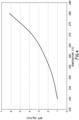
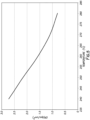
Figures 2-5 illustrate various properties of non-crosslinked peroxydicarbonate-branched polypropylenes useful in embodiments herein. -
Figure 6A illustrates a component part formed having a uniform polymer structure.Figure 6B and 6C , in comparison, illustrate possible component parts having sections of differing properties that may be produced using a single non-crosslinked peroxydicarbonate-branched polypropylene according to embodiments herein. - Fused Filament Fabrication (FFF) and Arburg Plastic Freeforming (APF), as noted above, are methods of rapid prototyping. The process works by laying down consecutive layers of material at high temperatures, allowing the adjacent layers to cool and bond together before the next layer is deposited.
- Referring to
Figure 1 , during the Fused Filament Fabrication process, afilament 10 may be fed from aspool 11 to anextruder 12. The extruder may use torque and apinch system 14 to feed and retract the filament as needed. Aheater block 16 melts the filament at an appropriate temperature, and the heated filament is forced out of theheated nozzle 18, laying down the extrudedmaterial 20 where it is needed. Theprint head 8 and/or thebed 20 may be moved to the correct X/Y/Z position for placing the material as the printing process proceeds. - While described with respect to a particular type of Fused Filament Fabrication process and illustrating a single spool, those of skill in the art will appreciate that there are many different types of Fused Filament Fabrication systems, many of which may include multiple spools and multiple print heads. Likewise, one skilled in the art may appreciate that Arburg Plastic Freeforming systems, such as those that may use pellets or flakes of polymer, may similarly extrude and print a polymer into a three-dimensional object.
- Embodiments disclosed herein relate to use of a non-crosslinked branched polypropylene to provide one or more of decreased cost, improved extrudability, and ability to vary properties of the printed filament. Embodiments disclosed herein provide a Fused Filament Fabrication or Arburg Plastic Freeforming process using a non-crosslinked branched polypropylene that may show improved extrudability, which is especially important for FFF and APF Additive Manufacturing. The finished parts formed from non-crosslinked branched polypropylenes according to embodiments herein may exhibit toughness or ductility and tensile properties suitable for FFF and APF. The non-crosslinked branched polypropylenes according to embodiments herein may have a melt stability that may support high resolution and thin-wall part printing. The non-crosslinked branched polypropylenes according to embodiments herein may also have temperature sensitivity, allowing for an in-process change of the polymer flow properties and structure, which enables the printing of single layers or layer sections, and thus influencing the mechanical properties (tensile modulus and impact strength) and shrinkage in x-y-z dimensions, without changing the polymer.
- Non-crosslinked branched polypropylenes useful in embodiments herein may include non-crosslinked peroxydicarbonate-branched polypropylenes.
- The term "polypropylene" ("PP") as used herein refers to polymers or mixtures of polymers containing at least 50% by weight of polymerized propylene. Polymerization catalysts may be Ziegler-Natta, metallocene or other types of catalysts giving stereospecific polymerization of propylene. Polypropylenes useful in embodiments herein may include homopolymers of propylene; random, alternating, or block copolymers; or random, alternating, or block terpolymers of propylene and another olefin. Generally, a propylene copolymer or terpolymer will contain one or more other olefins, such as ethylene, butene, pentene, hexene, heptene, or octene, but it may also comprise other olefinically unsaturated monomers or combinations of these, such as acrylates, styrene, styrene derivatives, acrylonitrile, vinyl acetate, vinylidene chloride, and vinyl chloride. In some embodiments, the content of olefins other than propylene is less than 30% by weight of the copolymer. In particular embodiments, polypropylenes useful in embodiments herein include homopolymers of propylene, copolymers of propylene and ethylene or mixtures of polypropylene and polyethylene containing not more than 10% by weight of polymerized ethylene.
- Branching of the polypropylene may be effected by contact of the polypropylene at an appropriate temperature with a peroxydicarbonate.
- Suitable examples of peroxydicarbonates have the formula the formula R1-OC(O)OOC(O)O-R2, wherein R1 and R2 are independently selected from the group consisting of CH3, 2-i-C3H7O-C6H4, C2H5CH(CH3), 4-CH3-C6H4, Cl3CC(CH3)2, C7H15, c-C6H11CH2, 3-t-C4H9-C6H5, Cl3Si(CH2)3, C6H5, CH3CH(OCH3)CH2CH2, C6H5OCH2CH2, C6H5CH2, Z-C8H17CH=CH(CH2)8, 2-CH3-C6H4, (CH3)2CHCH2CH(CH3), 3,4-di-CH3-C6H3, Cl3C, CHCH(Cl), ClCH2, [C2H5OC(O)]2CH(CH3), 3,5-di-CH3-C6H3, C8H17, C2H5, C18H37, 2-oxo-1,3-dioxolan-4-CH2, C2H5CH(Cl)CH2, 4-CH3O-C6H4, i-C4H9, CH3SO2CH2CH2, C12H25, C6H5CH(Cl)CH2, H2C=CHC(O)OCH2CH2, 4-NO2-C6H4, C4H9, C10H21, C4H9CH(C2H5)CH2, H2C=CHCH2, 2-Cl-c-C6H10, H2C=C(CH3)CH2, c-C6H11, ClCH2CH2, 4-[C6H5-N=N]-C6H4CH2, C16H33, 1-naphtyl, 4-t-C4H9-C6H10, 2,4, 5-tri-Cl-C6H2, Cl(CH2)3, C14H29, 9-fluorenyl, 4-NO2-C6H4CH2, 2-i-C3H7-C6H4, CH3OCH2CH2, H2C=C(CH3), 3-CH3-C6H4, BrCH2CH2, 3-CH3-5-i-C3H7-C6H3Br3CCH2, C2H5OCH2CH2, 4-CH3OC(O)-C6H4, H2C=CH, i-C3H7, 2-C2H5CH(CH3)-C6H4, Cl3CCH2, C5H11, c-C12H23, 4-t-C4H9-C6H4, C6H13, C3H7, CH3OCH2CH2, C6H13CH(CH3), CH3OC(CH3)2CH2CH2, C3H7OCH2CH2, CH3OCH2CH(CH3), 2-i-C3H7-5-CH3-c-C6H9, C4H9OCH2CH2, t-C4H9, (CH3)3CCH2, wherein i=iso, t=tertiary, Z=cis, and c=cyclic.
- In some embodiments, the peroxydicarbonate may include bis(4-tert-butylcyclohexyl) peroxydicarbonate, dicetyl peroxydicarbonate, and dimyristyl peroxydicarbonate, which peroxides are solid at room temperature, and diisopropylperoxydicarbonate, di-n-butylperoxydicarbonate and bis(2-ethylhexyl)peroxydicarbonate, which are liquid at room temperature, either pure or as a solution in isododecane. Optionally, a combination of peroxydicarbonates or peroxydicarbonates and other peroxides may be employed in order to influence the melt flow index of the (co)polymer and/or enhance the degree of modification of the (co)polymer.
- The quantity of peroxydicarbonate to be used will be dependent on the desired degree of PP modification and on the PP employed. Preferably, use is made of peroxydicarbonate at concentrations of up to about 5 meq (= milliequivalents = millimoles of peroxide) per 100 g PP. For example, peroxydicarbonates may be used at a concentration in the range from a lower limit of 0.05, 0.1, 0.15, 0.2, 0.25 to1 meq/100g PP to an upper limit of 5 meq/100g PP, where any lower limit may be combined with any upper limit. The preferable concentration range is from 0.5 to 3.0 meq/100g PP. It has been found that the increase of branching produced by addition of up to 0.445 meq/100g PP peroxydicarbonate (PERKADOX 24L) in the polypropylene reduces the shear viscosity and provides easier flow with less pressure build-up in the die/nozzle, which is beneficial for fast 3D printing. In general, however, it has been found that higher peroxydicarbonate concentrations, such as greater than 0.445 meq/100g PP leads to an increase of the shear viscosity and hence, higher pressure drop in the die/nozzle. The overall higher pressure drop at concentrations greater than 0.445 meq/100g PP is owed due to a more pronounced decreasing MFR at these concentration ranges of peroxydicarbonate. This means that the shear viscosity increase due to MFR reduction is stronger than the shear viscosity reduction caused by the more pronounce shear thinning effect with increasing Elasticity ratio or increasing branching respectively.
- For example, dosing of 0.09 meq PO/100g PP (PERKADOX 24L) increases the ER from 0.126 to 0.147 Pa (1.26 to 1.47 dyn/cm2) without influencing the MFR. Whereas dosing of 0.445 meq/100gPP (PERKADOX 24L) increases the ER to around 0.27 Pa (2.7 dyn/cm2) and decreases the MFR from 1.6 to 1.0 g/10min. This means the minimum dosing of peroxydicarbonate to have an effect on ER is 0.09 meq/100 gPP. As mentioned above this increase of ER does not show an effect on MFR, but has an influence in the shear behavior of the polymer showing easer flow in the thin nozzle of the 3D printer. For the printed product the tensile modulus will increase by approx. 120 MPa by adding 0.09 meq/100g PP. At slightly higher concentrations a clear increase of both, ER and MFR, can be observed.
- This means using PERKADOX 24L concentrations of > 0.09 meq/100gPP show the effect expected by the invention while using the polymer for FFF or APF printing. Another parameter which is influenced by the addition of branches is the recrystallization temperature (Tc). For example, a non-branched random-PP shows a Tc or around 100°C whereas a non-crosslinked branched random-PP (0.445 meq/100g PP) shows a Tc of 108°C. This increase of Tc while using peroxidicarbonate (PERKADOX 24L) will show faster solidification during the printing process and will therefore improve the overall process and the exactness of the printed product.
- Peroxydicarbonate-branched polypropylenes may be formed, for example, by heating a mixture of polypropylene and peroxydicarbonate. The reaction may be performed, for example, in a fluidized bed, melt-kneader, or an extruder, at a temperature ranging from room temperature up to 300°C, where the temperature conditions may depend upon one or more factors including the half-life temperature of the peroxydicarbonate, the melting point of the polypropylene, and the residence time in the reactor, among other variables. Processes to produce peroxydicarbonate-branched polypropylenes may include use of solid peroxydicarbonates, solutions of peroxydicarbonates in hydrocarbon solvents, and aqueous mixtures or emulsions. Various processes to produce peroxydicarbonate-branched polypropylenes are described in, for example,
US6323289 ,EP0384431 ,US20020043643 ,US5416169 ,US6103833 ,US20110245425 ,WO2010077394 , andWO2002096960 , among others. - For use in FFF processes, the peroxydicarbonate-branched polypropylene may be extruded, drawn into a filament, and wound on a spool. Filament diameters may be, for example, in the range of 1 to 3 mm in some embodiments. The diameter of the filament desired may depend upon the printer, however, and other diameters may be used.
- In other reference embodiments not according to the invention, a polypropylene may be extruded and drawn into a filament, then infused with a peroxydicarbonate. The peroxydicarbonate and the polypropylene may then react within the extruder of the printing head and heater, resulting in discharge of a non-crosslinked peroxydicarbonate branched polypropylene from the printer head. Likewise, powder, pellets or flakes may be infused with a peroxydicarbonate for feed to an FFF printer.
- Embodiments disclosed herein thus provide a process for printing a three-dimensional object. The process may include providing a non-crosslinked peroxydicarbonate-branched polypropylene filament adapted for a fused filament fabrication printer, and printing the filament with the fused filament fabrication printer to form a three-dimensional article. In other embodiments, the process may include providing a non-crosslinked peroxydicarbonate-branched polypropylene, in powder, pellet, or flake form, to a fused deposition modeling printer, and printing the polymer with the fused deposition modeling printer to form a three-dimensional article. Printing of the non-crosslinked peroxydicarbonate-branched polypropylene may occur, for example, at extrusion temperatures in the range from 180°C to about 300°C. The typical and more preferred temperature range is from 190°C to about 240°C.
- The peroxydicarbonate-branched polypropylene, as noted above, may include a polypropylene branched by reaction with up to 5 meq/100g PP peroxydicarbonate. For example, the peroxydicarbonate-branched polypropylene comprises a polypropylene branched by reaction with 0.09 meq/100g PP to 0.445 meq/100g PP peroxydicarbonate or by reaction with concentrations > 0.4450. wt% to 5 meq/100g PP peroxydicarbonate.
- The peroxydicarbonate-branched polypropylene is not cross-linked, prior to, during, or after FFF or APF printing. It has been found that non-crosslinked peroxydicarbonate-branched polypropylenes according to embodiments herein provide an improved extrudability and the ability to vary properties of the printed part, among other advantages.
- To take advantage of the properties of the peroxydicarbonate-branched polypropylenes, FFF and APF printers or printing systems include a control system that selectively varies the temperature of the extruder, extruder nozzle, or the print head in general, or may be linked to a computer capable of controlling the temperature. By changing the extruder or nozzle temperature or the print head in general, the print speed (residence time in extruder), or other conditions, the extent of branching and the flow properties of the polypropylene may be influenced according to the requirements of the part, as will be explained further below. The ability to influence the properties of the printed polymer may thus provide a printed object having different mechanical sections or fractions from only one polymer.
- The extent of branching of a non-crosslinked branched polypropylene is defined by the concentration of peroxydicarbonate and the extrusion conditions (temperature and pressure) during the production of the non-crosslinked branched polypropylene. This means using a certain concentration of peroxydicarbonate and a certain extrusion temperature will create a certain amount of branches on the backbone of the polymer chain. The particular extent of branches during the 3D printing process is subsequently dependent on the actual printing temperature. An increase of the printing temperature will reduce the extent of branching due to decreasing stability of the branches with increasing temperature and hence result in lower ER values, and producing different flow properties and different mechanical properties. This means the maximum branching level of PP is pre-defined by the original concentration of peroxydicarbonate and the extruder settings. The extent of branches can therefore either be maintained at the pre-defined level or be reduced during the 3D printing process depending on the temperature of the printing nozzle. This means for the finish printed part that sections printed with lower temperature will show increased ductility or impact strength whereas sections printed with higher temperature will show increased stiffness.
- In some embodiments, a printing system may be provided with a single print head or nozzle which is capable of fast temperature changes. Processes disclosed herein may include varying a temperature of an extruder head of the fused filament fabrication printer to vary a property of the printed filament, thus imparting varied properties in select portions of the three-dimensional article.
- In other embodiments, a printing system may be provided with a second or multiple nozzles with different temperature settings. Processes according to such embodiments may include operating the two or more extruder heads at different temperatures to vary a property of the printed filament.
- In yet other embodiments, a printing system may be provided with two or more nozzles. A first peroxydicarbonate-branched polypropylene may be provided to a first extruder head, and a second peroxydicarbonate-branched polypropylene may be provided to a second extruder head, and so forth. The polypropylene provided to the respective extruder heads may be the same or different.
- For example, the same peroxydicarbonate-branched polypropylene may be provided to each respective head by separate spools, and the extruders may be operated at different temperatures. A computer-based program or control system may then be used to print the peroxydicarbonate-branched polypropylene from a selected extruder to print polymer having a desired property at a desired location, the extrusion temperature driving the property differences in the printed polymer portions.
- As another example, different peroxydicarbonate-branched polypropylenes may be provided to each respective head, which may be operated at the same or different temperatures. A computer-based program or control system may then be used to print the peroxydicarbonate-branched polypropylene from a selected extruder to print polymer having a desired property at a desired location, the extrusion temperature and polymer grade (peroxydicarbonate concentration or peroxydicarbonate type) each impacting the property differences in the printed polymer portions.
- Embodiments disclosed herein also relate to an article formed at least in part from a non-crosslinked peroxydicarbonate-branched polypropylene. The peroxydicarbonate-branched polypropylenes may be used in FFF and APF 3D printing systems to form virtually any type of article. The printing systems may include, for example, one or more print heads for printing filaments or droplets as appropriate for the system, to form a three-dimensional article, and one or more spools or feed systems for providing a non-crosslinked peroxydicarbonate-branched polypropylene to a respective print head.
- As described above, polypropylenes useful in embodiments herein include polypropylenes modified using a certain concentration of peroxydicarbonate without any additional cross-linking agent to generate exclusively chain branching and no cross-linking. In contrast to cross-linked polypropylenes, branched polymers provide the potential of viscose stretching in which dis-entanglement of the polymer chains will occur which is necessary for filament production. In contrast to cross-linked polymers, the high throughput and stable fabrication of filaments with the branched polypropylenes described herein is actually possible, as shown by Rheotens experiments measuring the extensional properties of polymer melts.
- In FFF and APF 3D printing, the polymer is extruded through very small diameter nozzles. The non-crosslinked, peroxydicarbonate-branched polypropylenes described herein may show improved flow properties, making the printing easier and faster. Further, it has been observed that the non-crosslinked, peroxydicarbonate-branched polypropylenes described herein show reduced viscosity in the channel of the nozzle and simultaneously provides higher melt strength outside the nozzle compared to other polypropylene resins, including mentioned prior art polymers. The detected properties of the non-crosslinked, peroxydicarbonate-branched polypropylenes described herein make the use in FFF and APF preferable. The branching is subsequently responsible for the claimed improved impact strength and tensile modulus.
- The increase of the recrystallization temperature and the higher melt strength of the non-crosslinked, peroxydicarbonate-branched polypropylenes described herein enable a faster 3D printing of high resolution finish parts. Due to the temperature sensitivity of the non-crosslinked, peroxydicarbonate-branched polypropylenes described herein, it is possible to change the branching ratio of the polymer during the 3D printing process. Changing the branching ratio will directly influence the flow properties of the polymer and hence also the impact strength and tensile properties of the final 3D printed part.
- Precondition for the change of the branching ratio and MFR is a rapid or very fast temperature adjustment of the FFF APF 3D printing nozzle and/or ducts to the nozzle. The process mode with rapid or very fast nozzle temperature change (or the use of two or multi printing nozzles) enables the printing of layer or layer sections with different mechanical properties. Depending on the arrangement of these layer sections, the anisotropic characteristics of the finished 3D printed part can be adjusted (usually 3D printed parts show very anisotropic performances in the x-y and z dimension). Finally, the concept of rapid nozzle temperature change provides in addition the possibility to print 3D finish products with different behaviors from only one polypropylene grade.
- One difference of embodiments herein over currently existing printing systems is that the polypropylene is only branched, not cross-linked. In comparison to crosslinked PP, the non-crosslinked, peroxydicarbonate-branched polypropylenes described herein can be effectively spun into filaments for FFF printing technology or may be readily extruded using APF printing technology. The cross-linked PP requires, besides a peroxide, additional cross-linking agents and processing steps which makes the final polymer less cost efficient. Cross-linked polymers cannot be extruded and are generally excluded from FFF and APF technologies. Additionally, the high temperature sensitivity of the PP during the 3D printing process is not given by crosslinked PP, hence an influence on the anisotropy of the finish part is therefore not possible with cross-linked polypropylenes.
- In comparison to standard PP, the non-crosslinked, peroxydicarbonate-branched polypropylenes described herein provides higher impact strength and higher tensile properties. The increased melt stability in comparison to standard PP provided by non-crosslinked, peroxydicarbonate-branched polypropylenes described herein allows for printing with higher resolution and the production of thin-walled parts.
- The above-described advantages of the non-crosslinked peroxydicarbonate branched polypropylenes described herein may be illustrated by the following test results. The polypropylene used was random co-polymer with MFR of 0.5 g/10min and a co-polymer content of 3.2% and was branched with PERKADOX 24L (Dicetyl peroxydicarbonate) as the peroxydicarbonate. The branching process included mixing the polymer powder with a standard stabilizer package and the corresponding concentration of PERKADOX 24L for 4 hours in a tumbling mixer followed by feeding the blend into the extruder. During the extrusion at 190°C the branching reaction takes place. The changes of the flow properties and the Elasticity Ratio are determined by the temperature of the extrusion and the concentration of the peroxydicarbonate. The non-crosslinked peroxydicarbonate-branched polypropylene strand exiting the extruder die is quenched in a water bath and subsequently pelletized and dried. Without any further work step the pellets are ready to be used for filament extrusion for subsequent FFF printing or can be fed directly into the extruder of the APF printing system.
- The integrity of a freshly built 3D layer is supported by the higher melt strength of non-crosslinked peroxydicarbonate-branched polypropylenes described herein.
Figure 3 , for example, shows the increase of the melt strength with increasing concentration of peroxydicarbonate or branching respectively. - Integrity and fast re-crystallization (higher re-crystallization temperature), which is also supported by the non-crosslinked, peroxydicarbonate-branched polypropylenes described herein, enables the FFF and APF 3D printing of accurate thin-wall parts with high resolution. The re-crystallization temperature, as measured by DSC according to ISO 11357 using a cool down rate of 10°C/min is shown in Table 1.
Table 1. Concentration Peroxydicarbonate (Perkadox 24L) [meq/100g PP] 0 % standard random-PP 0,445 0,875 1,32 1,75 Re-crystallisation temp. Tc [°C] 100,2 108,0 109,3 109,9 110,5 - Table 2 shows the effect of the non-crosslinked, peroxydicarbonate-branched polypropylenes described herein with increasing concentration of peroxydicarbonate or increasing branching, respectively. The improved Tensile modulus and Yield strength in comparison to a standard Polypropylene resin demonstrates the positive effects of the non-crosslinked, peroxydicarbonate-branched polypropylenes described herein on the stability and rigidity of the finish printed part. The increase of the Tensile modulus and Yield strength is occurring without impacting the Charpy impact strength, meaning the ductility of the finished 3D printed part is not negatively influenced. Tensile modulus, tensile yield strength and Charpy Impact were measured by the respective test procedure according to the standards ISO 527-2 for Tensile modulus and Tensile yield strength and ISO 179/1eA for Charpy impact strength.
Table 2 Concentration Peroxydicarbonate (Perkadox 24L) [meq/100g PP] 0 (standard PP) 0,09 0,175 0,445 Tensile Modulus [MPa] 728 850 869 922 Tensile Yield Stress [MPa] 24,8 25,4 25,7 27,0 Charpy Impact @ 23°C [kJ/m2] 64 66 68 59 - The extent of Polymer branching can indirectly be quantified by shear experiments using Dynamic Oscillatory Rate Sweep (DORS). The value for the Elasticity Ratio (ER) obtained by the DORS analysis of the polymer reflects the extent of the branching. The higher the ER the higher is the branching of the polymer. The DORS measurement are accomplished by using a plate-to-plate shear rheometer measuring continuously the torque and angular position to obtain the total energy G* (complex shear modulus) required to deform the molten polymer. The measurement is conducted at a temperature of 190°C over a frequency range between 0.025 and 400 rad/s. The corresponding Storage Modulus G' and the Loss Modulus G" are obtained from the complex shear modulus G*. The corresponding Moduli are calculated by G'=G* cos(y) and G''= G* sin(y) (γ is the phase shift between the imposed strain and the response of the polymer at the sinusoidal stress input). The ER is based on the relationship between G' and G" as following, ER=1.781E-3 G'(at G''=500 Pa). Table 3 shows an example of the dependency of peroxydicarbonate concentration on ER and hence the extent of branching.
Table 3 Concentration Peroxydicarbonate (Perkadox 24L) [meq/100g PP] 0 (standard PP) 0,09 0,175 0,445 0,875 Elasticity Ratio Pa ([dyn/cm2] 0.126 (1,26) 0.147 (1,47) 0.179 (1,79) 0.268 (2,68) 0.312 (3,12) - A further aspect of embodiments herein is the distinct temperature sensitivity of the non-crosslinked, peroxydicarbonate-branched polypropylenes described herein. While changing the extruder or nozzle temperature, the extent of branching (ER) and the flow properties (MFR) can be influenced according to the requirements. This special feature provides the possibility to produce or print a finish part with different mechanical sections/fractions (like 2-component injection molding) from only one polymer. Therefore, to take advantage of such properties, a printing nozzle capable of fast temperature changes or a second (or multiple) nozzle with different temperatures settings may be used.
Figures 4 and5 show the high temperature dependencies of MFR and branching extent. - The capability of influencing the mechanical properties through temperature dependent branching, within a printed part may eliminate the issue of all additive manufacturing technologies - the un-isotropy of the finish part. This un-isotropy is especially dominant comparing the x-y and z-dimensions due to the fact that the plastic 3D part is build-up in x-y layers.
- Changing the mechanical characteristics of the polymer during FFF and APF 3D printing processes can also create preferable direction of force lines.
Figures 6A-6C demonstrate the influence on the mechanical isotropy that may be achieved using the non-crosslinked, peroxydicarbonate-branched polypropylenes disclosed herein. With the condition that different MFRs or ERs of the resin are providing differences in the mechanical properties (dark areas exhibit different ER and MFR than bright areas), the direction of the main force-lines change according to the intended arrangement. - As described above, embodiments disclosed herein provide for non-crosslinked, peroxydicarbonate-branched polypropylenes and their advantageous use in 3D printing processes, such as Fused Filament Fabrication or Arburg Plastic Freeforming. The 3D printing non-crosslinked, peroxydicarbonate-branched polypropylene grades show improved extrudability, which is especially important for FFF Additive Manufacturing. The melt stability of polypropylenes herein will support high resolution and thin-wall part printing. The temperature sensitivity of the non-crosslinked peroxydicarbonate-branched polypropylenes allows for an in-process change of the polymer flow properties and structure which enables the printing of single layers or layer sections and thus influencing the mechanical properties (tensile modulus and impact strength) and shrinkage in x-y-z dimensions without changing the polymer.
- While the disclosure includes a limited number of embodiments, those skilled in the art, having benefit of this disclosure, will appreciate that other embodiments may be devised which do not depart from the scope of the present disclosure. Accordingly, the scope should be limited only by the attached claims. For example, unless explicitly stated otherwise, the embodiments described herein may be combined together to form further embodiments of the disclosure.
Claims (14)
- A process for printing a three-dimensional object, comprising:providing a non-crosslinked peroxydicarbonate-branched polypropylene filament, flake, pellet, or powder adapted for one of a fused deposition modeling printer or a fused filament fabrication printer;printing the non-crosslinked peroxydicarbonate-branched polypropylene with a fused deposition modeling printer or a fused filament fabrication printer to form a three-dimensional article; andselectively varying a temperature of a print head extruder, a print head extruder nozzle or at least one print head of the printer to vary a property of the printed polypropylene, thus imparting varied properties in selected portions of the three-dimensional article.
- The process of claim 1, wherein the peroxydicarbonate-branched polypropylene comprises a polypropylene branched by reaction with up to 5 meq/100g PP peroxydicarbonate.
- The process of claim 1 or claim 2, wherein the peroxydicarbonate-branched polypropylene comprises a polypropylene branched by reaction with 0.09 meq/100g PP to 1.75 meq/100g PP peroxydicarbonate.
- The process of any one of claims 1-3, wherein the peroxydicarbonate-branched polypropylene comprises a polypropylene branched by reaction with 0.4 meq/100g PP to 1.4 meq/100g PP peroxydicarbonate.
- The process of any one of claims 1-4, wherein the peroxydicarbonate-branched polypropylene comprises a polypropylene branched by reaction with a peroxydicarbonate selected from the group consisting of: bis(4-tert-butylcyclohexyl) peroxydicarbonate, dicetyl peroxydicarbonate, and dimyristyl peroxydicarbonate.
- The process of any one of claims 1-5, wherein the peroxydicarbonate-branched polypropylene is not cross-linked, prior to, during, or after printing.
- The process of any one of claims 1-6, wherein the printer comprises two or more extruder heads.
- The process of claim 7, the process further comprising operating the two or more extruder heads at different temperatures to vary a property of the printed section.
- The process of claim 7 or claim 8, the process further comprising:providing a first peroxydicarbonate-branched polypropylene to a first extruder head; andproviding a second peroxydicarbonate-branched polypropylene to a second extruder head.
- The process of claim 9, wherein the first and second peroxydicarbonate-branched polypropylene are branched by reaction with one or both of different peroxydicarbonates or differing amounts of peroxydicarbonate.
- An article comprising a non-crosslinked peroxydicarbonate-branched polypropylene formed by the process of any one of claims 1-10.
- Use of non-crosslinked peroxydicarbonate-branched polypropylene for fused filament printer and fused deposition modeling 3D printing applications, implementing the process in accordance with any of claims 1-10.
- A fused filament printer system comprising:one or more print heads for printing a three-dimensional article;means for dosing up to 5 meq peroxydicarbonate /100g polypropylene to produce a non-crosslinked peroxydicarbonate-branched polypropylene;one or more spools for providing the non-crosslinked peroxydicarbonate-branched polypropylene to a respective print head; anda computer-based program or a control system configured to selectively vary a temperature of the one or more print heads or extruder or extruder nozzle thereof to vary a property of the printed polypropylene, thus imparting varied properties in selected portions of the three-dimensional article.
- A fused deposition modeling printer system comprising:one or more print heads for printing a polymer in powder, flake, or pellet form to form a three-dimensional article;means for dosing up to 5 meq peroxydicarbonate /100g polypropylene to produce a non-crosslinked peroxydicarbonate-branched polypropylene;one or more feed systems for providing the non-crosslinked peroxydicarbonate-branched polypropylene to a respective print head; anda computer-based program or a control system configured to selectively vary a temperature of the one or more print heads or extruder or extruder nozzle thereof to vary a property of the printed polypropylene, thus imparting varied properties in selected portions of the three-dimensional article.
Applications Claiming Priority (2)
| Application Number | Priority Date | Filing Date | Title |
|---|---|---|---|
| US201662381196P | 2016-08-30 | 2016-08-30 | |
| PCT/EP2017/071675 WO2018041839A1 (en) | 2016-08-30 | 2017-08-29 | Polypropylene for additive manufacturing (3d printing) |
Publications (3)
| Publication Number | Publication Date |
|---|---|
| EP3507072A1 EP3507072A1 (en) | 2019-07-10 |
| EP3507072B1 true EP3507072B1 (en) | 2025-04-02 |
| EP3507072C0 EP3507072C0 (en) | 2025-04-02 |
Family
ID=59901470
Family Applications (1)
| Application Number | Title | Priority Date | Filing Date |
|---|---|---|---|
| EP17768681.3A Active EP3507072B1 (en) | 2016-08-30 | 2017-08-29 | Polypropylene for additive manufacturing (3d printing) |
Country Status (10)
| Country | Link |
|---|---|
| US (2) | US11559937B2 (en) |
| EP (1) | EP3507072B1 (en) |
| JP (1) | JP6810806B2 (en) |
| KR (1) | KR102237108B1 (en) |
| CN (1) | CN109789631B (en) |
| ES (1) | ES3032334T3 (en) |
| SA (1) | SA519401218B1 (en) |
| TW (1) | TWI654235B (en) |
| WO (1) | WO2018041839A1 (en) |
| ZA (1) | ZA201901853B (en) |
Families Citing this family (10)
| Publication number | Priority date | Publication date | Assignee | Title |
|---|---|---|---|---|
| WO2018204844A1 (en) | 2017-05-04 | 2018-11-08 | Lehigh University | Additive manufacturing system with tunable material properties |
| US20190061336A1 (en) * | 2017-08-29 | 2019-02-28 | Xyzprinting, Inc. | Three-dimensional printing method and three-dimensional printing apparatus using the same |
| WO2019185361A1 (en) * | 2018-03-26 | 2019-10-03 | Signify Holding B.V. | Cross-linked polymer filled polymer particles for 3d printed items |
| WO2019197582A1 (en) * | 2018-04-11 | 2019-10-17 | Total Research & Technology Feluy | 3d printed article comprising polypropylene |
| EP3758919A4 (en) * | 2018-05-17 | 2021-10-06 | Hewlett-Packard Development Company, L.P. | THREE-DIMENSIONAL PRINTING |
| ES2760148A1 (en) * | 2018-11-12 | 2020-05-13 | Triditive S L | AUTOMATED MACHINE AND ADDITIVE MANUFACTURING SYSTEM (Machine-translation by Google Translate, not legally binding) |
| US11491719B2 (en) * | 2019-01-31 | 2022-11-08 | Fujifilm Business Innovation Corp. | Shaping apparatus |
| US12226955B2 (en) | 2019-04-16 | 2025-02-18 | Aspect, Inc. | Resin powder for three-dimensional molding, three-dimensional molded article, and method for producing three-dimensional molded article |
| JP7410184B2 (en) * | 2019-06-14 | 2024-01-09 | スリーディー システムズ インコーポレーテッド | Polypropylene-based particles for additive manufacturing |
| DE102021102154A1 (en) | 2021-01-29 | 2022-08-04 | Markus Brzeski | Process for the additive manufacturing of 3D objects made of thermoplastic material |
Citations (7)
| Publication number | Priority date | Publication date | Assignee | Title |
|---|---|---|---|---|
| US6004124A (en) * | 1998-01-26 | 1999-12-21 | Stratasys, Inc. | Thin-wall tube liquifier |
| WO2015175651A1 (en) * | 2014-05-13 | 2015-11-19 | Massachusetts Institute Of Technology | Systems, devices, and methods for three-dimensional printing |
| US20160016360A1 (en) * | 2014-07-17 | 2016-01-21 | Disney Enterprises, Inc. | Three dimensional (3d) printer and filament material providing scanning protection for 3d printed objects |
| WO2016036607A1 (en) * | 2014-09-02 | 2016-03-10 | Graphene 3D Lab Inc. | Electrochemical devices comprising nanoscopic carbon materials made by additive manufacturing |
| US20160200024A1 (en) * | 2015-01-13 | 2016-07-14 | Bucknell University | Dynamically controlled screw-driven extrusion |
| US20160229122A1 (en) * | 2015-02-06 | 2016-08-11 | Fernando Andres BIENZOBAS SAFFIE | System and method for generating an image in a three-dimensionally printed object |
| KR20160099125A (en) * | 2015-02-11 | 2016-08-22 | 주식회사 씨앤비텍 | The apparatus of the printing head in a 3-D printer |
Family Cites Families (24)
| Publication number | Priority date | Publication date | Assignee | Title |
|---|---|---|---|---|
| US5047485A (en) | 1989-02-21 | 1991-09-10 | Himont Incorporated | Process for making a propylene polymer with free-end long chain branching and use thereof |
| US5648450A (en) | 1992-11-23 | 1997-07-15 | Dtm Corporation | Sinterable semi-crystalline powder and near-fully dense article formed therein |
| US5416169A (en) | 1992-11-26 | 1995-05-16 | Chisso Corporation | Polypropylene having a high melt-tensile strength, a process for producing the same and a molded product from the same |
| TW341579B (en) | 1996-06-24 | 1998-10-01 | Akzo Nobel Nv | Process for enhancing the melt strength of polypropylene (co)polymers |
| US6103833A (en) | 1997-06-12 | 2000-08-15 | Akzo Nobel N.V. | Process for enhancing the melt strength of polypropylene (co)polymers |
| UA60351C2 (en) * | 1997-11-21 | 2003-10-15 | Акцо Нобель Н.В. | AN EXTRUSION PROCESS for enhancing the MELT strength OF POLYPROPYLENE |
| US20020043643A1 (en) | 2000-08-10 | 2002-04-18 | Kinzo Korehisa | Modified polypropylene, process for preparing modified polypropylene, modified polyropylene composition and foamed product |
| US7118362B2 (en) * | 2001-05-23 | 2006-10-10 | A San Chemicals, Co., Ltd. | Pellet-type foams of non-crosslinked polypropylene resin having lower melting point and process and device for producing the same and molded foams therefrom |
| EP1397396B1 (en) | 2001-05-30 | 2005-03-23 | Basell Poliolefine Italia S.p.A. | Polypropylene resin composition |
| US7703993B1 (en) | 2008-12-17 | 2010-04-27 | National Semiconductor Corporation | Wafer level optoelectronic package with fiber side insertion |
| KR100996420B1 (en) | 2008-12-26 | 2010-11-24 | 호남석유화학 주식회사 | Excellent polypropylene resin composition and its manufacturing method |
| WO2012037329A2 (en) * | 2010-09-17 | 2012-03-22 | Stratasys, Inc. | Semi-crystalline consumable materials for use in extrusion-based additive manufacturing systems |
| US9718218B2 (en) | 2012-03-13 | 2017-08-01 | Structured Polymers, Inc. | Materials for powder-based additive manufacturing processes |
| CA3121870A1 (en) | 2013-03-22 | 2014-09-25 | Markforged, Inc. | Three dimensional printing |
| GB2515348A (en) | 2013-06-23 | 2014-12-24 | Tim Denholm | A method of 3D printing a flexible or compressible structure |
| CN103497414B (en) | 2013-08-14 | 2016-01-13 | 上海涌利材料科技有限公司 | A kind of α-crosslinked with silicane polypropylene and the application as 3D printed material thereof |
| CN103980402B (en) | 2014-04-30 | 2015-12-09 | 中国科学院化学研究所 | A kind of cross-linked polypropylene resin and its preparation method and application that can be used for 3D and print |
| CN104031316A (en) | 2014-06-09 | 2014-09-10 | 温州科力塑业有限公司 | Ultra-low density polypropylene composite material capable of being used for 3D printing and preparation method thereof. |
| CN104211876A (en) | 2014-08-26 | 2014-12-17 | 太仓碧奇新材料研发有限公司 | Polypropylene composite material for 3D printing and preparation method thereof |
| DE102014113993A1 (en) | 2014-09-26 | 2016-03-31 | Endress + Hauser Gmbh + Co. Kg | Method for producing a container for a medium |
| JP2016097588A (en) * | 2014-11-21 | 2016-05-30 | 武藤工業株式会社 | Modeling table for three-dimensional modeling apparatus, three-dimensional modeling apparatus, and manufacturing method of modeled object |
| US20160271876A1 (en) * | 2015-03-22 | 2016-09-22 | Robert Bruce Lower | Apparatus and method of embedding cable in 3D printed objects |
| KR101768890B1 (en) * | 2015-09-24 | 2017-08-17 | 주식회사 영진하이텍 | color nozzle for 3D printer |
| CN105946233A (en) * | 2016-06-17 | 2016-09-21 | 季鹏凯 | Multi-nozzle 3D spray-head, printing method, and 3D printer |
-
2017
- 2017-08-18 US US15/680,880 patent/US11559937B2/en active Active
- 2017-08-22 TW TW106128408A patent/TWI654235B/en active
- 2017-08-29 ES ES17768681T patent/ES3032334T3/en active Active
- 2017-08-29 EP EP17768681.3A patent/EP3507072B1/en active Active
- 2017-08-29 JP JP2019532193A patent/JP6810806B2/en active Active
- 2017-08-29 KR KR1020197007665A patent/KR102237108B1/en active Active
- 2017-08-29 WO PCT/EP2017/071675 patent/WO2018041839A1/en not_active Ceased
- 2017-08-29 CN CN201780053260.7A patent/CN109789631B/en active Active
-
2019
- 2019-02-27 SA SA519401218A patent/SA519401218B1/en unknown
- 2019-03-26 ZA ZA201901853A patent/ZA201901853B/en unknown
-
2023
- 2023-01-23 US US18/158,303 patent/US20230158734A1/en active Pending
Patent Citations (7)
| Publication number | Priority date | Publication date | Assignee | Title |
|---|---|---|---|---|
| US6004124A (en) * | 1998-01-26 | 1999-12-21 | Stratasys, Inc. | Thin-wall tube liquifier |
| WO2015175651A1 (en) * | 2014-05-13 | 2015-11-19 | Massachusetts Institute Of Technology | Systems, devices, and methods for three-dimensional printing |
| US20160016360A1 (en) * | 2014-07-17 | 2016-01-21 | Disney Enterprises, Inc. | Three dimensional (3d) printer and filament material providing scanning protection for 3d printed objects |
| WO2016036607A1 (en) * | 2014-09-02 | 2016-03-10 | Graphene 3D Lab Inc. | Electrochemical devices comprising nanoscopic carbon materials made by additive manufacturing |
| US20160200024A1 (en) * | 2015-01-13 | 2016-07-14 | Bucknell University | Dynamically controlled screw-driven extrusion |
| US20160229122A1 (en) * | 2015-02-06 | 2016-08-11 | Fernando Andres BIENZOBAS SAFFIE | System and method for generating an image in a three-dimensionally printed object |
| KR20160099125A (en) * | 2015-02-11 | 2016-08-22 | 주식회사 씨앤비텍 | The apparatus of the printing head in a 3-D printer |
Also Published As
| Publication number | Publication date |
|---|---|
| US20180056584A1 (en) | 2018-03-01 |
| CN109789631A (en) | 2019-05-21 |
| EP3507072A1 (en) | 2019-07-10 |
| ZA201901853B (en) | 2019-11-27 |
| TWI654235B (en) | 2019-03-21 |
| JP2019531947A (en) | 2019-11-07 |
| CN109789631B (en) | 2021-07-23 |
| SA519401218B1 (en) | 2022-05-12 |
| WO2018041839A1 (en) | 2018-03-08 |
| ES3032334T3 (en) | 2025-07-17 |
| US11559937B2 (en) | 2023-01-24 |
| TW201811901A (en) | 2018-04-01 |
| KR102237108B1 (en) | 2021-04-09 |
| US20230158734A1 (en) | 2023-05-25 |
| JP6810806B2 (en) | 2021-01-06 |
| KR20190041495A (en) | 2019-04-22 |
| EP3507072C0 (en) | 2025-04-02 |
Similar Documents
| Publication | Publication Date | Title |
|---|---|---|
| US20230158734A1 (en) | Polypropylene for additive manufacturing (3d printing) | |
| EP2673306B1 (en) | Compatibilized polypropylene heterophasic copolymer and polylactic acid blends for injection molding applications | |
| KR100890598B1 (en) | Methods and Materials for 3D Modeling | |
| EP3030402B1 (en) | A system comprising a three-dimensional printer and a printer cartridge, and a method for forming a three-dimensional object | |
| KR102509689B1 (en) | Thermoplastic compositions having improved toughness, articles therefrom and methods thereof | |
| BR112020009400A2 (en) | polyolefins having improved dimensional stability in three-dimensional printing, articles formed from them and methods for them | |
| EP4305100A1 (en) | Recycled polymer compositions and methods thereof | |
| CN107686627A (en) | 3D printing composition and 3D printing material and its preparation method and application | |
| JP2014534998A (en) | Polymers based on grafted polyolefins | |
| EP3392014A1 (en) | Method for manufacturing foam molded article, and foam molded article | |
| KR20140021682A (en) | Thermoplastic elastomers moldable under low shear conditions | |
| US8912270B2 (en) | Modified resins for blown film | |
| TW202506756A (en) | Propylene polymers for three-dimensional printing | |
| Baddour et al. | Comparing FFF and DPAM for composite specimens | |
| WO2023086361A1 (en) | Ethylene polymer blend composition for additive-manufacture feedstock | |
| JP5548495B2 (en) | Method for producing polypropylene modified resin, polypropylene modified resin | |
| CZ20004419A3 (en) | A polymer composition comprising a propylene block copolymer |
Legal Events
| Date | Code | Title | Description |
|---|---|---|---|
| STAA | Information on the status of an ep patent application or granted ep patent |
Free format text: STATUS: UNKNOWN |
|
| STAA | Information on the status of an ep patent application or granted ep patent |
Free format text: STATUS: THE INTERNATIONAL PUBLICATION HAS BEEN MADE |
|
| PUAI | Public reference made under article 153(3) epc to a published international application that has entered the european phase |
Free format text: ORIGINAL CODE: 0009012 |
|
| STAA | Information on the status of an ep patent application or granted ep patent |
Free format text: STATUS: REQUEST FOR EXAMINATION WAS MADE |
|
| 17P | Request for examination filed |
Effective date: 20190329 |
|
| AK | Designated contracting states |
Kind code of ref document: A1 Designated state(s): AL AT BE BG CH CY CZ DE DK EE ES FI FR GB GR HR HU IE IS IT LI LT LU LV MC MK MT NL NO PL PT RO RS SE SI SK SM TR |
|
| AX | Request for extension of the european patent |
Extension state: BA ME |
|
| DAV | Request for validation of the european patent (deleted) | ||
| DAX | Request for extension of the european patent (deleted) | ||
| STAA | Information on the status of an ep patent application or granted ep patent |
Free format text: STATUS: EXAMINATION IS IN PROGRESS |
|
| 17Q | First examination report despatched |
Effective date: 20201104 |
|
| GRAP | Despatch of communication of intention to grant a patent |
Free format text: ORIGINAL CODE: EPIDOSNIGR1 |
|
| STAA | Information on the status of an ep patent application or granted ep patent |
Free format text: STATUS: GRANT OF PATENT IS INTENDED |
|
| RAP3 | Party data changed (applicant data changed or rights of an application transferred) |
Owner name: LUMMUS NOVOLEN TECHNOLOGY GMBH |
|
| RIC1 | Information provided on ipc code assigned before grant |
Ipc: B29K 23/00 20060101ALN20241122BHEP Ipc: B29C 64/336 20170101ALN20241122BHEP Ipc: B29C 64/209 20170101ALN20241122BHEP Ipc: B33Y 80/00 20150101ALI20241122BHEP Ipc: B33Y 70/00 20150101ALI20241122BHEP Ipc: B33Y 30/00 20150101ALI20241122BHEP Ipc: B33Y 10/00 20150101ALI20241122BHEP Ipc: B29C 64/118 20170101ALI20241122BHEP Ipc: B29C 64/106 20170101AFI20241122BHEP |
|
| INTG | Intention to grant announced |
Effective date: 20241205 |
|
| GRAS | Grant fee paid |
Free format text: ORIGINAL CODE: EPIDOSNIGR3 |
|
| GRAA | (expected) grant |
Free format text: ORIGINAL CODE: 0009210 |
|
| STAA | Information on the status of an ep patent application or granted ep patent |
Free format text: STATUS: THE PATENT HAS BEEN GRANTED |
|
| AK | Designated contracting states |
Kind code of ref document: B1 Designated state(s): AL AT BE BG CH CY CZ DE DK EE ES FI FR GB GR HR HU IE IS IT LI LT LU LV MC MK MT NL NO PL PT RO RS SE SI SK SM TR |
|
| REG | Reference to a national code |
Ref country code: GB Ref legal event code: FG4D |
|
| REG | Reference to a national code |
Ref country code: CH Ref legal event code: EP |
|
| REG | Reference to a national code |
Ref country code: IE Ref legal event code: FG4D |
|
| REG | Reference to a national code |
Ref country code: DE Ref legal event code: R096 Ref document number: 602017088696 Country of ref document: DE |
|
| U01 | Request for unitary effect filed |
Effective date: 20250429 |
|
| U07 | Unitary effect registered |
Designated state(s): AT BE BG DE DK EE FI FR IT LT LU LV MT NL PT RO SE SI Effective date: 20250507 |
|
| REG | Reference to a national code |
Ref country code: ES Ref legal event code: FG2A Ref document number: 3032334 Country of ref document: ES Kind code of ref document: T3 Effective date: 20250717 |
|
| U20 | Renewal fee for the european patent with unitary effect paid |
Year of fee payment: 9 Effective date: 20250723 |
|
| PGFP | Annual fee paid to national office [announced via postgrant information from national office to epo] |
Ref country code: ES Payment date: 20250909 Year of fee payment: 9 |
|
| PG25 | Lapsed in a contracting state [announced via postgrant information from national office to epo] |
Ref country code: GR Free format text: LAPSE BECAUSE OF FAILURE TO SUBMIT A TRANSLATION OF THE DESCRIPTION OR TO PAY THE FEE WITHIN THE PRESCRIBED TIME-LIMIT Effective date: 20250703 |
|
| PGFP | Annual fee paid to national office [announced via postgrant information from national office to epo] |
Ref country code: NO Payment date: 20250808 Year of fee payment: 9 |
|
| PG25 | Lapsed in a contracting state [announced via postgrant information from national office to epo] |
Ref country code: PL Free format text: LAPSE BECAUSE OF FAILURE TO SUBMIT A TRANSLATION OF THE DESCRIPTION OR TO PAY THE FEE WITHIN THE PRESCRIBED TIME-LIMIT Effective date: 20250402 |
|
| PG25 | Lapsed in a contracting state [announced via postgrant information from national office to epo] |
Ref country code: HR Free format text: LAPSE BECAUSE OF FAILURE TO SUBMIT A TRANSLATION OF THE DESCRIPTION OR TO PAY THE FEE WITHIN THE PRESCRIBED TIME-LIMIT Effective date: 20250402 |
|
| PG25 | Lapsed in a contracting state [announced via postgrant information from national office to epo] |
Ref country code: RS Free format text: LAPSE BECAUSE OF FAILURE TO SUBMIT A TRANSLATION OF THE DESCRIPTION OR TO PAY THE FEE WITHIN THE PRESCRIBED TIME-LIMIT Effective date: 20250702 |
|
| PG25 | Lapsed in a contracting state [announced via postgrant information from national office to epo] |
Ref country code: IS Free format text: LAPSE BECAUSE OF FAILURE TO SUBMIT A TRANSLATION OF THE DESCRIPTION OR TO PAY THE FEE WITHIN THE PRESCRIBED TIME-LIMIT Effective date: 20250802 |
|
| PG25 | Lapsed in a contracting state [announced via postgrant information from national office to epo] |
Ref country code: SM Free format text: LAPSE BECAUSE OF FAILURE TO SUBMIT A TRANSLATION OF THE DESCRIPTION OR TO PAY THE FEE WITHIN THE PRESCRIBED TIME-LIMIT Effective date: 20250402 |
|
| PG25 | Lapsed in a contracting state [announced via postgrant information from national office to epo] |
Ref country code: CZ Free format text: LAPSE BECAUSE OF FAILURE TO SUBMIT A TRANSLATION OF THE DESCRIPTION OR TO PAY THE FEE WITHIN THE PRESCRIBED TIME-LIMIT Effective date: 20250402 |
|
| PG25 | Lapsed in a contracting state [announced via postgrant information from national office to epo] |
Ref country code: SK Free format text: LAPSE BECAUSE OF FAILURE TO SUBMIT A TRANSLATION OF THE DESCRIPTION OR TO PAY THE FEE WITHIN THE PRESCRIBED TIME-LIMIT Effective date: 20250402 |
|
| PLBE | No opposition filed within time limit |
Free format text: ORIGINAL CODE: 0009261 |
|
| STAA | Information on the status of an ep patent application or granted ep patent |
Free format text: STATUS: NO OPPOSITION FILED WITHIN TIME LIMIT |
|
| REG | Reference to a national code |
Ref country code: CH Ref legal event code: L10 Free format text: ST27 STATUS EVENT CODE: U-0-0-L10-L00 (AS PROVIDED BY THE NATIONAL OFFICE) Effective date: 20260211 |
|
| 26N | No opposition filed |
Effective date: 20260105 |
|
| REG | Reference to a national code |
Ref country code: CH Ref legal event code: H13 Free format text: ST27 STATUS EVENT CODE: U-0-0-H10-H13 (AS PROVIDED BY THE NATIONAL OFFICE) Effective date: 20260324 |
|
| PG25 | Lapsed in a contracting state [announced via postgrant information from national office to epo] |
Ref country code: MC Free format text: LAPSE BECAUSE OF FAILURE TO SUBMIT A TRANSLATION OF THE DESCRIPTION OR TO PAY THE FEE WITHIN THE PRESCRIBED TIME-LIMIT Effective date: 20250402 |
|
| PG25 | Lapsed in a contracting state [announced via postgrant information from national office to epo] |
Ref country code: CH Free format text: LAPSE BECAUSE OF NON-PAYMENT OF DUE FEES Effective date: 20250831 |
|
| GBPC | Gb: european patent ceased through non-payment of renewal fee |
Effective date: 20250829 |