EP3505591A1 - Synergized acetals composition and method for scavenging sulfides and mercaptans - Google Patents
Synergized acetals composition and method for scavenging sulfides and mercaptans Download PDFInfo
- Publication number
- EP3505591A1 EP3505591A1 EP18150087.7A EP18150087A EP3505591A1 EP 3505591 A1 EP3505591 A1 EP 3505591A1 EP 18150087 A EP18150087 A EP 18150087A EP 3505591 A1 EP3505591 A1 EP 3505591A1
- Authority
- EP
- European Patent Office
- Prior art keywords
- carbon atoms
- composition according
- group
- aldehyde
- amines
- Prior art date
- Legal status (The legal status is an assumption and is not a legal conclusion. Google has not performed a legal analysis and makes no representation as to the accuracy of the status listed.)
- Withdrawn
Links
- 239000000203 mixture Substances 0.000 title claims abstract description 164
- RWSOTUBLDIXVET-UHFFFAOYSA-N Dihydrogen sulfide Chemical class S RWSOTUBLDIXVET-UHFFFAOYSA-N 0.000 title claims description 69
- 150000001241 acetals Chemical class 0.000 title claims description 33
- 230000002000 scavenging effect Effects 0.000 title claims description 33
- 238000000034 method Methods 0.000 title claims description 23
- 150000003568 thioethers Chemical class 0.000 title description 2
- 125000004432 carbon atom Chemical group C* 0.000 claims abstract description 167
- 150000002772 monosaccharides Chemical class 0.000 claims abstract description 104
- LFQSCWFLJHTTHZ-UHFFFAOYSA-N Ethanol Chemical compound CCO LFQSCWFLJHTTHZ-UHFFFAOYSA-N 0.000 claims abstract description 85
- 150000001299 aldehydes Chemical class 0.000 claims abstract description 85
- 239000007795 chemical reaction product Substances 0.000 claims abstract description 72
- 150000001875 compounds Chemical class 0.000 claims abstract description 66
- 229920001542 oligosaccharide Polymers 0.000 claims abstract description 53
- 150000002482 oligosaccharides Chemical class 0.000 claims abstract description 51
- -1 alkylaryl amines Chemical class 0.000 claims abstract description 50
- 238000006384 oligomerization reaction Methods 0.000 claims abstract description 47
- 150000002576 ketones Chemical class 0.000 claims abstract description 40
- 239000007787 solid Substances 0.000 claims abstract description 33
- 150000001412 amines Chemical class 0.000 claims abstract description 32
- 125000000217 alkyl group Chemical group 0.000 claims abstract description 24
- 239000003795 chemical substances by application Substances 0.000 claims abstract description 14
- 125000002768 hydroxyalkyl group Chemical group 0.000 claims abstract description 13
- 150000003973 alkyl amines Chemical class 0.000 claims abstract description 12
- 230000001629 suppression Effects 0.000 claims abstract description 12
- 125000003118 aryl group Chemical group 0.000 claims abstract description 11
- 229910052784 alkaline earth metal Inorganic materials 0.000 claims abstract description 10
- WSFSSNUMVMOOMR-NJFSPNSNSA-N methanone Chemical compound O=[14CH2] WSFSSNUMVMOOMR-NJFSPNSNSA-N 0.000 claims abstract description 7
- 125000002877 alkyl aryl group Chemical group 0.000 claims abstract description 5
- WSFSSNUMVMOOMR-UHFFFAOYSA-N Formaldehyde Chemical compound O=C WSFSSNUMVMOOMR-UHFFFAOYSA-N 0.000 claims description 102
- 238000006243 chemical reaction Methods 0.000 claims description 46
- 239000007789 gas Substances 0.000 claims description 37
- OKKJLVBELUTLKV-UHFFFAOYSA-N Methanol Chemical compound OC OKKJLVBELUTLKV-UHFFFAOYSA-N 0.000 claims description 36
- XLYOFNOQVPJJNP-UHFFFAOYSA-N water Substances O XLYOFNOQVPJJNP-UHFFFAOYSA-N 0.000 claims description 36
- QGZKDVFQNNGYKY-UHFFFAOYSA-N Ammonia Chemical compound N QGZKDVFQNNGYKY-UHFFFAOYSA-N 0.000 claims description 24
- 150000002373 hemiacetals Chemical class 0.000 claims description 20
- 238000009472 formulation Methods 0.000 claims description 17
- 230000008569 process Effects 0.000 claims description 17
- LYCAIKOWRPUZTN-UHFFFAOYSA-N Ethylene glycol Chemical compound OCCO LYCAIKOWRPUZTN-UHFFFAOYSA-N 0.000 claims description 15
- 230000015572 biosynthetic process Effects 0.000 claims description 15
- 125000003277 amino group Chemical group 0.000 claims description 13
- 239000002253 acid Chemical group 0.000 claims description 12
- 229910021529 ammonia Inorganic materials 0.000 claims description 12
- 239000012530 fluid Substances 0.000 claims description 11
- 150000003839 salts Chemical class 0.000 claims description 11
- SRBFZHDQGSBBOR-IOVATXLUSA-N D-xylopyranose Chemical compound O[C@@H]1COC(O)[C@H](O)[C@H]1O SRBFZHDQGSBBOR-IOVATXLUSA-N 0.000 claims description 10
- KFZMGEQAYNKOFK-UHFFFAOYSA-N Isopropanol Chemical compound CC(C)O KFZMGEQAYNKOFK-UHFFFAOYSA-N 0.000 claims description 10
- PEDCQBHIVMGVHV-UHFFFAOYSA-N Glycerine Chemical compound OCC(O)CO PEDCQBHIVMGVHV-UHFFFAOYSA-N 0.000 claims description 9
- MTHSVFCYNBDYFN-UHFFFAOYSA-N diethylene glycol Chemical compound OCCOCCO MTHSVFCYNBDYFN-UHFFFAOYSA-N 0.000 claims description 9
- 239000002904 solvent Substances 0.000 claims description 9
- WQZGKKKJIJFFOK-GASJEMHNSA-N Glucose Natural products OC[C@H]1OC(O)[C@H](O)[C@@H](O)[C@@H]1O WQZGKKKJIJFFOK-GASJEMHNSA-N 0.000 claims description 8
- LRHPLDYGYMQRHN-UHFFFAOYSA-N N-Butanol Chemical compound CCCCO LRHPLDYGYMQRHN-UHFFFAOYSA-N 0.000 claims description 8
- PYMYPHUHKUWMLA-UHFFFAOYSA-N arabinose Natural products OCC(O)C(O)C(O)C=O PYMYPHUHKUWMLA-UHFFFAOYSA-N 0.000 claims description 8
- SRBFZHDQGSBBOR-UHFFFAOYSA-N beta-D-Pyranose-Lyxose Natural products OC1COC(O)C(O)C1O SRBFZHDQGSBBOR-UHFFFAOYSA-N 0.000 claims description 8
- WQZGKKKJIJFFOK-VFUOTHLCSA-N beta-D-glucose Chemical compound OC[C@H]1O[C@@H](O)[C@H](O)[C@@H](O)[C@@H]1O WQZGKKKJIJFFOK-VFUOTHLCSA-N 0.000 claims description 8
- 239000008103 glucose Substances 0.000 claims description 8
- LEQAOMBKQFMDFZ-UHFFFAOYSA-N glyoxal Chemical compound O=CC=O LEQAOMBKQFMDFZ-UHFFFAOYSA-N 0.000 claims description 8
- 229930091371 Fructose Natural products 0.000 claims description 7
- RFSUNEUAIZKAJO-ARQDHWQXSA-N Fructose Chemical compound OC[C@H]1O[C@](O)(CO)[C@@H](O)[C@@H]1O RFSUNEUAIZKAJO-ARQDHWQXSA-N 0.000 claims description 7
- 239000005715 Fructose Substances 0.000 claims description 7
- 229910052751 metal Inorganic materials 0.000 claims description 7
- 239000002184 metal Substances 0.000 claims description 7
- BDERNNFJNOPAEC-UHFFFAOYSA-N propan-1-ol Chemical compound CCCO BDERNNFJNOPAEC-UHFFFAOYSA-N 0.000 claims description 7
- 229930040373 Paraformaldehyde Natural products 0.000 claims description 6
- 150000001323 aldoses Chemical class 0.000 claims description 6
- 125000002947 alkylene group Chemical group 0.000 claims description 6
- 150000001408 amides Chemical class 0.000 claims description 6
- ZTQSAGDEMFDKMZ-UHFFFAOYSA-N butyric aldehyde Natural products CCCC=O ZTQSAGDEMFDKMZ-UHFFFAOYSA-N 0.000 claims description 6
- 238000002347 injection Methods 0.000 claims description 6
- 239000007924 injection Substances 0.000 claims description 6
- GUBGYTABKSRVRQ-XLOQQCSPSA-N Alpha-Lactose Chemical compound O[C@@H]1[C@@H](O)[C@@H](O)[C@@H](CO)O[C@H]1O[C@@H]1[C@@H](CO)O[C@H](O)[C@H](O)[C@H]1O GUBGYTABKSRVRQ-XLOQQCSPSA-N 0.000 claims description 5
- IAYPIBMASNFSPL-UHFFFAOYSA-N Ethylene oxide Chemical compound C1CO1 IAYPIBMASNFSPL-UHFFFAOYSA-N 0.000 claims description 5
- 208000007976 Ketosis Diseases 0.000 claims description 5
- GUBGYTABKSRVRQ-QKKXKWKRSA-N Lactose Natural products OC[C@H]1O[C@@H](O[C@H]2[C@H](O)[C@@H](O)C(O)O[C@@H]2CO)[C@H](O)[C@@H](O)[C@H]1O GUBGYTABKSRVRQ-QKKXKWKRSA-N 0.000 claims description 5
- CZMRCDWAGMRECN-UGDNZRGBSA-N Sucrose Chemical compound O[C@H]1[C@H](O)[C@@H](CO)O[C@@]1(CO)O[C@@H]1[C@H](O)[C@@H](O)[C@H](O)[C@@H](CO)O1 CZMRCDWAGMRECN-UGDNZRGBSA-N 0.000 claims description 5
- 229930006000 Sucrose Natural products 0.000 claims description 5
- WQZGKKKJIJFFOK-PHYPRBDBSA-N alpha-D-galactose Chemical compound OC[C@H]1O[C@H](O)[C@H](O)[C@@H](O)[C@H]1O WQZGKKKJIJFFOK-PHYPRBDBSA-N 0.000 claims description 5
- 125000004122 cyclic group Chemical group 0.000 claims description 5
- 150000002016 disaccharides Chemical class 0.000 claims description 5
- 125000001033 ether group Chemical group 0.000 claims description 5
- 229930182830 galactose Natural products 0.000 claims description 5
- 150000002584 ketoses Chemical class 0.000 claims description 5
- 239000008101 lactose Substances 0.000 claims description 5
- 239000005720 sucrose Substances 0.000 claims description 5
- BBMCTIGTTCKYKF-UHFFFAOYSA-N 1-heptanol Chemical compound CCCCCCCO BBMCTIGTTCKYKF-UHFFFAOYSA-N 0.000 claims description 4
- IKHGUXGNUITLKF-UHFFFAOYSA-N Acetaldehyde Chemical compound CC=O IKHGUXGNUITLKF-UHFFFAOYSA-N 0.000 claims description 4
- SXRSQZLOMIGNAQ-UHFFFAOYSA-N Glutaraldehyde Chemical compound O=CCCCC=O SXRSQZLOMIGNAQ-UHFFFAOYSA-N 0.000 claims description 4
- AMQJEAYHLZJPGS-UHFFFAOYSA-N N-Pentanol Chemical compound CCCCCO AMQJEAYHLZJPGS-UHFFFAOYSA-N 0.000 claims description 4
- NBBJYMSMWIIQGU-UHFFFAOYSA-N Propionic aldehyde Chemical compound CCC=O NBBJYMSMWIIQGU-UHFFFAOYSA-N 0.000 claims description 4
- DKGAVHZHDRPRBM-UHFFFAOYSA-N Tert-Butanol Chemical compound CC(C)(C)O DKGAVHZHDRPRBM-UHFFFAOYSA-N 0.000 claims description 4
- 150000004982 aromatic amines Chemical class 0.000 claims description 4
- 150000002148 esters Chemical class 0.000 claims description 4
- 125000000524 functional group Chemical group 0.000 claims description 4
- 229940015043 glyoxal Drugs 0.000 claims description 4
- ZSIAUFGUXNUGDI-UHFFFAOYSA-N hexan-1-ol Chemical compound CCCCCCO ZSIAUFGUXNUGDI-UHFFFAOYSA-N 0.000 claims description 4
- ZXEKIIBDNHEJCQ-UHFFFAOYSA-N isobutanol Chemical compound CC(C)CO ZXEKIIBDNHEJCQ-UHFFFAOYSA-N 0.000 claims description 4
- 125000002496 methyl group Chemical group [H]C([H])([H])* 0.000 claims description 4
- 229920002866 paraformaldehyde Polymers 0.000 claims description 4
- 229920000642 polymer Polymers 0.000 claims description 4
- OWEGMIWEEQEYGQ-UHFFFAOYSA-N 100676-05-9 Natural products OC1C(O)C(O)C(CO)OC1OCC1C(O)C(O)C(O)C(OC2C(OC(O)C(O)C2O)CO)O1 OWEGMIWEEQEYGQ-UHFFFAOYSA-N 0.000 claims description 3
- POAOYUHQDCAZBD-UHFFFAOYSA-N 2-butoxyethanol Chemical compound CCCCOCCO POAOYUHQDCAZBD-UHFFFAOYSA-N 0.000 claims description 3
- GUBGYTABKSRVRQ-CUHNMECISA-N D-Cellobiose Chemical compound O[C@@H]1[C@@H](O)[C@H](O)[C@@H](CO)O[C@H]1O[C@@H]1[C@@H](CO)OC(O)[C@H](O)[C@H]1O GUBGYTABKSRVRQ-CUHNMECISA-N 0.000 claims description 3
- WQZGKKKJIJFFOK-QTVWNMPRSA-N D-mannopyranose Chemical compound OC[C@H]1OC(O)[C@@H](O)[C@@H](O)[C@@H]1O WQZGKKKJIJFFOK-QTVWNMPRSA-N 0.000 claims description 3
- HMFHBZSHGGEWLO-SOOFDHNKSA-N D-ribofuranose Chemical compound OC[C@H]1OC(O)[C@H](O)[C@@H]1O HMFHBZSHGGEWLO-SOOFDHNKSA-N 0.000 claims description 3
- GUBGYTABKSRVRQ-PICCSMPSSA-N Maltose Natural products O[C@@H]1[C@@H](O)[C@H](O)[C@@H](CO)O[C@@H]1O[C@@H]1[C@@H](CO)OC(O)[C@H](O)[C@H]1O GUBGYTABKSRVRQ-PICCSMPSSA-N 0.000 claims description 3
- GOOHAUXETOMSMM-UHFFFAOYSA-N Propylene oxide Chemical compound CC1CO1 GOOHAUXETOMSMM-UHFFFAOYSA-N 0.000 claims description 3
- PYMYPHUHKUWMLA-LMVFSUKVSA-N Ribose Natural products OC[C@@H](O)[C@@H](O)[C@@H](O)C=O PYMYPHUHKUWMLA-LMVFSUKVSA-N 0.000 claims description 3
- HMFHBZSHGGEWLO-UHFFFAOYSA-N alpha-D-Furanose-Ribose Natural products OCC1OC(O)C(O)C1O HMFHBZSHGGEWLO-UHFFFAOYSA-N 0.000 claims description 3
- PYMYPHUHKUWMLA-WDCZJNDASA-N arabinose Chemical compound OC[C@@H](O)[C@@H](O)[C@H](O)C=O PYMYPHUHKUWMLA-WDCZJNDASA-N 0.000 claims description 3
- GUBGYTABKSRVRQ-QUYVBRFLSA-N beta-maltose Chemical compound OC[C@H]1O[C@H](O[C@H]2[C@H](O)[C@@H](O)[C@H](O)O[C@@H]2CO)[C@H](O)[C@@H](O)[C@@H]1O GUBGYTABKSRVRQ-QUYVBRFLSA-N 0.000 claims description 3
- 150000002191 fatty alcohols Chemical class 0.000 claims description 3
- 125000005027 hydroxyaryl group Chemical group 0.000 claims description 3
- 229960004592 isopropanol Drugs 0.000 claims description 3
- ZIBGPFATKBEMQZ-UHFFFAOYSA-N triethylene glycol Chemical compound OCCOCCOCCO ZIBGPFATKBEMQZ-UHFFFAOYSA-N 0.000 claims description 3
- HDTRYLNUVZCQOY-UHFFFAOYSA-N α-D-glucopyranosyl-α-D-glucopyranoside Natural products OC1C(O)C(O)C(CO)OC1OC1C(O)C(O)C(O)C(CO)O1 HDTRYLNUVZCQOY-UHFFFAOYSA-N 0.000 claims description 2
- NAWXUBYGYWOOIX-SFHVURJKSA-N (2s)-2-[[4-[2-(2,4-diaminoquinazolin-6-yl)ethyl]benzoyl]amino]-4-methylidenepentanedioic acid Chemical compound C1=CC2=NC(N)=NC(N)=C2C=C1CCC1=CC=C(C(=O)N[C@@H](CC(=C)C(O)=O)C(O)=O)C=C1 NAWXUBYGYWOOIX-SFHVURJKSA-N 0.000 claims description 2
- SVBWNHOBPFJIRU-UHFFFAOYSA-N 1-O-alpha-D-Glucopyranosyl-D-fructose Natural products OC1C(O)C(O)C(CO)OC1OCC1(O)C(O)C(O)C(O)CO1 SVBWNHOBPFJIRU-UHFFFAOYSA-N 0.000 claims description 2
- PVXPPJIGRGXGCY-TZLCEDOOSA-N 6-O-alpha-D-glucopyranosyl-D-fructofuranose Chemical compound O[C@@H]1[C@@H](O)[C@H](O)[C@@H](CO)O[C@@H]1OC[C@@H]1[C@@H](O)[C@H](O)C(O)(CO)O1 PVXPPJIGRGXGCY-TZLCEDOOSA-N 0.000 claims description 2
- AYRXSINWFIIFAE-SCLMCMATSA-N Isomaltose Natural products OC[C@H]1O[C@H](OC[C@@H](O)[C@@H](O)[C@H](O)[C@@H](O)C=O)[C@@H](O)[C@@H](O)[C@@H]1O AYRXSINWFIIFAE-SCLMCMATSA-N 0.000 claims description 2
- MUPFEKGTMRGPLJ-RMMQSMQOSA-N Raffinose Natural products O(C[C@H]1[C@@H](O)[C@H](O)[C@@H](O)[C@@H](O[C@@]2(CO)[C@H](O)[C@@H](O)[C@@H](CO)O2)O1)[C@@H]1[C@H](O)[C@@H](O)[C@@H](O)[C@@H](CO)O1 MUPFEKGTMRGPLJ-RMMQSMQOSA-N 0.000 claims description 2
- HDTRYLNUVZCQOY-WSWWMNSNSA-N Trehalose Natural products O[C@@H]1[C@@H](O)[C@@H](O)[C@@H](CO)O[C@@H]1O[C@@H]1[C@H](O)[C@@H](O)[C@@H](O)[C@@H](CO)O1 HDTRYLNUVZCQOY-WSWWMNSNSA-N 0.000 claims description 2
- MUPFEKGTMRGPLJ-UHFFFAOYSA-N UNPD196149 Natural products OC1C(O)C(CO)OC1(CO)OC1C(O)C(O)C(O)C(COC2C(C(O)C(O)C(CO)O2)O)O1 MUPFEKGTMRGPLJ-UHFFFAOYSA-N 0.000 claims description 2
- IKHGUXGNUITLKF-XPULMUKRSA-N acetaldehyde Chemical compound [14CH]([14CH3])=O IKHGUXGNUITLKF-XPULMUKRSA-N 0.000 claims description 2
- HDTRYLNUVZCQOY-LIZSDCNHSA-N alpha,alpha-trehalose Chemical compound O[C@@H]1[C@@H](O)[C@H](O)[C@@H](CO)O[C@@H]1O[C@@H]1[C@H](O)[C@@H](O)[C@H](O)[C@@H](CO)O1 HDTRYLNUVZCQOY-LIZSDCNHSA-N 0.000 claims description 2
- 229920001577 copolymer Polymers 0.000 claims description 2
- DLRVVLDZNNYCBX-RTPHMHGBSA-N isomaltose Chemical compound O[C@@H]1[C@@H](O)[C@H](O)[C@@H](CO)O[C@@H]1OC[C@@H]1[C@@H](O)[C@H](O)[C@@H](O)C(O)O1 DLRVVLDZNNYCBX-RTPHMHGBSA-N 0.000 claims description 2
- JCQLYHFGKNRPGE-FCVZTGTOSA-N lactulose Chemical compound OC[C@H]1O[C@](O)(CO)[C@@H](O)[C@@H]1O[C@H]1[C@H](O)[C@@H](O)[C@@H](O)[C@@H](CO)O1 JCQLYHFGKNRPGE-FCVZTGTOSA-N 0.000 claims description 2
- 229960000511 lactulose Drugs 0.000 claims description 2
- PFCRQPBOOFTZGQ-UHFFFAOYSA-N lactulose keto form Natural products OCC(=O)C(O)C(C(O)CO)OC1OC(CO)C(O)C(O)C1O PFCRQPBOOFTZGQ-UHFFFAOYSA-N 0.000 claims description 2
- SLCVBVWXLSEKPL-UHFFFAOYSA-N neopentyl glycol Chemical compound OCC(C)(C)CO SLCVBVWXLSEKPL-UHFFFAOYSA-N 0.000 claims description 2
- 229920001568 phenolic resin Polymers 0.000 claims description 2
- 229920000136 polysorbate Polymers 0.000 claims description 2
- 229940068965 polysorbates Drugs 0.000 claims description 2
- MUPFEKGTMRGPLJ-ZQSKZDJDSA-N raffinose Chemical compound O[C@H]1[C@H](O)[C@@H](CO)O[C@@]1(CO)O[C@@H]1[C@H](O)[C@@H](O)[C@H](O)[C@@H](CO[C@@H]2[C@@H]([C@@H](O)[C@@H](O)[C@@H](CO)O2)O)O1 MUPFEKGTMRGPLJ-ZQSKZDJDSA-N 0.000 claims description 2
- NMXLJRHBJVMYPD-IPFGBZKGSA-N trehalulose Chemical compound O[C@H]1[C@H](O)[C@@H](CO)O[C@]1(O)CO[C@@H]1[C@H](O)[C@@H](O)[C@H](O)[C@@H](CO)O1 NMXLJRHBJVMYPD-IPFGBZKGSA-N 0.000 claims description 2
- HGBOYTHUEUWSSQ-UHFFFAOYSA-N valeric aldehyde Natural products CCCCC=O HGBOYTHUEUWSSQ-UHFFFAOYSA-N 0.000 claims description 2
- KBPLFHHGFOOTCA-UHFFFAOYSA-N 1-Octanol Chemical compound CCCCCCCCO KBPLFHHGFOOTCA-UHFFFAOYSA-N 0.000 claims 2
- DNIAPMSPPWPWGF-GSVOUGTGSA-N (R)-(-)-Propylene glycol Chemical compound C[C@@H](O)CO DNIAPMSPPWPWGF-GSVOUGTGSA-N 0.000 claims 1
- FKLJPTJMIBLJAV-UHFFFAOYSA-N Compound IV Chemical compound O1N=C(C)C=C1CCCCCCCOC1=CC=C(C=2OCCN=2)C=C1 FKLJPTJMIBLJAV-UHFFFAOYSA-N 0.000 claims 1
- 229920003171 Poly (ethylene oxide) Polymers 0.000 claims 1
- 238000006471 dimerization reaction Methods 0.000 claims 1
- 238000005755 formation reaction Methods 0.000 claims 1
- 239000003513 alkali Substances 0.000 abstract description 4
- 229940083124 ganglion-blocking antiadrenergic secondary and tertiary amines Drugs 0.000 abstract description 3
- 150000001342 alkaline earth metals Chemical class 0.000 abstract description 2
- 235000019441 ethanol Nutrition 0.000 description 71
- HEMHJVSKTPXQMS-UHFFFAOYSA-M Sodium hydroxide Chemical compound [OH-].[Na+] HEMHJVSKTPXQMS-UHFFFAOYSA-M 0.000 description 60
- GLUUGHFHXGJENI-UHFFFAOYSA-N Piperazine Chemical compound C1CNCCN1 GLUUGHFHXGJENI-UHFFFAOYSA-N 0.000 description 58
- 229910000037 hydrogen sulfide Inorganic materials 0.000 description 48
- HZAXFHJVJLSVMW-UHFFFAOYSA-N 2-Aminoethan-1-ol Chemical compound NCCO HZAXFHJVJLSVMW-UHFFFAOYSA-N 0.000 description 34
- 125000003396 thiol group Chemical group [H]S* 0.000 description 34
- 125000002887 hydroxy group Chemical group [H]O* 0.000 description 29
- 229960004279 formaldehyde Drugs 0.000 description 28
- 239000003921 oil Substances 0.000 description 27
- 235000019256 formaldehyde Nutrition 0.000 description 25
- 239000002516 radical scavenger Substances 0.000 description 25
- ZMANZCXQSJIPKH-UHFFFAOYSA-N Triethylamine Chemical compound CCN(CC)CC ZMANZCXQSJIPKH-UHFFFAOYSA-N 0.000 description 24
- 101100228210 Caenorhabditis elegans gly-7 gene Proteins 0.000 description 17
- 150000001298 alcohols Chemical class 0.000 description 15
- 239000000839 emulsion Substances 0.000 description 15
- 230000007797 corrosion Effects 0.000 description 13
- 238000005260 corrosion Methods 0.000 description 13
- 239000007858 starting material Substances 0.000 description 12
- 125000001931 aliphatic group Chemical group 0.000 description 11
- 125000002915 carbonyl group Chemical group [*:2]C([*:1])=O 0.000 description 11
- DHKHKXVYLBGOIT-UHFFFAOYSA-N acetaldehyde Diethyl Acetal Natural products CCOC(C)OCC DHKHKXVYLBGOIT-UHFFFAOYSA-N 0.000 description 9
- 238000004519 manufacturing process Methods 0.000 description 9
- DHMQDGOQFOQNFH-UHFFFAOYSA-N Glycine Chemical compound NCC(O)=O DHMQDGOQFOQNFH-UHFFFAOYSA-N 0.000 description 8
- 239000003112 inhibitor Substances 0.000 description 8
- VNWKTOKETHGBQD-UHFFFAOYSA-N methane Chemical compound C VNWKTOKETHGBQD-UHFFFAOYSA-N 0.000 description 8
- 238000012360 testing method Methods 0.000 description 8
- XSQUKJJJFZCRTK-UHFFFAOYSA-N Urea Chemical compound NC(N)=O XSQUKJJJFZCRTK-UHFFFAOYSA-N 0.000 description 7
- 125000002843 carboxylic acid group Chemical group 0.000 description 7
- 238000005553 drilling Methods 0.000 description 7
- 239000000463 material Substances 0.000 description 7
- 238000011056 performance test Methods 0.000 description 7
- 239000000047 product Substances 0.000 description 7
- 239000000126 substance Chemical group 0.000 description 7
- YIWUKEYIRIRTPP-UHFFFAOYSA-N 2-ethylhexan-1-ol Chemical compound CCCCC(CC)CO YIWUKEYIRIRTPP-UHFFFAOYSA-N 0.000 description 6
- IJGRMHOSHXDMSA-UHFFFAOYSA-N Atomic nitrogen Chemical compound N#N IJGRMHOSHXDMSA-UHFFFAOYSA-N 0.000 description 6
- QUSNBJAOOMFDIB-UHFFFAOYSA-N Ethylamine Chemical compound CCN QUSNBJAOOMFDIB-UHFFFAOYSA-N 0.000 description 6
- BAVYZALUXZFZLV-UHFFFAOYSA-N Methylamine Chemical compound NC BAVYZALUXZFZLV-UHFFFAOYSA-N 0.000 description 6
- KWYUFKZDYYNOTN-UHFFFAOYSA-M Potassium hydroxide Chemical compound [OH-].[K+] KWYUFKZDYYNOTN-UHFFFAOYSA-M 0.000 description 6
- DNIAPMSPPWPWGF-UHFFFAOYSA-N Propylene glycol Chemical compound CC(O)CO DNIAPMSPPWPWGF-UHFFFAOYSA-N 0.000 description 6
- 125000001183 hydrocarbyl group Chemical group 0.000 description 6
- WGYKZJWCGVVSQN-UHFFFAOYSA-N propylamine Chemical compound CCCN WGYKZJWCGVVSQN-UHFFFAOYSA-N 0.000 description 6
- 235000001014 amino acid Nutrition 0.000 description 5
- 229940024606 amino acid Drugs 0.000 description 5
- 150000001413 amino acids Chemical class 0.000 description 5
- 239000010779 crude oil Substances 0.000 description 5
- 229930195733 hydrocarbon Natural products 0.000 description 5
- 150000002430 hydrocarbons Chemical class 0.000 description 5
- 239000007788 liquid Substances 0.000 description 5
- 229920006395 saturated elastomer Polymers 0.000 description 5
- 239000000243 solution Substances 0.000 description 5
- 125000001424 substituent group Chemical group 0.000 description 5
- 235000000346 sugar Nutrition 0.000 description 5
- AGMZSYQMSHMXLT-UHFFFAOYSA-N 3-aminobutan-1-ol Chemical compound CC(N)CCO AGMZSYQMSHMXLT-UHFFFAOYSA-N 0.000 description 4
- 239000004215 Carbon black (E152) Substances 0.000 description 4
- ROSDSFDQCJNGOL-UHFFFAOYSA-N Dimethylamine Chemical compound CNC ROSDSFDQCJNGOL-UHFFFAOYSA-N 0.000 description 4
- 239000004471 Glycine Substances 0.000 description 4
- XEEYBQQBJWHFJM-UHFFFAOYSA-N Iron Chemical compound [Fe] XEEYBQQBJWHFJM-UHFFFAOYSA-N 0.000 description 4
- 125000002723 alicyclic group Chemical group 0.000 description 4
- 239000012267 brine Substances 0.000 description 4
- RXKJFZQQPQGTFL-UHFFFAOYSA-N dihydroxyacetone Chemical compound OCC(=O)CO RXKJFZQQPQGTFL-UHFFFAOYSA-N 0.000 description 4
- 239000002270 dispersing agent Substances 0.000 description 4
- 229910052976 metal sulfide Inorganic materials 0.000 description 4
- 239000003345 natural gas Substances 0.000 description 4
- 229910052757 nitrogen Inorganic materials 0.000 description 4
- 239000002736 nonionic surfactant Substances 0.000 description 4
- 238000002360 preparation method Methods 0.000 description 4
- 239000011541 reaction mixture Substances 0.000 description 4
- HPALAKNZSZLMCH-UHFFFAOYSA-M sodium;chloride;hydrate Chemical compound O.[Na+].[Cl-] HPALAKNZSZLMCH-UHFFFAOYSA-M 0.000 description 4
- GETQZCLCWQTVFV-UHFFFAOYSA-N trimethylamine Chemical compound CN(C)C GETQZCLCWQTVFV-UHFFFAOYSA-N 0.000 description 4
- ZWEHNKRNPOVVGH-UHFFFAOYSA-N 2-Butanone Chemical compound CCC(C)=O ZWEHNKRNPOVVGH-UHFFFAOYSA-N 0.000 description 3
- QTBSBXVTEAMEQO-UHFFFAOYSA-N Acetic acid Chemical compound CC(O)=O QTBSBXVTEAMEQO-UHFFFAOYSA-N 0.000 description 3
- CSCPPACGZOOCGX-UHFFFAOYSA-N Acetone Chemical compound CC(C)=O CSCPPACGZOOCGX-UHFFFAOYSA-N 0.000 description 3
- DGAQECJNVWCQMB-PUAWFVPOSA-M Ilexoside XXIX Chemical compound C[C@@H]1CC[C@@]2(CC[C@@]3(C(=CC[C@H]4[C@]3(CC[C@@H]5[C@@]4(CC[C@@H](C5(C)C)OS(=O)(=O)[O-])C)C)[C@@H]2[C@]1(C)O)C)C(=O)O[C@H]6[C@@H]([C@H]([C@@H]([C@H](O6)CO)O)O)O.[Na+] DGAQECJNVWCQMB-PUAWFVPOSA-M 0.000 description 3
- ZLMJMSJWJFRBEC-UHFFFAOYSA-N Potassium Chemical compound [K] ZLMJMSJWJFRBEC-UHFFFAOYSA-N 0.000 description 3
- NINIDFKCEFEMDL-UHFFFAOYSA-N Sulfur Chemical compound [S] NINIDFKCEFEMDL-UHFFFAOYSA-N 0.000 description 3
- YXFVVABEGXRONW-UHFFFAOYSA-N Toluene Chemical compound CC1=CC=CC=C1 YXFVVABEGXRONW-UHFFFAOYSA-N 0.000 description 3
- 239000011149 active material Substances 0.000 description 3
- 239000007864 aqueous solution Substances 0.000 description 3
- 239000004202 carbamide Substances 0.000 description 3
- 150000001728 carbonyl compounds Chemical class 0.000 description 3
- 239000003638 chemical reducing agent Substances 0.000 description 3
- 230000007613 environmental effect Effects 0.000 description 3
- 150000002334 glycols Chemical class 0.000 description 3
- 125000004433 nitrogen atom Chemical group N* 0.000 description 3
- 238000005580 one pot reaction Methods 0.000 description 3
- 239000012071 phase Substances 0.000 description 3
- 239000011591 potassium Substances 0.000 description 3
- 229910052700 potassium Inorganic materials 0.000 description 3
- 125000002924 primary amino group Chemical group [H]N([H])* 0.000 description 3
- 239000000376 reactant Substances 0.000 description 3
- 150000003335 secondary amines Chemical class 0.000 description 3
- 239000011734 sodium Substances 0.000 description 3
- 229910052708 sodium Inorganic materials 0.000 description 3
- 229910052717 sulfur Inorganic materials 0.000 description 3
- 239000011593 sulfur Substances 0.000 description 3
- 150000003512 tertiary amines Chemical class 0.000 description 3
- DPMZXMBOYHBELT-UHFFFAOYSA-N 1,3,5-trimethyl-1,3,5-triazinane Chemical compound CN1CN(C)CN(C)C1 DPMZXMBOYHBELT-UHFFFAOYSA-N 0.000 description 2
- LORRLQMLLQLPSJ-UHFFFAOYSA-N 1,3,5-trithiane Chemical group C1SCSCS1 LORRLQMLLQLPSJ-UHFFFAOYSA-N 0.000 description 2
- HXKKHQJGJAFBHI-UHFFFAOYSA-N 1-aminopropan-2-ol Chemical compound CC(O)CN HXKKHQJGJAFBHI-UHFFFAOYSA-N 0.000 description 2
- JCBPETKZIGVZRE-UHFFFAOYSA-N 2-aminobutan-1-ol Chemical compound CCC(N)CO JCBPETKZIGVZRE-UHFFFAOYSA-N 0.000 description 2
- YFBZSYRSVUOGPF-UHFFFAOYSA-N 2-ethoxypropan-1-amine Chemical compound CCOC(C)CN YFBZSYRSVUOGPF-UHFFFAOYSA-N 0.000 description 2
- ASUDFOJKTJLAIK-UHFFFAOYSA-N 2-methoxyethanamine Chemical compound COCCN ASUDFOJKTJLAIK-UHFFFAOYSA-N 0.000 description 2
- JKVXCYAWVKQKGA-UHFFFAOYSA-N 2-methoxypropan-2-amine Chemical compound COC(C)(C)N JKVXCYAWVKQKGA-UHFFFAOYSA-N 0.000 description 2
- SYBYTAAJFKOIEJ-UHFFFAOYSA-N 3-Methylbutan-2-one Chemical compound CC(C)C(C)=O SYBYTAAJFKOIEJ-UHFFFAOYSA-N 0.000 description 2
- SOYBEXQHNURCGE-UHFFFAOYSA-N 3-ethoxypropan-1-amine Chemical compound CCOCCCN SOYBEXQHNURCGE-UHFFFAOYSA-N 0.000 description 2
- 241000894006 Bacteria Species 0.000 description 2
- LSNNMFCWUKXFEE-UHFFFAOYSA-M Bisulfite Chemical compound OS([O-])=O LSNNMFCWUKXFEE-UHFFFAOYSA-M 0.000 description 2
- OYPRJOBELJOOCE-UHFFFAOYSA-N Calcium Chemical compound [Ca] OYPRJOBELJOOCE-UHFFFAOYSA-N 0.000 description 2
- VTYYLEPIZMXCLO-UHFFFAOYSA-L Calcium carbonate Chemical compound [Ca+2].[O-]C([O-])=O VTYYLEPIZMXCLO-UHFFFAOYSA-L 0.000 description 2
- RTZKZFJDLAIYFH-UHFFFAOYSA-N Diethyl ether Chemical compound CCOCC RTZKZFJDLAIYFH-UHFFFAOYSA-N 0.000 description 2
- VGGSQFUCUMXWEO-UHFFFAOYSA-N Ethene Chemical group C=C VGGSQFUCUMXWEO-UHFFFAOYSA-N 0.000 description 2
- 239000005977 Ethylene Substances 0.000 description 2
- YLQBMQCUIZJEEH-UHFFFAOYSA-N Furan Chemical compound C=1C=COC=1 YLQBMQCUIZJEEH-UHFFFAOYSA-N 0.000 description 2
- WMFOQBRAJBCJND-UHFFFAOYSA-M Lithium hydroxide Chemical compound [Li+].[OH-] WMFOQBRAJBCJND-UHFFFAOYSA-M 0.000 description 2
- YNAVUWVOSKDBBP-UHFFFAOYSA-N Morpholine Chemical compound C1COCCN1 YNAVUWVOSKDBBP-UHFFFAOYSA-N 0.000 description 2
- CTQNGGLPUBDAKN-UHFFFAOYSA-N O-Xylene Chemical compound CC1=CC=CC=C1C CTQNGGLPUBDAKN-UHFFFAOYSA-N 0.000 description 2
- WUGQZFFCHPXWKQ-UHFFFAOYSA-N Propanolamine Chemical compound NCCCO WUGQZFFCHPXWKQ-UHFFFAOYSA-N 0.000 description 2
- CDBYLPFSWZWCQE-UHFFFAOYSA-L Sodium Carbonate Chemical compound [Na+].[Na+].[O-]C([O-])=O CDBYLPFSWZWCQE-UHFFFAOYSA-L 0.000 description 2
- UIIMBOGNXHQVGW-UHFFFAOYSA-M Sodium bicarbonate Chemical compound [Na+].OC([O-])=O UIIMBOGNXHQVGW-UHFFFAOYSA-M 0.000 description 2
- QAOWNCQODCNURD-UHFFFAOYSA-L Sulfate Chemical compound [O-]S([O-])(=O)=O QAOWNCQODCNURD-UHFFFAOYSA-L 0.000 description 2
- 150000007513 acids Chemical class 0.000 description 2
- 239000000654 additive Substances 0.000 description 2
- 230000000996 additive effect Effects 0.000 description 2
- 125000005210 alkyl ammonium group Chemical group 0.000 description 2
- 150000007854 aminals Chemical class 0.000 description 2
- 239000008346 aqueous phase Substances 0.000 description 2
- 239000003125 aqueous solvent Substances 0.000 description 2
- 125000002029 aromatic hydrocarbon group Chemical group 0.000 description 2
- 125000004429 atom Chemical group 0.000 description 2
- 239000003139 biocide Substances 0.000 description 2
- HQABUPZFAYXKJW-UHFFFAOYSA-N butan-1-amine Chemical compound CCCCN HQABUPZFAYXKJW-UHFFFAOYSA-N 0.000 description 2
- 239000006227 byproduct Substances 0.000 description 2
- 239000011575 calcium Substances 0.000 description 2
- 229910052791 calcium Inorganic materials 0.000 description 2
- AXCZMVOFGPJBDE-UHFFFAOYSA-L calcium dihydroxide Chemical compound [OH-].[OH-].[Ca+2] AXCZMVOFGPJBDE-UHFFFAOYSA-L 0.000 description 2
- 239000000920 calcium hydroxide Substances 0.000 description 2
- 229910001861 calcium hydroxide Inorganic materials 0.000 description 2
- 150000001732 carboxylic acid derivatives Chemical class 0.000 description 2
- 230000008021 deposition Effects 0.000 description 2
- ZBCBWPMODOFKDW-UHFFFAOYSA-N diethanolamine Chemical compound OCCNCCO ZBCBWPMODOFKDW-UHFFFAOYSA-N 0.000 description 2
- HPNMFZURTQLUMO-UHFFFAOYSA-N diethylamine Chemical compound CCNCC HPNMFZURTQLUMO-UHFFFAOYSA-N 0.000 description 2
- 229940120503 dihydroxyacetone Drugs 0.000 description 2
- 230000000694 effects Effects 0.000 description 2
- 239000003995 emulsifying agent Substances 0.000 description 2
- 230000014509 gene expression Effects 0.000 description 2
- BXWNKGSJHAJOGX-UHFFFAOYSA-N hexadecan-1-ol Chemical compound CCCCCCCCCCCCCCCCO BXWNKGSJHAJOGX-UHFFFAOYSA-N 0.000 description 2
- WGCNASOHLSPBMP-UHFFFAOYSA-N hydroxyacetaldehyde Natural products OCC=O WGCNASOHLSPBMP-UHFFFAOYSA-N 0.000 description 2
- 238000010348 incorporation Methods 0.000 description 2
- 239000004615 ingredient Substances 0.000 description 2
- 230000005764 inhibitory process Effects 0.000 description 2
- 230000010354 integration Effects 0.000 description 2
- 239000000543 intermediate Substances 0.000 description 2
- 229910052742 iron Inorganic materials 0.000 description 2
- JJWLVOIRVHMVIS-UHFFFAOYSA-N isopropylamine Chemical compound CC(C)N JJWLVOIRVHMVIS-UHFFFAOYSA-N 0.000 description 2
- VTHJTEIRLNZDEV-UHFFFAOYSA-L magnesium dihydroxide Chemical compound [OH-].[OH-].[Mg+2] VTHJTEIRLNZDEV-UHFFFAOYSA-L 0.000 description 2
- 239000000347 magnesium hydroxide Substances 0.000 description 2
- 229910001862 magnesium hydroxide Inorganic materials 0.000 description 2
- QJGQUHMNIGDVPM-UHFFFAOYSA-N nitrogen group Chemical group [N] QJGQUHMNIGDVPM-UHFFFAOYSA-N 0.000 description 2
- 235000019645 odor Nutrition 0.000 description 2
- FDPIMTJIUBPUKL-UHFFFAOYSA-N pentan-3-one Chemical compound CCC(=O)CC FDPIMTJIUBPUKL-UHFFFAOYSA-N 0.000 description 2
- BWHMMNNQKKPAPP-UHFFFAOYSA-L potassium carbonate Chemical compound [K+].[K+].[O-]C([O-])=O BWHMMNNQKKPAPP-UHFFFAOYSA-L 0.000 description 2
- 235000011118 potassium hydroxide Nutrition 0.000 description 2
- 239000002244 precipitate Substances 0.000 description 2
- 239000002243 precursor Substances 0.000 description 2
- 150000003141 primary amines Chemical class 0.000 description 2
- 125000004805 propylene group Chemical group [H]C([H])([H])C([H])([*:1])C([H])([H])[*:2] 0.000 description 2
- AOHJOMMDDJHIJH-UHFFFAOYSA-N propylenediamine Chemical compound CC(N)CN AOHJOMMDDJHIJH-UHFFFAOYSA-N 0.000 description 2
- 230000035484 reaction time Effects 0.000 description 2
- FSYKKLYZXJSNPZ-UHFFFAOYSA-N sarcosine Chemical compound C[NH2+]CC([O-])=O FSYKKLYZXJSNPZ-UHFFFAOYSA-N 0.000 description 2
- 238000003860 storage Methods 0.000 description 2
- 150000008163 sugars Chemical class 0.000 description 2
- 230000002195 synergetic effect Effects 0.000 description 2
- 238000003786 synthesis reaction Methods 0.000 description 2
- XOAAWQZATWQOTB-UHFFFAOYSA-N taurine Chemical compound NCCS(O)(=O)=O XOAAWQZATWQOTB-UHFFFAOYSA-N 0.000 description 2
- UMGDCJDMYOKAJW-UHFFFAOYSA-N thiourea Chemical compound NC(N)=S UMGDCJDMYOKAJW-UHFFFAOYSA-N 0.000 description 2
- 238000011179 visual inspection Methods 0.000 description 2
- 239000008096 xylene Substances 0.000 description 2
- PUPZLCDOIYMWBV-UHFFFAOYSA-N (+/-)-1,3-Butanediol Chemical compound CC(O)CCO PUPZLCDOIYMWBV-UHFFFAOYSA-N 0.000 description 1
- MTCFGRXMJLQNBG-REOHCLBHSA-N (2S)-2-Amino-3-hydroxypropansäure Chemical compound OC[C@H](N)C(O)=O MTCFGRXMJLQNBG-REOHCLBHSA-N 0.000 description 1
- IMGXDCAOBSTOQJ-DOACPYJISA-N (3R,4R,5S,6R)-3-amino-6-(hydroxymethyl)oxane-2,4,5-triol (2R,3R,4S,5R)-2-amino-3,4,5,6-tetrahydroxyhexanal Chemical compound O=C[C@H](N)[C@@H](O)[C@H](O)[C@H](O)CO.N[C@H]1C(O)O[C@H](CO)[C@@H](O)[C@@H]1O IMGXDCAOBSTOQJ-DOACPYJISA-N 0.000 description 1
- ALSTYHKOOCGGFT-KTKRTIGZSA-N (9Z)-octadecen-1-ol Chemical compound CCCCCCCC\C=C/CCCCCCCCO ALSTYHKOOCGGFT-KTKRTIGZSA-N 0.000 description 1
- QGLWBTPVKHMVHM-KTKRTIGZSA-N (z)-octadec-9-en-1-amine Chemical compound CCCCCCCC\C=C/CCCCCCCCN QGLWBTPVKHMVHM-KTKRTIGZSA-N 0.000 description 1
- XYRTVIAPRQLSOW-UHFFFAOYSA-N 1,3,5-triethyl-1,3,5-triazinane Chemical compound CCN1CN(CC)CN(CC)C1 XYRTVIAPRQLSOW-UHFFFAOYSA-N 0.000 description 1
- 238000005160 1H NMR spectroscopy Methods 0.000 description 1
- VILCJCGEZXAXTO-UHFFFAOYSA-N 2,2,2-tetramine Chemical compound NCCNCCNCCN VILCJCGEZXAXTO-UHFFFAOYSA-N 0.000 description 1
- GIAFURWZWWWBQT-UHFFFAOYSA-N 2-(2-aminoethoxy)ethanol Chemical compound NCCOCCO GIAFURWZWWWBQT-UHFFFAOYSA-N 0.000 description 1
- QQZOPKMRPOGIEB-UHFFFAOYSA-N 2-Oxohexane Chemical class CCCCC(C)=O QQZOPKMRPOGIEB-UHFFFAOYSA-N 0.000 description 1
- HUHGPYXAVBJSJV-UHFFFAOYSA-N 2-[3,5-bis(2-hydroxyethyl)-1,3,5-triazinan-1-yl]ethanol Chemical compound OCCN1CN(CCO)CN(CCO)C1 HUHGPYXAVBJSJV-UHFFFAOYSA-N 0.000 description 1
- UDHIHFKXAXLKDZ-UHFFFAOYSA-N 2-aminoethanol;triazine Chemical compound NCCO.C1=CN=NN=C1 UDHIHFKXAXLKDZ-UHFFFAOYSA-N 0.000 description 1
- HBAQYPYDRFILMT-UHFFFAOYSA-N 8-[3-(1-cyclopropylpyrazol-4-yl)-1H-pyrazolo[4,3-d]pyrimidin-5-yl]-3-methyl-3,8-diazabicyclo[3.2.1]octan-2-one Chemical class C1(CC1)N1N=CC(=C1)C1=NNC2=C1N=C(N=C2)N1C2C(N(CC1CC2)C)=O HBAQYPYDRFILMT-UHFFFAOYSA-N 0.000 description 1
- QGZKDVFQNNGYKY-UHFFFAOYSA-O Ammonium Chemical compound [NH4+] QGZKDVFQNNGYKY-UHFFFAOYSA-O 0.000 description 1
- 239000004475 Arginine Substances 0.000 description 1
- DCXYFEDJOCDNAF-UHFFFAOYSA-N Asparagine Natural products OC(=O)C(N)CC(N)=O DCXYFEDJOCDNAF-UHFFFAOYSA-N 0.000 description 1
- 125000006539 C12 alkyl group Chemical group [H]C([H])([H])C([H])([H])C([H])([H])C([H])([H])C([H])([H])C([H])([H])C([H])([H])C([H])([H])C([H])([H])C([H])([H])C([H])([H])C([H])([H])* 0.000 description 1
- 0 C[N+](C)(*)Cc1ccccc1 Chemical compound C[N+](C)(*)Cc1ccccc1 0.000 description 1
- OKTJSMMVPCPJKN-UHFFFAOYSA-N Carbon Chemical compound [C] OKTJSMMVPCPJKN-UHFFFAOYSA-N 0.000 description 1
- 229910000975 Carbon steel Inorganic materials 0.000 description 1
- RYGMFSIKBFXOCR-UHFFFAOYSA-N Copper Chemical compound [Cu] RYGMFSIKBFXOCR-UHFFFAOYSA-N 0.000 description 1
- 239000004971 Cross linker Substances 0.000 description 1
- 241000195493 Cryptophyta Species 0.000 description 1
- YTBSYETUWUMLBZ-UHFFFAOYSA-N D-Erythrose Natural products OCC(O)C(O)C=O YTBSYETUWUMLBZ-UHFFFAOYSA-N 0.000 description 1
- WQZGKKKJIJFFOK-CBPJZXOFSA-N D-Gulose Chemical compound OC[C@H]1OC(O)[C@H](O)[C@H](O)[C@H]1O WQZGKKKJIJFFOK-CBPJZXOFSA-N 0.000 description 1
- WQZGKKKJIJFFOK-WHZQZERISA-N D-aldose Chemical compound OC[C@H]1OC(O)[C@@H](O)[C@@H](O)[C@H]1O WQZGKKKJIJFFOK-WHZQZERISA-N 0.000 description 1
- WQZGKKKJIJFFOK-IVMDWMLBSA-N D-allopyranose Chemical compound OC[C@H]1OC(O)[C@H](O)[C@H](O)[C@@H]1O WQZGKKKJIJFFOK-IVMDWMLBSA-N 0.000 description 1
- LKDRXBCSQODPBY-JDJSBBGDSA-N D-allulose Chemical compound OCC1(O)OC[C@@H](O)[C@@H](O)[C@H]1O LKDRXBCSQODPBY-JDJSBBGDSA-N 0.000 description 1
- YTBSYETUWUMLBZ-IUYQGCFVSA-N D-erythrose Chemical compound OC[C@@H](O)[C@@H](O)C=O YTBSYETUWUMLBZ-IUYQGCFVSA-N 0.000 description 1
- MNQZXJOMYWMBOU-VKHMYHEASA-N D-glyceraldehyde Chemical compound OC[C@@H](O)C=O MNQZXJOMYWMBOU-VKHMYHEASA-N 0.000 description 1
- ZAQJHHRNXZUBTE-NQXXGFSBSA-N D-ribulose Chemical compound OC[C@@H](O)[C@@H](O)C(=O)CO ZAQJHHRNXZUBTE-NQXXGFSBSA-N 0.000 description 1
- ZAQJHHRNXZUBTE-UHFFFAOYSA-N D-threo-2-Pentulose Natural products OCC(O)C(O)C(=O)CO ZAQJHHRNXZUBTE-UHFFFAOYSA-N 0.000 description 1
- YTBSYETUWUMLBZ-QWWZWVQMSA-N D-threose Chemical compound OC[C@@H](O)[C@H](O)C=O YTBSYETUWUMLBZ-QWWZWVQMSA-N 0.000 description 1
- ZAQJHHRNXZUBTE-WUJLRWPWSA-N D-xylulose Chemical compound OC[C@@H](O)[C@H](O)C(=O)CO ZAQJHHRNXZUBTE-WUJLRWPWSA-N 0.000 description 1
- RPNUMPOLZDHAAY-UHFFFAOYSA-N Diethylenetriamine Chemical compound NCCNCCN RPNUMPOLZDHAAY-UHFFFAOYSA-N 0.000 description 1
- XTHFKEDIFFGKHM-UHFFFAOYSA-N Dimethoxyethane Chemical compound COCCOC XTHFKEDIFFGKHM-UHFFFAOYSA-N 0.000 description 1
- 206010056474 Erythrosis Diseases 0.000 description 1
- PIICEJLVQHRZGT-UHFFFAOYSA-N Ethylenediamine Chemical compound NCCN PIICEJLVQHRZGT-UHFFFAOYSA-N 0.000 description 1
- MBMLMWLHJBBADN-UHFFFAOYSA-N Ferrous sulfide Chemical compound [Fe]=S MBMLMWLHJBBADN-UHFFFAOYSA-N 0.000 description 1
- IAJILQKETJEXLJ-UHFFFAOYSA-N Galacturonsaeure Natural products O=CC(O)C(O)C(O)C(O)C(O)=O IAJILQKETJEXLJ-UHFFFAOYSA-N 0.000 description 1
- WHUUTDBJXJRKMK-UHFFFAOYSA-N Glutamic acid Natural products OC(=O)C(N)CCC(O)=O WHUUTDBJXJRKMK-UHFFFAOYSA-N 0.000 description 1
- UFHFLCQGNIYNRP-UHFFFAOYSA-N Hydrogen Chemical compound [H][H] UFHFLCQGNIYNRP-UHFFFAOYSA-N 0.000 description 1
- AVXURJPOCDRRFD-UHFFFAOYSA-N Hydroxylamine Chemical compound ON AVXURJPOCDRRFD-UHFFFAOYSA-N 0.000 description 1
- LKDRXBCSQODPBY-AMVSKUEXSA-N L-(-)-Sorbose Chemical compound OCC1(O)OC[C@H](O)[C@@H](O)[C@@H]1O LKDRXBCSQODPBY-AMVSKUEXSA-N 0.000 description 1
- ONIBWKKTOPOVIA-BYPYZUCNSA-N L-Proline Chemical compound OC(=O)[C@@H]1CCCN1 ONIBWKKTOPOVIA-BYPYZUCNSA-N 0.000 description 1
- QNAYBMKLOCPYGJ-REOHCLBHSA-N L-alanine Chemical compound C[C@H](N)C(O)=O QNAYBMKLOCPYGJ-REOHCLBHSA-N 0.000 description 1
- WQZGKKKJIJFFOK-VSOAQEOCSA-N L-altropyranose Chemical compound OC[C@@H]1OC(O)[C@H](O)[C@@H](O)[C@H]1O WQZGKKKJIJFFOK-VSOAQEOCSA-N 0.000 description 1
- ODKSFYDXXFIFQN-BYPYZUCNSA-P L-argininium(2+) Chemical compound NC(=[NH2+])NCCC[C@H]([NH3+])C(O)=O ODKSFYDXXFIFQN-BYPYZUCNSA-P 0.000 description 1
- DCXYFEDJOCDNAF-REOHCLBHSA-N L-asparagine Chemical compound OC(=O)[C@@H](N)CC(N)=O DCXYFEDJOCDNAF-REOHCLBHSA-N 0.000 description 1
- CKLJMWTZIZZHCS-REOHCLBHSA-N L-aspartic acid Chemical compound OC(=O)[C@@H](N)CC(O)=O CKLJMWTZIZZHCS-REOHCLBHSA-N 0.000 description 1
- WHUUTDBJXJRKMK-VKHMYHEASA-N L-glutamic acid Chemical compound OC(=O)[C@@H](N)CCC(O)=O WHUUTDBJXJRKMK-VKHMYHEASA-N 0.000 description 1
- ZDXPYRJPNDTMRX-VKHMYHEASA-N L-glutamine Chemical compound OC(=O)[C@@H](N)CCC(N)=O ZDXPYRJPNDTMRX-VKHMYHEASA-N 0.000 description 1
- HNDVDQJCIGZPNO-YFKPBYRVSA-N L-histidine Chemical compound OC(=O)[C@@H](N)CC1=CN=CN1 HNDVDQJCIGZPNO-YFKPBYRVSA-N 0.000 description 1
- AGPKZVBTJJNPAG-WHFBIAKZSA-N L-isoleucine Chemical compound CC[C@H](C)[C@H](N)C(O)=O AGPKZVBTJJNPAG-WHFBIAKZSA-N 0.000 description 1
- ROHFNLRQFUQHCH-YFKPBYRVSA-N L-leucine Chemical compound CC(C)C[C@H](N)C(O)=O ROHFNLRQFUQHCH-YFKPBYRVSA-N 0.000 description 1
- KDXKERNSBIXSRK-YFKPBYRVSA-N L-lysine Chemical compound NCCCC[C@H](N)C(O)=O KDXKERNSBIXSRK-YFKPBYRVSA-N 0.000 description 1
- FFEARJCKVFRZRR-BYPYZUCNSA-N L-methionine Chemical compound CSCC[C@H](N)C(O)=O FFEARJCKVFRZRR-BYPYZUCNSA-N 0.000 description 1
- COLNVLDHVKWLRT-QMMMGPOBSA-N L-phenylalanine Chemical compound OC(=O)[C@@H](N)CC1=CC=CC=C1 COLNVLDHVKWLRT-QMMMGPOBSA-N 0.000 description 1
- AYFVYJQAPQTCCC-GBXIJSLDSA-N L-threonine Chemical compound C[C@@H](O)[C@H](N)C(O)=O AYFVYJQAPQTCCC-GBXIJSLDSA-N 0.000 description 1
- QIVBCDIJIAJPQS-VIFPVBQESA-N L-tryptophane Chemical compound C1=CC=C2C(C[C@H](N)C(O)=O)=CNC2=C1 QIVBCDIJIAJPQS-VIFPVBQESA-N 0.000 description 1
- OUYCCCASQSFEME-QMMMGPOBSA-N L-tyrosine Chemical compound OC(=O)[C@@H](N)CC1=CC=C(O)C=C1 OUYCCCASQSFEME-QMMMGPOBSA-N 0.000 description 1
- KZSNJWFQEVHDMF-BYPYZUCNSA-N L-valine Chemical compound CC(C)[C@H](N)C(O)=O KZSNJWFQEVHDMF-BYPYZUCNSA-N 0.000 description 1
- ROHFNLRQFUQHCH-UHFFFAOYSA-N Leucine Natural products CC(C)CC(N)C(O)=O ROHFNLRQFUQHCH-UHFFFAOYSA-N 0.000 description 1
- WHXSMMKQMYFTQS-UHFFFAOYSA-N Lithium Chemical compound [Li] WHXSMMKQMYFTQS-UHFFFAOYSA-N 0.000 description 1
- KDXKERNSBIXSRK-UHFFFAOYSA-N Lysine Natural products NCCCCC(N)C(O)=O KDXKERNSBIXSRK-UHFFFAOYSA-N 0.000 description 1
- 239000004472 Lysine Substances 0.000 description 1
- FYYHWMGAXLPEAU-UHFFFAOYSA-N Magnesium Chemical compound [Mg] FYYHWMGAXLPEAU-UHFFFAOYSA-N 0.000 description 1
- XOBKSJJDNFUZPF-UHFFFAOYSA-N Methoxyethane Chemical compound CCOC XOBKSJJDNFUZPF-UHFFFAOYSA-N 0.000 description 1
- UEEJHVSXFDXPFK-UHFFFAOYSA-N N-dimethylaminoethanol Chemical compound CN(C)CCO UEEJHVSXFDXPFK-UHFFFAOYSA-N 0.000 description 1
- OPKOKAMJFNKNAS-UHFFFAOYSA-N N-methylethanolamine Chemical compound CNCCO OPKOKAMJFNKNAS-UHFFFAOYSA-N 0.000 description 1
- 229940123973 Oxygen scavenger Drugs 0.000 description 1
- 229920002873 Polyethylenimine Polymers 0.000 description 1
- 239000004372 Polyvinyl alcohol Substances 0.000 description 1
- ONIBWKKTOPOVIA-UHFFFAOYSA-N Proline Natural products OC(=O)C1CCCN1 ONIBWKKTOPOVIA-UHFFFAOYSA-N 0.000 description 1
- 108010077895 Sarcosine Proteins 0.000 description 1
- MTCFGRXMJLQNBG-UHFFFAOYSA-N Serine Natural products OCC(N)C(O)=O MTCFGRXMJLQNBG-UHFFFAOYSA-N 0.000 description 1
- KEAYESYHFKHZAL-UHFFFAOYSA-N Sodium Chemical class [Na] KEAYESYHFKHZAL-UHFFFAOYSA-N 0.000 description 1
- 239000005708 Sodium hypochlorite Substances 0.000 description 1
- 229920002472 Starch Polymers 0.000 description 1
- UCKMPCXJQFINFW-UHFFFAOYSA-N Sulphide Chemical compound [S-2] UCKMPCXJQFINFW-UHFFFAOYSA-N 0.000 description 1
- AYFVYJQAPQTCCC-UHFFFAOYSA-N Threonine Natural products CC(O)C(N)C(O)=O AYFVYJQAPQTCCC-UHFFFAOYSA-N 0.000 description 1
- 239000004473 Threonine Substances 0.000 description 1
- GSEJCLTVZPLZKY-UHFFFAOYSA-N Triethanolamine Chemical compound OCCN(CCO)CCO GSEJCLTVZPLZKY-UHFFFAOYSA-N 0.000 description 1
- QIVBCDIJIAJPQS-UHFFFAOYSA-N Tryptophan Natural products C1=CC=C2C(CC(N)C(O)=O)=CNC2=C1 QIVBCDIJIAJPQS-UHFFFAOYSA-N 0.000 description 1
- KZSNJWFQEVHDMF-UHFFFAOYSA-N Valine Natural products CC(C)C(N)C(O)=O KZSNJWFQEVHDMF-UHFFFAOYSA-N 0.000 description 1
- HCHKCACWOHOZIP-UHFFFAOYSA-N Zinc Chemical compound [Zn] HCHKCACWOHOZIP-UHFFFAOYSA-N 0.000 description 1
- FMRLDPWIRHBCCC-UHFFFAOYSA-L Zinc carbonate Chemical compound [Zn+2].[O-]C([O-])=O FMRLDPWIRHBCCC-UHFFFAOYSA-L 0.000 description 1
- VLGJRAODDPWBTI-UHFFFAOYSA-N [3,5-bis(hydroxymethyl)-1,3,5-triazinan-1-yl]methanol Chemical compound OCN1CN(CO)CN(CO)C1 VLGJRAODDPWBTI-UHFFFAOYSA-N 0.000 description 1
- 125000004036 acetal group Chemical group 0.000 description 1
- 238000006359 acetalization reaction Methods 0.000 description 1
- 230000002378 acidificating effect Effects 0.000 description 1
- 239000004480 active ingredient Substances 0.000 description 1
- 235000004279 alanine Nutrition 0.000 description 1
- 239000005456 alcohol based solvent Substances 0.000 description 1
- 125000003172 aldehyde group Chemical group 0.000 description 1
- 150000004996 alkyl benzenes Chemical class 0.000 description 1
- 125000005233 alkylalcohol group Chemical group 0.000 description 1
- AEMOLEFTQBMNLQ-WAXACMCWSA-N alpha-D-glucuronic acid Chemical compound O[C@H]1O[C@H](C(O)=O)[C@@H](O)[C@H](O)[C@H]1O AEMOLEFTQBMNLQ-WAXACMCWSA-N 0.000 description 1
- SRBFZHDQGSBBOR-STGXQOJASA-N alpha-D-lyxopyranose Chemical compound O[C@@H]1CO[C@H](O)[C@@H](O)[C@H]1O SRBFZHDQGSBBOR-STGXQOJASA-N 0.000 description 1
- 230000004075 alteration Effects 0.000 description 1
- LHIJANUOQQMGNT-UHFFFAOYSA-N aminoethylethanolamine Chemical compound NCCNCCO LHIJANUOQQMGNT-UHFFFAOYSA-N 0.000 description 1
- 238000004458 analytical method Methods 0.000 description 1
- 150000001450 anions Chemical class 0.000 description 1
- 239000013011 aqueous formulation Substances 0.000 description 1
- ODKSFYDXXFIFQN-UHFFFAOYSA-N arginine Natural products OC(=O)C(N)CCCNC(N)=N ODKSFYDXXFIFQN-UHFFFAOYSA-N 0.000 description 1
- 235000009582 asparagine Nutrition 0.000 description 1
- 229960001230 asparagine Drugs 0.000 description 1
- 235000003704 aspartic acid Nutrition 0.000 description 1
- 229910052790 beryllium Inorganic materials 0.000 description 1
- ATBAMAFKBVZNFJ-UHFFFAOYSA-N beryllium atom Chemical compound [Be] ATBAMAFKBVZNFJ-UHFFFAOYSA-N 0.000 description 1
- 229910000023 beryllium carbonate Inorganic materials 0.000 description 1
- WPJWIROQQFWMMK-UHFFFAOYSA-L beryllium dihydroxide Chemical compound [Be+2].[OH-].[OH-] WPJWIROQQFWMMK-UHFFFAOYSA-L 0.000 description 1
- 229910001865 beryllium hydroxide Inorganic materials 0.000 description 1
- OQFSQFPPLPISGP-UHFFFAOYSA-N beta-carboxyaspartic acid Natural products OC(=O)C(N)C(C(O)=O)C(O)=O OQFSQFPPLPISGP-UHFFFAOYSA-N 0.000 description 1
- 230000003115 biocidal effect Effects 0.000 description 1
- 125000000484 butyl group Chemical group [H]C([*])([H])C([H])([H])C([H])([H])C([H])([H])[H] 0.000 description 1
- 229910000020 calcium bicarbonate Inorganic materials 0.000 description 1
- 229910000019 calcium carbonate Inorganic materials 0.000 description 1
- 235000011116 calcium hydroxide Nutrition 0.000 description 1
- 239000010962 carbon steel Substances 0.000 description 1
- 125000005587 carbonate group Chemical group 0.000 description 1
- 125000003178 carboxy group Chemical group [H]OC(*)=O 0.000 description 1
- 150000001735 carboxylic acids Chemical class 0.000 description 1
- 239000004359 castor oil Substances 0.000 description 1
- 235000019438 castor oil Nutrition 0.000 description 1
- 230000015556 catabolic process Effects 0.000 description 1
- 150000001768 cations Chemical class 0.000 description 1
- 239000001913 cellulose Substances 0.000 description 1
- 229920002678 cellulose Polymers 0.000 description 1
- 229960000541 cetyl alcohol Drugs 0.000 description 1
- 230000007073 chemical hydrolysis Effects 0.000 description 1
- 238000004581 coalescence Methods 0.000 description 1
- 230000000052 comparative effect Effects 0.000 description 1
- 238000009833 condensation Methods 0.000 description 1
- 230000005494 condensation Effects 0.000 description 1
- 238000010276 construction Methods 0.000 description 1
- 229910052802 copper Inorganic materials 0.000 description 1
- 239000010949 copper Substances 0.000 description 1
- 238000005336 cracking Methods 0.000 description 1
- 229960002887 deanol Drugs 0.000 description 1
- WOQQAWHSKSSAGF-WXFJLFHKSA-N decyl beta-D-maltopyranoside Chemical compound O[C@@H]1[C@@H](O)[C@H](OCCCCCCCCCC)O[C@H](CO)[C@H]1O[C@@H]1[C@H](O)[C@@H](O)[C@H](O)[C@@H](CO)O1 WOQQAWHSKSSAGF-WXFJLFHKSA-N 0.000 description 1
- 230000001419 dependent effect Effects 0.000 description 1
- 238000011161 development Methods 0.000 description 1
- VILAVOFMIJHSJA-UHFFFAOYSA-N dicarbon monoxide Chemical compound [C]=C=O VILAVOFMIJHSJA-UHFFFAOYSA-N 0.000 description 1
- 235000014113 dietary fatty acids Nutrition 0.000 description 1
- 239000012972 dimethylethanolamine Substances 0.000 description 1
- 150000002009 diols Chemical class 0.000 description 1
- 150000002023 dithiocarboxylic acids Chemical class 0.000 description 1
- 230000007071 enzymatic hydrolysis Effects 0.000 description 1
- 238000006047 enzymatic hydrolysis reaction Methods 0.000 description 1
- 238000011067 equilibration Methods 0.000 description 1
- UQPHVQVXLPRNCX-UHFFFAOYSA-N erythrulose Chemical compound OCC(O)C(=O)CO UQPHVQVXLPRNCX-UHFFFAOYSA-N 0.000 description 1
- 150000002170 ethers Chemical class 0.000 description 1
- AEOCXXJPGCBFJA-UHFFFAOYSA-N ethionamide Chemical compound CCC1=CC(C(N)=S)=CC=N1 AEOCXXJPGCBFJA-UHFFFAOYSA-N 0.000 description 1
- 229930195729 fatty acid Natural products 0.000 description 1
- 239000000194 fatty acid Substances 0.000 description 1
- 150000004665 fatty acids Chemical class 0.000 description 1
- 239000012467 final product Substances 0.000 description 1
- 239000008394 flocculating agent Substances 0.000 description 1
- 150000002243 furanoses Chemical class 0.000 description 1
- 239000007792 gaseous phase Substances 0.000 description 1
- 235000013922 glutamic acid Nutrition 0.000 description 1
- 239000004220 glutamic acid Substances 0.000 description 1
- ZDXPYRJPNDTMRX-UHFFFAOYSA-N glutamine Natural products OC(=O)C(N)CCC(N)=O ZDXPYRJPNDTMRX-UHFFFAOYSA-N 0.000 description 1
- 150000004676 glycans Chemical class 0.000 description 1
- ZEMPKEQAKRGZGQ-XOQCFJPHSA-N glycerol triricinoleate Natural products CCCCCC[C@@H](O)CC=CCCCCCCCC(=O)OC[C@@H](COC(=O)CCCCCCCC=CC[C@@H](O)CCCCCC)OC(=O)CCCCCCCC=CC[C@H](O)CCCCCC ZEMPKEQAKRGZGQ-XOQCFJPHSA-N 0.000 description 1
- 159000000011 group IA salts Chemical class 0.000 description 1
- 231100001261 hazardous Toxicity 0.000 description 1
- 230000036541 health Effects 0.000 description 1
- 238000010438 heat treatment Methods 0.000 description 1
- 125000001976 hemiacetal group Chemical group 0.000 description 1
- CATSNJVOTSVZJV-UHFFFAOYSA-N heptan-2-one Chemical class CCCCCC(C)=O CATSNJVOTSVZJV-UHFFFAOYSA-N 0.000 description 1
- 238000004128 high performance liquid chromatography Methods 0.000 description 1
- HNDVDQJCIGZPNO-UHFFFAOYSA-N histidine Natural products OC(=O)C(N)CC1=CN=CN1 HNDVDQJCIGZPNO-UHFFFAOYSA-N 0.000 description 1
- 229940091173 hydantoin Drugs 0.000 description 1
- 239000001257 hydrogen Substances 0.000 description 1
- 229910052739 hydrogen Inorganic materials 0.000 description 1
- 238000006460 hydrolysis reaction Methods 0.000 description 1
- 125000004029 hydroxymethyl group Chemical group [H]OC([H])([H])* 0.000 description 1
- 150000002454 idoses Chemical class 0.000 description 1
- 125000002883 imidazolyl group Chemical group 0.000 description 1
- 230000001771 impaired effect Effects 0.000 description 1
- AGPKZVBTJJNPAG-UHFFFAOYSA-N isoleucine Natural products CCC(C)C(N)C(O)=O AGPKZVBTJJNPAG-UHFFFAOYSA-N 0.000 description 1
- 229960000310 isoleucine Drugs 0.000 description 1
- 239000003350 kerosene Substances 0.000 description 1
- BJHIKXHVCXFQLS-PQLUHFTBSA-N keto-D-tagatose Chemical compound OC[C@@H](O)[C@H](O)[C@H](O)C(=O)CO BJHIKXHVCXFQLS-PQLUHFTBSA-N 0.000 description 1
- GKQPCPXONLDCMU-CCEZHUSRSA-N lacidipine Chemical compound CCOC(=O)C1=C(C)NC(C)=C(C(=O)OCC)C1C1=CC=CC=C1\C=C\C(=O)OC(C)(C)C GKQPCPXONLDCMU-CCEZHUSRSA-N 0.000 description 1
- 229920005610 lignin Polymers 0.000 description 1
- 229910052744 lithium Inorganic materials 0.000 description 1
- 239000011777 magnesium Substances 0.000 description 1
- 229910052749 magnesium Inorganic materials 0.000 description 1
- 229910000022 magnesium bicarbonate Inorganic materials 0.000 description 1
- 239000001095 magnesium carbonate Substances 0.000 description 1
- 229910000021 magnesium carbonate Inorganic materials 0.000 description 1
- ZLNQQNXFFQJAID-UHFFFAOYSA-L magnesium carbonate Chemical compound [Mg+2].[O-]C([O-])=O ZLNQQNXFFQJAID-UHFFFAOYSA-L 0.000 description 1
- 235000012254 magnesium hydroxide Nutrition 0.000 description 1
- 230000007246 mechanism Effects 0.000 description 1
- 150000002739 metals Chemical class 0.000 description 1
- 238000005555 metalworking Methods 0.000 description 1
- 229930182817 methionine Natural products 0.000 description 1
- 235000006109 methionine Nutrition 0.000 description 1
- CRVGTESFCCXCTH-UHFFFAOYSA-N methyl diethanolamine Chemical compound OCCN(C)CCO CRVGTESFCCXCTH-UHFFFAOYSA-N 0.000 description 1
- 230000003278 mimic effect Effects 0.000 description 1
- 239000002480 mineral oil Substances 0.000 description 1
- 235000010446 mineral oil Nutrition 0.000 description 1
- 238000005065 mining Methods 0.000 description 1
- 238000002156 mixing Methods 0.000 description 1
- OMKZWUPRGQMQJC-UHFFFAOYSA-N n'-[3-(dimethylamino)propyl]propane-1,3-diamine Chemical compound CN(C)CCCNCCCN OMKZWUPRGQMQJC-UHFFFAOYSA-N 0.000 description 1
- 230000007935 neutral effect Effects 0.000 description 1
- 229910017464 nitrogen compound Inorganic materials 0.000 description 1
- 150000002830 nitrogen compounds Chemical class 0.000 description 1
- 239000003129 oil well Substances 0.000 description 1
- 229940055577 oleyl alcohol Drugs 0.000 description 1
- XMLQWXUVTXCDDL-UHFFFAOYSA-N oleyl alcohol Natural products CCCCCCC=CCCCCCCCCCCO XMLQWXUVTXCDDL-UHFFFAOYSA-N 0.000 description 1
- 150000002898 organic sulfur compounds Chemical class 0.000 description 1
- 230000003647 oxidation Effects 0.000 description 1
- 238000007254 oxidation reaction Methods 0.000 description 1
- 239000003002 pH adjusting agent Substances 0.000 description 1
- 238000005191 phase separation Methods 0.000 description 1
- COLNVLDHVKWLRT-UHFFFAOYSA-N phenylalanine Natural products OC(=O)C(N)CC1=CC=CC=C1 COLNVLDHVKWLRT-UHFFFAOYSA-N 0.000 description 1
- 235000011007 phosphoric acid Nutrition 0.000 description 1
- 150000003016 phosphoric acids Chemical class 0.000 description 1
- 231100000614 poison Toxicity 0.000 description 1
- 229920002401 polyacrylamide Polymers 0.000 description 1
- 229920001282 polysaccharide Polymers 0.000 description 1
- 239000005017 polysaccharide Substances 0.000 description 1
- 229920001296 polysiloxane Polymers 0.000 description 1
- 229920002451 polyvinyl alcohol Polymers 0.000 description 1
- 239000011736 potassium bicarbonate Substances 0.000 description 1
- 229910000028 potassium bicarbonate Inorganic materials 0.000 description 1
- 229910000027 potassium carbonate Inorganic materials 0.000 description 1
- TYJJADVDDVDEDZ-UHFFFAOYSA-M potassium hydrogencarbonate Chemical compound [K+].OC([O-])=O TYJJADVDDVDEDZ-UHFFFAOYSA-M 0.000 description 1
- 230000002265 prevention Effects 0.000 description 1
- 150000003138 primary alcohols Chemical class 0.000 description 1
- 230000002035 prolonged effect Effects 0.000 description 1
- 238000010926 purge Methods 0.000 description 1
- 150000003214 pyranose derivatives Chemical class 0.000 description 1
- 125000004309 pyranyl group Chemical class O1C(C=CC=C1)* 0.000 description 1
- 239000002994 raw material Substances 0.000 description 1
- 230000003134 recirculating effect Effects 0.000 description 1
- 238000011084 recovery Methods 0.000 description 1
- 238000004064 recycling Methods 0.000 description 1
- 230000009467 reduction Effects 0.000 description 1
- 238000002407 reforming Methods 0.000 description 1
- 238000006798 ring closing metathesis reaction Methods 0.000 description 1
- 238000007363 ring formation reaction Methods 0.000 description 1
- 229910052701 rubidium Inorganic materials 0.000 description 1
- IGLNJRXAVVLDKE-UHFFFAOYSA-N rubidium atom Chemical compound [Rb] IGLNJRXAVVLDKE-UHFFFAOYSA-N 0.000 description 1
- 229940043230 sarcosine Drugs 0.000 description 1
- 239000002455 scale inhibitor Substances 0.000 description 1
- 150000003333 secondary alcohols Chemical class 0.000 description 1
- 239000013049 sediment Substances 0.000 description 1
- 239000010865 sewage Substances 0.000 description 1
- 229910000030 sodium bicarbonate Inorganic materials 0.000 description 1
- 229910000029 sodium carbonate Inorganic materials 0.000 description 1
- SUKJFIGYRHOWBL-UHFFFAOYSA-N sodium hypochlorite Chemical compound [Na+].Cl[O-] SUKJFIGYRHOWBL-UHFFFAOYSA-N 0.000 description 1
- 239000012265 solid product Substances 0.000 description 1
- 230000000087 stabilizing effect Effects 0.000 description 1
- 239000010935 stainless steel Substances 0.000 description 1
- 229910001220 stainless steel Inorganic materials 0.000 description 1
- 239000008107 starch Substances 0.000 description 1
- 235000019698 starch Nutrition 0.000 description 1
- 230000003068 static effect Effects 0.000 description 1
- 238000003756 stirring Methods 0.000 description 1
- 229910052712 strontium Inorganic materials 0.000 description 1
- CIOAGBVUUVVLOB-UHFFFAOYSA-N strontium atom Chemical compound [Sr] CIOAGBVUUVVLOB-UHFFFAOYSA-N 0.000 description 1
- 150000003460 sulfonic acids Chemical class 0.000 description 1
- 239000004094 surface-active agent Substances 0.000 description 1
- 239000011885 synergistic combination Substances 0.000 description 1
- 239000006188 syrup Substances 0.000 description 1
- 235000020357 syrup Nutrition 0.000 description 1
- 239000003760 tallow Substances 0.000 description 1
- 229960003080 taurine Drugs 0.000 description 1
- FAGUFWYHJQFNRV-UHFFFAOYSA-N tetraethylenepentamine Chemical compound NCCNCCNCCNCCN FAGUFWYHJQFNRV-UHFFFAOYSA-N 0.000 description 1
- 238000004227 thermal cracking Methods 0.000 description 1
- 150000003566 thiocarboxylic acids Chemical class 0.000 description 1
- 239000002341 toxic gas Substances 0.000 description 1
- 239000003440 toxic substance Substances 0.000 description 1
- 231100000419 toxicity Toxicity 0.000 description 1
- 230000001988 toxicity Effects 0.000 description 1
- 150000004043 trisaccharides Chemical class 0.000 description 1
- OUYCCCASQSFEME-UHFFFAOYSA-N tyrosine Natural products OC(=O)C(N)CC1=CC=C(O)C=C1 OUYCCCASQSFEME-UHFFFAOYSA-N 0.000 description 1
- 235000002374 tyrosine Nutrition 0.000 description 1
- 239000004474 valine Substances 0.000 description 1
- 235000014393 valine Nutrition 0.000 description 1
- 235000013311 vegetables Nutrition 0.000 description 1
- 238000004065 wastewater treatment Methods 0.000 description 1
- 150000003751 zinc Chemical class 0.000 description 1
- 229910052725 zinc Inorganic materials 0.000 description 1
- 239000011701 zinc Substances 0.000 description 1
- 239000011667 zinc carbonate Substances 0.000 description 1
- 235000004416 zinc carbonate Nutrition 0.000 description 1
- 229910000010 zinc carbonate Inorganic materials 0.000 description 1
Classifications
-
- C—CHEMISTRY; METALLURGY
- C09—DYES; PAINTS; POLISHES; NATURAL RESINS; ADHESIVES; COMPOSITIONS NOT OTHERWISE PROVIDED FOR; APPLICATIONS OF MATERIALS NOT OTHERWISE PROVIDED FOR
- C09K—MATERIALS FOR MISCELLANEOUS APPLICATIONS, NOT PROVIDED FOR ELSEWHERE
- C09K8/00—Compositions for drilling of boreholes or wells; Compositions for treating boreholes or wells, e.g. for completion or for remedial operations
- C09K8/52—Compositions for preventing, limiting or eliminating depositions, e.g. for cleaning
- C09K8/528—Compositions for preventing, limiting or eliminating depositions, e.g. for cleaning inorganic depositions, e.g. sulfates or carbonates
- C09K8/532—Sulfur
-
- C—CHEMISTRY; METALLURGY
- C09—DYES; PAINTS; POLISHES; NATURAL RESINS; ADHESIVES; COMPOSITIONS NOT OTHERWISE PROVIDED FOR; APPLICATIONS OF MATERIALS NOT OTHERWISE PROVIDED FOR
- C09K—MATERIALS FOR MISCELLANEOUS APPLICATIONS, NOT PROVIDED FOR ELSEWHERE
- C09K2208/00—Aspects relating to compositions of drilling or well treatment fluids
- C09K2208/20—Hydrogen sulfide elimination
-
- C—CHEMISTRY; METALLURGY
- C09—DYES; PAINTS; POLISHES; NATURAL RESINS; ADHESIVES; COMPOSITIONS NOT OTHERWISE PROVIDED FOR; APPLICATIONS OF MATERIALS NOT OTHERWISE PROVIDED FOR
- C09K—MATERIALS FOR MISCELLANEOUS APPLICATIONS, NOT PROVIDED FOR ELSEWHERE
- C09K2208/00—Aspects relating to compositions of drilling or well treatment fluids
- C09K2208/32—Anticorrosion additives
Definitions
- the invention relates to a composition and a process for scavenging hydrogen sulfide from liquids and/or gas by using a synergistic combination of acetals in admixture with a reaction product from formaldehyde and amines and/or a solids suppression agent.
- the formulations containing the inventive composition have particular applicability in scavenging hydrogen sulfide and/or mercaptans yet at the same time prevent the formation of unwanted emulsions and/or deposition of unwanted by-products often associated with using chemistries and/or formulations of the prior art.
- sulfhydryl compounds compounds containing a sulfhydryl group
- H 2 S hydrogen sulfide
- organosulfur compounds containing R-SH groups also called mercaptans
- thiocarboxylic acids RC(O)SH dithiocarboxylic acids RC(S)SH, and related compounds.
- H 2 S Hydrogen sulfide is a flammable, corrosive, and highly toxic gas.
- H 2 S is the most reduced form of sulfur and is produced by sulfate reducing bacteria (SRB) that are often found in anaerobic oilfield environments, or caused by thermal cracking and thermochemical sulfate reduction (TSR) by hydrocarbons.
- SRB sulfate reducing bacteria
- TSR thermochemical sulfate reduction
- H 2 S gas can create a significant asset integrity risk as it is an acid gas and upon dissolving into produced water creates a very corrosive environment.
- H 2 S increases the risks of sulfide stress cracking, hydrogen embrittlement and pitting corrosion of some structural materials and requires to be removed in order for fluids and gases to be safely processed.
- sulfhydryl compounds are also a challenge in, for example, metal working environments, but equally in water treatment processes, either municipal (e.g. waste water treatment) or industrial (e.g. recycling of mining water).
- SRB are often present in the recirculating fluid systems, and though the bacteria can usually be controlled by the use of biocidal compositions, often control of the biology in the system gets lost which results in the development of hazardous H 2 S and/or mercaptans in the system.
- biocides are inefficient at removing H 2 S after it forms and only anecdotally scavenge H 2 S, via either oxidation (e.g.
- Sulfhydryl compounds and particularly H 2 S can present environmental, toxicity and integrity challenges in gaseous phases in confined spaces, as for instance in sewage treatment facilities and particularly in shipping and storage containers for moisture sensitive materials that may emit H 2 S which can accumulate in the gaseous headspace. It would be desirable to have a scavenger that can reduce the H 2 S concentration in such locations.
- sulfhydryl scavengers are based on metals as for example copper, zinc or iron which are converted to insoluble sulfides.
- metal free methods have been proposed to scavenge hydrogen sulfide and to control sulfhydryl odors in hydrocarbon containing systems, including:
- US-5347004 teaches the use of reaction products of alkoxyalkylene amine, optionally in admixture with ammonia and/or alkylamines with aldehydes to remove H 2 S from gas streams which are sparged into water solutions of the reaction products.
- WO-2014/031537 teaches the use of an aldehyde releasing compound, preferably a hydantoin compound, to remove sulfhydryl compounds from hydrocarbon fluids.
- US-3928211 describes the use of inorganic zinc salts (most preferably zinc carbonate) preferably dispersed in aqueous or non-aqueous oil well drilling fluids with an organic dispersant such as lignin containing materials for scavenging hydrogen sulfide in aqueous drilling fluids.
- WO-2002/051968 teaches a process for reducing the level of hydrogen sulfide in a liquid or gas by treatment of the liquid or gas with an H 2 S-scavenger product derivable from the reaction of a carbonyl group-containing compound with an alcohol, thiol, amide, thioamide, urea or thiourea.
- the carbonyl group-containing compound is preferably formaldehyde, and preferably the product is derivable by reaction of formaldehyde with an amine-free alcohol or urea selected from ethylene glycol, propylene glycol, glycerol, diethylene glycol, triethylene glycol, ethyl alcohol, n-butanol, a sugar, a low molecular weight polyvinyl alcohol, castor oil fatty acid and urea. More especially, the scavenger product is used with an amine, especially monoethanolamine or monoethanolamine triazine.
- US-4978512 teaches a method of reducing H 2 S levels, the method comprising bringing the H 2 S containing medium into contact with inter alia acetals and bisoxazolidines.
- the object of this invention is to provide compositions which can be used for scavenging of sulfhydryl compounds in crude oil, gas production, water production, water injection and combinations thereof, preferably, but not limited to H 2 S and/or mercaptans.
- the compositions of the invention should be notable for improved safety and performance compared to the formulations and chemistries of the prior art, i.e. they should contain low amounts of toxic substances like free formaldehyde even after prolonged storage. They should have a higher scavenging efficiency than scavengers according to the state of the art and especially for the treatment of gases as for example of natural gas they should assure an efficient scavenging of sulfhydryl compounds within a short contact time.
- a scavenger that does not produce unwanted solid by-products and/or form emulsions that can inadvertently contaminate the very systems they are treating.
- the formation of solid products which may plug lines and vessels shall be retarded or even inhibited in order to facilitate the removal of the sulfhydryl reaction products formed during the scavenging process.
- composition comprising at least one reaction product between a monohydric alcohol and an aldehyde or ketone and at least one reaction product of a monosaccharide having 3 to 6 carbon atoms and/or an oligosaccharide being formed by oligomerization of monosaccharides having 3 to 6 carbon atoms with an aldehyde having one or two carbon atoms shows improved capability in scavenging sulfhydryl compounds in comparison to the respective reaction products of the individual alcohols.
- composition allows i) for a lower dosage rate of scavenger to obtain the same level of residual amount of sulfhydryl compound and/or ii) for a lower level of residual amount of sulfhydryl compound with the same dosage rate of scavenger.
- the kinetics of scavenging H 2 S and/or mercaptans provided by the reaction products of a monohydric alcohol with an aldehyde or ketone and a monosaccharide having 3 to 6 carbon atoms and/or an oligosaccharide being formed by oligomerization of monosaccharides having 3 to 6 carbon atoms with an aldehyde having one or two carbon atoms can be significantly accelerated.
- the admixture of a solids suppression agent as a further synergistic additive facilitates the removal of sulfhydryl reaction products especially in continuously operated scavenging processes.
- the admixture of the synergist and/or the further synergist extends the gas breakthrough time of sulfhydryl compounds in a contact tower containing the reaction products of a monohydric alcohol with an aldehyde and/or ketone and a monosaccharide having 3 to 6 carbon atoms and/or an oligosaccharide being formed by oligomerization of monosaccharides having 3 to 6 carbon atoms with an aldehyde having one or two carbon atoms.
- synergist and/or the further synergist of the invention enables the mixed hemiacetals and acetals to react much more efficiently with sulfhydryl compounds and especially with H 2 S.
- the mechanism believed to be involved in this reaction occurs due to the likelihood that the synergist component reacts preferentially with H 2 S forming an intermediate reaction complex which then in turn reacts with a molecule of hemiacetal respectively acetal reforming a molecule of synergist and liberation of the corresponding alcohol present in the (hemi-)acetal.
- the residual synergist then works as a corrosion inhibitor, protecting the integrity of the pipelines and equipment in which it has been applied.
- hemiacetal and acetal encompass the reaction products of an alcohol with either an aldehyde or a ketone, i. e. they include hemiketals respectively ketals when using a ketone instead of an aldehyde in the reaction with an monohydric alcohol.
- (hemi-)acetals encompasses hemiacetals, acetals and their mixtures which are often formed during reaction of alcohols and carbonyl compounds.
- composition comprising
- composition comprising
- composition comprising
- composition of the first, second, third or fourth aspect of the invention as a scavenger for sulfhydryl compounds for application in oilfield operations and process systems.
- a process for scavenging sulfhydryl compounds in oilfield operations and process systems comprising adding to a system susceptible to liberation of sulfhydryl compounds the composition of the first, second, third or fourth aspect of the invention.
- At least one demulsifier (V) and/or corrosion inhibitor (VI) is present in any aspect of the invention.
- the group I compound is the reaction product of a monohydric alcohol and an aldehyde or ketone.
- the monohydric alcohol does not contain nitrogen.
- Preferred monohydric alcohols as starting materials are alkyl, aryl and arylalkyl alcohols containing one hydroxy group and 1 to 15 carbon atoms, more preferably 1 to 10 carbon atoms and especially 2 to 5 carbon atoms as for example 1 to 5, or 2 to 15 or 2 to 10 carbon atoms.
- the hydroxyl group of preferred monohydric alcohols is bound to an aliphatic, alicyclic and/or aromatic moiety, preferably to an aliphatic, alicyclic and/or aromatic hydrocarbon moiety, and more especially to an aliphatic or cycloaliphatic hydrocarbon moiety.
- the aliphatic and cycloaliphatic moieties may be saturated or unsaturated, preferably they are saturated.
- Aliphatic moieties with 3 or more carbon atoms may be linear or branched. More especially the monohydric alcohol is aliphatic.
- the alcohol is an alkyl alcohol. Examples for preferred alcohols are methanol, ethanol, propanol, iso-propanol, n-butanol, iso-butanol, tert-butanol and the various isomers of pentanol, hexanol, heptanol and methanol and ethanol.
- Preferred aldehydes or ketones as starting materials contain one or more carbonyl groups, more preferably one or two carbonyl groups and especially one carbonyl group. Furthermore, preferred aldehydes and ketones contain 1 to 10 carbon atoms, more preferably 1 to 7, and especially 1 to 4 carbon atoms. In preferred aldehydes the carbonyl group carries one and in preferred ketones two aliphatic, alicyclic and/or aromatic substituents. More preferably the substituents are aliphatic, alicyclic and/or aromatic hydrocarbon substituents and especially preferred the substituents are aliphatic hydrocarbon groups. Preferred aliphatic and cycloaliphatic substituents may be saturated or unsaturated, most preferably they are saturated. In a particularly preferred embodiment the saturated aliphatic groups are alkyl groups. In ketones both substituents may be the same or different.
- the carbonyl compound is an aldehyde, more preferably a mono- or di-aldehyde, and especially formaldehyde.
- aldehyde and “formaldehyde” include precursors like e.g. para-formaldehyde, formalin, and other chemical forms from which the basic structure HCHO can be released or set free during the reaction with an alcohol.
- suitable aldehydes include, for example, acetaldehyde, propionaldehyde, butyraldehyde, glutaraldehyde and glyoxal.
- Suitable ketones include, for example, acetone, methyl ethyl ketone, diethylketone, methyl isopropyl ketone, hexanones and heptanones.
- Mixtures of two or more carbonyl compounds for example two or more of the aldehydes mentioned above, e.g. formaldehyde and one or more other aldehydes, may be used if desired.
- part or all of the alcohols may be converted to hemiacetals and/or acetals.
- the reaction product is a hemiacetal.
- at least 50 mol-% of the alcohol, more preferably 60 to 99 mol-% of the alcohol, especially 65 to 95 mol-% of the alcohol and especially preferred 70 to 90 mol-% of the alcohol as for example more than 60 mol-%, more than 65 mol-%, more than 70 mol-%, % of the alcohol or 50 to 99 mol-%, 50 to 95 mol-%, 50 to 90 mol-%, 60 to 95 %, 60 to 90 mol-%, 65 to 99 mol-%, 65 to 90 mol-%, 70 to 99 mol-% or 70 to 95 mol-% of the alcohol are converted to hemiacetals and/or acetals.
- the group II compound is the reaction product of a monosaccharide having 3 to 6 carbon atoms or an oligosaccharide being formed by oligomerization of monosaccharides having 3 to 6 carbon atoms with an aldehyde having one or two carbon atoms.
- the monosaccharide having 3 to 6 carbon atoms respectively the oligosaccharide being formed by oligomerization of monosaccharides having 3 to 6 carbon atoms and the aldehyde having one or two carbon atoms are different.
- the group II compound is the reaction product of a monosaccharide having 3 to 6 carbon atoms with an aldehyde having one or two carbon atoms.
- the group II compound is the reaction product of an oligosaccharide being formed by oligomerization of monosaccharides having 3 to 6 carbon atoms with an aldehyde having one or two carbon atoms.
- the monosaccharide having 3 to 6 carbon atoms is a polyhydroxyaldehyde (aldose). In a further preferred embodiment the monosaccharide having 3 to 6 carbon atoms is a polyhydroxyketone (ketose). In a further preferred embodiment the monosaccharide having 3 to 6 carbon atoms is a mixture of a polyhydroxyaldehyde with a polyhydroxyketone.
- Monosaccharides as starting materials for the group II compounds have 3 to 6, preferably 4 to 6 and especially 5 or 6 carbon atoms. Besides the carbonyl group they carry at least 2, preferably 3 to 5 and especially preferred 4 or 5 hydroxyl groups. In preferred embodiments all carbon atoms except the carbonyl carbon carry a hydroxyl group. Where different stereoisomers or enantiomers of the polyhydroxyaldehyde respectively the polyhydroxyketone exist all of them are equally suited. However, in a preferred embodiment, the polyhydroxyaldehyde respectively the polyhydroxyketone, except dihydroxyacetone, is the D-enantiomer.
- Preferred polyhydroxyaldehydes and -ketones have the general formula (1) Cn(H 2 O) n (1) wherein n is an integer between 3 and 6 and preferably between 4 and 6 as especially preferred 5 or 6.
- Preferred polyhydroxyaldehydes have the general formula (2).
- n is 5 and m is 3.
- Examples for preferred polyhydroxyaldehydes are ribose, arabinose, xylose and lyxose.
- n is 5 and p is 2.
- Examples for preferred polyhydroxyketones are ribulose and xylulose.
- n 6 and m is 4.
- Examples for preferred polyhydroxyaldehydes are allose, altrose, glucose, mannose, gulose, idose, galactose and talose.
- n 6 and p is 3.
- Examples for preferred polyhydroxyketones are psicose, fructose, sorbose and tagatose.
- Examples for preferred polyhydroxyaldehydes are the following aldoses:
- ketoses examples for preferred polyhydroxyketones are the following ketoses:
- polyhydroxyaldehydes and/or polyhydroxyketones are in open chain form as depicted above.
- polyhydroxyaldehydes and/or polyhydroxyketones with 5 and 6 carbon atoms are in a cyclic hemiacetal respectively hemiketal form.
- Ring closure by condensation corresponds to reaction between the carbonyl group and either the C-4-OH or C-5-OH in the open chain polyhydroxyaldehydes respectively polyhydroxyketones.
- Cyclization involving 0-4 results in a five-membered ring structurally related to furan and therefore designated as a furanose, whilst hemiacetal formation with 0-5 gives rise to an essentially strainfree, hence sterically more favored, six-membered ring, a derivative of pyran, hence termed a pyranose.
- the polyhydroxyaldehyde and/or polyhydroxyketone to be reacted with the aldehyde having one or two carbon atoms is a mixture of open chain and cyclic forms.
- the polyhydroxyaldehyde and/or polyhydroxyketone as starting material for the group II compound may comprise further functionalities other than a carbonyl group and hydroxyl groups, including but not limited to amino groups or carboxylic acid groups.
- suitable amino derivatives are aldoses which have a hydroxyl group replaced by an amino functionality as for example in D-glucosamin (2-amino-2-deoxy-D-glucose).
- the amino group may furthermore be acylated with a carboxylic acid having 1 to 18 carbon atoms as for example with acetic acid.
- Examples for suited derivatives containing a carboxylic acid group are uronic acids which contain a carboxylic acid substituting the chain terminating hydroxymethyl group, as for example D-glucuronic acid.
- the carboxylic acid groups may be in the form of their alkali, earth alkaline, ammonium or alkyl ammonium salt.
- the nitrogen atom carries 1, 2, 3 or 4 alkyl residues with independently 1 to 6 carbon atoms each, and optionally a hydroxyl group in the alkyl residue.
- the polyhydroxyaldehyde and/or polyhydroxyketone does not contain nitrogen.
- the polyhydroxyaldehyde and/or polyhydroxyketone does not contain a carboxylic acid group nor its derivative.
- the most preferred polyhydroxyaldehydes used as starting material for the group II compound are glucose, mannose, galactose, ribose, arabinose and xylose.
- the most preferred polyhydroxyketone used as starting materials for the group II compound is fructose.
- Preferred oligosaccharides as starting materials for the group II compounds are oligomers formed by oligomerization of above described aldoses and/or ketoses having 3 to 6 carbon atoms and being joined by a glycosidic linkage.
- Especially preferred aldoses and ketoses as monomeric units are those having 4 to 6 carbon atoms and especially those having 5 or 6 carbon atoms.
- More preferred oligomers contain two to five and especially two or three monosaccharide units each joined by glycosidic linkages.
- the oligosaccharides as starting materials for the group II compounds contain two monosaccharide units. Each unit has 3 to 6 carbon atoms, more preferred 4 to 6 carbon atoms and especially preferred 5 or 6 carbon atoms.
- the units are joined by a glycosidic linkage. Usually the glycosidic linkage is formed between the hydroxyl group resulting from hemiacetalisation of a first monosaccharide and subsequent acetalisation with a hydroxyl group of a further monosaccharide.
- the oligosaccharide being formed by oligomerization of monosaccharides having 3 to 6 carbon atoms is non-reducing, i.e. all the carbonyl groups are converted to acetal groups.
- the oligosaccharide being formed by oligomerization of monosaccharides having 3 to 6 carbon atoms is reducing, i.e. the oligosaccharide contains a hemiacetal group. The latter is in equilibrium with the open chain form and allows the sugar to act as a reducing agent, for example in the Fehling's test, Tollens' test or Benedict's test.
- the oligosaccharide is a homo-oligosaccharide being formed from only one type of monosaccharide. Examples for homodisaccharides are maltose, Isomaltose, cellobiose and trehalose.
- the oligosaccharide is a hetero-oligosaccharide being formed from at least two different monosaccharides each having 3 to 6 carbon atoms, more preferred 4 to 6 carbon atoms and especially preferred 5 or 6 carbon atoms.
- hetero-disaccharides are sucrose, isomaltulose, and trehalulose, each being composed of glucose and fructose as well as lactose (glucose and galactose) and lactulose (fructose and galactose).
- lactose glucose and galactose
- lactulose fructose and galactose
- An example for a trisaccharide is raffinose.
- the disaccharide has the general formula (6) C y (H 2 O) y-1 (6) wherein y is an integer between 10 and 12. Especially preferred y is 12.
- oligosaccharides formed by oligomerization of monosaccharides having 3 to 6 carbon atoms as starting materials for the group II compounds are sucrose, lactose, cellobiose and maltose.
- the monosaccharide having 3 to 6 carbon atoms and/or an oligosaccharide formed by oligomerization of monosaccharides having 3 to 6 carbon atoms may be applied as a solid or as a concentrated solution often called syrup.
- aldehydes as starting materials for the group II compounds are formaldehyde, acetaldehyde and glyoxal. Most preferred aldehyde as starting material for group II compounds is formaldehyde. It should be understood that the terms "aldehyde” and “formaldehyde” include precursors like e.g. para-formaldehyde, formalin, and other chemical forms from which the basic structure HCHO can be released or set free during the reaction with an alcohol.
- the aldehyde used for reaction with the monosaccharide having 3 to 6 carbon atoms and/or the oligosaccharide formed by oligomerization of monosaccharides having 3 to 6 carbon atoms may be the same as the one used for the monohydric alcohol, or it may be a different one.
- At least 50 mol-% of the hydroxyl groups are converted to hemiacetals.
- reaction product between the monosaccharide having 3 to 6 carbon atoms and/or the oligosaccharide respectively the monohydric alcohol and the aldehyde is predominantly a mixture of hemiacetals and acetals.
- reaction products wherein the ratio between hemiacetals and acetals on a molar basis is between 100:1 and 1:10 more preferably between 50:1 and 1:5 and especially between 20:1 and 1:1 as for example between 100:1 and 1:5 or between 100:1 and 1:1 or between 50:1 and 1:10 or between 50:1 and 1:1 or between 20:1 and 1:10 or between 20:1 and 1:5.
- the synthesis of compounds of group I and group II may be accomplished in separate reactions. Preferably it is accomplished in a simultaneous reaction using a one pot reaction by charging a mixture of monohydric alcohol and monosaccharide having 3 to 6 carbon atoms and/or oligosaccharide formed by oligomerization of monosaccharides having 3 to 6 carbon atoms and reacting this mixture with an aldehyde having one or two carbon atoms.
- a one-pot reaction is especially preferred when the aldehyde used for the reaction with the monohydric alcohol is the same as the aldehyde used for the reaction with the monosaccharide having 3 to 6 carbon atoms and/or the oligosaccharide formed by oligomerization of monosaccharides having 3 to 6 carbon atoms.
- the presence of an aqueous solvent has proven to be advantageous.
- the reaction is made in the presence of 5 to 70 wt.-%, more preferably in the presence of 10 to 50 wt.-% and especially in the presence of 15 to 40 wt.-% of water in respect to the overall reaction mass.
- the amount of water introduced by the reactants like for example by formalin is sufficient.
- the water remains in the reaction product.
- the molar ratio of hydroxyl groups in the monohydric alcohol respectively the monosaccharide having 3 to 6 carbon atoms and/or the oligosaccharide formed by oligomerization of monosaccharides having 3 to 6 carbon atoms to carbonyl groups of the aldehyde is preferably between 20:1 and 1:5 and more preferably between 10:1 and 1:2 and especially between 2:1 and 1:1 as for example between 20:1 and 1:2 or between 20:1 and 1:1 or between 10:1 and 1:5 or between 10:1 and 1:1 or between 2:1 and 1:5 or between 2:1 and 1:2.
- the reactants are reacted in a substantially stoichiometric ratio.
- the reaction between the monohydric alcohol and the aldehyde is made with less than the stoichiometric amount of aldehyde compound in respect to the hydroxyl groups of the alcohol.
- reaction between the monosaccharide having 3 to 6 carbon atoms and/or the oligosaccharide formed by oligomerization of monosaccharides having 3 to 6 carbon atoms and the aldehyde having one or two carbon atoms is made with less than the stoichiometric amount of aldehyde compound in respect to the hydroxyl groups of the monosaccharide having 3 to 6 carbon atoms and/or the oligosaccharide formed by oligomerization of monosaccharides having 3 to 6 carbon atoms.
- a preferred molar ratio of aldehyde groups to hydroxyl groups is between 1.01 : 1.50 and especially between 1.05 and 1.20 as for example between 1.01 and 1.20 or between 1.05 and 1.50.
- the ratios given above similarly apply for the reaction of the aldehyde compound with the monohydric alcohol of group I respectively with the monosaccharide having 3 to 6 carbon atoms and/or the oligosaccharide being formed by oligomerization of monosaccharides having 3 to 6 carbon atoms of group II in separate reaction steps as well as for the reaction with their mixture in a one-pot reaction.
- part or all of the aldehyde used for the reaction with the monohydric alcohol can be substituted by a ketone.
- the group III component is optional.
- the group III compound is the reaction product from formaldehyde with ammonia and/or an amine, the amine being selected from the group consisting of primary alkyl amines having 1 to 10 carbon atoms and primary hydroxy alkyl amines having 2 to 10 carbon atoms.
- This group comprises the synergist component of the inventive composition according to the second and fourth aspect of the invention.
- Preferred primary amines comprise 1 to 4 carbon atoms, preferred primary hydroxy amines 2 to 4 carbon atoms.
- Especially preferred primary hydroxy amines correspond to the formula (7) HO-A-NH 2 (7) wherein A is a linear or branched alkylene group with 2 to 4 carbon atoms.
- nitrogen containing compounds suitable for the present invention include, but are not limited to: ammonia, methylamine, ethylamine, propylamine, isopropyl amine, monoethanolamine, 1-amino-2-propanol, 3-amino-1-propanol, 2-amino-1-butanol, 3-amino-1-butanol, 3-amino-1-butanol, 2-ethoxypropylamine, 3-ethoxypropylamine, 1-methoxyisopropylamine and 2-methoxyethylamine.
- the nitrogen containing compound and formaldehyde may be reacted in any molar ratio with a preferred ratio being from 1 mole aldehyde to 10 moles nitrogen containing compound to 10 moles aldehyde to 1 mole nitrogen containing compound, a more preferred ratio being from 1 mole aldehyde to 5 moles nitrogen containing compound to 5 moles aldehyde to 1 mole nitrogen containing compound, an even more preferred ratio being 1 mole aldehyde to 3 moles nitrogen containing compound to 3 moles aldehyde to 1 mole nitrogen containing compound and a most preferred ratio being 1 mole aldehyde to 1 mole nitrogen containing compound.
- the structure of the aminal formed from the reaction of formaldehyde and the nitrogen containing compound is dependent upon the selected nitrogen containing compound and the selected molar ratio between formaldehyde and nitrogen compound, as is self-evident to those of ordinary skill in the art. Similarly, mixtures of the above nitrogen containing compounds may also be reacted in order to form singular, or mixtures of various aminals as is also evident to one of ordinary skill in the art.
- reaction product corresponds to formula (7a) wherein
- R is CH 3 .
- n is 1.
- R is CH 3 .
- the name of this compound is 3,3'-methylenebis-5-methyl-oxazolidine (MBO).
- reaction product corresponds to formula (7b) wherein each R 2 is C 1 to C 4 alkyl or C 2 to C 4 hydroxy alkyl.
- R 2 is C 1 to C 4 alkyl or C 2 to C 4 hydroxy alkyl.
- examples for especially preferred compounds are hexahydro-1,3,5-trimethyl-s-triazine, hexahydro-1,3,5-triethyl-s-triazine, hexahydro-1,3,5-tris(hydroxymethyl)-s-triazine and hexahydro-1,3,5-tris(2-hydroxyethyl)-s-triazine.
- the group IV component is optional.
- the group IV compound is an inorganic or organic alkaline compound. This group comprises the solids suppression agent of the inventive composition according to the third and fourth aspect of the invention.
- the solid usually formed by the reaction of group I and group II compounds with hydrogen sulfide is 1,3,5-trithiane.
- Addition of an alkaline compound to the compounds of groups I and II prevents or at least retards the formation of the poorly soluble 1,3,5-trithiane upon their reaction with sulfhydryl compounds.
- different intermediates as for example polyoxymethylenesulfide oligomers are formed and stabilized by the presence of the alkaline compound of group IV.
- the compound of group IV is soluble in, or miscible with the mixture of compounds of groups I and II.
- the compound of group IV is soluble in, or miscible with the formulation of the mixture of compounds of groups I and II in the presence of an aqueous solvent.
- the alkaline compound is selected from the group consisting of
- the N atom is bonded to the aromatic system.
- the N atom may be bonded to either the aromatic system or the alkyl group.
- Preferred cations of the alkaline metal and alkaline earth metal salts IV(a) are derived from lithium, sodium, potassium, rubidium, beryllium, magnesium, calcium and strontium with sodium, potassium and calcium being especially preferred.
- Preferred anions are hydroxyl and carbonate groups with hydroxyl being especially preferred.
- Examples for preferred alkali or alkaline earth metal salts LiOH, NaOH, KOH, Mg(OH)2, Ca(OH)2, Be(OH)2, Na 2 CO 3 , K 2 CO 3 , NaHCO 3 , KHCO 3 , BeCO 3 , MgCO 3 , CaCO 3 , Mg(HCO 3 ) 2 , Ca(HCO 3 ) 2 and their mixtures.
- Especially preferred alkali and alkaline earth metal salts of group IVa are NaOH, KOH, Mg(OH) 2 and Ca(OH) 2 .
- the amines of group IV(b) may be primary, secondary or tertiary amines.
- Preferred amines have up to 20 carbon atoms, more preferably between 1 and 10 and especially between 2 and 4 carbon atoms as for example between 1 and 20, between 1 and 4, between 2 and 20 or between 2 and 10 carbon atoms.
- Preferred hydrocarbyl residues are alkyl, aryl and alkylaryl residues, with alkyl residues being particularly preferred.
- the hydrocarbyl residues may be the same or different.
- Especially preferred amines are alkyl amines with 1 to 4 carbon atoms per alkyl residue. Examples for especially preferred amines are methylamine, dimethylamine, trimethylamine, ethylamine, diethylamine, triethylamine, propylamine, isopropylamine and butylamine.
- the hydroxy amine of group IV(c) may be a primary, secondary or tertiary amine. It may contain one, two or three hydroxy groups. In a preferred embodiment each hydrocarbyl substituent of the nitrogen is substituted by not more than one hydroxy group.
- Preferred amines have up to 20 carbon atoms, more preferably between 1 and 10 and especially between 2 and 4 carbon atoms as for example between 1 and 20, between 1 and 4, between 2 and 20 or between 2 and 10 carbon atoms.
- the hydrocarbyl respectively hydroxyalkyl residues may be the same or different.
- Preferred hydrocarbyl residues are alkyl, aryl and alkylaryl residues, with alkyl residues being particularly preferred.
- Especially preferred hydroxy amines are hydroxyalkyl amines with 1 to 4 carbon atoms per alkyl residue.
- Examples for especially preferred hydroxy amines of group IV(c) are monoethanolamine, diethanolamine, 1-amino-2-propanol, 3-amino-1-propanol, 2-amino-1-butanol, 3-amino-1-butanol, 3-amino-1-butanol, 2-ethoxypropylamine, 3-ethoxypropylamine, 1-methoxyisopropylamine, 2-methoxyethylamine, 2-(2-aminoethoxy)ethanol, dimethylethanolamine, N-methyldiethanolamine and monomethylethanolam ine.
- Preferred multifunctional amines of group IV(d) contain, besides an amino group, at least one further functional group selected from the group consisting of amino groups, ether groups and acid groups or an ester, amide or salt thereof.
- Preferred multifunctional amines have up to 50 carbon atoms, more preferably between 1 and 20 and especially between 2 and 10 carbon atoms as for example between 1 and 50, between 1 and 10, between 2 and 50 or between 2 and 20 carbon atoms.
- the hydrocarbon chains may be linear, branched and/or cyclic. In a preferred embodiment they contain 1 to 10 and especially 2 to 5 as for example 1 to 5 further amino groups and/or ether groups.
- the amino- and/or ether groups are separated by at least two carbon atoms.
- Examples for especially preferred multifunctional amines of group IV(d) are ethylenediamine, diethylenetriamine, triethylenetetramine, tetraethylenepentamine, poly(ethylene imine), propylene diamine, dipropylenetriamine, N,N-dimethyldipropylenetriamine, aminoethylenepiperazine, aminoethylethanolamine, tallow fatty propylene diamine ethoxylated with 2 to 20 moles ethylene oxide, oleyl amine ethoxylated with 2 to 20 mole ethylene oxide, morpholine and piperazine.
- the multifunctional amines of group IV(d) contain, besides an amino group, an acid group or an ester, amide or salt thereof.
- Preferred acid groups are sulfonic acids, phosphoric acids and carboxylic acids.
- Especially preferred multifunctional amines carrying a carboxylic acid group are amino acids.
- Preferred amino acids include proteinogenic and non-proteinogenic amino acids.
- the amino group and the carboxylic acid group may be located at the same or at different carbon atoms.
- Carboxylic acid groups and other acidic groups are especially preferred in their neutralized form, e.g. as alkaline or earth alkaline salts.
- Especially preferred amino acids contain further functional groups including, hydroxyl, carboxyl, amide, ether, guanidino, hydroxyphenyl, imidazolyl and/or further amine groups.
- Examples of preferred multifunctional amines carrying and acid group are glycine, alanine, leucine, isoleucine, proline, serine, threonine, asparagine, glutamine, phenylalanine, tryptophan, tyrosine, valine, aspartic acid, glutamic acid, methionine, sarcosine and taurine and their carboxylate salts with sodium and/or potassium.
- Especially preferred amino acids are glycine, lysine, histidine and arginine.
- mixtures IV(d) of alkaline compounds of the groups IV(a) to IV(c) may comprise 2 or more, preferably 2 to 10 and especially 3 to 5 as for example two, three, four or five different components selected form the groups IV(a) to IV(c).
- each individual compound in the mixture of the compounds of groups IV(a) to IV(c) is preferably between 5 and 95 wt.-%, more preferably between 10 and 90 wt.-% and especially between 20 and 80 wt.-% as for example between 5 and 90 wt.-%, between 5 and 80 wt.-%, between 10 and 95 wt.-%, between 10 and 80 wt.-%, between 20 and 95 wt.-% or between 20 and 90 wt.-%.
- the group V component is optional.
- This group comprises emulsion breakers, demulsifiers and/or non-emulsifiers.
- the purpose of having the compounds of group V present is to prevent the formation of emulsions during the scavenging process and to improve the efficiency of the scavenging process.
- metal sulfides as for example iron sulfide are formed e.g. by corrosion of pipelines and equipment in the presence of sulfhydryl compounds. Being in the form of fine solids they accumulate at the oil water interface, thereby stabilizing the water present in the oil and generating a stable emulsion which may affect phase separation and accessibility of the sulfhydryl compounds to be scavenged.
- the purpose of the emulsion breaker, demulsifier and/or non-emulsifier is to break the oil/water emulsion by creating a preferentially water wet surface on the metal sulfide and also to modify the surface tension at the oil/water interface which is stabilized by the metal sulfides to one allowing coalescence of the emulsion .
- the emulsion breaker of group V is part of the inventive composition comprising compounds of groups I and II, of groups I, II and III, of groups I, II and IV or of groups I, II, III and IV.
- Preferred emulsion breakers are polymeric nonionic surfactants, including but not limited to polysorbates, polymers comprising ethylene oxide, polymers comprising propylene oxide, ethylene oxidepropylene oxide copolymers, alkyl polyglucosides such as decyl maltoside, alkylphenol ethoxylates, and ethoxylated and/or propoxylated alkyl phenolformaldehyde resins.
- the emulsion breaker can also be a fatty alcohol alkoxylated with 1 to 200 moles, preferably with 2 to 100 moles and especially with 5 to 50 moles as for example with 1 to 100 moles or 1 to 50 moles or 2 to 50 moles or with 5 to 100 moles of alkylene oxide.
- alkylene oxides are ethylene oxide, propylene oxide and their mixtures; preferred fatty alcohols have a C 4 - to C 36 -alkyl residue and especially a C 8 - to C 24 -alkyl residue as for example a C 4 - to C 24 -alkyl residue or a C 8 - to C 32 -alkyl residue such as cetyl alcohol and oleyl alcohol.
- the emulsion breaker is a compound according to the formula (8) wherein
- R 10 is an ethylene or a propylene group.
- R 10 may represent mixtures of different C 2 to C 4 alkylene groups, preferably ethylene and propylene groups.
- R 11 is a C 4 to C 12 alkyl group, more preferably a tertiary butyl group or an iso-nonyl group.
- R 10 , R 11 and k may be the same in each of the repeating units, or they may differ from unit to unit.
- k is a number from 2 to 20.
- m is a number from 3 to 20.
- the emulsion breaker is an alkylbenzenesulfonic as for example dodecylbenzesulfonic acid (9) or its salt with an alkaline metal, ammonia or a primary, secondary or tertiary amine as for example methylamine, ethylamine, propylamine, diethylamine, dimethylamine, trimethylamine, ethanolamine, diethanolamine or triethanolamine.
- alkylbenzenesulfonic as for example dodecylbenzesulfonic acid (9) or its salt with an alkaline metal, ammonia or a primary, secondary or tertiary amine as for example methylamine, ethylamine, propylamine, diethylamine, dimethylamine, trimethylamine, ethanolamine, diethanolamine or triethanolamine.
- the demulsifier is a mixture of at least one compound of formula (8) and an alkylbenzene sulfonic acid (9) or its salt.
- Such mixture preferably contains (8) and sulfonic acid (9), respectively its salt, in a weight ratio of from 5:1 to 1:5, more preferably in a weight ratio of from 3:1 to 1:3.
- the polymeric nonionic surfactant may be added to the further components of the inventive composition neat or preferably dissolved or suspended in a solvent.
- Any solvent suitable for dissolving or suspending a polymeric nonionic surfactant may be used.
- suitable solvents include water, ethylene glycol, propylene glycol, butylene glycol, oligoethylene glycols, oligopropylene glycols, ethers including glycol ethers like methoxyethane, dimethoxyethane and butoxyethanol, alcohols, toluene, xylene, aromatic naphtha, or any combination thereof.
- the alcohol may include any alcohol suitable for use with oil recovery and for dissolving the polymeric nonionic surfactant and is preferably selected from the group consisting of methanol, ethanol, propanol, isopropyl alcohol, butanol, 2-ethyl hexanol or any combination thereof.
- the group VI component is optional.
- This group comprises corrosion inhibitors and serves to add corrosion inhibition functionality to the inventive composition.
- the addition of a corrosion inhibitor may not be required because the synergist of group III provides sufficient corrosion inhibition to protect the integrity of the whole asset.
- a preferred embodiment of the current invention is to use alkyl dimethyl benzyl ammonium chloride according to formula (10) as a corrosion inhibitor that also provides functionality as an interfacial tension reducer. wherein R 9 is C 8 to C 18 alkyl.
- the inventive composition may additionally contain biocides, for example, formaldehyde or glutaraldehyde, water dispersants such as polyacrylamide based dispersants, oxygen scavengers, antifoams such as acetylenic diols, silicones or polyethoxylated antifoams, and/or flocculants.
- biocides for example, formaldehyde or glutaraldehyde
- water dispersants such as polyacrylamide based dispersants
- oxygen scavengers oxygen scavengers
- antifoams such as acetylenic diols, silicones or polyethoxylated antifoams
- flocculants Preferably their content is less than 10 wt.-% and especially less than 5 wt.-% relative to the components of the groups I to VI.
- the inventive composition comprises 1 to 60 wt.-% based on its content of active components of groups I to IV of the reaction product of the monohydric alcohol described above in group I, preferably between 5 and 50 wt.-% and especially between 10 and 40 wt.-% as for example between 1 and 50 wt.-% or between 1 and 40 wt.-% or between 5 and 60 wt.-% or between 5 and 40 wt.-% or between 10 and 60 wt.-% or between 10 and 50 wt.-%.
- the inventive composition comprises 1 to 95 wt.-% based on its content of active components of groups I to IV of the reaction product of the monosaccharide having 3 to 6 carbon atoms and/or the oligosaccharide being formed by oligomerization of monosaccharides having 3 to 6 carbon atoms described above in group II, preferably between 10 and 90 wt.-%, more preferably between 20 and 80 wt.-% and especially between 25 and 75 wt.-% as for example between 1 and 90 wt.-% or between 1 and 80 wt.-% or 1 and 75 wt.-% or between 10 and 95 wt.-% or between 10 and 80 wt.-% or between 10 and 75 wt.-% or between 20 an d95 wt.-% or between 20 and 90 wt.-% or between 20 and 75 wt.-% or between 25 and 90 wt.-% or between 25 and 80 wt.-%.
- the molar ratio between the reaction product of the monohydric alcohol and an aldehyde or ketone (group I) and the reaction product of the monosaccharide having 3 to 6 carbon atoms and/or the oligosaccharide being formed by oligomerization of monosaccharides having 3 to 6 carbon atoms and an aldehyde having one or two carbon atoms (group II) is preferably between 20:1 and 1:20, preferably between 10:1 and 1:10 and especially between 5:1 and 1:5 as for example between 20:1 and 1:10, between 20:1 and 1:5, between 10:1 and 1:20, between 10:1 and 1:5, between 5:1 and 1:20 or between 5:1 and 1:10.
- the inventive composition comprises 0.1 to 20 wt.-% based on its content of active components of groups I to IV of the synergist described above in group III, preferably between 0.5 and 15 wt.-% and especially between 1 and 10 wt.-% as for example between 0.1 and 15 wt.-% or between 0.1 and 10 wt.-% or between 0.5 and 20 wt.-% or between 0.5 and 10 wt.-% or between 1 and 20 wt.-% or between 1 and 15 wt.-%.
- the weight ratio between the reaction products of group I and group II together and the synergist (group III) on the other hand side is preferably between 1000:1 and 5:1, more preferably between 500:1 and 10:1 and especially between 100:1 and 10:1 as for example between 1000:1 and 10:1, between 500:1 and 5:1 or between 100:1 and 5:1.
- the inventive composition comprises 0.1 to 15 wt.-% based on its content of active components of groups I to IV of at least one solids suppression agent described above in group IV, preferably between 0.5 and 10 wt.-% and especially between 1 and 8 wt.-%, as for example between 1 and 10 wt.-% or between 1 and 8 wt.-% or between 5 and 15 wt.-% or between 5 and 8 wt.-% or between 7 and 15 wt.-% or between 7 and 10 wt.-%.
- the inventive composition comprises 0.1 to 10 wt.-% based on its content of active components of groups I to VI of at least one emulsion breaker described above in group V, preferably between 0.5 and 5 wt.-%.
- the inventive composition comprises 0.1 to 10 wt.-% based on its content of active components of groups I to VI of the corrosion inhibitor described above in group VI, preferably between 0.2 and 5 wt.-%.
- the compounds of groups I to IV sum up to 100 wt.-%. In a further preferred embodiment the compounds of groups I to IV sum up to 100 wt.-%.
- the inventive composition is preferably applied to the oil or gas to be treated in amounts of 0.5 to 50 wt.-ppm, more preferably 1 to 30 wt.-ppm and especially 2 to 20 wt.-ppm as for example 0.5 to 30 wt.-ppm, 0.5 to 20 wt.-ppm, 1 to 50 wt.-ppm, 1 to 20 wt.-ppm, 2 to 50 wt.-ppm or 2 to 30 wt.-ppm per 1 ppm of sulfur contained in the oil or gas.
- compositions according to the different aspects of the invention are used in formulations additionally comprising water.
- the water in the formulation may be formed during the manufacture of hemiacetals, or it can be introduced as a solvent for the reactants or it can be added to the composition to balance the formulation.
- water is present in a concentration from 1 to 90 wt.-%, preferably between 5 and 80 wt.-% as for example between 1 and 80 wt.-% or between 5 and 90 wt.-% of the formulation.
- water is present to balance up to 100 wt.-% of the formulation.
- any balance remaining in a formulated composition according to the different aspects of the invention is made up with water and/or glycol and/or alcohol based solvents in the amounts given above for water alone.
- Preferred alcohols and glycols are selected from, but not limited to, methanol, ethanol, propan-1-ol, propan-2-ol, ethylene glycol, diethylene glycol, triethylene glycol, neopentyl glycol, 2-butoxyethanol, glycerol and their mixtures.
- inventive compositions can be made by mixing of the compounds of groups I and II, of groups I, II and III, of groups I, II and IV respectively of groups I, II, II and IV each optionally with compounds of groups V and/or VI.
- the sequence of addition of the individual compounds is not important.
- the compounds of groups I and II are produced simultaneously in a single pot reaction and subsequently the compounds of groups III and/or IV and optionally V and/or VI are added.
- water and/or other solvents can be added to the inventive composition.
- some or all of the components to make up the inventive composition may contain solvent.
- a formulated product containing the inventive composition and solvent is preferably applied in concentrations between 5 and 40,000 mg/L, preferably between 50 and 30,000 mg/L and especially between 100 and 25,000 mg/L as for example between 5 and 40,000 mg/L, between 5 and 25,000 mg/L, between 50 and 40,000 mg/L, between 50 and 25,000 mg/L, between 100 and 40,000 mg/L and between 100 and 30,000 mg/L based on the volume of oil or gas production to be treated.
- concentrations depends on the formulation activity itself, the type and amount of sulfhydryl compounds to be scavenged, static conditions, temperature and salinity of the system.
- the material grade of the equipment used for operating the scavenging process should be taken into account: If e.g. a contact tower is made of stainless steel a more concentrated product can be applied while it has proven to be advantageous to apply more dilute product formulations, preferably containing a corrosion inhibitor of group VI, if a poor material of construction as for example carbon steel is used.
- the inventive composition provides substantial scavenging of sulfhydryl compounds from the treated liquids and gases and ensures a specified sulfur content of e. g. the produced hydrocarbon as it is brought to the market and therefore its safe handling. Furthermore flowability of the treated hydrocarbon will not be impaired due to retardation resp. prevention of the formation of solid sulfhydryl reaction products.
- the present invention also includes a process for application of the inventive composition in scavenging of sulfhydryl compounds present in the drilling and the production cycle of mineral oil, particularly as a component of well work-over, well intervention, production enhancement and flow assurance packages.
- composition according to the invention may be injected into a sulfhydryl compound containing stream together with other ingredients known to those familiar with the art.
- Such other ingredients include acids, dispersants, viscosifiers, lubricity agents, scale inhibitors, friction reducers, cross linker, surfactants, pH adjuster, iron control agents, breakers; this is especially advantageous if any produced water (or recycled water) is in contact with the compositions of the instant invention.
- Employing the embodiments of the instant invention allows either i) for a lower dosage rate of scavenger to obtain the same level of residual amount of sulfhydryl compound or ii) for a lower level of residual amount of sulfhydryl compound with the same dosage rate of scavenger in comparison to hemiacetals and/or acetals according to the state of the art.
- the kinetics of scavenging H 2 S and/or mercaptans provided by the mixture of hemiacetals and/or acetals containing the reaction products of a monohydric alcohol with an aldehyde and/or ketone and of a monosaccharide having 3 to 6 carbon atoms and/or an oligosaccharide being formed by oligomerization of monosaccharides having 3 to 6 carbon atoms with an aldehyde having one or two carbons atoms can be significantly accelerated.
- Method A using paraformaldehyde, PFA: The amounts of alcohols and/or sugars and water given in table 1 were charged into a stirred reactor. 0.25 wt.-% (based on the mass of alcohols) of sodium hydroxide solution at 50 wt.-% was added. This mixture was homogenized for 10 minutes before paraformaldehyde (PFA, 93 wt.-%) was added in the amount given in table 1 over a period of approximately 30 minutes. The reaction mixture was warmed while stirring for 8 hours at a temperature between 80 to 85 °C. After the reaction time, the mixture was cooled to 30 °C.
- Method B using aqueous formaldehyde, AFA: A stirred reactor was charged with the quantities of an aqueous solution of formaldehyde (AFA, 37 wt.-%) given in table 1 . Then, amounts of alcohols and/or sugars given in table 1 were added followed by 0.25 wt.-% (based on the mass of alcohols) of sodium hydroxide solution at 50 wt.-%. This mixture was homogenized for 10 minutes before heating the stirred reaction mixture to to a temperature between 80 to 85 °C for 8 hours. After the reaction time, the mixture was cooled to 30 °C.
- reaction products are characterized by the molar amounts of hemiacetal in respect to the total amount of hydroxyl groups charged and the content of free formaldehyde (CH 2 O) as determined by 1 H NMR spectroscopy.
- the oil used was a mixture of kerosene with 10 % of xylene with zero bottom sediment and water (BS&W) to simulate oil field conditions.
- the oil/water mixture was a mixture of the oil described above and brine (in a 50:50 volume ratio of oil to aqueous phase) to mimic the efficiency in hydrated crude oil.
- compositions given in tables 2 and 3 containing (hemi-)acetal, synergist and/or solids suppressant as active materials, were applied as 50 wt.-% active aqueous formulations.
- the portions of (hemi-)acetal, synergist and solids suppressant given in tables 2, 3 and 4 refer to the portion of the respective component in the active material, therefore summing up to 100 %.
- the water content introduced during preparation of the (hemi-)acetals A1 to A13 according to table 1 was taken into account.
- the performance tests were carried out at 30 °C and under 1 bar, using a gas chromatograph to measure the outlet H 2 S content in the gas phase every two minutes. Then, a graph of the measured values of H 2 S content (ppm) versus time (min) was plotted. The amount of hydrogen sulfide scavenged is the area above the resultant performance curve, which is calculated by the integration of the curve. For all samples the integration of the curve was done up to 60 min after the injection of H 2 S-scavenger. As the output parameter of this performance test L sc /kgH 2 S (Liters of H 2 S scavenger required to remove 1 kg of H 2 S from the system) has been determined for 6 minutes and 1 hour of analysis.
- the lower consumption of the scavenger to remove 1 kg of H 2 S the more efficient is the scavenger.
- the mixtures of acetals being based on mixtures of a monohydric alcohols and a monosaccharide having 3 to 6 carbon atoms and/or an oligosaccharide being formed by oligomerization of monosaccharides having 3 to 6 carbon atoms are more efficient than the single components.
- the efficiency is further improved by the incorporation of a synergist and/or a solids suppressant. Furthermore, incorporation of the synergist enhances the reaction rate in the initial phase of the test as can be seen from the difference between scavenging efficiency after 6 minutes versus 1 hour.
- the performance of the H 2 S scavengers according to the invention was evaluated for their ability to remove H 2 S from a flowing gas stream by passing gas laden with H 2 S through a column of fluid containing the scavenger chemical.
- a sour gas mixture of 0.2 % H 2 S and 99.8 % CO 2 was purged with a flow rate of 60 mL/min through 440 mL of a 22 % active solution of the scavenger composition in water. Under these conditions the average contact time of gas and scavenger was about 4 seconds. Initially all of the H 2 S is removed from the gas stream and no H 2 S is detected in the effluent gas.
- the chemical can no longer entirely remove H 2 S from the gas stream and H 2 S is observed in the effluent.
- This parameter is a measure of the efficacy of the scavenger especially for contact tower applications with short contact time. The longer the break through time the more efficient is the chemical scavenger.
- the effect of the solids suppression agent is rated by visual inspection of the spent scavenger fluid after the gas breakthrough test.
- the degree of solids formation is rated opaque > turbid > opalescent > clear.
- the overall concentration of the scavenger formulations in all examples is 22 wt.-% (active ingredients), i. e. in examples where synergist and/or solids suppressant is present the concentration of (hemi-)acetals is reduced accordingly.
- Table 4 Gas breakthrough times for different (hemi-)acetals example (hemi-)acetal synergist solids suppressant TBT [min] visual inspection type amount [wt.-%] type amount [wt-%] type amount [wt-%] B1 (comp.) A1 100 - 0 - 0 31 opaque B2 (comp.) A2 100 - 0 - 0 29 opaque B3 (comp.) A3 100 - 0 - 0 27 opaque B4 (comp.) A5 100 - 0 - 0 30 opaque B5 (comp.) A6 100 - 0 - 0 31 opaque B6 (comp.) A7 100 - 0 - 0 29 opaque B7 (comp.) A1 + A2 (1:1) 100 - 0 - 0 35 opaque B8 (comp.) A5 + A7 (1:1) 100 - 0 - 0 37 opaque B9 A1 + A5 (1:1) 100 - 0 - 0 38 opaque B10 A1 + A
- a comparison of the inventive examples and the comparative examples shows that mixtures of (hemi-)acetals containing reaction products of a monohydric alcohol and a monosaccharide having 3 to 6 carbon atoms and/or an oligosaccharide being formed by oligomerization of monosaccharides having 3 to 6 carbon atoms have a higher TBT than the single components or mixtures of components of the same group.
- the addition of a synergist according to group III increases the H 2 S scavenging activity of (hemi-)acetals and especially of mixtures of (hemi-)acetals significantly. The scavenging process becomes faster and more efficient.
- the addition of a solids suppressant further significantly improves the performance of the scavenger.
Landscapes
- Chemical & Material Sciences (AREA)
- Inorganic Chemistry (AREA)
- Life Sciences & Earth Sciences (AREA)
- General Life Sciences & Earth Sciences (AREA)
- Engineering & Computer Science (AREA)
- Materials Engineering (AREA)
- Organic Chemistry (AREA)
- Cosmetics (AREA)
- Detergent Compositions (AREA)
Abstract
This invention provides a composition comprisingI. at least one reaction product between a nitrogen-free monohydric alcohol and an aldehyde or ketone, andII. at least one reaction product between a monosaccharide having 3 to 6 carbon atoms and/or an oligosaccharide being formed by oligomerization of monosaccharides having 3 to 6 carbon atoms and an aldehyde or ketone, and optionallyIII. at least one reaction product fromIII.a) formaldehyde, andIII.b) an amine, selected from the group consisting of primary alkyl amines having 1 to 4 carbon atoms, and primary hydroxy alkyl amines having 2 to 4 carbon atoms, and optionallyIV. at least one solid suppression agent selected from the group consisting ofIV(a). alkali or alkaline earth metal hydroxidesIV(b). mono-, di- or tri-hydroxy alkyl, aryl or alkylaryl amines,IV(c). mono-, di- or tri-alkyl, aryl or alkylaryl primary, secondary and tertiary amines orIV(d). multifunctional amines andIV(e). mixtures of compounds of groups IV(a) to IV(c).wherein alkyl is Cto C, aryl is Cto Cand alkylaryl is Cto C.
Description
- The invention relates to a composition and a process for scavenging hydrogen sulfide from liquids and/or gas by using a synergistic combination of acetals in admixture with a reaction product from formaldehyde and amines and/or a solids suppression agent. The formulations containing the inventive composition have particular applicability in scavenging hydrogen sulfide and/or mercaptans yet at the same time prevent the formation of unwanted emulsions and/or deposition of unwanted by-products often associated with using chemistries and/or formulations of the prior art.
- The presence of compounds containing a sulfhydryl group (-SH) and particularly of hydrogen sulfide pose challenges in many industries. Their presence can create a significant health, safety and environmental challenge. There are many different types of compounds containing a sulfhydryl group ("sulfhydryl compounds"), with the most commonly encountered molecules including hydrogen sulfide (H2S), organosulfur compounds containing R-SH groups (also called mercaptans), thiocarboxylic acids RC(O)SH, dithiocarboxylic acids RC(S)SH, and related compounds.
- In the oil and gas industry the H2S content of crude oil and natural gas in many areas of the world is high enough to present environmental and safety hazards. Hydrogen sulfide is a flammable, corrosive, and highly toxic gas. H2S is the most reduced form of sulfur and is produced by sulfate reducing bacteria (SRB) that are often found in anaerobic oilfield environments, or caused by thermal cracking and thermochemical sulfate reduction (TSR) by hydrocarbons. As crude oil is produced, it is depressurized and dissolved H2S is released and can then be transferred to, for example, oil based drilling fluid during the drilling process and this can become a hazard as the drilling fluid is recirculated from the well to the surface. During the production phase of crude oil and natural gas H2S gas can create a significant asset integrity risk as it is an acid gas and upon dissolving into produced water creates a very corrosive environment. In addition, the presence of H2S increases the risks of sulfide stress cracking, hydrogen embrittlement and pitting corrosion of some structural materials and requires to be removed in order for fluids and gases to be safely processed.
- The odor of sulfhydryl compounds is also a challenge in, for example, metal working environments, but equally in water treatment processes, either municipal (e.g. waste water treatment) or industrial (e.g. recycling of mining water). SRB are often present in the recirculating fluid systems, and though the bacteria can usually be controlled by the use of biocidal compositions, often control of the biology in the system gets lost which results in the development of hazardous H2S and/or mercaptans in the system. Furthermore biocides are inefficient at removing H2S after it forms and only anecdotally scavenge H2S, via either oxidation (e.g. sodium hypochlorite application) or due to the release of low levels of aldehyde during their breakdown (e.g. with glutaraldehyde). Sulfhydryl compounds and particularly H2S can present environmental, toxicity and integrity challenges in gaseous phases in confined spaces, as for instance in sewage treatment facilities and particularly in shipping and storage containers for moisture sensitive materials that may emit H2S which can accumulate in the gaseous headspace. It would be desirable to have a scavenger that can reduce the H2S concentration in such locations.
- Most commonly used sulfhydryl scavengers are based on metals as for example copper, zinc or iron which are converted to insoluble sulfides. A number of alternative, metal free methods have been proposed to scavenge hydrogen sulfide and to control sulfhydryl odors in hydrocarbon containing systems, including:
-
WO-98/02501 -
US-5347004 teaches the use of reaction products of alkoxyalkylene amine, optionally in admixture with ammonia and/or alkylamines with aldehydes to remove H2S from gas streams which are sparged into water solutions of the reaction products. -
WO-2014/031537 teaches the use of an aldehyde releasing compound, preferably a hydantoin compound, to remove sulfhydryl compounds from hydrocarbon fluids. -
US-3928211 describes the use of inorganic zinc salts (most preferably zinc carbonate) preferably dispersed in aqueous or non-aqueous oil well drilling fluids with an organic dispersant such as lignin containing materials for scavenging hydrogen sulfide in aqueous drilling fluids. -
WO-2002/051968 teaches a process for reducing the level of hydrogen sulfide in a liquid or gas by treatment of the liquid or gas with an H2S-scavenger product derivable from the reaction of a carbonyl group-containing compound with an alcohol, thiol, amide, thioamide, urea or thiourea. The carbonyl group-containing compound is preferably formaldehyde, and preferably the product is derivable by reaction of formaldehyde with an amine-free alcohol or urea selected from ethylene glycol, propylene glycol, glycerol, diethylene glycol, triethylene glycol, ethyl alcohol, n-butanol, a sugar, a low molecular weight polyvinyl alcohol, castor oil fatty acid and urea. More especially, the scavenger product is used with an amine, especially monoethanolamine or monoethanolamine triazine. -
US-4978512 teaches a method of reducing H2S levels, the method comprising bringing the H2S containing medium into contact with inter alia acetals and bisoxazolidines. - The object of this invention is to provide compositions which can be used for scavenging of sulfhydryl compounds in crude oil, gas production, water production, water injection and combinations thereof, preferably, but not limited to H2S and/or mercaptans. The compositions of the invention should be notable for improved safety and performance compared to the formulations and chemistries of the prior art, i.e. they should contain low amounts of toxic substances like free formaldehyde even after prolonged storage. They should have a higher scavenging efficiency than scavengers according to the state of the art and especially for the treatment of gases as for example of natural gas they should assure an efficient scavenging of sulfhydryl compounds within a short contact time. Furthermore it is desirable to have a scavenger that does not produce unwanted solid by-products and/or form emulsions that can inadvertently contaminate the very systems they are treating. In particular the formation of solid products which may plug lines and vessels shall be retarded or even inhibited in order to facilitate the removal of the sulfhydryl reaction products formed during the scavenging process.
- Surprisingly it has been found that a composition comprising at least one reaction product between a monohydric alcohol and an aldehyde or ketone and at least one reaction product of a monosaccharide having 3 to 6 carbon atoms and/or an oligosaccharide being formed by oligomerization of monosaccharides having 3 to 6 carbon atoms with an aldehyde having one or two carbon atoms shows improved capability in scavenging sulfhydryl compounds in comparison to the respective reaction products of the individual alcohols. Such composition allows i) for a lower dosage rate of scavenger to obtain the same level of residual amount of sulfhydryl compound and/or ii) for a lower level of residual amount of sulfhydryl compound with the same dosage rate of scavenger. Furthermore, in combination with at least one reaction product from formaldehyde and an amine (hereinafter also referred to as "synergist") the kinetics of scavenging H2S and/or mercaptans provided by the reaction products of a monohydric alcohol with an aldehyde or ketone and a monosaccharide having 3 to 6 carbon atoms and/or an oligosaccharide being formed by oligomerization of monosaccharides having 3 to 6 carbon atoms with an aldehyde having one or two carbon atoms can be significantly accelerated. Alternatively to the synergist or in addition to the synergist, the admixture of a solids suppression agent as a further synergistic additive facilitates the removal of sulfhydryl reaction products especially in continuously operated scavenging processes. Furthermore the admixture of the synergist and/or the further synergist extends the gas breakthrough time of sulfhydryl compounds in a contact tower containing the reaction products of a monohydric alcohol with an aldehyde and/or ketone and a monosaccharide having 3 to 6 carbon atoms and/or an oligosaccharide being formed by oligomerization of monosaccharides having 3 to 6 carbon atoms with an aldehyde having one or two carbon atoms.
- The use of the synergist and/or the further synergist of the invention enables the mixed hemiacetals and acetals to react much more efficiently with sulfhydryl compounds and especially with H2S. The mechanism believed to be involved in this reaction, but which should not be considered to be limiting to the invention in any way, occurs due to the likelihood that the synergist component reacts preferentially with H2S forming an intermediate reaction complex which then in turn reacts with a molecule of hemiacetal respectively acetal reforming a molecule of synergist and liberation of the corresponding alcohol present in the (hemi-)acetal. After the H2S scavenging process the residual synergist then works as a corrosion inhibitor, protecting the integrity of the pipelines and equipment in which it has been applied.
- Within the scope of this application the expressions "hemiacetal" and "acetal" encompass the reaction products of an alcohol with either an aldehyde or a ketone, i. e. they include hemiketals respectively ketals when using a ketone instead of an aldehyde in the reaction with an monohydric alcohol. The expression "(hemi-)acetals" encompasses hemiacetals, acetals and their mixtures which are often formed during reaction of alcohols and carbonyl compounds.
- In a first aspect of the invention, there is provided a composition comprising
- I. at least one reaction product between a nitrogen-free monohydric alcohol and an aldehyde or ketone, and
- II. at least one reaction product between a monosaccharide having 3 to 6 carbon atoms and/or an oligosaccharide being formed by oligomerization of monosaccharides having 3 to 6 carbon atoms with an aldehyde having one or two carbon atoms.
- In a second aspect of the invention there is provided a composition comprising
- I. at least one reaction product between a nitrogen-free monohydric alcohol and an aldehyde or ketone, and
- II. at least one reaction product between a monosaccharide having 3 to 6 carbon atoms and/or an oligosaccharide being formed by oligomerization of monosaccharides having 3 to 6 carbon atoms with an aldehyde having one or two carbon atoms, and
- III. at least one reaction product from formaldehyde and ammonia and/or an amine selected from the group consisting of primary alkyl amines having 1 to 10 carbon atoms and primary hydroxy alkyl amines having 2 to 10 carbon atoms.
- In a third aspect of the invention there is provided a composition comprising
- I. at least one reaction product between a nitrogen-free monohydric alcohol and an aldehyde or ketone, and
- II. at least one reaction product between a monosaccharide having 3 to 6 carbon atoms and/or an oligosaccharide being formed by oligomerization of monosaccharides having 3 to 6 carbon atoms with an aldehyde or ketone, and
- IV. at least one inorganic or organic alkaline compound that functions as a solids suppression agent.
- In a fourth aspect of the invention there is provided a composition comprising
- I. at least one reaction product between a nitrogen-free monohydric alcohol and an aldehyde or ketone, and
- II. at least one reaction product between a monosaccharide having 3 to 6 carbon atoms and/or an oligosaccharide being formed by oligomerization of monosaccharides having 3 to 6 carbon atoms with an aldehyde having one or two carbon atoms, and
- III. at least one reaction product from formaldehyde and ammonia and/or an amine selected from the group consisting of primary alkyl amines having 1 to 10 carbon atoms and primary hydroxy alkyl amines having 2 to 10 carbon atoms, and
- IV. at least one inorganic or organic alkaline compound that functions as a solids suppression agent.
- In a fifth aspect of the invention, there is provided the use of the composition of the first, second, third or fourth aspect of the invention as a scavenger for sulfhydryl compounds for application in oilfield operations and process systems.
- In a sixth aspect of the invention, there is provided a process for scavenging sulfhydryl compounds in oilfield operations and process systems, the process comprising adding to a system susceptible to liberation of sulfhydryl compounds the composition of the first, second, third or fourth aspect of the invention.
- In a seventh aspect of the invention there is provided the use of at least one reaction product from
- III. formaldehyde and ammonia and/or an amine, selected from the group consisting of primary alkyl amines having 1 to 10 carbon atoms and primary hydroxy alkyl amines having 2 to 10 carbon atoms,
- a) I. the reaction product between a nitrogen-free monohydric alcohol and an aldehyde or ketone, and
- a) II. the reaction product between a monosaccharide having 3 to 6 carbon atoms and/or an oligosaccharide being formed by oligomerization of monosaccharides having 3 to 6 carbon atoms with an aldehyde having one or two carbon atoms, and
- b) a sulfhydryl compound.
- In an eighth aspect of the invention there is provided the use of at least
- IV. one inorganic or organic alkaline compound
- a) I. the reaction product between a nitrogen-free monohydric alcohol and an aldehyde or ketone, and
- a) II. the reaction product between a monosaccharide having 3 to 6 carbon atoms and/or an oligosaccharide being formed by oligomerization of monosaccharides having 3 to 6 carbon atoms with an aldehyde or ketone, and
- b) a sulfhydryl compound.
- In preferred embodiments of the invention, at least one demulsifier (V) and/or corrosion inhibitor (VI) is present in any aspect of the invention.
- The group I compound is the reaction product of a monohydric alcohol and an aldehyde or ketone. The monohydric alcohol does not contain nitrogen.
- Preferred monohydric alcohols as starting materials are alkyl, aryl and arylalkyl alcohols containing one hydroxy group and 1 to 15 carbon atoms, more preferably 1 to 10 carbon atoms and especially 2 to 5 carbon atoms as for example 1 to 5, or 2 to 15 or 2 to 10 carbon atoms. The hydroxyl group of preferred monohydric alcohols is bound to an aliphatic, alicyclic and/or aromatic moiety, preferably to an aliphatic, alicyclic and/or aromatic hydrocarbon moiety, and more especially to an aliphatic or cycloaliphatic hydrocarbon moiety. The aliphatic and cycloaliphatic moieties may be saturated or unsaturated, preferably they are saturated. Aliphatic moieties with 3 or more carbon atoms may be linear or branched. More especially the monohydric alcohol is aliphatic. In particular the alcohol is an alkyl alcohol. Examples for preferred alcohols are methanol, ethanol, propanol, iso-propanol, n-butanol, iso-butanol, tert-butanol and the various isomers of pentanol, hexanol, heptanol and methanol and ethanol.
- Preferred aldehydes or ketones as starting materials contain one or more carbonyl groups, more preferably one or two carbonyl groups and especially one carbonyl group. Furthermore, preferred aldehydes and ketones contain 1 to 10 carbon atoms, more preferably 1 to 7, and especially 1 to 4 carbon atoms. In preferred aldehydes the carbonyl group carries one and in preferred ketones two aliphatic, alicyclic and/or aromatic substituents. More preferably the substituents are aliphatic, alicyclic and/or aromatic hydrocarbon substituents and especially preferred the substituents are aliphatic hydrocarbon groups. Preferred aliphatic and cycloaliphatic substituents may be saturated or unsaturated, most preferably they are saturated. In a particularly preferred embodiment the saturated aliphatic groups are alkyl groups. In ketones both substituents may be the same or different.
- In a preferred embodiment the carbonyl compound is an aldehyde, more preferably a mono- or di-aldehyde, and especially formaldehyde. It should be understood that the terms "aldehyde" and "formaldehyde" include precursors like e.g. para-formaldehyde, formalin, and other chemical forms from which the basic structure HCHO can be released or set free during the reaction with an alcohol. Other suitable aldehydes include, for example, acetaldehyde, propionaldehyde, butyraldehyde, glutaraldehyde and glyoxal. Suitable ketones include, for example, acetone, methyl ethyl ketone, diethylketone, methyl isopropyl ketone, hexanones and heptanones.
- Mixtures of two or more carbonyl compounds, for example two or more of the aldehydes mentioned above, e.g. formaldehyde and one or more other aldehydes, may be used if desired.
- In the reaction between monohydric alcohol and aldehyde and/or ketone part or all of the alcohols may be converted to hemiacetals and/or acetals. In a preferred embodiment, the reaction product is a hemiacetal. In a preferred embodiment at least 50 mol-% of the alcohol, more preferably 60 to 99 mol-% of the alcohol, especially 65 to 95 mol-% of the alcohol and especially preferred 70 to 90 mol-% of the alcohol as for example more than 60 mol-%, more than 65 mol-%, more than 70 mol-%, % of the alcohol or 50 to 99 mol-%, 50 to 95 mol-%, 50 to 90 mol-%, 60 to 95 %, 60 to 90 mol-%, 65 to 99 mol-%, 65 to 90 mol-%, 70 to 99 mol-% or 70 to 95 mol-% of the alcohol are converted to hemiacetals and/or acetals. In case the degree of conversion is low some unreacted monohydric alcohol remains in the composition. The presence of residual alcohol in the reaction mixture has proven to be advantageous as upon its reaction with sulfhydryl compounds often the formation of solid precipitate gets reduced. Furthermore, remaining alcohol will act as a solvent.
- The group II compound is the reaction product of a monosaccharide having 3 to 6 carbon atoms or an oligosaccharide being formed by oligomerization of monosaccharides having 3 to 6 carbon atoms with an aldehyde having one or two carbon atoms. The monosaccharide having 3 to 6 carbon atoms respectively the oligosaccharide being formed by oligomerization of monosaccharides having 3 to 6 carbon atoms and the aldehyde having one or two carbon atoms are different. In a preferred embodiment the group II compound is the reaction product of a monosaccharide having 3 to 6 carbon atoms with an aldehyde having one or two carbon atoms. In a further preferred embodiment the group II compound is the reaction product of an oligosaccharide being formed by oligomerization of monosaccharides having 3 to 6 carbon atoms with an aldehyde having one or two carbon atoms.
- In a preferred embodiment the monosaccharide having 3 to 6 carbon atoms is a polyhydroxyaldehyde (aldose). In a further preferred embodiment the monosaccharide having 3 to 6 carbon atoms is a polyhydroxyketone (ketose). In a further preferred embodiment the monosaccharide having 3 to 6 carbon atoms is a mixture of a polyhydroxyaldehyde with a polyhydroxyketone.
- Monosaccharides as starting materials for the group II compounds have 3 to 6, preferably 4 to 6 and especially 5 or 6 carbon atoms. Besides the carbonyl group they carry at least 2, preferably 3 to 5 and especially preferred 4 or 5 hydroxyl groups. In preferred embodiments all carbon atoms except the carbonyl carbon carry a hydroxyl group. Where different stereoisomers or enantiomers of the polyhydroxyaldehyde respectively the polyhydroxyketone exist all of them are equally suited. However, in a preferred embodiment, the polyhydroxyaldehyde respectively the polyhydroxyketone, except dihydroxyacetone, is the D-enantiomer.
- Preferred polyhydroxyaldehydes and -ketones have the general formula (1)
Cn(H2O)n (1)
wherein n is an integer between 3 and 6 and preferably between 4 and 6 as especially preferred 5 or 6. - Preferred polyhydroxyaldehydes have the general formula (2). Preferred polyhydroxyketones have the general formula (3)
CHO-(CH-OH)m-CH2OH (2)
HO-CH2-C(=O)-(CH-OH)p-CH2OH (3)
wherein m is 1,2,3 or 4 and p is 0, 1, 2 or 3. - In a preferred embodiment the polyhydroxyaldehyde according to formulae 1 and 2 is glyceraldehyde (n = 3; m = 1).
- In a further preferred embodiment the polyhydroxyketone according to formulae 1 and 3 is dihydroxyacetone (n = 3; p = 0)
- In a further preferred embodiment the polyhydroxyaldehyde according to formulae 1 and 2 is selected from the group consisting of erythrose and threose (n = 4; m = 2).
- In a further preferred embodiment the polyhydroxyketone according to formulae 1 and 3 is erythrulose (n = 4; p = 1)
- In a further preferred embodiment in the polyhydroxyaldehyde according to formulae 1 and 2, n is 5 and m is 3. Examples for preferred polyhydroxyaldehydes are ribose, arabinose, xylose and lyxose.
- In a further preferred embodiment in the polyhydroxyketone according to formulae 1 and 3, n is 5 and p is 2. Examples for preferred polyhydroxyketones are ribulose and xylulose.
- In a further preferred embodiment in the polyhydroxyaldehyde according to formulae 1 and 2 n is 6 and m is 4. Examples for preferred polyhydroxyaldehydes are allose, altrose, glucose, mannose, gulose, idose, galactose and talose.
- In a further preferred embodiment in the polyhydroxyketone according to formulae 1 and 3 n is 6 and p is 3. Examples for preferred polyhydroxyketones are psicose, fructose, sorbose and tagatose.
- Examples for preferred polyhydroxyaldehydes are the following aldoses:


- Examples for preferred polyhydroxyketones are the following ketoses:


- In a preferred embodiment the polyhydroxyaldehydes and/or polyhydroxyketones are in open chain form as depicted above.
- In a further preferred embodiment the polyhydroxyaldehydes and/or polyhydroxyketones with 5 and 6 carbon atoms are in a cyclic hemiacetal respectively hemiketal form. Ring closure by condensation corresponds to reaction between the carbonyl group and either the C-4-OH or C-5-OH in the open chain polyhydroxyaldehydes respectively polyhydroxyketones. Cyclization involving 0-4 results in a five-membered ring structurally related to furan and therefore designated as a furanose, whilst hemiacetal formation with 0-5 gives rise to an essentially strainfree, hence sterically more favored, six-membered ring, a derivative of pyran, hence termed a pyranose. Most often, especially in aqueous solution, open chain form and cyclic form are in equilibrium. In a preferred embodiment the polyhydroxyaldehyde and/or polyhydroxyketone to be reacted with the aldehyde having one or two carbon atoms is a mixture of open chain and cyclic forms.
- Suited cyclic structures are exemplified for glucose and fructose in formulae groups 4 and 5. The same principle is applicable for all polyhydroxyaldehydes and polyhydroxyketones where n stands for 5 or 6.

- In a preferred embodiment the polyhydroxyaldehyde and/or polyhydroxyketone as starting material for the group II compound may comprise further functionalities other than a carbonyl group and hydroxyl groups, including but not limited to amino groups or carboxylic acid groups. Examples for suitable amino derivatives are aldoses which have a hydroxyl group replaced by an amino functionality as for example in D-glucosamin (2-amino-2-deoxy-D-glucose). The amino group may furthermore be acylated with a carboxylic acid having 1 to 18 carbon atoms as for example with acetic acid. Examples for suited derivatives containing a carboxylic acid group are uronic acids which contain a carboxylic acid substituting the chain terminating hydroxymethyl group, as for example D-glucuronic acid. Likewise the carboxylic acid groups may be in the form of their alkali, earth alkaline, ammonium or alkyl ammonium salt. In preferred alkyl ammonium salts the nitrogen atom carries 1, 2, 3 or 4 alkyl residues with independently 1 to 6 carbon atoms each, and optionally a hydroxyl group in the alkyl residue. In a preferred embodiment the polyhydroxyaldehyde and/or polyhydroxyketone does not contain nitrogen. In a further preferred embodiment the polyhydroxyaldehyde and/or polyhydroxyketone does not contain a carboxylic acid group nor its derivative.
- The most preferred polyhydroxyaldehydes used as starting material for the group II compound are glucose, mannose, galactose, ribose, arabinose and xylose. The most preferred polyhydroxyketone used as starting materials for the group II compound is fructose.
- Preferred oligosaccharides as starting materials for the group II compounds are oligomers formed by oligomerization of above described aldoses and/or ketoses having 3 to 6 carbon atoms and being joined by a glycosidic linkage. Especially preferred aldoses and ketoses as monomeric units are those having 4 to 6 carbon atoms and especially those having 5 or 6 carbon atoms. More preferred oligomers contain two to five and especially two or three monosaccharide units each joined by glycosidic linkages.
- In a more preferred embodiment the oligosaccharides as starting materials for the group II compounds contain two monosaccharide units. Each unit has 3 to 6 carbon atoms, more preferred 4 to 6 carbon atoms and especially preferred 5 or 6 carbon atoms. The units are joined by a glycosidic linkage. Usually the glycosidic linkage is formed between the hydroxyl group resulting from hemiacetalisation of a first monosaccharide and subsequent acetalisation with a hydroxyl group of a further monosaccharide.
- In a preferred embodiment the oligosaccharide being formed by oligomerization of monosaccharides having 3 to 6 carbon atoms is non-reducing, i.e. all the carbonyl groups are converted to acetal groups. In a further preferred embodiment the oligosaccharide being formed by oligomerization of monosaccharides having 3 to 6 carbon atoms is reducing, i.e. the oligosaccharide contains a hemiacetal group. The latter is in equilibrium with the open chain form and allows the sugar to act as a reducing agent, for example in the Fehling's test, Tollens' test or Benedict's test.
- In a further preferred embodiment the oligosaccharide is a homo-oligosaccharide being formed from only one type of monosaccharide. Examples for homodisaccharides are maltose, Isomaltose, cellobiose and trehalose. In a further preferred embodiment the oligosaccharide is a hetero-oligosaccharide being formed from at least two different monosaccharides each having 3 to 6 carbon atoms, more preferred 4 to 6 carbon atoms and especially preferred 5 or 6 carbon atoms. Examples for hetero-disaccharides are sucrose, isomaltulose, and trehalulose, each being composed of glucose and fructose as well as lactose (glucose and galactose) and lactulose (fructose and galactose). An example for a trisaccharide is raffinose.
- In a preferred embodiment the disaccharide has the general formula (6)
Cy(H2O)y-1 (6)
wherein y is an integer between 10 and 12. Especially preferred y is 12. - Most preferred oligosaccharides formed by oligomerization of monosaccharides having 3 to 6 carbon atoms as starting materials for the group II compounds are sucrose, lactose, cellobiose and maltose.
- The majority of monosaccharides having 3 to 6 carbon atoms and of oligosaccharides formed by oligomerization of monosaccharides having 3 to 6 carbon atoms occur naturally in the vegetable kingdom. Accordingly they can be extracted from plant raw material or marine algae. Others are accessible by chemical or enzymatic hydrolysis of higher polysaccharides as for example from starch or cellulose.
- For the reaction between a monosaccharide having 3 to 6 carbon atoms and/or an oligosaccharide formed by oligomerization of monosaccharides having 3 to 6 carbon atoms with and aldehyde and/or ketone the monosaccharide having 3 to 6 carbon atoms and/or the oligosaccharide formed by oligomerization of monosaccharides having 3 to 6 carbon atoms may be applied as a solid or as a concentrated solution often called syrup.
- Preferred aldehydes as starting materials for the group II compounds are formaldehyde, acetaldehyde and glyoxal. Most preferred aldehyde as starting material for group II compounds is formaldehyde. It should be understood that the terms "aldehyde" and "formaldehyde" include precursors like e.g. para-formaldehyde, formalin, and other chemical forms from which the basic structure HCHO can be released or set free during the reaction with an alcohol. The aldehyde used for reaction with the monosaccharide having 3 to 6 carbon atoms and/or the oligosaccharide formed by oligomerization of monosaccharides having 3 to 6 carbon atoms may be the same as the one used for the monohydric alcohol, or it may be a different one.
- In the reaction between a monosaccharide having 3 to 6 carbon atoms and/or the oligosaccharide being formed by oligomerization of monosaccharides having 3 to 6 carbon atoms with and aldehyde part or all of the free hydroxyl groups may be converted to hemiacetals. In a preferred embodiment at least 50 mol-% of the hydroxyl groups, more preferably 60 to 99 mol-% of the hydroxyl groups, especially 65 to 95 mol-% of the hydroxyl groups and especially preferred 70 to 90 mol-% of the hydroxyl groups as for example more than 60 mol-%, more than 65 mol-%, more than 70 mol-%, or 50 to 99 mol-%, 50 to 95 mol-%, 50 to 90 mol-%, 60 to 95 %, 60 to 90 mol-%, 65 to 99 mol-%, 65 to 90 mol-%, 70 to 99 mol-% or 70 to 95 mol-% of the hydroxyl groups are converted to hemiacetals. In case the degree of conversion is low some unreacted hydroxyl groups of the monosaccharide having 3 to 6 carbon atoms and/or the oligosaccharide formed by oligomerization of monosaccharides having 3 to 6 carbon atoms remain in the composition. The presence of residual hydroxyl groups in the reaction mixture has proven to be advantageous as upon its reaction with sulfhydryl compounds the formation of solid precipitate gets reduced.
- In a particularly preferred embodiment the reaction product between the monosaccharide having 3 to 6 carbon atoms and/or the oligosaccharide respectively the monohydric alcohol and the aldehyde is predominantly a mixture of hemiacetals and acetals. Preferred are reaction products wherein the ratio between hemiacetals and acetals on a molar basis is between 100:1 and 1:10 more preferably between 50:1 and 1:5 and especially between 20:1 and 1:1 as for example between 100:1 and 1:5 or between 100:1 and 1:1 or between 50:1 and 1:10 or between 50:1 and 1:1 or between 20:1 and 1:10 or between 20:1 and 1:5.
- Reactions of aldehydes and ketones with alcohols are described in the literature. "Formaldehyde", p 265, Joseph Frederic Walker, reprint 1975, Robert E. Krieger Publishing Company Inc. discloses that hemiacetals are obtained when formaldehyde and alcohols are brought together under neutral or alkaline conditions, and that they form readily in the case of primary and secondary alcohols.
- The synthesis of compounds of group I and group II may be accomplished in separate reactions. Preferably it is accomplished in a simultaneous reaction using a one pot reaction by charging a mixture of monohydric alcohol and monosaccharide having 3 to 6 carbon atoms and/or oligosaccharide formed by oligomerization of monosaccharides having 3 to 6 carbon atoms and reacting this mixture with an aldehyde having one or two carbon atoms. A one-pot reaction is especially preferred when the aldehyde used for the reaction with the monohydric alcohol is the same as the aldehyde used for the reaction with the monosaccharide having 3 to 6 carbon atoms and/or the oligosaccharide formed by oligomerization of monosaccharides having 3 to 6 carbon atoms.
- For ease of reaction the presence of an aqueous solvent has proven to be advantageous. Preferably the reaction is made in the presence of 5 to 70 wt.-%, more preferably in the presence of 10 to 50 wt.-% and especially in the presence of 15 to 40 wt.-% of water in respect to the overall reaction mass. Often the amount of water introduced by the reactants like for example by formalin is sufficient. In a preferred embodiment the water remains in the reaction product.
- In the synthesis of compounds of group I and group II the molar ratio of hydroxyl groups in the monohydric alcohol respectively the monosaccharide having 3 to 6 carbon atoms and/or the oligosaccharide formed by oligomerization of monosaccharides having 3 to 6 carbon atoms to carbonyl groups of the aldehyde is preferably between 20:1 and 1:5 and more preferably between 10:1 and 1:2 and especially between 2:1 and 1:1 as for example between 20:1 and 1:2 or between 20:1 and 1:1 or between 10:1 and 1:5 or between 10:1 and 1:1 or between 2:1 and 1:5 or between 2:1 and 1:2. In a preferred embodiment the reactants are reacted in a substantially stoichiometric ratio.
- However, in order to reduce the presence of residual free (unreacted) aldehyde in the final product to extremely low levels it has proven to be advantageous not to proceed to full reaction of all hydroxyl groups, i.e. to react only part of the hydroxyl groups of the alcohol of group I and/or of the monosaccharide having 3 to 6 carbon atoms and/or the oligosaccharide formed by oligomerization of monosaccharides having 3 to 6 carbon atoms of group II with the aldehyde. Accordingly, in a preferred embodiment the reaction between the monohydric alcohol and the aldehyde is made with less than the stoichiometric amount of aldehyde compound in respect to the hydroxyl groups of the alcohol. In a further preferred embodiment the reaction between the monosaccharide having 3 to 6 carbon atoms and/or the oligosaccharide formed by oligomerization of monosaccharides having 3 to 6 carbon atoms and the aldehyde having one or two carbon atoms is made with less than the stoichiometric amount of aldehyde compound in respect to the hydroxyl groups of the monosaccharide having 3 to 6 carbon atoms and/or the oligosaccharide formed by oligomerization of monosaccharides having 3 to 6 carbon atoms. A preferred molar ratio of aldehyde groups to hydroxyl groups is between 1.01 : 1.50 and especially between 1.05 and 1.20 as for example between 1.01 and 1.20 or between 1.05 and 1.50. The ratios given above similarly apply for the reaction of the aldehyde compound with the monohydric alcohol of group I respectively with the monosaccharide having 3 to 6 carbon atoms and/or the oligosaccharide being formed by oligomerization of monosaccharides having 3 to 6 carbon atoms of group II in separate reaction steps as well as for the reaction with their mixture in a one-pot reaction. For separate reactions part or all of the aldehyde used for the reaction with the monohydric alcohol can be substituted by a ketone.
- The group III component is optional. The group III compound is the reaction product from formaldehyde with ammonia and/or an amine, the amine being selected from the group consisting of primary alkyl amines having 1 to 10 carbon atoms and primary hydroxy alkyl amines having 2 to 10 carbon atoms. This group comprises the synergist component of the inventive composition according to the second and fourth aspect of the invention.
- Preferred primary amines comprise 1 to 4 carbon atoms, preferred primary hydroxy amines 2 to 4 carbon atoms. Especially preferred primary hydroxy amines correspond to the formula (7)
HO-A-NH2 (7)
wherein A is a linear or branched alkylene group with 2 to 4 carbon atoms. - Examples of nitrogen containing compounds suitable for the present invention include, but are not limited to: ammonia, methylamine, ethylamine, propylamine, isopropyl amine, monoethanolamine, 1-amino-2-propanol, 3-amino-1-propanol, 2-amino-1-butanol, 3-amino-1-butanol, 3-amino-1-butanol, 2-ethoxypropylamine, 3-ethoxypropylamine, 1-methoxyisopropylamine and 2-methoxyethylamine.
- The nitrogen containing compound and formaldehyde may be reacted in any molar ratio with a preferred ratio being from 1 mole aldehyde to 10 moles nitrogen containing compound to 10 moles aldehyde to 1 mole nitrogen containing compound, a more preferred ratio being from 1 mole aldehyde to 5 moles nitrogen containing compound to 5 moles aldehyde to 1 mole nitrogen containing compound, an even more preferred ratio being 1 mole aldehyde to 3 moles nitrogen containing compound to 3 moles aldehyde to 1 mole nitrogen containing compound and a most preferred ratio being 1 mole aldehyde to 1 mole nitrogen containing compound.
- The structure of the aminal formed from the reaction of formaldehyde and the nitrogen containing compound is dependent upon the selected nitrogen containing compound and the selected molar ratio between formaldehyde and nitrogen compound, as is self-evident to those of ordinary skill in the art. Similarly, mixtures of the above nitrogen containing compounds may also be reacted in order to form singular, or mixtures of various aminals as is also evident to one of ordinary skill in the art.
- In one preferred embodiment the reaction product corresponds to formula (7a)

- R
- is H or methyl, and
- n
- is 1 or 2.
- In an especially preferred embodiment R is CH3. In another especially preferred embodiment, n is 1. In a particularly preferred embodiment n is 1 and R is CH3. The name of this compound is 3,3'-methylenebis-5-methyl-oxazolidine (MBO).
- In another preferred embodiment the reaction product corresponds to formula (7b)

- Mixtures of different reaction products of structures 7a and 7b are equally suited. The substituents R and R2 may be the same or different.
- The group IV component is optional. The group IV compound is an inorganic or organic alkaline compound. This group comprises the solids suppression agent of the inventive composition according to the third and fourth aspect of the invention.
- The solid usually formed by the reaction of group I and group II compounds with hydrogen sulfide is 1,3,5-trithiane. Addition of an alkaline compound to the compounds of groups I and II prevents or at least retards the formation of the poorly soluble 1,3,5-trithiane upon their reaction with sulfhydryl compounds. Without being bound to this theory it is believed that different intermediates as for example polyoxymethylenesulfide oligomers are formed and stabilized by the presence of the alkaline compound of group IV. By preventing the formation of solids the scavenging composition remains homogeneous and especially in a contact tower application allows for more efficient and up to quantitative use of the (hemi-)acetals of group I and II compounds and thereby reduces the amount of chemicals required. This may result in an extended gas breakthrough time in such scavenging applications. Additionally, in direct injection applications for continuous scavenging of sulfhydryl compounds from e.g. natural gas streams the removal of the liquid reaction products is much easier than removal of solids and it is not prone to blockage of tubings and vessels.
- Furthermore, in the presence of an alkaline compound of group IV the stability of compounds I and II is increased and e.g. gassing of formaldehyde is further reduced or even prevented. This leads to a further reduced level of free formaldehyde in the space above the composition and thereby further improves the safety of the personnel handling the inventive composition.
- Preferably, the compound of group IV is soluble in, or miscible with the mixture of compounds of groups I and II. In a further preferred embodiment the compound of group IV is soluble in, or miscible with the formulation of the mixture of compounds of groups I and II in the presence of an aqueous solvent.
- In a preferred embodiment, the alkaline compound is selected from the group consisting of
- IV(a). alkaline metal salts or alkaline earth metal salts,
- IV(b). ammonia; alkyl amines, aryl amines or alkylaryl amines,
- IV(c). hydroxy alkyl amines, hydroxy aryl amines or hydroxy alkylaryl amines,
- IV(d). multifunctional amines, and
- IV(e). mixtures of compounds of groups IV(a) to IV(c).
- In an aryl amine, the N atom is bonded to the aromatic system. In an alkyl aryl amine, the N atom may be bonded to either the aromatic system or the alkyl group.
- Preferred cations of the alkaline metal and alkaline earth metal salts IV(a) are derived from lithium, sodium, potassium, rubidium, beryllium, magnesium, calcium and strontium with sodium, potassium and calcium being especially preferred. Preferred anions are hydroxyl and carbonate groups with hydroxyl being especially preferred. Examples for preferred alkali or alkaline earth metal salts LiOH, NaOH, KOH, Mg(OH)2, Ca(OH)2, Be(OH)2, Na2CO3, K2CO3, NaHCO3, KHCO3, BeCO3, MgCO3, CaCO3, Mg(HCO3)2, Ca(HCO3)2 and their mixtures. Especially preferred alkali and alkaline earth metal salts of group IVa are NaOH, KOH, Mg(OH)2 and Ca(OH)2.
- The amines of group IV(b) may be primary, secondary or tertiary amines. Preferred amines have up to 20 carbon atoms, more preferably between 1 and 10 and especially between 2 and 4 carbon atoms as for example between 1 and 20, between 1 and 4, between 2 and 20 or between 2 and 10 carbon atoms. Preferred hydrocarbyl residues are alkyl, aryl and alkylaryl residues, with alkyl residues being particularly preferred. In secondary and tertiary amines the hydrocarbyl residues may be the same or different. Especially preferred amines are alkyl amines with 1 to 4 carbon atoms per alkyl residue. Examples for especially preferred amines are methylamine, dimethylamine, trimethylamine, ethylamine, diethylamine, triethylamine, propylamine, isopropylamine and butylamine.
- The hydroxy amine of group IV(c) may be a primary, secondary or tertiary amine. It may contain one, two or three hydroxy groups. In a preferred embodiment each hydrocarbyl substituent of the nitrogen is substituted by not more than one hydroxy group. Preferred amines have up to 20 carbon atoms, more preferably between 1 and 10 and especially between 2 and 4 carbon atoms as for example between 1 and 20, between 1 and 4, between 2 and 20 or between 2 and 10 carbon atoms. In secondary and tertiary amines the hydrocarbyl respectively hydroxyalkyl residues may be the same or different. Preferred hydrocarbyl residues are alkyl, aryl and alkylaryl residues, with alkyl residues being particularly preferred. Especially preferred hydroxy amines are hydroxyalkyl amines with 1 to 4 carbon atoms per alkyl residue. Examples for especially preferred hydroxy amines of group IV(c) are monoethanolamine, diethanolamine, 1-amino-2-propanol, 3-amino-1-propanol, 2-amino-1-butanol, 3-amino-1-butanol, 3-amino-1-butanol, 2-ethoxypropylamine, 3-ethoxypropylamine, 1-methoxyisopropylamine, 2-methoxyethylamine, 2-(2-aminoethoxy)ethanol, dimethylethanolamine, N-methyldiethanolamine and monomethylethanolam ine.
- Preferred multifunctional amines of group IV(d) contain, besides an amino group, at least one further functional group selected from the group consisting of amino groups, ether groups and acid groups or an ester, amide or salt thereof. Preferred multifunctional amines have up to 50 carbon atoms, more preferably between 1 and 20 and especially between 2 and 10 carbon atoms as for example between 1 and 50, between 1 and 10, between 2 and 50 or between 2 and 20 carbon atoms. The hydrocarbon chains may be linear, branched and/or cyclic. In a preferred embodiment they contain 1 to 10 and especially 2 to 5 as for example 1 to 5 further amino groups and/or ether groups. Preferably the amino- and/or ether groups are separated by at least two carbon atoms. Examples for especially preferred multifunctional amines of group IV(d) are ethylenediamine, diethylenetriamine, triethylenetetramine, tetraethylenepentamine, poly(ethylene imine), propylene diamine, dipropylenetriamine, N,N-dimethyldipropylenetriamine, aminoethylenepiperazine, aminoethylethanolamine, tallow fatty propylene diamine ethoxylated with 2 to 20 moles ethylene oxide, oleyl amine ethoxylated with 2 to 20 mole ethylene oxide, morpholine and piperazine.
- In a further preferred embodiment the multifunctional amines of group IV(d) contain, besides an amino group, an acid group or an ester, amide or salt thereof. Preferred acid groups are sulfonic acids, phosphoric acids and carboxylic acids. Especially preferred multifunctional amines carrying a carboxylic acid group are amino acids. Preferred amino acids include proteinogenic and non-proteinogenic amino acids. The amino group and the carboxylic acid group may be located at the same or at different carbon atoms. Carboxylic acid groups and other acidic groups are especially preferred in their neutralized form, e.g. as alkaline or earth alkaline salts. Especially preferred amino acids contain further functional groups including, hydroxyl, carboxyl, amide, ether, guanidino, hydroxyphenyl, imidazolyl and/or further amine groups. Examples of preferred multifunctional amines carrying and acid group are glycine, alanine, leucine, isoleucine, proline, serine, threonine, asparagine, glutamine, phenylalanine, tryptophan, tyrosine, valine, aspartic acid, glutamic acid, methionine, sarcosine and taurine and their carboxylate salts with sodium and/or potassium. Especially preferred amino acids are glycine, lysine, histidine and arginine.
- When mixtures IV(d) of alkaline compounds of the groups IV(a) to IV(c) are used, they may comprise 2 or more, preferably 2 to 10 and especially 3 to 5 as for example two, three, four or five different components selected form the groups IV(a) to IV(c). The portion of each individual compound in the mixture of the compounds of groups IV(a) to IV(c) is preferably between 5 and 95 wt.-%, more preferably between 10 and 90 wt.-% and especially between 20 and 80 wt.-% as for example between 5 and 90 wt.-%, between 5 and 80 wt.-%, between 10 and 95 wt.-%, between 10 and 80 wt.-%, between 20 and 95 wt.-% or between 20 and 90 wt.-%.
- The group V component is optional. This group comprises emulsion breakers, demulsifiers and/or non-emulsifiers. The purpose of having the compounds of group V present is to prevent the formation of emulsions during the scavenging process and to improve the efficiency of the scavenging process. Often metal sulfides as for example iron sulfide are formed e.g. by corrosion of pipelines and equipment in the presence of sulfhydryl compounds. Being in the form of fine solids they accumulate at the oil water interface, thereby stabilizing the water present in the oil and generating a stable emulsion which may affect phase separation and accessibility of the sulfhydryl compounds to be scavenged. The purpose of the emulsion breaker, demulsifier and/or non-emulsifier is to break the oil/water emulsion by creating a preferentially water wet surface on the metal sulfide and also to modify the surface tension at the oil/water interface which is stabilized by the metal sulfides to one allowing coalescence of the emulsion .
- In a preferred embodiment, the emulsion breaker of group V is part of the inventive composition comprising compounds of groups I and II, of groups I, II and III, of groups I, II and IV or of groups I, II, III and IV. Preferred emulsion breakers are polymeric nonionic surfactants, including but not limited to polysorbates, polymers comprising ethylene oxide, polymers comprising propylene oxide, ethylene oxidepropylene oxide copolymers, alkyl polyglucosides such as decyl maltoside, alkylphenol ethoxylates, and ethoxylated and/or propoxylated alkyl phenolformaldehyde resins. The emulsion breaker can also be a fatty alcohol alkoxylated with 1 to 200 moles, preferably with 2 to 100 moles and especially with 5 to 50 moles as for example with 1 to 100 moles or 1 to 50 moles or 2 to 50 moles or with 5 to 100 moles of alkylene oxide. Examples for preferred alkylene oxides are ethylene oxide, propylene oxide and their mixtures; preferred fatty alcohols have a C4- to C36-alkyl residue and especially a C8- to C24-alkyl residue as for example a C4- to C24-alkyl residue or a C8- to C32-alkyl residue such as cetyl alcohol and oleyl alcohol.
- In a preferred embodiment, the emulsion breaker is a compound according to the formula (8)

- R10
- C2 to C4 alkylene
- R11
- C1 to C18 alkyl
- k
- a number from 1 to 200
- m
- a number from 1 to 100 is.
- In a preferred embodiment R10 is an ethylene or a propylene group. R10 may represent mixtures of different C2 to C4 alkylene groups, preferably ethylene and propylene groups.
- In another preferred embodiment, R11 is a C4 to C12 alkyl group, more preferably a tertiary butyl group or an iso-nonyl group.
- In formula (8), R10, R11 and k may be the same in each of the repeating units, or they may differ from unit to unit.
- In another preferred embodiment k is a number from 2 to 20.
- In another preferred embodiment m is a number from 3 to 20.
- In another specific preferred embodiment the emulsion breaker is an alkylbenzenesulfonic as for example dodecylbenzesulfonic acid (9) or its salt with an alkaline metal, ammonia or a primary, secondary or tertiary amine as for example methylamine, ethylamine, propylamine, diethylamine, dimethylamine, trimethylamine, ethanolamine, diethanolamine or triethanolamine.

- In another preferred embodiment, the demulsifier is a mixture of at least one compound of formula (8) and an alkylbenzene sulfonic acid (9) or its salt. Such mixture preferably contains (8) and sulfonic acid (9), respectively its salt, in a weight ratio of from 5:1 to 1:5, more preferably in a weight ratio of from 3:1 to 1:3.
- The polymeric nonionic surfactant may be added to the further components of the inventive composition neat or preferably dissolved or suspended in a solvent. Any solvent suitable for dissolving or suspending a polymeric nonionic surfactant may be used. Examples of suitable solvents include water, ethylene glycol, propylene glycol, butylene glycol, oligoethylene glycols, oligopropylene glycols, ethers including glycol ethers like methoxyethane, dimethoxyethane and butoxyethanol, alcohols, toluene, xylene, aromatic naphtha, or any combination thereof. The alcohol may include any alcohol suitable for use with oil recovery and for dissolving the polymeric nonionic surfactant and is preferably selected from the group consisting of methanol, ethanol, propanol, isopropyl alcohol, butanol, 2-ethyl hexanol or any combination thereof.
- The group VI component is optional. This group comprises corrosion inhibitors and serves to add corrosion inhibition functionality to the inventive composition. The addition of a corrosion inhibitor may not be required because the synergist of group III provides sufficient corrosion inhibition to protect the integrity of the whole asset.
- However, often addition of a further corrosion inhibitor is advisable to reduce the overall corrosivity, protecting the tubulars and production equipment from corrosion caused by oilfield fluids and gases into which the instant invention is deployed.
- A preferred embodiment of the current invention is to use alkyl dimethyl benzyl ammonium chloride according to formula (10) as a corrosion inhibitor that also provides functionality as an interfacial tension reducer.

- The inventive composition may additionally contain biocides, for example, formaldehyde or glutaraldehyde, water dispersants such as polyacrylamide based dispersants, oxygen scavengers, antifoams such as acetylenic diols, silicones or polyethoxylated antifoams, and/or flocculants. Preferably their content is less than 10 wt.-% and especially less than 5 wt.-% relative to the components of the groups I to VI.
- In a preferred embodiment, the inventive composition comprises 1 to 60 wt.-% based on its content of active components of groups I to IV of the reaction product of the monohydric alcohol described above in group I, preferably between 5 and 50 wt.-% and especially between 10 and 40 wt.-% as for example between 1 and 50 wt.-% or between 1 and 40 wt.-% or between 5 and 60 wt.-% or between 5 and 40 wt.-% or between 10 and 60 wt.-% or between 10 and 50 wt.-%.
- In a preferred embodiment, the inventive composition comprises 1 to 95 wt.-% based on its content of active components of groups I to IV of the reaction product of the monosaccharide having 3 to 6 carbon atoms and/or the oligosaccharide being formed by oligomerization of monosaccharides having 3 to 6 carbon atoms described above in group II, preferably between 10 and 90 wt.-%, more preferably between 20 and 80 wt.-% and especially between 25 and 75 wt.-% as for example between 1 and 90 wt.-% or between 1 and 80 wt.-% or 1 and 75 wt.-% or between 10 and 95 wt.-% or between 10 and 80 wt.-% or between 10 and 75 wt.-% or between 20 an d95 wt.-% or between 20 and 90 wt.-% or between 20 and 75 wt.-% or between 25 and 90 wt.-% or between 25 and 80 wt.-%.
- The molar ratio between the reaction product of the monohydric alcohol and an aldehyde or ketone (group I) and the reaction product of the monosaccharide having 3 to 6 carbon atoms and/or the oligosaccharide being formed by oligomerization of monosaccharides having 3 to 6 carbon atoms and an aldehyde having one or two carbon atoms (group II) is preferably between 20:1 and 1:20, preferably between 10:1 and 1:10 and especially between 5:1 and 1:5 as for example between 20:1 and 1:10, between 20:1 and 1:5, between 10:1 and 1:20, between 10:1 and 1:5, between 5:1 and 1:20 or between 5:1 and 1:10.
- In a preferred embodiment, the inventive composition comprises 0.1 to 20 wt.-% based on its content of active components of groups I to IV of the synergist described above in group III, preferably between 0.5 and 15 wt.-% and especially between 1 and 10 wt.-% as for example between 0.1 and 15 wt.-% or between 0.1 and 10 wt.-% or between 0.5 and 20 wt.-% or between 0.5 and 10 wt.-% or between 1 and 20 wt.-% or between 1 and 15 wt.-%.
- The weight ratio between the reaction products of group I and group II together and the synergist (group III) on the other hand side is preferably between 1000:1 and 5:1, more preferably between 500:1 and 10:1 and especially between 100:1 and 10:1 as for example between 1000:1 and 10:1, between 500:1 and 5:1 or between 100:1 and 5:1.
- In a preferred embodiment, the inventive composition comprises 0.1 to 15 wt.-% based on its content of active components of groups I to IV of at least one solids suppression agent described above in group IV, preferably between 0.5 and 10 wt.-% and especially between 1 and 8 wt.-%, as for example between 1 and 10 wt.-% or between 1 and 8 wt.-% or between 5 and 15 wt.-% or between 5 and 8 wt.-% or between 7 and 15 wt.-% or between 7 and 10 wt.-%.
- In a preferred embodiment, the inventive composition comprises 0.1 to 10 wt.-% based on its content of active components of groups I to VI of at least one emulsion breaker described above in group V, preferably between 0.5 and 5 wt.-%.
- In a preferred embodiment, the inventive composition comprises 0.1 to 10 wt.-% based on its content of active components of groups I to VI of the corrosion inhibitor described above in group VI, preferably between 0.2 and 5 wt.-%.
- In a preferred embodiment the compounds of groups I to IV sum up to 100 wt.-%. In a further preferred embodiment the compounds of groups I to IV sum up to 100 wt.-%.
- The inventive composition is preferably applied to the oil or gas to be treated in amounts of 0.5 to 50 wt.-ppm, more preferably 1 to 30 wt.-ppm and especially 2 to 20 wt.-ppm as for example 0.5 to 30 wt.-ppm, 0.5 to 20 wt.-ppm, 1 to 50 wt.-ppm, 1 to 20 wt.-ppm, 2 to 50 wt.-ppm or 2 to 30 wt.-ppm per 1 ppm of sulfur contained in the oil or gas.
- The use of undiluted compositions according to the invention has proven especially successful in gas contact towers.
- In a preferred embodiment the compositions according to the different aspects of the invention are used in formulations additionally comprising water. The water in the formulation may be formed during the manufacture of hemiacetals, or it can be introduced as a solvent for the reactants or it can be added to the composition to balance the formulation. Preferably water is present in a concentration from 1 to 90 wt.-%, preferably between 5 and 80 wt.-% as for example between 1 and 80 wt.-% or between 5 and 90 wt.-% of the formulation. In another preferred embodiment water is present to balance up to 100 wt.-% of the formulation.
- Alternatively, any balance remaining in a formulated composition according to the different aspects of the invention is made up with water and/or glycol and/or alcohol based solvents in the amounts given above for water alone. Preferred alcohols and glycols are selected from, but not limited to, methanol, ethanol, propan-1-ol, propan-2-ol, ethylene glycol, diethylene glycol, triethylene glycol, neopentyl glycol, 2-butoxyethanol, glycerol and their mixtures.
- The inventive compositions can be made by mixing of the compounds of groups I and II, of groups I, II and III, of groups I, II and IV respectively of groups I, II, II and IV each optionally with compounds of groups V and/or VI. The sequence of addition of the individual compounds is not important. In a preferred embodiment the compounds of groups I and II are produced simultaneously in a single pot reaction and subsequently the compounds of groups III and/or IV and optionally V and/or VI are added. For the production of formulations water and/or other solvents can be added to the inventive composition. Alternatively, some or all of the components to make up the inventive composition may contain solvent.
- A formulated product containing the inventive composition and solvent is preferably applied in concentrations between 5 and 40,000 mg/L, preferably between 50 and 30,000 mg/L and especially between 100 and 25,000 mg/L as for example between 5 and 40,000 mg/L, between 5 and 25,000 mg/L, between 50 and 40,000 mg/L, between 50 and 25,000 mg/L, between 100 and 40,000 mg/L and between 100 and 30,000 mg/L based on the volume of oil or gas production to be treated. The preferred and best suited concentration of the formulation depends on the formulation activity itself, the type and amount of sulfhydryl compounds to be scavenged, static conditions, temperature and salinity of the system. Furthermore, the material grade of the equipment used for operating the scavenging process should be taken into account: If e.g. a contact tower is made of stainless steel a more concentrated product can be applied while it has proven to be advantageous to apply more dilute product formulations, preferably containing a corrosion inhibitor of group VI, if a poor material of construction as for example carbon steel is used.
- At the given concentration range, the inventive composition provides substantial scavenging of sulfhydryl compounds from the treated liquids and gases and ensures a specified sulfur content of e. g. the produced hydrocarbon as it is brought to the market and therefore its safe handling. Furthermore flowability of the treated hydrocarbon will not be impaired due to retardation resp. prevention of the formation of solid sulfhydryl reaction products.
- The present invention also includes a process for application of the inventive composition in scavenging of sulfhydryl compounds present in the drilling and the production cycle of mineral oil, particularly as a component of well work-over, well intervention, production enhancement and flow assurance packages.
- The composition according to the invention may be injected into a sulfhydryl compound containing stream together with other ingredients known to those familiar with the art. Such other ingredients include acids, dispersants, viscosifiers, lubricity agents, scale inhibitors, friction reducers, cross linker, surfactants, pH adjuster, iron control agents, breakers; this is especially advantageous if any produced water (or recycled water) is in contact with the compositions of the instant invention.
- Employing the embodiments of the instant invention allows either i) for a lower dosage rate of scavenger to obtain the same level of residual amount of sulfhydryl compound or ii) for a lower level of residual amount of sulfhydryl compound with the same dosage rate of scavenger in comparison to hemiacetals and/or acetals according to the state of the art. Additionally, in combination with a reaction product from formaldehyde and an amine the kinetics of scavenging H2S and/or mercaptans provided by the mixture of hemiacetals and/or acetals containing the reaction products of a monohydric alcohol with an aldehyde and/or ketone and of a monosaccharide having 3 to 6 carbon atoms and/or an oligosaccharide being formed by oligomerization of monosaccharides having 3 to 6 carbon atoms with an aldehyde having one or two carbons atoms can be significantly accelerated. This allows for a much more efficient scavenging of sulfhydryl compounds especially in applications where only short contact times between the oil or gas and the scavenger are available, as for example in contact towers and direct injection applications for treatment of gases. By admixture of a solids suppression agent to the mixture of hemiacetals and/or acetals containing the reaction products of a monohydric alcohol with an aldehyde and/or ketone and of a monosaccharide having 3 to 6 carbon atoms or a disaccharide with an aldehyde having one or two carbons atoms as a further synergistic additive the gas breakthrough time of a system containing sulfhydryl compounds is extended. While improving the scavenging of sulfhydryl compounds no formation of complex and difficult to treat emulsions is observed. Furthermore the embodiments of the instant invention will not corrode the oilfield equipment that it comes into contact with, nor will it allow the deposition of unwanted solids, such as polymethylenesulfide oligomers and metal sulfide scales, so often found with applications of the prior art. Other applications of the embodiments of the instantaneous invention include treating water for downhole injection for pressure support, treatment of drilling and work-over operations, wettability alteration and well cleanout.
- Within this specification, percentages are weight percentages unless specified otherwise.
- Method A (using paraformaldehyde, PFA): The amounts of alcohols and/or sugars and water given in table 1 were charged into a stirred reactor. 0.25 wt.-% (based on the mass of alcohols) of sodium hydroxide solution at 50 wt.-% was added. This mixture was homogenized for 10 minutes before paraformaldehyde (PFA, 93 wt.-%) was added in the amount given in table 1 over a period of approximately 30 minutes. The reaction mixture was warmed while stirring for 8 hours at a temperature between 80 to 85 °C. After the reaction time, the mixture was cooled to 30 °C.
- Method B (using aqueous formaldehyde, AFA): A stirred reactor was charged with the quantities of an aqueous solution of formaldehyde (AFA, 37 wt.-%) given in table 1 . Then, amounts of alcohols and/or sugars given in table 1 were added followed by 0.25 wt.-% (based on the mass of alcohols) of sodium hydroxide solution at 50 wt.-%. This mixture was homogenized for 10 minutes before heating the stirred reaction mixture to to a temperature between 80 to 85 °C for 8 hours. After the reaction time, the mixture was cooled to 30 °C.
- The reaction products are characterized by the molar amounts of hemiacetal in respect to the total amount of hydroxyl groups charged and the content of free formaldehyde (CH2O) as determined by 1H NMR spectroscopy.
- Further materials used were
- hexahydro-1,3,5-trimethyl-s-triazin (HTT) and 3,3'-methylenebis-5-methyloxazolidine (MBO) as the synergists according to group III.
- triethylamine (TEA), monoethanolamine (MEA), piperazine (PIP), 5 wt.-% aqueous solution of NaOH (NaOH), and the monosodium salt of glycine (GLY) as the solids suppressants according to group IV. All these materials were commercial grades.
- In order to demonstrate the improved efficiency of the instant invention in removing sulfhydryl compounds compared to group I respectively group II compounds alone, the removal of H2S from an oil and from an oil/water mixture was measured.
- The oil used was a mixture of kerosene with 10 % of xylene with zero bottom sediment and water (BS&W) to simulate oil field conditions.
- The oil/water mixture was a mixture of the oil described above and brine (in a 50:50 volume ratio of oil to aqueous phase) to mimic the efficiency in hydrated crude oil.
- In a 500 mL stirred autoclave (Parr reactor), 350 mL of the oil respectively the oil/brine mixture was de-aerated for 1 hour with N2, then saturated with a sour gas mixture of 0.2 wt.-% H2S and 99.8 wt. % CO2, by purging this gas into the oil resp. oil/brine mixture with a flow rate of 0.6 L/min. After equilibration by the sour gas mixture, 1000 ppm of the composition to be tested was injected into the autoclave by an HPLC pump.
- For reasons of better comparability of performance tests the compositions given in tables 2 and 3, containing (hemi-)acetal, synergist and/or solids suppressant as active materials, were applied as 50 wt.-% active aqueous formulations. The portions of (hemi-)acetal, synergist and solids suppressant given in tables 2, 3 and 4 refer to the portion of the respective component in the active material, therefore summing up to 100 %. For preparation of the compositions given in tables 2, 3 and 4 the water content introduced during preparation of the (hemi-)acetals A1 to A13 according to table 1 was taken into account.
- The performance tests were carried out at 30 °C and under 1 bar, using a gas chromatograph to measure the outlet H2S content in the gas phase every two minutes. Then, a graph of the measured values of H2S content (ppm) versus time (min) was plotted. The amount of hydrogen sulfide scavenged is the area above the resultant performance curve, which is calculated by the integration of the curve. For all samples the integration of the curve was done up to 60 min after the injection of H2S-scavenger. As the output parameter of this performance test Lsc/kgH2S (Liters of H2S scavenger required to remove 1 kg of H2S from the system) has been determined for 6 minutes and 1 hour of analysis. All consumption values (Lsc/kgH2S) refer to the amount of 100 % active composition consumed in the test and are averages of three repeat tests. The test results have been summarized in Table 2 and Table 3. Percentages mean weight percent if not indicated otherwise. Ratios in mixtures of (hemi-)acetals refer to the mass portions of active material.
Table 2: Performance tests for H2S-scavengers in oil (zero BS&W) (hemi)acetal synergist solids suppressant Lsc/kg H2S example type amount [wt%] type amount [wt%] type amount [wt%] @ 6 min. @ 1 hour P1 (comp.) A1 100 - 0 - 0 19,45 8,70 P2 (comp.) A2 100 - 0 - 0 20,76 9,56 P3 (comp.) A3 100 - 0 - 0 21,23 10,04 P4 (comp.) A5 100 - 0 - 0 19,53 9,43 P5 (comp.) A6 100 - 0 - 0 19,10 9,53 P6 (comp.) A1 +A2 (1:1) 100 - 0 - 0 19,12 9,85 P7 (comp.) A5 + A6 (1:1) 100 - 0 - 0 18,87 9,06 P8 A1 + A5 (1:1) 100 - 0 - 0 14,56 7,80 P9 A1 + A6 (1:2) 100 - 0 - 0 15,18 7,59 P10 A2 + A5 (1:3) 100 - 0 - 0 15,21 8,07 P11 A8 100 - 0 - 0 13,61 7,01 P12 A9 100 - 0 - 0 13,43 6,93 P13 (comp.) A1 98 MBO 2 - 0 5,31 4,22 P14 (comp.) A2 98 MBO 2 - 0 5,65 4,63 P15 (comp.) A3 98 MBO 2 - 0 5,86 4,86 P16 (comp.) A5 98 MBO 2 - 0 5,52 4,67 P17 (comp.) A6 98 MBO 2 - 0 5,37 4,49 P18 A1 + A5 (1:1) 98 MBO 2 - 0 3,27 2,94 P19 A1 + A6 (1:2) 98 MBO 2 - 0 3,98 3,00 P20 A2 + A6 (1:3) 98 MBO 2 - 0 3,95 2,97 P21 A3 + A5 (1:3) 98 MBO 2 - 0 4,01 3,06 P22 A8 96 HTT 4 - 0 3,40 3,01 P23 A9 96 HTT 4 - 0 3,35 2,98 P24 A12 96 HTT 4 - 0 3,16 2,72 P25 (comp.) A1 93 - 0 GLY 7 3,10 2,70 P26 (comp.) A2 93 - 0 MEA 7 3,23 2,87 P27 (comp.) A5 95 - 0 NaOH 5 3,17 2,84 P28 (comp.) A6 93 - 0 PIP 7 3,45 2,93 P29 A1 + A5 (1:1) 93 - 0 GLY 7 3,23 2,83 P30 A8 93 - 0 GLY 7 3,09 2,90 P31 A8 95 - 0 NaOH 5 3,16 2,92 P32 A9 93 - 0 PIP 7 3,25 2,89 P33 A9 93 - 0 MEA 7 3,38 3,04 P34 (comp.) A1 93 MBO 2 MEA 5 4,46 3,93 P35 (comp.) A2 90 MBO 2 PIP 8 4,76 4,06 P36 (comp.) A3 88 MBO 2 TEA 10 4,80 4,12 P37 (comp.) A5 93 MBO 2 MEA 5 4,53 3,87 P38 (comp.) A6 90 MBO 2 PIP 8 4,38 3,62 P39 A1 + A5 (1:1) 93 MBO 2 MEA 5 2,65 2,36 P40 A1 + A6 (1:2) 93 MBO 2 MEA 5 2,30 2,08 P41 A2 + A5 (1:2) 88 MBO 2 TEA 10 2,78 2,48 P42 A3 + A6 (1:3) 93 MBO 2 MEA 5 2,89 2,31 P43 A8 93 MBO 2 MEA 5 2,38 2,21 P44 A8 89 HTT 4 GLY 7 2,37 2,09 P46 A8 91 HTT 4 NaOH 5 2,40 2,11 P47 A9 89 HTT 4 PIP 7 2,41 2,23 P48 A9 89 HTT 4 MEA 7 2,39 2,17 P49 A11 89 HTT 4 GLY 7 2,47 2,19 P50 A12 89 HTT 4 GLY 7 2,38 2,10 Table 3: Performance tests for H2S-scavenging in a mixture of the oil and brine (50:50 volume ratio of oil to aqueous phase) example (hemi)acetal synergist solids suppressant Lsc/kg H2S type amount [wt%] type amount [wt%] type amount [wt%] @ 6 min. @ 1 hour P51 (comp.) A1 100 - 0 - 0 23,36 10,04 P52 (comp.) A2 100 - 0 - 0 23,82 10,20 P53 (comp.) A4 100 - 0 - 0 28,51 14,21 P54 (comp.) A5 100 - 0 - 0 22,64 9,84 P55 (comp.) A7 100 - 0 - 0 21,84 9,21 P56 (comp.) A1 + A2 (1:1) 100 - 0 - 0 21,87 9,95 P57 A1 + A5 (1:1) 100 - 0 - 0 18,97 7,99 P58 A1 + A7 (1:3) 100 - 0 - 0 19,14 8,05 P59 A4 + A7 (1:1) 100 - 0 - 0 19,46 8,11 P60 A2 + A5 (1:1) 100 - 0 - 0 19,21 8,07 P61 A8 100 - 0 - 0 18,75 7,94 P62 A10 100 - 0 - 0 18,81 7,96 P63 A11 100 - 0 - 0 18,72 8,01 P64 (comp.) A1 94 HTT 6 - 0 8,76 7,04 P65 (comp.) A2 98 MBO 2 - 0 8,40 6,88 P66 (comp.) A4 98 HTT 2 - 0 8,45 7,12 P67 (comp.) A5 98 MBO 2 - 0 8,56 6,96 P68 (comp.) A7 94 HTT 6 - 0 8,63 7,01 P69 A1 + A5 (1:1) 98 MBO 2 - 0 7,95 6,84 P70 A1 + A7 (2:1) 94 HTT 6 - 0 8,03 6,99 P71 A4 + A7 (1:3) 94 HTT 6 - 0 7,86 6,91 P72 A2 + A5 (1:2) 98 MBO 2 - 0 7,94 6,90 P73 A8 94 HTT 6 - 0 7,77 6,84 P74 A10 98 MBO 2 - 0 7,83 6,72 P75 A10 94 HTT 6 - 0 7,71 6,76 P76 (comp.) A1 95 - 0 NaOH 5 7,56 6,66 P77 (comp.) A2 93 - 0 GLY 7 7,62 6,71 P78 (comp.) A4 93 - 0 MEA 7 7,70 6,78 P79 (comp.) A5 93 - 0 GLY 7 7,63 6,70 P80 (comp.) A7 93 - 0 PIP 7 7,68 6,73 P81 A8 93 - 0 GLY 7 7,60 6,69 P82 A8 93 - 0 MEA 7 7,61 6,70 P83 A10 93 - 0 GLY 7 7,64 6,63 P84 A10 93 - 0 MEA 7 7,62 6,65 P85 A13 90 - 0 TEA 10 7,84 6,82 P86 A2 + A5 (1:4) 90 - 0 MEA 10 7,60 6,67 P87 A10 90 - 0 MEA 10 7,61 6,65 P88 (comp.) A1 89 HTT 6 NaOH 5 6,91 5,72 P89 (comp.) A2 88 MBO 2 MEA 10 6,52 5,56 P90 (comp.) A5 88 MBO 2 MEA 10 7,05 5,92 P91 (comp.) A7 89 HTT 6 NaOH 5 7,06 5,95 P92 A1 + A5 (1:1) 88 MBO 2 MEA 10 6,95 5,62 P93 A1 + A7 (2:1) 89 HTT 6 NaOH 5 6,97 5,78 P94 A4 + A7 (1:3) 89 HTT 6 NaOH 5 7,00 5,94 P95 A2 + A5 (1:2) 89 HTT 4 GLY 7 6,63 5,60 P96 A8 89 HT 6 NaOH 5 6,57 5,59 P97 A8 89 HTT 4 GLY 7 6,53 5,54 P98 A8 89 HTT 4 MEA 7 6,55 5,56 P99 A9 91 HTT 4 NaOH 5 6,71 5,60 P100 A9 89 HTT 4 PIP 7 6,69 5,63 P101 A10 88 MBO 2 MEA 10 6,60 5,59 P102 A10 89 HTT 4 GLY 7 6,58 5,53 P103 A10 89 HTT 4 PIP 7 6,56 5,50 P104 A12 89 HTT 6 NaOH 5 6,50 5,49 P105 A13 89 HTT 6 NaOH 5 6,66 5,67 - In tables 2 and 3 the lower consumption of the scavenger to remove 1 kg of H2S, the more efficient is the scavenger. In the inventive examples the mixtures of acetals being based on mixtures of a monohydric alcohols and a monosaccharide having 3 to 6 carbon atoms and/or an oligosaccharide being formed by oligomerization of monosaccharides having 3 to 6 carbon atoms are more efficient than the single components. The efficiency is further improved by the incorporation of a synergist and/or a solids suppressant. Furthermore, incorporation of the synergist enhances the reaction rate in the initial phase of the test as can be seen from the difference between scavenging efficiency after 6 minutes versus 1 hour.
- The performance of the H2S scavengers according to the invention was evaluated for their ability to remove H2S from a flowing gas stream by passing gas laden with H2S through a column of fluid containing the scavenger chemical. A sour gas mixture of 0.2 % H2S and 99.8 % CO2 was purged with a flow rate of 60 mL/min through 440 mL of a 22 % active solution of the scavenger composition in water. Under these conditions the average contact time of gas and scavenger was about 4 seconds. Initially all of the H2S is removed from the gas stream and no H2S is detected in the effluent gas. At some point in time (the breakthrough time or TBT) the chemical can no longer entirely remove H2S from the gas stream and H2S is observed in the effluent. This parameter is a measure of the efficacy of the scavenger especially for contact tower applications with short contact time. The longer the break through time the more efficient is the chemical scavenger.
- The effect of the solids suppression agent is rated by visual inspection of the spent scavenger fluid after the gas breakthrough test. The degree of solids formation is rated opaque > turbid > opalescent > clear.
- The overall concentration of the scavenger formulations in all examples is 22 wt.-% (active ingredients), i. e. in examples where synergist and/or solids suppressant is present the concentration of (hemi-)acetals is reduced accordingly.
Table 4: Gas breakthrough times for different (hemi-)acetals example (hemi-)acetal synergist solids suppressant TBT [min] visual inspection type amount [wt.-%] type amount [wt-%] type amount [wt-%] B1 (comp.) A1 100 - 0 - 0 31 opaque B2 (comp.) A2 100 - 0 - 0 29 opaque B3 (comp.) A3 100 - 0 - 0 27 opaque B4 (comp.) A5 100 - 0 - 0 30 opaque B5 (comp.) A6 100 - 0 - 0 31 opaque B6 (comp.) A7 100 - 0 - 0 29 opaque B7 (comp.) A1 + A2 (1:1) 100 - 0 - 0 35 opaque B8 (comp.) A5 + A7 (1:1) 100 - 0 - 0 37 opaque B9 A1 + A5 (1:1) 100 - 0 - 0 38 opaque B10 A1 + A7 (2:1) 100 - 0 - 0 34 opaque B11 A2 + A7 (1:3) 100 - 0 - 0 37 opaque B12 A3 + A7 (1:2) 100 - 0 - 0 36 opaque B13 A8 100 - 0 - 0 45 opaque B14 A9 100 - 0 - 0 38 opaque B15 A10 100 - 0 - 0 43 opaque B16 A11 100 - 0 - 0 42 opaque B17 A12 100 - 0 - 0 39 opaque B18 A13 100 - 0 - 0 37 opaque B19 (comp.) A1 93 MBO 7 - 0 76 turbid B20 (comp.) A2 97 HTT 3 - 0 69 turbid B21 (comp.) A3 95 HTT 5 - 0 68 turbid B22 (comp.) A5 97 HTT 3 - 0 75 turbid B23 (comp.) A6 93 MBO 7 - 0 70 turbid B24 (comp.) A7 93 MBO 7 - 0 73 turbid B25 A1 + A5 (1:1) 97 HTT 3 - 0 78 turbid B26 A1 + A6 (2:1) 97 HTT 3 - 0 74 turbid B27 A2 + A7 (1:3) 95 MBO 5 - 0 79 turbid B28 A3 + A5 (1:2) 95 HTT 5 - 0 76 turbid B29 A8 96 HTT 4 - 0 80 turbid B30 A9 96 HTT 4 - 0 76 turbid B31 A10 96 HTT 4 - 0 77 turbid B32 A12 97 HTT 3 - 0 78 turbid B33 A13 93 MBO 7 - 0 75 turbid B34 (comp.) A1 90 - 0 MEA 10 149 opalescent B35 (comp.) A2 85 - 0 PIP 15 146 opalescent B36 (comp.) A3 85 - 0 PIP 15 134 opalescent B37 (comp.) A5 85 - 0 PIP 15 140 opalescent B38 (comp.) A5 93 - 0 GLY 7 143 opalescent B39 (comp.) A7 90 - 0 MEA 10 142 opalescent B40 A1 + A5 (1:1) 85 - 0 PIP 15 146 opalescent B41 A1 + A6 (2:1) 85 - 0 PIP 15 140 opalescent B42 A2 + A7 (1:3) 85 - 0 PIP 15 144 opalescent B43 A3 + A5 (1:2) 85 - 0 PIP 15 145 opalescent B42 A8 93 - 0 GLY 7 149 opalescent B43 A8 93 - 0 MEA 7 147 opalescent B44 A9 95 - 0 NaOH 5 145 opalescent B45 A9 93 - 0 TEA 7 143 opalescent B46 A10 93 - 0 GLY 7 148 opalescent B47 A10 93 - 0 PIP 7 145 opalescent B38 A11 85 - 0 PIP 15 146 opalescent B39 A12 90 - 0 MEA 10 143 opalescent B48 (comp.) A1 83 MBO 7 MEA 10 215 clear B49 (comp.) A2 82 HTT 3 PIP 15 200 clear B50 (comp.) A3 90 HTT 5 PIP 15 192 clear B51 (comp.) A5 82 HTT 3 PIP 15 203 clear B51 (comp.) A6 90 HTT 3 GKY 7 193 clear B52 (comp.) A7 83 MBO 7 MEA 10 201 clear B53 A1 + A5 (1:1) 82 HTT 3 PIP 15 210 clear B54 A1 + A6 (2:1) 82 HTT 3 PIP 15 201 clear B58 A2 + A7 (1:3) 80 MBO 5 PIP 15 202 clear B59 A3 + A5 (1:2) 80 HTT 5 PIP 15 200 clear B60 A8 89 HTT 4 GLY 7 217 clear B61 A8 89 HTT 4 MEA 7 214 clear B62 A9 89 HTT 4 TEA 7 203 clear B63 A9 89 HTT 4 PIP 7 207 clear B64 A10 91 HTT 4 NaOH 5 215 clear B56 A11 82 HTT 3 PIP 15 208 clear B57 A12 83 MBO 7 MEA 10 210 clear - A comparison of the inventive examples and the comparative examples shows that mixtures of (hemi-)acetals containing reaction products of a monohydric alcohol and a monosaccharide having 3 to 6 carbon atoms and/or an oligosaccharide being formed by oligomerization of monosaccharides having 3 to 6 carbon atoms have a higher TBT than the single components or mixtures of components of the same group. The addition of a synergist according to group III increases the H2S scavenging activity of (hemi-)acetals and especially of mixtures of (hemi-)acetals significantly. The scavenging process becomes faster and more efficient. The addition of a solids suppressant further significantly improves the performance of the scavenger. Formation of solids is mostly inhibited which otherwise hampers the accessibility of part of the scavenger and furthermore bears the risk of clogging flow lines for the effluent. The enhancement in scavenging efficiency exceeds the stoichiometric H2S scavenging capacity of the added synergist considerably.
| reactor charge | reaction product | ||||||||
| (hemi-)acetal | monohydric alcohol | charge [g] | sugar | charge [g] | water [g] | formal dehyde | acetalized [mol-%] | CH2O [wt.-%] | |
| source | charge [g] | ||||||||
| A1 (comp.) | methanol | 500 | - | 0 | 0 | PFA | 500 | 98% | 0.07 |
| A2 (comp.) | ethanol | 600 | - | 0 | 0 | PFA | 420 | 99% | 0.06 |
| A3 (comp.) | i-propanol | 600 | - | 0 | 0 | PFA | 320 | 99% | 0.08 |
| A4 (comp.) | 2-EH | 800 | - | 0 | 0 | PFA | 200 | 98% | 0.11 |
| A5 (comp.) | - | 0 | glucose | 780 | 0 | AFA | 1036 | 76 | 0.07 |
| A6 (comp.) | - | 0 | sucrose | 1033 | 988 | PFA | 624 | 71 | 0.12 |
| A7 (comp.) | - | 0 | xylose | 694 | 0 | AFA | 1200 | 73 | 0.09 |
| A8 | methanol | 128 | glucose | 721 | 982 | PFA | 620 | 79 | 0.05 |
| A9 | methanol | 64 | sucrose | 685 | 736 | PFA | 464 | 75 | 0.10 |
| A10 | methanol | 80 | xylose | 375 | 511 | PFA | 323 | 74 | 0.06 |
| A11 | methanol | 96 | fructose | 772 | 0 | AFA | 877 | 58 | 0.07 |
| A12 | methanol | 96 | lactose | 1027 | 500 | PFA | 872 | 95 | 0.11 |
| A13 | ethanol | 157 | lactose | 1663 | 0 | AFA | 1738 | 67 | 0.09 |
| 2-EH = 2-ethyl hexanol |
Claims (47)
- Composition comprisingI. at least one reaction product between a nitrogen-free monohydric alcohol and an aldehyde or ketone, andII. at least one reaction product between a monosaccharide having 3 to 6 carbon atoms and/or an oligosaccharide being formed by oligomerization of monosaccharides having 3 to 6 carbon atoms and an aldehyde or ketone having one or two carbon atoms.
- Composition according to claim 1, further comprisingIII. at least one reaction product from formaldehyde and ammonia and/or an amine, selected from the group consisting of primary alkyl amines having 1 to 10 carbon atoms, and primary hydroxy alkyl amines having 2 to 10 carbon atoms.
- Composition according to claim 1 or 2, further comprisingIV. at least one inorganic or organic alkaline compound that functions as a solids suppression agent.
- Composition according to one or more of claims 1 - 3, wherein the reaction products I. and II. are hemiacetals and/or acetals.
- The composition according to one or more of claims 1 - 4, wherein the aldehyde or ketone for the reaction with the monohydric alcohol (I) contains 1 to 10 carbon atoms, preferably 1 to 4 carbon atoms.
- The composition according to one or more of claims 1 - 5, wherein the aldehyde or ketone for the reaction with the monohydric alcohol (I) is selected from the group consisting of formaldehyde, paraformaldehyde, glyoxal, acetaldehyde, propionaldehyde, butyraldehyde and glutaraldehyde.
- The composition according to one or more of claims 1 - 6, wherein the aldehyde for the reaction with the monosaccharide having 3 to 6 carbon atoms and/or the oligosaccharide being formed by oligomerization of monosaccharides having 3 to 6 carbon atoms (group II) is selected from the group consisting of formaldehyde, paraformaldehyde, acetaldehyde and glyoxal.
- The composition according to one or more of claims 1 - 7, wherein the aldehyde or ketone for both components (group I) and (group II) is formaldehyde.
- The composition according to one or more of claims 1 - 8, wherein the monohydric alcohol comprises 1 to 15 carbon atoms, preferably 1 to 5 carbon atoms.
- The composition according to one or more of claims 1 - 9, wherein the monohydric alcohol is an aliphatic alcohol.
- The composition according to one or more of claims 1 - 10, wherein the monohydric alcohol is selected from the group consisting of methanol, ethanol, propanol, iso-propanol, n-butanol, iso-butanol, tert-butanol, pentanol, hexanol, heptanol and octanol, and any mixture thereof.
- The composition according to one or more of claims 1 - 11, wherein the monosaccharide having 3 to 6 carbon atoms and/or the oligosaccharide being formed by oligomerization of monosaccharides having 3 to 6 carbon atoms is a monosaccharide having 3 to 6 carbon atoms.
- The composition according to one or more of claims 1 - 12, wherein the monosaccharide is a linear polyhydroxycarbonyl compound having the general formula (1)
Cn(H2O)n (1)
wherein n is an integer between 3 and 6 - The composition according to claim 13 wherein n is between 4 and 6.
- The composition according to claim 14 wherein n is 5 or 6.
- The composition according to one or more of claims 1 - 12 wherein the monosaccharide is a polyhydroxyaldehyde of formula (2)
CHO-(CH-OH)m-CH2OH (2)
wherein m is 1,2,3 or 4 - The composition according to one or more of claims 1 - 12 wherein the monosaccharide is a polyhydroxyketone of formula (3)
HO-CH2-C(=O)-(CH-OH)p-CH2OH (3)
wherein p is 0, 1, 2 or 3. - The composition according to claim 16 or 17 wherein the monosaccharide is a mixture of open-chain and cyclic form of the polyhydroxyaldehyde of formula (2) respectively the polyhydroxyketone according to formula (3).
- The composition according to one or more of claims 1 to 18, wherein the monosaccharide is selected from the group consisting of glucose, mannose, galactose, ribose, arabinose, xylose and fructose.
- The composition according to one or more of claims 1 to 11 wherein the monosaccharide having 3 to 6 carbon atoms and/or the oligosaccharide being formed by oligomerization of monosaccharides having 3 to 6 carbon atoms is an oligosaccharide being formed by oligomerization of monosaccharides having 3 to 6 carbon atoms.
- The composition according to one or more of claims 1 to 11 and 20 wherein the oligosaccharide being formed by oligomerization of monosaccharides having 3 to 6 carbon atoms is a disaccharide being formed by dimerization of monosaccharides having 3 to 6 carbon atoms.
- The composition according to claim 21 wherein the disaccharide formed by oligomerization of monosaccharides having 3 to 6 carbon atoms has the general formula (4)
Cy(H2O)y-1 (4)
wherein y is 10, 11 or 12. - The composition according to claim 21 or 22 wherein the disaccharide is formed from aldoses and/or ketoses having 5 or 6 carbon atoms which are linked by a glycosidic linkage.
- The composition according to one or more of claims 20 - 23, wherein the oligosaccharide being formed by oligomerization of monosaccharides having 3 to 6 carbon atoms is selected from maltose, Isomaltose, cellobiose, trehalose, sucrose, isomaltulose, trehalulose, lactose, lactulose and raffinose.
- The composition according to one or more of claims 2 - 24, wherein the reaction product III of an amine and formaldehyde corresponds to formula (7a)
 R is H or methyl, andn is 1 or 2.
 - The composition according to one or more of claims 2 - 24, wherein the reaction product III of an amine and formaldehyde corresponds to the formula (7b)

- The composition according to claim 25, wherein the compound of formula 7a is 3,3'-methylenebis-5-methyl-oxazolidine.
- The composition according to one or more of claims 2 - 27, wherein the reaction product III of an amine and formaldehyde is present in the composition in an amount from 1 wt.-% to 20 wt.-%, preferably between 5 wt.-% and 15 wt.-%.
- Composition according to one or more of claims 3 - 28, wherein the alkaline compound IV. is selected from the group consisting ofIV(a). alkaline metal salts or alkaline earth metal saltsIV(b). ammonia; alkyl amines, aryl amines or alkylaryl aminesIV(c). hydroxy alkyl amines, hydroxy aryl amines or hydroxy alkylaryl aminesIV(d). multifunctional amines containing besides an amino group, at least one further functional group selected from the group consisting of amino groups, ether groups and acid groups or an ester, amide or salt thereofIV(e). mixtures of compounds of groups IV(a) to IV(c).wherein "alkyl" means C1 to C20 alkyl, "aryl" means C6 to C20 aryl and "alkylaryl" means C7 to C20 alkylaryl.
- Composition according to one or more of claims 1 - 29, comprising 1 to 60 wt.-% of the reaction product between a monohydric alcohol and an aldehyde or ketone, preferably between 5 and 50 wt.-%.
- Composition according to one or more of claims 1 - 30, comprising 1 to 95 wt.-% of the reaction product between a monosaccharide having 3 to 6 carbon atoms and/or an oligosaccharide being formed by oligomerization of monosaccharides having 3 to 6 carbon atoms and an aldehyde or ketone, preferably between 20 and 75 wt.-%.
- Composition according to one or more of claims 1 - 31 wherein the molar ratio between the reaction product between a monohydric alcohol and an aldehyde or ketone (group I) and the reaction product between a monosaccharide having 3 to 6 carbon atoms and/or an oligosaccharide being formed by oligomerization of monosaccharides having 3 to 6 carbon atoms and an aldehyde having one or two carbon atoms (group II) is between 20:1 and 1:20, more preferably between 5:1 and 1:5.
- Composition according to one or more of claims 2 - 32 wherein the weight ratio between the combined reaction products of groups I and group II on the one hand side and the synergist (group III) on the other hand side is between 1000:1 and 5:1.
- Composition according to one or more of claims 3 - 33, comprising 0.1 to 15 wt.-%, preferably 0.5 to 10 wt.-% of at least one solids suppression agent (group IV).
- The composition according to one or more of claims 1 - 34, further comprising an alkyl dimethyl benzyl ammonium chloride according to formula (10) in an amount between 0,01 and 5 wt.-%, preferably between 0,5 and 2 wt.-%

- The composition according to one or more of claims 1 - 35, further comprising a demulsifier in an amount between 0.1 to 10 wt.-%, preferably between 0.5 and 2 wt.-%.
- The composition according to claim 36, wherein the demulsifier is selected from the group consisting of polysorbates, fatty alcohols, polymers comprising ethylene oxide, polymers comprising propylene oxide, ethylene oxide-propylene oxide copolymers, alkyl polyglucosides, alkylphenol ethoxylates, alkyl polyethylene oxide, alkylbenzenesulfonic acid and ethoxylated and/or propoxylated alkyl phenolformaldehyde resins.
- The composition according to claim 36 or 37, wherein the demulsifier corresponds to the formula (8)
 R10 is C2 to C4 alkylene,R11 is C1 to C18 alkyl,k is a number from 1 to 200,m is a number from 1 to 100.
 - Composition according to claim 36 or 37, wherein the demulsifier is dodecylbenezesulfonic acid (9)
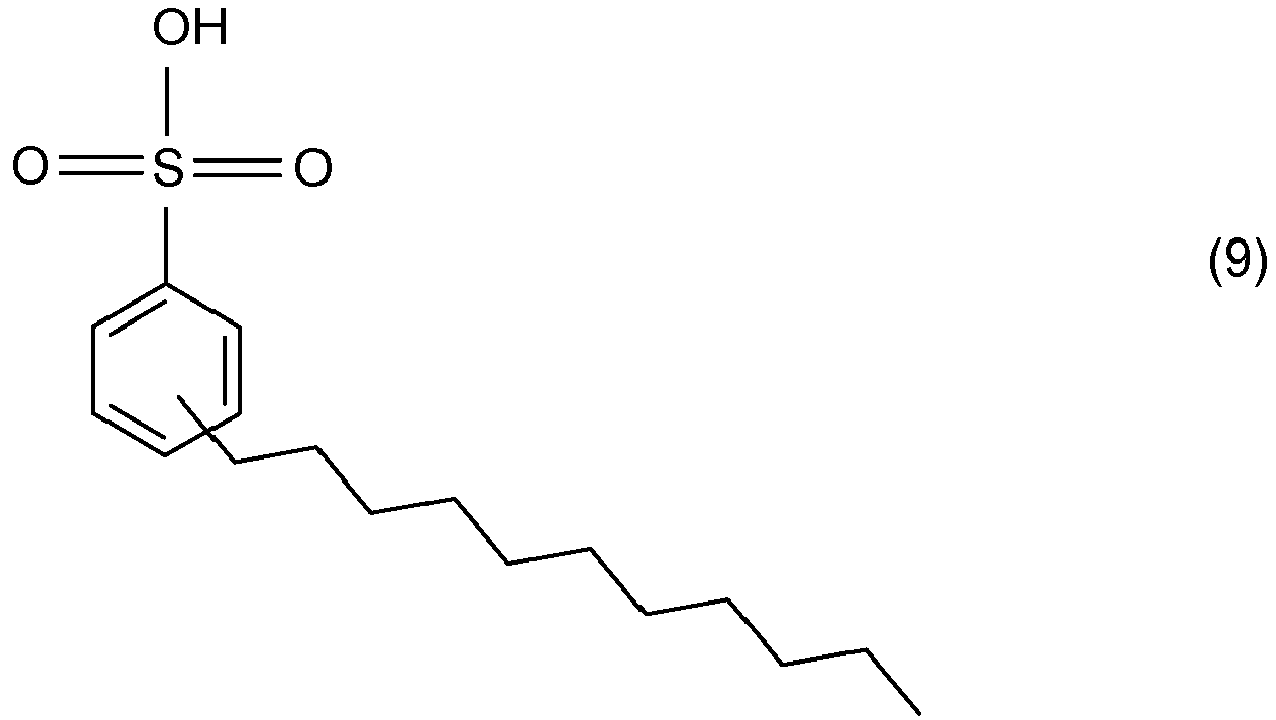
- Composition according to one or more of claims 36 - 39, wherein the demulsifier is a mixture of at least one compound of formula (8) and at least one compound of formula (9) in a weight ratio of from 5:1 to 1:5, preferably in a weight ratio of from 3:1 to 1:3.
- Formulation, comprising 10 to 99 wt.-% of a composition according to one or more of claims 1 - 40, and 1 to 90 wt.-% of a solvent selected from the group consisting of water, methanol, ethanol, propan-1-ol, propan-2-ol, ethylene glycol, diethylene glycol, triethylene glycol, neopentyl glycol, 2-butoxyethanol, glycerol and their mixtures, most preferably water.
- Use of a composition or formulation according to one or more of claims 1 - 41 for scavenging hydrogen sulphide and/or mercaptans.
- Use according to claim 42, wherein the scavenging occurs from fluids or gases produced from subterranean formations.
- Use according to claim 42 and/or 43, wherein the scavenging from gas is conducted in a contact tower or by direct injection into the gas.
- Process for the scavenging of hydrogen sulphide and/or mercaptans, comprising adding to a medium comprising such hydrogen sulphide or mercaptans a composition or formulation according to one or more of claims 1 - 41.
- Use of a reaction product from formaldehyde, and ammonia and/or an amine, selected from the group consisting of primary alkyl amines having 1 to 10 carbon atoms, and primary hydroxy alkyl amines having 2 to 10 carbon atoms,
as a synergist in the reaction between hydrogen sulphide and/or mercaptans and a composition comprisingI. at least one reaction product between a nitrogen-free monohydric alcohol and an aldehyde or ketone, andII. at least one reaction product between a monosaccharide having 3 to 6 carbon atoms and/or an oligosaccharide being formed by oligomerization of monosaccharides having 3 to 6 carbon atoms and an aldehyde or ketone. - Use of an alkaline compound selected from the group consisting ofIV(a). alkaline metal salts or alkaline earth metal saltsIV(b). ammonia; alkyl amines, aryl amines or alkylaryl aminesIV(c). hydroxy alkyl amines, hydroxy aryl amines or hydroxy alkylaryl aminesIV(d). multifunctional amines containing besides an amino group, at least one further functional group selected from the group consisting of amino groups, ether groups and acid groups or an ester, amide or salt thereofIV(e). mixtures of compounds of groups IV(a) to IV(c)as a synergist in the reaction between between hydrogen sulphide and/or mercaptans and a composition comprisingI. at least one reaction product between a nitrogen-free monohydric alcohol and an aldehyde or ketone, andII. at least one reaction product between a monosaccharide having 3 to 6 carbon atoms and/or an oligosaccharide being formed by oligomerization of monosaccharides having 3 to 6 carbon atoms and an aldehyde or ketone.
Priority Applications (1)
| Application Number | Priority Date | Filing Date | Title |
|---|---|---|---|
| EP18150087.7A EP3505591A1 (en) | 2018-01-02 | 2018-01-02 | Synergized acetals composition and method for scavenging sulfides and mercaptans |
Applications Claiming Priority (1)
| Application Number | Priority Date | Filing Date | Title |
|---|---|---|---|
| EP18150087.7A EP3505591A1 (en) | 2018-01-02 | 2018-01-02 | Synergized acetals composition and method for scavenging sulfides and mercaptans |
Publications (1)
| Publication Number | Publication Date |
|---|---|
| EP3505591A1 true EP3505591A1 (en) | 2019-07-03 |
Family
ID=60923361
Family Applications (1)
| Application Number | Title | Priority Date | Filing Date |
|---|---|---|---|
| EP18150087.7A Withdrawn EP3505591A1 (en) | 2018-01-02 | 2018-01-02 | Synergized acetals composition and method for scavenging sulfides and mercaptans |
Country Status (1)
| Country | Link |
|---|---|
| EP (1) | EP3505591A1 (en) |
Cited By (1)
| Publication number | Priority date | Publication date | Assignee | Title |
|---|---|---|---|---|
| CN115466609A (en) * | 2022-09-14 | 2022-12-13 | 中国石油天然气集团有限公司 | Solid slow-release sulfur removal agent and preparation method thereof |
Citations (9)
| Publication number | Priority date | Publication date | Assignee | Title |
|---|---|---|---|---|
| US2956963A (en) * | 1954-08-02 | 1960-10-18 | Nat Sugar Refining Company | Saccharide-monohydroxy aldehyde reaction product and method of preparing same |
| US3928211A (en) | 1970-10-21 | 1975-12-23 | Milchem Inc | Process for scavenging hydrogen sulfide in aqueous drilling fluids and method of preventing metallic corrosion of subterranean well drilling apparatuses |
| US4680127A (en) * | 1985-12-13 | 1987-07-14 | Betz Laboratories, Inc. | Method of scavenging hydrogen sulfide |
| US4978512A (en) | 1988-12-23 | 1990-12-18 | Quaker Chemical Corporation | Composition and method for sweetening hydrocarbons |
| US5347004A (en) | 1992-10-09 | 1994-09-13 | Baker Hughes, Inc. | Mixtures of hexahydrotriazines useful as H2 S scavengers |
| US5486605A (en) * | 1991-07-11 | 1996-01-23 | Gatlin; Larry W. | Hydrogen sulfide converter |
| WO1998002501A1 (en) | 1996-07-12 | 1998-01-22 | Baker Hughes Incorporated | Bisoxazolidine hydrogen sulfide scavenger |
| WO2002051968A1 (en) | 2000-12-27 | 2002-07-04 | M-I L.L.C. | Process for the reduction or elimination of hydrogen sulphide |
| WO2014031537A2 (en) | 2012-08-21 | 2014-02-27 | Lonza, Inc. | Method of scavenging hydrogen sulfide and/or sulfhydryl compounds |
-
2018
- 2018-01-02 EP EP18150087.7A patent/EP3505591A1/en not_active Withdrawn
Patent Citations (10)
| Publication number | Priority date | Publication date | Assignee | Title |
|---|---|---|---|---|
| US2956963A (en) * | 1954-08-02 | 1960-10-18 | Nat Sugar Refining Company | Saccharide-monohydroxy aldehyde reaction product and method of preparing same |
| US3928211A (en) | 1970-10-21 | 1975-12-23 | Milchem Inc | Process for scavenging hydrogen sulfide in aqueous drilling fluids and method of preventing metallic corrosion of subterranean well drilling apparatuses |
| US4680127A (en) * | 1985-12-13 | 1987-07-14 | Betz Laboratories, Inc. | Method of scavenging hydrogen sulfide |
| US4978512A (en) | 1988-12-23 | 1990-12-18 | Quaker Chemical Corporation | Composition and method for sweetening hydrocarbons |
| US4978512B1 (en) | 1988-12-23 | 1993-06-15 | Composition and method for sweetening hydrocarbons | |
| US5486605A (en) * | 1991-07-11 | 1996-01-23 | Gatlin; Larry W. | Hydrogen sulfide converter |
| US5347004A (en) | 1992-10-09 | 1994-09-13 | Baker Hughes, Inc. | Mixtures of hexahydrotriazines useful as H2 S scavengers |
| WO1998002501A1 (en) | 1996-07-12 | 1998-01-22 | Baker Hughes Incorporated | Bisoxazolidine hydrogen sulfide scavenger |
| WO2002051968A1 (en) | 2000-12-27 | 2002-07-04 | M-I L.L.C. | Process for the reduction or elimination of hydrogen sulphide |
| WO2014031537A2 (en) | 2012-08-21 | 2014-02-27 | Lonza, Inc. | Method of scavenging hydrogen sulfide and/or sulfhydryl compounds |
Non-Patent Citations (1)
| Title |
|---|
| "0714 Normal pressure hydrocephalus: The predictive value of cerebrospinal fluid tap-test ED - Friedman Joseph H; Bhidayasiri Roongroj; Truong Daniel D", JOURNAL OF NEUROLOGICAL SCIEN, ELSEVIER SCIENTIFIC PUBLISHING CO, AMSTERDAM, NL, vol. 238, 1 January 2005 (2005-01-01), pages S281 - S282, XP005546902, ISSN: 0022-510X * |
Cited By (2)
| Publication number | Priority date | Publication date | Assignee | Title |
|---|---|---|---|---|
| CN115466609A (en) * | 2022-09-14 | 2022-12-13 | 中国石油天然气集团有限公司 | Solid slow-release sulfur removal agent and preparation method thereof |
| CN115466609B (en) * | 2022-09-14 | 2023-06-30 | 中国石油天然气集团有限公司 | Solid slow-release sulfur remover and preparation method thereof |
Similar Documents
| Publication | Publication Date | Title |
|---|---|---|
| US11603497B2 (en) | Synergized acetals composition and method for scavenging sulfides and mercaptans | |
| EP3478789B1 (en) | Use of synergized acetals composition and method for scavenging sulfides and mercaptans | |
| EP3727652B1 (en) | Synergized acetals composition and method for scavenging sulfides and mercaptants | |
| EP3294831B1 (en) | Composition and method for scavenging sulfides and mercaptans | |
| CA2880283C (en) | Method of scavenging hydrogen sulfide and/or sulfhydryl compounds | |
| WO2018001629A1 (en) | Synergized acetals composition and method for scavenging sulfides and mercaptans | |
| EP3317383A1 (en) | Hydrogen sulfide scavenging additive compositions, and medium comprising the same | |
| WO2018001630A1 (en) | Synergized acetals composition and method for scavenging sulfides and mercaptans | |
| EP3505590A1 (en) | Synergized acetals composition and method for scavenging sulfides and mercaptans | |
| EP3820959A1 (en) | Alkyl lactone- derived corrosion inhibitors | |
| EA039974B1 (en) | SYNERGETIC COMPOSITION WITH ACETALS AND METHOD FOR RECOVERY OF SULFIDES AND MERCAPTANS | |
| EA039954B1 (en) | SYNERGETIC ACETAL COMPOSITIONS AND METHOD FOR RECOVERY OF SULFIDES AND MERCAPTANS | |
| OA18421A (en) | Composition and method for scavenging sulfides and mercaptans. |
Legal Events
| Date | Code | Title | Description |
|---|---|---|---|
| PUAI | Public reference made under article 153(3) epc to a published international application that has entered the european phase |
Free format text: ORIGINAL CODE: 0009012 |
|
| AK | Designated contracting states |
Kind code of ref document: A1 Designated state(s): AL AT BE BG CH CY CZ DE DK EE ES FI FR GB GR HR HU IE IS IT LI LT LU LV MC MK MT NL NO PL PT RO RS SE SI SK SM TR |
|
| AX | Request for extension of the european patent |
Extension state: BA ME |
|
| STAA | Information on the status of an ep patent application or granted ep patent |
Free format text: STATUS: THE APPLICATION HAS BEEN WITHDRAWN |
|
| 18W | Application withdrawn |
Effective date: 20180508 |