EP3505547A1 - Polymerizable composition for an optical material - Google Patents
Polymerizable composition for an optical material Download PDFInfo
- Publication number
- EP3505547A1 EP3505547A1 EP18215872.5A EP18215872A EP3505547A1 EP 3505547 A1 EP3505547 A1 EP 3505547A1 EP 18215872 A EP18215872 A EP 18215872A EP 3505547 A1 EP3505547 A1 EP 3505547A1
- Authority
- EP
- European Patent Office
- Prior art keywords
- polymerizable composition
- compound
- polythiol
- polyisocyanate compound
- diisocyanate
- Prior art date
- Legal status (The legal status is an assumption and is not a legal conclusion. Google has not performed a legal analysis and makes no representation as to the accuracy of the status listed.)
- Granted
Links
Classifications
-
- C—CHEMISTRY; METALLURGY
- C08—ORGANIC MACROMOLECULAR COMPOUNDS; THEIR PREPARATION OR CHEMICAL WORKING-UP; COMPOSITIONS BASED THEREON
- C08G—MACROMOLECULAR COMPOUNDS OBTAINED OTHERWISE THAN BY REACTIONS ONLY INVOLVING UNSATURATED CARBON-TO-CARBON BONDS
- C08G18/00—Polymeric products of isocyanates or isothiocyanates
- C08G18/06—Polymeric products of isocyanates or isothiocyanates with compounds having active hydrogen
- C08G18/28—Polymeric products of isocyanates or isothiocyanates with compounds having active hydrogen characterised by the compounds used containing active hydrogen
- C08G18/40—High-molecular-weight compounds
- C08G18/52—Polythioethers
-
- C—CHEMISTRY; METALLURGY
- C08—ORGANIC MACROMOLECULAR COMPOUNDS; THEIR PREPARATION OR CHEMICAL WORKING-UP; COMPOSITIONS BASED THEREON
- C08G—MACROMOLECULAR COMPOUNDS OBTAINED OTHERWISE THAN BY REACTIONS ONLY INVOLVING UNSATURATED CARBON-TO-CARBON BONDS
- C08G18/00—Polymeric products of isocyanates or isothiocyanates
- C08G18/06—Polymeric products of isocyanates or isothiocyanates with compounds having active hydrogen
- C08G18/28—Polymeric products of isocyanates or isothiocyanates with compounds having active hydrogen characterised by the compounds used containing active hydrogen
- C08G18/30—Low-molecular-weight compounds
- C08G18/38—Low-molecular-weight compounds having heteroatoms other than oxygen
- C08G18/3855—Low-molecular-weight compounds having heteroatoms other than oxygen having sulfur
- C08G18/3876—Low-molecular-weight compounds having heteroatoms other than oxygen having sulfur containing mercapto groups
-
- C—CHEMISTRY; METALLURGY
- C08—ORGANIC MACROMOLECULAR COMPOUNDS; THEIR PREPARATION OR CHEMICAL WORKING-UP; COMPOSITIONS BASED THEREON
- C08G—MACROMOLECULAR COMPOUNDS OBTAINED OTHERWISE THAN BY REACTIONS ONLY INVOLVING UNSATURATED CARBON-TO-CARBON BONDS
- C08G18/00—Polymeric products of isocyanates or isothiocyanates
- C08G18/06—Polymeric products of isocyanates or isothiocyanates with compounds having active hydrogen
- C08G18/08—Processes
- C08G18/16—Catalysts
- C08G18/22—Catalysts containing metal compounds
- C08G18/24—Catalysts containing metal compounds of tin
- C08G18/242—Catalysts containing metal compounds of tin organometallic compounds containing tin-carbon bonds
-
- C—CHEMISTRY; METALLURGY
- C08—ORGANIC MACROMOLECULAR COMPOUNDS; THEIR PREPARATION OR CHEMICAL WORKING-UP; COMPOSITIONS BASED THEREON
- C08G—MACROMOLECULAR COMPOUNDS OBTAINED OTHERWISE THAN BY REACTIONS ONLY INVOLVING UNSATURATED CARBON-TO-CARBON BONDS
- C08G18/00—Polymeric products of isocyanates or isothiocyanates
- C08G18/06—Polymeric products of isocyanates or isothiocyanates with compounds having active hydrogen
- C08G18/28—Polymeric products of isocyanates or isothiocyanates with compounds having active hydrogen characterised by the compounds used containing active hydrogen
- C08G18/30—Low-molecular-weight compounds
- C08G18/38—Low-molecular-weight compounds having heteroatoms other than oxygen
- C08G18/3855—Low-molecular-weight compounds having heteroatoms other than oxygen having sulfur
-
- C—CHEMISTRY; METALLURGY
- C08—ORGANIC MACROMOLECULAR COMPOUNDS; THEIR PREPARATION OR CHEMICAL WORKING-UP; COMPOSITIONS BASED THEREON
- C08G—MACROMOLECULAR COMPOUNDS OBTAINED OTHERWISE THAN BY REACTIONS ONLY INVOLVING UNSATURATED CARBON-TO-CARBON BONDS
- C08G18/00—Polymeric products of isocyanates or isothiocyanates
- C08G18/06—Polymeric products of isocyanates or isothiocyanates with compounds having active hydrogen
- C08G18/28—Polymeric products of isocyanates or isothiocyanates with compounds having active hydrogen characterised by the compounds used containing active hydrogen
- C08G18/40—High-molecular-weight compounds
- C08G18/64—Macromolecular compounds not provided for by groups C08G18/42 - C08G18/63
- C08G18/6453—Macromolecular compounds not provided for by groups C08G18/42 - C08G18/63 having sulfur
-
- C—CHEMISTRY; METALLURGY
- C08—ORGANIC MACROMOLECULAR COMPOUNDS; THEIR PREPARATION OR CHEMICAL WORKING-UP; COMPOSITIONS BASED THEREON
- C08G—MACROMOLECULAR COMPOUNDS OBTAINED OTHERWISE THAN BY REACTIONS ONLY INVOLVING UNSATURATED CARBON-TO-CARBON BONDS
- C08G18/00—Polymeric products of isocyanates or isothiocyanates
- C08G18/06—Polymeric products of isocyanates or isothiocyanates with compounds having active hydrogen
- C08G18/70—Polymeric products of isocyanates or isothiocyanates with compounds having active hydrogen characterised by the isocyanates or isothiocyanates used
- C08G18/72—Polyisocyanates or polyisothiocyanates
- C08G18/721—Two or more polyisocyanates not provided for in one single group C08G18/73 - C08G18/80
-
- C—CHEMISTRY; METALLURGY
- C08—ORGANIC MACROMOLECULAR COMPOUNDS; THEIR PREPARATION OR CHEMICAL WORKING-UP; COMPOSITIONS BASED THEREON
- C08G—MACROMOLECULAR COMPOUNDS OBTAINED OTHERWISE THAN BY REACTIONS ONLY INVOLVING UNSATURATED CARBON-TO-CARBON BONDS
- C08G18/00—Polymeric products of isocyanates or isothiocyanates
- C08G18/06—Polymeric products of isocyanates or isothiocyanates with compounds having active hydrogen
- C08G18/70—Polymeric products of isocyanates or isothiocyanates with compounds having active hydrogen characterised by the isocyanates or isothiocyanates used
- C08G18/72—Polyisocyanates or polyisothiocyanates
- C08G18/721—Two or more polyisocyanates not provided for in one single group C08G18/73 - C08G18/80
- C08G18/722—Combination of two or more aliphatic and/or cycloaliphatic polyisocyanates
-
- C—CHEMISTRY; METALLURGY
- C08—ORGANIC MACROMOLECULAR COMPOUNDS; THEIR PREPARATION OR CHEMICAL WORKING-UP; COMPOSITIONS BASED THEREON
- C08G—MACROMOLECULAR COMPOUNDS OBTAINED OTHERWISE THAN BY REACTIONS ONLY INVOLVING UNSATURATED CARBON-TO-CARBON BONDS
- C08G18/00—Polymeric products of isocyanates or isothiocyanates
- C08G18/06—Polymeric products of isocyanates or isothiocyanates with compounds having active hydrogen
- C08G18/70—Polymeric products of isocyanates or isothiocyanates with compounds having active hydrogen characterised by the isocyanates or isothiocyanates used
- C08G18/72—Polyisocyanates or polyisothiocyanates
- C08G18/73—Polyisocyanates or polyisothiocyanates acyclic
-
- C—CHEMISTRY; METALLURGY
- C08—ORGANIC MACROMOLECULAR COMPOUNDS; THEIR PREPARATION OR CHEMICAL WORKING-UP; COMPOSITIONS BASED THEREON
- C08G—MACROMOLECULAR COMPOUNDS OBTAINED OTHERWISE THAN BY REACTIONS ONLY INVOLVING UNSATURATED CARBON-TO-CARBON BONDS
- C08G18/00—Polymeric products of isocyanates or isothiocyanates
- C08G18/06—Polymeric products of isocyanates or isothiocyanates with compounds having active hydrogen
- C08G18/70—Polymeric products of isocyanates or isothiocyanates with compounds having active hydrogen characterised by the isocyanates or isothiocyanates used
- C08G18/72—Polyisocyanates or polyisothiocyanates
- C08G18/74—Polyisocyanates or polyisothiocyanates cyclic
- C08G18/75—Polyisocyanates or polyisothiocyanates cyclic cycloaliphatic
- C08G18/751—Polyisocyanates or polyisothiocyanates cyclic cycloaliphatic containing only one cycloaliphatic ring
- C08G18/752—Polyisocyanates or polyisothiocyanates cyclic cycloaliphatic containing only one cycloaliphatic ring containing at least one isocyanate or isothiocyanate group linked to the cycloaliphatic ring by means of an aliphatic group
- C08G18/753—Polyisocyanates or polyisothiocyanates cyclic cycloaliphatic containing only one cycloaliphatic ring containing at least one isocyanate or isothiocyanate group linked to the cycloaliphatic ring by means of an aliphatic group containing one isocyanate or isothiocyanate group linked to the cycloaliphatic ring by means of an aliphatic group having a primary carbon atom next to the isocyanate or isothiocyanate group
- C08G18/755—Polyisocyanates or polyisothiocyanates cyclic cycloaliphatic containing only one cycloaliphatic ring containing at least one isocyanate or isothiocyanate group linked to the cycloaliphatic ring by means of an aliphatic group containing one isocyanate or isothiocyanate group linked to the cycloaliphatic ring by means of an aliphatic group having a primary carbon atom next to the isocyanate or isothiocyanate group and at least one isocyanate or isothiocyanate group linked to a secondary carbon atom of the cycloaliphatic ring, e.g. isophorone diisocyanate
-
- C—CHEMISTRY; METALLURGY
- C08—ORGANIC MACROMOLECULAR COMPOUNDS; THEIR PREPARATION OR CHEMICAL WORKING-UP; COMPOSITIONS BASED THEREON
- C08G—MACROMOLECULAR COMPOUNDS OBTAINED OTHERWISE THAN BY REACTIONS ONLY INVOLVING UNSATURATED CARBON-TO-CARBON BONDS
- C08G18/00—Polymeric products of isocyanates or isothiocyanates
- C08G18/06—Polymeric products of isocyanates or isothiocyanates with compounds having active hydrogen
- C08G18/70—Polymeric products of isocyanates or isothiocyanates with compounds having active hydrogen characterised by the isocyanates or isothiocyanates used
- C08G18/72—Polyisocyanates or polyisothiocyanates
- C08G18/74—Polyisocyanates or polyisothiocyanates cyclic
- C08G18/75—Polyisocyanates or polyisothiocyanates cyclic cycloaliphatic
- C08G18/751—Polyisocyanates or polyisothiocyanates cyclic cycloaliphatic containing only one cycloaliphatic ring
- C08G18/752—Polyisocyanates or polyisothiocyanates cyclic cycloaliphatic containing only one cycloaliphatic ring containing at least one isocyanate or isothiocyanate group linked to the cycloaliphatic ring by means of an aliphatic group
- C08G18/757—Polyisocyanates or polyisothiocyanates cyclic cycloaliphatic containing only one cycloaliphatic ring containing at least one isocyanate or isothiocyanate group linked to the cycloaliphatic ring by means of an aliphatic group containing at least two isocyanate or isothiocyanate groups linked to the cycloaliphatic ring by means of an aliphatic group
-
- C—CHEMISTRY; METALLURGY
- C08—ORGANIC MACROMOLECULAR COMPOUNDS; THEIR PREPARATION OR CHEMICAL WORKING-UP; COMPOSITIONS BASED THEREON
- C08G—MACROMOLECULAR COMPOUNDS OBTAINED OTHERWISE THAN BY REACTIONS ONLY INVOLVING UNSATURATED CARBON-TO-CARBON BONDS
- C08G18/00—Polymeric products of isocyanates or isothiocyanates
- C08G18/06—Polymeric products of isocyanates or isothiocyanates with compounds having active hydrogen
- C08G18/70—Polymeric products of isocyanates or isothiocyanates with compounds having active hydrogen characterised by the isocyanates or isothiocyanates used
- C08G18/72—Polyisocyanates or polyisothiocyanates
- C08G18/74—Polyisocyanates or polyisothiocyanates cyclic
- C08G18/75—Polyisocyanates or polyisothiocyanates cyclic cycloaliphatic
- C08G18/758—Polyisocyanates or polyisothiocyanates cyclic cycloaliphatic containing two or more cycloaliphatic rings
-
- C—CHEMISTRY; METALLURGY
- C08—ORGANIC MACROMOLECULAR COMPOUNDS; THEIR PREPARATION OR CHEMICAL WORKING-UP; COMPOSITIONS BASED THEREON
- C08G—MACROMOLECULAR COMPOUNDS OBTAINED OTHERWISE THAN BY REACTIONS ONLY INVOLVING UNSATURATED CARBON-TO-CARBON BONDS
- C08G18/00—Polymeric products of isocyanates or isothiocyanates
- C08G18/06—Polymeric products of isocyanates or isothiocyanates with compounds having active hydrogen
- C08G18/70—Polymeric products of isocyanates or isothiocyanates with compounds having active hydrogen characterised by the isocyanates or isothiocyanates used
- C08G18/72—Polyisocyanates or polyisothiocyanates
- C08G18/74—Polyisocyanates or polyisothiocyanates cyclic
- C08G18/76—Polyisocyanates or polyisothiocyanates cyclic aromatic
- C08G18/7614—Polyisocyanates or polyisothiocyanates cyclic aromatic containing only one aromatic ring
- C08G18/7621—Polyisocyanates or polyisothiocyanates cyclic aromatic containing only one aromatic ring being toluene diisocyanate including isomer mixtures
-
- C—CHEMISTRY; METALLURGY
- C08—ORGANIC MACROMOLECULAR COMPOUNDS; THEIR PREPARATION OR CHEMICAL WORKING-UP; COMPOSITIONS BASED THEREON
- C08G—MACROMOLECULAR COMPOUNDS OBTAINED OTHERWISE THAN BY REACTIONS ONLY INVOLVING UNSATURATED CARBON-TO-CARBON BONDS
- C08G18/00—Polymeric products of isocyanates or isothiocyanates
- C08G18/06—Polymeric products of isocyanates or isothiocyanates with compounds having active hydrogen
- C08G18/70—Polymeric products of isocyanates or isothiocyanates with compounds having active hydrogen characterised by the isocyanates or isothiocyanates used
- C08G18/72—Polyisocyanates or polyisothiocyanates
- C08G18/74—Polyisocyanates or polyisothiocyanates cyclic
- C08G18/76—Polyisocyanates or polyisothiocyanates cyclic aromatic
- C08G18/7614—Polyisocyanates or polyisothiocyanates cyclic aromatic containing only one aromatic ring
- C08G18/7628—Polyisocyanates or polyisothiocyanates cyclic aromatic containing only one aromatic ring containing at least one isocyanate or isothiocyanate group linked to the aromatic ring by means of an aliphatic group
- C08G18/7642—Polyisocyanates or polyisothiocyanates cyclic aromatic containing only one aromatic ring containing at least one isocyanate or isothiocyanate group linked to the aromatic ring by means of an aliphatic group containing at least two isocyanate or isothiocyanate groups linked to the aromatic ring by means of an aliphatic group having a primary carbon atom next to the isocyanate or isothiocyanate groups, e.g. xylylene diisocyanate or homologues substituted on the aromatic ring
-
- C—CHEMISTRY; METALLURGY
- C08—ORGANIC MACROMOLECULAR COMPOUNDS; THEIR PREPARATION OR CHEMICAL WORKING-UP; COMPOSITIONS BASED THEREON
- C08G—MACROMOLECULAR COMPOUNDS OBTAINED OTHERWISE THAN BY REACTIONS ONLY INVOLVING UNSATURATED CARBON-TO-CARBON BONDS
- C08G75/00—Macromolecular compounds obtained by reactions forming a linkage containing sulfur with or without nitrogen, oxygen, or carbon in the main chain of the macromolecule
- C08G75/02—Polythioethers
- C08G75/04—Polythioethers from mercapto compounds or metallic derivatives thereof
-
- C—CHEMISTRY; METALLURGY
- C08—ORGANIC MACROMOLECULAR COMPOUNDS; THEIR PREPARATION OR CHEMICAL WORKING-UP; COMPOSITIONS BASED THEREON
- C08L—COMPOSITIONS OF MACROMOLECULAR COMPOUNDS
- C08L75/00—Compositions of polyureas or polyurethanes; Compositions of derivatives of such polymers
- C08L75/04—Polyurethanes
-
- G—PHYSICS
- G02—OPTICS
- G02B—OPTICAL ELEMENTS, SYSTEMS OR APPARATUS
- G02B1/00—Optical elements characterised by the material of which they are made; Optical coatings for optical elements
- G02B1/04—Optical elements characterised by the material of which they are made; Optical coatings for optical elements made of organic materials, e.g. plastics
-
- G—PHYSICS
- G02—OPTICS
- G02B—OPTICAL ELEMENTS, SYSTEMS OR APPARATUS
- G02B1/00—Optical elements characterised by the material of which they are made; Optical coatings for optical elements
- G02B1/04—Optical elements characterised by the material of which they are made; Optical coatings for optical elements made of organic materials, e.g. plastics
- G02B1/041—Lenses
Definitions
- An embodiment relates to a polymerizable composition for a polythiourethane-based optical material and a polythiourethane-based compound prepared therefrom.
- the polythiourethane-based compound is excellent in appearance as the generation rates of striae and bubbles are low.
- Optical materials using plastics are lightweight, hardly breakable, and excellent in dyeability as compared with optical materials made of inorganic materials such as glass. Therefore, plastic materials of various resins are widely used as optical materials for eyeglass lenses, camera lenses, and so on. Recently, due to an increased demand of users for higher performance and convenience, studies have continued on optical materials having such properties as high transparency, high refractive index, high Abbe number, low specific gravity, high heat resistance, and high impact resistance.
- Examples of widely used optical materials include polythiourethane compounds obtained by polymerizing a polythiol compound and a polyisocyanate compound.
- a polythiol compound and a polyisocyanate compound are reacted to prepare a polythiourethane-based optical material, the reactivity changes depending on the kinds of the polythiol compound and the polyisocyanate compound and the kind and content of the catalyst, which causes a problem that the polythiourethane-based optical material thus produced has appearance defects such as striae and/or bubbles.
- Korean Patent No. 1704951 discloses a method for preparing a polyurethane resin composition in which an alcohol compound is employed such that the ratio of hydroxyl groups to isocyanate groups is 10 to 20% by mole.
- Patent Document 1 Korean Patent No. 1704951
- an embodiment aims to provide a polymerizable composition capable of producing a plastic lens that is excellent in appearance without striae and/or bubbles, regardless of the kind of the polyisocyanate, the polythiol, and the catalyst.
- Another embodiment provides a polythiourethane-based compound prepared from the polymerizable composition.
- Still another embodiment provides an optical material molded from the polythiourethane-based compound.
- the polymerizable composition of the embodiment is capable of producing a plastic lens that is excellent in appearance without striae and/or bubbles, regardless of the kind of the polyisocyanate, the polythiol, and the catalyst. Specifically, the appearance, workability, dimensional stability, and the like of a plastic lens vary with the kinds of the polyisocyanate, the polythiol, and the catalyst as raw materials. It is possible to provide a polymerizable composition in which the characteristics as described above are considered together by controlling the kinds and contents of raw materials such that R calculated by the above Formula 1 satisfies a specific numerical range.
- the polymerizable composition comprises two polyisocyanates of a first polyisocyanate and a second polyisocyanate
- n is 2
- W1 is the amount (g) of the first polyisocyanate
- W2 is the amount (g) of the second polyisocyanate
- R calculated by the above Equation 1 may be a real number of 9.5 to 19.5. Specifically, in the polymerizable composition, R calculated by the above Equation 1 may be a real number of 9.5 to 19, a real number of 9.8 to 19, a real number of 9.8 to 18.5, or a real number of 9.8 to 18. If R is 9.5 or more, it is possible to prevent the problem that the reactivity between the polyisocyanate and the polythiol is too low, so that the generation of striae and bubbles due to the reaction imbalance in the terminal stage of polymerization can be increased, thereby lowering the production yield.
- R is 19.5 or less, it is possible to prevent the problem that the reactivity is too high, so that the generation of striae and bubbles due to the reaction imbalance in the initial stage of polymerization is increased, thereby lowering the production yield. Therefore, in order to minimize the generation of striae and bubbles in the plastic lens thus produced, to thereby prevent such appearance defects and maximize the production yield, it is preferable to use a polymerizable composition wherein R is within the above-mentioned range.
- A may be a real number of 80 to 120, and B may be a real number of 80 to 115. Specifically, A may be a real number of 82 to 117, a real number of 86 to 112, or a real number of 90 to 105. B may be a real number of 82 to 114, a real number of 85 to 112, or a real number of 87 to 110.
- a and B are within the above ranges, it is more advantageous in that the dimensional stability can be improved in the polymerization and curing steps, thereby enhancing the heat resistance and suppressing the generation of cracks.
- D may be a real number of 0.08 to 0.25, a real number of 0.09 to 0.24, or a real number of 0.10 to 0.23. If D is within the above range, it is possible to carry out homogeneous polymerization of the polymerizable composition, thereby suppressing the generation of striae and bubbles and enhancing the appearance and workability.
- E may be at least one selected from the group consisting of fluorine (F), chlorine (Cl), bromine (Br), and iodine (I). Specifically, E may be chlorine.
- F may be an alkyl group having 1 to 10 carbon atoms. Specifically, F may be methyl, ethyl, n-propyl, i-propyl, n-butyl, i-butyl, or t-butyl.
- the polymerizable composition comprises 1 to 5 types of a polyisocyanate compound, 1 to 5 types of a polythiol compound, and a catalyst represented by the above Formula 1.
- the polymerizable composition may comprise 1 to 3 types of a polyisocyanate compound, 1 to 4 types of a polythiol compound, and a catalyst represented by the above Formula 1.
- it may comprise 1 or 2 types of a polyisocyanate compound, 1 or 2 types of a polythiol compound, and a catalyst represented by the above Formula 1.
- the polymerizable composition may comprise 1 to 3 types of a polyisocyanate compound and 1 to 4 types of a polythiol compound.
- the polyisocyanate compound may be a conventional one commonly used for the synthesis of polythiourethane.
- the polyisocyanate compound may comprise at least one selected from the group consisting of an aliphatic isocyanate compound such as isophorone diisocyanate, dicyclohexylmethane-4,4-diisocyanate, hexamethylene diisocyanate, 2,2-dimethylpentane diisocyanate, 2,2,4-trimethylhexane diisocyanate, butene diisocyanate, 1,3-butadiene-1,4-diisocyanate, 2,4,4-trimethylhexamethylene diisocyanate, 1,6,11-undecane triisocyanate, 1,3,6-hexamethylene triisocyanate, 1,8-diisocyanato-4-isocyanatomethyloctane, bis(isocyanatoethyl) carbonate, and bis(isocyanatoethy
- the polyisocyanate compound may be one to five selected from the group consisting of isophorone diisocyanate, norbornene diisocyanate, m-xylene diisocyanate, toluene diisocyanate, hexamethylene diisocyanate, and cyclohexane diisocyanate.
- the number (n) of kinds of the polyisocyanate compound may be 1 to 5. Specifically, the number (n) of kinds of the polyisocyanate compound may be 1 to 3 or 1 to 2.
- the NCO content (N i ) of the polyisocyanate compound may be determined by the method specified in ISO 14896 "Plastics - Polyurethane raw materials - Determination of isocyanate content.”
- the number (m i ) of functional groups in the polyisocyanate compound may be 2 or 3.
- the weight average molecular weight (o i ) of the polyisocyanate compound may be 100 to 900 g/mole or 150 to 800 g/mole.
- the polythiol compound may be a conventional one commonly used for the synthesis of polythiourethane.
- the polythiol compound may comprise at least one selected from the group consisting of bis(2-(2-mercaptoethylthio)-3-mercaptopropyl) sulfide, 4-mercaptomethyl-1,8-dimercapto-3,6-dithiaoctane, 2,3-bis(2-mercaptoethylthio)propane-1-thiol, 2,2-bis(mercaptomethyl)-1,3-propanedithiol, bis(2-mercaptoethyl) sulfide, tetrakis(mercaptomethyl)methane, 2-(2-mercaptoethylthio)propane-1,3-dithiol, 2-(2,3-bis(2-mercaptoethylthio)propylthio)ethanethiol, bis(2,3-dimercaptopropanyl)
- the polythiol compound may be one to five selected from the group consisting of 4-mercaptomethyl-1,8-dimercapto-3,6-dithiaoctane, 4,8-dimercaptomethyl-1,11-dimercapto-3,6,9-trithiaundecane, pentaerythritol tetrakis(3-mercaptopropionate), pentaerythritol tetrakis(2-mercaptoacetate), and 1,4-dithiane-2,5-dimethanethiol.
- the number (1) of kinds of the polythiol compound may be 1 to 5, 1 to 3, or 2 or 3.
- the equivalent weight (g/eq.) (Sj) of the polythiol compound per unit molecular weight may be measured by the capacity titration method using the redox reaction of thiol and iodine.
- the number (u j ) of functional groups in the polythiol compound may be an integer of 2 to 6 or an integer of 2 to 4.
- the weight average molecular weight (t j ) of the polythiol compound may be 100 to 1,000 g/mole or 200 to 800 g/mole.
- the polymerizable composition may comprise a polythiol compound and an isocyanate compound in a molar ratio of 0.5 to 1.5:1.
- the polymerizable composition may comprise a polythiol compound and an isocyanate compound in a molar ratio of 0.8 to 1.2:1.
- the catalyst may be a compound represented by the above Formula 1.
- the catalyst may be at least one selected from the group consisting of dibutyltin dichloride, dimethyltin dichloride, diethyltin dichloride, dipropyltin dichloride, di-isopropyltin dichloride, and di-tert-butyltin dichloride.
- the polymerizable composition may have a viscosity of 1,000 cps (centipoise) or more after it stands at 10°C for 24 hours. Specifically, the polymerizable composition may have a viscosity of 1,000 to 10,000 cps or 1,500 to 10,000 cps after it stands at 10°C for 24 hours. If the viscosity of the polymerizable composition after it stands at 10°C for 24 hours is within the above range, it is possible to prevent the problem that the reactivity of the composition is too high, which lowers the workability, or that the reactivity of the composition is too low, which lowers the production yield.
- the polymerizable composition When the polymerizable composition is made into a specimen having a diameter of 75 mm and a thickness of 10 mm, it may have a generation rate of bubbles of 0 to 10% and a generation rate of striae of 0 to 8%. Specifically, when the polymerizable composition is made into a specimen having a diameter of 75 mm and a thickness of 10 mm, it may have a generation rate of bubbles of 0 to 8% or 0 to 5% and a generation rate of striae of 0 to 7% or 0 to 5%.
- the polymerizable composition may further comprise such additives as an internal mold release agent, an ultraviolet absorber, a polymerization initiator, a heat stabilizer, a blueing agent, a chain extender, a crosslinking agent, a light stabilizer, an antioxidant, and a filler, depending on the purpose thereof.
- additives as an internal mold release agent, an ultraviolet absorber, a polymerization initiator, a heat stabilizer, a blueing agent, a chain extender, a crosslinking agent, a light stabilizer, an antioxidant, and a filler, depending on the purpose thereof.
- the internal mold release agent may comprise at least one selected from the group consisting of a fluorine-based nonionic surfactant having a perfluoroalkyl group, a hydroxyalkyl group, or a phosphate ester group; a silicone-based nonionic surfactant having a dimethylpolysiloxane group, a hydroxyalkyl group, or a phosphate ester group; an alkyl quaternary ammonium salt such as trimethylcetylammonium salt, trimethylstearylammonium salt, dimethylethylcetylammonium salt, triethyldodecylammonium salt, trioctylmethylammonium salt, and diethylcyclohexadodecylammonium salt; and an acidic phosphate ester.
- a fluorine-based nonionic surfactant having a perfluoroalkyl group, a hydroxyalkyl group, or a phosphate este
- Examples of the ultraviolet absorber may include a benzophenone type, a benzotriazole type, a salicylate type, a cyanoacrylate type, an oxanilide type, or the like.
- the polymerization initiator may include, for example, an amine type, a phosphorus type, an organotin type, an organic copper type, an organic gallium type, an organic zirconium type, an organic iron type, an organic zinc, and an organic aluminum.
- the heat stabilizer may include, for example, a metal fatty acid salt type, a phosphorus type, a lead type, or an organotin type.
- the blueing agent has an absorption band in the wavelength range from orange to yellow in the visible light region and has a function of adjusting the color of an optical material made of a resin.
- the blueing agent may comprise a material that exhibits blue to violet color, but it is not particularly limited thereto.
- examples of the blueing agent include a dye, a fluorescent whitening agent, a fluorescent pigment, and an inorganic pigment. It may be properly selected in accordance with the properties required for an optical component to be produced and the resin color.
- the blueing agent may be used alone or in combination of two or more. In view of the solubility in the polymerizable composition and the transparency of the optical material to be produced, a dye is preferably used as the bluing agent.
- the dye may particularly have a maximum absorption wavelength of 520 to 600 nm; and more particularly, it may have a maximum absorption wavelength of 540 to 580 nm.
- an anthraquinone-based dye is preferable as the dye.
- the method of adding the blueing agent is not particularly limited, and the blueing agent may be added to the monomers in advance. Specifically, various methods can be used; for example, the blueing agent may be dissolved in the monomers or may be contained in a master solution in a high concentration, the master solution being later diluted with the monomers or other additives and then added.
- Another embodiment provides a polythiourethane-based compound prepared from the polymerizable composition as described above.
- the polythiourethane-based compound is prepared by polymerizing (and curing) the polythiol compound and the polyisocyanate compound.
- the reaction molar ratio of SH groups to NCO groups in the polymerization reaction may be 0.5 to 3.0, particularly 0.6 to 2.0 or 0.8 to 1.3. Within the above range, it is possible to enhance such properties as refractive index and heat resistance required for an optical material and the balance between them.
- Still another embodiment provides an optical material molded from the polythiourethane-based compound as described above.
- the optical material may be comprised of a molded article prepared by curing the polymerizable composition.
- the optical material is produced by polymerizing and molding the polymerizable composition (i.e., a polythiol compound, a polyisocyanate compound, and a catalyst).
- the polymerizable composition is degassed under a reduced pressure and then injected into a mold for molding an optical material.
- Such degassing and mold injection may be carried out in a temperature range of, for example, 5 to 40°C or 10 to 30°C.
- polymerization is usually carried out by gradually heating the composition from a low temperature to a high temperature.
- the polymerization temperature may be, for example, 30 to 150°C, particularly 40 to 130°C.
- a reaction catalyst which is conventionally used in the production of polythiourethane, may be employed in order to control the reaction rate. Specific examples of the reaction catalyst are as exemplified above.
- the polythiourethane-based optical material is released from the mold.
- the optical material may have various shapes by changing the mold used in the production thereof. Specifically, it may be in the form of an eyeglass lens, a camera lens, a light emitting diode (LED), or the like.
- the optical material may be, for example, an optical lens, specifically a plastic optical lens.
- the optical material may have a refractive index of 1.55 to 1.70 for light at 546 nm and an Abbe number of 25 to 50. Specifically, the optical material may have a refractive index of 1.58 to 1.68 for light at 546 nm and an Abbe number of 30 to 45, or a refractive index of 1.55 to 1.70 for light at 546 nm and an Abbe number of 25 to 45.
- the polyisocyanate, the polythiol, and the catalyst were mixed in the composition shown in Table 3 below. Added thereto were 1.0 part by weight of 2-(2-hydroxy-5-tert-octylphenyl)benzotriazole as an ultraviolet stabilizer and 0.2 part by weight of Zelec® UN (acidic phosphate alkyl ester release agent, Stepan Company) as an internal mold release agent to prepare a polymerizable composition.
- Zelec® UN acidic phosphate alkyl ester release agent, Stepan Company
- Polymerizable compositions were each prepared in the same manner as in Example 1, except that the polyisocyanate, the polythiol, and the catalyst were mixed in the compositions shown in Table 3 below. [Table 3] Ex. 1 Ex. 2 Ex. 3 Ex. 4 Ex. 5 Ex. 6 Ex. 7 Ex. 8 Ex. 9 C. Ex. 1 C. Ex. 2 C. Ex.
- the polymerizable compositions filtered in the same manner as in the above Section (1) were each injected into a glass mold assembled with an adhesive tape.
- the mold was allowed to stand at 10°C for 5 hours and then heated from 10°C to 120°C at a rate of 5°C/min, so that the polymerization was carried out at 120°C for 20 hours.
- the cured resin having a size of 75 mm in diameter and 10 mm in thickness was further cured in the glass mold at 130°C for 4 hours, and then the molded article (i.e., plastic lens) was released from the glass mold.
- a plastic lens prepared in the same manner as in the above Section (2) was observed with the naked eyes under a mercury lamp. The generation of microbubbles was observed. 100 plastic lenses were prepared and tested for evaluation of the generation rate of bubbles.
- a plastic lens prepared in the same manner as in the above Section (2) was measured for the refractive index and Abbe number with E-line (nE) at 20°C using a refractometer DR-M4 manufactured by Atago Co.
Landscapes
- Chemical & Material Sciences (AREA)
- Organic Chemistry (AREA)
- Health & Medical Sciences (AREA)
- Chemical Kinetics & Catalysis (AREA)
- Medicinal Chemistry (AREA)
- Polymers & Plastics (AREA)
- Physics & Mathematics (AREA)
- General Physics & Mathematics (AREA)
- Optics & Photonics (AREA)
- Inorganic Chemistry (AREA)
- Polyurethanes Or Polyureas (AREA)
Abstract
Description
- An embodiment relates to a polymerizable composition for a polythiourethane-based optical material and a polythiourethane-based compound prepared therefrom. The polythiourethane-based compound is excellent in appearance as the generation rates of striae and bubbles are low.
- Optical materials using plastics are lightweight, hardly breakable, and excellent in dyeability as compared with optical materials made of inorganic materials such as glass. Therefore, plastic materials of various resins are widely used as optical materials for eyeglass lenses, camera lenses, and so on. Recently, due to an increased demand of users for higher performance and convenience, studies have continued on optical materials having such properties as high transparency, high refractive index, high Abbe number, low specific gravity, high heat resistance, and high impact resistance.
- Examples of widely used optical materials include polythiourethane compounds obtained by polymerizing a polythiol compound and a polyisocyanate compound. However, when a polythiol compound and a polyisocyanate compound are reacted to prepare a polythiourethane-based optical material, the reactivity changes depending on the kinds of the polythiol compound and the polyisocyanate compound and the kind and content of the catalyst, which causes a problem that the polythiourethane-based optical material thus produced has appearance defects such as striae and/or bubbles.
- As an alternative to the above, Korean Patent No.
1704951 - (Patent Document 1) Korean Patent No.
1704951 - The above-mentioned Korean patent, however, still has the problems that the improvement in striae or bubbles is insufficient and that the production yield is low.
- Accordingly, an embodiment aims to provide a polymerizable composition capable of producing a plastic lens that is excellent in appearance without striae and/or bubbles, regardless of the kind of the polyisocyanate, the polythiol, and the catalyst.
- An embodiment provides a polymerizable composition, which comprises 1 to 5 types of a polyisocyanate compound, 1 to 5 types of a polythiol compound, and a catalyst represented by the following Formula 1,
wherein R calculated by the following Equation 1 is a real number of 9.5 to 19.5:
- In the above Equation 1,


- n is the number of kinds of the polyisocyanate compound,
- Ni is the content (% by weight) of NCO in the i-polyisocyanate compound,
- mi is the number of functional groups in the i-polyisocyanate compound,
- Wi is the amount (g) of the i-polyisocyanate compound added,
- oi is the weight average molecular weight (g/mole) of the i-polyisocyanate compound,

- 1 is the number of kinds of the polythiol compound,
- Sj is the equivalent weight (g/eq.) of the j-polythiol compound,

- uj is the number of functional groups in the polythiol compound,
- Vj is the amount (g) of the j-polythiol compound added,
- tj is the weight average molecular weight (g/mole) of the j- polythiol compound,


- In the above Formula 1,
- E is a halogen compound,
- F is an aliphatic hydrocarbon having 1 to 30 carbon atoms or an aromatic hydrocarbon having 6 to 30 carbon atoms,
- h and g are each independently an integer of 1 to 3,
- h + g is 4,
- K is the amount of the compound represented by the above Formula 1 based on 100 parts by weight of the total amounts of the polyisocyanate compound and the polythiol compound,
- D is the rate of change in the viscosity of the polymerizable composition with respect to time and is a value derived from Equation 2 defined as follows:

- In the above Equation 2,
- x is the elapsed time (hours) from the preparation of the composition to the measurement of viscosity, which ranges from 5 to 24,
- y is the viscosity (cps) of the polymerizable composition at 10°C after time x, and
- G is the initial viscosity of the polymerizable composition at 10°C.
- Another embodiment provides a polythiourethane-based compound prepared from the polymerizable composition.
- Still another embodiment provides an optical material molded from the polythiourethane-based compound.
- The polymerizable composition of the embodiment is capable of producing a plastic lens that is excellent in appearance without striae and/or bubbles, regardless of the kind of the polyisocyanate, the polythiol, and the catalyst. Specifically, the appearance, workability, dimensional stability, and the like of a plastic lens vary with the kinds of the polyisocyanate, the polythiol, and the catalyst as raw materials. It is possible to provide a polymerizable composition in which the characteristics as described above are considered together by controlling the kinds and contents of raw materials such that R calculated by the above Formula 1 satisfies a specific numerical range.
- The polymerizable composition according to an embodiment comprises 1 to 5 types of a polyisocyanate compound, 1 to 5 types of a polythiol compound, and a catalyst represented by the following Formula 1, wherein R calculated by the following Equation 1 is a real number of 9.5 to 19.5:

- In the above Equation 1,


- n is the number of kinds of the polyisocyanate compound,
- Ni is the content (% by weight) of NCO in the i-polyisocyanate compound,
- mi is the number of functional groups in the i-polyisocyanate compound,
- Wi is the amount (g) of the i-polyisocyanate compound added,
- oi is the weight average molecular weight (g/mole) of the i-polyisocyanate compound,

- 1 is the number of kinds of the polythiol compounds,
- Sj is the equivalent weight (g/eq.) of the j-polythiol compound,
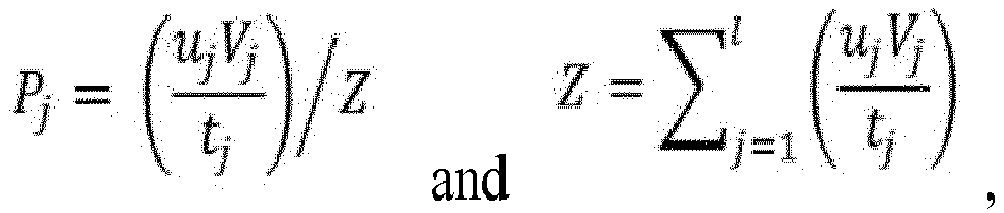
- uj is the number of functional groups in the polythiol compound,
- Vj is the amount (g) of the j-polythiol compound added,
- tj is the weight average molecular weight (g/mole) of the j-polythiol compound,


- In the above Formula 1,
- E is a halogen compound,
- F is an aliphatic hydrocarbon having 1 to 30 carbon atoms or an aromatic hydrocarbon having 6 to 30 carbon atoms,
- h and g are each independently an integer of 1 to 3,
- h + g is 4,
- K is the amount of the compound represented by the above Formula 1 (in parts by weight) based on 100 parts by weight of the total amounts of the polyisocyanate compound and the polythiol compound,
- D is the rate of change in the viscosity of the polymerizable composition with respect to time and is a value derived from Equation 2 defined as follows:

- In the above Equation 2,
- x is the elapsed time (hours) from the preparation of the composition to the measurement of viscosity, which ranges from 5 to 24,
- y is the viscosity (cps) of the polymerizable composition at 10°C after time x, and
- G is the initial viscosity of the polymerizable composition at 10°C.
- For example, when the polymerizable composition comprises two polyisocyanates of a first polyisocyanate and a second polyisocyanate, n is 2, W1 is the amount (g) of the first polyisocyanate, W2 is the amount (g) of the second polyisocyanate, and other factors may be assigned in the same manner in the above Equation 1.
- In the polymerizable composition, R calculated by the above Equation 1 may be a real number of 9.5 to 19.5. Specifically, in the polymerizable composition, R calculated by the above Equation 1 may be a real number of 9.5 to 19, a real number of 9.8 to 19, a real number of 9.8 to 18.5, or a real number of 9.8 to 18. If R is 9.5 or more, it is possible to prevent the problem that the reactivity between the polyisocyanate and the polythiol is too low, so that the generation of striae and bubbles due to the reaction imbalance in the terminal stage of polymerization can be increased, thereby lowering the production yield. In addition, if R is 19.5 or less, it is possible to prevent the problem that the reactivity is too high, so that the generation of striae and bubbles due to the reaction imbalance in the initial stage of polymerization is increased, thereby lowering the production yield. Therefore, in order to minimize the generation of striae and bubbles in the plastic lens thus produced, to thereby prevent such appearance defects and maximize the production yield, it is preferable to use a polymerizable composition wherein R is within the above-mentioned range.
- A may be a real number of 80 to 120, and B may be a real number of 80 to 115. Specifically, A may be a real number of 82 to 117, a real number of 86 to 112, or a real number of 90 to 105. B may be a real number of 82 to 114, a real number of 85 to 112, or a real number of 87 to 110.
- If A and B are within the above ranges, it is more advantageous in that the dimensional stability can be improved in the polymerization and curing steps, thereby enhancing the heat resistance and suppressing the generation of cracks.
- D may be a real number of 0.08 to 0.25, a real number of 0.09 to 0.24, or a real number of 0.10 to 0.23. If D is within the above range, it is possible to carry out homogeneous polymerization of the polymerizable composition, thereby suppressing the generation of striae and bubbles and enhancing the appearance and workability.
- E may be at least one selected from the group consisting of fluorine (F), chlorine (Cl), bromine (Br), and iodine (I). Specifically, E may be chlorine.
- F may be an alkyl group having 1 to 10 carbon atoms. Specifically, F may be methyl, ethyl, n-propyl, i-propyl, n-butyl, i-butyl, or t-butyl.
- The polymerizable composition comprises 1 to 5 types of a polyisocyanate compound, 1 to 5 types of a polythiol compound, and a catalyst represented by the above Formula 1. Specifically, the polymerizable composition may comprise 1 to 3 types of a polyisocyanate compound, 1 to 4 types of a polythiol compound, and a catalyst represented by the above Formula 1. Alternatively, it may comprise 1 or 2 types of a polyisocyanate compound, 1 or 2 types of a polythiol compound, and a catalyst represented by the above Formula 1.
- In addition, the polymerizable composition may comprise 1 to 3 types of a polyisocyanate compound and 1 to 4 types of a polythiol compound.
- The polyisocyanate compound may be a conventional one commonly used for the synthesis of polythiourethane. For example, the polyisocyanate compound may comprise at least one selected from the group consisting of an aliphatic isocyanate compound such as isophorone diisocyanate, dicyclohexylmethane-4,4-diisocyanate, hexamethylene diisocyanate, 2,2-dimethylpentane diisocyanate, 2,2,4-trimethylhexane diisocyanate, butene diisocyanate, 1,3-butadiene-1,4-diisocyanate, 2,4,4-trimethylhexamethylene diisocyanate, 1,6,11-undecane triisocyanate, 1,3,6-hexamethylene triisocyanate, 1,8-diisocyanato-4-isocyanatomethyloctane, bis(isocyanatoethyl) carbonate, and bis(isocyanatoethyl) ether; an alicyclic isocyanate compound such as isophorone diisocyanate, 1,2-bis(isocyanatomethyl)cyclohexane, 1,3-bis(isocyanatomethyl)cyclohexane, 1,4-bis(isocyanatomethyl)cyclohexane, dicyclohexylmethane diisocyanate, cyclohexane diisocyanate, methylcyclohexane diisocyanate, dicyclohexyldimethylmethane isocyanate, 2,2-dimethyldicyclohexylmethane isocyanate, and norbornane diisocyanate; an aromatic isocyanate compound such as bis(isocyanatomethyl)benzene, bis(isocyanatoethyl)benzene, bis(isocyanatopropyl)benzene, bis(isocyanatobutyl)benzene, bis(isocyanatomethyl)naphthalene, bis(isocyanatomethyl)diphenyl ether, phenylene diisocyanate, ethylphenylene diisocyanate, isopropylphenylene diisocyanate, dimethylphenylene diisocyanate, diethylphenylene diisocyanate, diisopropylphenylene diisocyanate, trimethylbenzene triisocyanate, benzene triisocyanate, biphenyl diisocyanate, toluidine diisocyanate, 4,4-diphenylmethane diisocyanate, 3,3-dimethyldiphenylmethane-4,4-diisocyanate, bibenzyl-4,4-diisocyanate, bis(isocyanatophenyl)ethylene, 3,3-dimethoxybiphenyl-4,4-diisocyanate, hexahydrobenzene diisocyanate, hexahydrodiphenylmethane-4,4-diisocyanate, o-xylene diisocyanate, m-xylene diisocyanate, p-xylene diisocyanate, and toluene diisocyanate; an aliphatic isocyanate compound containing sulfur such as bis(isocyanatoethyl) sulfide, bis(isocyanatopropyl) sulfide, bis(isocyanatohexyl) sulfide, bis(isocyanatomethyl) sulfone, bis(isocyanatomethyl) disulfide, bis(isocyanatopropyl) disulfide, bis(isocyanatomethylthio)methane, bis(isocyanatoethylthio)methane, bis(isocyanatoethylthio)ethane, , bis(isocyanatomethylthio)ethane, and 1,5-diisocyanato-2-isocyanatomethyl-3-thiapentane; an aromatic sulfide-based polyisocyanate compound such as 2-isocyanatophenyl-4-isocyanatophenyl sulfide, bis(4-isocyanatophenyl) sulfide, and bis(4-isocyanatomethylphenyl) sulfide; an aromatic isocyanate compound containing sulfur such as diphenyl sulfide-2,4-diisocyanate, diphenyl sulfide-4,4-diisocyanate, 3,3-dimethoxy-4,4-diisocyanatodibenzylthioether, bis(4-isocyanatomethylbenzene) sulfide, 4,4-methoxybenzenethioethylene glycol-3,3-diisocyanate, diphenyl disulfide-4,4-diisocyanate, 2,2-dimethyl diphenyl disulfide-5,5-diisocyanate, 3,3-dimethyl diphenyl disulfide-5,5-diisocyanate, 3,3-dimethyl diphenyl disulfide-6,6-diisocyanate, 4,4-dimethyl diphenyl disulfide-5,5-diisocyanate, 3,3-dimethoxydiphenyl disulfide-4,4-diisocyanate, and 4,4-dimethoxydiphenyl disulfide-3,3-diisocyanate; and a heterocyclic isocyanate compound containing sulfur such as 2,5-diisocyanatothiophene, 2,5-bis (isocyanatomethyl)thiophene, 2,5-diisocyanatotetrahydrothiophene, 2,5-bis (isocyanatomethyl)tetrahydrothiophene, 3,4-bis (isocyanatomethyl)tetrahydrothiophene, 2,5-diisocyanato-1,4-dithiane, 2,5-bis(isocyanatomethyl)-1,4-dithiane, 4,5-diisocyanato-1,3-dithiolane, 4,5-bis(isocyanatomethyl)-1,3-dithiolane, and 4,5-bis(isocyanatomethyl)-2-methyl-1,3-dithiolane. Specifically, the polyisocyanate compound may be one to five selected from the group consisting of isophorone diisocyanate, norbornene diisocyanate, m-xylene diisocyanate, toluene diisocyanate, hexamethylene diisocyanate, and cyclohexane diisocyanate.
- The number (n) of kinds of the polyisocyanate compound may be 1 to 5. Specifically, the number (n) of kinds of the polyisocyanate compound may be 1 to 3 or 1 to 2.
- The NCO content (Ni) of the polyisocyanate compound may be determined by the method specified in ISO 14896 "Plastics - Polyurethane raw materials - Determination of isocyanate content."
- The number (mi) of functional groups in the polyisocyanate compound may be 2 or 3.
- The weight average molecular weight (oi) of the polyisocyanate compound may be 100 to 900 g/mole or 150 to 800 g/mole.
- The polythiol compound may be a conventional one commonly used for the synthesis of polythiourethane. For example, the polythiol compound may comprise at least one selected from the group consisting of bis(2-(2-mercaptoethylthio)-3-mercaptopropyl) sulfide, 4-mercaptomethyl-1,8-dimercapto-3,6-dithiaoctane, 2,3-bis(2-mercaptoethylthio)propane-1-thiol, 2,2-bis(mercaptomethyl)-1,3-propanedithiol, bis(2-mercaptoethyl) sulfide, tetrakis(mercaptomethyl)methane, 2-(2-mercaptoethylthio)propane-1,3-dithiol, 2-(2,3-bis(2-mercaptoethylthio)propylthio)ethanethiol, bis(2,3-dimercaptopropanyl) sulfide, bis(2,3-dimercaptopropanyl) disulfide, 1,2-bis(2-mercaptoethylthio)-3-mercaptopropane, 1,2-bis(2-(2-mercaptoethylthio)-3-mercaptopropylthio)ethane, 2-(2-mercaptoethylthio)-3-2-mercapto-3-[3-mercapto-2-(2-mercaptoethylthio)-propylthio]propylthio-propane-1-thiol, 2,2-bis-(3-mercapto-propionyloxymethyl)-butyl ester, 2-(2-mercaptoethylthio)-3-(2-(2-[3-mercapto-2-(2-mercaptoethylthio)-propylthio]ethylthio)ethylthio)propane-1-thiol, (4R,11S)-4,11-bis(mercaptomethyl)-3,6,9,12-tetrathiatetradecane-1,14-dithiol, (S)-3-((R-2,3-dimercaptopropyl)thio)propane-1,2-dithiol, (4R, 14R)-4,14-bis(mercaptomethyl)-3,6,9,12,15-pentathiaheptane-1,17-dithiol, (S)-3-((R-3-mercapto-2-((2-mercaptoethyl)thio)propylthio)propylthio)-2-((2-mercaptoethyl)thio)propane-1-thiol, 3,3'-dithiobis(propane-1,2-dithiol), (7R,11S)-7,11-bis(mercaptomethyl)-3,6,9,12,15-pentathiaheptadecane-1,17-dithiol, (7R,12S)-7,12-bis(mercaptomethyl)-3,6,9,10,13,16-hexathiaoctadecane-1,18-dithiol, 5,7-dimercaptomethyl-1,11-dimercapto-3,6,9-trithiaundecane, 4,7-dimercaptomethyl-1,1-dimercapto-3,6,9-trithiaundecane, 4,8-dimercaptomethyl-1,11-dimercapto-3,6,9-trithiaundecane, pentaerythritol tetrakis(3-mercaptopropionate), trimethylolpropane tris(3-mercaptopropionate), pentaerythritol tetrakis(2-mercaptoacetate), bispentaerythritol-ether-hexakis(3-mercaptopropionate), 1,1,3,3-tetrakis(mercaptomethylthio)propane, 1,1,2,2-tetrakis(mercaptomethylthio)ethane, 4,6-bis(mercaptomethylthio)-1,3-dithiane, 1,4-dithiane-2,5-dimethanethiol, and 2-(2,2-bis(mercaptodimethylthio)ethyl)-1,3-dithiane. Specifically, the polythiol compound may be one to five selected from the group consisting of 4-mercaptomethyl-1,8-dimercapto-3,6-dithiaoctane, 4,8-dimercaptomethyl-1,11-dimercapto-3,6,9-trithiaundecane, pentaerythritol tetrakis(3-mercaptopropionate), pentaerythritol tetrakis(2-mercaptoacetate), and 1,4-dithiane-2,5-dimethanethiol.
- The number (1) of kinds of the polythiol compound may be 1 to 5, 1 to 3, or 2 or 3.
- The equivalent weight (g/eq.) (Sj) of the polythiol compound per unit molecular weight may be measured by the capacity titration method using the redox reaction of thiol and iodine.
- The number (uj) of functional groups in the polythiol compound may be an integer of 2 to 6 or an integer of 2 to 4.
- The weight average molecular weight (tj) of the polythiol compound may be 100 to 1,000 g/mole or 200 to 800 g/mole.
- The polymerizable composition may comprise a polythiol compound and an isocyanate compound in a molar ratio of 0.5 to 1.5:1. Specifically, the polymerizable composition may comprise a polythiol compound and an isocyanate compound in a molar ratio of 0.8 to 1.2:1.
- The catalyst may be a compound represented by the above Formula 1. Specifically, the catalyst may be at least one selected from the group consisting of dibutyltin dichloride, dimethyltin dichloride, diethyltin dichloride, dipropyltin dichloride, di-isopropyltin dichloride, and di-tert-butyltin dichloride.
- The polymerizable composition may have a viscosity of 1,000 cps (centipoise) or more after it stands at 10°C for 24 hours. Specifically, the polymerizable composition may have a viscosity of 1,000 to 10,000 cps or 1,500 to 10,000 cps after it stands at 10°C for 24 hours. If the viscosity of the polymerizable composition after it stands at 10°C for 24 hours is within the above range, it is possible to prevent the problem that the reactivity of the composition is too high, which lowers the workability, or that the reactivity of the composition is too low, which lowers the production yield.
- When the polymerizable composition is made into a specimen having a diameter of 75 mm and a thickness of 10 mm, it may have a generation rate of bubbles of 0 to 10% and a generation rate of striae of 0 to 8%. Specifically, when the polymerizable composition is made into a specimen having a diameter of 75 mm and a thickness of 10 mm, it may have a generation rate of bubbles of 0 to 8% or 0 to 5% and a generation rate of striae of 0 to 7% or 0 to 5%.
- The polymerizable composition may further comprise such additives as an internal mold release agent, an ultraviolet absorber, a polymerization initiator, a heat stabilizer, a blueing agent, a chain extender, a crosslinking agent, a light stabilizer, an antioxidant, and a filler, depending on the purpose thereof.
- For example, the internal mold release agent may comprise at least one selected from the group consisting of a fluorine-based nonionic surfactant having a perfluoroalkyl group, a hydroxyalkyl group, or a phosphate ester group; a silicone-based nonionic surfactant having a dimethylpolysiloxane group, a hydroxyalkyl group, or a phosphate ester group; an alkyl quaternary ammonium salt such as trimethylcetylammonium salt, trimethylstearylammonium salt, dimethylethylcetylammonium salt, triethyldodecylammonium salt, trioctylmethylammonium salt, and diethylcyclohexadodecylammonium salt; and an acidic phosphate ester.
- Examples of the ultraviolet absorber may include a benzophenone type, a benzotriazole type, a salicylate type, a cyanoacrylate type, an oxanilide type, or the like.
- The polymerization initiator may include, for example, an amine type, a phosphorus type, an organotin type, an organic copper type, an organic gallium type, an organic zirconium type, an organic iron type, an organic zinc, and an organic aluminum.
- The heat stabilizer may include, for example, a metal fatty acid salt type, a phosphorus type, a lead type, or an organotin type.
- The blueing agent has an absorption band in the wavelength range from orange to yellow in the visible light region and has a function of adjusting the color of an optical material made of a resin. Specifically, the blueing agent may comprise a material that exhibits blue to violet color, but it is not particularly limited thereto. In addition, examples of the blueing agent include a dye, a fluorescent whitening agent, a fluorescent pigment, and an inorganic pigment. It may be properly selected in accordance with the properties required for an optical component to be produced and the resin color. The blueing agent may be used alone or in combination of two or more. In view of the solubility in the polymerizable composition and the transparency of the optical material to be produced, a dye is preferably used as the bluing agent. From the viewpoint of the absorption wavelength, the dye may particularly have a maximum absorption wavelength of 520 to 600 nm; and more particularly, it may have a maximum absorption wavelength of 540 to 580 nm. In addition, in terms of the structure of the compound, an anthraquinone-based dye is preferable as the dye. The method of adding the blueing agent is not particularly limited, and the blueing agent may be added to the monomers in advance. Specifically, various methods can be used; for example, the blueing agent may be dissolved in the monomers or may be contained in a master solution in a high concentration, the master solution being later diluted with the monomers or other additives and then added.
- Another embodiment provides a polythiourethane-based compound prepared from the polymerizable composition as described above.
- The polythiourethane-based compound is prepared by polymerizing (and curing) the polythiol compound and the polyisocyanate compound. The reaction molar ratio of SH groups to NCO groups in the polymerization reaction may be 0.5 to 3.0, particularly 0.6 to 2.0 or 0.8 to 1.3. Within the above range, it is possible to enhance such properties as refractive index and heat resistance required for an optical material and the balance between them.
- Still another embodiment provides an optical material molded from the polythiourethane-based compound as described above. Specifically, the optical material may be comprised of a molded article prepared by curing the polymerizable composition. In addition, the optical material is produced by polymerizing and molding the polymerizable composition (i.e., a polythiol compound, a polyisocyanate compound, and a catalyst).
- First, the polymerizable composition is degassed under a reduced pressure and then injected into a mold for molding an optical material. Such degassing and mold injection may be carried out in a temperature range of, for example, 5 to 40°C or 10 to 30°C. Once the composition is injected into the mold, polymerization is usually carried out by gradually heating the composition from a low temperature to a high temperature. The polymerization temperature may be, for example, 30 to 150°C, particularly 40 to 130°C. In addition, a reaction catalyst, which is conventionally used in the production of polythiourethane, may be employed in order to control the reaction rate. Specific examples of the reaction catalyst are as exemplified above.
- Then, the polythiourethane-based optical material is released from the mold.
- The optical material may have various shapes by changing the mold used in the production thereof. Specifically, it may be in the form of an eyeglass lens, a camera lens, a light emitting diode (LED), or the like. The optical material may be, for example, an optical lens, specifically a plastic optical lens.
- The optical material may have a refractive index of 1.55 to 1.70 for light at 546 nm and an Abbe number of 25 to 50. Specifically, the optical material may have a refractive index of 1.58 to 1.68 for light at 546 nm and an Abbe number of 30 to 45, or a refractive index of 1.55 to 1.70 for light at 546 nm and an Abbe number of 25 to 45.
- Hereinafter, the present invention is explained in detail by Examples. The following Examples are intended to further illustrate the present invention without limiting its scope.
- The polyisocyanates and the polythiols used in the following Examples and Comparative Examples are as shown in Tables 1 and 2 below.
[Table 1] Chemical structure Chemical name Weight average molecular weight (g/mole) (o) Number of functional groups (m) NCO% (wt. %) Iso 1 
m-xylene diisocyanate 188.2 2 43.8 to 44.7 Iso 2 
1,3-bis(isocyanatomethyl)cyclohex ane 194.2 2 42.4 to 43.3 Iso 3 
hexamethylene diisocyanate 168.2 2 49.1 to 50.0 Iso 4 
toluene diisocyanate 174.2 2 48.4 to 48.3 Iso 5 
norbornene diisocyanate 206.3 2 39.9 to 40.8 Iso 6 
isophorone diisocyanate 222.3 2 37.0 to 37.9 [Table 2] Chemical structure Chemical name Weight average molecular (g/mole) (t) Number of functional groups (u) Eq. wt. (g/eq.) Thiol 1 
4-mercaptomethyl-3,6-dithia-1,8-octanethiol 260.5 3 87 to 93 Thiol 2 
4,8-dimercaptomethyl-1,11-dimercapto-3,6,9-trithiaundecane 366.7 4 94 to 102 Thiol 3 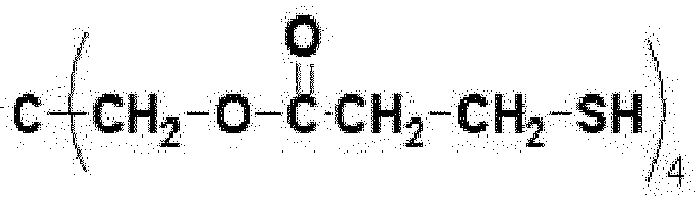
pentaerythritol tetrakis(3-mercaptopropionate) 488.7 4 124 to 127 Thiol 4 
pentaerythritol tetrakis(2-mercaptoacetate) 446.6 4 112 to 116 Thiol 5 
1,4-dithiane-2,5-dimethanethiol 212.4 2 106 to 109 - Catalyst 1: DMTC, dimethyltin dichloride
- Catalyst 2: DBTC, dibutyltin dichloride
- The polyisocyanate, the polythiol, and the catalyst were mixed in the composition shown in Table 3 below. Added thereto were 1.0 part by weight of 2-(2-hydroxy-5-tert-octylphenyl)benzotriazole as an ultraviolet stabilizer and 0.2 part by weight of Zelec® UN (acidic phosphate alkyl ester release agent, Stepan Company) as an internal mold release agent to prepare a polymerizable composition.
- Polymerizable compositions were each prepared in the same manner as in Example 1, except that the polyisocyanate, the polythiol, and the catalyst were mixed in the compositions shown in Table 3 below.
[Table 3] Ex. 1 Ex. 2 Ex. 3 Ex. 4 Ex. 5 Ex. 6 Ex. 7 Ex. 8 Ex. 9 C. Ex. 1 C. Ex. 2 C. Ex. 3 Iso 1 - - - - - - 121.5 g - - - - - Iso 2 154.4 g 155.4 g 155.4 g 155.2 g - - - 95.1 g 93.6 g 154.5 g 97.1 g - Iso 3 - - - - - 16.8 g - 13.7 g - - - 33.6 g Iso 4 - - - - - - 12.1 g - - - - 139.4 g Iso 5 - - - - 164.9 g - - - - - - - Iso 6 - - - - 88.9 g - 42.6 g 36.0 g - - - Thiol 1 - - - - 111.2 g 32.6 g 60.4 g 56.7 g 29.9 g - - 130.3 g Thiol 2 87.6 g 88.2 g - - - - 63.7 g 59.9 g 31.6 g 88.1 g - - Thiol 3 - - - - 39.3 g - - 39.9 g 50.4 g - 122.3 g - Thiol 4 78.7 g 77.3 g 69.2 g 68.9 g - 61.1 g - - - 78.7 g - - Thiol 5 - - 101.9 g 102.2 g - - - - 29.3 g - - - Catalyst DMTC DBTC DMTC DMTC DBTC DBTC DBTC DBTC DMTC DMTC DBTC DMTC Amount of catalyst 300 ppm 210 ppm 200 ppm 295 ppm 320 ppm 150 ppm 75 ppm 120 ppm 180 ppm 30 ppm 500 ppm 75 ppm - The polymerizable compositions of Examples 1 to 9 and Comparative Examples 1 to 3 were each measured for the change in the viscosity at 10°C. Each of the plastic lenses produced therefrom was measured for the generation rates of striae and bubbles, refractive index, and Abbe number. The measurement results are shown in Table 4 below.
- Each of the polymerizable compositions prepared in Examples 1 to 9 and Comparative Examples 1 to 3 was degassed at 10°C and 2 torr for 1 hour and then filtered through a Teflon filter of 3 µm. The change in the viscosity of the polymerizable compositions thus filtered were measured for 24 hours at 10°C using a non-contact viscometer (EMS-1000, Kyoto Electronics Manufacturing Co., Ltd.), and the rate of change in viscosity with time was calculated by the following Equation 2.

- The polymerizable compositions filtered in the same manner as in the above Section (1) were each injected into a glass mold assembled with an adhesive tape. The mold was allowed to stand at 10°C for 5 hours and then heated from 10°C to 120°C at a rate of 5°C/min, so that the polymerization was carried out at 120°C for 20 hours. Then, the cured resin having a size of 75 mm in diameter and 10 mm in thickness was further cured in the glass mold at 130°C for 4 hours, and then the molded article (i.e., plastic lens) was released from the glass mold.
- Light was transmitted through a plastic lens using a mercury lamp as a light source. The transmitted light was projected onto a white plate, and the presence or absence of a contrast was visually checked to determine the generation of striae. 100 plastic lenses were prepared and tested for evaluation of the generation rate of striae.
- A plastic lens prepared in the same manner as in the above Section (2) was observed with the naked eyes under a mercury lamp. The generation of microbubbles was observed. 100 plastic lenses were prepared and tested for evaluation of the generation rate of bubbles.
- A plastic lens prepared in the same manner as in the above Section (2) was measured for the refractive index and Abbe number with E-line (nE) at 20°C using a refractometer DR-M4 manufactured by Atago Co.
- Specifically, the refractive index was measured for light with a wavelength of 546 nm.
[Table 4] D R Refractive index Abbe number Generation rate of striae (%) Generation rate of bubbles (%) Ex. 1 0.1596 11.01 1.5993 41 4 1 Ex. 2 0.1702 11.16 1.5995 41 3 2 Ex. 3 0.1495 11.25 1.6031 42 1 2 Ex. 4 0.0973 9.88 1.6029 42 1 1 Ex. 5 0.0615 10.32 1.6024 41 2 1 Ex. 6 0.1159 10.31 1.5760 44 4 3 Ex. 7 0.2214 16.77 1.6698 32 2 3 Ex. 8 0.1356 12.01 1.5947 42 4 2 Ex. 9 0.1674 12.30 1.5865 42 3 2 C. Ex. 1 0.2409 35.19 1.5994 41 22 29 C. Ex. 2 0.0265 7.73 1.5671 41 69 45 C. Ex. 3 0.3357 20.02 1.6715 30 56 39 - As shown in Table 4, in the polymerizable compositions of Examples 1 to 9, R was in the range of 9.5 to 19.5. The plastic lenses produced therefrom were excellent in appearance with low generation rates of striae and bubbles. In contrast, in the polymerizable compositions of Comparative Examples 1 to 3, R did not satisfy the above range. Thus, the plastic lenses produced therefrom had appearance defects with high generation rates of striae and bubbles.
Claims (13)
- A polymerizable composition, which comprises 1 to 5 types of a polyisocyanate compound, 1 to 5 types of a polythiol compounds, and a catalyst represented by the following Formula 1,
wherein R calculated by the following Equation 1 is a real number of 9.5 to 19.5:

 n is the number of kinds of the polyisocyanate compound,Ni is the content (% by weight) of NCO in the i-polyisocyanate compound,mi is the number of functional groups in the i-polyisocyanate compound,Wi is the amount (g) of the i-polyisocyanate compound added,oi is the weight average molecular weight (g/mole) of the i-polyisocyanate compound,
 1 is the number of kinds of the polythiol compounds,Sj is the equivalent weight (g/eq.) of the j-polythiol compound,
 uj is the number of functional groups in the polythiol compound,Vj is the amount (g) of the j-polythiol compound added,tj is the weight average molecular weight (g/mole) of the j-polythiol compound,In the above Formula 1,
 E is a halogen compound,F is an aliphatic hydrocarbon having 1 to 30 carbon atoms or an aromatic hydrocarbon having 6 to 30 carbon atoms,h and g are each independently an integer of 1 to 3,h + g is 4,K is the amount of the compound represented by the above Formula 1 based on 100 parts by weight of the total amounts of the polyisocyanate compound and the polythiol compound,D is the rate of change in the viscosity of the polymerizable composition with respect to time and is a value derived from Equation 2 defined as follows:In the above Equation 2,
 x is the elapsed time (hours) from the preparation of the composition to the measurement of viscosity, which ranges from 5 to 24,y is the viscosity (cps) of the polymerizable composition at 10°C after time x, and G is the initial viscosity of the polymerizable composition at 10°C.
 - The polymerizable composition of claim 1, wherein A is a real number of 80 to 120, and B is a real number of 80 to 115.
- The polymerizable composition of claim 1, wherein D is a real number of 0.08 to 0.25.
- The polymerizable composition of claim 1, wherein R is a real number of 9.8 to 18.
- The polymerizable composition of claim 1, wherein E is at least one selected from the group consisting of fluorine (F), chlorine (Cl), bromine (Br), and iodine (I).
- The polymerizable composition of claim 1, wherein F is an alkyl group having 1 to 10 carbon atoms.
- The polymerizable composition of claim 6, wherein F is methyl, ethyl, n-propyl, i-propyl, n-butyl, i-butyl, or t-butyl.
- The polymerizable composition of claim 1, which has a viscosity of 1,000 cps (centipoise) or more after it stands at 10°C for 24 hours.
- The polymerizable composition of claim 1, wherein when the polymerizable composition is made into a specimen having a diameter of 75 mm and a thickness of 10 mm, it has a generation rate of bubbles of 0 to 10% and a generation rate of striae of 0 to 8%.
- The polymerizable composition of claim 1, which comprises 1 to 3 types of a polyisocyanate compound and 1 to 4 types of a polythiol compound.
- A polythiourethane-based compound prepared from the polymerizable composition of any one of claims 1 to 10.
- An optical material molded from the polythiourethane-based compound of claim 11.
- The optical material of claim 12, which has a refractive index of 1.55 to 1.70 for light at 546 nm and an Abbe number of 25 to 45.
Applications Claiming Priority (1)
| Application Number | Priority Date | Filing Date | Title |
|---|---|---|---|
| KR1020170182078A KR20190079956A (en) | 2017-12-28 | 2017-12-28 | Polymerizable composition for optical material |
Publications (2)
| Publication Number | Publication Date |
|---|---|
| EP3505547A1 true EP3505547A1 (en) | 2019-07-03 |
| EP3505547B1 EP3505547B1 (en) | 2024-06-26 |
Family
ID=65199275
Family Applications (1)
| Application Number | Title | Priority Date | Filing Date |
|---|---|---|---|
| EP18215872.5A Active EP3505547B1 (en) | 2017-12-28 | 2018-12-24 | Polymerizable composition for an optical material |
Country Status (6)
| Country | Link |
|---|---|
| US (1) | US10759895B2 (en) |
| EP (1) | EP3505547B1 (en) |
| JP (1) | JP6957445B2 (en) |
| KR (1) | KR20190079956A (en) |
| CN (1) | CN109575217B (en) |
| TW (1) | TWI691519B (en) |
Families Citing this family (3)
| Publication number | Priority date | Publication date | Assignee | Title |
|---|---|---|---|---|
| MX2022012244A (en) * | 2020-03-30 | 2022-10-27 | Ppg Ind Ohio Inc | Method of preparing low haze polymer compositions for use in high refractive index optical materials. |
| KR102853547B1 (en) * | 2021-05-28 | 2025-09-02 | 피유코어 주식회사 | Polymerizable composition and optical material using the same |
| US12583963B2 (en) * | 2021-05-28 | 2026-03-24 | Sk Pucore Co., Ltd. | Polymerizable composition and optical material using the same |
Citations (4)
| Publication number | Priority date | Publication date | Assignee | Title |
|---|---|---|---|---|
| EP2660260A1 (en) * | 2010-12-27 | 2013-11-06 | Mitsubishi Gas Chemical Company, Inc. | Composition for optical material |
| EP2891672A1 (en) * | 2012-08-29 | 2015-07-08 | KOC Solution Co. Ltd. | Method for manufacturing thiourethane-based optical material |
| WO2016153061A1 (en) * | 2015-03-25 | 2016-09-29 | ホヤ レンズ タイランド リミテッド | Polymerizable composition, optical member, plastic lens, and eyeglass lens |
| KR101704951B1 (en) | 2012-11-21 | 2017-02-08 | 미쓰이 가가쿠 가부시키가이샤 | Polyurethane resin production method |
Family Cites Families (9)
| Publication number | Priority date | Publication date | Assignee | Title |
|---|---|---|---|---|
| JP2001353734A (en) * | 2000-06-16 | 2001-12-25 | Seiko Epson Corp | Method for producing plastic lens and adhesive tape for producing plastic lens |
| US6852771B2 (en) * | 2001-08-28 | 2005-02-08 | Basf Corporation | Dual radiation/thermal cured coating composition |
| US7759435B2 (en) * | 2006-09-26 | 2010-07-20 | Loctite (R&D) Limited | Adducts and curable compositions using same |
| CN103108918B (en) * | 2011-03-02 | 2015-07-15 | 可奥熙搜路司有限公司 | Method for manufacturing resin for thiourethane-based optical material using universal polyisocyanate compound, resin composition, and optical material manufactured thereby |
| JP6095646B2 (en) | 2012-03-27 | 2017-03-15 | Hoya株式会社 | Manufacturing method of plastic lens |
| KR101386543B1 (en) * | 2012-10-24 | 2014-04-18 | 대우조선해양 주식회사 | System for treating boil-off gas for a ship |
| CN105793737B (en) * | 2013-12-13 | 2020-03-03 | 三井化学株式会社 | Polymerizable composition for optical materials |
| EP3103824B1 (en) * | 2014-02-06 | 2020-03-25 | Mitsui Chemicals, Inc. | Polymerizable composition for optical material and optical material |
| KR101996981B1 (en) * | 2017-10-18 | 2019-07-05 | 에스케이씨 주식회사 | Polymerizable composition for plastic lens |
-
2017
- 2017-12-28 KR KR1020170182078A patent/KR20190079956A/en not_active Ceased
-
2018
- 2018-12-06 CN CN201811490099.2A patent/CN109575217B/en active Active
- 2018-12-20 TW TW107146157A patent/TWI691519B/en active
- 2018-12-24 EP EP18215872.5A patent/EP3505547B1/en active Active
- 2018-12-25 JP JP2018241026A patent/JP6957445B2/en active Active
- 2018-12-26 US US16/232,746 patent/US10759895B2/en active Active
Patent Citations (4)
| Publication number | Priority date | Publication date | Assignee | Title |
|---|---|---|---|---|
| EP2660260A1 (en) * | 2010-12-27 | 2013-11-06 | Mitsubishi Gas Chemical Company, Inc. | Composition for optical material |
| EP2891672A1 (en) * | 2012-08-29 | 2015-07-08 | KOC Solution Co. Ltd. | Method for manufacturing thiourethane-based optical material |
| KR101704951B1 (en) | 2012-11-21 | 2017-02-08 | 미쓰이 가가쿠 가부시키가이샤 | Polyurethane resin production method |
| WO2016153061A1 (en) * | 2015-03-25 | 2016-09-29 | ホヤ レンズ タイランド リミテッド | Polymerizable composition, optical member, plastic lens, and eyeglass lens |
Also Published As
| Publication number | Publication date |
|---|---|
| TW201932503A (en) | 2019-08-16 |
| TWI691519B (en) | 2020-04-21 |
| JP2019119861A (en) | 2019-07-22 |
| US20190202968A1 (en) | 2019-07-04 |
| EP3505547B1 (en) | 2024-06-26 |
| US10759895B2 (en) | 2020-09-01 |
| KR20190079956A (en) | 2019-07-08 |
| CN109575217A (en) | 2019-04-05 |
| CN109575217B (en) | 2021-05-11 |
| JP6957445B2 (en) | 2021-11-02 |
Similar Documents
| Publication | Publication Date | Title |
|---|---|---|
| US9522879B2 (en) | Method for preparing polythiol compound and polymeric composition for optical material comprising same | |
| KR101349273B1 (en) | A method of preparing thioepoxy based optical material and its polymerizable composition | |
| EP2980113B1 (en) | Polymerizable composition for optical material, optical material, and method for producing optical material | |
| EP3480233B1 (en) | Polymerizable composition for polythiourethane-based optical material | |
| JP2016175905A (en) | Method for producing polythiol compound for optical material and method for producing urethane-based optical material using the same | |
| KR20130081257A (en) | Polymerizable composition for thioepoxy based optical material and method of preparing the optical material | |
| US10759895B2 (en) | Polymerizable composition for optical material | |
| KR20130085914A (en) | Thioepoxy based copolymerizable composition and the method of preparing thioepoxy based optical material | |
| KR101464943B1 (en) | Method of Producing Polythiol Compound for Thioepoxy based Optical Material, and Copolymerizable Composition for Thioepoxy based Optical Material Comprising the Polythiol Compound | |
| US10669367B2 (en) | Polythiol composition for plastic lens | |
| KR20140001808A (en) | A method of preparing thiourethane based optical material | |
| KR102553438B1 (en) | Composition for episulfide based optical material having high refractive index and method of preparing the optical material | |
| KR102150592B1 (en) | Polymerizable composition for optical material | |
| EP3805286B1 (en) | Polymerizable composition and optical material produced therefrom | |
| KR20210107444A (en) | Composition for episulfide-based high refractive optical material with improved light resistance and manufacturing method of optical material | |
| KR20210130547A (en) | Method for manufacturing epoxy compound for optical materials and method for manufacturing episulfide compound for optical material and high refractive optical material using same | |
| KR20200026853A (en) | Polythiol composition and preparation method thereof | |
| KR20210097356A (en) | Composition for episulfide-based high refractive optical material with controlled curing rate during polymerization and manufacturing method of optical material using same | |
| KR20190095214A (en) | Polymerizable composition comprising bluing agent | |
| KR20210105221A (en) | Heat stabilizer for episulfide-based optical material, composition for optical material and manufacturing method of optical material |
Legal Events
| Date | Code | Title | Description |
|---|---|---|---|
| PUAI | Public reference made under article 153(3) epc to a published international application that has entered the european phase |
Free format text: ORIGINAL CODE: 0009012 |
|
| STAA | Information on the status of an ep patent application or granted ep patent |
Free format text: STATUS: THE APPLICATION HAS BEEN PUBLISHED |
|
| AK | Designated contracting states |
Kind code of ref document: A1 Designated state(s): AL AT BE BG CH CY CZ DE DK EE ES FI FR GB GR HR HU IE IS IT LI LT LU LV MC MK MT NL NO PL PT RO RS SE SI SK SM TR |
|
| AX | Request for extension of the european patent |
Extension state: BA ME |
|
| STAA | Information on the status of an ep patent application or granted ep patent |
Free format text: STATUS: REQUEST FOR EXAMINATION WAS MADE |
|
| 17P | Request for examination filed |
Effective date: 20191223 |
|
| RBV | Designated contracting states (corrected) |
Designated state(s): AL AT BE BG CH CY CZ DE DK EE ES FI FR GB GR HR HU IE IS IT LI LT LU LV MC MK MT NL NO PL PT RO RS SE SI SK SM TR |
|
| STAA | Information on the status of an ep patent application or granted ep patent |
Free format text: STATUS: EXAMINATION IS IN PROGRESS |
|
| 17Q | First examination report despatched |
Effective date: 20220720 |
|
| P01 | Opt-out of the competence of the unified patent court (upc) registered |
Effective date: 20230622 |
|
| GRAP | Despatch of communication of intention to grant a patent |
Free format text: ORIGINAL CODE: EPIDOSNIGR1 |
|
| STAA | Information on the status of an ep patent application or granted ep patent |
Free format text: STATUS: GRANT OF PATENT IS INTENDED |
|
| INTG | Intention to grant announced |
Effective date: 20240122 |
|
| RAP1 | Party data changed (applicant data changed or rights of an application transferred) |
Owner name: SK PUCORE CO., LTD. |
|
| GRAS | Grant fee paid |
Free format text: ORIGINAL CODE: EPIDOSNIGR3 |
|
| GRAA | (expected) grant |
Free format text: ORIGINAL CODE: 0009210 |
|
| STAA | Information on the status of an ep patent application or granted ep patent |
Free format text: STATUS: THE PATENT HAS BEEN GRANTED |
|
| AK | Designated contracting states |
Kind code of ref document: B1 Designated state(s): AL AT BE BG CH CY CZ DE DK EE ES FI FR GB GR HR HU IE IS IT LI LT LU LV MC MK MT NL NO PL PT RO RS SE SI SK SM TR |
|
| REG | Reference to a national code |
Ref country code: GB Ref legal event code: FG4D |
|
| REG | Reference to a national code |
Ref country code: CH Ref legal event code: EP |
|
| REG | Reference to a national code |
Ref country code: DE Ref legal event code: R096 Ref document number: 602018070965 Country of ref document: DE |
|
| PG25 | Lapsed in a contracting state [announced via postgrant information from national office to epo] |
Ref country code: BG Free format text: LAPSE BECAUSE OF FAILURE TO SUBMIT A TRANSLATION OF THE DESCRIPTION OR TO PAY THE FEE WITHIN THE PRESCRIBED TIME-LIMIT Effective date: 20240626 |
|
| PG25 | Lapsed in a contracting state [announced via postgrant information from national office to epo] |
Ref country code: FI Free format text: LAPSE BECAUSE OF FAILURE TO SUBMIT A TRANSLATION OF THE DESCRIPTION OR TO PAY THE FEE WITHIN THE PRESCRIBED TIME-LIMIT Effective date: 20240626 Ref country code: HR Free format text: LAPSE BECAUSE OF FAILURE TO SUBMIT A TRANSLATION OF THE DESCRIPTION OR TO PAY THE FEE WITHIN THE PRESCRIBED TIME-LIMIT Effective date: 20240626 |
|
| REG | Reference to a national code |
Ref country code: LT Ref legal event code: MG9D |
|
| PG25 | Lapsed in a contracting state [announced via postgrant information from national office to epo] |
Ref country code: GR Free format text: LAPSE BECAUSE OF FAILURE TO SUBMIT A TRANSLATION OF THE DESCRIPTION OR TO PAY THE FEE WITHIN THE PRESCRIBED TIME-LIMIT Effective date: 20240927 |
|
| PG25 | Lapsed in a contracting state [announced via postgrant information from national office to epo] |
Ref country code: LV Free format text: LAPSE BECAUSE OF FAILURE TO SUBMIT A TRANSLATION OF THE DESCRIPTION OR TO PAY THE FEE WITHIN THE PRESCRIBED TIME-LIMIT Effective date: 20240626 |
|
| REG | Reference to a national code |
Ref country code: NL Ref legal event code: MP Effective date: 20240626 |
|
| PG25 | Lapsed in a contracting state [announced via postgrant information from national office to epo] |
Ref country code: NO Free format text: LAPSE BECAUSE OF FAILURE TO SUBMIT A TRANSLATION OF THE DESCRIPTION OR TO PAY THE FEE WITHIN THE PRESCRIBED TIME-LIMIT Effective date: 20240926 Ref country code: LV Free format text: LAPSE BECAUSE OF FAILURE TO SUBMIT A TRANSLATION OF THE DESCRIPTION OR TO PAY THE FEE WITHIN THE PRESCRIBED TIME-LIMIT Effective date: 20240626 Ref country code: HR Free format text: LAPSE BECAUSE OF FAILURE TO SUBMIT A TRANSLATION OF THE DESCRIPTION OR TO PAY THE FEE WITHIN THE PRESCRIBED TIME-LIMIT Effective date: 20240626 Ref country code: GR Free format text: LAPSE BECAUSE OF FAILURE TO SUBMIT A TRANSLATION OF THE DESCRIPTION OR TO PAY THE FEE WITHIN THE PRESCRIBED TIME-LIMIT Effective date: 20240927 Ref country code: FI Free format text: LAPSE BECAUSE OF FAILURE TO SUBMIT A TRANSLATION OF THE DESCRIPTION OR TO PAY THE FEE WITHIN THE PRESCRIBED TIME-LIMIT Effective date: 20240626 Ref country code: BG Free format text: LAPSE BECAUSE OF FAILURE TO SUBMIT A TRANSLATION OF THE DESCRIPTION OR TO PAY THE FEE WITHIN THE PRESCRIBED TIME-LIMIT Effective date: 20240626 Ref country code: RS Free format text: LAPSE BECAUSE OF FAILURE TO SUBMIT A TRANSLATION OF THE DESCRIPTION OR TO PAY THE FEE WITHIN THE PRESCRIBED TIME-LIMIT Effective date: 20240926 |
|
| PG25 | Lapsed in a contracting state [announced via postgrant information from national office to epo] |
Ref country code: NL Free format text: LAPSE BECAUSE OF FAILURE TO SUBMIT A TRANSLATION OF THE DESCRIPTION OR TO PAY THE FEE WITHIN THE PRESCRIBED TIME-LIMIT Effective date: 20240626 |
|
| REG | Reference to a national code |
Ref country code: AT Ref legal event code: MK05 Ref document number: 1697650 Country of ref document: AT Kind code of ref document: T Effective date: 20240626 |
|
| PG25 | Lapsed in a contracting state [announced via postgrant information from national office to epo] |
Ref country code: NL Free format text: LAPSE BECAUSE OF FAILURE TO SUBMIT A TRANSLATION OF THE DESCRIPTION OR TO PAY THE FEE WITHIN THE PRESCRIBED TIME-LIMIT Effective date: 20240626 |
|
| PG25 | Lapsed in a contracting state [announced via postgrant information from national office to epo] |
Ref country code: PT Free format text: LAPSE BECAUSE OF FAILURE TO SUBMIT A TRANSLATION OF THE DESCRIPTION OR TO PAY THE FEE WITHIN THE PRESCRIBED TIME-LIMIT Effective date: 20241028 |
|
| PG25 | Lapsed in a contracting state [announced via postgrant information from national office to epo] |
Ref country code: PT Free format text: LAPSE BECAUSE OF FAILURE TO SUBMIT A TRANSLATION OF THE DESCRIPTION OR TO PAY THE FEE WITHIN THE PRESCRIBED TIME-LIMIT Effective date: 20241028 |
|
| PG25 | Lapsed in a contracting state [announced via postgrant information from national office to epo] |
Ref country code: PL Free format text: LAPSE BECAUSE OF FAILURE TO SUBMIT A TRANSLATION OF THE DESCRIPTION OR TO PAY THE FEE WITHIN THE PRESCRIBED TIME-LIMIT Effective date: 20240626 |
|
| PG25 | Lapsed in a contracting state [announced via postgrant information from national office to epo] |
Ref country code: EE Free format text: LAPSE BECAUSE OF FAILURE TO SUBMIT A TRANSLATION OF THE DESCRIPTION OR TO PAY THE FEE WITHIN THE PRESCRIBED TIME-LIMIT Effective date: 20240626 |
|
| PG25 | Lapsed in a contracting state [announced via postgrant information from national office to epo] |
Ref country code: AT Free format text: LAPSE BECAUSE OF FAILURE TO SUBMIT A TRANSLATION OF THE DESCRIPTION OR TO PAY THE FEE WITHIN THE PRESCRIBED TIME-LIMIT Effective date: 20240626 Ref country code: IS Free format text: LAPSE BECAUSE OF FAILURE TO SUBMIT A TRANSLATION OF THE DESCRIPTION OR TO PAY THE FEE WITHIN THE PRESCRIBED TIME-LIMIT Effective date: 20241026 |
|
| PG25 | Lapsed in a contracting state [announced via postgrant information from national office to epo] |
Ref country code: CZ Free format text: LAPSE BECAUSE OF FAILURE TO SUBMIT A TRANSLATION OF THE DESCRIPTION OR TO PAY THE FEE WITHIN THE PRESCRIBED TIME-LIMIT Effective date: 20240626 |
|
| PG25 | Lapsed in a contracting state [announced via postgrant information from national office to epo] |
Ref country code: RO Free format text: LAPSE BECAUSE OF FAILURE TO SUBMIT A TRANSLATION OF THE DESCRIPTION OR TO PAY THE FEE WITHIN THE PRESCRIBED TIME-LIMIT Effective date: 20240626 Ref country code: SK Free format text: LAPSE BECAUSE OF FAILURE TO SUBMIT A TRANSLATION OF THE DESCRIPTION OR TO PAY THE FEE WITHIN THE PRESCRIBED TIME-LIMIT Effective date: 20240626 |
|
| PG25 | Lapsed in a contracting state [announced via postgrant information from national office to epo] |
Ref country code: ES Free format text: LAPSE BECAUSE OF FAILURE TO SUBMIT A TRANSLATION OF THE DESCRIPTION OR TO PAY THE FEE WITHIN THE PRESCRIBED TIME-LIMIT Effective date: 20240626 Ref country code: SM Free format text: LAPSE BECAUSE OF FAILURE TO SUBMIT A TRANSLATION OF THE DESCRIPTION OR TO PAY THE FEE WITHIN THE PRESCRIBED TIME-LIMIT Effective date: 20240626 |
|
| PG25 | Lapsed in a contracting state [announced via postgrant information from national office to epo] |
Ref country code: SM Free format text: LAPSE BECAUSE OF FAILURE TO SUBMIT A TRANSLATION OF THE DESCRIPTION OR TO PAY THE FEE WITHIN THE PRESCRIBED TIME-LIMIT Effective date: 20240626 Ref country code: SK Free format text: LAPSE BECAUSE OF FAILURE TO SUBMIT A TRANSLATION OF THE DESCRIPTION OR TO PAY THE FEE WITHIN THE PRESCRIBED TIME-LIMIT Effective date: 20240626 Ref country code: RO Free format text: LAPSE BECAUSE OF FAILURE TO SUBMIT A TRANSLATION OF THE DESCRIPTION OR TO PAY THE FEE WITHIN THE PRESCRIBED TIME-LIMIT Effective date: 20240626 Ref country code: PL Free format text: LAPSE BECAUSE OF FAILURE TO SUBMIT A TRANSLATION OF THE DESCRIPTION OR TO PAY THE FEE WITHIN THE PRESCRIBED TIME-LIMIT Effective date: 20240626 Ref country code: IS Free format text: LAPSE BECAUSE OF FAILURE TO SUBMIT A TRANSLATION OF THE DESCRIPTION OR TO PAY THE FEE WITHIN THE PRESCRIBED TIME-LIMIT Effective date: 20241026 Ref country code: ES Free format text: LAPSE BECAUSE OF FAILURE TO SUBMIT A TRANSLATION OF THE DESCRIPTION OR TO PAY THE FEE WITHIN THE PRESCRIBED TIME-LIMIT Effective date: 20240626 Ref country code: EE Free format text: LAPSE BECAUSE OF FAILURE TO SUBMIT A TRANSLATION OF THE DESCRIPTION OR TO PAY THE FEE WITHIN THE PRESCRIBED TIME-LIMIT Effective date: 20240626 Ref country code: CZ Free format text: LAPSE BECAUSE OF FAILURE TO SUBMIT A TRANSLATION OF THE DESCRIPTION OR TO PAY THE FEE WITHIN THE PRESCRIBED TIME-LIMIT Effective date: 20240626 Ref country code: AT Free format text: LAPSE BECAUSE OF FAILURE TO SUBMIT A TRANSLATION OF THE DESCRIPTION OR TO PAY THE FEE WITHIN THE PRESCRIBED TIME-LIMIT Effective date: 20240626 |
|
| REG | Reference to a national code |
Ref country code: DE Ref legal event code: R097 Ref document number: 602018070965 Country of ref document: DE |
|
| PG25 | Lapsed in a contracting state [announced via postgrant information from national office to epo] |
Ref country code: DK Free format text: LAPSE BECAUSE OF FAILURE TO SUBMIT A TRANSLATION OF THE DESCRIPTION OR TO PAY THE FEE WITHIN THE PRESCRIBED TIME-LIMIT Effective date: 20240626 |
|
| PLBE | No opposition filed within time limit |
Free format text: ORIGINAL CODE: 0009261 |
|
| STAA | Information on the status of an ep patent application or granted ep patent |
Free format text: STATUS: NO OPPOSITION FILED WITHIN TIME LIMIT |
|
| 26N | No opposition filed |
Effective date: 20250327 |
|
| PG25 | Lapsed in a contracting state [announced via postgrant information from national office to epo] |
Ref country code: MC Free format text: LAPSE BECAUSE OF FAILURE TO SUBMIT A TRANSLATION OF THE DESCRIPTION OR TO PAY THE FEE WITHIN THE PRESCRIBED TIME-LIMIT Effective date: 20240626 |
|
| REG | Reference to a national code |
Ref country code: CH Ref legal event code: PL |
|
| PG25 | Lapsed in a contracting state [announced via postgrant information from national office to epo] |
Ref country code: LU Free format text: LAPSE BECAUSE OF NON-PAYMENT OF DUE FEES Effective date: 20241224 |
|
| PG25 | Lapsed in a contracting state [announced via postgrant information from national office to epo] |
Ref country code: SE Free format text: LAPSE BECAUSE OF FAILURE TO SUBMIT A TRANSLATION OF THE DESCRIPTION OR TO PAY THE FEE WITHIN THE PRESCRIBED TIME-LIMIT Effective date: 20240626 |
|
| REG | Reference to a national code |
Ref country code: BE Ref legal event code: MM Effective date: 20241231 |
|
| PGFP | Annual fee paid to national office [announced via postgrant information from national office to epo] |
Ref country code: IT Payment date: 20250924 Year of fee payment: 8 |
|
| PG25 | Lapsed in a contracting state [announced via postgrant information from national office to epo] |
Ref country code: BE Free format text: LAPSE BECAUSE OF NON-PAYMENT OF DUE FEES Effective date: 20241231 |
|
| PGFP | Annual fee paid to national office [announced via postgrant information from national office to epo] |
Ref country code: FR Payment date: 20250925 Year of fee payment: 8 |
|
| PG25 | Lapsed in a contracting state [announced via postgrant information from national office to epo] |
Ref country code: CH Free format text: LAPSE BECAUSE OF NON-PAYMENT OF DUE FEES Effective date: 20241231 |
|
| PG25 | Lapsed in a contracting state [announced via postgrant information from national office to epo] |
Ref country code: IE Free format text: LAPSE BECAUSE OF NON-PAYMENT OF DUE FEES Effective date: 20241224 |
|
| PGFP | Annual fee paid to national office [announced via postgrant information from national office to epo] |
Ref country code: DE Payment date: 20250922 Year of fee payment: 8 |
|
| PGFP | Annual fee paid to national office [announced via postgrant information from national office to epo] |
Ref country code: GB Payment date: 20251001 Year of fee payment: 8 |