EP3503947B1 - Orientation indicator for a medicament delivery device and a medicament delivery device comprising the orientation indicator - Google Patents
Orientation indicator for a medicament delivery device and a medicament delivery device comprising the orientation indicator Download PDFInfo
- Publication number
- EP3503947B1 EP3503947B1 EP17749741.9A EP17749741A EP3503947B1 EP 3503947 B1 EP3503947 B1 EP 3503947B1 EP 17749741 A EP17749741 A EP 17749741A EP 3503947 B1 EP3503947 B1 EP 3503947B1
- Authority
- EP
- European Patent Office
- Prior art keywords
- delivery device
- medicament delivery
- orientation indicator
- signal
- orientation
- Prior art date
- Legal status (The legal status is an assumption and is not a legal conclusion. Google has not performed a legal analysis and makes no representation as to the accuracy of the status listed.)
- Active
Links
Images


Classifications
-
- G—PHYSICS
- G09—EDUCATION; CRYPTOGRAPHY; DISPLAY; ADVERTISING; SEALS
- G09B—EDUCATIONAL OR DEMONSTRATION APPLIANCES; APPLIANCES FOR TEACHING, OR COMMUNICATING WITH, THE BLIND, DEAF OR MUTE; MODELS; PLANETARIA; GLOBES; MAPS; DIAGRAMS
- G09B23/00—Models for scientific, medical, or mathematical purposes, e.g. full-sized devices for demonstration purposes
- G09B23/28—Models for scientific, medical, or mathematical purposes, e.g. full-sized devices for demonstration purposes for medicine
- G09B23/285—Models for scientific, medical, or mathematical purposes, e.g. full-sized devices for demonstration purposes for medicine for injections, endoscopy, bronchoscopy, sigmoidscopy, insertion of contraceptive devices or enemas
-
- A—HUMAN NECESSITIES
- A61—MEDICAL OR VETERINARY SCIENCE; HYGIENE
- A61M—DEVICES FOR INTRODUCING MEDIA INTO, OR ONTO, THE BODY; DEVICES FOR TRANSDUCING BODY MEDIA OR FOR TAKING MEDIA FROM THE BODY; DEVICES FOR PRODUCING OR ENDING SLEEP OR STUPOR
- A61M5/00—Devices for bringing media into the body in a subcutaneous, intra-vascular or intramuscular way; Accessories therefor, e.g. filling or cleaning devices, arm-rests
- A61M5/178—Syringes
- A61M5/19—Syringes having more than one chamber, e.g. including a manifold coupling two parallelly aligned syringes through separate channels to a common discharge assembly
-
- A—HUMAN NECESSITIES
- A61—MEDICAL OR VETERINARY SCIENCE; HYGIENE
- A61M—DEVICES FOR INTRODUCING MEDIA INTO, OR ONTO, THE BODY; DEVICES FOR TRANSDUCING BODY MEDIA OR FOR TAKING MEDIA FROM THE BODY; DEVICES FOR PRODUCING OR ENDING SLEEP OR STUPOR
- A61M5/00—Devices for bringing media into the body in a subcutaneous, intra-vascular or intramuscular way; Accessories therefor, e.g. filling or cleaning devices, arm-rests
- A61M5/178—Syringes
- A61M5/31—Details
- A61M5/3146—Priming, e.g. purging, reducing backlash or clearance
-
- A—HUMAN NECESSITIES
- A61—MEDICAL OR VETERINARY SCIENCE; HYGIENE
- A61M—DEVICES FOR INTRODUCING MEDIA INTO, OR ONTO, THE BODY; DEVICES FOR TRANSDUCING BODY MEDIA OR FOR TAKING MEDIA FROM THE BODY; DEVICES FOR PRODUCING OR ENDING SLEEP OR STUPOR
- A61M5/00—Devices for bringing media into the body in a subcutaneous, intra-vascular or intramuscular way; Accessories therefor, e.g. filling or cleaning devices, arm-rests
- A61M5/36—Devices for bringing media into the body in a subcutaneous, intra-vascular or intramuscular way; Accessories therefor, e.g. filling or cleaning devices, arm-rests with means for eliminating or preventing injection or infusion of air into body
-
- A—HUMAN NECESSITIES
- A61—MEDICAL OR VETERINARY SCIENCE; HYGIENE
- A61M—DEVICES FOR INTRODUCING MEDIA INTO, OR ONTO, THE BODY; DEVICES FOR TRANSDUCING BODY MEDIA OR FOR TAKING MEDIA FROM THE BODY; DEVICES FOR PRODUCING OR ENDING SLEEP OR STUPOR
- A61M2205/00—General characteristics of the apparatus
- A61M2205/18—General characteristics of the apparatus with alarm
-
- A—HUMAN NECESSITIES
- A61—MEDICAL OR VETERINARY SCIENCE; HYGIENE
- A61M—DEVICES FOR INTRODUCING MEDIA INTO, OR ONTO, THE BODY; DEVICES FOR TRANSDUCING BODY MEDIA OR FOR TAKING MEDIA FROM THE BODY; DEVICES FOR PRODUCING OR ENDING SLEEP OR STUPOR
- A61M2205/00—General characteristics of the apparatus
- A61M2205/21—General characteristics of the apparatus insensitive to tilting or inclination, e.g. spill-over prevention
- A61M2205/215—Tilt detection, e.g. for warning or shut-off
-
- A—HUMAN NECESSITIES
- A61—MEDICAL OR VETERINARY SCIENCE; HYGIENE
- A61M—DEVICES FOR INTRODUCING MEDIA INTO, OR ONTO, THE BODY; DEVICES FOR TRANSDUCING BODY MEDIA OR FOR TAKING MEDIA FROM THE BODY; DEVICES FOR PRODUCING OR ENDING SLEEP OR STUPOR
- A61M2205/00—General characteristics of the apparatus
- A61M2205/33—Controlling, regulating or measuring
- A61M2205/3327—Measuring
-
- A—HUMAN NECESSITIES
- A61—MEDICAL OR VETERINARY SCIENCE; HYGIENE
- A61M—DEVICES FOR INTRODUCING MEDIA INTO, OR ONTO, THE BODY; DEVICES FOR TRANSDUCING BODY MEDIA OR FOR TAKING MEDIA FROM THE BODY; DEVICES FOR PRODUCING OR ENDING SLEEP OR STUPOR
- A61M2205/00—General characteristics of the apparatus
- A61M2205/33—Controlling, regulating or measuring
- A61M2205/3379—Masses, volumes, levels of fluids in reservoirs, flow rates
-
- A—HUMAN NECESSITIES
- A61—MEDICAL OR VETERINARY SCIENCE; HYGIENE
- A61M—DEVICES FOR INTRODUCING MEDIA INTO, OR ONTO, THE BODY; DEVICES FOR TRANSDUCING BODY MEDIA OR FOR TAKING MEDIA FROM THE BODY; DEVICES FOR PRODUCING OR ENDING SLEEP OR STUPOR
- A61M2205/00—General characteristics of the apparatus
- A61M2205/35—Communication
- A61M2205/3546—Range
- A61M2205/3561—Range local, e.g. within room or hospital
-
- A—HUMAN NECESSITIES
- A61—MEDICAL OR VETERINARY SCIENCE; HYGIENE
- A61M—DEVICES FOR INTRODUCING MEDIA INTO, OR ONTO, THE BODY; DEVICES FOR TRANSDUCING BODY MEDIA OR FOR TAKING MEDIA FROM THE BODY; DEVICES FOR PRODUCING OR ENDING SLEEP OR STUPOR
- A61M2205/00—General characteristics of the apparatus
- A61M2205/43—General characteristics of the apparatus making noise when used correctly
-
- A—HUMAN NECESSITIES
- A61—MEDICAL OR VETERINARY SCIENCE; HYGIENE
- A61M—DEVICES FOR INTRODUCING MEDIA INTO, OR ONTO, THE BODY; DEVICES FOR TRANSDUCING BODY MEDIA OR FOR TAKING MEDIA FROM THE BODY; DEVICES FOR PRODUCING OR ENDING SLEEP OR STUPOR
- A61M2205/00—General characteristics of the apparatus
- A61M2205/44—General characteristics of the apparatus making noise when used incorrectly
-
- A—HUMAN NECESSITIES
- A61—MEDICAL OR VETERINARY SCIENCE; HYGIENE
- A61M—DEVICES FOR INTRODUCING MEDIA INTO, OR ONTO, THE BODY; DEVICES FOR TRANSDUCING BODY MEDIA OR FOR TAKING MEDIA FROM THE BODY; DEVICES FOR PRODUCING OR ENDING SLEEP OR STUPOR
- A61M2205/00—General characteristics of the apparatus
- A61M2205/58—Means for facilitating use, e.g. by people with impaired vision
- A61M2205/582—Means for facilitating use, e.g. by people with impaired vision by tactile feedback
-
- A—HUMAN NECESSITIES
- A61—MEDICAL OR VETERINARY SCIENCE; HYGIENE
- A61M—DEVICES FOR INTRODUCING MEDIA INTO, OR ONTO, THE BODY; DEVICES FOR TRANSDUCING BODY MEDIA OR FOR TAKING MEDIA FROM THE BODY; DEVICES FOR PRODUCING OR ENDING SLEEP OR STUPOR
- A61M2205/00—General characteristics of the apparatus
- A61M2205/58—Means for facilitating use, e.g. by people with impaired vision
- A61M2205/583—Means for facilitating use, e.g. by people with impaired vision by visual feedback
-
- A—HUMAN NECESSITIES
- A61—MEDICAL OR VETERINARY SCIENCE; HYGIENE
- A61M—DEVICES FOR INTRODUCING MEDIA INTO, OR ONTO, THE BODY; DEVICES FOR TRANSDUCING BODY MEDIA OR FOR TAKING MEDIA FROM THE BODY; DEVICES FOR PRODUCING OR ENDING SLEEP OR STUPOR
- A61M2205/00—General characteristics of the apparatus
- A61M2205/58—Means for facilitating use, e.g. by people with impaired vision
- A61M2205/583—Means for facilitating use, e.g. by people with impaired vision by visual feedback
- A61M2205/584—Means for facilitating use, e.g. by people with impaired vision by visual feedback having a color code
-
- A—HUMAN NECESSITIES
- A61—MEDICAL OR VETERINARY SCIENCE; HYGIENE
- A61M—DEVICES FOR INTRODUCING MEDIA INTO, OR ONTO, THE BODY; DEVICES FOR TRANSDUCING BODY MEDIA OR FOR TAKING MEDIA FROM THE BODY; DEVICES FOR PRODUCING OR ENDING SLEEP OR STUPOR
- A61M2205/00—General characteristics of the apparatus
- A61M2205/58—Means for facilitating use, e.g. by people with impaired vision
- A61M2205/587—Lighting arrangements
-
- A—HUMAN NECESSITIES
- A61—MEDICAL OR VETERINARY SCIENCE; HYGIENE
- A61M—DEVICES FOR INTRODUCING MEDIA INTO, OR ONTO, THE BODY; DEVICES FOR TRANSDUCING BODY MEDIA OR FOR TAKING MEDIA FROM THE BODY; DEVICES FOR PRODUCING OR ENDING SLEEP OR STUPOR
- A61M2205/00—General characteristics of the apparatus
- A61M2205/60—General characteristics of the apparatus with identification means
- A61M2205/6027—Electric-conductive bridges closing detection circuits, with or without identifying elements, e.g. resistances, zener-diodes
-
- A—HUMAN NECESSITIES
- A61—MEDICAL OR VETERINARY SCIENCE; HYGIENE
- A61M—DEVICES FOR INTRODUCING MEDIA INTO, OR ONTO, THE BODY; DEVICES FOR TRANSDUCING BODY MEDIA OR FOR TAKING MEDIA FROM THE BODY; DEVICES FOR PRODUCING OR ENDING SLEEP OR STUPOR
- A61M5/00—Devices for bringing media into the body in a subcutaneous, intra-vascular or intramuscular way; Accessories therefor, e.g. filling or cleaning devices, arm-rests
- A61M5/178—Syringes
- A61M5/31—Details
- A61M5/315—Pistons; Piston-rods; Guiding, blocking or restricting the movement of the rod or piston; Appliances on the rod for facilitating dosing ; Dosing mechanisms
- A61M5/31565—Administration mechanisms, i.e. constructional features, modes of administering a dose
- A61M5/31566—Means improving security or handling thereof
- A61M5/31571—Means preventing accidental administration
-
- G—PHYSICS
- G01—MEASURING; TESTING
- G01C—MEASURING DISTANCES, LEVELS OR BEARINGS; SURVEYING; NAVIGATION; GYROSCOPIC INSTRUMENTS; PHOTOGRAMMETRY OR VIDEOGRAMMETRY
- G01C9/00—Measuring inclination, e.g. by clinometers, by levels
- G01C9/10—Measuring inclination, e.g. by clinometers, by levels by using rolling bodies, e.g. spheres, cylinders, mercury droplets
- G01C2009/105—Measuring inclination, e.g. by clinometers, by levels by using rolling bodies, e.g. spheres, cylinders, mercury droplets mercury droplets
-
- G—PHYSICS
- G01—MEASURING; TESTING
- G01C—MEASURING DISTANCES, LEVELS OR BEARINGS; SURVEYING; NAVIGATION; GYROSCOPIC INSTRUMENTS; PHOTOGRAMMETRY OR VIDEOGRAMMETRY
- G01C9/00—Measuring inclination, e.g. by clinometers, by levels
- G01C9/10—Measuring inclination, e.g. by clinometers, by levels by using rolling bodies, e.g. spheres, cylinders, mercury droplets
Definitions
- the present invention relates to an orientation indicator for a medicament delivery device, and more particularly to an orientation indicator for informing a user of a medicament delivery device that a proper orientation of the device is attained.
- medicament delivery devices has become more and more directed towards self-medication, i.e. to let the patient administer a medicament to him- or herself in an easy, safe and reliable way.
- medicaments that can be stored for a long time and that are packaged in cartridges or the like, containing a ready-to-use medicament in liquid state.
- medicaments that are stored in separate compartments.
- An agent e.g. lyophilized, powdered or concentrated liquid
- a diluent e.g. water, dextrox solution or saline solution
- Other types of delivery devices comprise a container with a pre-mixed solution. Still, some air may need to be evacuated before use. The device needs to be “primed”. Priming is necessary to avoid injecting air into the bloodstream and to make sure that a correct dosage is administrated.
- the devices In both types of delivery devices, the devices must be oriented with its delivery member pointing upwards. Conventionally, air is evacuated by the patient tapping the device with a finger, to make sure that any air in the container is collected at the top, near the opening of the container. Thereafter, the container is pressurized, such as by pushing the piston rod forward, until some of the liquid medicament appears at an opening of the delivery member, e.g. at the tip of an injection needle. The patient therefore needs to be taught and trained on how to handle the medicament delivery device before usage.
- US2015/0246179 wherein sensors are used to detect the progress of an injection process, such as temperature, dosage and orientation.
- a controller determines the progress and provides a notification thereof, both directly, by beeping, and indirectly, by sending data to a smartphone app.
- the disclosed solution is unnecessarily complicated for many applications.
- the present invention provides a simple and robust orientation indicator that is also reliable and easy to use.
- An object of the present invention is to provide an orientation indicator for a medicament delivery device, wherein the drawbacks of the state of the art devices are remedied.
- distal when the term “distal” is used, this refers to the direction pointing away from the dose delivery site.
- distal part/end this refers to the part/end of the delivery device, or the parts/ends of the members thereof, which under use of the medicament delivery device is/are located furthest away from the dose delivery site.
- proximal when the term “proximal” is used, this refers to the direction pointing to the dose delivery site.
- proximal part/end when the term “proximal part/end” is used, this refers to the part/end of the delivery device, or the parts/ends of the members thereof, which under use of the medicament delivery device is/are located closest to the dose delivery site.
- the term “longitudinal”, with or without “axis”, refers to a direction or an axis through the device or components thereof in the direction of the longest extension of the device or the component.
- lateral refers to a direction or an axis through the device or components thereof in the direction of the broadest extension of the device or the component.
- radial or transversal refers to a direction or an axis through the device or components thereof in a direction generally perpendicular to the longitudinal direction, e.g. "radially outward” would refer to a direction pointing away from the longitudinal axis.
- the device is in an initial non-activated or non-operated state.
- the aim of the present invention is to provide a simple and robust orientation indicator that is also reliable and easy to use.
- an orientation indicator for a medicament delivery device which orientation indicator comprises a support element having a proximal end and a distal end, an activation member, movable, in relation to the support element, between a first position and a second position, an electrical circuit comprising a signal switch, and a signalling element connected to the electrical circuit, wherein the activation member may move under gravitational force when the support element is tilted to actuate the signal switch, such that a signal may be generated by the signalling element.
- a movable element which moves under the influence of gravity, is a robust and simple solution.
- the element may slide, roll, pivot or fall between the first and the second positions, as long as it is able to interact with, i.e. to close, or to open, the signal switch.
- the activation member is made of a conductive material, such that actuation of the signal switch, by the activation member, closes or opens the signal switch.
- Conductivity is a further advantage in that the movable element may directly close or open the electrical circuit by bridging or opening the gap between the poles of the signal switch. No additional mechanical or electrical component needs to be involved in actuating the switch.
- the activation member is slidably movable between the first position and the second position.
- a slidable activation member may have any suitable shape and may be formed to provide a small contact surface with a substrate on which it slides.
- the slidable activation member may be made of a material that provides a low coefficient of friction with the substrate on which it slides.
- the activation member is rollably movable between the first position and the second position.
- a rollable activation member may be ball-shaped, cylindrical, or have any other shape that allows a rolling motion.
- the activation member is a ball and wherein the ball and the signal switch constitute a tilt ball switch.
- the activation member is made of a liquid conductor.
- the liquid conductor is mercury and wherein the liquid conductor and the signal switch constitute a mercury switch.
- the activation member is held fixed in the first position until released by a manually operable locking member.
- the device During normal handling of a medicament delivery device, the device is often tilted in various directions.
- the activation member may be held fixed in the first position until it is time to use the device.
- the manually operable locking member may be of any configuration known in the art. It may be operated by pushing or sliding a button, turning a knob, etc.
- the electrical circuit further comprises a manually operable second switch, and wherein the signal is generated by the signalling element when the signal switch and the second switch are actuated.
- the second switch serves to prevent the signalling element from being activated prematurely, i.e. to prevent the signalling device from activating accidentally before the device is to be used.
- the second switch may be opened or closed to set the electrical circuit in an active state, before or after the signal switch is actuated.
- the second switch may be actuated by turning a knob, operating a button, etc.
- the signal generated by the signalling element is an audible signal and/or a tactile signal and/or a visual signal.
- the signalling element may display a visible light, or a colour, or a symbol, or the like.
- the signalling element may generate a sound, which may sound positive or negative, depending on the orientation in which the electrical circuit and the signalling element are designed to be activated.
- the signalling element may generate a tactile sensation, such as a vibration, which is distributed in the device in which the orientation indicator is arranged.
- the second position is located proximally, relative to the first position, such that a negative signal is generated by the signalling element, indicating an incorrect orientation.
- the activation member moves under the influence of gravity. Therefore, if the second position is proximal of the first position it means that the signalling element is activated when the proximal part of the orientation indicator is lower than the distal part, meaning that a negative signal will be generated.
- a negative signal may for instance be a red light, a dissonant noise or an unpleasant vibration.
- the second position is located distally, relative to the first position, such that a positive signal is generated by the signalling element, indicating a correct orientation.
- a positive signal may for instance be a green light, a harmonic melody or a soft vibration.
- the support element is attachable to a medicament delivery device.
- the orientation indicator may be designed as a packaged module that may be attached to an outer part of a medicament delivery device. In this way, the orientation indicator may be used for many types of medicament delivery devices, which do not need to be further adapted to accommodate the orientation indicator.
- the support element is integrated in a medicament delivery device.
- orientation indicator By integrating the orientation indicator in a medicament delivery device, a more compact design may be achieved.
- the orientation indicator may thereby be arranged on the inside of the device, such that visual signals may be viewed through a window.
- the electrical circuit also comprises a control unit and a communication unit capable of wirelessly communicating orientation data with an external device, which orientation data is retrieved from the control unit.
- a further aspect of the invention relates to a medicament delivery device comprising an orientation indicator according to any of the previous aspects of the invention.
- the orientation indicator can be used for a training device or a trainer, which is simulating the medicament delivery device and used for training of users prior their use of a real medicament delivery device.
- the trainer may comprise an orientation indicator.
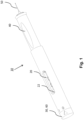
- Fig. 1 shows a perspective view of a medicament delivery device 10 comprising an orientation indicator according to the presently claimed invention.
- the support element 20 is generally elongated along a longitudinal axis A ( Fig. 3 and 4 ) of the medicament delivery device 10.
- An activation member 22 is movable in relation to the support element 20, between a first position and a second position.
- the activation member 22 may be accommodated in the support element 20.
- the first position and the second position may be defined as end points of longitudinal movement of the activation member 22 in relation to the support element 20.
- the activation member 22 may move between the first position and the second position, under influence of gravitational force, when the orientation indicator is tilted in relation to a horizontal plane.
- Fig. 1 further shows a delivery member 50 through which a medicament of the medicament delivery device 10 may be expelled.
- the delivery member may be a needle, or a nozzle, or a mouthpiece, etc.
- a container (not shown), holding the medicament to be expelled, may be visible through a window 40.
- the support element 20 of the orientation indicator may be integrated in a medicament delivery device as shown in Fig. 1 .
- the support element 20 may also be a separate module that may be attached to a medicament delivery device 10 to provide an orientation indication function ( Fig. 3 ) to almost any existing delivery device.
- Fig. 2 displays the support element 20 as comprising an elongated compartment comprising the activation member 22.
- the support element further comprises a power source 24 and a signalling element 26.
- the power source 24 may for instance be a battery.
- the signalling element 26 may be sound-generating, such as a speaker, and/or visual, such as a light emitter or a display.
- the signalling element may also be tactile, such as a piezoelectric element configured to generate mechanical vibrations.
- the support element 20 comprises an electrical circuit and a signal switch 29.
- the signal switch 29 may be actuated by the activation member 22 by movement of the activation member 22 relative to the support element 20.
- the signal switch 29 may be actuated by the activation member 22 either opening or closing the signal switch 29.
- the signal switch is defined to be located at the second position of the activation member 22.
- the support element 20 When integrated in a medicament delivery device 10, the support element 20 may be generally regarded as comprised in a body of the medicament delivery device 10. Accordingly, the various components comprised by the support element 20 may be distributed throughout the medicament delivery device, as appropriate, to be properly adapted to the various functions and features of both the medicament delivery device 10 and of the orientation indicator.
- orientation indicator By integrating the orientation indicator in a medicament delivery device, a more compact design may be achieved.
- the orientation indicator may thereby be arranged on the inside of the device, such that visual signals may be viewed through a window.
- orientation indicator as a separate module is that it may be used for most kinds of already existing medicament delivery devices.
- the activation member 22 is preferably made of a conductive material, e.g. metal, such that actuation of the signal switch 29, by the activation member 22, closes the signal switch such that an electrical current from the power source 24 activates the signalling element 26.
- the electrical circuit may be designed such that the signal switch 29 is opened by movement of the activation member 22.
- movable element may in itself directly close or open the electrical circuit by bridging or opening the gap between the poles of the signal switch. No additional mechanical or electrical component needs to be involved in activating the switch.
- the activation member 22 may be designed in different ways to achieve the preferred characteristics, e.g. speed of movement, friction, etc.
- the activation member 22 may be slidably movable between the first position and the second position. A sliding motion is relatively slow and needs a certain tilting angle to overcome the friction between the activation member 22 a sliding surface of the support element 20.
- the slidable activation member may have any suitable shape and may be formed to provide a large or a small contact surface with the sliding substrate on which it slides.
- the slidable activation member may be made of a material that provides a required coefficient of friction with the substrate on which it slides.
- the activation member may alternatively be rollably movable between the first position and the second position.
- a rollable activation member 22 may be ball-shaped, cylindrical, or have any other shape that allows a rolling motion. Friction is negligible and movement may be initiated by only a small tilt of the orientation indicator.
- the activation member 22 is a ball, and the ball and the signal switch 29 may constitute a tilt ball switch.
- the activation member 22 may be a liquid conductor.
- the liquid conductor may be mercury, and the liquid conductor and the signal switch 29 may constitute a mercury switch.
- Mercury switches are generally known in other fields of technology.
- mercury is often avoided due to its poisonous and environmentally polluting properties.
- other liquid conductors are also conceivable.
- the activation member 22 may be held fixed in the first position until released by a manually operable locking member 30.
- the manually operable locking member may be of any configuration known in the art. It may be operated by pushing or sliding a button, or turning a knob, etc.
- the manually operable locking member 30 may be moved between a locking position in which the activation member 22 is prevented from moving, and a released position in which the activation member 22 is released for movement. In the figures, the locking position is marked “0" and the released position is marked "I".
- the locking mechanism that fixes the activation member 22 may be selected from any suitable locking mechanism known to the skilled person.
- the electrical circuit may comprise a manually operable second switch, and wherein the signal is generated by the signalling element 26 when both the signal switch 29 and the second switch 60 are actuated.
- the second switch 60 serves to prevent the signalling element 26 from being activated prematurely, i.e. to prevent the signalling element 26 from accidental activation before the device is to be used.
- the second switch 60 may be opened or closed to set the electrical circuit in an active state, before or after the signal switch 29 is actuated.
- the second switch 60 may be actuated by turning a knob, operating a button, etc.
- the second switch 60 shown in Figs 4 and 5 may be turned between an inactive state "0" and an active state "I".
- the signal generated by the signalling element 26 may be an audible signal, a tactile signal or a visual signal.
- the generated signal may also be a combination of those.
- the visual signal may be visible light, or a colour, or a symbol, or the like.
- the tactile signal may be a tactile sensation, such as a vibration, which is distributed from the support element 22, throughout the device in which the orientation indicator is arranged.
- the signal generated by the signalling element 26 may be designed to be perceived as either positive or negative, depending on the orientation in which the electrical circuit and the signalling element are designed to be activated.
- a light may be green (positive) or red (negative).
- a sound may be harmonious (positive) or dissonant (negative).
- a tactile signal may be soft (positive) or hard and intense (negative).
- a correct orientation of a medicament delivery device, comprising the orientation indicator, during a mixing or a priming operation is to have the delivery member 50 pointing upwards from a horizontal plane. Consequently, the orientation indicator must be configured to signal either a good orientation or a bad orientation.
- the electrical circuit may also be configured to activate the signalling element 26 when the activation member 22, moving under the force of gravity, either closes or opens the signal switch 29. As explained earlier, the signal switch 29 is located at the second position of the activation member 22.
- Figs 4-5 serve to exemplify the use of the orientation indicator.
- the illustrated case is applicable for alternative configurations (a) or (d) above.
- the medicament delivery device 10 comprises a second switch 60, which is in the inactive state "0".
- the medicament delivery device 10 is tilted such that the proximal end comprising the delivery member 50 is at an angle ⁇ below the horizontal plane H.
- the activation member 22 of Fig. 4 has moved to the second position and has closed the signal switch 29. Since the medicament delivery device 10 is equipped with the manually operable second switch 60, no signal is generated since the second switch is in the inactive position "0".
- the signalling element 26 When the user sets the second switch 60 to the active position "I" ( Fig. 5 ), the signalling element 26 will be activated and may immediately generate a negative signal if configured as configuration (a) because the signal switch 29 is closed and the second switch 60 is in the active position.
- the orientation indicator will generate a positive signal, if configured as configuration (d), as soon as the delivery member is tilted above the horizontal plane, because the activation member 22 will move towards the first position and thereby open the signal switch 29 while the second switch 60 is in the active position.
- a detection circuit may need to be provided as part of the electrical circuit, in order to detect the opening of the switch and to at least partly activate the signalling element 26.
- the electrical circuit may also comprise a control unit and a communication unit capable of wirelessly communicating orientation data with an external device, which orientation data is retrieved from the control unit.
- a control unit capable of wirelessly communicating orientation data with an external device, which orientation data is retrieved from the control unit.
- information about the use of the device may be stored and or communicated to e.g. a physician who may then be able to use the information to teach and to improve the patient's usage of the device.
Landscapes
- Health & Medical Sciences (AREA)
- Engineering & Computer Science (AREA)
- General Health & Medical Sciences (AREA)
- Anesthesiology (AREA)
- Biomedical Technology (AREA)
- Heart & Thoracic Surgery (AREA)
- Hematology (AREA)
- Life Sciences & Earth Sciences (AREA)
- Animal Behavior & Ethology (AREA)
- Public Health (AREA)
- Veterinary Medicine (AREA)
- Vascular Medicine (AREA)
- Physics & Mathematics (AREA)
- General Physics & Mathematics (AREA)
- Emergency Medicine (AREA)
- Chemical & Material Sciences (AREA)
- Mathematical Optimization (AREA)
- Medical Informatics (AREA)
- Algebra (AREA)
- Computational Mathematics (AREA)
- Radiology & Medical Imaging (AREA)
- Mathematical Analysis (AREA)
- Medicinal Chemistry (AREA)
- Mathematical Physics (AREA)
- Pure & Applied Mathematics (AREA)
- Business, Economics & Management (AREA)
- Educational Administration (AREA)
- Educational Technology (AREA)
- Theoretical Computer Science (AREA)
- Pulmonology (AREA)
- Infusion, Injection, And Reservoir Apparatuses (AREA)
Description
- The present invention relates to an orientation indicator for a medicament delivery device, and more particularly to an orientation indicator for informing a user of a medicament delivery device that a proper orientation of the device is attained.
- The development of medicament delivery devices has become more and more directed towards self-medication, i.e. to let the patient administer a medicament to him- or herself in an easy, safe and reliable way. There are different types of medicaments that can be stored for a long time and that are packaged in cartridges or the like, containing a ready-to-use medicament in liquid state. There are also other types of medicaments that are stored in separate compartments. An agent (e.g. lyophilized, powdered or concentrated liquid) is stored in one compartment of the container, and a diluent (e.g. water, dextrox solution or saline solution) is stored in a separate compartment. These types of medicaments cannot be pre-mixed and stored for a long time because the medicament agent is unstable and can be degraded and will lose its effect quickly. Hence, the patients have to perform the mixing shortly before administration. During the mixing step, a significant amount of air needs to be evacuated from the powder compartment as it is filled with diluent. This air needs to escape through a delivery member, e.g. a needle, a mouthpiece or a nozzle, of the device. At the same time it is important not to spill any of the liquid medicament during the mixing procedure.
- Other types of delivery devices comprise a container with a pre-mixed solution. Still, some air may need to be evacuated before use. The device needs to be "primed". Priming is necessary to avoid injecting air into the bloodstream and to make sure that a correct dosage is administrated.
- In both types of delivery devices, the devices must be oriented with its delivery member pointing upwards. Conventionally, air is evacuated by the patient tapping the device with a finger, to make sure that any air in the container is collected at the top, near the opening of the container. Thereafter, the container is pressurized, such as by pushing the piston rod forward, until some of the liquid medicament appears at an opening of the delivery member, e.g. at the tip of an injection needle. The patient therefore needs to be taught and trained on how to handle the medicament delivery device before usage.
- There are a number of prior art devices that register patient handling of medicament delivery devices. One example is
US2015/0246179 , wherein sensors are used to detect the progress of an injection process, such as temperature, dosage and orientation. A controller determines the progress and provides a notification thereof, both directly, by beeping, and indirectly, by sending data to a smartphone app. - Document
WO 2010/125153 A1 discloses a pen-type injector which has a priming detection facility to identify when the injector is inverted. - The disclosed solution is unnecessarily complicated for many applications. The present invention provides a simple and robust orientation indicator that is also reliable and easy to use.
- An object of the present invention is to provide an orientation indicator for a medicament delivery device, wherein the drawbacks of the state of the art devices are remedied.
- In the present application, when the term "distal" is used, this refers to the direction pointing away from the dose delivery site. When the term "distal part/end" is used, this refers to the part/end of the delivery device, or the parts/ends of the members thereof, which under use of the medicament delivery device is/are located furthest away from the dose delivery site. Correspondingly, when the term "proximal" is used, this refers to the direction pointing to the dose delivery site. When the term "proximal part/end" is used, this refers to the part/end of the delivery device, or the parts/ends of the members thereof, which under use of the medicament delivery device is/are located closest to the dose delivery site.
- Further, the term "longitudinal", with or without "axis", refers to a direction or an axis through the device or components thereof in the direction of the longest extension of the device or the component.
- The term "lateral", with or without "axis", refers to a direction or an axis through the device or components thereof in the direction of the broadest extension of the device or the component.
- In a similar manner, the terms "radial" or "transversal", with or without "axis", refers to a direction or an axis through the device or components thereof in a direction generally perpendicular to the longitudinal direction, e.g. "radially outward" would refer to a direction pointing away from the longitudinal axis.
- Also, if nothing else is stated, in the following description wherein the mechanical structure of the device and the mechanical interconnection of its components is described, the device is in an initial non-activated or non-operated state.
- As stated above, the aim of the present invention is to provide a simple and robust orientation indicator that is also reliable and easy to use.
- According to a main aspect of the invention it is characterized by the features of the independent patent claim. Further advantageous features are the subject of the dependent claims.
- According to a main aspect of the invention it is characterised by an orientation indicator for a medicament delivery device, which orientation indicator comprises a support element having a proximal end and a distal end, an activation member, movable, in relation to the support element, between a first position and a second position, an electrical circuit comprising a signal switch, and a signalling element connected to the electrical circuit, wherein the activation member may move under gravitational force when the support element is tilted to actuate the signal switch, such that a signal may be generated by the signalling element.
- A movable element, which moves under the influence of gravity, is a robust and simple solution. The element may slide, roll, pivot or fall between the first and the second positions, as long as it is able to interact with, i.e. to close, or to open, the signal switch.
- According to another aspect of the invention the activation member is made of a conductive material, such that actuation of the signal switch, by the activation member, closes or opens the signal switch.
- Conductivity is a further advantage in that the movable element may directly close or open the electrical circuit by bridging or opening the gap between the poles of the signal switch. No additional mechanical or electrical component needs to be involved in actuating the switch.
- According to another aspect of the invention the activation member is slidably movable between the first position and the second position.
- A slidable activation member may have any suitable shape and may be formed to provide a small contact surface with a substrate on which it slides. The slidable activation member may be made of a material that provides a low coefficient of friction with the substrate on which it slides.
- According to another aspect of the invention the activation member is rollably movable between the first position and the second position.
- A rollable activation member may be ball-shaped, cylindrical, or have any other shape that allows a rolling motion.
- According to another aspect of the invention the activation member is a ball and wherein the ball and the signal switch constitute a tilt ball switch.
- According to another aspect of the invention the activation member is made of a liquid conductor.
- According to another aspect of the invention the liquid conductor is mercury and wherein the liquid conductor and the signal switch constitute a mercury switch.
- Mercury switches are generally known in other fields of technology. Nowadays, however, mercury is often avoided due to its poisonous and environmentally polluting properties.
- According to another aspect of the invention the activation member is held fixed in the first position until released by a manually operable locking member.
- During normal handling of a medicament delivery device, the device is often tilted in various directions. In order to avoid activating the signalling element, the activation member may be held fixed in the first position until it is time to use the device. The manually operable locking member may be of any configuration known in the art. It may be operated by pushing or sliding a button, turning a knob, etc.
- According to another aspect of the invention the electrical circuit further comprises a manually operable second switch, and wherein the signal is generated by the signalling element when the signal switch and the second switch are actuated.
- In a similar fashion to the manually operable locking member, the second switch serves to prevent the signalling element from being activated prematurely, i.e. to prevent the signalling device from activating accidentally before the device is to be used. The second switch may be opened or closed to set the electrical circuit in an active state, before or after the signal switch is actuated. The second switch may be actuated by turning a knob, operating a button, etc.
- According to another aspect of the invention the signal generated by the signalling element is an audible signal and/or a tactile signal and/or a visual signal.
- The signalling element may display a visible light, or a colour, or a symbol, or the like.
- The signalling element may generate a sound, which may sound positive or negative, depending on the orientation in which the electrical circuit and the signalling element are designed to be activated.
- The signalling element may generate a tactile sensation, such as a vibration, which is distributed in the device in which the orientation indicator is arranged.
- According to another aspect of the invention the second position is located proximally, relative to the first position, such that a negative signal is generated by the signalling element, indicating an incorrect orientation.
- The activation member moves under the influence of gravity. Therefore, if the second position is proximal of the first position it means that the signalling element is activated when the proximal part of the orientation indicator is lower than the distal part, meaning that a negative signal will be generated. A negative signal may for instance be a red light, a dissonant noise or an unpleasant vibration.
- According to another aspect of the invention the second position is located distally, relative to the first position, such that a positive signal is generated by the signalling element, indicating a correct orientation.
- As opposed to the situation above, if the second position is distal of the first position it means that the signalling element is activated when the proximal part of the orientation indicator is higher than the distal part, meaning that a positive signal will be generated. A positive signal may for instance be a green light, a harmonic melody or a soft vibration.
- According to another aspect of the invention the support element is attachable to a medicament delivery device.
- The orientation indicator may be designed as a packaged module that may be attached to an outer part of a medicament delivery device. In this way, the orientation indicator may be used for many types of medicament delivery devices, which do not need to be further adapted to accommodate the orientation indicator.
- According to another aspect of the invention the support element is integrated in a medicament delivery device.
- By integrating the orientation indicator in a medicament delivery device, a more compact design may be achieved. The orientation indicator may thereby be arranged on the inside of the device, such that visual signals may be viewed through a window.
- According to another aspect of the invention the electrical circuit also comprises a control unit and a communication unit capable of wirelessly communicating orientation data with an external device, which orientation data is retrieved from the control unit.
- A further aspect of the invention relates to a medicament delivery device comprising an orientation indicator according to any of the previous aspects of the invention. Alternatively, the orientation indicator can be used for a training device or a trainer, which is simulating the medicament delivery device and used for training of users prior their use of a real medicament delivery device. The trainer may comprise an orientation indicator.
- These and other features and advantages of the present invention will become apparent from the following detailed description and the drawings.
- The figures below disclose an embodiment of the invention for illustrational purposes only. In particular, the disclosure within the figures is not meant to limit the range of protection of the invention. The embodiment shown may be modified in different ways within the scope of the claims.
- Fig. 1
- a perspective view of a medicament delivery device comprising an orientation indicator according to the invention
- Fig. 2
- an exploded perspective view of the orientation indicator and the medicament delivery device
- Fig. 3
- perspective view of an orientation indicator attachable to a medicament delivery device
- Figs 4-5
- perspective views of the orientation indicator in use
-
Fig. 1 shows a perspective view of amedicament delivery device 10 comprising an orientation indicator according to the presently claimed invention. Asupport element 20, having a proximal end and a distal end, is shown. Thesupport element 20 is generally elongated along a longitudinal axis A (Fig. 3 and4 ) of themedicament delivery device 10. Anactivation member 22 is movable in relation to thesupport element 20, between a first position and a second position. Theactivation member 22 may be accommodated in thesupport element 20. The first position and the second position may be defined as end points of longitudinal movement of theactivation member 22 in relation to thesupport element 20. Theactivation member 22 may move between the first position and the second position, under influence of gravitational force, when the orientation indicator is tilted in relation to a horizontal plane. -
Fig. 1 further shows adelivery member 50 through which a medicament of themedicament delivery device 10 may be expelled. The delivery member may be a needle, or a nozzle, or a mouthpiece, etc. A container (not shown), holding the medicament to be expelled, may be visible through awindow 40. - The
support element 20 of the orientation indicator may be integrated in a medicament delivery device as shown inFig. 1 . Thesupport element 20 may also be a separate module that may be attached to amedicament delivery device 10 to provide an orientation indication function (Fig. 3 ) to almost any existing delivery device. -
Fig. 2 displays thesupport element 20 as comprising an elongated compartment comprising theactivation member 22. The support element further comprises apower source 24 and asignalling element 26. Thepower source 24 may for instance be a battery. Thesignalling element 26 may be sound-generating, such as a speaker, and/or visual, such as a light emitter or a display. The signalling element may also be tactile, such as a piezoelectric element configured to generate mechanical vibrations. Thesupport element 20 comprises an electrical circuit and asignal switch 29. Thesignal switch 29 may be actuated by theactivation member 22 by movement of theactivation member 22 relative to thesupport element 20. Thesignal switch 29 may be actuated by theactivation member 22 either opening or closing thesignal switch 29. The signal switch is defined to be located at the second position of theactivation member 22. - When integrated in a
medicament delivery device 10, thesupport element 20 may be generally regarded as comprised in a body of themedicament delivery device 10. Accordingly, the various components comprised by thesupport element 20 may be distributed throughout the medicament delivery device, as appropriate, to be properly adapted to the various functions and features of both themedicament delivery device 10 and of the orientation indicator. - By integrating the orientation indicator in a medicament delivery device, a more compact design may be achieved. The orientation indicator may thereby be arranged on the inside of the device, such that visual signals may be viewed through a window.
- An advantage of the orientation indicator as a separate module is that it may be used for most kinds of already existing medicament delivery devices.
- The
activation member 22 is preferably made of a conductive material, e.g. metal, such that actuation of thesignal switch 29, by theactivation member 22, closes the signal switch such that an electrical current from thepower source 24 activates thesignalling element 26. In an alternative embodiment the electrical circuit may be designed such that thesignal switch 29 is opened by movement of theactivation member 22. - Using conductivity as an activating means is advantageous in that the movable element may in itself directly close or open the electrical circuit by bridging or opening the gap between the poles of the signal switch. No additional mechanical or electrical component needs to be involved in activating the switch.
- The
activation member 22 may be designed in different ways to achieve the preferred characteristics, e.g. speed of movement, friction, etc. Theactivation member 22 may be slidably movable between the first position and the second position. A sliding motion is relatively slow and needs a certain tilting angle to overcome the friction between the activation member 22 a sliding surface of thesupport element 20. - The slidable activation member may have any suitable shape and may be formed to provide a large or a small contact surface with the sliding substrate on which it slides. The slidable activation member may be made of a material that provides a required coefficient of friction with the substrate on which it slides.
- The activation member may alternatively be rollably movable between the first position and the second position. A
rollable activation member 22 may be ball-shaped, cylindrical, or have any other shape that allows a rolling motion. Friction is negligible and movement may be initiated by only a small tilt of the orientation indicator. - In the illustrated embodiment, the
activation member 22 is a ball, and the ball and thesignal switch 29 may constitute a tilt ball switch. - The
activation member 22 may be a liquid conductor. The liquid conductor may be mercury, and the liquid conductor and thesignal switch 29 may constitute a mercury switch. - Mercury switches are generally known in other fields of technology. Nowadays, however, mercury is often avoided due to its poisonous and environmentally polluting properties. However, other liquid conductors are also conceivable.
- The
activation member 22 may be held fixed in the first position until released by a manually operable lockingmember 30. During normal handling of a medicament delivery device, the device is often tilted in various directions, which might cause the orientation indicator to accidentally generate signals. In order to avoid activating the signalling element, the activation member may therefore be held fixed in the first position until it is time to use the device. The manually operable locking member may be of any configuration known in the art. It may be operated by pushing or sliding a button, or turning a knob, etc. As illustrated in the figures, the manually operable lockingmember 30 may be moved between a locking position in which theactivation member 22 is prevented from moving, and a released position in which theactivation member 22 is released for movement. In the figures, the locking position is marked "0" and the released position is marked "I". The locking mechanism that fixes theactivation member 22 may be selected from any suitable locking mechanism known to the skilled person. - Alternatively, the electrical circuit may comprise a manually operable second switch, and wherein the signal is generated by the
signalling element 26 when both thesignal switch 29 and thesecond switch 60 are actuated. - In a similar fashion to the manually operable locking
member 30, thesecond switch 60 serves to prevent thesignalling element 26 from being activated prematurely, i.e. to prevent thesignalling element 26 from accidental activation before the device is to be used. Thesecond switch 60 may be opened or closed to set the electrical circuit in an active state, before or after thesignal switch 29 is actuated. Thesecond switch 60 may be actuated by turning a knob, operating a button, etc. Thesecond switch 60 shown inFigs 4 and5 may be turned between an inactive state "0" and an active state "I". - The signal generated by the
signalling element 26 may be an audible signal, a tactile signal or a visual signal. The generated signal may also be a combination of those. The visual signal may be visible light, or a colour, or a symbol, or the like. The tactile signal may be a tactile sensation, such as a vibration, which is distributed from thesupport element 22, throughout the device in which the orientation indicator is arranged. - The signal generated by the
signalling element 26 may be designed to be perceived as either positive or negative, depending on the orientation in which the electrical circuit and the signalling element are designed to be activated. A light may be green (positive) or red (negative). A sound may be harmonious (positive) or dissonant (negative). A tactile signal may be soft (positive) or hard and intense (negative). - A correct orientation of a medicament delivery device, comprising the orientation indicator, during a mixing or a priming operation is to have the
delivery member 50 pointing upwards from a horizontal plane. Consequently, the orientation indicator must be configured to signal either a good orientation or a bad orientation. The electrical circuit may also be configured to activate thesignalling element 26 when theactivation member 22, moving under the force of gravity, either closes or opens thesignal switch 29. As explained earlier, thesignal switch 29 is located at the second position of theactivation member 22. Thus, four configurations are conceivable: - a) The
delivery member 50 is pointed downward. A negative signal is generated when theactivation member 22 closes thesignal switch 29 of the electrical circuit, i.e. the second position is located proximally of the first position. Theactivation member 22 moves downward to the second position to close thesignal switch 29. - b) The
delivery member 50 is pointed downward. A negative signal is generated when theactivation member 22 opens thesignal switch 29 of the electrical circuit, i.e. the second position is located distally of the first position. Theactivation member 22 moves downward to the first position to open thesignal switch 29. - c) The
delivery member 50 is pointed upward. A positive signal is generated when theactivation member 22 closes thesignal switch 29 of the electrical circuit, i.e. the second position is located distally of the first position. Theactivation member 22 moves downward to the second position to close thesignal switch 29. - d) The
delivery member 50 is pointed upward. A positive signal is generated when theactivation member 22 opens thesignal switch 29 of the electrical circuit, i.e. the second position is located proximally of the first position. Theactivation member 22 moves downward to the first position to open thesignal switch 29. -
Figs 4-5 serve to exemplify the use of the orientation indicator. The illustrated case is applicable for alternative configurations (a) or (d) above. Themedicament delivery device 10 comprises asecond switch 60, which is in the inactive state "0". Themedicament delivery device 10 is tilted such that the proximal end comprising thedelivery member 50 is at an angle α below the horizontal plane H. When compared to the situation shown inFig. 3 , where the delivery member of themedicament delivery device 10 is tilted an angle β above the horizontal plane H, theactivation member 22 ofFig. 4 has moved to the second position and has closed thesignal switch 29. Since themedicament delivery device 10 is equipped with the manually operablesecond switch 60, no signal is generated since the second switch is in the inactive position "0". - When the user sets the
second switch 60 to the active position "I" (Fig. 5 ), thesignalling element 26 will be activated and may immediately generate a negative signal if configured as configuration (a) because thesignal switch 29 is closed and thesecond switch 60 is in the active position. In an alternative embodiment the orientation indicator will generate a positive signal, if configured as configuration (d), as soon as the delivery member is tilted above the horizontal plane, because theactivation member 22 will move towards the first position and thereby open thesignal switch 29 while thesecond switch 60 is in the active position. - The electrical circuits that provide the above-described functions are readily available to the skilled person and do not require any further explanation, except to note that in case of activation by opening a switch, a detection circuit may need to be provided as part of the electrical circuit, in order to detect the opening of the switch and to at least partly activate the
signalling element 26. - With information technology, it is also conceivable to configure the electrical circuit to also comprise a control unit and a communication unit capable of wirelessly communicating orientation data with an external device, which orientation data is retrieved from the control unit. In this way, information about the use of the device may be stored and or communicated to e.g. a physician who may then be able to use the information to teach and to improve the patient's usage of the device.
Claims (15)
- An orientation indicator for a medicament delivery device (10) having a longitudinal axis (A) and a delivery member (50); the medicament delivery device (10) being configured to be oriented with its delivery member (50) pointing upwards during mixing or priming, wherein the orientation indicator comprises- a support element (20) having a proximal end and a distal end and generally elongated along the longitudinal axis (A) of the medicament delivery device (10),- an activation member (22) movable in relation to the support element (20), between a first position and a second position,- an electrical circuit (28) comprising a signal switch (29),- a signalling element (26) connected to the electrical circuit (28),wherein the activation member (22) is movable under gravitational force when the support element (20) is tilted, to actuate the signal switch (29), such that a signal is generated by the signalling element (26) informing a user that a proper orientation of the device (10) has been attained for mixing or priming.
- The orientation indicator for a medicament delivery device (10) according to claim 1, wherein the activation member (22) is made of a conductive material, such that actuation of the signal switch (29), by the activation member (22), closes or opens the signal switch (29).
- The orientation indicator for a medicament delivery device (10) according to claim 2, wherein the activation member (22) is slidably movable between the first position and the second position.
- The orientation indicator for a medicament delivery device (10) according to claim 2, wherein the activation member (22) is rollably movable between the first position and the second position
- The orientation indicator for a medicament delivery device (10) according to claim 2, wherein the activation member (22) is made of a liquid conductor and wherein the liquid conductor may flow between the first position and the second position.
- The orientation indicator for a medicament delivery device (10) according to claim 5, wherein the liquid conductor is mercury and wherein the liquid conductor and the signal switch (29) are comprised in a mercury switch.
- The orientation indicator for a medicament delivery device (10) according to any of the claims 1-6, wherein the activation member (22) is held fixed in the first position until released by a manually operable locking member (30).
- The orientation indicator for a medicament delivery device (10) according to any of the claims 1-6, wherein the electrical circuit (28) further comprises a manually operable second switch (60), and wherein the signal is generated by the signalling element (26) when the signal switch (29) and the second switch (60) are actuated.
- The orientation indicator for a medicament delivery device (10) according to claim 1, wherein the signal generated by the signalling element (26) is an audible signal and/or a tactile signal and/or a visual signal.
- The orientation indicator for a medicament delivery device (10) according to claim 1, wherein the support element (20) is attachable to the medicament delivery device (10).
- The orientation indicator for a medicament delivery device (10) according to claim 1, wherein the support element (20) is integrated in the medicament delivery device (10).
- The orientation indicator for a medicament delivery device (10) according to any of claims 1-6, wherein the electrical circuit (28) also comprises a control unit and a communication unit capable of wirelessly communicating orientation data with an external device, which orientation data is retrieved from the control unit.
- The orientation indicator for a medicament delivery device (10) according to any of claims claim 1-12, wherein the orientation indicator is designed as a packaged module to be attached to an outer part of a medicament delivery device (10).
- The orientation indicator for a medicament delivery device (10) according to claim 9, wherein the signalling element (26) is able generate a positive signal, indicating a correct orientation or a negative signal, indicating an incorrect orientation.
- A medicament delivery device (10) comprising the orientation indicator according to any of claims 1-14.
Applications Claiming Priority (2)
| Application Number | Priority Date | Filing Date | Title |
|---|---|---|---|
| EP16185634 | 2016-08-25 | ||
| PCT/EP2017/070638 WO2018036860A1 (en) | 2016-08-25 | 2017-08-14 | Orientation indicator for a medicament delivery device, a medicament delivery device comprising the orientation indicator, and a trainer for a medicament delivery device, which traner comprises the orientation indicator |
Publications (2)
| Publication Number | Publication Date |
|---|---|
| EP3503947A1 EP3503947A1 (en) | 2019-07-03 |
| EP3503947B1 true EP3503947B1 (en) | 2024-11-13 |
Family
ID=56852087
Family Applications (1)
| Application Number | Title | Priority Date | Filing Date |
|---|---|---|---|
| EP17749741.9A Active EP3503947B1 (en) | 2016-08-25 | 2017-08-14 | Orientation indicator for a medicament delivery device and a medicament delivery device comprising the orientation indicator |
Country Status (5)
| Country | Link |
|---|---|
| US (1) | US20190259303A1 (en) |
| EP (1) | EP3503947B1 (en) |
| CN (1) | CN109661249B (en) |
| TW (1) | TWI656896B (en) |
| WO (1) | WO2018036860A1 (en) |
Families Citing this family (3)
| Publication number | Priority date | Publication date | Assignee | Title |
|---|---|---|---|---|
| WO2021260007A1 (en) * | 2020-06-25 | 2021-12-30 | Sanofi | A training device, system and method |
| CN116440012A (en) * | 2023-06-07 | 2023-07-18 | 中国人民解放军陆军军医大学第一附属医院 | Constant-speed constant-temperature stomach tube injector |
| US20250213783A1 (en) * | 2023-12-29 | 2025-07-03 | Altek Biotechnology Corporation | Drug delivery device |
Citations (4)
| Publication number | Priority date | Publication date | Assignee | Title |
|---|---|---|---|---|
| WO2010125153A1 (en) * | 2009-04-30 | 2010-11-04 | Sanofi-Aventis Deutschland Gmbh | Pen-type injector with ergonomic button arrangement |
| WO2012164397A1 (en) * | 2011-06-02 | 2012-12-06 | Beucb Pharma S.A. | Auto-injector |
| US20160213856A1 (en) * | 2015-01-26 | 2016-07-28 | Becton, Dickinson And Company | Dose capture device for syringes |
| EP3175876A1 (en) * | 2015-12-01 | 2017-06-07 | Carebay Europe Ltd. | Medicament delivery device with user feedback capability |
Family Cites Families (19)
| Publication number | Priority date | Publication date | Assignee | Title |
|---|---|---|---|---|
| US4168410A (en) * | 1977-02-11 | 1979-09-18 | Norris Albert B | Motion sensing alarm switch |
| US5062834A (en) * | 1989-02-24 | 1991-11-05 | Product Development (S.G.Z.) Ltd | Device for dispensing a liquid particularly useful for delivering medicaments at a predetermined rate |
| US5058283A (en) * | 1990-11-19 | 1991-10-22 | Century Products Company | Car seat level indicator |
| FR2701399B1 (en) * | 1993-02-16 | 1995-03-31 | Valois | Portable spray device with actuation triggered by inhalation. |
| US5957125A (en) * | 1996-11-05 | 1999-09-28 | Medical Safety Products, Inc. | Apparatus for indicating proper orientation for oral and nasal inhalers |
| JP3288943B2 (en) * | 1996-12-06 | 2002-06-04 | スーガン株式会社 | Medical injector head |
| DE19847968A1 (en) * | 1998-10-17 | 2000-04-20 | Boehringer Ingelheim Pharma | Separate storage of an active material and a solvent comprises a closure cap and a container, with a chamber attached to the unit. |
| DE10261961A1 (en) * | 2002-03-22 | 2003-10-16 | Hahn Schickard Ges | tilt sensor |
| US8894231B2 (en) * | 2004-05-17 | 2014-11-25 | Resmed Limited | Position sensitive illumination system |
| US7468667B2 (en) * | 2006-05-19 | 2008-12-23 | Moffett Robert L | Anti-thief owner notification alarm system for a two-wheeled vehicle, and method of same |
| US8192398B2 (en) * | 2008-03-13 | 2012-06-05 | Medtronic, Inc. | Medical device and medical instrument alignment |
| US20090235744A1 (en) * | 2008-03-18 | 2009-09-24 | Ming-Hung Tsai | Detecting device for a walk-substituting cart to automatically slow down when moving down slope |
| WO2010019456A1 (en) * | 2008-08-09 | 2010-02-18 | Mallinckrodt Inc. | Injector auto purge |
| EP2575936A1 (en) * | 2010-06-07 | 2013-04-10 | Sanofi-Aventis Deutschland GmbH | Drug delivery device with light source |
| US9163498B2 (en) * | 2011-12-14 | 2015-10-20 | Baker Hughes Incorporated | Apparatus and methods for determining parameters downhole using gravity-affected sensor |
| US20150246179A1 (en) | 2014-03-02 | 2015-09-03 | Nissim Zur | Device and method for drug dosing with administration monitoring, in particular for insulin pen integrated with smart phone apps. |
| US10130388B2 (en) * | 2014-03-13 | 2018-11-20 | New York University | Position guidance device with bubble level |
| US20160367766A1 (en) * | 2015-03-24 | 2016-12-22 | Jeff Baker | Injection training and compliance device and method |
| US9933248B2 (en) * | 2016-07-20 | 2018-04-03 | Tesa Sa | Height gauge |
-
2017
- 2017-08-14 US US16/327,813 patent/US20190259303A1/en not_active Abandoned
- 2017-08-14 CN CN201780045090.8A patent/CN109661249B/en active Active
- 2017-08-14 EP EP17749741.9A patent/EP3503947B1/en active Active
- 2017-08-14 WO PCT/EP2017/070638 patent/WO2018036860A1/en not_active Ceased
- 2017-08-21 TW TW106128290A patent/TWI656896B/en not_active IP Right Cessation
Patent Citations (4)
| Publication number | Priority date | Publication date | Assignee | Title |
|---|---|---|---|---|
| WO2010125153A1 (en) * | 2009-04-30 | 2010-11-04 | Sanofi-Aventis Deutschland Gmbh | Pen-type injector with ergonomic button arrangement |
| WO2012164397A1 (en) * | 2011-06-02 | 2012-12-06 | Beucb Pharma S.A. | Auto-injector |
| US20160213856A1 (en) * | 2015-01-26 | 2016-07-28 | Becton, Dickinson And Company | Dose capture device for syringes |
| EP3175876A1 (en) * | 2015-12-01 | 2017-06-07 | Carebay Europe Ltd. | Medicament delivery device with user feedback capability |
Also Published As
| Publication number | Publication date |
|---|---|
| US20190259303A1 (en) | 2019-08-22 |
| WO2018036860A1 (en) | 2018-03-01 |
| EP3503947A1 (en) | 2019-07-03 |
| CN109661249B (en) | 2021-05-25 |
| TWI656896B (en) | 2019-04-21 |
| CN109661249A (en) | 2019-04-19 |
| TW201811386A (en) | 2018-04-01 |
Similar Documents
| Publication | Publication Date | Title |
|---|---|---|
| US20250332352A1 (en) | Medicament delivery device with usage monitoring | |
| US9610407B2 (en) | Medicament delivery devices | |
| EP1527376B1 (en) | Device with time indicating means | |
| EP3503947B1 (en) | Orientation indicator for a medicament delivery device and a medicament delivery device comprising the orientation indicator | |
| JP4287148B2 (en) | Pen-type injection device with electronic control unit | |
| EP3355970B1 (en) | Power efficinet add-on device | |
| CN104797281A (en) | Medicament delivery device with trigger button | |
| US10668224B2 (en) | Medicament delivery device | |
| JPWO2003057286A1 (en) | Medical dosing device | |
| JP2014500087A (en) | Functional packaging for medical devices | |
| US11400229B2 (en) | Drug delivery system with dose capturing | |
| HK1164759B (en) | Medicament delivery devices |
Legal Events
| Date | Code | Title | Description |
|---|---|---|---|
| STAA | Information on the status of an ep patent application or granted ep patent |
Free format text: STATUS: UNKNOWN |
|
| STAA | Information on the status of an ep patent application or granted ep patent |
Free format text: STATUS: THE INTERNATIONAL PUBLICATION HAS BEEN MADE |
|
| PUAI | Public reference made under article 153(3) epc to a published international application that has entered the european phase |
Free format text: ORIGINAL CODE: 0009012 |
|
| STAA | Information on the status of an ep patent application or granted ep patent |
Free format text: STATUS: REQUEST FOR EXAMINATION WAS MADE |
|
| 17P | Request for examination filed |
Effective date: 20190110 |
|
| AK | Designated contracting states |
Kind code of ref document: A1 Designated state(s): AL AT BE BG CH CY CZ DE DK EE ES FI FR GB GR HR HU IE IS IT LI LT LU LV MC MK MT NL NO PL PT RO RS SE SI SK SM TR |
|
| AX | Request for extension of the european patent |
Extension state: BA ME |
|
| DAV | Request for validation of the european patent (deleted) | ||
| DAX | Request for extension of the european patent (deleted) | ||
| STAA | Information on the status of an ep patent application or granted ep patent |
Free format text: STATUS: EXAMINATION IS IN PROGRESS |
|
| 17Q | First examination report despatched |
Effective date: 20201202 |
|
| P01 | Opt-out of the competence of the unified patent court (upc) registered |
Effective date: 20230425 |
|
| GRAP | Despatch of communication of intention to grant a patent |
Free format text: ORIGINAL CODE: EPIDOSNIGR1 |
|
| STAA | Information on the status of an ep patent application or granted ep patent |
Free format text: STATUS: GRANT OF PATENT IS INTENDED |
|
| INTG | Intention to grant announced |
Effective date: 20240705 |
|
| RAP3 | Party data changed (applicant data changed or rights of an application transferred) |
Owner name: SHL MEDICAL AG |
|
| GRAS | Grant fee paid |
Free format text: ORIGINAL CODE: EPIDOSNIGR3 |
|
| GRAA | (expected) grant |
Free format text: ORIGINAL CODE: 0009210 |
|
| STAA | Information on the status of an ep patent application or granted ep patent |
Free format text: STATUS: THE PATENT HAS BEEN GRANTED |
|
| AK | Designated contracting states |
Kind code of ref document: B1 Designated state(s): AL AT BE BG CH CY CZ DE DK EE ES FI FR GB GR HR HU IE IS IT LI LT LU LV MC MK MT NL NO PL PT RO RS SE SI SK SM TR |
|
| REG | Reference to a national code |
Ref country code: GB Ref legal event code: FG4D |
|
| REG | Reference to a national code |
Ref country code: CH Ref legal event code: EP |
|
| REG | Reference to a national code |
Ref country code: DE Ref legal event code: R096 Ref document number: 602017086102 Country of ref document: DE |
|
| REG | Reference to a national code |
Ref country code: IE Ref legal event code: FG4D |
|
| REG | Reference to a national code |
Ref country code: LT Ref legal event code: MG9D |
|
| REG | Reference to a national code |
Ref country code: NL Ref legal event code: MP Effective date: 20241113 |
|
| PG25 | Lapsed in a contracting state [announced via postgrant information from national office to epo] |
Ref country code: PT Free format text: LAPSE BECAUSE OF FAILURE TO SUBMIT A TRANSLATION OF THE DESCRIPTION OR TO PAY THE FEE WITHIN THE PRESCRIBED TIME-LIMIT Effective date: 20250313 Ref country code: HR Free format text: LAPSE BECAUSE OF FAILURE TO SUBMIT A TRANSLATION OF THE DESCRIPTION OR TO PAY THE FEE WITHIN THE PRESCRIBED TIME-LIMIT Effective date: 20241113 Ref country code: IS Free format text: LAPSE BECAUSE OF FAILURE TO SUBMIT A TRANSLATION OF THE DESCRIPTION OR TO PAY THE FEE WITHIN THE PRESCRIBED TIME-LIMIT Effective date: 20250313 |
|
| PG25 | Lapsed in a contracting state [announced via postgrant information from national office to epo] |
Ref country code: FI Free format text: LAPSE BECAUSE OF FAILURE TO SUBMIT A TRANSLATION OF THE DESCRIPTION OR TO PAY THE FEE WITHIN THE PRESCRIBED TIME-LIMIT Effective date: 20241113 Ref country code: NL Free format text: LAPSE BECAUSE OF FAILURE TO SUBMIT A TRANSLATION OF THE DESCRIPTION OR TO PAY THE FEE WITHIN THE PRESCRIBED TIME-LIMIT Effective date: 20241113 |
|
| REG | Reference to a national code |
Ref country code: AT Ref legal event code: MK05 Ref document number: 1741189 Country of ref document: AT Kind code of ref document: T Effective date: 20241113 |
|
| PG25 | Lapsed in a contracting state [announced via postgrant information from national office to epo] |
Ref country code: BG Free format text: LAPSE BECAUSE OF FAILURE TO SUBMIT A TRANSLATION OF THE DESCRIPTION OR TO PAY THE FEE WITHIN THE PRESCRIBED TIME-LIMIT Effective date: 20241113 |
|
| PG25 | Lapsed in a contracting state [announced via postgrant information from national office to epo] |
Ref country code: ES Free format text: LAPSE BECAUSE OF FAILURE TO SUBMIT A TRANSLATION OF THE DESCRIPTION OR TO PAY THE FEE WITHIN THE PRESCRIBED TIME-LIMIT Effective date: 20241113 |
|
| PG25 | Lapsed in a contracting state [announced via postgrant information from national office to epo] |
Ref country code: NO Free format text: LAPSE BECAUSE OF FAILURE TO SUBMIT A TRANSLATION OF THE DESCRIPTION OR TO PAY THE FEE WITHIN THE PRESCRIBED TIME-LIMIT Effective date: 20250213 |
|
| PG25 | Lapsed in a contracting state [announced via postgrant information from national office to epo] |
Ref country code: AT Free format text: LAPSE BECAUSE OF FAILURE TO SUBMIT A TRANSLATION OF THE DESCRIPTION OR TO PAY THE FEE WITHIN THE PRESCRIBED TIME-LIMIT Effective date: 20241113 Ref country code: LV Free format text: LAPSE BECAUSE OF FAILURE TO SUBMIT A TRANSLATION OF THE DESCRIPTION OR TO PAY THE FEE WITHIN THE PRESCRIBED TIME-LIMIT Effective date: 20241113 Ref country code: GR Free format text: LAPSE BECAUSE OF FAILURE TO SUBMIT A TRANSLATION OF THE DESCRIPTION OR TO PAY THE FEE WITHIN THE PRESCRIBED TIME-LIMIT Effective date: 20250214 |
|
| PG25 | Lapsed in a contracting state [announced via postgrant information from national office to epo] |
Ref country code: PL Free format text: LAPSE BECAUSE OF FAILURE TO SUBMIT A TRANSLATION OF THE DESCRIPTION OR TO PAY THE FEE WITHIN THE PRESCRIBED TIME-LIMIT Effective date: 20241113 |
|
| PG25 | Lapsed in a contracting state [announced via postgrant information from national office to epo] |
Ref country code: RS Free format text: LAPSE BECAUSE OF FAILURE TO SUBMIT A TRANSLATION OF THE DESCRIPTION OR TO PAY THE FEE WITHIN THE PRESCRIBED TIME-LIMIT Effective date: 20250213 |
|
| PG25 | Lapsed in a contracting state [announced via postgrant information from national office to epo] |
Ref country code: SM Free format text: LAPSE BECAUSE OF FAILURE TO SUBMIT A TRANSLATION OF THE DESCRIPTION OR TO PAY THE FEE WITHIN THE PRESCRIBED TIME-LIMIT Effective date: 20241113 |
|
| PG25 | Lapsed in a contracting state [announced via postgrant information from national office to epo] |
Ref country code: DK Free format text: LAPSE BECAUSE OF FAILURE TO SUBMIT A TRANSLATION OF THE DESCRIPTION OR TO PAY THE FEE WITHIN THE PRESCRIBED TIME-LIMIT Effective date: 20241113 |
|
| PG25 | Lapsed in a contracting state [announced via postgrant information from national office to epo] |
Ref country code: EE Free format text: LAPSE BECAUSE OF FAILURE TO SUBMIT A TRANSLATION OF THE DESCRIPTION OR TO PAY THE FEE WITHIN THE PRESCRIBED TIME-LIMIT Effective date: 20241113 |
|
| PG25 | Lapsed in a contracting state [announced via postgrant information from national office to epo] |
Ref country code: RO Free format text: LAPSE BECAUSE OF FAILURE TO SUBMIT A TRANSLATION OF THE DESCRIPTION OR TO PAY THE FEE WITHIN THE PRESCRIBED TIME-LIMIT Effective date: 20241113 |
|
| PG25 | Lapsed in a contracting state [announced via postgrant information from national office to epo] |
Ref country code: SK Free format text: LAPSE BECAUSE OF FAILURE TO SUBMIT A TRANSLATION OF THE DESCRIPTION OR TO PAY THE FEE WITHIN THE PRESCRIBED TIME-LIMIT Effective date: 20241113 |
|
| PG25 | Lapsed in a contracting state [announced via postgrant information from national office to epo] |
Ref country code: CZ Free format text: LAPSE BECAUSE OF FAILURE TO SUBMIT A TRANSLATION OF THE DESCRIPTION OR TO PAY THE FEE WITHIN THE PRESCRIBED TIME-LIMIT Effective date: 20241113 |
|
| PG25 | Lapsed in a contracting state [announced via postgrant information from national office to epo] |
Ref country code: IT Free format text: LAPSE BECAUSE OF FAILURE TO SUBMIT A TRANSLATION OF THE DESCRIPTION OR TO PAY THE FEE WITHIN THE PRESCRIBED TIME-LIMIT Effective date: 20241113 |
|
| REG | Reference to a national code |
Ref country code: DE Ref legal event code: R097 Ref document number: 602017086102 Country of ref document: DE |
|
| PG25 | Lapsed in a contracting state [announced via postgrant information from national office to epo] |
Ref country code: SE Free format text: LAPSE BECAUSE OF FAILURE TO SUBMIT A TRANSLATION OF THE DESCRIPTION OR TO PAY THE FEE WITHIN THE PRESCRIBED TIME-LIMIT Effective date: 20241113 |
|
| PLBE | No opposition filed within time limit |
Free format text: ORIGINAL CODE: 0009261 |
|
| STAA | Information on the status of an ep patent application or granted ep patent |
Free format text: STATUS: NO OPPOSITION FILED WITHIN TIME LIMIT |
|
| 26N | No opposition filed |
Effective date: 20250814 |
|
| REG | Reference to a national code |
Ref country code: DE Ref legal event code: R119 Ref document number: 602017086102 Country of ref document: DE |
|
| REG | Reference to a national code |
Ref country code: CH Ref legal event code: H13 Free format text: ST27 STATUS EVENT CODE: U-0-0-H10-H13 (AS PROVIDED BY THE NATIONAL OFFICE) Effective date: 20260324 |
|
| PG25 | Lapsed in a contracting state [announced via postgrant information from national office to epo] |
Ref country code: MC Free format text: LAPSE BECAUSE OF FAILURE TO SUBMIT A TRANSLATION OF THE DESCRIPTION OR TO PAY THE FEE WITHIN THE PRESCRIBED TIME-LIMIT Effective date: 20241113 |
|
| PG25 | Lapsed in a contracting state [announced via postgrant information from national office to epo] |
Ref country code: LU Free format text: LAPSE BECAUSE OF NON-PAYMENT OF DUE FEES Effective date: 20250814 |
|
| PG25 | Lapsed in a contracting state [announced via postgrant information from national office to epo] |
Ref country code: CH Free format text: LAPSE BECAUSE OF NON-PAYMENT OF DUE FEES Effective date: 20250831 |