EP3503432A1 - Device for remote data transfer using a laser technique - Google Patents
Device for remote data transfer using a laser technique Download PDFInfo
- Publication number
- EP3503432A1 EP3503432A1 EP17209794.1A EP17209794A EP3503432A1 EP 3503432 A1 EP3503432 A1 EP 3503432A1 EP 17209794 A EP17209794 A EP 17209794A EP 3503432 A1 EP3503432 A1 EP 3503432A1
- Authority
- EP
- European Patent Office
- Prior art keywords
- laser
- cylindrical drum
- data
- digital data
- laser head
- Prior art date
- Legal status (The legal status is an assumption and is not a legal conclusion. Google has not performed a legal analysis and makes no representation as to the accuracy of the status listed.)
- Withdrawn
Links
Images

Classifications
-
- H—ELECTRICITY
- H04—ELECTRIC COMMUNICATION TECHNIQUE
- H04B—TRANSMISSION
- H04B10/00—Transmission systems employing electromagnetic waves other than radio-waves, e.g. infrared, visible or ultraviolet light, or employing corpuscular radiation, e.g. quantum communication
- H04B10/80—Optical aspects relating to the use of optical transmission for specific applications, not provided for in groups H04B10/03 - H04B10/70, e.g. optical power feeding or optical transmission through water
Definitions
- This invention refers to a device for remote data transferring between a transmitting end and a receiving end using a laser technique according to claim 1. More specifically, the invention provides a device for remote data transferring between a transmitting end and a receiving end using a cylindrical drum and the laser technique.
- Remote data transmission was a term used in the 1980s, primarily in Germany, for the transmission of data between computers over a medium using a communications protocol. At the time, the most widespread form was RDT over the telephone network. Other transmission media like radio waves or light were also used. But in most of the cases RDT now utilizes an Internet communication. However, in the lack of Internet access, it is burdensome process to establish a communication between devices for transferring of data at remote location.
- this medium is a network infrastructure for current devices like Mobile Phones, loT devices (Internet of Things devices) and similar devices. But for those devices, there may not be initial network connectivity on the given environments. There is an unmet need to define a way to transfer the configuration data to that kind of electronic devices.
- the subject-matter of the prior art does not provide an option to transfer data remotely between nodes without the need for Internet connectivity. Further, the techniques available in the prior art requires complicated network configurations and is expensive.
- the before mentioned object is solved by a device for remote data transferring between a transmitting end and a receiving end using a laser technique according to claim 1.
- the device preferably comprises of at least one modulator, at least one data converter, and at least one demodulator.
- the device further comprises of at least one cylindrical drum rotating in a predefined axis by a transmitting end motor, at least one laser source, and a plurality of laser sensors provided at the cylindrical drum.
- the laser source includes but is not limited to a laser head and a fixed part.
- the laser head is connected to a stepper motor to enable to move the laser head across the length of fixed part.
- the data at the transmitting end is converted to a digital data by the data converter and transferred to the stepper motor thus the laser head capable to move across the length of fixed part based on the received digital data.
- the laser head is further configured to move and project laser beam over the cylindrical drum based on the received digital data.
- the laser sensor is configured to detect the laser beam in a sequence over the cylindrical drum as a sinusoidal pattern.
- the modulator is configured to modulate the sinusoidal pattern and to transmit the modulated laser signal to the receiving end.
- This solution is beneficial since such a device for remote data transferring between devices or nodes without the need for Internet connectivity is provided.
- the laser head is configured to move in a horizontal axis over the cylindrical drum.
- the stepper motor is provided to generate discrete movement for the laser head at various speeds based on the digital data.
- the modulation of the sinusoidal pattern is performed using known methods for example Amplitude Shifting Key (ASK) or Frequency Shifting Key (FSK).
- the laser sensors are located vertically and horizontally as a matrix inside the cylindrical drum so as to cover entire circumference of the cylindrical drum thereby to detect the laser beam from the laser head.
- the laser head is moved horizontally in a predetermined speed based on the digital data and the cylindrical drum is rotated in the predefined axis at a predetermined speed by the transmitting end motor.
- the device further comprises of a demodulator for demodulating the modulated laser signal into the sinusoidal pattern and transmitting it to the cylindrical drum at the receiving end.
- the cylindrical drum is provided with the laser sensor capable to receive and convert the sinusoidal pattern into the digital data at the receiving end.
- the data converter is capable to convert the digital data into data at the receiving end that is originally sent from the transmitting end.
- the laser sensor may include but not limited to photodiodes.
- Fig. 1 illustrates an exemplary model 100 of a cylindrical drum 1 with laser sensors when the device provided at a transmitting end, according to the present invention.
- the device for remote data transferring between a transmitting end and a receiving end using a laser technique according to the present invention preferably comprises of at least one modulator, at least one data converter, and at least one demodulator.
- the device further comprises of at least one cylindrical drum 1 rotating in a predefined axis by a transmitting end motor, at least one laser source, and a plurality of laser sensors provided at the cylindrical drum 1.
- the transmitting end motor is provided to rotate the cylindrical drum 1 in the predefined axis 2 during the remote data transferring process.
- the laser source includes but not limited to a laser head 4 and a fixed part 3.
- the laser head 4 is connected to a stepper motor to enable to move the laser head 4 across the length of fixed part.
- the data at the transmitting end is converted to a digital data by the data converter and transferred to the stepper motor thus the laser head 4 capable to move across the length of fixed part based on the received digital data.
- the data to be transferred is converted to ASCII codes character by character. That is for a letter 'A' the converted code is '01000001'. So this digital data need to be converted to analogue for transferring that data to the receiver end. That is to the cylinder with laser sensors at the receiver end. This analogue conversion is performed by the laser head 4 with a horizontal 5 movement over the rotating cylindrical drum 1.
- the laser head 4 is configured to move and project laser beam over the cylindrical drum 1 based on the received digital data.
- the laser sensor is configured to detect the laser beam in a sequence over the cylindrical drum 1 as a sinusoidal pattern.
- the modulator is configured to modulate the sinusoidal pattern and to transmit the modulated laser signal to the receiving end.
- the laser head 4 is configured to move in a horizontal 5 axis over the cylindrical drum 1.
- the stepper motor is provided to generate discrete movement for the laser head 4 at various speeds based on the digital data.
- the modulation of the sinusoidal pattern can be performed using known methods for example Amplitude Shifting Key (ASK) or Frequency Shifting Key (FSK).
- the laser sensors are located vertically and horizontally 5 as a matrix inside the cylindrical drum 1 so as to cover entire circumference of the cylindrical drum 1 thereby to detect the laser beam from the laser head 4.
- the laser head 4 is moved horizontally 5 in a predetermined speed based on the digital data and the cylindrical drum 1 rotated in the predefined axis 2 at a predetermined speed by the transmitting end motor.
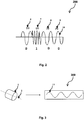
- the laser head 4 starts to move when the cylindrical drum 1 rotting in the predetermined axis, and the projection of the laser beam on the cylinder can create sinusoidal patterns which are modulated using FSK or ASK. So, to send first nibble (4 bit), if FSK is being used the sinusoidal pattern generated by the laser head 4 pointed onto the cylindrical drum 1 is shown in Fig.2 .
- Fig. 2 illustrates an exemplary four bit data converted to analog sinusoidal pattern at the transmitting end, according to the present invention.
- the first 6, third 8 and fourth 9 bits are generated with same speed from the laser head 4.
- the second bit 7, that is bit value "1" is generated by a higher speed movement of the laser head 4. So, higher speed (or higher period on laser head 4 move, because it is a harmonic motion as denoted in fig.1 in a horizontal 5 direction) can create more frequent patterns 10 which demonstrates bit one ("1").
- Fig. 3 illustrates an exemplary model 300 of a cylindrical drum 1 with laser sensor when the device provided at a receiving end, according to the present invention.
- the device further comprises of a demodulator for demodulating the modulated laser signal into the sinusoidal pattern 11 and transmitting it to the cylindrical drum 1 at the receiving end.
- the cylindrical drum 1 is provided with the laser sensors capable to receive and convert the sinusoidal pattern 11 into the digital data at the receiving end.
- the data converter is capable to convert the digital data into data at the receiving end that is originally sent from the transmitting end.
- the laser sensor may include but not limited to photodiodes.
- the device for remote data transfer is provided in both the transmitting end and the receiving end. All the elements of the device are available at both the end.
- the function of the device may vary based on the data transmission or reception. That is either the data to be transferred or received.
- the elements include but not limited to the laser head 4, the cylindrical drum 1, the laser sensors, the stepper motor, the data converter and the motor for rotating the cylindrical drum 1.
- the received laser signal at the receiving end can be tracked and read by the cylinder.
- the transmitting end or receiving end may be a mobile device, computer, laptop, tablet or any data electronic device, therefore the mobile device may act as the transmitting end as well as the receiving end depending upon whether to send the data or to receive the data.
- the device can achieve remote data transferring between a transmitting end and a receiving end using a laser technique according to the present invention.
- the device preferably comprises of at least one modulator, at least one data converter, and at least one demodulator.
- the device further comprises of at least one cylindrical drum 1 rotating in a predefined axis by a transmitting end motor, at least one laser source, and a plurality of laser sensors provided at the cylindrical drum 1.
- the laser source includes but not limited to a laser head 4 and a fixed part 3.
- the laser head 4 is connected to a stepper motor to enable to move the laser head 4 across the length of fixed part 3.
- the data at the transmitting end is converted to a digital data by the data converter and transferred to the stepper motor thus the laser head 4 capable to move across the length of fixed part 3 based on the received digital data.
- the laser head 4 is configured to move and project laser beam over the cylindrical drum 1 based on the received digital data.
- the laser sensor is configured to detect the laser beam in a sequence over the cylindrical drum 1 as a sinusoidal pattern.
- the modulator is configured to modulate the sinusoidal pattern and to transmit the modulated laser signal to the receiving end.
- the device is capable to convert the modulated laser signal to the data.
Landscapes
- Physics & Mathematics (AREA)
- Electromagnetism (AREA)
- Engineering & Computer Science (AREA)
- Computer Networks & Wireless Communication (AREA)
- Signal Processing (AREA)
- Electronic Switches (AREA)
- Optical Communication System (AREA)
Abstract
Description
- This invention refers to a device for remote data transferring between a transmitting end and a receiving end using a laser technique according to
claim 1. More specifically, the invention provides a device for remote data transferring between a transmitting end and a receiving end using a cylindrical drum and the laser technique. - Remote data transmission (RDT) was a term used in the 1980s, primarily in Germany, for the transmission of data between computers over a medium using a communications protocol. At the time, the most widespread form was RDT over the telephone network. Other transmission media like radio waves or light were also used. But in most of the cases RDT now utilizes an Internet communication. However, in the lack of Internet access, it is burdensome process to establish a communication between devices for transferring of data at remote location.
- Conventionally, the methods utilized for transferring data between two nodes or devices requires a medium to carry over the data. Typically, this medium is a network infrastructure for current devices like Mobile Phones, loT devices (Internet of Things devices) and similar devices. But for those devices, there may not be initial network connectivity on the given environments. There is an unmet need to define a way to transfer the configuration data to that kind of electronic devices.
- The subject-matter of the prior art does not provide an option to transfer data remotely between nodes without the need for Internet connectivity. Further, the techniques available in the prior art requires complicated network configurations and is expensive.
- It is therefore the object of the present invention to provide a device for remote data transferring between a transmitting end and a receiving end using a laser technique in an efficient manner.
- The before mentioned object is solved by a device for remote data transferring between a transmitting end and a receiving end using a laser technique according to
claim 1. - The device according to the present invention preferably comprises of at least one modulator, at least one data converter, and at least one demodulator. The device further comprises of at least one cylindrical drum rotating in a predefined axis by a transmitting end motor, at least one laser source, and a plurality of laser sensors provided at the cylindrical drum. The laser source includes but is not limited to a laser head and a fixed part. The laser head is connected to a stepper motor to enable to move the laser head across the length of fixed part. The data at the transmitting end is converted to a digital data by the data converter and transferred to the stepper motor thus the laser head capable to move across the length of fixed part based on the received digital data. The laser head is further configured to move and project laser beam over the cylindrical drum based on the received digital data. The laser sensor is configured to detect the laser beam in a sequence over the cylindrical drum as a sinusoidal pattern. The modulator is configured to modulate the sinusoidal pattern and to transmit the modulated laser signal to the receiving end.
- This solution is beneficial since such a device for remote data transferring between devices or nodes without the need for Internet connectivity is provided.
- Further preferred embodiments are subject-matter of dependent claims and/or of the following specification parts.
- According to a preferred embodiment of the present invention the laser head is configured to move in a horizontal axis over the cylindrical drum. The stepper motor is provided to generate discrete movement for the laser head at various speeds based on the digital data. The modulation of the sinusoidal pattern is performed using known methods for example Amplitude Shifting Key (ASK) or Frequency Shifting Key (FSK). The laser sensors are located vertically and horizontally as a matrix inside the cylindrical drum so as to cover entire circumference of the cylindrical drum thereby to detect the laser beam from the laser head. The laser head is moved horizontally in a predetermined speed based on the digital data and the cylindrical drum is rotated in the predefined axis at a predetermined speed by the transmitting end motor.
- According to another preferred embodiment of the present invention the device further comprises of a demodulator for demodulating the modulated laser signal into the sinusoidal pattern and transmitting it to the cylindrical drum at the receiving end. The cylindrical drum is provided with the laser sensor capable to receive and convert the sinusoidal pattern into the digital data at the receiving end. The data converter is capable to convert the digital data into data at the receiving end that is originally sent from the transmitting end. The laser sensor may include but not limited to photodiodes.
- Further benefits, goals and features of the present invention will be described by the following specification of the attached figures, in which components of the invention are exemplarily illustrated. Components of the devices and method according to the inventions, which match at least essentially with respect to their function can be marked with the same reference sign, wherein such components do not have to be marked or described in all figures.
- The invention is just exemplarily described with respect to the attached figures in the following.
-
- Fig. 1
- illustrates an exemplary model of a cylindrical drum with laser sensors when the device provided at a transmitting end, according to the present invention;
- Fig. 2
- illustrates an exemplary four bit data converted to analog sinusoidal pattern at the transmitting end, according to the present invention; and
- Fig. 3
- illustrates an exemplary model of a cylindrical drum with laser sensors when the device provided at a receiving end, according to the present invention.
-
Fig. 1 illustrates anexemplary model 100 of acylindrical drum 1 with laser sensors when the device provided at a transmitting end, according to the present invention. The device for remote data transferring between a transmitting end and a receiving end using a laser technique according to the present invention preferably comprises of at least one modulator, at least one data converter, and at least one demodulator. The device further comprises of at least onecylindrical drum 1 rotating in a predefined axis by a transmitting end motor, at least one laser source, and a plurality of laser sensors provided at thecylindrical drum 1. The transmitting end motor is provided to rotate thecylindrical drum 1 in thepredefined axis 2 during the remote data transferring process. - The laser source includes but not limited to a laser head 4 and a
fixed part 3. The laser head 4 is connected to a stepper motor to enable to move the laser head 4 across the length of fixed part. The data at the transmitting end is converted to a digital data by the data converter and transferred to the stepper motor thus the laser head 4 capable to move across the length of fixed part based on the received digital data. The data to be transferred is converted to ASCII codes character by character. That is for a letter 'A' the converted code is '01000001'. So this digital data need to be converted to analogue for transferring that data to the receiver end. That is to the cylinder with laser sensors at the receiver end. This analogue conversion is performed by the laser head 4 with a horizontal 5 movement over the rotatingcylindrical drum 1. - The laser head 4 is configured to move and project laser beam over the
cylindrical drum 1 based on the received digital data. The laser sensor is configured to detect the laser beam in a sequence over thecylindrical drum 1 as a sinusoidal pattern. The modulator is configured to modulate the sinusoidal pattern and to transmit the modulated laser signal to the receiving end. This solution is beneficial since such a device for remote data transferring between devices or nodes without the need for Internet connectivity. - According to a preferred embodiment of the present invention the laser head 4 is configured to move in a horizontal 5 axis over the
cylindrical drum 1. The stepper motor is provided to generate discrete movement for the laser head 4 at various speeds based on the digital data. The modulation of the sinusoidal pattern can be performed using known methods for example Amplitude Shifting Key (ASK) or Frequency Shifting Key (FSK). The laser sensors are located vertically and horizontally 5 as a matrix inside thecylindrical drum 1 so as to cover entire circumference of thecylindrical drum 1 thereby to detect the laser beam from the laser head 4. The laser head 4 is moved horizontally 5 in a predetermined speed based on the digital data and thecylindrical drum 1 rotated in thepredefined axis 2 at a predetermined speed by the transmitting end motor. - That is to send "01000001" bit-stream sequentially, the laser head 4 starts to move when the
cylindrical drum 1 rotting in the predetermined axis, and the projection of the laser beam on the cylinder can create sinusoidal patterns which are modulated using FSK or ASK. So, to send first nibble (4 bit), if FSK is being used the sinusoidal pattern generated by the laser head 4 pointed onto thecylindrical drum 1 is shown inFig.2 . -
Fig. 2 illustrates an exemplary four bit data converted to analog sinusoidal pattern at the transmitting end, according to the present invention. The first 6, third 8 and fourth 9 bits are generated with same speed from the laser head 4. But, thesecond bit 7, that is bit value "1" is generated by a higher speed movement of the laser head 4. So, higher speed (or higher period on laser head 4 move, because it is a harmonic motion as denoted infig.1 in a horizontal 5 direction) can create morefrequent patterns 10 which demonstrates bit one ("1"). -
Fig. 3 illustrates anexemplary model 300 of acylindrical drum 1 with laser sensor when the device provided at a receiving end, according to the present invention. The device further comprises of a demodulator for demodulating the modulated laser signal into thesinusoidal pattern 11 and transmitting it to thecylindrical drum 1 at the receiving end. Thecylindrical drum 1 is provided with the laser sensors capable to receive and convert thesinusoidal pattern 11 into the digital data at the receiving end. The data converter is capable to convert the digital data into data at the receiving end that is originally sent from the transmitting end. The laser sensor may include but not limited to photodiodes. The device for remote data transfer is provided in both the transmitting end and the receiving end. All the elements of the device are available at both the end. But the function of the device may vary based on the data transmission or reception. That is either the data to be transferred or received. The elements include but not limited to the laser head 4, thecylindrical drum 1, the laser sensors, the stepper motor, the data converter and the motor for rotating thecylindrical drum 1. The received laser signal at the receiving end can be tracked and read by the cylinder. - The transmitting end or receiving end may be a mobile device, computer, laptop, tablet or any data electronic device, therefore the mobile device may act as the transmitting end as well as the receiving end depending upon whether to send the data or to receive the data.
- Thus, the device can achieve remote data transferring between a transmitting end and a receiving end using a laser technique according to the present invention. The device preferably comprises of at least one modulator, at least one data converter, and at least one demodulator. The device further comprises of at least one
cylindrical drum 1 rotating in a predefined axis by a transmitting end motor, at least one laser source, and a plurality of laser sensors provided at thecylindrical drum 1. The laser source includes but not limited to a laser head 4 and afixed part 3. The laser head 4 is connected to a stepper motor to enable to move the laser head 4 across the length of fixedpart 3. The data at the transmitting end is converted to a digital data by the data converter and transferred to the stepper motor thus the laser head 4 capable to move across the length of fixedpart 3 based on the received digital data. The laser head 4 is configured to move and project laser beam over thecylindrical drum 1 based on the received digital data. The laser sensor is configured to detect the laser beam in a sequence over thecylindrical drum 1 as a sinusoidal pattern. The modulator is configured to modulate the sinusoidal pattern and to transmit the modulated laser signal to the receiving end. At the receiving end, the device is capable to convert the modulated laser signal to the data. -
- 1
- cylindrical drum
- 2
- direction of rotation of cylindrical drum
- 3
- fixed part
- 4
- laser head
- 5
- horizontal direction
- 6
- first bit of the nibble
- 7
- second bit of the nibble
- 8
- third bit of the nibble
- 9
- fourth bit of the nibble
- 10
- modulated laser signal / modulated sinusoidal pattern
- 11
- received sinusoidal signal
Claims (9)
- A device for remote data transferring between a transmitting end and a receiving end using a laser technique, wherein the device comprises
at least one modulator, at least one data converter and at least one demodulator,
wherein the device further comprises of at least one cylindrical drum (1) rotating in a predefined axis by a transmitting end motor, at least one laser source and a plurality of laser sensor provided at the cylindrical drum (1),
wherein the laser source includes a laser head (4) and a fixed part (3), wherein the laser head (4) is connected to a stepper motor to enable to move the laser head (4) across the length of fixed part (3)
wherein the data at the transmitting end are converted to a digital data by the data converter and transferred to the stepper motor, thus the laser head (4) is capable to move across the length of fixed part (3) based on the received digital data,
wherein the laser head (4) is configured to move and project laser beam over the cylindrical drum (1) based on the received digital data,
wherein the laser sensor is configured to detect the laser beam in a sequence over the cylindrical drum (1) as a sinusoidal pattern and
wherein the modulator is configured to modulate the sinusoidal pattern and to transmit the modulated laser signal to the receiving end. - The device as claimed in claim 1, wherein the laser head (4) is configured to move in a horizontal (5) axis over the cylindrical drum (1), and wherein the stepper motor is provided to generate discrete movement for the laser head (4) at various speeds based on the digital data.
- The device as claimed in claim 1, wherein the modulation of the sinusoidal pattern is using Amplitude Shifting Key (ASK) or Frequency Shifting Key (FSK).
- The device as claimed in claim 1, wherein the laser sensors are located vertically and horizontally (5) as a matrix inside the cylindrical drum (1) so as to cover the entire circumference of the cylindrical drum (1), thereby to detect the laser beam from the laser head (4).
- The device as claimed in claim 1, wherein the laser head (4) moves horizontally (5) in a predetermined speed based on the digital data and the cylindrical drum (1) is rotated in the predefined axis (2) at a predetermined speed by the transmitting end motor.
- The device as claimed in claim 1, wherein the device further comprises a demodulator for demodulating the modulated laser signal into the sinusoidal pattern (11) and for transmitting it to the cylindrical drum (1) at the receiving end.
- The device as claimed in claim 6, wherein the cylindrical drum (1) provided with the laser sensor receives and converts the sinusoidal pattern (11) into the digital data at the receiving end.
- The device as claimed in claim 7, wherein the data converter converts the digital data into data at the receiving end that is originally sent from the transmitting end.
- The device as claimed in claim 1, wherein the laser sensor includes photodiodes.
Priority Applications (2)
| Application Number | Priority Date | Filing Date | Title |
|---|---|---|---|
| EP17209794.1A EP3503432A1 (en) | 2017-12-21 | 2017-12-21 | Device for remote data transfer using a laser technique |
| TR2017/22703A TR201722703A2 (en) | 2017-12-21 | 2017-12-28 | Device for Remote Data Transfer Using a Laser Technique |
Applications Claiming Priority (1)
| Application Number | Priority Date | Filing Date | Title |
|---|---|---|---|
| EP17209794.1A EP3503432A1 (en) | 2017-12-21 | 2017-12-21 | Device for remote data transfer using a laser technique |
Publications (1)
| Publication Number | Publication Date |
|---|---|
| EP3503432A1 true EP3503432A1 (en) | 2019-06-26 |
Family
ID=60811853
Family Applications (1)
| Application Number | Title | Priority Date | Filing Date |
|---|---|---|---|
| EP17209794.1A Withdrawn EP3503432A1 (en) | 2017-12-21 | 2017-12-21 | Device for remote data transfer using a laser technique |
Country Status (2)
| Country | Link |
|---|---|
| EP (1) | EP3503432A1 (en) |
| TR (1) | TR201722703A2 (en) |
Citations (2)
| Publication number | Priority date | Publication date | Assignee | Title |
|---|---|---|---|---|
| EP1175026A2 (en) * | 2000-07-21 | 2002-01-23 | Texas Instruments Inc. | Optical wireless link |
| US6366380B1 (en) * | 1999-02-12 | 2002-04-02 | Cisco Technology, Inc | Optical transceiver EMI detuning device |
-
2017
- 2017-12-21 EP EP17209794.1A patent/EP3503432A1/en not_active Withdrawn
- 2017-12-28 TR TR2017/22703A patent/TR201722703A2/en unknown
Patent Citations (2)
| Publication number | Priority date | Publication date | Assignee | Title |
|---|---|---|---|---|
| US6366380B1 (en) * | 1999-02-12 | 2002-04-02 | Cisco Technology, Inc | Optical transceiver EMI detuning device |
| EP1175026A2 (en) * | 2000-07-21 | 2002-01-23 | Texas Instruments Inc. | Optical wireless link |
Also Published As
| Publication number | Publication date |
|---|---|
| TR201722703A2 (en) | 2019-07-22 |
Similar Documents
| Publication | Publication Date | Title |
|---|---|---|
| CN101697248B (en) | Learning type infrared remote control device and method | |
| JP2004215225A5 (en) | ||
| KR101733879B1 (en) | Network Communication System for Ship | |
| CN107733640B (en) | Continuous variable quantum key distribution method based on continuous random measurement basis | |
| US9240837B2 (en) | Systems and methods using optical communication for commissioning of network nodes | |
| AU7000400A (en) | Method and apparatus for adaptive bit resolution in a digital receiver and a digital transmitter | |
| NO942534D0 (en) | Trellis-coded modulation method with a small envelope variation for mobile radio | |
| CN102123117B (en) | Modulation device and method | |
| HUP9902441A2 (en) | Radio data modem | |
| AU2001277910A1 (en) | System and apparatus for a direct conversion receiver and transmitter | |
| KR910001164B1 (en) | Digital data decoder and method | |
| JP3882673B2 (en) | 4-level FSK modulation system | |
| CN1674569A (en) | Method and modulation control device for wireless data transmission | |
| JP2003513521A (en) | Method and apparatus for communicating using pulse decoding | |
| CA2306298A1 (en) | Apparatus and method for audio data/audio-related information transfer | |
| US6487242B1 (en) | Method and apparatus for VCO modulation in a communication system | |
| KR102003956B1 (en) | Wireless Communication System for Ship | |
| GB1459041A (en) | Radio communication system | |
| EP0397094A3 (en) | Spread spectrum communication system | |
| Gong et al. | Cross-Technology Backscatter for Smart Health Monitoring | |
| Reichard | Reconsidering RTTY in Telecommunications Education: Historicity, Simplicity, and Interoperability | |
| Chordia et al. | Imposition and Transmission of QPSK Communication Through LabVIEW Using USRP | |
| JPH02157925A (en) | Printing data transmitting system between printer host devices | |
| CN102510544A (en) | Digital fishery interphone private protocol control method using 4FSK (Frequency Shift Keying) | |
| WO2026027099A1 (en) | Mobile communication system |
Legal Events
| Date | Code | Title | Description |
|---|---|---|---|
| PUAI | Public reference made under article 153(3) epc to a published international application that has entered the european phase |
Free format text: ORIGINAL CODE: 0009012 |
|
| STAA | Information on the status of an ep patent application or granted ep patent |
Free format text: STATUS: THE APPLICATION HAS BEEN PUBLISHED |
|
| AK | Designated contracting states |
Kind code of ref document: A1 Designated state(s): AL AT BE BG CH CY CZ DE DK EE ES FI FR GB GR HR HU IE IS IT LI LT LU LV MC MK MT NL NO PL PT RO RS SE SI SK SM TR |
|
| AX | Request for extension of the european patent |
Extension state: BA ME |
|
| STAA | Information on the status of an ep patent application or granted ep patent |
Free format text: STATUS: REQUEST FOR EXAMINATION WAS MADE |
|
| 17P | Request for examination filed |
Effective date: 20191209 |
|
| RBV | Designated contracting states (corrected) |
Designated state(s): AL AT BE BG CH CY CZ DE DK EE ES FI FR GB GR HR HU IE IS IT LI LT LU LV MC MK MT NL NO PL PT RO RS SE SI SK SM TR |
|
| REG | Reference to a national code |
Ref country code: DE Ref legal event code: R079 Free format text: PREVIOUS MAIN CLASS: H04B0010114000 Ipc: H04B0010800000 |
|
| STAA | Information on the status of an ep patent application or granted ep patent |
Free format text: STATUS: EXAMINATION IS IN PROGRESS |
|
| RIC1 | Information provided on ipc code assigned before grant |
Ipc: H04B 10/80 20130101AFI20210930BHEP |
|
| 17Q | First examination report despatched |
Effective date: 20211029 |
|
| GRAP | Despatch of communication of intention to grant a patent |
Free format text: ORIGINAL CODE: EPIDOSNIGR1 |
|
| STAA | Information on the status of an ep patent application or granted ep patent |
Free format text: STATUS: GRANT OF PATENT IS INTENDED |
|
| STAA | Information on the status of an ep patent application or granted ep patent |
Free format text: STATUS: THE APPLICATION HAS BEEN WITHDRAWN |
|
| INTG | Intention to grant announced |
Effective date: 20251113 |
|
| 18W | Application withdrawn |
Effective date: 20251209 |