EP3502779A1 - Inherently photodegradable hydrogels or organogels for microfabrication - Google Patents
Inherently photodegradable hydrogels or organogels for microfabrication Download PDFInfo
- Publication number
- EP3502779A1 EP3502779A1 EP17002054.9A EP17002054A EP3502779A1 EP 3502779 A1 EP3502779 A1 EP 3502779A1 EP 17002054 A EP17002054 A EP 17002054A EP 3502779 A1 EP3502779 A1 EP 3502779A1
- Authority
- EP
- European Patent Office
- Prior art keywords
- group
- substituted
- unsubstituted
- hydrogel
- ethylene glycol
- Prior art date
- Legal status (The legal status is an assumption and is not a legal conclusion. Google has not performed a legal analysis and makes no representation as to the accuracy of the status listed.)
- Granted
Links
- 239000000017 hydrogel Substances 0.000 title claims abstract description 221
- 238000000034 method Methods 0.000 claims abstract description 45
- 238000012258 culturing Methods 0.000 claims abstract description 17
- 238000004519 manufacturing process Methods 0.000 claims abstract description 17
- 238000012377 drug delivery Methods 0.000 claims abstract description 7
- 230000000593 degrading effect Effects 0.000 claims abstract description 5
- -1 poly(ethylene glycol) Polymers 0.000 claims description 95
- 229920001223 polyethylene glycol Polymers 0.000 claims description 73
- 125000003118 aryl group Chemical group 0.000 claims description 35
- 125000000217 alkyl group Chemical group 0.000 claims description 34
- 239000003431 cross linking reagent Substances 0.000 claims description 32
- 125000004435 hydrogen atom Chemical group [H]* 0.000 claims description 31
- 229920000642 polymer Polymers 0.000 claims description 26
- 125000005011 alkyl ether group Chemical group 0.000 claims description 20
- DBCAQXHNJOFNGC-UHFFFAOYSA-N 4-bromo-1,1,1-trifluorobutane Chemical compound FC(F)(F)CCCBr DBCAQXHNJOFNGC-UHFFFAOYSA-N 0.000 claims description 19
- 125000000753 cycloalkyl group Chemical group 0.000 claims description 19
- STVZJERGLQHEKB-UHFFFAOYSA-N ethylene glycol dimethacrylate Substances CC(=C)C(=O)OCCOC(=O)C(C)=C STVZJERGLQHEKB-UHFFFAOYSA-N 0.000 claims description 19
- 125000001072 heteroaryl group Chemical group 0.000 claims description 19
- 239000000178 monomer Substances 0.000 claims description 17
- 125000002947 alkylene group Chemical group 0.000 claims description 15
- 238000004132 cross linking Methods 0.000 claims description 14
- 125000000954 2-hydroxyethyl group Chemical group [H]C([*])([H])C([H])([H])O[H] 0.000 claims description 11
- LYCAIKOWRPUZTN-UHFFFAOYSA-N Ethylene glycol Chemical group OCCO LYCAIKOWRPUZTN-UHFFFAOYSA-N 0.000 claims description 11
- 239000002245 particle Substances 0.000 claims description 10
- 230000001678 irradiating effect Effects 0.000 claims description 8
- 125000005647 linker group Chemical group 0.000 claims description 8
- 229920006037 cross link polymer Polymers 0.000 claims description 6
- 125000002496 methyl group Chemical group [H]C([H])([H])* 0.000 claims description 5
- 125000004430 oxygen atom Chemical group O* 0.000 claims description 5
- 125000004386 diacrylate group Chemical group 0.000 claims description 4
- ZIUHHBKFKCYYJD-UHFFFAOYSA-N n,n'-methylenebisacrylamide Chemical compound C=CC(=O)NCNC(=O)C=C ZIUHHBKFKCYYJD-UHFFFAOYSA-N 0.000 claims description 4
- 230000000379 polymerizing effect Effects 0.000 claims description 3
- 229920002538 Polyethylene Glycol 20000 Polymers 0.000 claims description 2
- 150000003573 thiols Chemical class 0.000 claims description 2
- 239000004971 Cross linker Substances 0.000 claims 2
- 210000004027 cell Anatomy 0.000 description 79
- ROOXNKNUYICQNP-UHFFFAOYSA-N ammonium persulfate Chemical compound [NH4+].[NH4+].[O-]S(=O)(=O)OOS([O-])(=O)=O ROOXNKNUYICQNP-UHFFFAOYSA-N 0.000 description 33
- 238000001782 photodegradation Methods 0.000 description 30
- XLYOFNOQVPJJNP-UHFFFAOYSA-N water Substances O XLYOFNOQVPJJNP-UHFFFAOYSA-N 0.000 description 24
- 125000004432 carbon atom Chemical group C* 0.000 description 18
- KWYHDKDOAIKMQN-UHFFFAOYSA-N N,N,N',N'-tetramethylethylenediamine Chemical compound CN(C)CCN(C)C KWYHDKDOAIKMQN-UHFFFAOYSA-N 0.000 description 17
- 230000015556 catabolic process Effects 0.000 description 17
- 238000006731 degradation reaction Methods 0.000 description 17
- 229910001870 ammonium persulfate Inorganic materials 0.000 description 16
- 238000009281 ultraviolet germicidal irradiation Methods 0.000 description 15
- 230000003628 erosive effect Effects 0.000 description 14
- 238000005406 washing Methods 0.000 description 14
- LOKCTEFSRHRXRJ-UHFFFAOYSA-I dipotassium trisodium dihydrogen phosphate hydrogen phosphate dichloride Chemical compound P(=O)(O)(O)[O-].[K+].P(=O)(O)([O-])[O-].[Na+].[Na+].[Cl-].[K+].[Cl-].[Na+] LOKCTEFSRHRXRJ-UHFFFAOYSA-I 0.000 description 11
- 239000003960 organic solvent Substances 0.000 description 11
- 239000002953 phosphate buffered saline Substances 0.000 description 11
- 230000008569 process Effects 0.000 description 11
- 239000002609 medium Substances 0.000 description 10
- 239000000203 mixture Substances 0.000 description 10
- PYWVYCXTNDRMGF-UHFFFAOYSA-N rhodamine B Chemical compound [Cl-].C=12C=CC(=[N+](CC)CC)C=C2OC2=CC(N(CC)CC)=CC=C2C=1C1=CC=CC=C1C(O)=O PYWVYCXTNDRMGF-UHFFFAOYSA-N 0.000 description 9
- 229940043267 rhodamine b Drugs 0.000 description 9
- 239000000243 solution Substances 0.000 description 9
- 125000001424 substituent group Chemical group 0.000 description 9
- 238000002360 preparation method Methods 0.000 description 8
- 239000000758 substrate Substances 0.000 description 8
- WOBHKFSMXKNTIM-UHFFFAOYSA-N Hydroxyethyl methacrylate Chemical compound CC(=C)C(=O)OCCO WOBHKFSMXKNTIM-UHFFFAOYSA-N 0.000 description 7
- 125000005842 heteroatom Chemical group 0.000 description 7
- 239000012966 redox initiator Substances 0.000 description 7
- 238000005259 measurement Methods 0.000 description 6
- 238000010899 nucleation Methods 0.000 description 6
- 229910052760 oxygen Inorganic materials 0.000 description 6
- 229920000193 polymethacrylate Polymers 0.000 description 6
- 238000000518 rheometry Methods 0.000 description 6
- 239000000126 substance Substances 0.000 description 6
- 102100026735 Coagulation factor VIII Human genes 0.000 description 5
- 239000006144 Dulbecco’s modified Eagle's medium Substances 0.000 description 5
- 235000008247 Echinochloa frumentacea Nutrition 0.000 description 5
- 101000911390 Homo sapiens Coagulation factor VIII Proteins 0.000 description 5
- 240000004072 Panicum sumatrense Species 0.000 description 5
- 229940122605 Short-acting muscarinic antagonist Drugs 0.000 description 5
- 238000004113 cell culture Methods 0.000 description 5
- 238000006243 chemical reaction Methods 0.000 description 5
- 238000007334 copolymerization reaction Methods 0.000 description 5
- 238000000799 fluorescence microscopy Methods 0.000 description 5
- 238000001879 gelation Methods 0.000 description 5
- 239000001963 growth medium Substances 0.000 description 5
- 229910052739 hydrogen Inorganic materials 0.000 description 5
- 239000001257 hydrogen Substances 0.000 description 5
- 210000001519 tissue Anatomy 0.000 description 5
- 108091003079 Bovine Serum Albumin Proteins 0.000 description 4
- XEEYBQQBJWHFJM-UHFFFAOYSA-N Iron Chemical compound [Fe] XEEYBQQBJWHFJM-UHFFFAOYSA-N 0.000 description 4
- 230000008901 benefit Effects 0.000 description 4
- 230000015572 biosynthetic process Effects 0.000 description 4
- 229910052799 carbon Inorganic materials 0.000 description 4
- 230000004663 cell proliferation Effects 0.000 description 4
- 238000012668 chain scission Methods 0.000 description 4
- 238000001218 confocal laser scanning microscopy Methods 0.000 description 4
- 230000003247 decreasing effect Effects 0.000 description 4
- 239000012091 fetal bovine serum Substances 0.000 description 4
- 238000002073 fluorescence micrograph Methods 0.000 description 4
- 239000011521 glass Substances 0.000 description 4
- 238000000059 patterning Methods 0.000 description 4
- 238000000206 photolithography Methods 0.000 description 4
- 238000006303 photolysis reaction Methods 0.000 description 4
- 230000015843 photosynthesis, light reaction Effects 0.000 description 4
- 238000006116 polymerization reaction Methods 0.000 description 4
- 239000012429 reaction media Substances 0.000 description 4
- 238000003860 storage Methods 0.000 description 4
- XDLMVUHYZWKMMD-UHFFFAOYSA-N 3-trimethoxysilylpropyl 2-methylprop-2-enoate Chemical compound CO[Si](OC)(OC)CCCOC(=O)C(C)=C XDLMVUHYZWKMMD-UHFFFAOYSA-N 0.000 description 3
- ZMXDDKWLCZADIW-UHFFFAOYSA-N N,N-Dimethylformamide Chemical compound CN(C)C=O ZMXDDKWLCZADIW-UHFFFAOYSA-N 0.000 description 3
- 239000000654 additive Substances 0.000 description 3
- 238000003491 array Methods 0.000 description 3
- 230000021164 cell adhesion Effects 0.000 description 3
- 238000007877 drug screening Methods 0.000 description 3
- 230000000694 effects Effects 0.000 description 3
- DUDCYUDPBRJVLG-UHFFFAOYSA-N ethoxyethane methyl 2-methylprop-2-enoate Chemical compound CCOCC.COC(=O)C(C)=C DUDCYUDPBRJVLG-UHFFFAOYSA-N 0.000 description 3
- 238000002474 experimental method Methods 0.000 description 3
- 238000000338 in vitro Methods 0.000 description 3
- 239000007788 liquid Substances 0.000 description 3
- 238000002493 microarray Methods 0.000 description 3
- 238000000386 microscopy Methods 0.000 description 3
- XJMOSONTPMZWPB-UHFFFAOYSA-M propidium iodide Chemical compound [I-].[I-].C12=CC(N)=CC=C2C2=CC=C(N)C=C2[N+](CCC[N+](C)(CC)CC)=C1C1=CC=CC=C1 XJMOSONTPMZWPB-UHFFFAOYSA-M 0.000 description 3
- 229910052717 sulfur Inorganic materials 0.000 description 3
- 230000001960 triggered effect Effects 0.000 description 3
- 230000035899 viability Effects 0.000 description 3
- BCAIDFOKQCVACE-UHFFFAOYSA-N 3-[dimethyl-[2-(2-methylprop-2-enoyloxy)ethyl]azaniumyl]propane-1-sulfonate Chemical compound CC(=C)C(=O)OCC[N+](C)(C)CCCS([O-])(=O)=O BCAIDFOKQCVACE-UHFFFAOYSA-N 0.000 description 2
- 238000012604 3D cell culture Methods 0.000 description 2
- VNFYMAPAENTMMO-UHFFFAOYSA-N 5-chloro-2-methylquinoline Chemical compound ClC1=CC=CC2=NC(C)=CC=C21 VNFYMAPAENTMMO-UHFFFAOYSA-N 0.000 description 2
- 229920000858 Cyclodextrin Polymers 0.000 description 2
- BWGNESOTFCXPMA-UHFFFAOYSA-N Dihydrogen disulfide Chemical compound SS BWGNESOTFCXPMA-UHFFFAOYSA-N 0.000 description 2
- LCGLNKUTAGEVQW-UHFFFAOYSA-N Dimethyl ether Chemical group COC LCGLNKUTAGEVQW-UHFFFAOYSA-N 0.000 description 2
- IAZDPXIOMUYVGZ-UHFFFAOYSA-N Dimethylsulphoxide Chemical compound CS(C)=O IAZDPXIOMUYVGZ-UHFFFAOYSA-N 0.000 description 2
- LFQSCWFLJHTTHZ-UHFFFAOYSA-N Ethanol Chemical compound CCO LFQSCWFLJHTTHZ-UHFFFAOYSA-N 0.000 description 2
- JLTDJTHDQAWBAV-UHFFFAOYSA-N N,N-dimethylaniline Chemical compound CN(C)C1=CC=CC=C1 JLTDJTHDQAWBAV-UHFFFAOYSA-N 0.000 description 2
- WYURNTSHIVDZCO-UHFFFAOYSA-N Tetrahydrofuran Chemical compound C1CCOC1 WYURNTSHIVDZCO-UHFFFAOYSA-N 0.000 description 2
- 229940008075 allyl sulfide Drugs 0.000 description 2
- 239000007864 aqueous solution Substances 0.000 description 2
- ZYGHJZDHTFUPRJ-UHFFFAOYSA-N benzo-alpha-pyrone Natural products C1=CC=C2OC(=O)C=CC2=C1 ZYGHJZDHTFUPRJ-UHFFFAOYSA-N 0.000 description 2
- 150000001721 carbon Chemical group 0.000 description 2
- 239000011203 carbon fibre reinforced carbon Substances 0.000 description 2
- 230000010261 cell growth Effects 0.000 description 2
- 210000003855 cell nucleus Anatomy 0.000 description 2
- 230000001413 cellular effect Effects 0.000 description 2
- 238000004624 confocal microscopy Methods 0.000 description 2
- 235000001671 coumarin Nutrition 0.000 description 2
- 150000004775 coumarins Chemical class 0.000 description 2
- 230000007423 decrease Effects 0.000 description 2
- 229920001971 elastomer Polymers 0.000 description 2
- 239000000806 elastomer Substances 0.000 description 2
- 238000005516 engineering process Methods 0.000 description 2
- 125000001495 ethyl group Chemical group [H]C([H])([H])C([H])([H])* 0.000 description 2
- 125000000816 ethylene group Chemical group [H]C([H])([*:1])C([H])([H])[*:2] 0.000 description 2
- 125000005843 halogen group Chemical group 0.000 description 2
- 238000011534 incubation Methods 0.000 description 2
- 238000011835 investigation Methods 0.000 description 2
- 229910052742 iron Inorganic materials 0.000 description 2
- 229920001427 mPEG Polymers 0.000 description 2
- 150000002734 metacrylic acid derivatives Chemical class 0.000 description 2
- 125000001570 methylene group Chemical group [H]C([H])([*:1])[*:2] 0.000 description 2
- 238000012544 monitoring process Methods 0.000 description 2
- 239000004033 plastic Substances 0.000 description 2
- 229920003023 plastic Polymers 0.000 description 2
- 108090000623 proteins and genes Proteins 0.000 description 2
- 102000004169 proteins and genes Human genes 0.000 description 2
- 238000010526 radical polymerization reaction Methods 0.000 description 2
- 239000005871 repellent Substances 0.000 description 2
- 239000002904 solvent Substances 0.000 description 2
- 210000000130 stem cell Anatomy 0.000 description 2
- UCSJYZPVAKXKNQ-HZYVHMACSA-N streptomycin Chemical compound CN[C@H]1[C@H](O)[C@@H](O)[C@H](CO)O[C@H]1O[C@@H]1[C@](C=O)(O)[C@H](C)O[C@H]1O[C@@H]1[C@@H](NC(N)=N)[C@H](O)[C@@H](NC(N)=N)[C@H](O)[C@H]1O UCSJYZPVAKXKNQ-HZYVHMACSA-N 0.000 description 2
- 229960005322 streptomycin Drugs 0.000 description 2
- 229920002818 (Hydroxyethyl)methacrylate Polymers 0.000 description 1
- 241000271566 Aves Species 0.000 description 1
- 239000004342 Benzoyl peroxide Substances 0.000 description 1
- OMPJBNCRMGITSC-UHFFFAOYSA-N Benzoylperoxide Chemical compound C=1C=CC=CC=1C(=O)OOC(=O)C1=CC=CC=C1 OMPJBNCRMGITSC-UHFFFAOYSA-N 0.000 description 1
- KCXVZYZYPLLWCC-UHFFFAOYSA-N EDTA Chemical compound OC(=O)CN(CC(O)=O)CCN(CC(O)=O)CC(O)=O KCXVZYZYPLLWCC-UHFFFAOYSA-N 0.000 description 1
- 102000004190 Enzymes Human genes 0.000 description 1
- 108090000790 Enzymes Proteins 0.000 description 1
- 108010010803 Gelatin Proteins 0.000 description 1
- 241000238631 Hexapoda Species 0.000 description 1
- UFHFLCQGNIYNRP-UHFFFAOYSA-N Hydrogen Chemical compound [H][H] UFHFLCQGNIYNRP-UHFFFAOYSA-N 0.000 description 1
- 229910001374 Invar Inorganic materials 0.000 description 1
- 241001082241 Lythrum hyssopifolia Species 0.000 description 1
- 241000124008 Mammalia Species 0.000 description 1
- CERQOIWHTDAKMF-UHFFFAOYSA-M Methacrylate Chemical compound CC(=C)C([O-])=O CERQOIWHTDAKMF-UHFFFAOYSA-M 0.000 description 1
- 206010028980 Neoplasm Diseases 0.000 description 1
- 229930182555 Penicillin Natural products 0.000 description 1
- JGSARLDLIJGVTE-MBNYWOFBSA-N Penicillin G Chemical compound N([C@H]1[C@H]2SC([C@@H](N2C1=O)C(O)=O)(C)C)C(=O)CC1=CC=CC=C1 JGSARLDLIJGVTE-MBNYWOFBSA-N 0.000 description 1
- 239000005062 Polybutadiene Substances 0.000 description 1
- 239000004698 Polyethylene Substances 0.000 description 1
- 229920000604 Polyethylene Glycol 200 Polymers 0.000 description 1
- 229920002556 Polyethylene Glycol 300 Polymers 0.000 description 1
- 229920002565 Polyethylene Glycol 400 Polymers 0.000 description 1
- 229920002593 Polyethylene Glycol 800 Polymers 0.000 description 1
- 239000004793 Polystyrene Substances 0.000 description 1
- 239000004809 Teflon Substances 0.000 description 1
- 229920006362 Teflon® Polymers 0.000 description 1
- 102000004142 Trypsin Human genes 0.000 description 1
- 108090000631 Trypsin Proteins 0.000 description 1
- 150000001252 acrylic acid derivatives Chemical class 0.000 description 1
- 230000000996 additive effect Effects 0.000 description 1
- 239000000853 adhesive Substances 0.000 description 1
- 230000001070 adhesive effect Effects 0.000 description 1
- 230000002776 aggregation Effects 0.000 description 1
- 238000004220 aggregation Methods 0.000 description 1
- 239000012935 ammoniumperoxodisulfate Substances 0.000 description 1
- 125000002178 anthracenyl group Chemical group C1(=CC=CC2=CC3=CC=CC=C3C=C12)* 0.000 description 1
- 239000012736 aqueous medium Substances 0.000 description 1
- 125000003710 aryl alkyl group Chemical group 0.000 description 1
- 239000012298 atmosphere Substances 0.000 description 1
- QVGXLLKOCUKJST-UHFFFAOYSA-N atomic oxygen Chemical compound [O] QVGXLLKOCUKJST-UHFFFAOYSA-N 0.000 description 1
- 230000001580 bacterial effect Effects 0.000 description 1
- 230000006399 behavior Effects 0.000 description 1
- 235000019400 benzoyl peroxide Nutrition 0.000 description 1
- 230000003592 biomimetic effect Effects 0.000 description 1
- 230000000903 blocking effect Effects 0.000 description 1
- 239000000872 buffer Substances 0.000 description 1
- 125000000484 butyl group Chemical group [H]C([*])([H])C([H])([H])C([H])([H])C([H])([H])[H] 0.000 description 1
- 201000011510 cancer Diseases 0.000 description 1
- 125000003178 carboxy group Chemical group [H]OC(*)=O 0.000 description 1
- 239000006143 cell culture medium Substances 0.000 description 1
- 230000024245 cell differentiation Effects 0.000 description 1
- 230000003915 cell function Effects 0.000 description 1
- 239000006285 cell suspension Substances 0.000 description 1
- 230000003833 cell viability Effects 0.000 description 1
- 230000008859 change Effects 0.000 description 1
- 125000001995 cyclobutyl group Chemical group [H]C1([H])C([H])([H])C([H])(*)C1([H])[H] 0.000 description 1
- 125000000113 cyclohexyl group Chemical group [H]C1([H])C([H])([H])C([H])([H])C([H])(*)C([H])([H])C1([H])[H] 0.000 description 1
- 125000001511 cyclopentyl group Chemical group [H]C1([H])C([H])([H])C([H])([H])C([H])(*)C1([H])[H] 0.000 description 1
- 238000013461 design Methods 0.000 description 1
- 238000009826 distribution Methods 0.000 description 1
- 238000005538 encapsulation Methods 0.000 description 1
- 238000012632 fluorescent imaging Methods 0.000 description 1
- 229920001973 fluoroelastomer Polymers 0.000 description 1
- 239000012737 fresh medium Substances 0.000 description 1
- 230000006870 function Effects 0.000 description 1
- 125000002541 furyl group Chemical group 0.000 description 1
- 239000008273 gelatin Substances 0.000 description 1
- 229920000159 gelatin Polymers 0.000 description 1
- 235000019322 gelatine Nutrition 0.000 description 1
- 235000011852 gelatine desserts Nutrition 0.000 description 1
- 125000003187 heptyl group Chemical group [H]C([*])([H])C([H])([H])C([H])([H])C([H])([H])C([H])([H])C([H])([H])C([H])([H])[H] 0.000 description 1
- 125000004051 hexyl group Chemical group [H]C([H])([H])C([H])([H])C([H])([H])C([H])([H])C([H])([H])C([H])([H])* 0.000 description 1
- 238000006897 homolysis reaction Methods 0.000 description 1
- 238000007654 immersion Methods 0.000 description 1
- 239000012535 impurity Substances 0.000 description 1
- 238000001727 in vivo Methods 0.000 description 1
- 125000000959 isobutyl group Chemical group [H]C([H])([H])C([H])(C([H])([H])[H])C([H])([H])* 0.000 description 1
- 125000001449 isopropyl group Chemical group [H]C([H])([H])C([H])(*)C([H])([H])[H] 0.000 description 1
- 230000031700 light absorption Effects 0.000 description 1
- 210000004962 mammalian cell Anatomy 0.000 description 1
- 239000000463 material Substances 0.000 description 1
- 239000011159 matrix material Substances 0.000 description 1
- 230000007246 mechanism Effects 0.000 description 1
- 229910052751 metal Inorganic materials 0.000 description 1
- 239000002184 metal Substances 0.000 description 1
- 125000000956 methoxy group Chemical group [H]C([H])([H])O* 0.000 description 1
- 238000001000 micrograph Methods 0.000 description 1
- 230000003278 mimic effect Effects 0.000 description 1
- 238000012986 modification Methods 0.000 description 1
- 230000004048 modification Effects 0.000 description 1
- 210000003205 muscle Anatomy 0.000 description 1
- 125000001624 naphthyl group Chemical group 0.000 description 1
- 102000039446 nucleic acids Human genes 0.000 description 1
- 108020004707 nucleic acids Proteins 0.000 description 1
- 150000007523 nucleic acids Chemical class 0.000 description 1
- 235000015097 nutrients Nutrition 0.000 description 1
- 230000003534 oscillatory effect Effects 0.000 description 1
- TWNQGVIAIRXVLR-UHFFFAOYSA-N oxo(oxoalumanyloxy)alumane Chemical compound O=[Al]O[Al]=O TWNQGVIAIRXVLR-UHFFFAOYSA-N 0.000 description 1
- 239000001301 oxygen Substances 0.000 description 1
- 229940049954 penicillin Drugs 0.000 description 1
- JLFNLZLINWHATN-UHFFFAOYSA-N pentaethylene glycol Chemical compound OCCOCCOCCOCCOCCO JLFNLZLINWHATN-UHFFFAOYSA-N 0.000 description 1
- 125000004817 pentamethylene group Chemical group [H]C([H])([*:2])C([H])([H])C([H])([H])C([H])([H])C([H])([H])[*:1] 0.000 description 1
- 125000001147 pentyl group Chemical group C(CCCC)* 0.000 description 1
- 125000001997 phenyl group Chemical group [H]C1=C([H])C([H])=C(*)C([H])=C1[H] 0.000 description 1
- 229920001084 poly(chloroprene) Polymers 0.000 description 1
- 229920003229 poly(methyl methacrylate) Polymers 0.000 description 1
- 229920002857 polybutadiene Polymers 0.000 description 1
- 229920000573 polyethylene Polymers 0.000 description 1
- 229920000139 polyethylene terephthalate Polymers 0.000 description 1
- 239000005020 polyethylene terephthalate Substances 0.000 description 1
- 229920001195 polyisoprene Polymers 0.000 description 1
- 239000004926 polymethyl methacrylate Substances 0.000 description 1
- 229920001184 polypeptide Polymers 0.000 description 1
- 229920001296 polysiloxane Polymers 0.000 description 1
- 229920002223 polystyrene Polymers 0.000 description 1
- 239000004814 polyurethane Substances 0.000 description 1
- 229920003225 polyurethane elastomer Polymers 0.000 description 1
- 102000004196 processed proteins & peptides Human genes 0.000 description 1
- 108090000765 processed proteins & peptides Proteins 0.000 description 1
- 230000035755 proliferation Effects 0.000 description 1
- 125000001436 propyl group Chemical group [H]C([*])([H])C([H])([H])C([H])([H])[H] 0.000 description 1
- 125000004805 propylene group Chemical group [H]C([H])([H])C([H])([*:1])C([H])([H])[*:2] 0.000 description 1
- 238000000746 purification Methods 0.000 description 1
- 125000004076 pyridyl group Chemical group 0.000 description 1
- 125000000714 pyrimidinyl group Chemical group 0.000 description 1
- 125000000168 pyrrolyl group Chemical group 0.000 description 1
- 238000007717 redox polymerization reaction Methods 0.000 description 1
- 238000011160 research Methods 0.000 description 1
- 150000003839 salts Chemical class 0.000 description 1
- 230000011664 signaling Effects 0.000 description 1
- 238000002174 soft lithography Methods 0.000 description 1
- 239000007779 soft material Substances 0.000 description 1
- 238000001179 sorption measurement Methods 0.000 description 1
- 238000010186 staining Methods 0.000 description 1
- 230000001954 sterilising effect Effects 0.000 description 1
- 238000004659 sterilization and disinfection Methods 0.000 description 1
- 125000000547 substituted alkyl group Chemical group 0.000 description 1
- 230000002522 swelling effect Effects 0.000 description 1
- 238000003786 synthesis reaction Methods 0.000 description 1
- 125000000999 tert-butyl group Chemical group [H]C([H])([H])C(*)(C([H])([H])[H])C([H])([H])[H] 0.000 description 1
- 238000012360 testing method Methods 0.000 description 1
- YLQBMQCUIZJEEH-UHFFFAOYSA-N tetrahydrofuran Natural products C=1C=COC=1 YLQBMQCUIZJEEH-UHFFFAOYSA-N 0.000 description 1
- 125000000383 tetramethylene group Chemical group [H]C([H])([*:1])C([H])([H])C([H])([H])C([H])([H])[*:2] 0.000 description 1
- 125000001544 thienyl group Chemical group 0.000 description 1
- 125000003866 trichloromethyl group Chemical group ClC(Cl)(Cl)* 0.000 description 1
- 125000002023 trifluoromethyl group Chemical group FC(F)(F)* 0.000 description 1
- 239000012588 trypsin Substances 0.000 description 1
- 230000005748 tumor development Effects 0.000 description 1
- 239000003643 water by type Substances 0.000 description 1
Images




Classifications
-
- G—PHYSICS
- G03—PHOTOGRAPHY; CINEMATOGRAPHY; ANALOGOUS TECHNIQUES USING WAVES OTHER THAN OPTICAL WAVES; ELECTROGRAPHY; HOLOGRAPHY
- G03F—PHOTOMECHANICAL PRODUCTION OF TEXTURED OR PATTERNED SURFACES, e.g. FOR PRINTING, FOR PROCESSING OF SEMICONDUCTOR DEVICES; MATERIALS THEREFOR; ORIGINALS THEREFOR; APPARATUS SPECIALLY ADAPTED THEREFOR
- G03F7/00—Photomechanical, e.g. photolithographic, production of textured or patterned surfaces, e.g. printing surfaces; Materials therefor, e.g. comprising photoresists; Apparatus specially adapted therefor
- G03F7/0037—Production of three-dimensional images
-
- B—PERFORMING OPERATIONS; TRANSPORTING
- B29—WORKING OF PLASTICS; WORKING OF SUBSTANCES IN A PLASTIC STATE IN GENERAL
- B29C—SHAPING OR JOINING OF PLASTICS; SHAPING OF MATERIAL IN A PLASTIC STATE, NOT OTHERWISE PROVIDED FOR; AFTER-TREATMENT OF THE SHAPED PRODUCTS, e.g. REPAIRING
- B29C67/00—Shaping techniques not covered by groups B29C39/00 - B29C65/00, B29C70/00 or B29C73/00
-
- G—PHYSICS
- G03—PHOTOGRAPHY; CINEMATOGRAPHY; ANALOGOUS TECHNIQUES USING WAVES OTHER THAN OPTICAL WAVES; ELECTROGRAPHY; HOLOGRAPHY
- G03F—PHOTOMECHANICAL PRODUCTION OF TEXTURED OR PATTERNED SURFACES, e.g. FOR PRINTING, FOR PROCESSING OF SEMICONDUCTOR DEVICES; MATERIALS THEREFOR; ORIGINALS THEREFOR; APPARATUS SPECIALLY ADAPTED THEREFOR
- G03F7/00—Photomechanical, e.g. photolithographic, production of textured or patterned surfaces, e.g. printing surfaces; Materials therefor, e.g. comprising photoresists; Apparatus specially adapted therefor
- G03F7/004—Photosensitive materials
- G03F7/039—Macromolecular compounds which are photodegradable, e.g. positive electron resists
Definitions
- the present invention relates to a photodegradable hydrogel or organogel which is used for manufacturing a patterned article, a method for degrading the photodegradable hydrogel or organogel, a corresponding patterned article, as well as the use of such a patterned article in microengineering, e.g. for three-dimensional cell culturing, for drug delivery, or for tissue-engineering.
- Hydrogels are water-swollen three dimensional (3D) networks of either physically or chemically crosslinked polymers.
- Organogels are the organic solvent based analogs of said hydrogels. Hydrogels and organogels possess rich structures and tunable properties, and have become extremely important soft materials useful for both industrial and biomedical fields, including actuators, sensors, artificial muscles, drug delivery, and tissue engineering. To meet these applications, hydrogels and organogels with well-defined microscale structures, including size, shape, porosity and heterogeneity, are usually required.
- Typical applications of microengineered hydrogels or organogels include, but are not limited to, biomimetic hydrogels/organogels with hierarchical microstructures for tissue engineering, hydrogel/organogel microarrays for high-throughput drug screenings, hydrogel/organogel microarrays as organ-on-a-chip platforms for in-vitro pharmaceutical research, hydrogel/organogel microwell arrays to prepare cell spheroids for 3D culture, hydrogels/organogels with spatially patterned matrix elasticity to direct stem cell fate.
- Microengineering hydrogels/organogels can be achieved with various technologies including photolithography, soft-lithography, microfluidics and printing.
- Photolithography is the most popular method because of its low-cost, high-throughput and ability of large scale patterning.
- There exist two strategies for photopatterning of hydrogels/organogels light-triggered cross-linking of pregel mixtures and light-triggered de-cross-linking of photodegradable hydrogels/organogels.
- the latter strategy shows two apparent advantages: it applies to the photopatterning of hydrogels/organogels with light-sensitive components due to the blocking of UV light by photomasks and it also allows the preparation of hierarchical microstructures within hydrogels/organogels by controlling the photodegradation depth.
- photodegradable hydrogels/organogels require the introduction of photosensitive groups, like photo-labile o-nitrobenzyl esters and coumarins, photodynamic disulfide and allyl-sulfide, photoresponsive azobenzene-cyclodextrin complex, and iron(III)-carboxylic acid coordination.
- photosensitive groups like photo-labile o-nitrobenzyl esters and coumarins, photodynamic disulfide and allyl-sulfide, photoresponsive azobenzene-cyclodextrin complex, and iron(III)-carboxylic acid coordination.
- the technical problem underlying the present invention is to provide a photodegradable hydrogel or organogel, which can be used for preparing patterned articles, can be prepared in a straightforward manner, shows controlled degradation kinetics, has chemical flexibility, and allows sophisticated microfabrication, as well a method for manufacturing a patterned article, which can be used in a diversity of microengineering applications, such as for forming cell aggregates, especially uniform cell aggregates and three-dimensional cell cultures.
- the present invention relates to the use of a photodegradable hydrogel or organogel for manufacturing a patterned article by irradiating at least a part of the photodegradable hydrogel or organogel with UV light, the photodegradable hydrogel or organogel comprising a polymer including a three-dimensional network of cross-linked polymer chains, the polymer chains having repeating units of the general Formula (I) wherein each R 1 is independently selected from the group consisting of a hydrogen atom, a substituted or unsubstituted alkyl group, a substituted or unsubstituted cycloalkyl group, a substituted or unsubstituted aryl group, a substituted or unsubstituted heteroaryl group, a substituted or unsubstituted 2-hydroxyethyl group, a substituted or unsubstituted 2-(N-3-sulfopropyl-N,N-dimethyl ammonium)ethyl group, a substitute
- the term "photodegradable hydrogel or organogel” relates to a hydrogel or organogel which can be degraded when subjected to light irradiation.
- the three-dimensional network of cross-linked polymer chains preferably breaks up. This leads to a change in the consistency of the former hydrogel/organogel to a liquid state, which can subsequently be removed, e.g. by washing with water or solvent.
- alkyl group refers particularly to a branched or linear alkyl group having 1 to 20, preferably 1 to 12, more preferably 1 to 6, and most preferably 1 to 4 carbon atoms, which can be substituted or unsubstituted.
- alkyl groups represent methyl groups, ethyl groups, propyl groups, isopropyl groups, butyl groups, isobutyl groups, tert-butyl groups, pentyl groups, hexyl groups, and heptyl groups.
- alkylene group refers particularly to a branched or linear alkylene group having 5 to 2000, preferably 10 to 1000, and most preferably 20 to 500 carbon atoms, which can be substituted or unsubstituted.
- cycloalkyl group refers particularly to a cycloalkyl group having 3 to 10, preferably 4 to 8, more preferably 5 or 6, and most preferably 6 carbon atoms, which can be substituted or unsubstituted. Examples of cycloalkyl groups represent cyclobutyl groups, cyclopentyl groups, and cyclohexyl groups.
- aryl group refers particularly to an aryl group consisting of 1 to 6, preferably 1 to 4, more preferably 1 to 3 aromatic rings, and most preferably 1 aromatic ring, which can be substituted or unsubstituted.
- aryl groups represent phenyl groups, anthracenyl or naphthyl groups.
- heteroaryl group refers particularly to a heteroaryl group consisting of 1 to 6, preferably 1 to 4, more preferably 1 to 3 aromatic rings including heteroatoms, which can be substituted or unsubstituted.
- Heteroatoms, which are present in heteroaryl groups are for example N, O and S.
- heteroaryl groups represent pyridyl groups, pyrimidinyl groups, thienyl groups, furyl groups or pyrrolyl groups.
- the alkyl groups, the alkylene groups, the cycloalkyl groups, the aryl groups and the heteroaryl groups may be substituted or unsubstituted.
- the potential substituents are not specifically limited. Accordingly, instead of hydrogen atoms any substituent known in the prior art can be bonded to the further positions of the corresponding groups.
- the potential substituents may be selected from the group consisting of a branched or linear alkyl group having 1 to 6 carbon atoms, a cycloalkyl group having 4 to 8 carbon atoms, an aryl group having 1 to 3 aromatic rings, a heteroaryl group having 1 to 3 aromatic rings including heteroatoms, a halogen atom, -NL 1 L 2 , -NO 2 , -CN, -OL 3 , -C(O)L 4 , -C(O)NL 5 L 6 , -COOL 7 , and -SO 3 L 8 , wherein L 1 to L 8 are each independently selected from a hydrogen atom, a branched or linear alkyl group having 1 to 6 carbon atoms, a cycloalkyl group having 4 to 8 carbon atoms, an aryl group having 1 to 3 aromatic rings, a heteroaryl group having 1 to 3 aromatic rings including heteroatoms.
- substituted alkyl groups are aralkyl groups or alkyl groups substituted with e.g. cycloalkyl groups or alkyl groups substituted with e.g. halogen atoms, such as e.g. a trifluoromethyl group or a trichloromethyl group, or any other of the above-mentioned substituents.
- the potential substituents are selected from the group consisting of a branched or linear alkyl group having 1 to 6 carbon atoms, an aryl group having 1 to 3 aromatic rings, a heteroaryl group having 1 to 3 aromatic rings including heteroatoms, -NH 2 , -NHCH 3 , - N(CH 3 ) 2 , -NO 2 , -OH, -OCH 3 , -OEt, -C(O)H, and -COOH.
- one or more tetravalent carbon atoms when present, in each of the alkyl groups, the alkylene groups, and the cycloalkyl groups may each independently be substituted by a member selected from the group consisting of O, (OCH 2 CH 2 ) p O, S, (SCH 2 CH 2 ) q S, C(O), C(O)O, NX, and C(O)NY, preferably O, (OCH 2 CH 2 ) p O, C(O)O, and C(O)NY, wherein p and q are each independently an integer from 1 to 6.
- an alkyl group may be interrupted by e.g.
- a carbon atom may be substituted by C(O)O in the sense of -C(O)O- or -OC(O)- and by C(O)NY in the sense of -C(O)NY- or -NYC(O)-.
- X and Y are each independently selected from the group consisting of a hydrogen atom, a branched or linear alkyl group having 1 to 6 carbon atoms, a cycloalkyl group having 4 to 8 carbon atoms, an aryl group having 1 to 3 aromatic rings, a heteroaryl group having 1 to 3 aromatic rings including heteroatoms, -OZ 1 , -C(O)Z 2 , -C(O)NZ 3 Z 4 , -COOZ 5 , and -SO 2 Z 6 .
- X and Y are each independently selected from the group consisting of a hydrogen atom, a branched or linear alkyl group having 1 to 6 carbon atoms, an aryl group having 1 to 3 aromatic rings, -C(O)Z 2 , and -SO 2 Z 6 .
- X and Y are each independently selected from the group consisting of a hydrogen atom and a branched or linear alkyl group having 1 to 6 carbon atoms.
- Z 1 to Z 6 are each independently selected from the group consisting of a hydrogen atom, a branched or linear alkyl group having 1 to 6 carbon atoms, a cycloalkyl group having 4 to 8 carbon atoms, an aryl group having 1 to 3 aromatic rings, a heteroaryl group having 1 to 3 aromatic rings including heteroatoms.
- Z 1 to Z 6 are each independently selected from the group consisting of a hydrogen atom, a branched or linear alkyl group having 1 to 6 carbon atoms, and an aryl group having 1 to 3 aromatic rings.
- the alkyl groups, the alkylene groups, the cycloalkyl groups, the aryl groups and the heteroaryl groups are unsubstituted.
- the alkyl groups and the alkylene groups are linear.
- the photodegradable hydrogels or organogels used in the present invention are inherently photodegradable hydrogels or organogels, which do not comprise external photosensitive groups as described above and do not comprise additional chemicals, such as e.g. photoinitiators or thiols, for the degradation.
- the term "external photosensitive groups” relates to photosensitive groups other than those included in the backbone of the polymer chains having the repeating units of the general Formula (I).
- the backbone of said polymer chains does not include the groups R 1 .
- photosensitive groups may not be included in said groups R 1 .
- photo-labile o-nitrobenzyl esters and coumarins photodynamic disulfide and allyl-sulfide, photoresponsive azobenzene-cyclodextrin complex, and iron(III)-carboxylic acid coordination.
- the photodegradable hydrogels or organogels used in the present invention can e.g. be developed from poly(meth)acrylate hydrogels/organogels.
- Poly(meth)acrylates are photodegradable due to the homolysis of main chain carbon-carbon bonds under UV light. According to a proposed non-limiting mechanism, this photolysis process undergoes three routes: the direct main-chain scission, the main-chain scission following side-chain scission, and the photooxidative main chain scission.
- the photolysis of poly(meth)acrylate will lead to the de-cross-linking of the corresponding hydrogels/organogels, without external photosensitive groups being required.
- the polymer chains have repeating units of the general Formula (I) wherein each R 1 is independently selected from the group consisting of a hydrogen atom, a substituted or unsubstituted alkyl group, a substituted or unsubstituted cycloalkyl group, a substituted or unsubstituted aryl group, a substituted or unsubstituted heteroaryl group, a substituted or unsubstituted 2-hydroxyethyl group, a substituted or unsubstituted 2-(N-3-sulfopropyl-N,N-dimethyl ammonium)ethyl group, a substituted or unsubstituted poly(ethylene glycol) group, and a substituted or unsubstituted poly(ethylene glycol) alkyl ether group; and each R 2 is independently a hydrogen atom or a substituted or unsubstituted alkyl group.
- the 2-hydroxyethyl group, the 2-(N-3-sulfopropyl-N,N-dimethyl ammonium)ethyl group, the poly(ethylene glycol) group, and the poly(ethylene glycol) alkyl ether group of R 1 may be further substituted.
- the above definition concerning potential substituents analogously applies to the potential further substituents of the 2-hydroxyethyl group, the 2-(N-3-sulfopropyl-N,N-dimethyl ammonium)ethyl group, the poly(ethylene glycol) group, and the poly(ethylene glycol) alkyl ether group of R 1 .
- the 2-hydroxyethyl group, the 2-(N-3-sulfopropyl-N,N-dimethyl ammonium)ethyl group, the poly(ethylene glycol) group, and the poly(ethylene glycol) alkyl ether group of R 1 are not further substituted.
- poly(ethylene glycol) group refers to PEG molecules, wherein one terminal hydrogen has been abstracted.
- poly(ethylene glycol) group refers to corresponding PEG molecules (i.e. PEG molecules, wherein one terminal hydrogen has been abstracted) derived from PEG molecules (with all hydrogen atoms) within the Mn range of 106 to 20000, preferably of 200 to 1200, more preferably of 300 to 800 group, more preferably of 400 to 700, most preferably from PEG molecules (with all hydrogen atoms) with a Mn of 500.
- poly(ethylene glycol) alkyl ether group refers to PEG molecules, wherein one terminal hydrogen has been exchanged for an alkyl group, preferably a branched or linear alkyl group having 1 to 10 carbon atoms, more preferably a methyl or an ethyl group, most preferably a methyl group, and another hydrogen of the poly(ethylene glycol) molecule, preferably the other terminal hydrogen, is abstracted.
- a PEGX 1 00 to PEGY 1 00 group herein mean PEG alkyl ether groups, preferably PEG methyl ether groups, derived from PEG molecules (with all hydrogen atoms) within the Mn range of X 1 00 to Y 1 00.
- PEGX 1 00MA to PEGY 1 00MA refers to poly(ethylene glycol) methacrylates having PEG alkyl ether groups, preferably PEG methyl ether groups, derived from PEG molecules (with all hydrogen atoms) within the Mn range of X 1 00 to Y 1 00.
- a poly(ethylene glycol) group or a poly(ethylene glycol) alkyl ether group is attached (e.g. in a general formula, such as e.g. in the case of R 1 in general Formulas (I) and (II)) to a oxygen atom, said oxygen belongs to the poly(ethylene glycol) group or the poly(ethylene glycol) alkyl ether group, respectively.
- poly(ethylene glycol) linker group refers to PEG molecules, wherein both terminal hydrogens have been abstracted.
- PEGX 2 00D(M)A to PEGY 2 00D(M)A refers to poly(ethylene glycol) di(meth)acrylates having PEG linker groups derived from PEG molecules (with all hydrogen atoms) within the Mn range of X 2 00 to Y 2 00.
- the polymer comprises repeating units of the general Formula (I) having more than one kind of R 1 and/or R 2 groups
- the mass ratios of the different repeating units are not particularly limited.
- the different repeating units may be mixed in any given ratio as long as the hydrogel/organogel keeps its photodegradable properties.
- the polymer comprises repeating units of the general Formula (I) having only one kind of R 1 group and one kind of R 2 group.
- the polymer comprises repeating units of the general Formula (I) wherein R 1 is a 2-hydroxyethyl group
- the polymer preferably further contains repeating units of the general Formula (I) wherein R 1 is a poly(ethylene glycol) alkyl ether group, preferably a PEG500 group.
- the polymer preferably further contains 20 mol% or more of repeating units of the general Formula (I) wherein R 1 is a poly(ethylene glycol) alkyl ether group, preferably a PEG500 group, based on a total of 100 mol% of the repeating units of the general Formula (I).
- each R 1 is independently selected from the group consisting of a 2-hydroxyethyl group, a 2-(N-3-sulfopropyl-N,N-dimethyl ammonium)ethyl group, a poly(ethylene glycol) group, and a poly(ethylene glycol) alkyl ether group. More preferably, each R 1 is independently a poly(ethylene glycol) alkyl ether group selected from a PEG106 to PEG20000 group, preferably from a PEG200 to PEG1200 group.
- each R 1 is independently a poly(ethylene glycol) alkyl ether group selected from a PEG300 to PEG800 group, more preferably a poly(ethylene glycol) alkyl ether group selected from a PEG400 to PEG700 group, most preferably each R 1 is a PEG500 group.
- each R 2 is independently an alkyl group having 1 to 4 carbon atoms. Most preferably, R 2 is a methyl group.
- the cross-linking agent used for cross-linking the polymer chains of the polymer comprised in the photodegradable hydrogel or organogel used in the present invention is not particularly limited.
- the cross-linking agent used for cross-linking the polymer chains has the general Formula (III) wherein each R 3 is independently selected from the group consisting of a hydrogen atom, a substituted or unsubstituted alkyl group, a substituted or unsubstituted cycloalkyl group, a substituted or unsubstituted aryl group, and a substituted or unsubstituted heteroaryl group; and R 4 is selected from a substituted or unsubstituted alkylene group, a substituted or unsubstituted poly(ethylene glycol) linker group, and the following Formula (IV) wherein G is NH or an oxygen atom and n is an integer from 1 to 5.
- n is an integer from 1 to 5.
- the corresponding alkylene group in Formula (IV) may be a methylene group, an ethylene group, a propylene group, a butylene group, or a pentylene group, which may be substituted or unsubstituted.
- n is an integer from 1 to 3, more preferably an integer of 1 or 2.
- G is NH
- n is most preferably 1, i.e. the corresponding alkylene group in Formula (IV) is a methylene group.
- G is an oxygen atom
- n is most preferably 2, i.e. the corresponding alkylene group in Formula (IV) is an ethylene group.
- G is an oxygen atom.
- the poly(ethylene glycol) linker group and the alkylene group in Formula (IV) of R 4 may be further substituted.
- the above definition concerning potential substituents analogously applies to the potential (further) substituents of the poly(ethylene glycol) linker group and the alkylene group in Formula (IV) of R 4 .
- the poly(ethylene glycol) linker group and the alkylene group in Formula (IV) of R 4 are not (further) substituted.
- the cross-linking agent is selected from the group consisting of ethylene glycol dimethacrylate (EGDMA), N,N'- methylenebisacrylamide (MBA), poly(ethylene glycol) diacrylate selected from PEG106DA to PEG20000DA, preferably from PEG300DA to PEG1500DA, and poly(ethylene glycol) dimethacrylate selected from PEG106DMA to PEG20000DMA, preferably from PEG500DMA to PEG6000DMA.
- EGDMA ethylene glycol dimethacrylate
- MSA N,N'- methylenebisacrylamide
- PEG106DA poly(ethylene glycol) diacrylate
- PEG300DA preferably from PEG1500DA
- PEG600DMA poly(ethylene glycol) dimethacrylate selected from PEG106DMA to PEG20000DMA
- PEG700DA and PEG4000DMA are used due to their good water-solubility and commercial availability.
- the content of the cross-linked polymer in the hydrogel or organogel used in the present invention is not particularly limited.
- the content of the polymer in the hydrogel or organogel may be from 2.0 to 40 wt%, preferably from 5.0 to 35 wt%, more preferably from 10 to 30 wt%, and most preferably from 15 to 25 wt%.
- the remainder is water or the respective organic solvent and optional additives as well as potential impurities included e.g. due to the manufacturing process, such as remainder of the redox initiators used in redox-initiated radical copolymerization.
- the optional additives are not particularly limited and are known in the art. For example, as additive there may be used Rhodamine B for fluorescence imaging.
- the photodegradable hydrogel or organogel used in the present invention is transparent.
- the method for producing the photodegradable hydrogel or organogel used in the present invention is not particularly limited.
- any known method for producing hydrogels/organogels can be used.
- the hydrogel or organogel may be produced by polymerizing the monomer units in water and/or the respective organic solvent in the presence of a cross-linking agent or crosslinking the poly(meth)acrylates in water and/or the respective organic solvent via the reaction of side groups.
- the hydrogel or organogel used in the present invention is produced by a method comprising the step of polymerizing monomer units of the general Formula (II) in water and/or the respective organic solvent in the presence of a cross-linking agent.
- the monomer units are selected from the group consisting of (2-hydroxyethyl)methacrylate, [2-(methacryloyloxy)ethyl]dimethyl-(3-sulfopropyl) ammonium hydroxide, poly(ethylene glycol) methacrylates derived from PEG molecules (with all hydrogen atoms) within the Mn range of 106 to 20000, and poly(ethylene glycol) alkyl ether methacrylates selected from PEG106MA to PEG20000MA, preferably from PEG200MA to PEG1200MA.
- the monomer units are selected from poly(ethylene glycol) alkyl ether methacrylates selected from PEG106MA to PEG20000MA, preferably from PEG200MA to PEG1200MA. Most preferably, the monomer units are PEG500 methyl ether methacrylate.
- the polymerization method is not particularly limited. Thus, any known polymerization method can be used.
- the polymer may be produced by redox-initiated radical copolymerization, photo-initiated radical polymerization or thermo-initiated radical polymerization.
- the polymer is produced by redox-initiated radical copolymerization due to the fast kinetics and easy operation associated with said method.
- the applied redox initiators are not particularly limited.
- any known redox initiators can be used.
- redox initiators there may be used a combination of ammonium persulfate (APS) and N,N,N',N' -tetramethylethylenediamine (TEMED), or benzoyl peroxide and N,N- dimethylaniline.
- redox initiator there is used a combination of ammonium persulfate and N,N,N',N' -tetramethylethylenediamine.
- the concentration of the redox initiator in the polymerization medium may be from 1.0 mM to 200 mM, preferably from 3.0 mM to 100 mM, more preferably from 6.0 mM to 30 mM.
- the respective concentrations in the polymerization medium may be from 1.0 mM to 100 mM for ammonium persulfate and from 1.3 mM to 130 mM for N,N,N',N' -tetramethylethylenediamine, preferably from 4.0 mM to 25 mM for ammonium persulfate and from 5.2 mM to 33 mM for N,N,N',N'- tetramethylethylenediamine, more preferably 8.0 mM to 12 mM for ammonium persulfate and from 10 mM to 16 mM for
- total amount of the monomer units and the cross-linking agent in the reaction medium is not particularly limited.
- total amount of the monomer units and the cross-linking agent (taken together) in the reaction medium may be from 2.0 to 40 wt%, preferably from 5.0 to 35 wt%, more preferably from 10 to 30 wt%, and most preferably from 15 to 25 wt%.
- the mole fraction of the cross-linking agent used is not particularly limited.
- the mole fraction of the cross-linking agent used may be from 0.10% to 20%, preferably from 1.0% to 15%, and most preferably from 2.5% to 10%, based on the total amount of the monomer units and the cross-linking agent.
- the reaction medium is not particularly limited as long as it dissolves the obtained polymers.
- the medium may be water, a medium based on one or more organic solvents, or a medium based on a mixture of water with one or more organic solvents.
- Suitable solvents are for example water, tetrahydrofuran, dimethylformamide, and dimethyl sulfoxide, which are able to dissolve both monomer and polymer to a satisfactory extent.
- the reaction medium is water (i.e. leading to a hydrogel).
- the reaction temperature is not particularly limited.
- the reaction temperature may be from -20°C to 100°C, preferably from 0°C to 80°C, more preferably from 20°C to 60°C, and most preferably from 25°C to 40°C.
- the reaction/gelation time is not particularly limited.
- the reaction/gelation time may be from 1 min to 10 h, preferably from 5 min to 5 h, more preferably from 5 min to 3 h, and most preferably from 5 min to 60 min.
- the substrates on which the hydrogel or organogel may be applied is not particularly limited.
- the substrate may be selected from glass, metal, plastic, or an elastomer.
- Suitable plastics are for example polystyrene, polyethylene, poly(methyl methacrylate), and poly(ethylene terephthalate).
- Suitable elastomers are for example polyisoprene, polybutadiene, polychloroprene, polysiloxanes, polyurethane, and fluoro-elastomers.
- the hydrogel or organogel used in the present invention can degrade when irradiated with UV light, e.g. light having a wavelength from 100 nm to 300 nm, preferably from 200 to 300 nm, more preferably from 240 to 280 nm, e.g. UV light having a wavelength of 260 nm. Accordingly, the patterned article is formed by irradiating at least a part of the photodegradable hydrogel or organogel with such UV light.
- UV light e.g. light having a wavelength from 100 nm to 300 nm, preferably from 200 to 300 nm, more preferably from 240 to 280 nm, e.g. UV light having a wavelength of 260 nm.
- An excellent precision can preferably be reached by manufacturing a patterned article with the photodegradable hydrogel or organogel used in the present invention.
- the fabrication can reach a precision in the micrometer range, e.g. approx. 20 ⁇ m, and thus can be regarded as microfabrication.
- free-standing and shaped hydrogel/organogel particles can be obtained e.g. in case no covalent bonding between substrates and hydrogels/organogels are present.
- the intensity of the light used when irradiating the photodegradable hydrogel or organogel is not particularly limited.
- the light may have an intensity from 0.1 mW/cm 2 to 1000 mW/cm 2 , preferably from 0.1 mW/cm 2 to 25 mW/cm 2 , more preferably from 1.0 mW/cm 2 to 10 mW/cm 2 , more preferably from 2.0 mW/cm 2 to 7.0 mW/cm 2 , and most preferably from 3.0 mW/cm 2 to 5.0 mW/cm 2 .
- the irradiation time is not particularly limited. In general, the irradiation time depends on the light intensity and the hydrogel/organogel thickness, and ranges from minutes to hours. For example, the irradiation time may be from 30 s to 2.5 h, preferably from 1.0 min to 1.0 h, more preferably from 2.0 min to 30 min, and most preferably from 3.0 min to 10 min.
- washing step after irradiation.
- degraded parts of the hydrogel/organogel can be removed.
- water or organic solvents are used for said washing step.
- water and/or the respective organic solvent building the basis of the hydrogel/organogel are used for the washing step.
- the term "patterned article” relates to a partially (photo)degraded hydrogel or organogel. Apart from that the patterned article is obtained from the photodegradable hydrogel or organogel, it is not particularly limited. Thus, any patterned article, which can be produced from the photodegradable hydrogel or organogel is encompassed by the present invention. Appropriate shapes and patterns can for example be obtained by the application of photomasks when irradiating the photodegradable hydrogel or organogel.
- the patterned article may be any micro-device, such as a microwell array or microchannel, or any three-dimensional structure, which may be complex, or a particle, which may be free-standing, or any article with a pattern.
- the patterned article is a microwell array.
- a photodegradable hydrogel used in the present invention is poly(ethylene glycol) methyl ether methacrylate (Mn 500, PEG500MA) crosslinked with ethylene glycol dimethacrylate (EGDMA).
- the PEG500MA-EGDMA-10 hydrogel can be obtained via redox polymerization ( Figure 1 ) and was characterized with rheology measurement.
- the PEG500MA-EGDMA-10 hydrogel and other hydrogels/organogels herein are named as "monomer-cross-linking agent-X", where X % equals to n cross-linking agent /(n cross-linking agent + n monomer ), with the concentration of monomer and cross-linking agent fixed at 20 wt% for comparison.
- the photodegradable hydrogel or organogel used in the present invention is not limited to a corresponding concentration of monomer and cross-linking agent as mentioned above.
- the storage modulus (G') of PEG500MA-EGDMA-10 hydrogels is larger than the loss modulus (G") and both of them show independence on frequencies, demonstrating the formation of hydrogels.
- G' the storage modulus
- G loss modulus
- New inherently photodegradable hydrogels/organogels were developed by taking advantage of the photolysis property of e.g. poly(meth)acrylates.
- This strategy enables the straightforward preparation of photodegradable hydrogels/organogels without requiring external photosensitive groups or additional chemicals for degradation of the same, and generally tolerates various monomers and cross-linking agents.
- the defined kinetics and spatial controllability of the photodegradation process and the robustness of the photodegradable hydrogels or organogels used in the present invention advantageously provides a convenient way to fabricate sophisticated hydrogel/organogel microstructures via the photolithography technique.
- these photodegradable hydrogels/organogels provide convenient access to microstructured platforms e.g.
- the photodegradable hydrogel or organogel used in the present invention provides two advantages, i.e. capacity to prepare microwells with defined geometry and dimensions, as well as resistance to cell adhesion due to the bio-inertness of hydrophilic PEG chains.
- the present invention relates to a method for degrading a photodegradable hydrogel or organogel comprising the step of irradiating at least a part of the photodegradable hydrogel or organogel used in the present invention with UV light, e.g. light having a wavelength from 100 nm to 300 nm, preferably from 200 to 300 nm, more preferably from 240 to 280 nm, e.g. UV light having a wavelength of 260 nm.
- UV light e.g. light having a wavelength from 100 nm to 300 nm, preferably from 200 to 300 nm, more preferably from 240 to 280 nm, e.g. UV light having a wavelength of 260 nm.
- the present invention relates to a patterned article obtained by the use according to the present invention or the method for degrading a photodegradable hydrogel or organogel according to the present invention.
- a patterned article obtained by the use according to the present invention or the method for degrading a photodegradable hydrogel or organogel according to the present invention.
- the patterned article is a microwell array.
- the dimensions of the microwell array are not particularly limited.
- the height of the microwell array may be from 1 to 1000 ⁇ m
- the breadth of the microwell array may e.g. be from 20 to 1000 ⁇ m
- the depth of the microwell array may e.g. be from 1 to 1000 ⁇ m.
- the photodegradable hydrogels or organogels used in the present invention provide convenient access to microstructured platforms.
- Such micropatterned hydrogels/organogels can e.g. be used for the formation of 3D multicellular aggregates, an important 3D model for cell cultures. These 3D cell cultures are important for understanding cellular behaviors and can e.g. be used in cell study, drug screening, tissue engineering.
- 3D models better mimic both chemical and physical cues of native cellular microenvironment in vivo and allows the cell-cell and cell-ECM signaling, which greatly affect cell growth, proliferation, differentiation, and other cellular functions.
- the photodegradable hydrogels or organogels used in the present invention are for example able to provide access to corresponding particles, which might be used for drug delivery, preferably into a mammal, more preferably into a human, to three-dimensional structures, which might also have complex shapes and/or which might be used for tissue-engineering, in particular in vitro, or to corresponding objects with specific patterns.
- corresponding particles which might be used for drug delivery, preferably into a mammal, more preferably into a human
- three-dimensional structures which might also have complex shapes and/or which might be used for tissue-engineering, in particular in vitro, or to corresponding objects with specific patterns.
- tissue-engineering these structures may or may not contain cells.
- the present invention relates to the use of the patterned article according to the present invention in all kinds of microengineering, e.g. for three-dimensional cell culturing, for drug delivery, or for tissue-engineering, preferably three-dimensional cell culturing.
- microengineering e.g. for three-dimensional cell culturing, for drug delivery, or for tissue-engineering, preferably three-dimensional cell culturing.
- three-dimensional cell culturing means the culturing of cells in such a way that the cells are permitted to grow or interact with their surroundings in all three dimensions.
- the respective method used for three-dimensional cell culturing, for drug delivery, or for tissue-engineering is not particularly limited as long as the patterned article according the present invention is used for the same.
- one method for three-dimensional cell culturing may comprise seeding cells in the patterned article, preferably a microwell array, and culturing the seeded cells.
- such a method may further comprise washing the patterned article after seeding the cells therein and before culturing the seeded cells. By applying said washing step, excess cells outside e.g. cavities can be removed.
- PBS phosphate buffered saline
- the cells may for example be seeded in cavities of the patterned article, such as e.g. microwells of a microwell array.
- the number of cells present in each of the cavities upon seeding is not particularly limited.
- the number of cells present in each of the cavities may be from 1 to 50 cells.
- the number of cells present in each of the cavities upon seeding is from 3 to 30 cells, more preferably from 5 to 15 cells, to permit the direct observation and monitoring of cell proliferation.
- the term "cells” means a generic term and encompasses individual cells, insect cells, avian cells, mammalian cells, bacterial cells, primary cells, cancer cells, continuous cell lines, stem cells and/or genetically engineered cells, such as recombinant cells expressing a heterologous polypeptide or protein and/or containing a recombinant nucleic acid molecule and/or stable expressing cells.
- the cells are Hela cells.
- the culturing time is not particularly limited.
- the cells may be cultured for 12 h to 30 d, preferably for 1.0 d to 15 d, and more preferably for 3.0 d to 10 d, e.g. for 7d.
- the culturing temperature is not particularly limited.
- the culturing temperature may be from 5°C to 40°C, preferably from 10°C to 39°C, more preferably from 15°C to 38°C, and most preferably from 20°C to 37°C.
- the culture medium is not particularly limited.
- the culture medium may be an aqueous medium, a medium based on one or more organic solvents, or a medium based on a mixture of water with one or more organic solvents.
- the culture medium may e.g. contain salts and substrates and may have a specific pH.
- enzyme substrates and co-substrates, buffer components, nutrients for growth of cells, antibodies, and proteins may be comprised in the medium.
- the medium is selected from the group consisting of water, phosphate buffered saline (PBS), Dulbecco's Modified Eagle's Medium.
- the culture medium is PBS having a pH of 7.4.
- photodegradable hydrogels or organogels used in the present invention are robust photodegradable scaffolds.
- This photodegradation system shows apparent advantages, that is, straightforward fabrication, controlled erosion kinetics, flexible chemical variety, and robustness for microscale photofabrication.
- the hydrogel/organogel microwell array developed represents a sophisticated 3D cell culture platform, in particular due to excellent cytocompatibility of the hydrogel/organogel.
- These inherently photodegradable hydrogels or organogels can e.g. be used for fabrication of microstructured materials in cell culture, microfluidics devices, and tissue engineering.
- a corresponding microwell array is preferably able to form cell aggregates, especially uniform cell aggregates and three-dimensional cell cultures.
- Ammonium peroxodisulfate (98.0%, APS), N,N'-methylene bisacrylamide (99%, MBA), [2-(methacryloyloxy)ethyl]dimethyl-(3-sulfopropyl) ammonium hydroxide (97%, SAMA), Rhodamine B (95%), 3-(trimethoxysilyl)propyl methacrylate (98%), Gelatin, and fetal bovine serum (FBS) were purchased from Sigma-Aldrich (Germany).
- DMEM Dulbecco's Modified Eagle's Medium
- Penicillin/ Streptomycin Penicillin/ Streptomycin
- NEAA 100x Stock
- PBS phosphate-buffered saline
- trypsin/EDTA trypsin/EDTA were purchased from Gibco Life Technologies GmbH (Germany).
- Poly(ethylene glycol) methyl ether methacrylate (Mn 500, PEG500MA), ethylene glycol dimethacrylate (98%, EGDMA), (hydroxyethyl)methacrylate (97%, HEMA), and poly(ethylene glycol) diacrylate (Mn 700, PEG700DA) were purchased from Sigma-Aldrich (Germany) and purified through a short column filled with basic aluminum oxide.
- N,N,N',N'-tetramethylethylenediamine (98.5 %, TEMED) was purchased from Carl Roth.
- Poly(ethylene glycol) dimethacrylate, (Mn 4000, PEG4000DMA) was synthesized according to the reported method. All the other chemicals were purchased from Merck KGaA (Germany) and used without further purification.
- An OAI model 30 deep-UV collimated light source (San Jose, CA, USA) fitted with a 500 W HgXe lamp was utilized for high intensity UV irradiation.
- the lamp was calibrated to 5.0 mW/cm 2 at 260 nm with the OAI 306 UV power meter.
- the light source at 260 nm (5.0 mW/cm 2 ) was used for UV irradiation unless otherwise specified.
- the fluorescence images were taken by a Keyence BZ-9000 fluorescence microscope (Japan).
- the 3D structures of hydrogel patterns were imaged using a Leica Confocal Microscope SPE. For photodegradation kinetics, Leica microscopy was used to measure the thickness of hydrogel block.
- PEG500MA (2.32 mL) was dissolved in H 2 O (10 mL), followed by the addition of EGDMA (106 ⁇ L) and TEMED (35.4 ⁇ L). This solution was vortexed as APS (27.2 mg) was added and quickly poured to one well (85.9 ⁇ 27.9 mm) of 4-well rectangular dish (NUNC). After gelation for 1 hour, the hydrogel block was carefully taken out and immersed into water. The hydrogel blocks were kept in water for at least 48 hours. During this period, the water was exchanged three times.
- PEG500MA- EGDMA-2.5 hydrogel blocks were prepared in accordance with Example 1 except that 2.4 mL of PEG500MA and 26 ⁇ L of EGDMA were used.
- PEG500MA-MBA-2.5 hydrogel blocks were prepared in accordance with Example 2 except that 20 mg of MBA were used instead of EGDMA.
- PEG500MA-PEG700DA-2.5 hydrogel blocks were prepared in accordance with Example 1 except that 2.34 mL of PEG500MA were used and 82 ⁇ L of PEG700DA were used instead of EGDMA.
- PEG500MA-PEG4000DMA-0.17 hydrogel blocks were prepared in accordance with Example 1 except that 2.38 mL of PEG500MA were used and 35 mg of PEG4000DMA were used instead of EGDMA.
- Example 6 Pregel composition of PEG500MA-EGDMA-10 hydrogel films
- PEG500MA (232 ⁇ L) was dissolved in H 2 O (1 mL), followed by the addition of EGDMA (10.6 ⁇ L) and TEMED (3.5 ⁇ L). This solution was vortexed as APS (2.7 mg) was added and immediately used for preparing hydrogel films.
- Example 7 Pregel composition of PEG500MA-PEG700DA-2.5 hydrogel films
- PEG500MA (234 ⁇ L) was dissolved in H 2 O (1 mL), followed by the addition of PEG700DA (8.2 ⁇ L) and TEMED (3.5 ⁇ L). This solution was vortexed as APS (2.7 mg) was added and immediately used for preparing hydrogel films.
- Example 8 Pregel composition of PEG500MA-PEG4000DMA-0.17 hydrogel films
- PEG500MA (238 ⁇ L) was dissolved in H 2 O (1 mL), followed by the addition of PEG4000DMA (3.5 mg) and TEMED (3.5 ⁇ L). This solution was vortexed as APS (2.7 mg) was added and immediately used for preparing hydrogel films.
- Example 9 Pregel composition of (HEMA 80 mol% -PEG500MA 20 mol% )-EGDMA-2.5 hydrogel films
- HEMA 119 ⁇ L
- PEG500MA 111 ⁇ L
- H 2 O 1 mL
- EGDMA 5.9 ⁇ L
- TEMED 3.5 ⁇ L
- This solution was vortexed as APS (2.7 mg) was added and immediately used for preparing hydrogel films.
- Example 10 Pregel composition of SAMA-EGDMA-2.5 hydrogel films
- Example 11 Rheology measurements and photodegradation experiments with the PEG500MA-EGDMA-10 hydrogel obtained in Example 6
- the PEG500MA-EGDMA-10 hydrogel obtained in Example 6 was characterized with rheology measurement. As shown in Figure 2 , the storage modulus (G') is frequency independent and more than one order of magnitude greater than the loss modulus (G"), indicating a crosslinked sample.
- the PEG500MA-EGDMA-10 hydrogel was locally irradiated with UV light and Rhodamine B physically encapsulated into the obtained samples for subsequent fluorescence imaging.
- masked irradiation of the hydrogel led to the degradation of hydrogels in the exposed areas and generated progressively recessed features, whereas hydrogels in the unexposed regions remained intact.
- This surface erosion process allows the fabrication of precise 3D microstructures, like microwells or microchannels, within hydrogels/organogels without sacrificing the mechanical supporting of bulk hydrogels/organogels, which is useful to prepare micro-devices.
- the corresponding blocks of Examples 1 to 5 were exposed to 260 nm light at certain intensities for different periods of time. After washing with water, the thicknesses of the hydrogels were measured with Leica microscopy. The photodegradation depth was determined as the difference between the original thickness and the final thickness after UV irradiation.
- the respective films of Examples 9 and 10 with the thickness of 125 ⁇ m were exposed to 260 nm light through a photomask for different periods of time. After removing the photomask, the hydrogel film was washed with water. For introducing the dye for fluorescence imaging, the obtained hydrogel was immersed in an aqueous solution of Rhodamine B for 15 min, washed with water, and then characterized with confocal microscopy. The photodegradation depth was determined as the difference between the thickness of unexposed area and the thickness of exposed area.
- the PEG500MA-EGDMA-10 hydrogels were exposed to flood irradiation for different times and their erosion depths were measured with microscopy.
- the photodegradation depth progressively increased with the irradiation time, and UV exposure at a higher intensity led to faster erosion kinetics.
- UV irradiation for 15 minutes at 3 mW/cm 2 generated the erosion of 850 ⁇ m-thick hydrogel while the same irradiation at 5 mW/cm 2 created the erosion of 1250 ⁇ m-thick hydrogel.
- an exactly defined photodegradation depth can be controlled by adjusting the UV exposure time.
- erosion kinetics can be tailor-made by selecting the appropriate UV intensity.
- hydrogels with different cross-linking agents and differing cross-linking ratios were prepared and investigated.
- hydrogels were prepared by copolymerizing PEG500MA with different cross-linking agents: N,N'-methylenebisacrylamide (MBA), poly(ethylene glycol) diacrylate (Mn 700, PEG700DA) and poly(ethylene glycol) dimethacrylate (Mn 4000, PEG4000DMA).
- MAA N,N'-methylenebisacrylamide
- Mn 700, PEG700DA poly(ethylene glycol) diacrylate
- Mn 4000, PEG4000DMA poly(ethylene glycol) dimethacrylate
- the PEG500MA-PEG700DA-2.5 hydrogel showed the slowest degradation with an erosion depth of 150 ⁇ m at 5 min, which was 1500 ⁇ m for PEG500MA-MBA-2.5 hydrogel and 3650 ⁇ m for PEG500MA-EGDMA-2.5 hydrogel ( Figure 7 ).
- HEMA and SAMA hydrogels were studied.
- HEMA80mol%-PEG500MA20mol%)-EGDMA-0.85 hydrogel and SAMA-EGDMA-2.5 hydrogel were tested.
- the geometry of patterned hydrogels is defined by the used photomask and the thickness of eroded regions is determined by the exposure time and the original thickness.
- the model PEG500MA-EGDMA-10 hydrogel film of Example 6 with a thickness of 125 ⁇ m was subjected to UV light through different photomasks.
- all samples are subjected to an irradiation of 5 min at an intensity of 5 mW/cm 2 , ensuring the complete degradation of exposed regions of hydrogel.
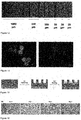
- the bright spots indicate the intact non-exposed hydrogels, while the dark regions confirm the complete degradation of exposed hydrogels.
- the obtained hydrogel pattern is consistent with the used photomask.
- the corresponding 3D shape is confirmed by the confocal image and its thickness is about 200 ⁇ m (due to the swelling effect of hydrogels).
- Microcavities were also imported within these photodegradable hydrogels by using appropriate photomasks. Other features of arbitrary shapes and sizes can be precisely and rapidly prepared with these photodegradable hydrogels/organogels.
- a 12.5 ⁇ m-thick PEG500MA-EGDMA-10 hydrogel of Example 6 was patterned with different feature sizes. As shown in Figure 13 , a micropattern with a resolution of 20 ⁇ m could be fabricated.
- a PEG500MA-PEG4000DMA-0.17 hydrogel film of Example 8 was prepared on the glass slide without methacrylated modification as described in the general procedure for Examples 6 to 10 to ensure the detachment of the hydrogel from the substrate.
- Rhodamine B (20 ⁇ g/mL) was added to the pregel solution. Its film with the thickness of 125 ⁇ m was prepared according to the above procedure. Then it was exposed to UV light through the photomask for 5 min. After removing the photomask, subsequent washing of the patterned hydrogel film gave free-standing microscale hydrogel particles ( Figure 14 ).
- cell-repellent cylindrical microwell arrays were prepared, which promote cell aggregation ( Figure 15 ).
- the PEG500MA-PEG700DA-2.5 hydrogel of Example 7 was used due to its controlled degradation kinetics. Its film with the thickness of 125 ⁇ m was exposed to UV light (260 nm, 4 mW/cm 2 ) through a photomask for 5 min. After washing with water, the 3D microwell array was obtained and stored in H 2 O for use.
- Figure 17 shows the 3D structure of microwells with the depth 60 ⁇ m and the diameter 100 ⁇ m. Both the periphery and the bottom of each microwell are cell-repellent PEG hydrogel, which promotes cell-cell contacts and thus multi-cellular aggregate formation.
- Example 16 Using fabricated 3D microwell array system of Example 15 for culturing cells
- DMEM Dulbecco's Modified Eagle's Medium
- FBS fetal bovine serum
- penicillin-streptomycin pH 7.4.
- Cells were grown in 75cm 2 tissue culture flasks and incubated at 37°C in a humidified air atmosphere of 5% CO 2 . Fresh medium was added every 2 to 3 days.
- the Microwell Array System was kept in ethanol for 20 min. Then it was immersed in PBS (phosphate buffered saline) for 60 min, and every 20 min the PBS was refreshed. This array was kept in cell culture medium for 20 min. Then, the array was placed in a 10 mL Petri dish.
- PBS phosphate buffered saline
- Hela cells as model cell type were seeded into the microwells by adding 250 ⁇ L of cell suspension having a concentration of 10 5 cells/mL on top of the microwell array. The cells were allowed to settle for 5 minutes into the microwells. The cells that did not sink into the microwells were gently washed away with PBS. A low density of cells ( ⁇ 7 cells/microwell) were used in this experiment to permit the direct observation and monitoring of cell proliferation. Then Hela cells seeded on microwell arrays were cultured for 7 days in an incubator. The medium was changed at 3-day intervals. During the culture period, Brightfield images were recorded to investigate the distribution and proliferation of cells on the array and also visualize the morphologies of cell aggregates in the microwells ( Figure 16 ).
- the observed increase in cell density indicates the cell proliferation and demonstrates the good cytocompatibility of this hydrogel.
- the Hela cells began to aggregate in each microwell due to the resistance of the PEG hydrogel to cell adhesion. After 7 days in culture, Hela cells grew to fill the size of the microwells and formed into relatively uniform cell aggregates. The hydrogel microwell array kept intact over 7 days. Cell viabilities were assessed by staining dead cells with propidium iodide (PI) for 20 minutes according to standard protocols. At the same time, cell nuclei were stained with Hoechst for 20 minutes according to standard protocols. Then the stained cells were imaged by fluorescence microscopy and confocal microscopy.
- PI propidium iodide
Landscapes
- Physics & Mathematics (AREA)
- General Physics & Mathematics (AREA)
- Spectroscopy & Molecular Physics (AREA)
- Engineering & Computer Science (AREA)
- Mechanical Engineering (AREA)
- Materials For Medical Uses (AREA)
- Macromonomer-Based Addition Polymer (AREA)
Abstract
Description
- The present invention relates to a photodegradable hydrogel or organogel which is used for manufacturing a patterned article, a method for degrading the photodegradable hydrogel or organogel, a corresponding patterned article, as well as the use of such a patterned article in microengineering, e.g. for three-dimensional cell culturing, for drug delivery, or for tissue-engineering.
- Hydrogels are water-swollen three dimensional (3D) networks of either physically or chemically crosslinked polymers. Organogels are the organic solvent based analogs of said hydrogels. Hydrogels and organogels possess rich structures and tunable properties, and have become extremely important soft materials useful for both industrial and biomedical fields, including actuators, sensors, artificial muscles, drug delivery, and tissue engineering. To meet these applications, hydrogels and organogels with well-defined microscale structures, including size, shape, porosity and heterogeneity, are usually required. Typical applications of microengineered hydrogels or organogels include, but are not limited to, biomimetic hydrogels/organogels with hierarchical microstructures for tissue engineering, hydrogel/organogel microarrays for high-throughput drug screenings, hydrogel/organogel microarrays as organ-on-a-chip platforms for in-vitro pharmaceutical research, hydrogel/organogel microwell arrays to prepare cell spheroids for 3D culture, hydrogels/organogels with spatially patterned matrix elasticity to direct stem cell fate.
- Microengineering hydrogels/organogels can be achieved with various technologies including photolithography, soft-lithography, microfluidics and printing. Photolithography is the most popular method because of its low-cost, high-throughput and ability of large scale patterning. There exist two strategies for photopatterning of hydrogels/organogels: light-triggered cross-linking of pregel mixtures and light-triggered de-cross-linking of photodegradable hydrogels/organogels. The latter strategy shows two apparent advantages: it applies to the photopatterning of hydrogels/organogels with light-sensitive components due to the blocking of UV light by photomasks and it also allows the preparation of hierarchical microstructures within hydrogels/organogels by controlling the photodegradation depth. For achieving the photodegradability, current photodegradable hydrogels/organogels require the introduction of photosensitive groups, like photo-labile o-nitrobenzyl esters and coumarins, photodynamic disulfide and allyl-sulfide, photoresponsive azobenzene-cyclodextrin complex, and iron(III)-carboxylic acid coordination.
- However, the introduction of external photosensitive groups inevitably increases the synthetic difficulty and reduces the flexibility and diversity of hydrogel/organogel structures. Accordingly, the scope of their practical applications, including microfabrication, is impeded.
- Thus, the technical problem underlying the present invention is to provide a photodegradable hydrogel or organogel, which can be used for preparing patterned articles, can be prepared in a straightforward manner, shows controlled degradation kinetics, has chemical flexibility, and allows sophisticated microfabrication, as well a method for manufacturing a patterned article, which can be used in a diversity of microengineering applications, such as for forming cell aggregates, especially uniform cell aggregates and three-dimensional cell cultures.
- The solution to the above technical problem is achieved by the embodiments characterized in the claims.
- In particular, the present invention relates to the use of a photodegradable hydrogel or organogel for manufacturing a patterned article by irradiating at least a part of the photodegradable hydrogel or organogel with UV light, the photodegradable hydrogel or organogel comprising a polymer including a three-dimensional network of cross-linked polymer chains,
the polymer chains having repeating units of the general Formula (I)
each R2 is independently a hydrogen atom or a substituted or unsubstituted alkyl group. - Herein, the term "photodegradable hydrogel or organogel" relates to a hydrogel or organogel which can be degraded when subjected to light irradiation. Upon light irradiation, the three-dimensional network of cross-linked polymer chains preferably breaks up. This leads to a change in the consistency of the former hydrogel/organogel to a liquid state, which can subsequently be removed, e.g. by washing with water or solvent.
- If not stated otherwise, the following definitions apply to the terms "alkyl group", "alkylene group", "cycloalkyl group", "aryl group", and "heteroaryl group". The term "alkyl group" refers particularly to a branched or linear alkyl group having 1 to 20, preferably 1 to 12, more preferably 1 to 6, and most preferably 1 to 4 carbon atoms, which can be substituted or unsubstituted. Examples of alkyl groups represent methyl groups, ethyl groups, propyl groups, isopropyl groups, butyl groups, isobutyl groups, tert-butyl groups, pentyl groups, hexyl groups, and heptyl groups. The term "alkylene group" refers particularly to a branched or linear alkylene group having 5 to 2000, preferably 10 to 1000, and most preferably 20 to 500 carbon atoms, which can be substituted or unsubstituted. The term "cycloalkyl group" refers particularly to a cycloalkyl group having 3 to 10, preferably 4 to 8, more preferably 5 or 6, and most preferably 6 carbon atoms, which can be substituted or unsubstituted. Examples of cycloalkyl groups represent cyclobutyl groups, cyclopentyl groups, and cyclohexyl groups. The term "aryl group" refers particularly to an aryl group consisting of 1 to 6, preferably 1 to 4, more preferably 1 to 3 aromatic rings, and most preferably 1 aromatic ring, which can be substituted or unsubstituted. Examples of aryl groups represent phenyl groups, anthracenyl or naphthyl groups. The term "heteroaryl group" refers particularly to a heteroaryl group consisting of 1 to 6, preferably 1 to 4, more preferably 1 to 3 aromatic rings including heteroatoms, which can be substituted or unsubstituted. Heteroatoms, which are present in heteroaryl groups are for example N, O and S. Examples of heteroaryl groups represent pyridyl groups, pyrimidinyl groups, thienyl groups, furyl groups or pyrrolyl groups.
- According to the present invention, the alkyl groups, the alkylene groups, the cycloalkyl groups, the aryl groups and the heteroaryl groups may be substituted or unsubstituted. The potential substituents are not specifically limited. Accordingly, instead of hydrogen atoms any substituent known in the prior art can be bonded to the further positions of the corresponding groups. For example, the potential substituents may be selected from the group consisting of a branched or linear alkyl group having 1 to 6 carbon atoms, a cycloalkyl group having 4 to 8 carbon atoms, an aryl group having 1 to 3 aromatic rings, a heteroaryl group having 1 to 3 aromatic rings including heteroatoms, a halogen atom, -NL1L2, -NO2, -CN, -OL3, -C(O)L4, -C(O)NL5L6, -COOL7, and -SO3L8, wherein L1 to L8 are each independently selected from a hydrogen atom, a branched or linear alkyl group having 1 to 6 carbon atoms, a cycloalkyl group having 4 to 8 carbon atoms, an aryl group having 1 to 3 aromatic rings, a heteroaryl group having 1 to 3 aromatic rings including heteroatoms. Accordingly, examples of substituted alkyl groups are aralkyl groups or alkyl groups substituted with e.g. cycloalkyl groups or alkyl groups substituted with e.g. halogen atoms, such as e.g. a trifluoromethyl group or a trichloromethyl group, or any other of the above-mentioned substituents. Preferably, the potential substituents are selected from the group consisting of a branched or linear alkyl group having 1 to 6 carbon atoms, an aryl group having 1 to 3 aromatic rings, a heteroaryl group having 1 to 3 aromatic rings including heteroatoms, -NH2, -NHCH3, - N(CH3)2, -NO2, -OH, -OCH3, -OEt, -C(O)H, and -COOH. Moreover, one or more tetravalent carbon atoms (together with the hydrogen atoms bonded thereto), when present, in each of the alkyl groups, the alkylene groups, and the cycloalkyl groups may each independently be substituted by a member selected from the group consisting of O, (OCH2CH2)pO, S, (SCH2CH2)qS, C(O), C(O)O, NX, and C(O)NY, preferably O, (OCH2CH2)pO, C(O)O, and C(O)NY, wherein p and q are each independently an integer from 1 to 6. Accordingly, for example an alkyl group may be interrupted by e.g. one or more poly(ethylene glycol) (PEG) linkers and/or amide bonds. The way the groups are introduced instead of a carbon atom is not specifically limited. For example, a carbon atom may be substituted by C(O)O in the sense of -C(O)O- or -OC(O)- and by C(O)NY in the sense of -C(O)NY- or -NYC(O)-. According to the present invention, X and Y are each independently selected from the group consisting of a hydrogen atom, a branched or linear alkyl group having 1 to 6 carbon atoms, a cycloalkyl group having 4 to 8 carbon atoms, an aryl group having 1 to 3 aromatic rings, a heteroaryl group having 1 to 3 aromatic rings including heteroatoms, -OZ1, -C(O)Z2, -C(O)NZ3Z4, -COOZ5, and -SO2Z6. In a preferred embodiment, X and Y are each independently selected from the group consisting of a hydrogen atom, a branched or linear alkyl group having 1 to 6 carbon atoms, an aryl group having 1 to 3 aromatic rings, -C(O)Z2, and -SO2Z6. Most preferably, X and Y are each independently selected from the group consisting of a hydrogen atom and a branched or linear alkyl group having 1 to 6 carbon atoms. According to the present invention, Z1 to Z6 are each independently selected from the group consisting of a hydrogen atom, a branched or linear alkyl group having 1 to 6 carbon atoms, a cycloalkyl group having 4 to 8 carbon atoms, an aryl group having 1 to 3 aromatic rings, a heteroaryl group having 1 to 3 aromatic rings including heteroatoms. In a preferred embodiment, Z1 to Z6 are each independently selected from the group consisting of a hydrogen atom, a branched or linear alkyl group having 1 to 6 carbon atoms, and an aryl group having 1 to 3 aromatic rings.
- Most preferably, the alkyl groups, the alkylene groups, the cycloalkyl groups, the aryl groups and the heteroaryl groups are unsubstituted. Moreover, in a preferred embodiment the alkyl groups and the alkylene groups are linear.
- The photodegradable hydrogels or organogels used in the present invention are inherently photodegradable hydrogels or organogels, which do not comprise external photosensitive groups as described above and do not comprise additional chemicals, such as e.g. photoinitiators or thiols, for the degradation. Herein, the term "external photosensitive groups" relates to photosensitive groups other than those included in the backbone of the polymer chains having the repeating units of the general Formula (I). The backbone of said polymer chains does not include the groups R1. Thus, photosensitive groups may not be included in said groups R1. In particular, it is not necessary to include external photosensitive groups, as e.g. photo-labile o-nitrobenzyl esters and coumarins, photodynamic disulfide and allyl-sulfide, photoresponsive azobenzene-cyclodextrin complex, and iron(III)-carboxylic acid coordination.
- The photodegradable hydrogels or organogels used in the present invention can e.g. be developed from poly(meth)acrylate hydrogels/organogels. Poly(meth)acrylates are photodegradable due to the homolysis of main chain carbon-carbon bonds under UV light. According to a proposed non-limiting mechanism, this photolysis process undergoes three routes: the direct main-chain scission, the main-chain scission following side-chain scission, and the photooxidative main chain scission. Without being bound to a specific theory, it is hypothesized that the photolysis of poly(meth)acrylate will lead to the de-cross-linking of the corresponding hydrogels/organogels, without external photosensitive groups being required.
- According to the present invention, the polymer chains have repeating units of the general Formula (I)

- The 2-hydroxyethyl group, the 2-(N-3-sulfopropyl-N,N-dimethyl ammonium)ethyl group, the poly(ethylene glycol) group, and the poly(ethylene glycol) alkyl ether group of R1 may be further substituted. The above definition concerning potential substituents analogously applies to the potential further substituents of the 2-hydroxyethyl group, the 2-(N-3-sulfopropyl-N,N-dimethyl ammonium)ethyl group, the poly(ethylene glycol) group, and the poly(ethylene glycol) alkyl ether group of R1. Preferably, the 2-hydroxyethyl group, the 2-(N-3-sulfopropyl-N,N-dimethyl ammonium)ethyl group, the poly(ethylene glycol) group, and the poly(ethylene glycol) alkyl ether group of R1 are not further substituted.
- The term "poly(ethylene glycol) group" refers to PEG molecules, wherein one terminal hydrogen has been abstracted. Preferably, the term "poly(ethylene glycol) group" refers to corresponding PEG molecules (i.e. PEG molecules, wherein one terminal hydrogen has been abstracted) derived from PEG molecules (with all hydrogen atoms) within the Mn range of 106 to 20000, preferably of 200 to 1200, more preferably of 300 to 800 group, more preferably of 400 to 700, most preferably from PEG molecules (with all hydrogen atoms) with a Mn of 500.
- The term "poly(ethylene glycol) alkyl ether group" refers to PEG molecules, wherein one terminal hydrogen has been exchanged for an alkyl group, preferably a branched or linear alkyl group having 1 to 10 carbon atoms, more preferably a methyl or an ethyl group, most preferably a methyl group, and another hydrogen of the poly(ethylene glycol) molecule, preferably the other terminal hydrogen, is abstracted. Moreover, the terms "a
PEGX 100 toPEGY 100 group" herein mean PEG alkyl ether groups, preferably PEG methyl ether groups, derived from PEG molecules (with all hydrogen atoms) within the Mn range ofX 100 toY 100. Accordingly, the term "PEGX100MA to PEGY100MA" refers to poly(ethylene glycol) methacrylates having PEG alkyl ether groups, preferably PEG methyl ether groups, derived from PEG molecules (with all hydrogen atoms) within the Mn range ofX 100 toY 100. - Herein, if not stated otherwise, in case a poly(ethylene glycol) group or a poly(ethylene glycol) alkyl ether group is attached (e.g. in a general formula, such as e.g. in the case of R1 in general Formulas (I) and (II)) to a oxygen atom, said oxygen belongs to the poly(ethylene glycol) group or the poly(ethylene glycol) alkyl ether group, respectively.
- Furthermore, the term "poly(ethylene glycol) linker group" refers to PEG molecules, wherein both terminal hydrogens have been abstracted. The term "PEGX200D(M)A to PEGY200D(M)A" refers to poly(ethylene glycol) di(meth)acrylates having PEG linker groups derived from PEG molecules (with all hydrogen atoms) within the Mn range of
X 200 toY 200. - In case the polymer comprises repeating units of the general Formula (I) having more than one kind of R1 and/or R2 groups, the mass ratios of the different repeating units are not particularly limited. Thus, the different repeating units may be mixed in any given ratio as long as the hydrogel/organogel keeps its photodegradable properties. Preferably, the polymer comprises repeating units of the general Formula (I) having only one kind of R1 group and one kind of R2 group.
- In case the polymer comprises repeating units of the general Formula (I) wherein R1 is a 2-hydroxyethyl group, the polymer preferably further contains repeating units of the general Formula (I) wherein R1 is a poly(ethylene glycol) alkyl ether group, preferably a PEG500 group. In case the polymer comprises repeating units of the general Formula (I) wherein R1 is a 2-hydroxyethyl group, the polymer preferably further contains 20 mol% or more of repeating units of the general Formula (I) wherein R1 is a poly(ethylene glycol) alkyl ether group, preferably a PEG500 group, based on a total of 100 mol% of the repeating units of the general Formula (I).
- In a preferred embodiment, each R1 is independently selected from the group consisting of a 2-hydroxyethyl group, a 2-(N-3-sulfopropyl-N,N-dimethyl ammonium)ethyl group, a poly(ethylene glycol) group, and a poly(ethylene glycol) alkyl ether group. More preferably, each R1 is independently a poly(ethylene glycol) alkyl ether group selected from a PEG106 to PEG20000 group, preferably from a PEG200 to PEG1200 group. Even more preferably, each R1 is independently a poly(ethylene glycol) alkyl ether group selected from a PEG300 to PEG800 group, more preferably a poly(ethylene glycol) alkyl ether group selected from a PEG400 to PEG700 group, most preferably each R1 is a PEG500 group.
- In a preferred embodiment, each R2 is independently an alkyl group having 1 to 4 carbon atoms. Most preferably, R2 is a methyl group.
- The cross-linking agent used for cross-linking the polymer chains of the polymer comprised in the photodegradable hydrogel or organogel used in the present invention is not particularly limited. In a preferred embodiment, the cross-linking agent used for cross-linking the polymer chains has the general Formula (III)


- Accordingly, when the cross-linking agent has the general Formula (III) the main chains are cross-linked via cross-linking units of the general Formula (V)

- The above definitions with respect to R3 and R4 analogously apply to the cross-linking units of the general Formula (V).
- According to the present invention, n is an integer from 1 to 5. Thus, the corresponding alkylene group in Formula (IV) may be a methylene group, an ethylene group, a propylene group, a butylene group, or a pentylene group, which may be substituted or unsubstituted. Preferably, n is an integer from 1 to 3, more preferably an integer of 1 or 2. When G is NH, n is most preferably 1, i.e. the corresponding alkylene group in Formula (IV) is a methylene group. When G is an oxygen atom, n is most preferably 2, i.e. the corresponding alkylene group in Formula (IV) is an ethylene group.
- In a preferred embodiment, G is an oxygen atom.
- The poly(ethylene glycol) linker group and the alkylene group in Formula (IV) of R4 may be further substituted. The above definition concerning potential substituents analogously applies to the potential (further) substituents of the poly(ethylene glycol) linker group and the alkylene group in Formula (IV) of R4. Preferably, the poly(ethylene glycol) linker group and the alkylene group in Formula (IV) of R4 are not (further) substituted.
- In a particularly preferred embodiment, the cross-linking agent is selected from the group consisting of ethylene glycol dimethacrylate (EGDMA), N,N'-methylenebisacrylamide (MBA), poly(ethylene glycol) diacrylate selected from PEG106DA to PEG20000DA, preferably from PEG300DA to PEG1500DA, and poly(ethylene glycol) dimethacrylate selected from PEG106DMA to PEG20000DMA, preferably from PEG500DMA to PEG6000DMA. Most preferably, PEG700DA and PEG4000DMA are used due to their good water-solubility and commercial availability.
- The content of the cross-linked polymer in the hydrogel or organogel used in the present invention is not particularly limited. For example, the content of the polymer in the hydrogel or organogel may be from 2.0 to 40 wt%, preferably from 5.0 to 35 wt%, more preferably from 10 to 30 wt%, and most preferably from 15 to 25 wt%. The remainder is water or the respective organic solvent and optional additives as well as potential impurities included e.g. due to the manufacturing process, such as remainder of the redox initiators used in redox-initiated radical copolymerization. The optional additives are not particularly limited and are known in the art. For example, as additive there may be used Rhodamine B for fluorescence imaging.
- In a preferred embodiment, the photodegradable hydrogel or organogel used in the present invention is transparent.
- The method for producing the photodegradable hydrogel or organogel used in the present invention is not particularly limited. Thus, any known method for producing hydrogels/organogels can be used. For example, the hydrogel or organogel may be produced by polymerizing the monomer units in water and/or the respective organic solvent in the presence of a cross-linking agent or crosslinking the poly(meth)acrylates in water and/or the respective organic solvent via the reaction of side groups. In a preferred embodiment of the present invention, the hydrogel or organogel used in the present invention is produced by a method comprising the step of polymerizing monomer units of the general Formula (II)

- The polymerization method is not particularly limited. Thus, any known polymerization method can be used. For example, the polymer may be produced by redox-initiated radical copolymerization, photo-initiated radical polymerization or thermo-initiated radical polymerization. Preferably the polymer is produced by redox-initiated radical copolymerization due to the fast kinetics and easy operation associated with said method.
- When using redox-initiated radical copolymerization, the applied redox initiators are not particularly limited. Thus, any known redox initiators can be used. For example, as redox initiators there may be used a combination of ammonium persulfate (APS) and N,N,N',N'-tetramethylethylenediamine (TEMED), or benzoyl peroxide and N,N-dimethylaniline. Preferably, as redox initiator there is used a combination of ammonium persulfate and N,N,N',N'-tetramethylethylenediamine. For example, the concentration of the redox initiator in the polymerization medium may be from 1.0 mM to 200 mM, preferably from 3.0 mM to 100 mM, more preferably from 6.0 mM to 30 mM. When using a combination of ammonium persulfate and N,N,N',N'-tetramethylethylenediamine as redox initiator the respective concentrations in the polymerization medium may be from 1.0 mM to 100 mM for ammonium persulfate and from 1.3 mM to 130 mM for N,N,N',N'-tetramethylethylenediamine, preferably from 4.0 mM to 25 mM for ammonium persulfate and from 5.2 mM to 33 mM for N,N,N',N'-tetramethylethylenediamine, more preferably 8.0 mM to 12 mM for ammonium persulfate and from 10 mM to 16 mM for N,N,N',N'-tetramethylethylenediamine. Higher concentrations of ammonium persulfate and N,N,N',N'-tetramethylethylenediamine will lead to faster gelations.
- The total amount of the monomer units and the cross-linking agent in the reaction medium is not particularly limited. For example, total amount of the monomer units and the cross-linking agent (taken together) in the reaction medium may be from 2.0 to 40 wt%, preferably from 5.0 to 35 wt%, more preferably from 10 to 30 wt%, and most preferably from 15 to 25 wt%.
- The mole fraction of the cross-linking agent used is not particularly limited. For example, the mole fraction of the cross-linking agent used may be from 0.10% to 20%, preferably from 1.0% to 15%, and most preferably from 2.5% to 10%, based on the total amount of the monomer units and the cross-linking agent.
- The reaction medium is not particularly limited as long as it dissolves the obtained polymers. For example, the medium may be water, a medium based on one or more organic solvents, or a medium based on a mixture of water with one or more organic solvents. Suitable solvents are for example water, tetrahydrofuran, dimethylformamide, and dimethyl sulfoxide, which are able to dissolve both monomer and polymer to a satisfactory extent. Preferably, the reaction medium is water (i.e. leading to a hydrogel).
- The reaction temperature is not particularly limited. For example, the reaction temperature may be from -20°C to 100°C, preferably from 0°C to 80°C, more preferably from 20°C to 60°C, and most preferably from 25°C to 40°C.
- The reaction/gelation time is not particularly limited. For example, the reaction/gelation time may be from 1 min to 10 h, preferably from 5 min to 5 h, more preferably from 5 min to 3 h, and most preferably from 5 min to 60 min.
- The substrates on which the hydrogel or organogel may be applied is not particularly limited. For example, the substrate may be selected from glass, metal, plastic, or an elastomer. Suitable plastics are for example polystyrene, polyethylene, poly(methyl methacrylate), and poly(ethylene terephthalate). Suitable elastomers are for example polyisoprene, polybutadiene, polychloroprene, polysiloxanes, polyurethane, and fluoro-elastomers.
- The hydrogel or organogel used in the present invention can degrade when irradiated with UV light, e.g. light having a wavelength from 100 nm to 300 nm, preferably from 200 to 300 nm, more preferably from 240 to 280 nm, e.g. UV light having a wavelength of 260 nm. Accordingly, the patterned article is formed by irradiating at least a part of the photodegradable hydrogel or organogel with such UV light.
- An excellent precision can preferably be reached by manufacturing a patterned article with the photodegradable hydrogel or organogel used in the present invention. For example, the fabrication can reach a precision in the micrometer range, e.g. approx. 20 µm, and thus can be regarded as microfabrication. Moreover, free-standing and shaped hydrogel/organogel particles can be obtained e.g. in case no covalent bonding between substrates and hydrogels/organogels are present.
- The intensity of the light used when irradiating the photodegradable hydrogel or organogel is not particularly limited. For example, the light may have an intensity from 0.1 mW/cm2 to 1000 mW/cm2, preferably from 0.1 mW/cm2 to 25 mW/cm2, more preferably from 1.0 mW/cm2 to 10 mW/cm2, more preferably from 2.0 mW/cm2 to 7.0 mW/cm2, and most preferably from 3.0 mW/cm2 to 5.0 mW/cm2.
- The irradiation time is not particularly limited. In general, the irradiation time depends on the light intensity and the hydrogel/organogel thickness, and ranges from minutes to hours. For example, the irradiation time may be from 30 s to 2.5 h, preferably from 1.0 min to 1.0 h, more preferably from 2.0 min to 30 min, and most preferably from 3.0 min to 10 min.
- Optionally, there may be included a washing step after irradiation. By applying said washing step, degraded parts of the hydrogel/organogel can be removed. Preferably, water or organic solvents are used for said washing step. Most preferably, water and/or the respective organic solvent building the basis of the hydrogel/organogel are used for the washing step.
- Herein, the term "patterned article" relates to a partially (photo)degraded hydrogel or organogel. Apart from that the patterned article is obtained from the photodegradable hydrogel or organogel, it is not particularly limited. Thus, any patterned article, which can be produced from the photodegradable hydrogel or organogel is encompassed by the present invention. Appropriate shapes and patterns can for example be obtained by the application of photomasks when irradiating the photodegradable hydrogel or organogel. For example, the patterned article may be any micro-device, such as a microwell array or microchannel, or any three-dimensional structure, which may be complex, or a particle, which may be free-standing, or any article with a pattern. Preferably, the patterned article is a microwell array.
- One specific example of a photodegradable hydrogel used in the present invention is poly(ethylene glycol) methyl ether methacrylate (
Mn 500, PEG500MA) crosslinked with ethylene glycol dimethacrylate (EGDMA). The PEG500MA-EGDMA-10 hydrogel can be obtained via redox polymerization (Figure 1 ) and was characterized with rheology measurement. The PEG500MA-EGDMA-10 hydrogel and other hydrogels/organogels herein are named as "monomer-cross-linking agent-X", where X % equals to ncross-linking agent/(ncross-linking agent + nmonomer), with the concentration of monomer and cross-linking agent fixed at 20 wt% for comparison. However, the photodegradable hydrogel or organogel used in the present invention is not limited to a corresponding concentration of monomer and cross-linking agent as mentioned above. - As shown in
Figure 2 , the storage modulus (G') of PEG500MA-EGDMA-10 hydrogels is larger than the loss modulus (G") and both of them show independence on frequencies, demonstrating the formation of hydrogels. In case one 3.5 mm-thick block of this hydrogel is exposed to UV light (260 nm, 5 mW/cm2), said hydrogel block completely turns into liquid state after 25 min (Figure 3 ), which demonstrates that this PEG500MA-EGDMA-10 hydrogel can be de-crosslinked under UV-irradiation. Further rheology measurements were used to monitor the photodegradation process (Figure 4 ). During the UV irradiation, the G' of the hydrogel gradually decreases from 280 Pa to 84 Pa, being about 30 % of the original storage modulus (G'0), during the exposure for 7 min (Figure 4 ). Longer irradiation leads to the total degradation of hydrogels. All these data demonstrate the inherent photodegradability of a PEG500MA-EGDMA-10 hydrogel. - New inherently photodegradable hydrogels/organogels were developed by taking advantage of the photolysis property of e.g. poly(meth)acrylates. This strategy enables the straightforward preparation of photodegradable hydrogels/organogels without requiring external photosensitive groups or additional chemicals for degradation of the same, and generally tolerates various monomers and cross-linking agents. The defined kinetics and spatial controllability of the photodegradation process and the robustness of the photodegradable hydrogels or organogels used in the present invention advantageously provides a convenient way to fabricate sophisticated hydrogel/organogel microstructures via the photolithography technique. In particular, these photodegradable hydrogels/organogels provide convenient access to microstructured platforms e.g. for the culturing of cells. Especially, the photodegradable hydrogel or organogel used in the present invention provides two advantages, i.e. capacity to prepare microwells with defined geometry and dimensions, as well as resistance to cell adhesion due to the bio-inertness of hydrophilic PEG chains.
- In a further aspect, the present invention relates to a method for degrading a photodegradable hydrogel or organogel comprising the step of irradiating at least a part of the photodegradable hydrogel or organogel used in the present invention with UV light, e.g. light having a wavelength from 100 nm to 300 nm, preferably from 200 to 300 nm, more preferably from 240 to 280 nm, e.g. UV light having a wavelength of 260 nm. The above statements and definitions analogously apply to this aspect of the present invention.
- In a further aspect, the present invention relates to a patterned article obtained by the use according to the present invention or the method for degrading a photodegradable hydrogel or organogel according to the present invention. The above statements and definitions analogously apply to this aspect of the present invention.
- Preferably, the patterned article is a microwell array. The dimensions of the microwell array are not particularly limited. For example, the height of the microwell array may be from 1 to 1000 µm, the breadth of the microwell array may e.g. be from 20 to 1000 µm, and the depth of the microwell array may e.g. be from 1 to 1000 µm.
- The photodegradable hydrogels or organogels used in the present invention provide convenient access to microstructured platforms. Such micropatterned hydrogels/organogels can e.g. be used for the formation of 3D multicellular aggregates, an important 3D model for cell cultures. These 3D cell cultures are important for understanding cellular behaviors and can e.g. be used in cell study, drug screening, tissue engineering. Compared with the traditional two-dimensional (2D) models, 3D models better mimic both chemical and physical cues of native cellular microenvironment in vivo and allows the cell-cell and cell-ECM signaling, which greatly affect cell growth, proliferation, differentiation, and other cellular functions. Furthermore, the photodegradable hydrogels or organogels used in the present invention are for example able to provide access to corresponding particles, which might be used for drug delivery, preferably into a mammal, more preferably into a human, to three-dimensional structures, which might also have complex shapes and/or which might be used for tissue-engineering, in particular in vitro, or to corresponding objects with specific patterns. In the case of structures for tissue-engineering, these structures may or may not contain cells.
- Therefore, in a further aspect, the present invention relates to the use of the patterned article according to the present invention in all kinds of microengineering, e.g. for three-dimensional cell culturing, for drug delivery, or for tissue-engineering, preferably three-dimensional cell culturing. The above statements and definitions analogously apply to this aspect of the present invention. In this context, three-dimensional cell culturing means the culturing of cells in such a way that the cells are permitted to grow or interact with their surroundings in all three dimensions.
- The respective method used for three-dimensional cell culturing, for drug delivery, or for tissue-engineering is not particularly limited as long as the patterned article according the present invention is used for the same. For example, one method for three-dimensional cell culturing may comprise seeding cells in the patterned article, preferably a microwell array, and culturing the seeded cells. Optionally, such a method may further comprise washing the patterned article after seeding the cells therein and before culturing the seeded cells. By applying said washing step, excess cells outside e.g. cavities can be removed. Preferably, phosphate buffered saline (PBS) is used for said washing step.
- The cells may for example be seeded in cavities of the patterned article, such as e.g. microwells of a microwell array. Thereby, the number of cells present in each of the cavities upon seeding is not particularly limited. For example, the number of cells present in each of the cavities may be from 1 to 50 cells. Preferably, the number of cells present in each of the cavities upon seeding is from 3 to 30 cells, more preferably from 5 to 15 cells, to permit the direct observation and monitoring of cell proliferation.
- Within the scope of the invention, the term "cells" means a generic term and encompasses individual cells, insect cells, avian cells, mammalian cells, bacterial cells, primary cells, cancer cells, continuous cell lines, stem cells and/or genetically engineered cells, such as recombinant cells expressing a heterologous polypeptide or protein and/or containing a recombinant nucleic acid molecule and/or stable expressing cells. Preferably, the cells are Hela cells.
- The culturing time is not particularly limited. For example, the cells may be cultured for 12 h to 30 d, preferably for 1.0 d to 15 d, and more preferably for 3.0 d to 10 d, e.g. for 7d.
- The culturing temperature is not particularly limited. For example, the culturing temperature may be from 5°C to 40°C, preferably from 10°C to 39°C, more preferably from 15°C to 38°C, and most preferably from 20°C to 37°C.
- The culture medium is not particularly limited. Thus, any known culture medium known in the art can be used. For example, the culture medium may be an aqueous medium, a medium based on one or more organic solvents, or a medium based on a mixture of water with one or more organic solvents. The culture medium may e.g. contain salts and substrates and may have a specific pH. For example, enzyme substrates and co-substrates, buffer components, nutrients for growth of cells, antibodies, and proteins may be comprised in the medium. Preferably, the medium is selected from the group consisting of water, phosphate buffered saline (PBS), Dulbecco's Modified Eagle's Medium. Preferably, the culture medium is PBS having a pH of 7.4.
- It has been demonstrated that photodegradable hydrogels or organogels used in the present invention are robust photodegradable scaffolds. This photodegradation system shows apparent advantages, that is, straightforward fabrication, controlled erosion kinetics, flexible chemical variety, and robustness for microscale photofabrication. Moreover, the hydrogel/organogel microwell array developed represents a sophisticated 3D cell culture platform, in particular due to excellent cytocompatibility of the hydrogel/organogel. These inherently photodegradable hydrogels or organogels can e.g. be used for fabrication of microstructured materials in cell culture, microfluidics devices, and tissue engineering. A corresponding microwell array is preferably able to form cell aggregates, especially uniform cell aggregates and three-dimensional cell cultures.
- The figures show:
-
Figure 1 : Photodegradable hydrogel/organogel synthesis and degradation. The hydrogel/organogel network is formed via the redox copolymerization of PEG500MA and EGDMA initiated by APS and TEMED. The obtained hydrogel/organogel is decrosslinked due to the photolysis of carbon-carbon bonds in the polymethacrylate backbone upon exposure to UV light. -
Figure 2 : Elastic (G') and viscous (G") moduli of PEG500MA-EGDMA-10 hydrogels. -
Figure 3 : A 3.5 mm-thick PEG500MA-EGDMA-10 hydrogel was irradiated with 260 nm light (5 mW/cm2), and completed eroded over the course of ≈25 min. -
Figure 4 : Plots of G' versus UV irradiation time. Evidence for the hydrogel degradation can be seen from the decreasing of G' with the irradiation time. -
Figure 5 : Progressively recessed features of hydrogels upon irradiation. The PEG500MA-EGDMA-10 hydrogel was eroded spatially through masked irradiation (260 nm, 5 mW/cm2). After non-specific adsorption of Rhodamine B, these patterned hydrogels were imaged with confocal microscopy. Erosion depth increased with irradiation time. Scale bar: 200 µm. -
Figure 6 : Photodegradation kinetics of the PEG500MA-EGDMA-10 hydrogel can be adjusted by changes in light intensity. The increase in photodegradation depths with increasing irradiation time was fastened when increasing the UV light intensity from 3 mW/cm2 to 5 mW/cm2. -
Figure 7 : Effects of cross-linking agents on photodegradation kinetics. Photodegradation processes were monitored for the PEG500MA hydrogels (20 wt%) with 2.5 mol% EGDMA, MBA, or PEG700DA as cross-linking agents. Higher crosslinking degrees caused by cross-linking agents having better water-solubility and longer chain length led to slower photodegradation kinetics. For the hydrogel with PEG4000DMA as the cross-linking agents, the amount of the cross-linking agent was further decreased to 0.17 mol% in order to reach the apparent photodegradation kinetics under the same condition. -
Figures 8 and9 : Photodegradation kinetics of a (HEMA80mol%-PEG500MA20mol%)-EGDMA-0.85 hydrogel (Figure 8 ) and of a SAMA-EGDMA-2.5 hydrogel (Figure 9 ). -
Figure 10 : Hydrogel microarrays and microcavities of different geometries were fabricated via UV irradiation of 125 µm-thick PEG500MA-EGDMA-10 hydrogels through corresponding photomasks. Their 2D geometries were shown in the fluorescence images (top panel) and their 3D shapes were confirmed in the confocal images (bottom panel). -
Figures 11 and 12 : Hydrogel patterns of different geometries were fabricated via UV irradiation of 125 µm-thick (HEMA80mol%-PEG500MA20mol%)-EGDMA-0.85 hydrogels (Figure 11 ) and 125 µm-thick SAMA-EGDMA-2.5 hydrogels (Figure 12 ) through corresponding photomasks. Their 2D geometries were shown in the fluorescence images and their 3D shapes were confirmed in the inserted images. -
Figure 13 : Brightfield microscope images of 12.5 µm-thick PEG500MA-EGDMA-10 hydrogel patterns with lines of different widths. The precision of this microfabrication could reach as small as 20 µm. -
Figure 14 : Free-standing and shaped hydrogel particles were obtained from a 125 µm-thick PEG500MA-PEG4000DMA-0.17 hydrogel as model hydrogel in case of no covalent bonding between substrates and hydrogels. These patterns still possess photodegradability. Scale bars are 500 µm. -
Figure 15 : Microcavities are fabricated by the UV patterning of photodegradable PEG500MA-PEG700DA-2.5 hydrogel (125 µm-thick). After seeding on the microcavities array, cells are allowed to settle within the microcavities. Subsequently gentle washing removes extraneous cells outside of the microcavities, thus selectively trapping cells inside. The sidewalls and bottom of these microcavities are PEG hydrogels, which are cell-repellant and non-adhesive, thus preventing cell adhesion and helping to encourage cells to "clump together" and to form aggregates. -
Figure 16 : Bright images showing that cells were perfectly trapped within the circle microcavities. During the 7-day incubation, cells proliferate and form into dense aggregates, showing the same circle shape. Scale bars: 100 µm. -
Figure 17 : Confocal image confirming the 3D shape of microcavities with the diameter of 100 µm and the thickness of 60 µm. Scale bars: 100 µm. -
Figure 18 : After 7-day incubation within the microcavities, cell nuclei and dead cells were stained with Hoechst (blue) and PI (red), respectively. The overlay of fluorescence images showed the high viability of cells. Scale bars: 100 µm. -
Figures 19 and 20 : Side view (Figure 19 ) and top view (Figure 20 ) of the formed cell aggregates. Scale bars: 50 µm. - The present invention will be further illustrated in the following examples without being limited thereto.
- Ammonium peroxodisulfate (98.0%, APS), N,N'-methylene bisacrylamide (99%, MBA), [2-(methacryloyloxy)ethyl]dimethyl-(3-sulfopropyl) ammonium hydroxide (97%, SAMA), Rhodamine B (95%), 3-(trimethoxysilyl)propyl methacrylate (98%), Gelatin, and fetal bovine serum (FBS) were purchased from Sigma-Aldrich (Germany). Dulbecco's Modified Eagle's Medium (DMEM), Penicillin/ Streptomycin, NEAA (100x Stock), phosphate-buffered saline (PBS), and trypsin/EDTA were purchased from Gibco Life Technologies GmbH (Germany). Poly(ethylene glycol) methyl ether methacrylate (
Mn 500, PEG500MA), ethylene glycol dimethacrylate (98%, EGDMA), (hydroxyethyl)methacrylate (97%, HEMA), and poly(ethylene glycol) diacrylate (Mn 700, PEG700DA) were purchased from Sigma-Aldrich (Germany) and purified through a short column filled with basic aluminum oxide. N,N,N',N'-tetramethylethylenediamine (98.5 %, TEMED) was purchased from Carl Roth. Poly(ethylene glycol) dimethacrylate, (Mn 4000, PEG4000DMA) was synthesized according to the reported method. All the other chemicals were purchased from Merck KGaA (Germany) and used without further purification. - An
OAI model 30 deep-UV collimated light source (San Jose, CA, USA) fitted with a 500 W HgXe lamp was utilized for high intensity UV irradiation. The lamp was calibrated to 5.0 mW/cm2 at 260 nm with the OAI 306 UV power meter. The light source at 260 nm (5.0 mW/cm2) was used for UV irradiation unless otherwise specified. The fluorescence images were taken by a Keyence BZ-9000 fluorescence microscope (Japan). The 3D structures of hydrogel patterns were imaged using a Leica Confocal Microscope SPE. For photodegradation kinetics, Leica microscopy was used to measure the thickness of hydrogel block. - Rheological measurements were carried out on a ARES G2 rotational rheometer (TA Instruments, obtained from Waters GmbH, Eschborn, Germany) equipped with parallel plate Invar geometry (13 mm diameter) at a gap of 1.46 mm. Hydrogels were placed between two plates of the rheometer. An amplitude sweep (G' measured as a function of strain) was carried out to confirm that the measurements were performed within the linear viscoelastic regime. Oscillatory frequency sweeps were then conducted at 25°C with a constant strain of 1% in the frequency range of 100-0.1 rad s-1.
- PEG500MA (2.32 mL) was dissolved in H2O (10 mL), followed by the addition of EGDMA (106 µL) and TEMED (35.4 µL). This solution was vortexed as APS (27.2 mg) was added and quickly poured to one well (85.9 × 27.9 mm) of 4-well rectangular dish (NUNC). After gelation for 1 hour, the hydrogel block was carefully taken out and immersed into water. The hydrogel blocks were kept in water for at least 48 hours. During this period, the water was exchanged three times.
- PEG500MA- EGDMA-2.5 hydrogel blocks were prepared in accordance with Example 1 except that 2.4 mL of PEG500MA and 26 µL of EGDMA were used.
- PEG500MA-MBA-2.5 hydrogel blocks were prepared in accordance with Example 2 except that 20 mg of MBA were used instead of EGDMA.
- PEG500MA-PEG700DA-2.5 hydrogel blocks were prepared in accordance with Example 1 except that 2.34 mL of PEG500MA were used and 82 µL of PEG700DA were used instead of EGDMA.
- PEG500MA-PEG4000DMA-0.17 hydrogel blocks were prepared in accordance with Example 1 except that 2.38 mL of PEG500MA were used and 35 mg of PEG4000DMA were used instead of EGDMA.
- Two strips of 12.5 or 125 µm-thick Teflon film (American Durafilm Co.), defining the thickness of the hydrogel film, are placed at the edges of a 3-(trimethoxysilyl)propyl methacrylate functionalized glass slide and another tridecafluoro-(1,1,2,2)-tetrahydrooctyltrichlorosilane functionalized glass slide (cf. Levkin, P. et al, Angew. Chem. Int. Ed., 2011, 50, pp. 8424-8427) is clamped on top of it. 200 µL of the pregel solution was injected in the mold between them. After 1 hour, the obtained hydrogel film bound to the 3-(trimethoxysilyl)propyl methacrylate functionalized slide was separated from the fluorinated slide and kept in water overnight. Detailed pregel compositions for every hydrogel film are shown below.
- PEG500MA (232 µL) was dissolved in H2O (1 mL), followed by the addition of EGDMA (10.6 µL) and TEMED (3.5 µL). This solution was vortexed as APS (2.7 mg) was added and immediately used for preparing hydrogel films.
- PEG500MA (234 µL) was dissolved in H2O (1 mL), followed by the addition of PEG700DA (8.2 µL) and TEMED (3.5 µL). This solution was vortexed as APS (2.7 mg) was added and immediately used for preparing hydrogel films.
- PEG500MA (238 µL) was dissolved in H2O (1 mL), followed by the addition of PEG4000DMA (3.5 mg) and TEMED (3.5 µL). This solution was vortexed as APS (2.7 mg) was added and immediately used for preparing hydrogel films.
- HEMA (119 µL) and PEG500MA (111 µL) was dissolved in H2O (1 mL), followed by the addition of EGDMA (5.9 µL) and TEMED (3.5 µL). This solution was vortexed as APS (2.7 mg) was added and immediately used for preparing hydrogel films.
- SAMA (250 mg) was dissolved in H2O (1 mL), followed by the addition of EGDMA (4.3 µL) and TEMED (3.5 µL). This solution was vortexed as APS (2.7 mg) was added and immediately used for preparing hydrogel films.
- The PEG500MA-EGDMA-10 hydrogel obtained in Example 6 was characterized with rheology measurement. As shown in
Figure 2 , the storage modulus (G') is frequency independent and more than one order of magnitude greater than the loss modulus (G"), indicating a crosslinked sample. - Then one 3.5 mm-thick block of this hydrogel was exposed to UV light (260 nm, 5 mW/cm2) and completely turned into liquid state after 25 min (
Figure 3 ), which means this PEG500MA-EGDMA-10 hydrogel can be de-cross-linked under UV-irradiation. - Further rheology measurements were used to monitor the photodegradation process (
Figure 4 ). During the UV irradiation, the G' of the hydrogel gradually decreased from 280 Pa to 84 Pa, being about 30 % of the original storage modulus (G'0), during the exposure for 7 min (Figure 4 ). Longer irradiation leads to the total degradation of hydrogels. All these data supported the inherent photodegradability of a PEG500MA-EGDMA-10 hydrogel. - For investigating the photodegradation process, PEG500MA-EGDMA-10 hydrogels were exposed to UV light for different times. Rhodamine B was non-specific absorbed into the hydrogel samples after UV irradiation in order to measure the thickness by confocal fluorescence microscopy. Due to the light absorption, the UV light intensity gradually decreased along the light path in the hydrogel. This attenuation led to the gradual decrease of degradation rate. Therefore, the uppermost layers of a thick hydrogel eroded faster under UV irradiation before the total degradation of underlying layers. In other words, this photodegradation should be a surface erosion process instead of a bulk erosion process.
- For demonstrating this hypothesis, the PEG500MA-EGDMA-10 hydrogel was locally irradiated with UV light and Rhodamine B physically encapsulated into the obtained samples for subsequent fluorescence imaging. As shown in
Figure 5 , masked irradiation of the hydrogel led to the degradation of hydrogels in the exposed areas and generated progressively recessed features, whereas hydrogels in the unexposed regions remained intact. This surface erosion process allows the fabrication of precise 3D microstructures, like microwells or microchannels, within hydrogels/organogels without sacrificing the mechanical supporting of bulk hydrogels/organogels, which is useful to prepare micro-devices. - For quantitatively examining the photodegradation kinetics, different hydrogels were exposed to flood irradiation for different times and their erosion depths were measured with confocal fluorescence microscopy.
- For examining the photodegradation kinetics of PEG500MA hydrogels, the corresponding blocks of Examples 1 to 5 were exposed to 260 nm light at certain intensities for different periods of time. After washing with water, the thicknesses of the hydrogels were measured with Leica microscopy. The photodegradation depth was determined as the difference between the original thickness and the final thickness after UV irradiation.
- For HEMA and SAMA hydrogels with slow photodegradation kinetics, the respective films of Examples 9 and 10 with the thickness of 125 µm were exposed to 260 nm light through a photomask for different periods of time. After removing the photomask, the hydrogel film was washed with water. For introducing the dye for fluorescence imaging, the obtained hydrogel was immersed in an aqueous solution of Rhodamine B for 15 min, washed with water, and then characterized with confocal microscopy. The photodegradation depth was determined as the difference between the thickness of unexposed area and the thickness of exposed area.
- For quantitatively examining the photodegradation kinetics, the PEG500MA-EGDMA-10 hydrogels were exposed to flood irradiation for different times and their erosion depths were measured with microscopy. As sown in
Figure 6 , the photodegradation depth progressively increased with the irradiation time, and UV exposure at a higher intensity led to faster erosion kinetics. In detail, UV irradiation for 15 minutes at 3 mW/cm2 generated the erosion of 850 µm-thick hydrogel while the same irradiation at 5 mW/cm2 created the erosion of 1250 µm-thick hydrogel. Thus, for a photodegradable hydrogel with a fixed composition, an exactly defined photodegradation depth can be controlled by adjusting the UV exposure time. Moreover, erosion kinetics can be tailor-made by selecting the appropriate UV intensity. - For examining the effects of the nature and the ratio of the cross-linking agent on the photodegradation kinetics, hydrogels with different cross-linking agents and differing cross-linking ratios were prepared and investigated.
- 5 min UV irradiation (5 mW/cm2) led to the erosion depth of 3.65 mm for PEG500MA-EGDMA-2.5 (
Figure 7 ), compared to 0.5 mm for PEG500MA-EGDMA-10 (Figure 6 ). Thus, faster degradation was achieved by reducing the ratio of the cross-linking agent EGDMA from 10 mol% to 2.5 mol%. - For testing the effects of the chemistry of the cross-linking agent on the photodegradation kinetics, hydrogels were prepared by copolymerizing PEG500MA with different cross-linking agents: N,N'-methylenebisacrylamide (MBA), poly(ethylene glycol) diacrylate (Mn 700, PEG700DA) and poly(ethylene glycol) dimethacrylate (
Mn 4000, PEG4000DMA). Under fixed gelation and irradiation conditions and with the same ratio of cross-linking agent to monomer, the PEG500MA-PEG700DA-2.5 hydrogel showed the slowest degradation with an erosion depth of 150 µm at 5 min, which was 1500 µm for PEG500MA-MBA-2.5 hydrogel and 3650 µm for PEG500MA-EGDMA-2.5 hydrogel (Figure 7 ). - Without being bound to a specific theory, apparently, cross-linking agents with better water solubility and longer chain-length led to hydrogels with higher cross-linking degree, which required more UV energy for achieving the de-cross-linking of networks. This hypothesis is also supported by the fact that PEG500MA-PEG4000DMA-2.5 showed less degradation after 10 min. However, comparable degradation kinetics were observed when the ratio of PEG4000DMA was reduced to 0.17 mol%.
- For investigating as to whether hydrogels composed of other methacrylate monomers can also be photodegraded, HEMA and SAMA hydrogels were studied. In detail, (HEMA80mol%-PEG500MA20mol%)-EGDMA-0.85 hydrogel and SAMA-EGDMA-2.5 hydrogel were tested. Both hydrogels possess the photodegradation property, show defined erosion kinetics, and also allow the photofabrication technique (cf.
Figures 8 ,9 ,11, and 12 ). Therefore, this strategy promises a general way for the design of photodegradable hydrogels and hence provides a convenient way for the fabrication of 3D microstructures with adjusted chemistry. - In this process, the geometry of patterned hydrogels is defined by the used photomask and the thickness of eroded regions is determined by the exposure time and the original thickness. The model PEG500MA-EGDMA-10 hydrogel film of Example 6 with a thickness of 125 µm was subjected to UV light through different photomasks. Herein, all samples are subjected to an irradiation of 5 min at an intensity of 5 mW/cm2, ensuring the complete degradation of exposed regions of hydrogel. After the washing with water and the encapsulation of Rhodamine B via subsequent immersion in a corresponding aqueous solution (20 µg/mL Rhodamine B) for 15 min and further washing with water, these patterned hydrogels were characterized with fluorescence microscopy and confocal microscopy.
- In
Figure 10 , the bright spots indicate the intact non-exposed hydrogels, while the dark regions confirm the complete degradation of exposed hydrogels. The obtained hydrogel pattern is consistent with the used photomask. The corresponding 3D shape is confirmed by the confocal image and its thickness is about 200 µm (due to the swelling effect of hydrogels). Microcavities were also imported within these photodegradable hydrogels by using appropriate photomasks. Other features of arbitrary shapes and sizes can be precisely and rapidly prepared with these photodegradable hydrogels/organogels. - Corresponding hydrogel patterns of different geometries were also fabricated through corresponding photomasks from 125 µm-thick (HEMA80m%-PEG500MA20m%)-EGDMA-0.85 hydrogels and 125 µm-thick SAMA-EGDMA-2.5 hydrogels via UV irradiation (cf.
Figures 11 and 12 ). - For investigating the resolution of this photofabrication technique, a 12.5 µm-thick PEG500MA-EGDMA-10 hydrogel of Example 6 was patterned with different feature sizes. As shown in
Figure 13 , a micropattern with a resolution of 20 µm could be fabricated. - A PEG500MA-PEG4000DMA-0.17 hydrogel film of Example 8 was prepared on the glass slide without methacrylated modification as described in the general procedure for Examples 6 to 10 to ensure the detachment of the hydrogel from the substrate. For fluorescent imaging, Rhodamine B (20 µg/mL) was added to the pregel solution. Its film with the thickness of 125 µm was prepared according to the above procedure. Then it was exposed to UV light through the photomask for 5 min. After removing the photomask, subsequent washing of the patterned hydrogel film gave free-standing microscale hydrogel particles (
Figure 14 ). Thus, with this photopatterning technique, it is also possible to fabricate free-standing microscale hydrogel/organogel particles with different geometries by patterning these hydrogels/organogels without covalent bonding to the surface. In fact, these particles keep the photodegradation property. Accordingly, these particles could be used as remote-triggered sacrificial templates for microscale fabrications. - Via the photopatterning of a PEG500MA hydrogel, cell-repellent cylindrical microwell arrays were prepared, which promote cell aggregation (
Figure 15 ). For preparing the microwell array, the PEG500MA-PEG700DA-2.5 hydrogel of Example 7 was used due to its controlled degradation kinetics. Its film with the thickness of 125 µm was exposed to UV light (260 nm, 4 mW/cm2) through a photomask for 5 min. After washing with water, the 3D microwell array was obtained and stored in H2O for use.Figure 17 shows the 3D structure of microwells with thedepth 60 µm and thediameter 100 µm. Both the periphery and the bottom of each microwell are cell-repellent PEG hydrogel, which promotes cell-cell contacts and thus multi-cellular aggregate formation. - Hela cells were cultured in complete Dulbecco's Modified Eagle's Medium (DMEM) containing 10% of fetal bovine serum (FBS) and 1% penicillin-streptomycin at pH 7.4. Cells were grown in 75cm2 tissue culture flasks and incubated at 37°C in a humidified air atmosphere of 5% CO2. Fresh medium was added every 2 to 3 days.
- For sterilization, the Microwell Array System was kept in ethanol for 20 min. Then it was immersed in PBS (phosphate buffered saline) for 60 min, and every 20 min the PBS was refreshed. This array was kept in cell culture medium for 20 min. Then, the array was placed in a 10 mL Petri dish.
- Hela cells as model cell type were seeded into the microwells by adding 250 µL of cell suspension having a concentration of 105 cells/mL on top of the microwell array. The cells were allowed to settle for 5 minutes into the microwells. The cells that did not sink into the microwells were gently washed away with PBS. A low density of cells (≈7 cells/microwell) were used in this experiment to permit the direct observation and monitoring of cell proliferation. Then Hela cells seeded on microwell arrays were cultured for 7 days in an incubator. The medium was changed at 3-day intervals. During the culture period, Brightfield images were recorded to investigate the distribution and proliferation of cells on the array and also visualize the morphologies of cell aggregates in the microwells (
Figure 16 ). - During this period, the observed increase in cell density indicates the cell proliferation and demonstrates the good cytocompatibility of this hydrogel. Beginning from
day 3, the Hela cells began to aggregate in each microwell due to the resistance of the PEG hydrogel to cell adhesion. After 7 days in culture, Hela cells grew to fill the size of the microwells and formed into relatively uniform cell aggregates. The hydrogel microwell array kept intact over 7 days. Cell viabilities were assessed by staining dead cells with propidium iodide (PI) for 20 minutes according to standard protocols. At the same time, cell nuclei were stained with Hoechst for 20 minutes according to standard protocols. Then the stained cells were imaged by fluorescence microscopy and confocal microscopy. - As shown in
Figure 18 , very few cells are stained red, indicating high viability of the cells throughout this culture period. Confocal fluorescent images inFigures 19 and 20 confirmed the compact 3D structure of cell aggregates, whose diameter and height scaled in size with the microwell dimension. The uniform cell aggregates are not limited to cylindrical shapes. Other geometries are also easily accessible by culturing cells in microwells with corresponded patterns, which are obtainable due to the great flexibility of the microfabrication based on the photodegradable hydrogels or organogels used in the present invention. In fact, cuboid Hela cell aggregates were successfully formed with controlled size and also high viability. These size-controlled cell aggregates could be useful for in vitro high throughput studies of tumor development as well as in drug screening studies.
Claims (15)
- Use of a photodegradable hydrogel or organogel for manufacturing a patterned article by irradiating at least a part of the photodegradable hydrogel or organogel with UV light, the photodegradable hydrogel or organogel comprising a polymer including a three-dimensional network of cross-linked polymer chains,
the polymer chains having repeating units of the general Formula (I) wherein each R1 is independently selected from the group consisting of a hydrogen atom, a substituted or unsubstituted alkyl group, a substituted or unsubstituted cycloalkyl group, a substituted or unsubstituted aryl group, a substituted or unsubstituted heteroaryl group, a substituted or unsubstituted 2-hydroxyethyl group, a substituted or unsubstituted 2-(N-3-sulfopropyl-N,N-dimethyl ammonium)ethyl group, a substituted or unsubstituted poly(ethylene glycol) group, and a substituted or unsubstituted poly(ethylene glycol) alkyl ether group; andeach R2 is independently a hydrogen atom or a substituted or unsubstituted alkyl group.
 - Method for degrading a photodegradable hydrogel or organogel comprising the step of
irradiating at least a part of the photodegradable hydrogel or organogel with UV light;
wherein the photodegradable hydrogel or organogel comprises a polymer including a three-dimensional network of cross-linked polymer chains,
the polymer chains having repeating units of the general Formula (I) wherein each R1 is independently selected from the group consisting of a hydrogen atom, a substituted or unsubstituted alkyl group, a substituted or unsubstituted cycloalkyl group, a substituted or unsubstituted aryl group, a substituted or unsubstituted heteroaryl group, a substituted or unsubstituted 2-hydroxyethyl group, a substituted or unsubstituted 2-(N-3-sulfopropyl-N,N-dimethyl ammonium)ethyl group, a substituted or unsubstituted poly(ethylene glycol) group, and a substituted or unsubstituted poly(ethylene glycol) alkyl ether group; andeach R2 is independently a hydrogen atom or a substituted or unsubstituted alkyl group.
 - The use according to claim 1 or the method according to claim 2, wherein the polymer is obtained by polymerizing monomer units of the general Formula (II)
 wherein each R1 is independently selected from the group consisting of a hydrogen atom, a substituted or unsubstituted alkyl group, a substituted or unsubstituted cycloalkyl group, a substituted or unsubstituted aryl group, a substituted or unsubstituted heteroaryl group, a substituted or unsubstituted 2-hydroxyethyl group, a substituted or unsubstituted 2-(N-3-sulfopropyl-N,N-dimethyl ammonium)ethyl group, a substituted or unsubstituted poly(ethylene glycol) group, and a substituted or unsubstituted poly(ethylene glycol) alkyl ether group; andeach R2 is independently a hydrogen atom or a substituted or unsubstituted alkyl group.
 - The use or the method according to any one of the preceding claims, wherein each R1 independently is a poly(ethylene glycol) alkyl ether group selected from a PEG106 to PEG20000 group.
- The use or the method according to any one of the preceding claims, wherein R2 is a methyl group.
- The use or the method according to any one of the preceding claims, wherein the cross-linking agent used for cross-linking the polymer chains has the general Formula (III)
 wherein each R3 is independently selected from the group consisting of a hydrogen atom, a substituted or unsubstituted alkyl group, a substituted or unsubstituted cycloalkyl group, a substituted or unsubstituted aryl group, and a substituted or unsubstituted heteroaryl group; andR4 is selected from a substituted or unsubstituted alkylene group, a substituted or unsubstituted poly(ethylene glycol) linker group, and the following Formula (IV)
 wherein G is NH or an oxygen atom and n is an integer from 1 to 5.
 - The use or the method according to claim 6, wherein cross-linking agent is selected from the group consisting of ethylene glycol dimethacrylate (EGDMA), N,N'-methylenebisacrylamide (MBA), poly(ethylene glycol) diacrylate selected from PEG106DA to PEG20000DA, and poly(ethylene glycol) dimethacrylate selected from PEG106DMA to PEG20000DMA.
- The use or the method according to any one of the preceding claims, wherein the content of the polymer in the hydrogel or organogel is from 2.0 to 40 wt%.
- The use or the method according to any one of the preceding claims, wherein the mole fraction of the cross-linker used is from 0.10 to 20% based on the total amount of the monomer units and the cross-linker.
- The use or the method according to any one of the preceding claims, wherein the photodegradable hydrogel or organogel does not comprise external photosensitive groups, photoinitiators or thiols.
- The use or the method according to any one of the preceding claims, wherein the light has an intensity from 0.1 mW/cm2 to 1000 mW/cm2.
- The use or the method according to any one of the preceding claims, wherein the hydrogel or organogel is irradiated for 30 s to 2.5 h.
- Patterned article obtained by the use or the method according to any one of the preceding claims.
- The patterned article according to claim 14, wherein the patterned article is a microwell array, a complex three-dimensional structure, or a particle.
- Use of the patterned article according to claim 13 for three-dimensional cell culturing, for drug delivery, or for tissue-engineering.
Priority Applications (1)
| Application Number | Priority Date | Filing Date | Title |
|---|---|---|---|
| EP17002054.9A EP3502779B1 (en) | 2017-12-21 | 2017-12-21 | Inherently photodegradable hydrogels or organogels for microfabrication |
Applications Claiming Priority (1)
| Application Number | Priority Date | Filing Date | Title |
|---|---|---|---|
| EP17002054.9A EP3502779B1 (en) | 2017-12-21 | 2017-12-21 | Inherently photodegradable hydrogels or organogels for microfabrication |
Publications (2)
| Publication Number | Publication Date |
|---|---|
| EP3502779A1 true EP3502779A1 (en) | 2019-06-26 |
| EP3502779B1 EP3502779B1 (en) | 2020-11-18 |
Family
ID=60971884
Family Applications (1)
| Application Number | Title | Priority Date | Filing Date |
|---|---|---|---|
| EP17002054.9A Active EP3502779B1 (en) | 2017-12-21 | 2017-12-21 | Inherently photodegradable hydrogels or organogels for microfabrication |
Country Status (1)
| Country | Link |
|---|---|
| EP (1) | EP3502779B1 (en) |
Cited By (4)
| Publication number | Priority date | Publication date | Assignee | Title |
|---|---|---|---|---|
| CN113788910A (en) * | 2021-09-29 | 2021-12-14 | 浙江中医药大学 | Zwitterionic hydrogel based on nacreous clay polymer and preparation method thereof |
| EP4075196A1 (en) | 2021-04-14 | 2022-10-19 | Karlsruher Institut für Technologie | Photolithographic preparation of a circuit board using a photo- resist based on poly(meth)acrylate) organogels |
| NL2030209B1 (en) | 2021-12-21 | 2023-06-29 | Surfix B V | Process for manufacturing a microfluidic device |
| CN116622179A (en) * | 2023-05-05 | 2023-08-22 | 浙江大学 | A kind of immunoregulatory hydrogel and immunomodulatory compound, its preparation method and application |
Citations (3)
| Publication number | Priority date | Publication date | Assignee | Title |
|---|---|---|---|---|
| WO2009039307A2 (en) * | 2007-09-19 | 2009-03-26 | The Regents Of The University Of Colorado | Hydrogels and methods for producing and using the same |
| US8343710B1 (en) * | 2005-03-11 | 2013-01-01 | The Regents Of The University Of Colorado, A Body Corporate | Photodegradable groups for tunable polymeric materials |
| US20140031285A1 (en) * | 2005-03-11 | 2014-01-30 | The Regents Of The University Of Colorado, A Body Corporate | Photodegradable groups for tunable polymeric materials |
-
2017
- 2017-12-21 EP EP17002054.9A patent/EP3502779B1/en active Active
Patent Citations (3)
| Publication number | Priority date | Publication date | Assignee | Title |
|---|---|---|---|---|
| US8343710B1 (en) * | 2005-03-11 | 2013-01-01 | The Regents Of The University Of Colorado, A Body Corporate | Photodegradable groups for tunable polymeric materials |
| US20140031285A1 (en) * | 2005-03-11 | 2014-01-30 | The Regents Of The University Of Colorado, A Body Corporate | Photodegradable groups for tunable polymeric materials |
| WO2009039307A2 (en) * | 2007-09-19 | 2009-03-26 | The Regents Of The University Of Colorado | Hydrogels and methods for producing and using the same |
Non-Patent Citations (2)
| Title |
|---|
| LEE S H ET AL: "Three-dimensional micropatterning of bioactive hydrogels via two-photon laser scanning photolithography for guided 3D cell migration", BIOMATERIALS, ELSEVIER SCIENCE PUBLISHERS BV., BARKING, GB, vol. 29, no. 20, 1 July 2008 (2008-07-01), pages 2962 - 2968, XP022647937, ISSN: 0142-9612, [retrieved on 20080422], DOI: 10.1016/J.BIOMATERIALS.2008.04.004 * |
| LEVKIN, P. ET AL., ANGEW. CHEM. INT. ED., vol. 50, 2011, pages 8424 - 8427 |
Cited By (7)
| Publication number | Priority date | Publication date | Assignee | Title |
|---|---|---|---|---|
| EP4075196A1 (en) | 2021-04-14 | 2022-10-19 | Karlsruher Institut für Technologie | Photolithographic preparation of a circuit board using a photo- resist based on poly(meth)acrylate) organogels |
| CN113788910A (en) * | 2021-09-29 | 2021-12-14 | 浙江中医药大学 | Zwitterionic hydrogel based on nacreous clay polymer and preparation method thereof |
| NL2030209B1 (en) | 2021-12-21 | 2023-06-29 | Surfix B V | Process for manufacturing a microfluidic device |
| WO2023118292A1 (en) | 2021-12-21 | 2023-06-29 | Surfix B.V. | Process for manufacturing a microfluidic device |
| US12358271B2 (en) | 2021-12-21 | 2025-07-15 | Surfix B.V. | Process for manufacturing a microfluidic device |
| CN116622179A (en) * | 2023-05-05 | 2023-08-22 | 浙江大学 | A kind of immunoregulatory hydrogel and immunomodulatory compound, its preparation method and application |
| CN116622179B (en) * | 2023-05-05 | 2024-02-20 | 浙江大学 | An immunomodulatory hydrogel and an immunomodulatory compound, preparation methods and applications thereof |
Also Published As
| Publication number | Publication date |
|---|---|
| EP3502779B1 (en) | 2020-11-18 |
Similar Documents
| Publication | Publication Date | Title |
|---|---|---|
| Khetan et al. | Patterning hydrogels in three dimensions towards controlling cellular interactions | |
| EP3502779B1 (en) | Inherently photodegradable hydrogels or organogels for microfabrication | |
| Khademhosseini et al. | Micromolding of photocrosslinkable hyaluronic acid for cell encapsulation and entrapment | |
| JP6056111B2 (en) | Photodegradable cross-linking agent, photodegradable gel, cell culture instrument, cell arrangement / sorting device, cell arrangement method, cell sorting method, tissue body forming method, and tissue body | |
| EP3129494B1 (en) | Hydrogel compositions for use in promoting tubulogenesis | |
| EP2952267B1 (en) | Reactive superhydrophobic surfaces, patterned superhydrophobic surfaces, methods for producing the same and use of the patterned superhydrophobic surfaces | |
| Yin et al. | Physical properties and cellular responses of gelatin methacryloyl bulk hydrogels and highly ordered porous hydrogels | |
| Zhao et al. | Spatiotemporal control of polymer brush formation through photoinduced radical polymerization regulated by DMD light modulation | |
| Singh et al. | Three‐dimensional cryogel matrix for spheroid formation and anti‐cancer drug screening | |
| Wang et al. | Gene-modified cell detachment on photoresponsive hydrogels strengthened through hydrogen bonding | |
| US20110269208A1 (en) | Cross-linked polymer network formed by sequential cross-linking | |
| EP2986703A2 (en) | A novel 3d scaffold microstructure | |
| Tocchio et al. | RGD-mimetic poly (amidoamine) hydrogel for the fabrication of complex cell-laden micro constructs | |
| González-Henríquez et al. | Microwrinkled pH-sensitive hydrogel films and their role on the cell adhesion/proliferation | |
| US11384334B2 (en) | Polymer gel for medium, medium, and method and kit for culturing cells | |
| US11767516B2 (en) | Methods and compositions for thiol-acrylate based matertals for 3D cell culturing in a microfluidic device | |
| Chen et al. | Anthracene dimer cross-linked, washing-and sterilization-free hydrogel films for multicellular spheroid generation | |
| WO2024194416A1 (en) | Cellular support for culturing methods | |
| Dong et al. | In situ tailored confining microenvironment for lung cancer spheroids | |
| Karamzadeh et al. | Nanoporous PEGDA ink for high-resolution additive manufacturing of scaffolds for organ-on-a-chip | |
| Khan | Synthesis of Thiol-Acrylate Hydrogels for 3D Cell Culture and Microfluidic Applications | |
| Rommel | Continuous production of functional microgel building blocks for biocompatible 3D scaffolds | |
| Anandakrishnan | Design and optimization of PEGDA as a functional material for 3D printing of liver tissue | |
| Dobos | 3D printed micro-environments as biomimetic in vitro models | |
| CN115386026B (en) | Polyethylene glycol derivative and heparinoid polymer hetero-patterned surface, preparation method thereof and application of cell patterning |
Legal Events
| Date | Code | Title | Description |
|---|---|---|---|
| PUAI | Public reference made under article 153(3) epc to a published international application that has entered the european phase |
Free format text: ORIGINAL CODE: 0009012 |
|
| STAA | Information on the status of an ep patent application or granted ep patent |
Free format text: STATUS: THE APPLICATION HAS BEEN PUBLISHED |
|
| AK | Designated contracting states |
Kind code of ref document: A1 Designated state(s): AL AT BE BG CH CY CZ DE DK EE ES FI FR GB GR HR HU IE IS IT LI LT LU LV MC MK MT NL NO PL PT RO RS SE SI SK SM TR |
|
| AX | Request for extension of the european patent |
Extension state: BA ME |
|
| STAA | Information on the status of an ep patent application or granted ep patent |
Free format text: STATUS: REQUEST FOR EXAMINATION WAS MADE |
|
| 17P | Request for examination filed |
Effective date: 20191017 |
|
| RBV | Designated contracting states (corrected) |
Designated state(s): AL AT BE BG CH CY CZ DE DK EE ES FI FR GB GR HR HU IE IS IT LI LT LU LV MC MK MT NL NO PL PT RO RS SE SI SK SM TR |
|
| GRAP | Despatch of communication of intention to grant a patent |
Free format text: ORIGINAL CODE: EPIDOSNIGR1 |
|
| STAA | Information on the status of an ep patent application or granted ep patent |
Free format text: STATUS: GRANT OF PATENT IS INTENDED |
|
| INTG | Intention to grant announced |
Effective date: 20200615 |
|
| GRAS | Grant fee paid |
Free format text: ORIGINAL CODE: EPIDOSNIGR3 |
|
| GRAA | (expected) grant |
Free format text: ORIGINAL CODE: 0009210 |
|
| STAA | Information on the status of an ep patent application or granted ep patent |
Free format text: STATUS: THE PATENT HAS BEEN GRANTED |
|
| AK | Designated contracting states |
Kind code of ref document: B1 Designated state(s): AL AT BE BG CH CY CZ DE DK EE ES FI FR GB GR HR HU IE IS IT LI LT LU LV MC MK MT NL NO PL PT RO RS SE SI SK SM TR |
|
| REG | Reference to a national code |
Ref country code: GB Ref legal event code: FG4D |
|
| REG | Reference to a national code |
Ref country code: CH Ref legal event code: EP |
|
| REG | Reference to a national code |
Ref country code: IE Ref legal event code: FG4D |
|
| REG | Reference to a national code |
Ref country code: DE Ref legal event code: R096 Ref document number: 602017027591 Country of ref document: DE |
|
| REG | Reference to a national code |
Ref country code: AT Ref legal event code: REF Ref document number: 1336412 Country of ref document: AT Kind code of ref document: T Effective date: 20201215 |
|
| REG | Reference to a national code |
Ref country code: AT Ref legal event code: MK05 Ref document number: 1336412 Country of ref document: AT Kind code of ref document: T Effective date: 20201118 |
|
| REG | Reference to a national code |
Ref country code: NL Ref legal event code: MP Effective date: 20201118 |
|
| PG25 | Lapsed in a contracting state [announced via postgrant information from national office to epo] |
Ref country code: GR Free format text: LAPSE BECAUSE OF FAILURE TO SUBMIT A TRANSLATION OF THE DESCRIPTION OR TO PAY THE FEE WITHIN THE PRESCRIBED TIME-LIMIT Effective date: 20210219 Ref country code: FI Free format text: LAPSE BECAUSE OF FAILURE TO SUBMIT A TRANSLATION OF THE DESCRIPTION OR TO PAY THE FEE WITHIN THE PRESCRIBED TIME-LIMIT Effective date: 20201118 Ref country code: RS Free format text: LAPSE BECAUSE OF FAILURE TO SUBMIT A TRANSLATION OF THE DESCRIPTION OR TO PAY THE FEE WITHIN THE PRESCRIBED TIME-LIMIT Effective date: 20201118 Ref country code: PT Free format text: LAPSE BECAUSE OF FAILURE TO SUBMIT A TRANSLATION OF THE DESCRIPTION OR TO PAY THE FEE WITHIN THE PRESCRIBED TIME-LIMIT Effective date: 20210318 Ref country code: NO Free format text: LAPSE BECAUSE OF FAILURE TO SUBMIT A TRANSLATION OF THE DESCRIPTION OR TO PAY THE FEE WITHIN THE PRESCRIBED TIME-LIMIT Effective date: 20210218 |
|
| PGFP | Annual fee paid to national office [announced via postgrant information from national office to epo] |
Ref country code: FR Payment date: 20210104 Year of fee payment: 4 |
|
| PG25 | Lapsed in a contracting state [announced via postgrant information from national office to epo] |
Ref country code: SE Free format text: LAPSE BECAUSE OF FAILURE TO SUBMIT A TRANSLATION OF THE DESCRIPTION OR TO PAY THE FEE WITHIN THE PRESCRIBED TIME-LIMIT Effective date: 20201118 Ref country code: AT Free format text: LAPSE BECAUSE OF FAILURE TO SUBMIT A TRANSLATION OF THE DESCRIPTION OR TO PAY THE FEE WITHIN THE PRESCRIBED TIME-LIMIT Effective date: 20201118 Ref country code: IS Free format text: LAPSE BECAUSE OF FAILURE TO SUBMIT A TRANSLATION OF THE DESCRIPTION OR TO PAY THE FEE WITHIN THE PRESCRIBED TIME-LIMIT Effective date: 20210318 Ref country code: PL Free format text: LAPSE BECAUSE OF FAILURE TO SUBMIT A TRANSLATION OF THE DESCRIPTION OR TO PAY THE FEE WITHIN THE PRESCRIBED TIME-LIMIT Effective date: 20201118 Ref country code: LV Free format text: LAPSE BECAUSE OF FAILURE TO SUBMIT A TRANSLATION OF THE DESCRIPTION OR TO PAY THE FEE WITHIN THE PRESCRIBED TIME-LIMIT Effective date: 20201118 Ref country code: BG Free format text: LAPSE BECAUSE OF FAILURE TO SUBMIT A TRANSLATION OF THE DESCRIPTION OR TO PAY THE FEE WITHIN THE PRESCRIBED TIME-LIMIT Effective date: 20210218 |
|
| PGFP | Annual fee paid to national office [announced via postgrant information from national office to epo] |
Ref country code: DE Payment date: 20210104 Year of fee payment: 4 |
|
| REG | Reference to a national code |
Ref country code: LT Ref legal event code: MG9D |
|
| PG25 | Lapsed in a contracting state [announced via postgrant information from national office to epo] |
Ref country code: HR Free format text: LAPSE BECAUSE OF FAILURE TO SUBMIT A TRANSLATION OF THE DESCRIPTION OR TO PAY THE FEE WITHIN THE PRESCRIBED TIME-LIMIT Effective date: 20201118 |
|
| PG25 | Lapsed in a contracting state [announced via postgrant information from national office to epo] |
Ref country code: RO Free format text: LAPSE BECAUSE OF FAILURE TO SUBMIT A TRANSLATION OF THE DESCRIPTION OR TO PAY THE FEE WITHIN THE PRESCRIBED TIME-LIMIT Effective date: 20201118 Ref country code: SK Free format text: LAPSE BECAUSE OF FAILURE TO SUBMIT A TRANSLATION OF THE DESCRIPTION OR TO PAY THE FEE WITHIN THE PRESCRIBED TIME-LIMIT Effective date: 20201118 Ref country code: SM Free format text: LAPSE BECAUSE OF FAILURE TO SUBMIT A TRANSLATION OF THE DESCRIPTION OR TO PAY THE FEE WITHIN THE PRESCRIBED TIME-LIMIT Effective date: 20201118 Ref country code: LT Free format text: LAPSE BECAUSE OF FAILURE TO SUBMIT A TRANSLATION OF THE DESCRIPTION OR TO PAY THE FEE WITHIN THE PRESCRIBED TIME-LIMIT Effective date: 20201118 Ref country code: CZ Free format text: LAPSE BECAUSE OF FAILURE TO SUBMIT A TRANSLATION OF THE DESCRIPTION OR TO PAY THE FEE WITHIN THE PRESCRIBED TIME-LIMIT Effective date: 20201118 Ref country code: EE Free format text: LAPSE BECAUSE OF FAILURE TO SUBMIT A TRANSLATION OF THE DESCRIPTION OR TO PAY THE FEE WITHIN THE PRESCRIBED TIME-LIMIT Effective date: 20201118 |
|
| REG | Reference to a national code |
Ref country code: CH Ref legal event code: PL |
|
| REG | Reference to a national code |
Ref country code: DE Ref legal event code: R097 Ref document number: 602017027591 Country of ref document: DE |
|
| PG25 | Lapsed in a contracting state [announced via postgrant information from national office to epo] |
Ref country code: MC Free format text: LAPSE BECAUSE OF FAILURE TO SUBMIT A TRANSLATION OF THE DESCRIPTION OR TO PAY THE FEE WITHIN THE PRESCRIBED TIME-LIMIT Effective date: 20201118 Ref country code: DK Free format text: LAPSE BECAUSE OF FAILURE TO SUBMIT A TRANSLATION OF THE DESCRIPTION OR TO PAY THE FEE WITHIN THE PRESCRIBED TIME-LIMIT Effective date: 20201118 |
|
| REG | Reference to a national code |
Ref country code: BE Ref legal event code: MM Effective date: 20201231 |
|
| PLBE | No opposition filed within time limit |
Free format text: ORIGINAL CODE: 0009261 |
|
| STAA | Information on the status of an ep patent application or granted ep patent |
Free format text: STATUS: NO OPPOSITION FILED WITHIN TIME LIMIT |
|
| 26N | No opposition filed |
Effective date: 20210819 |
|
| PG25 | Lapsed in a contracting state [announced via postgrant information from national office to epo] |
Ref country code: IE Free format text: LAPSE BECAUSE OF NON-PAYMENT OF DUE FEES Effective date: 20201221 Ref country code: AL Free format text: LAPSE BECAUSE OF FAILURE TO SUBMIT A TRANSLATION OF THE DESCRIPTION OR TO PAY THE FEE WITHIN THE PRESCRIBED TIME-LIMIT Effective date: 20201118 Ref country code: NL Free format text: LAPSE BECAUSE OF FAILURE TO SUBMIT A TRANSLATION OF THE DESCRIPTION OR TO PAY THE FEE WITHIN THE PRESCRIBED TIME-LIMIT Effective date: 20201118 Ref country code: LU Free format text: LAPSE BECAUSE OF NON-PAYMENT OF DUE FEES Effective date: 20201221 Ref country code: IT Free format text: LAPSE BECAUSE OF FAILURE TO SUBMIT A TRANSLATION OF THE DESCRIPTION OR TO PAY THE FEE WITHIN THE PRESCRIBED TIME-LIMIT Effective date: 20201118 |
|
| PG25 | Lapsed in a contracting state [announced via postgrant information from national office to epo] |
Ref country code: CH Free format text: LAPSE BECAUSE OF NON-PAYMENT OF DUE FEES Effective date: 20201231 Ref country code: SI Free format text: LAPSE BECAUSE OF FAILURE TO SUBMIT A TRANSLATION OF THE DESCRIPTION OR TO PAY THE FEE WITHIN THE PRESCRIBED TIME-LIMIT Effective date: 20201118 Ref country code: LI Free format text: LAPSE BECAUSE OF NON-PAYMENT OF DUE FEES Effective date: 20201231 |
|
| PG25 | Lapsed in a contracting state [announced via postgrant information from national office to epo] |
Ref country code: ES Free format text: LAPSE BECAUSE OF FAILURE TO SUBMIT A TRANSLATION OF THE DESCRIPTION OR TO PAY THE FEE WITHIN THE PRESCRIBED TIME-LIMIT Effective date: 20201118 |
|
| PG25 | Lapsed in a contracting state [announced via postgrant information from national office to epo] |
Ref country code: IS Free format text: LAPSE BECAUSE OF FAILURE TO SUBMIT A TRANSLATION OF THE DESCRIPTION OR TO PAY THE FEE WITHIN THE PRESCRIBED TIME-LIMIT Effective date: 20210318 Ref country code: TR Free format text: LAPSE BECAUSE OF FAILURE TO SUBMIT A TRANSLATION OF THE DESCRIPTION OR TO PAY THE FEE WITHIN THE PRESCRIBED TIME-LIMIT Effective date: 20201118 Ref country code: MT Free format text: LAPSE BECAUSE OF FAILURE TO SUBMIT A TRANSLATION OF THE DESCRIPTION OR TO PAY THE FEE WITHIN THE PRESCRIBED TIME-LIMIT Effective date: 20201118 Ref country code: CY Free format text: LAPSE BECAUSE OF FAILURE TO SUBMIT A TRANSLATION OF THE DESCRIPTION OR TO PAY THE FEE WITHIN THE PRESCRIBED TIME-LIMIT Effective date: 20201118 |
|
| PG25 | Lapsed in a contracting state [announced via postgrant information from national office to epo] |
Ref country code: MK Free format text: LAPSE BECAUSE OF FAILURE TO SUBMIT A TRANSLATION OF THE DESCRIPTION OR TO PAY THE FEE WITHIN THE PRESCRIBED TIME-LIMIT Effective date: 20201118 |
|
| REG | Reference to a national code |
Ref country code: DE Ref legal event code: R119 Ref document number: 602017027591 Country of ref document: DE |
|
| PG25 | Lapsed in a contracting state [announced via postgrant information from national office to epo] |
Ref country code: BE Free format text: LAPSE BECAUSE OF NON-PAYMENT OF DUE FEES Effective date: 20201231 |
|
| GBPC | Gb: european patent ceased through non-payment of renewal fee |
Effective date: 20211221 |
|
| PG25 | Lapsed in a contracting state [announced via postgrant information from national office to epo] |
Ref country code: GB Free format text: LAPSE BECAUSE OF NON-PAYMENT OF DUE FEES Effective date: 20211221 Ref country code: DE Free format text: LAPSE BECAUSE OF NON-PAYMENT OF DUE FEES Effective date: 20220701 |
|
| PG25 | Lapsed in a contracting state [announced via postgrant information from national office to epo] |
Ref country code: FR Free format text: LAPSE BECAUSE OF NON-PAYMENT OF DUE FEES Effective date: 20211231 |