EP3501874A1 - Gesture control method and device for at least one function of a vehicle - Google Patents
Gesture control method and device for at least one function of a vehicle Download PDFInfo
- Publication number
- EP3501874A1 EP3501874A1 EP18214828.8A EP18214828A EP3501874A1 EP 3501874 A1 EP3501874 A1 EP 3501874A1 EP 18214828 A EP18214828 A EP 18214828A EP 3501874 A1 EP3501874 A1 EP 3501874A1
- Authority
- EP
- European Patent Office
- Prior art keywords
- vehicle
- gesture
- function
- occupant
- control
- Prior art date
- Legal status (The legal status is an assumption and is not a legal conclusion. Google has not performed a legal analysis and makes no representation as to the accuracy of the status listed.)
- Granted
Links
Images


Classifications
-
- B—PERFORMING OPERATIONS; TRANSPORTING
- B60—VEHICLES IN GENERAL
- B60K—ARRANGEMENT OR MOUNTING OF PROPULSION UNITS OR OF TRANSMISSIONS IN VEHICLES; ARRANGEMENT OR MOUNTING OF PLURAL DIVERSE PRIME-MOVERS IN VEHICLES; AUXILIARY DRIVES FOR VEHICLES; INSTRUMENTATION OR DASHBOARDS FOR VEHICLES; ARRANGEMENTS IN CONNECTION WITH COOLING, AIR INTAKE, GAS EXHAUST OR FUEL SUPPLY OF PROPULSION UNITS IN VEHICLES
- B60K35/00—Instruments specially adapted for vehicles; Arrangement of instruments in or on vehicles
- B60K35/10—Input arrangements, i.e. from user to vehicle, associated with vehicle functions or specially adapted therefor
-
- B—PERFORMING OPERATIONS; TRANSPORTING
- B60—VEHICLES IN GENERAL
- B60H—ARRANGEMENTS OF HEATING, COOLING, VENTILATING OR OTHER AIR-TREATING DEVICES SPECIALLY ADAPTED FOR PASSENGER OR GOODS SPACES OF VEHICLES
- B60H1/00—Heating, cooling or ventilating devices
- B60H1/00642—Control systems or circuits; Control members or indication devices for heating, cooling or ventilating devices
- B60H1/00735—Control systems or circuits characterised by their input, i.e. by the detection, measurement or calculation of particular conditions, e.g. signal treatment, dynamic models
- B60H1/00742—Control systems or circuits characterised by their input, i.e. by the detection, measurement or calculation of particular conditions, e.g. signal treatment, dynamic models by detection of the vehicle occupants' presence; by detection of conditions relating to the body of occupants, e.g. using radiant heat detectors
-
- B—PERFORMING OPERATIONS; TRANSPORTING
- B60—VEHICLES IN GENERAL
- B60K—ARRANGEMENT OR MOUNTING OF PROPULSION UNITS OR OF TRANSMISSIONS IN VEHICLES; ARRANGEMENT OR MOUNTING OF PLURAL DIVERSE PRIME-MOVERS IN VEHICLES; AUXILIARY DRIVES FOR VEHICLES; INSTRUMENTATION OR DASHBOARDS FOR VEHICLES; ARRANGEMENTS IN CONNECTION WITH COOLING, AIR INTAKE, GAS EXHAUST OR FUEL SUPPLY OF PROPULSION UNITS IN VEHICLES
- B60K35/00—Instruments specially adapted for vehicles; Arrangement of instruments in or on vehicles
- B60K35/65—Instruments specially adapted for specific vehicle types or users, e.g. for left- or right-hand drive
-
- G—PHYSICS
- G06—COMPUTING OR CALCULATING; COUNTING
- G06F—ELECTRIC DIGITAL DATA PROCESSING
- G06F3/00—Input arrangements for transferring data to be processed into a form capable of being handled by the computer; Output arrangements for transferring data from processing unit to output unit, e.g. interface arrangements
- G06F3/01—Input arrangements or combined input and output arrangements for interaction between user and computer
- G06F3/017—Gesture based interaction, e.g. based on a set of recognized hand gestures
-
- B—PERFORMING OPERATIONS; TRANSPORTING
- B60—VEHICLES IN GENERAL
- B60H—ARRANGEMENTS OF HEATING, COOLING, VENTILATING OR OTHER AIR-TREATING DEVICES SPECIALLY ADAPTED FOR PASSENGER OR GOODS SPACES OF VEHICLES
- B60H1/00—Heating, cooling or ventilating devices
- B60H1/00642—Control systems or circuits; Control members or indication devices for heating, cooling or ventilating devices
- B60H1/00814—Control systems or circuits characterised by their output, for controlling particular components of the heating, cooling or ventilating installation
- B60H1/00821—Control systems or circuits characterised by their output, for controlling particular components of the heating, cooling or ventilating installation the components being ventilating, air admitting or air distributing devices
-
- B—PERFORMING OPERATIONS; TRANSPORTING
- B60—VEHICLES IN GENERAL
- B60K—ARRANGEMENT OR MOUNTING OF PROPULSION UNITS OR OF TRANSMISSIONS IN VEHICLES; ARRANGEMENT OR MOUNTING OF PLURAL DIVERSE PRIME-MOVERS IN VEHICLES; AUXILIARY DRIVES FOR VEHICLES; INSTRUMENTATION OR DASHBOARDS FOR VEHICLES; ARRANGEMENTS IN CONNECTION WITH COOLING, AIR INTAKE, GAS EXHAUST OR FUEL SUPPLY OF PROPULSION UNITS IN VEHICLES
- B60K2360/00—Indexing scheme associated with groups B60K35/00 or B60K37/00 relating to details of instruments or dashboards
- B60K2360/11—Instrument graphical user interfaces or menu aspects
-
- B—PERFORMING OPERATIONS; TRANSPORTING
- B60—VEHICLES IN GENERAL
- B60K—ARRANGEMENT OR MOUNTING OF PROPULSION UNITS OR OF TRANSMISSIONS IN VEHICLES; ARRANGEMENT OR MOUNTING OF PLURAL DIVERSE PRIME-MOVERS IN VEHICLES; AUXILIARY DRIVES FOR VEHICLES; INSTRUMENTATION OR DASHBOARDS FOR VEHICLES; ARRANGEMENTS IN CONNECTION WITH COOLING, AIR INTAKE, GAS EXHAUST OR FUEL SUPPLY OF PROPULSION UNITS IN VEHICLES
- B60K2360/00—Indexing scheme associated with groups B60K35/00 or B60K37/00 relating to details of instruments or dashboards
- B60K2360/146—Instrument input by gesture
-
- B—PERFORMING OPERATIONS; TRANSPORTING
- B60—VEHICLES IN GENERAL
- B60K—ARRANGEMENT OR MOUNTING OF PROPULSION UNITS OR OF TRANSMISSIONS IN VEHICLES; ARRANGEMENT OR MOUNTING OF PLURAL DIVERSE PRIME-MOVERS IN VEHICLES; AUXILIARY DRIVES FOR VEHICLES; INSTRUMENTATION OR DASHBOARDS FOR VEHICLES; ARRANGEMENTS IN CONNECTION WITH COOLING, AIR INTAKE, GAS EXHAUST OR FUEL SUPPLY OF PROPULSION UNITS IN VEHICLES
- B60K2360/00—Indexing scheme associated with groups B60K35/00 or B60K37/00 relating to details of instruments or dashboards
- B60K2360/146—Instrument input by gesture
- B60K2360/1464—3D-gesture
-
- B—PERFORMING OPERATIONS; TRANSPORTING
- B60—VEHICLES IN GENERAL
- B60K—ARRANGEMENT OR MOUNTING OF PROPULSION UNITS OR OF TRANSMISSIONS IN VEHICLES; ARRANGEMENT OR MOUNTING OF PLURAL DIVERSE PRIME-MOVERS IN VEHICLES; AUXILIARY DRIVES FOR VEHICLES; INSTRUMENTATION OR DASHBOARDS FOR VEHICLES; ARRANGEMENTS IN CONNECTION WITH COOLING, AIR INTAKE, GAS EXHAUST OR FUEL SUPPLY OF PROPULSION UNITS IN VEHICLES
- B60K2360/00—Indexing scheme associated with groups B60K35/00 or B60K37/00 relating to details of instruments or dashboards
- B60K2360/741—Instruments adapted for user detection
-
- B—PERFORMING OPERATIONS; TRANSPORTING
- B60—VEHICLES IN GENERAL
- B60K—ARRANGEMENT OR MOUNTING OF PROPULSION UNITS OR OF TRANSMISSIONS IN VEHICLES; ARRANGEMENT OR MOUNTING OF PLURAL DIVERSE PRIME-MOVERS IN VEHICLES; AUXILIARY DRIVES FOR VEHICLES; INSTRUMENTATION OR DASHBOARDS FOR VEHICLES; ARRANGEMENTS IN CONNECTION WITH COOLING, AIR INTAKE, GAS EXHAUST OR FUEL SUPPLY OF PROPULSION UNITS IN VEHICLES
- B60K35/00—Instruments specially adapted for vehicles; Arrangement of instruments in or on vehicles
- B60K35/20—Output arrangements, i.e. from vehicle to user, associated with vehicle functions or specially adapted therefor
- B60K35/21—Output arrangements, i.e. from vehicle to user, associated with vehicle functions or specially adapted therefor using visual output, e.g. blinking lights or matrix displays
- B60K35/22—Display screens
Definitions
- This patent application concerns a control method by gestures of the at least one function of a vehicle according to Claim 1, which incorporates significant innovations and advantages, and a device associated with the method according to Claim 13, which also incorporates significant innovations and advantages.
- the at least one specific screen is implemented in the rear console area, as well as specific actuators to modify ventilation and temperature.
- external tablets are installed or used in vehicles, which enable these functions linked to the rear seats of the vehicle to be controlled through wireless connections.
- a method and control system to recognise gestures via a terminal installed in a vehicle is known in the state of the art, as detailed in document CN105151048 .
- the method involves controlling the vehicle-installed terminal by detecting gestures through changes in the electric field.
- the detected gesture information is analysed and processed in order to obtain a corresponding action.
- An instruction is sent to achieve control over the terminal, according to a present instruction.
- the detection panel can be placed on a seat. In this way, people sitting in the front or rear row of a car can control various applications in the car, such as the radio, air conditioning, and similar.
- a system for recognising motion by analysing a radio signal which includes: a radio signal transmitter; a radio signal receiver; and a motion recognition processing device configured to: i) analyse the received radio signal, ii) extract and classify a gesture from the analysed radio signal, iii) recognise the extracted and classified gesture, and iv) perform control over the vehicle device based on the gesture recognition.
- the present invention consists of a method, and its associated device, for the control by gestures of at least one function of a vehicle, in particular of functions linked to rear seats of the vehicle, of variables such as air conditioning, music, and ambient light.
- This invention is based on gesture control to allow, from the rear or rear seats, the control of certain functions of the vehicle.
- Rear or rear seats means the rows of seats behind the first line of the driver and passenger.
- HMI Human Machine Interface
- a series of predefined gestures are determined as signals that induce changes in the variables or parameters of the vehicle. For example, and in a non-limiting way, raising a hand increases the intensity, lowering a hand reduces the intensity, and moving a hand to the left changes the context or function to be modified.
- the driver can avoid handling the controls that mainly affect the rear seats, resulting in greater driving safety.
- the rear seat occupant can be offered more functionalities that affect the rear seat occupants, for example in terms of the level of lighting, or the radio volume, increasing comfort by increasing their decision-making autonomy.
- the need to enable a control of the at least one function of the vehicle is highlighted, in such a way that an occupant of one of the vehicle's front seats can authorise the control by gestures of the at least one function of the vehicle, resulting in an increase in safety in the vehicle, and control by the driver of the vehicle's parameters.
- the at least one first gesture is different than the at least one second gesture.
- the first gesture is a predefined gesture, which allows the method of the present invention to awaken or be initiated.
- the at least a second gesture refers to gestures that are previously memorised and known by the control unit to control the at least one function of the vehicle.
- the method comprises an additional step of representing the at least one function of the vehicle by means of a graphical representation device, in particular an HMI.
- a graphical representation device in particular an HMI.
- This action of representing is based on the previous step of controlling the at least one function. In this way the occupant, both the driver and the occupant of the at least one rear seat, has the possibility to visually observe the modifications made by the occupant in this function.
- the at least one graphical representation device is a first interface, where the at least one first interface is arranged on an instrument panel or vehicle console, in such a way that both the driver and the occupant of the at least one rear seat observe the function of the vehicle to be controlled in the first interface.
- the present invention's optimisation of resources is emphasised, since the first interface is the graphical representation device arranged in the vehicle's dashboard. In this way, the first interface can be controlled tactilely by the occupants of the front seats and can be controlled by gestures by the occupants of the rear seats.
- the step of representing the at least one function of the vehicle at the first interface comprises representing the at least one function in a simplified way, so that the at least one function is visible from the at least one rear seat of the vehicle.
- the at least one function is easily understandable in its meaning, even despite the distance between the rear seats and the vehicle's dashboard or console.
- the at least one simplified function is represented with a larger font size, with a larger contrast, eliminating irrelevant information...
- the graphical representation device is a second interface, where the at least a second interface is arranged in at least one rear seat of the vehicle. This makes it easier for the occupant of the rear seats to view the information that appears on the graphic representation device and, therefore, to interact with it.
- the step of controlling the at least one vehicle function involves modifying at least one vehicle parameter, where the at least one vehicle parameter is linked to the at least one rear seat of the vehicle.
- the occupant of the rear seats has a greater autonomy when it comes to managing the variables or parameters of the vehicle that affect them.
- the method of the present invention comprises an additional step of determining the occupant of the at least one rear seat of the vehicle performing the at least one second gesture, where the step of modifying the at least one parameter of the vehicle comprises modifying the at least one parameter of the vehicle linked to the occupant of the at least one rear seat of the given vehicle.
- determining the occupant of the at least one rear seat of the vehicle involves analysing the at least a second gesture and determining the position of the thumb of the occupant of the rear seat. Depending on the position of the thumb, a distinction is made between the occupant of the left rear seat and the occupant of the right rear seat.
- the step of controlling the at least one vehicle function involves navigating between the at least one vehicle function and/or selecting the at least one vehicle function and/or increasing an intensity of the at least one vehicle function and/or reducing an intensity of the at least one vehicle function.
- the method involves an additional step of determining an authorisation to enable the control of the at least one function of the vehicle.
- an authorisation is determined, the control of the at least one function of the vehicle by the occupant of at least one rear seat is enabled.
- an authorisation is not determined, the control of the at least one function of the vehicle by the occupant of the at least one rear seat is not enabled.
- the authorisation to enable the control of the at least one function is carried out by an occupant of the at least one front seat of the vehicle, preferably the driver of the vehicle.
- the vehicle driver should give the authorisation to enable the control.
- authorisation to enable control is given via the first interface.
- authorisation to enable control is given by voice control, an actuator on the vehicle steering wheel, and/or a third predefined gesture.
- the method of the invention comprises an additional step of disabling the control of the at least one function of the vehicle.
- disabling may be for a period of inactivity and/or by means of an actuation on the first interface and/or an actuation on the second interface and/or by a vehicle control unit, where priority information must be displayed through the first interface. In this way, operation can be deactivated to avoid confusion or contradictory instructions. Consequently, the step of disabling the control of the at least one function of the vehicle can be performed by the occupant of a front seat, by the occupant of a rear seat and/or by the control unit.
- the step of recognising the at least one first gesture and/or the step of recognising the at least one second gesture additionally comprises the steps of:
- the system that executes the method of the present invention is able to determine that a gesture has occurred and its type.
- Each identified gesture is equivalent to a predetermined order, in such a way that when the execution of the at least a first gesture and/or the execution of the at least a second gesture is determined, the method executes the order according to the previously stored information.
- a complete and sequential sequence of all possible steps comprises the steps of: performing a predefined first gesture; displaying information from the function menu via the graphical display device of a first interface; issuing a message via the graphical display device of the first interface requesting authorisation; determining an input of information authorising control by subsequent locations; representing through the first interface the at least one function to be controlled; preferably in a simplified way in the first interface; recognising a second gesture; interpreting this second gesture; controlling the parameter of the modified function according to the nature of the gesture; representing through the first interface the changes that occur in the function; and finally, disabling the control of the function.
- the object of the present invention also includes a gesture control device for at least one function of a vehicle, configured to execute the method previously described.
- This gesture control device presents the successive advantages mentioned above for the method of the present invention.
- control unit is configured or programmed to execute the method described above.
- the control unit communicates with the detector, the first interface, and the second interface, preferably via cable communication, through the vehicle's own data bus, which increases the reliability and the speed of data and instruction transmission.
- the device comprises at least one detector, where the at least one detector is configured to recognise the at least one first gesture and recognise the at least one second gesture.
- the at least one detector is configured to recognise the at least one first gesture and recognise the at least one second gesture.
- the detector is oriented vertically, in such a way that the detector recognises the at least a first gesture and recognises the at least a second gesture executed on top of said detector.
- the detector minimises the detection of the at least a first gesture and recognises the at least a second gesture executed on top of said detector.
- the attached drawings show, as an example but not limited to, a gesture control method and device for the at least one function of a vehicle, constituted in accordance with the invention.
- Other characteristics and advantages of this gesture control method and device for the at least one function of a vehicle, which is the object of this invention, will be evident from the description of a preferred, but not exclusive, embodiment, which is illustrated as a non-exclusive example in the attached drawings, in which:
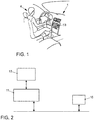
- Figure 1 shows, for illustration purposes, a perspective view of the driver's position 4 of a vehicle 1.
- Vehicle 1 comprises a graphical representation device arranged on the dashboard, performing the functions of the first interface 13, through which the driver 4 communicates with the vehicle 1.
- Figure 2 shows, for illustration purposes, a view of a scheme with the integral elements of the device of the present invention, where the existing connection between the control unit 11 and the first interface 13 can be observed.
- the control unit 11 communicates with the detector 15, preferably through physical means, such as a communication bus.
- the detector 15 is arranged, according to a preferred mode of embodiment, in the central area of the rear seats 12 of the vehicle 1, i.e. between the right rear seat and the left rear seat of the vehicle 1. More specifically, the at least one detector 15 is configured to recognise the at least one first gesture 61 and recognise the at least one second gesture 62.
- the detector 15 is at least an infrared sensor, which is implemented in the rear area of the console, specifically in the axis of symmetry of the vehicle 1, between the right rear seat 12 right and the left rear seat 12. More particularly, as can be seen in Figure 3 , the detector 15 is oriented vertically, in such a way that the detector 15 recognises the at least a first gesture 61 and recognises the at least a second gesture 62 executed above the detector 15.
- the infrared is oriented vertically and pointing upwards, in such a way that it can be used by any of the occupants 5 of the rear seats 12.
- This detector 15 is physically connected to the system and control unit 11, which is faster and more effective than a wireless connection.
- the procedure of the present invention executes a series of basic steps, which include, in an illustrative and non-limiting manner, the following:
- the driver 4 and the occupant 5 of the rear seat 12 see the modifications made on the display of the HMI or the first interface 13. It is noted that the HMI represents reduced content only for the occupant 5 of the rear seats 12, in order for them to have information in response to the steps and instructions they are performing;
- Figure 3 illustrates a perspective view of one of the rear seats 12 with a console between them.
- Figure 3 shows the interior of the passenger compartment of a vehicle 1, with a second interface 14 between the two rear seats 12, which includes a detector 15 designed to capture the gestures that the occupant occupant 5 of these rear seats 12 makes with their hand 51 or wrist 52, in order to indicate to the control unit 11 their preference to change some variable or parameter of the at least one function 2 of the vehicle 1.
- This function is visible in the graphical representation device, either in the first interface 13 or in the second interface 14, in the form of a graphical menu 3, preferably with options and icons.
- Figure 4A shows an illustrative view of a first activation gesture 61, with a hand 51 open.
- the detector 15 transmits a wireless signal, receives the transmitted wireless signal and analyses the variation between the transmitted wireless signal and the received wireless signal.
- control unit 11 determines whether the gesture 6 performed by the occupant 5 matches the at least one stored first gesture 61. If this is the case, a control of the at least one function 2 of the vehicle 1 is enabled and access to the handling of certain variables and parameters of the vehicle 1 is activated for the occupants 5 of the rear seats 12, preferably by keeping the palm open above the sensor or detector 15, at a given distance, for a given number of seconds, after which the occupant 5 receives information in response from the control unit 11.
- the control unit enables the control of the at least one function 2 of the vehicle 1.
- the enabling of the control may comprise an authorisation by a occupant 5 of a front seat of the vehicle 1, preferably by a driver 4 of the vehicle 1 and preferably by means of the first interface 13, but it may also be carried out by voice control, or by an actuator on the steering wheel of the vehicle 1. If the authorisation is affirmative, the at least one function 2 of the vehicle 1 is controlled.
- a plurality of second gestures 62 are represented in an illustrative and not limiting way.
- the detector 15 transmits a wireless signal, receives the transmitted wireless signal and analyses the variation between the transmitted wireless signal and the received wireless signal.
- control unit 11 determines whether the gesture 6 performed by the occupant 5 matches the at least one stored second gesture 62. According to the second recognised gesture 62, the occupant 5 is able to modify the at least one parameter of the vehicle 1.
- This parameter of the vehicle 1 is preferably linked to the rear seat 12 of the vehicle 1, thus improving the comfort of the occupant 5 of the rear seat 12.
- the occupant 5 can navigate between the at least one function 2 of the vehicle 1 and/or select the at least one function 2 of the vehicle 1 and/or increase an intensity of the at least one function 2 of the vehicle 1 and/or reduce an intensity of the at least one function 2 of the vehicle 1.
- the first gesture 61 to activate the at least a second interface 14 is a hand 51 in the shape of a fist
- the second gesture 62 to select the at least a function 2 of the vehicle 1 from a menu 3 involves moving a hand 51 from left to right or from right to left
- the second gesture 62 to enter the at least one function 2 of the vehicle 1 selected from a menu 3 involves turning a wrist 52 upwards and downwards
- the second gesture 62 to increase the intensity of the at least one function 2 of vehicle 1 involves moving a hand 51 up and down
- the second gesture 62 to reduce the intensity of the at least one function 2 of the vehicle 1 involves moving a hand 51 up and down.
- Figure 4B illustrates a second gesture 62 for navigating between the plurality of functions 2 of the vehicle 1 by moving the open hand 51 sideways, and a third gesture 6 to select the desired function 2 by turning a wrist 52 downwards, which can be considered within the category of the second gesture 62.
- Figure 4C shows, for illustrative purposes, a view of a fourth control gesture 6, in the category of the so-called second gesture 62, by moving and closing a hand 51.
- the intensity of the air conditioning function 2 is reduced by closing the hand 51 of the occupant 5, from gesture 6 with extended fingers to gesture 6 with closed fingers.
- the intensity of the air conditioning function 2 is increased when the occupant 5 opens their hand 51, from a gesture 6 with the fingers closed to a gesture 6 with the fingers open.
- Figure 4D shows, for illustrative purposes, a view of a fifth gesture 6, in the category of the so-called second gesture 62, for control, moving the closed hand 51.
- the occupant 5 can move their hand 51 from side to side in the direction of their preference to navigate between the available songs and select one.
- they can make a gesture 6 by closing their hand 51.
- Figure 4E shows, for illustrative purposes, a view of a sixth control gesture 6, in the category of the so-called second gesture 62, by opening the closed hand 51.
- Figure 4F shows, for illustrative purposes, a view of a seventh control gesture 6, in the category of the so-called second gesture 62, by turning the wrist 52 upwards.
- the occupant 5 can turn their wrist 52 upwards with an open hand 51. And to cancel the action by gesture control 6, they remove their hand 51, and this activates a process contrary to the activation that will cancel it.
- the detector 15 determines the occupant 5 of the at least one rear seat 12 of the vehicle 1, in such a way that the control unit 11 is able to recognise whether it is a occupant 5 seated in the left rear seat 12 or a occupant 5 seated in the right rear seat 12. In this way, the control unit 11 modifies the parameter of the vehicle 1 that affects the identified rear seat 12, improving the comfort of the occupants 5 in an individualised and effective way.
- the detector 15 determines the thumb position of the occupant's 5 hand 51. The detector 11 determines the position of the occupant 5 based on the thumb position of the hand 51 compared to the rest of the occupant's 5 hand 51.
- the method comprises an additional step of disabling the control of the at least one function 2 of the vehicle 1, so that the driver 4 can cancel the interaction of the occupants 5 of the rear seats 12 at any time.
- This action can be performed by tapping the screen of the first interface 13, on an icon to go back in the routine, or to completely cancel and return to the start menu 3.
- it can be cancelled by a voice command, or also if the detector detects during a determined period of time that a hand 51 is in front of the first interface 13.
- disabling occurs after a period of inactivity.
Landscapes
- Engineering & Computer Science (AREA)
- Mechanical Engineering (AREA)
- Chemical & Material Sciences (AREA)
- Combustion & Propulsion (AREA)
- Transportation (AREA)
- Physics & Mathematics (AREA)
- General Engineering & Computer Science (AREA)
- Theoretical Computer Science (AREA)
- Thermal Sciences (AREA)
- Human Computer Interaction (AREA)
- General Physics & Mathematics (AREA)
- User Interface Of Digital Computer (AREA)
Abstract
Description
- This patent application concerns a control method by gestures of the at least one function of a vehicle according to Claim 1, which incorporates significant innovations and advantages, and a device associated with the method according to
Claim 13, which also incorporates significant innovations and advantages. - In certain high-end vehicles, in order to control some functions relating to the rear seats, such as rear seat ventilation, the at least one specific screen is implemented in the rear console area, as well as specific actuators to modify ventilation and temperature.
There are also cases in which external tablets are installed or used in vehicles, which enable these functions linked to the rear seats of the vehicle to be controlled through wireless connections. - In this respect, a method and control system to recognise gestures via a terminal installed in a vehicle is known in the state of the art, as detailed in document
CN105151048 . The method involves controlling the vehicle-installed terminal by detecting gestures through changes in the electric field. The detected gesture information is analysed and processed in order to obtain a corresponding action. An instruction is sent to achieve control over the terminal, according to a present instruction. The detection panel can be placed on a seat. In this way, people sitting in the front or rear row of a car can control various applications in the car, such as the radio, air conditioning, and similar. - In the state of the art, according to
US20160084951 , a system for recognising motion by analysing a radio signal is also known, which includes: a radio signal transmitter; a radio signal receiver; and a motion recognition processing device configured to: i) analyse the received radio signal, ii) extract and classify a gesture from the analysed radio signal, iii) recognise the extracted and classified gesture, and iv) perform control over the vehicle device based on the gesture recognition. - Thus, and in view of the above, it is clear that there is still a need to allow gesture control of certain vehicle functions by occupants of the rear seats of the passenger compartment of a vehicle, optimising the resources required.
- The present invention consists of a method, and its associated device, for the control by gestures of at least one function of a vehicle, in particular of functions linked to rear seats of the vehicle, of variables such as air conditioning, music, and ambient light.
- Currently implementing actuators and displays in addition to those installed on the dashboard result in a substantial increase in costs and complexity. In particular, the installation of screens and actuators in the rear of the front seats or in the central area of the rear seats, is used only in high-end vehicles. On the other hand, the use of portable external devices, such as tablets and smart phones, requires occupying a wireless connection channel with the vehicle, in addition to requiring the prior installation of software enabled for the control of vehicle functions. In the case of portable external devices, it supposes a risk element inside the vehicle, since, in the event of an impact, it could become an object that causes damage to the occupants of the vehicle.
- This invention is based on gesture control to allow, from the rear or rear seats, the control of certain functions of the vehicle. Rear or rear seats means the rows of seats behind the first line of the driver and passenger.
- As for the "Hardware", or physical elements necessary for a basic embodiment of the present invention, this must consist of an HMI (Human Machine Interface) that has a special representation mode for the variables that, in particular, affect the rear seats of the passenger compartment.
- Generically speaking, in the context of this invention, a series of predefined gestures are determined as signals that induce changes in the variables or parameters of the vehicle. For example, and in a non-limiting way, raising a hand increases the intensity, lowering a hand reduces the intensity, and moving a hand to the left changes the context or function to be modified.
- In summary, and as the most relevant characteristics of the method of invention, the following actions or steps can be cited, in a non-limiting way:
- performing a predetermined gesture to activate the HMI operation from the rear seats;
- authorisation by the occupant driver;
- representation through the HMI of a simplified context or set of information with only functions of interest for the rear seats;
- gesture control and navigation in the simplified HMI;
- communication between the gesture detector and the HMI.
- recognition of at least one first gesture by an occupant of at least one rear seat of the vehicle,
- enabling control of the at least one vehicle function based on the at least one recognised first gesture,
- recognition of at least one second gesture by an occupant of at least one rear seat of the vehicle,
- and controlling the at least one function of the vehicle on the basis of the at least one recognised second gesture.
- In this way, the driver can avoid handling the controls that mainly affect the rear seats, resulting in greater driving safety.
- In this way, the rear seat occupant can be offered more functionalities that affect the rear seat occupants, for example in terms of the level of lighting, or the radio volume, increasing comfort by increasing their decision-making autonomy. As an advantage, the need to enable a control of the at least one function of the vehicle is highlighted, in such a way that an occupant of one of the vehicle's front seats can authorise the control by gestures of the at least one function of the vehicle, resulting in an increase in safety in the vehicle, and control by the driver of the vehicle's parameters.
- In addition, the at least one first gesture is different than the at least one second gesture. The first gesture is a predefined gesture, which allows the method of the present invention to awaken or be initiated. On the contrary, the at least a second gesture refers to gestures that are previously memorised and known by the control unit to control the at least one function of the vehicle.
- Advantageously, the method comprises an additional step of representing the at least one function of the vehicle by means of a graphical representation device, in particular an HMI. This action of representing is based on the previous step of controlling the at least one function. In this way the occupant, both the driver and the occupant of the at least one rear seat, has the possibility to visually observe the modifications made by the occupant in this function.
- According to another aspect of the invention, the at least one graphical representation device is a first interface, where the at least one first interface is arranged on an instrument panel or vehicle console, in such a way that both the driver and the occupant of the at least one rear seat observe the function of the vehicle to be controlled in the first interface. The present invention's optimisation of resources is emphasised, since the first interface is the graphical representation device arranged in the vehicle's dashboard. In this way, the first interface can be controlled tactilely by the occupants of the front seats and can be controlled by gestures by the occupants of the rear seats.
- In a preferred embodiment of the invention, the step of representing the at least one function of the vehicle at the first interface comprises representing the at least one function in a simplified way, so that the at least one function is visible from the at least one rear seat of the vehicle. Thus, the at least one function is easily understandable in its meaning, even despite the distance between the rear seats and the vehicle's dashboard or console. As an example, the at least one simplified function is represented with a larger font size, with a larger contrast, eliminating irrelevant information...
- In an alternative embodiment of the invention, the graphical representation device is a second interface, where the at least a second interface is arranged in at least one rear seat of the vehicle. This makes it easier for the occupant of the rear seats to view the information that appears on the graphic representation device and, therefore, to interact with it.
- More specifically, the step of controlling the at least one vehicle function involves modifying at least one vehicle parameter, where the at least one vehicle parameter is linked to the at least one rear seat of the vehicle. In this way, the occupant of the rear seats has a greater autonomy when it comes to managing the variables or parameters of the vehicle that affect them.
- According to another aspect of the invention, the method of the present invention comprises an additional step of determining the occupant of the at least one rear seat of the vehicle performing the at least one second gesture, where the step of modifying the at least one parameter of the vehicle comprises modifying the at least one parameter of the vehicle linked to the occupant of the at least one rear seat of the given vehicle. In this way the variation of variables or parameters in the environment of the passenger compartment is limited to a greater extent to each of the occupants in particular, minimising the influence of changes on other occupants. Thus, the method of invention makes it possible to differentiate between a occupant of a left rear seat and a right rear seat in order to change the parameter exclusively to that occupant. In more detail and as an example, determining the occupant of the at least one rear seat of the vehicle involves analysing the at least a second gesture and determining the position of the thumb of the occupant of the rear seat. Depending on the position of the thumb, a distinction is made between the occupant of the left rear seat and the occupant of the right rear seat.
- More particularly, the step of controlling the at least one vehicle function involves navigating between the at least one vehicle function and/or selecting the at least one vehicle function and/or increasing an intensity of the at least one vehicle function and/or reducing an intensity of the at least one vehicle function.
- These operations are of interest to a occupant in order to increase their sense of comfort in the cabin. These control actions are carried out, as mentioned above, by means of the at least a second gesture, where advantageously said the at least a second gesture is previously known by the control unit.
- According to another aspect of the invention, the method involves an additional step of determining an authorisation to enable the control of the at least one function of the vehicle. Thus, if an authorisation is determined, the control of the at least one function of the vehicle by the occupant of at least one rear seat is enabled. On the other hand, if an authorisation is not determined, the control of the at least one function of the vehicle by the occupant of the at least one rear seat is not enabled.
- More specifically, the authorisation to enable the control of the at least one function is carried out by an occupant of the at least one front seat of the vehicle, preferably the driver of the vehicle. Thus, occupants of the rear seats cannot control any cabin variable without the consent of an occupant of the front seats. Preferably, the vehicle driver should give the authorisation to enable the control. In addition, authorisation to enable control is given via the first interface. Alternatively, authorisation to enable control is given by voice control, an actuator on the vehicle steering wheel, and/or a third predefined gesture.
- Additionally, the method of the invention comprises an additional step of disabling the control of the at least one function of the vehicle. In particular, disabling may be for a period of inactivity and/or by means of an actuation on the first interface and/or an actuation on the second interface and/or by a vehicle control unit, where priority information must be displayed through the first interface. In this way, operation can be deactivated to avoid confusion or contradictory instructions. Consequently, the step of disabling the control of the at least one function of the vehicle can be performed by the occupant of a front seat, by the occupant of a rear seat and/or by the control unit.
- More particularly, the step of recognising the at least one first gesture and/or the step of recognising the at least one second gesture additionally comprises the steps of:
- transmitting a wireless signal, receiving the transmitted wireless signal,
- analysing a variation between the transmitted wireless signal and the received wireless signal,
- identifying the at least a first gesture and/or the at least a second gesture based on the variation between the transmitted wireless signal, the received wireless signal and previously stored information.
- In this way the system that executes the method of the present invention is able to determine that a gesture has occurred and its type. Each identified gesture is equivalent to a predetermined order, in such a way that when the execution of the at least a first gesture and/or the execution of the at least a second gesture is determined, the method executes the order according to the previously stored information.
- In a preferred embodiment, a complete and sequential sequence of all possible steps comprises the steps of: performing a predefined first gesture; displaying information from the function menu via the graphical display device of a first interface; issuing a message via the graphical display device of the first interface requesting authorisation; determining an input of information authorising control by subsequent locations; representing through the first interface the at least one function to be controlled; preferably in a simplified way in the first interface; recognising a second gesture; interpreting this second gesture; controlling the parameter of the modified function according to the nature of the gesture; representing through the first interface the changes that occur in the function; and finally, disabling the control of the function.
- The object of the present invention also includes a gesture control device for at least one function of a vehicle, configured to execute the method previously described. This gesture control device presents the successive advantages mentioned above for the method of the present invention.
- Note that, specifically, the control unit is configured or programmed to execute the method described above. The control unit communicates with the detector, the first interface, and the second interface, preferably via cable communication, through the vehicle's own data bus, which increases the reliability and the speed of data and instruction transmission.
- According to another aspect of the invention, the device comprises at least one detector, where the at least one detector is configured to recognise the at least one first gesture and recognise the at least one second gesture. In this way, the occupant of the rear seats can easily transmit their preference to change one or more of the vehicle parameters.
- Advantageously, the detector is oriented vertically, in such a way that the detector recognises the at least a first gesture and recognises the at least a second gesture executed on top of said detector. Thus, due to its position and orientation, its detection is fast and reliable.
- The attached drawings show, as an example but not limited to, a gesture control method and device for the at least one function of a vehicle, constituted in accordance with the invention. Other characteristics and advantages of this gesture control method and device for the at least one function of a vehicle, which is the object of this invention, will be evident from the description of a preferred, but not exclusive, embodiment, which is illustrated as a non-exclusive example in the attached drawings, in which:
-
- Figure 1
- A perspective view of the driver's position in a vehicle, a graphical representation device arranged on the dashboard, in accordance with this invention.
- Figure 2
- A schematic view with the elements that make up the device of the present invention.
- Figure 3
- A perspective view of one of the rear seats with a console lodged between the seats, in accordance with the present invention.
- Figure 4A
- A schematic view of a first control gesture, with an open hand, in accordance with the present invention.
- Figure 4B
- A schematic view of a second control gesture, with an open hand moving laterally, and a third access gesture, with a wrist turning downwards, in accordance with the present invention.
- Figure 4C
- A schematic view of a fourth control gesture, with a hand moving and closing, in accordance with the present invention.
- Figure 4D
- A schematic view of a fifth control gesture, with a closed hand moving, in accordance with the present invention.
- Figure 4E
- A schematic view of a sixth control gesture, with a closed hand opening, in accordance with the present invention.
- Figure 4F
- A schematic view of a seventh control gesture, with a wrist turning upwards, in accordance with the present invention.
- In view of the above-mentioned figures and in accordance with the numbering adopted, an example of the preferred embodiment of the invention can be observed in them, which includes the parts and elements indicated and described in detail below.
-
Figure 1 shows, for illustration purposes, a perspective view of the driver'sposition 4 of a vehicle 1. Vehicle 1 comprises a graphical representation device arranged on the dashboard, performing the functions of thefirst interface 13, through which thedriver 4 communicates with the vehicle 1. -
Figure 2 shows, for illustration purposes, a view of a scheme with the integral elements of the device of the present invention, where the existing connection between thecontrol unit 11 and thefirst interface 13 can be observed. Additionally, thecontrol unit 11 communicates with thedetector 15, preferably through physical means, such as a communication bus. Thedetector 15 is arranged, according to a preferred mode of embodiment, in the central area of therear seats 12 of the vehicle 1, i.e. between the right rear seat and the left rear seat of the vehicle 1. More specifically, the at least onedetector 15 is configured to recognise the at least onefirst gesture 61 and recognise the at least onesecond gesture 62. - Preferably, the
detector 15 is at least an infrared sensor, which is implemented in the rear area of the console, specifically in the axis of symmetry of the vehicle 1, between the rightrear seat 12 right and the leftrear seat 12. More particularly, as can be seen inFigure 3 , thedetector 15 is oriented vertically, in such a way that thedetector 15 recognises the at least afirst gesture 61 and recognises the at least asecond gesture 62 executed above thedetector 15. - In particular, the infrared is oriented vertically and pointing upwards, in such a way that it can be used by any of the
occupants 5 of therear seats 12. Thisdetector 15 is physically connected to the system andcontrol unit 11, which is faster and more effective than a wireless connection.
The procedure of the present invention executes a series of basic steps, which include, in an illustrative and non-limiting manner, the following: - a
detector 15 or sensor detects aspecific gesture 6 orfirst gesture 61, such as a hand in the shape of a fist, in the vertical line on which thedetector 15 points. Thisfirst gesture 61 is recognised, in such a way that it detects a willingness on the part of theoccupants 5 of therear seats 12 to control by means ofgestures 6 some functions or parameters of the vehicle; - the
control unit 11 receives information that aoccupant 5 ofrear seats 12 wants to control some variable or parameter of a function of the vehicle 1 by means ofgestures 6; - the
control unit 11 sends a query to thedriver 4 of the vehicle 1, in particular via the HMI display installed in the dashboard of the vehicle 1 or thefirst interface 13. Through thisfirst interface 13 the possibility of allowing theoccupants 5 of therear seats 12 to modify the parameters of the vehicle 1 is shown, generating either an accepted or refused access response; - the
control unit 11 receives an acceptance from thedriver 4 for the request, in such a way that a control of certain variables for the vehicle 1 is enabled from therear seats 12; - the HMI or
first interface 13 represents a reduced and simplified menu or context which theoccupant 5 of therear seats 12 can access, being able to modify, by way of example, the following variables or parameters related to rear seats 12: ventilation, ambient lighting, music volume (intensifying or reducing only the loudspeakers of rear seats), the heating in the rear seats, or any other variable or particular parameter for therear seats 12; - the
detector 15 detectsgestures 6, specifically second gestures 62, made by theoccupant 6 of therear seats 12. Thesegestures 6 allow the modifiable variable or parameters to be changed, from among the various available functions. In addition, their content allows access, and for intensities and/or volumes to be increased or decreased; - the HMI or
first interface 13 represents these changes, simultaneously to the changes or alterations that theoccupant 5 executes by means of the at least asecond gesture 62. - In this way, both the
driver 4 and theoccupant 5 of therear seat 12 see the modifications made on the display of the HMI or thefirst interface 13. It is noted that the HMI represents reduced content only for theoccupant 5 of therear seats 12, in order for them to have information in response to the steps and instructions they are performing; - Finally, the
control unit 11 disables the control of functions by theoccupants 5 of therear seats 12, so that the same information is represented in the HMI as that which was represented before the control of functions was enabled by theoccupants 5 of therear seats 12. - A second alternative mode of the present invention can be seen in
Figure 3. Figure 3 illustrates a perspective view of one of therear seats 12 with a console between them.Figure 3 shows the interior of the passenger compartment of a vehicle 1, with asecond interface 14 between the tworear seats 12, which includes adetector 15 designed to capture the gestures that theoccupant occupant 5 of theserear seats 12 makes with theirhand 51 orwrist 52, in order to indicate to thecontrol unit 11 their preference to change some variable or parameter of the at least onefunction 2 of the vehicle 1. This function is visible in the graphical representation device, either in thefirst interface 13 or in thesecond interface 14, in the form of agraphical menu 3, preferably with options and icons. -
Figure 4A shows an illustrative view of afirst activation gesture 61, with ahand 51 open. Thus, thedetector 15 transmits a wireless signal, receives the transmitted wireless signal and analyses the variation between the transmitted wireless signal and the received wireless signal. Based on previously stored information,control unit 11 determines whether thegesture 6 performed by theoccupant 5 matches the at least one storedfirst gesture 61. If this is the case, a control of the at least onefunction 2 of the vehicle 1 is enabled and access to the handling of certain variables and parameters of the vehicle 1 is activated for theoccupants 5 of therear seats 12, preferably by keeping the palm open above the sensor ordetector 15, at a given distance, for a given number of seconds, after which theoccupant 5 receives information in response from thecontrol unit 11. - Once the
first gesture 61 is recognised, the control unit enables the control of the at least onefunction 2 of the vehicle 1. The enabling of the control may comprise an authorisation by aoccupant 5 of a front seat of the vehicle 1, preferably by adriver 4 of the vehicle 1 and preferably by means of thefirst interface 13, but it may also be carried out by voice control, or by an actuator on the steering wheel of the vehicle 1. If the authorisation is affirmative, the at least onefunction 2 of the vehicle 1 is controlled. - In
figures 4B, 4C, 4D ,4E and 4F , a plurality ofsecond gestures 62 are represented in an illustrative and not limiting way. Thus, thedetector 15 transmits a wireless signal, receives the transmitted wireless signal and analyses the variation between the transmitted wireless signal and the received wireless signal. Based on previously stored information,control unit 11 determines whether thegesture 6 performed by theoccupant 5 matches the at least one storedsecond gesture 62. According to the secondrecognised gesture 62, theoccupant 5 is able to modify the at least one parameter of the vehicle 1. This parameter of the vehicle 1 is preferably linked to therear seat 12 of the vehicle 1, thus improving the comfort of theoccupant 5 of therear seat 12. More specifically, theoccupant 5 can navigate between the at least onefunction 2 of the vehicle 1 and/or select the at least onefunction 2 of the vehicle 1 and/or increase an intensity of the at least onefunction 2 of the vehicle 1 and/or reduce an intensity of the at least onefunction 2 of the vehicle 1. - Thus, and for illustrative and non-limited purposes, the
first gesture 61 to activate the at least asecond interface 14 is ahand 51 in the shape of a fist, thesecond gesture 62 to select the at least afunction 2 of the vehicle 1 from amenu 3 involves moving ahand 51 from left to right or from right to left, thesecond gesture 62 to enter the at least onefunction 2 of the vehicle 1 selected from amenu 3 involves turning awrist 52 upwards and downwards, thesecond gesture 62 to increase the intensity of the at least onefunction 2 of vehicle 1 involves moving ahand 51 up and down, and thesecond gesture 62 to reduce the intensity of the at least onefunction 2 of the vehicle 1 involves moving ahand 51 up and down. -
Figure 4B illustrates asecond gesture 62 for navigating between the plurality offunctions 2 of the vehicle 1 by moving theopen hand 51 sideways, and athird gesture 6 to select the desiredfunction 2 by turning awrist 52 downwards, which can be considered within the category of thesecond gesture 62. - By way of illustration, once activated, in the first or
second interface occupant 5 accesses each of them by moving theirhand 51, with the palm open, moving it sideways to select the option of interest. Theoccupant 5 then rotates theirwrist 52 downwards to access the contents of the option just selected. -
Figure 4C shows, for illustrative purposes, a view of afourth control gesture 6, in the category of the so-calledsecond gesture 62, by moving and closing ahand 51. - By way of illustration, once the air conditioning and heating option is selected, the intensity of the
air conditioning function 2 is reduced by closing thehand 51 of theoccupant 5, fromgesture 6 with extended fingers togesture 6 with closed fingers. On the other hand, the intensity of theair conditioning function 2 is increased when theoccupant 5 opens theirhand 51, from agesture 6 with the fingers closed to agesture 6 with the fingers open. -
Figure 4D shows, for illustrative purposes, a view of afifth gesture 6, in the category of the so-calledsecond gesture 62, for control, moving theclosed hand 51. - By way of illustration, with regards to the music function, to select a different song, the
occupant 5 can move theirhand 51 from side to side in the direction of their preference to navigate between the available songs and select one. To play a song, they can make agesture 6 by closing theirhand 51. -
Figure 4E shows, for illustrative purposes, a view of asixth control gesture 6, in the category of the so-calledsecond gesture 62, by opening theclosed hand 51. - By way of illustration, with regards to the ambient light function, in order to activate a palette of colours that can be seen on the graphic representation device or screen, the
occupant 5 has to move theirhand 51 to the left. - Then, to select the colour they are interested in, they rotate their
hand 51 and make agesture 6 by closing theirhand 51 to apply the colour that appears in the graphic representation device. -
Figure 4F shows, for illustrative purposes, a view of aseventh control gesture 6, in the category of the so-calledsecond gesture 62, by turning thewrist 52 upwards. - Optionally, and by way of illustration, to return to the
gesture control 6menu 3, theoccupant 5 can turn theirwrist 52 upwards with anopen hand 51. And to cancel the action bygesture control 6, they remove theirhand 51, and this activates a process contrary to the activation that will cancel it. - According to a particular mode of embodiment, the
detector 15 determines theoccupant 5 of the at least onerear seat 12 of the vehicle 1, in such a way that thecontrol unit 11 is able to recognise whether it is aoccupant 5 seated in the leftrear seat 12 or aoccupant 5 seated in the rightrear seat 12. In this way, thecontrol unit 11 modifies the parameter of the vehicle 1 that affects the identifiedrear seat 12, improving the comfort of theoccupants 5 in an individualised and effective way. For this purpose, thedetector 15 determines the thumb position of the occupant's 5hand 51. Thedetector 11 determines the position of theoccupant 5 based on the thumb position of thehand 51 compared to the rest of the occupant's 5hand 51. - In addition, the method comprises an additional step of disabling the control of the at least one
function 2 of the vehicle 1, so that thedriver 4 can cancel the interaction of theoccupants 5 of therear seats 12 at any time. This action can be performed by tapping the screen of thefirst interface 13, on an icon to go back in the routine, or to completely cancel and return to thestart menu 3. Also, optionally, it can be cancelled by a voice command, or also if the detector detects during a determined period of time that ahand 51 is in front of thefirst interface 13. Alternatively, disabling occurs after a period of inactivity. - The details, shapes, dimensions and other accessory components, as well as the components used in the implementation of the gesture control method and device of the at least one function of a vehicle, may be conveniently replaced by others that are technically equivalent, and do not deviate from the essentiality of the invention or from the scope defined by the claims listed below.
-
- 1
- vehicle
- 11
- control unit
- 12
- rear seat
- 13
- first interface
- 14
- second interface
- 15
- detector
- 2
- function
- 3
- menu
- 4
- driver
- 5
- occupant
- 51
- hand
- 52
- wrist
- 6
- gesture
- 61
- first gesture
- 62
- second gesture
Claims (15)
- Method of controlling through gestures at least one function (2) of a vehicle (1), comprising the following steps of:- recognizing at least one first gesture (61) of an occupant (5) of at least one rear seat (12) of the vehicle (1),- enabling a control of the at least one function (2) of the vehicle (1) based on the at least one recognised first gesture (61),- recognizing at least one second gesture (62) of an occupant (5) of at least one rear seat (12) of the vehicle (1), and- controlling the at least one function (2) of the vehicle (1) on the basis of the at least one recognised second gesture (62).
- Method according to Claim 1, characterised in that it comprises an additional step of representing the at least one function (2) of the vehicle (1) by means of a graphical representation device.
- Method according to Claim 2, characterised in that the at least one graphical representation device is a first interface (13), where the at least one first interface (13) is arranged on a vehicle instrument panel (1).
- Method according to Claim 3, characterised in that the step of representing the at least one function (2) of the vehicle (1) in the first interface (13) comprises representing the at least one function (2) in a simplified way, in such a way that the at least one function (2) is visible from the at least one rear seat (12) of the vehicle (1).
- Method according to Claim 3, characterised in that the at least one graphical representation device is a second interface (14), where the at least one second interface (14) is arranged in at least one rear seat (12) of the vehicle (1).
- Method according to any of the preceding claims, characterised in that the step of controlling the at least one function (2) of the vehicle (1) comprises modifying at least one parameter of the vehicle (1), where the at least one parameter of the vehicle (1) is linked to the at least one rear seat (12) of the vehicle (1).
- Method according to Claim 6, characterised in that it comprises an additional step of determining the occupant (5) of the at least one rear seat (12) of the vehicle (1) performing the at least one second gesture (62), where the step of modifying the at least one vehicle parameter (1) comprises modifying the at least one vehicle parameter (1) linked to the occupant (5) of the at least one rear seat (12) of the given vehicle (1).
- Method according to any of the preceding claims, characterised in that the step of controlling the at least one function (2) of the vehicle (1) comprises navigating between the at least one function (2) of the vehicle (1) and/or selecting the at least one function (2) of the vehicle (1) and/or increasing an intensity of the at least one function (2) of the vehicle (1) and/or reducing an intensity of the at least one function (2) of the vehicle (1).
- Method according to any of the preceding claims, characterised in that it comprises an additional step of determining an authorisation to enable the control of the at least one (2) function of the vehicle (1).
- Method according to Claim 9, characterised in that the authorisation to enable the control of the at least one function (2) is performed by an occupant (5) of at least one front seat of the vehicle (1).
- Method according to Claim 9, characterised in that it comprises an additional step of disabling the control of the at least one (2) function of the vehicle (1).
- Method according to any of the preceding claims, characterised in that the step of recognising the at least one first gesture (61) and/or the step of recognising the at least one second gesture (62) comprises the steps of:- transmitting a wireless signal,- receiving the transmitted wireless signal,- analysing a variation between the transmitted wireless signal and the received wireless signal,- identifying the at least a first gesture (61) and/or the at least a second gesture (62) based on the variation between the transmitted wireless signal, the received wireless signal and previously stored information.
- Gesture control device for at least one function (2) of a vehicle (1), configured to execute the method of Claim 1.
- Device according to Claim 13, characterised in that it comprises at least one detector (15), where the at least one detector (15) is configured to recognise the at least one first gesture (61) and recognise the at least one second gesture (62).
- Device according to any of the Claims 13 or 14, characterised in that the detector (15) is oriented vertically, in such a way that the detector (15) recognises the at least a first gesture (61) and recognises the at least a second gesture (62) executed above the detector (15).
Applications Claiming Priority (1)
| Application Number | Priority Date | Filing Date | Title |
|---|---|---|---|
| ES201731436A ES2717343B2 (en) | 2017-12-20 | 2017-12-20 | Gesture control method and device of at least one function of a vehicle |
Publications (2)
| Publication Number | Publication Date |
|---|---|
| EP3501874A1 true EP3501874A1 (en) | 2019-06-26 |
| EP3501874B1 EP3501874B1 (en) | 2021-07-07 |
Family
ID=64900766
Family Applications (1)
| Application Number | Title | Priority Date | Filing Date |
|---|---|---|---|
| EP18214828.8A Active EP3501874B1 (en) | 2017-12-20 | 2018-12-20 | Gesture control method and device for at least one function of a vehicle |
Country Status (2)
| Country | Link |
|---|---|
| EP (1) | EP3501874B1 (en) |
| ES (2) | ES2717343B2 (en) |
Citations (3)
| Publication number | Priority date | Publication date | Assignee | Title |
|---|---|---|---|---|
| US20140298212A1 (en) * | 2013-04-01 | 2014-10-02 | Jet-Optoelectronics Co., Ltd | Control and display system |
| US20150081133A1 (en) * | 2013-09-17 | 2015-03-19 | Toyota Motor Sales, U.S.A., Inc. | Gesture-based system enabling children to control some vehicle functions in a vehicle |
| DE102015006614A1 (en) * | 2015-05-21 | 2016-11-24 | Audi Ag | Method for operating an operating device and operating device for a motor vehicle |
Family Cites Families (2)
| Publication number | Priority date | Publication date | Assignee | Title |
|---|---|---|---|---|
| KR101556521B1 (en) * | 2014-10-06 | 2015-10-13 | 현대자동차주식회사 | Human Machine Interface apparatus, vehicle having the same and method for controlling the same |
| US9547373B2 (en) * | 2015-03-16 | 2017-01-17 | Thunder Power Hong Kong Ltd. | Vehicle operating system using motion capture |
-
2017
- 2017-12-20 ES ES201731436A patent/ES2717343B2/en not_active Expired - Fee Related
-
2018
- 2018-12-20 EP EP18214828.8A patent/EP3501874B1/en active Active
- 2018-12-20 ES ES18214828T patent/ES2893948T3/en active Active
Patent Citations (3)
| Publication number | Priority date | Publication date | Assignee | Title |
|---|---|---|---|---|
| US20140298212A1 (en) * | 2013-04-01 | 2014-10-02 | Jet-Optoelectronics Co., Ltd | Control and display system |
| US20150081133A1 (en) * | 2013-09-17 | 2015-03-19 | Toyota Motor Sales, U.S.A., Inc. | Gesture-based system enabling children to control some vehicle functions in a vehicle |
| DE102015006614A1 (en) * | 2015-05-21 | 2016-11-24 | Audi Ag | Method for operating an operating device and operating device for a motor vehicle |
Also Published As
| Publication number | Publication date |
|---|---|
| EP3501874B1 (en) | 2021-07-07 |
| ES2717343B2 (en) | 2021-07-08 |
| ES2717343A1 (en) | 2019-06-20 |
| ES2893948T3 (en) | 2022-02-10 |
Similar Documents
| Publication | Publication Date | Title |
|---|---|---|
| US9481246B2 (en) | Vehicle control apparatus and method thereof | |
| CN107107753B (en) | Method and system for operating a touch-sensitive display device of a motor vehicle | |
| US9965169B2 (en) | Systems, methods, and apparatus for controlling gesture initiation and termination | |
| US9403537B2 (en) | User input activation system and method | |
| US8239087B2 (en) | Method of operating a vehicle accessory | |
| GB2501575A (en) | Interacting with vehicle controls through gesture recognition | |
| US9540016B2 (en) | Vehicle interface input receiving method | |
| US20160195932A1 (en) | Apparatus and method for data input via virtual controls with haptic feedback to simulate key feel | |
| KR20200093091A (en) | Terminal device, vehicle having the same and method for controlling the same | |
| GB2543759A (en) | Vehicle user advice system | |
| KR20180091732A (en) | User interface, means of transport and method for distinguishing a user | |
| EP3488320B1 (en) | Device and method for assisting a user | |
| EP3416848B1 (en) | Arrangement, means of locomotion and method for assisting a user in the operation of a touch-sensitive display device | |
| JP2018501998A (en) | System and method for controlling automotive equipment | |
| KR20170105093A (en) | Positioning of non-vehicle objects in the vehicle | |
| CN112272625B (en) | Method and system for operating an automated driving function in a vehicle | |
| EP3126934B1 (en) | Systems and methods for the detection of implicit gestures | |
| EP3501874B1 (en) | Gesture control method and device for at least one function of a vehicle | |
| GB2539329A (en) | Method for operating a vehicle, in particular a passenger vehicle | |
| EP3663120B1 (en) | Method and associated device for controlling at least one parameter of a vehicle | |
| KR20180025378A (en) | System and method for provision of head up display information based on driver's gesture | |
| US20130030646A1 (en) | Interactive vehicle help menu | |
| CN121608587A (en) | Window control methods and vehicles | |
| KR20260033223A (en) | Automotive Display control device | |
| JP2021068001A (en) | Control device, program, and control system |
Legal Events
| Date | Code | Title | Description |
|---|---|---|---|
| PUAI | Public reference made under article 153(3) epc to a published international application that has entered the european phase |
Free format text: ORIGINAL CODE: 0009012 |
|
| STAA | Information on the status of an ep patent application or granted ep patent |
Free format text: STATUS: THE APPLICATION HAS BEEN PUBLISHED |
|
| AK | Designated contracting states |
Kind code of ref document: A1 Designated state(s): AL AT BE BG CH CY CZ DE DK EE ES FI FR GB GR HR HU IE IS IT LI LT LU LV MC MK MT NL NO PL PT RO RS SE SI SK SM TR |
|
| AX | Request for extension of the european patent |
Extension state: BA ME |
|
| STAA | Information on the status of an ep patent application or granted ep patent |
Free format text: STATUS: REQUEST FOR EXAMINATION WAS MADE |
|
| 17P | Request for examination filed |
Effective date: 20191226 |
|
| RBV | Designated contracting states (corrected) |
Designated state(s): AL AT BE BG CH CY CZ DE DK EE ES FI FR GB GR HR HU IE IS IT LI LT LU LV MC MK MT NL NO PL PT RO RS SE SI SK SM TR |
|
| GRAP | Despatch of communication of intention to grant a patent |
Free format text: ORIGINAL CODE: EPIDOSNIGR1 |
|
| STAA | Information on the status of an ep patent application or granted ep patent |
Free format text: STATUS: GRANT OF PATENT IS INTENDED |
|
| INTG | Intention to grant announced |
Effective date: 20210209 |
|
| GRAS | Grant fee paid |
Free format text: ORIGINAL CODE: EPIDOSNIGR3 |
|
| GRAA | (expected) grant |
Free format text: ORIGINAL CODE: 0009210 |
|
| STAA | Information on the status of an ep patent application or granted ep patent |
Free format text: STATUS: THE PATENT HAS BEEN GRANTED |
|
| AK | Designated contracting states |
Kind code of ref document: B1 Designated state(s): AL AT BE BG CH CY CZ DE DK EE ES FI FR GB GR HR HU IE IS IT LI LT LU LV MC MK MT NL NO PL PT RO RS SE SI SK SM TR |
|
| REG | Reference to a national code |
Ref country code: GB Ref legal event code: FG4D |
|
| REG | Reference to a national code |
Ref country code: AT Ref legal event code: REF Ref document number: 1408243 Country of ref document: AT Kind code of ref document: T Effective date: 20210715 |
|
| REG | Reference to a national code |
Ref country code: DE Ref legal event code: R096 Ref document number: 602018019641 Country of ref document: DE |
|
| REG | Reference to a national code |
Ref country code: IE Ref legal event code: FG4D |
|
| REG | Reference to a national code |
Ref country code: LT Ref legal event code: MG9D |
|
| REG | Reference to a national code |
Ref country code: NL Ref legal event code: MP Effective date: 20210707 |
|
| REG | Reference to a national code |
Ref country code: AT Ref legal event code: MK05 Ref document number: 1408243 Country of ref document: AT Kind code of ref document: T Effective date: 20210707 |
|
| PG25 | Lapsed in a contracting state [announced via postgrant information from national office to epo] |
Ref country code: SE Free format text: LAPSE BECAUSE OF FAILURE TO SUBMIT A TRANSLATION OF THE DESCRIPTION OR TO PAY THE FEE WITHIN THE PRESCRIBED TIME-LIMIT Effective date: 20210707 Ref country code: RS Free format text: LAPSE BECAUSE OF FAILURE TO SUBMIT A TRANSLATION OF THE DESCRIPTION OR TO PAY THE FEE WITHIN THE PRESCRIBED TIME-LIMIT Effective date: 20210707 Ref country code: HR Free format text: LAPSE BECAUSE OF FAILURE TO SUBMIT A TRANSLATION OF THE DESCRIPTION OR TO PAY THE FEE WITHIN THE PRESCRIBED TIME-LIMIT Effective date: 20210707 Ref country code: FI Free format text: LAPSE BECAUSE OF FAILURE TO SUBMIT A TRANSLATION OF THE DESCRIPTION OR TO PAY THE FEE WITHIN THE PRESCRIBED TIME-LIMIT Effective date: 20210707 Ref country code: PT Free format text: LAPSE BECAUSE OF FAILURE TO SUBMIT A TRANSLATION OF THE DESCRIPTION OR TO PAY THE FEE WITHIN THE PRESCRIBED TIME-LIMIT Effective date: 20211108 Ref country code: NO Free format text: LAPSE BECAUSE OF FAILURE TO SUBMIT A TRANSLATION OF THE DESCRIPTION OR TO PAY THE FEE WITHIN THE PRESCRIBED TIME-LIMIT Effective date: 20211007 Ref country code: NL Free format text: LAPSE BECAUSE OF FAILURE TO SUBMIT A TRANSLATION OF THE DESCRIPTION OR TO PAY THE FEE WITHIN THE PRESCRIBED TIME-LIMIT Effective date: 20210707 Ref country code: AT Free format text: LAPSE BECAUSE OF FAILURE TO SUBMIT A TRANSLATION OF THE DESCRIPTION OR TO PAY THE FEE WITHIN THE PRESCRIBED TIME-LIMIT Effective date: 20210707 Ref country code: BG Free format text: LAPSE BECAUSE OF FAILURE TO SUBMIT A TRANSLATION OF THE DESCRIPTION OR TO PAY THE FEE WITHIN THE PRESCRIBED TIME-LIMIT Effective date: 20211007 Ref country code: LT Free format text: LAPSE BECAUSE OF FAILURE TO SUBMIT A TRANSLATION OF THE DESCRIPTION OR TO PAY THE FEE WITHIN THE PRESCRIBED TIME-LIMIT Effective date: 20210707 |
|
| REG | Reference to a national code |
Ref country code: ES Ref legal event code: FG2A Ref document number: 2893948 Country of ref document: ES Kind code of ref document: T3 Effective date: 20220210 |
|
| PG25 | Lapsed in a contracting state [announced via postgrant information from national office to epo] |
Ref country code: PL Free format text: LAPSE BECAUSE OF FAILURE TO SUBMIT A TRANSLATION OF THE DESCRIPTION OR TO PAY THE FEE WITHIN THE PRESCRIBED TIME-LIMIT Effective date: 20210707 Ref country code: LV Free format text: LAPSE BECAUSE OF FAILURE TO SUBMIT A TRANSLATION OF THE DESCRIPTION OR TO PAY THE FEE WITHIN THE PRESCRIBED TIME-LIMIT Effective date: 20210707 Ref country code: GR Free format text: LAPSE BECAUSE OF FAILURE TO SUBMIT A TRANSLATION OF THE DESCRIPTION OR TO PAY THE FEE WITHIN THE PRESCRIBED TIME-LIMIT Effective date: 20211008 |
|
| REG | Reference to a national code |
Ref country code: DE Ref legal event code: R097 Ref document number: 602018019641 Country of ref document: DE |
|
| PG25 | Lapsed in a contracting state [announced via postgrant information from national office to epo] |
Ref country code: DK Free format text: LAPSE BECAUSE OF FAILURE TO SUBMIT A TRANSLATION OF THE DESCRIPTION OR TO PAY THE FEE WITHIN THE PRESCRIBED TIME-LIMIT Effective date: 20210707 |
|
| PLBE | No opposition filed within time limit |
Free format text: ORIGINAL CODE: 0009261 |
|
| STAA | Information on the status of an ep patent application or granted ep patent |
Free format text: STATUS: NO OPPOSITION FILED WITHIN TIME LIMIT |
|
| PG25 | Lapsed in a contracting state [announced via postgrant information from national office to epo] |
Ref country code: SM Free format text: LAPSE BECAUSE OF FAILURE TO SUBMIT A TRANSLATION OF THE DESCRIPTION OR TO PAY THE FEE WITHIN THE PRESCRIBED TIME-LIMIT Effective date: 20210707 Ref country code: SK Free format text: LAPSE BECAUSE OF FAILURE TO SUBMIT A TRANSLATION OF THE DESCRIPTION OR TO PAY THE FEE WITHIN THE PRESCRIBED TIME-LIMIT Effective date: 20210707 Ref country code: RO Free format text: LAPSE BECAUSE OF FAILURE TO SUBMIT A TRANSLATION OF THE DESCRIPTION OR TO PAY THE FEE WITHIN THE PRESCRIBED TIME-LIMIT Effective date: 20210707 Ref country code: EE Free format text: LAPSE BECAUSE OF FAILURE TO SUBMIT A TRANSLATION OF THE DESCRIPTION OR TO PAY THE FEE WITHIN THE PRESCRIBED TIME-LIMIT Effective date: 20210707 Ref country code: CZ Free format text: LAPSE BECAUSE OF FAILURE TO SUBMIT A TRANSLATION OF THE DESCRIPTION OR TO PAY THE FEE WITHIN THE PRESCRIBED TIME-LIMIT Effective date: 20210707 Ref country code: AL Free format text: LAPSE BECAUSE OF FAILURE TO SUBMIT A TRANSLATION OF THE DESCRIPTION OR TO PAY THE FEE WITHIN THE PRESCRIBED TIME-LIMIT Effective date: 20210707 |
|
| 26N | No opposition filed |
Effective date: 20220408 |
|
| PG25 | Lapsed in a contracting state [announced via postgrant information from national office to epo] |
Ref country code: MC Free format text: LAPSE BECAUSE OF FAILURE TO SUBMIT A TRANSLATION OF THE DESCRIPTION OR TO PAY THE FEE WITHIN THE PRESCRIBED TIME-LIMIT Effective date: 20210707 |
|
| REG | Reference to a national code |
Ref country code: CH Ref legal event code: PL |
|
| REG | Reference to a national code |
Ref country code: BE Ref legal event code: MM Effective date: 20211231 |
|
| PG25 | Lapsed in a contracting state [announced via postgrant information from national office to epo] |
Ref country code: LU Free format text: LAPSE BECAUSE OF NON-PAYMENT OF DUE FEES Effective date: 20211220 Ref country code: IE Free format text: LAPSE BECAUSE OF NON-PAYMENT OF DUE FEES Effective date: 20211220 |
|
| PG25 | Lapsed in a contracting state [announced via postgrant information from national office to epo] |
Ref country code: BE Free format text: LAPSE BECAUSE OF NON-PAYMENT OF DUE FEES Effective date: 20211231 |
|
| PG25 | Lapsed in a contracting state [announced via postgrant information from national office to epo] |
Ref country code: LI Free format text: LAPSE BECAUSE OF NON-PAYMENT OF DUE FEES Effective date: 20211231 Ref country code: CH Free format text: LAPSE BECAUSE OF NON-PAYMENT OF DUE FEES Effective date: 20211231 |
|
| PG25 | Lapsed in a contracting state [announced via postgrant information from national office to epo] |
Ref country code: CY Free format text: LAPSE BECAUSE OF FAILURE TO SUBMIT A TRANSLATION OF THE DESCRIPTION OR TO PAY THE FEE WITHIN THE PRESCRIBED TIME-LIMIT Effective date: 20210707 |
|
| P01 | Opt-out of the competence of the unified patent court (upc) registered |
Effective date: 20230527 |
|
| PG25 | Lapsed in a contracting state [announced via postgrant information from national office to epo] |
Ref country code: HU Free format text: LAPSE BECAUSE OF FAILURE TO SUBMIT A TRANSLATION OF THE DESCRIPTION OR TO PAY THE FEE WITHIN THE PRESCRIBED TIME-LIMIT; INVALID AB INITIO Effective date: 20181220 |
|
| REG | Reference to a national code |
Ref country code: DE Ref legal event code: R079 Ref document number: 602018019641 Country of ref document: DE Free format text: PREVIOUS MAIN CLASS: B60K0037060000 Ipc: B60K0035100000 |
|
| PG25 | Lapsed in a contracting state [announced via postgrant information from national office to epo] |
Ref country code: MK Free format text: LAPSE BECAUSE OF FAILURE TO SUBMIT A TRANSLATION OF THE DESCRIPTION OR TO PAY THE FEE WITHIN THE PRESCRIBED TIME-LIMIT Effective date: 20210707 |
|
| PG25 | Lapsed in a contracting state [announced via postgrant information from national office to epo] |
Ref country code: TR Free format text: LAPSE BECAUSE OF FAILURE TO SUBMIT A TRANSLATION OF THE DESCRIPTION OR TO PAY THE FEE WITHIN THE PRESCRIBED TIME-LIMIT Effective date: 20210707 |
|
| PG25 | Lapsed in a contracting state [announced via postgrant information from national office to epo] |
Ref country code: MT Free format text: LAPSE BECAUSE OF FAILURE TO SUBMIT A TRANSLATION OF THE DESCRIPTION OR TO PAY THE FEE WITHIN THE PRESCRIBED TIME-LIMIT Effective date: 20210707 |
|
| PGFP | Annual fee paid to national office [announced via postgrant information from national office to epo] |
Ref country code: GB Payment date: 20251223 Year of fee payment: 8 |
|
| PGFP | Annual fee paid to national office [announced via postgrant information from national office to epo] |
Ref country code: IT Payment date: 20251218 Year of fee payment: 8 |
|
| PGFP | Annual fee paid to national office [announced via postgrant information from national office to epo] |
Ref country code: FR Payment date: 20251223 Year of fee payment: 8 |
|
| PGFP | Annual fee paid to national office [announced via postgrant information from national office to epo] |
Ref country code: ES Payment date: 20260122 Year of fee payment: 8 |
|
| PGFP | Annual fee paid to national office [announced via postgrant information from national office to epo] |
Ref country code: DE Payment date: 20251229 Year of fee payment: 8 |