EP3501759A1 - Position and orientation estimation apparatus, position and orientation estimation method, and program - Google Patents
Position and orientation estimation apparatus, position and orientation estimation method, and program Download PDFInfo
- Publication number
- EP3501759A1 EP3501759A1 EP18200902.7A EP18200902A EP3501759A1 EP 3501759 A1 EP3501759 A1 EP 3501759A1 EP 18200902 A EP18200902 A EP 18200902A EP 3501759 A1 EP3501759 A1 EP 3501759A1
- Authority
- EP
- European Patent Office
- Prior art keywords
- orientation
- dimensional
- axis
- orientation estimation
- estimation unit
- Prior art date
- Legal status (The legal status is an assumption and is not a legal conclusion. Google has not performed a legal analysis and makes no representation as to the accuracy of the status listed.)
- Granted
Links
Images


Classifications
-
- G—PHYSICS
- G06—COMPUTING OR CALCULATING; COUNTING
- G06T—IMAGE DATA PROCESSING OR GENERATION, IN GENERAL
- G06T7/00—Image analysis
- G06T7/70—Determining position or orientation of objects or cameras
- G06T7/73—Determining position or orientation of objects or cameras using feature-based methods
- G06T7/75—Determining position or orientation of objects or cameras using feature-based methods involving models
-
- B—PERFORMING OPERATIONS; TRANSPORTING
- B25—HAND TOOLS; PORTABLE POWER-DRIVEN TOOLS; MANIPULATORS
- B25J—MANIPULATORS; CHAMBERS PROVIDED WITH MANIPULATION DEVICES
- B25J9/00—Program-controlled manipulators
- B25J9/16—Program controls
- B25J9/1694—Program controls characterised by use of sensors other than normal servo-feedback from position, speed or acceleration sensors, perception control, multi-sensor controlled systems, sensor fusion
- B25J9/1697—Vision controlled systems
-
- G—PHYSICS
- G06—COMPUTING OR CALCULATING; COUNTING
- G06T—IMAGE DATA PROCESSING OR GENERATION, IN GENERAL
- G06T17/00—Three-dimensional [3D] modelling for computer graphics
-
- G—PHYSICS
- G05—CONTROLLING; REGULATING
- G05B—CONTROL OR REGULATING SYSTEMS IN GENERAL; FUNCTIONAL ELEMENTS OF SUCH SYSTEMS; MONITORING OR TESTING ARRANGEMENTS FOR SUCH SYSTEMS OR ELEMENTS
- G05B2219/00—Program-control systems
- G05B2219/30—Nc systems
- G05B2219/40—Robotics, robotics mapping to robotics vision
- G05B2219/40543—Identification and location, position of components, objects
-
- G—PHYSICS
- G05—CONTROLLING; REGULATING
- G05B—CONTROL OR REGULATING SYSTEMS IN GENERAL; FUNCTIONAL ELEMENTS OF SUCH SYSTEMS; MONITORING OR TESTING ARRANGEMENTS FOR SUCH SYSTEMS OR ELEMENTS
- G05B2219/00—Program-control systems
- G05B2219/30—Nc systems
- G05B2219/40—Robotics, robotics mapping to robotics vision
- G05B2219/40554—Object recognition to track object on conveyor
-
- G—PHYSICS
- G06—COMPUTING OR CALCULATING; COUNTING
- G06T—IMAGE DATA PROCESSING OR GENERATION, IN GENERAL
- G06T2200/00—Indexing scheme for image data processing or generation, in general
- G06T2200/04—Indexing scheme for image data processing or generation, in general involving 3D image data
Definitions
- the present invention relates to a position and orientation estimation apparatus configured to estimate a position and an orientation of an object, and a position and orientation estimation method and a program for estimating a position and an orientation of an object.
- Japanese Patent 5393318 discloses a method in which, when the position/orientation of a workpiece whose three-dimensional shape is known is estimated, three-dimensional coordinate data (3D data) on the surface of the workpiece that was measured by a distance sensor and information of an image (2D image) captured by a camera are combined into one error function, six parameters (specifically, three translation parameters along the X, Y, and Z axes, and three rotation parameters about the X, Y, and Z axes) are optimized, and thereby the position/orientation of the workpiece that coincides best with the 3D data and the 2D image are estimated.
- three-dimensional coordinate data (3D data) on the surface of the workpiece that was measured by a distance sensor and information of an image (2D image) captured by a camera are combined into one error function
- six parameters specifically, three translation parameters along the X, Y, and Z axes, and three rotation parameters about the X, Y, and Z axes
- the three translation parameters along with the X, Y, and Z axes are respectively referred to as translation x, translation y, and translation z
- the three rotation parameters about the X, Y, and Z axes are respectively referred to as rotation ⁇ , rotation ⁇ , and rotation ⁇ hereinafter.
- Japanese Patent 5393318 is an example of background art.
- the present invention has been made in view of the above-described circumstances, and it is an object thereof to provide a position and orientation estimation apparatus capable of increasing accuracy of estimating the position and the orientation of an object in the camera's depth direction, compared with a conventional technique, for example.
- a position and orientation estimation apparatus configured to estimate a position and an orientation of an object, the apparatus including a first acquisition unit configured to acquire a two-dimensional image of the object; a second acquisition unit configured to acquire a three-dimensional model expressing a three-dimensional shape of the object; a third acquisition unit configured to acquire position/orientation information expressing pre-update position and orientation of the object that are estimated; a second position/orientation estimation unit configured to update the position/orientation information with regard to a translation in an X-axis and a translation in a Y-axis, which are two different axes on a plane of the two-dimensional image, and a rotation about the Z-axis that is orthogonal to the X-axis and the Y-axis, using the three-dimensional model and the two-dimensional image; and an output unit configured to output the position and the orientation expressed by the updated position/orientation information as the position and the orientation of the object.
- the second position/orientation estimation unit when receiving the position/orientation information expressing the pre-update position and orientation of the object that is estimated, the second position/orientation estimation unit optimizes only the translation in the X-axis direction and the translation in the Y-axis direction (that is, translation x and translation y) that can be estimated with high accuracy using the two-dimensional image, and the rotation about the Z-axis (that is, rotation ⁇ ) that is orthogonal to the X-axis and the Y-axis.
- the second position/orientation estimation unit includes a two-dimensional model generation unit configured to generate a two-dimensional model projected on the same plane as that of the two-dimensional image, based on the position/orientation information, an optimization unit configured to optimize a translation parameter in the X-axis, a translation parameter in the Y-axis, and a rotation parameter about the Z-axis by matching the positions of the two-dimensional image and the two-dimensional model, and an updating unit configured to update the position/orientation information using the optimized three parameters.
- a two-dimensional model generation unit configured to generate a two-dimensional model projected on the same plane as that of the two-dimensional image, based on the position/orientation information
- an optimization unit configured to optimize a translation parameter in the X-axis, a translation parameter in the Y-axis, and a rotation parameter about the Z-axis by matching the positions of the two-dimensional image and the two-dimensional model
- an updating unit configured to update the position/orientation information using the optimized three parameters.
- the above-described configuration may also have an aspect in which a fourth acquisition unit configured to acquire three-dimensional coordinate data expressing three-dimensional coordinates of a surface of the object that have been measured, and a first position/orientation estimation unit configured to update the position/orientation information through positioning using the three-dimensional model and the three-dimensional coordinate data are further included, and the first position/orientation estimation unit receives the position/orientation information acquired by the third acquisition unit, and the position/orientation information updated by the first position/orientation estimation unit is transmitted to the second position/orientation estimation unit.
- the above-described configuration may also have an aspect in which a fourth acquisition unit configured to acquire three-dimensional coordinate data expressing three-dimensional coordinates of a surface of the object that have been measured, and a first position/orientation estimation unit configured to update the position/orientation information through positioning using the three-dimensional model and the three-dimensional coordinate data are further included, and the first position/orientation estimation unit receives the position/orientation information updated by the second position/orientation estimation unit, and the position/orientation information updated by the first position/orientation estimation unit is transmitted to the output unit.
- the above-described configuration may also have an aspect in which a fourth acquisition unit configured to acquire three-dimensional coordinate data expressing three-dimensional coordinates of a surface of the object that have been measured, and a first position/orientation estimation unit configured to update position/orientation information through positioning using the three-dimensional model and the three-dimensional coordinate data are further included, and the position/orientation information acquired by the third acquisition unit is transmitted to the first and second position/orientation estimation units, the position/orientation information updated by the first position/orientation estimation unit and the position/orientation information updated by the second position/orientation estimation unit are transmitted to the output unit, and the output unit outputs the position and the orientation of the object based on the position/orientation information updated by the first position/orientation estimation unit and the position/orientation information updated by the second position/orientation estimation unit.
- the above-described configuration may also have an aspect in which, when performing positioning, the first position/orientation estimation unit optimizes a translation parameter in the X-axis, a translation parameter in the Y-axis, a translation parameter in the Z-axis, a rotation parameter about the X-axis, a rotation parameter about the Y-axis, and a rotation parameter about the Z-axis so as to bring points of the three-dimensional model corresponding to points of the three-dimensional coordinate data closer to the corresponding points of the three-dimensional coordinate data, and updates the position/orientation information using the optimized six parameters.
- the above-described configuration may also have an aspect in which, when performing positioning, the first position/orientation estimation unit optimizes a translation parameter in the Z-axis, a rotation parameter about the X-axis, and a rotation parameter about the Y-axis so as to bring points of the three-dimensional model corresponding to points of the three-dimensional coordinate data closer to the corresponding points of the three-dimensional coordinate data, and updates the position/orientation information using the optimized three parameters.
- the accuracy of estimating the position and the orientation of a workpiece using both pieces of information on the 3D data and the 2D image can be increased, compared to a conventional technique.
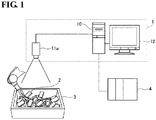
- FIG. 1 An example of a scene to which the present invention is applied will be described with reference to FIG. 1 .
- An object recognition apparatus 1 is a system that is installed in a production line provided with a picking system, and is configured to recognize the position and the orientation of an object 2 (three-dimensional object recognition) on a tray 3 through template matching using an image captured from a camera 11a.
- Objects to be recognized (that is, workpieces) 2 are stacked in bulk on the tray 3.
- the object recognition apparatus 1 captures an image from the camera 11a at predetermined time intervals, executes processing for recognizing the position and the orientation of each workpiece 2 included in the image using the image processing apparatus 10, and outputs its result to a PLC (programmable logic controller) 4 or a display 12, for example.
- the recognition result which is the output from the object recognition apparatus 1, is utilized to control a picking robot, control a processing apparatus or a printing apparatus, examine or measure the workpieces 2, for example.
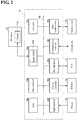
- the hardware configuration of the object recognition apparatus 1 will be described with reference to FIG. 2 .
- the object recognition apparatus 1 is constituted by a 3D sensor 11 and the image processing apparatus 10, in general.
- the 3D sensor 11 is a sensor for measuring three dimensions of the workpiece 2, and includes the camera 11a.
- the camera 11a is an image capturing device for capturing a digital image of the workpiece 2 into the image processing apparatus 10, and a CMOS (Complementary Metal-Oxide-Semiconductor) camera or a CCD (Charge-Coupled Device) camera can be suitably used, for example.
- the input image may have any format with regard to the resolution, color/monochrome, still image/moving image, gradation, and data format, and the format can be selected in accordance with types of workpiece 2 and the purpose of sensing as appropriate. If a special image other than a visible light image, such as and X-ray image or a thermo-image, is utilized to recognize or examine an object, then a camera corresponding to this image may also be used.
- the image processing apparatus 10 includes a CPU (central processing unit) 10a, a main memory 10b used as a working memory, a hard disk 10e that is a fixed storage unit, a camera interface 10c, an input interface 10f, a display controller 10g, a PLC interface 10h, a communication interface 10i, and a data reader/writer 10j. These units are connected to each other so as to be capable of data communication via a bus 10k.
- CPU central processing unit
- the camera interface 10c mediates data transmission between the CPU 10a and the camera 11a, and may also have an image buffer 10d for temporarily accumulating image data from the camera 11a.
- the input interface 10f mediates data transmission between the CPU 10a and the input unit.
- the input unit may also include a mouse 13, a keyboard, a touch panel, and a jog controller, for example.
- the display controller 10g is connected to the display 12 such as a liquid crystal monitor, and controls display on this display 12.
- the PLC interface 10h mediates data transmission between the CPU 10a and the PLC4.
- the communication interface 10i mediates data transmission between the CPU 10a and a console, or between a personal computer and a server, for example.
- the data reader/writer 10j mediates data transmission between the CPU 10a and the memory card 14 that is a recording medium.
- the image processing apparatus 10 can be constituted by a computer having a general-purpose architecture, and various processes are executed by the CPU 10a reading a program stored in the hard disk 10e or the memory card 14. Such a program may be distributed in a state in which the program is stored in a computer-readable recording medium such as the memory card 14 or an optical disk, or may be provided through the Internet. Note that the program according to the present embodiment may be provided as a single application program, or may be provided as a module that is incorporated in a part of another program. Part or all of the processes executed by this program may also be executed by a dedicated circuit such as an ASIC.
- FIG. 3 shows the configuration of the image processing apparatus 10.
- the image processing apparatus 10 operates as a template creation apparatus 120, a three-dimensional approximate position/orientation recognition apparatus 130, and a three-dimensional detailed position/orientation estimation apparatus 140 by the CPU 10a reading and executing a program stored in the hard disk 10e or the like.
- the template creation apparatus 120 creates a template showing characteristics of the contour of the workpiece 2 and characteristics of an internal unevenness shape of the workpiece 2. Specifically, the template creation apparatus 120 generates 2D images of the workpiece 2 viewed from various view points, using a 3D CAD representation of the workpiece 2 or 3D data acquired from the 3D sensor 11. Then, the template creation apparatus 120 creates a plurality of templates based on the generated luminance images and range images. The template creation apparatus 120 supplies the created templates, as template information, to the three-dimensional approximate position/orientation recognition apparatus 130 and the three-dimensional detailed position/orientation estimation apparatus 140.
- the template (that is, a 3D model) may have any format, and the template can have an array format in which feature quantities of a plurality of feature points in the image are written, for example.
- a pixel value luminance
- a luminance gradient direction a quantization gradient direction
- a Hog Hog
- HAAR-Like a Hog
- SIFT Scale-Invariant Feature Transform
- Three-dimensional approximate position/orientation recognition apparatus 130 Three-dimensional approximate position/orientation recognition apparatus 130
- the three-dimensional approximate position/orientation recognition apparatus 130 performs template matching on the 2D image and the 3D data captured from the camera 11a of the 3D sensor 11 using the template information supplied from the template creation apparatus 120, and recognizes the position/orientation of the three-dimensional object (that is, the workpiece 2) in the image. Specifically, the three-dimensional approximate position/orientation recognition apparatus 130 first captures the image obtained by inputting the workpiece 2, from the 3D sensor 11, and creates a set of images with different resolutions (that is, an image pyramid) from the captured input image (original image). The three-dimensional approximate position/orientation recognition apparatus 130 extracts the feature quantities of the image obtained by inputting the workpiece 2 by performing feature extraction on the created image pyramid.
- the feature quantities to be extracted are features that are the same type as those of the template, and an example of the feature quantities is a pixel value.
- the three-dimensional approximate position/orientation recognition apparatus 130 performs template matching using the extracted feature quantities of the image obtained by inputting the workpiece 2 and the template information of the workpiece 2 supplied from the template creation apparatus 120.
- the three-dimensional approximate position/orientation recognition apparatus 130 recognizes the rough position/orientation of the 3D model through template matching, and supplies the recognition result to the three-dimensional detailed position/orientation estimation apparatus 140 as pre-update position/orientation information expressing the position/orientation before the 3D model is updated.
- the three-dimensional detailed position/orientation estimation apparatus 140 estimates the three-dimensional position/orientation of the workpiece 2 utilizing the template information supplied from the template creation apparatus 120 and the pre-update position/orientation information supplied from the three-dimensional approximate position/orientation recognition apparatus 130.
- the three-dimensional detailed position/orientation estimation apparatus 140 includes an image acquisition unit 141, a 3D model acquisition unit 142, a pre-update position/orientation acquisition unit 143, a camera parameter acquisition unit 144, a first position/orientation estimation unit 145, a second position/orientation estimation unit 146, and a three-dimensional positioning result output unit 147.
- the three-dimensional detailed position/orientation estimation apparatus 140 estimates the three-dimensional position/orientation using the 3D data in the first position/orientation estimation unit 145, and estimates the three-dimensional position/orientation using the 2D image in the second position/orientation estimation unit 146.
- the second position/orientation estimation unit 146 has the feature that only three parameters, namely translations X and Y and rotation ⁇ , that can be estimated with high accuracy using the 2D image are optimized based on the result of the three-dimensional position/orientation estimation using the 3D data in the first position/orientation estimation unit 145 (details will be described later).
- each unit will be described.
- the image acquisition unit (the first and fourth acquisition units) 141 acquires 3D data (three-dimensional coordinate data) and the 2D image of the workpiece 2 from the 3D sensor 11.
- the image acquisition unit 141 outputs the acquired 3D data to the first position/orientation estimation unit 145, and outputs the acquired 2D image to the second position/orientation estimation unit 146.
- the 3D model acquisition unit (second acquisition unit) 142 When acquiring the template information expressing the 3D model from the template creation apparatus 120, the 3D model acquisition unit (second acquisition unit) 142 outputs, as the 3D model data, the acquired template information to the first position/orientation estimation unit 145 and the second position/orientation estimation unit 146,
- the pre-update position/orientation acquisition unit (the third acquisition unit) 143 acquires pre-update position/orientation information expressing the rough position/orientation of the 3D model recognized by the three-dimensional approximate position/orientation recognition apparatus 130, and outputs the acquired pre-update position/orientation information to the first position/orientation estimation unit 145.
- the pre-update position/orientation information is expressed by six parameters (x, y, z, ⁇ , ⁇ , ⁇ ) including three translation parameters (x, y, z) and three rotation parameters ( ⁇ , ⁇ , ⁇ ) about the X-axis, the Y-axis, and the Z-axis.
- the camera parameter acquisition unit 144 acquires, from the main memory 112, for example, internal parameters of the camera 11a utilized when the 3D sensor 11 generates the 3D data and the 2D image of the workpiece 2, and outputs the acquired internal parameters to the first position/orientation estimation unit 145 and the second position/orientation estimation unit 146.
- the internal parameter include a focal length of the camera 11a and the central position of the camera 11a.
- the first position/orientation estimation unit 145 matches the positions of a 3D point group of the 3D model data and a 3D point group of the 3D data (referred to as "first positioning" hereinafter, details will be described later) utilizing the pre-update position/orientation information supplied from the pre-update position/orientation acquisition unit 143, the 3D model data supplied from the 3D model acquisition unit 142, and the 3D data supplied from the image acquisition unit 141 together with the internal parameters of the camera 11a that is supplied from the camera parameter acquisition unit 144.
- an ICP Intelligent Closest Point
- another technique may also be used.
- the first position/orientation estimation unit 145 updates the position/orientation of the 3D model through first positioning, and outputs the updated 3D model data (first position/orientation information) expressing the position/orientation of the updated 3D model to the second position/orientation estimation unit 146.
- the second position/orientation estimation unit 146 adjusts the positions with respect to the translations x and y that define the 2D image plane and rotation ⁇ (referred to as "second positioning", details will be described later) utilizing the updated 3D model data supplied from the first position/orientation estimation unit 145 and the 2D image supplied from the image acquisition unit 141 together with the internal parameters of the camera 11a that are supplied from the camera parameter acquisition unit 144.
- the second position/orientation estimation unit 146 finally updates the position/orientation of the 3D model through second positioning. Then, the second position/orientation estimation unit 146 outputs, to a three-dimensional positioning result output unit 147, the final updated 3D model data (second position/orientation information) expressing the position/orientation of the 3D model that was finally updated.
- the three-dimensional positioning result output unit (output unit) 147 outputs the final updated 3D model data supplied from the second position/orientation estimation unit 146 to an external apparatus or a liquid crystal panel, for example.
- the final updated 3D model data is utilized to examine and measure a workpiece, position and assemble a workpiece, and control a picking robot, for example.
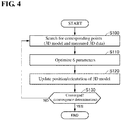
- FIG. 4 is a flowchart showing the first positioning.
- the first position/orientation estimation unit 145 searches for corresponding points using the 3D model data and the 3D data (step S100).
- Corresponding point search means processing in which, in a 3D space, with regard to each point (that is, 3D coordinates) of the 3D model, its closest point (that is, 3D coordinates) of the 3D data is searched for.
- first and second methods below are known as representative corresponding point search methods, the second method has a search range that is narrower than that of the first method and enables high-speed processing, and thus the second method is adopted in the present embodiment.
- the first method directly searches for, in a 3D space, points of the 3D data that are respectively closest to points of the 3D model.
- the points of the 3D model and the points of the 3D data are projected onto the same 2D image plane using the internal parameters of the camera 11a, and the points of the 3D data that are closest to the points of the 3D model are searched for, from the points of the 3D data that are located near the points of the 3D model projected on the 2D image plane.
- the first position/orientation estimation unit 145 calculates errors between pairs of the points of the 3D model and the points of the 3D data (also referred to as "corresponding point pairs” hereinafter) that were obtained in the above-described corresponding point search, using an error metric (for quantifying differences), such as a "distance between points” or a "distance between a point and a surface”.
- the first position/orientation estimation unit 145 determines the differences ( ⁇ x, ⁇ y, ⁇ z, ⁇ , ⁇ , and ⁇ ) between the six parameters for bringing the points of the 3D model closer to their corresponding points of the 3D data so as to minimize a target function (error function).
- the first position/orientation estimation unit 145 then obtains optimized six parameters (x + ⁇ x, y + ⁇ y, z + ⁇ z, ⁇ + ⁇ , ⁇ + ⁇ , ⁇ + ⁇ ) by updating the six parameters using the obtained differences ( ⁇ x, ⁇ y, ⁇ z, ⁇ , ⁇ , ⁇ ) between the six parameters (step S110).
- the first position/orientation estimation unit 145 updates the pre-update position/orientation of the 3D model using the optimized six parameters (step S120). That is, the first position/orientation estimation unit 145 obtains the pre-update position/orientation of the 3D model based on the pre-update position/orientation information received from the pre-update position/orientation acquisition unit 143, and updates the obtained pre-update position/orientation of the 3D model using the optimized six parameters.
- the first position/orientation estimation unit 145 determines whether or not positioning was performed in a state in which the 3D model was sufficiently close to the 3D data (also referred to as "convergence determination” hereinafter) (step S130).
- a convergence determination method is a method in which the first position/orientation estimation unit 145 compares the previous position/orientation Pose(n-1) of a 3D point group of the 3D model with the current position/orientation Pose(n), obtains a position/orientation update width Lup, and checks whether or not the obtained position/orientation update width Lup is below a set convergence threshold Dth.
- the first position/orientation estimation unit 145 determines that positioning was performed in a state in which the 3D point group of the 3D model was sufficiently close to the point group of the 3D data, and if the obtained position/orientation update width Lup exceeds the set convergence threshold Dth, then it determines that the 3D point group of the 3D model is not yet sufficiently close to the point group of the 3D data.
- step S130 NO
- processing returns to step S100, and the first position/orientation estimation unit 145 repeatedly executes the series of processes of steps S100, S110 and S130 in this order.
- the first position/orientation estimation unit 145 determines that positioning was performed in a state in which the 3D point group of the 3D model was sufficiently close to the 3D point group of the 3D data (step S130: YES), then the first position/orientation estimation unit 145 outputs the updated 3D model data expressing the position/orientation of the updated 3D model to the second position/orientation estimation unit 146, and ends the first positioning described above.
- an upper limit number of times N (N ⁇ 1) may be set for the number of repetitions of the series of processes of steps S100, S110, S120, and S130 in this order, for example, and if the number of repetitions of the series of processes reaches the upper limit number of times N, then the first positioning may also be forcibly ended.
- FIG. 5 is a flowchart showing second positioning.
- the second position/orientation estimation unit (two-dimensional model generation unit) 146 projects the 3D model onto a 2D image plane using the position/orientation of the 3D model positioned by the first position/orientation estimation unit 145, the 3D model data, and the internal parameters of the camera 11a, for example, calculates a gradient feature quantity of the contour of the 2D image, and thereby generates a 2D model (step S200).
- the 2D model is generated online during measurement in the present embodiment, it is also possible to generate a 2D model through offline processing in which 3D templates are created.
- the 2D model whose orientation is the closest to the current orientation is selected from among the plurality of 2D models that were already generated, and positioning (will be described later) is performed using the selected 2D model (will be described later).
- the second position/orientation estimation unit 146 searches for corresponding points using the 2D model data and the 2D data (step S210). Specifically, the second position/orientation estimation unit 146 calculates gradient features of the 2D image using a method similar to the method for generating the 2D model. The second position/orientation estimation unit 146 then derives, as the corresponding points, pixels (that is, gradient features of the 2D image) on the 2D image corresponding to the gradient features of the 2D model.
- the second position/orientation estimation unit (optimization unit) 146 optimizes three parameters, namely translations x and y (unit: pixel) and rotation ⁇ , on the 2D image by matching the positions of the 2D image and the 2D model on the 2D image plane based on the corresponding points on the 2D image (step S220).
- the second position/orientation estimation unit 146 converts the three parameters (translations x and y (unit: pixel), rotation ⁇ ) in the 2D space that were optimized using the 2D image into three parameters (translations x and y (unit: mm), rotation ⁇ ) in the 3D space (step S230).
- the second position/orientation estimation unit 146 converts the position/orientation in the 2D space into the position/orientation in the 3D space by solving a PnP problem using a correspondence relationship between the "2D coordinates obtained by updating the position/orientation of the 2D model using the optimized three parameters in the 2D space" and the "3D coordinates of the 3D model” and the internal parameters of the camera 11a (step S230).
- the second position/orientation estimation unit (updating unit) 146 further updates the position/orientation of the 3D model that was updated by the first position/orientation estimation unit 145 (also referred to as "the updated position/orientation of the 3D model” hereinafter) using the converted three parameters (translations x and y (unit: mm), rotation ⁇ ) in the 3D space (step S240). That is, the second position/orientation estimation unit 146 first obtains the position/orientation of the 3D model based on the updated 3D model data received from the first position/orientation estimation unit 145.
- the second position/orientation estimation unit 146 then further updates the updated position/orientation of the 3D model using the converted three parameters (translations x and y (unit: mm), rotation ⁇ ) in the 3D space. Thereafter, the second position/orientation estimation unit 146 performs convergence determination using a method that is similar to that for convergence determination performed by the first position/orientation estimation unit 145 shown in step S130 (step S250).
- step S250 NO
- processing returns to step S200, and the second position/orientation estimation unit 146 repeatedly executes the series of processes of steps S200, S210, S220, S230, S240, and S250 in this order.
- the second position/orientation estimation unit 146 determines that the 3D point group of the 3D model is sufficiently close to the 3D point group of the 3D data because the position/orientation update width Lup is below the convergence threshold Dth in the convergence determination (step S250: YES), then the second position/orientation estimation unit 146 outputs the final updated 3D model data expressing the position/orientation of the 3D model that was finally updated, to the three-dimensional positioning result output unit 147 (step S260), and ends second positioning described above.
- the second position/orientation estimation unit 146 may also output, to the three-dimensional positioning result output unit 147, as the optimal parameter information, the six parameters of the position/orientation derived in step S240 in order to obtain the position/orientation of the final updated 3D model together with the final updated 3D model data.
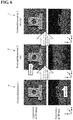
- FIG. 6 is a diagram showing the position/orientation of a workpiece, where ⁇ represents position/orientation 1 of a workpiece recognized by the three-dimensional approximate position/orientation recognition apparatus 130, ⁇ represents position/orientation 2 of the workpiece if three-dimensional position/orientation estimation (3D) is performed using 3D data based on the position/orientation 1, and y represents position/orientation 3 of the workpiece if three-dimensional position/orientation estimation (3D + 2D) is further performed using a 2D image based on the position/orientation 2.
- ⁇ represents position/orientation 1 of a workpiece recognized by the three-dimensional approximate position/orientation recognition apparatus 130
- ⁇ represents position/orientation 2 of the workpiece if three-dimensional position/orientation estimation (3D) is performed using 3D data based on the position/orientation 1
- y represents position/orientation 3 of the workpiece if three-dimensional position/orientation estimation (3D + 2D) is further performed using a 2D image based on the position/orientation 2.
- the position/orientation of the workpiece recognized by the three-dimensional approximate position/orientation recognition apparatus 130 is correct in the X-direction and the Y-direction, but deviates in the Z-direction (see the position/orientation 1 shown in FIG. 6 ⁇ ).
- the estimated position/orientation is correct in the Z-direction, but deviates in the X-direction and the Y-direction (see the position/orientation 2 shown in FIG. 6 ⁇ ).
- the position/orientation can be detected with high accuracy without deviating in any of the X-direction, the Y-direction, and the Z-direction (see the position/orientation 3 shown in FIG. 6 ⁇ ).
- the first position/orientation estimation unit 145 optimizes the six parameters (that is, translations x, y, and z and rotations ⁇ , ⁇ , and ⁇ ) using the 3D data
- the second position/orientation estimation unit 146 optimizes only the three parameters (that is, translations x and y, and rotation ⁇ ) that can be estimated using the 2D image with high accuracy based on the result of three-dimensional position/orientation estimation performed by the first position/orientation estimation unit 145 using the 3D data.
- Optimizing only the three parameters, namely translations x and y, and rotation ⁇ , that can be estimated with high accuracy using the 2D image in this manner makes it possible to prevent the problem that the three parameters, namely the position (translation z) in the camera's depth direction and rotations (rotations ⁇ and ⁇ ), cannot be estimated with high accuracy, which is a weakness of three-dimensional position/orientation estimation using a 2D image, and to estimate the three-dimensional position with a higher accuracy, compared with a conventional three-dimensional position/orientation estimation method with which the 3D data and the information of the 2D image are combined into one equation and the six parameters are optimized.
- 3D estimation three-dimensional position/orientation estimation using 3D data
- 2D estimation three-dimensional position estimation using a 2D image
- 3D estimation may also be performed after 2D estimation, or 3D estimation and 2D estimation may also be performed in parallel.
- a configuration may also be adopted in which, if 3D estimation is performed after 2D estimation, the first position/orientation estimation unit 145 receives the position/orientation information updated by the second position/orientation estimation unit 146, and the position/orientation information updated by the first position/orientation estimation unit 145 is output to the three-dimensional positioning result output unit 147.
- a configuration may also be adopted in which, if 3D estimation and 2D estimation are performed in parallel, the position/orientation information acquired by the pre-update position/orientation acquisition unit 143 is supplied to the first position/orientation estimation unit 145 and the second position/orientation estimation unit 146, the position/orientation information that is updated by the first position/orientation estimation unit 145 and the position/orientation information that is updated by the second position/orientation estimation unit 146 are supplied to the three-dimensional positioning result output unit 147, and the three-dimensional positioning result output unit 147 outputs the position/orientation of an object based on the position/orientation information updated by the first position/orientation estimation unit 145 and the position/orientation information updated by the second position/orientation estimation unit 146.
- the six parameters are optimized in 3D estimation in the present embodiment, it is not intended to limit the invention to only this embodiment.
- the three parameters namely translations x and y and rotation ⁇
- the remaining three parameters may also be optimized in 3D estimation.
- the first position/orientation estimation unit 145 may also optimize the three parameters (that is, translation z and rotations ⁇ and ⁇ ) for bringing the points of the 3D model closer to their corresponding points of the 3D data so as to minimize a target function (error function).
- unit does not simply mean a physical configuration but also includes the case where processing executed by the "unit” is realized by software. Also, processing performed by one "unit” or one apparatus may also be executed by two or more physical configurations or apparatuses, or processing realized by two or more "units” or two or more apparatuses may also be executed by one physical means or apparatus.
- Programs that implement the processes described in this specification may be stored in a recording medium. Use of this recording medium allows the above-described programs to be installed in the apparatuses constituting the image processing apparatus 10.
- the recording medium storing the above-described program may also be a non-transitory recording medium.
- the non-transitory recording medium is not particularly limited, and may be a recording medium such as a CD-ROM, for example.
- a position/orientation estimation apparatus configured to estimate a position and an orientation of an object, the apparatus including:
- the second position/orientation estimation unit (146) includes a two-dimensional model generation unit (step S200) configured to generate a two-dimensional model projected on the same plane as that of the two-dimensional image, based on the position/orientation information, an optimization unit (step S220) configured to optimize a translation parameter in the X-axis, a translation parameter in the Y-axis, and a rotation parameter about the Z-axis by matching the positions of the two-dimensional image and the two-dimensional model; and an updating unit (step S240) configured to update the position/orientation information using the optimized three parameters.
- the position/orientation estimation apparatus according to Additional Remark 1 or 2, further comprising:
- the position/orientation estimation apparatus according to Additional Remark 1 or 2, further comprising:
- the position/orientation estimation apparatus according to Additional Remark 1 or 2, further comprising:
- the position/orientation estimation apparatus in which, when performing positioning, the first position/orientation estimation unit (145) optimizes a translation parameter in the X-axis, a translation parameter in the Y-axis, a translation parameter in the Z-axis, a rotation parameter about the X-axis, a rotation parameter about the Y-axis, and a rotation parameter about the Z-axis so as to bring points of the three-dimensional model corresponding to points of the three-dimensional coordinate data closer to the corresponding points of the three-dimensional coordinate data, and updates the position/orientation information using the optimized six parameters.
- the position/orientation estimation apparatus in which, when performing positioning, the first position/orientation estimation unit (145) optimizes a translation parameter in the Z-axis, a rotation parameter about the X-axis, and a rotation parameter about the Y-axis so as to bring points of the three-dimensional model corresponding to points of the three-dimensional coordinate data closer to the corresponding points of the three-dimensional coordinate data, and updates the position/orientation information using the optimized three parameters.
Landscapes
- Engineering & Computer Science (AREA)
- Physics & Mathematics (AREA)
- Theoretical Computer Science (AREA)
- General Physics & Mathematics (AREA)
- Robotics (AREA)
- Mechanical Engineering (AREA)
- Computer Vision & Pattern Recognition (AREA)
- Computer Graphics (AREA)
- Geometry (AREA)
- Software Systems (AREA)
- Length Measuring Devices By Optical Means (AREA)
- Image Analysis (AREA)
- Image Processing (AREA)
Abstract
Description
- The present invention relates to a position and orientation estimation apparatus configured to estimate a position and an orientation of an object, and a position and orientation estimation method and a program for estimating a position and an orientation of an object.
- As robot technology advances dramatically in recent years, attempts are made to automate tasks by a robot, such as assembly and processing that up to now have been performed manually. When assembly or processing is automated by a robot, it is sometimes necessary to estimate the position and the orientation (also referred to as "position/orientation") of an object (also referred to as "workpiece" hereinafter) that is to be held (gripped) by the robot, such as a component or a product that is to be conveyed. Conventionally, in order to estimate the position/orientation of a workpiece, various methods have been proposed in which an image of the workpiece is captured with a camera and the position/orientation of the workpiece are estimated based on the obtained image (a two-dimensional image, which is also referred to as "2D image" hereinafter).
- Japanese Patent
5393318 - Japanese Patent
5393318 - However, in general, with a 2D image, a change in the size of an object, that is, a change in the camera's depth direction, is unlikely to appear, and thus, if the position/orientation of a workpiece is estimated using its 2D image, a translation z, rotation ϕ, and rotation γ, which are the parameters in the camera's depth direction, have low estimation accuracy. Thus, as in Japanese Patent
5393318 - The present invention has been made in view of the above-described circumstances, and it is an object thereof to provide a position and orientation estimation apparatus capable of increasing accuracy of estimating the position and the orientation of an object in the camera's depth direction, compared with a conventional technique, for example.
- A position and orientation estimation apparatus according to one aspect of the present invention is an estimation apparatus configured to estimate a position and an orientation of an object, the apparatus including a first acquisition unit configured to acquire a two-dimensional image of the object; a second acquisition unit configured to acquire a three-dimensional model expressing a three-dimensional shape of the object; a third acquisition unit configured to acquire position/orientation information expressing pre-update position and orientation of the object that are estimated; a second position/orientation estimation unit configured to update the position/orientation information with regard to a translation in an X-axis and a translation in a Y-axis, which are two different axes on a plane of the two-dimensional image, and a rotation about the Z-axis that is orthogonal to the X-axis and the Y-axis, using the three-dimensional model and the two-dimensional image; and an output unit configured to output the position and the orientation expressed by the updated position/orientation information as the position and the orientation of the object.
- With this configuration, when receiving the position/orientation information expressing the pre-update position and orientation of the object that is estimated, the second position/orientation estimation unit optimizes only the translation in the X-axis direction and the translation in the Y-axis direction (that is, translation x and translation y) that can be estimated with high accuracy using the two-dimensional image, and the rotation about the Z-axis (that is, rotation θ) that is orthogonal to the X-axis and the Y-axis.
- This makes it possible to prevent a problem, which is a weakness of three-dimensional position/orientation estimation using a two-dimensional image, of a conventional technique with which three parameters, namely, the position in the camera's depth direction (that is, translation z) and rotations (that is, rotation ϕ and rotation y), cannot be estimated with high accuracy, and to increase accuracy of estimating the position and the orientation of an object in the camera's depth direction, compared with a conventional technique.
- The above-described configuration may also have an aspect in which the second position/orientation estimation unit includes a two-dimensional model generation unit configured to generate a two-dimensional model projected on the same plane as that of the two-dimensional image, based on the position/orientation information, an optimization unit configured to optimize a translation parameter in the X-axis, a translation parameter in the Y-axis, and a rotation parameter about the Z-axis by matching the positions of the two-dimensional image and the two-dimensional model, and an updating unit configured to update the position/orientation information using the optimized three parameters.
- The above-described configuration may also have an aspect in which a fourth acquisition unit configured to acquire three-dimensional coordinate data expressing three-dimensional coordinates of a surface of the object that have been measured, and a first position/orientation estimation unit configured to update the position/orientation information through positioning using the three-dimensional model and the three-dimensional coordinate data are further included, and the first position/orientation estimation unit receives the position/orientation information acquired by the third acquisition unit, and the position/orientation information updated by the first position/orientation estimation unit is transmitted to the second position/orientation estimation unit.
- The above-described configuration may also have an aspect in which a fourth acquisition unit configured to acquire three-dimensional coordinate data expressing three-dimensional coordinates of a surface of the object that have been measured, and a first position/orientation estimation unit configured to update the position/orientation information through positioning using the three-dimensional model and the three-dimensional coordinate data are further included, and the first position/orientation estimation unit receives the position/orientation information updated by the second position/orientation estimation unit, and the position/orientation information updated by the first position/orientation estimation unit is transmitted to the output unit.
- The above-described configuration may also have an aspect in which a fourth acquisition unit configured to acquire three-dimensional coordinate data expressing three-dimensional coordinates of a surface of the object that have been measured, and a first position/orientation estimation unit configured to update position/orientation information through positioning using the three-dimensional model and the three-dimensional coordinate data are further included, and the position/orientation information acquired by the third acquisition unit is transmitted to the first and second position/orientation estimation units, the position/orientation information updated by the first position/orientation estimation unit and the position/orientation information updated by the second position/orientation estimation unit are transmitted to the output unit, and the output unit outputs the position and the orientation of the object based on the position/orientation information updated by the first position/orientation estimation unit and the position/orientation information updated by the second position/orientation estimation unit.
- The above-described configuration may also have an aspect in which, when performing positioning, the first position/orientation estimation unit optimizes a translation parameter in the X-axis, a translation parameter in the Y-axis, a translation parameter in the Z-axis, a rotation parameter about the X-axis, a rotation parameter about the Y-axis, and a rotation parameter about the Z-axis so as to bring points of the three-dimensional model corresponding to points of the three-dimensional coordinate data closer to the corresponding points of the three-dimensional coordinate data, and updates the position/orientation information using the optimized six parameters.
- The above-described configuration may also have an aspect in which, when performing positioning, the first position/orientation estimation unit optimizes a translation parameter in the Z-axis, a rotation parameter about the X-axis, and a rotation parameter about the Y-axis so as to bring points of the three-dimensional model corresponding to points of the three-dimensional coordinate data closer to the corresponding points of the three-dimensional coordinate data, and updates the position/orientation information using the optimized three parameters.
- According to the present invention, even if both pieces of information on 3D data and a 2D image are used, the accuracy of estimating the position and the orientation of a workpiece using both pieces of information on the 3D data and the 2D image can be increased, compared to a conventional technique.
-
-
FIG. 1 is a diagram showing the overall configuration of an object recognition apparatus. -
FIG. 2 is a diagram showing the hardware configuration of the object recognition apparatus. -
FIG. 3 is a diagram showing the configuration of an image processing apparatus. -
FIG. 4 is a flowchart showing first positioning. -
FIG. 5 is a flowchart showing second positioning. -
FIG. 6 is a diagram illustrating the position and the orientation of a workpiece. - Hereinafter, an embodiment of the present invention will be described with reference to the drawings.
- An example of a scene to which the present invention is applied will be described with reference to
FIG. 1 . - An
object recognition apparatus 1 is a system that is installed in a production line provided with a picking system, and is configured to recognize the position and the orientation of an object 2 (three-dimensional object recognition) on atray 3 through template matching using an image captured from acamera 11a. Objects to be recognized (that is, workpieces) 2 are stacked in bulk on thetray 3. Theobject recognition apparatus 1 captures an image from thecamera 11a at predetermined time intervals, executes processing for recognizing the position and the orientation of eachworkpiece 2 included in the image using theimage processing apparatus 10, and outputs its result to a PLC (programmable logic controller) 4 or adisplay 12, for example. The recognition result, which is the output from theobject recognition apparatus 1, is utilized to control a picking robot, control a processing apparatus or a printing apparatus, examine or measure theworkpieces 2, for example. - The hardware configuration of the
object recognition apparatus 1 will be described with reference toFIG. 2 . Theobject recognition apparatus 1 is constituted by a3D sensor 11 and theimage processing apparatus 10, in general. - The
3D sensor 11 is a sensor for measuring three dimensions of theworkpiece 2, and includes thecamera 11a. Thecamera 11a is an image capturing device for capturing a digital image of theworkpiece 2 into theimage processing apparatus 10, and a CMOS (Complementary Metal-Oxide-Semiconductor) camera or a CCD (Charge-Coupled Device) camera can be suitably used, for example. The input image may have any format with regard to the resolution, color/monochrome, still image/moving image, gradation, and data format, and the format can be selected in accordance with types ofworkpiece 2 and the purpose of sensing as appropriate. If a special image other than a visible light image, such as and X-ray image or a thermo-image, is utilized to recognize or examine an object, then a camera corresponding to this image may also be used. - The
image processing apparatus 10 includes a CPU (central processing unit) 10a, amain memory 10b used as a working memory, ahard disk 10e that is a fixed storage unit, acamera interface 10c, aninput interface 10f, adisplay controller 10g, aPLC interface 10h, a communication interface 10i, and a data reader/writer 10j. These units are connected to each other so as to be capable of data communication via abus 10k. - The
camera interface 10c mediates data transmission between theCPU 10a and thecamera 11a, and may also have animage buffer 10d for temporarily accumulating image data from thecamera 11a. Theinput interface 10f mediates data transmission between theCPU 10a and the input unit. The input unit may also include amouse 13, a keyboard, a touch panel, and a jog controller, for example. Thedisplay controller 10g is connected to thedisplay 12 such as a liquid crystal monitor, and controls display on thisdisplay 12. ThePLC interface 10h mediates data transmission between theCPU 10a and the PLC4. The communication interface 10i mediates data transmission between theCPU 10a and a console, or between a personal computer and a server, for example. The data reader/writer 10j mediates data transmission between theCPU 10a and thememory card 14 that is a recording medium. - The
image processing apparatus 10 can be constituted by a computer having a general-purpose architecture, and various processes are executed by theCPU 10a reading a program stored in thehard disk 10e or thememory card 14. Such a program may be distributed in a state in which the program is stored in a computer-readable recording medium such as thememory card 14 or an optical disk, or may be provided through the Internet. Note that the program according to the present embodiment may be provided as a single application program, or may be provided as a module that is incorporated in a part of another program. Part or all of the processes executed by this program may also be executed by a dedicated circuit such as an ASIC. -
FIG. 3 shows the configuration of theimage processing apparatus 10. Theimage processing apparatus 10 operates as atemplate creation apparatus 120, a three-dimensional approximate position/orientation recognition apparatus 130, and a three-dimensional detailed position/orientation estimation apparatus 140 by theCPU 10a reading and executing a program stored in thehard disk 10e or the like. - The
template creation apparatus 120 creates a template showing characteristics of the contour of theworkpiece 2 and characteristics of an internal unevenness shape of theworkpiece 2. Specifically, thetemplate creation apparatus 120 generates 2D images of theworkpiece 2 viewed from various view points, using a 3D CAD representation of theworkpiece 3D sensor 11. Then, thetemplate creation apparatus 120 creates a plurality of templates based on the generated luminance images and range images. Thetemplate creation apparatus 120 supplies the created templates, as template information, to the three-dimensional approximate position/orientation recognition apparatus 130 and the three-dimensional detailed position/orientation estimation apparatus 140. Note that the template (that is, a 3D model) may have any format, and the template can have an array format in which feature quantities of a plurality of feature points in the image are written, for example. A pixel value (luminance), a luminance gradient direction, a quantization gradient direction, a Hog (Histograms of Oriented Gradients), HAAR-Like, SIFT (Scale-Invariant Feature Transform) can be used as the feature points, and a normal direction and a normal direction distribution can be used as the feature quantity utilizing the range image, for example. - The three-dimensional approximate position/
orientation recognition apparatus 130 performs template matching on the 2D image and the 3D data captured from thecamera 11a of the3D sensor 11 using the template information supplied from thetemplate creation apparatus 120, and recognizes the position/orientation of the three-dimensional object (that is, the workpiece 2) in the image. Specifically, the three-dimensional approximate position/orientation recognition apparatus 130 first captures the image obtained by inputting theworkpiece 2, from the3D sensor 11, and creates a set of images with different resolutions (that is, an image pyramid) from the captured input image (original image). The three-dimensional approximate position/orientation recognition apparatus 130 extracts the feature quantities of the image obtained by inputting theworkpiece 2 by performing feature extraction on the created image pyramid. Herein, the feature quantities to be extracted are features that are the same type as those of the template, and an example of the feature quantities is a pixel value. The three-dimensional approximate position/orientation recognition apparatus 130 performs template matching using the extracted feature quantities of the image obtained by inputting theworkpiece 2 and the template information of theworkpiece 2 supplied from thetemplate creation apparatus 120. The three-dimensional approximate position/orientation recognition apparatus 130 recognizes the rough position/orientation of the 3D model through template matching, and supplies the recognition result to the three-dimensional detailed position/orientation estimation apparatus 140 as pre-update position/orientation information expressing the position/orientation before the 3D model is updated. - The three-dimensional detailed position/
orientation estimation apparatus 140 estimates the three-dimensional position/orientation of theworkpiece 2 utilizing the template information supplied from thetemplate creation apparatus 120 and the pre-update position/orientation information supplied from the three-dimensional approximate position/orientation recognition apparatus 130. The three-dimensional detailed position/orientation estimation apparatus 140 includes animage acquisition unit 141, a 3Dmodel acquisition unit 142, a pre-update position/orientation acquisition unit 143, a cameraparameter acquisition unit 144, a first position/orientation estimation unit 145, a second position/orientation estimation unit 146, and a three-dimensional positioningresult output unit 147. - The three-dimensional detailed position/
orientation estimation apparatus 140 estimates the three-dimensional position/orientation using the 3D data in the first position/orientation estimation unit 145, and estimates the three-dimensional position/orientation using the 2D image in the second position/orientation estimation unit 146. Herein, the second position/orientation estimation unit 146 has the feature that only three parameters, namely translations X and Y and rotation θ, that can be estimated with high accuracy using the 2D image are optimized based on the result of the three-dimensional position/orientation estimation using the 3D data in the first position/orientation estimation unit 145 (details will be described later). Hereinafter, each unit will be described. - The image acquisition unit (the first and fourth acquisition units) 141 acquires 3D data (three-dimensional coordinate data) and the 2D image of the
workpiece 2 from the3D sensor 11. Theimage acquisition unit 141 outputs the acquired 3D data to the first position/orientation estimation unit 145, and outputs the acquired 2D image to the second position/orientation estimation unit 146. - When acquiring the template information expressing the 3D model from the
template creation apparatus 120, the 3D model acquisition unit (second acquisition unit) 142 outputs, as the 3D model data, the acquired template information to the first position/orientation estimation unit 145 and the second position/orientation estimation unit 146, - The pre-update position/orientation acquisition unit (the third acquisition unit) 143 acquires pre-update position/orientation information expressing the rough position/orientation of the 3D model recognized by the three-dimensional approximate position/
orientation recognition apparatus 130, and outputs the acquired pre-update position/orientation information to the first position/orientation estimation unit 145. Note that the pre-update position/orientation information is expressed by six parameters (x, y, z, ϕ, γ, θ) including three translation parameters (x, y, z) and three rotation parameters (ϕ, γ, θ) about the X-axis, the Y-axis, and the Z-axis. - The camera
parameter acquisition unit 144 acquires, from the main memory 112, for example, internal parameters of thecamera 11a utilized when the3D sensor 11 generates the 3D data and the 2D image of theworkpiece 2, and outputs the acquired internal parameters to the first position/orientation estimation unit 145 and the second position/orientation estimation unit 146. Examples of the internal parameter include a focal length of thecamera 11a and the central position of thecamera 11a. - The first position/
orientation estimation unit 145 matches the positions of a 3D point group of the 3D model data and a 3D point group of the 3D data (referred to as "first positioning" hereinafter, details will be described later) utilizing the pre-update position/orientation information supplied from the pre-update position/orientation acquisition unit 143, the 3D model data supplied from the 3Dmodel acquisition unit 142, and the 3D data supplied from theimage acquisition unit 141 together with the internal parameters of thecamera 11a that is supplied from the cameraparameter acquisition unit 144. Although it is assumed that an ICP (Iterative Closest Point) algorithm is utilized as a technique for positioning 3D point groups in the first positioning in the present embodiment, another technique may also be used. The first position/orientation estimation unit 145 updates the position/orientation of the 3D model through first positioning, and outputs the updated 3D model data (first position/orientation information) expressing the position/orientation of the updated 3D model to the second position/orientation estimation unit 146. - The second position/
orientation estimation unit 146 adjusts the positions with respect to the translations x and y that define the 2D image plane and rotation θ (referred to as "second positioning", details will be described later) utilizing the updated 3D model data supplied from the first position/orientation estimation unit 145 and the 2D image supplied from theimage acquisition unit 141 together with the internal parameters of thecamera 11a that are supplied from the cameraparameter acquisition unit 144. The second position/orientation estimation unit 146 finally updates the position/orientation of the 3D model through second positioning. Then, the second position/orientation estimation unit 146 outputs, to a three-dimensional positioningresult output unit 147, the final updated 3D model data (second position/orientation information) expressing the position/orientation of the 3D model that was finally updated. - The three-dimensional positioning result output unit (output unit) 147 outputs the final updated 3D model data supplied from the second position/
orientation estimation unit 146 to an external apparatus or a liquid crystal panel, for example. The final updated 3D model data is utilized to examine and measure a workpiece, position and assemble a workpiece, and control a picking robot, for example. - Hereinafter, first positioning executed by the first position/
orientation estimation unit 145 will be described.FIG. 4 is a flowchart showing the first positioning. - The first position/
orientation estimation unit 145 searches for corresponding points using the 3D model data and the 3D data (step S100). Corresponding point search means processing in which, in a 3D space, with regard to each point (that is, 3D coordinates) of the 3D model, its closest point (that is, 3D coordinates) of the 3D data is searched for. Although first and second methods below are known as representative corresponding point search methods, the second method has a search range that is narrower than that of the first method and enables high-speed processing, and thus the second method is adopted in the present embodiment. - The first method directly searches for, in a 3D space, points of the 3D data that are respectively closest to points of the 3D model.
- The points of the 3D model and the points of the 3D data are projected onto the same 2D image plane using the internal parameters of the
camera 11a, and the points of the 3D data that are closest to the points of the 3D model are searched for, from the points of the 3D data that are located near the points of the 3D model projected on the 2D image plane. - The first position/
orientation estimation unit 145 calculates errors between pairs of the points of the 3D model and the points of the 3D data (also referred to as "corresponding point pairs" hereinafter) that were obtained in the above-described corresponding point search, using an error metric (for quantifying differences), such as a "distance between points" or a "distance between a point and a surface". The first position/orientation estimation unit 145 determines the differences (Δx, Δy, Δz, Δϕ, Δγ, and Δθ) between the six parameters for bringing the points of the 3D model closer to their corresponding points of the 3D data so as to minimize a target function (error function). The first position/orientation estimation unit 145 then obtains optimized six parameters (x + Δx, y + Δy, z + Δz, ϕ + Δϕ, γ + Δγ, θ + Δθ) by updating the six parameters using the obtained differences (Δx, Δy, Δz, Δϕ, Δγ, Δθ) between the six parameters (step S110). - The first position/
orientation estimation unit 145 updates the pre-update position/orientation of the 3D model using the optimized six parameters (step S120). That is, the first position/orientation estimation unit 145 obtains the pre-update position/orientation of the 3D model based on the pre-update position/orientation information received from the pre-update position/orientation acquisition unit 143, and updates the obtained pre-update position/orientation of the 3D model using the optimized six parameters. - When updating the pre-update position/orientation of the 3D model, the first position/
orientation estimation unit 145 determines whether or not positioning was performed in a state in which the 3D model was sufficiently close to the 3D data (also referred to as "convergence determination" hereinafter) (step S130). One example of a convergence determination method is a method in which the first position/orientation estimation unit 145 compares the previous position/orientation Pose(n-1) of a 3D point group of the 3D model with the current position/orientation Pose(n), obtains a position/orientation update width Lup, and checks whether or not the obtained position/orientation update width Lup is below a set convergence threshold Dth. If the obtained position/orientation update width Lup is below the set convergence threshold Dth, the first position/orientation estimation unit 145 determines that positioning was performed in a state in which the 3D point group of the 3D model was sufficiently close to the point group of the 3D data, and if the obtained position/orientation update width Lup exceeds the set convergence threshold Dth, then it determines that the 3D point group of the 3D model is not yet sufficiently close to the point group of the 3D data. - When the first position/
orientation estimation unit 145 determines that the 3D point group of the 3D model is not yet sufficiently close to the 3D point group of the 3D data (step S130: NO), processing returns to step S100, and the first position/orientation estimation unit 145 repeatedly executes the series of processes of steps S100, S110 and S130 in this order. - On the other hand, when the first position/
orientation estimation unit 145 determines that positioning was performed in a state in which the 3D point group of the 3D model was sufficiently close to the 3D point group of the 3D data (step S130: YES), then the first position/orientation estimation unit 145 outputs the updated 3D model data expressing the position/orientation of the updated 3D model to the second position/orientation estimation unit 146, and ends the first positioning described above. - Note that even if the series of processes of steps S100, S110, S120, and S130 is executed in this order a predetermined number of times, the position/orientation updated width Lup will sometimes not fall below the convergence threshold Dth. In order to handle such a case, an upper limit number of times N (N≥1) may be set for the number of repetitions of the series of processes of steps S100, S110, S120, and S130 in this order, for example, and if the number of repetitions of the series of processes reaches the upper limit number of times N, then the first positioning may also be forcibly ended.
- Hereinafter, second positioning executed by the second position/
orientation estimation unit 146 will be described.FIG. 5 is a flowchart showing second positioning. - The second position/orientation estimation unit (two-dimensional model generation unit) 146 projects the 3D model onto a 2D image plane using the position/orientation of the 3D model positioned by the first position/
orientation estimation unit 145, the 3D model data, and the internal parameters of thecamera 11a, for example, calculates a gradient feature quantity of the contour of the 2D image, and thereby generates a 2D model (step S200). Although the 2D model is generated online during measurement in the present embodiment, it is also possible to generate a 2D model through offline processing in which 3D templates are created. If the 2D models were generated through offline processing in advance in this manner, the 2D model whose orientation is the closest to the current orientation is selected from among the plurality of 2D models that were already generated, and positioning (will be described later) is performed using the selected 2D model (will be described later). - When generating the 2D model, the second position/
orientation estimation unit 146 searches for corresponding points using the 2D model data and the 2D data (step S210). Specifically, the second position/orientation estimation unit 146 calculates gradient features of the 2D image using a method similar to the method for generating the 2D model. The second position/orientation estimation unit 146 then derives, as the corresponding points, pixels (that is, gradient features of the 2D image) on the 2D image corresponding to the gradient features of the 2D model. - The second position/orientation estimation unit (optimization unit) 146 optimizes three parameters, namely translations x and y (unit: pixel) and rotation θ, on the 2D image by matching the positions of the 2D image and the 2D model on the 2D image plane based on the corresponding points on the 2D image (step S220). The second position/
orientation estimation unit 146 converts the three parameters (translations x and y (unit: pixel), rotation θ) in the 2D space that were optimized using the 2D image into three parameters (translations x and y (unit: mm), rotation θ) in the 3D space (step S230). Specifically, because 3D coordinates (mm) of the 3D model corresponding to the 2D coordinates (pixel) of the 2D model can be calculated during the generation of the 2D model described above, the second position/orientation estimation unit 146 converts the position/orientation in the 2D space into the position/orientation in the 3D space by solving a PnP problem using a correspondence relationship between the "2D coordinates obtained by updating the position/orientation of the 2D model using the optimized three parameters in the 2D space" and the "3D coordinates of the 3D model" and the internal parameters of thecamera 11a (step S230). - The second position/orientation estimation unit (updating unit) 146 further updates the position/orientation of the 3D model that was updated by the first position/orientation estimation unit 145 (also referred to as "the updated position/orientation of the 3D model" hereinafter) using the converted three parameters (translations x and y (unit: mm), rotation θ) in the 3D space (step S240). That is, the second position/
orientation estimation unit 146 first obtains the position/orientation of the 3D model based on the updated 3D model data received from the first position/orientation estimation unit 145. The second position/orientation estimation unit 146 then further updates the updated position/orientation of the 3D model using the converted three parameters (translations x and y (unit: mm), rotation θ) in the 3D space. Thereafter, the second position/orientation estimation unit 146 performs convergence determination using a method that is similar to that for convergence determination performed by the first position/orientation estimation unit 145 shown in step S130 (step S250). - If the second position/
orientation estimation unit 146 determines that the 3D point group of the 3D model is not yet sufficiently close to the 3D point group of the 3D data because the position/orientation update width Lup exceeds the convergence threshold Dth (step S250: NO), processing returns to step S200, and the second position/orientation estimation unit 146 repeatedly executes the series of processes of steps S200, S210, S220, S230, S240, and S250 in this order. - On the other hand, if the second position/
orientation estimation unit 146 determines that the 3D point group of the 3D model is sufficiently close to the 3D point group of the 3D data because the position/orientation update width Lup is below the convergence threshold Dth in the convergence determination (step S250: YES), then the second position/orientation estimation unit 146 outputs the final updated 3D model data expressing the position/orientation of the 3D model that was finally updated, to the three-dimensional positioning result output unit 147 (step S260), and ends second positioning described above. Note that in step S260, the second position/orientation estimation unit 146 may also output, to the three-dimensional positioningresult output unit 147, as the optimal parameter information, the six parameters of the position/orientation derived in step S240 in order to obtain the position/orientation of the final updated 3D model together with the final updated 3D model data. -
FIG. 6 is a diagram showing the position/orientation of a workpiece, where α represents position/orientation 1 of a workpiece recognized by the three-dimensional approximate position/orientation recognition apparatus 130, β represents position/orientation 2 of the workpiece if three-dimensional position/orientation estimation (3D) is performed using 3D data based on the position/orientation 1, and y represents position/orientation 3 of the workpiece if three-dimensional position/orientation estimation (3D + 2D) is further performed using a 2D image based on the position/orientation 2. - The position/orientation of the workpiece recognized by the three-dimensional approximate position/
orientation recognition apparatus 130 is correct in the X-direction and the Y-direction, but deviates in the Z-direction (see the position/orientation 1 shown inFIG. 6 α). - If three-dimensional position/orientation estimation is performed using only the 3D data based on the position/
orientation 1, the estimated position/orientation is correct in the Z-direction, but deviates in the X-direction and the Y-direction (see the position/orientation 2 shown inFIG. 6 β). - It is found that, in this regard, if three-dimensional position/orientation estimation is further performed using the 2D image based on the position/
orientation 2 after the three-dimensional position/orientation estimation is performed using the 3D data, the position/orientation can be detected with high accuracy without deviating in any of the X-direction, the Y-direction, and the Z-direction (see the position/orientation 3 shown inFIG. 6 γ). - As described above, according to the present embodiment, the first position/
orientation estimation unit 145 optimizes the six parameters (that is, translations x, y, and z and rotations ϕ, γ, and θ) using the 3D data, and the second position/orientation estimation unit 146 optimizes only the three parameters (that is, translations x and y, and rotation θ) that can be estimated using the 2D image with high accuracy based on the result of three-dimensional position/orientation estimation performed by the first position/orientation estimation unit 145 using the 3D data. Optimizing only the three parameters, namely translations x and y, and rotation θ, that can be estimated with high accuracy using the 2D image in this manner makes it possible to prevent the problem that the three parameters, namely the position (translation z) in the camera's depth direction and rotations (rotations ϕ and γ), cannot be estimated with high accuracy, which is a weakness of three-dimensional position/orientation estimation using a 2D image, and to estimate the three-dimensional position with a higher accuracy, compared with a conventional three-dimensional position/orientation estimation method with which the 3D data and the information of the 2D image are combined into one equation and the six parameters are optimized. - Also, it is possible to speed up optimization, compared with the above-described conventional three-dimensional position/orientation estimation method. That is, with the conventional method, it is necessary to combine 3D data and information of the 2D image into one formula and solve a complicated nonlinear optimization problem, whereas in the present embodiment, two linear optimization problems should be solved, that is, six parameters should be optimized using 3D data and three parameters should be optimized using a 2D image, and thus it is not necessary to solve a complicated nonlinear optimization problem, and its processing can be sped up.
- The above-described embodiment is a merely example for illustrating the present invention, and various modifications can be made to the present invention without departing from the gist thereof.
- For example, various combinations of three-dimensional position/orientation estimation using 3D data ("3D estimation" hereinafter) and three-dimensional position estimation using a 2D image ("2D estimation" hereinafter) are conceivable. Although the mode for performing 2D estimation after 3D estimation was described in the present embodiment, 3D estimation may also be performed after 2D estimation, or 3D estimation and 2D estimation may also be performed in parallel. For example, a configuration may also be adopted in which, if 3D estimation is performed after 2D estimation, the first position/
orientation estimation unit 145 receives the position/orientation information updated by the second position/orientation estimation unit 146, and the position/orientation information updated by the first position/orientation estimation unit 145 is output to the three-dimensional positioningresult output unit 147. On the other hand, a configuration may also be adopted in which, if 3D estimation and 2D estimation are performed in parallel, the position/orientation information acquired by the pre-update position/orientation acquisition unit 143 is supplied to the first position/orientation estimation unit 145 and the second position/orientation estimation unit 146, the position/orientation information that is updated by the first position/orientation estimation unit 145 and the position/orientation information that is updated by the second position/orientation estimation unit 146 are supplied to the three-dimensional positioningresult output unit 147, and the three-dimensional positioningresult output unit 147 outputs the position/orientation of an object based on the position/orientation information updated by the first position/orientation estimation unit 145 and the position/orientation information updated by the second position/orientation estimation unit 146. - Although the six parameters (translations x, y, and z, and rotations ϕ, γ, and θ) are optimized in 3D estimation in the present embodiment, it is not intended to limit the invention to only this embodiment. For example, because the three parameters, namely translations x and y and rotation θ, are optimized in 2D estimation, the remaining three parameters (that is, translation z and rotations ϕ and γ) may also be optimized in 3D estimation. Specifically, the first position/
orientation estimation unit 145 may also optimize the three parameters (that is, translation z and rotations ϕ and γ) for bringing the points of the 3D model closer to their corresponding points of the 3D data so as to minimize a target function (error function). - In this specification, "unit" does not simply mean a physical configuration but also includes the case where processing executed by the "unit" is realized by software. Also, processing performed by one "unit" or one apparatus may also be executed by two or more physical configurations or apparatuses, or processing realized by two or more "units" or two or more apparatuses may also be executed by one physical means or apparatus.
- The order of the processing steps described in this specification may be suitably changed or the processing steps may be executed in parallel, as long as no contradiction arises in the processing content.
- Programs that implement the processes described in this specification may be stored in a recording medium. Use of this recording medium allows the above-described programs to be installed in the apparatuses constituting the
image processing apparatus 10. Herein, the recording medium storing the above-described program may also be a non-transitory recording medium. The non-transitory recording medium is not particularly limited, and may be a recording medium such as a CD-ROM, for example. - A position/orientation estimation apparatus configured to estimate a position and an orientation of an object, the apparatus including:
- a first acquisition unit (141) configured to acquire a two-dimensional image of the object;
- a second acquisition unit (142) configured to acquire a three-dimensional model expressing a three-dimensional shape of the object;
- a third acquisition unit (143) configured to acquire position/orientation information expressing pre-update position and orientation of the object that are estimated;
- a second position/orientation estimation unit (146) configured to update the position/orientation information with regard to a translation in an X-axis and a translation in a Y-axis, which are two different axes on a plane of the two-dimensional image, and a rotation about a Z-axis that is orthogonal to the X-axis and the Y-axis, using the three-dimensional model and the two-dimensional image; and
- an output unit (147) configured to output the position and the orientation expressed by the updated position/orientation information as the position and the orientation of the object.
- The position/orientation estimation apparatus according to
Additional Remark 1,
in which the second position/orientation estimation unit (146) includes
a two-dimensional model generation unit (step S200) configured to generate a two-dimensional model projected on the same plane as that of the two-dimensional image, based on the position/orientation information,
an optimization unit (step S220) configured to optimize a translation parameter in the X-axis, a translation parameter in the Y-axis, and a rotation parameter about the Z-axis by matching the positions of the two-dimensional image and the two-dimensional model; and
an updating unit (step S240) configured to update the position/orientation information using the optimized three parameters. - The position/orientation estimation apparatus according to
Additional Remark - a fourth acquisition unit (141) configured to acquire three-dimensional coordinate data expressing three-dimensional coordinates of a surface of the object that have been measured; and
- a first position/orientation estimation unit (145) configured to update the position/orientation information through positioning using the three-dimensional model and the three-dimensional coordinate data,
- in which the first position/orientation estimation unit receives the position/orientation information acquired by the third acquisition unit, and the position/orientation information updated by the first position/orientation estimation unit is transmitted to the second position/orientation estimation unit.
- The position/orientation estimation apparatus according to
Additional Remark - a fourth acquisition unit (141) configured to acquire three-dimensional coordinate data expressing three-dimensional coordinates of a surface of the object that have been measured; and
- a first position/orientation estimation unit (145) configured to update the position/orientation information through positioning using the three-dimensional model and the three-dimensional coordinate data,
- in which the first position/orientation estimation unit receives the position/orientation information updated by the second position/orientation estimation unit, and the position/orientation information updated by the first position/orientation estimation unit is transmitted to the output unit.
- The position/orientation estimation apparatus according to
Additional Remark - a fourth acquisition unit (141) configured to acquire three-dimensional coordinate data expressing three-dimensional coordinates of a surface of the object that have been measured; and
- a first position/orientation estimation unit (145) configured to update the position/orientation information through positioning using the three-dimensional model and the three-dimensional coordinate data,
- in which the position/orientation information acquired by the third acquisition unit is transmitted to the first and second position/orientation estimation units, and the position/orientation information that is updated by the first position/orientation estimation unit and the position/orientation information that is updated by the second position/orientation estimation unit are transmitted to the output unit, and
- the output unit outputs the position and the orientation of the object based on the position/orientation information that is updated by the first position/orientation estimation unit and the position/orientation information that is updated by the second position/orientation estimation unit.
- The position/orientation estimation apparatus according to any one of
Additional Remarks 3 to 5,
in which, when performing positioning, the first position/orientation estimation unit (145) optimizes a translation parameter in the X-axis, a translation parameter in the Y-axis, a translation parameter in the Z-axis, a rotation parameter about the X-axis, a rotation parameter about the Y-axis, and a rotation parameter about the Z-axis so as to bring points of the three-dimensional model corresponding to points of the three-dimensional coordinate data closer to the corresponding points of the three-dimensional coordinate data, and updates the position/orientation information using the optimized six parameters. - The position/orientation estimation apparatus according to any one of
Additional Remarks 3 to 5,
in which, when performing positioning, the first position/orientation estimation unit (145) optimizes a translation parameter in the Z-axis, a rotation parameter about the X-axis, and a rotation parameter about the Y-axis so as to bring points of the three-dimensional model corresponding to points of the three-dimensional coordinate data closer to the corresponding points of the three-dimensional coordinate data, and updates the position/orientation information using the optimized three parameters. -
- 1 Object recognition apparatus
- 2 Workpiece
- 3 Tray
- 4 PLC
- 10 Image processing apparatus
- 11 3D sensor
- 11a Camera
- 12 Display
- 13 Mouse
- 14 Memory card
- 120 Template creation apparatus
- 130 Three-dimensional approximate position/orientation recognition apparatus
- 140 Three-dimensional detailed position/orientation estimation apparatus
- 141 Image acquisition unit
- 142 3D model acquisition unit
- 143 Pre-update position/orientation acquisition unit
- 144 Camera parameter acquisition unit
- 145 First three-dimensional position/orientation estimation unit
- 146 Second three-dimensional position/orientation estimation unit
- 147 Three-dimensional positioning result output unit
Claims (9)
- A position/orientation estimation apparatus (140) configured to estimate a position and an orientation of an object, the position/orientation estimation apparatus (140) comprising:a first acquisition unit (141) configured to acquire a two-dimensional image of the object;a second acquisition unit (142) configured to acquire a three-dimensional model expressing a three-dimensional shape of the object; anda third acquisition unit (143) configured to acquire position/orientation information expressing pre-update position and orientation of the object that are estimated;a second position/orientation estimation unit (146) configured to update the position/orientation information with regard to a translation in an X-axis and a translation in a Y-axis, which are two different axes on a plane of the two-dimensional image, and a rotation about a Z-axis that is orthogonal to the X-axis and the Y-axis, using the three-dimensional model and the two-dimensional image; andan output unit (147) configured to output the position and the orientation expressed by the updated position/orientation information as the position and the orientation of the object.
- The position/orientation estimation apparatus (140) according to claim 1,
wherein the second position/orientation estimation unit (146) includes:a two-dimensional model generation unit (step S200) configured to generate a two-dimensional model projected on the same plane as that of the two-dimensional image, based on the position/orientation information,an optimization unit (step S220) configured to optimize a translation parameter in the X-axis, a translation parameter in the Y-axis, and a rotation parameter about the Z-axis by matching the positions of the two-dimensional image and the two-dimensional model; andan updating unit (step S240) configured to update the position/orientation information using the optimized three parameters. - The position/orientation estimation apparatus (140) according to claim 1 or 2, further comprising:a fourth acquisition unit (141) configured to acquire three-dimensional coordinate data expressing three-dimensional coordinates of a surface of the object that have been measured; anda first position/orientation estimation unit (145) configured to update the position/orientation information through positioning using the three-dimensional model and the three-dimensional coordinate data,wherein the first position/orientation estimation unit (145) receives the position/orientation information acquired by the third acquisition unit (143), and the position/orientation information updated by the first position/orientation estimation unit (145) is transmitted to the second position/orientation estimation unit (146).
- The position/orientation estimation apparatus (140) according to claim 1 or 2, further comprising:a fourth acquisition unit (141) configured to acquire three-dimensional coordinate data expressing three-dimensional coordinates of a surface of the object that have been measured; anda first position/orientation estimation unit (145) configured to update the position/orientation information through positioning using the three-dimensional model and the three-dimensional coordinate data,wherein the first position/orientation estimation unit (145) receives the position/orientation information updated by the second position/orientation estimation unit (146), and the position/orientation information updated by the first position/orientation estimation unit (145) is transmitted to the output unit (147).
- The position/orientation estimation apparatus (140) according to claim 1 or 2, further comprising:a fourth acquisition unit (141) configured to acquire three-dimensional coordinate data expressing three-dimensional coordinates of a surface of the object that have been measured; anda first position/orientation estimation unit (145) configured to update the position/orientation information through positioning using the three-dimensional model and the three-dimensional coordinate data,wherein the position/orientation information acquired by the third acquisition unit (143) is transmitted to the first and second position/orientation estimation units (145, 146), and the position/orientation information that is updated by the first position/orientation estimation unit (145) and the position/orientation information that is updated by the second position/orientation estimation unit (146) are transmitted to the output unit (147), andthe output unit (147) outputs the position and the orientation of the object based on the position/orientation information that is updated by the first position/orientation estimation unit (145) and the position/orientation information that is updated by the second position/orientation estimation unit (146).
- The position/orientation estimation apparatus (140) according to any one of claims 3 to 5,
wherein, when performing positioning, the first position/orientation estimation unit (145) optimizes a translation parameter in the X-axis, a translation parameter in the Y-axis, a translation parameter in the Z-axis, a rotation parameter about the X-axis, a rotation parameter about the Y-axis, and a rotation parameter about the Z-axis so as to bring points of the three-dimensional model corresponding to points of the three-dimensional coordinate data closer to the corresponding points of the three-dimensional coordinate data, and updates the position/orientation information using the optimized six parameters. - The position/orientation estimation apparatus (140) according to any one of claims 3 to 5,
wherein, when performing positioning, the first position/orientation estimation unit (145) optimizes a translation parameter in the Z-axis, a rotation parameter about the X-axis, and a rotation parameter about the Y-axis so as to bring points of the three-dimensional model corresponding to points of the three-dimensional coordinate data closer to the corresponding points of the three-dimensional coordinate data, and updates the position/orientation information using the optimized three parameters. - A method for estimating a position and an orientation of an object, the method comprising:a first acquisition step of acquiring a two-dimensional image of the object;a second acquisition step of acquiring a three-dimensional model expressing a three-dimensional shape of the object; anda third acquisition step of acquiring position/orientation information expressing pre-update position and orientation of the object that are estimated;a second position/orientation estimation step of updating the position/orientation information with regard to a translation in an X-axis and a translation in a Y-axis, which are two different axes on a plane of the two-dimensional image, and a rotation about a Z-axis that is orthogonal to the X-axis and the Y-axis, using the three-dimensional model and the two-dimensional image; andan output step of outputting the position and the orientation expressed by the updated position/orientation information as the position and the orientation of the object.
- A program for causing a computer to estimate a position and an orientation of an object, the program causing the computer to execute:a first acquisition step of acquiring a two-dimensional image of the object;a second acquisition step of acquiring a three-dimensional model expressing a three-dimensional shape of the object;a third acquisition step of acquiring position/orientation information expressing pre-update position and orientation of the object that are estimated;a second position/orientation estimation step of updating the position/orientation information with regard to a translation in an X-axis and a translation in a Y-axis, which are two different axes on a plane of the two-dimensional image, and a rotation about a Z-axis that is orthogonal to the X-axis and the Y-axis, using the three-dimensional model and the two-dimensional image; andan output step of outputting the position and the orientation expressed by the updated position/orientation information as the position and the orientation of the object.
Applications Claiming Priority (1)
| Application Number | Priority Date | Filing Date | Title |
|---|---|---|---|
| JP2017242810A JP6936974B2 (en) | 2017-12-19 | 2017-12-19 | Position / orientation estimation device, position / orientation estimation method and program |
Publications (2)
| Publication Number | Publication Date |
|---|---|
| EP3501759A1 true EP3501759A1 (en) | 2019-06-26 |
| EP3501759B1 EP3501759B1 (en) | 2022-08-03 |
Family
ID=63878498
Family Applications (1)
| Application Number | Title | Priority Date | Filing Date |
|---|---|---|---|
| EP18200902.7A Active EP3501759B1 (en) | 2017-12-19 | 2018-10-17 | Position and orientation estimation apparatus, position and orientation estimation method, and program |
Country Status (4)
| Country | Link |
|---|---|
| US (1) | US10810761B2 (en) |
| EP (1) | EP3501759B1 (en) |
| JP (1) | JP6936974B2 (en) |
| CN (1) | CN109934869B (en) |
Families Citing this family (11)
| Publication number | Priority date | Publication date | Assignee | Title |
|---|---|---|---|---|
| FR3093215B1 (en) * | 2019-02-22 | 2021-08-27 | Fogale Nanotech | Method and device for monitoring the environment of a robot |
| US11536552B1 (en) * | 2019-04-03 | 2022-12-27 | Dylan E. Luckey | Digital workpiece measurement system and method for intelligent measurements |
| JP7316134B2 (en) * | 2019-07-22 | 2023-07-27 | ファナック株式会社 | POSITION AND POSTURE IDENTIFICATION APPARATUS, POSITION AND POSTURE IDENTIFICATION METHOD, AND POSITION AND POSTURE IDENTIFICATION PROGRAM |
| JP7362453B2 (en) * | 2019-11-28 | 2023-10-17 | 株式会社日立製作所 | Model creation device and model creation method |
| US11475589B2 (en) * | 2020-04-03 | 2022-10-18 | Fanuc Corporation | 3D pose estimation by a 2D camera |
| JP7404282B2 (en) * | 2021-02-10 | 2023-12-25 | 株式会社豊田中央研究所 | Facial model parameter estimation device, facial model parameter estimation method, and facial model parameter estimation program |
| JP7775582B2 (en) * | 2021-06-22 | 2025-11-26 | コニカミノルタ株式会社 | Object recognition device and program |
| CN117501315B (en) * | 2021-06-29 | 2026-06-26 | 富士胶片株式会社 | Image processing apparatus, image processing method and storage medium |
| KR102768784B1 (en) * | 2021-11-12 | 2025-02-19 | 고려대학교 산학협력단 | Apparatus and method for estimating location of measuring sensor |
| JP7779277B2 (en) * | 2023-01-25 | 2025-12-03 | Jfeスチール株式会社 | Picking method and picking device |
| US12418635B2 (en) * | 2023-12-05 | 2025-09-16 | Zebra Technologies Corporation | Motion-based frame synchronization |
Citations (4)
| Publication number | Priority date | Publication date | Assignee | Title |
|---|---|---|---|---|
| WO2011013301A1 (en) * | 2009-07-28 | 2011-02-03 | Canon Kabushiki Kaisha | Position and orientation calibration method and apparatus |
| EP2543482A1 (en) * | 2011-07-08 | 2013-01-09 | Canon Kabushiki Kaisha | Information processing apparatus and information processing method |
| US20130245828A1 (en) * | 2012-03-13 | 2013-09-19 | Canon Kabushiki Kaisha | Model generation apparatus, information processing apparatus, model generation method, and information processing method |
| US20170106540A1 (en) * | 2014-03-20 | 2017-04-20 | Canon Kabushiki Kaisha | Information processing apparatus, information processing method, and program |
Family Cites Families (6)
| Publication number | Priority date | Publication date | Assignee | Title |
|---|---|---|---|---|
| US7986813B2 (en) * | 2004-03-03 | 2011-07-26 | Nec Corporation | Object pose estimation and comparison system using image sharpness differences, object pose estimation and comparison method using image sharpness differences, and program therefor |
| US9279661B2 (en) * | 2011-07-08 | 2016-03-08 | Canon Kabushiki Kaisha | Information processing apparatus and information processing method |
| EP2602588A1 (en) * | 2011-12-06 | 2013-06-12 | Hexagon Technology Center GmbH | Position and Orientation Determination in 6-DOF |
| JP6180158B2 (en) * | 2013-04-03 | 2017-08-16 | キヤノン株式会社 | Position / orientation measuring apparatus, control method and program for position / orientation measuring apparatus |
| JP2016170050A (en) * | 2015-03-12 | 2016-09-23 | キヤノン株式会社 | Position / orientation measuring apparatus, position / orientation measuring method, and computer program |
| DE102015013551B4 (en) * | 2015-10-20 | 2021-04-29 | Hochschule RheinMain University of Applied Sciences Wiesbaden Rüsselsheim Geisenheim | System and method for determining the position and orientation of objects |
-
2017
- 2017-12-19 JP JP2017242810A patent/JP6936974B2/en active Active
-
2018
- 2018-10-10 CN CN201811183216.0A patent/CN109934869B/en active Active
- 2018-10-17 US US16/163,152 patent/US10810761B2/en active Active
- 2018-10-17 EP EP18200902.7A patent/EP3501759B1/en active Active
Patent Citations (5)
| Publication number | Priority date | Publication date | Assignee | Title |
|---|---|---|---|---|
| WO2011013301A1 (en) * | 2009-07-28 | 2011-02-03 | Canon Kabushiki Kaisha | Position and orientation calibration method and apparatus |
| JP5393318B2 (en) | 2009-07-28 | 2014-01-22 | キヤノン株式会社 | Position and orientation measurement method and apparatus |
| EP2543482A1 (en) * | 2011-07-08 | 2013-01-09 | Canon Kabushiki Kaisha | Information processing apparatus and information processing method |
| US20130245828A1 (en) * | 2012-03-13 | 2013-09-19 | Canon Kabushiki Kaisha | Model generation apparatus, information processing apparatus, model generation method, and information processing method |
| US20170106540A1 (en) * | 2014-03-20 | 2017-04-20 | Canon Kabushiki Kaisha | Information processing apparatus, information processing method, and program |
Also Published As
| Publication number | Publication date |
|---|---|
| CN109934869A (en) | 2019-06-25 |
| US20190188880A1 (en) | 2019-06-20 |
| JP6936974B2 (en) | 2021-09-22 |
| CN109934869B (en) | 2023-04-07 |
| JP2019109747A (en) | 2019-07-04 |
| US10810761B2 (en) | 2020-10-20 |
| EP3501759B1 (en) | 2022-08-03 |
Similar Documents
| Publication | Publication Date | Title |
|---|---|---|
| EP3501759B1 (en) | Position and orientation estimation apparatus, position and orientation estimation method, and program | |
| US11654571B2 (en) | Three-dimensional data generation device and robot control system | |
| JP6348093B2 (en) | Image processing apparatus and method for detecting image of detection object from input data | |
| US10083512B2 (en) | Information processing apparatus, information processing method, position and orientation estimation apparatus, and robot system | |
| US10803615B2 (en) | Object recognition processing apparatus, object recognition processing method, and program | |
| CN108381549B (en) | Binocular vision guide robot rapid grabbing method and device and storage medium | |
| CN107481292B (en) | Attitude error estimation method and device for vehicle-mounted camera | |
| CN104040590B (en) | Method for estimating pose of object | |
| US9639942B2 (en) | Information processing apparatus, information processing method, and storage medium | |
| CN108573471B (en) | Image processing apparatus, image processing method, and recording medium | |
| CN109543705B (en) | Template creation device and method, object recognition processing device, and recording medium | |
| US11625842B2 (en) | Image processing apparatus and image processing method | |
| US11094082B2 (en) | Information processing apparatus, information processing method, robot system, and non-transitory computer-readable storage medium | |
| CN116188713B (en) | Method and device for dynamically generating coal mine three-dimensional scene based on point cloud mirror image model | |
| CN112276935B (en) | Position and orientation determining device, position and orientation determining method, and position and orientation determining program | |
| CN117218350B (en) | A SLAM implementation method and system based on solid-state radar | |
| CN113939852B (en) | Object recognition device and object recognition method | |
| US20210404843A1 (en) | Information processing apparatus, control method for information processing apparatus, and storage medium | |
| JP2016004486A (en) | Information processor, information processing program and information processing system | |
| CN118505756A (en) | Pose generation method and device, electronic equipment, storage medium, product and vehicle | |
| CN114004878B (en) | Alignment device, alignment method, alignment system, storage medium and computer device | |
| JP7574642B2 (en) | Alignment device, alignment system, alignment method, and program | |
| US12318950B2 (en) | Adjustment support system and adjustment support method | |
| JP2015153405A (en) | Information processing device, information processing program, and information processing system | |
| US12154294B2 (en) | Model creation device and model creation method |
Legal Events
| Date | Code | Title | Description |
|---|---|---|---|
| PUAI | Public reference made under article 153(3) epc to a published international application that has entered the european phase |
Free format text: ORIGINAL CODE: 0009012 |
|
| STAA | Information on the status of an ep patent application or granted ep patent |
Free format text: STATUS: REQUEST FOR EXAMINATION WAS MADE |
|
| 17P | Request for examination filed |
Effective date: 20181017 |
|
| AK | Designated contracting states |
Kind code of ref document: A1 Designated state(s): AL AT BE BG CH CY CZ DE DK EE ES FI FR GB GR HR HU IE IS IT LI LT LU LV MC MK MT NL NO PL PT RO RS SE SI SK SM TR |
|
| AX | Request for extension of the european patent |
Extension state: BA ME |
|
| STAA | Information on the status of an ep patent application or granted ep patent |
Free format text: STATUS: EXAMINATION IS IN PROGRESS |
|
| 17Q | First examination report despatched |
Effective date: 20210209 |
|
| GRAP | Despatch of communication of intention to grant a patent |
Free format text: ORIGINAL CODE: EPIDOSNIGR1 |
|
| STAA | Information on the status of an ep patent application or granted ep patent |
Free format text: STATUS: GRANT OF PATENT IS INTENDED |
|
| INTG | Intention to grant announced |
Effective date: 20220408 |
|
| GRAS | Grant fee paid |
Free format text: ORIGINAL CODE: EPIDOSNIGR3 |
|
| GRAA | (expected) grant |
Free format text: ORIGINAL CODE: 0009210 |
|
| STAA | Information on the status of an ep patent application or granted ep patent |
Free format text: STATUS: THE PATENT HAS BEEN GRANTED |
|
| AK | Designated contracting states |
Kind code of ref document: B1 Designated state(s): AL AT BE BG CH CY CZ DE DK EE ES FI FR GB GR HR HU IE IS IT LI LT LU LV MC MK MT NL NO PL PT RO RS SE SI SK SM TR |
|
| REG | Reference to a national code |
Ref country code: AT Ref legal event code: REF Ref document number: 1508363 Country of ref document: AT Kind code of ref document: T Effective date: 20220815 Ref country code: CH Ref legal event code: EP |
|
| REG | Reference to a national code |
Ref country code: DE Ref legal event code: R096 Ref document number: 602018038685 Country of ref document: DE |
|
| REG | Reference to a national code |
Ref country code: IE Ref legal event code: FG4D |
|
| REG | Reference to a national code |
Ref country code: LT Ref legal event code: MG9D |
|
| REG | Reference to a national code |
Ref country code: NL Ref legal event code: MP Effective date: 20220803 |
|
| PG25 | Lapsed in a contracting state [announced via postgrant information from national office to epo] |
Ref country code: SE Free format text: LAPSE BECAUSE OF FAILURE TO SUBMIT A TRANSLATION OF THE DESCRIPTION OR TO PAY THE FEE WITHIN THE PRESCRIBED TIME-LIMIT Effective date: 20220803 Ref country code: RS Free format text: LAPSE BECAUSE OF FAILURE TO SUBMIT A TRANSLATION OF THE DESCRIPTION OR TO PAY THE FEE WITHIN THE PRESCRIBED TIME-LIMIT Effective date: 20220803 Ref country code: PT Free format text: LAPSE BECAUSE OF FAILURE TO SUBMIT A TRANSLATION OF THE DESCRIPTION OR TO PAY THE FEE WITHIN THE PRESCRIBED TIME-LIMIT Effective date: 20221205 Ref country code: NO Free format text: LAPSE BECAUSE OF FAILURE TO SUBMIT A TRANSLATION OF THE DESCRIPTION OR TO PAY THE FEE WITHIN THE PRESCRIBED TIME-LIMIT Effective date: 20221103 Ref country code: NL Free format text: LAPSE BECAUSE OF FAILURE TO SUBMIT A TRANSLATION OF THE DESCRIPTION OR TO PAY THE FEE WITHIN THE PRESCRIBED TIME-LIMIT Effective date: 20220803 Ref country code: LV Free format text: LAPSE BECAUSE OF FAILURE TO SUBMIT A TRANSLATION OF THE DESCRIPTION OR TO PAY THE FEE WITHIN THE PRESCRIBED TIME-LIMIT Effective date: 20220803 Ref country code: LT Free format text: LAPSE BECAUSE OF FAILURE TO SUBMIT A TRANSLATION OF THE DESCRIPTION OR TO PAY THE FEE WITHIN THE PRESCRIBED TIME-LIMIT Effective date: 20220803 Ref country code: FI Free format text: LAPSE BECAUSE OF FAILURE TO SUBMIT A TRANSLATION OF THE DESCRIPTION OR TO PAY THE FEE WITHIN THE PRESCRIBED TIME-LIMIT Effective date: 20220803 Ref country code: ES Free format text: LAPSE BECAUSE OF FAILURE TO SUBMIT A TRANSLATION OF THE DESCRIPTION OR TO PAY THE FEE WITHIN THE PRESCRIBED TIME-LIMIT Effective date: 20220803 |
|
| REG | Reference to a national code |
Ref country code: AT Ref legal event code: MK05 Ref document number: 1508363 Country of ref document: AT Kind code of ref document: T Effective date: 20220803 |
|
| PG25 | Lapsed in a contracting state [announced via postgrant information from national office to epo] |
Ref country code: PL Free format text: LAPSE BECAUSE OF FAILURE TO SUBMIT A TRANSLATION OF THE DESCRIPTION OR TO PAY THE FEE WITHIN THE PRESCRIBED TIME-LIMIT Effective date: 20220803 Ref country code: IS Free format text: LAPSE BECAUSE OF FAILURE TO SUBMIT A TRANSLATION OF THE DESCRIPTION OR TO PAY THE FEE WITHIN THE PRESCRIBED TIME-LIMIT Effective date: 20221203 Ref country code: HR Free format text: LAPSE BECAUSE OF FAILURE TO SUBMIT A TRANSLATION OF THE DESCRIPTION OR TO PAY THE FEE WITHIN THE PRESCRIBED TIME-LIMIT Effective date: 20220803 Ref country code: GR Free format text: LAPSE BECAUSE OF FAILURE TO SUBMIT A TRANSLATION OF THE DESCRIPTION OR TO PAY THE FEE WITHIN THE PRESCRIBED TIME-LIMIT Effective date: 20221104 |
|
| PG25 | Lapsed in a contracting state [announced via postgrant information from national office to epo] |
Ref country code: SM Free format text: LAPSE BECAUSE OF FAILURE TO SUBMIT A TRANSLATION OF THE DESCRIPTION OR TO PAY THE FEE WITHIN THE PRESCRIBED TIME-LIMIT Effective date: 20220803 Ref country code: RO Free format text: LAPSE BECAUSE OF FAILURE TO SUBMIT A TRANSLATION OF THE DESCRIPTION OR TO PAY THE FEE WITHIN THE PRESCRIBED TIME-LIMIT Effective date: 20220803 Ref country code: DK Free format text: LAPSE BECAUSE OF FAILURE TO SUBMIT A TRANSLATION OF THE DESCRIPTION OR TO PAY THE FEE WITHIN THE PRESCRIBED TIME-LIMIT Effective date: 20220803 Ref country code: CZ Free format text: LAPSE BECAUSE OF FAILURE TO SUBMIT A TRANSLATION OF THE DESCRIPTION OR TO PAY THE FEE WITHIN THE PRESCRIBED TIME-LIMIT Effective date: 20220803 Ref country code: AT Free format text: LAPSE BECAUSE OF FAILURE TO SUBMIT A TRANSLATION OF THE DESCRIPTION OR TO PAY THE FEE WITHIN THE PRESCRIBED TIME-LIMIT Effective date: 20220803 |
|
| REG | Reference to a national code |
Ref country code: DE Ref legal event code: R097 Ref document number: 602018038685 Country of ref document: DE |
|
| PG25 | Lapsed in a contracting state [announced via postgrant information from national office to epo] |
Ref country code: SK Free format text: LAPSE BECAUSE OF FAILURE TO SUBMIT A TRANSLATION OF THE DESCRIPTION OR TO PAY THE FEE WITHIN THE PRESCRIBED TIME-LIMIT Effective date: 20220803 Ref country code: MC Free format text: LAPSE BECAUSE OF FAILURE TO SUBMIT A TRANSLATION OF THE DESCRIPTION OR TO PAY THE FEE WITHIN THE PRESCRIBED TIME-LIMIT Effective date: 20220803 Ref country code: EE Free format text: LAPSE BECAUSE OF FAILURE TO SUBMIT A TRANSLATION OF THE DESCRIPTION OR TO PAY THE FEE WITHIN THE PRESCRIBED TIME-LIMIT Effective date: 20220803 |
|
| REG | Reference to a national code |
Ref country code: CH Ref legal event code: PL |
|
| PLBE | No opposition filed within time limit |
Free format text: ORIGINAL CODE: 0009261 |
|
| STAA | Information on the status of an ep patent application or granted ep patent |
Free format text: STATUS: NO OPPOSITION FILED WITHIN TIME LIMIT |
|
| REG | Reference to a national code |
Ref country code: BE Ref legal event code: MM Effective date: 20221031 |
|
| PG25 | Lapsed in a contracting state [announced via postgrant information from national office to epo] |
Ref country code: LU Free format text: LAPSE BECAUSE OF NON-PAYMENT OF DUE FEES Effective date: 20221017 Ref country code: AL Free format text: LAPSE BECAUSE OF FAILURE TO SUBMIT A TRANSLATION OF THE DESCRIPTION OR TO PAY THE FEE WITHIN THE PRESCRIBED TIME-LIMIT Effective date: 20220803 |
|
| 26N | No opposition filed |
Effective date: 20230504 |
|
| GBPC | Gb: european patent ceased through non-payment of renewal fee |
Effective date: 20221103 |
|
| PG25 | Lapsed in a contracting state [announced via postgrant information from national office to epo] |
Ref country code: LI Free format text: LAPSE BECAUSE OF NON-PAYMENT OF DUE FEES Effective date: 20221031 Ref country code: FR Free format text: LAPSE BECAUSE OF NON-PAYMENT OF DUE FEES Effective date: 20221031 Ref country code: CH Free format text: LAPSE BECAUSE OF NON-PAYMENT OF DUE FEES Effective date: 20221031 |
|
| PG25 | Lapsed in a contracting state [announced via postgrant information from national office to epo] |
Ref country code: SI Free format text: LAPSE BECAUSE OF FAILURE TO SUBMIT A TRANSLATION OF THE DESCRIPTION OR TO PAY THE FEE WITHIN THE PRESCRIBED TIME-LIMIT Effective date: 20220803 |
|
| PG25 | Lapsed in a contracting state [announced via postgrant information from national office to epo] |
Ref country code: BE Free format text: LAPSE BECAUSE OF NON-PAYMENT OF DUE FEES Effective date: 20221031 |
|
| PG25 | Lapsed in a contracting state [announced via postgrant information from national office to epo] |
Ref country code: IE Free format text: LAPSE BECAUSE OF NON-PAYMENT OF DUE FEES Effective date: 20221017 Ref country code: GB Free format text: LAPSE BECAUSE OF NON-PAYMENT OF DUE FEES Effective date: 20221103 |
|
| PG25 | Lapsed in a contracting state [announced via postgrant information from national office to epo] |
Ref country code: HU Free format text: LAPSE BECAUSE OF FAILURE TO SUBMIT A TRANSLATION OF THE DESCRIPTION OR TO PAY THE FEE WITHIN THE PRESCRIBED TIME-LIMIT; INVALID AB INITIO Effective date: 20181017 |
|
| PG25 | Lapsed in a contracting state [announced via postgrant information from national office to epo] |
Ref country code: CY Free format text: LAPSE BECAUSE OF FAILURE TO SUBMIT A TRANSLATION OF THE DESCRIPTION OR TO PAY THE FEE WITHIN THE PRESCRIBED TIME-LIMIT Effective date: 20220803 |
|
| PG25 | Lapsed in a contracting state [announced via postgrant information from national office to epo] |
Ref country code: MK Free format text: LAPSE BECAUSE OF FAILURE TO SUBMIT A TRANSLATION OF THE DESCRIPTION OR TO PAY THE FEE WITHIN THE PRESCRIBED TIME-LIMIT Effective date: 20220803 Ref country code: IT Free format text: LAPSE BECAUSE OF FAILURE TO SUBMIT A TRANSLATION OF THE DESCRIPTION OR TO PAY THE FEE WITHIN THE PRESCRIBED TIME-LIMIT Effective date: 20220803 |
|
| PG25 | Lapsed in a contracting state [announced via postgrant information from national office to epo] |
Ref country code: BG Free format text: LAPSE BECAUSE OF FAILURE TO SUBMIT A TRANSLATION OF THE DESCRIPTION OR TO PAY THE FEE WITHIN THE PRESCRIBED TIME-LIMIT Effective date: 20220803 |
|
| PG25 | Lapsed in a contracting state [announced via postgrant information from national office to epo] |
Ref country code: MT Free format text: LAPSE BECAUSE OF FAILURE TO SUBMIT A TRANSLATION OF THE DESCRIPTION OR TO PAY THE FEE WITHIN THE PRESCRIBED TIME-LIMIT Effective date: 20220803 |
|
| PG25 | Lapsed in a contracting state [announced via postgrant information from national office to epo] |
Ref country code: TR Free format text: LAPSE BECAUSE OF FAILURE TO SUBMIT A TRANSLATION OF THE DESCRIPTION OR TO PAY THE FEE WITHIN THE PRESCRIBED TIME-LIMIT Effective date: 20220803 |
|
| PGFP | Annual fee paid to national office [announced via postgrant information from national office to epo] |
Ref country code: DE Payment date: 20251020 Year of fee payment: 8 |