EP3499787A1 - Scalable crash fault-tolerance consensus protocol with efficient message aggregation - Google Patents
Scalable crash fault-tolerance consensus protocol with efficient message aggregation Download PDFInfo
- Publication number
- EP3499787A1 EP3499787A1 EP18180449.3A EP18180449A EP3499787A1 EP 3499787 A1 EP3499787 A1 EP 3499787A1 EP 18180449 A EP18180449 A EP 18180449A EP 3499787 A1 EP3499787 A1 EP 3499787A1
- Authority
- EP
- European Patent Office
- Prior art keywords
- proposal
- message
- leader node
- node
- follower
- Prior art date
- Legal status (The legal status is an assumption and is not a legal conclusion. Google has not performed a legal analysis and makes no representation as to the accuracy of the status listed.)
- Granted
Links
Images


Classifications
-
- H—ELECTRICITY
- H04—ELECTRIC COMMUNICATION TECHNIQUE
- H04L—TRANSMISSION OF DIGITAL INFORMATION, e.g. TELEGRAPHIC COMMUNICATION
- H04L9/00—Cryptographic mechanisms or cryptographic arrangements for secret or secure communications; Network security protocols
- H04L9/50—Cryptographic mechanisms or cryptographic arrangements for secret or secure communications; Network security protocols using hash chains, e.g. blockchains or hash trees
-
- H—ELECTRICITY
- H04—ELECTRIC COMMUNICATION TECHNIQUE
- H04L—TRANSMISSION OF DIGITAL INFORMATION, e.g. TELEGRAPHIC COMMUNICATION
- H04L9/00—Cryptographic mechanisms or cryptographic arrangements for secret or secure communications; Network security protocols
- H04L9/12—Transmitting and receiving encryption devices synchronised or initially set up in a particular manner
-
- H—ELECTRICITY
- H04—ELECTRIC COMMUNICATION TECHNIQUE
- H04L—TRANSMISSION OF DIGITAL INFORMATION, e.g. TELEGRAPHIC COMMUNICATION
- H04L9/00—Cryptographic mechanisms or cryptographic arrangements for secret or secure communications; Network security protocols
- H04L9/008—Cryptographic mechanisms or cryptographic arrangements for secret or secure communications; Network security protocols involving homomorphic encryption
-
- H—ELECTRICITY
- H04—ELECTRIC COMMUNICATION TECHNIQUE
- H04L—TRANSMISSION OF DIGITAL INFORMATION, e.g. TELEGRAPHIC COMMUNICATION
- H04L9/00—Cryptographic mechanisms or cryptographic arrangements for secret or secure communications; Network security protocols
- H04L9/32—Cryptographic mechanisms or cryptographic arrangements for secret or secure communications; Network security protocols including means for verifying the identity or authority of a user of the system or for message authentication, e.g. authorization, entity authentication, data integrity or data verification, non-repudiation, key authentication or verification of credentials
- H04L9/3236—Cryptographic mechanisms or cryptographic arrangements for secret or secure communications; Network security protocols including means for verifying the identity or authority of a user of the system or for message authentication, e.g. authorization, entity authentication, data integrity or data verification, non-repudiation, key authentication or verification of credentials using cryptographic hash functions
- H04L9/3239—Cryptographic mechanisms or cryptographic arrangements for secret or secure communications; Network security protocols including means for verifying the identity or authority of a user of the system or for message authentication, e.g. authorization, entity authentication, data integrity or data verification, non-repudiation, key authentication or verification of credentials using cryptographic hash functions involving non-keyed hash functions, e.g. modification detection codes [MDCs], MD5, SHA or RIPEMD
-
- H—ELECTRICITY
- H04—ELECTRIC COMMUNICATION TECHNIQUE
- H04L—TRANSMISSION OF DIGITAL INFORMATION, e.g. TELEGRAPHIC COMMUNICATION
- H04L9/00—Cryptographic mechanisms or cryptographic arrangements for secret or secure communications; Network security protocols
- H04L9/32—Cryptographic mechanisms or cryptographic arrangements for secret or secure communications; Network security protocols including means for verifying the identity or authority of a user of the system or for message authentication, e.g. authorization, entity authentication, data integrity or data verification, non-repudiation, key authentication or verification of credentials
- H04L9/3236—Cryptographic mechanisms or cryptographic arrangements for secret or secure communications; Network security protocols including means for verifying the identity or authority of a user of the system or for message authentication, e.g. authorization, entity authentication, data integrity or data verification, non-repudiation, key authentication or verification of credentials using cryptographic hash functions
- H04L9/3242—Cryptographic mechanisms or cryptographic arrangements for secret or secure communications; Network security protocols including means for verifying the identity or authority of a user of the system or for message authentication, e.g. authorization, entity authentication, data integrity or data verification, non-repudiation, key authentication or verification of credentials using cryptographic hash functions involving keyed hash functions, e.g. message authentication codes [MACs], CBC-MAC or HMAC
-
- H—ELECTRICITY
- H04—ELECTRIC COMMUNICATION TECHNIQUE
- H04L—TRANSMISSION OF DIGITAL INFORMATION, e.g. TELEGRAPHIC COMMUNICATION
- H04L9/00—Cryptographic mechanisms or cryptographic arrangements for secret or secure communications; Network security protocols
- H04L9/32—Cryptographic mechanisms or cryptographic arrangements for secret or secure communications; Network security protocols including means for verifying the identity or authority of a user of the system or for message authentication, e.g. authorization, entity authentication, data integrity or data verification, non-repudiation, key authentication or verification of credentials
- H04L9/3247—Cryptographic mechanisms or cryptographic arrangements for secret or secure communications; Network security protocols including means for verifying the identity or authority of a user of the system or for message authentication, e.g. authorization, entity authentication, data integrity or data verification, non-repudiation, key authentication or verification of credentials involving digital signatures
Definitions
- the present invention relates to a method and system for a scalable crash fault-tolerant (CFT) consensus protocol for large networks.
- CFT crash fault-tolerant
- Blockchain technology provides a decentralized, open, Byzantine fault-tolerant transaction mechanism.
- Blockchain technology is becoming common for various types of Internet interactions, including anonymous online payments, remittance, and the transaction of digital assets.
- Crash fault-tolerance (CFT) protocols are used in distributed systems with unreliable communication channels to maintain consensus among the replicated servers.
- Cloud storage providers rely on crash fault-tolerant variants such as Paxos consensus algorithms and Raft consensus algorithms to guarantee data consistency for read/write operations.
- existing CFT protocols are only suitable for applications in relatively small networks, i.e., networks with no more than 20 nodes. Modern applications and systems using blockchain can effectively utilize large networks composed of thousands of nodes.
- a method for encrypting and aggregating data in a network includes performing synchronization, by a leader node. Synchronization includes the following steps: transmitting a prepare message, including a proposal number, the prepare message encrypted with a proposal key and signed by the leader node; receiving a promise message including the proposal number, an initiated instruction number, and a last accepted proposal if any from each follower node, the promise message encrypted with authenticated encryption; transmitting an accept message including the proposal number, the initiated instruction number, and the last accepted proposal, the accept message encrypted with the proposal key and signed by the leader node; and receiving an accepted message including a hash of the of the proposal number and the instruction number and an acknowledgement indicator encrypted with additive homomorphic cryptography.
- the method further includes performing a steady state phase, by the leader node.
- the steady state phase includes the following steps: transmitting a second accept message including the synchronized proposal number, a second incremented instruction number, and a transaction value from the request, the second accept message encrypted with the proposal key and signed by the leader node; and receiving a second accepted message including a hash of the of the synchronized proposal number, the second instruction number and an acknowledgment indicator encrypted with additive homomorphic cryptography.
- a leader node in a network comprising one or more processors which, alone or in combination, are configured to provide for performance of synchronization, by the leader node.
- Synchronization includes the following steps: transmitting a prepare message, including a proposal number, the prepare message encrypted with a proposal key and signed by the leader node; receiving a promise message including the proposal number, an initiated instruction number, and a last accepted proposal if any from each follower node, the promise message encrypted with authenticated encryption; transmitting an accept message including the proposal number, the initiated instruction number, and the last accepted proposal if any from each follower node, the accept message encrypted with the proposal key and signed by the leader node; and receiving an accepted message including a hash of the of the proposal number and the instruction number and an acknowledgement indicator encrypted with additive homomorphic cryptography.
- the one or more processors are further configured to provide for performance of a steady state phase.
- the steady state phase includes the following steps: transmitting a second accept message including the synchronized proposal number, a second incremented instruction number, and a transaction value from the request, the second accept message encrypted with the proposal key and signed by the leader node; and receiving a second accepted message including a hash of the of the synchronized proposal number, the second instruction number and an acknowledgment indicator encrypted with additive homomorphic cryptography.
- a problem unique to computer networks and solved by embodiments of the present invention is to efficiently provide a scalable fault tolerant consensus protocol for large networks.
- Embodiments provide a scalable crash fault-tolerant (CFT) protocol for network.
- the network is a blockchain network.
- a network topology can be either a tree or a super star.
- TLS transport layer security
- embodiments provide an efficient message aggregation approach based on homomorphically encrypted data. As a result, authentication is only required among relaying nodes, while votes in the network can be directly aggregated without re-encryption.
- the scalable CFT protocol of embodiments of the present invention can be used in large networks, and in particular, block chain networks despite the challenges presented by such networks.
- a validation node maintains a keystore that records the credentials for nodes in the network, a state machine that executes the instructions in the transaction messages, and a counter that tracks the latest instruction number. Transactions are broadcast in the network and the validation nodes follow the consensus algorithm to agree on the next transaction (or block of transactions) which will be included in a ledger.
- Each transaction (or block) has an increasing instruction number I k to indicate its executing order in the ledger, while the content of the transaction (or block) is denoted by v k .
- FIG. 1 illustrates a validation node 100.
- the validation node 100 includes a keystore 102.
- the keystore 102 stores credentials for each node in a network.
- An instruction number counter 104 is incremented for each instruction received in transaction messages by the same leader node.
- a state machine 106 executes the instructions in the transaction messages.
- a communications interface 108 connects the validation node 100 to the network.
- the communications interface 108 can be any suitable interface including, Ethernet, WiFi, and cellular.
- the network can be any suitable network, including the internet, local area network, and wide area network.
- the validation nodes may be connected either following a tree topology or a super star topology.
- Fig. 2 illustrates a tree topology 200.
- leader node 202 is a validation node.
- Leader nodes in a network tree are validation nodes, such as validation node 100.
- Each of the remaining nodes 204 form the tree.
- the nodes 204 are also referred to as follower nodes.
- each validation node 202 shares pair-wise message authentication code (MAC) keys k i , j mac for bi-directional authentication.
- MAC message authentication code
- the leader node 202 has a pair of asymmetric keys ( pk, sk ) of an additive homomorphic cryptographic scheme and signing key pair ( pk s , sk s ) where the public key is known by all follower nodes 204.
- the leader node 202 also has a proposal key k pr that is shared by all nodes.
- pk and pk s are public keys and sk and sk s are private keys.
- the nodes will synchronize for the last state with a prepare stage and an accept stage.
- the last state refers to the state of accepted transaction proposals, including the proposal number, the instruction number and the value of the instruction in the transaction.
- the leader node 202 sends a prepare message Prepare ( n ) to the follower nodes 204, where n is the proposal number.
- the proposal number must be greater than that of any previous Prepare messages proposed by the leader.
- the prepare message is encrypted with the proposal key k pr and signed by the leader node 202 with sk s . In this way, the propagation of the prepare message does not need to follow a static network topology and can be forwarded from any node to avoid re-processing.
- the leader node 202 is able to initiate the prepare message.
- a follower node 204 receives the Prepare message, it replies to the leader with a Promise message only if the received proposal number is higher than that of any previously promised messages.
- the promise message would repeat the proposal number n, initialize the instruction number (for the same leader) I 0 , and would include the last accepted proposal v i if there is any.
- the promise message Promise ( n, I 0 , v i ) follows the authenticated encryption procedure using the pair-wise session key k i , j mac .
- the leader node 202 derives the last accepted proposal value v 0 from the promises of the followers to be the value associated with the highest proposal number (first-key) and instruction number (second-key).
- the leader thus sends an accept message Accept ( n, I 0 , v 0 ) to the follower nodes 204 so that they are synchronized. Similar to a prepare message, the accept message is encrypted with the proposal key k pr with the leader node's signature.
- each follower node replies with a message Accepted ( H ( n, I 0 ) , b i ) , where b i is 1 if node i accepted and 0 if rejected.
- H ( ⁇ ) is hash function and only the hash of the proposal number and instruction number is sent, and b is encrypted with additive homomorphic cryptography (e.g., Paillier scheme) using key pk .
- a MAC is added to the accepted message.
- a node receives the accepted messages from the sub-nodes, they just need to verify and re-compute the MAC of the message, while the acknowledgement b can be summed up with the encrypted value as a result of the additive homomorphism of homomorphic cryptography.
- the leader node decrypts the sum of the votes and if the vote is the majority, the system is now ready to accept new instructions.
- FIG. 3 illustrates a star topology 300.
- Leader node 302 connects to follower nodes 304.
- FIG. 4 illustrates a super-peer architecture 400.
- FIG. 5 is a sequence diagram showing a scalable crash-fault tolerant protocol according to one embodiment.
- the illustrated embodiment includes a client 502, one leader node 504 and two follower nodes 506 and 508.
- the client 502 initiates a transaction.
- various network topologies are supported including various numbers of leader nodes and follower nodes.
- the leader node 504 sends a prepare message, Prepare(n) to the follower nodes 506 and 508. As shown, follower node 506 may receive the prepare message and transmit it to the next follower node in the network, follower node 508.
- the follower nodes 506 and 508 After receiving the prepare message the follower nodes 506 and 508 transmit a promise message, Promise ( n, I 0 , v 1 ) and Promise ( n , I 0 , v 2 ) respectively to the leader node 504 if they did not promise any proposals with a higher proposal number than n.
- n is the proposal number of the prepare messages. If the node has accepted a proposal before, then the accepted proposal v i from node i is also transmitted. As shown, follower node 506 may transmit the last accepted proposal v 1 in the promise message and follower node 508 ( v 2 ) to the leader node 504.
- the leader node 504 After the leader node 504 receives the promise message, the leader node 504 transmits an accept message Accept ( n, I 0 , v 0 ) , to the follower nodes 506 and 508, where n is the proposal number for the prepare message, I 0 is the instruction number, and v is the last accepted proposal.
- the follower nodes 506 and 508 After receiving the accept message, the follower nodes 506 and 508 transmit an accepted message, Accepted ( H ( n, I 0 ) , b i ) where n is the proposal number for the prepare message, I 0 is the instruction number, and the acknowledgement b i is 1 if node i accepted and 0 if rejected. In this case, b i is 2 because the acknowledgement b can be summed with the encrypted value of the sub node as a result of the additive homomorphism of homomorphic cryptography.
- the leader node 504 and follower nodes 606 and 508 are synchronized.
- the system is in a steady state.
- the leader node 504 transmits accept messages, Accept ( m, I j , w j ) , where m is the proposal number in the steady phase, I j is the incremented instruction number at time tx j , and w j is the value of the transaction at time tx j .
- the follower nodes 506 and 508 After receiving the accept message, the follower nodes 506 and 508 transmit an accepted message, Accepted ( H ( m, I j ) , b j ) where m is the proposal number in the steady phase, I j is the instruction number at time tx j , and the acknowledgement b j is 1 if node i accepted and 0 if rejected.
- b i is 2 because the acknowledgement b can be summed with the encrypted value of the sub node as a result of the additive homomorphism of homomorphic cryptography.
- each of the messages in FIG. 5 may be transmitted using the cryptography shown in table 1.
- FIG. 6 is a flow illustrating a scalable crash fault tolerant consensus protocol according to one embodiment.
- Stage 602 illustrates the steps in the synchronization phase of the protocol.
- Stage 604 illustrates the steps in the steady state phase of the protocol.
- a leader node sends a prepare message.
- the prepare message is encrypted with the proposal key k pr and signed by the leader node with sk s .
- the follower nodes receive the prepare message and send back to the leader node a promise message.
- the promise message follows the authenticated encryption routine.
- the leader node transmits an accept message to the follower nodes.
- the accept message is encrypted with the proposal key k pr with the leader node's signature.
- the follower nodes After receiving the accept message, at step 612 the follower nodes send back an accepted message.
- the accepted message is encrypted with additive homomorphic cryptography using key pk . Additionally, a MAC is added to the accepted message.
- the protocol After the synchronization phase of the protocol is complete at stage 602, the protocol enters a steady state phase at stage 604.
- the leader node transmits an accept message to the follower nodes.
- the accept message is encrypted with the proposal key k pr with the leader node's signature.
- the follower nodes After receiving the accept message, at step 616 the follower nodes send back an accepted message.
- the accepted message is encrypted with additive homomorphic cryptography using key pk and a MAC is added to the accepted message.
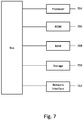
- FIG. 7 is a block diagram of a processing system according to one embodiment.
- the processing can be used to implement the protocols, systems and nodes described above.
- the processing system includes a processor 704, such as a central processing unit (CPU) of the computing device or a dedicated special-purpose infotainment processor, executes computer executable instructions comprising embodiments of the system for performing the functions and methods described above.
- the computer executable instructions are locally stored and accessed from a non-transitory computer readable medium, such as storage 710, which may be a hard drive or flash drive.
- Read Only Memory (ROM) 706 includes computer executable instructions for initializing the processor 704, while the random-access memory (RAM) 708 is the main memory for loading and processing instructions executed by the processor 704.
- the network interface 712 may connect to a wired network or cellular network and to a local area network or wide area network, such as the internet.
- the recitation of "at least one of A, B and C” should be interpreted as one or more of a group of elements consisting of A, B and C, and should not be interpreted as requiring at least one of each of the listed elements A, B and C, regardless of whether A, B and C are related as categories or otherwise.
- the recitation of "A, B and/or C" or "at least one of A, B or C” should be interpreted as including any singular entity from the listed elements, e.g., A, any subset from the listed elements, e.g., A and B, or the entire list of elements A, B and C.
Landscapes
- Engineering & Computer Science (AREA)
- Computer Security & Cryptography (AREA)
- Computer Networks & Wireless Communication (AREA)
- Signal Processing (AREA)
- Power Engineering (AREA)
- Computer And Data Communications (AREA)
Abstract
Description
- The present invention relates to a method and system for a scalable crash fault-tolerant (CFT) consensus protocol for large networks.
- Blockchain technology provides a decentralized, open, Byzantine fault-tolerant transaction mechanism. Blockchain technology is becoming common for various types of Internet interactions, including anonymous online payments, remittance, and the transaction of digital assets.
- There are numerous types of different open blockchains. Permission-based blockchains for various industrial use cases are also becoming common. Blockchains, including industrial blockchains, are a distributed system with strong consensus mechanisms that are scalable to support hundreds or thousands of nodes. However, industrial blockchain has more trust on the nodes then general blockchains. Therefore, industrial blockchains can assume the nodes to be crash-faulty only.
- Crash fault-tolerance (CFT) protocols are used in distributed systems with unreliable communication channels to maintain consensus among the replicated servers. Cloud storage providers rely on crash fault-tolerant variants such as Paxos consensus algorithms and Raft consensus algorithms to guarantee data consistency for read/write operations. However, existing CFT protocols are only suitable for applications in relatively small networks, i.e., networks with no more than 20 nodes. Modern applications and systems using blockchain can effectively utilize large networks composed of thousands of nodes.
- There are two primary challenges when applying conventional CFT protocols to blockchain networks. First, all existing CFT protocols are based on broadcasting channels using leader nodes. Therefore, the leader node can become a bottleneck for the network. Second, when using a CFT protocol, a secure and authenticated channel such as transport layer security (TLS) between any two nodes is assumed. As a result, the computation effort of a node increases with the number of connections to other nodes. This becomes especially burdensome in a relayed network, where the votes of nodes first need to be decrypted and encrypted again for the next relay.
- In one embodiment, a method for encrypting and aggregating data in a network is provided. The method includes performing synchronization, by a leader node. Synchronization includes the following steps: transmitting a prepare message, including a proposal number, the prepare message encrypted with a proposal key and signed by the leader node; receiving a promise message including the proposal number, an initiated instruction number, and a last accepted proposal if any from each follower node, the promise message encrypted with authenticated encryption; transmitting an accept message including the proposal number, the initiated instruction number, and the last accepted proposal, the accept message encrypted with the proposal key and signed by the leader node; and receiving an accepted message including a hash of the of the proposal number and the instruction number and an acknowledgement indicator encrypted with additive homomorphic cryptography. The method further includes performing a steady state phase, by the leader node. The steady state phase includes the following steps: transmitting a second accept message including the synchronized proposal number, a second incremented instruction number, and a transaction value from the request, the second accept message encrypted with the proposal key and signed by the leader node; and receiving a second accepted message including a hash of the of the synchronized proposal number, the second instruction number and an acknowledgment indicator encrypted with additive homomorphic cryptography.
- In another embodiment, a leader node in a network comprising one or more processors which, alone or in combination, are configured to provide for performance of synchronization, by the leader node. Synchronization includes the following steps: transmitting a prepare message, including a proposal number, the prepare message encrypted with a proposal key and signed by the leader node; receiving a promise message including the proposal number, an initiated instruction number, and a last accepted proposal if any from each follower node, the promise message encrypted with authenticated encryption; transmitting an accept message including the proposal number, the initiated instruction number, and the last accepted proposal if any from each follower node, the accept message encrypted with the proposal key and signed by the leader node; and receiving an accepted message including a hash of the of the proposal number and the instruction number and an acknowledgement indicator encrypted with additive homomorphic cryptography. The one or more processors are further configured to provide for performance of a steady state phase. The steady state phase includes the following steps: transmitting a second accept message including the synchronized proposal number, a second incremented instruction number, and a transaction value from the request, the second accept message encrypted with the proposal key and signed by the leader node; and receiving a second accepted message including a hash of the of the synchronized proposal number, the second instruction number and an acknowledgment indicator encrypted with additive homomorphic cryptography.
- The present invention will be described in even greater detail below based on the exemplary figures. The invention is not limited to the exemplary embodiments. All features described and/or illustrated herein can be used alone or combined in different combinations in embodiments of the invention. The features and advantages of various embodiments of the present invention will become apparent by reading the following detailed description with reference to the attached drawings which illustrate the following:
-
FIG. 1 illustrates a system diagram of a validation node according to an embodiment; -
FIG. 2 illustrates a tree network topology according to an embodiment; -
FIG. 3 illustrates a star network topology according to an embodiment; -
FIG. 4 illustrates a super peer network topology according to an embodiment; -
FIG. 5 is a sequence diagram showing a scalable crash-fault tolerant protocol according to one embodiment; -
FIG. 6 is a flow illustrating a scalable crash fault tolerant consensus protocol according to one embodiment; and -
FIG. 7 is a block diagram of a processing system according to one embodiment. - A problem unique to computer networks and solved by embodiments of the present invention is to efficiently provide a scalable fault tolerant consensus protocol for large networks. Embodiments provide a scalable crash fault-tolerant (CFT) protocol for network. In some embodiments, the network is a blockchain network. A network topology can be either a tree or a super star. These configurations reduce the computational burden, including the network bandwidth, of the leader node. Rather than use a conventional secure channel such as transport layer security (TLS), embodiments provide an efficient message aggregation approach based on homomorphically encrypted data. As a result, authentication is only required among relaying nodes, while votes in the network can be directly aggregated without re-encryption. Moreover, as compared to existing CFT protocols which are only suitable for small networks, the scalable CFT protocol of embodiments of the present invention can be used in large networks, and in particular, block chain networks despite the challenges presented by such networks.
- In an embodiment, an exemplary blockchain network contains n = 2f + 1 validation nodes to maintain the network consensus, assuming the system can tolerate f crash-faulty validation nodes. In addition to the communication channel, a validation node maintains a keystore that records the credentials for nodes in the network, a state machine that executes the instructions in the transaction messages, and a counter that tracks the latest instruction number. Transactions are broadcast in the network and the validation nodes follow the consensus algorithm to agree on the next transaction (or block of transactions) which will be included in a ledger. Each transaction (or block) has an increasing instruction number Ik to indicate its executing order in the ledger, while the content of the transaction (or block) is denoted by vk.
-
FIG. 1 illustrates avalidation node 100. Thevalidation node 100 includes akeystore 102. Thekeystore 102 stores credentials for each node in a network. Aninstruction number counter 104 is incremented for each instruction received in transaction messages by the same leader node. Astate machine 106 executes the instructions in the transaction messages. Finally, acommunications interface 108 connects thevalidation node 100 to the network. Thecommunications interface 108 can be any suitable interface including, Ethernet, WiFi, and cellular. The network can be any suitable network, including the internet, local area network, and wide area network. - In some embodiments, the validation nodes (such as validation node 100) may be connected either following a tree topology or a super star topology.
Fig. 2 illustrates atree topology 200. In this embodiment,leader node 202 is a validation node. Leader nodes in a network tree are validation nodes, such asvalidation node 100. Each of the remainingnodes 204 form the tree. Thenodes 204 are also referred to as follower nodes. - In this embodiment, for point-to-point connections, each
validation node 202 shares pair-wise message authentication code (MAC) keys
leader node 202 proposes messages and collects votes fromfollower nodes 204. In some embodiments, theleader node 202 has a pair of asymmetric keys (pk, sk) of an additive homomorphic cryptographic scheme and signing key pair (pks, sks ) where the public key is known by allfollower nodes 204. In addition, theleader node 202 also has a proposal key kpr that is shared by all nodes. In this embodiment, pk and pks are public keys and sk and sks are private keys. - In one embodiment, the nodes will synchronize for the last state with a prepare stage and an accept stage. The last state refers to the state of accepted transaction proposals, including the proposal number, the instruction number and the value of the instruction in the transaction. In the prepare stage, the
leader node 202 sends a prepare message Prepare(n) to thefollower nodes 204, where n is the proposal number. The proposal number must be greater than that of any previous Prepare messages proposed by the leader. The prepare message is encrypted with the proposal key kpr and signed by theleader node 202 with sks. In this way, the propagation of the prepare message does not need to follow a static network topology and can be forwarded from any node to avoid re-processing. However, only theleader node 202 is able to initiate the prepare message. In one embodiment, when afollower node 204 receives the Prepare message, it replies to the leader with a Promise message only if the received proposal number is higher than that of any previously promised messages. The promise message would repeat the proposal number n, initialize the instruction number (for the same leader) I 0, and would include the last accepted proposal vi if there is any. The promise message Promise (n, I 0, vi ) follows the authenticated encryption procedure using the pair-wise session key
- In the accept stage, the
leader node 202 derives the last accepted proposal value v 0 from the promises of the followers to be the value associated with the highest proposal number (first-key) and instruction number (second-key). The leader thus sends an accept message Accept (n, I 0, v 0) to thefollower nodes 204 so that they are synchronized. Similar to a prepare message, the accept message is encrypted with the proposal key kpr with the leader node's signature. To confirm that the message is accepted by the majority of the follower nodes, each follower node replies with a message Accepted (H(n, I 0), bi ), where bi is 1 if node i accepted and 0 if rejected. Note that H(·) is hash function and only the hash of the proposal number and instruction number is sent, and b is encrypted with additive homomorphic cryptography (e.g., Paillier scheme) using key pk. - In addition, a MAC is added to the accepted message. When a node receives the accepted messages from the sub-nodes, they just need to verify and re-compute the MAC of the message, while the acknowledgement b can be summed up with the encrypted value as a result of the additive homomorphism of homomorphic cryptography. Finally, the leader node decrypts the sum of the votes and if the vote is the majority, the system is now ready to accept new instructions.
- When the
leader node 202 receives a new request, instruction (Ik , wk ) is proposed to thefollower nodes 204 in an accept message Accept (n, Ik, wk ), where the instruction number Ik increments on each new request. Similar to the accept stage in the synchronization phase, the message is encrypted with the proposal key kpr with the leader's signature. Then if the followers accept the message, accepted message Accepted (H(n, Ik ), b) is replied and aggregated in a similar way. Table 1 summarizes one embodiment of a scalable crash-fault tolerant protocol.Table 1: Phase Sender Message Crypto Synchronize (only once) leader Prepare (n) Enck pr , Sigpks followeri Promise (n, I 0, vi ) AuthenticatedEnck ij leader Accept (n, I 0 , v 0) Enck pr , Sigpkfolloweri Accepted (H(n, I 0), bi ) Mack ij , EncpkSteady (multiple) leader Accept (n, Ik, wk ) Enck pr , Sigpks followeri Accepted (H(n, Ik ), bi ) Mack ij , Encpk - Other network topologies can be used with the described scalable crash-fault tolerant protocol. For example,
FIG. 3 illustrates astar topology 300.Leader node 302 connects tofollower nodes 304. Similarly,FIG. 4 illustrates asuper-peer architecture 400. -
FIG. 5 is a sequence diagram showing a scalable crash-fault tolerant protocol according to one embodiment. The illustrated embodiment includes aclient 502, oneleader node 504 and twofollower nodes client 502 initiates a transaction. However, as described above various network topologies are supported including various numbers of leader nodes and follower nodes. - At a time tx0 synchronization of the nodes begins. The
leader node 504 sends a prepare message, Prepare(n) to thefollower nodes follower node 506 may receive the prepare message and transmit it to the next follower node in the network,follower node 508. - After receiving the prepare message the
follower nodes leader node 504 if they did not promise any proposals with a higher proposal number than n. In this embodiment, n is the proposal number of the prepare messages. If the node has accepted a proposal before, then the accepted proposal v i from node i is also transmitted. As shown,follower node 506 may transmit the last accepted proposal v 1 in the promise message and follower node 508 (v2 ) to theleader node 504. - After receiving the promise message, the
leader node 504 derives the last accepted proposal v 0 (v 0= last of {v 1 , v 2}) and transmits an accept message, to thefollower nodes - After the
leader node 504 receives the promise message, theleader node 504 transmits an accept message Accept (n, I 0, v 0), to thefollower nodes - After receiving the accept message, the
follower nodes leader node 504 andfollower nodes - At a later time txj, the system is in a steady state. During this time, the
leader node 504 transmits accept messages, Accept (m, Ij, wj ), where m is the proposal number in the steady phase, Ij is the incremented instruction number at time txj, and wj is the value of the transaction at time txj. After receiving the accept message, thefollower nodes FIG. 5 may be transmitted using the cryptography shown in table 1. -
FIG. 6 is a flow illustrating a scalable crash fault tolerant consensus protocol according to one embodiment.Stage 602 illustrates the steps in the synchronization phase of the protocol.Stage 604 illustrates the steps in the steady state phase of the protocol. - At
step 606, a leader node sends a prepare message. The prepare message is encrypted with the proposal key kpr and signed by the leader node with sks. - At
step 608, the follower nodes receive the prepare message and send back to the leader node a promise message. The promise message follows the authenticated encryption routine. - At
step 610, after receiving the promise message, the leader node transmits an accept message to the follower nodes. The accept message is encrypted with the proposal key kpr with the leader node's signature. - After receiving the accept message, at
step 612 the follower nodes send back an accepted message. The accepted message is encrypted with additive homomorphic cryptography using key pk. Additionally, a MAC is added to the accepted message. - After the synchronization phase of the protocol is complete at
stage 602, the protocol enters a steady state phase atstage 604. Atstep 614 the leader node transmits an accept message to the follower nodes. As described above, the accept message is encrypted with the proposal key kpr with the leader node's signature. - After receiving the accept message, at
step 616 the follower nodes send back an accepted message. The accepted message is encrypted with additive homomorphic cryptography using key pk and a MAC is added to the accepted message. -
FIG. 7 is a block diagram of a processing system according to one embodiment. The processing can be used to implement the protocols, systems and nodes described above. The processing system includes aprocessor 704, such as a central processing unit (CPU) of the computing device or a dedicated special-purpose infotainment processor, executes computer executable instructions comprising embodiments of the system for performing the functions and methods described above. In embodiments, the computer executable instructions are locally stored and accessed from a non-transitory computer readable medium, such asstorage 710, which may be a hard drive or flash drive. Read Only Memory (ROM) 706 includes computer executable instructions for initializing theprocessor 704, while the random-access memory (RAM) 708 is the main memory for loading and processing instructions executed by theprocessor 704. Thenetwork interface 712 may connect to a wired network or cellular network and to a local area network or wide area network, such as the internet. - All references, including publications, patent applications, and patents, cited herein are hereby incorporated by reference to the same extent as if each reference were individually and specifically indicated to be incorporated by reference and were set forth in its entirety herein.
- While the invention has been illustrated and described in detail in the drawings and foregoing description, such illustration and description are to be considered illustrative or exemplary and not restrictive. It will be understood that changes and modifications may be made by those of ordinary skill within the scope of the following claims. In particular, the present invention covers further embodiments with any combination of features from different embodiments described above and below. Additionally, statements made herein characterizing the invention refer to an embodiment of the invention and not necessarily all embodiments.
- The terms used in the claims should be construed to have the broadest reasonable interpretation consistent with the foregoing description. For example, the use of the article "a" or "the" in introducing an element should not be interpreted as being exclusive of a plurality of elements. Likewise, the recitation of "or" should be interpreted as being inclusive, such that the recitation of "A or B" is not exclusive of "A and B," unless it is clear from the context or the foregoing description that only one of A and B is intended. Further, the recitation of "at least one of A, B and C" should be interpreted as one or more of a group of elements consisting of A, B and C, and should not be interpreted as requiring at least one of each of the listed elements A, B and C, regardless of whether A, B and C are related as categories or otherwise. Moreover, the recitation of "A, B and/or C" or "at least one of A, B or C" should be interpreted as including any singular entity from the listed elements, e.g., A, any subset from the listed elements, e.g., A and B, or the entire list of elements A, B and C.
Claims (15)
- A method for encrypting and aggregating data in a network, the method comprising:performing synchronization, by a leader node, comprising the following steps:transmitting a prepare message, including a proposal number, the prepare message encrypted with a proposal key and signed by the leader node;receiving a promise message including the proposal number, an initiated instruction number, and a last accepted proposal if any from each follower node, the promise message encrypted with authenticated encryption;transmitting an accept message including the proposal number, the initiated instruction number, and the last accepted proposal, the accept message encrypted with the proposal key and signed by the leader node; andreceiving an accepted message including a hash of the of the proposal number and the instruction number and an acknowledgement indicator encrypted with additive homomorphic cryptography; andperforming a steady state phase, by the leader node, comprising the following steps:transmitting a second accept message including the synchronized proposal number, a second incremented instruction number, and a transaction value from the request, the second accept message encrypted with the proposal key and signed by the leader node; andreceiving a second accepted message including a hash of the of the synchronized proposal number, the second instruction number and an acknowledgment indicator encrypted with additive homomorphic cryptography.
- The method according to claim 1, wherein the leader node is connected to a plurality of follower nodes in a tree topology.
- The method according to claim 1, wherein the leader node is connected to a plurality of follower nodes in a star topology
- The method according to any of claims 1 to 3, further comprising sending, by a follower node, the promise message.
- The method according to any of claims 1 to 4, further comprising:receiving, by a first follower node, a sub-accepted message from a second follower node;computing a message authentication code for the sub-accepted message and adding an acknowledgement indicator from the sub-acceptance message to an acknowledgement indicator for the first follower node.
- The method according to any of claims 1 to 5, wherein the network is a blockchain network.
- The method according to any of claims 1 to 6, further comprising storing, by the leader node, credentials for a plurality of follower nodes.
- The method according to any of claims 1 to 7, wherein the leader node includes a counter to track instruction numbers.
- A leader node in a network comprising one or more processors which, alone or in combination, are configured to provide for performance of the following steps:performing synchronization, by the leader node, comprising the following steps:transmitting a prepare message, including a proposal number, the prepare message encrypted with a proposal key and signed by the leader node;receiving a promise message including the proposal number, an initiated instruction number, and a last accepted proposal if any from each follower node, the promise message encrypted with authenticated encryption;transmitting an accept message including the proposal number, the initiated instruction number, and the last accepted proposal if any from each follower node, the accept message encrypted with the proposal key and signed by the leader node; andreceiving an accepted message including a hash of the of the proposal number and the instruction number and an acknowledgement indicator encrypted with additive homomorphic cryptography; andperforming a steady state phase comprising the following steps:transmitting a second accept message including the synchronized proposal number, a second incremented instruction number, and a transaction value from the request, the second accept message encrypted with the proposal key and signed by the leader node; andreceiving a second accepted message including a hash of the of the synchronized proposal number, the second instruction number and an acknowledgment indicator encrypted with additive homomorphic cryptography.
- The leader node according to claim 9, further configured to store credentials for a plurality of follower nodes.
- The leader node according to claim 9 or 10, further configured to count instruction numbers.
- The leader node according to any of claims 9 to 11, wherein the leader node is connected to a plurality of follower nodes in a tree topology.
- The leader node according to any of claims 9 to 11, wherein the leader node is connected to a plurality of follower nodes in a star topology.
- The leader node according to any of claims 9 to 13, further configured to receive a promise message sent by a follower node.
- The leader node according to any of claims 9 to 14, wherein the network is a blockchain network.
Applications Claiming Priority (1)
| Application Number | Priority Date | Filing Date | Title |
|---|---|---|---|
| US15/844,674 US10200197B1 (en) | 2017-12-18 | 2017-12-18 | Scalable crash fault-tolerance consensus protocol with efficient message aggregation |
Publications (2)
| Publication Number | Publication Date |
|---|---|
| EP3499787A1 true EP3499787A1 (en) | 2019-06-19 |
| EP3499787B1 EP3499787B1 (en) | 2023-11-15 |
Family
ID=62947920
Family Applications (1)
| Application Number | Title | Priority Date | Filing Date |
|---|---|---|---|
| EP18180449.3A Active EP3499787B1 (en) | 2017-12-18 | 2018-06-28 | Scalable crash fault-tolerance consensus protocol with efficient message aggregation |
Country Status (3)
| Country | Link |
|---|---|
| US (1) | US10200197B1 (en) |
| EP (1) | EP3499787B1 (en) |
| JP (1) | JP6751130B2 (en) |
Cited By (1)
| Publication number | Priority date | Publication date | Assignee | Title |
|---|---|---|---|---|
| WO2021073777A1 (en) * | 2019-10-14 | 2021-04-22 | NEC Laboratories Europe GmbH | Topology-driven byzantine fault-tolerant consensus protocol with vote aggregation |
Families Citing this family (9)
| Publication number | Priority date | Publication date | Assignee | Title |
|---|---|---|---|---|
| US10756904B1 (en) | 2018-02-22 | 2020-08-25 | EMC IP Holding Company LLC | Efficient and secure distributed ledger maintenance |
| US11386078B2 (en) * | 2018-12-17 | 2022-07-12 | Sap Se | Distributed trust data storage system |
| US11171931B2 (en) * | 2019-02-15 | 2021-11-09 | Wipro Limited | Method and system for providing a light-weight secure communication for computing devices |
| KR102805695B1 (en) * | 2019-10-18 | 2025-05-09 | 삼성에스디에스 주식회사 | Method for associating data between a plurality of blockchain networks and apparatus thereof |
| US12099997B1 (en) | 2020-01-31 | 2024-09-24 | Steven Mark Hoffberg | Tokenized fungible liabilities |
| CN111586147B (en) * | 2020-04-30 | 2021-09-28 | 平安科技(深圳)有限公司 | Node synchronization method, device, equipment and storage medium of block chain |
| CN111930840B (en) * | 2020-08-06 | 2024-09-13 | 平安科技(深圳)有限公司 | Method and system for optimizing consensus mechanism based on Paxos algorithm and blockchain network |
| CN113282462B (en) * | 2020-08-28 | 2022-06-28 | 深圳市金麦粒传媒科技有限公司 | Information processing method applied to block chain and big data platform |
| CN112564960B (en) * | 2020-12-01 | 2022-05-13 | 浙商银行股份有限公司 | Elastic adjustment consensus method and device based on block link point centrality |
Family Cites Families (7)
| Publication number | Priority date | Publication date | Assignee | Title |
|---|---|---|---|---|
| US7421578B1 (en) * | 2003-07-22 | 2008-09-02 | Cisco Technology, Inc. | Method and apparatus for electing a leader node in a computer network |
| US7856502B2 (en) * | 2004-06-18 | 2010-12-21 | Microsoft Corporation | Cheap paxos |
| JP5574402B2 (en) * | 2009-01-14 | 2014-08-20 | 日本電気株式会社 | Distributed concealed data integration apparatus, distributed concealed data integration method, and distributed concealed data integration program |
| JP5395517B2 (en) * | 2009-05-29 | 2014-01-22 | 日本電信電話株式会社 | Distributed data management system, data management apparatus, data management method, and program |
| GB2484086A (en) * | 2010-09-28 | 2012-04-04 | Metaswitch Networks Ltd | Reliability and performance modes in a distributed storage system |
| US10027560B2 (en) * | 2015-11-12 | 2018-07-17 | Hulu, LLC | Leader election in distributed computer system |
| JP6199518B1 (en) * | 2017-03-23 | 2017-09-20 | 株式会社bitFlyer | Private node, processing method in private node, and program therefor |
-
2017
- 2017-12-18 US US15/844,674 patent/US10200197B1/en active Active
-
2018
- 2018-06-28 EP EP18180449.3A patent/EP3499787B1/en active Active
- 2018-12-12 JP JP2018232830A patent/JP6751130B2/en active Active
Non-Patent Citations (4)
| Title |
|---|
| "Web-Scale Data Management for the Cloud", 1 January 2013, SPRINGER NEW YORK, New York, NY, ISBN: 978-1-4614-6856-1, article WOLFGANG LEHNER ET AL: "Web-Scale Data Management for the Cloud", XP055540872 * |
| JIM GRAY ET AL: "Consensus on Transaction Commit", ARXIV.ORG, CORNELL UNIVERSITY LIBRARY, 201 OLIN LIBRARY CORNELL UNIVERSITY ITHACA, NY 14853, 14 August 2004 (2004-08-14), XP080162604, DOI: 10.1145/1132863.1132867 * |
| LESLIE LAMPORT: "Paxos Made Simple", 1 November 2001 (2001-11-01), XP055099745, Retrieved from the Internet <URL:http://research.microsoft.com/en-us/um/people/lamport/pubs/paxos-simple.pdf> [retrieved on 20190115] * |
| MICROSOFT: "The Coco Framework Technical Overview", 10 August 2017 (2017-08-10), XP055467798, Retrieved from the Internet <URL:https://www.slideshare.net/WillyDevNET/coco-framework-whitepaper> [retrieved on 20180417] * |
Cited By (1)
| Publication number | Priority date | Publication date | Assignee | Title |
|---|---|---|---|---|
| WO2021073777A1 (en) * | 2019-10-14 | 2021-04-22 | NEC Laboratories Europe GmbH | Topology-driven byzantine fault-tolerant consensus protocol with vote aggregation |
Also Published As
| Publication number | Publication date |
|---|---|
| JP6751130B2 (en) | 2020-09-02 |
| US10200197B1 (en) | 2019-02-05 |
| JP2019110531A (en) | 2019-07-04 |
| EP3499787B1 (en) | 2023-11-15 |
Similar Documents
| Publication | Publication Date | Title |
|---|---|---|
| US10200197B1 (en) | Scalable crash fault-tolerance consensus protocol with efficient message aggregation | |
| EP3461059B1 (en) | Scalable byzantine fault-tolerant protocol with partial trusted execution environment support | |
| US11902456B2 (en) | Blockchain sharding with adjustable quorums | |
| US11614994B2 (en) | Method, apparatus and electronic device for blockchain-based transaction consensus processing | |
| US11625718B2 (en) | Blockchain-based data verification system and method, computing device and storage medium | |
| KR102157452B1 (en) | Performing a recovery process for network nodes in a distributed system | |
| CN111242617B (en) | Method and apparatus for performing transaction correctness verification | |
| US9660970B1 (en) | Cryptographic key distribution | |
| CN109327467B (en) | Management method of RSSP-II secure communication protocol key management mechanism | |
| US11784811B2 (en) | Storage of cryptographic information | |
| CN114285555B (en) | Blockchain-based multicast method and device | |
| US20240097894A1 (en) | Threshold key exchange | |
| WO2018099577A1 (en) | System and method for providing a collective decentralized authority for sharing sensitive data | |
| US11563575B2 (en) | Communication node, method of operating thereof and collaborative system | |
| CN107666491A (en) | The data transmission method of air-ground integrated network based on symmetric cryptography | |
| US10212141B2 (en) | Autonomous key update mechanism with blacklisting of compromised nodes for mesh networks | |
| Panwar et al. | Blanc: Blockchain-based anonymous and decentralized credit networks | |
| Xing et al. | GoSSamer: Lightweight and linear-communication asynchronous (dynamic proactive) secret sharing and the applications | |
| US12513012B1 (en) | Linear network coding for blockchains | |
| Kate et al. | Brief note: Asynchronous verifiable secret sharing with optimal resilience and linear amortized overhead | |
| Schultz | Mobile proactive secret sharing | |
| Feng et al. | SAPE: A Scalable Aggregation with Parallel Encoder for Federated Learning in VANETs | |
| CN115001719A (en) | Private data processing system, method, device, computer equipment and storage medium | |
| CN115297125B (en) | Business data processing method, device, computer equipment and readable storage medium | |
| US20250358106A1 (en) | Secure aggregation with one-shot clients |
Legal Events
| Date | Code | Title | Description |
|---|---|---|---|
| PUAI | Public reference made under article 153(3) epc to a published international application that has entered the european phase |
Free format text: ORIGINAL CODE: 0009012 |
|
| STAA | Information on the status of an ep patent application or granted ep patent |
Free format text: STATUS: THE APPLICATION HAS BEEN PUBLISHED |
|
| AK | Designated contracting states |
Kind code of ref document: A1 Designated state(s): AL AT BE BG CH CY CZ DE DK EE ES FI FR GB GR HR HU IE IS IT LI LT LU LV MC MK MT NL NO PL PT RO RS SE SI SK SM TR |
|
| AX | Request for extension of the european patent |
Extension state: BA ME |
|
| STAA | Information on the status of an ep patent application or granted ep patent |
Free format text: STATUS: REQUEST FOR EXAMINATION WAS MADE |
|
| 17P | Request for examination filed |
Effective date: 20191007 |
|
| RBV | Designated contracting states (corrected) |
Designated state(s): AL AT BE BG CH CY CZ DE DK EE ES FI FR GB GR HR HU IE IS IT LI LT LU LV MC MK MT NL NO PL PT RO RS SE SI SK SM TR |
|
| STAA | Information on the status of an ep patent application or granted ep patent |
Free format text: STATUS: EXAMINATION IS IN PROGRESS |
|
| 17Q | First examination report despatched |
Effective date: 20200910 |
|
| GRAP | Despatch of communication of intention to grant a patent |
Free format text: ORIGINAL CODE: EPIDOSNIGR1 |
|
| STAA | Information on the status of an ep patent application or granted ep patent |
Free format text: STATUS: GRANT OF PATENT IS INTENDED |
|
| RIC1 | Information provided on ipc code assigned before grant |
Ipc: H04L 9/32 20060101ALI20230510BHEP Ipc: H04L 9/00 20060101AFI20230510BHEP |
|
| INTG | Intention to grant announced |
Effective date: 20230525 |
|
| GRAJ | Information related to disapproval of communication of intention to grant by the applicant or resumption of examination proceedings by the epo deleted |
Free format text: ORIGINAL CODE: EPIDOSDIGR1 |
|
| STAA | Information on the status of an ep patent application or granted ep patent |
Free format text: STATUS: EXAMINATION IS IN PROGRESS |
|
| GRAP | Despatch of communication of intention to grant a patent |
Free format text: ORIGINAL CODE: EPIDOSNIGR1 |
|
| STAA | Information on the status of an ep patent application or granted ep patent |
Free format text: STATUS: GRANT OF PATENT IS INTENDED |
|
| INTG | Intention to grant announced |
Effective date: 20230727 |
|
| GRAS | Grant fee paid |
Free format text: ORIGINAL CODE: EPIDOSNIGR3 |
|
| GRAA | (expected) grant |
Free format text: ORIGINAL CODE: 0009210 |
|
| STAA | Information on the status of an ep patent application or granted ep patent |
Free format text: STATUS: THE PATENT HAS BEEN GRANTED |
|
| RAP1 | Party data changed (applicant data changed or rights of an application transferred) |
Owner name: NEC CORPORATION |
|
| AK | Designated contracting states |
Kind code of ref document: B1 Designated state(s): AL AT BE BG CH CY CZ DE DK EE ES FI FR GB GR HR HU IE IS IT LI LT LU LV MC MK MT NL NO PL PT RO RS SE SI SK SM TR |
|
| REG | Reference to a national code |
Ref country code: CH Ref legal event code: EP Ref country code: GB Ref legal event code: FG4D |
|
| REG | Reference to a national code |
Ref country code: DE Ref legal event code: R096 Ref document number: 602018061051 Country of ref document: DE |
|
| REG | Reference to a national code |
Ref country code: IE Ref legal event code: FG4D |
|
| REG | Reference to a national code |
Ref country code: LT Ref legal event code: MG9D |
|
| REG | Reference to a national code |
Ref country code: NL Ref legal event code: MP Effective date: 20231115 |
|
| PG25 | Lapsed in a contracting state [announced via postgrant information from national office to epo] |
Ref country code: GR Free format text: LAPSE BECAUSE OF FAILURE TO SUBMIT A TRANSLATION OF THE DESCRIPTION OR TO PAY THE FEE WITHIN THE PRESCRIBED TIME-LIMIT Effective date: 20240216 |
|
| PG25 | Lapsed in a contracting state [announced via postgrant information from national office to epo] |
Ref country code: IS Free format text: LAPSE BECAUSE OF FAILURE TO SUBMIT A TRANSLATION OF THE DESCRIPTION OR TO PAY THE FEE WITHIN THE PRESCRIBED TIME-LIMIT Effective date: 20240315 |
|
| PG25 | Lapsed in a contracting state [announced via postgrant information from national office to epo] |
Ref country code: LT Free format text: LAPSE BECAUSE OF FAILURE TO SUBMIT A TRANSLATION OF THE DESCRIPTION OR TO PAY THE FEE WITHIN THE PRESCRIBED TIME-LIMIT Effective date: 20231115 |
|
| REG | Reference to a national code |
Ref country code: AT Ref legal event code: MK05 Ref document number: 1632765 Country of ref document: AT Kind code of ref document: T Effective date: 20231115 |
|
| PG25 | Lapsed in a contracting state [announced via postgrant information from national office to epo] |
Ref country code: NL Free format text: LAPSE BECAUSE OF FAILURE TO SUBMIT A TRANSLATION OF THE DESCRIPTION OR TO PAY THE FEE WITHIN THE PRESCRIBED TIME-LIMIT Effective date: 20231115 |
|
| PG25 | Lapsed in a contracting state [announced via postgrant information from national office to epo] |
Ref country code: AT Free format text: LAPSE BECAUSE OF FAILURE TO SUBMIT A TRANSLATION OF THE DESCRIPTION OR TO PAY THE FEE WITHIN THE PRESCRIBED TIME-LIMIT Effective date: 20231115 |
|
| PG25 | Lapsed in a contracting state [announced via postgrant information from national office to epo] |
Ref country code: ES Free format text: LAPSE BECAUSE OF FAILURE TO SUBMIT A TRANSLATION OF THE DESCRIPTION OR TO PAY THE FEE WITHIN THE PRESCRIBED TIME-LIMIT Effective date: 20231115 |
|
| PG25 | Lapsed in a contracting state [announced via postgrant information from national office to epo] |
Ref country code: NL Free format text: LAPSE BECAUSE OF FAILURE TO SUBMIT A TRANSLATION OF THE DESCRIPTION OR TO PAY THE FEE WITHIN THE PRESCRIBED TIME-LIMIT Effective date: 20231115 Ref country code: LT Free format text: LAPSE BECAUSE OF FAILURE TO SUBMIT A TRANSLATION OF THE DESCRIPTION OR TO PAY THE FEE WITHIN THE PRESCRIBED TIME-LIMIT Effective date: 20231115 Ref country code: IS Free format text: LAPSE BECAUSE OF FAILURE TO SUBMIT A TRANSLATION OF THE DESCRIPTION OR TO PAY THE FEE WITHIN THE PRESCRIBED TIME-LIMIT Effective date: 20240315 Ref country code: GR Free format text: LAPSE BECAUSE OF FAILURE TO SUBMIT A TRANSLATION OF THE DESCRIPTION OR TO PAY THE FEE WITHIN THE PRESCRIBED TIME-LIMIT Effective date: 20240216 Ref country code: ES Free format text: LAPSE BECAUSE OF FAILURE TO SUBMIT A TRANSLATION OF THE DESCRIPTION OR TO PAY THE FEE WITHIN THE PRESCRIBED TIME-LIMIT Effective date: 20231115 Ref country code: BG Free format text: LAPSE BECAUSE OF FAILURE TO SUBMIT A TRANSLATION OF THE DESCRIPTION OR TO PAY THE FEE WITHIN THE PRESCRIBED TIME-LIMIT Effective date: 20240215 Ref country code: AT Free format text: LAPSE BECAUSE OF FAILURE TO SUBMIT A TRANSLATION OF THE DESCRIPTION OR TO PAY THE FEE WITHIN THE PRESCRIBED TIME-LIMIT Effective date: 20231115 Ref country code: PT Free format text: LAPSE BECAUSE OF FAILURE TO SUBMIT A TRANSLATION OF THE DESCRIPTION OR TO PAY THE FEE WITHIN THE PRESCRIBED TIME-LIMIT Effective date: 20240315 |
|
| PG25 | Lapsed in a contracting state [announced via postgrant information from national office to epo] |
Ref country code: SE Free format text: LAPSE BECAUSE OF FAILURE TO SUBMIT A TRANSLATION OF THE DESCRIPTION OR TO PAY THE FEE WITHIN THE PRESCRIBED TIME-LIMIT Effective date: 20231115 Ref country code: RS Free format text: LAPSE BECAUSE OF FAILURE TO SUBMIT A TRANSLATION OF THE DESCRIPTION OR TO PAY THE FEE WITHIN THE PRESCRIBED TIME-LIMIT Effective date: 20231115 Ref country code: PL Free format text: LAPSE BECAUSE OF FAILURE TO SUBMIT A TRANSLATION OF THE DESCRIPTION OR TO PAY THE FEE WITHIN THE PRESCRIBED TIME-LIMIT Effective date: 20231115 Ref country code: NO Free format text: LAPSE BECAUSE OF FAILURE TO SUBMIT A TRANSLATION OF THE DESCRIPTION OR TO PAY THE FEE WITHIN THE PRESCRIBED TIME-LIMIT Effective date: 20240215 Ref country code: LV Free format text: LAPSE BECAUSE OF FAILURE TO SUBMIT A TRANSLATION OF THE DESCRIPTION OR TO PAY THE FEE WITHIN THE PRESCRIBED TIME-LIMIT Effective date: 20231115 Ref country code: HR Free format text: LAPSE BECAUSE OF FAILURE TO SUBMIT A TRANSLATION OF THE DESCRIPTION OR TO PAY THE FEE WITHIN THE PRESCRIBED TIME-LIMIT Effective date: 20231115 |
|
| PG25 | Lapsed in a contracting state [announced via postgrant information from national office to epo] |
Ref country code: DK Free format text: LAPSE BECAUSE OF FAILURE TO SUBMIT A TRANSLATION OF THE DESCRIPTION OR TO PAY THE FEE WITHIN THE PRESCRIBED TIME-LIMIT Effective date: 20231115 |
|
| PG25 | Lapsed in a contracting state [announced via postgrant information from national office to epo] |
Ref country code: CZ Free format text: LAPSE BECAUSE OF FAILURE TO SUBMIT A TRANSLATION OF THE DESCRIPTION OR TO PAY THE FEE WITHIN THE PRESCRIBED TIME-LIMIT Effective date: 20231115 |
|
| PG25 | Lapsed in a contracting state [announced via postgrant information from national office to epo] |
Ref country code: SK Free format text: LAPSE BECAUSE OF FAILURE TO SUBMIT A TRANSLATION OF THE DESCRIPTION OR TO PAY THE FEE WITHIN THE PRESCRIBED TIME-LIMIT Effective date: 20231115 |
|
| PG25 | Lapsed in a contracting state [announced via postgrant information from national office to epo] |
Ref country code: SM Free format text: LAPSE BECAUSE OF FAILURE TO SUBMIT A TRANSLATION OF THE DESCRIPTION OR TO PAY THE FEE WITHIN THE PRESCRIBED TIME-LIMIT Effective date: 20231115 Ref country code: SK Free format text: LAPSE BECAUSE OF FAILURE TO SUBMIT A TRANSLATION OF THE DESCRIPTION OR TO PAY THE FEE WITHIN THE PRESCRIBED TIME-LIMIT Effective date: 20231115 Ref country code: RO Free format text: LAPSE BECAUSE OF FAILURE TO SUBMIT A TRANSLATION OF THE DESCRIPTION OR TO PAY THE FEE WITHIN THE PRESCRIBED TIME-LIMIT Effective date: 20231115 Ref country code: IT Free format text: LAPSE BECAUSE OF FAILURE TO SUBMIT A TRANSLATION OF THE DESCRIPTION OR TO PAY THE FEE WITHIN THE PRESCRIBED TIME-LIMIT Effective date: 20231115 Ref country code: EE Free format text: LAPSE BECAUSE OF FAILURE TO SUBMIT A TRANSLATION OF THE DESCRIPTION OR TO PAY THE FEE WITHIN THE PRESCRIBED TIME-LIMIT Effective date: 20231115 Ref country code: DK Free format text: LAPSE BECAUSE OF FAILURE TO SUBMIT A TRANSLATION OF THE DESCRIPTION OR TO PAY THE FEE WITHIN THE PRESCRIBED TIME-LIMIT Effective date: 20231115 Ref country code: CZ Free format text: LAPSE BECAUSE OF FAILURE TO SUBMIT A TRANSLATION OF THE DESCRIPTION OR TO PAY THE FEE WITHIN THE PRESCRIBED TIME-LIMIT Effective date: 20231115 |
|
| REG | Reference to a national code |
Ref country code: DE Ref legal event code: R097 Ref document number: 602018061051 Country of ref document: DE |
|
| PLBE | No opposition filed within time limit |
Free format text: ORIGINAL CODE: 0009261 |
|
| STAA | Information on the status of an ep patent application or granted ep patent |
Free format text: STATUS: NO OPPOSITION FILED WITHIN TIME LIMIT |
|
| 26N | No opposition filed |
Effective date: 20240819 |
|
| PG25 | Lapsed in a contracting state [announced via postgrant information from national office to epo] |
Ref country code: SI Free format text: LAPSE BECAUSE OF FAILURE TO SUBMIT A TRANSLATION OF THE DESCRIPTION OR TO PAY THE FEE WITHIN THE PRESCRIBED TIME-LIMIT Effective date: 20231115 |
|
| PG25 | Lapsed in a contracting state [announced via postgrant information from national office to epo] |
Ref country code: SI Free format text: LAPSE BECAUSE OF FAILURE TO SUBMIT A TRANSLATION OF THE DESCRIPTION OR TO PAY THE FEE WITHIN THE PRESCRIBED TIME-LIMIT Effective date: 20231115 |
|
| PG25 | Lapsed in a contracting state [announced via postgrant information from national office to epo] |
Ref country code: MC Free format text: LAPSE BECAUSE OF FAILURE TO SUBMIT A TRANSLATION OF THE DESCRIPTION OR TO PAY THE FEE WITHIN THE PRESCRIBED TIME-LIMIT Effective date: 20231115 |
|
| REG | Reference to a national code |
Ref country code: CH Ref legal event code: PL |
|
| PG25 | Lapsed in a contracting state [announced via postgrant information from national office to epo] |
Ref country code: LU Free format text: LAPSE BECAUSE OF NON-PAYMENT OF DUE FEES Effective date: 20240628 |
|
| GBPC | Gb: european patent ceased through non-payment of renewal fee |
Effective date: 20240628 |
|
| PG25 | Lapsed in a contracting state [announced via postgrant information from national office to epo] |
Ref country code: IE Free format text: LAPSE BECAUSE OF NON-PAYMENT OF DUE FEES Effective date: 20240628 |
|
| PG25 | Lapsed in a contracting state [announced via postgrant information from national office to epo] |
Ref country code: BE Free format text: LAPSE BECAUSE OF NON-PAYMENT OF DUE FEES Effective date: 20240630 Ref country code: CH Free format text: LAPSE BECAUSE OF NON-PAYMENT OF DUE FEES Effective date: 20240630 |
|
| PG25 | Lapsed in a contracting state [announced via postgrant information from national office to epo] |
Ref country code: FR Free format text: LAPSE BECAUSE OF NON-PAYMENT OF DUE FEES Effective date: 20240630 |
|
| PG25 | Lapsed in a contracting state [announced via postgrant information from national office to epo] |
Ref country code: GB Free format text: LAPSE BECAUSE OF NON-PAYMENT OF DUE FEES Effective date: 20240628 |
|
| REG | Reference to a national code |
Ref country code: BE Ref legal event code: MM Effective date: 20240630 |
|
| PGFP | Annual fee paid to national office [announced via postgrant information from national office to epo] |
Ref country code: DE Payment date: 20250618 Year of fee payment: 8 |
|
| PG25 | Lapsed in a contracting state [announced via postgrant information from national office to epo] |
Ref country code: FI Free format text: LAPSE BECAUSE OF FAILURE TO SUBMIT A TRANSLATION OF THE DESCRIPTION OR TO PAY THE FEE WITHIN THE PRESCRIBED TIME-LIMIT Effective date: 20231115 |
|
| PG25 | Lapsed in a contracting state [announced via postgrant information from national office to epo] |
Ref country code: CY Free format text: LAPSE BECAUSE OF FAILURE TO SUBMIT A TRANSLATION OF THE DESCRIPTION OR TO PAY THE FEE WITHIN THE PRESCRIBED TIME-LIMIT; INVALID AB INITIO Effective date: 20180628 |
|
| PG25 | Lapsed in a contracting state [announced via postgrant information from national office to epo] |
Ref country code: HU Free format text: LAPSE BECAUSE OF FAILURE TO SUBMIT A TRANSLATION OF THE DESCRIPTION OR TO PAY THE FEE WITHIN THE PRESCRIBED TIME-LIMIT; INVALID AB INITIO Effective date: 20180628 |