EP3499622A1 - A fuel cell system comprising an antimicrobial patterned surface - Google Patents
A fuel cell system comprising an antimicrobial patterned surface Download PDFInfo
- Publication number
- EP3499622A1 EP3499622A1 EP19154178.8A EP19154178A EP3499622A1 EP 3499622 A1 EP3499622 A1 EP 3499622A1 EP 19154178 A EP19154178 A EP 19154178A EP 3499622 A1 EP3499622 A1 EP 3499622A1
- Authority
- EP
- European Patent Office
- Prior art keywords
- coolant
- fuel cell
- flow path
- cell stack
- antimicrobial
- Prior art date
- Legal status (The legal status is an assumption and is not a legal conclusion. Google has not performed a legal analysis and makes no representation as to the accuracy of the status listed.)
- Granted
Links
Images


Classifications
-
- H—ELECTRICITY
- H01—ELECTRIC ELEMENTS
- H01M—PROCESSES OR MEANS, e.g. BATTERIES, FOR THE DIRECT CONVERSION OF CHEMICAL ENERGY INTO ELECTRICAL ENERGY
- H01M8/00—Fuel cells; Manufacture thereof
- H01M8/04—Auxiliary arrangements, e.g. for control of pressure or for circulation of fluids
- H01M8/04007—Auxiliary arrangements, e.g. for control of pressure or for circulation of fluids related to heat exchange
- H01M8/04044—Purification of heat exchange media
-
- H—ELECTRICITY
- H01—ELECTRIC ELEMENTS
- H01M—PROCESSES OR MEANS, e.g. BATTERIES, FOR THE DIRECT CONVERSION OF CHEMICAL ENERGY INTO ELECTRICAL ENERGY
- H01M8/00—Fuel cells; Manufacture thereof
- H01M8/04—Auxiliary arrangements, e.g. for control of pressure or for circulation of fluids
- H01M8/04007—Auxiliary arrangements, e.g. for control of pressure or for circulation of fluids related to heat exchange
- H01M8/04029—Heat exchange using liquids
-
- H—ELECTRICITY
- H01—ELECTRIC ELEMENTS
- H01M—PROCESSES OR MEANS, e.g. BATTERIES, FOR THE DIRECT CONVERSION OF CHEMICAL ENERGY INTO ELECTRICAL ENERGY
- H01M8/00—Fuel cells; Manufacture thereof
- H01M8/04—Auxiliary arrangements, e.g. for control of pressure or for circulation of fluids
- H01M8/04007—Auxiliary arrangements, e.g. for control of pressure or for circulation of fluids related to heat exchange
- H01M8/04067—Heat exchange or temperature measuring elements, thermal insulation, e.g. heat pipes, heat pumps, fins
-
- H—ELECTRICITY
- H01—ELECTRIC ELEMENTS
- H01M—PROCESSES OR MEANS, e.g. BATTERIES, FOR THE DIRECT CONVERSION OF CHEMICAL ENERGY INTO ELECTRICAL ENERGY
- H01M8/00—Fuel cells; Manufacture thereof
- H01M8/04—Auxiliary arrangements, e.g. for control of pressure or for circulation of fluids
- H01M8/04298—Processes for controlling fuel cells or fuel cell systems
- H01M8/04313—Processes for controlling fuel cells or fuel cell systems characterised by the detection or assessment of variables; characterised by the detection or assessment of failure or abnormal function
- H01M8/0432—Temperature; Ambient temperature
- H01M8/04358—Temperature; Ambient temperature of the coolant
-
- H—ELECTRICITY
- H01—ELECTRIC ELEMENTS
- H01M—PROCESSES OR MEANS, e.g. BATTERIES, FOR THE DIRECT CONVERSION OF CHEMICAL ENERGY INTO ELECTRICAL ENERGY
- H01M8/00—Fuel cells; Manufacture thereof
- H01M8/04—Auxiliary arrangements, e.g. for control of pressure or for circulation of fluids
- H01M8/04298—Processes for controlling fuel cells or fuel cell systems
- H01M8/04313—Processes for controlling fuel cells or fuel cell systems characterised by the detection or assessment of variables; characterised by the detection or assessment of failure or abnormal function
- H01M8/0438—Pressure; Ambient pressure; Flow
- H01M8/04417—Pressure; Ambient pressure; Flow of the coolant
-
- H—ELECTRICITY
- H01—ELECTRIC ELEMENTS
- H01M—PROCESSES OR MEANS, e.g. BATTERIES, FOR THE DIRECT CONVERSION OF CHEMICAL ENERGY INTO ELECTRICAL ENERGY
- H01M8/00—Fuel cells; Manufacture thereof
- H01M8/04—Auxiliary arrangements, e.g. for control of pressure or for circulation of fluids
- H01M8/04298—Processes for controlling fuel cells or fuel cell systems
- H01M8/04694—Processes for controlling fuel cells or fuel cell systems characterised by variables to be controlled
- H01M8/04746—Pressure; Flow
- H01M8/04768—Pressure; Flow of the coolant
-
- H—ELECTRICITY
- H01—ELECTRIC ELEMENTS
- H01M—PROCESSES OR MEANS, e.g. BATTERIES, FOR THE DIRECT CONVERSION OF CHEMICAL ENERGY INTO ELECTRICAL ENERGY
- H01M8/00—Fuel cells; Manufacture thereof
- H01M8/24—Grouping of fuel cells, e.g. stacking of fuel cells
- H01M8/2465—Details of groupings of fuel cells
-
- H—ELECTRICITY
- H01—ELECTRIC ELEMENTS
- H01M—PROCESSES OR MEANS, e.g. BATTERIES, FOR THE DIRECT CONVERSION OF CHEMICAL ENERGY INTO ELECTRICAL ENERGY
- H01M2250/00—Fuel cells for particular applications; Specific features of fuel cell system
- H01M2250/20—Fuel cells in motive systems, e.g. vehicle, ship, plane
-
- Y—GENERAL TAGGING OF NEW TECHNOLOGICAL DEVELOPMENTS; GENERAL TAGGING OF CROSS-SECTIONAL TECHNOLOGIES SPANNING OVER SEVERAL SECTIONS OF THE IPC; TECHNICAL SUBJECTS COVERED BY FORMER USPC CROSS-REFERENCE ART COLLECTIONS [XRACs] AND DIGESTS
- Y02—TECHNOLOGIES OR APPLICATIONS FOR MITIGATION OR ADAPTATION AGAINST CLIMATE CHANGE
- Y02E—REDUCTION OF GREENHOUSE GAS [GHG] EMISSIONS, RELATED TO ENERGY GENERATION, TRANSMISSION OR DISTRIBUTION
- Y02E60/00—Enabling technologies; Technologies with a potential or indirect contribution to GHG emissions mitigation
- Y02E60/30—Hydrogen technology
- Y02E60/50—Fuel cells
-
- Y—GENERAL TAGGING OF NEW TECHNOLOGICAL DEVELOPMENTS; GENERAL TAGGING OF CROSS-SECTIONAL TECHNOLOGIES SPANNING OVER SEVERAL SECTIONS OF THE IPC; TECHNICAL SUBJECTS COVERED BY FORMER USPC CROSS-REFERENCE ART COLLECTIONS [XRACs] AND DIGESTS
- Y02—TECHNOLOGIES OR APPLICATIONS FOR MITIGATION OR ADAPTATION AGAINST CLIMATE CHANGE
- Y02T—CLIMATE CHANGE MITIGATION TECHNOLOGIES RELATED TO TRANSPORTATION
- Y02T90/00—Enabling technologies or technologies with a potential or indirect contribution to GHG emissions mitigation
- Y02T90/40—Application of hydrogen technology to transportation, e.g. using fuel cells
Definitions
- the present invention relates to electrochemical fuel cells disposed in a stack formation, and in particular to cooling systems for such fuel cell stacks.
- the invention relates to a fuel cell system, an antimicrobial system for a fuel cell system, and a vehicle including the fuel cell system.
- a common type of electrochemical fuel cell for reacting hydrogen and oxygen comprises a polymeric ion transfer membrane, also known as a proton exchange membrane (PEM), within a membrane-electrode assembly (MEA), with fuel and air being passed over respective sides of the membrane.
- Protons i.e., hydrogen ions
- MEA membrane-electrode assembly
- a stack is formed comprising a number of MEAs electrically arranged in series. Each MEA is provided with separate anode and cathode fluid flow paths. The anode and cathode fluid flow paths respectively deliver fuel and oxidant to the membrane.
- the fuel cell stack is typically in the form of a block comprising numerous individual fuel cell plates held together by end plates at either end of the stack.
- a fuel cell stack requires cooling once an operating temperature has been reached, to avoid damage to the fuel cells. Cooling may be achieved at least in part by the delivery of coolant (such as water) to individual cells in the stack in either the anode fluid flow paths (which serves to hydrate the anode) and/or in the cathode fluid flow path which combines with reactant water. In each case, evaporative cooling of the fuel cells can occur.
- coolant such as water
- cooling water is injected into the anode or cathode fluid flow channels of the fuel cell stack.
- the coolant water must be very pure. If contaminated coolant water is introduced into the fuel cell stack then the contaminants can drastically affect the performance of the fuel cell stack and can degrade the components within the stack. Contaminants may be inorganic (such as metal ions) and organic (such as organic contaminant molecules and bacteria/microbes). It is therefore beneficial to treat coolant water before it enters the fuel cell stack to remove contaminants.
- Ozone may be used to as a powerful disinfectant to kill bacteria/microbes in water.
- it may not always be practical to use ozone to disinfect water in stationary and confined environments such as in back-up power systems and combined-heat-and- power (CHP) systems as ozone can be harmful.
- CHP combined-heat-and- power
- UV light may be used to kill bacteria/microbes.
- using UV light to disinfect water may not be effective in all situations.
- a fuel cell system only the process fluid (that is, the fluid exposed to the UV light) would be treated by the UV light. If UV light does not reach a region of water in a fuel cell system (such as in a water storage tank), then that unexposed water is not cleaned by the UV light. Further, if an aggregation of biological contaminants is present (such as a biofilm) then only the exposed surface would be treated by the UV light.
- the present invention comprises a method of operating a fuel cell system as defined in the appended claims.
- a fuel cell system comprising an antimicrobial patterned surface.
- the antimicrobial patterned surface may be antibacterial, antifungal, and/or antiviral.
- the patterning of the antimicrobial surface gives rise to its antimicrobial properties, as opposed to, for example chemical additives in the surface material.
- the antimicrobial patterned surface may inhibit microbial growth by interfering with the adhesion and growth/development of the microbes on the surface.
- the relief of the pattern may be such that microbes, such as bacteria, are unable to multiply and/or group together on the surface. This may inhibit the development and spread of biofilms over surfaces within the fuel cell system. By inhibiting microbial growth and biofilm development, coolant in the fuel cell system may be kept pure.
- the fuel cell system may comprise: a fuel cell stack; a coolant reservoir; and a coolant flow path configured to supply coolant from the coolant reservoir to the fuel cell stack; wherein one or more of the fuel cell stack, the coolant reservoir and the coolant flow path comprise the antimicrobial patterned surface.
- the antimicrobial patterned surface may comprise microscale corrugations or ridges (continuous or discontinuous) for inhibiting microbial growth.
- the microscale corrugations may each have a width of between 1 and 100 microns, 10 and 100 microns and possibly between 2 and 25 microns.
- the microscale corrugations may be separated across their width by a spacing of between 1 and 100 microns, 10 and 100 microns and possibly between 2 and 25 microns.
- the microscale corrugations may each have a depth of between 1 and 100 microns, 10 and 100 microns and possibly between 2 and 20 microns.
- the antimicrobial patterned surface may comprise a cellular relief pattern. This is advantageous as the repeating cells of the patterned surface provide for efficient manufacture.
- the antimicrobial patterned surface may have an average roughness factor of between 2 and 30, the average roughness factor determined as the ratio of the actual surface area to the geometric surface area (in some examples the average roughness factor may be greater than 30).
- the patterned surface may be designed and manufactured with particular surface relief patterning, with the surface relief structures that form the pattern having particular microscale dimensions, in such as way as to prevent the aggregation and development / spread of microbes within the fuel cell system.
- the antimicrobial patterned surface may be chemically inert.
- the surface may have antimicrobial properties due to the particular surface patterning, thus providing an antimicrobial surface without antimicrobial chemical agents. This may be desirable for maintaining a pure coolant supply to fuel cell stacks in the fuel cell system.
- the antimicrobial patterned surface may be chemically antimicrobial.
- the surface may have antimicrobial properties due to the particular surface patterning as well as due to chemically active antimicrobial agents.
- a "double action" antimicrobial surface which may inhibit microbial growth due to the patterned surface, and which may kill existing microbes due to the chemical antimicrobial properties, may be used in a fuel cell system.
- the coolant may be water, in particular purified water or deionised water.
- the fuel cell system may comprise an ultra violet light source arranged in a coolant flow path for supplying coolant to a fuel cell stack, the UV light source positioned upstream of the fuel cell stack.
- using a UV light source configured to kill microbes present in the coolant flow path of the fuel cell system may allow for the provision of pure coolant to the fuel cell stack(s), and works well with the antimicrobial patterned surface which helps to reduce the build up of biofilms and the like which the UV light may not be able to penetrate.
- the fuel cell system may comprise a deionisation apparatus arranged in a coolant flow path for supplying coolant to a fuel cell stack, the deionisation apparatus positioned upstream of the fuel cell stack.
- a deionisation apparatus configured for ion exchange with the coolant in the fuel cell system may allow for the provision of pure coolant to the fuel cell stack(s), and works well with the antimicrobial patterned surface to ensure that the deionisation apparatus does not get coated in biofilms.
- the deionisation apparatus may be a deionisation column.
- a deionisation apparatus may be positioned downstream from an ultra violet light source and upstream from a fuel cell stack in the fuel cell system.
- coolant may be cleaned using UV light to destroy microbes in the coolant, then the coolant passes through a deionisation apparatus for ion exchange, before arriving at the fuel cell stack(s).
- the fuel cell system may comprise a filter arranged in a coolant flow path for supplying coolant to a fuel cell stack, the filter positioned upstream of the fuel cell stack.
- the fuel cell system may comprise: a coolant flow path for transporting coolant in the fuel cell system; a pressure meter configured to determine the coolant pressure in the coolant flow path; a pump positioned in the coolant flow path; and a controller configured to control the pump; wherein the controller may be configured to receive a pressure value from the pressure meter and, based on the pressure value, control the flow of coolant in the coolant flow path using the pump.
- the controller may control the pump to increase the coolant flow.
- the fuel cell system may comprise: a coolant flow path for transporting coolant in the fuel cell system; a temperature meter configured to determine the coolant temperature in the coolant flow path; a pump positioned in the coolant flow path; and a controller configured to control the pump; wherein the controller may be configured to receive a temperature value from the temperature meter and, based on the temperature value, control the flow of coolant in the coolant flow path using the pump.
- the controller may control the pump to increase the coolant flow.
- a vehicle comprising a fuel cell system as disclosed herein.
- an antimicrobial system for a fuel cell system as disclosed herein.
- a system may be, for example, a coolant reservoir for connection to a fuel cell system.
- the coolant reservoir may comprise an antimicrobial patterned surface.
- the invention provides a vehicle comprising a fuel cell system as disclosed herein.
- the various embodiments described below comprise a fuel cell system 100; 300; 400; 500 having a fuel cell stack 102; 302; 402; 502, a coolant reservoir 104; 304; 404; 504 and a coolant flow path 106; 306; 406; 506 for the supply of coolant from the reservoir 104; 304; 404; 504 to the fuel cell stack 102; 302; 402; 502.
- a patterned antimicrobial surface 108, 110, 112; 200; 308; 408; 508 is present in the fuel cell system 100; 300; 400; 500 to prevent bacterial contamination of the cooling water supply to the evaporatively cooled fuel cell stack 102; 302; 402; 502.
- Fuel cell systems as described herein may be suitable for use in combined-heat-and-power (CHP) and back up supply units using evaporatively cooled fuel cells/fuel cell stacks.
- CHP combined-heat-and-power
- the embodiments described herein comprise an antimicrobial (in particular, antibacterial) patterned surface which inhibits biofilm / microbial / bacterial growth.
- an antimicrobial (in particular, antibacterial) patterned surface which inhibits biofilm / microbial / bacterial growth.
- the antimicrobial patterned surface need not be chemically active.
- the patterned surface may inhibit the growth and clustering of microbes / bacteria on its surface due to having a patterned relief structure with raised features and lower regions.
- the size of the raised features and the spacing between the raised features may be in the micron range.
- the size of the raised features may be small enough to prevent microbes settling on the top of the raised features.
- the size of the spaces between the raised features may be small enough such that microbes are unable to settle between the raised features.
- a raised feature spacing of around 25% to 75% of the size of an organism's smallest dimension may be suitable for inhibiting bioadhesion of the microbial organism.
- coolant water, in particular purified water or deionised water, may be used as a suitable coolant, but that the embodiments need not be restricted to the use of water as a suitable coolant.
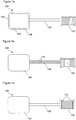
- FIGS 1a-1c illustrate an example embodiment of a fuel cell system 100 comprising an antimicrobial patterned surface 108, 110, 112.
- the fuel cell system 100 comprises a fuel cell stack 102, a coolant reservoir 104 and a coolant flow path 106 configured to supply coolant from the coolant reservoir 104 to the fuel cell stack 102.
- the coolant reservoir 104 has inner walls having an antimicrobial patterned surface 108.
- This embodiment may be effective in inhibiting bacterial growth at the coolant source, before the coolant travels from the coolant reservoir through the coolant flow path 106 to the fuel cell stack 102.
- all inner walls of the coolant reservoir 104 comprise the patterned antimicrobial surface 108. In other examples only some inner walls may comprise the patterned antimicrobial surface 108.
- the coolant flow path 106 has inner walls comprising an antimicrobial patterned surface 110. It may be that a part of the coolant flow path 106 comprises the antimicrobial patterned surface 110 and another part does not.
- the fuel cell stack 102 has inner surfaces comprising the antimicrobial patterned surface 112. It may be that some inner surfaces of the fuel cell stack 102 comprise the antimicrobial patterned surface 112 (such as those exposed to coolant) while others do not. More than one component of the fuel cell system 100 may comprise an antimicrobial patterned surface (for example, both in the coolant reservoir 104 and in the coolant flow path 106).
- the antimicrobial patterned surface 108, 110, 112 may be applied to a component by coating the component 102, 104, 106 with a film having the patterned antimicrobial surface.
- the patterned antimicrobial surface 108, 110, 112 may be formed on the surface of a component 102, 104, 106 by machining the surface to have a suitable antimicrobial pattern.
- Figures 2a-2b show schematic views of an exemplary antimicrobial patterned surface.
- a top-down view of an exemplary surface 200 is shown.
- a cross-sectional view through three ridges 204 of the exemplary surface of figure 2a is shown.
- the surface 200 may be considered to comprise a plurality of microscale corrugations 204 raised up from a base level 206 of the surface in a cellular repeating pattern.
- the microscale corrugations may be non-continuous, such as a series of discontinuous ridges, bumps or projections.
- the surface therefore may have a corrugated appearance with rows/regions of discontinuous corrugations.
- Figure 2a shows a patterned antimicrobial surface comprising a cellular repeating pattern with a hexagonal/diamond shaped unit cell 202.
- Each unit cell 202 comprises six parallel ridges 204 of varying lengths which are raised in relation to the space between the ridges 206. This pattern may be considered to mimic the structure of a shark's skin, with each unit cell 202 representing a sharkskin scale, and each unit cell 202 comprising ridges 204 similar to those of a sharkskin scale.
- a surface may comprise structures which, from a top-down view of the surface, are substantially round, oval, triangular, square, rectangular, pentagonal, and/or hexagonal.
- an antimicrobial patterned surface may comprise microscale structures within bands running across the surface. The microscale structures may be raised up from the base level of the surface, and/or may be sunken / depressed into the base level of the surface.
- the patterned antimicrobial surface may comprise one or more different shapes, structure heights, structure separations, and/or structure widths.
- Figure 2b illustrates different dimensions which may be defined for such a patterned antimicrobial surface.
- the ridges 204 and the spacing between ridges 206 have microscale dimensions.
- the ridges 204 may each have a width 210 between 2 and 25 microns.
- the microscale ridges may be separated across their width by a spacing 212 of between 2 and 25 microns.
- the microscale ridges 204 may each have a depth 214 of between 2 and 20 microns.
- the width 210 may be more than 25 microns
- the spacing 212 may be more than 25 microns
- the depth 214 may be more than 20 microns.
- the width 210 may be less than 2 microns
- the spacing 212 may be less than 2 microns
- the depth 214 may be less than 2 microns.
- the dimensions 210, 212, 214 may be tuned depending on the size of the organisms which are to be inhibited from developing on the surface 200.
- the antimicrobial patterned surface may have an average roughness factor of between 2 and 30, determined as the ratio of the actual surface area to the geometric surface area. For example, a perfectly smooth 1cm 2 area has both an actual and geometric surface area of 1cm 2 and thus a roughness factor of 1. As the surface becomes rougher, due to corrugations and surface patterning for example, then the roughness factor increases. For example if the 1cm 2 surface is patterned such that the total exposed surface has an area of 2cm 2 , then the roughness factor would be 2.
- the surface roughness maybe quantified using other metrics.
- the arithmetic mean roughness factor R a may be determined for a surface and may lie in a particular range conducive for inhibiting microbial growth.
- the arithmetic mean roughness factor R a is the arithmetic mean of absolute departures of a cross-sectional roughness profile from a mean line.
- the arithmetic mean of the differences from a mean line of this cross section would give the arithmetic mean roughness factor R a .
- other ways of measuring roughness may be used and the roughness of the patterned antimicrobial surface determined using one or more of these methods may lie in a particular range conducive to inhibiting microbial growth.
- figure 2b shows the ridge height 214, width 210 and separation 212 to be the same across the surface 200, in other examples one or more of these dimensions may vary across the surface 200.
- the height of the structure may be considered to be the distance from the base level of the surface to the bottom of the depression/trough formed by the structure.
- the antimicrobial patterned surface may be a Tactivex® surface with Sharklet® technology which inhibits bacterial survival and transfer through a surface micro-pattern. Other surfaces could be used.
- the antimicrobial patterned surface is chemically inert.
- Use of such a non-chemical system for coolant purification may be advantageous as the surface may not need to be "refreshed" as a chemically active component may need to be when its chemical activity has been depleted due to coolant cleaning/purification.
- the patterned surface may be able to provide antimicrobial properties for a longer time than a chemically active antimicrobial component.
- the antimicrobial patterned surface may be considered to be a passive coolant purification component, since it inhibits the growth and development of microbes on the surface rather than attacking already-present microbes. Inhibiting microbial growth may be advantageous compared with killing existing microbes, since there is a reduced burden to remove biological debris from dead microbes if the microbes are inhibited from multiplying on the fuel cell system due to the patterned antimicrobial surface.
- the antimicrobial patterned surface may be chemically active. This may be advantageous to provide coolant cleaning through both chemically activity and non-chemical surface properties (that is, due to the physical structure of the surface relief). Thus microbes may be inhibited from growing/multiplying due to the patterning of the antimicrobial surface, and microbes which are present in the coolant may be killed by the chemically active component of the surface.
- FIGS 3a-3c illustrate an example embodiment of a fuel cell system 300 comprising a fuel cell stack 302, a coolant reservoir 304 and a coolant flow path 306 configured to supply coolant from the coolant reservoir 304 to the fuel cell stack 302.
- the coolant reservoir 304 in these examples comprises the antimicrobial patterned surface 308
- a UV light source 314 is located in the coolant flow path 306 upstream of the fuel cell stack 302.
- the UV light source may be, for example, a UV lamp or a series of one or more UV light emitting diodes (LEDs).
- Coolant will pass the UV light source 314 which is configured to break down microbes in the coolant.
- the combination of the UV light source 314 and the patterned antimicrobial surface 308 may be considered to provide a synergistic effect in purifying the coolant.
- the patterned antimicrobial surface 308 acts to prevent the growth and aggregation of bacteria/microbes in the coolant, in particular on the surface in aggregations / biolayers where the UV light may not reach.
- the UV light source 314 may be able to break down microbes in the coolant more effectively if there are fewer, more disperse microbes in the coolant (due to the patterned antimicrobial surface 308). Thus the effect of the patterned antimicrobial surface 308 may cause the UV light source 314 to be more effective at breaking down microbes in the coolant by inhibiting the formation of microbial aggregations.
- a deionisation apparatus 316 such as a deionisation column, is located in the coolant flow path 306 upstream of the fuel cell stack 302.
- any deionisation apparatus configured for ion exchange with the coolant fluid may be used.
- the deionisation apparatus 316 acts to remove inorganic and organic ions from the coolant which may damage the fuel cell stack 302 and degrade performance of the fuel cell stack 302 (for example by contributing to corrosion of the fuel cell plates or by being deposited on the fuel cell plates).
- the fuel cell system 300 comprises both a UV light source 314 and a deionisation apparatus 316 upstream of the fuel cell stack 302.
- the deionisation apparatus 316 is located upstream of the fuel cell stack 302 and downstream of the UV light source 314. Both active and passive coolant purification components are present in the fuel cell system of figure 3c .
- the patterned antimicrobial surface 308 may be considered a passive component as it does not expend energy in disrupting microbial growth.
- the UV light source 314 may be considered an active component because it expends energy to actively attack microbes and remove contaminant species.
- FIGS 4a-4c illustrate an example embodiment of a fuel cell system 400 comprising a fuel cell stack 402, a coolant reservoir 404 and a coolant flow path 406 configured to supply coolant from the coolant reservoir 404 to the fuel cell stack 402.
- the coolant reservoir 404 in this example comprises the antimicrobial patterned surface 408
- a filter 418 is located in the coolant flow path 406 upstream of the fuel cell stack. Coolant will pass through the filter 418 which will act to remove microbes and bacterial debris from the coolant in the coolant flow path 406
- a pump 420 is located in the coolant flow path 406 upstream of the fuel cell stack.
- the pump 420 is coupled to a controller 422.
- the controller in this example is coupled to the fuel cell stack 402, for example to receive a fuel cell stack operating parameter such as the stack voltage. Coolant will be pumped from the coolant reservoir 404 to the fuel cell stack 402 by the pump 420.
- the controller 422 is configured to control the rate of coolant flow to the fuel cell stack 420 based on a stack operating parameter. In other examples the controller 422 may be configured to control the rate of coolant flow to the fuel cell stack 420 based on a different parameter, for example as discussed in relation to figures 5a and 5b .
- the fuel cell system 400 comprises both a filter 418 and a pump 420 controlled by the controller 422.
- the pump 420 is located upstream of the fuel cell stack 402 and downstream of the filter 418 in this example.
- FIGS 5a-5b illustrate an example embodiment of a fuel cell system 500 comprising a fuel cell stack 502, a coolant reservoir 504 and a coolant flow path 506 configured to supply coolant from the coolant reservoir 504 to the fuel cell stack 502.
- the coolant reservoir 504 in this example comprises the antimicrobial patterned surface 508.
- Figure 5a shows that, within the coolant flow path 506, a filter 518, a pump 520 coupled to a controller 522, a UV light source 514 and a deionisation apparatus 516 are located upstream of the fuel cell stack 502. These different components are discussed above. Also present in the fuel cell system 500 are a pressure meter 524 and a temperature meter 526 both coupled to the controller 522. The controller 522 is also coupled to the fuel cell stack 502 for receiving a stack operating parameter.
- the pressure meter 524 is configured to determine the coolant pressure in the fuel cell system 500, and in particular of the coolant pressure in the coolant flow path 506.
- the controller 522 is configured to receive a pressure value from the pressure meter 524 and, based on the pressure value, control the flow of coolant in the coolant flow path 506. Thus if the coolant pressure is below a desired pressure threshold, the controller 522 can increase the pumping using the pump 520 to increase the flow of coolant to the fuel cell stack 502.
- the temperature meter 526 is configured to determine the coolant temperature in the fuel cell system 500, and in particular of the coolant temperature in the coolant flow path 506.
- the controller 522 is configured to receive a temperature value from the temperature meter 526 and, based on the temperature value, control the flow of coolant in the coolant flow path 506. For example, a higher temperature may indicate that a higher coolant flow is required to the fuel cell stack 502 to sufficiently cool the fuel cells in the stack 502.
- Figure 5b builds upon the fuel cell system shown in figure 5a , and further comprises a flowmeter (FM) 528 and a data acquisition card (DAQ) 530 coupled to the controller 522.
- the flow meter 528 measures the flow of coolant through the coolant flow path 506.
- the controller 522 is coupled to the pump 520 and UV light source 514 (in this example, a series of UV light emitting diodes (LEDs)).
- the controller 522 can thus send a signal to control the pump 520 and/or UV light source 514 based on, for example, feedback received from the stack or temperature / pressure meters or according to a predetermined operating programme.
- the DAQ 530 is coupled to the pressure meter 524 and temperature meter 526 to receive pressure and temperature readings from the coolant flow path 506 to feed back to the controller 522.
- the controller 522 is shown coupled to the fuel cell stack 502 for receiving stack operating parameters.
- the DAQ 530 may be coupled to the fuel cell stack 502, for receiving operating parameters.
- the above embodiments also exemplify an antimicrobial system for attachment to a fuel cell stack.
- Figure 1 a shows an antimicrobial system comprising a coolant reservoir for connecting to a fuel cell stack
- figure 1b shows an antimicrobial system comprising a coolant flow path for connecting to a fuel cell stack.
- Figures 3a-3c , 4a-4c and 5a-5b also show an antimicrobial system comprising a coolant reservoir for connecting to a fuel cell stack.
- one fuel cell stack it will be appreciated there may be a plurality of fuel cell stacks in the fuel cell system. Further, more than one particular component may be present in the fuel cell system (for example, one UV light source may be present just downstream of the coolant reservoir and a further UV light source may be present just upstream of the fuel cell stack).
- a fuel cell system may comprise a UV light source for breaking down bacteria, and a filter for removing bacterial debris from the coolant.
- Other embodiments are intentionally within the scope of the accompanying claims.
Landscapes
- Chemical Kinetics & Catalysis (AREA)
- Engineering & Computer Science (AREA)
- Manufacturing & Machinery (AREA)
- Sustainable Development (AREA)
- Sustainable Energy (AREA)
- Chemical & Material Sciences (AREA)
- Life Sciences & Earth Sciences (AREA)
- Electrochemistry (AREA)
- General Chemical & Material Sciences (AREA)
- Fuel Cell (AREA)
- Apparatus For Disinfection Or Sterilisation (AREA)
- Physical Water Treatments (AREA)
- Electric Propulsion And Braking For Vehicles (AREA)
Abstract
Description
- The present invention relates to electrochemical fuel cells disposed in a stack formation, and in particular to cooling systems for such fuel cell stacks. In particular, the invention relates to a fuel cell system, an antimicrobial system for a fuel cell system, and a vehicle including the fuel cell system.
- Conventional electrochemical fuel cells convert fuel and oxidant, generally both in the form of gaseous streams, into electrical energy and a reaction product. A common type of electrochemical fuel cell for reacting hydrogen and oxygen comprises a polymeric ion transfer membrane, also known as a proton exchange membrane (PEM), within a membrane-electrode assembly (MEA), with fuel and air being passed over respective sides of the membrane. Protons (i.e., hydrogen ions) are conducted through the membrane, balanced by electrons conducted through a circuit connecting the anode and cathode of the fuel cell. To increase the available voltage, a stack is formed comprising a number of MEAs electrically arranged in series. Each MEA is provided with separate anode and cathode fluid flow paths. The anode and cathode fluid flow paths respectively deliver fuel and oxidant to the membrane. The fuel cell stack is typically in the form of a block comprising numerous individual fuel cell plates held together by end plates at either end of the stack.
- Because the reaction of fuel and oxidant generates heat as well as electrical power, a fuel cell stack requires cooling once an operating temperature has been reached, to avoid damage to the fuel cells. Cooling may be achieved at least in part by the delivery of coolant (such as water) to individual cells in the stack in either the anode fluid flow paths (which serves to hydrate the anode) and/or in the cathode fluid flow path which combines with reactant water. In each case, evaporative cooling of the fuel cells can occur.
- In a typical arrangement, cooling water is injected into the anode or cathode fluid flow channels of the fuel cell stack. The coolant water must be very pure. If contaminated coolant water is introduced into the fuel cell stack then the contaminants can drastically affect the performance of the fuel cell stack and can degrade the components within the stack. Contaminants may be inorganic (such as metal ions) and organic (such as organic contaminant molecules and bacteria/microbes). It is therefore beneficial to treat coolant water before it enters the fuel cell stack to remove contaminants.
- Ozone may be used to as a powerful disinfectant to kill bacteria/microbes in water. However, it may not always be practical to use ozone to disinfect water in stationary and confined environments such as in back-up power systems and combined-heat-and- power (CHP) systems as ozone can be harmful.
- Ultra violet (UV) light may be used to kill bacteria/microbes. However, using UV light to disinfect water may not be effective in all situations. In a fuel cell system, only the process fluid (that is, the fluid exposed to the UV light) would be treated by the UV light. If UV light does not reach a region of water in a fuel cell system (such as in a water storage tank), then that unexposed water is not cleaned by the UV light. Further, if an aggregation of biological contaminants is present (such as a biofilm) then only the exposed surface would be treated by the UV light.
- It is desirable to disinfect water at the source before it passes through the fuel cell system conduits, mechanisms and the fuel cell stack. Thus, disinfecting the coolant water in a water reservoir/storage tank, if used, is desirable. As mentioned above, it is not always practical to use ozone for this purpose, and UV illumination may be ineffective when used in a storage tank or similar coolant reservoir.
- The present invention comprises a method of operating a fuel cell system as defined in the appended claims.
- According to an aspect of the invention, there is provided a fuel cell system comprising an antimicrobial patterned surface. The antimicrobial patterned surface may be antibacterial, antifungal, and/or antiviral. Advantageously, the patterning of the antimicrobial surface gives rise to its antimicrobial properties, as opposed to, for example chemical additives in the surface material.
- The antimicrobial patterned surface may inhibit microbial growth by interfering with the adhesion and growth/development of the microbes on the surface. The relief of the pattern may be such that microbes, such as bacteria, are unable to multiply and/or group together on the surface. This may inhibit the development and spread of biofilms over surfaces within the fuel cell system. By inhibiting microbial growth and biofilm development, coolant in the fuel cell system may be kept pure.
- The fuel cell system may comprise: a fuel cell stack; a coolant reservoir; and a coolant flow path configured to supply coolant from the coolant reservoir to the fuel cell stack;
wherein one or more of the fuel cell stack, the coolant reservoir and the coolant flow path comprise the antimicrobial patterned surface. - The antimicrobial patterned surface may comprise microscale corrugations or ridges (continuous or discontinuous) for inhibiting microbial growth. The microscale corrugations may each have a width of between 1 and 100 microns, 10 and 100 microns and possibly between 2 and 25 microns. The microscale corrugations may be separated across their width by a spacing of between 1 and 100 microns, 10 and 100 microns and possibly between 2 and 25 microns. The microscale corrugations may each have a depth of between 1 and 100 microns, 10 and 100 microns and possibly between 2 and 20 microns. The antimicrobial patterned surface may comprise a cellular relief pattern. This is advantageous as the repeating cells of the patterned surface provide for efficient manufacture.
- The antimicrobial patterned surface may have an average roughness factor of between 2 and 30, the average roughness factor determined as the ratio of the actual surface area to the geometric surface area (in some examples the average roughness factor may be greater than 30). Advantageously, the patterned surface may be designed and manufactured with particular surface relief patterning, with the surface relief structures that form the pattern having particular microscale dimensions, in such as way as to prevent the aggregation and development / spread of microbes within the fuel cell system.
- The antimicrobial patterned surface may be chemically inert. Advantageously, the surface may have antimicrobial properties due to the particular surface patterning, thus providing an antimicrobial surface without antimicrobial chemical agents. This may be desirable for maintaining a pure coolant supply to fuel cell stacks in the fuel cell system.
- The antimicrobial patterned surface may be chemically antimicrobial. Advantageously, the surface may have antimicrobial properties due to the particular surface patterning as well as due to chemically active antimicrobial agents. Thus a "double action" antimicrobial surface, which may inhibit microbial growth due to the patterned surface, and which may kill existing microbes due to the chemical antimicrobial properties, may be used in a fuel cell system.
- The coolant may be water, in particular purified water or deionised water.
The fuel cell system may comprise an ultra violet light source arranged in a coolant flow path for supplying coolant to a fuel cell stack, the UV light source positioned upstream of the fuel cell stack. Advantageously, using a UV light source configured to kill microbes present in the coolant flow path of the fuel cell system may allow for the provision of pure coolant to the fuel cell stack(s), and works well with the antimicrobial patterned surface which helps to reduce the build up of biofilms and the like which the UV light may not be able to penetrate. - The fuel cell system may comprise a deionisation apparatus arranged in a coolant flow path for supplying coolant to a fuel cell stack, the deionisation apparatus positioned upstream of the fuel cell stack. Advantageously, using a deionisation apparatus configured for ion exchange with the coolant in the fuel cell system may allow for the provision of pure coolant to the fuel cell stack(s), and works well with the antimicrobial patterned surface to ensure that the deionisation apparatus does not get coated in biofilms. The deionisation apparatus may be a deionisation column.
- A deionisation apparatus may be positioned downstream from an ultra violet light source and upstream from a fuel cell stack in the fuel cell system. Advantageously, coolant may be cleaned using UV light to destroy microbes in the coolant, then the coolant passes through a deionisation apparatus for ion exchange, before arriving at the fuel cell stack(s).
- The fuel cell system may comprise a filter arranged in a coolant flow path for supplying coolant to a fuel cell stack, the filter positioned upstream of the fuel cell stack.
- The fuel cell system may comprise: a coolant flow path for transporting coolant in the fuel cell system; a pressure meter configured to determine the coolant pressure in the coolant flow path; a pump positioned in the coolant flow path; and a controller configured to control the pump; wherein the controller may be configured to receive a pressure value from the pressure meter and, based on the pressure value, control the flow of coolant in the coolant flow path using the pump. Advantageously, if the pressure falls in the coolant flow path the controller may control the pump to increase the coolant flow.
- The fuel cell system may comprise: a coolant flow path for transporting coolant in the fuel cell system; a temperature meter configured to determine the coolant temperature in the coolant flow path; a pump positioned in the coolant flow path; and a controller configured to control the pump; wherein the controller may be configured to receive a temperature value from the temperature meter and, based on the temperature value, control the flow of coolant in the coolant flow path using the pump. Advantageously, if the temperature rises in the coolant flow path the controller may control the pump to increase the coolant flow.
- In a further aspect of the invention there is provided a vehicle comprising a fuel cell system as disclosed herein.
- In a further aspect of the invention there is provided an antimicrobial system for a fuel cell system as disclosed herein. Such a system may be, for example, a coolant reservoir for connection to a fuel cell system. The coolant reservoir may comprise an antimicrobial patterned surface.
- According to another aspect, the invention provides a vehicle comprising a fuel cell system as disclosed herein.
- The invention may also be in accordance with the following (non-limiting) numbered clauses:
- 1. A fuel cell system comprising an antimicrobial patterned surface.
- 2. The fuel cell system of clause 1 comprising: a fuel cell stack;
a coolant reservoir; and
a coolant flow path configured to supply coolant from the coolant reservoir to the fuel cell stack;
wherein one or more of the fuel cell stack, the coolant reservoir and the coolant flow path comprise the antimicrobial patterned surface. - 3. The fuel cell system of any preceding clause, wherein the antimicrobial patterned surface comprises microscale corrugations for inhibiting microbial growth.
- 4. The fuel cell system of clause 3, wherein the microscale corrugations each have a width of between 10 and 100 microns.
- 5. The fuel cell system of any of clauses 3-4, wherein the microscale corrugations are separated across their width by a spacing of between 10 and 100 microns.
- 6. The fuel cell system of any of clauses 3-5, wherein the microscale corrugations each have a depth of between 10 and 100 microns.
- 7. The fuel cell system of any preceding clause, wherein the antimicrobial patterned surface comprises a cellular relief pattern.
- 8. The fuel cell system of any preceding clause, wherein the antimicrobial patterned surface has an average roughness factor of between 2 and 30, the average roughness factor determined as the ratio of the actual surface area to the geometric surface area.
- 9. The fuel cell system of any preceding clause wherein the antimicrobial patterned surface is chemically inert.
- 10. The fuel cell system of any of preceding clauses 1-8 wherein the antimicrobial patterned surface is chemically antimicrobial.
- 11. The fuel cell system of clause 2 wherein the coolant is water.
- 12. The fuel cell system of any preceding clause comprising an ultra violet light source arranged in a coolant flow path for supplying coolant to a fuel cell stack, the UV light source positioned upstream of the fuel cell stack.
- 13. The fuel cell system of any preceding clause comprising a deionisation apparatus arranged in a coolant flow path for supplying coolant to a fuel cell stack, the deionisation apparatus positioned upstream of the fuel cell stack
- 14. The fuel cell system of any preceding clause wherein a deionisation apparatus is positioned downstream from an ultra violet light source and upstream from a fuel cell stack.
- 15. The fuel cell system of any preceding clause comprising a filter arranged in a coolant flow path for supplying coolant to a fuel cell stack, the filter positioned upstream of the fuel cell stack.
- 16. The fuel cell system of clause 1, wherein the fuel cell system comprises: a coolant flow path for transporting coolant in the fuel cell system;
a pressure meter configured to determine the coolant pressure in the coolant flow path;
a pump positioned in the coolant flow path; and
a controller configured to control the pump; wherein
the controller is configured to receive a pressure value from the pressure meter and, based on the pressure value, control the flow of coolant in the coolant flow path using the pump. - 17. The fuel cell system of clause 1, wherein the fuel cell system comprises: a coolant flow path for transporting coolant in the fuel cell system;
a temperature meter configured to determine the coolant temperature in the coolant flow path;
a pump positioned in the coolant flow path; and
a controller configured to control the pump; wherein
the controller is configured to receive a temperature value from the temperature meter and, based on the temperature value, control the flow of coolant in the coolant flow path using the pump. - 18. A vehicle comprising the fuel cell system of any preceding clause.
- Embodiments of the present invention will now be described by way of example and with reference to the accompanying drawings in which:
-
figures 1a-1c show schematic views of fuel cell systems comprising an antimicrobial patterned surface; -
figures 2a-2b show schematic views of an exemplary antimicrobial patterned surface; -
figures 3a-3c show schematic views of fuel cell systems comprising an antimicrobial patterned surface, an ultra violet light source and/or a deionisation apparatus; -
figures 4a-4c show schematic views of fuel cell systems comprising an antimicrobial patterned surface, a filter and/or a pump; and -
figures 5a-5b show schematic views of fuel cell systems comprising an antimicrobial patterned surface and other components. - The various embodiments described below comprise a
fuel cell system 100; 300; 400; 500 having afuel cell stack 102; 302; 402; 502, acoolant reservoir 104; 304; 404; 504 and acoolant flow path 106; 306; 406; 506 for the supply of coolant from thereservoir 104; 304; 404; 504 to thefuel cell stack 102; 302; 402; 502. A patternedantimicrobial surface fuel cell system 100; 300; 400; 500 to prevent bacterial contamination of the cooling water supply to the evaporatively cooledfuel cell stack 102; 302; 402; 502. - Fuel cell systems as described herein may be suitable for use in combined-heat-and-power (CHP) and back up supply units using evaporatively cooled fuel cells/fuel cell stacks.
- The embodiments described herein comprise an antimicrobial (in particular, antibacterial) patterned surface which inhibits biofilm / microbial / bacterial growth. Thus the present invention advantageously provides improved fuel cell stack assemblies by inhibiting the growth of microbes in the coolant to be supplied for evaporative cooling of the fuel cell stack. The antimicrobial patterned surface need not be chemically active.
- The patterned surface may inhibit the growth and clustering of microbes / bacteria on its surface due to having a patterned relief structure with raised features and lower regions. The size of the raised features and the spacing between the raised features may be in the micron range. The size of the raised features may be small enough to prevent microbes settling on the top of the raised features. The size of the spaces between the raised features may be small enough such that microbes are unable to settle between the raised features. Thus the surface relief interferes with the settlement and adhesion of microbes on the surface. A raised feature spacing of around 25% to 75% of the size of an organism's smallest dimension may be suitable for inhibiting bioadhesion of the microbial organism.
- The following discussions use the term "coolant". The skilled person will appreciate that water, in particular purified water or deionised water, may be used as a suitable coolant, but that the embodiments need not be restricted to the use of water as a suitable coolant.
-
Figures 1a-1c illustrate an example embodiment of afuel cell system 100 comprising an antimicrobialpatterned surface fuel cell system 100 comprises afuel cell stack 102, acoolant reservoir 104 and acoolant flow path 106 configured to supply coolant from thecoolant reservoir 104 to thefuel cell stack 102. - In
figure 1a , thecoolant reservoir 104 has inner walls having an antimicrobialpatterned surface 108. This embodiment may be effective in inhibiting bacterial growth at the coolant source, before the coolant travels from the coolant reservoir through thecoolant flow path 106 to thefuel cell stack 102. In this example all inner walls of thecoolant reservoir 104 comprise the patternedantimicrobial surface 108. In other examples only some inner walls may comprise the patternedantimicrobial surface 108. - In
figure 1b , thecoolant flow path 106 has inner walls comprising an antimicrobialpatterned surface 110. It may be that a part of thecoolant flow path 106 comprises the antimicrobial patternedsurface 110 and another part does not. - In
figure 1c , thefuel cell stack 102 has inner surfaces comprising the antimicrobial patternedsurface 112. It may be that some inner surfaces of thefuel cell stack 102 comprise the antimicrobial patterned surface 112 (such as those exposed to coolant) while others do not. More than one component of thefuel cell system 100 may comprise an antimicrobial patterned surface (for example, both in thecoolant reservoir 104 and in the coolant flow path 106). - In some examples the antimicrobial patterned
surface component antimicrobial surface component -
Figures 2a-2b show schematic views of an exemplary antimicrobial patterned surface. Infigure 2a , a top-down view of anexemplary surface 200 is shown. Infigure 2b , a cross-sectional view through threeridges 204 of the exemplary surface offigure 2a is shown. Thesurface 200 may be considered to comprise a plurality ofmicroscale corrugations 204 raised up from abase level 206 of the surface in a cellular repeating pattern. The microscale corrugations may be non-continuous, such as a series of discontinuous ridges, bumps or projections. The surface therefore may have a corrugated appearance with rows/regions of discontinuous corrugations. -
Figure 2a shows a patterned antimicrobial surface comprising a cellular repeating pattern with a hexagonal/diamond shapedunit cell 202. Eachunit cell 202 comprises sixparallel ridges 204 of varying lengths which are raised in relation to the space between theridges 206. This pattern may be considered to mimic the structure of a shark's skin, with eachunit cell 202 representing a sharkskin scale, and eachunit cell 202 comprisingridges 204 similar to those of a sharkskin scale. - While the surface shown in
figure 2a shows a cellular repeating pattern of discontinuouscorrugated ridges 204, other surface patterns may be used which satisfy the criteria for inhibiting bacterial growth and adhesion. For example, a surface may comprise structures which, from a top-down view of the surface, are substantially round, oval, triangular, square, rectangular, pentagonal, and/or hexagonal. As another example, an antimicrobial patterned surface may comprise microscale structures within bands running across the surface. The microscale structures may be raised up from the base level of the surface, and/or may be sunken / depressed into the base level of the surface. The patterned antimicrobial surface may comprise one or more different shapes, structure heights, structure separations, and/or structure widths. -
Figure 2b illustrates different dimensions which may be defined for such a patterned antimicrobial surface. In this example, theridges 204 and the spacing betweenridges 206 have microscale dimensions. For example, theridges 204 may each have awidth 210 between 2 and 25 microns. The microscale ridges may be separated across their width by a spacing 212 of between 2 and 25 microns. Themicroscale ridges 204 may each have adepth 214 of between 2 and 20 microns. In some examples thewidth 210 may be more than 25 microns, the spacing 212 may be more than 25 microns, and/or thedepth 214 may be more than 20 microns. In some examples thewidth 210 may be less than 2 microns, the spacing 212 may be less than 2 microns, and/or thedepth 214 may be less than 2 microns. Thedimensions surface 200. - The antimicrobial patterned surface may have an average roughness factor of between 2 and 30, determined as the ratio of the actual surface area to the geometric surface area. For example, a perfectly smooth 1cm2 area has both an actual and geometric surface area of 1cm2 and thus a roughness factor of 1. As the surface becomes rougher, due to corrugations and surface patterning for example, then the roughness factor increases. For example if the 1cm2 surface is patterned such that the total exposed surface has an area of 2cm2, then the roughness factor would be 2.
- The surface roughness maybe quantified using other metrics. For example, the arithmetic mean roughness factor Ra may be determined for a surface and may lie in a particular range conducive for inhibiting microbial growth. The arithmetic mean roughness factor Ra is the arithmetic mean of absolute departures of a cross-sectional roughness profile from a mean line. Thus, if a cross section is taken through the patterned surface, the arithmetic mean of the differences from a mean line of this cross section would give the arithmetic mean roughness factor Ra. Of course, other ways of measuring roughness may be used and the roughness of the patterned antimicrobial surface determined using one or more of these methods may lie in a particular range conducive to inhibiting microbial growth.
- While
figure 2b shows theridge height 214,width 210 andseparation 212 to be the same across thesurface 200, in other examples one or more of these dimensions may vary across thesurface 200. In an example where structures are depressed into the surface rather than raised up from the base level of the surface, the height of the structure may be considered to be the distance from the base level of the surface to the bottom of the depression/trough formed by the structure. - The antimicrobial patterned surface may be a Tactivex® surface with Sharklet® technology which inhibits bacterial survival and transfer through a surface micro-pattern. Other surfaces could be used.
- In some examples, the antimicrobial patterned surface is chemically inert. Use of such a non-chemical system for coolant purification may be advantageous as the surface may not need to be "refreshed" as a chemically active component may need to be when its chemical activity has been depleted due to coolant cleaning/purification. The patterned surface may be able to provide antimicrobial properties for a longer time than a chemically active antimicrobial component.
- The antimicrobial patterned surface may be considered to be a passive coolant purification component, since it inhibits the growth and development of microbes on the surface rather than attacking already-present microbes. Inhibiting microbial growth may be advantageous compared with killing existing microbes, since there is a reduced burden to remove biological debris from dead microbes if the microbes are inhibited from multiplying on the fuel cell system due to the patterned antimicrobial surface.
- In other examples, the antimicrobial patterned surface may be chemically active. This may be advantageous to provide coolant cleaning through both chemically activity and non-chemical surface properties (that is, due to the physical structure of the surface relief). Thus microbes may be inhibited from growing/multiplying due to the patterning of the antimicrobial surface, and microbes which are present in the coolant may be killed by the chemically active component of the surface.
-
Figures 3a-3c illustrate an example embodiment of afuel cell system 300 comprising afuel cell stack 302, acoolant reservoir 304 and acoolant flow path 306 configured to supply coolant from thecoolant reservoir 304 to thefuel cell stack 302. Thecoolant reservoir 304 in these examples comprises the antimicrobial patternedsurface 308 - In
figure 3a , aUV light source 314 is located in thecoolant flow path 306 upstream of thefuel cell stack 302. The UV light source may be, for example, a UV lamp or a series of one or more UV light emitting diodes (LEDs). Coolant will pass theUV light source 314 which is configured to break down microbes in the coolant. The combination of the UVlight source 314 and the patternedantimicrobial surface 308 may be considered to provide a synergistic effect in purifying the coolant. The patternedantimicrobial surface 308 acts to prevent the growth and aggregation of bacteria/microbes in the coolant, in particular on the surface in aggregations / biolayers where the UV light may not reach. The UVlight source 314 may be able to break down microbes in the coolant more effectively if there are fewer, more disperse microbes in the coolant (due to the patterned antimicrobial surface 308). Thus the effect of the patternedantimicrobial surface 308 may cause theUV light source 314 to be more effective at breaking down microbes in the coolant by inhibiting the formation of microbial aggregations. - In
figure 3b , adeionisation apparatus 316, such as a deionisation column, is located in thecoolant flow path 306 upstream of thefuel cell stack 302. In other such examples, any deionisation apparatus configured for ion exchange with the coolant fluid may be used. Thedeionisation apparatus 316 acts to remove inorganic and organic ions from the coolant which may damage thefuel cell stack 302 and degrade performance of the fuel cell stack 302 (for example by contributing to corrosion of the fuel cell plates or by being deposited on the fuel cell plates). - In
figure 3c , thefuel cell system 300 comprises both aUV light source 314 and adeionisation apparatus 316 upstream of thefuel cell stack 302. Thedeionisation apparatus 316 is located upstream of thefuel cell stack 302 and downstream of the UVlight source 314. Both active and passive coolant purification components are present in the fuel cell system offigure 3c . The patternedantimicrobial surface 308 may be considered a passive component as it does not expend energy in disrupting microbial growth. The UVlight source 314 may be considered an active component because it expends energy to actively attack microbes and remove contaminant species. -
Figures 4a-4c illustrate an example embodiment of afuel cell system 400 comprising afuel cell stack 402, acoolant reservoir 404 and acoolant flow path 406 configured to supply coolant from thecoolant reservoir 404 to thefuel cell stack 402. Thecoolant reservoir 404 in this example comprises the antimicrobial patternedsurface 408 - In
figure 4a , afilter 418 is located in thecoolant flow path 406 upstream of the fuel cell stack. Coolant will pass through thefilter 418 which will act to remove microbes and bacterial debris from the coolant in thecoolant flow path 406 - In
figure 4b , apump 420 is located in thecoolant flow path 406 upstream of the fuel cell stack. Thepump 420 is coupled to acontroller 422. The controller in this example is coupled to thefuel cell stack 402, for example to receive a fuel cell stack operating parameter such as the stack voltage. Coolant will be pumped from thecoolant reservoir 404 to thefuel cell stack 402 by thepump 420. In this example thecontroller 422 is configured to control the rate of coolant flow to thefuel cell stack 420 based on a stack operating parameter. In other examples thecontroller 422 may be configured to control the rate of coolant flow to thefuel cell stack 420 based on a different parameter, for example as discussed in relation tofigures 5a and 5b . - In
figure 4c , thefuel cell system 400 comprises both afilter 418 and apump 420 controlled by thecontroller 422. Thepump 420 is located upstream of thefuel cell stack 402 and downstream of thefilter 418 in this example. -
Figures 5a-5b illustrate an example embodiment of afuel cell system 500 comprising afuel cell stack 502, acoolant reservoir 504 and acoolant flow path 506 configured to supply coolant from thecoolant reservoir 504 to thefuel cell stack 502. Thecoolant reservoir 504 in this example comprises the antimicrobial patternedsurface 508. -
Figure 5a shows that, within thecoolant flow path 506, afilter 518, apump 520 coupled to acontroller 522, aUV light source 514 and adeionisation apparatus 516 are located upstream of thefuel cell stack 502. These different components are discussed above. Also present in thefuel cell system 500 are apressure meter 524 and atemperature meter 526 both coupled to thecontroller 522. Thecontroller 522 is also coupled to thefuel cell stack 502 for receiving a stack operating parameter. - The
pressure meter 524 is configured to determine the coolant pressure in thefuel cell system 500, and in particular of the coolant pressure in thecoolant flow path 506. Thecontroller 522 is configured to receive a pressure value from thepressure meter 524 and, based on the pressure value, control the flow of coolant in thecoolant flow path 506. Thus if the coolant pressure is below a desired pressure threshold, thecontroller 522 can increase the pumping using thepump 520 to increase the flow of coolant to thefuel cell stack 502. - The
temperature meter 526 is configured to determine the coolant temperature in thefuel cell system 500, and in particular of the coolant temperature in thecoolant flow path 506. Thecontroller 522 is configured to receive a temperature value from thetemperature meter 526 and, based on the temperature value, control the flow of coolant in thecoolant flow path 506. For example, a higher temperature may indicate that a higher coolant flow is required to thefuel cell stack 502 to sufficiently cool the fuel cells in thestack 502. -
Figure 5b builds upon the fuel cell system shown infigure 5a , and further comprises a flowmeter (FM) 528 and a data acquisition card (DAQ) 530 coupled to thecontroller 522. Theflow meter 528 measures the flow of coolant through thecoolant flow path 506. In this example thecontroller 522 is coupled to thepump 520 and UV light source 514 (in this example, a series of UV light emitting diodes (LEDs)). Thecontroller 522 can thus send a signal to control thepump 520 and/orUV light source 514 based on, for example, feedback received from the stack or temperature / pressure meters or according to a predetermined operating programme. In this example theDAQ 530 is coupled to thepressure meter 524 andtemperature meter 526 to receive pressure and temperature readings from thecoolant flow path 506 to feed back to thecontroller 522. Thecontroller 522 is shown coupled to thefuel cell stack 502 for receiving stack operating parameters. In other examples theDAQ 530 may be coupled to thefuel cell stack 502, for receiving operating parameters.
The above embodiments also exemplify an antimicrobial system for attachment to a fuel cell stack.Figure 1 a shows an antimicrobial system comprising a coolant reservoir for connecting to a fuel cell stack andfigure 1b shows an antimicrobial system comprising a coolant flow path for connecting to a fuel cell stack.Figures 3a-3c ,4a-4c and5a-5b also show an antimicrobial system comprising a coolant reservoir for connecting to a fuel cell stack. - While the examples above discuss one fuel cell stack, it will be appreciated there may be a plurality of fuel cell stacks in the fuel cell system. Further, more than one particular component may be present in the fuel cell system (for example, one UV light source may be present just downstream of the coolant reservoir and a further UV light source may be present just upstream of the fuel cell stack).
- It will be appreciated that the above described embodiments may be combined in various ways within the scope of the claims. For example, a fuel cell system may comprise a UV light source for breaking down bacteria, and a filter for removing bacterial debris from the coolant. Other embodiments are intentionally within the scope of the accompanying claims.
Claims (12)
- A method of operating a fuel cell system (100, 300, 400, 500) comprising a fuel cell stack (102, 302, 402, 502), a coolant reservoir (104, 304, 404, 504) and a coolant flow path (106, 306, 406, 506), between the coolant reservoir (104, 304, 404, 504) and the fuel cell stack (102, 302, 402, 502), the method comprising:providing an antimicrobial patterned surface (108, 110, 112, 200, 308, 408, 508) in one or more of the fuel cell stack (102, 302, 402, 502), the coolant reservoir (104, 304, 404, 504), and the coolant flow path (106, 306, 406, 506);
wherein the antimicrobial patterned surface comprises microscale corrugations (204) for inhibiting microbial growth, wherein the microscale corrugations (204) each have a width (210) of between 10 microns and 100 microns and are separated across their width by a spacing (212) of between 10 microns and 100 microns; andsupplying coolant from the coolant reservoir (104, 304, 404, 504) to the fuel cell stack (102, 302, 402, 502) via the coolant flow path (106, 306, 406, 506) whilst operating the fuel cell system (100, 300, 400, 500) to generate electrical power. - The method of claim 1, wherein the antimicrobial patterned surface (108, 110, 112, 200, 308, 408, 508) comprises microscale corrugations (204) each having a depth (214) of between 10 microns and 100 microns.
- The method of any preceding claim, wherein the antimicrobial patterned surface (108, 110, 112, 200, 308, 408, 508) comprises a cellular relief pattern.
- The method of any preceding claim, wherein the antimicrobial patterned surface (108, 110, 112, 200, 308, 408, 508) is provided with an average roughness factor of between 2 and 30, the average roughness factor determined as the ratio of the actual surface area to the geometric surface area.
- The method of any preceding claim, wherein the antimicrobial patterned (108, 110, 112, 200, 308, 408, 508) surface is chemically inert.
- The method of any one of preceding claims 1-4, wherein the antimicrobial patterned surface (108, 110, 112, 200, 308, 408, 508) is chemically antimicrobial.
- The method of any preceding claim, wherein the method further comprises:
providing an ultra-violet light source (314) in the coolant flow path (106, 306, 406, 506) upstream of the fuel cell stack (102, 302, 402, 502). - The method of claim 7, wherein the method further comprises:
providing a deionisation apparatus (316) in the coolant flow path (106, 306, 406, 506) positioned downstream from the ultra violet light source (314) and upstream from the fuel cell stack (102, 302, 402, 502). - The method of any preceding claim, wherein the method further comprises:
providing a filter (418, 518) in the coolant flow path (106, 306, 406, 506) upstream of the fuel cell stack (102, 302, 402, 502). - The method of claim 1, wherein the method further comprises:providing a pressure meter (524) configured to determine the coolant pressure in the coolant flow path (106, 306, 406, 506);providing a pump (420, 520) positioned in the coolant flow path;providing a controller (422, 522) configured to control the pump (420, 520);determining the coolant pressure in the coolant flow path with the pressure meter (524); andcontrolling the flow of coolant in the coolant flow path using the pump, the controlling of the flow of coolant based on the coolant pressure.
- The method of claim 1, wherein the method further comprises:providing a temperature meter (526) configured to determine the coolant temperature in the coolant flow path (106, 306, 406, 506);providing a pump (420, 520) positioned in the coolant flow path;providing a controller (422, 522) configured to control the pump (420, 520);determining the coolant temperature in the coolant flow path with the temperature meter (526); andcontrolling the flow of coolant in the coolant flow path using the pump, the controlling of the flow of coolant based on the coolant temperature.
- The method of claim 1, wherein the method further comprises:providing a pump (420, 520) positioned in the coolant flow path;providing a controller (522);coupling the controller (522) to the fuel cell stack (102, 302, 402, 502) and to the pump (420, 520);sending a stack operating parameter to the controller (522); andsending a signal to control the pump with the controller (522) based on the stack operating parameter.
Applications Claiming Priority (3)
| Application Number | Priority Date | Filing Date | Title |
|---|---|---|---|
| GB1311603.3A GB2515553B (en) | 2013-06-28 | 2013-06-28 | Coolant purification |
| PCT/GB2014/051943 WO2014207463A1 (en) | 2013-06-28 | 2014-06-25 | A fuel cell system comprising an antimicrobial patterned surface |
| EP14742573.0A EP3014683B1 (en) | 2013-06-28 | 2014-06-25 | Antifouling patterned surface in a fuel cell water cooling system |
Related Parent Applications (2)
| Application Number | Title | Priority Date | Filing Date |
|---|---|---|---|
| EP14742573.0A Division EP3014683B1 (en) | 2013-06-28 | 2014-06-25 | Antifouling patterned surface in a fuel cell water cooling system |
| EP14742573.0A Division-Into EP3014683B1 (en) | 2013-06-28 | 2014-06-25 | Antifouling patterned surface in a fuel cell water cooling system |
Publications (2)
| Publication Number | Publication Date |
|---|---|
| EP3499622A1 true EP3499622A1 (en) | 2019-06-19 |
| EP3499622B1 EP3499622B1 (en) | 2020-08-19 |
Family
ID=48999195
Family Applications (2)
| Application Number | Title | Priority Date | Filing Date |
|---|---|---|---|
| EP14742573.0A Not-in-force EP3014683B1 (en) | 2013-06-28 | 2014-06-25 | Antifouling patterned surface in a fuel cell water cooling system |
| EP19154178.8A Not-in-force EP3499622B1 (en) | 2013-06-28 | 2014-06-25 | A method of operating a fuel cell system comprising an antimicrobial patterned surface |
Family Applications Before (1)
| Application Number | Title | Priority Date | Filing Date |
|---|---|---|---|
| EP14742573.0A Not-in-force EP3014683B1 (en) | 2013-06-28 | 2014-06-25 | Antifouling patterned surface in a fuel cell water cooling system |
Country Status (7)
| Country | Link |
|---|---|
| US (1) | US10854896B2 (en) |
| EP (2) | EP3014683B1 (en) |
| JP (3) | JP2016532998A (en) |
| KR (1) | KR102217257B1 (en) |
| CN (2) | CN105453320B (en) |
| GB (1) | GB2515553B (en) |
| WO (1) | WO2014207463A1 (en) |
Families Citing this family (1)
| Publication number | Priority date | Publication date | Assignee | Title |
|---|---|---|---|---|
| US12466304B2 (en) * | 2022-07-05 | 2025-11-11 | Carrier Corporation | Transport refrigeration unit with heat island mitigation |
Citations (3)
| Publication number | Priority date | Publication date | Assignee | Title |
|---|---|---|---|---|
| US20100330340A1 (en) * | 2009-05-12 | 2010-12-30 | University Of Massachusetts | Superhydrophobic surfaces for drag reduction |
| CA2840752A1 (en) * | 2011-06-30 | 2013-01-03 | Nissan Motor Co., Ltd. | System for adjusting temperature of cooling-liquid for fuel cell, and thermostat valve |
| WO2013063520A1 (en) * | 2011-10-27 | 2013-05-02 | Endoclear, Llc | Endotracheal tube coupling adapters |
Family Cites Families (24)
| Publication number | Priority date | Publication date | Assignee | Title |
|---|---|---|---|---|
| JPH11348088A (en) | 1998-06-10 | 1999-12-21 | Toppan Printing Co Ltd | Multi-layer extrusion structure |
| JP3642285B2 (en) * | 2001-03-14 | 2005-04-27 | 日産自動車株式会社 | Fuel cell system and microbial control method thereof |
| JP2004165121A (en) * | 2002-09-19 | 2004-06-10 | Toyota Motor Corp | Fuel cell cooling system |
| CN1534817A (en) * | 2003-03-31 | 2004-10-06 | 亚太燃料电池科技股份有限公司 | Liquid Cooled Fuel Cell System |
| JP2005069190A (en) * | 2003-08-27 | 2005-03-17 | Calsonic Kansei Corp | Exhaust device for fuel cell automobile |
| JP4081432B2 (en) | 2003-12-22 | 2008-04-23 | 本田技研工業株式会社 | Fuel cell |
| US7117807B2 (en) | 2004-02-17 | 2006-10-10 | University Of Florida Research Foundation, Inc. | Dynamically modifiable polymer coatings and devices |
| US7650848B2 (en) * | 2004-02-17 | 2010-01-26 | University Of Florida Research Foundation, Inc. | Surface topographies for non-toxic bioadhesion control |
| US9016221B2 (en) | 2004-02-17 | 2015-04-28 | University Of Florida Research Foundation, Inc. | Surface topographies for non-toxic bioadhesion control |
| JP2005332746A (en) * | 2004-05-21 | 2005-12-02 | Toyota Motor Corp | Fuel cell system |
| US20050260463A1 (en) * | 2004-05-21 | 2005-11-24 | Chapman Ivan D | Fluid flow pulsing for increased stability in PEM fuel cell |
| JP2005339889A (en) | 2004-05-25 | 2005-12-08 | Matsushita Electric Ind Co Ltd | Fuel cell power generator |
| WO2006071580A2 (en) * | 2004-12-29 | 2006-07-06 | Utc Power Corporation | Fuel cells evaporatively reactant gas cooling and operational freeze prevention |
| EP1893549A4 (en) * | 2005-06-08 | 2009-11-25 | Smaht Ceramics Inc | Biocidal ceramic compositions, methods and articles of manufacture |
| JP2007287591A (en) * | 2006-04-20 | 2007-11-01 | Toyota Motor Corp | Solid polymer fuel cell and manufacturing method thereof |
| US20080206622A1 (en) * | 2006-06-06 | 2008-08-28 | Naoki Mitsuta | Sealing member for fuel cell, method for producing the same and separator for fuel cell |
| JP5353034B2 (en) | 2008-03-14 | 2013-11-27 | 富士電機株式会社 | Fuel cell power generator |
| RU2011102696A (en) * | 2008-06-25 | 2012-07-27 | НЭНОБАЙОМЭТТЕРЗ, Эс.Эл. (ES) | ACTIVE NANOCOMPOSITE MATERIALS AND METHOD FOR THEIR MANUFACTURE |
| US10188103B2 (en) * | 2008-09-15 | 2019-01-29 | The Boeing Company | Antimicrobial coating fabrication method and structure |
| DE102008054370A1 (en) * | 2008-12-08 | 2010-06-10 | Robert Bosch Gmbh | Fuel cell cooling equipment is provided with deionization device for deionization of coolant of fuel cell, particularly fuel cell stack in vehicle |
| US20110142889A1 (en) * | 2009-12-16 | 2011-06-16 | Nod Pharmaceuticals, Inc. | Compositions and methods for oral drug delivery |
| EP2528635A1 (en) | 2010-01-28 | 2012-12-05 | President and Fellows of Harvard College | Structures for preventing microorganism attachment |
| JP4837808B2 (en) * | 2010-03-25 | 2011-12-14 | パナソニック株式会社 | Fuel cell system |
| WO2012031201A2 (en) * | 2010-09-03 | 2012-03-08 | Massachusetts Institute Of Technology | Fabrication of anti-fouling surfaces comprising a micro- or nano-patterned coating |
-
2013
- 2013-06-28 GB GB1311603.3A patent/GB2515553B/en not_active Expired - Fee Related
-
2014
- 2014-06-25 JP JP2016522864A patent/JP2016532998A/en active Pending
- 2014-06-25 CN CN201480037064.7A patent/CN105453320B/en active Active
- 2014-06-25 CN CN201710864238.2A patent/CN107634244B/en active Active
- 2014-06-25 WO PCT/GB2014/051943 patent/WO2014207463A1/en not_active Ceased
- 2014-06-25 KR KR1020157036742A patent/KR102217257B1/en not_active Expired - Fee Related
- 2014-06-25 EP EP14742573.0A patent/EP3014683B1/en not_active Not-in-force
- 2014-06-25 EP EP19154178.8A patent/EP3499622B1/en not_active Not-in-force
- 2014-06-25 US US14/898,092 patent/US10854896B2/en active Active
-
2020
- 2020-06-03 JP JP2020096930A patent/JP7261200B2/en active Active
-
2021
- 2021-07-29 JP JP2021124240A patent/JP2021182552A/en active Pending
Patent Citations (3)
| Publication number | Priority date | Publication date | Assignee | Title |
|---|---|---|---|---|
| US20100330340A1 (en) * | 2009-05-12 | 2010-12-30 | University Of Massachusetts | Superhydrophobic surfaces for drag reduction |
| CA2840752A1 (en) * | 2011-06-30 | 2013-01-03 | Nissan Motor Co., Ltd. | System for adjusting temperature of cooling-liquid for fuel cell, and thermostat valve |
| WO2013063520A1 (en) * | 2011-10-27 | 2013-05-02 | Endoclear, Llc | Endotracheal tube coupling adapters |
Non-Patent Citations (2)
| Title |
|---|
| CHELSEA M. KIRSCHNER ET AL.: "BIO-INSPIRED ANTIFOULING STRATEGIES", ANNU. REV. MATER. RES., vol. 42, 3 May 2012 (2012-05-03), pages 211 - 229, XP002731325, DOI: 1531-7331/12/0804-0211 * |
| GREGORY D. BIXLER ET AL.: "BIOFOULING LESSONS FROM NATURE", PHIL. TRANS. R. SOC., vol. 370, no. 1967, 12 April 2012 (2012-04-12), pages 2381 - 2417, XP002731324, Retrieved from the Internet <URL:http://rsta.royalsocietypublishing.org/content/370/1967/2381.full.pdf+html> DOI: 10.1098/rsta.2011.0502 * |
Also Published As
| Publication number | Publication date |
|---|---|
| JP2021182552A (en) | 2021-11-25 |
| WO2014207463A1 (en) | 2014-12-31 |
| CN107634244B (en) | 2021-07-20 |
| JP7261200B2 (en) | 2023-04-19 |
| CN105453320A (en) | 2016-03-30 |
| EP3499622B1 (en) | 2020-08-19 |
| EP3014683B1 (en) | 2019-03-06 |
| KR20160024883A (en) | 2016-03-07 |
| CN105453320B (en) | 2019-03-08 |
| JP2016532998A (en) | 2016-10-20 |
| CN107634244A (en) | 2018-01-26 |
| GB2515553A (en) | 2014-12-31 |
| KR102217257B1 (en) | 2021-02-17 |
| EP3014683A1 (en) | 2016-05-04 |
| US20160141648A1 (en) | 2016-05-19 |
| GB2515553B (en) | 2021-04-21 |
| JP2020184542A (en) | 2020-11-12 |
| US10854896B2 (en) | 2020-12-01 |
| GB201311603D0 (en) | 2013-08-14 |
Similar Documents
| Publication | Publication Date | Title |
|---|---|---|
| CA2820663C (en) | Spirally wound microbial fuel cell | |
| US20050023227A1 (en) | Electrochemical sterilizing and bacteriostatic method | |
| US20160376173A1 (en) | Electrochemical cell for water treatment | |
| CN107428567A (en) | Electrolyzed water generator | |
| JP7261200B2 (en) | Fuel cell system with antimicrobial patterned surface | |
| US20250282654A1 (en) | Nonthermal Plasma Treatment of Contaminants in Liquid Cooling Systems for Optimal Heat Removal and Reliable Operation in Data Centers | |
| CN103482730B (en) | A kind of Electrocatalytic wastewater treatment system | |
| KR20130080600A (en) | Ozone generator | |
| JP2004132592A (en) | Electrochemical water treatment method and water treatment system | |
| CN116282407B (en) | Solar-driven sewage electrochemical integrated treatment equipment and sewage treatment method | |
| US11975990B2 (en) | Photoreactor and formulations for environmental remediation and methods of use thereof | |
| KR100950415B1 (en) | Electrolysis apparatus of seawater or fresh water | |
| JP2005296922A (en) | Rainwater sterilization system | |
| CN203529983U (en) | Wastewater treatment system | |
| CN223793019U (en) | A rural decentralized water source disinfection device | |
| JP2016508066A (en) | How to disinfect water electrochemically | |
| KR101309373B1 (en) | Ballast water management system improved electrolyzer to hybrid type | |
| CN103449574B (en) | Wastewater treatment system | |
| JPH06121985A (en) | Fixed bed type three-dimensional electrode electrolyzer | |
| KR20120125434A (en) | Microbial fuel cell | |
| CN204803053U (en) | Nanometer titanium photoelectrocatalysis water treatment facilities | |
| CN118702236A (en) | A sewage treatment device | |
| JP2006205016A (en) | How to get ozone water | |
| CN103435133A (en) | Waste water treatment system |
Legal Events
| Date | Code | Title | Description |
|---|---|---|---|
| PUAI | Public reference made under article 153(3) epc to a published international application that has entered the european phase |
Free format text: ORIGINAL CODE: 0009012 |
|
| STAA | Information on the status of an ep patent application or granted ep patent |
Free format text: STATUS: THE APPLICATION HAS BEEN PUBLISHED |
|
| AC | Divisional application: reference to earlier application |
Ref document number: 3014683 Country of ref document: EP Kind code of ref document: P |
|
| AK | Designated contracting states |
Kind code of ref document: A1 Designated state(s): AL AT BE BG CH CY CZ DE DK EE ES FI FR GB GR HR HU IE IS IT LI LT LU LV MC MK MT NL NO PL PT RO RS SE SI SK SM TR |
|
| STAA | Information on the status of an ep patent application or granted ep patent |
Free format text: STATUS: REQUEST FOR EXAMINATION WAS MADE |
|
| 17P | Request for examination filed |
Effective date: 20191125 |
|
| RBV | Designated contracting states (corrected) |
Designated state(s): AL AT BE BG CH CY CZ DE DK EE ES FI FR GB GR HR HU IE IS IT LI LT LU LV MC MK MT NL NO PL PT RO RS SE SI SK SM TR |
|
| GRAP | Despatch of communication of intention to grant a patent |
Free format text: ORIGINAL CODE: EPIDOSNIGR1 |
|
| STAA | Information on the status of an ep patent application or granted ep patent |
Free format text: STATUS: GRANT OF PATENT IS INTENDED |
|
| INTG | Intention to grant announced |
Effective date: 20200305 |
|
| GRAS | Grant fee paid |
Free format text: ORIGINAL CODE: EPIDOSNIGR3 |
|
| GRAA | (expected) grant |
Free format text: ORIGINAL CODE: 0009210 |
|
| STAA | Information on the status of an ep patent application or granted ep patent |
Free format text: STATUS: THE PATENT HAS BEEN GRANTED |
|
| AC | Divisional application: reference to earlier application |
Ref document number: 3014683 Country of ref document: EP Kind code of ref document: P |
|
| AK | Designated contracting states |
Kind code of ref document: B1 Designated state(s): AL AT BE BG CH CY CZ DE DK EE ES FI FR GB GR HR HU IE IS IT LI LT LU LV MC MK MT NL NO PL PT RO RS SE SI SK SM TR |
|
| REG | Reference to a national code |
Ref country code: CH Ref legal event code: EP |
|
| REG | Reference to a national code |
Ref country code: DE Ref legal event code: R096 Ref document number: 602014069324 Country of ref document: DE |
|
| REG | Reference to a national code |
Ref country code: AT Ref legal event code: REF Ref document number: 1304981 Country of ref document: AT Kind code of ref document: T Effective date: 20200915 |
|
| REG | Reference to a national code |
Ref country code: IE Ref legal event code: FG4D |
|
| REG | Reference to a national code |
Ref country code: LT Ref legal event code: MG4D |
|
| REG | Reference to a national code |
Ref country code: NL Ref legal event code: MP Effective date: 20200819 |
|
| PG25 | Lapsed in a contracting state [announced via postgrant information from national office to epo] |
Ref country code: BG Free format text: LAPSE BECAUSE OF FAILURE TO SUBMIT A TRANSLATION OF THE DESCRIPTION OR TO PAY THE FEE WITHIN THE PRESCRIBED TIME-LIMIT Effective date: 20201119 Ref country code: SE Free format text: LAPSE BECAUSE OF FAILURE TO SUBMIT A TRANSLATION OF THE DESCRIPTION OR TO PAY THE FEE WITHIN THE PRESCRIBED TIME-LIMIT Effective date: 20200819 Ref country code: NO Free format text: LAPSE BECAUSE OF FAILURE TO SUBMIT A TRANSLATION OF THE DESCRIPTION OR TO PAY THE FEE WITHIN THE PRESCRIBED TIME-LIMIT Effective date: 20201119 Ref country code: LT Free format text: LAPSE BECAUSE OF FAILURE TO SUBMIT A TRANSLATION OF THE DESCRIPTION OR TO PAY THE FEE WITHIN THE PRESCRIBED TIME-LIMIT Effective date: 20200819 Ref country code: HR Free format text: LAPSE BECAUSE OF FAILURE TO SUBMIT A TRANSLATION OF THE DESCRIPTION OR TO PAY THE FEE WITHIN THE PRESCRIBED TIME-LIMIT Effective date: 20200819 Ref country code: GR Free format text: LAPSE BECAUSE OF FAILURE TO SUBMIT A TRANSLATION OF THE DESCRIPTION OR TO PAY THE FEE WITHIN THE PRESCRIBED TIME-LIMIT Effective date: 20201120 Ref country code: FI Free format text: LAPSE BECAUSE OF FAILURE TO SUBMIT A TRANSLATION OF THE DESCRIPTION OR TO PAY THE FEE WITHIN THE PRESCRIBED TIME-LIMIT Effective date: 20200819 Ref country code: PT Free format text: LAPSE BECAUSE OF FAILURE TO SUBMIT A TRANSLATION OF THE DESCRIPTION OR TO PAY THE FEE WITHIN THE PRESCRIBED TIME-LIMIT Effective date: 20201221 |
|
| REG | Reference to a national code |
Ref country code: AT Ref legal event code: MK05 Ref document number: 1304981 Country of ref document: AT Kind code of ref document: T Effective date: 20200819 |
|
| PG25 | Lapsed in a contracting state [announced via postgrant information from national office to epo] |
Ref country code: NL Free format text: LAPSE BECAUSE OF FAILURE TO SUBMIT A TRANSLATION OF THE DESCRIPTION OR TO PAY THE FEE WITHIN THE PRESCRIBED TIME-LIMIT Effective date: 20200819 Ref country code: PL Free format text: LAPSE BECAUSE OF FAILURE TO SUBMIT A TRANSLATION OF THE DESCRIPTION OR TO PAY THE FEE WITHIN THE PRESCRIBED TIME-LIMIT Effective date: 20200819 Ref country code: RS Free format text: LAPSE BECAUSE OF FAILURE TO SUBMIT A TRANSLATION OF THE DESCRIPTION OR TO PAY THE FEE WITHIN THE PRESCRIBED TIME-LIMIT Effective date: 20200819 Ref country code: LV Free format text: LAPSE BECAUSE OF FAILURE TO SUBMIT A TRANSLATION OF THE DESCRIPTION OR TO PAY THE FEE WITHIN THE PRESCRIBED TIME-LIMIT Effective date: 20200819 Ref country code: IS Free format text: LAPSE BECAUSE OF FAILURE TO SUBMIT A TRANSLATION OF THE DESCRIPTION OR TO PAY THE FEE WITHIN THE PRESCRIBED TIME-LIMIT Effective date: 20201219 |
|
| PG25 | Lapsed in a contracting state [announced via postgrant information from national office to epo] |
Ref country code: EE Free format text: LAPSE BECAUSE OF FAILURE TO SUBMIT A TRANSLATION OF THE DESCRIPTION OR TO PAY THE FEE WITHIN THE PRESCRIBED TIME-LIMIT Effective date: 20200819 Ref country code: RO Free format text: LAPSE BECAUSE OF FAILURE TO SUBMIT A TRANSLATION OF THE DESCRIPTION OR TO PAY THE FEE WITHIN THE PRESCRIBED TIME-LIMIT Effective date: 20200819 Ref country code: DK Free format text: LAPSE BECAUSE OF FAILURE TO SUBMIT A TRANSLATION OF THE DESCRIPTION OR TO PAY THE FEE WITHIN THE PRESCRIBED TIME-LIMIT Effective date: 20200819 Ref country code: CZ Free format text: LAPSE BECAUSE OF FAILURE TO SUBMIT A TRANSLATION OF THE DESCRIPTION OR TO PAY THE FEE WITHIN THE PRESCRIBED TIME-LIMIT Effective date: 20200819 Ref country code: SM Free format text: LAPSE BECAUSE OF FAILURE TO SUBMIT A TRANSLATION OF THE DESCRIPTION OR TO PAY THE FEE WITHIN THE PRESCRIBED TIME-LIMIT Effective date: 20200819 |
|
| REG | Reference to a national code |
Ref country code: DE Ref legal event code: R097 Ref document number: 602014069324 Country of ref document: DE |
|
| PG25 | Lapsed in a contracting state [announced via postgrant information from national office to epo] |
Ref country code: ES Free format text: LAPSE BECAUSE OF FAILURE TO SUBMIT A TRANSLATION OF THE DESCRIPTION OR TO PAY THE FEE WITHIN THE PRESCRIBED TIME-LIMIT Effective date: 20200819 Ref country code: AL Free format text: LAPSE BECAUSE OF FAILURE TO SUBMIT A TRANSLATION OF THE DESCRIPTION OR TO PAY THE FEE WITHIN THE PRESCRIBED TIME-LIMIT Effective date: 20200819 Ref country code: AT Free format text: LAPSE BECAUSE OF FAILURE TO SUBMIT A TRANSLATION OF THE DESCRIPTION OR TO PAY THE FEE WITHIN THE PRESCRIBED TIME-LIMIT Effective date: 20200819 |
|
| PLBE | No opposition filed within time limit |
Free format text: ORIGINAL CODE: 0009261 |
|
| STAA | Information on the status of an ep patent application or granted ep patent |
Free format text: STATUS: NO OPPOSITION FILED WITHIN TIME LIMIT |
|
| PG25 | Lapsed in a contracting state [announced via postgrant information from national office to epo] |
Ref country code: SK Free format text: LAPSE BECAUSE OF FAILURE TO SUBMIT A TRANSLATION OF THE DESCRIPTION OR TO PAY THE FEE WITHIN THE PRESCRIBED TIME-LIMIT Effective date: 20200819 |
|
| 26N | No opposition filed |
Effective date: 20210520 |
|
| PG25 | Lapsed in a contracting state [announced via postgrant information from national office to epo] |
Ref country code: IT Free format text: LAPSE BECAUSE OF FAILURE TO SUBMIT A TRANSLATION OF THE DESCRIPTION OR TO PAY THE FEE WITHIN THE PRESCRIBED TIME-LIMIT Effective date: 20200819 |
|
| PG25 | Lapsed in a contracting state [announced via postgrant information from national office to epo] |
Ref country code: SI Free format text: LAPSE BECAUSE OF FAILURE TO SUBMIT A TRANSLATION OF THE DESCRIPTION OR TO PAY THE FEE WITHIN THE PRESCRIBED TIME-LIMIT Effective date: 20200819 |
|
| PG25 | Lapsed in a contracting state [announced via postgrant information from national office to epo] |
Ref country code: MC Free format text: LAPSE BECAUSE OF FAILURE TO SUBMIT A TRANSLATION OF THE DESCRIPTION OR TO PAY THE FEE WITHIN THE PRESCRIBED TIME-LIMIT Effective date: 20200819 |
|
| REG | Reference to a national code |
Ref country code: CH Ref legal event code: PL |
|
| REG | Reference to a national code |
Ref country code: BE Ref legal event code: MM Effective date: 20210630 |
|
| PG25 | Lapsed in a contracting state [announced via postgrant information from national office to epo] |
Ref country code: LU Free format text: LAPSE BECAUSE OF NON-PAYMENT OF DUE FEES Effective date: 20210625 |
|
| PG25 | Lapsed in a contracting state [announced via postgrant information from national office to epo] |
Ref country code: LI Free format text: LAPSE BECAUSE OF NON-PAYMENT OF DUE FEES Effective date: 20210630 Ref country code: IE Free format text: LAPSE BECAUSE OF NON-PAYMENT OF DUE FEES Effective date: 20210625 Ref country code: CH Free format text: LAPSE BECAUSE OF NON-PAYMENT OF DUE FEES Effective date: 20210630 |
|
| PG25 | Lapsed in a contracting state [announced via postgrant information from national office to epo] |
Ref country code: FR Free format text: LAPSE BECAUSE OF NON-PAYMENT OF DUE FEES Effective date: 20210630 |
|
| PG25 | Lapsed in a contracting state [announced via postgrant information from national office to epo] |
Ref country code: BE Free format text: LAPSE BECAUSE OF NON-PAYMENT OF DUE FEES Effective date: 20210630 |
|
| PG25 | Lapsed in a contracting state [announced via postgrant information from national office to epo] |
Ref country code: CY Free format text: LAPSE BECAUSE OF FAILURE TO SUBMIT A TRANSLATION OF THE DESCRIPTION OR TO PAY THE FEE WITHIN THE PRESCRIBED TIME-LIMIT Effective date: 20200819 |
|
| PG25 | Lapsed in a contracting state [announced via postgrant information from national office to epo] |
Ref country code: HU Free format text: LAPSE BECAUSE OF FAILURE TO SUBMIT A TRANSLATION OF THE DESCRIPTION OR TO PAY THE FEE WITHIN THE PRESCRIBED TIME-LIMIT; INVALID AB INITIO Effective date: 20140625 |
|
| PG25 | Lapsed in a contracting state [announced via postgrant information from national office to epo] |
Ref country code: MK Free format text: LAPSE BECAUSE OF FAILURE TO SUBMIT A TRANSLATION OF THE DESCRIPTION OR TO PAY THE FEE WITHIN THE PRESCRIBED TIME-LIMIT Effective date: 20200819 |
|
| PG25 | Lapsed in a contracting state [announced via postgrant information from national office to epo] |
Ref country code: TR Free format text: LAPSE BECAUSE OF FAILURE TO SUBMIT A TRANSLATION OF THE DESCRIPTION OR TO PAY THE FEE WITHIN THE PRESCRIBED TIME-LIMIT Effective date: 20200819 |
|
| PGFP | Annual fee paid to national office [announced via postgrant information from national office to epo] |
Ref country code: GB Payment date: 20240627 Year of fee payment: 11 |
|
| PGFP | Annual fee paid to national office [announced via postgrant information from national office to epo] |
Ref country code: DE Payment date: 20240627 Year of fee payment: 11 |
|
| PG25 | Lapsed in a contracting state [announced via postgrant information from national office to epo] |
Ref country code: MT Free format text: LAPSE BECAUSE OF FAILURE TO SUBMIT A TRANSLATION OF THE DESCRIPTION OR TO PAY THE FEE WITHIN THE PRESCRIBED TIME-LIMIT Effective date: 20200819 |
|
| REG | Reference to a national code |
Ref country code: DE Ref legal event code: R119 Ref document number: 602014069324 Country of ref document: DE |
|
| GBPC | Gb: european patent ceased through non-payment of renewal fee |
Effective date: 20250625 |
|
| PG25 | Lapsed in a contracting state [announced via postgrant information from national office to epo] |
Ref country code: GB Free format text: LAPSE BECAUSE OF NON-PAYMENT OF DUE FEES Effective date: 20250625 |
|
| PG25 | Lapsed in a contracting state [announced via postgrant information from national office to epo] |
Ref country code: DE Free format text: LAPSE BECAUSE OF NON-PAYMENT OF DUE FEES Effective date: 20260101 |