EP3499611A2 - Lithium metal complex oxide and manufacturing method of the same - Google Patents
Lithium metal complex oxide and manufacturing method of the same Download PDFInfo
- Publication number
- EP3499611A2 EP3499611A2 EP18208156.2A EP18208156A EP3499611A2 EP 3499611 A2 EP3499611 A2 EP 3499611A2 EP 18208156 A EP18208156 A EP 18208156A EP 3499611 A2 EP3499611 A2 EP 3499611A2
- Authority
- EP
- European Patent Office
- Prior art keywords
- lithium
- complex oxide
- metal complex
- compound
- lithium metal
- Prior art date
- Legal status (The legal status is an assumption and is not a legal conclusion. Google has not performed a legal analysis and makes no representation as to the accuracy of the status listed.)
- Pending
Links
- 229910052744 lithium Inorganic materials 0.000 title claims abstract description 115
- 150000004696 coordination complex Chemical class 0.000 title claims abstract description 45
- 238000004519 manufacturing process Methods 0.000 title description 3
- WHXSMMKQMYFTQS-UHFFFAOYSA-N Lithium Chemical compound [Li] WHXSMMKQMYFTQS-UHFFFAOYSA-N 0.000 claims abstract description 70
- 230000009467 reduction Effects 0.000 claims abstract description 29
- 150000002736 metal compounds Chemical class 0.000 claims abstract description 24
- 238000000034 method Methods 0.000 claims description 14
- 150000001875 compounds Chemical class 0.000 claims description 13
- 239000000126 substance Substances 0.000 claims description 13
- 150000002642 lithium compounds Chemical class 0.000 claims description 12
- 229910052748 manganese Inorganic materials 0.000 claims description 10
- -1 Li6Zr3O9 Inorganic materials 0.000 claims description 8
- 229910052782 aluminium Inorganic materials 0.000 claims description 7
- UBEWDCMIDFGDOO-UHFFFAOYSA-N cobalt(II,III) oxide Inorganic materials [O-2].[O-2].[O-2].[O-2].[Co+2].[Co+3].[Co+3] UBEWDCMIDFGDOO-UHFFFAOYSA-N 0.000 claims description 7
- 238000002156 mixing Methods 0.000 claims description 7
- 239000013078 crystal Substances 0.000 claims description 6
- 229910052733 gallium Inorganic materials 0.000 claims description 6
- 229910052749 magnesium Inorganic materials 0.000 claims description 6
- 229910052710 silicon Inorganic materials 0.000 claims description 6
- 239000007787 solid Substances 0.000 claims description 6
- 229910052720 vanadium Inorganic materials 0.000 claims description 6
- 229910052726 zirconium Inorganic materials 0.000 claims description 6
- 229910032387 LiCoO2 Inorganic materials 0.000 claims description 5
- KTVIXTQDYHMGHF-UHFFFAOYSA-L cobalt(2+) sulfate Chemical compound [Co+2].[O-]S([O-])(=O)=O KTVIXTQDYHMGHF-UHFFFAOYSA-L 0.000 claims description 5
- 229910018916 CoOOH Inorganic materials 0.000 claims description 4
- 229910021503 Cobalt(II) hydroxide Inorganic materials 0.000 claims description 4
- 229910003005 LiNiO2 Inorganic materials 0.000 claims description 4
- 229910002097 Lithium manganese(III,IV) oxide Inorganic materials 0.000 claims description 4
- 229910052791 calcium Inorganic materials 0.000 claims description 4
- 229910052802 copper Inorganic materials 0.000 claims description 4
- 229910052732 germanium Inorganic materials 0.000 claims description 4
- 229910052738 indium Inorganic materials 0.000 claims description 4
- 229910052742 iron Inorganic materials 0.000 claims description 4
- 239000000203 mixture Substances 0.000 claims description 4
- 229910052750 molybdenum Inorganic materials 0.000 claims description 4
- 229910052758 niobium Inorganic materials 0.000 claims description 4
- 229910052700 potassium Inorganic materials 0.000 claims description 4
- 229910052709 silver Inorganic materials 0.000 claims description 4
- 229910052708 sodium Inorganic materials 0.000 claims description 4
- 238000003756 stirring Methods 0.000 claims description 4
- 229910052719 titanium Inorganic materials 0.000 claims description 4
- 229910052721 tungsten Inorganic materials 0.000 claims description 4
- 229910002983 Li2MnO3 Inorganic materials 0.000 claims description 2
- 229910008714 Li2NiO3 Inorganic materials 0.000 claims description 2
- 229910007848 Li2TiO3 Inorganic materials 0.000 claims description 2
- 229910007786 Li2WO4 Inorganic materials 0.000 claims description 2
- 229910007822 Li2ZrO3 Inorganic materials 0.000 claims description 2
- 229910011312 Li3VO4 Inorganic materials 0.000 claims description 2
- 229910010557 Li4WO5 Inorganic materials 0.000 claims description 2
- 229910010092 LiAlO2 Inorganic materials 0.000 claims description 2
- 229910011279 LiCoPO4 Inorganic materials 0.000 claims description 2
- 229910012631 LiTi2 Inorganic materials 0.000 claims description 2
- 229910012616 LiTi2O4 Inorganic materials 0.000 claims description 2
- 229910052788 barium Inorganic materials 0.000 claims description 2
- 229910001386 lithium phosphate Inorganic materials 0.000 claims description 2
- 229910052759 nickel Inorganic materials 0.000 claims description 2
- 229910052698 phosphorus Inorganic materials 0.000 claims description 2
- TWQULNDIKKJZPH-UHFFFAOYSA-K trilithium;phosphate Chemical compound [Li+].[Li+].[Li+].[O-]P([O-])([O-])=O TWQULNDIKKJZPH-UHFFFAOYSA-K 0.000 claims description 2
- 238000002360 preparation method Methods 0.000 abstract description 5
- 238000006243 chemical reaction Methods 0.000 abstract description 4
- 239000006182 cathode active material Substances 0.000 description 28
- 230000000052 comparative effect Effects 0.000 description 28
- 229910019421 CoxAly Inorganic materials 0.000 description 6
- WMFOQBRAJBCJND-UHFFFAOYSA-M Lithium hydroxide Chemical compound [Li+].[OH-] WMFOQBRAJBCJND-UHFFFAOYSA-M 0.000 description 6
- 230000002441 reversible effect Effects 0.000 description 6
- 239000011572 manganese Substances 0.000 description 5
- 238000004833 X-ray photoelectron spectroscopy Methods 0.000 description 4
- 150000002500 ions Chemical class 0.000 description 4
- 229910052808 lithium carbonate Inorganic materials 0.000 description 4
- 239000011149 active material Substances 0.000 description 3
- 239000012153 distilled water Substances 0.000 description 3
- XGZVUEUWXADBQD-UHFFFAOYSA-L lithium carbonate Chemical compound [Li+].[Li+].[O-]C([O-])=O XGZVUEUWXADBQD-UHFFFAOYSA-L 0.000 description 3
- 238000005259 measurement Methods 0.000 description 3
- 230000008569 process Effects 0.000 description 3
- 239000000243 solution Substances 0.000 description 3
- 238000003860 storage Methods 0.000 description 3
- XLYOFNOQVPJJNP-UHFFFAOYSA-N water Chemical compound O XLYOFNOQVPJJNP-UHFFFAOYSA-N 0.000 description 3
- 229910002993 LiMnO2 Inorganic materials 0.000 description 2
- HBBGRARXTFLTSG-UHFFFAOYSA-N Lithium ion Chemical compound [Li+] HBBGRARXTFLTSG-UHFFFAOYSA-N 0.000 description 2
- 239000002033 PVDF binder Substances 0.000 description 2
- 239000006227 byproduct Substances 0.000 description 2
- 230000015556 catabolic process Effects 0.000 description 2
- 150000001768 cations Chemical class 0.000 description 2
- 229910017052 cobalt Inorganic materials 0.000 description 2
- 239000010941 cobalt Substances 0.000 description 2
- GUTLYIVDDKVIGB-UHFFFAOYSA-N cobalt atom Chemical compound [Co] GUTLYIVDDKVIGB-UHFFFAOYSA-N 0.000 description 2
- 239000002131 composite material Substances 0.000 description 2
- 238000006731 degradation reaction Methods 0.000 description 2
- 239000011888 foil Substances 0.000 description 2
- 229910001416 lithium ion Inorganic materials 0.000 description 2
- 239000000463 material Substances 0.000 description 2
- 229920002981 polyvinylidene fluoride Polymers 0.000 description 2
- 239000002243 precursor Substances 0.000 description 2
- 239000000047 product Substances 0.000 description 2
- 239000002002 slurry Substances 0.000 description 2
- 239000006245 Carbon black Super-P Substances 0.000 description 1
- KMTRUDSVKNLOMY-UHFFFAOYSA-N Ethylene carbonate Chemical compound O=C1OCCO1 KMTRUDSVKNLOMY-UHFFFAOYSA-N 0.000 description 1
- 229910001290 LiPF6 Inorganic materials 0.000 description 1
- 229910005953 NiCo(OH)2 Inorganic materials 0.000 description 1
- 229910006020 NiCoAl Inorganic materials 0.000 description 1
- 239000004698 Polyethylene Substances 0.000 description 1
- 230000009471 action Effects 0.000 description 1
- XAGFODPZIPBFFR-UHFFFAOYSA-N aluminium Chemical compound [Al] XAGFODPZIPBFFR-UHFFFAOYSA-N 0.000 description 1
- NDPGDHBNXZOBJS-UHFFFAOYSA-N aluminum lithium cobalt(2+) nickel(2+) oxygen(2-) Chemical compound [Li+].[O--].[O--].[O--].[O--].[Al+3].[Co++].[Ni++] NDPGDHBNXZOBJS-UHFFFAOYSA-N 0.000 description 1
- 238000004458 analytical method Methods 0.000 description 1
- 239000011230 binding agent Substances 0.000 description 1
- 230000008859 change Effects 0.000 description 1
- 238000000975 co-precipitation Methods 0.000 description 1
- 239000004020 conductor Substances 0.000 description 1
- 238000009831 deintercalation Methods 0.000 description 1
- 238000007599 discharging Methods 0.000 description 1
- 238000009826 distribution Methods 0.000 description 1
- 230000000694 effects Effects 0.000 description 1
- 230000005611 electricity Effects 0.000 description 1
- 238000003487 electrochemical reaction Methods 0.000 description 1
- 239000008151 electrolyte solution Substances 0.000 description 1
- JBTWLSYIZRCDFO-UHFFFAOYSA-N ethyl methyl carbonate Chemical compound CCOC(=O)OC JBTWLSYIZRCDFO-UHFFFAOYSA-N 0.000 description 1
- 238000011049 filling Methods 0.000 description 1
- 239000000706 filtrate Substances 0.000 description 1
- 230000002687 intercalation Effects 0.000 description 1
- 238000009830 intercalation Methods 0.000 description 1
- 239000011244 liquid electrolyte Substances 0.000 description 1
- 229910002102 lithium manganese oxide Inorganic materials 0.000 description 1
- QEXMICRJPVUPSN-UHFFFAOYSA-N lithium manganese(2+) oxygen(2-) Chemical class [O-2].[Mn+2].[Li+] QEXMICRJPVUPSN-UHFFFAOYSA-N 0.000 description 1
- 229910044991 metal oxide Inorganic materials 0.000 description 1
- 150000004706 metal oxides Chemical class 0.000 description 1
- 239000007773 negative electrode material Substances 0.000 description 1
- 230000003647 oxidation Effects 0.000 description 1
- 238000007254 oxidation reaction Methods 0.000 description 1
- 229920000573 polyethylene Polymers 0.000 description 1
- 239000005518 polymer electrolyte Substances 0.000 description 1
- 239000002994 raw material Substances 0.000 description 1
- 239000007790 solid phase Substances 0.000 description 1
- 239000002904 solvent Substances 0.000 description 1
- 230000008961 swelling Effects 0.000 description 1
- 229910052723 transition metal Inorganic materials 0.000 description 1
- 150000003624 transition metals Chemical class 0.000 description 1
Images
Classifications
-
- H—ELECTRICITY
- H01—ELECTRIC ELEMENTS
- H01M—PROCESSES OR MEANS, e.g. BATTERIES, FOR THE DIRECT CONVERSION OF CHEMICAL ENERGY INTO ELECTRICAL ENERGY
- H01M4/00—Electrodes
- H01M4/02—Electrodes composed of, or comprising, active material
- H01M4/36—Selection of substances as active materials, active masses, active liquids
- H01M4/48—Selection of substances as active materials, active masses, active liquids of inorganic oxides or hydroxides
- H01M4/52—Selection of substances as active materials, active masses, active liquids of inorganic oxides or hydroxides of nickel, cobalt or iron
- H01M4/525—Selection of substances as active materials, active masses, active liquids of inorganic oxides or hydroxides of nickel, cobalt or iron of mixed oxides or hydroxides containing iron, cobalt or nickel for inserting or intercalating light metals, e.g. LiNiO2, LiCoO2 or LiCoOxFy
-
- C—CHEMISTRY; METALLURGY
- C01—INORGANIC CHEMISTRY
- C01G—COMPOUNDS CONTAINING METALS NOT COVERED BY SUBCLASSES C01D OR C01F
- C01G53/00—Compounds of nickel
- C01G53/40—Complex oxides containing nickel and at least one other metal element
- C01G53/42—Complex oxides containing nickel and at least one other metal element containing alkali metals, e.g. LiNiO2
-
- H—ELECTRICITY
- H01—ELECTRIC ELEMENTS
- H01M—PROCESSES OR MEANS, e.g. BATTERIES, FOR THE DIRECT CONVERSION OF CHEMICAL ENERGY INTO ELECTRICAL ENERGY
- H01M4/00—Electrodes
- H01M4/02—Electrodes composed of, or comprising, active material
- H01M4/13—Electrodes for accumulators with non-aqueous electrolyte, e.g. for lithium-accumulators; Processes of manufacture thereof
- H01M4/131—Electrodes based on mixed oxides or hydroxides, or on mixtures of oxides or hydroxides, e.g. LiCoOx
-
- H—ELECTRICITY
- H01—ELECTRIC ELEMENTS
- H01M—PROCESSES OR MEANS, e.g. BATTERIES, FOR THE DIRECT CONVERSION OF CHEMICAL ENERGY INTO ELECTRICAL ENERGY
- H01M4/00—Electrodes
- H01M4/02—Electrodes composed of, or comprising, active material
- H01M4/13—Electrodes for accumulators with non-aqueous electrolyte, e.g. for lithium-accumulators; Processes of manufacture thereof
- H01M4/139—Processes of manufacture
- H01M4/1391—Processes of manufacture of electrodes based on mixed oxides or hydroxides, or on mixtures of oxides or hydroxides, e.g. LiCoOx
-
- H—ELECTRICITY
- H01—ELECTRIC ELEMENTS
- H01M—PROCESSES OR MEANS, e.g. BATTERIES, FOR THE DIRECT CONVERSION OF CHEMICAL ENERGY INTO ELECTRICAL ENERGY
- H01M4/00—Electrodes
- H01M4/02—Electrodes composed of, or comprising, active material
- H01M4/36—Selection of substances as active materials, active masses, active liquids
- H01M4/362—Composites
- H01M4/366—Composites as layered products
-
- H—ELECTRICITY
- H01—ELECTRIC ELEMENTS
- H01M—PROCESSES OR MEANS, e.g. BATTERIES, FOR THE DIRECT CONVERSION OF CHEMICAL ENERGY INTO ELECTRICAL ENERGY
- H01M4/00—Electrodes
- H01M4/02—Electrodes composed of, or comprising, active material
- H01M4/36—Selection of substances as active materials, active masses, active liquids
- H01M4/48—Selection of substances as active materials, active masses, active liquids of inorganic oxides or hydroxides
- H01M4/485—Selection of substances as active materials, active masses, active liquids of inorganic oxides or hydroxides of mixed oxides or hydroxides for inserting or intercalating light metals, e.g. LiTi2O4 or LiTi2OxFy
-
- H—ELECTRICITY
- H01—ELECTRIC ELEMENTS
- H01M—PROCESSES OR MEANS, e.g. BATTERIES, FOR THE DIRECT CONVERSION OF CHEMICAL ENERGY INTO ELECTRICAL ENERGY
- H01M4/00—Electrodes
- H01M4/02—Electrodes composed of, or comprising, active material
- H01M4/62—Selection of inactive substances as ingredients for active masses, e.g. binders, fillers
-
- C—CHEMISTRY; METALLURGY
- C01—INORGANIC CHEMISTRY
- C01P—INDEXING SCHEME RELATING TO STRUCTURAL AND PHYSICAL ASPECTS OF SOLID INORGANIC COMPOUNDS
- C01P2002/00—Crystal-structural characteristics
- C01P2002/20—Two-dimensional structures
-
- C—CHEMISTRY; METALLURGY
- C01—INORGANIC CHEMISTRY
- C01P—INDEXING SCHEME RELATING TO STRUCTURAL AND PHYSICAL ASPECTS OF SOLID INORGANIC COMPOUNDS
- C01P2002/00—Crystal-structural characteristics
- C01P2002/80—Crystal-structural characteristics defined by measured data other than those specified in group C01P2002/70
- C01P2002/85—Crystal-structural characteristics defined by measured data other than those specified in group C01P2002/70 by XPS, EDX or EDAX data
-
- C—CHEMISTRY; METALLURGY
- C01—INORGANIC CHEMISTRY
- C01P—INDEXING SCHEME RELATING TO STRUCTURAL AND PHYSICAL ASPECTS OF SOLID INORGANIC COMPOUNDS
- C01P2006/00—Physical properties of inorganic compounds
- C01P2006/40—Electric properties
-
- Y—GENERAL TAGGING OF NEW TECHNOLOGICAL DEVELOPMENTS; GENERAL TAGGING OF CROSS-SECTIONAL TECHNOLOGIES SPANNING OVER SEVERAL SECTIONS OF THE IPC; TECHNICAL SUBJECTS COVERED BY FORMER USPC CROSS-REFERENCE ART COLLECTIONS [XRACs] AND DIGESTS
- Y02—TECHNOLOGIES OR APPLICATIONS FOR MITIGATION OR ADAPTATION AGAINST CLIMATE CHANGE
- Y02E—REDUCTION OF GREENHOUSE GAS [GHG] EMISSIONS, RELATED TO ENERGY GENERATION, TRANSMISSION OR DISTRIBUTION
- Y02E60/00—Enabling technologies; Technologies with a potential or indirect contribution to GHG emissions mitigation
- Y02E60/10—Energy storage using batteries
Definitions
- the present invention relates to a lithium metal complex oxide and a preparation method thereof, and more particularly, to a lithium metal complex oxide mixed with a metal compound for a lithium reaction, stirred and heat-treated to allow residual lithium and a metal compound for reducing lithium (or a metal compound for lithium reduction) to react with each other on a surface to form a product, which is included in the lithium metal complex oxide, in which the content of Ni 3+ is higher than the content of Ni 2+ and a ratio of Ni 3+ /Ni 2+ is 1.5 or greater so that life characteristics and capacity characteristics are improved, while residual lithium is reduced, and a preparation method thereof.
- a battery generates electricity by using a material available for electrochemical reaction with a cathode and an anode.
- a typical example of such a battery is includes a lithium secondary battery that produces electrical energy according to a change in a chemical potential when lithium ions are intercalated/deintercalated in the cathode and the anode.
- the lithium secondary battery is manufactured by using a material capable of reversible intercalation/deintercalation of lithium ions as a positive electrode and a negative electrode active material, and filling an organic electrolytic solution or a polymer electrolyte between the positive electrode and the negative electrode.
- a lithium composite metal compound As a cathode active material of a lithium secondary battery, a lithium composite metal compound is used, and as an example thereof, composite metal oxides such as LiCoO 2 , LiMn 2 O 4 , LiNiO 2 , LiMnO 2 , and the like, have been studied.
- LiCoO 2 having excellent life characteristics and charge/discharge efficiency, has most widely been used.
- LiCoO 2 has low structural stability and is high in price due to a limitation of cobalt used as a raw material thereof in terms of resource, having a limitation in price competitiveness.
- Lithium manganese oxides such as LiMnO 2 , LiMn 2 O 4 , and the like, advantageously have excellent thermal safety and low in price, but have small capacity and poor high temperature characteristics.
- a LiNiO 2 -based cathode active material exhibits battery characteristics of high discharge capacity but is significantly difficult to synthesize due to a problem of cation mixing between lithium (Li) and a transition metal, thus having significant problem of rate characteristics.
- Li by-products As a large amount of Li by-products is produced depending on the degree of cation mixing, and most of the Li by-products are formed as a compound of LiOH and Li 2 CO 3 , causing a cathode paste to become gel and generating a gas as charging/discharging is performed after an electrode is manufactured. Residual Li 2 CO 3 increases a swelling phenomenon of a cell to reduce a cycle and cause a battery to swell. Thus, a technique capable of solving such problems is required.
- rinsing is performed to rinse a cathode active material with distilled water, or the like.
- performing rinsing may reduce residual lithium but electrochemical performance is degraded due to rinsing.
- An aspect of the present invention provides a lithium metal complex oxide in which the content of Ni 2+ and Ni 3+ ions on a surface is controlled.
- Another aspect of the present invention provides a lithium metal complex oxide including a lithium compound formed as residual lithium on a surface reacts with a metal compound for lithium reduction.
- Another aspect of the present invention provides a method for preparing a lithium metal complex oxide.
- a cathode active material in which the ion content of Ni 2+ and Ni 3+ on a surface are adjusted.
- the content of Ni 3+ is higher than the content of Ni 2+ and a ratio of Ni 3+ /Ni 2+ may be 1.5 or greater.
- Ni 3+ is positioned in the layered structure, Ni 2+ and Ni 3+ coexist in the lithium nickel-cobalt-aluminum oxide layer, and some Ni 2+ are present between the layers and inserted in reversible lithium layer. That is, in this structure, Ni ions inserted into the reversible lithium layer are all Ni 2+ , and a value of the oxidation number of the Ni ions inserted into the reversible lithium layer is not changed.
- the content of Ni 3+ may be greater than the content of Ni 2+ , the ratio of Ni 3+ /Ni 2+ may be 1.5 or greater, a mole fraction of Ni 2+ inserted and bonded to the reversible lithium layer may be 0.03 to 0.07 with respect to a total amount of Li bond sites of the reversible lithium layer, and the content of Ni 2+ is 40% or less when XPS-analyzed.
- the present invention also provides a cathode active material including a lithium compound, which is produced as residual lithium in the cathode active material and a metal compound for lithium reduction react with each other, on a surface thereof.
- the lithium metal complex oxide is represented by Chemical Formula 1 below.
- Chemical Formula 1 Li 1+a Ni 1-x-y M1 x M2 y O 2 (Here, M1 is Co or Mn, M2 is one or more elements selected from the group consisting of Al, Mn, Mg, Si, P, V, W, Zr, Ba, and Ga, -0.2 ⁇ a ⁇ 0.5, 0.01 ⁇ x ⁇ 0.5, and 0.01 ⁇ y ⁇ 0.2).
- the lithium compound produced as residual lithium in the lithium metal complex oxide and the metal compound for lithium reduction react with each other may be represented by Chemical Formula 2 below.
- Chemical Formula 2 Li a' -M' b -M" c -O d
- M' is Al or Mn
- M" includes one or more elements selected from the group consisting of Co, Ba, B, Ti, Mn, Mg, Fe, Cu, Ag, Ca, Na, K, In, Ga, Ge, V, Mo, Nb, Si, W, and Zr, 0 ⁇ a' ⁇ 3, 0 ⁇ b ⁇ 2, 0 ⁇ c ⁇ 10, and 0 ⁇ d ⁇ 10).
- the present invention includes a lithium compound represented by Chemical Formula 2 on a surface of the cathode active material represented by Chemical Formula 2, and a crystal structure of the cathode active material of Chemical Formula 1 and a crystal structure of the lithium compound of Chemical Formula 2 may be different.
- the lithium compound produced as residual lithium and the compound for lithium reduction may be one selected from the group consisting of LiCoO 2 , LiAlO 2 , LiCoPO 4 , Li 3 PO 4 , Li 2 TiO 3 , LiTi 2 (PO) 4 , LiTi 7 O 4 , LiTi 2 O 4 , Li 6 Zr 3 O 9 , Li 2 ZrO 3 , Li 2 VO 3 , LiCoTiO 2 , Li 2 NiO 3 , LiNiO 2 , Ba 19 Li 44 , BaLi 4 , Li 3 VO 4 , LiVP 2 O 7 , LiMn 2 O 4 , Li 2 MnO 3 , LiMnP 2 O 7 , Li 2 MnP 2 O 2 , Li 4 WO 5 , and Li 2 WO 4 .
- the metal compound for lithium reduction may be represented by MOH, MOOH, and MO x (Here, M is selected from the group consisting of Co, Ni, Al, Ba, B, Ti, Mn, Mg, Fe, Cu, Ag, Ca, Na, K, In, Ga, Ge, V, Mo, Nb, Si, and Zr, and 0.001 ⁇ x ⁇ 2).
- the compound for lithium reduction may be mixed in a solid state. That is, the metal compound for lithium reduction may be a compound which may react with residual lithium, in a solid state.
- the present invention also provides a method for preparing a lithium metal complex oxide including: preparing a lithium metal complex oxide; mixing the lithium metal complex oxide with a metal compound for lithium reduction; and stirring a mixture of the lithium metal complex oxide and the metal compound for lithium reduction, while applying energy thereto.
- the metal compound for lithium reduction may be selected from the group consisting of Co 3 O 4 , CoOOH, Co(OH) 2 , and CoSO 4 .
- the lithium metal complex oxide and the metal compound for lithium reduction may be mixed in a solid state.
- the metal compound for lithium reduction in a solid state and the cathode active material react with each other to reduce residual lithium, while preventing a degradation of capacity which occurs in the related art rinsing process.
- a lithium compound having a crystal structure different from a cathode active material may be produced through a reaction by stirring a mixture of the lithium metal complex oxide and the metal compound for lithium reduction, while applying energy thereto.
- the lithium metal complex oxide according to the present invention may include a lithium compound having a structure different from that of the cathode active material produced as residual lithium on a surface and the compound for reducing residual lithium in a solid state react with each other, and thus, the ion content of Ni 2+ and Ni 3+ on the surface may be adjusted, reducing residual lithium, and a degradation due to the related art rinsing process for reducing residual lithium is prevented, significantly increasing capacity.
- Precursors represented by NiCo(OH) 2 and NiCoAl(OH) 2 were prepared to prepare a lithium metal complex oxide by a coprecipitation reaction.
- LiOH and Li 2 CO 3 were added as lithium compounds to the prepared precursors and heat-treated to prepare a cathode active material for a lithium secondary battery.
- Co(OH) 2 , CoOOH, Co 3 O 4 , and CoSO 4 were mixed with the prepared lithium metal complex oxide and the compound for lithium reduction and the mixture was stirred, while applying energy thereto.
- a cathode active material of Comparative Example 1 was prepared in the same manner as that of Inventive Example 1, except that rinsing was performed with a solution including Co 3 O 4 or CoSO 4 salt after the active material was prepared.
- a cathode active material of Comparative Example 2 was prepared by performing rinsing with distilled water not including cobalt after the active material was prepared without mixing Co 3 O 4 as a compound for lithium reduction.
- a cathode active material of Comparative Example 3 was prepared without mixing a compound for lithium reduction and without performing rinsing after the active material was prepared.
- Residual lithium of the cathode active materials prepared according to the above Inventive Examples and Comparative Examples was measured.
- a battery was prepared using the cathode active materials prepared in the above Inventive Examples and Comparative Examples.
- a secondary battery cathode active material, super-P as a conductive material, and polyvinylidene fluoride (PVdF) as a binder were mixed at a weight ratio of 95:5:3 to prepare a slurry.
- the prepared slurry was uniformly applied to an aluminum foil having a thickness of 15 ⁇ m and vacuum-dried at 135°C to prepare a cathode for a lithium secondary battery.
- a coil battery was manufactured using the obtained cathode for a lithium secondary battery, a lithium foil as a counterpart electrode, a porous polyethylene film (Celguard LLC., Celguard 2300) having a thickness of 25 ⁇ m as a separator, and a solvent including ethylene carbonate and ethylmethylcarbonate mixed in the volume ratio of 3:7 and including LiPF 6 having a concentration of 1.15M as a liquid electrolyte.
Landscapes
- Chemical & Material Sciences (AREA)
- Chemical Kinetics & Catalysis (AREA)
- Electrochemistry (AREA)
- General Chemical & Material Sciences (AREA)
- Engineering & Computer Science (AREA)
- Inorganic Chemistry (AREA)
- Organic Chemistry (AREA)
- Composite Materials (AREA)
- Materials Engineering (AREA)
- Manufacturing & Machinery (AREA)
- Battery Electrode And Active Subsutance (AREA)
- Inorganic Compounds Of Heavy Metals (AREA)
Abstract
Description
- The present invention relates to a lithium metal complex oxide and a preparation method thereof, and more particularly, to a lithium metal complex oxide mixed with a metal compound for a lithium reaction, stirred and heat-treated to allow residual lithium and a metal compound for reducing lithium (or a metal compound for lithium reduction) to react with each other on a surface to form a product, which is included in the lithium metal complex oxide, in which the content of Ni3+ is higher than the content of Ni2+ and a ratio of Ni3+/Ni2+ is 1.5 or greater so that life characteristics and capacity characteristics are improved, while residual lithium is reduced, and a preparation method thereof.
- A battery generates electricity by using a material available for electrochemical reaction with a cathode and an anode. A typical example of such a battery is includes a lithium secondary battery that produces electrical energy according to a change in a chemical potential when lithium ions are intercalated/deintercalated in the cathode and the anode.
- The lithium secondary battery is manufactured by using a material capable of reversible intercalation/deintercalation of lithium ions as a positive electrode and a negative electrode active material, and filling an organic electrolytic solution or a polymer electrolyte between the positive electrode and the negative electrode.
- As a cathode active material of a lithium secondary battery, a lithium composite metal compound is used, and as an example thereof, composite metal oxides such as LiCoO2, LiMn2O4, LiNiO2, LiMnO2, and the like, have been studied.
- Among the above cathode active materials, LiCoO2, having excellent life characteristics and charge/discharge efficiency, has most widely been used. However, LiCoO2 has low structural stability and is high in price due to a limitation of cobalt used as a raw material thereof in terms of resource, having a limitation in price competitiveness.
- Lithium manganese oxides such as LiMnO2, LiMn2O4, and the like, advantageously have excellent thermal safety and low in price, but have small capacity and poor high temperature characteristics. In addition, a LiNiO2-based cathode active material exhibits battery characteristics of high discharge capacity but is significantly difficult to synthesize due to a problem of cation mixing between lithium (Li) and a transition metal, thus having significant problem of rate characteristics.
- Also, as a large amount of Li by-products is produced depending on the degree of cation mixing, and most of the Li by-products are formed as a compound of LiOH and Li2CO3, causing a cathode paste to become gel and generating a gas as charging/discharging is performed after an electrode is manufactured. Residual Li2CO3 increases a swelling phenomenon of a cell to reduce a cycle and cause a battery to swell. Thus, a technique capable of solving such problems is required.
- In the related art, in order to solve the problems, rinsing is performed to rinse a cathode active material with distilled water, or the like. Here, however, performing rinsing may reduce residual lithium but electrochemical performance is degraded due to rinsing.
- An aspect of the present invention provides a lithium metal complex oxide in which the content of Ni2+ and Ni3+ ions on a surface is controlled.
- Another aspect of the present invention provides a lithium metal complex oxide including a lithium compound formed as residual lithium on a surface reacts with a metal compound for lithium reduction.
- Another aspect of the present invention provides a method for preparing a lithium metal complex oxide.
- According to an aspect of the present invention, there is provided a cathode active material in which the ion content of Ni2+ and Ni3+ on a surface are adjusted. In the lithium metal complex oxide according to the present invention, the content of Ni3+ is higher than the content of Ni2+ and a ratio of Ni3+/Ni2+ may be 1.5 or greater.
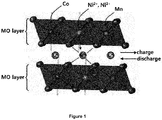
- As illustrated in
FIG. 1 , in the cathode active material having a layered structure, Ni3+ is positioned in the layered structure, Ni2+ and Ni3+ coexist in the lithium nickel-cobalt-aluminum oxide layer, and some Ni2+ are present between the layers and inserted in reversible lithium layer. That is, in this structure, Ni ions inserted into the reversible lithium layer are all Ni2+, and a value of the oxidation number of the Ni ions inserted into the reversible lithium layer is not changed. - In the cathode active material according to the present invention, the content of Ni3+ may be greater than the content of Ni2+, the ratio of Ni3+/Ni2+ may be 1.5 or greater, a mole fraction of Ni2+ inserted and bonded to the reversible lithium layer may be 0.03 to 0.07 with respect to a total amount of Li bond sites of the reversible lithium layer, and the content of Ni2+ is 40% or less when XPS-analyzed. If the mole fraction of Ni2+ is too small, the mole fraction of Ni2+ inserted and bonded to the lithium layer is insufficient, making a crystal structure unstable to degrade cycle characteristics, and conversely, if the mole fraction of Ni2+ is too large, capacity may be degraded, which are thus undesirable.
- The present invention also provides a cathode active material including a lithium compound, which is produced as residual lithium in the cathode active material and a metal compound for lithium reduction react with each other, on a surface thereof.
- The lithium metal complex oxide is represented by Chemical Formula 1 below.
<Chemical Formula 1> Li1+aNi1-x-yM1xM2yO2
(Here, M1 is Co or Mn, M2 is one or more elements selected from the group consisting of Al, Mn, Mg, Si, P, V, W, Zr, Ba, and Ga, -0.2 ≤ a ≤ 0.5, 0.01 ≤ x ≤ 0.5, and 0.01 ≤ y ≤ 0.2). - In the present invention, the lithium compound produced as residual lithium in the lithium metal complex oxide and the metal compound for lithium reduction react with each other may be represented by Chemical Formula 2 below.
<Chemical Formula 2> Lia'-M'b-M"c-Od
(Here, M' is Al or Mn, M" includes one or more elements selected from the group consisting of Co, Ba, B, Ti, Mn, Mg, Fe, Cu, Ag, Ca, Na, K, In, Ga, Ge, V, Mo, Nb, Si, W, and Zr, 0 ≤ a' ≤ 3, 0 ≤ b ≤ 2, 0 ≤ c ≤ 10, and 0 ≤ d ≤ 10). - The present invention includes a lithium compound represented by Chemical Formula 2 on a surface of the cathode active material represented by Chemical Formula 2, and a crystal structure of the cathode active material of Chemical Formula 1 and a crystal structure of the lithium compound of Chemical Formula 2 may be different.
- In the present invention, the lithium compound produced as residual lithium and the compound for lithium reduction may be one selected from the group consisting of LiCoO2, LiAlO2, LiCoPO4, Li3PO4, Li2TiO3, LiTi2(PO)4, LiTi7O4, LiTi2O4, Li6Zr3O9, Li2ZrO3, Li2VO3, LiCoTiO2, Li2NiO3, LiNiO2, Ba19Li44, BaLi4, Li3VO4, LiVP2O7, LiMn2O4, Li2MnO3, LiMnP2O7, Li2MnP2O2, Li4WO5, and Li2WO4.
- In the present invention, the metal compound for lithium reduction may be represented by MOH, MOOH, and MOx (Here, M is selected from the group consisting of Co, Ni, Al, Ba, B, Ti, Mn, Mg, Fe, Cu, Ag, Ca, Na, K, In, Ga, Ge, V, Mo, Nb, Si, and Zr, and 0.001≤x≤2). During a process of preparing the lithium metal complex oxide according to the present invention, the compound for lithium reduction may be mixed in a solid state. That is, the metal compound for lithium reduction may be a compound which may react with residual lithium, in a solid state.
- The present invention also provides a method for preparing a lithium metal complex oxide including: preparing a lithium metal complex oxide; mixing the lithium metal complex oxide with a metal compound for lithium reduction; and stirring a mixture of the lithium metal complex oxide and the metal compound for lithium reduction, while applying energy thereto.
- In the method for preparing a lithium metal complex oxide, the metal compound for lithium reduction may be selected from the group consisting of Co3O4, CoOOH, Co(OH)2, and CoSO4.
- In the method for preparing a lithium metal complex oxide, the lithium metal complex oxide and the metal compound for lithium reduction may be mixed in a solid state.
- That is, in the method for preparing a lithium metal complex oxide, the metal compound for lithium reduction in a solid state and the cathode active material react with each other to reduce residual lithium, while preventing a degradation of capacity which occurs in the related art rinsing process.
- In the method for preparing a lithium metal complex oxide, a lithium compound having a crystal structure different from a cathode active material may be produced through a reaction by stirring a mixture of the lithium metal complex oxide and the metal compound for lithium reduction, while applying energy thereto.
- The lithium metal complex oxide according to the present invention may include a lithium compound having a structure different from that of the cathode active material produced as residual lithium on a surface and the compound for reducing residual lithium in a solid state react with each other, and thus, the ion content of Ni2+ and Ni3+ on the surface may be adjusted, reducing residual lithium, and a degradation due to the related art rinsing process for reducing residual lithium is prevented, significantly increasing capacity.
- The above and other aspects, features and other advantages of the present invention will be more clearly understood from the following detailed description taken in conjunction with the accompanying drawings, in which:
-
FIG. 1 illustrates an action of Ni2+ and Ni3+ in a layered cathode active material. -
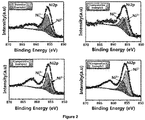
FIG. 2 is a graph illustrating a result of measuring a distribution of Ni2+ and Ni3+ in a lithium metal complex oxide prepared in an embodiment of the present invention through XPS. - Hereinafter, examples of the present invention will be described in detail. However, the following examples are for illustrative purposes only and are not intended to limit the scope of the present invention. Any technical concept having substantially the same constitution as the technical idea described in the claims of the present invention and achieving the same operational effect is included in the scope of the present invention.
- Precursors represented by NiCo(OH)2 and NiCoAl(OH)2 were prepared to prepare a lithium metal complex oxide by a coprecipitation reaction.
- LiOH and Li2CO3 were added as lithium compounds to the prepared precursors and heat-treated to prepare a cathode active material for a lithium secondary battery.
- Co(OH)2, CoOOH, Co3O4, and CoSO4 were mixed with the prepared lithium metal complex oxide and the compound for lithium reduction and the mixture was stirred, while applying energy thereto.
- The compound for lithium reduction mixed with the lithium metal complex oxide prepared thusly are shown in Table 1 below.
[Table 1] Lithium metal complex oxide Compound for lithium reduction Rinsing Inventive Example-1 LiN i1-(x+y)CoxAlyO2 Co3O4 × Inventive Example-2 LiN i1-(x+y)CoxAlyO2 CoOOH × Inventive Example-3 LiN i1-(x+y)CoxAlyO2 Co(OH)2 × Comparative Example-1 LiN i1-(x+y)CoxAlyO2 Co3O4, CoSO4 ○ Comparative Example-2 LiN i1-(x+y)CoxAlyO2 × ○ Comparative Example-3 LiN i1-(x+y)CoxAlyO2 × × - A cathode active material of Comparative Example 1 was prepared in the same manner as that of Inventive Example 1, except that rinsing was performed with a solution including Co3O4 or CoSO4 salt after the active material was prepared.
- A cathode active material of Comparative Example 2 was prepared by performing rinsing with distilled water not including cobalt after the active material was prepared without mixing Co3O4 as a compound for lithium reduction.
- A cathode active material of Comparative Example 3 was prepared without mixing a compound for lithium reduction and without performing rinsing after the active material was prepared.
- XPS of the cathode active materials for a secondary battery prepared in the above Inventive Examples and Comparative Examples was measured and results thereof are shown in
FIG. 2 and Table 2 below. - It can be seen that, in the case of solid phase mixing with the compound for lithium reduction without rinsing according to the present invention, the content of Ni3+ was significantly increased, relative to Ni2+, and the ratio of Ni3+/Ni2+ was the highest.
[Table 2] Classification XPS analysis Ni3+ Ni2+ Ni3+/Ni2+ Inventive Example-1 66.0% 34.0% 1.94 Comparative Example-1 44.1% 55.9% 0.79 Comparative Example-2 32.4% 67.6% 0.48 Comparative Example-3 53.7% 46.3% 1.16 - Residual lithium of the cathode active materials prepared according to the above Inventive Examples and Comparative Examples was measured.
- Specifically, 10 g of a prepared lithium metal complex oxide was immersed in 100 g of distilled water and stirred for 10 minutes. After stirring was finished, the product was filtered to obtain a filtrate, to which 0.1 M of HCI solution was added to be titrated to pH 5.
- Here, the volume of the added HCI solution was measured to analyze residual lithium of the cathode active materials for a secondary battery, and results thereof are illustrated in Table 3 below.
[Table 3] Classification Residual lithium (ppm) LiOH Li2Co3 Li
Inventive Example-1 5021 6990 0.178 Inventive Example-2 4948 7270 0.178 Inventive Example-3 5012 6978 0.178 Comparative Example-1 1311 1598 0.045 Comparative Example-2 629 1628 0.026 Comparative Example-3 7033 9914 0.250 - A battery was prepared using the cathode active materials prepared in the above Inventive Examples and Comparative Examples.
- First, a secondary battery cathode active material, super-P as a conductive material, and polyvinylidene fluoride (PVdF) as a binder were mixed at a weight ratio of 95:5:3 to prepare a slurry. The prepared slurry was uniformly applied to an aluminum foil having a thickness of 15µm and vacuum-dried at 135°C to prepare a cathode for a lithium secondary battery.
- A coil battery was manufactured using the obtained cathode for a lithium secondary battery, a lithium foil as a counterpart electrode, a porous polyethylene film (Celguard LLC., Celguard 2300) having a thickness of 25µm as a separator, and a solvent including ethylene carbonate and ethylmethylcarbonate mixed in the volume ratio of 3:7 and including LiPF6 having a concentration of 1.15M as a liquid electrolyte.
- Initial capacities of batteries including the cathode active materials of the present invention prepared in Inventive Examples and cathode active materials of Comparative Examples were measured and results thereof are shown in Table 4.
[Table 4] Classification 1st charge/discharge (0.15 C, 3.0∼4.25 V @25 °C) Charge Discharge Efficiency mAh/g mAh/g % Inventive Example-1 229.5 205.8 89.7 Inventive Example-2 229.0 205.4 89.7 Inventive Example-3 229.2 205.2 89.5 Comparative Example-1 230.2 201.1 87.4 Comparative Example-2 229.1 199.4 87.0 Comparative Example-3 230.1 203.9 88.6 - Life characteristics and high-temperature storage characteristics of the batteries including the cathode active materials of the present invention prepared in Inventive Examples and the cathode active materials of Comparative Examples were measured by resistance before and after storage, and results thereof are shown in Table 5 and Table 6.
[Table 5] Classification Life time (@100 cycle) Room temperature ((1 C, 3.0∼4.25 V) % Inventive Example-1 93.1 Inventive Example-2 93.3 Inventive Example-3 93.9 Comparative Example-1 78.9 Comparative Example-2 72.3 Comparative Example-3 87.8 [Table 6] Classification Life time Imp 1st 100th Ω Ω Inventive Example-1 2.9 12.3 Inventive Example-2 2.0 11.3 Inventive Example-3 1.9 11.5 Comparative Example-1 3.6 19.9 Comparative Example-2 22.0 51.5 Comparative Example-3 4.7 37.6 - In Table 5 and Table 6, it can be seen that the life characteristics of Inventive Examples according to the present invention were significantly improved, as compared with Comparative Examples.
Claims (9)
- A lithium metal complex oxide in which the content of Ni3+ is greater than the content of Ni2+ and a ratio of Ni3+/Ni2+ is 1.5 or greater.
- The lithium metal complex oxide of claim 1, wherein
The lithium metal complex oxide is represented by Chemical Formula 1 below:
<Chemical Formula 1> Li1+aNi1-x-yM1xM2yO2
where M1 is Co or Mn, M2 is one or more elements selected from the group consisting of Al, Mn, Mg, Si, P, V, W, Zr, Ba, and Ga, -0.2 ≤ a ≤ 0.5, 0.01 ≤ x ≤ 0.5, and 0.01≤ y ≤ 0.2. - The lithium metal complex oxide of claim 1 or claim 2, wherein
the lithium compound produced as residual lithium in the lithium metal complex oxide and the metal compound for lithium reduction react with each other is represented by Chemical Formula 2 below:
<Chemical Formula 2> Lia'-M'b-M"c-Od
where M' is Al or Mn, M" includes one or more elements selected from the group consisting of Co, Ba, B, Ti, Mn, Mg, Fe, Cu, Ag, Ca, Na, K, In, Ga, Ge, V, Mo, Nb, Si, W, and Zr, 0 ≤ a' ≤ 3, 0 ≤ b ≤ 2, 0≤ c ≤ 10, and 0 ≤ d ≤ 10. - The lithium metal complex oxide of any one of claims 1 to 3, wherein
the lithium compound produced as residual lithium and the compound for lithium reduction is one selected from the group consisting of LiCoO2, LiAlO2, LiCoPO4, Li3PO4, Li2TiO3, LiTi2(PO)4, LiTi7O4, LiTi2O4, Li6Zr3O9, Li2ZrO3, Li2VO3, LiCoTiO2, Li2NiO3, LiNiO2, Ba19Li44, BaLi4, Li3VO4, LiVP2O7, LiMn2O4, Li2MnO3, LiMnP2O7, Li2MnP2O2, Li4WO5, and Li2WO4. - The lithium metal complex oxide of any one of claims 1 to 4, wherein
the lithium compound produced as residual lithium and the metal compound for lithium reduction react with each other has a crystal structure different from a crystal structure of the lithium metal complex oxide. - A method for preparing a lithium metal complex oxide, the method comprising:preparing a lithium metal complex oxide;mixing the lithium metal complex oxide with a metal compound for lithium reduction; andstirring a mixture of the lithium metal complex oxide and the metal compound for lithium reduction, while applying energy thereto.
- The method of claim 6, wherein
the compound for lithium reduction is in a solid state. - The lithium metal complex oxide of claim 6 or claim 7, wherein
the metal compound for lithium reduction is selected from the group consisting of MOH, MOOH, and MOx (M is selected from the group consisting of Co, Ni, Al, Ba, B, Ti, Mn, Mg, Fe, Cu, Ag, Ca, Na, K, In, Ga, Ge, V, Mo, Nb, Si, and Zr, and 0.001≤x≤2). - The method of any one of claims 6 to 8, wherein
the metal compound for lithium reduction is selected from the group consisting of Co3O4, CoOOH, Co(OH)2, and CoSO4.
Applications Claiming Priority (2)
| Application Number | Priority Date | Filing Date | Title |
|---|---|---|---|
| KR20170157765 | 2017-11-23 | ||
| KR1020180142946A KR102174720B1 (en) | 2017-11-23 | 2018-11-19 | Lithium metal complex oxide and manufacturing method of the same |
Publications (2)
| Publication Number | Publication Date |
|---|---|
| EP3499611A2 true EP3499611A2 (en) | 2019-06-19 |
| EP3499611A3 EP3499611A3 (en) | 2019-11-06 |
Family
ID=64456900
Family Applications (1)
| Application Number | Title | Priority Date | Filing Date |
|---|---|---|---|
| EP18208156.2A Pending EP3499611A3 (en) | 2017-11-23 | 2018-11-23 | Lithium metal complex oxide and manufacturing method of the same |
Country Status (2)
| Country | Link |
|---|---|
| US (1) | US11508960B2 (en) |
| EP (1) | EP3499611A3 (en) |
Citations (2)
| Publication number | Priority date | Publication date | Assignee | Title |
|---|---|---|---|---|
| US20070292761A1 (en) | 2005-04-13 | 2007-12-20 | Lg Chem, Ltd. | Material for lithium secondary battery of high performance |
| US20150171423A1 (en) * | 2013-12-17 | 2015-06-18 | Samsung Sdi Co., Ltd. | Composite cathode active material, cathode and lithium battery comprising the same, and preparation method thereof |
Family Cites Families (19)
| Publication number | Priority date | Publication date | Assignee | Title |
|---|---|---|---|---|
| JP3835180B2 (en) * | 2001-03-05 | 2006-10-18 | 住友金属鉱山株式会社 | Cathode active material for non-aqueous electrolyte secondary battery and method for producing the same |
| JP5223166B2 (en) * | 2006-02-07 | 2013-06-26 | 日産自動車株式会社 | Battery active material and secondary battery |
| EP2214234B1 (en) * | 2007-11-12 | 2014-01-08 | Toda Kogyo Corporation | Li-ni-based composite oxide particle powder for rechargeable battery with nonaqueous elctrolyte, process for producing the powder, and rechargeable battery with nonaqueous electrolyte |
| KR101184964B1 (en) | 2008-08-07 | 2012-10-02 | 주식회사 엘지화학 | Electode assembly and electrochemical cell comprising the same |
| CN102150305B (en) * | 2008-09-10 | 2014-01-08 | 株式会社Lg化学 | Cathode active material for lithium secondary battery |
| KR101127554B1 (en) * | 2011-07-20 | 2012-03-23 | 한화케미칼 주식회사 | Single phase lithium-deficient multi-component transition metal oxides having a layered crystal structure and a method of producing the same |
| JP5141805B1 (en) * | 2011-08-02 | 2013-02-13 | トヨタ自動車株式会社 | Solid secondary battery and battery system |
| JP5822708B2 (en) * | 2011-12-16 | 2015-11-24 | 住友金属鉱山株式会社 | Positive electrode active material for non-aqueous electrolyte secondary battery, method for producing the same, and non-aqueous electrolyte secondary battery using the positive electrode active material |
| CN103700833B (en) * | 2012-09-27 | 2016-04-27 | 清华大学 | Anode composite material of lithium ion battery |
| CN105229830A (en) * | 2013-02-28 | 2016-01-06 | 汉阳大学校产学协力团 | Positive electrode active material for lithium secondary battery |
| US9991514B2 (en) * | 2013-08-29 | 2018-06-05 | Lg Chem, Ltd. | Method of manufacturing lithium nickel complex oxide, lithium nickel complex oxide manufactured thereby, and cathode active material including the same |
| KR101631753B1 (en) | 2013-08-29 | 2016-06-17 | 주식회사 엘지화학 | Manufacturing method of lithium nickel complex oxide, lithium nickel complex oxide manufactured thereby, and cathode active material comprising the same |
| KR102183996B1 (en) * | 2014-01-29 | 2020-11-27 | 삼성에스디아이 주식회사 | Positive active material and manufacturing method thereof, positive electrode and lithium battery containing the material |
| KR102296131B1 (en) * | 2014-12-30 | 2021-09-01 | 삼성에스디아이 주식회사 | Cathode active material for lithium ion secondary battery, method for preparing the same, and lithium ion secondary battery including the same |
| KR102004457B1 (en) * | 2015-11-30 | 2019-07-29 | 주식회사 엘지화학 | Positive electrode active material for secondary battery and secondary battery comprising the same |
| WO2017095134A1 (en) * | 2015-11-30 | 2017-06-08 | 주식회사 엘지화학 | Cathode active material for secondary battery, and secondary battery comprising same |
| CN105958062A (en) | 2016-06-12 | 2016-09-21 | 湖南杉杉新能源有限公司 | Polycrystal high-nickel positive electrode material used for lithium ion battery and preparation method for polycrystal high-nickel positive electrode material |
| CN106532038A (en) * | 2017-01-18 | 2017-03-22 | 宁波金和锂电材料有限公司 | Lithium nickel and cobalt aluminate anode material and preparation method and lithium ion battery thereof |
| CN106910881A (en) | 2017-03-29 | 2017-06-30 | 山东玉皇新能源科技有限公司 | Metatitanic acid lithium coats the preparation method of nickel cobalt lithium aluminate cathode material |
-
2018
- 2018-11-23 EP EP18208156.2A patent/EP3499611A3/en active Pending
- 2018-11-23 US US16/198,985 patent/US11508960B2/en active Active
Patent Citations (3)
| Publication number | Priority date | Publication date | Assignee | Title |
|---|---|---|---|---|
| US20070292761A1 (en) | 2005-04-13 | 2007-12-20 | Lg Chem, Ltd. | Material for lithium secondary battery of high performance |
| US20150171423A1 (en) * | 2013-12-17 | 2015-06-18 | Samsung Sdi Co., Ltd. | Composite cathode active material, cathode and lithium battery comprising the same, and preparation method thereof |
| KR20150070853A (en) | 2013-12-17 | 2015-06-25 | 삼성에스디아이 주식회사 | Composite cathode active material, cathode, lithium battery comprising the same, and preparation method thereof |
Non-Patent Citations (2)
| Title |
|---|
| HUANG YAQUN ET AL: "Enhanced electrochemical performance of LiNi0.8Co0.15Al0.05O2by nanoscale surface modification with Co3O4", ELECTROCHIMICA ACTA, ELSEVIER, AMSTERDAM, NL, vol. 231, 14 February 2017 (2017-02-14), pages 294 - 299, XP085134199, ISSN: 0013-4686, DOI: 10.1016/J.ELECTACTA.2017.02.067 * |
| SCHIPPER FLORIAN ET AL: "Stabilizing nickel-rich layered cathode materials by a high-charge cation doping strategy: zirconium-doped LiNi 0.6 Co 0.2 Mn 0.2 O 2", JOURNAL OF MATERIALS CHEMISTRY A, vol. 4, no. 41, 13 September 2016 (2016-09-13), GB, pages 16073 - 16084, XP055904428, ISSN: 2050-7488, Retrieved from the Internet <URL:https://pubs.rsc.org/en/content/articlepdf/2016/ta/c6ta06740a> DOI: 10.1039/C6TA06740A * |
Also Published As
| Publication number | Publication date |
|---|---|
| EP3499611A3 (en) | 2019-11-06 |
| US20190157672A1 (en) | 2019-05-23 |
| US11508960B2 (en) | 2022-11-22 |
Similar Documents
| Publication | Publication Date | Title |
|---|---|---|
| EP4086984A1 (en) | Positive electrode material, preparation method therefor, and lithium ion secondary battery | |
| Li et al. | Effect of niobium doping on the microstructure and electrochemical properties of lithium-rich layered Li [Li 0.2 Ni 0.2 Mn 0.6] O 2 as cathode materials for lithium ion batteries | |
| US20230067781A1 (en) | Lithium metal complex oxide and manufacturing method of the same | |
| EP3428124B1 (en) | Ni based cathode material for rechargeable lithium-ion batteries | |
| EP2600444B1 (en) | Secondary battery with an improved lithium ion mobility and cell capacity | |
| EP2368851B1 (en) | Powder of lithium complex compound particles, method for producing the same, and nonaqueous electrolyte secondary cell | |
| US9981859B2 (en) | Positive electrode composition for non-aqueous electrolyte secondary battery and method of manufacturing thereof | |
| KR101977995B1 (en) | Positive electrode active material coated with boron compounds for lithium secondary battery and preparation method thereof | |
| EP3653581A1 (en) | Metal composite hydroxide, method for producing same, positive electrode active material for nonaqueous electrolyte secondary batteries, method for producing said positive electrode active material, and nonaqueous electrolyte secondary battery using said positive electrode active material | |
| JP6951028B2 (en) | Method for producing positive electrode active material and positive electrode active material produced by this method | |
| US11677065B2 (en) | Cathode active material of lithium secondary battery | |
| CN117691068A (en) | A positive active material and secondary battery | |
| KR101676687B1 (en) | Positive active material for rechargeable lithium battery, method for manufacturing the same, and rechargeable lithium battery including the same | |
| US20240250257A1 (en) | Lithium nickel-based composite oxide as a positive electrode active material for rechargeable lithium-ion batteries | |
| US20200343539A1 (en) | Manganese phosphate coated lithium nickel oxide materials | |
| EP4696656A1 (en) | Positive electrode active material, secondary battery, and electric device | |
| EP3486220B2 (en) | Cathode active material for lithium secondary battery and lithium secondary battery including the same | |
| US20220158160A1 (en) | Fluorination of al2o3 coating for lithium-ion battery | |
| KR101439630B1 (en) | Positive electrode for lithium ion secondary battery and lithium ion secondary battery including the same | |
| EP3499611A2 (en) | Lithium metal complex oxide and manufacturing method of the same | |
| KR20180094567A (en) | Positive active material for lithium secondary battery | |
| EP3489198A1 (en) | Cathode active material of lithium secondary battery | |
| EP4636855A1 (en) | Cathode active material for lithium secondary battery, and method for manufacturing cathode active material |
Legal Events
| Date | Code | Title | Description |
|---|---|---|---|
| PUAI | Public reference made under article 153(3) epc to a published international application that has entered the european phase |
Free format text: ORIGINAL CODE: 0009012 |
|
| STAA | Information on the status of an ep patent application or granted ep patent |
Free format text: STATUS: REQUEST FOR EXAMINATION WAS MADE |
|
| 17P | Request for examination filed |
Effective date: 20181123 |
|
| AK | Designated contracting states |
Kind code of ref document: A2 Designated state(s): AL AT BE BG CH CY CZ DE DK EE ES FI FR GB GR HR HU IE IS IT LI LT LU LV MC MK MT NL NO PL PT RO RS SE SI SK SM TR |
|
| AX | Request for extension of the european patent |
Extension state: BA ME |
|
| PUAL | Search report despatched |
Free format text: ORIGINAL CODE: 0009013 |
|
| AK | Designated contracting states |
Kind code of ref document: A3 Designated state(s): AL AT BE BG CH CY CZ DE DK EE ES FI FR GB GR HR HU IE IS IT LI LT LU LV MC MK MT NL NO PL PT RO RS SE SI SK SM TR |
|
| AX | Request for extension of the european patent |
Extension state: BA ME |
|
| RIC1 | Information provided on ipc code assigned before grant |
Ipc: H01M 4/525 20100101ALI20190930BHEP Ipc: H01M 4/62 20060101ALI20190930BHEP Ipc: H01M 4/131 20100101ALI20190930BHEP Ipc: H01M 4/36 20060101AFI20190930BHEP Ipc: H01M 4/1391 20100101ALI20190930BHEP Ipc: C01G 53/00 20060101ALI20190930BHEP |
|
| TPAC | Observations filed by third parties |
Free format text: ORIGINAL CODE: EPIDOSNTIPA |
|
| STAA | Information on the status of an ep patent application or granted ep patent |
Free format text: STATUS: EXAMINATION IS IN PROGRESS |
|
| 17Q | First examination report despatched |
Effective date: 20220329 |