EP3498712B1 - Spirocyclic indolone polyethylene glycol carbonate compound, composition, preparation method and use thereof - Google Patents
Spirocyclic indolone polyethylene glycol carbonate compound, composition, preparation method and use thereof Download PDFInfo
- Publication number
- EP3498712B1 EP3498712B1 EP16911933.6A EP16911933A EP3498712B1 EP 3498712 B1 EP3498712 B1 EP 3498712B1 EP 16911933 A EP16911933 A EP 16911933A EP 3498712 B1 EP3498712 B1 EP 3498712B1
- Authority
- EP
- European Patent Office
- Prior art keywords
- cancer
- rac
- polyethylene glycol
- indolone
- spirocyclic
- Prior art date
- Legal status (The legal status is an assumption and is not a legal conclusion. Google has not performed a legal analysis and makes no representation as to the accuracy of the status listed.)
- Active
Links
Images





Classifications
-
- A—HUMAN NECESSITIES
- A61—MEDICAL OR VETERINARY SCIENCE; HYGIENE
- A61K—PREPARATIONS FOR MEDICAL, DENTAL OR TOILETRY PURPOSES
- A61K47/00—Medicinal preparations characterised by the non-active ingredients used, e.g. carriers or inert additives; Targeting or modifying agents chemically bound to the active ingredient
- A61K47/50—Medicinal preparations characterised by the non-active ingredients used, e.g. carriers or inert additives; Targeting or modifying agents chemically bound to the active ingredient the non-active ingredient being chemically bound to the active ingredient, e.g. polymer-drug conjugates
- A61K47/51—Medicinal preparations characterised by the non-active ingredients used, e.g. carriers or inert additives; Targeting or modifying agents chemically bound to the active ingredient the non-active ingredient being chemically bound to the active ingredient, e.g. polymer-drug conjugates the non-active ingredient being a modifying agent
- A61K47/56—Medicinal preparations characterised by the non-active ingredients used, e.g. carriers or inert additives; Targeting or modifying agents chemically bound to the active ingredient the non-active ingredient being chemically bound to the active ingredient, e.g. polymer-drug conjugates the non-active ingredient being a modifying agent the modifying agent being an organic macromolecular compound, e.g. an oligomeric, polymeric or dendrimeric molecule
- A61K47/59—Medicinal preparations characterised by the non-active ingredients used, e.g. carriers or inert additives; Targeting or modifying agents chemically bound to the active ingredient the non-active ingredient being chemically bound to the active ingredient, e.g. polymer-drug conjugates the non-active ingredient being a modifying agent the modifying agent being an organic macromolecular compound, e.g. an oligomeric, polymeric or dendrimeric molecule obtained otherwise than by reactions only involving carbon-to-carbon unsaturated bonds, e.g. polyureas or polyurethanes
- A61K47/60—Medicinal preparations characterised by the non-active ingredients used, e.g. carriers or inert additives; Targeting or modifying agents chemically bound to the active ingredient the non-active ingredient being chemically bound to the active ingredient, e.g. polymer-drug conjugates the non-active ingredient being a modifying agent the modifying agent being an organic macromolecular compound, e.g. an oligomeric, polymeric or dendrimeric molecule obtained otherwise than by reactions only involving carbon-to-carbon unsaturated bonds, e.g. polyureas or polyurethanes the organic macromolecular compound being a polyoxyalkylene oligomer, polymer or dendrimer, e.g. PEG, PPG, PEO or polyglycerol
-
- A—HUMAN NECESSITIES
- A61—MEDICAL OR VETERINARY SCIENCE; HYGIENE
- A61P—SPECIFIC THERAPEUTIC ACTIVITY OF CHEMICAL COMPOUNDS OR MEDICINAL PREPARATIONS
- A61P35/00—Antineoplastic agents
-
- A—HUMAN NECESSITIES
- A61—MEDICAL OR VETERINARY SCIENCE; HYGIENE
- A61K—PREPARATIONS FOR MEDICAL, DENTAL OR TOILETRY PURPOSES
- A61K31/00—Medicinal preparations containing organic active ingredients
- A61K31/33—Heterocyclic compounds
- A61K31/395—Heterocyclic compounds having nitrogen as a ring hetero atom, e.g. guanethidine or rifamycins
- A61K31/40—Heterocyclic compounds having nitrogen as a ring hetero atom, e.g. guanethidine or rifamycins having five-membered rings with one nitrogen as the only ring hetero atom, e.g. sulpiride, succinimide, tolmetin, buflomedil
- A61K31/407—Heterocyclic compounds having nitrogen as a ring hetero atom, e.g. guanethidine or rifamycins having five-membered rings with one nitrogen as the only ring hetero atom, e.g. sulpiride, succinimide, tolmetin, buflomedil condensed with other heterocyclic ring systems, e.g. ketorolac, physostigmine
-
- C—CHEMISTRY; METALLURGY
- C07—ORGANIC CHEMISTRY
- C07D—HETEROCYCLIC COMPOUNDS
- C07D487/00—Heterocyclic compounds containing nitrogen atoms as the only ring hetero atoms in the condensed system, not provided for by groups C07D451/00 - C07D477/00
- C07D487/02—Heterocyclic compounds containing nitrogen atoms as the only ring hetero atoms in the condensed system, not provided for by groups C07D451/00 - C07D477/00 in which the condensed system contains two hetero rings
- C07D487/04—Ortho-condensed systems
-
- C—CHEMISTRY; METALLURGY
- C07—ORGANIC CHEMISTRY
- C07D—HETEROCYCLIC COMPOUNDS
- C07D487/00—Heterocyclic compounds containing nitrogen atoms as the only ring hetero atoms in the condensed system, not provided for by groups C07D451/00 - C07D477/00
- C07D487/02—Heterocyclic compounds containing nitrogen atoms as the only ring hetero atoms in the condensed system, not provided for by groups C07D451/00 - C07D477/00 in which the condensed system contains two hetero rings
- C07D487/10—Spiro-condensed systems
-
- C—CHEMISTRY; METALLURGY
- C07—ORGANIC CHEMISTRY
- C07D—HETEROCYCLIC COMPOUNDS
- C07D487/00—Heterocyclic compounds containing nitrogen atoms as the only ring hetero atoms in the condensed system, not provided for by groups C07D451/00 - C07D477/00
- C07D487/12—Heterocyclic compounds containing nitrogen atoms as the only ring hetero atoms in the condensed system, not provided for by groups C07D451/00 - C07D477/00 in which the condensed system contains three hetero rings
- C07D487/20—Spiro-condensed systems
Definitions
- the present invention pertains to the field of medicine, and relates to spirocyclic indolone polyethylene glycol carbonate compounds, and compositions thereof, to processes for their preparation, and to the use thereof as anticancer drugs due to their antitumor activity.
- the p53 tumor suppresser protein plays a critical role in protection against development of tumor.
- the gene encoding the p53 protein occur mutation or deletion, resulting in loss of the transcriptional activity and the functions of the tumor suppressor protein.
- direct interaction between p53 and human murine double minute 2 (MDM2) proteins plays a major role in inhibiting the functions of wild-type p53. Intervention of the interaction between MDM2-p53 with a small molecule has been considered as a new strategy for cancer treatment.
- Swiss Roche Pharmaceuticals also reports a series of spiro-indolone analogs (see WO2011067185 , WO2011134925 , and WO2012022707 ) and a series of pyrrolidine analogs (see WO2013178570 , WO2014206866 , and WO2015000945 ), wherein RG7388 among the pyrrolidine analogs has been in clinical development. It has been shown that these compounds have limited solubility, greatly challenging the development of preparations which are stable in vivo and in clinical researches.
- the existing compounds can only be used in oral preparations due to poor water solubility, and have compromised therapeutic effect against tumors in clinical due to severe gastrointestinal effects and low bioavailability. Accordingly, there is still a need for developing spiro-indolone analogs that have excellent solubility in water, low toxicity, and more potency and can be used in dosage forms for intravenous injection, as inhibitors of the MDM2-p53 interaction.
- the present disclosure provides a spirocyclic indolone polyethylene glycol carbonate compound represented by the following general formula I, a stereoisomer thereof, or a pharmaceutically acceptable salt thereof: in the general formula I:
- the present disclosure provides an antitumor pharmaceutical composition
- the present disclosure provides a spirocyclic indolone polyethylene glycol compound represented by the general formula I, a stereoisomer thereof, or a pharmaceutically acceptable salt thereof, for use in treating cancer.
- the spirocyclic indolone polyethylene glycol carbonate compounds of the present disclosure, stereoisomers thereof or pharmaceutically acceptable salts thereof, have excellent tumor suppressing activity, good solubility in water, low toxicity, and can be prepared into dosage forms for intravenous injection.
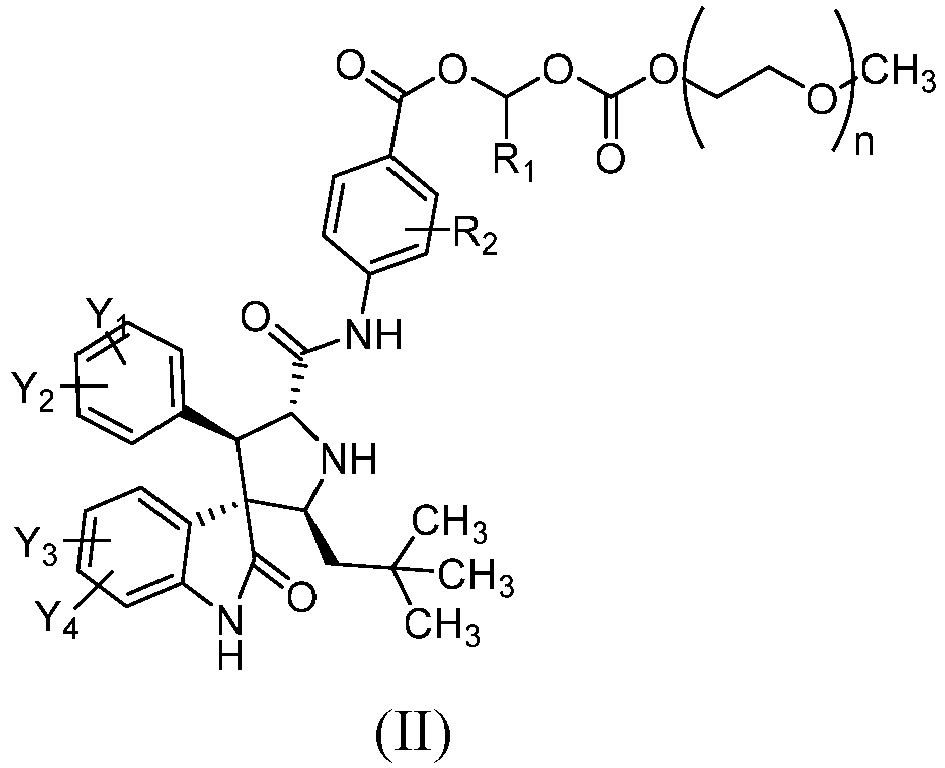
- the spirocyclic indolone polyethylene glycol carbonate compounds are spirocyclic indolone polyethylene glycol carbonate compounds represented by the following formula II: wherein, Y 1 , Y 2 , Y 3 , Y 4 , R 1 , R 2 , and n are as defined above.
- the spirocyclic indolone polyethylene glycol carbonate compounds represented by the general formula I according to the present disclosure may exhibit tautomerism or structural isomerism. This indicates that the invention encompasses any tautomeric or structural isomeric forms of these compounds, or mixtures of such forms, and is not limited to any one tautomeric or structural isomeric form depicted in the structural formulas above.
- Pharmaceutically acceptable salts of the spirocyclic indolone polyethylene glycol carbonate compounds according to the present disclosure refers to conventional acid-addition salts that are formed by reaction of the compounds with suitable non-toxic organic acids, such as p-toluene sulfonic acid, salicylic acid, oxalic acid, citric acid, lactic acid, malic acid, and the like, or inorganic acids, such as hydrochloric acid, sulfuric acid, phosphoric acid, nitric acid, and the like; or conventional base-addition salts formed by reaction of the compounds with suitable non-toxic organic or inorganic bases; examples of the base-addition salts include ammonium salts, sodium salts, potassium salts, and quaternary ammonium hydroxides.
- suitable non-toxic organic acids such as p-toluene sulfonic acid, salicylic acid, oxalic acid, citric acid, lactic acid, malic acid, and the like
- the process for preparing the spirocyclic indolone polyethylene glycol carbonate compound comprises: reacting a spirocyclic indolone compound represented by the following formula III with a compound represented by the following formula IV by a nucleophilic substitution reaction in the presence of a base to give said spirocyclic indolone polyethylene glycol carbonate compound wherein Y 1 , Y 2 , Y 3 , Y 4 , R 1 , R 2 , R 3 and n are as defined above.
- the spirocyclic indolone compounds represented by the general formula III may be prepared by the processes as described in WO2011/067185A1 and WO2011/134925A1 .
- the compounds represented by the general formula IV may, for example, be prepared by the reaction as follows:
- compositions provided by the present disclosure comprise a therapeutically effective amount of a spirocyclic indolone polyethylene glycol carbonate compound represented by the above general formula I, a stereoisomer thereof or a pharmaceutically acceptable salt thereof, and pharmaceutically acceptable auxiliary material(s).
- the antitumor pharmaceutical compositions of the present disclosure may be formulated into injection solutions, tablets, capsules, and other dosage forms, as needed.
- the pharmaceutically acceptable auxiliary materials may be appropriately selected from conventional auxiliary materials depending on the dosage form to be prepared from the antitumor pharmaceutical composition.
- the pharmaceutically acceptable auxiliary materials may include excipients, diluents, and the like.
- a spirocyclic indolone polyethylene glycol carbonate compound represented by the general formula I a stereoisomer thereof or a pharmaceutically acceptable salt thereof in the manufacture of a medicament for treating cancer.
- the use according to the present disclosure may comprise administering to a cancer patient a therapeutically effective amount of a spirocyclic indolone polyethylene glycol carbonate compound represented by the general formula I, a stereoisomer thereof or a pharmaceutically acceptable salt thereof.
- the cancer includes, but is not limited to, bladder cancer, breast cancer, colon cancer, rectal cancer, renal cancer, liver cancer, small cell lung cancer, non-small cell lung cancer, esophageal cancer, gallbladder cancer, ovarian cancer, pancreatic cancer, gastric cancer, cervical cancer, thyroid cancer, prostate cancer, skin cancer, acute lymphocytic leukemia, chronic myeloid leukemia, acute lymphoblastic leukemia, B-cell lymphoma, T-cell lymphoma, Hodgkin's lymphoma, non-Hodgkin's lymphoma, hairy cell lymphoma, Burkett's lymphoma, acute myeloid leukemia, melanoma, endometrial cancer, head and neck cancer, glioblastoma or osteosarcoma.
- a therapeutically effective amount of a compound in accordance with the present invention means an amount of the compound that is effective to prevent, alleviate or ameliorate symptoms of disease or prolong the survival of a patient.
- the therapeutically effective amount or dosage of a compound according to the present invention can vary within wide limits and may be determined in a manner known in the art. Such dosage will be adjusted to the individual requirements in each particular case including the specific compound(s) being administered, the route of administration, the condition being treated, as well as the patient being treated. In general, in the case of oral or parenteral administration to adult humans weighting approximately 70 kg, a daily dose of about 10 mg to about 10,000 mg, and preferably from about 200 mg to about 1,000 mg, should be appropriate, although the upper limit may be exceeded when indicated.
- the daily dosage can be administered as a single dose or in divided doses, or for parenteral administration; and the daily dosage may be given as continuous infusion.
- Example 8 Synthesis of rac-9-oxo-2,5,8,10-tetraoxadodecan-11-yl-4-((2'S,3R,4'S,5'R)-6-chloro-4'-(3-chloro-2-fluorophenyl)-2'-neopentyl-2-oxospiro[indoline-3,3'-pyrrolidine]-5'-carboxamido)-3-methoxybenzoate (rac-SIP-PEG-2)
- Example 9 Synthesis of rac-12-oxo-2,5,8,11,13-pentaoxapentadecan-14-yl-4-((2'S,3R,4'S,5'R)-6-chloro-4'-(3-chloro-2-fluorophenyl)-2'-neopentyl-2-oxospiro[indoline-3,3'-pyrrolidine]-5'-carboxamido)-3-methoxybenzoate (rac-SIP-PEG-3)
- Example 11 Synthesis of chiral-12-oxo-2,5,8,11,13-pentaoxapentadecan-14-yl-4-((2'S,3R,4'S,5'R)-6-chloro-4'-(3-chloro-2-fluorophenyl)-2'-neopentyl-2-oxospiro [indoline-3,3'-pyrrolidine]-5'-carboxamido)-3-methoxybenzoate (chiral-R-SIP-PEG-3)
- Example 12 Synthesis of rac-24-oxo-2,5,8,11,14,17,20,23,25-nonoxaheptacosan-26-yl-4-((2'S,3R,4'S,5'R)-6-chloro-4'-(3-chloro-2-fluorophenyl)-2'-neopentyl-2-oxospiro[indoline-3,3'-pyrrolidine]-5'-carboxamido)-3-methoxybenzoate (rac-SIP-PEG-7)
- Example 13 Synthesis of rac-4-((2'S,3'R,4'S,5'R)-6-chloro-4'-(3-chloro-2-fluorophenyl)-2'-neopentyl-2-oxospiro [indoline-3,3'-pyrrolidine]-5'-carboxamido)-3-methoxybenzoic acid methoxy polyethylene glycol 1000 carbonate (rac-SIP-MPEG-1000)
- Example 14 Synthesis of rac-4-((2'S,3'R,4'S,5'R)-6-chloro-4'-(3-chloro-2-fluorophenyl)-2'-neopentyl-2-oxospiro [indoline-3,3'-pyrrolidine]-5'-carboxamido)-3-methoxybenzoic acid methoxy polyethylene glycol 2000 carbonate (rac-SIP-MPEG-2000)
- rac-SIP-acid (a precursor of rac-SIP-PEG-2, see the reaction in Example 8), rac-SIP-PEG-2 (i.e., the compound of Example 8), rac-SIP-PEG-3 (i.e., the compound of Example 9), chiral-R-SIP-PEG-3 (i.e., the compound of Example 11), rac-SIP-PEG-7 (i.e., the compound of Example 12), rac-SIP-MPEG-1000 (i.e., the compound of Example 13), and rac-SIP-MPEG-2000
- rac-SIP and rac-SIP-acid have a very low solubility in water ( ⁇ 0.1 mg/ml) and are nearly insoluble in water; while rac-SIP-PEG-2 (i.e., the compound of Example 8) has a solubility >0.4 mg/ml, rac-SIP-PEG-3 (i.e., the compound of Example 9) has a solubility > 3 mg/ml, chiral-R-SIP-PEG-3 (i.e., the compound of Example 11) has a solubility > 8 mg/ml, rac-SIP-PEG-7 (i.e., the compound of Example 12) has a solubility of 30 mg/ml, rac-SIP-MPEG-1000 (i.e., the compound of Example 13) has a solubility > 100 mg/ml, and rac-SIP-MPEG-2000 (i.e., the compound of Example 14) has a solubility >
- rac-SIP-PEG-2 i.e., the compound of Example 8
- rac-SIP-PEG-3 i.e., the compound of Example 9
- chiral-R-SIP-PEG-3 i.e., the compound of Example 11
- rac-SIP-PEG-7 i.e., the compound of Example 12
- rac-SIP-MPEG-2000 i.e., the compound of Example 14
- mice Female Balb/c/nu nude mice (weighting 15-19 g) were provided by Beijing Huafukang BioScience Co., Inc. Certificate No.: SCXK (Beijing) 2014-0004.
- Tumor cells (SJSA-1) were harvested under aseptic conditions, and were adjusted to a cell density of 1 ⁇ 10 7 cells/ml with sterile physiological saline. 0.2 ml was inoculated under the skin of the axilla of nude mice, and the tumor was grown to have a diameter of 1 cm. The tumor was removed under aseptic conditions and cut into tumor masses with a size of 2.0 mm ⁇ 2.0 mm, and evenly inoculated under the skin of the axilla of the nude mice. When the tumor volume reached about 250 mm 3 (8 days after inoculation), the animals were administered in groups with 9 mice in each group, and the animals with poor tumor growth were excluded. The control group used physiological saline as a control.
- Dose groups included doxorubicin at a dose of 3.0 mg/kg; rac-SIP at a dose of 30.0 mg/kg dose group; rac-SIP-PEG-2, rac-SIP-PEG-3, chiral-R-SIP-PEG-3 and rac-SIP-PEG-7 each at a dose of 30.0 mg/kg and rac-SIP-MPEG-2000 at a dose of 50.0 mg/kg.
- the data were processed by EXCEL software and expressed by Mean ⁇ SD, and the inter-group analysis was statistically processed using t test.
- the series of rac-SIP-PEG compounds (Example 8, Example 9, Example 11, Example 12 and Example 14) have water solubility greater than the PEG-free compounds, rac-SIP and rac-SIP-acid; and the water solubility increases with the extension of PEG Example 9, Example 11, Example 12 and Example 14 exhibited greater water solubility than Example 8, and could be directly dissolved in physiological saline, being more suitable for intravenous administration, and thus avoiding gastrointestinal side effects of oral drugs.
- the compounds of the present invention due to the presence of PEG, exhibited a significantly greater inhibitory effect on tumor growth than the PEG-free compound SIP; wherein rac-SIP-PEG-2 administered by injection at a dose of 30.0 mg/kg exhibited a slightly better inhibitory effect on tumor growth than the PEG-free rac-SIP given by gastrointestinal administration; rac-SIP-PEG-3, chiral-R-PEG-3 and rac-SIP-PEG-7 at a dose of 30.0 mg/kg, and rac-SIP-MPEG-2000 at a dose of 50.0 mg/kg administered by injection exhibited a stronger inhibitory effect on tumor growth than the PEG-free rac-SIP given by gastrointestinal administration.
- the inhibition rates were 55.36% for rac-SIP-PEG-2, 90.79% for rac-SIP-PEG-3, 97.9% for chiral-R-PEG-3, 96.38% for rac-SIP-PEG-7, and 96.02% for rac-SIP-MPEG-2000, but only 54.89% for SIP which was given by oral administration; and calculated on the basis of tumor weight, the tumor inhibition rates were 50.55% for rac-SIP-PEG-2, 92.86% for rac-SIP-PEG-3, 97.84% for chiral-R-PEG-3, 97.06% for rac-SIP-PEG-7, and 96.70% for rac-SIP-MPEG-2000, but only 49.69% for SIP which was given by oral administration (see Table 1, and Figures 7 , 8 ).
- the body weight was decreased by about 9.4% for rac-SIP-PEG-2; the body weight was decreased by about 7.5% for rac-SIP-PEG-3; the body weight was increased by about 11% for chiral-R-PEG-3; the body weight was decreased by about 6.4% for rac-SIP-PEG-7; the body weight was decrease d by about 5.2% for rac-SIP-MPEG-2000; and the body weight was decreased by about 18% for SIP which was given by oral administration, which were statistically significant (see Table 1, Figure 7 ).
- SIP-PEG spirocyclic indolone polyethylene glycol carbonate compounds
- SIP-PEG spirocyclic indolone polyethylene glycol carbonate compounds
- Table 1 Inhibitory effect of a series of rac-SIP-PEG compounds on the growth of SJSA-1 xenografted tumor in nude mice Groups Dose (mg/kg) Number of Animals (n) Body Weights X ⁇ SD (g) Tumor volumes X ⁇ SD(mm 3 ) Weights of Tumor Start End Start End Inhibition rate (%) X ⁇ SD (g) Inhibition rate (%) Control - 9/9 17.2 ⁇ 1.0 17.0 ⁇ 0.8 247.8127.4 2823.61591.5 2.73 ⁇ 0.43 Doxorubicin ADM 3.0 9/9 17.4 ⁇ 0.7 13.7 ⁇ 0.7*** 241.1146.6 1401.1 ⁇ 658.2*** 50.38 1.41 ⁇ 0.66*** 48.27 rac-SIP 30.0 9/9 17.1
Landscapes
- Chemical & Material Sciences (AREA)
- Health & Medical Sciences (AREA)
- Organic Chemistry (AREA)
- Medicinal Chemistry (AREA)
- Pharmacology & Pharmacy (AREA)
- Life Sciences & Earth Sciences (AREA)
- Animal Behavior & Ethology (AREA)
- General Health & Medical Sciences (AREA)
- Public Health (AREA)
- Veterinary Medicine (AREA)
- Epidemiology (AREA)
- Chemical Kinetics & Catalysis (AREA)
- General Chemical & Material Sciences (AREA)
- Nuclear Medicine, Radiotherapy & Molecular Imaging (AREA)
- Engineering & Computer Science (AREA)
- Bioinformatics & Cheminformatics (AREA)
- Pharmaceuticals Containing Other Organic And Inorganic Compounds (AREA)
- Nitrogen Condensed Heterocyclic Rings (AREA)
- Medicinal Preparation (AREA)
Description
- The present invention pertains to the field of medicine, and relates to spirocyclic indolone polyethylene glycol carbonate compounds, and compositions thereof, to processes for their preparation, and to the use thereof as anticancer drugs due to their antitumor activity.
- Cancer threatens human health and life. In recent years, researches on anticancer drugs have turned to the development of specific molecular targeted therapeutic drugs.
- The p53 tumor suppresser protein plays a critical role in protection against development of tumor. In about 50% of human cancers the gene encoding the p53 protein occur mutation or deletion, resulting in loss of the transcriptional activity and the functions of the tumor suppressor protein. In the remaining 50% cases, direct interaction between p53 and human murine double minute 2 (MDM2) proteins plays a major role in inhibiting the functions of wild-type p53. Intervention of the interaction between MDM2-p53 with a small molecule has been considered as a new strategy for cancer treatment.
- Since 2005, Wang Shaomeng et al. have reported a series of spiro-indolone analogs as inhibitors of MDM2-p53 interaction, and one (SAR405838/MI-77301) among this series of compounds has currently been in clinical development (see
US7759383B2 ,US8222288B2 ,US8680132B2 ,US20130030173A1 ,WO2012065022A2 , andWO2012155066A2 ). Swiss Roche Pharmaceuticals also reports a series of spiro-indolone analogs (seeWO2011067185 ,WO2011134925 , andWO2012022707 ) and a series of pyrrolidine analogs (seeWO2013178570 ,WO2014206866 , andWO2015000945 ), wherein RG7388 among the pyrrolidine analogs has been in clinical development. It has been shown that these compounds have limited solubility, greatly challenging the development of preparations which are stable in vivo and in clinical researches. - The existing compounds can only be used in oral preparations due to poor water solubility, and have compromised therapeutic effect against tumors in clinical due to severe gastrointestinal effects and low bioavailability. Accordingly, there is still a need for developing spiro-indolone analogs that have excellent solubility in water, low toxicity, and more potency and can be used in dosage forms for intravenous injection, as inhibitors of the MDM2-p53 interaction.
- The scope of the invention is defined by the claims. Any references in the description to methods of treatment refer to the compounds, pharmaceutical compositions and medicaments of the present invention for use in a method of treatment of the human (or animal) body by therapy (or for diagnosis).
- Therefore, an object of the present disclosure is to provide a spirocyclic indolone polyethylene glycol carbonate compound which has excellent solubility in water, low toxicity, and more potency and can be used in dosage forms for intravenous injection, or a stereoisomer thereof, or a pharmaceutically acceptable salt thereof; Another object of the present disclosure is to provide a process for preparing the above-mentioned spirocyclic indolone polyethylene glycol carbonate compound; Still another object of the present disclosure is to provide an antitumor pharmaceutical composition;
- Still yet another object of the present disclosure is to provide use of the above-mentioned spirocyclic indolone polyethylene glycol carbonate compound, a stereoisomer thereof, or a pharmaceutically acceptable salt thereof, in the manufacture of a medicament for treating cancer;
- It is still another object of the present disclosure to provide a method of treating cancer.
- In an aspect, the present disclosure provides a spirocyclic indolone polyethylene glycol carbonate compound represented by the following general formula I, a stereoisomer thereof, or a pharmaceutically acceptable salt thereof:

- Y1, Y2, Y3, and Y4 are each independently selected from the group consisting of H and halogen;
- R1 is selected from the group consisting of H and C1-C5 alkyl;
- R2 is selected from the group consisting of H, C1-C5 alkyl and C1-C5 alkoxy;
- R3 is selected from the group consisting of C1-C10 alkyl and C2-C10 alkenyl; and
- n is an integer of 3 to 50.
- In still another aspect, the present disclosure provides an antitumor pharmaceutical composition comprising a therapeutically effective amount of a spirocyclic indolone polyethylene glycol carbonate compound represented by the above general formula I, a stereoisomer thereof, or a pharmaceutically acceptable salt, and one or more pharmaceutically acceptable auxiliary materials.
- In still yet another aspect, the present disclosure provides a spirocyclic indolone polyethylene glycol compound represented by the general formula I, a stereoisomer thereof, or a pharmaceutically acceptable salt thereof, for use in treating cancer.
- The spirocyclic indolone polyethylene glycol carbonate compounds of the present disclosure, stereoisomers thereof or pharmaceutically acceptable salts thereof, have excellent tumor suppressing activity, good solubility in water, low toxicity, and can be prepared into dosage forms for intravenous injection.
- The invention is defined by the claims. Any subject matter falling outside the scope of the claims is provided for information purposes only.
-
-
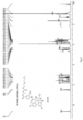
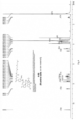
Figure 1 is a 1H NMR spectrum of the compound prepared in Example 6; -
Figure 2 is a 1H NMR spectrum of the compound of the invention prepared in Example 8; -
Figure 3 is a 1H NMR spectrum of the compound prepared in Example 10; -
Figure 4 is a 1H NMR spectrum of the compound of the invention prepared in Example 11; -
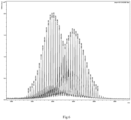
Figure 5 is a spectrum from matrix-assisted laser desorption/ionization time of flight mass spectrometry (MALDI-TOF-MS) of the compound of the invention prepared in Example 13; -
Figure 6 is a spectrum from matrix-assisted laser desorption/ionization time of flight mass spectrometry (MALDI-TOF-MS) of the compound of the invention prepared in Example 14; -
Figure 7 is a curve graph showing the inhibitory effect of doxorubicin, rac-SIP, rac-SIP-PEG-2 (i.e., the compound of Example 8), rac-SIP-PEG-3 (i.e., the compound of Example 9), chiral-R-SIP-PEG-3 (i.e., the compound of Example 11), rac-SIP-PEG-7 (i.e., the compound of Example 12), and rac-SIP-MPEG-2000 (i.e., the compound of Example 14) on the growth of SJSA-1 xenografted tumor in nude mice against relative tumor volumes; -
Figure 8 is a graph showing the inhibitory effect of doxorubicin, rac-SIP, rac-SIP-PEG-2 (i.e., the compound of Example 8), rac-SIP-PEG-3 (i.e., the compound of Example 9), chiral-R-SIP-PEG-3 (i.e., the compound of Example 11), rac-SIP-PEG-7 (i.e., the compound of Example 12), and rac-SIP-MPEG-2000 (i.e., the compound of Example 14) on the growth of SJSA-1 xenografted tumor in nude mice; -
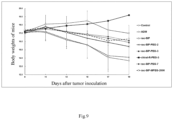
Figure 9 is a curve graph showing the effect of doxorubicin, rac-SIP, rac-SIP-PEG-2 (i.e., the compound of Example 8), rac-SIP-PEG-3 (i.e., the compound of Example 9), chiral-R-SIP-PEG-3 (i.e., the compound of Example 11), rac-SIP-PEG-7 (i.e., the compound of Example 12), and rac-SIP-MPEG-2000 (i.e., the compound of Example 14) on the body weights of SJSA-1 implanted nude mice. - Hereinafter, the present disclosure will be specifically described.
- Among the spirocyclic indolone polyethylene glycol carbonate compounds according to the present disclosure, stereoisomers thereof or pharmaceutically acceptable salts thereof, in one embodiment, the spirocyclic indolone polyethylene glycol carbonate compounds are spirocyclic indolone polyethylene glycol carbonate compounds represented by the following formula II:

- In further preferred embodiments,
- Y1, Y2, Y3, and Y4 are preferably each independently selected from the group consisting of H, F and Cl;
- R1 is preferably selected from the group consisting of H and C1-C3 alkyl, and R1 is more preferably methyl or ethyl, and most preferably methyl;
- R2 is preferably selected from the group consisting of C1-C5 alkoxy groups, and R2 is more preferably methoxy or ethoxy, and most preferably methoxy;
- R3 is preferably selected from the group consisting of C1-C6 alkyl groups, and R3 is more preferably pentyl, and most preferably neopentyl;
- n is an integer of 3 to 50.
- The spirocyclic indolone polyethylene glycol carbonate compounds represented by the general formula I according to the present disclosure may exhibit tautomerism or structural isomerism. This indicates that the invention encompasses any tautomeric or structural isomeric forms of these compounds, or mixtures of such forms, and is not limited to any one tautomeric or structural isomeric form depicted in the structural formulas above.
- Pharmaceutically acceptable salts of the spirocyclic indolone polyethylene glycol carbonate compounds according to the present disclosure refers to conventional acid-addition salts that are formed by reaction of the compounds with suitable non-toxic organic acids, such as p-toluene sulfonic acid, salicylic acid, oxalic acid, citric acid, lactic acid, malic acid, and the like, or inorganic acids, such as hydrochloric acid, sulfuric acid, phosphoric acid, nitric acid, and the like; or conventional base-addition salts formed by reaction of the compounds with suitable non-toxic organic or inorganic bases; examples of the base-addition salts include ammonium salts, sodium salts, potassium salts, and quaternary ammonium hydroxides.
- The process for preparing the spirocyclic indolone polyethylene glycol carbonate compound provided by the present disclosure comprises: reacting a spirocyclic indolone compound represented by the following formula III with a compound represented by the following formula IV by a nucleophilic substitution reaction in the presence of a base to give said spirocyclic indolone polyethylene glycol carbonate compound


- The spirocyclic indolone compounds represented by the general formula III may be prepared by the processes as described in
WO2011/067185A1 andWO2011/134925A1 . - The compounds represented by the general formula IV may, for example, be prepared by the reaction as follows:

- The antitumor pharmaceutical compositions provided by the present disclosure comprise a therapeutically effective amount of a spirocyclic indolone polyethylene glycol carbonate compound represented by the above general formula I, a stereoisomer thereof or a pharmaceutically acceptable salt thereof, and pharmaceutically acceptable auxiliary material(s).
- The antitumor pharmaceutical compositions of the present disclosure may be formulated into injection solutions, tablets, capsules, and other dosage forms, as needed. The pharmaceutically acceptable auxiliary materials may be appropriately selected from conventional auxiliary materials depending on the dosage form to be prepared from the antitumor pharmaceutical composition. For example, when it is desirable to prepare into a lyophilized product for injection, the pharmaceutically acceptable auxiliary materials may include excipients, diluents, and the like.
- According to the present disclosure, there is provided use of a spirocyclic indolone polyethylene glycol carbonate compound represented by the general formula I, a stereoisomer thereof or a pharmaceutically acceptable salt thereof in the manufacture of a medicament for treating cancer.
- The use according to the present disclosuremay comprise administering to a cancer patient a therapeutically effective amount of a spirocyclic indolone polyethylene glycol carbonate compound represented by the general formula I, a stereoisomer thereof or a pharmaceutically acceptable salt thereof.
- The cancer includes, but is not limited to, bladder cancer, breast cancer, colon cancer, rectal cancer, renal cancer, liver cancer, small cell lung cancer, non-small cell lung cancer, esophageal cancer, gallbladder cancer, ovarian cancer, pancreatic cancer, gastric cancer, cervical cancer, thyroid cancer, prostate cancer, skin cancer, acute lymphocytic leukemia, chronic myeloid leukemia, acute lymphoblastic leukemia, B-cell lymphoma, T-cell lymphoma, Hodgkin's lymphoma, non-Hodgkin's lymphoma, hairy cell lymphoma, Burkett's lymphoma, acute myeloid leukemia, melanoma, endometrial cancer, head and neck cancer, glioblastoma or osteosarcoma.
- The compounds of the present disclosure may be administered by any of conventional and convenient routes, including oral administration, intravenous injection, and topical injection. A therapeutically effective amount of a compound in accordance with the present invention means an amount of the compound that is effective to prevent, alleviate or ameliorate symptoms of disease or prolong the survival of a patient.
- The therapeutically effective amount or dosage of a compound according to the present invention can vary within wide limits and may be determined in a manner known in the art. Such dosage will be adjusted to the individual requirements in each particular case including the specific compound(s) being administered, the route of administration, the condition being treated, as well as the patient being treated. In general, in the case of oral or parenteral administration to adult humans weighting approximately 70 kg, a daily dose of about 10 mg to about 10,000 mg, and preferably from about 200 mg to about 1,000 mg, should be appropriate, although the upper limit may be exceeded when indicated. The daily dosage can be administered as a single dose or in divided doses, or for parenteral administration; and the daily dosage may be given as continuous infusion.
- The present invention will be described below by way of examples.
- Examples 7, 8 and 15-19 are comparative examples and do not fall within the scope of the claims.
-

- To a solution of methyl 3-methoxybenzoate (83.0 g, 500 mmol) in H2SO4(70 wt%, 200 ml) was added HNO3 (65 wt%, 40 ml) dropwise at 0 °C. The resulting mixture was stirred overnight, and then poured into ice water. The mixture thus obtained was filtered, and the solid cake obtained was washed with water (3×300 ml) to give 84.4 g of 4-nitro-3-methoxybenzoic acid methyl ester as a yellow solid. Yield: 80%.
- A solution of 4-nitro-3-methoxybenzoic acid methyl ester (84.4 g, 400 mmol) in ethanol (1500 ml) was stirred in the presence of Pd/carbon catalyst (10% Pd, 5.35 g) under a H2 atmosphere for 5 hours. The reaction solution was then filtered through Celite® diatomite to remove the catalyst. The solvent was evaporated in vacuo to give an off white solid, which was recrystallized from methanol, giving 4-amino-3-methoxybenzoic acid methyl ester (70.95 g, 392 mmol). Yield: 98%.
- 1H NMR (400MHz, CDCl3): δ 7.55 (dd, J=8.2Hz, 1.4Hz, 1 H), 7.45 (d, J=8.0Hz, 1 H), 6.65 (d, J=8.0Hz, 1 H), 4.22 (s, 2 H), 3.90 (s, 3 H), 3.86 (s, 3 H); MS: Calcd for C9H12NO3 ([M+H]+): 182, found: 182.
-

- A solution of 2-((tert-butoxycarbonyl)amino)acetic acid (8.75 g, 50 mmol), Et3N (60 mmol) in dichloromethane (DCM) (150 ml) and acetyl chloride (60 mmol) was stirred under a N2 atmosphere at room temperature for 1 hour. Then a solution of 4-amino-3-methoxybenzoic acid methyl ester (9.05 g, 50 mmol) in ethanol (100 ml) was added thereto. The resulting mixture was stirred overnight. Then, 200 ml of water was added to the reaction solution, and the reaction mixture was extracted with DCM (2 × 150 ml). The organic layers were combined, washed with water, and dried over Na2SO4 and then removed the solvents in vacuo. The residue obtained was purified by silica gel column chromatography to give 12.0 g of the target compound as a white solid. Yield: 70%.
- 1H NMR (400MHz, CDCl3): δ 8.59 (s, 1 H), 8.42 (d, J=8.4Hz, 1 H), 7.66 (d, J=8.4Hz, 1 H), 7.52 (s, 1 H), 5.30 (s, 1 H), 3.96 (d, J=5.2Hz, 2 H), 3.91 (s, 3 H), 3.89 (s, 3 H), 1.48 (s, 9 H);
- MS: Calcd for C16H23N2O6 ([M+H]+): 339, found: 339.2.
-

- A solution of 4-(2-((tert-butoxycarbonyl)amino)acetamido)-3-methoxy benzoic acid methyl ester (11.83 g, 35 mmol) and concentrated hydrochloric acid (7.0 ml) in ethyl acetate (100 ml) was stirred overnight at room temperature. The reaction solution was then filtered, and the obtained filter cake was washed with ethyl acetate (2 × 50 ml), and then dried to give 6.562 g 4-(2-aminoacetamido)-3-methoxybenzoic acid methyl ester hydrochloride as a white solid. Yield: 69%.
- 1H NMR (400MHz, DMSO): δ 10.03 (s, 1 H), 8.49 (s, 3 H), 8.20 (d, J=8.4Hz, 1 H), 7.57 (d, J=8.4Hz, 1 H), 7.51 (d, J=1.2 Hz, 1 H), 3.90 (s, 5 H), 3.83 (s, 3 H);
- MS: Calcd for C11H15N2O4 ([M-HCl+H]+): 239, found: 239.
-

- To a suspension of 4-(2-aminoacetamido)-3-methoxybenzoic acid methyl ester hydrochloride (6.56 g, 24 mmol) in MTBE (methyl t-butyl ether) (100 mL) was added triethylamine (5 ml) at room temperature. After stirring for 1 hour, 3,3-dimethyl-n-butanal (2.64 g, 26.4 mmol) was added dropwise, and the resulting mixture was stirred at room temperature for 10 hours. Then, the reaction mixture was filtered to remove triethylamine hydrochloride, and the solid cake was washed with MTBE (3 × 30 ml). The combined organic phases were evaporated in vacuo to remove the organic solvents, yielding a viscous oil, which was directly used for the next step without purification.
-

- 6-Chloroindolin-2-one (8.35 g, 50 mmol) and 3-chloro-2-fluorobenzaldehyde (8.295 g, 52.5 mmol) were stirred at reflux in the presence of piperidine (1 ml) for 6 hours. The reaction suspension was then filtered, and the solid obtained was washed with methanol and dried to give a yellow solid product, (E)-6-chloro-3-(3-chloro-2-fluorobenzylidene)indol-2-one (14.63g, 47.5mmol). Yield: 95%.
- 1H NMR (400MHz, DMSO): δ 10.85 (s, 1 H), 7.70 (q, J=7.3Hz 2 H), 7.54 (s, 1 H), 7.36 (t, J=8Hz 1 H), 7.16 (d, J=8Hz 1 H), 6.92-6.86 (m, 2 H);
- MS: Calcd for C15H9Cl2FNO ([M+H]+): 308, found: 308.0.
-

- A solution of (E)-4-(2-((3,3-dimethylbutylidene)amino)acetamido)-3-methoxybenzoic acid methyl ester (24 mmol) and (E)-6-chloro-3-(3-chloro-2-fluorobenzylidene)indolin-2-one (24 mmol) in 60 ml of toluene was stirred in the presence of 1,8-diazabicycloundec-7-ene (7 ml) overnight, then 100 ml of water was added. The resulting mixture was extracted with ethyl acetate (2 × 150 ml). The organic layers were combined, washed with water, dried over Na2SO4, and removed the solvents in vacuo. The residue obtained was purified by silica gel column chromatography to yield 13.9 g of the target compound as a white solid. Yield: 92%.
- 1H NMR (400 MHz, CDCl3): δ 10.65 (s, 1 H), 8.49 (d, J =8 Hz 1 H), 7.94 (s, 1 H), 7.66 (dd, J =8.6 Hz J =1 Hz 1 H), 7.57 (s, 1 H), 7.51 (t, J =6.8 Hz 1 H), 7.28 (s, 1 H), 7.16 (t, J =7.4 Hz 1 H), 7.07 (dd, J =8.2 Hz J =1.4 Hz 1 H), 6.92 (t, J =8 Hz 1 H), 6.73 (d, J =1.2 Hz 1 H), 4.69 (t, J =8.8 Hz 1 H), 4.44 (d, J =9.2 Hz 1 H), 3.93 (s, 3 H), 3.90 (s, 3 H), 3.65 (t, J =10.4 Hz 1 H), 3.29 (t, J =10.8 Hz 1 H), 1.38-1.28 (m, 1H), 0.96 (s, 9 H), 0.92 (s, 1H) (see
Figure 1 ); - MS: Calcd for C32H33Cl2FN3O5 ([M+H]+): 628, found: 628.2.
-

- A solution of 2-(2-methoxyethoxy)ethanol (6.0 g, 50 mmol) and 1-chloroethyl chloroformate (1-chloroethyl carbonochloridate) (7.455 g, 52.5 mmol) in the presence of Et3N (4.04 g, 52.5 mmol) was stirred at room temperature for 6 hours; then, 200 ml of water was added thereto. The reaction mixture was extracted with DCM (2×150 ml). The organic layers were combined, washed with water and dried over Na2SO4. The solvents were removed in vacuo. The residue obtained was purified by silica gel column chromatography to yield 8.475 g of the target compound as an oil. Yield: 75%.
- 1H NMR (400MHz, CDCl3): δ 6.41 (q, J=5.7Hz 1 H), 4.37-4.32 (m, 2 H), 3.73 (t, J=4.8Hz, 2 H), 3.66-3.62 (m, 2 H), 3.56-3.52 (m, 2 H), 3.37 (s, 3 H), 1.81 (d, J=6.4Hz, 3 H).
-

- A solution of rac-4-((2'S,3'R,4'S,5'R)-6-chloro-4'-(3-chloro-2-fluorophenyl)-2'-neopentyl-2-oxospiro[indoline-3,3'-pyrrolidine]-5'-carboxamido)-3-methoxybenzoic acid methyl ester (13.816 g, 22 mmol) in THF (20 mL) was added LiOH (5.8 ml, 50% in H2O) and stirred overnight. After this, the reaction solution was acidified with hydrochloric acid to pH=1, and the obtained reaction mixture was extracted with ethyl acetate (3 × 50 ml). The organic layers were combined, washed with water, then dried over anhydrous Na2SO4, and removed the solvents in vacuo. The obtained residue was purified by silica gel column chromatography to give 12.43 g of the corresponding acid compound (rac-4-((2'S,3'R,4'S,5'R)-6-chloro-4'-(3-chloro-2-fluorophenyl)-2'-neopentyl-2-oxo spiro[indoline-3,3'-pyrrolidine]-5'-carboxamido)-3-methoxybenzoic acid) as a yellow solid. Yield: 92%.
- A solution of rac-4-((2'S,3'R,4'S,5'R)-6-chloro-4'-(3-chloro-2-fluorophenyl)-2'-neopentyl-2-oxospiro[indoline-3,3'-pyrrolidine]-5'-carboxamido)-3-methoxybenzoic acid (306 mg, 0.5 mmol) and 1-chloroethyl (2-(2-methoxyethoxy)ethyl)carbonate (510 mg, 2.25 mmol) in dimethylformamide (10 ml) was added NaOH (3 mmol, 975 mg, 6 eq), and stirred overnight under a nitrogen atmosphere. Then, 10 ml of water was added. The mixture was extracted with ethyl acetate (2×15 ml). The organic layers were combined, washed with water, dried over anhydrous Na2SO4, and removed the solvents in vacuo. The obtained residue was purified by silica gel column chromatography to give 102 mg of the target compound as a yellow solid. Yield: 26%.
- 1H NMR (400 MHz, CDCl3): δ 10.62 (s, 1 H), 8.48 (d, J =8 Hz, 1 H), 7.79 (d, J =1.6 Hz, 1 H), 7.66 (dd, J =8.6 Hz, 1.4 Hz, 1 H), 7.56 (s, 1 H), 7.47 (t, 1 H), 7.33 (d, J =8 Hz, 1 H), 7.23 (d, J =9.2 Hz, 1 H), 7.19 (d, J =7.6 Hz, 1 H), 7.07-6.98 (m, 2 H), 4.75-4.68 (m, 1 H), 4.50-4.42 (m, 2 H), 4.37-4.25 (m, 2 H), 3.92 (s, 3 H), 3.82 (t, 2 H), 3.76-3.50 (m, 9 H), 2.18 (bs, 1 H), 1.65 (d, J =5.2 Hz, 3 H), 1.36-1.22 (m, 1H), 0.95 (s, 9H) (see
Figure 2 ). - MS: Calcd for C39H45Cl2FN3O10 ([M+H]+): 804, found: 804.2.
-

- A solution of rac-4-((2'S,3'R,4'S,5'R)-6-chloro-4'-(3-chloro-2-fluorophenyl)-2'-neopentyl-2-oxospiro[indoline-3,3'-pyrrolidine]-5'-carboxamido)-3-methoxybenzoic acid (306 mg, 0.5 mmol, synthesized according to the first step in Example 8) and 1-chloroethyl (2-(2-methoxyethoxyethoxy)ethyl)carbonate (609 mg, 2.25 mmol) in dimethylformamide (10 ml) was added NaOH (3 mmol, 975 mg, 6 eq) and stirred overnight under a nitrogen atmosphere; 10 ml of water was then added, and the mixture was extracted with EA ethyl acetate (2 × 15 ml). The organic layers were combined, washed with water, dried over anhydrous Na2SO4, and removed the solvents in vacuo. The residue obtained was purified by silica gel column chromatography to yield 100 mg of the target compound as a white solid. Yield: 24%.
- 1H NMR(CDCl3, 400MHz): δ 10.62 (s, 1 H), 8.50 (d, J = 4.2 Hz, 1 H), 7.79 (d, J = 0.6 Hz, 1 H), 7.74 (d, J = 4.2 Hz, 1 H), 7.61 (s, 1 H), 7.47 (t, J = 6.4 Hz, 1 H), 7.33 (d, J = 7.6 Hz, 1 H), 7.10-7.25 (m, 2 H), 7.02 (t, J = 7.8 Hz, 1 H), 4.70 (d, J = 4.8 Hz, 1 H), 4.40-4.50 (m, 3 H), 3.93 (s, 3 H), 3.78-3.80 (m, 2 H), 3.72 (d, J = 9.0 Hz ,4 H), 3.64 (s, 9 H), 3.50-3.54 (m, 2 H), 3.36 (s, 3 H), 1.23-1.35 (m,1 H), 0.95 (s, 9 H), 0.90 (s, 1 H);
- MS: Calcd for C41H49Cl2FN3O11 ([M+H]+): 848, found: 848.3.
-

- A mixture of rac-4-((2'S,3'R,4'S,5'R)-6-chloro-4'-(3-chloro-2-fluorophenyl)-2'-neopentyl-2-oxospiro[indoline-3,3'-pyrrolidine]-5'-carboxamido)-3-methoxybenzoic acid (4.0 g, 6.5 mmol, synthesized according to the first step in Example 8) and (R)-N,N-dimethyl-1-phenylethan-1-amine (1.12 g, 7.49 mmol) was dispersed in ethyl acetate, heated to 60 °C and stirred at this temperature for 2 hours, and then cooled to room temperature and stirred overnight. The precipitated solid was filtered, washed with cold ethyl acetate and dried to give the R-amine salts, 4-((2'S,3'R,4'S,5'R)-6-chloro-4'-(3-chloro-2-fluorophenyl)-2'-neopentyl-2-oxospiro[indoline-3,3'-pyrrolidine]-5'-carboxamido)-3-methoxybenzoic acid-(R -N,N-dimethyl-1-phenylethan-1-amine salt (2.0 g), as a white solid.
- 1H NMR(d6 -DMSO, 400MHz): δ 10.75 (s, 1 H), 10.47 (s, 1 H), 8.38 (d, J = 8.4 Hz, 1 H), 7.70 (d, J = 8.0 Hz, 1 H), 7.61 (t, J = 7.0 Hz, 1 H), 7.55-7.58 (m, 2 H), 7.37 (t, J = 7.4 Hz, 1 H), 7.25-7.33 (m, 4 H), 7.22 (t, J = 6.8 Hz, 1 H), 7.17 (t, J = 8.0 Hz, 1 H), 7.00 (d, J = 8.4 Hz, 1 H), 6.67 (s, 1 H), 4.67 (t, J = 7.6 Hz, 1 H), 4.47 (d, J = 9.6 Hz, 1 H), 3.90 (s, 3 H), 3.65-3.90 (m, 1 H), 3.20-3.40 (m, 2 H), 2.08 (s, 6 H), 1.29-1.32 (m, 1 H), 1.26 (d, J = 6.8 Hz, 3 H), 0.91 (s, 9 H), 0.76 (d, J = 14 Hz, 1 H) (see
Figure 3 ). -

- A solution of 4-((2'S,3'R,4'S,5'R)-6-chloro-4'-(3-chloro-2-fluorophenyl)-2'-neopentyl-2-oxospiro[indoline-3,3'-pyrrolidine]-5'-carboxamido)-3-methoxybenzoic acid-(R)-N,N-dimethyl-1-phenylethan-1-amine salt (382 mg, 0.5 mmol) and 1-chloroethyl (2-(2-methoxyethoxyethoxy)ethyl)carbonate (609 mg, 2.25 mmol) in dimethylformamide (10 ml) was added with NaOH (3 mmol, 975 mg, 6 eq) and stirred overnight under a nitrogen atmosphere; then 10 ml of water was added, and the mixture was extracted with ethyl acetate (2 × 15 ml). The organic layers were combined, washed with water, dried over anhydrous Na2SO4, and removed the solvents in vacuo. The residue obtained was purified by silica gel column chromatography to give 98 mg of the target compound as a white solid. Yield: 23 %. [α] 20 D = -138° (0.1g/100ml, CH3OH).
- 1H NMR(CDCl3, 400MHz): δ 10.62 (s, 1 H), 8.51 (d, J = 8.8 Hz, 1 H), 7.92 (s, 1 H), 7.73 (d, J = 8.4 Hz, 1 H), 7.60 (s, 1 H), 7.47 (t, J = 6.8 Hz, 1 H), 7.33 (d, J = 7.6 Hz, 1 H), 7.10-7.25 (m, 2 H), 7.02 (t, J = 7.8 Hz, 1 H), 4.68-4.80 (m, 1 H), 4.40-4.50 (m, 3 H), 3.93 (s, 3 H), 3.80-3.88 (m, 2 H), 3.70-3.80 (m, 4H), 3.60-3.70 (m, 9 H), 3.50-3.58 (m, 2 H), 3.36 (s, 3 H), 1.23-1.35 (m, 1 H), 0.95 (s, 9 H), 0.85-0.90 (m, 1 H) (see
Figure 4 ); - MS: Calcd for C41H49Cl2FN3O11, ([M+H]+): 848, found: 848.3.
-

- A solution of rac-4-((2'S,3'R,4'S,5'R)-6-chloro-4'-(3-chloro-2-fluorophenyl)-2'-neopentyl-2-oxospiro[indoline-3,3'-pyrrolidine]-5'-carboxamido)-3-methoxybenzoic acid (306 mg, 0.5 mmol) and 1-chloroethyl (2,5,8,11,14,17,20-heptaoxadocosan-22-yl)carbonate (1.00 g, 2.25 mmol) in dimethylformamide (10 ml) was added NaOH (3 mmol, 975 mg, 6 eq) and stirred overnight at a nitrogen atmosphere; then 10 ml of water was added, and the mixture was extracted with ethyl acetate (2 × 15 ml). The organic layers were combined, washed with water, dried over anhydrous Na2SO4, and removed the solvents in vacuo. The residue obtained was purified by silica gel column chromatography to give 77 mg of the target compound. Yield: 15 %.
- Calculated molecular formula (M+H): C49H65Cl2FN3O15; calculated molecular weight: 1024.3777, HRMS (C49H65Cl2FN3O15) found: 1024.3772.
-

- Methoxy polyethylene glycol 1000 [MPEG-1000 (CAS: 9004-74-4, average molecular weight Mn = 1000, TCI), 1.0 g, 1.0 mmol] and triethylamine (505 mg, 5.0 mmol) were dissolved in dichloromethane (10 ml). To the solution 1-chloroethyl chloroformate (715 mg, 5.0 mmol) was added dropwise under an ice-bath condition. The resulting mixture was stirred and reacted for 24 hours, then washed with water, extracted, and dried to give 1-
chloroethylmethoxy polyethylene glycol 1000 carbonate, which was used directly for the following reaction. - A solution of rac-4-((2'S,3'R,4'S,5'R)-6-chloro-4'-(3-chloro-2-fluorophenyl)-2'-neopentyl-2-oxospiro[indoline-3,3'-pyrrolidine]-5'-carboxamido)-3-methoxybenzoi c acid (306 mg, 0.5 mmol) and 1-
chloroethylmethoxypolyethylene glycol 1000 carbonate (2.53 g, 2.25 mmol) in dimethylformamide (10 ml) was added NaOH (3 mmol, 975 mg, 6 eq) and stirred overnight under a nitrogen atmosphere; 10 ml of water was then added, and the mixture was extracted with ethyl acetate (2 × 15 ml). The organic layers were combined, washed with water, dried over anhydrous Na2SO4, and removed the solvents in vacuo. The residue obtained was purified by preparative liquid chromatography to give 128 mg of the target compound. Yield: 15 %. MALDI-TOF MS: about 1700 (seeFigure 5 ). -

- Chloroethyl
methoxy polyethylene glycol 2000 carbonate can be prepared from the raw material methoxy polyethylene glycol 2000 (CAS: 9004-74-4, average molecular weight Mn = 2000, Sigma-Aldrich) according to the procedures for synthesizing 1-chloroethylmethoxy polyethylene glycol 1000 carbonate in Example 13. - A solution of rac-4-((2'S,3'R,4'S,5'R)-6-chloro-4'-(3-chloro-2-fluorophenyl)-2'-neopentyl-2-oxospiro[indoline-3,3'-pyrrolidine]-5'-carboxamido)-3-methoxybenzoi c acid (306 mg, 0.5 mmol) and 1-
chloroethylmethoxypolyethylene glycol 2000 carbonate (4.80 g, 2.25 mmol) in dimethylformamide (10 ml) was added NaOH (3 mmol, 975 mg, 6 eq), and stirred overnight under a nitrogen atmosphere; then 10 ml of water was added, and the mixture was extracted with ethyl acetate (2 × 15 ml). The organic layers were combined, washed with water, dried over anhydrous Na2SO4, and removed the solvents in vacuo. The residue obtained was purified by preparative liquid chromatography to give 220 mg of the target compound. Yield: 17 %. MALDI-TOF MS: about 2600 (seeFigure 6 ). -

- MS: Calculated (M+H)+: 790
- MS: found (M+H)+: 790.2
-

- MS: Calculated (M+H)+: 818
- MS: found (M+H)+: 818.3
-

- MS: Calculated (M+H)+: 860
- MS: (M+H)+ found: 860.4
-

- MS: Calculated (M+H)+: 790
- MS: found (M+H)+: 790.3
-

- MS: Calculated (M+H)+: 804
- MS: found (M+H)+: 804.3
-

- MS: Calculated (M+H)+: 1006
- MS: found (M+H)+: 1006.4
- Improvement Effect of the Compounds of the Present Invention on Water Solubility
- To examine the improvement effect of the compounds of the present invention on water solubility of the spirocyclic indolone compounds via the polyethylene glycol carbonate structure.
- 30.00 Mg rac-SIP (rac-spiroindolinone pyrrolidinecarboxamide, Org. Process Res. Dev. 2013; 17(2): 247-256) was accurately weighed as a reference, placed in a 10-ml volumetric flask, dissolved in and diluted to volume with acetonitrile, to prepare a rac-SIP mother liquid at a concentration of 3.00 mg/ml, stored at low temperature and protected from light for use.

- Chromatographic conditions: Column: Iinertsil ODS-3 column (4.6 mm × 150 mm, 5 µm); Mobile phase: acetonitrile-20% phosphoric acid solution (40:60, V/V); Flow rate: 1ml/min; Detection wavelength: 286 nm; Injection volume: 20 µl; Temperature: room temperature. Under these chromatographic conditions, an appropriate concentration of rac-SIP reference solution was injected to determine the retention time of the rac-SIP peak, which was 4.5 min, and that the main peak was not interfered by the impurities.
- The rac-SIP reference mother liquor was precisely measured in a 10-ml volumetric flask, diluted to volume with acetonitrile, and shake well to obtain a series of standard solutions with concentrations of 0.1, 0.5, 1.0, 2.0, and 3.0 µg/ml, respectively. Detection was made under the above chromatographic conditions. The peak area was recorded, and the peak area (Y) was plotted against the concentration (X) to obtain a regression equation (Y=88.85X+0.2221 (r2=0.9998), and the concentrations of the samples were calculated according to this equation.
- Excess amounts of rac-SIP, rac-4-((2'S,3'R,4'S,5'R)-6-chloro-4'-(3-chloro-2-fluorophenyl)-2'-neopentyl-2-oxospiro [indoline-3,3'-pyrrolidine]-5'-carboxamido)-3-methoxybenzoic acid (rac-SIP-acid) (a precursor of rac-SIP-PEG-2, see the reaction in Example 8), rac-SIP-PEG-2 (i.e., the compound of Example 8), rac-SIP-PEG-3 (i.e., the compound of Example 9), chiral-R-SIP-PEG-3 (i.e., the compound of Example 11), rac-SIP-PEG-7 (i.e., the compound of Example 12), rac-SIP-MPEG-1000 (i.e., the compound of Example 13), and rac-SIP-MPEG-2000 (i.e., the compound of Example 14), were each placed in a test tube with a stopper, added an appropriate amount of water, sonicated until no longer to be dissolved, placed and shaken in an oscillator (100 r/min) at (25 ± 1) °C for 24 hours. After the dissolving reached equilibrium, saturated solution of each compound was taken out, placed in a centrifuge and centrifuged at 10 000 r/min for 10 min. The supernatant was accurately aspirated, and quantitatively diluted with acetonitrile before injected for assay. The solubility in water of these different derivatives was approximately calculated by the SIP standard curve.
- The results from the solubility test showed that rac-SIP and rac-SIP-acid have a very low solubility in water (<0.1 mg/ml) and are nearly insoluble in water; while rac-SIP-PEG-2 (i.e., the compound of Example 8) has a solubility >0.4 mg/ml, rac-SIP-PEG-3 (i.e., the compound of Example 9) has a solubility > 3 mg/ml, chiral-R-SIP-PEG-3 (i.e., the compound of Example 11) has a solubility > 8 mg/ml, rac-SIP-PEG-7 (i.e., the compound of Example 12) has a solubility of 30 mg/ml, rac-SIP-MPEG-1000 (i.e., the compound of Example 13) has a solubility > 100 mg/ml, and rac-SIP-MPEG-2000 (i.e., the compound of Example 14) has a solubility > 100 mg/ml. It can be concluded that as the length of PEG (i.e., -CH2-CH2-O-) increases, the solubility becomes better.
- To examiner the inhibitory effect of a known chiral compound, rac-SIP, and the chiral compounds of the present invention, rac-SIP-PEG-2 (i.e., the compound of Example 8), rac-SIP-PEG-3 (i.e., the compound of Example 9), chiral-R-SIP-PEG-3 (i.e., the compound of Example 11), rac-SIP-PEG-7 (i.e., the compound of Example 12), rac-SIP-MPEG-2000 (i.e., the compound of Example 14) on the growth of SJSA-1 xenografted tumor in nude mice.
- 72 Female Balb/c/nu nude mice (weighting 15-19 g) were provided by Beijing Huafukang BioScience Co., Inc. Certificate No.: SCXK (Beijing) 2014-0004.
-
- 1. Drugs
- Doxorubicin: a positive control drug
- rac-SIP: (Org. Process Res. Dev. 2013; 17(2):247-256) milky white powder
- rac-SIP-PEG-2 (i.e., the compound of Example 8): white powder
- rac-SIP-PEG-3 (i.e., the compound of Example 9): white powder
- chiral-R-SIP-PEG-3 (i.e., the compound of Example 11): white powder
- rac-SIP-PEG-7 (i.e., the compound of Example 12): white powder
- rac-SIP-MPEG-2000 (i.e., the compound of Example 14): white powder
- 2. Drug Preparation Method
- Doxorubicin: prepared in sterile physiological saline at a concentration of 0.3 mg/ml; the administration dosage was 3.0 mg/kg; and the administration volume was 10 ml/kg.
- rac-SIP: prepared in a solvent consisting of 4% DMA, 30% PEG400, and 66% (by volume) sterile distilled water to a solution with a concentration of 1.5 mg/ml; the administration dosage was 30.0 mg/kg, and the administration volume was 20 ml/kg.
- rac-SIP-PEG-2: prepared in a solvent consisting of polyoxyethylene castor oil: 95% ethanol: sterile physiological saline (1.5:1.5:7 by volume) to drug solutions with concentrations of 1.5 mg/ml and 3.0 mg/ml. The administration dosages were 15.0 mg/kg and 30.0 mg/kg. The administration volume was 10 ml/kg.
- rac-SIP-PEG-3: prepared in sterile physiological saline to a solution with a concentration of 3.0 mg/ml. The administration dose was 30.0 mg/kg. The administration volume was 10 ml/kg.
- chiral-R-SIP-PEG-3: prepared in sterile physiological saline to a solution with a concentration of 3.0 mg/ml. The administration dose was 30.0 mg/kg. The administration volume was 10 ml/kg.
- rac-SIP-PEG-7: prepared in sterile physiological saline to a solution with a concentration of 3.0 mg/ml. The administration dose was 30.0 mg/kg. The administration volume was 10 ml/kg.
- rac-SIP-MPEG-2000: prepared in sterile physiological saline to a solution with a concentration of 5.0 mg/ml. The administration dose was 50.0 mg/kg. The administration volume was 10 ml/kg.
- 3. Doses and Routes of Administration:
- Doxorubicin: at a dose of 3.0 mg/kg, administered intraperitoneally, once every other day, for a total of 6 times.
- rac-SIP: at a dose of 30.0 mg/kg, administered by gavage, once a day, 6 times a week, for a total of 9 times.
- rac-SIP-PEG-2: at a dose of 30.0 mg/kg, administered intraperitoneally, once a day, 6 times a week, for a total of 9 times.
- rac-SIP-PEG-3: at a dose of 30.0 mg/kg, administered intraperitoneally, once a day, 6 times a week, for a total of 9 times.
- chiral-R-SIP-PEG-3: at a dose of 30.0 mg/kg, administered intraperitoneally, once a day, 6 times a week, for a total of 9 times.
- rac-SIP-PEG-7: at a dose of 30.0 mg/kg, administered intraperitoneally, once a day, 6 times a week, for a total of 9 times.
- rac-SIP-mPEG-2000: at a dose of 50.0 mg/kg, administered intraperitoneally, once a day, 6 times a week, for a total of 9 times.
- 4. SJSA-1 Cells: purchased from Shanghai Fuxiang Biotechnology Co., Ltd.
- 5. Other Reagents: polyoxyethylene castor oil (Aladdin Reagent Co., Ltd. CAS: 61791-12-6).
- Tumor cells (SJSA-1) were harvested under aseptic conditions, and were adjusted to a cell density of 1×10⁷ cells/ml with sterile physiological saline. 0.2 ml was inoculated under the skin of the axilla of nude mice, and the tumor was grown to have a diameter of 1 cm. The tumor was removed under aseptic conditions and cut into tumor masses with a size of 2.0 mm × 2.0 mm, and evenly inoculated under the skin of the axilla of the nude mice. When the tumor volume reached about 250 mm3 (8 days after inoculation), the animals were administered in groups with 9 mice in each group, and the animals with poor tumor growth were excluded. The control group used physiological saline as a control. Dose groups included doxorubicin at a dose of 3.0 mg/kg; rac-SIP at a dose of 30.0 mg/kg dose group; rac-SIP-PEG-2, rac-SIP-PEG-3, chiral-R-SIP-PEG-3 and rac-SIP-PEG-7 each at a dose of 30.0 mg/kg and rac-SIP-MPEG-2000 at a dose of 50.0 mg/kg. Body weight was weighted 3 times a week, and the length a and the width b of the tumor were measured with a vernier caliper, and the volume of the tumor was calculated according to the formula V = a × b2/2, where a is the length of the tumor and b is the width of the tumor. 21 Days after the inoculation, the nude mice were dislocated and photographed, and then the tumor was peeled off, weighed and photographed. RTV (relative tumor volume) and tumor inhibition rate were calculated. At the same time, the peripheral blood of nude mice was taken to count blood cells.
- The data were processed by EXCEL software and expressed by Mean ± SD, and the inter-group analysis was statistically processed using t test.
- As can be seen from the drug preparation method, the series of rac-SIP-PEG compounds (Example 8, Example 9, Example 11, Example 12 and Example 14) have water solubility greater than the PEG-free compounds, rac-SIP and rac-SIP-acid; and the water solubility increases with the extension of PEG Example 9, Example 11, Example 12 and Example 14 exhibited greater water solubility than Example 8, and could be directly dissolved in physiological saline, being more suitable for intravenous administration, and thus avoiding gastrointestinal side effects of oral drugs.
- The compounds of the present invention, due to the presence of PEG, exhibited a significantly greater inhibitory effect on tumor growth than the PEG-free compound SIP; wherein rac-SIP-PEG-2 administered by injection at a dose of 30.0 mg/kg exhibited a slightly better inhibitory effect on tumor growth than the PEG-free rac-SIP given by gastrointestinal administration; rac-SIP-PEG-3, chiral-R-PEG-3 and rac-SIP-PEG-7 at a dose of 30.0 mg/kg, and rac-SIP-MPEG-2000 at a dose of 50.0 mg/kg administered by injection exhibited a stronger inhibitory effect on tumor growth than the PEG-free rac-SIP given by gastrointestinal administration. Calculated on the basis of the relative tumor volume, the inhibition rates were 55.36% for rac-SIP-PEG-2, 90.79% for rac-SIP-PEG-3, 97.9% for chiral-R-PEG-3, 96.38% for rac-SIP-PEG-7, and 96.02% for rac-SIP-MPEG-2000, but only 54.89% for SIP which was given by oral administration; and calculated on the basis of tumor weight, the tumor inhibition rates were 50.55% for rac-SIP-PEG-2, 92.86% for rac-SIP-PEG-3, 97.84% for chiral-R-PEG-3, 97.06% for rac-SIP-PEG-7, and 96.70% for rac-SIP-MPEG-2000, but only 49.69% for SIP which was given by oral administration (see Table 1, and
Figures 7 ,8 ). Compared with the saline control group, the body weight in each of the dose groups was decreased, except the body weight in the chiral-R-PEG-3 dose group was increased, which were statistically significant (see Table 1,Figure 9 ). It can be concluded that the spirocyclic indolone polyethylene glycol carbonate compounds (SIP-PEG) have more potent antitumor activity than the unesterified spirocyclic indolone (SIP). - Compared with the solvent control group, the body weight was decreased by about 9.4% for rac-SIP-PEG-2; the body weight was decreased by about 7.5% for rac-SIP-PEG-3; the body weight was increased by about 11% for chiral-R-PEG-3; the body weight was decreased by about 6.4% for rac-SIP-PEG-7; the body weight was decrease d by about 5.2% for rac-SIP-MPEG-2000; and the body weight was decreased by about 18% for SIP which was given by oral administration, which were statistically significant (see Table 1,
Figure 7 ). Therefore, it can be concluded that the spirocyclic indolone polyethylene glycol carbonate compounds (SIP-PEG) have less toxic side effects than the unesterified spirocyclic fluorenone (SIP).Table 1 Inhibitory effect of a series of rac-SIP-PEG compounds on the growth of SJSA-1 xenografted tumor in nude mice Groups Dose (mg/kg) Number of Animals (n) Body Weights X±SD (g) Tumor volumes X ±SD(mm3) Weights of Tumor Start End Start End Inhibition rate (%) X ±SD (g) Inhibition rate (%) Control - 9/9 17.2±1.0 17.0±0.8 247.8127.4 2823.61591.5 2.73±0.43 Doxorubicin ADM 3.0 9/9 17.4±0.7 13.7±0.7*** 241.1146.6 1401.1±658.2*** 50.38 1.41±0.66*** 48.27 rac-SIP 30.0 9/9 17.1±0.8 14.1±1.6*** 249.4159.5 1273.7±506.9*** 54.89 1.37±0.55*** 49.69 rac-SIP-PEG-2 30.0 9/9 17.0±1.1 15.4±1.0** 242.6149.9 1260.8±597.6*** 55.36 1.35±0.64*** 50.55 rac-SIP-PEG-3 30.0 9/9 17.2±0.7 15.9±1.8** 246.4123.6 260.1±219.3*** 90.79 0.20±0.20*** 92.86 chiral-R-SIP-PEG-3 30.0 9/9 17.3±0.9 19.2±1.2*** 252.9168.3 59.4146.3*** 97.90 0.06±0.05*** 97.84 rac-SIP-PEG-7 30.0 9/9 17.1±0.7 16.1±1.6** 247.6157.4 93.2165.2*** 96.38 0.08±0.14*** 97.06 rac-SIP-MPEG-2000 50.0 9/9 17.4±1.0 16.3±1.5** 251.3139.8 102.5±58.5*** 96.02 0.09±0.09*** 96.70 *p<0.05, **p<0.01, ***p<0.001, vs. control group.
Claims (9)
- A spirocyclic indolone polyethylene glycol carbonate compound represented by the following general formula I, a stereoisomer thereof, or a pharmaceutically acceptable salt thereof:
 Y1, Y2, Y3, and Y4 are independently selected from the group consisting of H and halogen;R1 is selected from the group consisting of H and C1-C5 alkyl;R2 is selected from the group consisting of H, C1-C5 alkyl, and C1-C5 alkoxy;R3 is selected from the group consisting of C1-C10 alkyl and C2-C10 alkenyl; andn is an integer of 3 to 50.
 - The spirocyclic indolone polyethylene glycol carbonate compound, a stereoisomer thereof, or a pharmaceutically acceptable salt thereof according to claim 1, characterized in that said spirocyclic indolone polyethylene glycol carbonate compound has a structure represented by the following general formula II:
- The spirocyclic indolone polyethylene glycol carbonate compound, a stereoisomer thereof, or a pharmaceutically acceptable salt thereof according to claim 1 or 2, characterized in that Y1, Y2, Y3, and Y4 are independently selected from the group consisting of H, F and Cl.
- The spirocyclic indolone polyethylene glycol carbonate compound, a stereoisomer thereof, or a pharmaceutically acceptable salt thereof according to claim 1 or 2, characterized in that, R1 is selected from the group consisting of H and C1-C3 alkyl; R2 is selected from C1-C5 alkoxy; and R3 is selected from C1-C6 alkyl.
- The spirocyclic indolone polyethylene glycol carbonate compound, a stereoisomer thereof, or a pharmaceutically acceptable salt thereof according to claim 1 or 2, characterized in that, said spirocyclic indolone polyethylene glycol carbonate compound is selected from the group consisting of:rac-12-oxo-2,5,8,11,13-pentaoxapentadecan-14-yl-4-((2'S,3R,4'S,5'R)-6-chlor o-4'-(3-chloro-2-fluorophenyl)-2'-neopentyl-2-oxospiro[indoline-3,3'-pyrrolidine]-5'-carboxamido)-3-methoxybenzoate
 chiral-12-oxo-2,5,8,11,13-pentaoxapentadecan-14-yl-4-((2' S,3R,4' S,5'R)-6-chl oro-4'-(3-chloro-2-fluorophenyl)-2'-neopentyl-2-oxospiro[indoline-3,3'-pyrrolidine ]-5'-carboxamido)-3-methoxybenzoate
 rac-24-oxo-2,5,8,11,14,17,20,23,25-nonoxaheptacosan-26-yl-4-((2'S,3R,4'S,5' R)-6-chloro-4'-(3-chloro-2-fluorophenyl)-2'-neopentyl-2-oxospiro[indoline-3,3'-pyrrolidine]-5'-carboxamido)-3-methoxybenzoate
 rac-4-((2'S,3'R,4'S,5'R)-6-chloro-4'-(3-chloro-2-fluorophenyl)-2'-neopentyl-2-oxospiro[indoline-3,3'-pyrrolidine]-5'-carboxamido)-3-methoxybenzoic acid methoxy polyethylene glycol 1000 carbonate
 rac-4-((2'S,3'R,4'S,5'R)-6-chloro-4'-(3-chloro-2-fluorophenyl)-2'-neopentyl-2-oxospiro[indoline-3,3'-pyrrolidine]-5'-carboxamido)-3-methoxybenzoic acid methoxy polyethylene glycol 2000 carbonate
 rac-24-oxo-2,5,8,11,14,17,20,23,25-nonoxaheptacosan-26-yl-4-((2'S,3R,4'S,5' R)-6-chloro-4'-(3-chlorophenyl)-2'-neopentyl-2-oxospiro[indoline-3,3'-pyrrolidine] -5'-carboxamido)-3-methoxybenzoate
- An antitumor pharmaceutical composition, comprising a therapeutically effect amount of a spirocyclic indolone polyethylene glycol carbonate compound, a stereoisomer thereof, or a pharmaceutically acceptable salt thereof as claimed in any one of claims 1 to 5, and pharmaceutically acceptable auxiliary material(s).
- The antitumor pharmaceutical composition according to claim 6, characterized in that, the composition is in a form of an injectable solution, a tablet, or a capsule.
- A spirocyclic indolone polyethylene glycol carbonate compound, a stereoisomer thereof, or a pharmaceutically acceptable salt thereof as claimed in any one of claims 1 to 5 for use in the treatment of cancer.
- The spirocyclic indolone polyethylene glycol carbonate compound, a stereoisomer thereof, or a pharmaceutically acceptable salt thereof for use as claimed in claim 8, characterized in that, the cancer is selected from the group consisting of bladder cancer, breast cancer, colon cancer, rectal cancer, renal cancer, liver cancer, small cell lung cancer, non-small cell lung cancer, esophageal cancer, gallbladder cancer, ovarian cancer, pancreatic cancer, gastric cancer, cervical cancer, thyroid cancer, prostate cancer, skin cancer, acute lymphocytic leukemia, acute myeloid leukemia, chronic myeloid leukemia, acute lymphoblastic leukemia, B-cell lymphoma, T-cell lymphoma, Hodgkin's lymphoma, non-Hodgkin's lymphoma, hairy cell lymphoma, Burkett's lymphoma, melanoma, endometrial cancer, head and neck cancer, glioblastoma and osteosarcoma.
Applications Claiming Priority (1)
| Application Number | Priority Date | Filing Date | Title |
|---|---|---|---|
| PCT/CN2016/093954 WO2018027477A1 (en) | 2016-08-08 | 2016-08-08 | Spirocyclic indolone polyethylene glycol carbonate compound, composition, preparation method and use thereof |
Publications (4)
| Publication Number | Publication Date |
|---|---|
| EP3498712A1 EP3498712A1 (en) | 2019-06-19 |
| EP3498712A4 EP3498712A4 (en) | 2020-01-22 |
| EP3498712C0 EP3498712C0 (en) | 2024-01-03 |
| EP3498712B1 true EP3498712B1 (en) | 2024-01-03 |
Family
ID=61161173
Family Applications (1)
| Application Number | Title | Priority Date | Filing Date |
|---|---|---|---|
| EP16911933.6A Active EP3498712B1 (en) | 2016-08-08 | 2016-08-08 | Spirocyclic indolone polyethylene glycol carbonate compound, composition, preparation method and use thereof |
Country Status (4)
| Country | Link |
|---|---|
| US (1) | US10471154B2 (en) |
| EP (1) | EP3498712B1 (en) |
| JP (1) | JP6848047B2 (en) |
| WO (1) | WO2018027477A1 (en) |
Families Citing this family (1)
| Publication number | Priority date | Publication date | Assignee | Title |
|---|---|---|---|---|
| EP3671930A1 (en) * | 2018-12-19 | 2020-06-24 | Nederlandse Organisatie voor toegepast- natuurwetenschappelijk onderzoek TNO | Hybrid solid state electrolyte |
Family Cites Families (14)
| Publication number | Priority date | Publication date | Assignee | Title |
|---|---|---|---|---|
| US7759383B2 (en) | 2005-02-22 | 2010-07-20 | The Regents Of The University Of Michigan | Small molecule inhibitors of MDM2 and the uses thereof |
| US8222288B2 (en) | 2006-08-30 | 2012-07-17 | The Regents Of The University Of Michigan | Small molecule inhibitors of MDM2 and the uses thereof |
| US8088815B2 (en) * | 2009-12-02 | 2012-01-03 | Hoffman-La Roche Inc. | Spiroindolinone pyrrolidines |
| US8217044B2 (en) * | 2010-04-28 | 2012-07-10 | Hoffmann-La Roche Inc. | Spiroindolinone pyrrolidines |
| US20120046306A1 (en) | 2010-08-18 | 2012-02-23 | David Joseph Bartkovitz | Substituted Heteroaryl Spiropyrrolidine MDM2 Antagonists |
| US20120071499A1 (en) | 2010-09-20 | 2012-03-22 | Xin-Jie Chu | Substituted Spiro[3H-Indole-3,6'(5'H)-[1H]Pyrrolo[1,2c]Imidazole-1',2(1H,2'H)-diones |
| PE20140408A1 (en) | 2010-11-12 | 2014-04-10 | Univ Michigan | SPIRO-OXINDOL DERIVATIVES AS ANTAGONISTS OF MDM2 |
| MX346375B (en) | 2011-05-11 | 2017-03-16 | Univ Michigan Regents | Spiro-oxindole mdm2 antagonists. |
| US8993614B2 (en) * | 2012-03-15 | 2015-03-31 | F. Hoffmann-La Roche Ag | Substituted pyrrolidine-2-carboxamides |
| CN107540594A (en) | 2012-05-30 | 2018-01-05 | 霍夫曼-拉罗奇有限公司 | The substituted formamide of pyrrolidines 2 |
| RU2015154097A (en) * | 2013-06-24 | 2017-07-26 | Ф. Хоффманн-Ля Рош Аг | STABLE DOMESTIC DRUG |
| AU2014286237B2 (en) | 2013-07-03 | 2020-08-20 | F. Hoffmann-La Roche Ag | mRNA-based gene expression for personalizing patient cancer therapy with an MDM2 antagonist |
| EP3077004B1 (en) * | 2013-12-05 | 2020-02-19 | F.Hoffmann-La Roche Ag | Novel combination treatment for acute myeloid leukemia (aml) |
| CN105829318B (en) | 2014-08-18 | 2018-10-02 | 哈德森生物医药有限公司 | Spiropiperidines or spiropyrrolidines as MDM2 inhibitor |
-
2016
- 2016-08-08 WO PCT/CN2016/093954 patent/WO2018027477A1/en not_active Ceased
- 2016-08-08 US US16/324,034 patent/US10471154B2/en active Active
- 2016-08-08 JP JP2019507118A patent/JP6848047B2/en active Active
- 2016-08-08 EP EP16911933.6A patent/EP3498712B1/en active Active
Also Published As
| Publication number | Publication date |
|---|---|
| JP6848047B2 (en) | 2021-03-24 |
| EP3498712C0 (en) | 2024-01-03 |
| WO2018027477A1 (en) | 2018-02-15 |
| JP2019524803A (en) | 2019-09-05 |
| EP3498712A1 (en) | 2019-06-19 |
| US20190209700A1 (en) | 2019-07-11 |
| EP3498712A4 (en) | 2020-01-22 |
| US10471154B2 (en) | 2019-11-12 |
Similar Documents
| Publication | Publication Date | Title |
|---|---|---|
| JP7773987B2 (en) | Spiro ring-containing quinazoline compounds | |
| CN109422752B (en) | Compound with functions of inhibiting and degrading Bruton tyrosine protein kinase Btk activity | |
| EP3816163A1 (en) | Cell necrosis inhibitor, preparation method therefor and use thereof | |
| RU2467012C2 (en) | Method of staurosporin purification and method of obtaining n-benzoylstaurosporin | |
| CN100349888C (en) | Medicine compound | |
| CN113387873B (en) | Substituted diaryl compound, preparation method and application thereof | |
| KR102912761B1 (en) | Solid forms of [(1 s)-1 -[(2s,4r,5r)-5-(5-amino-2-oxo-thiazolo[4,5-d]pyrimidin-3-yl)-4-hydroxy-te trahydrofuran-2-yl]propyl] acetate | |
| KR102954979B1 (en) | Acrylic-containing nuclear export regulators and their uses | |
| EP2610257B1 (en) | Diimidated derivative of berbamine, and preparation method therefor and use thereof | |
| CN108794517B (en) | Arginase inhibitor and preparation method and application thereof | |
| JP6275644B2 (en) | N- [2-({2-[(2S) -2-cyanopyrrolidin-1-yl] -2-oxoethyl} amino) -2-methylpropyl] -2-methylpyrazolo [1,5-a] pyrimidine-6 -Carboxamide crystals | |
| EP3498712A1 (en) | Spirocyclic indolone polyethylene glycol carbonate compound, composition, preparation method and use thereof | |
| CN114907354A (en) | Sulfonamide polycyclic compound and preparation method and application thereof | |
| EP3851108B1 (en) | Borate-based drug and use thereof | |
| JP2010535203A (en) | Therapeutic compounds | |
| EP3525795B1 (en) | Phenothiazine derivatives and methods of use thereof | |
| WO2019091046A1 (en) | Preparation method for lenalidomide derivative and application thereof | |
| CN107698598B (en) | Spiro indole ketone polyethylene glycol carbonates class compound and its composition, Preparation method and use | |
| CN103450164B (en) | Geldanamycin derivatives as well as preparation methods and uses thereof | |
| RU2851633C1 (en) | Hynazoline connections containing spiro ring | |
| CN113557236A (en) | A kind of bifunctional immunomodulator and its pharmaceutically acceptable salt and pharmaceutical composition | |
| RU2793918C2 (en) | Cell necrosis inhibitor, method for its production and application | |
| CN113683613B (en) | Polycyclic pyridine oxime compound, pharmaceutical composition and application thereof | |
| CN111100087B (en) | 1,3, 4-oxadiazole-2-cyclobutyl compound and preparation method and application thereof | |
| CN111100086B (en) | 1,3, 4-oxadiazole-2-cyclobutyl compound and preparation method thereof |
Legal Events
| Date | Code | Title | Description |
|---|---|---|---|
| STAA | Information on the status of an ep patent application or granted ep patent |
Free format text: STATUS: THE INTERNATIONAL PUBLICATION HAS BEEN MADE |
|
| PUAI | Public reference made under article 153(3) epc to a published international application that has entered the european phase |
Free format text: ORIGINAL CODE: 0009012 |
|
| STAA | Information on the status of an ep patent application or granted ep patent |
Free format text: STATUS: REQUEST FOR EXAMINATION WAS MADE |
|
| 17P | Request for examination filed |
Effective date: 20190306 |
|
| AK | Designated contracting states |
Kind code of ref document: A1 Designated state(s): AL AT BE BG CH CY CZ DE DK EE ES FI FR GB GR HR HU IE IS IT LI LT LU LV MC MK MT NL NO PL PT RO RS SE SI SK SM TR |
|
| AX | Request for extension of the european patent |
Extension state: BA ME |
|
| DAV | Request for validation of the european patent (deleted) | ||
| DAX | Request for extension of the european patent (deleted) | ||
| A4 | Supplementary search report drawn up and despatched |
Effective date: 20191219 |
|
| RIC1 | Information provided on ipc code assigned before grant |
Ipc: A61K 31/407 20060101ALI20191213BHEP Ipc: A61P 35/00 20060101ALI20191213BHEP Ipc: C07D 487/04 20060101ALI20191213BHEP Ipc: C07D 487/20 20060101ALI20191213BHEP Ipc: C07D 487/10 20060101AFI20191213BHEP |
|
| STAA | Information on the status of an ep patent application or granted ep patent |
Free format text: STATUS: EXAMINATION IS IN PROGRESS |
|
| 17Q | First examination report despatched |
Effective date: 20220301 |
|
| RAP1 | Party data changed (applicant data changed or rights of an application transferred) |
Owner name: JIANGSU YAYO BIOTECHNOLOGY CO. LTD |
|
| GRAP | Despatch of communication of intention to grant a patent |
Free format text: ORIGINAL CODE: EPIDOSNIGR1 |
|
| STAA | Information on the status of an ep patent application or granted ep patent |
Free format text: STATUS: GRANT OF PATENT IS INTENDED |
|
| INTG | Intention to grant announced |
Effective date: 20230717 |
|
| GRAS | Grant fee paid |
Free format text: ORIGINAL CODE: EPIDOSNIGR3 |
|
| GRAA | (expected) grant |
Free format text: ORIGINAL CODE: 0009210 |
|
| STAA | Information on the status of an ep patent application or granted ep patent |
Free format text: STATUS: THE PATENT HAS BEEN GRANTED |
|
| AK | Designated contracting states |
Kind code of ref document: B1 Designated state(s): AL AT BE BG CH CY CZ DE DK EE ES FI FR GB GR HR HU IE IS IT LI LT LU LV MC MK MT NL NO PL PT RO RS SE SI SK SM TR |
|
| REG | Reference to a national code |
Ref country code: GB Ref legal event code: FG4D |
|
| RIN1 | Information on inventor provided before grant (corrected) |
Inventor name: WU, MENG Inventor name: SU, FEI Inventor name: DING, FEI Inventor name: ZOU, LIHUI Inventor name: WANG, MENG Inventor name: XU, HONGTAO Inventor name: WANG, WEI Inventor name: REN, HONGJUN Inventor name: XIAO, FEI Inventor name: MA, JIE |
|
| REG | Reference to a national code |
Ref country code: DE Ref legal event code: R096 Ref document number: 602016085200 Country of ref document: DE |
|
| REG | Reference to a national code |
Ref country code: CH Ref legal event code: EP |
|
| REG | Reference to a national code |
Ref country code: IE Ref legal event code: FG4D |
|
| U01 | Request for unitary effect filed |
Effective date: 20240130 |
|
| U07 | Unitary effect registered |
Designated state(s): AT BE BG DE DK EE FI FR IT LT LU LV MT NL PT SE SI Effective date: 20240208 |
|
| PG25 | Lapsed in a contracting state [announced via postgrant information from national office to epo] |
Ref country code: ES Free format text: LAPSE BECAUSE OF FAILURE TO SUBMIT A TRANSLATION OF THE DESCRIPTION OR TO PAY THE FEE WITHIN THE PRESCRIBED TIME-LIMIT Effective date: 20240103 |
|
| PG25 | Lapsed in a contracting state [announced via postgrant information from national office to epo] |
Ref country code: ES Free format text: LAPSE BECAUSE OF FAILURE TO SUBMIT A TRANSLATION OF THE DESCRIPTION OR TO PAY THE FEE WITHIN THE PRESCRIBED TIME-LIMIT Effective date: 20240103 |
|
| PG25 | Lapsed in a contracting state [announced via postgrant information from national office to epo] |
Ref country code: IS Free format text: LAPSE BECAUSE OF FAILURE TO SUBMIT A TRANSLATION OF THE DESCRIPTION OR TO PAY THE FEE WITHIN THE PRESCRIBED TIME-LIMIT Effective date: 20240503 |
|
| PG25 | Lapsed in a contracting state [announced via postgrant information from national office to epo] |
Ref country code: GR Free format text: LAPSE BECAUSE OF FAILURE TO SUBMIT A TRANSLATION OF THE DESCRIPTION OR TO PAY THE FEE WITHIN THE PRESCRIBED TIME-LIMIT Effective date: 20240404 |
|
| PG25 | Lapsed in a contracting state [announced via postgrant information from national office to epo] |
Ref country code: RS Free format text: LAPSE BECAUSE OF FAILURE TO SUBMIT A TRANSLATION OF THE DESCRIPTION OR TO PAY THE FEE WITHIN THE PRESCRIBED TIME-LIMIT Effective date: 20240403 Ref country code: HR Free format text: LAPSE BECAUSE OF FAILURE TO SUBMIT A TRANSLATION OF THE DESCRIPTION OR TO PAY THE FEE WITHIN THE PRESCRIBED TIME-LIMIT Effective date: 20240103 |
|
| PG25 | Lapsed in a contracting state [announced via postgrant information from national office to epo] |
Ref country code: CZ Free format text: LAPSE BECAUSE OF FAILURE TO SUBMIT A TRANSLATION OF THE DESCRIPTION OR TO PAY THE FEE WITHIN THE PRESCRIBED TIME-LIMIT Effective date: 20240103 |
|
| PG25 | Lapsed in a contracting state [announced via postgrant information from national office to epo] |
Ref country code: RS Free format text: LAPSE BECAUSE OF FAILURE TO SUBMIT A TRANSLATION OF THE DESCRIPTION OR TO PAY THE FEE WITHIN THE PRESCRIBED TIME-LIMIT Effective date: 20240403 Ref country code: NO Free format text: LAPSE BECAUSE OF FAILURE TO SUBMIT A TRANSLATION OF THE DESCRIPTION OR TO PAY THE FEE WITHIN THE PRESCRIBED TIME-LIMIT Effective date: 20240403 Ref country code: IS Free format text: LAPSE BECAUSE OF FAILURE TO SUBMIT A TRANSLATION OF THE DESCRIPTION OR TO PAY THE FEE WITHIN THE PRESCRIBED TIME-LIMIT Effective date: 20240503 Ref country code: HR Free format text: LAPSE BECAUSE OF FAILURE TO SUBMIT A TRANSLATION OF THE DESCRIPTION OR TO PAY THE FEE WITHIN THE PRESCRIBED TIME-LIMIT Effective date: 20240103 Ref country code: GR Free format text: LAPSE BECAUSE OF FAILURE TO SUBMIT A TRANSLATION OF THE DESCRIPTION OR TO PAY THE FEE WITHIN THE PRESCRIBED TIME-LIMIT Effective date: 20240404 Ref country code: CZ Free format text: LAPSE BECAUSE OF FAILURE TO SUBMIT A TRANSLATION OF THE DESCRIPTION OR TO PAY THE FEE WITHIN THE PRESCRIBED TIME-LIMIT Effective date: 20240103 |
|
| PG25 | Lapsed in a contracting state [announced via postgrant information from national office to epo] |
Ref country code: PL Free format text: LAPSE BECAUSE OF FAILURE TO SUBMIT A TRANSLATION OF THE DESCRIPTION OR TO PAY THE FEE WITHIN THE PRESCRIBED TIME-LIMIT Effective date: 20240103 |
|
| PG25 | Lapsed in a contracting state [announced via postgrant information from national office to epo] |
Ref country code: PL Free format text: LAPSE BECAUSE OF FAILURE TO SUBMIT A TRANSLATION OF THE DESCRIPTION OR TO PAY THE FEE WITHIN THE PRESCRIBED TIME-LIMIT Effective date: 20240103 |
|
| U20 | Renewal fee for the european patent with unitary effect paid |
Year of fee payment: 9 Effective date: 20240821 |
|
| REG | Reference to a national code |
Ref country code: DE Ref legal event code: R097 Ref document number: 602016085200 Country of ref document: DE |
|
| PG25 | Lapsed in a contracting state [announced via postgrant information from national office to epo] |
Ref country code: SM Free format text: LAPSE BECAUSE OF FAILURE TO SUBMIT A TRANSLATION OF THE DESCRIPTION OR TO PAY THE FEE WITHIN THE PRESCRIBED TIME-LIMIT Effective date: 20240103 |
|
| PG25 | Lapsed in a contracting state [announced via postgrant information from national office to epo] |
Ref country code: SK Free format text: LAPSE BECAUSE OF FAILURE TO SUBMIT A TRANSLATION OF THE DESCRIPTION OR TO PAY THE FEE WITHIN THE PRESCRIBED TIME-LIMIT Effective date: 20240103 |
|
| PG25 | Lapsed in a contracting state [announced via postgrant information from national office to epo] |
Ref country code: SM Free format text: LAPSE BECAUSE OF FAILURE TO SUBMIT A TRANSLATION OF THE DESCRIPTION OR TO PAY THE FEE WITHIN THE PRESCRIBED TIME-LIMIT Effective date: 20240103 Ref country code: SK Free format text: LAPSE BECAUSE OF FAILURE TO SUBMIT A TRANSLATION OF THE DESCRIPTION OR TO PAY THE FEE WITHIN THE PRESCRIBED TIME-LIMIT Effective date: 20240103 Ref country code: RO Free format text: LAPSE BECAUSE OF FAILURE TO SUBMIT A TRANSLATION OF THE DESCRIPTION OR TO PAY THE FEE WITHIN THE PRESCRIBED TIME-LIMIT Effective date: 20240103 |
|
| PLBE | No opposition filed within time limit |
Free format text: ORIGINAL CODE: 0009261 |
|
| STAA | Information on the status of an ep patent application or granted ep patent |
Free format text: STATUS: NO OPPOSITION FILED WITHIN TIME LIMIT |
|
| 26N | No opposition filed |
Effective date: 20241007 |
|
| REG | Reference to a national code |
Ref country code: CH Ref legal event code: PL |
|
| PG25 | Lapsed in a contracting state [announced via postgrant information from national office to epo] |
Ref country code: CH Free format text: LAPSE BECAUSE OF NON-PAYMENT OF DUE FEES Effective date: 20240831 Ref country code: MC Free format text: LAPSE BECAUSE OF FAILURE TO SUBMIT A TRANSLATION OF THE DESCRIPTION OR TO PAY THE FEE WITHIN THE PRESCRIBED TIME-LIMIT Effective date: 20240103 |
|
| PG25 | Lapsed in a contracting state [announced via postgrant information from national office to epo] |
Ref country code: IE Free format text: LAPSE BECAUSE OF NON-PAYMENT OF DUE FEES Effective date: 20240808 |
|
| U20 | Renewal fee for the european patent with unitary effect paid |
Year of fee payment: 10 Effective date: 20250819 |
|
| PGFP | Annual fee paid to national office [announced via postgrant information from national office to epo] |
Ref country code: GB Payment date: 20250819 Year of fee payment: 10 |
|
| PG25 | Lapsed in a contracting state [announced via postgrant information from national office to epo] |
Ref country code: CY Free format text: LAPSE BECAUSE OF FAILURE TO SUBMIT A TRANSLATION OF THE DESCRIPTION OR TO PAY THE FEE WITHIN THE PRESCRIBED TIME-LIMIT; INVALID AB INITIO Effective date: 20160808 |
|
| PG25 | Lapsed in a contracting state [announced via postgrant information from national office to epo] |
Ref country code: HU Free format text: LAPSE BECAUSE OF FAILURE TO SUBMIT A TRANSLATION OF THE DESCRIPTION OR TO PAY THE FEE WITHIN THE PRESCRIBED TIME-LIMIT; INVALID AB INITIO Effective date: 20160808 |
|
| PG25 | Lapsed in a contracting state [announced via postgrant information from national office to epo] |
Ref country code: TR Free format text: LAPSE BECAUSE OF FAILURE TO SUBMIT A TRANSLATION OF THE DESCRIPTION OR TO PAY THE FEE WITHIN THE PRESCRIBED TIME-LIMIT Effective date: 20240103 |