EP3497114B1 - Androgen receptor antisense oligonucleotides - Google Patents
Androgen receptor antisense oligonucleotides Download PDFInfo
- Publication number
- EP3497114B1 EP3497114B1 EP17838864.1A EP17838864A EP3497114B1 EP 3497114 B1 EP3497114 B1 EP 3497114B1 EP 17838864 A EP17838864 A EP 17838864A EP 3497114 B1 EP3497114 B1 EP 3497114B1
- Authority
- EP
- European Patent Office
- Prior art keywords
- fethoc
- substituted
- lys
- fmoc
- ctt
- Prior art date
- Legal status (The legal status is an assumption and is not a legal conclusion. Google has not performed a legal analysis and makes no representation as to the accuracy of the status listed.)
- Active
Links
Images




Classifications
-
- A—HUMAN NECESSITIES
- A61—MEDICAL OR VETERINARY SCIENCE; HYGIENE
- A61K—PREPARATIONS FOR MEDICAL, DENTAL OR TOILETRY PURPOSES
- A61K38/00—Medicinal preparations containing peptides
- A61K38/04—Peptides having up to 20 amino acids in a fully defined sequence; Derivatives thereof
- A61K38/10—Peptides having 12 to 20 amino acids
-
- A—HUMAN NECESSITIES
- A61—MEDICAL OR VETERINARY SCIENCE; HYGIENE
- A61K—PREPARATIONS FOR MEDICAL, DENTAL OR TOILETRY PURPOSES
- A61K38/00—Medicinal preparations containing peptides
- A61K38/16—Peptides having more than 20 amino acids; Gastrins; Somatostatins; Melanotropins; Derivatives thereof
-
- A—HUMAN NECESSITIES
- A61—MEDICAL OR VETERINARY SCIENCE; HYGIENE
- A61K—PREPARATIONS FOR MEDICAL, DENTAL OR TOILETRY PURPOSES
- A61K9/00—Medicinal preparations characterised by special physical form
- A61K9/0012—Galenical forms characterised by the site of application
- A61K9/0014—Skin, i.e. galenical aspects of topical compositions
-
- A—HUMAN NECESSITIES
- A61—MEDICAL OR VETERINARY SCIENCE; HYGIENE
- A61P—SPECIFIC THERAPEUTIC ACTIVITY OF CHEMICAL COMPOUNDS OR MEDICINAL PREPARATIONS
- A61P17/00—Drugs for dermatological disorders
- A61P17/14—Drugs for dermatological disorders for baldness or alopecia
-
- A—HUMAN NECESSITIES
- A61—MEDICAL OR VETERINARY SCIENCE; HYGIENE
- A61P—SPECIFIC THERAPEUTIC ACTIVITY OF CHEMICAL COMPOUNDS OR MEDICINAL PREPARATIONS
- A61P43/00—Drugs for specific purposes, not provided for in groups A61P1/00-A61P41/00
-
- C—CHEMISTRY; METALLURGY
- C07—ORGANIC CHEMISTRY
- C07K—PEPTIDES
- C07K14/00—Peptides having more than 20 amino acids; Gastrins; Somatostatins; Melanotropins; Derivatives thereof
-
- C—CHEMISTRY; METALLURGY
- C07—ORGANIC CHEMISTRY
- C07K—PEPTIDES
- C07K14/00—Peptides having more than 20 amino acids; Gastrins; Somatostatins; Melanotropins; Derivatives thereof
- C07K14/001—Peptides having more than 20 amino acids; Gastrins; Somatostatins; Melanotropins; Derivatives thereof by chemical synthesis
- C07K14/003—Peptide-nucleic acids (PNAs)
-
- C—CHEMISTRY; METALLURGY
- C07—ORGANIC CHEMISTRY
- C07K—PEPTIDES
- C07K7/00—Peptides having 5 to 20 amino acids in a fully defined sequence; Derivatives thereof
- C07K7/02—Linear peptides containing at least one abnormal peptide link
-
- C—CHEMISTRY; METALLURGY
- C12—BIOCHEMISTRY; BEER; SPIRITS; WINE; VINEGAR; MICROBIOLOGY; ENZYMOLOGY; MUTATION OR GENETIC ENGINEERING
- C12N—MICROORGANISMS OR ENZYMES; COMPOSITIONS THEREOF; PROPAGATING, PRESERVING, OR MAINTAINING MICROORGANISMS; MUTATION OR GENETIC ENGINEERING; CULTURE MEDIA
- C12N15/00—Mutation or genetic engineering; DNA or RNA concerning genetic engineering, vectors, e.g. plasmids, or their isolation, preparation or purification; Use of hosts therefor
- C12N15/09—Recombinant DNA-technology
- C12N15/11—DNA or RNA fragments; Modified forms thereof; Non-coding nucleic acids having a biological activity
- C12N15/111—General methods applicable to biologically active non-coding nucleic acids
-
- C—CHEMISTRY; METALLURGY
- C12—BIOCHEMISTRY; BEER; SPIRITS; WINE; VINEGAR; MICROBIOLOGY; ENZYMOLOGY; MUTATION OR GENETIC ENGINEERING
- C12N—MICROORGANISMS OR ENZYMES; COMPOSITIONS THEREOF; PROPAGATING, PRESERVING, OR MAINTAINING MICROORGANISMS; MUTATION OR GENETIC ENGINEERING; CULTURE MEDIA
- C12N15/00—Mutation or genetic engineering; DNA or RNA concerning genetic engineering, vectors, e.g. plasmids, or their isolation, preparation or purification; Use of hosts therefor
- C12N15/09—Recombinant DNA-technology
- C12N15/11—DNA or RNA fragments; Modified forms thereof; Non-coding nucleic acids having a biological activity
- C12N15/113—Non-coding nucleic acids modulating the expression of genes, e.g. antisense oligonucleotides; Antisense DNA or RNA; Triplex- forming oligonucleotides; Catalytic nucleic acids, e.g. ribozymes; Nucleic acids used in co-suppression or gene silencing
- C12N15/1138—Non-coding nucleic acids modulating the expression of genes, e.g. antisense oligonucleotides; Antisense DNA or RNA; Triplex- forming oligonucleotides; Catalytic nucleic acids, e.g. ribozymes; Nucleic acids used in co-suppression or gene silencing against receptors or cell surface proteins
-
- A—HUMAN NECESSITIES
- A61—MEDICAL OR VETERINARY SCIENCE; HYGIENE
- A61K—PREPARATIONS FOR MEDICAL, DENTAL OR TOILETRY PURPOSES
- A61K38/00—Medicinal preparations containing peptides
-
- C—CHEMISTRY; METALLURGY
- C12—BIOCHEMISTRY; BEER; SPIRITS; WINE; VINEGAR; MICROBIOLOGY; ENZYMOLOGY; MUTATION OR GENETIC ENGINEERING
- C12N—MICROORGANISMS OR ENZYMES; COMPOSITIONS THEREOF; PROPAGATING, PRESERVING, OR MAINTAINING MICROORGANISMS; MUTATION OR GENETIC ENGINEERING; CULTURE MEDIA
- C12N2310/00—Structure or type of the nucleic acid
- C12N2310/10—Type of nucleic acid
- C12N2310/11—Antisense
-
- C—CHEMISTRY; METALLURGY
- C12—BIOCHEMISTRY; BEER; SPIRITS; WINE; VINEGAR; MICROBIOLOGY; ENZYMOLOGY; MUTATION OR GENETIC ENGINEERING
- C12N—MICROORGANISMS OR ENZYMES; COMPOSITIONS THEREOF; PROPAGATING, PRESERVING, OR MAINTAINING MICROORGANISMS; MUTATION OR GENETIC ENGINEERING; CULTURE MEDIA
- C12N2310/00—Structure or type of the nucleic acid
- C12N2310/30—Chemical structure
- C12N2310/31—Chemical structure of the backbone
- C12N2310/318—Chemical structure of the backbone where the PO2 is completely replaced, e.g. MMI or formacetal
- C12N2310/3181—Peptide nucleic acid, PNA
-
- C—CHEMISTRY; METALLURGY
- C12—BIOCHEMISTRY; BEER; SPIRITS; WINE; VINEGAR; MICROBIOLOGY; ENZYMOLOGY; MUTATION OR GENETIC ENGINEERING
- C12N—MICROORGANISMS OR ENZYMES; COMPOSITIONS THEREOF; PROPAGATING, PRESERVING, OR MAINTAINING MICROORGANISMS; MUTATION OR GENETIC ENGINEERING; CULTURE MEDIA
- C12N2310/00—Structure or type of the nucleic acid
- C12N2310/30—Chemical structure
- C12N2310/33—Chemical structure of the base
-
- C—CHEMISTRY; METALLURGY
- C12—BIOCHEMISTRY; BEER; SPIRITS; WINE; VINEGAR; MICROBIOLOGY; ENZYMOLOGY; MUTATION OR GENETIC ENGINEERING
- C12N—MICROORGANISMS OR ENZYMES; COMPOSITIONS THEREOF; PROPAGATING, PRESERVING, OR MAINTAINING MICROORGANISMS; MUTATION OR GENETIC ENGINEERING; CULTURE MEDIA
- C12N2310/00—Structure or type of the nucleic acid
- C12N2310/30—Chemical structure
- C12N2310/35—Nature of the modification
- C12N2310/351—Conjugate
- C12N2310/3513—Protein; Peptide
-
- C—CHEMISTRY; METALLURGY
- C12—BIOCHEMISTRY; BEER; SPIRITS; WINE; VINEGAR; MICROBIOLOGY; ENZYMOLOGY; MUTATION OR GENETIC ENGINEERING
- C12N—MICROORGANISMS OR ENZYMES; COMPOSITIONS THEREOF; PROPAGATING, PRESERVING, OR MAINTAINING MICROORGANISMS; MUTATION OR GENETIC ENGINEERING; CULTURE MEDIA
- C12N2320/00—Applications; Uses
- C12N2320/30—Special therapeutic applications
- C12N2320/32—Special delivery means, e.g. tissue-specific
-
- C—CHEMISTRY; METALLURGY
- C12—BIOCHEMISTRY; BEER; SPIRITS; WINE; VINEGAR; MICROBIOLOGY; ENZYMOLOGY; MUTATION OR GENETIC ENGINEERING
- C12N—MICROORGANISMS OR ENZYMES; COMPOSITIONS THEREOF; PROPAGATING, PRESERVING, OR MAINTAINING MICROORGANISMS; MUTATION OR GENETIC ENGINEERING; CULTURE MEDIA
- C12N2320/00—Applications; Uses
- C12N2320/30—Special therapeutic applications
- C12N2320/33—Alteration of splicing
-
- Y—GENERAL TAGGING OF NEW TECHNOLOGICAL DEVELOPMENTS; GENERAL TAGGING OF CROSS-SECTIONAL TECHNOLOGIES SPANNING OVER SEVERAL SECTIONS OF THE IPC; TECHNICAL SUBJECTS COVERED BY FORMER USPC CROSS-REFERENCE ART COLLECTIONS [XRACs] AND DIGESTS
- Y02—TECHNOLOGIES OR APPLICATIONS FOR MITIGATION OR ADAPTATION AGAINST CLIMATE CHANGE
- Y02P—CLIMATE CHANGE MITIGATION TECHNOLOGIES IN THE PRODUCTION OR PROCESSING OF GOODS
- Y02P20/00—Technologies relating to chemical industry
- Y02P20/50—Improvements relating to the production of bulk chemicals
- Y02P20/55—Design of synthesis routes, e.g. reducing the use of auxiliary or protecting groups
Definitions
- This invention relates to peptide nucleic acid derivatives targeting androgen receptor pre-mRNA for the treatment of dermatological indications or conditions mediated by androgenic activity.
- Alopecia is a disorder characterized by hair loss and hair thinning initially on the scalp. Androgenic alopecia, also referred to as “male pattern baldness,” is caused by overt androgenic activity in hair follicles and surrounding tissue.
- Androgens regulate the release of sebum in sebaceous glands, the hair growth in hair follicles, libido systemically, and so on. Androgens stimulate the gradual transformation of small vellus follicles, making non-pigmented, fine, and short hairs in some areas to larger terminal follicles (e.g. face). In contrast to this androgen action on terminal follicles, however, gradual regression of terminal hair follicles to vellus follicles occurs on the temples and scalp vertex, which is often called as ⁇ androgen paradox'. [ Expert Opin. Drug Discov. vol 10, 269-292 (2015 )]
- DHT dihydrotestosterone
- DHT is produced from testosterone by 5 ⁇ -reductase.
- Males with androgenic alopecia express a higher level of 5 a -reductase in hair follicles than those without androgenic alopecia.
- DHT is highly responsible for miniaturization of hair follicles, and therefore androgenic alopecia.
- Finasteride and dutasteride inhibit 5 ⁇ -reductase, and therefore decrease the DHT level available to androgen receptors in hair follicles and surrounding tissue.
- the two small molecule inhibitors have been used to treat male pattern baldness despite adverse effects originating from the down-regulation of systemic androgenic activity.
- the adverse effects include sexual dysfunction, dizziness, weakness, headache, runny nose, skin rash, and so on. [ New Engl. J. Med. vol 362, 1237-8 (2010 )].
- Topical AR Antagonist Androgens express their pharmacologic activities by binding to androgen receptor (AR).
- AR antagonists bind to AR and inhibit the physiological function of androgens, and therefore may be used to treat androgenic alopecia if properly delivered to hair follicles and surrounding tissue.
- AR antagonists are topically administered directly to scalp tissue.
- Ketoconazole possesses weak AR antagonistic activity in addition to its famous antifungal activity.
- a shampoo containing 2% ketoconazole (under a commercial brand name of Nizoral ® ) has been used to topically treat androgenic hair loss. [ J. Dermatol. Sci. vol 45(1), 66-68 (2007 )]
- Topilutamide is an AR antagonist known as fludiril. Topilutamide is marketed as a 2% topical formulation to treat androgenic alopecia in a number of European countries with a brand name of "Eucapil”. [ Dermatol. Surg. vol 28(8), 678-685 (2002 )]
- AR Protein or mRNA in Hair Follicles In male and female subjects with androgenic alopecia, AR expression was found to be higher in frontal hair follicles than in occipital hair follicles. [ J. Investig. Dermatol. vol 109, 296-300 (1997 )] If AR expression is down-regulated by an agent selectively in hair follicles and surrounding tissue, such agent may safely treat androgenic alopecia without incurring adverse events caused by the systemic down-regulation of androgenic activity. In another literature, females with androgenic alopecia were found to show a higher level of AR mRNA in frontal and parietal hair follicles than in occipital hair follicles. [ Genetics Mol. Res. vol 12(2), 1834-1840 (2013 )]
- Ribosomal Protein Synthesis Proteins are encoded by DNA (2-deoxyribose nucleic acid). In response to cellular stimulation, DNA is transcribed to produce pre-mRNA (pre-messenger ribonucleic acid) in the nucleus. The introns of pre-mRNA are enzymatically spliced out to yield mRNA (messenger ribonucleic acid), which is then translocated into the cytosolic compartment. In the cytosol, a complex of translational machinery called ribosome binds to mRNA and carries out the protein synthesis as it scans the genetic information encoded along the mRNA. [ Biochemistry vol 41, 4503-4510 (2002 ); Cancer Res. vol 48, 2659-2668 (1988 )]
- ASO antisense oligonucleotide
- Splicing is initiated by forming "splicesome E complex" (i.e. early splicesome complex) between pre-mRNA and splicing adapter factors.
- splicesome E complex U1 binds to the junction of exon N and intron N, and U2AF 35 binds to the junction of intron N and exon (N+1).
- Splicesome E complex evolves into “splicesome A complex” following additional complexation with U2.
- the "splicesome A complex” undergoes a series of complex reactions to delete or splice out the intron to adjoin the neighboring exons.
- ASO may tightly bind to a certain position within a pre-mRNA, and can interfere with the splicing process of the pre-mRNA into mRNA, producing the full-length mRNA or mRNA variant(s) lacking the target exon.
- Such mRNA(s) is called "splice variant(s)", encodes protein(s) smaller than the protein encoded by the full-length mRNA.
- splicing can be interrupted by inhibiting the formation of "splicesome E complex". If an ASO tightly binds to a junction of (5' ⁇ 3') exon-intron, i.e. "5' splice site", the ASO blocks the complex formation between the pre-mRNA and factor U1, and therefore the formation of "splicesome E complex". Likewise, "splicesome E complex” cannot be formed if an ASO tightly binds to a junction of (5' ⁇ 3') intron-exon, i.e. "3' splice site".
- Unnatural Oligonucleotides DNA or RNA oligonucleotide is susceptible to degradation by endogenous nucleases, limiting their therapeutic utility. To date, a large number of unnatural oligonucleotides have been developed and studied intensively. [ Clin. Exp. Pharmacol. Physiol. vol 33, 533-540 (2006 )] Some of them were found to show extended metabolic stability compared to DNA and RNA. Provided below are the chemical structures for a few number of representative unnatural oligonucleotides. Such oligonucleotide predictably binds to its complementary nucleic acid as DNA or RNA does.
- Phosphorothioate Oligonucleotide is a DNA analog with one of the backbone phosphate oxygen atoms replaced with sulfur atom per monomer. Such a small structural change made PTO comparatively resistant to degradation by nucleases. [ Ann. Rev. Biochem. vol 54, 367-402 (1985 )]
- lipofection In order to increase PTO's in vitro cell membrane permeability, lipofection has been widely practiced. However, lipofection physically alters cell membrane, causes cytotoxicity, and therefore would not be safe for long term therapeutic use.
- PTOs are known to be associated with dose-limiting toxicity including increased coagulation time, complement activation, tubular nephropathy, Kupffer cell activation, and immune stimulation including splenomegaly, lymphoid hyperplasia, mononuclear cell infiltration.
- Mipomersen is a PTO analog which inhibits the synthesis of apoB-100, a protein involved in LDL cholesterol transport. Mipomersen manifested due clinical activity in a certain population of atherosclerosis patients most likely due to its preferential distribution to the liver.
- ISIS-113715 is a PTO antisense analog inhibiting the synthesis of protein tyrosine phosphatase 1B (PTP1B), and was found to show therapeutic activity in type II diabetes patients.
- PTP1B protein tyrosine phosphatase 1B
- LNA locked nucleic acid
- the backbone ribose ring of RNA is structurally constrained to increase the binding affinity for RNA or DNA.
- LNA may be regarded as a high affinity DNA or RNA analog.
- Phosphorodiamidate Morpholino Oligonucleotide In phosphorodiamidate morpholino oligonucleotide (PMO), the backbone phosphate and 2-deoxyribose of DNA are replaced with phosphoamidite and morpholine, respectively. [ Appl. Microbiol. Biotechnol. vol 71, 575-586 (2006 )] Whilst the DNA backbone is negatively charged, the PMO backbone is not charged. Thus the binding between PMO and mRNA is free of electrostatic repulsion between the backbones, and tends to be stronger than that between DNA and mRNA. Since PMO is structurally very different from DNA, PMO wouldn't be recognized by the hepatic transporter(s) recognizing DNA or RNA. However, PMO doesn't readily penetrate cell membrane, either.
- PNA Peptide nucleic acid
- N-(2-aminoethyl)glycine N-(2-aminoethyl)glycine as the unit backbone, and was discovered by Dr. Nielsen and colleagues. [ Science vol 254, 1497-1500 (1991 )] The chemical structure and abbreviated nomenclature of the prototype PNA are illustrated with the drawing provided below. Like DNA and RNA, PNA also selectively binds to complementary nucleic acid.
- N-terminus of PNA is regarded as equivalent to the "5'-end” of DNA or RNA, and the C-terminus of PNA as equivalent to the "3'-end” of DNA or RNA.
- PNA Like PMO, the PNA backbone is not charged. Thus the binding between PNA and RNA tends to be stronger than that between DNA and RNA. Since PNA is markedly different from DNA in the chemical structure, PNA wouldn't be recognized by the hepatic transporter(s) recognizing DNA, and would show a tissue distribution profile different from that of DNA or PTO. However, PNA also poorly penetrates mammalian cell membrane. ( Adv. Drug Delivery Rev. vol 55, 267-280, 2003 )
- PNA was made highly permeable to mammalian cell membrane by introducing modified nucleobases with a cationic lipid or its equivalent covalently attached thereto.
- modified nucleobases are provided above.
- modified nucleobases of cytosine, adenine, and guanine were found to predictably and complementarily hybridize with guanine, thymine, and cytosine, respectively.
- those PNA derivatives were found to possess ultra-strong affinity for complementary nucleic acid.
- introduction of 4 to 5 modified nucleobases onto 11- to 13-mer PNA derivatives easily yielded a T m gain of 20°C or higher in duplex formation with complementary DNA.
- Such PNA derivatives are highly sensitive to a single base mismatch. A single base mismatch resulted in a T m loss of 11 to 22°C depending on the type of modified base as well as PNA sequence.
- AR Antisense Oligonucleotide In principle, an ASO targeting the AR mRNA can inhibit ribosomal protein synthesis of androgen receptor. There are reported cases of AR ASOs inhibiting AR expression in cells. For example, EZN-4176, an LNA/DNA gapmer complementarily targeting the AR mRNA, down-regulated AR expression in tumor cells as well as in tumors of animal models for prostate cancer. [ Mol. Cancer. Ther. vol 10(12), 2309-2319 (2011 )].
- ASOs targeting either exon 1 or exon 8 of the AR mRNA inhibited AR expression in prostate cancer cells as well as in tumors of animal models for prostate cancer resistant to chemotherapy with Enzalutamide, an AR antagonist.
- AR Down-regulation in Hair Follicles by Topical Application of AR ASO Down-regulation of androgenic activity in hair follicles and surrounding tissue may be achieved by inhibiting AR expression in hair follicles and surrounding tissue.
- AR expression in hair follicles can be down-regulated with an AR ASO, if the ASO is delivered into hair follicles and surrounding tissue.
- AR expression down-regulated locally in hair follicles and surrounding tissue for the treatment of androgenic alopecia.
- Topical application of an AR ASO to scalp skin would be the safest mode to inhibit AR expression locally in hair follicles and surrounding tissue, if the ASO is made or formulated to be readily delivered into hair follicles.
- AR ASOs have been hardly used for topical treatment of androgenic alopecia.
- AR ASOs have been evaluated mostly for systemic administration to treat prostate cancer resistant to androgen ablation therapy.
- the present invention provides a peptide nucleic acid derivative represented by Formula I, or a pharmaceutically acceptable salt thereof: wherein,
- the compound of Formula I induces alternative splicing of the human AR pre-mRNA, yields AR mRNA splice variant(s) lacking "exon 5", and therefore is useful to safely treat dermatological indications or conditions involving androgenic activity upon topical administration.
- the present invention provides a peptide nucleic acid derivative represented by Formula I, or a pharmaceutically acceptable salt thereof: wherein,
- the compound of Formula I induces alternative splicing of the human AR pre-mRNA, yields AR mRNA splice variant(s) lacking "exon 5", and therefore is useful to safely treat dermatological indications or conditions involving androgenic activity upon topical administration.
- n is an integer between 11 and 21.
- the compound of Formula I tightly binds to the 5' splice site of "exon 5" of the human AR pre-mRNA transcribed from the human AR gene.
- NCBI Reference Sequence: NC_000023.11 The 40-mer AR pre-mRNA sequence consisting of a 20-mer from "exon 5" and a 20-mer from "intron 5" unequivocally reads [(5' —> 3') GUGGGCCAAGGCCUUGCCUG-GUAAGGAAAAGGGAAGUGGG], although the exon and intron number may vary depending on AR mRNA transcript.
- the 40-mer pre-mRNA sequence may be alternatively denoted as [(5' ----+ 3') GUGGGCCAAGGCCUUGCCUG
- the 17-mer pre-mRNA sequence of [(5' —> 3') CCUUGCCUGGUAAGGAA] adopted to describe the compound of Formula I in this invention consists of 9-mer in the AR "exon 5" and 8-mer in the AR "intron 5".
- the 17-mer pre-mRNA sequence may alternatively read [(5' —> 3') CCUUGCCUG
- the compound of Formula I tightly binds to the target 5' splice site of exon 5 in the human AR pre-mRNA, and interferes with the formation of "splicesome early complex" involving the compound's target exon. Since the compound of this invention sterically inhibits the formation of "splicesome early complex", the AR "exon 5" is spliced out to yield an AR mRNA splice variant or variants lacking "exon 5". Consequently the compound of this invention induces the skipping of "exon 5".
- the compound of Formula I tightly binds to the complementary DNA as exemplified in the prior art [ PCT/KR2009/001256 , published as WO 2009/113828 ].
- the duplex between the PNA derivative of Formula I and its full-length complementary DNA or RNA shows a T m value too high to be reliably determined in aqueous buffer.
- the PNA compound of Formula I still yields high T m values with complementary DNAs of shorter length, for example, 10-mer.
- the PNA derivative of this invention potently induces the skipping of "exon 5" in cells even with a complementary overlap of as small as 9-mer with the 5' splice site of "exon 5", although such a small number of overlap may increase the risk of cross reactivity with other pre-mRNAs. If the PNA derivative of this invention is used for topical therapeutic purposes, the risk of the cross reactivity is predicted to be considerably attenuated.
- Natural (i.e. naturally occurring) or unnatural (i.e. non-naturally occurring) nucleobases of this invention comprise but are not limited to the nucleobases provided in Figures 1(A)-(C) . Provision of such unnatural nucleobases is to illustrate the diversity of allowable nucleobases, and therefore should not be interpreted to limit the scope of the present invention. A skilled person in the field may easily figure out that variations of unnatural nucleobases are possible for specific positions in the PNA compound of Formula I as long as such variations meet the desired complementarity with its target pre-mRNA sequence.
- Figure 2(A)-(E) The substituents adopted to describe the PNA derivative of Formula I are exemplified in Figures 2(A)-(E) .
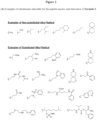
- Figure 2(A) provides examples for substituted or non-substituted alkyl radicals.
- Substituted or non-substituted alkylacyl and substituted or non-substituted alkylacyl aryl acyl radicals are exemplified in Figure 2(B) .
- Figure 2(C) illustrates examples for substituted or non-substituted alkylamino, substituted or non-substituted arylamino, substituted or non-substituted aryl, substituted or non-substituted alkylsulfonyl or arylsulfonyl, and substituted or non-substituted alkylphosphonyl or arylphosphonyl radicals.
- Figure 2(D) provides examples for substituted or non-substituted alkyloxycarbonyl or aryloxycarbonyl, substituted or non-substituted alkyl aminocarbonyl or arylaminocarbonyl radicals.
- Figure 2(E) are provided examples for substituted or non-substituted alkylaminothiocarbonyl, substituted or non-substituted arylaminothiocarbonyl, substituted or non-substituted alkyloxythiocarbonyl, and substituted or non-substituted aryloxythiocarbonyl radicals. Provision of such exemplary substituents is to illustrate the diversity of allowable substituents, and therefore should not be interpreted to limit the scope of the present invention.
- oligonucleotide sequence is the overriding factor for sequence specific binding of an oligonucleotide to the target pre-mRNA sequence over substituents in the N-terminus or C-terminus.
- the compound of Formula I possesses good cell permeability and can be readily delivered into cell if treated as "naked” oligonucleotide as exemplified in the prior art [ PCT/KR2009/001256 , published as WO 2009/113828 ].
- the compound of this invention induces the skipping of "exon 5" in the human AR pre-mRNA to yield AR mRNA splice variant(s) lacking AR "exon 5" in cells treated with the compound of Formula I as "naked” oligonucleotide.
- the compound of Formula I does not require any means or formulations for delivery into cell to potently induce the skipping of the target exon in cells.
- the compound of Formula I readily induces the skipping of the AR "exon 5" in cells treated with the compound of this invention as "naked” oligonucleotide at sub-femtomolar concentration.
- the PNA derivative of Formula I can be topically administered as "naked" oligonucleotide to induce the skipping of the AR "exon 5" in target skin.
- the compound of Formula I does not require a formulation to increase trans-dermal delivery for a topical therapeutic or biological activity.
- the compound of Formula I is dissolved in water and co-solvent, and topically or trans-dermally administered at sub-picomolar concentration to elicit the desired therapeutic or biological activity in the target skin.
- the compound of this invention does not need to be heavily or invasively formulated to elicit the topical therapeutic activity.
- the compound of Formula I may be used as combined with a pharmaceutically acceptable acid or base including but not limited to sodium hydroxide, potassium hydroxide, hydrochloric acid, methanesulfonic acid, citric acid, trifluoroacetic acid, and so on.
- a pharmaceutically acceptable acid or base including but not limited to sodium hydroxide, potassium hydroxide, hydrochloric acid, methanesulfonic acid, citric acid, trifluoroacetic acid, and so on.
- the PNA derivative of Formula I or a pharmaceutically acceptable salt thereof can be administered to a subject in combination with a pharmaceutically acceptable adjuvant including but not limited to citric acid, hydrochloric acid, tartaric acid, stearic acid, polyethyleneglycol, polypropyleneglycol, ethanol, isopropanol, sodium bicarbonate, distilled water, preservative(s), and so on.
- a pharmaceutically acceptable adjuvant including but not limited to citric acid, hydrochloric acid, tartaric acid, stearic acid, polyethyleneglycol, polypropyleneglycol, ethanol, isopropanol, sodium bicarbonate, distilled water, preservative(s), and so on.
- the compound of the present invention can be topically administered to a subject at a therapeutically or biologically effective concentration ranging from 1 aM to higher than 1 nM, which would vary depending on the dosing schedule, conditions or situations of the subject, and so on.
- PNA derivative of Formula I which is selected from the group of compounds provided below, or a pharmaceutically acceptable salt thereof:
- Figure 3 collectively and unambiguously provides the chemical structures for the PNA monomers abbreviated as A, G, T, C, C(pOq), A(p), A(pOq), G(p), and G(pOq).
- C(pOq) is regarded as a "modified cytosine” PNA monomer due to its hybridization for "guanine”.
- A(p) and A(pOq) are taken as "modified adenine" PNA monomers for their hybridization for "thymine”.
- G(p) and G(pOq) are considered to be "modified guanine” PNA monomers for their base pairing with "cytosine”.
- Figure 4 unequivocally illustrates the chemical structures for a variety of abbreviations for substituents used for diversifying the N-terminus or C-terminus of the PNA derivative of Formula I in this invention.
- the chemical structure for the PNA derivative abbreviated as "(N —> C) Fethoc-GA(5)A-GC(1O2)C-A(5)GG-C(1O2)AA(5)-G-NH 2 " is provided in Figure 5(A) .
- the chemical structure for the PNA derivative abbreviated as "(N ----+ C) Benzoyl-Lys-Val-C(1O2)TT-A(5)CC-A(5)GG-C(1O2)AA(5)-G-NH 2 " is provided in Figure 5(B) .
- the 13-mer PNA sequence of "(N —> C) Fethoc-GA(5)A-GC(1O2)C-A(5)GG-C(1O2)AA(5)-G-NH 2 " is equivalent to the DNA sequence of "(5' —> 3') GAA-GCC-AGG-CAA-G" in binding to its complementary binding with pre-mRNA.
- the 13-mer PNA has a 9-mer complementary overlap with the 9-mer sequence marked as "bold” and "underlined” in the 20-mer RNA sequence [(5' —> 3') GC CUUGCCUG
- the 13-mer PNA sequence of "(N —> C) Benzoyl-Lys-Val-C(1O2)TT-A(5)CC-A(5)GG-C(1O2)AA(5)-G-NH 2 " is equivalent to the DNA sequence of "(5' —> 3') CTT-ACC-AGG-CAA-G", which has a 13-mer complementary overlap with the 13-mer sequence marked as "bold” and "underlined” in the 20-mer RNA sequence [(5' —> 3') GC CUUGCCUG
- the 13-mer PNA sequence of "(N ----+ C) Ac-C(1O2)TT-A(5)CC-A(5)GG-C(1O2)TA(5)-G-NH 2 " is equivalent to the DNA sequence of "(5' —> 3') CTT-ACC-AGG-CTA-G", which has a 12-mer complementary overlap with the 12-mer sequence as marked “bold” and "underlined” in the 20-mer RNA sequence [(5' ⁇ 3') GC CU “U” GCCUG
- the 17-mer PNA sequence of "(N ----+ C) Fethoc-TTT-TCC(1O2)-TTA(6)-CCA(6)-GG(6)C-A(6)A-NH 2 " is equivalent to the DNA sequence of "(5' ----+ 3') TTT-TCC-TTA-CCA-GGC-AA", which has a 17-mer complementary overlap with the 17-mer sequence marked as "bold” and "underlined” in the 20-mer RNA sequence [(5' —> 3') GCC UUGCCUG
- the present invention provides a PNA derivative of Formula I which is selected from the group of specifically preferred compounds enlisted below, or a pharmaceutically acceptable salt thereof:
- a peptide nucleic acid derivative selected from the group consisting of: (N ⁇ C) Fethoc-C(1O2)TT-A(5)CC-A(5)GG-C(1O2)AA(5)-G-NH 2 , (N ⁇ C) Fethoc-TC(1O2)C-TTA(6)-CCA(6)-GGC(1O2)-AA(6)G-G(6)-NH 2 , (N ⁇ C) Fethoc-TC(1O2)C-TTA(5)-CCA(5)-GGC(1O2)-AA(5)G-G(6)-NH 2 , (N ⁇ C) Fethoc-TA(5)C-CAG(6)-GC(1O2)A-A(5)GG(6)-C-NH 2 , (N ⁇ C) Fethoc-C(1O2)TT-A(5)CC-A(5)GG(6)-CA(5)A-NH 2 , (N ⁇ C) Fethoc-C(1O2)TT-A(5)CC-A(6)GG(6)-CA(5)A-NH 2 , (N ⁇ C) Fe
- PNA oligomers were synthesized by solid phase peptide synthesis (SPPS) based on Fmoc-chemistry according to the method disclosed in the prior art [ US6,133,444 ; WO96/40685 ] with minor but due modifications.
- the solid support employed in this study was H-Rink Amide-ChemMatrix purchased from PCAS BioMatrix Inc. (Quebec, Canada).
- Fmoc-PNA monomers with a modified nucleobase were synthesized as described in the prior art [ PCT/KR 2009/001256 , published as WO 2009/113828 ] or with minor modifications.
- Fmoc-PNA monomers with a modified nucleobase and Fmoc-PNA monomers with a naturally occurring nucleobase were used to synthesize the PNA derivatives of the present invention.
- PNA oligomers were purified by C 18 -reverse phase HPLC (watre/acetonitrile or water/methanol with 0.1% TFA) and characterized by mass spectrometry.
- Scheme 1 illustrates a typical monomer elongation cycle adopted in the SPPS of this invention, and procedural details are provided below. To a skilled person in the field, however, lots of minor variations are obviously possible in effectively running such SPPS reactions on an automatic peptide synthesizer or manual peptide synthesizer. Each reaction step in Scheme 1 is briefly provided as follows.
- Fmoc-PNA monomers with a modified nucleobase are provided in Figure 6 should be taken as examples, and therefore should not be taken to limit the scope of the present invention.
- a skilled person in the field may easily figure out a number of variations in Fmoc-PNA monomers to synthesize the PNA derivative of Formula I.
- PNA derivatives of this invention were prepared according to the synthetic procedures provided above or with minor modifications.
- Table 1 provides examples of AR ASOs of the present invention along with structural characterization data by mass spectrometry. Provision of the AR ASOs in Table 1 is to exemplify the PNA derivatives of Formula I, and should not be interpreted to limit the scope of the present invention.
- Table 1. PNA derivatives of Formula I and structural identification by mass spectrometry.
- the PNA derivatives in Table 1 were evaluated for their binding affinity for 10-mer DNAs complementarily targeting either the N-terminal or C-terminal. The binding affinity was assessed by T m value for the duplex between PNA and 10-mer complementary DNA.
- T m value for the duplex between PNA and 10-mer complementary DNA.
- the duplex between PNA derivatives in Table 1 and fully complementary DNAs show T m values too high to be reliably determined in aqueous buffer solution, since the buffer solution tends to boil off during the T m measurement.
- T m values were determined on an UV/Vis spectrometer as follows. A mixed solution of 4 ⁇ M PNA oligomer and 4 ⁇ M complementary 10-mer DNA in 4 mL aqueous buffer (pH 7.16, 10 mM sodium phosphate, 100 mM NaCl) in 15 mL polypropylene falcon tube was incubated at 90°C for a minute and slowly cooled down to ambient temperature over several minutes.
- aqueous buffer pH 7.16, 10 mM sodium phosphate, 100 mM NaCl
- the solution was transferred into a 3 mL quartz UV cuvette equipped with an air-tight cap, and subjected to a T m measurement at 260 nm on an Agilent 8453 UV/Visible spectrophotometer or a similar one as described in the prior art [ PCT/KR2009/001256 , published as WO 2009/113828 ] or with minor modifications.
- the 10-mer complementary DNAs for T m measurement were purchased from Bioneer (www.bioneer.com , Dajeon, Republic of Korea) and used without further purification.
- T m values of the PNA derivatives of Formula I are very high for a complementary binding to 10-mer DNA, and provided in Table 2.
- "ASO 5" showed a T m value of 86.1°C for the duplex with the 10-mer complementary DNA targeting the N-terminal 10-mer within the PNA marked as “bold” and "underlined” in [(N ⁇ C) Fethoc- C(1O2)TT-A(5)CC-A(5)GG-C(1O2) AA(5)-G-NH 2 ].
- PNA derivatives of Formula I were evaluated for their biological activities in vitro and in vivo.
- the biological examples provided below are provided as examples to illustrate the biological profiles of such PNA derivatives of Formula I, and therefore should not be interpreted to limit the scope of the current invention.
- ASO 5" specified in Table 1 is a 13-mer antisense oligonucleotide which has a 13-mer full complementary overlap with the 13-mer sequence marked as “bold” and "underlined” in the 20-mer RNA sequence [(5' —> 3') GC CUUGCCUG
- ASO 5" was evaluated by AR nested PCR for its ability to induce the skipping of AR "exon 5" in MCF7 cells (Cat. Number: HTB-22, ATCC). The employed procedures are detailed as follows.
- MCF7 cells were grown in EMEM medium supplemented with 10% FBS, 1% streptomycin/penicillin, and 0.01 mg/ml bovine insulin under 5% CO 2 atmosphere at 37°C. Cells were sub-cultured in 60 mm culture dish prior to treatment with "ASO 5" at 3 aM to 3 fM.
- RNA Extraction MCF7 cells were incubated with or without "ASO 5" for 3 hours. Total RNA was extracted from cells in 60 mm culture dish using "Universal RNA Extraction Kit” (Cat. No. 9767, Takara) according to the manufacturer's instructions
- RNA template 100 ng was used in a 25 ⁇ L reverse transcription reaction using Super Script ® One-Step RT-PCR kit with platinum ® Taq polymerase (Cat. No. 10928-042, Invitrogen) against a set of gene-specific primers [exon 3_forward: (5' ⁇ 3') TGGGTGTCACTATGGAGC, and exon 9_reverse: (5' ⁇ 3') GGGTGT-GGAAATAGATGGG] according to the following cycle conditions: 50°C for 30 min and 94°C for 2 min, followed by 39 cycles of 30 sec at 94°C, 30 sec at 55 °C, and 1 min at 72°C.
- ASO 5" was evaluated for its ability to down-regulate the human AR mRNA by qPCR with SYBR Green detection.
- MCF7 cells were sub-cultured in 5 mL culture medium in 60 mm culture dish, and treated or with "ASO 5" at 0 zM (negative control) to 1 aM (2 culture dishes per each concentration). 5 hours later, total RNA was extracted with "MiniBEST Universal RNA Extraction Kit” according to the manufacturer's instructions (Cat. No. 9767, Takara). 500 ng of RNA template were used to synthesize cDNA for a 50 ⁇ L reverse transcription reaction using Oligo-dT according to the manufacturer's instructions (Cat. No. 6110A, Takara).
- Figure 9(A) provides the qPCR data obtained therefrom.
- the relative expression level of exons 4-6 significantly decreased as the ASO concentration was increased from 0 zM to 100 zM.
- the exon message levels decreased by ca 50 to 60%.
- the exon message levels rebounded to near the levels of the negative control (no ASO treatment).
- the strange dose response pattern of the qPCR data could be due to a transcription upregulation by the "exon intron circular RNA (EIciRNA)" accumulated during the exon skipping with "ASO 5".
- EIciRNA exon intron circular RNA
- ASO 1 specified in Table 1 is a 13-mer antisense oligonucleotide originally designed to complementarily target the junction of "exon 5" and “exon 6" within the human AR mRNA.
- “ASO 1” has a 9-mer complementary overlap with the 9-mer sequence as marked “bold” and “underlined” in the 20-mer RNA sequence [(5' ⁇ 3') GC CUUGCCUG
- ASO 1 was evaluated for its ability to down-regulate the human AR mRNA by qPCR according to the protocol described in "Example 2".
- Figure 9(B) provides the qPCR data obtained therefrom.
- the relative expression level of "exons 4-6" significantly decreased as the ASO concentration was increased from 0 zM to 100 zM.
- the exon message levels decreased by more than 80%.
- the exon message levels rebounded to ca 60% of the negative control (no ASO treatment).
- the strange dose response pattern of the qPCR data could be due to a transcription upregulation by the "exon intron circular RNA (EIciRNA)" accumulated during the exon skipping with "ASO 5".
- EIciRNA exon intron circular RNA
- ASO 10 specified in Table 1 is a 12-mer antisense oligonucleotide which has a 12-mer full complementary overlap with the 12-mer sequence as marked “bold” and "underlined” in the 20-mer pre-mRNA sequence [(5' ⁇ 3') GC C UUGCCUG
- ASO 10 was evaluated for its ability to down-regulate the human AR mRNA (full-length) by qPCR according to the protocol described in "Example 2".
- Figure 9(C) provides the qPCR data obtained therefrom.
- the relative expression level of "exons 4-6" significantly decreased by 60 ⁇ 80% in MCF7 cells treated with "ASO 10" at 1 zM to 1,000 zM.
- MCF7 cells were sub-cultured in 60 mm culture dish containing 5 ml culture medium, and treated with "ASO 1" at 0 zM (negative control), or 100 zM to 300 aM. 4 culture dishes were used for 4 negative controls. 48 hours later, cells were washed 2 times with cold PBS, and then subjected to lysis with 200 ⁇ L 1X cell lysis buffer (Cat. No. 9803, Cell Signaling Tech) supplemented with 1X protease inhibitor (Cat. No. P8340, Sigma). The lysates were collected in 1.5 ml e-tube. 200 ⁇ L of each lysate was mixed with 100 ⁇ L 3X sample buffer, and boiled for 5 min at 100 °C.
- 1X cell lysis buffer Cat. No. 9803, Cell Signaling Tech
- 1X protease inhibitor Cat. No. P8340, Sigma
- ASO 5" was evaluated for its ability to inhibit AR protein expression at 10 zM to 30 aM in MCF7 cells according to the procedures described in "Example 5".
- Figure 10(B) provides the AR Western blot data obtained with MCF7 cells treated with "ASO 5" at 0 zM (negative control, no ASO treatment), or 10 zM to 30 aM. Multiple (negative) control samples were used to overcome technical artifacts of western blot procedures.
- the AR band intensity of the lysates with ASO treatment was considerably weaker than that of the neighboring lysates without ASO treatment, which unequivocally indicates that "ASO 1" inhibits the expression of the full-length AR protein in MCF7 cells.
- ASO 1 was evaluated for its ability to promote hair growth in C57BL/6 mice upon topical administration as follows.
- the target sequence of "ASO 1" in the human AR pre-mRNA is conserved in the mouse AR pre-mRNA.
- the in vivo therapeutic findings in mice may be extrapolated to human cases without much ambiguity.
- Topical solutions of "ASO 1" were prepared by diluting a mother stock solution of "ASO 1" to 0.2 fM or 1 fM in aqueous 30%(v/v) ethanol supplemented with 3%(v/v) glycerin. About 100 ⁇ L of 0 (negative control), 0.2, or 1 fM "ASO 1" was topically administered in the back of each animal using a cotton ball in Days 3, 7, 10, and 14.
- FIG. 11(A) For scoring the hair growth, the animals were anesthetized and photographed by group as shown in Figure 11(A) using a digital camera at a fixed value of exposure time and illumination. The digital image for the area of the hair removal for each animal was selected and digitally scored for the average brightness over the selected area using "ImageJ" program. Lower brightness score is taken as faster hair growth. Brightness scores of individual animals were combined by group, and subjected to statistical analysis by student's t-test.
- Figure 11(B) summarizes the relative brightness scores of the ASO treated groups against the control group. The relative brightness score tended to decrease with days in the treatment groups. In Day 13, the 1 fM group was significantly lower in the brightness score than the non-treated group. Thus, "ASO 1" was concluded to promote hair growth upon topical administrations at 1 fM.
- mice received a single topical administration of either vehicle or "ASO 1" according to the group.
- the skin of the area with hair removal was sampled for immunohistochemistry (IHC) analysis against androgen receptor.
- the skin samples were cryo-sectioned and subjected to immunostaining in series with a primary anti-AR antibody (Cat. No. sc-816, Santa Cruz) at 1:100 dilution, with a secondary anti-IgG (Cat No. BA-1100, Vector) at 1:200 dilution, and then with Dylight 594-steptavidin (Cat No. SA-5594, Vector, CA, USA) at 1:200 dilution for red fluoresence tagging.
- the IHC images were captured on an Olympus fluorescence microscope for changes in the AR expression level upon topical treatment with "ASO 1".
- Figure 12 is a representative set of AR IHC images demonstrating that the AR expression in hair follicles was markedly inhibited in hair follicles upon the topical administrations of "ASO 1" at 0.2 fM or 1 fM.
- the DAPI staining images were provided to locate the hair follicles in the IHC images. It is interesting to note that AR expression decreased even in the muscle layer underneath the dermis upon the topical administrations of "ASO 1" at 0.2 fM or 1 fM. Thus "ASO 1" is readily delivered into the dermis as well as the muscle layer underneath the dermis upon topical administration, and potently inhibits the expression of AR.
- ASO 5" was evaluated for its ability to promote hair growth in C57BL/6 mice upon topical administration as detailed below.
- the target sequence of "ASO 5" in the human AR pre-mRNA is conserved in the mouse AR pre-mRNA. Thus the in vivo therapeutic findings in mice may be extrapolated to human cases without much ambiguity.
- Topical solutions of "ASO 5" were prepared by diluting a mother stock solution of "ASO 5" to 1, 5, or 25 fM in aqueous 30%(v/v) ethanol supplemented with 3%(v/v) glycerin. About 100 ⁇ L of each ASO solution or vehicle (negative control) was topically administered to in the back of an animal using a cotton ball in Days 3, 7, 10, 14 and 21.
- Figure 13 summarizes the relative brightness scores of the ASO treated groups against the negative control group.
- the relative brightness score tended to decrease with days in the ASO treatment groups.
- Day 17 the treatment groups of 1 fM and 25 fM were significantly lower in the brightness score than the non-treated group.
- “ASO 5" was concluded to promote hair growth upon topical administrations at 1 to 25 fM.
- the animals received a single topical administration of either vehicle or "ASO 5" at 1 fM, 5 fM, or 25 fM.
- the hair in the back was collected by shaving with a clipper to determine the total amount of hair growth between Days 21 and 53.
- the average hair weights of the 1 fM, 5 fM, and 25 fM groups were 1,630%, 1,450%, and 771% of the non-treated group, respectively.
- "ASO 5" was concluded to promote hair growth upon topical administrations at 1 to 25 fM.
- ASO 10 was evaluated for its ability to promote hair growth in C57BL/6 mice upon topical administration as detailed below.
- the target sequence of "ASO 10" in the human AR pre-mRNA is conserved in the mouse AR pre-mRNA. Thus the in vivo therapeutic findings in mice may be extrapolated to human cases without much ambiguity.
- Topical solutions of "ASO 10" were prepared by diluting a mother stock solution of "ASO 10" to 1, 5, or 25 fM in aqueous 30%(v/v) ethanol supplemented with 3%(v/v) glycerin. About 100 ⁇ L of each ASO solution or vehicle (negative control) was topically administered to in the back of an animal using a cotton ball in Day 2.
- Figure 14(A) summarizes the relative brightness scores of the ASO treated groups against the control group.
- the relative brightness score tended to decrease with days in the treatment groups.
- Day 27 the treatment groups of 1 fM and 5 fM were significantly lower in the brightness score than the non-treatment group.
- “ASO 10" was concluded to promote hair growth upon topical administrations at 1 to 5 fM.
- Example 10 qPCR Evaluation of AR mRNA Level by TaqMan Assay in MCF7 Cells treated with "ASO 10".
- ASO 10 was evaluated for its ability to down-regulate the human AR mRNA by qPCR adopting a TaqMan probe.
- RNA template 400 ng were used to synthesize cDNA for a 20 ⁇ L reverse transcription reaction using One-Step RT-PCR kit (Invitrogen) against a set of exon specific primers of [exon 3_forward: (5' —> 3') TGGGTGTCACTATGGAGC ; and exon 9_reverse: (5' ⁇ 3') GGGTGT- GGAAATAGATGGG] according to the following cycle conditions: 50 °C for 30 min and 94 °C for 2 min, followed by 15 cycles of 30 sec at 94°C, 30 sec at 50 °C, and 1 min at 72 °C.
- the cDNA solutions were diluted by 50 times, and 1 ⁇ L of each diluted PCR product was subjected to a 20 ⁇ L Real-Time PCR reaction against a set of exon specific primers of [exon 4_forward: (5' —> 3') TTGTCCATCTTGTCGTCTT; and exon 5_reverse: (5' —> 3') CCTCTC-CTTCCTCCTGTA] according to the following cycle conditions: 95 °C for 3 min followed by 40 cycles 15 sec at 95 °C, and 30 sec at 60 °C.
- the qPCR reaction was monitored with a TaqMan probe of [(5' ----+ 3') TTTCTTCAG-ZEN-CTTCCGGGCTC-3IABkFQ].
- Figure 15 provides the qPCR data obtained therefrom.
- the relative expression level of exons 4-6 significantly decreased by ca 50 to 70% in MCF7 cells treated with "ASO 10" at 1 zM to 1 aM.
- ASO 10 was evaluated for its ability to inhibit AR expression in mice as follows. 12 weeks old male C57BL/6 mice were randomly assigned to 3 groups of negative control (no ASO treatment), 0.01 pmole/Kg "ASO 10" and 0.1 pmole/Kg "ASO 10". (3 animals per group) Mice subcutaneously received either vehicle or ASO dissolved in vehicle (PBS) 2X per week for 4 weeks according to the dosing group. Three days post the final dosing, the animals were anesthetized with zoletil/rompun and subjected to tissue or organ sampling for AR IHC by paraffin blolck.
- the AR protein was probed in series with a primary antibody (Cat. No. sc-816, Santa Cruz) at 1: 100 dilution, a secondary anti-rabbit IgG (Cat. No. BA-1100, VECTOR) at 1:200 dilution, and Dylight 594-Streptavidin (Cat. No. SA-5594, VECTOR) at 1:200. Nucleus was stained with DAPI. IHC fluorescence images were captured on a Zeiss slide scanner.
- Figure 16 provides AR IHC images (red) obtained with tissues known to abundantly express AR protein. It is noted that the IHC images are provided as colocalized with DAPI (blue).
- AR expression markedly decreased in epidermis distal to the injection site, the liver, testis and prostate as the ASO dose was increased from 0.01 pmole/Kg to 0.1 pmole/Kg.
- ASO 10 unequivocally inhibits AR protein expression in mice upon systemic exposure
Landscapes
- Health & Medical Sciences (AREA)
- Chemical & Material Sciences (AREA)
- Life Sciences & Earth Sciences (AREA)
- Organic Chemistry (AREA)
- Engineering & Computer Science (AREA)
- Genetics & Genomics (AREA)
- General Health & Medical Sciences (AREA)
- Medicinal Chemistry (AREA)
- Bioinformatics & Cheminformatics (AREA)
- Biochemistry (AREA)
- Molecular Biology (AREA)
- Biomedical Technology (AREA)
- Biophysics (AREA)
- Proteomics, Peptides & Aminoacids (AREA)
- Animal Behavior & Ethology (AREA)
- Public Health (AREA)
- Veterinary Medicine (AREA)
- Pharmacology & Pharmacy (AREA)
- General Chemical & Material Sciences (AREA)
- Chemical Kinetics & Catalysis (AREA)
- General Engineering & Computer Science (AREA)
- Biotechnology (AREA)
- Wood Science & Technology (AREA)
- Zoology (AREA)
- Gastroenterology & Hepatology (AREA)
- Epidemiology (AREA)
- Dermatology (AREA)
- Nuclear Medicine, Radiotherapy & Molecular Imaging (AREA)
- Microbiology (AREA)
- Plant Pathology (AREA)
- Physics & Mathematics (AREA)
- Immunology (AREA)
- Medicines That Contain Protein Lipid Enzymes And Other Medicines (AREA)
- Peptides Or Proteins (AREA)
- Pharmaceuticals Containing Other Organic And Inorganic Compounds (AREA)
- Measuring Or Testing Involving Enzymes Or Micro-Organisms (AREA)
- Saccharide Compounds (AREA)
Description
- This invention relates to peptide nucleic acid derivatives targeting androgen receptor pre-mRNA for the treatment of dermatological indications or conditions mediated by androgenic activity.
- Alopecia is a disorder characterized by hair loss and hair thinning initially on the scalp. Androgenic alopecia, also referred to as "male pattern baldness," is caused by overt androgenic activity in hair follicles and surrounding tissue.
- While androgenic alopecia affects both men and women, the disorder often shows up differently in men versus women. Males are likely to experience spot baldness, and females are more likely to experience overall hair thinning on the scalp. The prevalence of androgenic alopecia in males aged 30 to 50 is approximately 58% [J. Invest. Dermatol. )]. Androgenic alopecia is caused by changes in male steroid hormones known as androgens [New Engl. J. Med. vol 341, 491-7 (1999 ); Mol. Cell Endocrinol. vol 198, 89-95 (2002)].
- Androgens regulate the release of sebum in sebaceous glands, the hair growth in hair follicles, libido systemically, and so on. Androgens stimulate the gradual transformation of small vellus follicles, making non-pigmented, fine, and short hairs in some areas to larger terminal follicles (e.g. face). In contrast to this androgen action on terminal follicles, however, gradual regression of terminal hair follicles to vellus follicles occurs on the temples and scalp vertex, which is often called as `androgen paradox'. [Expert Opin. Drug Discov. )]
- Androgenic Alopecia and DHT: 5α-reductase reduces testosterone into 5 α - dihydrotestosterone (DHT), an androgen more potent and effective than testosterone. A substantial increase in DHT production in frontal anagen hair follicles was observed in young balding males compared with non-balding males. [(Ind. J. Dermatol. Vene. Leprol. vol 79, 613-625 (2013)] Males with androgenic alopecia tend to show a lower level of "total testosterone" than those without androgenic alopecia. Instead, the DHT level is higher in males with androgenic alopecia than in those without androgenic alopecia. DHT is produced from testosterone by 5α-reductase. Males with androgenic alopecia express a higher level of 5 a -reductase in hair follicles than those without androgenic alopecia. DHT is highly responsible for miniaturization of hair follicles, and therefore androgenic alopecia. [Endocrinology, vol 151, 2373-2380 (2010)]
- Finasteride and dutasteride inhibit 5α-reductase, and therefore decrease the DHT level available to androgen receptors in hair follicles and surrounding tissue. The two small molecule inhibitors have been used to treat male pattern baldness despite adverse effects originating from the down-regulation of systemic androgenic activity. The adverse effects include sexual dysfunction, dizziness, weakness, headache, runny nose, skin rash, and so on. [New Engl. J. Med. vol 362, 1237-8 (2010)].
- Topical AR Antagonist: Androgens express their pharmacologic activities by binding to androgen receptor (AR). AR antagonists bind to AR and inhibit the physiological function of androgens, and therefore may be used to treat androgenic alopecia if properly delivered to hair follicles and surrounding tissue. In order to avoid side effects incurred by the inhibition of systemic androgenic activity, AR antagonists are topically administered directly to scalp tissue.
- Ketoconazole possesses weak AR antagonistic activity in addition to its famous antifungal activity. A shampoo containing 2% ketoconazole (under a commercial brand name of Nizoral®) has been used to topically treat androgenic hair loss. [J. Dermatol. Sci. vol 45(1), 66-68 (2007)]
- Topilutamide is an AR antagonist known as fludiril. Topilutamide is marketed as a 2% topical formulation to treat androgenic alopecia in a number of European countries with a brand name of "Eucapil". [Dermatol. Surg. vol 28(8), 678-685 (2002)]
- AR Protein or mRNA in Hair Follicles: In male and female subjects with androgenic alopecia, AR expression was found to be higher in frontal hair follicles than in occipital hair follicles. [J. Investig. Dermatol. vol 109, 296-300 (1997)] If AR expression is down-regulated by an agent selectively in hair follicles and surrounding tissue, such agent may safely treat androgenic alopecia without incurring adverse events caused by the systemic down-regulation of androgenic activity. In another literature, females with androgenic alopecia were found to show a higher level of AR mRNA in frontal and parietal hair follicles than in occipital hair follicles. [Genetics Mol. Res. vol 12(2), 1834-1840 (2013)]
- Ribosomal Protein Synthesis: Proteins are encoded by DNA (2-deoxyribose nucleic acid). In response to cellular stimulation, DNA is transcribed to produce pre-mRNA (pre-messenger ribonucleic acid) in the nucleus. The introns of pre-mRNA are enzymatically spliced out to yield mRNA (messenger ribonucleic acid), which is then translocated into the cytosolic compartment. In the cytosol, a complex of translational machinery called ribosome binds to mRNA and carries out the protein synthesis as it scans the genetic information encoded along the mRNA. [Biochemistry vol 41, 4503-4510 (2002); Cancer Res. vol 48, 2659-2668 (1988)]
- An oligonucleotide binding to RNA in a sequence specific manner (i.e. complementarily) is called antisense oligonucleotide (ASO). ASO may tightly bind to an mRNA and inhibit the protein synthesis by ribosome along the mRNA in the cytosol. ASO needs to be present within cell in order to inhibit the ribosomal protein synthesis of its target protein.
- Splicing Process: DNA is transcribed to produce pre-mRNA (pre-messenger ribonucleic acid) in the nucleus. Pre-mRNA is then processed into mRNA following deletion of introns by a series of complex reactions collectively called "splicing" as schematically summarized in the diagram below. [Ann. Rev. Biochem. 72(1), 291-336 (2003); Nature Rev. Mol. Cell Biol. 6(5), 386-398 (2005); Nature Rev. Mol. Cell Biol. 15(2), 108-121 (2014)]
- Splicing is initiated by forming "splicesome E complex" (i.e. early splicesome complex) between pre-mRNA and splicing adapter factors. In "splicesome E complex", U1 binds to the junction of exon N and intron N, and U2AF35 binds to the junction of intron N and exon (N+1). Thus the junctions of exon/intron or intron/exon are critical to the formation of the early splicesome complex. "Splicesome E complex" evolves into "splicesome A complex" following additional complexation with U2. The "splicesome A complex" undergoes a series of complex reactions to delete or splice out the intron to adjoin the neighboring exons.

- Antisense Inhibition of Splicing: In the nucleus, ASO may tightly bind to a certain position within a pre-mRNA, and can interfere with the splicing process of the pre-mRNA into mRNA, producing the full-length mRNA or mRNA variant(s) lacking the target exon. Such mRNA(s) is called "splice variant(s)", encodes protein(s) smaller than the protein encoded by the full-length mRNA.
- In principle, splicing can be interrupted by inhibiting the formation of "splicesome E complex". If an ASO tightly binds to a junction of (5' → 3') exon-intron, i.e. "5' splice site", the ASO blocks the complex formation between the pre-mRNA and factor U1, and therefore the formation of "splicesome E complex". Likewise, "splicesome E complex" cannot be formed if an ASO tightly binds to a junction of (5' → 3') intron-exon, i.e. "3' splice site".
- Unnatural Oligonucleotides: DNA or RNA oligonucleotide is susceptible to degradation by endogenous nucleases, limiting their therapeutic utility. To date, a large number of unnatural oligonucleotides have been developed and studied intensively. [Clin. Exp. Pharmacol. Physiol. vol 33, 533-540 (2006)] Some of them were found to show extended metabolic stability compared to DNA and RNA. Provided below are the chemical structures for a few number of representative unnatural oligonucleotides. Such oligonucleotide predictably binds to its complementary nucleic acid as DNA or RNA does.

- Phosphorothioate Oligonucleotide: Phosphorothioate oligonucleotide (PTO) is a DNA analog with one of the backbone phosphate oxygen atoms replaced with sulfur atom per monomer. Such a small structural change made PTO comparatively resistant to degradation by nucleases. [Ann. Rev. Biochem. vol 54, 367-402 (1985)]
- Reflecting the structural similarity of backbone between PTO and DNA, they both poorly penetrate cell membrane in most mammalian cell types. For some types of cells abundantly expressing transporter(s) for DNA, however, DNA and PTO show good cellular uptake. Systemically administered PTOs are known to readily distribute to the liver and kidney. [Nucleic Acids Res. vol 25, 3290-3296 (1997)]
- In order to increase PTO's in vitro cell membrane permeability, lipofection has been widely practiced. However, lipofection physically alters cell membrane, causes cytotoxicity, and therefore would not be safe for long term therapeutic use.
- Over the past 30 years, antisense PTOs and variants of PTOs have been clinically evaluated to treat cancers, immunological disorders, metabolic diseases, and so on. [Biochemistry vol 41, 4503-4510 (2002); Clin. Exp. Pharmacol. Physiol. vol 33, 533-540 (2006)] Many of such antisense drug candidates have not been successfully developed partly due to PTO's poor cell membrane permeability. In order to overcome the poor membrane permeability, PTO needs to be administered at high dose for therapeutic activity. However, PTOs are known to be associated with dose-limiting toxicity including increased coagulation time, complement activation, tubular nephropathy, Kupffer cell activation, and immune stimulation including splenomegaly, lymphoid hyperplasia, mononuclear cell infiltration. [Clin. Exp. Pharmacol. Physiol. vol 33, 533-540 (2006)]
- Many antisense PTOs have been found to show due clinical activity for diseases with a significant contribution from the liver or kidney. Mipomersen is a PTO analog which inhibits the synthesis of apoB-100, a protein involved in LDL cholesterol transport. Mipomersen manifested due clinical activity in a certain population of atherosclerosis patients most likely due to its preferential distribution to the liver. [Circulation vol 118(7), 743-753 (2008)] ISIS-113715 is a PTO antisense analog inhibiting the synthesis of protein tyrosine phosphatase 1B (PTP1B), and was found to show therapeutic activity in type II diabetes patients. [Curr. Opin. Mol. Ther. )]
- Locked Nucleic Acid: In locked nucleic acid (LNA), the backbone ribose ring of RNA is structurally constrained to increase the binding affinity for RNA or DNA. Thus, LNA may be regarded as a high affinity DNA or RNA analog. [Biochemistry vol 45, 7347-7355 (2006)] Like PTO, LNA also shows poor cell membrane permeability.
- Phosphorodiamidate Morpholino Oligonucleotide: In phosphorodiamidate morpholino oligonucleotide (PMO), the backbone phosphate and 2-deoxyribose of DNA are replaced with phosphoamidite and morpholine, respectively. [Appl. Microbiol. Biotechnol. vol 71, 575-586 (2006)] Whilst the DNA backbone is negatively charged, the PMO backbone is not charged. Thus the binding between PMO and mRNA is free of electrostatic repulsion between the backbones, and tends to be stronger than that between DNA and mRNA. Since PMO is structurally very different from DNA, PMO wouldn't be recognized by the hepatic transporter(s) recognizing DNA or RNA. However, PMO doesn't readily penetrate cell membrane, either.
- Peptide Nucleic Acid: Peptide nucleic acid (PNA) is a polypeptide with N-(2-aminoethyl)glycine as the unit backbone, and was discovered by Dr. Nielsen and colleagues. [Science vol 254, 1497-1500 (1991)] The chemical structure and abbreviated nomenclature of the prototype PNA are illustrated with the drawing provided below. Like DNA and RNA, PNA also selectively binds to complementary nucleic acid. [Nature (London) vol 365, 566-568 (1992)] In binding to complementary nucleic acid, the N-terminus of PNA is regarded as equivalent to the "5'-end" of DNA or RNA, and the C-terminus of PNA as equivalent to the "3'-end" of DNA or RNA.

- Like PMO, the PNA backbone is not charged. Thus the binding between PNA and RNA tends to be stronger than that between DNA and RNA. Since PNA is markedly different from DNA in the chemical structure, PNA wouldn't be recognized by the hepatic transporter(s) recognizing DNA, and would show a tissue distribution profile different from that of DNA or PTO. However, PNA also poorly penetrates mammalian cell membrane. (Adv. Drug Delivery Rev. vol 55, 267-280, 2003)
- Modified Nucleobases to Improve Membrane Permeability of PNA: PNA was made highly permeable to mammalian cell membrane by introducing modified nucleobases with a cationic lipid or its equivalent covalently attached thereto. The chemical structures of such modified nucleobases are provided above. Such modified nucleobases of cytosine, adenine, and guanine were found to predictably and complementarily hybridize with guanine, thymine, and cytosine, respectively. [PCT Appl. No.
PCT/KR2009/001256 WO 2009/113828 );EP2268607 ;US8680253 ]

- Incorporation of such modified nucleobases onto PNA resembles situations of lipofection. By lipofection, oligonucleotide molecules are wrapped with cationic lipid molecules such as lipofectamine, and such lipofectamine/oligonucleotide complexes tend to penetrate cell membrane rather easily as compared to naked oligonucleotide molecules.
- In addition to good membrane permeability, those PNA derivatives were found to possess ultra-strong affinity for complementary nucleic acid. For example, introduction of 4 to 5 modified nucleobases onto 11- to 13-mer PNA derivatives easily yielded a Tm gain of 20°C or higher in duplex formation with complementary DNA. Such PNA derivatives are highly sensitive to a single base mismatch. A single base mismatch resulted in a Tm loss of 11 to 22°C depending on the type of modified base as well as PNA sequence.
- AR Antisense Oligonucleotide (AR ASO): In principle, an ASO targeting the AR mRNA can inhibit ribosomal protein synthesis of androgen receptor. There are reported cases of AR ASOs inhibiting AR expression in cells. For example, EZN-4176, an LNA/DNA gapmer complementarily targeting the AR mRNA, down-regulated AR expression in tumor cells as well as in tumors of animal models for prostate cancer. [Mol. Cancer. Ther. vol 10(12), 2309-2319 (2011)].
- ASOs targeting either
exon 1 orexon 8 of the AR mRNA inhibited AR expression in prostate cancer cells as well as in tumors of animal models for prostate cancer resistant to chemotherapy with Enzalutamide, an AR antagonist. [Clin. Cancer Res. vol 21(7), 1675-1687 (2015)] - AR Down-regulation in Hair Follicles by Topical Application of AR ASO: Down-regulation of androgenic activity in hair follicles and surrounding tissue may be achieved by inhibiting AR expression in hair follicles and surrounding tissue. AR expression in hair follicles can be down-regulated with an AR ASO, if the ASO is delivered into hair follicles and surrounding tissue.
- In order to avoid the side effects from the down-regulation of systemic androgenic activity, it is desired to have AR expression down-regulated locally in hair follicles and surrounding tissue for the treatment of androgenic alopecia. Topical application of an AR ASO to scalp skin would be the safest mode to inhibit AR expression locally in hair follicles and surrounding tissue, if the ASO is made or formulated to be readily delivered into hair follicles. To date, AR ASOs have been hardly used for topical treatment of androgenic alopecia. AR ASOs have been evaluated mostly for systemic administration to treat prostate cancer resistant to androgen ablation therapy.
-
-
Figures 1(A) -(C). Examples of natural or unnatural (modified) nucleobases selectable for the peptide nucleic acid derivative of Formula I. -
Figures 2(A) -(E). Examples of substituents selectable for the peptide nucleic acid derivative of Formula I. -
Figure 3 . Chemical structures of PNA monomers with natural or modified nucleobase. -
Figure 4 . Chemical structures for abbreviations of N- or C-terminus substituents. -
Figure 5(A) . Chemical structure for the PNA derivative of "(N —> C) Fethoc-GA(5)A-GC(102)C-A(5)GG-C(102)AA(5)-G-NH2". -
Figure 5(B) . Chemical structure for the PNA derivative of "(N —> C) Benzoyl-Lys-Val-C(102)TT-A(5)CC-A(5)GG-C(102)AA(5)-G-NH2". -
Figure 6 . Chemical structures for Fmoc-PNA monomers employed to synthesize the PNA derivatives of this invention. -
Figures 7(A) -(B). C18-reverse phase HPLC chromatograms of "ASO 1" before and after HPLC purification, respectively. -
Figure 8(A) . Electrophoretic analysis of the nested PCR products of MCF7 cells treated with 0 aM (negative control), 3 aM, 30 aM, 300 aM, or 3 fM "ASO 5". -
Figure 8(B) . Schematic representation of the PCR band for the skipping of exons 4-5 along with sequencing data. -
Figure 9(A) . Changes in the relative levels of exons 4-6 in MCF7 cells treated with "ASO 5" at 0 zM (negative control), or 1 zM to 1 aM for 5 hours. (statistical analysis by student's t-test) -
Figure 9(B) . Changes in the relative levels of exons 4-6 in MCF7 cells treated with "ASO 1" at 0 zM (negative control), or 1 zM to 1 aM for 5 hours. (statistical analysis by student's t-test) -
Figure 9(C) . Changes in the relative levels of exons 4-6 in MCF7 cells treated with "ASO 10" at 0 zM (negative control), or 1 zM to 1 aM for 5 hours. (statistical analysis by student's t-test) -
Figure 10(A) . Western blot data for MCF7 cells treated with "ASO 1" at 0 zM (negative control), or 100 zM to 300 aM. -
Figure 10(B) . Western blot data for MCF7 cells treated with "ASO 5" at 0 zM (negative control), or 10 zM to 30 aM. -
Figure 11(A) . Hair growth images by group in the skin area of hair removal with days after hair removal. -
Figure 11(B) . Relative brightness scores of the "ASO 1" treatment groups against the negative control (vehicle) group. (statistical analysis by student's t-test) -
Figure 12 . Representative sets of AR IHC (red) and DAPI (blue) fluorescence images for skin samples obtained from animals treated with "ASO 1" at 0 fM (negative control, vehicle), 0.2 fM or 1 fM. -
Figure 13 . Relative brightness scores of the "ASO 5" treatment groups against the negative control (vehicle) group. (statistical analysis by student's t-test) -
Figure 14(A) . Relative brightness scores of the "ASO 10" treatment groups against the negative control (vehicle) group. (statistical analysis by student's t-test) -
Figure 14(B) . Representative sets of AR IHC (red) and DAPI (blue) fluorescence images for skin samples obtained from animals treated with "ASO 10" at 0 (negative control, vehicle), 1, 5 or 25 fM. -
Figure 15 . qPCR data for the relative AR mRNA level by TaqMan assay in MCF7 cells treated with "ASO 10" at 0 (negative control), 1 , 10, 100, or 1,000 zM for 24 hours against the negative control. (statistical analysis by student's t-test) -
Figure 16 . Representative sets of AR IHC (red) and DAPI (blue) fluorescence images for tissue samples obtained from mice subcutaneously administered with "ASO 10" at 0 (negative control), 0.01 or 0.1 pmole/Kg, 2X per week for 4 weeks. - The present invention provides a peptide nucleic acid derivative represented by Formula I, or a pharmaceutically acceptable salt thereof:

- n is an integer between 11 and 21;
- the compound of Formula I possesses at least a 9-mer complementary overlap with a 17-mer RNA sequence of [(5' ----+ 3') CCUUGCCUGGUAAGGAA] within the human androgen receptor pre-mRNA;
- S1, S2, ..., Sn-1, Sn, T1, T2, ..., Tn-1, and Tn independently represent deuterido, hydrido, substituted or non-substituted alkyl, or substituted or non-substituted aryl radical;
- X and Y independently represent hydrido [H], formyl [H-C(=O)-], aminocarbonyl [NH2-C(=O)-], substituted or non-substituted alkyl, substituted or non-substituted aryl, substituted or non-substituted alkylacyl, substituted or non-substituted arylacyl, substituted or non-substituted alkyloxycarbonyl, substituted or non-substituted aryloxycarbonyl, substituted or non-substituted alkylaminocarbonyl, substituted or non-substituted arylaminocarbonyl, substituted or non-substituted alkylsulfonyl, or substituted or non-substituted arylsulfonyl radical;
- Z represents hydrido, hydroxy, substituted or non-substituted alkyloxy, substituted or non-substituted aryloxy, substituted or non-substituted amino, substituted or non-substituted alkyl, or substituted or non-substituted aryl radical;
- B1, B2, ..., Bn-1, and Bn are independently selected from natural nucleobases including adenine, thymine, guanine, cytosine and uracil, and unnatural nucleobases; and
- at least four of B1, B2, ..., Bn-1, and Bn are independently selected from unnatural nucleobases with a substituted or non-substituted amino radical covalently linked to the nucleobase moiety.
- The compound of Formula I induces alternative splicing of the human AR pre-mRNA, yields AR mRNA splice variant(s) lacking "
exon 5", and therefore is useful to safely treat dermatological indications or conditions involving androgenic activity upon topical administration. - The present invention provides a peptide nucleic acid derivative represented by Formula I, or a pharmaceutically acceptable salt thereof:

- n is an integer between 11 and 21;
- the compound of Formula I possesses at least a 9-mer complementary overlap with a 17-mer RNA sequence of [(5' ----+ 3') CCUUGCCUGGUAAGGAA] within the human androgen receptor pre-mRNA;
- S1, S2, ..., Sn-1, Sn, T1, T2, ..., Tn-1, and Tn independently represent deuterido, hydrido, substituted or non-substituted alkyl, or substituted or non-substituted aryl radical;
- X and Y independently represent hydrido [H], formyl [H-C(=O)-], aminocarbonyl [NH2-C(=O)-], substituted or non-substituted alkyl, substituted or non-substituted aryl, substituted or non-substituted alkylacyl, substituted or non-substituted arylacyl, substituted or non-substituted alkyloxycarbonyl, substituted or non-substituted aryloxycarbonyl, substituted or non-substituted alkylaminocarbonyl, substituted or non-substituted arylaminocarbonyl, substituted or non-substituted alkylsulfonyl, or substituted or non-substituted arylsulfonyl radical;
- Z represents hydrido, hydroxy, substituted or non-substituted alkyloxy, substituted or non-substituted aryloxy, substituted or non-substituted amino, substituted or non-substituted alkyl, or substituted or non-substituted aryl radical;
- B1, B2, ..., Bn-1, and Bn are independently selected from natural nucleobases including adenine, thymine, guanine, cytosine and uracil, and unnatural nucleobases; and
- at least four of B1, B2, ..., Bn-1, and Bn are independently selected from unnatural nucleobases with a substituted or non-substituted amino radical covalently linked to the nucleobase moiety.
- The compound of Formula I induces alternative splicing of the human AR pre-mRNA, yields AR mRNA splice variant(s) lacking "
exon 5", and therefore is useful to safely treat dermatological indications or conditions involving androgenic activity upon topical administration. - The condition that "n is an integer between 11 and 21" literally states that n is an integer selectable from a group of integers of 12, 13, 14, 15, 16, 17, 18, 19, and 20.
- The compound of Formula I tightly binds to the 5' splice site of "
exon 5" of the human AR pre-mRNA transcribed from the human AR gene. [NCBI Reference Sequence: NC_000023.11] The 40-mer AR pre-mRNA sequence consisting of a 20-mer from "exon 5" and a 20-mer from "intron 5" unequivocally reads [(5' —> 3') GUGGGCCAAGGCCUUGCCUG-GUAAGGAAAAGGGAAGUGGG], although the exon and intron number may vary depending on AR mRNA transcript. The 40-mer pre-mRNA sequence may be alternatively denoted as [(5' ----+ 3') GUGGGCCAAGGCCUUGCCUG | guaaggaaaagggaaguggg], wherein the exon and intron sequences are expressed with "capital" and "small" letters, respectively, and the exon/intron junction is expressed with " | ". - The 17-mer pre-mRNA sequence of [(5' —> 3') CCUUGCCUGGUAAGGAA] adopted to describe the compound of Formula I in this invention consists of 9-mer in the AR "
exon 5" and 8-mer in the AR "intron 5". Thus the 17-mer pre-mRNA sequence may alternatively read [(5' —> 3') CCUUGCCUG | guaaggaa]. - The compound of Formula I tightly binds to the target 5' splice site of
exon 5 in the human AR pre-mRNA, and interferes with the formation of "splicesome early complex" involving the compound's target exon. Since the compound of this invention sterically inhibits the formation of "splicesome early complex", the AR "exon 5" is spliced out to yield an AR mRNA splice variant or variants lacking "exon 5". Consequently the compound of this invention induces the skipping of "exon 5". - The compound of Formula I tightly binds to the complementary DNA as exemplified in the prior art [
PCT/KR2009/001256 WO 2009/113828 ]. The duplex between the PNA derivative of Formula I and its full-length complementary DNA or RNA shows a Tm value too high to be reliably determined in aqueous buffer. The PNA compound of Formula I still yields high Tm values with complementary DNAs of shorter length, for example, 10-mer. - Owing to the high binding affinity, the PNA derivative of this invention potently induces the skipping of "
exon 5" in cells even with a complementary overlap of as small as 9-mer with the 5' splice site of "exon 5", although such a small number of overlap may increase the risk of cross reactivity with other pre-mRNAs. If the PNA derivative of this invention is used for topical therapeutic purposes, the risk of the cross reactivity is predicted to be considerably attenuated. - The chemical structures of natural or unnatural nucleobases in the PNA derivative of Formula I are exemplified in
Figures 1(A)-(C) . Natural (i.e. naturally occurring) or unnatural (i.e. non-naturally occurring) nucleobases of this invention comprise but are not limited to the nucleobases provided inFigures 1(A)-(C) . Provision of such unnatural nucleobases is to illustrate the diversity of allowable nucleobases, and therefore should not be interpreted to limit the scope of the present invention. A skilled person in the field may easily figure out that variations of unnatural nucleobases are possible for specific positions in the PNA compound of Formula I as long as such variations meet the desired complementarity with its target pre-mRNA sequence. - The substituents adopted to describe the PNA derivative of Formula I are exemplified in
Figures 2(A)-(E) .Figure 2(A) provides examples for substituted or non-substituted alkyl radicals. Substituted or non-substituted alkylacyl and substituted or non-substituted alkylacyl aryl acyl radicals are exemplified inFigure 2(B) .Figure 2(C) illustrates examples for substituted or non-substituted alkylamino, substituted or non-substituted arylamino, substituted or non-substituted aryl, substituted or non-substituted alkylsulfonyl or arylsulfonyl, and substituted or non-substituted alkylphosphonyl or arylphosphonyl radicals.Figure 2(D) provides examples for substituted or non-substituted alkyloxycarbonyl or aryloxycarbonyl, substituted or non-substituted alkyl aminocarbonyl or arylaminocarbonyl radicals. InFigure 2(E) are provided examples for substituted or non-substituted alkylaminothiocarbonyl, substituted or non-substituted arylaminothiocarbonyl, substituted or non-substituted alkyloxythiocarbonyl, and substituted or non-substituted aryloxythiocarbonyl radicals. Provision of such exemplary substituents is to illustrate the diversity of allowable substituents, and therefore should not be interpreted to limit the scope of the present invention. A skilled person in the field may easily figure out that oligonucleotide sequence is the overriding factor for sequence specific binding of an oligonucleotide to the target pre-mRNA sequence over substituents in the N-terminus or C-terminus. - The compound of Formula I possesses good cell permeability and can be readily delivered into cell if treated as "naked" oligonucleotide as exemplified in the prior art [
PCT/KR2009/001256 WO 2009/113828 ]. Thus the compound of this invention induces the skipping of "exon 5" in the human AR pre-mRNA to yield AR mRNA splice variant(s) lacking AR "exon 5" in cells treated with the compound of Formula I as "naked" oligonucleotide. The compound of Formula I does not require any means or formulations for delivery into cell to potently induce the skipping of the target exon in cells. The compound of Formula I readily induces the skipping of the AR "exon 5" in cells treated with the compound of this invention as "naked" oligonucleotide at sub-femtomolar concentration. - Owing to the good cell or membrane permeability, the PNA derivative of Formula I can be topically administered as "naked" oligonucleotide to induce the skipping of the AR "
exon 5" in target skin. The compound of Formula I does not require a formulation to increase trans-dermal delivery for a topical therapeutic or biological activity. Usually the compound of Formula I is dissolved in water and co-solvent, and topically or trans-dermally administered at sub-picomolar concentration to elicit the desired therapeutic or biological activity in the target skin. The compound of this invention does not need to be heavily or invasively formulated to elicit the topical therapeutic activity. - The compound of Formula I may be used as combined with a pharmaceutically acceptable acid or base including but not limited to sodium hydroxide, potassium hydroxide, hydrochloric acid, methanesulfonic acid, citric acid, trifluoroacetic acid, and so on.
- The PNA derivative of Formula I or a pharmaceutically acceptable salt thereof can be administered to a subject in combination with a pharmaceutically acceptable adjuvant including but not limited to citric acid, hydrochloric acid, tartaric acid, stearic acid, polyethyleneglycol, polypropyleneglycol, ethanol, isopropanol, sodium bicarbonate, distilled water, preservative(s), and so on.
- The compound of the present invention can be topically administered to a subject at a therapeutically or biologically effective concentration ranging from 1 aM to higher than 1 nM, which would vary depending on the dosing schedule, conditions or situations of the subject, and so on.
- Of highest interest is a PNA derivative of Formula I, or a pharmaceutically acceptable salt thereof:
wherein, - n is an integer between 11 and 15;
- the compound of Formula I possesses at least a 11-mer complementary overlap with the 17-mer RNA sequence of [(5' → 3') CCUUGCCUGGUAAGGAA] within the human AR pre-mRNA;
- the compound of Formula I is fully complementary to a pre-mRNA sequence within the human AR pre-mRNA;
- S1, S2, ..., Sn-1, Sn, T1, T2, ..., Tn-1, and Tn are hydrido radical;
- X is hydrido radical;
- Y represents substituted or non-substituted alkylacyl, or substituted or non-substituted alkyloxycarbonyl radical;
- Z represents substituted or non-substituted amino radical;
- B1, B2, ..., Bn-1, and Bn are independently selected from adenine, thymine, guanine, cytosine, and unnatural nucleobases;
- at least five of B1, B2, ..., Bn-1, and Bn are independently selected from unnatural nucleobases represented by Formula II, Formula III, or Formula IV;

- R1, R2, R3, R4, R5, and R6 are hydrido radical;
- L1 represents -(CH2)2-O-(CH2)2-, -CH2-O-(CH2)2-, -CH2-O-(CH2)3-, -CH2-O-(CH2)4-, or -CH2-O-(CH2)5- with the right end being directly linked to the basic amino group; and,
- L2 and L3 are independently selected from -(CH2)2-O-(CH2)2-, -(CH2)3-O-(CH2)2-, - (CH2)2-O-(CH2)3-, -(CH2)2-, -(CH2)3-, -(CH2)4-, -(CH2)5-, -(CH2)6-, -(CH2)7-, and -(CH2)8-with the right end being directly linked to the basic amino group.
- Of specific interest is a PNA derivative of Formula I which is selected from the group of compounds provided below, or a pharmaceutically acceptable salt thereof:
- (N → C) Fmoc-GA(5)A-GC(1O2)C-A(5)GG-C(1O2)AA(5)-G-NH2;
- (N → C) Fethoc-GA(5)A-GC(1O2)C-A(5)GG-C(1O2)AA(5)-G-NH2;
- (N → C) Ac-GA(5)A-GC(1O2)C-A(5)GG-C(1O2)AA(5)-G-NH2;
- (N → C) Benzoyl-GA(5)A-GC(1O2)C-A(2O2)GG-C(1O2)AA(5)-G-NH2;
- (N → C) Piv-GA(5)A-GC(1O2)C-A(5)GG-C(1O2)AA(5)-G-NH2;
- (N ----+ C) Methyl-GA(5)A-GC(1O2)C-A(5)GG-C(1O2)AA(5)-G-NH2;
- (N ----+ C) n-Propyl-GA(5)A-GC(1O2)C-A(5)GG-C(1O2)AA(5)-G-NH2;
- (N ----+ C) Fmoc-Lys-GA(5)A-GC(1O2)C-A(5)GG-C(1O2)AA(5)-G-NH2;
- (N ----+ C) Fmoc-Lys-GA(5)A-GC(1O2)C-A(5)GG-C(1O2)AA(5)-G-Lys-NH2
- (N ----+ C) Fmoc-GA(5)A-GC(1O2)C-A(5)GG-C(1O2)AA(5)-G-Lys-NH2;
- (N → C) Fmoc-Gly-GA(5)A-GC(1O2)C-A(5)GG-C(1O2)AA(5)-G-NH2;
- (N → C) Fmoc-Lys-Gly-GA(5)A-GC(1O2)C-A(5)GG-C(1O2)AA(5)-G-Lys-NH2;
- (N → C) Fmoc-Val-Gly-GA(5)A-GC(1O2)C-A(5)GG-C(1O2)AA(5)-G-NH2;
- (N → C) Fmoc-GA(6)A-GC(1O2)C-A(6)GG-C(1O2)AA(6)-G-NH2;
- (N → C) Fmoc-G(6)AA(5)-GC(1O3)C-A(7)GG(5)-CA(5)A-G-NH2;
- (N → C) Fmoc-GA(5)A-GC(2O2)C-A(6)GG-C(1O5)AA(6)-G-NH2;
- (N → C) Fmoc-TG(6)C(1O5)-GGA(6)-AG(6)C-CA(6)G-GC(1O2)A-A(6)GG(6)-HN2;
- (N → C) Fethoc-C(1O2)TT-A(5)CC-A(5)GG-C(1O2)AA(5)-G-NH2;
- (N → C) Fethoc-C(1O2)TT-A(5)CC-A(5)GG-C(1O2)AA(5)-G-Lys-Lys-NH2;
- (N → C) Fethoc-C(1O2)TT-A(6)CC-A(5)GG-C(1O3)AA(5)-G-Val-Lys-NH2;
- (N → C) Ac-C(1O2)TT-A(5)CC-A(5)GG-C(1O2)TA(5)-G-NH2;
- (N → C) Piv-C(1O2)TT-A(5)CC-A(5)GG-C(1O2)AA(5)-G-NH2;
- (N → C) H-C(1O2)TT-A(5)CC-A(5)GG-C(1O2)AA(5)-G-NH2;
- (N → C) H-CTT-A(5)C(1O3)C-A(5)G(3)G-C(1O2)AA(5)-G-NH2;
- (N → C) n-Propyl-C(1O2)TT-A(5)CC-A(5)GG-C(1O2)AA(5)-G-NH2;
- (N → C) n-Propyl-CTT-A(5)C(2O2)C-A(3)G(2O3)G-C(1O2)AA(5)-G-NH2;
- (N → C) p-Toluenesulfonyl-CTT-A(5)C(1O2)C-A(8)G(5)G-C(1O2)AA(5)-G-NH2;
- (N → C) Benzoyl-Lys-Val-C(1O2)TT-A(5)CC-A(5)GG-C(1O2)AA(5)-G-NH2;
- (N → C) Benzoyl-CTT-A(5)C(1O5)C-A(5)G(2O2)G-C(1O2)AA(5)-G-NH2;
- (N → C) Fethoc-Lys-Leu-CTT-A(5)C(1O2)C-A(2O2)GG-C(1O2)AA(5)-G-Lys-NH2;
- (N → C) Fethoc-C(1O2)TT-A(5)CC-A(5)GG-C(1O5)AA(5)-G-NH2;
- (N → C) Fethoc-C(1O2)TT-A(5)CC-A(5)GT-C(1O2)AA(5)-G-NH2;
- (N → C) Fethoc-C(1O2)TT-A(5)CC-A(5)GG-C(1O2)TA(5)-G-NH2;
- (N → C) Fethoc-C(1O2)TT-A(5)CC-A(5)GG-C(1O2)A(5)A-G-NH2;
- (N → C) Fethoc-C(1O2)TT-A(5)CC-AG(5)G-C(1O2)AA(5)-G-NH2;
- (N → C) Fethoc-C(1O2)TT-A(5)CC-A(7)GG-C(1O2)AA(3)-G-NH2;
- (N → C) Fethoc-CTT-A(5)C(1O2)C-A(5)GT-C(1O2)TA(5)-G-NH2;
- (N → C) Fethoc-CTT-A(5)C(1O2)C-A(5)GT-C(1O2)TA(5)-G-Arg-NH2;
- (N → C) Fethoc-TC(1O2)C-TTA(6)-CCA(6)-GGC(1O2)-AA(6)G-G(6)-NH2;
- (N → C) Fethoc-TC(1O2)C-TTA(5)-CCA(5)-GGC(1O2)-AA(5)G-G(6)-NH2;
- (N → C) Fethoc-GA(5)T-AC(1O2)C-A(5)GG(6)-CAA(5)-G-NH2;
- (N → C) Fethoc-TA(5)C-CAG(6)-GC(1O2)A-A(5)GG(6)-C-NH2;
- (N → C) Fethoc-C(1O2)TT-A(5)CC-A(5)GG(6)-CA(5)A-NH2;
- (N → C) Benzyl-C(1O2)TT-A(2O2)CC-A(5)GG(6)-CA(5)A-NH2;
- (N → C) Phenyl-C(1O2)TT-A(5)CC-A(5)GG(6)-CA(5)A-NH2;
- (N → C) Fethoc-C(1O2)TT-A(5)CC-A(7)GG(5)-CA(5)A-NH2;
- (N → C) Fethoc-C(1O2)TT-A(5)CC-A(6)GG(2O2)-CA(5)A-NH2;
- (N → C) Fethoc-C(1O2)TT-A(5)CC-A(5)GG(6)-CA(5)A-Val-Lys-NH2;
- (N → C) Piv-C(1O2)TT-A(5)CC-A(5)GG(6)-CA(5)A-NH2;
- (N → C) Fmoc-Lys-Val-C(1O2)TT-A(5)CC-A(5)GG(6)-CA(5)A-NH2;
- (N → C) Ac-C(1O2)TT-A(5)CC-A(5)GG(6)-CA(5)A-NH2;
- (N → C) H-C(1O2)TT-A(5)CC-A(5)GG(6)-CA(5)A-Lys-NH2;
- (N → C) Piv-Arg-C(1O2)TT-A(5)CC-A(5)GG(6)-CA(5)A-Lys-NH2;
- (N → C) N-Phenyl-N-methyl-CTT-A(5)C(1O2)C-A(5)GG-C(1O2)AA(5)-G-Lys-NH2;
- (N → C) [N-(2-Phenylethyl)amino]carbonyl-CTT-A(5)C(1O2)C-A(4)G(5)G-C(1O2)AA(5)-G-NH2;
- (N → C) Benzoyl-Leu-C(1O2)TT-A(5)CC-A(5)GG(6)-CA(5)A-Lys-NH2;
- (N → C) Fethoc-C(1O3)TT-A(5)CC-A(5)GG(5)-CA(5)A-NH2;
- (N → C) Fethoc-C(1O2)TT-A(6)CC-A(6)GG(6)-CA(6)A-NH2;
- (N → C) Fethoc-TTT-TCC(1O2)-TTA(6)-CCA(6)-GG(6)C-A(6)A-NH2;
- (N → C) Fethoc-TTT-TCC(1O2)-TTA(6)-CC(1O3)A(6)-G-Lys-NH2;
- (N → C) Fethoc-TC(2O2)C-TTA(6)-CCA(6)-GG(6)C-A(6)A-NH2;
- (N → C) Me-Gly-TC(2O2)C-TTA(6)-CCA(6)-GG(6)C-A(6)A-NH2;
- (N → C) Fethoc-Lys-TTT-TCC(1O2)-TTA(6)-CCA(6)-GG(6)C-NH2; and
- (N → C) Fethoc-Arg-TCC(1O2)-TTA(5)-CCA(6)-GG(5)C-Lys-NH2:
wherein,- A, G, T, and C are PNA monomers with a natural nucleobase of adenine, guanine, thymine, and cytosine, respectively;
- C(pOq), A(p), A(pOq), G(p), and G(pOq) are PNA monomers with an unnatural nucleobase represented by Formula VI, Formula VII, Formula VIII, Formula IX, and Formula X, respectively;


- p and q are integers; and,
- the abbreviations for the N- and C-terminus substituents are as specifically described as follows: "Fmoc-" is the abbreviation for "[(9-fluorenyl)methyloxy]carbonyl-"; "Fethoc-" for "[2-(9-fluorenyl)ethyl-1-oxy]carbonyl"; "Ac-" for "acetyl-"; "Benzoyl-" for "benzenecabonyl-"; "Piv-" for "pivalyl-"; "Methyl-" for "methyl-"; "n-Propyl-" for "1-(n-propyl)-"; "H-" for "hydrido-" group; "p-Toluenesulfonyl" for "(4-methylbenzene)-1-sulfonyl-"; "-Lys-" for amino acid residue "lysine"; "-Val-" for amino acid residue "valine"; "-Leu-" for amino acid residue "leucine"; "-Arg-" for amino acid residue "arginine"; "-Gly-" for amino acid residue "glycine"; "[N-(2-Phenylethyl)amino]carbonyl-" for "[N-1-(2-phenylethyl)amino]carbonyl-"; "Benzyl-" for "1-(phenyl)methyl-"; "Phenyl-" for "phenyl- "; "Me-" for "methyl-"; and "-NH2" for non-subsituted "-amino" group.
-
Figure 3 collectively and unambiguously provides the chemical structures for the PNA monomers abbreviated as A, G, T, C, C(pOq), A(p), A(pOq), G(p), and G(pOq). As discussed in the prior art [PCT/KR2009/001256 WO 2009/113828 ], C(pOq) is regarded as a "modified cytosine" PNA monomer due to its hybridization for "guanine". A(p) and A(pOq) are taken as "modified adenine" PNA monomers for their hybridization for "thymine". Likewise G(p) and G(pOq) are considered to be "modified guanine" PNA monomers for their base pairing with "cytosine". -
Figure 4 unequivocally illustrates the chemical structures for a variety of abbreviations for substituents used for diversifying the N-terminus or C-terminus of the PNA derivative of Formula I in this invention. - In order to illustrate the abbreviations for the PNA derivatives, the chemical structure for the PNA derivative abbreviated as "(N —> C) Fethoc-GA(5)A-GC(1O2)C-A(5)GG-C(1O2)AA(5)-G-NH2" is provided in
Figure 5(A) . As another illustration, the chemical structure for the PNA derivative abbreviated as "(N ----+ C) Benzoyl-Lys-Val-C(1O2)TT-A(5)CC-A(5)GG-C(1O2)AA(5)-G-NH2" is provided inFigure 5(B) . - The 13-mer PNA sequence of "(N —> C) Fethoc-GA(5)A-GC(1O2)C-A(5)GG-C(1O2)AA(5)-G-NH2" is equivalent to the DNA sequence of "(5' —> 3') GAA-GCC-AGG-CAA-G" in binding to its complementary binding with pre-mRNA. The 13-mer PNA has a 9-mer complementary overlap with the 9-mer sequence marked as "bold" and "underlined" in the 20-mer RNA sequence [(5' —> 3') GC CUUGCCUG | g "uaag"gaaaa] spanning the junction of "
exon 5" and "intron 5" within the human AR pre-mRNA. It is noted that the four single mismatches in "intron 5" is marked as "uaag". - The 13-mer PNA sequence of "(N —> C) Benzoyl-Lys-Val-C(1O2)TT-A(5)CC-A(5)GG-C(1O2)AA(5)-G-NH2" is equivalent to the DNA sequence of "(5' —> 3') CTT-ACC-AGG-CAA-G", which has a 13-mer complementary overlap with the 13-mer sequence marked as "bold" and "underlined" in the 20-mer RNA sequence [(5' —> 3') GC CUUGCCUG | guaag gaaaa] spanning the junction of "
exon 5" and "intron 5" within the human AR pre-mRNA. - The 13-mer PNA sequence of "(N ----+ C) Ac-C(1O2)TT-A(5)CC-A(5)GG-C(1O2)TA(5)-G-NH2" is equivalent to the DNA sequence of "(5' —> 3') CTT-ACC-AGG-CTA-G", which has a 12-mer complementary overlap with the 12-mer sequence as marked "bold" and "underlined" in the 20-mer RNA sequence [(5' → 3') GCCU"U"GCCUG | guaag gaaaa] spanning the junction of "
exon 5" and "intron 5" within the human AR pre-mRNA. It is noted that the single mismatch inexon 5 is marked as "U". - The 17-mer PNA sequence of "(N ----+ C) Fethoc-TTT-TCC(1O2)-TTA(6)-CCA(6)-GG(6)C-A(6)A-NH2" is equivalent to the DNA sequence of "(5' ----+ 3') TTT-TCC-TTA-CCA-GGC-AA", which has a 17-mer complementary overlap with the 17-mer sequence marked as "bold" and "underlined" in the 20-mer RNA sequence [(5' —> 3') GCC UUGCCUG | guaaggaaaa ] spanning the junction of "
exon 5" and "intron 5" within the human AR pre-mRNA. - The present invention provides a PNA derivative of Formula I which is selected from the group of specifically preferred compounds enlisted below, or a pharmaceutically acceptable salt thereof:
- (N → C) Fmoc-GA(5)A-GC(1O2)C-A(5)GG-C(1O2)AA(5)-G-NH2;
- (N → C) Fethoc-GA(5)A-GC(1O2)C-A(5)GG-C(1O2)AA(5)-G-NH2;
- (N → C) Fmoc-GA(6)A-GC(102)C-A(6)GG-C(102)AA(6)-G-NH2;
- (N → C) Fmoc-G(6)AA(5)-GC(103)C-A(7)GG(5)-CA(5)A-G-NH2;
- (N → C) Fmoc-GA(5)A-GC(2O2)C-A(6)GG-C(1O5)AA(6)-G-NH2;
- (N → C) Fethoc-TG(6)C(1O2)-GGA(6)-AG(6)C-CA(6)G-GC(1O2)A-A(6)GG(6)-NH2;
- (N → C) Fethoc-C(102)TT-A(5)CC-A(5)GG-C(102)AA(5)-G-NH2;
- (N → C) Fethoc-C(102)TT-A(6)CC-A(5)GG-C(103)AA(5)-G-Val-Lys-NH2;
- (N → C) Ac-C(102)TT-A(5)CC-A(5)GG-C(102)TA(5)-G-NH2;
- (N → C) Piv-C(102)TT-A(5)CC-A(5)GG-C(102)AA(5)-G-NH2;
- (N → C) H-CTT-A(5)C(103)C-A(5)G(3)G-C(102)AA(5)-G-NH2;
- (N → C) n-Propyl-C(102)TT-A(5)CC-A(5)GG-C(102)AA(5)-G-NH2;
- (N → C) n-Propyl-CTT-A(5)C(202)C-A(3)G(203)G-C(102)AA(5)-G-NH2;
- (N → C) p-Toluenesulfonyl-CTT-A(5)C(102)C-A(8)G(5)G-C(102)AA(5)-G-NH2;
- (N → C) Benzoyl-CTT-A(5)C(105)C-A(5)G(202)G-C(102)AA(5)-G-NH2;
- (N → C) Fethoc-Lys-Leu-CTT-A(5)C(1O2)C-A(2O2)GG-C(1O2)AA(5)-G-Lys-NH2;
- (N → C) Fethoc-C(102)TT-A(5)CC-A(5)GG-C(105)AA(5)-G-NH2;
- (N → C) Fethoc-C(102)TT-A(5)CC-A(7)GG-C(102)AA(3)-G-NH2;
- (N → C) Fethoc-CTT-A(5)C(102)C-A(5)GT-C(102)TA(5)-G-NH2;
- (N → C) Fethoc-TC(102)C-TTA(6)-CCA(6)-GGC(102)-AA(6)G-G(6)-NH2;
- (N → C) Fethoc-TC(102)C-TTA(5)-CCA(5)-GGC(102)-AA(5)G-G(6)-NH2;
- (N → C) Fethoc-GA(5)T-AC(102)C-A(5)GG(6)-CAA(5)-G-NH2;
- (N → C) Fethoc-TA(5)C-CAG(6)-GC(1O2)A-A(5)GG(6)-C-NH2;
- (N → C) Fethoc-C(102)TT-A(5)CC-A(5)GG(6)-CA(5)A-NH2;
- (N → C) Fethoc-C(102)TT-A(5)CC-A(7)GG(5)-CA(5)A-NH2;
- (N → C) Fethoc-C(102)TT-A(5)CC-A(6)GG(202)-CA(5)A-NH2;
- (N → C) Piv-C(102)TT-A(5)CC-A(5)GG(6)-CA(5)A-NH2;
- (N → C) Ac-C(102)TT-A(5)CC-A(5)GG(6)-CA(5)A-NH2;
- (N → C) N-Phenyl-N-methyl-CTT-A(5)C(1O2)C-A(5)GG-C(1O2)AA(5)-G-Lys-NH2;
- (N → C) [N-(2-Phenylethyl)amino]carbonyl-CTT-A(5)C(1O2)C-A(4)G(5)G-C(102)AA(5)-G-NH2;
- (N → C) Fethoc-C(102)TT-A(6)CC-A(6)GG(6)-CA(6)A-NH2;
- (N → C) Fethoc-TTT-TCC(102)-TTA(6)-CCA(6)-GG(6)C-A(6)A-NH2;
- (N → C) Fethoc-TTT-TCC(1O2)-TTA(6)-CC(1O3)A(6)-G-Lys-NH2;and
- (N → C) Fethoc-TC(2O2)C-TTA(6)-CCA(6)-GG(6)C-A(6)A-NH2.
- Also provided are a peptide nucleic acid derivative selected from the group consisting of: (N → C) Fethoc-C(1O2)TT-A(5)CC-A(5)GG-C(1O2)AA(5)-G-NH2, (N → C) Fethoc-TC(1O2)C-TTA(6)-CCA(6)-GGC(1O2)-AA(6)G-G(6)-NH2, (N → C) Fethoc-TC(1O2)C-TTA(5)-CCA(5)-GGC(1O2)-AA(5)G-G(6)-NH2, (N → C) Fethoc-TA(5)C-CAG(6)-GC(1O2)A-A(5)GG(6)-C-NH2, (N → C) Fethoc-C(1O2)TT-A(5)CC-A(5)GG(6)-CA(5)A-NH2, (N → C) Fethoc-C(1O2)TT-A(5)CC-A(6)GG(6)-CA(5)A-NH2, (N → C) Ac-C(1O2)TT-A(5)CC-A(5)GG(6)-CA(5)A-NH2, or (N → C) Fethoc-C(1O2)TT-A(6)CC-A(6)GG(6)-CA(6)A-NH2, or a pharmaceutically acceptable salt thereof.
- PNA oligomers were synthesized by solid phase peptide synthesis (SPPS) based on Fmoc-chemistry according to the method disclosed in the prior art [
US6,133,444 ;WO96/40685 PCT/KR 2009/001256 WO 2009/113828 ] or with minor modifications. Such Fmoc-PNA monomers with a modified nucleobase and Fmoc-PNA monomers with a naturally occurring nucleobase were used to synthesize the PNA derivatives of the present invention. PNA oligomers were purified by C18-reverse phase HPLC (watre/acetonitrile or water/methanol with 0.1% TFA) and characterized by mass spectrometry. -
Scheme 1 illustrates a typical monomer elongation cycle adopted in the SPPS of this invention, and procedural details are provided below. To a skilled person in the field, however, lots of minor variations are obviously possible in effectively running such SPPS reactions on an automatic peptide synthesizer or manual peptide synthesizer. Each reaction step inScheme 1 is briefly provided as follows.

- [Activation of H-Rink-ChemMatrix Resin] 0.01 mmol (
ca 20 mg resin) of the ChemMatrix resin in 1.5mL 20% piperidine/DMF was vortexed in a libra tube for 20 min, and the DeFmoc solution was filtered off. The resin was washed for 30 sec each in series with 1.5 mL methylene chloride (MC), 1.5 mL dimethylformamide (DMF), 1.5 mL MC, 1.5 mL DMF, and 1.5 mL MC. The resulting free amines on the solid support were subjected to coupling either with an Fmoc-PNA monomer or with an Fmoc-protected amino acid derivative. - [DeFmoc] The resin was vortexed in 1.5
mL 20% piperidine/DMF for 7 min, and the DeFmoc solution was filtered off. The resin was washed for 30 sec each in series with 1.5 mL MC, 1.5 mL DMF, 1.5 mL MC, 1.5 mL DMF, and 1.5 mL MC. The resulting free amines on the solid support were immediately subjected to coupling with an Fmoc-PNA monomer. - [Coupling with Fmoc-PNA Monomer] The free amines on the solid support were coupled with an Fmoc-PNA monomer as follows. 0.04 mmol of PNA monomer, 0.05 mmol HBTU, and 10 mmol DIEA were incubated for 2 min in 1 mL anhydrous DMF, and added to the resin with free amines. The resin solution was vortexed for 1 hour and the reaction medium was filtered off. Then the resin was washed for 30 sec each in series with 1.5 mL MC, 1.5 mL DMF, and 1.5 mL MC. The chemical structures of Fmoc-PNA monomers with a modified nucleobase used in this invention are provided in
Figure 6 . The Fmoc-PNA monomers with a modified nucleobase are provided inFigure 6 should be taken as examples, and therefore should not be taken to limit the scope of the present invention. A skilled person in the field may easily figure out a number of variations in Fmoc-PNA monomers to synthesize the PNA derivative of Formula I. - [Capping] Following the coupling reaction, the unreacted free amines were capped by shaking for 5 min in 1.5 mL capping solution (5% acetic anhydride and 6% 2,6-leutidine in DMF). Then the capping solution was filtered off and washed for 30 sec each in series with 1.5 mL MC, 1.5 mL DMF, and 1.5 mLMC.
- [Introduction of "Fethoc-" Radical in N-Terminus] "Fethoc-" radical was introduced to the N-terminus by reacting the free amine on the resin with "Fethoc-OSu" under basic coupling conditions. The chemical structure of "Fethoc-OSu" [CAS No. 179337-69-0, C20H17NO5, MW 351.36] is provided as follows.

- [Cleavage from Resin] PNA oligomers bound to the resin were cleaved from the resin by shaking for 3 hours in 1.5 mL cleavage solution (2.5% tri-isopropylsilane and 2.5% water in trifluoroacetic acid). The resin was filtered off and the filtrate was concentrated under reduced pressure. The residue was triturated with diethylether, and the resulting precipitate was collected by filtration for purification by reverse phase HPLC.
- [HPLC Analysis and Purification] Following a cleavage from resin, the crude product of a PNA derivative was purified by C18-reverse phase HPLC eluting water/acetonitrile or water/methanol (gradient method) containing 0.1% TFA.
Figures 7(A) and 7(B) are exemplary HPLC chromatograms for "ASO 1" before and after HPLC purification, respectively. The oligomer sequence of "ASO 1" is as provided in Table 1. - PNA derivatives of this invention were prepared according to the synthetic procedures provided above or with minor modifications. Table 1 provides examples of AR ASOs of the present invention along with structural characterization data by mass spectrometry. Provision of the AR ASOs in Table 1 is to exemplify the PNA derivatives of Formula I, and should not be interpreted to limit the scope of the present invention.
Table 1. PNA derivatives of Formula I and structural identification by mass spectrometry. PNA Example PNA Sequence (N → C) Exact Mass, m/z theor.a obs.b ASO 1 
4317.91 4317.96 ASO 2 
4331.93 433'.97 ASO 3 
6047.80 6047.76 ASO 4 
4359.96 4356.96 ASO 5 
4257.90 4257.92 ASO 6 
5207.37 5207.42 ASO 7 
5165.32 5165.31 ASO 8 Fethoc-GA(5)T-AC(1O2)C-A(5)GG(6)-CAA(5)-G-NH2 4308.97 4308.98 ASO 9 Fethoc-TA(5)C-CAG(6)-GC(1O2)A-A(5)GG(6)-C-NH2 4283.97 4283.96 ASO 10 Fethoc-C(1O2)TT-A(5)CC-A(5)GG(6)-CA(5)A-NH2 3968.85 3968.86 ASO 11 Fethoc-C(1O2)TT-A(5)CC-A(6)GG(6)-CA(5)A-NH2 3982.86 3982.88 ASO 12 Ac-C(1O2)TT-A(5)CC-A(5)GG(6)-CA(5)A-NH2 3774.77 3774.83 ASO 13 Fethoc-C(1O2)TT-A(6)CC-A(6)GG(6)-CA(6)A-NH2 4010.89 4010.93 ASO 14 H-CTT-A(5)C(1O3)C-A(5)G(3)G-C(1O2)AA(5)-G-NH2 4092.89 4092.90 ASO 15 
4254.96 4254.99 ASO 16 
4150.93 4150.93 ASO 17 
4302.96 4302.90 ASO 18 
4629.16 4629.16 ASO 19 
4223.88 4223.93 ASO 20 
4239.96 4240.00 ASO 21 
4239.96 4239.95 a) theoretical exact mass, b) observed exact mass - The PNA derivatives in Table 1 were evaluated for their binding affinity for 10-mer DNAs complementarily targeting either the N-terminal or C-terminal. The binding affinity was assessed by Tm value for the duplex between PNA and 10-mer complementary DNA. The duplex between PNA derivatives in Table 1 and fully complementary DNAs show Tm values too high to be reliably determined in aqueous buffer solution, since the buffer solution tends to boil off during the Tm measurement.
- Tm values were determined on an UV/Vis spectrometer as follows. A mixed solution of 4 µM PNA oligomer and 4 µM complementary 10-mer DNA in 4 mL aqueous buffer (pH 7.16, 10 mM sodium phosphate, 100 mM NaCl) in 15 mL polypropylene falcon tube was incubated at 90°C for a minute and slowly cooled down to ambient temperature over several minutes. Then the solution was transferred into a 3 mL quartz UV cuvette equipped with an air-tight cap, and subjected to a Tm measurement at 260 nm on an Agilent 8453 UV/Visible spectrophotometer or a similar one as described in the prior art [
PCT/KR2009/001256 WO 2009/113828 ] or with minor modifications. The 10-mer complementary DNAs for Tm measurement were purchased from Bioneer (www.bioneer.com, Dajeon, Republic of Korea) and used without further purification. - Observed Tm values of the PNA derivatives of Formula I are very high for a complementary binding to 10-mer DNA, and provided in Table 2. For example, "
ASO 5" showed a Tm value of 86.1°C for the duplex with the 10-mer complementary DNA targeting the N-terminal 10-mer within the PNA marked as "bold" and "underlined" in [(N → C) Fethoc- C(1O2)TT-A(5)CC-A(5)GG-C(1O2) AA(5)-G-NH2]. In the meantime, "ASO 5" showed a Tm of 81.3°C for the duplex with the 10-mer complementary DNA targeting the C-terminal 10-mer within the PNA marked as "bold" and "underlined" in [(N → C) Fethoc-C(102)TT- A(5)CC-A(5)GG-C(102)AA(5)-G -NH2].Table 2. Tm values between PNAs in Table and 10-mer complementary DNA targeting either the N-terminal or the C-terminal of PNA. PNA Tm Value, °C 10-mer DNA against N-Terminal 10-mer DNA against C- Terminal ASO 5 86.1 81.3 ASO 887.4 86.0 ASO 984.3 84.5 ASO 1084.4 78.4 ASO 13 83.0 87.0 - PNA derivatives of Formula I were evaluated for their biological activities in vitro and in vivo. The biological examples provided below are provided as examples to illustrate the biological profiles of such PNA derivatives of Formula I, and therefore should not be interpreted to limit the scope of the current invention.
- "
ASO 5" specified in Table 1 is a 13-mer antisense oligonucleotide which has a 13-mer full complementary overlap with the 13-mer sequence marked as "bold" and "underlined" in the 20-mer RNA sequence [(5' —> 3') GC CUUGCCUG | guaag gaaaa] spanning the junction of "exon 5" and "intron 5" within the human AR pre-mRNA. - "
ASO 5" was evaluated by AR nested PCR for its ability to induce the skipping of AR "exon 5" in MCF7 cells (Cat. Number: HTB-22, ATCC). The employed procedures are detailed as follows. - [Cell Culture & ASO Treatment] MCF7 cells were grown in EMEM medium supplemented with 10% FBS, 1% streptomycin/penicillin, and 0.01 mg/ml bovine insulin under 5% CO2 atmosphere at 37°C. Cells were sub-cultured in 60 mm culture dish prior to treatment with "
ASO 5" at 3 aM to 3 fM. - [RNA Extraction] MCF7 cells were incubated with or without "
ASO 5" for 3 hours. Total RNA was extracted from cells in 60 mm culture dish using "Universal RNA Extraction Kit" (Cat. No. 9767, Takara) according to the manufacturer's instructions - [cDNA Synthesis by One-step PCR] 100 ng of RNA template was used in a 25 µL reverse transcription reaction using Super Script® One-Step RT-PCR kit with platinum® Taq polymerase (Cat. No. 10928-042, Invitrogen) against a set of gene-specific primers [exon 3_forward: (5' → 3') TGGGTGTCACTATGGAGC, and exon 9_reverse: (5' → 3') GGGTGT-GGAAATAGATGGG] according to the following cycle conditions: 50°C for 30 min and 94°C for 2 min, followed by 39 cycles of 30 sec at 94°C, 30 sec at 55 °C, and 1 min at 72°C.
- [Nested PCR Amplification] Throughout the amplification process, was used a unique amplification technique (touch up as increasing annealing temperature per cycle) that worked efficiently and specifically over a temperature range, rather than at one specific annealing temperature (i.e. conventional PCR method). 1 µL of cDNA was further amplified in a 20 µL nested PCR (Invitrogen) reaction against a set of primers [exon 3_forward: (5' →
- 3') TGGGTG-TCACTATGGAGC, and exon 7n_reverse: (5' → 3') GGGGTGATTTGGAGCCAT] according to the following cycle conditions: initial 10 cycles [94°C for 30 sec, 47°C for 40 sec (+0.5°C every cycle), 72°C for 40 sec], followed by 20 cycles [94°C for 30 sec, 50°C for 30 sec, and 72°C for 40 sec].
- [Identification of Exon Skipping Products] The PCR products were subjected to electrophoretic separation on a 2% agarose gel. The bands of target size were collected and analyzed by Sanger Sequencing. In
Figure 8(A) , there were three treatment-related PCR product bands assignable to AR mRNA splice variants lacking "exon 5". "ASO 5" was found to induce the skipping of "exon 5", "exons 4-5", and "exons 4-6", although the ratio of the skipping products appeared to be dependent on the ASO concentration.Figure 8(B) provides the actual sequencing data for the skipping band of "exons 4-5" inFigure 8(A) as an example for Sanger Sequencing. - "
ASO 5" was evaluated for its ability to down-regulate the human AR mRNA by qPCR with SYBR Green detection. - MCF7 cells were sub-cultured in 5 mL culture medium in 60 mm culture dish, and treated or with "
ASO 5" at 0 zM (negative control) to 1 aM (2 culture dishes per each concentration). 5 hours later, total RNA was extracted with "MiniBEST Universal RNA Extraction Kit" according to the manufacturer's instructions (Cat. No. 9767, Takara). 500 ng of RNA template were used to synthesize cDNA for a 50 µL reverse transcription reaction using Oligo-dT according to the manufacturer's instructions (Cat. No. 6110A, Takara). cDNA was then subjected to the 1st PCR against a set of primers covering "exon 3" to "exon 9" [Exon 3_forward: (5' → 3') TGGGTGTCACTATGGAGC, and Exon 9_reverse: (5' → 3') GGGTG-TGGAAATAGAT-GGG] according to the following cycle conditions: 94 °C for 2 min followed by 15 cycles of 15 sec at 94 °C, 30 sec at 55 °C, and 2 min at 72 °C. - The 1st PCR products were diluted by 2,000 times, and 1 µL of each diluted PCR product was subjected to a 20 µL Real-Time PCR reaction against sets of exon specific primers sets [Exon 4_forward(q): (5' → 3') GACCATGTTTTGCCCATTG and Exon 4_reverse(q): (5' → 3') GGCTCTTTTGAAGAAGACC for
exon 4; Exon 5_forward(q): (5' → 3') GAAACAGAAGTA-CCTGTGC and Exon 5_reverse(q): (5' → 3') GTCATCCCTGCTTCATAAC forexon 5; and Exon 6_forward(q): (5' → 3') CGGAAGCTGAAGAAACTTG and Exon 6_reverse(q): (5' → 3') CACTTGACCACGTGTACAAG for exon 6]. The PCR reactions were monitored by SYBR Green (Takara, Japan). Cycle Conditions: 95 °C for 3 min followed by 40cycles 5 sec at 95 °C, and 30 sec at 60°C. -
Figure 9(A) provides the qPCR data obtained therefrom. The relative expression level of exons 4-6 significantly decreased as the ASO concentration was increased from 0 zM to 100 zM. At 100 zM, the exon message levels decreased by ca 50 to 60%. At 1 aM, however, the exon message levels rebounded to near the levels of the negative control (no ASO treatment). The strange dose response pattern of the qPCR data could be due to a transcription upregulation by the "exon intron circular RNA (EIciRNA)" accumulated during the exon skipping with "ASO 5". [Nature Struc. Mol. Biol. vol 22(3), 256-264 (2015)] - Although "
ASO 1" specified in Table 1 is a 13-mer antisense oligonucleotide originally designed to complementarily target the junction of "exon 5" and "exon 6" within the human AR mRNA. "ASO 1" has a 9-mer complementary overlap with the 9-mer sequence as marked "bold" and "underlined" in the 20-mer RNA sequence [(5' → 3') GC CUUGCCUG | g "uaag"gaaaa] spanning the junction of "exon 5" and "intron 5" within the human AR pre-mRNA. It is noted that the four single mismatches inintron 5 are marked as "uaag". Thus "ASO 1" may be regarded as an antisense oligonucleotide targeting the human AR pre-mRNA, although only with a 9-mer complementary overlap out of the 13-mer sequence. - "
ASO 1" was evaluated for its ability to down-regulate the human AR mRNA by qPCR according to the protocol described in "Example 2". -
Figure 9(B) provides the qPCR data obtained therefrom. The relative expression level of "exons 4-6" significantly decreased as the ASO concentration was increased from 0 zM to 100 zM. At 100 zM, the exon message levels decreased by more than 80%. At 1 aM, however, the exon message levels rebounded to ca 60% of the negative control (no ASO treatment). The strange dose response pattern of the qPCR data could be due to a transcription upregulation by the "exon intron circular RNA (EIciRNA)" accumulated during the exon skipping with "ASO 5". [Nature Struc. Mol. Biol. vol 22(3), 256-264 (2015)] - "
ASO 10" specified in Table 1 is a 12-mer antisense oligonucleotide which has a 12-mer full complementary overlap with the 12-mer sequence as marked "bold" and "underlined" in the 20-mer pre-mRNA sequence [(5' → 3') GCCUUGCCUG | guaag gaaaa] spanning the junction of "exon 5" and "intron 5" of the human AR pre-mRNA. - "
ASO 10" was evaluated for its ability to down-regulate the human AR mRNA (full-length) by qPCR according to the protocol described in "Example 2". -
Figure 9(C) provides the qPCR data obtained therefrom. The relative expression level of "exons 4-6" significantly decreased by 60 ~ 80% in MCF7 cells treated with "ASO 10" at 1 zM to 1,000 zM. - MCF7 cells were sub-cultured in 60 mm culture dish containing 5 ml culture medium, and treated with "
ASO 1" at 0 zM (negative control), or 100 zM to 300 aM. 4 culture dishes were used for 4 negative controls. 48 hours later, cells were washed 2 times with cold PBS, and then subjected to lysis with 200 µL 1X cell lysis buffer (Cat. No. 9803, Cell Signaling Tech) supplemented with 1X protease inhibitor (Cat. No. P8340, Sigma). The lysates were collected in 1.5 ml e-tube. 200 µL of each lysate was mixed with 100 µL 3X sample buffer, and boiled for 5 min at 100 °C. 20 µL of each lysate (12 lysates in total). 4 negative controls and 8 ASO treatment samples) was subjected to electrophoretic separation on a 8% SDS-PAGE gel, and transferred onto a 0.2 µm PVDF membrane. The membrane was probed with anti-AR antibody (Cat. No. 5153, Cell Signaling Tech) and anti-β-actin antibody (Cat. No. sc4778, Santa Cruz).Figure 10(A) provides the AR Western blot data obtained therefrom. Multiple (negative) control samples were used to overcome technical artifacts of western blot procedures. Except for the AR band for (negative) "control 4", the AR band intensity of the lysates with ASO treatment was considerably weaker than that of the lysates without ASO treatment, which unequivocally indicates that "ASO 1" inhibits the expression of the full-length AR protein in MCF7 cells. - "
ASO 5" was evaluated for its ability to inhibit AR protein expression at 10 zM to 30 aM in MCF7 cells according to the procedures described in "Example 5". -
Figure 10(B) provides the AR Western blot data obtained with MCF7 cells treated with "ASO 5" at 0 zM (negative control, no ASO treatment), or 10 zM to 30 aM. Multiple (negative) control samples were used to overcome technical artifacts of western blot procedures. The AR band intensity of the lysates with ASO treatment was considerably weaker than that of the neighboring lysates without ASO treatment, which unequivocally indicates that "ASO 1" inhibits the expression of the full-length AR protein in MCF7 cells. - "
ASO 1" was evaluated for its ability to promote hair growth in C57BL/6 mice upon topical administration as follows. The target sequence of "ASO 1" in the human AR pre-mRNA is conserved in the mouse AR pre-mRNA. Thus the in vivo therapeutic findings in mice may be extrapolated to human cases without much ambiguity. - [Hair Removal and Grouping] In
Day 0, 7 week old female C57BL/6 mice were anesthetized with zoletil/rompun, and the hair in the back was cut and removed with a clipper and wax, respectively. Mice with flawless (i.e. spotless) hair removal were selected and randomly assigned into three groups (7 animals per group). - [Topical Administration] The topical solutions of "
ASO 1" were prepared by diluting a mother stock solution of "ASO 1" to 0.2 fM or 1 fM in aqueous 30%(v/v) ethanol supplemented with 3%(v/v) glycerin. About 100 µL of 0 (negative control), 0.2, or 1 fM "ASO 1" was topically administered in the back of each animal using a cotton ball inDays - [Digital Image Scoring for Hair Growth] For scoring the hair growth, the animals were anesthetized and photographed by group as shown in
Figure 11(A) using a digital camera at a fixed value of exposure time and illumination. The digital image for the area of the hair removal for each animal was selected and digitally scored for the average brightness over the selected area using "ImageJ" program. Lower brightness score is taken as faster hair growth. Brightness scores of individual animals were combined by group, and subjected to statistical analysis by student's t-test.Figure 11(B) summarizes the relative brightness scores of the ASO treated groups against the control group. The relative brightness score tended to decrease with days in the treatment groups. In Day 13, the 1 fM group was significantly lower in the brightness score than the non-treated group. Thus, "ASO 1" was concluded to promote hair growth upon topical administrations at 1 fM. - [Scoring by Hair Weight] In Day 21, the animals were anesthetized and the hair in the back was cut with a clipper. The hair samples from individual animals were combined by group, and weighed to evaluate the hair growth between
Day 0 and Day 21. The average hair weight was 70.5 mg/animal for the control group, 90.8 mg/animal for the 0.2 fM treatment group, and 94.4 mg/animal for the 1 fM treatment group. Thus "ASO 1" was concluded to promote hair growth upon topical administrations at 0.2 fM as well as 1 fM. - [AR IHC of Skin Sample] Following the shaving in Day 21, the mice received a single topical administration of either vehicle or "
ASO 1" according to the group. InDay 24, the skin of the area with hair removal was sampled for immunohistochemistry (IHC) analysis against androgen receptor. The skin samples were cryo-sectioned and subjected to immunostaining in series with a primary anti-AR antibody (Cat. No. sc-816, Santa Cruz) at 1:100 dilution, with a secondary anti-IgG (Cat No. BA-1100, Vector) at 1:200 dilution, and then with Dylight 594-steptavidin (Cat No. SA-5594, Vector, CA, USA) at 1:200 dilution for red fluoresence tagging. The IHC images were captured on an Olympus fluorescence microscope for changes in the AR expression level upon topical treatment with "ASO 1". -
Figure 12 is a representative set of AR IHC images demonstrating that the AR expression in hair follicles was markedly inhibited in hair follicles upon the topical administrations of "ASO 1" at 0.2 fM or 1 fM. The DAPI staining images were provided to locate the hair follicles in the IHC images. It is interesting to note that AR expression decreased even in the muscle layer underneath the dermis upon the topical administrations of "ASO 1" at 0.2 fM or 1 fM. Thus "ASO 1" is readily delivered into the dermis as well as the muscle layer underneath the dermis upon topical administration, and potently inhibits the expression of AR. - "
ASO 5" was evaluated for its ability to promote hair growth in C57BL/6 mice upon topical administration as detailed below. The target sequence of "ASO 5" in the human AR pre-mRNA is conserved in the mouse AR pre-mRNA. Thus the in vivo therapeutic findings in mice may be extrapolated to human cases without much ambiguity. - [Hair Removal and Grouping] In
Day 0, 7 week old female C57BL/6 mice were anesthetized with zoletil/rompun, and the hair in the back was cut and removed with a clipper and wax, respectively. Mice with flawless (i.e. spotless) hair removal were selected and randomly assigned into three groups (10 animals per group). - [Topical Administration] The topical solutions of "
ASO 5" were prepared by diluting a mother stock solution of "ASO 5" to 1, 5, or 25 fM in aqueous 30%(v/v) ethanol supplemented with 3%(v/v) glycerin. About 100 µL of each ASO solution or vehicle (negative control) was topically administered to in the back of an animal using a cotton ball inDays - [Digital Image Scoring for Hair Growth]
Figure 13 summarizes the relative brightness scores of the ASO treated groups against the negative control group. The relative brightness score tended to decrease with days in the ASO treatment groups. In Day 17, the treatment groups of 1 fM and 25 fM were significantly lower in the brightness score than the non-treated group. Thus, "ASO 5" was concluded to promote hair growth upon topical administrations at 1 to 25 fM. - [Scoring by Hair Weight] In Day 21, the animals were anesthetized and the hair in the back was cut and collected. The hair samples from individual animals were combined by group, and weighed to evaluate the hair growth between
Day 0 and Day 21. The treatment groups yielded marked increases in the hair weight compared to the control group. The average hair weights of the 1 fM, 5 fM, and 25 fM groups were 293%, 306%, and 278% of the negative control group, respectively. Thus "ASO 5" was concluded to promote hair growth upon topical administrations at 1 to 25 fM. - Following the shaving in Day 21, the animals received a single topical administration of either vehicle or "
ASO 5" at 1 fM, 5 fM, or 25 fM. In Day 53, the hair in the back was collected by shaving with a clipper to determine the total amount of hair growth between Days 21 and 53. The average hair weights of the 1 fM, 5 fM, and 25 fM groups were 1,630%, 1,450%, and 771% of the non-treated group, respectively. Thus "ASO 5" was concluded to promote hair growth upon topical administrations at 1 to 25 fM. - "
ASO 10" was evaluated for its ability to promote hair growth in C57BL/6 mice upon topical administration as detailed below. The target sequence of "ASO 10" in the human AR pre-mRNA is conserved in the mouse AR pre-mRNA. Thus the in vivo therapeutic findings in mice may be extrapolated to human cases without much ambiguity. - [Hair Removal and Grouping] In
Day 0, 7 week old female C57BL/6 mice were anesthetized with zoletil/rompun, and the hair in the back was cut and removed with a clipper and wax, respectively. Mice with flawless (i.e. spotless) hair removal were selected and randomly assigned into three groups (9 animals per group). - [Topical Administration] The topical solutions of "
ASO 10" were prepared by diluting a mother stock solution of "ASO 10" to 1, 5, or 25 fM in aqueous 30%(v/v) ethanol supplemented with 3%(v/v) glycerin. About 100 µL of each ASO solution or vehicle (negative control) was topically administered to in the back of an animal using a cotton ball inDay 2. - [Digital Image Scoring for Hair Growth]
Figure 14(A) summarizes the relative brightness scores of the ASO treated groups against the control group. The relative brightness score tended to decrease with days in the treatment groups. In Day 27, the treatment groups of 1 fM and 5 fM were significantly lower in the brightness score than the non-treatment group. Thus, "ASO 10" was concluded to promote hair growth upon topical administrations at 1 to 5 fM. - [Scoring by Hair Weight] In Day 27, the animals were anesthetized and the hair in the back was cut and collected. The hair samples from individual animals were combined by group, and weighed to evaluate the hair growth between
Day 0 and Day 27. The treatment groups yielded modest increases in the hair weight compared to the control group. The average hair weights of the 1 fM, 5 fM, and 25 fM groups were 115%, 114%, and 119% of the non-treated group, respectively. Thus "ASO 10" was concluded to promote hair growth upon topical administrations at 1 to 25 fM. - [AR Immunohistochemistry of Skin Samples] After the hair cut in Day 27, The animals topically received further either vehicle or "
ASO 10" at 1, 5, or 25 fM in Days 27 and 29. Skin samples of the back were collected inDay 30 for immunohistochemical analysis against androgen receptor. The skin samples were subjected to immunostaining against androgen receptor as described in "Example 7". IHC images were captured on a Zeiss slide scanner.Figure 14(B) is a representative set of AR IHC images. It is interesting to note that the number of hair follicles increased markedly in the ASO treatment groups compared to the negative control group. It would be difficult to clearly state that the AR expression in hair follicles decreased in the treatment groups due to the marked increases in the number of hair follicles in the treatment groups. Nevertheless, the AR expression in the muscle layer underneath the dermis markedly decreased in the treatment groups compared to the control group. The most notable decrease was observed with the 5 fM treatment group. Taken together the IHC findings in the animals treated with "ASO 10", "ASO 10" promotes hair growth by inhibiting AR expression to increase the number of hair follicles at all the tested doses, most notably at 5 fM. - "
ASO 10" was evaluated for its ability to down-regulate the human AR mRNA by qPCR adopting a TaqMan probe. - MCF7 cells sub-cultured in 5 mL culture medium in 60 mm culture dish, and treated or with "
ASO 10" at 0 zM (negative control) to 1 aM (2 culture dishes per each concentration). 24 hours later, total RNA was extracted by "MiniBEST Universal RNA Extraction Kit" according to the manufacturer's instructions (Cat. No. 9767, Takara). - 400 ng of RNA template were used to synthesize cDNA for a 20 µL reverse transcription reaction using One-Step RT-PCR kit (Invitrogen) against a set of exon specific primers of [exon 3_forward: (5' —> 3') TGGGTGTCACTATGGAGC ; and exon 9_reverse: (5' → 3') GGGTGT- GGAAATAGATGGG] according to the following cycle conditions: 50 °C for 30 min and 94 °C for 2 min, followed by 15 cycles of 30 sec at 94°C, 30 sec at 50 °C, and 1 min at 72 °C.
- The cDNA solutions were diluted by 50 times, and 1 µL of each diluted PCR product was subjected to a 20 µL Real-Time PCR reaction against a set of exon specific primers of [exon 4_forward: (5' —> 3') TTGTCCATCTTGTCGTCTT; and exon 5_reverse: (5' —> 3') CCTCTC-CTTCCTCCTGTA] according to the following cycle conditions: 95 °C for 3 min followed by 40 cycles 15 sec at 95 °C, and 30 sec at 60 °C. The qPCR reaction was monitored with a TaqMan probe of [(5' ----+ 3') TTTCTTCAG-ZEN-CTTCCGGGCTC-3IABkFQ].
-
Figure 15 provides the qPCR data obtained therefrom. The relative expression level of exons 4-6 significantly decreased by ca 50 to 70% in MCF7 cells treated with "ASO 10" at 1 zM to 1 aM. - "
ASO 10" was evaluated for its ability to inhibit AR expression in mice as follows. 12 weeks old male C57BL/6 mice were randomly assigned to 3 groups of negative control (no ASO treatment), 0.01 pmole/Kg "ASO 10" and 0.1 pmole/Kg "ASO 10". (3 animals per group) Mice subcutaneously received either vehicle or ASO dissolved in vehicle (PBS) 2X per week for 4 weeks according to the dosing group. Three days post the final dosing, the animals were anesthetized with zoletil/rompun and subjected to tissue or organ sampling for AR IHC by paraffin blolck. - The AR protein was probed in series with a primary antibody (Cat. No. sc-816, Santa Cruz) at 1: 100 dilution, a secondary anti-rabbit IgG (Cat. No. BA-1100, VECTOR) at 1:200 dilution, and Dylight 594-Streptavidin (Cat. No. SA-5594, VECTOR) at 1:200. Nucleus was stained with DAPI. IHC fluorescence images were captured on a Zeiss slide scanner.
-
Figure 16 provides AR IHC images (red) obtained with tissues known to abundantly express AR protein. It is noted that the IHC images are provided as colocalized with DAPI (blue). Upon chronic subcutaneous exposure to "ASO 10", AR expression markedly decreased in epidermis distal to the injection site, the liver, testis and prostate as the ASO dose was increased from 0.01 pmole/Kg to 0.1 pmole/Kg. Thus "ASO 10" unequivocally inhibits AR protein expression in mice upon systemic exposure
Claims (8)
- A peptide nucleic acid derivative represented by Formula I, or a pharmaceutically acceptable salt thereof:
 n is an integer between 11 and 21;the compound of Formula I possesses at least a 9-mer complementary overlap with a 17-mer RNA sequence of [(5' —> 3') CCUUGCCUGGUAAGGAA] within the human androgen receptor pre-mRNA;S1, S2, ..., Sn-1, Sn, T1, T2, ..., Tn-1, and Tn independently represent deuterido, hydrido, substituted or non-substituted alkyl, or substituted or non-substituted aryl radical;X and Y independently represent hydrido [H], formyl [H-C(=O)-], aminocarbonyl [NH2-C(=O)-], substituted or non-substituted alkyl, substituted or non-substituted aryl, substituted or non-substituted alkylacyl, substituted or non-substituted arylacyl, substituted or non-substituted alkyloxycarbonyl, substituted or non-substituted aryloxycarbonyl, substituted or non-substituted alkylaminocarbonyl, substituted or non-substituted arylaminocarbonyl, substituted or non-substituted alkylsulfonyl, or substituted or non-substituted arylsulfonyl radical;Z represents hydrido, hydroxy, substituted or non-substituted alkyloxy, substituted or non-substituted aryloxy, substituted or non-substituted amino, substituted or non-substituted alkyl, or substituted or non-substituted aryl radical;B1, B2, ..., Bn-1, and Bn are independently selected from natural nucleobases including adenine, thymine, guanine, cytosine and uracil, and unnatural nucleobases; andat least four of B1, B2, ..., Bn-1, and Bn are independently selected from unnatural nucleobases with a substituted or non-substituted amino radical covalently linked to the nucleobase moiety.
 - The peptide nucleic acid derivative according to claim 1, or a pharmaceutical salt thereof:
wherein,n is an integer between 11 and 15;the compound of Formula I possesses at least a 11-mer complementary overlap with the 17-mer RNA sequence of [(5' ----+ 3') CCUUGCCUGGUAAGGAA] within the human AR pre-mRNA;the compound of Formula I is fully complementary to a pre-mRNA sequence within the human AR pre-mRNA;S1, S2, ..., Sn-1, Sn, T1, T2, ..., Tn-1, and Tn are hydrido radical;X is hydrido radical;Y represents substituted or non-substituted alkylacyl, or substituted or non-substituted alkyloxycarbonyl radical;Z represents substituted or non-substituted amino radical;B1, B2, ..., Bn-1, and Bn are independently selected from adenine, thymine, guanine, cytosine, and unnatural nucleobases;at least five of B1, B2, ..., Bn-1, and Bn are independently selected from unnatural nucleobases represented by Formula II, Formula III, or Formula IV; R1, R2, R3, R4, R5, and R6 are hydrido radical;L1 represents -(CH2)2-O-(CH2)2-, -CH2-O-(CH2)2-, -CH2-O-(CH2)3-, -CH2-O-(CH2)4-, or -CH2-O-(CH2)5- with the right end being directly linked to the basic amino group; and,L2 and L3 are independently selected from -(CH2)2-O-(CH2)2-, -(CH2)3-O-(CH2)2-, - (CH2)2-O-(CH2)3-, -(CH2)2-, -(CH2)3-, -(CH2)4-, -(CH2)5-, -(CH2)6-, -(CH2)7-, and -(CH2)8- with the right end being directly linked to the basic amino group.
 - The peptide nucleic acid derivative according to claim 1, which is selected from the group of peptide nucleic acid derivatives provided below, or a pharmaceutically acceptable salt thereof:(N ----+ C) Fmoc-GA(5)A-GC(1O2)C-A(5)GG-C(1O2)AA(5)-G-NH2;(N ----+ C) Fethoc-GA(5)A-GC(1O2)C-A(5)GG-C(1O2)AA(5)-G-NH2;(N ----+ C) Ac-GA(5)A-GC(1O2)C-A(5)GG-C(1O2)AA(5)-G-NH2;(N ----+ C) Benzoyl-GA(5)A-GC(1O2)C-A(2O2)GG-C(1O2)AA(5)-G-NH2;(N ----+ C) Piv-GA(5)A-GC(1O2)C-A(5)GG-C(1O2)AA(5)-G-NH2;(N ----+ C) Methyl-GA(5)A-GC(1O2)C-A(5)GG-C(1O2)AA(5)-G-NH2;(N ----+ C) n-Propyl-GA(5)A-GC(1O2)C-A(5)GG-C(1O2)AA(5)-G-NH2;(N ----+ C) Fmoc-Lys-GA(5)A-GC(1O2)C-A(5)GG-C(1O2)AA(5)-G-NH2;(N ----+ C) Fmoc-Lys-GA(5)A-GC(1O2)C-A(5)GG-C(1O2)AA(5)-G-Lys-NH2(N ----+ C) Fmoc-GA(5)A-GC(1O2)C-A(5)GG-C(1O2)AA(5)-G-Lys-NH2;(N ----+ C) Fmoc-Gly-GA(5)A-GC(1O2)C-A(5)GG-C(1O2)AA(5)-G-NH2;(N ----+ C) Fmoc-Lys-Gly-GA(5)A-GC(1O2)C-A(5)GG-C(1O2)AA(5)-G-Lys-NH2;(N ----+ C) Fmoc-Val-Gly-GA(5)A-GC(1O2)C-A(5)GG-C(1O2)AA(5)-G-NH2;(N ----+ C) Fmoc-GA(6)A-GC(102)C-A(6)GG-C(102)AA(6)-G-NH2;(N ----+ C) Fmoc-G(6)AA(5)-GC(103)C-A(7)GG(5)-CA(5)A-G-NH2;(N ----+ C) Fmoc-GA(5)A-GC(2O2)C-A(6)GG-C(1O5)AA(6)-G-NH2;(N ----+ C) Fmoc-TG(6)C(1O5)-GGA(6)-AG(6)C-CA(6)G-GC(1O2)A-A(6)GG(6)-NH2;(N ----+ C) Fethoc-C(1O2)TT-A(5)CC-A(5)GG-C(1O2)AA(5)-G-NH2;(N ----+ C) Fethoc-C(1O2)TT-A(5)CC-A(5)GG-C(1O2)AA(5)-G-Lys-Lys-NH2;(N ----+ C) Fethoc-C(102)TT-A(6)CC-A(5)GG-C(103)AA(5)-G-Val-Lys-NH2;(N ----+ C) Ac-C(1O2)TT-A(5)CC-A(5)GG-C(1O2)TA(5)-G-NH2;(N ----+ C) Piv-C(102)TT-A(5)CC-A(5)GG-C(102)AA(5)-G-NH2;(N ----+ C) H-C(1O2)TT-A(5)CC-A(5)GG-C(1O2)AA(5)-G-NH2;(N ----+ C) H-CTT-A(5)C(103)C-A(5)G(3)G-C(102)AA(5)-G-NH2;(N ----+ C) n-Propyl-C(1O2)TT-A(5)CC-A(5)GG-C(1O2)AA(5)-G-NH2;(N ----+ C) n-Propyl-CTT-A(5)C(2O2)C-A(3)G(2O3)G-C(lO2)AA(5)-G-NH2;(N ----+ C) p-Toluenesulfonyl-CTT-A(5)C(102)C-A(8)G(5)G-C(102)AA(5)-G-NH2;(N ----+ C) Benzoyl-Lys-Val-C(1O2)TT-A(5)CC-A(5)GG-C(1O2)AA(5)-G-NH2;(N ----+ C) Benzoyl-CTT-A(5)C(1O5)C-A(5)G(2O2)G-C(1O2)AA(5)-G-NH2;(N ----+ C) Fethoc-Lys-Leu-CTT-A(5)C(1O2)C-A(2O2)GG-C(1O2)AA(5)-G-Lys-NH2;(N ----+ C) Fethoc-C(1O2)TT-A(5)CC-A(5)GG-C(1O5)AA(5)-G-NH2;(N ----+ C) Fethoc-C(1O2)TT-A(5)CC-A(5)GT-C(1O2)AA(5)-G-NH2;(N ----+ C) Fethoc-C(1O2)TT-A(5)CC-A(5)GG-C(1O2)TA(5)-G-NH2;(N ----+ C) Fethoc-C(1O2)TT-A(5)CC-A(5)GG-C(1O2)A(5)A-G-NH2;(N ----+ C) Fethoc-C(1O2)TT-A(5)CC-AG(5)G-C(1O2)AA(5)-G-NH2;(N ----+ C) Fethoc-C(1O2)TT-A(5)CC-A(7)GG-C(1O2)AA(3)-G-NH2;(N ----+ C) Fethoc-CTT-A(5)C(1O2)C-A(5)GT-C(1O2)TA(5)-G-NH2;(N ----+ C) Fethoc-CTT-A(5)C(1O2)C-A(5)GT-C(1O2)TA(5)-G-Arg-NH2;(N ----+ C) Fethoc-TC(102)C-TTA(6)-CCA(6)-GGC(102)-AA(6)G-G(6)-NH2;(N ----+ C) Fethoc-TC(102)C-TTA(5)-CCA(5)-GGC(102)-AA(5)G-G(6)-NH2;(N ----+ C) Fethoc-GA(5)T-AC(102)C-A(5)GG(6)-CAA(5)-G-NH2;(N ----+ C) Fethoc-TA(5)C-CAG(6)-GC(1O2)A-A(5)GG(6)-C-NH2;(N ----+ C) Fethoc-C(102)TT-A(5)CC-A(5)GG(6)-CA(5)A-NH2;(N ----+ C) Benzyl-C(1O2)TT-A(2O2)CC-A(5)GG(6)-CA(5)A-NH2;(N ----+ C) Phenyl-C(1O2)TT-A(5)CC-A(5)GG(6)-CA(5)A-NH2;(N ----+ C) Fethoc-C(1O2)TT-A(5)CC-A(7)GG(5)-CA(5)A-NH2;(N ----+ C) Fethoc-C(1O2)TT-A(5)CC-A(6)GG(2O2)-CA(5)A-NH2;(N ----+ C) Fethoc-C(1O2)TT-A(5)CC-A(5)GG(6)-CA(5)A-Val-Lys-NH2;(N ----+ C) Piv-C(102)TT-A(5)CC-A(5)GG(6)-CA(5)A-NH2;(N ----+ C) Fmoc-Lys-Val-C(1O2)TT-A(5)CC-A(5)GG(6)-CA(5)A-NH2;(N ----+ C) Ac-C(1O2)TT-A(5)CC-A(5)GG(6)-CA(5)A-NH2;(N ----+ C) H-C(1O2)TT-A(5)CC-A(5)GG(6)-CA(5)A-Lys-NH2;(N ----+ C) Piv-Arg-C(1O2)TT-A(5)CC-A(5)GG(6)-CA(5)A-Lys-NH2;(N ----+ C) N-Phenyl-N-methyl-CTT-A(5)C(1O2)C-A(5)GG-C(1O2)AA(5)-G-Lys-NH2;(N ----+ C) [N-(2-Phenylethyl)amino]carbonyl-CTT-A(5)C(1O2)C-A(4)G(5)G-C(1O2)AA(5)-G-NH2;(N ----+ C) Benzoyl-Leu-C(1O2)TT-A(5)CC-A(5)GG(6)-CA(5)A-Lys-NH2;(N ----+ C) Fethoc-C(1O3)TT-A(5)CC-A(5)GG(5)-CA(5)A-NH2;(N ----+ C) Fethoc-C(102)TT-A(6)CC-A(6)GG(6)-CA(6)A-NH2;(N ----+ C) Fethoc-TTT-TCC(102)-TTA(6)-CCA(6)-GG(6)C-A(6)A-NH2;(N ----+ C) Fethoc-TTT-TCC(1O2)-TTA(6)-CC(1O3)A(6)-G-Lys-NH2;(N ----+ C) Fethoc-TC(2O2)C-TTA(6)-CCA(6)-GG(6)C-A(6)A-NH2;(N → C) Me-Gly-TC(2O2)C-TTA(6)-CCA(6)-GG(6)C-A(6)A-NH2;(N ----+ C) Fethoc-Lys-TTT-TCC(1O2)-TTA(6)-CCA(6)-GG(6)C-NH2; and(N ----+ C) Fethoc-Arg-TCC(1O2)-TTA(5)-CCA(6)-GG(5)C-Lys-NH2;
whereinA, G, T, and C are PNA monomers with a natural nucleobase of adenine, guanine, thymine, and cytosine, respectively;C(pOq), A(p), A(pOq), G(p), and G(pOq) are PNA monomers with an unnatural nucleobase represented by Formula VI, Formula VII, Formula VIII, Formula IX, and Formula X, respectively;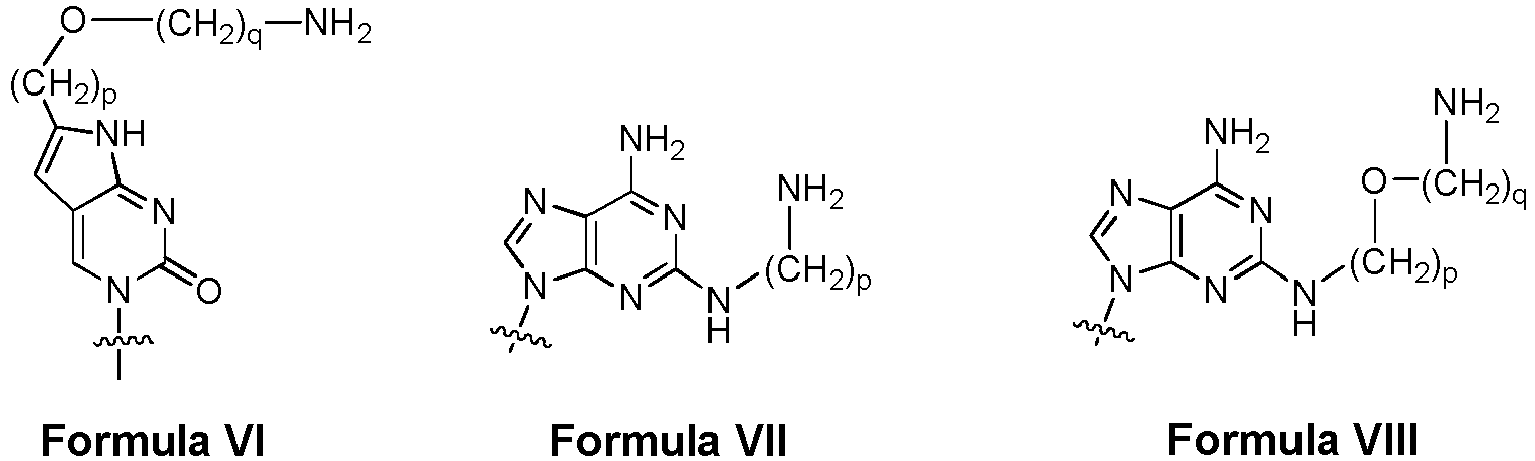
 p and q are integers; andthe abbreviations for the N- and C-terminus substituents are as specifically described as follows: "Fmoc-" is the abbreviation for "[(9-fluorenyl)methyloxy]carbonyl-"; "Fethoc-" for "[2-(9-fluorenyl)ethyl-1-oxy]carbonyl"; "Ac-" for "acetyl-"; "Benzoyl-" for "benzenecabonyl-"; "Piv-" for "pivalyl-"; "Methyl-" for "methyl-"; "n-Propyl-" for "1-(n-propyl)-"; "H-" for "hydrido-" group; "p-Toluenesulfonyl" for "(4-methylbenzene)-1-sulfonyl- "; "-Lys-" for amino acid residue "lysine"; "-Val-" for amino acid residue "valine"; "-Leu-" for amino acid residue "leucine"; "-Arg-" for amino acid residue "arginine"; "-Gly-" for amino acid residue "glycine"; "[N-(2-Phenylethyl)amino]carbonyl-" for "[N-1-(2-phenylethyl)amino]carbonyl-"; "Benzyl-" for "1-(phenyl)methyl-"; "Phenyl-" for "phenyl-"; "Me-" for "methyl-"; and "-NH2" for non-substituted "-amino" group.
 - The peptide nucleic acid derivative according to claim 1, which is selected from the group of compounds provided below, or a pharmaceutically acceptable salt thereof:(N → C) Fmoc-GA(5)A-GC(1O2)C-A(5)GG-C(1O2)AA(5)-G-NH2;(N → C) Fethoc-GA(5)A-GC(1O2)C-A(5)GG-C(1O2)AA(5)-G-NH2;(N → C) Fmoc-GA(6)A-GC(1O2)C-A(6)GG-C(1O2)AA(6)-G-NH2;(N → C) Fmoc-G(6)AA(5)-GC(1O3)C-A(7)GG(5)-CA(5)A-G-NH2;(N → C) Fmoc-GA(5)A-GC(2O2)C-A(6)GG-C(1O5)AA(6)-G-NH2;(N → C) Fethoc-TG(6)C(1O2)-GGA(6)-AG(6)C-CA(6)G-GC(1O2)A-A(6)GG(6)-NH2;(N → C) Fethoc-C(102)TT-A(5)CC-A(5)GG-C(102)AA(5)-G-NH2;(N → C) Fethoc-C(102)TT-A(6)CC-A(5)GG-C(103)AA(5)-G-Val-Lys-NH2;(N → C) Ac-C(102)TT-A(5)CC-A(5)GG-C(102)TA(5)-G-NH2;(N → C) Piv-C(102)TT-A(5)CC-A(5)GG-C(102)AA(5)-G-NH2;(N → C) H-CTT-A(5)C(103)C-A(5)G(3)G-C(102)AA(5)-G-NH2;(N → C) n-Propyl-C(102)TT-A(5)CC-A(5)GG-C(102)AA(5)-G-NH2;(N → C) n-Propyl-CTT-A(5)C(202)C-A(3)G(203)G-C(102)AA(5)-G-NH2;(N → C) p-Toluenesulfonyl-CTT-A(5)C(102)C-A(8)G(5)G-C(102)AA(5)-G-NH2;(N → C) Benzoyl-CTT-A(5)C(105)C-A(5)G(202)G-C(102)AA(5)-G-NH2;(N → C) Fethoc-Lys-Leu-CTT-A(5)C(1O2)C-A(2O2)GG-C(1O2)AA(5)-G-Lys-NH2;(N → C) Fethoc-C(102)TT-A(5)CC-A(5)GG-C(105)AA(5)-G-NH2;(N → C) Fethoc-C(102)TT-A(5)CC-A(7)GG-C(102)AA(3)-G-NH2;(N → C) Fethoc-CTT-A(5)C(102)C-A(5)GT-C(102)TA(5)-G-NH2;(N → C) Fethoc-TC(102)C-TTA(6)-CCA(6)-GGC(102)-AA(6)G-G(6)-NH2;(N → C) Fethoc-TC(102)C-TTA(5)-CCA(5)-GGC(102)-AA(5)G-G(6)-NH2;(N → C) Fethoc-GA(5)T-AC(102)C-A(5)GG(6)-CAA(5)-G-NH2;(N → C) Fethoc-TA(5)C-CAG(6)-GC(1O2)A-A(5)GG(6)-C-NH2;(N → C) Fethoc-C(102)TT-A(5)CC-A(5)GG(6)-CA(5)A-NH2;(N → C) Fethoc-C(102)TT-A(5)CC-A(7)GG(5)-CA(5)A-NH2;(N → C) Fethoc-C(102)TT-A(5)CC-A(6)GG(202)-CA(5)A-NH2;(N → C) Piv-C(1O2)TT-A(5)CC-A(5)GG(6)-CA(5)A-H2;;(N → C) Ac-C(102)TT-A(5)CC-A(5)GG(6)-CA(5)A-NH2;(N → C) N-Phenyl-N-methyl-CTT-A(5)C(102)C-A(5)GG-C(102)AA(5)-G-Lys-NH2;(N → C) [N-(2-Phenylethyl)amino]carbonyl-CTT-A(5)C(102)C-A(4)G(5)G-C(102)AA(5)-G-NH2;(N → C) Fethoc-C(102)TT-A(6)CC-A(6)GG(6)-CA(6)A-NH2;(N → C) Fethoc-TTT-TCC(102)-TTA(6)-CCA(6)-GG(6)C-A(6)A-NH2;(N → C) Fethoc-TTT-TCC(1O2)-TTA(6)-CC(1O3)A(6)-G-Lys-NH2;and(N → C) Fethoc-TC(2O2)C-TTA(6)-CCA(6)-GG(6)C-A(6)A-NH2.
- A peptide nucleic acid derivative according to claim 1, selected from the group consisting of: (N → C) Fethoc-C(1O2)TT-A(5)CC-A(5)GG-C(1O2)AA(5)-G-NH2, (N → C) Fethoc-TC(1O2)C-TTA(6)-CCA(6)-GGC(1O2)-AA(6)G-G(6)-NH2, (N → C) Fethoc-TC(1O2)C-TTA(5)-CCA(5)-GGC(1O2)-AA(5)G-G(6)-NH2, (N --7 C) Fethoc-TA(5)C-CAG(6)-GC(1O2)A-A(5)GG(6)-C-NH2, (N --7 C) Fethoc-C(102)TT-A(5)CC-A(5)GG(6)-CA(5)A-NH2, (N --7 C) Fethoc-C(1O2)TT-A(5)CC-A(6)GG(6)-CA(5)A-NH2, (N --7 C) Ac-C(1O2)TT-A(5)CC-A(5)GG(6)-CA(5)A-NH2, or (N --7 C) Fethoc-C(102)TT-A(6)CC-A(6)GG(6)-CA(6)A-NH2, or a pharmaceutically acceptable salt thereof.
- A peptide nucleic acid derivative according to any one of claims 1 to 5, for use in the treatment of a dermatological indication involving androgenic activity.
- A peptide nucleic acid derivative of any one of claims 1 to 5, for use in the treatment of a dermatological condition involving androgenic activity.
- A peptide nucleic acid derivative of any one of claims 1 to 5, for use in the treatment of androgenic alopecia.
Applications Claiming Priority (2)
| Application Number | Priority Date | Filing Date | Title |
|---|---|---|---|
| US201662372035P | 2016-08-08 | 2016-08-08 | |
| PCT/IB2017/000697 WO2018029517A1 (en) | 2016-08-08 | 2017-05-24 | Androgen receptor antisense oligonucleotides |
Publications (3)
| Publication Number | Publication Date |
|---|---|
| EP3497114A1 EP3497114A1 (en) | 2019-06-19 |
| EP3497114A4 EP3497114A4 (en) | 2020-04-29 |
| EP3497114B1 true EP3497114B1 (en) | 2024-10-16 |
Family
ID=61161927
Family Applications (1)
| Application Number | Title | Priority Date | Filing Date |
|---|---|---|---|
| EP17838864.1A Active EP3497114B1 (en) | 2016-08-08 | 2017-05-24 | Androgen receptor antisense oligonucleotides |
Country Status (12)
| Country | Link |
|---|---|
| US (1) | US20190345202A1 (en) |
| EP (1) | EP3497114B1 (en) |
| JP (1) | JP7407592B2 (en) |
| KR (1) | KR102427575B1 (en) |
| CN (1) | CN110072879B (en) |
| AR (1) | AR109303A1 (en) |
| AU (1) | AU2017309347B2 (en) |
| BR (1) | BR112019002387A2 (en) |
| RU (1) | RU2753966C2 (en) |
| SG (1) | SG11201900153XA (en) |
| TW (1) | TWI775764B (en) |
| WO (1) | WO2018029517A1 (en) |
Families Citing this family (7)
| Publication number | Priority date | Publication date | Assignee | Title |
|---|---|---|---|---|
| AU2017385962B2 (en) * | 2016-12-30 | 2021-09-02 | Olipass Corporation | Exon skipping by peptide nucleic acid derivatives |
| JP7503903B2 (en) * | 2017-01-06 | 2024-06-21 | オリパス コーポレーション | SNAP25 antisense oligonucleotides |
| CA3051178A1 (en) * | 2017-01-24 | 2018-08-02 | Olipass Corporation | Scn9a antisense pain killer |
| TWI832851B (en) * | 2018-05-18 | 2024-02-21 | 韓商奧利通公司 | Matrix metalloproteinase-1 antisense oligonucleotides |
| KR102304280B1 (en) * | 2018-08-14 | 2021-09-23 | 올리패스 주식회사 | Acetyl-CoA Carboxylase2 Antisense Oligonucleotides |
| WO2025119007A1 (en) * | 2023-12-05 | 2025-06-12 | 成都凌泰氪生物技术有限公司 | Group of antisense oligonucleotides that specifically inhibit androgen receptor, and use thereof |
| WO2025219570A1 (en) | 2024-04-17 | 2025-10-23 | Johannes Kepler Universität Linz | Composition for inhibiting protein translocation and methods using the same |
Family Cites Families (13)
| Publication number | Priority date | Publication date | Assignee | Title |
|---|---|---|---|---|
| IL104043A0 (en) * | 1991-12-12 | 1993-05-13 | Scios Nova Inc | Fluorenyl derivatives and pharmaceutical compositions containing them |
| EP0684764A4 (en) * | 1993-02-19 | 1997-10-22 | Genta Inc | Treatment of androgen-associated baldness using antisense oligomers. |
| US6133444A (en) | 1993-12-22 | 2000-10-17 | Perseptive Biosystems, Inc. | Synthons for the synthesis and deprotection of peptide nucleic acids under mild conditions |
| US6617422B1 (en) * | 1997-05-23 | 2003-09-09 | Peter Nielsen | Peptide nucleic acid monomers and oligomers |
| CA2302169A1 (en) * | 1998-06-30 | 2000-01-13 | The University Of British Columbia | Inhibitors of androgen-independent activation of androgen receptor |
| US20030207804A1 (en) * | 2001-05-25 | 2003-11-06 | Muthiah Manoharan | Modified peptide nucleic acids |
| US20050153935A1 (en) * | 2003-09-12 | 2005-07-14 | Iversen Patrick L. | Compound and method for treating androgen-independent prostate cancer |
| US8450290B2 (en) * | 2007-11-26 | 2013-05-28 | Enzon Pharmaceuticals, Inc. | Methods for treating androgen receptor dependent disorders including cancers |
| KR20100110298A (en) * | 2007-11-26 | 2010-10-12 | 산타리스 팔마 에이/에스 | Lna antagonists targeting the androgen receptor |
| KR20090098710A (en) * | 2008-03-14 | 2009-09-17 | 주식회사 씨티아이바이오 | Peptide Nucleic Acid Derivatives with Good Cell Permeability and Nucleic Acid Binding Capacity |
| EP4052709A1 (en) * | 2012-10-11 | 2022-09-07 | Ionis Pharmaceuticals, Inc. | Methods of treating kennedy's disease |
| WO2018012261A1 (en) | 2016-07-14 | 2018-01-18 | 株式会社日立製作所 | Electrical component storage case and manufacturing method therefor |
| AU2017385962B2 (en) * | 2016-12-30 | 2021-09-02 | Olipass Corporation | Exon skipping by peptide nucleic acid derivatives |
-
2017
- 2017-05-24 JP JP2019507826A patent/JP7407592B2/en active Active
- 2017-05-24 RU RU2019105298A patent/RU2753966C2/en active
- 2017-05-24 AU AU2017309347A patent/AU2017309347B2/en not_active Ceased
- 2017-05-24 US US16/324,266 patent/US20190345202A1/en not_active Abandoned
- 2017-05-24 SG SG11201900153XA patent/SG11201900153XA/en unknown
- 2017-05-24 WO PCT/IB2017/000697 patent/WO2018029517A1/en not_active Ceased
- 2017-05-24 EP EP17838864.1A patent/EP3497114B1/en active Active
- 2017-05-24 KR KR1020197005192A patent/KR102427575B1/en active Active
- 2017-05-24 CN CN201780061959.8A patent/CN110072879B/en active Active
- 2017-05-24 BR BR112019002387-9A patent/BR112019002387A2/en unknown
- 2017-08-07 AR ARP170102220A patent/AR109303A1/en unknown
- 2017-08-07 TW TW106126503A patent/TWI775764B/en active
Also Published As
| Publication number | Publication date |
|---|---|
| RU2753966C2 (en) | 2021-08-24 |
| CN110072879A (en) | 2019-07-30 |
| TW201812009A (en) | 2018-04-01 |
| AR109303A1 (en) | 2018-11-21 |
| CA3032549A1 (en) | 2018-02-15 |
| SG11201900153XA (en) | 2019-02-27 |
| EP3497114A4 (en) | 2020-04-29 |
| AU2017309347B2 (en) | 2020-11-19 |
| CN110072879B (en) | 2023-03-10 |
| TWI775764B (en) | 2022-09-01 |
| EP3497114A1 (en) | 2019-06-19 |
| US20190345202A1 (en) | 2019-11-14 |
| AU2017309347A1 (en) | 2019-02-07 |
| KR20190055066A (en) | 2019-05-22 |
| JP2019527720A (en) | 2019-10-03 |
| JP7407592B2 (en) | 2024-01-04 |
| RU2019105298A (en) | 2020-09-11 |
| KR102427575B1 (en) | 2022-08-01 |
| BR112019002387A2 (en) | 2019-06-04 |
| RU2019105298A3 (en) | 2020-10-08 |
| WO2018029517A1 (en) | 2018-02-15 |
Similar Documents
| Publication | Publication Date | Title |
|---|---|---|
| AU2017309347B2 (en) | Androgen receptor antisense oligonucleotides | |
| EP3512870B1 (en) | Scn9a antisense oligonucleotides | |
| CN117624310A (en) | Exon skipping by peptide nucleic acid derivatives | |
| WO2018138585A1 (en) | Scn9a antisense pain killer | |
| EP3526239B1 (en) | Hif 1-alpha antisense oligonucleotides | |
| US20220363720A1 (en) | Melanophilin antisense oligonucleotides | |
| TWI769208B (en) | Snap25 antisense oligonucleotides | |
| CA3032549C (en) | Androgen receptor antisense oligonucleotides | |
| AU2019320670B2 (en) | Acetyl-coa carboxylase2 antisense oligonucleotides | |
| EP3658570B1 (en) | Tyrosinase antisense oligonucleotides |
Legal Events
| Date | Code | Title | Description |
|---|---|---|---|
| STAA | Information on the status of an ep patent application or granted ep patent |
Free format text: STATUS: THE INTERNATIONAL PUBLICATION HAS BEEN MADE |
|
| PUAI | Public reference made under article 153(3) epc to a published international application that has entered the european phase |
Free format text: ORIGINAL CODE: 0009012 |
|
| STAA | Information on the status of an ep patent application or granted ep patent |
Free format text: STATUS: REQUEST FOR EXAMINATION WAS MADE |
|
| 17P | Request for examination filed |
Effective date: 20190304 |
|
| AK | Designated contracting states |
Kind code of ref document: A1 Designated state(s): AL AT BE BG CH CY CZ DE DK EE ES FI FR GB GR HR HU IE IS IT LI LT LU LV MC MK MT NL NO PL PT RO RS SE SI SK SM TR |
|
| AX | Request for extension of the european patent |
Extension state: BA ME |
|
| DAV | Request for validation of the european patent (deleted) | ||
| DAX | Request for extension of the european patent (deleted) | ||
| REG | Reference to a national code |
Ref country code: DE Free format text: PREVIOUS MAIN CLASS: C07K0014000000 Ipc: C12N0015113000 Ref country code: DE Ref legal event code: R079 Ref document number: 602017085564 Country of ref document: DE Free format text: PREVIOUS MAIN CLASS: C07K0014000000 Ipc: C12N0015113000 |
|
| A4 | Supplementary search report drawn up and despatched |
Effective date: 20200330 |
|
| RIC1 | Information provided on ipc code assigned before grant |
Ipc: C12N 15/113 20100101AFI20200324BHEP Ipc: C12N 15/11 20060101ALI20200324BHEP |
|
| STAA | Information on the status of an ep patent application or granted ep patent |
Free format text: STATUS: EXAMINATION IS IN PROGRESS |
|
| 17Q | First examination report despatched |
Effective date: 20210317 |
|
| P01 | Opt-out of the competence of the unified patent court (upc) registered |
Effective date: 20230419 |
|
| GRAP | Despatch of communication of intention to grant a patent |
Free format text: ORIGINAL CODE: EPIDOSNIGR1 |
|
| STAA | Information on the status of an ep patent application or granted ep patent |
Free format text: STATUS: GRANT OF PATENT IS INTENDED |
|
| GRAJ | Information related to disapproval of communication of intention to grant by the applicant or resumption of examination proceedings by the epo deleted |
Free format text: ORIGINAL CODE: EPIDOSDIGR1 |
|
| STAA | Information on the status of an ep patent application or granted ep patent |
Free format text: STATUS: EXAMINATION IS IN PROGRESS |
|
| INTG | Intention to grant announced |
Effective date: 20240219 |
|
| GRAP | Despatch of communication of intention to grant a patent |
Free format text: ORIGINAL CODE: EPIDOSNIGR1 |
|
| STAA | Information on the status of an ep patent application or granted ep patent |
Free format text: STATUS: GRANT OF PATENT IS INTENDED |
|
| INTC | Intention to grant announced (deleted) | ||
| INTG | Intention to grant announced |
Effective date: 20240409 |
|
| GRAJ | Information related to disapproval of communication of intention to grant by the applicant or resumption of examination proceedings by the epo deleted |
Free format text: ORIGINAL CODE: EPIDOSDIGR1 |
|
| STAA | Information on the status of an ep patent application or granted ep patent |
Free format text: STATUS: EXAMINATION IS IN PROGRESS |
|
| GRAP | Despatch of communication of intention to grant a patent |
Free format text: ORIGINAL CODE: EPIDOSNIGR1 |
|
| STAA | Information on the status of an ep patent application or granted ep patent |
Free format text: STATUS: GRANT OF PATENT IS INTENDED |
|
| INTC | Intention to grant announced (deleted) | ||
| INTG | Intention to grant announced |
Effective date: 20240718 |
|
| GRAS | Grant fee paid |
Free format text: ORIGINAL CODE: EPIDOSNIGR3 |
|
| GRAA | (expected) grant |
Free format text: ORIGINAL CODE: 0009210 |
|
| STAA | Information on the status of an ep patent application or granted ep patent |
Free format text: STATUS: THE PATENT HAS BEEN GRANTED |
|
| AK | Designated contracting states |
Kind code of ref document: B1 Designated state(s): AL AT BE BG CH CY CZ DE DK EE ES FI FR GB GR HR HU IE IS IT LI LT LU LV MC MK MT NL NO PL PT RO RS SE SI SK SM TR |
|
| REG | Reference to a national code |
Ref country code: GB Ref legal event code: FG4D |
|
| REG | Reference to a national code |
Ref country code: CH Ref legal event code: EP |
|
| REG | Reference to a national code |
Ref country code: IE Ref legal event code: FG4D |
|
| REG | Reference to a national code |
Ref country code: DE Ref legal event code: R096 Ref document number: 602017085564 Country of ref document: DE |
|
| REG | Reference to a national code |
Ref country code: LT Ref legal event code: MG9D |
|
| REG | Reference to a national code |
Ref country code: NL Ref legal event code: MP Effective date: 20241016 |
|
| REG | Reference to a national code |
Ref country code: AT Ref legal event code: MK05 Ref document number: 1732961 Country of ref document: AT Kind code of ref document: T Effective date: 20241016 |
|
| PG25 | Lapsed in a contracting state [announced via postgrant information from national office to epo] |
Ref country code: NL Free format text: LAPSE BECAUSE OF FAILURE TO SUBMIT A TRANSLATION OF THE DESCRIPTION OR TO PAY THE FEE WITHIN THE PRESCRIBED TIME-LIMIT Effective date: 20241016 |
|
| PG25 | Lapsed in a contracting state [announced via postgrant information from national office to epo] |
Ref country code: NL Free format text: LAPSE BECAUSE OF FAILURE TO SUBMIT A TRANSLATION OF THE DESCRIPTION OR TO PAY THE FEE WITHIN THE PRESCRIBED TIME-LIMIT Effective date: 20241016 |
|
| PG25 | Lapsed in a contracting state [announced via postgrant information from national office to epo] |
Ref country code: IS Free format text: LAPSE BECAUSE OF FAILURE TO SUBMIT A TRANSLATION OF THE DESCRIPTION OR TO PAY THE FEE WITHIN THE PRESCRIBED TIME-LIMIT Effective date: 20250216 Ref country code: HR Free format text: LAPSE BECAUSE OF FAILURE TO SUBMIT A TRANSLATION OF THE DESCRIPTION OR TO PAY THE FEE WITHIN THE PRESCRIBED TIME-LIMIT Effective date: 20241016 Ref country code: PT Free format text: LAPSE BECAUSE OF FAILURE TO SUBMIT A TRANSLATION OF THE DESCRIPTION OR TO PAY THE FEE WITHIN THE PRESCRIBED TIME-LIMIT Effective date: 20250217 |
|
| PG25 | Lapsed in a contracting state [announced via postgrant information from national office to epo] |
Ref country code: FI Free format text: LAPSE BECAUSE OF FAILURE TO SUBMIT A TRANSLATION OF THE DESCRIPTION OR TO PAY THE FEE WITHIN THE PRESCRIBED TIME-LIMIT Effective date: 20241016 |
|
| PG25 | Lapsed in a contracting state [announced via postgrant information from national office to epo] |
Ref country code: BG Free format text: LAPSE BECAUSE OF FAILURE TO SUBMIT A TRANSLATION OF THE DESCRIPTION OR TO PAY THE FEE WITHIN THE PRESCRIBED TIME-LIMIT Effective date: 20241016 |
|
| PG25 | Lapsed in a contracting state [announced via postgrant information from national office to epo] |
Ref country code: ES Free format text: LAPSE BECAUSE OF FAILURE TO SUBMIT A TRANSLATION OF THE DESCRIPTION OR TO PAY THE FEE WITHIN THE PRESCRIBED TIME-LIMIT Effective date: 20241016 |
|
| PG25 | Lapsed in a contracting state [announced via postgrant information from national office to epo] |
Ref country code: NO Free format text: LAPSE BECAUSE OF FAILURE TO SUBMIT A TRANSLATION OF THE DESCRIPTION OR TO PAY THE FEE WITHIN THE PRESCRIBED TIME-LIMIT Effective date: 20250116 |
|
| PG25 | Lapsed in a contracting state [announced via postgrant information from national office to epo] |
Ref country code: GR Free format text: LAPSE BECAUSE OF FAILURE TO SUBMIT A TRANSLATION OF THE DESCRIPTION OR TO PAY THE FEE WITHIN THE PRESCRIBED TIME-LIMIT Effective date: 20250117 Ref country code: AT Free format text: LAPSE BECAUSE OF FAILURE TO SUBMIT A TRANSLATION OF THE DESCRIPTION OR TO PAY THE FEE WITHIN THE PRESCRIBED TIME-LIMIT Effective date: 20241016 Ref country code: LV Free format text: LAPSE BECAUSE OF FAILURE TO SUBMIT A TRANSLATION OF THE DESCRIPTION OR TO PAY THE FEE WITHIN THE PRESCRIBED TIME-LIMIT Effective date: 20241016 |
|
| PG25 | Lapsed in a contracting state [announced via postgrant information from national office to epo] |
Ref country code: PL Free format text: LAPSE BECAUSE OF FAILURE TO SUBMIT A TRANSLATION OF THE DESCRIPTION OR TO PAY THE FEE WITHIN THE PRESCRIBED TIME-LIMIT Effective date: 20241016 |
|
| PG25 | Lapsed in a contracting state [announced via postgrant information from national office to epo] |
Ref country code: RS Free format text: LAPSE BECAUSE OF FAILURE TO SUBMIT A TRANSLATION OF THE DESCRIPTION OR TO PAY THE FEE WITHIN THE PRESCRIBED TIME-LIMIT Effective date: 20250116 |
|
| PG25 | Lapsed in a contracting state [announced via postgrant information from national office to epo] |
Ref country code: SM Free format text: LAPSE BECAUSE OF FAILURE TO SUBMIT A TRANSLATION OF THE DESCRIPTION OR TO PAY THE FEE WITHIN THE PRESCRIBED TIME-LIMIT Effective date: 20241016 |
|
| PG25 | Lapsed in a contracting state [announced via postgrant information from national office to epo] |
Ref country code: DK Free format text: LAPSE BECAUSE OF FAILURE TO SUBMIT A TRANSLATION OF THE DESCRIPTION OR TO PAY THE FEE WITHIN THE PRESCRIBED TIME-LIMIT Effective date: 20241016 |
|
| REG | Reference to a national code |
Ref country code: DE Ref legal event code: R097 Ref document number: 602017085564 Country of ref document: DE |
|
| PG25 | Lapsed in a contracting state [announced via postgrant information from national office to epo] |
Ref country code: EE Free format text: LAPSE BECAUSE OF FAILURE TO SUBMIT A TRANSLATION OF THE DESCRIPTION OR TO PAY THE FEE WITHIN THE PRESCRIBED TIME-LIMIT Effective date: 20241016 |
|
| PG25 | Lapsed in a contracting state [announced via postgrant information from national office to epo] |
Ref country code: RO Free format text: LAPSE BECAUSE OF FAILURE TO SUBMIT A TRANSLATION OF THE DESCRIPTION OR TO PAY THE FEE WITHIN THE PRESCRIBED TIME-LIMIT Effective date: 20241016 |
|
| PG25 | Lapsed in a contracting state [announced via postgrant information from national office to epo] |
Ref country code: SK Free format text: LAPSE BECAUSE OF FAILURE TO SUBMIT A TRANSLATION OF THE DESCRIPTION OR TO PAY THE FEE WITHIN THE PRESCRIBED TIME-LIMIT Effective date: 20241016 |
|
| PG25 | Lapsed in a contracting state [announced via postgrant information from national office to epo] |
Ref country code: CZ Free format text: LAPSE BECAUSE OF FAILURE TO SUBMIT A TRANSLATION OF THE DESCRIPTION OR TO PAY THE FEE WITHIN THE PRESCRIBED TIME-LIMIT Effective date: 20241016 |
|
| PLBE | No opposition filed within time limit |
Free format text: ORIGINAL CODE: 0009261 |
|
| STAA | Information on the status of an ep patent application or granted ep patent |
Free format text: STATUS: NO OPPOSITION FILED WITHIN TIME LIMIT |
|
| PG25 | Lapsed in a contracting state [announced via postgrant information from national office to epo] |
Ref country code: SE Free format text: LAPSE BECAUSE OF FAILURE TO SUBMIT A TRANSLATION OF THE DESCRIPTION OR TO PAY THE FEE WITHIN THE PRESCRIBED TIME-LIMIT Effective date: 20241016 |
|
| 26N | No opposition filed |
Effective date: 20250717 |
|
| REG | Reference to a national code |
Ref country code: CH Ref legal event code: U11 Free format text: ST27 STATUS EVENT CODE: U-0-0-U10-U11 (AS PROVIDED BY THE NATIONAL OFFICE) Effective date: 20251202 |
|
| PGFP | Annual fee paid to national office [announced via postgrant information from national office to epo] |
Ref country code: LU Payment date: 20251128 Year of fee payment: 9 |
|
| PGFP | Annual fee paid to national office [announced via postgrant information from national office to epo] |
Ref country code: DE Payment date: 20251127 Year of fee payment: 9 |
|
| PGFP | Annual fee paid to national office [announced via postgrant information from national office to epo] |
Ref country code: GB Payment date: 20251125 Year of fee payment: 9 |
|
| PGFP | Annual fee paid to national office [announced via postgrant information from national office to epo] |
Ref country code: MC Payment date: 20251127 Year of fee payment: 9 |
|
| PGFP | Annual fee paid to national office [announced via postgrant information from national office to epo] |
Ref country code: IT Payment date: 20251127 Year of fee payment: 9 |
|
| PGFP | Annual fee paid to national office [announced via postgrant information from national office to epo] |
Ref country code: FR Payment date: 20251126 Year of fee payment: 9 |
|
| PGFP | Annual fee paid to national office [announced via postgrant information from national office to epo] |
Ref country code: BE Payment date: 20251126 Year of fee payment: 9 |
|
| PGFP | Annual fee paid to national office [announced via postgrant information from national office to epo] |
Ref country code: CH Payment date: 20251202 Year of fee payment: 9 |
|
| PGFP | Annual fee paid to national office [announced via postgrant information from national office to epo] |
Ref country code: IE Payment date: 20251127 Year of fee payment: 9 |