EP3496011A1 - Automated attendee monitoring and guidance system - Google Patents
Automated attendee monitoring and guidance system Download PDFInfo
- Publication number
- EP3496011A1 EP3496011A1 EP18210781.3A EP18210781A EP3496011A1 EP 3496011 A1 EP3496011 A1 EP 3496011A1 EP 18210781 A EP18210781 A EP 18210781A EP 3496011 A1 EP3496011 A1 EP 3496011A1
- Authority
- EP
- European Patent Office
- Prior art keywords
- beacon
- beacons
- unique
- server
- entry
- Prior art date
- Legal status (The legal status is an assumption and is not a legal conclusion. Google has not performed a legal analysis and makes no representation as to the accuracy of the status listed.)
- Pending
Links
Images


Classifications
-
- G—PHYSICS
- G06—COMPUTING OR CALCULATING; COUNTING
- G06Q—INFORMATION AND COMMUNICATION TECHNOLOGY [ICT] SPECIALLY ADAPTED FOR ADMINISTRATIVE, COMMERCIAL, FINANCIAL, MANAGERIAL OR SUPERVISORY PURPOSES; SYSTEMS OR METHODS SPECIALLY ADAPTED FOR ADMINISTRATIVE, COMMERCIAL, FINANCIAL, MANAGERIAL OR SUPERVISORY PURPOSES, NOT OTHERWISE PROVIDED FOR
- G06Q10/00—Administration; Management
-
- G—PHYSICS
- G06—COMPUTING OR CALCULATING; COUNTING
- G06Q—INFORMATION AND COMMUNICATION TECHNOLOGY [ICT] SPECIALLY ADAPTED FOR ADMINISTRATIVE, COMMERCIAL, FINANCIAL, MANAGERIAL OR SUPERVISORY PURPOSES; SYSTEMS OR METHODS SPECIALLY ADAPTED FOR ADMINISTRATIVE, COMMERCIAL, FINANCIAL, MANAGERIAL OR SUPERVISORY PURPOSES, NOT OTHERWISE PROVIDED FOR
- G06Q10/00—Administration; Management
- G06Q10/06—Resources, workflows, human or project management; Enterprise or organisation planning; Enterprise or organisation modelling
- G06Q10/063—Operations research, analysis or management
-
- G—PHYSICS
- G06—COMPUTING OR CALCULATING; COUNTING
- G06Q—INFORMATION AND COMMUNICATION TECHNOLOGY [ICT] SPECIALLY ADAPTED FOR ADMINISTRATIVE, COMMERCIAL, FINANCIAL, MANAGERIAL OR SUPERVISORY PURPOSES; SYSTEMS OR METHODS SPECIALLY ADAPTED FOR ADMINISTRATIVE, COMMERCIAL, FINANCIAL, MANAGERIAL OR SUPERVISORY PURPOSES, NOT OTHERWISE PROVIDED FOR
- G06Q10/00—Administration; Management
- G06Q10/06—Resources, workflows, human or project management; Enterprise or organisation planning; Enterprise or organisation modelling
- G06Q10/063—Operations research, analysis or management
- G06Q10/0631—Resource planning, allocation, distributing or scheduling for enterprises or organisations
- G06Q10/06311—Scheduling, planning or task assignment for a person or group
- G06Q10/063114—Status monitoring or status determination for a person or group
-
- G—PHYSICS
- G06—COMPUTING OR CALCULATING; COUNTING
- G06Q—INFORMATION AND COMMUNICATION TECHNOLOGY [ICT] SPECIALLY ADAPTED FOR ADMINISTRATIVE, COMMERCIAL, FINANCIAL, MANAGERIAL OR SUPERVISORY PURPOSES; SYSTEMS OR METHODS SPECIALLY ADAPTED FOR ADMINISTRATIVE, COMMERCIAL, FINANCIAL, MANAGERIAL OR SUPERVISORY PURPOSES, NOT OTHERWISE PROVIDED FOR
- G06Q10/00—Administration; Management
- G06Q10/10—Office automation; Time management
- G06Q10/109—Time management, e.g. calendars, reminders, meetings or time accounting
- G06Q10/1091—Recording time for administrative or management purposes
-
- G—PHYSICS
- G06—COMPUTING OR CALCULATING; COUNTING
- G06Q—INFORMATION AND COMMUNICATION TECHNOLOGY [ICT] SPECIALLY ADAPTED FOR ADMINISTRATIVE, COMMERCIAL, FINANCIAL, MANAGERIAL OR SUPERVISORY PURPOSES; SYSTEMS OR METHODS SPECIALLY ADAPTED FOR ADMINISTRATIVE, COMMERCIAL, FINANCIAL, MANAGERIAL OR SUPERVISORY PURPOSES, NOT OTHERWISE PROVIDED FOR
- G06Q50/00—Information and communication technology [ICT] specially adapted for implementation of business processes of specific business sectors, e.g. utilities or tourism
- G06Q50/10—Services
- G06Q50/20—Education
Definitions
- the present disclosure relates generally to attendance and admittance monitoring systems, and in one particular example to a system for alerting attendees to a location of a room, automatically guiding attendees to the room and automatically monitoring the attendance of the attendees throughout a session.
- Universities and/or job training schools often use attendance in class as one metric for monitoring and ensuring student progress.
- existing systems for monitoring attendance require the utilization of class time to determine which attendees are present.
- the attendance check can fail to account for attendees exiting the classroom early.
- the attendance check can fail to account for attendees who arrive late, or who enter the session partway through.
- An exemplary method for monitoring a location of a group of individuals includes receiving a first signal at a server, the first signal including an individual identification (ID) corresponding to a specific individual, and at least one beacon ID corresponding to a unique beacon from a set of beacons, cross-checking the individual ID and the at least one beacon ID with an allowed individuals list, and unlocking an entry-way corresponding to a unique beacon ID in the at least one beacon ID in response to the unique beacon ID corresponding to an entry-way beacon at a room which the individual ID is authorized to access, and cross-checking the individual ID and the at least one beacon ID with an attendance list, and updating an attendance monitoring file on said server in response to the unique beacon ID in the at least one beacon ID corresponding to an interior room beacon.
- ID individual identification
- a system for monitoring attendance of a group of attendees includes a plurality of beacons distributed throughout a campus, each of said beacons having a unique beacon identification, a plurality of mobile devices, each of said mobile devices corresponding to a single attendee and having a unique attendee identification, a network, and a central server in communication with each of said mobile devices via said network.
- FIG. 1 schematically illustrates an attendance monitoring system 10 including a server 20, and a set of unique beacons 30.
- the beacons 30 are positioned throughout a campus, such as a school building, and each include a memory 32, and a transmitter 34.
- the beacons 30 further include a processor 36 capable of basic computer processing. Alternatively, some attendance monitoring systems can omit the processor 36.
- Each of the beacons 30 transmits a unique beacon identifier, such as a numeric code, using the transmitter 34, via a low range local wireless signal.
- the low range local wireless signal can be a Bluetooth protocol signal. Alternative low range wireless protocols could be used to similar effect.
- the limited range of the low power transmission defines a transmission zone of the beacon 30.
- each of the beacons 30 can also be connected to the server 20 via the network 50.
- Each individual attendee interacts with the system 10 via a mobile device 40, such as a cell phone, tablet, or a dedicated monitoring device.
- Each mobile device is also assigned a unique identifier.
- the mobile device 40 then transmits a unique mobile device identifier, and the unique beacon identifier to the server 20 over a network 50 such as the internet.
- a network 50 such as the internet.
- any other computer network can be utilized to the same effect.
- the server 20 can determine that a specific attendee is within a broadcast zone of a specific beacon 30, and appropriate corresponding action can be taken by the server 20.
- each attendee is assigned a unique identifier, instead of the mobile device 40, and any given attendee can sign in to any given mobile device.
- a beacon 30 can be positioned proximate to an entry-way, such as a door.
- an entry-way such as a door.
- the server 20 can determine if the owner of the mobile device 40 is authorized to pass through the entry-way and, if so, the server 20 can unlock the door for the authorized user.
- the mobile device 40 can be a dedicated monitoring device that is specifically constructed to be utilized in, and integrated with, the system 10.
- the mobile device 40 can be an attendee's mobile device, such as a cell phone, tablet, smart watch or any similar wearable gadget.
- the mobile device 40 includes a specifically designed attendance monitoring module that configures the mobile device 40 to receive the short range transmissions from the beacons 30 when the mobile device 40 is within range of the beacon 30, and to transmit a signal to the server 20 using the network 50.
- the beacons 30 can be oriented, or targeted, such that the short range transmission zone is prevented from extending certain directions from the beacon 30.
- a beacon 30 can be positioned at an entry-way and oriented such that only attendees in the hallway, passing by, approaching, or exiting the entry-way interact with the transmission.
- Such an example can be utilized in conjunction with a secondary attendance beacon within a room as described below.
- the specific range and transmission zone of any given beacon 30 can be controlled via adjusting a power level of the beacon 30, partially shielding a transmission antennae of the beacon 30, a physical orientation of the beacon 30, or any similar technique for controlling wireless transmissions.
- Figure 2 schematically illustrates a partial implementation of the system 10 within a single room 100.
- the room 100 includes a single entry-way 110.
- An entry beacon 120 is disposed at the entry-way 110 and generates a broadcast zone 112 at the entry-way 110.
- a door is maintained in a locked state at the entry-way 110.
- a mobile device 140 carried by the user 130 interacts with the entry-way beacon 120 and receives the transmitted unique beacon ID corresponding to the entry-way beacon 120.
- the mobile device 140 transmits a unique mobile device ID, or a unique user ID. and the received unique beacon ID to the server 20 (illustrated in Figure 1 ), and the server 20 determines whether the user 130 is authorized to enter the room 100 or not. If the user 130 is authorized to enter the room 100, the server 20 interacts with building security systems and unlocks the door at the entry-way 110 for a pre-determined period of time sufficient to allow the user 130 to enter the room 100.
- the broadcast zone 112 of the short range transmission from the entry-way beacon 120 is oriented away from the room 100, and into the adjoining hallway. In this way, a user 130 carrying a mobile device 140 outside of the room 100 interacts with the beacon 120, while the same user 130 within the room would not interact with the beacon 120.
- the wall defining the room and/or features of the entry-way 110 can further shield a user 130 within the room from interacting with the broadcast zone 112 of the entry-way beacon 120.
- a second user 150 is illustrated having already entered the room 100 through the entry-way 110.
- the second user 150 has a second mobile device 160 that interacts with an attendance monitoring beacon 170 disposed within the room 100.
- the second mobile device 160 receives a unique beacon ID corresponding to the attendance monitoring beacon 170.
- the second mobile device 160 transmits a combination of the unique mobile device ID and the unique beacon ID to the server 20. Based on this transmission, the server 20 can determine that the user 150 is attending an event, such as a class, in the room 100.
- the second mobile device 160 transmits a combination of the unique user ID, the attendance monitoring beacon 170, and the most recent entry-way beacon 120. Such a transmission provides additional detail to the server 20 and can ensure that an attendee is not spoofing the unique beacon ID of the attendance monitoring beacon 170, by allowing the server 20 to verify that the most recently passed entry-way beacon 120 is an entry-way to the room 100 containing the attendance monitoring beacon 170.
- the second mobile device 160 can continuously transmit the combination of the mobile device ID and the two beacon IDs for a duration of a class, thereby allowing the server 20 to monitor the attendance of the user 150 for a full duration of a class or other event.
- the continuous transmission example can be applied to the single beacon ID implementation to achieve a similar result.
- a professor 180 can interact with the server 20 using a third mobile device 190.
- the professor 180 is given unique and elevated privileges through a software module installed on the third mobile device 190.
- the software module allows the professor 180 to query the server to determine how many attendees are present, which attendees are present, the most recently scanned beacon of any non-present scheduled attendees, or any similar information.
- the software module can be configured to allow the professor to update or alter a location of the class and a time of the class. In such implementations, the updated information is transmitted to attendees via the mobile devices 140, 160.
- the software module can be configured to allow any user with the level of the professor to monitor attendance of a class, location of attendees, or update or alter class locations, times, and the like.
- each of the entry-ways 110 includes a corresponding entry-way beacon 120 with its own unique beacon identifier.
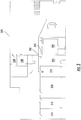
- FIG. 3 schematically illustrates campus 200, such as a single floor of a building, exemplifying this configuration.
- the campus 200 includes multiple classrooms 210, as well as a conference room 220, and multiple labs 230.
- Each of the classrooms 210, the conference room 220, and the multiple labs 230 includes the entry-way beacon 120, and attendance beacon 170 configuration described above with regards to Figure 2 . Further, the beacons are configured such that a transmission zone of each entry-way beacon extends only into the adjoining hallway, thereby preventing interference with the corresponding attendance beacons.
- an attendee may not know which classroom 210, conference room 220 or lab 230 they are supposed to attend on any given day.
- the attendance monitoring module stored on each of the mobile devices can include a direction and scheduling feature.
- the mobile device can query the server to determine which classroom 210, 220, 230 the attendee is supposed to be attending, and at what time.
- the direction and scheduling feature can identify where the attendee is within the campus by determining the nearest beacon to the attendee. Once the location of the attendee is determined by the server, the server can provide the direction and scheduling feature with directions to the location where the attendee should be, and the mobile device can display those directions. In yet further examples, any other directional indicator including audio cues and vibrational cues can be used to indicate the direction as well.
- an attendee may wish to disable the capability of the direction and scheduling feature to monitor their location on the campus. Ordinarily, this could be achieved by the attendee placing their mobile device in airplane mode, disabling Wi-Fi communication, or both.
- the direction and scheduling feature is, in some examples, configured to re-enable data and Wi-Fi capabilities of the mobile device if the attendee disables them.
- the re-enabling can be limited to a duration sufficient to transmit the attendee's location to the server. In other examples, the duration can be unlimited in scope.
- disabling the communications of the mobile device will provide a notification from the server to a professor, or other monitor, that the attendee has disabled, or attempted to disable, their mobile device.
- some example systems can display on their mobile device that a professor, or other monitor, has received this notification.
- the classrooms 210 can be gated from the remainder of the campus 200 via another entry-way 240.
- an additional beacon 242 is positioned at the entry-way 240, and operates in a similar fashion to the previously described beacons.
- the campus can be configured such that a local transmission zone of each beacon does not intersect with a local transmission zone of any other beacons.
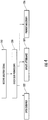
- Figure 4 illustrates a flowchart demonstrating the method for monitoring the attendance of an individual as enacted by the server 20.
- the server 20 receives a signal over the network 50 from one of the mobile devices 40 in a "receive location signal" step 310.
- the signal includes a combination of an individual identification corresponding to the specific individual and a beacon identification corresponding to a beacon that the individual has entered the transmission zone of.
- the individual identification can be a mobile device ID, when the individual has their own dedicated mobile device, or it can be a user ID, when the user is logged into an attendance monitoring module on the mobile device 40.
- the signal can include a combination of multiple beacon identifications.
- the server 20 then cross checks the individual ID and the beacon ID with a permissions list in a "check user permissions" step 320.
- the server 20 will determine if the individual is authorized to pass through the entry-way based on the permissions. If the user is authorized, the server 20 will interface with building security systems and unlock the entry-way for a predetermined period of time sufficient for the individual to pass through in an "open entry-way" step 322.
- the server 20 will determine from the permissions list that the individual corresponding to the individual ID is an attendee of the event occurring within the room, and will update an attendance sheet within the server 20 in an "update attendance" step 324.
- the server 20 can determine, based on the user permissions where the user is next scheduled to be. The server 20 can then transmit directions to the next location from the users current location to the user's mobile device 40 in a "provide directions" step 326.
Landscapes
- Business, Economics & Management (AREA)
- Human Resources & Organizations (AREA)
- Engineering & Computer Science (AREA)
- Strategic Management (AREA)
- Entrepreneurship & Innovation (AREA)
- Economics (AREA)
- Tourism & Hospitality (AREA)
- Physics & Mathematics (AREA)
- Theoretical Computer Science (AREA)
- Marketing (AREA)
- General Physics & Mathematics (AREA)
- General Business, Economics & Management (AREA)
- Quality & Reliability (AREA)
- Operations Research (AREA)
- Educational Administration (AREA)
- Development Economics (AREA)
- Game Theory and Decision Science (AREA)
- Educational Technology (AREA)
- Health & Medical Sciences (AREA)
- General Health & Medical Sciences (AREA)
- Primary Health Care (AREA)
- Data Mining & Analysis (AREA)
- Telephonic Communication Services (AREA)
- Time Recorders, Dirve Recorders, Access Control (AREA)
Abstract
Description
- The present disclosure relates generally to attendance and admittance monitoring systems, and in one particular example to a system for alerting attendees to a location of a room, automatically guiding attendees to the room and automatically monitoring the attendance of the attendees throughout a session.
- Universities and/or job training schools often use attendance in class as one metric for monitoring and ensuring student progress. However, existing systems for monitoring attendance require the utilization of class time to determine which attendees are present. Additionally, when attendance is taken at the beginning of a session the attendance check can fail to account for attendees exiting the classroom early. Similarly, when attendance is taken at the end of a session, the attendance check can fail to account for attendees who arrive late, or who enter the session partway through.
- Further complicating attendance monitoring is the requirement that some classes, such as engineering and technical work classes, can utilize two or more distinct classrooms, labs, and learning areas depending on the subject matter being addressed on a particular day. In such a case, student attendance can be varied, stuttered based on schedules, and the like.
- An exemplary method for monitoring a location of a group of individuals includes receiving a first signal at a server, the first signal including an individual identification (ID) corresponding to a specific individual, and at least one beacon ID corresponding to a unique beacon from a set of beacons, cross-checking the individual ID and the at least one beacon ID with an allowed individuals list, and unlocking an entry-way corresponding to a unique beacon ID in the at least one beacon ID in response to the unique beacon ID corresponding to an entry-way beacon at a room which the individual ID is authorized to access, and cross-checking the individual ID and the at least one beacon ID with an attendance list, and updating an attendance monitoring file on said server in response to the unique beacon ID in the at least one beacon ID corresponding to an interior room beacon.
- In one exemplary embodiment a system for monitoring attendance of a group of attendees includes a plurality of beacons distributed throughout a campus, each of said beacons having a unique beacon identification, a plurality of mobile devices, each of said mobile devices corresponding to a single attendee and having a unique attendee identification, a network, and a central server in communication with each of said mobile devices via said network.
- These and other features of the present invention can be best understood from the following specification and drawings, the following of which is a brief description.
-
-
Figure 1 illustrates a high level schematic attendance monitoring system. -
Figure 2 illustrates an implementation of an attendance monitoring system in a single room. -
Figure 3 illustrates an exemplary single building campus incorporating an attendance monitoring system. -
Figure 4 illustrate a flowchart of a process for monitoring attendance. -
Figure 1 schematically illustrates anattendance monitoring system 10 including aserver 20, and a set ofunique beacons 30. Thebeacons 30 are positioned throughout a campus, such as a school building, and each include amemory 32, and atransmitter 34. In the illustrated example, thebeacons 30 further include aprocessor 36 capable of basic computer processing. Alternatively, some attendance monitoring systems can omit theprocessor 36. Each of thebeacons 30 transmits a unique beacon identifier, such as a numeric code, using thetransmitter 34, via a low range local wireless signal. By way of example, the low range local wireless signal can be a Bluetooth protocol signal. Alternative low range wireless protocols could be used to similar effect. The limited range of the low power transmission defines a transmission zone of thebeacon 30. Further, in order to prevent beacon tampering in some implementations, each of thebeacons 30 can also be connected to theserver 20 via thenetwork 50. - Each individual attendee interacts with the
system 10 via amobile device 40, such as a cell phone, tablet, or a dedicated monitoring device. Each mobile device is also assigned a unique identifier. When an attendee enters the broadcast zone of any givenbeacon 30, theirmobile device 40 reads the transmission from thebeacon 30. Themobile device 40 then transmits a unique mobile device identifier, and the unique beacon identifier to theserver 20 over anetwork 50 such as the internet. In alternative examples, any other computer network can be utilized to the same effect. Utilizing the combination of unique mobile device and beacon identifiers, theserver 20 can determine that a specific attendee is within a broadcast zone of aspecific beacon 30, and appropriate corresponding action can be taken by theserver 20. In alternate examples, each attendee is assigned a unique identifier, instead of themobile device 40, and any given attendee can sign in to any given mobile device. - In one example, described in more detail below with regards to
Figure 2 , abeacon 30 can be positioned proximate to an entry-way, such as a door. When amobile device 40 transmits to theserver 20 that themobile device 40 is in a transmission zone of thebeacon 30, theserver 20 can determine if the owner of themobile device 40 is authorized to pass through the entry-way and, if so, theserver 20 can unlock the door for the authorized user. - In some
example systems 10, themobile device 40 can be a dedicated monitoring device that is specifically constructed to be utilized in, and integrated with, thesystem 10. In alternative examples, themobile device 40 can be an attendee's mobile device, such as a cell phone, tablet, smart watch or any similar wearable gadget. In either example, themobile device 40 includes a specifically designed attendance monitoring module that configures themobile device 40 to receive the short range transmissions from thebeacons 30 when themobile device 40 is within range of thebeacon 30, and to transmit a signal to theserver 20 using thenetwork 50. - Further, in some examples the
beacons 30 can be oriented, or targeted, such that the short range transmission zone is prevented from extending certain directions from thebeacon 30. By way of example, abeacon 30 can be positioned at an entry-way and oriented such that only attendees in the hallway, passing by, approaching, or exiting the entry-way interact with the transmission. Such an example can be utilized in conjunction with a secondary attendance beacon within a room as described below. The specific range and transmission zone of any givenbeacon 30 can be controlled via adjusting a power level of thebeacon 30, partially shielding a transmission antennae of thebeacon 30, a physical orientation of thebeacon 30, or any similar technique for controlling wireless transmissions. - With continued reference to the
system 10 described above inFigure 1 ,Figure 2 schematically illustrates a partial implementation of thesystem 10 within asingle room 100. Theroom 100 includes a single entry-way 110. Anentry beacon 120 is disposed at the entry-way 110 and generates abroadcast zone 112 at the entry-way 110. In order to prevent unauthorized attendees from entering theroom 100, a door is maintained in a locked state at the entry-way 110. - When a
user 130 approaches the entry-way 110 and enters thebroadcast zone 112, amobile device 140 carried by theuser 130 interacts with the entry-way beacon 120 and receives the transmitted unique beacon ID corresponding to the entry-way beacon 120. Themobile device 140 then transmits a unique mobile device ID, or a unique user ID. and the received unique beacon ID to the server 20 (illustrated inFigure 1 ), and theserver 20 determines whether theuser 130 is authorized to enter theroom 100 or not. If theuser 130 is authorized to enter theroom 100, theserver 20 interacts with building security systems and unlocks the door at the entry-way 110 for a pre-determined period of time sufficient to allow theuser 130 to enter theroom 100. - The
broadcast zone 112 of the short range transmission from the entry-way beacon 120 is oriented away from theroom 100, and into the adjoining hallway. In this way, auser 130 carrying amobile device 140 outside of theroom 100 interacts with thebeacon 120, while thesame user 130 within the room would not interact with thebeacon 120. In some examples, the wall defining the room and/or features of the entry-way 110 can further shield auser 130 within the room from interacting with thebroadcast zone 112 of the entry-way beacon 120. - A
second user 150 is illustrated having already entered theroom 100 through the entry-way 110. Thesecond user 150 has a secondmobile device 160 that interacts with anattendance monitoring beacon 170 disposed within theroom 100. As with the interaction between themobile device 140 and the entry-way beacon 120, the secondmobile device 160 receives a unique beacon ID corresponding to theattendance monitoring beacon 170. The secondmobile device 160 then transmits a combination of the unique mobile device ID and the unique beacon ID to theserver 20. Based on this transmission, theserver 20 can determine that theuser 150 is attending an event, such as a class, in theroom 100. - In some examples, the second
mobile device 160 transmits a combination of the unique user ID, theattendance monitoring beacon 170, and the most recent entry-way beacon 120. Such a transmission provides additional detail to theserver 20 and can ensure that an attendee is not spoofing the unique beacon ID of theattendance monitoring beacon 170, by allowing theserver 20 to verify that the most recently passed entry-way beacon 120 is an entry-way to theroom 100 containing theattendance monitoring beacon 170. - In some further examples, the second
mobile device 160 can continuously transmit the combination of the mobile device ID and the two beacon IDs for a duration of a class, thereby allowing theserver 20 to monitor the attendance of theuser 150 for a full duration of a class or other event. The continuous transmission example can be applied to the single beacon ID implementation to achieve a similar result. - In further examples a
professor 180 can interact with theserver 20 using a thirdmobile device 190. In such an example, theprofessor 180 is given unique and elevated privileges through a software module installed on the thirdmobile device 190. The software module allows theprofessor 180 to query the server to determine how many attendees are present, which attendees are present, the most recently scanned beacon of any non-present scheduled attendees, or any similar information. In some further implementations, the software module can be configured to allow the professor to update or alter a location of the class and a time of the class. In such implementations, the updated information is transmitted to attendees via themobile devices - In yet further examples, a
single room 100 including multiple entry-ways 110 can be implemented. In such an example, each of the entry-ways 110 includes a corresponding entry-way beacon 120 with its own unique beacon identifier. - With continued reference to the examples of
Figures 1 and2 , it can be appreciated that thesystem 10 can be expanded to multiple rooms throughout a given campus, such as a single school building, or multiple buildings at a university campus, to achieve additional benefits.Figure 3 schematically illustrates campus 200, such as a single floor of a building, exemplifying this configuration. The campus 200 includesmultiple classrooms 210, as well as aconference room 220, andmultiple labs 230. - Each of the
classrooms 210, theconference room 220, and themultiple labs 230 includes the entry-way beacon 120, andattendance beacon 170 configuration described above with regards toFigure 2 . Further, the beacons are configured such that a transmission zone of each entry-way beacon extends only into the adjoining hallway, thereby preventing interference with the corresponding attendance beacons. - In certain instances, an attendee may not know which
classroom 210,conference room 220 orlab 230 they are supposed to attend on any given day. In order to assist the attendee, the attendance monitoring module stored on each of the mobile devices can include a direction and scheduling feature. When the user accesses the direction and scheduling feature, the mobile device can query the server to determine whichclassroom - In yet further examples, the direction and scheduling feature can identify where the attendee is within the campus by determining the nearest beacon to the attendee. Once the location of the attendee is determined by the server, the server can provide the direction and scheduling feature with directions to the location where the attendee should be, and the mobile device can display those directions. In yet further examples, any other directional indicator including audio cues and vibrational cues can be used to indicate the direction as well.
- In some instances, an attendee may wish to disable the capability of the direction and scheduling feature to monitor their location on the campus. Ordinarily, this could be achieved by the attendee placing their mobile device in airplane mode, disabling Wi-Fi communication, or both. In order to prevent this, the direction and scheduling feature is, in some examples, configured to re-enable data and Wi-Fi capabilities of the mobile device if the attendee disables them. In some examples, the re-enabling can be limited to a duration sufficient to transmit the attendee's location to the server. In other examples, the duration can be unlimited in scope. In yet further examples, disabling the communications of the mobile device will provide a notification from the server to a professor, or other monitor, that the attendee has disabled, or attempted to disable, their mobile device. In addition, some example systems can display on their mobile device that a professor, or other monitor, has received this notification.
- In some examples, the
classrooms 210 can be gated from the remainder of the campus 200 via another entry-way 240. In such an example, anadditional beacon 242 is positioned at the entry-way 240, and operates in a similar fashion to the previously described beacons. In yet further implementations, the campus can be configured such that a local transmission zone of each beacon does not intersect with a local transmission zone of any other beacons. - With continued reference to the examples illustrated above in
Figure 1-3 ,Figure 4 illustrates a flowchart demonstrating the method for monitoring the attendance of an individual as enacted by theserver 20. Initially, theserver 20 receives a signal over thenetwork 50 from one of themobile devices 40 in a "receive location signal"step 310. The signal includes a combination of an individual identification corresponding to the specific individual and a beacon identification corresponding to a beacon that the individual has entered the transmission zone of. By way of example, the individual identification can be a mobile device ID, when the individual has their own dedicated mobile device, or it can be a user ID, when the user is logged into an attendance monitoring module on themobile device 40. Further, as described above, in some examples the signal can include a combination of multiple beacon identifications. - The
server 20 then cross checks the individual ID and the beacon ID with a permissions list in a "check user permissions"step 320. In the case that the beacon ID corresponds to a specific entry-way, such as a lab entry-way, theserver 20 will determine if the individual is authorized to pass through the entry-way based on the permissions. If the user is authorized, theserver 20 will interface with building security systems and unlock the entry-way for a predetermined period of time sufficient for the individual to pass through in an "open entry-way"step 322. - Alternatively, when the beacon ID corresponds to an attendance beacon within any given room, the
server 20 will determine from the permissions list that the individual corresponding to the individual ID is an attendee of the event occurring within the room, and will update an attendance sheet within theserver 20 in an "update attendance"step 324. - In the case that the user corresponding to the individual identification is not authorized to pass through an entry-way and/or is not scheduled to attend an even in the corresponding room, the
server 20 can determine, based on the user permissions where the user is next scheduled to be. Theserver 20 can then transmit directions to the next location from the users current location to the user'smobile device 40 in a "provide directions"step 326. - While described above in the context of schools, and classes, one skilled in the art will appreciate that the idea can be extended to any institutional attendance monitoring and is not limited to schools.
- It is further understood that any of the above described concepts can be used alone or in combination with any or all of the other above described concepts. Although an embodiment of this invention has been disclosed, a worker of ordinary skill in this art would recognize that certain modifications would come within the scope of this invention. For that reason, the following claims should be studied to determine the true scope and content of this invention.
Claims (15)
- A method for monitoring a location of a group of individuals comprising:receiving a first signal at a server, the first signal including an individual identification (ID) corresponding to a specific individual, and at least one beacon ID corresponding to a unique beacon from a set of beacons;cross-checking the individual ID and the at least one beacon ID with an allowed individuals list, and unlocking an entry-way corresponding to a unique beacon ID in the at least one beacon ID in response to the unique beacon ID corresponding to an entry-way beacon at a room which the individual ID is authorized to access; andcross-checking the individual ID and the at least one beacon ID with an attendance list, and updating an attendance monitoring file on said server in response to the unique beacon ID in the at least one beacon ID corresponding to an interior room beacon.
- The method of claim 1, further comprising transmitting a second signal from the server to a mobile device in response to the unique beacon ID in the at least one beacon ID being an entry-way beacon at a room which the individual ID is not authorized to access.
- The method of claim 2, wherein the second signal includes directions configured to cause a receiving mobile device to display directions to the room which the individual ID is authorized to access.
- The method of any of the preceding claims, further comprising determining a position of the specific individual on a campus based at least in part on a position of the received at least one beacon ID.
- The method of claim 4, wherein the campus is a single building or a multi-building campus.
- The method of any of the preceding claims,
wherein each beacon in said set of beacons transmits a local signal including the corresponding beacon ID; and/or
wherein the at least one beacon ID in the first signal includes a beacon ID corresponding to a beacon in said set of beacons that is in closest physical proximity to the specific individual. - The method of any of the preceding claims, further comprising the server receiving a third signal from an authorized user, and updating at least one entry-way that at least one specific user is authorized to access.
- The method of any of the preceding claims, wherein the at least one beacon ID comprises a first unique beacon ID corresponding to a most recently passed entry-way beacon and a second unique beacon ID corresponding to an attendance monitoring beacon.
- A system for monitoring attendance of a group of attendees comprising:a plurality of beacons distributed throughout a campus, each of said beacons having a unique beacon identification;a plurality of mobile devices, each of said mobile devices corresponding to a single attendee and having a unique attendee identification;a network; anda central server in communication with each of said mobile devices via said network.
- The system of claim 9, wherein each of said beacons defines a local transmission zone.
- The system of claim 10, wherein the local transmission zone is a region in which the beacon transmits a local transmission including the unique beacon identification of the beacon defining the transmission zone.
- The system of any of claims 9 to 11, wherein none of the local transmission zones intersects another of the local transmission zones.
- The system of any of claims 9 to 12,
wherein each of the mobile devices includes a processor and a memory, the memory storing a direction and scheduling feature configured to cause the mobile device to display directions in response to a signal from the server; and/or
wherein the plurality of beacons includes a subset of entry-way beacons and a subset of attendance beacons. - The system of any of claims 9 to 13,
further comprising a campus security system in communication with the server, the campus security system including at least one automated lock; and/or
wherein the automated lock is a lock on a door corresponding to an entry-way beacon in said plurality of beacons. - The system of any of claims 9 to 14,
wherein each of said beacons in said plurality of beacons is in communication with the server via the network; and/or
wherein each of said beacons comprises a transmitter and a memory, and wherein the memory stores the unique beacon identifier and instructions for causing the transmitter to transmit the unique beacon identifier.
Applications Claiming Priority (2)
| Application Number | Priority Date | Filing Date | Title |
|---|---|---|---|
| IN201711044105 | 2017-12-08 | ||
| US15/864,262 US10339737B1 (en) | 2017-12-08 | 2018-01-08 | Automated attendee monitoring and guidance system |
Publications (1)
| Publication Number | Publication Date |
|---|---|
| EP3496011A1 true EP3496011A1 (en) | 2019-06-12 |
Family
ID=64899179
Family Applications (1)
| Application Number | Title | Priority Date | Filing Date |
|---|---|---|---|
| EP18210781.3A Pending EP3496011A1 (en) | 2017-12-08 | 2018-12-06 | Automated attendee monitoring and guidance system |
Country Status (1)
| Country | Link |
|---|---|
| EP (1) | EP3496011A1 (en) |
Citations (2)
| Publication number | Priority date | Publication date | Assignee | Title |
|---|---|---|---|---|
| US20150296347A1 (en) * | 2014-04-09 | 2015-10-15 | Denise Roth | Data locator technology |
| US9432808B1 (en) * | 2014-07-07 | 2016-08-30 | Microstrategy Incorporated | Education proximity services |
-
2018
- 2018-12-06 EP EP18210781.3A patent/EP3496011A1/en active Pending
Patent Citations (2)
| Publication number | Priority date | Publication date | Assignee | Title |
|---|---|---|---|---|
| US20150296347A1 (en) * | 2014-04-09 | 2015-10-15 | Denise Roth | Data locator technology |
| US9432808B1 (en) * | 2014-07-07 | 2016-08-30 | Microstrategy Incorporated | Education proximity services |
Similar Documents
| Publication | Publication Date | Title |
|---|---|---|
| US10339737B1 (en) | Automated attendee monitoring and guidance system | |
| US11887420B2 (en) | Electronic access control and location tracking system | |
| KR102494560B1 (en) | Method for providing a visitor controlled access into a building | |
| US7400891B2 (en) | Methods, systems and computer program products for remotely controlling wireless terminals | |
| US20160049028A1 (en) | Electronic access control and location tracking system | |
| US9396598B2 (en) | Remote guest access to a secured premises | |
| US20180132106A1 (en) | Wireless communication of information from access control device to mobile communications device | |
| US10593139B2 (en) | Method of granting access on a route based upon route taken | |
| US20210142600A1 (en) | System and method for seamless access & intent identification using mobile phones | |
| JP2013162346A (en) | Remote control system, operation terminal and method of managing operation terminal | |
| EP3815053B1 (en) | A system of conditional access where access is granted to other users when primary accessor is present in room | |
| US11004287B2 (en) | Seamless hands-free reader route to a destination | |
| US10827336B2 (en) | Using access control devices to send event notifications and to detect user presence | |
| US10997807B2 (en) | Method to create a building path for building occupants based on historic information | |
| US10832508B2 (en) | Intent driven building occupant path and system interaction optimization | |
| EP4524920A1 (en) | Building access using a mobile device | |
| KR102464245B1 (en) | Bluetooth-based time and attendance management method, device, and system therefor | |
| JP2004139263A (en) | Entrance / exit management system and entrance / exit management device | |
| CN112309005A (en) | Campus intelligent access control system | |
| HK1235531A1 (en) | Method for providing a visitor controlled access into a building |
Legal Events
| Date | Code | Title | Description |
|---|---|---|---|
| PUAI | Public reference made under article 153(3) epc to a published international application that has entered the european phase |
Free format text: ORIGINAL CODE: 0009012 |
|
| STAA | Information on the status of an ep patent application or granted ep patent |
Free format text: STATUS: THE APPLICATION HAS BEEN PUBLISHED |
|
| AK | Designated contracting states |
Kind code of ref document: A1 Designated state(s): AL AT BE BG CH CY CZ DE DK EE ES FI FR GB GR HR HU IE IS IT LI LT LU LV MC MK MT NL NO PL PT RO RS SE SI SK SM TR |
|
| AX | Request for extension of the european patent |
Extension state: BA ME |
|
| STAA | Information on the status of an ep patent application or granted ep patent |
Free format text: STATUS: REQUEST FOR EXAMINATION WAS MADE |
|
| 17P | Request for examination filed |
Effective date: 20191129 |
|
| RBV | Designated contracting states (corrected) |
Designated state(s): AL AT BE BG CH CY CZ DE DK EE ES FI FR GB GR HR HU IE IS IT LI LT LU LV MC MK MT NL NO PL PT RO RS SE SI SK SM TR |
|
| STAA | Information on the status of an ep patent application or granted ep patent |
Free format text: STATUS: EXAMINATION IS IN PROGRESS |
|
| 17Q | First examination report despatched |
Effective date: 20201207 |
|
| P01 | Opt-out of the competence of the unified patent court (upc) registered |
Effective date: 20230527 |
|
| RAP1 | Party data changed (applicant data changed or rights of an application transferred) |
Owner name: HONEYWELL INTERNATIONAL INC. |