EP3495350A1 - Compound inhibiting formation of c-myc/max/dna complex - Google Patents
Compound inhibiting formation of c-myc/max/dna complex Download PDFInfo
- Publication number
- EP3495350A1 EP3495350A1 EP17834751.4A EP17834751A EP3495350A1 EP 3495350 A1 EP3495350 A1 EP 3495350A1 EP 17834751 A EP17834751 A EP 17834751A EP 3495350 A1 EP3495350 A1 EP 3495350A1
- Authority
- EP
- European Patent Office
- Prior art keywords
- acetyl
- bromo
- chloro
- quinolin
- sulfinyl
- Prior art date
- Legal status (The legal status is an assumption and is not a legal conclusion. Google has not performed a legal analysis and makes no representation as to the accuracy of the status listed.)
- Granted
Links
- 0 *C(*)([Al])S(c1nc(c(*=C)c(*)c(*)c2*)c2c(O)c1C(*)=O)=O Chemical compound *C(*)([Al])S(c1nc(c(*=C)c(*)c(*)c2*)c2c(O)c1C(*)=O)=O 0.000 description 6
- GQPAFIMQWXKQHW-UHFFFAOYSA-N CC(C(C(c(c(N1)c(cc2)Br)c2Cl)=O)=C1S(c(cccc1)c1OC)=O)=O Chemical compound CC(C(C(c(c(N1)c(cc2)Br)c2Cl)=O)=C1S(c(cccc1)c1OC)=O)=O GQPAFIMQWXKQHW-UHFFFAOYSA-N 0.000 description 1
- JCTQDIFMDIKQHF-UHFFFAOYSA-N CC(C(C(c(c(N1)c(cc2)Br)c2Cl)=O)=C1SCc(cc(cc1)Cl)c1Cl)=O Chemical compound CC(C(C(c(c(N1)c(cc2)Br)c2Cl)=O)=C1SCc(cc(cc1)Cl)c1Cl)=O JCTQDIFMDIKQHF-UHFFFAOYSA-N 0.000 description 1
- QCDYFQQAHDVPFR-UHFFFAOYSA-N CC(C(C(c(c(N1)c(cc2)Br)c2Cl)=O)=C1SCc1cccc(C#N)c1)=O Chemical compound CC(C(C(c(c(N1)c(cc2)Br)c2Cl)=O)=C1SCc1cccc(C#N)c1)=O QCDYFQQAHDVPFR-UHFFFAOYSA-N 0.000 description 1
- JVMMSRATSWGGHL-UHFFFAOYSA-N CC(C(C(c(c(N1)c(cc2)F)c2F)=O)=C1S(Cc1ccc(C(F)(F)F)[o]1)=O)=O Chemical compound CC(C(C(c(c(N1)c(cc2)F)c2F)=O)=C1S(Cc1ccc(C(F)(F)F)[o]1)=O)=O JVMMSRATSWGGHL-UHFFFAOYSA-N 0.000 description 1
- KGJPHFGTDXFDPH-UHFFFAOYSA-N CC(C(C(c(c(N1C(c(cc2)ccc2Br)=O)c(cc2)Br)c2Cl)=O)=C1SCc1ccccc1)=O Chemical compound CC(C(C(c(c(N1C(c(cc2)ccc2Br)=O)c(cc2)Br)c2Cl)=O)=C1SCc1ccccc1)=O KGJPHFGTDXFDPH-UHFFFAOYSA-N 0.000 description 1
- MQOOPVNFHSLPJT-UHFFFAOYSA-N CC(C(C(c(cc(cc1)F)c1N1C)=O)=C1SC)=O Chemical compound CC(C(C(c(cc(cc1)F)c1N1C)=O)=C1SC)=O MQOOPVNFHSLPJT-UHFFFAOYSA-N 0.000 description 1
- WVIIGRTXOZBDFE-UHFFFAOYSA-N CC(C)SC(Nc1c2c(Cl)ccc1Br)=C(C(C)=O)C2=O Chemical compound CC(C)SC(Nc1c2c(Cl)ccc1Br)=C(C(C)=O)C2=O WVIIGRTXOZBDFE-UHFFFAOYSA-N 0.000 description 1
Classifications
-
- C—CHEMISTRY; METALLURGY
- C07—ORGANIC CHEMISTRY
- C07D—HETEROCYCLIC COMPOUNDS
- C07D215/00—Heterocyclic compounds containing quinoline or hydrogenated quinoline ring systems
- C07D215/02—Heterocyclic compounds containing quinoline or hydrogenated quinoline ring systems having no bond between the ring nitrogen atom and a non-ring member or having only hydrogen atoms or carbon atoms directly attached to the ring nitrogen atom
- C07D215/16—Heterocyclic compounds containing quinoline or hydrogenated quinoline ring systems having no bond between the ring nitrogen atom and a non-ring member or having only hydrogen atoms or carbon atoms directly attached to the ring nitrogen atom with hetero atoms or with carbon atoms having three bonds to hetero atoms with at the most one bond to halogen, e.g. ester or nitrile radicals, directly attached to ring carbon atoms
- C07D215/36—Sulfur atoms
-
- A—HUMAN NECESSITIES
- A61—MEDICAL OR VETERINARY SCIENCE; HYGIENE
- A61K—PREPARATIONS FOR MEDICAL, DENTAL OR TOILETRY PURPOSES
- A61K31/00—Medicinal preparations containing organic active ingredients
- A61K31/33—Heterocyclic compounds
- A61K31/395—Heterocyclic compounds having nitrogen as a ring hetero atom, e.g. guanethidine or rifamycins
- A61K31/435—Heterocyclic compounds having nitrogen as a ring hetero atom, e.g. guanethidine or rifamycins having six-membered rings with one nitrogen as the only ring hetero atom
- A61K31/47—Quinolines; Isoquinolines
-
- A—HUMAN NECESSITIES
- A61—MEDICAL OR VETERINARY SCIENCE; HYGIENE
- A61P—SPECIFIC THERAPEUTIC ACTIVITY OF CHEMICAL COMPOUNDS OR MEDICINAL PREPARATIONS
- A61P35/00—Antineoplastic agents
-
- C—CHEMISTRY; METALLURGY
- C07—ORGANIC CHEMISTRY
- C07D—HETEROCYCLIC COMPOUNDS
- C07D215/00—Heterocyclic compounds containing quinoline or hydrogenated quinoline ring systems
- C07D215/02—Heterocyclic compounds containing quinoline or hydrogenated quinoline ring systems having no bond between the ring nitrogen atom and a non-ring member or having only hydrogen atoms or carbon atoms directly attached to the ring nitrogen atom
- C07D215/16—Heterocyclic compounds containing quinoline or hydrogenated quinoline ring systems having no bond between the ring nitrogen atom and a non-ring member or having only hydrogen atoms or carbon atoms directly attached to the ring nitrogen atom with hetero atoms or with carbon atoms having three bonds to hetero atoms with at the most one bond to halogen, e.g. ester or nitrile radicals, directly attached to ring carbon atoms
- C07D215/20—Oxygen atoms
- C07D215/22—Oxygen atoms attached in position 2 or 4
- C07D215/233—Oxygen atoms attached in position 2 or 4 only one oxygen atom which is attached in position 4
-
- C—CHEMISTRY; METALLURGY
- C07—ORGANIC CHEMISTRY
- C07D—HETEROCYCLIC COMPOUNDS
- C07D215/00—Heterocyclic compounds containing quinoline or hydrogenated quinoline ring systems
- C07D215/58—Heterocyclic compounds containing quinoline or hydrogenated quinoline ring systems with hetero atoms directly attached to the ring nitrogen atom
-
- C—CHEMISTRY; METALLURGY
- C07—ORGANIC CHEMISTRY
- C07D—HETEROCYCLIC COMPOUNDS
- C07D401/00—Heterocyclic compounds containing two or more hetero rings, having nitrogen atoms as the only ring hetero atoms, at least one ring being a six-membered ring with only one nitrogen atom
- C07D401/02—Heterocyclic compounds containing two or more hetero rings, having nitrogen atoms as the only ring hetero atoms, at least one ring being a six-membered ring with only one nitrogen atom containing two hetero rings
- C07D401/12—Heterocyclic compounds containing two or more hetero rings, having nitrogen atoms as the only ring hetero atoms, at least one ring being a six-membered ring with only one nitrogen atom containing two hetero rings linked by a chain containing hetero atoms as chain links
-
- C—CHEMISTRY; METALLURGY
- C07—ORGANIC CHEMISTRY
- C07D—HETEROCYCLIC COMPOUNDS
- C07D401/00—Heterocyclic compounds containing two or more hetero rings, having nitrogen atoms as the only ring hetero atoms, at least one ring being a six-membered ring with only one nitrogen atom
- C07D401/14—Heterocyclic compounds containing two or more hetero rings, having nitrogen atoms as the only ring hetero atoms, at least one ring being a six-membered ring with only one nitrogen atom containing three or more hetero rings
-
- C—CHEMISTRY; METALLURGY
- C07—ORGANIC CHEMISTRY
- C07D—HETEROCYCLIC COMPOUNDS
- C07D405/00—Heterocyclic compounds containing both one or more hetero rings having oxygen atoms as the only ring hetero atoms, and one or more rings having nitrogen as the only ring hetero atom
- C07D405/02—Heterocyclic compounds containing both one or more hetero rings having oxygen atoms as the only ring hetero atoms, and one or more rings having nitrogen as the only ring hetero atom containing two hetero rings
- C07D405/12—Heterocyclic compounds containing both one or more hetero rings having oxygen atoms as the only ring hetero atoms, and one or more rings having nitrogen as the only ring hetero atom containing two hetero rings linked by a chain containing hetero atoms as chain links
-
- C—CHEMISTRY; METALLURGY
- C07—ORGANIC CHEMISTRY
- C07D—HETEROCYCLIC COMPOUNDS
- C07D409/00—Heterocyclic compounds containing two or more hetero rings, at least one ring having sulfur atoms as the only ring hetero atoms
- C07D409/02—Heterocyclic compounds containing two or more hetero rings, at least one ring having sulfur atoms as the only ring hetero atoms containing two hetero rings
- C07D409/12—Heterocyclic compounds containing two or more hetero rings, at least one ring having sulfur atoms as the only ring hetero atoms containing two hetero rings linked by a chain containing hetero atoms as chain links
-
- C—CHEMISTRY; METALLURGY
- C07—ORGANIC CHEMISTRY
- C07D—HETEROCYCLIC COMPOUNDS
- C07D413/00—Heterocyclic compounds containing two or more hetero rings, at least one ring having nitrogen and oxygen atoms as the only ring hetero atoms
- C07D413/02—Heterocyclic compounds containing two or more hetero rings, at least one ring having nitrogen and oxygen atoms as the only ring hetero atoms containing two hetero rings
- C07D413/12—Heterocyclic compounds containing two or more hetero rings, at least one ring having nitrogen and oxygen atoms as the only ring hetero atoms containing two hetero rings linked by a chain containing hetero atoms as chain links
-
- C—CHEMISTRY; METALLURGY
- C07—ORGANIC CHEMISTRY
- C07D—HETEROCYCLIC COMPOUNDS
- C07D471/00—Heterocyclic compounds containing nitrogen atoms as the only ring hetero atoms in the condensed system, at least one ring being a six-membered ring with one nitrogen atom, not provided for by groups C07D451/00 - C07D463/00
- C07D471/02—Heterocyclic compounds containing nitrogen atoms as the only ring hetero atoms in the condensed system, at least one ring being a six-membered ring with one nitrogen atom, not provided for by groups C07D451/00 - C07D463/00 in which the condensed system contains two hetero rings
- C07D471/04—Ortho-condensed systems
-
- C—CHEMISTRY; METALLURGY
- C07—ORGANIC CHEMISTRY
- C07B—GENERAL METHODS OF ORGANIC CHEMISTRY; APPARATUS THEREFOR
- C07B2200/00—Indexing scheme relating to specific properties of organic compounds
- C07B2200/13—Crystalline forms, e.g. polymorphs
Definitions
- the present invention relates to a new class of compounds having c-Myc / Max / DNA complex formation inhibitory activity.
- c-myc is a proto-oncogene encoding the c-Myc oncoprotein regulating cell transformation, growth, and differentiation, apoptosis, cell cycle progression and the like.
- Myc family proteins including c-Myc form a heterodimer with the basic/helix-loop-helix/leucine zipper (bHLHZip) domain of Max protein, and the Myc/Max heterodimer binds to a specific DNA sequence (CACGTG, i.e., E-box motif).
- Heterodimer formation with Max protein and subsequent DNA binding of the heterodimer are steps required for transcriptional activation of c-Myc target genes, and play important roles in promoting cell proliferation, malignant transformation, apoptosis and the like (see International Patent Publication No. WO2015/089180 ).
- c- myc Abnormal expression of c- myc has been reported to be associated with a variety of cancers, including lung cancer, colorectal cancer, colon cancer, rectal cancer, breast cancer, bladder cancer, leukemia, myelogenous leukemia, lymphoma, small cell lung cancer, lung cancer, cervical carcinoma, osteosarcoma, glioblastoma, melanoma and the like (see Nature 1983 Nov 10-16; 306(5939): 194-196 ; Cancer Res 1985 Apr; 45(4): 1823-1827 ; and Mol. BioSyst., 2010, 6: 1503-1509 ).
- a motif responsible for binding of Myc and Max is the leucine zipper motif commonly found in general protein structures.
- certain proteins that bind to the leucine zipper motif inhibit Myc/Max heterodimer formation, but have low selectivity.
- a substance that binds to a unique motif present in a Myc/Max heterodimer should be selected and selectivity thereof should be confirmed, or side effects may be caused.
- certain c-Myc inhibitors exhibit low selectivity, inhibiting the activity of c-Jun/Fos transcription factors with similar structures. Therefore, it is important to develop an inhibitor capable of selectively acting on a Myc/Max heterodimer.
- a targeting substance that inhibits formation of a complex between a c-Myc/Max dimer and DNA may have higher selectivity than a targeting substance that inhibits c-Myc/Max dimer formation.
- the present disclosure has been made in view of the above problems, and it is an objective of the present disclosure to provide novel compounds having inhibitory activity on c-Myc/Max/DNA complex formation.
- the present disclosure provides compounds corresponding to Formula 2a or 2b below or pharmaceutically acceptable salts thereof: in Formula 2,
- the present disclosure provides compounds corresponding to Formula 3a or 3b below or pharmaceutically acceptable salts thereof: in Formula 3,
- a (pharmaceutical) composition including compounds according to Formula 1, 2 or 3 or pharmaceutically acceptable salts thereof, and a pharmaceutically acceptable carrier or additive.
- the (pharmaceutical) composition may further include one or more additional pharmaceutically active agents.
- Novel compounds of the present disclosure having structures of Formula 1, 2 or 3 or pharmaceutically acceptable salts thereof are useful for inhibiting c-Myc/Max/DNA complex formation, and thus may be useful for treatment or prevention of cancers.
- Cancers, neoplasia, or tumors that can be treated by inhibiting c-Myc/Max/DNA complex formation include, for example, lung cancer (including small cell lung cancer and non-small cell lung cancer), colorectal cancer, colon cancer, rectal cancer, breast cancer, prostate cancer, bladder cancer, myeloma, leukemia, myelogenous leukemia, lymphoma, cervical carcinoma, osteosarcoma, glioblastoma, melanoma, pancreatic cancer, gastric cancer, liver cancer, kidney cancer, gallbladder cancer, biliary tract cancer, and esophageal cancer.
- Novel compounds according to the present disclosure and a (pharmaceutical) composition including the compounds are described in detail as follows.
- the term "patient” refers to an animal (e.g., cow, horse, sheep, pig, chicken, turkey, quail, cat, dog, mouse, rat, rabbit or guinea pig), preferably a mammal such as a primate (e.g., monkey or human), and most preferably a human.
- an animal e.g., cow, horse, sheep, pig, chicken, turkey, quail, cat, dog, mouse, rat, rabbit or guinea pig
- a mammal e.g., monkey or human
- a primate e.g., monkey or human
- alkyl when the number of carbon atoms is not particularly limited, refers to a saturated straight or branched non-cyclic hydrocarbon having 1 to 10 carbon atoms.
- lower alkyl refers to a straight or branched alkyl having 1 to 4 carbon atoms.
- saturated straight alkyls include - methyl, -ethyl, -n-propyl, -n-butyl, -n-pentyl, -n-hexyl, -n-heptyl, -n-octyl, -n-nonyl and -n-decyl, whereas saturated branched alkyls include-isopropyl, -sec-butyl, -isobutyl, - tert-butyl, isopentyl, 2-methylhexyl, 3-methylbutyl, 2-methylpentyl, 3-methylpentyl, 4-methylpentyl, 2-methylhexyl, 3-methylhexyl, 2-methylpentyl, 3-methylpentyl, 4-methylpentyl, 2-methylhexyl, 3-methylhexyl, 4-methylpentyl, 2-methylhexyl, 3-methylhexyl, 4-methylhexyl, 5-methylhe
- C 1-6 means 1 to 6 carbon atoms.
- C 1-6 alkyl means an alkyl having 1 to 6 carbon atoms.
- alkenyl refers to a saturated straight or branched non-cyclic hydrocarbon having 2 to 10 carbon atoms and including at least one carbon-carbon double bond.
- Representative straight and branched (C 2 -C 10 ) alkenyls include - vinyl, -allyl, -1-butenyl, -2-butenyl, -isobutylenyl, -1-pentenyl, -2-pentenyl, -3-methyl-1-butenyl, -2-methyl-2-butenyl, -2,3-dimethyl-2-butenyl, -1-hexenyl, -2-hexenyl, -3-hexenyl, -1-heptenyl, -2-heptenyl, -3-heptenyl, -1-octenyl, -2-octenyl, -3octenyl, -1-nonenyl, -2-noneny
- alkynyl refers to a straight or branched non-cyclic hydrocarbon having 2 to 10 carbon atoms and including at least one carbon-carbon triple bond.
- Representative straight or branched (C 2 -C 10 ) alkynyls include -acetylenyl, -propynyl, -1-butynyl, -2-butynyl, -1-pentynyl, -2-pentynyl, -3-methyl-1-butynyl, -4-pentynyl, -1-hexynyl, -2-hexynyl, -5-hexynyl, -1-heptynyl, -2-heptynyl, -6-heptynyl, -1-octynyl, -2-octynyl, -7-octynyl, -1-nonylyl, -2-n
- halogen and halo refer to fluorine, chlorine, bromine or iodine.
- haloalkyl refers to an alkyl, alkoxy, alkenyl or alkynyl group wherein one or more hydrogen atoms are substituted with halogen atoms, respectively.
- haloalkyls include -CF 3 , -CHF 2 , -CH 2 F, -CBr 3 , -CHBr 2 , -CH 2 Br, -CCl 3 , -CHCl 2 , - CH 2 CI, -CI 3 , -CHI 2 , -CH 2 I, -CH 2 -CF 3 , -CH 2 -CHF 2 , -CH 2 -CH 2 F, -CH 2 -CBr 3 , -CH2-CHBr 2 , -CH 2 -CH 2 Br, -CH 2 -CCl 3 , -CH 2 -CHCl 2 , -CH 2 -CH 2 CI, -CH 2 -CI 3 , -CH 2 -CHI 2 , - CH 2 -CH 2 I, and the like.
- the alkyl and the halogen are as defined above.
- alkanoyl or “acyl” refers to -C(O)alkyl groups including -C(O)CH 3 , -C(O)CH 2 CH 3 , -C(O)(CH 2 ) 2 CH 3 , -C(O)(CH 2 ) 3 CH 3 , - C(O)(CH 2 ) 4 CH 3 , -C(O)(CH 2 ) 5 CH 3 , and the like, wherein the alkyl is as defined above.
- alkanoyloxy or “acyloxy” refers to -OC(O)alkyl groups including -OC(O)CH 3 , -OC(O)CH 2 CH 3 , -OC(O)(CH 2 ) 2 CH 3 , -OC(O)(CH 2 ) 3 CH 3 , -OC(O)(CH 2 ) 4 CH 3 , -OC(O)(CH 2 ) 5 CH 3 , and the like, wherein the alkyl is as defined above.
- alkoxy refers to -O-(alkyl) including -OCH 3 , - OCH 2 CH 3 , -O(CH 2 ) 2 CH 3 , -O(CH 2 ) 3 CH 3 , -O(CH 2 ) 4 CH 3 , -O(CH 2 ) 5 CH 3 , and the like, wherein the alkyl is as defined above.
- lower alkoxy refers to -O-(lower alkyl), wherein the lower alkyl is as defined above.
- aryl refers to a carbocyclic aromatic group containing 5 to 10 cyclic atoms. Representative examples include phenyl, tolyl, xylyl, naphthyl, tetrahydronaphthyl, anthracenyl, fluorenyl, indenyl, azulenyl, and the like, without being limited thereto.
- the carbocyclic aromatic group may be optionally substituted.
- aryloxy is RO-, wherein R is aryl as defined above.
- arylthio is RS-, wherein R is the aryl as defined above.
- cycloalkyl refers to a monocyclic or polycyclic saturated ring having carbon and hydrogen atoms and no carbon-carbon multiple bonds.
- the cycloalkyl group includes (C 3 -C 7 )cycloalkyl (e.g., cyclopropyl, cyclobutyl, cyclopentyl, cyclohexyl and cycloheptyl), without being limited thereto.
- the cycloalkyl group may be optionally substituted.
- the cycloalkyl group is a monocyclic or bicyclic ring.
- the term "mono-alkylamino" refers to -NH(alkyl) including - NHCH 3 , -NHCH 2 CH 3 , -NH(CH 2 ) 2 CH 3 , -NH(CH 2 ) 3 CH 3 , -NH(CH 2 ) 4 CH 3 , - NH(CH 2 ) 5 CH 3 , and the like, wherein the alkyl is as defined above.
- di-alkylamino refers to N(alkyl)(alkyl) including - N(CH 3 ) 2 , -N(CH 2 CH 3 ) 2 , -N((CH 2 ) 2 CH 3 ) 2 , -N(CH 3 )(CH 2 CH 3 ), and the like, wherein each alkyl is alkyl as defined above.
- alkylamino is a concept that includes mono-alkylamino and di-alkylamino as defined above.
- aminoalkyl refers to -(alkyl)-NH 2 including -CH 2 -NH 2 , -(CH 2 ) 2 -NH 2 , -(CH 2 ) 3 -NH 2 , -(CH 2 ) 4 -NH 2 , -(CH 2 ) 5 -NH 2 , and the like, wherein the alkyl is as defined above.
- the term "mono-alkylaminoalkyl” refers to -(alkyl)-NH(alkyl) including -CH 2 -NH-CH 3 , -CH 2 -NHCH 2 CH 3 , -CH 2 -NH(CH 2 ) 2 CH 3 , -CH 2 -NH(CH 2 ) 3 CH 3 , -CH 2 -NH(CH 2 ) 4 CH 3 , -CH 2 -NH(CH 2 ) 5 CH 3 , -(CH 2 ) 2 -NH-CH 3 , and the like, wherein each alkyl is alkyl as defined above.
- heteroaryl is a 5- to 10- membered aromatic heterocyclic ring that has at least one heteroatom selected from the group consisting of nitrogen, oxygen, and sulfur and that includes a mono- or bicyclic ring system and at least one carbon atom.
- heteroaryls include triazolyl, tetrazolyl, oxadiazolyl, pyridyl, furyl, benzofuranyl, thiophenyl, benzothiophenyl, quinolinyl, pyrrolyl, indolyl, oxazolyl, benzoxazolyl, imidazolyl, benzimidazolyl, thiazolyl, benzothiazolyl, isoxazolyl, pyrazolyl, isothiazolyl, pyridazinyl, pyrimidinyl, pyrazinyl, triazinyl, cinnolinyl, phthalazinyl, quinazolinyl, pyrimidyl, oxetanyl, azepinyl, piperazinyl, morpholinyl, dioxanyl, tietanyl and oxazolyl.
- heterocycle refers to a saturated or unsaturated 5-to 7- membered monocyclic ring or a 7- to 10- membered bicyclic/heterocyclic ring containing 1 to 4 heteroatoms independently selected from nitrogen, oxygen and sulfur, wherein nitrogen and sulfur heteroatoms may be optionally oxidized, nitrogen heteroatoms may be optionally quaternized, and a bicyclic ring in which a part of the heterocycle is fused to a benzene ring is included.
- the heterocycle may be attached by heteroatoms or carbon atoms.
- the heterocycle includes the heteroaryl as defined above.
- heterocycles include morpholinyl, pyrrolidinonyl, pyrrolidinyl, piperidinyl, hydantoinyl, valerolactamyl, oxiranyl, oxetanyl, tetrahydrofuranyl, tetrahydropyranyl, tetrahydropyridinyl, tetrahydropyrimidinyl, tetrahydrothiophenyl, tetrahydrothiopyranyl, tetrahydropyrimidinyl, tetrahydrothiophenyl, and tetrahydrothiopyranyl.
- Heterocycle fused to phenyl refers to a heterocycle attached to two adjacent carbon atoms of a phenyl ring, wherein the heterocycle is as defined above.
- hydroxyalkyl refers to an alkyl in which one or more hydrogen atoms are substituted with hydroxy and includes -CH 2 OH, -CH 2 CH 2 OH, - (CH 2 ) 2 CH 2 OH, -(CH 2 ) 3 CH 2 OH, -(CH 2 ) 4 CH 2 OH, -(CH 2 ) 5 CH 2 OH, -CH(OH)-CH 3 , - CH 2 CH(OH)CH 3 , and the like, wherein the alkyl is as defined above.
- sulfonyl refers to -SO 3 H.
- sulfonylalkyl refers to -SO 2 -(alkyl) including -SO 2 -CH 3 , -SO 2 -CH 2 CH 3 , -SO 2 -(CH 2 ) 2 CH 3 , -SO 2 -(CH 2 ) 3 CH 3 , -SO 2 -(CH 2 ) 4 CH 3 , and -SO 2 -(CH 2 ) 5 CH 3 , wherein the alkyl is as defined above.
- sulfinylalkyl refers to -SO-(alkyl) including -SOCH 3 , -SO-CH 2 CH 3 , -SO-(CH 2 ) 2 CH 3 , -SO-(CH 2 ) 3 CH 3 , -SO-(CH 2 ) 4 CH 3 , -SO-(CH 2 ) 5 CH 3 , and the like, wherein the alkyl is as defined above.
- Thioalkyl includes -S-CH 3 , -S-CH 2 CH 3 , -S-(CH 2 ) 2 CH 3 , -S-(CH 2 ) 3 CH 3 , -S-(CH 2 ) 4 CH 3 , -S-(CH 2 ) 5 CH 3 , and the like, wherein the alkyl is as defined above.
- substituted indicates that the hydrogen atom of the moiety (e.g., alkyl, aryl, heteroaryl, heterocycle or cycloalkyl) to be replaced is replaced with a substituent.
- each carbon atom of the substituted group is not substituted with two or more substituents.
- each carbon atom of the substituted group is not substituted with one or more substituents.
- two hydrogen atoms are substituted with oxygen attached to carbon by a double bond.
- basic structure of quinoline refers to the following structure.
- “pharmaceutically acceptable salts” include salts of active compounds prepared from relatively non-toxic acids and bases depending on particular substituents found in the compounds described herein.
- base addition salts may be obtained by bringing the neutral forms of the compounds into contact with a sufficient amount of a desired base in a pure or suitable inert solvent.
- pharmaceutically acceptable base addition salts include sodium, potassium, calcium, ammonium, organic amino or magnesium salts or similar salts.
- acid addition salts may be obtained by bringing the neutral forms of the compounds into contact with a sufficient amount of a desired acid in a pure or suitable inert solvent.
- pharmaceutically acceptable acid addition salts include salts derived from relatively non-toxic organic acids including acetic acid, propionic acid, isobutylic acid, oxalic acid, maleic acid, malonic acid, benzoic acid, succinic acid, suberic acid, fumaric acid, mandelic acid, phthalic acid, benzenesulfonic acid, p-tolylsulfonic acid, citric acid, tartaric acid, methanesulfonic acid, and analogs thereof.
- relatively non-toxic organic acids including acetic acid, propionic acid, isobutylic acid, oxalic acid, maleic acid, malonic acid, benzoic acid, succinic acid, suberic acid, fumaric acid, mandelic acid, phthalic acid, benzenesulfonic acid, p-tolylsulfonic acid, citric acid, tartaric acid, methanesulfonic acid, and analogs thereof.
- the pharmaceutically acceptable acid addition salts include hydrogen chloride, hydrogen bromide, nitric acid, carbonic acid, monohydrogen carbonic acid, phosphoric acid, monohydrogen phosphoric acid, dihydrogen phosphoric acid, sulfuric acid, monohydrogensulfuric acid, hydrogen iodide or phosphorous acid and analogs thereof.
- the pharmaceutically acceptable acid addition salts include salts of amino acids such as arginate and analogs thereof and analogs of organic acids such as glucuronic or galacturonic acids and analogs thereof (e.g., Berge et al. (1977) J. Pharm. Sci. 66: 1-19 ). Certain compounds of the present disclosure have both basic and acidic functionalities to convert the compounds into base or acid addition salts.
- effective dose refers to an amount of the compounds of the present disclosure sufficient to destroy, modify, control or eliminate primary, localized or metastatic cancer cells or cancer tissues; to slow or minimize the spread of cancer; or to provide therapeutic benefits in treatment or management of cancer, neoplastic diseases, or tumors.
- effective dose refers to an amount of the compounds of the present disclosure sufficient to cause the death of neoplastic cells including cancer cells.
- effective dose refers to an amount of the compounds sufficient to inhibit or reduce c-Myc/Max/DNA complex formation either in vitro or in vivo.
- inhibiting c-Myc/Max/DNA complex formation indicates that, when compared to cells that are not exposed to the compounds of the present disclosure, the amount of c-Myc/Max/DNA complexes is decreased or the degree of binding of the c-Myc/Max heterodimer to DNA is suppressed or delayed in cells exposed to the compounds of the present disclosure.
- preventive effective dose refers to an amount of the compounds of the present disclosure sufficient to inhibit cancer development in patients susceptible to the recurrence, or spread of cancer, susceptible to cancer or patients previously exposed to a carcinogen. At this time, the type of patient is not limited thereto.
- neoplastic refers to an abnormal growth of cells or tissues (e.g., a boil) that may be benign or cancerous.
- prevention refers to preventing the recurrence, spread or onset of cancer in a patient.
- treatment includes eradication, removal, modification, or control of primary, localized or metastatic cancer tissues; and refers to minimizing or delaying the spread of cancer.
- the term "the compounds of the present disclosure” refers to compounds corresponding to each of Formula 1 (1a and 1b), Formula 2 (2a and 2b) and Formula 3 (3a and 3b), and also includes clathrates, hydrates, solvates, or polymorphs thereof.
- the term “the compounds of the present disclosure” also includes pharmaceutically acceptable salts of the compounds of the present disclosure, when pharmaceutically acceptable salts thereof are not mentioned.
- the compounds of the present disclosure may be present as stereomerically pure compounds (e.g., compounds that are substantially free of other stereoisomers (e.g., 85% ee or more, 90% ee or more, 95% ee or more, 97% ee or more, or 99% ee or more)). That is, in addition to the compounds corresponding to Formula 1, 2 or 3, when the salts of the compounds are tautomeric isomers and/or stereoisomers (e.g., geometrical isomers and conformational isomers), isolated isomers thereof and respective mixtures thereof are within the scope of the compounds of the present disclosure.
- stereoisomers e.g., 85% ee or more, 90% ee or more, 95% ee or more, 97% ee or more, or 99% ee or more
- optically active compounds and racemic mixtures thereof are also within the scope of the compounds of the present disclosure.
- the compounds of the present disclosure when the compounds of the present disclosure have a sulfoxide(SOR) structure, the compounds may have chirality.
- the R and S forms of these isomers are included in the category of the compounds of the present disclosure, and the mixtures of the R and S forms are also included in the category of the compounds of the present disclosure.
- the compounds of the present disclosure may exist in either keto or enol form, both of which are included in the category of the compounds of the present disclosure.
- polymorph refers to solid crystalline forms of the compounds of the present disclosure or complexes thereof. Different polymorphs of the same compound exhibit different physical, chemical and/or spectral characteristics. Differences in physical characteristics include stability (e.g., heat or light stability), compressibility and density (important for formulation and product production), and dissolution rate (which may affect bioavailability), without being limited thereto.
- stability e.g., heat or light stability
- compressibility and density important for formulation and product production
- dissolution rate which may affect bioavailability
- Differences in stability cause changes in chemical reactivity (e.g., differential oxidation, as evidenced by more rapid color change when composed of one polymorph than when composed of another polymorph) or mechanical characteristics (e.g., as dynamically preferred polymorphs, stored tablet fragments are converted into more thermodynamically stable polymorphs), or both (tablets of one polymorph are more sensitive to degradation at high humidity).
- Other physical properties of polymorphs may affect processing thereof. For example, one polymorph may be more likely to form solvent compounds than another polymorph, e.g., due to a shape or particle size distribution thereof, or may be more difficult to filter or wash than another polymorph
- solvent compounds refers to the compounds of the present disclosure or pharmaceutically acceptable salts thereof, including a stoichiometric or non-stoichiometric amount of a solvent bound by force between non-covalent molecules.
- Preferred solvents are volatile and non-toxic, and may be administered to humans in very small doses.
- hydrates refers to the compounds of the present disclosure or pharmaceutically acceptable salts thereof, including a stoichiometric or non-stoichiometric amount of water bound by force between non-covalent molecules.
- clathrates refers to the compounds of the present disclosure or salts thereof in the form of a crystal lattice including a space (e.g., channel) in which guest molecules (e.g., solvent or water) are confined.
- space e.g., channel
- guest molecules e.g., solvent or water
- prodrugs When any compounds (prodrugs) isolated from the body are capable of producing the compounds of the present disclosure or salts thereof, such compounds are also within the scope of the present disclosure.
- prodrugs refer to the compounds of the present disclosure that are capable of undergoing hydrolysis, oxidation, or other reactions under biological conditions ( in vitro or in vivo ) to provide active compounds, particularly the compounds of the present disclosure.
- prodrugs include biohydrolyzable compounds that are biodegraded to yield the compounds of the present disclosure, including biohydrolyzable portions such as biohydrolyzable amides, biohydrolyzable esters, biohydrolyzable carbamates, biohydrolyzable carbonates, biohydrolyzable ureides, and biohydrolyzable phosphate analogs, without being limited thereto.
- biohydrolyzable portions such as biohydrolyzable amides, biohydrolyzable esters, biohydrolyzable carbamates, biohydrolyzable carbonates, biohydrolyzable ureides, and biohydrolyzable phosphate analogs, without being limited thereto.
- prodrugs of compounds having a carboxyl group are lower alkyl esters of carboxylic acids.
- Carboxylic esters are typically formed by esterifying a portion of carboxylic acids present in the molecule.
- Prodrugs may be readily prepared using well known methods as described in the following documents: Burger's Medicinal Chemistry and Drug Discovery 6th ed. (Donald J. Abrahamed., 2001, Wiley ) and Design and Application of Prodrugs (H. Bundgaard ed., 1985, Harwood Academic Publishers Gmfh ).
- the term "purified" indicates that when a substance is separated, the purity of the substance is at least 90%.
- the purity of the substance may be at least 95% in one embodiment, 99% in another embodiment, and 99.9% in still another embodiment.
- hydro refers to a single -H atom (H), and may be interchanged with the symbol "H” or the term "hydrogen".
- substituents When substituents are described as being “optionally substituted", the substituents may be unsubstituted (1) or may be substituted with at least one of substituents as defined (2). When a substitutable position is not substituted, a default substituent is a hydrido radical.
- pharmaceutically acceptable means suitable for use as a pharmaceutical preparation and is generally considered to be safe for such use.
- pharmaceutically acceptable substances refer to substances which have been formally approved by the governing body of the State for such use or which are on the list of Korean Pharmacopoeia or US Pharmacopoeia.
- the present disclosure provides compounds having the structures of Formula 2 (2a or 2b) or pharmaceutically acceptable salts thereof: in Formula 2,
- the present disclosure provides compounds having the structures corresponding to Formula 3a or 3b or pharmaceutically acceptable salts thereof: in Formula 3,
- the present inventors synthesized various compounds and performed various experiments to evaluate the compounds. As a result, the present inventors completed the present disclosure by confirming that the novel compounds of the present disclosure were suitable for the above-described various objects.
- a compound having a substituent linked to -S- at the 2-position of the basic structure of quinoline is superior in safety to a compound having a substituent linked to -NH-.
- the compound having a substituent linked to -NH- the compound is somewhat superior but has very severe cardiotoxicity.
- KSI-3716 of the following Formula 4 all of the experimental group (30 mpk, intraperitoneal administration (IP)) died.
- R 2 linked to S at the 2-position of the basic structure of quinoline is preferably a phenyl structure in view of the various objects of the present disclosure.
- the phenyl group is linked via -CH 2 -, -CH 2 CH 2 -, -CH 2 CH 2 CH 2 -, or -CH 2 CH 2 CH 2 CH 2 - as a bridge rather than directly linked to S. More preferably, -CH 2 - or -CH 2 CH 2 - is used as a bridge.
- R 1a to R 1d are preferably substituted with substituents, more preferably halogens.
- substituents more preferably halogens.
- R 3 C 1-4 alkyl, isoalkyl, cycloalkyl, phenyl, or C 1-4 haloalkyl exhibited excellent activity. In particular, groups such as methyl or halomethyl exhibited better activity. In addition, when R 3 was -CF 3 , metabolic stability was increased. On the other hand, when R 3 was heteroatoms of O or N, the activity desired in the present disclosure was weak.
- Y is preferably hydrogen.
- R 4 is an important site for metabolic stability, and is preferably a lower alkyl or halogen for various objects of the present disclosure.
- Non-limiting examples of the compounds according to the present disclosure include the compounds of Table 3 below and pharmaceutically acceptable salts thereof.
- Table 3 Compoun d Number Structure IUPAC Name 1 3-acetyl-8-bromo-5-chloro-2-(methylsulfinyl)quinolin-4(1H)-one 2 3-acetyl-8-bromo-5-chloro-2-(methylthio)quinolin-4(1H)-one 3 3-acetyl-2-(benzylthio)-8-bromo-5-chloroquinolin-4(1H)-one 4 3-acetyl-2-(benzylsulfinyl)-8-bromo-5-chloroquinolin-4(1H)-one 5 3-acetyl-8-bromo-5-chloro-1-methyl-2-(methylthio)quinolin-4(1H)-one 6 3-acetyl-5,8-dichloro-2-(methylsulfinyl)quinolin-4(1H
- the present disclosure provides therapeutically effective amounts of the compounds of Formula 1, 2 or 3 or pharmaceutically acceptable salts thereof, and a (pharmaceutical) composition including a pharmaceutically acceptable carrier.
- the present disclosure provides therapeutically effective amounts of the compounds of Formula 1, 2 or 3 or pharmaceutically acceptable salts thereof and a pharmaceutically acceptable carrier, and provides a (pharmaceutical) composition including a therapeutically effective amount of an active pharmaceutical ingredient selected from the group consisting of other anti-cancer agents other than the compounds of the present disclosure, cytostatic drugs, angiogenesis inhibitors, kinase inhibitors, cytokine blockers and cell adhesion molecule inhibitors.
- the dose is as follows. Any suitable route for administration of the compounds of the present disclosure may be selected, the type of pharmaceutical composition suitable for such route may be determined, and for the intended treatment, the compound may be administered in an effective dose.
- the effective dose is generally from about 0.001 to about 100 mg/kg body weight/day, preferably from about 0.01 to about 30 mg/kg/day, in a single or divided dose. Depending on the age, species, and diseases or conditions to be treated, a dose below the lower limit of this range may be appropriate. In other cases, higher doses may be used without harmful side effects. Higher doses may be divided into smaller doses and administered daily. Methods of determining an appropriate dose are well known in the art to which the present disclosure pertains. For example, a document, such as Remington: The Science and Practice of Pharmacy, Mack Publishing Co., 20th ed., 2000 , may be used.
- the present invention provides novel compounds capable of inhibiting c-Myc / Max / DNA complex formation and exhibiting various pharmacological activities.
- the compounds according to the present invention or their pharmaceutically acceptable salts are excellent in safety and have high selectivity in terms of inhibition of c-Myc / Max / DNA complex formation, so that they can exhibit various excellent effects.
- 2-Bromo-5-chloroaniline (1) (10 g, 48.5 mmol) was dissolved in anhydrous dichloroethane (CH 2 Cl 2 , 250 mL) and sodium carbonate (Na 2 CO 3 , 11 g, 97 mmol) was added thereto.
- the solution was cooled to 5°C with ice water under nitrogen gas, and thiophosgene (5.5 mL, 72.7 mmol) was added very slowly to the solution in that state.
- the reaction solution was stirred at room temperature for 12 hours and then filtered to remove inorganic matter.
- Isothiothianate (2) (10 g, 40 mmol) synthesized in step 1 was dissolved in anhydrous DMF (20 mL), and the mixed solution was slowly added to a solution of ethyl oxobutanoate (5.2 g, 40 mmol) and K 2 CO 3 (5.6 g, 40 mmol) dissolved in DMF (100 mL) at room temperature. The mixture was stirred for 12 hours at room temperature, and then iodomethane (5.7 g, 40 mmol) was slowly added thereto at room temperature. The solution was then stirred at room temperature for one day. After completion of the reaction was confirmed by TLC, water and ethyl acetate were added and the desired compound was extracted as an organic layer.
- Recombinant proteins were prepared as described in the following references: K. C. Jung et al., Fatty Acids, Inhibitors for the DNA Binding of c-Myc/Max Dimer, Suppress Proliferation and Induce Apoptosis of Differentiated HL-60 Human Leukemia Cell, Leukemia, 2006, 20(1), 122-7 or Kyung-Chae Jeong et al., Small-Molecule Inhibitors of c-Myc Transcriptional Factor Suppress Proliferation and Induce Apoptosis of Promyelocytic Leukemia Cell via Cell Cycle Arrest, Mol. BioSyst., 2010, 6, 1503-1509 .
- the inhibitory activity of each candidate compound on DNA binding of recombinant c-Myc/Max was measured using an electrophoretic mobility shift assay (EMSA).
- E-box electrophoretic mobility shift assay
- the ratio of protein-DNA complexes in each sample was evaluated by measuring band intensity.
- the oligonucleotides (E-box, 5'-biotin-GGAAGCAGACCACGTGGTCTGCTTCC-3'-biotin) corresponding to the consensus binding site of Myc/Max were dimerized through an annealing process.
- the protein mixture was incubated at room temperature for 5 minutes, and a DMSO solution containing each candidate compound was added thereto. The mixture was further incubated for 5 minutes, and the biotinylated DNA was added.
- the final mixture was incubated at room temperature for 10 minutes.
- the protein-DNA complexes were separated from unbound free DNA by pre-electrophoresis using 8% polyacrylamide gel and 1 ⁇ TBE buffer. After pre-electrophoresis, electrophoresis was performed at 120 V for 1 hour in 1 ⁇ TBE buffer. Each band was visualized using HRP-conjugated streptavidin and an ECL solution, and band intensity was measured using image analysis software.
- bladder cancer cell lines were treated with trypsin-EDTA and seeded in each well of a 96 well plate, followed by incubation for 24 hours. After incubation, candidate compounds were added to each well at a final concentration of 0 to 2 ⁇ M. The compound-treated cells were further incubated for 72 hours. Cell viability was measured using an ATP detection method (CellTiter-Glo Luminescent Cell Viability Assay, Promega).
- IC 50 values calculated from an in vitro assay and a proliferation assay using compounds according to the present disclosure are summarized in Table 5 below.
- Table 5 Compound Number protein assay cell based assay cell line 1 MBT-2 cell line 2 KU19-19 cell line 3 253J cell line 4 UM-UC-3 1 ⁇ 1 ⁇ M 1.19 ⁇ M 1.94 ⁇ M 1.35 ⁇ M 1.51 ⁇ M 2 ⁇ 1 ⁇ M > 2 ⁇ M > 2 ⁇ M > 2 ⁇ M > 2 ⁇ M 3 ⁇ 1 ⁇ M > 2 ⁇ M > 2 ⁇ M > 2 ⁇ M > 2 ⁇ M 4 ⁇ 1 ⁇ M 0.96 ⁇ M 1.05 ⁇ M 1.00 ⁇ M 1.33 ⁇ M 5 ⁇ 1 ⁇ M > 2 ⁇ M > 2 ⁇ M > 2 ⁇ M > 2 ⁇ M 6 ⁇ 1 ⁇ M 1.44 ⁇ M > 2 ⁇ M 1.22 ⁇ M 1.46 ⁇ M 7 ⁇ 1 ⁇ M > 2 ⁇ M > 2 ⁇ M
- the compounds according to the present disclosure were highly effective in inhibiting c-Myc/Max/DNA complex formation, and were particularly effective in suppressing bladder cancer cell lines.
- compound KSI-3716 causes nonselective cell death in both benign (RT4) and malignant (253J and UM-UC-3) bladder cancer cell lines, but the compounds of the present disclosure kill only malignant cancer cells with high selectivity.
- the present disclosure provides novel compounds that can have various pharmacological activities by inhibiting c-Myc/Max/DNA complex formation.
- the compounds according to the present disclosure or pharmaceutically acceptable salts thereof are excellent in safety and has high selectivity in terms of inhibition of c-Myc/Max/DNA complex formation. Accordingly, various excellent effects can be exhibited.
- the present invention can provide a novel compound capable of inhibiting c-Myc / Max / DNA complex formation and exhibiting various pharmacological activities.
- the compound according to the present invention or a pharmaceutically acceptable salt thereof is excellent in safety and has high selectivity in terms of inhibition of c-Myc / Max / DNA complex formation, and thus can exhibit various excellent effects.
Landscapes
- Chemical & Material Sciences (AREA)
- Organic Chemistry (AREA)
- Health & Medical Sciences (AREA)
- Veterinary Medicine (AREA)
- Medicinal Chemistry (AREA)
- Pharmacology & Pharmacy (AREA)
- Life Sciences & Earth Sciences (AREA)
- Animal Behavior & Ethology (AREA)
- General Health & Medical Sciences (AREA)
- Public Health (AREA)
- Epidemiology (AREA)
- General Chemical & Material Sciences (AREA)
- Nuclear Medicine, Radiotherapy & Molecular Imaging (AREA)
- Chemical Kinetics & Catalysis (AREA)
- Pharmaceuticals Containing Other Organic And Inorganic Compounds (AREA)
- Acyclic And Carbocyclic Compounds In Medicinal Compositions (AREA)
Abstract
Description
- The present invention relates to a new class of compounds having c-Myc / Max / DNA complex formation inhibitory activity.
- c-myc is a proto-oncogene encoding the c-Myc oncoprotein regulating cell transformation, growth, and differentiation, apoptosis, cell cycle progression and the like. Myc family proteins including c-Myc form a heterodimer with the basic/helix-loop-helix/leucine zipper (bHLHZip) domain of Max protein, and the Myc/Max heterodimer binds to a specific DNA sequence (CACGTG, i.e., E-box motif). Heterodimer formation with Max protein and subsequent DNA binding of the heterodimer are steps required for transcriptional activation of c-Myc target genes, and play important roles in promoting cell proliferation, malignant transformation, apoptosis and the like (see International Patent Publication No.
WO2015/089180 ). - Abnormal expression of c-myc has been reported to be associated with a variety of cancers, including lung cancer, colorectal cancer, colon cancer, rectal cancer, breast cancer, bladder cancer, leukemia, myelogenous leukemia, lymphoma, small cell lung cancer, lung cancer, cervical carcinoma, osteosarcoma, glioblastoma, melanoma and the like (see Nature 1983 Nov 10-16; 306(5939): 194-196; Cancer Res 1985 Apr; 45(4): 1823-1827; and Mol. BioSyst., 2010, 6: 1503-1509). In addition, it has been reported that c-myc expression is elevated or deregulated in various human cancers and is associated with tumors (Oncogene, 1999, 18(19), 3004-16). Therefore, there has been much effort to develop anti-cancer agents or anti-tumor agents by regulating c-myc expression.
- However, in development of related drugs, development of substances that directly inhibit c-Myc function has not been technically feasible, and thus most attempts have been made to indirectly regulate c-Myc function. However, such indirect c-Myc inhibitors may cause many unexpected side effects. In particular, since c-Myc plays an important role in regulating cellular activity in the body, serious side effects may occur when c-Myc inhibitors are not highly selective for c-Myc. In fact, development of many substances was discontinued due to toxicity problems. For example, JQ1 has recently been reported to be useful for myeloma treatment by indirectly regulating c-Myc expression (see Cell. 2011, 146(6): 904-917 and Blood. 2012, 120(14): 2843-2852), but development of JQ1 was discontinued due to serious side effects thereof.
- Specifically, a motif responsible for binding of Myc and Max is the leucine zipper motif commonly found in general protein structures. Thus, certain proteins that bind to the leucine zipper motif inhibit Myc/Max heterodimer formation, but have low selectivity. In other words, when searching for a candidate substance, a substance that binds to a unique motif present in a Myc/Max heterodimer should be selected and selectivity thereof should be confirmed, or side effects may be caused. For example, certain c-Myc inhibitors exhibit low selectivity, inhibiting the activity of c-Jun/Fos transcription factors with similar structures. Therefore, it is important to develop an inhibitor capable of selectively acting on a Myc/Max heterodimer. In addition, a targeting substance that inhibits formation of a complex between a c-Myc/Max dimer and DNA may have higher selectivity than a targeting substance that inhibits c-Myc/Max dimer formation.
- Accordingly, it is necessary to develop an inhibitor capable of directly inhibiting c-Myc action. Specifically, there is demand for the development of an inhibitor that has high selectivity for c-Myc and is capable of inhibiting c-Myc activity, thus reducing side effects.
- Therefore, the present disclosure has been made in view of the above problems, and it is an objective of the present disclosure to provide novel compounds having inhibitory activity on c-Myc/Max/DNA complex formation.
- In accordance with the present disclosure, the above and other objectives can be accomplished by the provision of compounds having the structures corresponding to Formula 1a or 1b below or pharmaceutically acceptable salts thereof:


- R1a to R1d are each independently hydrogen, a halogen, C1-6 alkyl, C1-6 haloalkyl, C1-6 hydroxyalkyl, C1-6 alkoxy, C1-6 haloalkoxy, C2-10 alkenyl, C2-10 haloalkenyl, C2-10 alkynyl, C2-10 haloalkynyl, a hydroxyl group, nitro, cyano, C1-6 alkoxycarbonyl, amino, C1-6 alkylamino, di(C1-6 alkyl)amino, amino(C1-6)alkyl, (C1-6)alkylamino(C1-6)alkyl, C1-6 alkanoyl, C3-7 cycloalkyl, an aryl, a heterocycle, or a heteroaryl, wherein R1a to R1d may be each independently unsubstituted or one or more hydrogens may be optionally substituted;
- R2 is hydrogen, C1-6 alkyl, (C1-6)alkoxy(C1-6)alkyl, C1-6 haloalkyl, C1-6 hydroxyalkyl, C1-6 alkoxy, C1-6 haloalkoxy, C2-10 alkenyl, C2-10 alkenyl carboxy, C2-10 haloalkenyl, C2-10 alkynyl, C2-10 haloalkynyl, a hydroxyl group, nitro, cyano, C1-6 alkoxycarbonyl, amino, C1-6 alkylamino, C1-6 cyanoalkyl, di(C1-6 alkyl)amino, amino(C1-6)alkyl, (C1-6)alkylamino(C1-6)alkyl, C1-6 alkanoyl, C3-7 cycloalkyl, (C1-6)alkyl(C3-7)cycloalkyl, aryl, (C1-6)alkylaryl, (C1-6)haloalkylaryl, (C2-6)alkenylamide(C1-6)alkylalkoxy, a heterocycle, (C1-6)alkylheterocycle, a heteroaryl, or (C1-6)alkylheteroaryl, wherein R2 may be unsubstituted or optionally substituted;
- R3 is C1-4 alkyl, isoalkyl, cycloalkyl, phenyl, or C1-4 haloalkyl;
- n is an integer from 0 to 2; and
- Y is hydrogen, an alkyl, a haloalkyl, -C(O)alkyl, -C(O)aryl, a sulfonylalkyl, a sulfonylaryl, an aryl, or an alkylaryl, wherein the alkyl has 1 to 10 carbon atoms, preferably 1 to 4 carbon atoms, and the aryl may be unsubstituted or one or more hydrogens may be optionally substituted.
- In one embodiment, the present disclosure provides compounds corresponding to Formula 2a or 2b below or pharmaceutically acceptable salts thereof:


- R1a to R1d, R3, n and Y are as defined in Formula 1;
- m is an integer from 0 to 4; and
- R6 is phenyl, oxazole, pyrazole, pyrrole, imidazole, thiazole, thiophene, pyridine, pyrimidine, furan, indole, benzopyrazole, benzothiazole, benzooxazole, isoxazole, benzoimidazole, 1,2,5-oxadiazole, pyrrolo[2,3-b]pyridine, or benzothiophene, which may be unsubstituted or may be optionally substituted with one or more of hydrogen, C1-6 alkyl, C1-6 haloalkyl, C1-6 alkoxy, halogen or may be optionally substituted with one or more of hydrogen, phenyl, oxazole, pyrazole, pyrrole, imidazole, thiazole, thiophene, pyridine, pyrimidine, furan, indole, benzopyrazole, benzothiazole, benzooxazole, isoxazole, benzoimidazole, or benzothiophene or may be substituted with unsubstituted phenyl.
- In one embodiment, the present disclosure provides compounds corresponding to Formula 3a or 3b below or pharmaceutically acceptable salts thereof:


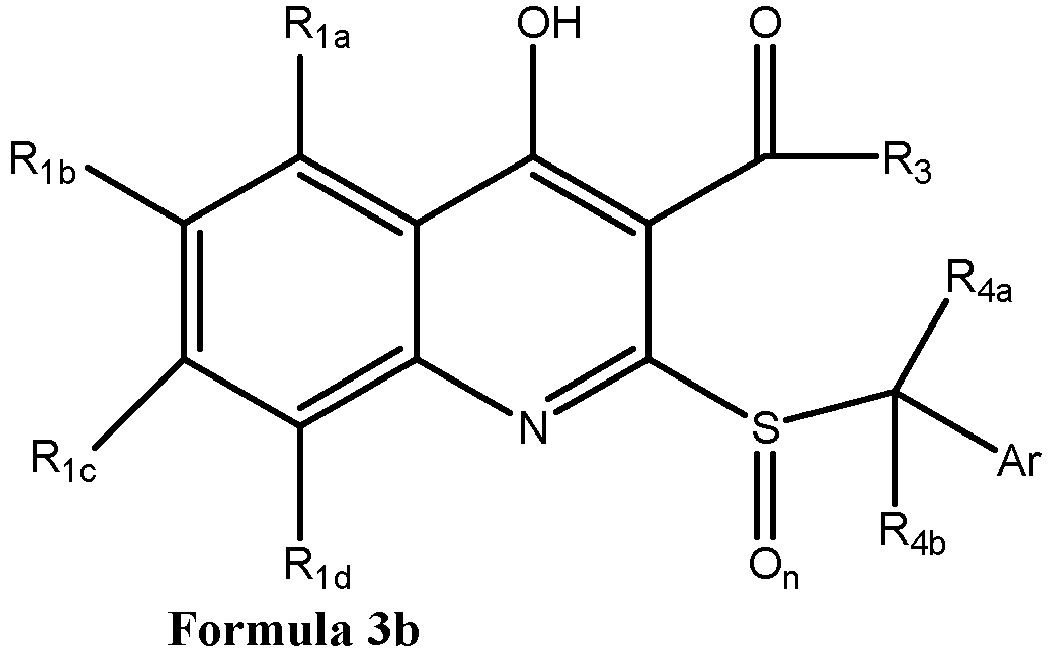
- R1a to R1d, R3, and n are as defined in Formula 1;
- R4a and R4b are each independently hydrogen, a halogen, C1-4 alkyl, C1-4 haloalkyl, or C1-4 alkyl in which one or more hydrogens are substituted with substituents other than halogen;
- Ar is phenyl, heteroaryl being 5-6-membered and having heteroatoms selected independently from N, S, or O, or biheteroaryl being 8-12-membered and having heteroatoms selected independently from N, S, or O,
- wherein Ar may be unsubstituted or may be optionally substituted with one or more of a halogen, C1-6 alkyl, C1-6 alkylthio, C1-6 haloalkyl, C1-6 haloalkylthio, C1-6 alkoxy, C1-6 haloalkoxy, C2-10 alkenyl, C2-10 haloalkenyl, C2-10 alkynyl, C2-10 haloalkynyl, a hydroxyl group, COOH, nitro, cyano, C1-6 alkoxycarbonyl, amino, C1-6 alkylamino, di(C1-6 alkyl)amino, amino(C1-6)alkyl, (C1-6)alkylamino(C1-6)alkyl, (C1-6)alkoxy(C1-6)alkylamino, (C1-6)alkylamino(C1-6) alkylamino, C1-6 alkanoyl, SF5, S(O)CF3, SCF3, NHC(=O)CH3, C(=O)NHCH3, NHSO2CH3, C3-7 cycloalkyl, an aryl, benzoyl, a heterocycle, a heteroaryl, phenyl, oxazole, pyrazole, pyrrole, imidazole, thiazole, thiophene, pyridine, pyrimidine, furan, indole, benzopyrazole, benzothiazole, benzooxazole, isoxazole, benzoimidazole, or benzothiophene,
- wherein the substituents of Ar may be unsubstituted or may be optionally substituted with one or more of CF3, a halogen, (C1-3)alkyl, (C1-3)haloalkyl, hydrogen, COOH, nitro, cyano, amino, di(Cl-3 alkyl)amino, NHC(=O)CH3, or C(=O)NHCH3.
- In accordance with an aspect of the present disclosure, the above and other objectives can be accomplished by the provision of a (pharmaceutical) composition including compounds according to Formula 1, 2 or 3 or pharmaceutically acceptable salts thereof, and a pharmaceutically acceptable carrier or additive.
- In accordance with various aspects, the (pharmaceutical) composition may further include one or more additional pharmaceutically active agents.
- Novel compounds of the present disclosure having structures of Formula 1, 2 or 3 or pharmaceutically acceptable salts thereof are useful for inhibiting c-Myc/Max/DNA complex formation, and thus may be useful for treatment or prevention of cancers. Cancers, neoplasia, or tumors that can be treated by inhibiting c-Myc/Max/DNA complex formation include, for example, lung cancer (including small cell lung cancer and non-small cell lung cancer), colorectal cancer, colon cancer, rectal cancer, breast cancer, prostate cancer, bladder cancer, myeloma, leukemia, myelogenous leukemia, lymphoma, cervical carcinoma, osteosarcoma, glioblastoma, melanoma, pancreatic cancer, gastric cancer, liver cancer, kidney cancer, gallbladder cancer, biliary tract cancer, and esophageal cancer.
- Novel compounds according to the present disclosure and a (pharmaceutical) composition including the compounds are described in detail as follows.
- The following description is merely illustrative and is not intended to limit the present disclosure to specific application or uses.
- As used herein, the following terms are defined as follows.
- In the present specification, the terms "substituent", "radical", "group", "moiety", and "fragment" may be used interchangeably.
- As used herein, the term "patient" refers to an animal (e.g., cow, horse, sheep, pig, chicken, turkey, quail, cat, dog, mouse, rat, rabbit or guinea pig), preferably a mammal such as a primate (e.g., monkey or human), and most preferably a human.
- As used herein, the term "alkyl", when the number of carbon atoms is not particularly limited, refers to a saturated straight or branched non-cyclic hydrocarbon having 1 to 10 carbon atoms. The term "lower alkyl" refers to a straight or branched alkyl having 1 to 4 carbon atoms. Representative saturated straight alkyls include - methyl, -ethyl, -n-propyl, -n-butyl, -n-pentyl, -n-hexyl, -n-heptyl, -n-octyl, -n-nonyl and -n-decyl, whereas saturated branched alkyls include-isopropyl, -sec-butyl, -isobutyl, - tert-butyl, isopentyl, 2-methylhexyl, 3-methylbutyl, 2-methylpentyl, 3-methylpentyl, 4-methylpentyl, 2-methylhexyl, 3-methylhexyl, 2-methylpentyl, 3-methylpentyl, 4-methylpentyl, 2-methylhexyl, 3-methylhexyl, 4-methylhexyl, 5-methylhexyl, 2,3-dimethylbutyl, 2,3-dimethylpentyl, 2,4-dimethylpentyl, 2,3-dimethylhexyl, 2,4-dimethylhexyl, 2,5-dimethylhexyl, 2,2-dimethylpentyl, 2,2-dimethylhexyl, 3,3-dimethylpentyl, 3,3-dimethylhexyl, 4,4-dimethylhexyl, 2-ethylpentyl, 3-ethylpentyl, 2-ethylhexyl, 3-ethylhexyl, 4-ethylhexyl, 2-methyl-2-ethylpentyl, 2-methyl-3-ethylpentyl, 2-methyl-4-ethylpentyl, 2-methyl-2-ethylhexyl, 2-methyl-3-ethylhexyl, 2-methyl-4-ethylhexyl, 2,2-diethylpentyl, 3,3-diethylhexyl, 2,2-diethylhexyl, and 3,3-diethylhexyl.
- In the present specification, "C1-6" means 1 to 6 carbon atoms. For example, C1-6 alkyl means an alkyl having 1 to 6 carbon atoms.
- As used herein, the term "alkenyl" refers to a saturated straight or branched non-cyclic hydrocarbon having 2 to 10 carbon atoms and including at least one carbon-carbon double bond. Representative straight and branched (C2-C10) alkenyls include - vinyl, -allyl, -1-butenyl, -2-butenyl, -isobutylenyl, -1-pentenyl, -2-pentenyl, -3-methyl-1-butenyl, -2-methyl-2-butenyl, -2,3-dimethyl-2-butenyl, -1-hexenyl, -2-hexenyl, -3-hexenyl, -1-heptenyl, -2-heptenyl, -3-heptenyl, -1-octenyl, -2-octenyl, -3octenyl, -1-nonenyl, -2-nonenyl, -3-nonenyl, -1-decenyl, -2-decenyl, and -3-decenyl. These alkenyl groups may be optionally substituted. The term "cyclic alkylidene" is a ring having 3 to 8 carbon atoms and including at least one carbon-carbon double bond, and the ring may have 1 to 3 heteroatoms.
- As used herein, the term "alkynyl" refers to a straight or branched non-cyclic hydrocarbon having 2 to 10 carbon atoms and including at least one carbon-carbon triple bond. Representative straight or branched (C2-C10) alkynyls include -acetylenyl, -propynyl, -1-butynyl, -2-butynyl, -1-pentynyl, -2-pentynyl, -3-methyl-1-butynyl, -4-pentynyl, -1-hexynyl, -2-hexynyl, -5-hexynyl, -1-heptynyl, -2-heptynyl, -6-heptynyl, -1-octynyl, -2-octynyl, -7-octynyl, -1-nonylyl, -2-nonylyl, -8-nonylyl, -1-decynyl, -2-decynyl, and -9-decynyl. These alkynyl groups may be optionally substituted.
- As used herein, the terms "halogen" and "halo" refer to fluorine, chlorine, bromine or iodine.
- As used herein, the term "haloalkyl", "haloalkoxy", "haloalkenyl" or "haloalkynyl" refers to an alkyl, alkoxy, alkenyl or alkynyl group wherein one or more hydrogen atoms are substituted with halogen atoms, respectively. For example, haloalkyls include -CF3, -CHF2, -CH2F, -CBr3, -CHBr2, -CH2Br, -CCl3, -CHCl2, - CH2CI, -CI3, -CHI2, -CH2I, -CH2-CF3, -CH2-CHF2, -CH2-CH2F, -CH2-CBr3, -CH2-CHBr2, -CH2-CH2Br, -CH2-CCl3, -CH2-CHCl2, -CH2-CH2CI, -CH2-CI3, -CH2-CHI2, - CH2-CH2I, and the like. Here, the alkyl and the halogen are as defined above.
- As used herein, the term "alkanoyl" or "acyl" refers to -C(O)alkyl groups including -C(O)CH3, -C(O)CH2CH3, -C(O)(CH2)2CH3, -C(O)(CH2)3CH3, - C(O)(CH2)4CH3, -C(O)(CH2)5CH3, and the like, wherein the alkyl is as defined above.
- As used herein, the term "alkanoyloxy" or "acyloxy" refers to -OC(O)alkyl groups including -OC(O)CH3, -OC(O)CH2CH3, -OC(O)(CH2)2CH3, -OC(O)(CH2)3CH3, -OC(O)(CH2)4CH3, -OC(O)(CH2)5CH3, and the like, wherein the alkyl is as defined above.
- As used herein, the term "alkoxy" refers to -O-(alkyl) including -OCH3, - OCH2CH3, -O(CH2)2CH3, -O(CH2)3CH3, -O(CH2)4CH3, -O(CH2)5CH3, and the like, wherein the alkyl is as defined above.
- As used herein, the term "lower alkoxy" refers to -O-(lower alkyl), wherein the lower alkyl is as defined above.
- As used herein, the term "aryl" refers to a carbocyclic aromatic group containing 5 to 10 cyclic atoms. Representative examples include phenyl, tolyl, xylyl, naphthyl, tetrahydronaphthyl, anthracenyl, fluorenyl, indenyl, azulenyl, and the like, without being limited thereto. The carbocyclic aromatic group may be optionally substituted.
- The term "aryloxy" is RO-, wherein R is aryl as defined above. The term "arylthio" is RS-, wherein R is the aryl as defined above.
- As used herein, the term "cycloalkyl" refers to a monocyclic or polycyclic saturated ring having carbon and hydrogen atoms and no carbon-carbon multiple bonds. For example, the cycloalkyl group includes (C3-C7)cycloalkyl (e.g., cyclopropyl, cyclobutyl, cyclopentyl, cyclohexyl and cycloheptyl), without being limited thereto. The cycloalkyl group may be optionally substituted. In one embodiment, the cycloalkyl group is a monocyclic or bicyclic ring.
- As used herein, the term "mono-alkylamino" refers to -NH(alkyl) including - NHCH3, -NHCH2CH3, -NH(CH2)2CH3, -NH(CH2)3CH3, -NH(CH2)4CH3, - NH(CH2)5CH3, and the like, wherein the alkyl is as defined above.
- As used herein, the term "di-alkylamino" refers to N(alkyl)(alkyl) including - N(CH3)2, -N(CH2CH3)2, -N((CH2)2CH3)2, -N(CH3)(CH2CH3), and the like, wherein each alkyl is alkyl as defined above.
- As used herein, the term "alkylamino" is a concept that includes mono-alkylamino and di-alkylamino as defined above.
- As used herein, the terms "carboxyl" and "carboxy" refer to -COOH.
- As used herein, the term "aminoalkyl" refers to -(alkyl)-NH2 including -CH2-NH2, -(CH2)2-NH2, -(CH2)3-NH2, -(CH2)4-NH2, -(CH2)5-NH2, and the like, wherein the alkyl is as defined above.
- As used herein, the term "mono-alkylaminoalkyl" refers to -(alkyl)-NH(alkyl) including -CH2-NH-CH3, -CH2-NHCH2CH3, -CH2-NH(CH2)2CH3, -CH2-NH(CH2)3CH3, -CH2-NH(CH2)4CH3, -CH2-NH(CH2)5CH3, -(CH2)2-NH-CH3, and the like, wherein each alkyl is alkyl as defined above.
- As used herein, "heteroaryl" is a 5- to 10- membered aromatic heterocyclic ring that has at least one heteroatom selected from the group consisting of nitrogen, oxygen, and sulfur and that includes a mono- or bicyclic ring system and at least one carbon atom. Representative heteroaryls include triazolyl, tetrazolyl, oxadiazolyl, pyridyl, furyl, benzofuranyl, thiophenyl, benzothiophenyl, quinolinyl, pyrrolyl, indolyl, oxazolyl, benzoxazolyl, imidazolyl, benzimidazolyl, thiazolyl, benzothiazolyl, isoxazolyl, pyrazolyl, isothiazolyl, pyridazinyl, pyrimidinyl, pyrazinyl, triazinyl, cinnolinyl, phthalazinyl, quinazolinyl, pyrimidyl, oxetanyl, azepinyl, piperazinyl, morpholinyl, dioxanyl, tietanyl and oxazolyl.
- As used herein, "heterocycle (heteroring)" refers to a saturated or unsaturated 5-to 7- membered monocyclic ring or a 7- to 10- membered bicyclic/heterocyclic ring containing 1 to 4 heteroatoms independently selected from nitrogen, oxygen and sulfur, wherein nitrogen and sulfur heteroatoms may be optionally oxidized, nitrogen heteroatoms may be optionally quaternized, and a bicyclic ring in which a part of the heterocycle is fused to a benzene ring is included. The heterocycle may be attached by heteroatoms or carbon atoms. The heterocycle includes the heteroaryl as defined above. Representative heterocycles include morpholinyl, pyrrolidinonyl, pyrrolidinyl, piperidinyl, hydantoinyl, valerolactamyl, oxiranyl, oxetanyl, tetrahydrofuranyl, tetrahydropyranyl, tetrahydropyridinyl, tetrahydropyrimidinyl, tetrahydrothiophenyl, tetrahydrothiopyranyl, tetrahydropyrimidinyl, tetrahydrothiophenyl, and tetrahydrothiopyranyl.
- "Heterocycle fused to phenyl" refers to a heterocycle attached to two adjacent carbon atoms of a phenyl ring, wherein the heterocycle is as defined above.
- As used herein, the term "hydroxyalkyl" refers to an alkyl in which one or more hydrogen atoms are substituted with hydroxy and includes -CH2OH, -CH2CH2OH, - (CH2)2CH2OH, -(CH2)3CH2OH, -(CH2)4CH2OH, -(CH2)5CH2OH, -CH(OH)-CH3, - CH2CH(OH)CH3, and the like, wherein the alkyl is as defined above.
- As used herein, the term "sulfonyl" refers to -SO3H.
- As used herein, the term "sulfonylalkyl" refers to -SO2-(alkyl) including -SO2-CH3, -SO2-CH2CH3, -SO2-(CH2)2CH3, -SO2-(CH2)3CH3, -SO2-(CH2)4CH3, and -SO2-(CH2)5CH3, wherein the alkyl is as defined above.
- As used herein, the term "sulfinylalkyl" refers to -SO-(alkyl) including -SOCH3, -SO-CH2CH3, -SO-(CH2)2CH3, -SO-(CH2)3CH3, -SO-(CH2)4CH3, -SO-(CH2)5CH3, and the like, wherein the alkyl is as defined above.
- "Thioalkyl" includes -S-CH3, -S-CH2CH3, -S-(CH2)2CH3, -S-(CH2)3CH3, -S-(CH2)4CH3, -S-(CH2)5CH3, and the like, wherein the alkyl is as defined above.
- As used herein, the term "substituted" indicates that the hydrogen atom of the moiety (e.g., alkyl, aryl, heteroaryl, heterocycle or cycloalkyl) to be replaced is replaced with a substituent. In one embodiment, each carbon atom of the substituted group is not substituted with two or more substituents. In another embodiment, each carbon atom of the substituted group is not substituted with one or more substituents. In the case of a keto substituent, two hydrogen atoms are substituted with oxygen attached to carbon by a double bond.
- Unless otherwise specified with respect to a substituent, a halogen, hydroxyl, (lower) alkyl, haloalkyl, mono- or di-alkylamino, aryl, heterocycle, -NO2, -NRaRb, - NRaC(=O)Rb, -NRaC(=O)NRaRb, -NRaC(=O)ORb, -NRaSO2Rb, -ORa, -CN, -C(=O)Ra, - C(=O)ORa, -C(=O)NRaRb, -OC(=O)Ra, -OC(=O)ORa, -OC(=O)NRaRb, -NRaSO2Rb, - PO3Ra, -PO(ORa)(ORb), -SO2Ra, -S(O)Ra, -SO(NRa)Rb (e.g., sulfoximine), -S(NRa)Rb (e.g., sulfilimine) and -SRa may be used as substituents in the present disclosure, wherein Ra and Rb are the same or different and are each independently hydrogen, a halogen, amino, an alkyl, an alkoxyalkyl, a haloalkyl, aryl or a heterocycle, or may be in the form of a heterocycle containing attached nitrogen atoms. Here, Ra and Rb may be plural depending on the bonded atom.
- As used herein, "basic structure of quinoline" refers to the following structure.
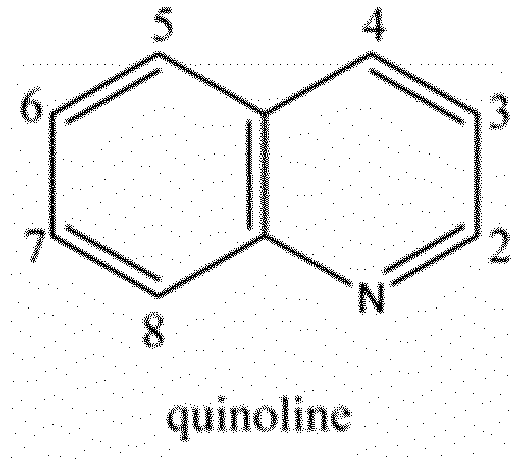
- According to the present disclosure, "pharmaceutically acceptable salts" include salts of active compounds prepared from relatively non-toxic acids and bases depending on particular substituents found in the compounds described herein. When the compounds of the present disclosure include relatively acidic functionality, base addition salts may be obtained by bringing the neutral forms of the compounds into contact with a sufficient amount of a desired base in a pure or suitable inert solvent. For example, pharmaceutically acceptable base addition salts include sodium, potassium, calcium, ammonium, organic amino or magnesium salts or similar salts. When the compounds of the present disclosure include relatively basic functionality, acid addition salts may be obtained by bringing the neutral forms of the compounds into contact with a sufficient amount of a desired acid in a pure or suitable inert solvent. For example, pharmaceutically acceptable acid addition salts include salts derived from relatively non-toxic organic acids including acetic acid, propionic acid, isobutylic acid, oxalic acid, maleic acid, malonic acid, benzoic acid, succinic acid, suberic acid, fumaric acid, mandelic acid, phthalic acid, benzenesulfonic acid, p-tolylsulfonic acid, citric acid, tartaric acid, methanesulfonic acid, and analogs thereof. In addition, the pharmaceutically acceptable acid addition salts include hydrogen chloride, hydrogen bromide, nitric acid, carbonic acid, monohydrogen carbonic acid, phosphoric acid, monohydrogen phosphoric acid, dihydrogen phosphoric acid, sulfuric acid, monohydrogensulfuric acid, hydrogen iodide or phosphorous acid and analogs thereof. In addition, the pharmaceutically acceptable acid addition salts include salts of amino acids such as arginate and analogs thereof and analogs of organic acids such as glucuronic or galacturonic acids and analogs thereof (e.g., Berge et al. (1977) J. Pharm. Sci. 66: 1-19). Certain compounds of the present disclosure have both basic and acidic functionalities to convert the compounds into base or acid addition salts. Other examples of salts are disclosed in documents (e.g., Remington's Pharmaceutical Sciences, 18th eds., Mack Publishing, Easton PA (1990) or Remington : The Science and Practice of Pharmacy, 19th eds., Mack Publishing, Easton PA (1995)) known in the art to which the present disclosure pertains.
- As used herein, "effective dose" refers to an amount of the compounds of the present disclosure sufficient to destroy, modify, control or eliminate primary, localized or metastatic cancer cells or cancer tissues; to slow or minimize the spread of cancer; or to provide therapeutic benefits in treatment or management of cancer, neoplastic diseases, or tumors. In addition, "effective dose" refers to an amount of the compounds of the present disclosure sufficient to cause the death of neoplastic cells including cancer cells. In addition, "effective dose" refers to an amount of the compounds sufficient to inhibit or reduce c-Myc/Max/DNA complex formation either in vitro or in vivo.
- As used herein, "inhibition of c-Myc/Max/DNA complex formation" indicates that, when compared to cells that are not exposed to the compounds of the present disclosure, the amount of c-Myc/Max/DNA complexes is decreased or the degree of binding of the c-Myc/Max heterodimer to DNA is suppressed or delayed in cells exposed to the compounds of the present disclosure.
- As used herein, "preventive effective dose" refers to an amount of the compounds of the present disclosure sufficient to inhibit cancer development in patients susceptible to the recurrence, or spread of cancer, susceptible to cancer or patients previously exposed to a carcinogen. At this time, the type of patient is not limited thereto.
- As used herein, the term "neoplastic" refers to an abnormal growth of cells or tissues (e.g., a boil) that may be benign or cancerous.
- As used herein, "prevention" refers to preventing the recurrence, spread or onset of cancer in a patient.
- As used herein, "treatment" includes eradication, removal, modification, or control of primary, localized or metastatic cancer tissues; and refers to minimizing or delaying the spread of cancer.
- As used herein, the term "the compounds of the present disclosure" refers to compounds corresponding to each of Formula 1 (1a and 1b), Formula 2 (2a and 2b) and Formula 3 (3a and 3b), and also includes clathrates, hydrates, solvates, or polymorphs thereof. In addition, the term "the compounds of the present disclosure" also includes pharmaceutically acceptable salts of the compounds of the present disclosure, when pharmaceutically acceptable salts thereof are not mentioned. According to one embodiment, the compounds of the present disclosure may be present as stereomerically pure compounds (e.g., compounds that are substantially free of other stereoisomers (e.g., 85% ee or more, 90% ee or more, 95% ee or more, 97% ee or more, or 99% ee or more)). That is, in addition to the compounds corresponding to Formula 1, 2 or 3, when the salts of the compounds are tautomeric isomers and/or stereoisomers (e.g., geometrical isomers and conformational isomers), isolated isomers thereof and respective mixtures thereof are within the scope of the compounds of the present disclosure. When the compounds of the present disclosure or salts thereof have asymmetric carbons in the structure thereof, optically active compounds and racemic mixtures thereof are also within the scope of the compounds of the present disclosure. For example, as shown in the following scheme, when the compounds of the present disclosure have a sulfoxide(SOR) structure, the compounds may have chirality. The R and S forms of these isomers are included in the category of the compounds of the present disclosure, and the mixtures of the R and S forms are also included in the category of the compounds of the present disclosure.


- In addition, as shown in Scheme 1, the compounds of the present disclosure may exist in either keto or enol form, both of which are included in the category of the compounds of the present disclosure.
- When used herein, the term "polymorph" refers to solid crystalline forms of the compounds of the present disclosure or complexes thereof. Different polymorphs of the same compound exhibit different physical, chemical and/or spectral characteristics. Differences in physical characteristics include stability (e.g., heat or light stability), compressibility and density (important for formulation and product production), and dissolution rate (which may affect bioavailability), without being limited thereto. Differences in stability cause changes in chemical reactivity (e.g., differential oxidation, as evidenced by more rapid color change when composed of one polymorph than when composed of another polymorph) or mechanical characteristics (e.g., as dynamically preferred polymorphs, stored tablet fragments are converted into more thermodynamically stable polymorphs), or both (tablets of one polymorph are more sensitive to degradation at high humidity). Other physical properties of polymorphs may affect processing thereof. For example, one polymorph may be more likely to form solvent compounds than another polymorph, e.g., due to a shape or particle size distribution thereof, or may be more difficult to filter or wash than another polymorph
- As used herein, the term "solvent compounds" refers to the compounds of the present disclosure or pharmaceutically acceptable salts thereof, including a stoichiometric or non-stoichiometric amount of a solvent bound by force between non-covalent molecules. Preferred solvents are volatile and non-toxic, and may be administered to humans in very small doses.
- As used herein, the term "hydrates" refers to the compounds of the present disclosure or pharmaceutically acceptable salts thereof, including a stoichiometric or non-stoichiometric amount of water bound by force between non-covalent molecules.
- As used herein, the term "clathrates" refers to the compounds of the present disclosure or salts thereof in the form of a crystal lattice including a space (e.g., channel) in which guest molecules (e.g., solvent or water) are confined.
- When any compounds (prodrugs) isolated from the body are capable of producing the compounds of the present disclosure or salts thereof, such compounds are also within the scope of the present disclosure. As used herein, and unless otherwise indicated, the term "prodrugs" refer to the compounds of the present disclosure that are capable of undergoing hydrolysis, oxidation, or other reactions under biological conditions (in vitro or in vivo) to provide active compounds, particularly the compounds of the present disclosure. For example, prodrugs include biohydrolyzable compounds that are biodegraded to yield the compounds of the present disclosure, including biohydrolyzable portions such as biohydrolyzable amides, biohydrolyzable esters, biohydrolyzable carbamates, biohydrolyzable carbonates, biohydrolyzable ureides, and biohydrolyzable phosphate analogs, without being limited thereto. Preferably, prodrugs of compounds having a carboxyl group are lower alkyl esters of carboxylic acids. Carboxylic esters are typically formed by esterifying a portion of carboxylic acids present in the molecule. Prodrugs may be readily prepared using well known methods as described in the following documents: Burger's Medicinal Chemistry and Drug Discovery 6th ed. (Donald J. Abrahamed., 2001, Wiley) and Design and Application of Prodrugs (H. Bundgaard ed., 1985, Harwood Academic Publishers Gmfh).
- As used herein, the term "purified" indicates that when a substance is separated, the purity of the substance is at least 90%. The purity of the substance may be at least 95% in one embodiment, 99% in another embodiment, and 99.9% in still another embodiment.
- The term "hydrido" refers to a single -H atom (H), and may be interchanged with the symbol "H" or the term "hydrogen".
- When substituents are described as being "optionally substituted", the substituents may be unsubstituted (1) or may be substituted with at least one of substituents as defined (2). When a substitutable position is not substituted, a default substituent is a hydrido radical.
- As used herein, the singular forms "a" and "an" may include the plural forms unless context clearly dictates otherwise.
- The term "pharmaceutically acceptable" means suitable for use as a pharmaceutical preparation and is generally considered to be safe for such use. In addition, pharmaceutically acceptable substances refer to substances which have been formally approved by the governing body of the State for such use or which are on the list of Korean Pharmacopoeia or US Pharmacopoeia.
- The present disclosure provides compounds having the structures corresponding to Formula 1 (1a or 1b) below or pharmaceutically acceptable salts thereof:
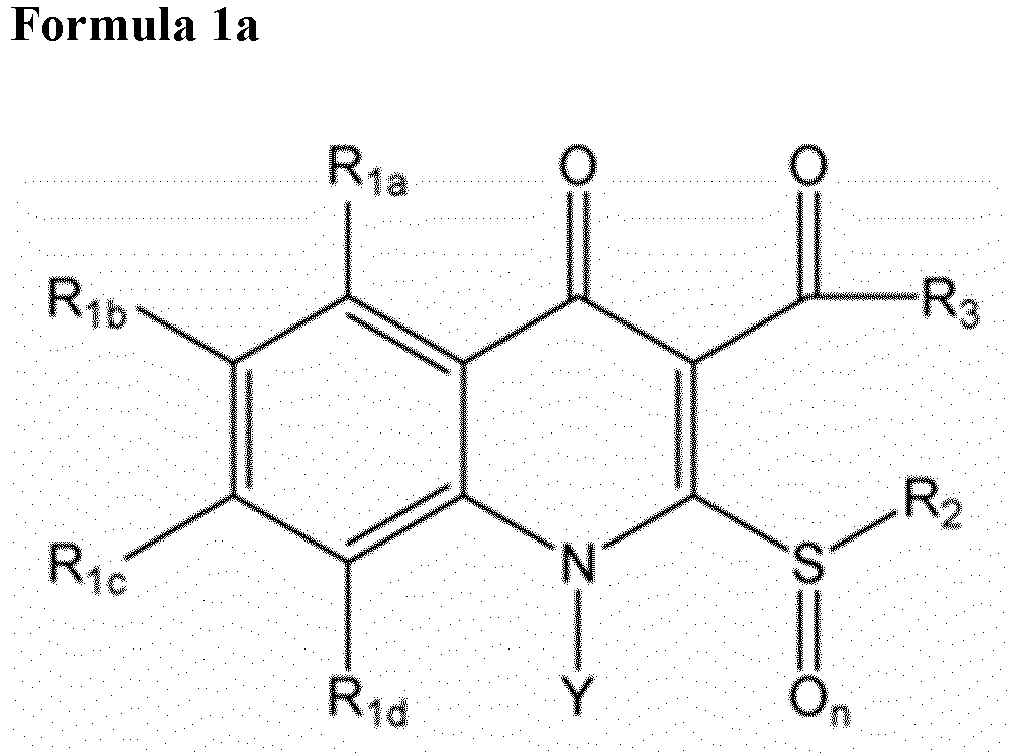


- R1a to R1d are each independently hydrogen, a halogen, C1-6 alkyl, C1-6 haloalkyl, C1-6 hydroxyalkyl, C1-6 alkoxy, C1-6 haloalkoxy, C2-10 alkenyl, C2-10 haloalkenyl, C2-10 alkynyl, C2-10 haloalkynyl, a hydroxyl group, nitro, cyano, C1-6 alkoxycarbonyl, amino, C1-6 alkylamino, di(C1-6 alkyl)amino, amino(C1-6)alkyl, (C1-6)alkylamino(C1-6)alkyl, C1-6 alkanoyl, C3-7 cycloalkyl, an aryl, a heterocycle, or a heteroaryl, wherein R1a to R1d may be each independently unsubstituted or optionally substituted;
- R2 is hydrogen, C1-6 alkyl, (C1-6)alkoxy(C1-6)alkyl, C1-6 haloalkyl, C1-6 hydroxyalkyl, C1-6 alkoxy, C1-6 haloalkoxy, C2-10 alkenyl, C2-10 alkenyl carboxy, C2-10 haloalkenyl, C2-10 alkynyl, C2-10 haloalkynyl, a hydroxyl group, nitro, cyano, C1-6 alkoxycarbonyl, amino, C1-6 alkylamino, C1-6 cyanoalkyl, di(C1-6 alkyl)amino, amino(C1-6)alkyl, (C1-6)alkylamino(C1-6)alkyl, C1-6 alkanoyl, C3-7 cycloalkyl, (C1-6)alkyl(C3-7)cycloalkyl, an aryl, (C1-6)alkylaryl, (C1-6)haloalkylaryl, (C2-6)alkenylamide(C1-6)alkylalkoxy, a heterocycle, (C1-6)alkylheterocycle, a heteroaryl, or (C1-6)alkylheteroaryl, wherein R2 may be unsubstituted or optionally substituted;
- R3 is C1-4 alkyl, isoalkyl, cycloalkyl, phenyl, or C1-4 haloalkyl;
- n is an integer from 0 to 2; and
- Y is hydrogen, an alkyl, a haloalkyl, -C(O)alkyl, -C(O)aryl, a sulfonylalkyl, a sulfonylaryl, an aryl, or an alkylaryl, wherein an alkyl has 1 to 10 carbon atoms, preferably 1 to 4 carbon atoms, and an aryl may be unsubstituted or optionally substituted.
- In another embodiment, the present disclosure provides compounds having the structures of Formula 2 (2a or 2b) or pharmaceutically acceptable salts thereof:


- R1a to R1d, R3, n and Y are as defined in Formula 1;
- m is an integer from 0 to 4; and
- R6 is phenyl, oxazole, pyrazole, pyrrole, imidazole, thiazole, thiophene, pyridine, pyrimidine, furan, indole, benzopyrazole, benzothiazole, benzooxazole, isoxazole, benzoimidazole, 1,2,5-oxadiazole, pyrrolo[2,3-b]pyridine, or benzothiophene, which may be unsubstituted or may be optionally substituted with one or more of hydrogen, C1-6 alkyl, C1-6 haloalkyl, C1-6 alkoxy, a halogen or may be optionally substituted with one or more of hydrogen, phenyl, oxazole, pyrazole, pyrrole, imidazole, thiazole, thiophene, pyridine, pyrimidine, furan, indole, benzopyrazole, benzothiazole, benzooxazole, isoxazole, benzoimidazole, or benzothiophene or may be substituted with unsubstituted phenyl.
- In another embodiment, the present disclosure provides compounds having the structures corresponding to Formula 3a or 3b or pharmaceutically acceptable salts thereof:


- R1a to R1d, R3, and n are as defined in Formula 1;
- R4a and R4b are each independently hydrogen, a halogen, C1-4 alkyl, C1-4 haloalkyl, or C1-4 alkyl in which one or more hydrogens are substituted with substituents other than halogen;
- Ar is phenyl, heteroaryl being 5-6-membered and having heteroatoms selected independently from N, S, or O, or biheteroaryl being 8-12-membered and having heteroatoms selected independently from N, S, or O,
- wherein Ar may be unsubstituted or may be optionally substituted with one or more of a halogen, C1-6 alkyl, C1-6 alkylthio, C1-6 haloalkyl, C1-6 haloalkylthio, C1-6 alkoxy, C1-6 haloalkoxy, C2-10 alkenyl, C2-10 haloalkenyl, C2-10 alkynyl, C2-10 haloalkynyl, a hydroxyl group, COOH, nitro, cyano, C1-6 alkoxycarbonyl, amino, C1-6 alkylamino, di(C1-6 alkyl)amino, amino(C1-6)alkyl, (C1-6)alkylamino(C1-6)alkyl, (C1-6)alkoxy(C1-6)alkylamino, (C1-6)alkylamino(C1-6) alkylamino, C1-6 alkanoyl, SF5, S(O)CF3, SCF3, NHC(=O)CH3, C(=O)NHCH3, NHSO2CH3, C3-7 cycloalkyl, an aryl, benzoyl, a heterocycle, a heteroaryl, phenyl, oxazole, pyrazole, pyrrole, imidazole, thiazole, thiophene, pyridine, pyrimidine, furan, indole, benzopyrazole, benzothiazole, benzooxazole, isoxazole, benzoimidazole, or benzothiophene,
- wherein the substituents of Ar may be unsubstituted or may be optionally substituted with one or more of CF3, a halogen, (C1-3)alkyl, (C1-3)haloalkyl, hydrogen, COOH, nitro, cyano, amino, di(Cl-3 alkyl)amino, NHC(=O)CH3, or C(=O)NHCH3.
- To obtain novel compounds having high inhibitory activity on c-Myc/Max/DNA complex formation, having high selectivity to c-Myc/Max/DNA complexes, and consequently having an inhibitory effect on cancer cells while having minimal side effects, the present inventors synthesized various compounds and performed various experiments to evaluate the compounds. As a result, the present inventors completed the present disclosure by confirming that the novel compounds of the present disclosure were suitable for the above-described various objects.
- For example, a compound having a substituent linked to -S- at the 2-position of the basic structure of quinoline is superior in safety to a compound having a substituent linked to -NH-. Specifically, in the case of the compound having a substituent linked to -NH-, the compound is somewhat superior but has very severe cardiotoxicity. For example, in the case of a mouse xenograft model experiment using compound KSI-3716 of the following Formula 4, all of the experimental group (30 mpk, intraperitoneal administration (IP)) died. On the other hand, when the compounds of the present disclosure (e.g., Compound 4) were subjected to IV and IP single toxicity tests using 40 mpk, there were no deaths, no significant weight changes, and no abnormal symptoms in terms of general symptoms such as feed intake and drinking water intake.


[Table 1] Single toxicity evaluation results of Compound 4 according to the present disclosure Species Sex Dose Percentage Mouse Male IV 40 mg/kg 0 (0/2) Mouse Male IP 40 mg/kg 0 (0/2) Mouse Female IV 40 mg/kg 0 (0/2) Mouse Female IP 40 mg/kg 0 (0/2) - No deaths were observed in single-dose administration of 40mpk.
- General symptoms: Feeding and drinking were good, and no other abnormal symptoms were observed.
- Weight changes: In general, weight gain was observed, but weight gain was slightly reduced in certain individuals.
- In the case of KSI-3716, all animals died at 30mpk (IP).
- In addition, in cardiotoxicity experiments using zebrafish, all zebrafish (n=10) died when 5 µM of a compound (e.g., KSI-3716 of Formula 4) having a substituent linked to -NH- was used. On the other hand, when the compounds of the present disclosure were used, lethality was very low and the compounds did not cause changes in heart rate. The experimental results of representative compounds are shown in the following Table 2.
[Table 2] Changes in heart rate depending on treatment of compounds in zebrafish (mean, n=10) Compounds Changes in heart rate (%) Lethality Note 10 µM Astemizole 46.2 0/10 5 µM of KSI-3716 - 10/10 Not measurable by death of all zebrafish 5 µM of Compound 4 88.5 1/10 5 µM of Compound 33 97.3 0/10 No significant heart rate inhibition - In another example, R2 linked to S at the 2-position of the basic structure of quinoline is preferably a phenyl structure in view of the various objects of the present disclosure. In addition, from the viewpoint of activity, it is preferable that the phenyl group is linked via -CH2-, -CH2CH2-, -CH2CH2CH2-, or -CH2CH2CH2CH2- as a bridge rather than directly linked to S. More preferably, -CH2- or -CH2CH2- is used as a bridge.
- For example, in view of activity, one or more of R1a to R1d are preferably substituted with substituents, more preferably halogens. In particular, when R1a and R1d were simultaneously substituted with halogens, even better activity was observed.
- In the case of R3, C1-4 alkyl, isoalkyl, cycloalkyl, phenyl, or C1-4 haloalkyl exhibited excellent activity. In particular, groups such as methyl or halomethyl exhibited better activity. In addition, when R3 was -CF3, metabolic stability was increased. On the other hand, when R3 was heteroatoms of O or N, the activity desired in the present disclosure was weak.
- In view of the various objects of the present disclosure, Y is preferably hydrogen.
- R4 (R4a and/or R4b) is an important site for metabolic stability, and is preferably a lower alkyl or halogen for various objects of the present disclosure.
- Non-limiting examples of the compounds according to the present disclosure include the compounds of Table 3 below and pharmaceutically acceptable salts thereof.
[Table 3] Compoun d Number Structure IUPAC Name 1 
3-acetyl-8-bromo-5-chloro-2-(methylsulfinyl)quinolin-4(1H)-one 2 
3-acetyl-8-bromo-5-chloro-2-(methylthio)quinolin-4(1H)-one 3 
3-acetyl-2-(benzylthio)-8-bromo-5-chloroquinolin-4(1H)-one 4 
3-acetyl-2-(benzylsulfinyl)-8-bromo-5-chloroquinolin-4(1H)-one 5 
3-acetyl-8-bromo-5-chloro-1-methyl-2-(methylthio)quinolin-4(1H)-one 6 
3-acetyl-5,8-dichloro-2-(methylsulfinyl)quinolin-4(1H)-one 7 
3-acetyl-6-fluoro-1-methyl-2-(methylthio)quinolin-4(1H)-one 8 
1-(6-fluoro-4-hydroxy-2-(methylthio)quinolin-3-yl)ethan-1-one 9 
3-acetyl-8-bromo-1-(4-bromobenzoyl)-5-chloro-2-(methylsulfinyl)quinolin-4(1H)-one 10 
3-acetyl-8-bromo-5-chloro-2-((4-chlorobenzyl)thio)quinolin-4(1H)-one 11 
3-acetyl-8-bromo-5-chloro-2-((4-chlorobenzyl)sulfinyl)quinolin-4(1H)-one 12 
3-acetyl-8-bromo-5-chloro-2-(phenylthio)quinolin-4(1H)-one 13 
3-acetyl-8-bromo-5-chloro-2-(phenylsulfinyl)quinolin-4(1H)-one 14 
3-acetyl-8-bromo-5-chloro-2-((2-methoxyphenyl)thio)quinolin-4(1H)-one 15 
3-acetyl-8-bromo-5-chloro-2-((2-methoxyphenyl)sulfinyl)quinolin-4(1H)-one 16 
3-acetyl-8-bromo-2-((4-bromophenyl)thio)-5-chloroquinolin-4(1H)-one 17 
3-acetyl-8-bromo-2-((4-bromophenyl)sulfinyl)-5-chloroquinolin-4(1H)-one 18 
1,1'-(8-bromo-5-chloro-2-(methylthio)-4-oxoquinoline-1,3(4H)-diyl)bis(ethan-1-one) 19 
1,1'-(8-bromo-5-chloro-2-(methylsulfinyl)-4-oxoquinoline-1,3(4H)-diyl)bis(ethan-1-one) 20 
3-acetyl-2-(benzylsulfinyl)-8-bromo-1-(4-bromobenzoyl)-5-chloroquinolin-4(1H)-one 21 
3-acetyl-8-bromo-1-(4-bromobenzoyl)-5-chloro-2-(methylsulfonyl)quinolin-4(1H)-one 22 
3-acetyl-8-bromo-5-chloro-1-(3-chloro-4-fluorobenzyl)-2-(methylsulfinyl)quinolin-4(1H)-one 23 
3-acetyl-2-(benzylthio)-8-bromo-1-(4-bromobenzoyl)-5-chloroquinolin-4(1H)-one 24 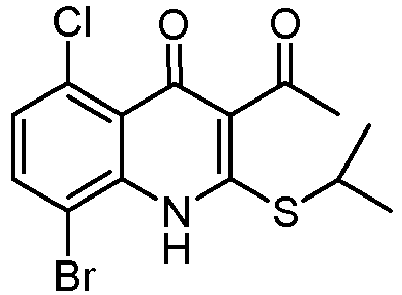
3-acetyl-8-bromo-5-chloro-2-(isopropylthio)quinolin-4(1H)-one 25 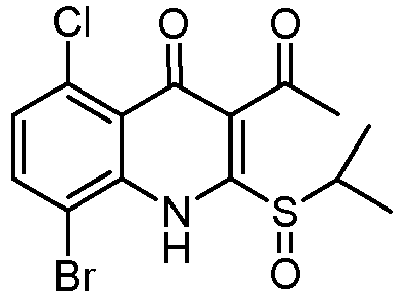
3-acetyl-8-bromo-5-chloro-2-(isopropylsulfinyl)quinolin-4(1H)-one 26 
3-acetyl-8-bromo-5-chloro-2-((1-phenylethyl)sulfinyl)quinolin-4(1H)-one 27 
3-(((3-acetyl-8-bromo-5-chloro-4-oxo-1,4-dihydroquinolin-2-yl)thio)methyl)benzonitrile 28 
3-(((3-acetyl-8-bromo-5-chloro-4-oxo-1,4-dihydroquinolin-2-yl)sulfinyl)methyl)benzonitrile 29 
3-acetyl-8-bromo-5-chloro-2-((2,4-difluorobenzyl)sulfinyl)quinolin-4(1H)-one 30 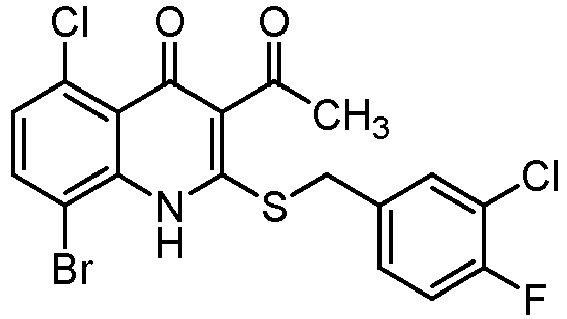
3-acetyl-8-bromo-5-chloro-2-((3-chloro-4-fluorobenzyl)thio)quinolin-4(1H)-one 31 
3-acetyl-8-bromo-5-chloro-2-((3-chloro-4-fluorobenzyl)sulfinyl)quinolin-4(1H)-one 32 
3-acetyl-8-bromo-5-chloro-2-((4-nitrobenzyl)thio)quinolin-4(1H)-one 33 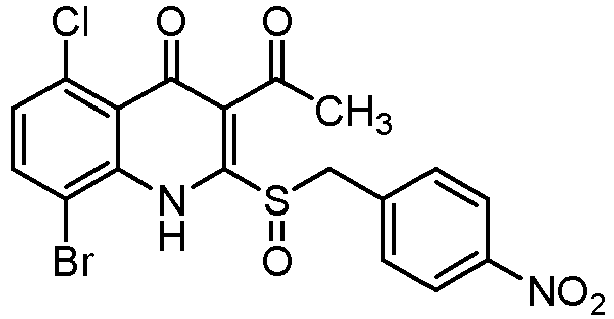
3-acetyl-8-bromo-5-chloro-2-((4-nitrobenzyl)sulfinyl)quinolin-4(1H)-one 34 
3-acetyl-2-(benzylsulfonyl)-8-bromo-5-chloroquinolin-4(1H)-one 35 
3-acetyl-8-bromo-5-chloro-1-(methylsulfonyl)-2-(methylthio)quinolin-4(1H)-one 36 
3-acetyl-8-bromo-5-chloro-2-(methylsulfinyl)-1-((trifluoromethyl)sulfonyl)quinolin-4(1H)-one 37 
3-acetyl-8-bromo-5-chloro-1-((4-chlorophenyl)sulfonyl)-2-(methylthio)quinolin-4(1H)-one 38 
3-acetyl-8-bromo-5-chloro-2-(methylthio)-1-((4-nitrophenyl)sulfonyl)quinolin-4(1H)-one 39 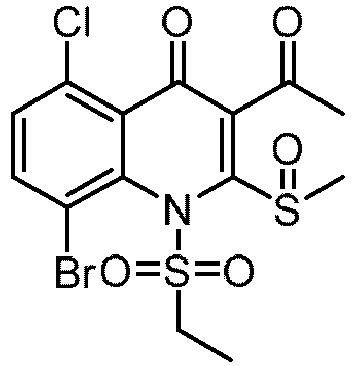
3-acetyl-8-bromo-5-chloro-1-(ethylsulfonyl)-2-(methylsulfinyl)qunolin-4(1H)-one 40 
3-acetyl-8-bromo-1-((4-(tert-butyl)phenyl)sulfonyl)-5-chloro-2-(methylthio)quinolin-4(1H)-one 41 
3-acetyl-8-bromo-1-((4-(tert-butyl)phenyl)sulfonyl)-5-chloro-2-(methylsulfonyl)quinolin-4(1H)-one 42 
3-acetyl-8-bromo-1-((4-(tert-butyl)phenyl)sulfonyl)-5-chloro-2-(methylsulfinyl)quinolin-4(1H)-one 43 
3-acetyl-8-bromo-5-chloro-2-((2,5-dichlorobenzyl)thio)quinolin-4( 1H)-one 44 
3-acetyl-8-bromo-5-chloro-2-((2,5-dichlorobenzyl)sulfinyl)quinolin-4(1H)-one 45 
3-acetyl-8-bromo-5-chloro-2-((3,5-difluorobenzyl)thio)quinolin-4( 1H)-one 46 
3-acetyl-8-bromo-5-chloro-2-((3,5-difluorobenzyl)sulfinyl)quinolin-4(1H)-one 47 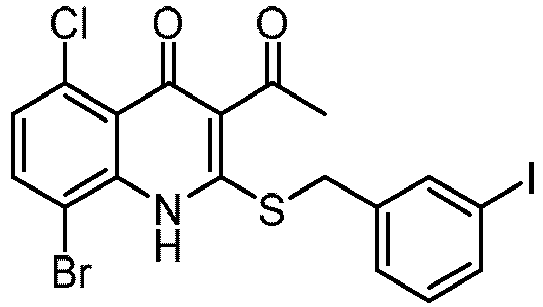
3-acetyl-8-bromo-5-chloro-2-((3-iodobenzyl)thio)quinolin-4(1H)-one 48 
3-acetyl-8-bromo-5-chloro-2-((3-iodobenzyl)sulfinyl)quinolin-4(1H)-one 49 
3-acetyl-8-bromo-5-chloro-2-((3-fluorobenzyl)thio)quinolin-4(1H)-one 50 
3-acetyl-8-bromo-5-chloro-2-((3-fluorobenzyl)sulfinyl)quinolin-4(1H)-one 51 
3-acetyl-8-bromo-5-chloro-2-(((5-methylisoxazol-3-yl)methyl)sulfinyl)quinolin-4(1H)-one 52 
1-(2-(benzylthio)-8-bromo-5-chloro-4-hydroxyquinolin-3-yl)ethan-1-one 53 
1-(2-(benzylsulfinyl)-8-bromo-5-chloro-4-hydroxyquinolin-3-yl)ethan-1-one 54 
1-(2-(benzylsulfonyl)-8-bromo-5-chloro-4-hydroxyquinolin-3-yl)ethan-1-one 55 
3-acetyl-8-bromo-5-chloro-2-((3-methoxybenzyl)sulfinyl)quinolin-4(1H)-one 56 
3-acetyl-8-bromo-5-chloro-2-((4-((trifluoromethyl)thio)benzyl)sulfinyl)quinolin-4(1H)-one 57 
3-acetyl-5,8-dichloro-2-((4-nitrobenzyl)sulfinyl)quinolin-4(1H)-one 58 
2-(((3-acetyl-8-bromo-5-chloro-4-oxo-1,4-dihydroquinolin-2-yl)sulfinyl)methyl)benzonitrile 59 
3-acetyl-8-bromo-5-chloro-2-((3,5-dimethoxybenzyl)sulfinyl)quinolin-4(1H)-one 60 
3-acetyl-8-bromo-2-((4-(tert-butyl)benzyl)sulfinyl)-5-chloroquinolin-4(1H)-one 61 
3-acetyl-8-bromo-5-chloro-2-((methoxymethyl)thio)quinolin-4(1H)-one 62 
3-acetyl-8-bromo-5-chloro-2-mercaptoquinolin-4(1H)-one 63 
3-acetyl-2-((4-benzoylbenzyl)sulfinyl)-8-bromo-5-chloroquinolin-4(1H)-one 64 
3-acetyl-8-bromo-5-chloro-2-((4-((trifluoromethyl)sulfinyl)benzyl)sulfinyl)quinol in-4(1H)-one 65 
2-((3-acetyl-8-bromo-5-chloro-4-oxo-1,4-dihydroquinolin-2-yl)sulfinyl)acetonitrile 66 
2-((3-acetyl-8-bromo-5-chloro-4-oxo-1,4-dihydroquinolin-2-yl)thio)acetonitrile 67 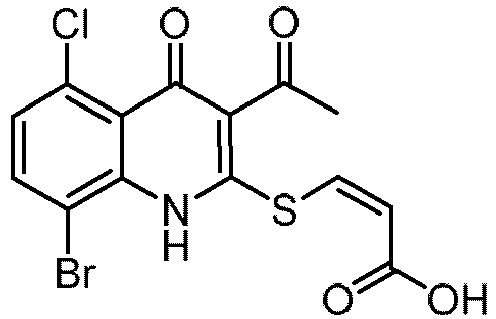
(Z)-3-((3-acetyl-8-bromo-5-chloro-4-oxo-1,4-dihydroquinolin-2-yl)thio)acrylic acid 68 
3-acetyl-8-bromo-5-chloro-2-((4-(pentafluoro-16-sulfanyl)benzyl)sulfinyl)quinolin-4(1H)-one 69 
3-acetyl-8-bromo-5-chloro-2-((2-fluoro-4-(pentafluoro-16-sulfanyl)benzyl)sulfinyl)quinolin-4(1H)-one 70 
3-acetyl-8-bromo-5-chloro-2-((4-(trifluoromethyl)benzyl)sulfinyl)quinolin-4(1H)-one 71 
3-acetyl-8-bromo-5-chloro-2-((4-(trifluoromethoxy)benzyl)sulfinyl)quinolin-4(1H)-one 72 
3-acetyl-8-bromo-5-chloro-2-(((5-(trifluoromethyl)furan-2-yl)methyl)sulfinyl)quinolin-4(1H)-one 73 
4-(((3-acetyl-8-bromo-5-chloro-4-oxo-1,4-dihydroquinolin-2-yl)sulfinyl)methyl)benzonitrile 74 
3-acetyl-8-bromo-5-chloro-2-((2-chloro-6-fluorobenzyl)sulfinyl)quinolin-4(1H)-one 75 
3-acetyl-8-bromo-5-chloro-2-((2-methoxy-4-(pentafluoro-λ6-sulfanyl)benzyl)sulfinyl)quinolin-4(1H)-one 76 
3-acetyl-8-bromo-5-chloro-2-((3-fluoro-5-(pentafluoro-λ6-sulfanyl)benzyl)sulfinyl)quinolin-4(1H)-one 77 
3-acetyl-8-bromo-5-chloro-2-((3-(pentafluoro-λ6-sulfanyl)benzyl)sulfinyl)quinolin-4(1H)-one 78 
3-acetyl-8-bromo-5-chloro-2-(((perfluorophenyl)methyl)sulfinyl)quinolin-4(1H)-one 79 
3-acetyl-5,8-dichloro-2-((4-((trifluoromethyl)thio)benzyl)sulfinyl)quinolin-4(1H)-one 80 
3-acetyl-5,8-difluoro-2-((4-(pentafluoro-λ6-sulfanyl)benzyl)sulfinyl)quinolin-4(1H)-one 81 
3-acetyl-5,8-difluoro-2-(((5-(trifluoromethyl)furan-2-yl)methyl)sulfinyl)quinolin-4(1H)-one 82 
3-acetyl-5,8-difluoro-2-(((5-methylisoxazol-3-yl)methyl)sulfinyl)quinolin-4(1H)-one 83 
3-acetyl-5,8-dichloro-2-((4-iodobenzyl)sulfinyl)quinolin-4(1H)-one 84 
3-acetyl-8-bromo-5-chloro-2-((pyridin-3-ylmethyl)sulfinyl)quinolin-4(1H)-one 85 
5,8-difluoro-3-isobutyryl-2-((4-((trifluoromethyl)thio)benzyl)sulfinyl)quinolin-4(1H)-one 86 
5,8-dichloro-3-isobutyryl-2-(((5-methylisoxazol-3-yl)methyl)sulfinyl)quinolin-4(1H)-one 87 
3-benzoyl-5,8-difluoro-2-((4-(pentafluoro-λ6-sulfanyl)benzyl)sulfinyl)quinolin-4(1H)-one 88 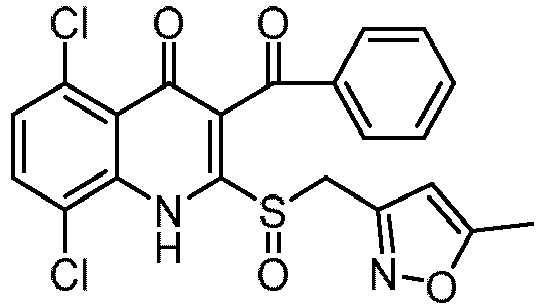
3-benzoyl-5,8-dichloro-2-(((5-methylisoxazol-3-yl)methyl)sulfinyl)quinolin-4(1H)-one 89 
methyl 5-(((3-acetyl-5,8-dichloro-4-oxo-1,4-dihydroquinolin-2-yl)sulfinyl)methyl)furan-2-carboxylate 90 
2-(((3-acetyl-5,8-dichloro-4-oxo-1,4-dihydroquinolin-2-yl)sulfinyl)methyl)isoindoline-1,3-dione 91 
methyl 4-(((3-acetyl-5,8-dichloro-4-oxo-1,4-dihydroquinolin-2-yl)sulfinyl)methyl)benzoate 92 
3-acetyl-5-methoxy-2-((4-(pentafluoro-λ6-sulfanyl)benzyl)thio)quinolin-4(1H)-one 93 
3-acetyl-5-methoxy-2-((4-(pentafluoro-λ6-sulfanyl)benzyl)sulfinyl)quinolin-4(1H)-one 94 
3-acetyl-5-methoxy-2-(((5-methylisoxazol-3-yl)methyl)sulfinyl)quinolin-4(1H)-one 95 
8-bromo-5-chloro-3-isobutyryl-2-(((5-methylisoxazol-3-yl)methyl)sulfinyl)quinolin-4(1H)-one 96 
8-bromo-5-chloro-3-(cyclopropanecarbonyl)-2-(((5-methylisoxazol-3-yl)methyl)sulfinyl)quinolin-4(1H)-one 97 
5,8-dichloro-3-(cyclopropanecarbonyl)-2-(((5-methylisoxazol-3-yl)methyl)sulfinyl)quinolin-4(1H)-one 98 
5-(((3-acetyl-8-bromo-5-chloro-4-oxo-1,4-dihydroquinolin-2-yl)sulfinyl)methyl)thiophene-2-carbonitrile 99 
2-(((6-(1H-pyrazol-1-yl)pyridin-3-yl)methyl)sulfinyl)-3-acetyl-8-bromo-5-chloroquinolin-4(1H)-one 100 
3-acetyl-2-(((6-aminopyridin-3-yl)methyl)sulfinyl)-8-bromo-5-chloroquinolin-4(1H)-one 101 
8-bromo-5-chloro-3-(cyclopropanecarbonyl)-2-((4-((trifluoromethyl)thio)benzyl)sulfinyl)quinolin-4(1H)-one 102 
3-acetyl-8-bromo-5-chloro-2-(((2-methyl-6-(trifluoromethyl)pyridin-3-yl)methyl)sulfinyl)quinolin-4(1H)-one 103 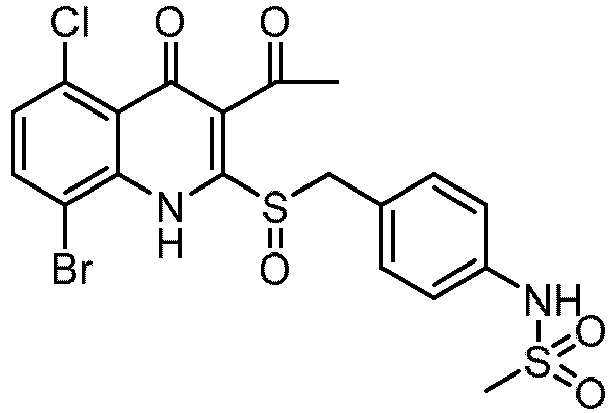
N-(4-(((3-acetyl-8-bromo-5-chloro-4-oxo-1,4-dihydroquinolin-2-yl)sulfinyl)methyl)phenyl)methanesulfonamide 104 
3-acetyl-8-bromo-5-chloro-2-(((6-chloropyridin-3-yl)methyl)sulfmyl)qumolin-4(1H)-one 105 
3-acetyl-8-bromo-5-chloro-2-(((6-((2-methoxyethyl)amino)pyridin-3-yl)methyl)sulfinyl)quinolin-4(1H)-one 106 
3-acetyl-8-bromo-5-chloro-2-(((4-methyl-1,2,5-oxadiazol-3-yl)methyl)sulfinyl)quinolin-4(1H)-one 107 
2-(((1H-pyrrolo[2,3-b]pyridin-5-yl)methyl)sulfinyl)-3-acetyl-8-bromo-5-chloroquinolin-4(1H)-one - In another embodiment, the present disclosure provides therapeutically effective amounts of the compounds of Formula 1, 2 or 3 or pharmaceutically acceptable salts thereof, and a (pharmaceutical) composition including a pharmaceutically acceptable carrier.
- In another embodiment, the present disclosure provides therapeutically effective amounts of the compounds of Formula 1, 2 or 3 or pharmaceutically acceptable salts thereof and a pharmaceutically acceptable carrier, and provides a (pharmaceutical) composition including a therapeutically effective amount of an active pharmaceutical ingredient selected from the group consisting of other anti-cancer agents other than the compounds of the present disclosure, cytostatic drugs, angiogenesis inhibitors, kinase inhibitors, cytokine blockers and cell adhesion molecule inhibitors.
- When the novel compounds according to the present disclosure are used as anti-cancer agents, the dose is as follows. Any suitable route for administration of the compounds of the present disclosure may be selected, the type of pharmaceutical composition suitable for such route may be determined, and for the intended treatment, the compound may be administered in an effective dose. The effective dose is generally from about 0.001 to about 100 mg/kg body weight/day, preferably from about 0.01 to about 30 mg/kg/day, in a single or divided dose. Depending on the age, species, and diseases or conditions to be treated, a dose below the lower limit of this range may be appropriate. In other cases, higher doses may be used without harmful side effects. Higher doses may be divided into smaller doses and administered daily. Methods of determining an appropriate dose are well known in the art to which the present disclosure pertains. For example, a document, such as Remington: The Science and Practice of Pharmacy, Mack Publishing Co., 20th ed., 2000, may be used.
- Methods for the preparation of pharmaceutical compositions for the treatment or prevention of diseases or conditions are well known to those of ordinary skill in the art. For example, as described in references such as Handbook of Pharmaceutical Excipients (7th ed.), Remington: The Science and Practice of Pharmacy (20th ed.), Encyclopedia of Pharmaceutical Technology (3rd ed.), Sustained and Controlled Release Drug Delivery Systems (1978), a pharmaceutically acceptable carrier, additives and the like may be suitably mixed with the compounds according to the present disclosure to prepare a pharmaceutical composition for the object of the present disclosure.
- The present invention provides novel compounds capable of inhibiting c-Myc / Max / DNA complex formation and exhibiting various pharmacological activities. The compounds according to the present invention or their pharmaceutically acceptable salts are excellent in safety and have high selectivity in terms of inhibition of c-Myc / Max / DNA complex formation, so that they can exhibit various excellent effects.
- Hereinafter, the present disclosure is described in detail with reference to the following examples. However, the examples according to the present disclosure can be modified into various other forms, and the scope of the present disclosure should not be construed as being limited to the following examples. The examples are provided to more fully explain the present disclosure to those skilled in the art to which the present disclosure pertains.
- The reagents and solvents used in the experiments described below can be purchased from Aldrich Chemical Co. (Milwaukee, Wisconsin, USA). A 1H-NMR spectrum was measured using a Varian Gemini 400 MHz NMR spectrometer.
-

- 2-Bromo-5-chloroaniline (1) (10 g, 48.5 mmol) was dissolved in anhydrous dichloroethane (CH2Cl2, 250 mL) and sodium carbonate (Na2CO3, 11 g, 97 mmol) was added thereto. The solution was cooled to 5°C with ice water under nitrogen gas, and thiophosgene (5.5 mL, 72.7 mmol) was added very slowly to the solution in that state. The reaction solution was stirred at room temperature for 12 hours and then filtered to remove inorganic matter. After removing the solvent by distillation under reduced pressure, nucleic acid (n-Hexane, 50 mL) was added to the resulting solid, and then the mixture was stirred for 10 minutes and subjected to filtering to quantitatively obtain a title compound as a yellow solid.
1H NMR (300 MHz, CDCl3) δ 7.51-7.49(d, J=8.61 Hz, 1H), 7.26-7.25(d, J=2.4 Hz, 1H), 7.13-7.09(dd, J=2.46, 6.18 Hz, 1H).
LC/MS data: 249.52 g/mol - Isothiothianate (2) (10 g, 40 mmol) synthesized in step 1 was dissolved in anhydrous DMF (20 mL), and the mixed solution was slowly added to a solution of ethyl oxobutanoate (5.2 g, 40 mmol) and K2CO3 (5.6 g, 40 mmol) dissolved in DMF (100 mL) at room temperature. The mixture was stirred for 12 hours at room temperature, and then iodomethane (5.7 g, 40 mmol) was slowly added thereto at room temperature. The solution was then stirred at room temperature for one day. After completion of the reaction was confirmed by TLC, water and ethyl acetate were added and the desired compound was extracted as an organic layer. Water was removed from the extracted organic layer using MgSO4, and the extracted organic layer was subjected to distillation under reduced pressure, and then purification was performed using a column to obtain title Compound 3a.
1H NMR (300 MHz, CDCl3) δ 12.90(s, 1H), 7.45-7.42(d, J=8.41 Hz, 1H), 6.90-6.86(d, J=7.74 Hz, 1H), 6.68(s, 1H), 4.36-4.29(m, 2H), 2.54(s, 3H), 2.04(s, 3H), 1.37-1.33(t, J=7.26 Hz, 3H).
LC/MS data: 393.69 g/mol - Compound 3a synthesized in step 2 was dissolved in o-dichlorobenzene and stirred for 12 hours while heated at 180°C. After the reaction was completed, the reaction mixture was cooled to room temperature and was subjected to distillation under reduced pressure. A nucleic acid was added to the resulting solid, and the mixture was stirred for 10 minutes and was subj ected to filtering to obtain Compound 4a.
1H NMR (300 MHz, CDCl3) δ 8.67(s, 1H), 7.91-7.88(d, J=8.19 Hz, 1H), 7.71-7.68(d, J=8.49 Hz, 1H), 2.97(s, 3H), 2.79(s, 3H).
LC/MS data: 347.62 g/mol - The quinolone compound 4a obtained in step 3 was oxidized with MCPBA (1.5 eq.) in anhydrous dichloroethane (CH2Cl2, 10 mL) to obtain title Compound 5a.
1H NMR (300 MHz, CDCl3) δ 11.13(s, 1H), 7.82-7.79(d, J=8.43 Hz, 1H), 7.38-7.36(d, J=8.46 Hz, 1H), 3.02(s, 3H), 2.78(s, 3H).
LC/MS data: 363.62 g/mol - Title Compound 3b was synthesized using benzyl bromide instead of Mel in a similar manner to the synthesis of Compound 3a.
1H NMR (300 MHz, CDCl3) δ 12.90(s, 1H), 7.46-7.44(m, 2H), 7.35-7.24(m, 4H), 6.91-6.89(d, J=7.95 Hz, 1H), 6.70(s, 1H), 4.49-4.19(m, 4H), 2.05(s, 3H), 1.36-1.31(t, J=7.11 Hz, 3H).
LC/MS data: 469.79 g/mol - Title Compound 4b was synthesized in a similar manner to the synthesis of Compound 4a.
1H NMR (300 MHz, CDCl3) δ 8.59(s, 1H), 7.93-7.90(d, J=8.25 Hz, 1H), 7.52-7.47(m, 2H), 7.42-7.21 (m, 4H), 4.80(s, 2H), 2.93(s, 3H).
LC/MS data: 423.72 g/mol - Title Compound 5b was synthesized in a similar manner to the synthesis of Compound 5a.
- Using the above-mentioned methods, the following compounds according to the present disclosure were synthesized by modifying reactants and/or starting materials appropriately. LC/MS and 1H NMR measurement results are summarized in Table 4. In Table 4 below, MW refers to an average molecular weight, and MS is the value obtained by analyzing the actually prepared compounds.
[Table 4] Comp ound Numb er Formula Name MW (Mole cular Weig ht) LC/ MS data 1H NMR 1 3-acetyl-8-bromo-5-chloro-2-(methylsulfinyl)quinolin-4(1H)-one 362.62 363 1H NMR (300 MHz, CDCl3)δ11.13 (br, 1H), 7.81 (d, J= 8.4 Hz, 1H), 7.37 (d, J= 8.4 Hz, 1H), 3.02 (s, 3H), 2.78 (s, 3H). 2 3-acetyl-8-bromo-5-chloro-2-(methylthio)quinolin-4(1H)-one 346.63 348 1H NMR (300 MHz, CDCl3)δ8.67(s,1H),7.91-7.88(d,J=8.19 Hz, 1H), 7.71-7.68(d, J=8.49 Hz, 1H), 2.97(s, 3H), 2.79(s, 3H). 3 3-acetyl-2-(benzylthio)-8-bromo-5-chloroquinolin-4(1H)-one 422.72 423 1H NMR (300 MHz, CDCl3)δ16.43 (s, 0.5H), 8.59 (br, 0.5H), 7.91 (d, J= 8.3 Hz, 1H), 7.62 (d, J= 8.4 Hz, 0.5H), 7.48 -7.52 (m, 3H), 7.27 -7.43 (m, 5H), 7.22 (d, J= 8.4 Hz, 0.5H), 4.80 (s, 2H), 4.32 (s, 1H), 2.93 (s, 3H), 2.69 (s, 1.5H). 4 3-acetyl-2-(benzylsulfinyl)-8-bromo-5-chloroquinolin-4(1H)-one 438.72 439 1H NMR (300 MHz, CDCl3)δ10.24 (br, 1H), 7.67 (d, J= 8.4 Hz, 1H), 7.29 (d, J= 8.4 Hz, 1H), 7.13 -7.22 (m, 3H), 7.08 -7.11 (m, 2H), 4.59-4.25 (m, 2H), 2.84 (s, 3H). 5 3-acetyl-8-bromo-5-chloro-1-methyl-2-(methylthio)quinolin-4(1H)-one 360.65 360 1H NMR (300 MHz, CDCl3)δ7.92-7.89(d,J=8.22 Hz, 1H), 7.36-7.33(d, J=8.13 Hz, 1H), 3.89(s, 3H), 2.74(s, 3H), 2.65(s, 3H). 6 3-acetyl-5,8-dichloro-2-(methylsulfinyl)quinolin-4(1H)-one 318.17 318 1H NMR (300 MHz, CDCl3)δ11.07(s,1H),7.67-7.64(d,J=8.46 Hz, 1H), 7.44-7.41(d, J=8.46 Hz, 1H), 3.02(s, 3H), 2.78(s, 3H). 7 3-acetyl-6-fluoro-1-methyl-2-(methylthio)quinolin-4(1H)-one 265.30 266 1H NMR (300 MHz, CDCl3)δ7.92-7.87(q,J=5.1, 3.99 Hz, 1H), 7.69-7.65(q, J=2.88, 6.45 Hz, 1H), 7.48-7.39(m, 1H), 4.53-4.46(q, J=7.14, 7.14 Hz, 2H), 4.08(s, 3H), 3.66(s, 3H), 1.48-1.44(t, J=7.14 Hz, 3H). 8 1-(6-fluoro-4-hydroxy-2-(methylthio)quinolin-3-yl)ethan-1-one 251.28 252 1H NMR (300 MHz, CDCl3)δ7.83-7.78(m,2H),7.49-7.42(m,1H),4.59-4.52(q,J=7.14 Hz, 2H), 2.58(s, 3H), 1.56-1.51(t, J=7.14 Hz, 3H). 9 3-acetyl-8-bromo-1-(4-bromobenzoyl)-5-chloro-2-(methylsulfinyl)quinolin-4(1H)-one 545.63 544 1H NMR (300 MHz, CDCl3)δ8.09-8.07(d,J=5.73 Hz, 1H), 8.06-8.04(d, J=6.15 Hz, 2H), 7.73-7.70(d, J=8.58 Hz, 2H), 7.56-7.54(d, J=8.22 Hz, 1H), 3.15(s, 3H), 2.63(s, 3H). 10 3-acetyl-8-bromo-5-chloro-2-((4-chlorobenzyl)thio)quinolin-4(1H)-one 457.16 456 1H NMR (300 MHz, DMSO) δ 7.65-7.62(d, J=8.13 Hz, 1H), 7.45-7.42(d, J=6.69 Hz, 2H), 7.29-7.26(d, J=8.34 Hz, 2H), 6.91-6.88(d, J=8.19 Hz, 1H), 4.44(s, 2H), 2.40(s, 3H). 11 3-acetyl-8-bromo-5-chloro-2-((4-chlorobenzyl)sulfinyl)quinoli n-4(1H)-one 473.16 472 1H NMR (300 MHz, CDCl3)δ10.21(s,1H),7.73-7.71(d,J=8.43 Hz, 1H), 7.33-7.31(d, J=8.37 Hz, 1H), 7.18-7.15(d, J=9 Hz, 2H), 7.05-7.03(d, J=8.25 Hz, 2H), 4.37(s, 2H), 2.84(s, 3H). 12 3-acetyl-8-bromo-5-chloro-2-(phenylthio)quinolin-4(1H)-one 408.69 408 1H NMR (300 MHz, MeOD) δ 7.51-7.48(m, 2H), 7.46-7.43(d, J=8.11 Hz, 1H), 7.31-7.28(d, J=7.71 Hz, 3H), 6.81-6.78(d, J=8.19 Hz, 1H). 13 3-acetyl-8-bromo-5-chloro-2-(phenylsulfinyl)quinolin-4(1H)-one 424.69 424 1H NMR (300 MHz, CDCl3)δ7.84-7.75(m,2H),7.68-7.64(m,2H),7.52-7.50(d,J=8.43 Hz, 1H), 7.48-7.45(m, 1H), 7.38-7.35(d, J=8.43 Hz, 1H), 2.78(s, 3H). 14 3-acetyl-8-bromo-5-chloro-2-((2-methoxyphenyl)thio)quinolin -4(1H)-one 438.72 438 1H NMR (300 MHz, CDCl3)δ8.55(s,1H),7.709(m,1H),7.633 (m,1H),7.511(d,1H,J=8.43 Hz), 7.158(m, 3H), 3.861(s, 3H), 2.781(s, 3H). 15 3-acetyl-8-bromo-5-chloro-2-((2-methoxyphenyl)sulfinyl)quin olin-4(1H)-one 454.72 454 1H NMR (300 MHz, CDCl3)δ7.84(d,J = 8.4 Hz, 1H), 7.383 (d, J = 8.4 Hz, 1H),7.53 (m, 1H), 7.415 (m, 1H), 6.949 (s, 1H), 6.956 (s, 1H), 3.86 (s, 3H), 2.634 (s, 3H) 16 3-acetyl-8-bromo-2-((4-bromophenyl)thio)-5-chloroquinolin-4(1H)-one 487.59 486 1H NMR (300 MHz, CDCl3)δ8.30(s,1H),7.779(d,J=8.4Hz, 2H), 7.614(d, J=8.46Hz, 2H), 7.541(d, J=8.4Hz, 1H), 7.183(d, J=8.46Hz, 1H), 2.77(s, 3H). 17 3-acetyl-8-bromo-2-((4-bromophenyl)sulfinyl)-5-chloroquinolin-4(1H)-one 503.59 502 1H NMR (300 MHz, CDCl3)δ11.37(s,1H),7.84-7.81(d,J=8.46 Hz, 1H), 7.73-7.70(d, J=8.73 Hz, 2H), 7.60-7.57(d, J=8.67 Hz, 2H), 7.39-7.38(d, J=8.43 Hz, 1H), 2.70(s, 3H). 18 1,1'-(8-bromo-5-chloro-2-(methylthio)-4-oxoquinoline-1,3(4H)-diyl)bis(ethan-1-one) 388.66 388 1H NMR (300 MHz, MeOD) δ 7.84 (d, J=8.25, 1H), 7.19(d, J=8.25, 1H), 2.72(s, dH), 2.57(s, 3H), 2.18(s, 3H). 19 1,1'-(8-bromo-5-chloro-2-(methylsulfinyl)-4-oxoquinoline-1,3(4H)-diyl)bis(ethan-1-one) 404.66 404 1H NMR (300 MHz, CDCl3)δ8.07(m,1H),7.60(m,1H),3.03( s,3H),3.02(s,3H),2.78(s,3H). 20 3-acetyl-2-(benzylsulfinyl)-8-bromo-1-(4-bromobenzoyl)-5-chloroquinolin-4(1H)-one 621.72 620 1H NMR (300 MHz, (CD3)2CO)δ7.96-7.93(d,J=8.22 Hz, 1H), 7.73-7.60(m, 7H), 7.45-7.42(d, J=8.25 Hz, 2H), 7.16-7.13(d, J=8.19 Hz, 1H), 2.86(s, 3H). 21 3-acetyl-8-bromo-1-(4-bromobenzoyl)-5-chloro-2-(methylsulfonyl)quinolin-4(1H)-one 561.63 560 1H NMR (300 MHz, CDCl3)δ8.10(d,J=8.22 Hz, 1H), 8.03-7.67 (dd, J=8.61, 88.8 Hz, 4H), 7.60(J=8.22 Hz, 1H), 3.53(s, 3H), 2.67(s, 3H). 22 3-acetyl-8-bromo-5-chloro-1-(3-chloro-4-fluorobenzyl)-2-(methylsulfinyl)quinolin-4(1H)-one 505.18 504 1H NMR (300 MHz, CDCl3)δ7.42-7.37(m,2H),7.24-7.09(m,3H),4.49(s,2H),3.44(s,3H),2.1 4(s,3H). 23 3-acetyl-2-(benzylthio)-8-bromo-1-(4-bromobenzoyl)-5-chloroquinolin-4(1H)-one 605.73 604 1H NMR (300 MHz, CDCl3)δ8.06-8.03(d,J=8.28 Hz, 1H), 7.93-7.91(d, J= 8.64 Hz, 2H), 7.71-7.68(d, 8.64 Hz, 2H), 7.54-7.51(d, J=7.02 Hz, 2H), 7.49-7.46(d, J=8.25 Hz, 1H), 7.30-7.27(d, J=7.33 Hz, 2H), 6.97(s, 1H), 4.71(s, 2H). 24 3-acetyl-8-bromo-5-chloro-2-(isopropylthio)quinolin-4(1H)-one 374.68 374 1H NMR (300 MHz, CDCl3)δ16.32(s,1H),7.77-7.86(d,J=8.13 Hz, 1H), 7.26-7.23(d, J=8.61 HZ, 1H), 4.54-4.45(m, 1H), 2.94(s, 3H), 1.54-1.51(m, 6H). 25 3-acetyl-8-bromo-5-chloro-2-(isopropylsulfinyl)quinolin-4(1H)-one 390.68 390 1H NMR (300 MHz, CDCl3)δ10.99(s, 1H),7.80-7.77(d,J=8.37 Hz, 1H), 7.36-7.34(d, J=8.4 Hz, 1H), 3.61-3.51(m, 1H), 2.77(s, 3H), 1.63-1.61(d, J=7.12 Hz, 3H), 1.01-0.99(d, J=6.78 Hz, 3H). 26 3-acetyl-8-bromo-5-chloro-2-((1-phenylethyl)sulfinyl)quinolin -4(1H)-one 452.75 452 1H NMR (300 MHz, CDCl3)δ11.06(br,1H),7.82(d,J= 8.4 Hz, 1H), 7.60-7.65 (m, 2H), 7.41-7.50 (m, 3H), 7.38 (d, J= 8.5 Hz, 1H), 4.72 (q, J= 7.3 Hz, 1H), 2.84 (s, 3H), 1.42 (d, J= 7.1 Hz, 3H). 27 3-(((3-acetyl-8-bromo-5-chloro-4-oxo-1,4-dihydroquinolin-2-yl)thio)methyl)benzonitrile 447.73 447 1H NMR (300 MHz, CDCl3)δ7.92(d,J= 8.3 Hz, 1H), 7.83 (s, 1H), 7.76 (d, J= 7.9 Hz, 1H), 7.55 (d, J= 7.7 Hz, 1H), 7.42 (t, J= 7.8 Hz, 1H), 7.32 (d, J= 8.3 Hz, 1H), 4.82 (s, 2H), 2.94 (s, 3H). 28 3-(((3-acetyl-8-bromo-5-chloro-4-oxo-1,4-dihydroquinolin-2-yl)sulfinyl)methyl)benzonitril e 463.73 463 1H NMR (300 MHz, CDCl3)δ10.27(br,1H),7.72(d,J= 8.5 Hz, 1H), 7.53-7.57 (m, 1H), 7.27-7.40 (m, 2H), 4.59 - 4.22 (m, 2H), 2.85 (s, 3H). 29 3-acetyl-8-bromo-5-chloro-2-((2,4-difluorobenzyl)sulfinyl)quino lin-4(1H)-one 474.70 474 1H NMR (300 MHz, CDCl3)δ10.34(br,1H),7.74(d,J= 8.4 Hz, 1H), 7.35 (d, J= 8.4 Hz, 1H), 7.20-7.28 (m, 1H), 6.81-6.87 (m, 1H), 6.60-6.75 (m, 1H), 4.53 (dd, J= 48.9, 13.2 Hz, 2H), 2.85 (s, 3H). 30 3-acetyl-8-bromo-5-chloro-2-((3-chloro-4-fluorobenzyl)thio)quinolin-4(1H)-one 475.15 474 1H NMR (300 MHz, CDCl3)δ7.92(d,J= 8.3 Hz, 1H), 7.83 (s, 1H), 7.76 (d, J= 7.9 Hz, 1H), 7.55 (d, J= 7.7 Hz, 1H), 7.42 (t, J= 7.8 Hz, 1H), 7.32 (d, J= 8.3 Hz, 1H), 4.82 (s, 2H), 2.94 (s, 3H). 31 3-acetyl-8-bromo-5-chloro-2-((3-chloro-4-fluorobenzyl)sulfinyl)quinoli n-4(1H)-one 491.15 490 1H NMR (300 MHz, CDCl3)δ10.27(br,1H),7.73(d,J= 8.4 Hz, 1H), 7.33 (d, J= 8.4 Hz, 1H), 7.22-7.24 (m, 1H), 6.95-6.98 (m, 2H), 4.33 (q, J= 12.8 Hz, 2H), 2.84 (s, 3H). 32 3-acetyl-8-bromo-5-chloro-2-((4-nitrobenzyl)thio)quinolin-4(1H)-one 467.72 467 1H NMR (300 MHz, CDCl3)δ8.16(d,J= 8.6 Hz, 2H), 7.92 (d, J= 8.3 Hz, 1H), 7.69 (d, J= 8.6 Hz, 2H), 7.32 (d, J= 8.2 Hz, 1H), 4.90 (s, 2H), 2.94 (s, 3H). 33 3-acetyl-8-bromo-5-chloro-2-((4-nitrobenzyl)sulfinyl)quinolin-4(1H)-one 483.72 483 1H NMR (300 MHz, CDCl3)δ10.23(br,1H),8.08(d,J= 8.7 Hz, 2H), 7.70 (d, J= 8.4 Hz, 1H), 7.34 (dd, J= 8.5, 3.9 Hz, 3H), 4.49 (dd, J= 27.8, 12.6 Hz, 2H), 2.85 (s, 3H). 34 3-acetyl-2-(benzylsulfonyl)-8-bromo-5-chloroquinolin-4(1H)-one 454.72 454 1H NMR (300 MHz, CDCl3)δ10.25(s,1H),7.66(d,J=8.46 Hz, 1H), 7.28(d, J=8.43 Hz, 1H), 7.20-7.08(m, 5H), 4.41(d, J=3, 2H), 2.84(s, 3H). 35 3-acetyl-8-bromo-5-chloro-1-(methylsulfonyl)-2-(methylthio)quinolin-4(1H)-one 424.71 424 1H NMR (300 MHz, CDCl3)δ7.96(d,J=8.25 Hz, 1H), 7.42(d, J=8.28 Hz, 1H), 3.30(s, 3H), 2.76(s, 3H), 2.73(s, 3H). 36 3-acetyl-8-bromo-5-chloro-2-(methylsulfinyl)-1-((trifluoromethyl)sulfonyl)qui nolin-4( 1H)-one 494.68 494 1H NMR (300 MHz, CDCl3)δ8.08-8.05(d,J=8.22 Hz, 1H), 7.69-7.65(d, J=8.25 Hz, 1H), 3.11(s, 3H), 2.78(s, 3H). 37 3-acetyl-8-bromo-5-chloro-1-((4-chlorophenyl)sulfonyl)-2-(methylthio)quinolin-4(1H)-one 521.22 520 1H NMR (300 MHz, CDCl3)δ7.93-7.91(d,J=8.22 Hz, 1H), 7.74-7.71(d, J=8.7 Hz, 2H), 7.50-7.47(d, J=8.61 Hz, 2H), 7.32-7.30(d, J=8.25 Hz, 1H), 2.71(s, 3H), 2.62(s, 3H). 38 3-acetyl-8-bromo-5-chloro-2-(methylthio)-1-((4-nitrophenyl)sulfonyl)quinolin -4(1H)-one 531.78 531 1H NMR (300 MHz, CDCl3)δ8.39-8.36(d,J=8.85 Hz, 2H), 8.03-8.00(d, J=8.85, 2H), 7.96-9.93 (d, J=8.22 Hz, 1H), 7.35-7.32(d, J=8.22 Hz, 1H), 2.74(s, 3H), 2.62(s, 3H). 39 3-acetyl-8-bromo-5-chloro-1-(ethylsulfonyl)-2-(methylsulfinyl)quinolin-4(1H)-one 454.73 454 1H NMR (300 MHz, CDCl3)δ7.96-7.93(d,J=8.23 Hz, 1H), 7.42-7.39(d, J=8.16 Hz, 1H), 3.54-3.46(q, J=7.41, 7.5 Hz, 2H), 2.76(s, 3H), 2.73(s, 3H), 1.58-1.53(t, J=7.38,7.44, 3H). 40 3-acetyl-8-bromo-1-((4-(tert-butyl)phenyl)sulfonyl)-5-chloro-2-(methylthio)quinolin-4(1H)-one 542.89 542 1H NMR (300 MHz, CDCl3)δ7.88-7.85(d,J=8.16 Hz, 1H), 7.69-7.66(d, J=8.67 Hz, 2H), 7.47-7.44(d, J=8.7 Hz, 2H), 7.25-7.23(d, J= 8.13 Hz, 1H), 2.71(s, 3H), 2.63(s, 3H), 1.33 (s, 9H). 41 3-acetyl-8-bromo-1-((4-(tert-butyl)phenyl)sulfonyl)-5-chloro-2-(methylsulfonyl)quinolin-4(1H)-one 574.89 574 1H NMR (300 MHz, CDCl3)δ8.10-8.07(d,J=8.22 Hz, 1H), 7.80-7.78(d, J=8.64 Hz, 2H), 7.62-7.59(d, J=8.25 Hz, 1H), 7.58-7.55(d, J = 8.64 Hz, 2H), 3.48(s, 3H), 2.71(s, 3H), 1.37(s, 9H). 42 3-acetyl-8-bromo-1-((4-(tert-butyl)phenyl)sulfonyl)-5-chloro-2-(methylsulfinyl)quinolin-4(1H)-one 558.89 558 1H NMR (300 MHz, CDCl3)δ8.05-8.03(d,J=8.16 Hz, 1H), 7.71-7.68(d, J=8.64 Hz, 2H), 7.52-7.49(d, J=8.28 Hz, 3H), 3.13(s, 3H), 2.69(s, 3H), 1.35(s, 9H). 43 3-acetyl-8-bromo-5-chloro-2-((2,5-dichlorobenzyl)thio)quinolin-4(1H)-one 491.61 490 1H NMR (300 MHz, DMSO) δ 7.93-7.90(d, J = 8.25 Hz, 1H), 7.84 (s, 1H), 7.52-7.49(d, J= 8.52 Hz, 1H), 7.37-7.33(m, 1H), 7.25-7.22(d, J= 8.34 Hz, 1H), 4.65(s, 2H). 44 3-acetyl-8-bromo-5-chloro-2-((2,5-dichlorobenzyl)sulfinyl)quino lin-4(1H)-one 507.60 506 1H NMR (300 MHz, CDCl3)δ10.35(s,1H),7.73-7.72(d,J=10.86 Hz, 1H), 7.32(s, 2H), 7.17(s, 2H), 4.81-4.49(dd, J= 13.33, 69.53 Hz, 2H), 2.81(s, 3H). 45 3-acetyl-8-bromo-5-chloro-2-((3,5-difluorobenzyl)thio)quinolin-4(1H)-one 458.70 458 1H NMR (300 MHz, CDCl3)δ7.93-7.91(d,J=8.28 Hz, 1H), 7.33-7.30(d, J=8.28 Hz, 1H), 7.06-7.04(m, 3H), 4.78(s, 2H), 2.94(s, 3H). 46 3-acetyl-8-bromo-5-chloro-2-((3,5-difluorobenzyl)sulfinyl)quino lin-4(1H)-one 474.70 474 1H NMR (300 MHz, CDCl3)δ10.43(s,1H),7.75-7.72(d,J= 8.4 Hz, 1H), 7.35-7.32(d. J= 8.46 Hz, 1H), 6.80-6.68(m, 3H), 4.44-4.23(q, J= 12.63, 36.84 Hz, 2H), 2.84(s, 3H). 47 3-acetyl-8-bromo-5-chloro-2-((3-iodobenzyl)thio)quinolin-4(1H)-one 548.62 548 1H NMR (300 MHz, DMSO) δ 7.97-7.94(d,J= 5.55 Hz, 1H), 7.89(s, 1H), 7.61-7.58(d, J=8.16 Hz, 1H), 7.49-7.46(d, J= 7.11 Hz, 1H), 7.31-7.29(m, 1H), 7.13-7.80(t, J= 7.76 Hz, 1H), 4.55(s, 2H). 48 3-acetyl-8-bromo-5-chloro-2-((3-iodobenzyl)sulfinyl)quinolin-4(1H)-one 564.62 564 1H NMR (300 MHz, CDCl3)δ10.19(s,1H),7.74-7.71(d,J=8.46 Hz, 1H), 7.56-7.54(d, J=8.07 Hz, 1H), 7.39(s, 1H), 7.35-7.32(d, J=8.46 Hz, 1H), 7.09-7.07(d, J=8.01 Hz, 1H), 6.97-6.92(t, J= 7.74 Hz, 1H), 4.40-4.30(q, J=12.71, 6.06 Hz, 2H), 2.87(s, 3H). 49 3-acetyl-8-bromo-5-chloro-2-((3-fluorobenzyl)thio)quinolin-4(1H)-one 440.71 440 1H NMR (300 MHz, CDCl3)δ7.93-7.91(d,J= 8.25 Hz, 1H), 7.32-7.30(d, J= 8.19 Hz, 2H), 7.28-7.27(m, 2H), 6.97(s, 1H), 4.79(s, 2H), 2.94(s, 3H). 50 3-acetyl-8-bromo-5-chloro-2-((3-fluorobenzyl)sulfinyl)quinoli n-4(1H)-one 456.71 456 1H NMR (300 MHz, CDCl3)δ10.30(s,1H),7.70-7.67(d,J=8.56 Hz, 1H), 7.30-7.27(d, J=8.43 Hz, 1H), 7.15-7.07(m, 1H), 6.98-6.88(m, 2H), 6.83-6.81(d, J=7.68 Hz, 1H), 4.42-4.32(q, J=12.66, 3.33 Hz, 2H), 2.82(s, 3H). 51 3-acetyl-8-bromo-5-chloro-2-(((5-methylisoxazol-3-yl)methyl)sulfinyl)quinolin-4(1H)-one 443.70 442 1H NMR (300 MHz, CDCl3)δ10.50(br,1H),7.77(d,J= 8.4 Hz, 1H), 7.36 (d, J= 8.4 Hz, 1H), 6.17 (s, 1H), 4.33-4.67 (m, 2H), 2.83 (s, 3H), 2.39 (s, 3H). 52 1-(2-(benzylthio)-8-bromo-5-chloro-4-hydroxyquinolin-3-yl)ethan-1-one 422.72 422 1H NMR (300 MHz, CDCl3)δ7.82(d,J= 8.2 Hz, 1H), 7.53 (d, J= 6.8 Hz, 2H), 7.32-7.48 (m, 3H), 7.26 (d, J= 8.4 Hz, 1H), 6.77 (s, 2H), 5.24 (s, 3H). 53 1-(2-(benzylsulfinyl)-8-bromo-5-chloro-4-hydroxyquinolin-3-yl)ethan-1-one 438.72 438 1H NMR (300 MHz, CDCl3)δ7.99(d,J= 8.2 Hz, 1H), 7.60 (s, 1H), 7.54-7.57 (m, 2H), 7.51 (d, J= 8.2 Hz, 1H), 7.37-7.48 (m, 3H), 5.39 (s, 2H), 3.48 (s, 3H). 54 1-(2-(benzylsulfonyl)-8-bromo-5-chloro-4-hydroxyquinolin-3-yl)ethan-1-one 454.72 454 1H NMR (300 MHz, CDCl3)δ7.94(d,J= 8.2 Hz, 1H), 7.73 (s, 1H), 7.54-7.58 (m, 2H), 7.45 (d, J= 8.1 Hz, 2H), 7.38-7.41 (m, 2H), 5.42 (s, 2H), 3.01 (s, 3H). 55 3-acetyl-8-bromo-5-chloro-2-((3-methoxybenzyl)sulfinyl)quin olin-4(1H)-one 468.75 468 1H NMR (300 MHz, CDCl3)δ10.32(s,1H),7.71-7.69(d,J=8.4 Hz, 1H), 7.33-7.30(d, J=8.43, 1H), 7.09-7.04(t, J=7.8 Hz,1H), 6.76-6.70(m, 2H), 6.65-6.63(d, J=7.47 Hz, 1H), 4.44-4.34(q, J=12.7, 4.86 Hz, 2H), 3.70(s, 3H), 2.86(s, 3H). 56 3-acetyl-8-bromo-5-chloro-2-((4-((trifluoromethyl)thio)benzyl) sulfinyl)quinolin-4(1H)-one 538.78 538 1H NMR (300 MHz, CDCl3)δ10.27(s,1H),7.69-7.66(d,J=8.40 Hz, 1H), 7.49-7.46(d, J=8.01 Hz, 2H), 7.31-7.28(d, J=8.40 Hz, 1H), 7.18-7.15(d, J=8.16 Hz, 2H), 4.52-4.37(q, J=12.7, 17.1 Hz, 2H), 2.84(s, 3H). 57 3-acetyl-5,8-dichloro-2-((4-nitrobenzyl)sulfinyl)quinolin-4(1H)-one 439.26 439 1H NMR (300 MHz, MeOD) 59.95(s, 1H), 8.22-8.20(d, J=8.6 Hz, 2H), 7.73-7.70(d, J=8.31 Hz, 2H), 7.63-7.60(d, J=8.22 Hz,1H), 7.29-7.26(d, J=8.13 Hz, 1H), 4.59-4.10(q, J=12.3, 122 Hz, 2H), 2.72(s, 3H). 58 2-(((3-acetyl-8-bromo-5-chloro-4-oxo-1,4-dihydroquinolin-2-yl)sulfinyl)methyl)benzonitril e 463.73 463 1H NMR (300 MHz, CDCl3)δ10.30(br,1H),7.69(d,J= 8.4 Hz, 1H), 7.47 - 7.61 (m, 2H), 7.34 - 7.45 (m, 2H), 7.31 (d, J= 8.4 Hz, 1H), 4.71 (q, J= 13.1 Hz, 2H), 2.85 (s, 3H). 59 3-acetyl-8-bromo-5-chloro-2-((3,5-dimethoxybenzyl) sulfinyl)qui nolin-4(1H)-one 498.77 498 1H NMR (300 MHz, CDCl3)δ10.36(s,1H),7.69(d,J= 8.4 Hz, 1H), 7.30 (d, J= 8.4 Hz, 1H), 6.23 (s, 3H), 4.25-4.39 (m, 2H), 3.62 (s, 6H), 2.83 (s, 3H). 60 3-acetyl-8-bromo-2-((4-(tert-butyl)benzyl)sulfinyl)-5-chloroquinolin-4(1H)-one 494.83 494 1H NMR (300 MHz, CDCl3)δ10.15(br,1H),7.62(d,J= 8.4 Hz, 1H), 7.25 (d, J= 8.4 Hz, 1H), 7.13 (d, J= 8.3 Hz, 2H), 6.96 (d, J= 8.3 Hz, 2H), 4.40 (dd, J= 53.3, 12.7 Hz, 2H),, 2.83 (s, 3H), 1.11 (s, 9H). 61 3-acetyl-8-bromo-5-chloro-2-((methoxymethyl)thio)quinoli n-4(1H)-one 376.65 376 1H NMR (300 MHz, CDCl3)δ10.62(br,1H),7.69(d,J= 8.4 Hz, 1H), 7.24 (d, J= 8.4 Hz, 1H), 5.07 (s, 2H), 3.66 (s, 3H), 2.69 (s, 3H). 62 3-acetyl-8-bromo-5-chloro-2-mercaptoquinolin-4(1H)-one 332.60 332 1H NMR (300 MHz, CDCl3)δ10.11(br,1H),7.74(d,J= 8.5 Hz, 1H), 7.21 (d, J= 8.5 Hz, 1H), 3.15 (s, 3H). 63 3-acetyl-2-((4-benzoylbenzyl)sulfinyl)-8-bromo-5 -chloroquinolin-4(1H)-one 542.83 542 1H NMR (300 MHz, CDCl3)δ10.29(br,1H),7.67(d,J= 8.4 Hz, 1H), 7.61 (d, J= 8.2 Hz, 2H), 7.37 - 7.59 (m, 5H), 7.31 (d, J= 8.4 Hz, 1H), 7.23 (d, J= 8.2 Hz, 2H), 4.51 (q, J= 12.6 Hz, 2H), 2.85 (s, 3H). 64 3-acetyl-8-bromo-5-chloro-2-((4-((trifluoromethyl)sulfinyl)ben zyl)sulfinyl)quinolin-4(1H)-one 554.78 554 1H NMR (300 MHz, CDCl3)δ10.30 (br s, 1H), 7.70-7.62(m, 3H), 7.41-7.26(m, 3H), 4.55-4.45(q, J= 16.3 Hz, 2H), 2.84 (s, 3H). 65 2-((3-acetyl-8-bromo-5-chloro-4-oxo-1,4-dihydroquinolin-2-yl)sulfinyl)acetonitrile 387.63 387 1H NMR (300 MHz, CDCl3)δ10.97(br,1H),7.87(d,J= 8.4 Hz, 1H), 7.43 (d, J= 8.5 Hz, 1H), 4.27 (q, J= 16.3 Hz, 2H), 2.84 (s, 3H). 66 2-((3-acetyl-8-bromo-5-chloro-4-oxo-1,4-dihydroquinolin-2-yl)thio)acetonitrile 371.63 371 1H NMR (300 MHz, CDCl3)δ7.96(d,J= 8.3 Hz, 1H), 7.36 (d, J= 8.3 Hz, 1H), 4.30 (s, 2H), 2.94 (s, 3H). 67 (Z)-3-((3-acetyl-8-bromo-5-chloro-4-oxo-1,4-dihydroquinolin-2-yl)thio)acrylic acid 402.64 402 1H NMR (300 MHz, MeOD) δ9.03 (br, 0.5H), 8.84 (br, 1H), 7.97 (d, J= 8.2 Hz, 1H), 7.91 (d, J= 8.3 Hz, 0.5H), 7.37 (d, J= 8.4 Hz, 1H), 7.31 (d, J= 8.3 Hz, 0.5H), 6.34 (d, J= 10.8 Hz, 0.5H), 6.22 (d, J= 10.3 Hz, 1H), 2.78 (s, 3H), 2.72 (s, 1.5H). 68 3-acetyl-8-bromo-5-chloro-2-((4-(pentafluoro-16-sulfanyl)benzyl)sulfinyl)quin olin-4(1H)-one 564.76 564 1H NMR (300 MHz, CDCl3)δ10.14 (s, 1H), 7.71 (d, J= 8.4 Hz, 1H), 7.57 (d, J= 8.7 Hz, 2H), 7.33 (d, J= 8.5 Hz, 1H), 7.20 (d, J= 8.3 Hz, 2H), 4.47 (dd, J= 30.2, 12.6 Hz, 2H), 2.87 (s, 3H). 69 3-acetyl-8-bromo-5-chloro-2-((2-fluoro-4-(pentafluoro-16-sulfanyl)benzyl)sulfinyl)quin olin-4(1H)-one 582.75 582 1H NMR (300 MHz, CDCl3)δ10.19(s,1H),7.71-7.68(d,J=8.43 Hz, 1H), 7.33-7.30(d, J=8.31 Hz, 1H), 4.73-4.40(q, J=13.0, 72.1 Hz, 2H), 2.83(s, 3H). 70 3-acetyl-8-bromo-5-chloro-2-((4-(trifluoromethyl)benzyl)sulfi nyl)quinolin-4(1H)-one 506.72 506 1H NMR (300 MHz, CDCl3)δ10.16 (s, 1H), 7.71 (d, J= 8.4 Hz, 1H), 7.46 (d, J= 8.1 Hz, 2H), 7.33 (d, J= 8.4 Hz, 1H), 7.25 (d, J= 8.0 Hz, 2H), 4.60 - 4.34 (m, 2H), 2.87 (s, 3H). 71 3-acetyl-8-bromo-5-chloro-2-((4-(trifluoromethoxy)benzyl)sulf inyl)quinolin-4(1H)-one 522.72 522 1H NMR (300 MHz, CDCl3)δ10.24(br,1H),7.69(d,J= 8.5 Hz, 1H), 7.30 (d, J= 8.4 Hz, 1H), 7.14 (d, J= 8.7 Hz, 2H), 7.04 (d, J= 8.1 Hz, 2H), 4.42 (q, J= 12.8 Hz, 2H), 2.84 (s, 3H). 72 3-acetyl-8-bromo-5-chloro-2-(((5-(trifluoromethyl)furan-2-yl)methyl)sulfinyl)quinolin-4(1H)-one 496.68 496 1H NMR (300 MHz, CDCl3)δ10.34 (s, 1H), 7.75 (d, J= 8.5 Hz, 1H), 7.36 (d, J= 8.4 Hz, 1H), 6.71 (s, 1H), 6.59 (d, J= 3.1 Hz, 1H), 4.58 (dd, J= 71.0, 14.1 Hz, 2H), 2.87 (s, 3H). 73 4-(((3-acetyl-8-bromo-5-chloro-4-oxo-1,4-dihydroquinolin-2-yl)sulfinyl)methyl)benzonitril e 463.73 463 1H NMR (300 MHz, CDCl3)δ10.21(s, 1H), 775-7.72(d, J=8.4 Hz, 1H), 7.52-7.50(d, J=8.04 Hz, 2H), 7.36-7.33(d, J=8.43 Hz, 1H), 7.27-7.25(d, J=8.1 Hz, 2H), 4.50-4.39(q, J=12.4, 6.33 Hz, 2H), 2.84(s, 3H). 74 3-acetyl-8-bromo-5-chloro-2-((2-chloro-6-fluorobenzyl)sulfinyl)quinoli n-4(1H)-one 491.15 491 1H NMR (300 MHz, CDCl3)δ10.6(s,1H),7.75-7.72(d,J=8.4 Hz, 1H), 7.35-7.33(d, J=8.4 Hz, 1H), 7.31-7.28(m, 1H), 7.24-7.18(t, J=8.8 Hz, 1H), 7.01-6.96(t, J=8.0 Hz, 1H), 5.08-5.05(q, J=1.9, 11, 120 Hz, 2H), 2.82(s, 3H). 75 3-acetyl-8-bromo-5-chloro-2-((2-methoxy-4-(pentafluoro-16-sulfanyl)benzyl)sulfinyl)quin olin-4(1H)-one 594.79 594 1H NMR (300 MHz, CDCl3)δ10.26(s,1H),7.69-7.67(d,J=8.40 Hz, 1H), 7.31-7.28(d, J=8.43 Hz, 1H), 4.80-4.40(q, J=13.0, 95.7 Hz, 2H), 2.82(s, 3H). 76 3-acetyl-8-bromo-5-chloro-2-((3-fluoro-5-(pentafluoro-16-sulfanyl)benzyl)sulfinyl)quin olin-4(1H)-one 582.75 582 1H NMR (300 MHz, CDCl3)δ10.13 (s, 1H), 7.70 (d, J= 8.5 Hz, 1H), 7.38 (s, 1H), 7.33 (d, J= 8.6 Hz, 1H), 7.21 (d, J= 8.1 Hz, 1H), 7.09 (s, 1H), 4.44 (s, 2H), 2.84 (s, 3H). 77 3-acetyl-8-bromo-5-chloro-2-((3-(pentafluoro-16-sulfanyl)benzyl)sulfinyl)quin olin-4(1H)-one 564.76 564 1H NMR (300 MHz, CDCl3)δ10.06 (s, 1H), 7.59 -7.68 (m, 2H), 7.29 -7.38 (m, 4H), 4.47 (q, J= 12.8 Hz, 2H), 2.85 (s, 3H). 78 3-acetyl-8-bromo-5-chloro-2-(((perfluorophenyl)methyl)su lfinyl)quinolin-4(1H)-one 528.67 528 1H NMR (300 MHz, CDCl3)δ10.48(s,1H),7.79-7.77(d,J=8.43 Hz,1H), 7.38-7.36(d, J=8.31 Hz, 1H), 4.49-4.40(q, J=13.0, 128 Hz, 2H), 2.83(s, 3H). 79 3-acetyl-5,8-dichloro-2-((4-((trifluoromethyl)thio)benzyl) sulfinyl)quinolin-4(1H)-one 494.32 494 1H NMR (300 MHz, CDCl3)δ10.24(br s, 1H), 7.56-7.49 (m, 4H), 7.39-7.37(d,J=8.52 Hz, 2H), 7.21-7.18(d, J=7.68 Hz, 2H), 4.52-4.40(q, J=13.4 Hz, 2H), 2.87(s, 3H). 80 3-acetyl-5,8-difluoro-2-((4-(pentafluoro-16-sulfanyl)benzyl)sulfinyl)quin olin-4(1H)-one 487.40 487 1H NMR (300 MHz, CDCl3)δ9.78(br s, 1H), 7.59-7.58 (d, J=8.49 Hz, 1H), 7.37-7.22(m, 3H), 7.06-6.98(m, 1H), 4.41(s, 2H), 2.84(s, 3H). 81 3-acetyl-5,8-difluoro-2-(((5-(trifluoromethyl)furan-2-yl)methyl)sulfinyl)quinolin-4(1H)-one 419.32 419 1H NMR (300 MHz, CDCl3)δ9.93(br s, 1H), 7.41-7.33(m, 1H), 7.08-7.00 (m, 1H), 6.71-6.69(m, 1H), 6.56-6.55(m, 1H), 4.66(d, J=14.1 Hz, 1H), 4.48-4.44(d, J=14.07 Hz, 1H), 2.83(s, 3H). 82 3-acetyl-5,8-difluoro-2-(((5-methylisoxazol-3-yl)methyl)sulfinyl)quinolin-4(1H)-one 366.34 366 1H NMR (300 MHz, CDCl3)δ 10.45(br s, 1H), 7.61-7.59(d, J=8.49 Hz, 2H), 7.41-7.38 (d, J=8.46 Hz, 1H), 6.16(s, 1H), 4.51-4.39(q, J=13.5, 21.8 Hz, 2H), 2.81(s, 3H), 2.37(s, 3H). 83 3-acetyl-5,8-dichloro-2-((4-iodobenzyl)sulfinyl)quinolin-4(1H)-one 520.16 520 1H NMR (300 MHz, CDCl3)δ10.11(br s, 1H), 7.60-7.57(d, J= 8.46 Hz, 1H), 7.51-7.49 (d, J= 8.22 Hz, 2H), 7.40-7.37(d, J= 8.43 Hz, 1H), 6.83-6.81(d, J= 8.22 Hz, 2H), 4.32(s, 2H), 2.83(s, 3H). 84 3-acetyl-8-bromo-5-chloro-2-((pyridin-3-ylmethyl)sulfinyl)quinolin-4(1H)-one 439.71 439 1H NMR (300 MHz, DMSO) δ8.41 (d, J= 4.6 Hz, 1H), 8.21 (s, 1H), 7.99 (d, J= 8.5 Hz, 1H), 7.52 (d, J= 7.9 Hz, 1H), 7.44 (d, J= 8.5 Hz, 1H), 7.25 (dd, J= 7.6, 4.6 Hz, 1H), 4.71 (d, J= 13.1 Hz, 1H), 4.37 (d, J= 13.0 Hz, 1H), 2.68 (s, 3H). 85 5,8-difluoro-3-isobutyryl-2-((4-((trifluoromethyl)thio)benzyl) sulfinyl)quinolin-4(1H)-one 489.48 489 1H NMR (300 MHz, CDCl3+MeOD)δ7.60-6.92(m, 6H), 4.45-4.41(m, 1H), 4.35-4.31(m, 1H), 4.09-4.00 (m, 1H), 1.19-1.17(d, J= 6 Hz, 3H), 1.11-1.08(d, J= 7.17 Hz, 3H). 86 5,8-dichloro-3-isobutyryl-2-(((5-methylisoxazol-3-yl)methyl)sulfinyl)quinolin-4(1H)-one 427.30 427 1H NMR (300 MHz. CDCl3)δ10.43(br s, 1H), 7.59-7.56(d, J= 8.43 Hz, 1H), 7.38-7.35(d, J= 8.43 Hz, 1H), 6.13(s, 1H), 4.50-4.39(d, J= 8.54 Hz, 2H), 4.14-4.05(m, 1H), 2.34(s, 3H). 1.21-1.15(dd, J= 6.8, 11.6 Hz, 6H). 87 3-benzoyl-5,8-difluoro-2-((4-(pentafluoro-16-sulfanyl)benzyl)sulfinyl)quin olin-4(1H)-one 549.48 549 1H NMR (300 MHz. CDCl3)δ7.74-7.27(m, 10H), 7.00-6.92 (m, 1H), 4.80-4.76(d, J= 12.66 Hz, 1H), 4.53-4.49(d, J= 12.6 Hz, 1H). 88 3-benzoyl-5,8-dichloro-2-(((5-methylisoxazol-3-yl)methyl)sulfinyl)quinolin-4(1H)-one 461.31 461 1H NMR (300 MHz, CDCl3)δ7.77-7.75(d, J= 6.75 Hz, 2H), 7.74-7.70 (d, J= 8.28 Hz, 1H), 7.59-7.31(m, 5H), 6.18(s, 1H), 4.68(s, 2H), 3.10(s, 3H). 89 methyl 5-(((3-acetyl-5,8-dichloro-4-oxo-1,4-dihydroquinolin-2-yl)sulfinyl)methyl)furan-2-carboxylate 442.26 442 1H NMR (300 MHz, CDCl3)δ1024 (s, 1H), 7.56 (d, J= 8.5 Hz, 1H), 7.38 (d, J= 8.5 Hz, 1H), 7.05 (d, J= 3.4 Hz, 1H), 6.59 (d, J= 3.4 Hz, 1H), 4.65 (d, J= 13.9 Hz, 1H), 4.44 (d, J= 13.9 Hz, 1H), 3.60 (s, 3H), 2.85 (s, 3H). 90 2-(((3-acetyl-5,8-dichloro-4-oxo-1,4-dihydroquinolin-2-yl)sulfinyl)methyl)isoindolin e-1,3-dione 463.29 463 1H NMR (300 MHz, CDCl3)δ10.52 (s, 1H), 8.00 -7.74 (m, 4H), 7.62 (d, J= 8.4 Hz, 1H), 7.43 (d, J= 8.5 Hz, 1H), 5.74 (d, J= 12.6 Hz, 1H), 4.86 (d, J= 12.6 Hz, 1H), 2.87 (s, 3H). 91 methyl 4-(((3-acetyl-5,8-dichloro-4-oxo-1,4-dihydroquinolin-2-yl)sulfinyl)methyl)benzoate 452.30 452 1H NMR (300 MHz, CDCl3)δ10.23 (s, 1H), 7.87 (d, J= 8.2 Hz, 2H), 7.52 (d, J= 8.4 Hz, 1H), 7.36 (d, J= 8.4 Hz, 1H), 7.23 (d, J= 8.2 Hz, 2H), 4.44 (q, J= 12.5 Hz, 2H), 3.89 (d, J= 5.4 Hz, 3H), 2.85 (s, 3H). 92 3-acetyl-5-methoxy-2-((4-(pentafluoro-16-sulfanyl)benzyl)thio)quinolin -4(1H)-one 465.45 465 1H NMR (300 MHz, CDCl3)δ8.18 (d, J= 9.0 Hz, 1H), 7.71 (d, J= 8.7 Hz, 2H), 7.60 (d, J= 8.4 Hz, 2H), 7.14 (d, J= 2.4 Hz, 1H), 7.08 (dd, J= 9.0, 2.5 Hz, 1H), 4.70 (s, 2H), 4.00 (s, 3H), 2.92 (s, 3H). 93 3-acetyl-5-methoxy-2-((4-(pentafluoro-16-sulfanyl)benzyl)sulfinyl)quin olin-4(1H)-one 481.45 481 1H NMR (300 MHz, CDCl3)δ9.63 (s, 1H), 8.28 (d, J= 9.0 Hz, 1H), 7.57 (d, J= 8.6 Hz, 2H), 7.23 (s, 1H), 7.04 (dd, J= 9.0, 2.2 Hz, 1H), 6.54 (d, J= 2.2 Hz, 1H), 4.39 (dd, J= 36.0, 12.5 Hz, 2H), 3.87 (d, J= 10.5 Hz, 3H), 2.87 (s, 3H). 94 3-acetyl-5-methoxy-2-(((5-methylisoxazol-3-yl)methyl)sulfinyl)quinolin-4(1H)-one 360.38 360 1H NMR (300 MHz, CDCl3)δ10.43 (s, 1H), 8.34 (d, J= 9.0 Hz, 1H), 7.08 (d, J= 8.9 Hz, 1H), 6.93 (s, 1H), 6.08 (s, 1H), 4.45 (dd, J= 60.6, 13.3 Hz, 2H), 3.91 (s, 3H), 2.87 (s,3H), 2.32 (s, 3H). 95 8-bromo-5-chloro-3-isobutyryl-2-(((5-methylisoxazol-3-yl)methyl)sulfinyl)quinolin-4(1H)-one 471.75 471 1H NMR (300 MHz, CDCl3)δ10.49(br s, 1H), 7.75-7.72 (d, J=8.43 Hz, 1H), 7.34-7.3 1(d, J=8.37 Hz, 1H), 6.13(s, 1H), 4.47(s, 2H), 4.16-4.07(m, 1H), 2.35(s, 3H), 1.23-1.17(dd, J=6.7, 12.0 Hz, 6H). 96 8-bromo-5-chloro-3-(cyclopropanecarbonyl)-2-(((5-methylisoxazol-3-yl)methyl)sulfinyl)quinolin-4(1H)-one 469.73 469 1H NMR (300 MHz, CDCl3)δ10.44(br s, 1H), 7.75-7.72 (d, J=8.43 Hz, 1H), 7.34-7.3 1(d, J=8.4 Hz, 1H), 6.11(s, 1H), 4.48-4.37(q, J=10.5 Hz, 2H), 3.70-3.62(m, 1H), 2.35(s, 3H), 1.28-1.05(m, 4H). 97 5,8-dichloro-3-(cyclopropanecarbonyl)-2-(((5-methylisoxazol-3-yl)methyl)sulfinyl)quinolin-4(1H)-one 425.28 425 1H NMR (300 MHz, CDCl3)δ10.42(br s, 1H), 7.61-7.58 (d, J=8.43 Hz, 1H), 7.41-7.38(d, J=8.43 Hz, 1H), 6.12(s, 1H), 4.49-4.37(q, J=11.7 Hz, 2H), 3.71-3.62(m, 1H), 2.36(s, 3H), 1.29-1.06(m, 4H). 98 5-(((3-acetyl-8-bromo-5-chloro-4-oxo-1,4-dihydroquinolin-2-yl)sulfinyl)methyl)thiophene-2-carbonitrile 469.75 469 1H NMR (300 MHz, CDCl3)δ10.3 1(br s, 1H), 7.79-7.77 (d, J= 8.43 Hz, 1H), 7.42-7.36(m, 2H), 6.91-6.86(d, J= 3.84 Hz, 1H), 4.77-4.72(d, J= 13.74, 1H), 4.63-4.59(d, J= 13.71, 1H), 2.86(s, 3H). 99 2-(((6-(1H-pyrazol-1-yl)pyridin-3-yl)methyl)sulfinyl)-3-acetyl-8-bromo-5-chloroquinolin-4(1H)-one 505.77 505 1H NMR (300 MHz, DMSO-d6)δ10.00(br s, 1H), 8.46-8.45 (s,1H), 8.11(s, 1H), 7.89-7.86(d, J=8.46 Hz, 1H), 7.80(s, 1H), 7.79-7.71(m, 2H), 7.41-7.38(d, J=8.37 Hz, 1H), 6.55(s, 1H), 4.79-4.75(d, J=12.99 Hz, 1H), 4.43-4.38(d, J=13.08 Hz, 1H), 2.70(s, 3H). 100 3-acetyl-2-(((6-aminopyridin-3-yl)methyl)sulfinyl)-8-bromo-5-chloroquinolin-4(1H)-one 454.72 454 1H NMR (300 MHz, DMSO-d6)δ8.22-7.65 (m, 4H), 7.09-7.06(m, 1H), 4.36-4.32(m,1H), 4.14-4.11(m, 1H), 2.88(s, 3H). 101 8-bromo-5-chloro-3-(cyclopropanecarbonyl)-2-((4-((trifluoromethyl)thio)benzyl) sulfinyl)quinolin-4(1H)-one 564.82 564 1H NMR (300 MHz, DMSO-d6)δ10.11(br s, 1H), 8.08-8.06 (d,J=8.43 Hz, 1H), 7.55-7.52(d, J =7.71 Hz, 2H), 7.45-7.43(d, J=8.37 Hz, 1H), 7.20-7.17(d, J=7.71 Hz, 2H), 4.65-4.61(d, J=12.66 Hz, 1H), 4.42-4.37(d, J=12.87 Hz, 1H), 3.55-3.47(m, 1H), 1.28-1.02(m, 4H). 102 3-acetyl-8-bromo-5-chloro-2-(((2-methyl-6-(trifluoromethyl)pyridin-3-yl)methyl)sulfinyl)quinolin-4(1H)-one 521.73 521 1H NMR (300 MHz, DMSO-d6)δ10.32(br s, 1H), 8.02-7.99(d, J=8.46 Hz, 1H), 7.68-7.65(d, J=7.98 Hz, 1H), 7.55-7.52(d, J=7.89 Hz, 1H), 7.45-7.42(d, J=8.49 Hz, 1H), 4.95-4.91(d, J=13.41 Hz, 1H), 4.51-4.46(d,J= 13.08 Hz, 2H), 2.68(s, 3H), 2.61(s, 3H). 103 N-(4-(((3-acetyl-8-bromo-5-chloro-4-oxo-1,4-dihydroquinolin-2-yl)sulfinyl)methyl)phenyl)me thanesulfonamide 531.82 531 1H NMR (300 MHz, DMSO-d6)δ10.25(br s, 1H), 8.01 (m, 1H), 7.67-7.64(m, 1H), 7.41-6.98(m, 6H), 4.79-4.50(m, 2H), 4.30-4.22(m, 2H), 2.81(s, 3H), 2.68(s, 3H). 104 3-acetyl-8-bromo-5-chloro-2-(((6-chloropyridin-3-yl)methyl)sulfinyl)quinolin-4(1H)-one 474.15 474 1H NMR (300 MHz, CDCl3)δ10.20 (s, 1H), 8.10 (s, 1H), 7.76 (d, J= 8.4 Hz, 1H), 7.51 (d, J= 7.8 Hz, 1H), 7.36 (d, J= 8.4 Hz, 1H), 7.24 (d, J= 8.1 Hz, 1H), 4.41 (dd, J= 26.8, 13.0 Hz, 2H), 2.86 (s, 3H). 105 3-acetyl-8-bromo-5-chloro-2-(((6-((2-methoxyethyl)amino)pyridin-3-yl)methyl)sulfinyl)quinolin-4(1H)-one 512.80 512 1H NMR (300 MHz, CDCl3) δ 12.59 (s,1H), 7.75 (d,J= 8.2 Hz, 1H), 7.63 (d, J= 7.6 Hz, 1H), 7.04 (d, J= 8.2 Hz, 2H), 6.11 (d, J= 7.6 Hz, 1H), 4.61 - 4.53 (m, 1H), 3.90 - 3.84 (m, 1H), 3.71 - 3.65 (m, 2H), 3.64 - 3.55 (m, 2H), 3.41 (s, 3H), 3.33 (s, 3H). 106 3-acetyl-8-bromo-5-chloro-2-(((4-methyl-1,2,5-oxadiazol-3-yl)methyl)sulfinyl)quinolin-4(1H)-one 444.68 444 1H NMR (300 MHz, DMSO-d6)δ 7.76-7.73(d, J= 8.5 Hz, 1H), 7.08-7.06(d, J= 8.5 Hz, 1H), 4.52-4.48(d, J= 12.0 Hz, 1H), 4.28-4.23 (d, J= 12.0 Hz, 1H), 2.50(s, 3H), 2.44(s, 3H). 107 2-(((1H-pyrrolo[2,3-b]pyridin-5-yl)methyl)sulfinyl)-3-acetyl-8-bromo-5-chloroquinolin-4(1H)-one 478.75 478 1H NMR (300 MHz, DMSO-d6)δ11.62(br s, 1H), 8.00-7.32 (m, 5H), 6.38(s, 1H), 4.62-4.58(m, 1H), 4.20-4.10(m, 1H), 2.60(s, 3H). - Recombinant proteins were prepared as described in the following references: K. C. Jung et al., Fatty Acids, Inhibitors for the DNA Binding of c-Myc/Max Dimer, Suppress Proliferation and Induce Apoptosis of Differentiated HL-60 Human Leukemia Cell, Leukemia, 2006, 20(1), 122-7 or Kyung-Chae Jeong et al., Small-Molecule Inhibitors of c-Myc Transcriptional Factor Suppress Proliferation and Induce Apoptosis of Promyelocytic Leukemia Cell via Cell Cycle Arrest, Mol. BioSyst., 2010, 6, 1503-1509.
- The inhibitory activity of each candidate compound on DNA binding of recombinant c-Myc/Max was measured using an electrophoretic mobility shift assay (EMSA). The ratio of protein-DNA complexes in each sample was evaluated by measuring band intensity. The oligonucleotides (E-box, 5'-biotin-GGAAGCAGACCACGTGGTCTGCTTCC-3'-biotin) corresponding to the consensus binding site of Myc/Max were dimerized through an annealing process. The protein mixture was incubated at room temperature for 5 minutes, and a DMSO solution containing each candidate compound was added thereto. The mixture was further incubated for 5 minutes, and the biotinylated DNA was added. To achieve a state of equilibrium, the final mixture was incubated at room temperature for 10 minutes. The protein-DNA complexes were separated from unbound free DNA by pre-electrophoresis using 8% polyacrylamide gel and 1× TBE buffer. After pre-electrophoresis, electrophoresis was performed at 120 V for 1 hour in 1×TBE buffer. Each band was visualized using HRP-conjugated streptavidin and an ECL solution, and band intensity was measured using image analysis software.
- Commercially available bladder cancer cell lines were treated with trypsin-EDTA and seeded in each well of a 96 well plate, followed by incubation for 24 hours. After incubation, candidate compounds were added to each well at a final concentration of 0 to 2 µM. The compound-treated cells were further incubated for 72 hours. Cell viability was measured using an ATP detection method (CellTiter-Glo Luminescent Cell Viability Assay, Promega).
- IC50 values calculated from an in vitro assay and a proliferation assay using compounds according to the present disclosure are summarized in Table 5 below.
[Table 5] Compound Number protein assay cell based assay cell line 1 MBT-2 cell line 2 KU19-19 cell line 3 253J cell line 4 UM-UC-3 1 < 1 µM 1.19 µM 1.94 µM 1.35 µM 1.51 µM 2 < 1 µM > 2 µM > 2 µM > 2 µM > 2 µM 3 < 1 µM > 2 µM > 2 µM > 2 µM > 2 µM 4 < 1 µM 0.96 µM 1.05 µM 1.00 µM 1.33 µM 5 < 1 µM > 2 µM > 2 µM > 2 µM > 2 µM 6 < 1 µM 1.44 µM > 2 µM 1.22 µM 1.46 µM 7 < 1 µM > 2 µM > 2 µM > 2 µM > 2 µM 8 < 1 µM > 2 µM > 2 µM > 2 µM > 2 µM 9 < 1 µM 1.20 µM 1.97 µM 1.10 µM 1.18 µM 10 < 1 µM > 2 µM > 2 µM > 2 µM > 2 µM 11 < 1 µM > 2 µM > 2 µM 1.41 µM 1.49 µM 12 < 1 µM > 2 µM > 2 µM > 2 µM > 2 µM 13 < 1 µM > 2 µM > 2 µM > 2 µM > 2 µM 14 < 1 µM > 2 µM > 2 µM > 2 µM > 2 µM 15 < 1 µM > 2 µM 1.91 µM > 2 µM > 2 µM 16 < 1 µM > 2 µM > 2 µM > 2 µM > 2 µM 17 < 1 µM > 2 µM > 2 µM > 2 µM > 2 µM 18 < 1 µM > 2 µM > 2 µM > 2 µM > 2 µM 19 < 1 µM > 2 µM > 2 µM > 2 µM > 2 µM 20 < 1 µM > 2 µM > 2 µM > 2 µM > 2 µM 21 < 1 µM > 2 µM > 2 µM > 2 µM > 2 µM 22 < 1 µM > 2 µM > 2 µM > 2 µM > 2 µM 23 < 1 µM > 2 µM > 2 µM > 2 µM > 2 µM 24 < 1 µM > 2 µM > 2 µM > 2 µM > 2 µM 25 < 1 µM > 2 µM > 2 µM > 2 µM > 2 µM 26 < 1 µM > 2 µM > 2 µM > 2 µM > 2 µM 27 < 1 µM > 2 µM > 2 µM > 2 µM > 2 µM 28 < 1 µM 0.79 µM 1.46 µM 0.74 µM 0.79 µM 29 < 1 µM 1.20 µM 1.68 µM 0.96 µM 1.13 µM 30 < 1 µM > 2 µM > 2 µM > 2 µM > 2 µM 31 < 1 µM 1.28 µM 1.45 µM 0.89 µM 1.02 µM 32 < 1 µM > 2 µM > 2 µM > 2 µM > 2 µM 33 < 1 µM 0.90 µM 1.42 µM 1.39 µM 1.11 µM 34 < 1 µM > 2 µM > 2 µM > 2 µM > 2 µM 35 < 1 µM > 2 µM > 2 µM > 2 µM > 2 µM 36 < 1 µM 1.28 µM > 2 µM > 2 µM > 2 µM 37 < 1 µM > 2 µM > 2 µM > 2 µM > 2 µM 38 < 1 µM > 2 µM > 2 µM > 2 µM > 2 µM 39 < 1 µM > 2 µM > 2 µM > 2 µM > 2 µM 40 < 1 µM > 2 µM > 2 µM > 2 µM > 2 µM 41 < 1 µM > 2 µM > 2 µM > 2 µM > 2 µM 42 < 1 µM > 2 µM > 2 µM > 2 µM 1.89 µM 43 < 1 µM > 2 µM > 2 µM > 2 µM > 2 µM 44 < 1 µM 1.15 µM 1.27 µM 1.24 µM 0.97 µM 45 < 1 µM > 2 µM > 2 µM > 2 µM > 2 µM 46 < 1 µM 1.84 µM 1.80 µM 1.96 µM 1.22 µM 47 < 1 µM > 2 µM > 2 µM > 2 µM > 2 µM 48 < 1 µM > 2 µM > 2 µM > 2 µM 1.82 µM 49 < 1 µM > 2 µM > 2 µM > 2 µM > 2 µM 50 < 1 µM 1.58 µM 1.69 µM 1.43 µM 1.26 µM 51 < 1 µM 0.76 µM 1.26 µM 1.13 µM 0.63 µM 52 < 1 µM > 2 µM > 2 µM > 2 µM > 2 µM 53 < 1 µM > 2 µM > 2 µM > 2 µM > 2 µM 54 < 1 µM > 2 µM > 2 µM > 2 µM > 2 µM 55 < 1 µM > 2 µM 1.38 µM 1.33 µM 1.58 µM 56 < 1 µM 1.18 µM 0.94 µM 1.11 µM 1.25 µM 57 < 1 µM > 2 µM 1.83 µM 1.92 µM > 2 µM 58 < 1 µM 0.86 µM 0.92 µM 0.92 µM 1.22 µM 59 < 1 µM 1.30 µM 1.23 µM 1.14 µM 1.37 µM 60 < 1 µM > 2 µM 1.56 µM 1.71 µM > 2 µM 61 < 1 µM > 2 µM > 2 µM > 2 µM > 2 µM 62 < 1 µM > 2 µM > 2 µM > 2 µM > 2 µM 63 < 1 µM > 2 µM > 2 µM > 2 µM > 2 µM 64 < 1 µM 0.84 µM 1.41 µM 0.95 µM 1.06 µM 65 < 1 µM > 2 µM > 2 µM > 2 µM > 2 µM 66 < 1 µM > 2 µM > 2 µM > 2 µM > 2 µM 67 < 1 µM > 2 µM > 2 µM > 2 µM > 2 µM 68 < 1 µM 1.07 µM 1.25 µM 0.97 µM 1.11 µM 69 < 1 µM 1.26 µM 1.50 µM 1.08 µM 1.20 µM 70 < 1 µM 1.33 µM 1.75 µM 1.04 µM 1.26 µM 71 < 1 µM 1.47 µM 1.60 µM 1.11 µM 1.61 µM 72 < 1 µM 1.01 µM 1.37 µM 0.83 µM 0.82 µM 73 < 1 µM 1.00 µM 2.00 µM 1.34 µM 1.62 µM 74 < 1 µM 1.15 µM 1.64 µM 0.81 µM 1.54 µM 75 < 1 µM 1.05 µM 1.21 µM 0.86 µM 1.01 µM 76 < 1 µM 1.86 µM 1.86 µM 1.24 µM 1.39 µM 77 < 1 µM 1.45 µM 1.38 µM 0.90 µM 1.18 µM 78 < 1 µM 1.53 µM > 2 µM 1.29 µM 1.39 µM 79 < 1 µM > 2 µM > 2 µM > 2 µM > 2 µM 80 < 1 µM > 2 µM > 2 µM > 2 µM > 2 µM 81 < 1 µM > 2 µM > 2 µM > 2 µM > 2 µM 82 < 1 µM > 2 µM > 2 µM > 2 µM > 2 µM 83 < 1 µM 1.35 µM 1.60 µM 1.42 µM 1.31 µM 84 < 1 µM 0.67 µM 1.50 µM 0.87 µM 0.76 µM 85 < 1 µM > 2 µM > 2 µM > 2 µM > 2 µM 86 < 1 µM 0.81 µM 1.41 µM 1.06 µM 1.26 µM 87 < 1 µM > 2 µM > 2 µM > 2 µM > 2 µM 88 < 1 µM > 2 µM > 2 µM > 2 µM > 2 µM 89 < 1 µM 1.27 µM > 2 µM 1.84 µM 1.47 µM 90 < 1 µM > 2 µM > 2 µM > 2 µM > 2 µM 91 < 1 µM 1.37 µM > 2 µM > 2 µM 1.56 µM 92 < 1 µM > 2 µM > 2 µM > 2 µM > 2 µM 93 < 1 µM > 2 µM > 2 µM > 2 µM > 2 µM 94 < 1 µM 1.53 µM > 2 µM > 2 µM > 2 µM 95 < 1 µM 0.80 µM 1.29 µM 0.77 µM 1.06 µM 96 < 1 µM 1.06 µM > 2 µM 1.49 µM 1.63 µM 97 < 1 µM 0.81 µM 1.62 µM 1.20 µM 1.27 µM 98 < 1 µM 0.84 µM 1.90 µM 1.38 µM 1.52 µM 99 < 1 µM 0.47 µM 1.12 µM 0.80 µM 0.77 µM 100 < 1 µM > 2 µM > 2 µM > 2 µM > 2 µM 101 < 1 µM > 2 µM > 2 µM 1.82 µM 1.93 µM 102 < 1 µM 0.77 µM 1.58 µM 0.83 µM 1.07 µM 103 < 1 µM > 2 µM > 2 µM > 2 µM > 2 µM 104 < 1 µM 0.71 µM 1.50 µM 0.87 µM 1.13 µM 105 < 1 µM > 2 µM > 2 µM > 2 µM > 2 µM 106 < 1 µM > 2 µM > 2 µM > 2 µM > 2 µM 107 < 1 µM > 2 µM > 2 µM > 2 µM > 2 µM - As shown in Table 5, the compounds according to the present disclosure were highly effective in inhibiting c-Myc/Max/DNA complex formation, and were particularly effective in suppressing bladder cancer cell lines.
- The selectivity of the compounds of the present disclosure to cancer cells was evaluated in the same manner as described in "2. Cell based assay". As a comparative example, KSI-3716 compound of Formula 4, which is a known compound, was used. Measurement results are summarized in Table 6 below.
[Table 6] Compound Cytotoxicity (µM) Compd. MBT-2 KU19-19 UM-UC-3 253J RT4 KSI-3716 1.0 0.4 0.9 1.2 1.5 Compound 4 1.0 1.1 1.5 1.1 > 10 Compound 33 0.9 1.4 1.6 1.6 > 10 253J: human urinary tract transitional cell carcinoma
UM-UC-3: human urinary bladder transitional cell carcinoma
RT4: human urinary bladder transitional cell papilloma - As shown in Table 6, compound KSI-3716 causes nonselective cell death in both benign (RT4) and malignant (253J and UM-UC-3) bladder cancer cell lines, but the compounds of the present disclosure kill only malignant cancer cells with high selectivity.
- The present disclosure provides novel compounds that can have various pharmacological activities by inhibiting c-Myc/Max/DNA complex formation. The compounds according to the present disclosure or pharmaceutically acceptable salts thereof are excellent in safety and has high selectivity in terms of inhibition of c-Myc/Max/DNA complex formation. Accordingly, various excellent effects can be exhibited.
- All documents mentioned herein are incorporated herein by reference. When introducing elements of the present disclosure or the preferred embodiments thereof, the articles "a", "an", "the" and "said" are intended to mean that there are one or more of the elements. The terms "comprising," "including," and "having" are intended to be inclusive and mean that there may be additional elements other than the listed elements. Although the present disclosure is described with respect to particular aspects, it should not be construed as limiting the details of these aspects.
- The present invention can provide a novel compound capable of inhibiting c-Myc / Max / DNA complex formation and exhibiting various pharmacological activities. The compound according to the present invention or a pharmaceutically acceptable salt thereof is excellent in safety and has high selectivity in terms of inhibition of c-Myc / Max / DNA complex formation, and thus can exhibit various excellent effects.
Claims (7)
- Compounds having structures corresponding to Formula 1a or 1b below or pharmaceutically acceptable salts thereof:

 R1a to R1d are each independently hydrogen, a halogen, C1-6 alkyl, C1-6 haloalkyl, C1-6 hydroxyalkyl, C1-6 alkoxy, C1-6 haloalkoxy, C2-10 alkenyl, C2-10 haloalkenyl, C2-10 alkynyl, C2-10 haloalkynyl, a hydroxyl group, nitro, cyano, C1-6 alkoxycarbonyl, amino, C1-6 alkylamino, di(C1-6 alkyl)amino, amino(C1-6)alkyl, (C1-6)alkylamino(C1-6)alkyl, C1-6 alkanoyl, C3-7 cycloalkyl, an aryl, a heterocycle, or a heteroaryl, wherein R1a to R1d are each independently unsubstituted or optionally substituted;R2 is hydrogen, C1-6 alkyl, (C1-6)alkoxy(C1-6)alkyl, C1-6 haloalkyl, C1-6 hydroxyalkyl, C1-6 alkoxy, C1-6 haloalkoxy, C2-10 alkenyl, C2-10 alkenyl carboxy, C2-10 haloalkenyl, C2-10 alkynyl, C2-10 haloalkynyl, a hydroxyl group, nitro, cyano, C1-6 alkoxycarbonyl, amino, C1-6 alkylamino, C1-6 cyanoalkyl, di(C1-6 alkyl)amino, amino(C1-6)alkyl, (C1-6)alkylamino(C1-6)alkyl, C1-6 alkanoyl, C3-7 cycloalkyl, (C1-6)alkyl(C3-7)cycloalkyl, aryl, (C1-6)alkylaryl, (C1-6)haloalkylaryl, (C2-6)alkenylamide(C1-6)alkylalkoxy, a heterocycle, (C1-6)alkylheterocycle, a heteroaryl, or (C1-6)alkylheteroaryl, wherein R2 is unsubstituted or optionally substituted;R3 is C1-4 alkyl, isoalkyl, cycloalkyl, phenyl, or C1-4 haloalkyl;n is an integer from 0 to 2; andY is hydrogen, an alkyl, a haloalkyl, -C(O)alkyl, -C(O)aryl, a sulfonylalkyl, a sulfonylaryl, an aryl, or an alkylaryl, wherein an alkyl has 1 to 10 carbon atoms, preferably 1 to 4 carbon atoms, and an aryl is unsubstituted or optionally substituted.
 - The compounds according to claim 1, wherein the compounds have structures corresponding to Formula 2a or 2b or are pharmaceutically acceptable salts thereof:


 R1a to R1d, R3, n and Y are as defined in Formula 1;m is an integer from 0 to 4; andR6 is phenyl, oxazole, pyrazole, pyrrole, imidazole, thiazole, thiophene, pyridine, pyrimidine, furan, indole, benzopyrazole, benzothiazole, benzooxazole, isoxazole, benzoimidazole, 1,2,5-oxadiazole, pyrrolo[2,3-b]pyridine, or benzothiophene, which is unsubstituted or optionally substituted with one or more of hydrogen, C1-6 alkyl, C1-6 haloalkyl, C1-6 alkoxy, or a halogen or is optionally substituted with one or more of hydrogen, phenyl, oxazole, pyrazole, pyrrole, imidazole, thiazole, thiophene, pyridine, pyrimidine, furan, indole, benzopyrazole, benzothiazole, benzooxazole, isoxazole, benzoimidazole, or benzothiophene or is substituted with unsubstituted phenyl.
 - The compounds according to claim 2, wherein any one or more of R1a to R1d are halogens, R3 is C1-4 alkyl, isoalkyl, cycloalkyl, phenyl, or C1-4 haloalkyl , and m is 1 or 2.
- The compounds according to claim 1, wherein the compounds have structures corresponding to Formula 3a or 3b or pharmaceutically acceptable salts thereof:
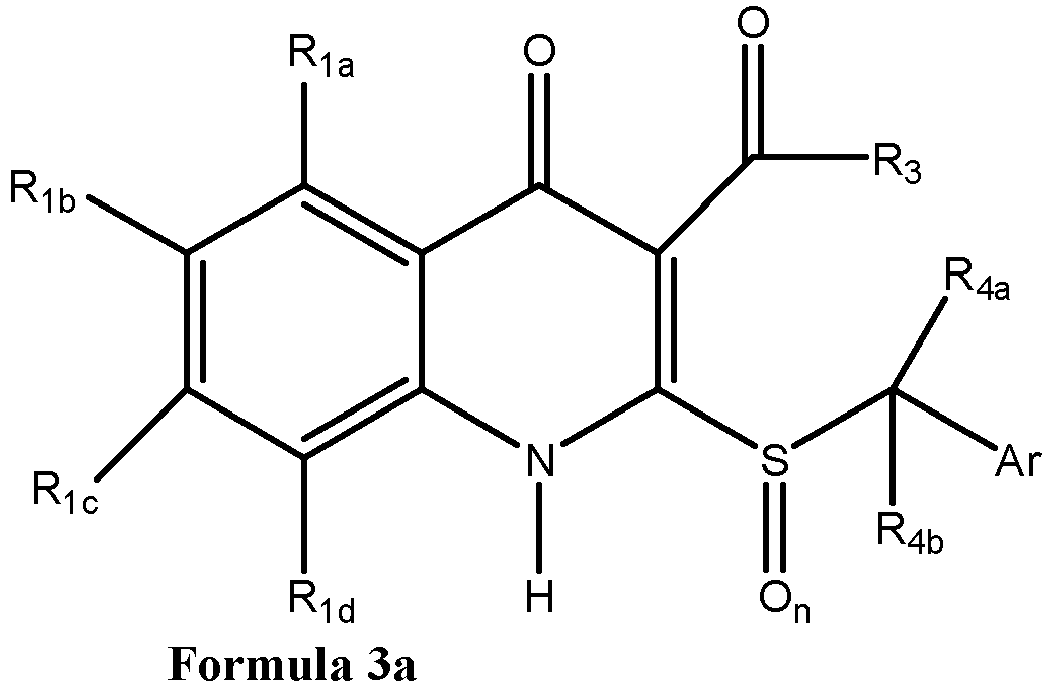

 R1a to R1d, R3, and n are as defined in Formula 1;R4a and R4b are each independently hydrogen, a halogen, C1-4 alkyl, C1-4 haloalkyl, or C1-4 alkyl in which one or more hydrogens are substituted with substituents other than halogen;Ar is phenyl, heteroaryl being 5-6-membered and having heteroatoms selected independently from N, S, or O, or biheteroaryl being 8-12-membered and having heteroatoms selected independently from N, S, or O,wherein Ar may be unsubstituted or may be optionally substituted with one or more of a halogen, C1-6 alkyl, C1-6 alkylthio, C1-6 haloalkyl, C1-6 haloalkylthio, C1-6 alkoxy, C1-6 haloalkoxy, C2-10 alkenyl, C2-10 haloalkenyl, C2-10 alkynyl, C2-10 haloalkynyl, a hydroxyl group, COOH, nitro, cyano, C1-6 alkoxycarbonyl, amino, C1-6 alkylamino, di(C1-6 alkyl)amino, amino(C1-6)alkyl, (C1-6)alkylamino(C1-6)alkyl, (C1-6)alkoxy(C1-6)alkylamino, (C1-6)alkylamino(C1-6) alkylamino, C1-6 alkanoyl, SF5, S(O)CF3, SCF3, NHC(=O)CH3, C(=O)NHCH3, NHSO2CH3, C3-7 cycloalkyl, an aryl, benzoyl, a heterocycle, a heteroaryl, phenyl, oxazole, pyrazole, pyrrole, imidazole, thiazole, thiophene, pyridine, pyrimidine, furan, indole, benzopyrazole, benzothiazole, benzooxazole, isoxazole, benzoimidazole, or benzothiophene,wherein the substituents of Ar may be unsubstituted or may be optionally substituted with one or more of CF3, a halogen, (C1-3)alkyl, (C1-3)haloalkyl, hydrogen, COOH, nitro, cyano, amino, di(Cl-3 alkyl)amino, NHC(=O)CH3, or C(=O)NHCH3.
 - The compounds according to claim 4, wherein any one or more of R1a to R1d are halogens, R3 is C1-4 alkyl, isoalkyl, cycloalkyl, phenyl, or C1-4 haloalkyl, and R4a and R4b are C1-4 alkyl, a halogen, or C1-4 cycloalkyl.
- The compounds according to claim 1, wherein the compounds comprise:3-acetyl-8-bromo-5-chloro-2-(methylsulfinyl)quinolin-4(1H)-one,3-acetyl-8-bromo-5-chloro-2-(methylthio)quinolin-4(1H)-one,3-acetyl-2-(benzylthio)-8-bromo-5-chloroquinolin-4(1H)-one,3-acetyl-2-(benzylsulfinyl)-8-bromo-5-chloroquinolin-4(1H)-one,3-acetyl-8-bromo-5-chloro-1-methyl-2-(methylthio)quinolin-4(1H)-one,3-acetyl-5,8-dichloro-2-(methylsulfinyl)quinolin-4(1H)-one,3-acetyl-6-fluoro-1-methyl-2-(methylthio)quinolin-4(1H)-one,1-(6-fluoro-4-hydroxy-2-(methylthio-one,3-acetyl-8-bromo-1-(4-bromobenzoyl)-5-chloro-2-(methylsulfinyl)quinolin-4(1H)-one,3-acetyl-8-bromo-5-chloro-2-((4-chlorobenzyl)thio)quinolin-4(1H)-one,3-acetyl-8-bromo-5-chloro-2-((4-chlorobenzyl)sulfinyl)quinolin-4(1H)-one,3-acetyl-8-bromo-5-chloro-2-(phenylthio)quinolin-4(1H)-one,3-acetyl-8-bromo-5-chloro-2-(phenylsulfinyl)quinolin-4(1H)-one,3-acetyl-8-bromo-5-chloro-2-((2-methoxyphenyl)thio)quinolin-4(1H)-one,3-acetyl-8-bromo-5-chloro-2-((2-methoxyphenyl)sulfinyl)quinolin-4(1H)-one,3-acetyl-8-bromo-2-((4-bromophenyl)thio)-5-chloroquinolin-4(1H)-one,3-acetyl-8-bromo-2-((4-bromophenyl)sulfinyl)-5-chloroquinolin-4(1H)-one,1,1'-(8-bromo-5-chloro-2-(methylthio)-4-oxoquinoline-1,3(4H)-diyl)bis(ethan-1-one),1,1'-(8-bromo-5-chloro-2-(methylsulfinyl)-4-oxoquinoline-1,3(4H)-diyl)bis(ethan-1-one),3-acetyl-2-(benzylsulfinyl)-8-bromo-1-(4-bromobenzoyl)-5-chloroquinolin-4(1H)-one,3-acetyl-8-bromo-1-(4-bromobenzoyl)-5-chloro-2-(methylsulfonyl)quinolin-4(1H)-one,3-acetyl-8-bromo-5-chloro-1-(3-chloro-4-fluorobenzyl)-2-(methylsulfinyl)quinolin-4(1H)-one,3-acetyl-2-(benzylthio)-8-bromo-1-(4-bromobenzoyl)-5-chloroquinolin-4(1H)-one,3-acetyl-8-bromo-5-chloro-2-(isopropylthio)quinolin-4(1H)-one,3 -acetyl-8-bromo-5-chloro-2-(isopropylsulfinyl)quinolin-4(1H)-one,3-acetyl-8-bromo-5-chloro-2-((1-phenylethyl)sulfinyl)quinolin-4(1H)-one,3-(((3-acetyl-8-bromo-5-chloro-4-oxo-1,4-dihydroquinolin-2-yl)thio)methyl)benzonitrile,3-(((3-acetyl-8-bromo-5-chloro-4-oxo-1,4-dihydroquinolin-2-yl)sulfinyl)methyl)benzonitrile,3-acetyl-8-bromo-5-chloro-2-((2,4-difluorobenzyl)sulfinyl)quinolin-4(1H)-one,3-acetyl-8-bromo-5-chloro-2-((3-chloro-4-fluorobenzyl)thio)quinolin-4(1H)-one,3-acetyl-8-bromo-5-chloro-2-((3-chloro-4-fluorobenzyl)sulfinyl)quinolin-4(1H)-one,3-acetyl-8-bromo-5-chloro-2-((4-nitrobenzyl)thio)quinolin-4(1H)-one,3-acetyl-8-bromo-5-chloro-2-((4-nitrobenzyl)sulfinyl)quinolin-4(1H)-one,3-acetyl-2-(benzylsulfonyl)-8-bromo-5-chloroquinolin-4(1H)-one,3-acetyl-8-bromo-5-chloro-1-(methylsulfonyl)-2-(methylthio)quinolin-4(1H)-one,3-acetyl-8-bromo-5-chloro-2-(methylsulfinyl)-1-((trifluoromethyl)sulfonyl)quinolin-4(1H)-one,3-acetyl-8-bromo-5-chloro-1-((4-chlorophenyl)sulfonyl)-2-(methylthio)quinolin-4(1H)-one,3-acetyl-8-bromo-5-chloro-2-(methylthio)-1-((4-nitrophenyl)sulfonyl)quinolin-4(1H)-one,3-acetyl-8-bromo-5-chloro-1-(ethylsulfonyl)-2-(methylsulfinyl)quinolin-4(1H)-one,3-acetyl-8-bromo-1-((4-(tert-butyl)phenyl)sulfonyl)-5-chloro-2-(methylthio)quinolin-4(1H)-one,3-acetyl-8-bromo-1-((4-(tert-butyl)phenyl)sulfonyl)-5-chloro-2-(methylsulfonyl)quinolin-4(1H)-one,3-acetyl-8-bromo-1-((4-(tert-butyl)phenyl)sulfonyl)-5-chloro-2-(methylsulfinyl)quinolin-4(1H)-one,3-acetyl-8-bromo-5-chloro-2-((2,5-dichlorobenzyl)thio)quinolin-4(1H)-one,3-acetyl-8-bromo-5-chloro-2-((2,5-dichlorobenzyl)sulfinyl)quinolin-4(1H)-one,3-acetyl-8-bromo-5-chloro-2-((3,5-difluorobenzyl)thio)quinolin-4(1H)-one,3-acetyl-8-bromo-5-chloro-2-((3,5-difluorobenzyl)sulfinyl)quinolin-4(1H)-one, 3-acetyl-8-bromo-5-chloro-2-((3-iodobenzyl)thio)quinolin-4(1H)-one,3-acetyl-8-bromo-5-chloro-2-((3-iodobenzyl)sulfinyl)quinolin-4(1H)-one,3-acetyl-8-bromo-5-chloro-2-((3-fluorobenzyl)thio)quinolin-4(1H)-one,3-acetyl-8-bromo-5-chloro-2-((3-fluorobenzyl)sulfinyl)quinolin-4(1H)-one,3-acetyl-8-bromo-5-chloro-2-(((5-methylisoxazol-3-yl)methyl)sulfinyl)quinolin-4(1H)-one,1-(2-(benzylthio)-8-bromo-5-chloro-4-hydroxyquinolin-3-yl)ethan-1-one,1-(2-(benzylsulfinyl)-8-bromo-5-chloro-4-hydroxyquinolin-3-yl)ethan-1-one,1-(2-(benzylsulfonyl)-8-bromo-5-chloro-4-hydroxyquinolin-3-yl)ethan-1-one,3-acetyl-8-bromo-5-chloro-2-((3-methoxybenzyl)sulfinyl)quinolin-4(1H)-one,3-acetyl-8-bromo-5-chloro-2-((4-((trifluoromethyl)thio)benzyl)sulfinyl)quinolin-4(1H)-one,3-acetyl-5,8-dichloro-2-((4-nitrobenzyl)sulfinyl)quinolin-4(1H)-one,2-(((3-acetyl-8-bromo-5-chloro-4-oxo-1,4-dihydroquinolin-2-yl)sulfinyl)methyl)benzonitrile,3-acetyl-8-bromo-5-chloro-2-((3,5-dimethoxybenzyl)sulfinyl)quinolin-4(1H)-one,3-acetyl-8-bromo-2-((4-(tert-butyl)benzyl)sulfinyl)-5-chloroquinolin-4(1H)-one,3-acetyl-8-bromo-5-chloro-2-((methoxymethyl)thio)quinolin-4(1H)-one,3-acetyl-8-bromo-5-chloro-2-mercaptoquinolin-4(1H)-one,3-acetyl-2-((4-benzoylbenzyl)sulfinyl)-8-bromo-5-chloroquinolin-4(1H)-one,3-acetyl-8-bromo-5-chloro-2-((4-((trifluoromethyl)sulfinyl)benzyl)sulfinyl)quinolin-4(1H)-one,2-((3-acetyl-8-bromo-5-chloro-4-oxo-1,4-dihydroquinolin-2-yl)sulfinyl)acetonitrile,2-((3-acetyl-8-bromo-5-chloro-4-oxo-1,4-dihydroquinolin-2-yl)thio)acetonitrile,(Z)-3-((3-acetyl-8-bromo-5-chloro-4-oxo-1,4-dihydroquinolin-2-yl)thio)acrylic acid,3-acetyl-8-bromo-5-chloro-2-((4-(pentafluoro-16-sulfanyl)benzyl)sulfinyl)quinolin-4(1H)-one,3-acetyl-8-bromo-5-chloro-2-((2-fluoro-4-(pentafluoro-16-sulfanyl)benzyl)sulfinyl)quinolin-4(1H)-one,3-acetyl-8-bromo-5-chloro-2-((4-(trifluoromethyl)benzyl)sulfinyl)quinolin-4(1H)-one,3-acetyl-8-bromo-5-chloro-2-((4-(trifluoromethoxy)benzyl)sulfinyl)quinolin-4(1H)-one,3-acetyl-8-bromo-5-chloro-2-(((5-(trifluoromethyl)furan-2-yl)methyl)sulfinyl)quinolin-4(1H)-one,4-(((3-acetyl-8-bromo-5-chloro-4-oxo-1,4-dihydroquinolin-2-yl)sulfinyl)methyl)benzonitrile,3-acetyl-8-bromo-5-chloro-2-((2-chloro-6-fluorobenzyl)sulfinyl)quinolin-4(1H)-one,3-acetyl-8-bromo-5-chloro-2-((2-methoxy-4-(pentafluoro-16-sulfanyl)benzyl)sulfinyl)quinolin-4(1H)-one,3-acetyl-8-bromo-5-chloro-2-((3-fluoro-5-(pentafluoro-16-sulfanyl)benzyl)sulfinyl)quinolin-4(1H)-one,3-acetyl-8-bromo-5-chloro-2-((3-(pentafluoro-16-sulfanyl)benzyl)sulfinyl)quinolin-4(1H)-one,3-acetyl-8-bromo-5-chloro-2-(((perfluorophenyl)methyl)sulfinyl)quinolin-4(1H)-one,3-acetyl-5,8-dichloro-2-((4-((trifluoromethyl)thio)benzyl)sulfinyl)quinolin-4(1H)-one,3-acetyl-5,8-difluoro-2-((4-(pentafluoro-l6-sulfanyl)benzyl)sulfinyl)quinolin-4(1H)-one,3-acetyl-5,8-difluoro-2-(((5-(trifluoromethyl)furan-2-yl)methyl)sulfinyl)quinolin-4(1H)-one,3-acetyl-5,8-difluoro-2-(((5-methylisoxazol-3-yl)methyl)sulfinyl)quinolin-4(1H)-one,3-acetyl-5,8-dichloro-2-((4-iodobenzyl)sulfinyl)quinolin-4(1H)-one,3-acetyl-8-bromo-5-chloro-2-((pyridin-3-ylmethyl)sulfinyl)quinolin-4(1H)-one,5,8-difluoro-3-isobutyryl-2-((4-((trifluoromethyl)thio)benzyl)sulfinyl)quinolin-4(1H)-one,5,8-dichloro-3-isobutyryl-2-(((5-methylisoxazol-3-yl)methyl)sulfinyl)quinolin-4(1H)-one,3-benzoyl-5,8-difluoro-2-((4-(pentafluoro-16-sulfanyl)benzyl)sulfinyl)quinolin-4(1H)-one,3-benzoyl-5,8-dichloro-2-(((5-methylisoxazol-3-yl)methyl)sulfinyl)quinolin-4(1H)-one, methyl 5-(((3-acetyl-5,8-dichloro-4-oxo-1,4-dihydroquinolin-2-yl)sulfinyl)methyl)furan-2-carboxylate,2-(((3-acetyl-5,8-dichloro-4-oxo-1,4-dihydroquinolin-2-yl)sulfinyl)methyl)isoindoline-1,3-dione, methyl 4-(((3-acetyl-5,8-dichloro-4-oxo-1,4-dihydroquinolin-2-yl)sulfinyl)methyl)benzoate,3-acetyl-5-methoxy-2-((4-(pentafluoro-l6-sulfanyl)benzyl)thio)quinolin-4(1H)-one,3-acetyl-5-methoxy-2-((4-(pentafluoro-16-sulfanyl)benzyl)sulfinyl)quinolin-4(1H)-one,3-acetyl-5-methoxy-2-(((5-methylisoxazol-3-yl)methyl)sulfinyl)quinolin-4(1H)-one,8-bromo-5-chloro-3-isobutyryl-2-(((5-methylisoxazol-3-yl)methyl)sulfinyl)quinolin-4(1H)-one,8-bromo-5-chloro-3-(cyclopropanecarbonyl)-2-(((5-methylisoxazol-3-yl)methyl)sulfinyl)quinolin-4(1H)-one,5,8-dichloro-3-(cyclopropanecarbonyl)-2-(((5-methylisoxazol-3-yl)methyl)sulfinyl)quinolin-4(1H)-one,5-(((3-acetyl-8-bromo-5-chloro-4-oxo-1,4-dihydroquinolin-2-yl)sulfinyl)methyl)thiophene-2-carbonitrile,2-(((6-(1H-pyrazol-1-yl)pyridin-3-yl)methyl)sulfinyl)-3-acetyl-8-bromo-5-chloroquinolin-4(1H)-one,3-acetyl-2-(((6-aminopyridin-3-yl)methyl)sulfinyl)-8-bromo-5-chloroquinolin-4(1H)-one,8-bromo-5-chloro-3-(cyclopropanecarbonyl)-2-((4-((trifluoromethyl)thio)benzyl)sulfinyl)quinolin-4(1H)-one,3-acetyl-8-bromo-5-chloro-2-(((2-methyl-6-(trifluoromethyl)pyridin-3-yl)methyl)sulfinyl)quinolin-4(1H)-one,N-(4-(((3-acetyl-8-bromo-5-chloro-4-oxo-1,4-dihydroquinolin-2-yl)sulfinyl)methyl)phenyl)methanesulfonamide,3-acetyl-8-bromo-5-chloro-2-(((6-chloropyridin-3-yl)methyl)sulfinyl)quinolin-4(1H)-one,3-acetyl-8-bromo-5-chloro-2-(((6-((2-methoxyethyl)amino)pyridin-3-yl)methyl)sulfinyl)quinolin-4(1H)-one,3-acetyl-8-bromo-5-chloro-2-(((4-methyl-1,2,5-oxadiazol-3-yl)methyl)sulfinyl)quinolin-4(1H)-one,2-(((1H-pyrrolo[2,3-b]pyridin-5-yl)methyl)sulfinyl)-3-acetyl-8-bromo-5-chloroquinolin-4(1H)-one,
or pharmaceutically acceptable salts thereof. - A composition comprising compounds according to any one claim of claims 1 to 6 or pharmaceutically acceptable salts thereof, and a pharmaceutically acceptable carrier.
Applications Claiming Priority (3)
| Application Number | Priority Date | Filing Date | Title |
|---|---|---|---|
| KR20160097429 | 2016-07-29 | ||
| KR1020170093661A KR101879992B1 (en) | 2016-07-29 | 2017-07-24 | Compounds inhibiting formation of c-Myc/Max/DNA complex |
| PCT/KR2017/008020 WO2018021810A1 (en) | 2016-07-29 | 2017-07-25 | Compound inhibiting formation of c-myc/max/dna complex |
Publications (3)
| Publication Number | Publication Date |
|---|---|
| EP3495350A1 true EP3495350A1 (en) | 2019-06-12 |
| EP3495350A4 EP3495350A4 (en) | 2020-01-08 |
| EP3495350B1 EP3495350B1 (en) | 2021-10-20 |
Family
ID=61203724
Family Applications (1)
| Application Number | Title | Priority Date | Filing Date |
|---|---|---|---|
| EP17834751.4A Active EP3495350B1 (en) | 2016-07-29 | 2017-07-25 | Compound inhibiting formation of c-myc/max/dna complex |
Country Status (8)
| Country | Link |
|---|---|
| EP (1) | EP3495350B1 (en) |
| KR (1) | KR101879992B1 (en) |
| CN (1) | CN109715607B (en) |
| AU (1) | AU2017304434B2 (en) |
| BR (1) | BR112019001805A2 (en) |
| CA (1) | CA3032270C (en) |
| MX (1) | MX387349B (en) |
| RU (1) | RU2727177C1 (en) |
Families Citing this family (2)
| Publication number | Priority date | Publication date | Assignee | Title |
|---|---|---|---|---|
| KR102532517B1 (en) * | 2021-02-05 | 2023-05-15 | 한국화학연구원 | Novel sulfonamide compound and Pharmaceutical Composition for Treating or Preventing Cancer comprising the same as an active ingredient |
| WO2025121962A1 (en) * | 2023-12-08 | 2025-06-12 | 주식회사 인큐릭스 | Novel quinoline derivative having inhibitory activity against c-myc transcription factor protein |
Family Cites Families (10)
| Publication number | Priority date | Publication date | Assignee | Title |
|---|---|---|---|---|
| SU1192617A3 (en) * | 1981-01-19 | 1985-11-15 | Дзе Бутс Компани Плс (Фирма) | Method of producing quinolones |
| FR2781218B1 (en) * | 1998-07-15 | 2001-09-07 | Lafon Labor | PHARMACEUTICAL COMPOSITIONS COMPRISING 2-QUINOLONES |
| KR100574351B1 (en) * | 2004-05-18 | 2006-04-27 | 한국화학연구원 | Agrohorticultural fungicide composition comprising 4-quinolinone derivative |
| US8106071B2 (en) * | 2007-02-21 | 2012-01-31 | Biobud Co., Ltd. | Compositions for treating hyperproliferative vascular disorders and cancers |
| KR100916160B1 (en) * | 2007-02-21 | 2009-09-08 | (주)바이오버드 | Pharmaceutical anticancer composition |
| KR101074212B1 (en) * | 2009-05-18 | 2011-10-14 | 한국화학연구원 | An insecticidal composition comprising 4-quinolinone derivative compound for tree insecticide and the method for killing the insect using thereby |
| WO2012093741A1 (en) * | 2011-01-04 | 2012-07-12 | 국립암센터 | Leukaemia-treatment pharmaceutical composition |
| EP2917203B1 (en) | 2012-11-02 | 2019-04-03 | Dana-Farber Cancer Institute, Inc. | Method for identifying myc inhibitors |
| WO2015089180A1 (en) | 2013-12-11 | 2015-06-18 | The Scripps Research Institute | Small molecule c-myc inhibitors |
| KR20150083353A (en) * | 2014-01-09 | 2015-07-17 | 국립암센터 | Pharmaceutical composition for prevention or treatment of bladder tumor via intravesical instillation |
-
2017
- 2017-07-24 KR KR1020170093661A patent/KR101879992B1/en active Active
- 2017-07-25 EP EP17834751.4A patent/EP3495350B1/en active Active
- 2017-07-25 BR BR112019001805-0A patent/BR112019001805A2/en active Search and Examination
- 2017-07-25 CA CA3032270A patent/CA3032270C/en active Active
- 2017-07-25 CN CN201780047162.2A patent/CN109715607B/en active Active
- 2017-07-25 MX MX2019001202A patent/MX387349B/en unknown
- 2017-07-25 AU AU2017304434A patent/AU2017304434B2/en not_active Ceased
- 2017-07-25 RU RU2019105499A patent/RU2727177C1/en active
Also Published As
| Publication number | Publication date |
|---|---|
| KR20180013739A (en) | 2018-02-07 |
| CN109715607B (en) | 2022-07-12 |
| MX387349B (en) | 2025-03-18 |
| AU2017304434B2 (en) | 2020-07-09 |
| EP3495350A4 (en) | 2020-01-08 |
| MX2019001202A (en) | 2019-09-04 |
| CA3032270C (en) | 2021-02-16 |
| KR101879992B1 (en) | 2018-07-19 |
| BR112019001805A2 (en) | 2019-05-07 |
| CA3032270A1 (en) | 2018-02-01 |
| RU2727177C1 (en) | 2020-07-21 |
| EP3495350B1 (en) | 2021-10-20 |
| CN109715607A (en) | 2019-05-03 |
| AU2017304434A1 (en) | 2019-02-28 |
Similar Documents
| Publication | Publication Date | Title |
|---|---|---|
| TWI394749B (en) | Heteropentacycles active as kinase inhibitors | |
| EP3088397B1 (en) | Compounds that abrogate the cell cycle g2 checkpoint for use in the treatment of cancer | |
| KR20190120766A (en) | Compounds containing O-aminoheteroarylalkynyl groups and methods for preparing the same | |
| EP3653620B1 (en) | New heteroaryl amide derivatives as selective inhibitors of histone deacetylases 1 and 2 (hdac1-2) | |
| WO2013078771A1 (en) | Poly (adp-ribose) polymerase inhibitor | |
| CN107176933B (en) | Indoleamine-2,3-dioxygenase inhibitor of nitrogen-containing alkylated and arylated sulfoximines | |
| JP7148650B2 (en) | Compounds, compositions and their use in drug manufacturing | |
| EP3344613B1 (en) | Heteroaryl compounds and their use as therapeutic drugs | |
| JP2017534653A (en) | Methods and compositions for inhibition of bromodomains and extra terminal proteins | |
| US10227306B2 (en) | Compounds for inhibiting c-myc/max/DNA complex formation | |
| JP2017517555A (en) | Compounds containing the 1,1 ', 2,5'-tetrahydrospiro [indole-3,2'-pyrrole] -2,5'-dione system as inhibitor p53-Mdm2 protein-protein interaction | |
| CN114008028A (en) | Pyrimidine derivative for inhibiting growth of cancer cells and medical application thereof | |
| EP3495350B1 (en) | Compound inhibiting formation of c-myc/max/dna complex | |
| CN110325508A (en) | The inhibitor of the N- terminal domains of androgen receptor | |
| AU2017304546B2 (en) | Anticancer pharmaceutical composition | |
| WO2018021849A1 (en) | Anticancer pharmaceutical composition | |
| WO2024114765A1 (en) | Benzopyrone compounds as well as preparation method therefor and use thereof | |
| JP2015117182A (en) | Anticancer agent |
Legal Events
| Date | Code | Title | Description |
|---|---|---|---|
| STAA | Information on the status of an ep patent application or granted ep patent |
Free format text: STATUS: THE INTERNATIONAL PUBLICATION HAS BEEN MADE |
|
| PUAI | Public reference made under article 153(3) epc to a published international application that has entered the european phase |
Free format text: ORIGINAL CODE: 0009012 |
|
| STAA | Information on the status of an ep patent application or granted ep patent |
Free format text: STATUS: REQUEST FOR EXAMINATION WAS MADE |
|
| 17P | Request for examination filed |
Effective date: 20190204 |
|
| AK | Designated contracting states |
Kind code of ref document: A1 Designated state(s): AL AT BE BG CH CY CZ DE DK EE ES FI FR GB GR HR HU IE IS IT LI LT LU LV MC MK MT NL NO PL PT RO RS SE SI SK SM TR |
|
| AX | Request for extension of the european patent |
Extension state: BA ME |
|
| DAV | Request for validation of the european patent (deleted) | ||
| DAX | Request for extension of the european patent (deleted) | ||
| A4 | Supplementary search report drawn up and despatched |
Effective date: 20191205 |
|
| RIC1 | Information provided on ipc code assigned before grant |
Ipc: A61K 31/47 20060101ALI20191130BHEP Ipc: C07D 215/36 20060101AFI20191130BHEP Ipc: A61P 35/00 20060101ALI20191130BHEP |
|
| STAA | Information on the status of an ep patent application or granted ep patent |
Free format text: STATUS: EXAMINATION IS IN PROGRESS |
|
| 17Q | First examination report despatched |
Effective date: 20200817 |
|
| GRAP | Despatch of communication of intention to grant a patent |
Free format text: ORIGINAL CODE: EPIDOSNIGR1 |
|
| STAA | Information on the status of an ep patent application or granted ep patent |
Free format text: STATUS: GRANT OF PATENT IS INTENDED |
|
| INTG | Intention to grant announced |
Effective date: 20210512 |
|
| GRAS | Grant fee paid |
Free format text: ORIGINAL CODE: EPIDOSNIGR3 |
|
| GRAA | (expected) grant |
Free format text: ORIGINAL CODE: 0009210 |
|
| STAA | Information on the status of an ep patent application or granted ep patent |
Free format text: STATUS: THE PATENT HAS BEEN GRANTED |
|
| AK | Designated contracting states |
Kind code of ref document: B1 Designated state(s): AL AT BE BG CH CY CZ DE DK EE ES FI FR GB GR HR HU IE IS IT LI LT LU LV MC MK MT NL NO PL PT RO RS SE SI SK SM TR |
|
| REG | Reference to a national code |
Ref country code: GB Ref legal event code: FG4D |
|
| REG | Reference to a national code |
Ref country code: CH Ref legal event code: EP |
|
| REG | Reference to a national code |
Ref country code: IE Ref legal event code: FG4D |
|
| REG | Reference to a national code |
Ref country code: DE Ref legal event code: R096 Ref document number: 602017048028 Country of ref document: DE |
|
| REG | Reference to a national code |
Ref country code: AT Ref legal event code: REF Ref document number: 1439841 Country of ref document: AT Kind code of ref document: T Effective date: 20211115 |
|
| REG | Reference to a national code |
Ref country code: DK Ref legal event code: T3 Effective date: 20211206 |
|
| REG | Reference to a national code |
Ref country code: SE Ref legal event code: TRGR |
|
| REG | Reference to a national code |
Ref country code: NL Ref legal event code: FP |
|
| REG | Reference to a national code |
Ref country code: LT Ref legal event code: MG9D |
|
| REG | Reference to a national code |
Ref country code: ES Ref legal event code: FG2A Ref document number: 2899988 Country of ref document: ES Kind code of ref document: T3 Effective date: 20220315 Ref country code: AT Ref legal event code: MK05 Ref document number: 1439841 Country of ref document: AT Kind code of ref document: T Effective date: 20211020 |
|
| PG25 | Lapsed in a contracting state [announced via postgrant information from national office to epo] |
Ref country code: RS Free format text: LAPSE BECAUSE OF FAILURE TO SUBMIT A TRANSLATION OF THE DESCRIPTION OR TO PAY THE FEE WITHIN THE PRESCRIBED TIME-LIMIT Effective date: 20211020 Ref country code: LT Free format text: LAPSE BECAUSE OF FAILURE TO SUBMIT A TRANSLATION OF THE DESCRIPTION OR TO PAY THE FEE WITHIN THE PRESCRIBED TIME-LIMIT Effective date: 20211020 Ref country code: FI Free format text: LAPSE BECAUSE OF FAILURE TO SUBMIT A TRANSLATION OF THE DESCRIPTION OR TO PAY THE FEE WITHIN THE PRESCRIBED TIME-LIMIT Effective date: 20211020 Ref country code: BG Free format text: LAPSE BECAUSE OF FAILURE TO SUBMIT A TRANSLATION OF THE DESCRIPTION OR TO PAY THE FEE WITHIN THE PRESCRIBED TIME-LIMIT Effective date: 20220120 Ref country code: AT Free format text: LAPSE BECAUSE OF FAILURE TO SUBMIT A TRANSLATION OF THE DESCRIPTION OR TO PAY THE FEE WITHIN THE PRESCRIBED TIME-LIMIT Effective date: 20211020 |
|
| PG25 | Lapsed in a contracting state [announced via postgrant information from national office to epo] |
Ref country code: IS Free format text: LAPSE BECAUSE OF FAILURE TO SUBMIT A TRANSLATION OF THE DESCRIPTION OR TO PAY THE FEE WITHIN THE PRESCRIBED TIME-LIMIT Effective date: 20220220 Ref country code: PT Free format text: LAPSE BECAUSE OF FAILURE TO SUBMIT A TRANSLATION OF THE DESCRIPTION OR TO PAY THE FEE WITHIN THE PRESCRIBED TIME-LIMIT Effective date: 20220221 Ref country code: PL Free format text: LAPSE BECAUSE OF FAILURE TO SUBMIT A TRANSLATION OF THE DESCRIPTION OR TO PAY THE FEE WITHIN THE PRESCRIBED TIME-LIMIT Effective date: 20211020 Ref country code: NO Free format text: LAPSE BECAUSE OF FAILURE TO SUBMIT A TRANSLATION OF THE DESCRIPTION OR TO PAY THE FEE WITHIN THE PRESCRIBED TIME-LIMIT Effective date: 20220120 Ref country code: LV Free format text: LAPSE BECAUSE OF FAILURE TO SUBMIT A TRANSLATION OF THE DESCRIPTION OR TO PAY THE FEE WITHIN THE PRESCRIBED TIME-LIMIT Effective date: 20211020 Ref country code: HR Free format text: LAPSE BECAUSE OF FAILURE TO SUBMIT A TRANSLATION OF THE DESCRIPTION OR TO PAY THE FEE WITHIN THE PRESCRIBED TIME-LIMIT Effective date: 20211020 Ref country code: GR Free format text: LAPSE BECAUSE OF FAILURE TO SUBMIT A TRANSLATION OF THE DESCRIPTION OR TO PAY THE FEE WITHIN THE PRESCRIBED TIME-LIMIT Effective date: 20220121 |
|
| REG | Reference to a national code |
Ref country code: DE Ref legal event code: R097 Ref document number: 602017048028 Country of ref document: DE |
|
| PG25 | Lapsed in a contracting state [announced via postgrant information from national office to epo] |
Ref country code: SM Free format text: LAPSE BECAUSE OF FAILURE TO SUBMIT A TRANSLATION OF THE DESCRIPTION OR TO PAY THE FEE WITHIN THE PRESCRIBED TIME-LIMIT Effective date: 20211020 Ref country code: SK Free format text: LAPSE BECAUSE OF FAILURE TO SUBMIT A TRANSLATION OF THE DESCRIPTION OR TO PAY THE FEE WITHIN THE PRESCRIBED TIME-LIMIT Effective date: 20211020 Ref country code: RO Free format text: LAPSE BECAUSE OF FAILURE TO SUBMIT A TRANSLATION OF THE DESCRIPTION OR TO PAY THE FEE WITHIN THE PRESCRIBED TIME-LIMIT Effective date: 20211020 Ref country code: EE Free format text: LAPSE BECAUSE OF FAILURE TO SUBMIT A TRANSLATION OF THE DESCRIPTION OR TO PAY THE FEE WITHIN THE PRESCRIBED TIME-LIMIT Effective date: 20211020 Ref country code: CZ Free format text: LAPSE BECAUSE OF FAILURE TO SUBMIT A TRANSLATION OF THE DESCRIPTION OR TO PAY THE FEE WITHIN THE PRESCRIBED TIME-LIMIT Effective date: 20211020 |
|
| PLBE | No opposition filed within time limit |
Free format text: ORIGINAL CODE: 0009261 |
|
| STAA | Information on the status of an ep patent application or granted ep patent |
Free format text: STATUS: NO OPPOSITION FILED WITHIN TIME LIMIT |
|
| 26N | No opposition filed |
Effective date: 20220721 |
|
| PG25 | Lapsed in a contracting state [announced via postgrant information from national office to epo] |
Ref country code: AL Free format text: LAPSE BECAUSE OF FAILURE TO SUBMIT A TRANSLATION OF THE DESCRIPTION OR TO PAY THE FEE WITHIN THE PRESCRIBED TIME-LIMIT Effective date: 20211020 |
|
| PG25 | Lapsed in a contracting state [announced via postgrant information from national office to epo] |
Ref country code: SI Free format text: LAPSE BECAUSE OF FAILURE TO SUBMIT A TRANSLATION OF THE DESCRIPTION OR TO PAY THE FEE WITHIN THE PRESCRIBED TIME-LIMIT Effective date: 20211020 |
|
| PG25 | Lapsed in a contracting state [announced via postgrant information from national office to epo] |
Ref country code: MC Free format text: LAPSE BECAUSE OF FAILURE TO SUBMIT A TRANSLATION OF THE DESCRIPTION OR TO PAY THE FEE WITHIN THE PRESCRIBED TIME-LIMIT Effective date: 20211020 |
|
| REG | Reference to a national code |
Ref country code: BE Ref legal event code: MM Effective date: 20220731 |
|
| PG25 | Lapsed in a contracting state [announced via postgrant information from national office to epo] |
Ref country code: LU Free format text: LAPSE BECAUSE OF NON-PAYMENT OF DUE FEES Effective date: 20220725 |
|
| PG25 | Lapsed in a contracting state [announced via postgrant information from national office to epo] |
Ref country code: BE Free format text: LAPSE BECAUSE OF NON-PAYMENT OF DUE FEES Effective date: 20220731 |
|
| PG25 | Lapsed in a contracting state [announced via postgrant information from national office to epo] |
Ref country code: IE Free format text: LAPSE BECAUSE OF NON-PAYMENT OF DUE FEES Effective date: 20220725 |
|
| PG25 | Lapsed in a contracting state [announced via postgrant information from national office to epo] |
Ref country code: HU Free format text: LAPSE BECAUSE OF FAILURE TO SUBMIT A TRANSLATION OF THE DESCRIPTION OR TO PAY THE FEE WITHIN THE PRESCRIBED TIME-LIMIT; INVALID AB INITIO Effective date: 20170725 |
|
| PG25 | Lapsed in a contracting state [announced via postgrant information from national office to epo] |
Ref country code: MK Free format text: LAPSE BECAUSE OF FAILURE TO SUBMIT A TRANSLATION OF THE DESCRIPTION OR TO PAY THE FEE WITHIN THE PRESCRIBED TIME-LIMIT Effective date: 20211020 Ref country code: CY Free format text: LAPSE BECAUSE OF FAILURE TO SUBMIT A TRANSLATION OF THE DESCRIPTION OR TO PAY THE FEE WITHIN THE PRESCRIBED TIME-LIMIT Effective date: 20211020 |
|
| PGFP | Annual fee paid to national office [announced via postgrant information from national office to epo] |
Ref country code: NL Payment date: 20240723 Year of fee payment: 8 |
|
| PG25 | Lapsed in a contracting state [announced via postgrant information from national office to epo] |
Ref country code: MT Free format text: LAPSE BECAUSE OF FAILURE TO SUBMIT A TRANSLATION OF THE DESCRIPTION OR TO PAY THE FEE WITHIN THE PRESCRIBED TIME-LIMIT Effective date: 20211020 |
|
| PGFP | Annual fee paid to national office [announced via postgrant information from national office to epo] |
Ref country code: DK Payment date: 20240723 Year of fee payment: 8 |
|
| PGFP | Annual fee paid to national office [announced via postgrant information from national office to epo] |
Ref country code: FR Payment date: 20240724 Year of fee payment: 8 |
|
| PGFP | Annual fee paid to national office [announced via postgrant information from national office to epo] |
Ref country code: ES Payment date: 20240807 Year of fee payment: 8 |
|
| PGFP | Annual fee paid to national office [announced via postgrant information from national office to epo] |
Ref country code: IT Payment date: 20240730 Year of fee payment: 8 Ref country code: SE Payment date: 20240731 Year of fee payment: 8 |
|
| PGFP | Annual fee paid to national office [announced via postgrant information from national office to epo] |
Ref country code: TR Payment date: 20240725 Year of fee payment: 8 |
|
| REG | Reference to a national code |
Ref country code: CH Ref legal event code: U11 Free format text: ST27 STATUS EVENT CODE: U-0-0-U10-U11 (AS PROVIDED BY THE NATIONAL OFFICE) Effective date: 20260122 |
|
| REG | Reference to a national code |
Ref country code: DK Ref legal event code: EBP Effective date: 20250731 |
|
| REG | Reference to a national code |
Ref country code: NL Ref legal event code: MM Effective date: 20250801 |
|
| PGFP | Annual fee paid to national office [announced via postgrant information from national office to epo] |
Ref country code: GB Payment date: 20260120 Year of fee payment: 9 |
|
| PGFP | Annual fee paid to national office [announced via postgrant information from national office to epo] |
Ref country code: DE Payment date: 20260129 Year of fee payment: 9 |
|
| PG25 | Lapsed in a contracting state [announced via postgrant information from national office to epo] |
Ref country code: NL Free format text: LAPSE BECAUSE OF NON-PAYMENT OF DUE FEES Effective date: 20250801 |
|
| PG25 | Lapsed in a contracting state [announced via postgrant information from national office to epo] |
Ref country code: FR Free format text: LAPSE BECAUSE OF NON-PAYMENT OF DUE FEES Effective date: 20250731 |
|
| PGFP | Annual fee paid to national office [announced via postgrant information from national office to epo] |
Ref country code: CH Payment date: 20260122 Year of fee payment: 9 |