EP3493555B1 - Hearing device and method for tuning hearing device parameters - Google Patents
Hearing device and method for tuning hearing device parameters Download PDFInfo
- Publication number
- EP3493555B1 EP3493555B1 EP17204326.7A EP17204326A EP3493555B1 EP 3493555 B1 EP3493555 B1 EP 3493555B1 EP 17204326 A EP17204326 A EP 17204326A EP 3493555 B1 EP3493555 B1 EP 3493555B1
- Authority
- EP
- European Patent Office
- Prior art keywords
- test setting
- hearing device
- setting
- primary
- test
- Prior art date
- Legal status (The legal status is an assumption and is not a legal conclusion. Google has not performed a legal analysis and makes no representation as to the accuracy of the status listed.)
- Active
Links
Images



Classifications
-
- H—ELECTRICITY
- H04—ELECTRIC COMMUNICATION TECHNIQUE
- H04R—LOUDSPEAKERS, MICROPHONES, GRAMOPHONE PICK-UPS OR LIKE ACOUSTIC ELECTROMECHANICAL TRANSDUCERS; ELECTRIC HEARING AIDS; PUBLIC ADDRESS SYSTEMS
- H04R25/00—Electric hearing aids
- H04R25/70—Adaptation of deaf aid to hearing loss, e.g. initial electronic fitting
-
- H—ELECTRICITY
- H04—ELECTRIC COMMUNICATION TECHNIQUE
- H04R—LOUDSPEAKERS, MICROPHONES, GRAMOPHONE PICK-UPS OR LIKE ACOUSTIC ELECTROMECHANICAL TRANSDUCERS; ELECTRIC HEARING AIDS; PUBLIC ADDRESS SYSTEMS
- H04R25/00—Electric hearing aids
- H04R25/30—Monitoring or testing of hearing aids, e.g. functioning, settings, battery power
-
- H—ELECTRICITY
- H04—ELECTRIC COMMUNICATION TECHNIQUE
- H04R—LOUDSPEAKERS, MICROPHONES, GRAMOPHONE PICK-UPS OR LIKE ACOUSTIC ELECTROMECHANICAL TRANSDUCERS; ELECTRIC HEARING AIDS; PUBLIC ADDRESS SYSTEMS
- H04R25/00—Electric hearing aids
- H04R25/50—Customised settings for obtaining desired overall acoustical characteristics
- H04R25/505—Customised settings for obtaining desired overall acoustical characteristics using digital signal processing
-
- H—ELECTRICITY
- H04—ELECTRIC COMMUNICATION TECHNIQUE
- H04R—LOUDSPEAKERS, MICROPHONES, GRAMOPHONE PICK-UPS OR LIKE ACOUSTIC ELECTROMECHANICAL TRANSDUCERS; ELECTRIC HEARING AIDS; PUBLIC ADDRESS SYSTEMS
- H04R2225/00—Details of deaf aids covered by H04R25/00, not provided for in any of its subgroups
- H04R2225/43—Signal processing in hearing aids to enhance the speech intelligibility
-
- H—ELECTRICITY
- H04—ELECTRIC COMMUNICATION TECHNIQUE
- H04R—LOUDSPEAKERS, MICROPHONES, GRAMOPHONE PICK-UPS OR LIKE ACOUSTIC ELECTROMECHANICAL TRANSDUCERS; ELECTRIC HEARING AIDS; PUBLIC ADDRESS SYSTEMS
- H04R25/00—Electric hearing aids
- H04R25/55—Electric hearing aids using an external connection, either wireless or wired
- H04R25/558—Remote control, e.g. of amplification, frequency
Definitions
- the present disclosure relates to a hearing device and related method, in particular a method for configuring hearing device parameters.
- Hearing devices with user-selectable programs allowing the user to adjust hearing device programs/hearing device parameters to obtain a satisfactory listening experience are known.
- US 2003/0133578 relates to hearing aids and methods and apparatus for audio fitting thereof.
- Method and apparatus for audio fitting a hearing aid are described in a hand-held configuration having paired comparisons (hearing selections) stored in and derivable from a memory therein.
- the paired comparisons are presented one at a time to a user and a preferred selection for each paired comparison is made by a select indicator after the user toggles back and forth between the selections for as many times necessary in determining their preferences.
- a genetic algorithm converges all the preferences upon a single solution.
- Crossover and mutation genetic algorithm operators operate on a linear range of indexes representative of parametric values of the pairs.
- a fully integrated hearing aid having all the above described features incorporated therein is also presented.
- a hearing device comprising a set of microphones comprising a first microphone for provision of a first microphone input signal; a processor for processing input signals according to one or more hearing device parameters and providing an electrical output signal based on input signals; a user interface; and a receiver for converting the electrical output signal to an audio output signal.
- a method for tuning hearing device parameters of a hearing device comprising initializing a model comprising a parameterized objective function based on a first assumption and a second assumption on the objective function; obtaining an initial test setting defined by one or more initial test hearing device parameters; assigning the initial test setting as a primary test setting; obtaining a secondary test setting based on the model, the secondary test setting defined by one or more secondary test hearing device parameters; outputting a primary test signal according to the primary test setting; outputting a secondary test signal according to the secondary test setting; detecting a user input of a preferred test setting indicative of a preference for either the primary test setting or the secondary test setting; updating the model based on the primary test setting, the secondary test setting, and the preferred test setting; and in accordance with a determination that a tuning criterion is satisfied, updating the hearing device parameters of the hearing device based on hearing device parameters of the preferred test setting, wherein the objective function f X ⁇ , ⁇ ( X ) is given by: f
- hearing device parameters can be configured during a normal operating situation and/or with a small number of user inputs/interactions. Thus, a simple and smooth user experience of the hearing device is provided.
- the present disclosure relates to hearing systems, user accessory device and hearing device thereof, and related methods.
- the user accessory device forms an accessory device to the hearing device.
- the user accessory device is typically paired or wirelessly coupled to the hearing device.
- the hearing device may be a hearing aid, e.g. of the behind-the-ear (BTE) type, in-the-ear (ITE) type, in-the-canal (ITC) type, receiver-in-canal (RIC) type or receiver-in-the-ear (RITE) type.
- BTE behind-the-ear
- ITE in-the-ear
- ITC in-the-canal
- RIC receiver-in-canal
- RITE receiver-in-the-ear
- the hearing device system is in possession of and controlled by the hearing device user.
- the user accessory device may be a hand-held device, such as smartphone, a smartwatch, a special purpose device, or a tablet computer.
- the hearing system may comprise a server device and/or a fitting device.
- the fitting device is controlled by a dispenser and is configured to determine configuration data, such as fitting parameters.
- the server device may be controlled by the hearing device manufacturer.
- the hearing system is configured to receive and detect a user input of a preferred test setting indicative of a preference for either the primary test setting or the secondary test setting.
- the hearing system may comprise one or more user interfaces for receiving and/or detecting a user input.
- the hearing device may comprise a user interface receiving a user input.
- the user interface of the hearing device may comprise one or more buttons, an accelerometer and/or a voice control unit.
- the accessory device may comprise a user interface.
- the user interface of the accessor device may comprise a touch sensitive surface, e.g. a touch display, and/or one or more buttons.
- the user interface of the accessory device may comprise a voice control unit.
- the user interface of the hearing device may comprise one or more physical sliders, knobs and/or push buttons.
- the user interface of the accessory device may comprise one or more physical or virtual (on-screen) sliders, knobs and/or push buttons.
- a method for tuning hearing device parameters of a hearing device comprises the sequence of steps as defined in claim 1.
- the first assumption may be that the objective function is a smooth function.
- the second assumption may be that the objective function is unimodal.
- the objective function is denoted f X ⁇ , ⁇ ( X ), where X is a D -dimensional vector in the hypercube [0,1] D that represents the ( D ) hearing device parameters of the device, X ⁇ is the maximizing argument of f x ⁇ , ⁇ , and A is a scaling matrix.
- the number D of hearing device parameters may be 1 and/or less than 20, such as in the range from 2 to 15.
- the real-valued exponent p may be in the range from 0.2 to 0.8.
- the real-valued exponent p may set to 1.
- ⁇ is a real-valued parameter, which according to the invention is equal to one.
- Other examples not falling under the scope of the claimed invention comprise values of ⁇ larger than one.
- the maximizing argument X ⁇ may be constrained by one or more prior assumptions on the objective function f X ⁇ , ⁇ .
- 0,1 d x is the cumulative density function of the standard normal distribution, and ⁇ is a sample from the normal distribution with mean vector ⁇ and covariance matrix ⁇ . Values of the mean and covariances are learned from the user responses.
- the scaling matrix ⁇ has two functions. Firstly, the diagonal elements of ⁇ are scaling factors for the individual hearing device parameters, and secondly the off-diagonal values allow to model correlations between the hearing device parameters. In one or more exemplary methods/hearing devices, the correlations between the hearing device parameters are not modelled in the prior assumption ( ⁇ is diagonal).
- the scaling matrix ⁇ does not need to be a diagonal matrix.
- the method may comprise updating the primary test setting with the preferred test setting; updating the secondary test setting, e.g. based on the updated model, the secondary test setting defined by one or more secondary test hearing device parameters; outputting the primary test signal according to the primary test setting; outputting the secondary test signal according to the secondary test setting; detecting a user input of a preferred test setting indicative of a preference for either the primary test setting or the secondary test setting; and updating the model based on the primary test setting, the secondary test setting, and the preferred test setting.
- the method may comprise determining if a continue-optimization criterion is satisfied and optionally forgo outputting test signals and detecting user input of preferred test setting in accordance with the continue-optimization criterion not being satisfied (in other words in accordance with a stop criterion being satisfied).
- the continue-optimization criterion may be based on the primary test setting and the secondary test setting.
- An exemplary continue-optimization criterion may be satisfied or at least partly satisfied if the model updates seem to converge to fixed parameter settings.
- the continue-optimization criterion may be based on a count of the number of user inputs.
- An exemplary continue-optimization criterion may be satisfied or at least partly satisfies if the number of user inputs in a given optimization sequence is less than ten, such as in the range from two to eight.
- the method may comprise in accordance with the continue-optimization criterion being satisfied, repeating: updating the primary test setting with the preferred test setting; updating the secondary test setting based on the updated model, the secondary test setting defined by one or more secondary test hearing device parameters; outputting the primary test signal according to the primary test setting; outputting the secondary test signal according to the secondary test setting; detecting a user input of a preferred test setting indicative of a preference for either the primary test setting or the secondary test setting; and updating the model based on the primary test setting, the secondary test setting, and the preferred test setting.
- Obtaining an initial test setting may comprise randomly selecting a first initial test hearing device parameter of the one or more initial test hearing device parameters and/or selecting one or more current hearing device parameters as the one or more initial test hearing device parameters.
- Obtaining a secondary test setting based on the model may comprise obtaining the secondary test setting as a sampling from a posterior distribution also denoted p ( X ⁇
- the posterior distribution may be conditioned on one or more, such as all, previously obtained user input.
- the present method and hearing device allows for explicitly describing a probability distribution over the maximizing argument, i.e. p ( X ⁇
- Detecting a user input of a preferred test setting indicative of a preference for either the primary test setting or the secondary test setting may comprise prompting the user for the user input.
- Detecting a user input may be performed on the hearing device, e.g. by a user activating a button and/or an accelerometer (e.g. single or double tapping the hearing device housing) in the hearing device.
- Detecting a user input may be performed on the accessory device, e.g. by a user selecting a user interface element representative of the preferred test setting.
- Detecting a user input may be performed on the accessory device, e.g. by a user selecting a user interface element representative of the preferred test setting on a touch-sensitive display.
- Updating the model may be based on a Bayesian inference method. Updating the model may comprise updating one or more of the parameters of the model. In one or more exemplary methods/hearing devices/accessory devices, updating the model may comprise updating one or more, e.g. all, of the mean vector ⁇ , the covariance matrix ⁇ , and the shape and scale parameters k d and ⁇ d . Updating the model, or parameters thereof may be based on variational optimization, Laplace approximation or Monte Carlo sampling.
- Updating the hearing device parameters of the hearing device is based on hearing device parameters of the preferred test setting.
- the hearing device parameters of the hearing device may be set to the maximizing argument X ⁇ of the objective function.
- the hearing device parameters of the hearing device may be updated after each test cycle, i.e. after each user input, however, in order to not confuse the user and/or save power, the hearing device parameters of the hearing device may be updated in accordance with a tuning criterion being satisfied.
- the tuning criterion is satisfied when the continue-optimization criterion is not satisfied, i.e. when tuning of the hearing device parameters is done.
- the hearing device comprises the set of features defined in claim 14.
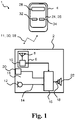
- Fig. 1 shows an exemplary hearing system.
- the hearing system 1 comprises a hearing device 2 and an accessory device 4.
- the hearing device 2 optionally comprises a transceiver module 6 for (wireless) communication with the accessory device 4 and optionally a contralateral hearing device (not shown in Fig. 1 ).
- the transceiver module 6 comprises antenna 8 and transceiver 10, and is configured for receipt and/or transmission of wireless signals via wireless connection 11 to the accessory device 4.
- the hearing device 2 comprises a set of microphones comprising a first microphone 12 for provision of a first microphone input signal 14; a processor 16 for processing input signals including the first microphone input signal 14 according to one or more hearing device parameters and providing an electrical output signal 18 based on input signals; a user interface 20 connected to the processor 16; and a receiver 22 for converting the electrical output signal 18 to an audio output signal.
- the accessory device 4 is a smartphone and comprises a user interface 24 comprising a touch display 26, and a processor (not shown).
- the accessory device 4 is in a setting adjustment mode for adjusting a setting, i.e. one or more hearing device parameters, of the hearing device 2.
- the hearing device 2 (processor 16) or the accessory device 4 is configured to initialize a model comprising a parameterized objective function based on a first assumption and a second assumption on the objective function, e.g. in accordance a determination that a start criterion is satisfied.
- the start criterion may be satisfied if a user input on user interface 20 or user interface 24 indicative of a user desire to start optimization has been detected, e.g. by activation of virtual start button 28 on the accessory device 4.
- the hearing device 2 or the accessory device 4 is configured to obtain an initial test setting defined by one or more initial test hearing device parameters; assign the initial test setting as a primary test setting; and obtain a secondary test setting based on the model, the secondary test setting defined by one or more secondary test hearing device parameters.
- the accessory device 4 may be configured to send a control signal 30 to the hearing device 2, the control signal 30 being indicative of the primary test setting and the secondary test setting, thus enabling the hearing device 2 to output test signals accordingly.
- the hearing device 2 (processor 16) is configured to output a primary test signal according to the primary test setting via the receiver 22 and a secondary test signal according to the secondary test setting via the receiver 22.
- the hearing device 2 (processor 16) or the accessory device 4 is configured to detect a user input of a preferred test setting indicative of a preference for either the primary test setting or the secondary test setting, e.g. by detecting a user input on user interface 20 or by detecting a user selection of one of a primary virtual button 32 and a secondary virtual button 34 on the user interface 26 of accessory device 4.
- the hearing device 2 (processor 16) and/or the accessory device 4 is configured to update the model based on the primary test setting, the secondary test setting, and the preferred test setting; and in accordance with a determination that a tuning criterion is satisfied, update the hearing device parameters of the hearing device based on hearing device parameters of the preferred test setting.
- the tuning criterion may be satisfied when a user provides a user input indicative of a desire to stop optimization, e.g. by detecting a user selection of a stop virtual button (not shown) on the user interface 26 of accessory device 4 and/or when a pre-set number of user inputs of preferred test setting(s).
- the accessory device 4 may be configured to send a control signal 32 to the hearing device 2, the control signal 38 being indicative of the hearing device parameters of the preferred test setting, thus enabling the hearing device to update the hearing device parameters of the hearing device.
- Fig. 2 is a flow diagram of an exemplary method for tuning hearing device parameters of a hearing device.
- the method 100 comprises initializing 102 a model comprising a parameterized objective function based on a first assumption and a second assumption on the objective function.
- 0,1 d x is the cumulative density function of the standard normal distribution, and Z is a sample from the normal distribution with mean vector ⁇ and covariance matrix ⁇ .
- the method 100 comprises obtaining 104 an initial test setting defined by one or more initial test hearing device parameters and assigning 106 the initial test setting as a primary test setting.
- the method 100 comprises obtaining 108 a secondary test setting based on the model by sampling from a posterior distribution also denoted p ( X ⁇
- the method 100 proceeds to outputting, with the hearing device, 110 a primary test signal according to the primary test setting and outputting, with the hearing device, a secondary test signal 112 according to the secondary test setting.
- the method 100 comprises detecting 114 a user input of a preferred test setting indicative of a preference for either the primary test setting or the secondary test setting; and updating 116 the model based on the primary test setting, the secondary test setting, and the preferred test setting, wherein updating the model comprises updating the mean vector ⁇ , the covariance matrix ⁇ , and the shape and scale parameters k d and ⁇ d based on variational optimization.
- the method 100 comprises updating 118 the hearing device parameters of the hearing device based on hearing device parameters of the preferred test setting.
- Updating 118 the hearing device parameters and updating 120 the primary test setting may be integrated in a single operation, e.g. updating 120 the primary test setting may be performed as an integrated part of updating 118 the hearing device parameters.
- Updating 116 the model and updating 120 the primary test setting may be integrated in a single operation, e.g. updating 120 the primary test setting may be performed as an integrated part of updating 116 the model.
- the method 100 may be a continuous method and may comprise updating 120 the primary test setting with the preferred test setting; and optionally, as part of obtaining 108 the secondary test setting, updating 122 the secondary test setting based on the updated model.
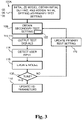
- Fig. 3 is a flow diagram of an exemplary method for tuning hearing device parameters of a hearing device.
- the method 100A implements a conditioned updating of hearing device parameters of the hearing device. This may be advantageous, e.g. if acts 102, 104, 106, 108, 114, 116 of the method are implemented at least partly in an accessory device, since receipt/transmission in/from the hearing device required in connection with update 118 can be reduced.
- the method 100A comprises determining if a tuning criterion is satisfied and in accordance with a determination that the tuning criterion is satisfied 130, updating 118 the hearing device parameters of the hearing device based on hearing device parameters of the preferred test setting. Further, normal operation of the hearing device is not affected until a preferred setting is obtained.
- the method 100A may comprise, in accordance with a determination that the tuning criterion is not satisfied 130, updating 120 the primary test setting with the preferred test setting; and updating 122, as part of obtaining 108 secondary test setting, the secondary test setting based on the updated model.
- Fig. 4 is a flow diagram of an exemplary method for tuning hearing device parameters of a hearing device.
- the method 100B comprises determining if a continue-optimization criterion is satisfied and in accordance with the continue-optimization criterion being satisfied 140, repeating updating 120 the primary test setting with the preferred test setting; updating 122 the secondary test setting based on the updated model, the secondary test setting defined by one or more secondary test hearing device parameters; outputting 110 the primary test signal according to the primary test setting; outputting 112 the secondary test signal according to the secondary test setting; and detecting 114 a user input of a preferred test setting indicative of a preference for either the primary test setting or the secondary test setting.
- the method 100B proceeds to updating 118 hearing device parameters of the hearing device.
- Fig. 5 is a flow diagram of an exemplary method for tuning hearing device parameters of a hearing device.
- the hearing device parameters are updated 118 in each optimization cycle.
- Fig. 6 illustrates results of optimization of a hearing device parameter with different objective functions.
- the first objective function f 1 is a 1-dimensional cone depicted in Fig. 6a .
- the second objective function f 2 is bell-shaped, shown in Fig. 6c .
- the cone variant of the parametric model (Cone-Thompson) is compared to a GP model with a squared exponential kernel (GP-Thompson).
Landscapes
- Health & Medical Sciences (AREA)
- General Health & Medical Sciences (AREA)
- Otolaryngology (AREA)
- Neurosurgery (AREA)
- Physics & Mathematics (AREA)
- Engineering & Computer Science (AREA)
- Acoustics & Sound (AREA)
- Signal Processing (AREA)
- Measurement Of The Respiration, Hearing Ability, Form, And Blood Characteristics Of Living Organisms (AREA)
Description
- The present disclosure relates to a hearing device and related method, in particular a method for configuring hearing device parameters.
- Hearing devices with user-selectable programs allowing the user to adjust hearing device programs/hearing device parameters to obtain a satisfactory listening experience are known.
-
US 2003/0133578 relates to hearing aids and methods and apparatus for audio fitting thereof. Method and apparatus for audio fitting a hearing aid are described in a hand-held configuration having paired comparisons (hearing selections) stored in and derivable from a memory therein. The paired comparisons are presented one at a time to a user and a preferred selection for each paired comparison is made by a select indicator after the user toggles back and forth between the selections for as many times necessary in determining their preferences. A genetic algorithm converges all the preferences upon a single solution. Crossover and mutation genetic algorithm operators operate on a linear range of indexes representative of parametric values of the pairs. A fully integrated hearing aid having all the above described features incorporated therein is also presented. - The paper 'A Probabilistic Modeling Approach to Hearing Loss Compensation' of Thijs van de Laar and Bert de Vries published in IEEE/ACM Transactions on Audio, Speech, and Language Processing, Vol. 24, No. 11, November 2016 teaches a probabilistic model for finding optimum hearing aid parameters.
- The paper 'Perception-Based Personalization of Hearing Aids Using Gaussian Processes and Active Learning' by Jens Brehm Bagger Nielsen, Jakob Nielsen, and Jan Larsen published in IEEE/ACM Transactions on Audio, Speech, and Language Processing, Vol 23, No. 1, January 2015 teaches a stochastics framework with machine learning for finding optimum hearing aid parameter sets.
- The paper 'Incremental Utility Elicitation for Adpative Personalisation' by Tom Heskes and Bart de Vries published in the Proceedings of the 17th Belgium-Netherlands Conference on Artificial Intelligence, 17-18 October 2005, Brussels, Belgium also teaches a stochastics framework for finding optimum parameter sets for medical devices.
- There is a desire to provide an improved listening experience to a hearing device user.
- Further, there is a need for a simple and effective way to configure one or more hearing device parameters of a hearing device.
- A hearing device is disclosed, the hearing device comprising a set of microphones comprising a first microphone for provision of a first microphone input signal; a processor for processing input signals according to one or more hearing device parameters and providing an electrical output signal based on input signals; a user interface; and a receiver for converting the electrical output signal to an audio output signal. The processor is configured to initialize a model comprising a parameterized objective function based on a first assumption and a second assumption on the objective function; obtain an initial test setting defined by one or more initial test hearing device parameters; assign the initial test setting as a primary test setting; obtain a secondary test setting based on the model, the secondary test setting defined by one or more secondary test hearing device parameters; output a primary test signal according to the primary test setting via the receiver; output a secondary test signal according to the secondary test setting via the receiver; detect a user input of a preferred test setting indicative of a preference for either the primary test setting or the secondary test setting; update the model based on the primary test setting, the secondary test setting, and the preferred test setting; and in accordance with a determination that a tuning criterion is satisfied, update the hearing device parameters of the hearing device based on hearing device parameters of the preferred test setting, wherein the objective function fX̂ ,Λ (X) is given by:

- Further, a method for tuning hearing device parameters of a hearing device is disclosed, the method comprising initializing a model comprising a parameterized objective function based on a first assumption and a second assumption on the objective function; obtaining an initial test setting defined by one or more initial test hearing device parameters; assigning the initial test setting as a primary test setting; obtaining a secondary test setting based on the model, the secondary test setting defined by one or more secondary test hearing device parameters; outputting a primary test signal according to the primary test setting; outputting a secondary test signal according to the secondary test setting; detecting a user input of a preferred test setting indicative of a preference for either the primary test setting or the secondary test setting; updating the model based on the primary test setting, the secondary test setting, and the preferred test setting; and in accordance with a determination that a tuning criterion is satisfied, updating the hearing device parameters of the hearing device based on hearing device parameters of the preferred test setting, wherein the objective function fX̂ ,Λ (X) is given by:

- It is an advantage of the present disclosure that hearing device parameters can be configured during a normal operating situation and/or with a small number of user inputs/interactions. Thus, a simple and smooth user experience of the hearing device is provided.
- The above and other features and advantages of the present invention will become readily apparent to those skilled in the art by the following detailed description of exemplary embodiments thereof with reference to the attached drawings, in which:
-
Fig. 1 schematically illustrates an exemplary hearing device and accessory device according to the disclosure, -
Fig. 2 is a flow diagram of an exemplary method according to the disclosure, -
Fig. 3 is a flow diagram of an exemplary method according to the disclosure, -
Fig. 4 is a flow diagram of an exemplary method according to the disclosure, -
Fig. 5 is a flow diagram of an exemplary method according to the disclosure, and -
Fig. 6 illustrates results of optimization of different objective functions. - Various exemplary embodiments and details are described hereinafter, with reference to the figures when relevant. It should be noted that the figures may or may not be drawn to scale and that elements of similar structures or functions are represented by like reference numerals throughout the figures. It should also be noted that the figures are only intended to facilitate the description of the embodiments. They are not intended as an exhaustive description of the invention or as a limitation on the scope of the invention. In addition, an illustrated embodiment needs not have all the aspects or advantages shown. An aspect or an advantage described in conjunction with a particular embodiment is not necessarily limited to that embodiment and can be practiced in any other embodiments even if not so illustrated, or if not so explicitly described.
- The present disclosure relates to hearing systems, user accessory device and hearing device thereof, and related methods. The user accessory device forms an accessory device to the hearing device. The user accessory device is typically paired or wirelessly coupled to the hearing device. The hearing device may be a hearing aid, e.g. of the behind-the-ear (BTE) type, in-the-ear (ITE) type, in-the-canal (ITC) type, receiver-in-canal (RIC) type or receiver-in-the-ear (RITE) type. Typically, the hearing device system is in possession of and controlled by the hearing device user. The user accessory device may be a hand-held device, such as smartphone, a smartwatch, a special purpose device, or a tablet computer.
- The hearing system may comprise a server device and/or a fitting device. The fitting device is controlled by a dispenser and is configured to determine configuration data, such as fitting parameters. The server device may be controlled by the hearing device manufacturer.
- The hearing system is configured to receive and detect a user input of a preferred test setting indicative of a preference for either the primary test setting or the secondary test setting. Accordingly, the hearing system may comprise one or more user interfaces for receiving and/or detecting a user input. For example, the hearing device may comprise a user interface receiving a user input. The user interface of the hearing device may comprise one or more buttons, an accelerometer and/or a voice control unit. The accessory device may comprise a user interface. The user interface of the accessor device may comprise a touch sensitive surface, e.g. a touch display, and/or one or more buttons. The user interface of the accessory device may comprise a voice control unit. The user interface of the hearing device may comprise one or more physical sliders, knobs and/or push buttons. The user interface of the accessory device may comprise one or more physical or virtual (on-screen) sliders, knobs and/or push buttons.
- A method for tuning hearing device parameters of a hearing device comprises the sequence of steps as defined in
claim 1. - The first assumption may be that the objective function is a smooth function.
- The second assumption may be that the objective function is unimodal.
- The objective function is denoted fX̂ ,Λ(X), where X is a D-dimensional vector in the hypercube [0,1] D that represents the (D) hearing device parameters of the device, X̂ is the maximizing argument of fx̂ ,Λ , and A is a scaling matrix. The number D of hearing device parameters may be 1 and/or less than 20, such as in the range from 2 to 15.
- According to the invention, the objective function fX̂ ,Λ(X) is given by:

- The objective function fX̂ ,Λ(X) may be given by:

- In an example not falling under scope of the claimed invention, the objective function fX̂ ,Λ(X) may be given by:

- The maximizing argument X̂ may be constrained by one or more prior assumptions on the objective function fX̂ ,Λ.
- The maximizing argument X̂ may be constrained by the following prior assumptions on the objective function fX̂ ,Λ:


- The scaling matrix Λ is a positive-definite scaling matrix Λ, for example constrained by the following prior assumptions:

- The scaling matrix Λ has two functions. Firstly, the diagonal elements of Λ are scaling factors for the individual hearing device parameters, and secondly the off-diagonal values allow to model correlations between the hearing device parameters. In one or more exemplary methods/hearing devices, the correlations between the hearing device parameters are not modelled in the prior assumption (Λ is diagonal).
- The scaling matrix Λ does not need to be a diagonal matrix. The scaling matrix Λ may be selected as A = L' ∗ L, where L is a low-triangular matrix (also known as the Cholesky decomposition of Λ). Gaussian priors may be applied on each of the elements of L, e.g.,

- In one or more exemplary methods/hearing systems, the maximizing argument X̂ may be constrained by the prior assumption:

- The method may comprise updating the primary test setting with the preferred test setting; updating the secondary test setting, e.g. based on the updated model, the secondary test setting defined by one or more secondary test hearing device parameters; outputting the primary test signal according to the primary test setting; outputting the secondary test signal according to the secondary test setting; detecting a user input of a preferred test setting indicative of a preference for either the primary test setting or the secondary test setting; and updating the model based on the primary test setting, the secondary test setting, and the preferred test setting.
- The method may comprise determining if a continue-optimization criterion is satisfied and optionally forgo outputting test signals and detecting user input of preferred test setting in accordance with the continue-optimization criterion not being satisfied (in other words in accordance with a stop criterion being satisfied). The continue-optimization criterion may be based on the primary test setting and the secondary test setting. An exemplary continue-optimization criterion may be satisfied or at least partly satisfied if the model updates seem to converge to fixed parameter settings. The continue-optimization criterion may be based on a count of the number of user inputs. An exemplary continue-optimization criterion may be satisfied or at least partly satisfies if the number of user inputs in a given optimization sequence is less than ten, such as in the range from two to eight.
- The method may comprise in accordance with the continue-optimization criterion being satisfied, repeating: updating the primary test setting with the preferred test setting; updating the secondary test setting based on the updated model, the secondary test setting defined by one or more secondary test hearing device parameters; outputting the primary test signal according to the primary test setting; outputting the secondary test signal according to the secondary test setting; detecting a user input of a preferred test setting indicative of a preference for either the primary test setting or the secondary test setting; and updating the model based on the primary test setting, the secondary test setting, and the preferred test setting.
- Obtaining an initial test setting may comprise randomly selecting a first initial test hearing device parameter of the one or more initial test hearing device parameters and/or selecting one or more current hearing device parameters as the one or more initial test hearing device parameters.
- Obtaining a secondary test setting based on the model may comprise obtaining the secondary test setting as a sampling from a posterior distribution also denoted p(X̂|data) over the maximizing argument of the objective function, e.g. by Thompson sampling. The posterior distribution may be conditioned on one or more, such as all, previously obtained user input. The present method and hearing device allows for explicitly describing a probability distribution over the maximizing argument, i.e. p(X̂|data), where data denotes the data that follows or is obtained from all interaction with the user.
- Detecting a user input of a preferred test setting indicative of a preference for either the primary test setting or the secondary test setting may comprise prompting the user for the user input. Detecting a user input may be performed on the hearing device, e.g. by a user activating a button and/or an accelerometer (e.g. single or double tapping the hearing device housing) in the hearing device. Detecting a user input may be performed on the accessory device, e.g. by a user selecting a user interface element representative of the preferred test setting. Detecting a user input may be performed on the accessory device, e.g. by a user selecting a user interface element representative of the preferred test setting on a touch-sensitive display.
- Updating the model may be based on a Bayesian inference method. Updating the model may comprise updating one or more of the parameters of the model. In one or more exemplary methods/hearing devices/accessory devices, updating the model may comprise updating one or more, e.g. all, of the mean vector µ, the covariance matrix ∑, and the shape and scale parameters kd and θd. Updating the model, or parameters thereof may be based on variational optimization, Laplace approximation or Monte Carlo sampling.
- Updating the hearing device parameters of the hearing device is based on hearing device parameters of the preferred test setting. For example, the hearing device parameters of the hearing device may be set to the maximizing argument X̂ of the objective function. In one or more exemplary methods/hearing devices, the hearing device parameters of the hearing device may be updated after each test cycle, i.e. after each user input, however, in order to not confuse the user and/or save power, the hearing device parameters of the hearing device may be updated in accordance with a tuning criterion being satisfied. In one or more exemplary methods/hearing devices, the tuning criterion is satisfied when the continue-optimization criterion is not satisfied, i.e. when tuning of the hearing device parameters is done.
- The hearing device comprises the set of features defined in
claim 14. -
Fig. 1 shows an exemplary hearing system. Thehearing system 1 comprises ahearing device 2 and anaccessory device 4. Thehearing device 2 optionally comprises atransceiver module 6 for (wireless) communication with theaccessory device 4 and optionally a contralateral hearing device (not shown inFig. 1 ). Thetransceiver module 6 comprisesantenna 8 andtransceiver 10, and is configured for receipt and/or transmission of wireless signals via wireless connection 11 to theaccessory device 4. - The
hearing device 2 comprises a set of microphones comprising afirst microphone 12 for provision of a firstmicrophone input signal 14; aprocessor 16 for processing input signals including the firstmicrophone input signal 14 according to one or more hearing device parameters and providing anelectrical output signal 18 based on input signals; auser interface 20 connected to theprocessor 16; and areceiver 22 for converting theelectrical output signal 18 to an audio output signal. - The
accessory device 4 is a smartphone and comprises a user interface 24 comprising a touch display 26, and a processor (not shown). Theaccessory device 4 is in a setting adjustment mode for adjusting a setting, i.e. one or more hearing device parameters, of thehearing device 2. - The hearing device 2 (processor 16) or the
accessory device 4 is configured to initialize a model comprising a parameterized objective function based on a first assumption and a second assumption on the objective function, e.g. in accordance a determination that a start criterion is satisfied. The start criterion may be satisfied if a user input onuser interface 20 or user interface 24 indicative of a user desire to start optimization has been detected, e.g. by activation ofvirtual start button 28 on theaccessory device 4. - The
hearing device 2 or theaccessory device 4 is configured to obtain an initial test setting defined by one or more initial test hearing device parameters; assign the initial test setting as a primary test setting; and obtain a secondary test setting based on the model, the secondary test setting defined by one or more secondary test hearing device parameters. - In an implementation including
accessory device 4, theaccessory device 4 may be configured to send a control signal 30 to thehearing device 2, the control signal 30 being indicative of the primary test setting and the secondary test setting, thus enabling thehearing device 2 to output test signals accordingly. - The hearing device 2 (processor 16) is configured to output a primary test signal according to the primary test setting via the
receiver 22 and a secondary test signal according to the secondary test setting via thereceiver 22. - The hearing device 2 (processor 16) or the
accessory device 4 is configured to detect a user input of a preferred test setting indicative of a preference for either the primary test setting or the secondary test setting, e.g. by detecting a user input onuser interface 20 or by detecting a user selection of one of a primaryvirtual button 32 and a secondaryvirtual button 34 on the user interface 26 ofaccessory device 4. - The hearing device 2 (processor 16) and/or the
accessory device 4 is configured to update the model based on the primary test setting, the secondary test setting, and the preferred test setting; and in accordance with a determination that a tuning criterion is satisfied, update the hearing device parameters of the hearing device based on hearing device parameters of the preferred test setting. The tuning criterion may be satisfied when a user provides a user input indicative of a desire to stop optimization, e.g. by detecting a user selection of a stop virtual button (not shown) on the user interface 26 ofaccessory device 4 and/or when a pre-set number of user inputs of preferred test setting(s). - In an implementation including
accessory device 4, theaccessory device 4 may be configured to send acontrol signal 32 to thehearing device 2, the control signal 38 being indicative of the hearing device parameters of the preferred test setting, thus enabling the hearing device to update the hearing device parameters of the hearing device. -
Fig. 2 is a flow diagram of an exemplary method for tuning hearing device parameters of a hearing device. Themethod 100 comprises initializing 102 a model comprising a parameterized objective function based on a first assumption and a second assumption on the objective function. The objective function fX̂ ,Λ (X) is given by:


- The
method 100 comprises obtaining 104 an initial test setting defined by one or more initial test hearing device parameters and assigning 106 the initial test setting as a primary test setting. Themethod 100 comprises obtaining 108 a secondary test setting based on the model by sampling from a posterior distribution also denoted p(X̂|data) over the maximizing argument of the objective function, the secondary test setting defined by one or more secondary test hearing device parameters. - The
method 100 proceeds to outputting, with the hearing device, 110 a primary test signal according to the primary test setting and outputting, with the hearing device, a secondary test signal 112 according to the secondary test setting. - The
method 100 comprises detecting 114 a user input of a preferred test setting indicative of a preference for either the primary test setting or the secondary test setting; and updating 116 the model based on the primary test setting, the secondary test setting, and the preferred test setting, wherein updating the model comprises updating the mean vector µ, the covariance matrix ∑, and the shape and scale parameters kd and θd based on variational optimization. - The
method 100 comprises updating 118 the hearing device parameters of the hearing device based on hearing device parameters of the preferred test setting. - Updating 118 the hearing device parameters and updating 120 the primary test setting may be integrated in a single operation, e.g. updating 120 the primary test setting may be performed as an integrated part of updating 118 the hearing device parameters.
- Updating 116 the model and updating 120 the primary test setting may be integrated in a single operation, e.g. updating 120 the primary test setting may be performed as an integrated part of updating 116 the model.
- The
method 100 may be a continuous method and may comprise updating 120 the primary test setting with the preferred test setting; and optionally, as part of obtaining 108 the secondary test setting, updating 122 the secondary test setting based on the updated model. -
Fig. 3 is a flow diagram of an exemplary method for tuning hearing device parameters of a hearing device. Themethod 100A implements a conditioned updating of hearing device parameters of the hearing device. This may be advantageous, e.g. ifacts update 118 can be reduced. Themethod 100A comprises determining if a tuning criterion is satisfied and in accordance with a determination that the tuning criterion is satisfied 130, updating 118 the hearing device parameters of the hearing device based on hearing device parameters of the preferred test setting. Further, normal operation of the hearing device is not affected until a preferred setting is obtained. Themethod 100A may comprise, in accordance with a determination that the tuning criterion is not satisfied 130, updating 120 the primary test setting with the preferred test setting; and updating 122, as part of obtaining 108 secondary test setting, the secondary test setting based on the updated model. -
Fig. 4 is a flow diagram of an exemplary method for tuning hearing device parameters of a hearing device. Themethod 100B comprises determining if a continue-optimization criterion is satisfied and in accordance with the continue-optimization criterion being satisfied 140, repeating updating 120 the primary test setting with the preferred test setting; updating 122 the secondary test setting based on the updated model, the secondary test setting defined by one or more secondary test hearing device parameters; outputting 110 the primary test signal according to the primary test setting; outputting 112 the secondary test signal according to the secondary test setting; and detecting 114 a user input of a preferred test setting indicative of a preference for either the primary test setting or the secondary test setting. When the continue-optimization criterion is satisfied, themethod 100B proceeds to updating 118 hearing device parameters of the hearing device. -
Fig. 5 is a flow diagram of an exemplary method for tuning hearing device parameters of a hearing device. In themethod 100C, the hearing device parameters are updated 118 in each optimization cycle. -
Fig. 6 illustrates results of optimization of a hearing device parameter with different objective functions. The first objective function f1 is a 1-dimensional cone depicted inFig. 6a . The second objective function f2 is bell-shaped, shown inFig. 6c . The cone variant of the parametric model (Cone-Thompson) is compared to a GP model with a squared exponential kernel (GP-Thompson). - Since the parametric model assumes the objective function to have the analytical form of a cone, there is a model mismatch in the second experiment, allowing us to test the robustness under mismatch. Priors p(X̂) and p(Λ) are chosen to be uninformative. User inputs x'1, ... , x'40 are selected through Thompson sampling under both models. The hyperparameters of the GP model are fitted in every iteration by marginal log-likelihood optimization. The results in
Figs. 6b and 6d show that the present method consistently and significantly outperforms GP-Thompson on both objective functions.Figs. 6b and 6d depict the so-called "cumulative value" curves, which are the cumulative sums of the objective function values at the inputs x'1, ... , x' 40 . Larger cumulative values correspond to inputs x' 1, ... , x' 40 that are closer to the optimal parameter value. The fact that the Cone-Thompson curves are consistently above the GP-Thompson curves indicates that the Cone-Thompson algorithm select better inputs than the GP-Thompson algorithm. - The use of the terms "first", "second", "third" and "fourth", "primary", "secondary", "tertiary" etc. does not imply any particular order, but are included to identify individual elements. Moreover, the use of the terms "first", "second", "third" and "fourth", "primary", "secondary", "tertiary" etc. does not denote any order or importance, but rather the terms "first", "second", "third" and "fourth", "primary", "secondary", "tertiary" etc. are used to distinguish one element from another. Note that the words "first", "second", "third" and "fourth", "primary", "secondary", "tertiary" etc. are used here and elsewhere for labelling purposes only and are not intended to denote any specific spatial or temporal ordering. Furthermore, the labelling of a first element does not imply the presence of a second element and vice versa.
- Although particular features have been shown and described, it will be understood that they are not intended to limit the claimed invention, and it will be made obvious to those skilled in the art that various changes and modifications may be made without departing from the scope of the claimed invention. The specification and drawings are, accordingly to be regarded in an illustrative rather than restrictive sense. The claimed invention is defined by the scope of the appended claims.
-
- 1
- hearing system
- 2
- hearing device
- 4
- accessory device
- 6
- transceiver module
- 8
- antenna
- 10
- transceiver
- 11
- wireless connection 11 between hearing device and accessory device
- 12
- first microphone
- 14
- first microphone input signal
- 16
- processor
- 18
- electrical output signal
- 20
- user interface
- 22
- receiver
- 24
- user interface of accessory device
- 26
- touch display
- 28
- start
button 28 - 30
- control signal indicative of primary and secondary test setting
- 32
- primary virtual button
- 34
- secondary virtual button
- 38
- control signal indicative of the hearing device parameters of the preferred test setting
- 100, 100A, 100B, 100C
- method for tuning hearing device parameters
- 102
- initializing a model
- 104
- obtaining an initial test setting
- 106
- assigning the initial test setting as a primary test setting
- 108
- obtaining a secondary test setting
- 110
- outputting a primary test signal according to the primary test setting
- 112
- outputting a secondary test signal according to the secondary test setting
- 114
- detecting a user input of a preferred test setting
- 116
- updating the model
- 118
- updating the hearing device parameters of the hearing device
- 120
- updating the primary test setting
- 122
- updating the secondary test setting
- 130
- in accordance with a determination that the tuning criterion is satisfied
- 140
- in accordance with a continue-optimization criterion being satisfied
- 200
- first objective function
- 202
- second objective function
Claims (14)
- Method (100, 100A, 100B, 100C) for tuning hearing device parameters of a hearing device, the method comprising:initializing (102) a model comprising a parameterized objective function based on a first assumption and a second assumption on the objective function;obtaining (104) an initial test setting defined by one or more initial test hearing device parameters;assigning (106) the initial test setting as a primary test setting;obtaining (108) a secondary test setting based on the model, the secondary test setting defined by one or more secondary test hearing device parameters;outputting (110) a primary test signal according to the primary test setting;outputting (112) a secondary test signal according to the secondary test setting;detecting (114) a user input of a preferred test setting indicative of a preference for either the primary test setting or the secondary test setting;updating (116) the model based on the primary test setting, the secondary test setting, and the preferred test setting; andin accordance with a determination that a tuning criterion is satisfied (130), updating (118) the hearing device parameters of the hearing device based on hearing device parameters of the preferred test setting,characterized in that the objective function fX̂ ,Λ (X) is given by:

- Method according to claim 1, the method comprising:updating (120) the primary test setting with the preferred test setting;updating (122) the secondary test setting based on the updated model, the secondary test setting defined by one or more secondary test hearing device parameters;outputting (110) the primary test signal according to the primary test setting;outputting (112) the secondary test signal according to the secondary test setting;detecting (114) a user input of a preferred test setting indicative of a preference for either the primary test setting or the secondary test setting; andupdating (116) the model based on the primary test setting, the secondary test setting, and the preferred test setting.
- Method according to claim 1, the method comprising determining (140) if a continue-optimization criterion is satisfied.
- Method according to claim 3, the method comprising:
in accordance with the continue-optimization criterion being satisfied (140), repeating:updating (120) the primary test setting with the preferred test setting;updating (122) the secondary test setting based on the updated model, the secondary test setting defined by one or more secondary test hearing device parameters;outputting (110) the primary test signal according to the primary test setting;outputting (112) the secondary test signal according to the secondary test setting;detecting (114) a user input of a preferred test setting indicative of a preference for either the primary test setting or the secondary test setting; andupdating (116) the model based on the primary test setting, the secondary test setting, and the preferred test setting. - Method according to any of claims 1-4, wherein the first assumption is that the objective function is a smooth function.
- Method according to any of claims 1-5, wherein the second assumption is that the objective function is unimodal.
- Method according to claim 1, wherein the objective function fX̂ ,Λ(X) is given by:

- Method according to claim 7, wherein the maximizing argument X̂ is constrained by the following prior assumptions on the objective function fX̂ ,Λ:


- Method according to any of claims 1, 7, or 8, wherein the positive-definite scaling matrix Λ is constrained by the following prior assumptions:

- Method according to any of claims 1-9, wherein obtaining (104) an initial test setting comprises randomly selecting a first initial test hearing device parameter of the one or more initial test hearing device parameters or selecting one or more current hearing device parameters as the one or more initial test hearing device parameters.
- Method according to any of claims 1-10, wherein obtaining (108) a secondary test setting based on the model comprises obtaining the secondary test setting as a sampling from a posterior distribution p(X̂|data) over the maximizing argument of the objective function, wherein the posterior distribution is conditioned on all previously obtained user input.
- Method according to any of claims 1-11, wherein detecting (114) a user input of a preferred test setting indicative of a preference for either the primary test setting or the secondary test setting comprises prompting the user for the user input.
- Method according to any of claims 1-12, wherein updating the model is based on a Bayesian or approximate Bayesian inference method.
- A hearing device (2) comprising:- a set of microphones comprising a first microphone (12) for provision of a first microphone input signal (14);- a processor (16) for processing input signals according to one or more hearing device parameters and providing an electrical output signal (18) based on input signals;- a user interface (20); and- a receiver (22) for converting the electrical output signal (18) to an audio output signal,wherein the processor (16) is configured toinitialize a model comprising a parameterized objective function based on a first assumption and a second assumption on the objective function;obtain an initial test setting defined by one or more initial test hearing device parameters;assign the initial test setting as a primary test setting;obtain a secondary test setting based on the model, the secondary test setting defined by one or more secondary test hearing device parameters;output a primary test signal according to the primary test setting via the receiver;output a secondary test signal according to the secondary test setting via the receiver;detect a user input of a preferred test setting indicative of a preference for either the primary test setting or the secondary test setting;update the model based on the primary test setting, the secondary test setting, and the preferred test setting; andin accordance with a determination that a tuning criterion is satisfied, update the hearing device parameters of the hearing device based on hearing device parameters of the preferred test setting,characterized in that the objective function fX̂ ,Λ (X) is given by:

Priority Applications (6)
| Application Number | Priority Date | Filing Date | Title |
|---|---|---|---|
| DK17204326.7T DK3493555T3 (en) | 2017-11-29 | 2017-11-29 | HEARING DEVICE AND METHOD FOR TUNING HEARING DEVICE PARAMETERS |
| EP17204326.7A EP3493555B1 (en) | 2017-11-29 | 2017-11-29 | Hearing device and method for tuning hearing device parameters |
| US16/195,836 US10735877B2 (en) | 2017-11-29 | 2018-11-19 | Hearing device and method for tuning hearing device parameters |
| JP2018220266A JP2019134405A (en) | 2017-11-29 | 2018-11-26 | Hearing device and method for tuning hearing device parameter |
| CN201811424777.5A CN110035368B (en) | 2017-11-29 | 2018-11-27 | Hearing device and method for adjusting parameters of a hearing device |
| US16/721,901 US11146899B2 (en) | 2017-11-29 | 2019-12-19 | Hearing device and method for tuning hearing device par |
Applications Claiming Priority (1)
| Application Number | Priority Date | Filing Date | Title |
|---|---|---|---|
| EP17204326.7A EP3493555B1 (en) | 2017-11-29 | 2017-11-29 | Hearing device and method for tuning hearing device parameters |
Publications (2)
| Publication Number | Publication Date |
|---|---|
| EP3493555A1 EP3493555A1 (en) | 2019-06-05 |
| EP3493555B1 true EP3493555B1 (en) | 2022-12-21 |
Family
ID=60484276
Family Applications (1)
| Application Number | Title | Priority Date | Filing Date |
|---|---|---|---|
| EP17204326.7A Active EP3493555B1 (en) | 2017-11-29 | 2017-11-29 | Hearing device and method for tuning hearing device parameters |
Country Status (5)
| Country | Link |
|---|---|
| US (2) | US10735877B2 (en) |
| EP (1) | EP3493555B1 (en) |
| JP (1) | JP2019134405A (en) |
| CN (1) | CN110035368B (en) |
| DK (1) | DK3493555T3 (en) |
Families Citing this family (9)
| Publication number | Priority date | Publication date | Assignee | Title |
|---|---|---|---|---|
| WO2019238798A1 (en) * | 2018-06-15 | 2019-12-19 | Widex A/S | Method of fine tuning a hearing aid system and a hearing aid system |
| DK180999B1 (en) * | 2021-02-26 | 2022-09-13 | Gn Hearing As | Fitting agent and method of determining hearing device parameters |
| DK181015B1 (en) | 2021-03-17 | 2022-09-23 | Gn Hearing As | Fitting agent for a hearing device and method for updating a user model |
| US11937052B2 (en) | 2021-06-15 | 2024-03-19 | Gn Hearing A/S | Fitting agent for a hearing device and method for updating a multi-environment user model |
| US12539057B2 (en) * | 2021-12-13 | 2026-02-03 | Gn Hearing A/S | Method for hearing test and hearing test device |
| CN114760576B (en) * | 2022-06-16 | 2022-09-06 | 武汉左点科技有限公司 | Bone conduction hearing aid output volume self-adjusting method and device |
| US20240129679A1 (en) | 2022-09-29 | 2024-04-18 | Gn Hearing A/S | Fitting agent with user model initialization for a hearing device |
| EP4408025B1 (en) | 2023-01-30 | 2025-07-02 | Sonova AG | Method of self-fitting of a binaural hearing system |
| EP4633202A1 (en) | 2024-04-08 | 2025-10-15 | GN Hearing A/S | Fitting agent for a hearing device with environment model |
Family Cites Families (8)
| Publication number | Priority date | Publication date | Assignee | Title |
|---|---|---|---|---|
| US6004015A (en) * | 1994-11-24 | 1999-12-21 | Matsushita Electric Industrial Co., Ltd. | Optimization adjusting method and optimization adjusting apparatus |
| JP3797834B2 (en) * | 1999-10-29 | 2006-07-19 | リオン株式会社 | Hearing aid fitting device |
| US7650004B2 (en) * | 2001-11-15 | 2010-01-19 | Starkey Laboratories, Inc. | Hearing aids and methods and apparatus for audio fitting thereof |
| WO2004004414A1 (en) * | 2002-06-28 | 2004-01-08 | Microsound A/S | Method of calibrating an intelligent earphone |
| EP2986033B1 (en) * | 2005-03-29 | 2020-10-14 | Oticon A/s | A hearing aid for recording data and learning therefrom |
| US8359283B2 (en) * | 2009-08-31 | 2013-01-22 | Starkey Laboratories, Inc. | Genetic algorithms with robust rank estimation for hearing assistance devices |
| EP2521377A1 (en) * | 2011-05-06 | 2012-11-07 | Jacoti BVBA | Personal communication device with hearing support and method for providing the same |
| US9414173B1 (en) * | 2013-01-22 | 2016-08-09 | Ototronix, Llc | Fitting verification with in situ hearing test |
-
2017
- 2017-11-29 EP EP17204326.7A patent/EP3493555B1/en active Active
- 2017-11-29 DK DK17204326.7T patent/DK3493555T3/en active
-
2018
- 2018-11-19 US US16/195,836 patent/US10735877B2/en active Active
- 2018-11-26 JP JP2018220266A patent/JP2019134405A/en active Pending
- 2018-11-27 CN CN201811424777.5A patent/CN110035368B/en active Active
-
2019
- 2019-12-19 US US16/721,901 patent/US11146899B2/en active Active
Non-Patent Citations (2)
| Title |
|---|
| NIELSEN JENS BREHM BAGGER ET AL: "Perception-Based Personalization of Hearing Aids Using Gaussian Processes and Active Learning", IEEE/ACM TRANSACTIONS ON AUDIO, SPEECH, AND LANGUAGE PROCESSING, IEEE, USA, vol. 23, no. 1, 1 January 2015 (2015-01-01), pages 162 - 173, XP011570044, ISSN: 2329-9290, [retrieved on 20150114], DOI: 10.1109/TASLP.2014.2377581 * |
| TOM HESKES ET AL: "INCREMENTAL UTILITY ELICITATION FOR ADAPTIVE", PROCEEDINGS OF THE 17TH BELGIUM-NETHERLANDS CONFERENCE ON ARTIFICIAL INTELLIGENCE, 17-18 OCTOBER 2005, BRUSSELS, BELGIUM, 18 October 2005 (2005-10-18), pages 127 - 134, XP055730140, Retrieved from the Internet <URL:http://citeseerx.ist.psu.edu/viewdoc/download?doi=10.1.1.104.8332&rep=rep1&type=pdf> [retrieved on 20200911] * |
Also Published As
| Publication number | Publication date |
|---|---|
| EP3493555A1 (en) | 2019-06-05 |
| DK3493555T3 (en) | 2023-02-20 |
| US10735877B2 (en) | 2020-08-04 |
| CN110035368B (en) | 2021-11-02 |
| US11146899B2 (en) | 2021-10-12 |
| US20190166440A1 (en) | 2019-05-30 |
| US20200128343A1 (en) | 2020-04-23 |
| CN110035368A (en) | 2019-07-19 |
| JP2019134405A (en) | 2019-08-08 |
Similar Documents
| Publication | Publication Date | Title |
|---|---|---|
| US11146899B2 (en) | Hearing device and method for tuning hearing device par | |
| EP3167625B1 (en) | Method of optimizing parameters in a hearing aid system and a hearing aid system | |
| EP4106350A1 (en) | Fitting agent for a hearing device and method for updating a multi-environment user model | |
| US10362414B2 (en) | Hearing assistance system comprising an EEG-recording and analysis system | |
| US20230039728A1 (en) | Hearing assistance device model prediction | |
| US12167214B2 (en) | Devices and method for hearing device parameter configuration | |
| JP2020092411A (en) | Hearing systems, accessory devices, and related methods for contextual design of hearing algorithms | |
| US9191754B2 (en) | Method for automatically setting a piece of equipment and classifier | |
| US20120087524A1 (en) | System for using multiple hearing assistance device programmers | |
| US11792588B2 (en) | Fitting agent for a hearing device and method for updating a user model | |
| EP4346231A1 (en) | Fitting agent with user model initialization for a hearing device | |
| EP4586647A1 (en) | Hearing device fitting agent with customized environment model | |
| EP4050912A1 (en) | Fitting agent and method of determining hearing device parameters | |
| US20250088813A1 (en) | Hearing device fitting agent with customized environment model |
Legal Events
| Date | Code | Title | Description |
|---|---|---|---|
| PUAI | Public reference made under article 153(3) epc to a published international application that has entered the european phase |
Free format text: ORIGINAL CODE: 0009012 |
|
| STAA | Information on the status of an ep patent application or granted ep patent |
Free format text: STATUS: THE APPLICATION HAS BEEN PUBLISHED |
|
| AK | Designated contracting states |
Kind code of ref document: A1 Designated state(s): AL AT BE BG CH CY CZ DE DK EE ES FI FR GB GR HR HU IE IS IT LI LT LU LV MC MK MT NL NO PL PT RO RS SE SI SK SM TR |
|
| AX | Request for extension of the european patent |
Extension state: BA ME |
|
| STAA | Information on the status of an ep patent application or granted ep patent |
Free format text: STATUS: REQUEST FOR EXAMINATION WAS MADE |
|
| 17P | Request for examination filed |
Effective date: 20191204 |
|
| RBV | Designated contracting states (corrected) |
Designated state(s): AL AT BE BG CH CY CZ DE DK EE ES FI FR GB GR HR HU IE IS IT LI LT LU LV MC MK MT NL NO PL PT RO RS SE SI SK SM TR |
|
| STAA | Information on the status of an ep patent application or granted ep patent |
Free format text: STATUS: EXAMINATION IS IN PROGRESS |
|
| 17Q | First examination report despatched |
Effective date: 20200918 |
|
| GRAP | Despatch of communication of intention to grant a patent |
Free format text: ORIGINAL CODE: EPIDOSNIGR1 |
|
| STAA | Information on the status of an ep patent application or granted ep patent |
Free format text: STATUS: GRANT OF PATENT IS INTENDED |
|
| INTG | Intention to grant announced |
Effective date: 20220215 |
|
| GRAJ | Information related to disapproval of communication of intention to grant by the applicant or resumption of examination proceedings by the epo deleted |
Free format text: ORIGINAL CODE: EPIDOSDIGR1 |
|
| STAA | Information on the status of an ep patent application or granted ep patent |
Free format text: STATUS: EXAMINATION IS IN PROGRESS |
|
| GRAP | Despatch of communication of intention to grant a patent |
Free format text: ORIGINAL CODE: EPIDOSNIGR1 |
|
| STAA | Information on the status of an ep patent application or granted ep patent |
Free format text: STATUS: GRANT OF PATENT IS INTENDED |
|
| INTC | Intention to grant announced (deleted) | ||
| INTG | Intention to grant announced |
Effective date: 20220715 |
|
| GRAS | Grant fee paid |
Free format text: ORIGINAL CODE: EPIDOSNIGR3 |
|
| GRAA | (expected) grant |
Free format text: ORIGINAL CODE: 0009210 |
|
| STAA | Information on the status of an ep patent application or granted ep patent |
Free format text: STATUS: THE PATENT HAS BEEN GRANTED |
|
| AK | Designated contracting states |
Kind code of ref document: B1 Designated state(s): AL AT BE BG CH CY CZ DE DK EE ES FI FR GB GR HR HU IE IS IT LI LT LU LV MC MK MT NL NO PL PT RO RS SE SI SK SM TR |
|
| REG | Reference to a national code |
Ref country code: GB Ref legal event code: FG4D |
|
| REG | Reference to a national code |
Ref country code: DE Ref legal event code: R096 Ref document number: 602017064746 Country of ref document: DE |
|
| REG | Reference to a national code |
Ref country code: CH Ref legal event code: EP |
|
| REG | Reference to a national code |
Ref country code: AT Ref legal event code: REF Ref document number: 1539765 Country of ref document: AT Kind code of ref document: T Effective date: 20230115 |
|
| REG | Reference to a national code |
Ref country code: IE Ref legal event code: FG4D |
|
| REG | Reference to a national code |
Ref country code: DK Ref legal event code: T3 Effective date: 20230217 |
|
| REG | Reference to a national code |
Ref country code: LT Ref legal event code: MG9D |
|
| REG | Reference to a national code |
Ref country code: NL Ref legal event code: MP Effective date: 20221221 |
|
| PG25 | Lapsed in a contracting state [announced via postgrant information from national office to epo] |
Ref country code: SE Free format text: LAPSE BECAUSE OF FAILURE TO SUBMIT A TRANSLATION OF THE DESCRIPTION OR TO PAY THE FEE WITHIN THE PRESCRIBED TIME-LIMIT Effective date: 20221221 Ref country code: NO Free format text: LAPSE BECAUSE OF FAILURE TO SUBMIT A TRANSLATION OF THE DESCRIPTION OR TO PAY THE FEE WITHIN THE PRESCRIBED TIME-LIMIT Effective date: 20230321 Ref country code: LT Free format text: LAPSE BECAUSE OF FAILURE TO SUBMIT A TRANSLATION OF THE DESCRIPTION OR TO PAY THE FEE WITHIN THE PRESCRIBED TIME-LIMIT Effective date: 20221221 Ref country code: FI Free format text: LAPSE BECAUSE OF FAILURE TO SUBMIT A TRANSLATION OF THE DESCRIPTION OR TO PAY THE FEE WITHIN THE PRESCRIBED TIME-LIMIT Effective date: 20221221 |
|
| REG | Reference to a national code |
Ref country code: AT Ref legal event code: MK05 Ref document number: 1539765 Country of ref document: AT Kind code of ref document: T Effective date: 20221221 |
|
| PG25 | Lapsed in a contracting state [announced via postgrant information from national office to epo] |
Ref country code: RS Free format text: LAPSE BECAUSE OF FAILURE TO SUBMIT A TRANSLATION OF THE DESCRIPTION OR TO PAY THE FEE WITHIN THE PRESCRIBED TIME-LIMIT Effective date: 20221221 Ref country code: LV Free format text: LAPSE BECAUSE OF FAILURE TO SUBMIT A TRANSLATION OF THE DESCRIPTION OR TO PAY THE FEE WITHIN THE PRESCRIBED TIME-LIMIT Effective date: 20221221 Ref country code: HR Free format text: LAPSE BECAUSE OF FAILURE TO SUBMIT A TRANSLATION OF THE DESCRIPTION OR TO PAY THE FEE WITHIN THE PRESCRIBED TIME-LIMIT Effective date: 20221221 Ref country code: GR Free format text: LAPSE BECAUSE OF FAILURE TO SUBMIT A TRANSLATION OF THE DESCRIPTION OR TO PAY THE FEE WITHIN THE PRESCRIBED TIME-LIMIT Effective date: 20230322 |
|
| PG25 | Lapsed in a contracting state [announced via postgrant information from national office to epo] |
Ref country code: NL Free format text: LAPSE BECAUSE OF FAILURE TO SUBMIT A TRANSLATION OF THE DESCRIPTION OR TO PAY THE FEE WITHIN THE PRESCRIBED TIME-LIMIT Effective date: 20221221 |
|
| P01 | Opt-out of the competence of the unified patent court (upc) registered |
Effective date: 20230525 |
|
| PG25 | Lapsed in a contracting state [announced via postgrant information from national office to epo] |
Ref country code: SM Free format text: LAPSE BECAUSE OF FAILURE TO SUBMIT A TRANSLATION OF THE DESCRIPTION OR TO PAY THE FEE WITHIN THE PRESCRIBED TIME-LIMIT Effective date: 20221221 Ref country code: RO Free format text: LAPSE BECAUSE OF FAILURE TO SUBMIT A TRANSLATION OF THE DESCRIPTION OR TO PAY THE FEE WITHIN THE PRESCRIBED TIME-LIMIT Effective date: 20221221 Ref country code: PT Free format text: LAPSE BECAUSE OF FAILURE TO SUBMIT A TRANSLATION OF THE DESCRIPTION OR TO PAY THE FEE WITHIN THE PRESCRIBED TIME-LIMIT Effective date: 20230421 Ref country code: ES Free format text: LAPSE BECAUSE OF FAILURE TO SUBMIT A TRANSLATION OF THE DESCRIPTION OR TO PAY THE FEE WITHIN THE PRESCRIBED TIME-LIMIT Effective date: 20221221 Ref country code: EE Free format text: LAPSE BECAUSE OF FAILURE TO SUBMIT A TRANSLATION OF THE DESCRIPTION OR TO PAY THE FEE WITHIN THE PRESCRIBED TIME-LIMIT Effective date: 20221221 Ref country code: CZ Free format text: LAPSE BECAUSE OF FAILURE TO SUBMIT A TRANSLATION OF THE DESCRIPTION OR TO PAY THE FEE WITHIN THE PRESCRIBED TIME-LIMIT Effective date: 20221221 Ref country code: AT Free format text: LAPSE BECAUSE OF FAILURE TO SUBMIT A TRANSLATION OF THE DESCRIPTION OR TO PAY THE FEE WITHIN THE PRESCRIBED TIME-LIMIT Effective date: 20221221 |
|
| PG25 | Lapsed in a contracting state [announced via postgrant information from national office to epo] |
Ref country code: SK Free format text: LAPSE BECAUSE OF FAILURE TO SUBMIT A TRANSLATION OF THE DESCRIPTION OR TO PAY THE FEE WITHIN THE PRESCRIBED TIME-LIMIT Effective date: 20221221 Ref country code: PL Free format text: LAPSE BECAUSE OF FAILURE TO SUBMIT A TRANSLATION OF THE DESCRIPTION OR TO PAY THE FEE WITHIN THE PRESCRIBED TIME-LIMIT Effective date: 20221221 Ref country code: IS Free format text: LAPSE BECAUSE OF FAILURE TO SUBMIT A TRANSLATION OF THE DESCRIPTION OR TO PAY THE FEE WITHIN THE PRESCRIBED TIME-LIMIT Effective date: 20230421 Ref country code: AL Free format text: LAPSE BECAUSE OF FAILURE TO SUBMIT A TRANSLATION OF THE DESCRIPTION OR TO PAY THE FEE WITHIN THE PRESCRIBED TIME-LIMIT Effective date: 20221221 |
|
| REG | Reference to a national code |
Ref country code: DE Ref legal event code: R097 Ref document number: 602017064746 Country of ref document: DE |
|
| PLBE | No opposition filed within time limit |
Free format text: ORIGINAL CODE: 0009261 |
|
| STAA | Information on the status of an ep patent application or granted ep patent |
Free format text: STATUS: NO OPPOSITION FILED WITHIN TIME LIMIT |
|
| 26N | No opposition filed |
Effective date: 20230922 |
|
| PG25 | Lapsed in a contracting state [announced via postgrant information from national office to epo] |
Ref country code: SI Free format text: LAPSE BECAUSE OF FAILURE TO SUBMIT A TRANSLATION OF THE DESCRIPTION OR TO PAY THE FEE WITHIN THE PRESCRIBED TIME-LIMIT Effective date: 20221221 |
|
| PG25 | Lapsed in a contracting state [announced via postgrant information from national office to epo] |
Ref country code: IT Free format text: LAPSE BECAUSE OF FAILURE TO SUBMIT A TRANSLATION OF THE DESCRIPTION OR TO PAY THE FEE WITHIN THE PRESCRIBED TIME-LIMIT Effective date: 20221221 |
|
| PG25 | Lapsed in a contracting state [announced via postgrant information from national office to epo] |
Ref country code: MC Free format text: LAPSE BECAUSE OF FAILURE TO SUBMIT A TRANSLATION OF THE DESCRIPTION OR TO PAY THE FEE WITHIN THE PRESCRIBED TIME-LIMIT Effective date: 20221221 |
|
| PG25 | Lapsed in a contracting state [announced via postgrant information from national office to epo] |
Ref country code: LU Free format text: LAPSE BECAUSE OF NON-PAYMENT OF DUE FEES Effective date: 20231129 |
|
| PG25 | Lapsed in a contracting state [announced via postgrant information from national office to epo] |
Ref country code: MC Free format text: LAPSE BECAUSE OF FAILURE TO SUBMIT A TRANSLATION OF THE DESCRIPTION OR TO PAY THE FEE WITHIN THE PRESCRIBED TIME-LIMIT Effective date: 20221221 Ref country code: LU Free format text: LAPSE BECAUSE OF NON-PAYMENT OF DUE FEES Effective date: 20231129 |
|
| REG | Reference to a national code |
Ref country code: BE Ref legal event code: MM Effective date: 20231130 |
|
| REG | Reference to a national code |
Ref country code: IE Ref legal event code: MM4A |
|
| PG25 | Lapsed in a contracting state [announced via postgrant information from national office to epo] |
Ref country code: IE Free format text: LAPSE BECAUSE OF NON-PAYMENT OF DUE FEES Effective date: 20231129 |
|
| PG25 | Lapsed in a contracting state [announced via postgrant information from national office to epo] |
Ref country code: BE Free format text: LAPSE BECAUSE OF NON-PAYMENT OF DUE FEES Effective date: 20231130 |
|
| PG25 | Lapsed in a contracting state [announced via postgrant information from national office to epo] |
Ref country code: IE Free format text: LAPSE BECAUSE OF NON-PAYMENT OF DUE FEES Effective date: 20231129 Ref country code: BE Free format text: LAPSE BECAUSE OF NON-PAYMENT OF DUE FEES Effective date: 20231130 |
|
| PG25 | Lapsed in a contracting state [announced via postgrant information from national office to epo] |
Ref country code: BG Free format text: LAPSE BECAUSE OF FAILURE TO SUBMIT A TRANSLATION OF THE DESCRIPTION OR TO PAY THE FEE WITHIN THE PRESCRIBED TIME-LIMIT Effective date: 20221221 |
|
| PG25 | Lapsed in a contracting state [announced via postgrant information from national office to epo] |
Ref country code: BG Free format text: LAPSE BECAUSE OF FAILURE TO SUBMIT A TRANSLATION OF THE DESCRIPTION OR TO PAY THE FEE WITHIN THE PRESCRIBED TIME-LIMIT Effective date: 20221221 |
|
| PG25 | Lapsed in a contracting state [announced via postgrant information from national office to epo] |
Ref country code: CY Free format text: LAPSE BECAUSE OF FAILURE TO SUBMIT A TRANSLATION OF THE DESCRIPTION OR TO PAY THE FEE WITHIN THE PRESCRIBED TIME-LIMIT; INVALID AB INITIO Effective date: 20171129 |
|
| PG25 | Lapsed in a contracting state [announced via postgrant information from national office to epo] |
Ref country code: HU Free format text: LAPSE BECAUSE OF FAILURE TO SUBMIT A TRANSLATION OF THE DESCRIPTION OR TO PAY THE FEE WITHIN THE PRESCRIBED TIME-LIMIT; INVALID AB INITIO Effective date: 20171129 |
|
| REG | Reference to a national code |
Ref country code: CH Ref legal event code: U11 Free format text: ST27 STATUS EVENT CODE: U-0-0-U10-U11 (AS PROVIDED BY THE NATIONAL OFFICE) Effective date: 20251201 |
|
| PG25 | Lapsed in a contracting state [announced via postgrant information from national office to epo] |
Ref country code: TR Free format text: LAPSE BECAUSE OF FAILURE TO SUBMIT A TRANSLATION OF THE DESCRIPTION OR TO PAY THE FEE WITHIN THE PRESCRIBED TIME-LIMIT Effective date: 20221221 |
|
| PGFP | Annual fee paid to national office [announced via postgrant information from national office to epo] |
Ref country code: DE Payment date: 20251118 Year of fee payment: 9 |
|
| PGFP | Annual fee paid to national office [announced via postgrant information from national office to epo] |
Ref country code: GB Payment date: 20251117 Year of fee payment: 9 |
|
| PGFP | Annual fee paid to national office [announced via postgrant information from national office to epo] |
Ref country code: DK Payment date: 20251120 Year of fee payment: 9 |
|
| PGFP | Annual fee paid to national office [announced via postgrant information from national office to epo] |
Ref country code: FR Payment date: 20251117 Year of fee payment: 9 |
|
| PGFP | Annual fee paid to national office [announced via postgrant information from national office to epo] |
Ref country code: CH Payment date: 20251201 Year of fee payment: 9 |