EP3492440A1 - Method of densifying a ceramic matrix composite using a filled tackifier - Google Patents
Method of densifying a ceramic matrix composite using a filled tackifier Download PDFInfo
- Publication number
- EP3492440A1 EP3492440A1 EP18207213.2A EP18207213A EP3492440A1 EP 3492440 A1 EP3492440 A1 EP 3492440A1 EP 18207213 A EP18207213 A EP 18207213A EP 3492440 A1 EP3492440 A1 EP 3492440A1
- Authority
- EP
- European Patent Office
- Prior art keywords
- filler particles
- inorganic filler
- matrix composite
- ceramic matrix
- fiber preform
- Prior art date
- Legal status (The legal status is an assumption and is not a legal conclusion. Google has not performed a legal analysis and makes no representation as to the accuracy of the status listed.)
- Pending
Links
Images

Classifications
-
- C—CHEMISTRY; METALLURGY
- C04—CEMENTS; CONCRETE; ARTIFICIAL STONE; CERAMICS; REFRACTORIES
- C04B—LIME, MAGNESIA; SLAG; CEMENTS; COMPOSITIONS THEREOF, e.g. MORTARS, CONCRETE OR LIKE BUILDING MATERIALS; ARTIFICIAL STONE; CERAMICS; REFRACTORIES; TREATMENT OF NATURAL STONE
- C04B35/00—Shaped ceramic products characterised by their composition; Ceramics compositions; Processing powders of inorganic compounds preparatory to the manufacturing of ceramic products
- C04B35/71—Ceramic products containing macroscopic reinforcing agents
- C04B35/78—Ceramic products containing macroscopic reinforcing agents containing non-metallic materials
- C04B35/80—Fibres, filaments, whiskers, platelets, or the like
-
- C—CHEMISTRY; METALLURGY
- C04—CEMENTS; CONCRETE; ARTIFICIAL STONE; CERAMICS; REFRACTORIES
- C04B—LIME, MAGNESIA; SLAG; CEMENTS; COMPOSITIONS THEREOF, e.g. MORTARS, CONCRETE OR LIKE BUILDING MATERIALS; ARTIFICIAL STONE; CERAMICS; REFRACTORIES; TREATMENT OF NATURAL STONE
- C04B35/00—Shaped ceramic products characterised by their composition; Ceramics compositions; Processing powders of inorganic compounds preparatory to the manufacturing of ceramic products
- C04B35/515—Shaped ceramic products characterised by their composition; Ceramics compositions; Processing powders of inorganic compounds preparatory to the manufacturing of ceramic products based on non-oxide ceramics
-
- C—CHEMISTRY; METALLURGY
- C04—CEMENTS; CONCRETE; ARTIFICIAL STONE; CERAMICS; REFRACTORIES
- C04B—LIME, MAGNESIA; SLAG; CEMENTS; COMPOSITIONS THEREOF, e.g. MORTARS, CONCRETE OR LIKE BUILDING MATERIALS; ARTIFICIAL STONE; CERAMICS; REFRACTORIES; TREATMENT OF NATURAL STONE
- C04B35/00—Shaped ceramic products characterised by their composition; Ceramics compositions; Processing powders of inorganic compounds preparatory to the manufacturing of ceramic products
- C04B35/515—Shaped ceramic products characterised by their composition; Ceramics compositions; Processing powders of inorganic compounds preparatory to the manufacturing of ceramic products based on non-oxide ceramics
- C04B35/52—Shaped ceramic products characterised by their composition; Ceramics compositions; Processing powders of inorganic compounds preparatory to the manufacturing of ceramic products based on non-oxide ceramics based on carbon, e.g. graphite
- C04B35/528—Shaped ceramic products characterised by their composition; Ceramics compositions; Processing powders of inorganic compounds preparatory to the manufacturing of ceramic products based on non-oxide ceramics based on carbon, e.g. graphite obtained from carbonaceous particles with or without other non-organic components
- C04B35/532—Shaped ceramic products characterised by their composition; Ceramics compositions; Processing powders of inorganic compounds preparatory to the manufacturing of ceramic products based on non-oxide ceramics based on carbon, e.g. graphite obtained from carbonaceous particles with or without other non-organic components containing a carbonisable binder
-
- C—CHEMISTRY; METALLURGY
- C04—CEMENTS; CONCRETE; ARTIFICIAL STONE; CERAMICS; REFRACTORIES
- C04B—LIME, MAGNESIA; SLAG; CEMENTS; COMPOSITIONS THEREOF, e.g. MORTARS, CONCRETE OR LIKE BUILDING MATERIALS; ARTIFICIAL STONE; CERAMICS; REFRACTORIES; TREATMENT OF NATURAL STONE
- C04B35/00—Shaped ceramic products characterised by their composition; Ceramics compositions; Processing powders of inorganic compounds preparatory to the manufacturing of ceramic products
- C04B35/515—Shaped ceramic products characterised by their composition; Ceramics compositions; Processing powders of inorganic compounds preparatory to the manufacturing of ceramic products based on non-oxide ceramics
- C04B35/56—Shaped ceramic products characterised by their composition; Ceramics compositions; Processing powders of inorganic compounds preparatory to the manufacturing of ceramic products based on non-oxide ceramics based on carbides or oxycarbides
- C04B35/565—Shaped ceramic products characterised by their composition; Ceramics compositions; Processing powders of inorganic compounds preparatory to the manufacturing of ceramic products based on non-oxide ceramics based on carbides or oxycarbides based on silicon carbide
- C04B35/571—Shaped ceramic products characterised by their composition; Ceramics compositions; Processing powders of inorganic compounds preparatory to the manufacturing of ceramic products based on non-oxide ceramics based on carbides or oxycarbides based on silicon carbide obtained from Si-containing polymer precursors or organosilicon monomers
-
- C—CHEMISTRY; METALLURGY
- C04—CEMENTS; CONCRETE; ARTIFICIAL STONE; CERAMICS; REFRACTORIES
- C04B—LIME, MAGNESIA; SLAG; CEMENTS; COMPOSITIONS THEREOF, e.g. MORTARS, CONCRETE OR LIKE BUILDING MATERIALS; ARTIFICIAL STONE; CERAMICS; REFRACTORIES; TREATMENT OF NATURAL STONE
- C04B35/00—Shaped ceramic products characterised by their composition; Ceramics compositions; Processing powders of inorganic compounds preparatory to the manufacturing of ceramic products
- C04B35/515—Shaped ceramic products characterised by their composition; Ceramics compositions; Processing powders of inorganic compounds preparatory to the manufacturing of ceramic products based on non-oxide ceramics
- C04B35/58—Shaped ceramic products characterised by their composition; Ceramics compositions; Processing powders of inorganic compounds preparatory to the manufacturing of ceramic products based on non-oxide ceramics based on borides, nitrides, i.e. nitrides, oxynitrides, carbonitrides or oxycarbonitrides or silicides
- C04B35/584—Shaped ceramic products characterised by their composition; Ceramics compositions; Processing powders of inorganic compounds preparatory to the manufacturing of ceramic products based on non-oxide ceramics based on borides, nitrides, i.e. nitrides, oxynitrides, carbonitrides or oxycarbonitrides or silicides based on silicon nitride
- C04B35/589—Shaped ceramic products characterised by their composition; Ceramics compositions; Processing powders of inorganic compounds preparatory to the manufacturing of ceramic products based on non-oxide ceramics based on borides, nitrides, i.e. nitrides, oxynitrides, carbonitrides or oxycarbonitrides or silicides based on silicon nitride obtained from Si-containing polymer precursors or organosilicon monomers
-
- C—CHEMISTRY; METALLURGY
- C04—CEMENTS; CONCRETE; ARTIFICIAL STONE; CERAMICS; REFRACTORIES
- C04B—LIME, MAGNESIA; SLAG; CEMENTS; COMPOSITIONS THEREOF, e.g. MORTARS, CONCRETE OR LIKE BUILDING MATERIALS; ARTIFICIAL STONE; CERAMICS; REFRACTORIES; TREATMENT OF NATURAL STONE
- C04B35/00—Shaped ceramic products characterised by their composition; Ceramics compositions; Processing powders of inorganic compounds preparatory to the manufacturing of ceramic products
- C04B35/622—Forming processes; Processing powders of inorganic compounds preparatory to the manufacturing of ceramic products
- C04B35/626—Preparing or treating the powders individually or as batches ; preparing or treating macroscopic reinforcing agents for ceramic products, e.g. fibres; mechanical aspects section B
- C04B35/62605—Treating the starting powders individually or as mixtures
- C04B35/62625—Wet mixtures
- C04B35/6264—Mixing media, e.g. organic solvents
-
- C—CHEMISTRY; METALLURGY
- C04—CEMENTS; CONCRETE; ARTIFICIAL STONE; CERAMICS; REFRACTORIES
- C04B—LIME, MAGNESIA; SLAG; CEMENTS; COMPOSITIONS THEREOF, e.g. MORTARS, CONCRETE OR LIKE BUILDING MATERIALS; ARTIFICIAL STONE; CERAMICS; REFRACTORIES; TREATMENT OF NATURAL STONE
- C04B35/00—Shaped ceramic products characterised by their composition; Ceramics compositions; Processing powders of inorganic compounds preparatory to the manufacturing of ceramic products
- C04B35/622—Forming processes; Processing powders of inorganic compounds preparatory to the manufacturing of ceramic products
- C04B35/626—Preparing or treating the powders individually or as batches ; preparing or treating macroscopic reinforcing agents for ceramic products, e.g. fibres; mechanical aspects section B
- C04B35/628—Coating the powders or the macroscopic reinforcing agents
- C04B35/62884—Coating the powders or the macroscopic reinforcing agents by gas phase techniques
-
- C—CHEMISTRY; METALLURGY
- C04—CEMENTS; CONCRETE; ARTIFICIAL STONE; CERAMICS; REFRACTORIES
- C04B—LIME, MAGNESIA; SLAG; CEMENTS; COMPOSITIONS THEREOF, e.g. MORTARS, CONCRETE OR LIKE BUILDING MATERIALS; ARTIFICIAL STONE; CERAMICS; REFRACTORIES; TREATMENT OF NATURAL STONE
- C04B35/00—Shaped ceramic products characterised by their composition; Ceramics compositions; Processing powders of inorganic compounds preparatory to the manufacturing of ceramic products
- C04B35/622—Forming processes; Processing powders of inorganic compounds preparatory to the manufacturing of ceramic products
- C04B35/626—Preparing or treating the powders individually or as batches ; preparing or treating macroscopic reinforcing agents for ceramic products, e.g. fibres; mechanical aspects section B
- C04B35/63—Preparing or treating the powders individually or as batches ; preparing or treating macroscopic reinforcing agents for ceramic products, e.g. fibres; mechanical aspects section B using additives specially adapted for forming the products, e.g.. binder binders
- C04B35/632—Organic additives
- C04B35/634—Polymers
- C04B35/63404—Polymers obtained by reactions only involving carbon-to-carbon unsaturated bonds
- C04B35/63416—Polyvinylalcohols [PVA]; Polyvinylacetates
-
- C—CHEMISTRY; METALLURGY
- C04—CEMENTS; CONCRETE; ARTIFICIAL STONE; CERAMICS; REFRACTORIES
- C04B—LIME, MAGNESIA; SLAG; CEMENTS; COMPOSITIONS THEREOF, e.g. MORTARS, CONCRETE OR LIKE BUILDING MATERIALS; ARTIFICIAL STONE; CERAMICS; REFRACTORIES; TREATMENT OF NATURAL STONE
- C04B2235/00—Aspects relating to ceramic starting mixtures or sintered ceramic products
- C04B2235/02—Composition of constituents of the starting material or of secondary phases of the final product
- C04B2235/30—Constituents and secondary phases not being of a fibrous nature
- C04B2235/32—Metal oxides, mixed metal oxides, or oxide-forming salts thereof, e.g. carbonates, nitrates, (oxy)hydroxides, chlorides
- C04B2235/3217—Aluminum oxide or oxide forming salts thereof, e.g. bauxite, alpha-alumina
-
- C—CHEMISTRY; METALLURGY
- C04—CEMENTS; CONCRETE; ARTIFICIAL STONE; CERAMICS; REFRACTORIES
- C04B—LIME, MAGNESIA; SLAG; CEMENTS; COMPOSITIONS THEREOF, e.g. MORTARS, CONCRETE OR LIKE BUILDING MATERIALS; ARTIFICIAL STONE; CERAMICS; REFRACTORIES; TREATMENT OF NATURAL STONE
- C04B2235/00—Aspects relating to ceramic starting mixtures or sintered ceramic products
- C04B2235/02—Composition of constituents of the starting material or of secondary phases of the final product
- C04B2235/30—Constituents and secondary phases not being of a fibrous nature
- C04B2235/32—Metal oxides, mixed metal oxides, or oxide-forming salts thereof, e.g. carbonates, nitrates, (oxy)hydroxides, chlorides
- C04B2235/3231—Refractory metal oxides, their mixed metal oxides, or oxide-forming salts thereof
- C04B2235/3244—Zirconium oxides, zirconates, hafnium oxides, hafnates, or oxide-forming salts thereof
-
- C—CHEMISTRY; METALLURGY
- C04—CEMENTS; CONCRETE; ARTIFICIAL STONE; CERAMICS; REFRACTORIES
- C04B—LIME, MAGNESIA; SLAG; CEMENTS; COMPOSITIONS THEREOF, e.g. MORTARS, CONCRETE OR LIKE BUILDING MATERIALS; ARTIFICIAL STONE; CERAMICS; REFRACTORIES; TREATMENT OF NATURAL STONE
- C04B2235/00—Aspects relating to ceramic starting mixtures or sintered ceramic products
- C04B2235/02—Composition of constituents of the starting material or of secondary phases of the final product
- C04B2235/30—Constituents and secondary phases not being of a fibrous nature
- C04B2235/38—Non-oxide ceramic constituents or additives
- C04B2235/3817—Carbides
- C04B2235/3821—Boron carbides
-
- C—CHEMISTRY; METALLURGY
- C04—CEMENTS; CONCRETE; ARTIFICIAL STONE; CERAMICS; REFRACTORIES
- C04B—LIME, MAGNESIA; SLAG; CEMENTS; COMPOSITIONS THEREOF, e.g. MORTARS, CONCRETE OR LIKE BUILDING MATERIALS; ARTIFICIAL STONE; CERAMICS; REFRACTORIES; TREATMENT OF NATURAL STONE
- C04B2235/00—Aspects relating to ceramic starting mixtures or sintered ceramic products
- C04B2235/02—Composition of constituents of the starting material or of secondary phases of the final product
- C04B2235/30—Constituents and secondary phases not being of a fibrous nature
- C04B2235/38—Non-oxide ceramic constituents or additives
- C04B2235/3817—Carbides
- C04B2235/3826—Silicon carbides
-
- C—CHEMISTRY; METALLURGY
- C04—CEMENTS; CONCRETE; ARTIFICIAL STONE; CERAMICS; REFRACTORIES
- C04B—LIME, MAGNESIA; SLAG; CEMENTS; COMPOSITIONS THEREOF, e.g. MORTARS, CONCRETE OR LIKE BUILDING MATERIALS; ARTIFICIAL STONE; CERAMICS; REFRACTORIES; TREATMENT OF NATURAL STONE
- C04B2235/00—Aspects relating to ceramic starting mixtures or sintered ceramic products
- C04B2235/02—Composition of constituents of the starting material or of secondary phases of the final product
- C04B2235/30—Constituents and secondary phases not being of a fibrous nature
- C04B2235/38—Non-oxide ceramic constituents or additives
- C04B2235/3852—Nitrides, e.g. oxynitrides, carbonitrides, oxycarbonitrides, lithium nitride, magnesium nitride
- C04B2235/3873—Silicon nitrides, e.g. silicon carbonitride, silicon oxynitride
-
- C—CHEMISTRY; METALLURGY
- C04—CEMENTS; CONCRETE; ARTIFICIAL STONE; CERAMICS; REFRACTORIES
- C04B—LIME, MAGNESIA; SLAG; CEMENTS; COMPOSITIONS THEREOF, e.g. MORTARS, CONCRETE OR LIKE BUILDING MATERIALS; ARTIFICIAL STONE; CERAMICS; REFRACTORIES; TREATMENT OF NATURAL STONE
- C04B2235/00—Aspects relating to ceramic starting mixtures or sintered ceramic products
- C04B2235/02—Composition of constituents of the starting material or of secondary phases of the final product
- C04B2235/30—Constituents and secondary phases not being of a fibrous nature
- C04B2235/42—Non metallic elements added as constituents or additives, e.g. sulfur, phosphor, selenium or tellurium
- C04B2235/422—Carbon
-
- C—CHEMISTRY; METALLURGY
- C04—CEMENTS; CONCRETE; ARTIFICIAL STONE; CERAMICS; REFRACTORIES
- C04B—LIME, MAGNESIA; SLAG; CEMENTS; COMPOSITIONS THEREOF, e.g. MORTARS, CONCRETE OR LIKE BUILDING MATERIALS; ARTIFICIAL STONE; CERAMICS; REFRACTORIES; TREATMENT OF NATURAL STONE
- C04B2235/00—Aspects relating to ceramic starting mixtures or sintered ceramic products
- C04B2235/02—Composition of constituents of the starting material or of secondary phases of the final product
- C04B2235/30—Constituents and secondary phases not being of a fibrous nature
- C04B2235/48—Organic compounds becoming part of a ceramic after heat treatment, e.g. carbonising phenol resins
-
- C—CHEMISTRY; METALLURGY
- C04—CEMENTS; CONCRETE; ARTIFICIAL STONE; CERAMICS; REFRACTORIES
- C04B—LIME, MAGNESIA; SLAG; CEMENTS; COMPOSITIONS THEREOF, e.g. MORTARS, CONCRETE OR LIKE BUILDING MATERIALS; ARTIFICIAL STONE; CERAMICS; REFRACTORIES; TREATMENT OF NATURAL STONE
- C04B2235/00—Aspects relating to ceramic starting mixtures or sintered ceramic products
- C04B2235/02—Composition of constituents of the starting material or of secondary phases of the final product
- C04B2235/30—Constituents and secondary phases not being of a fibrous nature
- C04B2235/48—Organic compounds becoming part of a ceramic after heat treatment, e.g. carbonising phenol resins
- C04B2235/483—Si-containing organic compounds, e.g. silicone resins, (poly)silanes, (poly)siloxanes or (poly)silazanes
-
- C—CHEMISTRY; METALLURGY
- C04—CEMENTS; CONCRETE; ARTIFICIAL STONE; CERAMICS; REFRACTORIES
- C04B—LIME, MAGNESIA; SLAG; CEMENTS; COMPOSITIONS THEREOF, e.g. MORTARS, CONCRETE OR LIKE BUILDING MATERIALS; ARTIFICIAL STONE; CERAMICS; REFRACTORIES; TREATMENT OF NATURAL STONE
- C04B2235/00—Aspects relating to ceramic starting mixtures or sintered ceramic products
- C04B2235/02—Composition of constituents of the starting material or of secondary phases of the final product
- C04B2235/50—Constituents or additives of the starting mixture chosen for their shape or used because of their shape or their physical appearance
- C04B2235/52—Constituents or additives characterised by their shapes
- C04B2235/5208—Fibers
- C04B2235/5216—Inorganic
- C04B2235/524—Non-oxidic, e.g. borides, carbides, silicides or nitrides
- C04B2235/5244—Silicon carbide
-
- C—CHEMISTRY; METALLURGY
- C04—CEMENTS; CONCRETE; ARTIFICIAL STONE; CERAMICS; REFRACTORIES
- C04B—LIME, MAGNESIA; SLAG; CEMENTS; COMPOSITIONS THEREOF, e.g. MORTARS, CONCRETE OR LIKE BUILDING MATERIALS; ARTIFICIAL STONE; CERAMICS; REFRACTORIES; TREATMENT OF NATURAL STONE
- C04B2235/00—Aspects relating to ceramic starting mixtures or sintered ceramic products
- C04B2235/02—Composition of constituents of the starting material or of secondary phases of the final product
- C04B2235/50—Constituents or additives of the starting mixture chosen for their shape or used because of their shape or their physical appearance
- C04B2235/52—Constituents or additives characterised by their shapes
- C04B2235/528—Spheres
-
- C—CHEMISTRY; METALLURGY
- C04—CEMENTS; CONCRETE; ARTIFICIAL STONE; CERAMICS; REFRACTORIES
- C04B—LIME, MAGNESIA; SLAG; CEMENTS; COMPOSITIONS THEREOF, e.g. MORTARS, CONCRETE OR LIKE BUILDING MATERIALS; ARTIFICIAL STONE; CERAMICS; REFRACTORIES; TREATMENT OF NATURAL STONE
- C04B2235/00—Aspects relating to ceramic starting mixtures or sintered ceramic products
- C04B2235/02—Composition of constituents of the starting material or of secondary phases of the final product
- C04B2235/50—Constituents or additives of the starting mixture chosen for their shape or used because of their shape or their physical appearance
- C04B2235/52—Constituents or additives characterised by their shapes
- C04B2235/5296—Constituents or additives characterised by their shapes with a defined aspect ratio, e.g. indicating sphericity
-
- C—CHEMISTRY; METALLURGY
- C04—CEMENTS; CONCRETE; ARTIFICIAL STONE; CERAMICS; REFRACTORIES
- C04B—LIME, MAGNESIA; SLAG; CEMENTS; COMPOSITIONS THEREOF, e.g. MORTARS, CONCRETE OR LIKE BUILDING MATERIALS; ARTIFICIAL STONE; CERAMICS; REFRACTORIES; TREATMENT OF NATURAL STONE
- C04B2235/00—Aspects relating to ceramic starting mixtures or sintered ceramic products
- C04B2235/02—Composition of constituents of the starting material or of secondary phases of the final product
- C04B2235/50—Constituents or additives of the starting mixture chosen for their shape or used because of their shape or their physical appearance
- C04B2235/54—Particle size related information
- C04B2235/5418—Particle size related information expressed by the size of the particles or aggregates thereof
- C04B2235/5427—Particle size related information expressed by the size of the particles or aggregates thereof millimeter or submillimeter sized, i.e. larger than 0,1 mm
-
- C—CHEMISTRY; METALLURGY
- C04—CEMENTS; CONCRETE; ARTIFICIAL STONE; CERAMICS; REFRACTORIES
- C04B—LIME, MAGNESIA; SLAG; CEMENTS; COMPOSITIONS THEREOF, e.g. MORTARS, CONCRETE OR LIKE BUILDING MATERIALS; ARTIFICIAL STONE; CERAMICS; REFRACTORIES; TREATMENT OF NATURAL STONE
- C04B2235/00—Aspects relating to ceramic starting mixtures or sintered ceramic products
- C04B2235/02—Composition of constituents of the starting material or of secondary phases of the final product
- C04B2235/50—Constituents or additives of the starting mixture chosen for their shape or used because of their shape or their physical appearance
- C04B2235/54—Particle size related information
- C04B2235/5418—Particle size related information expressed by the size of the particles or aggregates thereof
- C04B2235/5436—Particle size related information expressed by the size of the particles or aggregates thereof micrometer sized, i.e. from 1 to 100 micron
-
- C—CHEMISTRY; METALLURGY
- C04—CEMENTS; CONCRETE; ARTIFICIAL STONE; CERAMICS; REFRACTORIES
- C04B—LIME, MAGNESIA; SLAG; CEMENTS; COMPOSITIONS THEREOF, e.g. MORTARS, CONCRETE OR LIKE BUILDING MATERIALS; ARTIFICIAL STONE; CERAMICS; REFRACTORIES; TREATMENT OF NATURAL STONE
- C04B2235/00—Aspects relating to ceramic starting mixtures or sintered ceramic products
- C04B2235/02—Composition of constituents of the starting material or of secondary phases of the final product
- C04B2235/50—Constituents or additives of the starting mixture chosen for their shape or used because of their shape or their physical appearance
- C04B2235/54—Particle size related information
- C04B2235/5418—Particle size related information expressed by the size of the particles or aggregates thereof
- C04B2235/5445—Particle size related information expressed by the size of the particles or aggregates thereof submicron sized, i.e. from 0,1 to 1 micron
-
- C—CHEMISTRY; METALLURGY
- C04—CEMENTS; CONCRETE; ARTIFICIAL STONE; CERAMICS; REFRACTORIES
- C04B—LIME, MAGNESIA; SLAG; CEMENTS; COMPOSITIONS THEREOF, e.g. MORTARS, CONCRETE OR LIKE BUILDING MATERIALS; ARTIFICIAL STONE; CERAMICS; REFRACTORIES; TREATMENT OF NATURAL STONE
- C04B2235/00—Aspects relating to ceramic starting mixtures or sintered ceramic products
- C04B2235/60—Aspects relating to the preparation, properties or mechanical treatment of green bodies or pre-forms
- C04B2235/614—Gas infiltration of green bodies or pre-forms
-
- C—CHEMISTRY; METALLURGY
- C04—CEMENTS; CONCRETE; ARTIFICIAL STONE; CERAMICS; REFRACTORIES
- C04B—LIME, MAGNESIA; SLAG; CEMENTS; COMPOSITIONS THEREOF, e.g. MORTARS, CONCRETE OR LIKE BUILDING MATERIALS; ARTIFICIAL STONE; CERAMICS; REFRACTORIES; TREATMENT OF NATURAL STONE
- C04B2235/00—Aspects relating to ceramic starting mixtures or sintered ceramic products
- C04B2235/60—Aspects relating to the preparation, properties or mechanical treatment of green bodies or pre-forms
- C04B2235/616—Liquid infiltration of green bodies or pre-forms
-
- C—CHEMISTRY; METALLURGY
- C04—CEMENTS; CONCRETE; ARTIFICIAL STONE; CERAMICS; REFRACTORIES
- C04B—LIME, MAGNESIA; SLAG; CEMENTS; COMPOSITIONS THEREOF, e.g. MORTARS, CONCRETE OR LIKE BUILDING MATERIALS; ARTIFICIAL STONE; CERAMICS; REFRACTORIES; TREATMENT OF NATURAL STONE
- C04B2235/00—Aspects relating to ceramic starting mixtures or sintered ceramic products
- C04B2235/70—Aspects relating to sintered or melt-casted ceramic products
- C04B2235/74—Physical characteristics
- C04B2235/77—Density
-
- C—CHEMISTRY; METALLURGY
- C04—CEMENTS; CONCRETE; ARTIFICIAL STONE; CERAMICS; REFRACTORIES
- C04B—LIME, MAGNESIA; SLAG; CEMENTS; COMPOSITIONS THEREOF, e.g. MORTARS, CONCRETE OR LIKE BUILDING MATERIALS; ARTIFICIAL STONE; CERAMICS; REFRACTORIES; TREATMENT OF NATURAL STONE
- C04B35/00—Shaped ceramic products characterised by their composition; Ceramics compositions; Processing powders of inorganic compounds preparatory to the manufacturing of ceramic products
- C04B35/515—Shaped ceramic products characterised by their composition; Ceramics compositions; Processing powders of inorganic compounds preparatory to the manufacturing of ceramic products based on non-oxide ceramics
- C04B35/56—Shaped ceramic products characterised by their composition; Ceramics compositions; Processing powders of inorganic compounds preparatory to the manufacturing of ceramic products based on non-oxide ceramics based on carbides or oxycarbides
- C04B35/563—Shaped ceramic products characterised by their composition; Ceramics compositions; Processing powders of inorganic compounds preparatory to the manufacturing of ceramic products based on non-oxide ceramics based on carbides or oxycarbides based on boron carbide
-
- C—CHEMISTRY; METALLURGY
- C04—CEMENTS; CONCRETE; ARTIFICIAL STONE; CERAMICS; REFRACTORIES
- C04B—LIME, MAGNESIA; SLAG; CEMENTS; COMPOSITIONS THEREOF, e.g. MORTARS, CONCRETE OR LIKE BUILDING MATERIALS; ARTIFICIAL STONE; CERAMICS; REFRACTORIES; TREATMENT OF NATURAL STONE
- C04B35/00—Shaped ceramic products characterised by their composition; Ceramics compositions; Processing powders of inorganic compounds preparatory to the manufacturing of ceramic products
- C04B35/515—Shaped ceramic products characterised by their composition; Ceramics compositions; Processing powders of inorganic compounds preparatory to the manufacturing of ceramic products based on non-oxide ceramics
- C04B35/56—Shaped ceramic products characterised by their composition; Ceramics compositions; Processing powders of inorganic compounds preparatory to the manufacturing of ceramic products based on non-oxide ceramics based on carbides or oxycarbides
- C04B35/565—Shaped ceramic products characterised by their composition; Ceramics compositions; Processing powders of inorganic compounds preparatory to the manufacturing of ceramic products based on non-oxide ceramics based on carbides or oxycarbides based on silicon carbide
-
- C—CHEMISTRY; METALLURGY
- C04—CEMENTS; CONCRETE; ARTIFICIAL STONE; CERAMICS; REFRACTORIES
- C04B—LIME, MAGNESIA; SLAG; CEMENTS; COMPOSITIONS THEREOF, e.g. MORTARS, CONCRETE OR LIKE BUILDING MATERIALS; ARTIFICIAL STONE; CERAMICS; REFRACTORIES; TREATMENT OF NATURAL STONE
- C04B35/00—Shaped ceramic products characterised by their composition; Ceramics compositions; Processing powders of inorganic compounds preparatory to the manufacturing of ceramic products
- C04B35/622—Forming processes; Processing powders of inorganic compounds preparatory to the manufacturing of ceramic products
- C04B35/626—Preparing or treating the powders individually or as batches ; preparing or treating macroscopic reinforcing agents for ceramic products, e.g. fibres; mechanical aspects section B
- C04B35/63—Preparing or treating the powders individually or as batches ; preparing or treating macroscopic reinforcing agents for ceramic products, e.g. fibres; mechanical aspects section B using additives specially adapted for forming the products, e.g.. binder binders
- C04B35/632—Organic additives
- C04B35/634—Polymers
- C04B35/63404—Polymers obtained by reactions only involving carbon-to-carbon unsaturated bonds
- C04B35/63424—Polyacrylates; Polymethacrylates
-
- C—CHEMISTRY; METALLURGY
- C04—CEMENTS; CONCRETE; ARTIFICIAL STONE; CERAMICS; REFRACTORIES
- C04B—LIME, MAGNESIA; SLAG; CEMENTS; COMPOSITIONS THEREOF, e.g. MORTARS, CONCRETE OR LIKE BUILDING MATERIALS; ARTIFICIAL STONE; CERAMICS; REFRACTORIES; TREATMENT OF NATURAL STONE
- C04B35/00—Shaped ceramic products characterised by their composition; Ceramics compositions; Processing powders of inorganic compounds preparatory to the manufacturing of ceramic products
- C04B35/622—Forming processes; Processing powders of inorganic compounds preparatory to the manufacturing of ceramic products
- C04B35/626—Preparing or treating the powders individually or as batches ; preparing or treating macroscopic reinforcing agents for ceramic products, e.g. fibres; mechanical aspects section B
- C04B35/63—Preparing or treating the powders individually or as batches ; preparing or treating macroscopic reinforcing agents for ceramic products, e.g. fibres; mechanical aspects section B using additives specially adapted for forming the products, e.g.. binder binders
- C04B35/632—Organic additives
- C04B35/634—Polymers
- C04B35/63404—Polymers obtained by reactions only involving carbon-to-carbon unsaturated bonds
- C04B35/63432—Polystyrenes
-
- C—CHEMISTRY; METALLURGY
- C04—CEMENTS; CONCRETE; ARTIFICIAL STONE; CERAMICS; REFRACTORIES
- C04B—LIME, MAGNESIA; SLAG; CEMENTS; COMPOSITIONS THEREOF, e.g. MORTARS, CONCRETE OR LIKE BUILDING MATERIALS; ARTIFICIAL STONE; CERAMICS; REFRACTORIES; TREATMENT OF NATURAL STONE
- C04B35/00—Shaped ceramic products characterised by their composition; Ceramics compositions; Processing powders of inorganic compounds preparatory to the manufacturing of ceramic products
- C04B35/622—Forming processes; Processing powders of inorganic compounds preparatory to the manufacturing of ceramic products
- C04B35/626—Preparing or treating the powders individually or as batches ; preparing or treating macroscopic reinforcing agents for ceramic products, e.g. fibres; mechanical aspects section B
- C04B35/63—Preparing or treating the powders individually or as batches ; preparing or treating macroscopic reinforcing agents for ceramic products, e.g. fibres; mechanical aspects section B using additives specially adapted for forming the products, e.g.. binder binders
- C04B35/638—Removal thereof
-
- C—CHEMISTRY; METALLURGY
- C04—CEMENTS; CONCRETE; ARTIFICIAL STONE; CERAMICS; REFRACTORIES
- C04B—LIME, MAGNESIA; SLAG; CEMENTS; COMPOSITIONS THEREOF, e.g. MORTARS, CONCRETE OR LIKE BUILDING MATERIALS; ARTIFICIAL STONE; CERAMICS; REFRACTORIES; TREATMENT OF NATURAL STONE
- C04B35/00—Shaped ceramic products characterised by their composition; Ceramics compositions; Processing powders of inorganic compounds preparatory to the manufacturing of ceramic products
- C04B35/622—Forming processes; Processing powders of inorganic compounds preparatory to the manufacturing of ceramic products
- C04B35/64—Burning or sintering processes
Definitions
- the present invention relates to the fabrication of ceramic matrix composites and more particularly, to a ceramic matrix composite having improved properties for operating in gas turbine engines.
- Ceramic matrix composites may be fabricated using a chemical vapor infiltration process, in which a matrix is deposited on a fiber preform. Deposition occurs more easily on fiber surfaces rather than in open spaces between fibers. Thus, the open spaces remain in the resulting composite structure, which can negatively impact strength and thermal conductivity.
- a method of producing a ceramic matrix composite includes applying a tackifier compound to a fiber preform.
- the tackifier compound includes inorganic filler particles.
- the method further includes modifying, e.g. by heating, the tackifier compound such that the inorganic filler particles remain interspersed throughout the fiber preform, and occupy pores of the fiber preform.
- a ceramic matrix composite e.g. an enhanced ceramic matrix composite, e.g. as produced by the method disclosed herein, includes a fiber preform interspersed with inorganic filler particles, and a matrix formed over the fiber preform and the inorganic filler particles.
- the ceramic matrix composite has a porosity of less than 6%.
- a method of forming a ceramic matrix composite having improved mechanical and thermal properties is disclosed herein.
- the method includes applying a tackifier compound to a fiber preform made up of one or more fiber plies or other subcomponents.
- the tackifier compound includes inorganic filler particles that, after a modification step, remain interspersed throughout the structure.
- the preform can be subjected to subsequent processing steps, such as infiltration with reactant vapors to form a matrix.
- the inorganic filler particles serve as nucleation sites for the vaporous deposits, thus forming a more uniform matrix with increased resistance to environmental degradation.
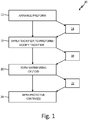
- FIG. 1 is a flow diagram illustrating selected steps of method 10, used to produce an enhanced CMC.
- FIG. 2 illustrates a tackifier used to produce the enhanced CMC.
- FIG. 3 is a simplified cross-section showing a preform as an arrangement of fiber plies to which a silicon carbide or other ceramic matrix can be applied.
- a plurality of fiber plies 34 (shown in FIG. 3 ) are arranged in a desired manner, such as in a stacked arrangement.
- Plies 34 can be formed from woven and/or non-woven ceramic fibers or tows, which in an exemplary embodiment, can be formed from silicon carbide. Other suitable ceramics are contemplated herein.
- Plies 34 can further be formed from unidirectional and/or multidirectional (including randomly oriented) fibers.
- plies 34 are generally uniform in their design, however, alternative embodiments can include any combination of woven and/or non-woven plies 34, as well as any combination of fiber orientations.
- tackifier 26 is applied to plies 34.
- tackifier 26 includes resin 28, carrier solvent 30, and inorganic filler particles 32.
- Resin 28 can include a polymer-based material, such as polyvinyl-alcohol, polyvinyl-styrene, and polyacrylate, to name a few, non-limiting examples.
- Carrier solvent 30 can be an organic or inorganic solvent such as water, acetone, ethanol, isopropanol, toluene, or any compound suitable for dissolving resin 28.
- Filler particles 32 can be, in one embodiment, formed from a stable ceramic material, such as silicon carbide, boron carbide, silicon nitride, silicon e.g.
- filler particles 32 can be formed from a preceramic polymer, such as polycarbosilane, polycarbosiloxane, polycarbosilazane, or polycarbodiimides, which e.g. pyrolyze to form a silicon-based ceramic.
- a preceramic polymer such as polycarbosilane, polycarbosiloxane, polycarbosilazane, or polycarbodiimides, which e.g. pyrolyze to form a silicon-based ceramic.
- Other suitable organosilicon compounds are contemplated herein.
- filler particles 32 can include preceramic polymers which decompose to form non-silicon ceramics (e.g. zirconium carbide, hafnium carbide, etc.).
- Filler particles 32 are intended to infiltrate plies 34, and more specifically, the open spaces/pores 36 of plies 34. Accordingly, particle dimensions can be tailored to a specific application.
- the width of filler particles 32 can range from 0.1 micrometer to 500 micrometers, depending on, for example, the size of pores 36 needing to be filled.
- Filler particles 32 can be spherical particles having an aspect ratio (ratio of particle width to length) of 1.
- Filler particles 32 can also be elongated particles, such as chopped fibers, having aspect ratios ranging from greater than 1 to 10. In some embodiments, the aspect ratio can be as great as 100.
- Tackifier 26 can include filler particles 32 having roughly uniform sizes/dimensions, or it can include filler particles 32 having varied sizes/dimensions, based on factors such as the porosity of the individual plies 34, and the arrangement of plies 34 with respect to one another.
- a mixed tackifier 26 (having more than one type of filler particle 32) can be advantageous in certain embodiments where spherical particles 32 are better suited to fill intra-ply pores 36, while elongated particles 32 are better suited to fill inter-ply gaps.
- tackifier 26 can be painted or sprayed onto plies 34 as a mixture of each of resin 28, carrier solvent 30, and filler particles 32.
- a suitable spraying technique can be, for example, a slurry coating technique.
- the mixture can also be formed as a film adhesive and applied to plies 34.
- a mixture of resin 28 and carrier solvent 30 can be prepared and applied to plies 34 as described above, while filler particles 32 are subsequently applied over the wet film or mixture.
- a dip-coating application technique is also contemplated herein. In most cases, plies 34 require only a single application of tackifier 26, however, multiple applications of tackifier 26 can be carried out if necessary.
- Step 16 further includes modifying tackifier 26 after it is applied to plies 34, such that filler particles 32 remain associated with plies 34.
- the modification step can include a thermal and/or chemical decomposition technique, such as pyrolysis, dissolution, or calcination.
- pyrolysis can be used to burn off resin 28 and carrier solvent 30 to leave behind the ceramic particles.
- preceramic polymer filler particles 32 pyrolysis can be used to burn off resin 28 and carrier solvent 30, and also to decompose the preceramic polymer to a ceramic material.
- FIG. 3 illustrates plies 34 after the modification step with filler particles 32 remaining attached to fiber tows 38 and in pores 36 of plies 34.
- alternative modification techniques can be used without departing from the scope of the present invention. Such techniques can include one or a combination of crosslinking, heating, drying, exposure to radiation, applying a vacuum, and more.
- plies 34 undergo matrix formation and densification using a chemical vapor infiltration or deposition (CVI or CVD) process.
- Plies 34 are infiltrated by reactant vapors, and a gaseous precursor deposits on the fiber tows 38 and filler particles 32.
- Filler particles 32 disposed along all surfaces of the fiber tows 38 and within pores 36, act as nucleation sites for the gaseous precursor, thus allowing for a more uniform distribution of a matrix within plies 34.
- Vapor infiltration is carried out until the resulting CMC has reached the desired residual porosity.
- CMCs formed using method 10 can have a residual porosity below 10%, and in some embodiments, as low as 3-5%.
- additional coatings can be applied to the CMC.
- one or more protective coatings such as an environmental and/or thermal barrier coatings, can be applied.
- a bond coat can also be applied to facilitate bonding between the CMC and protective coating.
- Other protective coatings especially those suitable for use in a gas turbine engine environment, are contemplated herein.
- Method 10 further includes optional, intermediate steps 14, 18, and 22, which can be performed variously between steps 12, 16, 20, and 24.
- step 14 can be a fiber coating step during which an interface coating is applied to fiber plies 34 using chemical vapor infiltration.
- Step 14 can additionally or alternatively include a preforming/shaping step, as well as an initial round of matrix formation and densification using chemical vapor infiltration.
- step 18 can be any of preforming, interface coating, secondary matrix formation, or machining. Machining can additionally or alternatively be performed at step 22.
- the use and order of intermediate steps 14, 18, and 22 depends on a number of factors, such as operating environment, component dimensions, cost, and labor availability.
- the method and tackifier can also be used on three-dimensional fiber structures.
- Such three-dimensional structures can be formed from woven, braided, needled, or stitched fibers, loosely-associated chopped fibers, and chopped-fiber or continuous-strand mats, to name a few, non-limiting examples.
- Three-dimensional structures can further be formed by joining together a plurality of individual three-dimensional structures of any combination, or any combination of one, two, and three-dimensional fiber structures.
- the disclosed method produces CMCs with reduced porosity over CMCs produced using other methods. These enhanced CMCs have improved mechanical and thermal properties ideal for harsh operating environments like the hot section of a gas turbine engine.
- Other aerospace applications include exhaust systems, ducting, and external systems.
- the disclosed method can also be used to produce enhanced CMCs for maritime, power generation, and industrial applications.
- a method of producing a ceramic matrix composite includes applying a tackifier compound to a fiber preform.
- the tackifier compound includes inorganic filler particles.
- the method further includes modifying the tackifier compound such that the inorganic filler particles remain interspersed throughout the fiber preform, and occupy pores of the fiber preform.
- the method of the preceding paragraph can optionally include, additionally and/or alternatively, any one or more of the following features, configurations and/or additional components:
- the method can further include coating the fiber preform with an interface coating using a chemical vapor infiltration or chemical vapor deposition process.
- Any of the above methods can further include forming a matrix surrounding the fiber preform using a chemical vapor infiltration or chemical vapor deposition process.
- Any of the above methods can further include applying a thermal barrier coating or an environmental barrier coating to the ceramic matrix composite.
- the tackifier compound can further include a solvent and a resin.
- the solvent can include water, acetone, ethanol, isopropanol, or toluene.
- the resin can include polyvinyl-alcohol, polyvinyl-styrene, or polyacrylate.
- applying the tackifier compound can include a technique selected from the group consisting of spraying, painting, filming, dip-coating, and combinations thereof.
- the inorganic filler particles can include a ceramic material or a preceramic polymer.
- the ceramic material can be formed from a material selected from the group consisting of silicon carbide, silicon nitride, silicon e.g. pure silicon, boron carbide, carbon e.g. pure carbon, aluminum oxide, hafnia, and combinations thereof.
- the preceramic polymer can be formed from a material selected from the group consisting of polycarbosilane, polycarbosiloxane, polycarbosilazane, polycarbodiimides, and combinations thereof.
- modifying the tackifier compound can include a thermochemical decomposition technique or a crosslinking technique.
- a ceramic matrix composite (e.g. one produced by the methods herein described), e.g. an enhanced ceramic matrix composite, includes a fiber preform interspersed with inorganic filler particles, and a matrix formed over the fiber preform and the inorganic filler particles.
- the ceramic matrix composite has a porosity of less than 6%.
- the inorganic filler particles can include spherical particles, chopped fibers, and combinations thereof.
- the inorganic filler particles can be a ceramic material.
- the ceramic e.g. the ceramic material
- the ceramic material can be formed from a material selected from the group consisting of silicon carbide, silicon nitride, silicon e.g. pure silicon, boron carbide, carbon e.g. pure carbon, aluminum oxide, hafnia, and combinations thereof.
- the ceramic e.g. the ceramic material
- the ceramic material can be formed from a preceramic polymer, e.g. a decomposed preceramic polymer, and the preceramic polymer can be formed from a material selected from the group consisting of polycarbosilane, polycarbosiloxane, polycarbosilazane, polycarbodiimides, and combinations thereof.
- the inorganic filler particles can include spherical particles, elongated particles, and combinations thereof.
- a diameter of the inorganic filler particles can range from 0.1 micrometer to 500 micrometers.
- an aspect ratio of the inorganic filler particles can range from 1 to 100.
Landscapes
- Chemical & Material Sciences (AREA)
- Engineering & Computer Science (AREA)
- Ceramic Engineering (AREA)
- Manufacturing & Machinery (AREA)
- Materials Engineering (AREA)
- Structural Engineering (AREA)
- Organic Chemistry (AREA)
- Inorganic Chemistry (AREA)
- Chemical Kinetics & Catalysis (AREA)
- Ceramic Products (AREA)
- Turbine Rotor Nozzle Sealing (AREA)
Abstract
Description
- The present invention relates to the fabrication of ceramic matrix composites and more particularly, to a ceramic matrix composite having improved properties for operating in gas turbine engines.
- Ceramic matrix composites may be fabricated using a chemical vapor infiltration process, in which a matrix is deposited on a fiber preform. Deposition occurs more easily on fiber surfaces rather than in open spaces between fibers. Thus, the open spaces remain in the resulting composite structure, which can negatively impact strength and thermal conductivity.
- A method of producing a ceramic matrix composite, e.g, an enhanced ceramic matrix composite, e.g. as disclosed herein, includes applying a tackifier compound to a fiber preform. The tackifier compound includes inorganic filler particles. The method further includes modifying, e.g. by heating, the tackifier compound such that the inorganic filler particles remain interspersed throughout the fiber preform, and occupy pores of the fiber preform.
- A ceramic matrix composite, e.g. an enhanced ceramic matrix composite, e.g. as produced by the method disclosed herein, includes a fiber preform interspersed with inorganic filler particles, and a matrix formed over the fiber preform and the inorganic filler particles. The ceramic matrix composite has a porosity of less than 6%.
-
-
FIG. 1 is a flow chart illustrating a method of forming an enhanced ceramic matrix composite using a tackifier. -
FIG. 2 illustrates the composition of the tackifier. -
FIG. 3 is a simplified cross-section of an arrangement of fiber plies interspersed with inorganic filler particles. - A method of forming a ceramic matrix composite (hereinafter "CMC") having improved mechanical and thermal properties is disclosed herein. The method includes applying a tackifier compound to a fiber preform made up of one or more fiber plies or other subcomponents. The tackifier compound includes inorganic filler particles that, after a modification step, remain interspersed throughout the structure. The preform can be subjected to subsequent processing steps, such as infiltration with reactant vapors to form a matrix. The inorganic filler particles serve as nucleation sites for the vaporous deposits, thus forming a more uniform matrix with increased resistance to environmental degradation.
-
FIG. 1 is a flow diagram illustrating selected steps ofmethod 10, used to produce an enhanced CMC.FIG. 2 illustrates a tackifier used to produce the enhanced CMC.FIG. 3 is a simplified cross-section showing a preform as an arrangement of fiber plies to which a silicon carbide or other ceramic matrix can be applied. Atstep 12, a plurality of fiber plies 34 (shown inFIG. 3 ) are arranged in a desired manner, such as in a stacked arrangement.Plies 34 can be formed from woven and/or non-woven ceramic fibers or tows, which in an exemplary embodiment, can be formed from silicon carbide. Other suitable ceramics are contemplated herein.Plies 34 can further be formed from unidirectional and/or multidirectional (including randomly oriented) fibers. In the embodiment shown inFIG. 3 ,plies 34 are generally uniform in their design, however, alternative embodiments can include any combination of woven and/or non-wovenplies 34, as well as any combination of fiber orientations. - At
step 16,tackifier 26 is applied toplies 34. As is shown inFIG. 2 ,tackifier 26 includesresin 28,carrier solvent 30, andinorganic filler particles 32.Resin 28 can include a polymer-based material, such as polyvinyl-alcohol, polyvinyl-styrene, and polyacrylate, to name a few, non-limiting examples.Carrier solvent 30 can be an organic or inorganic solvent such as water, acetone, ethanol, isopropanol, toluene, or any compound suitable for dissolvingresin 28.Filler particles 32 can be, in one embodiment, formed from a stable ceramic material, such as silicon carbide, boron carbide, silicon nitride, silicon e.g. pure silicon, carbon e.g. pure carbon, aluminum oxide, or hafnia. In another embodiment,filler particles 32 can be formed from a preceramic polymer, such as polycarbosilane, polycarbosiloxane, polycarbosilazane, or polycarbodiimides, which e.g. pyrolyze to form a silicon-based ceramic. Other suitable organosilicon compounds are contemplated herein. In yet another embodiment,filler particles 32 can include preceramic polymers which decompose to form non-silicon ceramics (e.g. zirconium carbide, hafnium carbide, etc.). -
Filler particles 32 are intended to infiltrateplies 34, and more specifically, the open spaces/pores 36 ofplies 34. Accordingly, particle dimensions can be tailored to a specific application. The width offiller particles 32 can range from 0.1 micrometer to 500 micrometers, depending on, for example, the size ofpores 36 needing to be filled.Filler particles 32 can be spherical particles having an aspect ratio (ratio of particle width to length) of 1.Filler particles 32 can also be elongated particles, such as chopped fibers, having aspect ratios ranging from greater than 1 to 10. In some embodiments, the aspect ratio can be as great as 100.Tackifier 26 can includefiller particles 32 having roughly uniform sizes/dimensions, or it can includefiller particles 32 having varied sizes/dimensions, based on factors such as the porosity of theindividual plies 34, and the arrangement ofplies 34 with respect to one another. For example, a mixed tackifier 26 (having more than one type of filler particle 32) can be advantageous in certain embodiments wherespherical particles 32 are better suited to fillintra-ply pores 36, whileelongated particles 32 are better suited to fill inter-ply gaps. - There are a number of ways to apply
tackifier 26 to plies 34. For example,tackifier 26 can be painted or sprayed ontoplies 34 as a mixture of each ofresin 28,carrier solvent 30, andfiller particles 32. A suitable spraying technique can be, for example, a slurry coating technique. The mixture can also be formed as a film adhesive and applied toplies 34. Alternatively, a mixture ofresin 28 andcarrier solvent 30 can be prepared and applied toplies 34 as described above, whilefiller particles 32 are subsequently applied over the wet film or mixture. A dip-coating application technique is also contemplated herein. In most cases,plies 34 require only a single application oftackifier 26, however, multiple applications oftackifier 26 can be carried out if necessary. -
Step 16 further includes modifyingtackifier 26 after it is applied toplies 34, such thatfiller particles 32 remain associated withplies 34. The modification step can include a thermal and/or chemical decomposition technique, such as pyrolysis, dissolution, or calcination. For example, in embodiments havingceramic filler particles 32, pyrolysis can be used to burn offresin 28 andcarrier solvent 30 to leave behind the ceramic particles. In embodiments having preceramicpolymer filler particles 32, pyrolysis can be used to burn offresin 28 andcarrier solvent 30, and also to decompose the preceramic polymer to a ceramic material.FIG. 3 illustratesplies 34 after the modification step withfiller particles 32 remaining attached tofiber tows 38 and inpores 36 ofplies 34. It is further envisioned that depending on the composition oftackifier 26, alternative modification techniques can be used without departing from the scope of the present invention. Such techniques can include one or a combination of crosslinking, heating, drying, exposure to radiation, applying a vacuum, and more. - At
step 20, plies 34 undergo matrix formation and densification using a chemical vapor infiltration or deposition (CVI or CVD) process.Plies 34 are infiltrated by reactant vapors, and a gaseous precursor deposits on thefiber tows 38 andfiller particles 32.Filler particles 32, disposed along all surfaces of thefiber tows 38 and withinpores 36, act as nucleation sites for the gaseous precursor, thus allowing for a more uniform distribution of a matrix withinplies 34. Vapor infiltration is carried out until the resulting CMC has reached the desired residual porosity. CMCs formed usingmethod 10 can have a residual porosity below 10%, and in some embodiments, as low as 3-5%. - At
step 24, additional coatings can be applied to the CMC. For example, one or more protective coatings, such as an environmental and/or thermal barrier coatings, can be applied. A bond coat can also be applied to facilitate bonding between the CMC and protective coating. Other protective coatings, especially those suitable for use in a gas turbine engine environment, are contemplated herein. -
Method 10 further includes optional,intermediate steps steps Step 14 can additionally or alternatively include a preforming/shaping step, as well as an initial round of matrix formation and densification using chemical vapor infiltration. Depending on the process performed atstep 14,step 18 can be any of preforming, interface coating, secondary matrix formation, or machining. Machining can additionally or alternatively be performed at step 22. The use and order ofintermediate steps - While the disclosed method and tackifier have been described for use with fiber plies 34 as the fiber preform structure, it should be understood that the method and tackifier can also be used on three-dimensional fiber structures. Such three-dimensional structures can be formed from woven, braided, needled, or stitched fibers, loosely-associated chopped fibers, and chopped-fiber or continuous-strand mats, to name a few, non-limiting examples. Three-dimensional structures can further be formed by joining together a plurality of individual three-dimensional structures of any combination, or any combination of one, two, and three-dimensional fiber structures.
- The disclosed method produces CMCs with reduced porosity over CMCs produced using other methods. These enhanced CMCs have improved mechanical and thermal properties ideal for harsh operating environments like the hot section of a gas turbine engine. Other aerospace applications include exhaust systems, ducting, and external systems. The disclosed method can also be used to produce enhanced CMCs for maritime, power generation, and industrial applications.
- The following are non-exclusive descriptions of possible embodiments of the present invention.
- A method of producing a ceramic matrix composite (e.g. as herein described), e.g. an enhanced ceramic matrix composite, includes applying a tackifier compound to a fiber preform. The tackifier compound includes inorganic filler particles. The method further includes modifying the tackifier compound such that the inorganic filler particles remain interspersed throughout the fiber preform, and occupy pores of the fiber preform.
- The method of the preceding paragraph can optionally include, additionally and/or alternatively, any one or more of the following features, configurations and/or additional components:
- The method can further include coating the fiber preform with an interface coating using a chemical vapor infiltration or chemical vapor deposition process.
- Any of the above methods can further include forming a matrix surrounding the fiber preform using a chemical vapor infiltration or chemical vapor deposition process.
- Any of the above methods can further include applying a thermal barrier coating or an environmental barrier coating to the ceramic matrix composite.
- In any of the above methods, the tackifier compound can further include a solvent and a resin.
- In any of the above methods, the solvent can include water, acetone, ethanol, isopropanol, or toluene.
- In any of the above methods, the resin can include polyvinyl-alcohol, polyvinyl-styrene, or polyacrylate.
- In any of the above methods, applying the tackifier compound can include a technique selected from the group consisting of spraying, painting, filming, dip-coating, and combinations thereof.
- In any of the above methods, the inorganic filler particles can include a ceramic material or a preceramic polymer.
- In any of the above methods, the ceramic material can be formed from a material selected from the group consisting of silicon carbide, silicon nitride, silicon e.g. pure silicon, boron carbide, carbon e.g. pure carbon, aluminum oxide, hafnia, and combinations thereof.
- In any of the above methods, the preceramic polymer can be formed from a material selected from the group consisting of polycarbosilane, polycarbosiloxane, polycarbosilazane, polycarbodiimides, and combinations thereof.
- In any of the above methods, modifying the tackifier compound can include a thermochemical decomposition technique or a crosslinking technique.
- A ceramic matrix composite (e.g. one produced by the methods herein described), e.g. an enhanced ceramic matrix composite, includes a fiber preform interspersed with inorganic filler particles, and a matrix formed over the fiber preform and the inorganic filler particles. The ceramic matrix composite has a porosity of less than 6%.
- In the above composite, the inorganic filler particles can include spherical particles, chopped fibers, and combinations thereof.
- In any of the above composites, the inorganic filler particles can be a ceramic material.
- In any of the above composites, the ceramic, e.g. the ceramic material, can be formed from a material selected from the group consisting of silicon carbide, silicon nitride, silicon e.g. pure silicon, boron carbide, carbon e.g. pure carbon, aluminum oxide, hafnia, and combinations thereof.
- In any of the above composites, the ceramic, e.g. the ceramic material, can be formed from a preceramic polymer, e.g. a decomposed preceramic polymer, and the preceramic polymer can be formed from a material selected from the group consisting of polycarbosilane, polycarbosiloxane, polycarbosilazane, polycarbodiimides, and combinations thereof.
- In any of the above composites, the inorganic filler particles can include spherical particles, elongated particles, and combinations thereof.
- In any of the above composites, a diameter of the inorganic filler particles can range from 0.1 micrometer to 500 micrometers.
- In any of the above composites, an aspect ratio of the inorganic filler particles can range from 1 to 100.
- While the invention has been described with reference to an exemplary embodiment(s), it will be understood by those skilled in the art that various changes may be made and equivalents may be substituted for elements thereof without departing from the scope of the invention. In addition, many modifications may be made to adapt a particular situation or material to the teachings of the invention without departing from the essential scope thereof. Therefore, it is intended that the invention not be limited to the particular embodiment(s) disclosed, but that the invention will include all embodiments falling within the scope of the appended claims.
- Certain embodiments of the present disclosure are as follows:
- 1. A method of producing an enhanced ceramic matrix composite, the method comprising:
- applying a tackifier compound to a fiber preform, the tackifier compound comprising inorganic filler particles; and
- modifying the tackifier compound such that the inorganic filler particles remain interspersed throughout the fiber preform and occupy pores of the fiber preform.
- 2. The method of embodiment 1 and further comprising: coating the fiber preform with an interface coating using a chemical vapor infiltration or chemical vapor deposition process.
- 3. The method of embodiment 1 and further comprising: forming a matrix surrounding the fiber preform using a chemical vapor infiltration or chemical vapor deposition process.
- 4. The method of embodiment 3 and further comprising: applying a thermal barrier coating or an environmental barrier coating to the ceramic matrix composite.
- 5. The method of embodiment 1, wherein the tackifier compound further comprises a solvent and a resin.
- 6. The method of embodiment 5, wherein the solvent comprises water, acetone, ethanol, isopropanol, or toluene.
- 7. The method of embodiment 5, wherein the resin comprises polyvinyl-alcohol, polyvinyl-styrene, or polyacrylate.
- 8. The method of embodiment 5, wherein applying the tackifier compound comprises a technique selected from the group consisting of spraying, painting, filming, dip-coating, and combinations thereof.
- 9. The method of embodiment 1, wherein the inorganic filler particles comprise a ceramic material or a preceramic polymer.
- 10. The method of embodiment 9, wherein the ceramic material is formed from a material selected from the group consisting of silicon carbide, silicon nitride, pure silicon, boron carbide, pure carbon, aluminum oxide, hafnia, and combinations thereof.
- 11. The method of embodiment 9, wherein the preceramic polymer is formed from a material selected from the group consisting of polycarbosilane, polycarbosiloxane, polycarbosilazane, polycarbodiimides, and combinations thereof.
- 12. The method of embodiment 11, wherein modifying the tackifier compound comprises a thermochemical decomposition technique or a crosslinking technique.
- 13. An enhanced ceramic matrix composite comprising:
- a fiber preform interspersed with inorganic filler particles; and
- a matrix formed over the fiber preform and the inorganic filler particles;
- wherein the ceramic matrix composite has a porosity of less than 6%.
- 14. The ceramic matrix composite of embodiment 13, wherein the inorganic filler particles comprise spherical particles, chopped fibers, and combinations thereof.
- 15. The ceramic matric composite of embodiment 13, wherein the inorganic filler particles comprise a ceramic material.
- 16. The ceramic matrix composite of embodiment 15, wherein the ceramic is formed from a material selected from the group consisting of silicon carbide, silicon nitride, pure silicon, boron carbide, pure carbon, aluminum oxide, hafnia, and combinations thereof.
- 17. The ceramic matrix composite of embodiment 15, wherein the ceramic is formed from a decomposed preceramic polymer, the preceramic polymer being formed from a material selected from the group consisting of polycarbosilane, polycarbosiloxane, polycarbosilazane, polycarbodiimides, and combinations thereof.
- 18. The ceramic matrix composite of embodiment 13, wherein the inorganic filler particles comprises spherical particles, elongated particles, and combinations thereof.
- 19. The ceramic matrix composite of
embodiment 18, wherein a diameter of the inorganic filler particles ranges from 0.1 micrometer to 500 micrometers. - 20. The ceramic matrix composite of
embodiment 18, wherein an aspect ratio of the inorganic filler particles ranges from 1 to 100.
Claims (15)
- A method of producing a ceramic matrix composite, the method comprising:applying a tackifier compound to a fiber preform, the tackifier compound comprising inorganic filler particles; andmodifying the tackifier compound such that the inorganic filler particles remain interspersed throughout the fiber preform and occupy pores of the fiber preform.
- The method of claim 1 and further comprising: coating the fiber preform with an interface coating using a chemical vapor infiltration or chemical vapor deposition process.
- The method of claim 1 or claim 2 and further comprising: forming a matrix surrounding the fiber preform using a chemical vapor infiltration or chemical vapor deposition process.
- The method of any one of claims 1-3 and further comprising: applying a thermal barrier coating or an environmental barrier coating to the ceramic matrix composite.
- The method of any one of claims 1-4, wherein the tackifier compound further comprises a solvent and a resin, preferably wherein the solvent comprises water, acetone, ethanol, isopropanol, or toluene, and/or wherein the resin comprises polyvinyl-alcohol, polyvinyl-styrene, or polyacrylate.
- The method of any one of claims 1-5, wherein applying the tackifier compound comprises a technique selected from the group consisting of spraying, painting, filming, dip-coating, and combinations thereof.
- The method of any one of claims 1-6, wherein the inorganic filler particles comprise a ceramic material or a preceramic polymer, preferably wherein the ceramic material is formed from a material selected from the group consisting of silicon carbide, silicon nitride, pure silicon, boron carbide, pure carbon, aluminum oxide, hafnia, and combinations thereof, or wherein the preceramic polymer is formed from a material selected from the group consisting of polycarbosilane, polycarbosiloxane, polycarbosilazane, polycarbodiimides, and combinations thereof.
- The method of any one of claims 1-7, wherein modifying the tackifier compound comprises a thermochemical decomposition technique or a crosslinking technique.
- A ceramic matrix composite comprising:a fiber preform interspersed with inorganic filler particles; anda matrix formed over the fiber preform and the inorganic filler particles;wherein the ceramic matrix composite has a porosity of less than 6%.
- The ceramic matrix composite of claim 9, wherein the inorganic filler particles comprise spherical particles, chopped fibers, and combinations thereof.
- The ceramic matrix composite of claim 9 or claim 10, wherein the inorganic filler particles comprise a ceramic material.
- The ceramic matrix composite of claim 11, wherein the ceramic material is formed from a material selected from the group consisting of silicon carbide, silicon nitride, pure silicon, boron carbide, pure carbon, aluminum oxide, hafnia, and combinations thereof, or wherein the ceramic material is formed from a decomposed preceramic polymer, the preceramic polymer being formed from a material selected from the group consisting of polycarbosilane, polycarbosiloxane, polycarbosilazane, polycarbodiimides, and combinations thereof.
- The ceramic matrix composite of any one of claims 9-12, wherein the inorganic filler particles comprises spherical particles, elongated particles, and combinations thereof.
- The ceramic matrix composite of any one of claims 9-13, wherein a diameter of the inorganic filler particles ranges from 0.1 micrometer to 500 micrometers.
- The ceramic matrix composite of any one of claims 9-14, wherein an aspect ratio of the inorganic filler particles ranges from 1 to 100.
Applications Claiming Priority (1)
| Application Number | Priority Date | Filing Date | Title |
|---|---|---|---|
| US15/823,016 US10829418B2 (en) | 2017-11-27 | 2017-11-27 | Method of densifying a ceramic matrix composite using a filled tackifier |
Publications (1)
| Publication Number | Publication Date |
|---|---|
| EP3492440A1 true EP3492440A1 (en) | 2019-06-05 |
Family
ID=64402057
Family Applications (1)
| Application Number | Title | Priority Date | Filing Date |
|---|---|---|---|
| EP18207213.2A Pending EP3492440A1 (en) | 2017-11-27 | 2018-11-20 | Method of densifying a ceramic matrix composite using a filled tackifier |
Country Status (2)
| Country | Link |
|---|---|
| US (1) | US10829418B2 (en) |
| EP (1) | EP3492440A1 (en) |
Families Citing this family (6)
| Publication number | Priority date | Publication date | Assignee | Title |
|---|---|---|---|---|
| US10829419B2 (en) * | 2017-11-27 | 2020-11-10 | United Technologies Corporation | Method of densifying a ceramic matrix composite using a filled tackifier |
| US11820717B2 (en) | 2021-08-30 | 2023-11-21 | Rtx Corporation | PVB-based sacrificial tackifier for CMC |
| US11858861B2 (en) * | 2021-08-30 | 2024-01-02 | Rtx Corporation | Localized PVB based tackifier application for CMC |
| US12540102B2 (en) | 2021-11-05 | 2026-02-03 | Rtx Corporation | 3D woven space filler |
| US12312724B2 (en) | 2021-12-20 | 2025-05-27 | Rtx Corporation | Gradient tow ribbonizing for chemical vapor infiltration ceramic matrix composites |
| US12017379B2 (en) | 2021-12-20 | 2024-06-25 | Rtx Corporation | Ribbonized tows for optimized improved composite performance |
Citations (3)
| Publication number | Priority date | Publication date | Assignee | Title |
|---|---|---|---|---|
| US20110124256A1 (en) * | 2009-11-25 | 2011-05-26 | John Riehl | Tackifier composition |
| US20110200748A1 (en) * | 2008-09-29 | 2011-08-18 | Snecma Propulsion Solide | Method for producing parts made of a thermostructural composite material |
| US20150008613A1 (en) * | 2011-11-30 | 2015-01-08 | Herakles | Method of fabricating a part out of cmc material |
Family Cites Families (8)
| Publication number | Priority date | Publication date | Assignee | Title |
|---|---|---|---|---|
| CA2175433A1 (en) * | 1995-05-11 | 1996-11-12 | Gregg Alan Zank | Ceramic matrix composites using modified hydrogen silsesquioxane resin |
| GB201006625D0 (en) * | 2010-04-21 | 2010-06-02 | Rolls Royce Plc | A method of manufacturing a ceramic matrix composite article |
| FR3004712B1 (en) | 2013-04-19 | 2015-05-08 | Herakles | PROCESS FOR MANUFACTURING COMPOSITE MATERIAL WITH CARBIDE MATRIX |
| US10087111B2 (en) * | 2013-09-17 | 2018-10-02 | United Technologies Corporation | Method for prepregging tackifier for CMC articles |
| US11072565B2 (en) | 2015-02-27 | 2021-07-27 | General Electric Company | Ceramic matrix composite structures with controlled microstructures fabricated using chemical vapor infiltration (CVI) |
| US10227264B2 (en) * | 2015-07-13 | 2019-03-12 | Rolls-Royce High Temperature Composites, Inc. | Method for making ceramic matrix composite articles |
| US10086544B2 (en) | 2015-10-09 | 2018-10-02 | United Technologies Corporation | Laminate resin transfer molding of fibrous preforms using particle filled resin systems |
| CN106218061B (en) | 2016-07-26 | 2018-02-09 | 中国人民解放军国防科学技术大学 | A kind of double-decker ceramic matric composite and preparation method thereof |
-
2017
- 2017-11-27 US US15/823,016 patent/US10829418B2/en active Active
-
2018
- 2018-11-20 EP EP18207213.2A patent/EP3492440A1/en active Pending
Patent Citations (3)
| Publication number | Priority date | Publication date | Assignee | Title |
|---|---|---|---|---|
| US20110200748A1 (en) * | 2008-09-29 | 2011-08-18 | Snecma Propulsion Solide | Method for producing parts made of a thermostructural composite material |
| US20110124256A1 (en) * | 2009-11-25 | 2011-05-26 | John Riehl | Tackifier composition |
| US20150008613A1 (en) * | 2011-11-30 | 2015-01-08 | Herakles | Method of fabricating a part out of cmc material |
Also Published As
| Publication number | Publication date |
|---|---|
| US20190161413A1 (en) | 2019-05-30 |
| US10829418B2 (en) | 2020-11-10 |
Similar Documents
| Publication | Publication Date | Title |
|---|---|---|
| US10829418B2 (en) | Method of densifying a ceramic matrix composite using a filled tackifier | |
| US10829419B2 (en) | Method of densifying a ceramic matrix composite using a filled tackifier | |
| CN112694341B (en) | Ceramic matrix composites having unimodal pore size distribution and low fiber volume fraction | |
| EP2857193B1 (en) | Ceramic matrix composite component coated with environmental barrier coatings and method of manufacturing the same | |
| US6342269B1 (en) | Method for manufacturing ceramic-based composite material | |
| CN104010992A (en) | Process of producing ceramic matrix composites and ceramic matrix composites formed thereby | |
| JP2018177635A (en) | Method of treating ceramic matrix composite (CMC) with protective ceramic coating | |
| US20140272373A1 (en) | Ceramic matrix composite and method and article of manufacture | |
| US12540105B2 (en) | High temperature coatings | |
| US20100179045A1 (en) | Methods and apparatus relating to a composite material | |
| US20150291473A1 (en) | Energy preparation of ceramic fiber for coating | |
| US20210245490A1 (en) | Nanofiber interlaminar layer for ceramic matrix composites | |
| RU2754893C2 (en) | Part containing substrate and external barrier | |
| US6121169A (en) | Porous interfacial coating for fiber reinforced ceramic matrix composites | |
| US20250289765A1 (en) | Cvd functionalized particles for cmc applications | |
| US11702369B2 (en) | Method of fabricating a ceramic composite | |
| US20240051884A1 (en) | Method for coating a ceramic matrix composite part with an environmental barrier | |
| EP4197987A2 (en) | Pva based binder application for cmcs | |
| EP4201915A1 (en) | Introduction of metallic particles to enable formation of metallic carbides in a matrix | |
| US11267763B2 (en) | Rapid processing of laminar composite components | |
| US12545629B1 (en) | Functional tailoring of oxidation protection systems of carbon-carbon composites |
Legal Events
| Date | Code | Title | Description |
|---|---|---|---|
| PUAI | Public reference made under article 153(3) epc to a published international application that has entered the european phase |
Free format text: ORIGINAL CODE: 0009012 |
|
| STAA | Information on the status of an ep patent application or granted ep patent |
Free format text: STATUS: THE APPLICATION HAS BEEN PUBLISHED |
|
| AK | Designated contracting states |
Kind code of ref document: A1 Designated state(s): AL AT BE BG CH CY CZ DE DK EE ES FI FR GB GR HR HU IE IS IT LI LT LU LV MC MK MT NL NO PL PT RO RS SE SI SK SM TR |
|
| AX | Request for extension of the european patent |
Extension state: BA ME |
|
| STAA | Information on the status of an ep patent application or granted ep patent |
Free format text: STATUS: REQUEST FOR EXAMINATION WAS MADE |
|
| 17P | Request for examination filed |
Effective date: 20191129 |
|
| RBV | Designated contracting states (corrected) |
Designated state(s): AL AT BE BG CH CY CZ DE DK EE ES FI FR GB GR HR HU IE IS IT LI LT LU LV MC MK MT NL NO PL PT RO RS SE SI SK SM TR |
|
| RAP1 | Party data changed (applicant data changed or rights of an application transferred) |
Owner name: RAYTHEON TECHNOLOGIES CORPORATION |
|
| STAA | Information on the status of an ep patent application or granted ep patent |
Free format text: STATUS: EXAMINATION IS IN PROGRESS |
|
| 17Q | First examination report despatched |
Effective date: 20210507 |
|
| RAP3 | Party data changed (applicant data changed or rights of an application transferred) |
Owner name: RTX CORPORATION |